World Food Books' programme is largely produced on Kulin Nation land. We acknowledge the Wurundjeri people of the Kulin Nation as the first and continuing custodians of this land, and pay respect to their Elders past, present, and emerging.
World Food Books is an arts and special interests bookshop in Naarm / Melbourne. Founded in 2010, World Food Books is devoted to the presentation of a rotating, hand-selection of international art, design, literary and counterculture publications with an emphasis on the anti-traditional, the experimental, the avant-garde, the heretic, the marginal.
Presenting new titles alongside rare and out-of-print books, catalogues and journals spanning the fields of modern and contemporary art, design, photography, illustration, film, literature, poetry, cultural theory, philosophy, sexuality, popular and underground culture in its many radical forms, World Food Books wishes to encourage adventurous, thoughtful and open-minded reading, looking, writing, and exchange of publishing and ideas, both current and historical.
As well as our bookshop, located in Melbourne's historical Nicholas Building, all of our inventory is available internationally via our online mail-order service.
World Food Books semi-regularly co-ordinates "Occasions", a programme of exhibits and events at the bookshop and in partnership with other hosts (such as museums and art galleries) that develop out of the activities, relationships and content of the bookshop itself.
World Food Books
The Nicholas Building
37 Swanston Street
Room 5, Level 6
Melbourne 3000
Australia
SHOP HOURS:
Thu–Fri 12–6, Sat 12–5
WEB-SHOP OPEN 24/7
World Food Books
Postal Address:
PO Box 435
Flinders Lane
Victoria 8009
Australia
Art
Theory / Essay
Architecture / Interior
Graphic Design / Typography
Photography
Fashion
Eros
LGBTQ+
Fiction / Poetry
Weird / Speculative / Science Fiction / Horror
Transgressive / Visceral / Abject
Symbolism / Decadence / Fin de siècle
Film / Video
Painting
Sculpture / Installation
Performance / Dance / Theater
Drawing
Sound / Music
Curatorial
Group Shows / Collections
Periodicals
Out-of-print / Rare
Posters / Ephemera / Discs
Signed Books
World Food Books Gift Voucher
World Food Book Bag
Australian Art
Australian Fiction
Australian Science Fiction / Speculative Fiction
Australian Poetry
Australian Photography
Japanese Photography
Conceptual Art
Minimal Art
Dada
'Pataphysics / Oulipo
Fluxus
Concrete Poetry
Pop Art
Surrealism
Arte Povera
Arte Informale / Haute Pâte / Tachism
Nouveau Réalisme / Zero / Kinetic
Situationism / Lettrism
Collage / Mail Art / Xerox Art
Art Brut / Folk / Visionary / Fantastic
Illustration / Graphic Art / Bandes Dessinées
Furniture
Italian Radical Design / Postmodernism
Textiles
Ceramics / Glass
Counterculture
Protest / Revolt
Philosophy
Psychoanalysis
Anthropology
Anarchism
Socialism / Anarchism / Communism / Capitalism
Literary Theory / Semiotics / Language
Feminism / Women's Studies
Gender Studies / Sexuality
Anthropology
Fetishism / BDSM
Drugs / Psychedelia
Crime / Violence
Animal Rights / Veganism
Occult / Esoterica
Ecology / Earth / Alternative Living
Whole Earth / Crafts
All prices in AUD (Australian dollars)
Pick-Ups
Pick-up orders can be collected in our bookshop during opening hours after order date. Please collect any Pick-up orders within 2 weeks of ordering as we have limited storage space. Orders will be released back into stock if not collected within this time. No refunds can be made for pick-ups left un-collected. If you cannot make it in to the bookshop in this time-frame, please choose postage option.
Return Policy
All sales are final. We do accept returns (for refund or exchange) for items received in error. All our orders are packed with special care using heavy-duty padding and cardboard book-mailers or bubble mailers (for smaller books), using reinforcement where required. We cannot take responsibility for any lost, stolen or damaged parcels.
Insurance
Should you wish to insure your package, please email us directly after placing your order and we can organise this at a small extra expense. Although all standard/express tracked packages are very safe and dependable, we cannot take responsibility for any lost, stolen or damaged parcels. We recommend insurance on valuable orders.
Interested in selling your old books, catalogues, journals, magazines, comics, fanzines, ephemera? We are always looking for interesting, unusual and out-of-print books to buy. We only buy books in our fields of interest and specialty, and that we feel we can resell.
We base these prices on desirability, market value, in-print prices, condition and our current stock levels. We offer cash, store credit, and can take stock on consignment. All
about 25% of the price we expect to get when we sell them, or 30% in store credit. We base these prices on desirability, market value, in-print prices, condition and our current stock levels.
Sell your books any day of the week. You can drop them off and return later. If you have a lot of books, we can visit your Sydney home.
We buy books that we feel we can resell. We offer about 25 % of the price we expect to get when we sell them, or 30% in store credit. We base these prices on desirability, market value, in-print prices, condition and our current stock levels.
Philadelphia Wireman
03 August - 01 September, 2018
World Food Books is proud to announce our next Occasion, the first presentation of sculptures by Philadelphia Wireman in Australia.
The Philadelphia Wireman sculptures were found abandoned in an alley off Philadelphia’s South Street on trash night in 1982. Their discovery in a rapidly-changing neighbourhood undergoing extensive renovation, compounded with the failure of all attempts to locate the artist, suggests that the works may have been discarded after the maker’s death. Dubbed the "Philadelphia Wireman" during the first exhibition of this work, in 1985, the maker’s name, age, ethnicity, and even gender remain uncertain. The entire collection totals approximately 1200 pieces, all intricately bound together with tightly-wound heavy-gauge wire (along with a few small, abstract marker drawings, reminiscent both of Mark Tobey and J.B. Murry). The dense construction of the work, despite a modest range of scale and materials, is singularly obsessive and disciplined in design: a wire armature or exoskeleton firmly binds a bricolage of found objects including plastic, glass, food packaging, umbrella parts, tape, rubber, batteries, pens, leather, reflectors, nuts and bolts, nails, foil, coins, toys, watches, eyeglasses, tools, and jewellery.
Heavy with associations—anthropomorphic, zoomorphic, and socio-cultural responses to wrapped detritus—the totemic sculptures by Philadelphia Wireman have been discussed in the context of work created to fulfil the shamanistic needs of alternative religions in American culture. Curators, collectors, and critics have variously compared certain pieces to sculpture from Classical antiquity, Native American medicine bundles, African-American memory jugs, and African fetish objects. Reflecting the artist’s prolific and incredibly focused scavenging impulse, and despite—or perhaps enhanced by—their anonymity, these enigmatic objects function as urban artefacts and arbiters of power, though their origin and purpose is unknown. Philadelphia Wireman, whatever their identity, possessed an astonishing ability to isolate and communicate the concepts of power and energy through the selection and transformation of ordinary materials. Over the course of the past two decades, this collection has come to be regarded as an important discovery in the field of self-taught art and vernacular art.
Presented in collaboration with Fleisher-Ollman Gallery, Philadelphia, and Robert Heald, Wellington.
Susan Te Kahurangi King
02 February - 10 March, 2018
Susan Te Kahurangi King (24 February 1951 - ) has been a confident and prolific artist since she was a young child, drawing with readily available materials - pencils, ballpoint pens and felt-tip markers, on whatever paper is at hand. Between the ages of four and six Susan slowly ceased verbal communication. Her grandparents William and Myrtle Murphy had developed a special bond with Susan so they took on caring responsibilities for extended periods. Myrtle began informally archiving her work, carefully collecting and storing the drawings and compiling scrapbooks. No drawing was insignificant; every scrap of paper was kept. The King family are now the custodians of a vast collection containing over 7000 individual works, from tiny scraps of paper through to 5 meter long rolls.
The scrapbooks and diaries reveal Myrtle to be a woman of great patience and compassion, seeking to understand a child who was not always behaving as expected. She encouraged Susan to be observant, to explore her environment and absorb all the sights and sounds. Myrtle would show Susan’s drawings to friends and people in her community that she had dealings with, such as shopkeepers and postal workers, but this was not simply a case of a grandmother’s bias. She recognised that Susan had developed a sophisticated and unique visual language and sincerely believed that her art deserved serious attention.
This was an unorthodox attitude for the time. To provide some context, Jean Dubuffet coined the term Art Brut in 1945 to describe work created by self-taught artists – specifically residents of psychiatric institutions and those he considered to be visionaries or eccentrics. In 1972 Roger Cardinal extended this concept by adopting the term Outsider Art to describe work made by non-academically trained artists operating outside of mainstream art networks through choice or circumstance. Susan was born in Te Aroha, New Zealand in 1951, far from the artistic hubs of Paris and London that Dubuffet and Cardinal operated in. That Myrtle fêted Susan as a self-taught artist who deserved to be taken seriously shows how progressive her attitudes were.
Susan’s parents Doug and Dawn were also progressive. Over the years they had consulted numerous health practitioners about Susan’s condition, as the medical establishment could not provide an explanation as to why she had lapsed into silence. Dawn educated herself in the field of homeopathy and went on to treat all twelve of her children using these principles – basing prescriptions on her observations of their physical, mental and emotional state.
Doug was a linguist with an interest in philosophy who devoted what little spare time he had to studying Maori language and culture. To some extent their willingness to explore the fringes of the mainstream made them outsiders too but it was their commitment to living with integrity and their respect for individuality that ensured Susan’s creativity was always encouraged.
Even though Susan’s family supported her artistic pursuits, some staff in schools and hospitals saw it as an impediment to her assimilation into the community and discouraged it in a variety of ways. Her family was not always aware of this and therefore did not fully understand why Susan stopped drawing in the early 1990s. However, rather than dwell on the challenges that Susan faced in pursuit of her artistic practice, they prefer to highlight her achievements. In 2008 Susan began drawing again in earnest, after an almost 20 year interruption, and her work is now shown in galleries around the world.
Susan grew up without television and has been heavily influenced by the comics she read as a child. She is absolutely fearless in the appropriation of recognizable characters, such as Donald Duck and Mickey Mouse, in her work. She twists their limbs, contorts their faces, compresses them together, blends them into complex patterned backgrounds - always imbuing them with an incredible energy. Although Susan often used pop culture characters in her work they are not naive or childlike. These are drawings by a brilliant self-taught artist who has been creating exceptional work for decades without an audience in mind.
Mladen Stilinović
"Various Works 1986 - 1999"
02 February 16 - September 10, 2016
Various works 1986 - 1999, from two houses, from the collections of John Nixon, Sue Cramer, Kerrie Poliness, Peter Haffenden and Phoebe Haffenden.
Including: Geometry of Cakes (various shelves), 1993; Poor People’s Law (black and white plate), 1993; White Absence (glasses, ruler, set square, silver spoon, silver ladel with skin photograph and wooden cubes), 1990-1996; Exploitation of the Dead (grey and red star painting, wooden painting, black spoon with red table, red plate), 1984-1990; Money and Zeros (zero tie, paintings made for friends in Australia (Sue, John, Kerrie), numbers painting), 1991-1992; Words - Slogans (various t-shirts) - “they talk about the death of art...help! someone is trying to kill me”, “my sweet little lamb”, “work is a disease - Karl Marx”; Various artist books, catalogues, monographs, videos; Poster from exhibition Insulting Anarchy; "Circular" Croatian - Australian edition; Artist book by Vlado Martek (Dostoyevsky); more.
Thanks to Mladen Stilinović and Branka Stipančić.
Jonathan Walker
Always Will Need To Wear Winter Shirt Blue + Ochre Small Check Pattern
21 August - 21 September, 2015
Untitled
I am not a great reader of poetry but I always return to the work of Melbourne poet, Vincent Buckley (1925- 1988). Perhaps I find his most tantalising piece to be not a finished poem but a fragment left on a scrap of paper discovered on his desk after the poet’s death.
The poetry gathers like oil
In the word-core, and spreads
It has its music meet,
Its music is in movement.
This fragment is more the shell left behind from a volatile thought than a finished poem. I find the last two lines honest but awkward whereas the first two lines work like an arrow. Most likely he could not find a resolution so it was left. Still, in its present form, it remains an eloquent testimony to the ultimate failure of a medium to express mobile thought and sensation, in Buckley’s case, through verbal language. It’s an important matter because this is something all artists have to deal with regardless of the medium.
I have never written a poem, however, I am forever copying fragments from books on paper scraps in a vain effort to fix certain notions in my head. At first, they function as bookmarks that are sometimes returned to when I open the book. But before long, as they accumulate, they fall out littering the table interspersed with A4 photocopies, bills, books and medications.
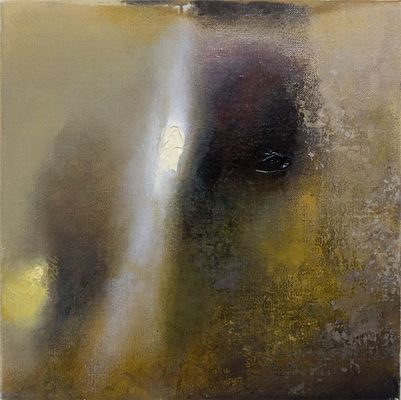
To return to Buckley’s fragment, the first two lines very much evoke how I paint nowadays. As you age, detail diminishes and patches of light become more luminous and float. I feel the most honest way of dealing with this is by smearing the oil paint on the canvas with the fingers and working close-up, blind. Only if the patches coalesce into an approaching image can the work gain a life.
-
Jonathan Walker was born in Melbourne, Australia and brought up on a dairy farm in Gippsland. In the 1970’s he studied painting at RMIT and won the Harold Wright Scholarship to the British Museum, London. During the 1980’s he exhibited at Pinacotheca Gallery, Richmond and had work shown at the NGV and Heidi City Art Gallery. Over the same period he designed the cover for the “Epigenesi” LP by Giancarlo Toniutti, Italy and conducted a mail exchange work with Achim Wollscheid, Germany. The work with artists through the post resulted in an article published in the bicentenary issue of Art and Australia 1988. He showed in artist run spaces such as WestSpace in the 90’s and 2000’s, and until 2012, taught painting at Victoria University, which is where we (Colleen Ahern and Lisa Radford) as organisers of the exhibition, among many others, had the privilege of being his student.
Walker’s knowledge was imparted to students through the careful selection of music, literature, and artists found in books that he himself had ordered for the library. Walker’s strategy was the generosity of sharing his vast knowledge with references specific to each student and their context.
Walker’s paintings share a similar focus and intimacy.
This exhibition presents a small selection of recent paintings alongside a publication that includes Walker’s writing. Observational and analytical, Walker’s work is a type of material notation — the time of day, colour and how it is blended, the both specific and fleeting location of a reflection on lino or the question of whether a chair leg should be included in a painting.
Please join us on Friday August 21 between 6-8pm to celebrate the opening of the exhibition.
Curated by Colleen Ahern and Lisa Radford.
B. Wurtz
Curated by Nic Tammens
March 26 - April 4, 2015
B.Wurtz works from a basement studio in his home on Manhattan’s Lower East Side.
This local fact is attested to by the plastic shopping bags and newsprint circulars that appear in his work. As formal objects, they don’t make loud claims about their origins but nonetheless transmit street addresses and places of business from the bottom of this long thin island. Like plenty of artists, Wurtz is affected by what is local and what is consumed. His work is underpinned by this ethic. It often speaks from a neighborhood or reads like the contents of a hamper:
“BLACK PLUMS $1.29 lb.”
“Food Bazaar”
“USDA Whole Pork Shoulder Picnic 99c lb.”
“RITE AID Pharmacy, with us it’s personal.”
“H. Brickman & Sons.”
“Sweet Yams 59c lb."
Most of the work in this exhibition was made while the artist was in residence at Dieu Donne, a workshop dedicated to paper craft in Midtown. Here Wurtz fabricated assemblages with paper and objects that are relatively lightweight, with the intention that they would be easily transportable to Australia. This consideration isn’t absolute in Wurtz’s work, but was prescriptive for making the current exhibition light and cheap. Packed in two boxes, these works were sent from a USPS post office on the Lower East Side and delivered to North Melbourne by Australia Post.
Wurtz appears courtesy of Metro Pictures, New York.
Thanks to Rob Halverson, Joshua Petherick, Sari de Mallory, Matt Hinkley, Helen Johnson, Fayen d'Evie, Ask Kilmartin, Lisa Radon, Ellena Savage, Yale Union, and "Elizabeth".
John Nixon
"Archive"
December 15 - January 20, 2014
The presentation of John Nixon's archive offered a rare showcase of this extensive collection of the artist's own publications, catalogues, posters, ephemera, editions and more, from the mid 1980s onwards, alongside a selection of his artworks.
Organized by John Nixon, Joshua Petherick and Matt Hinkley.
<a href=http://wfb.public-office.info/artist/john-nixon>All titles by John Nixon
"Habitat"
at Minerva, Sydney (organised by Joshua Petherick and Matt Hinkley)
November 15 - December 20, 2014
Lupo Borgonovo, Janet Burchill & Jennifer McCamley,
Lewis Fidock, HR Giger, Piero Gilardi, Veit Laurent Kurz,
Cinzia Ruggeri, Michael E. Smith, Lucie Stahl, Daniel Weil, Wols
Press Release:
“...It contained seven objects. The slender fluted bone, surely formed for flight, surely from the wing of some large bird. Three archaic circuitboards, faced with mazes of gold. A smooth white sphere of baked clay. An age-blackened fragment of lace. A fingerlength segment of what she assumed was bone from a human wrist, grayish white, inset smoothly with the silicon shaft of a small instrument that must once have ridden flush with the surface of the skin - but the thing’s face was seared and blackened.”
William Gibson, “Count Zero”, 1986
"Autumn Projects Archive"
Curated by Liza Vasiliou
March 6 - March 15, 2014
World Food Books, in conjunction with the Virgin Australia Melbourne Fashion Festival 2014, presented the Autumn Projects archive, consisting of a selection of early examples in Australian fashion with a particular interest in collecting designers and labels from the period beginning in the 1980’s, who significantly influenced the discourse of Australian Fashion.
Curated by Liza Vasiliou, the exhibition provided a unique opportunity to view pieces by designers Anthea Crawford, Barbara Vandenberg, Geoff Liddell and labels CR Australia, Covers, Jag along with early experimental collage pieces by Prue Acton and Sally Browne’s ‘Fragments’ collection, suspended throughout the functioning World Food Books shop in Melbourne.
H.B. Peace
presented by CENTRE FOR STYLE
November 14, 2013
"Hey Blinky, you say chic, I say same"
Anon 2013
H.B. Peace is a clothing collaboration between great friends Blake Barns and Hugh Egan Westland. Their pieces explore the divergences between 'character’ and ‘personality’ in garments....etc
Special Thanks to Joshua Petherick and Matt Hinkley of WFB and Gillian Mears
and a Very Special Thank you to Audrey Thomas Hayes for her shoe collaboration.
Janet Burchill & Jennifer McCamley
"Aesthetic Suicide"
May 10 - June 8, 2013
The first of our occasional exhibitions in the World Food Books office/shop space in Melbourne, "Aesthetic Suicide" presented a body of new and older works together by artists Janet Burchill & Jennifer McCamley, including videos, prints, a wall work, and publications.
During shop open hours videos played every hour, on the hour.
2013, English
Softcover, 240 pages, 21 x 23 cm
Published by
The MIT Press / Massachusetts
Whitechapel / London
$55.00 $30.00 - Out of stock
The revival of documentary in art, considered in historical, theoretical, and contemporary contexts.
After a long period in eclipse, documentary has undergone a marked revival in recent art. This has been spurred by two phenomena: the exhibition of photographic and video work on political issues at Documenta and numerous biennials; and increasing attention to issues of injustice, violence, and trauma in the war zones of the endemically conflict-ridden twenty-first century. The renewed attention to photography and video in the gallery and museum world has helped make documentary one of the most prominent modes of art-making today. Unsurprisingly, this development has been accompanied by a rich strain of theoretical and historical writing on documentary.
This anthology provides a much-needed contextual grounding for documentary art. It explores the roots of documentary in modernism and its critique under postmodernism; surveys current theoretical thinking about documentary; and examines a wide range of work by artists within, around, or against documentary through their own writings and interviews.
Artists surveyed include:Kutlug Ataman, Ursula Biemann, Hasan Elahi, Harun Farocki, Omer Fast, Joan Fontcuberta, Regina José Galindo, David Goldblatt, Craigie Horsfield, Alfredo Jaar, Emily Jacir, Lisa F. Jackson, Philip Jones Griffiths, An-My Le, Renzo Martens, Boris Mikhailov, Daido Moriyama, Walid Raad, Michael Schmidt, Sean Snyder
Writers include:James Agee, Ariella Azoulay, Walter Benjamin, Adam Broomberg, Judith Butler, Oliver Chanarin, Georges Didi-Huberman, John Grierson, David Levi Strauss, Elizabeth McCausland, Carl Plantinga, Jacques Rancière, Martha Rosler, Jean-Paul Sartre, Allan Sekula, W. Eugene Smith, Susan Sontag, Hito Steyerl, Trinh T. Minh-ha
Part of the Whitechapel Documents of Contemporary Art series
2016, English
Softcover, 240 pages, 145 x 210 mm
Published by
The MIT Press / Massachusetts
Whitechapel / London
$49.00 - Out of stock
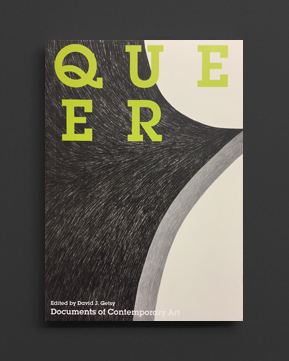
Historically, “queer” was the slur used against those who were perceived to be or made to feel abnormal. Beginning in the 1980s, “queer” was reappropriated and embraced as a badge of honor. While queer draws its politics and affective force from the history of non-normative, gay, lesbian, and bisexual communities, it is not equivalent to these categories, nor is it an identity. Rather, it offers a strategic undercutting of the stability of identity and of the dispensation of power that shadows the assignment of categories and taxonomies. Artists who identify their practices as queer today call forth utopian and dystopian alternatives to the ordinary, adopt outlaw stances, embrace criminality and opacity, and forge unprecedented kinships, relationships, loves, and communities.
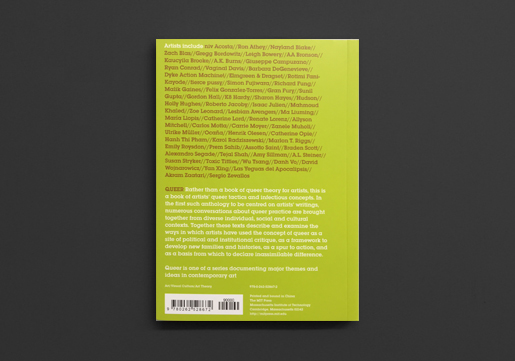
Rather than a book of queer theory for artists, this is a book of artists’ queer tactics and infectious concepts. By definition, there can be no singular “queer art.” Here, in the first Documents of Contemporary Art anthology to be centered on artists’ writings, numerous conversations about queer practice are brought together from diverse individual, social and cultural contexts. Together these texts describe and examine the ways in which artists have used the concept of queer as a site of political and institutional critique, as a framework to develop new families and histories, as a spur to action, and as a basis from which to declare inassimilable difference.
Artists and writers include
Nayland Blake, Gregg Bordowitz, Leigh Bowery, AA Bronson, A. K. Burns, Giuseppe Campuzano, Tee Corinne, Barbara DeGenevieve, Dyke Action Machine!, Elmgreen & Dragset, Rotimi Fani-Kayode, Simon Fujiwara, Malik Gaines, Felix Gonzalez-Torres, Gran Fury, Sunil Gupta, Hahn Thi Pham, Harmony Hammond, Sharon Hayes, Hudson, Roberto Jacoby, Derek Jarman, Isaac Julien, Mahmoud Khaled, Zoe Leonard, Lesbian Avengers, Catherine Lord, Ma Liuming, LTTR, Allyson Mitchell, Zanele Muholi, Carlos Motta, Ocaña, Hélio Oiticica, Catherine Opie, Ridykeulous (Nicole Eisenman & A.L. Steiner), Marlon Riggs, Emily Roysdon, Prem Sahib, Assoto Saint, Tejal Shah, Amy Sillman, Jack Smith, Wolfgang Tillmans, Toxic Titties, Danh Vo, David Wojnarowicz, Wu Tsang, Yan Xing, Las Yeguas del Apocalipsis, Akram Zaatari, Sergio Zevallos
About the Editor
David J. Getsy is Goldabelle McComb Finn Distinguished Professor of Art History at the School of the Art Institute of Chicago. His books include Abstract Bodies: Sixties Sculpture in the Expanded Field of Gender, Scott Burton: Collected Writings on Art and Performance, and Rodin: Sex and the Making of Modern Sculpture.
2018, English
Softcover, 164 pages, 21.6 x 14 cm
Published by
Primary Information / New York
$38.00 - Out of stock
Uncollected Texts draws together a number of Carolee Schneemann’s earliest writings – many exceedingly rare and several that are published here for the first time – ranging from letters to the editor, dream journals, and film criticism, to satirical poems, detailed discussions of her art, and pointed feminist critiques. Edited by Branden W. Joseph, the book includes 30 texts by Carolee Schneemann written between 1956 and 1981, as well as an introduction by Joseph.
First published in short-run magazines like Caterpillar, Film Culture, The Fox, Manipulations, and Matter; academic journals such as Performing Arts Journal; and mainstream publications including The New York Times and The Village Voice, the writings gathered in this volume shed light on some of Schneemann’s most important artistic achievements. Schneemann writes about her most famous “kinetic theatre” piece, Meat Joy; anti-Vietnam War works such as Snows, Viet-Flakes, and Divisions and Rubble; the multimedia performance Up to and Including Her Limits; and the double-screen film Kitch’s Last Meal. Frequently referring to one another, the assembled writings produce a densely interwoven tapestry of cross-references that provide unique insights into Schneemann’s artistic development while also foregrounding the artist’s uniquely poetic style.
2016, English
Softcover, 200 pages, 31.5 x 24 cm
Published by
The Artist's Institute / New York
Walther König / Köln
$53.00 - Out of stock
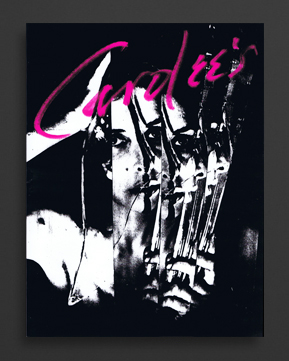
'Caroleeʼs' is the second issue of The Magazine of the Artistʼs Institute.
The first was 'Pierre's' by Pierre Huyghe.
Dedicated to Carolee Schneemann, it features a previously unpublished image archive from Schneemannʼs studio that documents half a century of morphological connections between her work and other visual material, including art, advertising, and popular culture.
A new long-form profile of Schneemann by writer Maggie Nelson accompanies this project and considers the artistʼs relationship to the history of her reception and Schneemannʼs significant influence on subsequent generations of feminists.
2016, English
Softcover, 328 pages, 15 x 23 cm
Published by
The MIT Press / Massachusetts
Haus der Kulturen der Welt / Berlin
$49.00 - Out of stock
Artists, filmmakers, art historians, poets, literary critics, anthropologists, theorists, and others, investigate one of the most vital areas of cultural practice: documentary.
Contemporary engagements with documentary are multifaceted and complex, reaching across disciplines to explore the intersections of politics and aesthetics, representation and reality, truth and illusion. Discarding the old notions of “fly on the wall” immediacy or quasi-scientific aspirations to objectivity, critics now understand documentary not as the neutral picturing of reality but as a way of coming to terms with reality through images and narrative. This book collects writings by artists, filmmakers, art historians, poets, literary critics, anthropologists, theorists, and others, to investigate one of the most vital areas of cultural practice: documentary. Their investigations take many forms—essays, personal memoirs, interviews, poetry.
Contemporary art turned away from the medium and toward the world, using photography and the moving image to take up global perspectives. Documentary filmmakers, meanwhile, began to work in the gallery context. The contributors consider the hybridization of art and film, and the “documentary turn” of contemporary art. They discuss digital technology and the “crisis of faith” caused by manipulation and generation of images, and the fading of the progressive social mandate that has historically characterized documentary. They consider invisible data and visible evidence; problems of archiving; and surveillance and biometric control, forms of documentation that call for “informatic opacity” as a means of evasion.
Contributors Ariella Azoulay, Zach Blas, Christa Blümlinger, Stella Bruzzi, Lucien Castaing-Taylor, Kris Fallon, Evgenia Giannouri, Ben Lerner, SylveÌre Lotringer, Antonia Majaca, Sohrab Mohebbi, Volker Pantenburg, Veìreìna Paravel, Christopher Pinney, Ben Rivers, and Eyal Sivan
Copublished between the MIT Press and the Haus der Kulturen der Welt (HKW), Berlin
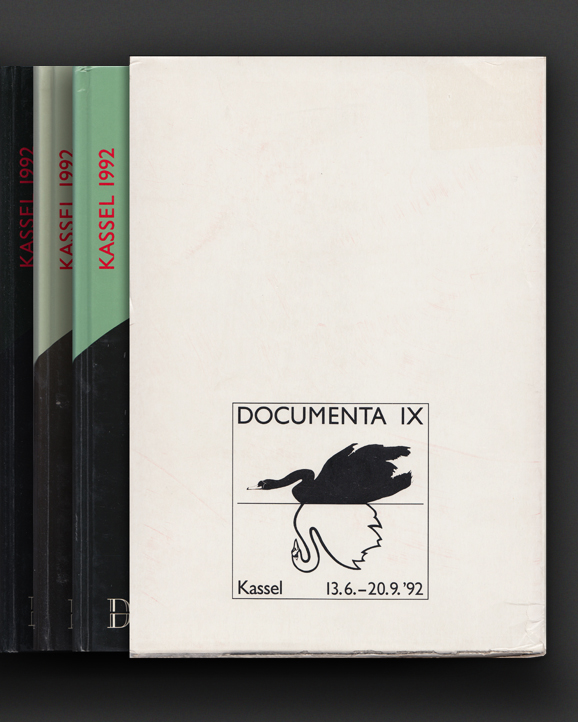
1992, German / English
Hardcover (in original slipcase), Vol. 1 : 255 pages; Vol. 2 : 310 pages; Vol. 3 : 619 pages, 18.5 x 27 cm
1st Edition, Out of print title / used / good
Published by
Hatje Cantz / Berlin
$120.00 - Out of stock
Hardcover edition, three volume exhibition catalogue published in conjunction with Documenta IX, Kassel, Germany, June 13 - September 9, 1992.
Documenta 9 is remembered as one of the most popular of all documenta exhibitions, thanks not least of all to the influence of its artistic director, the charismatic Belgian curator Jan Hoet. Hoet wanted to make the human being and our sensual, perceptual, agonized corporeality, which had been progressively displaced by the digitized, virtual world, the focus of attention at his exhibition. “From body to body to bodies” was the meaningful, poetic motto of documenta 9. Hoet described his curatorial mission in the following words: “At a time in which the human race is confronted more than ever with such dangers as AIDS and multinational wars, nuclear catastrophes, and global climate disasters, at a time in which threats are growing increasingly abstract and the fears more and more diffuse, I see reflection on the physical conditions of life as an appropriate answer.”
Texts by Jan Hoet, Denys Zacharopoulos, Bart de Baere, Pier Luigi Tazzi, Claudia Herstatt, Joyce Carol Oates, Jacques Roubaud, Cornelius Castoriadis, Heiner Müller, Paul Robbrecht, Hilde Daem.
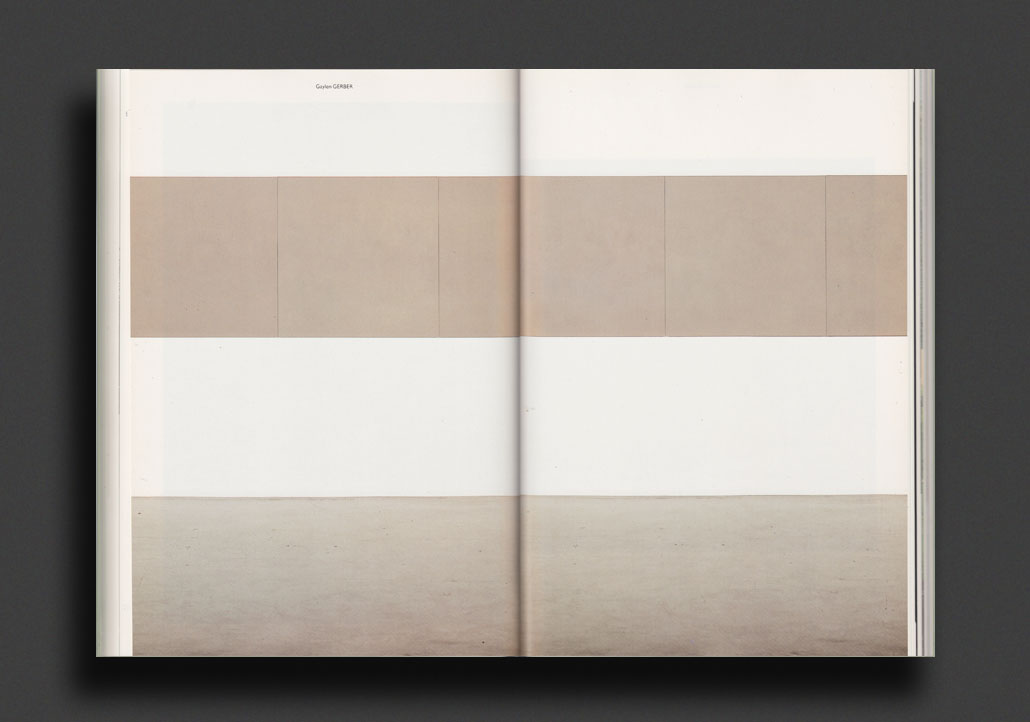
Artists include Marina Abramovic, Absalon, Richard Artschwager, Francis Bacon, Marco Bagnoli, Nicos Baikas, Miroslaw Balka, Matthew Barney, Jerry Barr, Lothar Baumgarten, Jean-Pierre Bertrand, Joseph Beuys, Michael Biberstein, Guillaume Bijl, Dara Birnbaum, Jonathan Borofsky, Louise Bourgeois, Herbert Brandl, Ricardo Brey, Tony Brown, Marie José Burki, Jean-Marc Bustamante, Michael Buthe, Pedro Cabrita Reis, Waltercio Caldas, Pier Paolo Calzolari, Ernst Caramelle, Lawrence Carroll, Saint Clair Cemin, Tomasz Ciecierski, Tony Clark, James Coleman, Tony Conrad, Patrick Corillon, Damian, Richard Deacon, Thierry De Cordier, Silvie Defraoui & Chérif Defraoui, Raoul De Keyser, Wim Delvoye, Braco Dimitrijevic, Eugenio Dittborn, Helmut Dorner, Stan Douglas, Marlene Dumas, Jimmie Durham, Mo Edoga, Jan Fabre, Luciano Fabro, Belu-Simion Fainaru, Peter Fend, Rose Finn-Kelcey, FLATZ, Fortuyn/O'Brien, Günther Förg, Erik A.Frandsen, Michel François, Vera Frenkel, Katsura Funakoshi, Isa Genzken, Gaylen Gerber, Robert Gober, Dan Graham, Rodney Graham, Angela Grauerholz, Michael Gross, George Hadjimichalis, David Hammons, Georg Herold, Gary Hill, Peter Hopkins, Rebecca Horn, Geoffrey James, Olav Christopher Jenssen, Tim Johnson, Andrej N. Joukov, Ilya Kabakov, Anish Kapoor, Kazuo Katase, Tadashi Kawamata, Mike Kelley, Ellsworth Kelly, Bhupen Khakhar, Per Kirkeby, Harald Klingelhöller, Kurt Kocherscheidt, Peter Kogler, Vladimir Kokolia, Joseph Kosuth, Mariusz Kruk, Guillermo Kuitca, Suzanne Lafont, Jonathan Lasker, Jac Leirner, Zoe Leonard, Eugène Leroy, Via Lewandowsky, Bernd Lohaus, Ingeborg Lüscher, Attila Richard Lukacs, James Lutes, Marcel Maeyer, Brice Marden, Cildo Meireles, Ulrich Meister, Thom Merrick, Gerhard Merz, Mario Merz, Marisa Merz, Meuser, Jürgen Meyer, Liliana Moro, Reinhard Mucha, Matt Mullican, Juan Muñoz, Christa Näher, Hidetoshi Nagasawa, Bruce Nauman, Max Neuhaus, Pekka Nevalainen, Nic Nicosia, Moshe Ninio, Jussi Niva, Cady Noland, Manuel Ocampo, Jean-Michel Othoniel, Tony Oursler, Panamarenko, Giulio Paolini, A. R. Penck, Michelangelo Pistoletto, Hermann Pitz, Stephen Prina, Richard Prince, Martin Puryear, Royden Rabinowitch, Rober Racine, Philip Rantzer, Charles Ray, Martial Raysse, readymades belong to everyone, José Resende, Gerhard Richter, Ulf Rollof, Erika Rothenberg, Susan Rothenberg, Ulrich Rückriem, Thomas Ruff, Stephan Runge, Edward Ruscha, Reiner Ruthenbeck, Remo Salvadori, Joe Scanlan, Eran Schaerf, Adrian Schiess, Thomas Schütte, Helmut Schweizer, Maria Serebriakova, Mariella Simoni, Susana Solano, Ousmane Sow, Ettore Spalletti, Haim Steinbach, Pat Steir, Wolfgang Strack, Thomas Struth, János Sugár, Yuji Takeoka, Robert Therrien, Frederic Matys Thursz, Niele Toroni, Thanassis Totsikas, Addo Lodovico Trinci, Mitja Tušek, Luc Tuymans, Micha Ullman, Juan Uslé, Bill Viola, Henk Visch, James Welling, Franz West, Rachel Whiteread, Christopher Wool, KeunByung Yook, Heimo Zobernig, Gilberto Zorio, and Constantin Zvezdochotov.
Very Good condition volumes in hardcover (much less common edition than usual softcover), preserved in their original illustrated slipcase (with common repaired splitting and bumping damage).
1985, English
Softcover, 592 pages, 15.5 x 23 cm
Published by
Johns Hopkins University Press / Baltimore
$30.00 - Out of stock
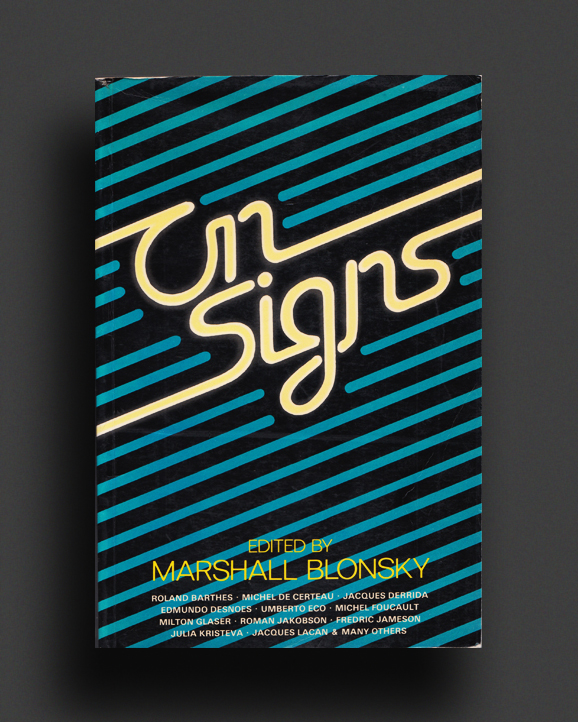
Edited by Marshall Blonsky
Published in 1985, this heavy volume functions as a unified voice proclaiming the power of semiotics to reveal the hidden practices and secrets of modern society. Marshall Blonsky has gathered original and newly translated written and illustrated contributions by highly visible forces in semiotic circles of the period, including Roland Barthes, Michel de Certeau, Jacques Derrida, Edmundo Desnoes, Umberto Eco, Michel Foucault, Julia Kristeva, Jacques Lacan, Jean Franco, Milton Glaser, Thomas A. Sebeok, Guido Crepax, Susan Meiselas and many others.
2018, English
Softcover, 608 pages, 178 x 25.5 cm
Published by
Columbia University Press / New York
$58.00 $30.00 - Out of stock
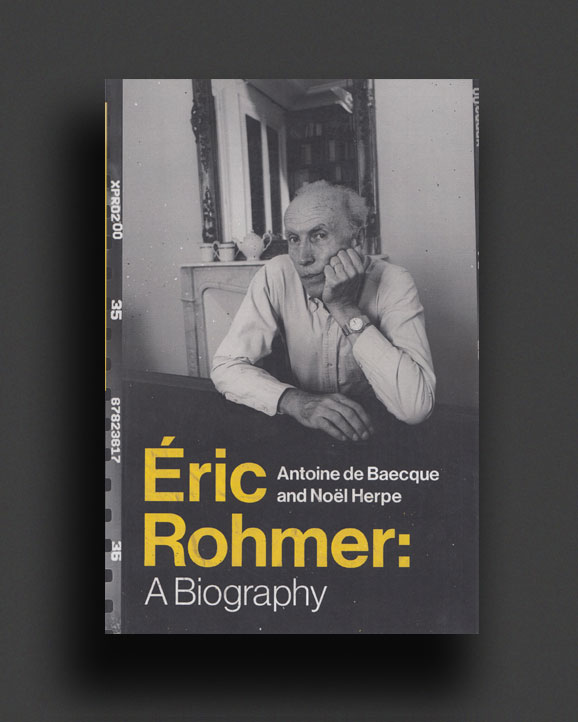
The director of twenty-five films, including My Night at Maud's (1969), which was nominated for a Best Picture Academy Award, and the editor in chief of Cahiers du cinéma from 1957 to 1963, Éric Rohmer set the terms by which people watched, made, and thought about cinema for decades. Such brilliance does not develop in a vacuum, and Rohmer cultivated a fascinating network of friends, colleagues, and industry contacts that kept his outlook sharp and propelled his work forward. Despite his privacy, he cared deeply about politics, religion, culture, and fostering a public appreciation of the medium he loved.
This exhaustive biography uses personal archives and interviews to enrich our knowledge of Rohmer's public achievements and lesser known interests and relations. The filmmaker kept in close communication with his contemporaries and competitors: François Truffaut, Jean-Luc Godard, Claude Chabrol, and Jacques Rivette. He held a paradoxical fascination with royalist politics, the fate of the environment, Catholicism, classical music, and the French nightclub scene, and his films were regularly featured at New York and Los Angeles film festivals. Despite an austere approach to life, Rohmer had a voracious appetite for art, culture, and intellectual debate captured vividly in this definitive volume.
Antoine de Baecque and Noël Herpe achieve in this scrupulously researched volume the paradoxical feat of delivering the definitive biography of a pseudonymous subject. Eric Rohmer will interest film historians, theorists of film, enthusiasts of French cinema, and film directors both aspiring and established, for whom Rohmer's low-budget modus operandi remains one of the miracles of modern film production. This, the first biography of Rohmer (né Maurice Schérer), is likely also to be the last. (Derek Schilling, Johns Hopkins University)
An essential and ceaselessly enjoyable work of scholarship.... The most valuable gift afforded by this biography is the sheer joy of moving through the exacting, meticulous accounts of each stage of Rohmer's life and career, painstakingly researched and written as if the authors were striving for the same arresting attention to detail, subtlety, humor, and philosophical weight of his films. (Dan Sullivan Film Comment)
2017, English
Paperback, 116 pages, 17 x 24 cm
Published by
CCA Wattis Institute for Contemporary Arts / San Francisco
$46.00 - In stock -
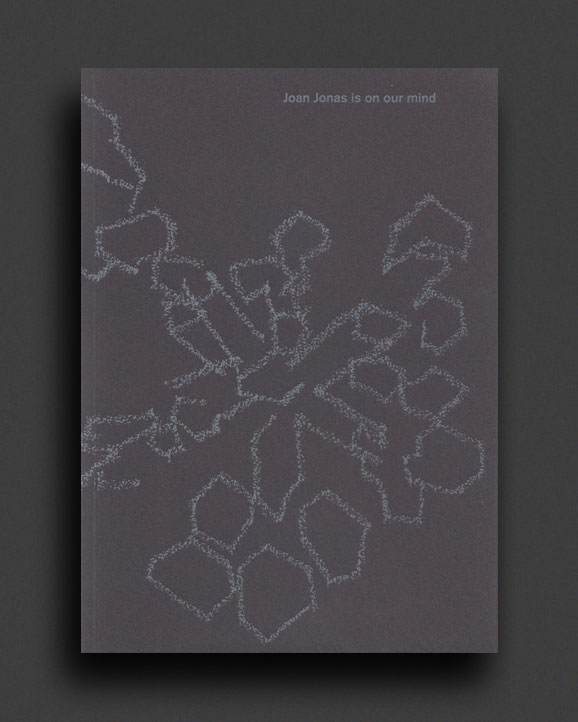
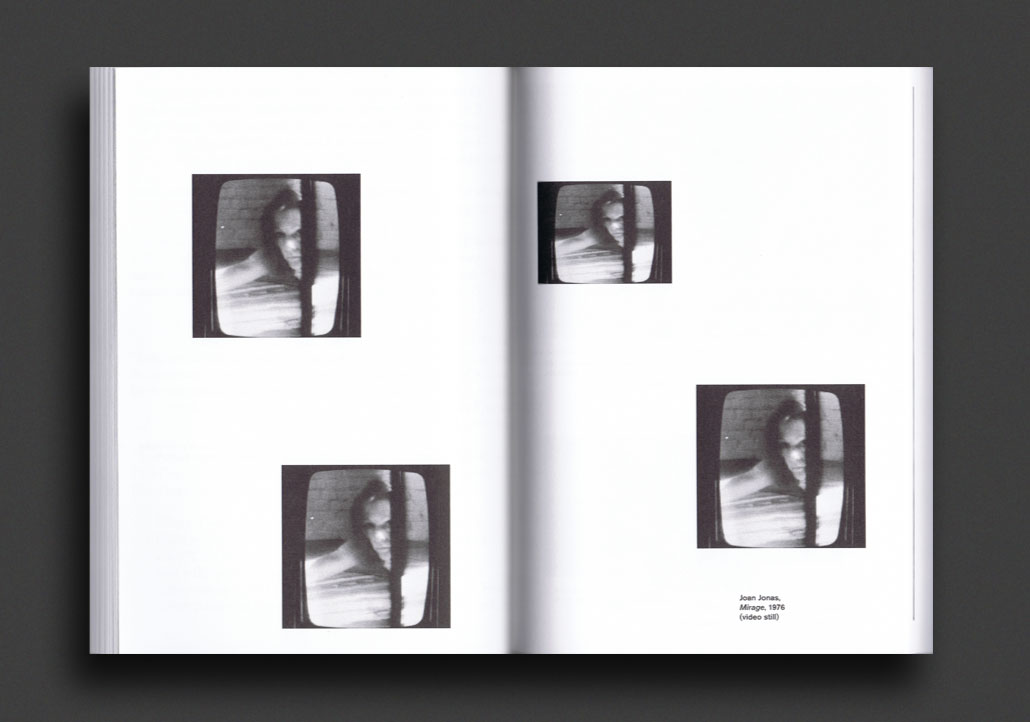
The CCA Wattis Institute in San Francisco dedicates year long seasons of discussions and public events to a single artist. In 2014–15, Joan Jonas was “on our mind.” This book brings together essays from writers, curators, art historians and artists that focus on a single work, from Jonas’ earliest films through her installation for the US Pavilion at the 56th Venice Biennale. The book also contains excerpts from readings and public lectures, and images by some of the other artists whose work was evoked in public and private conversation. Contributors include Jacqueline Francis, Renée Green, Quinn Latimer, Sarah Lehrer-Graiwer, Patricia Maloney, Elizabeth Mangini, Judith Rodenbeck and Lynne Tillman.
1971, Japanese / English
Hardcover (w. slipcase), 192 pages, 23.5 x 19 cm
1st Edition, Out of print title / used / very good
Published by
Kinema Jumpo Sha / Japan
$50.00 - Out of stock
Volume 6 from an incredible series (possibly 10-parts) published in Japan in the late 1960s-early 1970s that captures the work of Japanese film director and screenwriter Akira Kurosawa (1910 – 1998), who directed 30 films in a career spanning 57 years and is regarded as one of the most important and influential filmmakers in the history of cinema.
Each cardboard slipcased, hardbound volume comprises chronologically profiled films of Kurosawa presented scene for scene, reproducing the film through copious film stills alongside the film's entire script and dialogue (in both English and Japanese). Also includes a complete cast and staff listing for each film and further select full-page stills from the featured films. This volume (no. 6) features the films The Idiot (1951) and Ikiru (1952).
Very Good-Fine copy preserved in original issue cardboard slipcase (tanning to spine otherwise very well preserved).
2016, English
Hardcover (w. dust jacket), 124 pages, 11.7 x 18 cm
2nd ed., hardcover,
Published by
The Leopard Press / New York
$49.00 - Out of stock
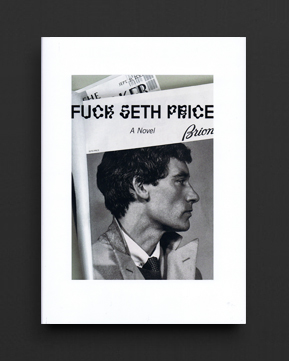
Hardcover, second edition!
From one of the most influential artists of his generation comes a provocative, moving novella about what it means to be a creative person under today’s digital regime. In the course of a gripping, headlong narrative, Price’s unnamed protagonist moves in and out of contemporary non-spaces on a confounding and enigmatic quest, all the while meditating on art in the broadest sense: not simply painting and sculpture but also film, architecture, literature, and poetry. From boutique hotels and highway bridges to PC terminals and off-ramps; from Kanye West and Jeff Koons to George Bush and Patricia Highsmith; from the playground to the internet to the mirror, Price’s hybrid of fiction, essay, and memoir gets to the central questions not only of art, but of how we live now.
Seth Price was born in 1973 in East Jerusalem, Palestine. He received a BA from Brown University in 1997, where he studied modern culture and media. In 2012 he began to work as an artist, and his first one-person exhibition was in 2004; major exhibitions of his work have since been presented around the world. His writings are widely anthologized and taught, and have been translated into eight languages. He lives in New York City.
1981, Japanese
Softcover (w. dust jacket), 240 pages, 15 x 21 cm
1st Edition, Out of print title / Used*,
Published by
? / Japan
$100.00 - Out of stock
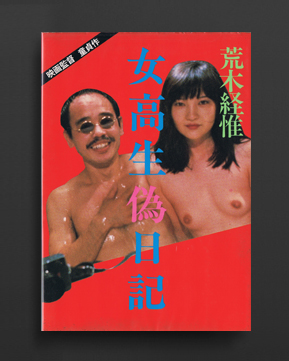
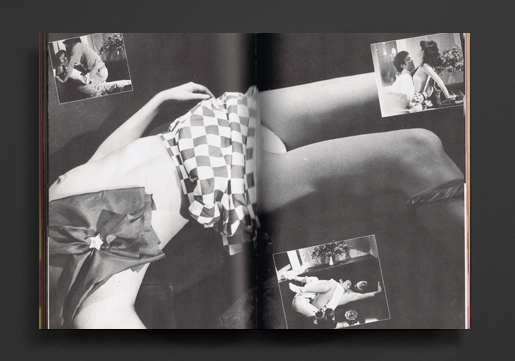
Very rare, early 1981 photo-book/diary by Japanese photographer Nobuyoshi Araki, who became an icon of photographic publishing and one of Japan's most celebrated and prolific photographers. This book was published as Araki's behind the scenes diary to High School Girl Fake Diary, a soft-core pink film, or pinku (a specific type of Japanese pornographic film made by independent studios) directed by Araki and released in 1981 by Nikkatsu movie studios under its Roman Porno genre – dramatised porn. The film was poorly received and disappointed fans of the genre and Araki himself, but the book, full of Araki's casual imagery on and off the set working and playing with the film's stars, technicians, composers and crew, became a sought-after oddity of Araki's publishing oeuvre. Not only is it a fine example of his famed early diary books, packed full of rarely seen Araki photographs, it also gives a rare and candid glimpse inside the world of independent film-making in Japan. Texts in Japanese.
Nobuyoshi Araki is a prolific Japanese photographer who has produced thousands of photographs over the course of his career. He became famous for “Un Voyage Sentimental” (1971), a series of photos depicting both banal and deeply intimate scenes of his wife and lifelong muse, essayist Aoki Yoko (whom the artist credits for making him a photographer), during their honeymoon. To date the 75 year old has produced 450 photo books and counting. With a repertoire that knows no boundaries, Araki's diaristic style of photography has captured the world around him (his cat Chiro, the people and landscapes of Japan and his travels, flowers, family), though it is Araki’s intensely sexual imagery that has elicited particular controversy and fascination throughout his career. Similarly to Helmut Newton, Araki has often addressed subversive themes — such as bondage in the Japanese style Kinbaku — in his provocative depictions of female nudes. He typically works in black-and-white photography, and his hallmark style is deliberately casual. “Rather than shooting something that looks like a professional photograph, I want my work to feel intimate, like someone in the subject’s inner circle shot them,” he says. Pushing against the world of commercialised photography, he is celebrated for his history of self-publishing and distributing his work, beginning with his Xerox Photo Albums of 1970. Amongst many others, Araki has collaborated with American photographer Nan Goldin and Icelandic musician Björk.
2017, English / Portuguese
Paperback, 264 pages, 17 x 26 cm
Published by
Mousse Publishing / Milan
$48.00 - Out of stock
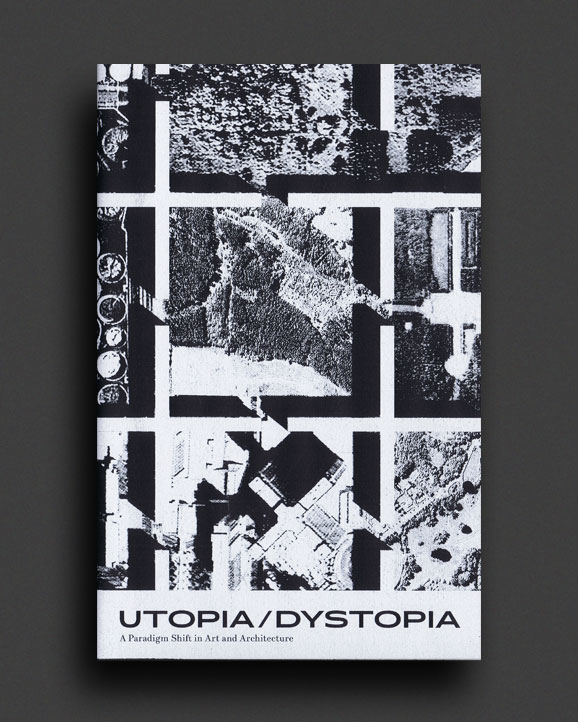
Released as a companion to an eponymous exhibition at MAAT, Lisbon, this book features previously unpublished essays on the ongoing transition from the notion of utopia towards its opposite image of dystopia. It acts as a reader for the curatorial project in which each author reflects on the unsurprising demise of utopian ideals. Yet, as humans, we need positive and idealistic impulses that help us overcome feelings of permanent crisis and disbelief. The dystopia that has come to be accepted and absorbed in human existence can only be combated with a “utopian impulse”. With contributions by Pedro Gadanho, Susana Ventura, Keller Easterling, Franco Berardi, and more.
2017, English
Softcover, 240 pages, 145 x 210 mm
Published by
Whitechapel / London
The MIT Press / Massachusetts
$49.00 - Out of stock
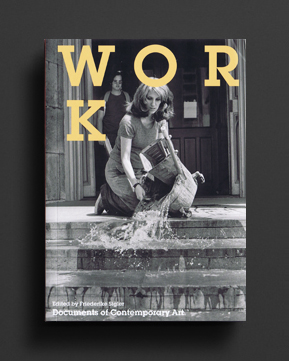
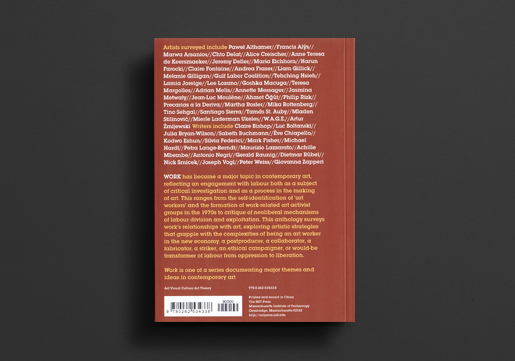
Warhol’s Factory of the 1960s, Minimalism’s assembly-line aesthetics, conceptual and feminist concern with workers’ conditions in the 1970s—these are among the antecedents of a renewed focus on the work of art: labor as artistic activity, as artistic method and as object of artistic engagement. In 2002, the “Work Ethic” exhibition curated by Helen Molesworth at the Baltimore Museum of Art took its cue from recent art to spotlight this earlier era of artistic practice in which activity became as valid as, and often dispensed with, object-production. Revealed through this prism was “dematerialized” art’s close and critical relation to the emergent information age’s criteria of management, production and skill.
By 2015, the Venice Biennale reflected artists’ wider concern with global economic and social crises, centered on exploitative and precarious worlds of employment. Yet while art increasingly engages with human travail, work’s significance in itself is seldom addressed by critics. This anthology explicitly investigates work in relation to contemporary art, surveying artistic strategies that grapple with the complexities of being an art worker in the new economy, a postproducer, a collaborator, a fabricator, a striker, an ethical campaigner, or would-be transformer of labor from oppression to liberation.
Artists surveyed include
Pawel Althamer, Francis Alÿs, Marwa Arsanios, Chto Delat, Alice Creischer, Ana de la Cueva, Anne Teresa De Keersmaeker, Jeremy Deller, Maria Eichhorn, Harun Farocki, Claire Fontaine, Andrea Fraser, Liam Gillick, Melanie Gilligan, Gulf Labour Coalition, Tehching Hsieh, Lamia Joreige, Lee Lozano, Goshka Macuga, Teresa Margolles, Adrian Melis, Annette Messager, Gustav Metzger, Jean-Luc Moulène, Ahmet Ögüt, Philip Rizk, Martha Rosler, Tino Sehgal, Santiago Sierra, Tamas St. Auby, Mladen Stilinovic, W.A.G.E., Artur Zmijewski
Writers include
Claire Bishop, Luc Boltanski, Julia Bryan-Wilson, Sabeth Buchmann, Ève Chiapello, Kodwo Eshun, Silvia Federici, Isabelle Graw, Maurizio Lazzarato, Achille Mbembe, Antonio Negri, Jacques Rancière, Gerald Raunig, Dietmar Rübel, Paolo Virno, Joseph Vogl
About the Editor
Friederike Sigler is a researcher and lecturer at the Hochschule für Bildende Künste, Dresden. She is the author of Work/Strike.
2015, English
Hardcover, 304 pages, 27 x 29 cm
Published by
Four Corners Books / London
$68.00 - Out of stock
Working from a cowshed on a farm in Kent, Oliver Postgate (1925–2008) and Peter Firmin (born 1928) produced some of the best-loved British children's animated television of the 1960s and 1970s. Their iconic productions include Bagpuss (originally aired in 1974), The Clangers (1969–74), Ivor The Engine (1975–77), Pogles' Wood (1966–68) and Noggin The Nog (1959–65). Postgate and Firmin worked together from 1959 through the 1980s, creating popular, beloved characters that appealed to children and their parents alike, like the whistling, mousy Clangers (knitted by Firmin's wife Joan in bright pink wool) in outer space, the saggy, baggy cloth cat Bagpuss and the mild-mannered Viking boy Prince Noggin. Firmin painted the backdrops and created the models, and Postgate wrote scripts, did the stop-motion filming and frequently recorded the kindly, avuncular narration. This book, which includes a preface by Postgate's son Daniel, presents the Smallfilms archive: the puppets and cutouts from these shows (including some of the characters who didn't quite make the cut), along with insights into how they were created. The emphatically handmade models and painstakingly drawn illustrations that came to life in the Smallfilms productions are captured here in attentive, detailed photographs. The archive is presented like "a collection of artifacts in an exhibition detailing some much-admired twentieth-century art movement, like Fluxus or Dada," as acclaimed English stand-up comedian Stewart Lee notes in his introduction. The Art of Smallfilms, full of pipe cleaners, cotton balls, wire and ping-pong balls, celebrates the imagination and ingenuity of two artists who shaped a generation's childhood.
2018, English
Hardcover, 172 pages, 21.5 x 27 cm
Published by
Sternberg Press / Berlin
Muzeum Sztuki / Łódź
$125.00 $60.00 - Out of stock
The Museum of Rhythm is a speculative institution that engages rhythm as a tool for interrogating the foundations of modernity and the sensual complex of time in daily experience. When entering a larger cultural infrastructure such as the art museum, it juxtaposes modern and contemporary art with ethnographic research, cinema, music, and scientific instruments to set in resonance a critical apparatus and conduct exercises in Rhythmanalysis.
This book, and the exhibition upon which it is based, is an outcome of durational research that sees art as one of the means by which the ideologies of rhythm are implemented. Hence alongside artworks it, by necessity, includes objects, films, and documents connected with the history of the development of time measurement, labor monitoring devices, choreography, and music practice, which enable the human being to experience more complex rhythms.
The book includes visual documentation of the exhibition as well as essays and texts by Lawrence Abu Hamdan, Erick Beltrán, Robert Brain, Francisco Camacho Herrera, Natasha Ginwala, Robert Horvitz, Ken Jacobs, Elisabeth Lebovici, Ernst Mach, Angela Melitopoulos, Daniel Muzyczuk, Nana Oforiatta-Ayim, Jean Painlevé, Forrestine Paulay, Kathleen Rivera, Simon Schaffer, Georg Simmel, Wadada Leo Smith, Stephen Willats, and Jason Young.
Design by Ryszard Bienert
2017, English
Hardcover, 398 pages, 30.5 x 23 cm
Published by
Stedelijk Museum / Amsterdam
Walther König / Köln
$98.00 - Out of stock
This catalogue is the first comprehensive publication on Price’s varied oeuvre. It offers an unflinching portrait of contemporary, mediated Western life. The exhibition at Stedelijk Museum is the first survey of the American artist’s work.
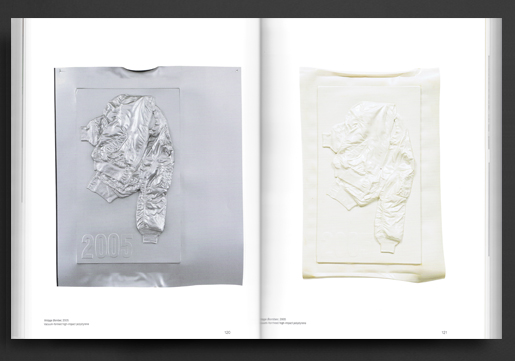
A key theme in Price’s work is the self under technological pressure. This is often expressed in terms of the ‘skins’ of surface, packaging, and wrapping: a photographic study of a person’s skin obtained through the technologies Google employs for mapping; a vacuum-formed plastic relief presenting a body part stranded in plastic; a large wall sculpture depicting the negative space between two people engaged in intimate action, greatly enlarged from a tiny internet jpeg.
‘Seth Price is a key figure in addressing technology and artistic authorship. His work traces an important art historical shift from the concept of collage, where chance played a major role and the image was constructed of multiple layers, to the concept of a unified image, which envelops us in an endless, undifferentiated, digital stream.’ – Beatrix Ruf, Director of Stedelijk Museum
Published on the occasion of the exhibition Seth Price: Social Synthetic, at Stedelijk Museum, Amsterdam (15 April – 3 September 2017), and at Museum Brandhorst, Munich (12 October 2017 – 18 March 2018).
Texts by: Cory Arcangel, Ed Halter, Achim Hochdörfer, Branden W Joseph, John Kelsey, Michelle Kuo, Rachel Kushner, Laura Owens, Ariana Reines, Beatrix Ruf.
2018, English
Softcover, 210 pages, 12 x 19 cm
Published by
Uh Books / Amsterdam
KW Institute for Contemporary Art / Berlin
$22.00 - Out of stock
According to editor Will Holder, ‘Flurry’ came about after being asked to propose ten books for acquisition by the Gerrit Rietveld Academie library in Amsterdam. He gave a talk about that selection, for which he preferred reproducing original material over commentary, and wanted to allow others to speak. The outcome was a reading back and forth between the ten books. It soon became clear that this reading would readily lend itself to an issue of ‘F.R. David’. Associated material came up in the process of transcription. Included are writings by Emmie McLuskey, Krist Gruijthuijsen, Bitsy Knox, Maurin Dietrich, Camille Pageard, Frances Stark, Eileen Myles, and more.
2018, English
Softcover, 224 pages, 240mm x 300mm
Published by
common-editions / London
$67.00 - Out of stock
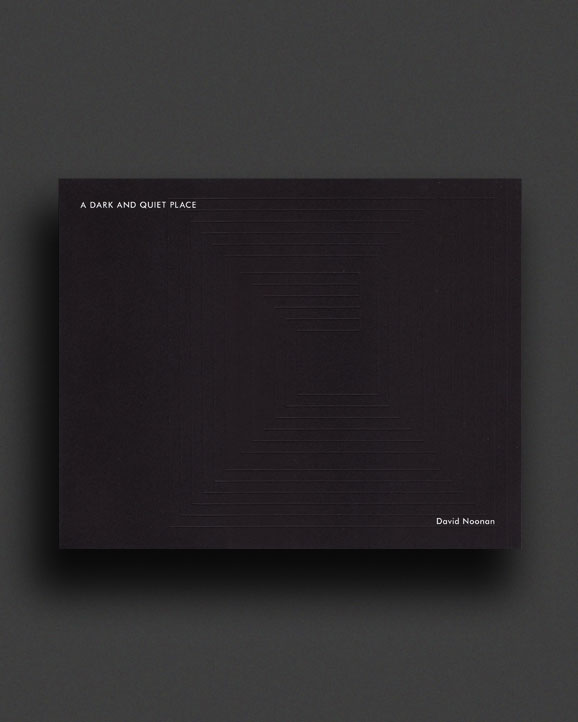
A Dark and Quiet Place accompanies a new moving image work of the same name by Australian artist, David Noonan. Both the film and this artist’s book present a meditation on performance, its associated apparatus, and the physical and imaginary domains they inhabit.
That this is Noonan’s first film work in over a decade is significant, as his practice since has frequently referenced both the material qualities of film and projection, and an ongoing interest in the slippages between figuration and pure abstraction.
For the book, the artist has worked closely with award-winning design studio A Practice for Everyday Life to disassemble the film work back into a rhythmic sequence of still images, employing both the language of design and Noonan’s characteristic strategies of layering and manipulation.
More than a series of film stills, the images that make up this book acquire their own intrinsic quality, proposing new spatial configurations and performative actions.
In response to the work, renowned author Brian Dillon presents a piece of fiction at once speculative and rigorously rational, in which geometric shapes become performers, diagrammatic grids become complex stage sets, and the supremacy of the body is thrown into doubt.
Noonan has had major solo shows at the Australian Centre for Contemporary Art, Melbourne (2009), Chisenhale Gallery, London (2008), and Palais de Tokyo, Paris (2007).
2018, English
Softcover, 208 pages, 20 x 23.5 cm
Published by
Museum Abteiberg / Mönchengladbach
Kunstverein Hannover / Hannover
M HKA / Antwerp
Walther König / Köln
$47.00 $30.00 - Out of stock
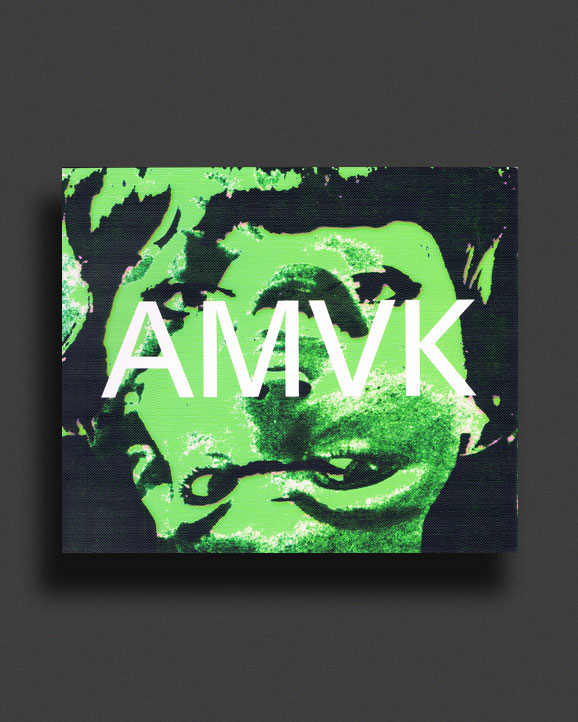
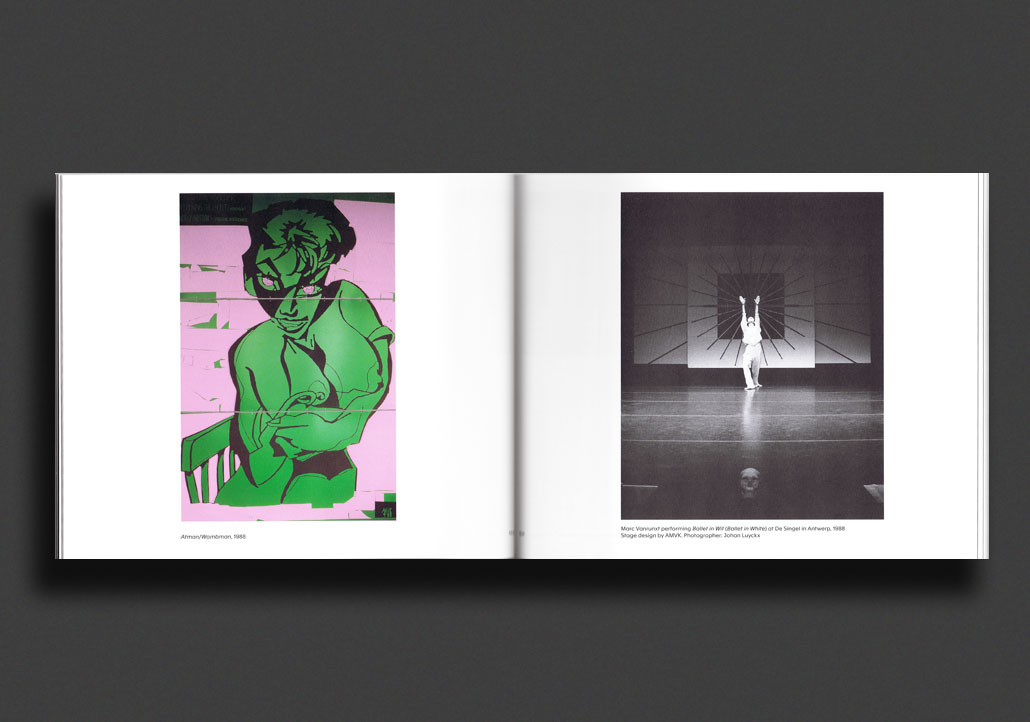
Monographic catalogue published by Koenig Books on the occasion of a series of exhibitions by Anne-Mie Van Kerckhoven at Museum Abteiberg Mönchengladbach, Kunstverein Hannover, and M HKA, Museum of Contemporary Art Antwerp. Heavily illustrated throughout with a broad cross-section of Anne-Mie's history of work in drawing, collage, sound, painting, video, performance, installation, and more. Texts by Menno Grootveld, Anders Kreuger, Ana Teixeira Pinto, Kathleen Rahn, Susanne Titz, Travis Jeppesen. Design by Sara de Bondt.
Anne-Mie van Kerckhoven (also known as AMVK) was born in Antwerp and lives in Antwerp and Berlin. She studied graphic design at the Fine Arts Academy in Antwerp and has been prolific in her output of drawings and other works on paper and synthetic material, as well as short videos, since the early eighties. Anne-Mie van Kerckhoven has been fascinated for a long time with the representation in the mass media of images of women, of interiors, of the kinetic powers of any kind of language. She investigates supra-moral connections in contemporary society s.a. between sex and technology. Her work connects different knowledge systems, explores the areas of the unconscious, and looks at moral aberrations or the obscene from a female point of view. In the nineties, hand-made paper works gave way to computer graphics, while text has always featured alongside images, underlining the message of Van Kerckhoven’s proud, sometimes exhibitionist female figures like song-lyrics. Music plays an important role in Van Kerchkoven’s creative production in parallel to her visual output, and she and Danny Devos have stood as a key pair of the Antwerp experimental music scene under the band name Club Moral (1981–now).
"In opposition to the arbitrary, which is the origin of every written and spoken language, I have placed the unspoken, the mystic. From despair to ecstasy, that is what the mystic is about now. This is the all-devouring lust for life and love. Unification, not feeling separated from the rest. No ego, no boundaries. Creation becomes one with its creator. I call it the analogue. The analogue versus the arbitrary. The analogue is ritual, evil, mystery, desire, yearning, lust, while the digital is control, technology, sublimation, dependence, cleanliness, transparency. The analogue plus the digital is what humans are about: perspective." - Anne-Mie Van Kerckhoven, Some Sort of Manifesto, 2016–17
1979, English
Softcover, 64 pages, 28 × 36 cm
1st Edition, Out of print title / used / good
Published by
Art Official Inc. / Toronto
$75.00 - Out of stock
FILE Megazine (published 1972–1989) was a quarterly, then irregularly published art and culture magazine, written, edited and published primarily by members of General Idea (AA Bronson, Felix Partz, Jorge Zontal).
The visual design and identity of FILE Megazine was a deliberate appropriation of LIFE Magazine. FILE's initial logo was the white block letters on red rectangle of the LIFE logo, with the letters re-arranged. This corresponded with the group's desire that the magazine be a “parasite within the world of magazine distribution”. The familiarity of the format would entice a broad range of unsuspecting readers outside the art- or mail-art worlds (including LIFE readers) to pick it up from newsstands. Initially the magazine served a dual purpose. It was a record and site of activity for the international mail/correspondence-art movement - the first mail-art project in magazine format. It was also the mouthpiece of General Idea, with editorials for each issue written by the group, elaborating on the group's core conceptual principles. The writing style of these editorials is noteworthy for its heavily ironic use of language, a parody of advertising copy, laced with double-entendres. Over the years the focus of FILE Megazine broadened to include the wider arts, culture and entertainment world, as General Idea's founders moved increasingly among the New York downtown circles of the 70s and 80s.
This "TRANSGRESSIONS" issue (edited by General Idea and Rodney Werden) includes Kathy Acker, Guy Hocquenghem, David Byrne, Jean Genet, Pier Paolo Pasolini, Colin Campbell, Francesco Clemente, The Clichettes, Robert Mapplethorpe, Martha and the Muffins, and others. Features the famous Nazi Milk Glass cover by General Idea.
General Idea was a collective of three Canadian artists, Felix Partz, Jorge Zontal and AA Bronson, who were active from 1967 to 1994. As pioneers of early conceptual and media-based art, their collaboration became a model for artist-initiated activities and continues to be a prominent influence on subsequent generations of artists. General Idea's work inhabited and subverted forms of popular and media culture, including boutiques, television talk shows, trade fair pavilions, mass media, beauty pageants and publishing (they published the highly acclaimed FILE magazine). From 1987 through 1994 their work addressed the AIDS crisis, creating numerous public works and making some of their most iconic works of art. After publishing FILE Megazine for two years and amassing a large collection of artists books and multiples, General Idea founded Art Metropole in 1974, a non-profit space dedicated to contemporary art in multiple format: artists books, multiples, video, audio and electronic media. Both Partz and Zontal died of AIDS in 1994. Bronson continues to work and exhibit as an independent artist, and was the director of Printed Matter, Inc in New York between 2006 and 2011. The General Idea Archive now resides at the Library of the National Gallery of Canada.
Note: this issue has a few photographs of male and female genitals hand censored (with black marker) in a feature by Jim Dawson. Quite likely by the international distributor or Japanese vendor who originally sold this title. A common practice in Japan for imported publications at the time.
Good copy throughout, general wear for age/size.
2017, English
Softcover, 312 pages, 21 x 15.5 cm
Published by
Mousse / Milan
LOOP / Barcelona
$58.00 - Out of stock
Edited by Eugeni Bonet
With texts by Stephen Beck, AA Bronson, Peter Campus, Peter d’Agostino, Douglas Davis, Jon Dovey, Juan Downey, Jean-Paul Fargier, Hermine Freed, Frank Gillette, David Hall, Takahiko Iimura, Les Levine, Mary Lucier, Muntadas, Nam June Paik, Ulrike Rosenbach, Martha Rosler, Paul Ryan, Francesc Torres, Woody Vasulka & Scott Nygren, Bill Viola, and Peter Weibel
Writings by artists have always played a crucial role in art theory. For the practitioners, they are a way to illustrate and explain their own ideas around their trajectory and working methods, identify trends they feel close to, articulate a broader reflection on a given medium, and perhaps challenge preconceived ideas. Just as film theory has incorporated essays, manifestos, and other written thoughts by filmmakers into a body of work that also includes the voices of critics studying the “new cinematic object,” this publication gathers together a number of artists’ writings—which were previously scattered in different publications—in order to revisit and reevaluate the early days of video art (up to 1990, a not entirely arbitrary time span). It adds a critical layer to LOOP Barcelona’s 15th edition, Winding the Clock Back: A Contemporary Archaeology of Video.
This title is now out of print.
2017, English
Softcover, 104 pages, 22 x 29 cm
Published by
Mousse / Milan
Sculpture Centre / New York
Kölnischer Kunstverein / Köln
$57.00 - Out of stock
This publication accompanies two distinct exhibitions presenting the work of American artist Sam Anderson. The first opened in May 2017 at SculptureCenter in New York City and the second opened later in July at the Kölnischer Kunstverein in Cologne. This catalogue is a co-production between both museums on the occasion of these two exhibitions, and it brings together a selection of images and texts related to both shows. The overlapping exhibitions were the first solo museum presentations of Anderson’s work and each highlighted different aspects of her practice. Her exhibition at SculptureCenter comprised new commissions while her exhibition at Kölnischer Kunstverein brought together existing works spanning several years. Working on the two shows simultaneously allowed for Anderson to consider her practice through new and existing objects and installations, while articulating particular narratives and connections between her works. This book presents a wide range of objects and concerns running throughout the two exhibitions.
Edited by Ruba Katrib and Moritz Wesseler
Texts by Ruba Katrib and Moritz Wesseler
Conversation between Sam Anderson and Lia Gangitano
2017, English / German
Softcover, 232 pages, 22 x 14 cm
Published by
KW Institute for Contemporary Art / Berlin
Koenig Books / London
$32.00 - In stock -
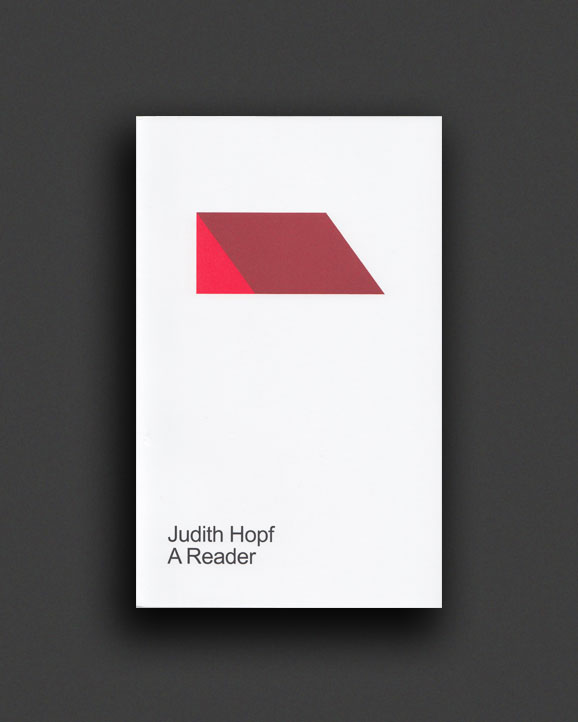
I think it can only be because of memory-of-knowing-how that we made it through the grey days in cities in general–and through the greyness of Berlin in particular–that we made it through again and again. Because the streets switched directions too, rushing towards us a whole lot faster. Bicycles became utterly useless. Just looking at them knocked the air out of their tyres. What's more, ticket prices increased and coins no longer fit in the slots of vending machines. [Judith Hopf, Stepping Stairs]
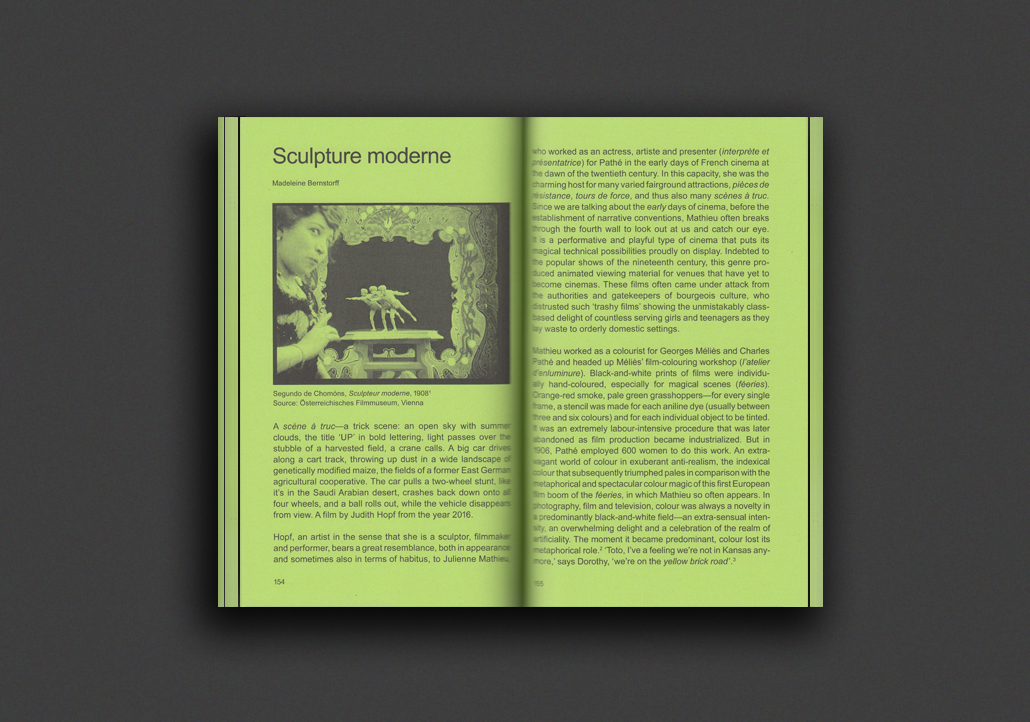
With texts by Kathy Acker, Madeleine Bernstorff, Sabeth Buchmann, Maurin Dietrich, Anna Gritz, John Hejduk, Judith Hopf, Monika Rinck, Avital Ronell, Annette Wehrmann