World Food Books' programme is largely produced on Kulin Nation land. We acknowledge the Wurundjeri people of the Kulin Nation as the first and continuing custodians of this land, and pay respect to their Elders past, present, and emerging.
World Food Books is an arts and special interests bookshop in Naarm / Melbourne. Founded in 2010, World Food Books is devoted to the presentation of a rotating, hand-selection of international art, design, literary and counterculture publications with an emphasis on the anti-traditional, the experimental, the avant-garde, the heretic, the marginal.
Presenting new titles alongside rare and out-of-print books, catalogues and journals spanning the fields of modern and contemporary art, design, photography, illustration, film, literature, poetry, cultural theory, philosophy, sexuality, popular and underground culture in its many radical forms, World Food Books wishes to encourage adventurous, thoughtful and open-minded reading, looking, writing, and exchange of publishing and ideas, both current and historical.
As well as our bookshop, located in Melbourne's historical Nicholas Building, all of our inventory is available internationally via our online mail-order service.
World Food Books semi-regularly co-ordinates "Occasions", a programme of exhibits and events at the bookshop and in partnership with other hosts (such as museums and art galleries) that develop out of the activities, relationships and content of the bookshop itself.
World Food Books
The Nicholas Building
37 Swanston Street
Room 5, Level 6
Melbourne 3000
Australia
SHOP HOURS:
Thu–Fri 12–6, Sat 12–5
WEB-SHOP OPEN 24/7
World Food Books
Postal Address:
PO Box 435
Flinders Lane
Victoria 8009
Australia
Art
Theory / Essay
Architecture / Interior
Graphic Design / Typography
Photography
Fashion
Eros
LGBTQ+
Fiction / Poetry
Weird / Speculative / Science Fiction / Horror
Transgressive / Visceral / Abject
Symbolism / Decadence / Fin de siècle
Film / Video
Painting
Sculpture / Installation
Performance / Dance / Theater
Drawing
Sound / Music
Curatorial
Group Shows / Collections
Periodicals
Out-of-print / Rare
Posters / Ephemera / Discs
Signed Books
World Food Books Gift Voucher
World Food Book Bag
Australian Art
Australian Fiction
Australian Science Fiction / Speculative Fiction
Australian Poetry
Australian Photography
Japanese Photography
Conceptual Art
Minimal Art
Dada
'Pataphysics / Oulipo
Fluxus
Concrete Poetry
Pop Art
Surrealism
Arte Povera
Arte Informale / Haute Pâte / Tachism
Nouveau Réalisme / Zero / Kinetic
Situationism / Lettrism
Collage / Mail Art / Xerox Art
Art Brut / Folk / Visionary / Fantastic
Illustration / Graphic Art / Bandes Dessinées
Furniture
Italian Radical Design / Postmodernism
Textiles
Ceramics / Glass
Counterculture
Protest / Revolt
Philosophy
Psychoanalysis
Anthropology
Anarchism
Socialism / Anarchism / Communism / Capitalism
Literary Theory / Semiotics / Language
Feminism / Women's Studies
Gender Studies / Sexuality
Anthropology
Fetishism / BDSM
Drugs / Psychedelia
Crime / Violence
Animal Rights / Veganism
Occult / Esoterica
Ecology / Earth / Alternative Living
Whole Earth / Crafts
All prices in AUD (Australian dollars)
Pick-Ups
Pick-up orders can be collected in our bookshop during opening hours after order date. Please collect any Pick-up orders within 2 weeks of ordering as we have limited storage space. Orders will be released back into stock if not collected within this time. No refunds can be made for pick-ups left un-collected. If you cannot make it in to the bookshop in this time-frame, please choose postage option.
Return Policy
All sales are final. We do accept returns (for refund or exchange) for items received in error. All our orders are packed with special care using heavy-duty padding and cardboard book-mailers or bubble mailers (for smaller books), using reinforcement where required. We cannot take responsibility for any lost, stolen or damaged parcels.
Insurance
Should you wish to insure your package, please email us directly after placing your order and we can organise this at a small extra expense. Although all standard/express tracked packages are very safe and dependable, we cannot take responsibility for any lost, stolen or damaged parcels. We recommend insurance on valuable orders.
Interested in selling your old books, catalogues, journals, magazines, comics, fanzines, ephemera? We are always looking for interesting, unusual and out-of-print books to buy. We only buy books in our fields of interest and specialty, and that we feel we can resell.
We base these prices on desirability, market value, in-print prices, condition and our current stock levels. We offer cash, store credit, and can take stock on consignment. All
about 25% of the price we expect to get when we sell them, or 30% in store credit. We base these prices on desirability, market value, in-print prices, condition and our current stock levels.
Sell your books any day of the week. You can drop them off and return later. If you have a lot of books, we can visit your Sydney home.
We buy books that we feel we can resell. We offer about 25 % of the price we expect to get when we sell them, or 30% in store credit. We base these prices on desirability, market value, in-print prices, condition and our current stock levels.
Philadelphia Wireman
03 August - 01 September, 2018
World Food Books is proud to announce our next Occasion, the first presentation of sculptures by Philadelphia Wireman in Australia.
The Philadelphia Wireman sculptures were found abandoned in an alley off Philadelphia’s South Street on trash night in 1982. Their discovery in a rapidly-changing neighbourhood undergoing extensive renovation, compounded with the failure of all attempts to locate the artist, suggests that the works may have been discarded after the maker’s death. Dubbed the "Philadelphia Wireman" during the first exhibition of this work, in 1985, the maker’s name, age, ethnicity, and even gender remain uncertain. The entire collection totals approximately 1200 pieces, all intricately bound together with tightly-wound heavy-gauge wire (along with a few small, abstract marker drawings, reminiscent both of Mark Tobey and J.B. Murry). The dense construction of the work, despite a modest range of scale and materials, is singularly obsessive and disciplined in design: a wire armature or exoskeleton firmly binds a bricolage of found objects including plastic, glass, food packaging, umbrella parts, tape, rubber, batteries, pens, leather, reflectors, nuts and bolts, nails, foil, coins, toys, watches, eyeglasses, tools, and jewellery.
Heavy with associations—anthropomorphic, zoomorphic, and socio-cultural responses to wrapped detritus—the totemic sculptures by Philadelphia Wireman have been discussed in the context of work created to fulfil the shamanistic needs of alternative religions in American culture. Curators, collectors, and critics have variously compared certain pieces to sculpture from Classical antiquity, Native American medicine bundles, African-American memory jugs, and African fetish objects. Reflecting the artist’s prolific and incredibly focused scavenging impulse, and despite—or perhaps enhanced by—their anonymity, these enigmatic objects function as urban artefacts and arbiters of power, though their origin and purpose is unknown. Philadelphia Wireman, whatever their identity, possessed an astonishing ability to isolate and communicate the concepts of power and energy through the selection and transformation of ordinary materials. Over the course of the past two decades, this collection has come to be regarded as an important discovery in the field of self-taught art and vernacular art.
Presented in collaboration with Fleisher-Ollman Gallery, Philadelphia, and Robert Heald, Wellington.
Susan Te Kahurangi King
02 February - 10 March, 2018
Susan Te Kahurangi King (24 February 1951 - ) has been a confident and prolific artist since she was a young child, drawing with readily available materials - pencils, ballpoint pens and felt-tip markers, on whatever paper is at hand. Between the ages of four and six Susan slowly ceased verbal communication. Her grandparents William and Myrtle Murphy had developed a special bond with Susan so they took on caring responsibilities for extended periods. Myrtle began informally archiving her work, carefully collecting and storing the drawings and compiling scrapbooks. No drawing was insignificant; every scrap of paper was kept. The King family are now the custodians of a vast collection containing over 7000 individual works, from tiny scraps of paper through to 5 meter long rolls.
The scrapbooks and diaries reveal Myrtle to be a woman of great patience and compassion, seeking to understand a child who was not always behaving as expected. She encouraged Susan to be observant, to explore her environment and absorb all the sights and sounds. Myrtle would show Susan’s drawings to friends and people in her community that she had dealings with, such as shopkeepers and postal workers, but this was not simply a case of a grandmother’s bias. She recognised that Susan had developed a sophisticated and unique visual language and sincerely believed that her art deserved serious attention.
This was an unorthodox attitude for the time. To provide some context, Jean Dubuffet coined the term Art Brut in 1945 to describe work created by self-taught artists – specifically residents of psychiatric institutions and those he considered to be visionaries or eccentrics. In 1972 Roger Cardinal extended this concept by adopting the term Outsider Art to describe work made by non-academically trained artists operating outside of mainstream art networks through choice or circumstance. Susan was born in Te Aroha, New Zealand in 1951, far from the artistic hubs of Paris and London that Dubuffet and Cardinal operated in. That Myrtle fêted Susan as a self-taught artist who deserved to be taken seriously shows how progressive her attitudes were.
Susan’s parents Doug and Dawn were also progressive. Over the years they had consulted numerous health practitioners about Susan’s condition, as the medical establishment could not provide an explanation as to why she had lapsed into silence. Dawn educated herself in the field of homeopathy and went on to treat all twelve of her children using these principles – basing prescriptions on her observations of their physical, mental and emotional state.
Doug was a linguist with an interest in philosophy who devoted what little spare time he had to studying Maori language and culture. To some extent their willingness to explore the fringes of the mainstream made them outsiders too but it was their commitment to living with integrity and their respect for individuality that ensured Susan’s creativity was always encouraged.
Even though Susan’s family supported her artistic pursuits, some staff in schools and hospitals saw it as an impediment to her assimilation into the community and discouraged it in a variety of ways. Her family was not always aware of this and therefore did not fully understand why Susan stopped drawing in the early 1990s. However, rather than dwell on the challenges that Susan faced in pursuit of her artistic practice, they prefer to highlight her achievements. In 2008 Susan began drawing again in earnest, after an almost 20 year interruption, and her work is now shown in galleries around the world.
Susan grew up without television and has been heavily influenced by the comics she read as a child. She is absolutely fearless in the appropriation of recognizable characters, such as Donald Duck and Mickey Mouse, in her work. She twists their limbs, contorts their faces, compresses them together, blends them into complex patterned backgrounds - always imbuing them with an incredible energy. Although Susan often used pop culture characters in her work they are not naive or childlike. These are drawings by a brilliant self-taught artist who has been creating exceptional work for decades without an audience in mind.
Mladen Stilinović
"Various Works 1986 - 1999"
02 February 16 - September 10, 2016
Various works 1986 - 1999, from two houses, from the collections of John Nixon, Sue Cramer, Kerrie Poliness, Peter Haffenden and Phoebe Haffenden.
Including: Geometry of Cakes (various shelves), 1993; Poor People’s Law (black and white plate), 1993; White Absence (glasses, ruler, set square, silver spoon, silver ladel with skin photograph and wooden cubes), 1990-1996; Exploitation of the Dead (grey and red star painting, wooden painting, black spoon with red table, red plate), 1984-1990; Money and Zeros (zero tie, paintings made for friends in Australia (Sue, John, Kerrie), numbers painting), 1991-1992; Words - Slogans (various t-shirts) - “they talk about the death of art...help! someone is trying to kill me”, “my sweet little lamb”, “work is a disease - Karl Marx”; Various artist books, catalogues, monographs, videos; Poster from exhibition Insulting Anarchy; "Circular" Croatian - Australian edition; Artist book by Vlado Martek (Dostoyevsky); more.
Thanks to Mladen Stilinović and Branka Stipančić.
Jonathan Walker
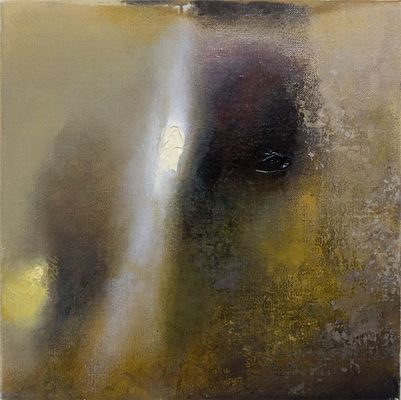
Always Will Need To Wear Winter Shirt Blue + Ochre Small Check Pattern
21 August - 21 September, 2015
Untitled
I am not a great reader of poetry but I always return to the work of Melbourne poet, Vincent Buckley (1925- 1988). Perhaps I find his most tantalising piece to be not a finished poem but a fragment left on a scrap of paper discovered on his desk after the poet’s death.
The poetry gathers like oil
In the word-core, and spreads
It has its music meet,
Its music is in movement.
This fragment is more the shell left behind from a volatile thought than a finished poem. I find the last two lines honest but awkward whereas the first two lines work like an arrow. Most likely he could not find a resolution so it was left. Still, in its present form, it remains an eloquent testimony to the ultimate failure of a medium to express mobile thought and sensation, in Buckley’s case, through verbal language. It’s an important matter because this is something all artists have to deal with regardless of the medium.
I have never written a poem, however, I am forever copying fragments from books on paper scraps in a vain effort to fix certain notions in my head. At first, they function as bookmarks that are sometimes returned to when I open the book. But before long, as they accumulate, they fall out littering the table interspersed with A4 photocopies, bills, books and medications.
To return to Buckley’s fragment, the first two lines very much evoke how I paint nowadays. As you age, detail diminishes and patches of light become more luminous and float. I feel the most honest way of dealing with this is by smearing the oil paint on the canvas with the fingers and working close-up, blind. Only if the patches coalesce into an approaching image can the work gain a life.
-
Jonathan Walker was born in Melbourne, Australia and brought up on a dairy farm in Gippsland. In the 1970’s he studied painting at RMIT and won the Harold Wright Scholarship to the British Museum, London. During the 1980’s he exhibited at Pinacotheca Gallery, Richmond and had work shown at the NGV and Heidi City Art Gallery. Over the same period he designed the cover for the “Epigenesi” LP by Giancarlo Toniutti, Italy and conducted a mail exchange work with Achim Wollscheid, Germany. The work with artists through the post resulted in an article published in the bicentenary issue of Art and Australia 1988. He showed in artist run spaces such as WestSpace in the 90’s and 2000’s, and until 2012, taught painting at Victoria University, which is where we (Colleen Ahern and Lisa Radford) as organisers of the exhibition, among many others, had the privilege of being his student.
Walker’s knowledge was imparted to students through the careful selection of music, literature, and artists found in books that he himself had ordered for the library. Walker’s strategy was the generosity of sharing his vast knowledge with references specific to each student and their context.
Walker’s paintings share a similar focus and intimacy.
This exhibition presents a small selection of recent paintings alongside a publication that includes Walker’s writing. Observational and analytical, Walker’s work is a type of material notation — the time of day, colour and how it is blended, the both specific and fleeting location of a reflection on lino or the question of whether a chair leg should be included in a painting.
Please join us on Friday August 21 between 6-8pm to celebrate the opening of the exhibition.
Curated by Colleen Ahern and Lisa Radford.
B. Wurtz
Curated by Nic Tammens
March 26 - April 4, 2015
B.Wurtz works from a basement studio in his home on Manhattan’s Lower East Side.
This local fact is attested to by the plastic shopping bags and newsprint circulars that appear in his work. As formal objects, they don’t make loud claims about their origins but nonetheless transmit street addresses and places of business from the bottom of this long thin island. Like plenty of artists, Wurtz is affected by what is local and what is consumed. His work is underpinned by this ethic. It often speaks from a neighborhood or reads like the contents of a hamper:
“BLACK PLUMS $1.29 lb.”
“Food Bazaar”
“USDA Whole Pork Shoulder Picnic 99c lb.”
“RITE AID Pharmacy, with us it’s personal.”
“H. Brickman & Sons.”
“Sweet Yams 59c lb."
Most of the work in this exhibition was made while the artist was in residence at Dieu Donne, a workshop dedicated to paper craft in Midtown. Here Wurtz fabricated assemblages with paper and objects that are relatively lightweight, with the intention that they would be easily transportable to Australia. This consideration isn’t absolute in Wurtz’s work, but was prescriptive for making the current exhibition light and cheap. Packed in two boxes, these works were sent from a USPS post office on the Lower East Side and delivered to North Melbourne by Australia Post.
Wurtz appears courtesy of Metro Pictures, New York.
Thanks to Rob Halverson, Joshua Petherick, Sari de Mallory, Matt Hinkley, Helen Johnson, Fayen d'Evie, Ask Kilmartin, Lisa Radon, Ellena Savage, Yale Union, and "Elizabeth".
John Nixon
"Archive"
December 15 - January 20, 2014
The presentation of John Nixon's archive offered a rare showcase of this extensive collection of the artist's own publications, catalogues, posters, ephemera, editions and more, from the mid 1980s onwards, alongside a selection of his artworks.
Organized by John Nixon, Joshua Petherick and Matt Hinkley.
<a href=http://wfb.public-office.info/artist/john-nixon>All titles by John Nixon
"Habitat"
at Minerva, Sydney (organised by Joshua Petherick and Matt Hinkley)
November 15 - December 20, 2014
Lupo Borgonovo, Janet Burchill & Jennifer McCamley,
Lewis Fidock, HR Giger, Piero Gilardi, Veit Laurent Kurz,
Cinzia Ruggeri, Michael E. Smith, Lucie Stahl, Daniel Weil, Wols
Press Release:
“...It contained seven objects. The slender fluted bone, surely formed for flight, surely from the wing of some large bird. Three archaic circuitboards, faced with mazes of gold. A smooth white sphere of baked clay. An age-blackened fragment of lace. A fingerlength segment of what she assumed was bone from a human wrist, grayish white, inset smoothly with the silicon shaft of a small instrument that must once have ridden flush with the surface of the skin - but the thing’s face was seared and blackened.”
William Gibson, “Count Zero”, 1986
"Autumn Projects Archive"
Curated by Liza Vasiliou
March 6 - March 15, 2014
World Food Books, in conjunction with the Virgin Australia Melbourne Fashion Festival 2014, presented the Autumn Projects archive, consisting of a selection of early examples in Australian fashion with a particular interest in collecting designers and labels from the period beginning in the 1980’s, who significantly influenced the discourse of Australian Fashion.
Curated by Liza Vasiliou, the exhibition provided a unique opportunity to view pieces by designers Anthea Crawford, Barbara Vandenberg, Geoff Liddell and labels CR Australia, Covers, Jag along with early experimental collage pieces by Prue Acton and Sally Browne’s ‘Fragments’ collection, suspended throughout the functioning World Food Books shop in Melbourne.
H.B. Peace
presented by CENTRE FOR STYLE
November 14, 2013
"Hey Blinky, you say chic, I say same"
Anon 2013
H.B. Peace is a clothing collaboration between great friends Blake Barns and Hugh Egan Westland. Their pieces explore the divergences between 'character’ and ‘personality’ in garments....etc
Special Thanks to Joshua Petherick and Matt Hinkley of WFB and Gillian Mears
and a Very Special Thank you to Audrey Thomas Hayes for her shoe collaboration.
Janet Burchill & Jennifer McCamley
"Aesthetic Suicide"
May 10 - June 8, 2013
The first of our occasional exhibitions in the World Food Books office/shop space in Melbourne, "Aesthetic Suicide" presented a body of new and older works together by artists Janet Burchill & Jennifer McCamley, including videos, prints, a wall work, and publications.
During shop open hours videos played every hour, on the hour.
2015, English
Softcover, 96 pages, 17 x 23 cm
Published by
MUMA / Victoria
$20.00 - Out of stock
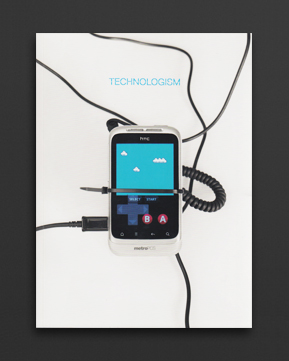
Catalogue published to accompany the exhibition Technologism, at Monash University Museum of Art (MUMA) in Melbourne, 3 Oct - 12 Dec 2015, curated by Charlotte Day.
Artists: Cory Arcangel (US), Dara Birnbaum (US), Chris Burden (US), Ian Burn (AU), Antoinette J. Citizen (AU), Simon Denny (NZ), Jan Dibbets (NL), Aleksandra Domanović (SI/DE), Harun Farocki (DE), Benjamin Forster (AU), Isa Genzken (DE), Greatest Hits (AU), Martijn Hendriks (NL), Lynn Hershman Leeson (US), Matt Hinkley (AU), Jenny Holzer (US), Edward Kienholz & Nancy Reddin Kienholz (US), Oliver Laric (AT), Mark Leckey (UK), Scott Mitchell (AU), Rabih Mroué (LB), Henrik Olesen (DK), Nam June Paik (KR/US), Nam June Paik & John Godfrey (US), Joshua Petherick (AU), Matte Rochford (AU), Jill Scott (AU), Richard Serra (US), John F. Simon Jr. (US), Brian Springer (US), Hito Steyerl (DE), Ricky Swallow (AU), Jeff Thompson (US), Pia van Gelder (AU), Ulla Wiggen (US) and Dennis Wilcox (AU)
MUMA concludes its three-part series on watershed moments in art history — Reinventing the Wheel: the readymade century and Art as a Verb — with Technologism, a major group exhibition bringing together forty-three historical and contemporary artworks, including several new commissions from Australian practitioners. Technologism wrestles with the profound cultural, social and political impact technology has made on art since the 1960s.
Conservative cul-de-sac's of the community are often sceptical of technology and its ever increasing presence in our lives. However many artists — with a natural propensity for constant upheaval — have whole-heartedly embraced radical changes in technology over the last sixty years. Featuring artworks that engage both physically and conceptually with electronic systems — television, computers, the internet, smartphones — Technologism focuses on the ways artists critique and disrupt official uses of the media, or construct their own machines and data systems.
Riffing off both the aesthetic and conceptual characteristics of technology, artists in Technologism document technology's advancement in a plethora of ways: Ulla Wiggen's intricate paintings of circuit boards from the mid 1960s, see the development of an aesthetic inspired by the complex intersection of electrical wires, connectors and components, working to manipulate and rewire the physicality of technology; some thirty years later, John F. Simon's Art Appliances series of the 1990s uses the circuitry of small LCD screens to disrupt pictures and patterns, recreating them over; in Matte Rochford's video Progressively Degrading Test Pattern 2013, humble VHS tapes are copied and recopied, in a process of metaphysical reduction; while in Joshua Petherick's new work, one technology is employed to record another soon to be superseded, revealing new visual dimensions and the 'ghosts in the machine'.
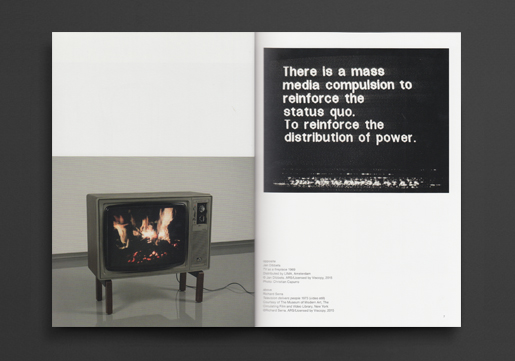
A story of advancement inevitably turns into obsolescence, and Technologism seeks to document the early use of broadcast technology as a way of bridging the gap (and finding a space) between the image on the screen, the physical presence of the viewer, and the broader community. Jan Dibbet's TV as a Fireplace 1968, documents television as a collective experience — even if viewers were separated physically, they were united through time and space like pre-historic cave-dwellers by a communal broadcast. However with the advent of the internet, personal computer devices and streaming services, technology has again changed the relationship we have with the world around us to a more singular yet proliferating existence.
A history of DIY jamming and hacking presents the way artists have continued to subvert conventional uses of technology and challenge the status-quo, from the internet as militarily-designed, to corporately-exploited, civilian-employed, artistically-manipulated, and back again. For instance, Lynn Hershman Leeson's work investigates how media is used as a tool for censorship and political repression, while Simon Denny's work co-opts the aesthetic and rhetoric of language of multinational corporations in order to question their power. In presenting these works and others, Technologism seeks to consider what is the value of such subversion, or is it merely a perpetuation of the problem?
Artist Hito Steyerl asks, 'is the internet dead?' Although, hyperbolic in its prognosis, Technologism recognises that sceptical questions such as this are an important part of how artistic practice negotiates technological advancement. Technologism proceeds from the idea that technology in all its forms, physical and immaterial, needs to be interrogated in order to be perpetually remade.
Technologism considers changes in infrastructure, such as telecommunication networks and the internet, and the cultural implications of technological innovation and considers from the position of the developers of these technologies as well as from the end user. Technologism asks 'how does technology effect artistic practice?' As well as, 'how can artistic practice effect technology?'
Fully illustrated catalogue features texts by Charlotte Day, Philip Brophy, Bridget Crone and Sean Dockray. Designed by Yanni Florence.
2016, English / Italian
Softcover (newspaper), 334 pages, 25 x 36 cm
Published by
Mousse Publishing / Milan
$20.00 $10.00 - Out of stock
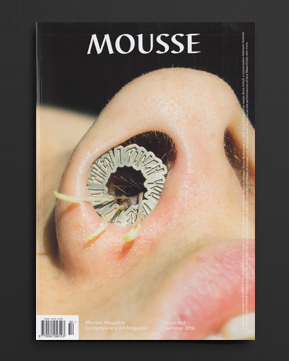
MOUSSE #54, Summer 2016
Contents:
IEVA MISEVIČIŪTĖ
Character Studies of Primeval Life Form
by Jacquelyn Ross
EXTEND, EXCEED, ENHANCE: PROSTHETICS AND SCULPTURE
by Lisa Le Feuvre
ANNE IMHOF
Choreographed layers
by Hans Ulrich Obrist
RAYMOND BOISJOLY, TANYA LUKIN LINKLATER, WALTER SCOTT
Native North America
by Andrew Berardini, Richard William Hill and Candice Hopkins
INSIDE TO OUTSIDE TO INSIDE
by Jens Hoffmann
NEW SCENARIO
Curating Holes
by Melanie Bühler
ROLE PLAY
by Maurizio Cattelan,
Liam Gillick,
Thomas Demand,
Barbara Bloom,
Christian Jankowski,
Elmgreen&Dragset,
Michelle Grabner,
Tobias Rehberger,
Ugo Rondinone,
Harrell Fletcher,
John Miller,
Paulina Olowska
RONALD JONES
What You See Is What You See
by Krist Gruijthuijsen
GARY INDIANA
I Can Give You Anything But Love
by Andrew Durbin
WILLA NASATIR
Psychic Junkyards
by Lauren Cornell
RAGNA BLEY
An Idiosyncratic Abecedary
by Filipa Ramos
NOAH BARKER
Projecting an Island from Another
by Mark Beasley
ISIAH MEDINA
The impossible is the only (no-)thing that ever happens
by Pia Bolognesi
ME
by Dieter Roelstraete
SHIFTING BACKGROUNDS
by Anselm Franke
NOBODY IS SLEEPING IN THE SKY
by Geoffrey Farmer and Dora García
NOW, I AM AFRAID...
by Chus Martínez
CECILIA BENGOLEA AND FRANÇOIS CHAIGNAUD
Emotional Aesthetics
by Kathy Noble
MORAG KEIL AND GEORGIE NETTELL
Domestic Battlegrounds
by Fredi Fischli and Niels Olsen
AN ESSAY ON DRESS-UP AND OTHER THINGS
by Sabrina Tarasoff
Softcover, 230 pages, 20.5 x 27 cm
Published by
Cura Books / Rome
$20.00 - Out of stock
cura. is a quarterly magazine, a publishing house, an exhibition space and a platform for editorial and curatorial activities, based in Rome, Italy.
CURA. NO.22
COVER BY SOL CALERO
INSIDE THE COVER
Sol Calero
text by Adam Carr
PORTRAITS IN THE EXHIBITION SPACE
Johannes Cladders’ anti-museum
by Lorenzo Benedetti
EXHIBITION LITERATURE
Expanded Literature.
Dominique Gonzalez-Foerster
by Jean-Max Colard
SPOTLIGHT
James Bridle.
Seeing Like a Network
in conversation with Ben Vickers
Self-Portrait as a City.
Alex Israel in conversation
with Gigiotto Del Vecchio
ABOUT
Anicka Yi’s Allegorical Bouquets
by Chris Sharp
ABOUT
Kevin Beasley.
Energy Accumulates
by Rose Bouthillier
ARTIST’S PROJECT
by Amy Yao
SPOTLIGHT
Philipp Timischl
in conversation with
Pierre-Alexandre Mateos
and Charles Teyssou
A VISIT TO
Rodrigo Hernández
in conversation with
Joao Mourao & Luis Silva
SPOTLIGHT
ÅYR
in conversation with Philipp Ekardt
SPOTLIGHT
Caroline Mesquita
in conversation with
Martha Kirszenbaum
HOT!
Debora Delmar Corp.
by Judith Vrancken
Juliana Huxtable
by Whitney Mallett
Sophie Jung
by Frances Loeffler
Nancy Lupo
by Sarah Lehrer-Graiwer
2016, English
Softcover (2 books), 560 pages, 215 x 155 cm
ed. of 1000,
Published by
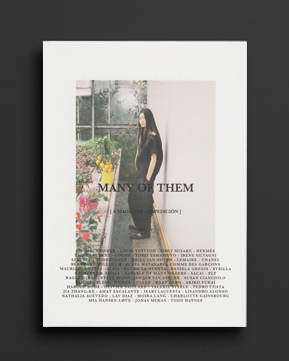
Many of Them
$62.00 - Out of stock
MANY OF THEM – VOL. IV
A LIMITED EDITION OF 1000 COPIES
Cosmic Wonder, Louis Vuitton, Issey Miyake, Hermès, Saint Laurent, Loewe, Yohji Yamamoto, Irène Silvagni, Limi Feu, Undercover, Dries Van Noten, Lemaire, Chanel, Bernhard Willhelm, Junya Watanabe, Comme Des Garçons, Maurizio Amadei, Alaïa, Paz De La Huerta, Daniela Gregis, Sybilla, Geoffrey B. Small, Eatable Of Many Orders, Sacai, Ply,Ragne Kikas, Steve Mono, Jan-Jan Van Essche, Susan Cianciolo, Koché, Bless, Oriole Cullen, Kaat Debo, Akiko Fukai, Harold Koda, Olivier Saillard, Valerie Steele, Pedro Costa, Jia Zhang-Ke, Amat Escalante, Isaki Lacuesta, Lisandro Alonso, Nathalia Acevedo, Lav Diaz, Moira Lang, Charlotte Gainsbourg, Mia Hansen-Løve, Jonas Mekas, Todd Haynes.
Many of Them is a limited edition publication. Its aim is to offer a space for discussion in which creators can share their perspective about their own field, their languages and the problems they face in their everyday practices. It originally started as a diary in 2008 and it keeps evolving into different formats.
2016, English
Softcover, 244 pages, 16 x 23 cm
Published by
Sternberg Press / Berlin
$38.00 - Out of stock
In this innovative take on early video art, Ina Blom considers the widespread notion that analog video was endowed with lifelike memory and agency. Reversing standard accounts of artistic uses of video, she follows the reflexive unfolding of a technology that seemed to deploy artists and artistic frameworks in the creation of new technical and social realities. She documents, among other things, video’s emergence through the framework of painting, its identification with biological life, its exploration of the outer limits of technical and mental time control, and its construction of new realms of labor and collaboration. Enlisting a distinctly media-archaeological approach, Blom’s new book—her second from Sternberg Press—is a brilliant look at the relationship between video memory and social ontology.
Ina Blom is a professor at the Department of Philosophy, Classics, History of Art and Ideas, University of Oslo, as well as visiting professor at the Department of Art History, University of Chicago.
This is a phosphorescently brilliant exploration of the birth and life of video. In the times when electronic media meant the flow of televisual signals, video became a uniquely glimmering force of idiosyncratic memory and the ordination of time. Blom’s focused beam of histories and ideas superlatively traces the crackling and flickering scanlines of this new reality as it came into being in art.
—Matthew Fuller, author and professor at the Centre for Cultural Studies, Goldsmiths, University of London
With this extraordinary study, early video has finally found its chronicler. Invaluable not only for its perspicacious genealogy of media-art practice, but for its inspired historiographic gambit, wherein both art and history are reimagined in light of contemporary media archaeology.
—Andrew V. Uroskie, author of Between the Black Box and the White Cube: Expanded Cinema and Postwar Art
Design by Surface
2016, English
Softcover (spiral-bound w. flexidisc), 208 pages, 20 x 31 cm
Published by
Walker Art Centre / Minneapolis
$85.00 $45.00 - Out of stock
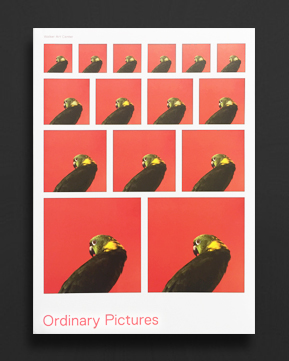
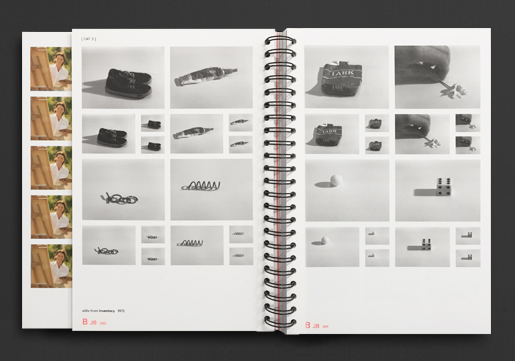
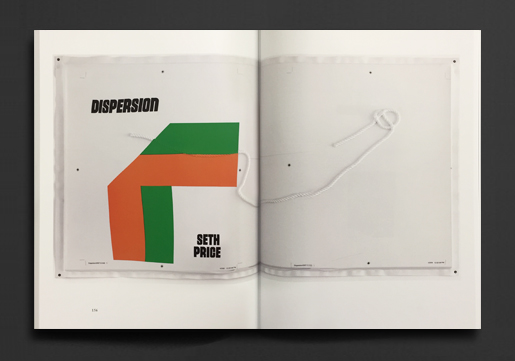
Despite its apparent throwaway status, the stock image comprises the primary commodity of a billion-dollar global industry with far-reaching effects in the marketplace and the public sphere. Taking this overlooked facet of contemporary life as a point of departure, "Ordinary Pictures" explores the photographic apparatuses and commercial interests that have given rise to our generic image culture through the conceptual image-based work of some 40 artists, including John Baldessari, Steven Baldi, Sarah Charlesworth, Anne Collier, Liz Deschenes, John Divola, Aleksandra Domanovi c, Hans-Peter Feldmann, Morgan Fisher, Hollis Frampton, Jack Goldstein, Rachel Harrison, Robert Heinecken, Leslie Hewitt, Elad Lassry, Louise Lawler, Sherrie Levine, Steve McQueen, Jack Pierson, Peter Piller, Seth Price, Amanda Rossotto, Ed Ruscha, Steven Shore, Sturtevant, Mungo Thomson, Wolfgang Tillmans, Tseng Kwong Chi, Julia Wachtel and Christopher Williams. Spanning generations, movements and artistic strategies from the 1960s to the present day, this publication brings together works by artists who have probed, mimicked and critiqued this aspect of our visual environment as well as its industrial modes of production and distribution. Through the work of these artists and a series of scholarly essays, the catalogue aims to examine different operations of the generic image in culture, namely its anonymous circulation and editorial uses, its adaptability and reproducibility, its technical processes of production, its claim to copyright and artistic license and its tendency toward abstraction. Featuring a unique, coil-bound design reminiscent of stock photo catalogues and a flexidisc recording by the artist Jack Goldstein, this highly collectible book ultimately reflects on contemporary art's own complicit function as an expanding industrial image economy.
Edited by Eric Crosby, texts by Lane Relyea and Thomas Beard.
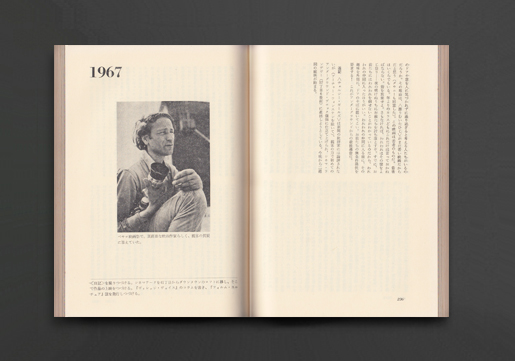
1972, Japanese
Softcover (w. dustjacket), 340 pages, 15.5 x 22 cm
1st Japanese edition, Out of print title / used*,
Published by
? / Japan
$45.00 - In stock -
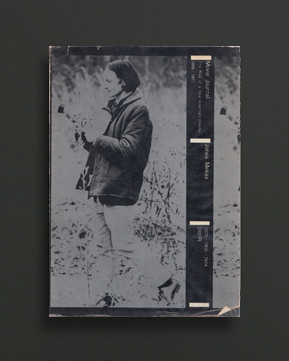
Japanese edition of this classic collection of writings from the great Jonas Mekas.
Please note, texts in this scarce edition are entirely in Japanese.
In his Village Voice Movie Journal columns, Jonas Mekas captured the makings of an exciting movement in 1960s American filmmaking. Works by Andy Warhol, Gregory J. Markapoulos, Stan Brakhage, Jack Smith, Robert Breer, and others echoed experiments already underway elsewhere, yet they belonged to a nascent tradition that only a true visionary could identify. Mekas incorporated the most essential characteristics of these films into a unique conception of American filmmaking s next phase. He simplified complex aesthetic strategies for unfamiliar audiences and appreciated the subversive genius of films that many dismissed as trash.
2016, English
Hardcover (padded), 312 pages, 18.4 x 30 cm
Published by
Moderna Museet / Stockholm
Walther König / Köln
$45.00 - Out of stock
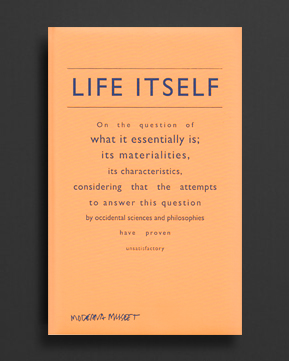
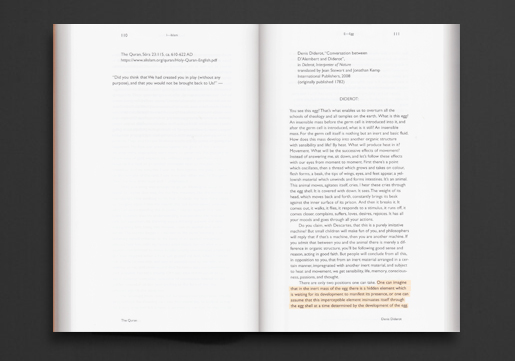
Anyone undertaking a study of the concept of "life" in our culture will observe that it never gets defined as such, writes Giorgio Agamben. Instead, he claims, this indeterminate thing - life itself - gets articulated and divided time and again through a series of oppositions that give it a function in the sciences without ever being defined as such. These theoretical and literary articulations are what this book is about, and what the 173 texts by authors, scientists and philosophers from all times and all disciplines will try to answer.
Ernst Haeckel, speculative biologist and naturalist, coined key concepts as phylum and ecology. In the years 1899-1904 he published Kunstformen der Natur (Art Forms of Nature), one hundred prints depicting organisms many of which were first described by Haeckel himself, who with this project took an unusual step from science to art. His sketches thus create a bridge between this book and the exhibition at Moderna Museet, appearing in the margins of both. Otherwise there is no art in this publication and the division of labor strict: the exhibition is art?s chance to answer the topic spelled out in the subtitle to Life Itself: "On the question of what it essentially is; its materialities, its characteristics, considering that attempts to answer this question by occidental sciences and philosophies have proven unsatisfactory."
Exhibition featured the work of Giovanni Anselmo, Olga Balema, Hicham Berrada, Joseph Beuys, Karl Blossfeldt, Constantin Brancusi, Victor Brauner, Nina Canell, Lygia Clark, Trisha Donnelly, Monica Englund, Valia Fetisov, Dirk Fleischmann, Katharina Fritsch, Ernst Haeckel, Barbara Hauser, Tamara Henderson, Eva Hesse, Damien Hirst, Tehching Hsieh, Pierre Huyghe, Carsten Höller/Rosemarie Trockel, On Kawara, Josh Kline, Hilma af Klint, Edward Krasinski, Mark Leckey, Helen Marten, Henri Michaux, Barnett Newman, Otobong Nkanga, Katja Novitskova, Philippe Parreno, Giuseppe Penone, Leo Reis, Ulf Rollof, Rachel Rose, Anri Sala, Sebastian Stöhrer, Sturtevant, Paul Thek, Rosemarie Trockel, Rosemarie Trockel/Günter Weseler, Christine Ödlund.
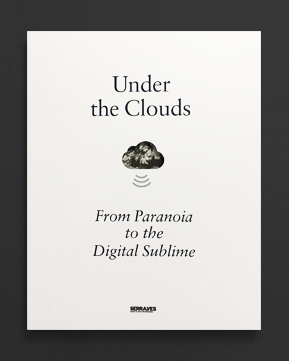
2015, English / Portuguese
Softcover (die-cut), 300 pages, 28.5 x 22.5 cm
Published by
Serralves Museum of Contemporary Art / Porto
$58.00 $30.00 - Out of stock
Since the second half of the 20th century, we have lived under the shadow of two clouds: the mushroom cloud of the atomic bomb, and the ‘cloud’ of distributed information networks. How did the central metaphor of cold war paranoia become the utopian metaphor of today? ‘Under the Clouds’ explores the contemporary sublime that has replaced the natural one, and the interrelated effects and affects of these two clouds on life and work, leisure and love, and on images, bodies, and minds.
The post-war technologies of the emergent third industrial revolution have now evolved to fit in the palm of our hand; we no longer merely look at images, we now touch, scroll, pinch, and drag them. Where is the border between the self and its data shadow, between information, matter, and affect? The biological, economic, aesthetic, and political effects of living under the clouds has taken the form of new relations between data and material, as well as increasing debt and abstract financialization; the changing nature of work and sex; and new relationships between screens, images, and things. As earlier forms of technologically inflected art sought to mitigate the effects of change — both on perception and society — many of today’s artistic practices confront the myriad interfaces and decentralized networks that continue to shape and transform daily life, forming new evolving connections between bits and atoms.
Texts by
Enrico Baj & Sergio Dangelo, Thomas Hirschhorn, Sean Landers, Metahaven, Seth Price, João Ribas, Frances Stark, Hito Steyerl, Stan VanDerBeek
Artists
Adel Abdessemed, Horst Ademeit, Cory Arcangel, Arte Nucleare, Darren Bader, Enrico Baj, Robert Barry, Eduardo Batarda, Thomas Bayrle, Neïl Beloufa, René Bertholo, Joseph Beuys, K.P. Brehmer, Bruce Conner, Kate Cooper, Gregory Corso, Guy Debord, Harun Farocki, Hans-Peter Feldmann, Carla Filipe, General Idea, Melanie Gilligan, Jean-Luc Godard & Anne-Marie Miéville, Peter Halley, Rachel Harrison, Mona Hatoum, Pedro Henriques, Thomas Hirschhorn, Yves Klein, Sean Landers, Elad Lassry, Mark Lombardi, Julie Mehretu, Katja Novitskova, Ken Okiishi, Trevor Paglen, Nam June Paik, Silvestre Pestana, Pratchaya Phinthong, Seth Price, Martha Rosler, Thomas Ruff, Jacolby Satterwhite, Ângelo de Sousa, Frances Stark, Haim Steinbach, Hito Steyerl, Jean Tinguely, Adelhyd van Bender, Stan VanDerBeek, Andy Warhol, Christopher Williams, Christopher Wool, Anicka Yi
2015, English
Softcover (w. DVD), 128 pages, 13 x 20 cm
Published by
International House / Philadelphia
$48.00 - Out of stock
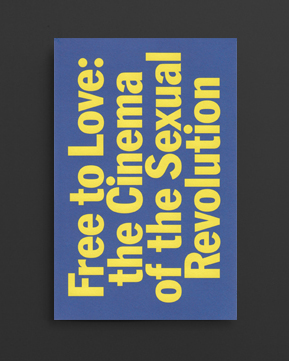
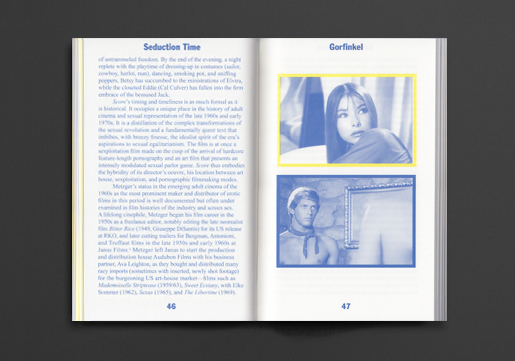
Free to Love looks at a selection of films from the 1960s and 70s, both commercial and experimental, to investigate how issues surrounding sexual liberation and the undoing of censorship laws manifested themselves in moving-image art from around the world. While the sexual revolution cannot simply be viewed as one unified movement, its conflicts and contradictions inspired some of the most important films from this period, asserting sexual power in an era when "power to the people" was the motto. The essays examine key works and individuals associated with the cinema of the sexual revolution (Radley Metzger, Pat Rocco, Phyllis and Eberhard Kronhausen), and the book includes a DVD of three short films: Desire Pie (Lisa Crafts, 1976), A Quickie (Dirk Kortz, 1970) and Norien Ten (John Knoop, 1972). Also included is a discussion with A.K. Burns, Barbara Hammer, M.M. Serra and A.L. Steiner.
2015, English
Softcover, 208 pages, 22.5 x 15 cm
Published by
Koenig Books / London
Raven Row / London
$49.00 - Out of stock
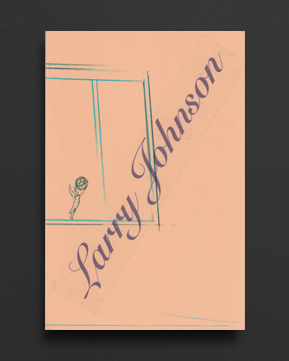
As part of a generation of artists that emerged in the US in the early 1980s, Johnson is the 'artist's artist' par excellence, highly respected by fellow practitioners and students but little known outside of these circles. Edited by Bruce Hainley, this volume addresses the glaring bibliographic gap by offering an accessible overview of Johnson's work through analyses of some of his main preoccupations: queer politics and the urban landscape of LA and Hollywood mythologies. Featuring newly commissioned essays by Morgan Fisher, Bruce Hainley, Antony Hudek, Wayne Koestenbaum and Lisa Lapinski alongside other writings, this volume spans the artist's career from the early 80s to the present, heavily illustrated with text-based imagery and later cartoon-esque pieces. The glossy surfaces of Johnson's works are often combined with penetrating references to celebrity or gay culture, their look echoing the worlds of advertising and graphic design while evoking a variety of artistic traditions.
Published on the occasion of the exhibition Larry Johnson: On Location at Raven Row, London, 11 June – 9 August.
2014, English
Softcover, 240 pages, 145 x 210 mm
Published by
The MIT Press / Massachusetts
Whitechapel / London
$52.00 - Out of stock
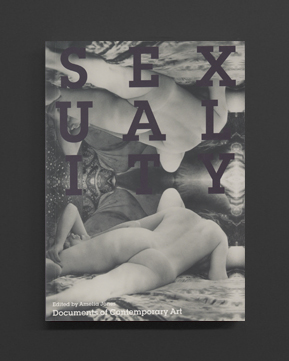
It has been argued, most notably in psychoanalytic and modernist art discourse, that the production of works of art is fundamentally driven by sexual desire. It has been further argued, particularly since the early 1970s, that sexual drives and desires also condition the distribution, display and reception of art.
This anthology traces how and why this identification of art with sexual expression or repression arose and how the terms have shifted in tandem with artistic and theoretical debates, from the era of the rights movements to the present. Among the subjects it discusses are abjection and the “informe,” or formless; pornography and the obscene; the performativity of gender and sexuality; and the role of sexuality in forging radical art or curatorial practices in response to such issues as state-sponsored repression and anti-feminism in the broader social realm.
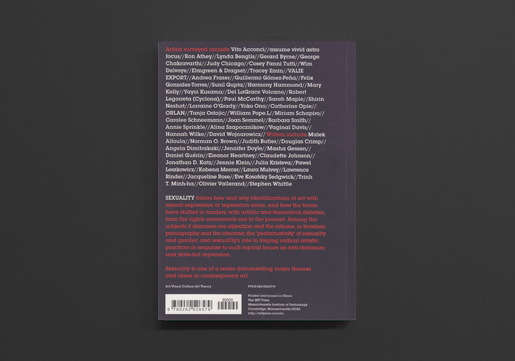
Artists surveyed include:
Vito Acconci, Assume Vivid Astro Focus, Lynda Benglis, Louise Bourgeois, Gerard Byrne, George Chakravarthi, Judy Chicago, Vaginal Davis, Wim Delvoye, Elmgreen & Dragset, Valie Export, Félix González-Torres, Guillermo Gómez-Peña, Harmony Hammond, Claudette Johnson, Mary Kelly, Yayoi Kusama, Robert Legorreta, Paul McCarthy, Sarah Maple, Shirin Neshat, Lorraine O’Grady, Yoko Ono, Catherine Opie, Orlan, William Pope.L, Miriam Schapiro, Carolee Schneemann, Joan Semmel, Barbara Smith, Annie Sprinkle, Alina Szapocznikow, Del LaGrace Volcano, Hannah Wilke, David Wojnarowicz
Writers include:
Malek Alloula, Norman O. Brown, Judith Butler, Douglas Crimp, Angela Dimitrakaki, Michel Foucault, Daniel Guérin, Eleanor Heartney, Jonathan D. Katz, Rosalind Krauss, Julia Kristeva, Paweł Leszkowicz, Herbert Marcuse, Kobena Mercer, Laura Mulvey, Lawrence Rinder, Jacqueline Rose, Eve Kosofsky Sedgwick, Susan Sontag, Trinh T. Minh-ha, Stephen Whittle
About the Editor
Amelia Jones is Grierson Chair in Art History and Communication Studies at McGill University. Her books include Irrational Modernism: A Neurasthenic History of New York Dada (MIT Press), Self/Image: Technology, Representation and the Contemporary Subject, and Seeing Differently: A History and Theory of Identification and the Visual Arts.
2014, English
Softcover, 160 pages, (8 b/w and 81 color ill.), 16 x 24 cm
Published by
Sternberg Press / Berlin
$28.00 - Out of stock
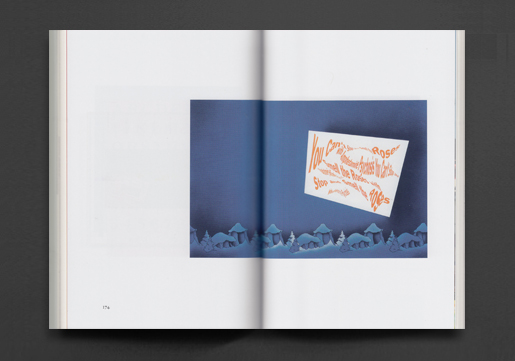
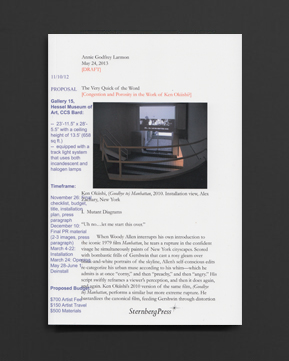
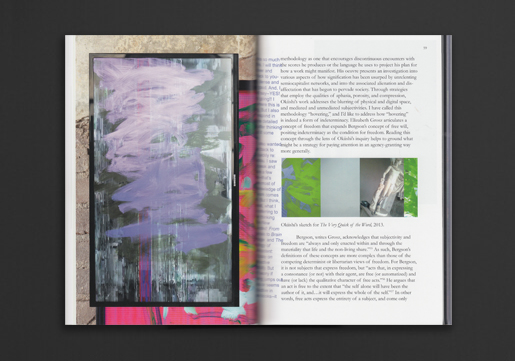
Ken Okiishi’s artwork has explored the subject in between digital and continuous space, the changing nature of authorship, memory, and perception, and the indeterminacy of consciousness as it clashes with the strictures of technology. He has engaged seminal works by figures including Woody Allen, Arthur Rimbaud, Marcel Duchamp, Stephen Spielberg, David Wojnarowicz, Jacques Demy, and Larry Clark (and the histories and personalities that circulate around these cultural products), infusing them with autobiographical and technological elements that reframe them through the incongruity of “real life.” While working on the exhibitions at MIT and CCS Bard that occasion this publication, Okiishi realized a radical material rupture in his work, as linguistic and bodily glitches became registered both inside andoutside the screen, and the surface of media itself became the support surface for weirdly gestural paintings. This series of works, titled gesture/data, was first exhibited at CCS Bard and, most recently, was exhibited to great acclaim at the 2014 Whitney Biennial. This book is the first instance of considering Okiishi’s work from the last fifteen years as a heterogeneous whole.
This publication takes the format of the exhibition catalogue—as a carrier for the circulation of texts and images—as a format in crisis. The physical book appears here as a dummy that is loaded with various files, many appearing as the glitchy in-between that we have become accustomed to as files load on so many different devices and scales of screens. Included in this mass of files is Annie Godfrey Larmon’s thesis on the work of Ken Okiishi (the first in-depth study of the artist’s work), a new text by Alise Upitis on computing and the conditions of translation, images from Okiishi’s series gesture/data (2013–ongoing), and a screenplay book of Okiishi’s 2010 runaway hit, (Goodbye to) Manhattan.
The Very Quick of the Word is published in conjunction with Ken Okiishi’s exhibitions at the MIT List Visual Arts Center (July 16–September 1, 2013) and the Hessel Museum of Art, Center for Curatorial Studies, Bard College (March 24–May 26, 2013).
Design by Ken Okiishi
2012, English
Softcover, 220 x 293 mm
Published by
Kaleidoscope Press / Milan
$18.00 - Out of stock
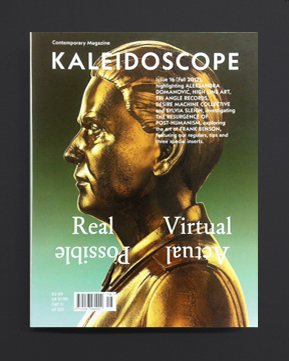
Kaleidoscope 16 – Fall 2012
Kaleidoscope is an international quarterly of contemporary art and culture. Distributed worldwide on a seasonal basis, it offers a timely guide to the present (but also to the past and possible futures) with an interdisciplinary and unconventional approach.
HIGHLIGHTS
Aleksandra Domanovic by Pablo Larios; The High Line Art by Piper Marshall; Tri Angle Reocrdsa by Ruth Saxelby; Desire Machine Collective by Ulrich Baer and Sandhini Poddar; Sylvia Sleigh by Joanna Fiduccia.
DRAWINGS by Ken Price
MAIN THEME – Human After All
Part A) Prisoner of Flesh by Michele D’Aurizio; Part B) Talking to Machines by Jason Brown and Brody Condon introduces by DIS Magazine; Part C) David Altmejd by Karen Archey; Part D) Possibility Spaces by Manuel de Landa and Timur Si-Qin.
STICKERS by Alistair Frost
MONO – Frank Benson
Essay by Alessandro Rabottini; Interview by Matt Keegan.
IMAGES by Karthik Pandian
REGULARS
Futura: Liz Magic Laser by Hans Ulrich Obrist; Panorama: Marseille by Dorothée Dupuis; Souvenir D’Italie: Alberto Garutti by Luca Cerizza; Producers: Ariane Beyn by Carson Chan.
2007, English
Hardcover, 400 pages, 235 x 263 mm
Published by
The MIT Press / Massachusetts
The Museum of Contemporary Art / Los Angeles
$88.00 - Out of stock
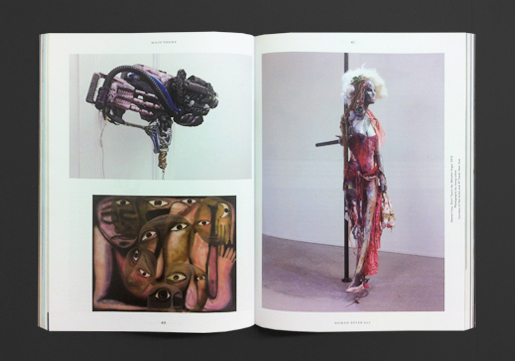
There had never been art like the art produced by women artists in the 1970s ;and there has never been a book with the ambition and scope of this one about that groundbreaking era. WACK! documents and illustrates the impact of the feminist revolution on art made between 1965 and 1980, featuring pioneering and influential works by artists who came of age during that period ;Chantal Akerman, Lynda Benglis, Theresa Hak Kyung Cha, Valie Export, Mary Heilmann, Sanja Ivekovič, Ana Mendieta, Annette Messager, and others ;as well as important works made in those years by artists whose whose careers were already well established, including Louise Bourgeois, Judy Chicago, Sheila Levrant de Bretteville, Lucy Lippard, Alice Neel, and Yoko Ono.The art surveyed in WACK! includes work by more than 120 artists, in all media ;from painting and sculpture to photography, film, installation, and video ;arranged not by chronology but by theme: Abstraction, "Autophotography," Body as Medium, Family Stories, Gender Performance, Knowledge as Power, Making Art History, and others. WACK!, which accompanies the first international museum exhibition to showcase feminist art from this revolutionary era, contains more than 400 color images. Highlights include the figurative paintings of Joan Semmel; the performance and film collaborations of Sally Potter and Rose English; the untitled film stills of Cindy Sherman; and the large-scale, craft-based sculptures of Magdalena Abakanowicz. Written entries on each artist offer key biographical and descriptive information and accompanying essays by leading critics, art historians, and scholars offer new perspectives on feminist art practice. The topics ;including the relationship between American and European feminism, feminism and New York abstraction, and mapping a global feminism ;provide a broad social context for the artworks themselves. WACK! is both a definitive visual record and a long-awaited history of one of the most important artistic movements of the twentieth century.
Essays by: Cornelia Butler, Judith Russi Kirshner, Catherine Lord, Marsha Meskimmon, Richard Meyer, Helen Molesworth, Peggy Phelan, Nelly Richard, Valerie Smith, Abigail Solomon-Godeau, Jenni Sorkin.
Artists include: Marina Abramovič, Chantal Akerman, Lynda Benglis, Dara Birnbaum, Louise Bourgeois, Judy Chicago, Lygia Clark, Jay DeFeo, Mary Beth Edelson, Valie Export, Barbara Hammer, Susan Hiller, Joan Jonas, Mary Kelly, Maria Lassnig, Linda Montano, Alice Neel, Senga Nengudi, Lorraine O'Grady, Pauline Oliveros, Yoko Ono, Orlan, Howardena Pindell, Yvonne Rainer, Faith Ringgold, Ketty La Rocca, Ulrike Rosenbach, Martha Rosler, Betye Saar, Miriam Schapiro, Carolee Schneemann, Cindy Sherman, and Hannah Wilke.
Due to the weight of this volume, your order will likely incur additional postage costs. We will contact you with the best shipping advice upon your order, or alternatively, please email us in advance. Thank you for understanding.
2008, English / German
84 x 59 cm
Published by
Kölnischer Kunstverein / Köln
$18.00 - Out of stock
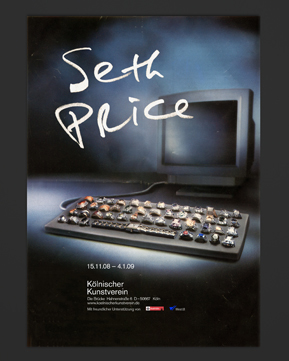
Poster for Seth Price's 2008 exhibition at the Kölnischer Kunstverein
2005, English / German
84 x 59 cm
Published by
Kölnischer Kunstverein / Köln
$18.00 - Out of stock
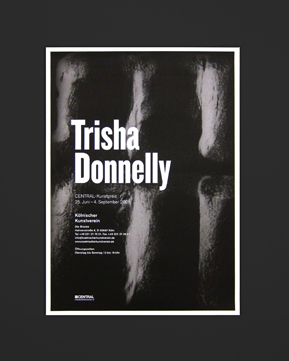
Poster for Trisha Donnelly's 2005 exhibition at the Kölnischer Kunstverein
2008, English / German
84 x 59 cm
Published by
Kölnischer Kunstverein / Köln
$18.00 - Out of stock
Poster for Mark Leckey's 2008 exhibition at the Kölnischer Kunstverein
2012, English / Italian
Softcover Newspaper, 270 pages (clour and b&w ill.), 26.5 x 37.5 cm
Published by
Mousse / Milan
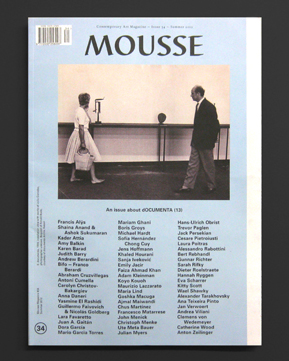
$15.00 - Out of stock
2011, English
Hardcover, 200 pages (25 colour and 55 b&w ill.), 178 x 254 mm
$37.00 - Out of stock
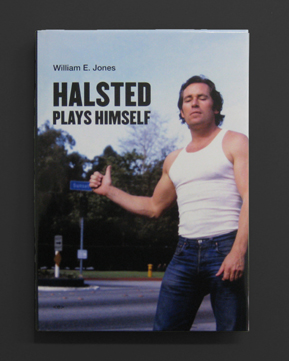
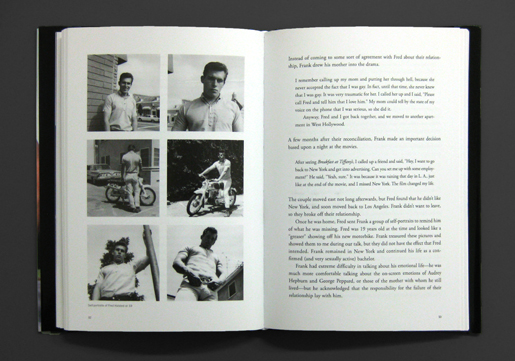
Fred Halsted’s L.A. Plays Itself (1972) was gay porn’s first masterpiece: a sexually explicit, autobiographical, experimental film whose New York screening left even Salvador Dalí repeatedly muttering “new information for me.” Halsted, a self-taught filmmaker, shot the film over a period of three years in a now-vanished Los Angeles, a city at once rural and sleazy.
Although his cultural notoriety at one point equaled that of Kenneth Anger or Jack Smith, Halsted’s star waned in the 1980s with the emergence of a more commercial gay-porn industry. After the death from AIDS of his long-time partner, lover, spouse (and tormentor) Joey Yale in 1986, Halsted committed suicide in 1989.
In Halsted Plays Himself, acclaimed artist and filmmaker William E. Jones documents his quest to capture the elusive public and private personas of Halsted–to zero in on an identity riddled with contradictions. Jones assembles a narrative of a long-gone gay lifestyle and an extinct Hollywood underground, when independent films were still possible, and the boundary between experimental and pornographic was not yet established. The book also depicts what sexual liberation looked like at a volatile point in time–and what it looked like when it collapsed.
William E. Jones is an artist and filmmaker who teaches film history at the Art Center College of Design in Pasadena. He has made two feature length experimental films, Massillon (1991) and Finished (1997), several short videos, including The Fall of Communism as Seen in Gay Pornography (1998), the feature length documentary Is It Really So Strange? (2004), and many video installations. His films and videos were the subject of retrospectives at Tate Modern, London, in 2005, and at Anthology Film Archives, New York, in 2010. He has worked in the adult video industry under the name Hudson Wilcox.
“[A] fascinating glimpse of a bygone gay culture whose aesthetic was far less polished, more earthy, and more dangerous than our current one, defined as it is by dollars and digital media.”
—Sam Biederman, Bookforum
“As a project born out of the author’s sincere admiration for his subject, Halsted Plays Himself amounts to a very passionate, if not sentimental, account. Jones not only attempts to symbolically revive Halsted in this elegy, but continuously constructs imaginary scenarios which could have resulted in him still being alive, better understood, or more accepted.”
—Aliina Astrova, Kaleidoscope (blog)
“[A] rich and rewarding excavation of a blazing moment in the early 1970s...[A] valuable installment in a recent, resurgent interest in queer documents from that flourishing social period, positioning Halsted's artistic legacy within a teeming moment of gay visibility.”
—Bradford Nordeen, Art in America
2011, English
Softcover (stapled), 16 pages, (colour ill.), 200 x 170 mm
Published by
Monash University Museum of Art / Melbourne
$8.00 - In stock -
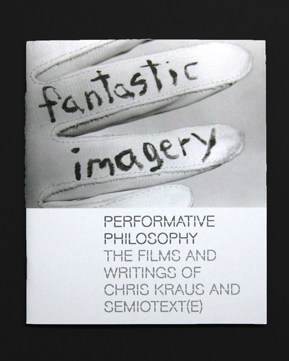
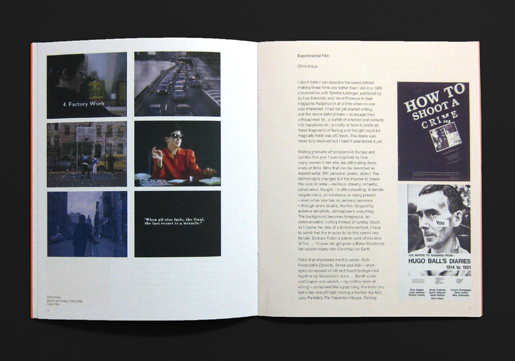
Accompanying catalogue for Performative Philosophy: The films and writings of Chris Kraus and Semiotext(e) which presents Kraus’ work as a film-maker, writer and co-editor of Semiotext(e). The exhibition comprising films, books, scripts, posters and stills and production notes, encompasses the poetic force of Kraus’ filmmaking and her deeply unique and inventive voice that moves through art, fiction, feminism, politics and the many spheres of cultural production.
Additional to Kraus’ films, Performative Philosophy will present film and video by authors published by Semiotext(e), including Guy Debord, Penny Arcade, David Wojnarowicz, David Rattray, Sylvére Lotringer, Gary Indiana and Bernadette Corporation. The exhibition locates Kraus as the thread linking this diverse selection of artists, filmmakers and philosophers.
2008, English
Softcover, 2nd printing, 43 pages, 11 x 8.5"
Edition of 1000,
Published by
2nd Cannons / Los Angeles
$14.00 - Out of stock
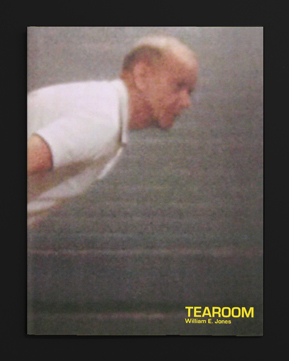
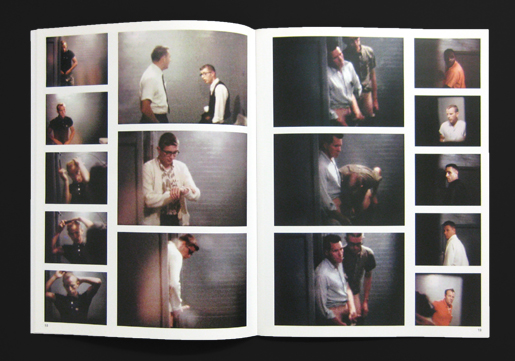
Tearoom is a companion piece to Jones’s video of the same name. A work of appropriation, the video Tearoom is a police surveillance film – presented virtually unaltered – of men having sex in a public rest room in Mansfield, Ohio during a three week period in the summer of 1962. This film, used as evidence in court, led to the conviction of over 30 men on charges of sodomy, which at that time carried a minimum sentence of one year in the state penitentiary.
In the book Tearoom, William E. Jones presents the results of research on these cases and on the production of the surveillance film. The book includes a number of historical texts, as well as two new essays by Jones. Tearoom is extensively illustrated with more than 100 film stills, most of them in color. These stills show men from all walks of life who met for furtive sex under the central square of Mansfield, and who went to jail as the result of a law enforcement sting. Tearoom provides a unique view of the clandestine sexual life of a small Midwestern city at the beginning of the 1960s.
2009, English / German / Italian
Softcover, 24 pages, 15 x 21 cm
Edition of 800,
Published by
Mousse / Milan
$8.00 - Out of stock
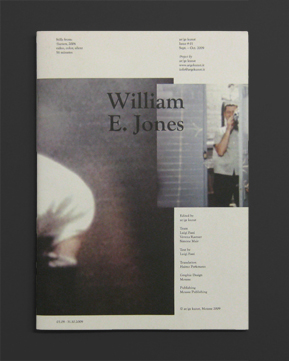
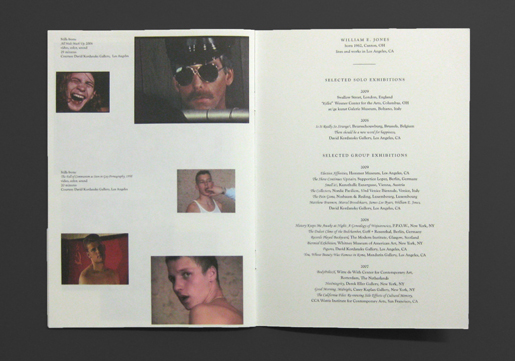
The first in a series of small-format publications connected to the shows at ar/ge kunst, the William E. Jones fanzine presents images of various works by this US artist, who is known for videos that reinterpret archival materials, police recordings, porn sequences, surveillance footage, etc., to trace a cultural history of sexuality, highlighting the ideologies of power and strategies of social control that are bound to it. The text by Luigi Fassi tells the story of this artistic adventure. The booklet contains a loose color print of a still from Tearoom (2006).
2001, German
Softcover, 12 pages, 220 x 270 mm
Published by
Kunstverein Braunschweig / Germany
$18.00 $5.00 - In stock -
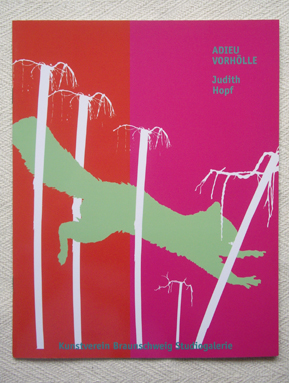
Catalogue from Judith Hopf, ADIEU VORHöLLE, 2001 exhibition at Kunstverein Braunschweig Studiogalerie