World Food Books' programme is largely produced on Kulin Nation land. We acknowledge the Wurundjeri people of the Kulin Nation as the first and continuing custodians of this land, and pay respect to their Elders past, present, and emerging.
World Food Books is an arts and special interests bookshop in Naarm / Melbourne. Founded in 2010, World Food Books is devoted to the presentation of a rotating, hand-selection of international art, design, literary and counterculture publications with an emphasis on the anti-traditional, the experimental, the avant-garde, the heretic, the marginal.
Presenting new titles alongside rare and out-of-print books, catalogues and journals spanning the fields of modern and contemporary art, design, photography, illustration, film, literature, poetry, cultural theory, philosophy, sexuality, popular and underground culture in its many radical forms, World Food Books wishes to encourage adventurous, thoughtful and open-minded reading, looking, writing, and exchange of publishing and ideas, both current and historical.
As well as our bookshop, located in Melbourne's historical Nicholas Building, all of our inventory is available internationally via our online mail-order service.
World Food Books semi-regularly co-ordinates "Occasions", a programme of exhibits and events at the bookshop and in partnership with other hosts (such as museums and art galleries) that develop out of the activities, relationships and content of the bookshop itself.
World Food Books
The Nicholas Building
37 Swanston Street
Room 5, Level 6
Melbourne 3000
Australia
SHOP HOURS:
Thu–Fri 12–6, Sat 12–5
WEB-SHOP OPEN 24/7
World Food Books
Postal Address:
PO Box 435
Flinders Lane
Victoria 8009
Australia
Art
Theory / Essay
Architecture / Interior
Graphic Design / Typography
Photography
Fashion
Eros
LGBTQ+
Fiction / Poetry
Weird / Speculative / Science Fiction / Horror
Transgressive / Visceral / Abject
Symbolism / Decadence / Fin de siècle
Film / Video
Painting
Sculpture / Installation
Performance / Dance / Theater
Drawing
Sound / Music
Curatorial
Group Shows / Collections
Periodicals
Out-of-print / Rare
Posters / Ephemera / Discs
Signed Books
World Food Books Gift Voucher
World Food Book Bag
Australian Art
Australian Fiction
Australian Science Fiction / Speculative Fiction
Australian Poetry
Australian Photography
Japanese Photography
Conceptual Art
Minimal Art
Dada
'Pataphysics / Oulipo
Fluxus
Concrete Poetry
Pop Art
Surrealism
Arte Povera
Arte Informale / Haute Pâte / Tachism
Nouveau Réalisme / Zero / Kinetic
Situationism / Lettrism
Collage / Mail Art / Xerox Art
Art Brut / Folk / Visionary / Fantastic
Illustration / Graphic Art / Bandes Dessinées
Furniture
Italian Radical Design / Postmodernism
Textiles
Ceramics / Glass
Counterculture
Protest / Revolt
Philosophy
Psychoanalysis
Anthropology
Anarchism
Socialism / Anarchism / Communism / Capitalism
Literary Theory / Semiotics / Language
Feminism / Women's Studies
Gender Studies / Sexuality
Anthropology
Fetishism / BDSM
Drugs / Psychedelia
Crime / Violence
Animal Rights / Veganism
Occult / Esoterica
Ecology / Earth / Alternative Living
Whole Earth / Crafts
All prices in AUD (Australian dollars)
Pick-Ups
Pick-up orders can be collected in our bookshop during opening hours after order date. Please collect any Pick-up orders within 2 weeks of ordering as we have limited storage space. Orders will be released back into stock if not collected within this time. No refunds can be made for pick-ups left un-collected. If you cannot make it in to the bookshop in this time-frame, please choose postage option.
Return Policy
All sales are final. We do accept returns (for refund or exchange) for items received in error. All our orders are packed with special care using heavy-duty padding and cardboard book-mailers or bubble mailers (for smaller books), using reinforcement where required. We cannot take responsibility for any lost, stolen or damaged parcels.
Insurance
Should you wish to insure your package, please email us directly after placing your order and we can organise this at a small extra expense. Although all standard/express tracked packages are very safe and dependable, we cannot take responsibility for any lost, stolen or damaged parcels. We recommend insurance on valuable orders.
Interested in selling your old books, catalogues, journals, magazines, comics, fanzines, ephemera? We are always looking for interesting, unusual and out-of-print books to buy. We only buy books in our fields of interest and specialty, and that we feel we can resell.
We base these prices on desirability, market value, in-print prices, condition and our current stock levels. We offer cash, store credit, and can take stock on consignment. All
about 25% of the price we expect to get when we sell them, or 30% in store credit. We base these prices on desirability, market value, in-print prices, condition and our current stock levels.
Sell your books any day of the week. You can drop them off and return later. If you have a lot of books, we can visit your Sydney home.
We buy books that we feel we can resell. We offer about 25 % of the price we expect to get when we sell them, or 30% in store credit. We base these prices on desirability, market value, in-print prices, condition and our current stock levels.
Philadelphia Wireman
03 August - 01 September, 2018
World Food Books is proud to announce our next Occasion, the first presentation of sculptures by Philadelphia Wireman in Australia.
The Philadelphia Wireman sculptures were found abandoned in an alley off Philadelphia’s South Street on trash night in 1982. Their discovery in a rapidly-changing neighbourhood undergoing extensive renovation, compounded with the failure of all attempts to locate the artist, suggests that the works may have been discarded after the maker’s death. Dubbed the "Philadelphia Wireman" during the first exhibition of this work, in 1985, the maker’s name, age, ethnicity, and even gender remain uncertain. The entire collection totals approximately 1200 pieces, all intricately bound together with tightly-wound heavy-gauge wire (along with a few small, abstract marker drawings, reminiscent both of Mark Tobey and J.B. Murry). The dense construction of the work, despite a modest range of scale and materials, is singularly obsessive and disciplined in design: a wire armature or exoskeleton firmly binds a bricolage of found objects including plastic, glass, food packaging, umbrella parts, tape, rubber, batteries, pens, leather, reflectors, nuts and bolts, nails, foil, coins, toys, watches, eyeglasses, tools, and jewellery.
Heavy with associations—anthropomorphic, zoomorphic, and socio-cultural responses to wrapped detritus—the totemic sculptures by Philadelphia Wireman have been discussed in the context of work created to fulfil the shamanistic needs of alternative religions in American culture. Curators, collectors, and critics have variously compared certain pieces to sculpture from Classical antiquity, Native American medicine bundles, African-American memory jugs, and African fetish objects. Reflecting the artist’s prolific and incredibly focused scavenging impulse, and despite—or perhaps enhanced by—their anonymity, these enigmatic objects function as urban artefacts and arbiters of power, though their origin and purpose is unknown. Philadelphia Wireman, whatever their identity, possessed an astonishing ability to isolate and communicate the concepts of power and energy through the selection and transformation of ordinary materials. Over the course of the past two decades, this collection has come to be regarded as an important discovery in the field of self-taught art and vernacular art.
Presented in collaboration with Fleisher-Ollman Gallery, Philadelphia, and Robert Heald, Wellington.
Susan Te Kahurangi King
02 February - 10 March, 2018
Susan Te Kahurangi King (24 February 1951 - ) has been a confident and prolific artist since she was a young child, drawing with readily available materials - pencils, ballpoint pens and felt-tip markers, on whatever paper is at hand. Between the ages of four and six Susan slowly ceased verbal communication. Her grandparents William and Myrtle Murphy had developed a special bond with Susan so they took on caring responsibilities for extended periods. Myrtle began informally archiving her work, carefully collecting and storing the drawings and compiling scrapbooks. No drawing was insignificant; every scrap of paper was kept. The King family are now the custodians of a vast collection containing over 7000 individual works, from tiny scraps of paper through to 5 meter long rolls.
The scrapbooks and diaries reveal Myrtle to be a woman of great patience and compassion, seeking to understand a child who was not always behaving as expected. She encouraged Susan to be observant, to explore her environment and absorb all the sights and sounds. Myrtle would show Susan’s drawings to friends and people in her community that she had dealings with, such as shopkeepers and postal workers, but this was not simply a case of a grandmother’s bias. She recognised that Susan had developed a sophisticated and unique visual language and sincerely believed that her art deserved serious attention.
This was an unorthodox attitude for the time. To provide some context, Jean Dubuffet coined the term Art Brut in 1945 to describe work created by self-taught artists – specifically residents of psychiatric institutions and those he considered to be visionaries or eccentrics. In 1972 Roger Cardinal extended this concept by adopting the term Outsider Art to describe work made by non-academically trained artists operating outside of mainstream art networks through choice or circumstance. Susan was born in Te Aroha, New Zealand in 1951, far from the artistic hubs of Paris and London that Dubuffet and Cardinal operated in. That Myrtle fêted Susan as a self-taught artist who deserved to be taken seriously shows how progressive her attitudes were.
Susan’s parents Doug and Dawn were also progressive. Over the years they had consulted numerous health practitioners about Susan’s condition, as the medical establishment could not provide an explanation as to why she had lapsed into silence. Dawn educated herself in the field of homeopathy and went on to treat all twelve of her children using these principles – basing prescriptions on her observations of their physical, mental and emotional state.
Doug was a linguist with an interest in philosophy who devoted what little spare time he had to studying Maori language and culture. To some extent their willingness to explore the fringes of the mainstream made them outsiders too but it was their commitment to living with integrity and their respect for individuality that ensured Susan’s creativity was always encouraged.
Even though Susan’s family supported her artistic pursuits, some staff in schools and hospitals saw it as an impediment to her assimilation into the community and discouraged it in a variety of ways. Her family was not always aware of this and therefore did not fully understand why Susan stopped drawing in the early 1990s. However, rather than dwell on the challenges that Susan faced in pursuit of her artistic practice, they prefer to highlight her achievements. In 2008 Susan began drawing again in earnest, after an almost 20 year interruption, and her work is now shown in galleries around the world.
Susan grew up without television and has been heavily influenced by the comics she read as a child. She is absolutely fearless in the appropriation of recognizable characters, such as Donald Duck and Mickey Mouse, in her work. She twists their limbs, contorts their faces, compresses them together, blends them into complex patterned backgrounds - always imbuing them with an incredible energy. Although Susan often used pop culture characters in her work they are not naive or childlike. These are drawings by a brilliant self-taught artist who has been creating exceptional work for decades without an audience in mind.
Mladen Stilinović
"Various Works 1986 - 1999"
02 February 16 - September 10, 2016
Various works 1986 - 1999, from two houses, from the collections of John Nixon, Sue Cramer, Kerrie Poliness, Peter Haffenden and Phoebe Haffenden.
Including: Geometry of Cakes (various shelves), 1993; Poor People’s Law (black and white plate), 1993; White Absence (glasses, ruler, set square, silver spoon, silver ladel with skin photograph and wooden cubes), 1990-1996; Exploitation of the Dead (grey and red star painting, wooden painting, black spoon with red table, red plate), 1984-1990; Money and Zeros (zero tie, paintings made for friends in Australia (Sue, John, Kerrie), numbers painting), 1991-1992; Words - Slogans (various t-shirts) - “they talk about the death of art...help! someone is trying to kill me”, “my sweet little lamb”, “work is a disease - Karl Marx”; Various artist books, catalogues, monographs, videos; Poster from exhibition Insulting Anarchy; "Circular" Croatian - Australian edition; Artist book by Vlado Martek (Dostoyevsky); more.
Thanks to Mladen Stilinović and Branka Stipančić.
Jonathan Walker
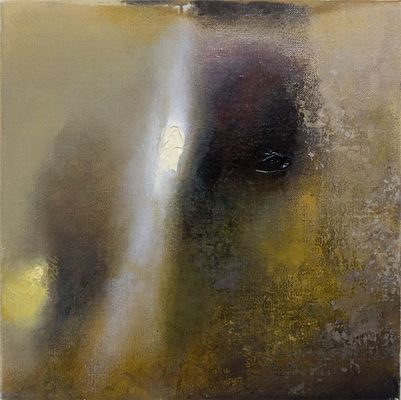
Always Will Need To Wear Winter Shirt Blue + Ochre Small Check Pattern
21 August - 21 September, 2015
Untitled
I am not a great reader of poetry but I always return to the work of Melbourne poet, Vincent Buckley (1925- 1988). Perhaps I find his most tantalising piece to be not a finished poem but a fragment left on a scrap of paper discovered on his desk after the poet’s death.
The poetry gathers like oil
In the word-core, and spreads
It has its music meet,
Its music is in movement.
This fragment is more the shell left behind from a volatile thought than a finished poem. I find the last two lines honest but awkward whereas the first two lines work like an arrow. Most likely he could not find a resolution so it was left. Still, in its present form, it remains an eloquent testimony to the ultimate failure of a medium to express mobile thought and sensation, in Buckley’s case, through verbal language. It’s an important matter because this is something all artists have to deal with regardless of the medium.
I have never written a poem, however, I am forever copying fragments from books on paper scraps in a vain effort to fix certain notions in my head. At first, they function as bookmarks that are sometimes returned to when I open the book. But before long, as they accumulate, they fall out littering the table interspersed with A4 photocopies, bills, books and medications.
To return to Buckley’s fragment, the first two lines very much evoke how I paint nowadays. As you age, detail diminishes and patches of light become more luminous and float. I feel the most honest way of dealing with this is by smearing the oil paint on the canvas with the fingers and working close-up, blind. Only if the patches coalesce into an approaching image can the work gain a life.
-
Jonathan Walker was born in Melbourne, Australia and brought up on a dairy farm in Gippsland. In the 1970’s he studied painting at RMIT and won the Harold Wright Scholarship to the British Museum, London. During the 1980’s he exhibited at Pinacotheca Gallery, Richmond and had work shown at the NGV and Heidi City Art Gallery. Over the same period he designed the cover for the “Epigenesi” LP by Giancarlo Toniutti, Italy and conducted a mail exchange work with Achim Wollscheid, Germany. The work with artists through the post resulted in an article published in the bicentenary issue of Art and Australia 1988. He showed in artist run spaces such as WestSpace in the 90’s and 2000’s, and until 2012, taught painting at Victoria University, which is where we (Colleen Ahern and Lisa Radford) as organisers of the exhibition, among many others, had the privilege of being his student.
Walker’s knowledge was imparted to students through the careful selection of music, literature, and artists found in books that he himself had ordered for the library. Walker’s strategy was the generosity of sharing his vast knowledge with references specific to each student and their context.
Walker’s paintings share a similar focus and intimacy.
This exhibition presents a small selection of recent paintings alongside a publication that includes Walker’s writing. Observational and analytical, Walker’s work is a type of material notation — the time of day, colour and how it is blended, the both specific and fleeting location of a reflection on lino or the question of whether a chair leg should be included in a painting.
Please join us on Friday August 21 between 6-8pm to celebrate the opening of the exhibition.
Curated by Colleen Ahern and Lisa Radford.
B. Wurtz
Curated by Nic Tammens
March 26 - April 4, 2015
B.Wurtz works from a basement studio in his home on Manhattan’s Lower East Side.
This local fact is attested to by the plastic shopping bags and newsprint circulars that appear in his work. As formal objects, they don’t make loud claims about their origins but nonetheless transmit street addresses and places of business from the bottom of this long thin island. Like plenty of artists, Wurtz is affected by what is local and what is consumed. His work is underpinned by this ethic. It often speaks from a neighborhood or reads like the contents of a hamper:
“BLACK PLUMS $1.29 lb.”
“Food Bazaar”
“USDA Whole Pork Shoulder Picnic 99c lb.”
“RITE AID Pharmacy, with us it’s personal.”
“H. Brickman & Sons.”
“Sweet Yams 59c lb."
Most of the work in this exhibition was made while the artist was in residence at Dieu Donne, a workshop dedicated to paper craft in Midtown. Here Wurtz fabricated assemblages with paper and objects that are relatively lightweight, with the intention that they would be easily transportable to Australia. This consideration isn’t absolute in Wurtz’s work, but was prescriptive for making the current exhibition light and cheap. Packed in two boxes, these works were sent from a USPS post office on the Lower East Side and delivered to North Melbourne by Australia Post.
Wurtz appears courtesy of Metro Pictures, New York.
Thanks to Rob Halverson, Joshua Petherick, Sari de Mallory, Matt Hinkley, Helen Johnson, Fayen d'Evie, Ask Kilmartin, Lisa Radon, Ellena Savage, Yale Union, and "Elizabeth".
John Nixon
"Archive"
December 15 - January 20, 2014
The presentation of John Nixon's archive offered a rare showcase of this extensive collection of the artist's own publications, catalogues, posters, ephemera, editions and more, from the mid 1980s onwards, alongside a selection of his artworks.
Organized by John Nixon, Joshua Petherick and Matt Hinkley.
<a href=http://wfb.public-office.info/artist/john-nixon>All titles by John Nixon
"Habitat"
at Minerva, Sydney (organised by Joshua Petherick and Matt Hinkley)
November 15 - December 20, 2014
Lupo Borgonovo, Janet Burchill & Jennifer McCamley,
Lewis Fidock, HR Giger, Piero Gilardi, Veit Laurent Kurz,
Cinzia Ruggeri, Michael E. Smith, Lucie Stahl, Daniel Weil, Wols
Press Release:
“...It contained seven objects. The slender fluted bone, surely formed for flight, surely from the wing of some large bird. Three archaic circuitboards, faced with mazes of gold. A smooth white sphere of baked clay. An age-blackened fragment of lace. A fingerlength segment of what she assumed was bone from a human wrist, grayish white, inset smoothly with the silicon shaft of a small instrument that must once have ridden flush with the surface of the skin - but the thing’s face was seared and blackened.”
William Gibson, “Count Zero”, 1986
"Autumn Projects Archive"
Curated by Liza Vasiliou
March 6 - March 15, 2014
World Food Books, in conjunction with the Virgin Australia Melbourne Fashion Festival 2014, presented the Autumn Projects archive, consisting of a selection of early examples in Australian fashion with a particular interest in collecting designers and labels from the period beginning in the 1980’s, who significantly influenced the discourse of Australian Fashion.
Curated by Liza Vasiliou, the exhibition provided a unique opportunity to view pieces by designers Anthea Crawford, Barbara Vandenberg, Geoff Liddell and labels CR Australia, Covers, Jag along with early experimental collage pieces by Prue Acton and Sally Browne’s ‘Fragments’ collection, suspended throughout the functioning World Food Books shop in Melbourne.
H.B. Peace
presented by CENTRE FOR STYLE
November 14, 2013
"Hey Blinky, you say chic, I say same"
Anon 2013
H.B. Peace is a clothing collaboration between great friends Blake Barns and Hugh Egan Westland. Their pieces explore the divergences between 'character’ and ‘personality’ in garments....etc
Special Thanks to Joshua Petherick and Matt Hinkley of WFB and Gillian Mears
and a Very Special Thank you to Audrey Thomas Hayes for her shoe collaboration.
Janet Burchill & Jennifer McCamley
"Aesthetic Suicide"
May 10 - June 8, 2013
The first of our occasional exhibitions in the World Food Books office/shop space in Melbourne, "Aesthetic Suicide" presented a body of new and older works together by artists Janet Burchill & Jennifer McCamley, including videos, prints, a wall work, and publications.
During shop open hours videos played every hour, on the hour.
1985, English
Softcover, 60 pages, 21 x 28 cm
1st Edition, Out of print title / Used*,
Published by
The Art Gallery of Western Australia / Perth
$50.00 - Out of stock
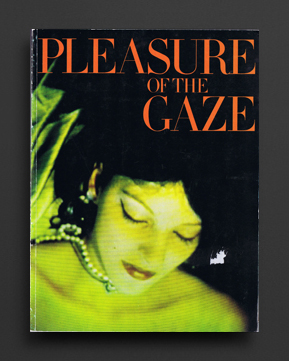
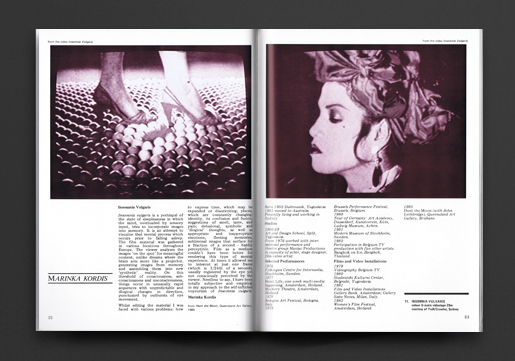
Scarce Australian catalogue published on the occasion of the exhibition "Pleasure of The Gaze : Image and Appearance in Recent Australian Art", held at the The Art Gallery of Western Australia, Perth, 1985, and curated by Bruce Adams.
Profusely illustrated in colour and black and white across exhibiting artist biographical sections and essay accompaniment illustrations, this publication features the work of Julie Brown-Rrap, Peter Callas, Richard Dunn, Merilyn Fairskye, Marinka Kordis, Maria Kozic, Lindy Lee, John Lethbridge, Akio Makigawa, Sue Paull, Stieg Persson, Robert Randall and Frank Bendinelli, Carol Rudyard, Peter Tyndall, Vicki Varvaressos, and John R. Walker. Essays include "Eye, Image, Picture, Screen (and all that Junk)" by Adrian Martin; "Sticky Television" by Meaghan Morris; "Re Re-Orientation: The Image as Fantasy and Furniture in Japan" by Peter Callas. Plus an introduction by Adams.
Design by Wohlnick Design.
2015, English / German
Softcover, 96 pages, 13 x 19.5 cm
Published by
Kunsthalle Wien / Vienna
Sternberg Press / Berlin
$22.00 - In stock -
Edited by Gareth Long, Nicolaus Schafhausen
Texts by Jonathan Walley, Tony Conrad, Diedrich Diederichsen
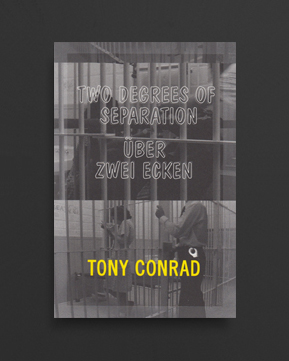
Tony Conrad, who can be described as an artist, composer, musician, filmmaker, and performer, might be considered the first true “crossover artist.” Two Degrees of Separation accompanies the eponymous exhibition by Tony Conrad at Kunsthalle Wien. In his essay “A Show That’s Almost Invisible,” the critic Jonathan Walley discusses how the main works in this exhibition relate to Conrad’s interest in the subgenre referred to as the woman-in-prison film, silent music, and the idea of perspective developed during the Italian Renaissance. A conversation between Tony Conrad and Diedrich Diederichsen provides insight into the thinking of the multitalented artist and his unique position in the field of contemporary art.
Copublished with Kunsthalle Wien
2014, English
Paperback (french-folds w. DVD), 80 pages, 28 x 24 cm
Published by
80WSE Gallery / New York
$75.00 $30.00 - Out of stock
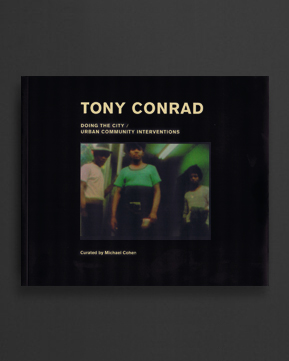
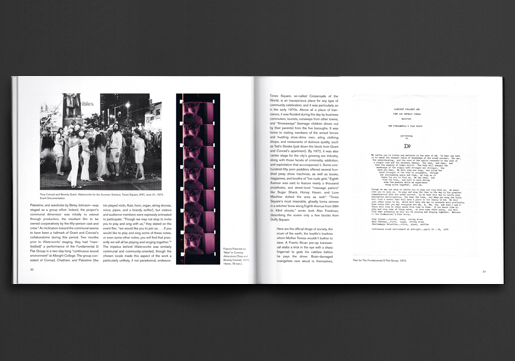
Tony Conrad: Doing the City is the first monograph printed to cover this pioneering film, video, music and installation artist's oeuvre of the last 50 years. The copiously illustrated, full-color catalogue includes essays by noted Columbia University art historian and Conrad scholar Branden Joseph; Whitney Museum Performance Curator and 2012 Whitney Biennial Curator Jay Sanders; filmmaker and Anthology Film Archives Curator Andrew Lampert; Swiss digital archivist Tabea Lurke; as well as an in-depth interview between Conrad and exhibition curator Michael Cohen examining Conrad's life and career.
The catalogue also includes a bonus DVD disc, Tony Conrad: Live at 80wse. This disc includes live performances of Conrad's classic minimalist works "Chant" and "Early Minimalism: May 1965," as well as a lengthy video conversation with Conrad as he walks through his old haunts in the Lower East Side. This volume is a distillation, documentation and expansion of the acclaimed exhibition and series of concerts and educational lectures of the same name which was held at NYU's 80WSE Gallery in 2012.
1982, English
Hardcover (w. dustjacket), 118 pages,
1st UK edition, Out of print title / used*,
Published by
Collins / London
$90.00 - Out of stock
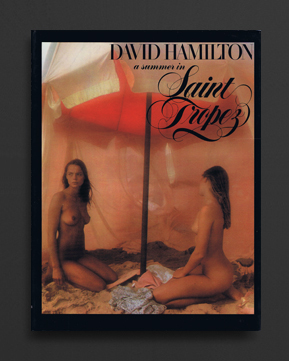
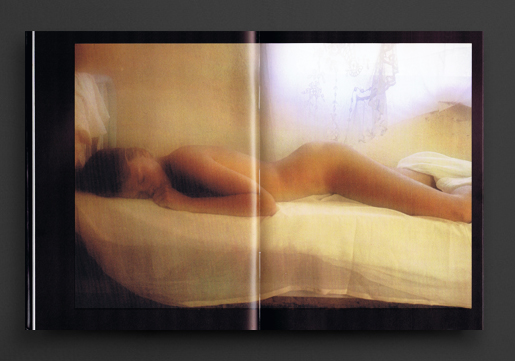
1st UK edition photo-book published by Collins, London, in 1982 with the release of A Summer in St. Tropez or Un été à Saint-Tropez (original French title) a French film directed by English photographer David Hamilton.
The film was shot at and around David Hamilton's 800 year old house in Saint Tropez, France, and, as this book is testament, aesthetically echoes the photographic imagery he became so famous and influential for. David Hamilton (15 April 1933 – 25 November 2016) was an English photographer and film director who started out as graphic designer for Peter Knapp of Elle magazine before moving to Paris where his photography became iconic throughout the 1960s-1980s. His dreamy, soft focus style of photography became enormously influential through his magazine work with Vogue, Twen, Elle, Réalités, and Photo, amongst many others. He published many acclaimed and often controversial photo-books that have been printed in editions the world over.
1980, English
Softcover, 102 pages, 22 x 26 cm
1st Edition, Out of print title / used*,
Published by
Knopf / New York
$70.00 - Out of stock
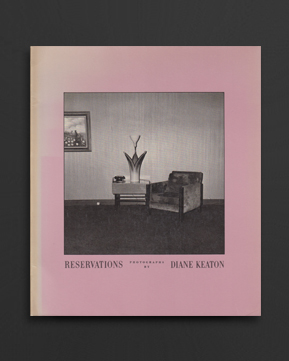
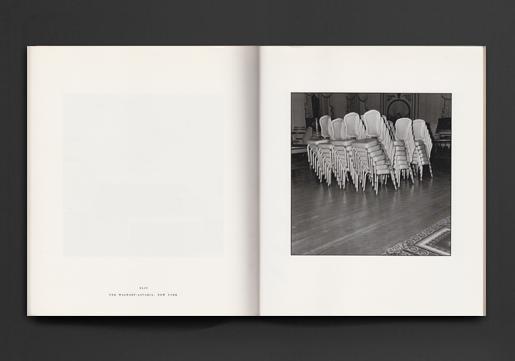
Reservations, published in 1980, is the first photographic book by Diane Keaton. Well known to most as an accomplished actress, she has a great and knowledgable interest in design and photography and since the 1980s she has published a number of collections of esoteric photography and is highly-regarded for her curatorial and editorial projects within the field.
The first book of her personal photography, Reservations is a beautiful and surprising collection of images taken by Keaton in the late 1970's of lobbies and dining halls in what are mostly now long-lost luxury hotels in Miami Beach, New York City, Los Angeles, Palm Springs. This stunning series at once capture the strong, simultaneous sense of potential and still emptiness that haunts the transient, often flamboyant, yet profoundly melancholic, surroundings of the sojourner.
Daine explains, “In 1980, Knopf agreed to publish a book of my photographs of hotel lobbies, called “Reservations.” I finally had an excuse to roam around the United States with my Rolleiflex shooting the interiors of old hotels. Along the way I began collecting books like “The Family of Man.” “Diane Arbus: An Aperture Monograph.” Garry Winogrand’s “Figments From the Real World” and Lee Friedlander’s 1976 “The American Monument.”… ”
First edition.
2016, English
Softcover, 170 pages, 24 x 30 cm
Published by
Bergen Kunsthall / Norway
ICA / London
Kestner Gesellschaft / Hannover
Sternberg Press / Berlin
$46.00 - Out of stock
Edited by Mason Leaver-Yap, James Richards
Contributions by Ed Atkins, Dan Fox, Fatima Hellberg, Chris McCormack, Steve Reinke
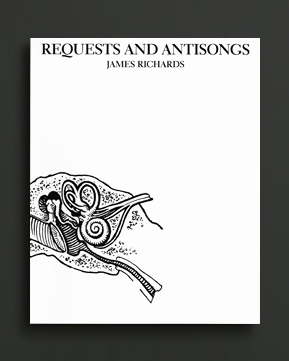
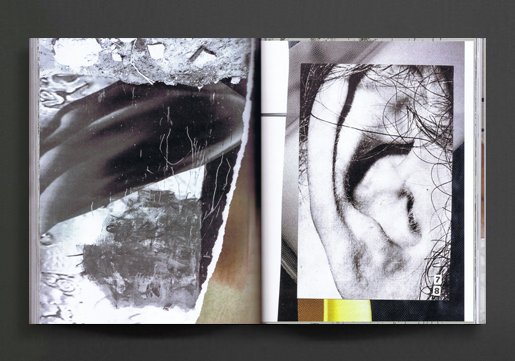
Requests and Antisongs is an artist’s book to accompany a sequence of exhibitions by James Richards held at Bergen Kunsthall, Norway; Institute of Contemporary Arts, London; and the Kestner Gesellschaft, Hanover. The book contains a series of visual essays by the artist, documentation of recent exhibitions, as well as essays by Dan Fox, Ed Atkins, Steve Reinke, Chris McCormack, and Fatima Hellberg.
In Richards’s work, images and sounds are merged into highly affective videos that combine footage from a wide range of sources to form elegant compositions. His recent projects separate these elements out again, allowing space for multichannel audio installations that combine sound in a way that is physical and spatial. The video works convene materials according to the silent rhythms and movements of the footage they contain—footage from newscasts, medical documentaries, and French erotica as well as the institutions’ own archives of video documentation—composing a lyrical meditation on the body as a site for the flow of material and sensation.
This book, the most significant publication on Richards’s work to date, is an extension of the shows, transposing the strategies of his exhibition making into the rhythm of printed matter. The artist has developed a new series of collages specially for the book, comprising promiscuous relations and dissonant juxtapositions between photographic documentation of the works in the exhibitions, the artist’s personal photographs, and found images.
Copublished with Bergen Kunsthall; Institute of Contemporary Arts, London; Kestner Gesellschaft, Hannover
Design by HIT, Berlin
2016, English
Softcover, 216 pages, 23 x 16.5 cm
Published by
Walther König / Köln
$44.00 - Out of stock
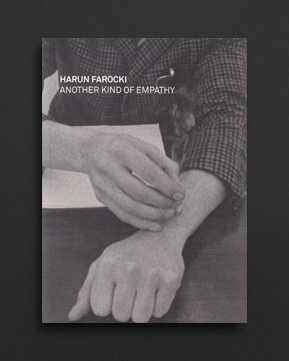
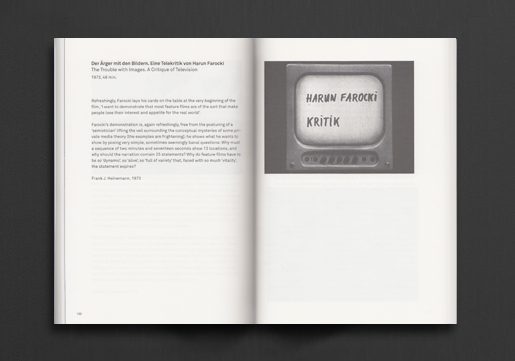
Another Kind of Empathy echoes a short essay by Harun Farocki published in 2008. In it the author set out a new approach to his film practice. He proposed a mixture of Eindringen (to penetrate) and Mitfühlen (to sympathize) as a way of leaving behind the de-romanticized attitudes of the past.
Einfühlung (Empathy) is included in this publication along with several other essays and references to his films and installations from 1966 to 2013. The extent of the material gathered in this book is a fair guide to an epic figure.
Farocki’s long and complex career is reflected in two exhibitions: What is at Stake, at IVAM Institut Valencià dʼArt Modern (20 January – 22 May 2016); and Empathy, at Fundació Antoni Tàpies, Barcelona (2 June – 16 October 2016). This catalogue is published on the occasion of both exhibitions.
2016, English / French
Softcover, 150 pages, 240 x 175 mm
Published by
May Revue / Paris
$29.00 $10.00 - In stock -
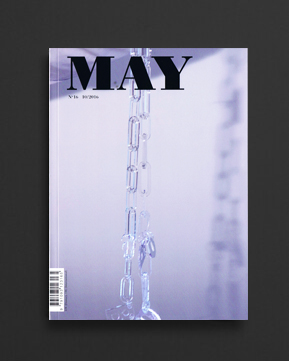
May no.16 focuses on recent feminist debates actualizing the history of Italian feminist collectives of the 1970s and 1980s. The issue is a continuation of the issue 4 of May, which reprinted and translated a selection of texts from the time. The issue’s touchstone is the work of writer and co-founder of Rivolta Femminile, Carla Lonzi. Throughout her life, Lonzi refused the power of a masculine creativity that exploits the reproductive, supportive activity of women. The texts assembled in May no.16 bring that refusal to contemporary light.
Weed and the Practice of Liberty
Claire Fontaine
The Paradox of Self-Abolition: a Mapping Exercice
Marina Vishmidt
Presence and Absence
Melissa Gordon
Narrative Without End
Anna De Filippi
An Exercise in the Practice of affidamento
Alex Martinis Roe
On Marinella Pirelli’s Films
Lucia Aspesi
Human Strike Between Foreignness and Responsibility
Claire Fontaine
Introduction to Double Bind
Rhea Anastas
Visual Insert
LGG$B
Citadelle. On Marie Angeletti at Édouard Montassut, Paris
Jacob Stewart-Halevy
On Mathieu K. Abonnenc, Lotte Arndt, Catalina lozano (eds), Colonial Collect and Affect, Crawling Doubles
Emmanuelle Chérel
A World Exactly Like This One. On Credits by Hannah Black
Jack Gross
Get Some Rest Pam, or Jason Bourne comes of age. On Paul Greengrass’ film, Jason Bourne
Maija Timonen
Aggregation or Mere Dislocation. On the 9th Berlin Biennale and “Painting 2.0: Expression in the information Age,” mumok, Vienna
Kari Rittenbach
Short Story
Jeanne Graff
Limited Edition
Hans-Christian Lotz
About MAY Revue:
Conceived as a collective space in which to develop thoughts and confront positions on artistic production, May magazine examines, quaterly, contemporary art practice and theory in direct engagement with the issues, contexts and strategies that construct these two fields. An approach that could be summed up as critique at work – or as critique actively performed in text and art forms alike.
Featuring essays, interviews, art works and reviews by artists, writers and diverse practitioners of the arts, the magazine also intends to address the economy of the production of knowledge – the starting point of this reflection being the space of indistinction between information and advertisement typical of our time. This implies a dialogue with forms of critique produced in other fields.
2016, English / German
Softcover, 96 pages, 24 x 17 cm
Published by
Haus der Kunst / Munich
Walther König / Köln
$29.00 - Out of stock
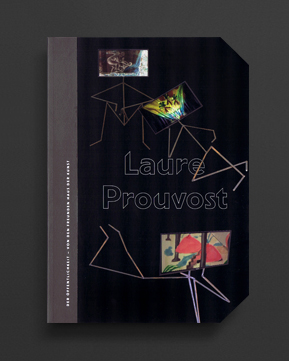
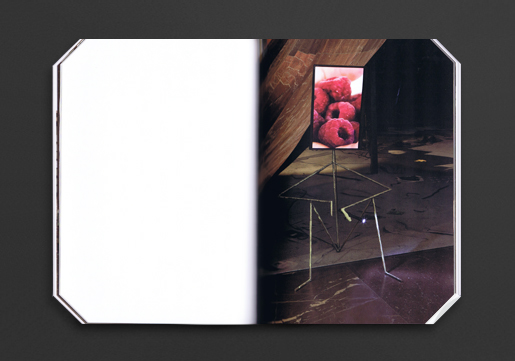
For the spacious central hall in the Haus der Kunst, Laure Prouvost creates an installation that includes sculptural and cinematic elements. In this work, Prouvost refers to both architecture and the House of Art as an institution, rich in imagery and inimitable humor.
This catalog is the fourth volume in the series "The Public - from the Friends House of Art", which annually documents artistic commission work for the middle hall of the House of Art.
2016, English
Hardcover, 252 pages, 26 x 20 cm
Published by
Koenig Books / London
NTU Contre for Contemporary Art Singapore / Singapore
$55.00 - Out of stock
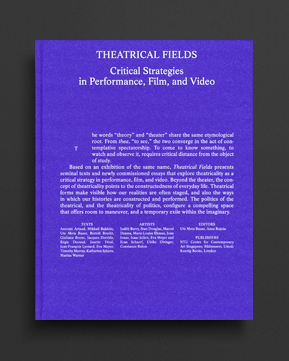
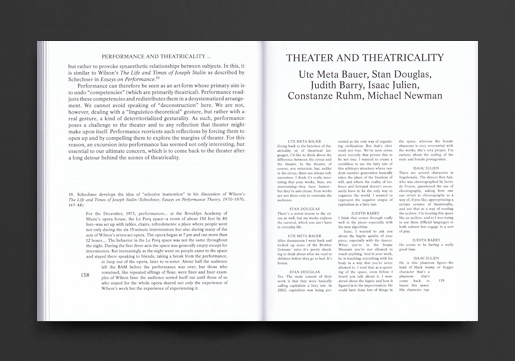
Theatrical Fields brings together a selection of seminal texts, commissioned essays and exhibition materials that explore the political potential of ʻtheatricalityʼ.
This reader stems from a long-term curatorial research examining the deep-rooted connection between theatre and theory, juxtaposing artists and theoreticians from different generations and backgrounds who share a communal interest in the ʻtheatricalityʼ as a methodology to address questions of ideology, gender, power and resistance.
In this conception, ʻtheatricalityʼ does not refer strictly only to the theatre and the theatrical arts; rather, it also points to the constructedness of everyday life. Theatrical forms make visible how our realities are staged, and also how our histories are constructed and performed.
This reader has been conceived and edited by renowned curator, Ute Meta Bauer – Artistic Director of the 3rd Berlin Biennale for Contemporary Art, Berlin (2004); Co-Curator of documenta 11 (2001/2002); Professor and Dean of the School of Fine Art at the Royal College of Art, London (2012/2013); and since 2005 she has been an Associate Professor at MIT, Cambridge, United States.
Includes texts by: Antonin Artaud, Mikhail Bakhtin, Ute Meta Bauer, Bertolt Brecht, Giuliana Bruno, Jacques Derrida, Regis Durand, Josette Féral, Jean-François Lyotard, Eva Meyer, Timothy Murray, Katarina Pierre, Katharina Sykora, Marina Warner
2016, English
Hardcover, 1012 pages, 30 x 24 cm
Published by
Self Service / Paris
$45.00 - Out of stock
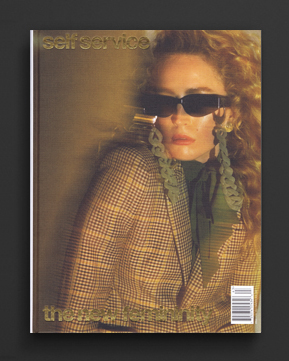
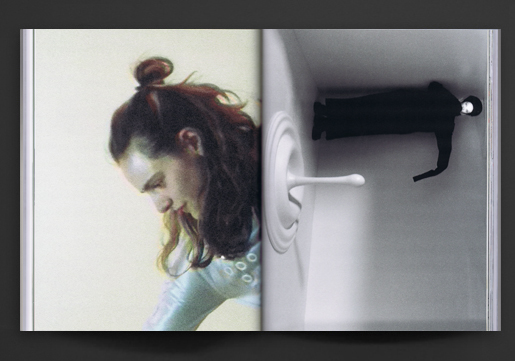
Self Service No. 45 Fall / Winter 2016: The New Femininity
Features : Luna Bijl photographed by David Sims, Raquel Zimmermann by Inez and Vinoodh, Rianne van Rompaey and Edie Campbell by Cass Bird, The House of Vetements, Juergen Teller, Alasdair McLellan, Anna Ewers by Terry Richardson, and Charlotte Rampling by Ezra Petronio. With model mothers Amber Valetta, Mini Anden and Heidi Mount and their children. Dialogs with Charlotte Rampling, Emmanuelle Seigner, Emily Weiss, and Melanie Ward, among many others. Edie Campbell and Harriet Quick write about what is femininity, and much more.
Self Service magazine is a fashion and cultural biannual magazine. The magazine features the preeminent players in the fashion world, with innovative editorials photographed by the world’s best photographers and stylists.
Note: Due to the size/weight of this volume, your order will possibly incur additional postage costs. We will contact you with the best shipping advice upon your order, or alternatively, please email us in advance. Thank you for understanding.
2016, English
Softcover, 124 pages, 13 x 19 cm
Published by
Künstlerhaus Graz / Graz
Sternberg Press / Berlin
$44.00 $15.00 - Out of stock
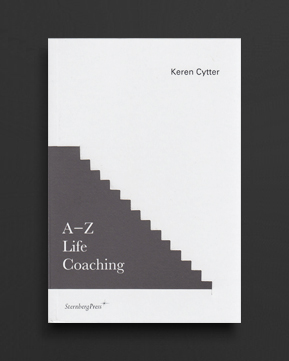
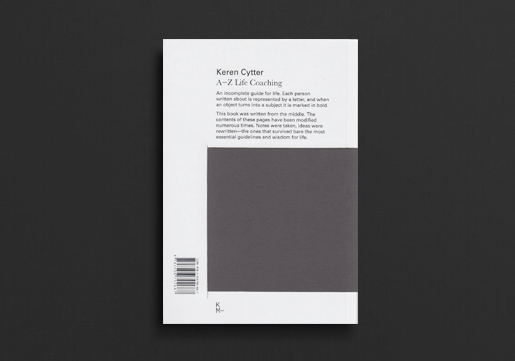
An incomplete guide for life. Each person written about is represented by a letter, and when an object turns into a subject it is marked in bold.
The form of life coaching described in this book won’t lead the reader to social recognition or financial success. If one of the two occurs after reading this text, it is a coincidence. This book aims to expose the owners of an innocent heart to reality’s true structures and to utilize them for spiritual growth so their soul and body evaporate into the abstract.
This book was written from the middle. The contents of these pages have been modified numerous times. Notes were taken, ideas were rewritten—the ones that survived bare the most essential guidelines and wisdom for life.
Copublished with Künstlerhaus, Halle für Kunst & Medien, Graz
Design by Vasilis Marmatakis
2016, English
Softcover (w. dustjacket), 166 pages, 19 x 25.5 cm
Published by
Sternberg Press / Berlin
$54.00 $15.00 - Out of stock
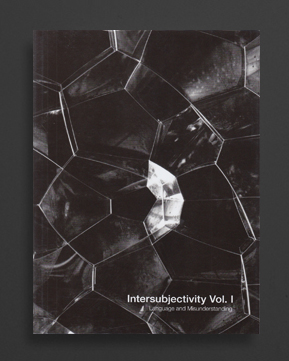
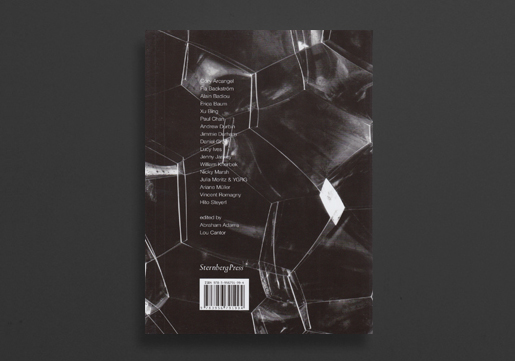
Intersubjectivity Vol. 1
Language and Misunderstanding
With contributions by Cory Arcangel, Fia Backström, Alain Badiou, Erica Baum, Xu Bing, Paul Chan, Andrew Durbin, Jimmie Durham, Daniel Grúň, Lucy Ives, Jenny Jaskey, William Kherbek, Nicky Marsh, Julia Moritz & YGRG, Ariane Müller, Vincent Romagny, Hito Steyerl
Intersubjectivity, a two-volume collection of essays, is concerned with a new account of our ideas of what subjects are, and what is means for them to meet. The project explores these concepts in the context of the interaction of non-sentient beings, attempting to move beyond anthropomorphic theories of objectivity and materiality, as well as subjects whose boundaries resist definition. Intersubjectivity takes up the complementary problems of nondiscursive language and nonlinguistic discourse, in an attempt to locate the distinctions and respective abilities of philosophy as a particular kind of art and art as a particular kind of philosophy.
The first volume, Language and Misunderstanding, addresses concretism and its discontents. The essays and performance texts herein argue for an expanded consideration of concretism in contemporary practices oriented toward the embodiment of language, in works that challenge the privileging of the body of the word over the body of the artist. Thus Cory Arcangel, Fia Backström, Erica Baum, Paul Chan, Jimmie Durham, and Hito Steyerl all contribute works that in different ways insist on the somatic nature of writing; Andrew Durbin, and Ariane Müller, and Vincent Romagny address the drift of meaning across material; Lucy Ives, Daniel Grúň, and the Young Girl Reading Group are skeptical of dogmas of authorship and identity; Alain Badiou asks when modern art will end; and Abraham Adams polemicizes against the loss of the body in the concrete work. With an introduction by Lou Cantor.
Design by BOKA Bożena Kalinowska
2014, English
Softcover, 97 pages, 15 x 23 cm
Published by
The Drawing Center / New York
$38.00 - Out of stock
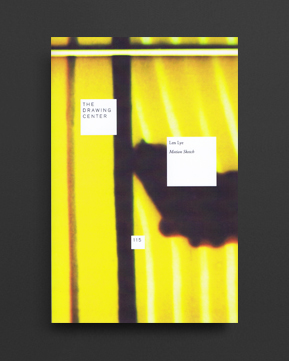
Featuring a forward Brett Littman and essays by Gregory Burke, Tyler Cahn, and Len Lye.
Len Lye (1901–1980) is arguably one of the twentieth century’s most original artists; a one-man art movement spanning several countries and multiple media over a lifetime and beyond. As a New Zealander practising in London during the pre-war years, and then a key figure in the post-war New York avant-garde art scene, Lye mapped a unique course through Modernism.
This publication was produced on the occasion of a Len Lye exhibition at The Drawing Centre in New York in 2014.
"Len Lye’s career was marked by a lifelong fascination with movement and an aspiration to compose motion; the movement of the drawing hand was an important touchstone for his works in various media. In New York Lye is now well known for his animated experimental films. In the 1920s, however, Lye began to make what he termed “motion sketches”; abstract drawings that attempted to render the movement of his subjects, rather than their appearance. Motion Sketch reintroduces scholars and audiences in New York to Lye’s multidimensional practice specifically in relation to drawing. Describing his drawing practice in his own carefree prose, Lye said that doodling “cultivates a vacuous seaweed-pod state of kelp as a skull which is attached to a pencil betwixt the arm and the fingers held doodling in turn ‘twixt you and the paper in a rather bemused, empty, harmonious state of an attitude, eyes periphering said paper.” Lye’s kinesthetic approach to drawing—related to Surrealist automatism and anticipating aspects of Abstract Expressionism—also informed his practice in painting, photography, film and sculpture. Not limited to works on paper; the exhibition will instead reveal how Lye’s concept of "doodling" underpinned his approach to much of his work.
The exhibtion will include a selection of paintings, drawings, and photograms, never before seen in the United States. In The Drawing Center’s Lab gallery, an extensive film program will be presented on video, including such landmark films as Tusalava, 1929; A Colour Box, 1935; andFree Radicals, 1957/1979.
Len Lye: Motion Sketch is curated by Gregory Burke, Executive Director/CEO of both the Mendel Art Gallery and Remai Art Gallery of Saskatchewan and Co-Curator of the Montreal Biennale, 2014; and Tyler Cann, Associate Curator of Contemporary Art at the Columbus Museum of Art. This exhibition is presented by The Drawing Center in collaboration with the Govett-Brewster Art Gallery (New Plymouth, New Zealand) and draws primarily from the Len Lye Foundation Collection."
2014, English
Hardcover, 135 pages, 15 x 25 cm
1st edition, 1000 copies, Out of print title / As New,
Published by
Mousse Publishing / Milan
Museum of Contemporary Art / Denver
$40.00 $20.00 - Out of stock
Edited by Nora Burnett Abrams.
Texts by Michael Ned Holte, Sarah Robaio Sheridan, and Nora Burnett Abrams
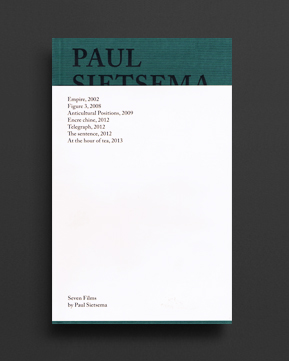
Published in conjunction with Sietsema’s show at Museum of Contemporary Art Denver, Seven Films by Paul Sietsema is the first publication devoted to the artist’s films. In the words of Sarah Robayo Sheridan, “Paul Sietsema compounds organic and artificial detritus in all his artwork, scavenging in history’s wake to identify specific tools of cultural production and foraging for concepts of art promulgated in the words of artists and attitudes of critics. He mines film as a vestige, the medium of the mechanical age, pressing and squeezing its very obsolescence through a contemporary sieve. In so doing, the artist hovers in the switchover between a bodily inscription in the image and a fundamental reconstitution of sight and representation in the matrix of the virtual. Where body stops and image starts is a divide collapsing through a series of innovations and accidents that go back as far as the people of Pompeii trapped in an emulsion that marked their death, but which paradoxically carried forward their image into eternity.”
First edition of 1000 copies, now out of print.
2014, English
Hardcover, 256 pages (colour ill.), 28.5 x 21.5 cm
Published by
Walther König / Köln
$79.00 - Out of stock
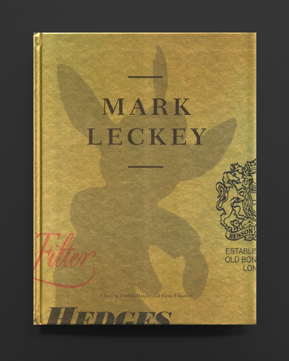
Mark Leckey: On Pleasure Bent is the first comprehensive monograph on the British artist’s work.
Tracing in reverse chronology the connections between his recent production – including videos, sculptures, installations, and lecture performances – and his earliest works from the mid and late 1990s, this publication reveals the persistent centrality of popular culture, music, and technology to Leckey’s influential oeuvre.
All the artist’s scripts to date appear together for the first time in this lavishly illustrated volume.
Published to coincide with the exhibition Mark Leckey: Lending Enchantment to Vulgar Materials at WIELS Contemporary Art Centre,
Brussels, 25 September – 15 January 2014–15.
This exhibition was made in collaboration with the Museo d’Arte Contemporanea Donnaregina-Madre, Naples and Kunsthalle Basel.
2016, English
Softcover, 154 pages, 28 x 23.5 cm
Published by
Mumok / Vienna
Walther König / Köln
$55.00 - Out of stock
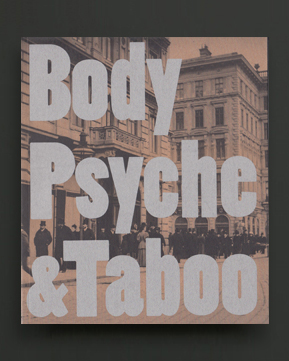
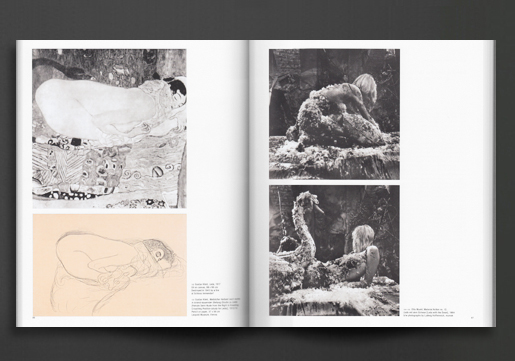
The central concepts of Body, Psyche, and Taboo is a presentation of both the intellectual and the formal links between Vienna Actionism and artistic developments in early 20th century Vienna.
Works by Günter Brus, Otto Muehl, Hermann Nitsch, and Rudolf Schwarzkogler – the ‘scandal artists’ of the 1960s – are compared and contrasted with pieces by their equally controversial colleagues working at the dawn of the twentieth century, including Gustav Klimt, Oskar Kokoschka, and Egon Schiele, among others.
Published on the occasion of the exhibition Body, Psyche, and Taboo: Vienna Actionism and Early Vienna Modernism at mumok, Vienna, 4 March – 16 May 2016.
Striking and heavily illustrated catalogue featuring the work of Artists Günter Brus, Richard Gerstl, Gustav Klimt, Oskar Kokoschka, Koloman Moser, Otto Muehl, Hermann Nitsch, Max Oppenheimer, Anton Romako, Egon Schiele, Rudolf Schwarzkogler, and accompanying texts by Eva Badura-Triska, Brigitte Borchhardt-Birbaumer, Rosemarie Brucher, and Bernadette Reinhold.
2016, English / German
Softcover, 264 pages, 23 x 16.5 cm
Published by
Texte Zur Kunst / Berlin
$30.00 - Out of stock
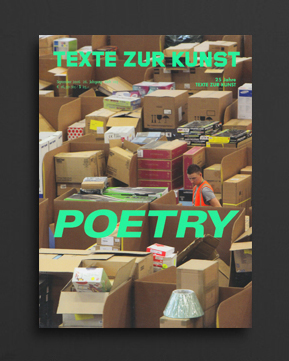
TZK #103 addresses "poetry," a language form central to the recent shift toward affect in contemporary critical writing. Seeing the “artist-poet” as a vital site for the intersection of politics, affect, and digitality, we consider her voice and her currency from various perspectives, pro and con, across generations, analyzing her rising success, also asking what is gained and lost in this move from "rational" thought to what one feels? Scanning populist poetry, anarchist poetry, post-millennial net-poetry, the poetry of surplus-language and social media, the art historical poetic/poet-turned-object, and shades of fading Poesie, this issue, conceived by the editors with John Kelsey and Isabelle Graw explores how the seeming immediacy of #poetry and the suggestion of a hyper-personal voice correlates with current economic demand to claim visibility.
ISSUE NO. 103 / SEPTEMBER 2016 “POETRY”
TABLE OF CONTENTS
PREFACE
TIM GRIFFIN
WHAT IS POETRY?
JOSHUA CLOVER
OBJECTIVELY SPEAKING / Remarks on Subjectivity and Poetry
ISABELLE GRAW
THE POET'S SEDUCTION / Six Theses on Marcel Broodthaers’s Contemporary Relevance
LIZ KOTZ
WORD PIECES, EVENT SCORES, COMPOSITIONS
MONIKA RINCK
THE PROMISE OF POETIC LANGUAGE
ADA O'HIGGINS
IF YOU DON’T LIKE THE REFLECTION. DON’T LOOK IN THE MIRROR. I DON’T CARE.
CHRIS KRAUS AND ARIANA REINES
THE FEELINGS I FAIL TO CAPITALIZE, I FAIL / Chris Kraus and Ariana Reines in conversation on auto-fiction and biography
FELIX BERNSTEIN
THE IRREPROACHABLE ESSAY / On the Amazon Discourse of Hybrid Literature
DANIELA SEEL
IMMEDIACY, I MEET WITH SKEPTICISM / Three questions for Daniela Seel
MICAELA DURAND
DEVIL SHIT
KAROLIN MEUNIER
HEARING VOICES / On the reading and performance of poetry
DENA YAGO
EMPIRE POETRY
SHORT CUT
FOUR THESES ON BRANDING / David Joselit on Berlin Biennale 9
MANTRAS DER GEGENWART / Hanna Magauer über die Berlin Biennale 9
ROTATION
SEHNSUCHT NACH DER VERLORENEN STADT / Johannes Paul Raether über "spiritus" von Honey-Suckle Company
BENJAMIN BUCHLOH, ART HISTORIAN / Christine Mehring on Benjamin H. D. Buchloh’s “Formalism and Historicity: Models and Methods in Twentieth-Century Art”
ES WAR ZWEIMAL SAGTE SIE / Vojin Sasa Vukadinovic über Eva Meyers „Legende sein“
LESS IS MORE? / John Miller on Justin Lieberman’s “The Corrector’s Custom Pre-Fab House”
SO MACHEN WIR'S / Eva Geulen über „The Use of Bodies“ (Homo Sacer IV.2) von Giorgio Agamben
SHORT WAVES
Gunter Reski über Victor Man bei MD 72, Berlin / Harry Burke on Dean Blunt at Arcadia Missa, London / Rhea Dall on Stephen G. Rhodes at Eden Eden, Berlin / Tobias Vogt über Thea Djordjadze bei Sprüth Magers, Berlin / Deanna Havas on Marc Kokopeli at Lomex, New York / Martin Herbert on Fredrik Værslev at Bergen Kunsthall, Norway
REVIEWS
HABEAS CORPUS / Simon Baier über Francis Picabia im Kunsthaus Zürich
MARCEL BROODTHAERS, ART HISTORIAN’S ARTIST / Trevor Stark on Marcel Broodthaers at the Museum of Modern Art, New York
MALEREI ALS SOZIALES HANDELN? / Christian Spies über Fernand Léger im Museum Ludwig, Köln
SIMULIERTE MUSEALISIERUNG / Philipp Kleinmichel über Isa Genzken im Martin-Gropius-Bau, Berlin
ELEGANCE IS RESISTANCE / Stephanie LaCava on Lukas Duwenhögger at Artists Space, New York
NACHRUFE / OBITUARIES
TONY CONRAD (1940–2016)
by Diedrich Diederichsen
by Jay Sanders
EDITION
MARTHA ROSLER
AMY SILLMAN
AMY SILLMAN
2016, English
Softcover, 296 pages, 18 x 11 cm
Published by
August Verlag / Cologne
$46.00 - In stock -
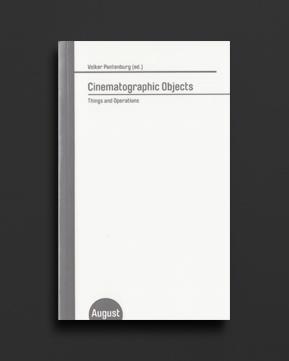
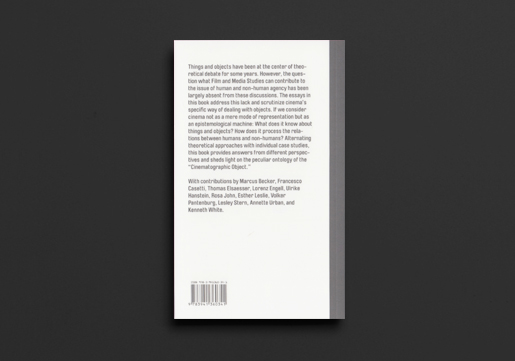
Things and objects have been at the center of theoretical debate for some years. However, the question what Film and Media Studies can contribute to questions of human and non-human agency has been largely absent from these discussions.
The essays in this book address this lack and scrutinize cinema’s specific way of dealing with objects. If we consider cinema not as a mere mode of representation but as an epistemological machine: What does it know about things and objects?
How does it process the relations between humans and non-humans? Alternating theoretical approaches with individual case studies, this book provides answers from different perspectives and sheds light on the peculiar ontology of the ‘Cinematographic Object’.
Artists/filmmakers featured in this book include: Fritz Lang, Max Ophüls, John Baldessari, John Stezaker, and Michael Snow, among others.
Texts by Marcus Becker, Francesco Casetti, Thomas Elsaesser, Lorenz Engell, Ulrike Hanstein, R. John, Esther Leslie, Volker Pantenburg, Lesley Stern, Annette Urban, Kenneth White.
Published by August Verlag.
2016, English
Softcover, 448 pages, 24 x 29.7 cm
Published by
Walker Art Centre / Minneapolis
$95.00 - Out of stock
Published by Walker Art Center
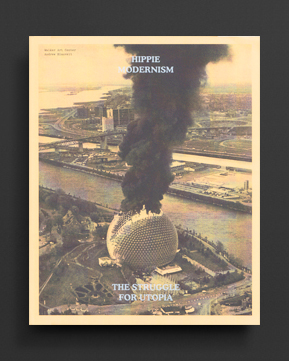
Edited with text by Andrew Blauvelt. Text by Greg Castillo, Esther Choi, Alison Clarke, Hugh Dubberly, Ross Elfline, Craig Peariso, Tina Rivers Ryan, Catharine Rossi, Simon Sadler, Felicity Scott, Lorraine Wild with David Karwan. Interviews by Adam Gildar, Susan Snodgrass, Elizabeth Glass.
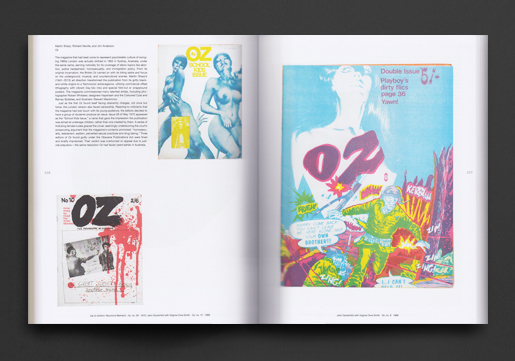
"Hippie Modernism" examines the art, architecture and design of the counterculture of the 1960s and early 1970s. The catalogue surveys the radical experiments that challenged societal norms while proposing new kinds of technological, ecological and political utopia. It includes the counter-design proposals of Victor Papanek and the anti-design polemics of Global Tools; the radical architectural visions of Archigram, Superstudio, Haus-Rucker-Co and ONYX; the installations of Ken Isaacs, Joan Hills, Mark Boyle, Hélio Oiticica and Neville D'Almeida; the experimental films of Jordan Belson, Bruce Conner and John Whitney; posters and prints by Emory Douglas, Corita Kent and Victor Moscoso; documentation of performances by the Diggers and the Cockettes; publications such as "Oz" and "The Whole Earth Catalog"; books by Marshall McLuhan and Buckminster Fuller; and much more. While the turbulent social history of the 1960s is well known, its cultural production remains comparatively under-examined. In this substantial volume, scholars explore a range of practices such as radical architectural and anti-design movements emerging in Europe and North America; the print revolution in the graphic design of books, posters and magazines; and new forms of cultural practice that merged street theater and radical politics. Through a profusion of illustrations, interviews with figures including: Gerd Stern of USCO; Ken Isaacs; Gunther Zamp Kelp of Haus-Rucker-Co; Ron Williams and Woody Rainey of ONYX; Franco Raggi of Global Tools; Tony Martin; Clark Richert and Richard Kallweit of Drop City; as well as new scholarly writings, this book explores the conjunction of the countercultural ethos and the modernist desire to fuse art and life.
Huge, generous and vividly illustrated volume!
2016, English
Softcover, 312 pages, 11 x 18 cm
Published by
Spector Books / Leipzig
$36.00 - Out of stock
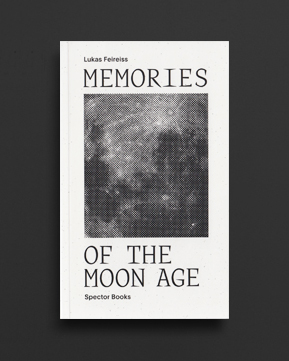
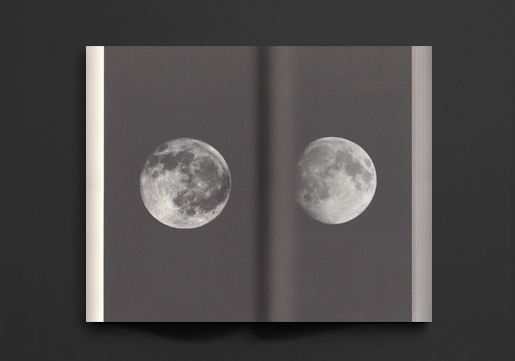
Long before scientists took the possibility of travelling to the Moon seriously, virtually all of its aspects had already been explored in art and literature. Our nearest astronomical neighbour, the Moon — just three days journey by spacecraft — still serves as an object of creative projection and speculation for visionaries across the globe. More than five decades after the first moonwalk, the book Memories of the Moon-Age traces a visual cultural history of lunar exploration in snapshots from the past, present, and future. This inspiring journey through history ranges from Ptolemy’s early calculations of the distance from the Earth to the Moon and Galilei’s invention of the telescope and his pen drawings of the lunar surface to the golden age of space travel in the mid-twentieth century with Kubrick’s 2001: A Space Odyssey and the concrete preparations for the Apollo Moon landing.
Lukas Feireiss (*1977) works as curator and writer in the international mediation of contemporary cultural reflexivity beyond disciplinary boundaries.
2015, English
Softcover, 240 pages, 13 x 20 cm
Published by
Archive Books / Berlin
$40.00 - Out of stock
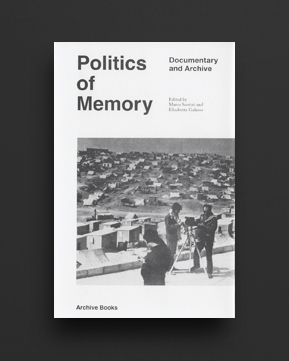
The anthology Politics of Memory aims to investigate the document as such, as an objective trace left by events, as material proof or the creation of reality – the strategies with which they transform a state of memory into state memory, those by means of which a historical removal is enacted, those, ultimately, in which there is an attempt to challenge permanent or temporary amnesia, opening up to the future. The artists and filmmakers contributing to this publication represent the most advanced area on an international scale of a research that inaugurates a new relationship between artistic practices and the documentary.
The artists’ contributions have been collected within the context of a cycle of conferences held between 2010 and 2013 and are re-presented here in a format aimed at highlighting their connections and common research perspectives. To this end, the volume is articulated in four sections and does not follow the chronological order of the conferences. The first section is dedicated to archival practices, the second to the memory of conflicts, the third to the documentary dispositive and the last to the representation of migration as a social practice and as the enactment of breaching boundaries.
Edited by Marco Scotini and Elisabetta Galasso
Contributions by John Akomfrah, Eric Baudelaire, Ursula Biemann, Harun Farocki, Yervant Gianikian and Angela Ricci Lucchi, Khaled Jarrar, Lamia Joreige, Gintaras Makarevičius, Angela Melitopoulos, Deimantas Narkevičius, Lisl Ponger, Florian Schneider, Eyal Sivan, Hito Steyerl, Jean-Marie Teno, Trinh T. Minh-ha, Wendelien van Oldenborgh, Clemens von Wedemeyer, Mohanad Yaqubi and Reem Shilleh
2015, English
Softcover, 212 pages, 15.5 x 23 cm
Published by
Archive Books / Berlin
$44.00 - Out of stock
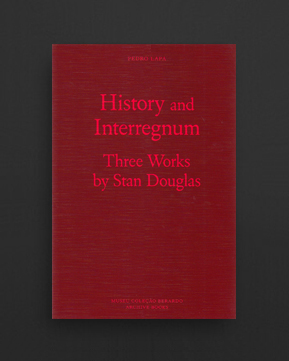
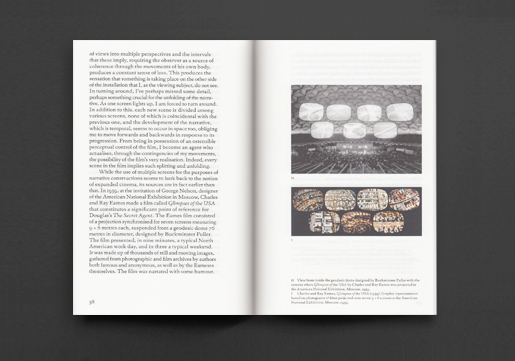
The Museu Coleção Berardo in collaboration with Archive Books is publishing the book History and Interregnum. Three Works by Stan Douglas to mark the exhibition, featuring an extensive essay by Pedro Lapa, the artistic directorof the museum and the curator of this exhibition, which takes an in-depth look at the “trilogy” made up of Disco Angola (2012), Luanda-Kinshasa (2013) and The Secret Agent (2015). The book, which is replete with illustrations of these three works as well as two series of photographs showing their production, also includes the final version of the script for The Secret Agent by Stan Douglas himself.
Edited by Pedro Lapa
Texts by Stan Douglas and Pedro Lapa
Editorial coordination by Nuno Ferreira de Carvalho
Graphic design by Raquel Pinto
2016, English
Softcover, 382 pages, 24 x 17 cm
Published by
Distanz / Berlin
$50.00 - Out of stock
The Present in Drag is published as a companion volume to the 9th Berlin Biennale for Contemporary Art, which was curated by New York collective DIS. Providing information on the works shown in the exhibition, it also includes contributions by Roe Ethridge, Simon und Daniel Fujiwara, Boris Groys, Katja Novitskova, Chus Martinez, Bjarne Melgaard, Sean Patrick Monahan, Sabine Reitmaier, McKenzie Wark, and others.
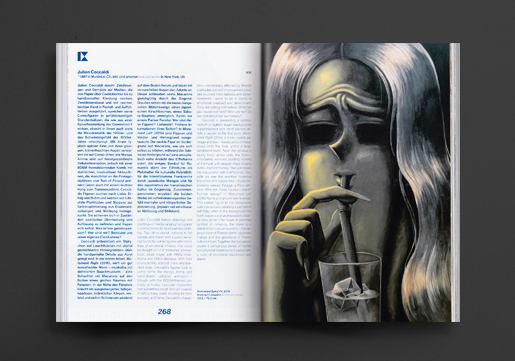
The 9th Berlin Biennale for Contemporary Art features the work and contributions of: 69, Antoni Abad, Halil Altindere, Ei Arakawa (in collaboration with Dan Poston, Stefan Tcherepnin), Korakrit Arunanondchai/Alex Gvojic, atelier le balto, Armen Avanessian/Alexander Martos (in collaboration with Christopher Roth), åyr, Will Benedict, Julien Ceccaldi, Centre for Style
(in collaboration with Anna-Sophie Berger; Burkhard Beschow & Anne Fellner; Max Brand; Rare Candy with Alden Epp, Spencer Lai, Natasha Madden, Misty Pollen, Ander Rennick & Amber Wright; Susan Cianciolo; Marlie Mul; Liam Osborne; H.B. Peace & Kate Meakin; Joshua Petherick; Lin May Saeed; Eirik Sæther), Brody Condon, CUSS Group (in collaboration with ANGEL-HO, FAKA, Megan Mace, NTU), Kathleen Daniel, Debora Delmar Corp., Simon Denny with Linda Kantchev, Cécile B. Evans, Nicolás Fernández, Lizzie Fitch/Ryan Trecartin, Simon Fujiwara, GCC, GUAN Xiao, Calla Henkel/Max Pitegoff, Camille Henrot, Yngve Holen, Alexa Karolinski/Ingo Niermann, Kartenrecht, Josh Kline, Korpys/Löffler, Nik Kosmas, M/L Artspace, Shawn Maximo, Ashland Mines, Katja Novitskova, Trevor Paglen/Jacob Appelbaum, Juan Sebastián Peláez, Adrian Piper, Alexandra Pirici, Josephine Pryde, Puppies Puppies, Babak Radboy, Jon Rafman, Timur Si-Qin, Lucie Stahl, Hito Steyerl, TELFAR, Christopher Kulendran Thomas, Wu Tsang, Anna Uddenberg, Amalia Ulman, Anne de Vries, Abu Hajar, Halil Altindere, Math Bass, Lizzi Bougatsos & Brian DeGraw, Elysia Crampton, Lizzie Fitch/Ryan Trecartin, Isa Genzken, Juliana Huxtable, Kelela, Nguzunguzu, PATRICIA (Patricia Satterwhite, Jacolby Satterwhite, Nick Weiss), Adrian Piper, Fatima Al Qadiri, Carles Santos, Hito Steyerl, Total Freedom, Amalia Ulman, Antoni Abad, åyr/Rem Koolhaas/Hans Ulrich Obrist, Kathleen Daniel, Cécile B. Evans and Andrew Snyder-Beattie, Oleg Fonaryov and Oleksiy Radynski, Simon & Daniel Fujiwara, GCC, Boris Groys, Rob Horning, Izabella Kaminska and Simon Denny, Chus Martínez, Meredith Meredith, Sean Monahan, New Scenario, Ingo Niermann, Alexandra Pirici, Puppies Puppies, Sean Raspet, Natasha Stagg, Amalia Ulman, Sencer Vardarman, Eduardo Viveiros de Castro and Déborah Danowski in conversation with Michelle Sommer and Daniel Steegmann Mangrané, McKenzie Wark, Will Benedict, Dora Budor, Cao Fei, Roe Ethridge, Hood by Air, Bjarne Melgaard, Simon Dybbroe Møller, Zanele Muholi, Johannes Paul Raether, Torbjørn Rødland, Akeem Smith, Martine Syms, Stewart Uoo, Nina Cristante, Sabine Gottfried, Nik Kosmas, Lesley Moon, Helga Wretman, Frank Benson, Asger Carlsen, DIS, Casey Jane Ellison, Roe Ethridge, Avena Gallagher, Saemundur Thor Helgason, Tilman Hornig, Benjamin Alexander Huseby, Chris Kraus, Bjarne Melgaard, Jason Nocito, Babak Radboy, Sean Raspet, Sabine Reitmaier, Aaron David Ross, Andrew Norman Wilson, Anonymous, Anonymous, Anonymous and others.