World Food Books' programme is largely produced on Kulin Nation land. We acknowledge the Wurundjeri people of the Kulin Nation as the first and continuing custodians of this land, and pay respect to their Elders past, present, and emerging.
World Food Books is an arts and special interests bookshop in Naarm / Melbourne. Founded in 2010, World Food Books is devoted to the presentation of a rotating, hand-selection of international art, design, literary and counterculture publications with an emphasis on the anti-traditional, the experimental, the avant-garde, the heretic, the marginal.
Presenting new titles alongside rare and out-of-print books, catalogues and journals spanning the fields of modern and contemporary art, design, photography, illustration, film, literature, poetry, cultural theory, philosophy, sexuality, popular and underground culture in its many radical forms, World Food Books wishes to encourage adventurous, thoughtful and open-minded reading, looking, writing, and exchange of publishing and ideas, both current and historical.
As well as our bookshop, located in Melbourne's historical Nicholas Building, all of our inventory is available internationally via our online mail-order service.
World Food Books semi-regularly co-ordinates "Occasions", a programme of exhibits and events at the bookshop and in partnership with other hosts (such as museums and art galleries) that develop out of the activities, relationships and content of the bookshop itself.
World Food Books
The Nicholas Building
37 Swanston Street
Room 5, Level 6
Melbourne 3000
Australia
SHOP HOURS:
Thu–Fri 12–6, Sat 12–5
WEB-SHOP OPEN 24/7
World Food Books
Postal Address:
PO Box 435
Flinders Lane
Victoria 8009
Australia
Art
Theory / Essay
Architecture / Interior
Graphic Design / Typography
Photography
Fashion
Eros
LGBTQ+
Fiction / Poetry
Weird / Speculative / Science Fiction / Horror
Transgressive / Visceral / Abject
Symbolism / Decadence / Fin de siècle
Film / Video
Painting
Sculpture / Installation
Performance / Dance / Theater
Drawing
Sound / Music
Curatorial
Group Shows / Collections
Periodicals
Out-of-print / Rare
Posters / Ephemera / Discs
Signed Books
World Food Books Gift Voucher
World Food Book Bag
Australian Art
Australian Fiction
Australian Science Fiction / Speculative Fiction
Australian Poetry
Australian Photography
Japanese Photography
Conceptual Art
Minimal Art
Dada
'Pataphysics / Oulipo
Fluxus
Concrete Poetry
Pop Art
Surrealism
Arte Povera
Arte Informale / Haute Pâte / Tachism
Nouveau Réalisme / Zero / Kinetic
Situationism / Lettrism
Collage / Mail Art / Xerox Art
Art Brut / Folk / Visionary / Fantastic
Illustration / Graphic Art / Bandes Dessinées
Furniture
Italian Radical Design / Postmodernism
Textiles
Ceramics / Glass
Counterculture
Protest / Revolt
Philosophy
Psychoanalysis
Anthropology
Anarchism
Socialism / Anarchism / Communism / Capitalism
Literary Theory / Semiotics / Language
Feminism / Women's Studies
Gender Studies / Sexuality
Anthropology
Fetishism / BDSM
Drugs / Psychedelia
Crime / Violence
Animal Rights / Veganism
Occult / Esoterica
Ecology / Earth / Alternative Living
Whole Earth / Crafts
All prices in AUD (Australian dollars)
Pick-Ups
Pick-up orders can be collected in our bookshop during opening hours after order date. Please collect any Pick-up orders within 2 weeks of ordering as we have limited storage space. Orders will be released back into stock if not collected within this time. No refunds can be made for pick-ups left un-collected. If you cannot make it in to the bookshop in this time-frame, please choose postage option.
Return Policy
All sales are final. We do accept returns (for refund or exchange) for items received in error. All our orders are packed with special care using heavy-duty padding and cardboard book-mailers or bubble mailers (for smaller books), using reinforcement where required. We cannot take responsibility for any lost, stolen or damaged parcels.
Insurance
Should you wish to insure your package, please email us directly after placing your order and we can organise this at a small extra expense. Although all standard/express tracked packages are very safe and dependable, we cannot take responsibility for any lost, stolen or damaged parcels. We recommend insurance on valuable orders.
Interested in selling your old books, catalogues, journals, magazines, comics, fanzines, ephemera? We are always looking for interesting, unusual and out-of-print books to buy. We only buy books in our fields of interest and specialty, and that we feel we can resell.
We base these prices on desirability, market value, in-print prices, condition and our current stock levels. We offer cash, store credit, and can take stock on consignment. All
about 25% of the price we expect to get when we sell them, or 30% in store credit. We base these prices on desirability, market value, in-print prices, condition and our current stock levels.
Sell your books any day of the week. You can drop them off and return later. If you have a lot of books, we can visit your Sydney home.
We buy books that we feel we can resell. We offer about 25 % of the price we expect to get when we sell them, or 30% in store credit. We base these prices on desirability, market value, in-print prices, condition and our current stock levels.
Philadelphia Wireman
03 August - 01 September, 2018
World Food Books is proud to announce our next Occasion, the first presentation of sculptures by Philadelphia Wireman in Australia.
The Philadelphia Wireman sculptures were found abandoned in an alley off Philadelphia’s South Street on trash night in 1982. Their discovery in a rapidly-changing neighbourhood undergoing extensive renovation, compounded with the failure of all attempts to locate the artist, suggests that the works may have been discarded after the maker’s death. Dubbed the "Philadelphia Wireman" during the first exhibition of this work, in 1985, the maker’s name, age, ethnicity, and even gender remain uncertain. The entire collection totals approximately 1200 pieces, all intricately bound together with tightly-wound heavy-gauge wire (along with a few small, abstract marker drawings, reminiscent both of Mark Tobey and J.B. Murry). The dense construction of the work, despite a modest range of scale and materials, is singularly obsessive and disciplined in design: a wire armature or exoskeleton firmly binds a bricolage of found objects including plastic, glass, food packaging, umbrella parts, tape, rubber, batteries, pens, leather, reflectors, nuts and bolts, nails, foil, coins, toys, watches, eyeglasses, tools, and jewellery.
Heavy with associations—anthropomorphic, zoomorphic, and socio-cultural responses to wrapped detritus—the totemic sculptures by Philadelphia Wireman have been discussed in the context of work created to fulfil the shamanistic needs of alternative religions in American culture. Curators, collectors, and critics have variously compared certain pieces to sculpture from Classical antiquity, Native American medicine bundles, African-American memory jugs, and African fetish objects. Reflecting the artist’s prolific and incredibly focused scavenging impulse, and despite—or perhaps enhanced by—their anonymity, these enigmatic objects function as urban artefacts and arbiters of power, though their origin and purpose is unknown. Philadelphia Wireman, whatever their identity, possessed an astonishing ability to isolate and communicate the concepts of power and energy through the selection and transformation of ordinary materials. Over the course of the past two decades, this collection has come to be regarded as an important discovery in the field of self-taught art and vernacular art.
Presented in collaboration with Fleisher-Ollman Gallery, Philadelphia, and Robert Heald, Wellington.
Susan Te Kahurangi King
02 February - 10 March, 2018
Susan Te Kahurangi King (24 February 1951 - ) has been a confident and prolific artist since she was a young child, drawing with readily available materials - pencils, ballpoint pens and felt-tip markers, on whatever paper is at hand. Between the ages of four and six Susan slowly ceased verbal communication. Her grandparents William and Myrtle Murphy had developed a special bond with Susan so they took on caring responsibilities for extended periods. Myrtle began informally archiving her work, carefully collecting and storing the drawings and compiling scrapbooks. No drawing was insignificant; every scrap of paper was kept. The King family are now the custodians of a vast collection containing over 7000 individual works, from tiny scraps of paper through to 5 meter long rolls.
The scrapbooks and diaries reveal Myrtle to be a woman of great patience and compassion, seeking to understand a child who was not always behaving as expected. She encouraged Susan to be observant, to explore her environment and absorb all the sights and sounds. Myrtle would show Susan’s drawings to friends and people in her community that she had dealings with, such as shopkeepers and postal workers, but this was not simply a case of a grandmother’s bias. She recognised that Susan had developed a sophisticated and unique visual language and sincerely believed that her art deserved serious attention.
This was an unorthodox attitude for the time. To provide some context, Jean Dubuffet coined the term Art Brut in 1945 to describe work created by self-taught artists – specifically residents of psychiatric institutions and those he considered to be visionaries or eccentrics. In 1972 Roger Cardinal extended this concept by adopting the term Outsider Art to describe work made by non-academically trained artists operating outside of mainstream art networks through choice or circumstance. Susan was born in Te Aroha, New Zealand in 1951, far from the artistic hubs of Paris and London that Dubuffet and Cardinal operated in. That Myrtle fêted Susan as a self-taught artist who deserved to be taken seriously shows how progressive her attitudes were.
Susan’s parents Doug and Dawn were also progressive. Over the years they had consulted numerous health practitioners about Susan’s condition, as the medical establishment could not provide an explanation as to why she had lapsed into silence. Dawn educated herself in the field of homeopathy and went on to treat all twelve of her children using these principles – basing prescriptions on her observations of their physical, mental and emotional state.
Doug was a linguist with an interest in philosophy who devoted what little spare time he had to studying Maori language and culture. To some extent their willingness to explore the fringes of the mainstream made them outsiders too but it was their commitment to living with integrity and their respect for individuality that ensured Susan’s creativity was always encouraged.
Even though Susan’s family supported her artistic pursuits, some staff in schools and hospitals saw it as an impediment to her assimilation into the community and discouraged it in a variety of ways. Her family was not always aware of this and therefore did not fully understand why Susan stopped drawing in the early 1990s. However, rather than dwell on the challenges that Susan faced in pursuit of her artistic practice, they prefer to highlight her achievements. In 2008 Susan began drawing again in earnest, after an almost 20 year interruption, and her work is now shown in galleries around the world.
Susan grew up without television and has been heavily influenced by the comics she read as a child. She is absolutely fearless in the appropriation of recognizable characters, such as Donald Duck and Mickey Mouse, in her work. She twists their limbs, contorts their faces, compresses them together, blends them into complex patterned backgrounds - always imbuing them with an incredible energy. Although Susan often used pop culture characters in her work they are not naive or childlike. These are drawings by a brilliant self-taught artist who has been creating exceptional work for decades without an audience in mind.
Mladen Stilinović
"Various Works 1986 - 1999"
02 February 16 - September 10, 2016
Various works 1986 - 1999, from two houses, from the collections of John Nixon, Sue Cramer, Kerrie Poliness, Peter Haffenden and Phoebe Haffenden.
Including: Geometry of Cakes (various shelves), 1993; Poor People’s Law (black and white plate), 1993; White Absence (glasses, ruler, set square, silver spoon, silver ladel with skin photograph and wooden cubes), 1990-1996; Exploitation of the Dead (grey and red star painting, wooden painting, black spoon with red table, red plate), 1984-1990; Money and Zeros (zero tie, paintings made for friends in Australia (Sue, John, Kerrie), numbers painting), 1991-1992; Words - Slogans (various t-shirts) - “they talk about the death of art...help! someone is trying to kill me”, “my sweet little lamb”, “work is a disease - Karl Marx”; Various artist books, catalogues, monographs, videos; Poster from exhibition Insulting Anarchy; "Circular" Croatian - Australian edition; Artist book by Vlado Martek (Dostoyevsky); more.
Thanks to Mladen Stilinović and Branka Stipančić.
Jonathan Walker
Always Will Need To Wear Winter Shirt Blue + Ochre Small Check Pattern
21 August - 21 September, 2015
Untitled
I am not a great reader of poetry but I always return to the work of Melbourne poet, Vincent Buckley (1925- 1988). Perhaps I find his most tantalising piece to be not a finished poem but a fragment left on a scrap of paper discovered on his desk after the poet’s death.
The poetry gathers like oil
In the word-core, and spreads
It has its music meet,
Its music is in movement.
This fragment is more the shell left behind from a volatile thought than a finished poem. I find the last two lines honest but awkward whereas the first two lines work like an arrow. Most likely he could not find a resolution so it was left. Still, in its present form, it remains an eloquent testimony to the ultimate failure of a medium to express mobile thought and sensation, in Buckley’s case, through verbal language. It’s an important matter because this is something all artists have to deal with regardless of the medium.
I have never written a poem, however, I am forever copying fragments from books on paper scraps in a vain effort to fix certain notions in my head. At first, they function as bookmarks that are sometimes returned to when I open the book. But before long, as they accumulate, they fall out littering the table interspersed with A4 photocopies, bills, books and medications.
To return to Buckley’s fragment, the first two lines very much evoke how I paint nowadays. As you age, detail diminishes and patches of light become more luminous and float. I feel the most honest way of dealing with this is by smearing the oil paint on the canvas with the fingers and working close-up, blind. Only if the patches coalesce into an approaching image can the work gain a life.
-
Jonathan Walker was born in Melbourne, Australia and brought up on a dairy farm in Gippsland. In the 1970’s he studied painting at RMIT and won the Harold Wright Scholarship to the British Museum, London. During the 1980’s he exhibited at Pinacotheca Gallery, Richmond and had work shown at the NGV and Heidi City Art Gallery. Over the same period he designed the cover for the “Epigenesi” LP by Giancarlo Toniutti, Italy and conducted a mail exchange work with Achim Wollscheid, Germany. The work with artists through the post resulted in an article published in the bicentenary issue of Art and Australia 1988. He showed in artist run spaces such as WestSpace in the 90’s and 2000’s, and until 2012, taught painting at Victoria University, which is where we (Colleen Ahern and Lisa Radford) as organisers of the exhibition, among many others, had the privilege of being his student.
Walker’s knowledge was imparted to students through the careful selection of music, literature, and artists found in books that he himself had ordered for the library. Walker’s strategy was the generosity of sharing his vast knowledge with references specific to each student and their context.
Walker’s paintings share a similar focus and intimacy.
This exhibition presents a small selection of recent paintings alongside a publication that includes Walker’s writing. Observational and analytical, Walker’s work is a type of material notation — the time of day, colour and how it is blended, the both specific and fleeting location of a reflection on lino or the question of whether a chair leg should be included in a painting.
Please join us on Friday August 21 between 6-8pm to celebrate the opening of the exhibition.
Curated by Colleen Ahern and Lisa Radford.
B. Wurtz
Curated by Nic Tammens
March 26 - April 4, 2015
B.Wurtz works from a basement studio in his home on Manhattan’s Lower East Side.
This local fact is attested to by the plastic shopping bags and newsprint circulars that appear in his work. As formal objects, they don’t make loud claims about their origins but nonetheless transmit street addresses and places of business from the bottom of this long thin island. Like plenty of artists, Wurtz is affected by what is local and what is consumed. His work is underpinned by this ethic. It often speaks from a neighborhood or reads like the contents of a hamper:
“BLACK PLUMS $1.29 lb.”
“Food Bazaar”
“USDA Whole Pork Shoulder Picnic 99c lb.”
“RITE AID Pharmacy, with us it’s personal.”
“H. Brickman & Sons.”
“Sweet Yams 59c lb."
Most of the work in this exhibition was made while the artist was in residence at Dieu Donne, a workshop dedicated to paper craft in Midtown. Here Wurtz fabricated assemblages with paper and objects that are relatively lightweight, with the intention that they would be easily transportable to Australia. This consideration isn’t absolute in Wurtz’s work, but was prescriptive for making the current exhibition light and cheap. Packed in two boxes, these works were sent from a USPS post office on the Lower East Side and delivered to North Melbourne by Australia Post.
Wurtz appears courtesy of Metro Pictures, New York.
Thanks to Rob Halverson, Joshua Petherick, Sari de Mallory, Matt Hinkley, Helen Johnson, Fayen d'Evie, Ask Kilmartin, Lisa Radon, Ellena Savage, Yale Union, and "Elizabeth".
John Nixon
"Archive"
December 15 - January 20, 2014
The presentation of John Nixon's archive offered a rare showcase of this extensive collection of the artist's own publications, catalogues, posters, ephemera, editions and more, from the mid 1980s onwards, alongside a selection of his artworks.
Organized by John Nixon, Joshua Petherick and Matt Hinkley.
<a href=http://wfb.public-office.info/artist/john-nixon>All titles by John Nixon
"Habitat"
at Minerva, Sydney (organised by Joshua Petherick and Matt Hinkley)
November 15 - December 20, 2014
Lupo Borgonovo, Janet Burchill & Jennifer McCamley,
Lewis Fidock, HR Giger, Piero Gilardi, Veit Laurent Kurz,
Cinzia Ruggeri, Michael E. Smith, Lucie Stahl, Daniel Weil, Wols
Press Release:
“...It contained seven objects. The slender fluted bone, surely formed for flight, surely from the wing of some large bird. Three archaic circuitboards, faced with mazes of gold. A smooth white sphere of baked clay. An age-blackened fragment of lace. A fingerlength segment of what she assumed was bone from a human wrist, grayish white, inset smoothly with the silicon shaft of a small instrument that must once have ridden flush with the surface of the skin - but the thing’s face was seared and blackened.”
William Gibson, “Count Zero”, 1986
"Autumn Projects Archive"
Curated by Liza Vasiliou
March 6 - March 15, 2014
World Food Books, in conjunction with the Virgin Australia Melbourne Fashion Festival 2014, presented the Autumn Projects archive, consisting of a selection of early examples in Australian fashion with a particular interest in collecting designers and labels from the period beginning in the 1980’s, who significantly influenced the discourse of Australian Fashion.
Curated by Liza Vasiliou, the exhibition provided a unique opportunity to view pieces by designers Anthea Crawford, Barbara Vandenberg, Geoff Liddell and labels CR Australia, Covers, Jag along with early experimental collage pieces by Prue Acton and Sally Browne’s ‘Fragments’ collection, suspended throughout the functioning World Food Books shop in Melbourne.
H.B. Peace
presented by CENTRE FOR STYLE
November 14, 2013
"Hey Blinky, you say chic, I say same"
Anon 2013
H.B. Peace is a clothing collaboration between great friends Blake Barns and Hugh Egan Westland. Their pieces explore the divergences between 'character’ and ‘personality’ in garments....etc
Special Thanks to Joshua Petherick and Matt Hinkley of WFB and Gillian Mears
and a Very Special Thank you to Audrey Thomas Hayes for her shoe collaboration.
Janet Burchill & Jennifer McCamley
"Aesthetic Suicide"
May 10 - June 8, 2013
The first of our occasional exhibitions in the World Food Books office/shop space in Melbourne, "Aesthetic Suicide" presented a body of new and older works together by artists Janet Burchill & Jennifer McCamley, including videos, prints, a wall work, and publications.
During shop open hours videos played every hour, on the hour.
2020, Japanese
Hardcover, 350 pages, 19 x 13 cm
Signed by Moriyama,
1st Edition, Out of print title / used / fine
Published by
Tokyo Metropolitan Museum of Photography / Tokyo
$280.00 - In stock -
Signed, first edition of this wonderful, now out-of-print and hard to come by, compact and sturdy publication designed by Satoshi Machiguchi and published to accompany the large-scale retrospective exhibition of Japanese photographer Daido Moriyama, “Moriyama Daido’s Tokyo: Ongoing”, at the Tokyo Metropolitan Museum of Photography, June 2 – September 22, 2020.
Printed on warm paper and packed cover-to-cover with full-bleed reproductions of all the works in the exhibition, starting with his iconic "Tights" photographs and the repetitive image of the lips inspired by Warhol from his "Nippon Gekijo Shashincho / Japan, A Photo Theater", sampling some of his most recognisable early works, the book focuses on the theme of Tokyo seen through the never-restless lens of the Japanese master photographer. In addition to a foreword by Daido Moriyama, the book also contains essays by writer Akiko Otake and photo critic Yoshiaki Kai, shedding light on Moriyama’s photographic practice and his legacy (all texts included in Japanese and English translation).
"Known as a master of snapshots, Moriyama Daido, one of Japan’s preeminent photographers, began his career in the 1960s. His grainy, high-contrast style, which came to be described as “are, bure, boke” (rough, blurry, out of focus), sent shockwaves through the photography world. Over the years, Moriyama has held large exhibitions at museums in a host of different countries, and received countless international photography prizes, including the 2019 Hasselblad Award, and today, 55 years after his debut, he remains active at the forefront of the art world.
Based on the theme of “ongoing,” this exhibition focuses the city of Tokyo as seen through the constantly sprinting Moriyama’s lens in his latest color and monochrome works."
A wonderful collection.
Near Fine copy, signed "Daido" in silver metallic marker to the first page.
1971, Japanese
Rigid softcover (in illustrated slipcase), 64 pages, 30 cm x 21 cm
1st Edition, Out of print title / used / very good
Published by
Gakugei Shorinsha / Tokyo
$380.00 - In stock -
Super rare and bookshop favourite early collection of artworks by ero-guro master Toshio Saeki (1945—2019), published in 1971 by Gakugeishorin. Stunning large-format softcover collection of exquisitely printed saturated full-bleed colour and b/w artworks on warm matte paper stock capturing this legendary underground artist at the height of his powers, housed in original publisher's cardboard slipcase. His third book collection featuring so many of his finest works. Postface by Hiraoka Masaaki in Japanese. A must!
Toshio Saeki (1945—2019) was an illusive Japanese illustrator and painter, and icon of 1970s Tokyo counterculture, known for combining Japanese folklore, Yōkai spirits and elements of Western art with his own sophisticated aesthetics to create a unique, sensational world of eros, dark humour, and horror. Given the title “Erotic Engineer” by Timothy Leary, Saeki's provocative art broke all sexual taboos, questioned Japanese ideology and traditional views on love, desire and gender roles. Saeki’s surgically-precise graphic work is closely related to the Japanese cultural phenomenon ‘Erotic, Grotesque, Nonsense’ (ero, guro, nansensu).
“Toshio Saeki conjures death with a pen”—Shūji Terayama, 1969.
Very Good copy. Very complete copy with slipcase and obi present. Some wear/marking to a VG slipcase.
1969, English
Softcover, 240 pages, 21 x 22 cm
1st Edition, Out of print title / used / very good
Published by
Studio Vista / London
$280.00 - Out of stock
Rare first 1969 printing of the seminal "Art Povera", the phenomenal and now legendary critical/photographic book by the great Italian art historian, critic and curator Germano Celant (1940—2020) that internationally established the so-called Art Povera / Arte Povera movement (meaning "poor art", coined by Celant in 1967) and published by Studio Vista, London and printed in Italy.
Includes profiles of major artists of the movement, including a short text followed by pages of full-page photographs for each artist. Artists featured: Walter de Maria, Michelangelo Pisteletto, Stephen Kaltenbach, Richard Long, Mario Merz, Douglas Huebler, Joseph Beuys, Eva Hesse, Michael Heizer, Ger van Elk, Lawrence Weiner, Luciano Fabro, Bruce Nauman, Joseph Kosuth, Jan Dibbets, Giovanni Anselmo, Robert Barry, Pier Paolo Calzolari, Dennis Oppenheim, Barry Flanagan, Robert Smithson, Giulio Paolini, Reiner Ruthenbeck, Alighiero Boetti, Giuseppe Penone, Franz Erhard Walther, Hans Haacke, Gilberto Zorio, Robert Morris, Marinus Boezem, Carl Andre, Emilio Prini, Richard Serra.
"This book does not aim at being an objective and general analysis of the phenomenon of art or life, but is rather an attempt to flank (both art and life) as accomplices of the changes and attitudes in the development of their daily becoming. This book does not attempt to be objective since the awareness of objectivity is false consciousness. The book, made up of photographs and written documents, bases its critical and editorial assumptions on the knowledge that criticism and iconographic documents give limited vision and partial perception of artistic work. The book, when it reproduces the documents of artistic work, refutes the linguistic mediation of photography. The book, even though it wants to avoid the logic of consumption, is a consumer's item. ... This book produces a collection of already old material. ... In this book there is no need to reflect in order to seek a unitary and reassuring value, immediately refuted by the the authors themselves, rather there is the necessity to look into it for the changes, limits, precariousness and instability of artistic work." — text from Celant's introduction "Stating That."
A must.
Very Good copy, usual tanning.
1970, English
Softcover, 208 pages, 20.3 x 25.4 cm
1st Edition, Out of print title / used / very good
Published by
MoMA / New York
$250.00 - In stock -
Rare first 1970 edition of MoMA's landmark book on conceptual art, published to accompany this groundbreaking avant-garde show.
In the summer of 1970, the Museum of Modern Art in New York mounted the now legendary exhibition Information, one of the first surveys of conceptual art. Conceived by MoMA’s celebrated curator Kynaston McShine as an “international report” on contemporary trends, the show and attendant catalog together assembled the work of more than 150 artists from 15 countries to explore the parameters and possibilities of the emerging art practices of the era. Noting the participating artists’ attunement to the “mobility and change that pervades their time,” McShine underscored their interest in “ways of rapidly exchanging ideas, rather than embalming the idea in an ‘object.’” Indeed, much of the work in the exhibition engaged mass-communications systems, such as broadcast television and the postal service, and addressed viewers directly, often encouraging their participation in return.
The catalog, rather than merely document the show, functioned autonomously: it included a list of recommended reading, a chance-based index by critic Lucy Lippard, and individual artist contributions in the form of photographic documentation, textual description, drawings and diagrams—some relating to work in the exhibition and others to artworks as yet unrealized.
Artists include Vito Acconci, Carl Andre, Siah Armajani, Keith Arnatt, Art & Language Press, Art & Project, Richard Artschwager, David Askevold, Terry Atkinson, David Bainbridge, John Baldessari, Michael Baldwin, Barrio, Robert Barry, Frederick Barthelme, Bernhard & Hilla Becher, Joseph Beuys, Mel Bochner, Bill Bollinger, George Brecht, Stig Broegger, Stanley Brouwn, Daniel Buren, Victor Burgin, Donald Burgy, Ian Burn and Mel Ramsden, James Lee Byars, Jorge Luis Carballa, Christopher Cook, Roger Cutforth, Carlos D'Alessio, Hanne Darboven, Walter de Maria, Jan Dibbets, Gerald Ferguson, Rafael Ferrer, Barry Flanagan, Group Frontera, Hamish Fulton, Gilbert & George, Giorno Poetry Systems, Dan Graham, Hans Haacke, Ira Joel Haber, Randy Hardy, Michael Heizer, Hans Hollein, Douglas Huebler, Robert Huot, Peter Hutchinson, Richards Jarden, Stephen Kaltenbach, On Kawara, Joseph Kosuth, Christine Kozlov, John Latham, Barry Le Va, Sol Lewitt, Lucy Lippard, Richard Long, Bruce McLean, Cildo Campos Meirelles, Marta Minujin, Robert Morris, N.E. Thing Co., Bruce Nauman, New York Graphic Workshop, Newspaper, Group Oho, Helio Oiticica, Yoko Ono, Dennis Oppenheim, Panamarenko, Giulio Paolini, Paul Pechter, Giuseppe Penone, Adrian Piper, Michelangelo Pistoletto, Emilio Prini, Alejandro Puente, Markus Raetz, Yvonne Rainer, Klaus Rinke, Edward Ruscha, J.M. Sanejouand, Richard Sladden, Robert Smithson, Keith Sonnier, Ettore Sottsass Jr., Erik Thygesen, John Van Saun, Guilherme Magalhaes Vaz, Bernar Venet, Jeff Wall, Lawrence Weiner, Ian Wilson.
Kynaston McShine was formerly Chief Curator at Large at The Museum of Modern Art, New York.
Very Good copy. Light cover wear, single spine crack, all crisp, clean interior and tightly bound copy of a book that usually sees serious page detachments. Best copy we have seen.
2021, English
Hardcover, 120 pages, 30 x 24cm
1st Edition, Out of print title / as new
Published by
Fulgur Press / UK
$600.00 - In stock -
The immediately out-of-print Tarot of Leonora Carrington. As New sealed copy of the first edition.
The British-born artist Leonora Carrington (1917–2011) is one of the more fascinating figures to emerge from the Surrealist movement. As both a writer and painter, she was championed early by André Breton and joined the exiled Surrealists in New York, before settling in Mexico in 1943. The magical themes of Carrington’s otherworldly paintings are well-known, but the recent discovery of a suite of tarot designs she created for the Major Arcana was a revelation for scholars and fans of Carrington alike. Drawing inspiration from the Tarot of Marseille and the popular Waite-Smith deck, Carrington brings her own approach and style to this timeless subject, creating a series of iconic images. Executed on thick board, brightly coloured and squarish in format, Carrington’s Major Arcana shines with gold and silver leaf, exploring tarot themes through what Gabriel Weisz Carrington describes as a ‘surrealist object’. This tantalising discovery, made by the curator Tere Arcq and scholar Susan Aberth, has placed greater emphasis upon the role of the tarot in Carrington’s creative life and has led to fresh research in this area.
The Tarot of Leonora Carrington is the first book dedicated to this important aspect of the artist’s work. It includes a full-size facsimile of her newly discovered Major Arcana; an introduction from her son, Gabriel Weisz Carrington; and a richly illustrated essay from Tere Arcq and Susan Aberth that offers new insights — exploring the significance of tarot imagery within Carrington’s wider work, her many inspirations and mysterious occult sources.
1995, English
Softcover (staplebound), 28 pages, 34 x 30 cm
1st Edition, Out of print title / used / very good
Published by
Morpheus International / US
$55.00 - Out of stock
It was a good year, 1995, and with each month a new full-colour depiction of H.R. Giger's universe of the grotesque fantastic. 15 large-format reproductions, including never before published works, his hommage to Gustave Moreau, his Biomechanoids and Biomechanical Landscapes, designs for the unreleased films "The Tourist" and Jodorowsky's "Dune". Unused copy ready for the wall. Live in the past, who cares.
Very Good copy with light wear.
1977, French
Softcover, 352 pages, 28 x 22 cm
1st Edition, Out of print title / used / very good
Published by
Obliques / Paris
$160.00 - Out of stock
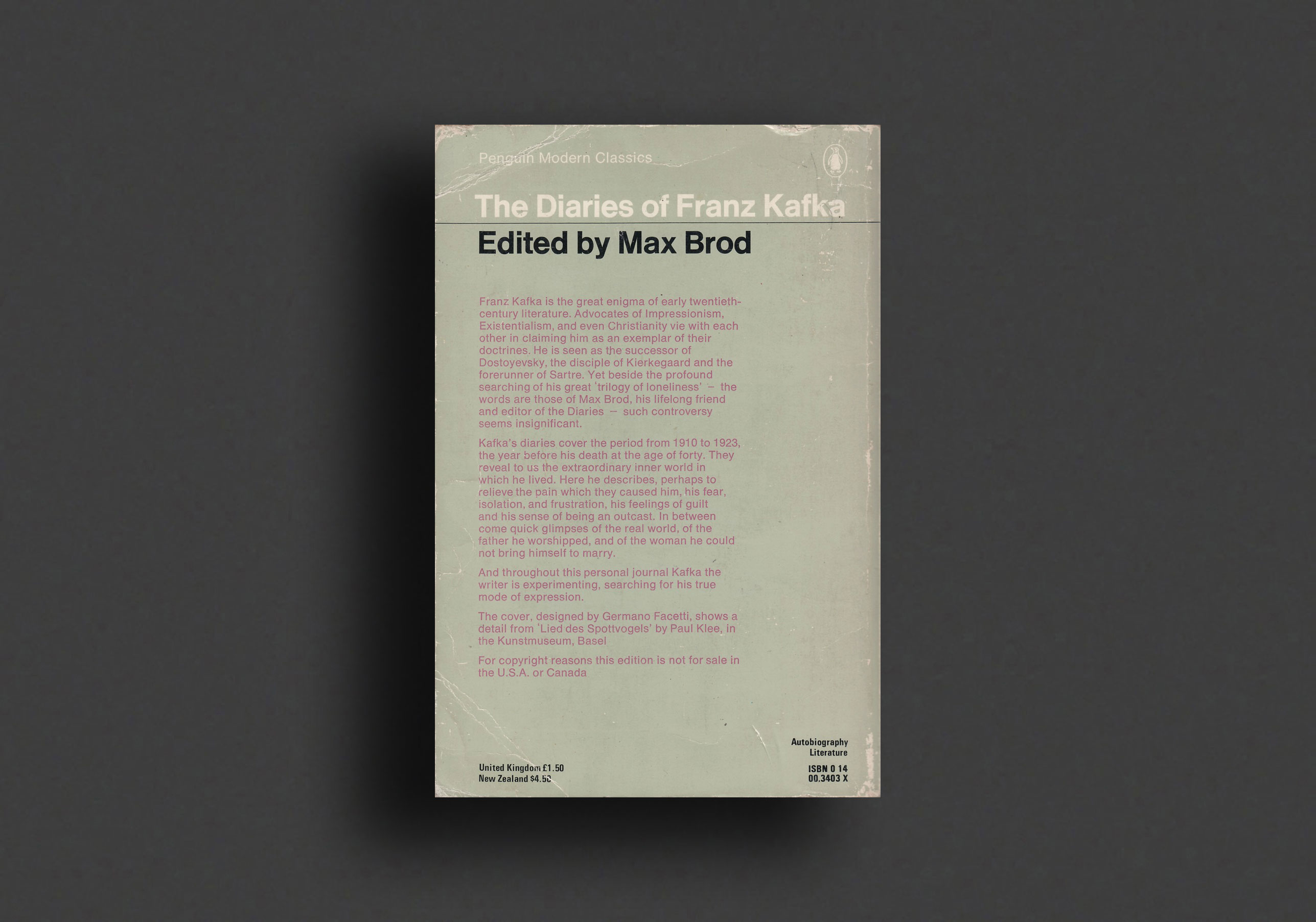
The landmark, over-sized Obliques special double issue, "La Femme Surréaliste", published in Paris in 1977. The French literary journal Obliques (who published special issues on Artaud, Bellmer, Kafka, Klossowski, Vian, Sartre, Robbe-Grillet, Strindberg, Genet...) was the first publisher to present a comprehensive list of the literary and plastic production of Surrealist women with this gorgeous volume, long before the works of surrealist women, as a corpus, began to be more widely studied in the 1980s. Featuring well known names, but also many female artists neglected and seldom mentioned in the recent (strangely narrow-minded) re-evaluation of this period, this beautifully printed issue of Obliques is an incredibly valuable reference on a movement that was decidedly ‘feminine’. Edited by Roger Borderie with Michel Camus, it features profiles on the work and writing of Belen, Maya Bell, Bona, Leonora Carrington, Lise Deharme, Jacqueline Duprey, Aube Elléouët, Josette Exandier, Leonor Fini, Aline Gagnaire, Giovanna, Jane Graverol, Marianne Van Hirtum, Rozeta Hum, Valentine Hugo, Karskaya, Greta Knutson, Laure, Gina Pane, Annie Lebrun, Georgette Magritte, Manina, Joyce Mansour, Nora Mitrani, Meret Oppenheim, Mimi Parent, Valentine Penrose, Gisele Prassinos, Karina Raeck, Remedios Varo, Sibylle Ruppert, Colette Thomas, Toyen, Isabelle Waldberg, Unica Zurn, Cécile Reims, Dorothea Tanning, Greta Knutson, and more. Additional texts and works by Beatrice Didier, Cécile Reims, Michel Butor, Michel Sicard, Andre Pieyre De Mandiargues, Jean Roudaut, Rene Micha, Gerard Legrand, Jean Pfeiffer, Jacques Laurans, Michel Carassou, Annie Lebrun, Charles Bachat, Olivier Milliard, Robert Brechon, Jules Michelet, Jerome Prieur, Xaviere Gauthier, Elsa Thoresen Gouveia, plus a gallery by Titi Parant and Henri Maccheroni's Portraits Corrigés. Profusely illustrated with artworks, mostly in b/w with some colour sections.
Very Good copy of the lovely softcover edition with textured boards. Sunning to spine edge, light general wear.
1972, English
Softcover (staple-bound), 48 pages, 28 x 21.5 cm
1st Edition, Out of print title / used / good
Published by
Payton / NSW
$40.00 - In stock -
Rare copy of this fantastic, seldom seen issue of Camera Graphics Australia (no. 5), published in May/June 1972, published by Payton, McMahons Point, NSW, featuring the work of Australian photographers Sue Ford, Paul Cox, Greg Weight, Roger Warwick Scott, Rob Walls, Lissa Coote, Stan Ciccone (inc. front cover), illustrated review of Toowoomba '72 International Salon, illustrated review on American documentary photojournalist Leonard Freed's Germany... As well as the featured photographic portfolios, the magazine includes essays, news, reviews for photo books, exhibitions, products, photography/camera related advertising, and more.
Good copy with edge wear to textured card covers, some shallow insect marking to front.
1974, English
Hardcover (w. dust jacket), 206 pages, 31 x 23 cm
Out of print title / used / very good
Published by
Phaidon / London
$45.00 - In stock -
The much scarcer (revised and expanded) 1974 edition of this classic 1955 survey of the paintings of the astoundingly inventive painter and draftsman, Pieter Bruegel the Elder, one of the most significant artists of Dutch and Flemish Renaissance painting. Issued by Phaidon, London, this hardcover volume is profusely illustrated with colour and b/w plates of his paintings in full, along with many details, accompanied by English texts and a complete list of works that have lost none of their wonder and continue to be one of the most inspiring catalogues in the history of painting.
"Pieter Bruegel the Elder began his career in 1551, at a period when Michelangelo was painting his last frescoes; and when death took Bruegel in 1569, at the summit of his achievement, the youthful El Greco had just completed his fırst paintings.
The creative originality of Bruegel's inventions is very powerful. It has rightly been said that he discovered the world of the peasants as a new field of artistic representation, that he was the fırst painter to characterize the appearance of the four seasons in nature, and that he depicted both the tragic and the comic elements of human life with a deep understanding.
About forty of his paintings, nearly half of them in Vienna, others in Naples, Brussels, Madrid, London, New York, and elsewhere, have survived. Many of them are rather large and contain a great wealth of figures; hence this volume comprises, in addition to complete renderings, a great number of detail reproductions, which not only show certain beautiful parts of the pictures, but also convey the force and boldness of Bruegel's imagination and of his brush work. [...]"—from inner jacket
VG in VG dust jacket.
2007, English
Hardcover (w. dust jacket), 544 pages, 30.5 x 25.5 cm
1st Edition, Out of print title / used / very good
Published by
Steidl / Göttingen
Schaulager / Basel
$380.00 - In stock -
The monumental, and very rare catalogue raisonné of American artist Robert Gober's (b. 1954) sculptures and installations, published on the occasion of the retrospective exhibition "Robert Gober. Work 1976-2007" at Schaulager, Basel by the great Steidl publishing house with Schaulager. At 544 pages, this incredible, handsomely designed hardcover book catalogues Gober's work as he developed an iconography once beautifully described as 'The Poetics of the Drain'. It charts his journey through his heart breaking reaction to the emergence of AIDs in the New York community, whilst grappling with issues around childhood, domesticity, sexuality, victimization and religion, relative to the disenfranchised and spurned, melding the human body with the drain. The book firmly places him in the forefront of his generation of artists.
Lavishly illustrated with approximately 250 works, all of which are reproduced in large format along with behind the scenes production/studio photography and comprehensive descriptions complemented by the artist's own commentary on individual works, as well as technical information on their manufacture. With an introductory essay by Elisabeth Sussman, curator at the Whitney Museum of American Art in New York, this volume remains the most exhaustive and revealing volume on Gober's oeuvre.
A highly sought after book, especially in the more collectible English edition.
Near Fine copy in VG dust jacket, light traces of wear to extremities.
1978, Japanese
Softcover, 25.5 x 18 cm
1st Edition, Out of print title / used / good
Published by
Sun Publishing / Japan
$80.00 - In stock -
Rare premiere issue (October 1978) of June (magazine), the first yaoi (boys love or "BL") magazine in Japan, founded in 1978, named after the French author Jean Genet, with "june" being a play on the Japanese pronunciation of his name. An underground cult hit, June became synonymous with the BL genre, publishing male/male tanbi ("aesthetic") romances — stories written for and about the worship of idealised beauty, tragedy, and homoerotic romance between androgynous men and beautiful male youths, narratives that emphasise homosociality and de-emphasize socio-cultural homophobia, rich in decadence through the use of flowery language, baroque sexual fantasies and unusual kanji. The yaoi genre was coined by the female manga artists Yasuko Sakata and Akiko Hatsu and originated in the 1970s as a subgenre of shōjo manga, or comics for girls, influenced by the rising popularity of depictions of bishōnen ("beautiful boys"), a term for androgynous or effeminate male characters. June ushered in a new wave of — primarily female — manga artists and writers, including Keiko Takemiya, Tomomi Kobayashi, Kaoru Kurimoto, and Akimi Yoshida, and male artists such as Sadao Hasegawa, Gekko Hayashi, and Ben Kimura, publishing unsolicited manuscripts and homoerotic artworks alongside critical writings, reviews, and historical pieces, all centred around boys. Although it began typically as a genre by and for women, distinct from bara (gay manga created by men), June increasingly appealed to a gay audience, and played a significant role in the construction of a collective gay identity in Japan, alongside pioneering gay manga magazines such Barazoku, which featured many of the same artists. The June imprint ran various editions of the magazine, including the "large format" with many photos of youths and colour artworks, the popular Roman June ("Romantic June") which contained a mix of stories and manga, and Shousetsu June, and the original manga magazine.
The yaoi genre of June (also referred to as shōnen-ai "boy love") was heavily inspired by European decadent literature, philosophy, the homoerotic writings of Japanese authors Taruho Inagaki, Yukio Mishima, Yasunari Kawabata, Jun'ichirō Tanizaki, and the Bildungsroman (coming-of-age) literary genre as much as it was by pop culture and the androgyny of musicians such as David Bowie, Marc Bolan and David Sylvian, or actor Björn Andrésen's portrayal of Thaddeus in Visconti's 1971 film adaptation of Death in Venice. Early issues are be filled to the brim with lavish illustrations and comic stories, erotic fantasy fiction, photographs of "beautiful boys" (young film stars, catholic choir boys, musicians...), reviews, interviews, and essays, all rich with romantic connotations to the age of Decadence, Symbolism, and the aesthetics of the Victorian and Edwardian eras, as well as Japanese folklore.
Good—Very Good copy of this scarce early issue of June, published by Sun Publishing, Tokyo.
1978, Japanese
Softcover, 25.5 x 18 cm
1st Edition, Out of print title / used / good
Published by
Sun Publishing / Japan
$80.00 - In stock -
Issue No 2 (December 1978) of June (magazine), the first yaoi (boys love or "BL") magazine in Japan, founded in 1978, named after the French author Jean Genet, with "june" being a play on the Japanese pronunciation of his name. An underground cult hit, June became synonymous with the BL genre, publishing male/male tanbi ("aesthetic") romances — stories written for and about the worship of idealised beauty, tragedy, and homoerotic romance between androgynous men and beautiful male youths, narratives that emphasise homosociality and de-emphasize socio-cultural homophobia, rich in decadence through the use of flowery language, baroque sexual fantasies and unusual kanji. The yaoi genre was coined by the female manga artists Yasuko Sakata and Akiko Hatsu and originated in the 1970s as a subgenre of shōjo manga, or comics for girls, influenced by the rising popularity of depictions of bishōnen ("beautiful boys"), a term for androgynous or effeminate male characters. June ushered in a new wave of — primarily female — manga artists and writers, including Keiko Takemiya, Tomomi Kobayashi, Kaoru Kurimoto, and Akimi Yoshida, and male artists such as Sadao Hasegawa, Gekko Hayashi, and Ben Kimura, publishing unsolicited manuscripts and homoerotic artworks alongside critical writings, reviews, and historical pieces, all centred around boys. Although it began typically as a genre by and for women, distinct from bara (gay manga created by men), June increasingly appealed to a gay audience, and played a significant role in the construction of a collective gay identity in Japan, alongside pioneering gay manga magazines such Barazoku, which featured many of the same artists. The June imprint ran various editions of the magazine, including the "large format" with many photos of youths and colour artworks, the popular Roman June ("Romantic June") which contained a mix of stories and manga, and Shousetsu June, and the original manga magazine.
The yaoi genre of June (also referred to as shōnen-ai "boy love") was heavily inspired by European decadent literature, philosophy, the homoerotic writings of Japanese authors Taruho Inagaki, Yukio Mishima, Yasunari Kawabata, Jun'ichirō Tanizaki, and the Bildungsroman (coming-of-age) literary genre as much as it was by pop culture and the androgyny of musicians such as David Bowie, Marc Bolan and David Sylvian, or actor Björn Andrésen's portrayal of Thaddeus in Visconti's 1971 film adaptation of Death in Venice.
These early issues are filled to the brim with lavish illustrations and comic stories, erotic fantasy fiction, photographs of "beautiful boys" (young film stars, catholic choir boys, musicians...), reviews, interviews, and essays, all rich with romantic connotations to the age of Decadence, Symbolism, and the aesthetics of the Victorian and Edwardian eras, as well as Japanese folklore.
Good—Very Good copy of this scarce early issue of June, published by Sun Publishing, Tokyo.
2009, English
Softcover (staple-bound), 128 pages, 28.5 x 23.5 cm
1st Edition, Out of print title / used / very good
Published by
PIN-UP / New York
$150.00 - In stock -
Rare and collectible early issue of the acclaimed 'Magazine for Architectural Entretainment', PIN–UP. Issue 6, S/S 2009, back when the print-run was surprisingly small and magazines were still fantastic.
"PIN–UP 6, Spring Summer 2009. A mid-recession tour de force. Hot fluorescent pink, green, purple, and orange. A potent mix of Meier, Wines, and Ishigami. Plus: flowers, Sylvia Lavin, and Dynasty. The last PIN–UP to be staple-bound. A must-have in any PIN–UP collection."—from PIN-UP website
Featuring:
RICHARD MEIER
The authority on all things white is one colorful character
Interview by Horacio Silva
Photography by Katja Rahlwes
DAVID KOHN
The cunning fox behind London’s new eclecticism
Interview by Caroline Roux
Photography by Devin Blair
ROY MCMAKIN
Forever blurring the makers of art, architecture, and design
Interview by Michael Ned Holte
Photography by Julika Rudelius
JUNYA ISHIGAMI
The minimalist’s darling is a nature lover at heart
Interview by Beatrice Galilee
Photography by Takashi Homma
JAMES WINES
The perpetual nonconformist has the last laugh
Interview by Michael Bullock
Photography by Miguel Villalobos
Also:
Floor plans from Dark Rooms Atlas examine the ideal architecture of gay cruising spots in Barcelona. Andreas Angelidakis tinkers with the intersection between technology and physicality, using programs like Second Life to create his playfully geometric structures. Brooklyn-based design studio labDORA fuses computer-coded design with waxy blobs. A look into Eric Lloyd Wright’s unfinished house, a sparse concrete structure perched on the summit of California’s Malibu hills. Art by Thomas Ravens juxtapose the whimsy of watercolors with images of failed utopia. PIN–UP pays homage to Dan Friedman via collage, mixing the artist’s wacky furniture with found objects. Sketches for chairs by various designers reveal the complicated and raw psychology behind creating one of the most fundamental entities of design. PIN–UP reconsiders the basic shapes of architecture via bouquets and topiary arrangements. Screenshots from Dynasty pay tribute to set designer Brock Broughton. Suleman Anaya examines the logic behind architecture’s emotional impact, both in films and in his life. Maia Morgensztern writes about the economic and cultural impact of opening a Louvre museum on the island of Saadiyat, located off the coast of Abu Dhabi. Sylvia Lavin on the impact that Richard Neutra’s windows had on reshaping postwar buildings. Paul Elliman remembers Dan Friedman and the interplay between design and contemporary art. And a look at the interactive, anamorphosis paintings of Felice Varini, who uses light projectors to paint shapes that seemingly levitate within the space.
Very Good copy, light wear.
2007, English
Softcover (staple-bound), 108 pages, 28.5 x 23.5 cm
1st Edition, Out of print title / used / very good
Published by
PIN-UP / New York
$150.00 - In stock -
Rare and collectible early issue of the acclaimed 'Magazine for Architectural Entretainment', PIN–UP. Issue 3, F/W 2007-2008, back when the print-run was surprisingly small and magazines were still fantastic.
"The power of three. PIN–UP’s third issue combines theory with architectural fun and games. An inescapable document of the late 2000s New York scene and beyond. One of PIN–UP’s few staple-bound issues. VERY RARE."—from PIN-UP website
Featuring:
JULIUS SHULMAN
The photography legend shares his love for gardening with a young Los Angeles architect
Interview by Fritz Haeg
Photography by Todd Cole
ROBERT WILSON
The artist and director reflects on the objects of his affection
Text by Horacio Silva
Photography by Todd Eberle
K/R ARCHITECTS
Straight talk with two mellowed New York modernists
Interview by Aric Chen
Photography by Disco Meisch
BALL-NOGUES & GANDALF GAVAN
East and West Coast meet on the threshold of art and architecture
Interview by Pierre Alexandre de Looz
Photography by Gandalf Gavan
Drawings by Ball-Nogues
Also:
A Thierry Mugler fashion shoot from May 1980 conjures up the irresistible dynamic of Gotham’s darker, bolder days. One last visit to Robert Wilson’s former TriBeCa loft for a glimpse at his cargo cult of collectibles. Photographer Chris Mottalini captures the “beautiful ruins” of one Paul Rudolph house in Westport Connecticut, moments before it is demolished. A look back at the work of Tony Duquette, the designer who evoked the exotic strangeness of the natural world. A two-part meditation on the “folly of ruins” — in photographs and text. Lorenz Cugini and Richard Petit provide two distinct studies of the usually veiled dialogue between chairs and bodies. Ben Widdicome examines the position of the architect in popular cinema and, by extension, society-at-large. Ted Trussel Porter investigates the influence of David Whitney on his paramour Philip Johnson’s interiors. A letter sent across the Iron Curtain by German architect Hans Scharoun to his Czechoslovakian student and collaborator Lubomir Šlapeta. Mike Kelley and Paul McCarthy stage a critical conversation between avant-garde and kitsch with their installation Heidi at the Krizinger Gallery in Vienna. Some notes on play and architecture in the 1950s and 1960s by Dirk van den Heuvel. PIN–UP takes a fresh look at the aging beauty of Hong Kong’s Cultural Centre. A peek inside the VIP Suites Caracas —a n iconic landmark made over as a boutique hotel by New York architects Ashe+Leandro. Photographs by Marcelo Krasilcic invite you to imagine a scenario of your own in Steve McQueen’s recently restored Palm Springs residence. Simon Fujiwara turns the Documenta town’s ’80s civic architecture into an effervescent intervention. And photographer Adrian Gaut time-travels to Prague to recapture the creativity and forward-thinking work of 20th Century Czech theatre designers.
Very Good copy, light wear.
1983, Japanese
Hardcover (clothbound w. dustjacket), 152 pages, 20.5 x 30 cm
1st Edition, Out of print title / used / very good
Published by
Orion Press / Tokyo
$150.00 - In stock -
Exquisitely designed and produced book dedicated entirely to the photography of the German artist Hans Bellmer (1902—1975). Produced in French by Editions Filipacchi, Centre Georges Pompidou, and Musee National D'art Moderne in Paris in 1983, this scarce Japanese hardcover printing (produced and printed in Japan that same year) features a different cover, with translations to the Japanese language of the introductory essay and texts. A beautiful photo book densely illustrated with colour and black and white reproductions of Bellmer's infamous doll photography, his many studies of the female nude (including those of his wife, artist Unica Zürn), and rare photography of his objects and sculptural assemblages, his studio, and more, this volume captures an important Surrealist visionary and one of the most daring artists of the 20th century through his stunning photography. Features the wonderful "La Poupee" — Hans Bellmer's articulated, anatomically amorphous Surrealist doll, reconfigured and captured through Bellmer's intimate hand-painted photographic images. "La Poupee" acquired iconic status as perhaps the purest exemplification of the Surrealist ideal of "convulsive beauty." Bellmer constructed his first doll in the early 1930s. André Breton and Paul Eluard described it as "the first and only Surrealist object with a universal, provocative power".
German artist Hans Bellmer (1902—1975) was one of the most subversive artists associated with Surrealism, famous—notorious, even—for his erotic engravings, objects and photographs. Many of Bellmer's works were inspired by the literary works of Comte de Lautréamont, Marquis de Sade and Georges Bataille, amongst others.
Very Good copy in VG dust jacket with light wear/light foxing.
1991, English
Softcover, 155 pages, 21.5 x 13.5 cm
1st Edition, Out of print title / used / very good
Published by
Marion Boyars / London
$50.00 - In stock -
First 1991 English edition.
Set against the backdrop of Europe's slide into Fascism, Blue of Noon is one of Bataille's most overtly political works, exploring the ambiguity of sex as a subversive force and synthesizing the fetishes of violence, power and death that mesmerized an age. In this classic of twentieth century eroticism, the reader is taken on a dark journey through the psyche of the prewar French intel- ligentsia, torn between identification with the victims of history and the glamour of its victors.
"The writing is superlative... daringly imaginative, intended only for those awake and aware of the possibilities of excess in literature and life. Along with Céline and Breton, Bataille writes as if he were dropping a bomb; in a fore-flash he creates a world of demented funereal sexuality."—Detroit Free Press
"Bataille is one of the most important writers of this century. He broke with traditional narrative to tell us what has never been told before."—Michel Foucault
"Bataille denudes himself, exposes himself, his exhibitionism aims at destroying all literature. He has a holocaust of words. Bataille speaks about man's condition, not his nature. His tone recalls the scornful aggressiveness of the surrealist. Bataille has survived the death of God. In him reality is conflict."—Jean-Paul Sartre
Very Good copy with light wear. Sample images.
2009, English / German
Hardcover, 336 pages, 23 x 30 cm
1st Edition, Out of print title / used / very good
Published by
Brinkmann & Bose / Berlin
$300.00 - In stock -
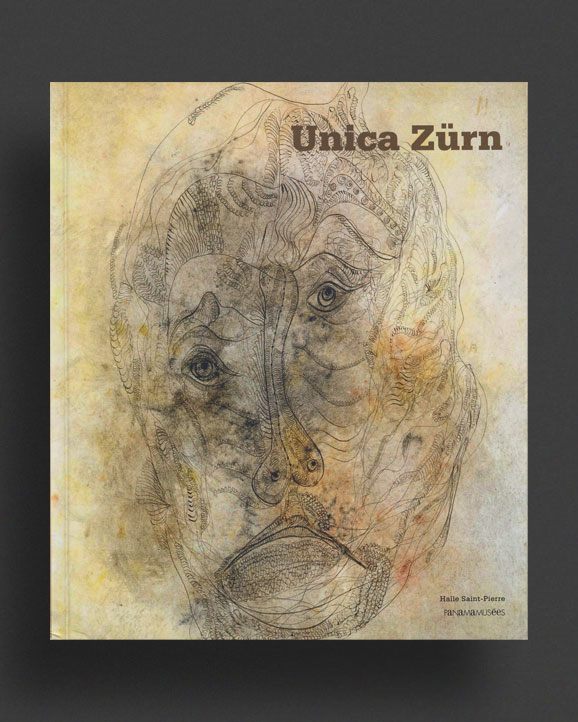
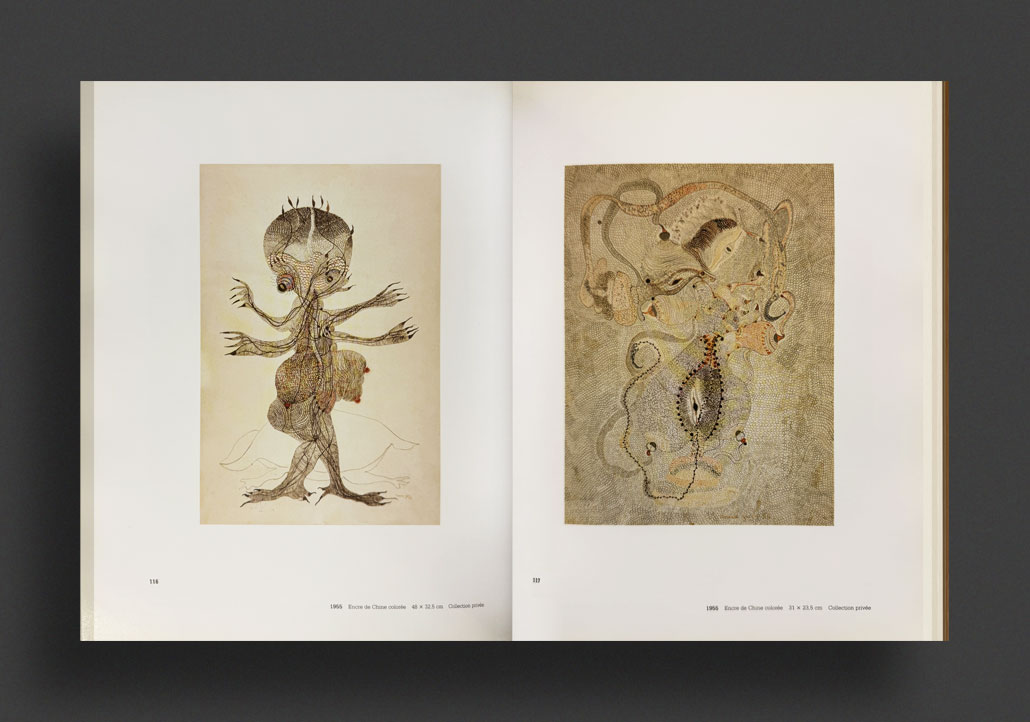
First limited hardcover edition of this wonderful Unica Zürn (1916-1970) collection of artworks. Beautifully produced, profusely illustrated, and long out-of-print, this rare volume is still one of the most cherished and comprehensive collections of Zürn's artwork ever published. This lovely limited-edition survey collects together her drawings done between 1954 and 1967, 300 drawings almost all unpublished, facsimiles of her sketch-books, and reproductions of her highly-collectible artist books produced throughout her life (Hexentexte, Oracles et Spectacles, etc.), all accompanied by bibliographic information, making it a invaluable reference. Illustrated introduction by publisher Erich Brinkmann. Texts in bi-lingual German and English.
The German artist and writer Unica Zurn (1916-1970) joined the ranks of Surrealism in the 1950s, after moving to Paris and taking up residence with the German-born Surrealist Hans Bellmer. Drawn to the movement's espousal of automatic drawing and writing, Zurn pursued Henri Michaux's declaration that "the hand dreams," making a vocation of these techniques with drawings and paintings that are labyrinthine in detail, as one form sprouts out of another. Zurn has left us an account of the sensation of automatic drawing: "After an initial moment when the pen 'swims' hesitantly on the paper, she discovers the place assigned to the first eye. It is only when she is being watched from the depths of the paper that she begins to get her bearings and, effortlessly, one motif is added to another." This lovely limited-edition survey reproduces drawings done between 1954 and 1967.
The German artist and writer Unica Zürn (1916-1970) joined the ranks of Surrealism in the 1950s, after moving to Paris and taking up residence with fellow German-born Surrealist Hans Bellmer. Already an accomplished author, Zürn was drawn to the Surrealist movement's espousal of automatic drawing and writing, Zürn pursued Henri Michaux's declaration that "the hand dreams," making a vocation of these techniques with her dense, otherworldly drawings and paintings that are labyrinthine in detail, as one form sprouts out of another. Also with her experimental anagrams, natural extensions of her established interest in hidden meanings and coincidences. Zürn produced most of her oeuvre during this intensive period in the 1950s and 60s, though one marked by her deteriorating mental health. Many of her works were made during periods of hospitalisation. In 1970, Zürn leapt to her death from the balcony of the Paris apartment she had shared with Bellmer. Upon his death in 1975, Bellmer was buried, at his request, next to Zürn in Paris’s Père-Lachaise Cemetery. Their grave is marked with the words Bellmer wrote for Zürn’s funeral wreath nearly five years before: “My love will follow you into Eternity.”
Zürn has left us an account of the sensation of automatic drawing: "After an initial moment when the pen 'swims' hesitantly on the paper, she discovers the place assigned to the first eye. It is only when she is being watched from the depths of the paper that she begins to get her bearings and, effortlessly, one motif is added to another."
Very Good copy, light wear.
1999, English
Softcover (staple-bound), 66 pages, 30 x 21 cm
1st Edition, Out of print title / used / good
Published by
Avant Magazine / Essex
$10.00 - In stock -
Featuring the Baschet Brothers' Sculpture Sonores, Cecil Taylor, Max Roach, John Cale, Eliane Radigue, Pierre Favre, Mauricio Kagel, Annae Lockwood, and many more. In-depth articles, interviews, reviews, all heavily illustrated.
Good copy, light wear, missing CD.
1985, English
Softcover (w. paste-ins), 224 pages, 21 x 15 cm
1st Edition, Out of print title / used / very good
Published by
Atlas Press / London
$100.00 - In stock -
"A chrestomathy of dicey enchantments.'—CITY LIMITS
Now rare, long out-of-print 1985 Atlas Anthology 3, edited by Alastair Brotchie & Malcolm Green. "Benign Pollution, Enthused Writing". The third production from the legendary Atlas Press, the third general anthology and the first book to be actually typeset (a very expensive business in those days).
Features: Hans Carl Artmann, Pierre Albert-Birot, Wolfgang Bauer, Konrad Bayer, Pierre Bettencourt, Peter Blegvad, Andre Breton, Jean-Pierre Brisset, Günter Brus, René Crevel, David Gascoyne, Alfred Jarry, James Kirkup, Karl Kraus, Jean Lorrain, Harry Mathews, Gustave Meyrink, Pier Paolo Pasolini, Georges Perec, Benjamin Peret, Oskar Panizza, Raymond Queneau, Jacques Rigaut, Herbert Rosendorfer, Raymond Roussel, Paul Scheerbart, Mathew Phipps Shiel, Kurt Schwitters, Boris Vian, Austryn Wainhouse, Robert Walser, Unica Zürn, Etcetera Etc.
"Here is a prose based on Romanticism, in this century focused around the early Expressionism and the Surrealist movement. It is a literature of unusual beauty and bitter humour, political (in the widest sense), it asserts a complete freedom of form and content. Neither 'cool', restrained nor boring! An important collection of unjustly neglected authors, past and present, which includes many who are seldom translated into English."
Highest recommendation.
Good—Very Good copy complete with all the paste-ins. General wear and tanning.
1973, Japanese
Softcover, 108 pages, 28 x 30 cm
1st Edition, Out of print title / used / very good
Published by
Mainichi Shimbun / Tokyo
$280.00 - In stock -
Rare first 1973 edition of acclaimed Japanese photographer Hajime Sawatari's cult photo book "Nadia" (aka Doll Forest Museum/Nadia in the Woods). Sawatari began working as a freelancer in 1966, photographing for many leading fashion magazines in Japan. Sawatari fell in love with the Italian fashion model Nadia Galli while working with her on an advertisement back in 1971. Driven by the photographer’s desire to capture on film everything about the person he loved, Sawatari took Nadia with him on an extensive journey. Traveling around Karuizawa in the summer, Venice, Sicily and other locations in Nadia’s home country, Karuizawa in the Winter, and Tokyo, his focus on Nadia switched between viewing her as a photographic subject and a lover, resulting in Sawatari establishing his own unique semi-fictional style of “capturing a woman in a back-and-forth between reality and fiction,” which marked a clear departure from his previous female portraits, and opened a new frontier in the realm of photography. This dreamlike and intimate series of monochrome portraits of Nadia weaves a fairytale-like, visual travelogue akin to Sawatari's other cult classic of the same year, Alice. Playful, intimate and at times hallucinatory, the book closes with a lovely hand-written letter by Nadia in Japanese and a photographic portrait of Sawatari, also by Nadia. A gorgeous book.
Number 3 in Camera Mainichi's Private series.
Very Good copy, tightly bound and clean with some wear to covers, corners. Very nice copy for a book that is usually heavily damaged.
1991, English
Softcover, 96 pages, 28 x 21.5 cm
1st Edition, Out of print title / used / very good
Published by
NBM / New York
Eurotica / New York
$70.00 - In stock -
First 1991 English-language softcover edition, volume 3, of Italian illustrator Guido Crepax's famous graphic adaptation of The Story of O, one of the most famous erotic novels of all time, by French literary critic, journalist, and novelist, Anne Cécile Desclos (1907—1998), under the pen name Pauline Réage. A beautiful display of Crepax's dizzying, rhythmic paneling and beautiful, erotically-charged ink work, as imaginative as the literary work of Réage.
"A rare thing, a pornographic book well written and without a trace of obscenity"—Graham Greene.
Guido Crepas (15 July 1933 in Milan - 31 July 2003 in Milan), better known by his nom de plume Guido Crepax, was an Italian comics artist. He studied at the School of Architecture at the University of Milan. After graduating, he made his debut in comic books in 1959 when he contributed his work to Tempo Medico. He joined the new magazine Linus in 1965 with a fantasy comic, 'Neutron', a superhero comic about an art critic with the mysterious power to stop humans or objects via his gaze. It featured a minor character called Valentina, a fashionable, communist Milanese photographer born in 1942, who quickly became Crepax's protagonist and his most famous creation. Valentina became an underground icon of 1960s culture. Crepax's work became noted for his very sophisticated expressionistic yet graphic drawing style, his truely innovative panel work and his unusual compositions that seemed to have more in common with modern art and film than comic strips. His psychedelic, dreamlike storylines were immersive, generally involving a strong dose of erotism and a predilection towards sadomasochism and the surreal. After 'Valentina', other titles followed, such as 'L'Astronave Pirata' (1968), 'La Casa Matta' (1969), 'La Calata di Mac Similiano' (1969), 'Belinda', 'Anita' and 'Bianca'. Crepax's illustrated adaptations of classic erotic stories like De Sade's 'Justine', Pauline Réage's 'Histoire d'O' and Sacher-Masoch's 'Venus in Furs' brought him further acclaim, especially to English audiences who had mostly only read translated Crepax through the pages of Heavy Metal magazine.
Very Good copy.
1988, Italian
Hardcover (w. dust jacket), 94 pages, 23.5 x 31 cm
1st Edition, Out of print title / used / fine
Published by
Olympia / Rome
$70.00 - Out of stock
Wonderful large-format, hardcover 1988 edition of Guido Crepax's 'Anita in Diretta', one of the great Crepax books in all it's dizzying, rhythmic paneling and beautiful use of colour, compiling two complimentary Anita stories - 'Input Anita' (1986) and 'Anita Color' (1987). Here Crepax evokes two fantastic erotic "environments" that stem from the growing universe of technology in the 1980s and the world's new-found obsession with screens. In the first, Anita is swept into a vortex of mental delirium because she anthropomorphises the data of her computer and transforms into reality what appears on her screen. In the second, in parallel, Anita masturbates to her television, fantasising about the endless characters and scenarios that change with each flick of the remote. Anita meets-clashes in both cases with the magical surface of the unifying screen, a producer of cold imagination, which the individual transforms into a lived, private experience. This participation is strongly unconscious, and in Crepax's stories there is an unacknowledged denunciation of fantasy based on technology. The last step in each story is in fact the "dispossession" of Anita's personality by the fantasy machine, her fall into psychosis, demonstrating that the excess of empathy into the illusionary screen ends up producing a new, dangerous reality.
Guido Crepas (15 July 1933 in Milan - 31 July 2003 in Milan), better known by his nom de plume Guido Crepax, was an Italian comics artist. He studied at the School of Architecture at the University of Milan. After graduating, he made his debut in comic books in 1959 when he contributed his work to Tempo Medico. He joined the new magazine Linus in 1965 with a fantasy comic, 'Neutron', a superhero comic about an art critic with the mysterious power to stop humans or objects via his gaze. It featured a minor character called Valentina, a fashionable, communist Milanese photographer born in 1942, who quickly became Crepax's protagonist and his most famous creation. Valentina became an underground icon of 1960s culture. Crepax's work became noted for his very sophisticated expressionistic yet graphic drawing style, his truely innovative panel work and his unusual compositions that seemed to have more in common with modern art and film than comic strips. His psychedelic, dreamlike storylines were immersive, generally involving a strong dose of erotism and a predilection towards sadomasochism and the surreal. After 'Valentina', other titles followed, such as 'L'Astronave Pirata' (1968), 'La Casa Matta' (1969), 'La Calata di Mac Similiano' (1969), 'Belinda', 'Anita' and 'Bianca'. Crepax's illustrated adaptations of classic erotic stories like De Sade's 'Justine', Pauline Réage's 'Histoire d'O' and Sacher-Masoch's 'Venus in Furs' brought him further acclaim, especially to English audiences who had mostly only read translated Crepax through the pages of Heavy Metal magazine.
1995, English
Softcover, 270 pages, 21.5 x 13.5 cm
1st Edition, Out of print title / used / very good
Published by
Faber & Faber / London
$40.00 - Out of stock
Krzysztof Kieślowski's untimely death in 1996 robbed cinema of one of its great visionaries. Published a year before his passing, this 1995 English paperback edition of Kieślowski on Kieślowski, published by Faber & Faber and edited by Danusia Stok provides an rare, intimate insight into his world, moving between Poland and France and creating some of the most important cinematic works of the late 20th century.
"Decalogue, The Double Life of Veronique and his new trilogy, Three Colours, have earned Kieslowski his reputation as a world-class film-maker. Kieślowski is notoriously reticent, and even dismissive of his work and talent, but these frank and detailed discussions show a passion for film-making and a career which has been often threatened by political and economic change within Poland. He talks at length about his life: his childhood, disrupted by Hitler and Stalin; his four attempts to get into film school; and what Poland and its future mean to him now."
VG copy, light tanning to block, light wear.
1998, English
Softcover, 176 pages, 23 x 14 cm
1st Edition, Out of print title / used / good
Published by
Main St. Books / New York
$85.00 - In stock -
First edition.
"There is no place for plot, linear narrative, character development, or scene setting in Harmony Korine's audacious and original first novel, A Crackup at the Race Riots. The twenty-three-year-old filmmaker has created a bold work of fiction, a montage that takes literary convention and explodes it in a sequence of half-remembered scenes, suicide notes, dialogue fragments, movie ideas, rumors, and jokes. Korine's eye and ear are exquisitely tuned to the absurd, to the hypocrisy and hilarity that comprise our national obsessions with death, dirt, poverty, celebrity, religion, and gossip. He captures the fragmented moments of a life observed through the demented lens of media, TV, and teen obsession. The reinvented wheel of Korine's darkly bizarre imagination, A Crackup at the Race Riots is the ultimate postmodern novel-funny, offensive, depraved, and sad."
"The new heir, the man, the sweet edge of the future."—Jim Carroll, author of The Basketball Diaries
"I was struck from the very beginning that there is a totally independent & new voice in writing. I believe that [he] is a great talent as a writer."—Werner Herzog
HARMONY KORINE is the self-educated twenty-three-year-old who wrote the screenplay for the controversial film Kids. His directorial debut, Gummo, received the 1997 Venice Film Critics' Award and the Rotterdam Film Festival Critics' Award. Korine was raised in the carnival and currently resides in West Virginia.
Good copy with wear to extremities, Tightly bound, no spine creases.