World Food Books' programme is largely produced on Kulin Nation land. We acknowledge the Wurundjeri people of the Kulin Nation as the first and continuing custodians of this land, and pay respect to their Elders past, present, and emerging.
World Food Books is an arts and special interests bookshop in Naarm / Melbourne. Founded in 2010, World Food Books is devoted to the presentation of a rotating, hand-selection of international art, design, literary and counterculture publications with an emphasis on the anti-traditional, the experimental, the avant-garde, the heretic, the marginal.
Presenting new titles alongside rare and out-of-print books, catalogues and journals spanning the fields of modern and contemporary art, design, photography, illustration, film, literature, poetry, cultural theory, philosophy, sexuality, popular and underground culture in its many radical forms, World Food Books wishes to encourage adventurous, thoughtful and open-minded reading, looking, writing, and exchange of publishing and ideas, both current and historical.
As well as our bookshop, located in Melbourne's historical Nicholas Building, all of our inventory is available internationally via our online mail-order service.
World Food Books semi-regularly co-ordinates "Occasions", a programme of exhibits and events at the bookshop and in partnership with other hosts (such as museums and art galleries) that develop out of the activities, relationships and content of the bookshop itself.
World Food Books
The Nicholas Building
37 Swanston Street
Room 5, Level 6
Melbourne 3000
Australia
SHOP HOURS:
Thu–Fri 12–6, Sat 12–5
WEB-SHOP OPEN 24/7
World Food Books
Postal Address:
PO Box 435
Flinders Lane
Victoria 8009
Australia
Art
Theory / Essay
Architecture / Interior
Graphic Design / Typography
Photography
Fashion
Eros
LGBTQ+
Fiction / Poetry
Weird / Speculative / Science Fiction / Horror
Transgressive / Visceral / Abject
Symbolism / Decadence / Fin de siècle
Film / Video
Painting
Sculpture / Installation
Performance / Dance / Theater
Drawing
Sound / Music
Curatorial
Group Shows / Collections
Periodicals
Out-of-print / Rare
Posters / Ephemera / Discs
Signed Books
World Food Books Gift Voucher
World Food Book Bag
Australian Art
Australian Fiction
Australian Science Fiction / Speculative Fiction
Australian Poetry
Australian Photography
Japanese Photography
Conceptual Art
Minimal Art
Dada
'Pataphysics / Oulipo
Fluxus
Concrete Poetry
Pop Art
Surrealism
Arte Povera
Arte Informale / Haute Pâte / Tachism
Nouveau Réalisme / Zero / Kinetic
Situationism / Lettrism
Collage / Mail Art / Xerox Art
Art Brut / Folk / Visionary / Fantastic
Illustration / Graphic Art / Bandes Dessinées
Furniture
Italian Radical Design / Postmodernism
Textiles
Ceramics / Glass
Counterculture
Protest / Revolt
Philosophy
Psychoanalysis
Anthropology
Anarchism
Socialism / Anarchism / Communism / Capitalism
Literary Theory / Semiotics / Language
Feminism / Women's Studies
Gender Studies / Sexuality
Anthropology
Fetishism / BDSM
Drugs / Psychedelia
Crime / Violence
Animal Rights / Veganism
Occult / Esoterica
Ecology / Earth / Alternative Living
Whole Earth / Crafts
All prices in AUD (Australian dollars)
Pick-Ups
Pick-up orders can be collected in our bookshop during opening hours after order date. Please collect any Pick-up orders within 2 weeks of ordering as we have limited storage space. Orders will be released back into stock if not collected within this time. No refunds can be made for pick-ups left un-collected. If you cannot make it in to the bookshop in this time-frame, please choose postage option.
Return Policy
All sales are final. We do accept returns (for refund or exchange) for items received in error. All our orders are packed with special care using heavy-duty padding and cardboard book-mailers or bubble mailers (for smaller books), using reinforcement where required. We cannot take responsibility for any lost, stolen or damaged parcels.
Insurance
Should you wish to insure your package, please email us directly after placing your order and we can organise this at a small extra expense. Although all standard/express tracked packages are very safe and dependable, we cannot take responsibility for any lost, stolen or damaged parcels. We recommend insurance on valuable orders.
Interested in selling your old books, catalogues, journals, magazines, comics, fanzines, ephemera? We are always looking for interesting, unusual and out-of-print books to buy. We only buy books in our fields of interest and specialty, and that we feel we can resell.
We base these prices on desirability, market value, in-print prices, condition and our current stock levels. We offer cash, store credit, and can take stock on consignment. All
about 25% of the price we expect to get when we sell them, or 30% in store credit. We base these prices on desirability, market value, in-print prices, condition and our current stock levels.
Sell your books any day of the week. You can drop them off and return later. If you have a lot of books, we can visit your Sydney home.
We buy books that we feel we can resell. We offer about 25 % of the price we expect to get when we sell them, or 30% in store credit. We base these prices on desirability, market value, in-print prices, condition and our current stock levels.
Philadelphia Wireman
03 August - 01 September, 2018
World Food Books is proud to announce our next Occasion, the first presentation of sculptures by Philadelphia Wireman in Australia.
The Philadelphia Wireman sculptures were found abandoned in an alley off Philadelphia’s South Street on trash night in 1982. Their discovery in a rapidly-changing neighbourhood undergoing extensive renovation, compounded with the failure of all attempts to locate the artist, suggests that the works may have been discarded after the maker’s death. Dubbed the "Philadelphia Wireman" during the first exhibition of this work, in 1985, the maker’s name, age, ethnicity, and even gender remain uncertain. The entire collection totals approximately 1200 pieces, all intricately bound together with tightly-wound heavy-gauge wire (along with a few small, abstract marker drawings, reminiscent both of Mark Tobey and J.B. Murry). The dense construction of the work, despite a modest range of scale and materials, is singularly obsessive and disciplined in design: a wire armature or exoskeleton firmly binds a bricolage of found objects including plastic, glass, food packaging, umbrella parts, tape, rubber, batteries, pens, leather, reflectors, nuts and bolts, nails, foil, coins, toys, watches, eyeglasses, tools, and jewellery.
Heavy with associations—anthropomorphic, zoomorphic, and socio-cultural responses to wrapped detritus—the totemic sculptures by Philadelphia Wireman have been discussed in the context of work created to fulfil the shamanistic needs of alternative religions in American culture. Curators, collectors, and critics have variously compared certain pieces to sculpture from Classical antiquity, Native American medicine bundles, African-American memory jugs, and African fetish objects. Reflecting the artist’s prolific and incredibly focused scavenging impulse, and despite—or perhaps enhanced by—their anonymity, these enigmatic objects function as urban artefacts and arbiters of power, though their origin and purpose is unknown. Philadelphia Wireman, whatever their identity, possessed an astonishing ability to isolate and communicate the concepts of power and energy through the selection and transformation of ordinary materials. Over the course of the past two decades, this collection has come to be regarded as an important discovery in the field of self-taught art and vernacular art.
Presented in collaboration with Fleisher-Ollman Gallery, Philadelphia, and Robert Heald, Wellington.
Susan Te Kahurangi King
02 February - 10 March, 2018
Susan Te Kahurangi King (24 February 1951 - ) has been a confident and prolific artist since she was a young child, drawing with readily available materials - pencils, ballpoint pens and felt-tip markers, on whatever paper is at hand. Between the ages of four and six Susan slowly ceased verbal communication. Her grandparents William and Myrtle Murphy had developed a special bond with Susan so they took on caring responsibilities for extended periods. Myrtle began informally archiving her work, carefully collecting and storing the drawings and compiling scrapbooks. No drawing was insignificant; every scrap of paper was kept. The King family are now the custodians of a vast collection containing over 7000 individual works, from tiny scraps of paper through to 5 meter long rolls.
The scrapbooks and diaries reveal Myrtle to be a woman of great patience and compassion, seeking to understand a child who was not always behaving as expected. She encouraged Susan to be observant, to explore her environment and absorb all the sights and sounds. Myrtle would show Susan’s drawings to friends and people in her community that she had dealings with, such as shopkeepers and postal workers, but this was not simply a case of a grandmother’s bias. She recognised that Susan had developed a sophisticated and unique visual language and sincerely believed that her art deserved serious attention.
This was an unorthodox attitude for the time. To provide some context, Jean Dubuffet coined the term Art Brut in 1945 to describe work created by self-taught artists – specifically residents of psychiatric institutions and those he considered to be visionaries or eccentrics. In 1972 Roger Cardinal extended this concept by adopting the term Outsider Art to describe work made by non-academically trained artists operating outside of mainstream art networks through choice or circumstance. Susan was born in Te Aroha, New Zealand in 1951, far from the artistic hubs of Paris and London that Dubuffet and Cardinal operated in. That Myrtle fêted Susan as a self-taught artist who deserved to be taken seriously shows how progressive her attitudes were.
Susan’s parents Doug and Dawn were also progressive. Over the years they had consulted numerous health practitioners about Susan’s condition, as the medical establishment could not provide an explanation as to why she had lapsed into silence. Dawn educated herself in the field of homeopathy and went on to treat all twelve of her children using these principles – basing prescriptions on her observations of their physical, mental and emotional state.
Doug was a linguist with an interest in philosophy who devoted what little spare time he had to studying Maori language and culture. To some extent their willingness to explore the fringes of the mainstream made them outsiders too but it was their commitment to living with integrity and their respect for individuality that ensured Susan’s creativity was always encouraged.
Even though Susan’s family supported her artistic pursuits, some staff in schools and hospitals saw it as an impediment to her assimilation into the community and discouraged it in a variety of ways. Her family was not always aware of this and therefore did not fully understand why Susan stopped drawing in the early 1990s. However, rather than dwell on the challenges that Susan faced in pursuit of her artistic practice, they prefer to highlight her achievements. In 2008 Susan began drawing again in earnest, after an almost 20 year interruption, and her work is now shown in galleries around the world.
Susan grew up without television and has been heavily influenced by the comics she read as a child. She is absolutely fearless in the appropriation of recognizable characters, such as Donald Duck and Mickey Mouse, in her work. She twists their limbs, contorts their faces, compresses them together, blends them into complex patterned backgrounds - always imbuing them with an incredible energy. Although Susan often used pop culture characters in her work they are not naive or childlike. These are drawings by a brilliant self-taught artist who has been creating exceptional work for decades without an audience in mind.
Mladen Stilinović
"Various Works 1986 - 1999"
02 February 16 - September 10, 2016
Various works 1986 - 1999, from two houses, from the collections of John Nixon, Sue Cramer, Kerrie Poliness, Peter Haffenden and Phoebe Haffenden.
Including: Geometry of Cakes (various shelves), 1993; Poor People’s Law (black and white plate), 1993; White Absence (glasses, ruler, set square, silver spoon, silver ladel with skin photograph and wooden cubes), 1990-1996; Exploitation of the Dead (grey and red star painting, wooden painting, black spoon with red table, red plate), 1984-1990; Money and Zeros (zero tie, paintings made for friends in Australia (Sue, John, Kerrie), numbers painting), 1991-1992; Words - Slogans (various t-shirts) - “they talk about the death of art...help! someone is trying to kill me”, “my sweet little lamb”, “work is a disease - Karl Marx”; Various artist books, catalogues, monographs, videos; Poster from exhibition Insulting Anarchy; "Circular" Croatian - Australian edition; Artist book by Vlado Martek (Dostoyevsky); more.
Thanks to Mladen Stilinović and Branka Stipančić.
Jonathan Walker
Always Will Need To Wear Winter Shirt Blue + Ochre Small Check Pattern
21 August - 21 September, 2015
Untitled
I am not a great reader of poetry but I always return to the work of Melbourne poet, Vincent Buckley (1925- 1988). Perhaps I find his most tantalising piece to be not a finished poem but a fragment left on a scrap of paper discovered on his desk after the poet’s death.
The poetry gathers like oil
In the word-core, and spreads
It has its music meet,
Its music is in movement.
This fragment is more the shell left behind from a volatile thought than a finished poem. I find the last two lines honest but awkward whereas the first two lines work like an arrow. Most likely he could not find a resolution so it was left. Still, in its present form, it remains an eloquent testimony to the ultimate failure of a medium to express mobile thought and sensation, in Buckley’s case, through verbal language. It’s an important matter because this is something all artists have to deal with regardless of the medium.
I have never written a poem, however, I am forever copying fragments from books on paper scraps in a vain effort to fix certain notions in my head. At first, they function as bookmarks that are sometimes returned to when I open the book. But before long, as they accumulate, they fall out littering the table interspersed with A4 photocopies, bills, books and medications.
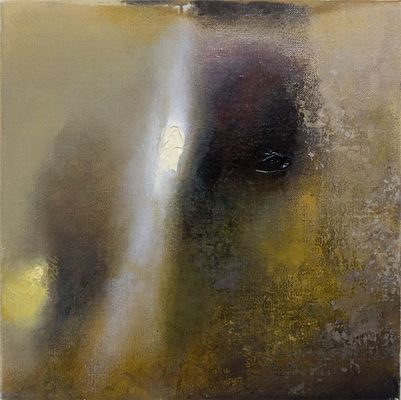
To return to Buckley’s fragment, the first two lines very much evoke how I paint nowadays. As you age, detail diminishes and patches of light become more luminous and float. I feel the most honest way of dealing with this is by smearing the oil paint on the canvas with the fingers and working close-up, blind. Only if the patches coalesce into an approaching image can the work gain a life.
-
Jonathan Walker was born in Melbourne, Australia and brought up on a dairy farm in Gippsland. In the 1970’s he studied painting at RMIT and won the Harold Wright Scholarship to the British Museum, London. During the 1980’s he exhibited at Pinacotheca Gallery, Richmond and had work shown at the NGV and Heidi City Art Gallery. Over the same period he designed the cover for the “Epigenesi” LP by Giancarlo Toniutti, Italy and conducted a mail exchange work with Achim Wollscheid, Germany. The work with artists through the post resulted in an article published in the bicentenary issue of Art and Australia 1988. He showed in artist run spaces such as WestSpace in the 90’s and 2000’s, and until 2012, taught painting at Victoria University, which is where we (Colleen Ahern and Lisa Radford) as organisers of the exhibition, among many others, had the privilege of being his student.
Walker’s knowledge was imparted to students through the careful selection of music, literature, and artists found in books that he himself had ordered for the library. Walker’s strategy was the generosity of sharing his vast knowledge with references specific to each student and their context.
Walker’s paintings share a similar focus and intimacy.
This exhibition presents a small selection of recent paintings alongside a publication that includes Walker’s writing. Observational and analytical, Walker’s work is a type of material notation — the time of day, colour and how it is blended, the both specific and fleeting location of a reflection on lino or the question of whether a chair leg should be included in a painting.
Please join us on Friday August 21 between 6-8pm to celebrate the opening of the exhibition.
Curated by Colleen Ahern and Lisa Radford.
B. Wurtz
Curated by Nic Tammens
March 26 - April 4, 2015
B.Wurtz works from a basement studio in his home on Manhattan’s Lower East Side.
This local fact is attested to by the plastic shopping bags and newsprint circulars that appear in his work. As formal objects, they don’t make loud claims about their origins but nonetheless transmit street addresses and places of business from the bottom of this long thin island. Like plenty of artists, Wurtz is affected by what is local and what is consumed. His work is underpinned by this ethic. It often speaks from a neighborhood or reads like the contents of a hamper:
“BLACK PLUMS $1.29 lb.”
“Food Bazaar”
“USDA Whole Pork Shoulder Picnic 99c lb.”
“RITE AID Pharmacy, with us it’s personal.”
“H. Brickman & Sons.”
“Sweet Yams 59c lb."
Most of the work in this exhibition was made while the artist was in residence at Dieu Donne, a workshop dedicated to paper craft in Midtown. Here Wurtz fabricated assemblages with paper and objects that are relatively lightweight, with the intention that they would be easily transportable to Australia. This consideration isn’t absolute in Wurtz’s work, but was prescriptive for making the current exhibition light and cheap. Packed in two boxes, these works were sent from a USPS post office on the Lower East Side and delivered to North Melbourne by Australia Post.
Wurtz appears courtesy of Metro Pictures, New York.
Thanks to Rob Halverson, Joshua Petherick, Sari de Mallory, Matt Hinkley, Helen Johnson, Fayen d'Evie, Ask Kilmartin, Lisa Radon, Ellena Savage, Yale Union, and "Elizabeth".
John Nixon
"Archive"
December 15 - January 20, 2014
The presentation of John Nixon's archive offered a rare showcase of this extensive collection of the artist's own publications, catalogues, posters, ephemera, editions and more, from the mid 1980s onwards, alongside a selection of his artworks.
Organized by John Nixon, Joshua Petherick and Matt Hinkley.
<a href=http://wfb.public-office.info/artist/john-nixon>All titles by John Nixon
"Habitat"
at Minerva, Sydney (organised by Joshua Petherick and Matt Hinkley)
November 15 - December 20, 2014
Lupo Borgonovo, Janet Burchill & Jennifer McCamley,
Lewis Fidock, HR Giger, Piero Gilardi, Veit Laurent Kurz,
Cinzia Ruggeri, Michael E. Smith, Lucie Stahl, Daniel Weil, Wols
Press Release:
“...It contained seven objects. The slender fluted bone, surely formed for flight, surely from the wing of some large bird. Three archaic circuitboards, faced with mazes of gold. A smooth white sphere of baked clay. An age-blackened fragment of lace. A fingerlength segment of what she assumed was bone from a human wrist, grayish white, inset smoothly with the silicon shaft of a small instrument that must once have ridden flush with the surface of the skin - but the thing’s face was seared and blackened.”
William Gibson, “Count Zero”, 1986
"Autumn Projects Archive"
Curated by Liza Vasiliou
March 6 - March 15, 2014
World Food Books, in conjunction with the Virgin Australia Melbourne Fashion Festival 2014, presented the Autumn Projects archive, consisting of a selection of early examples in Australian fashion with a particular interest in collecting designers and labels from the period beginning in the 1980’s, who significantly influenced the discourse of Australian Fashion.
Curated by Liza Vasiliou, the exhibition provided a unique opportunity to view pieces by designers Anthea Crawford, Barbara Vandenberg, Geoff Liddell and labels CR Australia, Covers, Jag along with early experimental collage pieces by Prue Acton and Sally Browne’s ‘Fragments’ collection, suspended throughout the functioning World Food Books shop in Melbourne.
H.B. Peace
presented by CENTRE FOR STYLE
November 14, 2013
"Hey Blinky, you say chic, I say same"
Anon 2013
H.B. Peace is a clothing collaboration between great friends Blake Barns and Hugh Egan Westland. Their pieces explore the divergences between 'character’ and ‘personality’ in garments....etc
Special Thanks to Joshua Petherick and Matt Hinkley of WFB and Gillian Mears
and a Very Special Thank you to Audrey Thomas Hayes for her shoe collaboration.
Janet Burchill & Jennifer McCamley
"Aesthetic Suicide"
May 10 - June 8, 2013
The first of our occasional exhibitions in the World Food Books office/shop space in Melbourne, "Aesthetic Suicide" presented a body of new and older works together by artists Janet Burchill & Jennifer McCamley, including videos, prints, a wall work, and publications.
During shop open hours videos played every hour, on the hour.
1987, English
Softcover, 414 pages, 22.6 x 14.8 cm
1st Edition, Out of print title / used / good
Published by
Columbia University Press / New York
$35.00 - Out of stock
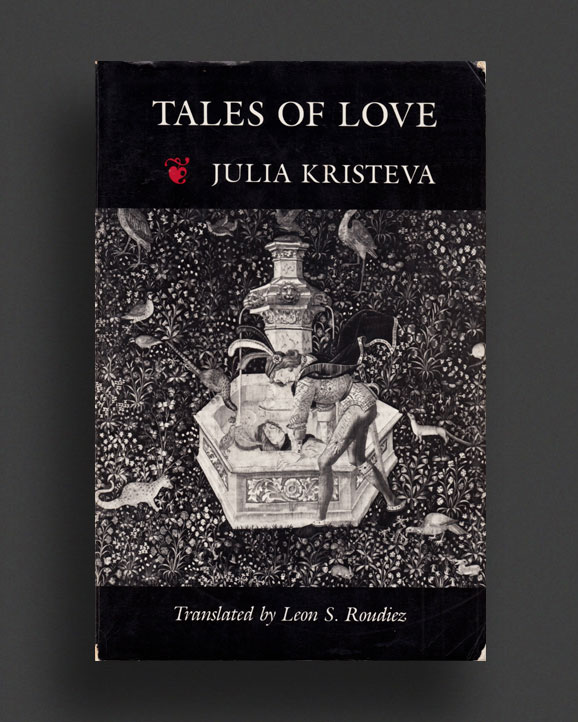
First edition from 1989 of Kristeva's Tales of Love, wherein her analysis deals with the role of narcissism and idealization in the formation of a love object. She accounts for the role of the death drive by coining the term "love/hate."
Assuming the voices of psychoanalyst, scholar, and postmodern polimicist, Kristeva discusses both the conflicts and commonalities among the Greek, Christian, Romantic and contemporary discourses on love, desire, and self... the analytical work is punctuated throughout by the personal, so that intelligently moving thoughts on motherhood aptly intervene. Kristeva makes a very strong case for the claim that the goal of analysis is not a truth in, but a dynamic rebirth of, the analysand via language.—Choice
From the Back Cover :
In 'Tales of Love' Julia Kristeva pursues her exploration of the basic emotions that affect the human psyche. The processes are similar to those followed in 'Powers of Horror'. She begins with a statement from personal experience and follows it with a critical examination of the psychoanalytic position with respect to the matter at hand.
Julia Kristeva (b. 1941) is a Bulgarian-French philosopher, literary critic, semiotician, psychoanalyst, feminist, and, most recently, novelist, who has lived in France since the mid-1960s. She has taught at Columbia University, and is now a professor emerita at Université Paris Cité.
Good copy, cover wear, marginalia in erasable light lead pencil.
Good copy, wear to cover edges, erasable light lead pencil marginalia.
1975, English
Hardcover (w. dust jacket), 168 pages, 24 x 25 cm
1st Edition, Out of print title / used / good
Published by
Overlook Press / New York
$180.00 - Out of stock
First edition of this rare and most comprehensive first English-language monograph on the work of Italian artist Domenico Gnoli, published by Overlook Press, New York, in 1975. Profusely illustrated throughout in colour and b/w with Gnoli's paintings, focusing on the period of his last and most mature work from 1954 to 1969. Luigi Carluccio's incisive text presents Gnoli's life and an evaluation of his work. Includes biography, exhibition history and catalogue of Gnoli's works.
Domenico Gnoli (1933–1970) is a unique and difficult figure to place. He died young, at 36, and lived fast, hanging with a glamorous crowd and marrying twice. He began as a stage designer in Rome, for which he was well received. He was also a successful illustrator, spending the better part of his life in New York City, illustrating for magazines such as Sports Illustrated, and Fortune, where he found favour with art director Leo Lionni in the 1960s. He was also a painter. His paintings exhibited internationally, characteristically zooming in on some crisp fragment of a domestic interior or sartorial flourish: a perfectly made bed, with a serenely patterned spread, or the top of a man’s head, hair meticulously parted. "Gnoli’s paintings are neither Pop nor Surrealist, though they have trace elements of both within them. Their realism is clear enough, and traditional, but the too-closeness of Gnoli’s gaze gives one the sense that abstraction is eating reality up from within."
Very Good copy with some light wear / ageing to plastic coating of dust jacket.
1972, Japanese
Softcover, 34 pages, 20 x 21.5 cm
1st Edition, Out of print title / used / very good
Published by
Hanashi-no-Tokushu / Tokyo
$140.00 - In stock -
First edition of Japanese photographer Yoshihiro Tachiki's photo book "Erotica Larotica", published in 1972. This book is one of the early masterpieces of Tatsuki — a unique collaboration between the Austrian painter Dina Larot (b. Maria Elisabeth Lebzelten in 1942), a student of Kokoschka best-known for her paintings and drawings of "women" in Austria, and photographer Yoshihiro Tatsuki, best known for his photography of "women" in Japan. It consists of playful portraits and nudes of Lalo herself and her friends lavishly dressed and undressed photographed by Tachiki in Vienna, paired with SM-lesbian erotic drawings and paintings by Larot throughout, plus a few photographs from a Crazy Horse show in Paris in the mix.
Tatsuki was born into a family that operated an photographic portrait studio. While at Tokyo junior College of Photography, he exhibited photographs of his family at the Fuji Photo Salon. After graduation, he began working as a photographer at Ad Center under the art direction of graphic designer Seiichi Horiuchi. Tatsuki’s name entered the limelight when he was just 26 years old with the publication of "A Fallen Angel", an astonishing 56 pages feature of his photographs shots for Camera Mainichi. Since starting as a freelance photographer in 1969, he has worked on the front lines of the advertising, magazine, publishing, and motion picture industries. He has published a number of celebrated photo books on female subjects and is best-known for works such as GIRL, EVES, Private (Mariko Kaga), Aoi Toki, My America, and Portrait of Family.
Very Good copy with publisher's obi-strip and dust-jacket. Light cover wear and pinch to spine, one page with crease to top corner.
1991, English
Softcover, 148 pages, 11.4 x 17.8 cm
Published by
Semiotext(e) / Los Angeles
The MIT Press / Massachusetts
$35.00 - Out of stock
You can say I write stories with sex and violence and therefore my writing isn't worth considering because it uses content much less lots of content. Well, I tell you this: 'Prickly race, who know nothing except how to eat out your hearts with envy, you don't eat cunt'...
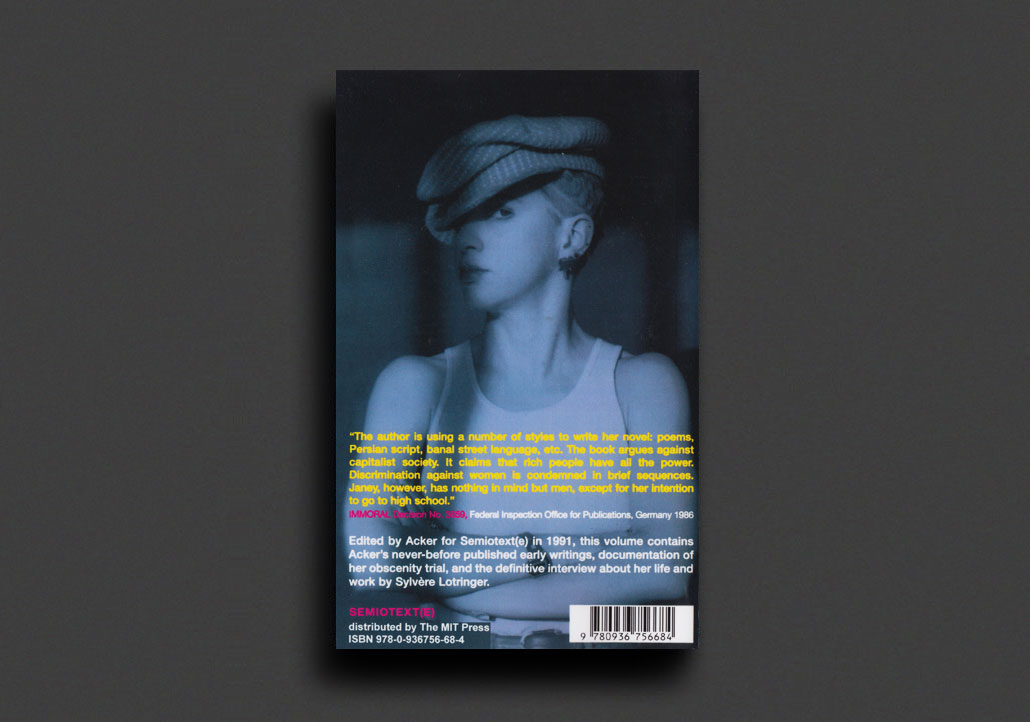
Edited by Sylvere Lotringer and published in 1991, this handy, pocket-sized collection of some early and not-so-early work by the mistress of gut-level fiction-making, Hannibal Lecter, My Father gathers together Acker's raw, brilliant, emotional and cerebral texts from 1970s, including the self-published 'zines written under the nom-de-plume, The Black Tarantula. This volume features, among others, the full text of Acker's opera, The Birth of the Poet, produced at Brooklyn Academy of Music in 1985, Algeria, 1979 and fragments of Politics, written at the age of 21. Also included is the longest and definitive interview Acker ever gave over two years: a chatty, intriguing and delightfully self-deprecating conversation with Semiotext(e) editor Sylvere Lotringer—which is trippy enough in itself as Lotringer, besides being a real person, has appeared as a character in Acker's fiction. And last, but not least, is the full transcript of the decision reached by West Germany's Federal Inspection Office for Publications Harmful to Minors in which Acker's work was judged to be "not only youth-threatening but also dangerous to adults," and subsequently banned.
Acker is the sort of the writer that should be read first at 16, so that you can spend the rest of your life trying to figure her out; she confuses, infuriates, perplexes and then all of a sudden the writing seems to be in your bloodstream, like some kind of benign virus. She's definitely not for the easily offended—but then, there are worse things in life than being offended. Such as the things that Acker writes about...
1992, Japanese
Hardcover (w. dust jacket), 226 pages, 19.5 x 13.5 cm
1st Edition, Out of print title / used / very good
Published by
Fusosha / Tokyo
$120.00 - Out of stock
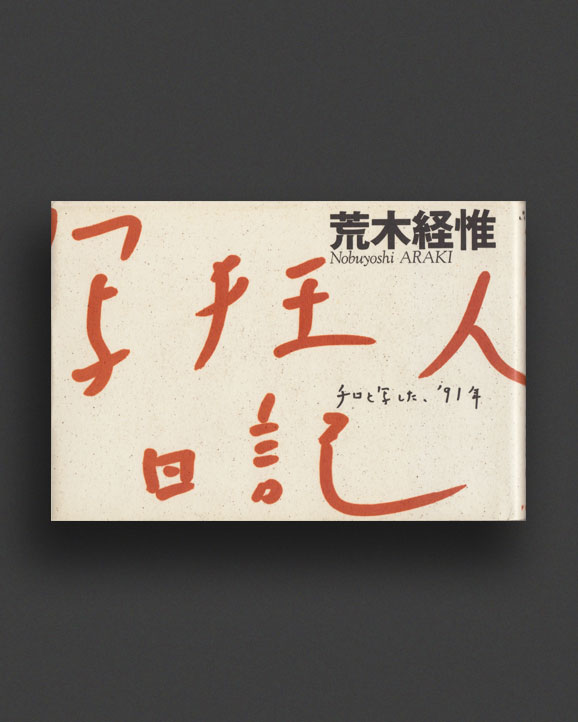
Scarce, first edition of this wonderful 1991 Araki hardcover photo album, published in 1992. From cover to cover this book is entirely comprised of Araki's photographs taken (mostly) in the year 1991, "From the days of monochrome to the days of color." Filled with an abundance of Araki's favourite subjects - his cat Chiro, flowers, women, girls, nudes, still-lifes, Japanese city details, and important for the inclusion of the "winter trip", taken in January 1990, the last story with his late wife Yoko Araki. A lovely collection in his "photo-maniac" period, where Araki used the art name Shakyojin (or photo-maniac) in imitation of Gakyojin (obsessive, or maniac, artist), used by the ukiyo-e artist Katsushika Hokusai. In April 1992, a photo exhibition of Araki's "Photo Maniac's Diary" saw 8 positive films seized by the Metropolitan Police Department and the Public Prosecutor's Office for showing genitals. Araki was fined for obscenity.
Very Good copy with Very Good dust jacket.
1984, French
Hardcover, 76 pages, 22.5 x 22.5 cm
1st Edition, Out of print title / used / very good
Published by
Christian Fayt Gallery / Belgium
$60.00 - In stock -
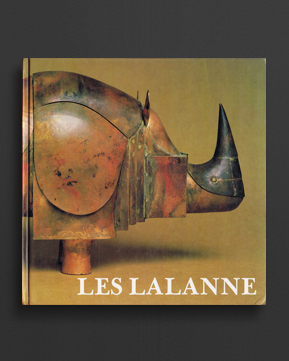
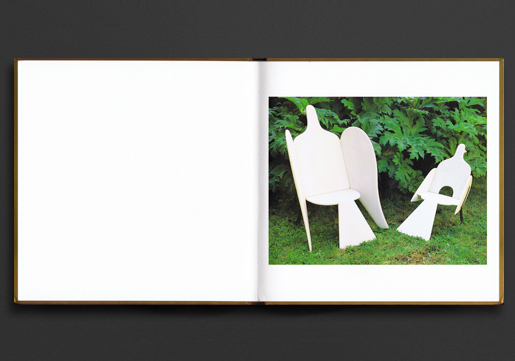
Hardcover monograph on the work of Les Lalanne (Claude Lalanne & Francois-Xavier Lalanne) on the occasion of a major exhibition of their work at Christian Fayt Gallery in Belgium 11.8-16.9, 1984.
Introduction by Daniel Abadie (in French) and reproductions in colour of many of their most notable, incredible sculptural objects.
Les Lalanne are a French artist duo comprising married couple François-Xavier Lalanne (1927–2008) and Claude Lalanne (born 1924).
Francois-Xavier Lalanne was born in Agen, France, and at age 18, he moved to Paris and studied sculpture, drawing and painting at Académie Julian. Francois-Xavier rented a studio in Montparnasse, next door to friend Constantin Brâncuși, who introduced Lalanne to artists such as Max Ernst, Man Ray, Marcel Duchamp, and Jean Tinguely. He met Claude Lalanne at his first gallery show in 1952. The show signified an end of painting for François-Xavier as he and Claude began their career sculpting together.
Claude Lalanne (b. 1924) was born in Paris and studied architecture at the École des Beaux-Arts and at the École des Arts Décoratifs. The couple began attracting public attention in Paris during the 1960s when Yves Saint Laurent and Pierre Bergé commissioned them - in particular, Francois-Xavier's realistic bronze cast sheep covered in skin alongside lily vanes cast by Claude were displayed in the library for their library. Francois-Xavier Lalanne became known to the larger public in France in 1976 when the singer Serge Gainsbourg selected a work by Lalanne, the man with the head of a cabbage, for the title and cover of an album in 1976. Together Les Lalanne were known to co-create on projects rather than collaborate. While Francois-Xavier favored sculpting animal themes, Claude preferred vegetation. The themes explored by the two collectively went against the current trend of Abstract art in the 1960s. The couple believed and Francois-Xavier claimed, "the supreme art is the art of living." Their first exhibition together included Francois-Xavier's famous rhinoceros desk, Rhinocrétaire, and Claude's cabbage with chicken legs sculpture. Similar themes by Les Lalanne have classified their works as an ode to Surrealism and Art Nouveau.
1991, English / German / French
Softcover, 160 pages, 23 x 30 cm
1st Edition, Out of print title / used / very good
Published by
Taschen / Cologne
$85.00 - Out of stock
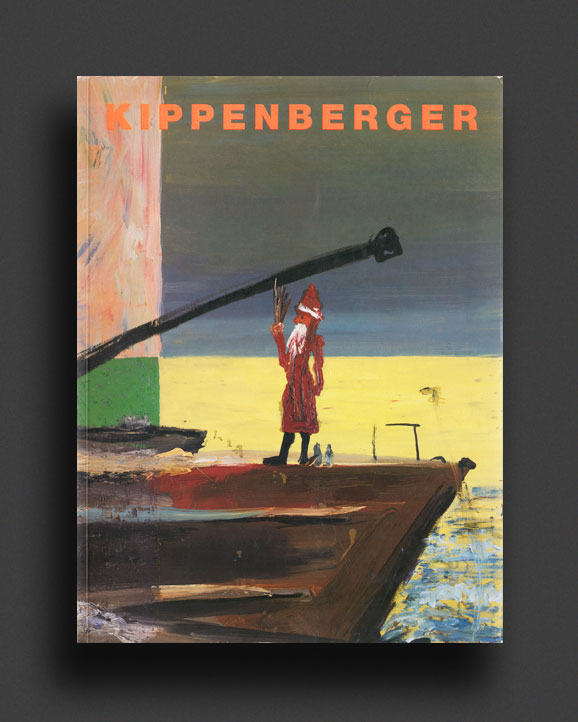
In 'Ten Years After' (1991) publishers Angelika Muthesius and Benedikt Taschen published the first major retrospective monographic study of the work of their friend, the artist Martin Kippenberger. Alongside the numerous texts (all in English, German and French), this book is profusely illustrated in colour throughout with Kippenberger's paintings, sculptures, drawings, editions, publications, posters, installations and public/social life. Includes an extensive biography, bibliography and list of exhibitions.
Long out of print.
Martin Kippenberger (25 February 1953 – 7 March 1997) was a German artist known for his extremely prolific output in a wide range of styles and media, superfiction as well as his provocative, jocular and hard-drinking public persona. Kippenberger was "widely regarded as one of the most talented German artists of his generation," according to Roberta Smith of the New York Times. He was at the center of a generation of German enfants terribles including Albert Oehlen, Markus Oehlen, Werner Büttner, Georg Herold, Dieter Göls, and Günther Förg.
Very Good copy.
1987 / 1993, English
Softcover, 518 + 507 pages, 22.4 x 15.3 cm
Out of print title / used / very good
Published by
University of Minnesota Press / Minnesota
$140.00 - Out of stock
Polity 1993 editions of Theweleit's classic two-volume Male Fantasies as complete set translated from the original German. Volume 1: Women, Floods, Bodies, History; Volume 2: Male Bodies: Psychoanalyzing the White Terror.
Klaus Theweleit's two-volume work Mannerphantasien, published in the late 1970s, has become a contemporary German classic. Male Fantasies dives into the sexual, psychological and sociopolitical foundation of National Socialism as it was manifested in the Weimar Republic, arguing that fascism is not a political or economic phenomenon, but a method to manufacture a specific reality. Unlike any study before it, Male Fantasies centers upon the fantasies that preoccupied a group of men who played a crucial role in the rise of Nazism — The German Freikorps, the precursors of the SA and SS. Theweleit draws upon the novels, letters, and autobiographies of these proto-fascists and their contemporaries. There he discovered how the repudiation of one's own body—and of femininity—became a psychic compulsion associating masculinity with hardness, self-denial, and destruction.
The first volume of Male Fantasies deals primarily with the image of women in the collective unconscious of the fascist warrior—visions reflecting hatred and fear, culminating in a series of liquid metaphors—red tide, lava, mud—that threaten to engulf the male ego. In Volume 2, Theweleit shifts his attention to the male self-image. We are shown how the body becomes a mechanism for eluding the dreaded liquid and the "feminine" emotions associated with it. Armored, organized by mental and physical procedures like the military drill, the male body is transformed into "a man of steel'.' As Theweleit shows, only in war does this body find redemption from constraint.
Theweleit writes in a non orthodox, highly personal and associative style, heavily illustrating his works with incredible cartoons, advertisements, engravings, and posters of the era.
"Theweleit's book asks some key questions for those of us interested in Men's Studies. [It] takes us inside the psyches of men who, in Theweleit's analysis, are not destroying and murdering out of sublimation, but because they want to." — Men's Studies Review
"Klaus Theweleit's book, like the first volume of his massive study, usefully employs psychoanalytic insights in conjunction with the social-historical analyses of Elias, Mary Douglas, Foucault, and others to investigate the formation and nature of the fascist psyche in 1920s Germany, exploring here the male self-image, envisaged as armored against the threat and intrusion of the feminine." — Contemporary Sociology
Klaus Theweleit (b. 1942) is a German sociologist and writer. In 1977–78 he published the two volumes of Male Fantasies, now recognized as a pre-eminent work on the body, war and fascism. In 1990 he published Orpheus (und) Eurydike, the first volume of The Book of Kings, an examination of Western art through male artists’ relationship with women.
Very Good copies both.
1985, English / French
Softcover, 152 pages, 23.4 x 15.6 cm
Out of print title / used / very good
Published by
University of Minnesota Press / Minnesota
$30.00 - In stock -
First 1984 edition, 1995 printing of Mikhail Bakhtin : The Dialogical Principle by Tzvetan Todorov Mikhail Bakhtin : The Dialogical Principle.
"The writings of Mikhail Bakhtin (1895-1975) comprise an intricate and sophisticated set of statements about culture, texts, and meaning. Scholars and students of literature, philosophy, and culture will welcome Tzvetan Todorov's systematic account of the life and work of this major Russian thinker. Bakhtin's remarks on culture reflect his own political experience (including time spent in internal exile) as well as his belief in the interdependence of history, text, and meaning. The implication for poetics of this plurality is what Bakhtin has called "the dialogical principle." Texts (or more accurately, utterances) are inherently poly-phonous: they simultaneously express, reflect, and determine history and meaning. Bakhtin's thinking and writing developed in anything but a systematic way. His works were often published under others' names, and many of them were not published in the order in which they were written, or appeared posthumously. Todorov, while retaining in his text the plurality that characterizes Bakh-tin's own method, presents us with an authoritative biographical essay, a straightforward analysis of and commentary upon the writings themselves, and a complete bibliography of the works of Bakhtin and his circle. Todorov's first chapter clears up many of the elusive details of Bakhtin's life. The remaining chapters analyze some of his themes, including epistemology, linguistics, history of literature, and philosophical anthropology.
"[This study] has all the qualities one has come to expect from Todorov's work over the years: scholarly precision, conceptual elegance, and unusual clarity of exposition."—Michael Holquist, Indiana University.
Tzvetan Todorov (Bulgaria 1939—Paris 2017) was a Bulgarian-French historian, philosopher, structuralist literary critic, sociologist and essayist. He was the author of many books and essays, which have had a significant influence in anthropology, sociology, semiotics, literary theory, intellectual history and culture theory. Among his most influential works is his theory on the fantastic, the uncanny and marvellous.
Very Good copy.
1995, English
Softcover, 256 pages, 23 x 14.9 cm
Published by
University of Minnesota Press / Minnesota
$45.00 - Out of stock
The celebrated scholar Tzvetan Todorov offers a study examining the complex relationship between "ethics" and "history". Exploring such questions as "How does one measure and experience freedom in the depths of society?" and "How does one practise and measure equality among different societies?", Todorov confronts topics ranging from the conquest of America and 19th-century colonialism, to democracy and conflicts of the "self" versus the "other". As he probes the effects of intercultural relationships and the difficulties inherent to the representation of the other, Todorov describes his own experience as a Bulgarian living in France. He also studies a variety of travel narratives from those of Columbus to Amerigo Vespucci to Lamartine, and he analyzes with great clarity the writings of the "ideologues" of both colonialism and anticolonialism. Offering an urgent call to contemporary intellectuals to re-examine their role in society and to integrate values into their work, "The Morals of History" explores the relationship between facts and values, truth and fiction, interpretation and articulation.
Addressed to a broad audience, it should intrigue readers interested in contemporary discussions regarding the outcome of democracy and the future of late capitalism, the persistence of a logic of conquest and ethnocentrism, and the signs which point to emerging fascisms.
Very Good copy.
2001, English
Softcover, 496 pages, 15.6 x 23.5 cm
Out of print title / used / very good
$40.00 - Out of stock
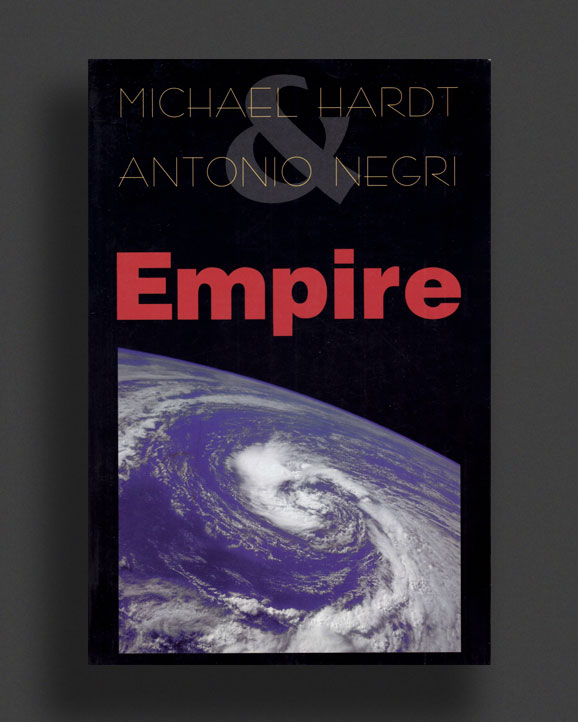
Empire is a book by post-Marxist philosophers Michael Hardt and Antonio Negri. Written in the mid-1990s, it was published in 2000 and quickly sold beyond its expectations as an academic work.
Imperialism as we knew it may be no more, but Empire is alive and well. It is, as Michael Hardt and Antonio Negri demonstrate in this bold work, the new political order of globalization. It is easy to recognize the contemporary economic, cultural, and legal transformations taking place across the globe but difficult to understand them. Hardt and Negri contend that they should be seen in line with our historical understanding of Empire as a universal order that accepts no boundaries or limits. Their book shows how this emerging Empire is fundamentally different from the imperialism of European dominance and capitalist expansion in previous eras. Rather, today’s Empire draws on elements of U.S. constitutionalism, with its tradition of hybrid identities and expanding frontiers.
Empire identifies a radical shift in concepts that form the philosophical basis of modern politics, concepts such as sovereignty, nation, and people. Hardt and Negri link this philosophical transformation to cultural and economic changes in postmodern society—to new forms of racism, new conceptions of identity and difference, new networks of communication and control, and new paths of migration. They also show how the power of transnational corporations and the increasing predominance of postindustrial forms of labor and production help to define the new imperial global order.
More than analysis, Empire is also an unabashedly utopian work of political philosophy, a new Communist Manifesto. Looking beyond the regimes of exploitation and control that characterize today’s world order, it seeks an alternative political paradigm—the basis for a truly democratic global society.
Very Good copy.
1997, English
Softcover, 224 pages, 15.6 x 23.4 cm
Out of print title / used / very good
Published by
Routledge / London
$35.00 - Out of stock
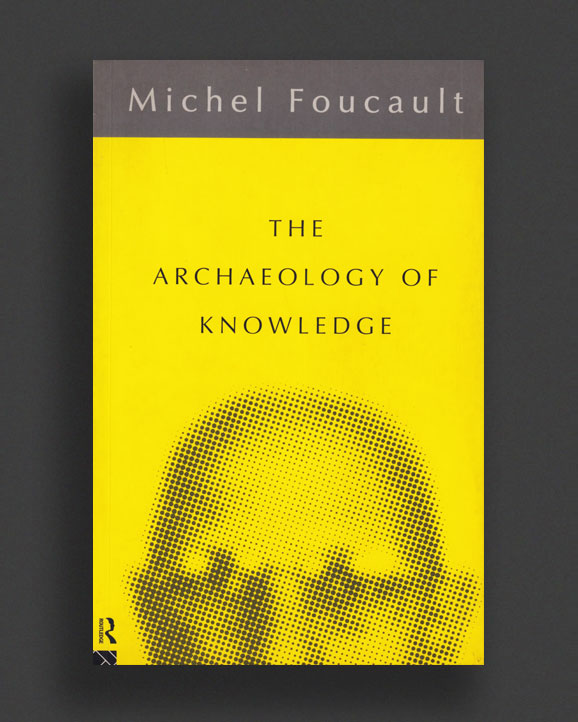
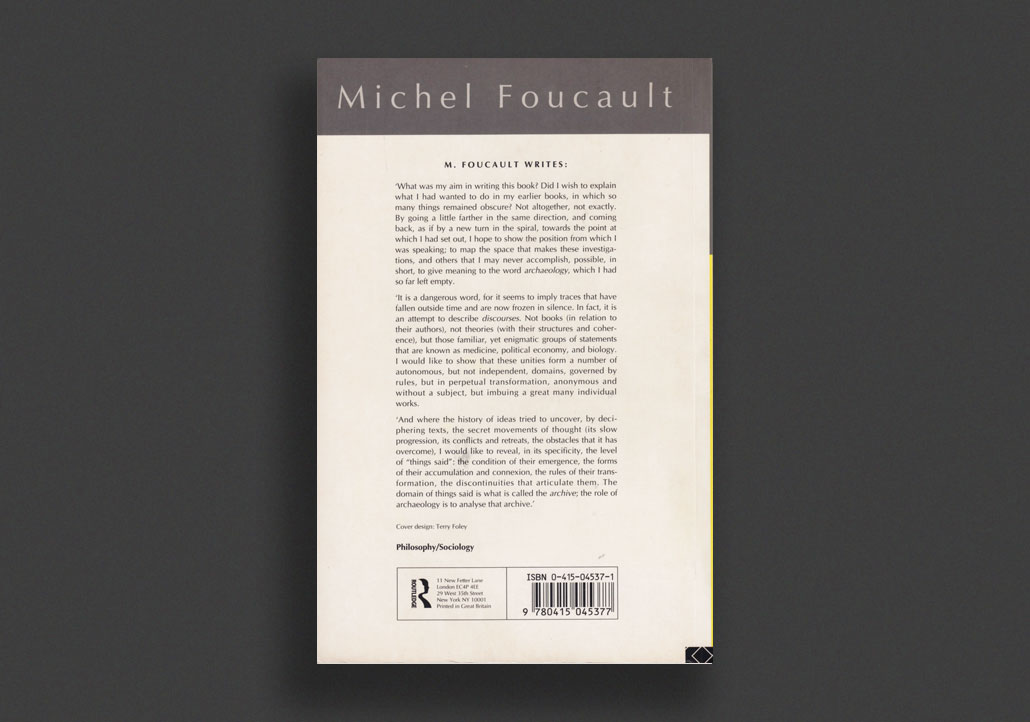
Out of print Routledge 1989 edition, 1997 printing of Foucault's Archaeology of Knowledge.
"In France, a country that awards its intellectuals the status other countries give their rock stars, Michel Foucault was part of a glittering generation of thinkers, one which also included Sartre, de Beauvoir and Deleuze. One of the great intellectual heroes of the twentieth century, Foucault was a man whose passion and reason were at the service of nearly every progressive cause of his time. From law and order, to mental health, to power and knowledge, he spearheaded public awareness of the dynamics that hold us all in thrall to a few powerful ideologies and interests. Arguably his finest work, Archaeology of Knowledge is a challenging but fantastically rewarding introduction to his ideas."
Very Good copy.
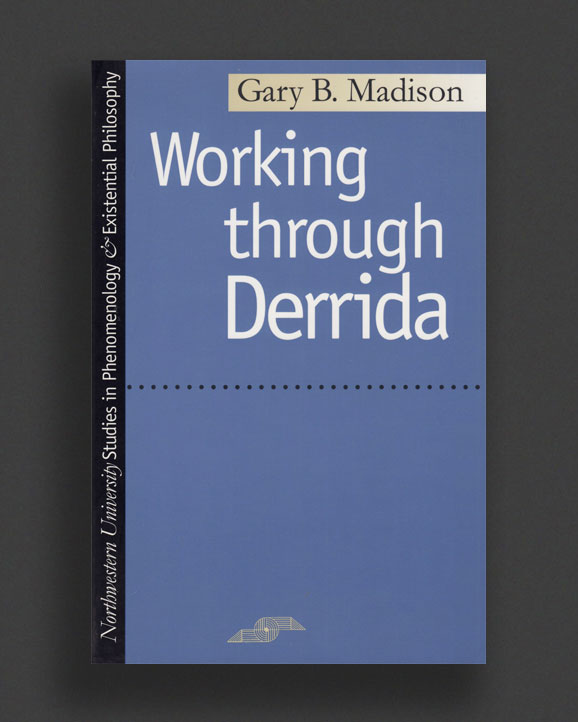
1993, English
Softcover, 284 pages, 15.2 x 22.9 cm
1st Edition, Out of print title / used / very good
Published by
Northwestern University Press / Evanston
$20.00 - In stock -
First 1993 Edition.
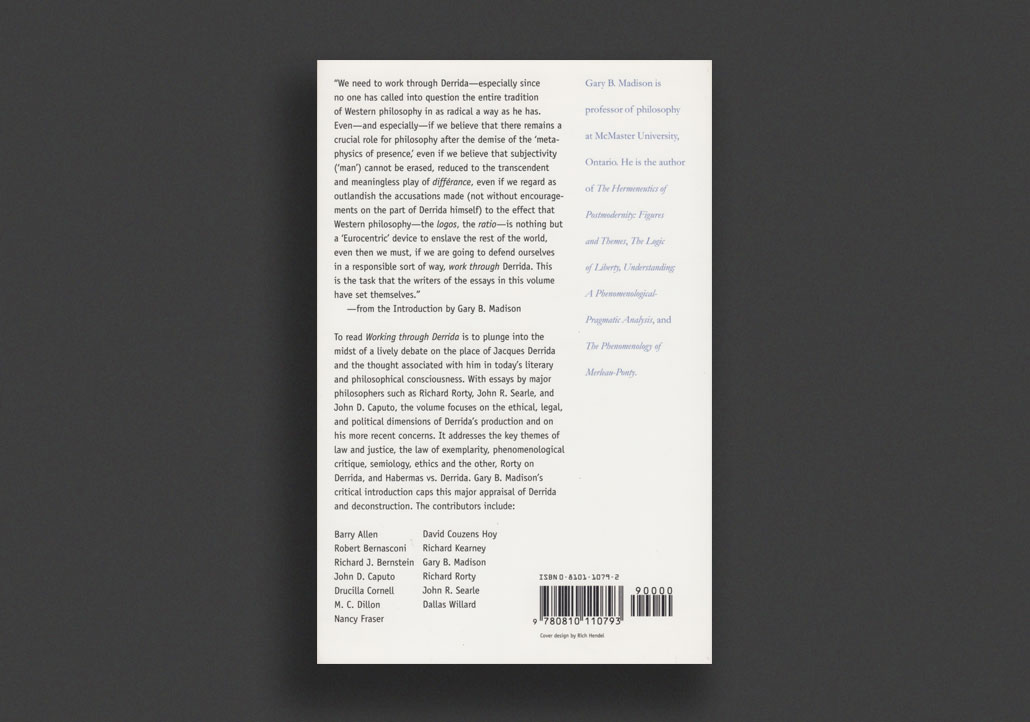
To read Working through Derrida is to plunge into the midst of a lively debate on the place of Jacques Derrida and the thought associated with him in today's literary and philosophical consciousness. With essays by major philosophers such as Richard Rorty, John R. Searle, and John D. Caputo, the volume focuses on the ethical, legal, and political dimensions of Derrida's production and on his more recent concerns. It addresses the key themes of law and justice, the law of exemplarity, phenomenological critique, semiology, ethics and the other, Rorty on Derrida, and Habermas vs. Derrida. Gary B. Madison's critical introduction caps this major appraisal of Derrida and deconstruction.
Very good copy.
1998, English
Softcover, 304 pages, 15.6 x 23.4 cm
1st Edition, Out of print title / used / very good
Published by
Routledge / London
$40.00 - In stock -
First 1998 edition of Jacques Derrida: Opening Lines by Marian Hobson, published by Routledge.
In Jacques Derrida : Opening Lines Marian Hobson gives us a thorough and elegant analysis of this controversial and seminal contemporary thinker. Looking closely at the language and the construction of some of Derrida's philosophy, Hobson suggests the way he writes, indeed the fact he writes in another language, affects how he can be understood by English speakers.
This superb study on the question of language will make illuminating reading for anyone studying or engaged with Derrida's philosophy.
Marian Elizabeth Hobson Jeanneret, CBE, FBA (b. 1941) is a British scholar of French philosophy, and culture. From 1992 to 2005, she was Professor of French at Queen Mary, University of London. She had previously taught at the University of Warwick, the University of Geneva, and the University of Cambridge.
Very Good copy.
1975 / 1997, English
Softcover, 443 pages, 15.4 x 23 cm
1st Edition, Out of print title / used / very good
Published by
Northwestern University Press / Evanston
$50.00 - Out of stock
In Experience and Judgment, Husserl explores the problems of contemporary philosophy of language and the constitution of logical forms. He argues that, even at its most abstract, logic demands an underlying theory of experience. Husserl sketches out a genealogy of logic in three parts: Part I examines prepredicative experience, Part II the structure of predicative thought as such, and Part III the origin of general conceptual thought. This volume provides an articulate restatement of many of the themes of Husserlian phenomenology.
Edmund Gustav Albrecht Husserl was a Jewish German Atheist philosopher and mathematician who established the school of phenomenology.
Very Good copy.
1988, English
Hardcover, 430 pages, 23 x 15.5 cm
1st Edition, Out of print title / used / very good
Published by
State University of New York Press / New York
$35.00 - Out of stock
First 1988 out of print hardcover edition.
The threat of solipcism nagged Husserl. The question of the status of others occupied him during the last years of his life and remained a question that seemed to challenge the foundation of his life's work. This book offers new answers to this persistent philosophical question by defining the question in specifically Husserlian terms and by means of a careful examination of Husserl's later texts, including the unpublished Nachlass.
James Richard Mensch holds a Licentiate from the Pontifical Institute of Mediaeval Studies and a Doctorate from the University of Toronto. Aside from working as a translator for the Dachau Concentration Camp Museum, he has taught at a number of universities, including Toronto, Dallas, and the University of Washington. He is the author of The Question of Being in Husserl's Logical Investigations.
Reviews
"The author has availed himself of hitherto unpublished manuscripts at the Husserl archives in Belgium, and has used those texts in an effort to finish Husserl's own case that phenomenology can meaningfully contribute to the discussion of others, of freedom, and of our fellowship. The resulting treatment of the problem of intersubjectivity is remarkably sympathetic to Husserlian thought and intelligently made. " — Dennis J. Schmidt, State University of New York at Binghamton
VG copy.
1987, English
Softcover, 300 pages, 23 x 15.5 cm
1st Edition, Out of print title / used / very good
Published by
State University of New York Press / New York
$35.00 - In stock -
First out-of-print edition from 1987. This book draws together some of the most important recent work in the areas of semiotics, critical theory, epistemology, and psychology. It contains a new essay by Karl-Otto Apel on the possibility of transcendental semiotics, as well as essays on the relationship between hermeneutics and critical theory, the nature of dialectical phenomenology, analyses of epistemic foundations, the hermeneutics of people and places, and there is a critique of contemporary cognitive psychology.
Donn Welton is with the Department of Philosophy at the State University of New York at Stony Brook. Hugh J. Silverman is with the Department of Philosophy at the State University of New York at Stony Brook.
VG copy.
1998, English
Softcover, 296 pages, 23.5 x 15.6 cm
1st Edition, Out of print title / used / very good
Published by
Harvard University Press / Cambridge
$30.00 - In stock -
Rodolphe Gasche, one of the world's foremost-and most provocative-authorities on Jacques Derrida, has news for deconstruction's devotees, whose traffic in the terms of "difference" signals privileged access to the most radically chic of intellectual circles: they do not know their Derrida. A deconstruction of the criticism that goes by deconstruction's name, this book reveals the true philosophical nature of Derrida's thought, its debt to the tradition it engages, and its misuse by some of its most fervent admirers.
Gasche's Inventions of Difference explodes the current myth of Derrida's singularity and sets in its place a finely informed sense of the philosopher's genuine accomplishment. Derrida's recent turn from philosophical concerns to matters literary, historical, and political has misled many of his self-styled followers, Gasche contends. Though less overtly philosophical, Derrida's later writings can be properly understood only in relation to a certain philosophical tradition, which Inventions of Difference cogently traces.
Gasche shows that terms like "difference" and "other" are devoid of meaning outside the context of identity, a context that draws not only on Husserl's phenomenology and Heidegger's writings but also on the work of Hegel. By setting forth this affinity with Hegel, Gasche clarifies the philosophical weight and direction of Derrida's recent work and the philosophical engagement of his larger project. His book puts a stop to the loose talk of deconstruction and points to the real rigors and pleasures of knowing Derrida.
First edition. VG copy.
1996, English
Softcover, 122 pages, 21.5 x 14 cm
Out of print title / used / very good
Published by
University of Chicago Press / Chicago
$35.00 - Out of stock
Translated by Eric Prenowitz
In this work, Jacques Derrida guides the reader through an extended meditation on remembrance, religion, time, and technology - all occasioned by a deconstructive analysis of the notion of archiving. The archival concept has played a pivotal role in numerous critical debates - a place of origin, yet of perpetuity, a place of stasis and order, yet of discovery, the notion of archive houses a complex of diverse, and often disparate, meanings. As a depository of civic record and social history whose very name derives from the Greek word for town hall, the archive would seem to be a public entity, yet it is stocked with the personal, even intimate, artifacts of private lives. This inherent tension between public and private inaugurates, argues Derrida, an inquiry into the human impulse to preserve, through technology as well as tradition, both a historical and a psychic past.
VG copy. Out of print.
1993, English
Softcover, 400 pages, 23 x 15 cm
Out of print title / used / very good
Published by
The Atlone Press / London
$45.00 - Out of stock
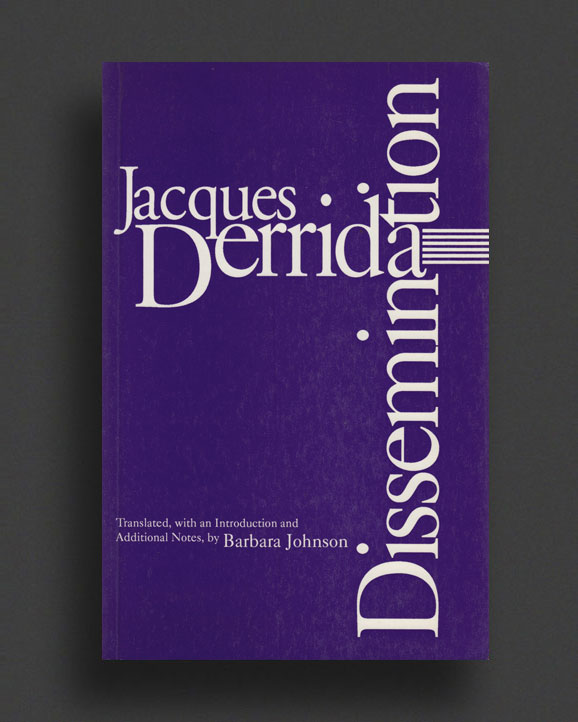
“The English version of Dissemination [is] an able translation by Barbara Johnson . . . . Derrida’s central contention is that language is haunted by dispersal, absence, loss, the risk of unmeaning, a risk which is starkly embodied in all writing. The distinction between philosophy and literature therefore becomes of secondary importance. Philosophy vainly attempts to control the irrecoverable dissemination of its own meaning, it strives—against the grain of language—to offer a sober revelation of truth. Literature—on the other hand—flaunts its own meretriciousness, abandons itself to the Dionysiac play of language. In Dissemination—more than any previous work—Derrida joins in the revelry, weaving a complex pattern of puns, verbal echoes and allusions, intended to ’deconstruct’ both the pretension of criticism to tell the truth about literature, and the pretension of philosophy to the literature of truth.”—Peter Dews, New Statesman
First published in 1972, Dissemination contains three of Derrida's most central and seminal works: 'Plato's Pharmacy', 'The Double Session' and 'Dissemination'.
1993 paperback edition. VG copy, light cover wear.
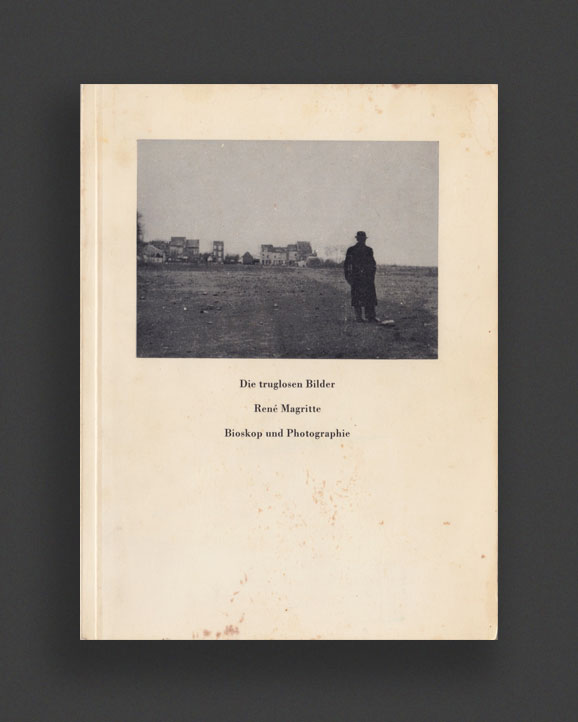
1976, German
Softcover, 96 pages, 19 x14 cm
1st Edition, Out of print title / used / good
Published by
Walther König / Köln
Edition Lebeer Hossmann / Brüssels
$40.00 - Out of stock
First edition of this rare collection of the photographs of Belgian surrealist artist René Magritte (1898—1967). German language edition issued by Walther Koenig in Cologne and Edition Lebeer Hossmann in Brüssels, on the occasion of the traveling exhibition La fidélité des images — René Magritte: Cinématograph et photographie. With 111 photos and film images by Rene Magritte.
René François Ghislain Magritte (1898—1967) was a Belgian surrealist artist known for his depictions of familiar objects in unfamiliar, unexpected contexts, which often provoked questions about the nature and boundaries of reality and representation. His imagery has influenced pop art, minimalist art, and conceptual art.
Good copy with some marking and tanning to covers.
1988, English / Japanese
Hardcover (w. dust jacket), 341 pages, 24 x 31 cm
1st Edition, Out of print title / used / very good
Published by
Books Nippan / Tokyo
$100.00 - Out of stock
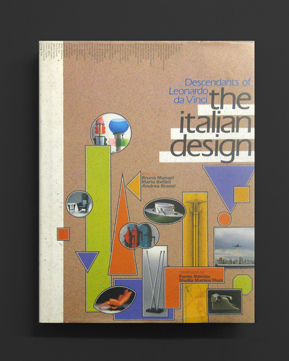
One of the most incredible books on Italian design of the last century, this epic, long-out-of-print volume, published in Japan in 1988, is as visually encompassing in it's design and visual content as it is invaluable as a resource of essays and profiles on the many artists and designers working in Italy from (roughly) the 1930's to the late 1980's.
With texts by none other than Mario Bellini, Andrea Branzi, and Bruno Munari, this heavy volume, co-ordinated by Fumio Shimizu and Studio Matteo Thun, is broken into "The First Generation" (Carlo Alessi, Bruno Munari, Gio Ponti, Carlo Scarpa, and many others); "The Second Generation" (Mario Bellini, Aldo Rossi, Alessandro Mendini, Enzo Mari, Ettore Sottsass, and many others); "The Third Generation" (Andrea Branzi, George J. Sowden, Ugo La Pietra, Paolo Deganello, and many others); "The Fourth Generation" (Alchimia, Aldo Cibic, Michele De Lucchi, Nathalie Du Pasquier, Matteo Thun, Alessio Sarri, and many others) - all with illustrated examples of their furniture, architecture, fashion, product design, interiors, etc. and profiles on each and every featured artist and designer. The names above are only the tip of the iceberg of the many amazing practices highlighted in this book, many of which are not easily found in any other publications on the subject.
Highly recommended.
All texts are in both English and Japanese.
"Engaging Italian industry and culture in a single-minded and spontaneous project of national image building, Italy's designers have produced a complete variety of forms--fashion, graphic arts and product and set design--with a unique international resonance. This volume explores Italian design of the last half-century, featuring the classic lines of the Vespa, Bruno Munari's deconstruction of the common fork, the nostalgic appeal of Italo Marchioni's ice cream cone and the sleek Minimalism of Alberto Meda's 1987 "Light Light Chair," among many other masterpieces. Paola Antonelli's lively introduction provides an overview of Italy's design culture; an essay by Giampiero Bosoni illuminates the design objects that are superbly reproduced in the volume's plate section."
2002, English
Softcover, 350 pages, 21.5 x 14 cm
1st Edition, Out of print title / used / very good
$30.00 - Out of stock
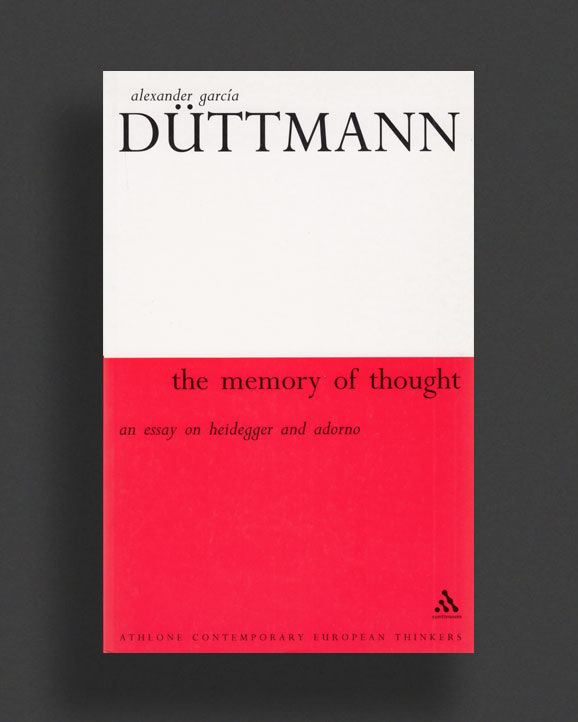
A reconstruction of aspects of the philosophy of Adorno and Heidegger. This title reconstructs the philosophy of Adorno and Heidegger in the light of the importance that these thinkers attach to two proper names: Auschwitz and Germanien. In Adorno's dialectical thinking, Auschwitz is the name of an incommensurable historical event that seems to put a provisional end to history as a negative totality. In Heidegger's thinking of Being, Germanien is a name inscribed in an historical mission on which the fate of Western civilization seems to depend: it thus becomes the name of a positive totality of history.
Alexander García Düttmann (b. 1961) studied Philosophy in Frankfurt as a student of Alfred Schmidt and in Paris as a student of Jacques Derrida.
Very Good copy, first edition.
1995, English
Softcover, 414 pages, 23 x 15.5 cm
1st Edition, Out of print title / used / very good
Published by
Verso / London
$40.00 - Out of stock
Appearing for the first time in an English translation, Introduction to Modernity is one of Henri Lefebvre's greatest works. Published in 1962, when Lefebvre was beginning his career as a lecturer in sociology at the University of Strasbourg, it established his position in the vanguard of a movement which was to culminate in the events of May 1968. It is a book which supersedes the conventional divisions between academic disciplines. With dazzling skill, Lefebvre moves from philosophy to sociology, from literature to history, to present a profound analysis of the social, political and cultural forces at work in France and the world in the aftermath of Stalin's death-an analysis in which the contours of our own "postmodernity" appear with startling clarity.
Lefebvre's lectures have become legendary, and something of his charismatic presence and delivery is captured in this book, which he intended "to be understood in the mind's ear ... and not simply to be read." With its mercurial shifts of tone, now intensely poetic, now conversational, it not only explores modernity, it exemplifies it. Equally experimental in conception is the book's remarkable structure, twelve "preludes" through which a range of recurrent themes are interwoven in free-form counterpoint: irony as a critical tool, utopianism, nature and culture, the Stalinization of Marxism, the alienation of everyday life, the cybernetic society ... What gradually emerges is not only a series of original concepts about humanity and culture, but an extraordinary invocation of the complexity of social contradictions.
Yet the fragmented structure of the book is not left to float free. Its shifting and eclectic melodies and leitmotifs have a solid ground basis: the wish to rehabilitate the Marxist dialectic as a method for understanding and transforming the modern world. This program is at the heart of the book, and gives it its underlying coherence, making Introduction to Modernity not only essential reading for all students of European cultural history, but also a key text for Marxism in the post-communist world of the late twentieth century.
Very Good copy, general light wear.