World Food Books' programme is largely produced on Kulin Nation land. We acknowledge the Wurundjeri people of the Kulin Nation as the first and continuing custodians of this land, and pay respect to their Elders past, present, and emerging.
World Food Books is an arts and special interests bookshop in Naarm / Melbourne. Founded in 2010, World Food Books is devoted to the presentation of a rotating, hand-selection of international art, design, literary and counterculture publications with an emphasis on the anti-traditional, the experimental, the avant-garde, the heretic, the marginal.
Presenting new titles alongside rare and out-of-print books, catalogues and journals spanning the fields of modern and contemporary art, design, photography, illustration, film, literature, poetry, cultural theory, philosophy, sexuality, popular and underground culture in its many radical forms, World Food Books wishes to encourage adventurous, thoughtful and open-minded reading, looking, writing, and exchange of publishing and ideas, both current and historical.
As well as our bookshop, located in Melbourne's historical Nicholas Building, all of our inventory is available internationally via our online mail-order service.
World Food Books semi-regularly co-ordinates "Occasions", a programme of exhibits and events at the bookshop and in partnership with other hosts (such as museums and art galleries) that develop out of the activities, relationships and content of the bookshop itself.
World Food Books
The Nicholas Building
37 Swanston Street
Room 5, Level 6
Melbourne 3000
Australia
SHOP HOURS:
Thu–Fri 12–6, Sat 12–5
WEB-SHOP OPEN 24/7
World Food Books
Postal Address:
PO Box 435
Flinders Lane
Victoria 8009
Australia
Art
Theory / Essay
Architecture / Interior
Graphic Design / Typography
Photography
Fashion
Eros
LGBTQ+
Fiction / Poetry
Weird / Speculative / Science Fiction / Horror
Transgressive / Visceral / Abject
Symbolism / Decadence / Fin de siècle
Film / Video
Painting
Sculpture / Installation
Performance / Dance / Theater
Drawing
Sound / Music
Curatorial
Group Shows / Collections
Periodicals
Out-of-print / Rare
Posters / Ephemera / Discs
Signed Books
World Food Books Gift Voucher
World Food Book Bag
Australian Art
Australian Fiction
Australian Science Fiction / Speculative Fiction
Australian Poetry
Australian Photography
Japanese Photography
Conceptual Art
Minimal Art
Dada
'Pataphysics / Oulipo
Fluxus
Concrete Poetry
Pop Art
Surrealism
Arte Povera
Arte Informale / Haute Pâte / Tachism
Nouveau Réalisme / Zero / Kinetic
Situationism / Lettrism
Collage / Mail Art / Xerox Art
Art Brut / Folk / Visionary / Fantastic
Illustration / Graphic Art / Bandes Dessinées
Furniture
Italian Radical Design / Postmodernism
Textiles
Ceramics / Glass
Counterculture
Protest / Revolt
Philosophy
Psychoanalysis
Anthropology
Anarchism
Socialism / Anarchism / Communism / Capitalism
Literary Theory / Semiotics / Language
Feminism / Women's Studies
Gender Studies / Sexuality
Anthropology
Fetishism / BDSM
Drugs / Psychedelia
Crime / Violence
Animal Rights / Veganism
Occult / Esoterica
Ecology / Earth / Alternative Living
Whole Earth / Crafts
All prices in AUD (Australian dollars)
Pick-Ups
Pick-up orders can be collected in our bookshop during opening hours after order date. Please collect any Pick-up orders within 2 weeks of ordering as we have limited storage space. Orders will be released back into stock if not collected within this time. No refunds can be made for pick-ups left un-collected. If you cannot make it in to the bookshop in this time-frame, please choose postage option.
Return Policy
All sales are final. We do accept returns (for refund or exchange) for items received in error. All our orders are packed with special care using heavy-duty padding and cardboard book-mailers or bubble mailers (for smaller books), using reinforcement where required. We cannot take responsibility for any lost, stolen or damaged parcels.
Insurance
Should you wish to insure your package, please email us directly after placing your order and we can organise this at a small extra expense. Although all standard/express tracked packages are very safe and dependable, we cannot take responsibility for any lost, stolen or damaged parcels. We recommend insurance on valuable orders.
Interested in selling your old books, catalogues, journals, magazines, comics, fanzines, ephemera? We are always looking for interesting, unusual and out-of-print books to buy. We only buy books in our fields of interest and specialty, and that we feel we can resell.
We base these prices on desirability, market value, in-print prices, condition and our current stock levels. We offer cash, store credit, and can take stock on consignment. All
about 25% of the price we expect to get when we sell them, or 30% in store credit. We base these prices on desirability, market value, in-print prices, condition and our current stock levels.
Sell your books any day of the week. You can drop them off and return later. If you have a lot of books, we can visit your Sydney home.
We buy books that we feel we can resell. We offer about 25 % of the price we expect to get when we sell them, or 30% in store credit. We base these prices on desirability, market value, in-print prices, condition and our current stock levels.
Philadelphia Wireman
03 August - 01 September, 2018
World Food Books is proud to announce our next Occasion, the first presentation of sculptures by Philadelphia Wireman in Australia.
The Philadelphia Wireman sculptures were found abandoned in an alley off Philadelphia’s South Street on trash night in 1982. Their discovery in a rapidly-changing neighbourhood undergoing extensive renovation, compounded with the failure of all attempts to locate the artist, suggests that the works may have been discarded after the maker’s death. Dubbed the "Philadelphia Wireman" during the first exhibition of this work, in 1985, the maker’s name, age, ethnicity, and even gender remain uncertain. The entire collection totals approximately 1200 pieces, all intricately bound together with tightly-wound heavy-gauge wire (along with a few small, abstract marker drawings, reminiscent both of Mark Tobey and J.B. Murry). The dense construction of the work, despite a modest range of scale and materials, is singularly obsessive and disciplined in design: a wire armature or exoskeleton firmly binds a bricolage of found objects including plastic, glass, food packaging, umbrella parts, tape, rubber, batteries, pens, leather, reflectors, nuts and bolts, nails, foil, coins, toys, watches, eyeglasses, tools, and jewellery.
Heavy with associations—anthropomorphic, zoomorphic, and socio-cultural responses to wrapped detritus—the totemic sculptures by Philadelphia Wireman have been discussed in the context of work created to fulfil the shamanistic needs of alternative religions in American culture. Curators, collectors, and critics have variously compared certain pieces to sculpture from Classical antiquity, Native American medicine bundles, African-American memory jugs, and African fetish objects. Reflecting the artist’s prolific and incredibly focused scavenging impulse, and despite—or perhaps enhanced by—their anonymity, these enigmatic objects function as urban artefacts and arbiters of power, though their origin and purpose is unknown. Philadelphia Wireman, whatever their identity, possessed an astonishing ability to isolate and communicate the concepts of power and energy through the selection and transformation of ordinary materials. Over the course of the past two decades, this collection has come to be regarded as an important discovery in the field of self-taught art and vernacular art.
Presented in collaboration with Fleisher-Ollman Gallery, Philadelphia, and Robert Heald, Wellington.
Susan Te Kahurangi King
02 February - 10 March, 2018
Susan Te Kahurangi King (24 February 1951 - ) has been a confident and prolific artist since she was a young child, drawing with readily available materials - pencils, ballpoint pens and felt-tip markers, on whatever paper is at hand. Between the ages of four and six Susan slowly ceased verbal communication. Her grandparents William and Myrtle Murphy had developed a special bond with Susan so they took on caring responsibilities for extended periods. Myrtle began informally archiving her work, carefully collecting and storing the drawings and compiling scrapbooks. No drawing was insignificant; every scrap of paper was kept. The King family are now the custodians of a vast collection containing over 7000 individual works, from tiny scraps of paper through to 5 meter long rolls.
The scrapbooks and diaries reveal Myrtle to be a woman of great patience and compassion, seeking to understand a child who was not always behaving as expected. She encouraged Susan to be observant, to explore her environment and absorb all the sights and sounds. Myrtle would show Susan’s drawings to friends and people in her community that she had dealings with, such as shopkeepers and postal workers, but this was not simply a case of a grandmother’s bias. She recognised that Susan had developed a sophisticated and unique visual language and sincerely believed that her art deserved serious attention.
This was an unorthodox attitude for the time. To provide some context, Jean Dubuffet coined the term Art Brut in 1945 to describe work created by self-taught artists – specifically residents of psychiatric institutions and those he considered to be visionaries or eccentrics. In 1972 Roger Cardinal extended this concept by adopting the term Outsider Art to describe work made by non-academically trained artists operating outside of mainstream art networks through choice or circumstance. Susan was born in Te Aroha, New Zealand in 1951, far from the artistic hubs of Paris and London that Dubuffet and Cardinal operated in. That Myrtle fêted Susan as a self-taught artist who deserved to be taken seriously shows how progressive her attitudes were.
Susan’s parents Doug and Dawn were also progressive. Over the years they had consulted numerous health practitioners about Susan’s condition, as the medical establishment could not provide an explanation as to why she had lapsed into silence. Dawn educated herself in the field of homeopathy and went on to treat all twelve of her children using these principles – basing prescriptions on her observations of their physical, mental and emotional state.
Doug was a linguist with an interest in philosophy who devoted what little spare time he had to studying Maori language and culture. To some extent their willingness to explore the fringes of the mainstream made them outsiders too but it was their commitment to living with integrity and their respect for individuality that ensured Susan’s creativity was always encouraged.
Even though Susan’s family supported her artistic pursuits, some staff in schools and hospitals saw it as an impediment to her assimilation into the community and discouraged it in a variety of ways. Her family was not always aware of this and therefore did not fully understand why Susan stopped drawing in the early 1990s. However, rather than dwell on the challenges that Susan faced in pursuit of her artistic practice, they prefer to highlight her achievements. In 2008 Susan began drawing again in earnest, after an almost 20 year interruption, and her work is now shown in galleries around the world.
Susan grew up without television and has been heavily influenced by the comics she read as a child. She is absolutely fearless in the appropriation of recognizable characters, such as Donald Duck and Mickey Mouse, in her work. She twists their limbs, contorts their faces, compresses them together, blends them into complex patterned backgrounds - always imbuing them with an incredible energy. Although Susan often used pop culture characters in her work they are not naive or childlike. These are drawings by a brilliant self-taught artist who has been creating exceptional work for decades without an audience in mind.
Mladen Stilinović
"Various Works 1986 - 1999"
02 February 16 - September 10, 2016
Various works 1986 - 1999, from two houses, from the collections of John Nixon, Sue Cramer, Kerrie Poliness, Peter Haffenden and Phoebe Haffenden.
Including: Geometry of Cakes (various shelves), 1993; Poor People’s Law (black and white plate), 1993; White Absence (glasses, ruler, set square, silver spoon, silver ladel with skin photograph and wooden cubes), 1990-1996; Exploitation of the Dead (grey and red star painting, wooden painting, black spoon with red table, red plate), 1984-1990; Money and Zeros (zero tie, paintings made for friends in Australia (Sue, John, Kerrie), numbers painting), 1991-1992; Words - Slogans (various t-shirts) - “they talk about the death of art...help! someone is trying to kill me”, “my sweet little lamb”, “work is a disease - Karl Marx”; Various artist books, catalogues, monographs, videos; Poster from exhibition Insulting Anarchy; "Circular" Croatian - Australian edition; Artist book by Vlado Martek (Dostoyevsky); more.
Thanks to Mladen Stilinović and Branka Stipančić.
Jonathan Walker
Always Will Need To Wear Winter Shirt Blue + Ochre Small Check Pattern
21 August - 21 September, 2015
Untitled
I am not a great reader of poetry but I always return to the work of Melbourne poet, Vincent Buckley (1925- 1988). Perhaps I find his most tantalising piece to be not a finished poem but a fragment left on a scrap of paper discovered on his desk after the poet’s death.
The poetry gathers like oil
In the word-core, and spreads
It has its music meet,
Its music is in movement.
This fragment is more the shell left behind from a volatile thought than a finished poem. I find the last two lines honest but awkward whereas the first two lines work like an arrow. Most likely he could not find a resolution so it was left. Still, in its present form, it remains an eloquent testimony to the ultimate failure of a medium to express mobile thought and sensation, in Buckley’s case, through verbal language. It’s an important matter because this is something all artists have to deal with regardless of the medium.
I have never written a poem, however, I am forever copying fragments from books on paper scraps in a vain effort to fix certain notions in my head. At first, they function as bookmarks that are sometimes returned to when I open the book. But before long, as they accumulate, they fall out littering the table interspersed with A4 photocopies, bills, books and medications.
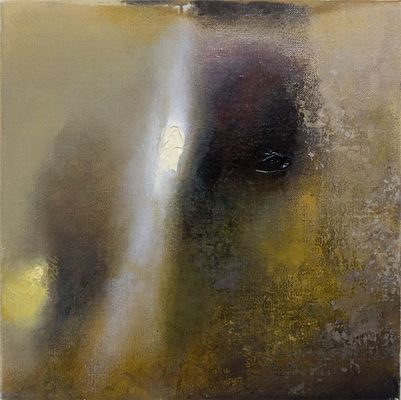
To return to Buckley’s fragment, the first two lines very much evoke how I paint nowadays. As you age, detail diminishes and patches of light become more luminous and float. I feel the most honest way of dealing with this is by smearing the oil paint on the canvas with the fingers and working close-up, blind. Only if the patches coalesce into an approaching image can the work gain a life.
-
Jonathan Walker was born in Melbourne, Australia and brought up on a dairy farm in Gippsland. In the 1970’s he studied painting at RMIT and won the Harold Wright Scholarship to the British Museum, London. During the 1980’s he exhibited at Pinacotheca Gallery, Richmond and had work shown at the NGV and Heidi City Art Gallery. Over the same period he designed the cover for the “Epigenesi” LP by Giancarlo Toniutti, Italy and conducted a mail exchange work with Achim Wollscheid, Germany. The work with artists through the post resulted in an article published in the bicentenary issue of Art and Australia 1988. He showed in artist run spaces such as WestSpace in the 90’s and 2000’s, and until 2012, taught painting at Victoria University, which is where we (Colleen Ahern and Lisa Radford) as organisers of the exhibition, among many others, had the privilege of being his student.
Walker’s knowledge was imparted to students through the careful selection of music, literature, and artists found in books that he himself had ordered for the library. Walker’s strategy was the generosity of sharing his vast knowledge with references specific to each student and their context.
Walker’s paintings share a similar focus and intimacy.
This exhibition presents a small selection of recent paintings alongside a publication that includes Walker’s writing. Observational and analytical, Walker’s work is a type of material notation — the time of day, colour and how it is blended, the both specific and fleeting location of a reflection on lino or the question of whether a chair leg should be included in a painting.
Please join us on Friday August 21 between 6-8pm to celebrate the opening of the exhibition.
Curated by Colleen Ahern and Lisa Radford.
B. Wurtz
Curated by Nic Tammens
March 26 - April 4, 2015
B.Wurtz works from a basement studio in his home on Manhattan’s Lower East Side.
This local fact is attested to by the plastic shopping bags and newsprint circulars that appear in his work. As formal objects, they don’t make loud claims about their origins but nonetheless transmit street addresses and places of business from the bottom of this long thin island. Like plenty of artists, Wurtz is affected by what is local and what is consumed. His work is underpinned by this ethic. It often speaks from a neighborhood or reads like the contents of a hamper:
“BLACK PLUMS $1.29 lb.”
“Food Bazaar”
“USDA Whole Pork Shoulder Picnic 99c lb.”
“RITE AID Pharmacy, with us it’s personal.”
“H. Brickman & Sons.”
“Sweet Yams 59c lb."
Most of the work in this exhibition was made while the artist was in residence at Dieu Donne, a workshop dedicated to paper craft in Midtown. Here Wurtz fabricated assemblages with paper and objects that are relatively lightweight, with the intention that they would be easily transportable to Australia. This consideration isn’t absolute in Wurtz’s work, but was prescriptive for making the current exhibition light and cheap. Packed in two boxes, these works were sent from a USPS post office on the Lower East Side and delivered to North Melbourne by Australia Post.
Wurtz appears courtesy of Metro Pictures, New York.
Thanks to Rob Halverson, Joshua Petherick, Sari de Mallory, Matt Hinkley, Helen Johnson, Fayen d'Evie, Ask Kilmartin, Lisa Radon, Ellena Savage, Yale Union, and "Elizabeth".
John Nixon
"Archive"
December 15 - January 20, 2014
The presentation of John Nixon's archive offered a rare showcase of this extensive collection of the artist's own publications, catalogues, posters, ephemera, editions and more, from the mid 1980s onwards, alongside a selection of his artworks.
Organized by John Nixon, Joshua Petherick and Matt Hinkley.
<a href=http://wfb.public-office.info/artist/john-nixon>All titles by John Nixon
"Habitat"
at Minerva, Sydney (organised by Joshua Petherick and Matt Hinkley)
November 15 - December 20, 2014
Lupo Borgonovo, Janet Burchill & Jennifer McCamley,
Lewis Fidock, HR Giger, Piero Gilardi, Veit Laurent Kurz,
Cinzia Ruggeri, Michael E. Smith, Lucie Stahl, Daniel Weil, Wols
Press Release:
“...It contained seven objects. The slender fluted bone, surely formed for flight, surely from the wing of some large bird. Three archaic circuitboards, faced with mazes of gold. A smooth white sphere of baked clay. An age-blackened fragment of lace. A fingerlength segment of what she assumed was bone from a human wrist, grayish white, inset smoothly with the silicon shaft of a small instrument that must once have ridden flush with the surface of the skin - but the thing’s face was seared and blackened.”
William Gibson, “Count Zero”, 1986
"Autumn Projects Archive"
Curated by Liza Vasiliou
March 6 - March 15, 2014
World Food Books, in conjunction with the Virgin Australia Melbourne Fashion Festival 2014, presented the Autumn Projects archive, consisting of a selection of early examples in Australian fashion with a particular interest in collecting designers and labels from the period beginning in the 1980’s, who significantly influenced the discourse of Australian Fashion.
Curated by Liza Vasiliou, the exhibition provided a unique opportunity to view pieces by designers Anthea Crawford, Barbara Vandenberg, Geoff Liddell and labels CR Australia, Covers, Jag along with early experimental collage pieces by Prue Acton and Sally Browne’s ‘Fragments’ collection, suspended throughout the functioning World Food Books shop in Melbourne.
H.B. Peace
presented by CENTRE FOR STYLE
November 14, 2013
"Hey Blinky, you say chic, I say same"
Anon 2013
H.B. Peace is a clothing collaboration between great friends Blake Barns and Hugh Egan Westland. Their pieces explore the divergences between 'character’ and ‘personality’ in garments....etc
Special Thanks to Joshua Petherick and Matt Hinkley of WFB and Gillian Mears
and a Very Special Thank you to Audrey Thomas Hayes for her shoe collaboration.
Janet Burchill & Jennifer McCamley
"Aesthetic Suicide"
May 10 - June 8, 2013
The first of our occasional exhibitions in the World Food Books office/shop space in Melbourne, "Aesthetic Suicide" presented a body of new and older works together by artists Janet Burchill & Jennifer McCamley, including videos, prints, a wall work, and publications.
During shop open hours videos played every hour, on the hour.
1987, English
Softcover (staple-bound), 50 pages, 27 x 33 cm
1st Edition, Out of print title / used / good
Published by
Tension / South Yarra
$30.00 - Out of stock
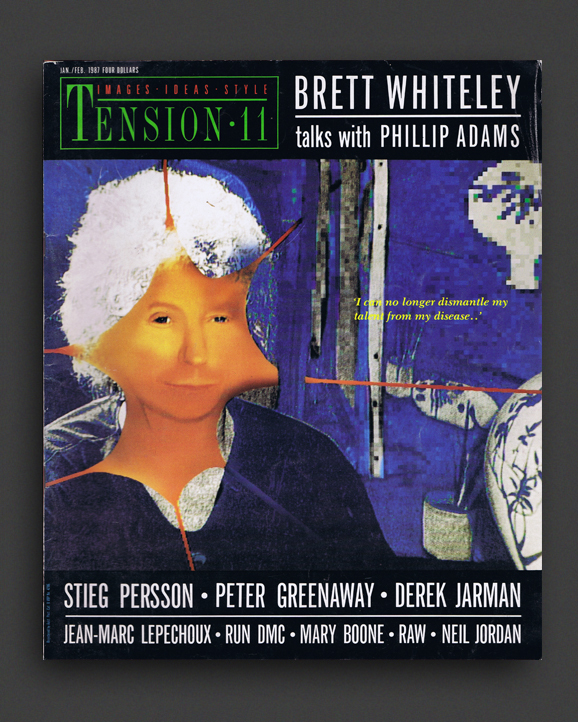
Tension 11 (Images - Ideas - Style : Jan / Feb 1987) features Brett Whiteley (interview by Phillip Adams), Stieg Persson (interview by Ashley Crawford), Jean-Marc Lepechoux (interview by Ashley Crawford), Peter Greenaway (interview by Ashley Crawford), Derek Jarman (interview by Melanie Brellis), "Godard, Mieville" (by Adrian Martin), Elfi Mikesch & Monika Trent (interview by Amree Hewitt), Neil Jordon, gallerists Mary Boone & Michael Werner (by Paul Taylor), RAW : Art Spiegelman and Francoise Mouly (interview by Kerri Phillips), Run DMC / Def Jam Records (by Peter Grace), and much more.
TENSION (1983-1990) was one of the central "popular" culture arts periodicals to come out of Melbourne in the 1980s, emerging from the ashes of Virgin Press. Independently published and edited by critic Ashley Crawford, Tension magazine lasted for 25 bi-monthly issues dedicated to Art, Music, Fashion, Theatre, Film, Photography, across reviews, interviews, reports, critical essays and artist pages. Now an important document of culture in Australia, and especially Melbourne in the 1980s, issues featured the writing and contributions of Paul Taylor, McKenzie Wark, Mike Parr, John Nixon, Catharine Lumby, Philip Brophy, Adrian Martin, Ashley Crawford, Peter Tyndall, Jean Baudrillard, Timothy Leary, Gerard Malanga, Keith Haring, Gerald Murnane, and many more. In 1985 Crawford, with John Buckley, staged an exhibition issue of the magazine, 'Visual Tension', at ACCA featuring the work of Howard Arkley, Marianne Baillieu, Peter Booth, Paul Boston, Peter Cripps, Richard Dunn, Maria Kozic, John Lethbridge, Geoff Lowe, Linda Marrinon, John Matthews, John Nixon, Stieg Persson, Robert Rooney, Gareth Sansom, Vivienne Shark LeWitt, Imants Tillers, Peter Tyndall, Jenny Watson, John Young.
1987, English
Softcover (staple-bound), 40 pages, 23.5 x 33.5 cm
1st Edition, Out of print title / used / good
Published by
Tension / South Yarra
$30.00 - Out of stock
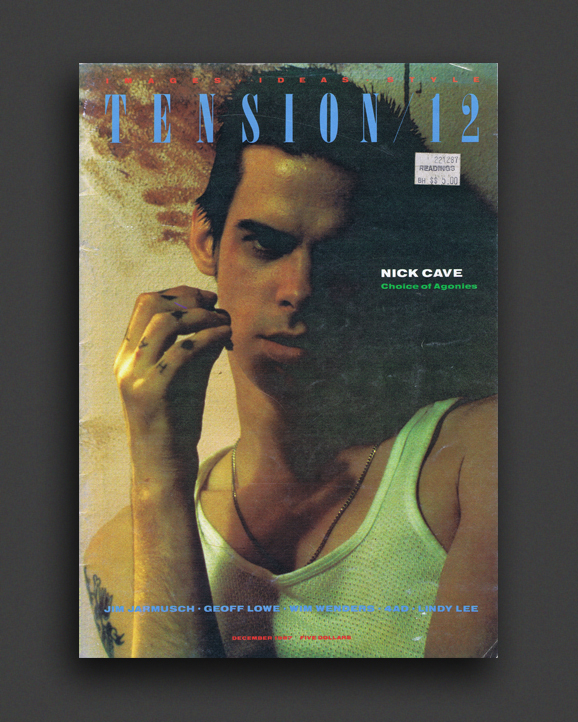
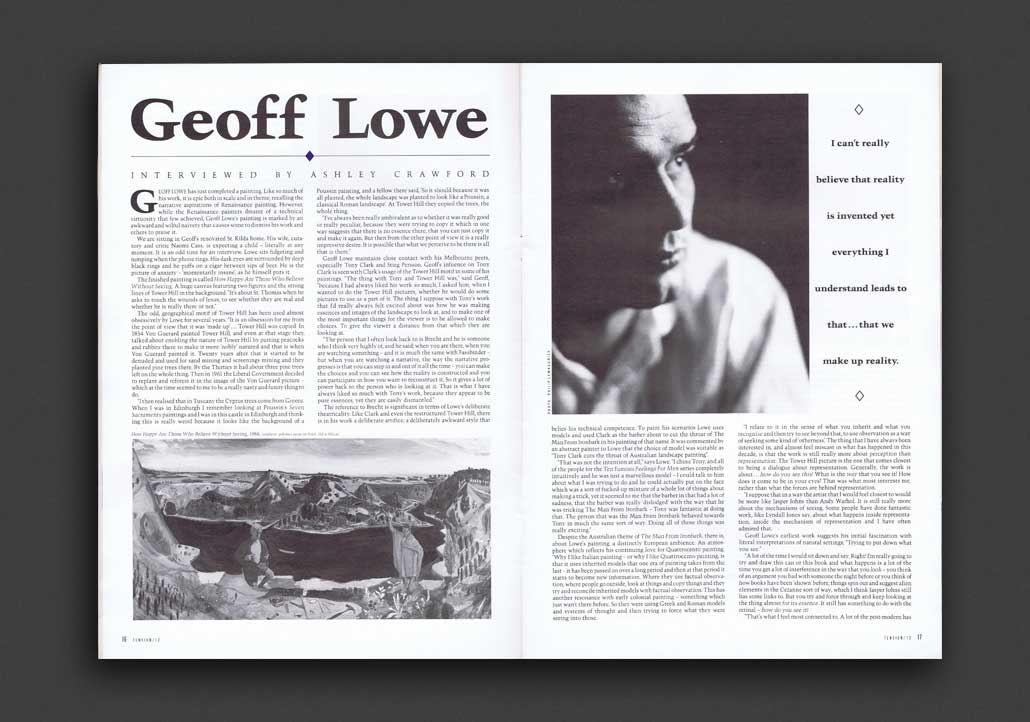
Tension 12 (Australian and International Arts : December 1987) features Geoff Lowe (interview by Ashley Crawford), Jim Jarmusch (interview by Kerry Doole), Lindy Lee (by Ted Colless), Wim Wenders (by Melanie Brellis), "Images from Japan" (by Ashley Crawford), Nick Cave (interview by Melanie Brellis), 4AD Records (interview by Bruce Elder), Trisha Brown (interview by Shelley Lasica), Syd Mead (interview by Chad Taylor), "Dennis Hopper: Out of the Sixties" by Robin Barden, "Television: A New Aesthetic", Paul Morley's ASK reviewed by McKenzie Wark, and much more.
TENSION (1983-1990) was one of the central "popular" culture arts periodicals to come out of Melbourne in the 1980s, emerging from the ashes of Virgin Press. Independently published and edited by critic Ashley Crawford, Tension magazine lasted for 25 bi-monthly issues dedicated to Art, Music, Fashion, Theatre, Film, Photography, across reviews, interviews, reports, critical essays and artist pages. Now an important document of culture in Australia, and especially Melbourne in the 1980s, issues featured the writing and contributions of Paul Taylor, McKenzie Wark, Mike Parr, John Nixon, Catharine Lumby, Philip Brophy, Adrian Martin, Ashley Crawford, Peter Tyndall, Jean Baudrillard, Timothy Leary, Gerard Malanga, Keith Haring, Gerald Murnane, and many more. In 1985 Crawford, with John Buckley, staged an exhibition issue of the magazine, 'Visual Tension', at ACCA featuring the work of Howard Arkley, Marianne Baillieu, Peter Booth, Paul Boston, Peter Cripps, Richard Dunn, Maria Kozic, John Lethbridge, Geoff Lowe, Linda Marrinon, John Matthews, John Nixon, Stieg Persson, Robert Rooney, Gareth Sansom, Vivienne Shark LeWitt, Imants Tillers, Peter Tyndall, Jenny Watson, John Young.
1989, English
Softcover (staple-bound), 56 pages, 23.5 x 33.5 cm
1st Edition, Out of print title / used / good
Published by
Tension / South Yarra
$25.00 - Out of stock
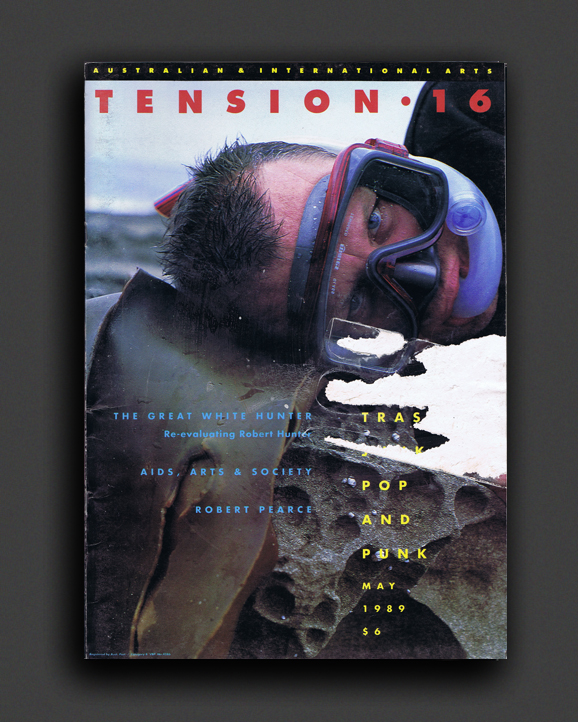
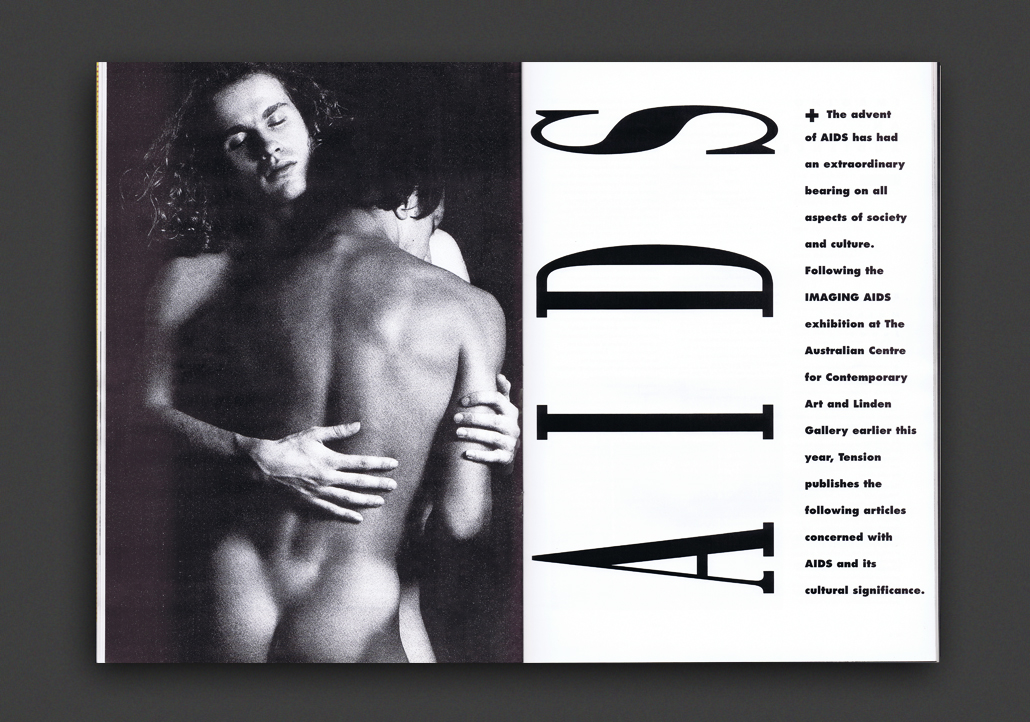
TENSION 16 (Australian and International Arts : May 1989) features articles on Robert Hunter, Lyndal Jones, Malcolm McLaren, Robert Pearce, Andy Warhol, "AIDS, ARTS & SOCIETY", "Trash & Junk Culture" by Adrian Martin w. Philip Brophy, Maria Kozic, Andrew and Ian Haig, "The Liberated Page", "Nightwatch" by Ted Colless, Tim Burns, Angus Jones, Bette Mifsud, and more.
Good copy but cover torn.
TENSION (1983-1990) was one of the central "popular" culture arts periodicals to come out of Melbourne in the 1980s, emerging from the ashes of Virgin Press. Independently published and edited by critic Ashley Crawford, Tension magazine lasted for 25 bi-monthly issues dedicated to Art, Music, Fashion, Theatre, Film, Photography, across reviews, interviews, reports, critical essays and artist pages. Now an important document of culture in Australia, and especially Melbourne in the 1980s, issues featured the writing and contributions of Paul Taylor, McKenzie Wark, Mike Parr, John Nixon, Catharine Lumby, Philip Brophy, Adrian Martin, Ashley Crawford, Peter Tyndall, Jean Baudrillard, Timothy Leary, Gerard Malanga, Keith Haring, Gerald Murnane, and many more. In 1985 Crawford, with John Buckley, staged an exhibition issue of the magazine, 'Visual Tension', at ACCA featuring the work of Howard Arkley, Marianne Baillieu, Peter Booth, Paul Boston, Peter Cripps, Richard Dunn, Maria Kozic, John Lethbridge, Geoff Lowe, Linda Marrinon, John Matthews, John Nixon, Stieg Persson, Robert Rooney, Gareth Sansom, Vivienne Shark LeWitt, Imants Tillers, Peter Tyndall, Jenny Watson, John Young.
1989, English
Softcover (staple-bound), 72 pages, 23.5 x 33.5 cm
1st Edition, Out of print title / used / good
Published by
Tension / South Yarra
$30.00 - Out of stock
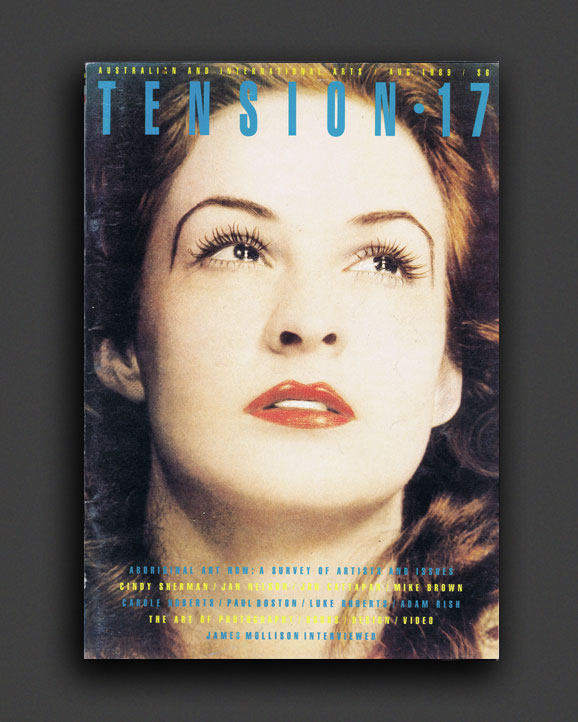
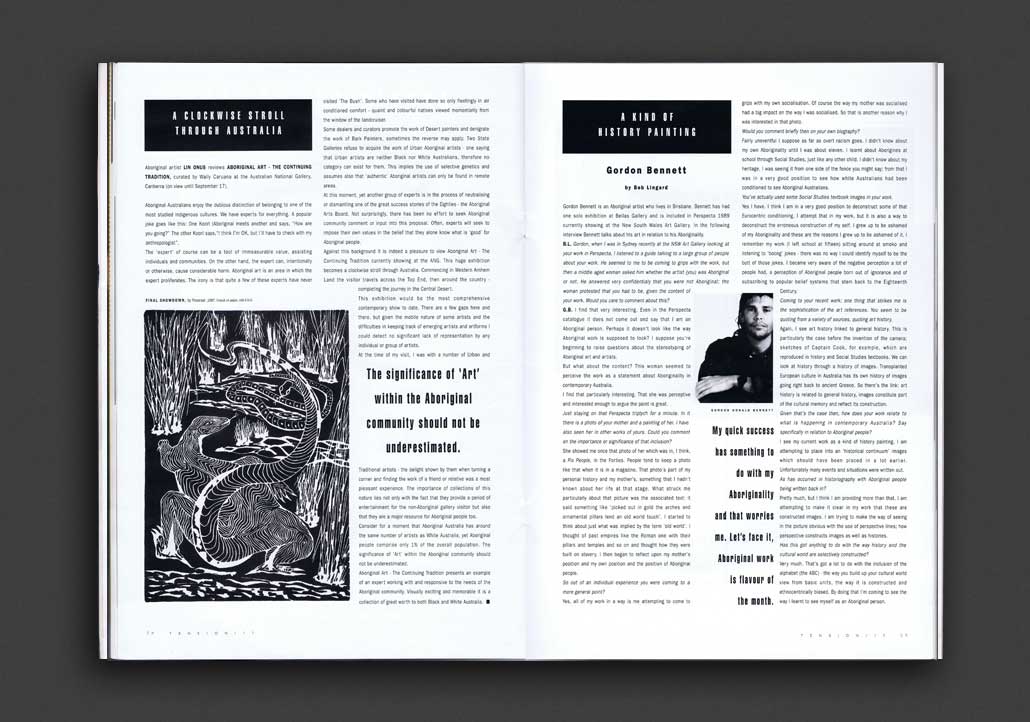
TENSION 17 (Australian and International Arts : August 1989) features articles on Mike Brown, Peter Halley, Cindy Sherman, Jon Cattapan, Jan Nelson, Paul Boston, Adam Rish, Carole Roberts, Luke Roberts, Carlo Mollino, "The Art of Photography", "Video", Horst, "The Designers' Designers" by Emma Dent Coed (on the art directors, designers, and visual marketing behind fashion designers such as Yohji Yamamoto, Dries Van Noten, John Galliano, Rei Kawakubo/Comme des Garcons, etc. inc. Peter Saville, Nick Knight, etc.), and "Aboriginal Art Now : A Survey of Artists and Issues", inc. the work of Gordon Bennett, Jarinyanu David Downs, Rover Thomas, Trevor Nickolls, Tim Johnson, a review by Lin Onus, and more.
TENSION (1983-1990) was one of the central "popular" culture arts periodicals to come out of Melbourne in the 1980s, emerging from the ashes of Virgin Press. Independently published and edited by critic Ashley Crawford, Tension magazine lasted for 25 bi-monthly issues dedicated to Art, Music, Fashion, Theatre, Film, Photography, across reviews, interviews, reports, critical essays and artist pages. Now an important document of culture in Australia, and especially Melbourne in the 1980s, issues featured the writing and contributions of Paul Taylor, McKenzie Wark, Mike Parr, John Nixon, Catharine Lumby, Philip Brophy, Adrian Martin, Ashley Crawford, Peter Tyndall, Jean Baudrillard, Timothy Leary, Gerard Malanga, Keith Haring, Gerald Murnane, and many more. In 1985 Crawford, with John Buckley, staged an exhibition issue of the magazine, 'Visual Tension', at ACCA featuring the work of Howard Arkley, Marianne Baillieu, Peter Booth, Paul Boston, Peter Cripps, Richard Dunn, Maria Kozic, John Lethbridge, Geoff Lowe, Linda Marrinon, John Matthews, John Nixon, Stieg Persson, Robert Rooney, Gareth Sansom, Vivienne Shark LeWitt, Imants Tillers, Peter Tyndall, Jenny Watson, John Young.
1990, English
Softcover (staple-bound), 88 pages, 23.5 x 33.5 cm
1st Edition, Out of print title / used / good
Published by
Tension / South Yarra
$30.00 - Out of stock
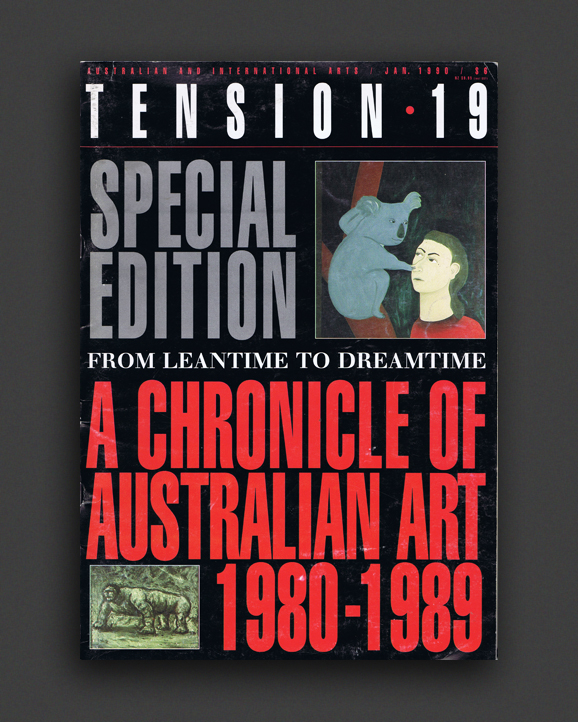
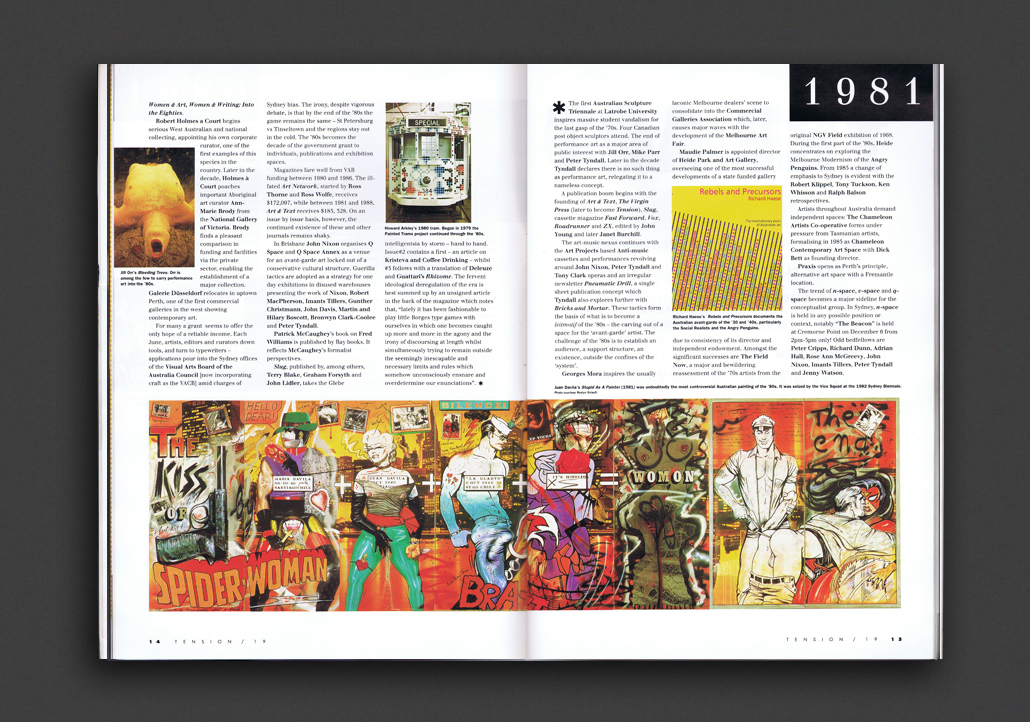
TENSION 19 (SPECIAL EDITION : FROM LEANTIME TO DREAMTIME - A CHRONICLE OF AUSTRALIAN ART 1980-1989) packs a concise year-by-year look-back at the exhibitions, artists, galleries, concerts, performances, publications, clubs, politics, influences that shaped Australian Art in the 1980s, compiled "in one week". Features contributions from writers Catherine Lumby, Charles Green, Chris McAuliffe, and Francis Pound (looking at NZ Art) and features the work of far too many artists to mention.
TENSION (1983-1990) was one of the central "popular" culture arts periodicals to come out of Melbourne in the 1980s, emerging from the ashes of Virgin Press. Independently published and edited by critic Ashley Crawford, Tension magazine lasted for 25 bi-monthly issues dedicated to Art, Music, Fashion, Theatre, Film, Photography, across reviews, interviews, reports, critical essays and artist pages. Now an important document of culture in Australia, and especially Melbourne in the 1980s, issues featured the writing and contributions of Paul Taylor, McKenzie Wark, Mike Parr, John Nixon, Catharine Lumby, Philip Brophy, Adrian Martin, Ashley Crawford, Peter Tyndall, Jean Baudrillard, Timothy Leary, Gerard Malanga, Keith Haring, Gerald Murnane, and many more. In 1985 Crawford, with John Buckley, staged an exhibition issue of the magazine, 'Visual Tension', at ACCA featuring the work of Howard Arkley, Marianne Baillieu, Peter Booth, Paul Boston, Peter Cripps, Richard Dunn, Maria Kozic, John Lethbridge, Geoff Lowe, Linda Marrinon, John Matthews, John Nixon, Stieg Persson, Robert Rooney, Gareth Sansom, Vivienne Shark LeWitt, Imants Tillers, Peter Tyndall, Jenny Watson, John Young.
1990, English
Softcover (staple-bound), 72 pages, 23.5 x 33.5 cm
1st Edition, Out of print title / used / good
$30.00 - Out of stock
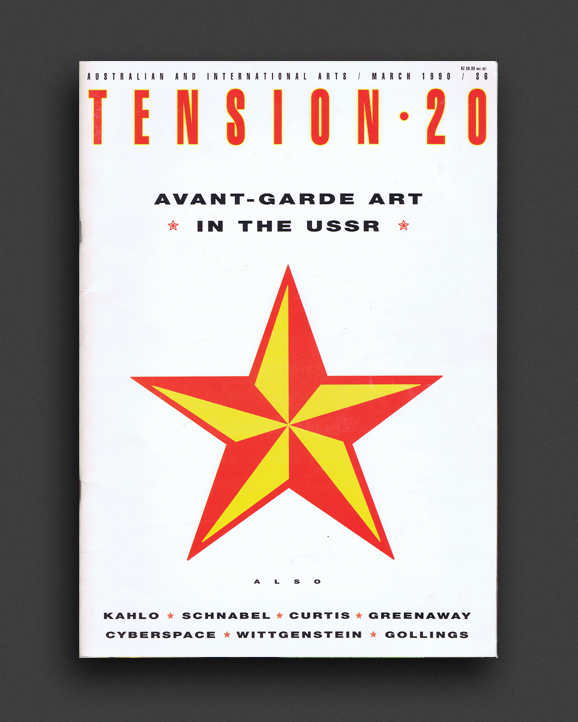
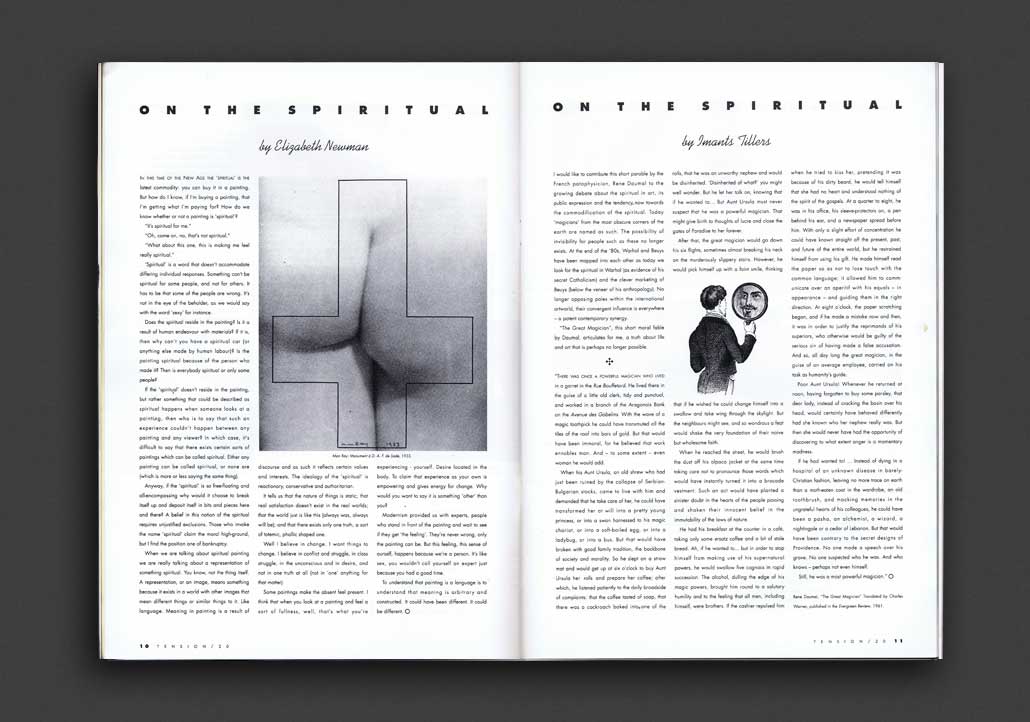
TENSION 20 ("Avant-Garde Art In The USSR" - Australian and International Arts : March 1990) features texts by Elizabeth Newman and Imants Tillers, articles on Julian Schnabel, Cyberspace, Peter Greenaway, Frida Kahlo, "Peewee meets Robocop : Films of the '80s" by Adrian Martin, "Towards a Post-Pop Language : Books of the '80s" by McKenzie Wark, and a huge cover feature "Avant-Garde Art In The USSR", with essays by Meryl Ryan, Ashley Crawford, Viktor Misiano, Dmitry Prigov, and Elena Pivovarova. Plus, news, letters, reviews (Kosuth, Nixon, etc.) and much more.
TENSION (1983-1990) was one of the central "popular" culture arts periodicals to come out of Melbourne in the 1980s, emerging from the ashes of Virgin Press. Independently published and edited by critic Ashley Crawford, Tension magazine lasted for 25 bi-monthly issues dedicated to Art, Music, Fashion, Theatre, Film, Photography, across reviews, interviews, reports, critical essays and artist pages. Now an important document of culture in Australia, and especially Melbourne in the 1980s, issues featured the writing and contributions of Paul Taylor, McKenzie Wark, Mike Parr, John Nixon, Catharine Lumby, Philip Brophy, Adrian Martin, Ashley Crawford, Peter Tyndall, Jean Baudrillard, Timothy Leary, Gerard Malanga, Keith Haring, Gerald Murnane, and many more. In 1985 Crawford, with John Buckley, staged an exhibition issue of the magazine, 'Visual Tension', at ACCA featuring the work of Howard Arkley, Marianne Baillieu, Peter Booth, Paul Boston, Peter Cripps, Richard Dunn, Maria Kozic, John Lethbridge, Geoff Lowe, Linda Marrinon, John Matthews, John Nixon, Stieg Persson, Robert Rooney, Gareth Sansom, Vivienne Shark LeWitt, Imants Tillers, Peter Tyndall, Jenny Watson, John Young.
2016, English / Italian
Softcover, 216 pages, 17 x 24 cm
Published by
Danilo Montanari Editore / Ravenna
$59.00 - Out of stock
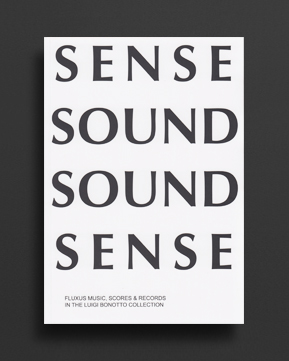
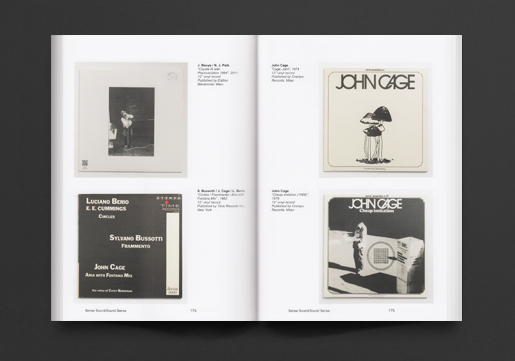
Luigi Bonotto dedicated himself to keeping the work of the artists of Fluxus and Experimental Poetry alive, and to preserving, cataloguing, and promoting their poetry, music, and work, which was strongly influenced by John Cage and the key concept of his theoretical framework, indeterminacy. Published on the occasion of an exhibition curated by Patrizio Peterlini and Walter Rovere, with the collaboration of Giorgio Maffei, this catalogue delves deeply into this aspect of the Fluxus network. Rife with illustrations, the materials of the collection, as well as the movement and its history, are analysed in scholarly essays by Anna Cestelli Guidi, Alison Knowles, and the curators.
features the work of Henning Christiansen, Wolf Vostell, Eric Andersen, George Brecht, Sylvano Bussotti, John Cage, Giuseppe Chiari, Philip Corner, Esther Ferrer, Juan Hidalgo, Dick Higgins, Robert Filliou, Toshi Ichiyanagi, Joe Jones, Milan Knizak, Takehisa Kosugi, Shigeko Kubota, György Ligeti, George Maciunas, Jackson Mac Low, Walter Marchetti, Charlotte Moorman, Claes Oldenburg, Yoko Ono, Nam June Paik, Ben Patterson, Terry Riley, Mieko Shiomi, Takako Saito, Gianni-Emilio Simonetti, Ben Vautier, Yoshimasa Wada, La Monte Young and others.
Out of Print.
2018, English
Softcover, 192 pages,
Edition of 2000,
Published by
Primary Information / New York
$29.00 - Out of stock
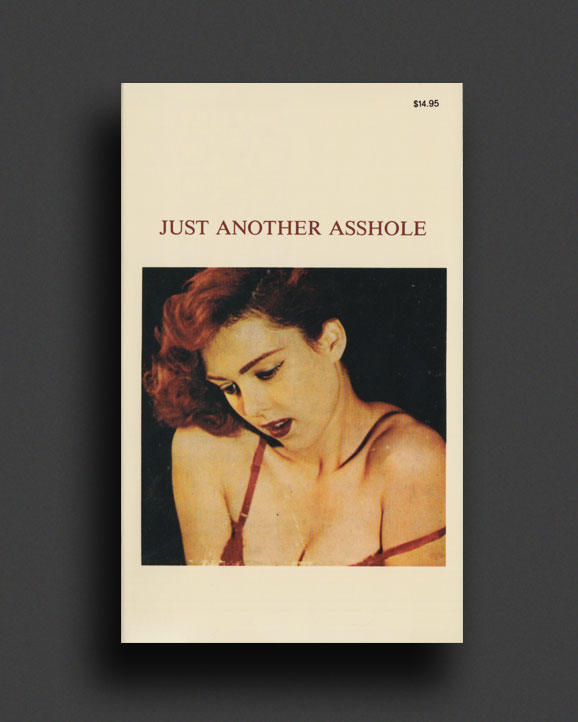
Just Another Asshole was an influential and now-legendary mixed-media publication series edited by Barbara Ess from 1978 to 1987. The submission process was open and collaborative, and each issue was produced in a different format (e.g., limited-edition zine by Ess, tabloid-sized graphic arts magazine, 4 pages in an issue of Artforum, photography book, LP record album, paperback book). Several were edited with Jane Sherry or Glenn Branca.
Issue 6 of the magazine, co-edited with Branca, was published in the form of a pulp paperback book with writings by sixty-one artists from the early-80s downtown scene. It includes short stories, performance transcripts, aphorisms, plays, monologues, screenplays, and essays that offer a window into the gritty and dynamic culture of New York City before gentrification pushed the underground out of Lower Manhattan.
Contributors include Kathy Acker, Lindsay Amos, Constance Ash, Josh Baer, Barbara Barg, Judith Barry, Nan Becker, Eric Bogosian, Glenn Branca, Brian Buczak, Mitch Corber, Peter Cummings, Margaret De Wys, Bradley Eros, Barbara Ess, Richard Fantina, Dorothea Franck, Matthew Geller, Michael Gira, Jack Goldstein, Dan Graham, Rudolph Grey, Sue Hanel, Jenny Holzer, Peggy Katz, Barbara Kruger, Beth Lapides, Joe Lewis, Amanda Linn, Carla Liss, Meredith Lund, Matthew Maguire, Aline Psyche Mare, Sam Marshall Harvey, Alan Moore, Richard Morrison, Cookie Mueller, Peter Nadin, Joseph Nechvatal, Richard Prince, Lee Ranaldo, David Rattray, Mike Roddy, David Rosenbloom, Ann Rower, Arleen Schloss, Jane Sherry, Kiki Smith, Michael Smith, Jim Sutcliffe, Fiona Templeton, Wharton Tiers, Lynne Tillman, Anne Turyn, Gail Vachon, S.Weisser, Sally A. White, Reese Williams, Martha Wilson, Stephan Wischerth, David Wojnarowicz, and Linda Yablonsky.
Barbara Ess is an artist living and working in New York City and upstate New York. She uses photography, video, and sound to make her work, which has been shown widely in the United States and Europe. She is an Associate Professor of Photography at Bard College.
Glenn Branca was a composer whose work included music for experimental rock bands, large ensemble instrumentals for electric guitars, symphonies for both electric instrumentation and acoustic orchestras, chamber ensemble pieces, an opera, a ballet, choral works, and music for film, dance, theater, and art installations. He was an early pioneer of the no wave punk scene that emerged in downtown New York in the late ’70s.
Edition of 2000
2019, English
Softcover, 100 pages, 23.5 x 20.5 cm
Ed. 0f 200,
Published by
Ruin Press / Sydney
$35.00 $15.00 - In stock -
With an accompanying essay by Francis Plagne
Limited to 200 copies
"Punter’s Club, 2001: the set started when he threw himself against the wall, amplified of course. The crying began then didn’t stop. He hit the microphone repeatedly with his forrid, initiating a hypnotic rhythm with intermittent irregularities, frizzy hair jagged. The ritual had begun, everyone was in. After a sustained 10 minute crescendo, Rizili went out into the street, using the pole outside Joe’s Garage the same way as he used the microphone. The crowd followed, bystanders were agape. By the time he ran down Brunswick St, wheezing at an alarming volume, the club was going off, everyone high on possibility, amazed to be there. The set kind of ended when no one knew where Nik was.
I’m writing in Berlin, it’s raining and I was going to go to a gig tonight, but already knew what it sounded like so I didn't. The avant-garde has auto-dissolved once again, at least in this town. Gig’s like Rizili’s don’t happen here, and if they do they’re documented into a tidy art-history oblivion, contextualised into suffocation, given no room to stand free and for themselves. There’s no Berlin MS: a Menstruation Sisters gig comes off genuinely unhinged, pure animal energy distilled into sound.
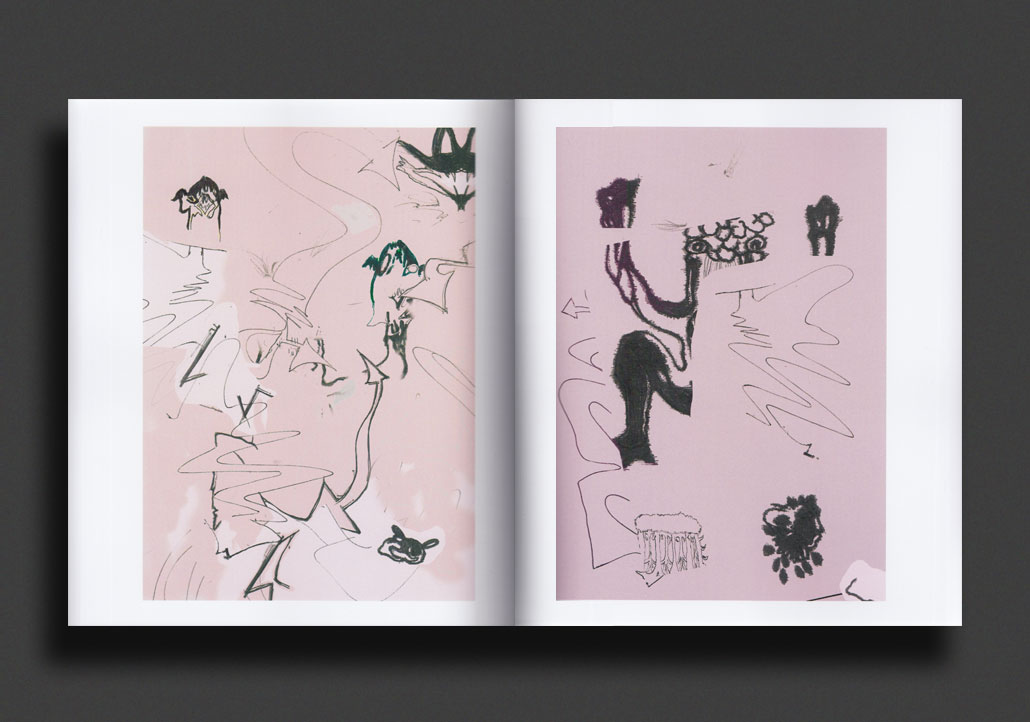
These drawings capture the unnameable energy of those gigs, an astonishing nexus of detail and mess, a mutation of reference and alterity, another lineage of thought altogether. The visual articulation of the psyche, the clarity of form, its explosion into these exquisite beauties shifts our perception of what figurative drawing can be. These images could only gestate in the most disciplined and isolated of minds, living in stern denial of the comfy pull towards corporate arts hell, creating space to quietly formulate ideas that transcend any concept of relation or community."
1977, German
Heavy card slipcase (4 vols.), 323 pages; 357 pages; 378 pages; 40 pages; 21 x 29.5 cm
1st Edition, Out of print title / used / good
Published by
Paul Dierich / Kassel
$100.00 - Out of stock
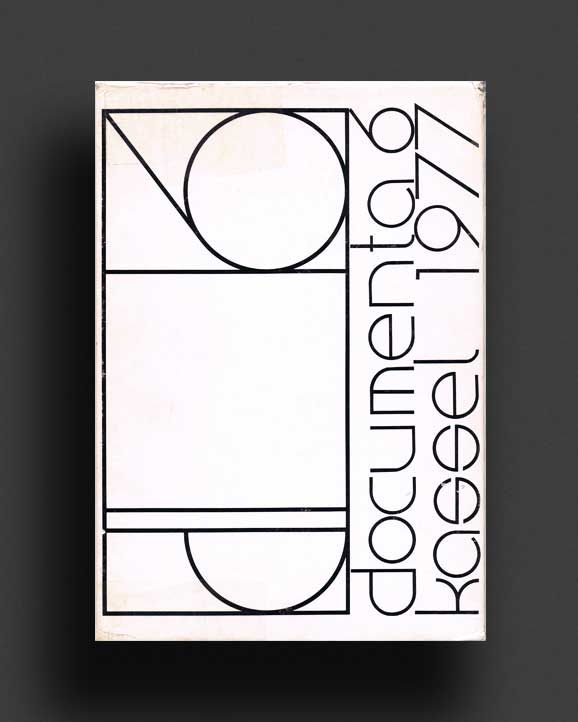
Complete 3 volume boxset exhibition catalogue published in conjunction with Documenta 6, the sixth edition of documenta, a quinquennial contemporary art exhibition. It was held between 24 June and 2 October 1977 in Kassel, Germany, and the artistic director was Manfred Schneckenburger. The title of the exhibition was: Internationale Ausstellung – international exhibition.
Box contains volume 1: painting - sculpture - performance (320 pages) / volume 2: photography - film - video (357 pages) / volume 3: drawings - utopian design - books (376 pages + show) / special edition of exhibition information booklet (40 pages + show); essays by Lothar Romain, Bazon Brock, Karl Oskar Blase, Klaus Honnef, Evelyn Weiss, Manfred Schneckenburger, Arnold Bode, Wieland Schmied, and Lothar Lang.
Artists featured throughout include Francis Bacon, Jennifer Bartlett, Georg Baselitz, Gerd Baukhage, Enzo Cacciola, Louis Cane, Chuck Close, Ulrich Erben, Winfred Gaul, Raimund Girke, Kuno Gonschior, Camille Graeser, Gotthard Graubner, Nancy Graves, Alan Green, Richard Hamilton, Heijo Hangen, Bernhard Heisig, Michael Heizer, Edgar Hofschen, Jasper Johns, Willem de Kooning, Attila Kovács, László Lakner, Roy Lichtenstein, Markus Lüpertz, Wolfgang Mattheuer, Gerhard Merz, Rune Mields, Carmengloria Morales, Malcolm Morley, Claudio Olivieri, Roman Opalka, Palermo, A.R. Penck, Lucio Pozzi, Hans-Peter Reuter, Gerhard Richter, Claude Rutault, Willi Sitte, Frank Stella, Werner Tübke, Bernar Venet, Andy Warhol, Reindert Wepko van de Wint, Gianfranco Zappetini, Jerry Zeniuk, Bernhard and Hilla Becher, Bernhard Johannes Blume, Christian Boltanski, Bettina Brand, Heinz Breloh, James Collins, Zdenek Felix, Reinhold Hohl, Gabrielle Honnef-Harling, Erich Kuby, Werner Lippert, Bernd Lohse, Felix H. Mann, Hilmar Pabel, Georg Reinhardt, Liselotte Strelow, Ann Wilde, Jürgen Wilde, Peter Ackermann, Michael von Biel, Fernando Botero, Miguel Condé, Renato Guttoso, Horst Janssen, Giacomo Manzù, Pablo Picasso, Wolfgang Schmitz, Rudolf Schoofs, André Thomkins, Bodo Baumgarten, Blythe Bohnen, Pinchas Cohen Gan, Rupprecht Geiger, Hetum Gruber, Eva Hesse, Sol LeWitt, Nino Malfatti, Bob Ryman, Jan Schoonhoven, Lee U-Fan, Rainer Werner Fassbinder, Martin Scorsese, Stanley Kubrick.
Texts in German.
Also includes an exhibition guide booklet in the same format as the 3 main catalogue volumes.
Good copy throughout with general tanning and age wear to box and books, some knocking and tape-mended cracking to the box binding corners and edging.
1971, German
Softcover, 464 pages, 29.7 x 21 cm
1st Edition, Out of print title / used / very good
Published by
DuMont / Köln
$85.00 - Out of stock
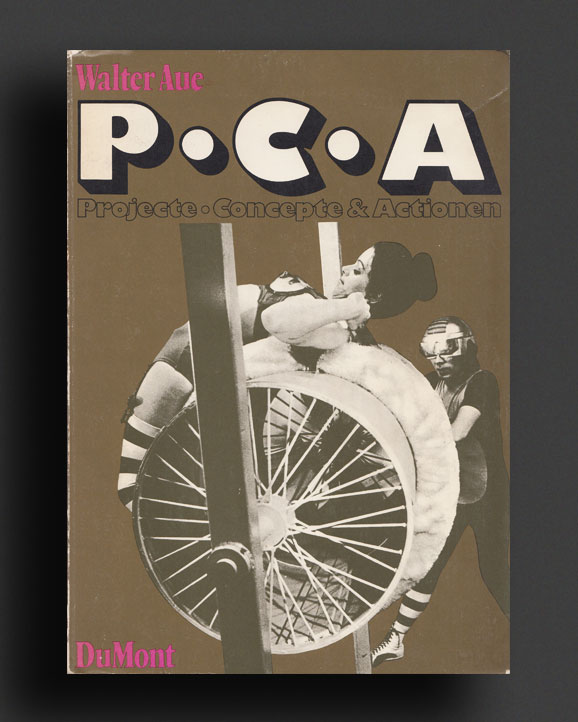
Huge, densely-illustrated volume compiled by German publisher/editor/essayist/curator Walter Aue, who worked closely with conceptual and performance artists in the 1960s-1970s. Laid-out by Aue himself, the book feels like a very natural scrap-book compendium of artist contributions, reproducing artworks, documentation of happenings, texts, photographs, diagrams, collages, news-clippings, instructions, etc. across over 450 pages, with Aue's type-written opening essay and cataloguing throughout. Features the most notable conceptual, actionist and performance artists of the period, spanning Fluxus, Arte Povera, radical architecture, Nouveau Realisme, etc. including Dieter Rot, Joseph Beuys, Robert Smithson, Pino Pascali, Stanley Brouwn, Jannis Kounellis, Klaus Rinke, Ben Vautier, Al Hansen, Walter Pichler, Hilla and Bernhard Becher, Giuseppe Penone, Ettore Sottsass, Gilbert and George, Walter De Maria, Wolf Vostell, Hans Hollein, Imi Knoebel, Barry Flanagan, Allan Kaprow, Carolee Schneemann, Hamish Fulton, Christo, Elfriede Jelinek, Dennis Oppenheim, Urs Lüthi, Sigmar Polke, Gerhard Rühm, Blink Palermo, Lawrence Weiner, Ed Ruscha, HA Schult, Hermann Nitsch, James Lee Byars, Jan Dibbets, Jochen Gerz, Mauricio Kagel, Nam June Paik, Otto Mühl, Arnulf Rainer, Jan Voss, George Brecht, Robert Filliou, Franz Erhard Walther, Timm Ulrichs, Daniel Spoerri, Erich Reusch, Paul Pechter, Rainer Giese, Jörg Immendorff, Henning Christiansen, Gilberto Zorio, Panamarenko, Joseph Kosuth, Dan Graham, Dick Higgins, Ian Baxter, Mel Bochner, Haus-Rucker-Co, Markus Raetz, Sottsass, Nam June Paik, Hans Haacke, Tetsumi Kudo, Bruce Mclean, On Kawara, and so many more.
Depending on the artist, texts are in English, German, Dutch, etc. Opening essay in German.
Very Good, light wear/tear to top spine.
1979, French
Softcover, 192 pages, 20.5 x 15 cm
Out of print title / used / good
Published by
Editions PAC / Paris
$90.00 - Out of stock
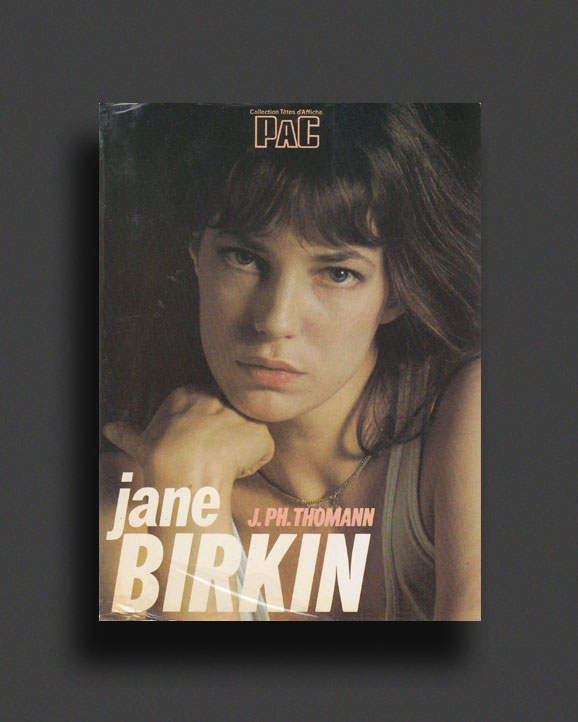
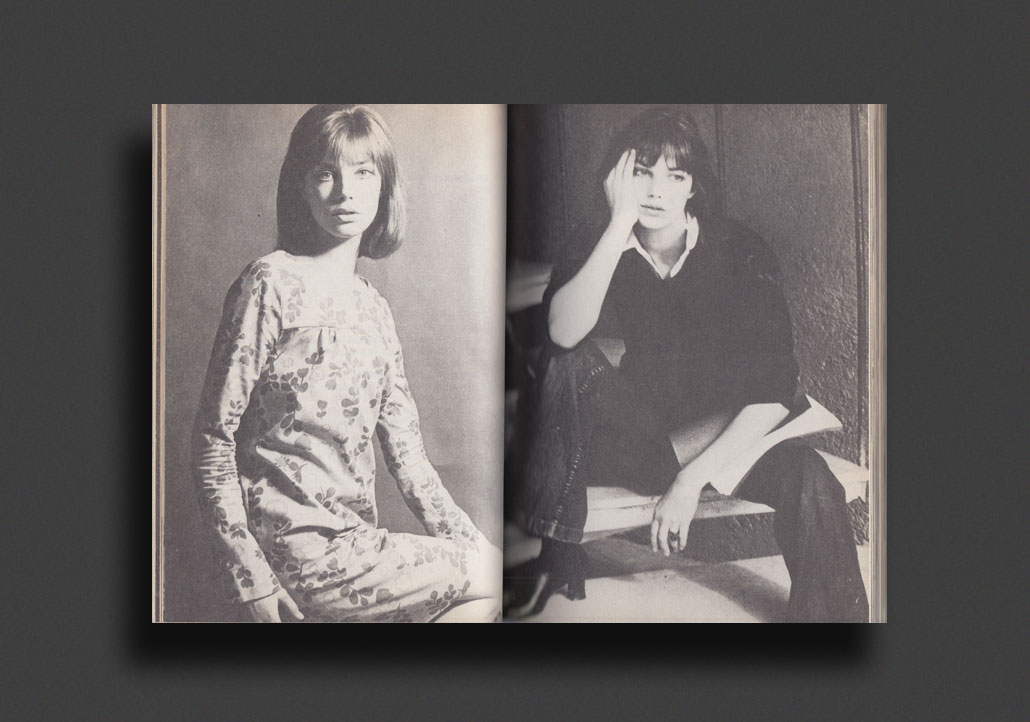
One of the earliest and scarcest books dedicated to the great French actress and singer, Jane Birkin. Written by Jean-Philippe Thomann and published in 1979, this heavily illustrated volume forms an early biography of her personal life and an important document capturing her diverse and challenging career as actress (working with Alain Resnais, Agnès Varda, Jean-Luc Godard, Michelangelo Antonioni, Jacques Doillon, Serge Gainsbourg, Jacques Rivette, to name a few), model, singer, and her work in theatre. Photographs, film stills, magazine covers, film posters and record jackets are accompanied by hand-written notes by Birkin, a filmography, discography and much more.
Very good copy with light wear and light peeling to cover laminate. Crisp copy throughout.
2018, English / Korean
Softcover, 380 pages, 21 x 26 cm
Published by
National Museum of Modern and Contemporary Art / Seoul
$105.00 - Out of stock
Published in conjunction with an exhibition at the National Museum of Modern and Contemporary Art in Seoul, this volume delves into the groundbreaking activities of E.A.T., a non-profit organisation that began actively promoting and exploring the union of art and technology in 1966. The brainchild of artists Robert Rauschenberg and Robert Whitman and engineers Billy Klüver and Fred Waldhauer, it aimed to expand the social role of artists and counteract feelings of alienation brought on by rapid technological advancement. The group hoped to inspire new directions for research, and also to serve as a catalyst in fostering technologies more attuned to the needs of the individual.
Profusely illustrated throughout with photographic documentation and archival material.
2005, English / German
Softcover, 270 pages, 19 x 27 cm
1st Edition, Out of print title / used / very good
Published by
Neues Museum Weserburg Bremen / Bremen
$150.00 - Out of stock
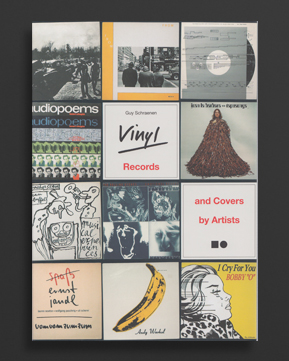
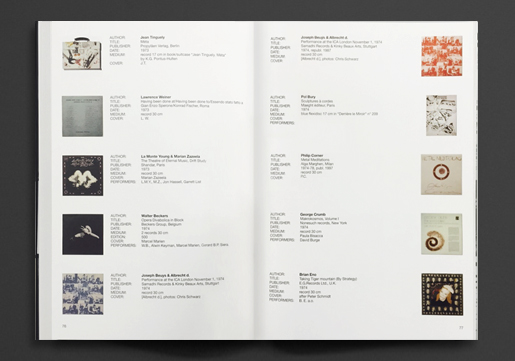
This large, detailed catalogue forms a unique and important document, which was produced to accompany an exhibition at Neues Museum Weserburg Bremen, Bremen, 21.8. - 27.11.2005 and Museu d'Art Contemporani de Barcelona, Barcelona, 16.5. - 1.10.2006 showcasing a selection of some 800 pieces from the collection of Guy Schraenen. The main of this collection comprises vinyl records and covers by artists, musicians and poets in LP, single and other formats, alongside other sound media (tapes and CDs). Posters and books are also included. The exhibition shows artists (such as Hanne Darboven, Jean Dubuffet, Dieter Roth, Joseph Beuys, Laurie Anderson, John Cage, Yoko Ono, Yves Klein, Roman Opalka, Lawrence Weiner, Mike Kelley, Öyvind Fahlström, Art & Language and Hermann Nitsch) and artistic movements of the second half of the twentieth century through this complex medium of the vinyl cover, with its dual visual and audible components. Here Guy Schraenen has edited together an extensive visual catalogue of these historical objects.
A wonderful book for anyone interested in the history of modern sound art and the artistic medium of the vinyl sleeve, especially in the fields of Avantgarde, Electro-Acoustic, Modern Classical, Musique Concrète, Sound-Poetry, Art Rock, Industrial, Power-Electronics....
Henri Chopin, A.R. Penck, Brion Gysin, George Brecht, Marcel Duchamp, Arman, Karel Appel, Öyvind Fahlström, Pierre Henry, Art & Language, Peter Brötzmann, Red Krayola, Ernst Jandl, Vito Acconci, Hanne Darboven, Jean Dubuffet, Dieter Roth, Joseph Beuys, Laurie Anderson, Yves Klein, Roman Opalka, Hermann Nitsch, Yoko Ono, Tony Conrad, Andy Warhol, John Cage, Pierre Schaeffer, Derek Bailey, Han Bennink, Jean Tinguely, Steve Reich, Meredith Monk, Terry Fox, Terry Riley, Sun Ra, Pandit Pran Nath, Albrecht/d., Robert Ashley, Bob Cobbing, Lawrence Weiner, Philip Glass, La Monte Young, Marian Zazeela, Poly Bury, Charlemagne Palestine, Carl Andre, Brian Eno, Mike Kelley, Sonic Youth, Henry Flynt, Jon Gibson, Michael Snow, Roland Topor, Michael Nyman, Harold Budd, Robert Filliou, Nam June Paik ... just the tip of the iceberg.
Very Good copy of the rare first printing from Bremen.
2015, English
Softcover, 208 pages, 17 x 24 cm
Published by
Occasional Papers / London
$50.00 - Out of stock
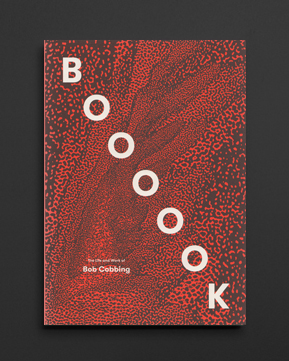
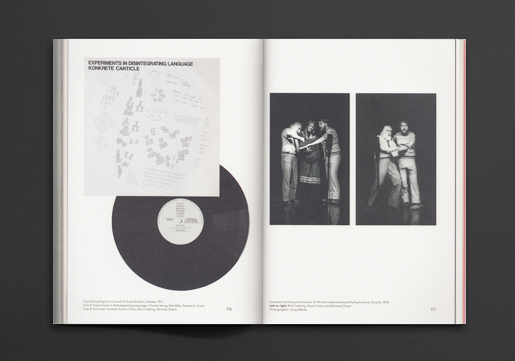
This is the first comprehensive overview of the life and work of the pioneering British concrete and sound poet Bob Cobbing (1920-2002). 'Boooook' addresses all aspects of Cobbing's career, with essays detailing his key roles in Better Books, London Film-makers' Co-op and the abAna trio, as well as his involvement in the Destruction in Art Symposium, Fylkingen and Writers Forum. Edited by William Cobbing and Rosie Cooper – and illustrated with reproductions of artworks, documents, posters, poems and film stills from the Bob Cobbing family collection – Boooook features contributions by Adrian Clarke, Arnaud Desjardin, Sanne Krogh Groth, Will Holder, Gustav Metzger, Andrew Wilson, and others.
2018, English / German
Softcover, 240 pages, 23 x 16.5 cm
Published by
Texte Zur Kunst / Berlin
$32.00 - Out of stock
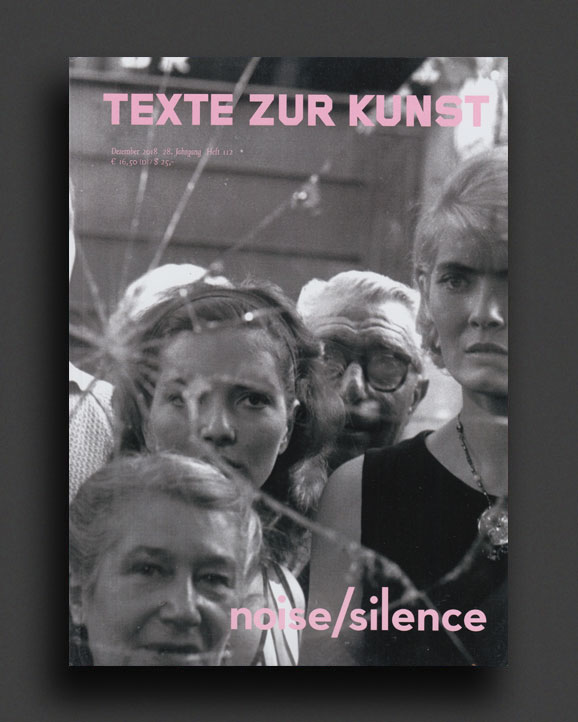
Issue # 112 of Texte zur Kunst, “Noise/Silence,” focuses on these two sonic extremes that define the boundaries of the audible, framing all possible sonic expressions therein. Given the emergence of sound as its own field of inquiry within the arts, and the development of newer media forms for sound production, can we still reliably argue that noise and silence are open to artists and musicians today in the ways that they were for Luigi Russolo in his 1913 manifesto, “The Art of Noises;” or, in John Cage’s writings on silence? In our analysis and judgment on the contemporary significance of noise and silence within sound and music, we are also questioning the potential for radical gestures with sound tout court—the all or nothing. What is left for music and sonic interventions today? What kinds of subversive noises can be marshaled against the deafening silence? And where, if anywhere, can silence provide a shelter from the relentless noise from the outside? We assembled a group of media historians and philosophers to give us a theoretical orientation in this shifting sonic landscape, and also asked four artists/musicians to weigh in on the possibility for radical gestures in their own practice. The results offer a much-needed revision of the terms for sound in the arts today.
Issue No. 112 / December 2018 "Noise/Silence"
Table Of Contents
Forward
Preface
Rolf Grossmann - Silence, Sound, Noise / Aesthetic And Media-Technological Observations
Ute Holl - Excavating Silence
Fiona Mcgovern - Curating Sound
Sound Rules / Colin Lang And Cevdet Erek In Conversation
Michaela Melián - Electric Ladyland
Andrea Neumann - Production By Subtraction
Arto Lindsay
Puce Moment
New Development
Political Myth – Prefiguration – Brexit / Angus Nicholls On The Mythic Structures Behind Brexit
Rotation
Metabolismen Der Moderne / André Rottmann Über „Entgrenzter Formalismus. Verfahren Einer Antimodernen Ästhetik“ Von Kerstin Stakemeier
Migration Und Film Denken / Nanna Heidenreich Über Brigitta Kusters „Grenze Filmen“
The Third Persona / Amanda Schmitt On Ben Lerner And Anna Ostoya’s “The Polish Rider”
Klang Körper
Figuring Space / Steven Warwick On Catherine Christer Hennix
Reviews
This Is The Rented Moment / Nicolás Guagnini On Jack Smith At Artists Space, New York
Konzeptueller Fehlschlag / Fabio Cypriano Über Die 33. Biennale In São Paulo
Enjoy Your Sinthome / Sven Lütticken On Dora García At The Reina Sofía, Madrid
Artists Must Begin Helping Themselves / Pedro De Llano On Stephan Dillemuth At A Certain Lack Of Coherence, Porto
Der Traumzauberbaum / Inka Meißner Über Amy Lien & Enzo Camacho Im Kunstverein Freiburg
Burnt By The Sun / Colin Lang On Katarina Sieverding At Manifesta 12, Palermo
Star Alliance / Alida Müschen Über Ei Arakawa Im Kunstverein Für Die Rheinlande Und Westfalen, Düsseldorf
Canon Fodder / Julia Pelta Feldman On Charline Von Heyl At Petzel Gallery, New York
Manspainting / Georg Imdahl Über Balthus In Der Fondation Beyeler, Basel
Case Of Urgency / Christina Catherine Martinez On Gerry Bibby At O-Town House, Los Angeles
Meshes Of The Platform Age / Jakob Schillinger On Loretta Fahrenholz At Mumok, Vienna
Re-Call, Re-Take, Represent / Rattanamol Singh Johal On Vivan Sundaram At The Kiran Nadar Museum Of Art, New Delhi And Haus Der Kunst, Munich
Grasping History / Frauke Zabel Über Karin Schneider Im Kunstverein Nürnberg
Stacked Cards / Ana Vogelfang On Pablo Accinelli At Malba, Buenos Aires
Computerkunst Jenseits Des Computers / Karel Císař Über „1968:Computer.Art“ In Brno
Abstraction Of The Body / Melissa Gordon On Amy Sillman At Camden Arts Centre, London
Feministischer Dekolonialismus Avant La Lettre / Michaela Wünsch Über Theresa Hak Kyung Cha Im Kulturzentrum Der Koreanischen Botschaft, Berlin
Where The Bodies Are Buried / Ana Teixeira Pinto On Roee Rosen At The Centre Pompidou, Paris
Chez Michel / Anke Dyes Über Henrik Olesen Im Schinkel Pavillon, Berlin
Obituary
Helena Almeida (1934–2018) / João Ribas
Klaus Herding (1939−2018) / Tom Holert
Edition
Dominique Gonzalez-Foerster
Jeanette Mundt
Wolfgang Tillmans
2016, English
Softcover, 320 pages, 23cm × 17cm
Ed. of 2000,
Published by
Unit Editions / London
$69.00 - Out of stock
The punk era transformed the world of music. If you could play three chords, you could make records. You didn’t even need a record label. You could start your own.
The same thing happened in graphic design. All you needed were a few a sheets of Letraset and access to a photocopier, and you could make your own record covers. And lots of people did just that.
The work in this book is culled from the record collections of designer (and Unit Editions co-founder) Tony Brook, and leading punk scholar Russ Bestley. As one of the world’s leading authorities on punk and post-punk music, Russ has contributed an insightful essay to the book.
The book also features interviews with designer Malcolm Garrett, Mute founder Daniel Miller and Sniffin’ Glue editor and musician Mark Perry.
United Edition's 'The Archive Series' is a bibliographic celebration of hidden and neglected visual archives. The Archive Series views graphic design as one of the ways to understand the semiotics of culture. United Editions is committed to the collection and preservation of printed specimens and graphic design artefacts to open up possibilities of decoding the past.
Edited by Tony Brook & Adrian Shaughnessy
Consultant Editor - Russ Bestley
Design by Spin
Edition of 2000
1977, English
Hardcover (w. dust jacket), 318 pages, 24 x 16 cm
Out of print title / used / fine
Published by
Macmillan Company / South Melbourne
$50.00 - In stock -
With a prefatory note by Benjamin Britten and Peter Pears, and an appreciation by Leopold Stokowski.
John Bird's acclaimed 1976 biography of the Australian-born composer and pianist Percy Grainger gives the first full account of the life and works of one of the strangest figures in twentieth-century music. Behind Grainger's highly original compositional achievements, folksong collecting, and glittering career as a virtuoso concert pianist lay a tragic and chaotic personal life--long domination by his mother, unorthodox sexual predilections, an eccentric athleticism, a demonic spiritual drive, and a wildly inconsistent personal philosophy with Anglo-Saxon obsessions such as his famous "Blue-Eyed English." A list of published compositions, a current discography of performances by Grainger, and a selection of his seminal writings complete what has already proved to be a standard work.
This fully revised edition includes much new biographical material from John Bird's continuing research. Grainger's reputation and popularity as a uniquely individual composer continue to grow, and this book remains the definitive biography.
First Australian hardcover edition from 1977, Very Good-Fine, with inlayed collected Grainger press clippings, brochures, ticket stubbs, etc.
2018, English
Hardcover (w. dust jacket), 224 pages, 22.9 x 15.2 cm
Published by
Goldsmiths Press / London
$58.00 - Out of stock
A timely exploration of whether sound and listening can be the basis of political change.
In a world dominated by the visual, could contemporary resistances be auditory? This timely and important book from Goldsmiths Press highlights sound's invisible, disruptive, and affective qualities and asks whether the unseen nature of sound can support a political transformation. In Sonic Agency, Brandon LaBelle sets out to engage contemporary social and political crises by way of sonic thought and imagination. He divides sound's functions into four figures of resistance—the invisible, the overheard, the itinerant, and the weak—and argues for their role in creating alternative “unlikely publics” in which to foster mutuality and dissent. He highlights existing sonic cultures and social initiatives that utilize or deploy sound and listening to address conflict, and points to their work as models for a wider movement. He considers issues of disappearance and hidden culture, nonviolence and noise, creole poetics, and networked life, aiming to unsettle traditional notions of the “space of appearance” as the condition for political action and survival.
By examining the experience of listening and being heard, LaBelle illuminates a path from the fringes toward hope, citizenship, and vibrancy. In a current climate that has left many feeling they have lost their voices, it may be sound itself that restores it to them.
Brandon LaBelle is Professor in New Media in the Faculty of Fine Art, Music and Design at the University of Bergen. He is the author of Lexicon of the Mouth: Poetics and Politics of Voice and the Oral Imaginary, Diary of an Imaginary Egyptian, Acoustic Territories: Sound Culture and Everyday Life, and Background Noise: Perspectives on Sound Art.
1984, English
Softcover, 342 pages, 270 x 280 cm
1st Edition, Out of print title / used / average
Published by
U.M.I. Research Press / Michigan
$50.00 - Out of stock
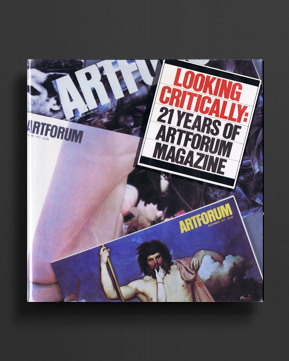
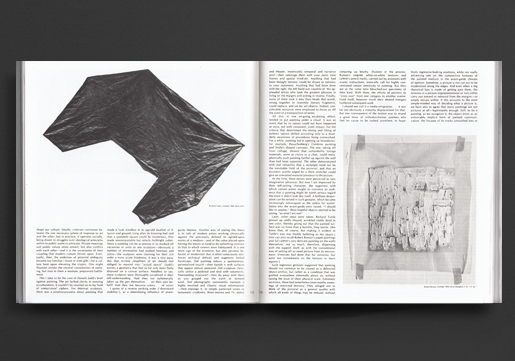
Softcover edition of "LOOKING CRITICALLY: 21 YEARS OF ARTFORUM MAGAZINE", the heavy 342 page volume anthology of the first 21 years of the world's most important modern and art journal. An incredibly valuable collection of art theory.
Edited by Amy Baker Sandback, designed by Roger Gorman and Mary Beath and published in 1984 by U.M.I. Research Press, this dense volume, bound in hardcover to the dimensions of a copy of ARTFORUM, begins with an Ed Kienholz review at the Ferus Gallery from ARTFORUM's June 1962 inaugural issue, and ends with Barbara Kruger reviewing the film "TRON" for the November 1982 issue. An amazing compendium of articles and reviews from the magazine's important first 21 years, featuring contributions by the likes of John Cage, Robert Morris, Kate Steinitz, Henry T. Hopkins, Don Factor, Robert Pincus-Witten, Dennis Adrian, John Coplans, Hilton Kramer, Harold Rosenberg, Henry Geldzahler, John Cage, Walter Hopps, Ed Ruscha, Allan Kaprow, Robert Rosenblum, Dan Flavin, Boris Groys, Sam Wagstaff, Billy Kluver, Lucy R. Lippard, Robert Rosenblum, Roger Shattuck, Ad Reinhardt, Mel Bochner, Andy Warhol, Roy Lichtenstein, Claes Oldenburg, Barbara Rose, Manny Farber, Michael Fried, Robert Morris, Philip Leider, Hollis Frampton, Carl Andre, Richard Serra, Lawrence Alloway, Barbara Kruger, Jane Livingston, Lizzie Borden, Kenneth Baker, Laurie Anderson, Agnes Martin, Cindy Nemser, Sidney Tillim, Annette Michelson, Rosalind Krauss, Jeremy Gilbert-Rolfe, Roberta Smith, Peter Plagens, Peter Schjeldahl, J. Hoberman, Hal Foster, Richard Flood, Carter Ratcliff, Stuart Morgan, Max Kozloff, Donald Kuspit, Dan Graham, Walter De Maria, Komar & Melamid, Edit De Ak, Lawrence Weiner, Kathy Acker, Robert Mapplethorpe, Anselm Kiefer, Thomas McEvilley, Louise Bourgeois, Ingrid Sischy, and too many more to list. Artists featured include: Josef Albers, Richard Tuttle, Jo Baer, Carl Andre, Ant Farm, Hans Arp, Max Bill, Mel Bochner, Alighiero Boetti, Lee Bontecou, Constantin Brancusi, Bertholt Brecht, Richard Avedon, Francis Bacon, Diane Arbus, Michaelangelo Antonioni, Lynda Beglis, Larry Bell, Terry Fox, James Byers, Rober Barry, Marcel Breuer, AA Bronson, Luis Buñel, Daniel Buren, Chris Burden, Joseph Beuys, Anthony Caro, Marcel Broodthaers, John Chamberlain, Paul Cézanne, Marc Chagall, Jean Cocteau, Merce Cunningham, Sonia Delauney, Walter de Maria, Bruce Connor, Jean Dubuffet, Max Ernst, Walker Evans, Dan Flavin, Marcel Duchamp, Albrecht Dürer, Lucio Fontana, Hollis Frampton, Alberto Giacometti, Eva Hesse, Gilbert & George, Philip Glass, John Cage, Nancy Graves, Dan Graham, Robert Grosvenor, Nancy Grossman, Walter Gropius, Hans Haacke, Hairy Who, David Hockney, Douglas Huebler, Jorg Immendorff, Donald Judd, Jasper Johns, Joan Jonas, Allan Kaprow, On Kawara, Ellsworth Kelly, Edward Keinholz, Paul Klee, Alison Knowles, Joseph Kosuth, Brice Marden, Agnes Martin, André Masson, Henri Matisse, Roberto Matta, Sol Lewitt, Roy Lichtenstein, Barbara Kruger, Jannis Kounellis, Markus Lüpertz, El Lissitzky, Rene Magritte, Robert Mapplethorpe, John McCracken, Mario Merz, Robert Morris, Robert Motherwell, Ree Morton, Louise Nevelson, Barnett Newman, Kenneth Noland, Claes Oldenburg, Eduardo Paolozzio, A. R. Penck, Irving Penn, Francis Picabia, Pablo Picasso, Larry Poons, Ken Price, Yvonne Rainer, Robert Rauschenberg, Martial Raysse, Roman Polanski, Jackson Pollock, Steve Reich, Gerrit Rietveld, Alain Robbe-Grillet, Dorothae Rockburne, James Rosenquist, Mark Rothko, Robert Ryman, Lucas Samaras, Kurt Schwitters, Oscar Schlemmer, Richard Serra, Cindy Sherman, David Smith, Robert Smithson, Michael Snow, Robert Venturi, Wolf Vostell, Andy Warhol, Frank Stella, Saul Steinberg, Karlheinz Stockhausen, Bruno Taut, Jean Tinguely, Anne Truitt, Paul Wunderlich, Lawrence Weiner, Louise Bourgeois, Alfred Hitchcock, and so many more.
A Good copy throughout, with cover rubbing and corner bumping. Tightly bound and clean copy internally.
2018, English
Hardcover, 432 pages, 25x 31 cm
Published by
Getty Publications / Los Angeles
$126.00 - Out of stock
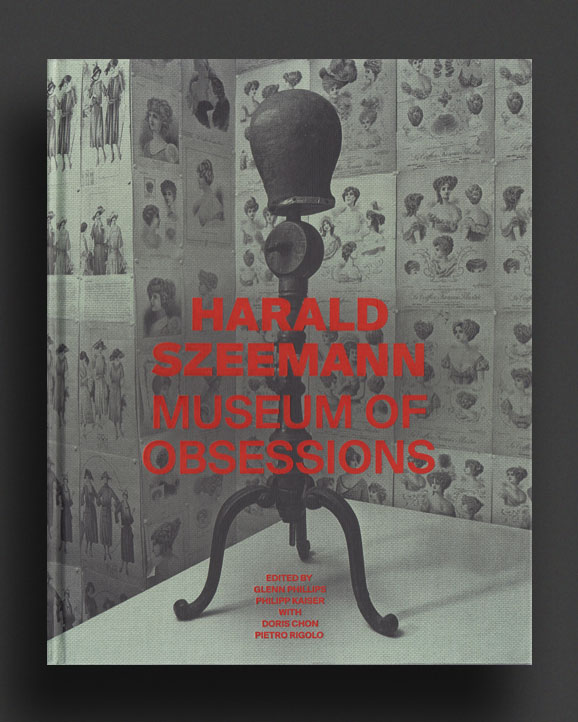
Texts by Glenn Phillips, Doris Chon, Pietro Rigolo, Philipp Kaiser
Harald Szeemann is associated with some of the most important artistic developments of the postwar era. A passionate advocate of avant-garde movements like conceptualism and post minimalism, he collaborated with artists such as Joseph Beuys, Bruce Nauman, Richard Serra, and Cy Twombly, developing new ways of presenting art that reflected his sweeping vision of contemporary culture.
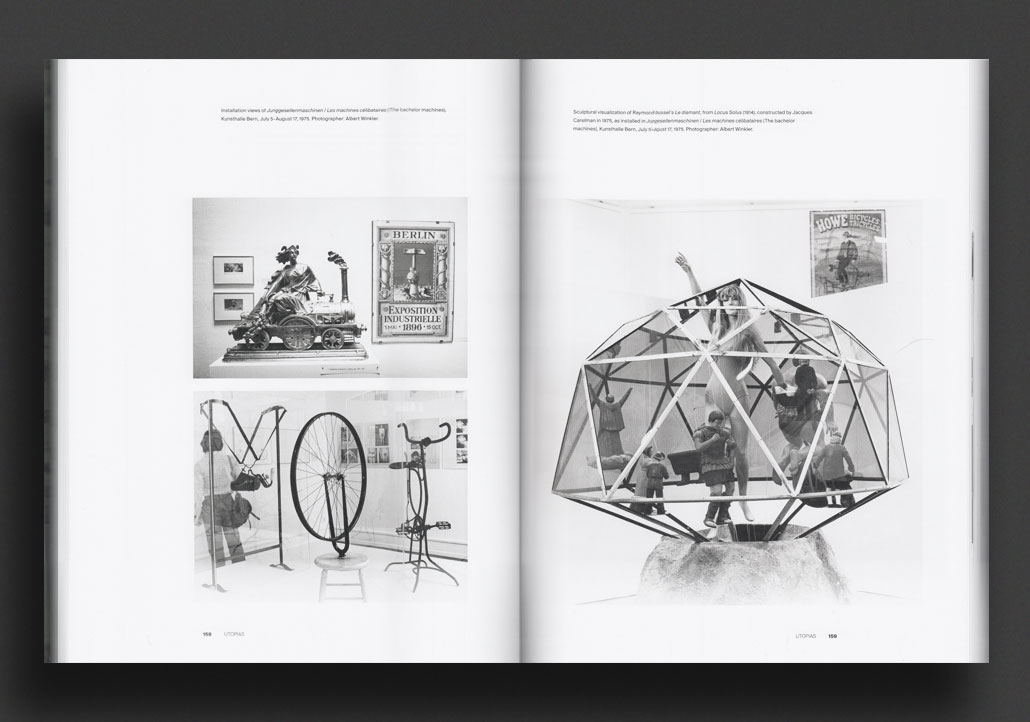
Szeemann once stated that his goal as an exhibition maker was to create a "Museum of Obsessions." This richly illustrated volume is a virtual collection catalogue for that imaginary institution, tracing the evolution of his curatorial method through the materials he collected and produced while researching and organising his exhibitions, including letters, drawings, personal datebooks, installation plans, artists' books, posters, photographs, and handwritten notes.
This book documents all phases of Szeemann's career, from his early stint as director of the Kunsthalle Bern, where he organized the seminal Live in Your Head: When Attitudes Become Form (1969); to documenta 5 (1972) and the intensely personal exhibition he staged in his own apartment using the belongings of his hairdresser grandfather (1974); to his reinvention as a freelance curator who realised projects on wide-ranging themes until his death in 2005.
The book contains essays exploring Szeemann's curatorial approach as well as interviews with collaborators. Its more than 350 illustrations include previously unpublished installation photographs and exhibition documents as well as many other materials from the curator's archive.
1970, English / German
Softcover, 300 pages, 23 x 15 cm
1st edition, Out of print title / used*,
Published by
Kölnischer Kunstverein / Köln
$85.00 - Out of stock
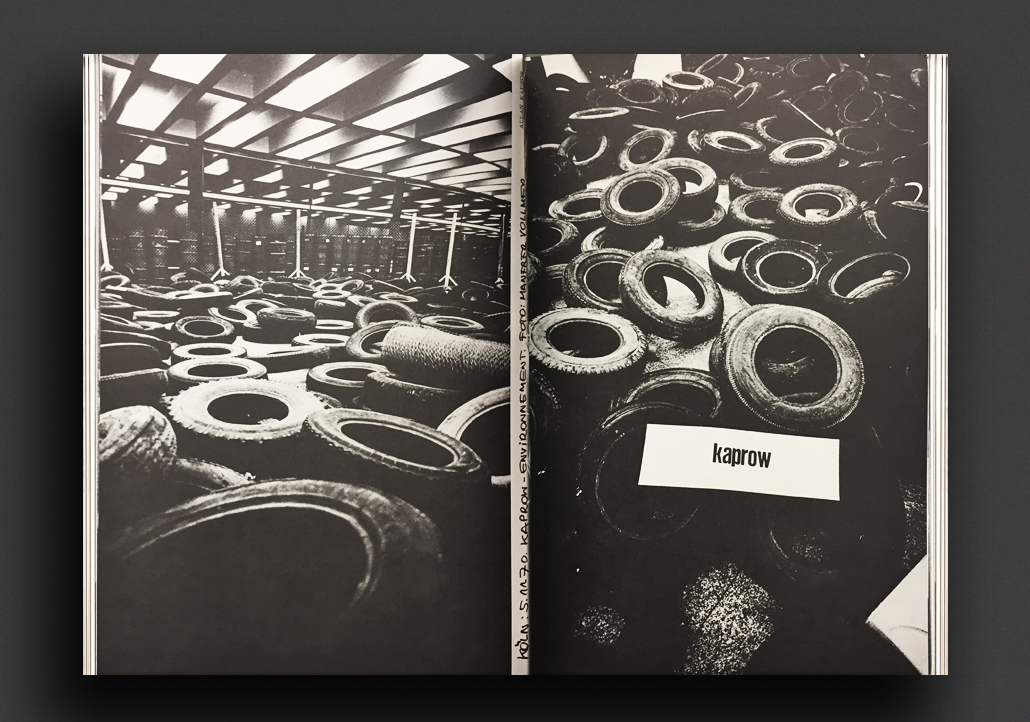
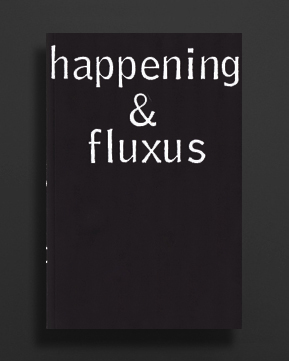
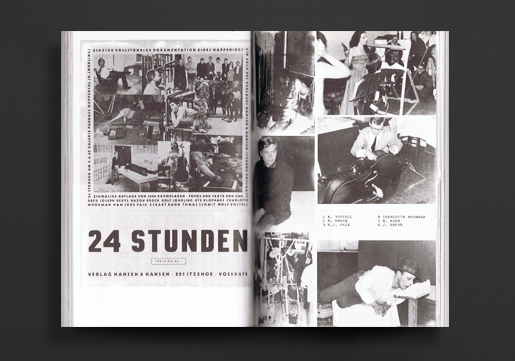
The great "Happening & Fluxus" book, published on the occasion of the exhibition of the same name at the Kölnischer Kunstverein in 1970, curated by Harald Szeemann.
This exhaustive Fluxus document is illustrated heavily throughout and broken into two important sections : 1. Chronology 1959-1970 (a detailed cataloguing of this incredible period of happenings, actions, concerts, meals, exhibitions and any related events, illustrated with photography along with dates, locations, those involved, and reproductions of the related ephemera), 2. Bibliography 1959-1970 (again heavily illustrated with detailed cataloguing of printed material about Fluxus and related actions, artists, exhibitions, performances, as well as a detailed listing for each featured artist of their publications, writings, art editions, etc). Book includes works by Wolf Vostell, Daniel Spoerri, Nam June Paik, Tetsumi Kudo, Tadeusz Kantor, Dick Higgins, George Brecht, Allan Kaprow, Yoko Ono, Claes Oldenburg, Alison Knowles, Robert Filliou, Stanley Brouwn, Bazon Brock, Joseph Beuys, Eric Anderson, Viennese Actionists, Charlotte Moorman, Günter Brus, Emmett Williams, Ben Vautier, Carolee Schneemann, Otto Muehl, Robert Watts, Al Hansen, Henry Flynt, Philip Corner, Henning Christiansen, Robert Rauschenberg, John Cage, and many more.
First major compilation of this material compiled by Harald Szeemann to accompany a now legendary exhibition.
"There is neither here nor in the exhibition, a fix-ready answer to the question: What is happening, what is Fluxus."
2018, English
Softcover, 350 pages, 15 x 22 cm
Published by
Trapart / Stockholm
$63.00 - Out of stock
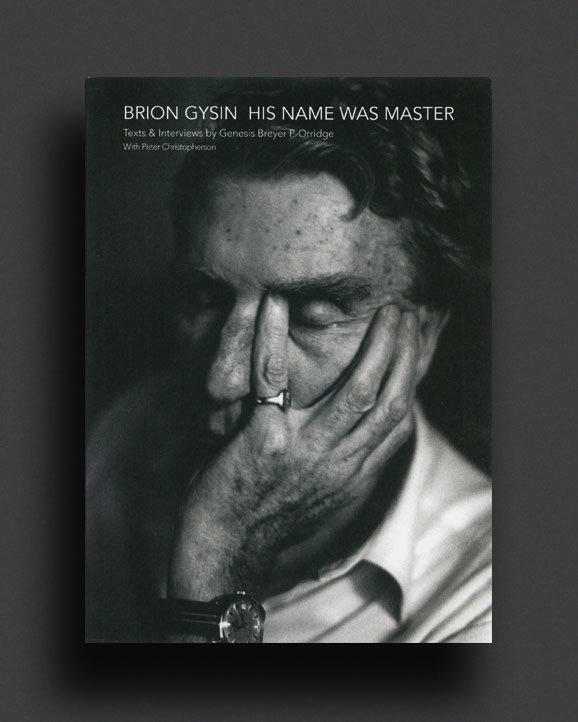
Texts and Interviews by Genesis Breyer P-Orridge, with Peter Christopherson. Edited with notes by Andrew M. McKenzie. Introductions by Genesis Breyer P-Orridge & Carl Abrahamsson.
Brion Gysin (1916–86) has been an incredibly influential artist and iconoclast: his development of the “cut-up” technique with William S. Burroughs has inspired generations of writers, artists and musicians. Gysin was also a skilled networker and revered expat: together with his friend Paul Bowles, he more or less constructed the post-beatnik romanticism for life and magic in Morocco, and was also a protagonist in an international gay culture with inspirational reaches in both America and Europe. Not surprisingly, Gysin has become something of a cult figure.
One of the artists he inspired is Genesis Breyer P-Orridge, who collaborated with both Gysin and Burroughs in the 1970s, during his work with Throbbing Gristle and COUM Transmissions. The interviews made by P-Orridge have since become part of a New Wave/Industrial mythos. This volume presents them in their entirety alongside three texts on Gysin by P-Orridge, plus an introduction. This book is an exclusive insight into the mind of a man P-Orridge describes as “a kind of Leonardo da Vinci of the last century,” and a fantastic complement to existing biographies and monographs.
2013, English
2 x LP
Ed. of 1000,
Published by
The Power Station / Dallas
$50.00 $10.00 - In stock -
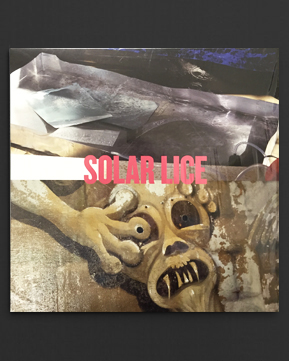
Solar Lice double LP / Catalogue produced in an edition of 1000 copies to accompany the exhibition, Tobias Madison, Emmanuel Rossetti, and Stefan Tcherepnin, "Drip Event" at The Power Station, Dallas, April 10 - July 12, 2013. Features writer / curator Jeanne Graff on vocals.
The Power Station is a not-for-profit contemporary art space in Exposition Park, Dallas, Texas, founded by Janelle and Alden Pinnell in 2011. It is housed in a former Dallas Power & Light building which was constructed in 1920, and hosts large scale exhibitions which compliment the building's raw architecture. For each of its international exhibitions, The Power Station works with the artists to produce a publication in conjunction with their project, limited to 1000 copies. Its programming also includes a summer exhibition and additional events each year. The building includes an apartment where artists can live as they create and build their installations. The first exhibitor was American artist Oscar Tuazon.