World Food Books' programme is largely produced on Kulin Nation land. We acknowledge the Wurundjeri people of the Kulin Nation as the first and continuing custodians of this land, and pay respect to their Elders past, present, and emerging.
World Food Books is an arts and special interests bookshop in Naarm / Melbourne. Founded in 2010, World Food Books is devoted to the presentation of a rotating, hand-selection of international art, design, literary and counterculture publications with an emphasis on the anti-traditional, the experimental, the avant-garde, the heretic, the marginal.
Presenting new titles alongside rare and out-of-print books, catalogues and journals spanning the fields of modern and contemporary art, design, photography, illustration, film, literature, poetry, cultural theory, philosophy, sexuality, popular and underground culture in its many radical forms, World Food Books wishes to encourage adventurous, thoughtful and open-minded reading, looking, writing, and exchange of publishing and ideas, both current and historical.
As well as our bookshop, located in Melbourne's historical Nicholas Building, all of our inventory is available internationally via our online mail-order service.
World Food Books semi-regularly co-ordinates "Occasions", a programme of exhibits and events at the bookshop and in partnership with other hosts (such as museums and art galleries) that develop out of the activities, relationships and content of the bookshop itself.
World Food Books
The Nicholas Building
37 Swanston Street
Room 5, Level 6
Melbourne 3000
Australia
SHOP HOURS:
Thu–Fri 12–6, Sat 12–5
WEB-SHOP OPEN 24/7
World Food Books
Postal Address:
PO Box 435
Flinders Lane
Victoria 8009
Australia
Art
Theory / Essay
Architecture / Interior
Graphic Design / Typography
Photography
Fashion
Eros
LGBTQ+
Fiction / Poetry
Weird / Speculative / Science Fiction / Horror
Transgressive / Visceral / Abject
Symbolism / Decadence / Fin de siècle
Film / Video
Painting
Sculpture / Installation
Performance / Dance / Theater
Drawing
Sound / Music
Curatorial
Group Shows / Collections
Periodicals
Out-of-print / Rare
Posters / Ephemera / Discs
Signed Books
World Food Books Gift Voucher
World Food Book Bag
Australian Art
Australian Fiction
Australian Science Fiction / Speculative Fiction
Australian Poetry
Australian Photography
Japanese Photography
Conceptual Art
Minimal Art
Dada
'Pataphysics / Oulipo
Fluxus
Concrete Poetry
Pop Art
Surrealism
Arte Povera
Arte Informale / Haute Pâte / Tachism
Nouveau Réalisme / Zero / Kinetic
Situationism / Lettrism
Collage / Mail Art / Xerox Art
Art Brut / Folk / Visionary / Fantastic
Illustration / Graphic Art / Bandes Dessinées
Furniture
Italian Radical Design / Postmodernism
Textiles
Ceramics / Glass
Counterculture
Protest / Revolt
Philosophy
Psychoanalysis
Anthropology
Anarchism
Socialism / Anarchism / Communism / Capitalism
Literary Theory / Semiotics / Language
Feminism / Women's Studies
Gender Studies / Sexuality
Anthropology
Fetishism / BDSM
Drugs / Psychedelia
Crime / Violence
Animal Rights / Veganism
Occult / Esoterica
Ecology / Earth / Alternative Living
Whole Earth / Crafts
All prices in AUD (Australian dollars)
Pick-Ups
Pick-up orders can be collected in our bookshop during opening hours after order date. Please collect any Pick-up orders within 2 weeks of ordering as we have limited storage space. Orders will be released back into stock if not collected within this time. No refunds can be made for pick-ups left un-collected. If you cannot make it in to the bookshop in this time-frame, please choose postage option.
Return Policy
All sales are final. We do accept returns (for refund or exchange) for items received in error. All our orders are packed with special care using heavy-duty padding and cardboard book-mailers or bubble mailers (for smaller books), using reinforcement where required. We cannot take responsibility for any lost, stolen or damaged parcels.
Insurance
Should you wish to insure your package, please email us directly after placing your order and we can organise this at a small extra expense. Although all standard/express tracked packages are very safe and dependable, we cannot take responsibility for any lost, stolen or damaged parcels. We recommend insurance on valuable orders.
Interested in selling your old books, catalogues, journals, magazines, comics, fanzines, ephemera? We are always looking for interesting, unusual and out-of-print books to buy. We only buy books in our fields of interest and specialty, and that we feel we can resell.
We base these prices on desirability, market value, in-print prices, condition and our current stock levels. We offer cash, store credit, and can take stock on consignment. All
about 25% of the price we expect to get when we sell them, or 30% in store credit. We base these prices on desirability, market value, in-print prices, condition and our current stock levels.
Sell your books any day of the week. You can drop them off and return later. If you have a lot of books, we can visit your Sydney home.
We buy books that we feel we can resell. We offer about 25 % of the price we expect to get when we sell them, or 30% in store credit. We base these prices on desirability, market value, in-print prices, condition and our current stock levels.
Philadelphia Wireman
03 August - 01 September, 2018
World Food Books is proud to announce our next Occasion, the first presentation of sculptures by Philadelphia Wireman in Australia.
The Philadelphia Wireman sculptures were found abandoned in an alley off Philadelphia’s South Street on trash night in 1982. Their discovery in a rapidly-changing neighbourhood undergoing extensive renovation, compounded with the failure of all attempts to locate the artist, suggests that the works may have been discarded after the maker’s death. Dubbed the "Philadelphia Wireman" during the first exhibition of this work, in 1985, the maker’s name, age, ethnicity, and even gender remain uncertain. The entire collection totals approximately 1200 pieces, all intricately bound together with tightly-wound heavy-gauge wire (along with a few small, abstract marker drawings, reminiscent both of Mark Tobey and J.B. Murry). The dense construction of the work, despite a modest range of scale and materials, is singularly obsessive and disciplined in design: a wire armature or exoskeleton firmly binds a bricolage of found objects including plastic, glass, food packaging, umbrella parts, tape, rubber, batteries, pens, leather, reflectors, nuts and bolts, nails, foil, coins, toys, watches, eyeglasses, tools, and jewellery.
Heavy with associations—anthropomorphic, zoomorphic, and socio-cultural responses to wrapped detritus—the totemic sculptures by Philadelphia Wireman have been discussed in the context of work created to fulfil the shamanistic needs of alternative religions in American culture. Curators, collectors, and critics have variously compared certain pieces to sculpture from Classical antiquity, Native American medicine bundles, African-American memory jugs, and African fetish objects. Reflecting the artist’s prolific and incredibly focused scavenging impulse, and despite—or perhaps enhanced by—their anonymity, these enigmatic objects function as urban artefacts and arbiters of power, though their origin and purpose is unknown. Philadelphia Wireman, whatever their identity, possessed an astonishing ability to isolate and communicate the concepts of power and energy through the selection and transformation of ordinary materials. Over the course of the past two decades, this collection has come to be regarded as an important discovery in the field of self-taught art and vernacular art.
Presented in collaboration with Fleisher-Ollman Gallery, Philadelphia, and Robert Heald, Wellington.
Susan Te Kahurangi King
02 February - 10 March, 2018
Susan Te Kahurangi King (24 February 1951 - ) has been a confident and prolific artist since she was a young child, drawing with readily available materials - pencils, ballpoint pens and felt-tip markers, on whatever paper is at hand. Between the ages of four and six Susan slowly ceased verbal communication. Her grandparents William and Myrtle Murphy had developed a special bond with Susan so they took on caring responsibilities for extended periods. Myrtle began informally archiving her work, carefully collecting and storing the drawings and compiling scrapbooks. No drawing was insignificant; every scrap of paper was kept. The King family are now the custodians of a vast collection containing over 7000 individual works, from tiny scraps of paper through to 5 meter long rolls.
The scrapbooks and diaries reveal Myrtle to be a woman of great patience and compassion, seeking to understand a child who was not always behaving as expected. She encouraged Susan to be observant, to explore her environment and absorb all the sights and sounds. Myrtle would show Susan’s drawings to friends and people in her community that she had dealings with, such as shopkeepers and postal workers, but this was not simply a case of a grandmother’s bias. She recognised that Susan had developed a sophisticated and unique visual language and sincerely believed that her art deserved serious attention.
This was an unorthodox attitude for the time. To provide some context, Jean Dubuffet coined the term Art Brut in 1945 to describe work created by self-taught artists – specifically residents of psychiatric institutions and those he considered to be visionaries or eccentrics. In 1972 Roger Cardinal extended this concept by adopting the term Outsider Art to describe work made by non-academically trained artists operating outside of mainstream art networks through choice or circumstance. Susan was born in Te Aroha, New Zealand in 1951, far from the artistic hubs of Paris and London that Dubuffet and Cardinal operated in. That Myrtle fêted Susan as a self-taught artist who deserved to be taken seriously shows how progressive her attitudes were.
Susan’s parents Doug and Dawn were also progressive. Over the years they had consulted numerous health practitioners about Susan’s condition, as the medical establishment could not provide an explanation as to why she had lapsed into silence. Dawn educated herself in the field of homeopathy and went on to treat all twelve of her children using these principles – basing prescriptions on her observations of their physical, mental and emotional state.
Doug was a linguist with an interest in philosophy who devoted what little spare time he had to studying Maori language and culture. To some extent their willingness to explore the fringes of the mainstream made them outsiders too but it was their commitment to living with integrity and their respect for individuality that ensured Susan’s creativity was always encouraged.
Even though Susan’s family supported her artistic pursuits, some staff in schools and hospitals saw it as an impediment to her assimilation into the community and discouraged it in a variety of ways. Her family was not always aware of this and therefore did not fully understand why Susan stopped drawing in the early 1990s. However, rather than dwell on the challenges that Susan faced in pursuit of her artistic practice, they prefer to highlight her achievements. In 2008 Susan began drawing again in earnest, after an almost 20 year interruption, and her work is now shown in galleries around the world.
Susan grew up without television and has been heavily influenced by the comics she read as a child. She is absolutely fearless in the appropriation of recognizable characters, such as Donald Duck and Mickey Mouse, in her work. She twists their limbs, contorts their faces, compresses them together, blends them into complex patterned backgrounds - always imbuing them with an incredible energy. Although Susan often used pop culture characters in her work they are not naive or childlike. These are drawings by a brilliant self-taught artist who has been creating exceptional work for decades without an audience in mind.
Mladen Stilinović
"Various Works 1986 - 1999"
02 February 16 - September 10, 2016
Various works 1986 - 1999, from two houses, from the collections of John Nixon, Sue Cramer, Kerrie Poliness, Peter Haffenden and Phoebe Haffenden.
Including: Geometry of Cakes (various shelves), 1993; Poor People’s Law (black and white plate), 1993; White Absence (glasses, ruler, set square, silver spoon, silver ladel with skin photograph and wooden cubes), 1990-1996; Exploitation of the Dead (grey and red star painting, wooden painting, black spoon with red table, red plate), 1984-1990; Money and Zeros (zero tie, paintings made for friends in Australia (Sue, John, Kerrie), numbers painting), 1991-1992; Words - Slogans (various t-shirts) - “they talk about the death of art...help! someone is trying to kill me”, “my sweet little lamb”, “work is a disease - Karl Marx”; Various artist books, catalogues, monographs, videos; Poster from exhibition Insulting Anarchy; "Circular" Croatian - Australian edition; Artist book by Vlado Martek (Dostoyevsky); more.
Thanks to Mladen Stilinović and Branka Stipančić.
Jonathan Walker
Always Will Need To Wear Winter Shirt Blue + Ochre Small Check Pattern
21 August - 21 September, 2015
Untitled
I am not a great reader of poetry but I always return to the work of Melbourne poet, Vincent Buckley (1925- 1988). Perhaps I find his most tantalising piece to be not a finished poem but a fragment left on a scrap of paper discovered on his desk after the poet’s death.
The poetry gathers like oil
In the word-core, and spreads
It has its music meet,
Its music is in movement.
This fragment is more the shell left behind from a volatile thought than a finished poem. I find the last two lines honest but awkward whereas the first two lines work like an arrow. Most likely he could not find a resolution so it was left. Still, in its present form, it remains an eloquent testimony to the ultimate failure of a medium to express mobile thought and sensation, in Buckley’s case, through verbal language. It’s an important matter because this is something all artists have to deal with regardless of the medium.
I have never written a poem, however, I am forever copying fragments from books on paper scraps in a vain effort to fix certain notions in my head. At first, they function as bookmarks that are sometimes returned to when I open the book. But before long, as they accumulate, they fall out littering the table interspersed with A4 photocopies, bills, books and medications.
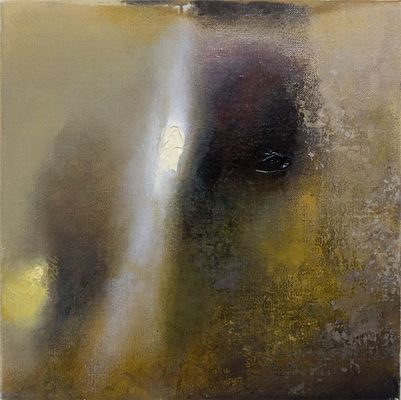
To return to Buckley’s fragment, the first two lines very much evoke how I paint nowadays. As you age, detail diminishes and patches of light become more luminous and float. I feel the most honest way of dealing with this is by smearing the oil paint on the canvas with the fingers and working close-up, blind. Only if the patches coalesce into an approaching image can the work gain a life.
-
Jonathan Walker was born in Melbourne, Australia and brought up on a dairy farm in Gippsland. In the 1970’s he studied painting at RMIT and won the Harold Wright Scholarship to the British Museum, London. During the 1980’s he exhibited at Pinacotheca Gallery, Richmond and had work shown at the NGV and Heidi City Art Gallery. Over the same period he designed the cover for the “Epigenesi” LP by Giancarlo Toniutti, Italy and conducted a mail exchange work with Achim Wollscheid, Germany. The work with artists through the post resulted in an article published in the bicentenary issue of Art and Australia 1988. He showed in artist run spaces such as WestSpace in the 90’s and 2000’s, and until 2012, taught painting at Victoria University, which is where we (Colleen Ahern and Lisa Radford) as organisers of the exhibition, among many others, had the privilege of being his student.
Walker’s knowledge was imparted to students through the careful selection of music, literature, and artists found in books that he himself had ordered for the library. Walker’s strategy was the generosity of sharing his vast knowledge with references specific to each student and their context.
Walker’s paintings share a similar focus and intimacy.
This exhibition presents a small selection of recent paintings alongside a publication that includes Walker’s writing. Observational and analytical, Walker’s work is a type of material notation — the time of day, colour and how it is blended, the both specific and fleeting location of a reflection on lino or the question of whether a chair leg should be included in a painting.
Please join us on Friday August 21 between 6-8pm to celebrate the opening of the exhibition.
Curated by Colleen Ahern and Lisa Radford.
B. Wurtz
Curated by Nic Tammens
March 26 - April 4, 2015
B.Wurtz works from a basement studio in his home on Manhattan’s Lower East Side.
This local fact is attested to by the plastic shopping bags and newsprint circulars that appear in his work. As formal objects, they don’t make loud claims about their origins but nonetheless transmit street addresses and places of business from the bottom of this long thin island. Like plenty of artists, Wurtz is affected by what is local and what is consumed. His work is underpinned by this ethic. It often speaks from a neighborhood or reads like the contents of a hamper:
“BLACK PLUMS $1.29 lb.”
“Food Bazaar”
“USDA Whole Pork Shoulder Picnic 99c lb.”
“RITE AID Pharmacy, with us it’s personal.”
“H. Brickman & Sons.”
“Sweet Yams 59c lb."
Most of the work in this exhibition was made while the artist was in residence at Dieu Donne, a workshop dedicated to paper craft in Midtown. Here Wurtz fabricated assemblages with paper and objects that are relatively lightweight, with the intention that they would be easily transportable to Australia. This consideration isn’t absolute in Wurtz’s work, but was prescriptive for making the current exhibition light and cheap. Packed in two boxes, these works were sent from a USPS post office on the Lower East Side and delivered to North Melbourne by Australia Post.
Wurtz appears courtesy of Metro Pictures, New York.
Thanks to Rob Halverson, Joshua Petherick, Sari de Mallory, Matt Hinkley, Helen Johnson, Fayen d'Evie, Ask Kilmartin, Lisa Radon, Ellena Savage, Yale Union, and "Elizabeth".
John Nixon
"Archive"
December 15 - January 20, 2014
The presentation of John Nixon's archive offered a rare showcase of this extensive collection of the artist's own publications, catalogues, posters, ephemera, editions and more, from the mid 1980s onwards, alongside a selection of his artworks.
Organized by John Nixon, Joshua Petherick and Matt Hinkley.
<a href=http://wfb.public-office.info/artist/john-nixon>All titles by John Nixon
"Habitat"
at Minerva, Sydney (organised by Joshua Petherick and Matt Hinkley)
November 15 - December 20, 2014
Lupo Borgonovo, Janet Burchill & Jennifer McCamley,
Lewis Fidock, HR Giger, Piero Gilardi, Veit Laurent Kurz,
Cinzia Ruggeri, Michael E. Smith, Lucie Stahl, Daniel Weil, Wols
Press Release:
“...It contained seven objects. The slender fluted bone, surely formed for flight, surely from the wing of some large bird. Three archaic circuitboards, faced with mazes of gold. A smooth white sphere of baked clay. An age-blackened fragment of lace. A fingerlength segment of what she assumed was bone from a human wrist, grayish white, inset smoothly with the silicon shaft of a small instrument that must once have ridden flush with the surface of the skin - but the thing’s face was seared and blackened.”
William Gibson, “Count Zero”, 1986
"Autumn Projects Archive"
Curated by Liza Vasiliou
March 6 - March 15, 2014
World Food Books, in conjunction with the Virgin Australia Melbourne Fashion Festival 2014, presented the Autumn Projects archive, consisting of a selection of early examples in Australian fashion with a particular interest in collecting designers and labels from the period beginning in the 1980’s, who significantly influenced the discourse of Australian Fashion.
Curated by Liza Vasiliou, the exhibition provided a unique opportunity to view pieces by designers Anthea Crawford, Barbara Vandenberg, Geoff Liddell and labels CR Australia, Covers, Jag along with early experimental collage pieces by Prue Acton and Sally Browne’s ‘Fragments’ collection, suspended throughout the functioning World Food Books shop in Melbourne.
H.B. Peace
presented by CENTRE FOR STYLE
November 14, 2013
"Hey Blinky, you say chic, I say same"
Anon 2013
H.B. Peace is a clothing collaboration between great friends Blake Barns and Hugh Egan Westland. Their pieces explore the divergences between 'character’ and ‘personality’ in garments....etc
Special Thanks to Joshua Petherick and Matt Hinkley of WFB and Gillian Mears
and a Very Special Thank you to Audrey Thomas Hayes for her shoe collaboration.
Janet Burchill & Jennifer McCamley
"Aesthetic Suicide"
May 10 - June 8, 2013
The first of our occasional exhibitions in the World Food Books office/shop space in Melbourne, "Aesthetic Suicide" presented a body of new and older works together by artists Janet Burchill & Jennifer McCamley, including videos, prints, a wall work, and publications.
During shop open hours videos played every hour, on the hour.
1974, English
Softcover (w. dust jacket), 88 pages, 19 x 24 cm
1st Edition, Out of print title / used / very good
Published by
New York University Press / New York
The Press of the Nova Scotia College of Art and Design / Halifax
$150.00 - Out of stock
Rare first edition copy of the highly influential Steve Reich book of texts,"Writings About Music", first published in 1974 by The Press of the Nova Scotia College of Art and Design.
In the mid-1960s, American composer Steve Reich radically renewed the musical landscape, along with La Monte Young, Terry Riley, and Philip Glass, to pioneer what became minimal music. These early Reich works, characterised by a relentless pulse and static harmony, focused single-mindedly on the process of gradual rhythmic change. Throughout his career, Reich has continued to reinvigorate the music world, drawing from a wide array of classical, popular, sacred, and non-western idioms. His works reflect the steady evolution of an original musical mind.
In 1974 Reich published the book Writings About Music, containing essays on his philosophy, aesthetics, and musical projects written between 1963 and 1974. The book features, amongst many other texts and studies, Reich's 1968 essay "Music as a Gradual Process," widely considered one of the most influential pieces of music theory in the second half of the 20th century.
Very Good copy in original dust jacket. Light wear and tanning.
1995, Japanese
Softcover, 66 pages, 18 x 13 cm
1st Edition, Out of print title / used / fine
Published by
Dela Corporation Inc. / Tokyo
$50.00 - Out of stock
Very scarce Japanese photo book for the film "Je t'aime moi non plus", a feature film written, directed, and musically scored in 1976 by Serge Gainsbourg, starring Jane Birkin, Hugues Quester and Joe Dallesandro, and featuring a cameo by Gérard Depardieu. Published in 1995 to accompany a small travelling Japanese exhibition of photographs from the film, this booklet reproduces many iconic images from the film in black and white and colour, alongside cast biographies, filmography, chronology, behind the scenes photographs, and much more.
Fine, almost As New copy, only some tanning to gloss edges.
2008, English
Softcover (bound with cloth tape), 120 pages, 21 x 29.7 cm
Published by
Self-Published
$200.00 - Out of stock
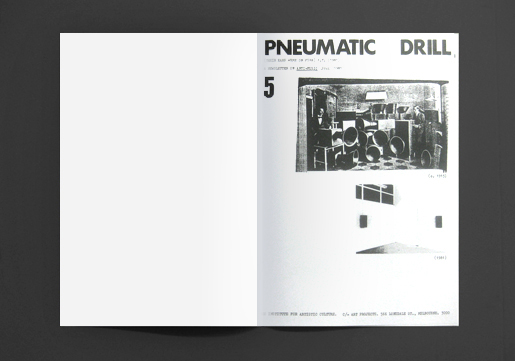
Pneumatic Drill was a one page magazine issued on an occasional basis from April 1981 - October 1983. Founded, edited and published by John Nixon.
This re-issue collection self-published by John Nixon in a limited edition in 2008 combines every issue of Pneumatic Drill into bound book format.
Out-of-print.
1975, English
Hardcover (w. dust jacket), 144 pages, 25.5 x 19.5 cm
1st Edition, Out of print title / used / very good
Published by
Faber & Faber / London
$100.00 - Out of stock
First hardcover edition of The Music Of Stockhausen by Jonathan Harvey (1939–2012). This crucial and comprehensive book from 1975 looks at and decrypts the early work of German composer Karlheinz Stockhausen (1928–2007). "This important and innovatory study of Stockhausen's music makes available for the first time systematic analyses of his works. Dr Jonathan Harvey comprehensively surveys the periods into which Stockhausen's music falls, from the early post-Webern works and group-form works, of which 'Gruppen' is a famous and brilliant example, to the subsequent moment-form works and the later period, which includes text-works (like 'Aus den sieben Tagen') and works like 'Hymnen', in which the composer would seem to be communicating on a quasi-mystical level. This is an indispensable book for the serious student of twentieth-century music and for anyone else with a lively interest in the new forms and sonorities of the preset day, their technology and the creative doctrines which gave birth to them." - from the dust jacket.
Includes a full list of compositions up to 1974, an appendix on Mantra (1970), a bibliography and full discography. The most comprehensive of published works on Stockhausen.
Very Good copy with good dj, some edge-wear and tanning.
2020, English
Softcover, 206 pages, 12 x 19 cm
Published by
Uh Books / Amsterdam
KW Institute for Contemporary Art / Berlin
$24.00 - Out of stock
The nineteenth issue of ‘F.R.DAVID’ is edited by Will Holder and Paula Abbott, and will serve as a reader for “We can still see the horizon (and it’s curved)”, a summer residency in Scotland led by the editors. It includes a surprising array of contributions from writer Jorge Luis Borges, journalist and writer Italo Calvino, composer Hugo Cole, literary critic and theorist Barbara Herrnstein Smith, percussionist Milford Graves, philosopher Michel Serres, novelist and essayist Wilson Harris, poet Bernadette Mayer, composer and music theorist Harry Partch, pianist and poet Cecil Taylor, and several others.
1996, English
Softcover, 400 pages, 2.8 x 2.8 cm
1st Edition, Out of print title / used / very good
Published by
Lars Müller / Zürich
$290.00 - Out of stock
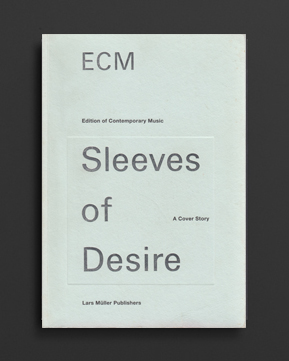
First and only 1996 printing of the stunning and very collectible book on the important design history of the incredible ECM record label, "ECM : Sleeves of Desire".
The ECM recording label's contribution to the fields of jazz and contemporary classical music is unparalleled, and its success story has been visually enhanced by the striking covers designed under Manfred Eicher's art direction by Barbara Wojirsch and Dieter Rehm.
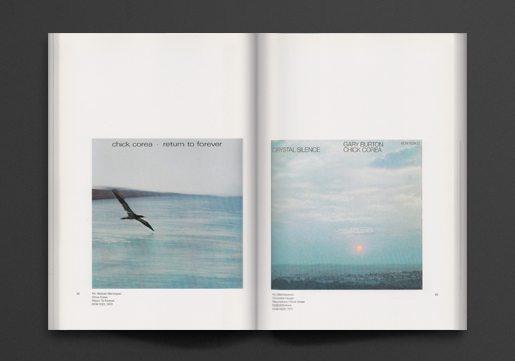
A delight for music and design fans alike, the book presents chronologically ordered color reproductions of over 500 covers from the innovative ECM label. Sleeves of Desire also contains a comprehensive picture essay that provides a detailed look at over 100 album covers. Additionally, renowned jazz essayist Peter Ruedi relates the history of the ECM label and designer Lars Muller comments on the evolution of the covers and on ECM's unmistakable aesthetic signature.
Features the cover art of releases by Jan Garbarek, Don Cherry, Nana Vasconcelos, Eberhard Weber, Gary Burton, Meredith Monk, Chick Corea, Wolfgang Dauner, Carla Bley, Keith Jarrett, Paul Bley, Pat Metheny, John McLaughlin, Evan Parker, Annette Peacock, Gary Peacock, Terje Rypdal, Ralph Towner, and so many more.
Very Good, clean copy throughout. A must.
2019, English
Softcover, 128 pages, 20 x 15 cm
Published by
Dark Entries Editions / San Fransisco
$53.00 - Out of stock
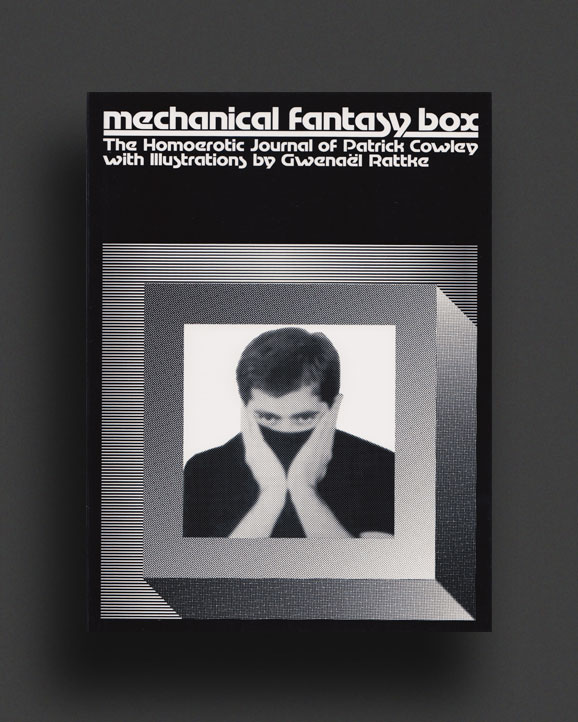
Patrick Cowley (1950–82) was one of the most revolutionary and influential figures in electronic dance music. Born in Buffalo, Cowley moved to San Francisco in 1971 to study music at the City College of San Francisco. By the mid '70s, his synthesizer techniques landed him a job composing and producing songs for disco diva Sylvester, including hits such as "You Make Me Feel (Mighty Real)." Cowley created his own brand of peak-time party music known as Hi-NRG, dubbed "the San Francisco Sound." His life was cut short on November 12, 1982, when he died shortly after his 32nd birthday from AIDS-related illness. Mechanical Fantasy Box is Cowley's homoerotic journal, or, as he called it, "graphic accounts of one man's sex life." The journal begins in 1974 and ends in 1980 on his 30th birthday. It chronicles his slow rise to fame from lighting technician at the City Disco to crafting his ground-breaking 16-minute remix of Donna Summer's "I Feel Love" to performing with Sylvester at the SF Opera House. Vivid descriptions are told of cruising in '70s SoMA sex venues, ecstatic highs in Buena Vista Park and composing "pornophonics" in his Castro apartment. For this book, artist Gwenaël Rattke created 25 original illustrations inspired by selected entries, three street maps documenting locations mentioned herein, and four collages of photos, ephemera and notes that Cowley had inserted in the journal. This book shows a very out-front, alive person going through the throes of gay liberation post-Stonewall.
2019, English
Softcover, 84 pages, 16.5 x 23.4 cm
Published by
Goldsmiths Press / London
$28.00 - Out of stock
Y'HUP presents items from the Ivor Cutler archive to accompany the exhibition Ivor Cutler: Good morning! How are you? Shut up! The Goldsmiths Centre for Contemporary Art exhibition pulls from the Cutler archive to present original musical scores, lyrics, sketches, artworks, letters, press cuttings, and posters, gathered to celebrate Cutler’s life and work, many of which have never been previously exhibited or published. Features an essay by Dan Fox, co-editor of frieze magazine and author of Pretentiousness: Why it Matters and Limbo, both published by Fitzcarraldo Editions, plus texts by Sarah McCrory and Robert Wyatt. Edited by Natasha Hoare.
Scottish poet, songwriter and humorist Ivor Cutler (1923–2006) was a singular force in popular culture. His oeuvre encompassed absurd songs and poems, surreal performances, and illustrated publications. These abstract the banal and everyday with warmth, occasional darkness, and quiet radicalism. Self-styled as an "Oblique Musical Philosopher", Cutler saw himself as having "….the effect of a very mild earthquake, one that nudges people into having a look around themselves, through all the rubbish that passes for convention". His whimsical performances gained him a cult following across generations, not least as part of 60s and 70s counterculture. Broadcasts on the Home Service in the 1950s lead to albums, later with Virgin Records and Rough Trade. TV appearances on the BBC caught Paul McCartney’s attention. Cutler appeared in the Beatles’ film Magical Mystery Tour (1967) and George Martin produced his album ‘Ludo’ (1967). Robert Wyatt of Soft Machine invited him to play on two of his tracks on the album Rock Bottom (1974). New generations were introduced to his work in the 1980s on TV for the Old Grey Whistle Test, and on radio for John Peel and later Andy Kershaw. Cutler also wrote many books for children and adults, and his wish to open adults up to their childish self (as counter to intellect and convention) was bolstered by his work as a teacher, at A. S. Neill’s Summerhill School and for inner-city schools in London for 30 years.
2020, English
Softcover, 112 pages, 15.2 x 21.6 cm
Published by
Afterall / London
$44.00 - Out of stock
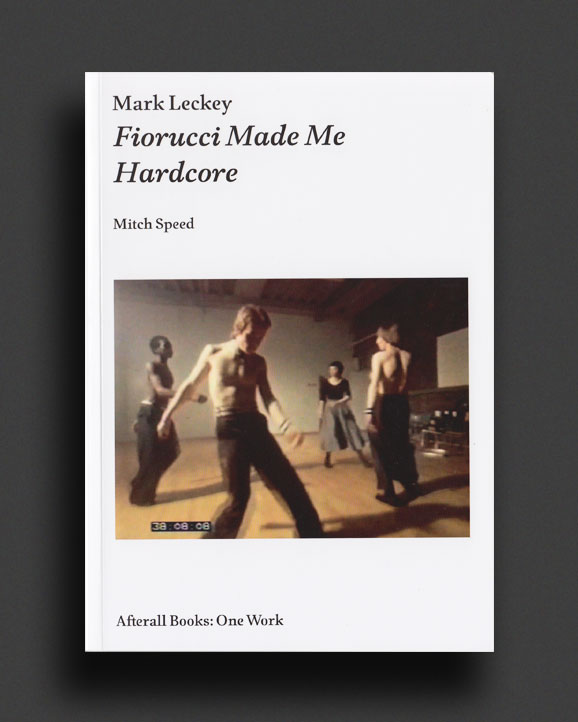
In 1999, the British artist Mark Leckey released his video-montage Fiorucci made me Hardcore, a dreamscape vignette that communes with the rapturous promises of youth. Putting archive material to use, Leckey entwined footage of underground dance and street culture in Britain with audio grifted and recorded in the artist's studio. In this illustrated study, the first comprehensive examination of the work, Mitch Speed argues that by interweaving personal and collective memory, this work gives voice to the complexities of class and cultural transformation during Britain's Thatcherite era. Oscillating between local and expansive resonances, Fiorucci made me Hardcore takes form as a homage, love letter, and work of criticism that eschews analysis, instead incanting the deeper implications of its subject.
2018, English
Softcover, 96 pages, 17 x 22 cm
Published by
Roma / Amsterdam
$40.00 - Out of stock
Looking at the play between memory and forgetfulness, 'Mike Kelley: Fortress of Solitude' brings together a range of key works from across the artist’s career. Whether using found stuffed animals as emotional effigies of long lost traumatic memories, or evoking the psychic existential homelessness of Superman in the form of his Kandor series, Mike Kelley explores the dark underbelly of post-war American culture. This publication accompanies the exhibition that took place at the Museum of Cycladic Art in Athens, Greece.
2019, English
Hardcover, 144 pages, 23 x 33 cm
Published by
Fulgur Press / UK
$115.00 - In stock -
Between 1968 and 1971, in a loft on New York's Jefferson Street, the poet, photographer and filmmaker Ira Cohen created some of the most mythic images of the late 1960s. Inspired by his friends Jack Smith and Bill Devore, Cohen’s initial experiments with black light developed into an experimental ritual space he termed the Mylar Chamber—a simple room of hinged boards hung with reflective Mylar film. Through his extended network, and with the support of artist and set designer Robert LaVigne, Cohen invited visitors to play another self within this small theater, among them Jimi Hendrix, William Burroughs, Vali Myers, Jack Smith, Angus MacLise, Alejandro Jodorowsky, Lionel Ziprin, Ching Ho Cheng, Petra Vogt, Charles Ludlam, John McLaughlin and the rock group Spirit.
In December 1969, in a summary of the past decade, Life magazine declared that “few came as close to explaining the euphoric distortions of hallucinogenics” as Cohen through his Mylar Chamber photographs, but the full story draws upon much deeper ideas surrounding identity and the power of the image.
This is the first book to explore Cohen’s iconic Mylar Chamber photographs. Published on the 50th anniversary of the Life magazine feature, and with several gatefolds, it includes more than 70 images from this intensely creative period, each digitally restored from the original negatives by Cohen’s friend and collaborator, Ira Landgarten. It also includes an interview with Cohen, excerpts from his poetry, critical writing from Allan Graubard and Ian MacFadyen and further reflections from Timothy Baum, Alice Farley and Thurston Moore.
Ira Cohen was born in the Bronx in 1935. A countercultural renaissance man, Cohen made films, photographs and poetry, edited the magazine Gnaoua and authored The Hashish Cookbook. Cohen became well known for his 1968 movie using the Mylar technique, The Invasion of Thunderbolt Pagoda, soundtracked by Angus MacLise, the original drummer of the Velvet Underground. In 2008 Nina Zivancevic, writing in NY Arts magazine, described Cohen’s life as “a sort of white magic produced by an alchemist who turned his back on the establishment in order to find God, art and poetry.” He died in 2011.
“Looking at your pictures is like looking through butterfly wings.” – Jimi Hendrix
2019, English
Softcover, 224 pages, 16.5 x 23.4 cm
Published by
City Gallery / Wellington
Melbourne University Law School / Melbourne
Liquid Architecture / Melbourne
$30.00 - Out of stock
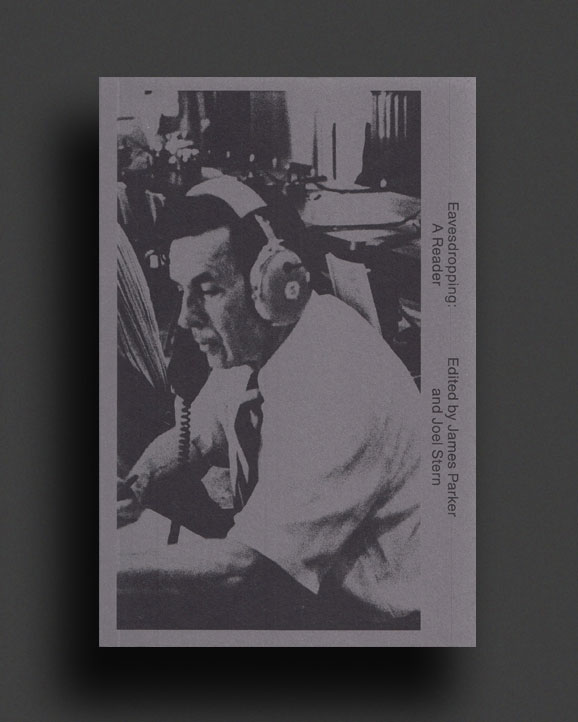
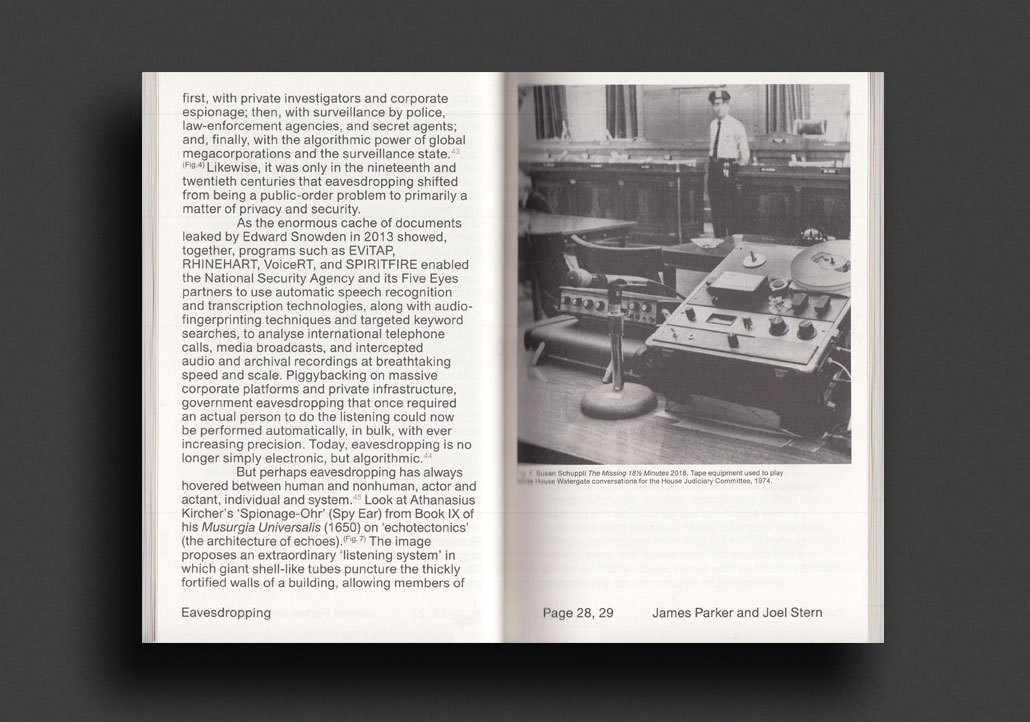
The earliest references to eavesdropping are found in law books. According to William Blackstone's Commentaries on the Laws of England (1769), 'eavesdroppers, or such as listen under walls or windows, or the eaves of a house, to hearken after discourse, and thereupon to frame slanderous and mischievous tales, are a common nuisance and presentable at the court-leet'. Today, however, eavesdropping is not only legal, it's ubiquitous – unavoidable. What was once a minor public-order offence has become one of the key political and legal problems of our time, as the Snowden revelations made clear.
Eavesdropping addresses the capture and control of our sonic world by state and corporate interests, alongside strategies of resistance. For editors James Parker (Melbourne Law School) and Joel Stern (Liquid Architecture), eavesdropping isn't necessarily malicious. We cannot help but hear too much, more than we mean to. Eavesdropping is a condition of social life. And the question is not whether to eavesdrop, therefore, but how.
Featuring contributions from Norie Neumark, Lawrence Abu Hamdan, Susan Schuppli, Sean Dockray, Joel Spring, Fayen d'Evie and Jen Bervin, Samson Young, Manus Recording Project Collective.
2019, English
Softcover, 219 pages, 21.3 x 28.2 cm
Published by
Walther König / Köln
Staatliche Kunsthalle / Baden Baden
$62.00 - Out of stock
Swedish artist Nina Canell (*1979 in Växjö, Sweden) explores in her artistic work the mostly hidden processes that define our life today. Her practice does not revolve around the finished artwork but rather the transitional, surprising and inexhaustible processes of the matter it contains.
Nina Canell has employed a whole range of different materials – from the synthetic to the organic – in order to produce a distinctive sculptural language. Objects and energy correlate in a syntax of relations which breaks down visual hierarchies and densifies our world with process and agency. For Canell, there is no mediation that is lossless – an output is never the pure transmission of a source – but always as much the distance it has travelled and the things it has come in contact with.
"Muscle Memory", among other works created especially for Baden-Baden, shows the new work "Otic Pit": a cochlea cast from basalt, whose vibrational mechanical properties contribute to the dissolution of different pitches as part of the inner ear of mammals.
Catalogue published on the occasion of Nina Canell "Muscle Memory", curated by Hendrik Bündge.
2019, English
Softcover, 188 pages, 15 cm x 24 cm
Published by
The Song Cave / New York
Merce Cunningham Trust / New York
$35.00 - Out of stock
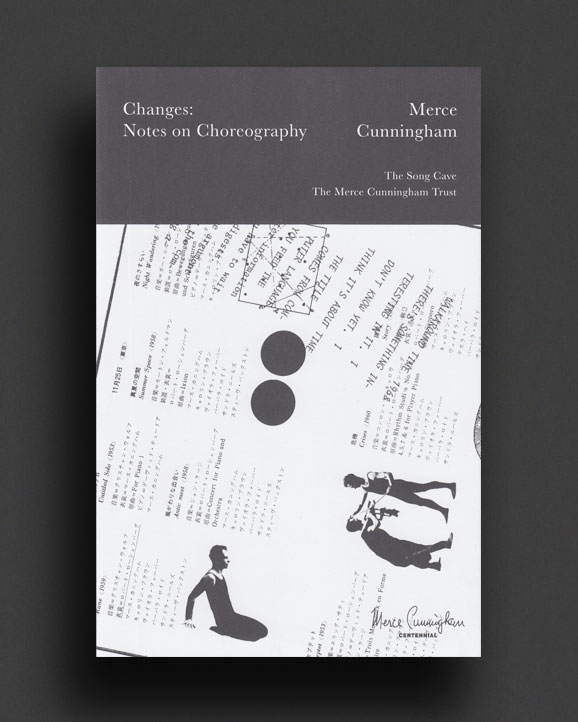
On the occasion of Merce Cunningham’s centennial comes this new edition of his classic and long-out-of-print artist’s book Changes: Notes on Choreography, first published in 1968 by Dick Higgins’s Something Else Press.
The book presents a revealing exposition of Cunningham’s compositional process by way of his working notebooks, containing in-progress notations of individual dances with extensive speculations about the choreographic and artistic problems he was facing. Illustrated with over 170 photographs and printed in colour and black and white, the book was described by its original publisher as “the most comprehensive book on choreography to emerge from the new dance … [which] will come to stand with Eisenstein’s and Stanislavsky’s classics on the artistic process".
By the time these notebooks were published, Cunningham had already led the Merce Cunningham Dance Company for 15 years, and had collaborated with Cage and others on milestones such as Variations V (1966) and RainForest (1968), the latter with Andy Warhol, David Tudor and Jasper Johns.
Along with his essay collection Dancing in Space and Time (1978), Changes is one of the most significant publications on Cunningham’s enduring contributions to dance, which developed through collaboration with John Cage to incorporate formal innovation with regard to chance, silence and stillness.
Book design by Dick Higgins.
1974, English
Hardcover (linen bound), 88 pages, 19 x 24 cm
1st Edition, Out of print title / used / good
Published by
New York University Press / New York
The Press of the Nova Scotia College of Art and Design / Halifax
$100.00 - Out of stock
Rare first hardcopy edition copy of the highly influential Steve Reich book of texts,"Writings About Music", first published in 1974 by The Press of the Nova Scotia College of Art and Design.
In the mid-1960s, American composer Steve Reich radically renewed the musical landscape, along with La Monte Young, Terry Riley, and Philip Glass, to pioneer what became minimal music. These early Reich works, characterised by a relentless pulse and static harmony, focused single-mindedly on the process of gradual rhythmic change. Throughout his career, Reich has continued to reinvigorate the music world, drawing from a wide array of classical, popular, sacred, and non-western idioms. His works reflect the steady evolution of an original musical mind.
In 1974 Reich published the book Writings About Music, containing essays on his philosophy, aesthetics, and musical projects written between 1963 and 1974. The book features, amongst many other texts and studies, Reich's 1968 essay "Music as a Gradual Process," widely considered one of the most influential pieces of music theory in the second half of the 20th century.
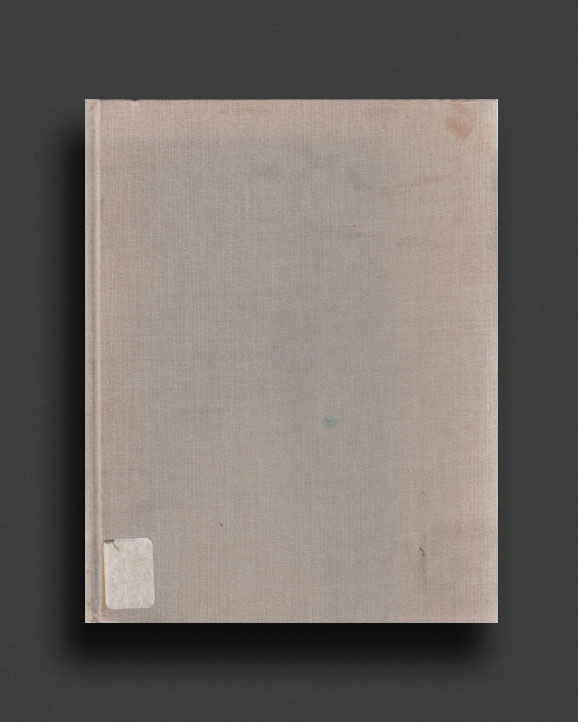
Good copy lacking dust jacket, with ex-library stamps/markings to cloth cover. Light wear, otherwise Very Good interior well-preserved.
2019, English
Softcover, 176 pages, 21.5 x 27 cm
Published by
Prestel / Munich
$65.00 - Out of stock
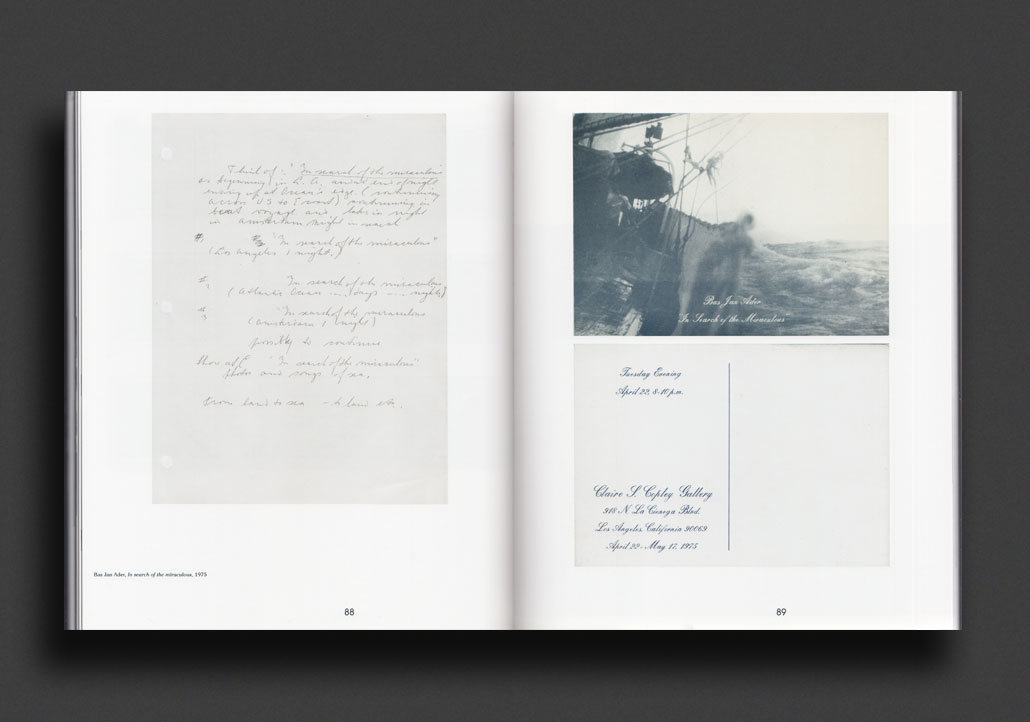
In 1971, Chris Burden disappeared for three days without a trace. This book, also entitled Disappearing, examines the theme of disappearance in the works of Burden and his contemporaries, Bas Jan Ader and Jack Goldstein, in 1970s Southern California. Loosely affiliated, these three artists shared an interest in themes of disappearance and self-effacement. In 1972, Goldstein buried himself alive during a performance, while during Ader's tragic last work, In search of the miraculous (1975), the artist vanished crossing the Atlantic. Responding to cultural pressures like the Vietnam War and the nascent field of feminist art, the artists used "disappearing" as a response to the masculine anxiety of the 1970s. This book reveals a fascinating intersection between major figures at a critical turning point for Californian art.
2017, English
Softcover, 72 pages, 9.6 x 14.8 cm
Published by
Sternberg Press / Berlin
$20.00 $10.00 - Out of stock
SSS: How to imitate the sound of the shore using two hands and a carpet is, at first glance, exactly what it claims to be: an in-depth manual for staging a private (or public) performance, in which one uses both hands and a carpet to imitate the sounds of water making contact with land. Istanbul-based artist Cevdet Erek’s book includes diagrams and photographs, which illustrate possible methods for producing this effect, while also addressing theoretical and methodological issues related to the representation of nature.
SSS is the second book in the Kayfa ta series, a publishing initiative of Maha Maamoun and Ala Younis. Each book in the series is a monographic essay commissioned in the style of how-to manuals that situation themselves in the space between the technical and the reflective, the everyday and the speculative, the instructional and the intuitive, and the factual and the fictional.
Copublished with Kayfa ta
Design by Julie Peeters
2018, English
Softcover, 304 pages, 19.4 x 27.9 cm
Published by
Koenig Books / London
$75.00 - Out of stock
Edited with text by Cathleen Chaffee. Text by Rachel Adams, Vera Alemani, Constance DeJong, Diedrich Diederichsen, Anthony Elms, David Grubbs, Henriette Huldisch, Branden W. Joseph, Andrew Lampert, Christopher Müller, Annie Ochmanek, Tony Oursler, Tina Rivers Ryan, Jay Sanders, Paige Sarlin, Christopher Williams.
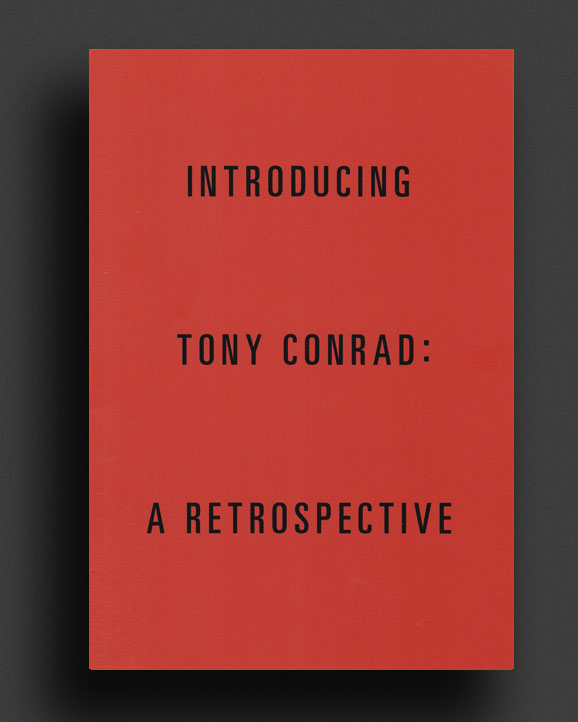
Tony Conrad (1940-2016) was a pioneering American avant-garde video artist, experimental filmmaker, musician, composer, sound artist, teacher, and writer.
Throughout his six-decade career he forged a unique path through numerous artistic movements and defined a vast range of culture, including rock music and public access television.
In music, Conrad was an early member of the Theatre of Eternal Music (The Dream Syndicate), which included John Cale and La Monte Young. In the early 1960s he was also influential in the origins of the iconic band, The Velvet Underground. In film, Conrad was associated with the Structuralist movement which included filmmakers such as Paul Sharits and Hollis Frampton.
This richly illustrated catalogue offers an in-depth introduction to Conrad’s life and career: presenting his early Structuralist films projects in which he treated film as a sculptural and performative material; his Invented Acoustical Tools which presented as sculptures themselves; the ambitious films about power relations, set in the military and in prison; and his final sculptures and installations, which evoke and critique what he perceived as an emerging culture of surveillance, control, and containment.
This book also includes Conrad’s own writings writings from 1966 to 2016, as well as texts by curators, theorists and notable artists such as Tony Oursler, Christopher Müller, and Christopher Williams.
Accompanying the exhibition, Introducing Tony Conrad: A Retrospective at Albright-Knox Art Gallery, Buffalo, New York (2018), MIT List Visual Arts Center and Carpenter Center for Visual Arts, Harvard University (2018/2019), and ICA, University of Pennsylvania (2019).
1971, English
Softcover, 210 pages, 23 x 25 cm
1st UK Edition, Out of print title / used / good
Published by
Mathews Miller Dunbar / London
$70.00 - Out of stock
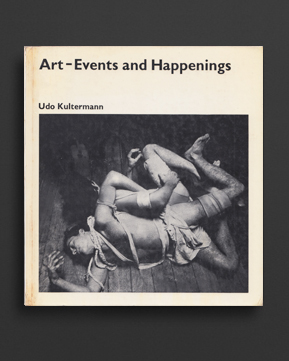
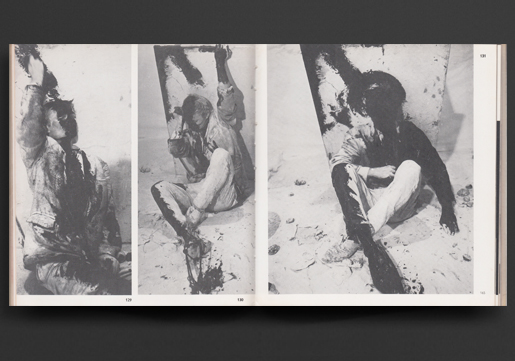
First English edition from 1971, Udo Kultermann's "Art-Events and Happenings", published by Mathews Miller Dunbar of London, translated by John William Gabriel. A deep reflection on an important part of Art's development throughout the 1960s - the turn to action through performance and conceptual art - surveying happenings, protests, theatre, ritual, land art and much more, and featuring a vast collection of black and white photographic illustrations of the work of Allan Kaprow, Ann Halprin, Yvonne Rainer, Merce Cunningham, Otto Mühl, Oyvind Fahlstrom, Piero Gilardi, Charlotte Moorman, Franz Erhard Walther, Joseph Beuys, Tetsumi Kudo, Lygia Clark, Carolee Schneemann, Stan Brakhage, John Cage, Hermann Nitsch, Günther Brus, Dennis Oppenheim, Jean-Jacques Lebel, Andy Warhol, Jan Dibbets, Carl Andre, Barry La Va, Rafael Ferrer, Marinus Boezum, Nam June Paik, Wolf Vostell, Milan Knizak, Jackson Pollock, Saburo Murakami, Atsuko Tanaka, Claes Oldenburg, Piero Manzoni, Peter Hutchinson, Christo, Robert Morris, and many more.
Very good copy (some tanning, previous owners name to first page)
1978, English
Softcover (staple-bound), 60 pages, 21.5 x 14 cm
1st Edition, Out of print title / used / good
Published by
Little Caesar Press / Los Angeles
$180.00 - Out of stock
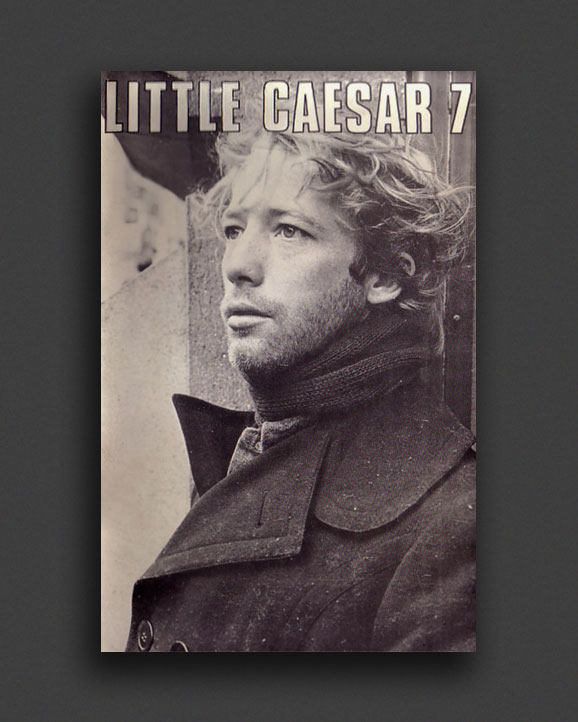
Little Caesar 7 - punk magazine October 1978, Dennis Cooper, editor. Gerard Malanga, photographer. Interviews, poetry, lyrics. Lou Reed, Nico, Andy Warhol, David Ignatow, Robert Bly and other subjects.
Ifyou have questions about condition, shipping or multiple item purchases, please contact us! We are eager to work with you! All items are on hand and individually photographed and described.
Very scarce issue 7 of Dennis Cooper's Little Caesar Magazine, published in 1978 and edited by Cooper with photography by Gerard Malanga. Features poetry, interviews, and lyrics by Nico, Lou Reed, Andy Warhol, David Ignatow, Gerard Malanga, Tom Meyer, Robert Bly and more.
American writer Dennis Cooper started Little Caesar Magazine in 1976 as a literary journal with an anarchist, punk rock spirit. From its humble beginnings as a skinny, low-tech zine dominated by poetry, it grew into a book sized magazine featuring poetry, fiction, portfolios of art and photography, essays, special theme issues, and interviews with a wide range of writers, artists, and pop culture figures (ranging from teen idol Leif Garrett to musicians like Johnny Rotten and Gram Parsons to porn director Toby Ross, to name but a few). In 1978, Cooper started Little Caesar Press, which wound up publishing 24 books of poetry and fiction by young and established contemporary authors (Joe Brainard, Amy Gerstler, Eileen Myles, Peter Schjeldahl, Elaine Equi, Ronald Koertge, Gerard Malanga, Tom Clark, et. al.), as well as the first and only English language translation of Arthur Rimbaud's final work, "Travels in Abyssinia".
By the time the magazine ceased production after twelve issues in 1982, its contributors included such people as Andy Warhol, Lou Reed, Nico, Debbie Harry, Brian Eno, and many others.
These days, issues of Little Caesar are highly sought after collector's items.
Good copy with tanning and light wear.
1983, English
Softcover (staple-bound), 40 pages, 27 x 33 cm
1st Edition, Out of print title / used / good
Published by
Tension / South Yarra
$35.00 - Out of stock
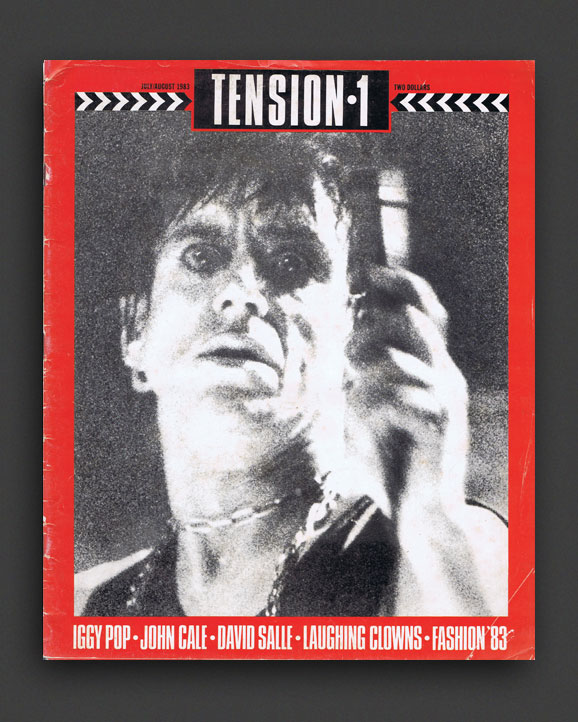
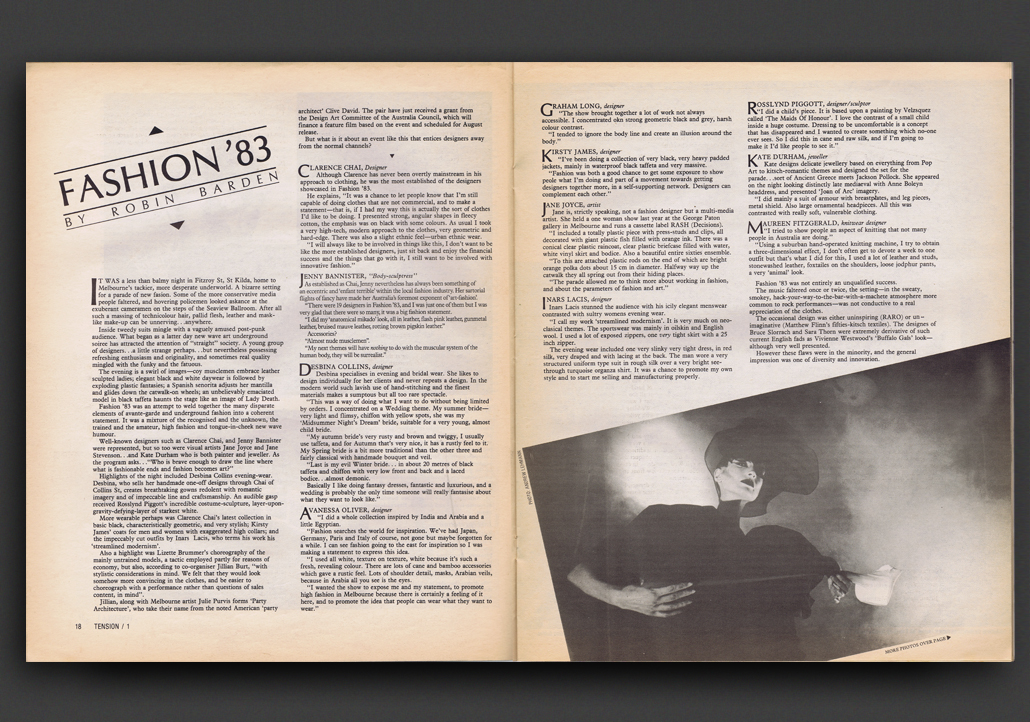
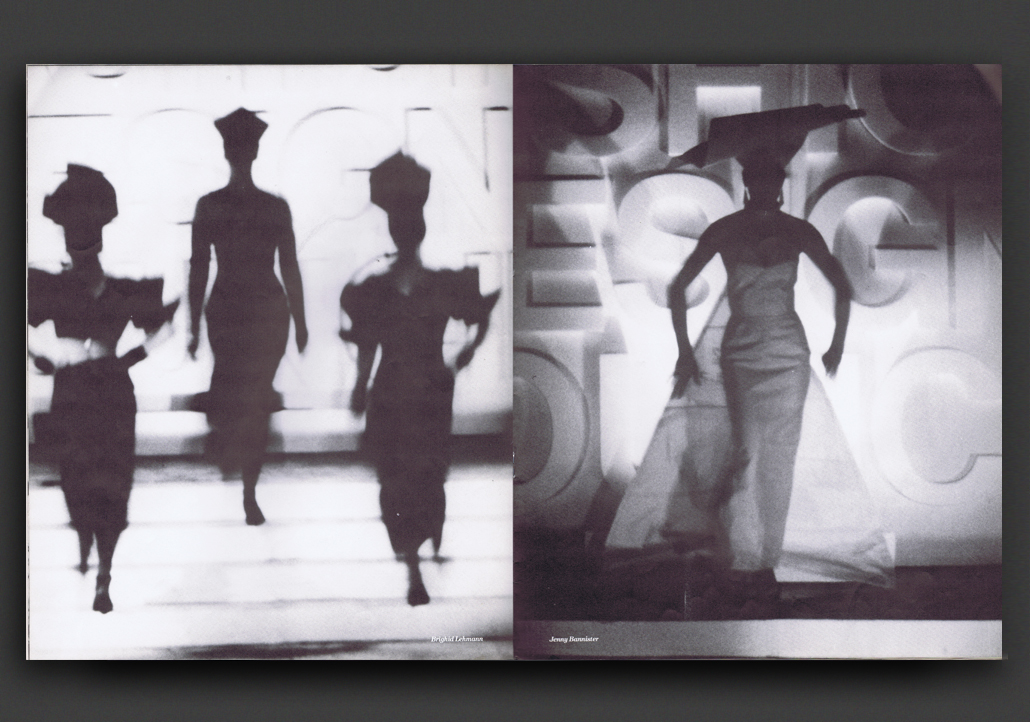
Tension 1 (July / August 1983) features Iggy Pop (by Richard Guilliat), David Salle (by John Walker), reviews of Tall Poppies and Perspecta '83, review of Sedition music festival, Laughing Clowns, John Cale (by Bruce Milne), "Fashion '83" spread and profiles on Australian fashion by Robin Barden, "Quarelle" by Adrian Martin and Paul Taylor, photospreads by Weegee (Arthur Fellig), Paul Taylor's article on "A Melbourne Mood" exhibition, record reviews, and much more.
TENSION (1983-1990) was one of the central "popular" culture arts periodicals to come out of Melbourne in the 1980s, emerging from the ashes of Virgin Press. Independently published and edited by critic Ashley Crawford, Tension magazine lasted for 25 bi-monthly issues dedicated to Art, Music, Fashion, Theatre, Film, Photography, across reviews, interviews, reports, critical essays and artist pages. Now an important document of culture in Australia, and especially Melbourne in the 1980s, issues featured the writing and contributions of Paul Taylor, McKenzie Wark, Mike Parr, John Nixon, Catharine Lumby, Philip Brophy, Adrian Martin, Ashley Crawford, Peter Tyndall, Jean Baudrillard, Timothy Leary, Gerard Malanga, Keith Haring, Gerald Murnane, and many more. In 1985 Crawford, with John Buckley, staged an exhibition issue of the magazine, 'Visual Tension', at ACCA featuring the work of Howard Arkley, Marianne Baillieu, Peter Booth, Paul Boston, Peter Cripps, Richard Dunn, Maria Kozic, John Lethbridge, Geoff Lowe, Linda Marrinon, John Matthews, John Nixon, Stieg Persson, Robert Rooney, Gareth Sansom, Vivienne Shark LeWitt, Imants Tillers, Peter Tyndall, Jenny Watson, John Young.
1985, English
Softcover (staple-bound), 44 pages, 27 x 33 cm
1st Edition, Out of print title / used / good
Published by
Tension / South Yarra
$35.00 - Out of stock
Tension 6 (Jan / Feb 1985) features "Gilded Lillies : Photographs of Fashion '84" - a spread of Australian fashion runways shot by Ashley Evans and Andrea Paton, John Lydon / Public Image, Lisa Lyon (interviewed by Faye Maxwell with illustrations by Katsu and photography by Robert Mapplethorpe), David Sylvian, Vivienne Shark Lewitt, poet Gerard Malanga, "On Location In Love" by Ted Colless, reviews of Videodrome and Metropolis by Adrian Martin, architectural drawings, and much more.
TENSION (1983-1990) was one of the central "popular" culture arts periodicals to come out of Melbourne in the 1980s, emerging from the ashes of Virgin Press. Independently published and edited by critic Ashley Crawford, Tension magazine lasted for 25 bi-monthly issues dedicated to Art, Music, Fashion, Theatre, Film, Photography, across reviews, interviews, reports, critical essays and artist pages. Now an important document of culture in Australia, and especially Melbourne in the 1980s, issues featured the writing and contributions of Paul Taylor, McKenzie Wark, Mike Parr, John Nixon, Catharine Lumby, Philip Brophy, Adrian Martin, Ashley Crawford, Peter Tyndall, Jean Baudrillard, Timothy Leary, Gerard Malanga, Keith Haring, Gerald Murnane, and many more. In 1985 Crawford, with John Buckley, staged an exhibition issue of the magazine, 'Visual Tension', at ACCA featuring the work of Howard Arkley, Marianne Baillieu, Peter Booth, Paul Boston, Peter Cripps, Richard Dunn, Maria Kozic, John Lethbridge, Geoff Lowe, Linda Marrinon, John Matthews, John Nixon, Stieg Persson, Robert Rooney, Gareth Sansom, Vivienne Shark LeWitt, Imants Tillers, Peter Tyndall, Jenny Watson, John Young.
1985, English
Softcover (staple-bound), 32 pages, 27 x 33 cm
1st Edition, Out of print title / used / good
Published by
Tension / South Yarra
$30.00 - Out of stock
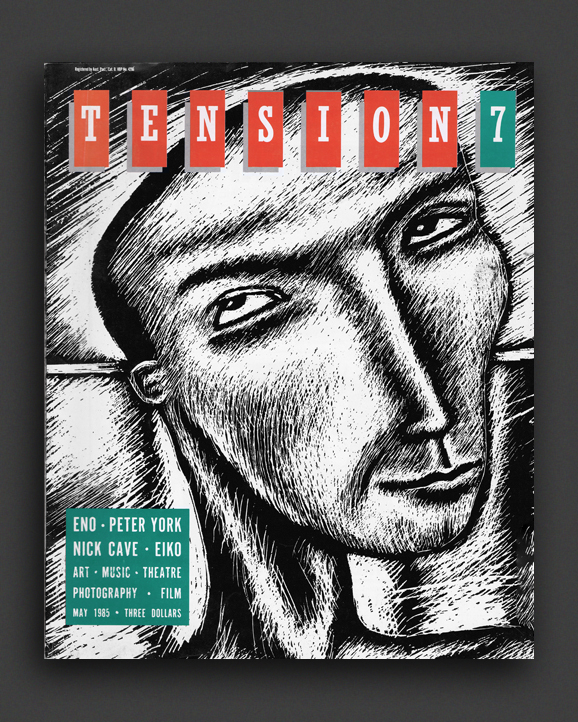
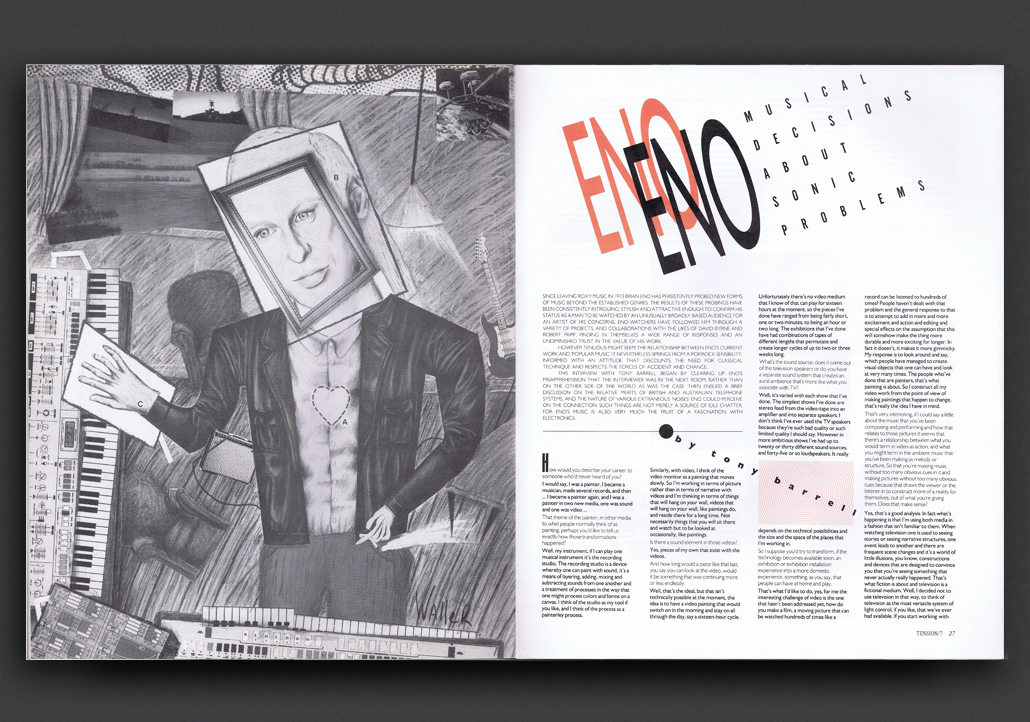
Tension 7 (May 1985) features Brian Eno, Reg Mombassa, Eiko Ishioka, Nick Cave, Brian De Palma, David Puttnam, Peter York, Bashir Baraki's portraits of Peter Booth and Robert Rooney, and more.
TENSION (1983-1990) was one of the central "popular" culture arts periodicals to come out of Melbourne in the 1980s, emerging from the ashes of Virgin Press. Independently published and edited by critic Ashley Crawford, Tension magazine lasted for 25 bi-monthly issues dedicated to Art, Music, Fashion, Theatre, Film, Photography, across reviews, interviews, reports, critical essays and artist pages. Now an important document of culture in Australia, and especially Melbourne in the 1980s, issues featured the writing and contributions of Paul Taylor, McKenzie Wark, Mike Parr, John Nixon, Catharine Lumby, Philip Brophy, Adrian Martin, Ashley Crawford, Peter Tyndall, Jean Baudrillard, Timothy Leary, Gerard Malanga, Keith Haring, Gerald Murnane, and many more. In 1985 Crawford, with John Buckley, staged an exhibition issue of the magazine, 'Visual Tension', at ACCA featuring the work of Howard Arkley, Marianne Baillieu, Peter Booth, Paul Boston, Peter Cripps, Richard Dunn, Maria Kozic, John Lethbridge, Geoff Lowe, Linda Marrinon, John Matthews, John Nixon, Stieg Persson, Robert Rooney, Gareth Sansom, Vivienne Shark LeWitt, Imants Tillers, Peter Tyndall, Jenny Watson, John Young.
1985, English
Softcover (staple-bound), 40 pages, 27 x 33 cm
1st Edition, Out of print title / used / good
Published by
Tension / South Yarra
$30.00 - Out of stock
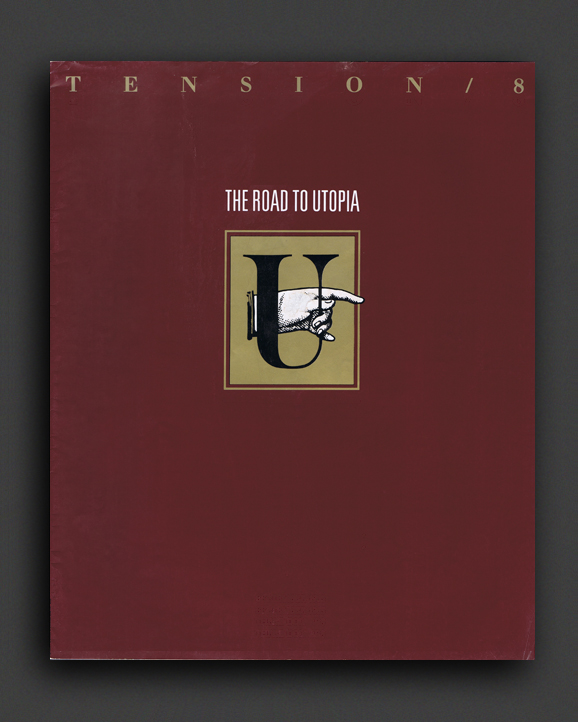
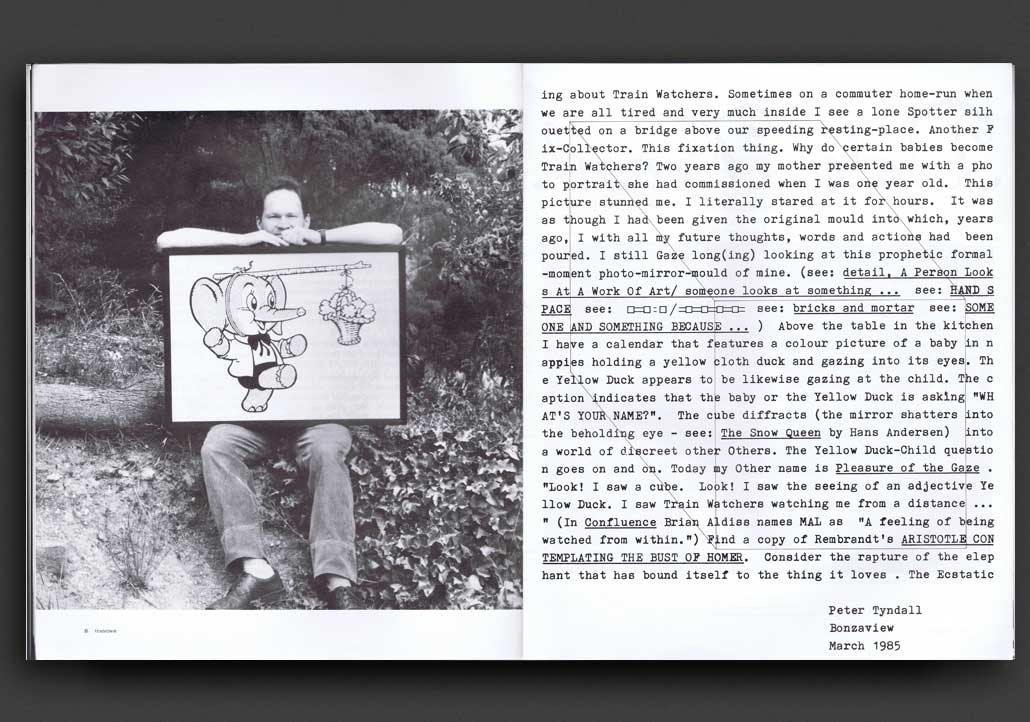
Tension 8 (The Road To Utopia : September 1985) features Scritti Politti (by McKenzie Wark), Gilbert & George (by Sue Cramer), artist contributions by Mike Parr and Peter Tyndall, Dale Frank (by Paul Groot), "Civilization and Its Discontents" by Paul Taylor, "The Road to Utopia" by Adrian Martin, with contributions by Philip Brophy, Ingrid Periz, and many more.
TENSION (1983-1990) was one of the central "popular" culture arts periodicals to come out of Melbourne in the 1980s, emerging from the ashes of Virgin Press. Independently published and edited by critic Ashley Crawford, Tension magazine lasted for 25 bi-monthly issues dedicated to Art, Music, Fashion, Theatre, Film, Photography, across reviews, interviews, reports, critical essays and artist pages. Now an important document of culture in Australia, and especially Melbourne in the 1980s, issues featured the writing and contributions of Paul Taylor, McKenzie Wark, Mike Parr, John Nixon, Catharine Lumby, Philip Brophy, Adrian Martin, Ashley Crawford, Peter Tyndall, Jean Baudrillard, Timothy Leary, Gerard Malanga, Keith Haring, Gerald Murnane, and many more. In 1985 Crawford, with John Buckley, staged an exhibition issue of the magazine, 'Visual Tension', at ACCA featuring the work of Howard Arkley, Marianne Baillieu, Peter Booth, Paul Boston, Peter Cripps, Richard Dunn, Maria Kozic, John Lethbridge, Geoff Lowe, Linda Marrinon, John Matthews, John Nixon, Stieg Persson, Robert Rooney, Gareth Sansom, Vivienne Shark LeWitt, Imants Tillers, Peter Tyndall, Jenny Watson, John Young.