World Food Books' programme is largely produced on Kulin Nation land. We acknowledge the Wurundjeri people of the Kulin Nation as the first and continuing custodians of this land, and pay respect to their Elders past, present, and emerging.
World Food Books is an arts and special interests bookshop in Naarm / Melbourne. Founded in 2010, World Food Books is devoted to the presentation of a rotating, hand-selection of international art, design, literary and counterculture publications with an emphasis on the anti-traditional, the experimental, the avant-garde, the heretic, the marginal.
Presenting new titles alongside rare and out-of-print books, catalogues and journals spanning the fields of modern and contemporary art, design, photography, illustration, film, literature, poetry, cultural theory, philosophy, sexuality, popular and underground culture in its many radical forms, World Food Books wishes to encourage adventurous, thoughtful and open-minded reading, looking, writing, and exchange of publishing and ideas, both current and historical.
As well as our bookshop, located in Melbourne's historical Nicholas Building, all of our inventory is available internationally via our online mail-order service.
World Food Books semi-regularly co-ordinates "Occasions", a programme of exhibits and events at the bookshop and in partnership with other hosts (such as museums and art galleries) that develop out of the activities, relationships and content of the bookshop itself.
World Food Books
The Nicholas Building
37 Swanston Street
Room 5, Level 6
Melbourne 3000
Australia
SHOP HOURS:
Thu–Fri 12–6, Sat 12–5
WEB-SHOP OPEN 24/7
World Food Books
Postal Address:
PO Box 435
Flinders Lane
Victoria 8009
Australia
Art
Theory / Essay
Architecture / Interior
Graphic Design / Typography
Photography
Fashion
Eros
LGBTQ+
Fiction / Poetry
Weird / Speculative / Science Fiction / Horror
Transgressive / Visceral / Abject
Symbolism / Decadence / Fin de siècle
Film / Video
Painting
Sculpture / Installation
Performance / Dance / Theater
Drawing
Sound / Music
Curatorial
Group Shows / Collections
Periodicals
Out-of-print / Rare
Posters / Ephemera / Discs
Signed Books
World Food Books Gift Voucher
World Food Book Bag
Australian Art
Australian Fiction
Australian Science Fiction / Speculative Fiction
Australian Poetry
Australian Photography
Japanese Photography
Conceptual Art
Minimal Art
Dada
'Pataphysics / Oulipo
Fluxus
Concrete Poetry
Pop Art
Surrealism
Arte Povera
Arte Informale / Haute Pâte / Tachism
Nouveau Réalisme / Zero / Kinetic
Situationism / Lettrism
Collage / Mail Art / Xerox Art
Art Brut / Folk / Visionary / Fantastic
Illustration / Graphic Art / Bandes Dessinées
Furniture
Italian Radical Design / Postmodernism
Textiles
Ceramics / Glass
Counterculture
Protest / Revolt
Philosophy
Psychoanalysis
Anthropology
Anarchism
Socialism / Anarchism / Communism / Capitalism
Literary Theory / Semiotics / Language
Feminism / Women's Studies
Gender Studies / Sexuality
Anthropology
Fetishism / BDSM
Drugs / Psychedelia
Crime / Violence
Animal Rights / Veganism
Occult / Esoterica
Ecology / Earth / Alternative Living
Whole Earth / Crafts
All prices in AUD (Australian dollars)
Pick-Ups
Pick-up orders can be collected in our bookshop during opening hours after order date. Please collect any Pick-up orders within 2 weeks of ordering as we have limited storage space. Orders will be released back into stock if not collected within this time. No refunds can be made for pick-ups left un-collected. If you cannot make it in to the bookshop in this time-frame, please choose postage option.
Return Policy
All sales are final. We do accept returns (for refund or exchange) for items received in error. All our orders are packed with special care using heavy-duty padding and cardboard book-mailers or bubble mailers (for smaller books), using reinforcement where required. We cannot take responsibility for any lost, stolen or damaged parcels.
Insurance
Should you wish to insure your package, please email us directly after placing your order and we can organise this at a small extra expense. Although all standard/express tracked packages are very safe and dependable, we cannot take responsibility for any lost, stolen or damaged parcels. We recommend insurance on valuable orders.
Interested in selling your old books, catalogues, journals, magazines, comics, fanzines, ephemera? We are always looking for interesting, unusual and out-of-print books to buy. We only buy books in our fields of interest and specialty, and that we feel we can resell.
We base these prices on desirability, market value, in-print prices, condition and our current stock levels. We offer cash, store credit, and can take stock on consignment. All
about 25% of the price we expect to get when we sell them, or 30% in store credit. We base these prices on desirability, market value, in-print prices, condition and our current stock levels.
Sell your books any day of the week. You can drop them off and return later. If you have a lot of books, we can visit your Sydney home.
We buy books that we feel we can resell. We offer about 25 % of the price we expect to get when we sell them, or 30% in store credit. We base these prices on desirability, market value, in-print prices, condition and our current stock levels.
Philadelphia Wireman
03 August - 01 September, 2018
World Food Books is proud to announce our next Occasion, the first presentation of sculptures by Philadelphia Wireman in Australia.
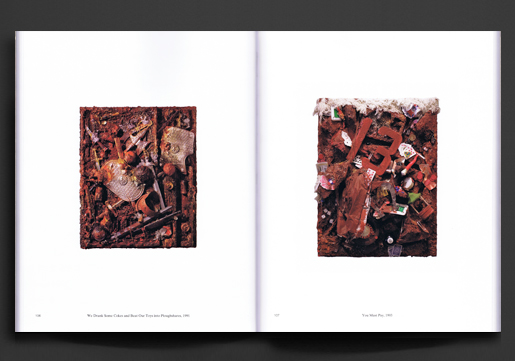
The Philadelphia Wireman sculptures were found abandoned in an alley off Philadelphia’s South Street on trash night in 1982. Their discovery in a rapidly-changing neighbourhood undergoing extensive renovation, compounded with the failure of all attempts to locate the artist, suggests that the works may have been discarded after the maker’s death. Dubbed the "Philadelphia Wireman" during the first exhibition of this work, in 1985, the maker’s name, age, ethnicity, and even gender remain uncertain. The entire collection totals approximately 1200 pieces, all intricately bound together with tightly-wound heavy-gauge wire (along with a few small, abstract marker drawings, reminiscent both of Mark Tobey and J.B. Murry). The dense construction of the work, despite a modest range of scale and materials, is singularly obsessive and disciplined in design: a wire armature or exoskeleton firmly binds a bricolage of found objects including plastic, glass, food packaging, umbrella parts, tape, rubber, batteries, pens, leather, reflectors, nuts and bolts, nails, foil, coins, toys, watches, eyeglasses, tools, and jewellery.
Heavy with associations—anthropomorphic, zoomorphic, and socio-cultural responses to wrapped detritus—the totemic sculptures by Philadelphia Wireman have been discussed in the context of work created to fulfil the shamanistic needs of alternative religions in American culture. Curators, collectors, and critics have variously compared certain pieces to sculpture from Classical antiquity, Native American medicine bundles, African-American memory jugs, and African fetish objects. Reflecting the artist’s prolific and incredibly focused scavenging impulse, and despite—or perhaps enhanced by—their anonymity, these enigmatic objects function as urban artefacts and arbiters of power, though their origin and purpose is unknown. Philadelphia Wireman, whatever their identity, possessed an astonishing ability to isolate and communicate the concepts of power and energy through the selection and transformation of ordinary materials. Over the course of the past two decades, this collection has come to be regarded as an important discovery in the field of self-taught art and vernacular art.
Presented in collaboration with Fleisher-Ollman Gallery, Philadelphia, and Robert Heald, Wellington.
Susan Te Kahurangi King
02 February - 10 March, 2018
Susan Te Kahurangi King (24 February 1951 - ) has been a confident and prolific artist since she was a young child, drawing with readily available materials - pencils, ballpoint pens and felt-tip markers, on whatever paper is at hand. Between the ages of four and six Susan slowly ceased verbal communication. Her grandparents William and Myrtle Murphy had developed a special bond with Susan so they took on caring responsibilities for extended periods. Myrtle began informally archiving her work, carefully collecting and storing the drawings and compiling scrapbooks. No drawing was insignificant; every scrap of paper was kept. The King family are now the custodians of a vast collection containing over 7000 individual works, from tiny scraps of paper through to 5 meter long rolls.
The scrapbooks and diaries reveal Myrtle to be a woman of great patience and compassion, seeking to understand a child who was not always behaving as expected. She encouraged Susan to be observant, to explore her environment and absorb all the sights and sounds. Myrtle would show Susan’s drawings to friends and people in her community that she had dealings with, such as shopkeepers and postal workers, but this was not simply a case of a grandmother’s bias. She recognised that Susan had developed a sophisticated and unique visual language and sincerely believed that her art deserved serious attention.
This was an unorthodox attitude for the time. To provide some context, Jean Dubuffet coined the term Art Brut in 1945 to describe work created by self-taught artists – specifically residents of psychiatric institutions and those he considered to be visionaries or eccentrics. In 1972 Roger Cardinal extended this concept by adopting the term Outsider Art to describe work made by non-academically trained artists operating outside of mainstream art networks through choice or circumstance. Susan was born in Te Aroha, New Zealand in 1951, far from the artistic hubs of Paris and London that Dubuffet and Cardinal operated in. That Myrtle fêted Susan as a self-taught artist who deserved to be taken seriously shows how progressive her attitudes were.
Susan’s parents Doug and Dawn were also progressive. Over the years they had consulted numerous health practitioners about Susan’s condition, as the medical establishment could not provide an explanation as to why she had lapsed into silence. Dawn educated herself in the field of homeopathy and went on to treat all twelve of her children using these principles – basing prescriptions on her observations of their physical, mental and emotional state.
Doug was a linguist with an interest in philosophy who devoted what little spare time he had to studying Maori language and culture. To some extent their willingness to explore the fringes of the mainstream made them outsiders too but it was their commitment to living with integrity and their respect for individuality that ensured Susan’s creativity was always encouraged.
Even though Susan’s family supported her artistic pursuits, some staff in schools and hospitals saw it as an impediment to her assimilation into the community and discouraged it in a variety of ways. Her family was not always aware of this and therefore did not fully understand why Susan stopped drawing in the early 1990s. However, rather than dwell on the challenges that Susan faced in pursuit of her artistic practice, they prefer to highlight her achievements. In 2008 Susan began drawing again in earnest, after an almost 20 year interruption, and her work is now shown in galleries around the world.
Susan grew up without television and has been heavily influenced by the comics she read as a child. She is absolutely fearless in the appropriation of recognizable characters, such as Donald Duck and Mickey Mouse, in her work. She twists their limbs, contorts their faces, compresses them together, blends them into complex patterned backgrounds - always imbuing them with an incredible energy. Although Susan often used pop culture characters in her work they are not naive or childlike. These are drawings by a brilliant self-taught artist who has been creating exceptional work for decades without an audience in mind.
Mladen Stilinović
"Various Works 1986 - 1999"
02 February 16 - September 10, 2016
Various works 1986 - 1999, from two houses, from the collections of John Nixon, Sue Cramer, Kerrie Poliness, Peter Haffenden and Phoebe Haffenden.
Including: Geometry of Cakes (various shelves), 1993; Poor People’s Law (black and white plate), 1993; White Absence (glasses, ruler, set square, silver spoon, silver ladel with skin photograph and wooden cubes), 1990-1996; Exploitation of the Dead (grey and red star painting, wooden painting, black spoon with red table, red plate), 1984-1990; Money and Zeros (zero tie, paintings made for friends in Australia (Sue, John, Kerrie), numbers painting), 1991-1992; Words - Slogans (various t-shirts) - “they talk about the death of art...help! someone is trying to kill me”, “my sweet little lamb”, “work is a disease - Karl Marx”; Various artist books, catalogues, monographs, videos; Poster from exhibition Insulting Anarchy; "Circular" Croatian - Australian edition; Artist book by Vlado Martek (Dostoyevsky); more.
Thanks to Mladen Stilinović and Branka Stipančić.
Jonathan Walker
Always Will Need To Wear Winter Shirt Blue + Ochre Small Check Pattern
21 August - 21 September, 2015
Untitled
I am not a great reader of poetry but I always return to the work of Melbourne poet, Vincent Buckley (1925- 1988). Perhaps I find his most tantalising piece to be not a finished poem but a fragment left on a scrap of paper discovered on his desk after the poet’s death.
The poetry gathers like oil
In the word-core, and spreads
It has its music meet,
Its music is in movement.
This fragment is more the shell left behind from a volatile thought than a finished poem. I find the last two lines honest but awkward whereas the first two lines work like an arrow. Most likely he could not find a resolution so it was left. Still, in its present form, it remains an eloquent testimony to the ultimate failure of a medium to express mobile thought and sensation, in Buckley’s case, through verbal language. It’s an important matter because this is something all artists have to deal with regardless of the medium.
I have never written a poem, however, I am forever copying fragments from books on paper scraps in a vain effort to fix certain notions in my head. At first, they function as bookmarks that are sometimes returned to when I open the book. But before long, as they accumulate, they fall out littering the table interspersed with A4 photocopies, bills, books and medications.
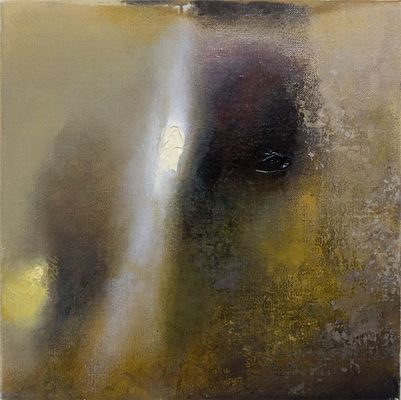
To return to Buckley’s fragment, the first two lines very much evoke how I paint nowadays. As you age, detail diminishes and patches of light become more luminous and float. I feel the most honest way of dealing with this is by smearing the oil paint on the canvas with the fingers and working close-up, blind. Only if the patches coalesce into an approaching image can the work gain a life.
-
Jonathan Walker was born in Melbourne, Australia and brought up on a dairy farm in Gippsland. In the 1970’s he studied painting at RMIT and won the Harold Wright Scholarship to the British Museum, London. During the 1980’s he exhibited at Pinacotheca Gallery, Richmond and had work shown at the NGV and Heidi City Art Gallery. Over the same period he designed the cover for the “Epigenesi” LP by Giancarlo Toniutti, Italy and conducted a mail exchange work with Achim Wollscheid, Germany. The work with artists through the post resulted in an article published in the bicentenary issue of Art and Australia 1988. He showed in artist run spaces such as WestSpace in the 90’s and 2000’s, and until 2012, taught painting at Victoria University, which is where we (Colleen Ahern and Lisa Radford) as organisers of the exhibition, among many others, had the privilege of being his student.
Walker’s knowledge was imparted to students through the careful selection of music, literature, and artists found in books that he himself had ordered for the library. Walker’s strategy was the generosity of sharing his vast knowledge with references specific to each student and their context.
Walker’s paintings share a similar focus and intimacy.
This exhibition presents a small selection of recent paintings alongside a publication that includes Walker’s writing. Observational and analytical, Walker’s work is a type of material notation — the time of day, colour and how it is blended, the both specific and fleeting location of a reflection on lino or the question of whether a chair leg should be included in a painting.
Please join us on Friday August 21 between 6-8pm to celebrate the opening of the exhibition.
Curated by Colleen Ahern and Lisa Radford.
B. Wurtz
Curated by Nic Tammens
March 26 - April 4, 2015
B.Wurtz works from a basement studio in his home on Manhattan’s Lower East Side.
This local fact is attested to by the plastic shopping bags and newsprint circulars that appear in his work. As formal objects, they don’t make loud claims about their origins but nonetheless transmit street addresses and places of business from the bottom of this long thin island. Like plenty of artists, Wurtz is affected by what is local and what is consumed. His work is underpinned by this ethic. It often speaks from a neighborhood or reads like the contents of a hamper:
“BLACK PLUMS $1.29 lb.”
“Food Bazaar”
“USDA Whole Pork Shoulder Picnic 99c lb.”
“RITE AID Pharmacy, with us it’s personal.”
“H. Brickman & Sons.”
“Sweet Yams 59c lb."
Most of the work in this exhibition was made while the artist was in residence at Dieu Donne, a workshop dedicated to paper craft in Midtown. Here Wurtz fabricated assemblages with paper and objects that are relatively lightweight, with the intention that they would be easily transportable to Australia. This consideration isn’t absolute in Wurtz’s work, but was prescriptive for making the current exhibition light and cheap. Packed in two boxes, these works were sent from a USPS post office on the Lower East Side and delivered to North Melbourne by Australia Post.
Wurtz appears courtesy of Metro Pictures, New York.
Thanks to Rob Halverson, Joshua Petherick, Sari de Mallory, Matt Hinkley, Helen Johnson, Fayen d'Evie, Ask Kilmartin, Lisa Radon, Ellena Savage, Yale Union, and "Elizabeth".
John Nixon
"Archive"
December 15 - January 20, 2014
The presentation of John Nixon's archive offered a rare showcase of this extensive collection of the artist's own publications, catalogues, posters, ephemera, editions and more, from the mid 1980s onwards, alongside a selection of his artworks.
Organized by John Nixon, Joshua Petherick and Matt Hinkley.
<a href=http://wfb.public-office.info/artist/john-nixon>All titles by John Nixon
"Habitat"
at Minerva, Sydney (organised by Joshua Petherick and Matt Hinkley)
November 15 - December 20, 2014
Lupo Borgonovo, Janet Burchill & Jennifer McCamley,
Lewis Fidock, HR Giger, Piero Gilardi, Veit Laurent Kurz,
Cinzia Ruggeri, Michael E. Smith, Lucie Stahl, Daniel Weil, Wols
Press Release:
“...It contained seven objects. The slender fluted bone, surely formed for flight, surely from the wing of some large bird. Three archaic circuitboards, faced with mazes of gold. A smooth white sphere of baked clay. An age-blackened fragment of lace. A fingerlength segment of what she assumed was bone from a human wrist, grayish white, inset smoothly with the silicon shaft of a small instrument that must once have ridden flush with the surface of the skin - but the thing’s face was seared and blackened.”
William Gibson, “Count Zero”, 1986
"Autumn Projects Archive"
Curated by Liza Vasiliou
March 6 - March 15, 2014
World Food Books, in conjunction with the Virgin Australia Melbourne Fashion Festival 2014, presented the Autumn Projects archive, consisting of a selection of early examples in Australian fashion with a particular interest in collecting designers and labels from the period beginning in the 1980’s, who significantly influenced the discourse of Australian Fashion.
Curated by Liza Vasiliou, the exhibition provided a unique opportunity to view pieces by designers Anthea Crawford, Barbara Vandenberg, Geoff Liddell and labels CR Australia, Covers, Jag along with early experimental collage pieces by Prue Acton and Sally Browne’s ‘Fragments’ collection, suspended throughout the functioning World Food Books shop in Melbourne.
H.B. Peace
presented by CENTRE FOR STYLE
November 14, 2013
"Hey Blinky, you say chic, I say same"
Anon 2013
H.B. Peace is a clothing collaboration between great friends Blake Barns and Hugh Egan Westland. Their pieces explore the divergences between 'character’ and ‘personality’ in garments....etc
Special Thanks to Joshua Petherick and Matt Hinkley of WFB and Gillian Mears
and a Very Special Thank you to Audrey Thomas Hayes for her shoe collaboration.
Janet Burchill & Jennifer McCamley
"Aesthetic Suicide"
May 10 - June 8, 2013
The first of our occasional exhibitions in the World Food Books office/shop space in Melbourne, "Aesthetic Suicide" presented a body of new and older works together by artists Janet Burchill & Jennifer McCamley, including videos, prints, a wall work, and publications.
During shop open hours videos played every hour, on the hour.
2017, English / Italian
Softcover, 296 pages, 24 x 35 cm
Published by
Mousse Publishing / Milan
$18.00 - Out of stock
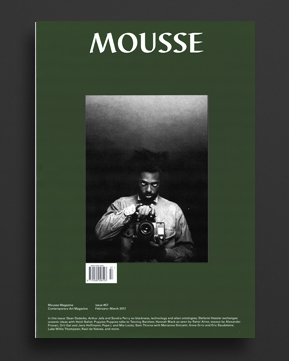
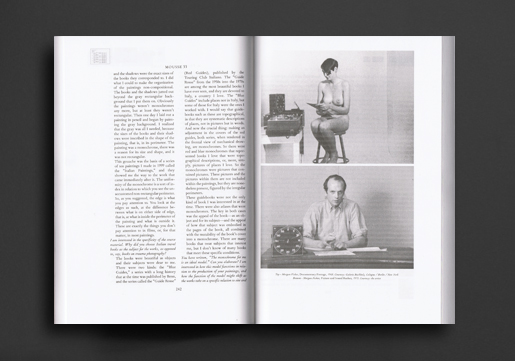
Dean Daderko, Arthur Jafa and Sondra Perry on blackness, technology and Alien ontologies; Stefanie Hessler exchanges oceanic ideas with Heidi Ballet; Puppies Puppies talk to Tenzing Barshee; Hannah Black as seen by Rahel Aima; essays by Alexander Provan, Orit Gat and Jens Hoffmann; William Pope.L and Mia Locks; Sam Thorne with Marianna Simnett; Anna Gritz and Eric Baudelaire; Luke Willis Thompson; Basel Abbas & Ruanne Abou-Rahme; Raúl de Nieves, and more.
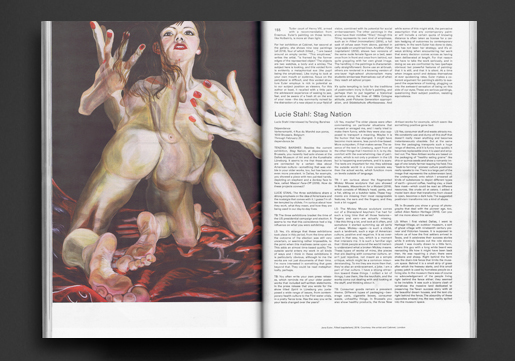
Mousse is a bimonthly magazine published in Italian and English. Established in 2006, Mousse contains interviews, conversations, and essays by some of the most important figures in international criticism, visual arts, and curating today, alternated with a series of distinctive articles in a unique tabloid format. Mousse keeps tabs on international trends in contemporary culture thanks to its city editors in major art capitals such as Berlin, New York, London, Paris, and Los Angeles.
Mousse (Mousse Publishing) is also publisher of catalogues, essays and curatorial projects, artist books and editions.
2017, English / Italian
Softcover, 440 pages, 18.5 x 26.5 cm
Published by
Mousse Publishing / Milan
$18.00 - Out of stock
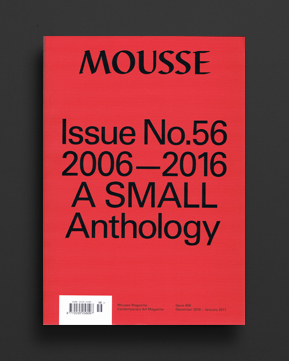
10-year anniversary special issue: a selection of essays, interviews, conversations, and projects appeared in the first ten years of Mousse.
Featuring: Chantal Akerman, Cecilia Alemani, Jennifer Allen, Kai Althoff, Bruce Altshuler, Ed Atkins, Lutz Bacher, Darren Bader, Alex Bag, John Baldessari, Phyllida Barlow, Kirsty Bell, Andrew Berardini, Jonathan Berger, Michael Bracewell, Tom Burr, Maurizio Cattelan, Marc Camille Chaimowicz, Sofía Hernández Chong Cuy, Carolyn Christov-Bakargiev, Stuart Comer, Lauren Cornell, Nicholas Cullinan, Roberto Cuoghi, Nick Currie, Massimo De Carlo, Gino De Dominicis, Gigiotto Del Vecchio, Simon Denny, Brian Dillon, Jimmie Durham, Dominic Eichler, Peter Eleey, Matias Faldbakken, Luigi Fassi, Elena Filipovic, Morgan Fisher, Isa Genzken, Yervant Gianikian & Angela Ricci Lucchi, Liam Gillick, Massimiliano Gioni, Isabelle Graw, Ed Halter, Jens Hoffmann, Judith Hopf, William E. Jones, Omar Kholeif, Alexander Kluge, Jiří Kovanda, William Leavitt, Elisabeth Lebovici, Andrea Lissoni, Helen Marten, Chus Martínez, Nick Mauss, Lucy McKenzie, Fionn Meade, Simone Menegoi, John Menick, Ute Meta Bauer, Massimo Minini, Hans Ulrich Obrist, Trevor Paglen, Stefania Palumbo, Francesco Pedraglio, Otto Piene, Laura Poitras, Elizabeth Price, Seth Price, Laure Prouvost, Alessandro Rabottini, Carol Rama, Filipa Ramos, Jason Rhoades, Dieter Roelstraete, Esperanza Rosales, Nicolaus Schafhausen, Fender Schrade, Stuart Sherman, Frances Stark, Jamie Stevens, Hito Steyerl, Sturtevant, Sabrina Tarasoff, Ana Teixeira Pinto, Oscar Tuazon, Giorgio Verzotti, Jan Verwoert, Francesco Vezzoli, Adrián Villar Rojas, Peter Wächtler, Ian Wallace, Klaus Weber, Cathy Wilkes, Christopher Williams, Jordan Wolfson.
Mousse is a bimonthly magazine published in Italian and English. Established in 2006, Mousse contains interviews, conversations, and essays by some of the most important figures in international criticism, visual arts, and curating today, alternated with a series of distinctive articles in a unique tabloid format. Mousse keeps tabs on international trends in contemporary culture thanks to its city editors in major art capitals such as Berlin, New York, London, Paris, and Los Angeles.
Mousse (Mousse Publishing) is also publisher of catalogues, essays and curatorial projects, artist books and editions.
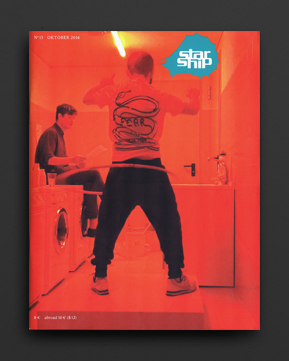
2016, English / German
Softcover, 136 pages, 20.5 x 26.8 cm
Published by
Starship / Berlin
$18.00 - Out of stock
Contributors to Starship 15: Nadja Abt, Tenzing Barshee, Gerry Bibby, Mercedes Bunz, Lou Cantor, Nicolas Ceccaldi, Jay Chung, Hans-Christian Dany, Helmut Draxler, Francesca Drechsler, Martin Ebner, Jana Euler, Julian Göthe, Toni Hildebrandt, Karl Holmqvist, Judith Hopf, Stephan Janitzky, Jakob Kolding, Robert McKenzie, Maria Loboda, Nick Mauss, Robert Meijer, Ariane Müller, Christopher Müller, Eileen Myles, Gunter Reski, Mandla Reuter, Cameron Rowland, Julia Scher, Mark von Schlegell, Eva Seufert, Diamond Stingily, Wolfgang Tillmans, Vera Tollmann, Haytham El-Wardany, Nicole Wermers, Amelie von Wulffen, Stephanie Wurster, Florian Zeyfang.
Editors: Nikola Dietrich, Martin Ebner, Ariane Müller, Henrik Olesen.
Layout concept: Starship and Dan Solbach.
Graphic Design: Philip Reinartz.
Cover: Gerry Bibby, Gina Folly.
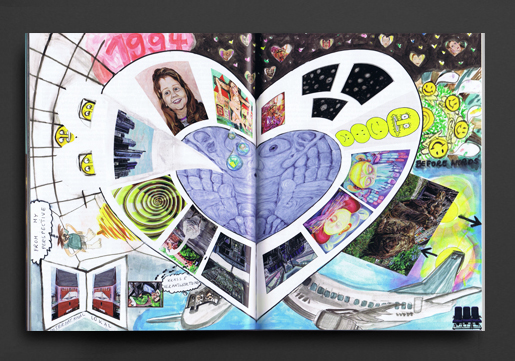
Centerfold: Amelie von Wulffen.
Backcover: Martin Ebner
2017, English
Hardcover, 216 pages, 29.5 x 23.5 cm
Published by
ICA / Miami
Koenig Books / London
$70.00 - Out of stock
The publication I Stand, I Fall, a comprehensive survey of work by John Miller, coincides with the first American museum exhibition dedicated to the influential conceptual artist.
Through almost 150 images, this catalogue comprehensively traces Miller’s use of the figure throughout his career in order to incisively comment on the status of art and life in American culture.
The book features a range of media, including painting, sculpture, drawing, photography, installation and video; never-before-seen works from the 1980s; new large-scale sculptures; and the artistʼs most ambitious architectural installation to date – a vast and immersive mirrored labyrinth that went on view at the ICA Miami’s Atrium Gallery.
I Stand, I Fall, surveys Miller’s use of the figure in order to examine themes of citizenship and politics, and the conventions of realism in contemporary art.
Organized chronologically, the exhibition begins with his drawings and paintings from 1982-1983, the majority of which have never been presented publicly.
Influenced by the pastoral genre of painting and American social realism of the 1920s and 30s, these deadpan, even grotesque, works explore issues of urban and suburban Americana, public space, and the human
Published retrospectively after the exhibition John Miller: I Stand, I Fall at Institute of Contemporary Art, Miami, 18 February – 12 June 2016.
2017, English / German
Softcover, 248 pages, 23 x 16.5 cm
Published by
Texte Zur Kunst / Berlin
$32.00 $10.00 - In stock -
ISSUE NO. 105 / MARCH 2017 “THEY ARE US / WIR SIND IHR”
With Issue #105, TZK considers the nationalist, conservative, and racist ideologies that have recently become more visible across Europe and the US, giving particular focus to questions of border politics and migration -- of humans, of data, of patrimony, of signs. Advised by Helmut Draxler, Isabelle Graw, and Susanne Leeb, this issue was conceived prior to the US presidential election as a cooler reflection on present political debates. And yet having been produced amid the chaos of the Trump administration's first weeks, it also necessarily stands as a reflection of political-aesthetic thinking during markedly volatile times: Wir sind Ihr? They are us? We are them?
TABLE OF CONTENTS:
FORWARD
PREFACE
ROUNDTABLE
BUT WHO IS “THEY”? / Roundtable discussion with Manuela Bojadžijev, Nikita Dhawan, and Christoph Menke, moderated by Helmut Draxler on Refugee and Migrant Flows as a Challenge for Political Thought
OVERCOMING MUTE RELATIONS, OR, THINKING WITH YOUR FEET / Angela Melitopoulos in conversation with Susanne Leeb
Daniel Keller
NEW DEVELOPMENT
HALFTIME VIBES / John Kelsey on Meditations in an Emergency
WEDER WOHNUNG NOCH WÄHRUNG / Diedrich Diederichsen über den Intendantenwechsel an der Berliner Volksbühne
BEGEHREN IN BETON / Benjamin Meyer-Krahmer über die Feuerle -Collection
LIEBE ARBEIT KINO
OF DREAMS, LIES, AND WIRES / Tom McDonough on Adam Curtis’s “HyperNormalisation”
MEDIALER GESTUS / Rainer Bellenbaum über Douglas Gordons Film
„I Had Nowhere to Go“
EU DESESPERO E ABRAÇO A TUA AUSÊNCIA:
“AQUARIUS” OR CINEMA AFTER NEO-FASCISM / Daniel R. Quiles on Kleber Mendonça Filho’s “Aquarius”
FAST UNANGENEHM DEUTLICH / Anke Dyes und Anna Voswinckel über Jill Soloways
Fernsehserie „I love Dick“
ROTATION
MACH ES NICHT SELBST / Daniel Loick über „Staying with the Trouble. Making Kin in the Chthulucene“ von Donna Haraway
(POST-)EMPIRE STATE OF MIND / Emily Segal on Cat Marnell’s “How to Murder Your Life”
RELEVANTE UPDATES / Christian Egger über Raymond Pettibon im
Museum der Moderne Salzburg
SHORT WAVES
Micaela Durand on Heji Shin at Real Fine Arts, New York / Arne Schmitt über Candida Höfer im Neuen Berliner Kunstverein / Hans-Jürgen Hafner über Peter Duka bei Zwinger Galerie / Ana Finel Honigman on Dan Attoe at Peres Projects, Berlin / Tina Schulz über Willem Oorebeek im Magazin 4 in Bregenz
REVIEWS
ZUCKER UND SHAME / Ulrike Bergermann über „Deutscher Kolonialismus“
im Deutschen Historischen Museum, Berlin
MODELS AND AGENCIES / Ben Caton on “The Ulm Model” at Raven Row, London
ART HISTORY, REMASTERED / Abbe Schriber on Kerry James Marshall at the Met Breuer, New York
AESTHETICIZED PLAY / Stefaan Vervoort on Ludger Gerdes at the Museum Haus Lange,
Krefeld, Germany
NACHRUFE / OBITUARIES
BARBARA WEISS (1960–2016)
by Monika Baer and John Miller
by Andreas Siekmann
JOHN BERGER (1926–2017)
by Tom Holert
by Svetlana Alpers
2017, English
Softcover, 224 pages, 15.2 x 22.9 cm
Published by
Semiotext(e) / Los Angeles
The MIT Press / Massachusetts
$38.00 - Out of stock
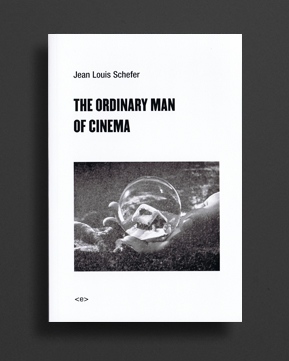
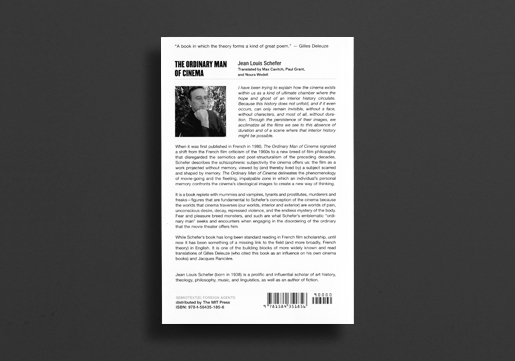
When it was first published in French in 1980, The Ordinary Man of Cinema signaled a shift from the French film criticism of the 1960s to a new breed of film philosophy that disregarded the semiotics and post-structuralism of the preceding decades. Schefer describes the schizophrenic subjectivity the cinema offers us: the film as a work projected without memory, viewed by (and thereby lived by) a subject scarred and shaped by memory. The Ordinary Man of Cinema delineates the phenomenology of movie-going and the fleeting, impalpable zone in which an individual’s personal memory confronts the cinema’s ideological images to create a new way of thinking.
It is also a book replete with mummies and vampires, tyrants and prostitutes, murderers and freaks—figures that are fundamental to Schefer’s conception of the cinema, because the worlds that cinema traverses (our worlds, interior and exterior) are worlds of pain, unconscious desire, decay, repressed violence, and the endless mystery of the body. Fear and pleasure breed monsters, and such are what Schefer’s emblematic “ordinary man” seeks and encounters when engaging in the disordering of the ordinary that the movie theater offers him. Among other things, Schefer considers “The Gods” in 31 brief essays on film stills and “The Criminal Life” with reflections on spectatorship and autobiography.
While Schefer’s book has long been standard reading in French film scholarship, until now it has been something of a missing link to the field (and more broadly, French theory) in English. It is one of the building blocks of more widely known and read translations of Gilles Deleuze (who cited this book as an influence on his own cinema books) and Jacques Rancière.
Translated by Max Cavitch, Noura Wedell and Paul Grant
About the Author
Jean Louis Schefer (born in 1938) is a prolific and influential scholar of art history, theology, philosophy, music, and linguistics, as well as an author of fiction.
2016, English
Softcover, 384 pages, 15 x 22.5 cm
Published by
Semiotext(e) / Los Angeles
$45.00 - Out of stock
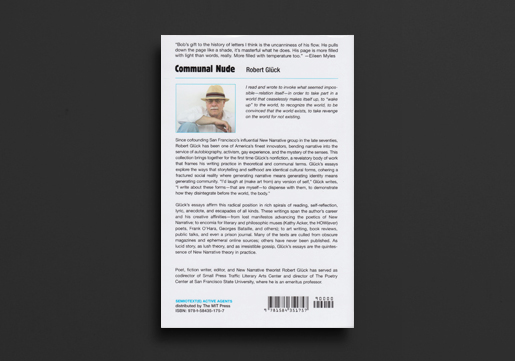
I read and wrote to invoke what seemed impossible -- relation itself -- in order to take part in a world that ceaselessly makes itself up, to "wake up" to the world, to recognize the world, to be convinced that the world exists, to take revenge on the world for not existing. -- from Communal Nude
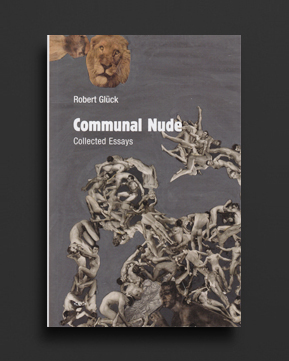
Since cofounding San Francisco's influential New Narrative circle in 1979, Robert Gluck has been one of America's finest prose stylists of innovative fiction, bending narrative into the service of autobiography, politics, and gay writing. This collection brings together for the first time Gluck's nonfiction, a revelatory body of work that anchors his writing practice. Gluck's essays explore the ways that storytelling and selfhood are mutually embedded cultural forms, cohering a fractured social reality where generating narrative means generating identity means generating community. "I'd laugh at (make art from) any version of self," Gluck writes, "I write about these forms -- that are myself -- to dispense with them, to demonstrate how they disintegrate before the world, the body." For any body -- or text -- to know itself, it must first see how it sees the world, and understand itself as writing. Gluck's essays affirm this radical narratorial precept in rich spirals of reading, self-reflection, anecdote, escapade, and "metatext." These texts span the author's career and his creative affinities -- from lost manifestos theorizing the poetics of New Narrative; to encomia for literary and philosophic muses (Kathy Acker, the HOW(ever) poets, Frank O'Hara, Georges Bataille, and others); to narrative journalism, book reviews, criticism, and public talks. Many of the texts are culled from obscure little magazines and ephemeral online sources; others have never been published. As lucid as story, as lush as theory, and as irresistible as gossip, Gluck's essays are the quintessence of New Narrative theory in practice.
2017, English
Hardcover (w. dust jacket), 240 pages, 20.3 x 25 cm
Published by
Yale University Press / New Haven
$94.00 - Out of stock
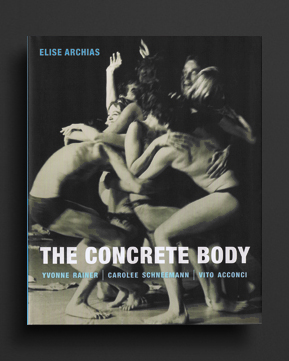
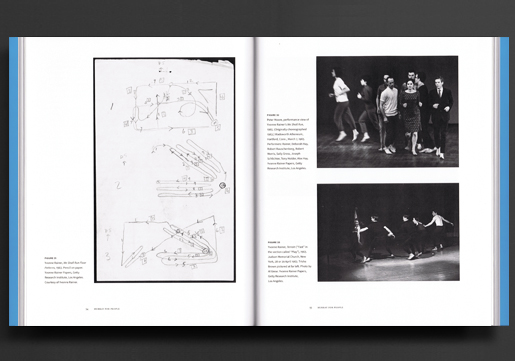
Offering an incisive rejoinder to traditional histories of modernism and postmodernism, this original book examines the 1960s performance work of three New York artists who adapted modernist approaches to form for the medium of the human body.
Finding parallels between the tactility of a drip of paint and a body's reflexive movements, Elise Archias argues convincingly that Yvonne Rainer (b. 1934), Carolee Schneemann (b. 1939), and Vito Acconci (b. 1940) forged a dialogue between modernist aesthetics and their own artistic community's embrace of all things ordinary through work that explored the abstraction born of the body's materiality. Rainer's task-like dances, Schneemann's sensuous appropriations of popular entertainment, and Acconci's behaviorist-inflected tests highlight the body's unintended movements as vital reminders of embodied struggle amid the constraining structures in contemporary culture. Archias also draws compelling comparisons between embodiment as performed in the work of these three artists and in the sit-ins and other nonviolent protests of the era.
2017, English
Softcover, 240 pages, 21 x 23 cm
Published by
The MIT Press / Massachusetts
Whitechapel / London
$50.00 - Out of stock
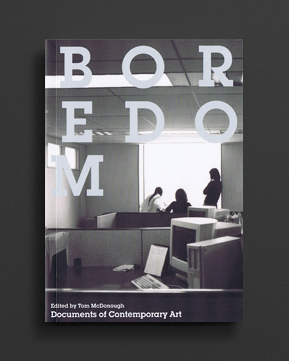
Without boredom, arguably there is no modernity. The current sense of the word emerged simultaneously with industrialization, mass politics, and consumerism. From Manet onwards, when art represents the everyday within modern life, encounters with tedium are inevitable. And starting with modernism’s retreat into abstraction through subsequent demands placed on audiences, from the late 1960s to the present, the viewer’s endurance of repetition, slowness or other forms of monotony has become an anticipated feature of gallery-going.
In contemporary art, boredom is no longer viewed as a singular experience; rather, it is contingent on diverse social identifications and cultural positions, and exists along a spectrum stretching from a malign condition to be struggled against to an something to be embraced or explored as a site of resistance. This anthology contextualizes the range of boredoms associated with our neoliberal moment, taking a long view that encompasses the political critique of boredom in 1960s France; the simultaneous aesthetic embrace in the United States of silence, repetition, or indifference in Fluxus, Pop, Minimalism and conceptual art; the development of feminist diagnoses of malaise in art, performance, and film; punk’s social critique and its influence on theories of the postmodern; and the recognition, beginning at the end of the 1980s, of a specific form of ennui experienced in former communist states. Today, with the emergence of new forms of labor alienation and personal intrusion, deadening forces extend even further into subjective experience, making the divide between a critical and an aesthetic use of boredom ever more tenuous.
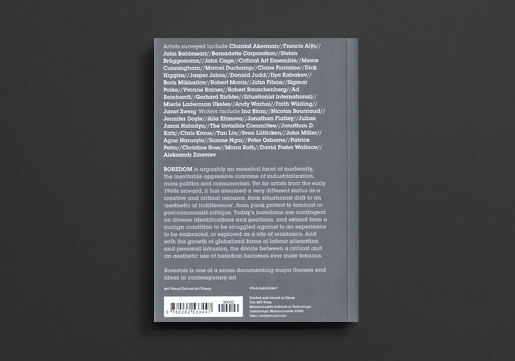
Artists surveyed include:
Chantal Akerman, Francis Alÿs, John Baldessari, Vanessa Beecroft, Bernadette Corporation, John Cage, Critical Art Ensemble, Merce Cunningham, Marcel Duchamp, Fischli & Weiss, Claire Fontaine, Dick Higgins, Jasper Johns, Donald Judd, Ilya Kabakov, Boris Mikhailov, Robert Morris, John Pilson, Sigmar Polke, Yvonne Rainer, Robert Rauschenberg, Ad Reinhardt, Gerhard Richter, Situationist International, Mierle Laderman Ukeles, Andy Warhol, Faith Wilding, Janet Zweig
Writers include:
Ina Blom, Nicolas Bourriaud, Jennifer Doyle, Alla Efimova, Jonathan Flatley, Julian Jason Haladyn, The Invisible Committee, Jonathan D. Katz, Chris Kraus, Tan Lin, Sven Lütticken, John Miller, Agné Narušyté, Sianne Ngai, Peter Osborne, Patrice Petro, Christine Ross, Moira Roth, David Foster Wallace, Aleksandr Zinovyev
About the Author
Tom McDonough is Associate Professor of Art History at Binghamton University, State University of New York. He is the author of “The Beautiful Language of My Century”: Reinventing the Language of Contestation in Postwar France, 1945–1968 (MIT Press)
From the "Documents of Contemporary Art" series.
2016, English
Hardcover (clothbound), 336 pages, 12.7 x 20.5 cm
Published by
Sternberg Press / Berlin
$45.00 - Out of stock
Edited by Kārlis Bērziņš, Jurga Daubaraitė, Petras Išora, Ona Lozuraitytė, Niklāvs Paegle, Dagnija Smilga, Johan Tali, Laila Zariņa, Jonas Žukauskas
Contributions by Åbäke, Indrek Allmann, Reinis Āzis, Viesturs Celmiņš, Nancy Couling, Tom Crosshill, Muriz Djurdjevic, Leonidas Donskis, Jānis Dripe, Keller Easterling, David Grandorge, Felix Hummel, Gustav Kalm, Karolis Kaupinis, Maroš Krivý, Carl-Dag Lige, Laura Linsi, Jonathan Lovekin, Agata Marzecova, Timothy Morton, Kaja Pae, Thomas Paturet, Ljeta Putāne, Eglė Rindzevičiūtė, Markus Schaefer, Jack Self, Nasrine Seraji, Tuomas Toivonen, Nomeda and Gediminas Urbonas, Jānis Ušča, Aro Velmet, Ines Weizman
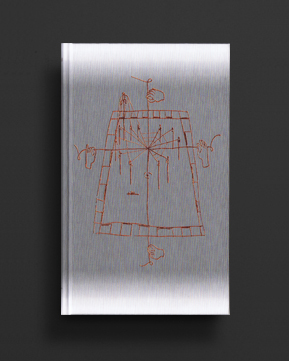
“It is impossible, but as you do not know it is impossible, it might be possible.”
—Lolita Jablonskiene, Director of the National Gallery of Art, Vilnius, commenting on previous attempts to organize a joint pavilion including all three Baltic States for the Venice Biennale
The Baltic Atlas, published in conjunction with the exhibition of the Baltic States Pavilion at the Venice Architecture Biennale 2016, is a gradient between two questions. The first: “what is it possible to imagine?” focuses on interpretations, fictional stories, analyses, and reflections on the ongoing processes, and proposes future projections. The second: “what is possible?” is an inquiry into the methods, resources, and parameters that define space.
All texts have been specially written for this publication. Parallel discourses are positioned next to each other—overlaid in an atlas that works in range of different modes. An atlas is a medium that unravels multiple ways of seeing the region of the Baltic States as an intensification of networks, agendas, and ideas that are relevant on a global scale. Along with the Baltic Pavilion exhibition, this publication offers a sense of an open-ended ecology of practices—a forum on what is to come.
Design by Åbäke and Vytautas Volbekas
2016, English
Softcover, 112 pages, 22.9 x 29.2 cm
Published by
Sternberg Press / Berlin
$36.00 - Out of stock
Edited by Rachel Adams
Texts by Rachel Adams, Sandra H. Olsen, Mari Rodriguez Binnie; interview with Lydia Okumura
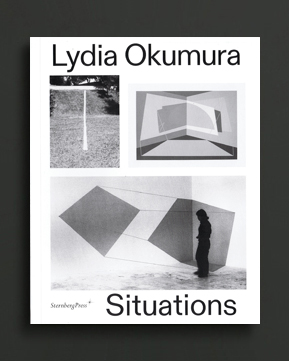
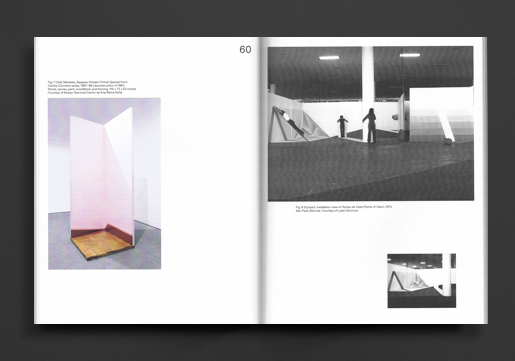
For almost fifty years, Lydia Okumura has explored the realm of geometric abstraction. She challenges our perception of space through sculptures, installations, and works on paper that blur distinctions between dimensions. In the 1970s, a young artist in her native São Paulo, she studied the Japanese art magazine Bijutsu Techou, which introduced her to Conceptual art, Minimalism, Land art, and Arte Povera. These movements, along with Brazilian Concretism and Neoconcretism, influenced Okumura’s work. Using simple materials such as string, glass, and paint, her dynamic work balances line, plane, and shadow.
Okumura’s oeuvre—although reminiscent of the work of Latin American artists such as Lygia Pape and Carmen Herrera, as well as contemporaries such as Dorothea Rockburne and Robert Irwin—has remained under-recognized. She has exhibited widely in São Paulo and is part of multiple museum collections, but she is much less known in her adopted country, the United States. “Lydia Okumura: Situations” (September 8, 2016–January 8, 2017) is the artist’s first solo exhibition in the United States. Through the exhibition and catalogue, the UB Art Galleries seek to encourage a critical reassessment of Okumura’s oeuvre within art history. The catalogue includes an essay on Okumura and her work, by curator Rachel Adams; an account of vanguardism in Brazilian art from 1960 to 1975, by art historian Mari Rodriguez Binnie; a conversation between Adams and Okumura; and extensive photo documentation of Okumura’s work from the 1970s until today.
Copublished with UB Art Galleries
Design by Mark Owens with Sarah Cleeremans
2017, English / German
Softcover, 132 pages, 12.5 x 19 cm
Published by
Portikus / Frankfurt
Sternberg Press / Berlin
$39.00 $15.00 - Out of stock
Edited by Fabian Schöneich
Texts by Sunghoon Han, Minouk Lim, Fabian Schöneich, Hyunsuk Seo
What role does historiography play in the formation of the present? How does contemporary experience inform the commemoration of historical events or lack thereof? Minouk Lim explores history in the present tense—its media representation, collective memory, ritual, and trauma—through her exhibition, publication, and broadcasting station United Paradox. The South Korea in Lim’s project is a nation with a hole in its chest: a nation of families divided by territorial disputes and traumatized by civilian massacres, victims of an authoritarian power in service of ideological control and economic growth. While reflecting on the representation and reappropriation of historical events in South Korea, Lim and the contributors to this publication explore ways of working through the past in a present that prefers to forget.
Copublished with Portikus
Design by Ronnie Fueglister
2016, English
Softcover, 288 pages, 12.5 x 20.5 cm
Published by
Sternberg Press / Berlin
$28.00 - Out of stock
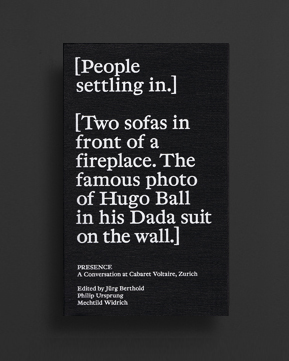
Edited by Jürg Berthold, Kristina Hinrichsen, Philip Ursprung, Mechtild Widrich
With contributions by Elisabeth Bronfen, Hans Ulrich Gumbrecht, Michael Hampe, Mark Jarzombek, Amelia Jones, Tom Levin, Dieter Mersch, Rebecca Schneider, Peter Zumthor
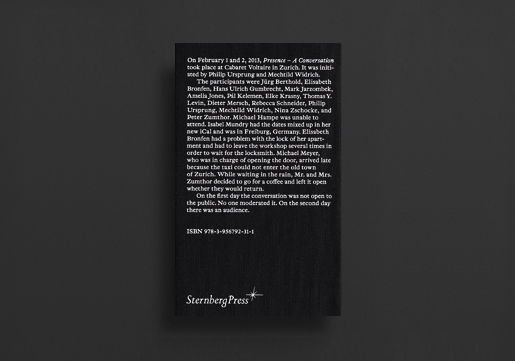
Recently, the idea of “presence” has returned to the arts, humanities, and social sciences. In February 2013, in Zurich’s historical Cabaret Voltaire, which was central to the Dada movement almost a hundred years ago, an experimental international symposium took place that put presence under the microscope.
Presence: A Conversation at Cabaret Voltaire, Zurich is not a traditional post-conference publication but is conceived as a theatrical discussion of ideas between different speakers, both on and offstage. In contrast to transcribed conversations, monologues are interspersed throughout the book, acting like small, performative interruptions. The lively juxtaposition of both individual speech and colloquy is enhanced by theatrical conventions: characters enter and exit; stage directions mirror those found in the cabaret.
Design by Elektrosmog, Zürich, Adeline Mollard, Marina Brugger, Marco Walser
2016, English
Softcover, 68 pages, 10.6 x 16 cm
Published by
Portikus / Frankfurt
Sternberg Press / Berlin
$18.00 - Out of stock
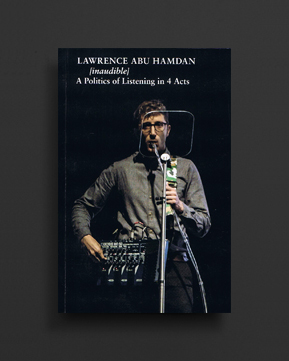
Edited by Fabian Schöneich
Contributions by Lawrence Abu Hamdan, Emily Apter, Giovanni Carmine, Omar Kholeif, Fabian Schöneich
A “politics of listening” is an intervention into and a reorganization of forms that listening takes rather than a call for free speech or for a platform for voices to be heard. Listening is a political act, a pedagogical process, and an activity that can lead to the development of an organized protocol for engagement.
In his art and research, Beirut-based artist Lawrence Abu Hamdan explores the perception of language, sound, and listening. National identity, human rights, and the administration of justice are recurrent themes in his work. The techniques used in his audio-aesthetic practice have been used to conduct forensic audio analysis for several legal investigations. This monograph includes a series of transcripts of live speech from sermons, monologues, testimonies, and interviews made over the course of the last five years.
Copublished with Kunsthalle St. Gallen and Portikus, Frankfurt am Main
Design by David Bennewith, Colophon
2016, English
Softcover, 16.5 x 22 cm
Published by
Sternberg Press / Berlin
$34.00 - Out of stock
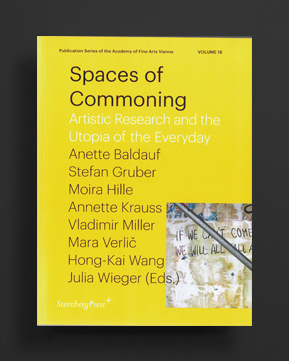
Edited by Anette Baldauf, Stefan Gruber, Moira Hille, Annette Krauss, Vladimir Miller, Mara Verlič, Hong-Kai Wang, Julia Wieger
With contributions by Berhanu Ashagrie Deribew, Anette Baldauf, Tesfaye Bekele Beri, Aluminé Cabrera, Silvia Federici, Elizabeth Giorgis, Stefan Gruber, Stefano Harney, Moira Hille, Mihret Kebede, Annette Krauss, Lisa Lowe, Maria Mesner, Vladimir Miller, Stavros Stavrides, Pelin Tan, Team at Casco—Office for Art, Design and Theory, Brook Teklehaimanot, Ultra-red, Mara Verlič, Hong-Kai Wang, Julia Wieger
Spaces of Commoning: Artistic Research and the Utopia of the Everyday is the outcome of a research project pursued by a group of artists, architects, and social theorists, who, in the face of exhilarating politics of accumulation and dispossession, explore commoning as the subject as well as the means of their collective study. The power of the commons, this book suggests, does not reside in the promise of a coming together free of friction. As different dimensions of power organize the terrain of the social, social movements are often caught between competing agendas, and in the gap between aims and everyday life. It is precisely the sites of these struggles that the book calls spaces of commoning. As such, this study is part of a much wider recognition of the necessity to rethink and undo the methodological premises of Western sciences, arts, and architecture, and to raise unsettling questions on research ethos, accountability, and the entanglement of power and knowledge.
Publication Series of the Academy of Fine Arts Vienna, vol. 18
Design by Surface
2017, English
Softcover, 112 pages, 19.5 x 26.5 cm
Published by
La Loge / Brussels
Sternberg Press / Berlin
$22.00 $10.00 - Out of stock
Introduction by Mark Mann
When first introduced, mass-market paperbacks sparked a publishing revolution. Critics despised them as lowbrow diversions, which did not impact their popularity. But the business model barely worked. Prices were so low, the books needed to sell in incredible numbers to make a profit. An industry norm emerged to pump up sales, whereby most of the novels were wrapped with images of women in provocative settings and states of undress. Many readers were duly provoked to purchase, but this recurring allure eventually lost its sway.
Simultaneously, an opposing theme of essentialism was asserting itself in grocery stores. The No Frills brand presented goods in unadorned packaging. It was as if the very intention to sell had been excised from the label’s straightforward design and terse declaration of contents—SALAD DRESSING, FRUIT PRESERVES, LAUNDRY DETERGENT. No Frills stripped the cloying appeal of traditional marketing and replaced it with a candid offering of canned beets and corned beef, pure and plain.
Inspired by this direct approach, Terry Bisson and art director Frank Kozelek developed the No-Frills book series in the early 1980s. Signature Strengths, conceived and edited by Boy Vereecken, reproduces in full the four books published in the series—Western, Mystery, Science Fiction, and Romance—as well as critical evaluations of the fascinating experimental endeavor in genre writing and mass-market publishing.
Copublished with La Loge, Brussels
Design by Boy Vereecken
2009, English
Softcover, 96 pages, 15 x 22 cm
Published by
Yale University Press / New Haven
$32.00 - Out of stock
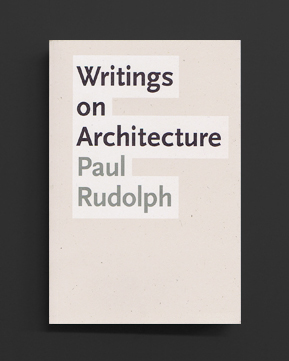
The first collection of writings by one of the most innovative architects and educators of the 1950s and 1960s, this book includes a wealth of recently discovered archival materials and many previously unpublished photographs. Featured texts include a selection of Paul Rudolph's published critical writings, which cover such topics as Rudolph's views about the architecture and city planning of his time and the proper way to educate an architectural student. Recent controversies about the preservation of many of Rudolph's buildings--including the landmark Art and Architecture Building at Yale, which celebrates its 45th anniversary and grand reopening in November 2008--make this a timely publication.
Foreword by Robert A. M. Stern
1992, English
Softcover (w. dust jacket), 84 pages, 14.5 x 20.5 cm
Ed. of 500, 1st edition, Out of print title / As New,
Published by
Kerb Your Dog / Sydney
$100.00 - Out of stock
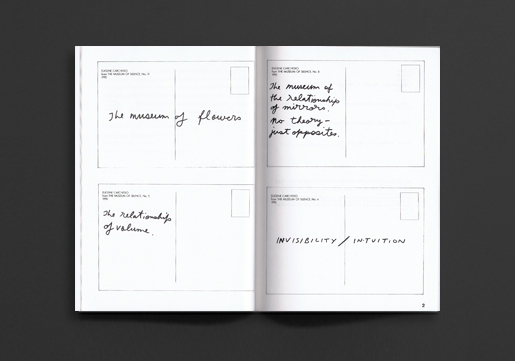
Kerb Your Dog was an artist-edited anthology of pages by contemporary Australian and International artists, published in Sydney, Australia. Edited by John Nixon and John Young and published in an edition of 500 copies, this volume from 1992 - "TEXTBOOK" - features pages by John Barbour, Eugene Carchesio, Tony Clark, Peter Cripps, Aleks Danko, John Dunkley-Smith, Clinton Garofano, Ross Harley, Tim Johnson, Lyndal Jones, Maria Kozic, Rosemary Laing, Shelley Lasica, Lindy Lee, Geoff Lowe, Robert Macpherson, John Nixon, Rose Nolan, Susan Norrie, David O'Halloran, Robert Owen, Mike Parr, Jacky Redgate, Carole Roberts, Vivienne Shark Lewitt, Peter Tyndall, Ken Unsworth, Geoffrey Weary, Wood / Marsh Architecture Pty. Ltd., John Young, and an essay by Janet Shanks. An invaluable collection of artist's texts from Australia in this very scarce document.
2017, English
Softcover, 72 pages, 9.5 x 14.8 cm
Published by
Moderna Museet / Stockholm
Sternberg Press / Berlin
$15.00 - Out of stock
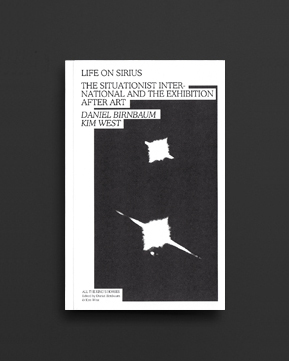
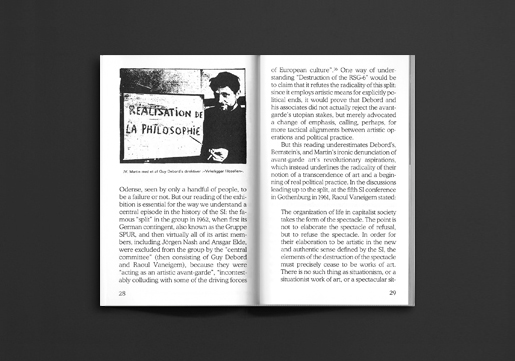
How did art escape the deadlock of the Situationists’ anti-art refusal? Did the relational artists, with their repetitions of Situationist slogans and techniques, outline a sustainable, micro-political alternative to Guy Debord’s dream of surpassing art and realizing philosophy? Looking back at some of the Situationists’ confrontations with the museum, this book traces a path beyond the tragedy of negativity and the litany of recuperation. At the center is the concept of play; originally adopted as the principle of reconciled life, it returns as the lever of instrumentalization. But in the extraterrestial wasteland of the present, spaces of ludic coexistence and experimentation may remain possible, provided that pessimism can be adequately organized.
part of the All the King’s Horses Series, edited by Daniel Birnbaum and
Kim West
Copublished between Sternberg Press and Moderna Museet, Stockholm
Design by Studio Christopher West
2016, English
Softcover, 296 pages, 14.8 x 21 cm
Published by
Sternberg Press / Berlin
$52.00 - Out of stock
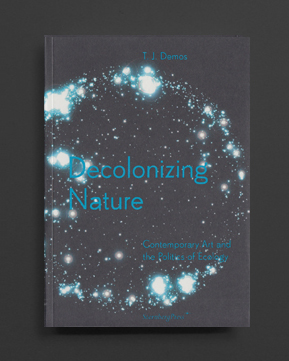
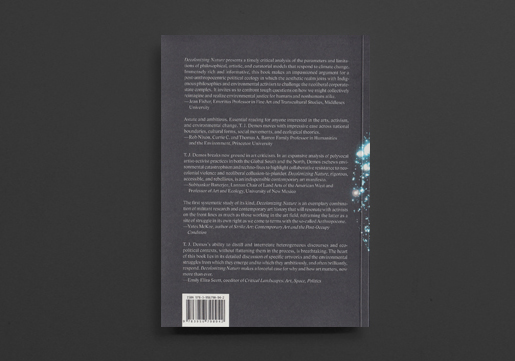
While ecology has received little systematic attention within art history, its visibility and significance has grown in relation to the threats of climate change and environmental destruction. By engaging artists’ widespread aesthetic and political engagement with environmental conditions and processes around the globe—and looking at cutting-edge theoretical, political, and cultural developments in the Global South and North—Decolonizing Nature offers a significant, original contribution to the intersecting fields of art history, ecology, visual culture, geography, and environmental politics. Art historian T. J. Demos, author of Return to the Postcolony: Specters of Colonialism in Contemporary Art(2013), considers the creative proposals of artists and activists for ways of life that bring together ecological sustainability, climate justice, and radical democracy, at a time when such creative proposals are urgently needed.
“Decolonizing Nature presents a timely critical analysis of the parameters and limitations of philosophical, artistic, and curatorial models responding to anthropogenic climate change. Rich and informative, the book makes an impassioned argument for a post-anthropocentric political ecology, in which the aesthetic realm enjoins with Indigenous philosophies and environmental activism to challenge the neoliberal corporate-state complex. It invites us to confront tough questions on how we might collectively reimagine and realize environmental justice for humans and nonhumans alike.” — Jean Fisher, Emeritus Professor in Fine Art and Transcultural Studies, Middlesex University
“Astute and ambitious. Essential reading for anyone interested in the arts, activism, and environmental change. Demos moves with impressive ease across national boundaries, cultural forms, social movements, and ecological theories.” — Rob Nixon, Currie C. and Thomas A. Barron Family Professor in Humanities and the Environment, Princeton University
“Demos breaks new ground in art criticism. In an expansive analysis of polyvocal artist-activist practices in the Global South and the North, Demos eschews environmental catastrophism, scientific determinism, and techno-fixes to highlight collaborative resistance to neocolonial violence and neoliberal collusion-to-plunder. He is also searching for what the path forward might be. Rigorous, accessible, and rebellious, Decolonizing Nature is an inspiring and indispensible contemporary art manifesto.” — Subhankar Banerjee, Lannan Chair of Land Arts of the American West and Professor of Art and Ecology, University of New Mexico
“With Decolonizing Nature, Demos extends his formidable intellectual project to a realm that has until recently often been characterized by varying degrees of naïveté, obscurantism, and indeed green-washing: the relationship between art and ecology. The first systematic study of its kind, Decolonizing Nature is an exemplary combination of militant research and contemporary art history that will resonate with activists on the front lines as much as those working in the art field, reframing the latter as a site of struggle in its own right as we come to terms with the so-called Anthropocene.”
—Yates McKee, author of Strike Art: Contemporary Art and the Post-Occupy Condition
“Demos’s ability to distill and interrelate heterogeneous discourses, practices, and eco-political contexts, without flattening them in the process, is a breathtaking feat and, moreover, one that rises to the demands of his complex and urgent subject. As clear in its argumentation as it is dense with information, the meat of this book lies in its detailed discussion of specific artworks and the environmental struggles from which they emerge and to which they ambitiously, and often brilliantly, respond. Decolonizing Nature makes a forceful case for why and how art matters, now more than ever.”
—Emily Eliza Scott, Postdoctoral Fellow, Institute for the History and Theory of Architecture, ETH Zurich, and coeditor of Critical Landscapes: Art, Space, Politics
Design by Miriam Rech, Berlin
2015, English
Softcover with dust jacket, 380 pages (19 b/w and 47 colour ill.), 12.4 x 19.4 cm,
Published by
Sternberg Press / Berlin
$45.00 - Out of stock
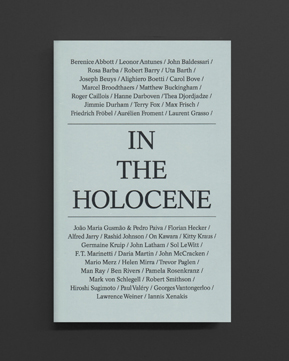
Contributions by Berenice Abbott, Leonor Antunes, Marcel Broodthaers, Roger Callois, Hanne Darboven and Lucy R. Lippard, Eric Duyckaerts, Max Frisch, Frederich Froebel, Joao Maria Gusmao and Pedro Paiva, Florian Hecker and Quintin Meillasoux, Alfred Jarry, On Kawara, John Latham, Sol LeWitt, F. T. Marinetti, Daria Martin, Mario Merz, Helen Mirra, Man Ray, Ben Rivers and Mark von Schlegell, Pamela Rosenkranz and Erik Wysocan, Robert Smithson, Paul Valéry, Iannis Xenakis
In the Holocene is based on a 2012 group exhibition of the same name at the MIT List Visual Arts Center that explored art as a speculative science, investigating principles more commonly associated with scientific or mathematical thought. Through the work of an intergenerational group of artists, the exhibition and book propose that art acts as an investigative and experimental form of inquiry, addressing or amending what is explained through traditional scientific or mathematical means: entropy, matter, time (cosmic, geological), energy, topology, mimicry, perception, consciousness, et cetera. Sometimes employing scientific methodologies or the epistemology of science, other times investigating phenomena not restricted to any scientific discipline, art can be seen as a form of inquiry into the physical and natural world. In this sense, both art and science share an interest in knowledge, realism, and observable phenomena, yet are subject to different logics, principles of reasoning, and conclusions.
Works by Berenice Abbott, John Baldessari, Rosa Barba, Robert Barry, Uta Barth, Joseph Beuys, Alighiero Boetti, Carol Bove, Marcel Broodthaers, Matthew Buckingham, Hanne Darboven, Thea Djordjadze, Aurélien Froment, Terry Fox, Laurent Grasso, João Maria Gusmão and Pedro Paiva, Rashid Johnson, Kitty Kraus, Germaine Kruip, Daria Martin, John McCracken, Trevor Paglen, Man Ray, Ben Rivers, Pamela Rosenkranz, Robert Smithson, Hiroshi Sugimoto, Georges Vantongerloo, Lawrence Weiner
Copublished with MIT List Visual Arts Center
Design by Kloepfer-Ramsey-Kwon
2012, English
Softcover, 88 pages, 25 color ills., 24 b/w ills, 11.2 x 17.2 cm
Published by
Sternberg Press / Berlin
$26.00 - Out of stock
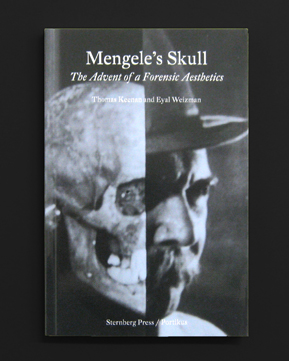
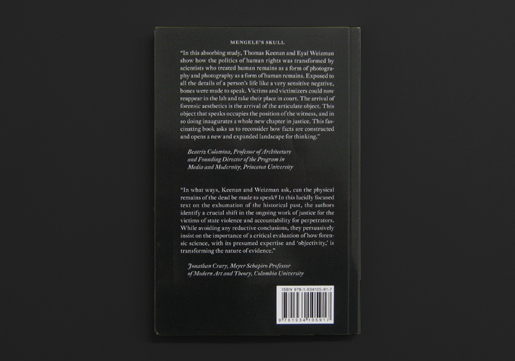
In 1985, the body of Josef Mengele, one of the last Nazi war criminals still at large, was unearthed in Brazil. The ensuing process of identifying the bones in question opened up what can now be seen as a third narrative in war crime investigations—not that of the document or the witness but rather the birth of a forensic approach to understanding war crimes and crimes against humanity.
In the period coinciding with the discovery of Mengele’s skeleton, scientists began to appear in human rights cases as expert witnesses, called to interpret and speak on behalf of things—often bones and human remains. But the aesthetic, political, and ethical complications that emerge with the introduction of the thing in war crimes trials indicate that this innovation is not simply one in which the solid object provides a stable and fixed alternative to human uncertainties, ambiguities, and anxieties.
The complexities associated with testimony—that of the subject—are echoed in the presentation of the object. Human remains are the kind of things from which the trace of the subject cannot be fully removed. Their appearance and presentation in the courts of law and public opinion has in fact blurred something of the distinction between objects and subjects, evidence and testimony.
Co-published with Portikus, Frankfurt am Main
Design by Zak Group
1968, English
Softcover (staple-bound), 42 pages, 14 x 21 cm
1st Edition, Out of print title / Used*,
Published by
Contemporary Films Limited / London
Federation of Film Societies / London
$15.00 - Out of stock
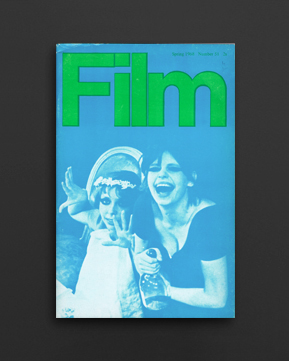
Film was the magazine of the Federation of Film Societies, published in London.
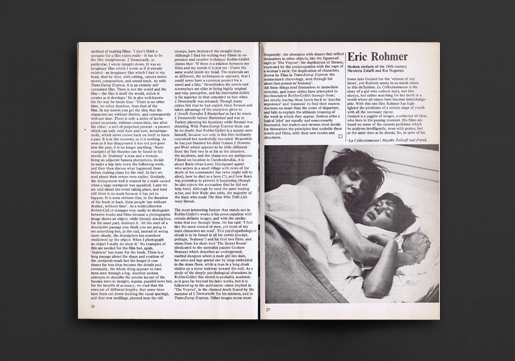
Vol. 51 Spring 1968 features articles on Alain Robbe-Grillet, Eric Rohmer, Kirsten Stenbaek, Jonas Cornell, Vera Chytilova, Dusan Makavejev, Jean Renoir, B. P. Schulberg, and much more.
Cover image: Vera Chytilova's "Daisies"
1984, English
Softcover, 156 pages (260 b/w & 140 colour ill.), 28.0 x 23.0 cm
Out of print title / Used*,
Published by
Thames and Hudson / London
$65.00 - Out of stock
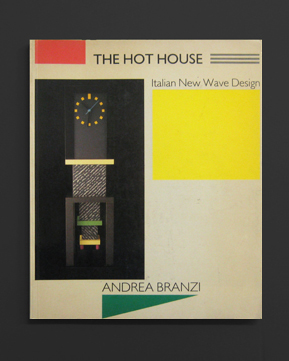
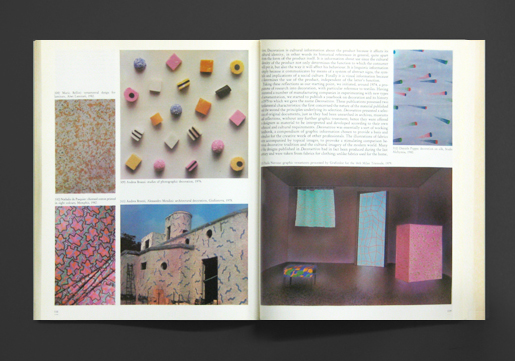
Edited by Andrea Branzi, The Hot House was one of the finest books published to trace the history of Italy's radical design studios from 1960 to the dawn of Memphis. Through academic texts and profuse visual documentation of the work of Alessandro Mendini, Gaetano Pesce, Superstudio, Ettore Sottsass, Natalie Du Pasquier, UFO Group, Enzo Mari, Alchymia, Michele De Lucchi, 9999, Archizoom Associati, Mattheo Thun, Memphis, and many others.