World Food Books' programme is largely produced on Kulin Nation land. We acknowledge the Wurundjeri people of the Kulin Nation as the first and continuing custodians of this land, and pay respect to their Elders past, present, and emerging.
World Food Books is an arts and special interests bookshop in Naarm / Melbourne. Founded in 2010, World Food Books is devoted to the presentation of a rotating, hand-selection of international art, design, literary and counterculture publications with an emphasis on the anti-traditional, the experimental, the avant-garde, the heretic, the marginal.
Presenting new titles alongside rare and out-of-print books, catalogues and journals spanning the fields of modern and contemporary art, design, photography, illustration, film, literature, poetry, cultural theory, philosophy, sexuality, popular and underground culture in its many radical forms, World Food Books wishes to encourage adventurous, thoughtful and open-minded reading, looking, writing, and exchange of publishing and ideas, both current and historical.
As well as our bookshop, located in Melbourne's historical Nicholas Building, all of our inventory is available internationally via our online mail-order service.
World Food Books semi-regularly co-ordinates "Occasions", a programme of exhibits and events at the bookshop and in partnership with other hosts (such as museums and art galleries) that develop out of the activities, relationships and content of the bookshop itself.
World Food Books
The Nicholas Building
37 Swanston Street
Room 5, Level 6
Melbourne 3000
Australia
SHOP HOURS:
Thu–Fri 12–6, Sat 12–5
WEB-SHOP OPEN 24/7
World Food Books
Postal Address:
PO Box 435
Flinders Lane
Victoria 8009
Australia
Art
Theory / Essay
Architecture / Interior
Graphic Design / Typography
Photography
Fashion
Eros
LGBTQ+
Fiction / Poetry
Weird / Speculative / Science Fiction / Horror
Transgressive / Visceral / Abject
Symbolism / Decadence / Fin de siècle
Film / Video
Painting
Sculpture / Installation
Performance / Dance / Theater
Drawing
Sound / Music
Curatorial
Group Shows / Collections
Periodicals
Out-of-print / Rare
Posters / Ephemera / Discs
Signed Books
World Food Books Gift Voucher
World Food Book Bag
Australian Art
Australian Fiction
Australian Science Fiction / Speculative Fiction
Australian Poetry
Australian Photography
Japanese Photography
Conceptual Art
Minimal Art
Dada
'Pataphysics / Oulipo
Fluxus
Concrete Poetry
Pop Art
Surrealism
Arte Povera
Arte Informale / Haute Pâte / Tachism
Nouveau Réalisme / Zero / Kinetic
Situationism / Lettrism
Collage / Mail Art / Xerox Art
Art Brut / Folk / Visionary / Fantastic
Illustration / Graphic Art / Bandes Dessinées
Furniture
Italian Radical Design / Postmodernism
Textiles
Ceramics / Glass
Counterculture
Protest / Revolt
Philosophy
Psychoanalysis
Anthropology
Anarchism
Socialism / Anarchism / Communism / Capitalism
Literary Theory / Semiotics / Language
Feminism / Women's Studies
Gender Studies / Sexuality
Anthropology
Fetishism / BDSM
Drugs / Psychedelia
Crime / Violence
Animal Rights / Veganism
Occult / Esoterica
Ecology / Earth / Alternative Living
Whole Earth / Crafts
All prices in AUD (Australian dollars)
Pick-Ups
Pick-up orders can be collected in our bookshop during opening hours after order date. Please collect any Pick-up orders within 2 weeks of ordering as we have limited storage space. Orders will be released back into stock if not collected within this time. No refunds can be made for pick-ups left un-collected. If you cannot make it in to the bookshop in this time-frame, please choose postage option.
Return Policy
All sales are final. We do accept returns (for refund or exchange) for items received in error. All our orders are packed with special care using heavy-duty padding and cardboard book-mailers or bubble mailers (for smaller books), using reinforcement where required. We cannot take responsibility for any lost, stolen or damaged parcels.
Insurance
Should you wish to insure your package, please email us directly after placing your order and we can organise this at a small extra expense. Although all standard/express tracked packages are very safe and dependable, we cannot take responsibility for any lost, stolen or damaged parcels. We recommend insurance on valuable orders.
Interested in selling your old books, catalogues, journals, magazines, comics, fanzines, ephemera? We are always looking for interesting, unusual and out-of-print books to buy. We only buy books in our fields of interest and specialty, and that we feel we can resell.
We base these prices on desirability, market value, in-print prices, condition and our current stock levels. We offer cash, store credit, and can take stock on consignment. All
about 25% of the price we expect to get when we sell them, or 30% in store credit. We base these prices on desirability, market value, in-print prices, condition and our current stock levels.
Sell your books any day of the week. You can drop them off and return later. If you have a lot of books, we can visit your Sydney home.
We buy books that we feel we can resell. We offer about 25 % of the price we expect to get when we sell them, or 30% in store credit. We base these prices on desirability, market value, in-print prices, condition and our current stock levels.
Philadelphia Wireman
03 August - 01 September, 2018
World Food Books is proud to announce our next Occasion, the first presentation of sculptures by Philadelphia Wireman in Australia.
The Philadelphia Wireman sculptures were found abandoned in an alley off Philadelphia’s South Street on trash night in 1982. Their discovery in a rapidly-changing neighbourhood undergoing extensive renovation, compounded with the failure of all attempts to locate the artist, suggests that the works may have been discarded after the maker’s death. Dubbed the "Philadelphia Wireman" during the first exhibition of this work, in 1985, the maker’s name, age, ethnicity, and even gender remain uncertain. The entire collection totals approximately 1200 pieces, all intricately bound together with tightly-wound heavy-gauge wire (along with a few small, abstract marker drawings, reminiscent both of Mark Tobey and J.B. Murry). The dense construction of the work, despite a modest range of scale and materials, is singularly obsessive and disciplined in design: a wire armature or exoskeleton firmly binds a bricolage of found objects including plastic, glass, food packaging, umbrella parts, tape, rubber, batteries, pens, leather, reflectors, nuts and bolts, nails, foil, coins, toys, watches, eyeglasses, tools, and jewellery.
Heavy with associations—anthropomorphic, zoomorphic, and socio-cultural responses to wrapped detritus—the totemic sculptures by Philadelphia Wireman have been discussed in the context of work created to fulfil the shamanistic needs of alternative religions in American culture. Curators, collectors, and critics have variously compared certain pieces to sculpture from Classical antiquity, Native American medicine bundles, African-American memory jugs, and African fetish objects. Reflecting the artist’s prolific and incredibly focused scavenging impulse, and despite—or perhaps enhanced by—their anonymity, these enigmatic objects function as urban artefacts and arbiters of power, though their origin and purpose is unknown. Philadelphia Wireman, whatever their identity, possessed an astonishing ability to isolate and communicate the concepts of power and energy through the selection and transformation of ordinary materials. Over the course of the past two decades, this collection has come to be regarded as an important discovery in the field of self-taught art and vernacular art.
Presented in collaboration with Fleisher-Ollman Gallery, Philadelphia, and Robert Heald, Wellington.
Susan Te Kahurangi King
02 February - 10 March, 2018
Susan Te Kahurangi King (24 February 1951 - ) has been a confident and prolific artist since she was a young child, drawing with readily available materials - pencils, ballpoint pens and felt-tip markers, on whatever paper is at hand. Between the ages of four and six Susan slowly ceased verbal communication. Her grandparents William and Myrtle Murphy had developed a special bond with Susan so they took on caring responsibilities for extended periods. Myrtle began informally archiving her work, carefully collecting and storing the drawings and compiling scrapbooks. No drawing was insignificant; every scrap of paper was kept. The King family are now the custodians of a vast collection containing over 7000 individual works, from tiny scraps of paper through to 5 meter long rolls.
The scrapbooks and diaries reveal Myrtle to be a woman of great patience and compassion, seeking to understand a child who was not always behaving as expected. She encouraged Susan to be observant, to explore her environment and absorb all the sights and sounds. Myrtle would show Susan’s drawings to friends and people in her community that she had dealings with, such as shopkeepers and postal workers, but this was not simply a case of a grandmother’s bias. She recognised that Susan had developed a sophisticated and unique visual language and sincerely believed that her art deserved serious attention.
This was an unorthodox attitude for the time. To provide some context, Jean Dubuffet coined the term Art Brut in 1945 to describe work created by self-taught artists – specifically residents of psychiatric institutions and those he considered to be visionaries or eccentrics. In 1972 Roger Cardinal extended this concept by adopting the term Outsider Art to describe work made by non-academically trained artists operating outside of mainstream art networks through choice or circumstance. Susan was born in Te Aroha, New Zealand in 1951, far from the artistic hubs of Paris and London that Dubuffet and Cardinal operated in. That Myrtle fêted Susan as a self-taught artist who deserved to be taken seriously shows how progressive her attitudes were.
Susan’s parents Doug and Dawn were also progressive. Over the years they had consulted numerous health practitioners about Susan’s condition, as the medical establishment could not provide an explanation as to why she had lapsed into silence. Dawn educated herself in the field of homeopathy and went on to treat all twelve of her children using these principles – basing prescriptions on her observations of their physical, mental and emotional state.
Doug was a linguist with an interest in philosophy who devoted what little spare time he had to studying Maori language and culture. To some extent their willingness to explore the fringes of the mainstream made them outsiders too but it was their commitment to living with integrity and their respect for individuality that ensured Susan’s creativity was always encouraged.
Even though Susan’s family supported her artistic pursuits, some staff in schools and hospitals saw it as an impediment to her assimilation into the community and discouraged it in a variety of ways. Her family was not always aware of this and therefore did not fully understand why Susan stopped drawing in the early 1990s. However, rather than dwell on the challenges that Susan faced in pursuit of her artistic practice, they prefer to highlight her achievements. In 2008 Susan began drawing again in earnest, after an almost 20 year interruption, and her work is now shown in galleries around the world.
Susan grew up without television and has been heavily influenced by the comics she read as a child. She is absolutely fearless in the appropriation of recognizable characters, such as Donald Duck and Mickey Mouse, in her work. She twists their limbs, contorts their faces, compresses them together, blends them into complex patterned backgrounds - always imbuing them with an incredible energy. Although Susan often used pop culture characters in her work they are not naive or childlike. These are drawings by a brilliant self-taught artist who has been creating exceptional work for decades without an audience in mind.
Mladen Stilinović
"Various Works 1986 - 1999"
02 February 16 - September 10, 2016
Various works 1986 - 1999, from two houses, from the collections of John Nixon, Sue Cramer, Kerrie Poliness, Peter Haffenden and Phoebe Haffenden.
Including: Geometry of Cakes (various shelves), 1993; Poor People’s Law (black and white plate), 1993; White Absence (glasses, ruler, set square, silver spoon, silver ladel with skin photograph and wooden cubes), 1990-1996; Exploitation of the Dead (grey and red star painting, wooden painting, black spoon with red table, red plate), 1984-1990; Money and Zeros (zero tie, paintings made for friends in Australia (Sue, John, Kerrie), numbers painting), 1991-1992; Words - Slogans (various t-shirts) - “they talk about the death of art...help! someone is trying to kill me”, “my sweet little lamb”, “work is a disease - Karl Marx”; Various artist books, catalogues, monographs, videos; Poster from exhibition Insulting Anarchy; "Circular" Croatian - Australian edition; Artist book by Vlado Martek (Dostoyevsky); more.
Thanks to Mladen Stilinović and Branka Stipančić.
Jonathan Walker
Always Will Need To Wear Winter Shirt Blue + Ochre Small Check Pattern
21 August - 21 September, 2015
Untitled
I am not a great reader of poetry but I always return to the work of Melbourne poet, Vincent Buckley (1925- 1988). Perhaps I find his most tantalising piece to be not a finished poem but a fragment left on a scrap of paper discovered on his desk after the poet’s death.
The poetry gathers like oil
In the word-core, and spreads
It has its music meet,
Its music is in movement.
This fragment is more the shell left behind from a volatile thought than a finished poem. I find the last two lines honest but awkward whereas the first two lines work like an arrow. Most likely he could not find a resolution so it was left. Still, in its present form, it remains an eloquent testimony to the ultimate failure of a medium to express mobile thought and sensation, in Buckley’s case, through verbal language. It’s an important matter because this is something all artists have to deal with regardless of the medium.
I have never written a poem, however, I am forever copying fragments from books on paper scraps in a vain effort to fix certain notions in my head. At first, they function as bookmarks that are sometimes returned to when I open the book. But before long, as they accumulate, they fall out littering the table interspersed with A4 photocopies, bills, books and medications.
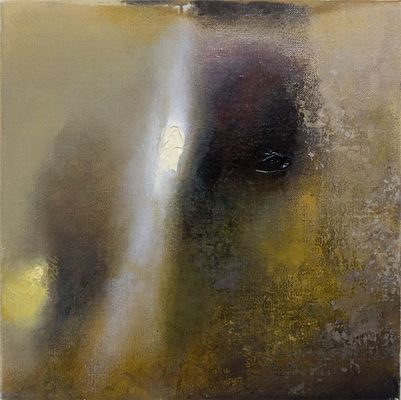
To return to Buckley’s fragment, the first two lines very much evoke how I paint nowadays. As you age, detail diminishes and patches of light become more luminous and float. I feel the most honest way of dealing with this is by smearing the oil paint on the canvas with the fingers and working close-up, blind. Only if the patches coalesce into an approaching image can the work gain a life.
-
Jonathan Walker was born in Melbourne, Australia and brought up on a dairy farm in Gippsland. In the 1970’s he studied painting at RMIT and won the Harold Wright Scholarship to the British Museum, London. During the 1980’s he exhibited at Pinacotheca Gallery, Richmond and had work shown at the NGV and Heidi City Art Gallery. Over the same period he designed the cover for the “Epigenesi” LP by Giancarlo Toniutti, Italy and conducted a mail exchange work with Achim Wollscheid, Germany. The work with artists through the post resulted in an article published in the bicentenary issue of Art and Australia 1988. He showed in artist run spaces such as WestSpace in the 90’s and 2000’s, and until 2012, taught painting at Victoria University, which is where we (Colleen Ahern and Lisa Radford) as organisers of the exhibition, among many others, had the privilege of being his student.
Walker’s knowledge was imparted to students through the careful selection of music, literature, and artists found in books that he himself had ordered for the library. Walker’s strategy was the generosity of sharing his vast knowledge with references specific to each student and their context.
Walker’s paintings share a similar focus and intimacy.
This exhibition presents a small selection of recent paintings alongside a publication that includes Walker’s writing. Observational and analytical, Walker’s work is a type of material notation — the time of day, colour and how it is blended, the both specific and fleeting location of a reflection on lino or the question of whether a chair leg should be included in a painting.
Please join us on Friday August 21 between 6-8pm to celebrate the opening of the exhibition.
Curated by Colleen Ahern and Lisa Radford.
B. Wurtz
Curated by Nic Tammens
March 26 - April 4, 2015
B.Wurtz works from a basement studio in his home on Manhattan’s Lower East Side.
This local fact is attested to by the plastic shopping bags and newsprint circulars that appear in his work. As formal objects, they don’t make loud claims about their origins but nonetheless transmit street addresses and places of business from the bottom of this long thin island. Like plenty of artists, Wurtz is affected by what is local and what is consumed. His work is underpinned by this ethic. It often speaks from a neighborhood or reads like the contents of a hamper:
“BLACK PLUMS $1.29 lb.”
“Food Bazaar”
“USDA Whole Pork Shoulder Picnic 99c lb.”
“RITE AID Pharmacy, with us it’s personal.”
“H. Brickman & Sons.”
“Sweet Yams 59c lb."
Most of the work in this exhibition was made while the artist was in residence at Dieu Donne, a workshop dedicated to paper craft in Midtown. Here Wurtz fabricated assemblages with paper and objects that are relatively lightweight, with the intention that they would be easily transportable to Australia. This consideration isn’t absolute in Wurtz’s work, but was prescriptive for making the current exhibition light and cheap. Packed in two boxes, these works were sent from a USPS post office on the Lower East Side and delivered to North Melbourne by Australia Post.
Wurtz appears courtesy of Metro Pictures, New York.
Thanks to Rob Halverson, Joshua Petherick, Sari de Mallory, Matt Hinkley, Helen Johnson, Fayen d'Evie, Ask Kilmartin, Lisa Radon, Ellena Savage, Yale Union, and "Elizabeth".
John Nixon
"Archive"
December 15 - January 20, 2014
The presentation of John Nixon's archive offered a rare showcase of this extensive collection of the artist's own publications, catalogues, posters, ephemera, editions and more, from the mid 1980s onwards, alongside a selection of his artworks.
Organized by John Nixon, Joshua Petherick and Matt Hinkley.
<a href=http://wfb.public-office.info/artist/john-nixon>All titles by John Nixon
"Habitat"
at Minerva, Sydney (organised by Joshua Petherick and Matt Hinkley)
November 15 - December 20, 2014
Lupo Borgonovo, Janet Burchill & Jennifer McCamley,
Lewis Fidock, HR Giger, Piero Gilardi, Veit Laurent Kurz,
Cinzia Ruggeri, Michael E. Smith, Lucie Stahl, Daniel Weil, Wols
Press Release:
“...It contained seven objects. The slender fluted bone, surely formed for flight, surely from the wing of some large bird. Three archaic circuitboards, faced with mazes of gold. A smooth white sphere of baked clay. An age-blackened fragment of lace. A fingerlength segment of what she assumed was bone from a human wrist, grayish white, inset smoothly with the silicon shaft of a small instrument that must once have ridden flush with the surface of the skin - but the thing’s face was seared and blackened.”
William Gibson, “Count Zero”, 1986
"Autumn Projects Archive"
Curated by Liza Vasiliou
March 6 - March 15, 2014
World Food Books, in conjunction with the Virgin Australia Melbourne Fashion Festival 2014, presented the Autumn Projects archive, consisting of a selection of early examples in Australian fashion with a particular interest in collecting designers and labels from the period beginning in the 1980’s, who significantly influenced the discourse of Australian Fashion.
Curated by Liza Vasiliou, the exhibition provided a unique opportunity to view pieces by designers Anthea Crawford, Barbara Vandenberg, Geoff Liddell and labels CR Australia, Covers, Jag along with early experimental collage pieces by Prue Acton and Sally Browne’s ‘Fragments’ collection, suspended throughout the functioning World Food Books shop in Melbourne.
H.B. Peace
presented by CENTRE FOR STYLE
November 14, 2013
"Hey Blinky, you say chic, I say same"
Anon 2013
H.B. Peace is a clothing collaboration between great friends Blake Barns and Hugh Egan Westland. Their pieces explore the divergences between 'character’ and ‘personality’ in garments....etc
Special Thanks to Joshua Petherick and Matt Hinkley of WFB and Gillian Mears
and a Very Special Thank you to Audrey Thomas Hayes for her shoe collaboration.
Janet Burchill & Jennifer McCamley
"Aesthetic Suicide"
May 10 - June 8, 2013
The first of our occasional exhibitions in the World Food Books office/shop space in Melbourne, "Aesthetic Suicide" presented a body of new and older works together by artists Janet Burchill & Jennifer McCamley, including videos, prints, a wall work, and publications.
During shop open hours videos played every hour, on the hour.
2014, English/German
Softcover, 256 pages, 23 x 16.5 cm
Published by
Texte Zur Kunst / Berlin
$29.00 - Out of stock
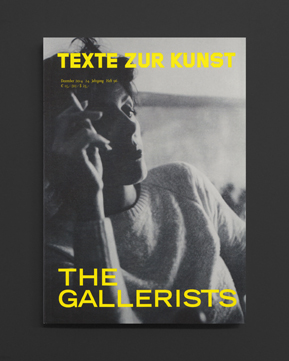
With this issue, Texte zur Kunst takes a closer look at one of the most contested groups of art world protagonists—”The Gallerists”—continuing a series in which we have examined, previously, “The Curators,” “The Collectors,” and the “Artists’ Artists.” As gatekeeper to artistic production on the one hand and market valuation on the other, the art seller, since the inception of the “dealer-critic” / “dealer-collector” systems, has occupied a decidedly privileged position. But in recent years, the demands of this profession have changed dramatically—now requiring 24/7 communication, perpetual travel, and a constant presence at fairs. In these pages, we ask if in recalibrating to accommodate these pressures, the gallerist has, in a sense, become something other than what we once took him or her to be?
What, today, can we make of the “good” gallerist carefully establishing a stable of artists, “placing” their work over time in particular institutional and private collections? And how does this position correspond with those of the many new (or at least newly prominent) mediators further altering the field—the advisors and consultants, the “flippers,” and various digitally based aggregators?
Further to this, we ask if this restructuring is affecting (or indeed is an effect of) the ways in which artists now work. And if a market taking place independently of gallerists is indeed increasing, how then does this affect the established mechanisms of validation and canonization?
Also in this issue: an image spread by Dan Mitchell as well as reviews from Berlin, Bregenz, Heidelberg, London, Madrid, Mexico City, New York, Salvador, and St. Petersburg.
English content:
Preface
Main Section
Olav Velthuis
“Artrank and the Flippers: Apocalypse Now?”
“New York Recall”
Friedrich Petzel on his gallery / Richard Kern on Feature Inc.
Hannes Loichinger
“Trading Notions”
Isabelle Graw
“The Gallerist’s Hat”
On John Knight’s “JK, a work in situ, Art Basel” and the structural transformation of the art world
Lynda Morris
“Out of Düsseldorf”
“G-Force: Gallerists and the Expanded Market”
A roundtable conversation with Simon Denny, Nicole Hackert, Lisa Schiff, Niklas Svennung, moderated by Caroline Busta and Hanna Magauer
Lane Relyea
“Shifting Terrain”
Harald Falckenberg
“Tips for a Gallerist I”
On galleries as commercial enterprises
Noah Horowitz
“Tips for a Gallerist II”
The passion of the industry
Reviews
Sven Lütticken
“Event Horizon”
On Johanna Burton and Anne Ellegood’s “Take It Or Leave It: Institution, Image, Ideology”
Philipp Ekardt
“Toward Criticism as an Anecdotal Science”
On “Pictures, Before and After: An Exhibition for Douglas Crimp” at Galerie Buchholz, Berlin
David Rimanelli
“All 47 Likes Are Mine”
On Richard Prince at Gagosian Gallery, New York
Brigid Doherty
“Studio Sessions”
On Hanne Darboven at Museo Nacional Centro de Arte Reina Sofía, Madrid
Brendan Fowler
“Heart and Soul”
On Colourbox at Between Bridges, Berlin
David Bussel
“Real Capital Seduction”
On KP Brehmer at Raven Row, London
Dorothea Jendricke
“Painting 501″
On Valentina Liernur at Campoli Presti, London
Ana Teixeira Pinto
“Lines of Territory”
On Mariana Castillo Deball at Kurimanzutto, Mexico City
Artists’ editions
Alex Israel
Ferris Bueller’s Day Off, 2014
Laura Owens
Untitled, 2014
2014, English/German
Softcover, 296 pages, 23 x 16.5 cm
Published by
Texte Zur Kunst / Berlin
$32.00 - In stock -
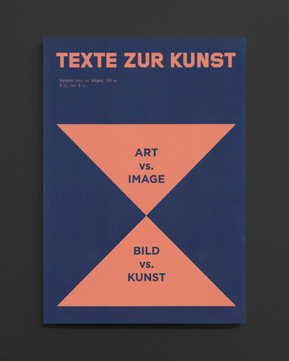
“Art vs. Image”—this opposition refers to recent changes and conflicts in the academic field and in artistic and curatorial practices. They correspond with symptomatic developments, like a growing interest in images that lie “beyond,” or “outside” of art; a steady increase of writing in the fields of image studies and philosophy; or proclamations of an age “after art” in which images assume art’s legacy. While shifts in technology are changing art production, the contemporary criteria for success seem increasingly contingent on iconic potency and the optimized potential for circulation as image. The necessity of distinguishing between two different concepts is clear: numerous artistic practices would, in fact, disappear if art were predominantly located in the sphere of image production.
And whereas a critical analysis of art is well put in place, there still seems to be a lack of comparable attempts when it comes to analyzing images. The questions raised in the field of image studies often pertain to the ontology of the image, not to its politics, production, or economy.
In this issue, we call for a critique that does not dwell on surface phenomena, but poses questions as to how images come into being. We consider the often underdeveloped differentiation in the discourses on art and image; questions of status attached to the two concepts; and the operational logics of image production inside and outside the art context.
The issue also features a statement by the late Harun Farocki, as well as a commemoration of the filmmaker’s and author’s life and work by Diedrich Diederichsen.
Plus a picture spread by Marlie Mul and reviews from Basel, Berlin, London, Los Angeles, Munich, New York, Oslo, Pittsburgh, Sørbråten, and Venice.
Exclusive new artists’ editions by Ken Okiishi and Elizabeth Peyton.
English content:
Preface
Main Section
Gertrud Koch
“False Reconciliation”
For a conceptual and practical differentiation of art and image
Peter Osborne
“‘Art’ versus ‘Image’?”
“Studies Oblivious to Power”
A statement by Daniela Hammer-Tugendhat on “Bildwissenschaft” (Image Studies)
“On Image Questions”
Harun Farocki responds to TEXTE ZUR KUNST
“Digital Reflex”
Avery Singer and Ed Atkins respond to TEXTE ZUR KUNST
Philipp Ekardt
“In Defense of Styling”
David Joselit
“Against Representation”
“Refusing Prestige”
A conversation between Georges Didi-Huberman, Ludger Schwarte and Philipp Ekardt
Peter Geimer
“Image and Art”
Notes on a relationship
Charlotte Klonk
“Beyond Black and White”
Reception-aesthetic reflections on the distinction between image and art
Inge Hinterwaldner
“Deep Layers of Design”
Reviews
George Baker
“The Greatest Artist of the Nineteenth Century”
On T. J. Clark’s Picasso and Truth
Tavia Nyong’o
“Profaning the Unprofanable”
On Why Do The Heathen Rage? by The Soft Pink Truth
Chris Reitz
“Aftermarket”
On No Problem: Cologne / New York 1984–1989 at David Zwirner, New York
Megan Francis Sullivan
“After Tina Matkovic”
On Other Primary Structures at the Jewish Museum, New York
Jenny Jaskey
“Do you want the real thing, or are you just talkin’?”
On Jutta Koether at Reena Spaulings Fine Art, New York
Johanna Burton
“Split Subjects”
On Anicka Yi at 47 Canal, New York
Jakob Schillinger
“MUD Club”
On Sam Pulitzer at Artists Space, New York
Daniel Horn
“Body and Soul Redux”
On Paul Chan at Schaulager, Basel
Jens Hoffmann
“United States of Biennials”
On Whitney Biennial, Carnegie International, and “Made in L.A.”
Petra Lange-Berndt
“Biography as Alibi”
On Sigmar Polke at the Museum of Modern Art, New York
Monica Amor
“A Farewell to Arts”
On Lygia Clark at the Museum of Modern Art, New York
Edward Dimendberg
“Exit the Political”
On the 14th International Architecture Exhibition, Venice
Artists’ editions
Ken Okiishi
gesture/data (micro thumbnail scale, boxed), 2014
Elizabeth Peyton
Elias, 2014
2014, German/English
Softcover, 280 pages, 23 x 16.5 cm
Published by
Texte Zur Kunst / Berlin
$29.00 - In stock -
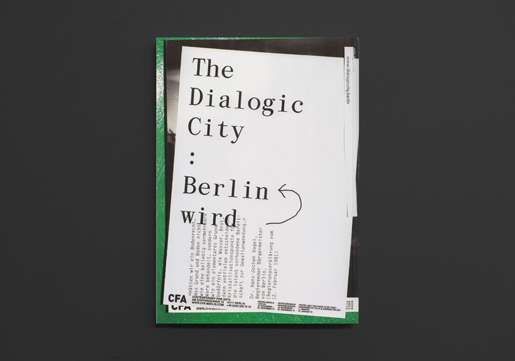
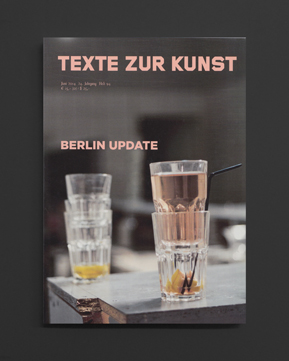
Over the past years, Berlin has become an important center for the international production of art and theory. English is firmly entrenched as its second language, and it attracts an unending inflow of newcomers. An informal economy, ample resources of time and space, the intense debates that are said to take place here, and its bohemian aura are still crucial to its attractiveness. But doesn’t Berlin’s allure derive from expectations created by realities of the 1990s and 2000s that no longer exist? Berlin’s current remodeling in line with a representational and economic agenda was already being planned as others still put their faith in the transgressive potential of parallel “underground” worlds. It is time for an assessment without nostalgia or resignation: for a Berlin Update.
This issue of TEXTE ZUR KUNST investigates recent developments in Berlin that also stand paradigmatically for structural transformations of the art world, academia, and the general conditions of life and work. As economization and flexibilization, along with formerly ‘alternative’ project culture, are spreading to the core of institutions, the interrelation between the public sphere, the city, knowledge, and the markets changes drastically. Our authors discuss the conditions artists and curators face when working in and outside of Berlin’s art institutions; they examine the bohemian art scene’s tendency to blend into the VIP zone that has formed in recent years; they criticize the exhibition and collection politics of Berlin’s museums; and they investigate new tendencies and sites in the production of theory, art, music, and nightlife in the city. And not at last we ask what remains of the local in a globally networked (art) world.
Plus a picture spread by Calla Henkel and Max Pitegoff and reviews from Berlin, Chicago, Copenhagen, Frankfurt/M., Geneva, New York, Siegen, Stuttgart, and Zurich. Exclusive new artists’ editions by Axel Hütte and K.O. Götz.
English content:
Preface
Main Section
Isabelle Graw
“The Myth of Remoteness from the Market. Notes on Berlin’s Rise as an Art Metropolis”
“Under the Shadow of Projects”
A roundtable discussion with Heike-Karin Föll, Juan Gaitán, Christoph Gurk and Florian Wüst, moderated by Philipp Ekardt and Hanna Magauer
Susanne von Falkenhausen
“Statement on the Exhibition and Collection Politics of the Berlin National Gallery”
“Berlin Theory”
A survey with Barbara Wittmann, Alexander García Düttmann, Frank Ruda, Peter Geimer and Maria Muhle
Philipp Ekardt
“The New Pragmatists. On Times and New Theater”
Pablo Larios
“Blackout. On White Material Records”
Paul Feigelfeld
“The Cloud Over Berlin. Two Remarks on the Archaeology and Present of Digital Rights”
Short Cuts
“On the Significance of Textiles in Contemporary Thought and Praxis”
A survey by S. Buchmann and R. Frank with T. Smith, A. Mendizabal, M. Kapustka/A. Reineke/A. Röhl/T. Weddigen, J. Raum, L. Antunes, K. Kouoh, I. Below
Reviews
John Beeson
“Where Failure is Proof of Wrongdoing”
On The Essential Ellen Willis
Gili Tal
“The Place Beyond One’s Prime”
On Timothy Davies at Sandy Brown, Berlin
Jenni Sorkin
“Still Waiting”
On Faith Wilding at Threewalls, Chicago
Andrew Stefan Weiner
“Photoconceptualism Pure and Impure”
On Christopher Williams at the Art Institute of Chicago
Carson Chan
“Growers and Showers”
On Eddie Peake at Peres Projects, Berlin
Brigid Doherty
“Titles and Compositions”
On Rosemarie Trockel at Gladstone Gallery, New York
Sven Lütticken
“A Retrospective With Eight Legs”
On Superflex at Kunsthal Charlottenborg, Copenhagen
Piper Marshall
“The Costliness of Our Attachments”
On Bad Conscience at Metro Pictures, New York
Jacob King
“Signifying Friendship”
On Macho Man, Tell It To My Heart at Artists Space, New York
Obituaries
Alena J. Williams
“Productive Estrangements. Remembering Nancy Holt (1938–2014)”
Artists’ Editions
Axel Hütte
Ca’Corner della Regina-3, 2012/2014
K.O. Götz
Siekri 12, 2014
2014, German/English
Softcover, 296 pages, 23 x 16.5 cm
Published by
Texte Zur Kunst / Berlin
$29.00 - In stock -
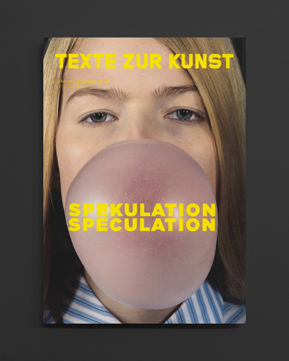
Speculation is clearly the buzzword of the moment; in philosophy, art, the art market, literature, and finance. But what does it mean, exactly, to speculate? Speculation grasps for the nonexistent. As a financial operation, speculation aims to make the future controllable, calculating possible price developments on the basis of empirical data. One of the elementary pacemakers of present-day capitalism, it also plays a pivotal role in generating value in the field of contemporary art. It transforms the character of collections, collectors now aiming at a subsequent resale with profit maximization.
In contrast, theoretical speculation, e.g. in the form of Speculative Realism, is directed toward the fundamentally uncertain. This philosophical movement, which is increasingly present in contemporary art discourse, frequently positions speculation against the programs of critique and aesthetics. The question is whether this leads to an unreflecting leap toward the ‘things themselves’ which in turn requires a critical examination; but also, wherein the opportunities of speculative models lie: Speculation bears the promise of not merely critically addressing what is given, but of catching up with the hypothetical, thinking the potential. In this sense, speculation is a driving force for any creative mode.
In this issue, we ask for theoretical, artistic, and curatorial assessments of the current boom of speculative models. We look at Speculative Realism, the work of its first protagonists and its recent developments, as well as the widely popular curatorial recourses to speculative philosophy, as seen in the exhibition Speculations on Anonymous Materials at Fridericianum, Kassel. Our authors discuss the generation of value in the art system; art’s function in investment portfolios; and the early case of the art speculators “La Peau de l’Ours” in early 20th-century Paris. We also examine the temporal contracts that are implemented by speculative operations. And, with Rainald Goetz and Alexander Kluge, we publish two authors who explore the proximity of speculation and (literary) writing.
Plus a picture spread by DIS and reviews from Berlin, Chicago, Düsseldorf, Irvine, Karlsruhe, London, Los Angeles, New York, and Paris.
Exclusive new artists’ editions by Albert Oehlen and Richard Phillips.
English content:
Preface
Main Section
Steven Shaviro
Speculative Realism – A Primer
Armen Avanessian
The Speculative End of the Aesthetic Regime
Suhail Malik
The Value of Everything
Michael Hutter
Balanced Investments. On Speculation in the Art Market
Sophie Cras
How to Sell the Bearskin. An Early Case of Art Speculation
In the Pull of Time
A conversation between Joseph Vogl and Philipp Ekardt
Alexander Kluge
Five Stories
Rainald Goetz
Speculative Realism
On the Advantages and Disadvantages of Working Speculatively
A survey with statements by Diedrich Diederichsen, Karin Harrasser, Jenny Jaskey, Jutta Koether, and Sam Lewitt
Kerstin Stakemeier
Prosthetic Productions. The Art of Digital Bodies. On “Speculations on Anonymous Materials” at Fridericianum, Kassel
Reviews
Julian Stallabrass
How to Own it
On “Collecting Art for Love, Money and More” by Ethan Wagner and Thea Westreich Wagner
Daniel Horn
This is Not an Orange
On Lindsay Lawson at Gillmeier Rech, Berlin
Ana Finel Honigman
An Air of Apathy and Awkwardness
On Kaye Donachie at Maureen Paley, London
Timotheus Vermeulen
A Lingering Absence
On Ilse D’Hollander at Konrad Fischer, Düsseldorf
Alex Kitnick
Toward a New Monumentality
On Isa Genzken at MoMA, New York
Melanie Gilligan
On Language as Plastic Phenomenona
On Mira Schendel at Tate Modern, London
Suzanne Hudson
From Landscape to Lacan
On The Symbolic Landscape: Pictures Beyond the Picturesque at UC Irvine University Art Galleries
Ellen Feiss
Behind the Sequined Curtain
On Pauline Boudry / Renate Lorenz at Badischer Kunstverein, Karlsruhe
Obituaries
Emma Hedditch / Kerstin Stakemeier
Ian White (1971–2013)
Artists’ Editions
Albert Oehlen
Baum, 2014
Richard Phillips
First Point, 2014
2013, German/English
Softcover, 272 pages, 23 x 16.5 cm
Published by
Texte Zur Kunst / Berlin
$29.00 - Out of stock
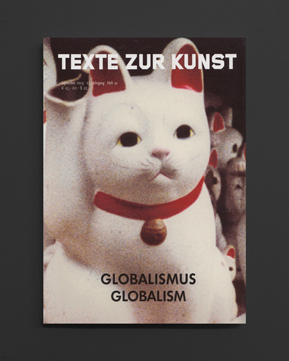
With the title of “Globalism,” this year’s September issue of Texte zur Kunst proposes a critique of the discourse on “Global Art” as it has emerged in the wake of economic globalization. The main questions are: Does a global world need Global Art—or—does a globalized world produce globalized art? What, precisely, is the difference between these two phrases, between making a political claim and the economic structure? When did the term “Global Art” become the assertion of a “contemporary world art” that is composed along the lines of global economization, and what possible alternatives and other historiographies exist? Where do the potentials and surpluses of the global lie, if we grasp them as a political horizon of common action—no matter how inherently contradictory that notion may be? Is the current pervasiveness of “Global Art” in exhibition titles, conferences, funding programs, and their implementation in study courses symptomatic of a (self-)surmounting of the Global North? Or does it indicate a universalization of its concepts of art that remain linked to capitalism’s colonizing power of definition?
Instead of accepting “Global Art” as a new category of covert European and Western self-definition, we would like to cast a view on a differentiated and pluralized notion of the “Global” on the possibility of writing the narrative of art as transnational entangled histories, and of bringing the exchange relations between actors from different regions of the world to the fore. Such a perspective also affects the attention paid to the transnational effects of capitalist crises in the Northwest and the ongoing political scenarios of upheaval in the “Middle East.” In light of this persistent global multitude of crises, one must also discuss the question as to the role of art and of artists beyond regionalist structures of advantage and prejudice. Instead of establishing new patterns of dominance with the world-spanning gesture of a Global Art, then, talk of the global in art should challenge not only one’s knowledge of what is distant, but also one’s own practice as the globality of what is close by.
Plus a picture spread by Sophie-Therese Trenka-Dalton and reviews from Beijing, Berlin, London, Los Angeles, Lüneburg, Munich, Münster, Oporto, Santa Barbara, Stuttgart, and Vienna.
Exclusive new artists’ editions by Annette Kelm and Matthias Weischer.
English Content:
Preface
Main Section
Susanne Leeb
Asynchronous Objects
Anke Bangma
Response to Susanne Leeb: Some Thoughts on the Uncomfortable Timeliness of Ethnological Museums
Sylvester Okwunodu Ogbechie
Response to Susanne Leeb: Contemporary Art, Ethnology Museums and Relational Politics
an email-conversation between
Kerstin Stakemeier, Maurizio Lazzarato, and Sarah Rifky
No New “New Deal”
Michaela Ott
The Small Aesthetic Difference
Christian Kravagna
Toward a Postcolonial Art History of Contact
Marion von Osten and Sarat Maharaj in conversation
The Surplus of the Global
Johannes Paul Raether and Eva Birkenstock
ask
Amilcar Packer, Zoe Zhang, Dmitry Vilensky, and Raqs Media Collective
A Dance of Growth and Terror
Reviews
John Beeson
Public Theater
On Liz Magic Laser at Westfälischer Kunstverein Münster
Pedro de Llano
The Periphery of the Others is Our Center
On Daniel Steegman at Uma certa falta de coerência, Oporto
Avigail Moss
Working Mothers of Invention
On My Barbarian at Susanne Vielmetter Los Angeles Projects
Drew Hammond
Globalism in Reverse
On Wang Xingwei at UCCA, Beijing
Ellen Feiss
A Dandy Flavor
On “Notes on Neo-Camp” at Studio Voltaire, London
Jenni Sorkin
Soft and Entitled
On Dasha Shishkin at MCA, Santa Barbara
Yuki Higashino
The Formalities of Curating
On “The Content of Form” at the Generali Foundation and “Unrest of Form. Imagining the Political Subject” at the Secession, both Vienna
Artists’ Editions
Annette Kelm
Untitled (TZK), 2013
Matthias Weischer
Berg, 2013
2013, German/English
Softcover, 280 pages, 23 x 16.5 cm
Published by
Texte Zur Kunst / Berlin
$32.00 - In stock -
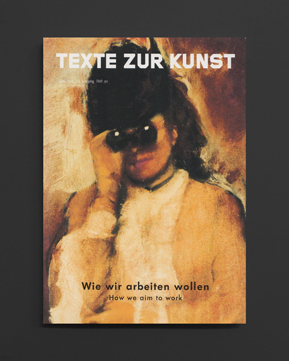
Under the motto “How we aim to work,” the June issue of Texte zur Kunst brings together contributions by authors who have been associated with the magazine for a long time and who have shaped its debates along the way. Instead of specifying a thematic focus, we left it to the contributors to decide which questions relating to their current research interests they wanted to address—themes for which, faced with the deadlines always bearing down on them, the authors usually don’t find time. It is precisely the conditions out of which their texts developed and the different formats of these contributions—from collaborative authorship; to narrative, literary essays; all the way to monographic and performative, artistic treatises—that stand for a different approach to the fields of university research, project-oriented collaborations, or artistic dealings. Such an approach would run counter to the often sobering coercion of activity and effectiveness that characterizes working conditions today. All of the contributions show that a strategy of countering this imperative of activity can derive from pursuing long-term modes of working and thought in a targeted way and from investing in a project intensively over a longer period of time. Not only does the longstanding commitment of these authors to Texte zur Kunst mark such an endeavor, but with their “work samples” in this issue, they also grant us insight into the themes they are currently working on: Instead of bowing to the pressure of presenting only finished products, they stress the potential that lies in making work processes visible and putting them up for debate. “How we aim to work” can therefore be understood as both a question that we pose ourselves and as a public appeal.
Plus a picture spread by Dierk Schmidt and reviews from Berlin, Cincinnati, Cologne, Düsseldorf, Frankfurt/Main, Liverpool, Los Angeles, Madrid, Margate (GB), New York, Nuremberg, Oberhausen, and Paris.
Exclusive new artists’ editions by Matias Faldbakken and Wade Guyton.
English Content
Preface
Main Section
Tom Holert
Postscript on the Societies of Comfort
Jutta Koether
Starting from the Picture
Seat of Power—A Picture of Being a Woman Artist
Beate Söntgen
Why Diderot?
A Project Outline
Helmut Draxler
Taking Part in the Other
Politics and Structural Ambivalence
Sabeth Buchmann & Constanze Ruhm
Subject Put to the Test
Rainer Bellenbaum
Disco, Drift, Tent, Choir
On Elizabeth Price’s Videos
Sven Lütticken
Research Objectives
Or: The Art of Obstruction
Clemens Krümmel
A Minor Ninth That Nobody Wants
On the Henry Flynt Exhibitions “Activities 1959–” in Düsseldorf and Karlsruhe
Short Cuts
Still One of Us?
Isabelle Graw asks Julia Gelshorn, Sebastian Egenhofer, Fiona McGovern, and Chris Reitz about the current reception of Martin Kippenberger.
Reviews
Christodoulos Panayiotou
Closer Distances
On Disabled Theater by Jérôme Bel
Marina Vishmidt
A Rapid Inventory of the Universe
On Rosa Barba at Turner Contemporary, Margate
Philipp Ekardt
Makeup Collage
On Linder at the Musée d’Art Moderne de la Ville de Paris
Adrienne Rooney
Who Knows Nothing?
On John Finneran at Canal 47, New York
Alex Kitnick
Pop Pyramid
On Derek Boshier at Thomas Solomon Gallery, Los Angeles
David Reisman
Teamwork
On Thomas Bayrle at The Artist’s Institute, New York
André Rottmann
Complicity and Contestation
On Andrea Fraser at the Museum Ludwig, Cologne
Petra Lange-Berndt
Unmaking Normality
On “Glam! The Performance of Style” at Tate Liverpool
Michael Darling
Photosensitive
On James Welling at the Cincinnati Art Museum
Pedro de Llano
The Sentient Memory of Latin America
On “Losing the human form” at Museo Nacional Centro de Arte Reina Sofía, Madrid
Artists’ Editions
Matias Faldbakken
Jerry Can Cut, 2013
Wade Guyton
IMG_1919.JPG, 2013
2013, German/English
Softcover, 264 pages, 23 x 16.5 cm
Published by
Texte Zur Kunst / Berlin
$29.00 - Out of stock
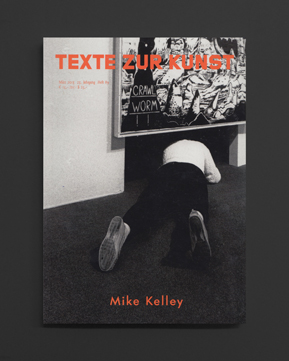
The March issue of Texte zur Kunst is dedicated to Los Angeles artist Mike Kelley, who died one year ago. During the three and a half decades in which he was active as an artist, the vast majority of criticism written about Kelley—both positive and negative—was produced by members of his own generation. For them, his oeuvre constitutes an intervention into what had been the status quo. His examination of culture’s objects, practices, and narratives revealed the contradictions between hegemonic culture and socially marginal cultural forms. In doing so, the work constructed a politics embracing difference and thus suggested the potential of living and working on the fringes of, but in relation to, given norms. In contrast to its initial impact, however, for growing numbers of younger artists and writers, Kelley’s work sets the standard by which others are measured. The authors of this issue know him first and foremost as a representative of the status quo—cultural analyst, subversive, and artist-critic par excellence. Their texts engage themes that were central to Kelley’s artistic practice, thus arguing by extension that room still exists for new and contradictory evaluations of the artist’s work in relation to the frameworks of culture and its history. A tacit assumption pervades all the texts: That it is possible to recognize complex inner workings of a division of culture through the mobilization and analysis of specific examples of its products. However, given the tendency of forms and practices to be assimilated by institutions as well as to fade out of use over time, it is Kelley’s analytic methodology, rather than his individual works, which holds critical potential both now and moving forward.
Plus a picture spread by Jim Shaw and reviews from Amsterdam, Berlin, Bordeaux, Chicago, Hamburg, Munich, New York, Tokyo, and Vienna.
Exclusive new artists’ editions by Jana Euler and Tony Oursler.
English Content:
Preface
Main Section
Victoria Camblin
Soft and Hard
Mike Kelley’s Tactile Return
Samuel Draxler
Working It
Kelley’s Crafts
Leigh Ledare
A Hole, but a Flattened Down Hole
Adam Putnam
Editorial Complex (A Reconstruction)
Matt Keegan
Playing House
Hannah Kahng
Behind the Scenes
Narrative and Filmic Convention in Mike Kelley’s Early Videos
Annie Ochmanek
Here Comes the Zoo
Mike Kelley and His Audience
Piper Marshall
Investment Returns
Mike Kelley’s Pay for Your Pleasure
Nicolás Guagnini
Italics Mine
Deformation, Modification, Exaggeration
Sam Lewitt
Stare Naked
More Than Could Ever Be Suppressed
A conversation about Mike Kelley between Philipp Kaiser, Jutta Koether, and Martin Prinzhorn, moderated by Oona Lochner
Reviews
Sven Lütticken
Moving in Circles
On Oskar Fischinger at EYE Film Museum, Amsterdam
Claire Fontaine
Krebber in Bordeaux
On Michael Krebber at the CAPC musée d’art contemporain de Bordeaux
Mathieu Malouf
Attitude Becomes Dorm
On Trisha Baga at Greene Naftali, New York
Rachel Haidu
Bonfire of the Vanities
On Rosemarie Trockel at the New Museum, New York
Daniel Horn
American Idol
On Mike Kelley at the Stedelijk Museum, Amsterdam
Maggie Taft
Surface Studies
On R.H. Quaytman at The Renaissance Society, Chicago
John Beeson
Louder Than a Dull Hum
On Nina Canell and Rolf Julius at the Hamburger Bahnhof, Berlin
Artists’ Editions
Jana Euler
Die individualisierte Editionsnummer besichtigt das subjektive Fenster (Bild) und guckt auf ein Stück der Welt, 2013
Tony Oursler
Ear-Worm, 1976/2013
2012, German/English
Softcover, 240 pages, 23 x 16.5 cm
Published by
Texte Zur Kunst / Berlin
$29.00 - Out of stock
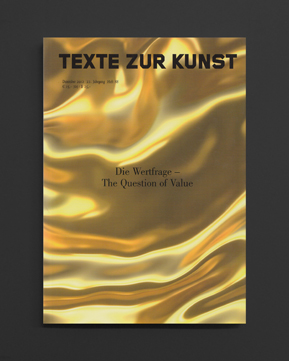
The December issue of Texte zur Kunst examines processes of value-formation in the art world and beyond. It pursues the question of which factors and players are involved in the production of value, but in doing so it is less interested in the motivations behind individual actions than in the specific structure of the mechanisms effecting value-formation. Value can be understood as an accumulation of human labor in an (artistic) object, although not every object containing human labor is, of course, experienced as valuable. In this sense, value can also be an attribution of artistic relevance, which implies clearly distinguishing it from the concept of monetary value: Value is not the same as price. In each of the various segments of the art world—the market, the exhibition circuit, academic studies, critique—specific criteria for value-formation have evolved. Furthermore, the process by which value is producedproves to be basically open and incomplete, and value is something that is newly negotiated time and again. This is true of the field of art, but also of all other areas of social interaction.
Plus reviews from Basel, Berlin, Bregenz, Cologne, Düsseldorf, Frankfurt/M., New York, Paris, Rotterdam, and Vienna.
Exclusive new artists’ editions:
Simon Denny, Jeff Koons, and Franz Erhard Walther
English Content
Preface
Isabelle Graw
The Value of the Art Commodity
Twelve theses on human labor, mimetic desire, and aliveness
At Any Cost
Seven questions for Todd Levin
André Orléan
What Is the Economic Value Worth?
Mikkel Bolt Rasmussen
The End of Contemporary Art’s Bubble Economy
Diedrich Diederichsen
Time, Object, Commodity
The Value of Autonomy
A conversation between Kerstin Stakemeier and Marina Vishmidt about the reproduction of art
Reviews
Chris Reitz
House Beautiful
On John M Armleder at the Swiss Institute, New York
John Miller
Napoleon in Rags
On Andreas Wegner at Petra Rinck Galerie, Düsseldorf
James Voorhies
Attraction and Repulsion in What It All Means
On Eran Schaerf at Zwinger Galerie, Berlin
David Joselit
The Power to Style
On Bernadette Corporation at Artists Space, New York
Sven Lütticken
Why Collaboration Matters in Art and Elsewhere as Never Before
On Surplus Authors at Witte de With, Rotterdam
André Rottmann
Sculpture as Retrieval
On Gabriel Orozco at the Deutsche Guggenheim, Berlin
Obituary
Daniel Buren
Michael Asher – God Is in the Details
Artists’ Editions
Simon Denny
Wer nicht umsteigt, wird abgeschaltet, 2012
Jeff Koons
Untitled (Antiquity Drawing), 2012
Franz Erhard Walther
Materialhandlung, 2012
2012, German/English
Softcover, 287 pages, 23 x 16.5 cm
Published by
Texte Zur Kunst / Berlin
$29.00 - Out of stock
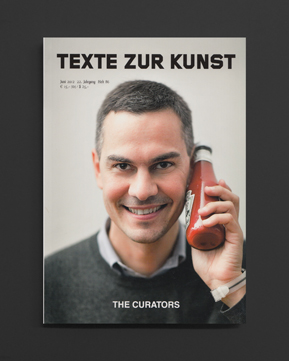
The June issue of Texte zur Kunst is dedicated to the curator, a figure in the art field that has gained authority over the past two decades. Ever since Harald Szeemann’s trendsetting documenta 5 (1972), “the independent curator” has counted as a new preeminent player in the art world. No longer employed by a museum but instead an initiator and author of project-based presentations at various institutions, the figure of the curator is also associated with the emergence of thematic group shows in which artworks, everyday objects, and documents, as equally treated exhibits, are meant to illustrate a hypothetical curatorial concept. In the art world of the 1990s—which was characterized by relations and interdisciplinarity, contexts and displays—curatorial activities were both popularized and professionalized. Curators increasingly acted as skilled networkers whose influence also grew due to the rising number of international biennials. At the same time, the notion of the curator or of curating has expanded beyond the confined boundaries of the art field and can now be found in all areas of cultural production. Against this backdrop the June issue of Texte zur Kunst examines how this rapid rise came about and what curatorial power really means. Thus, a perspective is opened that allows taking a fundamental look at the hegemonic structures in the art business and its effects.
Plus reviews from Berlin, Bregenz, Heidelberg, Karlsruhe, London, Los Angeles, Madrid, New York, Siegen, Vienna, and Winterthur.
Exclusive new artists’ editions:
Nick Mauss, Thomas Ruff, and Imi Knoebel
English content
Preface
Oliver Marchart
The Curatorial Subject
The figure of the curator between individuality and collectivity
Beatrice von Bismarck
Curating Curators
Between Art and Public
A roundtable conversation with Natasa Ilic, Maria Lind, Nicolaus Schafhausen, and Jakob Schillinger
Sabeth Buchmann
29,687
Lucy R. Lippard: Curating (Within) the System
Heinz Bude
The Curator as Meta-Artist
The case of HUO
Values and Interests
Survey among artists on the relationship to curators, with contributions by Monica Bonvicini, Claire Fontaine, Mariechen Danz, Olaf Nicolai, Adrian Piper, Thomas Scheibitz
Dieter Roelstraete
Art Work
Some notes on status anxiety
Reviews
Mark Prince
Through a Looking Glass
On John Smith at Tanya Leighton, Berlin, and Kestnergesellschaft, Hannover
John Beeson
Kill yr. Idols
On You Killed Me First at KW Institute for Contemporary Art, Berlin
Tal Sterngast
Attention, Deficit, Disorder
On Dirk Bell at Sadie Coles HQ, London
Comments on the 7th Berlin Biennial By Sven Lütticken, Margarita Tupitsyn, and Victor Tupitsyn
Pedro De Llano
Eggs Theory
On Hans Haacke at Museo Nacional Centro de Arte Reina Sofia, Madrid
Liz Kotz
Back to Basics
On Madison Brookshire and Tashi Wada at the Wulf., Los Angeles
Antek Walczak
Rites of Spring
On the Whitney Biennial 2012 at the Whitney Museum of American Art, New York
Mark Dion & Gareth James
Jackie McAllister – Silence with Great Eloquence
Artists’ Editions
Nick Mauss
Not another word for it, 2012
Thomas Ruff
Porträt 1989 (I. Graw), 1989/2012
Imi Knoebel
Anima Mundi, 2012
2009, English
Softcover, 248 pages (25 color ill.), 14 x 21.5 cm
Published by
Sternberg Press / Berlin
$32.00 - Out of stock
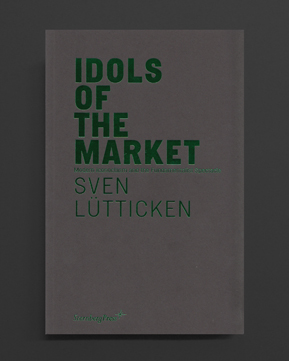
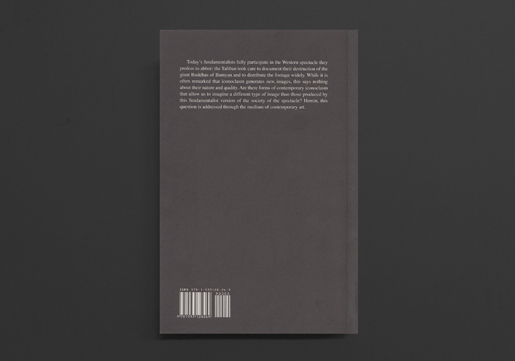
In a letter written shortly after Adorno’s death, in which he attempted to explain why his friend had not been buried according to Jewish rites, Max Horkheimer claimed that critical theory was based on the Second Commandment – the ban on representations of God or, in more fundamentalist interpretations, of representations of all living beings. In the 18th and 19th centuries, the monotheistic concept of idolatry had been gradually replaced by modern conceptions of myth and mythology; later it was integrated in critical conceptions of commodity fetishism, ideology, the spectacle, or Adorno and Horkheimer’s culture industry. This secularization of the concept of idolatry is now increasingly being revoked; the critique of the spectacle is seemingly "resacralized" by various religious factions.
The fundamentalists’ apparent fetishization of their religion’s aboriginal essence is rather questionable; their fight of the idolatrous spectacle takes place within this spectacle and fortifies it – all the while reducing the space for critique and dissent. This book examines both the afterlife of religious elements in modern culture and possible responses to the current religious reappropriation of this critique of modern capitalist culture by both Christian fundamentalists and radical Islamists. Rather than dismissing monotheistic idolatry critique, the aim is to once more set free its (self-) critical potential, in opposition to those “Enlightenment fundamentalists” who save the status quo by creating a manicheist opposition between the secular West and the pure otherness of Islam.
Art critic and historian Sven Lütticken contributes regularly to catalogues and art magazines such as Artforum, New Left Review, Afterimage, and Texte zur Kunst.
2014, English
Softcover, 180 pages, 16.5 x 23.5 cm
Published by
Dexter Sinister / New York
Sternberg Press / Berlin
The Serving Library / New York
$26.00 - Out of stock
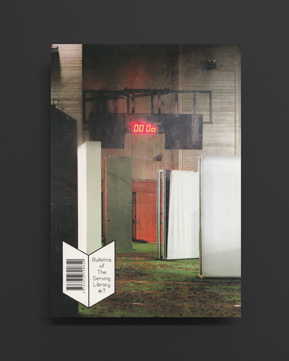
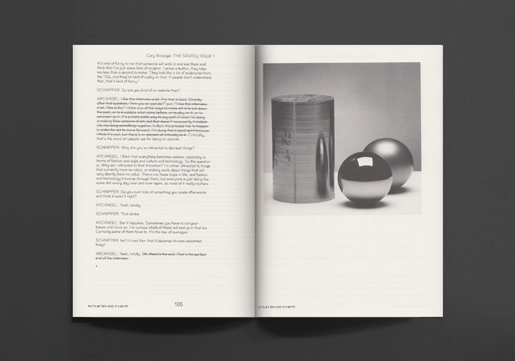
This issue concerns itself with “numbers,” ranging from a brief note on “The Psychology of Number” by John Dewey and John McLellan, to Vincenzo Latronico’s historical overview of the ongoing attempt to conjure “truths from thin air” (such as proof of the existence of god). In between are essays and articles by Cory Arcangel, Perrine Bailleux, Rosie Cooper, Dan Fox, Angie Keefer, Mathew Kneebone, James Langdon, Philip Ording, Katherine Pickard, David Reinfurt, and Justin Warsh, plus an indexical book review by the late David Foster Wallace.
Design by Dexter Sinister
2014, English
Softcover, 240 pages, 145 x 210 mm
$43.00 - Out of stock
Edited by Antony Hudek
Artists increasingly refer to “post-object-based" work while theorists engage with material artifacts in culture. A focus on “object-based" learning treats objects as vectors for dialogue across disciplines. Virtual imaging enables the object to be abstracted or circumvented, while immaterial forms of labor challenge materialist theories. This anthology surveys such reappraisals of what constitutes the “objectness" of production, with art as its focus.
Among the topics it examines are the relation of the object to subjectivity; distinctions between objects and things; the significance of the object’s transition from inert mass to tool or artifact; and the meanings of the everyday in the found object, repetition in the replicated or multiple object, loss in the absent object, and abjection in the formless or degraded object. It also explores artistic positions that are anti-object; theories of the experimental, liminal or mental object; and the role of objects in performance. The object becomes a prism through which to reread contemporary art and better understand its recent past.
Artists surveyed include
Georges Adéagbo, Art in Ruins, Iain Baxter, Louise Bourgeois, Pavel Büchler, Lygia Clark, Claude Closky, Brian Collier, Jimmie Durham, Fischli & Weiss, Luca Frei, Meschac Gaba, Isa Genzken, Gruppe Geflecht, Eva Hesse, Mike Kelley, John Latham, Antje Majewski, Gustav Metzger, Cady Noland, Gabriel Orozco, Adrian Piper, Falke Pisano, Eva Rothschild, Aura Satz, Kenneth Snelson, Hito Steyerl, Josef Strau, Alina Szapocznikow, Joelle Tuerlinckx, Erwin Wurm
Writers include
Homi K. Bhabha, Jack Burnham, Ewa Lajer-Burcharth, Lynne Cooke, Gillo Dorfles, Jean Fisher, Ferreira Gullar, Charles Harrison, Paulo Herkenhoff, Julia Kristeva, Bruno Latour, Bracha Lichtenberg-Ettinger, Jean-Fran?ois Lyotard, Lev Manovich, Ursula Meyer, Bruno Munari, Georges Perec, Hans-Jorg Rheinberger, Dieter Roelstraete, Howard Singerman, Nancy Spector, Marcus Steinweg, Anne Wagner, Gérard Wajcman, Slavoj Zizek
2014, English / French
Softcover, 232 pages (b&w ill.), 240 x 175 mm
Published by
May Revue / Paris
$29.00 $10.00 - In stock -
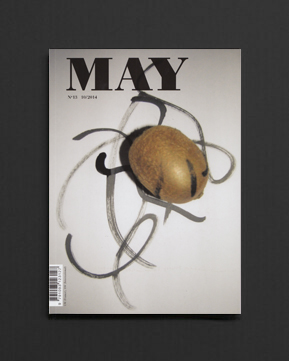
MAY #13 features:
Preface
καταστροφή: the end and the beginning
Man of the Anthropocene (as portrayed in the movie "Gravity")
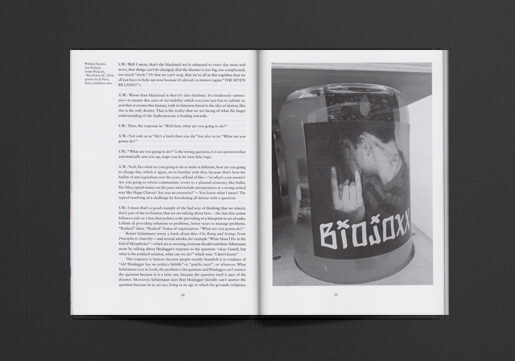
What is "political" in the Anthropocene? A conversation between STEPHANIE WAKEFIELD and ANTEK WALCZAK
DIY or DIE: a pastoral Selfie
Two stories
Insert: Dustin
REPORTS
Mirror, mirror on the wall ... STEWART UOO at Buchholz Gallery, Berlin
Garden graft. On the exhibition "Your portrait": a retrospective on TETSUMI KUDO at the National Museum of Modern Art, Tokyo
Kiss me, kiss me, love my body covers
True Romance. Camille Blatrix at Balice Hertling, Paris
The affect impersonal. Anne Imhof at Deborah Schamoni gallery, Munich
Dorothy Iannone This timeless sweetness at the Migros Museum für Gegenwartkunst, Zürich
"Species of notes." On the book Dubuffet typographer Pierre Leguillon
Exposure Charles James: beyond fashion at the MET, New York
About MAY Revue:
Conceived as a collective space in which to develop thoughts and confront positions on artistic production, May magazine examines, quaterly, contemporary art practice and theory in direct engagement with the issues, contexts and strategies that construct these two fields. An approach that could be summed up as critique at work – or as critique actively performed in text and art forms alike.
Featuring essays, interviews, art works and reviews by artists, writers and diverse practitioners of the arts, the magazine also intends to address the economy of the production of knowledge – the starting point of this reflection being the space of indistinction between information and advertisement typical of our time. This implies a dialogue with forms of critique produced in other fields.
2014, English
Softcover, 240 pages, 145 x 210 mm
Published by
The MIT Press / Massachusetts
Whitechapel / London
$52.00 - Out of stock
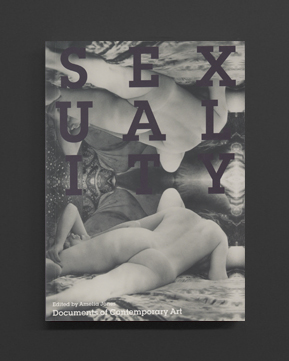
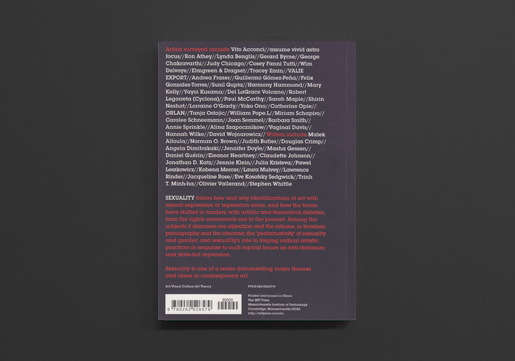
It has been argued, most notably in psychoanalytic and modernist art discourse, that the production of works of art is fundamentally driven by sexual desire. It has been further argued, particularly since the early 1970s, that sexual drives and desires also condition the distribution, display and reception of art.
This anthology traces how and why this identification of art with sexual expression or repression arose and how the terms have shifted in tandem with artistic and theoretical debates, from the era of the rights movements to the present. Among the subjects it discusses are abjection and the “informe,” or formless; pornography and the obscene; the performativity of gender and sexuality; and the role of sexuality in forging radical art or curatorial practices in response to such issues as state-sponsored repression and anti-feminism in the broader social realm.
Artists surveyed include:
Vito Acconci, Assume Vivid Astro Focus, Lynda Benglis, Louise Bourgeois, Gerard Byrne, George Chakravarthi, Judy Chicago, Vaginal Davis, Wim Delvoye, Elmgreen & Dragset, Valie Export, Félix González-Torres, Guillermo Gómez-Peña, Harmony Hammond, Claudette Johnson, Mary Kelly, Yayoi Kusama, Robert Legorreta, Paul McCarthy, Sarah Maple, Shirin Neshat, Lorraine O’Grady, Yoko Ono, Catherine Opie, Orlan, William Pope.L, Miriam Schapiro, Carolee Schneemann, Joan Semmel, Barbara Smith, Annie Sprinkle, Alina Szapocznikow, Del LaGrace Volcano, Hannah Wilke, David Wojnarowicz
Writers include:
Malek Alloula, Norman O. Brown, Judith Butler, Douglas Crimp, Angela Dimitrakaki, Michel Foucault, Daniel Guérin, Eleanor Heartney, Jonathan D. Katz, Rosalind Krauss, Julia Kristeva, Paweł Leszkowicz, Herbert Marcuse, Kobena Mercer, Laura Mulvey, Lawrence Rinder, Jacqueline Rose, Eve Kosofsky Sedgwick, Susan Sontag, Trinh T. Minh-ha, Stephen Whittle
About the Editor
Amelia Jones is Grierson Chair in Art History and Communication Studies at McGill University. Her books include Irrational Modernism: A Neurasthenic History of New York Dada (MIT Press), Self/Image: Technology, Representation and the Contemporary Subject, and Seeing Differently: A History and Theory of Identification and the Visual Arts.
2014, English
Softcover, 124 pages, 17 x 24.5 cm
Published by
Fillip / Vancouver
$20.00 $5.00 - In stock -
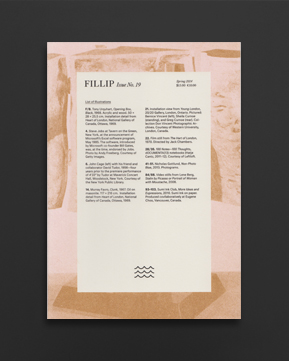
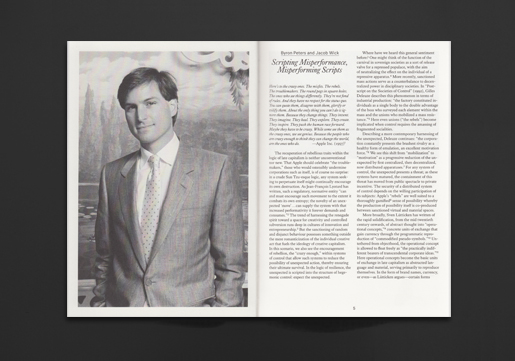
In this Issue:
Byron Peters and Jacob Wick, Christopher Regimbal, Bettina Funcke with Andrew Stefan Weiner, Nicholas Gottlund, Zarouhie Abdalian with Aaron Harbour and Jackie Im, Lene Berg with Jacob Wren, Sumi Ink Club, Matteo Pasquinelli and more...
2014, English
Softcover, 84 pages (colour & b/w ill.), 18.7 X 26 cm
Published by
Archive Books / Berlin
$19.00 - Out of stock
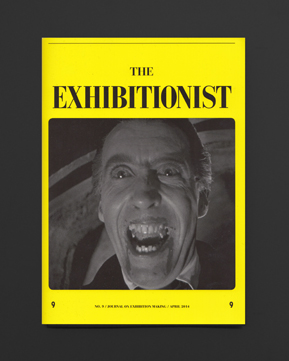
Overture
Jens Hoffmann and Lumi Tan
Curator’s Favorites
Monika Szewczyk – Idolizing Twilight
Chen Tamir – Liminal Spaces
Hendrik Folkerts – WACK the Canon!
Back in the Day
Inés Katzenstein – Experiencias 68: A Threshold
Missing in Action
Lucy Lippard – After a Fashion: The Group Show
introduced by Chelsea Haines
Attitude
Massimiliano Gioni – What I Did Last Summer
Assessments: Bergen Assembly 2013: Monday Begins Saturday
Christopher Y. Lew – Workers’ Compensation
Ase Lovgren – More Verbs, Please
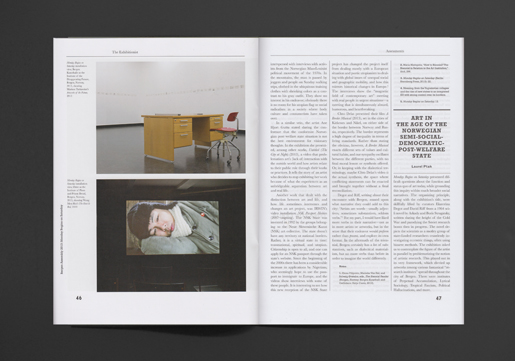
Laurel Ptak – Art in the Age of the Norwegian Semi-Social-Democratic-Post-Welfare-State
Johanne Nordby Werno – Love for Labour
Rigorous Research
Germano Celant – The Territories of Exhibition
Six x Six
Ngahiraka Mason, Fionn Meade, Pable Léon de la Barra, Fillipa Ramos, Maria Inés Rodriguez, Syrago Tsiara
Rear Mirror
Daniel Baumann, Dan Byers and Tina Kukielsky – Considering the 2013 Carnegie International
Jennifer Gross – The Société Anonyme’s Dada Destiny
Edited by Jens Hoffmann, Julian Myers-Szupinska, Lumi Tan
2014, English
Softcover, 240 pages, 145 x 210 mm
Published by
The MIT Press / Massachusetts
Whitechapel / London
$44.00 - Out of stock
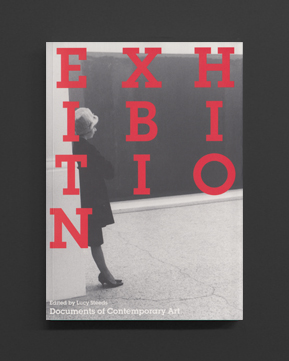
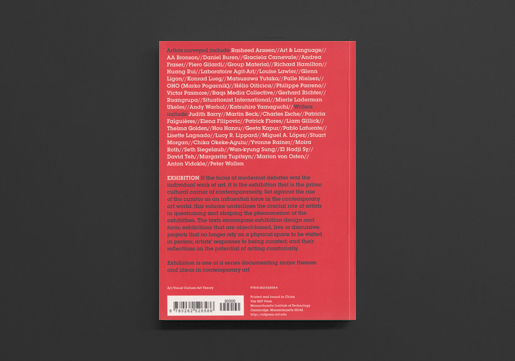
This anthology provides a multivocal critique of the exhibition of contemporary art, bringing together the writings of artists, curators, and theorists. Collectively these diverse perspectives are united by the notion that although the focus for modernist discussion was individual works of art, it is the exhibition that is the prime cultural carrier of contemporaneity. The texts encompass exhibition design and form; exhibitions that are object-based, live, or discursive; projects that no longer rely on a physical space to be visited in person; artists’ responses to being curated and their reflections on the potential of acting curatorially. Set against the rise of the curator as an influential force in the contemporary art world, this volume underlines the crucial role of artists in questioning and shaping the phenomenon of the exhibition.
Artists surveyed include:
Rasheed Araeen, Art & Language, AA Bronson, Daniel Buren, Graciela Carnevale, Andrea Fraser, Piero Gilardi, Group Material, Richard Hamilton, Huang Rui, Laboratoire Agit-Art, Louise Lawler, Glenn Ligon, Konrad Lueg, Matsuzawa Yutaka, Palle Nielsen, OHO (Marko Pogagnik), Hélio Oiticica, Philippe Parreno, Victor Pasmore, Raqs Media Collective, Gerhard Richter, Ruangrupa, Situationist International, Mierle Laderman Ukeles, Andy Warhol, Katsuhiro Yamaguchi
Writers include:
Judith Barry, Martin Beck, Charles Esche, Patricia Falguières, Elena Filipovic, Patrick Flores, Liam Gillick, Thelma Golden, Hou Hanru, Geeta Kapur, Pablo Lafuente, Lisette Lagnado, Lucy R. Lippard, Miguel A. López, Stuart Morgan, Chika Okeke-Agulu, Yvonne Rainer, Moira Roth, Seth Siegelaub, Wan-kyung Sung, El Hadji Sy, David Teh, Margarita Tupitsyn, Marion von Osten, Anton Vidokle, Peter Wollen
About the Editor:
Lucy Steeds is Pathway Leader in Exhibition Studies at Central Saint Martins, University of the Arts, London.
2014, English
Softcover, 240 pages, 145 x 210 mm
Published by
The MIT Press / Massachusetts
Whitechapel / London
$40.00 - Out of stock
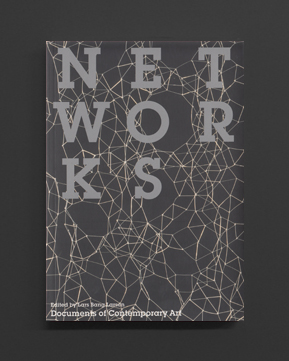
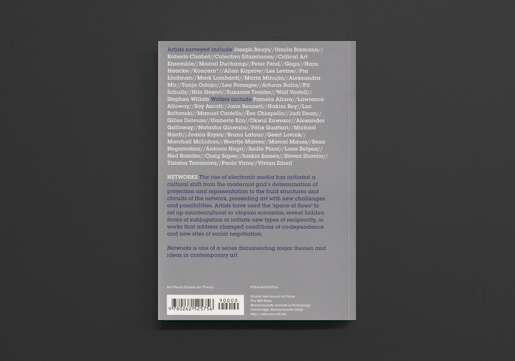
The dawn of the electronic media age in the 1960s began a cultural shift from the modernist grid and its determination of projection and representation to the fluid structures and circuits of the network, presenting art with new challenges and possibilities. This anthology considers art at the center of network theory, from the 1960s to the present.
Artists have used the “space of flows" as a basis for creating utopian scenarios, absurd yet functional propositions or holistic planetary visions. Others have explored the economies of reciprocity and the ethics of generosity, in works that address changed conditions of codependence and new sites of social negotiation. The “infra-power" of the network has been a departure point for self-organized counterculture and the creation of new types of agency. And a “poetics of connectivity" runs through a diverse range of work that addresses the social and material complexity of networks through physical structures and ambient installation, the mapping of the Internet, or the development of robots and software that take on the functions of artist or curator.
Artists surveyed include
Joseph Beuys, Ursula Biemann, Heath Bunting, Critical Art Ensemble, Fernand Deligny, Peter Fend, Gego, Jobim Jochimsen, Koncern, Christine Kozlov, Pia Lindman, Mark Lombardi, Diana McCarty, Marta Minujín, Aleksandra Mir, Tanja Ostojic, Ola Pehrson, Walid Raad, Artüras Raila, Hito Steyerl, Tomaso Tozzi, Suzanne Treister, Ultra Red, Wolf Vostell, Stephen Willats
Writers include
Jane Bennett, Hakim Bey, Luc Boltanski, Manuel Castells, ève Chiapello, Guy Debord, Umberto Eco, Okwui Enwezor, Michael Hardt, Bruno Latour, Marshall McLuhan, Marcel Mauss, Reza Negarestani, Antonio Negri, Sadie Plant, Lane Relyea, Craig Saper, Saskia Sassen, Pit Schultz, Steven Shaviro, Tiziana Terranova, Paolo Virno
2010, English
Softcover, 416 pages (150 b/w ill.), 140 x 215 mm
Published by
Sternberg Press / Berlin
$34.00 - Out of stock
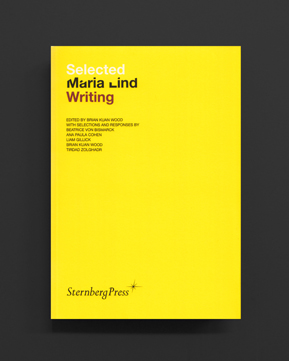
Edited by Brian Kuan Wood
Selections and responses by Beatrice von Bismarck, Ana Paula Cohen, Liam Gillick, Brian Kuan Wood, and Tirdad Zolghadr
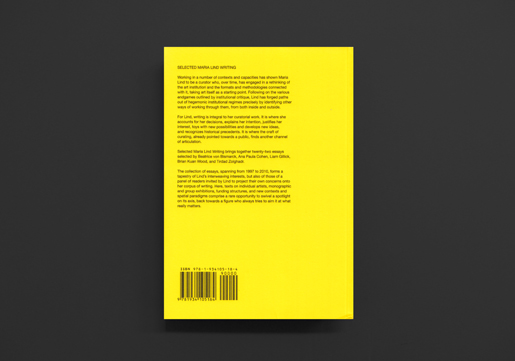
Working in a number of contexts and capacities has shown Maria Lind to be a curator who, over time, has engaged in a rethinking of the art institution and the formats and methodologies connected with it, taking art itself as a starting point. Following on the various endgames outlined by institutional critique, Lind has forged paths out of hegemonic institutional regimes precisely by identifying other ways of working through them, from both inside and outside.
For Lind, writing is integral to her curatorial work. It is where she accounts for her decisions, explains her intention, justifies her interest, toys with new possibilities and develops new ideas, and recognizes historical precedents. It is where the craft of curating, already pointed out towards a public, finds another channel of articulation.
Selected Maria Lind Writing brings together twenty-two essays selected by Beatrice von Bismarck, Ana Paula Cohen, Liam Gillick, Brian Kuan Wood, and Tirdad Zolghadr.
The collection of essays spanning from 1997 to 2010 forms a tapestry of Lind's own interweaving interests, but also of those of a panel of readers invited by Lind to project their own concerns onto her corpus of writing. Essays on individual artists, monographic and group exhibitions, funding structures, new contexts and spatial paradigms, together comprise a rare opportunity to swivel a spotlight on its axis back towards a figure who always tries to aim it at what really matters.
Maria Lind is a curator and writer based in Stockholm. She was the director of the graduate program at the Center for Curatorial Studies, Bard College, 2008 to 2010. She was director of Iaspis in Stockholm 2005 to 2007 and from 2002 to 2004 was the director of Kunstverein München. From 1997 to 2001, Lind was curator at Moderna Museet in Stockholm, where she was responsible for Moderna Museet Projekt. She was co-curator of Manifesta 2 in 1998. Lind has contributed widely to magazines and other publications, as well as to numerous exhibition catalogues. She was the 2009 recipient of the Walter Hopps Award for Curatorial Achievement.
Design by Liam Gillick
2014, English
Softcover, 352 pages (60 b/w ill.), 11.5 x 19 cm
Published by
Sternberg Press / Berlin
$64.00 $25.00 - Out of stock
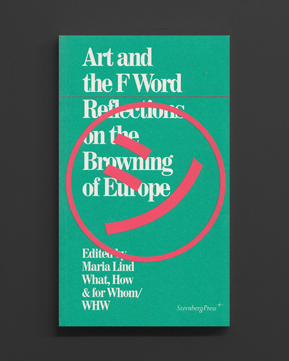
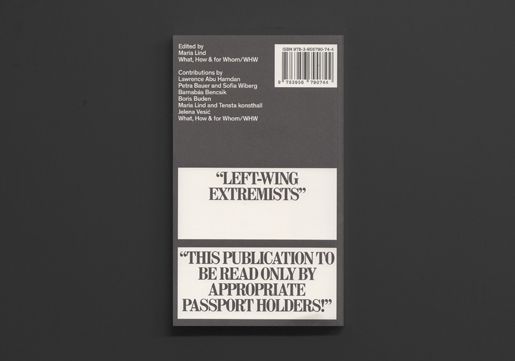
Contributions by Lawrence Abu Hamdan, Petra Bauer & Sofia Wiberg, Barnabás Bencsik, Boris Buden, Maria Lind and Tensta konsthall, Jelena Vesić, What, How & for Whom/WHW
From 2012 to 2014 a series of contemporary art exhibitions, events, and participatory forums organized by Galerija Nova, Tensta konsthall, and Grazer Kunstverein comprised the project “Beginning as Well as We Can (How Do We Talk about Fascism?).” Focusing on the startling increase of nationalism across Europe—made palpable in manifestations of fascist tendencies and the cult of heritage—the project points to the possibility and power of art to imagine futures that are not irrevocably determined by the present, but are invested with struggles fought here and now.
Art and the F Word: Reflections on the Browning of Europe, edited by curator Maria Lind and the collective What, How & for Whom/WHW, continues the debate with contributions by cultural critics, curators, and artists, which articulate resistant and constructive possibilities of social and artistic production—investigating the language of politics and philosophy and also popular vocabularies, social contexts, media, science, and aesthetics. The exhibitions featured here, which form an essential part of the overall project, test the potential of aesthetic experience to question reality and upset the ideological complacency and political resignation that lead to a loss of control over the direction of social transformation.
Copublished with Tensta konsthall and What, How & for Whom/WHW
Design by Metahaven
2014, English
Softcover, 260 pages, (27 b/w and 47 color ill.), 16.5 x 22 cm
Published by
Sternberg Press / Berlin
$33.00 - Out of stock
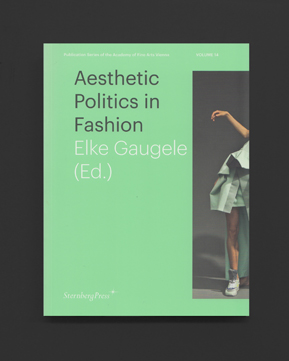
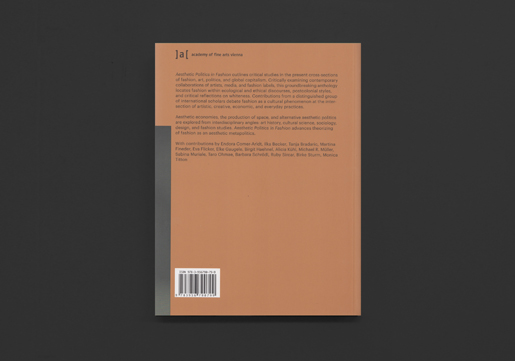
Texts by Endora Comer-Arldt, Ilka Becker, Tanja Bradaric, Martina Fineder, Eva Flicker, Elke Gaugele, Birgit Haehnel, Alicia Kühl, Michael R. Müller, Sabina Muriale, Taro Ohmae, Barbara Schrödl, Ruby Sircar, Birke Sturm, Monica Titton
Aesthetic Politics in Fashion outlines critical studies in the present cross-sections of fashion, art, politics, and global capitalism. Critically examining contemporary collaborations of artists, media, and fashion labels, this groundbreaking anthology locates fashion within ecological and ethical discourses, postcolonial styles, and critical reflections on whiteness. Contributions from a distinguished group of international scholars debate fashion as a cultural phenomenon at the intersection of artistic, creative, economic, and everyday practices.
Aesthetic economies, the production of space, and alternative aesthetic politics are explored from interdisciplinary angles: art history, cultural science, sociology, design, and fashion studies. Aesthetic Politics in Fashion advances theorizing of fashion as an aesthetic metapolitics.
Publication Series of the Academy of Fine Arts Vienna, vol. 14
Design by Surface
2014, English
softcover, 280 pages (b/w ill.), 15 x 21 cm
Published by
Sternberg Press / Berlin
$28.00 - Out of stock
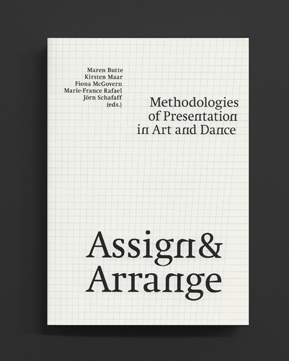
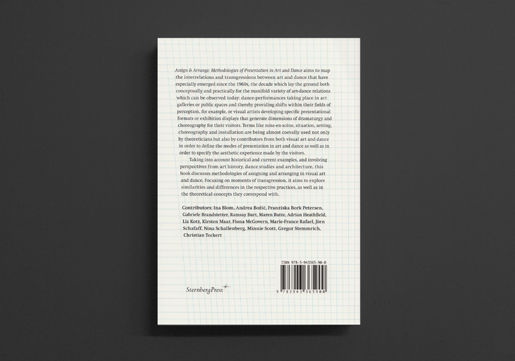
Contributions by Ina Blom, Franziska Bork Petersen, Andrea Božić, Gabriele Brandstetter, Ramsay Burt, Maren Butte, Fiona McGovern, Adrian Heathfield, Liz Kotz, Kirsten Maar, Marie-France Rafael, Jörn Schafaff, Nina Schallenberg, Minnie Scott, Gregor Stemmrich, Christian Tecker
Assign & Arrange: Methodologies of Presentation in Art and Dance aims to map the exchanges and transgressions between art and dance that characterize the manifold variety of relations between art and dance that can be observed today: dance performances taking place in art galleries or public spaces, for example, or visual artists developing specific presentational formats or exhibition displays that generate dimensions of dramaturgy and choreography for their visitors. Terms like mise-en-scène, situation, setting, choreography, and installation are being almost coevally used not only by theoreticians but also by contributors from both art and dance in order to define modes of presentation or to specify visitors’ aesthetic experience. Taking into account historical and current examples, and involving perspectives from art history, dance studies, and architecture, the book explores similarities and differences in the respective practices, as well as in the theoretical concepts they correspond with.
Design by Marit Münzberg
2013, English / French
Softcover (w. dustjacket), 424 pages, 16.8 x 23.8 cm
Published by
Kunst Halle Sankt Gallen / Switzerland
Les Presses Du Reel / Paris
$63.00 - Out of stock
An overview of the relation between choreography and exhibition, through the contributions of over thirty international visual artists, choreographers, musicians, filmmakers, theorists, and curators.
In 2008, the Contemporary art centre La Ferme du Buisson, invited the curator Mathieu Copeland to present his work, Choregraphed Exhibition, composed of movements executed by three dancers over two months. This exhibition nourished a multitude of questions that gave birth to a book, Choreograping Exhibitions, overview of the relation between choreography and exhibition. It brings together over thirty international visual artists, choreographers, musicians, filmmakers, theorists, and curators.
Contributions by Kenneth Anger, Fia Backström, Jérôme Bel, Julien Bismuth, Giovanni Carmine, Boris Charmatz,Mathieu Copeland, Tim Etchells, Barbara Formis, Maite Garbayo Maeztu, Kenneth Goldsmith, Amy Greenfield, Abbie Hoffman, Karl Holmqvist, Pierre Huyghe, Myriam Van Imschoot, Jennifer Lacey, LeClubdes5, Franck Leibovici, Pablo León de la Barra, André Lepecki, Alan Licht, Raimundas Malašauskas, Loreto Martínez Troncoso,Malcolm McLaren, Gustav Metzger, Lilo Nein, Phill Niblock, Hans Ulrich Obrist, Michael Parsons, Julie Pellegrin, Mickaël Phelippeau, Michael Portnoy, Claude Rutault, Irena Tomažin, Catherine Wood.
Edited by Mathieu Copeland and Julie Pellegrin.
Graphic design: Nicolas Eigenheer and Jeremy Schorderet.
Published with Mathieu Copeland editions, la Ferme du Buisson and Kunst Halle Sankt Gallen.
2014, English
Softcover, 120 pages, 18 x 25 cm
Published by
The Burger Collection / Germany
$41.00 - Out of stock
Published by the Burger Collection, ‘Torrent’ provides information and source material related to the work of artists it represents by focusing on in-depth conversations with diverse authors, practitioners and producers.
This issue includes a thought-provoking conversation with curator and writer Robert Storr on ethics in the art world. Artist contributions explore the awe-inspiring relationship between the sky and city space in Hong Kong (Muhanned Cader), materials about hyper-specialists on eBay, radioactive glows, and clouds of bats (Florian Germann) and text experiments and visuals related to pseudo writings and Chinese calligraphy (Enoch Cheung). Also included a visual essay about photographic materiality (Roland Lüthi) and a take on the transcultural dynamics in contemporary art through the example of kung-fu director Robert Tai’s Shaolin Dolemite (Manual Cirauqui).