World Food Books' programme is largely produced on Kulin Nation land. We acknowledge the Wurundjeri people of the Kulin Nation as the first and continuing custodians of this land, and pay respect to their Elders past, present, and emerging.
World Food Books is an arts and special interests bookshop in Naarm / Melbourne. Founded in 2010, World Food Books is devoted to the presentation of a rotating, hand-selection of international art, design, literary and counterculture publications with an emphasis on the anti-traditional, the experimental, the avant-garde, the heretic, the marginal.
Presenting new titles alongside rare and out-of-print books, catalogues and journals spanning the fields of modern and contemporary art, design, photography, illustration, film, literature, poetry, cultural theory, philosophy, sexuality, popular and underground culture in its many radical forms, World Food Books wishes to encourage adventurous, thoughtful and open-minded reading, looking, writing, and exchange of publishing and ideas, both current and historical.
As well as our bookshop, located in Melbourne's historical Nicholas Building, all of our inventory is available internationally via our online mail-order service.
World Food Books semi-regularly co-ordinates "Occasions", a programme of exhibits and events at the bookshop and in partnership with other hosts (such as museums and art galleries) that develop out of the activities, relationships and content of the bookshop itself.
World Food Books
The Nicholas Building
37 Swanston Street
Room 5, Level 6
Melbourne 3000
Australia
SHOP HOURS:
Thu–Fri 12–6, Sat 12–5
WEB-SHOP OPEN 24/7
World Food Books
Postal Address:
PO Box 435
Flinders Lane
Victoria 8009
Australia
Art
Theory / Essay
Architecture / Interior
Graphic Design / Typography
Photography
Fashion
Eros
LGBTQ+
Fiction / Poetry
Weird / Speculative / Science Fiction / Horror
Transgressive / Visceral / Abject
Symbolism / Decadence / Fin de siècle
Film / Video
Painting
Sculpture / Installation
Performance / Dance / Theater
Drawing
Sound / Music
Curatorial
Group Shows / Collections
Periodicals
Out-of-print / Rare
Posters / Ephemera / Discs
Signed Books
World Food Books Gift Voucher
World Food Book Bag
Australian Art
Australian Fiction
Australian Science Fiction / Speculative Fiction
Australian Poetry
Australian Photography
Japanese Photography
Conceptual Art
Minimal Art
Dada
'Pataphysics / Oulipo
Fluxus
Concrete Poetry
Pop Art
Surrealism
Arte Povera
Arte Informale / Haute Pâte / Tachism
Nouveau Réalisme / Zero / Kinetic
Situationism / Lettrism
Collage / Mail Art / Xerox Art
Art Brut / Folk / Visionary / Fantastic
Illustration / Graphic Art / Bandes Dessinées
Furniture
Italian Radical Design / Postmodernism
Textiles
Ceramics / Glass
Counterculture
Protest / Revolt
Philosophy
Psychoanalysis
Anthropology
Anarchism
Socialism / Anarchism / Communism / Capitalism
Literary Theory / Semiotics / Language
Feminism / Women's Studies
Gender Studies / Sexuality
Anthropology
Fetishism / BDSM
Drugs / Psychedelia
Crime / Violence
Animal Rights / Veganism
Occult / Esoterica
Ecology / Earth / Alternative Living
Whole Earth / Crafts
All prices in AUD (Australian dollars)
Pick-Ups
Pick-up orders can be collected in our bookshop during opening hours after order date. Please collect any Pick-up orders within 2 weeks of ordering as we have limited storage space. Orders will be released back into stock if not collected within this time. No refunds can be made for pick-ups left un-collected. If you cannot make it in to the bookshop in this time-frame, please choose postage option.
Return Policy
All sales are final. We do accept returns (for refund or exchange) for items received in error. All our orders are packed with special care using heavy-duty padding and cardboard book-mailers or bubble mailers (for smaller books), using reinforcement where required. We cannot take responsibility for any lost, stolen or damaged parcels.
Insurance
Should you wish to insure your package, please email us directly after placing your order and we can organise this at a small extra expense. Although all standard/express tracked packages are very safe and dependable, we cannot take responsibility for any lost, stolen or damaged parcels. We recommend insurance on valuable orders.
Interested in selling your old books, catalogues, journals, magazines, comics, fanzines, ephemera? We are always looking for interesting, unusual and out-of-print books to buy. We only buy books in our fields of interest and specialty, and that we feel we can resell.
We base these prices on desirability, market value, in-print prices, condition and our current stock levels. We offer cash, store credit, and can take stock on consignment. All
about 25% of the price we expect to get when we sell them, or 30% in store credit. We base these prices on desirability, market value, in-print prices, condition and our current stock levels.
Sell your books any day of the week. You can drop them off and return later. If you have a lot of books, we can visit your Sydney home.
We buy books that we feel we can resell. We offer about 25 % of the price we expect to get when we sell them, or 30% in store credit. We base these prices on desirability, market value, in-print prices, condition and our current stock levels.
Philadelphia Wireman
03 August - 01 September, 2018
World Food Books is proud to announce our next Occasion, the first presentation of sculptures by Philadelphia Wireman in Australia.
The Philadelphia Wireman sculptures were found abandoned in an alley off Philadelphia’s South Street on trash night in 1982. Their discovery in a rapidly-changing neighbourhood undergoing extensive renovation, compounded with the failure of all attempts to locate the artist, suggests that the works may have been discarded after the maker’s death. Dubbed the "Philadelphia Wireman" during the first exhibition of this work, in 1985, the maker’s name, age, ethnicity, and even gender remain uncertain. The entire collection totals approximately 1200 pieces, all intricately bound together with tightly-wound heavy-gauge wire (along with a few small, abstract marker drawings, reminiscent both of Mark Tobey and J.B. Murry). The dense construction of the work, despite a modest range of scale and materials, is singularly obsessive and disciplined in design: a wire armature or exoskeleton firmly binds a bricolage of found objects including plastic, glass, food packaging, umbrella parts, tape, rubber, batteries, pens, leather, reflectors, nuts and bolts, nails, foil, coins, toys, watches, eyeglasses, tools, and jewellery.
Heavy with associations—anthropomorphic, zoomorphic, and socio-cultural responses to wrapped detritus—the totemic sculptures by Philadelphia Wireman have been discussed in the context of work created to fulfil the shamanistic needs of alternative religions in American culture. Curators, collectors, and critics have variously compared certain pieces to sculpture from Classical antiquity, Native American medicine bundles, African-American memory jugs, and African fetish objects. Reflecting the artist’s prolific and incredibly focused scavenging impulse, and despite—or perhaps enhanced by—their anonymity, these enigmatic objects function as urban artefacts and arbiters of power, though their origin and purpose is unknown. Philadelphia Wireman, whatever their identity, possessed an astonishing ability to isolate and communicate the concepts of power and energy through the selection and transformation of ordinary materials. Over the course of the past two decades, this collection has come to be regarded as an important discovery in the field of self-taught art and vernacular art.
Presented in collaboration with Fleisher-Ollman Gallery, Philadelphia, and Robert Heald, Wellington.
Susan Te Kahurangi King
02 February - 10 March, 2018
Susan Te Kahurangi King (24 February 1951 - ) has been a confident and prolific artist since she was a young child, drawing with readily available materials - pencils, ballpoint pens and felt-tip markers, on whatever paper is at hand. Between the ages of four and six Susan slowly ceased verbal communication. Her grandparents William and Myrtle Murphy had developed a special bond with Susan so they took on caring responsibilities for extended periods. Myrtle began informally archiving her work, carefully collecting and storing the drawings and compiling scrapbooks. No drawing was insignificant; every scrap of paper was kept. The King family are now the custodians of a vast collection containing over 7000 individual works, from tiny scraps of paper through to 5 meter long rolls.
The scrapbooks and diaries reveal Myrtle to be a woman of great patience and compassion, seeking to understand a child who was not always behaving as expected. She encouraged Susan to be observant, to explore her environment and absorb all the sights and sounds. Myrtle would show Susan’s drawings to friends and people in her community that she had dealings with, such as shopkeepers and postal workers, but this was not simply a case of a grandmother’s bias. She recognised that Susan had developed a sophisticated and unique visual language and sincerely believed that her art deserved serious attention.
This was an unorthodox attitude for the time. To provide some context, Jean Dubuffet coined the term Art Brut in 1945 to describe work created by self-taught artists – specifically residents of psychiatric institutions and those he considered to be visionaries or eccentrics. In 1972 Roger Cardinal extended this concept by adopting the term Outsider Art to describe work made by non-academically trained artists operating outside of mainstream art networks through choice or circumstance. Susan was born in Te Aroha, New Zealand in 1951, far from the artistic hubs of Paris and London that Dubuffet and Cardinal operated in. That Myrtle fêted Susan as a self-taught artist who deserved to be taken seriously shows how progressive her attitudes were.
Susan’s parents Doug and Dawn were also progressive. Over the years they had consulted numerous health practitioners about Susan’s condition, as the medical establishment could not provide an explanation as to why she had lapsed into silence. Dawn educated herself in the field of homeopathy and went on to treat all twelve of her children using these principles – basing prescriptions on her observations of their physical, mental and emotional state.
Doug was a linguist with an interest in philosophy who devoted what little spare time he had to studying Maori language and culture. To some extent their willingness to explore the fringes of the mainstream made them outsiders too but it was their commitment to living with integrity and their respect for individuality that ensured Susan’s creativity was always encouraged.
Even though Susan’s family supported her artistic pursuits, some staff in schools and hospitals saw it as an impediment to her assimilation into the community and discouraged it in a variety of ways. Her family was not always aware of this and therefore did not fully understand why Susan stopped drawing in the early 1990s. However, rather than dwell on the challenges that Susan faced in pursuit of her artistic practice, they prefer to highlight her achievements. In 2008 Susan began drawing again in earnest, after an almost 20 year interruption, and her work is now shown in galleries around the world.
Susan grew up without television and has been heavily influenced by the comics she read as a child. She is absolutely fearless in the appropriation of recognizable characters, such as Donald Duck and Mickey Mouse, in her work. She twists their limbs, contorts their faces, compresses them together, blends them into complex patterned backgrounds - always imbuing them with an incredible energy. Although Susan often used pop culture characters in her work they are not naive or childlike. These are drawings by a brilliant self-taught artist who has been creating exceptional work for decades without an audience in mind.
Mladen Stilinović
"Various Works 1986 - 1999"
02 February 16 - September 10, 2016
Various works 1986 - 1999, from two houses, from the collections of John Nixon, Sue Cramer, Kerrie Poliness, Peter Haffenden and Phoebe Haffenden.
Including: Geometry of Cakes (various shelves), 1993; Poor People’s Law (black and white plate), 1993; White Absence (glasses, ruler, set square, silver spoon, silver ladel with skin photograph and wooden cubes), 1990-1996; Exploitation of the Dead (grey and red star painting, wooden painting, black spoon with red table, red plate), 1984-1990; Money and Zeros (zero tie, paintings made for friends in Australia (Sue, John, Kerrie), numbers painting), 1991-1992; Words - Slogans (various t-shirts) - “they talk about the death of art...help! someone is trying to kill me”, “my sweet little lamb”, “work is a disease - Karl Marx”; Various artist books, catalogues, monographs, videos; Poster from exhibition Insulting Anarchy; "Circular" Croatian - Australian edition; Artist book by Vlado Martek (Dostoyevsky); more.
Thanks to Mladen Stilinović and Branka Stipančić.
Jonathan Walker
Always Will Need To Wear Winter Shirt Blue + Ochre Small Check Pattern
21 August - 21 September, 2015
Untitled
I am not a great reader of poetry but I always return to the work of Melbourne poet, Vincent Buckley (1925- 1988). Perhaps I find his most tantalising piece to be not a finished poem but a fragment left on a scrap of paper discovered on his desk after the poet’s death.
The poetry gathers like oil
In the word-core, and spreads
It has its music meet,
Its music is in movement.
This fragment is more the shell left behind from a volatile thought than a finished poem. I find the last two lines honest but awkward whereas the first two lines work like an arrow. Most likely he could not find a resolution so it was left. Still, in its present form, it remains an eloquent testimony to the ultimate failure of a medium to express mobile thought and sensation, in Buckley’s case, through verbal language. It’s an important matter because this is something all artists have to deal with regardless of the medium.
I have never written a poem, however, I am forever copying fragments from books on paper scraps in a vain effort to fix certain notions in my head. At first, they function as bookmarks that are sometimes returned to when I open the book. But before long, as they accumulate, they fall out littering the table interspersed with A4 photocopies, bills, books and medications.
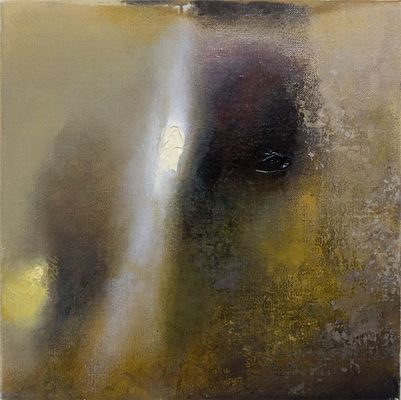
To return to Buckley’s fragment, the first two lines very much evoke how I paint nowadays. As you age, detail diminishes and patches of light become more luminous and float. I feel the most honest way of dealing with this is by smearing the oil paint on the canvas with the fingers and working close-up, blind. Only if the patches coalesce into an approaching image can the work gain a life.
-
Jonathan Walker was born in Melbourne, Australia and brought up on a dairy farm in Gippsland. In the 1970’s he studied painting at RMIT and won the Harold Wright Scholarship to the British Museum, London. During the 1980’s he exhibited at Pinacotheca Gallery, Richmond and had work shown at the NGV and Heidi City Art Gallery. Over the same period he designed the cover for the “Epigenesi” LP by Giancarlo Toniutti, Italy and conducted a mail exchange work with Achim Wollscheid, Germany. The work with artists through the post resulted in an article published in the bicentenary issue of Art and Australia 1988. He showed in artist run spaces such as WestSpace in the 90’s and 2000’s, and until 2012, taught painting at Victoria University, which is where we (Colleen Ahern and Lisa Radford) as organisers of the exhibition, among many others, had the privilege of being his student.
Walker’s knowledge was imparted to students through the careful selection of music, literature, and artists found in books that he himself had ordered for the library. Walker’s strategy was the generosity of sharing his vast knowledge with references specific to each student and their context.
Walker’s paintings share a similar focus and intimacy.
This exhibition presents a small selection of recent paintings alongside a publication that includes Walker’s writing. Observational and analytical, Walker’s work is a type of material notation — the time of day, colour and how it is blended, the both specific and fleeting location of a reflection on lino or the question of whether a chair leg should be included in a painting.
Please join us on Friday August 21 between 6-8pm to celebrate the opening of the exhibition.
Curated by Colleen Ahern and Lisa Radford.
B. Wurtz
Curated by Nic Tammens
March 26 - April 4, 2015
B.Wurtz works from a basement studio in his home on Manhattan’s Lower East Side.
This local fact is attested to by the plastic shopping bags and newsprint circulars that appear in his work. As formal objects, they don’t make loud claims about their origins but nonetheless transmit street addresses and places of business from the bottom of this long thin island. Like plenty of artists, Wurtz is affected by what is local and what is consumed. His work is underpinned by this ethic. It often speaks from a neighborhood or reads like the contents of a hamper:
“BLACK PLUMS $1.29 lb.”
“Food Bazaar”
“USDA Whole Pork Shoulder Picnic 99c lb.”
“RITE AID Pharmacy, with us it’s personal.”
“H. Brickman & Sons.”
“Sweet Yams 59c lb."
Most of the work in this exhibition was made while the artist was in residence at Dieu Donne, a workshop dedicated to paper craft in Midtown. Here Wurtz fabricated assemblages with paper and objects that are relatively lightweight, with the intention that they would be easily transportable to Australia. This consideration isn’t absolute in Wurtz’s work, but was prescriptive for making the current exhibition light and cheap. Packed in two boxes, these works were sent from a USPS post office on the Lower East Side and delivered to North Melbourne by Australia Post.
Wurtz appears courtesy of Metro Pictures, New York.
Thanks to Rob Halverson, Joshua Petherick, Sari de Mallory, Matt Hinkley, Helen Johnson, Fayen d'Evie, Ask Kilmartin, Lisa Radon, Ellena Savage, Yale Union, and "Elizabeth".
John Nixon
"Archive"
December 15 - January 20, 2014
The presentation of John Nixon's archive offered a rare showcase of this extensive collection of the artist's own publications, catalogues, posters, ephemera, editions and more, from the mid 1980s onwards, alongside a selection of his artworks.
Organized by John Nixon, Joshua Petherick and Matt Hinkley.
<a href=http://wfb.public-office.info/artist/john-nixon>All titles by John Nixon
"Habitat"
at Minerva, Sydney (organised by Joshua Petherick and Matt Hinkley)
November 15 - December 20, 2014
Lupo Borgonovo, Janet Burchill & Jennifer McCamley,
Lewis Fidock, HR Giger, Piero Gilardi, Veit Laurent Kurz,
Cinzia Ruggeri, Michael E. Smith, Lucie Stahl, Daniel Weil, Wols
Press Release:
“...It contained seven objects. The slender fluted bone, surely formed for flight, surely from the wing of some large bird. Three archaic circuitboards, faced with mazes of gold. A smooth white sphere of baked clay. An age-blackened fragment of lace. A fingerlength segment of what she assumed was bone from a human wrist, grayish white, inset smoothly with the silicon shaft of a small instrument that must once have ridden flush with the surface of the skin - but the thing’s face was seared and blackened.”
William Gibson, “Count Zero”, 1986
"Autumn Projects Archive"
Curated by Liza Vasiliou
March 6 - March 15, 2014
World Food Books, in conjunction with the Virgin Australia Melbourne Fashion Festival 2014, presented the Autumn Projects archive, consisting of a selection of early examples in Australian fashion with a particular interest in collecting designers and labels from the period beginning in the 1980’s, who significantly influenced the discourse of Australian Fashion.
Curated by Liza Vasiliou, the exhibition provided a unique opportunity to view pieces by designers Anthea Crawford, Barbara Vandenberg, Geoff Liddell and labels CR Australia, Covers, Jag along with early experimental collage pieces by Prue Acton and Sally Browne’s ‘Fragments’ collection, suspended throughout the functioning World Food Books shop in Melbourne.
H.B. Peace
presented by CENTRE FOR STYLE
November 14, 2013
"Hey Blinky, you say chic, I say same"
Anon 2013
H.B. Peace is a clothing collaboration between great friends Blake Barns and Hugh Egan Westland. Their pieces explore the divergences between 'character’ and ‘personality’ in garments....etc
Special Thanks to Joshua Petherick and Matt Hinkley of WFB and Gillian Mears
and a Very Special Thank you to Audrey Thomas Hayes for her shoe collaboration.
Janet Burchill & Jennifer McCamley
"Aesthetic Suicide"
May 10 - June 8, 2013
The first of our occasional exhibitions in the World Food Books office/shop space in Melbourne, "Aesthetic Suicide" presented a body of new and older works together by artists Janet Burchill & Jennifer McCamley, including videos, prints, a wall work, and publications.
During shop open hours videos played every hour, on the hour.
2012, English
Softcover (printed in various colourways), 136 pages, 170 x 245 mm
Published by
Projectile Publishing Society / Vancouver
$19.00 - Out of stock
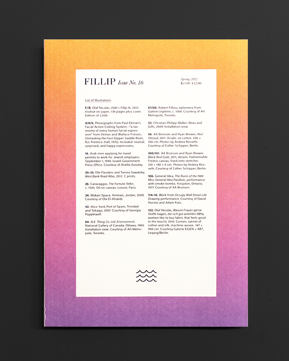
Fillip is a publication of art, culture, and ideas released three times a year by the Projectile Publishing Society from Vancouver, British Columbia.
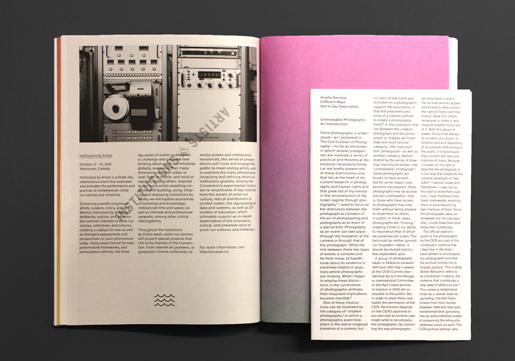
In the lead up to Fillip’s October 2012 conference, Institutions by Artists, Fillip 16 (produced in several alternate colour versions) features Vincent Bonin’s groundbreaking essay “Here, bad news always arrives too late,” which presents a chronology and counter-history of institutional critique in Canada since 1967 while investigating overlooked, but interrelated histories of artistic self-determination.
Fillip 16 also continues two ongoing series—Apparatus, Capture, Trace, which examines the links between biopolitics and photography, and Intangible Economies, which attempts to broaden the notion of economy beyond its financial dimensions.
Other features include:
Philip Monk on Crises in the Work of General Idea
Patricia Reed on Ethics and the Production of Misunderstanding
Ola El-Khalidi and Diala Khasawnih on Makan Space, Jordan
Jon Davies on Queer Spirits
Christopher Cozier and Claire Tancons on Alice Yard, Trinidad.
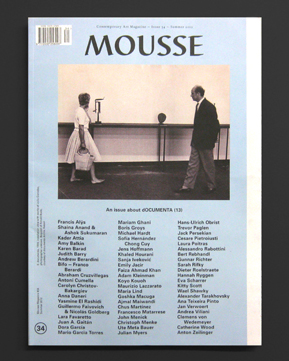
2012, English / Italian
Softcover Newspaper, 270 pages (clour and b&w ill.), 26.5 x 37.5 cm
Published by
Mousse / Milan
$15.00 - Out of stock
English, 2011
Softcover, 320 pages, 215 × 125 mm
Published by
Hyphen Press / London
$50.00 - Out of stock
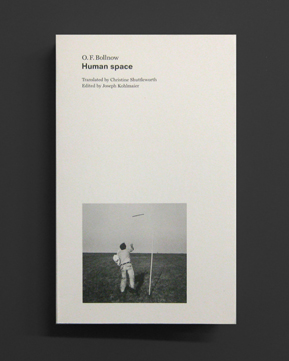
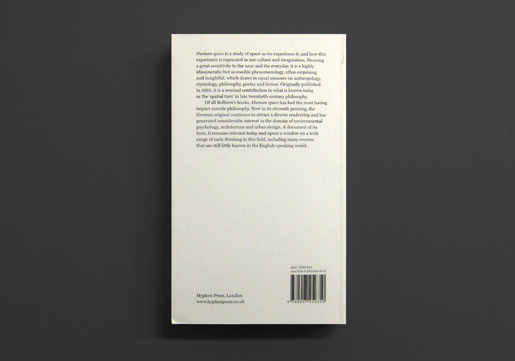
Human space is an English translation of one of the most comprehensive studies of space as we experience it. Since it was published in Germany in 1963, Bollnow’s text has become a key reading in architecture, anthropology, and philosophy, and has been kept continuously in print (in 2010 the German edition was issued in its eleventh impression). The book is serious academic research and something more – showing a great sensitivity to the near and the everyday. The text is enlivened and illustrated with many quotations, principally from German and English literature. Our edition is translated by Christine Shuttleworth and has an afterword by Joseph Kohlmaier, who places the work in its context of philosophical and architectural discussion.
2003, English
Softcover, 96 pages, 240 × 170 mm
Published by
Hyphen Press / London
$32.00 - In stock -
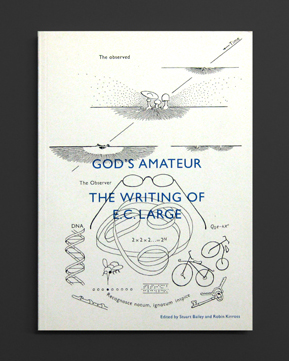
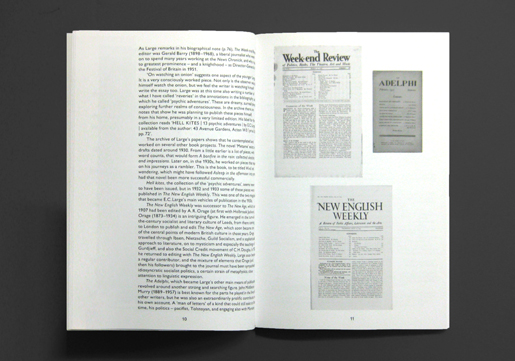
A book of and about E.C. Large, which contains a selection of his shorter writings – travel essays, reportage, reveries, reviews, critiques, autobiographical pieces – and which reveals the extent of his achievement. These show a notably exact writer, with sane no-nonsense views, and yet with great imagination. Some unpublished texts are shown in facsimile. Also here is a bibliography of his published writings (both ‘literary’ and scientific), and an essay by Stuart Bailey, which sees his work with present-day eyes.
2009, English
Softcover, 400 pages, offset, 210 x 125 cm.
Published by
Hyphen Press / London
$50.00 - Out of stock
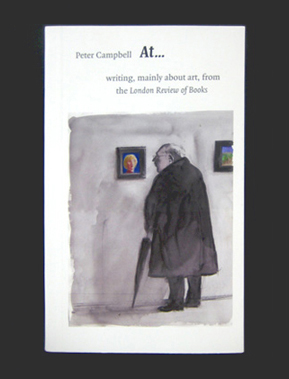
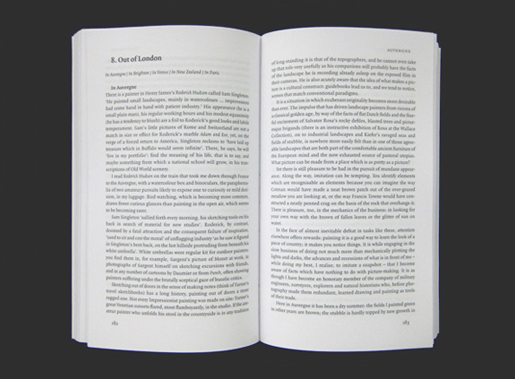
For over ten years Peter Campbell has reviewed art exhibitions for the London Review of Books. His writing is distinctive: often closely descriptive, always inquisitive about technique, it is the product of an independent mind and eye. Easy evaluations are resisted: we are invited to consider the work on show in its present place – ‘at’ the museum or gallery to which the critic has travelled on our behalf. This generous selection of reviews covers a wide range of subjects, from Bellini and Titian to Lucian Freud and Louise Bourgeois, from Hawksmoor to Libeskind. Blockbusting shows are noticed, but so too are exhibitions of unfashionable artists, of photographers and applied artists. Reviews of buildings and pieces on the everyday urban scene add another dimension to this book. Campbell is a typographer and book designer, and is also the draftsman of the London Review’s covers. His writing is of a piece with these accomplishments.
2002, English
Softcover, 184 pages, 210 × 125 mm
Published by
Hyphen Press / London
$31.00 - Out of stock
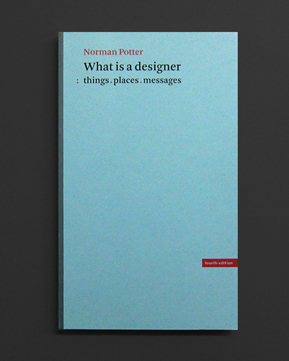
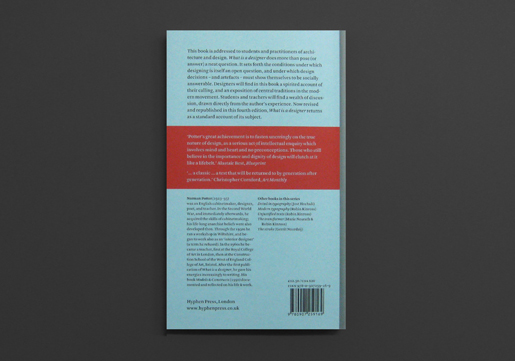
This long-established title shows powers of self-renewal, as new young readers find in it a stimulus to thought and action unavailable from more showy, duller items. An urgent book, it combines high-flown generalities with often striking specificity of reference. It addresses especially students at further education level in every design discipline, including architecture.
What is a designer proposes what design could be: there is no question mark in its title. Potter’s book is unusual in combining elevated ideas with down-to-earth advice. The first edition was published by Studio Vista in 1969. The second edition, published by Hyphen Press in 1980, was a very different work: completely reset and with new chapters that doubled the book in extent. A third edition (1989) incorporated revisions and updatings, and included a new introduction in which Norman Potter considered his own position in the light of the tremendous changes of the 1980s: some sharp blows were delivered at ‘designer culture’. Now, after the author’s death in 1995, the book is reissued in what must be a final edition: the outdated references again excised, to leave the enduring core of Potter’s arguments.
The three parts of the book are signalled visibly by a change of paper colour. The first part contains a sequence of quite general essays. A number of central ideas are discussed here. Design is essentially a useful and modest art. The designer is at the service of the community. These principles should animate education. Potter casts a critical and sceptical eye over the realities of design education. In the reference section the book stands apart from other literature on design, in its discussions of the processes of getting work done. Finally there is a set of appendixes, prodding the reader into thought and action.
The book has no visual illustrations. By this means it achieves a greater generality of reference and – true to its critical principles – avoids giving readers models for imitation.
2011, English
Hardcover, 128 pages (colour and b&w ill.), 120 x190 mm
Published by
Metro Verlag / Germany
$22.00 - Out of stock
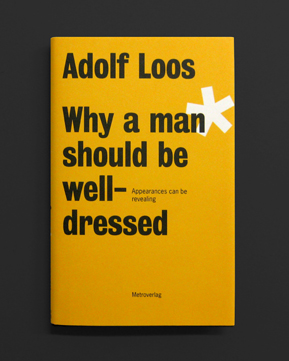
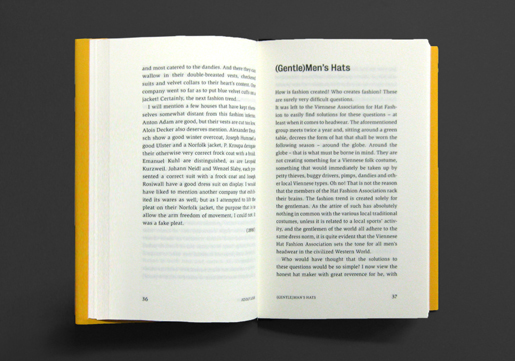
Throughout his life Adolf Loos raised his eloquent voice against the squandering of fine materials, frivolous ornamentation and unnecessary embellishments. His admirers consider him to be the inspiration for all modern architecture. Yet, few are acquainted with his amusing, incisive, critical and philosophical literary work reflecting on applied design and the essence of clothing in fin de siècle Vienna. Adolf Loos often had a radical, yet innovative outlook on life that made him such a nuisance for many of his contemporaries. His provocative musings on many subjects portray him as a man of varied interests and intellectual refinement as well as possessing a keen sense of style, which still has value today. For the first time the ‘Loos Dress Code’ is available in English. Included is a short social/historical look as the birth of Modernism in Adolf Loos’ Vienna.
2009, English
Softcover, 224 pages, 140 x 208 mm
Edition of 3000,
Published by
Primary Information / New York
$28.00 - Out of stock
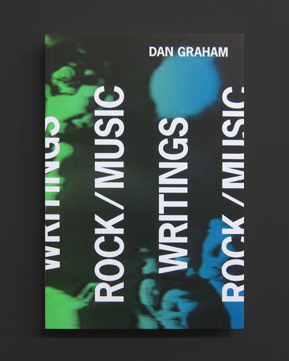
The first collection in English of Dan Graham’s influential body of writing on Rock and Roll music. Stretching from the late 60s to the late 80s, Rock/Music Writings contains the following 13 essays, most of which are currently out-of-print or seen here for the first time in a widely distributed form:
Holes and Lights: A Rock Concert Special
All You Need Is Love
Live Kinks
Late Kinks
Country Trip
The End of Liberalism
Punk as Propaganda
Rock My Religion
New Wave Rock and the Feminine
Musical Performance And Stage–Set Utilizing Two–Way Mirror And Time–Delay
McLaren’s Children
Untitled
Artist as Producer
2008, English
Softcover, 148 pages, 11 b/w ill., 12 x 19 cm
Published by
Sternberg Press / Berlin
$22.00 - In stock -
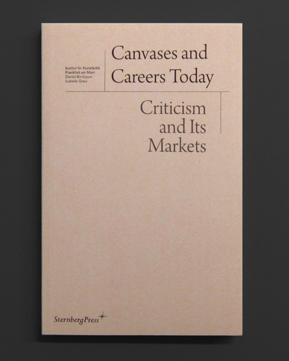
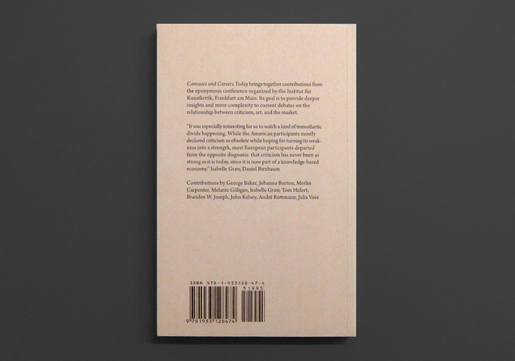
Contributions by George Baker, Johanna Burton, Merlin Carpenter, Melanie Gilligan, Isabelle Graw, Tom Holert, Branden W. Joseph, John Kelsey, André Rottmann, Julia Voss
Canvases and Careers Today brings together contributions from the eponymous conference organized by the Institut für Kunstkritik, Frankfurt am Main. Its goal is to provide deeper insights and more complexity to current debates on the relationship between criticism, art, and the market.
“It was especially interesting for us to watch a kind of transatlantic divide happening. While the US-American participants mostly declared criticism as obsolete while hoping for turning its weakness into a strength, most European participants departed from the opposite diagnosis: that criticism has never been as strong as it is today, since it is now part of a knowledge-based economy.” Isabelle Graw/Daniel Birnbaum
Design by Surface, Frankfurt am Main/Berlin
2012, English
Softcover, 240 pages, 12 x 19.5 cm
Published by
Sternberg Press / Berlin
$24.00 - Out of stock
"The what-if runs through Raimundas’s writing like the Woody Allen runs through Woody Allen—effective and contagious. It’s a pull as fervent and wistful as a hot lemon drink sloshing off of words that demand to be experienced. Speakers, objects, subjects, tenses, readers and editors are freed of their conventional roles and move around in their paragraphs like in a piece of music written, say in C Major where they’re drifting around in various other keys of course. With as much sovereignty granted to the reader of Paper Exhibition as to all other players in the essays of the book you now hold, the reader has also become the editor. Sixteen in fact. Sixteen readers have been invited to add, comment on, correct and leave their mark boldly in the margins, or way at the back, as another means of carefully replaying these words written by someone else. In this ‘book that belongs to no one and is not needed by anyone,’ according to its first author, Raimundas Malašauskas." —Maxine Kopsa
Paper Exhibitionis an anthology of writings by curator and writer Raimundas Malašauskas published in collaboration with Kunstverein Publishing, Sternberg Press, Sandberg Institute, and The Baltic Notebooks by Anthony Blunt.
The publication includes texts selected and edited by Aurimė Aleksandravičiūtė & Jonas Žakaitis, Tyler Coburn, Audrey Cottin, Krist Gruijthuijsen, Sofía Hernández Chong Cuy, Virginija Januškevičiūtė, Angie Keefer, Kevin Killian, Maxine Kopsa, John Menick, Vivian Rehberg, Sarah Rifky, Aaron Schuster, Vivian Ziherl, and Tirdad Zolghadr; and features contributions by Judith Braun, François Bucher, Chris Fitzpatrick & Post Brothers, Darius Mikšys, Dexter Sinister, and Lucy E. Smith.
2011, English
Softcover, 96 pages, 15.2 x 26.5 cm
Published by
Sternberg Press / Berlin
$23.00 - Out of stock
With contributions by Mai Abu ElDahab, Binna Choi, Emily Pethick, Heejin Kim, Anthony Huberman, Will Bradley, Miren Jaio and Leire Veraga, Anna Colin and Melanie Boutaloup, and Gabi Ngcobo; and an interview with Kim Einarsson.
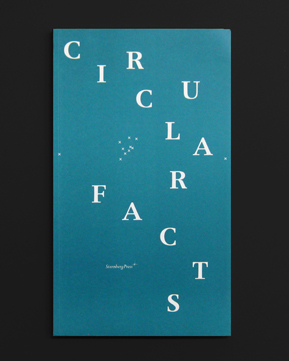
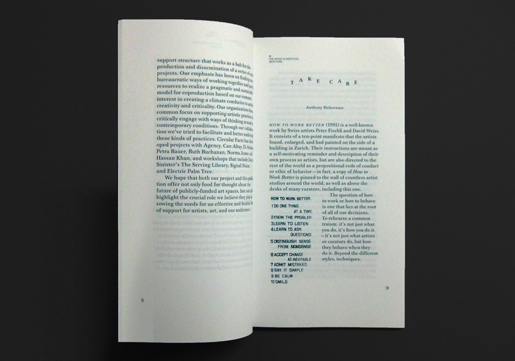
Circular Facts is a collaborative endeavor between three European contemporary art organizations: Casco – Office for Art, Design and Theory, Utrecht; Objectif Exhibitions, Antwerp; and The Showroom, London, in partnership with Kunst Halle Sankt Gallen and Electric Palm Tree. The project acted as an informal think tank and a mutual support structure for the production and dissemination of artistic projects, and has culminated in an eponymous publication. The publication aims to gather a spectrum of perspectives to explore the roles of specific initiatives within their particular localities. The contributors have produced works that speak to their experiences within arts institutions, collaborative curatorial initiatives, and research networks, expanding on the relationship between institutions and artists, markets, local and international audiences, and current political climates.
2010, English
Softcover, 304 pages, (1 b/w ill.),111 x 178 mm
Published by
Sternberg Press / Berlin
$23.00 - Out of stock
Including an introduction by Eyal Weizman, a conversation with Chantal Mouffe, an interview by Hans Ulrich Obrist, and post-scripts by Bassam El Baroni, Jeremy Beaudry, and Carson Chan.
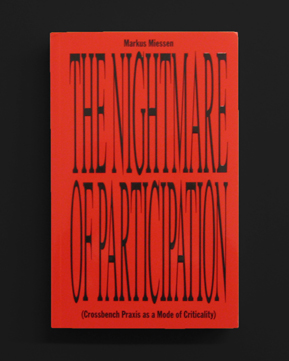
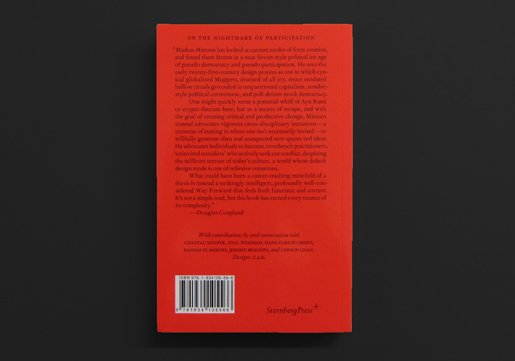
Welcome to Harmonistan! Over the last decade, the term “participation” has become increasingly overused. When everyone has been turned into a participant, the often uncritical, innocent, and romantic use of the term has become frightening. Supported by a repeatedly nostalgic veneer of worthiness, phony solidarity, and political correctness, participation has become the default of politicians withdrawing from responsibility. Similar to the notion of an independent politician dissociated from a specific party, this third part of Miessen’s “Participation” trilogy encourages the role of what he calls the “crossbench practitioner,” an “uninterested outsider” and “uncalled participator” who is not limited by existing protocols, and who enters the arena with nothing but creative intellect and the will to generate change.
Miessen argues for an urgent inversion of participation, a model beyond modes of consensus. Instead of reading participation as the charitable savior of political struggle, Miessen candidly reflects on the limits and traps of its real motivations. Rather than breading the next generation of consensual facilitators and mediators, he argues for conflict as an enabling, instead of disabling, force. The book calls for a format of conflictual participation—no longer a process by which others are invited “in,” but a means of acting without mandate, as uninvited irritant: a forced entry into fields of knowledge that arguably benefit from exterior thinking. Sometimes, democracy has to be avoided at all costs.
Markus Miessen (*1978) is an architect, consultant, and writer based in Berlin. He runs the collaborative agency for spatial practice Studio Miessen, is co-founder of the architectural practice nOffice, and director of the Winter School Middle East (Kuwait). Miessen has taught at institutions such as the Architectural Association (London), Columbia, and MIT. He is currently a Professor for Architecture and Curatorial Practice at the Hochschule für Gestaltung in Karlsruhe, Germany, a Harvard Fellow, and completing his PhD at the Centre for Research Architecture (Goldsmiths, London).
www.studiomiessen.com
www.nOffice.eu
www.winterschoolmiddleeast.org
Design by Z.A.K.
2010, English
Softcover (with dustjacket), 12 x 19 cm, 48 pages (3 b/w ill.)
Published by
Sternberg Press / Berlin
$23.00 - Out of stock
Texts by Daniel Loick and Christoph Menke
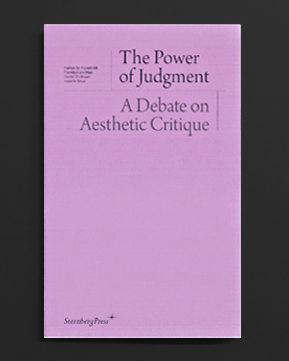
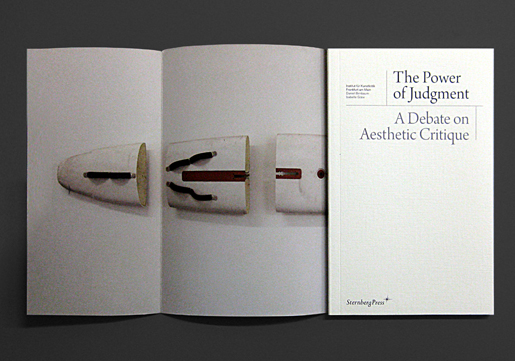
The Power of Judgment both attests to the importance of judgment in art criticism and argues against its determining verdicts. Comprised of a lecture by Christoph Menke and two respective responses to it by Daniel Loick and Isabelle Graw, this book brings together a dialogue on judgment originally begun at the Institut für Kunstkritik, Städelschule in Frankfurt am Main.
“Pointing to the necessity of an aesthetic judgment that produces controversy and dissent, The Power of Judgment deliberately takes up a proposition that can be debated.”
Design by Surface, Frankfurt am Main/Berlin
2010, English
Softcover, 12 x 19 cm, 248 pages (26 b/w ill.)
Published by
Sternberg Press / Berlin
$25.00 - Out of stock
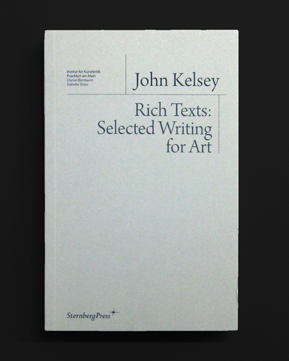
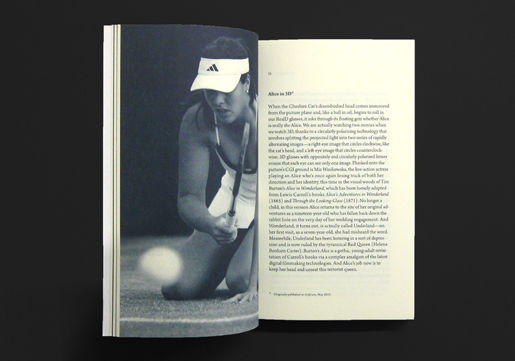
Edited by Daniel Birnbaum, Isabelle Graw, Institut für Kunstkritik, Frankfurt am Main Compiled for the first time here, the critic, artist, gallerist, dealer, translator John Kelsey’s selected essays gamesomely convey some of the most poignant challenges in the art world and in the many social roles it creates. “When the critic chooses to become a smuggler, a hack, a cook, or an artist,” Kelsey said at a 2007 conference at the Städelschule in Frankfurt am Main, “it’s maybe because criticism as such remains tied to an outmoded social relation.” It is precisely this relation that Kelsey intends to not only critique but also to surpass. In this way, Kelsey’s “Rich Texts” play the double role of explaining the art world and actively participating in it; they close the distance between the work of art and how we talk about it. “With a keen sense of the way objects and subjects appear in the spaces we share, and how we inhabit our bodies, John Kelsey writes texts at once playful and true to the situations under observation. He does not write from an imaginary critical distance, but as someone fully aware of being immersed in the commercial world, commodified and for hire—i.e., as a ‘hack’—yet constantly searching for new forms of experimentation.” —Daniel Birnbaum and Isabelle Graw Originally published in Artforum—where Kelsey is a contributing editor—Texte zur Kunst, Parkett, and various artists’ catalogues, the essays compiled in Rich Texts have all been written over the last decade, and therefore embody a timeliness that strikes at the core of the contemporary art world and the crises that have come to define it. Design by Surface, Frankfurt am Main/Berlin
2011, English
Softcover, 192 pages, 11.2 x 17.8 cm
Published by
Sternberg Press / Berlin
$23.00 - Out of stock
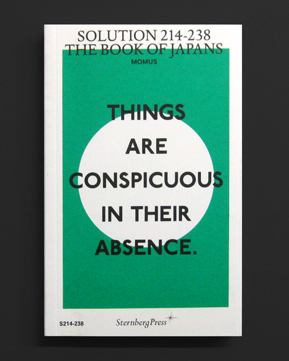
Following the success of The Book of Scotlands (shortlisted for the Scottish Arts Council’s First Book prize), Momus has been commissioned to write another book as part of Ingo Niermann’s Solution Series. Solution Japan, or The Book of Japans, makes a case for the rehabilitation of the idea of the “far.” We live in a time when difference and distance have been eroded and eradicated by globalization, the Internet, and cheap jet travel. The Book of Japans restores a sense of wonder—along with a plethora of imagination-triggering inaccuracies—by taking the reader on a trip not just through space but also time.
Solution Series edited by Ingo Niermann
Design by Z.A.K.
2009, English
Softcover, 160 pages, 11.2 x 17.8 cm
Published by
Sternberg Press / Berlin
$25.00 - Out of stock
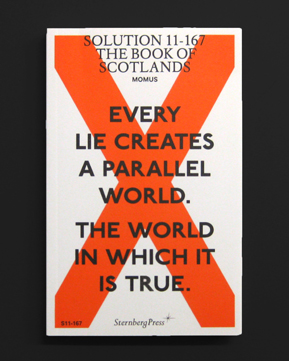
In the spirit of Italo Calvino, Bruno Schulz, and French animation series Les Shadoks (using any language, that is, except the “wooden tongue” of official discourse), The Book of Scotlands will outline, in a numerical sequence, one hundred and fifty-six Scotlands which currently do not exist anywhere. At a time when functional independence seems to be a real possibility for Scotland—and yet no one is quite sure what that means—a delirium of visions, realistic and absurd, is necessary.
Published in the Solution series edited by Ingo Niermann, The Book of Scotlands will provide one answer—and a few more—to this appeal for focused dreaming about potential parallel world Scotlands. The author, Momus, is a Scottish artist who has lived in Paris, New York, Tokyo and now Berlin. Paradoxically, of course, there is nothing more Scottish than leaving Scotland. And the further a Scot travels from Scotland, the more vivid and lurid his “inner Scotlands” become—and the more tellingly they differ from the real place. 2009 will also see the publication of Momus’ first novel, The Book of Jokes.
Design by Zak Kyes
In the spirit of Italo Calvino, Bruno Schulz, and French animation series Les Shadoks (using any language, that is, except the “wooden tongue” of official discourse), The Book of Scotlands will outline, in a numerical sequence, one hundred and fifty-six Scotlands which currently do not exist anywhere. At a time when functional independence seems to be a real possibility for Scotland—and yet no one is quite sure what that means—a delirium of visions, realistic and absurd, is necessary.
Published in the Solution series edited by Ingo Niermann, The Book of Scotlands will provide one answer—and a few more—to this appeal for focused dreaming about potential parallel world Scotlands. The author, Momus, is a Scottish artist who has lived in Paris, New York, Tokyo and now Berlin. Paradoxically, of course, there is nothing more Scottish than leaving Scotland. And the further a Scot travels from Scotland, the more vivid and lurid his “inner Scotlands” become—and the more tellingly they differ from the real place. 2009 will also see the publication of Momus’ first novel, The Book of Jokes.
Design by Zak Kyes
2012, English
Softcover, 526 pages (282 colour ill.), 210 x 277 mm
Published by
Walther König / Köln
$46.00 - Out of stock
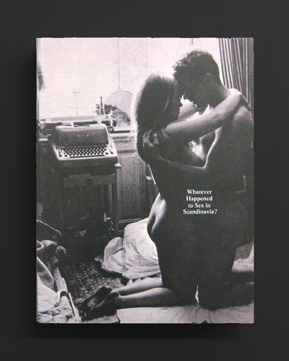
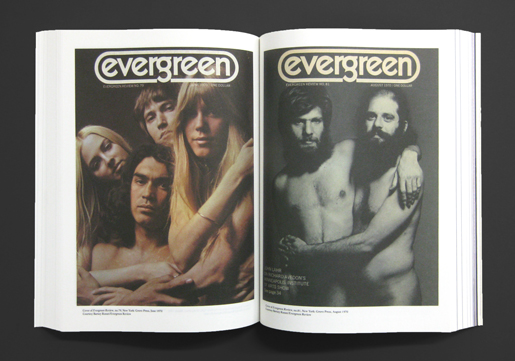
"Whatever Happened to Sex in Scandinavia?" is a reader that brings together essays, artists' writings and works, and countercultural publications to examine the juncture of the political and the erotic during the 1960s and 70s. Adopting as its starting point the postwar perception of Scandinavia as a socialist utopia of sexual freedom, it explores how the avant-garde artistic and cultural production of the time gravitated towards sexual and political liberation. "Whatever Happened to Sex in Scandinavia?" is the conclusion of a four-year research project, and includes many texts published in English here for the first time, by philosophers, artists, psychologists and theorists such as Knut Ove Arntzen, Stan Brakhage, Norman O. Brown, Valie Export, Oyvind Fahlstrom, Herbert Marcuse, Jonas Mekas, Henry Miller, Juliet Mitchell, Katti Anker Moller, Jorgen Nash, Havard Friis Nilsen, Claes Oldenburg, Elise Ottesen-Jensen, Wilhelm Reich, Yvonne Rainer, Jacqueline Rose, Barney Rosset, Barbara Rubin, Jens Jorgen Thorsen and Otto Weininger.
2012, English
Softcover, perfect bound, 176 pages (colour ills), 30 x 23 cm
Edition of 1000,
Published by
Discipline / Melbourne
$25.00 - Out of stock
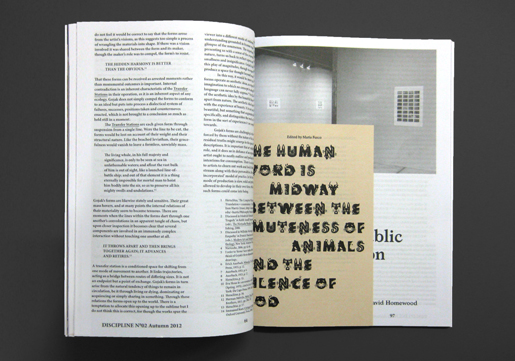
Second issue of Melbourne's Discipline!
CONTENTS
ESSAYS
Nicholas Croggon & Helen Hughes Editorial
Emanuele Coccia (trans. by Connal Parsley) End of Love
Amelia Barikin Time Shrines: Melancholia and Mourning in the Work of Ash Keating
Francis Plagne Matt Hinkley and the Embedded Mark
Helen Hughes Aestheticising Architecture / Architecturalising Aesthetics: Callum Morton and Bianca Hester
Timothy Morton Yukultji Napangati: Occupying Dreaming
Helen Johnson A Moment An Immeasurable Whole (on Mira Gojak)
David Homewood RR / SK: Public Exhibition
Steve Salisbury Kimberley Dinosaur Tracks
Kate Warren Unstable Realities in Omer Fast’s Five Thousand Feet Is The Best
Adrian Martin Price Tag
Vivian Ziherl Recommended Reading: LIP Magazine (1976-1984)
Sarinah Masukor All The News That’s Fit To Sing: Vernon Ah Kee’s Tall Man
Tim Alves The Telling Moment Revisited: Vernon Ah Kee’s Tall Man
Nikos Papastergiadis Can There Be a History of Contemporary Art?
James Parker Retromania and the Atemporality of Contemporary Pop
GUEST EDITED SECTION - MARIA FUSCO (EDITOR)
Maria Fusco Editorial: The Human Word is Midway Between the Muteness of Animals and the Silence of God
Nikolaus Gansterer & Moira Roth The Hand & The Creature
John Berger Why Look At Animals?
Yve Lomax A Philosopher, A Cat, A Monkey and Nudity
John Bevis Mnemonics for Bird Songs and Calls
Nikolaus Gansterer & Moira Roth The Hand, The Creatures & The Singing Garden
ARTIST PAGES
A Constructed World
Elizabeth Newman
Sandra Selig
Kate Meakin
Rongsolo
Christopher LG Hill
Paul Knight
S.T. Lore
POSTER INSERT
Janet Burchill
Editors: Nick Croggon and Helen Hughes
Guest Editor: Maria Fusco
Design: Annie Wu and Ziga Testen
2012, English
Softcover, 392 pages, 12.5 x 19.5 cm
Published by
Casco / Utrecht
Sternberg Press / Berlin
$27.00 - Out of stock
Binna Choi, Axel Wieder (Eds.)
Zayne Armstrong, Ei Arakawa, Bob Black, Augusto Boal, Ruth Buchanan, Binna Choi, common room, Paul Elliman, ifau & Jesko Fezer, Zachary Formwalt, Beatrice Gibson with Will Holder and John Tilbury, Kleines postfordistisches Drama, Mattin, Hwayeon Nam, Merijn Oudenampsen, Nam June Paik, Anne Querrien, David Reinfurt, Margit Rosen, Katerina Šedá, Axel Wieder
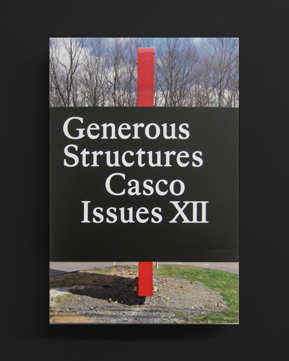
Casco Issues is a magazine published by Casco – Office for Art, Design and Theory, which explores recurring issues that emerge from Casco’s program. The twelfth edition of Casco Issues, Generous Structures, is a playful enquiry into "playfulness" as a value in critical cultural practice. It positions alternative notions of playing against the grain of neoliberal ideologies of "lifelong learning" and "work as play."
By taking the idea of playing and the metaphor of the game as a starting point, the publication addresses what might be called a “ludic turn”—the impact of the notion of play and gaming methods in various research fields and cultural work. Most prominent in the Internet industries and interactive media landscapes, but also in theoretical reflections, historical research, and the work of artists and designers, we are experiencing an interest in play as an educational tool or model for participation. However, with the conscious exception of the game per se, the publication attempts to trace its current impact and critical capacity, and explores various notions as well as concrete modes of play including activities such as learning, sharing, and group work, in relation to space, art, and design. It is driven from a methodological interest in the structure of playing, in its dialectics of rules and possibilities, planning and non-planning, collectivity and individuality. A game, in this sense, is not only characterized by its rules—or, on the contrary, by the liberty of the playing individuals—but is rather a construction of conscious interaction, application and transgression.
Co-published with Casco – Office for Art, Design and Theory
Design by Julia Born and Laurenz Brunner, with Sam de Groot
2010, English
Softcover, 248 pages offset (23 b/w ill.), 138 x 214 mm
Published by
Sternberg Press / Berlin
$31.00 - Out of stock
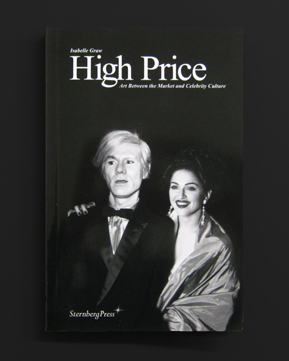
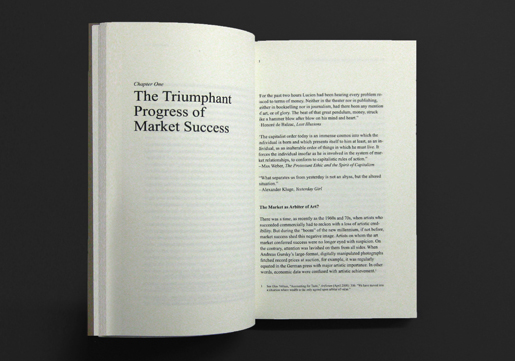
Today, the art world is not dominated by a small group of insiders. According to Graw, the art economy has been transformed from a retail business into an industry that produces visuality and meaning. This book questions the assumption of a dichotomy between art and the market, as well as the notion that market value is equal to artistic value. While examining the intrinsic connection between artistic production and its market conditions, Graw also insists that art is a commodity unlike any other. High Price claims that art and the market have to escape each other precisely because they are so deeply entangled.
This book provides numerous examples to support the first claim of a massive growth in the defining role of the market and its players during the art boom, who also increasingly have a say in establishing artistic value. There is indeed much to suggest that in recent years, whether or not an artwork was considered relevant in artistic terms depended to a greater extent on its market value. But this market value still depends on a “symbolic value” for its ultimate legitimacy. Without symbolic value, no market value—this is the book’s second claim. For if it is true that society has been changing since the 1970s from industrial capitalism into what Antonio Negri has called “cognitive capitalism,” then under such conditions, increased importance would once more be accorded to the symbolic meaning of an artwork. The art world is by definition a knowledge society, even if the spell of commercial success has long held sway over it.
Isabelle Graw is Professor for Art Theory and Art History at Staatliche Hochschule für Bildende Künste (Städelschule), Frankfurt am Main, where she co-founded the Institute of Art Criticism. She is an art critic and co-founder of Texte zur Kunst in Berlin.
Softcover, 15.5 x 23 cm, 192 pages, 23 color (15 b/w ill.)
Published by
Sternberg Press / Berlin
$27.00 - Out of stock
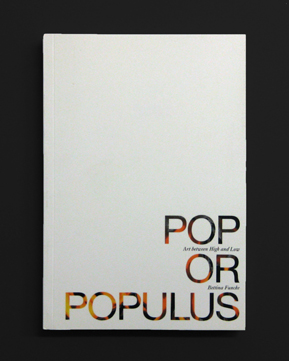
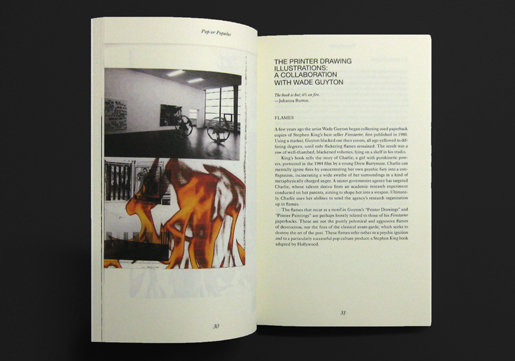
With illustrations by Wade Guyton
The alienation between modern high culture and its public is a fundamental conflict of art. This book develops a theory of contemporary art in response to our moment, when artists and critics must respond to art’s unprecedented popularity. Close readings of Friedrich Nietzsche, Jacques Rancière, Theodor W. Adorno, Clement Greenberg, Benjamin Buchloh, and Boris Groys provide the theoretical framework to comprehend a dialectic of art propelled by tension between the enduring history of art and the domineering presence of mass culture.
“In dialogue with some of the most interesting modern and contemporary philosophical figures, Bettina Funcke traces the divisions and alternations in twentieth-century art between high and low engagements with popular forms. She reveals fascinatingly how twentieth-century artists not only seek to engage the people but also problematize ‘the people’ as a political and cultural construct.”
— Michael Hardt, co-author of Empire and Multitude
“In this far-ranging, muscular book, Bettina Funcke persuasively argues for a renewed attention to the dialectical relationship between high culture and mass culture. Against the notion that the two domains have become wholly indistinguishable, Funcke posits a stubborn, even agonistic sphere still discernable between them; in her account, it is the praxis of ‘contemporary art’ that both embodies and reflects upon this condition. Skillfully delivering a complex history of the longstanding, slippery debates around hierarchical and repressive structures of culture, Funcke moves through two centuries of philosophical and art historical discourse. Tending to canonical—and often contradictory—premises by authors including Buchloh, Derrida, Foucault, and Greenberg and to still-ambiguous and heavily debated artistic practices like those of Beuys and Warhol, Funcke’s analysis extends, with great implication, into the philosophical and artistic details of our own moment. In Pop or Populus, Funcke delivers a cohesive, suggestive narrative that takes up the central issues of contemporary culture and refuses to consider any history a closed case.”
—Johanna Burton, art historian and critic, Associate Director and Senior Faculty, Whitney Museum of American Art Independent Study Program, New York
Bettina Funcke studied philosophy, art history, and media theory at the Hochschule für Gestaltung/ZKM, Karlsruhe, Germany, and has lectured at Bard College, Columbia University, Yale University, and the ZKM. Her writings have been published widely, both in artist monographs and magazines including Afterall, Artforum, Bookforum, Public, and Texte zur Kunst. A co-founder of The Leopard Press and the Continuous Project group, Funcke has worked as an editor at Dia Art Foundation and recently as Senior Editor U.S., Parkett.
Translated from the German by Warren Niesluchowski
2011/1973, English
Softcover, 96 pp., offset 2/1, 130 x 210 mm
Published by
Occasional Papers / London
$23.00 - Out of stock
BACK IN STOCK!
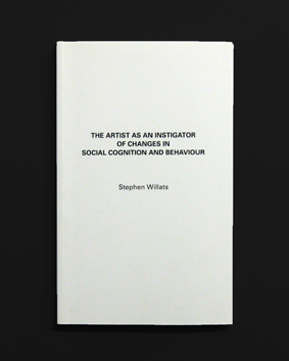
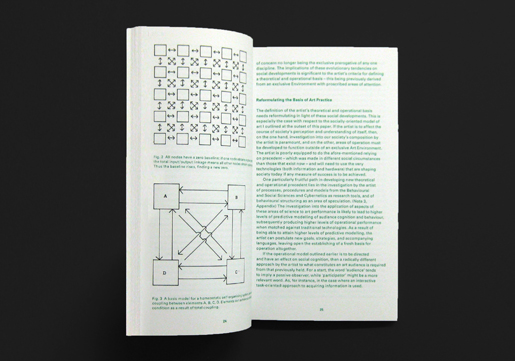
Stephen Willats’ major essay The Artist as an Instigator of Changes in Social Cognition and Behaviour is re-issued for the first time by Occasional Papers. Published in 1973 by Gallery House, London — where Willats was Director of the Centre for Behavioural Art — and long out of print, the paper includes rigorous analyses of social forms of artistic production and descriptions of a number of projects by the artist.
2011, English
Softcover (stapled), 16 pages, (colour ill.), 200 x 170 mm
Published by
Monash University Museum of Art / Melbourne
$8.00 - In stock -
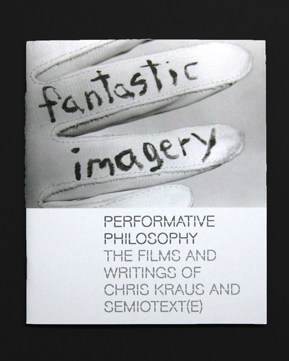
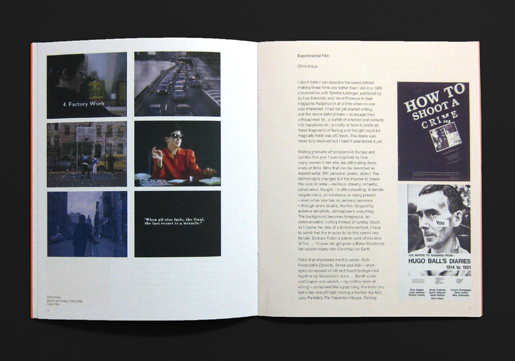
Accompanying catalogue for Performative Philosophy: The films and writings of Chris Kraus and Semiotext(e) which presents Kraus’ work as a film-maker, writer and co-editor of Semiotext(e). The exhibition comprising films, books, scripts, posters and stills and production notes, encompasses the poetic force of Kraus’ filmmaking and her deeply unique and inventive voice that moves through art, fiction, feminism, politics and the many spheres of cultural production.
Additional to Kraus’ films, Performative Philosophy will present film and video by authors published by Semiotext(e), including Guy Debord, Penny Arcade, David Wojnarowicz, David Rattray, Sylvére Lotringer, Gary Indiana and Bernadette Corporation. The exhibition locates Kraus as the thread linking this diverse selection of artists, filmmakers and philosophers.
2012, English
Softcover, 190 x 295 mm
Published by
Afterall / London
$18.00 - Out of stock
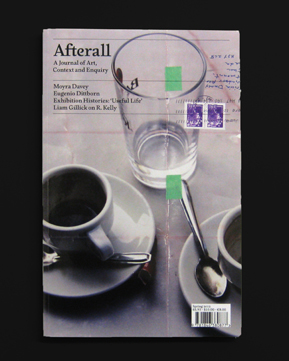
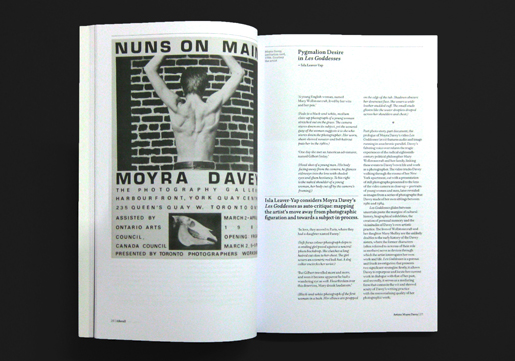
Issue 29 features deals with the notion of contested and constructed histories. Featuring Moyra Davey, Eugenio Dittborn, Wendelien van Oldenborgh and Dierk Schmidt; accompanying texts look at cinematic space and the public sphere, the 'Useful Life' exhibition and R Kelly's hip-hopera.
Contents include:
Contextual Essays
"Temporality, Sociality, Publicness: Cinema as Art Project"
"The Operation Was a Success But the Patient Died"
Artists
Moyra Davey
"Slack Time"
"Pygmalion Desire in Les Goddesses"
Wendelien van Oldenborgh
"Interzone: On Three Works by Wendelien van Oldenborgh"
"Wendelien van Oldenborgh: ‘The past is never dead. It’s not even past.'"
Eugenio Dittborn
"Disarmed and Equipped: Strategies, Politics and Poetics of the Image in Eugenio Dittborn’s Airmail Paintings"
"Correcaminos VII/ Roadrunner VII, 2012"
"No Man’s Land Paintings"
Dierk Schmidt
"Image Leaks: Dierk Schmidt’s Critical Opening of a Permeable Medium"
"Dierk Schmidt: Packing the Hard Potatoes"
Events, Works, Exhibitions
‘Useful Life’: Reflection Among Exhibition Frenzy (Shanghai, 2000)
Robert Kelly and Robert McNamara: Extended Narrative versus Data Mining