World Food Books' programme is largely produced on Kulin Nation land. We acknowledge the Wurundjeri people of the Kulin Nation as the first and continuing custodians of this land, and pay respect to their Elders past, present, and emerging.
World Food Books is an arts and special interests bookshop in Naarm / Melbourne. Founded in 2010, World Food Books is devoted to the presentation of a rotating, hand-selection of international art, design, literary and counterculture publications with an emphasis on the anti-traditional, the experimental, the avant-garde, the heretic, the marginal.
Presenting new titles alongside rare and out-of-print books, catalogues and journals spanning the fields of modern and contemporary art, design, photography, illustration, film, literature, poetry, cultural theory, philosophy, sexuality, popular and underground culture in its many radical forms, World Food Books wishes to encourage adventurous, thoughtful and open-minded reading, looking, writing, and exchange of publishing and ideas, both current and historical.
As well as our bookshop, located in Melbourne's historical Nicholas Building, all of our inventory is available internationally via our online mail-order service.
World Food Books semi-regularly co-ordinates "Occasions", a programme of exhibits and events at the bookshop and in partnership with other hosts (such as museums and art galleries) that develop out of the activities, relationships and content of the bookshop itself.
World Food Books
The Nicholas Building
37 Swanston Street
Room 5, Level 6
Melbourne 3000
Australia
SHOP HOURS:
Thu–Fri 12–6, Sat 12–5
WEB-SHOP OPEN 24/7
World Food Books
Postal Address:
PO Box 435
Flinders Lane
Victoria 8009
Australia
Art
Theory / Essay
Architecture / Interior
Graphic Design / Typography
Photography
Fashion
Eros
LGBTQ+
Fiction / Poetry
Weird / Speculative / Science Fiction / Horror
Transgressive / Visceral / Abject
Symbolism / Decadence / Fin de siècle
Film / Video
Painting
Sculpture / Installation
Performance / Dance / Theater
Drawing
Sound / Music
Curatorial
Group Shows / Collections
Periodicals
Out-of-print / Rare
Posters / Ephemera / Discs
Signed Books
World Food Books Gift Voucher
World Food Book Bag
Australian Art
Australian Fiction
Australian Science Fiction / Speculative Fiction
Australian Poetry
Australian Photography
Japanese Photography
Conceptual Art
Minimal Art
Dada
'Pataphysics / Oulipo
Fluxus
Concrete Poetry
Pop Art
Surrealism
Arte Povera
Arte Informale / Haute Pâte / Tachism
Nouveau Réalisme / Zero / Kinetic
Situationism / Lettrism
Collage / Mail Art / Xerox Art
Art Brut / Folk / Visionary / Fantastic
Illustration / Graphic Art / Bandes Dessinées
Furniture
Italian Radical Design / Postmodernism
Textiles
Ceramics / Glass
Counterculture
Protest / Revolt
Philosophy
Psychoanalysis
Anthropology
Anarchism
Socialism / Anarchism / Communism / Capitalism
Literary Theory / Semiotics / Language
Feminism / Women's Studies
Gender Studies / Sexuality
Anthropology
Fetishism / BDSM
Drugs / Psychedelia
Crime / Violence
Animal Rights / Veganism
Occult / Esoterica
Ecology / Earth / Alternative Living
Whole Earth / Crafts
All prices in AUD (Australian dollars)
Pick-Ups
Pick-up orders can be collected in our bookshop during opening hours after order date. Please collect any Pick-up orders within 2 weeks of ordering as we have limited storage space. Orders will be released back into stock if not collected within this time. No refunds can be made for pick-ups left un-collected. If you cannot make it in to the bookshop in this time-frame, please choose postage option.
Return Policy
All sales are final. We do accept returns (for refund or exchange) for items received in error. All our orders are packed with special care using heavy-duty padding and cardboard book-mailers or bubble mailers (for smaller books), using reinforcement where required. We cannot take responsibility for any lost, stolen or damaged parcels.
Insurance
Should you wish to insure your package, please email us directly after placing your order and we can organise this at a small extra expense. Although all standard/express tracked packages are very safe and dependable, we cannot take responsibility for any lost, stolen or damaged parcels. We recommend insurance on valuable orders.
Interested in selling your old books, catalogues, journals, magazines, comics, fanzines, ephemera? We are always looking for interesting, unusual and out-of-print books to buy. We only buy books in our fields of interest and specialty, and that we feel we can resell.
We base these prices on desirability, market value, in-print prices, condition and our current stock levels. We offer cash, store credit, and can take stock on consignment. All
about 25% of the price we expect to get when we sell them, or 30% in store credit. We base these prices on desirability, market value, in-print prices, condition and our current stock levels.
Sell your books any day of the week. You can drop them off and return later. If you have a lot of books, we can visit your Sydney home.
We buy books that we feel we can resell. We offer about 25 % of the price we expect to get when we sell them, or 30% in store credit. We base these prices on desirability, market value, in-print prices, condition and our current stock levels.
Philadelphia Wireman
03 August - 01 September, 2018
World Food Books is proud to announce our next Occasion, the first presentation of sculptures by Philadelphia Wireman in Australia.
The Philadelphia Wireman sculptures were found abandoned in an alley off Philadelphia’s South Street on trash night in 1982. Their discovery in a rapidly-changing neighbourhood undergoing extensive renovation, compounded with the failure of all attempts to locate the artist, suggests that the works may have been discarded after the maker’s death. Dubbed the "Philadelphia Wireman" during the first exhibition of this work, in 1985, the maker’s name, age, ethnicity, and even gender remain uncertain. The entire collection totals approximately 1200 pieces, all intricately bound together with tightly-wound heavy-gauge wire (along with a few small, abstract marker drawings, reminiscent both of Mark Tobey and J.B. Murry). The dense construction of the work, despite a modest range of scale and materials, is singularly obsessive and disciplined in design: a wire armature or exoskeleton firmly binds a bricolage of found objects including plastic, glass, food packaging, umbrella parts, tape, rubber, batteries, pens, leather, reflectors, nuts and bolts, nails, foil, coins, toys, watches, eyeglasses, tools, and jewellery.
Heavy with associations—anthropomorphic, zoomorphic, and socio-cultural responses to wrapped detritus—the totemic sculptures by Philadelphia Wireman have been discussed in the context of work created to fulfil the shamanistic needs of alternative religions in American culture. Curators, collectors, and critics have variously compared certain pieces to sculpture from Classical antiquity, Native American medicine bundles, African-American memory jugs, and African fetish objects. Reflecting the artist’s prolific and incredibly focused scavenging impulse, and despite—or perhaps enhanced by—their anonymity, these enigmatic objects function as urban artefacts and arbiters of power, though their origin and purpose is unknown. Philadelphia Wireman, whatever their identity, possessed an astonishing ability to isolate and communicate the concepts of power and energy through the selection and transformation of ordinary materials. Over the course of the past two decades, this collection has come to be regarded as an important discovery in the field of self-taught art and vernacular art.
Presented in collaboration with Fleisher-Ollman Gallery, Philadelphia, and Robert Heald, Wellington.
Susan Te Kahurangi King
02 February - 10 March, 2018
Susan Te Kahurangi King (24 February 1951 - ) has been a confident and prolific artist since she was a young child, drawing with readily available materials - pencils, ballpoint pens and felt-tip markers, on whatever paper is at hand. Between the ages of four and six Susan slowly ceased verbal communication. Her grandparents William and Myrtle Murphy had developed a special bond with Susan so they took on caring responsibilities for extended periods. Myrtle began informally archiving her work, carefully collecting and storing the drawings and compiling scrapbooks. No drawing was insignificant; every scrap of paper was kept. The King family are now the custodians of a vast collection containing over 7000 individual works, from tiny scraps of paper through to 5 meter long rolls.
The scrapbooks and diaries reveal Myrtle to be a woman of great patience and compassion, seeking to understand a child who was not always behaving as expected. She encouraged Susan to be observant, to explore her environment and absorb all the sights and sounds. Myrtle would show Susan’s drawings to friends and people in her community that she had dealings with, such as shopkeepers and postal workers, but this was not simply a case of a grandmother’s bias. She recognised that Susan had developed a sophisticated and unique visual language and sincerely believed that her art deserved serious attention.
This was an unorthodox attitude for the time. To provide some context, Jean Dubuffet coined the term Art Brut in 1945 to describe work created by self-taught artists – specifically residents of psychiatric institutions and those he considered to be visionaries or eccentrics. In 1972 Roger Cardinal extended this concept by adopting the term Outsider Art to describe work made by non-academically trained artists operating outside of mainstream art networks through choice or circumstance. Susan was born in Te Aroha, New Zealand in 1951, far from the artistic hubs of Paris and London that Dubuffet and Cardinal operated in. That Myrtle fêted Susan as a self-taught artist who deserved to be taken seriously shows how progressive her attitudes were.
Susan’s parents Doug and Dawn were also progressive. Over the years they had consulted numerous health practitioners about Susan’s condition, as the medical establishment could not provide an explanation as to why she had lapsed into silence. Dawn educated herself in the field of homeopathy and went on to treat all twelve of her children using these principles – basing prescriptions on her observations of their physical, mental and emotional state.
Doug was a linguist with an interest in philosophy who devoted what little spare time he had to studying Maori language and culture. To some extent their willingness to explore the fringes of the mainstream made them outsiders too but it was their commitment to living with integrity and their respect for individuality that ensured Susan’s creativity was always encouraged.
Even though Susan’s family supported her artistic pursuits, some staff in schools and hospitals saw it as an impediment to her assimilation into the community and discouraged it in a variety of ways. Her family was not always aware of this and therefore did not fully understand why Susan stopped drawing in the early 1990s. However, rather than dwell on the challenges that Susan faced in pursuit of her artistic practice, they prefer to highlight her achievements. In 2008 Susan began drawing again in earnest, after an almost 20 year interruption, and her work is now shown in galleries around the world.
Susan grew up without television and has been heavily influenced by the comics she read as a child. She is absolutely fearless in the appropriation of recognizable characters, such as Donald Duck and Mickey Mouse, in her work. She twists their limbs, contorts their faces, compresses them together, blends them into complex patterned backgrounds - always imbuing them with an incredible energy. Although Susan often used pop culture characters in her work they are not naive or childlike. These are drawings by a brilliant self-taught artist who has been creating exceptional work for decades without an audience in mind.
Mladen Stilinović
"Various Works 1986 - 1999"
02 February 16 - September 10, 2016
Various works 1986 - 1999, from two houses, from the collections of John Nixon, Sue Cramer, Kerrie Poliness, Peter Haffenden and Phoebe Haffenden.
Including: Geometry of Cakes (various shelves), 1993; Poor People’s Law (black and white plate), 1993; White Absence (glasses, ruler, set square, silver spoon, silver ladel with skin photograph and wooden cubes), 1990-1996; Exploitation of the Dead (grey and red star painting, wooden painting, black spoon with red table, red plate), 1984-1990; Money and Zeros (zero tie, paintings made for friends in Australia (Sue, John, Kerrie), numbers painting), 1991-1992; Words - Slogans (various t-shirts) - “they talk about the death of art...help! someone is trying to kill me”, “my sweet little lamb”, “work is a disease - Karl Marx”; Various artist books, catalogues, monographs, videos; Poster from exhibition Insulting Anarchy; "Circular" Croatian - Australian edition; Artist book by Vlado Martek (Dostoyevsky); more.
Thanks to Mladen Stilinović and Branka Stipančić.
Jonathan Walker
Always Will Need To Wear Winter Shirt Blue + Ochre Small Check Pattern
21 August - 21 September, 2015
Untitled
I am not a great reader of poetry but I always return to the work of Melbourne poet, Vincent Buckley (1925- 1988). Perhaps I find his most tantalising piece to be not a finished poem but a fragment left on a scrap of paper discovered on his desk after the poet’s death.
The poetry gathers like oil
In the word-core, and spreads
It has its music meet,
Its music is in movement.
This fragment is more the shell left behind from a volatile thought than a finished poem. I find the last two lines honest but awkward whereas the first two lines work like an arrow. Most likely he could not find a resolution so it was left. Still, in its present form, it remains an eloquent testimony to the ultimate failure of a medium to express mobile thought and sensation, in Buckley’s case, through verbal language. It’s an important matter because this is something all artists have to deal with regardless of the medium.
I have never written a poem, however, I am forever copying fragments from books on paper scraps in a vain effort to fix certain notions in my head. At first, they function as bookmarks that are sometimes returned to when I open the book. But before long, as they accumulate, they fall out littering the table interspersed with A4 photocopies, bills, books and medications.
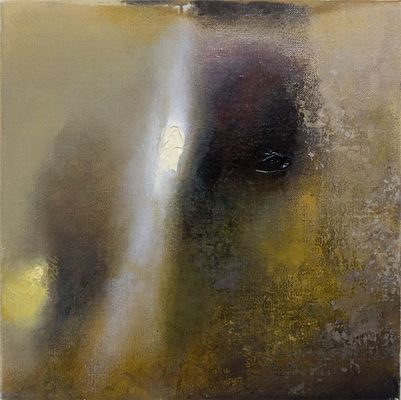
To return to Buckley’s fragment, the first two lines very much evoke how I paint nowadays. As you age, detail diminishes and patches of light become more luminous and float. I feel the most honest way of dealing with this is by smearing the oil paint on the canvas with the fingers and working close-up, blind. Only if the patches coalesce into an approaching image can the work gain a life.
-
Jonathan Walker was born in Melbourne, Australia and brought up on a dairy farm in Gippsland. In the 1970’s he studied painting at RMIT and won the Harold Wright Scholarship to the British Museum, London. During the 1980’s he exhibited at Pinacotheca Gallery, Richmond and had work shown at the NGV and Heidi City Art Gallery. Over the same period he designed the cover for the “Epigenesi” LP by Giancarlo Toniutti, Italy and conducted a mail exchange work with Achim Wollscheid, Germany. The work with artists through the post resulted in an article published in the bicentenary issue of Art and Australia 1988. He showed in artist run spaces such as WestSpace in the 90’s and 2000’s, and until 2012, taught painting at Victoria University, which is where we (Colleen Ahern and Lisa Radford) as organisers of the exhibition, among many others, had the privilege of being his student.
Walker’s knowledge was imparted to students through the careful selection of music, literature, and artists found in books that he himself had ordered for the library. Walker’s strategy was the generosity of sharing his vast knowledge with references specific to each student and their context.
Walker’s paintings share a similar focus and intimacy.
This exhibition presents a small selection of recent paintings alongside a publication that includes Walker’s writing. Observational and analytical, Walker’s work is a type of material notation — the time of day, colour and how it is blended, the both specific and fleeting location of a reflection on lino or the question of whether a chair leg should be included in a painting.
Please join us on Friday August 21 between 6-8pm to celebrate the opening of the exhibition.
Curated by Colleen Ahern and Lisa Radford.
B. Wurtz
Curated by Nic Tammens
March 26 - April 4, 2015
B.Wurtz works from a basement studio in his home on Manhattan’s Lower East Side.
This local fact is attested to by the plastic shopping bags and newsprint circulars that appear in his work. As formal objects, they don’t make loud claims about their origins but nonetheless transmit street addresses and places of business from the bottom of this long thin island. Like plenty of artists, Wurtz is affected by what is local and what is consumed. His work is underpinned by this ethic. It often speaks from a neighborhood or reads like the contents of a hamper:
“BLACK PLUMS $1.29 lb.”
“Food Bazaar”
“USDA Whole Pork Shoulder Picnic 99c lb.”
“RITE AID Pharmacy, with us it’s personal.”
“H. Brickman & Sons.”
“Sweet Yams 59c lb."
Most of the work in this exhibition was made while the artist was in residence at Dieu Donne, a workshop dedicated to paper craft in Midtown. Here Wurtz fabricated assemblages with paper and objects that are relatively lightweight, with the intention that they would be easily transportable to Australia. This consideration isn’t absolute in Wurtz’s work, but was prescriptive for making the current exhibition light and cheap. Packed in two boxes, these works were sent from a USPS post office on the Lower East Side and delivered to North Melbourne by Australia Post.
Wurtz appears courtesy of Metro Pictures, New York.
Thanks to Rob Halverson, Joshua Petherick, Sari de Mallory, Matt Hinkley, Helen Johnson, Fayen d'Evie, Ask Kilmartin, Lisa Radon, Ellena Savage, Yale Union, and "Elizabeth".
John Nixon
"Archive"
December 15 - January 20, 2014
The presentation of John Nixon's archive offered a rare showcase of this extensive collection of the artist's own publications, catalogues, posters, ephemera, editions and more, from the mid 1980s onwards, alongside a selection of his artworks.
Organized by John Nixon, Joshua Petherick and Matt Hinkley.
<a href=http://wfb.public-office.info/artist/john-nixon>All titles by John Nixon
"Habitat"
at Minerva, Sydney (organised by Joshua Petherick and Matt Hinkley)
November 15 - December 20, 2014
Lupo Borgonovo, Janet Burchill & Jennifer McCamley,
Lewis Fidock, HR Giger, Piero Gilardi, Veit Laurent Kurz,
Cinzia Ruggeri, Michael E. Smith, Lucie Stahl, Daniel Weil, Wols
Press Release:
“...It contained seven objects. The slender fluted bone, surely formed for flight, surely from the wing of some large bird. Three archaic circuitboards, faced with mazes of gold. A smooth white sphere of baked clay. An age-blackened fragment of lace. A fingerlength segment of what she assumed was bone from a human wrist, grayish white, inset smoothly with the silicon shaft of a small instrument that must once have ridden flush with the surface of the skin - but the thing’s face was seared and blackened.”
William Gibson, “Count Zero”, 1986
"Autumn Projects Archive"
Curated by Liza Vasiliou
March 6 - March 15, 2014
World Food Books, in conjunction with the Virgin Australia Melbourne Fashion Festival 2014, presented the Autumn Projects archive, consisting of a selection of early examples in Australian fashion with a particular interest in collecting designers and labels from the period beginning in the 1980’s, who significantly influenced the discourse of Australian Fashion.
Curated by Liza Vasiliou, the exhibition provided a unique opportunity to view pieces by designers Anthea Crawford, Barbara Vandenberg, Geoff Liddell and labels CR Australia, Covers, Jag along with early experimental collage pieces by Prue Acton and Sally Browne’s ‘Fragments’ collection, suspended throughout the functioning World Food Books shop in Melbourne.
H.B. Peace
presented by CENTRE FOR STYLE
November 14, 2013
"Hey Blinky, you say chic, I say same"
Anon 2013
H.B. Peace is a clothing collaboration between great friends Blake Barns and Hugh Egan Westland. Their pieces explore the divergences between 'character’ and ‘personality’ in garments....etc
Special Thanks to Joshua Petherick and Matt Hinkley of WFB and Gillian Mears
and a Very Special Thank you to Audrey Thomas Hayes for her shoe collaboration.
Janet Burchill & Jennifer McCamley
"Aesthetic Suicide"
May 10 - June 8, 2013
The first of our occasional exhibitions in the World Food Books office/shop space in Melbourne, "Aesthetic Suicide" presented a body of new and older works together by artists Janet Burchill & Jennifer McCamley, including videos, prints, a wall work, and publications.
During shop open hours videos played every hour, on the hour.
1979, English
Softcover, 228 pages, 21.5 x 13.5 cm
1st Edition, Out of print title / used / very good
Published by
Shambhala / Boulder
$60.00 - Out of stock
First 1979 English translation edition from original German.
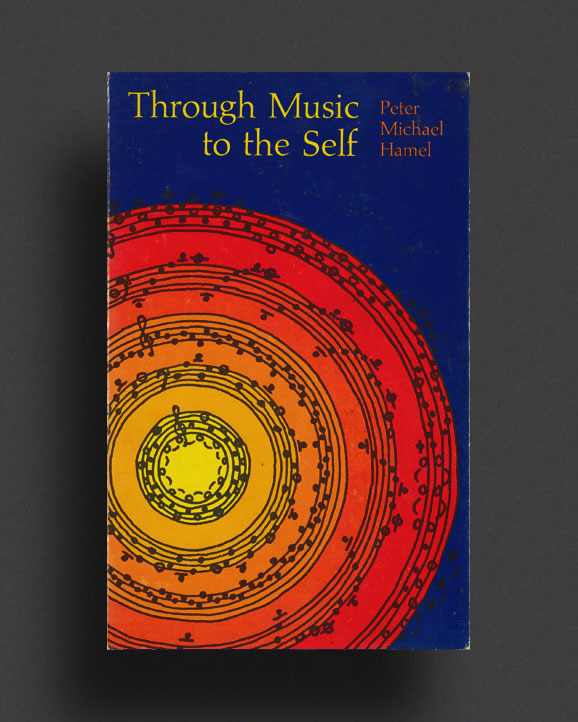
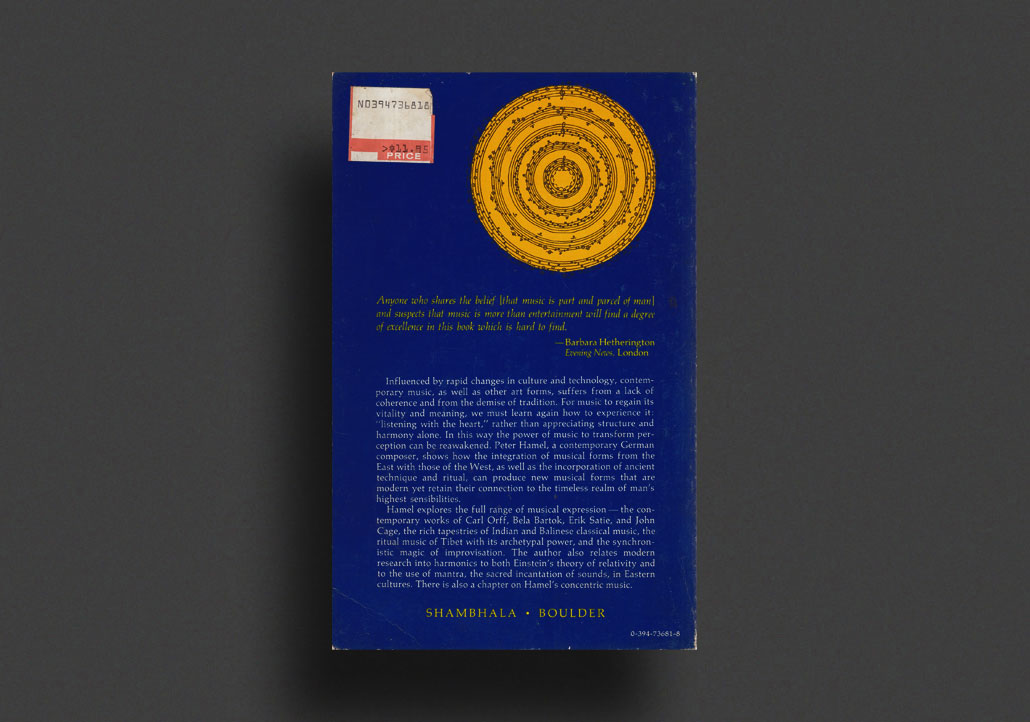
Influenced by rapid changes in culture and technology, contemporary music, as well as other art forms, suffers from a lack of coherence and from the demise of tradition. For music to regain its vitality and meaning, we must learn again how to experience it: "listening with the heart," rather than appreciating structure and harmony alone. In this way the power of music to transform perception can be reawakened. Peter Hamel, a contemporary German composer, shows how the integration of musical forms from the East with those of the West, as well as the incorporation of ancient technique and ritual, can produce new musical forms that are modern yet retain their connection to the timeless realm of man's highest sensibilities.
Hamel explores the full range of musical expression - the contemporary works of Carl Orff, Bela Bartok, Erik Satie, and John Cage, the rich tapestries of Indian and Balinese classical music, the ritual music of Tibet with its archetypal power, and the synchronistic magic of improvisation. The author also relates modern research into harmonics to both Einstein's theory of relativity and to the use of mantra, the sacred incantation of sounds, in Eastern cultures. There is also a chapter on Hamel's concentric music, and sections on rock music, psychedelic music and drugs, mantra, the relationship of vowels to parts of the body, meditation, music therapy, breath and voice, singing and 'one's own sound.'
Translated from the German By Peter Lemesurier.
Very Good copy with publisher's insert.
1995, English
Softcover, 176 pages, 23 x 15.7 cm
1st Edition, Out of print title / as new
Published by
Scarecrow Press / Maryland
$60.00 - Out of stock
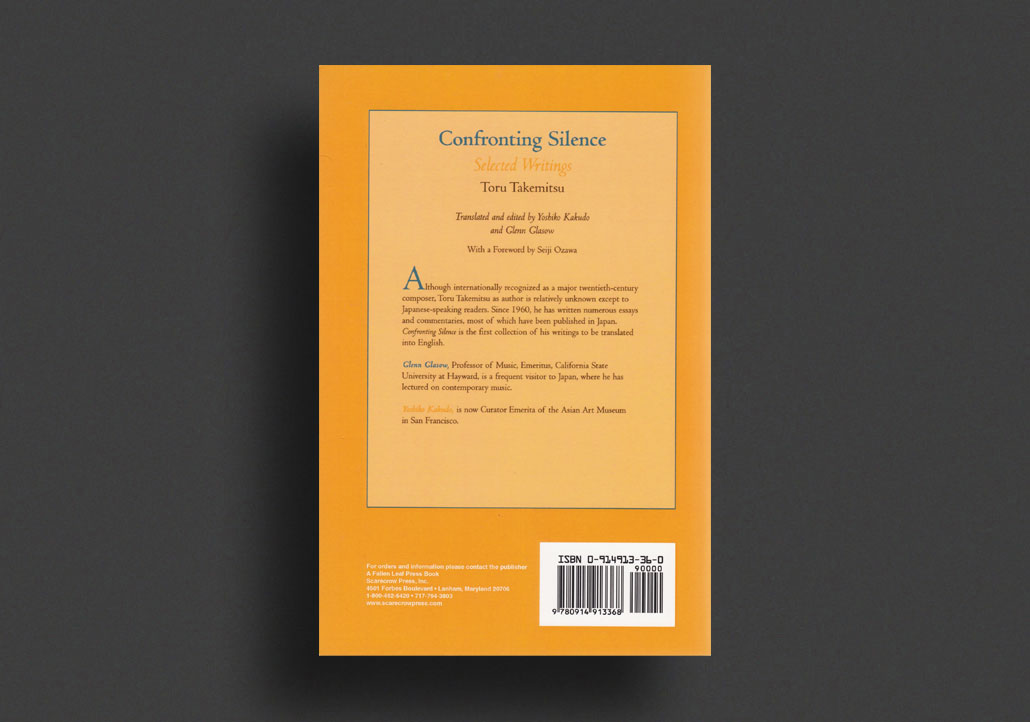
In these writings, available here in English for the first time, the distinguished Japanese composer Toru Takemitsu reflects on his contemporaries, including John Cage, Olivier Messiaen, and Merce Cunningham; on nature, which has profoundly influenced his composition; on film and painting; on relationships between East and West; on traditional Japanese music; and on his own compositions.
Translated and edited Yoshiko Kakudo and Glenn Glasow.
Forewaod by Seiji Ozawa.
First ed, As New copy.
1983, English
Softcover, 224 pages, 21 x 14 cm
1st Edition, Out of print title / used / very good
Published by
Seaver Books / US
$60.00 - Out of stock
Perhaps the single most important voice of cinema in the twentieth century, André Bazin profoundly influenced the development of the scholarship that we know now as film criticism. Bazin has acutely analyzed the cinematic values of our time, extending to his international audiences “the impact of art for the understanding and discrimination of his readers.”
The depth and logic of his commentary has elevated film criticism to new heights. The reputation of André Bazin continues to grow as his writings are published and studied by filmmakers and filmgoers alike. Often referred to as the Edmund Wilson of film, Bazin was more than a critic. “He made me see certain aspects of my work that I was unaware of,” said Luis Buñuel. “He was our conscience,” wrote Jean Renoir. “He was a logician in action,” echoed François Truffaut.
In The Cinema of Cruelty, François Truffaut, one of France’s most celebrated and versatile filmmakers, has collected Bazin’s writings on six film “greats”: Erich von Stroheim, Carl Dreyer, Preston Sturges, Luis Buñuel, Alfred Hitchcock, and Akira Kurosawa. The result is a major collection of film criticism.
André Bazin was born in Angers, France, in 1918. Critic, theorist, essayist, and teacher, Bazin is, as Truffaut notes, “the most widely published and translated film critic outside of France.” Bazin’s work and writings have attracted an international audience of filmmakers, directors, and viewers. He passed away in 1958 at the age of forty.
1981, English
Softcover, 378 pages, 23.5 x 15.5 cm
1st Edition, Out of print title / used / very good
Published by
Vintage Books / New York
$40.00 - Out of stock
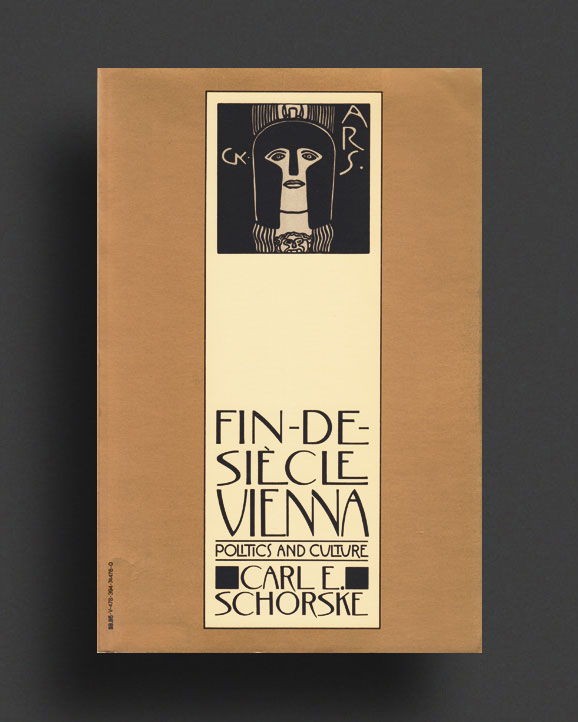
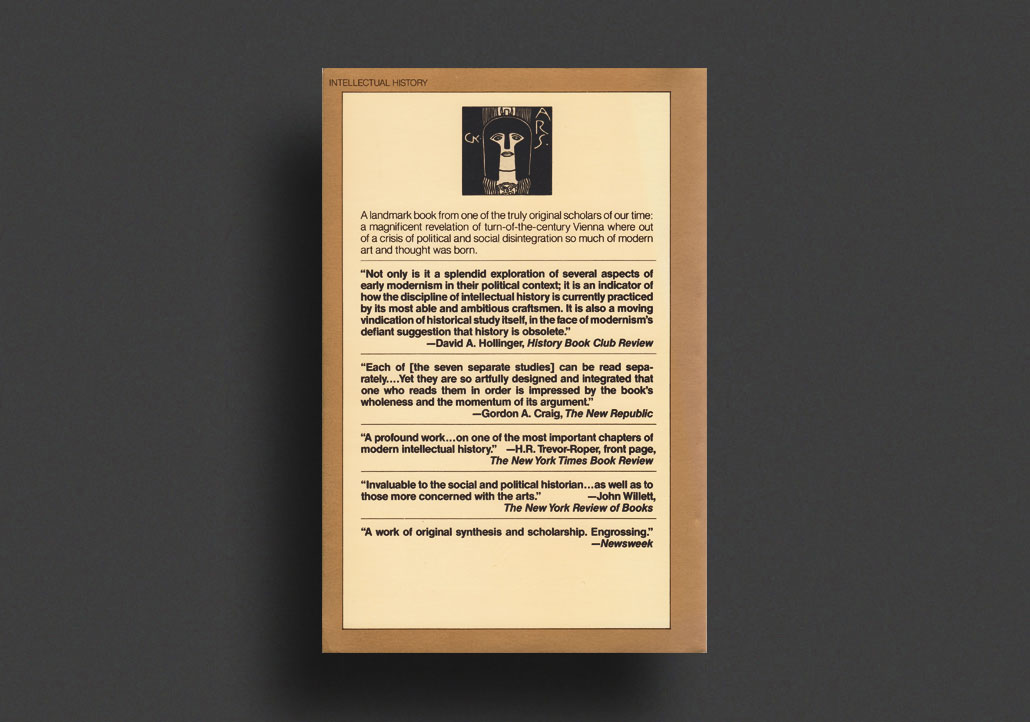
A Pulitzer Prize Winner and landmark book from one of the truly original scholars of our time: a magnificent revelation of turn-of-the-century Vienna where out of a crisis of political and social disintegration so much of modern art and thought was born.
"Not only is it a splendid exploration of several aspects of early modernism in their political context; it is an indicator of how the discipline of intellectual history is currently practiced by its most able and ambitious craftsmen. It is also a moving vindication of historical study itself, in the face of modernism's defiant suggestion that history is obsolete."—David A. Hollinger, History Book Club Review
"Each of [the seven separate studies] can be read separately....Yet they are so artfully designed and integrated that one who reads them in order is impressed by the book's wholeness and the momentum of its argument."—Gordon A. Craig, The New Republic
"A profound work...on one of the most important chapters of modern intellectual history"—H.R. Trevor-Roper, front page, The New York Times Book Review
"Invaluable to the social and political historian...as well as to those more concerned with the arts"—John Willett, The New York Review of Books
"A work of original synthesis and scholarship. Engrossing."—Newsweek
G—VG copy with light age/wear to extremities.
1985, English
Softcover, 400 pages, 22.5cm x 15 cm
1st Edition, Out of print title / used / very good
Published by
The Athlone Press / UK
$70.00 - Out of stock
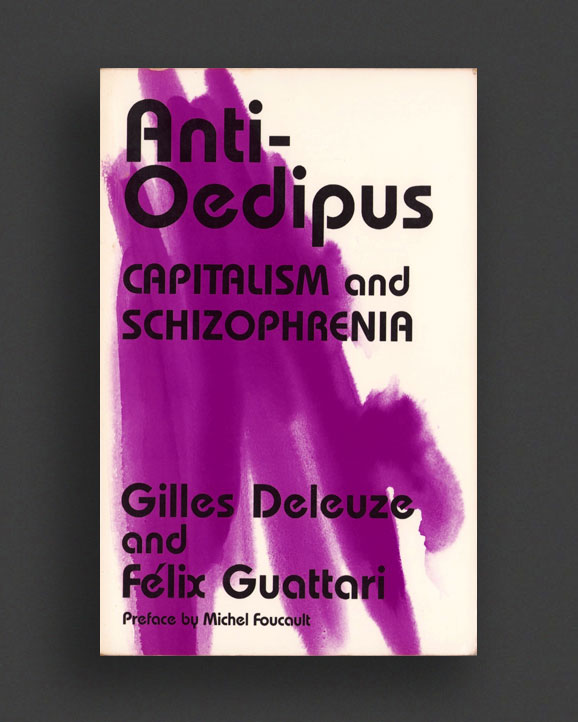
1985 English language edition of Gilles Deleuze and Félix Guattari's mighty Anti-Oedipus, published by The Athlone Press in England. With introduction by Michel Foucault.
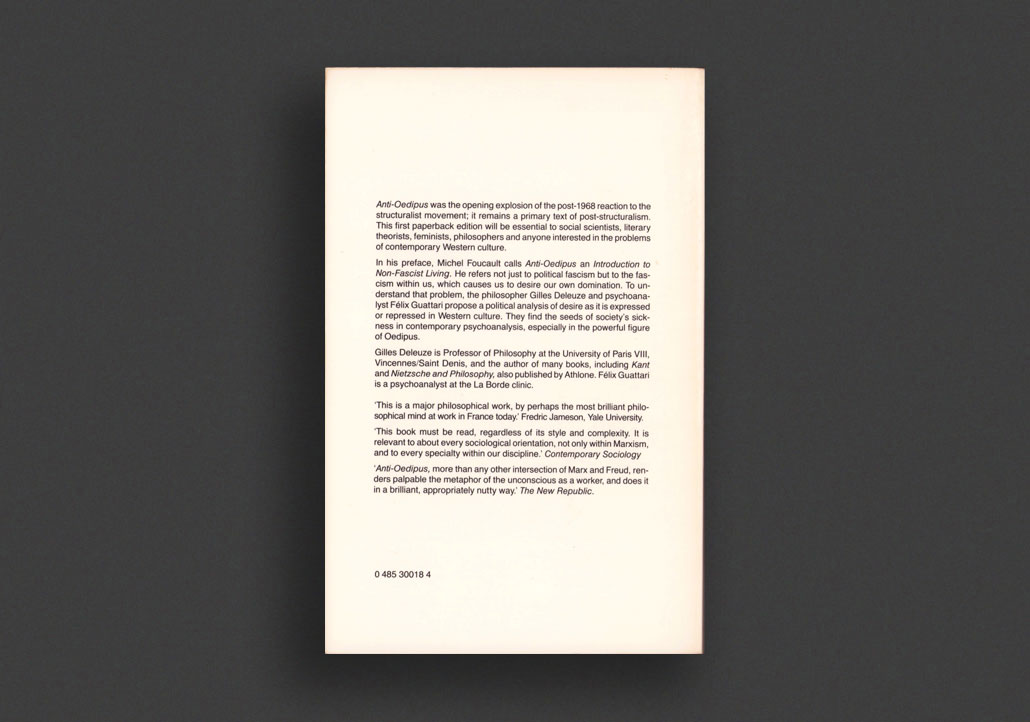
When it first appeared in France in 1972, Anti-Oedipus was hailed as a masterpiece by some and "a work of heretical madness" by others. Anti-Oedipus was the opening explosion to the post-1968 reaction to the structuralist movement; it remains a primary text of post-structuralism. In his preface, Michel Foucault calls Anti-Oedipus an Introduction to Non-Fascist Living. He refers not just to political fascism but to the fascism that is within us, that causes us to desire our own domination. In the book, philosopher Gilles Deleuze and clinical psychoanalyst Félix Guattari set forth the following theory: Western society's innate herd instinct has allowed the government, the media, and even the principles of economics to take advantage of each person's unwillingness to be cut off from the group. What's more, those who suffer from mental disorders may not be insane, but could be individuals in the purest sense, because they are by nature isolated from society. More than twenty-five years after its original publication, Anti-Oedipus still stands as a controversial contribution to a much-needed dialogue on the nature of free thinking.
Very Good copy of this scarce early English edition.
1982, English
Hardcover (w. dust jacket), 328 pages, 22.5 x 14 cm
1st UK Edition, Out of print title / used / very good
Published by
MacMillan / London
$40.00 - Out of stock
First 1982 HC edition.
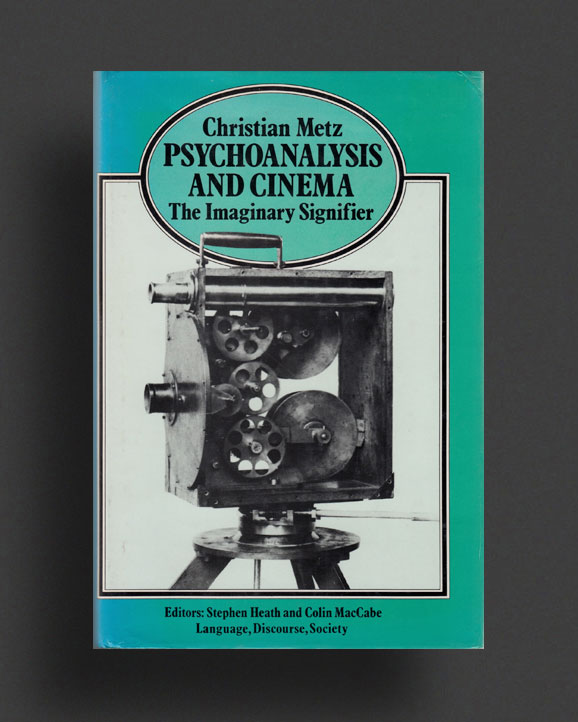
Since the publications of his first essays in the early 1960s Christian Metz has produced a body of work that has established him as the most influential contemporary theorist of cinema and as a leading contributor to the development of semiotics generally.
Psychoanalysis and Cinema: The Imaginary Signifier is in many ways a culmination of this work. In the first half of the book Metz explores a number of aspects of the psychological anchoring of cinema as a social institution, using Freudian psychoanalysis to examine the nature of cinematic spectatorship, the relations of cinema and voyeurism, fetishism and so on. In the second half, he shifts his approach a little to look at the operations of meaning in the film text, at the figures of image and sound concatenation. Thus he is led to consideration of metaphor and metonymy in film, this involving a detailed account of these two figures as they appear in psychoanalysis and linguistics - an account which brilliantly disentangles the various analogies that have been proposed between metaphor and metonymy, condensation and displacement, paradigm and syntagm, and makes an important contribution to our general understanding of these issues as well as to our particular understanding of cinema.
Throughout, the book is an argument with and recasting of initial semiotic thinking dependent on reference to fixed linguistics models; it offers something of a 'second semiotics', concerned now with the institution of modes of subjectivity, cinema as imaginary signifier, and with the movement and effects of meaning, film as text.
CHRISTIAN METZ teaches at the Ecole des Hautes Etudes en Sciences Sociales in Paris. His published works include two volumes of Essais sur la signification au cinema, Langage et cinema and Essais semiotiques. The Translators CELIA BRITTON and ANNWYL WILLIAMS are with the Department of French Studies at the University of Reading. BEN BREWSTER is at the University of Kent at Canterbury. ALFRED GUZZETTI is at the Carpenter Center for the Visual Arts at Harvard University.
G—VG copy, discolouration to dj spine edge, light age/wear.
1965, English
Softcover, 253 pages, 13.9 x 20.3 cm
Reprint,
Out of print title / used / very good
Published by
City Lights Books / San Francisco
$40.00 - Out of stock
"I am the man," wrote Artaud, "who has best charted his inmost self."
Antonin Artaud was a great poet who, like Poe, Holderlin, and Nerval, wanted to live in the infinite and asked that the human spirit burn in absolute freedom. To society, he was a madman. Artaud, however, was not insane but in luciferian pursuit of what society keeps hidden. The man who wrote "Van Gogh the Man Suicided by Society" raged against the insanity of social institutions with insight that proves more prescient with every passing year. Today, as Artaud's vatic thunder still crashes above the "larval confusion" he despised, what is most striking in his writings is an extravagant lucidity. This collection gives us quintessential Artaud on the occult, magic, the theater, mind and body, the cosmos, rebellion, and revolution in its deepest sense.
Antoine Marie Joseph Artaud, better known as Antonine Artaud, was a French dramatist, poet, essayist, actor, and theatre director, widely recognized as one of the major figures of twentieth-century theatre and the European avant-garde.
Second 1965 edition.
Jack Hirschman (1933 – 2021) was an American poet and social activist who has written more than 50 volumes of poetry. Dismissed from teaching at UCLA for anti-war activities in 1966, he moved to San Francisco in 1973, and was the city's present poet laureate. Hirschman translated nine languages and edited The Artaud Anthology.
1988, English
Hardcover (w. dust jacket), 239 pages, 21.5 x 14.8 cm
1st Edition, Out of print title / used / very good
Published by
Columbia University Press / New York
$50.00 - Out of stock
First 1988 English hardcover edition.
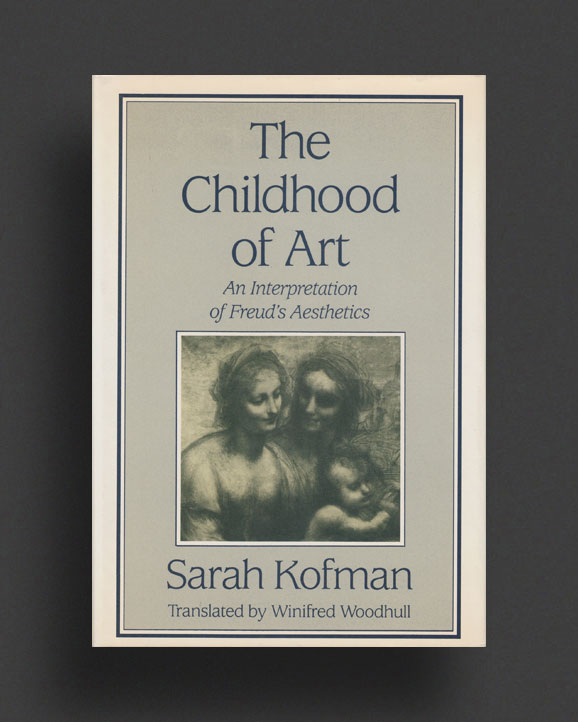
When first published in 1970, L'enfance de l'art—Sarah Kofman's first book—established her reputation overnight. More than a decade and a half later, it is still widely regarded as her most important work. This edition now makes available to an English-reading general audience Freudian analyses of art and literature that are more often alluded to than read.
Very Good copy.
1998, English
Softcover, 116 pages, 14 x 20.5 cm
1st Edition, Out of print title / used / very good
Published by
Cornell University Press / New York
$70.00 - In stock -
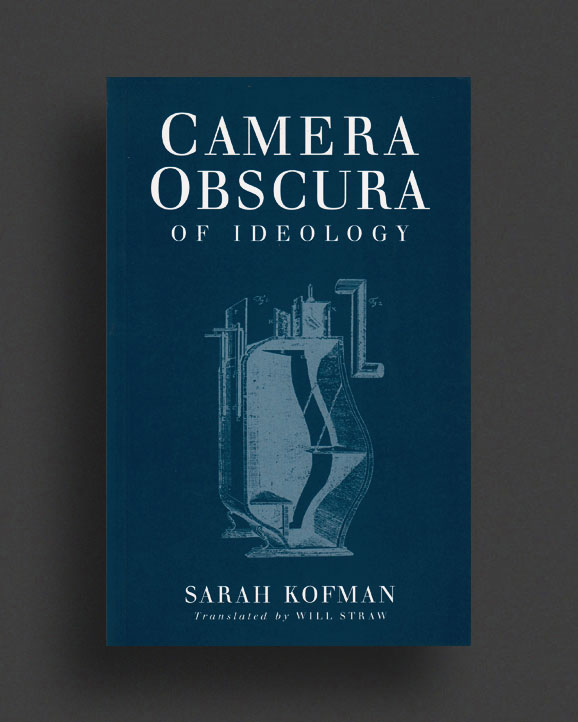
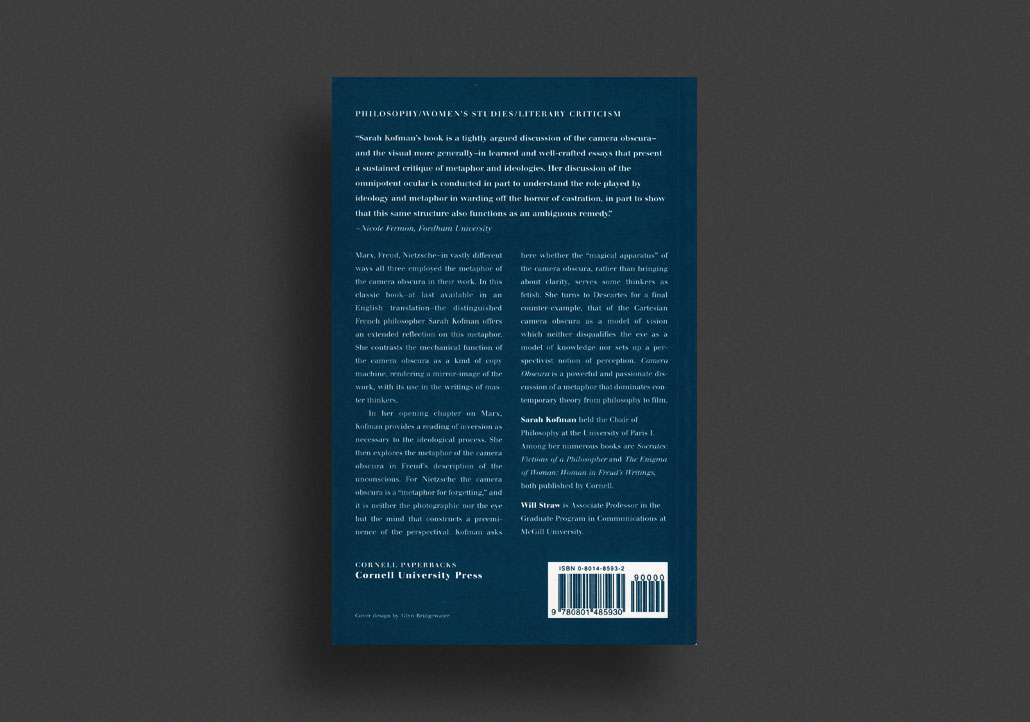
The first 1998 edition of the first English translation of Camera Obscura, de l'ideology (originally published in Paris in 1973), wherein Kofman discusses the use of the image of the camera obscura in the work of Marx, Freud, and Nietzsche.
Marx, Freud, and Nietzsche all - in vastly different ways - employed the metaphor of the camera obscura in their work. In this volume, the author offers an extended reflection on this metaphor. She contrasts the mechanical function of the camera obscura as a kind of copy machine, rendering a mirror-image of the work, with its use in the writings of master thinkers. In her opening chapter on Marx, Kofman provides a reading of inversion as necessary to the ideological process. She then explores the metaphor of the camera obscura in Freud’s description of the unconscious. For Nietzsche, the camera obscura is a metaphor for forgetting. Kofman asks here whether the magical apparatus of the camera obscura, rather than bringing about clarity, serves some thinkers as fetish.
Sarah Kofman held the Chair of Philosophy at the University of Paris I. Among her numerous books are Socrates: Fictions of a Philosopher and The Enigma of Woman: Woman in Freud's Writings, both published by Cornell.
Near Fine copy.
1999, English
Softcover, 406 pages, 21.6 x 14 cm
1st Edition, Out of print title / used / very good
Published by
Stanford University Press / Palo Alto
$25.00 - In stock -
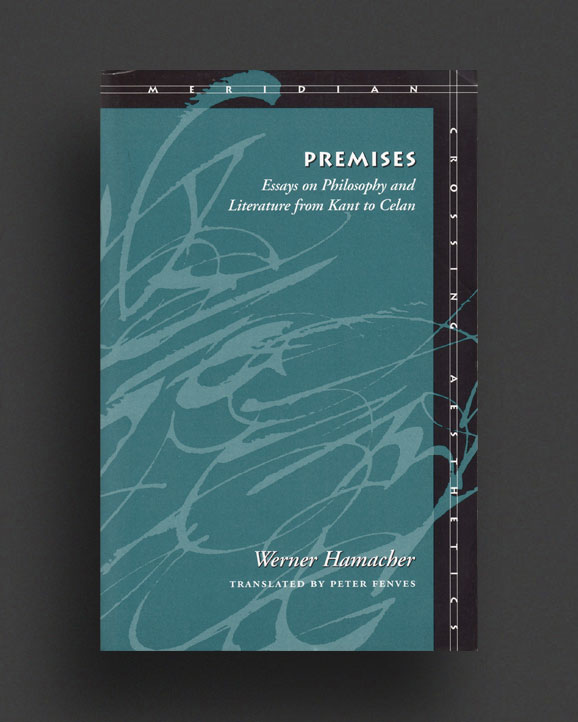
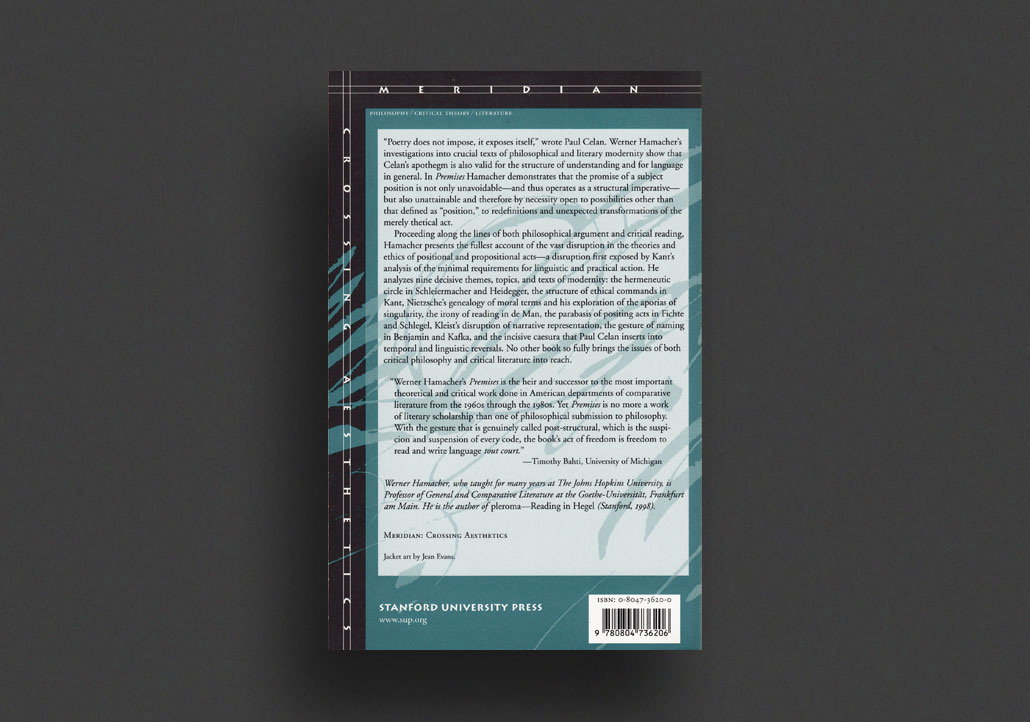
"Poetry does not impose, it exposes itself," wrote Paul Celan. Werner Hamacher's investigations into crucial texts of philosophical and literary modernity show that Celan's apothegm is also valid for the structure of understanding and for language in general. In Premises Hamacher demonstrates that the promise of a subject position is not only unavoidable—and thus operates as a structural imperative—but is also unattainable and therefore by necessity open to possibilities other than that defined as "position," to redefinitions and unexpected transformations of the merely theoretical act.
Proceeding along the lines of both philosophical argument and critical reading, Hamacher presents the fullest account of the vast disruption in the theories and ethics of positional and propositional acts—a disruption first exposed by Kant's analysis of the minimal requirements for linguistic and practical action. Focusing on the double trait of every premise—that it is promised but never attained—Hamacher analyzes nine decisive themes, topics, and texts of modernity: the hermeneutic circle in Schleiermacher and Heidegger, the structure of ethical commands in Kant, Nietzsche's genealogy of moral terms and his exploration of the aporias of singularity, the irony of reading in de Man, the parabasis of positing acts in Fichte and Schlegel, Kleist's disruption of narrative representation, the gesture of naming in Benjamin and Kafka, and the incisive caesura that Paul Celan inserts into temporal and linguistic reversals. There is no book that so fully brings the issues of both critical philosophy and critical literature into reach.
"Werner Hamacher's Premises is the heir and successor to the most important theoretical and critical work done in American departments of comparative literature from the 1960s through the 1980s. Yet, Premises is no more a work of literary scholarship than one of philosophical submission to philosophy. With the gesture that is genuinely called post-structural, which is the suspicion and suspension of every code, the book's act of freedom is freedom to read and write language tout court."—Timothy Bahti, University of Michigan
"Hamacher's project can be described as the retracing of the epistemological ground upon which the modern conception of the literary was erected. It is quite clear to me that there is nothing presently available to rival this book."—Wlad Godzich, University of Geneva
Werner Hamacher, who taught for many years at the Johns Hopkins University, is Professor of General and Comparative Literature at the Goethe-Universität, Frankfurt am Main. He is the author of pleroma—Reading in Hegel (Stanford, 1998).
2002, English
Softcover, 464 pages, 23 x 15 cm
1st Edition, Out of print title / used / very good
Published by
Stanford University Press / Palo Alto
$35.00 - Out of stock
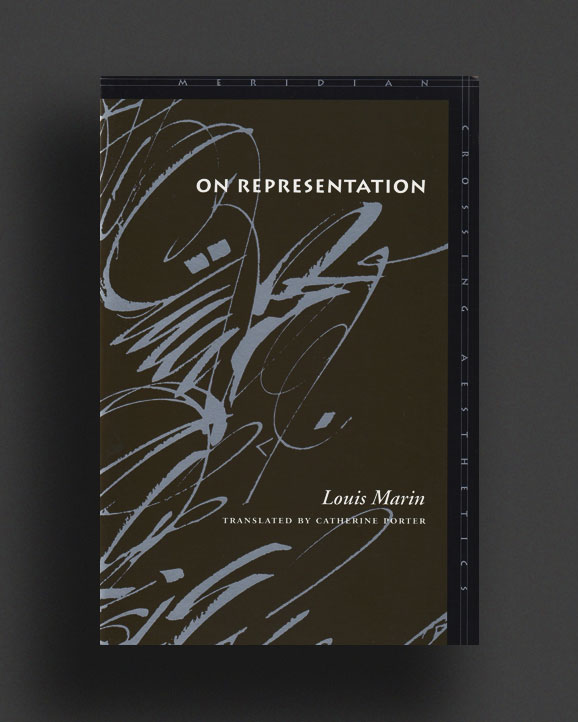
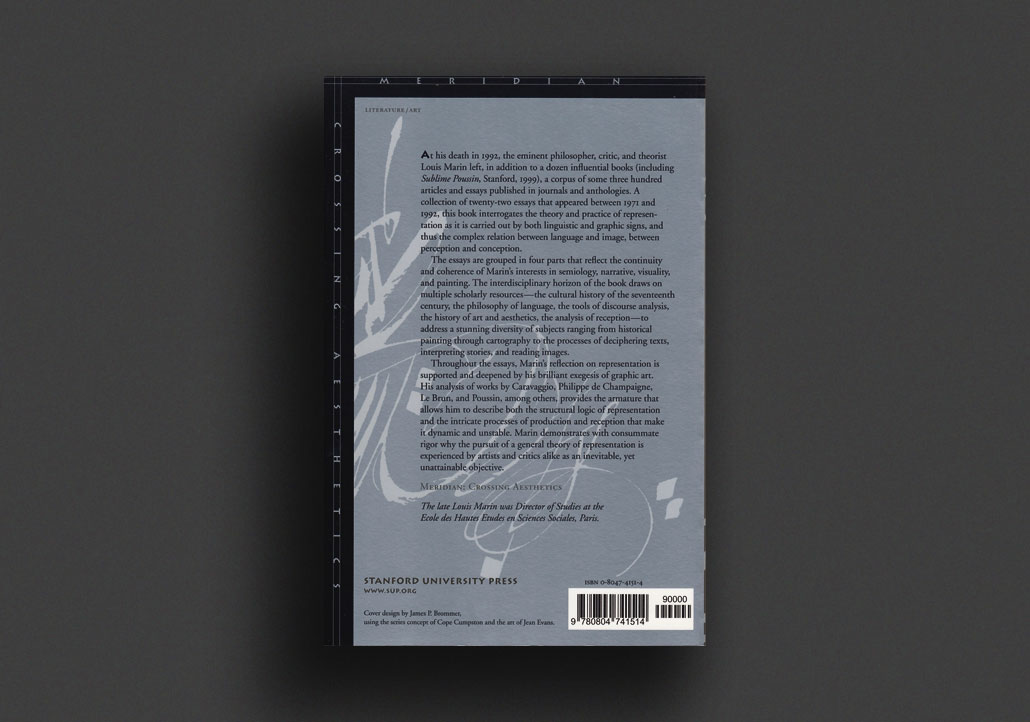
At his death in 1992, the eminent philosopher, critic, and theorist Louis Marin left, in addition to a dozen influential books (including Sublime Poussin, Stanford, 1999), a corpus of some three hundred articles and essays published in journals and anthologies. A collection of twenty-two essays that appeared between 1971 and 1992, this book interrogates the theory and practice of representation as it is carried out by both linguistic and graphic signs, and thus the complex relation between language and image, between perception and conception.
The essays are grouped in four parts that reflect the continuity and coherence of Marin's interests in semiology, narrative, visuality, and painting. The interdisciplinary horizon of the book draws on multiple scholarly resources—the cultural history of the seventeenth century, the philosophy of language, the tools of discourse analysis, the history of art and aesthetics, the analysis of reception—to address a stunning diversity of subjects ranging from historical painting through cartography to the processes of deciphering texts, interpreting stories, and reading images.
Throughout the essays, Marin's reflection on representation is supported and deepened by his brilliant exegesis of graphic art. His analysis of works by Caravaggio, Philippe de Champaigne, Le Brun, and Poussin, among others, provides the armature that allows him to describe both the structural logic of representation and the intricate processes of production and reception that make it dynamic and unstable. Marin demonstrates with consummate rigor why the pursuit of a general theory of representation is experienced by artists and critics alike as an inevitable, yet unattainable objective.
Very Good copy, light wear.
1977, English
Softcover, 20.5 x 13.5 cm
1st Edition, Out of print title / used / very good
Published by
Harper and Row / New York
Harper Torchbooks / USA
$20.00 - Out of stock
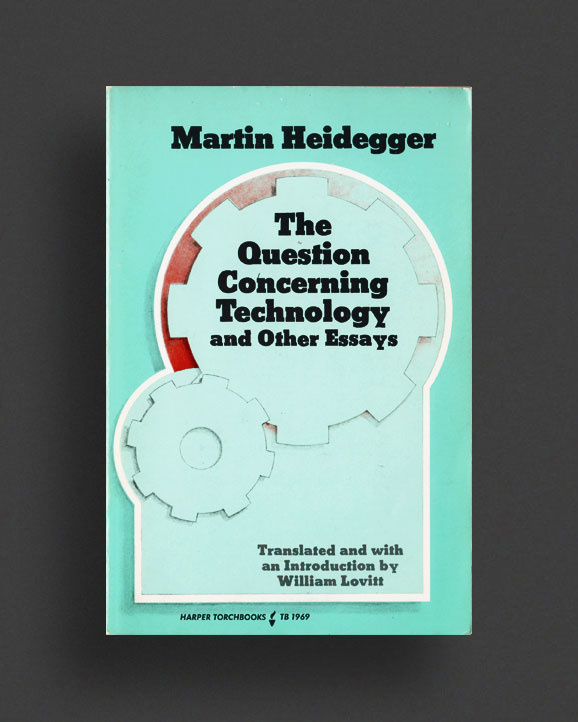
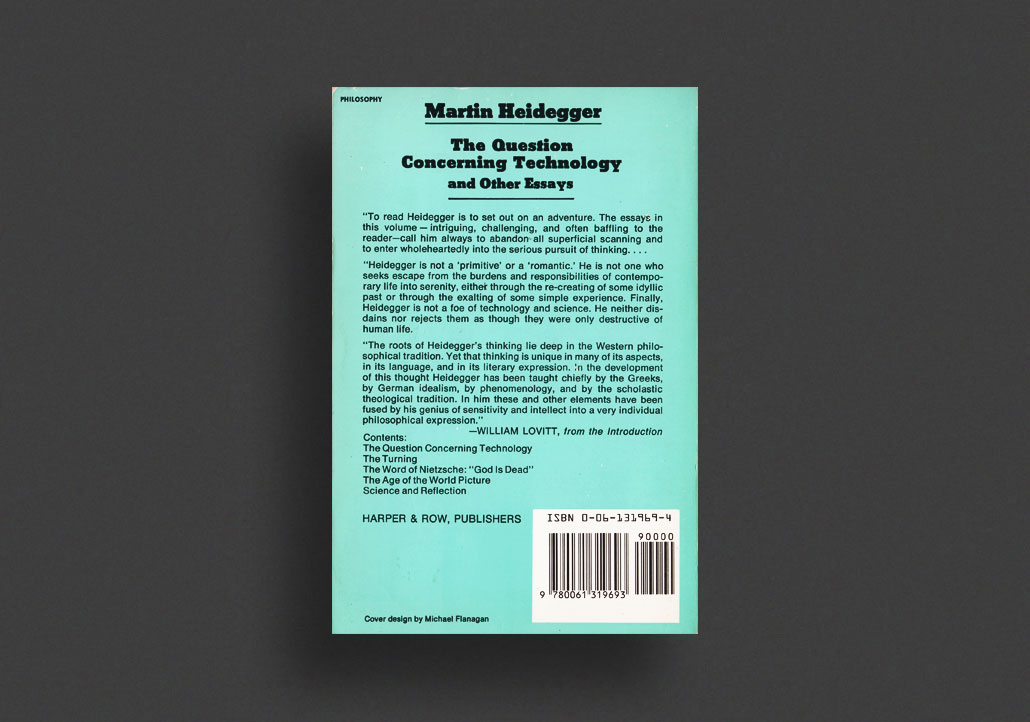
An essential landmark in the philosophy of science from "one of the most profound thinkers of the twentieth century" (New York Times).
"To read Heidegger is to set out on an adventure. The essays in this volume—intriguing, challenging, and often baffling to the reader—call him always to abandon all superficial scanning and to enter wholeheartedly into the serious pursuit of thinking...."
The advent of machine technology has given rise to some of the deepest problems of modern thought. Featuring the celebrated essay "The Question Concerning Technology," this prescient volume contains Martin Heidegger's groundbreaking investigation into the pervasive "enframing" character of our understanding of ourselves and the world.
VG copy.
1995, English
Softcover, 370 pages, 15.6 x 22.5 cm
1st Edition, Out of print title / used / very good
Published by
Stanford University Press / Palo Alto
$65.00 - In stock -
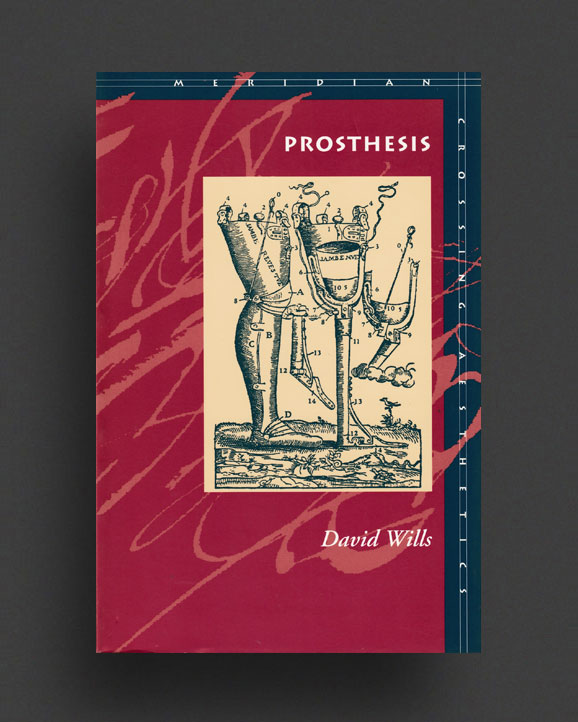
An examination of the presumed opposition between the natural human body and artificial inanimate objects.
"Many of you, many of us know [David Wills's] work and, like me, have admired it for a long time. It is work that I not only admire, but to which I owe a great deal. . . . [Prosthesis] is in my estimation a great book, a magnificent book."—Jacques Derrida
Prosthesis is a landmark work in posthuman thought that analyzes and explores the human body as a technology, seamlessly integrated (both physically and psychologically) with prosthetics. Here David Wills lays the groundwork for ideas he develops in two of his other books, Dorsality, exploring how technology functions behind or before the human, and Inanimation, giving perspective on what it means to be “alive.”
In Prosthesis, Wills promotes the idea that the human body is open to supplementation by artificial addenda that operate both internally or externally and engage it in an unceasing arbitration with the environment. Questioning the opposition between animate and inanimate along with the logic of the automatic prioritization of living flesh, Prosthesis undertakes these assumptions by studying thematics of artificiality through the writings of Freud, Derrida, William Gibson, Peter Greenaway, and others. In the twenty-five years since its first publication, Prosthesis has been a point of reference in the field of disability studies. It has also been recognized for its “prosthetic” writing, consisting of academic and autobiographical voices and styles that are artificially attached to one another.
Very Good—Near Fine copy.
1994, English
Softcover, 246 pages, 21.5 x 14 cm
1st Edition, Out of print title / used / very good
Published by
Stanford University Press / Palo Alto
$20.00 - In stock -
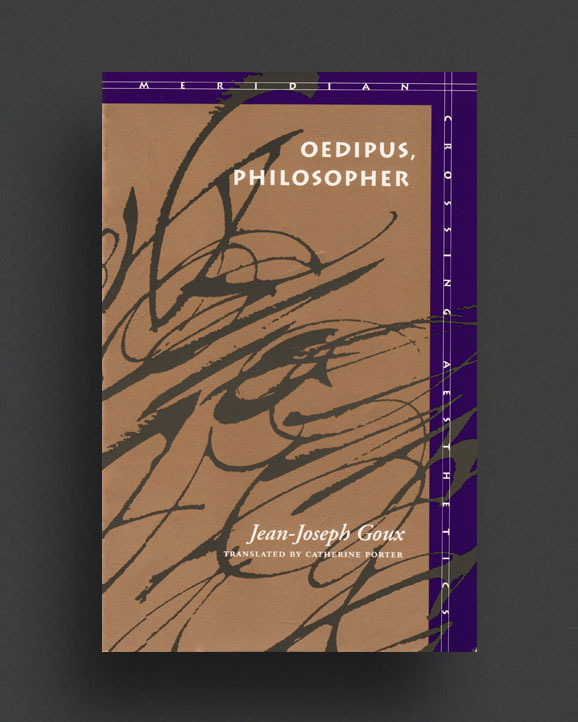
If the logic of the Oedipus myth were subjected to rigorous and thoroughgoing analysis with the tools of anthropology, comparative mythology, and narratology, might it invalidate the approach to the 'Oedipus complex' that Freud derived from his psychoanalytic experience? This book answers 'yes', arguing that instead of the Oedipus complex explaining the myth, the Oedipus myth explains the complex. The author argues that the Oedipus myth is an historical anomaly, a myth of failed royal investiture or of avoided masculine initiation. Does this mean that we must return to the wisdom of tradition and strike out twenty-five centuries of Oedipal history? The author knows very well that such a solution would be fantasy, and he concludes by speculating on how his analysis might contribute to a vision that has eluded Freudian psychoanalysis: how to surpass the Oedipus complex, with all the ethical consequences this would entail.
Near Fine, light wear.
1998, English
Softcover, 132 pages, 22 x 14 cm
1st Edition, Out of print title / used / fine
Published by
Stanford University Press / Palo Alto
$35.00 - In stock -
First 1998 edition.
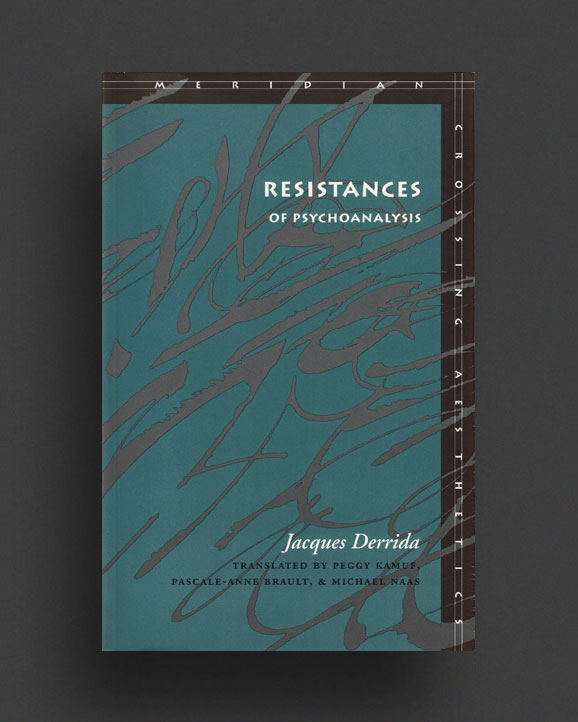
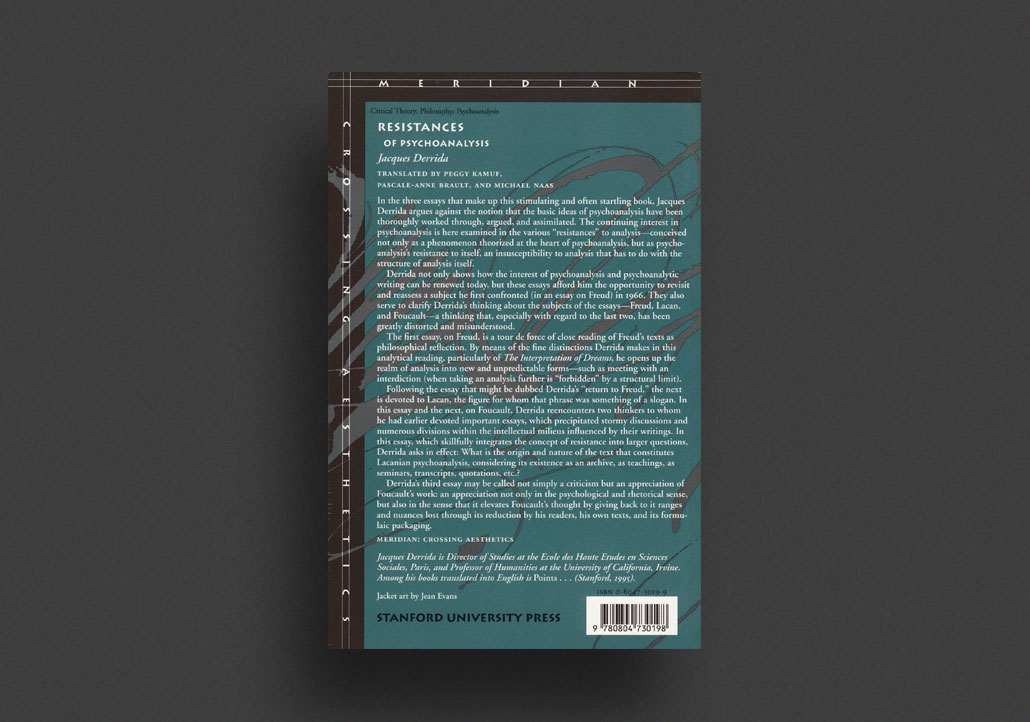
In the three essays that make up this stimulating and often startling book, Jacques Derrida argues against the notion that the basic ideas of psychoanalysis have been thoroughly worked through, argued, and assimilated. The continuing interest in psychoanalysis is here examined in the various "resistances" to analysis—conceived not only as a phenomenon theorized at the heart of psychoanalysis, but as psychoanalysis's resistance to itself, an insusceptibility to analysis that has to do with the structure of analysis itself.
Derrida not only shows how the interest of psychoanalysis and psychoanalytic writing can be renewed today, but these essays afford him the opportunity to revisit and reassess a subject he first confronted (in an essay on Freud) in 1966. They also serve to clarify Derrida's thinking about the subjects of the essays—Freud, Lacan, and Foucault—a thinking that, especially with regard to the last two, has been greatly distorted and misunderstood.
The first essay, on Freud, is a tour de force of close reading of Freud's texts as philosophical reflection. By means of the fine distinctions Derrida makes in this analytical reading, particularly of The Interpretation of Dreams, he opens up the realm of analysis into new and unpredictable forms—such as meeting with an interdiction (when taking an analysis further is "forbidden" by a structural limit).
Following the essay that might be dubbed Derrida's "return to Freud," the next is devoted to Lacan, the figure for whom that phrase was something of a slogan. In this essay and the next, on Foucault, Derrida reencounters two thinkers to whom he had earlier devoted important essays, which precipitated stormy discussions and numerous divisions within the intellectual milieus influenced by their writings. In this essay, which skillfully integrates the concept of resistance into larger questions, Derrida asks in effect: What is the origin and nature of the text that constitutes Lacanian psychoanalysis, considering its existence as an archive, as teachings, as seminars, transcripts, quotations, etc.?
Derrida's third essay may be called not simply a criticism but an appreciation of Foucault's work: an appreciation not only in the psychological and rhetorical sense, but also in the sense that it elevates Foucault's thought by giving back to it ranges and nuances lost through its reduction by his readers, his own texts, and its formulaic packaging.
Near Fine w. light lead pencil notation (erasable)
1978, English / French
Softcover, 166 pages, 23 x 12 cm
1st Edition, Out of print title / used / very good
Published by
University of Chicago Press / Chicago
$35.00 - Out of stock
First 1978 bi-lingual English-French edition.
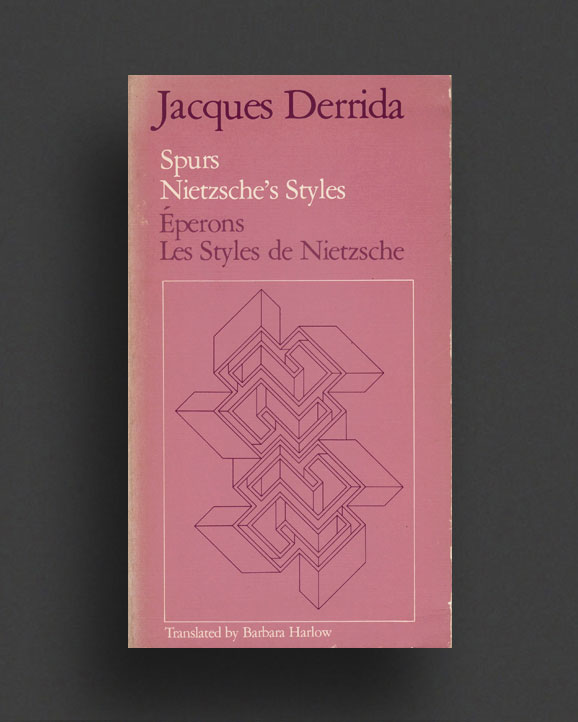
Translated by Barbara Harlow.
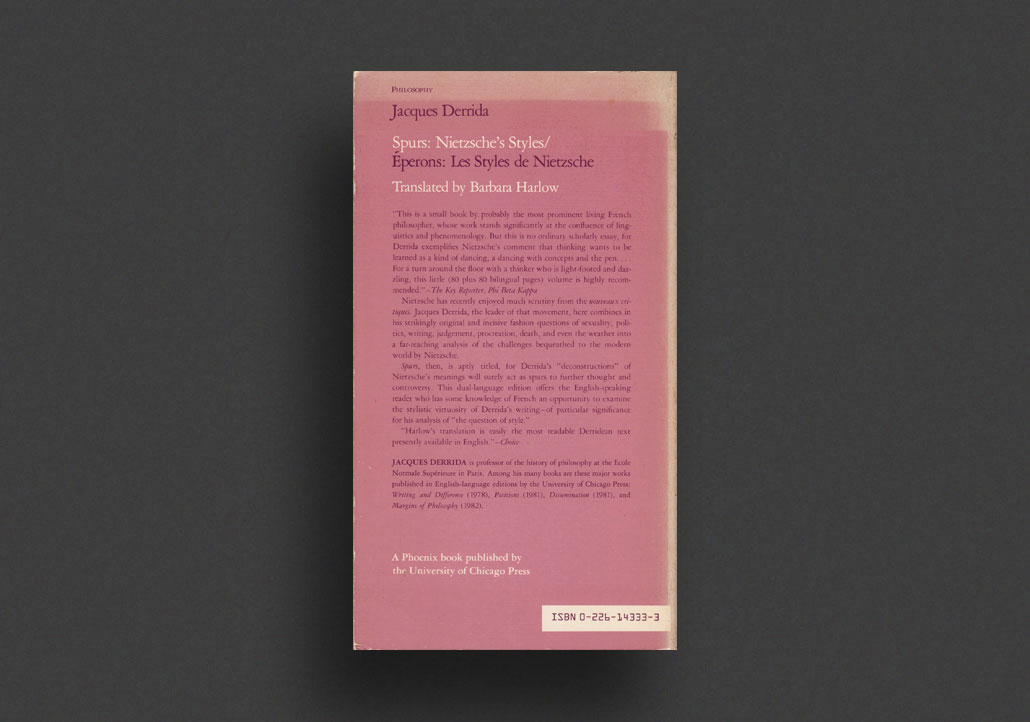
Nietzsche has recently enjoyed much scrutiny from the nouveaux critiques. Jacques Derrida, the leader of that movement, here combines in his strikingly original and incisive fashion questions of sexuality, politics, writing, judgment, procreation, death, and even the weather into a far-reaching analysis of the challenges bequeathed to the modern world by Nietzsche.
Spurs, then, is aptly titled, for Derrida’s “deconstructions” of Nietzsche’s meanings will surely act as spurs to further thought and controversy. This dual-language edition offers the English-speaking reader who has some knowledge of French an opportunity to examine the stylistic virtuosity of Derrida’s writing—of particular significance for his analysis of “the question of style.”
Very Good copy w. sunning to spine and back cover (milder in real life than depicted)
1999, English
Softcover, 204 pages, 24.5 x 17 cm
1st Edition, Out of print title / used / good
Published by
Creation Books / London
$45.00 - Out of stock
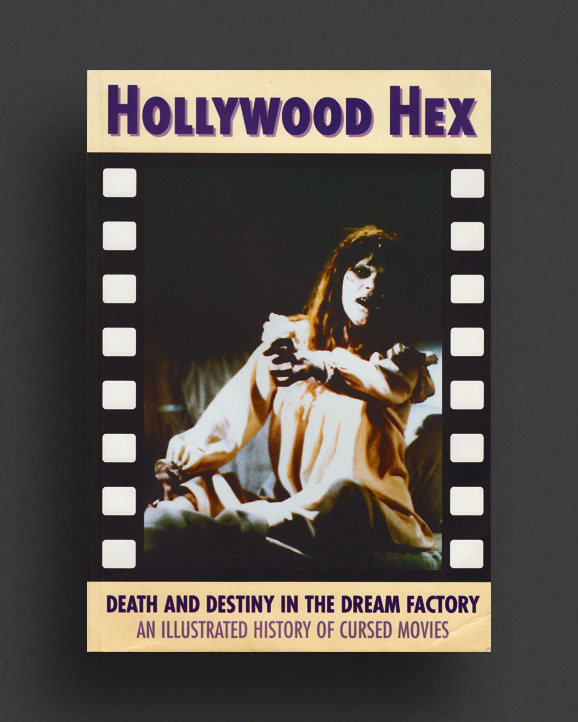
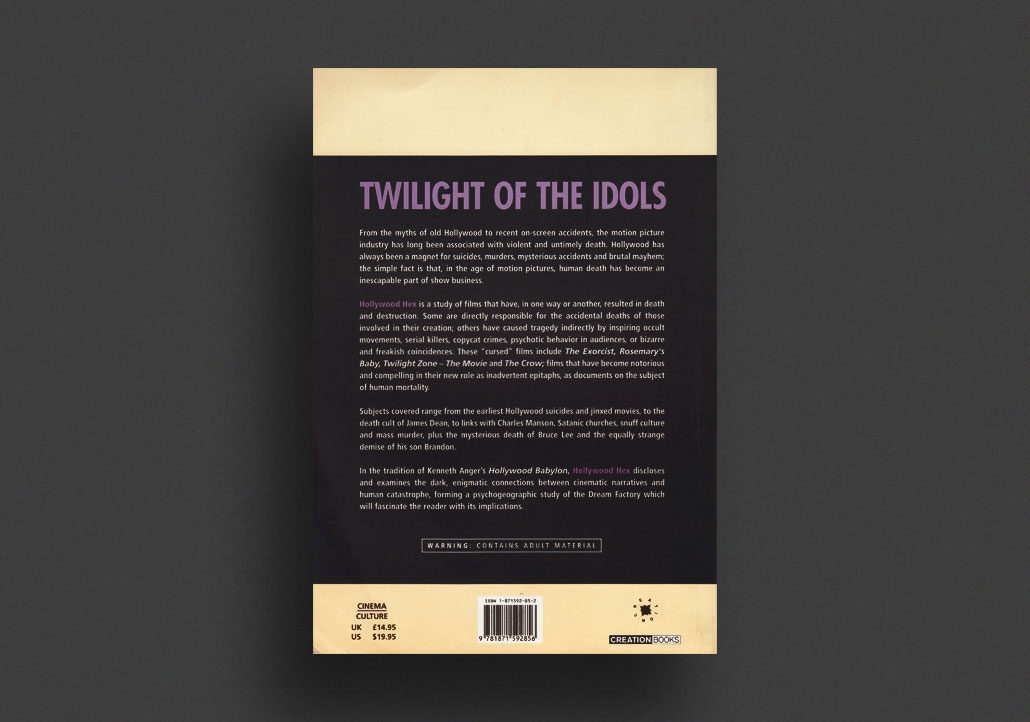
From the myths of old Hollywood to recent on-screen accidents, the motion picture industry has long been associated with violent and untimely death. Hollywood has always been a magnet for suicides, murders, mysterious accidents and brutal mayhem; the simple fact is that, in the age of motion pictures, human death has become an inescapable part of show business.
Hollywood Hex is a study of films that have, in one way or another, resulted in death and destruction. Some are directly responsible for the accidental deaths of those involved in their creation; others have caused tragedy indirectly by inspiring occult movements, serial killers, copycat crimes, psychotic behavior in audiences, or bizarre and freakish coincidences. These "cursed" films include The Exorcist, Rosemary's Baby, Twilight Zone — The Movie and The Crow; films that have become notorious and compelling in their new role as inadvertent epitaphs, as documents on the subject of human mortality.
Subjects covered range from the earliest Hollywood suicides and jinxed movies, to the death cult of James Dean, to links with Charles Manson, Satanic churches, snuff culture and mass murder, plus the mysterious death of Bruce Lee and the equally strange demise of his son Brandon.
In the tradition of Kenneth Anger's Hollywood Babylon, ,Hollywood Hex discloses and examines the dark, enigmatic connections between cinematic narratives and human catastrophe, forming a psychogeographic study of the Dream Factory which will fascinate the reader with its implications.
Good—VG copy with some light buckling wear/age.
2024, English
Softcover, 194 pages, 21 x 14.8 cm
Published by
Infinity Land Press / London
$55.00 - Out of stock
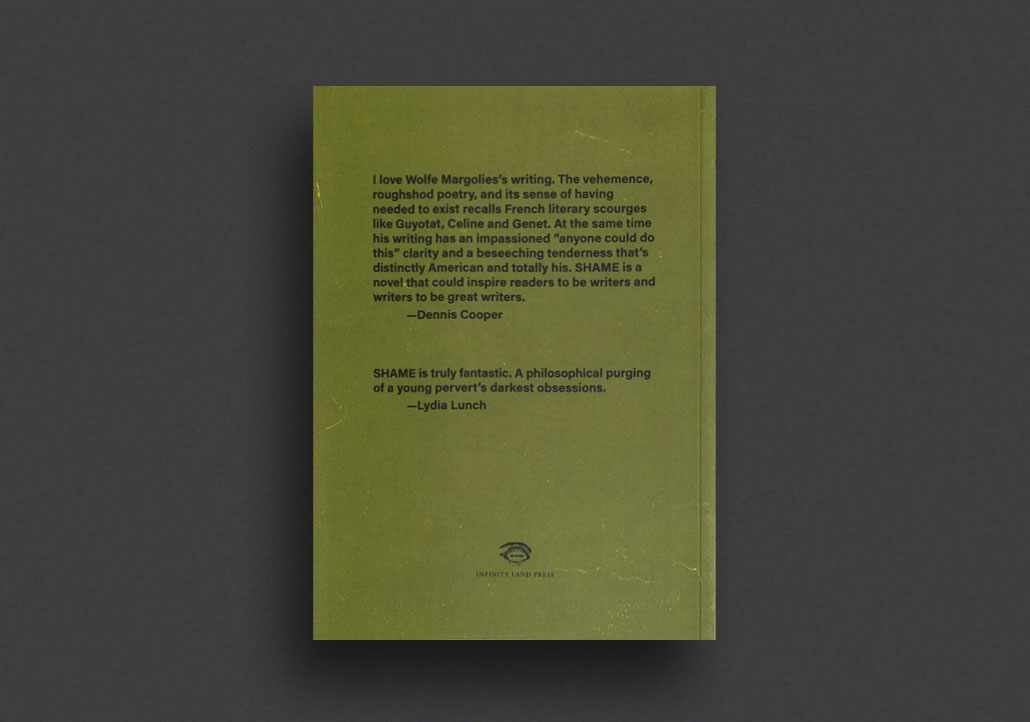
"I love Wolfe Margolies’s writing. The vehemence, roughshod poetry, and its sense of having needed to exist recalls French literary scourges like Guyotat, Celine and Genet. At the same time his writing has an impassioned “anyone could do this” clarity and a beseeching tenderness that’s distinctly American and totally his. SHAME is a novel that could inspire readers to be writers and writers to be great writers."—Dennis Cooper
"SHAME is truly fantastic. A philosophical purging of a young pervert’s darkest obsessions."—Lydia Lunch
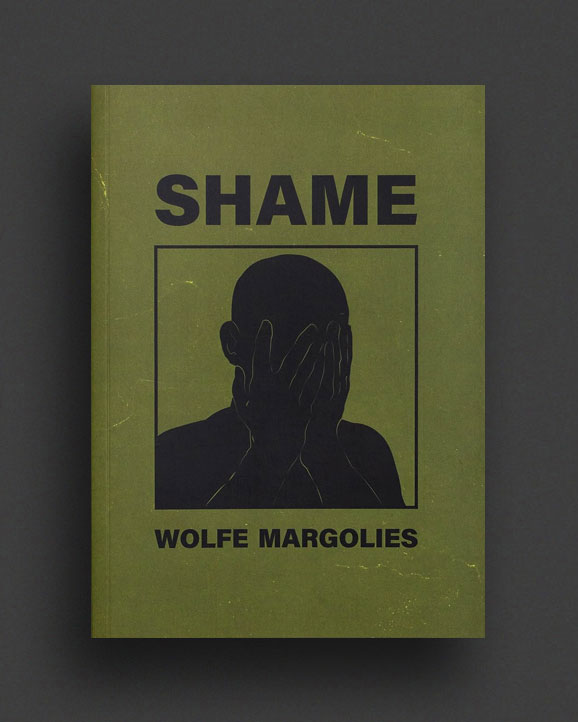
SHAME is not your enemy. SHAME aids survival, incentivizing you to blend in, thereby concealing yourself from predators and avoiding conflict with peers, while pride aids reproduction, motivating you to stand out, thereby attracting mates. Evolution did not design you to be happy, only to behave in ways which benefit your genes, in this case by disguising socially undesirable traits. SHAME is like a mother who restricts her child’s freedom in order to keep him safe. Ideally, her admonitions foster social integration, but sometimes they backfire. Sometimes her children rebel.
SHAME prevents social injury. Socialized people suppress their impermissible desires and cover the occasional aberration with hypocrisy and self-deception. The characters in this book, however, try to eradicate SHAME, by finding masochistic enjoyment in it or by transgressing so often, or getting so high, that they become numb to it. When SHAME no longer serves as a deterrent, when man seeks harmony with himself by battling his group, he trades his sense of belonging, with its accompanying inhibitions, for freedom with accompanying alienation. He makes himself an outcast, a criminal, a kamikaze for inner peace.
Following in the tradition of prison writers like Jean Genet, Jack Henry Abbott and de Sade, Wolfe Margolies’s SHAME is one of the decade's most urgent and disturbing debut novels.
Foreword by Lydia Lunch
Illustrated by Karolina Urbaniak & Wolfe Margolies
With an interview conducted by Martin Bladh
2024, English
Hardcover, 248 pages, 23.5 x 16.5 cm
Published by
Distanz / Berlin
$79.00 - Out of stock
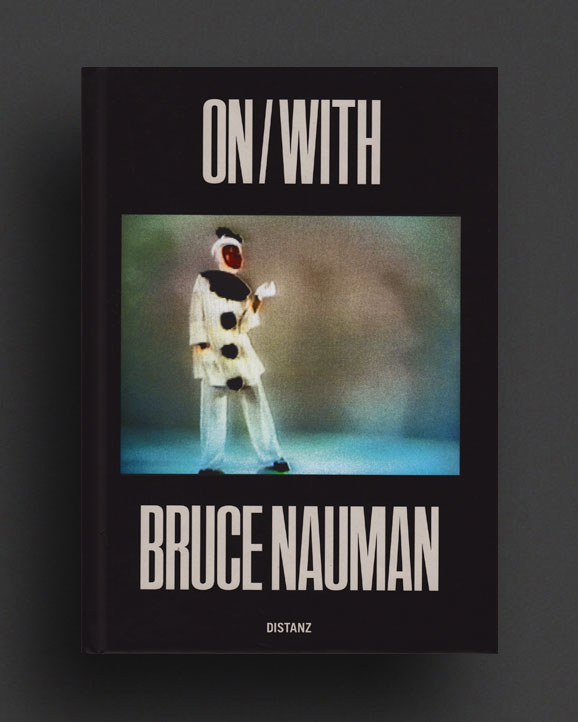
The American Bruce Nauman (b. Fort Wayne, US, 1941; lives and works in New Mexico, US) ranks among the preeminent visual artists of our time. For six decades, he has worked in an extraordinarily broad range of media, shattering the bounds of established genres and spearheading new ones along the way. His expanded conception of art encompasses wax casts, neon signs, physical contortions, word play, immersive audio and video environments, and the studio as a site of exploration. Nauman, who came of age amid the political and social upheavals of the 1960s, never abided by any rigid distinctions in art; instead remaining to this day, as he puts it, open to “the possibilities of what art can be.” Above all, Nauman’s work seduces and thrills viewers through a process-based approach which melds bodily experience with a wide variety of art forms.
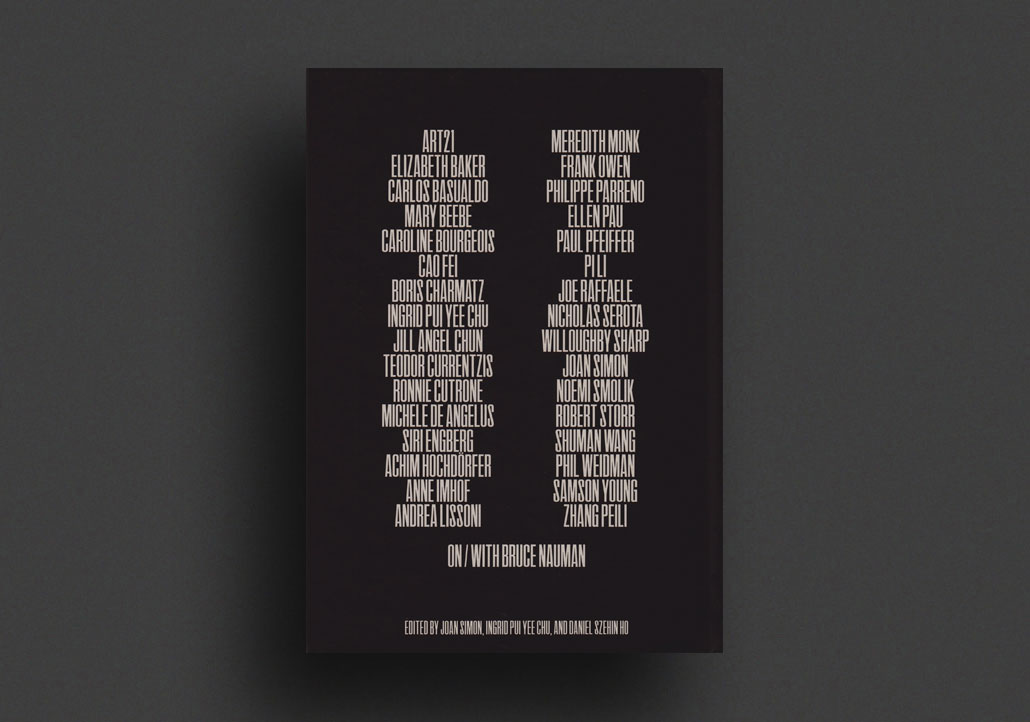
The publication enhances the pioneering artist’s largest survey exhibition in Asia to date, at Tai Kwun Contemporary in Hong Kong, with its multifaceted selection by the editors who have compiled interviews on and with the artist and his colleagues Cao Fei, Anne Imhof, Andrea Lissoni and Nicholas Serota, Meredith Monk, Philippe Parreno, Paul Pfeiffer, Robert Storr, Willoughby Sharp, Zhang Peili, and Samson Young among other key contributors are drawing historical connections and opening up fresh perspectives on Nauman’s oeuvre. Texts by the exhibition co-curators Carlos Basualdo, Caroline Bourgeois, Pi Li, and the Tai Kwun Contemporary team, are complemented by introductions to historic interviews by Joan Simon, as well as an array of supporting documentation and images offering new insight into Nauman’s enduring relevance amidst a changing media landscape.
1971, Japanese
Softcover (staple-bound), 160 pages, 21.5 x 15 cm
1st Edition, Out of print title / used / good
Published by
Lemon Inc. / Tokyo
$90.00 - Out of stock
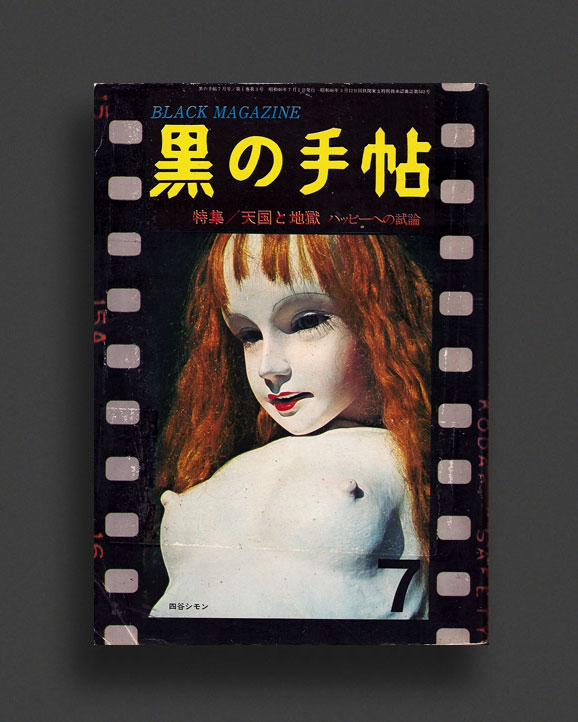
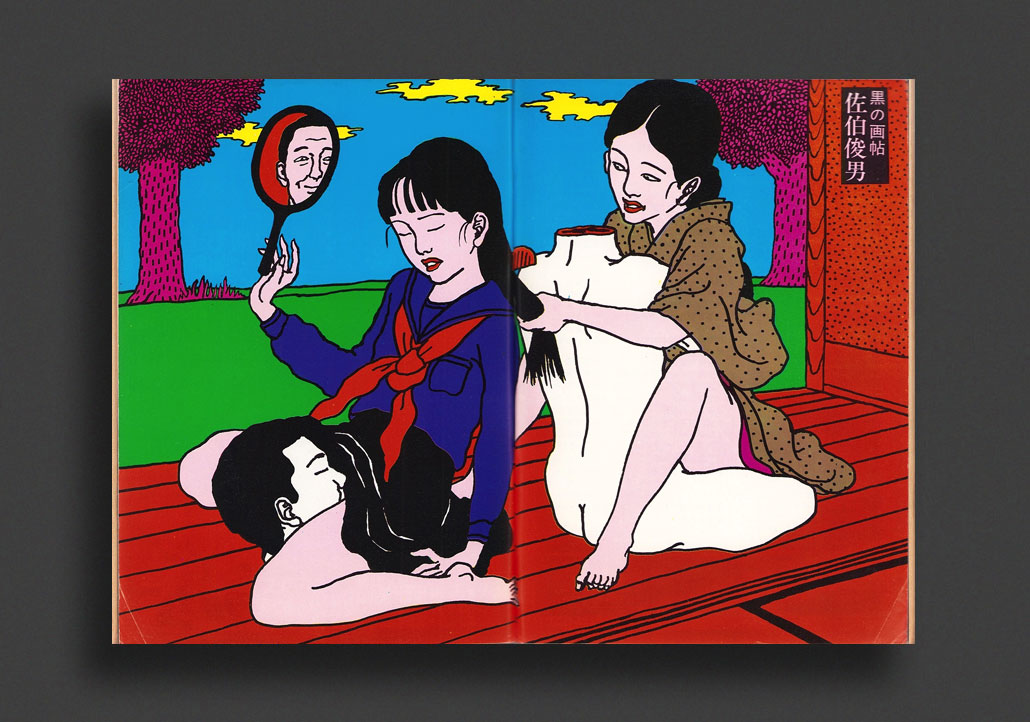
July 1971 (w. Simon Yotsuya cover) issue of legendary Japanese underground arts periodical, Black Magazine (or Black Notebook), a taboo-shattering vehicle of the 1970s subculture in Tokyo. A magazine like no-other, each issue, "a paradise of 1970's heretical culture", was a who's who of non-conformity, introducing a new wave of illustrators, painters, doll-makers and photographers, "taboo" sexuality and fetish culture, avant-garde comics, sadistic literature, radical criticism, queer poetry, activism, black humour, underground film and theatre, and all manner of transgressive, esoteric and erotic material, new and historical. Black Magazine featured the work of Yukio Mishima, Toshio Saeki, Izumi Suzuki, Simon Yotsuya, Shūji Terayama, Ken Katayama, Nobuyoshi Araki, Genpei Akasegawa, Keiichi Tanaami, Kikuji Yamashita, Aoi Fujimoto, Tadanori Yokoo, Hiroshi Nakamura, and so many others. It was also where Japanese photographer Satomi Nihongi's Tokyo Transgender photographs were first printed. Black Magazine was heavy with queer and trans content, and Nihongi's "The Most Beautifuls" was a regular photo-feature in its pages. A lot of great things started in the pages of this unique magazine. A highly recommended publication!
This third issue, themed "Heaven and Hell", features incredible cover by renowned Japanese doll artist (and female doll actor) Simon Yotsuya, and contributions by ero guro master Toshio Saeki, artist Genpei Akasegawa, art critic Junzo Ishiko, "Funeral Parade of Roses" director Toshio Matsumoto, Butoh dancer Natsu Nakajima, poet and critic Akiko Baba, photographer Masatoshi Naitō, manga artist Ryuzan Aki, literary critic Katsutarō Isogai, illustrator Akechi Goro, writer Masaki Umehara, author Utagawa Taiga, literary critic Nobuo Kasahara, essayist Shinichi Kusamori, critic Hidetomo Kanaoka, illustrator (Flower Travellin' Band) Shinobu Ishimaru, manga artist Shigeru Sugiura, scholar Aoi Suenaga, artist Takahashi Shōtei, illustrator Yosuke Inoue, and many more. A lot of great things started in the pages of this unique magazine. A highly recommended publication!
2020, English / Italian
Softcover (w. booklet), 300 pages, 24 x 17 cm
Published by
Danilo Montanari Editore / Ravenna
$80.00 $40.00 - Out of stock
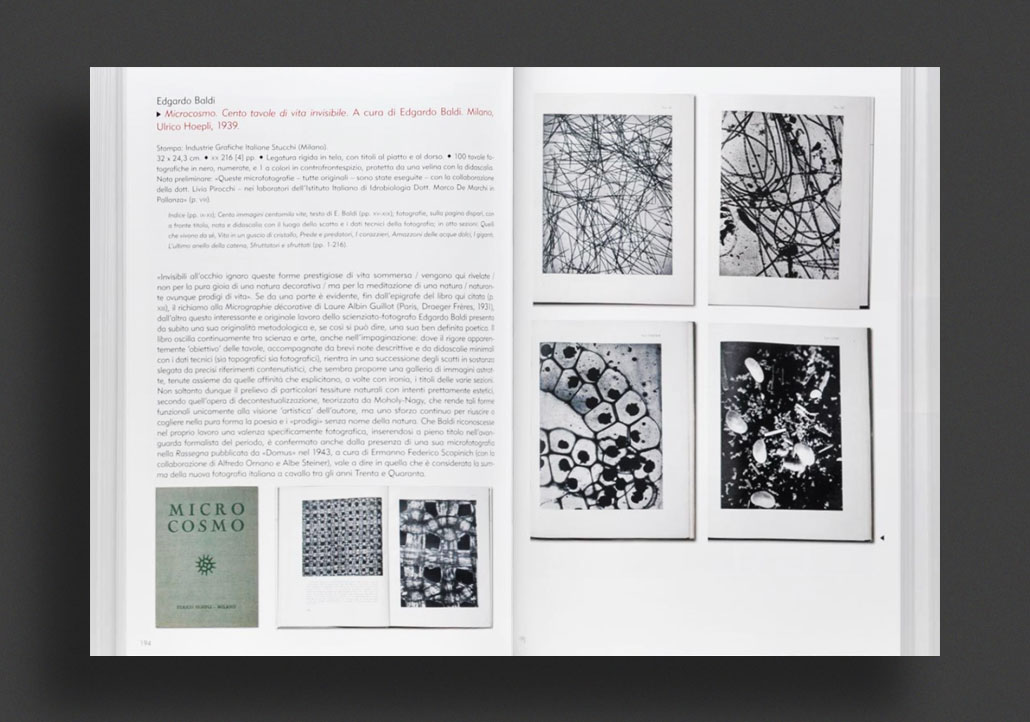
The volume examines the most interesting and innovative photographic books that appeared in Italy in the decade in which "modern" photography developed in our country. A boundary publishing industry, which oscillates between autonomous visual research (starting from the rediscovered experimentalism in the futurist field) and a 'functional' use of photographic illustration, in the two parallel and often crossed fields of advertising and propaganda.
The large Italian companies (Olivetti, Fiat, Snia Viscosa, Montecatini, etc.) recognized in those years the importance of linking their image to innovative graphic projects, in which photography plays a much more effective role than drawing; at the same time the fascist regime, having concluded its first phase of expansion and consolidation, discovers the power of photography and avant-garde techniques, especially photomontage, in the context of those promotional and self-celebrating practices which it increasingly needs to drive and maintain consent.
The book collects and illustrates about one hundred works, which emerge from an almost forgotten (if not removed), but conspicuous and often high-level editorial production, many of which due to the work of leading artists of the period, including Antonio Boggeri, Erberto Carboni, Franco Grignani, Bruno Munari, Giuseppe Pagano, Luigi Veronesi: tracing, we can say, the brief and intense history of graphic and photographic modernism in Italy.
Giorgio Grillo lives and works in Florence. He has dealt with Italian literature of the twentieth century, including the critical edition of Dino Campana's Canti Orfici. For some time he has been collecting photographs and photographic books, with particular attention to the photography of the origins and the historical avant-gardes of the last century.
2024, English
Softcover, 336 pages, 21.5 x 14.5 cm
Published by
The New York Review of Books / New York
$38.00 - Out of stock
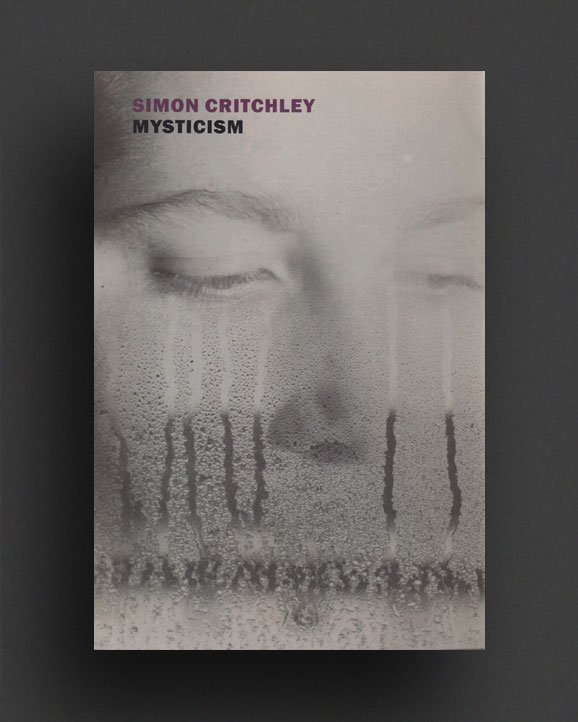
A probing, inspiring exploration of mysticism not as religious practice but as a mode of experience and way of life by one of the most provocative philosophical thinkers of our time.
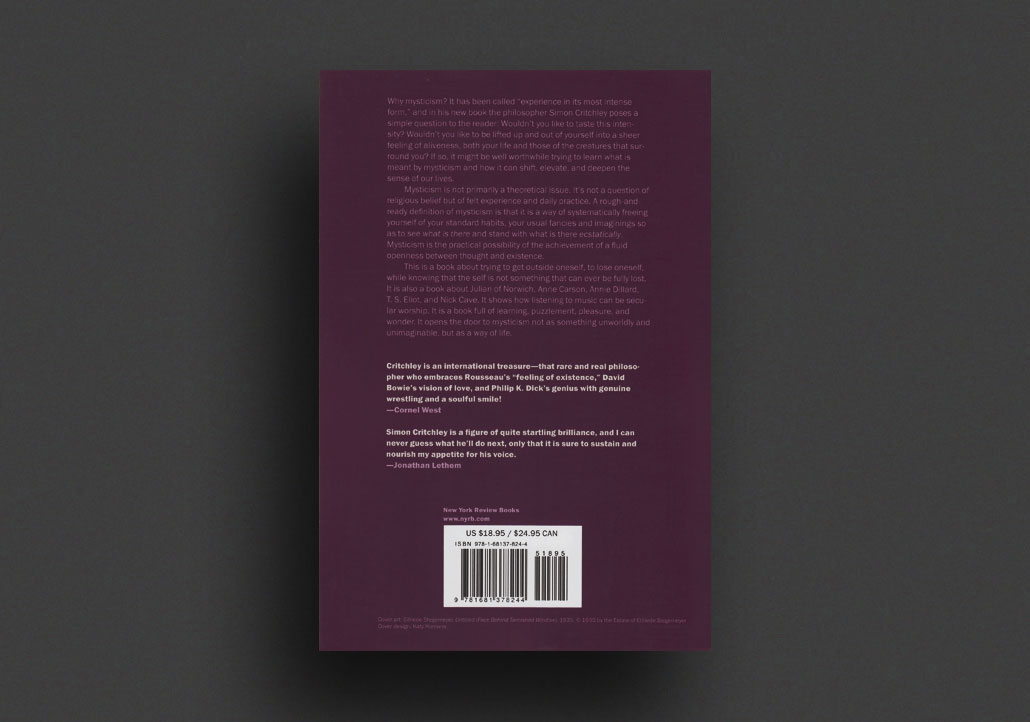
Why mysticism? It has been called “experience in its most intense form,” and in his new book the philosopher Simon Critchley poses a simple question to the reader: Wouldn’t you like to taste this intensity? Wouldn’t you like to be lifted up and out of yourself into a sheer feeling of aliveness, both your life and those of the creatures that surround you? If so, it might be well worthwhile trying to learn what is meant by mysticism and how it can shift, elevate, and deepen the sense of our lives.
Mysticism is not primarily a theoretical issue. It's not a question of religious belief but of felt experience and daily practice. A rough and ready definition of mysticism is that it is a way of systematically freeing yourself of your standard habits, your usual fancies and imaginings so as to see what is there and stand with what is there ecstatically. Mysticism is the practical possibility of the achievement of a fluid openness between thought and existence.
This is a book about trying to get outside oneself, to lose oneself, while knowing that the self is not something that can ever be fully lost. It is also a book about Julian of Norwich, Anne Carson, Annie Dillard, T.S. Eliot, and Nick Cave. It shows how listening to music can be secular worship. It is a book full of learning, puzzlement, pleasure, and wonder. It opens the door to mysticism not as something unworldly and unimaginable, but as a way of life.
"Simon Critchley is the most powerful and provocative philosopher now writing about the complex relations of ethical subjectivity and reinvigorated democracy."—Cornel West
"Simon Critchley’s work manages the difficult task of drawing both accessibility and depth from his vast range of references."—Daniel Fraser, The Quietus
"Erudite and impassioned, Critchley’s intimate examination of mysticism speaks to a yearning for personal transformation and nothing less than enchantment. A stirring, lyrical meditation on transfiguration."—Kirkus Reviews
"Critchley is what one might call a 'working-class philosopher,' by which I mean he sees philosophy as a proletarian concern rather than an elite activity to be practiced in ivory towers. He approaches every subject — be it suicide or soccer — with the same intellectual rigor. The writing is not only deep and philosophical, but approachable and conversational."—Tyler Malone, Los Angeles Times
"Critchley is generous without being platitudinous, rigorous but not overbearing." —Houman Barekat, Vol. 1 Brooklyn
“A study of mysticism—defined as an experience, rather than religious practice—by the great British philosopher Critchley, who mines music, poetry, and literature along the way.” —Sophia M. Stewart, The Millions
"Mysticism is a lucid, genial guide to a body of writing that describes states of being, and intuitions, that belong and don’t belong to the tradition in which its author finds himself." — Brian Dillon, 4Columns
“For readers looking to become one with the divine, philosopher Simon Critchley points to lessons from renowned religious mystics in Mysticism (New York Review Books, Oct.). In this book, God is optional, and one can find the extraordinary in the ordinary aspects of life.” – Cathy Lynn Grossman, Publishers Weekly
Simon Critchley has written over twenty books, including works of philosophy and books on Greek tragedy, dead philosophers, David Bowie, football, suicide, and many other subjects. He is the Hans Jonas Professor of Philosophy at the New School for Social Research in New York and a Director of the Onassis Foundation.
2024, English
Softcover, 232 pages, 13.4 x 9.1 cm
Published by
Urbanomic / Cornwall
$40.00 - Out of stock
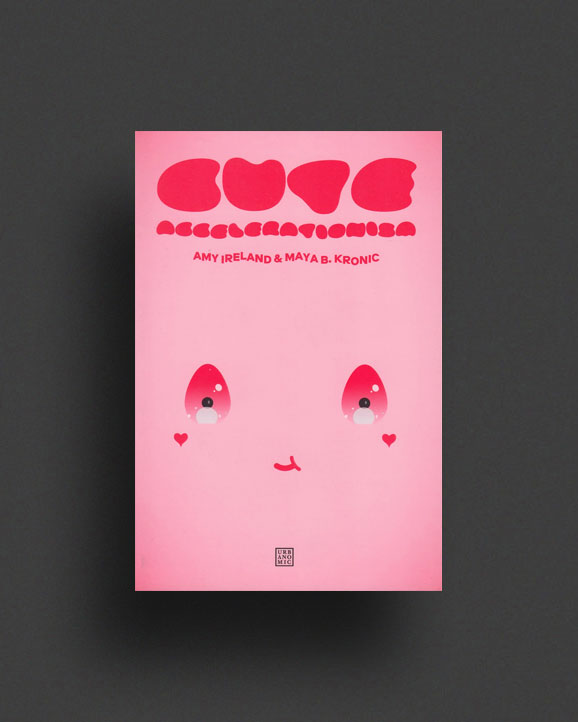
An impassioned philosophical celebration of the multiple dimensions of contemporary cuteness.
Involuntarily sucked into the forcefield of Cute, Amy Ireland and Maya B. Kronic decided to let go, give in, let the demon ride them, and make an accelerationism out of it—only to realize that Cute opens a microcosmic gate onto the transcendental process of acceleration itself.
Joining the swarming e-girls, t-girls, NEETS, anons, and otaku who rescued accelerationism from the double pincers of media panic and academic buzzkill by introducing it to big eyes, fluffy ears, programming socks, and silly memes, they discover that the objects of cute culture are just spinoffs of an accelerative process booping us from the future, rendering us all submissive, breedable, helpless, and cute in our turn. Cute comes tomorrow, and only anastrophe can make sense of what it will have been doing to us.
Evading all discipline, sliding across all possible surfaces, Cute Accelerationism embraces every detail of the symptomatology, aetiology, epidemiology, history, biology, etymology, topology, and even embryology of Cute, joyfully burrowing down into its natural, cultural, sensory, sexual, subjective, erotic, and semiotic dimensions in order to sound out the latent spaces of this Thing that has soft-soaped its way into human culture.
Traversing tangents on natural and unnatural selection, runaway supernormalisation, the collective self-transformation of genderswarming cuties, the hyperstitional cultures of shojo and otaku, denpa and 2D love, and the cute subworlds of aegyo and meng, moé and flatmaxxing, catboys and dogon eggs, bobbles and gummies, vore machines and partial objects, BwOs and UwUs…glomping, snuggling, smooshing and squeeeeing their way toward the event horizon of Cute, donning cat ears and popping bubbles as they go, in this untimely philosophical intensification of an omnipresent phenomenon, having surrendered to the squishiest demonic possession, like, ever, two bffs set out in search of the transcendental shape of cuteness only to realize that, even though it is all around us, we do not yet know what Cute can do.
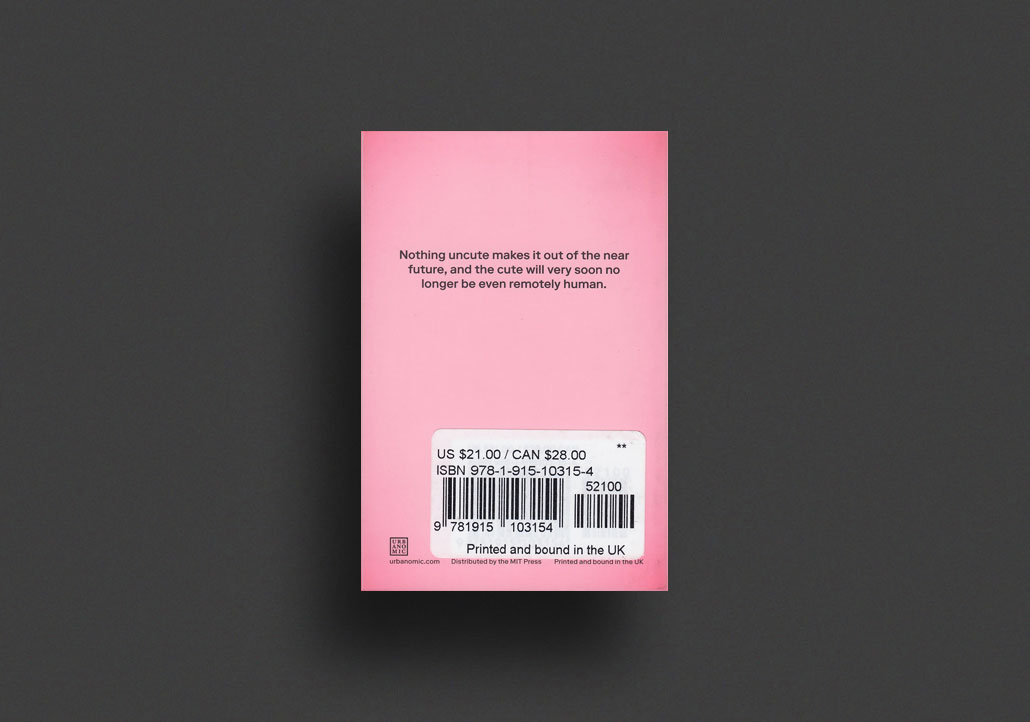
Seriously superficial and bafflingly coherent, half erudite philosophical treatise, half dariacore mashup, 100 percent cutagion, this compact lil' textual machine is a meltdown and a glow up, as well as a twizzled homage to Deleuze and Guattari's A Thousand Plateaus. Welcome to the kawaiizome: nothing uncute makes it out of the near future, and the cute will very soon no longer be even remotely human.
2012, English
Hardcover (w. dust jacket), 240 pages, 32 x 26 cm
1st Edition, Out of print title / used / fine
$55.00 $20.00 - Out of stock
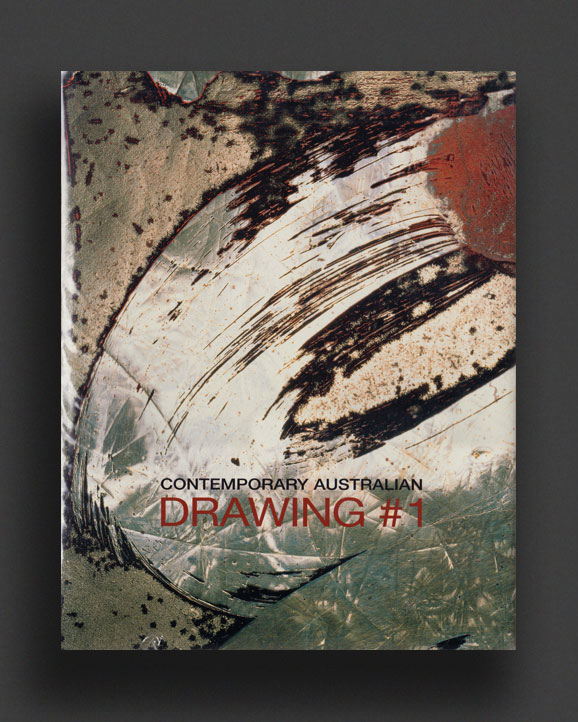
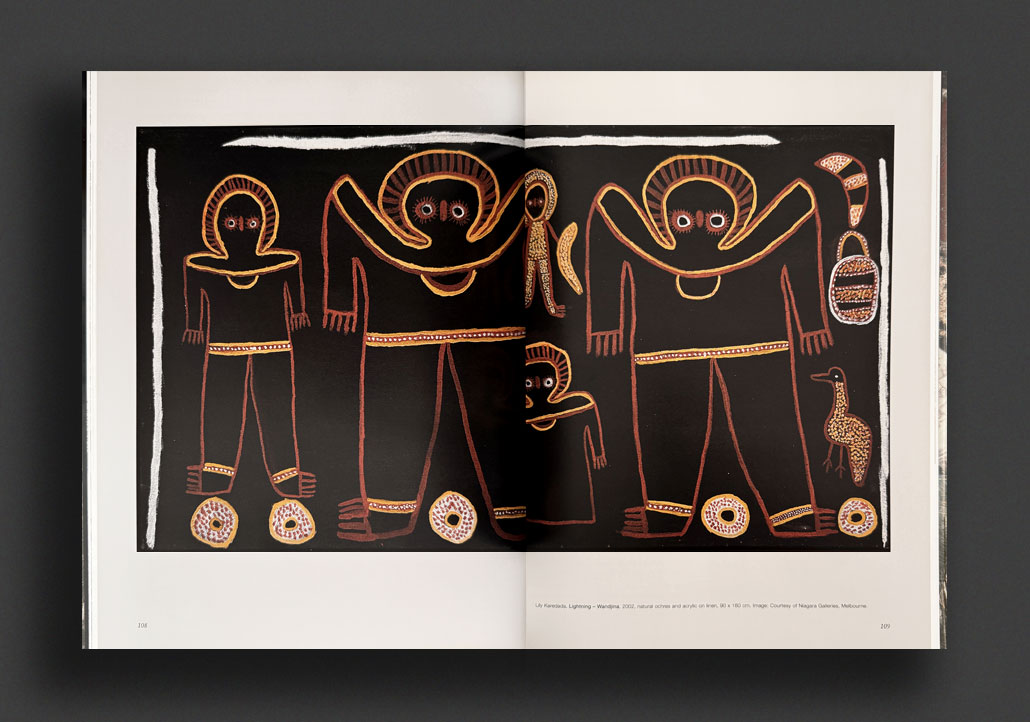
First hardcover edition of this out-of-print study on Australian drawing by Janet McKenzie, with contributions by Irene Barberis and Christopher Heathcote, published by Macmillan Art Publishing in 2012. McKenzie introduces works by 78 selected artists from across the country. They include prominent figures such as Peter Booth, Allan Mitelman, John Olsen, Mirka Mora, Mike Parr, Kevin Lincoln, Jenny Watson, Jan Senbergs and Wendy Stavrianos, among many others. Heavily illustrated throughout in colour.
Fine, As New.