World Food Books' programme is largely produced on Kulin Nation land. We acknowledge the Wurundjeri people of the Kulin Nation as the first and continuing custodians of this land, and pay respect to their Elders past, present, and emerging.
World Food Books is an arts and special interests bookshop in Naarm / Melbourne. Founded in 2010, World Food Books is devoted to the presentation of a rotating, hand-selection of international art, design, literary and counterculture publications with an emphasis on the anti-traditional, the experimental, the avant-garde, the heretic, the marginal.
Presenting new titles alongside rare and out-of-print books, catalogues and journals spanning the fields of modern and contemporary art, design, photography, illustration, film, literature, poetry, cultural theory, philosophy, sexuality, popular and underground culture in its many radical forms, World Food Books wishes to encourage adventurous, thoughtful and open-minded reading, looking, writing, and exchange of publishing and ideas, both current and historical.
As well as our bookshop, located in Melbourne's historical Nicholas Building, all of our inventory is available internationally via our online mail-order service.
World Food Books semi-regularly co-ordinates "Occasions", a programme of exhibits and events at the bookshop and in partnership with other hosts (such as museums and art galleries) that develop out of the activities, relationships and content of the bookshop itself.
World Food Books
The Nicholas Building
37 Swanston Street
Room 5, Level 6
Melbourne 3000
Australia
SHOP HOURS:
Thu–Fri 12–6, Sat 12–5
WEB-SHOP OPEN 24/7
World Food Books
Postal Address:
PO Box 435
Flinders Lane
Victoria 8009
Australia
Art
Theory / Essay
Architecture / Interior
Graphic Design / Typography
Photography
Fashion
Eros
LGBTQ+
Fiction / Poetry
Weird / Speculative / Science Fiction / Horror
Transgressive / Visceral / Abject
Symbolism / Decadence / Fin de siècle
Film / Video
Painting
Sculpture / Installation
Performance / Dance / Theater
Drawing
Sound / Music
Curatorial
Group Shows / Collections
Periodicals
Out-of-print / Rare
Posters / Ephemera / Discs
Signed Books
World Food Books Gift Voucher
World Food Book Bag
Australian Art
Australian Fiction
Australian Science Fiction / Speculative Fiction
Australian Poetry
Australian Photography
Japanese Photography
Conceptual Art
Minimal Art
Dada
'Pataphysics / Oulipo
Fluxus
Concrete Poetry
Pop Art
Surrealism
Arte Povera
Arte Informale / Haute Pâte / Tachism
Nouveau Réalisme / Zero / Kinetic
Situationism / Lettrism
Collage / Mail Art / Xerox Art
Art Brut / Folk / Visionary / Fantastic
Illustration / Graphic Art / Bandes Dessinées
Furniture
Italian Radical Design / Postmodernism
Textiles
Ceramics / Glass
Counterculture
Protest / Revolt
Philosophy
Psychoanalysis
Anthropology
Anarchism
Socialism / Anarchism / Communism / Capitalism
Literary Theory / Semiotics / Language
Feminism / Women's Studies
Gender Studies / Sexuality
Anthropology
Fetishism / BDSM
Drugs / Psychedelia
Crime / Violence
Animal Rights / Veganism
Occult / Esoterica
Ecology / Earth / Alternative Living
Whole Earth / Crafts
All prices in AUD (Australian dollars)
Pick-Ups
Pick-up orders can be collected in our bookshop during opening hours after order date. Please collect any Pick-up orders within 2 weeks of ordering as we have limited storage space. Orders will be released back into stock if not collected within this time. No refunds can be made for pick-ups left un-collected. If you cannot make it in to the bookshop in this time-frame, please choose postage option.
Return Policy
All sales are final. We do accept returns (for refund or exchange) for items received in error. All our orders are packed with special care using heavy-duty padding and cardboard book-mailers or bubble mailers (for smaller books), using reinforcement where required. We cannot take responsibility for any lost, stolen or damaged parcels.
Insurance
Should you wish to insure your package, please email us directly after placing your order and we can organise this at a small extra expense. Although all standard/express tracked packages are very safe and dependable, we cannot take responsibility for any lost, stolen or damaged parcels. We recommend insurance on valuable orders.
Interested in selling your old books, catalogues, journals, magazines, comics, fanzines, ephemera? We are always looking for interesting, unusual and out-of-print books to buy. We only buy books in our fields of interest and specialty, and that we feel we can resell.
We base these prices on desirability, market value, in-print prices, condition and our current stock levels. We offer cash, store credit, and can take stock on consignment. All
about 25% of the price we expect to get when we sell them, or 30% in store credit. We base these prices on desirability, market value, in-print prices, condition and our current stock levels.
Sell your books any day of the week. You can drop them off and return later. If you have a lot of books, we can visit your Sydney home.
We buy books that we feel we can resell. We offer about 25 % of the price we expect to get when we sell them, or 30% in store credit. We base these prices on desirability, market value, in-print prices, condition and our current stock levels.
Philadelphia Wireman
03 August - 01 September, 2018
World Food Books is proud to announce our next Occasion, the first presentation of sculptures by Philadelphia Wireman in Australia.
The Philadelphia Wireman sculptures were found abandoned in an alley off Philadelphia’s South Street on trash night in 1982. Their discovery in a rapidly-changing neighbourhood undergoing extensive renovation, compounded with the failure of all attempts to locate the artist, suggests that the works may have been discarded after the maker’s death. Dubbed the "Philadelphia Wireman" during the first exhibition of this work, in 1985, the maker’s name, age, ethnicity, and even gender remain uncertain. The entire collection totals approximately 1200 pieces, all intricately bound together with tightly-wound heavy-gauge wire (along with a few small, abstract marker drawings, reminiscent both of Mark Tobey and J.B. Murry). The dense construction of the work, despite a modest range of scale and materials, is singularly obsessive and disciplined in design: a wire armature or exoskeleton firmly binds a bricolage of found objects including plastic, glass, food packaging, umbrella parts, tape, rubber, batteries, pens, leather, reflectors, nuts and bolts, nails, foil, coins, toys, watches, eyeglasses, tools, and jewellery.
Heavy with associations—anthropomorphic, zoomorphic, and socio-cultural responses to wrapped detritus—the totemic sculptures by Philadelphia Wireman have been discussed in the context of work created to fulfil the shamanistic needs of alternative religions in American culture. Curators, collectors, and critics have variously compared certain pieces to sculpture from Classical antiquity, Native American medicine bundles, African-American memory jugs, and African fetish objects. Reflecting the artist’s prolific and incredibly focused scavenging impulse, and despite—or perhaps enhanced by—their anonymity, these enigmatic objects function as urban artefacts and arbiters of power, though their origin and purpose is unknown. Philadelphia Wireman, whatever their identity, possessed an astonishing ability to isolate and communicate the concepts of power and energy through the selection and transformation of ordinary materials. Over the course of the past two decades, this collection has come to be regarded as an important discovery in the field of self-taught art and vernacular art.
Presented in collaboration with Fleisher-Ollman Gallery, Philadelphia, and Robert Heald, Wellington.
Susan Te Kahurangi King
02 February - 10 March, 2018
Susan Te Kahurangi King (24 February 1951 - ) has been a confident and prolific artist since she was a young child, drawing with readily available materials - pencils, ballpoint pens and felt-tip markers, on whatever paper is at hand. Between the ages of four and six Susan slowly ceased verbal communication. Her grandparents William and Myrtle Murphy had developed a special bond with Susan so they took on caring responsibilities for extended periods. Myrtle began informally archiving her work, carefully collecting and storing the drawings and compiling scrapbooks. No drawing was insignificant; every scrap of paper was kept. The King family are now the custodians of a vast collection containing over 7000 individual works, from tiny scraps of paper through to 5 meter long rolls.
The scrapbooks and diaries reveal Myrtle to be a woman of great patience and compassion, seeking to understand a child who was not always behaving as expected. She encouraged Susan to be observant, to explore her environment and absorb all the sights and sounds. Myrtle would show Susan’s drawings to friends and people in her community that she had dealings with, such as shopkeepers and postal workers, but this was not simply a case of a grandmother’s bias. She recognised that Susan had developed a sophisticated and unique visual language and sincerely believed that her art deserved serious attention.
This was an unorthodox attitude for the time. To provide some context, Jean Dubuffet coined the term Art Brut in 1945 to describe work created by self-taught artists – specifically residents of psychiatric institutions and those he considered to be visionaries or eccentrics. In 1972 Roger Cardinal extended this concept by adopting the term Outsider Art to describe work made by non-academically trained artists operating outside of mainstream art networks through choice or circumstance. Susan was born in Te Aroha, New Zealand in 1951, far from the artistic hubs of Paris and London that Dubuffet and Cardinal operated in. That Myrtle fêted Susan as a self-taught artist who deserved to be taken seriously shows how progressive her attitudes were.
Susan’s parents Doug and Dawn were also progressive. Over the years they had consulted numerous health practitioners about Susan’s condition, as the medical establishment could not provide an explanation as to why she had lapsed into silence. Dawn educated herself in the field of homeopathy and went on to treat all twelve of her children using these principles – basing prescriptions on her observations of their physical, mental and emotional state.
Doug was a linguist with an interest in philosophy who devoted what little spare time he had to studying Maori language and culture. To some extent their willingness to explore the fringes of the mainstream made them outsiders too but it was their commitment to living with integrity and their respect for individuality that ensured Susan’s creativity was always encouraged.
Even though Susan’s family supported her artistic pursuits, some staff in schools and hospitals saw it as an impediment to her assimilation into the community and discouraged it in a variety of ways. Her family was not always aware of this and therefore did not fully understand why Susan stopped drawing in the early 1990s. However, rather than dwell on the challenges that Susan faced in pursuit of her artistic practice, they prefer to highlight her achievements. In 2008 Susan began drawing again in earnest, after an almost 20 year interruption, and her work is now shown in galleries around the world.
Susan grew up without television and has been heavily influenced by the comics she read as a child. She is absolutely fearless in the appropriation of recognizable characters, such as Donald Duck and Mickey Mouse, in her work. She twists their limbs, contorts their faces, compresses them together, blends them into complex patterned backgrounds - always imbuing them with an incredible energy. Although Susan often used pop culture characters in her work they are not naive or childlike. These are drawings by a brilliant self-taught artist who has been creating exceptional work for decades without an audience in mind.
Mladen Stilinović
"Various Works 1986 - 1999"
02 February 16 - September 10, 2016
Various works 1986 - 1999, from two houses, from the collections of John Nixon, Sue Cramer, Kerrie Poliness, Peter Haffenden and Phoebe Haffenden.
Including: Geometry of Cakes (various shelves), 1993; Poor People’s Law (black and white plate), 1993; White Absence (glasses, ruler, set square, silver spoon, silver ladel with skin photograph and wooden cubes), 1990-1996; Exploitation of the Dead (grey and red star painting, wooden painting, black spoon with red table, red plate), 1984-1990; Money and Zeros (zero tie, paintings made for friends in Australia (Sue, John, Kerrie), numbers painting), 1991-1992; Words - Slogans (various t-shirts) - “they talk about the death of art...help! someone is trying to kill me”, “my sweet little lamb”, “work is a disease - Karl Marx”; Various artist books, catalogues, monographs, videos; Poster from exhibition Insulting Anarchy; "Circular" Croatian - Australian edition; Artist book by Vlado Martek (Dostoyevsky); more.
Thanks to Mladen Stilinović and Branka Stipančić.
Jonathan Walker
Always Will Need To Wear Winter Shirt Blue + Ochre Small Check Pattern
21 August - 21 September, 2015
Untitled
I am not a great reader of poetry but I always return to the work of Melbourne poet, Vincent Buckley (1925- 1988). Perhaps I find his most tantalising piece to be not a finished poem but a fragment left on a scrap of paper discovered on his desk after the poet’s death.
The poetry gathers like oil
In the word-core, and spreads
It has its music meet,
Its music is in movement.
This fragment is more the shell left behind from a volatile thought than a finished poem. I find the last two lines honest but awkward whereas the first two lines work like an arrow. Most likely he could not find a resolution so it was left. Still, in its present form, it remains an eloquent testimony to the ultimate failure of a medium to express mobile thought and sensation, in Buckley’s case, through verbal language. It’s an important matter because this is something all artists have to deal with regardless of the medium.
I have never written a poem, however, I am forever copying fragments from books on paper scraps in a vain effort to fix certain notions in my head. At first, they function as bookmarks that are sometimes returned to when I open the book. But before long, as they accumulate, they fall out littering the table interspersed with A4 photocopies, bills, books and medications.
To return to Buckley’s fragment, the first two lines very much evoke how I paint nowadays. As you age, detail diminishes and patches of light become more luminous and float. I feel the most honest way of dealing with this is by smearing the oil paint on the canvas with the fingers and working close-up, blind. Only if the patches coalesce into an approaching image can the work gain a life.
-
Jonathan Walker was born in Melbourne, Australia and brought up on a dairy farm in Gippsland. In the 1970’s he studied painting at RMIT and won the Harold Wright Scholarship to the British Museum, London. During the 1980’s he exhibited at Pinacotheca Gallery, Richmond and had work shown at the NGV and Heidi City Art Gallery. Over the same period he designed the cover for the “Epigenesi” LP by Giancarlo Toniutti, Italy and conducted a mail exchange work with Achim Wollscheid, Germany. The work with artists through the post resulted in an article published in the bicentenary issue of Art and Australia 1988. He showed in artist run spaces such as WestSpace in the 90’s and 2000’s, and until 2012, taught painting at Victoria University, which is where we (Colleen Ahern and Lisa Radford) as organisers of the exhibition, among many others, had the privilege of being his student.
Walker’s knowledge was imparted to students through the careful selection of music, literature, and artists found in books that he himself had ordered for the library. Walker’s strategy was the generosity of sharing his vast knowledge with references specific to each student and their context.
Walker’s paintings share a similar focus and intimacy.
This exhibition presents a small selection of recent paintings alongside a publication that includes Walker’s writing. Observational and analytical, Walker’s work is a type of material notation — the time of day, colour and how it is blended, the both specific and fleeting location of a reflection on lino or the question of whether a chair leg should be included in a painting.
Please join us on Friday August 21 between 6-8pm to celebrate the opening of the exhibition.
Curated by Colleen Ahern and Lisa Radford.
B. Wurtz
Curated by Nic Tammens
March 26 - April 4, 2015
B.Wurtz works from a basement studio in his home on Manhattan’s Lower East Side.
This local fact is attested to by the plastic shopping bags and newsprint circulars that appear in his work. As formal objects, they don’t make loud claims about their origins but nonetheless transmit street addresses and places of business from the bottom of this long thin island. Like plenty of artists, Wurtz is affected by what is local and what is consumed. His work is underpinned by this ethic. It often speaks from a neighborhood or reads like the contents of a hamper:
“BLACK PLUMS $1.29 lb.”
“Food Bazaar”
“USDA Whole Pork Shoulder Picnic 99c lb.”
“RITE AID Pharmacy, with us it’s personal.”
“H. Brickman & Sons.”
“Sweet Yams 59c lb."
Most of the work in this exhibition was made while the artist was in residence at Dieu Donne, a workshop dedicated to paper craft in Midtown. Here Wurtz fabricated assemblages with paper and objects that are relatively lightweight, with the intention that they would be easily transportable to Australia. This consideration isn’t absolute in Wurtz’s work, but was prescriptive for making the current exhibition light and cheap. Packed in two boxes, these works were sent from a USPS post office on the Lower East Side and delivered to North Melbourne by Australia Post.
Wurtz appears courtesy of Metro Pictures, New York.
Thanks to Rob Halverson, Joshua Petherick, Sari de Mallory, Matt Hinkley, Helen Johnson, Fayen d'Evie, Ask Kilmartin, Lisa Radon, Ellena Savage, Yale Union, and "Elizabeth".
John Nixon
"Archive"
December 15 - January 20, 2014
The presentation of John Nixon's archive offered a rare showcase of this extensive collection of the artist's own publications, catalogues, posters, ephemera, editions and more, from the mid 1980s onwards, alongside a selection of his artworks.
Organized by John Nixon, Joshua Petherick and Matt Hinkley.
<a href=http://wfb.public-office.info/artist/john-nixon>All titles by John Nixon
"Habitat"
at Minerva, Sydney (organised by Joshua Petherick and Matt Hinkley)
November 15 - December 20, 2014
Lupo Borgonovo, Janet Burchill & Jennifer McCamley,
Lewis Fidock, HR Giger, Piero Gilardi, Veit Laurent Kurz,
Cinzia Ruggeri, Michael E. Smith, Lucie Stahl, Daniel Weil, Wols
Press Release:
“...It contained seven objects. The slender fluted bone, surely formed for flight, surely from the wing of some large bird. Three archaic circuitboards, faced with mazes of gold. A smooth white sphere of baked clay. An age-blackened fragment of lace. A fingerlength segment of what she assumed was bone from a human wrist, grayish white, inset smoothly with the silicon shaft of a small instrument that must once have ridden flush with the surface of the skin - but the thing’s face was seared and blackened.”
William Gibson, “Count Zero”, 1986
"Autumn Projects Archive"
Curated by Liza Vasiliou
March 6 - March 15, 2014
World Food Books, in conjunction with the Virgin Australia Melbourne Fashion Festival 2014, presented the Autumn Projects archive, consisting of a selection of early examples in Australian fashion with a particular interest in collecting designers and labels from the period beginning in the 1980’s, who significantly influenced the discourse of Australian Fashion.
Curated by Liza Vasiliou, the exhibition provided a unique opportunity to view pieces by designers Anthea Crawford, Barbara Vandenberg, Geoff Liddell and labels CR Australia, Covers, Jag along with early experimental collage pieces by Prue Acton and Sally Browne’s ‘Fragments’ collection, suspended throughout the functioning World Food Books shop in Melbourne.
H.B. Peace
presented by CENTRE FOR STYLE
November 14, 2013
"Hey Blinky, you say chic, I say same"
Anon 2013
H.B. Peace is a clothing collaboration between great friends Blake Barns and Hugh Egan Westland. Their pieces explore the divergences between 'character’ and ‘personality’ in garments....etc
Special Thanks to Joshua Petherick and Matt Hinkley of WFB and Gillian Mears
and a Very Special Thank you to Audrey Thomas Hayes for her shoe collaboration.
Janet Burchill & Jennifer McCamley
"Aesthetic Suicide"
May 10 - June 8, 2013
The first of our occasional exhibitions in the World Food Books office/shop space in Melbourne, "Aesthetic Suicide" presented a body of new and older works together by artists Janet Burchill & Jennifer McCamley, including videos, prints, a wall work, and publications.
During shop open hours videos played every hour, on the hour.
2007, English
Softcover, 150 pages, 23 x 15 cm
Published by
State University of New York Press / New York
$70.00 - Out of stock
Provocative essays on language, literature, and the aesthetics of embodiment.
Shocking, brilliant, and eccentric, the French author, translator, and artist Pierre Klossowski (1905–2001) exerted a profound effect on French intellectual culture throughout the twentieth century. The older brother of the painter Balthus, secretary to the novelist André Gide, friend to Georges Bataille and Maurice Blanchot, and heralded as one of the most important voices in the French "return to Nietzsche" by Michel Foucault and Gilles Deleuze, Klossowski pursued his singular vision of mortal embodiment through a variety of scholarly manifestations. In Such a Deathly Desire (Un si funeste désir), Klossowski's original interpretation of Nietzsche's eternal return is developed around the enigmatic figure of the "demon," then deepened with provocative readings of Gide's correspondence; Barbey d'Aurevilly's novel A Married Priest; and the intertwining of language and death in the work of Bataille, Blanchot, and Brice Parain. The book concludes with the powerful essay "Nietzsche, Polytheism, and Parody," in which Klossowski articulates the consequences of the eternal return and the meaning of Nietzsche's genealogy of the fabulation of the world. Intersecting with and confounding a range of disciplines—including psychoanalysis, literary criticism, gender studies, and philosophy—Klossowski's critical writings on language, literature, and the aesthetics of embodiment remain powerful and original contributions to contemporary concerns in the theoretical humanities.
Translated with afterword by Russell Ford. Russell Ford is Assistant Professor of Philosophy at Elmhurst College.
"Pierre Klossowski was one of the most influential (albeit idiosyncratic) literary figures in France during the postwar years, yet his work remains strangely unknown in the English-speaking world. Such a Deathly Desire was one of the essential books of Klossowski's oeuvre, and it includes seminal articles on Gide, Bataille, and Blanchot, as well as his now-classic essay 'Nietzsche, Polytheism, and Parody. ' The appearance of the book in English has long been anticipated, and we owe an immense debt to Russell Ford for providing us with an accessible and accurate translation. "—Daniel W. Smith, Purdue University
2018, English
Softcover, 264 pages, 20.3 x 13.2 cm
Published by
Strange Attractor / London
$40.00 - Out of stock
A literary mix tape that explores the entwined boundaries between sound, material culture, landscape and esoteric belief.
Trees rigged up to the wireless radio heavens. A fax machine used to decode the language of hurricanes. A broadcast ghost that hijacked a television station to terrorize a city. A failed computer factory in the desert with a slap-back echo resounding into ruin.
In High Static, Dead Lines, media historian and artist Kristen Gallerneaux weaves a literary mix tape that explores the entwined boundaries between sound, material culture, landscape, and esoteric belief. Essays and fictocritical interludes are arranged to evoke a network of ley lines for the “sonic spectre” to travel through—a hypothetical presence that manifests itself as an invisible layer of noise alongside the conventional histories of technological artifacts.
The objects and stories within span from the mid-nineteenth century to the present day, touching upon military, communications, and cultural history. A connective thread is the recurring presence of sound—audible, self-generative, and remembered—charting the contentious sonic histories of paranormal culture.
2023, English
Softcover, 312 pages, 20 x 12.5 cm
Published by
Seagull Books / London
$42.00 - Out of stock
Including a number of short essays by Bataille and Leiris on aspects of the other’s work as well as excerpts on Bataille from Leiris’ diaries, this collection of correspondence throws new light on two of Surrealism’s most radical dissidents.
In the autumn of 1924, just before André Breton published the Manifeste du surréalisme, two young men met in Paris for the first time. Georges Bataille, 27, starting work at the Bibliothèque Nationale; Michel Leiris, 23, beginning his studies in ethnology. Within a few months, they were both members of the Surrealist group, although their adherence to Surrealism (unlike their affinities with it) would not last long: in 1930 they were among the signatories of “Un cadavre,” the famous tract against Breton, the “Machiavelli of Montmartre,” as Leiris put it. But their friendship would endure for more than 30 years, and their correspondence, assembled here for the first time in English, would continue until the death of Bataille in 1962.
Translated by Liz Heron.
2017, English
Softcover, 152 pages, 11.4 x 17.8 cm
Published by
Semiotext(e) / Los Angeles
The MIT Press / Massachusetts
$34.00 - Out of stock
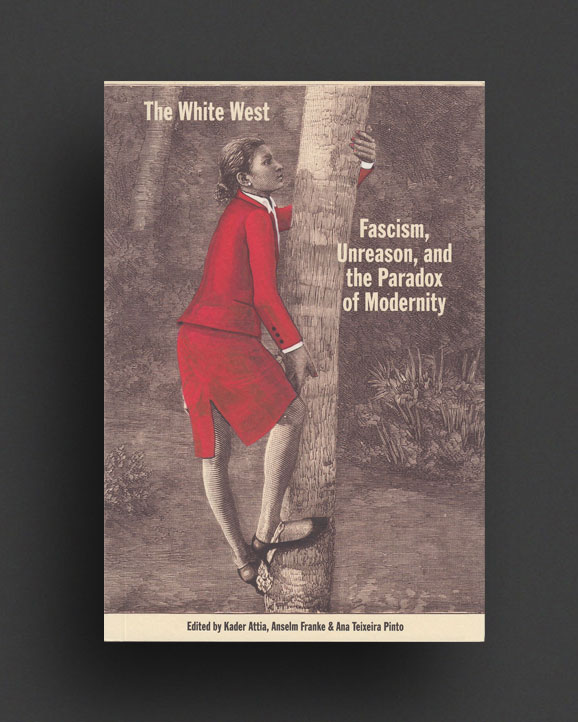
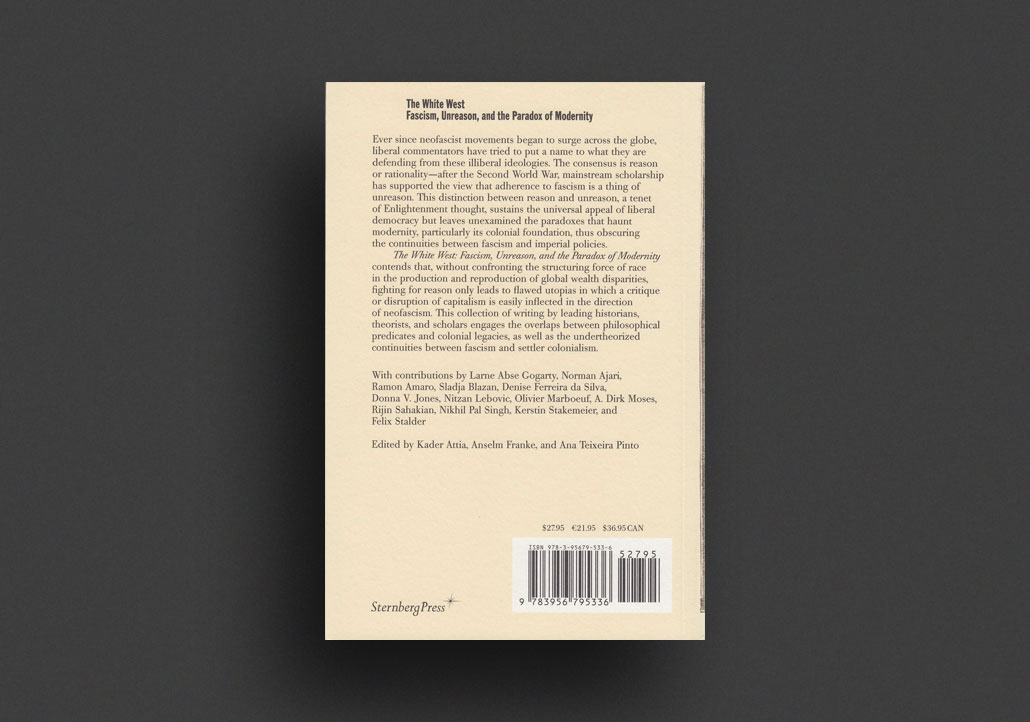
Why am I writing this book? Because I share Gramsci’s anxiety: “The old are dying and the new cannot be born; in this interregnum a great variety of morbid symptoms appear.” The fascist monster, born in the entrails of Western modernity. Of course, the West is not what it used to be. Hence my question: what can we offer white people in exchange for their decline and for the wars that will ensue? There is only one answer: peace. There is only one way: revolutionary love.
—from Whites, Jews, and Us
With Whites, Jews, and Us, Houria Bouteldja launches a scathing critique of the European Left from an indigenous anti-colonial perspective, reflecting on Frantz Fanon’s political legacy, the republican pact, the Shoah, the creation of Israel, feminism, and the fate of postcolonial immigration in the West in the age of rising anti-immigrant populism. Drawing upon such prominent voices as James Baldwin, Malcolm X, and Jean Genet, she issues a polemical call for a militant anti-racism grounded in the concept of revolutionary love.
Such love will not come without significant discomfort for whites, and without necessary provocation. Bouteldja challenges widespread assumptions among the Left in the United States and Europe—that anti-Semitism plays any role in Arab–Israeli conflicts, for example, or that philo-Semitism doesn’t in itself embody an oppressive position; that feminism or postcolonialist theory is free of colonialism; that integrationalism is a solution rather than a problem; that humanism can be against racism when its very function is to support the political-ideological apparatus that Bouteldja names the “white immune system.”
At this transitional moment in the history of the West—which is to say, at the moment of its decline—Bouteldja offers a call for political unity that demands the recognition that whiteness is not a genetic question: it is a matter of power, and it is high time to dismantle it.
Foreword by Cornel West
Translated by Rachel Valinsky
Houria Bouteldja is a French-Algerian political activist and writer focusing on anti-racism, anti-imperialism, and Islamophobia. She serves as spokesperson for the Parti des Indigènes de la République (Party of the Indigenous of the Republic).
2012, English
Softcover, 224 pages, 21 x 14 cm
Published by
Arcade Publishing / New York
$34.00 - Out of stock
“A sort of final philosopher of the Western world. His statements have the compression of poetry and the audacity of cosmic clowning”—The Washington Post
Introduction by Susan Sontag
Foreword by Eugene Thacker
This collection of eleven essays, when originally published in France, created a literary whirlwind on the Left Bank. Cioran writes incisively about Western civilizations, the writer, the novel, mystics, apostles, and philosophers.
The Temptation to Exist first introduced this brilliant European thinker twenty years ago to American readers, in a superb translation by Richard Howard. This literary mystique around Cioran continues to grow, and The Temptation to Exist has become an underground classic.
In this work Cioran writes about Western civilizations, the writer, the novel, about mystics, apostles, philosophers. For those to whom the very word philosophy brings visions of arduous reading, be assured: Cioran is crystal-clear, his style quotable and aphoristic.
2012, English
Softcover, 200 pages, 21 x 14 cm
Published by
Arcade Publishing / New York
$36.00 - Out of stock
Foreword by Eugene Thacker
In this collection of aphorisms and short essays, E.M. Cioran sets about the task of peeling off the layers of false realities with which society masks the truth. For him, real hope lies in this task, and thus, while he perceives the world darkly, he refuses to give in to despair. He hits upon this ultimate truth by developing his notion of human history and events as "a procession of delusions," striking out at the so-called "Fallacies of Hope." By examining the relationship between truth and action and between absolutes, unknowables, and frauds, Cioran comes out, for once, in favor of being.
1984, French
Softcover, 72 pages, 30 x 30 cm
1st Edition, Out of print title / used / very good
Published by
Editions Blusson / Paris
$100.00 - Out of stock
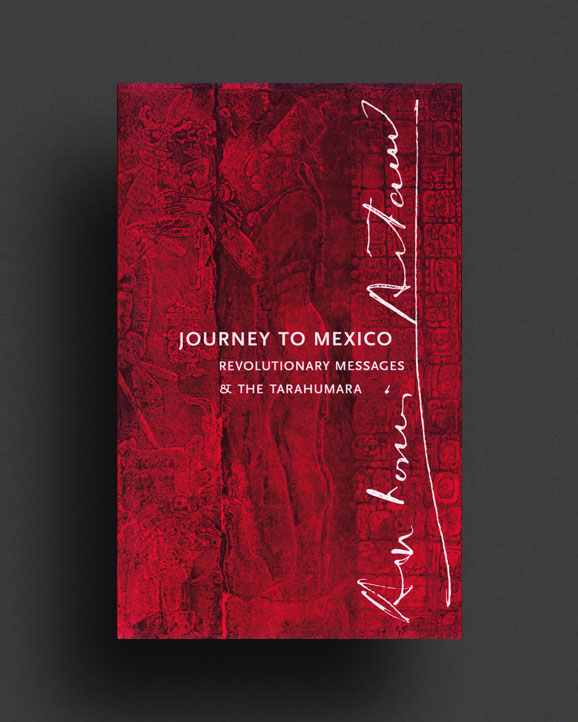
First 1984 edition of this very rare French publication, the first work on Artaud's drawings, published by Editions Blusson, Paris. From Artaud's first writings on the visual arts (1920) to the exhibition of his drawings at the Galerie Pierre (1947), Artaud wondered about graphic expression. This heavily illustrated book includes many of Artaud's illustrations accompanying the main texts, dedicated by Artaud to the commentary of his drawings, supplemented by two articles on the correspondence between Artaud and the painter Balthus, and on Artaud's relations with graffiti and art brut. This work remains the first in-depth published book on the question of drawing in Artaud's work. We find there the first constitution, revelation and analysis of the lines of force of the graphic work of Mômo. As well as a description of his analysis of painting and the history of art (the Italian Primitives, Le Vinci, Poussin, Van Gogh, Balthus, Surrealism, etc.). A wonderuful, oversized book. Texts in French.
Very Good copy.
2001, English
Softcover, 334 pages, 14 x 21.5 cm
Published by
Power Publications / Sydney
$30.00 - Out of stock
"Lacan says that the hysteric is a question raised to the medical establishment: Artaud is nothing but the question itself and it's a question raised to art, to theatre, and to society. The question itself cannot be defined because it's the function of the question that's important."—Sylvere Lotringer
100 Years of Cruelty: Essays on Artaud brings together responses to the Artaud question from some of the leading contemporary scholars working in the humanities today. The essays cover a wide variety of topics in opening the Artaud question to the disciplines – and the demarcations upon which so much knowledge and art practice is defined. They are intended as an affront to conservative thought, as an attack on clinical reason and as an open challenge to the corporate university.
Contributors: Rex Butler, Alan Cholodenko, Lisabeth During, Frances Dyson, Patrick Fuery, Douglas Kahn, Julia Kristeva, Sylvère Lotringer, Mike Parr, Bill Schaffer, Edward Scheer, Lesley Stern, Samuel Weber, Allen S. Weiss.
2000, English
Softcover, 330 pages, 19 x 13.5 cm
1st Edition, Out of print title / used / very good
Published by
Verso / London
$25.00 - Out of stock
Contingency, Hegemony, Universality:
Contemporary Dialogues on the Left
by Judith Butler, Ernesto Laclau and Slavoj Žižek
First --- edition of Contingency, Hegemony, Universality: Contemporary Dialogues on the Left by Judith Butler, Ernesto Laclau and Slavoj Žižek — The Hegelian legacy, Left strategy, and post-structuralism versus Lacanian psychoanalysis.
What is the contemporary legacy of Gramsci’s notion of Hegemony? How can universality be reformulated now that its spurious versions have been so thoroughly criticized? In this ground-breaking project, Judith Butler, Ernesto Laclau and Slavoj Žižek engage in a dialogue on central questions of contemporary philosophy and politics. Their essays, organized as separate contributions that respond to one another, range over the Hegelian legacy in contemporary critical theory, the theoretical dilemmas of multiculturalism, the universalism-versus-particularism debate, the strategies of the Left in a globalized economy, and the relative merits of post-structuralism and Lacanian psychoanalysis for a critical social theory. While the rigor and intelligence with which these writers approach their work is formidable, Contingency, Hegemony, Universality benefits additionally from their clear sense of energy and enjoyment in a revealing and often unpredictable exchange.
Very Good copy.
2017, English
Hardcover (w. dust jacket), 288 pages, 24 x 16.5 cm
1st Edition, Out of print title / used / fine
Published by
Princeton Architectural Press / New York
$45.00 - Out of stock
A cultural history of the face in Western art, ranging from portraiture in painting and photography to film, theater, and mass media
This fascinating book presents the first cultural history and anthropology of the face across centuries, continents, and media. Ranging from funerary masks and masks in drama to the figural work of contemporary artists including Cindy Sherman and Nam June Paik, renowned art historian Hans Belting emphasizes that while the face plays a critical role in human communication, it defies attempts at visual representation.
Belting divides his book into three parts: faces as masks of the self, portraiture as a constantly evolving mask in Western culture, and the fate of the face in the age of mass media. Referencing a vast array of sources, Belting's insights draw on art history, philosophy, theories of visual culture, and cognitive science. He demonstrates that Western efforts to portray the face have repeatedly failed, even with the developments of new media such as photography and film, which promise ever-greater degrees of verisimilitude. In spite of sitting at the heart of human expression, the face resists possession, and creative endeavors to capture it inevitably result in masks—hollow signifiers of the humanity they're meant to embody.
From creations by Van Eyck and August Sander to works by Francis Bacon, Ingmar Bergman, and Chuck Close, Face and Mask takes a remarkable look at how, through the centuries, the physical visage has inspired and evaded artistic interpretation.
Fine copy in Fine dust jacket.
2023, English
Softcover, 200 pages, 20.2 x 13.6 cm
Published by
Semiotext(e) / Los Angeles
$34.00 - Out of stock
Sasha Frere-Jones's evolution as a writer and musician with the deceptively casual intelligence that marks all of his work.
Shuttling between his first year of life (1967) and the year he wrote the book (2020), Earlier is a glorious sequence of moments, a record of the experiences that set the shape of a life. Frere-Jones's prose floats between clinically precise fragments and emotional impressions of revelations, pleasures, and accidents. It's a book about how lives happen and sensibilities form.
As fellow music critic Alex Ross observes, “It is weird to write a book about yourself, as this book is well aware. Gazing in the mirror is not mass entertainment. Sasha Frere-Jones, a writer of nonchalant, rope-a-dope power, drops the illusion of self-knowledge and instead offers up a kaleidoscope of memory shards, faithful to the chaos of inner and outer worlds. Earlier is funny, cool, raw, wise, and secretly sublime.”
Begun in 2010, Earlier was completed at the request of Deborah Holmes, to whom the book is dedicated. Holmes is the mother of Frere-Jones's two boys, Sam and Jonah. Diagnosed with pancreatic cancer in July of 2020, Holmes died in January of 2021. Earlier is the last book she read. Frere-Jones says, “Deborah was the most enthusiastic reader I've ever met. She read when she wasn't doing something else, and that never changed. She asked me to write this when we met, in 1990. I am sorry I made her wait so long.”
Sasha Frere-Jones grew up in Fort Greene, Brooklyn. His play, We Three Kings, was recognized by the Young Playwrights Festival in 1983 and performed at The Public Theater. He completed a short film called The Take in 1986. His first band, Dolores, completed two albums in the Eighties, and he is a member of Ui, whose work is available through The Numero Group. Frere-Jones plays with Body Meπa, who record for Hausu Mountain, as well as Calvinist and Fellas. He has written about music and books since 1994, and lives in the East Village with his wife, Heidi DeRuiter.
1992, English
Softcover, 320 pages, 22 x 14 cm
Published by
Vintage Books / New York
$40.00 - In stock -
This original and deeply provocative book was the first to make Palestine the subject of a serious debate—one that remains as critical as ever.
"A compelling call for identity and justice."—Anthony Lewis
"Books such as Mr. Said's need to be written and read in the hope that understanding will provide a better chance of survival."—The New York Times Book Review
With the rigorous scholarship he brought to his influential Orientalism and an exile's passion (he is Palestinian by birth), Edward W. Said traces the fatal collision between two peoples in the Middle East and its repercussions in the lives of both the occupier and the occupied--as well as in the conscience of the West. He has updated this landmark work to portray the changed status of Palestine and its people in light of such developments as the Israeli invasion of Lebanon, the intifada, the Gulf War, and the ongoing MIddle East peace initiative. For anyone interested in this region and its future, The Question of Palestine remains the most useful and authoritative account available.
1994, Japanese
Softcover, 316 pages, 22 x 14.5 cm
1st Edition, Out of print title / used / very good
Published by
Seidosha / Tokyo
$15.00 - In stock -
Eureka No. 9, published in Japan in 1994, a leading journal of poetry and criticism, this issue dedicated to the world of Italian director Federico Fellini, including texts by/about Pier Paolo Pasolini, Giulietta Masina, Anita Ekberg, Martin Scorsese, Italo Calvino, Alberto Moravia, full Fellini filmography, an essay on Balthus' teachings, plus much more. Contributors include critic Nagaharu Yodogawa, artist Hideaki Kawashima, director Nobuhiko Obayashi (House!), author Hirohide Takeyama, and much more... All in Japanese! Eureka is a heavy text journal, with scattered illustrations and film stills throughout.
Very Good copy, light wear.
1978, Japanese
Softcover, 80 pages, 26 x 18.5 cm
1st Edition, Out of print title / used / good
Published by
Tenjō Sajiki / Tokyo
$120.00 - Out of stock
Rare copy of Angura (Underground Theatre) issue 12, 1978, the "Dramatic Theory Magazine" published in Tokyo by Shūji Terayama's radical avant-garde theatre company Tenjō Sajiki. With iconic cover photography by Shūji Terayama, this issue's special feature is ‘Body Language and the Theatrical Body’, with contributions by Terayama, philosopher Hiroshi Ichikawa, musicologist Fumio Koizumi, film critic Masao Matsuda, illustrator Ryōichi Enomoto, musician J. A. Seazer, and many others. A very unique periodical that not only discusses in-depth the works of Angura theatre, but also the international avant-garde, inviting diverse critical perspectives on performance and anti- and living-theatre, sharing ground with Gutai and Fluxus. Illustrated throughout with drawings, diagrams and photographs, mixing themes of pop, protest, surrealism, and eros, plus texts and scripts in Japanese. A rare printed embodiment of Tenjō Sajiki, Terayama, Tadanori Yokoo and the Japanese underground.
Tenjō Sajiki was a Japanese independent theater troupe co-founded by Shūji Terayama, Kujō Kyōko, Yutaka Higashi, Tadanori Yokoo, and Fumiko Takagi. Led by Japanese avant-garde poet, dramatist, writer, film director, and photographer Shūji Terayama, the prolific group was active between 1967 and 1983 (until Terayama's death). A major phenomenon on the Japanese Angura ("underground") theater scene, the group has produced a number of stage works marked by experimentalism, folklore influences, social provocation, grotesque eroticism and the flamboyant fantasy characteristic of Terayama's oeuvre. Tenjō Sajiki benefitted greatly from collaborations with a number of prominent artists, including musicians J. A. Seazer and Kan Mikami, and graphic designers Aquirax Uno and Tadanori Yokoo.
Shūji Terayama (1935 — 1983) was a Japanese avant-garde poet, dramatist, writer, film director, and photographer. His works range from radio drama, experimental television, underground (Angura) theatre, countercultural essays, to Japanese New Wave and "expanded" cinema. Terayama is considered one of the most productive and provocative creative artists to come out of Japan, with a wide-reaching influence on many artists from the 1970s onward.
1979, Japanese
Softcover, 26 x 18.5 cm
1st Edition, Out of print title / used / very good
Published by
Tenjō Sajiki / Tokyo
$120.00 - Out of stock
Rare copy of Angura (Underground Theatre) issue 14, 1979, the "Dramatic Theory Magazine" published in Tokyo by Shūji Terayama's radical avant-garde theatre company Tenjō Sajiki. With iconic cover photography by Shūji Terayama, this issue's special feature is ‘Drama Lemming / Machine Dramaturgy’, with contributions by Terayama, scenographer Nobutaka Kotake, playwright Rio Kishida, artist Panamarenko, producer Michi Tanaka, and many others. A very unique periodical that not only discusses in-depth the works of Angura theatre, but also the international avant-garde, inviting diverse critical perspectives on performance and anti- and living-theatre. Illustrated throughout with drawings, diagrams and photographs, texts, scripts in Japanese.
Tenjō Sajiki was a Japanese independent theater troupe co-founded by Shūji Terayama, Kujō Kyōko, Yutaka Higashi, Tadanori Yokoo, and Fumiko Takagi. Led by Japanese avant-garde poet, dramatist, writer, film director, and photographer Shūji Terayama, the prolific group was active between 1967 and 1983 (until Terayama's death). A major phenomenon on the Japanese Angura ("underground") theater scene, the group has produced a number of stage works marked by experimentalism, folklore influences, social provocation, grotesque eroticism and the flamboyant fantasy characteristic of Terayama's oeuvre. Tenjō Sajiki benefitted greatly from collaborations with a number of prominent artists, including musicians J. A. Seazer and Kan Mikami, and graphic designers Aquirax Uno and Tadanori Yokoo.
Shūji Terayama (1935 — 1983) was a Japanese avant-garde poet, dramatist, writer, film director, and photographer. His works range from radio drama, experimental television, underground (Angura) theatre, countercultural essays, to Japanese New Wave and "expanded" cinema. Terayama is considered one of the most productive and provocative creative artists to come out of Japan, with a wide-reaching influence on many artists from the 1970s onward.
1996, Japanese
Softcover (staple-bound), unpaginated, 21.5 x 14 cm
1st Edition, Out of print title / used / very good
Published by
Uplink / Japan
$80.00 - In stock -
Issued in 1997 and long out-of-print, this tremendous little publication collects and reproduces every issue of 天井桟敷 "Ceiling Pier" newspaper, published by Shūji Terayama's experimental theatre troupe Tenjō Sajiki between 1967—1983. Ceiling Pier (a term for the cheap seats in a theatre, furthest from the stage) was the voice-piece for the "Theatre Laboratory" activities of Tenjō Sajiki and their associates, published throughout their entire existence, now all impossibly rare. Lovely document of this printed history, from issue No. 1 May 3, 1967 through to No. 26 March 15, 1983, all pages, all reduced to the size of a jacket pocket. Includes the work of collaborators musician J. A. Seazer, graphic artists Aquirax Uno and Tadanori Yokoo, playwright Yutaka Higashi, actress Eiko Kujo, art director Ryōichi Enomoto, illustrator Makoto Wada, playwright Jūrō Kara, and many more. Texts in Japanese.
Tenjō Sajiki was a Japanese independent theater troupe co-founded by Shūji Terayama, Kujō Kyōko, Yutaka Higashi, Tadanori Yokoo, and Fumiko Takagi. Led by Japanese avant-garde poet, dramatist, writer, film director, and photographer Shūji Terayama, the prolific group was active between 1967 and 1983 (until Terayama's death). A major phenomenon on the Japanese Angura ("underground") theater scene, the group has produced a number of stage works marked by experimentalism, folklore influences, social provocation, grotesque eroticism and the flamboyant fantasy characteristic of Terayama's oeuvre. Tenjō Sajiki benefitted greatly from collaborations with a number of prominent artists, including musicians J. A. Seazer and Kan Mikami, and graphic designers Aquirax Uno and Tadanori Yokoo.
Shūji Terayama (1935 — 1983) was a Japanese avant-garde poet, dramatist, writer, film director, and photographer. His works range from radio drama, experimental television, underground (Angura) theatre, countercultural essays, to Japanese New Wave and "expanded" cinema. Terayama is considered one of the most productive and provocative creative artists to come out of Japan, with a wide-reaching influence on many artists from the 1970s onward.
Very good with light wear and one fold to cover.
2023, English
Hardcover (w. dust jacket), 264 pages, 22.8 x 15.2 cm
Published by
Zone Books / New York
$56.00 - Out of stock
Essays on media systems and contemporary art by a leading theorist of modern visual culture.
Tricks of the Light brings together essays by critic and art historian Jonathan Crary, internationally known for his groundbreaking and widely admired studies of modern Western visual culture. This collection features a compelling selection of Crary's responses to modern and contemporary art and to the transformations of twentieth-century media systems and urban/technological environments. These wide-ranging and provocative texts explore the work of painters, performance artists, writers, architects, and photographers, including Allan Kaprow, Eleanor Antin, Ed Ruscha, John Berger, Bridget Riley, J.G. Ballard, Rem Koolhaas, Gretchen Bender, Dennis Oppenheim, Paul Virilio, Robert Irwin, and Uta Barth. There are also reflections on filmmakers Fritz Lang, Stanley Kubrick, Jean-Luc-Godard, David Cronenberg, and others. The book is enhanced by several expansive essays on the unstable status of television, both amid its beginnings in the 1930s and then during its assimilation into new assemblages and networks in the 1980s and 90s. These assess its many-sided role in the reshaping of subjectivity, temporality, and the operation of power. Like all of Crary's work, his writing here is grounded in the acuteness of his engagement with perceptual artifacts of many kinds and in his nuanced reading of historical processes and their cultural reverberations.
1996, English
Softcover, 224 pages, 21.6 x 13.5 cm
Published by
Faber & Faber / London
$45.00 - Out of stock
First 1996 softcover edition of Bálint András Varga's "Conversations with Iannis Xenakis", published by Faber and Faber. Later re-published as print on demand reprint.
Messiaen said that Xenakis was "one of the most extraordinary men that I know ... a hero, unlike any other". His music is elemental, primordial, yet it could not have existed at any other time. It comes out of the most personal experience of the horrors of the age, and from an intense engagement with the conceptual world of modern architecture and higher mathematics. His musical thinking from the start incorporated many of the preoccupations that have since become fashionable, such as chaos and game theory, fractals and probability, transformed into a music that has an energy and violence both disturbing and exhilarating. These conversations reveal a man of uncommon integrity, with a breadth of artistic empathy that is unique in the music of our time.
"Xenakis has developed a music of truly majestic otherness. It is an alien shard, glimmering in the heart of the West."—Ben Watson, The Wire
The music of the Greek-born composer, Iannis Xenakis, has been called brutal and violent. He first studied as an architect, but then turned to composition and put to musical use his knowledge of higher mathematics. In these conversations he talks about his life and music.
VG copy with some light general wear and tanning.
2023, English
Softcover, 216 pages, 20.2 x 13.7 cm
Published by
Semiotext(e) / Los Angeles
$36.00 - Out of stock
A remarkable time capsule of Simi Valley, 1979, written before the author would become one of LA's most influential artists of subsequent decades.
When Sean DeLear died prematurely in Vienna in 2017, his friends discovered-among other treasures-an extensive diary kept at the age of fourteen. Still living with his Christian parents in the notoriously racist Los Angeles suburb of Simi Valley, Sean wrote almost every day about crushes and hustling, waterbeds, blackmail, Donna Summer, gloryholes, racism, and shoplifting gay porn.
DeLear would go on to become the frontman for the Los Angeles punk/powerpop band Glue. He was a punk musician, visual artist, intercontinental scenester, video vixen, party host, marijuana farmer, and sometime-collaborator of artists such as Kembra Pfahler and Vaginal Davis.
DeLear's forgotten diaries capture a moment in Los Angeles underground and queer history when, as his friend the writer Cesar Padilla notes, "It wasn't cool at all to be trans, gay, queer or whatever. Those words weren't even in the vocabulary." I Could Not Believe It, Padilla continues, "is a raw fearless innocent gay Black kid's journey coming out into life at an incredible pre-AIDS period. It's not cognizant of being literature. It's as naïve and forthcoming as it gets. It wasn't written with the desire to be published so Sean didn't hold back. Sean's goal was to be true to himself."
"What I love about this 'potent historical artifact of Black youth,' as Brontez Purnell describes it in his introduction, are its notes of uncertainty, lack of pretention and its persistent faith in tomorrow."—Andrew Durbin, Frieze
1986 / 1988, English
Softcover, 320 pages, 23 x 15 cm
1st Edition, Out of print title / used / very good
Published by
St. Martin's Press / New York
$35.00 - Out of stock
"What is the postmodern scene? Baudrillard's vision of excremental culture par excellence or a final coming home to a mediascape which even as a 'body without organs' (Deleuze and Guattari), a 'negative space' (Krauss), a 'pure implosion' (Lyotard) or 'a symbolic experience' (Kristeva) is now first nature, and thus the terrain of a new political refusal?"
THE POSTMODERN SCENE is a series of major theorisations about key artistic and intellectual tendencies in the postmodern condition. A variety of texts, ranging from Nietzsche's The Will to Power, Serres' Hermes, Baudrillard's Precession of Simulacra, the visual art of Fischl, Hopper, Colville, and Magritte and recent performance art are used as probes of the human fate in the contemporary century. Here, theoretical reflection is viewed as a privileged artistic act: simultaneously a critical encounter with the 'shock of the real', and a meditation in the form of a lament over the 'intimations of deprival' which speak to us now of postmodern culture, art, and philosophy in ruins.
Arthur Kroker is the founding editor of the Canadian Journal of Political and Social Theory. He teaches political science and the humanities at Concordia University, Montreal.
David Cook teaches political theory at Erindale College, University of Toronto.
Good copy, Second 1988 expanded edition. Light general wear, tanning to spine edge.
1996, English
Hardcover (w. dust jacket), 432 pages, 22.8 x 15.5 cm
1st Edition, Out of print title / used / fine
Published by
Columbia University Press / New York
$80.00 - Out of stock
First 1996 hardcover edition of Julia Kristeva's "Time and Sense: Proust and the Experience of Literature". Not only a meditation on Proust, this is a commentary on how the experience of literature is manifested in time and sensation. Kristeva uses Proust as a starting point to reflect upon broader notions of character, time, sensation, metaphor, and history.
"Kristeva as always brings a resourceful and sophisticated theoretical awareness to her interpretive work. By translating much of Proust's post-symbolic discourse on literature into her own psychoanalytic idiom, she invites us to reread him with an innocence and an enthusiasm that today, in this age of suspicion we call our own, are becoming rare."—Modern Philology
Fine copy in NF dust jacket
2023, English
Softcover, 78 pages, 20 x 29.9 cm
First edition, edition of 150,
Published by
no more poetry / Naarm
$28.00 - In stock -
no more poetry presents nmp.18
SOMETHING WRITING
the debut anthology by Carmen-Sibha Keiso
Carmen-Sibha Keiso is an Arab-Australian artist, writer and facilitator working in performance, video, and text. Through a socially-collaborative and research based process, Keiso approaches their practice as a subjugated, intersectional mise-en-scéne in order to delineate how we utilise place to further understand the self. This is their debut publication.
cskeiso.com
readtheroom.info
First edition, edition of 150
2023, English
Softcover, 168 pages, 20.32 x 15.24 cm
Published by
University of California Press / Berkley
$68.00 - Out of stock
Examining this innovative collaboration as a turning point in the history of photography and in queer American culture.
Body Language is the first in-depth study of the extraordinary interplay between photographer George Platt Lynes and PaJaMa (painters Paul Cadmus, Jared French, and Margaret Hoening French). These enigmatic photographs—issuing from intimate private networks and queer sexualities—helped ground friendships and also found their way into the public worlds of fashion and fame.
Nick Mauss and Angela Miller offer timely readings of how practices of staging, collaboration, and psychological enactment through the body arced across the boundaries of art and life, private and public worlds, anticipating contemporary social media. For these audacious artists, the camera was used not to capture, but to actively perform. Renouncing photography's conventional role as mirror of the real, Lynes and PaJaMa energized forms of worldmaking via a new social framing of the self.
2020, English
Softcover, 200 pages, 20.5 x 13.5 cm
Published by
Semiotext(e) / Los Angeles
$34.00 - In stock -
McKenzie Wark invents a new genre for another gender: not a memoir but an auto-ethnography of the opacity of the self.
Another genre for another gender.
What if you were trans and didn't know it? What if there were some hole in your life and you didn't even know it was there? What if you went through life not knowing why you only felt at home in your body at peak moments of drugs and sex? What if you expended your days avoiding an absence, a hole in being? Reverse Cowgirl is not exactly a memoir. The author doesn't, in the end, have any answers as to who she really is or was, although maybe she figures out what she could become.
Traveling from Sydney in the 1980s to New York today, Reverse Cowgirl is a comedy of errors, chronicling the author's failed attempts at being gay and at being straight across the shifting political and media landscapes of the late twentieth century. Finding that the established narratives of being transgender don't seem to apply to her, Wark borrows from the genres of autofiction, fictocriticism, and new narrative to create a writing practice that can discover the form of a life outside existing accounts of trans experience: an auto-ethnography of the opacity of the self.