World Food Books' programme is largely produced on Kulin Nation land. We acknowledge the Wurundjeri people of the Kulin Nation as the first and continuing custodians of this land, and pay respect to their Elders past, present, and emerging.
World Food Books is an arts and special interests bookshop in Naarm / Melbourne. Founded in 2010, World Food Books is devoted to the presentation of a rotating, hand-selection of international art, design, literary and counterculture publications with an emphasis on the anti-traditional, the experimental, the avant-garde, the heretic, the marginal.
Presenting new titles alongside rare and out-of-print books, catalogues and journals spanning the fields of modern and contemporary art, design, photography, illustration, film, literature, poetry, cultural theory, philosophy, sexuality, popular and underground culture in its many radical forms, World Food Books wishes to encourage adventurous, thoughtful and open-minded reading, looking, writing, and exchange of publishing and ideas, both current and historical.
As well as our bookshop, located in Melbourne's historical Nicholas Building, all of our inventory is available internationally via our online mail-order service.
World Food Books semi-regularly co-ordinates "Occasions", a programme of exhibits and events at the bookshop and in partnership with other hosts (such as museums and art galleries) that develop out of the activities, relationships and content of the bookshop itself.
World Food Books
The Nicholas Building
37 Swanston Street
Room 5, Level 6
Melbourne 3000
Australia
SHOP HOURS:
Thu–Fri 12–6, Sat 12–5
WEB-SHOP OPEN 24/7
World Food Books
Postal Address:
PO Box 435
Flinders Lane
Victoria 8009
Australia
Art
Theory / Essay
Architecture / Interior
Graphic Design / Typography
Photography
Fashion
Eros
LGBTQ+
Fiction / Poetry
Weird / Speculative / Science Fiction / Horror
Transgressive / Visceral / Abject
Symbolism / Decadence / Fin de siècle
Film / Video
Painting
Sculpture / Installation
Performance / Dance / Theater
Drawing
Sound / Music
Curatorial
Group Shows / Collections
Periodicals
Out-of-print / Rare
Posters / Ephemera / Discs
Signed Books
World Food Books Gift Voucher
World Food Book Bag
Australian Art
Australian Fiction
Australian Science Fiction / Speculative Fiction
Australian Poetry
Australian Photography
Japanese Photography
Conceptual Art
Minimal Art
Dada
'Pataphysics / Oulipo
Fluxus
Concrete Poetry
Pop Art
Surrealism
Arte Povera
Arte Informale / Haute Pâte / Tachism
Nouveau Réalisme / Zero / Kinetic
Situationism / Lettrism
Collage / Mail Art / Xerox Art
Art Brut / Folk / Visionary / Fantastic
Illustration / Graphic Art / Bandes Dessinées
Furniture
Italian Radical Design / Postmodernism
Textiles
Ceramics / Glass
Counterculture
Protest / Revolt
Philosophy
Psychoanalysis
Anthropology
Anarchism
Socialism / Anarchism / Communism / Capitalism
Literary Theory / Semiotics / Language
Feminism / Women's Studies
Gender Studies / Sexuality
Anthropology
Fetishism / BDSM
Drugs / Psychedelia
Crime / Violence
Animal Rights / Veganism
Occult / Esoterica
Ecology / Earth / Alternative Living
Whole Earth / Crafts
All prices in AUD (Australian dollars)
Pick-Ups
Pick-up orders can be collected in our bookshop during opening hours after order date. Please collect any Pick-up orders within 2 weeks of ordering as we have limited storage space. Orders will be released back into stock if not collected within this time. No refunds can be made for pick-ups left un-collected. If you cannot make it in to the bookshop in this time-frame, please choose postage option.
Return Policy
All sales are final. We do accept returns (for refund or exchange) for items received in error. All our orders are packed with special care using heavy-duty padding and cardboard book-mailers or bubble mailers (for smaller books), using reinforcement where required. We cannot take responsibility for any lost, stolen or damaged parcels.
Insurance
Should you wish to insure your package, please email us directly after placing your order and we can organise this at a small extra expense. Although all standard/express tracked packages are very safe and dependable, we cannot take responsibility for any lost, stolen or damaged parcels. We recommend insurance on valuable orders.
Interested in selling your old books, catalogues, journals, magazines, comics, fanzines, ephemera? We are always looking for interesting, unusual and out-of-print books to buy. We only buy books in our fields of interest and specialty, and that we feel we can resell.
We base these prices on desirability, market value, in-print prices, condition and our current stock levels. We offer cash, store credit, and can take stock on consignment. All
about 25% of the price we expect to get when we sell them, or 30% in store credit. We base these prices on desirability, market value, in-print prices, condition and our current stock levels.
Sell your books any day of the week. You can drop them off and return later. If you have a lot of books, we can visit your Sydney home.
We buy books that we feel we can resell. We offer about 25 % of the price we expect to get when we sell them, or 30% in store credit. We base these prices on desirability, market value, in-print prices, condition and our current stock levels.
Philadelphia Wireman
03 August - 01 September, 2018
World Food Books is proud to announce our next Occasion, the first presentation of sculptures by Philadelphia Wireman in Australia.
The Philadelphia Wireman sculptures were found abandoned in an alley off Philadelphia’s South Street on trash night in 1982. Their discovery in a rapidly-changing neighbourhood undergoing extensive renovation, compounded with the failure of all attempts to locate the artist, suggests that the works may have been discarded after the maker’s death. Dubbed the "Philadelphia Wireman" during the first exhibition of this work, in 1985, the maker’s name, age, ethnicity, and even gender remain uncertain. The entire collection totals approximately 1200 pieces, all intricately bound together with tightly-wound heavy-gauge wire (along with a few small, abstract marker drawings, reminiscent both of Mark Tobey and J.B. Murry). The dense construction of the work, despite a modest range of scale and materials, is singularly obsessive and disciplined in design: a wire armature or exoskeleton firmly binds a bricolage of found objects including plastic, glass, food packaging, umbrella parts, tape, rubber, batteries, pens, leather, reflectors, nuts and bolts, nails, foil, coins, toys, watches, eyeglasses, tools, and jewellery.
Heavy with associations—anthropomorphic, zoomorphic, and socio-cultural responses to wrapped detritus—the totemic sculptures by Philadelphia Wireman have been discussed in the context of work created to fulfil the shamanistic needs of alternative religions in American culture. Curators, collectors, and critics have variously compared certain pieces to sculpture from Classical antiquity, Native American medicine bundles, African-American memory jugs, and African fetish objects. Reflecting the artist’s prolific and incredibly focused scavenging impulse, and despite—or perhaps enhanced by—their anonymity, these enigmatic objects function as urban artefacts and arbiters of power, though their origin and purpose is unknown. Philadelphia Wireman, whatever their identity, possessed an astonishing ability to isolate and communicate the concepts of power and energy through the selection and transformation of ordinary materials. Over the course of the past two decades, this collection has come to be regarded as an important discovery in the field of self-taught art and vernacular art.
Presented in collaboration with Fleisher-Ollman Gallery, Philadelphia, and Robert Heald, Wellington.
Susan Te Kahurangi King
02 February - 10 March, 2018
Susan Te Kahurangi King (24 February 1951 - ) has been a confident and prolific artist since she was a young child, drawing with readily available materials - pencils, ballpoint pens and felt-tip markers, on whatever paper is at hand. Between the ages of four and six Susan slowly ceased verbal communication. Her grandparents William and Myrtle Murphy had developed a special bond with Susan so they took on caring responsibilities for extended periods. Myrtle began informally archiving her work, carefully collecting and storing the drawings and compiling scrapbooks. No drawing was insignificant; every scrap of paper was kept. The King family are now the custodians of a vast collection containing over 7000 individual works, from tiny scraps of paper through to 5 meter long rolls.
The scrapbooks and diaries reveal Myrtle to be a woman of great patience and compassion, seeking to understand a child who was not always behaving as expected. She encouraged Susan to be observant, to explore her environment and absorb all the sights and sounds. Myrtle would show Susan’s drawings to friends and people in her community that she had dealings with, such as shopkeepers and postal workers, but this was not simply a case of a grandmother’s bias. She recognised that Susan had developed a sophisticated and unique visual language and sincerely believed that her art deserved serious attention.
This was an unorthodox attitude for the time. To provide some context, Jean Dubuffet coined the term Art Brut in 1945 to describe work created by self-taught artists – specifically residents of psychiatric institutions and those he considered to be visionaries or eccentrics. In 1972 Roger Cardinal extended this concept by adopting the term Outsider Art to describe work made by non-academically trained artists operating outside of mainstream art networks through choice or circumstance. Susan was born in Te Aroha, New Zealand in 1951, far from the artistic hubs of Paris and London that Dubuffet and Cardinal operated in. That Myrtle fêted Susan as a self-taught artist who deserved to be taken seriously shows how progressive her attitudes were.
Susan’s parents Doug and Dawn were also progressive. Over the years they had consulted numerous health practitioners about Susan’s condition, as the medical establishment could not provide an explanation as to why she had lapsed into silence. Dawn educated herself in the field of homeopathy and went on to treat all twelve of her children using these principles – basing prescriptions on her observations of their physical, mental and emotional state.
Doug was a linguist with an interest in philosophy who devoted what little spare time he had to studying Maori language and culture. To some extent their willingness to explore the fringes of the mainstream made them outsiders too but it was their commitment to living with integrity and their respect for individuality that ensured Susan’s creativity was always encouraged.
Even though Susan’s family supported her artistic pursuits, some staff in schools and hospitals saw it as an impediment to her assimilation into the community and discouraged it in a variety of ways. Her family was not always aware of this and therefore did not fully understand why Susan stopped drawing in the early 1990s. However, rather than dwell on the challenges that Susan faced in pursuit of her artistic practice, they prefer to highlight her achievements. In 2008 Susan began drawing again in earnest, after an almost 20 year interruption, and her work is now shown in galleries around the world.
Susan grew up without television and has been heavily influenced by the comics she read as a child. She is absolutely fearless in the appropriation of recognizable characters, such as Donald Duck and Mickey Mouse, in her work. She twists their limbs, contorts their faces, compresses them together, blends them into complex patterned backgrounds - always imbuing them with an incredible energy. Although Susan often used pop culture characters in her work they are not naive or childlike. These are drawings by a brilliant self-taught artist who has been creating exceptional work for decades without an audience in mind.
Mladen Stilinović
"Various Works 1986 - 1999"
02 February 16 - September 10, 2016
Various works 1986 - 1999, from two houses, from the collections of John Nixon, Sue Cramer, Kerrie Poliness, Peter Haffenden and Phoebe Haffenden.
Including: Geometry of Cakes (various shelves), 1993; Poor People’s Law (black and white plate), 1993; White Absence (glasses, ruler, set square, silver spoon, silver ladel with skin photograph and wooden cubes), 1990-1996; Exploitation of the Dead (grey and red star painting, wooden painting, black spoon with red table, red plate), 1984-1990; Money and Zeros (zero tie, paintings made for friends in Australia (Sue, John, Kerrie), numbers painting), 1991-1992; Words - Slogans (various t-shirts) - “they talk about the death of art...help! someone is trying to kill me”, “my sweet little lamb”, “work is a disease - Karl Marx”; Various artist books, catalogues, monographs, videos; Poster from exhibition Insulting Anarchy; "Circular" Croatian - Australian edition; Artist book by Vlado Martek (Dostoyevsky); more.
Thanks to Mladen Stilinović and Branka Stipančić.
Jonathan Walker
Always Will Need To Wear Winter Shirt Blue + Ochre Small Check Pattern
21 August - 21 September, 2015
Untitled
I am not a great reader of poetry but I always return to the work of Melbourne poet, Vincent Buckley (1925- 1988). Perhaps I find his most tantalising piece to be not a finished poem but a fragment left on a scrap of paper discovered on his desk after the poet’s death.
The poetry gathers like oil
In the word-core, and spreads
It has its music meet,
Its music is in movement.
This fragment is more the shell left behind from a volatile thought than a finished poem. I find the last two lines honest but awkward whereas the first two lines work like an arrow. Most likely he could not find a resolution so it was left. Still, in its present form, it remains an eloquent testimony to the ultimate failure of a medium to express mobile thought and sensation, in Buckley’s case, through verbal language. It’s an important matter because this is something all artists have to deal with regardless of the medium.
I have never written a poem, however, I am forever copying fragments from books on paper scraps in a vain effort to fix certain notions in my head. At first, they function as bookmarks that are sometimes returned to when I open the book. But before long, as they accumulate, they fall out littering the table interspersed with A4 photocopies, bills, books and medications.
To return to Buckley’s fragment, the first two lines very much evoke how I paint nowadays. As you age, detail diminishes and patches of light become more luminous and float. I feel the most honest way of dealing with this is by smearing the oil paint on the canvas with the fingers and working close-up, blind. Only if the patches coalesce into an approaching image can the work gain a life.
-
Jonathan Walker was born in Melbourne, Australia and brought up on a dairy farm in Gippsland. In the 1970’s he studied painting at RMIT and won the Harold Wright Scholarship to the British Museum, London. During the 1980’s he exhibited at Pinacotheca Gallery, Richmond and had work shown at the NGV and Heidi City Art Gallery. Over the same period he designed the cover for the “Epigenesi” LP by Giancarlo Toniutti, Italy and conducted a mail exchange work with Achim Wollscheid, Germany. The work with artists through the post resulted in an article published in the bicentenary issue of Art and Australia 1988. He showed in artist run spaces such as WestSpace in the 90’s and 2000’s, and until 2012, taught painting at Victoria University, which is where we (Colleen Ahern and Lisa Radford) as organisers of the exhibition, among many others, had the privilege of being his student.
Walker’s knowledge was imparted to students through the careful selection of music, literature, and artists found in books that he himself had ordered for the library. Walker’s strategy was the generosity of sharing his vast knowledge with references specific to each student and their context.
Walker’s paintings share a similar focus and intimacy.
This exhibition presents a small selection of recent paintings alongside a publication that includes Walker’s writing. Observational and analytical, Walker’s work is a type of material notation — the time of day, colour and how it is blended, the both specific and fleeting location of a reflection on lino or the question of whether a chair leg should be included in a painting.
Please join us on Friday August 21 between 6-8pm to celebrate the opening of the exhibition.
Curated by Colleen Ahern and Lisa Radford.
B. Wurtz
Curated by Nic Tammens
March 26 - April 4, 2015
B.Wurtz works from a basement studio in his home on Manhattan’s Lower East Side.
This local fact is attested to by the plastic shopping bags and newsprint circulars that appear in his work. As formal objects, they don’t make loud claims about their origins but nonetheless transmit street addresses and places of business from the bottom of this long thin island. Like plenty of artists, Wurtz is affected by what is local and what is consumed. His work is underpinned by this ethic. It often speaks from a neighborhood or reads like the contents of a hamper:
“BLACK PLUMS $1.29 lb.”
“Food Bazaar”
“USDA Whole Pork Shoulder Picnic 99c lb.”
“RITE AID Pharmacy, with us it’s personal.”
“H. Brickman & Sons.”
“Sweet Yams 59c lb."
Most of the work in this exhibition was made while the artist was in residence at Dieu Donne, a workshop dedicated to paper craft in Midtown. Here Wurtz fabricated assemblages with paper and objects that are relatively lightweight, with the intention that they would be easily transportable to Australia. This consideration isn’t absolute in Wurtz’s work, but was prescriptive for making the current exhibition light and cheap. Packed in two boxes, these works were sent from a USPS post office on the Lower East Side and delivered to North Melbourne by Australia Post.
Wurtz appears courtesy of Metro Pictures, New York.
Thanks to Rob Halverson, Joshua Petherick, Sari de Mallory, Matt Hinkley, Helen Johnson, Fayen d'Evie, Ask Kilmartin, Lisa Radon, Ellena Savage, Yale Union, and "Elizabeth".
John Nixon
"Archive"
December 15 - January 20, 2014
The presentation of John Nixon's archive offered a rare showcase of this extensive collection of the artist's own publications, catalogues, posters, ephemera, editions and more, from the mid 1980s onwards, alongside a selection of his artworks.
Organized by John Nixon, Joshua Petherick and Matt Hinkley.
<a href=http://wfb.public-office.info/artist/john-nixon>All titles by John Nixon
"Habitat"
at Minerva, Sydney (organised by Joshua Petherick and Matt Hinkley)
November 15 - December 20, 2014
Lupo Borgonovo, Janet Burchill & Jennifer McCamley,
Lewis Fidock, HR Giger, Piero Gilardi, Veit Laurent Kurz,
Cinzia Ruggeri, Michael E. Smith, Lucie Stahl, Daniel Weil, Wols
Press Release:
“...It contained seven objects. The slender fluted bone, surely formed for flight, surely from the wing of some large bird. Three archaic circuitboards, faced with mazes of gold. A smooth white sphere of baked clay. An age-blackened fragment of lace. A fingerlength segment of what she assumed was bone from a human wrist, grayish white, inset smoothly with the silicon shaft of a small instrument that must once have ridden flush with the surface of the skin - but the thing’s face was seared and blackened.”
William Gibson, “Count Zero”, 1986
"Autumn Projects Archive"
Curated by Liza Vasiliou
March 6 - March 15, 2014
World Food Books, in conjunction with the Virgin Australia Melbourne Fashion Festival 2014, presented the Autumn Projects archive, consisting of a selection of early examples in Australian fashion with a particular interest in collecting designers and labels from the period beginning in the 1980’s, who significantly influenced the discourse of Australian Fashion.
Curated by Liza Vasiliou, the exhibition provided a unique opportunity to view pieces by designers Anthea Crawford, Barbara Vandenberg, Geoff Liddell and labels CR Australia, Covers, Jag along with early experimental collage pieces by Prue Acton and Sally Browne’s ‘Fragments’ collection, suspended throughout the functioning World Food Books shop in Melbourne.
H.B. Peace
presented by CENTRE FOR STYLE
November 14, 2013
"Hey Blinky, you say chic, I say same"
Anon 2013
H.B. Peace is a clothing collaboration between great friends Blake Barns and Hugh Egan Westland. Their pieces explore the divergences between 'character’ and ‘personality’ in garments....etc
Special Thanks to Joshua Petherick and Matt Hinkley of WFB and Gillian Mears
and a Very Special Thank you to Audrey Thomas Hayes for her shoe collaboration.
Janet Burchill & Jennifer McCamley
"Aesthetic Suicide"
May 10 - June 8, 2013
The first of our occasional exhibitions in the World Food Books office/shop space in Melbourne, "Aesthetic Suicide" presented a body of new and older works together by artists Janet Burchill & Jennifer McCamley, including videos, prints, a wall work, and publications.
During shop open hours videos played every hour, on the hour.
2015, English
Softcover, 304 pages, 15 x 23 cm
Published by
Semiotext(e) / Los Angeles
$43.00 - Out of stock
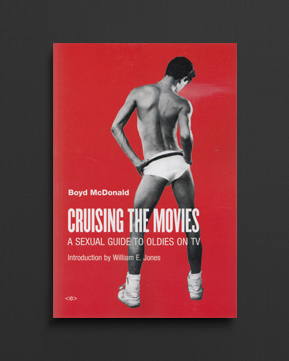
Introduction by William E. Jones
Ronnie Reagan’s bizarre legs are sufficient reason to watch John Loves Mary (1949), a picture so ordinaire it needs this bizarre touch. When the faces in this historic still from the Museum of Modern Art are cropped, Reagan could pass for a butch lez from the Women’s Army Corps who is about to put the old make on a fluff (Patricia Neal).
—from Cruising the Movies
Cruising the Movies was Boyd McDonald’s “sexual guide” to televised cinema, originally published by the Gay Presses of New York in 1985. The capstone of McDonald’s prolific turn as a freelance film columnist for the magazine Christopher Street, Cruising the Movies collects the author’s movie reviews of 1983–1985. This new, expanded edition also includes previously uncollected articles and a new introduction by William E. Jones.
Eschewing new theatrical releases for the “oldies” once common as cheap programing on independent television stations, and more interested in starlets and supporting players than leading actors, McDonald casts an acerbic, queer eye on the greats and not-so-greats of Hollywood’s Golden Age. Writing against the bleak backdrop of Reagan-era America, McDonald never ceases to find subversive, arousing delights in the comically chaste aesthetics imposed by the censorious Motion Picture Production Code of 1930–1968.
Better known as the editor of the Straight to Hell paperback series—a compendia of real-life sexual stories that is part pornography, part ethnography—McDonald in his film writing reveals both his studious and sardonic sides. Many of the texts in Cruising the Movies were inspired by McDonald’s attentive inspection of the now-shuttered MoMA Film Stills Archive, and his columns gloriously capture a bygone era in film fandom. Gay and subcultural, yet never reducible to a zany cult concern or mere camp, McDonald’s “reviews” capture a lost art of queer cinephilia, recording a furtive obsession that once animated gay urban life. With lancing wit, Cruising celebrates gay subculture’s profound embrace of mass culture, seeing film for what it is—a screen that reflects our fantasies, desires, and dreams.
About the Author
Boyd McDonald (1925–1993) was a writer for Time and IBM, a journalist, and founder and editor of Straight to Hell, a celebrated fanzine that bore a variety of subtitles, including “The Manhattan Review of Unnatural Acts” or “The New York Review of Cocksucking.”
2010, English
Softcover, 112 pages, 15.2 x 21.6 cm
Published by
Afterall / London
The MIT Press / Massachusetts
$49.00 - Out of stock
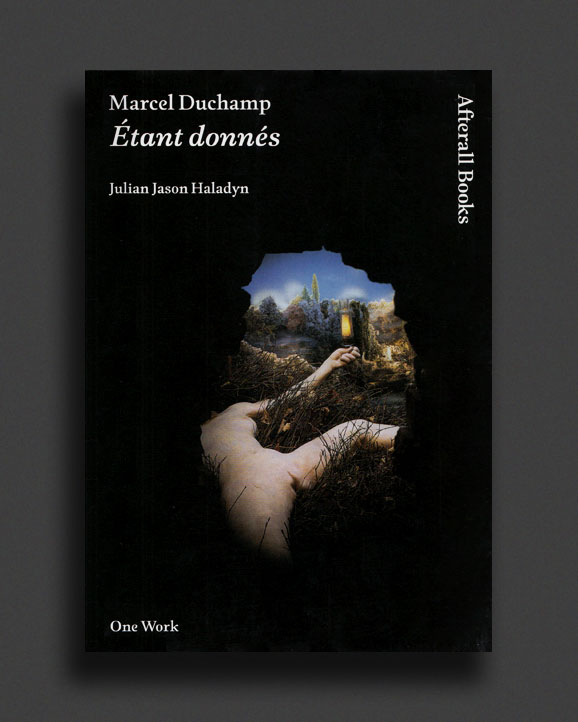
Duchamp's famous last artwork, seen not as a summation of his work but as an invitation to endless interpretation.
Following Marcel Duchamp's death in 1968, the Philadelphia Museum of Art stunned the art world by unveiling a project on which he had been working secretly for twenty years, long after he had supposedly given up art for chess. Installed by the museum curators with the assistance of Duchamp's widow Teeny and stepson Paul Matisse, Étant donnés (known in English as Given, or, literally, “being given”) consists of a small room with a locked wooden door; through a peephole can be seen a landscape of trees, with a naked female figure at the front, her arm outstretched, holding a lamp. In this illustrated study, Julian Haladyn argues that Duchamp's intention in this final piece was similar to Raymond Roussel's in How I Wrote Certain of My Books: not, as many have maintained, to provide a neat summation of his career, but the opposite—to open his artwork (which he had made sure was fully represented in the Philadelphia Museum of Art's collection) to endless interpretation and reinterpretation. Duchamp's engagement with his legacy (by orchestrating first the purchase of his work and then the donation of those purchases to the museum) is a significant historical development in the critical relationship between artists and the institution of art—a relationship that would later be further explored by such artists as Andrea Fraser and Michael Asher. Additionally, Haladyn sees that the staging of Étant donnés—especially the way that Duchamp forces viewers to become aware of the act of looking and their bodily presence in the gallery space—foreshadowed strategies used by Minimalism as well as installation, spectatorship, and institutional critique.
About the author:
Julian Jason Haladyn is a writer and artist based in Canada. He teaches at the University of Western Ontario.
2010, English
Softcover, 496 pages, 18 x 22 cm
Published by
The MIT Press / Massachusetts
$84.00 - In stock -
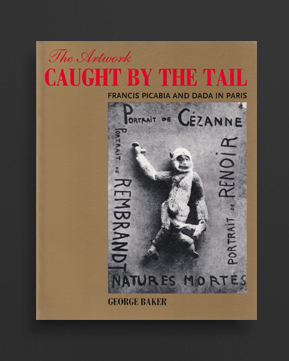
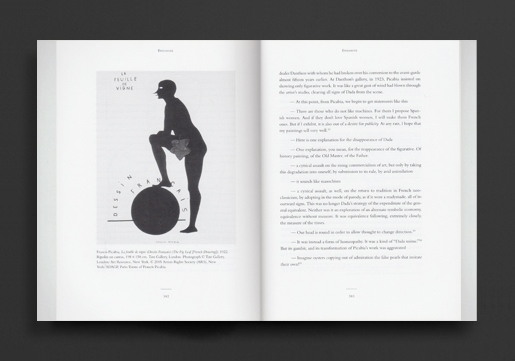
The artist Francis Picabia -- notorious dandy, bon vivant, painter, poet, filmmaker, and polemicist -- has emerged as the Dadaist with postmodern appeal, and one of the most enigmatic forces behind the enigma that was Dada.
In this first book in English to focus on Picabia's work in Paris during the Dada years, art historian and critic George Baker reimagines Dada through Picabia's eyes. Such reimagining involves a new account of the readymade -- Marcel Duchamp's anti-art invention, which opened fine art to mass culture and the commodity. But in Picabia's hands, Baker argues, the Dada readymade aimed to reinvent art rather than destroy it. Picabia's readymade opened art not just to the commodity, but to the larger world from which the commodity stems: the fluid sea of capital and money that transforms all objects and experiences in its wake. The book thus tells the story of a set of newly transformed artistic practices, claiming them for art history -- and naming them -- for the first time: Dada Drawing, Dada Painting, Dada Photography, Dada Abstraction, Dada Cinema, Dada Montage. Along the way, Baker describes a series of nearly forgotten objects and events, from the almost lunatic range of the Paris Dada "manifestations" to Picabia's polemical writings; from a lost work by Picabia in the form of a hole (called, suggestively, The Young Girl) to his "painting" Cacodylic Eye, covered in autographs by luminaries ranging from Ezra Pound to Fatty Arbuckle. Baker ends with readymades in prose: a vast interweaving of citations and quotations that converge to create a heated conversation among Picabia, Andre Breton, Tristan Tzara, James Joyce, Friedrich Nietzsche, Jacques Derrida, Gilles Deleuze, and others. Art history has never looked like this before. But then again, Dada has never looked like art history.
George Baker is Assistant Professor of Art History at the University of California, Los Angeles, and an editor at October magazine and October Books. He is the editor of James Coleman (MIT Press) and a frequent contributor to Artforum.
2013, English
Softcover, 400 pages, 17.5 x 22.6 cm
Published by
October Books / New York
The MIT Press / Massachusetts
$84.00 - Out of stock
In 1964, at age forty, Marcel Broodthaers (1924-1976) proclaimed that his years of writing poetry—of being "good for nothing," in his words—were over, and a brief but dazzling artistic career began. Considered a founding father of institutional critique, Broodthaers created hundreds of objects, books, films, photographs and exhibitions, including a "fictive" museum of modern art that evolved from an installation in his own home to a massive exhibition of over three hundred works representing eagles. In The Absence of Work, Rachel Haidu argues that all of Broodthaers's art is defined by its relationship to language. His perception of his poetry's "failure to communicate" led him to explore in his art the noncommunicative, nontransparent uses of language. By showing us the ways in which language is instrumentalized across society—used for its efficiency despite the complexities it introduces into communication—Broodthaers shows us how we imagine language to work and points us to its hidden operations.
Haidu's characterization of Broodthaers's contribution to institutional critique represents a major departure from the usual approach to this movement. Considering the wider political implications of his work, including its reflections on national identity and democracy, she explores how they derive from historical references and examines his work's relationships to the works of other contemporary artists. With The Absence of Work, one of the first monographs on Broodthaers in English, Haidu demystifies a crucial and enigmatic figure in postwar and contemporary art.
About the Author:
Rachel Haidu is Associate Professor in the Department of Art and Art History and the Graduate Program in Visual and Cultural Studies at the University of Rochester.
2018, English
Softcover, 272 pages, 17.8 x 25.4 cm
Published by
Yale University Press / New Haven
$59.00 - Out of stock
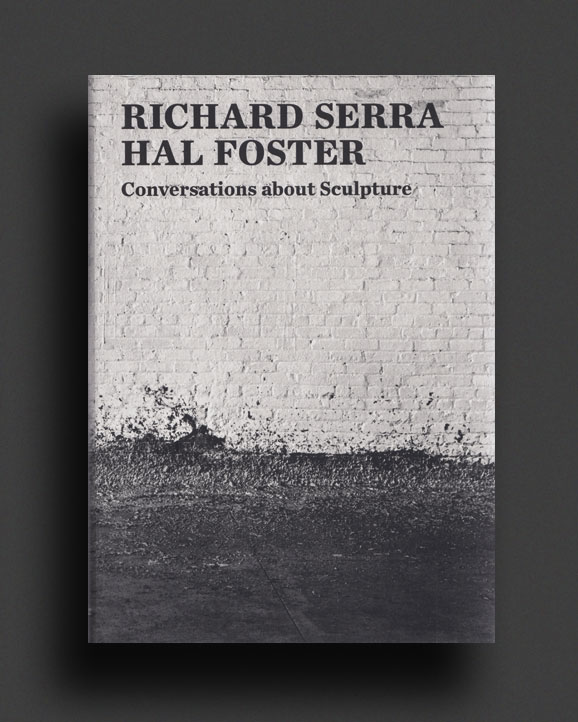
“The rhythm of the body moving through space has been the motivating source of most of my work.”—Richard Serra
Drawn from talks between celebrated artist Richard Serra and acclaimed art historian Hal Foster held over a fifteen-year period, this volume offers revelations into Serra’s prolific six-decade career and the ideas that have informed his working practice. Conversations about Sculpture is both an intimate look at Serra’s life and work, with candid reflections on personal moments of discovery, and a provocative examination of sculptural form from antiquity to today. Serra and Foster explore such subjects as the artist’s work in steel mills as a young man; the impact of music, dance, and architecture on his art; the importance of materiality and site specificity to his aesthetic; the controversies and contradictions his work has faced; and his belief in sculpture as experience. They also discuss sources of inspiration—from Donatello and Brancusi to Japanese gardens and Machu Picchu—revealing a history of sculpture across time and culture through the eyes of one of the medium’s most brilliant figures.
Introduced with an insightful preface by Foster, this probing dialogue is beautifully illustrated with duotone images that bring to life both Serra's work and his key commitments.
Richard Serra is an internationally renowned artist, best known for steel sculptures that engage audiences through material, form, structure, and site specificity. He has exhibited widely since his first solo exhibition in 1966 and has work publicly sited in Amsterdam, London, San Francisco, Bilbao, Berlin, Qatar, and elsewhere. Serra has been awarded the title of Chevalier de l’Ordre national de la Legion d’honneur and the J. Paul Getty Medal, among many other honors. Hal Foster is Townsend Martin, Class of 1917, Professor of Art and Archaeology at Princeton University. An award-winning author, his publications include Bad New Days, The Art-Architecture Complex, and The Return of the Real.
1974, English
Softcover (w. dust jacket), 88 pages, 19 x 24 cm
1st Edition, Out of print title / used / very good
Published by
New York University Press / New York
The Press of the Nova Scotia College of Art and Design / Halifax
$150.00 - Out of stock
Rare first edition copy of the highly influential Steve Reich book of texts,"Writings About Music", first published in 1974 by The Press of the Nova Scotia College of Art and Design.
In the mid-1960s, American composer Steve Reich radically renewed the musical landscape, along with La Monte Young, Terry Riley, and Philip Glass, to pioneer what became minimal music. These early Reich works, characterised by a relentless pulse and static harmony, focused single-mindedly on the process of gradual rhythmic change. Throughout his career, Reich has continued to reinvigorate the music world, drawing from a wide array of classical, popular, sacred, and non-western idioms. His works reflect the steady evolution of an original musical mind.
In 1974 Reich published the book Writings About Music, containing essays on his philosophy, aesthetics, and musical projects written between 1963 and 1974. The book features, amongst many other texts and studies, Reich's 1968 essay "Music as a Gradual Process," widely considered one of the most influential pieces of music theory in the second half of the 20th century.
Very Good copy in original dust jacket. Light wear and tanning.
2017, English
Softcover, 207 pages, 20 x 13 cm
Published by
Manchester University Press / Manchester
$39.00 - Out of stock
By Marion Schmid
Chantal Akerman is widely acclaimed as one of cinema's boldest visionaries.
A towering figure in women's and feminist film-making, she produced a diverse and intensely personal body of work ranging from minimalist portraits of the everyday to exuberant romantic comedies, and from documentaries and musicals to installation art. This book traces the director's career at the crossroads between experimental and mainstream cinema, contextualising her work within the American avant-garde of the 1970s, European anti-naturalism, feminism and the post-modern aesthetics.
While offering an in-depth analysis of her multi-faceted film style, it also stresses the social and ethical dimension of her work, especially as regards her representation of marginal groups and her exploration of exilic and diasporic identities. Particular attention is given to the inscription of the Holocaust and of Jewish memory in her films.
From Manchester University Press' French Film Directors series, edited by Diana Holmes and Robert Ingram.
2019, English
Softcover, 272 pages, 12.5 x 19.5 cm
Published by
Sternberg Press / Berlin
$59.00 - Out of stock
Texts by Defne Ayas, Ute Meta Bauer, Nicolas Bourriaud, Carolyn Christov-Bakargiev, Joshua Decter, Clémentine Deliss, Irmgard Emmelhainz, Boris Groys, Hou Hanru, María Belén Sáez De Ibarra, Maria Lind, Pi Li, Steven Henry Madoff, Antonia Majaca, Gabi Ngcobo, Hans Ulrich Obrist, Jack Persekian With Alison Carmel Ramer, Terry Smith, Nato Thompson, Mick Wilson, Brian Kuan Wood, Tirdad Zolghadr
With the global rise of a politics of shock driven by authoritarian regimes that subvert the rule of law and civil liberties, what paths to resistance, sanctuary, and change can cultural institutions offer? What about activism in curatorial practice? In this book, more than twenty leading curators and thinkers about contemporary art present powerful case studies, historical analyses, and theoretical perspectives that address the dynamics of activism, protest, and advocacy. What unfolds in these pages is a vast range of ideas—a tool kit for cultural producers everywhere to engage audiences and face the fierce political challenges of today and tomorrow.
What about Activism? is based on the summit “Curatorial Activism and the Politics of Shock,” which took place at the School of Visual Arts, New York. Along with expanded versions of the talks given at the conference, the book includes a transcript of a roundtable discussion moderated by Steven Henry Madoff and Brian Kuan Wood among the speakers and students in the MA Curatorial Practice program at SVA.
2017, English
Softcover, 196 pages, 13 x 21 cm
Published by
Sternberg Press / Berlin
$59.00 $35.00 - Out of stock
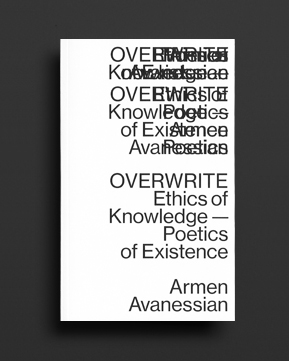
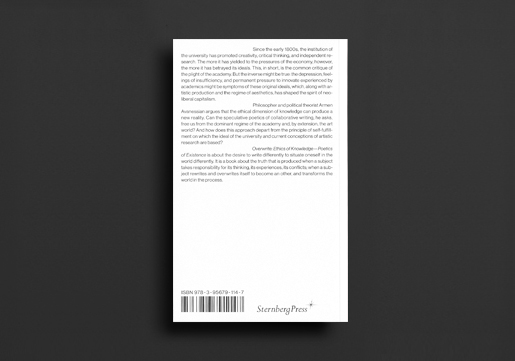
Since the early 1800s, the institution of the university has promoted creativity, critical thinking, and independent research. The more it has yielded to the pressures of the economy, however, the more it has betrayed its ideals. This, in short, is the common critique of the plight of the academy. But the inverse might be true: the depression, feelings of insufficiency, and permanent pressure to innovate experienced by academics might be symptoms of these original ideals, which, along with artistic production and the regime of aesthetics, has shaped the spirit of neoliberal capitalism.
Philosopher and political theorist Armen Avanessian argues that the ethical dimension of knowledge can produce a new reality. Can the speculative poetics of collaborative writing, he asks, free us from the dominant regime of the academy and, by extension, the art world? And how does this independence differ from the principle of self-fulfillment on which the ideal of the university and current conceptions of artistic research are based?
Overwrite: Ethics of Knowledge—Poetics of Existence is about the desire to write differently to situate oneself in the world differently. It is a book about the truth that is produced when a subject takes responsibility for its thinking, its experiences, its conflicts; when a subject rewrites and overwrites itself to become an other, and transforms the world in the process.
Translated by Nils F. Schott
Design by HelloMe
2017, English
Softcover, 128 pages, 13.2 x 18 cm
Published by
Sternberg Press / Berlin
$57.00 $30.00 - Out of stock
Strange how many déjà vus you have here.
How might we conceive of comradeship with a present that is increasingly predetermined by algorithms and governed by techno-politics? Armen Avanessian chronicles his stay in Miami as an experiment in writing about our times of individual optimization and digitization. An inventory of the self in the second person—and a philosopher’s reflections in the infinity pool of the art world—this book reckons with a new time complex as well as the aesthetics and infrastructures of the contemporary. Can we advance from conditions of financial feudalism and climate change to a progressive poetics of the digital? The city of tropical noir becomes a case study for a geopolitics and economics of the future—Miami vision, Miami vacation, Miami fiction, Miamification.
“A philosophical-autobiographical laboratory, this book tests ways of thinking and writing beyond run-of-the-mill academic talk. Avanessian doesn’t visit the library; he flies to Miami and goes swimming. Moving between the beach and his desk, he pens seventeen philosophical diary entries in which the hot topics of the day are tackled associatively and with tremendous precision: Trump, big data, capitalism, surveillance, immigration, Facebook, Twitter, etc.”
—Georg Dickmann, Spike
“Avanessian’s reflections, somewhere between diary and soliloquy, essay and travelogue, always take their starting point from the concrete, the phenomenological—for example, the flickering screens in the airplane cabin or the social networks that are first to appear on your computer screen in the morning. Digital profiles and algorithms raise one of the book’s defining themes on the first day: our temporality. In the 'geological science fiction' of Miami, the time complex finds its place.”
—Tom Wohlfarth, Der Freitag
“Avanessian has coined the time-philosophical metaphor of a future that is now 'from the future.' Not only preemptive personalization, but also preemptive policing, preemptive war as well as the war on terror, and the preemptive operations of the financial markets shape our future by anticipating it. And not only has the future largely fallen into the hands of reactionary political agendas and particular economic interests, but as the recursive and poetic character of these players' actions is passed off as the prognosis of a predestined future, our consciousness is clouded against a real existing future openness. The future has been 'automated' and thus distorted.
The political impulse of Miamification is to insist again and again on the recursive and poetic character of the future; to wrest ourselves of the present deterioration of twitter trances and live logs; and to take up the fight for the future in the future, that is, in the mode of preemption.”
—Daniel Falb, Textem
Translated by Nicholas Grindell
Design by HelloMe
2017, English
Softcover, 296 pages, 17 x 25 cm
Published by
Occasional Papers / London
$42.00 $25.00 - In stock -
This second print run of About Graphic Design (initially printed in 2012) features a comprehensive selection of writings by renowned graphic designer, graphic design theorist and historian Richard Hollis, this densely illustrated book includes a wide array of interviews, essays, letters, articles and lectures. It covers virtually everything regarding the field and history of graphic design, from Soviet revolutionary posters and designers in Nazi Germany to Penguin book covers, New 'New' Typography, Max Bill and Nicolete Gray. Various texts on Robin Fior, Theo Ballmer, Uwe Loesch and Pierre Faucheux, among many others, add depth to this very thoroughly researched story of graphic design.
2010, English
Softcover, 96 pages, 14 x 23 cm
Published by
Occasional Papers / London
$39.00 - Out of stock
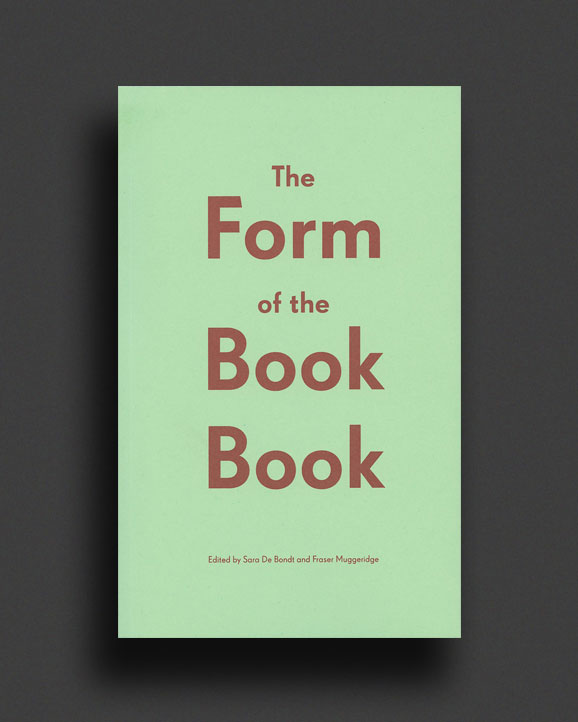
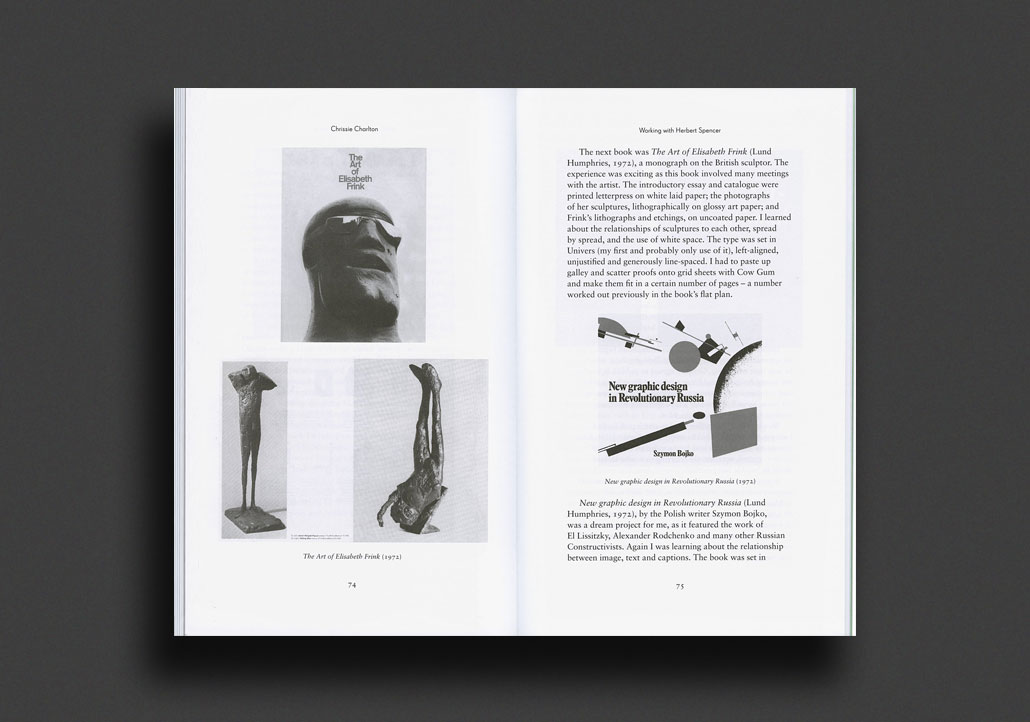
Now it in its third printing (green cover), The Form of the Book Book brings together essential essays on the book – its history, present, and possible futures – by preeminent graphic designers and graphic design theorists/historians including Chrissie Charlton, Catherine de Smet, James Goggin, Jennie Eneqvist, Roland Früh & Corina Neuenschwander, Sarah Gottlieb, Richard Hollis and Armand Mevis. In a nod to Jan Tschichold’s famous collection of essays The Form of the Book, first published in 1975, this book offers in-depth analyses of key moments in the history of book design in order to better imagine the many forms the book will take, and is already taking, in our digital age.
1964, English
Softcover (staple-bound), 16 pages, 18.5 x 24.5 cm
1st Edition, Out of print title / Used*,
Published by
Melbourne University Film Society / Melbourne
$15.00 - Out of stock
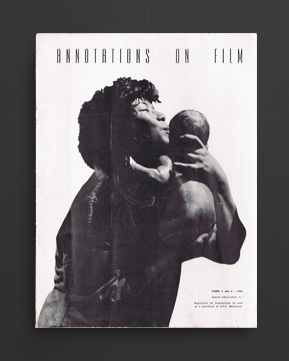
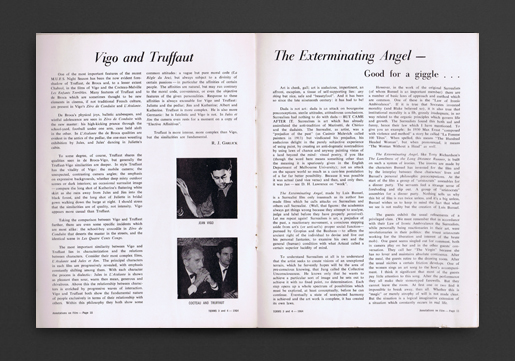
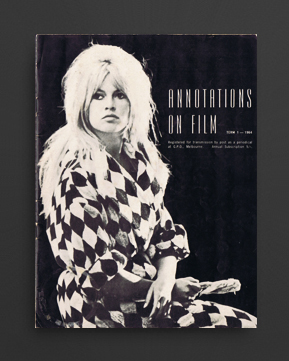
Annotations on Film was a journal published by the Melbourne University Film Society to accompany their film programme, aimed at presenting films in Melbourne in the medium they were created and providing a critical reading of them for an independent, membership-based film society. Starting in 1948, the Melbourne University Film Society (MUFS) changed its name to Cinémathèque in 1984 and continues to this day in Melbourne. A written accompaniment to their programme can be seen in the form of the current-day online journal Senses of Cinema.
This scarce early journal from the Melbourne University Film Society features writings on Roberto Rossellini's Vanina Vanini, Kon Ichikawa's Kagi, Georges Fraju's Spotlight on Murder, Blake Edwards' Breakfast at Tiffany's, Nicholas Ray's The Savage Innocents, Alfred Hitchcock's The Lady Vanishes, E. A. Dupont's Variety, Robert Flaherty's Moana, Jean Vigo, François Truffaut, Luis Buñuel's The Exterminating Angel, and more, and was published in Melbourne in 1964.
1964, English
Softcover (staple-bound), 20 pages, 18.5 x 24.5 cm
1st Edition, Out of print title / Used*,
Published by
Melbourne University Film Society / Melbourne
$15.00 - Out of stock
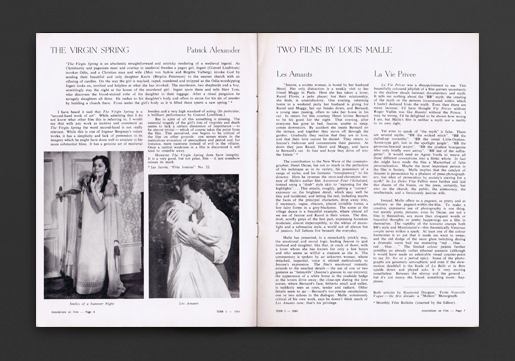
Annotations on Film was a journal published by the Melbourne University Film Society to accompany their film programme, aimed at presenting films in Melbourne in the medium they were created and providing a critical reading of them for an independent, membership-based film society. Starting in 1948, the Melbourne University Film Society (MUFS) changed its name to Cinémathèque in 1984 and continues to this day in Melbourne. A written accompaniment to their programme can be seen in the form of the current-day online journal Senses of Cinema.
This scarce early journal from the Melbourne University Film Society features writings on Ingmar Bergman, Louis Malle, Marcel Camus' Black Orpheus, Jules Dassin's Rififi, Jack Clayton's The Innocents, Frank Tashlin, Alain Resnais' Hiroshima, Mon Amour, Sergei Eisenstein's Battleship Potemkin, Orson Welles' Citizan Kane, and more, and was published in Melbourne in 1964.
2015, English
Softcover, 316 pages,10.8 x 17.8 cm
Published by
Sternberg Press / Berlin
$45.00 - Out of stock
Edited by Julieta Aranda, Brian Kuan Wood, Anton Vidokle
Contributions by Julian Assange, Franco “Bifo” Berardi, Benjamin Bratton, Diedrich Diederichsen, Keller Easterling, Rasmus Fleischer, Joana Hadjithomas and Khalil Joreige, Ursula K. Heise, Brian Kuan Wood, Bruno Latour, Geert Lovink, Patricia MacCormack, Metahaven, Gean Moreno, Hans Ulrich Obrist, Jon Rich, Hito Steyerl
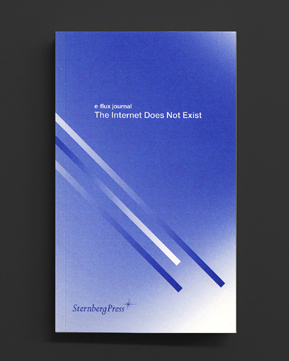
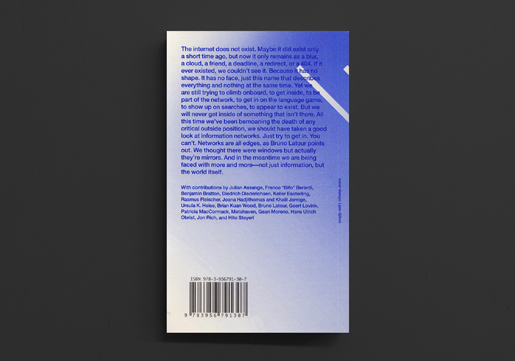
The internet does not exist. Maybe it did exist only a short time ago, but now it only remains as a blur, a cloud, a friend, a deadline, a redirect, or a 404. If it ever existed, we couldn't see it. Because it has no shape. It has no face, just this name that describes everything and nothing at the same time. Yet we are still trying to climb onboard, to get inside, to be part of the network, to get in on the language game, to show up on searches, to appear to exist. But we will never get inside of something that isn’t there. All this time we’ve been bemoaning the death of any critical outside position, we should have taken a good look at information networks. Just try to get in. You can’t. Networks are all edges, as Bruno Latour points out. We thought there were windows but actually they’re mirrors. And in the meantime we are being faced with more and more—not just information, but the world itself.
Series edited by Julieta Aranda, Brian Kuan Wood, Anton Vidokle
Design by Jeff Ramsey, front cover design by Liam Gillick
2017, English
Softcover, 360 pages, 10.8 x 17.8 cm
Published by
Sternberg Press / Berlin
$57.00 - Out of stock
Edited by Julieta Aranda, Brian Kuan Wood, Stephen Squibb, Anton Vidokle
With contributions by Paul Chan, Keti Chukhrov, Cluster, Antke Engel, Hu Fang, Brian Kuan Wood, Lee Mackinnon, Chus Martínez, Tavi Meraud, Fred Moten and Stefano Harney, Elizabeth A. Povinelli and Kim Turcot DiFruscia, Paul B. Preciado, Martha Rosler, Virginia Solomon, Jalal Toufic, Jan Verwoert, Slavoj Žižek
It is often said that we no longer have an addressee for our political demands. But that’s not true. We have each other. What we can no longer get from the state, the party, the union, the boss, we ask for from one another. And we provide. Lacan famously defined love as giving something you don’t have to someone who doesn’t want it. But love is more than a YouTube link or a URL. Love’s joy is not to be found in fulfillment, it is to be found in recognition: even though I can never return what was taken away from you, I may be the only person alive who knows what it is.
In our present times—post-human, post-reality, or maybe pre-internet, post-it, pre-collapse, pre-fabricated by algorithms—what does love have to do with it? Since 2009, need and care and desire and admiration have been cross-examined, called as witness, put on parole, and made the subject of caring inquiry by e-flux journal authors. These writings have now been collected to form this comprehensive volume.
Series edited by Julieta Aranda, Brian Kuan Wood, Stephen Squibb, Anton Vidokle
Design by Jeff Ramsey, front cover design by Liam Gillick
2020, English
Paperback, 504 pages, 17.8cm x 17.8cm
Published by
Walther König / Köln
$88.00 - Out of stock
From poems to statements and lectures, the writings of post-minimalist virtuoso Richard Tuttle possess the same instinct for materiality and delicacy as his art.
Over the course of more than 50 years, American artist Richard Tuttle (born 1941) has invented new possibilities of scale and humour, sometimes adding almost nothing to an object, at other times recklessly heaping up his materials or pressing them to the brink of compositional incoherence. With just the same sensitivity, humour and nuance, Tuttle has also composed numerous texts, mostly in response to specific commissions and publications. Tuttle does not approach writing as a transparent communicative medium, but rather as simply another material.
Beautifully designed, as Tuttle books always are, A Fair Sampling brings together a selection of the artist's writings published in exhibition catalogs, books and newspapers, as well as hitherto unpublished texts. These include not only reflections and commentaries on art and drawing, but also tributes to artist friends, including various texts on Agnes Martin, travel notes, poems and lectures that Tuttle delivered in various institutions.
1975, English
Hardcover (w. dust jacket), 144 pages, 25.5 x 19.5 cm
1st Edition, Out of print title / used / very good
Published by
Faber & Faber / London
$100.00 - Out of stock
First hardcover edition of The Music Of Stockhausen by Jonathan Harvey (1939–2012). This crucial and comprehensive book from 1975 looks at and decrypts the early work of German composer Karlheinz Stockhausen (1928–2007). "This important and innovatory study of Stockhausen's music makes available for the first time systematic analyses of his works. Dr Jonathan Harvey comprehensively surveys the periods into which Stockhausen's music falls, from the early post-Webern works and group-form works, of which 'Gruppen' is a famous and brilliant example, to the subsequent moment-form works and the later period, which includes text-works (like 'Aus den sieben Tagen') and works like 'Hymnen', in which the composer would seem to be communicating on a quasi-mystical level. This is an indispensable book for the serious student of twentieth-century music and for anyone else with a lively interest in the new forms and sonorities of the preset day, their technology and the creative doctrines which gave birth to them." - from the dust jacket.
Includes a full list of compositions up to 1974, an appendix on Mantra (1970), a bibliography and full discography. The most comprehensive of published works on Stockhausen.
Very Good copy with good dj, some edge-wear and tanning.
2020, English
Softcover, 206 pages, 12 x 19 cm
Published by
Uh Books / Amsterdam
KW Institute for Contemporary Art / Berlin
$24.00 - Out of stock
The nineteenth issue of ‘F.R.DAVID’ is edited by Will Holder and Paula Abbott, and will serve as a reader for “We can still see the horizon (and it’s curved)”, a summer residency in Scotland led by the editors. It includes a surprising array of contributions from writer Jorge Luis Borges, journalist and writer Italo Calvino, composer Hugo Cole, literary critic and theorist Barbara Herrnstein Smith, percussionist Milford Graves, philosopher Michel Serres, novelist and essayist Wilson Harris, poet Bernadette Mayer, composer and music theorist Harry Partch, pianist and poet Cecil Taylor, and several others.
2020, English
Softcover, 100 pages, 22 x 30 cm
Published by
UTS School of Architecture / Sydney
Post-Post / Sydney
$49.00 - In stock -
Melbourne, Sydney: References, Reflections and Remarks explores the decades-long architectural controversy between Melbourne and Sydney, inviting the protagonists of each city's architecture to weigh in.
Guest edited by Guillermo Fernández-Abascal and Urtzi Grau, it includes texts by AKAS, Baracco+Wright, Andrew Burns, Angelo Candalepas, Scott Colman, Edition Office, Philip Goad, Tristen Hardwood, Mike Hewson, Luisa King, Andrew Leach, Carey Lyon, Desley Luscombe, Ian Moore, Other Architects, panovscott, Andrew Power, Howard Raggatt, Gerard Reinmuth, Sibling Architecture, Richard Stampton, Naomi Stead, Luke Tipene, TRIAS, Leon Van Schaik and John Wardle.
Melbourne, Sydney; References, Reflections and Remarks is number one in a new series published by University of Technology, Sydney's School of Architecture: UTS da Waranada gunyamara bamulmara/ Architecture and Landscape at UTS and is published in collaboration with the design collective Post-Post-.
2020, English
Softcover, 60 pages, 20.5 x 30 cm
Published by
UTS School of Architecture / Sydney
Post-Post / Sydney
$32.00 - In stock -
Quality, Control examines the relationship between bureaucratic architectural practice and quality in architectural design and construction through the work of the Government Architects Office New South Wales. Conceived at the UTS School of Architecture, the publication repackages the catalogue from the exhibition held at UTS Tower in November 2019. Quality, Control is a curated set of reproduced drawings, physical models, constructed mockups, commissioned photographs and commentaries. The publication also includes texts by Charles Rice, Urtzi Grau and Guillermo Fernández-Abascal, Jack Cooper and Luka Enström-Gibb. These documents are used to reanimate archival records and bring awareness to an at risk portfolio of public architecture; an architecture built by public architects for the public.
Quality, Control is a project by Jack Cooper and Luka Enström-Gibb with Guillermo Fernández-Abascal.
Limited edition of 200 copies.
2019, English
Softcover, 212 pages, 25 x 20 cm
Published by
Sternberg Press / Berlin
Muzeum Sztuki / Łódź
$69.00 $40.00 - Out of stock
With contributions by Joanna Bednarek, Ines Doujak & John Barker, Zofia Łapniewska, Raqs Media Collective, Joanna Sokołowska, Marina Vishmidt, Siona Wilson
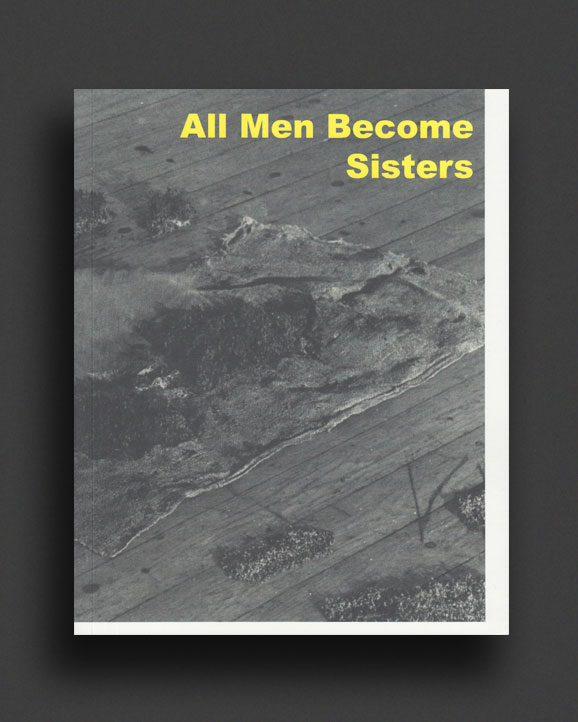
This book is both a record and a theoretical expansion of the exhibition “All Men Become Sisters” at the Muzeum Sztuki in Łódź. Dedicated to the manifestation of sisterhood in art from the 1970s until today, the exhibition and the publication focus on art that resonated with feminist perspectives on work, production, and reproduction. “Sisterhood” is a key concept and an impulse to work with imagination; built on the foundations of second-wave criticism of the patriarchal exploitation of women, it poses questions about the future from the perspective of feminist economics and ethics of care.
Artists: Berwick Street Film Collective, Pauline Boudry/Renate Lorenz, Sarah Browne, Agnieszka Brzeżańska, Jan Czapliński, Ines Doujak in cooperation with John Barker, Köken Ergun, Hackney Flashers, Krystyna Gryczełowska, Margaret Harrison, Elżbieta Jabłońska, Birgit Jürgenssen, Irena Kamieńska, Ola Kozioł/Suavas Levy, Nalini Malani, Marge Monko, Şükran Moral, Teresa Murak, Letícia Parente, Agnieszka Piksa, Marcin Polak, Aleksandra Polisiewicz, Raqs Media Collective, R.E.P., Alicja Rogalska, Daniel Rumiancew, Jadwiga Sawicka, Allan Sekula, Jo Spence, Rosemarie Trockel, Agnès Varda, Mona Vǎtǎmanu/Florin Tudor, Zorka Wollny
Curator: Joanna Sokołowska
Copublished with Muzeum Sztuki, Łódź
Design by Monika Zawadzki, Olo Jean-Claude Zawadzki
2015, English
Softcover, 196 pages, 10.8 x 17.8 cm
Published by
Sternberg Press / Berlin
$39.00 $10.00 - Out of stock
With a foreword by Keller Easterling
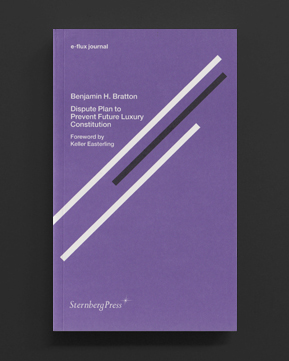
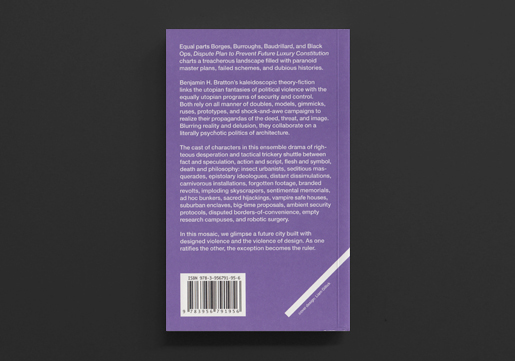
Equal parts Borges, Burroughs, Baudrillard, and Black Ops, Dispute Plan to Prevent Future Luxury Constitution charts a treacherous landscape filled with paranoid master plans, failed schemes, and dubious histories.
Benjamin H. Bratton’s kaleidoscopic theory-fiction links the utopian fantasies of political violence with the equally utopian programs of security and control. Both rely on all manner of doubles, models, gimmicks, ruses, prototypes, and shock-and-awe campaigns to realize their propagandas of the deed, threat, and image. Blurring reality and delusion, they collaborate on a literally psychotic politics of architecture.
The cast of characters in this ensemble drama of righteous desperation and tactical trickery shuttle between fact and speculation, action and script, flesh and symbol, death and philosophy: insect urbanists, seditious masquerades, epistolary ideologues, distant dissimulations, carnivorous installations, forgotten footage, branded revolts, imploding skyscrapers, sentimental memorials, ad-hoc bunkers, sacred hijackings, vampire safe-houses, suburban enclaves, big-time proposals, ambient security protocols, disputed borders-of-convenience, empty research campuses, and robotic surgery.
In this mosaic we glimpse a future city built with designed violence and the violence of design. As one ratifies the other, the exception becomes the ruler.
Design by Jeff Ramsey
2016, English
Softcover, 252 pages, 11.2 x 17.8 cm
Published by
Sternberg Press / Berlin
$62.00 $15.00 - Out of stock
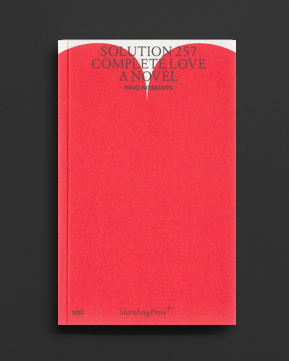
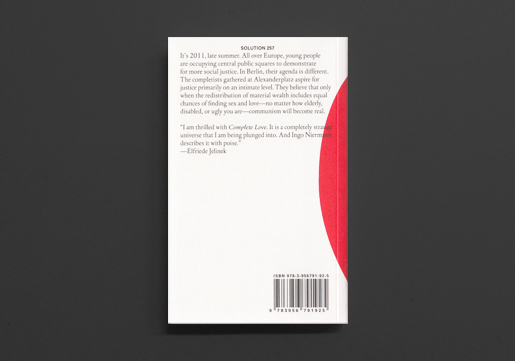
"I am being plunged into. And Ingo Niermann describes it with poise.”
—Elfriede Jelinek, author of The Piano Teacher
Ingo Niermann’s provocative new novel imagines a Berlin alternative to the activist occupation of public spaces in 2011. The completists, gathered at Alexanderplatz, aspire for justice through intimacy. They believe that only when the redistribution of material wealth includes equal chances of finding sex and love—no matter how elderly, disabled, or ugly you are—communism will become real. This volume of the Solution series is a revolutionary erotic fiction.
Karl, a freelance writer and young stay-at-home dad in Berlin, first dismisses the completists as a bunch of as fringe weirdos and burnouts. But over the course of one summer day, his outlook changes after a series of encounters both virtual and physical. Contacting him on Skype, an attractive and mysterious stranger tells him she has only three hours left to live. Their video chat starts a game of seduction and intrigue and turns into a vivid debate on the decorum of modern relationships and fantasies. Instead of satiating him sensually and emotionally, Ava enlightens him about the real completist challenge of justice through sex and intimacy. Karl must join ranks with disabled sex-rights activist Oskar Patzer before his day’s journey—culminating in an improvised public orgy prefaced by a choreographed group performance—can indicate the possibilities for completing love.
For further completist efforts, go to www.thearmyoflove.net.
Translated by Amy Patton
Solution Series edited by Ingo Niermann
Design by Zak Group