World Food Books' programme is largely produced on Kulin Nation land. We acknowledge the Wurundjeri people of the Kulin Nation as the first and continuing custodians of this land, and pay respect to their Elders past, present, and emerging.
World Food Books is an arts and special interests bookshop in Naarm / Melbourne. Founded in 2010, World Food Books is devoted to the presentation of a rotating, hand-selection of international art, design, literary and counterculture publications with an emphasis on the anti-traditional, the experimental, the avant-garde, the heretic, the marginal.
Presenting new titles alongside rare and out-of-print books, catalogues and journals spanning the fields of modern and contemporary art, design, photography, illustration, film, literature, poetry, cultural theory, philosophy, sexuality, popular and underground culture in its many radical forms, World Food Books wishes to encourage adventurous, thoughtful and open-minded reading, looking, writing, and exchange of publishing and ideas, both current and historical.
As well as our bookshop, located in Melbourne's historical Nicholas Building, all of our inventory is available internationally via our online mail-order service.
World Food Books semi-regularly co-ordinates "Occasions", a programme of exhibits and events at the bookshop and in partnership with other hosts (such as museums and art galleries) that develop out of the activities, relationships and content of the bookshop itself.
World Food Books
The Nicholas Building
37 Swanston Street
Room 5, Level 6
Melbourne 3000
Australia
SHOP HOURS:
Thu–Fri 12–6, Sat 12–5
WEB-SHOP OPEN 24/7
World Food Books
Postal Address:
PO Box 435
Flinders Lane
Victoria 8009
Australia
Art
Theory / Essay
Architecture / Interior
Graphic Design / Typography
Photography
Fashion
Eros
LGBTQ+
Fiction / Poetry
Weird / Speculative / Science Fiction / Horror
Transgressive / Visceral / Abject
Symbolism / Decadence / Fin de siècle
Film / Video
Painting
Sculpture / Installation
Performance / Dance / Theater
Drawing
Sound / Music
Curatorial
Group Shows / Collections
Periodicals
Out-of-print / Rare
Posters / Ephemera / Discs
Signed Books
World Food Books Gift Voucher
World Food Book Bag
Australian Art
Australian Fiction
Australian Science Fiction / Speculative Fiction
Australian Poetry
Australian Photography
Japanese Photography
Conceptual Art
Minimal Art
Dada
'Pataphysics / Oulipo
Fluxus
Concrete Poetry
Pop Art
Surrealism
Arte Povera
Arte Informale / Haute Pâte / Tachism
Nouveau Réalisme / Zero / Kinetic
Situationism / Lettrism
Collage / Mail Art / Xerox Art
Art Brut / Folk / Visionary / Fantastic
Illustration / Graphic Art / Bandes Dessinées
Furniture
Italian Radical Design / Postmodernism
Textiles
Ceramics / Glass
Counterculture
Protest / Revolt
Philosophy
Psychoanalysis
Anthropology
Anarchism
Socialism / Anarchism / Communism / Capitalism
Literary Theory / Semiotics / Language
Feminism / Women's Studies
Gender Studies / Sexuality
Anthropology
Fetishism / BDSM
Drugs / Psychedelia
Crime / Violence
Animal Rights / Veganism
Occult / Esoterica
Ecology / Earth / Alternative Living
Whole Earth / Crafts
All prices in AUD (Australian dollars)
Pick-Ups
Pick-up orders can be collected in our bookshop during opening hours after order date. Please collect any Pick-up orders within 2 weeks of ordering as we have limited storage space. Orders will be released back into stock if not collected within this time. No refunds can be made for pick-ups left un-collected. If you cannot make it in to the bookshop in this time-frame, please choose postage option.
Return Policy
All sales are final. We do accept returns (for refund or exchange) for items received in error. All our orders are packed with special care using heavy-duty padding and cardboard book-mailers or bubble mailers (for smaller books), using reinforcement where required. We cannot take responsibility for any lost, stolen or damaged parcels.
Insurance
Should you wish to insure your package, please email us directly after placing your order and we can organise this at a small extra expense. Although all standard/express tracked packages are very safe and dependable, we cannot take responsibility for any lost, stolen or damaged parcels. We recommend insurance on valuable orders.
Interested in selling your old books, catalogues, journals, magazines, comics, fanzines, ephemera? We are always looking for interesting, unusual and out-of-print books to buy. We only buy books in our fields of interest and specialty, and that we feel we can resell.
We base these prices on desirability, market value, in-print prices, condition and our current stock levels. We offer cash, store credit, and can take stock on consignment. All
about 25% of the price we expect to get when we sell them, or 30% in store credit. We base these prices on desirability, market value, in-print prices, condition and our current stock levels.
Sell your books any day of the week. You can drop them off and return later. If you have a lot of books, we can visit your Sydney home.
We buy books that we feel we can resell. We offer about 25 % of the price we expect to get when we sell them, or 30% in store credit. We base these prices on desirability, market value, in-print prices, condition and our current stock levels.
Philadelphia Wireman
03 August - 01 September, 2018
World Food Books is proud to announce our next Occasion, the first presentation of sculptures by Philadelphia Wireman in Australia.
The Philadelphia Wireman sculptures were found abandoned in an alley off Philadelphia’s South Street on trash night in 1982. Their discovery in a rapidly-changing neighbourhood undergoing extensive renovation, compounded with the failure of all attempts to locate the artist, suggests that the works may have been discarded after the maker’s death. Dubbed the "Philadelphia Wireman" during the first exhibition of this work, in 1985, the maker’s name, age, ethnicity, and even gender remain uncertain. The entire collection totals approximately 1200 pieces, all intricately bound together with tightly-wound heavy-gauge wire (along with a few small, abstract marker drawings, reminiscent both of Mark Tobey and J.B. Murry). The dense construction of the work, despite a modest range of scale and materials, is singularly obsessive and disciplined in design: a wire armature or exoskeleton firmly binds a bricolage of found objects including plastic, glass, food packaging, umbrella parts, tape, rubber, batteries, pens, leather, reflectors, nuts and bolts, nails, foil, coins, toys, watches, eyeglasses, tools, and jewellery.
Heavy with associations—anthropomorphic, zoomorphic, and socio-cultural responses to wrapped detritus—the totemic sculptures by Philadelphia Wireman have been discussed in the context of work created to fulfil the shamanistic needs of alternative religions in American culture. Curators, collectors, and critics have variously compared certain pieces to sculpture from Classical antiquity, Native American medicine bundles, African-American memory jugs, and African fetish objects. Reflecting the artist’s prolific and incredibly focused scavenging impulse, and despite—or perhaps enhanced by—their anonymity, these enigmatic objects function as urban artefacts and arbiters of power, though their origin and purpose is unknown. Philadelphia Wireman, whatever their identity, possessed an astonishing ability to isolate and communicate the concepts of power and energy through the selection and transformation of ordinary materials. Over the course of the past two decades, this collection has come to be regarded as an important discovery in the field of self-taught art and vernacular art.
Presented in collaboration with Fleisher-Ollman Gallery, Philadelphia, and Robert Heald, Wellington.
Susan Te Kahurangi King
02 February - 10 March, 2018
Susan Te Kahurangi King (24 February 1951 - ) has been a confident and prolific artist since she was a young child, drawing with readily available materials - pencils, ballpoint pens and felt-tip markers, on whatever paper is at hand. Between the ages of four and six Susan slowly ceased verbal communication. Her grandparents William and Myrtle Murphy had developed a special bond with Susan so they took on caring responsibilities for extended periods. Myrtle began informally archiving her work, carefully collecting and storing the drawings and compiling scrapbooks. No drawing was insignificant; every scrap of paper was kept. The King family are now the custodians of a vast collection containing over 7000 individual works, from tiny scraps of paper through to 5 meter long rolls.
The scrapbooks and diaries reveal Myrtle to be a woman of great patience and compassion, seeking to understand a child who was not always behaving as expected. She encouraged Susan to be observant, to explore her environment and absorb all the sights and sounds. Myrtle would show Susan’s drawings to friends and people in her community that she had dealings with, such as shopkeepers and postal workers, but this was not simply a case of a grandmother’s bias. She recognised that Susan had developed a sophisticated and unique visual language and sincerely believed that her art deserved serious attention.
This was an unorthodox attitude for the time. To provide some context, Jean Dubuffet coined the term Art Brut in 1945 to describe work created by self-taught artists – specifically residents of psychiatric institutions and those he considered to be visionaries or eccentrics. In 1972 Roger Cardinal extended this concept by adopting the term Outsider Art to describe work made by non-academically trained artists operating outside of mainstream art networks through choice or circumstance. Susan was born in Te Aroha, New Zealand in 1951, far from the artistic hubs of Paris and London that Dubuffet and Cardinal operated in. That Myrtle fêted Susan as a self-taught artist who deserved to be taken seriously shows how progressive her attitudes were.
Susan’s parents Doug and Dawn were also progressive. Over the years they had consulted numerous health practitioners about Susan’s condition, as the medical establishment could not provide an explanation as to why she had lapsed into silence. Dawn educated herself in the field of homeopathy and went on to treat all twelve of her children using these principles – basing prescriptions on her observations of their physical, mental and emotional state.
Doug was a linguist with an interest in philosophy who devoted what little spare time he had to studying Maori language and culture. To some extent their willingness to explore the fringes of the mainstream made them outsiders too but it was their commitment to living with integrity and their respect for individuality that ensured Susan’s creativity was always encouraged.
Even though Susan’s family supported her artistic pursuits, some staff in schools and hospitals saw it as an impediment to her assimilation into the community and discouraged it in a variety of ways. Her family was not always aware of this and therefore did not fully understand why Susan stopped drawing in the early 1990s. However, rather than dwell on the challenges that Susan faced in pursuit of her artistic practice, they prefer to highlight her achievements. In 2008 Susan began drawing again in earnest, after an almost 20 year interruption, and her work is now shown in galleries around the world.
Susan grew up without television and has been heavily influenced by the comics she read as a child. She is absolutely fearless in the appropriation of recognizable characters, such as Donald Duck and Mickey Mouse, in her work. She twists their limbs, contorts their faces, compresses them together, blends them into complex patterned backgrounds - always imbuing them with an incredible energy. Although Susan often used pop culture characters in her work they are not naive or childlike. These are drawings by a brilliant self-taught artist who has been creating exceptional work for decades without an audience in mind.
Mladen Stilinović
"Various Works 1986 - 1999"
02 February 16 - September 10, 2016
Various works 1986 - 1999, from two houses, from the collections of John Nixon, Sue Cramer, Kerrie Poliness, Peter Haffenden and Phoebe Haffenden.
Including: Geometry of Cakes (various shelves), 1993; Poor People’s Law (black and white plate), 1993; White Absence (glasses, ruler, set square, silver spoon, silver ladel with skin photograph and wooden cubes), 1990-1996; Exploitation of the Dead (grey and red star painting, wooden painting, black spoon with red table, red plate), 1984-1990; Money and Zeros (zero tie, paintings made for friends in Australia (Sue, John, Kerrie), numbers painting), 1991-1992; Words - Slogans (various t-shirts) - “they talk about the death of art...help! someone is trying to kill me”, “my sweet little lamb”, “work is a disease - Karl Marx”; Various artist books, catalogues, monographs, videos; Poster from exhibition Insulting Anarchy; "Circular" Croatian - Australian edition; Artist book by Vlado Martek (Dostoyevsky); more.
Thanks to Mladen Stilinović and Branka Stipančić.
Jonathan Walker
Always Will Need To Wear Winter Shirt Blue + Ochre Small Check Pattern
21 August - 21 September, 2015
Untitled
I am not a great reader of poetry but I always return to the work of Melbourne poet, Vincent Buckley (1925- 1988). Perhaps I find his most tantalising piece to be not a finished poem but a fragment left on a scrap of paper discovered on his desk after the poet’s death.
The poetry gathers like oil
In the word-core, and spreads
It has its music meet,
Its music is in movement.
This fragment is more the shell left behind from a volatile thought than a finished poem. I find the last two lines honest but awkward whereas the first two lines work like an arrow. Most likely he could not find a resolution so it was left. Still, in its present form, it remains an eloquent testimony to the ultimate failure of a medium to express mobile thought and sensation, in Buckley’s case, through verbal language. It’s an important matter because this is something all artists have to deal with regardless of the medium.
I have never written a poem, however, I am forever copying fragments from books on paper scraps in a vain effort to fix certain notions in my head. At first, they function as bookmarks that are sometimes returned to when I open the book. But before long, as they accumulate, they fall out littering the table interspersed with A4 photocopies, bills, books and medications.
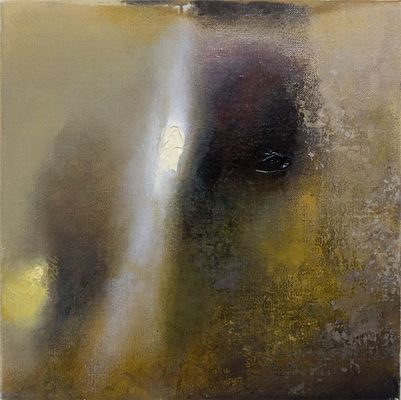
To return to Buckley’s fragment, the first two lines very much evoke how I paint nowadays. As you age, detail diminishes and patches of light become more luminous and float. I feel the most honest way of dealing with this is by smearing the oil paint on the canvas with the fingers and working close-up, blind. Only if the patches coalesce into an approaching image can the work gain a life.
-
Jonathan Walker was born in Melbourne, Australia and brought up on a dairy farm in Gippsland. In the 1970’s he studied painting at RMIT and won the Harold Wright Scholarship to the British Museum, London. During the 1980’s he exhibited at Pinacotheca Gallery, Richmond and had work shown at the NGV and Heidi City Art Gallery. Over the same period he designed the cover for the “Epigenesi” LP by Giancarlo Toniutti, Italy and conducted a mail exchange work with Achim Wollscheid, Germany. The work with artists through the post resulted in an article published in the bicentenary issue of Art and Australia 1988. He showed in artist run spaces such as WestSpace in the 90’s and 2000’s, and until 2012, taught painting at Victoria University, which is where we (Colleen Ahern and Lisa Radford) as organisers of the exhibition, among many others, had the privilege of being his student.
Walker’s knowledge was imparted to students through the careful selection of music, literature, and artists found in books that he himself had ordered for the library. Walker’s strategy was the generosity of sharing his vast knowledge with references specific to each student and their context.
Walker’s paintings share a similar focus and intimacy.
This exhibition presents a small selection of recent paintings alongside a publication that includes Walker’s writing. Observational and analytical, Walker’s work is a type of material notation — the time of day, colour and how it is blended, the both specific and fleeting location of a reflection on lino or the question of whether a chair leg should be included in a painting.
Please join us on Friday August 21 between 6-8pm to celebrate the opening of the exhibition.
Curated by Colleen Ahern and Lisa Radford.
B. Wurtz
Curated by Nic Tammens
March 26 - April 4, 2015
B.Wurtz works from a basement studio in his home on Manhattan’s Lower East Side.
This local fact is attested to by the plastic shopping bags and newsprint circulars that appear in his work. As formal objects, they don’t make loud claims about their origins but nonetheless transmit street addresses and places of business from the bottom of this long thin island. Like plenty of artists, Wurtz is affected by what is local and what is consumed. His work is underpinned by this ethic. It often speaks from a neighborhood or reads like the contents of a hamper:
“BLACK PLUMS $1.29 lb.”
“Food Bazaar”
“USDA Whole Pork Shoulder Picnic 99c lb.”
“RITE AID Pharmacy, with us it’s personal.”
“H. Brickman & Sons.”
“Sweet Yams 59c lb."
Most of the work in this exhibition was made while the artist was in residence at Dieu Donne, a workshop dedicated to paper craft in Midtown. Here Wurtz fabricated assemblages with paper and objects that are relatively lightweight, with the intention that they would be easily transportable to Australia. This consideration isn’t absolute in Wurtz’s work, but was prescriptive for making the current exhibition light and cheap. Packed in two boxes, these works were sent from a USPS post office on the Lower East Side and delivered to North Melbourne by Australia Post.
Wurtz appears courtesy of Metro Pictures, New York.
Thanks to Rob Halverson, Joshua Petherick, Sari de Mallory, Matt Hinkley, Helen Johnson, Fayen d'Evie, Ask Kilmartin, Lisa Radon, Ellena Savage, Yale Union, and "Elizabeth".
John Nixon
"Archive"
December 15 - January 20, 2014
The presentation of John Nixon's archive offered a rare showcase of this extensive collection of the artist's own publications, catalogues, posters, ephemera, editions and more, from the mid 1980s onwards, alongside a selection of his artworks.
Organized by John Nixon, Joshua Petherick and Matt Hinkley.
<a href=http://wfb.public-office.info/artist/john-nixon>All titles by John Nixon
"Habitat"
at Minerva, Sydney (organised by Joshua Petherick and Matt Hinkley)
November 15 - December 20, 2014
Lupo Borgonovo, Janet Burchill & Jennifer McCamley,
Lewis Fidock, HR Giger, Piero Gilardi, Veit Laurent Kurz,
Cinzia Ruggeri, Michael E. Smith, Lucie Stahl, Daniel Weil, Wols
Press Release:
“...It contained seven objects. The slender fluted bone, surely formed for flight, surely from the wing of some large bird. Three archaic circuitboards, faced with mazes of gold. A smooth white sphere of baked clay. An age-blackened fragment of lace. A fingerlength segment of what she assumed was bone from a human wrist, grayish white, inset smoothly with the silicon shaft of a small instrument that must once have ridden flush with the surface of the skin - but the thing’s face was seared and blackened.”
William Gibson, “Count Zero”, 1986
"Autumn Projects Archive"
Curated by Liza Vasiliou
March 6 - March 15, 2014
World Food Books, in conjunction with the Virgin Australia Melbourne Fashion Festival 2014, presented the Autumn Projects archive, consisting of a selection of early examples in Australian fashion with a particular interest in collecting designers and labels from the period beginning in the 1980’s, who significantly influenced the discourse of Australian Fashion.
Curated by Liza Vasiliou, the exhibition provided a unique opportunity to view pieces by designers Anthea Crawford, Barbara Vandenberg, Geoff Liddell and labels CR Australia, Covers, Jag along with early experimental collage pieces by Prue Acton and Sally Browne’s ‘Fragments’ collection, suspended throughout the functioning World Food Books shop in Melbourne.
H.B. Peace
presented by CENTRE FOR STYLE
November 14, 2013
"Hey Blinky, you say chic, I say same"
Anon 2013
H.B. Peace is a clothing collaboration between great friends Blake Barns and Hugh Egan Westland. Their pieces explore the divergences between 'character’ and ‘personality’ in garments....etc
Special Thanks to Joshua Petherick and Matt Hinkley of WFB and Gillian Mears
and a Very Special Thank you to Audrey Thomas Hayes for her shoe collaboration.
Janet Burchill & Jennifer McCamley
"Aesthetic Suicide"
May 10 - June 8, 2013
The first of our occasional exhibitions in the World Food Books office/shop space in Melbourne, "Aesthetic Suicide" presented a body of new and older works together by artists Janet Burchill & Jennifer McCamley, including videos, prints, a wall work, and publications.
During shop open hours videos played every hour, on the hour.
2013, English
Hardcover, 184 pages, 19 x 24 cm
Published by
Spurbuchverlag / Germany
$40.00 - In stock -
Few people are indifferent to Joseph Beuys and Rudolf Steiner - although it is decades since their death. One is a political clown and artistic agitator, the other an eccentric and esoteric philosopher. This is a judgement that many people still hold fast. Death Keeps Me Awake does not only show the intimate connection between Joseph Beuys' and Rudolf Steiner's thought. It also reveals the internal consistency and depth of their thinking, their determination and seriousness, and this, despite all the humour apparent in many of their works and statements. This book shows clearly that they attempt nothing less than to change the world.
2010, English
Softcover, 96 pages, 13.8 x 21.6 cm
Published by
Clairview Books / Forest Row
$28.00 - Out of stock
'If we want to achieve a different society where the principle of money operates equitably, if we want to abolish the power money has developed over people historically, and position money in relationship to freedom, equality and fraternity ...then we must elaborate a concept of culture and a concept of art where every person must be an artist...' - Joseph Beuys. The world of finance exerts a huge influence over our lives, being responsible for economic turmoil and seemingly interminable peaks and crashes. Whereas money was once a simple means of exchange, today it is a commodity in itself and as 'capital' exerts power over individuals, degrading work to tradable labour. Can we find a new way of understanding money today, so that we can begin to overcome its destructive aspects? In November 1984, a remarkable discussion took place at the Meeting House in Ulm, Germany. It featured the radical artist Joseph Beuys, two professors (of Financial Sciences and Political Economics) and a banker. Beuys would appear to be out of place among these heavyweight academics, professionals and authors.
But rather than being intimidated by his fellow panellists, Beuys - also a social and political activist - demonstrates his groundbreaking thinking on the subject, and his ability to bring fresh perspectives. Here for the first time is a transcript of this debate, together with analysis by Ulrich Rosch, which will be of equal interest to artists, economists and spiritual seekers.
2007, English
Softcover, 128 pages, 19 x 25 cm
Published by
Clairview Books / Forest Row
$43.00 - In stock -
Joseph Beuys' work continues to influence and inspire practitioners and thinkers all over the world, in areas from organisational learning, direct democracy and new money forms to new art pedagogies and ecological art practices. Here, in dialogue with Volker Harlan - a close colleague, whose own work also revolves around understandings of substance and sacrament that are central to Beuys - the deeper motivations and insights underlying 'social sculpture', Beuys' expanded conception of art, are illuminated. His profound reflections, complemented with insightful essays by Volker Harlan, give a sense of the interconnectedness between all life forms, and the foundations of a path towards an ecologically sustainable future.
2017, English
Hardcover (w. dust jacket), 312 pages, 18 x 23 cm
Published by
University of Chicago Press / Chicago
$87.00 $60.00 - Out of stock
Art historian Darby English is celebrated for working against the grain and plumbing gaps in historical narratives. In this book, he explores the year 1971, when two exhibitions opened that brought modernist painting and sculpture into the burning heart of black cultural politics: Contemporary Black Artists in America, shown at the Whitney Museum of American Art, and The DeLuxe Show, an integrated abstract art exhibition presented in a renovated movie theater in a Houston ghetto.
1971 takes an insightful look at many black artists' desire to gain freedom from overt racial representation, as well as their and their advocates' efforts to further that aim through public exhibitions. Amid calls to define a "black aesthetic" or otherwise settle the race question, these experiments with modernist art favored cultural interaction and instability. Contemporary Black Artists in America highlighted abstraction as a stance against normative approaches, while The DeLuxe Show positioned abstraction in a center of urban blight.
The power and social importance of these experiments, English argues, came partly from color's special status as a racial metaphor and partly from investigations of color that were underway in formalist American art and criticism. From Frank Bowling to Virginia Jaramillo, Sam Gilliam to Peter Bradley, black modernists and their supporters rose above the demand to represent or be represented, compromising nothing in their appeals for racial reconciliation. At a time when many debates about identity sought closure, these exhibitions offered openings; when icons and slogans touted simple solutions, they chose difficulty. But above all, as English demonstrates in this provocative book, these exhibitions and artists responded with optimism rather than cynicism to the surrounding culture's preoccupation with color.
2019, English
Softcover, 80 pages, 18 x 12 cm
Published by
Self-Published / Sydney
$22.00 - Out of stock
THE Ls consider writing itself
how words can move
subjectivities and their
relationships to each other
astonishment is
wonder is moving to the
unthinkable is
Judy Annear is an independent researcher and writer based in Victoria on Dja Dja Wurrung land, never ceded, and Honorary (Principal Fellow) School of Culture and Communication, University of Melbourne. Her fields of research include literary feminisms, and modern and contemporary art practice underpinned by a focus on periods of major technological change. Amongst other projects, she is currently researching Allan Sekula’s first visit to Australia in 1980, as a guest of Working Papers On Photography, Melbourne. Her recent publications include a small book of experimental texts The Ls 2019, as well as contributions to Photomedia Now/Everything is Interesting’ in Art Monthly Australasia October 2018, and an encyclopaedic history, The Photograph and Australia 2015. She has published extensively in journals such as Art Network, Art+Text (member of the editorial committee 1987–94), Photofile, Art Monthly, Art & Australia, Art Asia Pacific, LIKE, ART-iT Asia, Broadsheet, 4A Papers, eyeline. In 1980, she was a member of the collective that wrote and (largely) funded the feminist arts magazine LIP (1976–84).
2016, English
Hardcover, 240 pages, 21.6 x 26.7 cm
Published by
University of California Press / Berkley
$110.00 $80.00 - Out of stock
The Uses of Photography examines a network of California artists whose experiments with photography during the turbulent, transitional decade of the 1970s opened the medium to a profusion of new strategies and subjects. Working within the framework of Conceptual art, these artists introduced urgent social issues and themes of everyday life into the seemingly neutral territory of photography, producing works that took on hybrid forms, from books and postcards to video and text-and-image installations.
Tracing a crucial history of photoconceptual practice, The Uses of Photography focuses on an artistic community that formed in and around the young UC San Diego, founded in 1960, and its visual arts department, founded in 1968. Artists such as Eleanor Antin, John Baldessari, Allan Kaprow, Martha Rosler, and Allan Sekula employed photography and its expanded forms as a means to dismantle modernist autonomy, to contest notions of photographic truth, and to engage in political critique. The work of these artists shaped emergent accounts of postmodernism in the visual arts and their influence is felt throughout the global contemporary art world today. Published in association with the Museum of Contemporary Art San Diego.
Edited by Jill Dawsey
Texts by Judith Rodenbeck, Benjamin Young , David Antin, and Pamela M. Lee
Artists include David Antin, Eleanor Antin, John Baldessari, Jean-Pierre Gorin, Helen Mayer Harrison, Newton Harrison, Louis Hock, Allan Kaprow, Fred Lonidier, Babette Mangolte, Martha Rosler, Allan Sekula, Lorna Simpson, Elizabeth Sisco, Phel Steinmetz, Carrie Mae Weems.
2016, English
Softcover, 292 pages, 12 x 19 cm
Published by
Sternberg Press / Berlin
$54.00 - Out of stock
Painting beyond Itself
The Medium in the Post-medium Condition
Isabelle Graw, Ewa Lajer-Burcharth (Eds.)
Contributions by Carol Armstrong, Benjamin H. D. Buchloh, Sabeth Buchmann, René Démoris, Isabelle Graw, David Joselit, Jutta Koether, Ewa Lajer-Burcharth, Jacqueline Lichtenstein, Julie Mehretu, Matt Saunders, Amy Sillman
In response to recent developments in pictorial practice and critical discourse, Painting beyond Itself: The Medium in the Post-medium Condition seeks new ways to approach and historicize the question of the medium. Reaching back to the earliest theoretical and institutional definitions of painting, this book—based on a conference at Harvard University in 2013—focuses on the changing role of materiality in establishing painting as the privileged practice, discourse, and institution of modernity. Myriad conceptions of the medium and its specificity are explored by an international group of scholars, critics, and artists. Painting beyond Itself is a forum for rich historical, theoretical, and practice-grounded conversation.
Institut für Kunstkritik Series
Design by Surface
2020, English
Softcover, 300 pages, 14 x 21.1 cm
Published by
Campus Verlag / Frankfurt
$96.00 $60.00 - Out of stock
The Value of Critique casts its gaze on the two dominant modes of passing judgment in art--critique and value (or evaluation). The act of critique has long held sway in the world of art theory but has recently been increasingly abandoned in favor of evaluation, which advocates alternate modes of judgment aimed at finding the intrinsic "value" of a given work rather than picking apart its intentions and relative success. This book's contributors explore the relationship between these two practices, finding that one cannot exist with the other. As soon as a critic decides an object is worthy enough of their interest and time to critique it, they have imbued that object with a certain value. Similarly, theories of value are typically marked by a critical impetus: as much as critique takes part in the construction of evaluations, bestowing something with value can then trigger critiques. Assembling essays from an international array of authors, this book is the first to put value, critique, and artistic labor in conversation with one another, making clear just how closely all three are related.
2019, English
Hardcover (w. plastic dust-jacket), 200 pages, 16.5 x 24 cm
Published by
Lars Müller / Zürich
$62.00 - Out of stock
X-Ray Architecture explores the enormous impact of medical discourse and imaging technologies on the formation, representation and reception of twentieth-century architecture. It challenges the normal understanding of modern architecture by proposing that it was shaped by the dominant medical obsession of its time: tuberculosis and its primary diagnostic tool, the X-ray.
Modern architecture and the X-ray were born around the same time and evolved in parallel. While the X-ray exposed the inside of the body to the public eye, the modern building unveiled its interior, dramatically inverting the relationship between private and public. Architects presented their buildings as a kind of medical instrument for protecting and enhancing the body and psyche.
Beatriz Colomina traces the psychopathologies of twentieth-century architecture—from the trauma of tuberculosis to more recent disorders such as burn-out syndrome and ADHD—and the huge transformations of privacy and publicity instigated by diagnostic tools from X-Rays to MRIs and beyond. She suggests that if we want to talk about the state of architecture today, we should look to the dominant obsessions with illness and the latest techniques of imaging the body—and ask what effects they have on the way we conceive architecture.
"After years of research, the book by Beatriz Colomina explores the impact of medical theories and diagnostic technologies on the formation, representation and reception of modern architecture." (Domus, 2019)
"A new theory of architecture is on the horizon." (Ashley Simone for Bomb Magazine, 2019)
"Beatriz Colomina is one of the most exciting voices in architecture, bringing her unfailing canny perspective to topics as broad as Playboy, domesticity, the bed, and even what it means to be human." (Archdaily, 2018)
2018, English
Softcover, 160 pages, 25 x 34 cm
Published by
Koenig Books / London
Stedelijk Museum / Amsterdam
$45.00 $20.00 - Out of stock
The work of Metahaven consists of filmmaking, writing, graphic design, and installations, and is united by interests in poetry, storytelling, digital superstructures, and propaganda. Central to their practice is the narration of technological and political conditions through aesthetically immersive plots. Told through a multitude of languages and genres, their work imagines alternate realities and potential filmmakers and artists who use investigative and speculative methods to pinpoint the urgencies of their time.
Designed by Metahaven and co-edited with curator and critic Karen Archey, PSYOP brings together contributions by many of today's leading practitioners in the fields of contemporary art, music, fashion, film, technology and poetry.
2019, English
Hardcover (w. dust jacket), 296 pages, 17.8 x 22.9 cm
Published by
The MIT Press / Massachusetts
$85.00 $70.00 - Out of stock
The Bauhaus (1919–1933) is widely regarded as the twentieth century's most influential art, architecture, and design school, celebrated as the archetypal movement of rational modernism and famous for bringing functional and elegant design to the masses. In Haunted Bauhaus, art historian Elizabeth Otto liberates Bauhaus history, uncovering a movement that is vastly more diverse and paradoxical than previously assumed. Otto traces the surprising trajectories of the school's engagement with occult spirituality, gender fluidity, queer identities, and radical politics. The Bauhaus, she shows us, is haunted by these untold stories.
The Bauhaus is most often associated with a handful of famous artists, architects, and designers—notably Paul Klee, Walter Gropius, László Moholy-Nagy, and Marcel Breuer. Otto enlarges this narrow focus by reclaiming the historically marginalized lives and accomplishments of many of the more than 1,200 Bauhaus teachers and students (the so-called Bauhäusler), arguing that they are central to our understanding of this movement. Otto reveals Bauhaus members' spiritual experimentation, expressed in double-exposed “spirit photographs” and enacted in breathing exercises and nude gymnastics; their explorations of the dark sides of masculinity and emerging female identities; the “queer hauntology” of certain Bauhaus works; and the role of radical politics on both the left and the right—during the school's Communist period, when some of the Bauhäusler put their skills to work for the revolution, and, later, into the service of the Nazis.
With Haunted Bauhaus, Otto not only expands our knowledge of a foundational movement of modern art, architecture, and design, she also provides the first sustained investigation of the irrational and the unconventional currents swirling behind the Bauhaus's signature sleek surfaces and austere structures. This is a fresh, wild ride through the Bauhaus you thought you knew.
2018, English
Softcover, 400 pages, 19.7 × 13 cm
Published by
Urbanomic / Cornwall
$64.00 - In stock -
An existential odyssey weaving together lived experience and theoretical insight, this startling autobiographical hyperfiction surveys and dissects a world where everything connects and global technological delirium is the norm.
The mediascapes of late capitalism reconfigure erotic responses and trigger primal aggression; under constant surveillance, we occupy simulations of ourselves, private estates on a hyperconnected globe; fictions reprogram reality, memories are rewritten by the future…
Fleeing the excesses of ’90s cyberculture, a young researcher sets out to systematically analyse the obsessively reiterated themes of a writer who prophesied the disorienting future we now inhabit. The story of his failure is as disturbingly psychotropic as those of his magus—J.G. Ballard, prophet of the post-postmodern, voluptuary of the car crash, surgeon of the pathological virtualities pulsing beneath the surface of reality.
Plagued by obsessive fears, defeated by the tedium of academia, yet still certain that everything connects to Ballard, his academic thesis collapses into a series of delirious travelogues, deranged speculations and tormented meditations on time, memory, and loss. Abandoning literary interpretation and renouncing all scholarly distance, he finally accepts the deep assignment that has run throughout his entire life, and embarks on a rogue fieldwork project: Applied Ballardianism, a new discipline and a new ideal for living. Only the darkest impulses, the most morbid obsessions, and the most apocalyptic paranoia, can uncover the technological mutations of inner space.
An existential odyssey inextricably weaving together lived experience and theoretical insight, this startling autobiographical hyperfiction surveys and dissects a world where everything connects and global technological delirium is the norm—a world become unmistakably Ballardian.
A brilliantly written genre mashup […] a wonderfully original mix of cultural theory, literary exegesis, travelogue and psychopathological memoir.
–PD Smith, The Guardian
A curious, unsettling text, full of weird obsessions and mysterious drives. Gleefully, on page after page, it tears up the conventions of literary criticism, autobiography, and fiction and spits them out the other side.
–Robert Barry, The Quietus
An intensely worked and engaged encounter. I admired the persistence, “honesty”, and elective madness. The storms carried me through, all the way.
–Iain Sinclair
Applied Ballardianism is an astonishing book, part fictionalized hallucinatory memoir, part essential Ballard primer, all written in the style of the great man himself. Whether you’re new to JG Ballard or a lifelong fan, this is a thrilling read, cut through with equal parts black humor, cultural insight, and existential horror.
–Tim Maughan, author of Paintwork and Infinite Detail
In Applied Ballardianism, Simon Sellars has invented a genre all his own. But what is it, exactly? Postmodern autopathography? Rough Guide to the Desert of the Real? Notes toward a mental breakdown? The missing link between Ballard and Virilio, psychogeography and edgeland studies, Mad Max and Videodrome? One thing is certain: Applied Ballardianism is the only book you’ll need when you’re marooned on a concrete island, barricaded in a high rise that’s descending into anarchy, or cast away on some Enewetak of the unconscious.
–Mark Dery, author of I Must Not Think Bad Thoughts: Drive-By Essays on American Dread, American Dreams
At first, Simon Sellars appears to be a character in a JG Ballard novel. Then Ballard appears to be a character in a Simon Sellars novel. Then not just the characters but the whole setting and ambience appear to be at once Ballardian and Sellarsian. Then you finish the book and you seem to be a character in a novel the two of them conspired to write. And your perception of the world is never the same again.
–McKenzie Wark, author of A Hacker Manifesto, Gamer Theory, and Telesthesia
This is a book of critical epistemology, of questioning what it is we know, what it is we can know, about and through literary texts. The refracted fluorescence of our own critical passions and compulsions visits us outlandishly, like lights in the sky.
–Brendan Gillott, Minor Literatures
Simon Sellars is a writer and editor based in Melbourne, Australia.
2018, English
Softcover, 824 pages, 15.6 x 23.4 cm
Published by
Repeater Books / London
$56.00 - Out of stock
Edited by Darren Ambrose and with a foreword by Simon Reynolds, this comprehensive 800+ collection brings together the work of acclaimed blogger, writer, political activist and lecturer Mark Fisher (aka k-punk). Covering the period 2004 - 2016, the collection will include some of the best writings from his seminal blog k-punk; a selection of his brilliantly insightful film, television and music reviews; his key writings on politics, activism, precarity, hauntology, mental health and popular modernism for numerous websites and magazines; his final unfinished introduction to his planned work on "Acid Communism"; and a number of important interviews from the last decade.
Mark Fisher (11 July 1968 – 13 January 2017), also known as "k-punk", was a British writer, critic, cultural theorist, and teacher based in the Department of Visual Cultures at Goldsmiths, University of London. He initially achieved acclaim for his blogging as k-punk in the early 2000s, and was known for his writing on radical politics, music, and popular culture.
Fisher published several books, including the unexpected success Capitalist Realism: Is There No Alternative? (2009), and contributed to publications such as The Wire, Fact, New Statesman and Sight & Sound. He was also the co-founder of Zero Books, and later Repeater Books. He died in January 2017, shortly before the publication of his latest book The Weird and the Eerie (2017).
2010, English
Softcover, 197 pages, 15 x 23 cm
Published by
Solar Books / US
$44.00 - Out of stock
The Marquis de Sade (1740–1814), best known for his violent, erotic novels, such as 120 Days of Sodom and Justine, was also one of the key inspirational figures identified by André Breton in his Surrealist Manifestos. De Sade’s importance to the Surrealists and their close affiliates is reflected in the sheer volume of art and writing dedicated to, or inspired by, his life, philosophy, and writings. Sade: Sex and Death documents this body of Surrealist work, including many key texts and bizarre and erotic images never before assembled in one volume.
Included in Sade are more than fifty rarely seen transgressive illustrations by some of the most famous names associated with Surrealism, including Dalí, Hans Bellmer, Magritte, André Masson, and Man Ray. The book also features analytical texts by writers of the period such as Bataille, Breton, Bunuel, Eluard, and Klossowski. Also included is the first-ever English translation of “The Divine Marquis” by Guillaume Apollinaire, which was the first modernist appraisal of Sade and remains one of the best concise biographies of its subject, and “Sade and the Roman Noir” by scholar Maurice Heine, in which Heine posits Sade as inventor of the gothic novel. Putting the works in context is an extensive history by editor Candice Black that details the relationship between the Surrealists and Sade.
2020, English
Hardcover, 832 pages, 24 x 16.2 cm
Published by
Allen Lane / UK
$60.00 - Out of stock
'In this long-awaited, brilliant biography, Benjamin Moser shows us how to read Susan Sontag – and, by extension, her times – in the present, and reveals the extends and limits of her genius. His psychologically nuanced critical study is written with sangfroid and compassion.' Chris Kraus
The definitive portrait of one of the twentieth century's most towering figures: her writing and her radical thought, her public activism and her private face.
Susan Sontag was our last great literary star. Her brilliant mind, political activism and striking image made her an emblem of the seductions – and the dangers – of the twentieth-century world. Her writing on art and politics, feminism and her homosexuality, celebrity and style, medicine and drugs, Fascism and Freudianism, Communism and Americanism, reflected the conflicted meanings of a most conflicted word: modernity. Drawing on hundreds of interviews, featuring nearly one hundred images, never seen before – Sontag is the first book based on the writer's restricted archives. It is an indelible portrait of one of the twentieth century's greatest thinkers, who lived one of the century's most romantic – and most anguished – lives.
2019, English
Hardcover (w. dust jacket), 340 pages, 17.8 x 24 cm
Published by
The MIT Press / Massachusetts
$76.00 $69.00 - Out of stock
Independent publishing, art publishing, publishing as artistic practice, publishing counterculture, and the zine, DIY, and POD scenes have proliferated over the last two decades. So too have art book fairs, an increasingly important venue-or even medium-for art. Art publishing experienced a similar boom in the 1960s and 1970s, in response to the culture's "linguistic turn." Today, art publishing confronts the internet and the avalanche of language and images that it enables. The printed book offers artists both visibility and tangibility. Publishing Manifestos gathers texts by artists, authors, editors, publishers, designers, zinesters, and activists to explore this rapidly expanding terrain for art practice.
The book begins in the last century, with texts by Gertrude Stein, El Lissitsky, Oswald de Andrade, and Jorge-Luis Borges. But the bulk of the contributions are from the twenty-first century, with an emphasis on diversity, including contributions from Tauba Auerbach, Mariana Castillo Deball, Ntone Edjabe, Girls Like Us, Karl Holmqvist, Temporary Services, and zubaan. Some contributors take on new forms of production and distribution; others examine the political potential of publishing and the power of collectivity inherent in bookmaking. They explore among other topics, artists' books, appropriation, conceptual writing, non-Western communities, queer identities, and post-digital publishing. Many texts are reproduced in facsimile-including a handwritten "speculative, future-forward newspaper" from South Africa. Some are proclamatory mission statements, others are polemical self-positioning; some are playful, others explicitly push the boundaries. All help lay the conceptual foundations of a growing field of practice and theory.
Contributors
AND Publishing, Oswald de Andrade, Archive Books, Art-Rite, Rasheed Araeen, Tauba Auerbach, Michael Baers, Bibi Bakare-Yusuf, Ricardo Basbaum, Derek Beaulieu, Bernadette Corporation, Riccardo Boglione, Bombay Underground, Jorge Luis Borges, bpNichol, Kate Briggs, Broken Dimanche Press, Eleanor Vonne Brown, Urvashi Butalia, Ulises Carrion, Mariana Castillo Deball, Paul Chan, Chimurenga, Arpita Das, Anita Di Bianco, Guy Debord, Constant Dullaart, Craig Dworkin, Ntone Edjabe, Zenon Fajfer, Marina Fokidis, General Idea, Annette Gilbert, Girls Like Us, Gloria Glitzer, Marianne Groulez, Alex Hamburger, Karl Holmqvist, Lisa Holzer, Mahmood Jamal, Tom Jennings, Ray Johnson, David Jourdan, Sharon Kivland, Kione Kochi, Kwani?, Bruce LaBruce, Tan Lin, El Lissitzky, Alessandro Ludovico, Sara MacKillop, Steve McCaffery, Jonathan Monk, Simon Morris, Mosireen, Leon Munoz Santini, Takashi Murakami, Deke Nihilson, Aurelie Noury, Johnny Noxzema, Clive Phillpot, Michalis Pichler, Seth Price, Riot Grrrl, Carlos Soto Roman, Allen Ruppersberg, Joachim Schmid, Oliver Sieber, Paul Soulellis, Matthew Stadler, Gertrude Stein, Paul Stephens, Hito Steyerl, Mladen Stilinovic, Katja Stuke, Temporary Services, Nick Thurston, TIQQUN, Elisabeth Tonnard, V. Vale, Eric Watier, Erik van der Weijde, Lawrence Weiner, Eva Weinmayr, Jan Wenzel, Stephen Willats, Gil J Wolman, zubaan
Copublished with Miss Read: The Berlin Art Book Fair
2017, English
Softcover, 248 pages, 13.6 x 20.5 cm
Published by
Sternberg Press / Berlin
$54.00 - Out of stock
Quinn Latimer’s arresting writings find expression in literature and theory as well as contemporary art and its history. Moving from Southern California to central and southern Europe, crossing geographies and genres, her texts record specters and realities of culture, migration, and displacement, compounding the vagaries of rhetoric and poetics with those of personal history and criticism.
Composed in the space between the page and live performance, Latimer’s recent essays and poems collected here examine issues of genealogy and influence, the poverty and privilege of place, architecture’s relationship to language, and feminist economies of writing, reading, and art making. Shifting between written language and live address, between the needs of the internal and the external voice, Like a Woman retrieves the refrain, the litany, and the chorus, exploring their serial ecstasies and political possibilities.
Quinn Latimer is a poet and critic from California. Her writings and readings have been featured widely, including at Chisenhale Gallery, London; REDCAT, Los Angeles; and Qalandiya International, Ramallah/Jerusalem. Her books include Stories, Myths, Ironies, and Other Songs: Conceived, Directed, Edited, and Produced by M. Auder, coedited with Adam Szymczyk (Sternberg Press, 2014); Sarah Lucas: Describe This Distance (Mousse Publishing, 2013); Film as a Form of Writing, with Akram Zaatari (WIELS/Motto Books, 2013); and Rumored Animals (Dream Horse Press, 2012).
Latimer is editor in chief of publications for documenta 14.
Design by Sam de Groot
2018, English
Softcover, 383 pages, 11.5 x 17.5 cm
Published by
Sternberg Press / Berlin
Kunsthalle Wien / Vienna
$76.00 $59.00 - Out of stock
A single black-and white photograph taken by Babette Mangolte has come to epitomize New York's downtown art scene of the 1970s. The dancers performing Trisha Brown’s Roof Piece characterize perfectly the wild spirit of the time. Choreographed as an echo of movement unfolding across SoHo’s rooftops, the dancers mimed the chimneys, water towers, and fire escapes which surrounded them across that skyline. Influenced early on by Dziga Vertov’s Man with a Movie Camera and the work of Stan Brakhage and Jonas Mekas, Mangolte began studies in 1964 at the renowned École nationale de la photographie et de la cinematographie in Paris, one of the school’s first female students. In 1970, having become disillusioned with the film scene in France, Mangolte moved to New York and became involved in the avant-garde film and dance milieus of the Kitchen and the Anthology Film Archives.
Selected Writings, 1998–2015 is a collection of texts by Mangolte in which she reflects on her practice as a photographer and filmmaker and her collaborative work with filmmakers, artists, dancers, and choreographers. She provides insights into the techniques and methods she created as well as her relationships with notable collaborators such as Marina Abramović, Chantal Akerman, Trisha Brown, and Yvonne Rainer.
Copublished with Kunsthalle Wien on occasion of the exhibition “Babette Mangolte: I = Eye”
Edited by Luca Lo Pinto
Design by Enrico Bravi
2010, English
Hardcover, 312 pages, 12 x 18 cm
1st Edition, Out of print title / as new
Published by
Piet Zwart Institute / Rotterdam
Sternberg Press / Berlin
$180.00 - Out of stock
Quickly out-of-print and never reprinted, Tell Me What You Want, What You Really, Really Want is the first sought-after collection of writings by art critic Jan Verwoert. Published in collaboration with Piet Zwart Institute, Willem de Kooning Academy in Rotterdam, the book galvanizes central themes Verwoert has been developing in pursuit of a language to describe art’s transformative potential in conceptual, performative, and emotional terms. He analyzes the power of public gestures to constitute communities as well as the pressure to perform that governs the sphere of creative labor, in order to show how particular artists perform gestures and invoke community differently. Exploring the emotional power games that shape social relations, Verwoert looks for an alternative ethos of action and feeling, asking: How can a modernist approach to artistic form as a means of social critique be expanded to fully avow its subliminal affective undercurrents, and produce a pleasurably crooked form of criticality in art and writing?
“If we perceive the pressure to perform to be innately linked to the regimentation of options, to imagine the ethos of a resistant practice implies an exploration of the conditions, situations, and potentialites that lie beyond the option menus and the exclusivity of the yes and no. In artistic practice this dedication to imagining other ways to perform and other ways to enjoy consumption means claiming the imagination and the aesthetic experience as a field of collective agency where workable forms of resistance can be devised.”
First edition, As New.
2012, English
Softcover, 200 pages (27 b/w ill.), 10.8 x 17.8 cm
Published by
Sternberg Press / Berlin
$36.00 - Out of stock
In Hito Steyerl’s writing we begin to see how, even if the hopes and desires for coherent collective political projects have been displaced onto images and screens, it is precisely here that we must look frankly at the technology that seals them in. The Wretched of the Screen collects a number of Steyerl’s landmark essays from recent years in which she has steadily developed her very own politics of the image. Twisting the politics of representation around the representation of politics, these essays uncover a rich trove of information in the formal shifts and aberrant distortions of accelerated capitalism, of the art system as a vast mine of labor extraction and passionate commitment, of occupation and internship, of structural and literal violence, enchantment and fun, of hysterical, uncontrollable flight through the wreckage of postcolonial and modernist discourses and their unanticipated openings.
With a foreword by Franco ''Bifo'' Berardi
2019, English
Softcover, 256 pages, 13.7 x 20.3 cm
Published by
Semiotext(e) / Los Angeles
$44.00 - Out of stock
Essays and stories on fashion, art, and culture in the New York of the 2010s.
We were supposed to meet Rose McGowan at Café d'Alsace after the party, but she cancelled at the last minute. I saw on Twitter that she had been hit with a drug possession charge, which she insisted was a scheme to keep her Weinstein dirt quiet. I hadn't even read her Weinstein story… I still wanted to know that the articles were being published, and in large quantities, but reading stories of abuse and humiliation was as stupefying as a hangover. I didn't feel empowered; I only felt more hopeless. I wanted to watch the patriarchy go up in flames, but I wasn't excited about what was being pitched to replace it. If we got all of it out in the open, what would we have left? My fear was that guilt would destroy the classics and there'd be no one left to fuck. All movies would be as low-budget and as puritanical as the stuff they play on Lifetime, all of New York would look like a Target ad, every book or article would be a cathartic tell-all, and I'd be sexually frustrated but too ashamed to hook up with assholes, or even to watch porn.—from Sleeveless
Eve Babitz meets Roland Barthes in Sleeveless, Natasha Stagg's follow up to Surveys, her 2016 novel about internet fame. Composed of essays and stories commissioned by fashion, art, and culture magazines, Sleeveless is a scathing and sensitive report from New York in the 2010s. During those years, Stagg worked as an editor for V magazine and as a consultant, creating copy for fashion brands. Through these jobs, she met and interviewed countless industry luminaries, celebrities, and artists, and learned about the quickly evolving strategies of branding. In Sleeveless, she exposes the mechanics of personal identity and its monetization that propelled the narrator of Surveys from a mall job in Tucson to international travel and internet fame.
Natasha Stagg writes in a direct, clean, unapologetic style that is cynical in all the right ways, and sentimental in all the right ways, too. She's a trustworthy and perhaps indispensable reporter on this mediated condition we're living through. Stagg treads the line between truth and fiction (mostly hanging out on the “truth” side of the fence) with a pissed-off sang-froid that may be a great model for other writers of her generation. Her essays about sex are major necessary news. She knows how decadent—and not in a happy way—our “moment” is. And how it is time for voices like Natasha's. - Wayne Kostenbaum
Stagg is a canary in the cultural coalmine of a city whose intellectual and bohemian postures have begun to feel as false as they are drained of any real agency. What are these fumes? As New York melts into iPhone screens, it seems that literature can still get high on the poison of its own smoking remains. - John Kelsey, co-founder of the gallery Reena Spaulings Fine Art and a member of the artists collective Bernadette Corporation
2019, English
Softcover, 448 pages, 10.8 x 17.6 cm
Published by
Onomatopee / Eindhoven
$39.00 - Out of stock
Permanent Recession: a Handbook on Art, Labour and Circumstance is an enquiry into the capitals and currencies of experimental, radical and artist-run initiatives in Australia. Edited by Channon Goodwin, director of Melbourne's Bus Projects, the book excavates a shared history of independent practice stretching back to the 1980s, situating new research within a rich continuum of debate about the Australian artmaking context.
Part research, part advocacy document, part literature review, part reader, part position paper, Permanent Recession is a living contribution to current thought. As a handbook, it is a compilation of useful information in a compact and handy form. It should be used!
Authors include: Esther Anatolitis, Peter Anderson, Hana Pera Aoake, Dr Marnie Badham, Terri Bird, Andrew Brooks, Andy Butler, Colleen Chen, Clare Cooper, Dr David Corbet, Dr Ben Eltham, Dr Léuli Eshrāghi, Channon Goodwin, Sarah Gory. Tristen Harwood, Dr Mark Jackson, Dr Kate MacNeill, Dr Anne Marsh, Lucie McIntosh, Georgie Meagher, Dr Jacqueline Millner, Bernice Murphy, Spiros Panigirakis, Dr Lisa Radford, Macushla Robinson, Dr Francis Russell, Catherine Ryan, Kate Scardifield, Dr Pip Shea, Talia Smith, Philipa Veitch, Amelia Wallin, Pip Wallis, Amelia Winata, Katie Winten and Tian Zhang. Graphic design by Paul Mylecharane and Kim Mumm Hansen of Public Office.
2019, English
Softcover, 204 pages, 13.5 x 20.2 cm
Published by
Sternberg Press / Berlin
$59.00 - Out of stock
Contributions by Benjamin H. Bratton, Liam Gillick, Hannes Grassegger, Mahmoud Keshavarz, Angela Nagle, Nina Power, Patricia Reed, Konrad Renner, Slavs & Tatars, Jonas Staal, Hito Steyerl, Wolfgang Tillmans, Stephan Trüby, Christina Varvia (Forensic Architecture)
Para-Platforms investigates the social, spatial, and material reality of right-wing populism. Three case studies—presented in a symposium organized by Markus Miessen at the Gothenburg Design Festival in November 2017—form the core of this collection of essays: journalist Hannes Grassegger on Trump and Brexit; architectural theorist Stephan Trüby on spaces of right-wing extremism in Germany; and Christina Varvia on Forensic Architecture’s investigation of the murder of Halit Yozgat, a young German man of Turkish descent, at the hands of a far-right group in 2006. The presentations are reproduced along with the ensuing conversations with Miessen and the audience members.
An essay by design scholar Mahmoud Keshavarz opening the book discusses the capacity of design to create conditions for certain politics to occur. Among the other theoretical, artistic, and historical contributions in the reader, editor Zoë Ritts interviews artist Wolfgang Tillmans regarding his pro-EU poster series, the ongoing project truth study centre, and guest-edited volume What Is Different? The volume concludes with a comic by artist Liam Gillick animating a block of granite—culled from the Swedish quarry responsible for extracting the red granite intended for the Third Reich’s architectural ambitions—as the messiah of spatial and material politics.
Design by Sean Yendrys
2003, English
Softcover, 632 pages, 17.8 x 22.9 cm
Published by
The MIT Press / Massachusetts
October Books / New York
$130.00 - In stock -
Eighteen essays written by Buchloh over the last twenty years, each looking at a single artist within the framework of specific theoretical and historical questions.
Some critics view the postwar avant-garde as the empty recycling of forms and strategies from the first two decades of the twentieth century. Others view it, more positively, as a new articulation of the specific conditions of cultural production in the postwar period. Benjamin Buchloh, one of the most insightful art critics and theoreticians of recent decades, argues for a dialectical approach to these positions.This collection contains eighteen essays written by Buchloh over the last twenty years. Each looks at a single artist within the framework of specific theoretical and historical questions. The art movements covered include Nouveau Realisme in France (Arman, Yves Klein, Jacques de la Villegle) art in postwar Germany (Joseph Beuys, Sigmar Polke, Gerhard Richter), American Fluxus and pop art (Robert Watts and Andy Warhol), minimalism and postminimal art (Michael Asher and Richard Serra), and European and American conceptual art (Daniel Buren, Dan Graham). Buchloh addresses some artists in terms of their oppositional approaches to language and painting, for example, Nancy Spero and Lawrence Weiner. About others, he asks more general questions concerning the development of models of institutional critique (Hans Haacke) and the theorization of the museum (Marcel Broodthaers); or he addresses the formation of historical memory in postconceptual art (James Coleman). One of the book's strengths is its systematic, interconnected account of the key issues of American and European artistic practice during two decades of postwar art. Another is Buchloh's method, which integrates formalist and socio-historical approaches specific to each subject.