World Food Books' programme is largely produced on Kulin Nation land. We acknowledge the Wurundjeri people of the Kulin Nation as the first and continuing custodians of this land, and pay respect to their Elders past, present, and emerging.
World Food Books is an arts and special interests bookshop in Naarm / Melbourne. Founded in 2010, World Food Books is devoted to the presentation of a rotating, hand-selection of international art, design, literary and counterculture publications with an emphasis on the anti-traditional, the experimental, the avant-garde, the heretic, the marginal.
Presenting new titles alongside rare and out-of-print books, catalogues and journals spanning the fields of modern and contemporary art, design, photography, illustration, film, literature, poetry, cultural theory, philosophy, sexuality, popular and underground culture in its many radical forms, World Food Books wishes to encourage adventurous, thoughtful and open-minded reading, looking, writing, and exchange of publishing and ideas, both current and historical.
As well as our bookshop, located in Melbourne's historical Nicholas Building, all of our inventory is available internationally via our online mail-order service.
World Food Books semi-regularly co-ordinates "Occasions", a programme of exhibits and events at the bookshop and in partnership with other hosts (such as museums and art galleries) that develop out of the activities, relationships and content of the bookshop itself.
World Food Books
The Nicholas Building
37 Swanston Street
Room 5, Level 6
Melbourne 3000
Australia
SHOP HOURS:
Thu–Sat 11–5
WEB-SHOP OPEN 24/7
World Food Books
Postal Address:
PO Box 435
Flinders Lane
Victoria 8009
Australia
Art
Theory / Essay
Architecture / Interior
Graphic Design / Typography
Photography
Fashion
Eros
LGBTQ+
Fiction / Poetry
Weird / Speculative / Science Fiction / Horror
Transgressive / Visceral / Abject
Symbolism / Decadence / Fin de siècle
Film / Video
Painting
Sculpture / Installation
Performance / Dance / Theater
Drawing
Sound / Music
Curatorial
Group Shows / Collections
Periodicals
Out-of-print / Rare
Posters / Ephemera / Discs
Signed Books
World Food Books Gift Voucher
World Food Book Bag
Australian Art
Australian Fiction
Australian Science Fiction / Speculative Fiction
Australian Poetry
Australian Photography
Japanese Photography
Conceptual Art
Minimal Art
Dada
'Pataphysics / Oulipo
Fluxus
Concrete Poetry
Pop Art
Surrealism
Arte Povera
Arte Informale / Haute Pâte / Tachism
Nouveau Réalisme / Zero / Kinetic
Situationism / Lettrism
Collage / Mail Art / Xerox Art
Art Brut / Folk / Visionary / Fantastic
Illustration / Graphic Art / Bandes Dessinées
Furniture
Italian Radical Design / Postmodernism
Textiles
Ceramics / Glass
Counterculture
Protest / Revolt
Philosophy
Psychoanalysis
Anthropology
Anarchism
Socialism / Anarchism / Communism / Capitalism
Literary Theory / Semiotics / Language
Feminism / Women's Studies
Gender Studies / Sexuality
Anthropology
Fetishism / BDSM
Drugs / Psychedelia
Crime / Violence
Animal Rights / Veganism
Occult / Esoterica
Ecology / Earth / Alternative Living
Whole Earth / Crafts
All prices in AUD (Australian dollars)
Pick-Ups
Pick-up orders can be collected in our bookshop during opening hours after order date. Please collect any Pick-up orders within 2 weeks of ordering as we have limited storage space. Orders will be released back into stock if not collected within this time. No refunds can be made for pick-ups left un-collected. If you cannot make it in to the bookshop in this time-frame, please choose postage option.
Return Policy
All sales are final. We do accept returns (for refund or exchange) for items received in error. All our orders are packed with special care using heavy-duty padding and cardboard book-mailers or bubble mailers (for smaller books), using reinforcement where required. We cannot take responsibility for any lost, stolen or damaged parcels.
Insurance
Should you wish to insure your package, please email us directly after placing your order and we can organise this at a small extra expense. Although all standard/express tracked packages are very safe and dependable, we cannot take responsibility for any lost, stolen or damaged parcels. We recommend insurance on valuable orders.
Interested in selling your old books, catalogues, journals, magazines, comics, fanzines, ephemera? We are always looking for interesting, unusual and out-of-print books to buy. We only buy books in our fields of interest and specialty, and that we feel we can resell.
We base these prices on desirability, market value, in-print prices, condition and our current stock levels. We offer cash, store credit, and can take stock on consignment. All
about 25% of the price we expect to get when we sell them, or 30% in store credit. We base these prices on desirability, market value, in-print prices, condition and our current stock levels.
Sell your books any day of the week. You can drop them off and return later. If you have a lot of books, we can visit your Sydney home.
We buy books that we feel we can resell. We offer about 25 % of the price we expect to get when we sell them, or 30% in store credit. We base these prices on desirability, market value, in-print prices, condition and our current stock levels.
Philadelphia Wireman
03 August - 01 September, 2018
World Food Books is proud to announce our next Occasion, the first presentation of sculptures by Philadelphia Wireman in Australia.
The Philadelphia Wireman sculptures were found abandoned in an alley off Philadelphia’s South Street on trash night in 1982. Their discovery in a rapidly-changing neighbourhood undergoing extensive renovation, compounded with the failure of all attempts to locate the artist, suggests that the works may have been discarded after the maker’s death. Dubbed the "Philadelphia Wireman" during the first exhibition of this work, in 1985, the maker’s name, age, ethnicity, and even gender remain uncertain. The entire collection totals approximately 1200 pieces, all intricately bound together with tightly-wound heavy-gauge wire (along with a few small, abstract marker drawings, reminiscent both of Mark Tobey and J.B. Murry). The dense construction of the work, despite a modest range of scale and materials, is singularly obsessive and disciplined in design: a wire armature or exoskeleton firmly binds a bricolage of found objects including plastic, glass, food packaging, umbrella parts, tape, rubber, batteries, pens, leather, reflectors, nuts and bolts, nails, foil, coins, toys, watches, eyeglasses, tools, and jewellery.
Heavy with associations—anthropomorphic, zoomorphic, and socio-cultural responses to wrapped detritus—the totemic sculptures by Philadelphia Wireman have been discussed in the context of work created to fulfil the shamanistic needs of alternative religions in American culture. Curators, collectors, and critics have variously compared certain pieces to sculpture from Classical antiquity, Native American medicine bundles, African-American memory jugs, and African fetish objects. Reflecting the artist’s prolific and incredibly focused scavenging impulse, and despite—or perhaps enhanced by—their anonymity, these enigmatic objects function as urban artefacts and arbiters of power, though their origin and purpose is unknown. Philadelphia Wireman, whatever their identity, possessed an astonishing ability to isolate and communicate the concepts of power and energy through the selection and transformation of ordinary materials. Over the course of the past two decades, this collection has come to be regarded as an important discovery in the field of self-taught art and vernacular art.
Presented in collaboration with Fleisher-Ollman Gallery, Philadelphia, and Robert Heald, Wellington.
Susan Te Kahurangi King
02 February - 10 March, 2018
Susan Te Kahurangi King (24 February 1951 - ) has been a confident and prolific artist since she was a young child, drawing with readily available materials - pencils, ballpoint pens and felt-tip markers, on whatever paper is at hand. Between the ages of four and six Susan slowly ceased verbal communication. Her grandparents William and Myrtle Murphy had developed a special bond with Susan so they took on caring responsibilities for extended periods. Myrtle began informally archiving her work, carefully collecting and storing the drawings and compiling scrapbooks. No drawing was insignificant; every scrap of paper was kept. The King family are now the custodians of a vast collection containing over 7000 individual works, from tiny scraps of paper through to 5 meter long rolls.
The scrapbooks and diaries reveal Myrtle to be a woman of great patience and compassion, seeking to understand a child who was not always behaving as expected. She encouraged Susan to be observant, to explore her environment and absorb all the sights and sounds. Myrtle would show Susan’s drawings to friends and people in her community that she had dealings with, such as shopkeepers and postal workers, but this was not simply a case of a grandmother’s bias. She recognised that Susan had developed a sophisticated and unique visual language and sincerely believed that her art deserved serious attention.
This was an unorthodox attitude for the time. To provide some context, Jean Dubuffet coined the term Art Brut in 1945 to describe work created by self-taught artists – specifically residents of psychiatric institutions and those he considered to be visionaries or eccentrics. In 1972 Roger Cardinal extended this concept by adopting the term Outsider Art to describe work made by non-academically trained artists operating outside of mainstream art networks through choice or circumstance. Susan was born in Te Aroha, New Zealand in 1951, far from the artistic hubs of Paris and London that Dubuffet and Cardinal operated in. That Myrtle fêted Susan as a self-taught artist who deserved to be taken seriously shows how progressive her attitudes were.
Susan’s parents Doug and Dawn were also progressive. Over the years they had consulted numerous health practitioners about Susan’s condition, as the medical establishment could not provide an explanation as to why she had lapsed into silence. Dawn educated herself in the field of homeopathy and went on to treat all twelve of her children using these principles – basing prescriptions on her observations of their physical, mental and emotional state.
Doug was a linguist with an interest in philosophy who devoted what little spare time he had to studying Maori language and culture. To some extent their willingness to explore the fringes of the mainstream made them outsiders too but it was their commitment to living with integrity and their respect for individuality that ensured Susan’s creativity was always encouraged.
Even though Susan’s family supported her artistic pursuits, some staff in schools and hospitals saw it as an impediment to her assimilation into the community and discouraged it in a variety of ways. Her family was not always aware of this and therefore did not fully understand why Susan stopped drawing in the early 1990s. However, rather than dwell on the challenges that Susan faced in pursuit of her artistic practice, they prefer to highlight her achievements. In 2008 Susan began drawing again in earnest, after an almost 20 year interruption, and her work is now shown in galleries around the world.
Susan grew up without television and has been heavily influenced by the comics she read as a child. She is absolutely fearless in the appropriation of recognizable characters, such as Donald Duck and Mickey Mouse, in her work. She twists their limbs, contorts their faces, compresses them together, blends them into complex patterned backgrounds - always imbuing them with an incredible energy. Although Susan often used pop culture characters in her work they are not naive or childlike. These are drawings by a brilliant self-taught artist who has been creating exceptional work for decades without an audience in mind.
Mladen Stilinović
"Various Works 1986 - 1999"
02 February 16 - September 10, 2016
Various works 1986 - 1999, from two houses, from the collections of John Nixon, Sue Cramer, Kerrie Poliness, Peter Haffenden and Phoebe Haffenden.
Including: Geometry of Cakes (various shelves), 1993; Poor People’s Law (black and white plate), 1993; White Absence (glasses, ruler, set square, silver spoon, silver ladel with skin photograph and wooden cubes), 1990-1996; Exploitation of the Dead (grey and red star painting, wooden painting, black spoon with red table, red plate), 1984-1990; Money and Zeros (zero tie, paintings made for friends in Australia (Sue, John, Kerrie), numbers painting), 1991-1992; Words - Slogans (various t-shirts) - “they talk about the death of art...help! someone is trying to kill me”, “my sweet little lamb”, “work is a disease - Karl Marx”; Various artist books, catalogues, monographs, videos; Poster from exhibition Insulting Anarchy; "Circular" Croatian - Australian edition; Artist book by Vlado Martek (Dostoyevsky); more.
Thanks to Mladen Stilinović and Branka Stipančić.
Jonathan Walker
Always Will Need To Wear Winter Shirt Blue + Ochre Small Check Pattern
21 August - 21 September, 2015
Untitled
I am not a great reader of poetry but I always return to the work of Melbourne poet, Vincent Buckley (1925- 1988). Perhaps I find his most tantalising piece to be not a finished poem but a fragment left on a scrap of paper discovered on his desk after the poet’s death.
The poetry gathers like oil
In the word-core, and spreads
It has its music meet,
Its music is in movement.
This fragment is more the shell left behind from a volatile thought than a finished poem. I find the last two lines honest but awkward whereas the first two lines work like an arrow. Most likely he could not find a resolution so it was left. Still, in its present form, it remains an eloquent testimony to the ultimate failure of a medium to express mobile thought and sensation, in Buckley’s case, through verbal language. It’s an important matter because this is something all artists have to deal with regardless of the medium.
I have never written a poem, however, I am forever copying fragments from books on paper scraps in a vain effort to fix certain notions in my head. At first, they function as bookmarks that are sometimes returned to when I open the book. But before long, as they accumulate, they fall out littering the table interspersed with A4 photocopies, bills, books and medications.
To return to Buckley’s fragment, the first two lines very much evoke how I paint nowadays. As you age, detail diminishes and patches of light become more luminous and float. I feel the most honest way of dealing with this is by smearing the oil paint on the canvas with the fingers and working close-up, blind. Only if the patches coalesce into an approaching image can the work gain a life.
-
Jonathan Walker was born in Melbourne, Australia and brought up on a dairy farm in Gippsland. In the 1970’s he studied painting at RMIT and won the Harold Wright Scholarship to the British Museum, London. During the 1980’s he exhibited at Pinacotheca Gallery, Richmond and had work shown at the NGV and Heidi City Art Gallery. Over the same period he designed the cover for the “Epigenesi” LP by Giancarlo Toniutti, Italy and conducted a mail exchange work with Achim Wollscheid, Germany. The work with artists through the post resulted in an article published in the bicentenary issue of Art and Australia 1988. He showed in artist run spaces such as WestSpace in the 90’s and 2000’s, and until 2012, taught painting at Victoria University, which is where we (Colleen Ahern and Lisa Radford) as organisers of the exhibition, among many others, had the privilege of being his student.
Walker’s knowledge was imparted to students through the careful selection of music, literature, and artists found in books that he himself had ordered for the library. Walker’s strategy was the generosity of sharing his vast knowledge with references specific to each student and their context.
Walker’s paintings share a similar focus and intimacy.
This exhibition presents a small selection of recent paintings alongside a publication that includes Walker’s writing. Observational and analytical, Walker’s work is a type of material notation — the time of day, colour and how it is blended, the both specific and fleeting location of a reflection on lino or the question of whether a chair leg should be included in a painting.
Please join us on Friday August 21 between 6-8pm to celebrate the opening of the exhibition.
Curated by Colleen Ahern and Lisa Radford.
B. Wurtz
Curated by Nic Tammens
March 26 - April 4, 2015
B.Wurtz works from a basement studio in his home on Manhattan’s Lower East Side.
This local fact is attested to by the plastic shopping bags and newsprint circulars that appear in his work. As formal objects, they don’t make loud claims about their origins but nonetheless transmit street addresses and places of business from the bottom of this long thin island. Like plenty of artists, Wurtz is affected by what is local and what is consumed. His work is underpinned by this ethic. It often speaks from a neighborhood or reads like the contents of a hamper:
“BLACK PLUMS $1.29 lb.”
“Food Bazaar”
“USDA Whole Pork Shoulder Picnic 99c lb.”
“RITE AID Pharmacy, with us it’s personal.”
“H. Brickman & Sons.”
“Sweet Yams 59c lb."
Most of the work in this exhibition was made while the artist was in residence at Dieu Donne, a workshop dedicated to paper craft in Midtown. Here Wurtz fabricated assemblages with paper and objects that are relatively lightweight, with the intention that they would be easily transportable to Australia. This consideration isn’t absolute in Wurtz’s work, but was prescriptive for making the current exhibition light and cheap. Packed in two boxes, these works were sent from a USPS post office on the Lower East Side and delivered to North Melbourne by Australia Post.
Wurtz appears courtesy of Metro Pictures, New York.
Thanks to Rob Halverson, Joshua Petherick, Sari de Mallory, Matt Hinkley, Helen Johnson, Fayen d'Evie, Ask Kilmartin, Lisa Radon, Ellena Savage, Yale Union, and "Elizabeth".
John Nixon
"Archive"
December 15 - January 20, 2014
The presentation of John Nixon's archive offered a rare showcase of this extensive collection of the artist's own publications, catalogues, posters, ephemera, editions and more, from the mid 1980s onwards, alongside a selection of his artworks.
Organized by John Nixon, Joshua Petherick and Matt Hinkley.
<a href=http://wfb.public-office.info/artist/john-nixon>All titles by John Nixon
"Habitat"
at Minerva, Sydney (organised by Joshua Petherick and Matt Hinkley)
November 15 - December 20, 2014
Lupo Borgonovo, Janet Burchill & Jennifer McCamley,
Lewis Fidock, HR Giger, Piero Gilardi, Veit Laurent Kurz,
Cinzia Ruggeri, Michael E. Smith, Lucie Stahl, Daniel Weil, Wols
Press Release:
“...It contained seven objects. The slender fluted bone, surely formed for flight, surely from the wing of some large bird. Three archaic circuitboards, faced with mazes of gold. A smooth white sphere of baked clay. An age-blackened fragment of lace. A fingerlength segment of what she assumed was bone from a human wrist, grayish white, inset smoothly with the silicon shaft of a small instrument that must once have ridden flush with the surface of the skin - but the thing’s face was seared and blackened.”
William Gibson, “Count Zero”, 1986
"Autumn Projects Archive"
Curated by Liza Vasiliou
March 6 - March 15, 2014
World Food Books, in conjunction with the Virgin Australia Melbourne Fashion Festival 2014, presented the Autumn Projects archive, consisting of a selection of early examples in Australian fashion with a particular interest in collecting designers and labels from the period beginning in the 1980’s, who significantly influenced the discourse of Australian Fashion.
Curated by Liza Vasiliou, the exhibition provided a unique opportunity to view pieces by designers Anthea Crawford, Barbara Vandenberg, Geoff Liddell and labels CR Australia, Covers, Jag along with early experimental collage pieces by Prue Acton and Sally Browne’s ‘Fragments’ collection, suspended throughout the functioning World Food Books shop in Melbourne.
H.B. Peace
presented by CENTRE FOR STYLE
November 14, 2013
"Hey Blinky, you say chic, I say same"
Anon 2013
H.B. Peace is a clothing collaboration between great friends Blake Barns and Hugh Egan Westland. Their pieces explore the divergences between 'character’ and ‘personality’ in garments....etc
Special Thanks to Joshua Petherick and Matt Hinkley of WFB and Gillian Mears
and a Very Special Thank you to Audrey Thomas Hayes for her shoe collaboration.
Janet Burchill & Jennifer McCamley
"Aesthetic Suicide"
May 10 - June 8, 2013
The first of our occasional exhibitions in the World Food Books office/shop space in Melbourne, "Aesthetic Suicide" presented a body of new and older works together by artists Janet Burchill & Jennifer McCamley, including videos, prints, a wall work, and publications.
During shop open hours videos played every hour, on the hour.
2000, English
Hardcover (w. dust jacket), 72 pages, 24 x 21 cm
1st Edition, Out of print title / as new
Published by
Titan Books / London
$260.00 - Out of stock
Super collectible first, limited edition hardcover edition of the amazing "Blade Runner : The Inside Story," the first extensively illustrated book about the most influential sci-fi film ever made, published by the mighty Cinefex and Titan Books in 2000.
In 1982, to coincide with Blade Runner's original release, the highly respected movie magazine Cinefex devoted an entire, extended issue to the design and special effects of Ridley Scott's sci-fi masterpiece. Selling out immediately and in constant demand since, Cinefex and Titan Books brought this classic back into print, in an expanded, remastered hardcover edition in 2000. Not surprisingly, this first clothbound book edition, which was published in a limited edition, also went out of print quickly and has become a collectors item itself. It was later re-issued again in the more common 2003 edition.
Described as 'the single most comprehensive examination of Blade Runner's special effects', this must-have book contains scores of images not available elsewhere, as well as authoritative text, containing in-depth, exclusive interviews with director Ridley Scott, special effects supervisor Douglas Trumbull, legendary futurist/designer Syd Mead and dozens of other artists who contributed to this landmark film. This book is the definitive guide to the creation of Bladerunner's unsurpassed vision of the future, and a must for any fan.
Don Shay is the founder and publisher of Cinefex magazine.
Immaculate, unread, un-aged fine/as new copy.
2021, English
Softcover, 224 pages, 14 x 20.5 cm
Published by
Semiotext(e) / Los Angeles
$34.00 - Out of stock
Poet, writer, and translator Cecilia Pavón emerged in the late 1990s as one of the most prolific and central figures of the young Argentine literary scene—the so-called “Generation of the 90s”: artists and writers whose aesthetics and politics were an earnest response to the disastrous impact of American-exported neoliberal policies and the resulting economic crisis of 2001. Their publications were fragile—xeroxed, painted on cardboard—but their cultural impact, indelible.
A cofounder of Buenos Aires's independent art space and publishing press Belleza y Felicidad—where a whole generation of soon-to-be-famous Argentine artists showed their work for the first time—Pavón pioneered the use of "unpoetic" and intimate content—her verses often lifted from text messages or chat rooms, her tone often impish, yet brutally sincere. Fellow Argentine poet Marina Yuszczuk once wrote, "Pavón's writing is filled with minor illuminations and conjectures; her syntax is the syntax of commas, 'buts,' and disjunctives, thoughts and impressions organized into a current that flows, branches off, and stands still."
In 2015, Pavón's first volume of collected poems, A Hotel with My Name, was published in English. Contemporary writers in the United States, Australasia, and Europe discovered a deep affinity with her work. Pavón's protagonists, Ariana Reines noted, "are absolute women, guileless dreamers, saints in sneakers, on sidewalks, in jail, in Zara, on buses, in nightclubs, in bed."
Translated by Pavón's own poetic protégé Jacob Steinberg, Little Joy collects the best of Pavón's short stories written between 1999-2020, originally published in three volumes in Spanish.
"Cecilia Pavón's writings are pure happiness, although they aren't always about happiness, or about happy things. Sometimes emotion erupts but she keeps her eyes moving, scanning the room and the sidewalks, the faces of friends." — Artforum, Best of 2015
"These stories are high-precision lenses for seeing the daily utopias of reality." —César Aira
1972, English
Softcover, 320 pages, 11 x 18 cm
Out of print title / used / good
Published by
Tandem / London
$30.00 - Out of stock
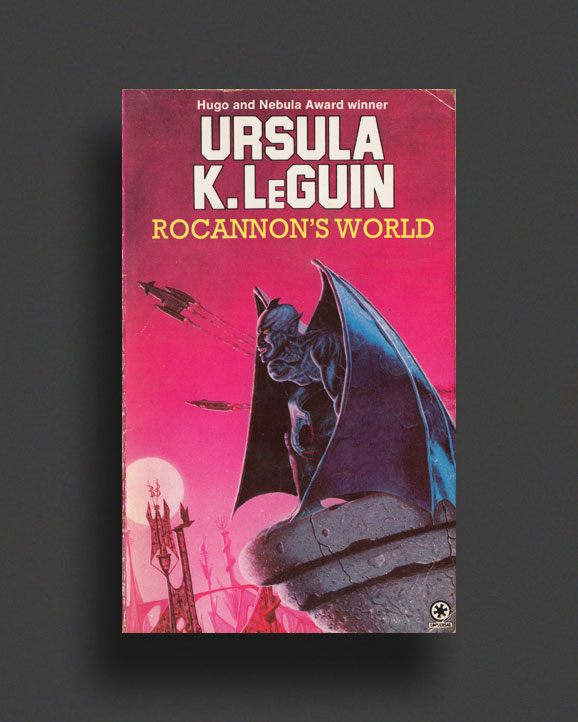
First published in 1966, this debut novel from preeminent science-fiction writer Ursula K. Le Guin introduces her brilliant Hainish series, set in a galaxy seeded by the planet Hain with a variety of humanoid species, including that of Earth. Over the centuries, the Hainish colonies have evolved into physically and culturally unique peoples, joined by a League of All Worlds.
Earth-scientist Rocannon has been leading an ethnological survey on a remote world populated by three native races: the cavern-dwelling Gdemiar, the elvish Fiia, and the warrior clan, Liuar. But when the technologically primitive planet is suddenly invaded by a fleet of ships from the stars, rebels against the League of All Worlds, Rocannon is the only survey member left alive. Marooned among alien peoples, he leads the battle to free this newly discovered world and finds that legends grow around him as he fights.
Rocannon's World along with its two sequels combine emerging British New Wave science fiction sentiments with established American genre imagery and Le Guin's signature anthropological interests into a tale of loss, companionship, isolation, redemption and love.
Ursula K. Le Guin (1929–2018) was an American author of speculative fiction, realistic fiction, non-fiction, screenplays, librettos, essays, poetry, speeches, translations, literary critiques, chapbooks, and children's fiction. She was primarily known for her works of speculative fiction. These include works set in the fictional world of Earthsea, stories in the Hainish Cycle, and standalone novels and short stories. Though frequently referred to as an author of science fiction, critics have described her work as being difficult to classify.
Good copy. General cover wear, tanning, creasing.
2014, English
Softcover, 245 pages, 14.2 x 21.4 cm
Published by
Zero Books / UK
$39.00 - Out of stock
This collection of writings by Mark Fisher, author of the acclaimed Capitalist Realism, argues that we are haunted by futures that failed to happen. Fisher searches for the traces of these lost futures in the work of David Peace, John Le Carre, Christopher Nolan, Joy Division, Burial and many others.
2020, English
Softcover, 240 pages, 14.9 x 21 cm
Published by
The MIT Press / Massachusetts
Whitechapel / London
$38.00 - In stock -
Part of the acclaimed Documents of Contemporary Art series of anthologies which collect writing on major themes and ideas in contemporary art.
The first major anthology to focus on relationships between science fiction and contemporary art, with topics ranging from accelerating technological change to global urbanization.
Over the past two decades, artists and writers have increasingly used science fiction as a lens through which to search for fragments of truth emerging from the past or the future. The proliferation of science fiction in contemporary art practice and discourse reflects an increased understanding of how this narrative field continues to grow in relevance. This book is the first major anthology to focus on relationships between science fiction and contemporary art, and offers an essential read for all those exploring this vital genre.
Organizing its contributions according to four distinct approaches—"estrangement,” “futures,” “posthumanism,” and “ecologies”—this unique collection gathers key examples of the influence of science fiction in recent cultural development. It considers topics that include the integration and acceleration of technological change, global urbanization and concepts of futurity, the boundaries of social structures and nonhuman life, and the threatening evidence of climate change.
Artists surveyed include :
Laylah Ali, Pawel Althamer, Ama Josephine Budge, Lee Bul, Ellen Gallagher, Dominique Gonzalez-Foerster, Eduardo Kac, Patrick Keiller, Josh Kline, Lawrence Lek, Anne Lislegaard, Mariko Mori, Wangechi Mutu, The Otolith Group, Suzanne Treister
Writers include :
Peio Aguirre, Margaret Atwood, J.G. Ballard, Jean Baudrillard, Franco 'Bifo' Berardi, Rosi Braidotti, Rachel Carson, Dawn Chan, T.J. Demos, Donna J. Haraway, N. Katherine Hayles, Wanuri Kahiu, Tom McCarthy, David Musgrave, Alondra Nelson, Kim Stanley Robinson, Darko Suvin
1970 / 1991, Japanese
Softcover (w. dust jacket), 100 pages, 26 x 18 cm
Out of print title / used / fine
Published by
Iwasaki Art Co. / Japan
$45.00 - Out of stock
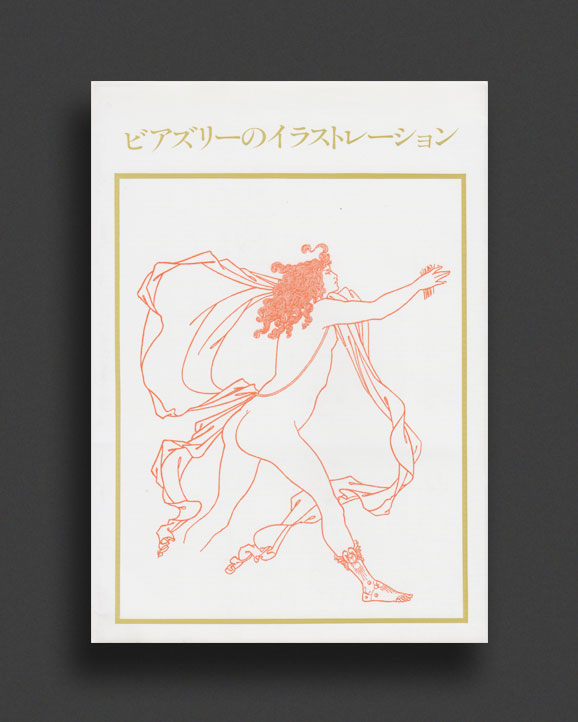
Lovely Japanese monograph on the work of Aubrey Beardsley, first published in 1970 and here in facsimile printed by Iwasaki Art Co. in 1991. Profusely illustrated throughout with 155 works, illustrated biography, biography and list of works. Texts by Tadayuki Omori.
Aubrey Vincent Beardsley (1872 – 1898) was an English illustrator and author. His black ink drawings were influenced by Japanese woodcuts, and emphasized the grotesque, the decadent, and the erotic. He was leading figure in the aesthetic movement, the British counterpart of Decadence and Symbolism. He produced extensive illustrations for books and magazines such as The Studio, The Yellow Book, and The Savoy. Beardsley was a public as well as private eccentric. He said "I have one aim—the grotesque. If I am not grotesque, I am nothing." Oscar Wilde said Beardsley had "a face like a silver hatchet, and grass green hair." Wilde's irreverent wit and work reflected the decadence of his era and his influence was enormous, despite his early death from tuberculosis at age 25. His influence is clearly visible in the work of the French Symbolists, the Poster Art Movement of the 1890s, the work of many later-period Art Nouveau artists such as Papé and Clarke and 20th fantasy illustration.
Fine crisp copy in Very Good original dust jacket.
2013, English / German
Hardcover, 660 pages, 13 × 23.5 cm
Published by
Edition Patrick Frey / Zürich
$199.00 - Out of stock
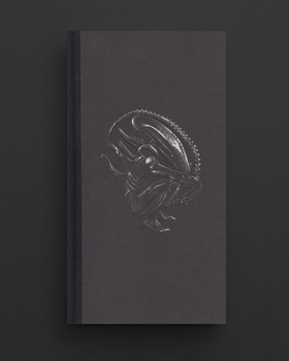
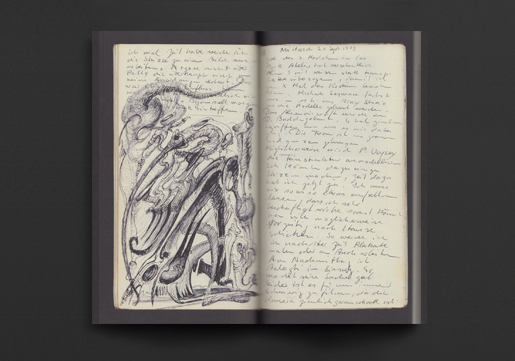
HR Giger worked in the Shepperton Studios near London from February to November 1978, creating the figures and sets for the film Alien (1979) directed by Ridley Scott. The film became an international success, earning Giger an Oscar. In the transcribed Alien Diaries, published here for the first time as a facsimile, HR Giger describes his work in the studios. He writes, sketches, and takes photographs with his Polaroid SX70. With brutal honesty, sarcasm and occasional despair, Giger describes what it is like working for the film industry and how he struggles against all odds — be it the stinginess of producers or the sluggishness of his staff — to see his designs become reality. The Alien Diaries (in German transcription with an English translation) show a little-known personal side of the artist HR Giger and offer an unusual, detailed glimpse into the making of a movie classic through the eyes of a Swiss artist. The book contains almost completely unpublished material, including drawings, Polaroids showing the monster coming to life, and several still shots from the plentiful film material that Giger took in Shepperton.
2020, English / Japanese
Softcover (w. dust-jacket, poster, stickers), 108 pages, 26.5 x 36.5 cm
1st Edition, Out of print title / as new
Published by
PARCO / Tokyo
Kaleidoscope Press / Milan
$220.00 - Out of stock
First edition.
Sold out in one week, this super book published by Italian art publisher KALEIDOSCOPE accompanies a two-artist exhibition co-curated by Alessio Ascari and Shinji Nanzuka, bringing together for the very first time the work of Japanese artist Hajime Sorayama and Swiss artist HR Giger. Touring from PARCO Museum in Tokyo to PARCO Event Hall in Osaka between December 2020 and February 2021, the exhibition coincides with the 80th anniversary of Giger’s birth and features over 50 works ranging from the late 1960s to the present day.
The catalogue, designed by Swiss-based art direction firm Kasper-Florio with Samuel Bänziger, features a foreword by co-curator Alessio Ascari, a critical essay by Venus Lau, an interview with the late HR Giger by Hans Ulrich Obrist and Patrick Frey, and a recent interview with Sorayama by Ascari.
Lavishly illustrated throughout, this beautiful first edition also comes with a 50 x 70 cm two-sided poster, and two 20 cm die-cut stickers.
Born and trained at opposite ends of the world, Sorayama and Giger are apparently at odds—one’s bright colors are swallowed by the other’s dark chiaroscuro; one’s enthusiastic outlook on technology borders with the other’s nightmarish dystopia; one’s “super-realism” challenges the other’s surrealism—yet they share more than meets the eye. Both emerged in the 1970s and 1980s, becoming acknowledged masters of airbrush painting and influential creators beyond the boundaries of the traditional art world, blurring the relationship between commercial and personal work. But more importantly, at the very core of their practice lies a similar concern: an obsessive investigation of AI, eternal life, and the fusion of organic and apparatus. Gynoids (female androids) are predominant subjects, conjuring the post-human and the apotheosis of the woman to reveal an underlying tension between life, death, power and desire.
Hajime Sorayama (b. 1947 in Imabari, Ehime prefecture) has established his position as a legendary artist, both within Japan and internationally, for his extensive oeuvre that centers upon an ongoing pursuit for beauty in the human body and the machine. Best known for his precisely detailed, hand-painted portrayals of voluptuous women, obtained through an astoundingly artful use of a wide array of realistic expressional techniques, most prominently airbrush painting, the artist’s international recognition is inextricably tied to his signature series titled “Sexy Robot” (1978-) featuring erotic android figures clad in shiny chrome metal, and to AIBO, the award-winning robotic pet he designed for SONY in 1999.
Hans Ruedi Giger (1940–2014) was a Swiss surrealist painter, sculptor, and set designer known for his biomechanical creatures, extraterrestrial landscapes, and disturbing sexual machines. In a career that spanned more than five decades, he employed a staggering variety of media, including furniture, movie props, prints, paintings and sculptures, often creating exhibition displays and total environments with the immersive quality of a wunderkammer—including, most notably, the HR Giger Museum in Gruyères. In 1979, his concept design for Ridley Scott’s Alien (1979) won an Academy Award for Best Achievement in Visual Effects and catapulted to fame his daunting vision of death and futurism.
First (sold out) edition. As New.
2004, English
Softcover, 128 pages, 21.5 x 28 cm
1st Edition, Out of print title / used / very good
Published by
Design Studio Press / Culver City
$60.00 - Out of stock
First edition of AVP : Alien vs. Predator - The Creature Effects of ADI, the essential companion to the 2004 science fiction action film written and directed by Paul W. S. Anderson, Alien vs. Predator, written by the chief creature effects supervisors Alec Gillis and Tom Woodruff Jr.
In 1979, Ridley Scott introduced moviegoers to a new definition of fear and horror with his sci-fi classic, Alien. To coincide with the release of AVP, special effects gurus Alec Gillis and Tom Woodruff, Jr. opened the doors of their Academy Award-winning creature shop, Amalgamated Dynamics Inc. (A.D.I.), to invite all to a behind-the-scenes journey, as they once more breathe life into the characters that have been scaring audiences for over two decades. Gillis and Woodruff's unique perspective makes this one of the most fascinating 'making of' books ever published, providing an in-depth look at how the Aliens and Predators were created. It follows Gillis and Woodruff and their talented crew of over 100 artists and technicians throughout the design, sculpting, fabrication, and finishing processes. Packed with over 400 exclusive photos, the story continues on-location in Prague where, as the cameras roll, their creations truly come to life. A rare glimpse into the world of the mighty Amalgamated Dynamics Inc. (A.D.I.), founded in 1988 by Stan Winston alumni Tom Woodruff Jr. and Alec Gillis.
Very Good copy, light cover wear.
1977/2011, English
Softcover, 222 pages, 11.4 x 16.5 cm
Published by
Avon Books / New York
$22.00 - Out of stock
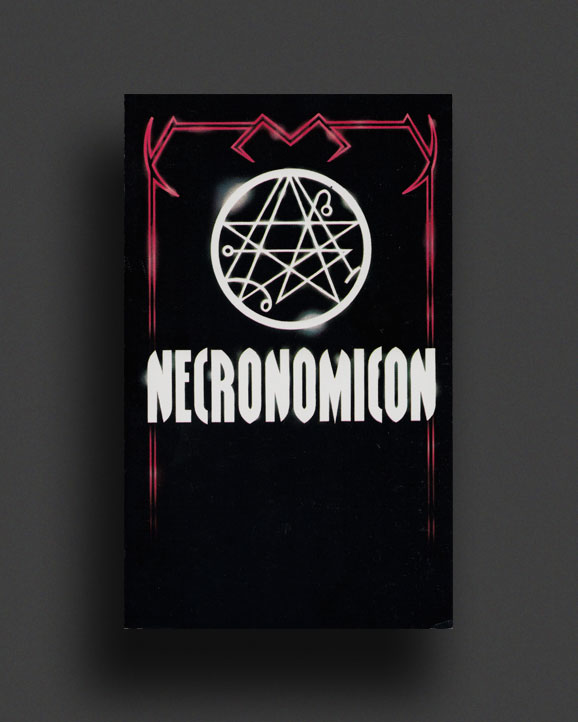
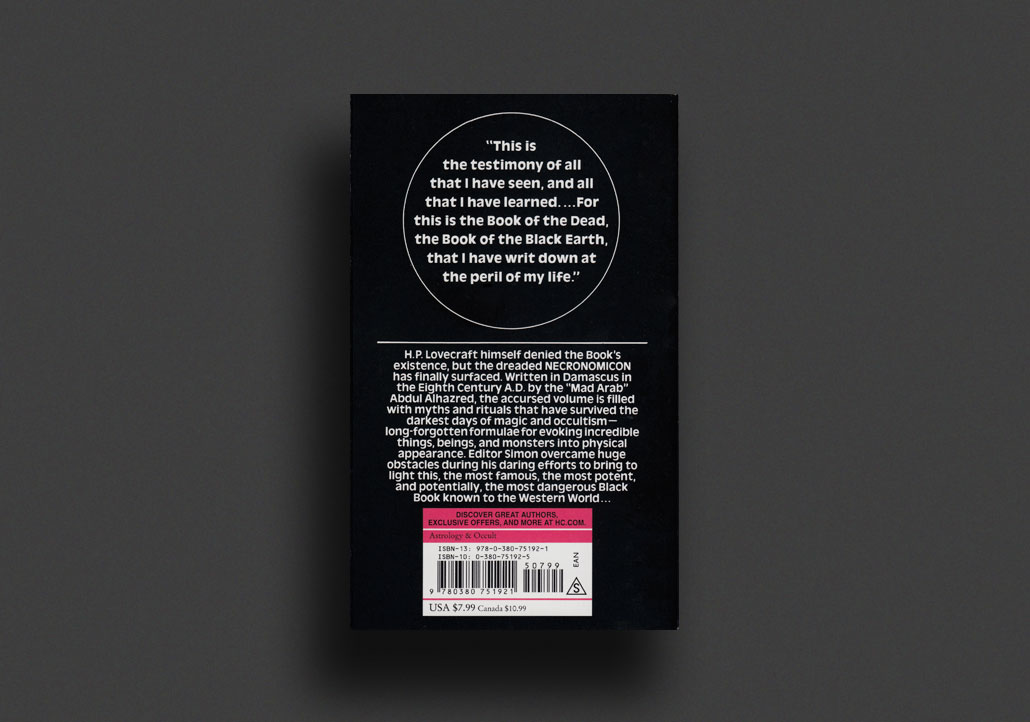
In the past 31 years, there has been a lot of ink--actual and virtual--spilled on the subject of the Necronomicon. Some have derided it as a clumsy hoax; others have praised it as a powerful grimoire. As the decades have passed, more information has come to light both on the book's origins and discovery, and on the information contained within its pages. The Necronomicon has been found to contain formula for spiritual trans-formation, consistent with some of the most ancient mystical processes in the world, processes that were not public knowledge when the book was first published, processes that involve communion with the stars.
In spite of all the controversy, the first edition sold out before it was published. And it has never been out of print since then. This year, the original designer of the 1977 edition and the original editor have joined forces to present a new, deluxe edition of the most feared, most reviled, and most desired occult book on the planet.
1980, Japanese
Hardcover (w. dust jacket in slipcase), 447 pages, 32 x 22.5 cm
1st Edition, Out of print title / used / good
Published by
Fantasia Co Ltd / Japan
$160.00 - Out of stock
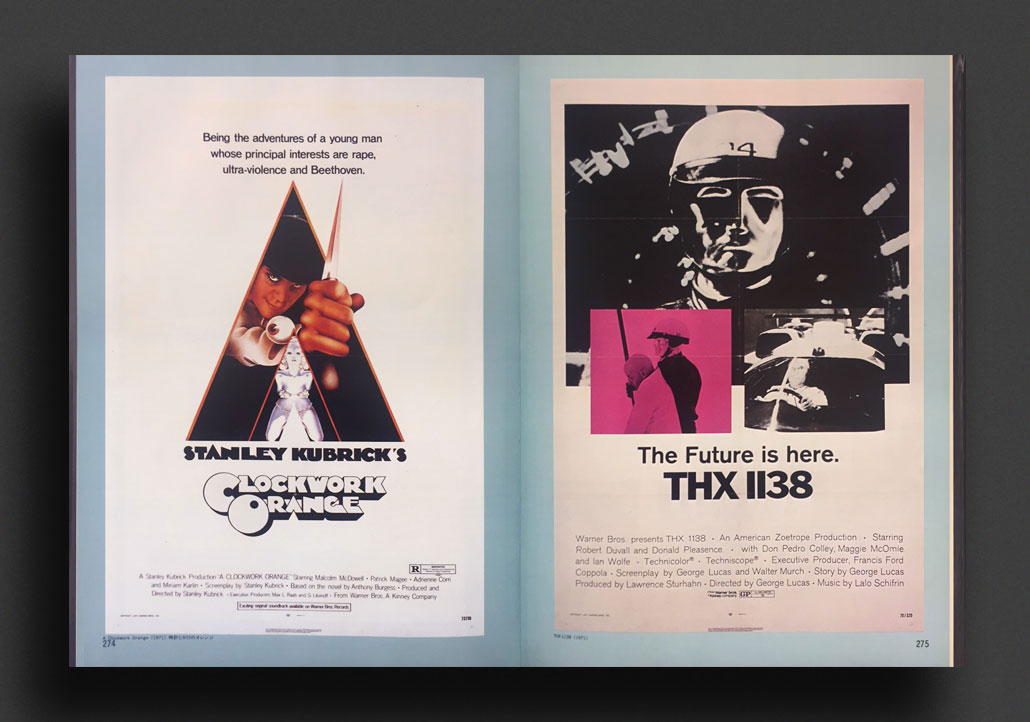
First deluxe edition of the illustrated Japanese encyclopaedic tome that explores the history of Science Fiction film, from early silent film to the modern era. Published in 1980 by special effects expert and editor of SFX Cinematic Illusion Shinji Nakako, A Pictorial History of SF Films compiles an exhaustive directory of chronological film listings from all over the world (including many unreleased Japanese sci-fi films, fantasy, horror, thriller, animation, and much beyond the usual SF category) through the decades. With comprehensive film details, credits and blurbs (in Japanese) for each film selection, illustrated with stills and each period including rich colour reproductions of the original film posters! Includes a neat, full index of the films included (in English and in Japanese), accompanied by thumbnails of Yoda, all housed in the original Hajime Sorayama illustrated dust jacket in original publishers heavy cardboard slipcase. A treasure for the SF fan.
Very Good copy, with small closed tears to jacket, preserved under mylar wrap and in VG original slipcase. Beautifully preserved copy.
2020, English
Softcover, 192 pages, 13.7 x 20.3 cm
Published by
Wakefield Press / Cambridge
$29.00 - Out of stock
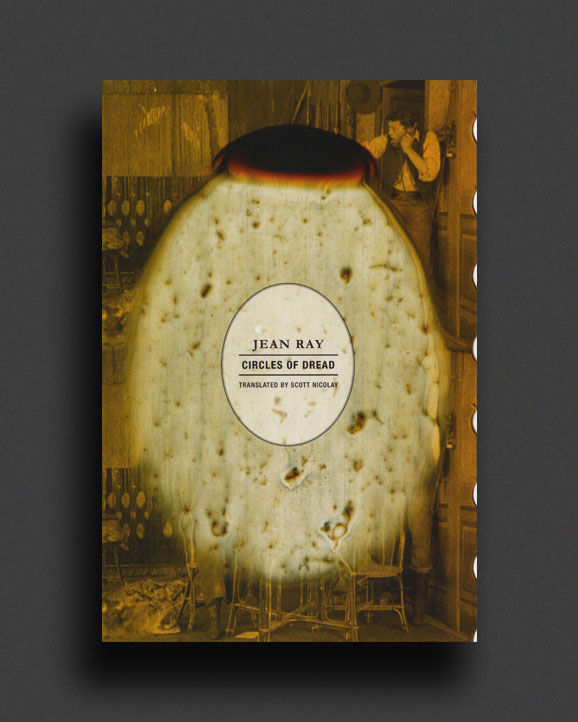
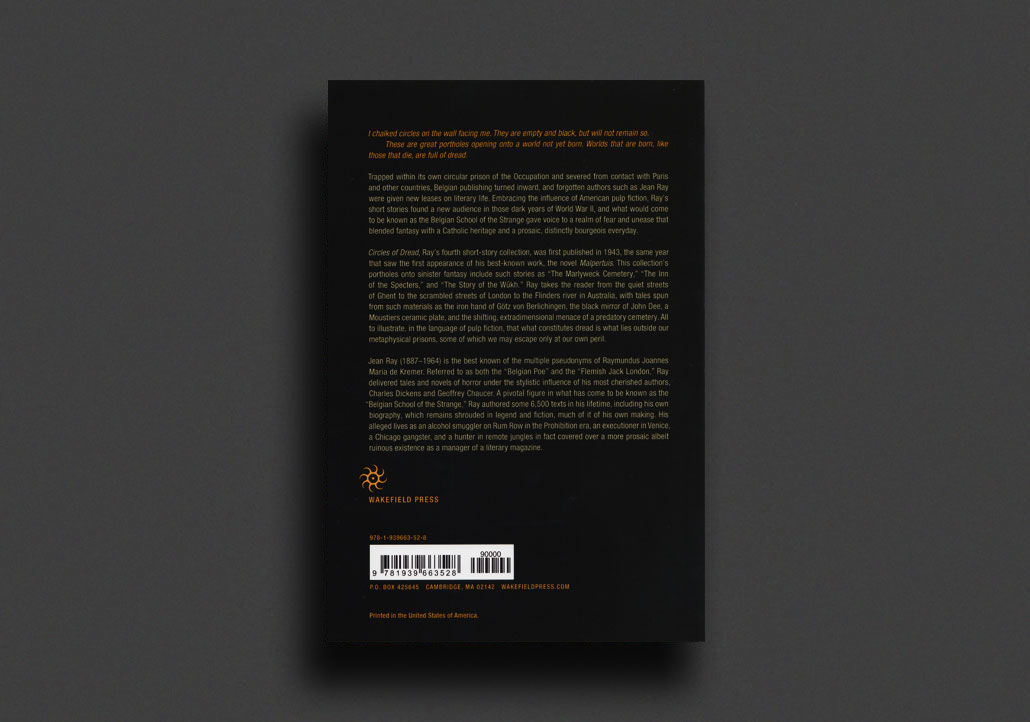
"I chalked circles on the wall facing me. They are empty and black, but will not remain so.
They are great portholes opening onto a world not yet born. Worlds that are born, like those that die, are full of dread."
Trapped within its own circular prison of the Occupation and severed from contact with Paris and other countries, Belgian publishing turned inward, and forgotten authors such as Jean Ray were given new leases on literary life. Embracing the influence of American pulp fiction, Ray’s short stories found a new audience in those dark years of World War II, and what would come to be known as the Belgian School of the Strange gave voice to a realm of fear and unease that blended fantasy with a Catholic heritage and a prosaic, distinctly bourgeois everyday.
Circles of Dread, Ray’s fourth short-story collection, was first published in 1943, the same year that saw the first appearance of his best-known work, the novel Malpertuis. This collection’s portholes onto sinister fantasy include such stories as “The Marlyweck Cemetery,” “The Inn of the Specters,” and “The Story of the Wûkh.” Ray takes the reader from the quiet streets of Ghent to the scrambled streets of London to the Flinders river in Australia, with tales spun from such materials as the iron hand of Götz von Berlichingen, the black mirror of John Dee, a Moustiers ceramic plate, and the shifting, extradimensional menace of a predatory cemetery. All to illustrate, in the language of pulp fiction, that what constitutes dread is what lies outside our metaphysical prisons, some of which we may escape only at our own peril.
Jean Ray (1887–1964) is the best known of the multiple pseudonyms of Raymundus Joannes Maria de Kremer. Alternately referred to as the “Belgian Poe” and the “Flemish Jack London,” Ray delivered tales and novels of horror under the stylistic influence of his most cherished authors, Charles Dickens and Geoffrey Chaucer. A pivotal figure in the “Belgian School of the Strange,” Ray authored some 6,500 texts in his lifetime, not including his own biography, which remains shrouded in legend and fiction, much of it his own making. His alleged lives as an alcohol smuggler on Rum Row in the prohibition era, an executioner in Venice, a Chicago gangster, and hunter in remote jungles in fact covered over a more prosaic, albeit ruinous, existence as a manager of a literary magazine that led to a prison sentence, during which he wrote some of his most memorable tales of fantastical fear.
Translated, with an afterword, by Scott Nicolay
2020, English
Softcover, 144 pages, 13.6 x 20.2 cm
Published by
Wakefield Press / Cambridge
$32.00 - Out of stock
After the commercial failure of his 1931 collection Cruise of Shadows, Jean Ray spent the next decade writing and publishing under other names in the stifling atmosphere of Ghent. Only in the midst of the darkest years of the Nazi Occupation of Belgium would he suddenly publish a spate of books under his earlier nom de plume, all appearing in rapid sequence and which would become his best-known and admired works. The first of these volumes, in essence picking up from where he had left off a decade ago and signaling the beginning of his reputation as the Belgian master of the weird tale, was the 1942 publication of The Great Nocturnal.
The collection, as its subtitle indicates, consists of tales of fear and dread—a dread evoked not by the standard tropes of horror (though rats, centipedes, and darkness lie waiting in these pages), but in what had now evolved into Ray’s personal brand of fear, drawn from a specifically Belgian notion of the fantastic that lies alongside the banality of everyday life. An aging haberdasher’s monotonous existence opens up to a spiritual fourth dimension (and serial murder); an inebriated young man in a tavern draws cryptic symbols and mutters statements that elicit an inexplicable terror among some sailors and, as he sobers up, himself; three students drink Finnish Kümmel and keep watch over a deceased woman’s apartment, awaiting a horrific transformation. Yet these tales are laced with a mordant humor that bears as much allegiance to Ambrose Bierce as Edgar Allan Poe, and toys as much with the reader’s expectations as they do with their characters.
Translated, with an afterword, by Scott Nicolay
Jean Ray (1887–1964) is the best known of the multiple pseudonyms of Raymundus Joannes Maria de Kremer. Alternately referred to as the “Belgian Poe” and the “Flemish Jack London,” Ray delivered tales and novels of horror under the stylistic influence of his most cherished authors, Charles Dickens and Geoffrey Chaucer. A pivotal figure in the Belgian School of the Strange, Ray authored some 6,500 texts in his lifetime, not including his own biography, which remains shrouded in legend and fiction, much of it his own making. His alleged lives as an alcohol smuggler on Rum Row in the Prohibition era, an executioner in Venice, a Chicago gangster, and a hunter in remote jungles in fact covered over a more prosaic albeit ruinous existence as a manager of a literary magazine.
2020, English
Softcover, 120 pages, 12.5 x 19.7 cm
Published by
Fitzcarraldo Editions / London
$30.00 - Out of stock
From one of the most lauded artists of his generation comes a purging soliloquy: a profound nowt delivered in some spent afterwards. Scorched by senility and nostalgia, and wracked by all kinds of hunger, Ed Atkins’ Old Food lurches from allegory to listicle, from lyric to menu, fetching up a plummeting, idiomatic and crabbed tableau from the cannibalised remains of each form in turn. Written in conjunction with Atkins’ exhibition of the same name, Old Food is a hard Brexit, wadded with historicity, melancholy and a bravura kind of stupidity.
Ed Atkins is an artist who makes all kinds of convolutions of self-portraiture. He writes uncomfortably intimate, debunked prophesies; paints travesties; and makes realistic computer generated videos that often feature figures that resemble the artist in the throes of unaccountable psychical crises. Atkins’ artificial realism, whether written or animated, pastiches romanticism to get rendered down to a sentimental blubber – all the better to model those bleak feelings often so inexpressible in real life.
2014, English
Softcover, 152 pages, 12.7 x 20.3 cm
Published by
Schism Press / World
$30.00 - In stock -
Schism Press brings you Eugene Thacker's {anti} novel, An Ideal For Living.
As today's strategies of conceptual writing have become legitimized and cliched, Thacker's text reminds us of how radical and potent these gestures once were, treading a fine line between the mechanical and the authorial. This is an important book...these pages take cues from Burroughs and Gibson, while at the same time presciently pointing to the web-based path writing would take over the next decade. It's a joy to see this back in print. — Kenneth Goldsmith, author of Day and Soliloquy, founder of Ubuweb
Eugene Thacker's An Ideal for Living in the apoptosis of hyperreal language shed a data flesh as a discourse toward death continuously from cracks in DNA...It is present in an inexplicable state of literary language and data. — Kenji Siratori, author of Blood Electric and Mad In Japan
1985, Japanese
Softcover, 146 pages, 29.5 x 21 cm
1st Edition, Out of print title / used / very good
Published by
Screen Extra / Tokyo
$90.00 - Out of stock
First edition of this scarce Japanese horror movie guide from the mid 1980s, The Horror Movies Part 2 (Screen Extra Edition). Beautifully printed in glossy covers with various paper stocks and lavishly illustrated with countless colour and b/w film stills and posters/VHS cover graphics. The mighty Horror Movies series aimed to compile a comprehensive catalogue of horror film from the height of video revolution across a series of publications, whilst also chronicling horror/sci-fi/fantasy from the past (1950s-1970s). This edition includes features/profiles/entries on Day of The Dead, Return of The Living Dead, Mutant, Alien, The Thing, The Fury, Rosemary's Baby, Manhattan Baby, Parasite, They Came From Within, Galaxy of Terror, Time Walker, Piranha 2, Happy Birthday to Me, Creepshow, Friday the 13th, Fright Night, Cat People, Cujo, Microwave Massacre, Saturday the 14th, Hell Night, The Crucible of Terror, Thirst, Lemora, Godsend, Savage Weekend, Halloween 3, The Innocents, Torture Dungeon, Bloodthirsty Butchers, The Rats Are Coming, The Beyond, The House by the Cemetary, Tales From The Darkside, The Shining, Christine, Jaws 1-3, The Legacy, The Amityville Horror 1-2, The Omen films, The Entity, The Exorcist films, The Wizard of Gore, Gore-Gore Girls, Psycho 1-2, The Man with 2 Heads, Time Walker, The Thing, Torso, The Blob, Tourist Trap, Demon Seed, Lifeforce, The Company of Wolves, CHUD, Re-Animator, The Mutilator, Silent Madness, directors Andy Milligan, Lucio Fulci, David Cronenberg, George A Romero, New York, and much more!
An invaluable guide for any fan of the genre.
1987, Japanese
Softcover, 106 pages, 27 x 21 cm
1st Edition, Out of print title / used / very good
Published by
Dunwich / Tokyo
$70.00 - Out of stock
Volume 1 of Dunwich, a leading, and extremely short-lived 1980s horror movie magazine from Tokyo that also covers art house/action/fantasy/sci fi film from the period. Profiles/reviews/articles on Blue Velvet, Critters, From Beyond, Guzoo, Legend, Poltergeist 2, The Golden Child, Stand By Me, American Ninja, Sky Pirates, The Vindicator, Street Trash, Hand of Steel, Giger/Alien, Friday the 13th pt. VI, Robot Holocaust, Scared to Death, Sword of Heaven, Highlander, El Topo, The Toxic Avenger, Festival d'Avoriaz '87 - the international fantasy film festival held in France, "Horror Music" (Goblin, Magma, King Crimson, Faust, Oldfield, Ozzy, Fripp-Eno, early Genesis), and much more.
Dunwich could be easily filed alongside the great V-Zone in promoting the home video revolution of the 1980s in Japan, and the explosion in popularity of horror, fantasy, and science fiction film that came with it. Like V-Zone, Dunwich covered the latest in American and European horror whilst publicising the new wave of Japanese gore and V-Cinema (direct-to-video splatter films). Heavy with film features, interviews, guides, stills, behind-the-scenes reports, ads, catalogues, and reviews. Another scarcely seen Japanese must for any 1980s video collector or lover of gore/sci fi.
2007, English
Hardcover, 528 pages, 25 x 28.9 cm
Published by
FAB Press / UK
$110.00 - Out of stock
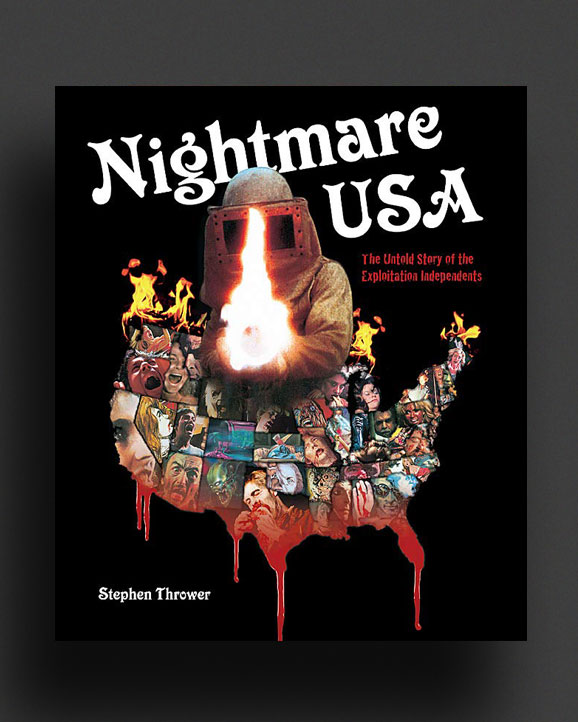
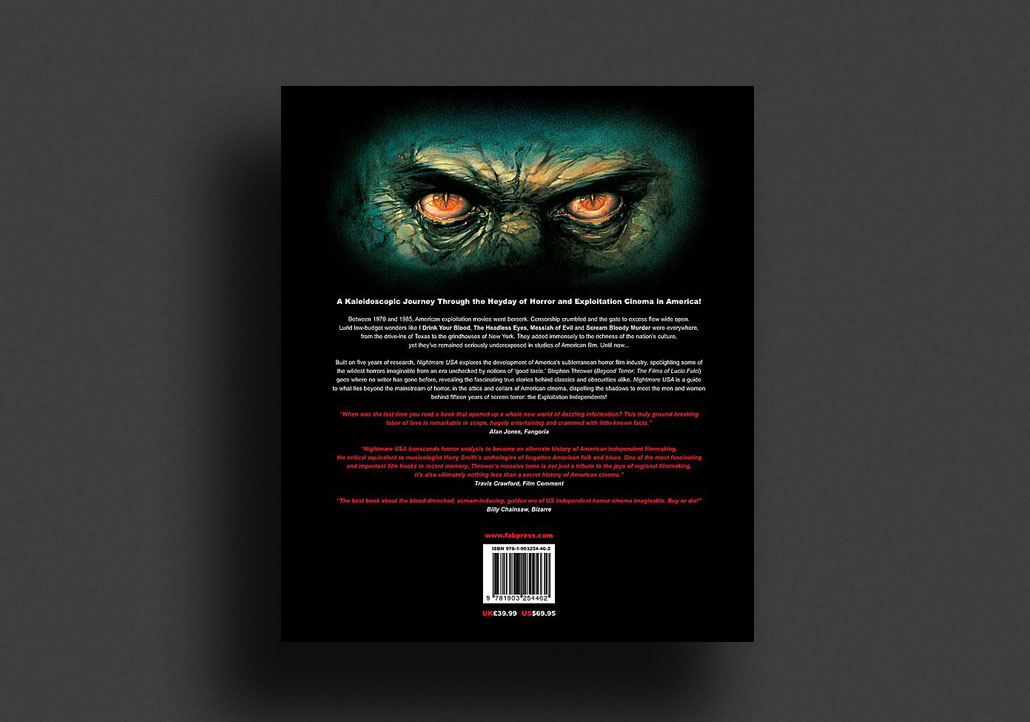
Running to 528 large-format pages, Nightmare USA is a veritable encyclopedia of grindhouse cinema - it's one of the most acclaimed genre film books ever published, and after having Sold Out three times over already, it's finally back in print!
From Quentin Tarantino (Kill Bill) to Eli Roth (Hostel), the young guns of modern Hollywood just can't get enough of that exploitation film high. That's because, between 1970 and 1985, American Exploitation movies went berserk. With censorship relaxed, and the gate to excess wide open, horror offered a vibrant alternative to the mainstream of American cinema. Luridly titled wonders like The Headless Eyes, Scream Bloody Murder and Hitch Hike to Hell were everywhere, from the drive-ins of Texas to the grindhouses of New York. Massively popular around the world, American exploitation movies added immensely to the richness of the nation's cinema.
Built on five years of research, Nightmare USA explores the development of America's subterranean horror film industry, spotlighting some of the wildest films imaginable from an era unchecked by censorship or 'good taste.' Ranging from cult favourites like I Drink Your Blood to stylish mind-benders like Messiah of Evil and shockers like Don't Go in the House, Nightmare USA goes where no other in-depth study has gone before, revealing the fascinating true stories behind classics and obscurities alike. Author Stephen Thrower has explored the attics and cellars of American cinema, delved beneath the floorboards, peered between the walls, searching for the strangest, most exotic cine-lifeforms... Nightmare USA is the reader's guide to what lies beyond the mainstream of American horror, dispelling the shadows to meet the men and women behind fifteen years of screen terror: the Exploitation Independents!
This massive overview of the Horror genre's development through the 1970s and 1980s features: In-depth EXCLUSIVE interviews with twenty-five grindhouse movie makers, many of whom are discussing their work for the first time ever in print, including David Durston (I Drink Your Blood), Robert Endelson (Fight for Your Life), Frederick Friedel (Axe), Don Jones (Schoolgirls in Chains); and Joseph Ellison (Don't Go in the House). Over 175 individual films reviewed, with full cast and crew credits. Vast quantities of previously unpublished stills, posters, press-books, plus behind-the-scenes photographs from the filmmakers' own collections.
2018, English
Softcover, 160 pages, 19.8 x 12.9 cm
Published by
Ignota / UK
$34.00 $15.00 - Out of stock
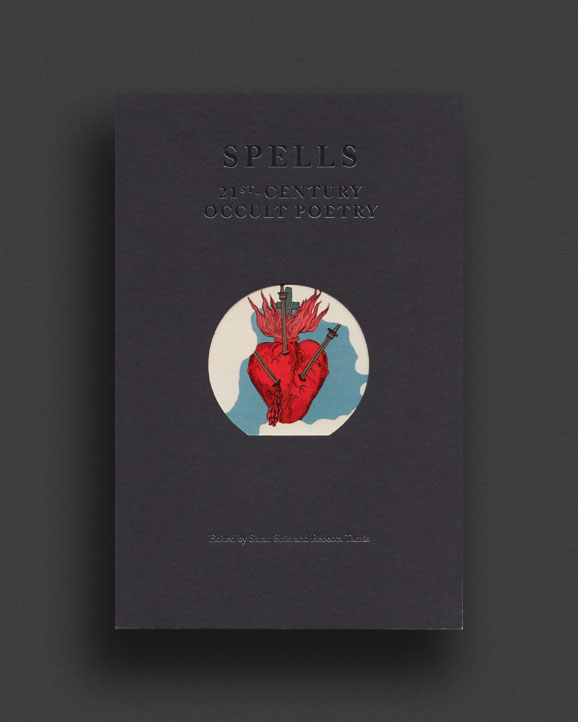
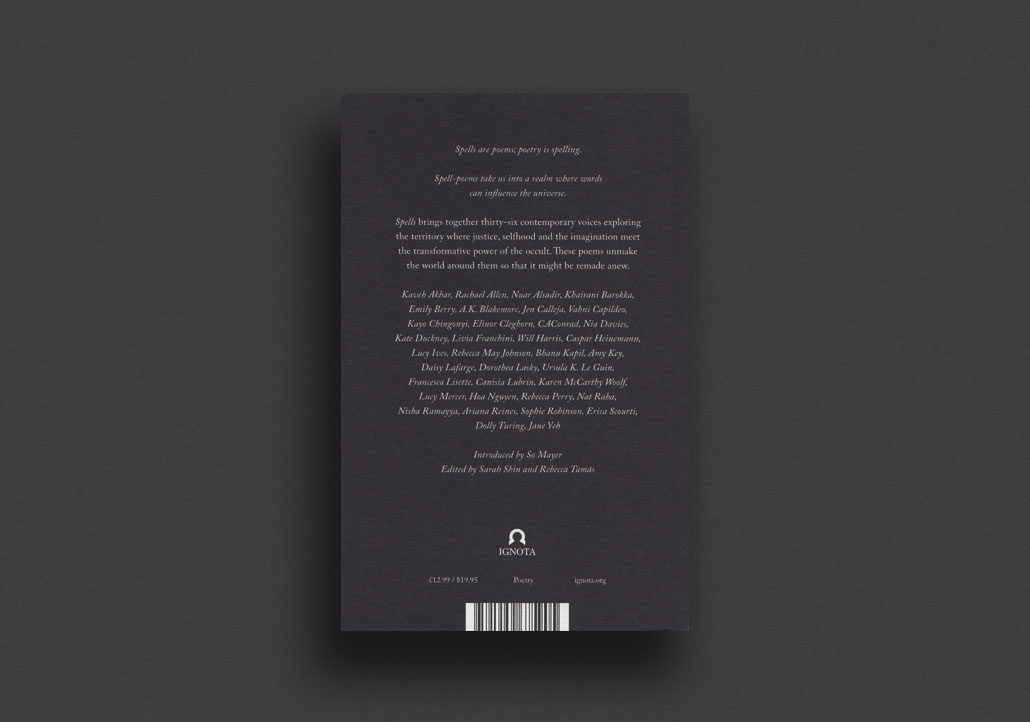
Spells are poems; poetry is spelling.
Spell-poems take us into a realm where words can influence the universe.
Spells brings together thirty-six contemporary voices exploring the territory where justice, selfhood and the imagination meet the transformative power of the occult. These poems unmake the world around them, so that it might be remade anew.
Kaveh Akbar, Rachael Allen, Nuar Alsadir, Khairani Barokka, Emily Berry, A.K. Blakemore, Jen Calleja, Vahni Capildeo, Kayo Chingonyi, Elinor Cleghorn, CAConrad, Nia Davies, Kate Duckney, Livia Franchini, Will Harris, Caspar Heinemann, Lucy Ives, Rebecca May Johnson, Bhanu Kapil, Amy Key, Daisy Lafarge, Dorothea Lasky, Ursula K. Le Guin, Francesca Lisette, Canisia Lubrin, Karen McCarthy Woolf, Lucy Mercer, Hoa Nguyen, Rebecca Perry, Nat Raha, Nisha Ramayya, Ariana Reines, Sophie Robinson, Erica Scourti, Dolly Turing, Jane Yeh.
Edited by Sarah Shin and Rebecca Tamas
As New with corner wear (hence price reduction)
2020, English
Softcover, 416 pages, 15.2 x 21.6 cm
Published by
Strange Attractor / London
$49.00 $15.00 - Out of stock
Small tearing to cover and a few pages, otherwise brand new.
An arcane compendium of strange fiction and hallucinatory tales, There Is a Graveyard That Dwells in Man collects chilling stories by renowned innovators of the weird and by many little-known and underrepresented or forgotten scribes of the macabre.
Selected by artist, writer, and musician David Tibet, this widely-sourced collection of supernatural rarities continues the bibliographic exhumation initiated with The Moons At Your Door (Strange Attractor Press, 2016), offering lyrical portals into worlds of strange beauty, elegant unease, and creeping decadence.
Authors include HR Wakefield, HD Everett, LA Lewis, AC Benson, Thomas Ligotti, Lady Dilke, Arthur Machen, Colette De Curzon, Nugent Barker, Edna W. Underwood, EF Benson, Oliver Onions, AM Burrage, John Gower, Algernon Blackwood, Amyas Northcote, LP Hartley, Edith Wharton, RH Benson, Charlotte Perkins Gilman, Richard Middleton and Walter De La Mare.
The volume also includes a new introductory essay by David Tibet, incorporating original translations from the Akkadian. Comprehensive biographical and publication histories are provided by noted scholar of bibliographic arcana Mark Valentine. There Is a Graveyard That Dwells in Man offers an unnerving, serpentine tributary to the canon of supernatural literature.
2017, English
Softcover, 472 pages, 21 x 14.8 cm
Published by
Strange Attractor / London
$54.00 - Out of stock
An anthology of strange fiction and hallucinatory tales, The Moons At Your Door collects chilling stories by many innovators of the weird whilst drawing attention to little-known and shamefully underrepresented or forgotten scribes of the macabre.
The Moons At Your Door collects over 30 tales, both familiar and unknown from Robert Aickman, Algernon Blackwood, DK Broster, AM Burrage, RW Chambers, Aleister Crowley, Elizabeth Gaskell, WW Jacobs, MR James, LA Lewis, Thomas Ligotti, Arthur Machen, Guy de Maupassant, Perrault, Thomas De Quincey, Saki, Count Stenbock and HR Wakefield. The volume also includes extracts and translations by the author from Babylonian, Coptic and Biblical texts alongside poems and fairy tales.
The book's cover features artwork by David and design by Ania Goszczynska; the frontispiece also reproduces a painting by David.
About the editor:
As founder of the Ultimate Hallucinatory SuperGroup Current 93, David Tibet’s work as an artist and songwriter is widely known. His song cycles present a rich vein of ethereal imagery, arcane reference and the supernatural, creating their own sound-worlds of heart-felt and mysterious poignancy. The Moons At Your Door presents both a skeleton key to these domains and a gateway to the world of supernatural fiction.
David Tibet says about the book:
I fell in Love with The Moons whom I had heard and seen at my door when I was a young boy in Malaysia. I have brought together, in this work, many of the short stories and texts that have made me what I am and what I will be, and it gives an insight into my Spheres for those who wish to read what formed me. I have never tired of these works, which still move me profoundly, and I never will.
2018, English
Softcover, 128 pages, 11.4 x 17.8 cm
Published by
Wakefield Press / Cambridge
$33.00 - Out of stock
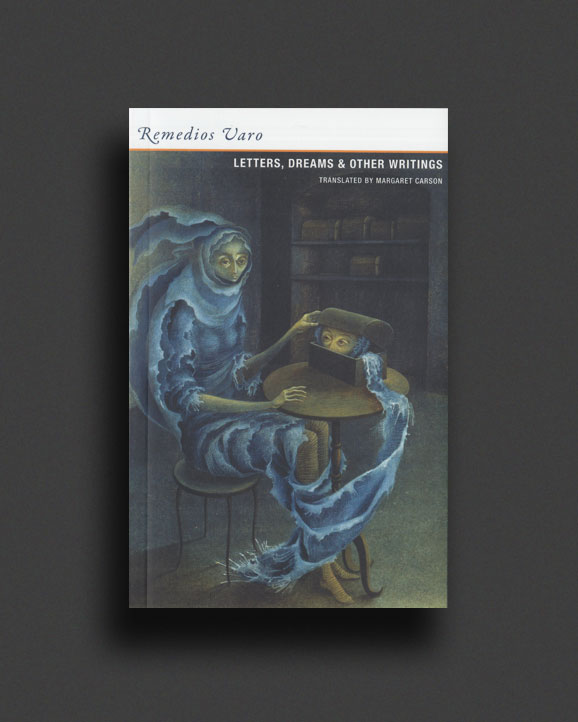
While the reputation of Remedios Varo (1908-63) the surrealist painter is now well established, Remedios Varo the writer has yet to be fully discovered. This volume brings together the painter's collected writings and includes an unpublished interview, letters to friends and acquaintances, dream accounts, notes for unrealised projects, a project for a theatre piece, whimsical recipes for controlled dreaming, exercises in surrealist automatic writing and prose poem commentaries on her paintings.
Remedios Varo Uranga (1908 – 1963) was a Spanish surrealist artist. Born in Anglès (north of Catalonia), Spain in 1908, she studied at the Real Academia de Bellas Artes de San Fernando, Madrid. Varo spent her formative years between France and Barcelona and was greatly influenced by the surrealist movement. The summer of 1935 marked Varo's formal invitation into Surrealism when French surrealist Marcel Jean arrived in Barcelona. While still married to her first husband Gerardo Lizarraga, Varo met her second partner, the French surrealist poet Benjamin Péret, in Barcelona. During the Spanish Civil War she fled to Paris with Péret leaving Lizarraga behind (1937). It was through Peret that Remedios Varo met André Breton and the Surrealist circle, which included Leonora Carrington, Dora Maar, Roberto Matta, Wolfgang Paalen, and Max Ernst among others. Shortly after arriving in France, Varo took part in the International Surrealist exhibitions in Paris and in Amsterdam in 1938. She was forced into exile from Paris during the German occupation of France and moved to Mexico City at the end of 1941 when the Mexican president, Lázaro Cardenas, made it a policy to welcome Spanish and European refugees. In Mexico, she met native artists such as Frida Kahlo and Diego Rivera, but her strongest ties were to other exiles and expatriates, notably the English painter Leonora Carrington and the French pilot and adventurer, Jean Nicolle. However, because Mexican muralism still dominated the country's art scene, surrealism was not generally well received. She worked as an assistant to Marc Chagall with the design of the costumes for the production of the ballet Aleko, which premiered in Mexico City in 1942. In 1947, Péret returned to Paris, and Varo traveled to Venezuela, living there for two years. She returned to Mexico and began her third and last important relationship with Austrian refugee Walter Gruen, who had endured concentration camps before escaping Europe. Gruen believed fiercely in Varo, and he gave her the economic and emotional support that allowed her to fully concentrate on her painting. In 1955, Varo had her first solo exhibition at the Galería Diana in Mexico City. Buyers were put on waiting lists for her work. Even Diego Rivera was supportive. In 1960, her representative, Juan Martín, opened his own gallery and showed her work there, and opened a second in 1962. Only a year after that opening, at the height of her career, she died from a heart attack in Mexico City. Her work is well known in Mexico, but not as commonly known throughout the rest of the world.
2015, English
Softcover, 304 pages, 15.2 x 22.9 cm
Published by
Semiotext(e) / Los Angeles
$45.00 - Out of stock
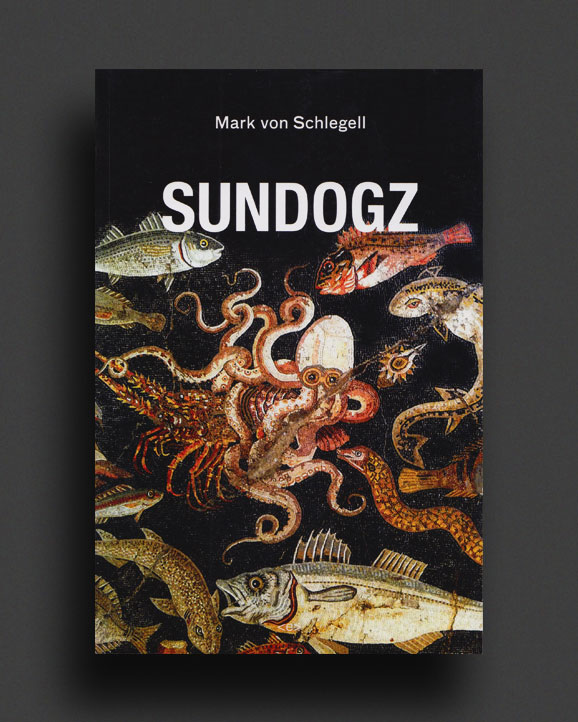
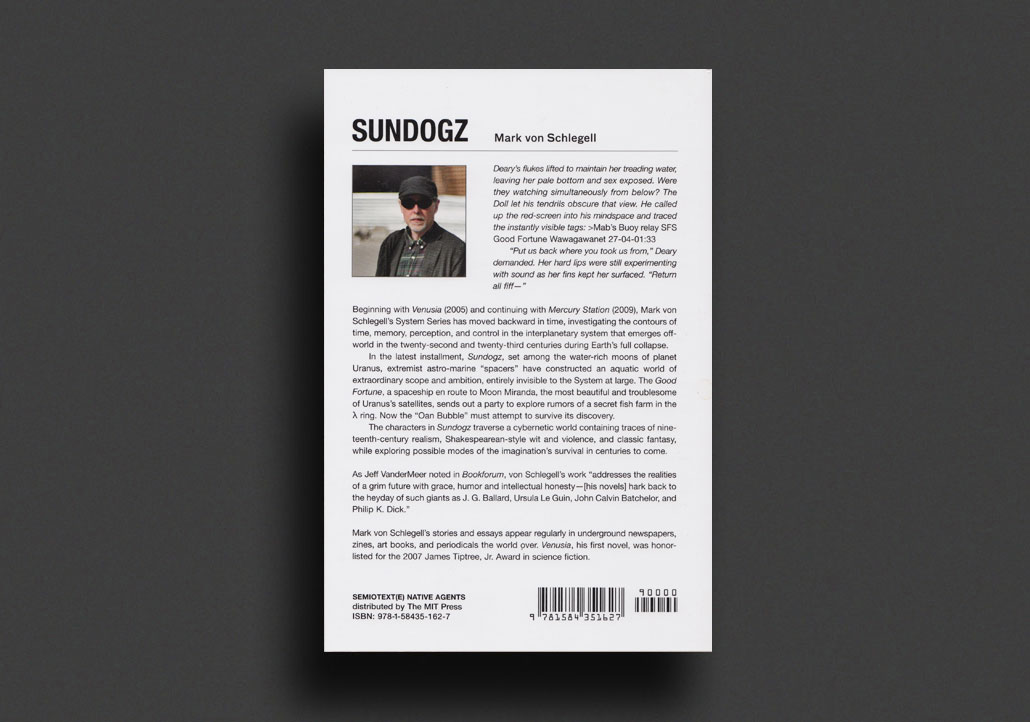
Was there some sort of accident? The Doll was now certain that the Japanese didn’t consider him a human. He was concerned with Deary alone. Her flukes lifted to maintain her treading water, left her pale bottom and sex exposed. Was he watching simultaneously from below? The Doll let his tendrils obscure. 5 hours till orbital synch, he remembered. The Doll called up the red-screen into his mindspace and traced the instantly visible tags: Mab's Buoy relay SFS Good Fortune, Wawagawanet 2145270401:33—
—from Sundogz
Beginning with Venusia (2005) and continuing with Mercury Station (2009), Mark von Schlegell’s System Series has moved backward in time, investigating the contours of time, memory, perception, and control in the inter-planetary system that emerge off-world in the twenty-second and twenty-third centuries during Earth’s full collapse.
In the latest installment, Sundogz, set among the water-rich moons of planet Uranus, extremist astro-marine “spacers” have constructed an aquatic world of extraordinary scope and ambition, entirely invisible to the System at large. The Good Fortune, a spaceship en route to Moon Miranda, the most beautiful and troublesome of Uranus’s satellites, sends out a party to explore rumors of a secret fish farm in the λ ring. Now the "Oan Bubble" must attempt to survive its discovery.
The characters in Sundogz traverse a cybernetic world containing traces of nineteenth-century realism, Shakespearean-style wit and violence, and classic fantasy, while exploring possible modes of the imagination’s survival in centuries to come.
As Jeff Vandermeer noted in Bookforum, von Schlegell’s work “addresses the realities of a grim future with grace, humor and intellectual honesty—[his novels] hark back to the heyday of such giants as J. G. Ballard, Ursula Le Guin, John Calvin Batchelor, and Philip K. Dick.”
2009, English
Softcover, 288 pages, 150 x 226 mm
Published by
Semiotext(e) / Los Angeles
$40.00 - Out of stock
Published by Semiotext(e) in 2005, Mark von Schlegell’s debut novel Venusia was hailed in the sci-fi and literary worlds as a “breathtaking excursion” and “heady kaleidoscopic trip,” establishing him as an important practitioner of vanguard science fiction. Mercury Station, the second book in Von Schlegell’s System Series, continues the journey into a dystopian literary future.
Like Venusia, Mercury Station tells a compelling story, drawn through a labyrinth of future-history sci-fi, medieval hard fantasy, and cascading samplings of high and low culture. The book is a brilliant literary assault against the singularity of self and its imprisonment in Einsteinian spacetime.