World Food Books' programme is largely produced on Kulin Nation land. We acknowledge the Wurundjeri people of the Kulin Nation as the first and continuing custodians of this land, and pay respect to their Elders past, present, and emerging.
World Food Books is an arts and special interests bookshop in Naarm / Melbourne. Founded in 2010, World Food Books is devoted to the presentation of a rotating, hand-selection of international art, design, literary and counterculture publications with an emphasis on the anti-traditional, the experimental, the avant-garde, the heretic, the marginal.
Presenting new titles alongside rare and out-of-print books, catalogues and journals spanning the fields of modern and contemporary art, design, photography, illustration, film, literature, poetry, cultural theory, philosophy, sexuality, popular and underground culture in its many radical forms, World Food Books wishes to encourage adventurous, thoughtful and open-minded reading, looking, writing, and exchange of publishing and ideas, both current and historical.
As well as our bookshop, located in Melbourne's historical Nicholas Building, all of our inventory is available internationally via our online mail-order service.
World Food Books semi-regularly co-ordinates "Occasions", a programme of exhibits and events at the bookshop and in partnership with other hosts (such as museums and art galleries) that develop out of the activities, relationships and content of the bookshop itself.
World Food Books
The Nicholas Building
37 Swanston Street
Room 5, Level 6
Melbourne 3000
Australia
SHOP HOURS:
Thu–Sat 11–5
WEB-SHOP OPEN 24/7
World Food Books
Postal Address:
PO Box 435
Flinders Lane
Victoria 8009
Australia
Art
Theory / Essay
Architecture / Interior
Graphic Design / Typography
Photography
Fashion
Eros
LGBTQ+
Fiction / Poetry
Weird / Speculative / Science Fiction / Horror
Transgressive / Visceral / Abject
Symbolism / Decadence / Fin de siècle
Film / Video
Painting
Sculpture / Installation
Performance / Dance / Theater
Drawing
Sound / Music
Curatorial
Group Shows / Collections
Periodicals
Out-of-print / Rare
Posters / Ephemera / Discs
Signed Books
World Food Books Gift Voucher
World Food Book Bag
Australian Art
Australian Fiction
Australian Science Fiction / Speculative Fiction
Australian Poetry
Australian Photography
Japanese Photography
Conceptual Art
Minimal Art
Dada
'Pataphysics / Oulipo
Fluxus
Concrete Poetry
Pop Art
Surrealism
Arte Povera
Arte Informale / Haute Pâte / Tachism
Nouveau Réalisme / Zero / Kinetic
Situationism / Lettrism
Collage / Mail Art / Xerox Art
Art Brut / Folk / Visionary / Fantastic
Illustration / Graphic Art / Bandes Dessinées
Furniture
Italian Radical Design / Postmodernism
Textiles
Ceramics / Glass
Counterculture
Protest / Revolt
Philosophy
Psychoanalysis
Anthropology
Anarchism
Socialism / Anarchism / Communism / Capitalism
Literary Theory / Semiotics / Language
Feminism / Women's Studies
Gender Studies / Sexuality
Anthropology
Fetishism / BDSM
Drugs / Psychedelia
Crime / Violence
Animal Rights / Veganism
Occult / Esoterica
Ecology / Earth / Alternative Living
Whole Earth / Crafts
All prices in AUD (Australian dollars)
Pick-Ups
Pick-up orders can be collected in our bookshop during opening hours after order date. Please collect any Pick-up orders within 2 weeks of ordering as we have limited storage space. Orders will be released back into stock if not collected within this time. No refunds can be made for pick-ups left un-collected. If you cannot make it in to the bookshop in this time-frame, please choose postage option.
Return Policy
All sales are final. We do accept returns (for refund or exchange) for items received in error. All our orders are packed with special care using heavy-duty padding and cardboard book-mailers or bubble mailers (for smaller books), using reinforcement where required. We cannot take responsibility for any lost, stolen or damaged parcels.
Insurance
Should you wish to insure your package, please email us directly after placing your order and we can organise this at a small extra expense. Although all standard/express tracked packages are very safe and dependable, we cannot take responsibility for any lost, stolen or damaged parcels. We recommend insurance on valuable orders.
Interested in selling your old books, catalogues, journals, magazines, comics, fanzines, ephemera? We are always looking for interesting, unusual and out-of-print books to buy. We only buy books in our fields of interest and specialty, and that we feel we can resell.
We base these prices on desirability, market value, in-print prices, condition and our current stock levels. We offer cash, store credit, and can take stock on consignment. All
about 25% of the price we expect to get when we sell them, or 30% in store credit. We base these prices on desirability, market value, in-print prices, condition and our current stock levels.
Sell your books any day of the week. You can drop them off and return later. If you have a lot of books, we can visit your Sydney home.
We buy books that we feel we can resell. We offer about 25 % of the price we expect to get when we sell them, or 30% in store credit. We base these prices on desirability, market value, in-print prices, condition and our current stock levels.
Philadelphia Wireman
03 August - 01 September, 2018
World Food Books is proud to announce our next Occasion, the first presentation of sculptures by Philadelphia Wireman in Australia.
The Philadelphia Wireman sculptures were found abandoned in an alley off Philadelphia’s South Street on trash night in 1982. Their discovery in a rapidly-changing neighbourhood undergoing extensive renovation, compounded with the failure of all attempts to locate the artist, suggests that the works may have been discarded after the maker’s death. Dubbed the "Philadelphia Wireman" during the first exhibition of this work, in 1985, the maker’s name, age, ethnicity, and even gender remain uncertain. The entire collection totals approximately 1200 pieces, all intricately bound together with tightly-wound heavy-gauge wire (along with a few small, abstract marker drawings, reminiscent both of Mark Tobey and J.B. Murry). The dense construction of the work, despite a modest range of scale and materials, is singularly obsessive and disciplined in design: a wire armature or exoskeleton firmly binds a bricolage of found objects including plastic, glass, food packaging, umbrella parts, tape, rubber, batteries, pens, leather, reflectors, nuts and bolts, nails, foil, coins, toys, watches, eyeglasses, tools, and jewellery.
Heavy with associations—anthropomorphic, zoomorphic, and socio-cultural responses to wrapped detritus—the totemic sculptures by Philadelphia Wireman have been discussed in the context of work created to fulfil the shamanistic needs of alternative religions in American culture. Curators, collectors, and critics have variously compared certain pieces to sculpture from Classical antiquity, Native American medicine bundles, African-American memory jugs, and African fetish objects. Reflecting the artist’s prolific and incredibly focused scavenging impulse, and despite—or perhaps enhanced by—their anonymity, these enigmatic objects function as urban artefacts and arbiters of power, though their origin and purpose is unknown. Philadelphia Wireman, whatever their identity, possessed an astonishing ability to isolate and communicate the concepts of power and energy through the selection and transformation of ordinary materials. Over the course of the past two decades, this collection has come to be regarded as an important discovery in the field of self-taught art and vernacular art.
Presented in collaboration with Fleisher-Ollman Gallery, Philadelphia, and Robert Heald, Wellington.
Susan Te Kahurangi King
02 February - 10 March, 2018
Susan Te Kahurangi King (24 February 1951 - ) has been a confident and prolific artist since she was a young child, drawing with readily available materials - pencils, ballpoint pens and felt-tip markers, on whatever paper is at hand. Between the ages of four and six Susan slowly ceased verbal communication. Her grandparents William and Myrtle Murphy had developed a special bond with Susan so they took on caring responsibilities for extended periods. Myrtle began informally archiving her work, carefully collecting and storing the drawings and compiling scrapbooks. No drawing was insignificant; every scrap of paper was kept. The King family are now the custodians of a vast collection containing over 7000 individual works, from tiny scraps of paper through to 5 meter long rolls.
The scrapbooks and diaries reveal Myrtle to be a woman of great patience and compassion, seeking to understand a child who was not always behaving as expected. She encouraged Susan to be observant, to explore her environment and absorb all the sights and sounds. Myrtle would show Susan’s drawings to friends and people in her community that she had dealings with, such as shopkeepers and postal workers, but this was not simply a case of a grandmother’s bias. She recognised that Susan had developed a sophisticated and unique visual language and sincerely believed that her art deserved serious attention.
This was an unorthodox attitude for the time. To provide some context, Jean Dubuffet coined the term Art Brut in 1945 to describe work created by self-taught artists – specifically residents of psychiatric institutions and those he considered to be visionaries or eccentrics. In 1972 Roger Cardinal extended this concept by adopting the term Outsider Art to describe work made by non-academically trained artists operating outside of mainstream art networks through choice or circumstance. Susan was born in Te Aroha, New Zealand in 1951, far from the artistic hubs of Paris and London that Dubuffet and Cardinal operated in. That Myrtle fêted Susan as a self-taught artist who deserved to be taken seriously shows how progressive her attitudes were.
Susan’s parents Doug and Dawn were also progressive. Over the years they had consulted numerous health practitioners about Susan’s condition, as the medical establishment could not provide an explanation as to why she had lapsed into silence. Dawn educated herself in the field of homeopathy and went on to treat all twelve of her children using these principles – basing prescriptions on her observations of their physical, mental and emotional state.
Doug was a linguist with an interest in philosophy who devoted what little spare time he had to studying Maori language and culture. To some extent their willingness to explore the fringes of the mainstream made them outsiders too but it was their commitment to living with integrity and their respect for individuality that ensured Susan’s creativity was always encouraged.
Even though Susan’s family supported her artistic pursuits, some staff in schools and hospitals saw it as an impediment to her assimilation into the community and discouraged it in a variety of ways. Her family was not always aware of this and therefore did not fully understand why Susan stopped drawing in the early 1990s. However, rather than dwell on the challenges that Susan faced in pursuit of her artistic practice, they prefer to highlight her achievements. In 2008 Susan began drawing again in earnest, after an almost 20 year interruption, and her work is now shown in galleries around the world.
Susan grew up without television and has been heavily influenced by the comics she read as a child. She is absolutely fearless in the appropriation of recognizable characters, such as Donald Duck and Mickey Mouse, in her work. She twists their limbs, contorts their faces, compresses them together, blends them into complex patterned backgrounds - always imbuing them with an incredible energy. Although Susan often used pop culture characters in her work they are not naive or childlike. These are drawings by a brilliant self-taught artist who has been creating exceptional work for decades without an audience in mind.
Mladen Stilinović
"Various Works 1986 - 1999"
02 February 16 - September 10, 2016
Various works 1986 - 1999, from two houses, from the collections of John Nixon, Sue Cramer, Kerrie Poliness, Peter Haffenden and Phoebe Haffenden.
Including: Geometry of Cakes (various shelves), 1993; Poor People’s Law (black and white plate), 1993; White Absence (glasses, ruler, set square, silver spoon, silver ladel with skin photograph and wooden cubes), 1990-1996; Exploitation of the Dead (grey and red star painting, wooden painting, black spoon with red table, red plate), 1984-1990; Money and Zeros (zero tie, paintings made for friends in Australia (Sue, John, Kerrie), numbers painting), 1991-1992; Words - Slogans (various t-shirts) - “they talk about the death of art...help! someone is trying to kill me”, “my sweet little lamb”, “work is a disease - Karl Marx”; Various artist books, catalogues, monographs, videos; Poster from exhibition Insulting Anarchy; "Circular" Croatian - Australian edition; Artist book by Vlado Martek (Dostoyevsky); more.
Thanks to Mladen Stilinović and Branka Stipančić.
Jonathan Walker
Always Will Need To Wear Winter Shirt Blue + Ochre Small Check Pattern
21 August - 21 September, 2015
Untitled
I am not a great reader of poetry but I always return to the work of Melbourne poet, Vincent Buckley (1925- 1988). Perhaps I find his most tantalising piece to be not a finished poem but a fragment left on a scrap of paper discovered on his desk after the poet’s death.
The poetry gathers like oil
In the word-core, and spreads
It has its music meet,
Its music is in movement.
This fragment is more the shell left behind from a volatile thought than a finished poem. I find the last two lines honest but awkward whereas the first two lines work like an arrow. Most likely he could not find a resolution so it was left. Still, in its present form, it remains an eloquent testimony to the ultimate failure of a medium to express mobile thought and sensation, in Buckley’s case, through verbal language. It’s an important matter because this is something all artists have to deal with regardless of the medium.
I have never written a poem, however, I am forever copying fragments from books on paper scraps in a vain effort to fix certain notions in my head. At first, they function as bookmarks that are sometimes returned to when I open the book. But before long, as they accumulate, they fall out littering the table interspersed with A4 photocopies, bills, books and medications.
To return to Buckley’s fragment, the first two lines very much evoke how I paint nowadays. As you age, detail diminishes and patches of light become more luminous and float. I feel the most honest way of dealing with this is by smearing the oil paint on the canvas with the fingers and working close-up, blind. Only if the patches coalesce into an approaching image can the work gain a life.
-
Jonathan Walker was born in Melbourne, Australia and brought up on a dairy farm in Gippsland. In the 1970’s he studied painting at RMIT and won the Harold Wright Scholarship to the British Museum, London. During the 1980’s he exhibited at Pinacotheca Gallery, Richmond and had work shown at the NGV and Heidi City Art Gallery. Over the same period he designed the cover for the “Epigenesi” LP by Giancarlo Toniutti, Italy and conducted a mail exchange work with Achim Wollscheid, Germany. The work with artists through the post resulted in an article published in the bicentenary issue of Art and Australia 1988. He showed in artist run spaces such as WestSpace in the 90’s and 2000’s, and until 2012, taught painting at Victoria University, which is where we (Colleen Ahern and Lisa Radford) as organisers of the exhibition, among many others, had the privilege of being his student.
Walker’s knowledge was imparted to students through the careful selection of music, literature, and artists found in books that he himself had ordered for the library. Walker’s strategy was the generosity of sharing his vast knowledge with references specific to each student and their context.
Walker’s paintings share a similar focus and intimacy.
This exhibition presents a small selection of recent paintings alongside a publication that includes Walker’s writing. Observational and analytical, Walker’s work is a type of material notation — the time of day, colour and how it is blended, the both specific and fleeting location of a reflection on lino or the question of whether a chair leg should be included in a painting.
Please join us on Friday August 21 between 6-8pm to celebrate the opening of the exhibition.
Curated by Colleen Ahern and Lisa Radford.
B. Wurtz
Curated by Nic Tammens
March 26 - April 4, 2015
B.Wurtz works from a basement studio in his home on Manhattan’s Lower East Side.
This local fact is attested to by the plastic shopping bags and newsprint circulars that appear in his work. As formal objects, they don’t make loud claims about their origins but nonetheless transmit street addresses and places of business from the bottom of this long thin island. Like plenty of artists, Wurtz is affected by what is local and what is consumed. His work is underpinned by this ethic. It often speaks from a neighborhood or reads like the contents of a hamper:
“BLACK PLUMS $1.29 lb.”
“Food Bazaar”
“USDA Whole Pork Shoulder Picnic 99c lb.”
“RITE AID Pharmacy, with us it’s personal.”
“H. Brickman & Sons.”
“Sweet Yams 59c lb."
Most of the work in this exhibition was made while the artist was in residence at Dieu Donne, a workshop dedicated to paper craft in Midtown. Here Wurtz fabricated assemblages with paper and objects that are relatively lightweight, with the intention that they would be easily transportable to Australia. This consideration isn’t absolute in Wurtz’s work, but was prescriptive for making the current exhibition light and cheap. Packed in two boxes, these works were sent from a USPS post office on the Lower East Side and delivered to North Melbourne by Australia Post.
Wurtz appears courtesy of Metro Pictures, New York.
Thanks to Rob Halverson, Joshua Petherick, Sari de Mallory, Matt Hinkley, Helen Johnson, Fayen d'Evie, Ask Kilmartin, Lisa Radon, Ellena Savage, Yale Union, and "Elizabeth".
John Nixon
"Archive"
December 15 - January 20, 2014
The presentation of John Nixon's archive offered a rare showcase of this extensive collection of the artist's own publications, catalogues, posters, ephemera, editions and more, from the mid 1980s onwards, alongside a selection of his artworks.
Organized by John Nixon, Joshua Petherick and Matt Hinkley.
<a href=http://wfb.public-office.info/artist/john-nixon>All titles by John Nixon
"Habitat"
at Minerva, Sydney (organised by Joshua Petherick and Matt Hinkley)
November 15 - December 20, 2014
Lupo Borgonovo, Janet Burchill & Jennifer McCamley,
Lewis Fidock, HR Giger, Piero Gilardi, Veit Laurent Kurz,
Cinzia Ruggeri, Michael E. Smith, Lucie Stahl, Daniel Weil, Wols
Press Release:
“...It contained seven objects. The slender fluted bone, surely formed for flight, surely from the wing of some large bird. Three archaic circuitboards, faced with mazes of gold. A smooth white sphere of baked clay. An age-blackened fragment of lace. A fingerlength segment of what she assumed was bone from a human wrist, grayish white, inset smoothly with the silicon shaft of a small instrument that must once have ridden flush with the surface of the skin - but the thing’s face was seared and blackened.”
William Gibson, “Count Zero”, 1986
"Autumn Projects Archive"
Curated by Liza Vasiliou
March 6 - March 15, 2014
World Food Books, in conjunction with the Virgin Australia Melbourne Fashion Festival 2014, presented the Autumn Projects archive, consisting of a selection of early examples in Australian fashion with a particular interest in collecting designers and labels from the period beginning in the 1980’s, who significantly influenced the discourse of Australian Fashion.
Curated by Liza Vasiliou, the exhibition provided a unique opportunity to view pieces by designers Anthea Crawford, Barbara Vandenberg, Geoff Liddell and labels CR Australia, Covers, Jag along with early experimental collage pieces by Prue Acton and Sally Browne’s ‘Fragments’ collection, suspended throughout the functioning World Food Books shop in Melbourne.
H.B. Peace
presented by CENTRE FOR STYLE
November 14, 2013
"Hey Blinky, you say chic, I say same"
Anon 2013
H.B. Peace is a clothing collaboration between great friends Blake Barns and Hugh Egan Westland. Their pieces explore the divergences between 'character’ and ‘personality’ in garments....etc
Special Thanks to Joshua Petherick and Matt Hinkley of WFB and Gillian Mears
and a Very Special Thank you to Audrey Thomas Hayes for her shoe collaboration.
Janet Burchill & Jennifer McCamley
"Aesthetic Suicide"
May 10 - June 8, 2013
The first of our occasional exhibitions in the World Food Books office/shop space in Melbourne, "Aesthetic Suicide" presented a body of new and older works together by artists Janet Burchill & Jennifer McCamley, including videos, prints, a wall work, and publications.
During shop open hours videos played every hour, on the hour.
2018, English
Hardcover, 150 pages, 14 x 18 cm
Published by
Tin House Books / US
$30.00 - Out of stock
When the New York Times referred to Ursula K. Le Guin as America's greatest writer of science fiction, they just might have undersold her legacy. It's hard to look at her vast body of work - novels and stories across multiple genres, poems, translations, essays, speeches, and criticism - and see anything but one of our greatest writers, period.
In a series of interviews with David Naimon (Between the Covers), Le Guin discusses craft, aesthetics, and philosophy in her fiction, poetry, and nonfiction respectively. The discussions provide ample advice and guidance for writers of every level, but also give Le Guin a chance to to sound off on some of her favorite subjects: the genre wars, the patriarchy, the natural world, and what, in her opinion, makes for great writing. With excerpts from her own books and those that she looked to for inspiration, this volume is a treat for Le Guin's longtime readers, a perfect introduction for those first approaching her writing, and a tribute to her incredible life and work.
2001, English
Softcover, 802 pages, 20.1 x 13.3 cm
Published by
Random House / New York
$36.00 - Out of stock
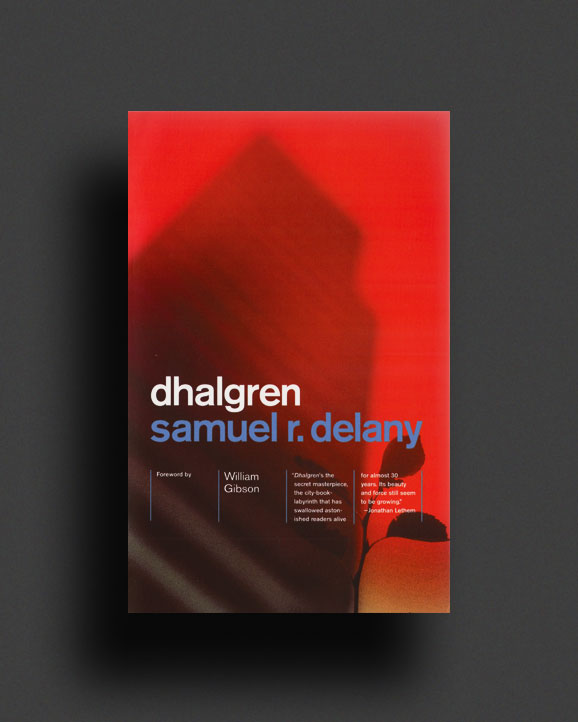
In Dhalgren, perhaps one of the most profound and bestselling science fiction novels of all time, Samuel R. Delany has produced a novel "to stand with the best American fiction of the 1970s" (Jonathan Lethem). Bellona is a city at the dead center of the United States. Something has happened there.... The population has fled. Madmen and criminals wander the streets. Strange portents appear in the cloud-covered sky. And into this disaster zone comes a young man-poet, lover, and adventurer-known only as the Kid. Tackling questions of race, gender, and sexuality, Dhalgren is a literary marvel and groundbreaking work of American magical realism.
Foreward by William Gibson.
After his seventh novel, Empire Star (1966), Samuel R. Delany began publishing short fiction professionally with “The Star Pit.” It appeared in Worlds of Tomorrow and was turned into a popular two-hour radio play, broadcast annually over WBAI-FM for more than a decade. Two tales, “Aye, and Gomorrah” and “Time Considered as a Helix of Semi-Precious Stones,” won Nebula Awards as the best science fiction short stories, respectively, of 1967 and 1969. Aye, and Gomorrah: And Other Stories contains all the significant short science fiction and fantasy works that Delany published between 1965 and 1988, excepting only those tales in his Return to Nevèrÿon series. A native New Yorker, Delany teaches English and creative writing at Temple University in Philadelphia. In July of 2002, he was inducted into the Science Fiction Hall of Fame.
2002, English
Softcover, 336 pages, 13.1 x 20.2 cm
Published by
Random House / New York
$32.00 - Out of stock
Author of the bestselling Dhalgren and winner of four Nebulas and one Hugo, Samuel R. Delany is one of the most acclaimed writers of speculative fiction. Babel-17, winner of the Nebula Award for best novel of the year, is a fascinating tale of a famous poet bent on deciphering a secret language that is the key to the enemy's deadly force, a task that requires she travel with a splendidly improbable crew to the site of the next attack. For the first time, Babel-17 is published as the author intended with the short novel Empire Star, the tale of Comet Jo, a simple-minded teen thrust into a complex galaxy when he's entrusted to carry a vital message to a distant world. Spellbinding and smart, both novels are testimony to Delany's vast and singular talent.
After his seventh novel, Empire Star (1966), Samuel R. Delany began publishing short fiction professionally with “The Star Pit.” It appeared in Worlds of Tomorrow and was turned into a popular two-hour radio play, broadcast annually over WBAI-FM for more than a decade. Two tales, “Aye, and Gomorrah” and “Time Considered as a Helix of Semi-Precious Stones,” won Nebula Awards as the best science fiction short stories, respectively, of 1967 and 1969. Aye, and Gomorrah: And Other Stories contains all the significant short science fiction and fantasy works that Delany published between 1965 and 1988, excepting only those tales in his Return to Nevèrÿon series. A native New Yorker, Delany teaches English and creative writing at Temple University in Philadelphia. In July of 2002, he was inducted into the Science Fiction Hall of Fame.
2018, English
Softcover, 212 pages, 14 x 21.6 cm
Published by
Exmilitary / Earth
$30.00 - Out of stock
Donna Haraway’s celebrated observation that “our machines are disturbingly lively, while we ourselves are frighteningly inert” has given this issue a certain currency in contemporary cyber-theory. But what is interesting about Haraway’s remark – its challenge to the oppositional thinking that sets up free will against determinism, vitalism against mechanism – has seldom been processed by a mode of theorizing which has tended to reproduce exactly the same oppositions. These theoretical failings, it will be argued here, arise from a resistance to pursuing cybernetics to its limits (a failure evinced as much by cyberneticists as by cultural theorists, it must be added). Unraveling the implications of cybernetics, it will be claimed, takes us out to the Gothic flatline. The Gothic flatline designates a zone of radical immanence. And to theorize this flatline demands a new approach, one committed to the theorization of immanence. This thesis calls that approach Gothic Materialism.
1984, English
Softcover (staple-bound), 96 pages, 28 x 20 cm
1st Edition, Out of print title / used / good
Published by
HM Communications / New York
$30.00 - Out of stock
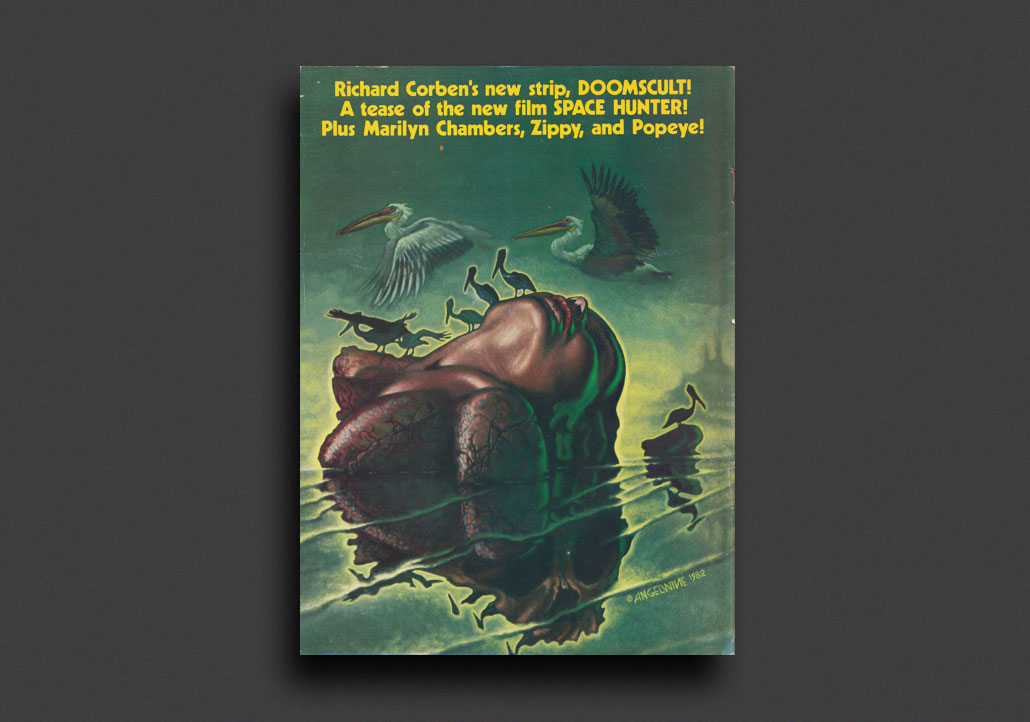
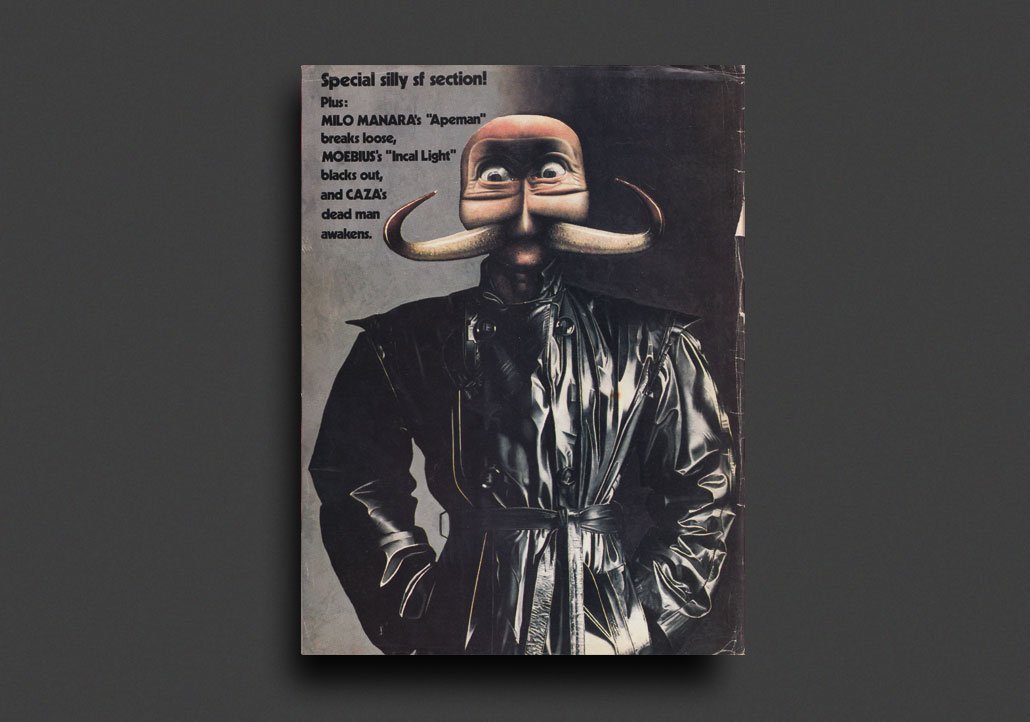
Heavy Metal August 1984 issue, featuring comic stories/art by Herikberto, Caza, Enki Bilal, Jean Torton, Frank Thorne, Philippe Druillet, Claude Renard, John Findley, and many more, plus the usual fare of sci-fi, movies, music... Cover art by Steven Sabella. Back cover by Peter Sato.
Heavy Metal is an American science fiction and fantasy comics magazine that exploded onto the publishing scene in 1977 and shaped a generation with its blend of dark fantasy/science fiction and erotica. Unlike the traditional American comic books of that time bound by the restrictive Comics Code Authority, Heavy Metal featured explicit content. The magazine started out as a licensed translation of the French science-fantasy magazine Métal Hurlant, including work by Enki Bilal, Philippe Caza, Guido Crepax, Philippe Druillet, Jean-Claude Forest, Jean Giraud (a.k.a. Moebius), Chantal Montellier, and Milo Manara. The magazine later ran Stefano Tamburini and Tanino Liberatore's ultra-violent RanXerox. Heavy Metal gradually evolved into a publication featuring North American contributors like Richard Corben, Matt Howarth, Stephen R. Bissette, Alex Ebel, John Holmstrom, Paul Kirchner, Terrance Lindall, Gray Morrow, Walt Simonson, Dan Steffan, Jim Steranko, John Shirley, Arthur Suydam, Bernie Wrightson, and Olivia De Berardinis.
Good copy with cover fold, light wear.
1983, English
Softcover (staple-bound), 96 pages, 28 x 20 cm
1st Edition, Out of print title / used / good
Published by
HM Communications / New York
$30.00 - Out of stock
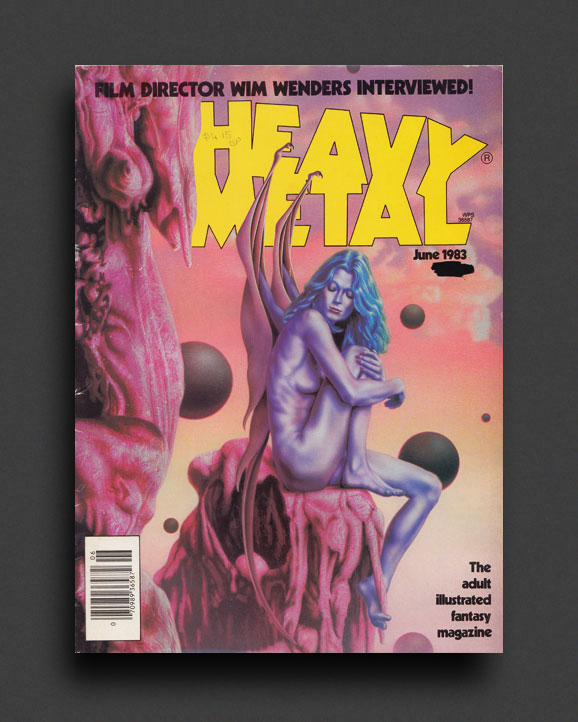
Heavy Metal June 1983 issue, featuring interview with director Wim Wenders, plus comic stories/art by Richard Corben, Guido Crepax, Enki Bilal, Jeff Jones, Caza, Michael Kaluta, Stephen R. Bissette, José Maria Martín Sauri, and many more, plus the usual fare of sci-fi, movies, music... Cover art by Barclay Shaw.
Heavy Metal is an American science fiction and fantasy comics magazine that exploded onto the publishing scene in 1977 and shaped a generation with its blend of dark fantasy/science fiction and erotica. Unlike the traditional American comic books of that time bound by the restrictive Comics Code Authority, Heavy Metal featured explicit content. The magazine started out as a licensed translation of the French science-fantasy magazine Métal Hurlant, including work by Enki Bilal, Philippe Caza, Guido Crepax, Philippe Druillet, Jean-Claude Forest, Jean Giraud (a.k.a. Moebius), Chantal Montellier, and Milo Manara. The magazine later ran Stefano Tamburini and Tanino Liberatore's ultra-violent RanXerox. Heavy Metal gradually evolved into a publication featuring North American contributors like Richard Corben, Matt Howarth, Stephen R. Bissette, Alex Ebel, John Holmstrom, Paul Kirchner, Terrance Lindall, Gray Morrow, Walt Simonson, Dan Steffan, Jim Steranko, John Shirley, Arthur Suydam, Bernie Wrightson, and Olivia De Berardinis.
Good copy, light general wear.
1982, English
Softcover (staple-bound), 96 pages, 28 x 20 cm
1st Edition, Out of print title / used / average
Published by
HM Communications / New York
$25.00 - Out of stock
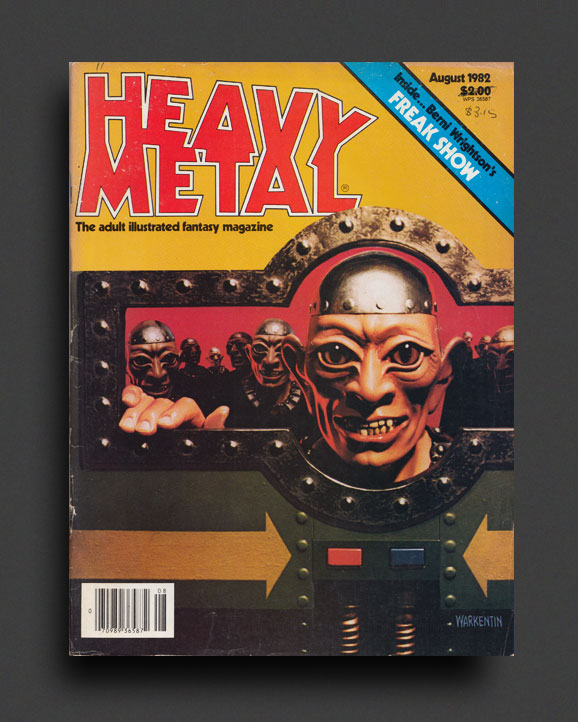
Heavy Metal August 1982 issue, featuring comic stories/art by Moebius, Milo Manara, Caza, Enki Bilal, Philippe Druillet, Nicole Claveloux, Dan O'Bannon, Gotlib (Marcel Gottlieb), Chris Foss, Richard Corben, Jeff Jones, Fernando Fernández, Bernie Wrightson, Jean-Claude Floch (Floc'h) and many more, plus the usual fare of sci-fi, movies, music... Cover art by Thomas Warkentin. Back cover by Christopher Mark Brennan.
Heavy Metal is an American science fiction and fantasy comics magazine that exploded onto the publishing scene in 1977 and shaped a generation with its blend of dark fantasy/science fiction and erotica. Unlike the traditional American comic books of that time bound by the restrictive Comics Code Authority, Heavy Metal featured explicit content. The magazine started out as a licensed translation of the French science-fantasy magazine Métal Hurlant, including work by Enki Bilal, Philippe Caza, Guido Crepax, Philippe Druillet, Jean-Claude Forest, Jean Giraud (a.k.a. Moebius), Chantal Montellier, and Milo Manara. The magazine later ran Stefano Tamburini and Tanino Liberatore's ultra-violent RanXerox. Heavy Metal gradually evolved into a publication featuring North American contributors like Richard Corben, Matt Howarth, Stephen R. Bissette, Alex Ebel, John Holmstrom, Paul Kirchner, Terrance Lindall, Gray Morrow, Walt Simonson, Dan Steffan, Jim Steranko, John Shirley, Arthur Suydam, Bernie Wrightson, and Olivia De Berardinis.
Good copy with re-attached(taped) cover, general light wear/tanning to page edges.
2020, English
Softcover, 232 pages, 14 x 20 cm
Published by
Wakefield Press / Cambridge
$34.00 - Out of stock
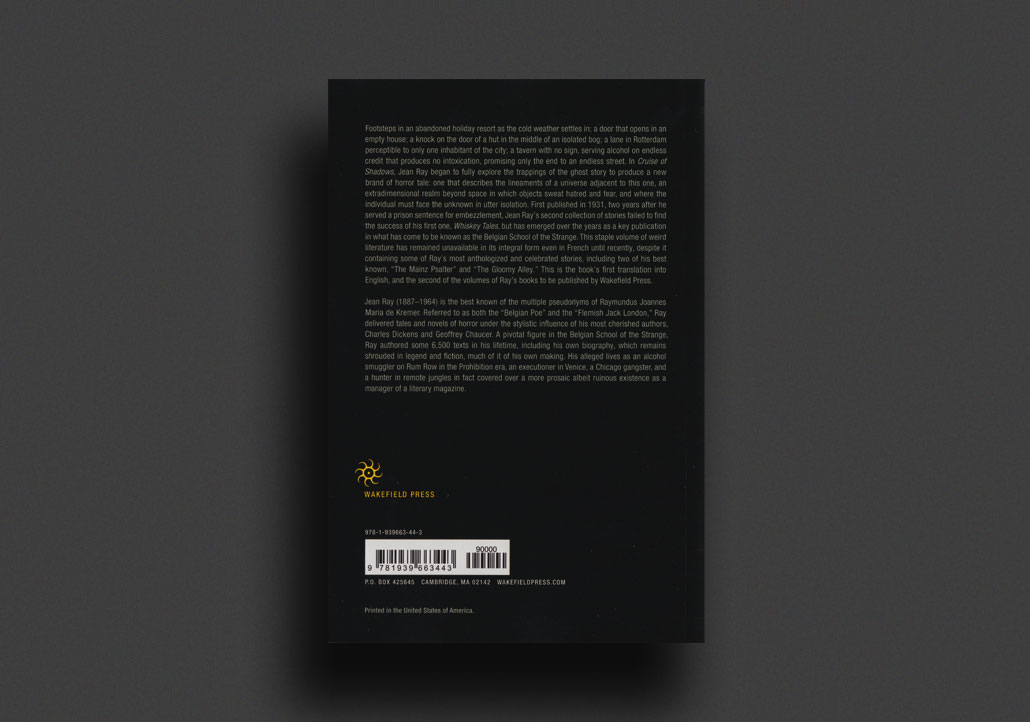
With this second short story collection, Jean Ray began to fully explore the trappings of the ghost story to produce a new brand of horror tale: one that described the lineaments of a universe adjacent to this one, in which objects sweat hatred and fear, and the individual must face the unknown in isolation. First published in 1931, it failed to find the success of his first collection, Whiskey Tales, but has emerged over the years as a key publication in the Belgian School of the Strange. Footsteps in an abandoned holiday resort as the cold weather settles in; a knock on the door of a hut in the middle of an isolated bog; a lane in Rotterdam perceptible to only one inhabitant in the city. In Cruise of Shadows, It has remained unavailable in its integral form even in French until recently, however, though it contains some of Ray’s most anthologised and celebrated stories, including two of his best known, “The Mainz Psalter” and “The Shadowy Alley.” This is the book’s first English translation, and the second of the volumes of Ray’s books to be published by Wakefield Press.Alternately referred to as the “Belgian Poe” and the “Flemish Jack London,” Jean Ray (1887–1964) delivered tales of horror under the stylistic influence of his most cherished authors, Charles Dickens and Geoffrey Chaucer. A pivotal figure in what has come to be known as the “Belgian School of the Strange,” Ray authored some 6,500 texts in his lifetime.
2019, English
Softcover, 240 pages. 13.9 x 20.3 cm
Published by
Wakefield Press / Cambridge
$30.00 - Out of stock
Translated, with an introduction, by Scott Nicolay
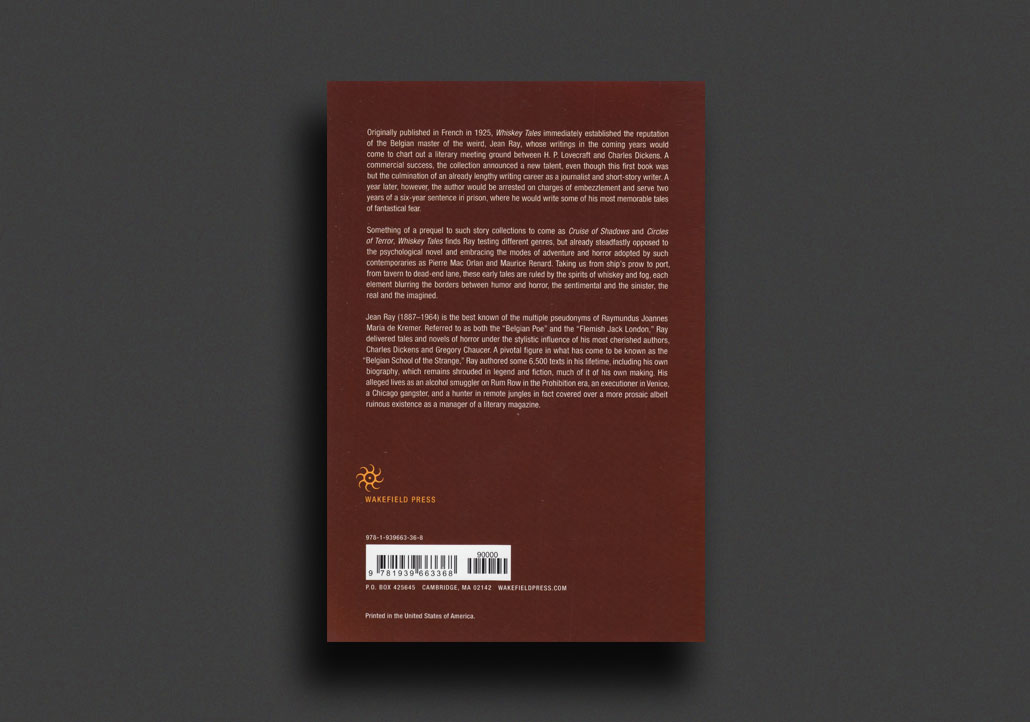
Originally published in French in 1925, Whiskey Tales immediately established the reputation of the Belgian master of the weird, Jean Ray, whose writings in the coming years would come to chart out a literary meeting ground between H. P. Lovecraft and Charles Dickens. A commercial success, the collection earned Ray the appellation of the “Belgian Poe” and announced a new talent, even though this first book had been but the culmination of an already lengthy writing career as a journalist and short-story writer. A year later, however, the author would be arrested on charges of embezzlement and serve two years of a six-year sentence in prison, where he would write some of his best stories.
Something of a prequel to such story collections to come as Cruise of Shadows or Circles of Terror (both forthcoming from Wakefield Press), Whiskey Tales finds Ray testing different genres, but already steadfastly opposed to the psychological novel and embracing the modes of adventure and horror adopted by such contemporaries as Pierre Mac Orlan and Maurice Renard. Taking us from ship’s prow to port, from tavern to dead-end lane, these early tales are ruled by the spirits of whiskey and fog, each element blurring the borders between humor and horror, the sentimental and the sinister, and the real and the imagined.
A handful of these stories first appeared in English in various issues of Weird Tales back in the 1930s, but the majority of this collection has never before been translated. This first complete English-language edition will be the first in many volumes of Jean Ray’s books that Wakefield Press will be bringing out over the coming seasons.
Jean Ray (1887–1964) is the best known of the multiple pseudonyms of Raymundus Joannes Maria de Kremer. Alternately referred to as the “Belgian Poe” and the “Flemish Jack London,” Ray delivered tales and novels of horror under the stylistic influence of his most cherished authors, Charles Dickens and Geoffrey Chaucer. A pivotal figure in what has come to be known as the “Belgian School of the Strange,” Ray authored some 6,500 texts in his lifetime, not including his own biography, which remains shrouded in legend and fiction, much of it his own making. His alleged lives as an alcohol smuggler on Rum Row in the prohibition era, an executioner in Venice, a Chicago gangster, and hunter in remote jungles in fact covered over a more prosaic, albeit ruinous, existence as a manager of a literary magazine that led to a prison sentence, during which he wrote some of his most memorable tales of fantastical fear.
2017, English
Softcover, 160 pages, 14.4 x 16.8 cm
Published by
Atlas Press / London
$30.00 - In stock -
Written in early 1922, this is the first prose work by Surrealist poet and exemplary practitioner of automatic writing Robert Desnos (preceding Mourning for Mourning and Liberty or Love!, also published by Atlas Press).
Its protagonists are swept into violent journeys through Paris by train and steamship; fabulous events consume their everyday lives; oracles spout nonsense or wisdom. All of Desnos' friends in the Paris Dada movement--André Breton, Louis Aragon and Benjamin Péret, among others--make an appearance, and all find a grave in the "cemetery" toward the end of the book, for the past must be buried (even though most of these now legendary names were then in their 20s and had barely made their mark).
By the time this book was written, the Dada movement seemed played out, killed off by a mixture of public success, internal dissent and boredom with the predictability of its scandals. The Punishments of Hell lies between Dada and Surrealism, harking back to the belligerent obfuscation of, say, Tristan Tzara and overwhelming it with the savage lyricism for which Desnos would become known.
Robert Desnos (1900-45) was one of the most celebrated and celebratory of the writers allied to the Paris Dada and Surrealist groups. He effortlessly combined mystery, eroticism and an irrepressible joi de vivre in a flood of poetry, prose fiction, radio plays and even children's verse. An active member of the French resistance, he died of typhoid just days after his liberation from the Terezin concentration camp.
2019, English
Hardcover, 192 pages, 17.5 x 19.5 cm
Published by
Atlas Press / London
$49.00 - Out of stock
Translated and introduced by John Walker, afterword by Alastair Brotchie. Foreword by Italo Calvino, translated by Martin McLaughlin.
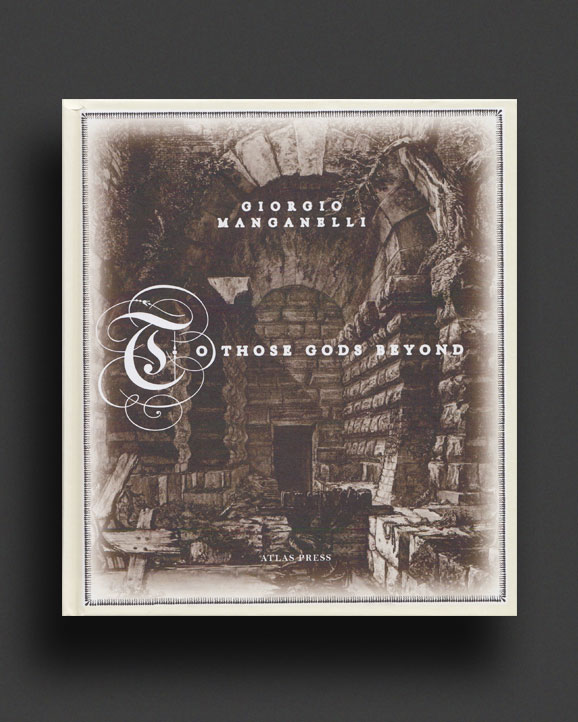
In Manganelli’s innumerable universes, beyond the gods we know or suspect we know is an endless array of other gods. Everything that is seemingly finite or known in our world becomes infinite and unknown. We die, we find ourselves among the other dead, and we die again, only to find ourselves somewhere even more unknown and with death still awaiting. We are both monarch and victim in a gothic simulation illuminated by sombre flashes of sardonic rhetoric that reveal only an astounding desolate wreck. Something of this landscape’s significance can be inferred from Manganelli’s manifesto “Literature as Deception” (1967), which elucidates the author’s notions of the literary “object”, whose devious nature is embodied and mirrored in the elaborate “lies” he constructs here in a style even more lush than the English Romantics he so admired. Manganelli’s paradoxically optimistic fatalism is founded upon a defiance of all the gods — in the knowledge that when they too perish, we are fated to invent others to replace them.
Giorgio Manganelli (1922-1990) is a writer almost unknown in English. He was a central member, with the likes of Eco and Sanguineti, of the Italian avant-garde Gruppo 63, named after its date of formation, and one of the editors of its collective publications. Ever the awkward member of this squad, his writing was greatly admired by Calvino. Manganelli’s theoretical and creative works are deeply intertwined and never more so than with his notorious manifesto (also translated here), which, so it seems, underpins the entire book in a wholly unexpected and original way.
2019, English
Softcover, 80 pages, 14.8 x 17 cm
Published by
Atlas Press / London
$26.00 - In stock -
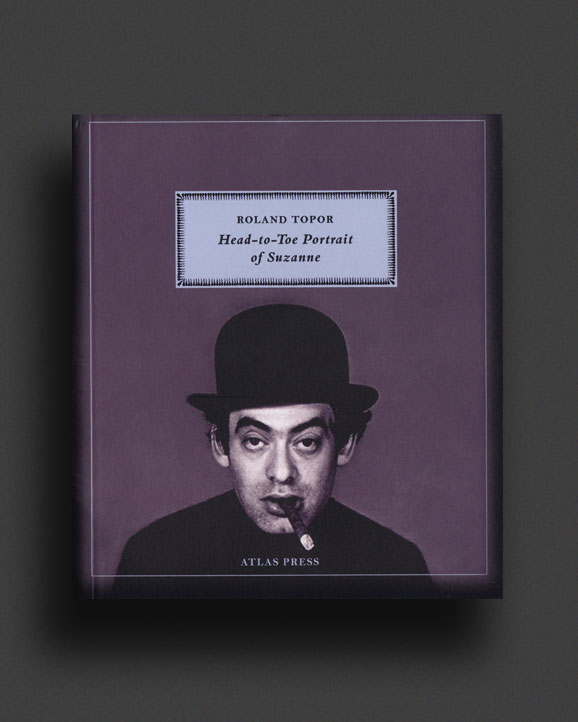
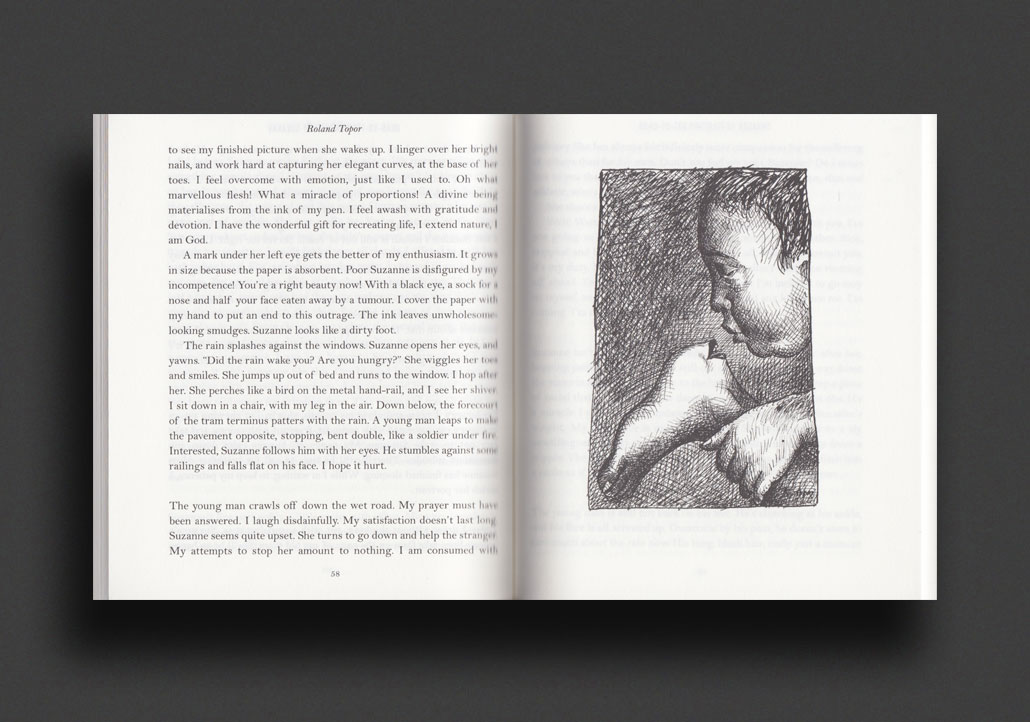
Illustrated by Roland Topor. Translated and introduced by Andrew Hodgson.
The works of the French author and artist Roland Topor, who died 20 years ago, are currently undergoing a major reassessment in his homeland. Major exhibitions have been mounted and all his books are being brought back into print. This is the first of them to be translated into English for some 50 years, and more will certainly follow. Topor was something of an all-round maverick, known for his paintings and drawings as much as for his novels (The Tenant was filmed by Polanski), plays and short stories. He was also a film-maker, actor and the co-founder, with Arrabal and Jodorowsky, of the Panic movement, whose violently orgiastic performances provoked widespread condemnation.
Topor’s works are dominated by a sense of irrational everyday menace that could be interpreted as humour, but a form of humour pushed deep into discomfort, almost to the point of total horror. The reader slowly becomes aware that, alongside preoccupations that some might think morbid, all is being orchestrated by a distinctively optimistic sensibility. From the collision of these factors, rooted in the author’s experiences and his irrepressible personality, come works increasingly seen as unique in European art and writing of the late 20th century. The present text is perhaps a fable, perhaps a love story of enormous tenderness, or it may be a sequence of ever more sinister events that culminate in horror and atrocity. It all depends on your point of view. The central event in this narrative cannot be revealed here, but its sheer implausible reality is utterly convincing and the effect is unforgettable.
2015, English
Softcover, 96 pages, 15 x 17 cm
Published by
Atlas Press / London
$35.00 - Out of stock
Illustrated by Rosa Rosa. Translated and introduced by John Walker and winner of an Italian Institute translation prize.
Sam Dunn is Dead, described by its author as a “Futurist Novel”, was first published in book form by Filippo Marinetti’s Edizioni Futuriste. However, one will search in vain for any mention of this work in anthologies or histories of Futurism. This is doubtless because it is so unlike anything else produced by Futurism (so ardent, so masculine, so positive and so absurdly serious). Sam Dunn is none of these, above all else it is a miniature masterpiece of black humour — the last thing likely to be associated with the posturings of Marinetti and his acolytes. Not only is Sam Dunn funny, despairing, cerebral and ludicrous, it also traces a history of the modern spirit. Its eponymous hero, a poet in languid 1890s mould, unleashes a thoroughly contemporary apocalypse upon the world. Subsequent chapters could be taken for Dadaist or Surrealist texts (but written a decade before their time), and then the whole edifice is fatally undermined by forces that are both banal and… unusual.
Corra later considered his novel a failure, but he was mistaken. His sensitivity to the great undertows of history that were then working their way to the surface seems alarmingly prescient — and anyway his opinion does nothing to inhibit the reader’s simple enjoyment of the book’s deliriously ebullient nihilism.
2013, English
Hardcover, 176 pages, 17 x 19 cm
Published by
Atlas Press / London
$52.00 - In stock -
Had The Tutu appeared when it was written in 1891 it would have been one of the defining works of late nineteenth-century French literature. Juan Goytisolo is among its admirers, and noted that: “The Tutu has been described as the most mysterious novel of the nineteenth century, it is probably one of the strangest, and certainly one of the most fascinating… We find in it a clear presentiment (one cannot say influence, since no one read this book) of the audacities of Jarry, Roussel, Breton, Ionesco and Queneau…”
Its author, the publisher Léon Genonceaux (1856–?), is as much of an enigma as the two legendary enfants terribles whom he was the first to publish: Arthur Rimbaud and the Comte de Lautréamont. When he brought out The Tutu he was already in trouble with the police for “immoral publishing”, and realised that sending it to bookstores would certainly land him in jail. The book disappeared for nearly 100 years, and its author likewise — after 1905 nothing is known of him. Finally republished in the 1990s, The Tutu was hailed by reviewers as the bastard child of J.-K. Huysmans and Antonin Artaud.
Genonceaux appears to have been intent on outraging just about everyone, and The Tutu is gleefully Nietzschean in its dismemberment of contemporary morality. It is simultaneously a sort of ultimate “decadent novel” and outlandishly modern; it is also repellent, infantile and deeply cynical. Yet despite all its absurdities and extravagances, in the end it somehow manages to appear compassionate, poetic, funny, and even — most absurdly of all — rational.
Translated and introduced by Iain White.
2018, English
Hardcover, 210 pages, 17.6 x 19.8 cm
Published by
Atlas Press / London
$55.00 - In stock -
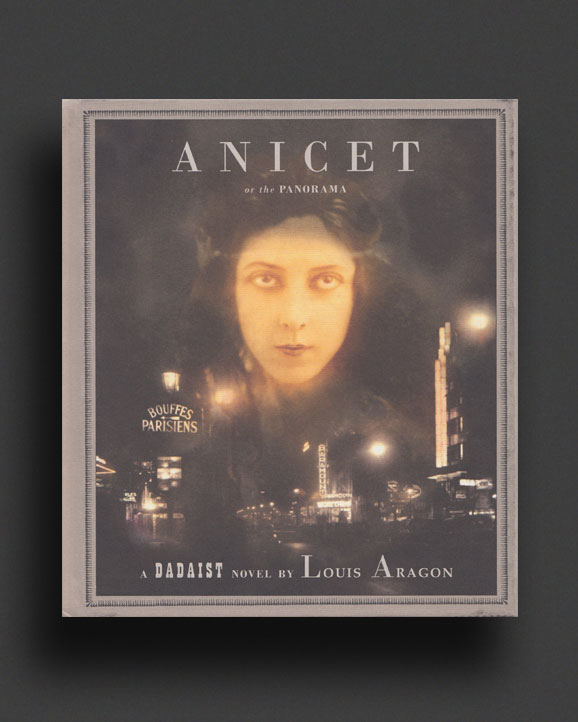
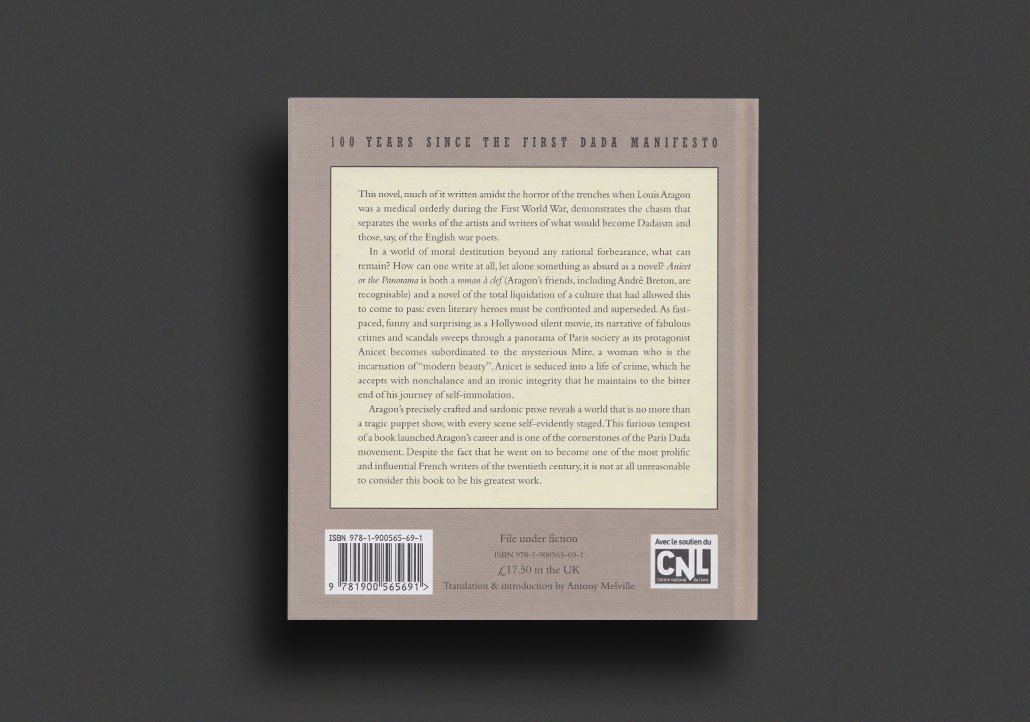
This novel, much of it written amidst the horror of the trenches when Louis Aragon was a medical orderly during the First World War, demonstrates the chasm that separates the works of the artists and writers of what would become Dadaism and those, say, of the English war poets.
In a world of moral destitution beyond any rational forbearance, what can remain? How can one write at all, let alone something as absurd as a novel? Anicet or the Panorama is both a roman à clef (Aragon’s friends, including André Breton, are recognisable) and a novel of the total liquidation of a culture that had allowed this to come to pass: even literary heroes must be confronted and superseded. As fast-paced, funny and surprising as a Hollywood silent movie, its narrative of fabulous crimes and scandals sweeps through a panorama of Parisian society as its protagonist Anicet becomes subordinated to the mysterious Mire, a woman who is the incarnation of “modern beauty”. Anicet is seduced into a life of crime, which he accepts with nonchalance and an ironic integrity that he maintains to the bitter end of his journey of self-immolation.
Aragon’s precisely crafted and sardonic prose reveals a world that is no more than a tragic puppet show, with every scene self-evidently staged. This furious tempest of a book launched Aragon’s career and is one of the cornerstones of the Paris Dada movement. Despite the fact that he went on to become one of the most prolific and influential French writers of the twentieth century, it is not at all unreasonable to consider this book to be his greatest work.
Translated and introduced by Antony Melville, and the runner-up to the 2017 Scott-Moncrieff Translation Prize.
2018, English
Softcover, 400 pages, 19.7 × 13 cm
Published by
Urbanomic / Cornwall
$64.00 - In stock -
An existential odyssey weaving together lived experience and theoretical insight, this startling autobiographical hyperfiction surveys and dissects a world where everything connects and global technological delirium is the norm.
The mediascapes of late capitalism reconfigure erotic responses and trigger primal aggression; under constant surveillance, we occupy simulations of ourselves, private estates on a hyperconnected globe; fictions reprogram reality, memories are rewritten by the future…
Fleeing the excesses of ’90s cyberculture, a young researcher sets out to systematically analyse the obsessively reiterated themes of a writer who prophesied the disorienting future we now inhabit. The story of his failure is as disturbingly psychotropic as those of his magus—J.G. Ballard, prophet of the post-postmodern, voluptuary of the car crash, surgeon of the pathological virtualities pulsing beneath the surface of reality.
Plagued by obsessive fears, defeated by the tedium of academia, yet still certain that everything connects to Ballard, his academic thesis collapses into a series of delirious travelogues, deranged speculations and tormented meditations on time, memory, and loss. Abandoning literary interpretation and renouncing all scholarly distance, he finally accepts the deep assignment that has run throughout his entire life, and embarks on a rogue fieldwork project: Applied Ballardianism, a new discipline and a new ideal for living. Only the darkest impulses, the most morbid obsessions, and the most apocalyptic paranoia, can uncover the technological mutations of inner space.
An existential odyssey inextricably weaving together lived experience and theoretical insight, this startling autobiographical hyperfiction surveys and dissects a world where everything connects and global technological delirium is the norm—a world become unmistakably Ballardian.
A brilliantly written genre mashup […] a wonderfully original mix of cultural theory, literary exegesis, travelogue and psychopathological memoir.
–PD Smith, The Guardian
A curious, unsettling text, full of weird obsessions and mysterious drives. Gleefully, on page after page, it tears up the conventions of literary criticism, autobiography, and fiction and spits them out the other side.
–Robert Barry, The Quietus
An intensely worked and engaged encounter. I admired the persistence, “honesty”, and elective madness. The storms carried me through, all the way.
–Iain Sinclair
Applied Ballardianism is an astonishing book, part fictionalized hallucinatory memoir, part essential Ballard primer, all written in the style of the great man himself. Whether you’re new to JG Ballard or a lifelong fan, this is a thrilling read, cut through with equal parts black humor, cultural insight, and existential horror.
–Tim Maughan, author of Paintwork and Infinite Detail
In Applied Ballardianism, Simon Sellars has invented a genre all his own. But what is it, exactly? Postmodern autopathography? Rough Guide to the Desert of the Real? Notes toward a mental breakdown? The missing link between Ballard and Virilio, psychogeography and edgeland studies, Mad Max and Videodrome? One thing is certain: Applied Ballardianism is the only book you’ll need when you’re marooned on a concrete island, barricaded in a high rise that’s descending into anarchy, or cast away on some Enewetak of the unconscious.
–Mark Dery, author of I Must Not Think Bad Thoughts: Drive-By Essays on American Dread, American Dreams
At first, Simon Sellars appears to be a character in a JG Ballard novel. Then Ballard appears to be a character in a Simon Sellars novel. Then not just the characters but the whole setting and ambience appear to be at once Ballardian and Sellarsian. Then you finish the book and you seem to be a character in a novel the two of them conspired to write. And your perception of the world is never the same again.
–McKenzie Wark, author of A Hacker Manifesto, Gamer Theory, and Telesthesia
This is a book of critical epistemology, of questioning what it is we know, what it is we can know, about and through literary texts. The refracted fluorescence of our own critical passions and compulsions visits us outlandishly, like lights in the sky.
–Brendan Gillott, Minor Literatures
Simon Sellars is a writer and editor based in Melbourne, Australia.
2018, English
Softcover, 824 pages, 15.6 x 23.4 cm
Published by
Repeater Books / London
$56.00 - Out of stock
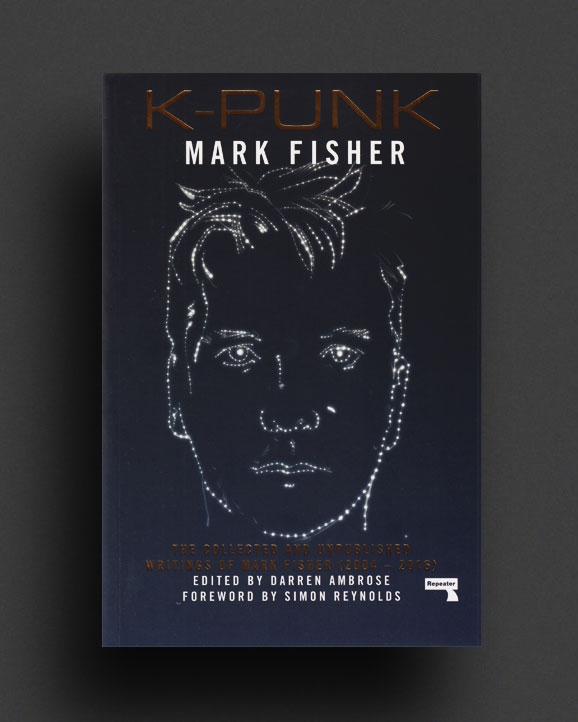
Edited by Darren Ambrose and with a foreword by Simon Reynolds, this comprehensive 800+ collection brings together the work of acclaimed blogger, writer, political activist and lecturer Mark Fisher (aka k-punk). Covering the period 2004 - 2016, the collection will include some of the best writings from his seminal blog k-punk; a selection of his brilliantly insightful film, television and music reviews; his key writings on politics, activism, precarity, hauntology, mental health and popular modernism for numerous websites and magazines; his final unfinished introduction to his planned work on "Acid Communism"; and a number of important interviews from the last decade.
Mark Fisher (11 July 1968 – 13 January 2017), also known as "k-punk", was a British writer, critic, cultural theorist, and teacher based in the Department of Visual Cultures at Goldsmiths, University of London. He initially achieved acclaim for his blogging as k-punk in the early 2000s, and was known for his writing on radical politics, music, and popular culture.
Fisher published several books, including the unexpected success Capitalist Realism: Is There No Alternative? (2009), and contributed to publications such as The Wire, Fact, New Statesman and Sight & Sound. He was also the co-founder of Zero Books, and later Repeater Books. He died in January 2017, shortly before the publication of his latest book The Weird and the Eerie (2017).
2020, English
Softcover, 44 pages, 23 x 15.5 cm
Published by
Sahara Books / France
$29.00 - Out of stock
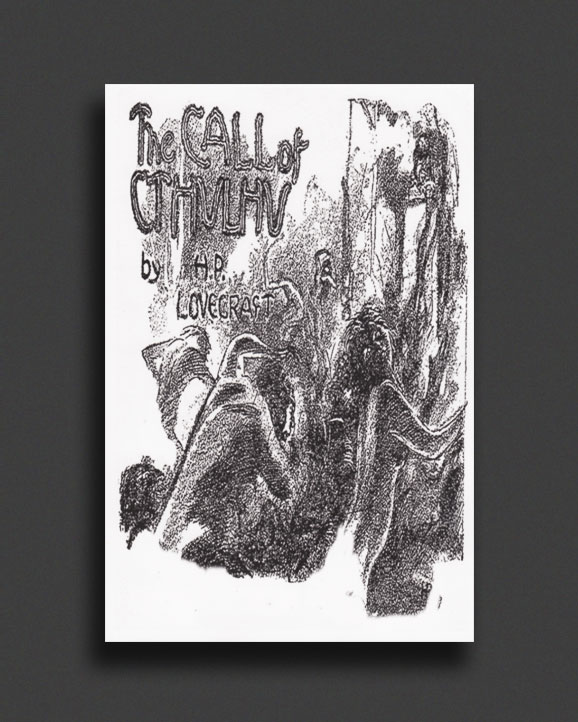
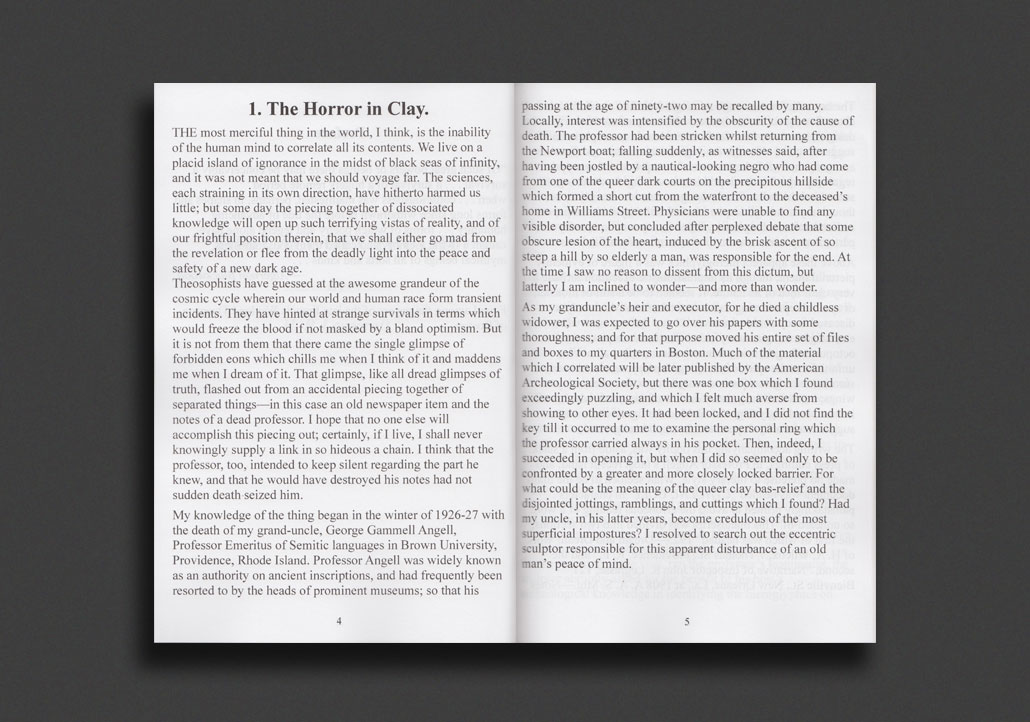
"The Call of Cthulhu" is a short story by American writer H. P. Lovecraft. Written in the summer of 1926, it was first published in the pulp magazine Weird Tales, in February 1928. This is an unabridged reprint of this original 1928 version.
Howard Phillips Lovecraft (August 20, 1890 – March 15, 1937) was an American writer, who achieved posthumous fame through his influential works of horror fiction. He was virtually unknown and published only in pulp magazines before he died in poverty, but he is now regarded as one of the most significant 20th-century authors of horror and weird fiction.
Lovecraft was born in Providence, Rhode Island, where he spent most of his life. Among his most celebrated tales are "The Rats in the Walls", "The Call of Cthulhu", At the Mountains of Madness, The Shadow over Innsmouth, and The Shadow Out of Time, all canonical to the Cthulhu Mythos. Lovecraft was never able to support himself from earnings as an author and editor. He saw commercial success increasingly elude him in this latter period, partly because he lacked the confidence and drive to promote himself. He subsisted in progressively strained circumstances in his last years; an inheritance was completely spent by the time he died, at age 46.
In 1962 Colin Wilson, in his survey of anti-realist trends in fiction The Strength to Dream, cited Lovecraft as one of the pioneers of the "assault on rationality" and included him with M. R. James, H. G. Wells, Aldous Huxley, Tolkien and others as one of the builders of mythicised realities over against the failing project of literary realism. Subsequently, Lovecraft began to acquire the status of a cult writer in the counterculture of the 1960s, and reprints of his work proliferated. Philosopher Graham Harman, seeing Lovecraft as having a unique—though implicit—anti-reductionalist ontology, writes: "No other writer is so perplexed by the gap between objects and the power of language to describe them, or between objects and the qualities they possess." Harman said of leading figures at the initial speculative realism conference (which included philosophers Quentin Meillassoux, Ray Brassier, and Iain Hamilton Grant) that, though they shared no philosophical heroes, all were enthusiastic readers of Lovecraft. Speculative realists, Mark Fisher and other contemporary philosophers, took Lovecraft seriously, mainly because Lovecraft's weird reality as presented in his novels, had nothing to do with the Gothic's insistence in the supernatural, but presented another reality incomprehensible to the human mind, but nonetheless real. According to scholar S. T. Joshi: "There is never an entity in Lovecraft that is not in some fashion material".
2018, English
Softcover, 212 pages, 13 x 19 cm
Published by
Strange Attractor / London
$47.00 - In stock -
A lost poet of the decadent era, Lionel Johnson is the shadow man of the 1890s, an enigma "pale as wasted golden hair." History has all but forgotten Johnson, except as a footnote to the lives of more celebrated characters like W. B. Yeats and Oscar Wilde.
Johnson should have been one of the great poets of the age but was already drinking eau-de-cologne for kicks while a teenager at Winchester College. His attraction to absinthe damaged his fragile health and cast him forever into a waking dream of haunted rooms and spectral poetry. A habitual insomniac, he haunted medieval burial grounds after dark, jotting down the epitaphs of the gone-too-young, as if anticipating his own early demise at the age of 35 -- falling from a bar stool in a Fleet Street pub.
It was rumoured that Johnson performed "strange religious rites" in his rooms at Oxford and experimented with hashish in the company of fellow poet Ernest Dowson. Moving to London, he fell in with Simeon Solomon, Oscar Wilde, and Aubrey Beardsley, and would contribute to the leading decadent publications of the day, including The Chameleon, The Yellow Book, and The Savoy.
Like a glimmering of a votive candle in one of Johnson's dream churches, Incurable sheds new light on one of the most gifted, if reclusive, poets of the fin de siècle. Containing a detailed biography, illustrations, rare and unusual material including previously unseen letters, poetry, and essays, Incurable pays tribute to this enchanting and eccentric poet while providing fresh insight into an era that continues to fascinate.
1989, English
Softcover, 304 pages, 11 x 18 cm
1st Edition, Out of print title / used / fine
Published by
VGSF / UK
$39.00 - Out of stock
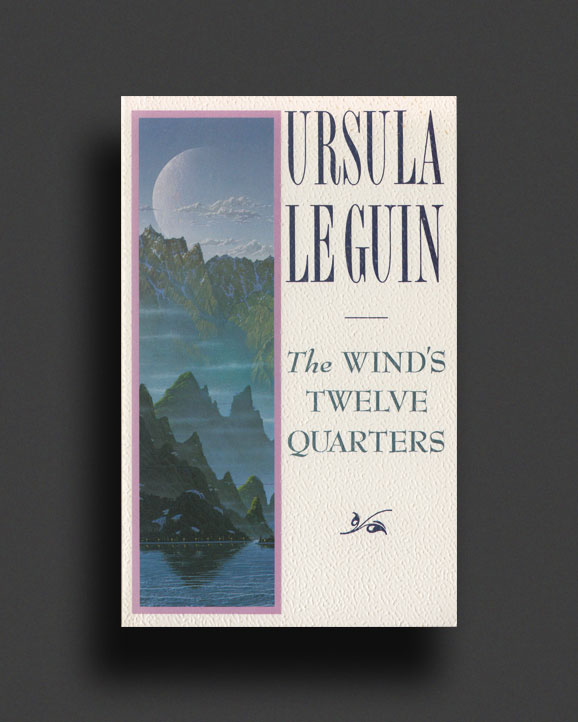
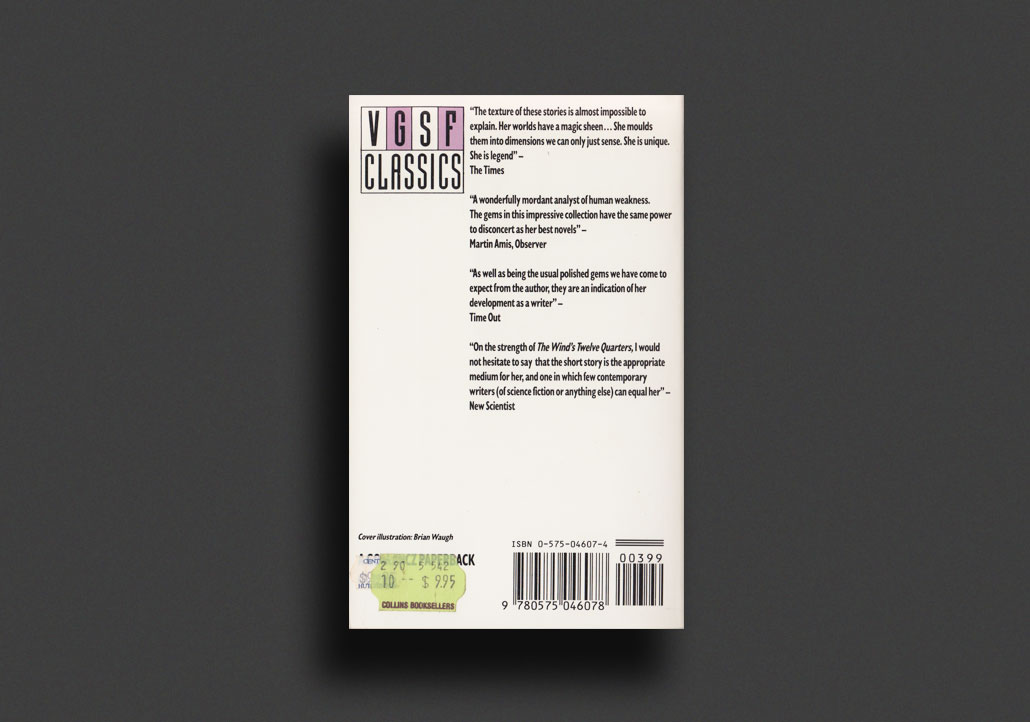
Described by author Ursula K. Le Guin as a retrospective, The Wind's Twelve Quarters is a collection of short stories named after a line from A. E. Housman's A Shropshire Lad and first published by Harper & Row in 1975. It collects 17 previously published stories, four of which were the germ of novels she was to write later: "The Word of Unbinding" and "The Rule of Names" gave Le Guin the place that was to become Earthsea; "Semley's Necklace" was first published as "Dowry of the Angyar" in 1964 and then as the Prologue of the novel Rocannon's World in 1966; "Winter's King" is about the inhabitants of the planet Winter, as is Le Guin's later novel The Left Hand of Darkness. Most of the other stories are also connected to Le Guin's novels. The story "The Ones Who Walk Away from Omelas" won the Hugo Award in 1974, while "The Day Before the Revolution" won the Locus and Nebula Awards in 1975.
The very lovely and scarce first VGSF edition from 1989.
Ursula K. Le Guin (1929–2018) was an American author of speculative fiction, realistic fiction, non-fiction, screenplays, librettos, essays, poetry, speeches, translations, literary critiques, chapbooks, and children's fiction. She was primarily known for her works of speculative fiction. These include works set in the fictional world of Earthsea, stories in the Hainish Cycle, and standalone novels and short stories. Though frequently referred to as an author of science fiction, critics have described her work as being difficult to classify.
Very Good-Fine copy.
English
Softcover, 11 x 18 cm
1st Edition, Out of print title / used / good
Published by
Puffin / UK
$40.00 - Out of stock
1984's The Earthsea Trilogy collects A Wizard of Earthsea, The Tombs of Atuan, and The Farthest Shore, the three first major novels of The Earthsea Cycle, a series of high fantasy books written by the great American writer Ursula K. Le Guin. In the series, Earthsea is a vast archipelago surrounded by an uncharted ocean. First published in 1968, A Wizard of Earthsea brought Le Guin much critical attention with many commentators describing The Earthsea books as Le Guin's best work. Literary critic Harold Bloom referred to the books as Le Guin's masterpieces.
Ursula K. Le Guin (1929–2018) was an American author of speculative fiction, realistic fiction, non-fiction, screenplays, librettos, essays, poetry, speeches, translations, literary critiques, chapbooks, and children's fiction. She was primarily known for her works of speculative fiction. These include works set in the fictional world of Earthsea, stories in the Hainish Cycle, and standalone novels and short stories. Though frequently referred to as an author of science fiction, critics have described her work as being difficult to classify.
1991, English
Softcover, 302 pages, 11 x 18 cm
Published by
VGSF / UK
$30.00 - Out of stock
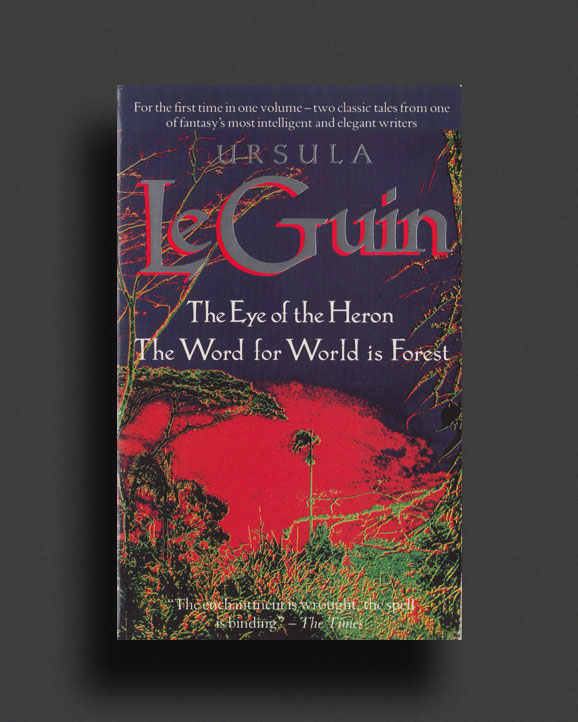
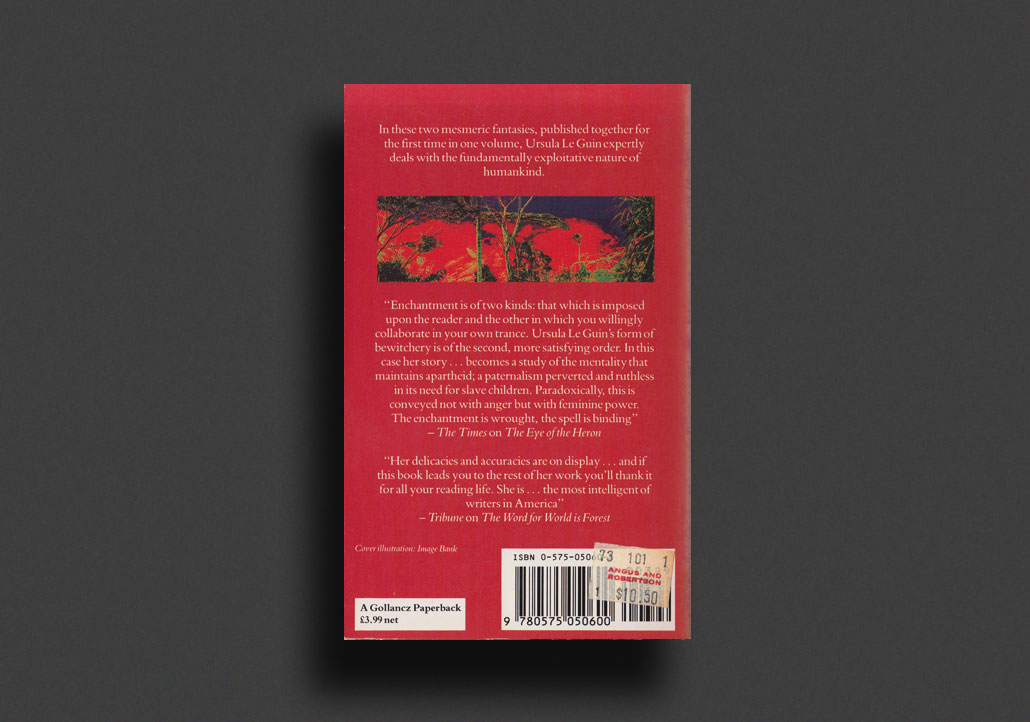
First VGSF 1991 edition collection of two Ursula K. Le Guin novellas: The Eye of the Heron, first published 1978; and The Word for World is Forest, first published in 1972 - for the first time in one volume.
The Eye of the Heron (1978) is a science fiction novel set on the fictional planet of Victoria in a speculative future, probably sometime in the 22nd century, when the planet has been colonized for about a century and has no communication with Earth. The protagonist is a young woman called Luz but the story is told in the third person and the reader sees events from the point of view of several different characters. The Eye of the Heron was first published in the science fiction anthology Millennial Women.
The Word for World Is Forest was first published in the United States in 1972 as a part of the anthology Again, Dangerous Visions. It is part of Le Guin's Hainish Cycle. The story focuses on a military logging colony set up on the fictional planet of Athshe by people from Earth (referred to as "Terra"). The colonists have enslaved the non-aggressive native Athsheans. Their peaceful culture is introduced to mass violence for the first time. The novel carries strongly anti-colonial and anti-militaristic overtones, driven partly by Le Guin's negative reaction to the Vietnam War. It also explores themes of sensitivity to the environment, and of connections between language and culture. It shares the theme of dreaming with Le Guin's novel The Lathe of Heaven, and the metaphor of the forest as a consciousness with the story "Vaster than Empires and More Slow". The novella won the Hugo Award in 1973, and was nominated for several other awards. It received generally positive reviews from reviewers and scholars, and was variously described as moving and hard-hitting.
Ursula K. Le Guin (1929–2018) was an American author of speculative fiction, realistic fiction, non-fiction, screenplays, librettos, essays, poetry, speeches, translations, literary critiques, chapbooks, and children's fiction. She was primarily known for her works of speculative fiction. These include works set in the fictional world of Earthsea, stories in the Hainish Cycle, and standalone novels and short stories. Though frequently referred to as an author of science fiction, critics have described her work as being difficult to classify.
Very Good copy.
1984, English
Softcover, 11 x 18 cm
Out of print title / used / very good
Published by
Panther / London
$30.00 - Out of stock
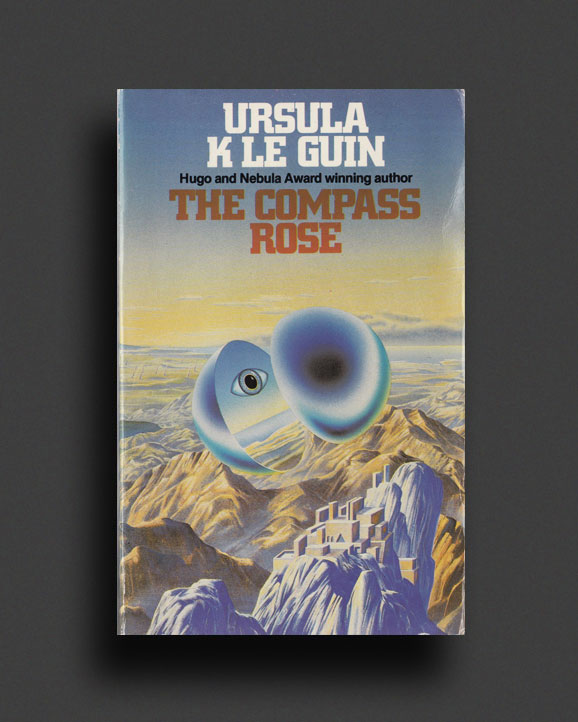
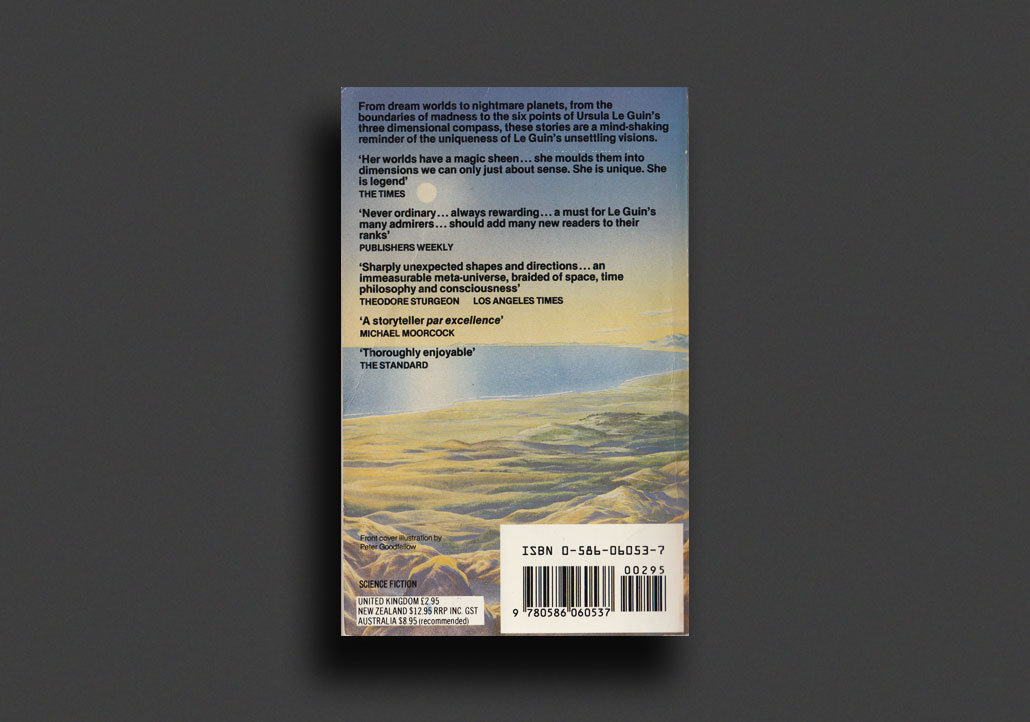
1984 Panther edition of Ursula K. Le Guin's "The Compass Rose". The Compass Rose, first published in 1982, is a collection of short stories by American writer Ursula K. Le Guin organized into sections on the theme of directions, though not strictly compass-related as the title implies. Nadir, North, East, Zenith, West, South. It won the Locus Award for best Single Author Collection in 1983.
Ursula K. Le Guin (1929–2018) was an American author of speculative fiction, realistic fiction, non-fiction, screenplays, librettos, essays, poetry, speeches, translations, literary critiques, chapbooks, and children's fiction. She was primarily known for her works of speculative fiction. These include works set in the fictional world of Earthsea, stories in the Hainish Cycle, and standalone novels and short stories. Though frequently referred to as an author of science fiction, critics have described her work as being difficult to classify.
Very Good copy.
1987, English
Softcover, 564 pages, 11 x 18 cm
Out of print title / used / very good
Published by
Spectra / UK
$35.00 - Out of stock
More than five years in the making, Always Coming Home by Ursula K. Le Guin, first published in 1985, is a science fiction novel unlike any other. Rich and complex, it is in parts narrative, pseudo-textbook and pseudo-anthropologist's record. It describes the life and society of the Kesh people, a cultural group who live in the distant future long after modern society has collapsed. The book's setting is a time so post-apocalyptic that no cultural source can remember the apocalypse, though a few folk tales refer to our time. The only signs of our civilization that have lasted into their time are indestructible artefacts such as styrofoam and a self-manufacturing, self-maintaining, solar-system-wide computer network. There has been a great sea level rise since our time, flooding much of northern California, where the story takes place. The story is presented by Pandora, who seems to be an anthropologist or ethnographer from the readers' contemporary culture, or a culture very close to it. Pandora describes the book as a protest against contemporary civilization, which the Kesh call "the Sickness of Man".
1987 Spectra edition.
Ursula K. Le Guin (1929–2018) was an American author of speculative fiction, realistic fiction, non-fiction, screenplays, librettos, essays, poetry, speeches, translations, literary critiques, chapbooks, and children's fiction. She was primarily known for her works of speculative fiction. These include works set in the fictional world of Earthsea, stories in the Hainish Cycle, and standalone novels and short stories. Though frequently referred to as an author of science fiction, critics have described her work as being difficult to classify.
Very Good.