World Food Books' programme is largely produced on Kulin Nation land. We acknowledge the Wurundjeri people of the Kulin Nation as the first and continuing custodians of this land, and pay respect to their Elders past, present, and emerging.
World Food Books is an arts and special interests bookshop in Naarm / Melbourne. Founded in 2010, World Food Books is devoted to the presentation of a rotating, hand-selection of international art, design, literary and counterculture publications with an emphasis on the anti-traditional, the experimental, the avant-garde, the heretic, the marginal.
Presenting new titles alongside rare and out-of-print books, catalogues and journals spanning the fields of modern and contemporary art, design, photography, illustration, film, literature, poetry, cultural theory, philosophy, sexuality, popular and underground culture in its many radical forms, World Food Books wishes to encourage adventurous, thoughtful and open-minded reading, looking, writing, and exchange of publishing and ideas, both current and historical.
As well as our bookshop, located in Melbourne's historical Nicholas Building, all of our inventory is available internationally via our online mail-order service.
World Food Books semi-regularly co-ordinates "Occasions", a programme of exhibits and events at the bookshop and in partnership with other hosts (such as museums and art galleries) that develop out of the activities, relationships and content of the bookshop itself.
World Food Books
The Nicholas Building
37 Swanston Street
Room 5, Level 6
Melbourne 3000
Australia
SHOP HOURS:
Thu–Sat 11–5
WEB-SHOP OPEN 24/7
World Food Books
Postal Address:
PO Box 435
Flinders Lane
Victoria 8009
Australia
Art
Theory / Essay
Architecture / Interior
Graphic Design / Typography
Photography
Fashion
Eros
LGBTQ+
Fiction / Poetry
Weird / Speculative / Science Fiction / Horror
Transgressive / Visceral / Abject
Symbolism / Decadence / Fin de siècle
Film / Video
Painting
Sculpture / Installation
Performance / Dance / Theater
Drawing
Sound / Music
Curatorial
Group Shows / Collections
Periodicals
Out-of-print / Rare
Posters / Ephemera / Discs
Signed Books
World Food Books Gift Voucher
World Food Book Bag
Australian Art
Australian Fiction
Australian Science Fiction / Speculative Fiction
Australian Poetry
Australian Photography
Japanese Photography
Conceptual Art
Minimal Art
Dada
'Pataphysics / Oulipo
Fluxus
Concrete Poetry
Pop Art
Surrealism
Arte Povera
Arte Informale / Haute Pâte / Tachism
Nouveau Réalisme / Zero / Kinetic
Situationism / Lettrism
Collage / Mail Art / Xerox Art
Art Brut / Folk / Visionary / Fantastic
Illustration / Graphic Art / Bandes Dessinées
Furniture
Italian Radical Design / Postmodernism
Textiles
Ceramics / Glass
Counterculture
Protest / Revolt
Philosophy
Psychoanalysis
Anthropology
Anarchism
Socialism / Anarchism / Communism / Capitalism
Literary Theory / Semiotics / Language
Feminism / Women's Studies
Gender Studies / Sexuality
Anthropology
Fetishism / BDSM
Drugs / Psychedelia
Crime / Violence
Animal Rights / Veganism
Occult / Esoterica
Ecology / Earth / Alternative Living
Whole Earth / Crafts
All prices in AUD (Australian dollars)
Pick-Ups
Pick-up orders can be collected in our bookshop during opening hours after order date. Please collect any Pick-up orders within 2 weeks of ordering as we have limited storage space. Orders will be released back into stock if not collected within this time. No refunds can be made for pick-ups left un-collected. If you cannot make it in to the bookshop in this time-frame, please choose postage option.
Return Policy
All sales are final. We do accept returns (for refund or exchange) for items received in error. All our orders are packed with special care using heavy-duty padding and cardboard book-mailers or bubble mailers (for smaller books), using reinforcement where required. We cannot take responsibility for any lost, stolen or damaged parcels.
Insurance
Should you wish to insure your package, please email us directly after placing your order and we can organise this at a small extra expense. Although all standard/express tracked packages are very safe and dependable, we cannot take responsibility for any lost, stolen or damaged parcels. We recommend insurance on valuable orders.
Interested in selling your old books, catalogues, journals, magazines, comics, fanzines, ephemera? We are always looking for interesting, unusual and out-of-print books to buy. We only buy books in our fields of interest and specialty, and that we feel we can resell.
We base these prices on desirability, market value, in-print prices, condition and our current stock levels. We offer cash, store credit, and can take stock on consignment. All
about 25% of the price we expect to get when we sell them, or 30% in store credit. We base these prices on desirability, market value, in-print prices, condition and our current stock levels.
Sell your books any day of the week. You can drop them off and return later. If you have a lot of books, we can visit your Sydney home.
We buy books that we feel we can resell. We offer about 25 % of the price we expect to get when we sell them, or 30% in store credit. We base these prices on desirability, market value, in-print prices, condition and our current stock levels.
Philadelphia Wireman
03 August - 01 September, 2018
World Food Books is proud to announce our next Occasion, the first presentation of sculptures by Philadelphia Wireman in Australia.
The Philadelphia Wireman sculptures were found abandoned in an alley off Philadelphia’s South Street on trash night in 1982. Their discovery in a rapidly-changing neighbourhood undergoing extensive renovation, compounded with the failure of all attempts to locate the artist, suggests that the works may have been discarded after the maker’s death. Dubbed the "Philadelphia Wireman" during the first exhibition of this work, in 1985, the maker’s name, age, ethnicity, and even gender remain uncertain. The entire collection totals approximately 1200 pieces, all intricately bound together with tightly-wound heavy-gauge wire (along with a few small, abstract marker drawings, reminiscent both of Mark Tobey and J.B. Murry). The dense construction of the work, despite a modest range of scale and materials, is singularly obsessive and disciplined in design: a wire armature or exoskeleton firmly binds a bricolage of found objects including plastic, glass, food packaging, umbrella parts, tape, rubber, batteries, pens, leather, reflectors, nuts and bolts, nails, foil, coins, toys, watches, eyeglasses, tools, and jewellery.
Heavy with associations—anthropomorphic, zoomorphic, and socio-cultural responses to wrapped detritus—the totemic sculptures by Philadelphia Wireman have been discussed in the context of work created to fulfil the shamanistic needs of alternative religions in American culture. Curators, collectors, and critics have variously compared certain pieces to sculpture from Classical antiquity, Native American medicine bundles, African-American memory jugs, and African fetish objects. Reflecting the artist’s prolific and incredibly focused scavenging impulse, and despite—or perhaps enhanced by—their anonymity, these enigmatic objects function as urban artefacts and arbiters of power, though their origin and purpose is unknown. Philadelphia Wireman, whatever their identity, possessed an astonishing ability to isolate and communicate the concepts of power and energy through the selection and transformation of ordinary materials. Over the course of the past two decades, this collection has come to be regarded as an important discovery in the field of self-taught art and vernacular art.
Presented in collaboration with Fleisher-Ollman Gallery, Philadelphia, and Robert Heald, Wellington.
Susan Te Kahurangi King
02 February - 10 March, 2018
Susan Te Kahurangi King (24 February 1951 - ) has been a confident and prolific artist since she was a young child, drawing with readily available materials - pencils, ballpoint pens and felt-tip markers, on whatever paper is at hand. Between the ages of four and six Susan slowly ceased verbal communication. Her grandparents William and Myrtle Murphy had developed a special bond with Susan so they took on caring responsibilities for extended periods. Myrtle began informally archiving her work, carefully collecting and storing the drawings and compiling scrapbooks. No drawing was insignificant; every scrap of paper was kept. The King family are now the custodians of a vast collection containing over 7000 individual works, from tiny scraps of paper through to 5 meter long rolls.
The scrapbooks and diaries reveal Myrtle to be a woman of great patience and compassion, seeking to understand a child who was not always behaving as expected. She encouraged Susan to be observant, to explore her environment and absorb all the sights and sounds. Myrtle would show Susan’s drawings to friends and people in her community that she had dealings with, such as shopkeepers and postal workers, but this was not simply a case of a grandmother’s bias. She recognised that Susan had developed a sophisticated and unique visual language and sincerely believed that her art deserved serious attention.
This was an unorthodox attitude for the time. To provide some context, Jean Dubuffet coined the term Art Brut in 1945 to describe work created by self-taught artists – specifically residents of psychiatric institutions and those he considered to be visionaries or eccentrics. In 1972 Roger Cardinal extended this concept by adopting the term Outsider Art to describe work made by non-academically trained artists operating outside of mainstream art networks through choice or circumstance. Susan was born in Te Aroha, New Zealand in 1951, far from the artistic hubs of Paris and London that Dubuffet and Cardinal operated in. That Myrtle fêted Susan as a self-taught artist who deserved to be taken seriously shows how progressive her attitudes were.
Susan’s parents Doug and Dawn were also progressive. Over the years they had consulted numerous health practitioners about Susan’s condition, as the medical establishment could not provide an explanation as to why she had lapsed into silence. Dawn educated herself in the field of homeopathy and went on to treat all twelve of her children using these principles – basing prescriptions on her observations of their physical, mental and emotional state.
Doug was a linguist with an interest in philosophy who devoted what little spare time he had to studying Maori language and culture. To some extent their willingness to explore the fringes of the mainstream made them outsiders too but it was their commitment to living with integrity and their respect for individuality that ensured Susan’s creativity was always encouraged.
Even though Susan’s family supported her artistic pursuits, some staff in schools and hospitals saw it as an impediment to her assimilation into the community and discouraged it in a variety of ways. Her family was not always aware of this and therefore did not fully understand why Susan stopped drawing in the early 1990s. However, rather than dwell on the challenges that Susan faced in pursuit of her artistic practice, they prefer to highlight her achievements. In 2008 Susan began drawing again in earnest, after an almost 20 year interruption, and her work is now shown in galleries around the world.
Susan grew up without television and has been heavily influenced by the comics she read as a child. She is absolutely fearless in the appropriation of recognizable characters, such as Donald Duck and Mickey Mouse, in her work. She twists their limbs, contorts their faces, compresses them together, blends them into complex patterned backgrounds - always imbuing them with an incredible energy. Although Susan often used pop culture characters in her work they are not naive or childlike. These are drawings by a brilliant self-taught artist who has been creating exceptional work for decades without an audience in mind.
Mladen Stilinović
"Various Works 1986 - 1999"
02 February 16 - September 10, 2016
Various works 1986 - 1999, from two houses, from the collections of John Nixon, Sue Cramer, Kerrie Poliness, Peter Haffenden and Phoebe Haffenden.
Including: Geometry of Cakes (various shelves), 1993; Poor People’s Law (black and white plate), 1993; White Absence (glasses, ruler, set square, silver spoon, silver ladel with skin photograph and wooden cubes), 1990-1996; Exploitation of the Dead (grey and red star painting, wooden painting, black spoon with red table, red plate), 1984-1990; Money and Zeros (zero tie, paintings made for friends in Australia (Sue, John, Kerrie), numbers painting), 1991-1992; Words - Slogans (various t-shirts) - “they talk about the death of art...help! someone is trying to kill me”, “my sweet little lamb”, “work is a disease - Karl Marx”; Various artist books, catalogues, monographs, videos; Poster from exhibition Insulting Anarchy; "Circular" Croatian - Australian edition; Artist book by Vlado Martek (Dostoyevsky); more.
Thanks to Mladen Stilinović and Branka Stipančić.
Jonathan Walker
Always Will Need To Wear Winter Shirt Blue + Ochre Small Check Pattern
21 August - 21 September, 2015
Untitled
I am not a great reader of poetry but I always return to the work of Melbourne poet, Vincent Buckley (1925- 1988). Perhaps I find his most tantalising piece to be not a finished poem but a fragment left on a scrap of paper discovered on his desk after the poet’s death.
The poetry gathers like oil
In the word-core, and spreads
It has its music meet,
Its music is in movement.
This fragment is more the shell left behind from a volatile thought than a finished poem. I find the last two lines honest but awkward whereas the first two lines work like an arrow. Most likely he could not find a resolution so it was left. Still, in its present form, it remains an eloquent testimony to the ultimate failure of a medium to express mobile thought and sensation, in Buckley’s case, through verbal language. It’s an important matter because this is something all artists have to deal with regardless of the medium.
I have never written a poem, however, I am forever copying fragments from books on paper scraps in a vain effort to fix certain notions in my head. At first, they function as bookmarks that are sometimes returned to when I open the book. But before long, as they accumulate, they fall out littering the table interspersed with A4 photocopies, bills, books and medications.
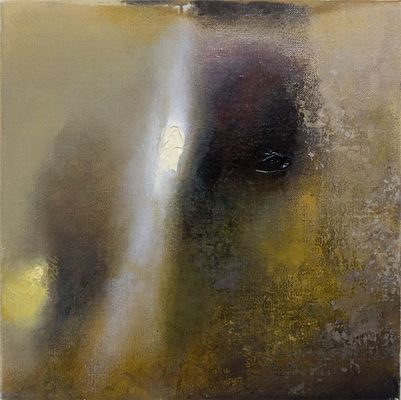
To return to Buckley’s fragment, the first two lines very much evoke how I paint nowadays. As you age, detail diminishes and patches of light become more luminous and float. I feel the most honest way of dealing with this is by smearing the oil paint on the canvas with the fingers and working close-up, blind. Only if the patches coalesce into an approaching image can the work gain a life.
-
Jonathan Walker was born in Melbourne, Australia and brought up on a dairy farm in Gippsland. In the 1970’s he studied painting at RMIT and won the Harold Wright Scholarship to the British Museum, London. During the 1980’s he exhibited at Pinacotheca Gallery, Richmond and had work shown at the NGV and Heidi City Art Gallery. Over the same period he designed the cover for the “Epigenesi” LP by Giancarlo Toniutti, Italy and conducted a mail exchange work with Achim Wollscheid, Germany. The work with artists through the post resulted in an article published in the bicentenary issue of Art and Australia 1988. He showed in artist run spaces such as WestSpace in the 90’s and 2000’s, and until 2012, taught painting at Victoria University, which is where we (Colleen Ahern and Lisa Radford) as organisers of the exhibition, among many others, had the privilege of being his student.
Walker’s knowledge was imparted to students through the careful selection of music, literature, and artists found in books that he himself had ordered for the library. Walker’s strategy was the generosity of sharing his vast knowledge with references specific to each student and their context.
Walker’s paintings share a similar focus and intimacy.
This exhibition presents a small selection of recent paintings alongside a publication that includes Walker’s writing. Observational and analytical, Walker’s work is a type of material notation — the time of day, colour and how it is blended, the both specific and fleeting location of a reflection on lino or the question of whether a chair leg should be included in a painting.
Please join us on Friday August 21 between 6-8pm to celebrate the opening of the exhibition.
Curated by Colleen Ahern and Lisa Radford.
B. Wurtz
Curated by Nic Tammens
March 26 - April 4, 2015
B.Wurtz works from a basement studio in his home on Manhattan’s Lower East Side.
This local fact is attested to by the plastic shopping bags and newsprint circulars that appear in his work. As formal objects, they don’t make loud claims about their origins but nonetheless transmit street addresses and places of business from the bottom of this long thin island. Like plenty of artists, Wurtz is affected by what is local and what is consumed. His work is underpinned by this ethic. It often speaks from a neighborhood or reads like the contents of a hamper:
“BLACK PLUMS $1.29 lb.”
“Food Bazaar”
“USDA Whole Pork Shoulder Picnic 99c lb.”
“RITE AID Pharmacy, with us it’s personal.”
“H. Brickman & Sons.”
“Sweet Yams 59c lb."
Most of the work in this exhibition was made while the artist was in residence at Dieu Donne, a workshop dedicated to paper craft in Midtown. Here Wurtz fabricated assemblages with paper and objects that are relatively lightweight, with the intention that they would be easily transportable to Australia. This consideration isn’t absolute in Wurtz’s work, but was prescriptive for making the current exhibition light and cheap. Packed in two boxes, these works were sent from a USPS post office on the Lower East Side and delivered to North Melbourne by Australia Post.
Wurtz appears courtesy of Metro Pictures, New York.
Thanks to Rob Halverson, Joshua Petherick, Sari de Mallory, Matt Hinkley, Helen Johnson, Fayen d'Evie, Ask Kilmartin, Lisa Radon, Ellena Savage, Yale Union, and "Elizabeth".
John Nixon
"Archive"
December 15 - January 20, 2014
The presentation of John Nixon's archive offered a rare showcase of this extensive collection of the artist's own publications, catalogues, posters, ephemera, editions and more, from the mid 1980s onwards, alongside a selection of his artworks.
Organized by John Nixon, Joshua Petherick and Matt Hinkley.
<a href=http://wfb.public-office.info/artist/john-nixon>All titles by John Nixon
"Habitat"
at Minerva, Sydney (organised by Joshua Petherick and Matt Hinkley)
November 15 - December 20, 2014
Lupo Borgonovo, Janet Burchill & Jennifer McCamley,
Lewis Fidock, HR Giger, Piero Gilardi, Veit Laurent Kurz,
Cinzia Ruggeri, Michael E. Smith, Lucie Stahl, Daniel Weil, Wols
Press Release:
“...It contained seven objects. The slender fluted bone, surely formed for flight, surely from the wing of some large bird. Three archaic circuitboards, faced with mazes of gold. A smooth white sphere of baked clay. An age-blackened fragment of lace. A fingerlength segment of what she assumed was bone from a human wrist, grayish white, inset smoothly with the silicon shaft of a small instrument that must once have ridden flush with the surface of the skin - but the thing’s face was seared and blackened.”
William Gibson, “Count Zero”, 1986
"Autumn Projects Archive"
Curated by Liza Vasiliou
March 6 - March 15, 2014
World Food Books, in conjunction with the Virgin Australia Melbourne Fashion Festival 2014, presented the Autumn Projects archive, consisting of a selection of early examples in Australian fashion with a particular interest in collecting designers and labels from the period beginning in the 1980’s, who significantly influenced the discourse of Australian Fashion.
Curated by Liza Vasiliou, the exhibition provided a unique opportunity to view pieces by designers Anthea Crawford, Barbara Vandenberg, Geoff Liddell and labels CR Australia, Covers, Jag along with early experimental collage pieces by Prue Acton and Sally Browne’s ‘Fragments’ collection, suspended throughout the functioning World Food Books shop in Melbourne.
H.B. Peace
presented by CENTRE FOR STYLE
November 14, 2013
"Hey Blinky, you say chic, I say same"
Anon 2013
H.B. Peace is a clothing collaboration between great friends Blake Barns and Hugh Egan Westland. Their pieces explore the divergences between 'character’ and ‘personality’ in garments....etc
Special Thanks to Joshua Petherick and Matt Hinkley of WFB and Gillian Mears
and a Very Special Thank you to Audrey Thomas Hayes for her shoe collaboration.
Janet Burchill & Jennifer McCamley
"Aesthetic Suicide"
May 10 - June 8, 2013
The first of our occasional exhibitions in the World Food Books office/shop space in Melbourne, "Aesthetic Suicide" presented a body of new and older works together by artists Janet Burchill & Jennifer McCamley, including videos, prints, a wall work, and publications.
During shop open hours videos played every hour, on the hour.
1975, English
Softcover, 206 pages, 11 x 18 cm
Out of print title / used / good
Published by
Panther / London
$35.00 - Out of stock
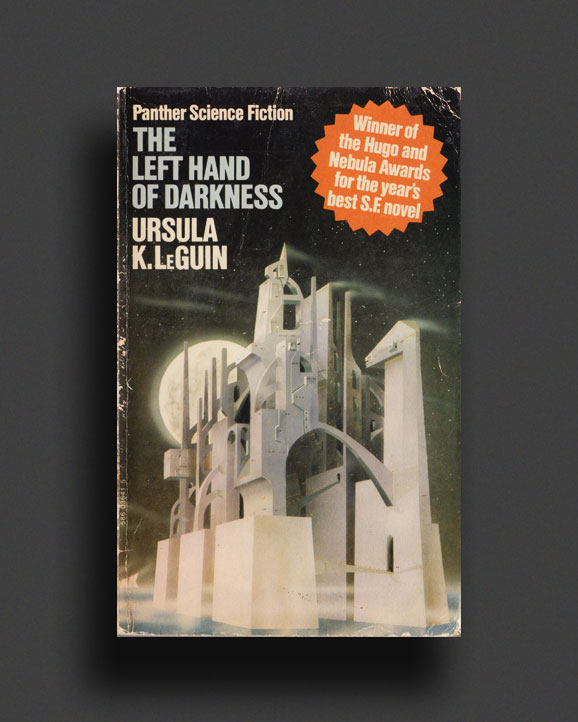
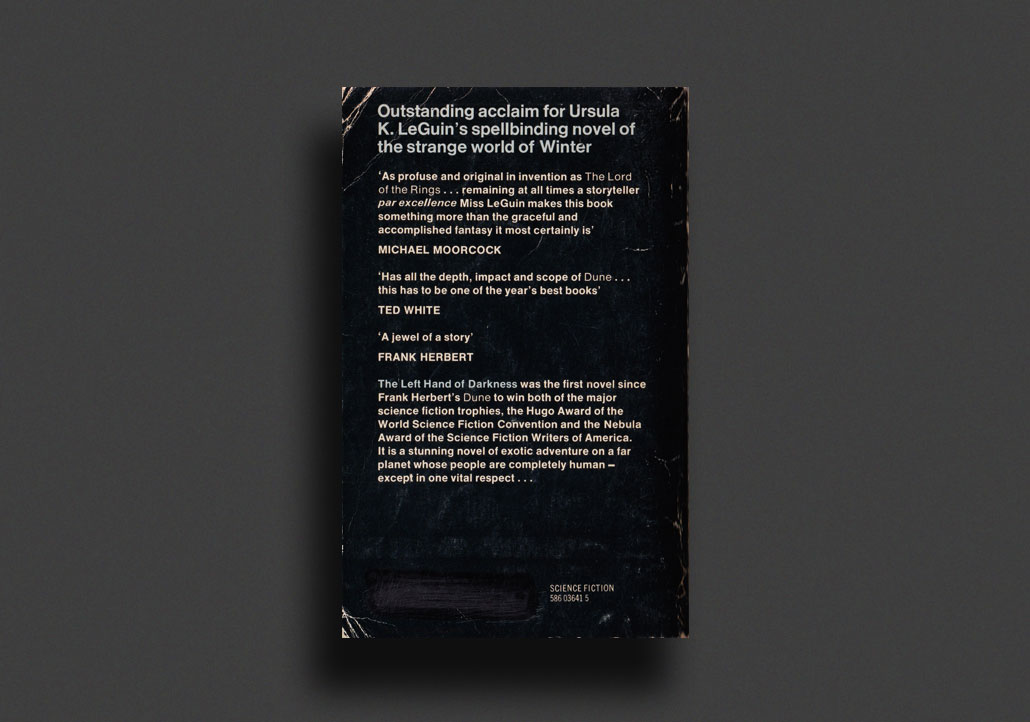
1975 Panther edition of Ursula K. Le Guin's "The Left Hand of Darkness", with Colin Hay cover art.
Published in 1969, The Left Hand of Darkness became immensely popular and established Le Guin's status as a major author of science fiction. The novel is part of the Hainish Cycle, a series of novels and short stories by Le Guin set in the fictional Hainish universe, which she introduced in 1964 with "The Dowry of the Angyar". Among the Hainish novels, it was preceded in the sequence of writing by City of Illusions and followed by The Word for World Is Forest. The novel follows the story of Genly Ai, a native of Terra, who is sent to the planet of Gethen as an envoy of the Ekumen, a loose confederation of planets. Ai's mission is to persuade the nations of Gethen to join the Ekumen, but he is stymied by his lack of understanding of Gethenian culture. Individuals on Gethen are ambisexual, with no fixed sex. This fact has a strong influence on the culture of the planet, and creates a barrier of understanding for Ai.
The Left Hand of Darkness was among the first books in the genre now known as feminist science fiction and is the most famous examination of androgyny in science fiction. A major theme of the novel is the effect of sex and gender on culture and society, explored in particular through the relationship between Ai and Estraven, a Gethenian politician who trusts and helps him. Within that context, the novel also explores the interaction between the unfolding loyalties of its main characters, the loneliness and rootlessness of Ai, and the contrast between the religions of Gethen's two major nations. The theme of gender also touched off a feminist debate when it was first published, over depictions of the ambisexual Gethenians.
Winner of both the Hugo and the Nebula awards. For the critic Harold Bloom, the book meant “that Le Guin, more than Tolkien, has raised fantasy into high literature, for our time”.
Ursula K. Le Guin (1929–2018) was an American author of speculative fiction, realistic fiction, non-fiction, screenplays, librettos, essays, poetry, speeches, translations, literary critiques, chapbooks, and children's fiction. She was primarily known for her works of speculative fiction. These include works set in the fictional world of Earthsea, stories in the Hainish Cycle, and standalone novels and short stories. Though frequently referred to as an author of science fiction, critics have described her work as being difficult to classify.
Good copy. General page tanning / cover and spine wear.
2019, English
Softcover, 144 pages, 16 x 24 cm
Published by
Kunsthalle Zürich / Zürich
Bergen Kunsthall / Norway
Sternberg Press / Berlin
$52.00 - Out of stock
Jolly Rogers is a collection of Peter Wächtler's latest short texts, written in preparation of his two solo exhibitions at Bergen Kunsthall and Kunsthalle Zürich (both 2019), and combined with a nearly complete collection of the artist's drawings and prints from recent years.
The texts operate like vignettes to a larger story, and the images as unreliable illustrations to the narrative. However, the larger story never really is revealed. Each individual text, each single work, articulates itself by means of an intense focus. It is as if we were suspended in a continual zooming motion, as if the artist and author wanted to tell and show it all. But alas, such is life under the microscope: always larger-than-life, but at the wrong scale at a time driven by individual interests, self-optimization, and egos that stage themselves simultaneously as victims and disruptors.
Peter Wächtler works in a variety of media: bronze, ceramics, drawings and video. But in many ways “stories” could be described as his main artistic material. His works often evoke a narration, with animals or human figures in animated states. They are made in ways that use and adapt elements of fiction and folklore, relating to specific traditions and common tales, and materialize the ways of telling a story as much as the story itself.
Born 1979 in Hannover, Peter Wächtler lives and works in Brussels and Berlin.
2012, English
Softcover, 836 pages, 15.2 x 22.9 cm
Published by
Martino Fine Books / United Kingdom
$64.00 - Out of stock
2012 Reprint of Original Three Volume s First Published from 1905-1907. Exact facsimile of the original edition, not reproduced with Optical Recognition Software. This is a collection of Crowley's early esoteric writings and poetry and comprise the first collected edition of his writings. Aleister Crowley, born Edward Alexander Crowley, and also known as both Frater Perdurabo and The Great Beast, was an influential English occultist, mystic, ceremonial magician, poet and mountaineer, who was responsible for founding the religious philosophy of Thelema. In his role as the founder of the Thelemite philosophy, he came to see himself as the prophet who was entrusted with informing humanity that it was entering the new Aeon of Horus in the early 20th century. Born into a wealthy upper class family, as a young man he became an influential member of the esoteric Hermetic Order of the Golden Dawn after befriending the order's leader, Samuel Liddell MacGregor Mathers. Subsequently believing that he was being contacted by his Holy Guardian Angel, an entity known as Aiwass, while staying in Egypt in 1904, he "received" a text known as 'The Book of the Law' from what he believed was a divine source, and around which he would come to develop his new philosophy of Thelema. He would go on to found his own occult society and eventually rose to become a leader of Ordo Templi Orientis (O.T.O.), before founding a religious commune in Cefalu known as the Abbey of Thelema, which he led from 1920 through till 1923. After abandoning the Abbey amid widespread opposition, Crowley returned to Britain, where he continued to promote Thelema until his death. Crowley has remained an influential figure and is widely thought of as the most influential occultist of all time. Includes: Volume 1. Aceldama. The tale of Archais. Songs of the spirit. The poem. Jephithah. Mysteries. Jezebel, and other tragic poems. An appeal to the American republic. The fatal force. The mother's tragedy. The temple of the holy ghost. Carmen Saeculare. Tannhauser. Epilogue. Appendix. -- Volume 2. Oracles. Alice: An adultery. The Argonauts. Ahab and other poems. The God-eater. The sword of song. Ambrosii magi hortus rosarum. The three characteristics. An essay on ontology. Science and Buddhism. The excluede middle; or, the sceptic refuted. Time. Epilogue. Volume 3. The star and the garter. Rosa mundi, and other love-songs. The Sire de Maletroit's door. Gargoyles. Rodin in rime. Orpheus. Epilogue and dedication. Appendix A. Bibliographical note. Appendix B. Index of first lines.
1978, Japanese
Softcover (w. dist jacket), 324 pages, 10.5 x 15.3 cm
1st Edition, Out of print title / used / very good
Published by
Hayakawa Books / Tokyo
$60.00 - Out of stock
First Japanese paperback edition of Ubik by Philip K. Dick, published in translated Japanese in 1978 by Hayakawa Books. Translation to Japanese by Hisashi Asakura. Ubik is a 1969 science fiction novel by American writer Philip K. Dick. The story is set in a future 1992 where psychic powers are common and utilized in corporate espionage. It follows Joe Chip, a technician at a psychic agency who begins to experience strange alterations in reality that can be temporarily reversed by a mysterious store-bought substance called Ubik. Ubik is one of Dick's most acclaimed novels.
Very Good copy w. light handling/edge tanning.
2014, English
Softcover, 162 pages, 12.6 x 21.6 cm
Published by
City Lights Books / San Francisco
$29.00 - Out of stock
Thousand Times Broken brings together three extraordinary, previously untranslated books in which Henri Michaux's art and poetry merge in ways never seen before, composing a journey in which we----with the great visionary Michaux as our guide----are invited to hover between reading and looking, between the ineffable and the known, between body and spirit into a realm where it is possible to perceive "what one otherwise doesn't perceive, what one hardly suspects at all."
Composed between 1956-1959, during Michaux's mescaline experiments, all three books engage a dynamic struggle between the mark and the word as Michaux searches for a medium up to the task of expressing the inexpressible. Included are Four Hundred Men on the Cross, a ghostly, enigmatic contemplation of Michaux's loss of faith, Peace in the Breaking, written under the influence of mescaline, its title poem of pure ascension sent flowing into the same spine-like furrows of Michaux's India ink drawings, and Watchtowers on Targets, a singular, automatic collaboration with surrealist and abstract expressionist painter Roberto Matta. Translated from the French by noted poet Gillian Conoley.
Through travel journals, prose poems, and incantatory exorcisms, Henri Michaux (1899–1984) built an unsettling world of aggression, fear, hostility, and paranoia, whose fantastical landscapes and fabulist beings delineate a space of psychological and cognitive discomfort all too contemporary. In 1956 he continued his controlled explorations of the self with a series of mescaline experiments, which he documented in a series of books over the next decade. Michaux’s writing was paralleled by his lifelong commitment to painting and drawing.
2019, English
Softcover, 360 pages, 15.2 x 21 cm
Published by
Strange Attractor / London
$46.00 - Out of stock
Edited by David Tibet
Described by W. B. Yeats as a “scholar, connoisseur, drunkard, poet, pervert, most charming of men,” Count Stanislaus Eric Stenbock (1860–1895) is surely the greatest exemplar of the Decadent movement of the late nineteenth century.
A friend of Aubrey Beardsley, patron of the extraordinary pre-Raphaelite artist Simeon Solomon, and contemporary of Oscar Wilde, Stenbock died at the age of thirty-six as a result of his addiction to opium and his alcoholism, having published just three slim volumes of suicidal poetry and one collection of morbid short stories.
Stenbock was a homosexual convert to Roman Catholicism and owner of a serpent, a toad, and a dachshund called Trixie. It was said that toward the end of his life he was accompanied everywhere by a life-size wooden doll that he believed to be his son. His poems and stories are replete with queer, supernatural, mystical, and Satanic themes; original editions of his books are highly sought by collectors of recherché literature.
Of Kings and Things is the first introduction to Stenbock's writing for the general reader, offering fifteen stories, eight poems and one autobiographical essay by this complex figure.
2019, English
Softcover, 328 pages, 19,7 x 13 cm
Published by
Urbanomic / Cornwall
$56.00 - Out of stock
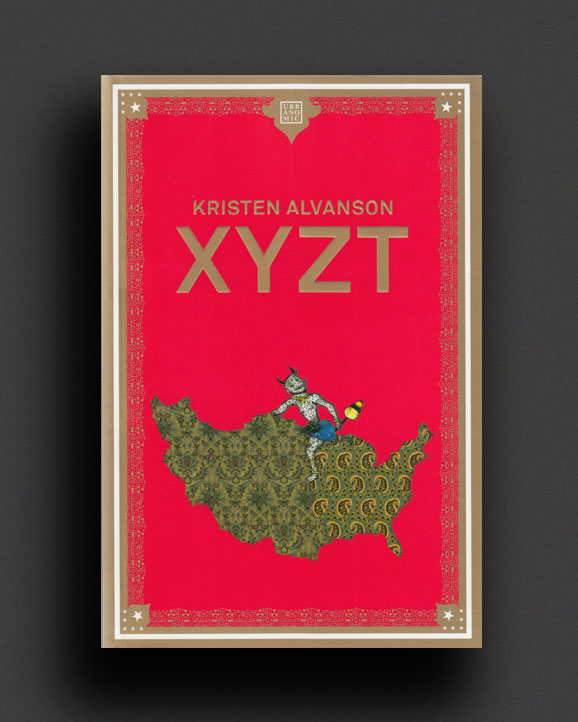
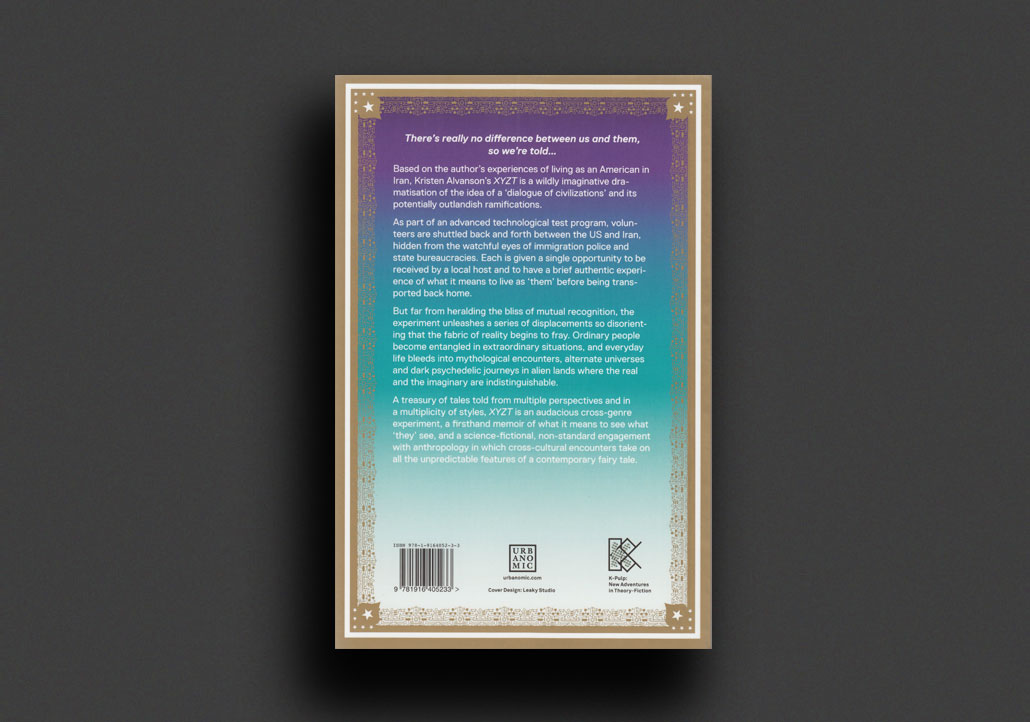
XYZT is high-concept sci-fi. Its exploration of the limits of cross-cultural communication makes for fascinating reading. — Helen Marshall, New Scientist
‘There’s really no difference between us and them, so we’re told….’
Based on the author’s experiences of living as an American in Iran, Kristen Alvanson’s XYZT is a wildly imaginative dramatisation of the idea of a ‘dialogue of civilizations’ and its potentially outlandish ramifications.
As part of an advanced technological test program, volunteers are shuttled back and forth between the US and Iran, hidden from the watchful eyes of immigration police and state bureaucracies. Each is given a single opportunity to be received by a local host and to have a brief authentic experience of what it means to live as ‘them’ before being transported back home.
But far from heralding the bliss of mutual recognition, the experiment unleashes a series of displacements so disorienting that the fabric of reality begins to fray. Ordinary people become entangled in extraordinary situations, and everyday life bleeds into mythological encounters, alternate universes and dark psychedelic journeys in alien lands where the real and the imaginary are indistinguishable.
A treasury of tales told from multiple perspectives and in a multiplicity of styles, Alvanson’s debut novel is an audacious cross-genre experiment, a firsthand memoir of what it means to see what ‘they’ see, and a science-fictional, non-standard engagement with anthropology in which cross-cultural encounters take on all the unpredictable features of a contemporary fairy tale.
2015, English
Softcover, 96 pages, 11 x 18 cm
Published by
Wakefield Press / Cambridge
$30.00 - Out of stock
Originally published in book form in French in 1887, Joris-Karl Huysmans’s A Dilemma remains a particularly nasty little tale, a mordantly satiric and cruel account of bourgeois greed and manipulation that holds up as clear a mirror to today's neoliberalist times as it did to the French fin-de-siècle. Written in-between Huysmans’ most famous works—his 1881 Against Nature, which came to define the Decadent movement, and his 1891 exploration of Satanism, Down There—A Dilemma presents some of the author’s most memorable characters, including Madame Champagne, the self-appointed Parisian protector of women in need, and the carnal would-be sophisticate notary Le Ponsart, who wages a war of words with the bereft pregnant mistress of his deceased grandson with devastating consequences. In its unflinching portrayal of how authoritarian language can be used and abused as a weapon, this novella stands as Huysmans’s indictment of the underlying crime of the novel itself: a language apparatus employed to maintain the appetites of the ruling class.
Earning a wage through a career in the French civil service, Joris-Karl Huysmans (1848–1907) quietly explored the extremes of human nature and artifice through a series of books that influenced a number of different literary movements: from the grey and grimy Naturalism of books like Marthe and Downstream to the cornerstones of the Decadent movement, Against Nature and the Satanist classic Down There, along with the dream-ridden Surrealist favorite, Becalmed, and his Catholic novels, The Cathedral and The Oblate.
Translated, with an introduction, by Justin Vicari
“Huysmans is surrealist in pessimism.”—André Breton
2017, English
Softcover, 280 pages, 15 x 23 cm
Published by
Wakefield Press / Cambridge
$49.00 - Out of stock
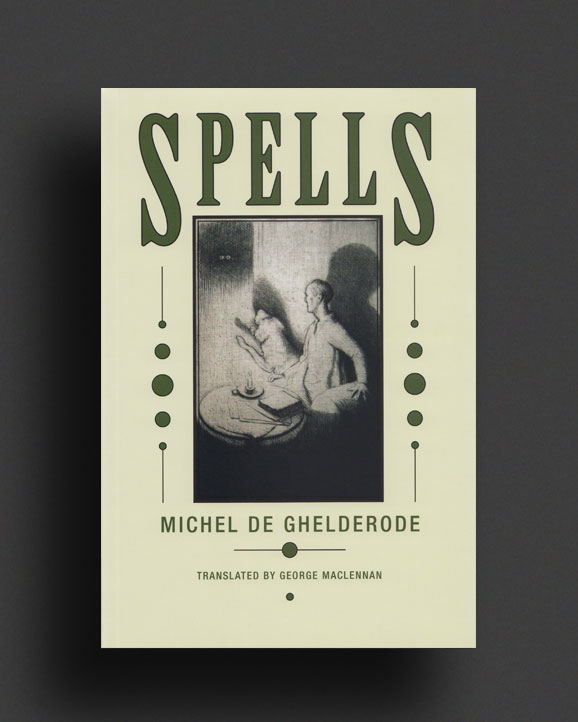
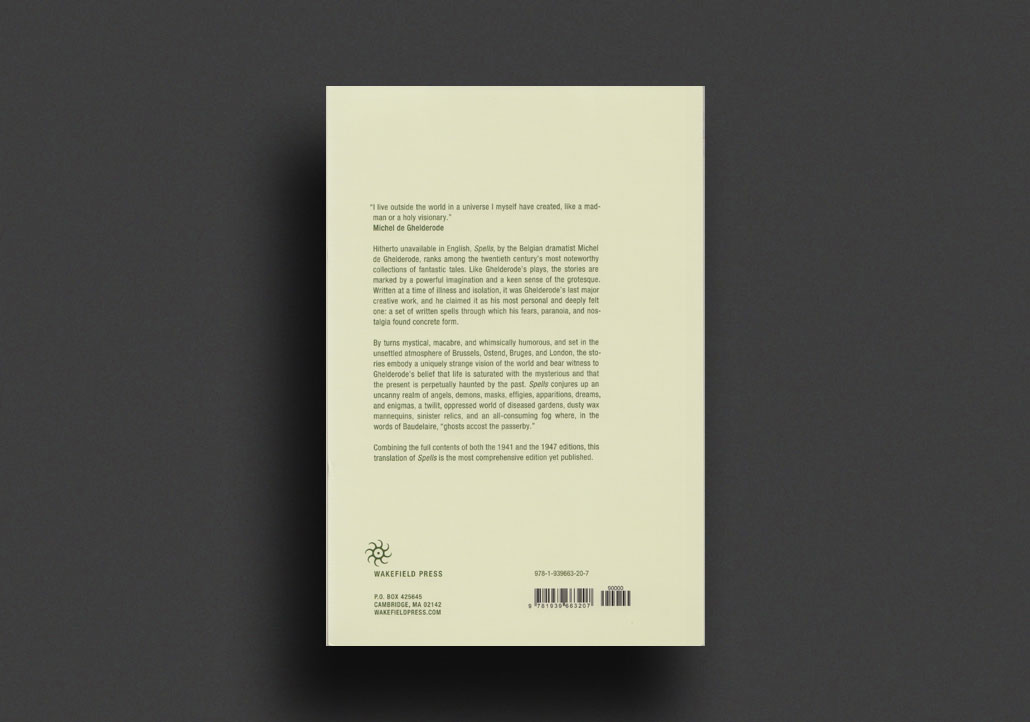
“I live outside the world in a universe I myself have created, like a madman or a holy visionary.”
—Michel de Ghelderode
Hitherto unavailable in English, Spells, by the Belgian dramatist Michel de Ghelderode, ranks among the twentieth century’s most noteworthy collections of fantastic tales. Like Ghelderode’s plays, the stories are marked by a powerful imagination and a keen sense of the grotesque. Written at a time of illness and isolation, it was Ghelderode’s last major creative work, and he claimed it as his most personal and deeply felt one: a set of written spells through which his fears, paranoia, and nostalgia found concrete form.
By turns mystical, macabre and whimsically humorous, and set in the unsettled atmosphere of Brussels, Ostend, Bruges, and London, the stories embody a uniquely strange vision of the world, and bear witness to Ghelderode’s belief that life is saturated with the mysterious and that the present is perpetually haunted by the past. Spells conjures up an uncanny realm of angels, demons, masks, effigies, apparitions, dreams, and enigmas, a twilit, oppressed world of diseased gardens, dusty wax mannequins, sinister relics, and an all-consuming fog where, in the words of Baudelaire, “ghosts accost the passerby.”
Combining the full contents of both the 1941 and the 1947 editions, this translation of Spells is the most comprehensive edition yet published.
Michel de Ghelderode (Adhémar Adolphe Martens, 1898–1962) was born in Brussels. His strong anti-realist bent was in evidence from the start and he first attracted attention in 1918 with a one-act play written in tribute to Edgar Allan Poe. In the following years he wrote fiction, drama, literary journalism, and puppet plays. After 1936 he suffered from poor health and his involvement with the theater gradually diminished. Spells (1941) was intended as a fresh start—a collection of new stories with others to follow, but proved to be his last significant creative statement.
“Ghelderode is the black diamond that closes the necklace of poets that Belgium wears around her neck. This black diamond casts a cruel and noble fire. It wounds only those with small souls. It dazzles others.”—Jean Cocteau
Translated, with an introduction, by George MacLennan
De Ghelderode’s fiction has not been broadly available to English readers, and this edition of Spells will hopefully do its part to remedy that. The consistent execution and thought-provoking, nuanced premises in these stories are enough to render them overlooked classics (at least, to non-Belgian audiences)—there are no real low points to speak of, and it seems unsurprising that the stories are among the final efforts produced by an author with a lengthy and well-developed body of work. — Christopher Burke, Weird Fiction Review
“Spells by Michel de Ghelderode offers a collection of stories both beautiful and loathsome. He represents literature that must be wrestled with to fully appreciate . . . [it] is literature distilled from despair, nostalgia, and sickness.” — Karl Wolff, New York Journal of Books
2019, English
Softcover, 160 pages, 15.2 x 20.3 cm
Published by
Exact Change / Boston
$34.00 - Out of stock
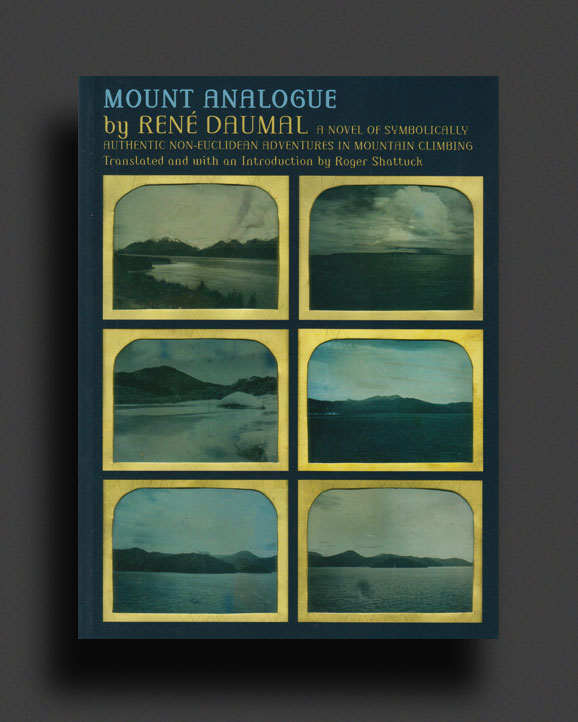
Translated and with an Introduction by Roger Shattuck
Postface by Véra Daumal
“For a mountain to play the role of Mount Analogue, I concluded, its summit must be inaccessible but its base accessible to human beings as nature has made them. It must be unique and it must exist geographically. The door to the invisible must be visible.”
A touchstone of Surrealism, Pataphysics, and Gurdjieffian mysticism, Mount Analogue tells the story of an expedition to a mountain whose existence can only be deduced, not observed. Left unfinished (mid-sentence) at the author's early death from tuberculosis in 1944 and first published posthumously in French in 1952, the book has inspired seekers of art and wisdom ever since - Alejandro Jodorowsky's 1973 film The Holy Mountain is a loose adaptation. This 1959 translation, the first made into English, remains the best and closest in spirit to the deadly serious joking of the original. Written in the form of an adventure tale, the story and language of Mount Analogue are open to layers of interpretation, an invitation that has kept generations of devoted readers returning to it again and again. Exact Change is delighted to bring this superb translation of a true 20th-century classic back into print.
René Daumal (1908-1944) was a literary prodigy in his teens, publishing writings and editing a journal (Le Grand Jeu) that attracted the attention of André Breton and the Surrealists. Rather than join the group, he turned his attention to Eastern Philosophy — first teaching himself Sanskrit to study the Hindu classics, then under the influence of G.I. Gurdjieff and his Parisian circle.
2017, English
Softcover, 240 pages, 15 x 23 cm
Published by
Wakefield Press / Cambridge
$34.00 - Out of stock
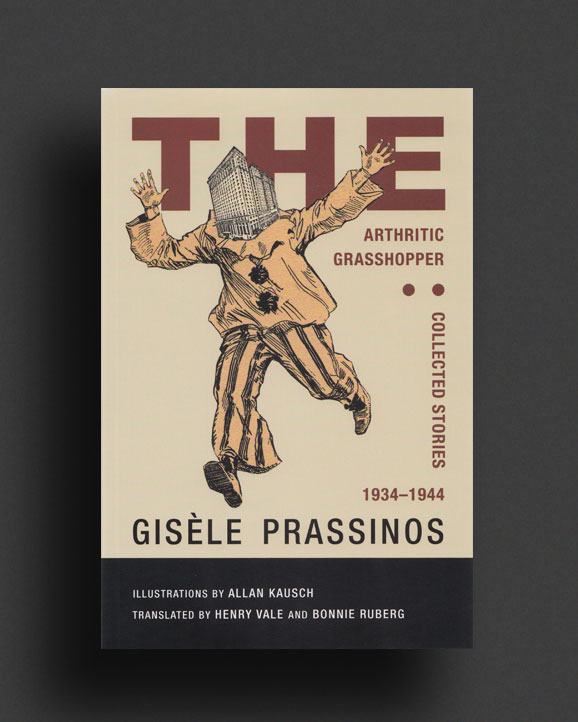
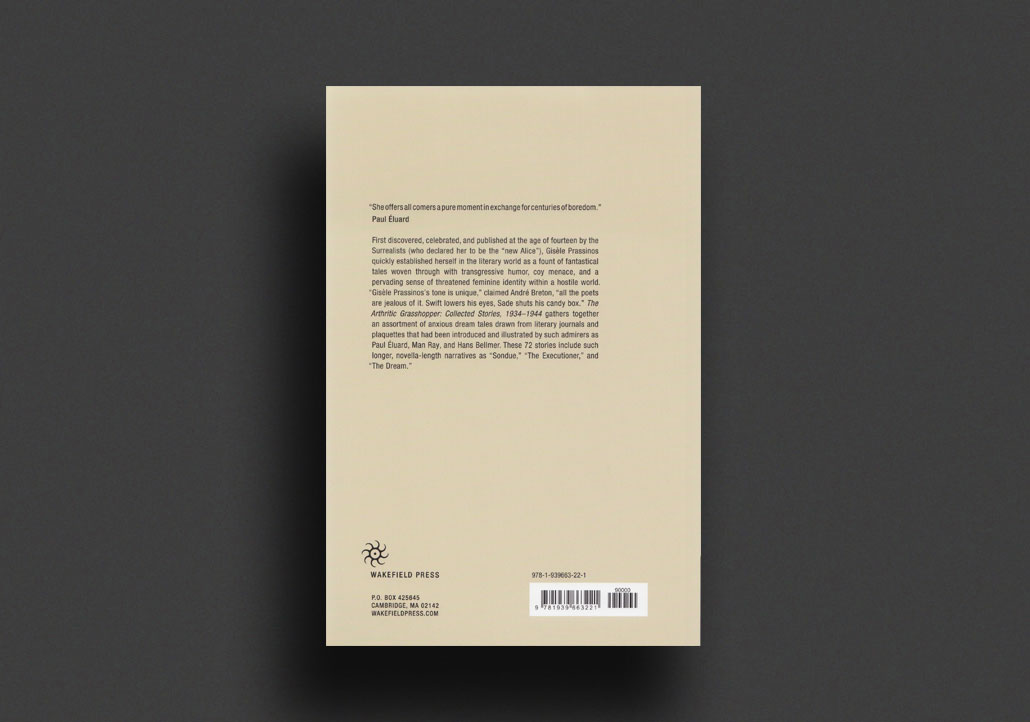
First discovered, celebrated, and published at the age of fourteen by the Surrealists (who declared her to be the “new Alice”), Gisèle Prassinos quickly established herself in the literary world as a fount of automatic tales woven through with transgressive humor, coy menace, and a pervading sense of threatened feminine identity within a hostile world. “Gisèle Prassinos’s tone is unique,” claimed André Breton, “all the poets are jealous of it. Swift lowers his eyes, Sade shuts his candy box.” The Arthritic Grasshopper: Collected Stories, 1934–1944 gathers together an assortment of anxious dream tales drawn from literary journals and plaquettes, introduced and illustrated by such admirers as Paul Éluard, Man Ray, and Hans Bellmer. These 72 stories include such longer, novella-length narratives as “Sondue,” “The Executioner,” and “The Dream.”
“She offers all comers a pure moment in exchange for centuries of boredom.”—Paul Éluard
Gisèle Prassinos (1920–2015) was born in Istanbul of a Greek father and an Italian mother. At the age of thirteen she began to compose short absurdist vignettes in a fit of boredom, filling up pages with tales of sarcastic stains, arrogant hair, liquid frogs, and blue spiders. Encouraged by her brother, who introduced her and her experiments in automatic writing to his Surrealist colleagues, she immediately found herself welcomed into the Parisian avant-garde community and her stories were published in all the significant literary journals of the time. Her first collection was published in 1935, with a preface by Paul Éluard and a frontispiece portrait by Man Ray. With World War II, Prassinos stopped publishing and began to distance herself from the Surrealists and the limitations imposed by her writing being so closely bound to the idea of automatism in its purest, “childhood” form. Writing nothing from 1944 to 1954, she then returned to literature with a series of novels and stories that, if still imbued with a Surrealist sensibility, pointed to a new direction in her writing.
Translated by Henry Vale and Bonnie Ruberg, with an introduction by Bonnie Ruberg
Illustrations by Allan Kausch
1967, French
Softcover, 60 pages, 26 x 18 cm
1st Edition, Out of print title / used / very good
Published by
Musée des Arts Decoratifs / Paris
$80.00 - Out of stock
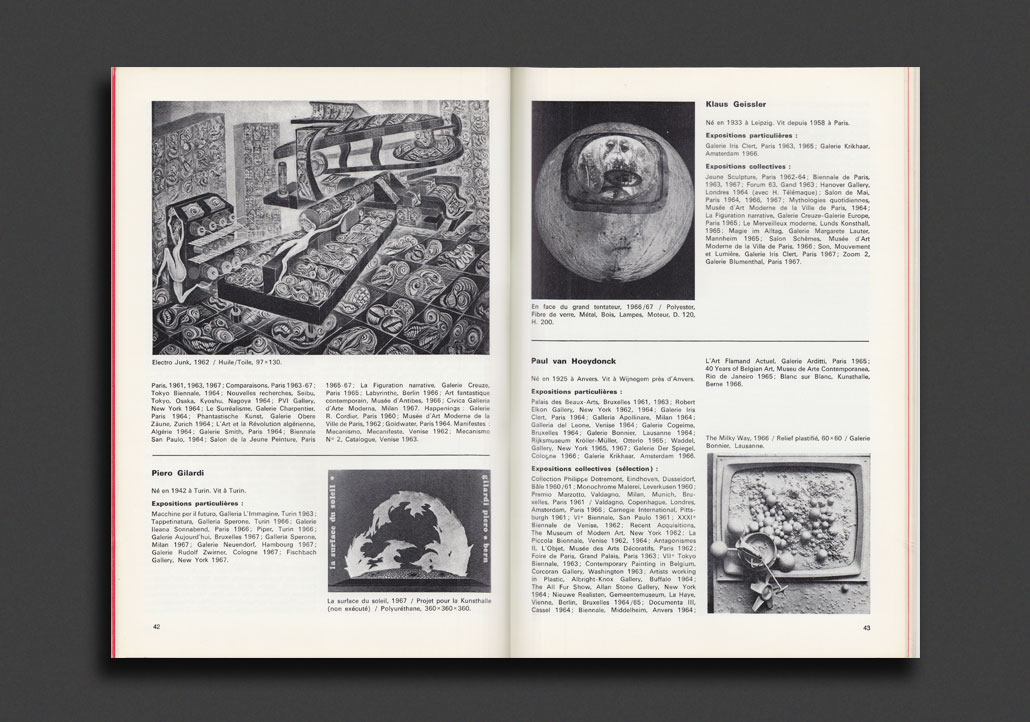
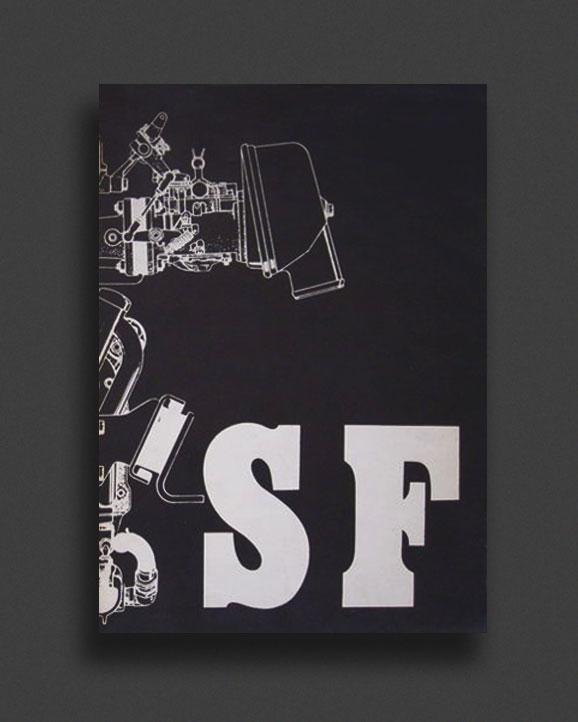
First edition of the iconic catalogue for the legendary Science-Fiction exhibition, curated by Harald Szeemann and presented as a touring show at Kunsthalle Bern, Musée des arts décoratifs Paris, and Städtische Kunsthalle Düsseldorf, 1967-1968. In the fashion of Szeemann's exhibition-making, Science-Fiction attracted record numbers of visitors whilst triggering controversial debate in the press. In institutions dedicated to the showcasing of contemporary art, Szeemann ventured to compile the unbelievable amount of around 3,000 objects from sociology, technology, science, art, comics, journalism, and literature, around the theme of Science-Fiction. The exhibits were presented in the show ordered in segments: modern spaceflight, art, film, literature, robots, UFOs, humour, toys, comics, as well as science fiction in the real world. Catalogue includes the work of Martial Raysse, Tetsumi Kudo, Roy Lichtenstein, Liliane Lijn, Robert Malaval, H. W. Muller, Bernard Rancillac, Markus Ratz, Shinkichi Tajiri, Edmund Alleyn, Piero Gilardi, Klaus Geissler, Paul van Hoeydonck, Piotr Kowalski, Yaacov Agam, Erró, Takis, Antonio Dias, Frank Franzetta, Guido Crepax, Wally Wood, Giovanni Scolari, Jean-Claude Forest, Al Williamson, and many more. Texts by Pierre Versins, Jacques Sadoul, Demètre Iokimidis, etc. in French. Includes the fold-out "Tableau chronologique de la S.F." compiled by French Science Fiction collector and scholar Pierre Versins.
Very Good copy.
1967, Dutch / English
Softcover (staple-bound), 14 pages, 29.5 × 21.5 cm
1st Edition, Out of print title / used / good
Published by
Kultureel Centrum / Venlo
$40.00 - Out of stock
Catalogue published in 1967 to accompany the international exhibition of S-F at Kultureel Centrum Venlo, 26 August - 25 September, 1967. Organised by Lei Alberigs, this high-profile exhibition presented the work of Shinkichi Tajiri and Ferdi Tajiri, Frans Zwartjes, Thomas Attridge, Karl Kleimann, Frans Peeters, Jan Slothouber, Willem Graatsma, Isamu Kanamori, Carl Mangus, Erhard Wehrmann and Robert Berlind. Illustrated throughout in b/w with works by all artists and text by Sylvia Nicolas (in Dutch).
Good with tanning to spine and some creasing to spine.
2019, English
Softcover, 224 pages, 14 x 20 cm
Published by
Wakefield Press / Cambridge
$34.00 - Out of stock
In a Yiddish take on Notes from Underground, a dark, expressionist love affair develops in a large, unnamed Eastern European city between the young, impoverished, and violently self-loathing teacher, Shloyme—and a hungry, spiteful, and unsettlingly sensual revolver. Purchased from a friend ostensibly to protect him from the pogroms sweeping the empire, the weapon instead opens a portal to Shloyme’s innermost demons, and through it he begins his methodical mission to eradicate any remnants of life and humanity in him and pave the way for his self-destruction. A Death takes the form of a diary that follows the Jewish calendar, describing hallucinatory demons and parasitical urges as its author spends his remaining days excising all his responsibilities and acquaintances from a life now devoted to not living.
Written in Yiddish in 1905 and published with immediate success in Warsaw in 1909, A Death utilizes the influences of Dostoyevsky and Schopenhauer to depict a distinctly Jewish experience of homelessness and uprooted modernity. Zalman Shneour’s short novel presents a much lesser-known strand of Jewish decadent literature and an authorial voice that has been buried for too long. This introduction of Shneour’s inaugural novel is his first appearance in English since 1963. Its exploration of alienation, mental health, toxic masculinity, and violence is remarkably contemporary.
Born in Shklow, Zalman Shneour (1887–1959) was a major figure of Jewish modernity and one of the most popular Yiddish writer between the World Wars. He wrote poetry, prose, and plays in both Yiddish and Hebrew. Like many of his generation, his life was spent moving from city to city in search of literary community or escaping political turmoil: from Odessa to Warsaw to Vilne, and on to such Western cities as Bern, Geneva, Berlin, Paris, New York (where he died), and Tel Aviv (where he is buried). His psychological fiction brought the insights of Nietzsche and Freud into the narrative world of Eastern European Jewish life.
Introduction by Daniel Kennedy
“Atmosphere abounds in this short, bleak novel. Its narrator’s descriptions hew toward the grotesque, which heightens the stylization of the work. His sublime indifference toward the world around him makes for some chilling passages...” —Tobias Carroll, Words Without Borders
2017, English
Softcover, 176 pages, 11.4 x 17.8 cm
Published by
Wakefield Press / Cambridge
$33.00 - Out of stock
Translated with introduction by Kit Schluter.
First published in French in 1892 and never before translated fully into English, The King in the Golden Mask gathers together twenty-one of Marcel Schwob’s cruelest and most erudite tales. Melding the fantastic with historical fiction, these stories swarm around moments of unexplained violence both historical and imaginary, often blending the two through Schwob’s collaging of primary source documents into fiction. Brimming with murder, suicide, royal leprosy, and medieval witchcraft, this collection describes for us historically attested clergymen furtively attending medieval sabbaths, Protestant galley slaves laboring under the persecution of Louis XIV, a ten-year-old French viscountess seeking vengeance for her unwilled espousal to a money-grubbing French lord, and dice-tumbling sons of Florentine noblemen wandering Europe at the height of the 1374 plague. These writings are of such hallucinatory detail and linguistic specificity that the reader is left wondering whether they aren’t newly unearthed historical documents. To read Schwob is to encounter human history in its most scintillating and ebullient form as it comes into contact with his unparalleled imagination.
Marcel Schwob (1867–1905) was a scholar of startling breadth and an incomparable storyteller. A secret influence on generations of writers, from Guillaume Apollinaire and Jorge Luis Borges to Roberto Bolaño, Schwob was as versed in the street slang of medieval thieves as he was in the poetry of Walt Whitman. His allegiances were to Rabelais and François Villon, Robert Louis Stevenson and Edgar Allan Poe. Paul Valéry and Alfred Jarry both dedicated their first books to him, and in doing so paid tribute to the author who could evoke both the intellect of Leonardo da Vinci and the anarchy of Ubu Roi. He was also the uncle of Lucy Schwob, better remembered today as the Surrealist photographer Claude Cahun.
1990, German
Softcover, 400 pages, 25.4 x 23 cm
1st Edition, Out of print title / used / good
Published by
Edition Spangenberg / Münich
$45.00 - Out of stock
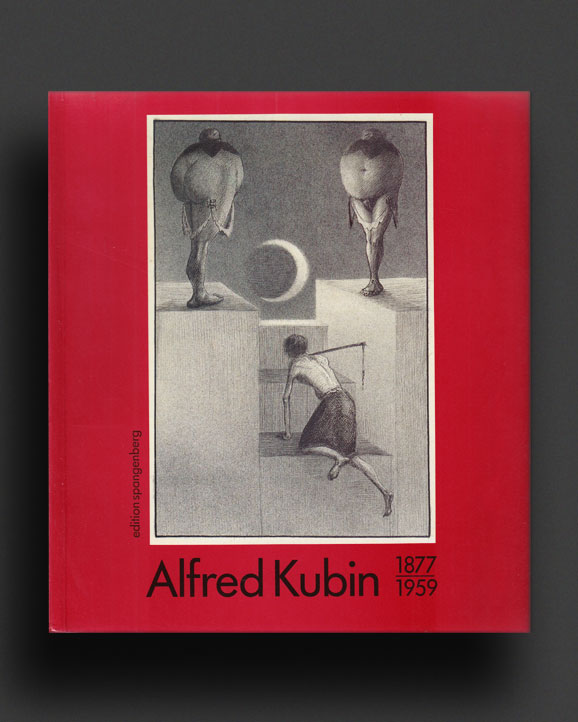
Huge 400 page catalogue published on the occasion of a travelling German exhibition in 1990-1991 of the work of Alfred Kubin. Illustrated throughout with extensive and comprehensive essays in German, tracing Kubin's entire life and career.
Alfred Leopold Isidor Kubin (10 April 1877 – 20 August 1959) was a Bohemian printmaker, illustrator and occasional writer who became an important figure of both the Symbolist and Expressionist movements. His inventive black-and-white drawings often featured fantastical or morbid elements, and depicted supernatural creatures and sexual violence. Born on April 10, 1877 in Leitmeritz, Bohemia (now the Czech Republic), Kubin had an emotionally unstable childhood, attempting suicide and suffering a nervous breakdown before the age of 20. Upon moving to Munich in 1899, he was introduced to the works of Francisco de Goya and Max Klinger, the latter having a particularly profound impact on Kubin. He began producing nightmarish ink-and-wash drawings, and briefly became affiliated with the Russian artist émigré group, the Der Blaue Reiter, which included Wassily Kandinsky and Marianne Werefkin. Kubin was perhaps best known for illustrating the German editions of books by Edgar Allan Poe and Fyodor Dostoevsky. During rise of Nazism in Germany, his work was considered degenerate; he retreated into solitude and lived in a castle in Zwickledt, Upper Austria. He was awarded the City of Vienna Prize for Visual Arts in 1950, and died at his home on August 20, 1959.
Good copy. Brand new but with one bumped corner.
2019, English
Softcover, 210 pages, 12 x 19 cm
Published by
Uh Books / Amsterdam
KW Institute for Contemporary Art / Berlin
$23.00 - Out of stock
The eighteenth issue of ‘F.R. DAVID’ is edited by Will Holder and had its beginnings in prosody, the measure of language, geometry, and a notion of imagist transcription. A two-dimensional exercise, it turns out, on paper. Words were tuned out in favour of the volume of values our bodies exchanged. This issue’s diverse contents centre around the non-verbal, the insinuated, the reverse-side of the image, the backside, and perhaps even the next page. With contributions by Simone Weil, Marcel Proust, Will Holder, Anna Daučíková, Yvonne Rainer, Jesse Birch, Paola Grassi, David Lang, Péter Dobai, John Yau, Clare Noonan, and others.
1965, English
Softcover, 172 pages, 18 x 11 cm
Out of print title / used / very good
$28.00 - Out of stock
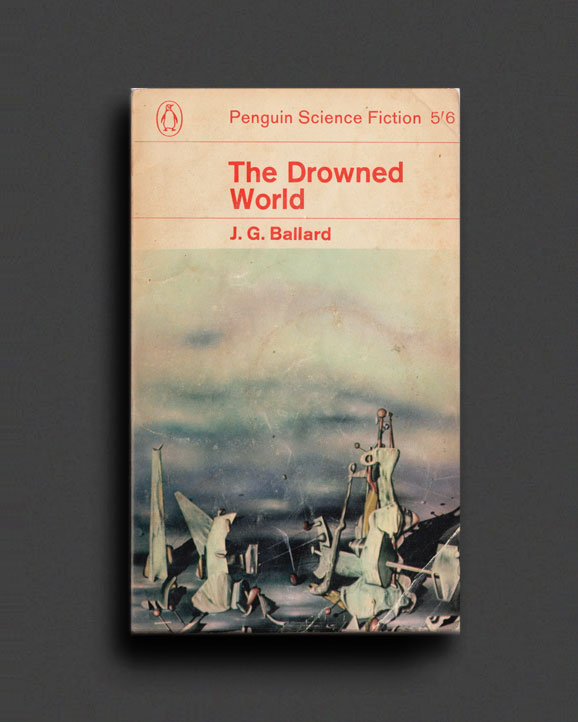
First published in 1962, British science fiction author J.G. Ballard's mesmerising and ferociously prescient novel "The Drowned World" imagines a terrifying future in which solar radiation and global warming have melted the polar ice caps and Triassic-era jungles have overrun a submerged and tropical London. Set during the year 2145, the novel follows biologist Dr. Robert Kerans and his team of scientists as they confront a surreal cityscape populated by giant iguanas, albino alligators, and endless swarms of malarial insects. "The Drowned World" is the second of a series of classic early Ballard novels dealing with scenarios of natural disaster. This is the British 1965 edition with Yves Tanguy cover art.
James Graham Ballard (15 November 1930 – 19 April 2009) was an English novelist, short story writer, and essayist who first became associated with the New Wave of science fiction for his post-apocalyptic novels such as The Wind from Nowhere (1961) and The Drowned World (1962). In the late 1960s, he produced a variety of experimental short stories (or "condensed novels"), such as those collected in the controversial The Atrocity Exhibition (1970). In the mid 1970s, Ballard published several novels, among them the highly controversial Crash (1973), a story about symphorophilia and car crash fetishism, and High-Rise (1975), a depiction of a luxury apartment building's descent into violent chaos.
1976, English
Softcover, 192 pages, 18 x 11 cm
Out of print title / used / good
Published by
Penguin Books / London
$18.00 - Out of stock
The Wind from Nowhere is British science fiction author J.G. Ballard's debut novel, first published in 1961. He had previously published only short stories. The novel was the first of a series of classic early Ballard novels dealing with scenarios of natural disaster. Here, civilization is reduced to ruins by mysterious prolonged worldwide hurricane force winds that devastate the surface of the earth. Some critics have suggested that his first four novels are based on elemental themes, showing global destruction by air, water, fire and earth. This is the 1976 paperback edition with David Pelham cover art.
James Graham Ballard (15 November 1930 – 19 April 2009) was an English novelist, short story writer, and essayist who first became associated with the New Wave of science fiction for his post-apocalyptic novels such as The Wind from Nowhere (1961) and The Drowned World (1962). In the late 1960s, he produced a variety of experimental short stories (or "condensed novels"), such as those collected in the controversial The Atrocity Exhibition (1970). In the mid 1970s, Ballard published several novels, among them the highly controversial Crash (1973), a story about symphorophilia and car crash fetishism, and High-Rise (1975), a depiction of a luxury apartment building's descent into violent chaos.
Average-Good. Worn cover, Ex-library, but still a great reading copy.
1966, English
Softcover, 224 pages, 18 x 11 cm
Out of print title / used / good
Published by
Penguin Books / London
$28.00 - Out of stock
The Terminal Beach is a superb collection of science fiction short stories by British author J.G. Ballard, published in 1964, including "Billennium", "The Terminal Beach", "The Lost Leonardo" and "The Illuminated Man". This is the British 1966 edition.
James Graham Ballard (15 November 1930 – 19 April 2009) was an English novelist, short story writer, and essayist who first became associated with the New Wave of science fiction for his post-apocalyptic novels such as The Wind from Nowhere (1961) and The Drowned World (1962). In the late 1960s, he produced a variety of experimental short stories (or "condensed novels"), such as those collected in the controversial The Atrocity Exhibition (1970). In the mid 1970s, Ballard published several novels, among them the highly controversial Crash (1973), a story about symphorophilia and car crash fetishism, and High-Rise (1975), a depiction of a luxury apartment building's descent into violent chaos.
1982, English
Softcover (staple-bound), 60 pages, 21.5 x 18 cm
1st Edition, Out of print title / used / fine
Published by
Richard H. Fawcett / Connecticut
$45.00 - Out of stock
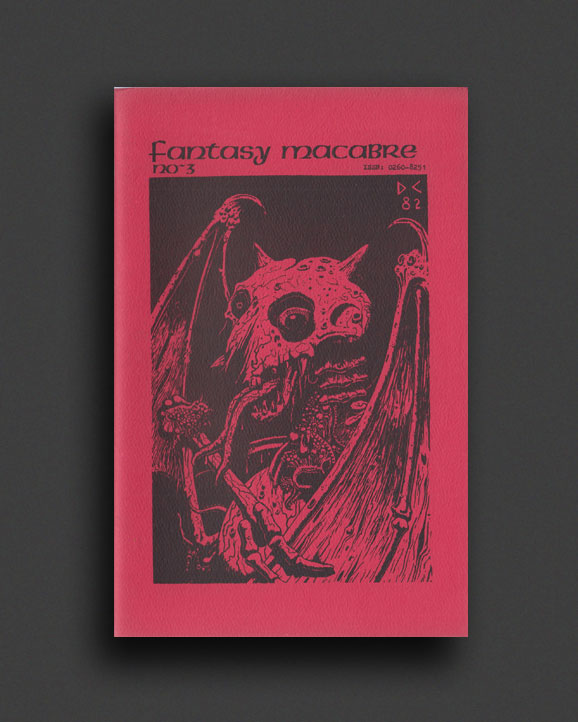
Issue 3 of this fantastic small-press dark fantasy fiction zine, published in 1982. Features stories by Joe R. Lansdale, Simon R. Green, David H. Keller, Richard R. Tierney, Peter Tremayne, Mike Ashley, Paul Spencer, Thomas Wiloch, David Cowperthwaite, Morgan Griffith, Michael D. Toman, C. Bruce Hunter, Dave Reeder, and many more. Profusely illustrated throughout by guest illustrators.
Fantasy Macabre was published in seventeen issues between 1980-1996, the first four edited by UK fan Dave Reeder, the rest by American author Jessica Amanda Salmonson. The first two issues (1980-1981) were published by Dave Reeder himself, the following fifteen issues (no 3 and 4 with Reeder still as editor) by Richard Fawcett in the USA, with an agent (Graeme Flanagan) in Australia.
Very Good-Fine copy.
1983, English
Softcover (staple-bound), 60 pages, 21.5 x 18 cm
1st Edition, Out of print title / used / fine
Published by
Richard H. Fawcett / Connecticut
$45.00 - Out of stock
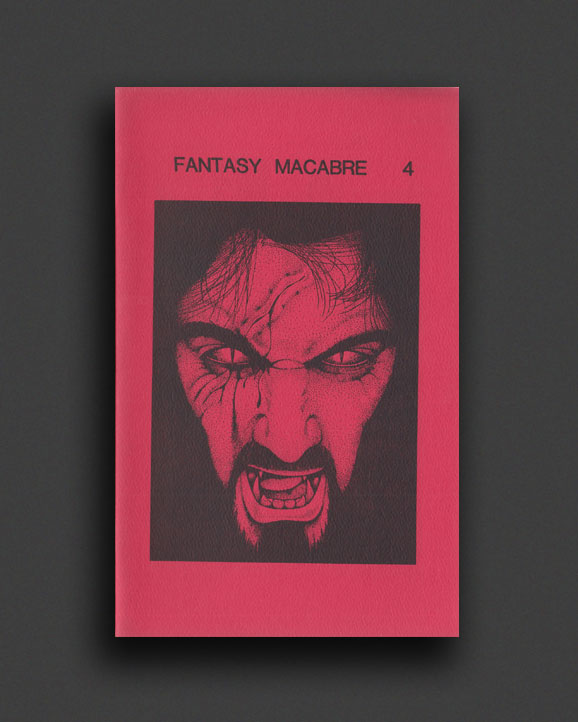
Issue 4 of this fantastic small-press dark fantasy fiction zine, published in 1983.. Features stories by Frank Belknap Long, Janet Fox, Robin Ansell/Karen Young, Jessica Amanda Salmonson, Mike Ashley, Tanith Lee, Thomas Wiloch, David Cowperthwaite, Herbert Swartz, Joel Lane, and Peter Tremayne. Profusely illustrated throughout by guest illustrators.
Fantasy Macabre was published in seventeen issues between 1980-1996, the first four edited by UK fan Dave Reeder, the rest by American author Jessica Amanda Salmonson. The first two issues (1980-1981) were published by Dave Reeder himself, the following fifteen issues (no 3 and 4 with Reeder still as editor) by Richard Fawcett in the USA, with an agent (Graeme Flanagan) in Australia.
Very Good-Fine copy.
1985, English
Softcover (staple-bound), 60 pages, 21.5 x 18 cm
1st UK Edition, Out of print title / used / fine
Published by
Richard H. Fawcett / Connecticut
$45.00 - Out of stock
Issue 3 of this fantastic small-press dark fantasy fiction zine, published in 1985. Features stories by B. Richard Parks, Phillip C. Heath, Frank Belknap Long, Jessica Amanda Salmonson, Billy Wolfenbarger, Bobby G. Warner, Margaret Widdemer, Richard Le Gallienne, M. Jesse Hoare, Joseph Payne Brennan, Delia Shiflet, Theophile Gautier, and many more. Profusely illustrated throughout by guest illustrators.
Fantasy Macabre was published in seventeen issues between 1980-1996, the first four edited by UK fan Dave Reeder, the rest by American author Jessica Amanda Salmonson. The first two issues (1980-1981) were published by Dave Reeder himself, the following fifteen issues (no 3 and 4 with Reeder still as editor) by Richard Fawcett in the USA, with an agent (Graeme Flanagan) in Australia.
Very Good-Fine copy.
1984, English
Softcover (staple-bound), 32 pages, 21 x 15 cm
1st Edition, Out of print title / used / very good
Published by
The Haunted Library / Cheshire
$45.00 - Out of stock
"Hag's Tapestry" by American author Jessica Amanda Salmonson, was published in 1984 by editor Rosemary Pardoe's Haunted Library series, Cheshire, England, a highly influential specialty publisher that cultivated many authors who embraced the traditional ghost story, many of whom went on to wider fame, devoted to ghost stories in the manner of M. R. James. As well as collections of reprints of scarcely available and new authors of weird fiction, The Haunted Library also published fantasy fiction fanzines and newsletters that were very central to a resurgence in the genre in the 1970s-1980s. This scarce staple-bound publication is a wonderful collection of six short stories by Jessica Amanda Salmonson. Illustrated by Wendy Wees.
Jessica Amanda Salmonson (born 1950) is an American author and editor of fantasy and horror fiction and poetry, as well as scholar and book dealer. From 1973 to 1975, she was one of the editors of The Literary Magazine of Fantasy and Terror, a small-press magazine. She openly documented her coming out as a transgender woman in this journal. She went on to edit Fantasy Macabre from 1985 until the final issue, #17, in 1996. The magazine was subtitled "Beauty plus strangeness equals terror." Salmonson is the author of the famed Tomoe Gozen trilogy, which tells the heroic and tragic tale of Japan's legendary female samauri. Salmonson is the recipient of the World Fantasy Award, Lambda Award, and ReaderCon Award. She has edited many series of single-author collections of ghost stories and weird tales, as well as editing the anthologies Amazons! and Amazons II; Heroic Visions and Heroic Visions II; Tales by Moonlight and Tales by Moonlight II; and What Did Miss Darrington See: An Anthology of Feminist Supernatural Stories. She was also editor of Fantasy Macabre, a small-press dark fantasy magazine in the 1980s-1990s.
Very Good copy.