World Food Books' programme is largely produced on Kulin Nation land. We acknowledge the Wurundjeri people of the Kulin Nation as the first and continuing custodians of this land, and pay respect to their Elders past, present, and emerging.
World Food Books is an arts and special interests bookshop in Naarm / Melbourne. Founded in 2010, World Food Books is devoted to the presentation of a rotating, hand-selection of international art, design, literary and counterculture publications with an emphasis on the anti-traditional, the experimental, the avant-garde, the heretic, the marginal.
Presenting new titles alongside rare and out-of-print books, catalogues and journals spanning the fields of modern and contemporary art, design, photography, illustration, film, literature, poetry, cultural theory, philosophy, sexuality, popular and underground culture in its many radical forms, World Food Books wishes to encourage adventurous, thoughtful and open-minded reading, looking, writing, and exchange of publishing and ideas, both current and historical.
As well as our bookshop, located in Melbourne's historical Nicholas Building, all of our inventory is available internationally via our online mail-order service.
World Food Books semi-regularly co-ordinates "Occasions", a programme of exhibits and events at the bookshop and in partnership with other hosts (such as museums and art galleries) that develop out of the activities, relationships and content of the bookshop itself.
World Food Books
The Nicholas Building
37 Swanston Street
Room 5, Level 6
Melbourne 3000
Australia
SHOP HOURS:
Thu–Fri 12–6, Sat 12–5
WEB-SHOP OPEN 24/7
World Food Books
Postal Address:
PO Box 435
Flinders Lane
Victoria 8009
Australia
Art
Theory / Essay
Architecture / Interior
Graphic Design / Typography
Photography
Fashion
Eros
LGBTQ+
Fiction / Poetry
Weird / Speculative / Science Fiction / Horror
Transgressive / Visceral / Abject
Symbolism / Decadence / Fin de siècle
Film / Video
Painting
Sculpture / Installation
Performance / Dance / Theater
Drawing
Sound / Music
Curatorial
Group Shows / Collections
Periodicals
Out-of-print / Rare
Posters / Ephemera / Discs
Signed Books
World Food Books Gift Voucher
World Food Book Bag
Australian Art
Australian Fiction
Australian Science Fiction / Speculative Fiction
Australian Poetry
Australian Photography
Japanese Photography
Conceptual Art
Minimal Art
Dada
'Pataphysics / Oulipo
Fluxus
Concrete Poetry
Pop Art
Surrealism
Arte Povera
Arte Informale / Haute Pâte / Tachism
Nouveau Réalisme / Zero / Kinetic
Situationism / Lettrism
Collage / Mail Art / Xerox Art
Art Brut / Folk / Visionary / Fantastic
Illustration / Graphic Art / Bandes Dessinées
Furniture
Italian Radical Design / Postmodernism
Textiles
Ceramics / Glass
Counterculture
Protest / Revolt
Philosophy
Psychoanalysis
Anthropology
Anarchism
Socialism / Anarchism / Communism / Capitalism
Literary Theory / Semiotics / Language
Feminism / Women's Studies
Gender Studies / Sexuality
Anthropology
Fetishism / BDSM
Drugs / Psychedelia
Crime / Violence
Animal Rights / Veganism
Occult / Esoterica
Ecology / Earth / Alternative Living
Whole Earth / Crafts
All prices in AUD (Australian dollars)
Pick-Ups
Pick-up orders can be collected in our bookshop during opening hours after order date. Please collect any Pick-up orders within 2 weeks of ordering as we have limited storage space. Orders will be released back into stock if not collected within this time. No refunds can be made for pick-ups left un-collected. If you cannot make it in to the bookshop in this time-frame, please choose postage option.
Return Policy
All sales are final. We do accept returns (for refund or exchange) for items received in error. All our orders are packed with special care using heavy-duty padding and cardboard book-mailers or bubble mailers (for smaller books), using reinforcement where required. We cannot take responsibility for any lost, stolen or damaged parcels.
Insurance
Should you wish to insure your package, please email us directly after placing your order and we can organise this at a small extra expense. Although all standard/express tracked packages are very safe and dependable, we cannot take responsibility for any lost, stolen or damaged parcels. We recommend insurance on valuable orders.
Interested in selling your old books, catalogues, journals, magazines, comics, fanzines, ephemera? We are always looking for interesting, unusual and out-of-print books to buy. We only buy books in our fields of interest and specialty, and that we feel we can resell.
We base these prices on desirability, market value, in-print prices, condition and our current stock levels. We offer cash, store credit, and can take stock on consignment. All
about 25% of the price we expect to get when we sell them, or 30% in store credit. We base these prices on desirability, market value, in-print prices, condition and our current stock levels.
Sell your books any day of the week. You can drop them off and return later. If you have a lot of books, we can visit your Sydney home.
We buy books that we feel we can resell. We offer about 25 % of the price we expect to get when we sell them, or 30% in store credit. We base these prices on desirability, market value, in-print prices, condition and our current stock levels.
Philadelphia Wireman
03 August - 01 September, 2018
World Food Books is proud to announce our next Occasion, the first presentation of sculptures by Philadelphia Wireman in Australia.
The Philadelphia Wireman sculptures were found abandoned in an alley off Philadelphia’s South Street on trash night in 1982. Their discovery in a rapidly-changing neighbourhood undergoing extensive renovation, compounded with the failure of all attempts to locate the artist, suggests that the works may have been discarded after the maker’s death. Dubbed the "Philadelphia Wireman" during the first exhibition of this work, in 1985, the maker’s name, age, ethnicity, and even gender remain uncertain. The entire collection totals approximately 1200 pieces, all intricately bound together with tightly-wound heavy-gauge wire (along with a few small, abstract marker drawings, reminiscent both of Mark Tobey and J.B. Murry). The dense construction of the work, despite a modest range of scale and materials, is singularly obsessive and disciplined in design: a wire armature or exoskeleton firmly binds a bricolage of found objects including plastic, glass, food packaging, umbrella parts, tape, rubber, batteries, pens, leather, reflectors, nuts and bolts, nails, foil, coins, toys, watches, eyeglasses, tools, and jewellery.
Heavy with associations—anthropomorphic, zoomorphic, and socio-cultural responses to wrapped detritus—the totemic sculptures by Philadelphia Wireman have been discussed in the context of work created to fulfil the shamanistic needs of alternative religions in American culture. Curators, collectors, and critics have variously compared certain pieces to sculpture from Classical antiquity, Native American medicine bundles, African-American memory jugs, and African fetish objects. Reflecting the artist’s prolific and incredibly focused scavenging impulse, and despite—or perhaps enhanced by—their anonymity, these enigmatic objects function as urban artefacts and arbiters of power, though their origin and purpose is unknown. Philadelphia Wireman, whatever their identity, possessed an astonishing ability to isolate and communicate the concepts of power and energy through the selection and transformation of ordinary materials. Over the course of the past two decades, this collection has come to be regarded as an important discovery in the field of self-taught art and vernacular art.
Presented in collaboration with Fleisher-Ollman Gallery, Philadelphia, and Robert Heald, Wellington.
Susan Te Kahurangi King
02 February - 10 March, 2018
Susan Te Kahurangi King (24 February 1951 - ) has been a confident and prolific artist since she was a young child, drawing with readily available materials - pencils, ballpoint pens and felt-tip markers, on whatever paper is at hand. Between the ages of four and six Susan slowly ceased verbal communication. Her grandparents William and Myrtle Murphy had developed a special bond with Susan so they took on caring responsibilities for extended periods. Myrtle began informally archiving her work, carefully collecting and storing the drawings and compiling scrapbooks. No drawing was insignificant; every scrap of paper was kept. The King family are now the custodians of a vast collection containing over 7000 individual works, from tiny scraps of paper through to 5 meter long rolls.
The scrapbooks and diaries reveal Myrtle to be a woman of great patience and compassion, seeking to understand a child who was not always behaving as expected. She encouraged Susan to be observant, to explore her environment and absorb all the sights and sounds. Myrtle would show Susan’s drawings to friends and people in her community that she had dealings with, such as shopkeepers and postal workers, but this was not simply a case of a grandmother’s bias. She recognised that Susan had developed a sophisticated and unique visual language and sincerely believed that her art deserved serious attention.
This was an unorthodox attitude for the time. To provide some context, Jean Dubuffet coined the term Art Brut in 1945 to describe work created by self-taught artists – specifically residents of psychiatric institutions and those he considered to be visionaries or eccentrics. In 1972 Roger Cardinal extended this concept by adopting the term Outsider Art to describe work made by non-academically trained artists operating outside of mainstream art networks through choice or circumstance. Susan was born in Te Aroha, New Zealand in 1951, far from the artistic hubs of Paris and London that Dubuffet and Cardinal operated in. That Myrtle fêted Susan as a self-taught artist who deserved to be taken seriously shows how progressive her attitudes were.
Susan’s parents Doug and Dawn were also progressive. Over the years they had consulted numerous health practitioners about Susan’s condition, as the medical establishment could not provide an explanation as to why she had lapsed into silence. Dawn educated herself in the field of homeopathy and went on to treat all twelve of her children using these principles – basing prescriptions on her observations of their physical, mental and emotional state.
Doug was a linguist with an interest in philosophy who devoted what little spare time he had to studying Maori language and culture. To some extent their willingness to explore the fringes of the mainstream made them outsiders too but it was their commitment to living with integrity and their respect for individuality that ensured Susan’s creativity was always encouraged.
Even though Susan’s family supported her artistic pursuits, some staff in schools and hospitals saw it as an impediment to her assimilation into the community and discouraged it in a variety of ways. Her family was not always aware of this and therefore did not fully understand why Susan stopped drawing in the early 1990s. However, rather than dwell on the challenges that Susan faced in pursuit of her artistic practice, they prefer to highlight her achievements. In 2008 Susan began drawing again in earnest, after an almost 20 year interruption, and her work is now shown in galleries around the world.
Susan grew up without television and has been heavily influenced by the comics she read as a child. She is absolutely fearless in the appropriation of recognizable characters, such as Donald Duck and Mickey Mouse, in her work. She twists their limbs, contorts their faces, compresses them together, blends them into complex patterned backgrounds - always imbuing them with an incredible energy. Although Susan often used pop culture characters in her work they are not naive or childlike. These are drawings by a brilliant self-taught artist who has been creating exceptional work for decades without an audience in mind.
Mladen Stilinović
"Various Works 1986 - 1999"
02 February 16 - September 10, 2016
Various works 1986 - 1999, from two houses, from the collections of John Nixon, Sue Cramer, Kerrie Poliness, Peter Haffenden and Phoebe Haffenden.
Including: Geometry of Cakes (various shelves), 1993; Poor People’s Law (black and white plate), 1993; White Absence (glasses, ruler, set square, silver spoon, silver ladel with skin photograph and wooden cubes), 1990-1996; Exploitation of the Dead (grey and red star painting, wooden painting, black spoon with red table, red plate), 1984-1990; Money and Zeros (zero tie, paintings made for friends in Australia (Sue, John, Kerrie), numbers painting), 1991-1992; Words - Slogans (various t-shirts) - “they talk about the death of art...help! someone is trying to kill me”, “my sweet little lamb”, “work is a disease - Karl Marx”; Various artist books, catalogues, monographs, videos; Poster from exhibition Insulting Anarchy; "Circular" Croatian - Australian edition; Artist book by Vlado Martek (Dostoyevsky); more.
Thanks to Mladen Stilinović and Branka Stipančić.
Jonathan Walker
Always Will Need To Wear Winter Shirt Blue + Ochre Small Check Pattern
21 August - 21 September, 2015
Untitled
I am not a great reader of poetry but I always return to the work of Melbourne poet, Vincent Buckley (1925- 1988). Perhaps I find his most tantalising piece to be not a finished poem but a fragment left on a scrap of paper discovered on his desk after the poet’s death.
The poetry gathers like oil
In the word-core, and spreads
It has its music meet,
Its music is in movement.
This fragment is more the shell left behind from a volatile thought than a finished poem. I find the last two lines honest but awkward whereas the first two lines work like an arrow. Most likely he could not find a resolution so it was left. Still, in its present form, it remains an eloquent testimony to the ultimate failure of a medium to express mobile thought and sensation, in Buckley’s case, through verbal language. It’s an important matter because this is something all artists have to deal with regardless of the medium.
I have never written a poem, however, I am forever copying fragments from books on paper scraps in a vain effort to fix certain notions in my head. At first, they function as bookmarks that are sometimes returned to when I open the book. But before long, as they accumulate, they fall out littering the table interspersed with A4 photocopies, bills, books and medications.
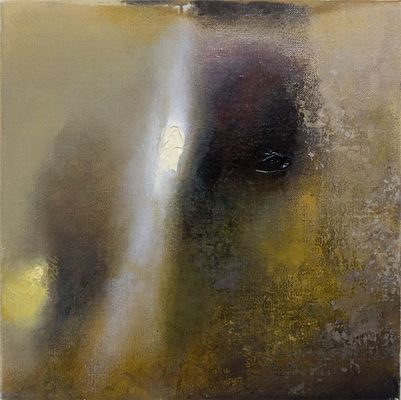
To return to Buckley’s fragment, the first two lines very much evoke how I paint nowadays. As you age, detail diminishes and patches of light become more luminous and float. I feel the most honest way of dealing with this is by smearing the oil paint on the canvas with the fingers and working close-up, blind. Only if the patches coalesce into an approaching image can the work gain a life.
-
Jonathan Walker was born in Melbourne, Australia and brought up on a dairy farm in Gippsland. In the 1970’s he studied painting at RMIT and won the Harold Wright Scholarship to the British Museum, London. During the 1980’s he exhibited at Pinacotheca Gallery, Richmond and had work shown at the NGV and Heidi City Art Gallery. Over the same period he designed the cover for the “Epigenesi” LP by Giancarlo Toniutti, Italy and conducted a mail exchange work with Achim Wollscheid, Germany. The work with artists through the post resulted in an article published in the bicentenary issue of Art and Australia 1988. He showed in artist run spaces such as WestSpace in the 90’s and 2000’s, and until 2012, taught painting at Victoria University, which is where we (Colleen Ahern and Lisa Radford) as organisers of the exhibition, among many others, had the privilege of being his student.
Walker’s knowledge was imparted to students through the careful selection of music, literature, and artists found in books that he himself had ordered for the library. Walker’s strategy was the generosity of sharing his vast knowledge with references specific to each student and their context.
Walker’s paintings share a similar focus and intimacy.
This exhibition presents a small selection of recent paintings alongside a publication that includes Walker’s writing. Observational and analytical, Walker’s work is a type of material notation — the time of day, colour and how it is blended, the both specific and fleeting location of a reflection on lino or the question of whether a chair leg should be included in a painting.
Please join us on Friday August 21 between 6-8pm to celebrate the opening of the exhibition.
Curated by Colleen Ahern and Lisa Radford.
B. Wurtz
Curated by Nic Tammens
March 26 - April 4, 2015
B.Wurtz works from a basement studio in his home on Manhattan’s Lower East Side.
This local fact is attested to by the plastic shopping bags and newsprint circulars that appear in his work. As formal objects, they don’t make loud claims about their origins but nonetheless transmit street addresses and places of business from the bottom of this long thin island. Like plenty of artists, Wurtz is affected by what is local and what is consumed. His work is underpinned by this ethic. It often speaks from a neighborhood or reads like the contents of a hamper:
“BLACK PLUMS $1.29 lb.”
“Food Bazaar”
“USDA Whole Pork Shoulder Picnic 99c lb.”
“RITE AID Pharmacy, with us it’s personal.”
“H. Brickman & Sons.”
“Sweet Yams 59c lb."
Most of the work in this exhibition was made while the artist was in residence at Dieu Donne, a workshop dedicated to paper craft in Midtown. Here Wurtz fabricated assemblages with paper and objects that are relatively lightweight, with the intention that they would be easily transportable to Australia. This consideration isn’t absolute in Wurtz’s work, but was prescriptive for making the current exhibition light and cheap. Packed in two boxes, these works were sent from a USPS post office on the Lower East Side and delivered to North Melbourne by Australia Post.
Wurtz appears courtesy of Metro Pictures, New York.
Thanks to Rob Halverson, Joshua Petherick, Sari de Mallory, Matt Hinkley, Helen Johnson, Fayen d'Evie, Ask Kilmartin, Lisa Radon, Ellena Savage, Yale Union, and "Elizabeth".
John Nixon
"Archive"
December 15 - January 20, 2014
The presentation of John Nixon's archive offered a rare showcase of this extensive collection of the artist's own publications, catalogues, posters, ephemera, editions and more, from the mid 1980s onwards, alongside a selection of his artworks.
Organized by John Nixon, Joshua Petherick and Matt Hinkley.
<a href=http://wfb.public-office.info/artist/john-nixon>All titles by John Nixon
"Habitat"
at Minerva, Sydney (organised by Joshua Petherick and Matt Hinkley)
November 15 - December 20, 2014
Lupo Borgonovo, Janet Burchill & Jennifer McCamley,
Lewis Fidock, HR Giger, Piero Gilardi, Veit Laurent Kurz,
Cinzia Ruggeri, Michael E. Smith, Lucie Stahl, Daniel Weil, Wols
Press Release:
“...It contained seven objects. The slender fluted bone, surely formed for flight, surely from the wing of some large bird. Three archaic circuitboards, faced with mazes of gold. A smooth white sphere of baked clay. An age-blackened fragment of lace. A fingerlength segment of what she assumed was bone from a human wrist, grayish white, inset smoothly with the silicon shaft of a small instrument that must once have ridden flush with the surface of the skin - but the thing’s face was seared and blackened.”
William Gibson, “Count Zero”, 1986
"Autumn Projects Archive"
Curated by Liza Vasiliou
March 6 - March 15, 2014
World Food Books, in conjunction with the Virgin Australia Melbourne Fashion Festival 2014, presented the Autumn Projects archive, consisting of a selection of early examples in Australian fashion with a particular interest in collecting designers and labels from the period beginning in the 1980’s, who significantly influenced the discourse of Australian Fashion.
Curated by Liza Vasiliou, the exhibition provided a unique opportunity to view pieces by designers Anthea Crawford, Barbara Vandenberg, Geoff Liddell and labels CR Australia, Covers, Jag along with early experimental collage pieces by Prue Acton and Sally Browne’s ‘Fragments’ collection, suspended throughout the functioning World Food Books shop in Melbourne.
H.B. Peace
presented by CENTRE FOR STYLE
November 14, 2013
"Hey Blinky, you say chic, I say same"
Anon 2013
H.B. Peace is a clothing collaboration between great friends Blake Barns and Hugh Egan Westland. Their pieces explore the divergences between 'character’ and ‘personality’ in garments....etc
Special Thanks to Joshua Petherick and Matt Hinkley of WFB and Gillian Mears
and a Very Special Thank you to Audrey Thomas Hayes for her shoe collaboration.
Janet Burchill & Jennifer McCamley
"Aesthetic Suicide"
May 10 - June 8, 2013
The first of our occasional exhibitions in the World Food Books office/shop space in Melbourne, "Aesthetic Suicide" presented a body of new and older works together by artists Janet Burchill & Jennifer McCamley, including videos, prints, a wall work, and publications.
During shop open hours videos played every hour, on the hour.
1997, English
Softcover, 224 pages, 12.8 x 20.5 cm
Published by
Little Brown & Company / New York
$34.00 - Out of stock
Imago (1989) is the final novel in Octavia E. Butler's Xenogenesis trilogy.
Child of two species, but part of neither, a new being must find his way.
Human and Oankali have been mating since the aliens first came to Earth to rescue the few survivors of an annihilating nuclear war. The Oankali began a massive breeding project, guided by the Ooloi, a sexless subspecies capable of manipulating DNA, in the hope of eventually creating a perfect starfaring race. Jodahs is supposed to be just another hybrid of human and Oankali, but as he begins his transformation to adulthood he finds himself becoming Ooloi—the first ever born to a human mother.
As his body changes, Jodahs develops the ability to shapeshift, manipulate matter, and cure or create disease at will. If this frightened young man is able to master his new identity, Jodahs could prove the savior of what’s left of mankind. Or, if he is not careful, he could become a plague that will destroy this new race once and for all.
Octavia Estelle Butler (1947-2006) was an American science fiction writer, one of the best-known among the few African-American women in the field. She won both Hugo and Nebula awards. In 1995, she became the first science fiction writer to receive the MacArthur Foundation "Genius" Grant.
2003, English
Softcover, 288 pages, 13 x 19.8 cm
Published by
Penguin Books / London
$23.00 - Out of stock
Introduction by Patrick Mcguiness
Translated by Robert Baldick
Notes by Patrick Mcguiness
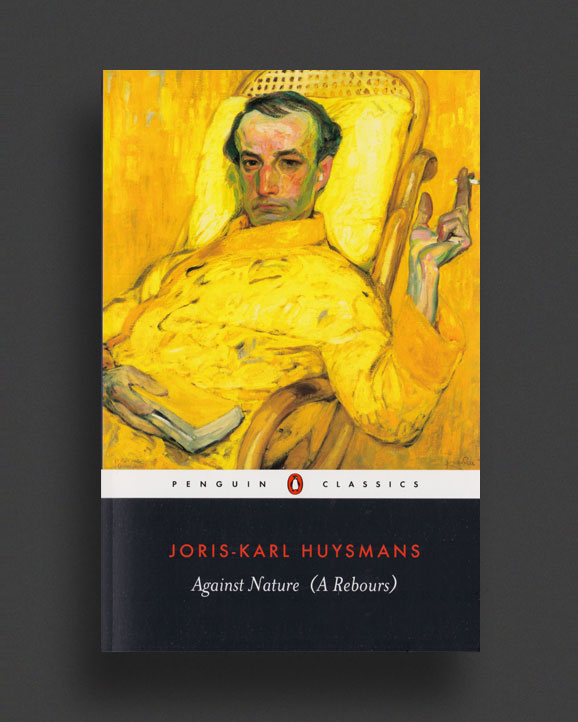
Infamous as the inspiration for the novel which slowly corrupts Oscar Wilde's "Dorian Gray", Joris-Karl Huysmans' "Against Nature" is the original handbook of decadence. A wildly original fin-de-siecle novel, Against Nature contains only one character. Des Esseintes is a decadent, ailing aristocrat who retreats to an isolated villa where he indulges his taste for luxury and excess. Veering between nervous excitability and debilitating ennui, he gluts his aesthetic appetites with classical literature and art, exotic jewels (with which he fatally encrusts the shell of his tortoise), rich perfumes and a kaleidoscope of sensual experiences. Against Nature, in the words of the author, exploded 'like a grenade' and has enjoyed a cult following to this day. This revised edition of Robert Baldick's lucid translation features a new introduction and a chronology, and reproduces Huysmans' original 1903 preface as well as a selection of reviews from writers including Mallarme, Zola and Wilde.
Joris-Karl Huysmans (1848-1907) is now recognized as one of the most challenging and innovative figures in European literature and an acknowledged principal architect of the fin-de-siecle imagination. He was a career civil servant who wrote ten novels, most notably "A Rebours and La-Bas". Huysmans died in 1907.
Robert Baldick (d.1972) translated widely from the French and wrote a biography of Huysmans. Patrick McGuinness is a Fellow and Tutor in French at St Anne's College, Oxford, and editor of Symbolism, Decadence and the Fin de Siecle (Exeter UP, 2000).
2003, English
Hardcover (w. dust jacket), 128 pages, 26 x 21 cm
1st Edition, Out of print title / as new
Published by
Little Bear Press / US
$700.00 - Out of stock
As new, first edition sealed copy of extremely collectible monograph by pioneering male-figure photographer Jim French, of Man and Another Man fame, showcasing French's 1972 nude study collection of the popular Colt model, Erron, also known as David Scrivanek. A beautifully produced monograph designed by Dimitri Levas with an essay and interview with French by photographer and publisher Bruce Weber. As with all of Little Bear’s books, the quality of the design, paper and printing is impeccable. Now near impossible to find.
Jim French (1932 – 2017) was an American artist, illustrator, photographer, filmmaker, and publisher. He is best known for his association as co-founder of Colt Studio, using the pseudonym Rip Colt, created in late 1967, where French built what would become one of the most successful gay male erotica companies in the U.S. French began drawing and photographing male erotica in the mid-1960s while working as an illustrator and artist for Madison Avenue advertising agencies. His first published book, Man, was issued in 1972. Other books include Another Man, Jim French Men, Quorum, Opus Deorum, Masc., The Art of Jim French and The Art of the Male Nude. Publication of Colt magazines began in 1969 with the digest-size "Manpower!". During the 1970s, French began marketing his short films in 8mm format; they were soon collected on video-cassette format, which were remastered for DVD format in the 1990s. French's artwork and photography has been hailed as “iconic, groundbreaking, and singularly influential”, leaving a legacy of homoerotic images in artwork, illustrations, photo sets, slides, film, fine-art photographs, magazines, books and calendars that presented his work exclusively and set a new standard in photography of men.
As New copy.
2021, English
Softcover, 155 pages, 22.1 x 15 cm
Published by
Black Widow Press / Boston
$34.00 - Out of stock
This international anthology takes us to the seldom discussed and anthologized beginnings of the prose poem. It gathers the foundational writings of William Blake, Charles Baudelaire and Max Jacob alongside lesser-known practitioners such as Judith Gautier, Elena Guro, Renée Vivien, Mizuno Yōshū, Dino Campana, Liu Bannong and Marcel Lecomte. The writers presented here celebrate the diversity of a genre that, perhaps more than any other poetic form, has cultivated hybridity and in-betweenness at many levels, be they aesthetic, cultural or political. This volume should be indispensable to anyone interested in modern and contemporary poetics as well as, more generally, the permutations of literary tradition and innovation.
Edited and with an introduction by Mary Ann Caws and Michel Delville. With over 20 translators from around the world.
Mary Ann Caws (born 1933) is an American author, art historian and literary critic. She is currently a Distinguished Professor of English, French and Comparative Literature at the Graduate School of the City University of New York. She is an expert on Surrealism and modern English and French literature, having written biographies of Marcel Proust, Virginia Woolf, and Henry James. She works on the interrelations of visual art and literary texts, has written biographies of Pablo Picasso and Salvador Dalí, edited the diaries, letters, and source material of Joseph Cornell. She has also written on André Breton, Robert Desnos, René Char, Yves Bonnefoy, Robert Motherwell, and Edmond Jabès. She served as the senior editor for the HarperCollins World Reader, and edited anthologies on Manifestos - Isms, Surrealism, Twentieth Century French Literature. Among others, she has translated Stéphane Mallarmé, Tristan Tzara, Pierre Reverdy, André Breton, Paul Éluard, Robert Desnos, and René Char.
Michel Delville is a Belgian musician, writer and critic. Delville teaches literature at the University of Liège. He is the author of books about comparative poetics and interdisciplinary studies.He was awarded the 1998 SAMLA Book Award, the Choice Outstanding Book Award, the Léon Guérin Prize, the 2001 Alumni Award of the Belgian American Educational Foundation, the rank of Officer of the Order of Leopold (2009), and the 2009 Prix Wernaers pour la recherche et la diffusion des connaissances. Besides his extensive discography, he has over 30 books published to date.
2011, English / German
Softcover, 300 pages, 22 x 29.5 cm
Published by
Distanz / Berlin
$99.00 - Out of stock
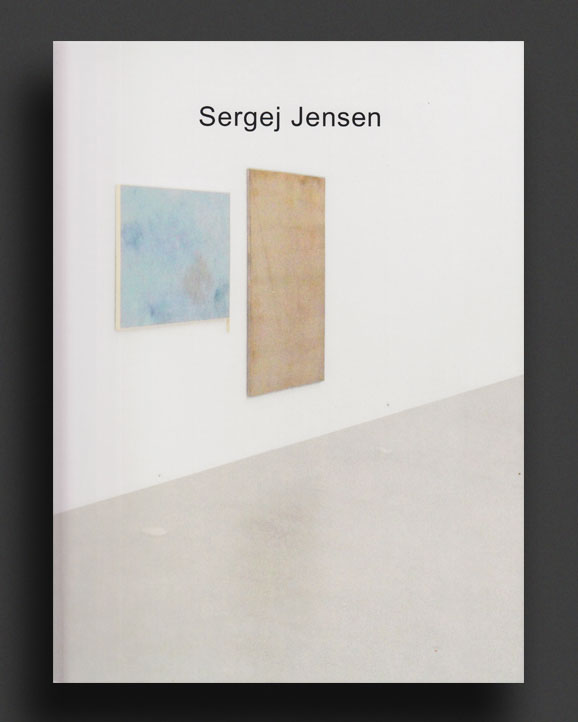
The major monograph on German painter Sergej Jensen, published in 2011. Very highly recommended.
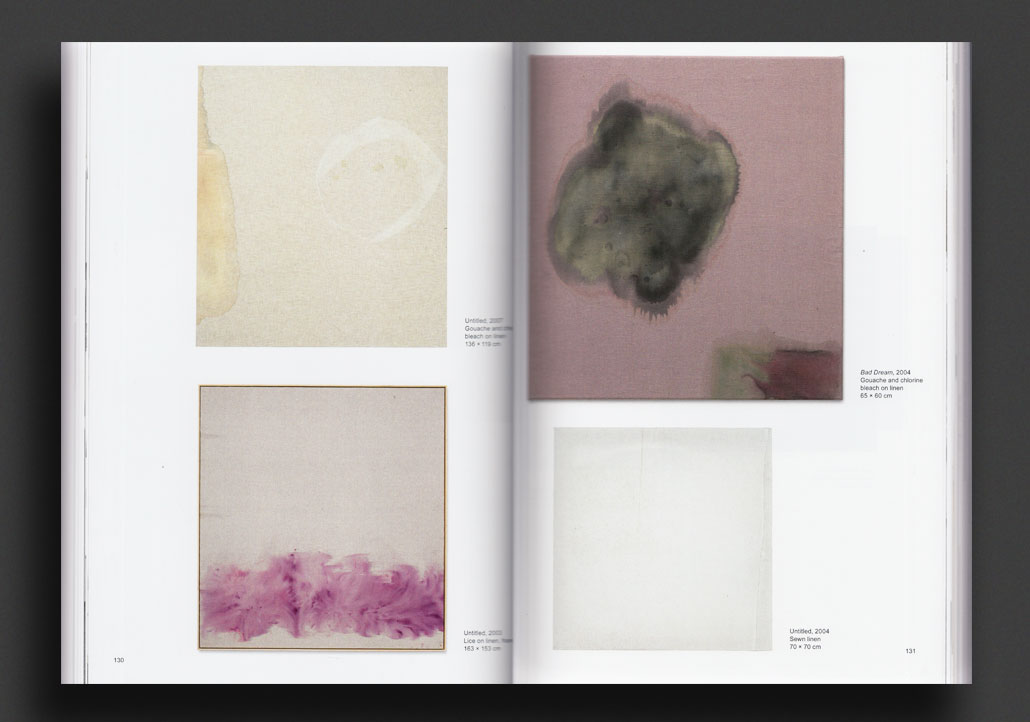
Since the mid-1990s, Sergej Jensen (born in Copenhagen in 1971) has been offering one of the most remarkable responses to the question of what painting can still be today. Painting in the classical sense plays only a minor role: in lieu of canvas, Jensen uses jute, coarse cotton, and jeans. He incorporates spots on fabrics which turn the “expressive gesture” of his paintings into a sign of wear from real life. Jensen sews fabrics together leaving the seams visible to evoke the fleeting impression of a drawing and he colors others with gouache, acrylics, and markers, but Jensen more often applies materials foreign to painting, such as patches, paper money, spices, beads, and glitter. Hanging his fabrics from windows, Jensen lets the sun and rain contribute a patina and treats them with chlorine and paints mixed with bleach to reduce their brilliance.
Jensen’s paintings are always at the edge of the abyss, but they do not fall in. Their brokenness is compensated by delicate sensual gestures—their decay and dirt, by an almost decorative beauty. Jensen operates within the narrow range between authenticity and fake, between punk and pose.
With texts by Peter Eleey, Helmut Draxler, Jacob Fabricius, Rainald Goetz, Dirk von Lowtzow, Melanie Ohnemus, Susanne Pfeffer, and Heidi Zuckerman Jacobson.
Design by Manuel Raeder.
2022, Japanese
Softcover (w. dust jacket and obi-strip), 240 pages, 21 x 15 cm
Published by
Kawade Shobo Shinsha / Tokyo
$60.00 - Out of stock
As the title suggests, this new volume edited by Koji Wakui and published in Japan in 2022, is entirely dedicated to the phenomenon of Canterbury Rock, something very close to the heart of World Food Books. Beginning with the "Canterbury Story", the book is broken into chapters around prominent pivotal artists, namely; Soft Machine; Kevin Ayers, Robert Wyatt; Caravan; Daevid Allen, Gong; Slapp Happy, Henry Cow; weaving together the tight-knit, over-lapping legacies of The Canterbury scene (or Canterbury sound), a musical scene centred around the city of Canterbury, Kent, England during the late 1960s and early 1970s. The term describes a loosely-defined, improvisational, avant-garde style that blended elements of jazz, rock, and psychedelia, and has come to be associated with progressive rock, art rock and British jazz-fusion. These musicians played together in numerous bands, with ever-changing and overlapping personnel. Illustrated throughout with a comprehensive discography of the artists involved, the extensive Japanese texts by Isao Inubushi, Noboru Umemura, Tetsuto Koyama, Yoshio Tachikawa, Midori Mashita, Takumi Matsui, Jiro Morijiro Junichi Yamada, Akira Yamanaka, Koji Wakui are accompanied by band photos and album art. Includes: The Wilde Flowers, Caravan, Gong, Daevid Allen, Gilli Smyth, Soft Machine, Henry Cow, Slapp Happy, Hatfield and The North, National Health, Kevin Ayers, Robert Wyatt, Hugh Hopper, Mike Ratledge, Pip Pyle, Lol Coxhill, Mike Westbrook, Centipede, Anthony Moore, Dagmar Krause, Peter Blegvad, Fred Frith, Art Bears, Skeleton Crew, Massacre, The Work, Chris Cutler, Charles Hayward, John Greaves, Lisa Herman, Kevin Coyne, Lindsay Cooper, Here and Now, Alan Gowen, Elton Dean, Karl Jenkins, Arzachel, Egg, Dave Stewart, Steve Hillage, Camel, Bill Bruford, Gilgamesh, Richard Sinclair, Camel, Mother Gong, Banana Moon band.... and more!
2013, Japanese
Softcover (w. dust jacket and obi-strip),
1st Edition, Out of print title / used / very good
Published by
Rittor Music / Tokyo
$100.00 - Out of stock
First, quickly out-of-print edition of Chee Shimuzu’s wonderful Obscure Sound book published in 2013. First edition with a special dust-jacket designed by musician/artist EYヨ (Yamantaka Eye of Boredoms, Hanatarashi, Puzzle Punks, etc). An indispensable, insightful look into Chee’s unique Organic Music sound and invaluable guide through many hand-picked records from all over the world by one of Japan’s legendary collectors. Contains 640 record reviews broken into specific categories – organic, ethnic, psychedelic, spiritual, experimental, cosmic, meditative and floating, all illustrated with record cover artwork and listed with discographical details. Includes an interview with Japanese composer Yasuaki Shimizu and other columns. So many WFB favourites in one book. Absolutely essential!
Chee Shimuzu is a Japanese music selector, writer, producer, and record shop / record label owner.
Very Good copy, with small closed tear to lower contents page, light wear, otherwise great, complete copy with dust jacket (essential as verso features book index of all artists featured, and illustrated obi-strip).
1981, English
Softcover, 89 pages, 20 x 22 cm
1st Edition, Out of print title / used / good
Published by
The Hearts of Space / San Francisco
$190.00 - Out of stock
First, very rare edition of The Hearts of Space Guide to Cosmic, Transcendent and Innerspace Music: An Annotated Listing of the Music Heard Since 1973 on the Weekly Radio Program Music from the Hearts of Space, self-published by The Hearts of Space, San Fransisco. First produced in 1973 by presenter Stephen Hill with co-producer Anna Turner, Hearts of Space is a pioneering weekly syndicated public radio show in California featuring music of a contemplative nature drawn largely from the ambient, New Age and electronic genres, while also including classical, world, Celtic, experimental, and other music selections. For many years, Hill has applied the term "space music" to the music broadcast on the show, irrespective of genre. It is the longest-running radio program of its type in the world. It was first broadcast as Music from the Hearts of Space, a three-hour long late-night show on KPFA-FM in Berkeley, California. Each episode ends with Hill gently saying, "Safe journeys, space fans ... wherever you are."
This annotated listening guide traverses the spectrum of space music presented on the radio throughout the 1970s-80s, with the editors providing introductions, glossary of genres, descriptions of each record, alongside interspersed reflections on sound by scholars, composers, artists, poets, architects — everyone from Cage to Inayat Khan, Steiner to Wagner. Includes a list of related material including reading, retail and mail-order sources, as well as a full index and record label contacts. An indispensable volume for anyone interested in ambient music, beautifully designed by Janaia Marisolle.
Good copy with light wear and creases.
2022, English
Softcover, 376 pages, 31 x 22 cm
Published by
Dashwood Books / New York
Cultural Traffic / UK
$160.00 - Out of stock
New Age: Stonehenge to Jungle is a comprehensive collection of iconic UK rave, jungle, sound system and warehouse party flyers dating from the early 1973s to 2000.
The book is sourced and curated from the Mott Collection – an extensive archive that gathers paper ephemera of British popular culture from punk to rave – curated by artist and collector Toby Mott.
Crammed full of 575 entries of flyers and other collectables, New Age is a visual feast that charts the origins and progress of a series of youth rebellions that were to last for a generation. The book looks beyond the music into the fantastical visual language that propelled this subculture, offering a global perspective on how British party culture shifted through the decades.
New Age opens with an extensive array of iconic flyers created for the early 1970s free festivals of Stonehenge and Windsor. It then moves into the 1980s, when the boom of illegal London warehouse parties gave birth to acid house – visually embodied by its iconic smiley face, then evolved into sound system and dub clashes. As rave culture takes over, the designs of the flyers become more complex, unveiling a craving for dystopian experiences and surrealistic universes forged by the vision of masters of flyer art, the likes of Pez and Junior Tomlin – also known as the Salvador Dalí of Rave.
The book traces the rise of jungle music and more widely the aesthetic of the 1990s, digging into its Jamaican roots and bringing together reggae, rave and sound system culture, giving insight into the profound, and yet often overlooked, impact of the Black British community on rave music.
Featuring interviews with influential flyer designers such as Pez, Kaos, Junior Tomlin, and Dave Little.
Published by Corina Manu, Cultural Traffic and Dashwood Books 2022
Art and Design Direction: Jamie Reid Studio
2022, English
Softcover, 70 pages, 19 x 13 cm
Published by
Self-Published / Sydney
$25.00 - In stock -
Artist's book collecting the abstract print and sculptural works of Australian artist Connor Bugelli (b. 1994) produced between 2020—2022, between Melbourne and Sydney. Profusely illustrated with gallery and studio documentation in stark b/w monochrome, accompanied by a text, "a world behind a curtain / a thought behind a head", by Mahmood Fazal.
In memory of Liam Osborne
2022, English
Softcover box folio + posters
Published by
Provence / Nice
$48.00 - Out of stock
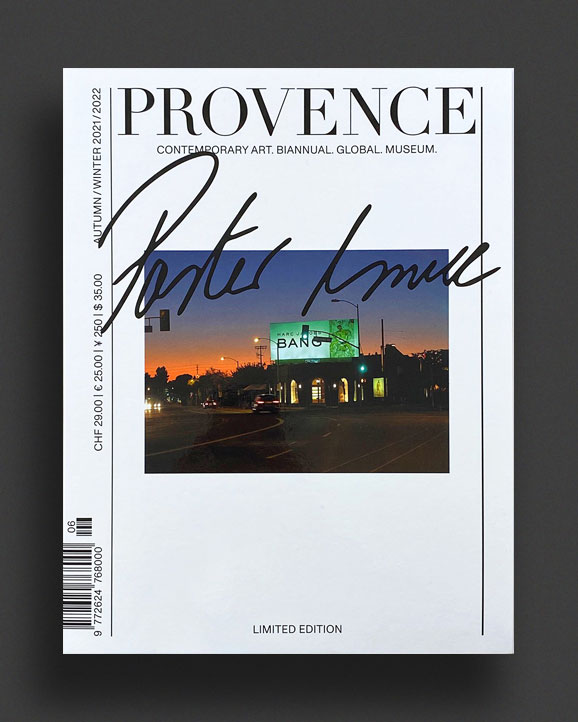
This limited edition of PROVENCE comes in the form of box folio filled with posters by contributing artists, galleries, historians, fashion designers, critics, enterprises, etc. including: Marc Asekhame, Brigade, Merlin Carpenter, CFGNY, Contemporary Art Writing Daily, Rhea Dahl, Damien & The Love Guru, DAY6, Simon Denny, galeriepcp — Perks and Mini, Gessnerallee, Edgars Gluhovs, Samuel Haitz & Leda Bourgogne & Anne Fellner, Gloria Hasnay & Moritz NebenfuÌuehr, Calla Henkel & Max Pitegoff, Valeria Herklotz, Nina Hollensteiner & Albrecht Pischel, Karma International, Vera Kaspar, Kunst Halle Sankt Gallen, Marie Karlberg, Milena Langer, Lulli 2020 — Jim C. Nedd — Nina Hollensteiner, Midway Contemporary Art, Olaf Nicolai, D’Ette Nogle, O-Town House, Walter Pfeiffer, Plymouth Rock, Sam Pulitzer, Ottolinger — Julien Ceccaldi, Marine Serre, Chen Shen featuring Gao Han, Wei Longwen & XYZ Lab, Kathrin Sonntag, suns.works, Swiss Art Awards, Una Szeemann, Galerie Tschudi, Hamish Fulton, Ilaria Vinci, Edition VFO, Nina Zimmer — Meret Oppenheim.
1967, English
Hardcover (w. dust jacket), 68 pages, 21 x 14 cm
Out of print title / used / very good
Published by
Holt Rinehart & Winston / Chicago
$30.00 - Out of stock
1967 hardcover edition of Charles M. Schulz's classic, Snoopy and the Red Baron. This gorgeous book (one of the fine 1960s Holt hardcover editions) was the widespread introduction of what became a recurring storyline where Snoopy, beloved beagle of the 'Peanuts' comic strip, dons scarf, helmet and goggles, and boards his Sopwith Camel (a.k.a. his dog-house) to become Snoopy, fighter ace, in a life and death struggle with the Red Baron in World War I. The first comic strip featuring Snoopy fighting the Red Baron appeared jus a year earlier, on Sunday October 10, 1965.
Charles Monroe "Sparky" Schulz, was an American cartoonist and creator of the comic strip Peanuts. He is widely regarded as one of the most influential cartoonists of all time.
Very Good copy in Good dust jacket preserved in mylar wrap.
1967, English
Hardcover (w. dust jacket), 66 pages, 15 x 15 cm
Out of print title / used / very good
Published by
Paul Hamlyn / Sydney
$30.00 - Out of stock
1967 printing of Charles M. Schulz's "Security is a Thumb and a Blanket", from the lovely Hamlyn square series of Peanuts hardcover books. A gorgeous collection of "Securities" brought to you by the Peanuts gang.
Charles Monroe "Sparky" Schulz, was an American cartoonist and creator of the comic strip Peanuts. He is widely regarded as one of the most influential cartoonists of all time.
Very Good copy in Good dust jacket, preserved under mylar wrap.
1984, English
Softcover, 120 pages, 30 x 21 cm
1st Edition, Out of print title / used / good
Published by
Self-Published / UK
$120.00 - Out of stock
Amazing and extremely rare Siouxsie and The Banshees Scrapbook 1976-1980, the incredible labour of love fanzine/scrapbook published anonymously in 1984 in the UK. No author and no publisher is credited to this wonderful book, but what you get is "120 pages of vital information" — practically everything there is to know about the first four years of Siouxsie and the Banshees. Includes the band history, discography, a list of all known bootlegs to date with cover artwork, gig and tape guide, rare photos of the band, interviews, press releases, advertisements, and endless press clippings from 1976 to 1980, including gig reviews, album reviews, interviews, articles, announcements... A work of DIY fanzine art, the pre-internet care and attention that has gone into this document makes for a perfect fan book. If only such a book existed for more groups of the period! Apparently a Volume 2 (1981-1984) was hoped to be published in September 1984... It seems this first volume was the only to ever see the light of day. A must for any Banshees fan!
Ex-library copy of the late Anthony (Matters) D’Ettorre of Australian punk bands Warpspasm, Magnacite, Death Sentence, the Rumjacks, Bastard Squad, Blackbreaks, Diggers With Attitude and more. Name to inner front cover.
Average-Good copy, with decent wear and old sticker marking to covers and spine. Internally good with tight binding.
1992, English
Hardcover, 144 pages, 24 x 18 cm
1st Edition, Out of print title / used / very good
Published by
Arkady / Warsaw
$600.00 - Out of stock
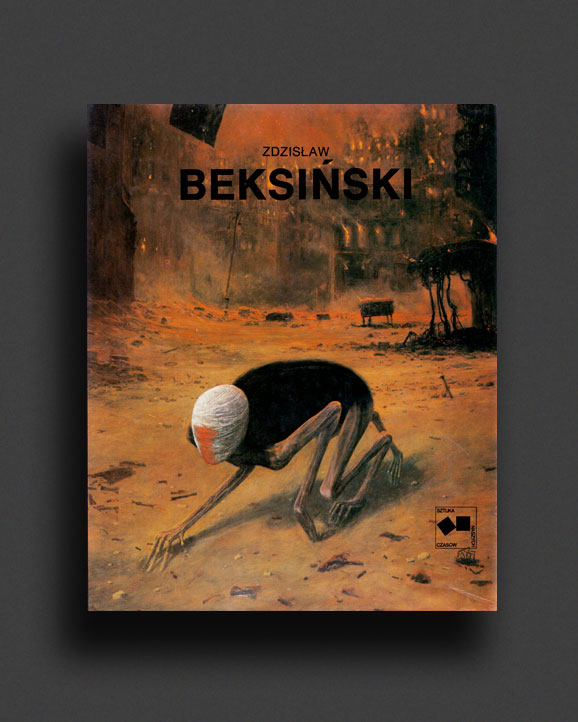
Signed copy of the long out-of-print and collectible hardcover monograph on Polish artist Zdzisław Beksiński, published in 1992 by Arkady, Warsaw. Profusely illustrated throughout with colour reproductions of Beksiński's surreal dystopian paintings spanning his entire career, alongside an introductory text in Polish by Tadeusz Nyczek.
Already a scarce title on Beksiński, this copy is extra special with signature by the master himself in pen on first blank page after his ("Beksinski"). Rarely does a signed book appear by this artist.
Zdzisław Beksiński (1929 – 2005) was a Polish painter, photographer and sculptor. Beksiński had no formal training as an artist. Born in Sanok, he studied architecture in Kraków and worked as a construction site supervisor before turning to his passion for art, sculpting with construction site materials for his medium. His early photography would be a precursor to his paintings, often referred to as dystopian surrealism. Beksiński claimed, "I wish to paint in such a manner as if I were photographing dreams". Beksiński undertook painting with a passion, working intensely whilst listening to classical music and quickly becoming a leading figure in contemporary Polish art. In the late 1960s, Beksiński entered what he himself called his "fantastic period", which lasted up to the mid-1980s, during which he created his famed images of desolate, surrealistic landscapes with intricate depictions of anxious, abstracted figures and architecture in states of decay, mutation and decomposition. Although Beksiński's art was often dark, he himself was known to be a pleasant person with a keen sense of humour. Modest and somewhat shy, he avoided public events such as the openings of his own exhibitions and almost never visited museums or exhibitions in general. He always credited music as his main source of inspiration. Beksiński avoided concrete analysis of the content of his work, saying "I cannot conceive of a sensible statement on painting". Beksiński was stabbed to death at his Warsaw apartment in February 2005 by a 19-year-old acquaintance from Wołomin, reportedly because he refused to lend the teenager money.
According to Mexican film director Guillermo del Toro "In the medieval tradition, Beksinski seems to believe art to be a forewarning about the fragility of the flesh – whatever pleasures we know are doomed to perish – thus, his paintings manage to evoke at once the process of decay and the ongoing struggle for life. They hold within them a secret poetry, stained with blood and rust."
"Beksinski's powerfully unique paintings are such as I have never before seen" H.R. Giger
Very Good copy in Very Good dust jacket.
2022, English
Softcover, 408 pages, 21 x 28 cm
Published by
Lenz Press / Milan
$85.00 - In stock -
This major new catalogue is published to accompany Marco Fusinato’s DESASTRES presentation at the Venice Biennale 2022, curated by Alexie Glass-Kantor, running from April 23 to November 27, 2022. DESASTRES is an experimental noise project that synchronises sound with image and takes the form of a durational solo performance as installation. The artist will be performing during the opening hours of the Biennale—a total of 200 days. The presentation will be the first time the Australian Pavilion, located in the historic Giardini della Biennale, has been the site for a live durational performance.
Originally from the Veneto region in Italy, Marco Fusinato’s parents migrated to Australia where he was born. He currently lives and works in Naarm/Melbourne. Fusinato (b. 1964) is a contemporary artist and noise-musician whose work takes the form of installation, photographic reproduction, design, performance and recording. DESASTRES is a culmination of his interests in noise/experimental music, underground culture, mass media images and art history. He uses an electric guitar as a signal generator into mass amplification to improvise slabs of noise, saturated feedback and discordant intensities that trigger a deluge of images onto a freestanding floor-to-ceiling LED wall. The images are sourced via a stream of words that have been put into an open search across multiple online platforms. There is no theme as such, rather the immersion of sound and image is open for the audience to interpret and make sense of. The intent is to create some kind of hallucination, elation in disorientation and exhaustion from confusion. The work is an invitation for audiences to come together within a high-intensity concentration of energy. What can’t be seen, can be felt: sound as physical matter which creates a transformative experience.
This expansive publication features a new essay by Branden W. Joseph, professor of art history at Columbia University and an extensive interview by curator Alexie Glass-Kantor with Marco Fusinato. It also includes texts by critical theorist and filmmaker Elizabeth Povinelli, AI researcher and author Kate Crawford, writer and curator Chus Martínez, and musicians/outre-guitarists Thurston Moore (Sonic Youth), Stephen O’Malley (SUNN O)))) and Bruce Russell (Dead C).
Marco Fusinato (b. 1964) is an Australian contemporary artist and noise-musician based in Naarm/Melbourne whose work takes the form of installation, photographic reproduction, design, performance and recording.
As an artist, he conceives his work as a succession of interrelated projects, some of which continue across numerous iterations. Within these projects the works are almost always serial and use specific frameworks for experimentation, as if demonstrating a thesis. Working across disciplines and cultural fields, Fusinato explores the tensions and contradictions of opposing forces: underground culture/institutions, noise/silence, minimalism/maximalism, purity/contamination. He creates dynamic situations in which these energies are captured by combining allegorical appropriation with an interest in the intensity of a gesture or event.
Fusinato's work has been presented in many international exhibitions, including All the World's Futures, 56th International Art Exhibition of La Biennale di Venezia (2015); The Imminence of Poetics, 30th Sao Paulo Biennale (2012); SUPERPOSITION: Art of Equilibrium and Engagement, 21st Biennale of Sydney (2018); and Australia: Antipodean Stories, Padiglione d'Arte Contemporanea, Milan (2019). His work was also included in Soundings: A Contemporary Score, the first ever exhibition of sound at the Museum of Modern Art, New York (2013) and Sonic Youth etc.: Sensational Fix (2008–10), a European travelling exhibition of artists who have collaborated with the New York rock band, Sonic Youth.
1979, English
Softcover, unpaginated, 27.5 x 22 cm
1st Edition, Out of print title / used / very good
Published by
Avon Books / New York
$140.00 - Out of stock
First edition of the incredible oversized cult classic ALIEN graphic novel by Richard J. Anobile, the first full-colour movie book specially designed to capture all the magnificence of the Film! A powerful story with overpowering visual effects, ALIEN comes to life as no movie ever has before in over 1,000 color photos that present the full range of the ingenious space vehicle, the Nostromo, the grotesque creature, and the utterly fantastic settings—conceived and created by such talents as Swiss surrealist painter H.R. Giger, Heavy Metal artist Moebius, and Ron Cobb, one of the designers of Star Wars. The result is was a new dimension in epic space adventure, a masterpiece in cinema history. This wonderful book is a cover-to-cover printed form of the film.
Richard J. Anobile (b. 19470 pioneered the use of the movie frame blow-up technique to recreate entire films in book form. His books were valuable resources especially in a time before VCR's and DVD's and the internet. While they might be viewed as simplistic picture books now, they were an attempt at curating film at a time when it was often still an after-thought. Anobile has spent much of the rest of his life in film production.
1997, English
Hardcover (w. dust jacket), 240 pages, 31 x 25 cm
1st Edition, Out of print title / used / very good
Published by
Taschen / Cologne
$150.00 - Out of stock
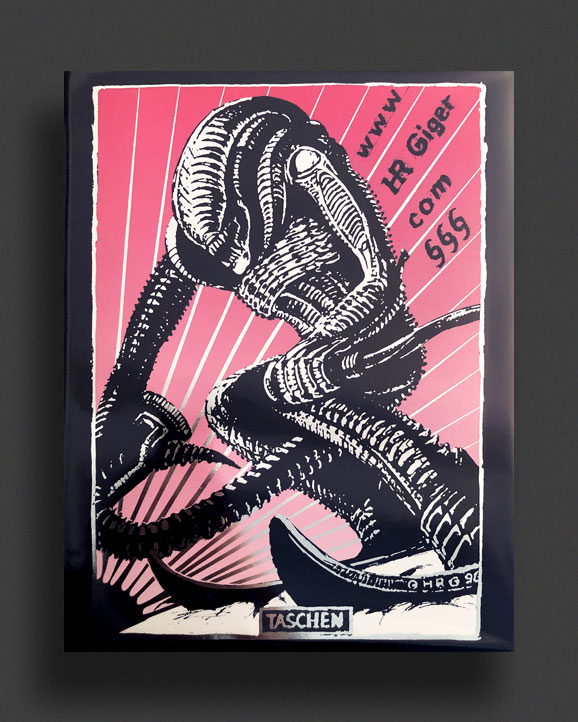
First hardcover English-language edition of this exceptionally in-depth and comprehensive book by H.R. Giger, published by Taschen in 1997.
“I paint what frightens me,” says H.R. Giger, who compiled and designed this comprehensive retrospective himself, documenting and describing his work from the early 1960s to the late 1990s. Lavishly illustrated with reproductions of his biomechanical visions, accompanied by his own detailed commentaries offering privileged insight into a uniquely imaginative mind. The book cover Giger's life and working methods, followed by page after page of Giger's artworks and various lesser-seen creations from the deepest recesses of the mind and of the Giger personal archives — from his early oil experiments to the Giger Bar in Tokyo to his killer condoms to his nightmare garden train! Includes an extensive illustrated chronology. An uncommon book in the original, long out-of-print foiled hardcover issue with English text (not a later reprint). Highly recommended resource for any Giger fan.
Very Good copy in VG dust jacket.
2021, English
Softcover, 154 pages, 24.5 x 17.5 cm
Published by
Bom Dia Boa Tarde Boa Noite / Berlin
$74.00 - Out of stock
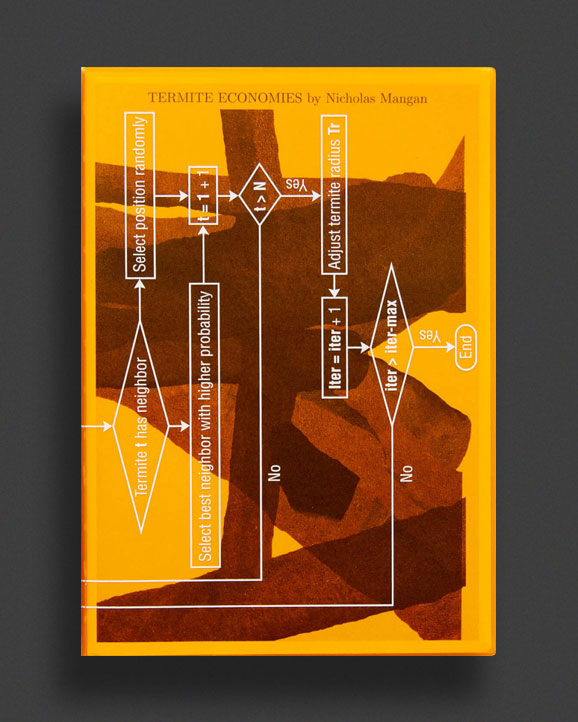
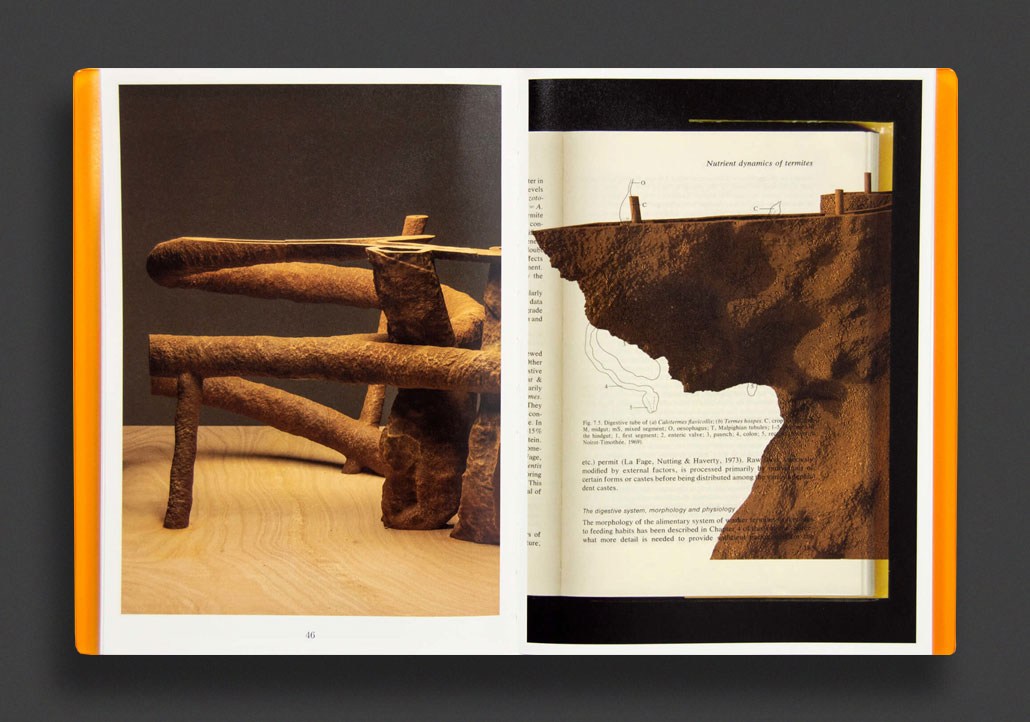
This publication assembles three phases of Termite Economies, a major series of artworks produced between 2018 and 2020 by the Australian artist Nicholas Mangan.
In Termite Economies (Phase 1) Mangan researched an anecdote that termite abilities might one day lead humans to gold deposits. Phase 2 explored termite eusociality, pheromonal communication, building behavior, biomimicry, superorganism and swarm intelligence. Phase 3 deployed termite collectivism as a speculative model for rerouting human neural pathways. Within each phase, Mangan developed specific methods to explore these phenomena formally, spatially, and through moving images.
Termite Economies grappled with the potentiality of collective social behavior and complexities of systematic exploitation of non-human intelligence.
The book presents each phase in the order of the exhibition series. It includes process and research photographs, diagrams, installation and detailed imagery. It includes an essay by Artist Mariana Silva, a fictional text by writer ST.Lore, a conversation between Mangan and cultural theorist Ana Teixeira Pinto, and a republished essay by Dr. Guy Theraulaz Research Director Member of Team CAB: Collective Animal Behavior Center for Research on Animal Cognition, CNRS.
Alert to both history and science, Nicholas Mangan (born 1979, Geelong, Victoria, lives and works in Melbourne) is a multi-disciplinary artist known for interrogating narratives embedded in a diverse range of objects. With a keen interest in the processes of forming meaning from objects, culture and natural phenomena, Mangan creates unnerving drawings, montages, sculptures and installations. His work addresses a wide range of themes, including the ongoing impacts of colonialism, humanity's fraught relationship with the natural environment, contemporary consumptive cultures and the complex dynamics of the global political economy.
Mangan completed a two year studio residency at Gertrude Contemporary, Melbourne, in 2002. He has been awarded numerous international residencies, including Recollets Artist Residency, Paris, 2011 and Australia Council's New York Green Street Residency, 2006. In 2007 he was a recipient of the Anne and Gordon Samstag International Visual Arts Scholarship, resulting in post graduate studies at Universität der Künste in Berlin, Germany.
Edited by Nicholas Mangan and Žiga Testen.
Texts by Nicholas Mangan, Ana Teixeira Pinto, Guy Theraulaz, Mariana Silva.
Graphic design: Žiga Testen.
1969, English
Softcover (textured wraps, staple-bound), 40 pages, 22 x 22 cm
1st Edition, Out of print title / used / very good
Published by
New Jersey State Museum Cultural Center / New Jersey
$290.00 - In stock -
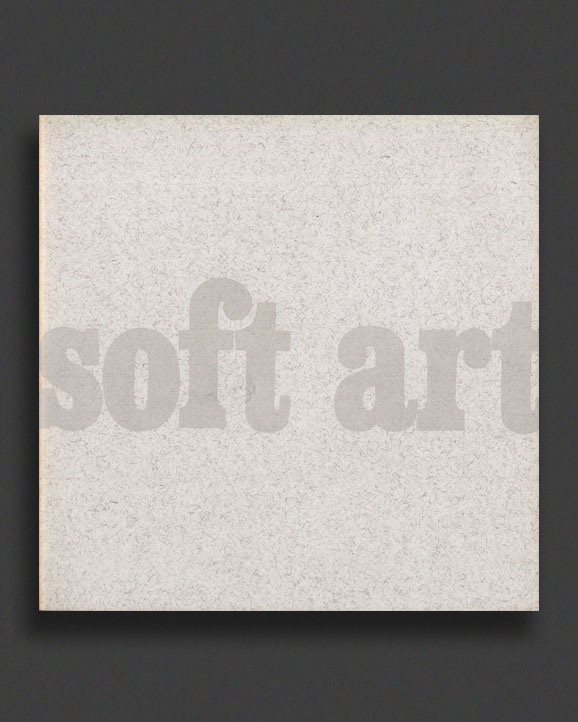
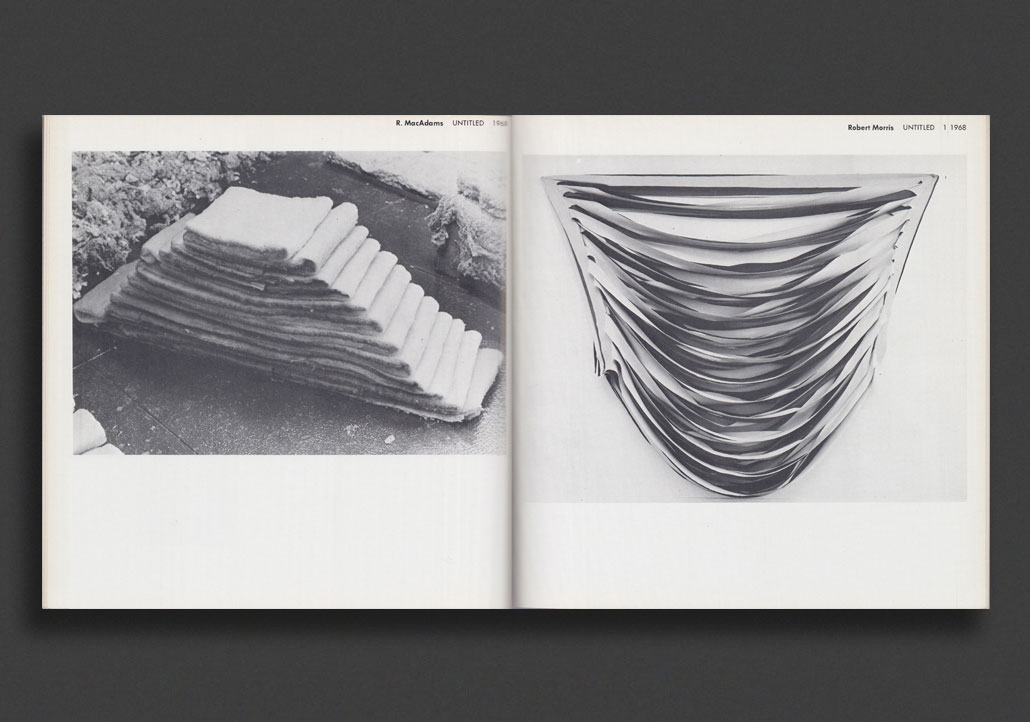
Rare, collectable catalogue published on the occasion of the exhibition "Soft Art", organized by Ralph Pomeroy at New Jersey State Museum Cultural Center, March - April 1969.
With an introductory essay by Pomeroy and works throughout by the artists featured in the exhibition : Richard Artschwager, Thomas Bang, Sue Bitney, John Chamberlain, Bruce Conner, Paul Harris, Eva Hesse, Susan Lewis, Jean Lindner, Robert Morris, Harold Paris, Robert Rohm, Richard Serra, Keith Sonnier, Richard Tuttle, William Wegman. Includes a list of the works exhibited, artist biographies and a list of lenders. A historic, very rarely seen catalogue.
Very Good copy.
1970, French
Softcover (staple-bound), 14 pages,
1st Edition, Out of print title / used / very good
Published by
Eric Losfeld / Paris
$45.00 - Out of stock
Scarce issue No. 5 of Arcanes, the "bulletin terrain vague" issued by publisher Eric Losfeld, Paris. With a cover feature on French artist Raymond Bertrand's "dessins érotiques", this issue also features the artwork of Guido Crepax and Jean-Claude Forest, as well as other information on the happenings around the Losfeld imprint.
Éric Losfeld (1922 - 1979) was a Belgian-born French publisher who had a reputation for publishing controversial material and was as often sued as Jean-Jacques Pauvert. A publisher who despised profit, he boasted that he had been, throughout his life, "in debt like a mule". When the creditors and the prosecutors gave him a little respite, he who defined himself as a "free editor" had only one principle: to be faithful to his tastes and unfaithful to his disgusts. "The only literature that touches me," he proclaimed, " is literature written with passion, or rather passionate literature." Thus, for thirty years, Losfeld created, at Arcane Editions, Le Terrain Vague, and under his own name, an invaluable and often clandestine catalog of Babouvist and hallucinated principality, and where he gathered all his preferences. For surrealism, eroticism, anarchism, romanticism, fantasy, black humor, jazz and comics. The world according to Losfeld, was that of Artaud, Mandiargues, Druillet, Sade, Vian, Peret, Allais, Jarry, Gbe, Sternberg, Forneret, Bealu, Topor, Arrabal, Peellaert or Klossowski. He was the publisher of Emmanuelle (1967), surrealist magazines ("Bief") and cinematographic magazines ("Midi Minuit Fantastique" and "Positif"), and the Barbarella science fiction comic book created by Jean-Claude Forest, amongst many other titles. Losfeld's tombstone inscription reads, "Tout ce qu'il éditait avait le souffle de la liberté." ("Everything he edited had the breath of freedom.").
Very Good copy.
1993, English
Softcover, 48 pages, 25 x 17.5 cm
Ed. of 500,
1st Edition, Out of print title / used / fine
Published by
University of South Australia Art Museum / Adelaide
The Museum of Economic Botany / Adelaide
$55.00 - Out of stock
Wonderful catalogue published on the occasion of the exhibition Peter Cripps: Projects for Two Museums, held at the University of South Australia Art Museum and the Museum of Economic Botany, Adelaide Botanic Garden, September 5—October 2, 1993. Illustrated in colour with extensive catalogue texts written by curator John Barrett-Lennard and author Carolyn Barnes, with an introduction by Erica Green, Art Museum director. An innovative project across two wholly different museum spaces—one, full already of objects and the apparatus of display, the other a formal exhibition space and empty—this catalogue looks in-depth at Cripps' rigorous conceptual practice whilst presenting a different voice on the nature of Australian museums and their role.
Edition of 500.
Peter Cripps (b. 1948, Melbourne, Victoria. Lives and works Melbourne) is an artist, curator and educator and has been a key figure in Australian art since the 1970s. Emerging at a time when minimal and conceptual art were at the forefront of contemporary practice, Cripps’ work has been concerned with the formal, conceptual, phenomenological and ideological relationships between objects and the spaces in which they are presented.
Fine, As New copy with light tanning.
1996, English
Softcover (staple-bound),
Ed. of 400,
1st Edition, Out of print title / as new
Published by
ACCA / Melbourne
$65.00 - Out of stock
Artist's publication published on the occasion Australian conceptual artist Peter Tyndall's solo exhibition, Death and the Viewer, 20 Sep—3 Nov, 1996, at ACCA, Dallas Brooks Drive. Curated by Jenepher Duncan. "Peter Tyndall has explored the nature of death in relation to art and social histories since 1971. This exhibition continued on from his 1987 survey at ACCA." Profusely illustrated throughout in colour and b/w alongside texts by Tyndall. Edition of 400 copies.
Peter Tyndall (b. Melbourne, 1951, lives and works in Hepburn Springs).
Since the 1970s, Peter Tyndall’s paintings, drawings and prints engage with recursive relationships between art, language and meaning. He is known for his use of graphic lines, text and comic-style illustration. Tyndall’s art reflects and disrupts historical perspectives on art. His ongoing project (since 2008) is a blog entitled bLOGOS/HA HA, which offers commentary on unfolding contemporary history.
First edition, As New copies.
1987, English
Softcover, 96 pages, 21.5 x 21.5 cm
1st Edition, Out of print title / as new
Published by
Greenhouse / Victoria
$30.00 - Out of stock
This 1987 monograph provides a wonderful study of the brilliant Australian conceptual artist Peter Tyndall (b. 1951). It provides a comprehensive survey of Tyndall’s work from 1952 – 1987. Starting with his parody work, Tyndall looks at the act of laugher and importance of jokes, as described by Pamela Hansford: “The truth is that a good joke, one sufficiently complex to sustain itself against the inevitable wear and tear of repetition, will still be funny at the end of the day”. Profusely illustrated in colour and b/w with texts by Pamela Hansford and appendices (Hand Space manifesto, Slave Guitars, etc.). Sponsored by the Australian Centre for Contemporary Art.
"Ultimately, a painting continues to hang upon a wall by the good grace of those who do not cut its strings." — Peter Tyndall
Peter Tyndall (b. Melbourne, 1951, lives and works in Hepburn Springs).
Since the 1970s, Peter Tyndall’s paintings, drawings and prints engage with recursive relationships between art, language and meaning. He is known for his use of graphic lines, text and comic-style illustration. Tyndall’s art reflects and disrupts historical perspectives on art. His ongoing project (since 2008) is a blog entitled bLOGOS/HA HA, which offers commentary on unfolding contemporary history.
First edition, As New copies.