World Food Books' programme is largely produced on Kulin Nation land. We acknowledge the Wurundjeri people of the Kulin Nation as the first and continuing custodians of this land, and pay respect to their Elders past, present, and emerging.
World Food Books is an arts and special interests bookshop in Naarm / Melbourne. Founded in 2010, World Food Books is devoted to the presentation of a rotating, hand-selection of international art, design, literary and counterculture publications with an emphasis on the anti-traditional, the experimental, the avant-garde, the heretic, the marginal.
Presenting new titles alongside rare and out-of-print books, catalogues and journals spanning the fields of modern and contemporary art, design, photography, illustration, film, literature, poetry, cultural theory, philosophy, sexuality, popular and underground culture in its many radical forms, World Food Books wishes to encourage adventurous, thoughtful and open-minded reading, looking, writing, and exchange of publishing and ideas, both current and historical.
As well as our bookshop, located in Melbourne's historical Nicholas Building, all of our inventory is available internationally via our online mail-order service.
World Food Books semi-regularly co-ordinates "Occasions", a programme of exhibits and events at the bookshop and in partnership with other hosts (such as museums and art galleries) that develop out of the activities, relationships and content of the bookshop itself.
World Food Books
The Nicholas Building
37 Swanston Street
Room 5, Level 6
Melbourne 3000
Australia
SHOP HOURS:
Thu–Fri 12–6, Sat 12–5
WEB-SHOP OPEN 24/7
World Food Books
Postal Address:
PO Box 435
Flinders Lane
Victoria 8009
Australia
Art
Theory / Essay
Architecture / Interior
Graphic Design / Typography
Photography
Fashion
Eros
LGBTQ+
Fiction / Poetry
Weird / Speculative / Science Fiction / Horror
Transgressive / Visceral / Abject
Symbolism / Decadence / Fin de siècle
Film / Video
Painting
Sculpture / Installation
Performance / Dance / Theater
Drawing
Sound / Music
Curatorial
Group Shows / Collections
Periodicals
Out-of-print / Rare
Posters / Ephemera / Discs
Signed Books
World Food Books Gift Voucher
World Food Book Bag
Australian Art
Australian Fiction
Australian Science Fiction / Speculative Fiction
Australian Poetry
Australian Photography
Japanese Photography
Conceptual Art
Minimal Art
Dada
'Pataphysics / Oulipo
Fluxus
Concrete Poetry
Pop Art
Surrealism
Arte Povera
Arte Informale / Haute Pâte / Tachism
Nouveau Réalisme / Zero / Kinetic
Situationism / Lettrism
Collage / Mail Art / Xerox Art
Art Brut / Folk / Visionary / Fantastic
Illustration / Graphic Art / Bandes Dessinées
Furniture
Italian Radical Design / Postmodernism
Textiles
Ceramics / Glass
Counterculture
Protest / Revolt
Philosophy
Psychoanalysis
Anthropology
Anarchism
Socialism / Anarchism / Communism / Capitalism
Literary Theory / Semiotics / Language
Feminism / Women's Studies
Gender Studies / Sexuality
Anthropology
Fetishism / BDSM
Drugs / Psychedelia
Crime / Violence
Animal Rights / Veganism
Occult / Esoterica
Ecology / Earth / Alternative Living
Whole Earth / Crafts
All prices in AUD (Australian dollars)
Pick-Ups
Pick-up orders can be collected in our bookshop during opening hours after order date. Please collect any Pick-up orders within 2 weeks of ordering as we have limited storage space. Orders will be released back into stock if not collected within this time. No refunds can be made for pick-ups left un-collected. If you cannot make it in to the bookshop in this time-frame, please choose postage option.
Return Policy
All sales are final. We do accept returns (for refund or exchange) for items received in error. All our orders are packed with special care using heavy-duty padding and cardboard book-mailers or bubble mailers (for smaller books), using reinforcement where required. We cannot take responsibility for any lost, stolen or damaged parcels.
Insurance
Should you wish to insure your package, please email us directly after placing your order and we can organise this at a small extra expense. Although all standard/express tracked packages are very safe and dependable, we cannot take responsibility for any lost, stolen or damaged parcels. We recommend insurance on valuable orders.
Interested in selling your old books, catalogues, journals, magazines, comics, fanzines, ephemera? We are always looking for interesting, unusual and out-of-print books to buy. We only buy books in our fields of interest and specialty, and that we feel we can resell.
We base these prices on desirability, market value, in-print prices, condition and our current stock levels. We offer cash, store credit, and can take stock on consignment. All
about 25% of the price we expect to get when we sell them, or 30% in store credit. We base these prices on desirability, market value, in-print prices, condition and our current stock levels.
Sell your books any day of the week. You can drop them off and return later. If you have a lot of books, we can visit your Sydney home.
We buy books that we feel we can resell. We offer about 25 % of the price we expect to get when we sell them, or 30% in store credit. We base these prices on desirability, market value, in-print prices, condition and our current stock levels.
Philadelphia Wireman
03 August - 01 September, 2018
World Food Books is proud to announce our next Occasion, the first presentation of sculptures by Philadelphia Wireman in Australia.
The Philadelphia Wireman sculptures were found abandoned in an alley off Philadelphia’s South Street on trash night in 1982. Their discovery in a rapidly-changing neighbourhood undergoing extensive renovation, compounded with the failure of all attempts to locate the artist, suggests that the works may have been discarded after the maker’s death. Dubbed the "Philadelphia Wireman" during the first exhibition of this work, in 1985, the maker’s name, age, ethnicity, and even gender remain uncertain. The entire collection totals approximately 1200 pieces, all intricately bound together with tightly-wound heavy-gauge wire (along with a few small, abstract marker drawings, reminiscent both of Mark Tobey and J.B. Murry). The dense construction of the work, despite a modest range of scale and materials, is singularly obsessive and disciplined in design: a wire armature or exoskeleton firmly binds a bricolage of found objects including plastic, glass, food packaging, umbrella parts, tape, rubber, batteries, pens, leather, reflectors, nuts and bolts, nails, foil, coins, toys, watches, eyeglasses, tools, and jewellery.
Heavy with associations—anthropomorphic, zoomorphic, and socio-cultural responses to wrapped detritus—the totemic sculptures by Philadelphia Wireman have been discussed in the context of work created to fulfil the shamanistic needs of alternative religions in American culture. Curators, collectors, and critics have variously compared certain pieces to sculpture from Classical antiquity, Native American medicine bundles, African-American memory jugs, and African fetish objects. Reflecting the artist’s prolific and incredibly focused scavenging impulse, and despite—or perhaps enhanced by—their anonymity, these enigmatic objects function as urban artefacts and arbiters of power, though their origin and purpose is unknown. Philadelphia Wireman, whatever their identity, possessed an astonishing ability to isolate and communicate the concepts of power and energy through the selection and transformation of ordinary materials. Over the course of the past two decades, this collection has come to be regarded as an important discovery in the field of self-taught art and vernacular art.
Presented in collaboration with Fleisher-Ollman Gallery, Philadelphia, and Robert Heald, Wellington.
Susan Te Kahurangi King
02 February - 10 March, 2018
Susan Te Kahurangi King (24 February 1951 - ) has been a confident and prolific artist since she was a young child, drawing with readily available materials - pencils, ballpoint pens and felt-tip markers, on whatever paper is at hand. Between the ages of four and six Susan slowly ceased verbal communication. Her grandparents William and Myrtle Murphy had developed a special bond with Susan so they took on caring responsibilities for extended periods. Myrtle began informally archiving her work, carefully collecting and storing the drawings and compiling scrapbooks. No drawing was insignificant; every scrap of paper was kept. The King family are now the custodians of a vast collection containing over 7000 individual works, from tiny scraps of paper through to 5 meter long rolls.
The scrapbooks and diaries reveal Myrtle to be a woman of great patience and compassion, seeking to understand a child who was not always behaving as expected. She encouraged Susan to be observant, to explore her environment and absorb all the sights and sounds. Myrtle would show Susan’s drawings to friends and people in her community that she had dealings with, such as shopkeepers and postal workers, but this was not simply a case of a grandmother’s bias. She recognised that Susan had developed a sophisticated and unique visual language and sincerely believed that her art deserved serious attention.
This was an unorthodox attitude for the time. To provide some context, Jean Dubuffet coined the term Art Brut in 1945 to describe work created by self-taught artists – specifically residents of psychiatric institutions and those he considered to be visionaries or eccentrics. In 1972 Roger Cardinal extended this concept by adopting the term Outsider Art to describe work made by non-academically trained artists operating outside of mainstream art networks through choice or circumstance. Susan was born in Te Aroha, New Zealand in 1951, far from the artistic hubs of Paris and London that Dubuffet and Cardinal operated in. That Myrtle fêted Susan as a self-taught artist who deserved to be taken seriously shows how progressive her attitudes were.
Susan’s parents Doug and Dawn were also progressive. Over the years they had consulted numerous health practitioners about Susan’s condition, as the medical establishment could not provide an explanation as to why she had lapsed into silence. Dawn educated herself in the field of homeopathy and went on to treat all twelve of her children using these principles – basing prescriptions on her observations of their physical, mental and emotional state.
Doug was a linguist with an interest in philosophy who devoted what little spare time he had to studying Maori language and culture. To some extent their willingness to explore the fringes of the mainstream made them outsiders too but it was their commitment to living with integrity and their respect for individuality that ensured Susan’s creativity was always encouraged.
Even though Susan’s family supported her artistic pursuits, some staff in schools and hospitals saw it as an impediment to her assimilation into the community and discouraged it in a variety of ways. Her family was not always aware of this and therefore did not fully understand why Susan stopped drawing in the early 1990s. However, rather than dwell on the challenges that Susan faced in pursuit of her artistic practice, they prefer to highlight her achievements. In 2008 Susan began drawing again in earnest, after an almost 20 year interruption, and her work is now shown in galleries around the world.
Susan grew up without television and has been heavily influenced by the comics she read as a child. She is absolutely fearless in the appropriation of recognizable characters, such as Donald Duck and Mickey Mouse, in her work. She twists their limbs, contorts their faces, compresses them together, blends them into complex patterned backgrounds - always imbuing them with an incredible energy. Although Susan often used pop culture characters in her work they are not naive or childlike. These are drawings by a brilliant self-taught artist who has been creating exceptional work for decades without an audience in mind.
Mladen Stilinović
"Various Works 1986 - 1999"
02 February 16 - September 10, 2016
Various works 1986 - 1999, from two houses, from the collections of John Nixon, Sue Cramer, Kerrie Poliness, Peter Haffenden and Phoebe Haffenden.
Including: Geometry of Cakes (various shelves), 1993; Poor People’s Law (black and white plate), 1993; White Absence (glasses, ruler, set square, silver spoon, silver ladel with skin photograph and wooden cubes), 1990-1996; Exploitation of the Dead (grey and red star painting, wooden painting, black spoon with red table, red plate), 1984-1990; Money and Zeros (zero tie, paintings made for friends in Australia (Sue, John, Kerrie), numbers painting), 1991-1992; Words - Slogans (various t-shirts) - “they talk about the death of art...help! someone is trying to kill me”, “my sweet little lamb”, “work is a disease - Karl Marx”; Various artist books, catalogues, monographs, videos; Poster from exhibition Insulting Anarchy; "Circular" Croatian - Australian edition; Artist book by Vlado Martek (Dostoyevsky); more.
Thanks to Mladen Stilinović and Branka Stipančić.
Jonathan Walker
Always Will Need To Wear Winter Shirt Blue + Ochre Small Check Pattern
21 August - 21 September, 2015
Untitled
I am not a great reader of poetry but I always return to the work of Melbourne poet, Vincent Buckley (1925- 1988). Perhaps I find his most tantalising piece to be not a finished poem but a fragment left on a scrap of paper discovered on his desk after the poet’s death.
The poetry gathers like oil
In the word-core, and spreads
It has its music meet,
Its music is in movement.
This fragment is more the shell left behind from a volatile thought than a finished poem. I find the last two lines honest but awkward whereas the first two lines work like an arrow. Most likely he could not find a resolution so it was left. Still, in its present form, it remains an eloquent testimony to the ultimate failure of a medium to express mobile thought and sensation, in Buckley’s case, through verbal language. It’s an important matter because this is something all artists have to deal with regardless of the medium.
I have never written a poem, however, I am forever copying fragments from books on paper scraps in a vain effort to fix certain notions in my head. At first, they function as bookmarks that are sometimes returned to when I open the book. But before long, as they accumulate, they fall out littering the table interspersed with A4 photocopies, bills, books and medications.
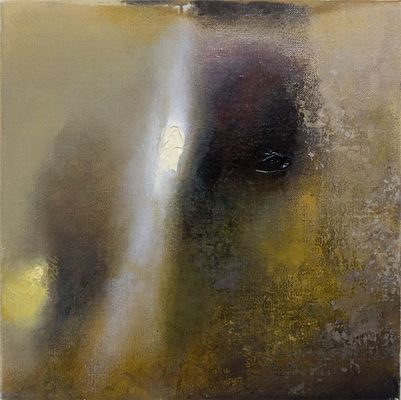
To return to Buckley’s fragment, the first two lines very much evoke how I paint nowadays. As you age, detail diminishes and patches of light become more luminous and float. I feel the most honest way of dealing with this is by smearing the oil paint on the canvas with the fingers and working close-up, blind. Only if the patches coalesce into an approaching image can the work gain a life.
-
Jonathan Walker was born in Melbourne, Australia and brought up on a dairy farm in Gippsland. In the 1970’s he studied painting at RMIT and won the Harold Wright Scholarship to the British Museum, London. During the 1980’s he exhibited at Pinacotheca Gallery, Richmond and had work shown at the NGV and Heidi City Art Gallery. Over the same period he designed the cover for the “Epigenesi” LP by Giancarlo Toniutti, Italy and conducted a mail exchange work with Achim Wollscheid, Germany. The work with artists through the post resulted in an article published in the bicentenary issue of Art and Australia 1988. He showed in artist run spaces such as WestSpace in the 90’s and 2000’s, and until 2012, taught painting at Victoria University, which is where we (Colleen Ahern and Lisa Radford) as organisers of the exhibition, among many others, had the privilege of being his student.
Walker’s knowledge was imparted to students through the careful selection of music, literature, and artists found in books that he himself had ordered for the library. Walker’s strategy was the generosity of sharing his vast knowledge with references specific to each student and their context.
Walker’s paintings share a similar focus and intimacy.
This exhibition presents a small selection of recent paintings alongside a publication that includes Walker’s writing. Observational and analytical, Walker’s work is a type of material notation — the time of day, colour and how it is blended, the both specific and fleeting location of a reflection on lino or the question of whether a chair leg should be included in a painting.
Please join us on Friday August 21 between 6-8pm to celebrate the opening of the exhibition.
Curated by Colleen Ahern and Lisa Radford.
B. Wurtz
Curated by Nic Tammens
March 26 - April 4, 2015
B.Wurtz works from a basement studio in his home on Manhattan’s Lower East Side.
This local fact is attested to by the plastic shopping bags and newsprint circulars that appear in his work. As formal objects, they don’t make loud claims about their origins but nonetheless transmit street addresses and places of business from the bottom of this long thin island. Like plenty of artists, Wurtz is affected by what is local and what is consumed. His work is underpinned by this ethic. It often speaks from a neighborhood or reads like the contents of a hamper:
“BLACK PLUMS $1.29 lb.”
“Food Bazaar”
“USDA Whole Pork Shoulder Picnic 99c lb.”
“RITE AID Pharmacy, with us it’s personal.”
“H. Brickman & Sons.”
“Sweet Yams 59c lb."
Most of the work in this exhibition was made while the artist was in residence at Dieu Donne, a workshop dedicated to paper craft in Midtown. Here Wurtz fabricated assemblages with paper and objects that are relatively lightweight, with the intention that they would be easily transportable to Australia. This consideration isn’t absolute in Wurtz’s work, but was prescriptive for making the current exhibition light and cheap. Packed in two boxes, these works were sent from a USPS post office on the Lower East Side and delivered to North Melbourne by Australia Post.
Wurtz appears courtesy of Metro Pictures, New York.
Thanks to Rob Halverson, Joshua Petherick, Sari de Mallory, Matt Hinkley, Helen Johnson, Fayen d'Evie, Ask Kilmartin, Lisa Radon, Ellena Savage, Yale Union, and "Elizabeth".
John Nixon
"Archive"
December 15 - January 20, 2014
The presentation of John Nixon's archive offered a rare showcase of this extensive collection of the artist's own publications, catalogues, posters, ephemera, editions and more, from the mid 1980s onwards, alongside a selection of his artworks.
Organized by John Nixon, Joshua Petherick and Matt Hinkley.
<a href=http://wfb.public-office.info/artist/john-nixon>All titles by John Nixon
"Habitat"
at Minerva, Sydney (organised by Joshua Petherick and Matt Hinkley)
November 15 - December 20, 2014
Lupo Borgonovo, Janet Burchill & Jennifer McCamley,
Lewis Fidock, HR Giger, Piero Gilardi, Veit Laurent Kurz,
Cinzia Ruggeri, Michael E. Smith, Lucie Stahl, Daniel Weil, Wols
Press Release:
“...It contained seven objects. The slender fluted bone, surely formed for flight, surely from the wing of some large bird. Three archaic circuitboards, faced with mazes of gold. A smooth white sphere of baked clay. An age-blackened fragment of lace. A fingerlength segment of what she assumed was bone from a human wrist, grayish white, inset smoothly with the silicon shaft of a small instrument that must once have ridden flush with the surface of the skin - but the thing’s face was seared and blackened.”
William Gibson, “Count Zero”, 1986
"Autumn Projects Archive"
Curated by Liza Vasiliou
March 6 - March 15, 2014
World Food Books, in conjunction with the Virgin Australia Melbourne Fashion Festival 2014, presented the Autumn Projects archive, consisting of a selection of early examples in Australian fashion with a particular interest in collecting designers and labels from the period beginning in the 1980’s, who significantly influenced the discourse of Australian Fashion.
Curated by Liza Vasiliou, the exhibition provided a unique opportunity to view pieces by designers Anthea Crawford, Barbara Vandenberg, Geoff Liddell and labels CR Australia, Covers, Jag along with early experimental collage pieces by Prue Acton and Sally Browne’s ‘Fragments’ collection, suspended throughout the functioning World Food Books shop in Melbourne.
H.B. Peace
presented by CENTRE FOR STYLE
November 14, 2013
"Hey Blinky, you say chic, I say same"
Anon 2013
H.B. Peace is a clothing collaboration between great friends Blake Barns and Hugh Egan Westland. Their pieces explore the divergences between 'character’ and ‘personality’ in garments....etc
Special Thanks to Joshua Petherick and Matt Hinkley of WFB and Gillian Mears
and a Very Special Thank you to Audrey Thomas Hayes for her shoe collaboration.
Janet Burchill & Jennifer McCamley
"Aesthetic Suicide"
May 10 - June 8, 2013
The first of our occasional exhibitions in the World Food Books office/shop space in Melbourne, "Aesthetic Suicide" presented a body of new and older works together by artists Janet Burchill & Jennifer McCamley, including videos, prints, a wall work, and publications.
During shop open hours videos played every hour, on the hour.
$.00 - Out of stock
The eternal clean out! New items weekly.
https://worldfoodbooks.com/category/sale
Published by World Food Books / Melbourne
$20.00 - In stock -
A World Food Books gift voucher is redeemable in our Melbourne bookshop or via our webshop (here). An e-voucher (printable pdf) will be sent to your purchase email address (please notify us if you wish to have the voucher sent to an alternate address and wish us to fill in the receiver's details on the card).
Gift vouchers can be purchased in increments of $20 (Australian Dollars) and the total amount can simply be added to by increasing the quantity in your shopping cart. eg. A quantity of 5 gift vouchers will result in an item total of $100 - a $100 gift voucher. Simply click "ADD TO CART" 5 times, or update your quantity in the shopping cart.
If you wish to purchase multiple, separate gift vouchers in one go, please just email us and we can personally prepare and email you a payment request.
Please note: Please select Pick-Up on gift voucher purchse to avoid any postage charges. Accidental postage charges will be refunded right away!
Thank you.
For any questions, please don't hesitate to email: [email protected]
1975 / 1986, English
Softcover, 194 pages, 25 x 18 cm
Out of print title / used / good
Published by
Arrow Books / London
$40.00 - In stock -
"Picking through the slag heap of the Hollywood dream factory, [Kenneth] Anger has put together a truly prodigious anthology of star-studded scandal."—The New York Times
Welcome to Hollywood. Take a walk down "The Boulevard of Broken Dreams," where starlets, sex goddesses, matinee idols, American aristocracy, and Mafia moguls meet. It's a town made manic in its heyday by "joy powder" and cocaine-crazed comedies, seduced by vamping heroin heroines, shaken by Fatty Arbuckle's orgiastic excesses and Errol Flynn's amoral extravagances, stunned by Marilyn Monroe's tragic suicide and Sharon Tate's brutal murder.
Here, as never revealed before, is the scalding reality behind the glittering façade: the true stories and darkest secrets behind the lurid headlines that have titillated the world and electrified the nation for decades.
Hollywood Babylon is a book by avant-garde filmmaker Kenneth Anger, a former child movie actor, which details the sordid scandals of many famous and infamous Hollywood denizens from the 1900s to the 1950s. Originally published in Paris, Hollywood Babylon was first published in the US in 1965, it was banned ten days later and would not be republished until 1975. Upon its second release, The New York Times said of it, "If a book such as this can be said to have charm, it lies in the fact that here is a book without one single redeeming merit."
The book details the stories of Hollywood stars from the silent era to stars of the 1960s including Charles Chaplin, Lupe Vélez, Rudolph Valentino, Olive Thomas, Thelma Todd, Frances Farmer, Juanita Hansen, Mae Murray, Alma Rubens, Barbara La Marr, and Marilyn Monroe. Hollywood Babylon also featured chapters on the Fatty Arbuckle–Virginia Rappe scandal, the murder of William Desmond Taylor, the Hollywood Blacklist, the murder of Sharon Tate, and the Confidential magazine lawsuits.
Good copy of the 1986 Arrow edition, with some storage buckling, light edge/corner wear,
2004, English
Hardcover, 224 pages, 21 x 25 cm
1st Edition, Out of print title / used / good
Published by
Black Dog Publishing Ltd / London
$100.00 - Out of stock
Scarce copy of the first hardcover edition of "Kenneth Anger: A Demonic Visionary", of which 10,000 copies were destroyed due to claims of plagiarism. Later re-printed in common soft cover in 2011.
Alice L. Hutchinson sets Kenneth Anger's work within the social and artistic context of the twentieth century - from the bohemian world of Cocteau in Paris in the 1940s and 50s to the psychedelic London in the late 60s to Anger's hometown of Hollywood, made infamous in his Hollywood Babylon books. With many new reproductions, this book provides an essential introduction to one of the pioneers of independent filmmaking. Alongside the text by Hutchinson, this publication consolidates English and French texts as well as interviews by Anger, alongside commentaries on his work by Stan Brakhage, Anais Nin, Samson De Brier, Jonas Mekas and Carolee Schneemann. This highly-illustrated book joins insightful text and unseen film stills to tell the vivid story of this evocative director and remains the only comprehensive book ever published on the artist.
Good copy with general wear/light creasing to stiff covers (common with this style of cover).
1990, English
Softcover, 144 pages, 23 x 15 cm
1st Edition, Out of print title / used / very good
Published by
University of Minnesota Press / Minnesota
$20.00 - In stock -
Two interrelated essays which address the debate concerning Heidegger's relationship to Nazism. In the first, Lyotard establishes the theme of the "outsider" by placing "the jews" in lower case - a representation of the threatening alien force. In the second, he discusses the "Heidegger affair".
"Lyotard's analysis is multifaceted and profound, defying easy synopsis. The book will be of interest to a wide audience."—Library Journal
Although Heidegger's relationship to Nazism had been rumored as early as 1960, the publication of Victor Farías's Heidegger et le nazismé in France in 1987 turned intimations into hard, unavoidable "facts" in the form of previously unpublished speeches, lectures, letters, "eye-witness" accounts, and inter-views. French intellectuals reacted quickly to this immense shock to a system that had nurtured and been nurtured by Heidegger's work. Reactions ranged from outright apology to utter condemnation.
Jean François Lyotard's contribution to the debate, Heidegger and "the jews," is a marked departure from the standard fare. In the first of two interrelated essays, "the jews," Lyotard quickly establishes the theme of the entire text, placing "the jews" in lower case, plural, and in quotation marks to represent outsiders, the nonconformists: the artists, anarchists, blacks, homeless, Arabs, etc. The Jews represent an alien and dangerous disruption, an "other" to be excised from the West's dream of unbounded fulfillment and development.
In "Heidegger," the second essay, Lyotard sets forty rules for explaining the "Heidegger affair," most of which prescribe close textual readings and careful attention to the specific forms in which the affair is represented: an unheimliche. Once Lyotard's rules are adopted, the affair can be accounted for within the widest possible context, without eliminating important aspects or reducing it to any one particular critical method.
Jean-François Lyotard is one of the principal French philosophers and intellectuals of the twentieth century. Best known for having coined the term "post-modern," he is the author of numerous works, including Postmodern Fables, The Postmodern Condition, The Differend, and The Postmodern Explained. All of these works are available from the University of Minnesota Press. Lyotard is professor emeritus at the University of Paris and professor of French at Emory University,
Jean-François Lyotard was a French philosopher and literary theorist best known for his work on postmodernism. In his influential book The Postmodern Condition: A Report on Knowledge (1979), Lyotard argued that contemporary societies have become skeptical of “grand narratives”—large, universal stories such as progress, enlightenment, or emancipation that once claimed to explain history and knowledge. Instead, he proposed that knowledge in the postmodern era is fragmented into many smaller, local narratives shaped by different cultures, institutions, and language games. Lyotard’s ideas helped shape debates in philosophy, cultural theory, and the humanities by emphasizing plurality, uncertainty, and the limits of universal truths.
VG copy with some light cover wear.
1979, English
Softcover, 318 pages, 23 x 16 cm
1st Edition, Out of print title / used / very good
Published by
Yale University Press / New Haven
$100.00 - In stock -
Rare first 1979 edition of this absolute classic of SF criticism, pioneering formulations of the novum and of the notion of cognitive estrangement. It is no wonder authors such as Fredric Jameson have said that the field of science fiction studies is divided into pre- and post-Suvin.
Metamorphoses of Science Fiction is the origin point for decades of literary and theoretical criticism of science fiction and related genres. Darko Suvin's paradigm-setting definition of SF as "the literature of cognitive estrangement" established a robust theory of the genre that continues to spark fierce debate, as well as inspiring myriad intellectual descendants and disciples. Suvin's centuries-spanning history of the genre links SF to a long tradition of utopian and satirical literatures crying out for a better world than this one, showing how SF and the imagination of utopia are now forever intertwined.
G—VG copy with some edge wear, tanning, minor sticker damage to back cover.
1979, English
Softcover, 168 pages, 20 x 13 cm
Out of print title / used / very good
Published by
Penguin Books / London
$25.00 - In stock -
1979 endition of Exterminator! by William S. Burroughs.
A man, dispirited by ageing, endeavours to steal a younger man’s face; a doctor yearns for a virus that might eliminate his discomfort by turning everyone else into doubles of himself; a Colonel lays out the precepts of the life of DE (Do Easy); conspirators posthumously succeed in blowing up a train full of nerve gas; a mandrill known as the Purple Better One runs for the presidency with brutal results; and the world drifts towards apocalypses of violence, climate and plague. The hallucinatory landscape of William Burroughs’ compellingly bizarre, fragmented novel is constantly shifting, something sinister always just beneath the surface.
VG copy with tanning to edges.
2018, English
Softcover, 52 pages, 21.5 x 13.5 cm
1st Edition, Out of print title / used / good
Published by
Amphetamine Sulphate / Austin
$45.00 - Out of stock
First 2018 printing of New Juche's Stupid Baby.
Dennis Cooper (American novelist, poet, critic, editor and performance artist) has described New Juche as 'one of the most inspiring, original and groundbreaking artists working today.'
New Juche is the nom de guerre of a writer and photographer who lives and works in Southeast Asia. He is also the author of The Worm, The Devils, Bosun, Mountainhead, Wasteland, The Mollusc, Gymnasium.
Good copy with rubbing wear to textured boards.
2019, English
Softcover, 146 pages, 20.5 x 20.5 cm
1st Edition, Out of print title / used / good
Published by
Amphetamine Sulphate / Austin
$140.00 - In stock -
First 2019 edition of New Juche's fast out-of-print Amphetamine Sulphate book of The Devils.
"Adieu all you Judges. New Juche returns with his book of ‘The Devils.’
An unsparing look into the dark rotten heart of Midlothian. Part true-crime narrative, part explicit memoir, ‘The Devils’ charts strange topographies and bloody histories.
‘Ever a fish out of water, ever a cunt,’ this is a vital occult dispatch from one of the most challenging and unnerving writers at work today."
Good—Very Good copy with storage curl to cover edge, light cover wear otherwise As New.
1982, English
Softcover, 218 pages, 22.5 x 15 cm
Out of print title / used / very good
Published by
Columbia University Press / New York
$70.00 - In stock -
1982 Columbia classics re-print of Powers of Horror: An Essay on Abjection (French: Pouvoirs de l'horreur. Essai sur l'abjection), a 1980 book by Julia Kristeva. The work is an extensive treatise on the subject of abjection, in which Kristeva draws on the theories of Sigmund Freud and Jacques Lacan to examine horror, marginalization, castration, the phallic signifier, the "I/Not I" dichotomy, the Oedipal complex, exile, and other concepts appropriate to feminist criticism and queer theory.
According to Kristeva, the abject marks a "primal order" that escapes signification in the symbolic order; the term is used to refer to the human reaction (horror, vomit) to a threatened breakdown in meaning caused by the loss of the distinction between subject and object, or between the self and the other.
"Kristeva is one of the leading voices in contemporary French criticism, on a par with such names as Genette, Foucault, Greimas and others. ... [Powers of Horror is] an excellent introduction to an aspect of contemporary French literature which has been allowed to become somewhat neglected in the current emphasis on para-philosophical modes of discourse. The sections on Celine, for example, are indispensable reading for those interested in this writer and place him within a context that is both illuminating and of general interest."—Paul de Man
1982 English translation by Leon S. Roudiez. Single spine crease, light knocking/creasing to baord extremities, otherwise VG throughout.
1986, English
Softcover, 328 pages, 22.8 x 15 cm
1st Edition, Out of print title / used / average
Published by
Blackwell / Cambridge
$25.00 - In stock -
First 1986 printing.
Julia Kristeva is a theorist and has been acclaimed for her work in linguistics, psychoanalysis, literary and political theory. This is an introduction to her work in English, containing a range of essays from all phases of her career.
Julia Kristeva is one of Europe's most brilliant and original theorists, widely acclaimed for her work in such diverse areas as linguistics, psychoanalysis, literary and political theory. The Kristeva Reader is a fully-comprehensive, easily accessible introduction to her work in English, containing a wide range of essays from all phases of Kristeva's career. The essays have been carefully selected as representative of the three main areas of her writing - semiotics, psychoanalysis and political theory - and each is prefaced by a clear, instructive introduction.
Julia Kristeva, internationally known psychoanalyst and critic, is Professor of Linguistics at the University de Paris VII. She has hosted a French television series and is the author of many critically acclaimed books published by Columbia University Press in translation, including Time and Sense: Proust and the Experience of Literature and the novel, Possessions.
"It has been apprarent for some time that Julia Kristeva has inherited the intellectual throne left vacant by the death of Simone de Beauvoir."—Elaine Showalter
Average ex-library copy, general wear and creasing, library markings. Sample image only.
2000, English
Softcover, 22.5 x 14.5 cm
1st Edition, Out of print title / used / fine
Published by
Columbia University Press / New York
$40.00 - In stock -
Linguist, psychoanalyst, and cultural theorist, Julia Kristeva is one of the most influential and prolific thinkers of our time. Her writings have broken new ground in the study of the self, the mind, and the ways in which we communicate through language. Her work is unique in that it skillfully brings together psychoanalytic theory and clinical practice, literature, linguistics, and philosophy.
In her latest book on the powers and limits of psychoanalysis, Kristeva focuses on an intriguing new dilemma. Freud and psychoanalysis taught us that rebellion is what guarantees our independence and our creative abilities. But in our contemporary "entertainment" culture, is rebellion still a viable option? Is it still possible to build and embrace a counterculture? For whom—and against what—and under what forms?
Kristeva illustrates the advances and impasses of rebel culture through the experiences of three twentieth-century writers: the existentialist John Paul Sartre, the surrealist Louis Aragon, and the theorist Roland Barthes. For Kristeva the rebellions championed by these figures—especially the political and seemingly dogmatic political commitments of Aragon and Sartre—strike the post-Cold War reader with a mixture of fascination and rejection. These theorists, according to Kristeva, are involved in a revolution against accepted notions of identity—of one's relation to others. Kristeva places their accomplishments in the context of other revolutionary movements in art, literature, and politics. The book also offers an illuminating discussion of Freud's groundbreaking work on rebellion, focusing on the symbolic function of patricide in his Totem and Taboo and discussing his often neglected vision of language, and underscoring its complex connection to the revolutionary drive.
Julia Kristeva is a practicing psychoanalyst and professor of linguistics at the University of Paris. She is the author of many acclaimed books, including Time and Sense; Strangers to Ourselves, and New Maladies of the Soul, all published by Columbia.
Translated by Jeanine Herman
NF copy.
1993, Japanese
Softcover (w. dust jacket), 210 pages, 21 x 14.8 cm
1st Edition, Out of print title / used / fine
Published by
World Comics / Japan
Kubo Shoten / Japan
$180.00 - In stock -
Very rare original first Japanese book collection of the infamous cult classic eromanga "Bondage Fairies" by Kondom, published by Kubo Shoten way back in 1993. This is the first ever book collecting over 200 pages of the first of the original series from the early 1990s, in the original Japanese language, as they appeared in the pages of Kubo Shoten's Young Lemon magazine for the first time as "Bondage Fairies". Includes colour artwork galleries.
Created by manga artist Teruo Kakuta under the pen name "Kondom", a multilingual pun, meaning "little insect" in Japanese and "condom" in English, Bondage Fairies is an erotic series about highly sexual female forest fairies, who work as police officers protecting the forest, whilst engaging in a wild array of anthropomorphized, inter-species sexual acts. The series began in Japan in 1990 as Insect Hunter, but it was quickly banned from sale by the Tokyo Metropolitan Ordinance. Under a new title, the manga was serialized in manga magazine Lemon Kids. The series is among the earliest sexually explicit manga (eromanga) commercially translated and published uncensored in the United States where the earliest editions date from 1994 (Venus Press). Eros Comix subsequently published a multi-volume series of the collected Bondage Fairies, and subsequent stories, now all very collectible. Translated to Swedish, German, French, and Italian, Bondage Fairies is one of the most popular underground adult Japanese comics outside Japan.
Near Fine copy in original NF dust jacket.
1994, Japanese
Softcover (w. dust jacket), 162 pages, 21 x 14.8 cm
1st Edition, Out of print title / used / fine
Published by
World Comics / Japan
Kubo Shoten / Japan
$160.00 - In stock -
Very rare original first printing Volume 2 Japanese book collection of the infamous cult classic eromanga "Bondage Fairies" by Kondom, published by Kubo Shoten way back in 1994. Volume 3 of the first ever book collection bringing together over 160 pages of the the original series from the early 1990s, in the original Japanese language, as they appeared in the pages of Kubo Shoten's Young Lemon magazine for the first time as "Bondage Fairies". Includes colour artwork galleries.
Created by manga artist Teruo Kakuta under the pen name "Kondom", a multilingual pun, meaning "little insect" in Japanese and "condom" in English, Bondage Fairies is an erotic series about highly sexual female forest fairies, who work as police officers protecting the forest, whilst engaging in a wild array of anthropomorphized, inter-species sexual acts. The series began in Japan in 1990 as Insect Hunter, but it was quickly banned from sale by the Tokyo Metropolitan Ordinance. Under a new title, the manga was serialized in manga magazine Lemon Kids. The series is among the earliest sexually explicit manga (eromanga) commercially translated and published uncensored in the United States where the earliest editions date from 1994 (Venus Press). Eros Comix subsequently published a multi-volume series of the collected Bondage Fairies, and subsequent stories, now all very collectible. Translated to Swedish, German, French, and Italian, Bondage Fairies is one of the most popular underground adult Japanese comics outside Japan.
Near Fine copy in original NF dust jacket.
1995, Japanese
Softcover (w. dust jacket), 164 pages, 21 x 14.8 cm
1st Edition, Out of print title / used / fine
Published by
World Comics / Japan
Kubo Shoten / Japan
$160.00 - In stock -
Very rare original first printing Volume 3 Japanese book collection of the infamous cult classic eromanga "Bondage Fairies" by Kondom, published by Kubo Shoten way back in 1995. Volume 3 of the first ever book collection bringing together over 160 pages of the the original series from the early 1990s, in the original Japanese language, as they appeared in the pages of Kubo Shoten's Young Lemon magazine for the first time as "Bondage Fairies". Includes colour artwork galleries.
Created by manga artist Teruo Kakuta under the pen name "Kondom", a multilingual pun, meaning "little insect" in Japanese and "condom" in English, Bondage Fairies is an erotic series about highly sexual female forest fairies, who work as police officers protecting the forest, whilst engaging in a wild array of anthropomorphized, inter-species sexual acts. The series began in Japan in 1990 as Insect Hunter, but it was quickly banned from sale by the Tokyo Metropolitan Ordinance. Under a new title, the manga was serialized in manga magazine Lemon Kids. The series is among the earliest sexually explicit manga (eromanga) commercially translated and published uncensored in the United States where the earliest editions date from 1994 (Venus Press). Eros Comix subsequently published a multi-volume series of the collected Bondage Fairies, and subsequent stories, now all very collectible. Translated to Swedish, German, French, and Italian, Bondage Fairies is one of the most popular underground adult Japanese comics outside Japan.
Near Fine copy in original NF dust jacket.
1991, English
Hardcover, 204 pages, 23 x 15.5 cm
1st Edition, Out of print title / used / good
Published by
Johns Hopkins University Press / Baltimore
$20.00 - In stock -
What makes New York City different from Moscow? Are small towns looking more and more alike? What criteria should we use to distinguish one place from another? Today, geographers and other social scientists are debating not only the answers to these sorts of questions but even whether or not to ask them at all. This ongoing controversy about how (or whether) to study place and its meaning in modern life forms the focus of J. Nicholas Entrikin's pioneering work.
Those who point to a decline in the study of place in geography, Entrikin explains, cite three main causes: the apparent homogenization of world culture; the belief that studying particular places is somehow "parochial;" and the tendency of the scientific method to generalize. Entrikin treats each of these in turn, addressing topics that include the Marxist view of a world economy, the moral implications of place (in such notions as community and provincialism), and the empiricist versus neo-Kantian traditions in philosophy.
To geographers arguing the merits of hard, scientific data versus subjective experience, Entrikin offers a compromise. "To understand place," he suggests, "requires that we have access to both an objective and a subjective reality. From the decentered vantage point of the theoretical scientist, place becomes either location or a set of generic relations and loses much of its significance for human action. From the centered viewpoint of the subjective self, place has meaning only in relation to one's own goals and concerns. Place is best viewed from points in-between."
Good copy w/o dust jacket.
1987, English
Softcover, 276 pages, 25 x 17.5 cm
1st Edition, Out of print title / used / very good
Published by
Humanities Press International / London
$120.00 - In stock -
Rare first 1987 English-language edition of this sought after study on Heidegger, published by Humanities Press, London.
Basically, the theory of intentionality can be viewed as an attempt to reach an "adequate" theory of the structure "I relate myself to reality". Husserl, Heidegger's teacher, believed that, using the method of phenomenology, such a theory could be made rigorously scientific and foundationalist. In this way, Husserl thought, the theory of intentionality would be capable of solving all genuine philosophical problems and hence of fulfilling the promise of enlightenment philosophy of securing a rational basis for the future happiness of mankind. Heidegger's Being and Time is an attempt to overcome the gap between Husserl's promises and his actual achievements, this gap being due to the limited scope of the basic experiences analyzed by Husserl and to Husserl's conception of phenomenological method.
Later, Heidegger came to realize the radical historical naivety of the conceptions of phenomenology and intentionality he none the less shared with Husserl and to recommend an entirely different kind of thinking. Though they both contain germs of truth which should be preserved, the later Husserl's "transcendental phenomenology" and the later Heidegger's "thinking of being" remain largely unfulfilled promises. Husserl's actual achievements in the theory of intentionality, on the other hand, today attract renewed interest for a number of reasons and are now the legacy of contemporary cognitive science. This interest, the author believes, should be extended to Heidegger's actual results in Being and Time when rationally reconstructed in contemporary philosophical terms as taking some further steps towards a general theory of intentionality.
VG copy with light wear and tanning.
1995, English
Softcover, 608 pages, 23 x 15 cm
1st Edition, Out of print title / used / very good
Published by
University of California Press / Berkley
$40.00 - In stock -
This is the first factual and conceptual history of Martin Heidegger's Being and Time (1927), a key twentieth-century text. Through painstaking investigation of European archives and private correspondence, Theodore Kisiel provides an unbroken account of the philosopher's early development and progress toward his masterwork.
"The most complete and the most enlightening reconstruction of the genesis of Being and Time that we can hope for at this time.... [We] come to see far more clearly not only where this book came from, but also what its genesis has made possible for us."—Jean Grondin, Archives de Philosophie
"[Kisiel] places his book at the service of presentation and surveys the conceptual laboratory in which Heidegger in those years mixed his 'blasting powder. The English reader can thus for the first time get acquainted in depth with the philosophical inside story? The German reader is likewise indebted to Kisiel for many a surprise....
An impressive and important book."—Dieter Thomä, Frankfurter Allgemeine Zeitung
"The Genesis of Heidegger's Being and Time is a magisterial accomplishment that will be the standard in this field for years to come."—John D. Caputo, Villanova University
"Groundbreaking and entirely original, this is an outstanding work"—Thomas Sheehan, Loyola University Chicago
Theodore Kisiel is Professor of Philosophy at Northern Illinois University and translator of Martin Heidegger's History of the Concept of Time.
VG copy of first edition.
2021, English
Softcover, 260 pages, 20 x 15 cm
Published by
Pilot Press / London
$39.00 - In stock -
Derek McCormack is the author of fashion-inflected novels that cast luminaries such as Elsa Schiaparelli and Balenciaga as characters. This collection brings together for the first time McCormack's fashion journalism. He writes about and interviews fashion figures that fascinate him, tracing the ways they inspire and inhabit his novels. The result is a sort of memoir in essays: as he writes, "My tribute to [Judy] Blame is about him and about me—there are lots of my own tales woven in with the topics I touch on. The writing here is a sort of autobiography, a life seen through a scrim, or a life as a scrim—my moire mémoire."
Judy Blame's Obituary contains twenty years' worth of reminiscences, reviews of fashion shows and books, interviews with writers about fashion, and interviews with fashion designers about writing. He talks to Nicolas Ghesquière about perfume, and to Edmund White about which perfume he wore as a young fag in New York City. He inspects the clothes that Kathy Acker left behind when she died, and he summons the spirit of Margiela in a literary seance. He traces the history of sequins, then recounts the cursed story of Vera West, the costume designer who dressed the Bride of Frankenstein. These pieces were all previously published, some in Artforum, some in The Believer, and some in underground publications like Werewolf Express—what binds them together is a sense that though fashion victimizes us, this victimization is sometimes a sort of salvation.
Derek McCormack is a Canadian writer. His most recent novels are The Well-Dressed Wound and Castle Faggot, both published by Semiotext(e). Of Castle Faggot, Dennis Cooper said: "It is really just one of the best books ever, and maybe the greatest novel ever written."
Praise for Judy Blame's Obituary:
'Derek McCormack, Canada's most famous author as yet unsullied by Nobel Prize or television adaptation, hides in plain sight as a fashion journalist. Parallel to his writing incantatory, scatalogical fiction, he has reviewed collections and interviewed the great and good of la mode. His divagations are often darkly hilarious and always exquisitely tailored. The sublime and the ridiculous coexist in his prose, as they do in life. Fashion victims, ignore his insights at your peril.' — William E. Jones
1977 / 1995, English
Softcover, 272 pages, 21.6 x 14.6 cm
Out of print title / used / very good
Published by
Cornell University Press / New York
$40.00 - Out of stock
Translated from the French by RICHARD HOWARD
With a new Foreword by JONATHAN CULLER
"Todorov's work is unquestionably one of the important constituents of a new poetics of fiction now in the making." —Library Journal Clearly argued and written with vivacity and force, this book makes an exciting addition to the roster of important works of continental criticism now available in English. It is at once an introduction to literary structuralism and a working out of the applications of struc-turalism to fiction in a variety of languages and in different historical periods. Combining practical criticism of fictional works with literary theory, Professor Todorov discusses in sixteen diverse essays writers such as Homer, Artaud, and the author of the Holy Grail, as well as narrative form in The Decameron, the tales of Henry James, and The Arabian Nights.
"The book can serve as an introduction to literary structuralism, an introduction unusually lucid and unmarred by the technical obscurantism of much recent structuralist criticism. Because structuralism is so often associated with poetry, the essays that apply the linguistic and formal criteria of structuralism to narrative, plot, and genre are especially welcome.... Recommended."—Choice
TZVETAN TODOROV is Directeur de Recherche at the Centre National de la Recherche Scientifique, Paris. He is the author of many other critical works, including The Fantastic: A Structural Approach to a Literary Genre (Cornell University Press).
Todorov was a Franco-Bulgarian historian, philosopher and literary theoretician. Among his most influential works is his theory on the fantastic, the uncanny and marvellous.
VG copy.
1995, English
Softcover, 200 pages, 24 x 18 cm
1st Edition, Out of print title / used / very good
Published by
Local Consumption Publications / Newtown
$40.00 - In stock -
Scarce first 1995 edition of Noel Sanders' The Thallium Enthusiasms: And Other Australian Outrages, a wonderful Oz true crime book study of sensational, often domestic, crimes in Australia, focusing on the 1950s Sydney thallium poisoning crime wave where six women in NSW were charged with using thallium-based rat poison to kill family members, often disguised in food or tea. It covers infamous poisoners like serial "comfort killer" "Aunt Thally" (Caroline Grills). Other "Outrages" cover other notable Australian criminal cases, including the Graeme Thorne kidnapping (1960), the Whiskey a Go-Go fire (1973), and the Fairlie Arrow disappearance (1991).
VG copy.
2024, English
Hardcover, 256 pages, 28 x 21 cm
Published by
Cult Epics / Amsterdam
$115.00 - In stock -
"Pornography is there to give you an erection, erotica is there to give you emotions."—Tinto Brass
Tinto Brass (1933), whose long-life career includes 30 films, is the Italian director best known for the soft adult films he shot in the 1970s and 1980s - his most famous being Salon Kitty (1976), The Key (1983) with Stefania Sandrelli, and the notorious Caligula (1979) which film producer Bob Guccioni, founder of Penthouse, took away from Brass and cut himself.
This homage to his fascinating career includes his earliest avant-garde films like Who Works is Lost (1963); the western Yankee (1966) and the giallo Deadly Sweet (1967); experimental arthouse films Attraction (1968) and The Howl (1969), including the hard-to-be-seen Dropout (1970) and Vacation (1971) with Franco Nero and Vanessa Redgrave to the decidedly derrière-obsessed fetishism of his later work, including Paprika (1991), All Ladies Do It (1992), The Voyeur (1994), Frivolous Lola (1998), and Cheeky! (2000).
The Films of Tinto Brass: From the Avant-Garde to Erotica is a film-by-film guide to one of the most interesting and uncompromising Italian film directors.
"For me, cinema is a dream that becomes true. What I cannot do in reality I try to do in movies. My scenes are not connected by logic, but by analogy. In this way, they proceed like poetry and dreams."—Tinto Brass
Nico B is the founder of the legendary Amsterdam video store Cult Videoheek, and started Cult Epics in 1991. He releases arthouse, horror & erotica films, specializing in the works of directors such as Walerian Borowczyk, Tinto Brass, Fernando Arrabal, Radley Metzger, Jörg Buttgereit, Agusti Villaronga, Pim de la Parra & Wim Verstappen, Nouchka van Brakel, Marleen Gorris, Irving Klaw and pin up Bettie Page in definitive editions on DVD & Blu-ray. Cult Epics also releases beautifully illustrated hardcover books including Women of the Sun: Bunny Yeager in Mexico, and Sylvia Kristel: From Emmanuelle to Chabrol.
Giovanni "Tinto" Brass (born 26 March 1933) is an Italian film director and screenwriter. In the 1960s and 1970s, he directed many critically acclaimed avant-garde films of various genres. Today, he is mainly known for his later work in the erotic genre, with films such as Caligula, Salon Kitty, Cosi fan tutte (All Ladies Do It), Paprika, Monella Frivolous Lola), and Trasgredire (Cheeky!).
1990, English
Softcover, 220 pages, 20 x 14 cm
1st Edition, Out of print title / used / very good
Published by
City Lights Books / San Francisco
$40.00 - In stock -
First 1990 edition.
The literary adventure of D.A.F. (1740-1814) is unique and paradoxical. He was widely read in the nineteenth century, but his books disappeared almost completely from circulation in the century. Meanwhile the exegesis of Sade poured from the presses of the Western world in a flood of words in which the writer, the novelist, and the exceptional poet disappeared.
In France today, J. J. Pauvert, who considers Sade "the greatest French writer," is publishing a new edition of the complete works with a new introduction by Annie Le Brun. Sade: A Sudden Abyss is the translation of this introduction, which shows Sade as the inventor of an entirely new language through which he fathoms human nature, desire, and relationships of power.
In this fresh and authoritative survey of Sade's work as a whole, Le Brun frees it from such critics as Bataille, Blanchot, Klossowski, and Barthes (who see Sade's language as a metaphor for history, society, or writing itself). She asks, Where is Sade himself in these texts? What exactly does Sade tell us? What is obscured when Sade's writing is placed in a "universe of discourse" rather than understood as a manifestation of a life spent in eleven prisons over twenty-seven years? Like a powerful laser beam, her reflections cut through two centuries of intellectual hide-and-seek and let Sade for the first time be seen and read in his own light.
Annie Le Brun is a French poet and literary theorist who participated in the final years of the Surrealist movement. Her books include Lachez tout, a critique of the French neofeminist movement; A distance; and Les chateaux de la subversion, a study of the Gothic tradition.
VG copy.
1956, English
Softcover, 370 pages, 18 x 10.5 cm
1st Edition, Out of print title / used / good
Published by
Doubleday Anchor / US
$45.00 - In stock -
First 1956 edition.
Baudelaire was one of the greatest poets of the nineteenth century, and at the same time one of its major art-critics - "the first aesthetician of his age." His most important writings on art, many of them translated into English for the first time in The Mirror of Art, have been selected by Jonathan Mayne from Curiosités Esthétiques and L'Art Romantique.
Baudelaire studies in precise detail the artists of mid-nineteenth century - among them Corot, Daumier, Delacroix, Ingres, and Millet - whose works appeared in the Salons of 1845, 1846 and 1859 and in the Exposition Universelle of 1855. Yet these brilliant and poetic essays form a coherent body of criticism and art-theory. The discussion centers around several essential questions which prompted in Baudelaire some of his profoundest insights into life and art: the nature of Romanticism; color; caricature; the heroism of modern life; the essence of laughter. "The Life and Work of Eugène Delacroix," which appears complete in this volume, gathers many of these themes together in a penetrating discussion of the painter between whose work and Baudelaire's there is a close affinity.
These studies are not only a major work in art criticism and the philosophy of art, but they are essential to a full understanding of Baudelaire the poet and the man.
The present volume has the unique advantage of a systematic collection of illustrations, so that the reader may examine in reproduction most of the works of which Baudelaire writes.
G—VG copy with tanning/cracking to spine, some general cover wear, still tightly bound.