World Food Books' programme is largely produced on Kulin Nation land. We acknowledge the Wurundjeri people of the Kulin Nation as the first and continuing custodians of this land, and pay respect to their Elders past, present, and emerging.
World Food Books is an arts and special interests bookshop in Naarm / Melbourne. Founded in 2010, World Food Books is devoted to the presentation of a rotating, hand-selection of international art, design, literary and counterculture publications with an emphasis on the anti-traditional, the experimental, the avant-garde, the heretic, the marginal.
Presenting new titles alongside rare and out-of-print books, catalogues and journals spanning the fields of modern and contemporary art, design, photography, illustration, film, literature, poetry, cultural theory, philosophy, sexuality, popular and underground culture in its many radical forms, World Food Books wishes to encourage adventurous, thoughtful and open-minded reading, looking, writing, and exchange of publishing and ideas, both current and historical.
As well as our bookshop, located in Melbourne's historical Nicholas Building, all of our inventory is available internationally via our online mail-order service.
World Food Books semi-regularly co-ordinates "Occasions", a programme of exhibits and events at the bookshop and in partnership with other hosts (such as museums and art galleries) that develop out of the activities, relationships and content of the bookshop itself.
World Food Books
The Nicholas Building
37 Swanston Street
Room 5, Level 6
Melbourne 3000
Australia
SHOP HOURS:
Thu–Fri 12–6, Sat 12–5
WEB-SHOP OPEN 24/7
World Food Books
Postal Address:
PO Box 435
Flinders Lane
Victoria 8009
Australia
Art
Theory / Essay
Architecture / Interior
Graphic Design / Typography
Photography
Fashion
Eros
LGBTQ+
Fiction / Poetry
Weird / Speculative / Science Fiction / Horror
Transgressive / Visceral / Abject
Symbolism / Decadence / Fin de siècle
Film / Video
Painting
Sculpture / Installation
Performance / Dance / Theater
Drawing
Sound / Music
Curatorial
Group Shows / Collections
Periodicals
Out-of-print / Rare
Posters / Ephemera / Discs
Signed Books
World Food Books Gift Voucher
World Food Book Bag
Australian Art
Australian Fiction
Australian Science Fiction / Speculative Fiction
Australian Poetry
Australian Photography
Japanese Photography
Conceptual Art
Minimal Art
Dada
'Pataphysics / Oulipo
Fluxus
Concrete Poetry
Pop Art
Surrealism
Arte Povera
Arte Informale / Haute Pâte / Tachism
Nouveau Réalisme / Zero / Kinetic
Situationism / Lettrism
Collage / Mail Art / Xerox Art
Art Brut / Folk / Visionary / Fantastic
Illustration / Graphic Art / Bandes Dessinées
Furniture
Italian Radical Design / Postmodernism
Textiles
Ceramics / Glass
Counterculture
Protest / Revolt
Philosophy
Psychoanalysis
Anthropology
Anarchism
Socialism / Anarchism / Communism / Capitalism
Literary Theory / Semiotics / Language
Feminism / Women's Studies
Gender Studies / Sexuality
Anthropology
Fetishism / BDSM
Drugs / Psychedelia
Crime / Violence
Animal Rights / Veganism
Occult / Esoterica
Ecology / Earth / Alternative Living
Whole Earth / Crafts
All prices in AUD (Australian dollars)
Pick-Ups
Pick-up orders can be collected in our bookshop during opening hours after order date. Please collect any Pick-up orders within 2 weeks of ordering as we have limited storage space. Orders will be released back into stock if not collected within this time. No refunds can be made for pick-ups left un-collected. If you cannot make it in to the bookshop in this time-frame, please choose postage option.
Return Policy
All sales are final. We do accept returns (for refund or exchange) for items received in error. All our orders are packed with special care using heavy-duty padding and cardboard book-mailers or bubble mailers (for smaller books), using reinforcement where required. We cannot take responsibility for any lost, stolen or damaged parcels.
Insurance
Should you wish to insure your package, please email us directly after placing your order and we can organise this at a small extra expense. Although all standard/express tracked packages are very safe and dependable, we cannot take responsibility for any lost, stolen or damaged parcels. We recommend insurance on valuable orders.
Interested in selling your old books, catalogues, journals, magazines, comics, fanzines, ephemera? We are always looking for interesting, unusual and out-of-print books to buy. We only buy books in our fields of interest and specialty, and that we feel we can resell.
We base these prices on desirability, market value, in-print prices, condition and our current stock levels. We offer cash, store credit, and can take stock on consignment. All
about 25% of the price we expect to get when we sell them, or 30% in store credit. We base these prices on desirability, market value, in-print prices, condition and our current stock levels.
Sell your books any day of the week. You can drop them off and return later. If you have a lot of books, we can visit your Sydney home.
We buy books that we feel we can resell. We offer about 25 % of the price we expect to get when we sell them, or 30% in store credit. We base these prices on desirability, market value, in-print prices, condition and our current stock levels.
Philadelphia Wireman
03 August - 01 September, 2018
World Food Books is proud to announce our next Occasion, the first presentation of sculptures by Philadelphia Wireman in Australia.
The Philadelphia Wireman sculptures were found abandoned in an alley off Philadelphia’s South Street on trash night in 1982. Their discovery in a rapidly-changing neighbourhood undergoing extensive renovation, compounded with the failure of all attempts to locate the artist, suggests that the works may have been discarded after the maker’s death. Dubbed the "Philadelphia Wireman" during the first exhibition of this work, in 1985, the maker’s name, age, ethnicity, and even gender remain uncertain. The entire collection totals approximately 1200 pieces, all intricately bound together with tightly-wound heavy-gauge wire (along with a few small, abstract marker drawings, reminiscent both of Mark Tobey and J.B. Murry). The dense construction of the work, despite a modest range of scale and materials, is singularly obsessive and disciplined in design: a wire armature or exoskeleton firmly binds a bricolage of found objects including plastic, glass, food packaging, umbrella parts, tape, rubber, batteries, pens, leather, reflectors, nuts and bolts, nails, foil, coins, toys, watches, eyeglasses, tools, and jewellery.
Heavy with associations—anthropomorphic, zoomorphic, and socio-cultural responses to wrapped detritus—the totemic sculptures by Philadelphia Wireman have been discussed in the context of work created to fulfil the shamanistic needs of alternative religions in American culture. Curators, collectors, and critics have variously compared certain pieces to sculpture from Classical antiquity, Native American medicine bundles, African-American memory jugs, and African fetish objects. Reflecting the artist’s prolific and incredibly focused scavenging impulse, and despite—or perhaps enhanced by—their anonymity, these enigmatic objects function as urban artefacts and arbiters of power, though their origin and purpose is unknown. Philadelphia Wireman, whatever their identity, possessed an astonishing ability to isolate and communicate the concepts of power and energy through the selection and transformation of ordinary materials. Over the course of the past two decades, this collection has come to be regarded as an important discovery in the field of self-taught art and vernacular art.
Presented in collaboration with Fleisher-Ollman Gallery, Philadelphia, and Robert Heald, Wellington.
Susan Te Kahurangi King
02 February - 10 March, 2018
Susan Te Kahurangi King (24 February 1951 - ) has been a confident and prolific artist since she was a young child, drawing with readily available materials - pencils, ballpoint pens and felt-tip markers, on whatever paper is at hand. Between the ages of four and six Susan slowly ceased verbal communication. Her grandparents William and Myrtle Murphy had developed a special bond with Susan so they took on caring responsibilities for extended periods. Myrtle began informally archiving her work, carefully collecting and storing the drawings and compiling scrapbooks. No drawing was insignificant; every scrap of paper was kept. The King family are now the custodians of a vast collection containing over 7000 individual works, from tiny scraps of paper through to 5 meter long rolls.
The scrapbooks and diaries reveal Myrtle to be a woman of great patience and compassion, seeking to understand a child who was not always behaving as expected. She encouraged Susan to be observant, to explore her environment and absorb all the sights and sounds. Myrtle would show Susan’s drawings to friends and people in her community that she had dealings with, such as shopkeepers and postal workers, but this was not simply a case of a grandmother’s bias. She recognised that Susan had developed a sophisticated and unique visual language and sincerely believed that her art deserved serious attention.
This was an unorthodox attitude for the time. To provide some context, Jean Dubuffet coined the term Art Brut in 1945 to describe work created by self-taught artists – specifically residents of psychiatric institutions and those he considered to be visionaries or eccentrics. In 1972 Roger Cardinal extended this concept by adopting the term Outsider Art to describe work made by non-academically trained artists operating outside of mainstream art networks through choice or circumstance. Susan was born in Te Aroha, New Zealand in 1951, far from the artistic hubs of Paris and London that Dubuffet and Cardinal operated in. That Myrtle fêted Susan as a self-taught artist who deserved to be taken seriously shows how progressive her attitudes were.
Susan’s parents Doug and Dawn were also progressive. Over the years they had consulted numerous health practitioners about Susan’s condition, as the medical establishment could not provide an explanation as to why she had lapsed into silence. Dawn educated herself in the field of homeopathy and went on to treat all twelve of her children using these principles – basing prescriptions on her observations of their physical, mental and emotional state.
Doug was a linguist with an interest in philosophy who devoted what little spare time he had to studying Maori language and culture. To some extent their willingness to explore the fringes of the mainstream made them outsiders too but it was their commitment to living with integrity and their respect for individuality that ensured Susan’s creativity was always encouraged.
Even though Susan’s family supported her artistic pursuits, some staff in schools and hospitals saw it as an impediment to her assimilation into the community and discouraged it in a variety of ways. Her family was not always aware of this and therefore did not fully understand why Susan stopped drawing in the early 1990s. However, rather than dwell on the challenges that Susan faced in pursuit of her artistic practice, they prefer to highlight her achievements. In 2008 Susan began drawing again in earnest, after an almost 20 year interruption, and her work is now shown in galleries around the world.
Susan grew up without television and has been heavily influenced by the comics she read as a child. She is absolutely fearless in the appropriation of recognizable characters, such as Donald Duck and Mickey Mouse, in her work. She twists their limbs, contorts their faces, compresses them together, blends them into complex patterned backgrounds - always imbuing them with an incredible energy. Although Susan often used pop culture characters in her work they are not naive or childlike. These are drawings by a brilliant self-taught artist who has been creating exceptional work for decades without an audience in mind.
Mladen Stilinović
"Various Works 1986 - 1999"
02 February 16 - September 10, 2016
Various works 1986 - 1999, from two houses, from the collections of John Nixon, Sue Cramer, Kerrie Poliness, Peter Haffenden and Phoebe Haffenden.
Including: Geometry of Cakes (various shelves), 1993; Poor People’s Law (black and white plate), 1993; White Absence (glasses, ruler, set square, silver spoon, silver ladel with skin photograph and wooden cubes), 1990-1996; Exploitation of the Dead (grey and red star painting, wooden painting, black spoon with red table, red plate), 1984-1990; Money and Zeros (zero tie, paintings made for friends in Australia (Sue, John, Kerrie), numbers painting), 1991-1992; Words - Slogans (various t-shirts) - “they talk about the death of art...help! someone is trying to kill me”, “my sweet little lamb”, “work is a disease - Karl Marx”; Various artist books, catalogues, monographs, videos; Poster from exhibition Insulting Anarchy; "Circular" Croatian - Australian edition; Artist book by Vlado Martek (Dostoyevsky); more.
Thanks to Mladen Stilinović and Branka Stipančić.
Jonathan Walker
Always Will Need To Wear Winter Shirt Blue + Ochre Small Check Pattern
21 August - 21 September, 2015
Untitled
I am not a great reader of poetry but I always return to the work of Melbourne poet, Vincent Buckley (1925- 1988). Perhaps I find his most tantalising piece to be not a finished poem but a fragment left on a scrap of paper discovered on his desk after the poet’s death.
The poetry gathers like oil
In the word-core, and spreads
It has its music meet,
Its music is in movement.
This fragment is more the shell left behind from a volatile thought than a finished poem. I find the last two lines honest but awkward whereas the first two lines work like an arrow. Most likely he could not find a resolution so it was left. Still, in its present form, it remains an eloquent testimony to the ultimate failure of a medium to express mobile thought and sensation, in Buckley’s case, through verbal language. It’s an important matter because this is something all artists have to deal with regardless of the medium.
I have never written a poem, however, I am forever copying fragments from books on paper scraps in a vain effort to fix certain notions in my head. At first, they function as bookmarks that are sometimes returned to when I open the book. But before long, as they accumulate, they fall out littering the table interspersed with A4 photocopies, bills, books and medications.
To return to Buckley’s fragment, the first two lines very much evoke how I paint nowadays. As you age, detail diminishes and patches of light become more luminous and float. I feel the most honest way of dealing with this is by smearing the oil paint on the canvas with the fingers and working close-up, blind. Only if the patches coalesce into an approaching image can the work gain a life.
-
Jonathan Walker was born in Melbourne, Australia and brought up on a dairy farm in Gippsland. In the 1970’s he studied painting at RMIT and won the Harold Wright Scholarship to the British Museum, London. During the 1980’s he exhibited at Pinacotheca Gallery, Richmond and had work shown at the NGV and Heidi City Art Gallery. Over the same period he designed the cover for the “Epigenesi” LP by Giancarlo Toniutti, Italy and conducted a mail exchange work with Achim Wollscheid, Germany. The work with artists through the post resulted in an article published in the bicentenary issue of Art and Australia 1988. He showed in artist run spaces such as WestSpace in the 90’s and 2000’s, and until 2012, taught painting at Victoria University, which is where we (Colleen Ahern and Lisa Radford) as organisers of the exhibition, among many others, had the privilege of being his student.
Walker’s knowledge was imparted to students through the careful selection of music, literature, and artists found in books that he himself had ordered for the library. Walker’s strategy was the generosity of sharing his vast knowledge with references specific to each student and their context.
Walker’s paintings share a similar focus and intimacy.
This exhibition presents a small selection of recent paintings alongside a publication that includes Walker’s writing. Observational and analytical, Walker’s work is a type of material notation — the time of day, colour and how it is blended, the both specific and fleeting location of a reflection on lino or the question of whether a chair leg should be included in a painting.
Please join us on Friday August 21 between 6-8pm to celebrate the opening of the exhibition.
Curated by Colleen Ahern and Lisa Radford.
B. Wurtz
Curated by Nic Tammens
March 26 - April 4, 2015
B.Wurtz works from a basement studio in his home on Manhattan’s Lower East Side.
This local fact is attested to by the plastic shopping bags and newsprint circulars that appear in his work. As formal objects, they don’t make loud claims about their origins but nonetheless transmit street addresses and places of business from the bottom of this long thin island. Like plenty of artists, Wurtz is affected by what is local and what is consumed. His work is underpinned by this ethic. It often speaks from a neighborhood or reads like the contents of a hamper:
“BLACK PLUMS $1.29 lb.”
“Food Bazaar”
“USDA Whole Pork Shoulder Picnic 99c lb.”
“RITE AID Pharmacy, with us it’s personal.”
“H. Brickman & Sons.”
“Sweet Yams 59c lb."
Most of the work in this exhibition was made while the artist was in residence at Dieu Donne, a workshop dedicated to paper craft in Midtown. Here Wurtz fabricated assemblages with paper and objects that are relatively lightweight, with the intention that they would be easily transportable to Australia. This consideration isn’t absolute in Wurtz’s work, but was prescriptive for making the current exhibition light and cheap. Packed in two boxes, these works were sent from a USPS post office on the Lower East Side and delivered to North Melbourne by Australia Post.
Wurtz appears courtesy of Metro Pictures, New York.
Thanks to Rob Halverson, Joshua Petherick, Sari de Mallory, Matt Hinkley, Helen Johnson, Fayen d'Evie, Ask Kilmartin, Lisa Radon, Ellena Savage, Yale Union, and "Elizabeth".
John Nixon
"Archive"
December 15 - January 20, 2014
The presentation of John Nixon's archive offered a rare showcase of this extensive collection of the artist's own publications, catalogues, posters, ephemera, editions and more, from the mid 1980s onwards, alongside a selection of his artworks.
Organized by John Nixon, Joshua Petherick and Matt Hinkley.
<a href=http://wfb.public-office.info/artist/john-nixon>All titles by John Nixon
"Habitat"
at Minerva, Sydney (organised by Joshua Petherick and Matt Hinkley)
November 15 - December 20, 2014
Lupo Borgonovo, Janet Burchill & Jennifer McCamley,
Lewis Fidock, HR Giger, Piero Gilardi, Veit Laurent Kurz,
Cinzia Ruggeri, Michael E. Smith, Lucie Stahl, Daniel Weil, Wols
Press Release:
“...It contained seven objects. The slender fluted bone, surely formed for flight, surely from the wing of some large bird. Three archaic circuitboards, faced with mazes of gold. A smooth white sphere of baked clay. An age-blackened fragment of lace. A fingerlength segment of what she assumed was bone from a human wrist, grayish white, inset smoothly with the silicon shaft of a small instrument that must once have ridden flush with the surface of the skin - but the thing’s face was seared and blackened.”
William Gibson, “Count Zero”, 1986
"Autumn Projects Archive"
Curated by Liza Vasiliou
March 6 - March 15, 2014
World Food Books, in conjunction with the Virgin Australia Melbourne Fashion Festival 2014, presented the Autumn Projects archive, consisting of a selection of early examples in Australian fashion with a particular interest in collecting designers and labels from the period beginning in the 1980’s, who significantly influenced the discourse of Australian Fashion.
Curated by Liza Vasiliou, the exhibition provided a unique opportunity to view pieces by designers Anthea Crawford, Barbara Vandenberg, Geoff Liddell and labels CR Australia, Covers, Jag along with early experimental collage pieces by Prue Acton and Sally Browne’s ‘Fragments’ collection, suspended throughout the functioning World Food Books shop in Melbourne.
H.B. Peace
presented by CENTRE FOR STYLE
November 14, 2013
"Hey Blinky, you say chic, I say same"
Anon 2013
H.B. Peace is a clothing collaboration between great friends Blake Barns and Hugh Egan Westland. Their pieces explore the divergences between 'character’ and ‘personality’ in garments....etc
Special Thanks to Joshua Petherick and Matt Hinkley of WFB and Gillian Mears
and a Very Special Thank you to Audrey Thomas Hayes for her shoe collaboration.
Janet Burchill & Jennifer McCamley
"Aesthetic Suicide"
May 10 - June 8, 2013
The first of our occasional exhibitions in the World Food Books office/shop space in Melbourne, "Aesthetic Suicide" presented a body of new and older works together by artists Janet Burchill & Jennifer McCamley, including videos, prints, a wall work, and publications.
During shop open hours videos played every hour, on the hour.
$.00 - Out of stock
The eternal clean out! New items weekly.
https://worldfoodbooks.com/category/sale
Published by World Food Books / Melbourne
$20.00 - In stock -
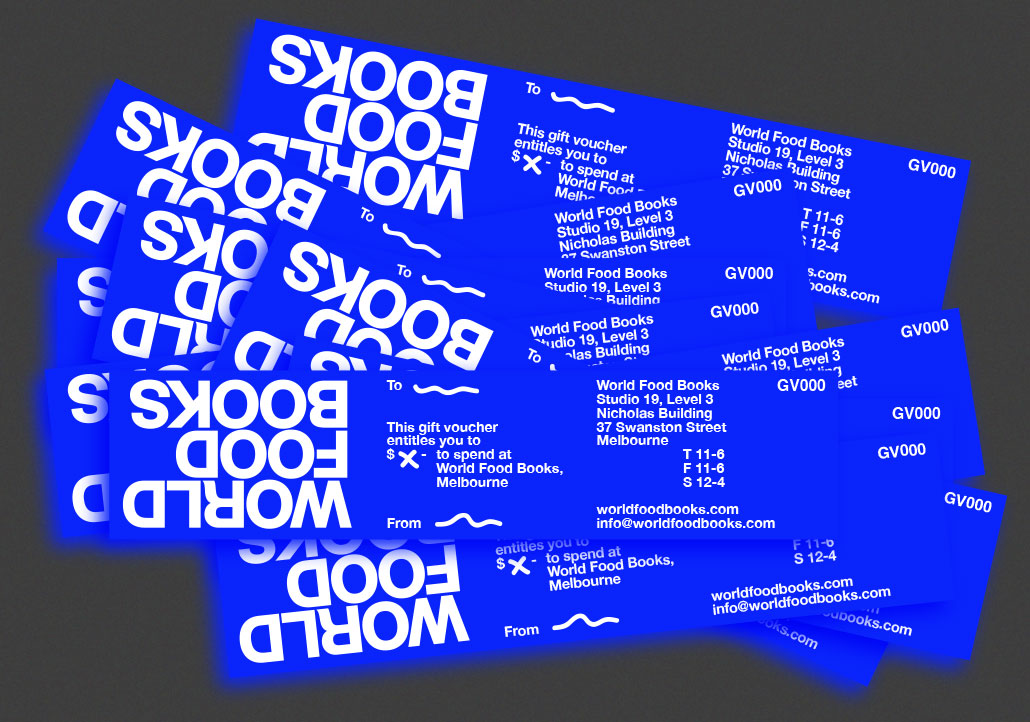
A World Food Books gift voucher is redeemable in our Melbourne bookshop or via our webshop (here). An e-voucher (printable pdf) will be sent to your purchase email address (please notify us if you wish to have the voucher sent to an alternate address and wish us to fill in the receiver's details on the card).
Gift vouchers can be purchased in increments of $20 (Australian Dollars) and the total amount can simply be added to by increasing the quantity in your shopping cart. eg. A quantity of 5 gift vouchers will result in an item total of $100 - a $100 gift voucher. Simply click "ADD TO CART" 5 times, or update your quantity in the shopping cart.
If you wish to purchase multiple, separate gift vouchers in one go, please just email us and we can personally prepare and email you a payment request.
Please note: Please select Pick-Up on gift voucher purchse to avoid any postage charges. Accidental postage charges will be refunded right away!
Thank you.
For any questions, please don't hesitate to email: [email protected]
2026, English
Softcover, 624 pages, 23.1 x 15.5 cm
Published by
No Place Press / US
$72.00 - In stock -
The first in a landmark three-volume series gathering the complete works of an indispensable voice in contemporary thought and aesthetics.
No Place Press is collaborating with Jalal Toufic on an ambitious publishing project: The Collected Writings (1991–2024) of a Mortal to Death: Jalal Toufic. Spanning three volumes of more than six hundred pages each, the series gathers re-edited versions of his earlier works alongside two newly written books, arranged and organized by the author himself. For new readers, the volumes provide an introduction to Toufic’s central concepts—including the withdrawal of tradition past a surpassing disaster, radical closure, silence-over, the 180-degree over-turn, and the dancer’s two bodies—while for longtime readers they offer a comprehensive view of more than three decades of thought, presented in their most rigorous and fully articulated form. Yet, in keeping with Toufic’s practice—which participates in untimely collaboration (including with future filmmakers, thinkers, and artists) and abides in the suspension of the avenir of messianism/Mahdism—some of these works remain forthcoming even after their inclusion in the Collected Writings.
Volume 1 (2025) includes newly revised editions of Toufic’s first three books—Distracted (1991/2003); (Vampires): An Uneasy Essay on the Undead in Film (1993/2003); and Over-Sensitivity (1996/2009)—together with the script Jouissance in Postwar Beirut (2014) and, new, The Unreviewed Writings of a Peerless Thinker (2024).
Jalal Toufic is a thinker and a mortal to death. He was born in 1962, in Beirut or Baghdad, and died before dying in 1989, in Evanston, Illinois. A number of his books were published by Forthcoming Books. He has made over twenty films and videos: essay films and conceptual films; short films, feature-length films, and “inhumanely” long ones (72 hours, 50 hours); standalone films and others that form part of mixed-media pieces; films he shot himself and films composed entirely of images from works by other filmmakers—Hitchcock, Sokurov, Bergman, etc.—as well as six created in collaboration with his wife, Graziella Rizkallah. His work—alongside that of artists and pretend artists—has been shown in Sharjah Biennials 6, 10, and 11; the 9th Shanghai Biennale; the 5th Guangzhou Triennial; MoMA PS1; San Francisco Museum of Modern Art; Centre Pompidou; ZKM; Kunsthalle Fridericianum; MAXXI; FKA Witte de With; Deichtorhallen Hamburg; and elsewhere. Many of his films and videos are available for viewing on Vimeo. In 2011, he was a guest of the Artists-in-Berlin Program of the DAAD. From September 2015 to August 2018, he was Director of the School of Visual Arts at the Lebanese Academy of Fine Arts (Alba).
"In this first of his three-volume set of collected writings, Jalal Toufic bequeaths to us a style of thinking and writing whose force and generosity are legible in the fact that, before his physical death, he nevertheless speaks to us from beyond the grave under all the names of history to tell us, among many other things, that we are mortal, dead even while still physically alive; and that we haunt labyrinthine ruins as dead humans while increasingly living among ruins. Toufic is one of our greatest resources in the face of a world that is reeling toward destruction—now more than ever, we are in urgent need of his forthcoming published writings."—Eduardo Cadava, Philip Mayhew Professor of English, Princeton University, author of Paper Graveyards, and co-author of Politically Red
"Jalal Toufic, the most original and captivating Arab thinker and artist of our time, has finally outdone himself. The Unreviewed Writings of a Peerless Thinker, 2020–2022 is like a Zen kōan where we re-find the gateless gate of radical closure, the black hole as archive and anti-archive, and those who died before (physically) dying. Indeed, being peerless, whom else could he outdo?"—Omnia El Shakry, Professor of History at Yale University and author of The Arabic Freud: Psychoanalysis and Islam in Modern Egypt
"Jalal Toufic is one of the best writers working in America today."—John Zorn
"Jalal Toufic is an amazing writer. He documents the moves of consciousness in a way that leads the reader ever deeper, from impasse to illusion to new impasse—turning the trap of “what can’t be named” into a true paradise. Both of his books [Distracted and (Vampires)] knocked me out; totally original, totally fascinating."—Richard Foreman, Artistic Director of the Ontological-Hysteric Theater and author of Plays and Manifestos
1996, English
Softcover, 220 pages, 22.5 x 14.5 cm
1st Edition, Out of print title / used / good
Published by
Columbia University Press / New York
$30.00 - In stock -
For over fifty years the philosophical achievements of Martin Heidegger have been haunted by a devil's bargain struck between the philosopher and the National Socialist movement of the early 1930s.
"In what may be the best available study of Heidegger's relation to Nazism, Wolin demonstrates that Heidegger's followers fail in their effort to distinguish between his philosophical thought and his political views and deeds. In fact, Heidegger's thought was inextricably combined with his decision to support the Nazis. Although resisting the temptation either to belittle Heidegger's considerable philosophical achievements or reduce them to the status of apologetics of fascism, Wolin nevertheless makes clear that, henceforth, we must read Heidegger's writings with an awareness of their political implications."—Dissent
"Courageously, Richard Wolin has faced his subject head on... and has approached his task with impressive learning and ingenuity... This is a splendid book: vigorously argued but at the same time cautious, provocative but at the same time thoroughly responsible and discriminating."—American Historical Review
"The book is a must-read."—Ethics
"Comprehensive, accesible, and compelling."—Journal of Politics
RICHARD WOLIN is Professor of Modern European Intellectual History and Humanities at Rice University. He is the author of The Terms of Cultural Criticism: The Frankfurt School, Existentialism, Poststructuralism and Walter Benjamin: An Aesthetic of Redemption, both published by Columbia University Press.
1st 1996 PB edition with the Giorgio de Chirico, The Great Metaphysician, 1917 cover.
Good—Very Good copy with some creasing to bottom cover corner, light edge wear.
1991, English
Hardcover (w. dust jacket), 318 pages, 24 x 16.5 cm
1st Edition, Out of print title / used / very good
Published by
Poseidon Press / New York
$20.00 - In stock -
Signs of the Times is a brilliant, witty, and provocative account of deconstruction-the most hotly controversial French import since existentialism—and the scandalous fate of its fallen idol, Paul de Man.
Deconstruction, which regards words as misleading "signs" and reduces history and literature to
"linguistic predicaments," has had a tremendous (many would say destructive) influence in our universities and among the best and brightest of our students. To its detractors, deconstruction is a pernicious and antihumanist doctrine; nevertheless, many are uncertain of its implications and the full extent of its sway. In Signs of the Times David Lehman explains deconstruction in terms that finally render it intelligible. He also gives us the riveting story of the major scandals—pro-Nazi writings during World War II, a bigamous private life-surrounding de Man, the revered Yale professor who was deconstruction's foremost guru in the United States.
Lehman presents a fascinating and enigmatic protagonist and charts the ironies and reversals that make de Man's story resemble a gothic melodrama. Details of de Man's past began to leak out after his death in 1983. Rushing to his defense, his followers used their esoteric method to "prove" that his wartime journalism was not what it seemed. In doing so, they dramatized the dangers inherent in a system of logic that turns the word and the world upside down.
What is deconstruction? Why did a generation of students find it so seductive? Why are so many professors up in arms about it, while for others it holds the key that unlocks the meaning of language and literature? How has it transformed the way books are interpreted and taught? What are deconstruction's merits? Its future? Was de Man's case the crucial turning point in the history of an idea?
Addressing these questions in this spirited and engaging book, David Lehman turns the tables on deconstruction, demystifying its forbidding jargon.
In masterly fashion, he relates the battle over deconstruction to the crisis in higher education today. He shows why deconstruction is so vital an issue—one that has itself become a disturbing sign of the times. He has written an important book, sure to be discussed and debated for years to come.
"David Lehman's Signs of the Times is thorough, clarifying, exciting, pro-vocative, even a little daredevil. It is also important, and is bound to be the book of the year that both Literary Theorists and Common Readers will dine out on. As for its substance: If Henry James had taken critic Paul de Man's life as the "germ" of a story, he might have written in his Notebook: "how a man's appalling secret spawns a theory that there can be no secrets." In the absence of such a Jamesian fiction, David Lehman's brilliant exposition of moral blindness in the academy will leave its lustrous mark"—Cynthia Ozick
"A wonderfully intelligent, witty, and highly readable account of the self-construction and self-deconstruction of one of the most remarkable trends in modern intellectual history."—Alison Lurie
"David Lehman provides a lucid, carefully documented, quietly devastating account of one of the major intellectual scandals of our time in its three successive stages: Paul de Man's early career in wartime Belgium as a collaborationist; the facade of silence and lies he constructed to hide his past as he became a revered figure in American academic life; and, perhaps most shocking, the orgy of exegesis through which his friends and followers have sought to mitigate, exculpate, or explain away his involvement with fascism."—Robert Alter
2025, English
Softcover, 328 pages, 20 x 13.5 cm
Published by
Semiotext(e) / Los Angeles
$34.00 - In stock -
A darkly comic novel set on the lower slopes of the Los Angeles literary world.
I stepped out to behold a crimson-streaked sky that would soon be adorning ten thousand Instagram posts, and walked down the sleepy residential streets, suffused with a soft and forgiving evening light, to the main drag. It felt like the end here, both sanctuary and termination- a soft place of harsh realities where a sun that once meant something barely brushed against the world. The perfect spring evening was blighted only by the citizenry.
A journalist in his late forties-having lost his job as a consequence of the death of print media-finds himself working at a bookstore in a rapidly gentrifying Los Angeles neighborhood, where he is thrown into the company of a younger generation with whom he has little in common. Embittered by his lowly position at this late stage of what had once been a promising career, he collapses his longtime ambition of writing a novel into a hilariously cathartic litany of contempt for his present circumstances.
Service examines the plight of the unrepentant artistic outsider in an unforgiving day and age. It alternates between passages that painstakingly describe the protagonist's fraught attempts to write his novel and such scenes of service work as wrapping children's books for Silver Lake moms and being "pilloried by dunces" on Yelp. As his writing process stalls in a "stale ceremony" of indolence and self-doubt, these unfamiliar humiliations become a toxic wellspring for his irascible observations.
With his notoriously dry wit, John Tottenham's debut novel reflects on a farrago of contemporary afflictions- gentrification, debt, friendship, aging gracelessly, self-medication, male vanity, professional jealousy, the perils of political correctness, and the role of literature in the digital era. Eventually, after endlessly agonizing about matters of form and style, he finds that despite himself he has actually written a book.
2005, English
Softcover, 304 pages, 15 x 21.1 cm
Published by
Grove Press / New York
$39.00 - In stock -
Set largely on the pages of a website where gay male escorts are reviewed by their clients, and told through the postings, emails, and conversations of several dozen unreliable narrators, The Sluts chronicles the evolution of one young escort's date with a satisfied client into a metafiction of pornography, lies, half-truths, and myth. Explicit, shocking, comical, and displaying the author's signature flair for blending structural complexity with direct, stylish, accessible language, The Sluts is Cooper's most transgressive novel since Frisk, and one of his most innovative works of fiction to date.
Dennis Cooper (born 1953) is an American novelist, poet, critic, editor and performance artist who grew up in the Southern California. In 1976, he founded Little Caesar Magazine and Press, which he ran until 1982. In 1985, he moved to Amsterdam for two and a half years, where he began his ten year long project, The George Miles Cycle, an interconnected sequence of five novels that includes Closer, Frisk, Try, Guide, and Period. His post-George Miles Cycle novels include My Loose Thread, The Sluts and God, Jr. Other works include the short-story collections Wrong and Ugly Man, poetry collections The Dream Police and The Weaklings, as well as the recent Smothered in Hugs: Essays, Interviews, Feedback, and Obituaries.
Dennis Cooper currently spends his time between Los Angeles and Paris.
"Dennis Cooper, God help him, is a born writer"—William Burroughs
"Cooper’s language is at first intense, nearly minimal, then suddenly, it ascends into vision"—Kathy Acker
1991, English
Softcover, 128 pages, 14 x 21 cm
Out of print title / as new
Published by
Grove Press / New York
$34.00 - In stock -
Frisk, first published in 1991, is an award-winning novel by American author Dennis Cooper that explores the ultimate meaning of the body, sex, and death. Homoeroticism, brutality and psychosis are explored through an unnervingly lucid account of a young man's fascination with snuff photos and murder.
"When Dennis is thirteen, he sees a series of photographs of a boy apparently unimaginably mutilated. Dennis is not shocked, but stunned by their mystery and their power; their glimpse at the reality of death. Some years later, Dennis meets the boy who posed for the photographs. He did it for love.
Surrounded by images of violence, the celebrity of horror, news of disease, a wasteland of sex, Dennis flies to Europe, having discovered some clues about the photographs: “I see these criminals on the news who’ve killed someone methodically, and they’re free. They know something amazing. You can just tell.” What they know may lie in bodies themselves. Bodies are unavoidably real; what’s in them must have something to say, even in a society that lives on images and fantasies. An isolated windmill in Holland provides the perfect setting for Dennis to find out more about bodies—of which there are many—and what is inside them.
Cooper says, "I present the actual act of evil so it's visible and give it a bunch of facets so that you can actually look at it and experience it. You're seduced into dealing with it. ... So with Frisk, whatever pleasure you got out of making a picture in your mind based on ... those people being murdered, you take responsibility for it."
Dennis Cooper (born 1953) is an American novelist, poet, critic, editor and performance artist who grew up in the Southern California. In 1976, he founded Little Caesar Magazine and Press, which he ran until 1982. In 1985, he moved to Amsterdam for two and a half years, where he began his ten year long project, The George Miles Cycle, an interconnected sequence of five novels that includes Closer, Frisk, Try, Guide, and Period. His post-George Miles Cycle novels include My Loose Thread, The Sluts and God, Jr. Other works include the short-story collections Wrong and Ugly Man, poetry collections The Dream Police and The Weaklings, as well as the recent Smothered in Hugs: Essays, Interviews, Feedback, and Obituaries.
Dennis Cooper currently spends his time between Los Angeles and Paris.
"Dennis Cooper, God help him, is a born writer" - William Burroughs
"Cooper’s language is at first intense, nearly minimal, then suddenly, it ascends into vision" - Kathy Acker
2025, English
Softcover, 448 pages, 22.5 x 19.2 cm
Published by
FAB Press / UK
$80.00 - In stock -
In 2012, a book debuted that would go on to canonical status and usher in a new way of writing about film. Kier-La Janisse's HOUSE OF PSYCHOTIC WOMEN is an autobiographical exploration of female neurosis in horror and exploitation films that examines hundreds of films through a daringly personal lens. In this pioneering work, anecdotes and memories interweave with film history, criticism, trivia and confrontational imagery to create a reflective personal history and a consideration of female madness, both onscreen and off.
To mark its 10th anniversary, Kier-La Janisse and FAB Press have reteamed to produce an expanded edition the book, featuring new writing on 100 more films - many of which were inspired in part by the book itself - and hundreds of new images. This hardcover expanded edition is now available in softcover.
Cinema is full of neurotic personalities, but few things are more transfixing than a woman losing her mind onscreen. Horror as a genre provides the most welcoming platform for these histrionics: crippling paranoia, desperate loneliness, masochistic death-wishes, dangerous obsessiveness, apocalyptic hysteria. Unlike her male counterpart - 'the eccentric' - the female neurotic lives a shamed existence, making these films those rare places where her destructive emotions get to play.
This sharply-designed book, including a 48-page full-colour section, is packed with 680 rare stills, posters, pressbooks and artwork throughout, that combine with family photos and artifacts to form a titillating sensory overload, with a filmography that traverses the acclaimed and the obscure in equal measure. Films covered include The Entity, The Corruption of Chris Miller, Singapore Sling, 3 Women, Toys Are Not for Children, Repulsion, Let's Scare Jessica to Death, The Haunting of Julia, Secret Ceremony, Cutting Moments, Out of the Blue, Mademoiselle, The Piano Teacher, Possession, Antichrist and hundreds more!
Compendium of Female Neurosis. A cross-section of horror and violent exploitation films that feature disturbed or neurotic women as primary or pivotal characters.
Alice, Sweet Alice; All the Colors of the Dark; Alucarda; Anima persa; Antichrist; Asylum; The Attic; Audition; Autopsy; The Baby; Bad Dreams; Bad Guy; Bas-fonds; Bedevilled; The Beguiled; La Belle Bête; The Bird with the Crystal Plumage; Black Narcissus; Black Swan; The Blood Spattered Bride; The Blue Eyes of the Broken Doll; Born Innocent; Boy Meets Girl; The Brave One; The Bride; The Brood; Burnt Offerings; Butcher, Baker, Nightmare Maker; Can Go Through Skin; A Candle for the Devil; Carrie; La casa muda; Cat People; La cérémonie; Children Shouldn't Play with Dead Things; Christiane F.; The Collector; The Corruption of Chris Miller; Les cousines; "Criminally Insane"; The Curse of the Cat People; Cutting Moments; Daddy; Dead Creatures; Defenceless: A Blood Symphony; Dementia; Descent; The Devil's Widow; The Devils; Diabel; Die! Die! My Darling!; The Dinner Party; Dirty Weekend; Dr. Jekyll and His Women; Don't Deliver Us from Evil; Don't Look Now; Don't Torture a Duckling; Doppelganger; Dracula's Daughter; Dream Home; The Entity; The Escapees; Eyes of a Stranger; Fatal Attraction; Feed; Five Across the Eyes; Footprints; Forbidden Photos of a Lady Above Suspicion; Four Flies on Grey Velvet; Freeze Me; The Frightened Woman; Frightmare; Funeral Home; Gently Before She Dies; The Geography of Fear; The Girl Next Door; The Glass Ceiling; Goodbye Gemini; A Gun for Jennifer; Handgun; Happy Birthday to Me; Hard Candy; The Haunting (1963); The Haunting (2009); The Haunting of Julia; Haute tension; Heavenly Creatures; The Honeymoon Killers; A Horrible Way to Die; I Never Promised You a Rose Garden; Images; In My Skin; The Innocents; Inside; The Isle; Julie Darling; Kichiku; The Killer Nun; Kissed; Knife of Ice; The Ladies Club; The Last Exorcism; The Legend of Lylah Clare; The Legend of the Wolf Woman; Let's Scare Jessica to Death; A Lizard in a Woman's Skin; Love Me Deadly; The Loved Ones; Macabre; The Mad Room; Mademoiselle; Madhouse (1974); Madhouse (1981); Madness; The Mafu Cage; Man, Woman and Beast; Marnie; Martyrs; Masks; May; Misery; Morris County; Morvern Callar; Mother's Day; Ms.45; Mumsy, Nanny, Sonny & Girly; Nabi: The Butterfly; Neighbor; Neither the Sea Nor the Sand; Nekromantik; Nekromantik 2; Next of Kin; The Night Porter; A Night to Dismember; Nightbirds; Nightmares; La nuit des traquées; The Other Hell; The Other Side of the Underneath; Out of the Blue; Paranoia; Paranormal Activity; The Perfume of the Lady in Black; Persona; Phenomena; The Piano Teacher; Pigs; Play Misty for Me; Possession; Pretty Poison; Prey; Psycho Girls; The Rapture; The Rats Are Coming! The Werewolves Are Here!; Rebecca; Red Desert; Red Sun; Red White & Blue; The Reincarnation of Peter Proud; Repulsion; Road to Salina; Roman's Bride; Santa Sangre; Schizo; Scissors; Scream 4; Séance on a Wet Afternoon; Secret Ceremony; The Secret Life of Sarah Sheldon; Shock; Singapore Sling; Sinner; Sisters (1973); Sisters (2006); Slaughter Hotel; The Snake Pit; Sombre; Spider Baby; The Stendhal Syndrome; Straight On Till Morning; Strait-Jacket; The Strange Possession of Mrs. Oliver; The Strange Vengeance of Rosalie; Symptoms; Szamanka; That Cold Day in the Park; They Call Her One Eye; 3 Women; To Let; Toys Are Not for Children; Trance; Trilogy of Terror; Trouble Every Day; Twin Peaks: Fire Walk with Me; The Uninvited; Venom; Venus Drowning; The Washing Machine; What Ever Happened to Baby Jane?; The Whip and the Body; Whoever Slew Auntie Roo?; Windows; The Witch Who Came from the Sea; The Woman; Woman Transformation; Wound PLUS MORE THAN 100 EXTRA FILM REVIEWS EXCLUSIVE TO THIS NEW EDITION
Kier-La Janisse is a film writer, programmer, producer and founder of The Miskatonic Institute of Horror Studies. She is the author of A Violent Professional: The Films of Luciano Rossi (2007) and has been an editor on numerous books including Warped & Faded: Weird Wednesday and the Birth of the American Genre Film Archive (2021), Yuletide Terror: Christmas Horror on Film and Television (2017) and Satanic Panic: Pop-Cultural Paranoia in the 1980s (2015). She was a producer on David Gregory’s Tales of the Uncanny (2020) and wrote, directed and produced the award-winning documentary Woodlands Dark and Days Bewitched: A History of Folk Horror (2021) for Severin Films, where she is a producer and editor of supplemental features. She is currently at work on several books including a monograph about Monte Hellman’s Cockfighter.
1976 / 2000, English
Softcover, 92 pages, 15.3 x 23 cm
Published by
Barrytown Ltd. / US
Station Hill Press / Barrytown
$30.00 - In stock -
Death Sentence is a philosophical novel by Maurice Blanchot. First published in 1948, it is his second complete work of fiction. This long awaited reprint of a book about which John Hollander wrote: "A masterful version of one of the most remarkable novels in any language since World War II," is the story of the narrator's relations with two women, one terminally ill, the other found motionless by him in a darkened room after a bomb explosion has separated them. "Through more than 40 years, the French writer Maurice Blanchot has produced an astonishing body of fiction and criticism," writes Gilbert Sorrentino in the New York Review of Books, and John Updike in The New Yorker: "Blanchot's prose gives an impression, like Henry James, of carrying meanings so fragile they might crumble in transit."
Translated from French by Lydia Davis
Maurice Blanchot (1907-2003) was a French writer, philosopher, and literary theorist. His work had a strong influence on later post-structuralist theorists such as Jacques Derrida. He is one of the most enigmatic and influential figures in modern French writing yet no interview, no biographical sketch, and hardly any photographs have ever been published of him.
2023, English
Softcover, 224 pages, 20.83 x 13.72 cm
Published by
Verso / London
$45.00 - In stock -
First collection on filmmaker and poet Pasolini's passion for painting.
Preface by T. J. Clark
Edited by Alessandro Giammei and Ara H Merjian
One of Europe's most mythologized Marxist intellectuals of the 20th century, Pier Paolo Pasolini was not only a poet, filmmaker, novelist, and political martyr. He was also a keen critic of painting. An intermittently practicing artist in his own right, Pasolini studied under the distinguished art historian Roberto Longhi, whose lessons marked a life-long affinity for figurative painting and its centrality to a particular cinematic sensibility.
Pasolini set out wilfully to "contaminate" art criticism with semiotics, dialectology, and film theory, penning catalogue essays and exhibition reviews alongside poems, autobiographical meditations, and public lectures on painting. His fiercely idiosyncratic blend of Communism and classicism, localism and civic universalism, iconophilia and aesthetic "heresy," animated and antagonized Cold War culture like few European contemporaries. This book offers numerous texts previously available only in Italian, each accompanied by an editorial note elucidating its place in the tumultuous context of post-war Italian culture.
Prefaced by the renowned art historian T.J. Clark, a historical essay on Pasolini's radical aesthetics anchors the anthology. One hundred years after his birth, Heretical Aesthetics sheds light on one of the most consequential aspects of Pasolini's intellectual life, further illuminating a vast cinematic and poetic corpus along the way.
"Vision in Pasolini is at once tactile, earthy, erotic, divine and communist. His way of seeing communes with the world rather than holding it at a distance. By bringing together his writings on art, Heretical Aesthetics gives the Anglophone reader the key to his at once singular and generous cinema and poetry. His is a perspective from elsewhere in history, one which holds our own times sternly to account. This is such a good book for understanding one of the very best of 'bad' Marxists."—T.J. Clark
"Magisterially translated and edited, this indispensable anthology is finally available to an English-speaking audience. It provides detailed and precise insight into Pasolini's convulsive and idiosyncratic relationship with the visual arts and the artists who inspired his aesthetic sense. This exhilarating trove sheds light on the contaminated and visionary visual landscape produced by one of the most important filmmakers in the history of cinema: a total artist who found expressive depth in the heretical forms of his vision."—Pierpaolo Antonello
"Pasolini's intimate relation to painting and the history of art demonstrated in these essays is a revelation, especially for understanding his films. The texts are classic Pasolini - unfailingly brilliant and erudite, but also at once revolutionary and reactionary, observant of his times and blind to some of the most innovative developments. A fascinating collection."—Michael Hardt, author of The Subversive Seventies
1988, English
Softcover, 248 pages, 21.5 x 13.5 cm
1st Edition, Out of print title / used / very good
Published by
Beacon Press / Boston
$20.00 - In stock -
Robin May Schott's 1988 book, Cognition and Eros: A Critique of the Kantian Paradigm, analyzes Kant's theory that emotion must be separated from reason, argues that this division is unnatural and discriminatory towards women, and discusses the political implications of Kant's theory.
"In her interesting and provocative book, Robin May Schott focuses our attention on two central themes emerging from the context of an examination of sexual relations in which philosophy has operated. First, she asks the reader to wonder about the philosophical significance of the historical absence of women from philosophy, and, second, to consider the social implications of a philosophy constructed on this basis. Her conclusions are to see the suppression of the erotic theme of human existence from philosophical contemplation to be an expression of philosophical response to morality; women have been viewed not only in terms of their life giving sexuality, but also to embody the threat of death as well."—Canadian Philosophical Reviews
"Schott's book stands as a good introduction to sexism in Western thought."—International Studies in Philosophy
"This fascinating book is an important contribution to the expanding literature that seeks to expose the ideological, often misogynist, biases that pervade the Western philosophical tradition."—Alison Jagger, University of Cincinnati
"A provocative inquiry into the role of intellectual asceticism in Western philosophy and its effects on the status and treatment of women. Schott's aim, in my view, is not so much to undercut or jeopardize philosophy as to invite further reflection on unexamined premises of philosophical thought."—Fred Dallmayr, University of Notre Dame
"A masterpiece of scholarship and critical interpretation that questions some of the most fundamental assumptions of the Kantian paradigm. [Schott's] avowedly feminist approach is bolstered by the instruments of social history and puts philosophy in a fresh and provocative perspective. A bold original work, it will be a landmark in Kant scholarship."—George Schrader, Yale University
ROBIN MAY SCHOTT is Associate Professor of Philosophy at the University of Louisville.
VG 1st 1988 ed.
1994, English
Softcover, 268 pages, 23.5 x 15.45 cm
1st Edition, Out of print title / used / very good
Published by
Yale University Press / New Haven
$45.00 - In stock -
This volume of Yale French Studies offers new perspectives on the relationship between text and image. Scholars address the common features of writing, typography, and graphic representation; analyze the point of convergence between writing and representation in Stendhal, Verlaine, Proust, Valéry, and Artaud; and explore solutions devised by contemporary artists to reconcile writing and drawing.
VG copy, light wear.
1990, English
Softcover, 270 pages, 23.5 x 16 cm
1st Edition, Out of print title / used / good
Published by
Yale University Press / New Haven
$45.00 - Out of stock
Yale French Studies, Number 78, 1990, dedicated entirely to texts on the work of French philosopher Georges Bataille (1897—1962), edited by Allan Stoekl.
"During his lifetime Bataille was known mainly as the editor of Critique and as an author of erotic novels. Since his death nearly thirty years ago, however, he has become known as a major theorist in his own right. The articles in this issue of Yale French Studies discuss and rewrite Bataille's philosophy, interrogate his concepts, politics, economics, and esthetics, and attempt to revise the past and the future on the basis of his text."
Good copy.
1997, English
Hardcover (w. dust jacket), 296 pages, 24 x 16.5 cm
1st Edition, Out of print title / used / very good
Published by
Indiana University Press / Indiana
$65.00 - In stock -
The text of Martin Heidegger's 1927-28 university lecture course on Emmanuel Kant's Critique of Pure Reason presents a close interpretive reading of the first two parts of this masterpiece of modern philosophy. In this course, Heidegger continues the task he enunciated in Being and Time as the problem of dismatling the history of ontology, using temporality as a clue. Within this context the relation between philosophy, ontology, and fundamental ontology is shown to be rooted in the genesis of the modern mathematical sciences. Heidegger demonstrates that objectification of beings as beings is inseparable from knowledge a priori, the central problem of Kant's Critique. He concludes that objectification rests on the productive power of imagination, a process that involves temporality, which is the basic constitution of humans as beings.
This is an essential work for students of Heidegger, Kant, modern philosophy, and contemporary phenomenology.
Parvis Emad is Emeritus Professor of Philosophy at DePaul University and the founding co-editor (with Kenneth Maly) of Heidegger Studies. Also with Maly, he has translated Hegel's Phenomenology of Spirit by Martin Heidegger and Encounters and Dialogues with Martin Heidegger by Heinrich Wiegand Petzet.
Kenneth Maly is Professor of Philosophy at the University of Wisconsin-LaCrosse and co-editor (with John Sallis) of Heraclitean Fragments. With Parvis Emad he is currently translating Beiträge zur Philosophie (Vom Ereignis) by Martin Heidegger.
VG—NF edition in VG—NF dust jacket, preserved under mylar wrap.
1970, English
Hardcover (w. dust jacket), 150 pages, 23 x 15 cm
1st Edition, Out of print title / used / very good
Published by
University of Edinburgh Press / Edinburgh
$45.00 - In stock -
First 1970 hardcover edition.
This is a critical survey of what Kant has to say about teleology in the first Critique, in some of his minor writings, and in the Critique of Judgement. The author shows how Kant's treatment of teleology helps to place in perspective his justification of Newtonian science, and his growing recognition that the language of the physicist is not adequate for describing all aspects of our experience of the world.
It also indicates the constructive importance for Kant of the distinction between the sensible and supersensible worlds, crucial for his moral theory. The book is the first to deal with Kant's treatment of teleology in such a way as to draw together, and explicate, the many and often puzzling things he has to say about 'end', 'purpose', and 'design'.
Dr McFarland is Associate Professor in the Department of Philosophy, York University, Toronto.
NF copy in VG—NF dust jacket, mild age/sunning/wear to spine.
1995, English
Softcover, 244 pages, 23 x 15.5 cm
1st Edition, Out of print title / used / very good
Published by
Cornell University Press / New York
$25.00 - In stock -
A reappraisal on the emphasis on duty in Immanuel Kant's ethics is long overdue. Marcia W. Baron evaluates and for the most part defends Kantian ethics against two frequent criticisms: that duty plays too large a role, leaving no room for the supererogatory; and that Kant places too much value on acting from duty.
The author first argues that Kant's distinction between perfect and imperfect duties provides a plausible and intriguing alternative to contemporary approaches to charity, self-sacrifice, heroism, and saintliness. She probes the differences between the supererogationist and the Kantian, exploring the motivation between the former's position and bringing to light sharply divided views on the nature of moral constraint and excellence.
Baron then confronts problems associated with Kant's account of moral motivation, she argues that the value that Kant attaches to acting from duty attaches primarily to governing ones conduct by a commitment to doing what morality asks. Thus understood, Kant's ethics steers clear of the most serious criticism. Of special interest is her discussion of overdetermination.
Clearly written and cogently argued, Kantian Ethics Almost without Apology takes on the most philosophically intriguing challenges to Kantian ethics and subjects them to a rigorous yet sympathetic assessment. Readers will find here original contributions to the debate over impartial morality.
VG copy, sunning to spine edge.
1976, English
Softcover, 108 pages, 23 x 15.5 cm
1st Edition, Out of print title / used / fine
Published by
Texas Christian University Press / Fort Worth
$30.00 - In stock -
The four essays that make up this volume are based upon and expand the lectures Ricoeur delivered at Texas Christian University, 27-30 November 1973, as their Centennial Lectures. They may be read as separate essays, but they may also be read as step by step approximations of a solution to a single problem.
Fine copy.
1991, English
Softcover, 302 pages, 23 x 15 cm
1st Edition, Out of print title / used / very good
Published by
Cornell University Press / New York
$35.00 - In stock -
"Okrent conducts a careful analysis of the major stages in the development of Heidegger's thought, examines with painstaking care and objectivity the shifting structures of the arguments from the early 'metaphysical' stage through the later 'critique of metaphysics, and concludes that a clear strain of pragmatism runs like an undercurrent throughout the whole. ... [He] has opened up Heidegger's achievements to a far wider audience than they have appealed to at all until now.... Certainly Heidegger's Pragmatism must be recognized as required reading for all those whose interest in pragmatism is not limited to its classical expression."—Society for the Advancement of American Philosophy Newsletter
"In this tightly argued interpretation, Okrent shows that Heidegger's critique of metaphysics follows from a pragmatic (anti-essentialist) rejection of his earlier analysis of intentionality in Being and Time (1962).... Okrent masterfully shows Being and Time to be an analysis of the transcendental conditions of intentionality and understanding."—Choice
"An original and provocative treatment of both early and late Heidegger. Okrent gives a very clear account of the parallels between pragmatism and Being and Time, and a novel and plausible account of Heidegger's later rejection of pragmatism. "—Richard Rorty, University of Virginia
MARK OKRENT is Associate Professor of Philosophy at Bates College.
VG copy, 1st PB edition.
1993, English
Softcover, 336 pages, 23 x 15 cm
1st Edition, Out of print title / used / very good
Published by
University of Minnesota Press / Minnesota
$35.00 - In stock -
First 1993 Ed.
Foreword by Donald E. Pease
Heidegger and Criticism: Retrieving the Cultural Politics of Destruction (1993), by William V. Spanos, argues for the relevance of Heidegger’s "antihumanist" philosophy in resisting modern technological, neo-imperialist, and American liberal humanist ideologies. It reframes Heidegger’s thought, focusing on political deconstruction rather than Nazism.
William V. Spanos here examines the controversy surrounding Heidegger and recent disclosures about his Nazi past. Not intended as a defense or apology for Heidegger's thought, Spanos's analysis instead affirms the importance of Heidegger's "antihumanist interrogation of the modern age, its globalization of technology, and its neoimperialist politics.
The attack on Heidegger's "antihumanistic discourse (by "liberal humanists" who have imported the European debate into the United States) aligns ideologically with the ongoing policing operations of William Bennett, Allan Bloom, E.D. Hirsch, Roger Kunball, Dinesh DSouza, and others in the spheres of higher education and cultural production. Throughout his arguments, Spanos focuses not so much on Heidegger the historical subject as on the transformative cultural and political discourses and practices implicit in and enabled by Heideggers exploration of Being and Time. It is this exploration, says Spanos, that has led to the contemporary emergence of the multiplicity of resistant "Others. And it is Heidegger's philosophic interventions that eventually will generate a diverse body of transgressive writing and an oppositional intellectual climate in the West.
William V. Spanos is professor of English and comparative literature at the State University of New York at Binghamton and is the founding editor of boundary 2. He is the author of Repetitions: The Postmodern Occasion in Literature and Culture and The End of Education: Toward Posthumanism (Minnesota, 1992).
VG copy.
1998, English
Hardcover, 288 pages, 15.2 x 23.5 cm
1st Edition, Out of print title / used / very good
Published by
Duke University Press / North Carolina
$25.00 - In stock -
The Cartesian cogito-the principle articulated by Descartes that "I think, therefore I am"-is often hailed as the precursor of modern science. At the same time, the cogito's agent, the ego, is sometimes feared as the agency of manipulative domination responsible for all present woes, from patriarchal oppression to ecological catastrophes. Without psychoanalyzing philosophy, Cogito and the Unconscious explores the vicissitudes of the cogito and shows that psychoanalyses can render visible a constitutive madness within modern philosophy, the point at which "I think, therefore I am" becomes obsessional neurosis characterized by "If I stop thinking, I will cease to exist."
Noting that for Lacan the Cartesian construct is the same as the Freudian "subject of the unconscious," the contributors follow Lacan's plea for a psychoanalytic return to the cogito. Along the path of this return, they examine the ethical attitude that befits modern subjectivity, the inherent sexualization of modern subjectivity, the impasse in which the Cartesian project becomes involved given the enigmatic status of the human body, and the Cartesian subject's confrontation with its modern critics, including Althusser, Bataille, and Dennett. In a style that has become familiar to Zizek's readers, these essays bring together a strict conceptual analysis and an approach to a wide range of cultural and ideological phenomena-from the sadist paradoxes of Kant's moral philosophy to the universe of Ayn Rand's novels, from the question "Which, if any, is the sex of the cogito?" to the defense of the cogito against the onslaught of cognitive sciences.
Challenging us to reconsider fundamental notions of human consciousness and modern subjectivity, this is a book whose very Lacanian orthodoxy makes it irreverently transgressive of predominant theoretical paradigms. Cogito and the Unconscious will appeal to readers interested in philosophy, psychoanalysis, cultural studies, and theories of ideology.
Contributors. Miran Bozovic, Mladen Dolar, Alain Grosrichard, Marc de Kessel, Robert Pfaller, Renata Salecl, Slavoj Zizek, Alenka Zupancic
VG HC copy w/o DJ.
1992, English
Hardcover (w. dust jacket), 608 pages, 25 x 18.5 cm
1st Edition, Out of print title / used / very good
Published by
University of Chicago Press / Chicago
$160.00 - In stock -
First 1992 HC edition.
A major event in the history of twentieth-century thought, Notebooks for a Ethics is Jean-Paul Sartre's attempt to develop an ethics consistent with the profound individualism of his existential philosophy.
In the famous conclusion to Being and Nothingness, Sartre announced that he would devote his next philosophical work to moral problems. Although he worked on this project in the late 1940s, Sartre never completed it to his satisfaction, and it remained unpublished until after his death in 1980. Presented here for the first time in English, the Notebooks reveal Sartre at his most productive, crafting a masterpiece of philosophical reflection that can easily stand alongside his other great works.
Sartre grapples anew here with such central issues as "authenticity" and the relation of alienation and freedom to moral values. Exploring fundamental modes of relating to the Other—among them violence, entreaty, demand, appeal, refusal, and revolt—he articulates the necessary transition from individualism to historical consciousness. This work thus forms an important bridge between the early existentialist Sartre and the later Marxist social thinker of the Critique of Dialectical Reason. The Notebooks themselves are complemented here by two additional essays, one on "the good and subjectivity," the other on the oppression of blacks in the United States.
With publication of David Pellauer's lucid translation, English-speaking readers will be able to appreciate this important contribution to moral philosophy and the history of ethics.
Jean-Paul Sartre (1906-1980) was offered, but declined, the Nobel Prize for literature in 1964. His many works of fiction, drama, and philosophy include the monumental study of Flaubert, The Family Idiot, and The Freud Scenario, both published in translation by the University of Chicago Press.
NF copy in Good dust jacket with creasing and tearing to back of DJ (see image), now preserved in archival mylar wrap. Book well preserved. Overall VG copy.
1991, English
Hardcover (w. dust jacket). 374 pages, 24 x 16.5 cm
1st Edition, Out of print title / used / fine
Published by
Yale University Press / New Haven
$35.00 - In stock -
This prize-winning book, first published in France in 1982 and now available in an English translation, investigates the question of human subjectivity. Francis Jacques shows that this question, far from becoming outmoded or irrelevant, remains of central significance for philosophy and the social sciences. Jacques takes issue with two commonly held philosophical views about the self: that the subject really doesn't exist at all, and that the relationship between the subject and others is not important. Jacques develops a relational model of the subject; personal identity, he says, is largely defined in the course of communicating with others. And the self, or subject, must not only identify both parties to the conversation ("you" and "me"), but also the absent third party ("him" or "her"). To critique the views with which he disagrees and to support his own argument, Jacques draws upon linguistics, literary criticism, theories of artificial intelligence, communication theory, psychoanalysis, and theology, applying logic to works as diverse as "Walden" and "Alice in Wonderland".
Fine 1st edition in NF dust jacket, preserved in mylar wrap.
1973 / 1988, English
Softcover, 336 pages, 23 x 15.5 cm
1st Edition, Out of print title / used / very good
Published by
Weiser / Boston
$40.00 - In stock -
A unique collection of Qabalistic texts that includes Gematria, 777, and Sepher Sephiroth.
Gematria provides essential explanations of theoretical and practical Qabalistic number analysis and philosophy. “An Essay in Number,” also included, provides invaluable insights into key numbers as well as techniques and safeguards for practical magical work. Gematria was first published in The Equinox, vol. 1. no. 5.
777 itself contains, in concise tabulated form, an overview of symbolism of the major world religions, as well as the system of correspondence of the Hermetic Order of the Golden Dawn. In short, it is a complete magical and philosophical dictionary—a key to all religion and practical occultism—an amazing work whose value has been recognized through many editions since its first appearance in 1909 and subsequent enlargement in 1955.
The third text in this collection is Sepher Sephiroth, a unique dictionary listing hundreds of Hebrew words arranged by numerical value. It was compiled jointly by Aleister Crowley and Allan Bennett and first appeared in The Equinox, vol. 1, no. 8.
1988 print, some foxing to block edges.