World Food Books' programme is largely produced on Kulin Nation land. We acknowledge the Wurundjeri people of the Kulin Nation as the first and continuing custodians of this land, and pay respect to their Elders past, present, and emerging.
World Food Books is an arts and special interests bookshop in Naarm / Melbourne. Founded in 2010, World Food Books is devoted to the presentation of a rotating, hand-selection of international art, design, literary and counterculture publications with an emphasis on the anti-traditional, the experimental, the avant-garde, the heretic, the marginal.
Presenting new titles alongside rare and out-of-print books, catalogues and journals spanning the fields of modern and contemporary art, design, photography, illustration, film, literature, poetry, cultural theory, philosophy, sexuality, popular and underground culture in its many radical forms, World Food Books wishes to encourage adventurous, thoughtful and open-minded reading, looking, writing, and exchange of publishing and ideas, both current and historical.
As well as our bookshop, located in Melbourne's historical Nicholas Building, all of our inventory is available internationally via our online mail-order service.
World Food Books semi-regularly co-ordinates "Occasions", a programme of exhibits and events at the bookshop and in partnership with other hosts (such as museums and art galleries) that develop out of the activities, relationships and content of the bookshop itself.
World Food Books
The Nicholas Building
37 Swanston Street
Room 5, Level 6
Melbourne 3000
Australia
SHOP HOURS:
Thu–Fri 12–6, Sat 12–5
WEB-SHOP OPEN 24/7
World Food Books
Postal Address:
PO Box 435
Flinders Lane
Victoria 8009
Australia
Art
Theory / Essay
Architecture / Interior
Graphic Design / Typography
Photography
Fashion
Eros
LGBTQ+
Fiction / Poetry
Weird / Speculative / Science Fiction / Horror
Transgressive / Visceral / Abject
Symbolism / Decadence / Fin de siècle
Film / Video
Painting
Sculpture / Installation
Performance / Dance / Theater
Drawing
Sound / Music
Curatorial
Group Shows / Collections
Periodicals
Out-of-print / Rare
Posters / Ephemera / Discs
Signed Books
World Food Books Gift Voucher
World Food Book Bag
Australian Art
Australian Fiction
Australian Science Fiction / Speculative Fiction
Australian Poetry
Australian Photography
Japanese Photography
Conceptual Art
Minimal Art
Dada
'Pataphysics / Oulipo
Fluxus
Concrete Poetry
Pop Art
Surrealism
Arte Povera
Arte Informale / Haute Pâte / Tachism
Nouveau Réalisme / Zero / Kinetic
Situationism / Lettrism
Collage / Mail Art / Xerox Art
Art Brut / Folk / Visionary / Fantastic
Illustration / Graphic Art / Bandes Dessinées
Furniture
Italian Radical Design / Postmodernism
Textiles
Ceramics / Glass
Counterculture
Protest / Revolt
Philosophy
Psychoanalysis
Anthropology
Anarchism
Socialism / Anarchism / Communism / Capitalism
Literary Theory / Semiotics / Language
Feminism / Women's Studies
Gender Studies / Sexuality
Anthropology
Fetishism / BDSM
Drugs / Psychedelia
Crime / Violence
Animal Rights / Veganism
Occult / Esoterica
Ecology / Earth / Alternative Living
Whole Earth / Crafts
All prices in AUD (Australian dollars)
Pick-Ups
Pick-up orders can be collected in our bookshop during opening hours after order date. Please collect any Pick-up orders within 2 weeks of ordering as we have limited storage space. Orders will be released back into stock if not collected within this time. No refunds can be made for pick-ups left un-collected. If you cannot make it in to the bookshop in this time-frame, please choose postage option.
Return Policy
All sales are final. We do accept returns (for refund or exchange) for items received in error. All our orders are packed with special care using heavy-duty padding and cardboard book-mailers or bubble mailers (for smaller books), using reinforcement where required. We cannot take responsibility for any lost, stolen or damaged parcels.
Insurance
Should you wish to insure your package, please email us directly after placing your order and we can organise this at a small extra expense. Although all standard/express tracked packages are very safe and dependable, we cannot take responsibility for any lost, stolen or damaged parcels. We recommend insurance on valuable orders.
Interested in selling your old books, catalogues, journals, magazines, comics, fanzines, ephemera? We are always looking for interesting, unusual and out-of-print books to buy. We only buy books in our fields of interest and specialty, and that we feel we can resell.
We base these prices on desirability, market value, in-print prices, condition and our current stock levels. We offer cash, store credit, and can take stock on consignment. All
about 25% of the price we expect to get when we sell them, or 30% in store credit. We base these prices on desirability, market value, in-print prices, condition and our current stock levels.
Sell your books any day of the week. You can drop them off and return later. If you have a lot of books, we can visit your Sydney home.
We buy books that we feel we can resell. We offer about 25 % of the price we expect to get when we sell them, or 30% in store credit. We base these prices on desirability, market value, in-print prices, condition and our current stock levels.
Philadelphia Wireman
03 August - 01 September, 2018
World Food Books is proud to announce our next Occasion, the first presentation of sculptures by Philadelphia Wireman in Australia.
The Philadelphia Wireman sculptures were found abandoned in an alley off Philadelphia’s South Street on trash night in 1982. Their discovery in a rapidly-changing neighbourhood undergoing extensive renovation, compounded with the failure of all attempts to locate the artist, suggests that the works may have been discarded after the maker’s death. Dubbed the "Philadelphia Wireman" during the first exhibition of this work, in 1985, the maker’s name, age, ethnicity, and even gender remain uncertain. The entire collection totals approximately 1200 pieces, all intricately bound together with tightly-wound heavy-gauge wire (along with a few small, abstract marker drawings, reminiscent both of Mark Tobey and J.B. Murry). The dense construction of the work, despite a modest range of scale and materials, is singularly obsessive and disciplined in design: a wire armature or exoskeleton firmly binds a bricolage of found objects including plastic, glass, food packaging, umbrella parts, tape, rubber, batteries, pens, leather, reflectors, nuts and bolts, nails, foil, coins, toys, watches, eyeglasses, tools, and jewellery.
Heavy with associations—anthropomorphic, zoomorphic, and socio-cultural responses to wrapped detritus—the totemic sculptures by Philadelphia Wireman have been discussed in the context of work created to fulfil the shamanistic needs of alternative religions in American culture. Curators, collectors, and critics have variously compared certain pieces to sculpture from Classical antiquity, Native American medicine bundles, African-American memory jugs, and African fetish objects. Reflecting the artist’s prolific and incredibly focused scavenging impulse, and despite—or perhaps enhanced by—their anonymity, these enigmatic objects function as urban artefacts and arbiters of power, though their origin and purpose is unknown. Philadelphia Wireman, whatever their identity, possessed an astonishing ability to isolate and communicate the concepts of power and energy through the selection and transformation of ordinary materials. Over the course of the past two decades, this collection has come to be regarded as an important discovery in the field of self-taught art and vernacular art.
Presented in collaboration with Fleisher-Ollman Gallery, Philadelphia, and Robert Heald, Wellington.
Susan Te Kahurangi King
02 February - 10 March, 2018
Susan Te Kahurangi King (24 February 1951 - ) has been a confident and prolific artist since she was a young child, drawing with readily available materials - pencils, ballpoint pens and felt-tip markers, on whatever paper is at hand. Between the ages of four and six Susan slowly ceased verbal communication. Her grandparents William and Myrtle Murphy had developed a special bond with Susan so they took on caring responsibilities for extended periods. Myrtle began informally archiving her work, carefully collecting and storing the drawings and compiling scrapbooks. No drawing was insignificant; every scrap of paper was kept. The King family are now the custodians of a vast collection containing over 7000 individual works, from tiny scraps of paper through to 5 meter long rolls.
The scrapbooks and diaries reveal Myrtle to be a woman of great patience and compassion, seeking to understand a child who was not always behaving as expected. She encouraged Susan to be observant, to explore her environment and absorb all the sights and sounds. Myrtle would show Susan’s drawings to friends and people in her community that she had dealings with, such as shopkeepers and postal workers, but this was not simply a case of a grandmother’s bias. She recognised that Susan had developed a sophisticated and unique visual language and sincerely believed that her art deserved serious attention.
This was an unorthodox attitude for the time. To provide some context, Jean Dubuffet coined the term Art Brut in 1945 to describe work created by self-taught artists – specifically residents of psychiatric institutions and those he considered to be visionaries or eccentrics. In 1972 Roger Cardinal extended this concept by adopting the term Outsider Art to describe work made by non-academically trained artists operating outside of mainstream art networks through choice or circumstance. Susan was born in Te Aroha, New Zealand in 1951, far from the artistic hubs of Paris and London that Dubuffet and Cardinal operated in. That Myrtle fêted Susan as a self-taught artist who deserved to be taken seriously shows how progressive her attitudes were.
Susan’s parents Doug and Dawn were also progressive. Over the years they had consulted numerous health practitioners about Susan’s condition, as the medical establishment could not provide an explanation as to why she had lapsed into silence. Dawn educated herself in the field of homeopathy and went on to treat all twelve of her children using these principles – basing prescriptions on her observations of their physical, mental and emotional state.
Doug was a linguist with an interest in philosophy who devoted what little spare time he had to studying Maori language and culture. To some extent their willingness to explore the fringes of the mainstream made them outsiders too but it was their commitment to living with integrity and their respect for individuality that ensured Susan’s creativity was always encouraged.
Even though Susan’s family supported her artistic pursuits, some staff in schools and hospitals saw it as an impediment to her assimilation into the community and discouraged it in a variety of ways. Her family was not always aware of this and therefore did not fully understand why Susan stopped drawing in the early 1990s. However, rather than dwell on the challenges that Susan faced in pursuit of her artistic practice, they prefer to highlight her achievements. In 2008 Susan began drawing again in earnest, after an almost 20 year interruption, and her work is now shown in galleries around the world.
Susan grew up without television and has been heavily influenced by the comics she read as a child. She is absolutely fearless in the appropriation of recognizable characters, such as Donald Duck and Mickey Mouse, in her work. She twists their limbs, contorts their faces, compresses them together, blends them into complex patterned backgrounds - always imbuing them with an incredible energy. Although Susan often used pop culture characters in her work they are not naive or childlike. These are drawings by a brilliant self-taught artist who has been creating exceptional work for decades without an audience in mind.
Mladen Stilinović
"Various Works 1986 - 1999"
02 February 16 - September 10, 2016
Various works 1986 - 1999, from two houses, from the collections of John Nixon, Sue Cramer, Kerrie Poliness, Peter Haffenden and Phoebe Haffenden.
Including: Geometry of Cakes (various shelves), 1993; Poor People’s Law (black and white plate), 1993; White Absence (glasses, ruler, set square, silver spoon, silver ladel with skin photograph and wooden cubes), 1990-1996; Exploitation of the Dead (grey and red star painting, wooden painting, black spoon with red table, red plate), 1984-1990; Money and Zeros (zero tie, paintings made for friends in Australia (Sue, John, Kerrie), numbers painting), 1991-1992; Words - Slogans (various t-shirts) - “they talk about the death of art...help! someone is trying to kill me”, “my sweet little lamb”, “work is a disease - Karl Marx”; Various artist books, catalogues, monographs, videos; Poster from exhibition Insulting Anarchy; "Circular" Croatian - Australian edition; Artist book by Vlado Martek (Dostoyevsky); more.
Thanks to Mladen Stilinović and Branka Stipančić.
Jonathan Walker
Always Will Need To Wear Winter Shirt Blue + Ochre Small Check Pattern
21 August - 21 September, 2015
Untitled
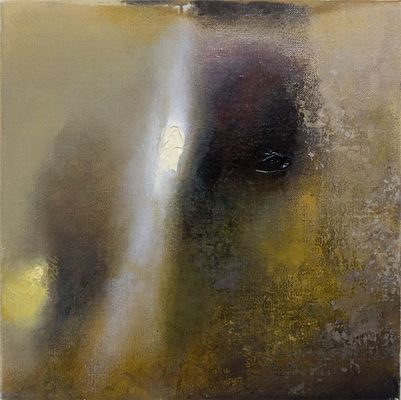
I am not a great reader of poetry but I always return to the work of Melbourne poet, Vincent Buckley (1925- 1988). Perhaps I find his most tantalising piece to be not a finished poem but a fragment left on a scrap of paper discovered on his desk after the poet’s death.
The poetry gathers like oil
In the word-core, and spreads
It has its music meet,
Its music is in movement.
This fragment is more the shell left behind from a volatile thought than a finished poem. I find the last two lines honest but awkward whereas the first two lines work like an arrow. Most likely he could not find a resolution so it was left. Still, in its present form, it remains an eloquent testimony to the ultimate failure of a medium to express mobile thought and sensation, in Buckley’s case, through verbal language. It’s an important matter because this is something all artists have to deal with regardless of the medium.
I have never written a poem, however, I am forever copying fragments from books on paper scraps in a vain effort to fix certain notions in my head. At first, they function as bookmarks that are sometimes returned to when I open the book. But before long, as they accumulate, they fall out littering the table interspersed with A4 photocopies, bills, books and medications.
To return to Buckley’s fragment, the first two lines very much evoke how I paint nowadays. As you age, detail diminishes and patches of light become more luminous and float. I feel the most honest way of dealing with this is by smearing the oil paint on the canvas with the fingers and working close-up, blind. Only if the patches coalesce into an approaching image can the work gain a life.
-
Jonathan Walker was born in Melbourne, Australia and brought up on a dairy farm in Gippsland. In the 1970’s he studied painting at RMIT and won the Harold Wright Scholarship to the British Museum, London. During the 1980’s he exhibited at Pinacotheca Gallery, Richmond and had work shown at the NGV and Heidi City Art Gallery. Over the same period he designed the cover for the “Epigenesi” LP by Giancarlo Toniutti, Italy and conducted a mail exchange work with Achim Wollscheid, Germany. The work with artists through the post resulted in an article published in the bicentenary issue of Art and Australia 1988. He showed in artist run spaces such as WestSpace in the 90’s and 2000’s, and until 2012, taught painting at Victoria University, which is where we (Colleen Ahern and Lisa Radford) as organisers of the exhibition, among many others, had the privilege of being his student.
Walker’s knowledge was imparted to students through the careful selection of music, literature, and artists found in books that he himself had ordered for the library. Walker’s strategy was the generosity of sharing his vast knowledge with references specific to each student and their context.
Walker’s paintings share a similar focus and intimacy.
This exhibition presents a small selection of recent paintings alongside a publication that includes Walker’s writing. Observational and analytical, Walker’s work is a type of material notation — the time of day, colour and how it is blended, the both specific and fleeting location of a reflection on lino or the question of whether a chair leg should be included in a painting.
Please join us on Friday August 21 between 6-8pm to celebrate the opening of the exhibition.
Curated by Colleen Ahern and Lisa Radford.
B. Wurtz
Curated by Nic Tammens
March 26 - April 4, 2015
B.Wurtz works from a basement studio in his home on Manhattan’s Lower East Side.
This local fact is attested to by the plastic shopping bags and newsprint circulars that appear in his work. As formal objects, they don’t make loud claims about their origins but nonetheless transmit street addresses and places of business from the bottom of this long thin island. Like plenty of artists, Wurtz is affected by what is local and what is consumed. His work is underpinned by this ethic. It often speaks from a neighborhood or reads like the contents of a hamper:
“BLACK PLUMS $1.29 lb.”
“Food Bazaar”
“USDA Whole Pork Shoulder Picnic 99c lb.”
“RITE AID Pharmacy, with us it’s personal.”
“H. Brickman & Sons.”
“Sweet Yams 59c lb."
Most of the work in this exhibition was made while the artist was in residence at Dieu Donne, a workshop dedicated to paper craft in Midtown. Here Wurtz fabricated assemblages with paper and objects that are relatively lightweight, with the intention that they would be easily transportable to Australia. This consideration isn’t absolute in Wurtz’s work, but was prescriptive for making the current exhibition light and cheap. Packed in two boxes, these works were sent from a USPS post office on the Lower East Side and delivered to North Melbourne by Australia Post.
Wurtz appears courtesy of Metro Pictures, New York.
Thanks to Rob Halverson, Joshua Petherick, Sari de Mallory, Matt Hinkley, Helen Johnson, Fayen d'Evie, Ask Kilmartin, Lisa Radon, Ellena Savage, Yale Union, and "Elizabeth".
John Nixon
"Archive"
December 15 - January 20, 2014
The presentation of John Nixon's archive offered a rare showcase of this extensive collection of the artist's own publications, catalogues, posters, ephemera, editions and more, from the mid 1980s onwards, alongside a selection of his artworks.
Organized by John Nixon, Joshua Petherick and Matt Hinkley.
<a href=http://wfb.public-office.info/artist/john-nixon>All titles by John Nixon
"Habitat"
at Minerva, Sydney (organised by Joshua Petherick and Matt Hinkley)
November 15 - December 20, 2014
Lupo Borgonovo, Janet Burchill & Jennifer McCamley,
Lewis Fidock, HR Giger, Piero Gilardi, Veit Laurent Kurz,
Cinzia Ruggeri, Michael E. Smith, Lucie Stahl, Daniel Weil, Wols
Press Release:
“...It contained seven objects. The slender fluted bone, surely formed for flight, surely from the wing of some large bird. Three archaic circuitboards, faced with mazes of gold. A smooth white sphere of baked clay. An age-blackened fragment of lace. A fingerlength segment of what she assumed was bone from a human wrist, grayish white, inset smoothly with the silicon shaft of a small instrument that must once have ridden flush with the surface of the skin - but the thing’s face was seared and blackened.”
William Gibson, “Count Zero”, 1986
"Autumn Projects Archive"
Curated by Liza Vasiliou
March 6 - March 15, 2014
World Food Books, in conjunction with the Virgin Australia Melbourne Fashion Festival 2014, presented the Autumn Projects archive, consisting of a selection of early examples in Australian fashion with a particular interest in collecting designers and labels from the period beginning in the 1980’s, who significantly influenced the discourse of Australian Fashion.
Curated by Liza Vasiliou, the exhibition provided a unique opportunity to view pieces by designers Anthea Crawford, Barbara Vandenberg, Geoff Liddell and labels CR Australia, Covers, Jag along with early experimental collage pieces by Prue Acton and Sally Browne’s ‘Fragments’ collection, suspended throughout the functioning World Food Books shop in Melbourne.
H.B. Peace
presented by CENTRE FOR STYLE
November 14, 2013
"Hey Blinky, you say chic, I say same"
Anon 2013
H.B. Peace is a clothing collaboration between great friends Blake Barns and Hugh Egan Westland. Their pieces explore the divergences between 'character’ and ‘personality’ in garments....etc
Special Thanks to Joshua Petherick and Matt Hinkley of WFB and Gillian Mears
and a Very Special Thank you to Audrey Thomas Hayes for her shoe collaboration.
Janet Burchill & Jennifer McCamley
"Aesthetic Suicide"
May 10 - June 8, 2013
The first of our occasional exhibitions in the World Food Books office/shop space in Melbourne, "Aesthetic Suicide" presented a body of new and older works together by artists Janet Burchill & Jennifer McCamley, including videos, prints, a wall work, and publications.
During shop open hours videos played every hour, on the hour.
2019, English
Softcover, 243 pages, 15 x 22.5 cm
Published by
A Nos Amours / London
$52.00 - In stock -
Between 2013 and 2015, A Nos Amours presented in London a complete retrospective of the films of the celebrated film-maker Chantal Akerman, the only complete retrospective given to date. Rights and screening copies turn out to be widely scattered and incredibly difficult to access. The research needed to present this retrospective is offered in this book so that others may more easily follow suit.
Also included are the texts, journalism and blogging that was offered to the audience as a means to engage with film-works that are at once radical, wildly varied in style and content, and surprisingly often, on account of their rarity, little known. The book aims to be accurate and a reliable source of detailed information about the films. The book is intended to serve as an Akerman companion and a key reference work.
Many texts are included to provide invaluable insights, from the likes of Raymond Bellour, Richard Brody, Ivone Margulies, Marion Schmid and Ginette Vincendeau.
Laura Mulvey (whose phrase 'the male gaze' has revolutionised film theory) has written the foreword, surveying Akerman's achievement, making use of this book as an aide-mémoire for what stands as one of the astonishing bodies of work in all cinema:
"As a collage of writing of many different kinds, the Handbook crucially bears witness to the effect that Akerman has had on the film community, from her earliest movies until her last... The high quality of the texts included in the book are all a reminder of the way that her 'cinematic' qualities have advanced our understanding of film."
A Nos Amours was founded in London by Joanna Hogg and Adam Roberts, to present screenings, events and art shows.
2005, English
Hardcover, 240 pages, 21.6 x 25.4 cm
1st Edition, Out of print title / used / very good
Published by
The Drawing Center / New York
Yale University Press / New Haven
$520.00 - Out of stock
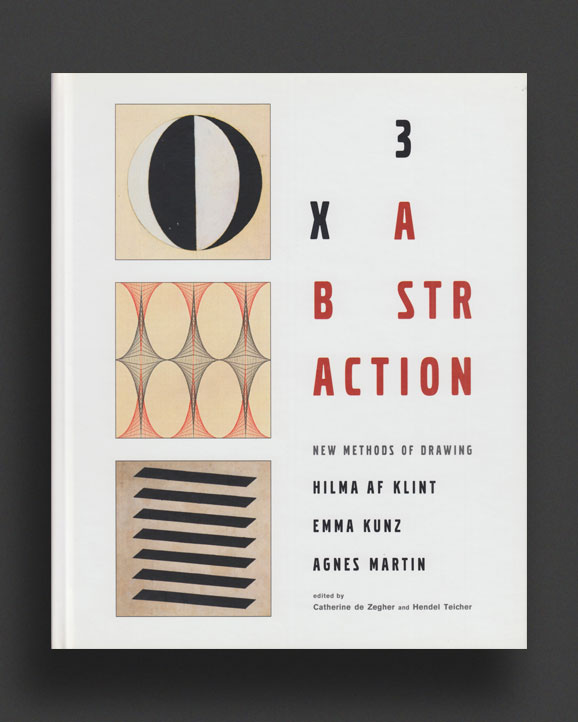
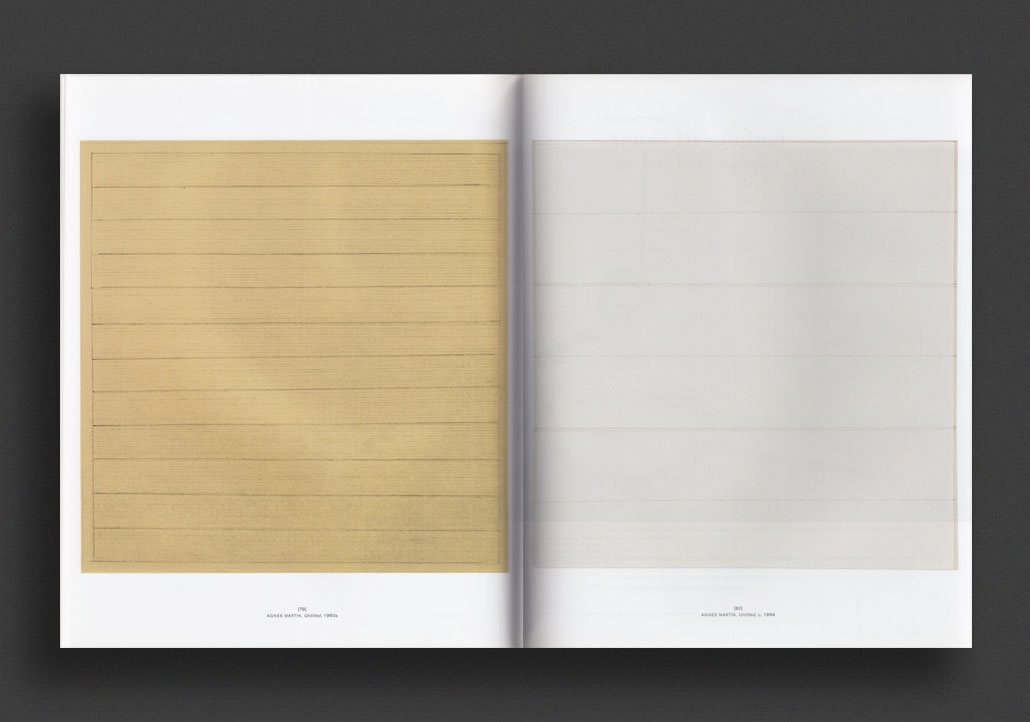
First edition of this quickly out-of-print and highly sought after hardcover volume published by Yale in 2005 to accompany the major travelling exhibition, 3 x an Abstraction, presenting the extraordinary work of three important women artists whose innovative ideas and approaches to drawing had a significant impact on the history of modern abstraction. Hilma af Klint (Sweden, 1862-1944), Emma Kunz (Switzerland, 1892-1963) and Agnes Martin (Canada, b. 1912; U.S. citizenship 1950) approached geometric abstraction not as formalism, but as a means of structuring philosophical, scientific, and spiritual ideas. Using line, geometry and the grid, each of these artists created diagrammatic drawings of their exploration of complex belief systems and restorative practices. Noteworthy among the 150 illustrations in the volume are a large number of works by Hilma af Klint, reproduced here for the first time in a major publication; Emma Kunz's drawings, exhibited in the United States for the first time in 2005; and approximately 20 early works by Agnes Martin. The book also includes writings by each of the artists, an introduction by Catherine de Zegher, seven essays by distinguished contributors, and brief statements from five contemporary artists.
Exhibition schedule: The Drawing Center, New York City, 25 March to 21 May 2005; Santa Monica Museum of Art, 10 June to 13 August 2005; Kunsthallen Brandts Klaedefabrik, Odense, Denmark, 14 October 2005 to 1 January 2006; The Irish Museum of Modern Art, Dublin, 24 January to 26 March 2006.
Catherine de Zegher is director of The Drawing Center. Hendel Teicher is an independent scholar and curator who publishes frequently on modern and contemporary art. Contributors include: Bracha Ettinger, Briony Fer, Elizabeth Finch, Adam Fuss, Rosalind Krauss, Birgit Pelzer, Griselda Pollock, Kathryn Tuma, Susan Klein, Richard Tuttle, Cecilia Vicuña, and Terry Winters.
Very Good copy with only light edge wear, light buckling from storage. A very important book that helped introduce the work of Emma Kunz and Hilma af Klint to English audiences.
2016, English
Hardcover (w. dust jacket + CD), 232 pages, 22.9 x 29.2 cm
Published by
Silver Gate Inc. / Taxas
$115.00 - Out of stock
Years in the making, this definitive monograph presents nearly six decades of work by the pioneering San Francisco-based ceramic sculptor Ron Nagle (born 1939). The plates section features 51 sculptures made since 1958, all reproduced in full colour. Critical essays by Joel Selvin and David Pagel and a foreword by Dave Hickey offer diverse perspectives on Nagle's accomplishments as both an artist and a musician. An illustrated chronology provides an overview of his life and work, including his apprenticeship with ceramicist Peter Voulkos, his seminal role in San Francisco's psychedelic music scene, his sound design for the film The Exorcist, and his obsessive devotion to intimately scaled sculpture. Nagle's irrepressible personality comes through in the book's innovative design, which includes a jacket that unfolds into a poster of the artist dressed as his film hero Charlie Chan. Also included is a CD of 21 songs spanning Nagle's musical career, from the 1960s to the 2000s. An essential, comprehensive and intimate book on one of America's great contemporary sculptors.
2000, English
Softcover (staple-bound) + related invitation, 16 pages, 20 x 20 cm
1st Edition, Out of print title / used / very good
Published by
Heide Museum of Modern Art / Victoria
$30.00 - In stock -
Catalogue published on the occasion of the exhibition Constructions in colour : the work of Yvonne Audette 1950s—1960s at Heide Museum of Modern Art, 2000, curated by Kelly Gellatly, with assistance from Ted Gott and Murray White. Published in an edition of 700 copies. Out-of-print. Heavily illustrated throughout with Audette's paintings in colour, accompanied by texts by Kelly Gellatly and Bruce James, plus biography, portraits, and list of works.
Bonus copy of invitation to coinciding solo retrospective exhibition at Lyttleton Gallery, North Melbourne, "Paintings 1950s—1990s, folded and inserted into catalogue.
Born in Sydney in 1930, Yvonne Audette is one of Australia’s most accomplished and dynamic abstract expressionist artists. She studied art under Henry Gibbons, Geoffrey Miller and John Passmore, Audette also modelled for Australian photographer’s Max Dupain and David Moore. At the age of 22 Audette travelled to America and was heavily influenced by it’s new abstract expressionism where she regularly mixed with Mark Rothko, Lee Krasner, Louise Nevelson, and William de Kooning. In 1955 she travelled to Europe, establishing a studio in Florence and later, Milan, where she lived and worked, presenting numerous successful exhibitions, before returning to Australia in 1966 and has continued to work and exhibit, based in Melbourne.
VG copy.
2018, English
Softcover, 364 pages, 14 x 20 cm
Published by
Sternberg Press / Berlin
$62.00 - Out of stock
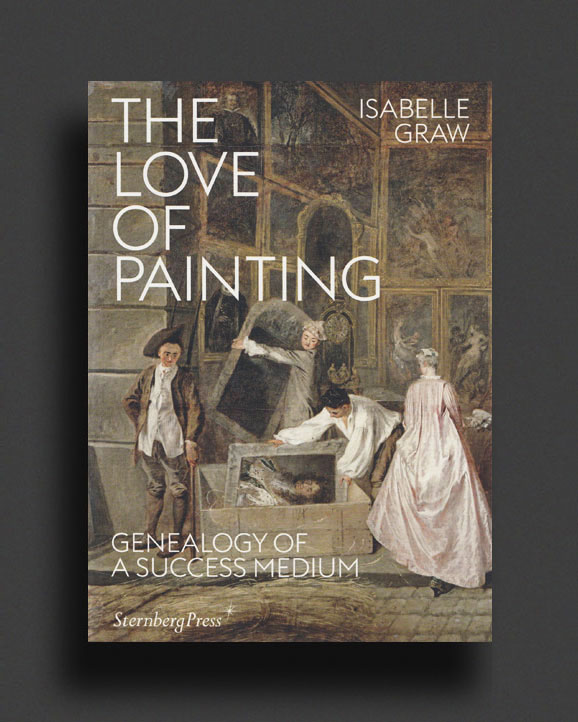
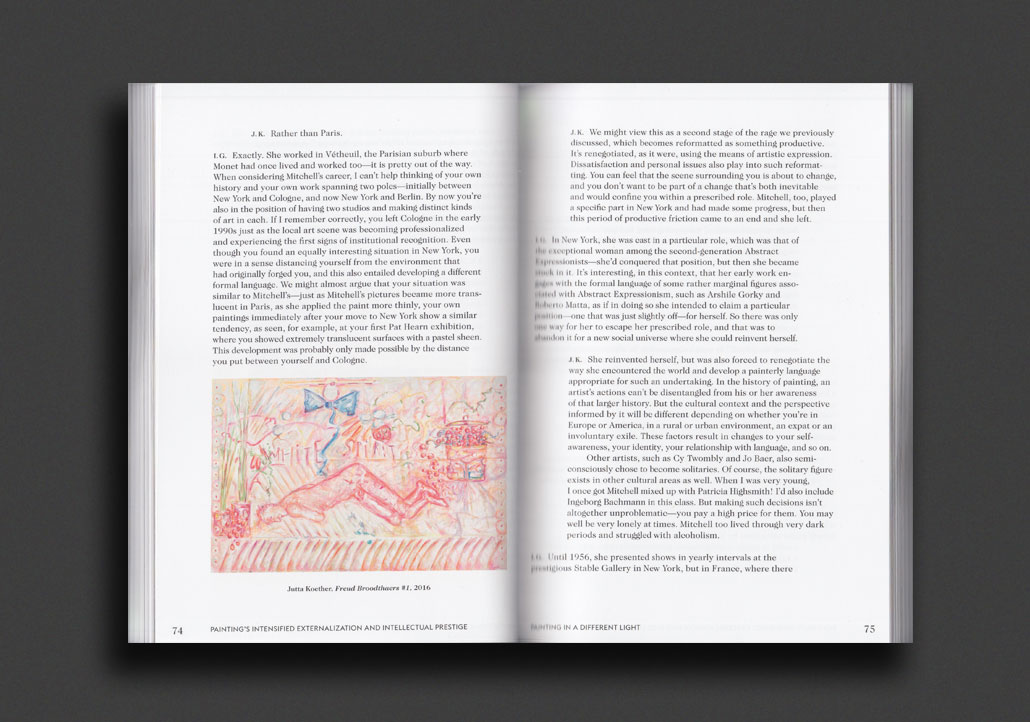
Isabelle Graw’s brilliant analysis of the exceptional position of painting in our increasingly digital economy combines a deep respect for the objects of study and those who make them with an impressive range of critical and theoretical insights. Along the way, The Love of Painting never loses sight of the medium’s dialectical relationship to the art world, the art market, and society at large. This is a lively, provocative, and persuasively argued book.
—Alexander Alberro, author of Abstraction in Reverse: The Reconfigured Spectator in Mid-Twentieth-Century Latin American Art
It’s about time for a book declaring “the love of painting” to appear, afer the aridity of postmodernism’s announcement of painting’s demise. Isabelle Graw’s argument in favor of this love turns on what she terms “vitalistic fantasies”: the perception of artworks as “quasi subjects” saturated with the life of their creator. This notion of the work of art as a quasi subject relates directly to the philosopher Stanley Cavell’s consideration that “the possibility of fraudulence, and the experience of fraudulence, is endemic in the experience of contemporary art.” To understand this we must ask: Why do we relate to works of art in the same way we relate to people? The Love of Painting works on this question—and does so with success.
—Rosalind E. Krauss, author and University Professor at the Department of Art History, Columbia University
Painting seems to have lost its dominant position in the field of the arts. However, looking more closely at exhibited photographs, assemblages, installations, or performances, it is evident how the rhetorics of painting still remain omnipresent. Following the tradition of classical theories of painting based on exchanges with artists, Isabelle Graw’s The Love of Painting considers the art form not as something fixed, but as a visual and discursive material formation with the potential to fascinate owing to its ability to produce the fantasy of liveliness. Thus, painting is not restricted to the limits of its own frame, but possesses a specific potential that is located in its material and physical signs. Its value is grounded in its capacity to both reveal and mystify its conditions of production. Alongside in-depth analyses of the work of artists like Édouard Manet, Jutta Koether, Martin Kippenberger, Jana Euler, and Marcel Broodthaers, the book includes conversations with artists in which Graw’s insights are further discussed and put to the test.
Design by Surface
2006, French
Softcover (+ audio cd), 232 pages, 17 x 24 cm
1st US Edition, Out of print title / as new
Published by
Fondation Dubuffet / Paris
$100.00 - In stock -
First edition, out-of-print catalogue, the first book (+ CD) published by Cahiers de la Fondation Dubuffet to accompany a major exhibition tracing the "musical experiences" of Jean Dubuffet, curated by Sophie Duplaix for the Dubuffet Foundation, Paris.
Protean artist, Jean Dubuffet has always been interested in the world of music. His preoccupations with music echo the development of his discourse on the subversion of culture, sweeping away cultural acquisitions in favour of ever freer improvisation. It was with his interest in jazz in the 1940s that parallels between music and painting began to emerge, but it was not until the early 1960s that these theoretical parallels took shape in "musical experiences" which consisted of recording sessions taking advantage of the flexible handling of magnetic tape. Dubuffet links these experiments to the research he conducts on the pictorial plane. However, it was more than ten years later that he truly achieved, with Coucou Bazar, a vast "animated tableau" and the culmination of the "L'Hourloupe" cycle, the osmosis of which he had gradually established the principles.
The main body of the book, "An Anthology in Three Times" (175 pages) — three profusely illustrated chapters — is a selection of texts, letters, documents, presented by Sophie Duplaix — curator of the exhibition presented at the same time — allowing understand the context and the challenges of the musical creations of Jean Dubuffet.
An accompanying audio compact disc is offered with the book with 7 unpublished recordings by Jean Dubuffet, a selection commented on by the German musicologist, Andreas Wagner, in the chapter "A selection of unpublished works".
The work is completed by a comprehensive directory of the original tapes kept at the Dubuffet Foundation, a discography, a selective bibliography and a short biography of the artist.
"The musical experiences which occupied me for several months in 1961, then later again in 1974, aim at a total oblivion of all cultural musical conditioning. They aim at erasing all that has received until now the name of music and to start anew. The principles which form the basis of all traditional music are revoked, and therefore first of all the sounds of the scale, then rhythm and time. any clearly discernible melodic song.[.] A music therefore where speech is withdrawn from the singer expressing his affective or passionate moods, and restored to the cosmic rumors delivering their wild noise."—Jean Dubuffet.
Texts in French.
As New copy complete with audio CD.
2022, English
Softcover, 192 pages, 12.9 x 19.8 cm
Published by
And Other Stories / High Wycombe
$30.00 - Out of stock
First published in 1972, Ann Quin's fourth and final novel was a radical break from the introspective style she had developed in Three and Passages: a declaration of independence from all expectations.
Brashly experimental, ribald, and hilarious, Tripticks maps new territories for the novel - aspiring to a form of pop art via the drawings of the artist Carol Annand and anticipating the genre-busting work of Kathy Acker through collage and gory satire.
Splattering its pages with the story of a man being chased across a nightmarish America by his 'first X-wife' and her 'schoolboy gigolo', Tripticks was ground zero for the collision of punk energy with high style.
2021, English
Softcover, 160 pages, 19.8 x 13 cm
Published by
And Other Stories / High Wycombe
$28.00 - Out of stock
Introduction by Claire-Louise Bennett
A book of voices, landscapes and seasons, Ann Quin's newly republished novel mirrors the multiplicity of meanings of the very word 'passage'--of music, of time, and of life itself. A woman, accompanied by her lover, searches for her lost brother, who may have been a revolutionary, and who may have been tortured, imprisoned or killed. Roving through a Mediterranean landscape, they live out their entangled existences, reluctant to give up, afraid of the outcome.
Reflecting the schizophrenia of its characters, the novel splits into alternating passages, switching between the sister and her lover's perspective. The lover's passages are also fractured, taking the form of a diary with notes alongside the entries. An intricate system of repetition and relation builds across the passages. 'All seasons passed through before the pattern formed, collected in parts.'
Erotic and tense, in Quin's compelling third novel the author allowed her writing freer rein than before, and created a work ahead of its time: her most poetic, evocative and mysterious novel yet.
2019, English
Softcover, 160 pages, 91.8 x 13 cm
Published by
And Other Stories / High Wycombe
$28.00 - In stock -
'A man called Berg, who changed his name to Greb, came to a seaside town intending to kill his father . . .'
So begins Ann Quin's madcap frolic with sinister undertones, her 1964 debut 'so staggeringly superior to most you'll never forget it' (The Guardian). Alistair Berg hears where his father, who has been absent from his life since his infancy, is living. Without revealing his identity, Berg takes a room next to the one where his father and father's mistress are lodging and he starts to plot his father's elimination. Seduction and violence follow, though not quite as Berg intends, with Quin lending the proceedings a delightful absurdist humour.
Anarchic, heady, dark, Berg is Quin's masterpiece, a classic of post-war avant-garde British writing, and now finally back in print after much demand.
Ann Quin (1936–1973) was a British writer noted for her experimental style. Born in Brighton, Sussex, in a family on the fringes of the working-class and lower-middle class, her father, former opera singer Nicholas Montague Quin, left the family, and she was raised by her mother Ann (née Reid) alone. Quin is associated with a loosely constituted circle of 'experimental' authors in Sixties Britain, headed by B. S. Johnson and including Stefan Themerson, Rayner Heppenstall, Alan Burns and Eva Figes, influenced by Samuel Beckett and recent French fiction (Marguerite Duras, Alain Robbe-Grillet). The author of Berg (1964), Three (1966), Passages (1969) and Tripticks (1972), she killed herself in 1973 at the age of 37.
1998, English
Softcover, 272 pages, 14 x 21 cm
Published by
Grove Press / New York
$32.00 - Out of stock
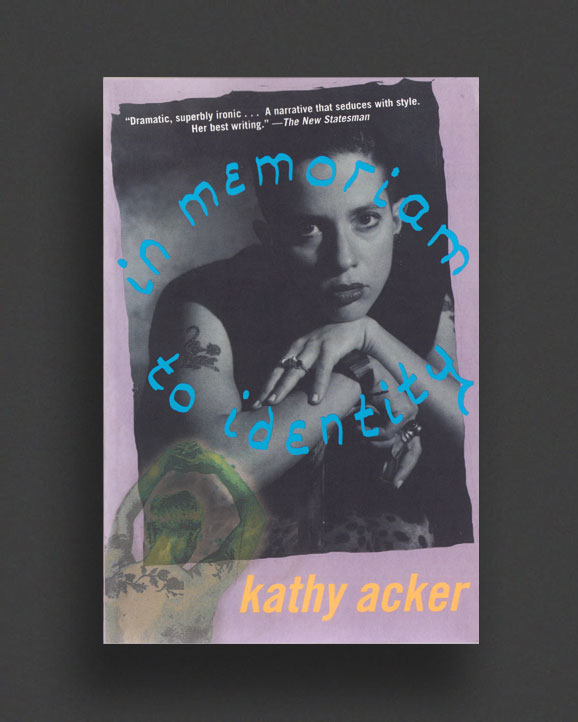
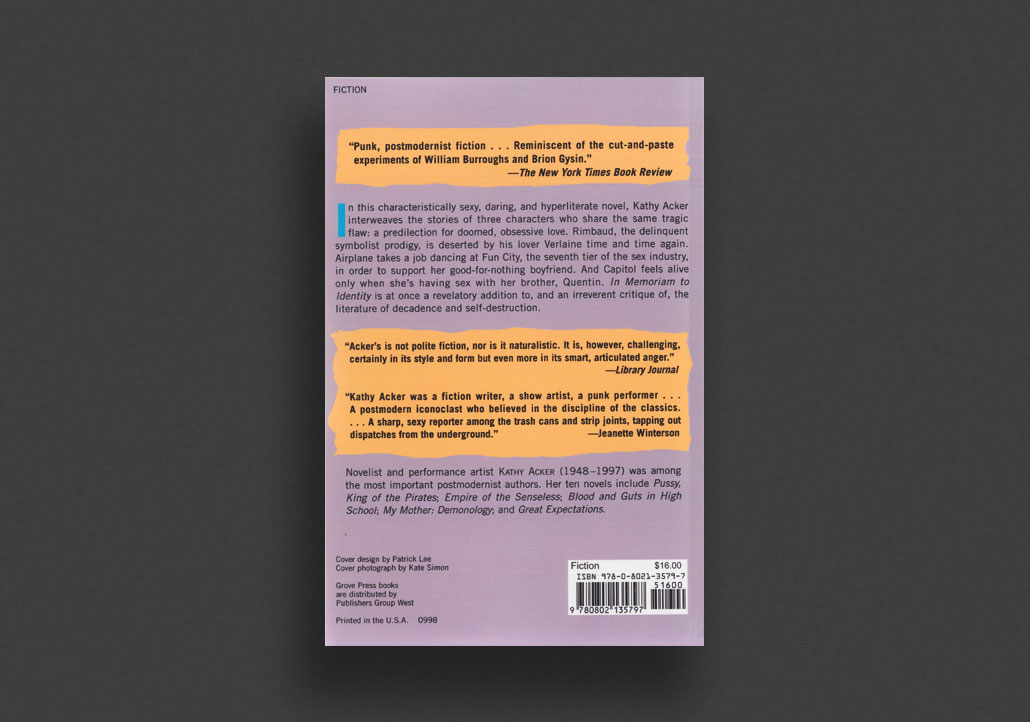
In this characteristically sexy, daring, and hyperliterate novel, Kathy Acker interweaves the stories of three characters who share the same tragic flaw: a predilection for doomed, obsessive love. Rimbaud, the delinquent symbolist prodigy, is deserted by his lover Verlaine time and time again. Airplane takes a job dancing at Fun City, the seventh tier of the sex industry, in order to support her good-for-nothing boyfriend. And Capitol feels alive only when she's having sex with her brother, Quentin. In Memoriam to Identity is at once a revelatory addition to, and an irreverent critique of, the literature of decadence and self-destruction.
2018, English
Softcover, 228 pages, 13.6 x 20.8 cm
Published by
Grove Press / New York
$32.00 - Out of stock
30th anniversary edition with introduction by Alexandra Kleeman.
Originally published in 1988, Empire of the Senseless marked a turning point in Acker's wild, inimitable style. Considered one of her more accessible works, here Acker candidly addresses her lifelong obsessions: childhood and trauma, language and sexuality, criminality and corruption, oppression and rebellion. Abhor (part human, part robot) and her lover Thivai (a pirate) traverse Paris in a dystopian future, in search of a mysterious drug that Thivai needs in order to maintain his ability to love. Navigating the chaotic city, they encounter mad doctors, prisoners, bikers, sailors, tattooists, terrorists, and prostitutes, while a band of Algerian revolutionaries take over, and the C. I. A. plots to thwart them all.
Sexually explicit, graphically violent, Empire of the Senseless resists the desensitizing of cultural consciousness and the disintegration of interpersonal communication. A timeless, prescient parable, it speaks profoundly to our social and political history as well as our present reality.
“Set in the present and near future, this is an apocalyptic tale that makes Clockwork Orange look tame.” – Publishers Weekly
Kathy Acker (1948 – 1997) was an influential postmodernist writer and performance artist, whose many books include Blood and Guts in High School; Don Quixote; Literal Madness; Empire of the Senseless; In Memoriam to Identity; My Mother: Demonology; Pussy, King of the Pirates; Portrait of an Eye; and Rip-Off Red, Girl Detective.
1982 / 2019, English
Softcover, 144 pages, 13.6 x 20.8 cm
Published by
Grove Press / New York
$32.00 - Out of stock
At the center of this form-shifting narrative, Acker’s protagonist collects an inheritance following her mother’s suicide, which compels her to revisit and reinterpret traumatic scenes from the past. Switching perspectives, identities, genders, and centuries, the speaker lustily ransacks world literature to celebrate and challenge the discourse around art, love, life, and death.
Beginning as a rewriting of Charles Dickens classic of the same name, Great Expectations spirals into Kathy Acker’s most notorious work of textual appropriation and literary homage, creating “variations on classic literary texts . . . [which] subvert all of our traditional expectations concerning causality, narrative form and moral sensibility.”—(Michiko Kakutani, New York Times)
Kathy Acker (1948 – 1997) was an influential postmodernist writer and performance artist, whose many books include Blood and Guts in High School; Don Quixote; Literal Madness; Empire of the Senseless; In Memoriam to Identity; My Mother: Demonology; Pussy, King of the Pirates; Portrait of an Eye; and Rip-Off Red, Girl Detective.
“[Acker’s] most completely unified work of art . . . One that by its formal concentration and its unified shape at every depth of reading fulfills the sort of demands that Sterne or Canetti makes of the novelist.”—Alain Robbe-Grillet
“A postmodern Colette with echoes of Cleland’s Fanny Hill.”—William S. Burroughs
1994, English
Softcover, 416 pages, 13.6 x 20.8 cm
Published by
Grove Press / New York
$40.00 - Out of stock
Here in one volume are three subversive novels from mastermind Kathy Acker, tackling the perils of erotic entanglement in the face of the modern world's corrupted moral and political values. Kathy Goes to Haiti follows a young writer from New York traveling alone in Port-au-Prince. There she meets Roger and they begin a pornographic affair of intellectual exploration. In My Death My Life by Pier Paolo Pasolini, the deceased Italian filmmaker solves his own mysterious murder, featuring cameos from Romeo, Juliet, Hamlet, and Macbeth. Florida—a surreal rendering of John Huston's film Key Largo—finds a cast of depraved characters bracing for a hurricane. Dreamlike, incisive, scathingly satirical while fiercely compassionate, the three books collected in Literal Madness form a multifaceted triptych that exemplifies Acker's clear-eyed, unflinching approach to reinventing fictional narrative.
Kathy Goes to Haiti, the first of three novels in Literal Madness, “Speaks to us out of a delightful mock-na’veté that reminds one at times of the Dick and Jane readers rewritten as manuals for politics and sex . . . . At once hilarious and terrifying, [it] has all the logic of a Caribbean tour and a nightmare combined”—Los Angeles Times
My Death My Life by Pier Paolo Pasolini – wherein, among other things, the late Italian filmmaker solves his own murder, with the help of, among others, Romeo, Juliet, and the Bronté sisters – is a “scathing commentary on false values in art” —The Hartford Courant
In the haunting Florida, Acker achieves “a nearly telegraphic reduction of the Bogart-Bacall movie Key Largo to fatalistic, tough-guy essentials.”—Booklist
Kathy Acker (1948 – 1997) was an influential postmodernist writer and performance artist, whose many books include Blood and Guts in High School; Don Quixote; Literal Madness; Empire of the Senseless; In Memoriam to Identity; My Mother: Demonology; Pussy, King of the Pirates; Portrait of an Eye; and Rip-Off Red, Girl Detective.
1978, English
Softcover, unpaginated, 20.5 x 28 cm
1st Edition, Out of print title / used / good
Published by
Thames and Hudson / London
$35.00 - Out of stock
First edition of this volume of 41 colour plates depicting the works of Dutch/Netherlandish fantastic painter Hieronymus Bosch (1450—1516), published by Thames and Hudson, London, 1978, accompanied by texts by Gregory Martin.
Hieronymus Bosch (1450—1516) was a Dutch/Netherlandish painter from Brabant. He is one of the most notable representatives of the Early Netherlandish painting school, his work, generally oil on oak wood, mainly contains fantastic illustrations of religious concepts and narratives. His pessimistic fantastical style cast a wide influence on northern art of the 16th century, with Pieter Bruegel the Elder being his best-known follower. Within his lifetime his work was collected in the Netherlands, Austria, and Spain, and widely copied, especially his macabre and nightmarish depictions of hell. Little is known of Bosch's life. He spent most of it in the town of 's-Hertogenbosch, where he was born in his grandfather's house. Today, Bosch is seen as a hugely individualistic painter with deep insight into humanity's desires and deepest fears. Attribution has been especially difficult; today only about 25 paintings are confidently given to his hand along with eight drawings. About another half-dozen paintings are confidently attributed to his workshop. His most acclaimed works consist of a few triptych altarpieces, including The Garden of Earthly Delights.
Good copy but with some edge wear and tanning to back colour, delicate spine, light markings.
1981, English
Softcover, 174 pages, 23 x 21 cm
1st Edition, Out of print title / used / good
Published by
Thames and Hudson / London
$45.00 $20.00 - Out of stock
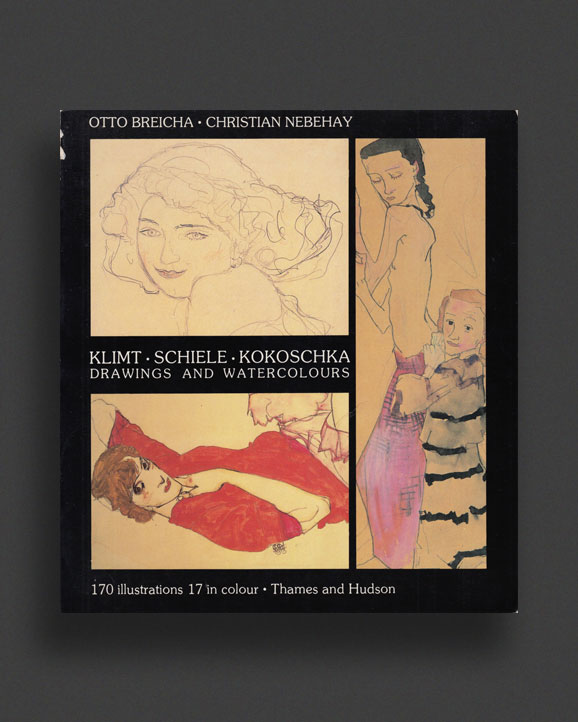
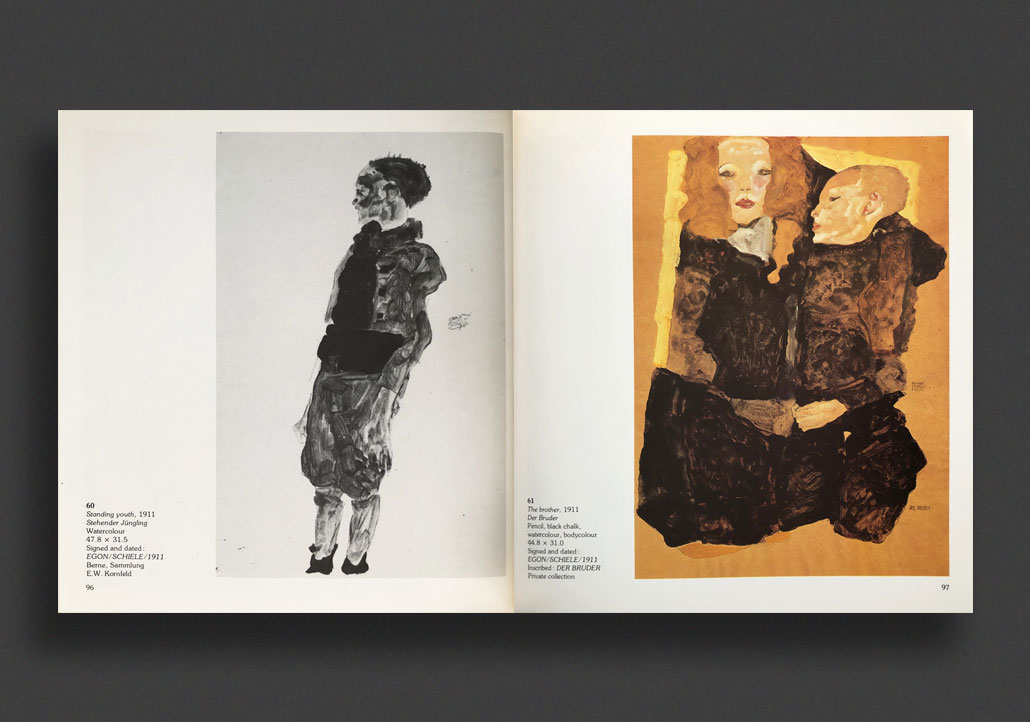
First 1981 edition of this catalogue published on the occasion of the exhibition at the Palais des Beaux-Arts, Brussels, April 4—May 17, 1981. Heavily illustrated with many works by all artists featured, accompanied by texts by Otto Brecha and Christian Nebehay, this volume explores the radical, shocking and ground-breaking artistic expression of Vienna's "grand three" avant-garde artists at the dawn of the twentieth century. A city bursting with intellectual and sensual energy, Vienna's burgeoning society was constantly at odds with the conservative and often disapproving nineteenth-century culture — Egon Schiele, Gustav Klimt, Oskar Kokoschka often at the center of this controversy. Beautiful examples of their drawings and watercolours in b/w/ and colour throughout.
Good copy with wear to delicate spine and small tear to top of spine cover edge. General age and wear.
1974, English
Softcover, 96 pages, 24cm x 30.5 cm
1st Edition, Out of print title / used / average
Published by
Ballantine Books / New York
$20.00 - Out of stock
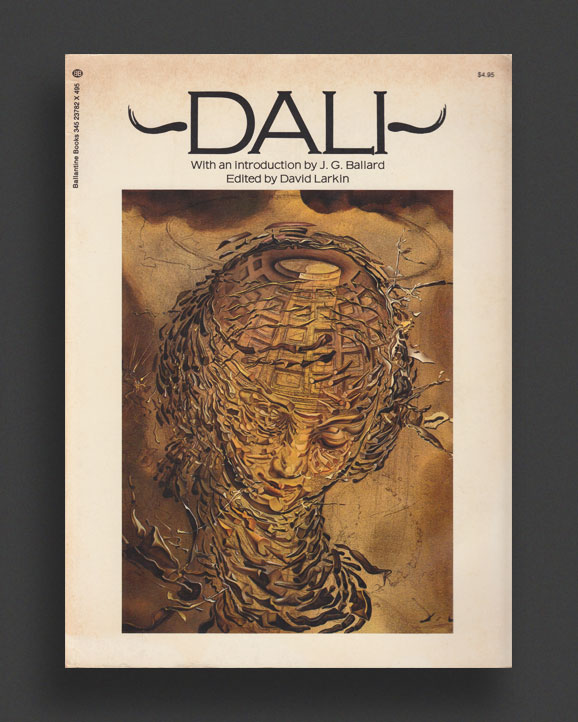
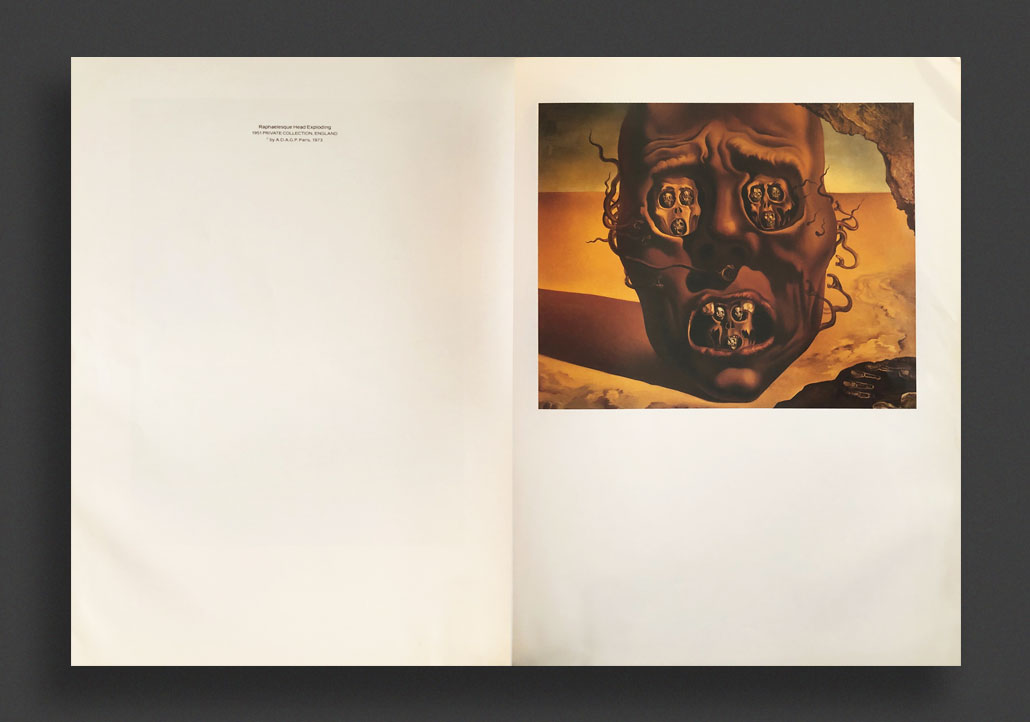
First 1974 edition of this volume on Surrealist painter Salvador Dalí, reproducing many of his most famous paintings in colour, edited by David Larkin with an introduction by J.G. Ballard. Painter, designer, and filmmaker Salvador Dalí (1904-1989) was one of the most colourful and controversial figures in twentieth-century art. A pioneer of Surrealism, he was both praised and reviled for the subconscious imagery he projected into his paintings, which he sometimes referred to as hand-painted dream photographs.
Average copy with ageing, tanning and some old moisture ripples creeping into back page edges. Otherwise still bright internally throughout with tight binding.
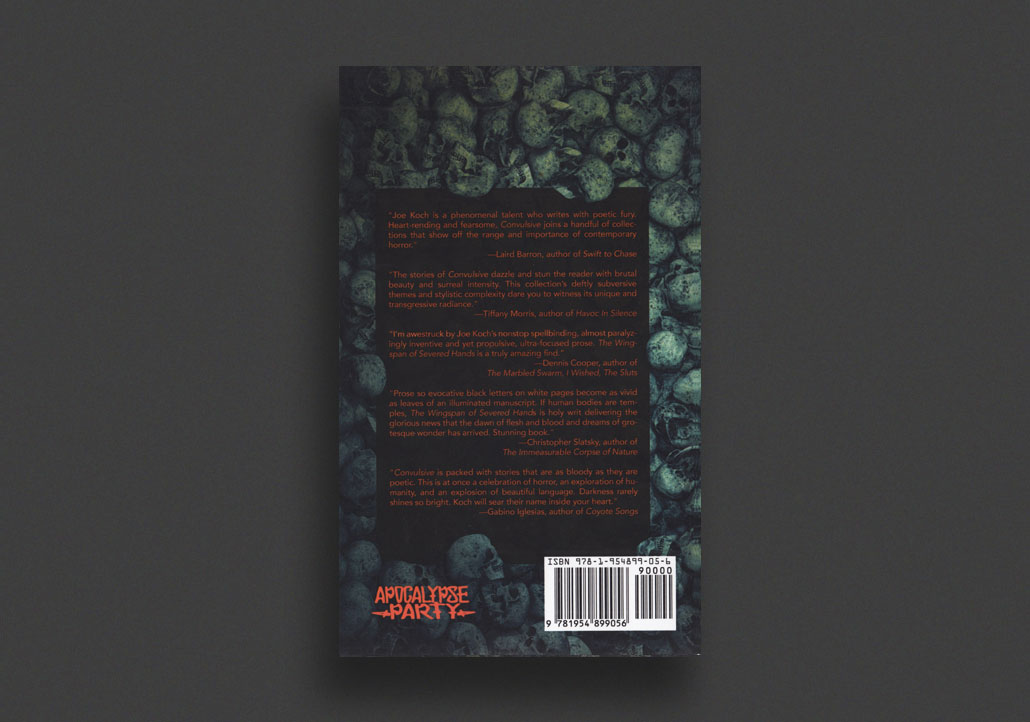
2022, English
Softcover, 192 pages, 20.3 x 12.7 cm
Published by
Apocalypse Party / Philadelphia
$36.00 - In stock -
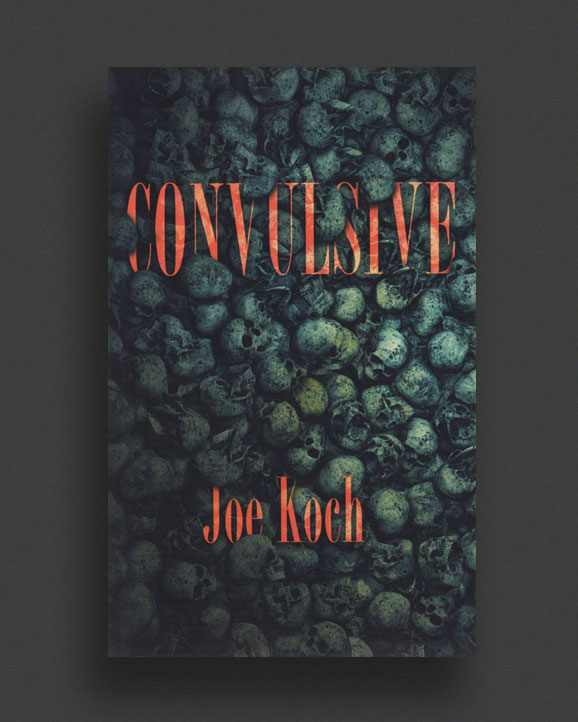
"Joe Koch is a phenomenal talent who writes with poetic fury. Heart-rending and fearsome, Convulsive joins a handful of collections that show off the range and importance of contemporary horror."—Laird Barron, author of Swift to Chase
"The stories of Convulsive dazzle and stun the reader with brutal beauty and surreal intensity. This collection's deftly subversive themes and stylistic complexity dare you to witness its unique and transgressive radiance."—Tiffany Morris, author of Havoc In Silence
"I'm awestruck by Joe Koch's nonstop spellbinding, almost paralyzingly inventive and yet propulsive, ultra-focused prose. The Wingspan of Severed Hands is a truly amazing find."—Dennis Cooper, author of The Marbled Swarm, I Wished, The Sluts
"Prose so evocative black letters on white pages become as vivid as leaves of an illuminated manuscript. If human bodies are temples, The Wingspan of Severed Hands is holy writ delivering the glorious news that the dawn of flesh and blood and dreams of grotesque wonder has arrived. Stunning book."—Christopher Slatsky, author of The Immeasurable Corpse of Nature
"Convulsive is packed with stories that are as bloody as they are poetic. This is at once a celebration of horror, an exploration of humanity, and an explosion of beautiful language. Darkness rarely shines so bright. Koch will sear their name inside your heart."—Gabino Iglesias, author of Coyote Songs
2022, English
Softcover, 446 pages, 22.9 x 15.2 cm
Published by
Apocalypse Party / Philadelphia
$44.00 - Out of stock
Incorporating hundreds of characters and cultural entities, spanning innumerable locations and billions of years, Aannex is a future-hacker's maze-map meant to have already been mass-burned; a fakebook full of retroneuroviruses disguised as ecstasy for the condemned; a post-Joycean neo-slipstream sci-fi cult dream encyclopedia composed as algorithmic code compiled in-soul. Designed in a far future where the twin grandsons of Satan-Danad and Nadan-have retroactively rewritten the Holy Bible and therefore the course of human history in its wake, the precarious distinction between mass entertainment and mind control has gone so wonky even the zits who think they run the show can't trace what's what. Laced in the code: a bio-hybrid ex-contract killer travels through space-time seeking immortal vengeance on her autocratic overseers for their crimes...a claims specialist for Garko*Farx, the last remaining megacorporation, unpacks the kickback of finally investigating her bureaucratic complicity in the psycho-spiritual dissolution of all mankind...a former Top 40 producer turned warmonger laments the transmutation of his once aesthetic aspirations into the most formidable fascistic global death-dream ever conceived...all while the fundamental meta-rigging of a divine imagination reels for reformat against the collapsing cavity of narrative events, obfuscating fact and memory in the same process it might have used to set us free. Pressed to the virtual edges of an existence itself already pressed far beyond the revelation that nothing truly can be known, what else exists beyond the bleeding-rainbow-daze of logic's hope? How might we aspire from beyond our future meaning's mythic limits, or is it already too late?
2015, English
Softcover, 478 pages, 23 x 15.2 cm
Published by
Feral House / Los Angeles
$49.00 - Out of stock
Expanded edition with introduction and new material by Colin Wilson. Expanded afterword by Peter Sotos.
Ian Brady and Myra Hindley's spree of torture, sexual abuse, and murder of children in the 1960s was one of the most appalling series of crimes ever committed in England, and remains almost daily fixated upon by the tabloid press. In The Gates of Janus, Ian Brady himself allows us a glimpse into the mind of a murderer as he analyzes a dozen other serial crimes and killers.
Criminal profiling by a criminal was not invented by the dramatists of Dexter.
Novelist and true-crime writer Colin Wilson, author of the famous and influential book The Outsider, remarks in his introduction to Brady's book that one must first explore the depraved reaches of human consciousness to truly understand human character.
When first released in 2001, The Gates of Janus sparked controversy attended by a huge media splash. The new edition, the first in paperback, provides the reader with a decade and a half of updates, including Brady's letters to the publisher, both providing information regarding his own demented history along with demands that Feral House remove its unflattering afterword written by author Peter Sotos.
1985, Japanese
Softcover (w. dust jacket), unpaginated, 30 x 21.5 cm
1st Edition, Out of print title / used / very good
Published by
Tsurumakisha / Japan
$200.00 - In stock -
"Increase your pleasure without knowing it! "Libido" is proof that you live a healthy life. For beautiful women!" "Sexual performance that invites pure libido" (from cover)
Exceptionally rare and obscure "Mystery" Japanese photo-collage book by one Osamu Yokota, vividly illustrated cover to cover with full-bleed nude photographic poses combining meditation, yoga, kama sutra set into psychedelic graphic collage, published in 1985! Like a Japanese mix of Penny Slinger's Mountain Ecstasy and John Champ's Yoga For Men, this instructional book is without words (only a short instruction list on the inside of the dust jacket), inviting the viewer to relax to ambient music, pick a page at random and breathe into the poses illustrated by the female instructors to find the cosmic force of "Qi" within. "A mysterious book that increases the power of the pyramid by 250%" (?) Playful hippy studio photography cut to Yokoo-esque cosmic graphic forces — one of a kind!
Very Good copy in VG dust jacket preserved under mylar wrap.
2022, English
Softcover, 436 pages, 23.4 x 28 cm
Published by
Third Man Books / US
$79.00 - In stock -
In this remarkable tale of creativity and chaos, do-it-yourself innovation and extraordinary attempts at world domination, Needles and Plastic tells the inside story of one of New Zealand - and the world's - great independent music labels. Hundreds of full color & black and white photos illustrate the story! Founded in 1981 by Roger Shepherd in Christchurch, New Zealand, Flying Nun Records unleashed an extraordinary wave of music that had an impact around the world.Needles and Plastic is the first comprehensive history of the early years of the label and its bands covering the critical period from 1981-1988 when many of the most influential and critically acclaimed artists emerged on Flying Nun, bands like - from The Clean, The Chills, The Verlaines, Straitjacket Fits and Bailter Space.
The influence of the obscure label became apparent in the 1990s, when big-time indie acts like Pavement, Cat Power or Yo La Tengo started covering Flying Nun bands. In entries on over 140 records from The Clean's 'Tally Ho!' 7" in 1981 to The Verlaines Bird-Dog LP in 1988, Matthew Goody tells the story through the records themselves. His book draws on years of in-depth research to reveal the stories of the bands, the recordings, the songs, and the audience, with a host of significant characters contributing along the way - Shepherd, Chris Knox, Doug Hood, Hamish Kilgour and many more.
In this remarkable tale of creativity and chaos, do-it-yourself innovation and extraordinary attempts at world domination, Needles and Plastic tells the inside story of one the world's great independent music labels.
2020, English
Hardcover, 288 pages, 26.7 x 22.9 cm
Published by
MoMA / New York
$120.00 - Out of stock
The first retrospective in 30 years on American maverick Donald Judd's minimalist sculpture, architecture and furniture. Published to accompany the first US retrospective exhibition of Donald Judd's sculpture in more than 30 years, Judd explores the work of a landmark artist who, over the course of his career, developed a material and formal vocabulary that transformed the field of modern sculpture. Donald Judd was among a generation of artists in the 1960s who sought to entirely do away with illusion, narrative and metaphorical content. He turned to three dimensions as well as industrial working methods and materials in order to investigate "real space," by his definition. Judd surveys the evolution of the artist's work, beginning with his paintings, reliefs and handmade objects from the early 1960s; through the years in which he built an iconic vocabulary of works in three dimensions, including hollow boxes, stacks and progressions made with metals and plastics by commercial fabricators; and continuing through his extensive engagement with colour during the last decade of his life.
This richly illustrated catalog takes a close look at Judd's achievements, and, using newly available archival materials at the Judd Foundation and elsewhere, expands scholarly perspectives on his work. The essays address subjects such as his early beginnings in painting, the fabrication of his sculptures, his site-specific pieces and his work in design and architecture.
Donald Judd (1928-94) began his professional career working as a painter while studying art history and writing art criticism. One of the foremost sculptors of our time, Judd refused this designation and other attempts to label his art: his revolutionary approach to form, materials, working methods and display went beyond the set of existing terms in midcentury New York. His work, in turn, changed the language of modern sculpture.
2022, English
Hardcover, 168 pages, 24 x 30 cm
Published by
RM / Barcelona
$110.00 - Out of stock
A significantly expanded hardcover edition of Carrington's acclaimed Tarot series, featuring new archival images and research.
The British-born Mexican surrealist Leonora Carrington (1917-2011) spent a lifetime exploring the esoteric traditions of diverse cultures, and incorporated their ideas and symbols into her artistic and literary oeuvre. Tibetan Buddhism, the Kabbalah, ancient Egyptian and Mesopotamian magic, Celtic mythology, witchcraft, astrology and the Tarot were filtered through her feminist lens to create a visionary, woman-centered worldview.
Carrington created a spectacular Major Arcana Tarot deck sometime during the 1950s, laying gold and silver leaf over brilliant color. Exhibited for the first time during her centennial exhibition Leonora Carrington: Magical Tales in 2018, this extraordinary work was a revelation for the public and inspired the publication of The Tarot of Leonora Carrington.
This second, considerably expanded edition--encouraged by the overwhelmingly positive reception of Fulgur's publication in 2020--explores further the central position that the Tarot held in Carrington's work. The volume includes an introductory text by her son Gabriel Weisz Carrington, who recalls his mother's long involvement with the Tarot, followed by a revised and more extensive essay by scholar Susan Aberth and curator Tere Arcq, including detailed analysis of each card: their color symbolism, their relationship to other works and their iconographic origins in ancient esoteric beliefs, including the Mesoamerican influences of her adopted country.
This new edition also reproduces previously unpublished photographs and images, as well as exciting new research into Carrington's influences, emphasizing the authors' claim that her work on the Major Arcana represents an esoteric roadmap to Carrington's feminist vision and wish for a new global gender equality toward a better ecological future for our planet.
2009, English
Hardcover (w. dust jacket), 184 pages, 30 x 26 cm
1st Edition, Out of print title / used / fine
Published by
Australian Centre for the Moving Image (ACMI) / Melbourne
Govett-Brewster Art Gallery / New Plymouth
Len Lye Foundation Collection / New Plymouth
$90.00 - In stock -
Rare first hardcover edition of this monograph on New Zealand-born experimental film maker and kinetic artist Len Lye (1901-1980), published on the occasion of a major retrospective, organised by the Australian Centre for the Moving Image (ACMI) and the Govett-Brewster Art Gallery (New Plymouth, New Zealand), the largest and most comprehensive exhibition of the artist’s work to date. Edited by Wystan Curnow and Tyler Cann with texts by Alessio Cavallaro, Tylar Cann, Rhana Devenport, Roger Horrocks, Guy Brett, Wystan Curnow, Tessa Laird, Evan Webb, plus chronology, bibliography, lexicon, and much more. Lavishly illustrated throughout. An incredible reference book on this important artist.
Drawing from the Len Lye Foundation Collection and Archives and featuring materials never exhibited before the exhibition and book follows the technical processes and conceptual threads that run through Len Lye’s artistic career, from his earliest sketches, paintings and batiks of the 1920s, through to his photographic work, experimental and documentary films, and astounding motorised steel sculptures from the 1960s and 1970s. Also featured is a wide range of the artist’s notebooks and working materials.
The New Zealand-born Len Lye (1901-1980) is one of the most innovative artists of the modernist era, and a seminal figure in the history of the moving image. Beginning in the 1930s he developed techniques of making films without a camera, applying hand-painted imagery directly to the film strip. Combining these vibrant abstractions with rhythmic Cuban jazz, works such as A Colour Box (1935) have become touchstones for the medium of film as an artistic expression. Lye’s film Free Radicals (1957) is perhaps the culmination of a body of film work that influenced successive generations of experimental filmmakers, including Norman McClaren and Stan Brakhage.
As the ubiquity of the moving image in contemporary culture drives a re-appraisal of its history, the critical recognition of Lye’s films has increased. Less well-known is the diverse range of media, styles and places in which the artist worked. Lye left New Zealand in his early twenties, travelled throughout the South Pacific, and lived for extended periods in Australia and Samoa before settling in London and then, at the close of World War II, New York. As a writer, painter, and kinetic sculptor, as well as in his work in photography, documentary and experimental film, Lye traversed the boundaries of media as readily as he crossed continents.
Informed by his longstanding interest in non-western and prehistoric art, Lye attempted to cut through distinctions of modern and ancient, technological and biological forms. Films such as Tusalava (1929) and Trade Tattoo (1937) share patterns and techniques derived from traditional bark-cloth and batik painting. Lye’s dynamic kinetic sculptures reference dance and the body as much as mechanical technology. Lye’s work consistently makes porous the barriers between different media: his films tend toward paintings or drawings, while his sculptures often evoke the condition of film. In each, Lye was concerned with the encounter between the viewer’s physical body and the raw materials of light, movement and sound. Len Lye stages this meeting in a vivid mix of film and flashing metal.
Very Good copy in VG—Near Fine dust jacket. Only light storage buckling, otherwise as new.