World Food Books' programme is largely produced on Kulin Nation land. We acknowledge the Wurundjeri people of the Kulin Nation as the first and continuing custodians of this land, and pay respect to their Elders past, present, and emerging.
World Food Books is an arts and special interests bookshop in Naarm / Melbourne. Founded in 2010, World Food Books is devoted to the presentation of a rotating, hand-selection of international art, design, literary and counterculture publications with an emphasis on the anti-traditional, the experimental, the avant-garde, the heretic, the marginal.
Presenting new titles alongside rare and out-of-print books, catalogues and journals spanning the fields of modern and contemporary art, design, photography, illustration, film, literature, poetry, cultural theory, philosophy, sexuality, popular and underground culture in its many radical forms, World Food Books wishes to encourage adventurous, thoughtful and open-minded reading, looking, writing, and exchange of publishing and ideas, both current and historical.
As well as our bookshop, located in Melbourne's historical Nicholas Building, all of our inventory is available internationally via our online mail-order service.
World Food Books semi-regularly co-ordinates "Occasions", a programme of exhibits and events at the bookshop and in partnership with other hosts (such as museums and art galleries) that develop out of the activities, relationships and content of the bookshop itself.
World Food Books
The Nicholas Building
37 Swanston Street
Room 5, Level 6
Melbourne 3000
Australia
SHOP HOURS:
Thu–Fri 12–6, Sat 12–5
WEB-SHOP OPEN 24/7
World Food Books
Postal Address:
PO Box 435
Flinders Lane
Victoria 8009
Australia
Art
Theory / Essay
Architecture / Interior
Graphic Design / Typography
Photography
Fashion
Eros
LGBTQ+
Fiction / Poetry
Weird / Speculative / Science Fiction / Horror
Transgressive / Visceral / Abject
Symbolism / Decadence / Fin de siècle
Film / Video
Painting
Sculpture / Installation
Performance / Dance / Theater
Drawing
Sound / Music
Curatorial
Group Shows / Collections
Periodicals
Out-of-print / Rare
Posters / Ephemera / Discs
Signed Books
World Food Books Gift Voucher
World Food Book Bag
Australian Art
Australian Fiction
Australian Science Fiction / Speculative Fiction
Australian Poetry
Australian Photography
Japanese Photography
Conceptual Art
Minimal Art
Dada
'Pataphysics / Oulipo
Fluxus
Concrete Poetry
Pop Art
Surrealism
Arte Povera
Arte Informale / Haute Pâte / Tachism
Nouveau Réalisme / Zero / Kinetic
Situationism / Lettrism
Collage / Mail Art / Xerox Art
Art Brut / Folk / Visionary / Fantastic
Illustration / Graphic Art / Bandes Dessinées
Furniture
Italian Radical Design / Postmodernism
Textiles
Ceramics / Glass
Counterculture
Protest / Revolt
Philosophy
Psychoanalysis
Anthropology
Anarchism
Socialism / Anarchism / Communism / Capitalism
Literary Theory / Semiotics / Language
Feminism / Women's Studies
Gender Studies / Sexuality
Anthropology
Fetishism / BDSM
Drugs / Psychedelia
Crime / Violence
Animal Rights / Veganism
Occult / Esoterica
Ecology / Earth / Alternative Living
Whole Earth / Crafts
All prices in AUD (Australian dollars)
Pick-Ups
Pick-up orders can be collected in our bookshop during opening hours after order date. Please collect any Pick-up orders within 2 weeks of ordering as we have limited storage space. Orders will be released back into stock if not collected within this time. No refunds can be made for pick-ups left un-collected. If you cannot make it in to the bookshop in this time-frame, please choose postage option.
Return Policy
All sales are final. We do accept returns (for refund or exchange) for items received in error. All our orders are packed with special care using heavy-duty padding and cardboard book-mailers or bubble mailers (for smaller books), using reinforcement where required. We cannot take responsibility for any lost, stolen or damaged parcels.
Insurance
Should you wish to insure your package, please email us directly after placing your order and we can organise this at a small extra expense. Although all standard/express tracked packages are very safe and dependable, we cannot take responsibility for any lost, stolen or damaged parcels. We recommend insurance on valuable orders.
Interested in selling your old books, catalogues, journals, magazines, comics, fanzines, ephemera? We are always looking for interesting, unusual and out-of-print books to buy. We only buy books in our fields of interest and specialty, and that we feel we can resell.
We base these prices on desirability, market value, in-print prices, condition and our current stock levels. We offer cash, store credit, and can take stock on consignment. All
about 25% of the price we expect to get when we sell them, or 30% in store credit. We base these prices on desirability, market value, in-print prices, condition and our current stock levels.
Sell your books any day of the week. You can drop them off and return later. If you have a lot of books, we can visit your Sydney home.
We buy books that we feel we can resell. We offer about 25 % of the price we expect to get when we sell them, or 30% in store credit. We base these prices on desirability, market value, in-print prices, condition and our current stock levels.
Philadelphia Wireman
03 August - 01 September, 2018
World Food Books is proud to announce our next Occasion, the first presentation of sculptures by Philadelphia Wireman in Australia.
The Philadelphia Wireman sculptures were found abandoned in an alley off Philadelphia’s South Street on trash night in 1982. Their discovery in a rapidly-changing neighbourhood undergoing extensive renovation, compounded with the failure of all attempts to locate the artist, suggests that the works may have been discarded after the maker’s death. Dubbed the "Philadelphia Wireman" during the first exhibition of this work, in 1985, the maker’s name, age, ethnicity, and even gender remain uncertain. The entire collection totals approximately 1200 pieces, all intricately bound together with tightly-wound heavy-gauge wire (along with a few small, abstract marker drawings, reminiscent both of Mark Tobey and J.B. Murry). The dense construction of the work, despite a modest range of scale and materials, is singularly obsessive and disciplined in design: a wire armature or exoskeleton firmly binds a bricolage of found objects including plastic, glass, food packaging, umbrella parts, tape, rubber, batteries, pens, leather, reflectors, nuts and bolts, nails, foil, coins, toys, watches, eyeglasses, tools, and jewellery.
Heavy with associations—anthropomorphic, zoomorphic, and socio-cultural responses to wrapped detritus—the totemic sculptures by Philadelphia Wireman have been discussed in the context of work created to fulfil the shamanistic needs of alternative religions in American culture. Curators, collectors, and critics have variously compared certain pieces to sculpture from Classical antiquity, Native American medicine bundles, African-American memory jugs, and African fetish objects. Reflecting the artist’s prolific and incredibly focused scavenging impulse, and despite—or perhaps enhanced by—their anonymity, these enigmatic objects function as urban artefacts and arbiters of power, though their origin and purpose is unknown. Philadelphia Wireman, whatever their identity, possessed an astonishing ability to isolate and communicate the concepts of power and energy through the selection and transformation of ordinary materials. Over the course of the past two decades, this collection has come to be regarded as an important discovery in the field of self-taught art and vernacular art.
Presented in collaboration with Fleisher-Ollman Gallery, Philadelphia, and Robert Heald, Wellington.
Susan Te Kahurangi King
02 February - 10 March, 2018
Susan Te Kahurangi King (24 February 1951 - ) has been a confident and prolific artist since she was a young child, drawing with readily available materials - pencils, ballpoint pens and felt-tip markers, on whatever paper is at hand. Between the ages of four and six Susan slowly ceased verbal communication. Her grandparents William and Myrtle Murphy had developed a special bond with Susan so they took on caring responsibilities for extended periods. Myrtle began informally archiving her work, carefully collecting and storing the drawings and compiling scrapbooks. No drawing was insignificant; every scrap of paper was kept. The King family are now the custodians of a vast collection containing over 7000 individual works, from tiny scraps of paper through to 5 meter long rolls.
The scrapbooks and diaries reveal Myrtle to be a woman of great patience and compassion, seeking to understand a child who was not always behaving as expected. She encouraged Susan to be observant, to explore her environment and absorb all the sights and sounds. Myrtle would show Susan’s drawings to friends and people in her community that she had dealings with, such as shopkeepers and postal workers, but this was not simply a case of a grandmother’s bias. She recognised that Susan had developed a sophisticated and unique visual language and sincerely believed that her art deserved serious attention.
This was an unorthodox attitude for the time. To provide some context, Jean Dubuffet coined the term Art Brut in 1945 to describe work created by self-taught artists – specifically residents of psychiatric institutions and those he considered to be visionaries or eccentrics. In 1972 Roger Cardinal extended this concept by adopting the term Outsider Art to describe work made by non-academically trained artists operating outside of mainstream art networks through choice or circumstance. Susan was born in Te Aroha, New Zealand in 1951, far from the artistic hubs of Paris and London that Dubuffet and Cardinal operated in. That Myrtle fêted Susan as a self-taught artist who deserved to be taken seriously shows how progressive her attitudes were.
Susan’s parents Doug and Dawn were also progressive. Over the years they had consulted numerous health practitioners about Susan’s condition, as the medical establishment could not provide an explanation as to why she had lapsed into silence. Dawn educated herself in the field of homeopathy and went on to treat all twelve of her children using these principles – basing prescriptions on her observations of their physical, mental and emotional state.
Doug was a linguist with an interest in philosophy who devoted what little spare time he had to studying Maori language and culture. To some extent their willingness to explore the fringes of the mainstream made them outsiders too but it was their commitment to living with integrity and their respect for individuality that ensured Susan’s creativity was always encouraged.
Even though Susan’s family supported her artistic pursuits, some staff in schools and hospitals saw it as an impediment to her assimilation into the community and discouraged it in a variety of ways. Her family was not always aware of this and therefore did not fully understand why Susan stopped drawing in the early 1990s. However, rather than dwell on the challenges that Susan faced in pursuit of her artistic practice, they prefer to highlight her achievements. In 2008 Susan began drawing again in earnest, after an almost 20 year interruption, and her work is now shown in galleries around the world.
Susan grew up without television and has been heavily influenced by the comics she read as a child. She is absolutely fearless in the appropriation of recognizable characters, such as Donald Duck and Mickey Mouse, in her work. She twists their limbs, contorts their faces, compresses them together, blends them into complex patterned backgrounds - always imbuing them with an incredible energy. Although Susan often used pop culture characters in her work they are not naive or childlike. These are drawings by a brilliant self-taught artist who has been creating exceptional work for decades without an audience in mind.
Mladen Stilinović
"Various Works 1986 - 1999"
02 February 16 - September 10, 2016
Various works 1986 - 1999, from two houses, from the collections of John Nixon, Sue Cramer, Kerrie Poliness, Peter Haffenden and Phoebe Haffenden.
Including: Geometry of Cakes (various shelves), 1993; Poor People’s Law (black and white plate), 1993; White Absence (glasses, ruler, set square, silver spoon, silver ladel with skin photograph and wooden cubes), 1990-1996; Exploitation of the Dead (grey and red star painting, wooden painting, black spoon with red table, red plate), 1984-1990; Money and Zeros (zero tie, paintings made for friends in Australia (Sue, John, Kerrie), numbers painting), 1991-1992; Words - Slogans (various t-shirts) - “they talk about the death of art...help! someone is trying to kill me”, “my sweet little lamb”, “work is a disease - Karl Marx”; Various artist books, catalogues, monographs, videos; Poster from exhibition Insulting Anarchy; "Circular" Croatian - Australian edition; Artist book by Vlado Martek (Dostoyevsky); more.
Thanks to Mladen Stilinović and Branka Stipančić.
Jonathan Walker
Always Will Need To Wear Winter Shirt Blue + Ochre Small Check Pattern
21 August - 21 September, 2015
Untitled
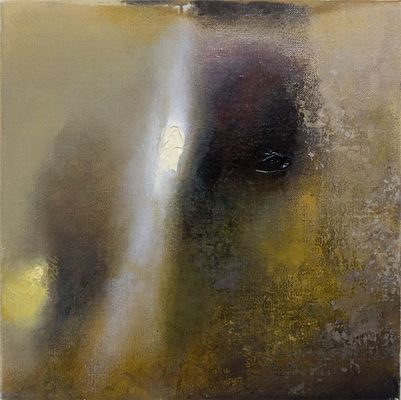
I am not a great reader of poetry but I always return to the work of Melbourne poet, Vincent Buckley (1925- 1988). Perhaps I find his most tantalising piece to be not a finished poem but a fragment left on a scrap of paper discovered on his desk after the poet’s death.
The poetry gathers like oil
In the word-core, and spreads
It has its music meet,
Its music is in movement.
This fragment is more the shell left behind from a volatile thought than a finished poem. I find the last two lines honest but awkward whereas the first two lines work like an arrow. Most likely he could not find a resolution so it was left. Still, in its present form, it remains an eloquent testimony to the ultimate failure of a medium to express mobile thought and sensation, in Buckley’s case, through verbal language. It’s an important matter because this is something all artists have to deal with regardless of the medium.
I have never written a poem, however, I am forever copying fragments from books on paper scraps in a vain effort to fix certain notions in my head. At first, they function as bookmarks that are sometimes returned to when I open the book. But before long, as they accumulate, they fall out littering the table interspersed with A4 photocopies, bills, books and medications.
To return to Buckley’s fragment, the first two lines very much evoke how I paint nowadays. As you age, detail diminishes and patches of light become more luminous and float. I feel the most honest way of dealing with this is by smearing the oil paint on the canvas with the fingers and working close-up, blind. Only if the patches coalesce into an approaching image can the work gain a life.
-
Jonathan Walker was born in Melbourne, Australia and brought up on a dairy farm in Gippsland. In the 1970’s he studied painting at RMIT and won the Harold Wright Scholarship to the British Museum, London. During the 1980’s he exhibited at Pinacotheca Gallery, Richmond and had work shown at the NGV and Heidi City Art Gallery. Over the same period he designed the cover for the “Epigenesi” LP by Giancarlo Toniutti, Italy and conducted a mail exchange work with Achim Wollscheid, Germany. The work with artists through the post resulted in an article published in the bicentenary issue of Art and Australia 1988. He showed in artist run spaces such as WestSpace in the 90’s and 2000’s, and until 2012, taught painting at Victoria University, which is where we (Colleen Ahern and Lisa Radford) as organisers of the exhibition, among many others, had the privilege of being his student.
Walker’s knowledge was imparted to students through the careful selection of music, literature, and artists found in books that he himself had ordered for the library. Walker’s strategy was the generosity of sharing his vast knowledge with references specific to each student and their context.
Walker’s paintings share a similar focus and intimacy.
This exhibition presents a small selection of recent paintings alongside a publication that includes Walker’s writing. Observational and analytical, Walker’s work is a type of material notation — the time of day, colour and how it is blended, the both specific and fleeting location of a reflection on lino or the question of whether a chair leg should be included in a painting.
Please join us on Friday August 21 between 6-8pm to celebrate the opening of the exhibition.
Curated by Colleen Ahern and Lisa Radford.
B. Wurtz
Curated by Nic Tammens
March 26 - April 4, 2015
B.Wurtz works from a basement studio in his home on Manhattan’s Lower East Side.
This local fact is attested to by the plastic shopping bags and newsprint circulars that appear in his work. As formal objects, they don’t make loud claims about their origins but nonetheless transmit street addresses and places of business from the bottom of this long thin island. Like plenty of artists, Wurtz is affected by what is local and what is consumed. His work is underpinned by this ethic. It often speaks from a neighborhood or reads like the contents of a hamper:
“BLACK PLUMS $1.29 lb.”
“Food Bazaar”
“USDA Whole Pork Shoulder Picnic 99c lb.”
“RITE AID Pharmacy, with us it’s personal.”
“H. Brickman & Sons.”
“Sweet Yams 59c lb."
Most of the work in this exhibition was made while the artist was in residence at Dieu Donne, a workshop dedicated to paper craft in Midtown. Here Wurtz fabricated assemblages with paper and objects that are relatively lightweight, with the intention that they would be easily transportable to Australia. This consideration isn’t absolute in Wurtz’s work, but was prescriptive for making the current exhibition light and cheap. Packed in two boxes, these works were sent from a USPS post office on the Lower East Side and delivered to North Melbourne by Australia Post.
Wurtz appears courtesy of Metro Pictures, New York.
Thanks to Rob Halverson, Joshua Petherick, Sari de Mallory, Matt Hinkley, Helen Johnson, Fayen d'Evie, Ask Kilmartin, Lisa Radon, Ellena Savage, Yale Union, and "Elizabeth".
John Nixon
"Archive"
December 15 - January 20, 2014
The presentation of John Nixon's archive offered a rare showcase of this extensive collection of the artist's own publications, catalogues, posters, ephemera, editions and more, from the mid 1980s onwards, alongside a selection of his artworks.
Organized by John Nixon, Joshua Petherick and Matt Hinkley.
<a href=http://wfb.public-office.info/artist/john-nixon>All titles by John Nixon
"Habitat"
at Minerva, Sydney (organised by Joshua Petherick and Matt Hinkley)
November 15 - December 20, 2014
Lupo Borgonovo, Janet Burchill & Jennifer McCamley,
Lewis Fidock, HR Giger, Piero Gilardi, Veit Laurent Kurz,
Cinzia Ruggeri, Michael E. Smith, Lucie Stahl, Daniel Weil, Wols
Press Release:
“...It contained seven objects. The slender fluted bone, surely formed for flight, surely from the wing of some large bird. Three archaic circuitboards, faced with mazes of gold. A smooth white sphere of baked clay. An age-blackened fragment of lace. A fingerlength segment of what she assumed was bone from a human wrist, grayish white, inset smoothly with the silicon shaft of a small instrument that must once have ridden flush with the surface of the skin - but the thing’s face was seared and blackened.”
William Gibson, “Count Zero”, 1986
"Autumn Projects Archive"
Curated by Liza Vasiliou
March 6 - March 15, 2014
World Food Books, in conjunction with the Virgin Australia Melbourne Fashion Festival 2014, presented the Autumn Projects archive, consisting of a selection of early examples in Australian fashion with a particular interest in collecting designers and labels from the period beginning in the 1980’s, who significantly influenced the discourse of Australian Fashion.
Curated by Liza Vasiliou, the exhibition provided a unique opportunity to view pieces by designers Anthea Crawford, Barbara Vandenberg, Geoff Liddell and labels CR Australia, Covers, Jag along with early experimental collage pieces by Prue Acton and Sally Browne’s ‘Fragments’ collection, suspended throughout the functioning World Food Books shop in Melbourne.
H.B. Peace
presented by CENTRE FOR STYLE
November 14, 2013
"Hey Blinky, you say chic, I say same"
Anon 2013
H.B. Peace is a clothing collaboration between great friends Blake Barns and Hugh Egan Westland. Their pieces explore the divergences between 'character’ and ‘personality’ in garments....etc
Special Thanks to Joshua Petherick and Matt Hinkley of WFB and Gillian Mears
and a Very Special Thank you to Audrey Thomas Hayes for her shoe collaboration.
Janet Burchill & Jennifer McCamley
"Aesthetic Suicide"
May 10 - June 8, 2013
The first of our occasional exhibitions in the World Food Books office/shop space in Melbourne, "Aesthetic Suicide" presented a body of new and older works together by artists Janet Burchill & Jennifer McCamley, including videos, prints, a wall work, and publications.
During shop open hours videos played every hour, on the hour.
2018, English
Softcover, 152 pages, 11 x 18 cm
Published by
Strelka / Moscow
$28.00 $15.00 - Out of stock
Digital Tarkovsky is an extended poetic exploration of how our experiences of visual entertainment and time itself are changing in the era of the smartphone and near-constant connection. The essay applies the ‘slow’ cinematic art of Andrei Tarkovsky to our interaction with the digital, visual reality of screens and interfaces. Digital Tarkovsky is a way of tracing what cinema, storytelling and time mean in our platform-based world.
In the US, an adult on average spends two hours and 51 minutes on their smartphone every day. That is eight minutes longer than Andrei Tarkovsky’s film Stalker.
We’re not interested in telling you to put your phone down and start paying attention to the real world. Instead, we want to investigate the kind of experience we have whilst staring at these tiny screens and the digital platforms that inhabit them. We are interested in calling this something other than smartphone addiction. We are interested in calling it cinema.
The work of Metahaven consists of filmmaking, writing, design, and installations, and is united conceptually by interests in poetry, storytelling, digital superstructures, and propaganda. Films by Metahaven include The Sprawl (Propaganda about Propaganda) (2015), Information Skies (2016), Possessed (2018, with Rob Schröder), Hometown (2018) and Eurasia (Questions on Happiness) (2018). Publications include PSYOP (2018), Black Transparency (2015) and Uncorporate Identity (2010). Their work is screened, published, and exhibited worldwide.
2019, English
Softcover, 134 pages, 11 x 18 cm
Published by
Strelka / Moscow
$24.00 $10.00 - In stock -
Introduction to Comparative Planetology presents an intertwined analysis of visual cultures of imagining the Earth and geopolitics of climate emergency. It compares different "figures" of the planet – the Planetary, the Globe, the Terrestrial, Earth-without-us and Spectral Earth – in order to assess their geopolitical implications. These implications are then mapped on respective prospects of these figures in developing an infrastructural space for planetary coordination of our design interventions against runaway global heating, and ultimately against mass species extinction.
2014, English
Softcover, 186 pages, 11 x 18 cm
Published by
Strelka / Moscow
$28.00 $10.00 - Out of stock
We live in an age of sticky problems, whether it's climate change or the decline of the welfare state. With conventional solutions failing, a new culture of decision-making is called for. Strategic design is about applying the principles of traditional design to "big picture" systemic challenges such as healthcare, education and the environment. It redefines how problems are approached and aims to deliver more resilient solutions. In this short book, Dan Hill outlines a new vocabulary of design, one that needs to be smuggled into the upper echelons of power. He asserts that, increasingly, effective design means engaging with the messy politics - the "dark matter"- taking place above the designer's head. And that may mean redesigning the organization that hires you.
2012, English
Hardcover (cloth-bound), 172 pages, 25 x 20 cm
1st UK Edition, Out of print title / as new
Published by
Standard Books / Oslo
$70.00 $50.00 - Out of stock
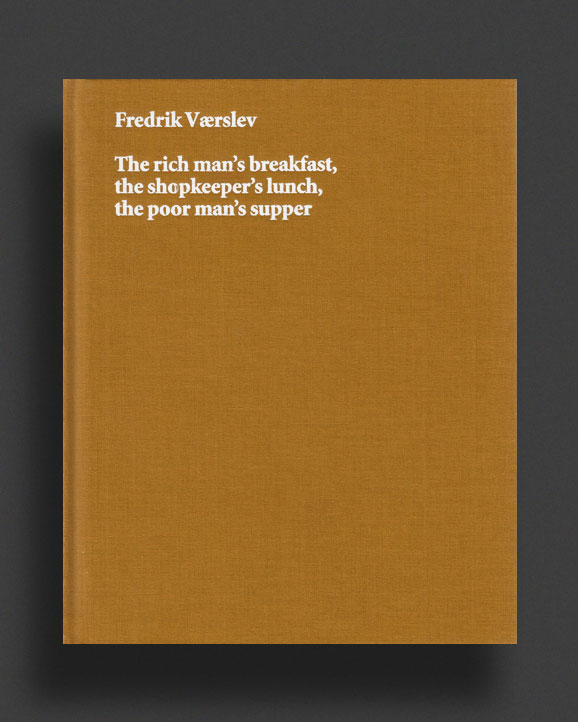
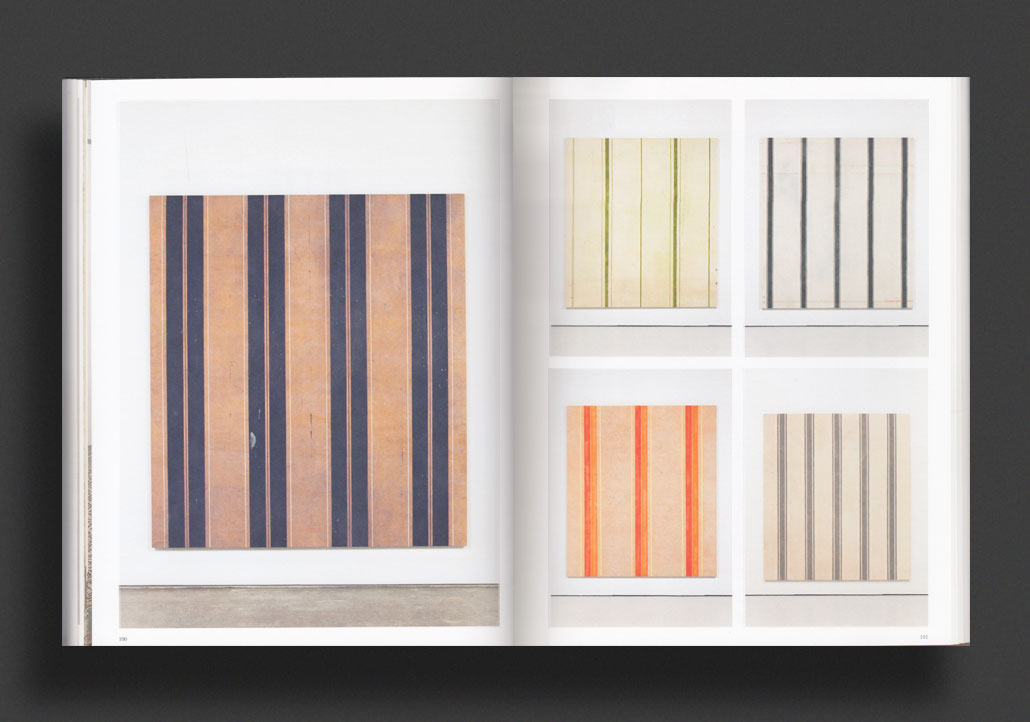
Profusely illustrated cloth-bound first edition of first major monograph on artist Fredrik Værslev, published by Standard (Oslo), with contributions by Nicolas Ceccaldi and Gertrud Sandqvist. One of the most original and recognised voices in contemporary painting, Norwegian artist Fredrik Værslev navigates between different pictorial traditions. In his practice, he focuses on the process of painting, demonstrating the possibilities and relevance of the medium today. Texts in English.
1980, German
Softcover, 140 pages, 26.8 x 22 cm
1st Edition, Out of print title / used / good
Published by
Ludwig Museum / Cologne
$65.00 - Out of stock
Catalogue published on the occasion of the Marcel Broodthaers major survey exhibition at Museum Ludwig, Cologne, October 4—November 26, 1980. Illustrated throughout in colour and b/w with the 128 exhibited objects, texts (in German) by Karl Ruhrberg, Evelyn Weiss, Michael Compton, Pierre Restany, Jürgen Harten, Gerhard Kohlberg.
Good copy with some cracking to top of spine.
2012, English
Hardcover, 404 pages, 21.6 x 26.2 cm
Published by
Ediciones Polígrafa / Barcelona
$150.00 - Out of stock
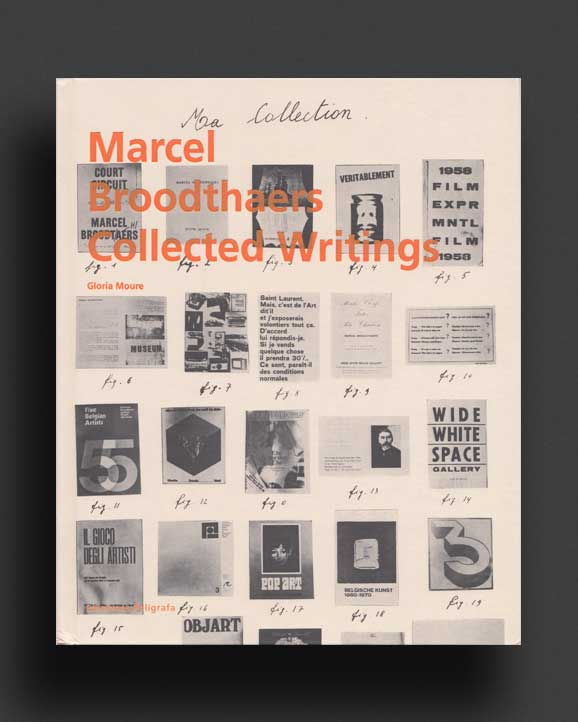
"I, too, asked myself if I could not sell something and succeed in life... Finally the idea of inventing something insincere came to me and I got to work immediately."
With this statement, penned for his first solo show in April, 1964, Marcel Broodthaers (1924-1976) announced his death as a poet and birth as an artist. In fact, he was to transform the category of artist completely, purging the vocation of its medium-specific implications to pursue a unified conceptualism across media such as artist's books, prints, film, installation, sculpture and writings-- "where the world of plastic arts and the world of poetry might possibly, I wouldn't say meet, but at the very frontier where they part." Broodthaers' "Museum of Modern Art, Eagles Department" (1968-1972) inaugurated the practice now known as institutional critique, and the linguistic foundations of his art--as well as his emphasis on printed multiples--also proved prescient for subsequent strains of Conceptual art. Edited by Gloria Moure in collaboration with the artist's estate, this momentous publication eclipses in its scope all previous Broodthaers monographs and writings collections. It gathers his early poetry, statements, critical essays both published and unpublished, open letters, interviews, preparatory notes and scripts alongside nearly 200 colour images in a massive and decisive presentation of the artists' postmedium art.
Marcel Broodthaers was born in Belgium in 1924. From the late 1940s to the early 1960s he worked primarily as a poet, and was a member of the Belgian Groupe Surrealiste-revolutionnaire, which included Andre Blavier, Achille Chavee and Rene Magritte. After almost two decades of poverty, Broodthaers performed a symbolic burial of his life as a poet by embedding 50 copies of his poetry collection Pense-Bete in plaster. However, his art continued to be characterized by its emphasis on written text. Broodthaers died in 1976, on his fifty-second birthday, and is buried in Brussels beneath a tomb of his own design that features images from his allegorical repertoire, including a pipe, a wine bottle and a parrot.
2022, English
Hardcover (clothbound), 168 pages, 25 x 19.6 cm
Published by
Pace / New York
$80.00 - Out of stock
Text by Agnes Martin, Durga Chew-Bose, Olivia Laing, Bruce Hainley, Andria Hickey, Marc Glimcher.
This handsomely designed, concise volume celebrates Agnes Martin’s pursuit of beauty, happiness and innocence in her nonobjective art created while living in the desert of New Mexico. From her multicolored striped works to compositions of color-washed bands defined by hand-drawn lines, to the deep gray Black Paintings that characterized her work in the late 1980s, Martin’s treatment of color in each of these phases is examined.
A particular emphasis is placed on the latter half of her career and the broadening vision that developed during her years working in the desert, which crystalized her quest to deepen her understanding of the essence of painting, unattached to emotion or subject, yet radiant and meditative in its pure abstraction.
With editorial contributions by a selection of writers whose cross-genre works span art writing, essay and memoir, this book expands an approach to Martin’s paintings beyond a purely art historical lens, bringing new voices into the conversations around her career, inviting a rediscovery of her enduring legacy. An essay by author Durga Chew-Bose provides a poetic exploration of color; the writer Olivia Laing (author of The Lonely City) discusses the nature of solitude in her text; and Bruce Hainley uses a 1974 essay by Jill Johnston as a jumping-off point to delve into Martin's life during her years in New Mexico.
2021, English
Softcover, 56 pages, 19 x 15 cm
Published by
Pilot Press / London
$24.00 - Out of stock
Now I Know, Daylight is the second in a new series of anthologies from London-based publisher Pilot Press seeking contemporary responses to works of art made during the AIDS crisis. In this second iteration, responses were sought to the 1981 painting 'Untitled No 1' (gesso, acrylic and pencil on canvas) by Agnes Martin.
Contributors, in order of appearance:
Sig Olson, Jean Chung, Natalie Stypa, Eduardo Viveiros, Katherine Franco, Kitti Klaudia Harmati, Kate Morgan, Declan Wiffen and Betsy Porritt, Ryan Skelton, Huw Lemmey, Kyle Griesmeyer, Alton Melvar M Dapanas, D Mortimer, Jack Bigglestone, Carlos Kong, Donna Marcus, Wilder Alison, Vanessa Walters
1993, English / German
Softcover, 176 pages, 24 x 15 cm
Out of print title / used / very good
Published by
Hatje Cantz / Berlin
D.A.P. / New York
$290.00 - Out of stock
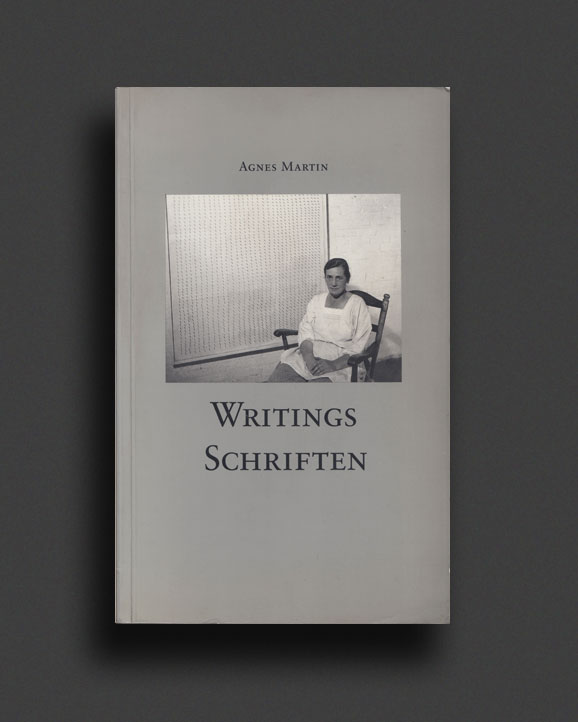
"I suggest that people who like to be alone, who walk alone, will perhaps be serious workers in the art field." — Agnes Martin.
Canadian-born American painter, Agnes Martin's (1912-2004) abstract works adhere to no catalogue of rules but appear instead as contemplative, intuitive signs. Her "floating abstractions," in which lines and free bands of colour emerge almost imperceptibly, can be reproduced only with difficulty. Her writings, on the other hand--although certainly not intended as programmatic statements--offer valuable clarity regarding her own works and poetic insight about art in general.
Since its original publication in 1991, this collectable volume of Martin's writings has been a fundamental document for libraries of artists, collectors, and critics. Rather than identifying herself with her Minimalist peers, Martin has aligned herself with the ancient Greeks, Egyptians, and Chinese, asserting that "the function of art work is . . . the renewal of memories of moments of perfection." In combination with illustrations of her works, these texts--including lectures, stories recorded by critic Ann Wilson, passages ostensibly arranged in associative sequences, and "fragmentary ideas"--form an eloquent artist's statement by the creator of "silent paintings."
Edited by Dieter Schwarz. Text in English and German. Published on the occasion of the exhibition "Agnes Martin : Paintings and Works on Paper, 1960 - 1989," held at the Kunstmuseum Winterthur, January 19 - March 15, 1992.
Very Good copy of the scarce bi-lingual English/German 1993 edition, with only light edge wear.
1973, English
Hardcover (w. dust jacket), 180 pages, 22 x 15 cm
1st Edition, Out of print title / used / very good
Published by
Thames and Hudson / London
$45.00 - Out of stock
First 1973 hardcover edition of this English study on Dutch/Netherlandish fantastic painter Hieronymus Bosch (1450—1516). No one can look at the paintings of Hieronymus Bosch without amazement and bewilderment. Professor Gibson shows that what seems inexplicable to us today "the canvases full of torture, monsters, and leering devils" was perfectly intelligible to the fifteenth-century viewer. The subjects of Bosch's paintings were in fact the overwhelming concerns of late medieval Europe: the Last Judgment, original sin, death, temptations of the flesh. The author describes each picture in detail, placing each work within the context of medieval folklore and religion, and explains that many of the acts portrayed in the pictures were visual translations of verbal puns or metaphors.
Hieronymus Bosch (1450—1516) was a Dutch/Netherlandish painter from Brabant. He is one of the most notable representatives of the Early Netherlandish painting school, his work, generally oil on oak wood, mainly contains fantastic illustrations of religious concepts and narratives. His pessimistic fantastical style cast a wide influence on northern art of the 16th century, with Pieter Bruegel the Elder being his best-known follower. Within his lifetime his work was collected in the Netherlands, Austria, and Spain, and widely copied, especially his macabre and nightmarish depictions of hell. Little is known of Bosch's life. He spent most of it in the town of 's-Hertogenbosch, where he was born in his grandfather's house. Today, Bosch is seen as a hugely individualistic painter with deep insight into humanity's desires and deepest fears. Attribution has been especially difficult; today only about 25 paintings are confidently given to his hand along with eight drawings. About another half-dozen paintings are confidently attributed to his workshop. His most acclaimed works consist of a few triptych altarpieces, including The Garden of Earthly Delights.
Very Good copy in VG dust jacket.
1971, English
Hardcover (in illustrated slip-case), 124 pages, 21 x 19 cm
1st Edition, Out of print title / used / very good
Published by
Harcourt Brace Jovanovich Inc. / New York
$45.00 - Out of stock
Edited, designed, and printed in Japan in 1971, this beautiful, compact hardcover volume is one of the finest publications on the work of the late medieval Dutch-Flemish painters Hieronymus Bosch (1450 – 1516) and Pieter Bruegel The Elder (1925-1530 – 1569). Bound in embossed, gilded and inlayed hardcover and housed in hard slip-case with front and back illustrations by Bosch and Bruegel, respectively, this volume is profusely illustrated throughout in colour and b/w, opening with a generous chapter of colour plates and fold-out panels of work by both artists and closing with an historical text and illustrated study of the artists' respective work and their historical context at the crossroads of the Northern European Middle Ages becoming the Renaissance. Also includes a duel-chronology. Published by Harcourt College, New York. All texts in English.
Very Good copy preserved in Good slipcase (w. light edge wear). Both still in original printers plastic jackets.
1984, German
Softcover (staple-bound), 38 pages, 28 x 23.5 cm
Ed. of 800,
1st Edition, Out of print title / used / very good
Published by
Zellermayer Galerie / Berlin
$45.00 - In stock -
Catalogue published in 1984 to accompany and document German artist Antonius Höckelmann's incredible aluminium foil sculptures produced between 1983—84, exhibited in survey at Zellermayer Galerie , Berlin. Illustrated throughout in colour with each work, accompanied by a short introduction text (German) and biography.
Edition of 800.
The basic material from which Höckelmann forms his sculptures is unusual: aluminum foil, which, when crumpled up, twisted and stretched, achieve amazing strength. In places, glue-soaked gauze strips are wound over it and colored with wax crayons. The artist forces his materials into the most unusual creeping movements. Forms that sometimes remind us of a gnarled tree seem strange to us at first; the aluminum foil, twisted together to form a volume, shows spiral formations that become labyrinthine furrows. And then the viewer may remember his own play with the silver foil of a cigarette pack lying around: If the bales and balls of thin foil do not result in miniature plastics, just big enough how they can be formed between the fingertips and further transformed and developed when a piece of foil is again twisted around existing thickenings? Seen in this way, Antonius Höckelmann's sculptures are "huge miniatures". As if under a magnifying glass, a whole new world emerges with unknown shapes and images never seen before. The big comes from the small, freed from all the obligations of dimensions.
Antonius Höckelmann (1937, Oelde—2000, Cologne ) was a German artist. Höckelmann trained as a wood sculptor in his hometown from 1951 to 1957 and studied from 1957 to 1961 at the University of Fine Arts in Berlin with Karl Hartung . His first gallery owner was the art dealer Michael Werner, who was also looked after by Galerie Zellermayer. He was later represented at various other galleries, such as Galerie Elke and Werner Zimmer, in Düsseldorf, Galerie Fred Jahn, Munich, De Weer Art Galerie, Outigem / Belgium or at Galerie Claude Samuel, Paris. In 1970 he moved to Cologne and studied at the Rolandseck train station near Bonn. In 1977 he took part in documenta 6, in 1982 in documenta 7 in Kassel, and in 1984 in the exhibition From Here - Two Months of New German Art in Düsseldorf. Many of his works combine sculpture and painting. Wooden sculptures and also sculptures made of other materials (bronze, silver foil, straw) were completely painted. Höckelmann died in 2000 at the age of 63 and was buried in Cologne's North Cemetery (Hall 22 No. 185).
Very Good copy.
1988, English
Softcover, 70 pages, 29 x 22 cm
1st Edition, Out of print title / used / very good
Published by
ICA / London
$65.00 - Out of stock
Scarce copy of Another Objectivity, catalogue published to accompany the major group exhibition at the Institute Of Contemporary Arts, London, 1988. Examining the work of 13 European and American photographers, the curators develop a definition of objectivity that emphasizes description as construction and the specificity of the photographic image. Profusely illustrated throughout with the work of photographers including Robert Adams, Bernd and Hilla Becher, Günther Förg, Hannah Collins, John Coplans, Jean-Louis Garnell, Craigie Horsfield, Suzanne Lafont, Thomas Struth, Patrick Tosani... Essay by curators Jean-François Chevrier and James Lingwood, and preface by Iwona Blazwick. Includes biographies of artists.
Very Good copy with some wear to cover edges.
1995, English
Softcover, 311 pages, 15.6 x 23.4 cm
1st Edition, Out of print title / used / very good
Published by
University of California Press / Berkley
$35.00 - In stock -
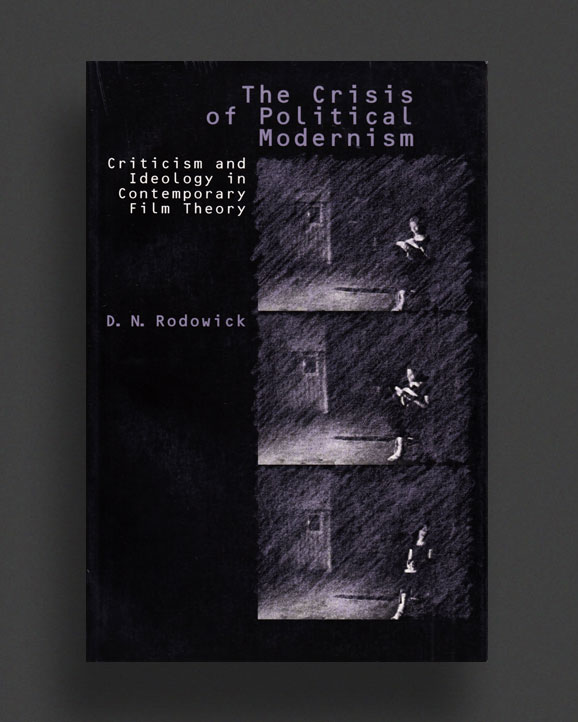
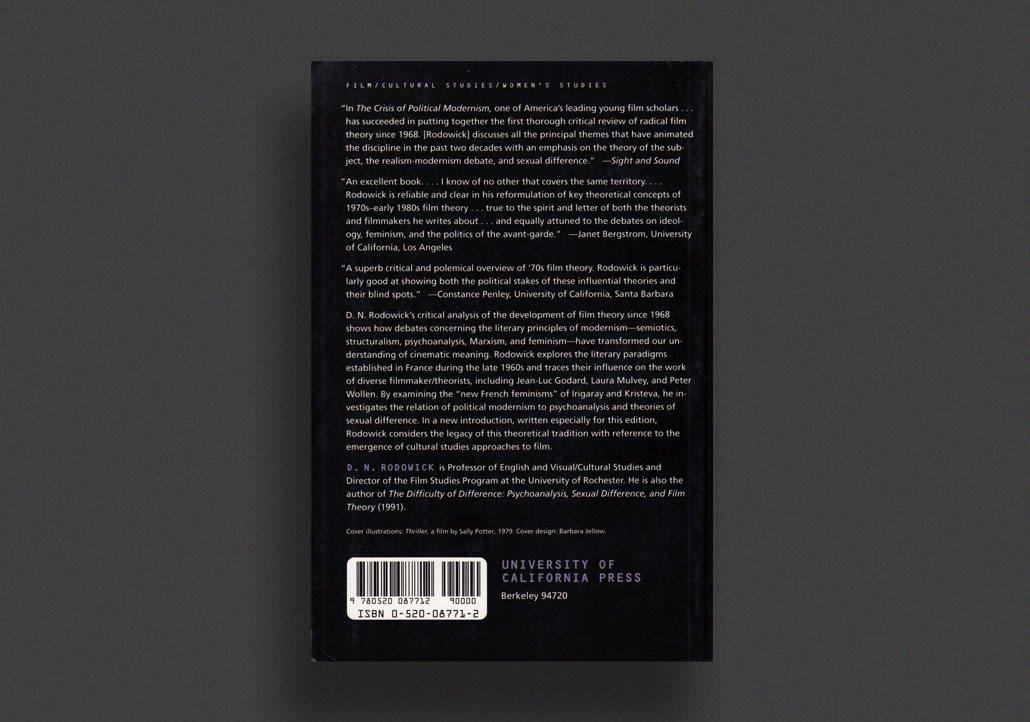
First 1995 paperback edition of The Crisis of Political Modernism : Criticism and Ideology in Contemporary Film Criticism. D.N. Rodowick offers a critical analysis of the development of film theory since 1968. He shows how debates concerning the literary principles of modernism—semiotics, structuralism, psychoanalysis, Marxism, and feminism—have transformed our understanding of cinematic meaning. Rodowick explores the literary paradigms established in France during the late 1960s and traces their influence on the work of diverse filmmaker/theorists including Jean-Luc Godard, Peter Gidal, Laura Mulvey, and Peter Wollen. By exploring the "new French feminisms" of Irigaray and Kristeva, he investigates the relation of political modernism to psychoanalysis and theories of sexual difference. In a new introduction written especially for this edition, Rodowick considers the continuing legacy of this theoretical tradition in relation to the emergence of cultural studies approaches to film.
David Norman Rodowick is an American philosopher, artist, and curator. He is best known for his contributions to cinema and media studies, visual cultural studies, critical theory, and aesthetics and the philosophy of art.
First 1995 paperback edition.
1983, English
Softcover, 514 pages, 24 x 16 cm
Out of print title / used / average
Published by
Allen & Unwin / NSW
$40.00 - Out of stock
Scarce expanded 1983 edition of this history of the turbulent destiny of Kino ("film" in Russian), documenting the artistic development of the Russian and Soviet cinema and traces its growth from 1896 to the death of Sergei Eisenstein in 1948, authored by Jay Leyda, a veteran of three years in Soviet film schools and studios and a student of Eisentein. First published in 1960, this new 1983 edition features a new Postscript that surveys the directions taken by Soviet cinema since the end of World War II. Beginning with the Lumiere filming of the coronation of Tsar Nicholas II, Jay Leyda links Russia's pre-Revolutionary past with its Communist present through the observation of a major cultural phenomenon: the evolution of the Soviet film as an artistic and political instrument. The book contains 150 drawings and photographs and five appendices, including a list of selected Russian and Soviet films from 1907 to the present. An incredible resource on the subject.
"Certainly the most important appraisal of Russian film ever made in book form"—Theatre Arts
Average—Good copy of the expanded 1983 edition, with some cover wear, coffee marking to edges and a few pages, tanning.
1981, English
Softcover, 533 pages, 23.5 x 16.5 cm
Out of print title / used / good
$20.00 - Out of stock
Richard Gilman referred to How to Read a Film as simply "the best single work of its kind." And Janet Maslin in The New York Times Book Review marveled at James Monaco's ability to collect "an enormous amount of useful information and assemble it in an exhilaratingly simple and systematic way." Indeed, since its original publication in 1977, this hugely popular book has become the definitive source on film and media. Monaco looks at film from many vantage points, as both art and craft, sensibility and science, tradition, and technology.
James Monaco is a writer, journalist, and producer. He is the author of American Film Now, The New Wave, and Alain Resnais.
Good copy of 1981 edition, with some general wear.
1971, English
Hardcover, 97 pages, 25 x 29 cm
1st Edition, Out of print title / used / very good
Published by
Edizioni 0 / Milan
$100.00 - Out of stock
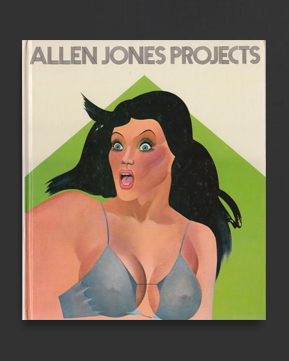
First edition of "Projects", the fantastic 1971 hardcover artist book by British Pop artist Allen Jones.
Designed and typeset by Jones, in collaboration with Roy Walker and Anthony Matthews, this lavish hardcover book is heavily illustrated throughout (primarily in vivid colour) with photographs, drawings, video excerpts and montages by Jones. Five of Allen Jones' costume/set design/art direction projects are covered in this book, including his work for opera (Mozart's "The Abduction from the Seraglio"), film ("The Playroom" and "A Clockwork Orange"), stage (two sequences from "Oh Calcutta!") and television ("Männer Wir Kommen"). "The text has been researched and transcribed from taped interviews with Allen Jones by Ruth Messina and Bonne Boston."
Allen Jones (b. 1 September 1937) is a British pop artist, best known for his sculptures, paintings, drawings, and work in set and costume design for film and theatre.
Jones’ exhibitions of erotic sculptures, such as the set Chair, Table and Hat Stand (1969), are studies in forniphilia, which turn women into items of human furniture. Much of his work draws on the imagery of rubber fetishism and BDSM. The sculptures in the Korova Milk Bar from the 1971 film A Clockwork Orange were based on works by Jones after he turned down the request by Stanley Kubrick to design the set for no payment. Jones designed Barbet Schroeder’s 1976 film Maîtresse.
Very Good copy, light water marking to end papers, not affecting content.
1994, English
Softcover, 316 Pages, 22.7 x 15.8 cm
1st Edition, Out of print title / used / very good
Published by
University of California Press / Berkley
$45.00 - Out of stock
Few twentieth-century thinkers have proven as influential as Walter Benjamin, the German-Jewish philosopher and cultural and literary critic. Richard Wolin's book remains among the clearest and most insightful introductions to Benjamin's writings, offering a philosophically rich exposition of his complex relationship to Adorno, Brecht, Jewish Messianism, and Western Marxism. Wolin provides nuanced interpretations of Benjamin's widely studied writings on Baudelaire, historiography, and art in the age of mechanical reproduction. In a new Introduction written especially for this edition, Wolin discusses the unfinished Arcades Project, as well as recent tendencies in the reception of Benjamin's work and the relevance of his ideas to contemporary debates about modernity and postmodernity.
Very Good copy.
1972, English
Softcover, 254 pages
Out of print title / used / very good
Published by
Paladin / US
$28.00 - Out of stock
Paladin 1972 edition of Melbourne writer Germaine Greer's The Female Eunuch, first published in 1970. A worldwide bestseller, translated into over twelve languages, The Female Eunuch is a landmark in the history of the women’s movement. Drawing liberally from history, literature and popular culture, past and present, Germaine Greer’s searing examination of women’s oppression is at once an important social commentary and a passionately argued masterpiece of polemic. Probably the most famous, most widely read book on feminism ever.
Germaine Greer (b. 1939, Melbourne) is an Australian writer and public intellectual, regarded as one of the major voices of the radical feminist movement in the latter half of the 20th century. She also published under the pseudonym Dr. G (for Oz magazine), Rose Blight (for Private Eye), and Earth Rose (for Suck magazine).
Very Good copy, some light wear.
1989, English
Softcover, 300 pages, 17 x 10.5 cm
1st Edition, Out of print title / used / very good
Published by
Popular Library / New York
$70.00 - Out of stock
First edition of Adulthood Rites, the second novel in Octavia E. Butler's Xenogenesis trilogy, published in 1989.
From the award-winning author of Parable of the Sower: After the near-extinction of the human race, one young man with extraordinary gifts will reveal whether the human race can learn from its past and rebuild their future . . . or is doomed to self-destruction.
In the future, nuclear war has destroyed nearly all humankind. An alien race intervenes, saving the small group of survivors from certain death. But their salvation comes at a cost.
The Oankali are able to read and mutate genetic code, and they use these skills for their own survival, interbreeding with new species to constantly adapt and evolve. They value the intelligence they see in humankind but also know that the species-rigidly bound to destructive social hierarchies-is destined for failure. They are determined that the only way forward is for the two races to produce a new hybrid species - and they will not tolerate rebellion.
Akin looks like an ordinary human child. But as the first true human-alien hybrid, he is born understanding language, then starts to form sentences at two months old. He can see at a molecular level and kill with a touch. More powerful than any human or Oankali, he will be the architect of both races' future. But before he can carry this new species into the stars, Akin must reconcile with his own heritage in a world already torn in two.
Octavia Estelle Butler (1947-2006) was an American science fiction writer, one of the best-known among the few African-American women in the field. She won both Hugo and Nebula awards. In 1995, she became the first science fiction writer to receive the MacArthur Foundation "Genius" Grant.
Very Good copy of the 1989 first edition.
2010, English
Softcover, 144 pages, 21 x 21 cm
1st Edition, Out of print title / as new
Published by
ACCA / Melbourne
$65.00 - Out of stock
Out of print catalogue published to accompany Peter Cripps: Towards an Elegant Solution, ACCA, Melbourne, June 8—25, 2010, a comprehensive survey of over 40 years of the artist's practice. Peter Cripps' work, comprised of objects, performances, sculptures and installations, is part of the trajectory of minimalist derivations in Australian art practice. Cripps refers to his minimalist approach as reductivist. His elegant forms interrogate the intersections between art, design and museum display, while his installations and 'plays' implicate the viewer in an active historical dialogue.
Towards an Elegant Solution unfolds as a sequential series of displays, twice changing during the exhibition's season at ACCA. This evolution permits a sense of development within Cripps' own practice and establishes a mimetic relationship to the exhibition behaviour of the 'gallery' which is central to Cripps' own theoretical interests.
ACCA also presents the first, full scale realisation of Peter Cripps' Public Projects works on its exterior forecourt. These sculptural towers are situated in conversation with the urban forms of architecture, industry and art that make up the built environment of ACCA.
Lavishly illustrated, this publication includes commissioned and republished essays and articles that add knowledge and interpretation about Cripps' practice, and the context in which, and from which he has developed his ideas. New texts from Rebecca Coates, Carolyn Barnes, Ann Stephen; republished essays by Margaret Plant, Robery Lingard, Peter Cripps, Carolyn Barnes, and John Barrett-Lennard.
As New copy.
1993, English
Softcover, 270 pages, 22.9 x 15.2 cm
1st Edition, Out of print title / used / good
Published by
Routledge / London
$35.00 - In stock -
First Routledge edition published in 1993, cover art by Remedios Varo.
"Ethics, Politics and Difference in Julia Kristeva's Writing" aims to be a valuable intervention in Kristevan scholarship, and a significant contribution in its own right to post-structuralist considerations of ethical and political agency and practice. The essays in this collection examine Kristeva's contributions to the project of creating an alternative ethical political agency. Post-structuralist critiques have transformed the ways in which we think about the subject, but they have failed to provide any satisfactory alternative when we think of ethical or political agency. Without such an alternative, theoretical accounts of emancipatory practices appear to be in jeopardy. Contributors to this collection explore Julia Kristeva's work and assess how helpful her theories can be in attempting to construct a post-structuralist ethics.
Contributors: Judith Butler, Tina Chanter, Marilyn Edelstein, Jean Graybeal, Suzanne Guerlac, Alice Jardine, Lisa Lowe, Noelle McAfee, Norma Claire Moruzzi, Kelly Oliver, Tilottma Rajan, Jacqueline Rose, Allison Weir, Mary Bittner Wiseman, Ewa Ziarek
Kelly Oliver (b. 1958) is an American philosopher specializing in feminism, political philosophy and ethics. She is W. Alton Jones Professor of Philosophy at Vanderbilt University in Nashville, Tennessee. She is also a founder of the feminist philosophy journal philoSOPHIA.
Julia Kristeva (b. 1941) is a Bulgarian-French philosopher, literary critic, semiotician, psychoanalyst, feminist, and, most recently, novelist, who has lived in France since the mid-1960s. She has taught at Columbia University, and is now a professor emerita at Université Paris Cité.
Good copy, corner/edge wear, some light lead-pencil marginalia (easily erased).
1974, English
Softcover, 222 pages, 18 x 11 cm
1st Edition, Out of print title / used / average
Published by
Penguin Books / London
$20.00 - Out of stock
Pelican 1974 edition of Peter Gay's Weimer Culture, with cover depicting 'The "Brücke" Group' by Ernst Ludwig Kirchner, 1926—1927.
The Weimar Republic, 'an idea seeking to become reality', has passed into legend as the era of the Bauhaus, Dada, The Cabinet of Dr Caligari, The Three penny Opera and much more. Its fifteen years of life, linking the demoralizing collapse of Imperial Germany with the arrival of the Nazis, encompassed vast intellectual and artistic achievements; the extraordinary richness of Weimar culture is evidenced by what Peter Gay calls the 'dazzling array' of exiles who left Germany after 1933 — Einstein, Freud, Mann, Panofsky, Brecht, Gropius, Grosz, Kandinsky, Max Reinhardt and Bruno Walter.
First published in 1968, Weimar Culture is the first overall study of the phenomenon and one of the masterworks of Peter Gay's distinguished career. A study of German culture between two wars, the book brilliantly traces the rise of the artistic, literary, and musical culture that bloomed ever so briefly in the 1920s amid the chaos of Germany's tenuous post-World War I democracy, and crashed violently in the wake of Hitler's rise to power. Despite the ephemeral nature of the Weimar democracy, the influence of its culture was profound and far-reaching, ushering in a modern sensibility in the arts that dominated Western culture for most of the twentieth century. Professor Gay's scholarly and readable account illuminates not only the exuberant creativity of the period, but also its darker side, haunted by 'anxiety, fear, a rising sense of doom'. His book also includes a short political history of the Republic and a comprehensive bibliography.
"An excellent introduction to a neglected topic, full of flashes of insight"—New Society
Average copy with wear, loose binding.
1978, English
Softcover, 160 pages, 18 x 11 cm
Out of print title / used / good
Published by
Penguin Books / London
$60.00 - Out of stock
First 1978 Penguin English edition of Alfred Döblin's modern masterpiece, Berlin Alexanderplatz, with scarce cover depicting "Morder Hoffnung der Frauen" Ill by Oskar Kokoschka, 1909. First published in 1929.
Alfred Döblin's Berlin Alexanderplatz was part of the heady flowering of Weimar culture. It describes the grimy street life of Berlin in the last years of the republic, when the Nazi gangs were growling in the background and poverty stalked the streets.
"Berlin Alexanderplatz, the parodic, picaresque tale of an ex-murderer's progress through underworld Berlin, surviving disaster after disaster to achieve a kind of exhausted rebirth at the end, was much influenced by Ulysses... it is a violent, funny book, with an enormous, almost freakish range"—Michael Ratcliffe in The Times
"Alexanderplatz is one of the great experimental fictions of the first half of our century, the German equivalent of Ulysses and Dos Passos' U.S.A."—Time Out
Bruno Alfred Döblin (1878—1957) was a German novelist, essayist, and doctor, best known for his novel Berlin Alexanderplatz. A prolific writer whose œuvre spans more than half a century and a wide variety of literary movements and styles, Döblin is one of the most important figures of German literary modernism.
Good copy with tanning and wear.