World Food Books' programme is largely produced on Kulin Nation land. We acknowledge the Wurundjeri people of the Kulin Nation as the first and continuing custodians of this land, and pay respect to their Elders past, present, and emerging.
World Food Books is an arts and special interests bookshop in Naarm / Melbourne. Founded in 2010, World Food Books is devoted to the presentation of a rotating, hand-selection of international art, design, literary and counterculture publications with an emphasis on the anti-traditional, the experimental, the avant-garde, the heretic, the marginal.
Presenting new titles alongside rare and out-of-print books, catalogues and journals spanning the fields of modern and contemporary art, design, photography, illustration, film, literature, poetry, cultural theory, philosophy, sexuality, popular and underground culture in its many radical forms, World Food Books wishes to encourage adventurous, thoughtful and open-minded reading, looking, writing, and exchange of publishing and ideas, both current and historical.
As well as our bookshop, located in Melbourne's historical Nicholas Building, all of our inventory is available internationally via our online mail-order service.
World Food Books semi-regularly co-ordinates "Occasions", a programme of exhibits and events at the bookshop and in partnership with other hosts (such as museums and art galleries) that develop out of the activities, relationships and content of the bookshop itself.
World Food Books
The Nicholas Building
37 Swanston Street
Room 5, Level 6
Melbourne 3000
Australia
SHOP HOURS:
Thu–Fri 12–6, Sat 12–5
WEB-SHOP OPEN 24/7
World Food Books
Postal Address:
PO Box 435
Flinders Lane
Victoria 8009
Australia
Art
Theory / Essay
Architecture / Interior
Graphic Design / Typography
Photography
Fashion
Eros
LGBTQ+
Fiction / Poetry
Weird / Speculative / Science Fiction / Horror
Transgressive / Visceral / Abject
Symbolism / Decadence / Fin de siècle
Film / Video
Painting
Sculpture / Installation
Performance / Dance / Theater
Drawing
Sound / Music
Curatorial
Group Shows / Collections
Periodicals
Out-of-print / Rare
Posters / Ephemera / Discs
Signed Books
World Food Books Gift Voucher
World Food Book Bag
Australian Art
Australian Fiction
Australian Science Fiction / Speculative Fiction
Australian Poetry
Australian Photography
Japanese Photography
Conceptual Art
Minimal Art
Dada
'Pataphysics / Oulipo
Fluxus
Concrete Poetry
Pop Art
Surrealism
Arte Povera
Arte Informale / Haute Pâte / Tachism
Nouveau Réalisme / Zero / Kinetic
Situationism / Lettrism
Collage / Mail Art / Xerox Art
Art Brut / Folk / Visionary / Fantastic
Illustration / Graphic Art / Bandes Dessinées
Furniture
Italian Radical Design / Postmodernism
Textiles
Ceramics / Glass
Counterculture
Protest / Revolt
Philosophy
Psychoanalysis
Anthropology
Anarchism
Socialism / Anarchism / Communism / Capitalism
Literary Theory / Semiotics / Language
Feminism / Women's Studies
Gender Studies / Sexuality
Anthropology
Fetishism / BDSM
Drugs / Psychedelia
Crime / Violence
Animal Rights / Veganism
Occult / Esoterica
Ecology / Earth / Alternative Living
Whole Earth / Crafts
All prices in AUD (Australian dollars)
Pick-Ups
Pick-up orders can be collected in our bookshop during opening hours after order date. Please collect any Pick-up orders within 2 weeks of ordering as we have limited storage space. Orders will be released back into stock if not collected within this time. No refunds can be made for pick-ups left un-collected. If you cannot make it in to the bookshop in this time-frame, please choose postage option.
Return Policy
All sales are final. We do accept returns (for refund or exchange) for items received in error. All our orders are packed with special care using heavy-duty padding and cardboard book-mailers or bubble mailers (for smaller books), using reinforcement where required. We cannot take responsibility for any lost, stolen or damaged parcels.
Insurance
Should you wish to insure your package, please email us directly after placing your order and we can organise this at a small extra expense. Although all standard/express tracked packages are very safe and dependable, we cannot take responsibility for any lost, stolen or damaged parcels. We recommend insurance on valuable orders.
Interested in selling your old books, catalogues, journals, magazines, comics, fanzines, ephemera? We are always looking for interesting, unusual and out-of-print books to buy. We only buy books in our fields of interest and specialty, and that we feel we can resell.
We base these prices on desirability, market value, in-print prices, condition and our current stock levels. We offer cash, store credit, and can take stock on consignment. All
about 25% of the price we expect to get when we sell them, or 30% in store credit. We base these prices on desirability, market value, in-print prices, condition and our current stock levels.
Sell your books any day of the week. You can drop them off and return later. If you have a lot of books, we can visit your Sydney home.
We buy books that we feel we can resell. We offer about 25 % of the price we expect to get when we sell them, or 30% in store credit. We base these prices on desirability, market value, in-print prices, condition and our current stock levels.
Philadelphia Wireman
03 August - 01 September, 2018
World Food Books is proud to announce our next Occasion, the first presentation of sculptures by Philadelphia Wireman in Australia.
The Philadelphia Wireman sculptures were found abandoned in an alley off Philadelphia’s South Street on trash night in 1982. Their discovery in a rapidly-changing neighbourhood undergoing extensive renovation, compounded with the failure of all attempts to locate the artist, suggests that the works may have been discarded after the maker’s death. Dubbed the "Philadelphia Wireman" during the first exhibition of this work, in 1985, the maker’s name, age, ethnicity, and even gender remain uncertain. The entire collection totals approximately 1200 pieces, all intricately bound together with tightly-wound heavy-gauge wire (along with a few small, abstract marker drawings, reminiscent both of Mark Tobey and J.B. Murry). The dense construction of the work, despite a modest range of scale and materials, is singularly obsessive and disciplined in design: a wire armature or exoskeleton firmly binds a bricolage of found objects including plastic, glass, food packaging, umbrella parts, tape, rubber, batteries, pens, leather, reflectors, nuts and bolts, nails, foil, coins, toys, watches, eyeglasses, tools, and jewellery.
Heavy with associations—anthropomorphic, zoomorphic, and socio-cultural responses to wrapped detritus—the totemic sculptures by Philadelphia Wireman have been discussed in the context of work created to fulfil the shamanistic needs of alternative religions in American culture. Curators, collectors, and critics have variously compared certain pieces to sculpture from Classical antiquity, Native American medicine bundles, African-American memory jugs, and African fetish objects. Reflecting the artist’s prolific and incredibly focused scavenging impulse, and despite—or perhaps enhanced by—their anonymity, these enigmatic objects function as urban artefacts and arbiters of power, though their origin and purpose is unknown. Philadelphia Wireman, whatever their identity, possessed an astonishing ability to isolate and communicate the concepts of power and energy through the selection and transformation of ordinary materials. Over the course of the past two decades, this collection has come to be regarded as an important discovery in the field of self-taught art and vernacular art.
Presented in collaboration with Fleisher-Ollman Gallery, Philadelphia, and Robert Heald, Wellington.
Susan Te Kahurangi King
02 February - 10 March, 2018
Susan Te Kahurangi King (24 February 1951 - ) has been a confident and prolific artist since she was a young child, drawing with readily available materials - pencils, ballpoint pens and felt-tip markers, on whatever paper is at hand. Between the ages of four and six Susan slowly ceased verbal communication. Her grandparents William and Myrtle Murphy had developed a special bond with Susan so they took on caring responsibilities for extended periods. Myrtle began informally archiving her work, carefully collecting and storing the drawings and compiling scrapbooks. No drawing was insignificant; every scrap of paper was kept. The King family are now the custodians of a vast collection containing over 7000 individual works, from tiny scraps of paper through to 5 meter long rolls.
The scrapbooks and diaries reveal Myrtle to be a woman of great patience and compassion, seeking to understand a child who was not always behaving as expected. She encouraged Susan to be observant, to explore her environment and absorb all the sights and sounds. Myrtle would show Susan’s drawings to friends and people in her community that she had dealings with, such as shopkeepers and postal workers, but this was not simply a case of a grandmother’s bias. She recognised that Susan had developed a sophisticated and unique visual language and sincerely believed that her art deserved serious attention.
This was an unorthodox attitude for the time. To provide some context, Jean Dubuffet coined the term Art Brut in 1945 to describe work created by self-taught artists – specifically residents of psychiatric institutions and those he considered to be visionaries or eccentrics. In 1972 Roger Cardinal extended this concept by adopting the term Outsider Art to describe work made by non-academically trained artists operating outside of mainstream art networks through choice or circumstance. Susan was born in Te Aroha, New Zealand in 1951, far from the artistic hubs of Paris and London that Dubuffet and Cardinal operated in. That Myrtle fêted Susan as a self-taught artist who deserved to be taken seriously shows how progressive her attitudes were.
Susan’s parents Doug and Dawn were also progressive. Over the years they had consulted numerous health practitioners about Susan’s condition, as the medical establishment could not provide an explanation as to why she had lapsed into silence. Dawn educated herself in the field of homeopathy and went on to treat all twelve of her children using these principles – basing prescriptions on her observations of their physical, mental and emotional state.
Doug was a linguist with an interest in philosophy who devoted what little spare time he had to studying Maori language and culture. To some extent their willingness to explore the fringes of the mainstream made them outsiders too but it was their commitment to living with integrity and their respect for individuality that ensured Susan’s creativity was always encouraged.
Even though Susan’s family supported her artistic pursuits, some staff in schools and hospitals saw it as an impediment to her assimilation into the community and discouraged it in a variety of ways. Her family was not always aware of this and therefore did not fully understand why Susan stopped drawing in the early 1990s. However, rather than dwell on the challenges that Susan faced in pursuit of her artistic practice, they prefer to highlight her achievements. In 2008 Susan began drawing again in earnest, after an almost 20 year interruption, and her work is now shown in galleries around the world.
Susan grew up without television and has been heavily influenced by the comics she read as a child. She is absolutely fearless in the appropriation of recognizable characters, such as Donald Duck and Mickey Mouse, in her work. She twists their limbs, contorts their faces, compresses them together, blends them into complex patterned backgrounds - always imbuing them with an incredible energy. Although Susan often used pop culture characters in her work they are not naive or childlike. These are drawings by a brilliant self-taught artist who has been creating exceptional work for decades without an audience in mind.
Mladen Stilinović
"Various Works 1986 - 1999"
02 February 16 - September 10, 2016
Various works 1986 - 1999, from two houses, from the collections of John Nixon, Sue Cramer, Kerrie Poliness, Peter Haffenden and Phoebe Haffenden.
Including: Geometry of Cakes (various shelves), 1993; Poor People’s Law (black and white plate), 1993; White Absence (glasses, ruler, set square, silver spoon, silver ladel with skin photograph and wooden cubes), 1990-1996; Exploitation of the Dead (grey and red star painting, wooden painting, black spoon with red table, red plate), 1984-1990; Money and Zeros (zero tie, paintings made for friends in Australia (Sue, John, Kerrie), numbers painting), 1991-1992; Words - Slogans (various t-shirts) - “they talk about the death of art...help! someone is trying to kill me”, “my sweet little lamb”, “work is a disease - Karl Marx”; Various artist books, catalogues, monographs, videos; Poster from exhibition Insulting Anarchy; "Circular" Croatian - Australian edition; Artist book by Vlado Martek (Dostoyevsky); more.
Thanks to Mladen Stilinović and Branka Stipančić.
Jonathan Walker
Always Will Need To Wear Winter Shirt Blue + Ochre Small Check Pattern
21 August - 21 September, 2015
Untitled
I am not a great reader of poetry but I always return to the work of Melbourne poet, Vincent Buckley (1925- 1988). Perhaps I find his most tantalising piece to be not a finished poem but a fragment left on a scrap of paper discovered on his desk after the poet’s death.
The poetry gathers like oil
In the word-core, and spreads
It has its music meet,
Its music is in movement.
This fragment is more the shell left behind from a volatile thought than a finished poem. I find the last two lines honest but awkward whereas the first two lines work like an arrow. Most likely he could not find a resolution so it was left. Still, in its present form, it remains an eloquent testimony to the ultimate failure of a medium to express mobile thought and sensation, in Buckley’s case, through verbal language. It’s an important matter because this is something all artists have to deal with regardless of the medium.
I have never written a poem, however, I am forever copying fragments from books on paper scraps in a vain effort to fix certain notions in my head. At first, they function as bookmarks that are sometimes returned to when I open the book. But before long, as they accumulate, they fall out littering the table interspersed with A4 photocopies, bills, books and medications.
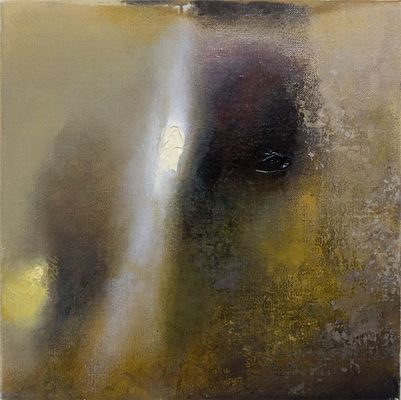
To return to Buckley’s fragment, the first two lines very much evoke how I paint nowadays. As you age, detail diminishes and patches of light become more luminous and float. I feel the most honest way of dealing with this is by smearing the oil paint on the canvas with the fingers and working close-up, blind. Only if the patches coalesce into an approaching image can the work gain a life.
-
Jonathan Walker was born in Melbourne, Australia and brought up on a dairy farm in Gippsland. In the 1970’s he studied painting at RMIT and won the Harold Wright Scholarship to the British Museum, London. During the 1980’s he exhibited at Pinacotheca Gallery, Richmond and had work shown at the NGV and Heidi City Art Gallery. Over the same period he designed the cover for the “Epigenesi” LP by Giancarlo Toniutti, Italy and conducted a mail exchange work with Achim Wollscheid, Germany. The work with artists through the post resulted in an article published in the bicentenary issue of Art and Australia 1988. He showed in artist run spaces such as WestSpace in the 90’s and 2000’s, and until 2012, taught painting at Victoria University, which is where we (Colleen Ahern and Lisa Radford) as organisers of the exhibition, among many others, had the privilege of being his student.
Walker’s knowledge was imparted to students through the careful selection of music, literature, and artists found in books that he himself had ordered for the library. Walker’s strategy was the generosity of sharing his vast knowledge with references specific to each student and their context.
Walker’s paintings share a similar focus and intimacy.
This exhibition presents a small selection of recent paintings alongside a publication that includes Walker’s writing. Observational and analytical, Walker’s work is a type of material notation — the time of day, colour and how it is blended, the both specific and fleeting location of a reflection on lino or the question of whether a chair leg should be included in a painting.
Please join us on Friday August 21 between 6-8pm to celebrate the opening of the exhibition.
Curated by Colleen Ahern and Lisa Radford.
B. Wurtz
Curated by Nic Tammens
March 26 - April 4, 2015
B.Wurtz works from a basement studio in his home on Manhattan’s Lower East Side.
This local fact is attested to by the plastic shopping bags and newsprint circulars that appear in his work. As formal objects, they don’t make loud claims about their origins but nonetheless transmit street addresses and places of business from the bottom of this long thin island. Like plenty of artists, Wurtz is affected by what is local and what is consumed. His work is underpinned by this ethic. It often speaks from a neighborhood or reads like the contents of a hamper:
“BLACK PLUMS $1.29 lb.”
“Food Bazaar”
“USDA Whole Pork Shoulder Picnic 99c lb.”
“RITE AID Pharmacy, with us it’s personal.”
“H. Brickman & Sons.”
“Sweet Yams 59c lb."
Most of the work in this exhibition was made while the artist was in residence at Dieu Donne, a workshop dedicated to paper craft in Midtown. Here Wurtz fabricated assemblages with paper and objects that are relatively lightweight, with the intention that they would be easily transportable to Australia. This consideration isn’t absolute in Wurtz’s work, but was prescriptive for making the current exhibition light and cheap. Packed in two boxes, these works were sent from a USPS post office on the Lower East Side and delivered to North Melbourne by Australia Post.
Wurtz appears courtesy of Metro Pictures, New York.
Thanks to Rob Halverson, Joshua Petherick, Sari de Mallory, Matt Hinkley, Helen Johnson, Fayen d'Evie, Ask Kilmartin, Lisa Radon, Ellena Savage, Yale Union, and "Elizabeth".
John Nixon
"Archive"
December 15 - January 20, 2014
The presentation of John Nixon's archive offered a rare showcase of this extensive collection of the artist's own publications, catalogues, posters, ephemera, editions and more, from the mid 1980s onwards, alongside a selection of his artworks.
Organized by John Nixon, Joshua Petherick and Matt Hinkley.
<a href=http://wfb.public-office.info/artist/john-nixon>All titles by John Nixon
"Habitat"
at Minerva, Sydney (organised by Joshua Petherick and Matt Hinkley)
November 15 - December 20, 2014
Lupo Borgonovo, Janet Burchill & Jennifer McCamley,
Lewis Fidock, HR Giger, Piero Gilardi, Veit Laurent Kurz,
Cinzia Ruggeri, Michael E. Smith, Lucie Stahl, Daniel Weil, Wols
Press Release:
“...It contained seven objects. The slender fluted bone, surely formed for flight, surely from the wing of some large bird. Three archaic circuitboards, faced with mazes of gold. A smooth white sphere of baked clay. An age-blackened fragment of lace. A fingerlength segment of what she assumed was bone from a human wrist, grayish white, inset smoothly with the silicon shaft of a small instrument that must once have ridden flush with the surface of the skin - but the thing’s face was seared and blackened.”
William Gibson, “Count Zero”, 1986
"Autumn Projects Archive"
Curated by Liza Vasiliou
March 6 - March 15, 2014
World Food Books, in conjunction with the Virgin Australia Melbourne Fashion Festival 2014, presented the Autumn Projects archive, consisting of a selection of early examples in Australian fashion with a particular interest in collecting designers and labels from the period beginning in the 1980’s, who significantly influenced the discourse of Australian Fashion.
Curated by Liza Vasiliou, the exhibition provided a unique opportunity to view pieces by designers Anthea Crawford, Barbara Vandenberg, Geoff Liddell and labels CR Australia, Covers, Jag along with early experimental collage pieces by Prue Acton and Sally Browne’s ‘Fragments’ collection, suspended throughout the functioning World Food Books shop in Melbourne.
H.B. Peace
presented by CENTRE FOR STYLE
November 14, 2013
"Hey Blinky, you say chic, I say same"
Anon 2013
H.B. Peace is a clothing collaboration between great friends Blake Barns and Hugh Egan Westland. Their pieces explore the divergences between 'character’ and ‘personality’ in garments....etc
Special Thanks to Joshua Petherick and Matt Hinkley of WFB and Gillian Mears
and a Very Special Thank you to Audrey Thomas Hayes for her shoe collaboration.
Janet Burchill & Jennifer McCamley
"Aesthetic Suicide"
May 10 - June 8, 2013
The first of our occasional exhibitions in the World Food Books office/shop space in Melbourne, "Aesthetic Suicide" presented a body of new and older works together by artists Janet Burchill & Jennifer McCamley, including videos, prints, a wall work, and publications.
During shop open hours videos played every hour, on the hour.
2019, English
Softcover, 272 pages, 12.5 x 19.7 cm
Published by
Fitzcarraldo Editions / London
$36.00 - Out of stock
Foreword by Frances Wilson
Boldly combining the highly personal with the brilliantly scholarly, In the Dark Room explores the question of how memory works emotionally and culturally. It is narrated through the prism of the author's experience of losing both his parents, his mother when he was sixteen, his father when he was on the cusp of adulthood and of trying, after a breakdown some years later, to piece things together. Drawing on the lessons of centuries of literature, philosophy and visual art, Dillon interprets the relics of his parents and of his childhood in a singularly original and arresting piece of writing reissued for the first time since its original publication in 2005, and including a new foreword from prize-winning biographer Frances Wilson.
‘It is the deeply emotive nature of his “journey into memory” that presents Dillon with such a formidable task. Yet he not only succeeds in translating his personal experience into a book of immense, disturbingly lucid insight, but in doing so has written a meditation on the nature of memory that, in many places, could compare to the most open-hearted writings of Roland Barthes. It is an amazing achievement in terms of prose style alone.’ — Michael Bracewell, Daily Telegraph
2022, English
Softcover, 480 pages, 15.2 x 22.9 cm
Published by
Wakefield Press / Cambridge
$44.00 - In stock -
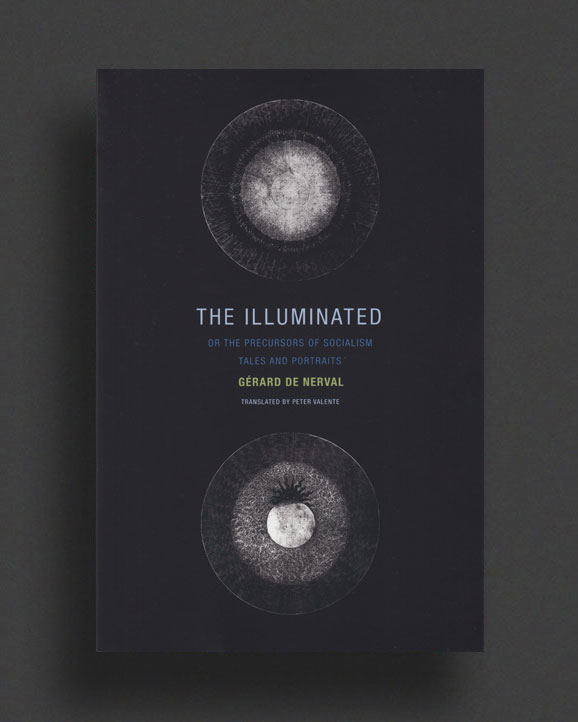
Poetical biographies of six radical thinkers from Cagliostro to Restif de la Bretonne, by the leading figure of French Romanticism.
Translated, with an introduction, by Peter Valente
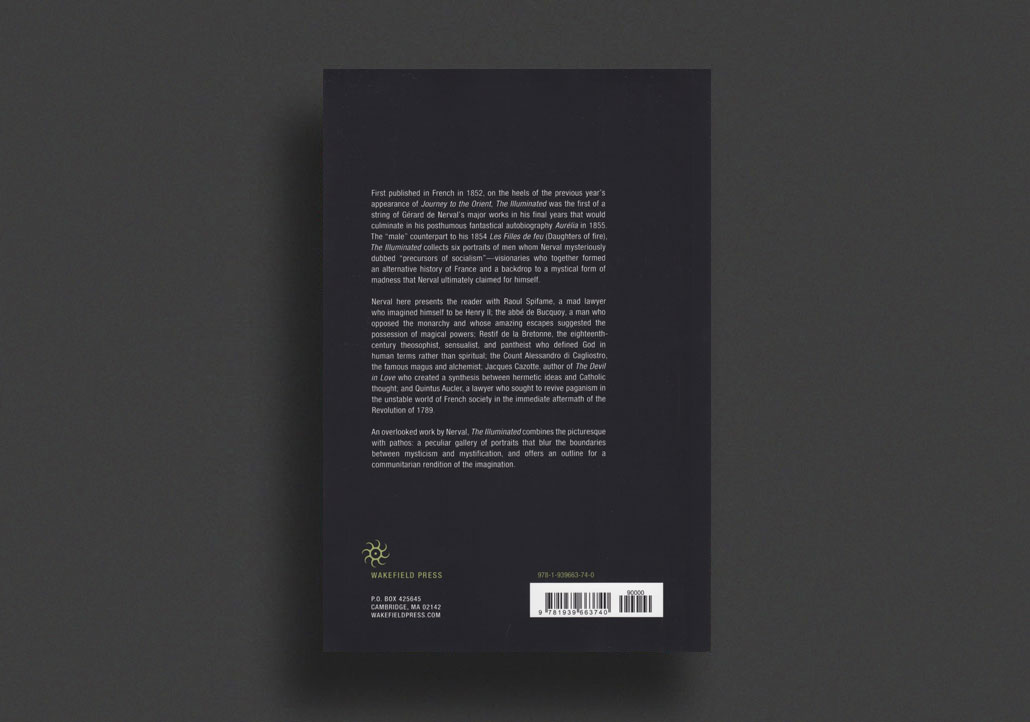
First published in French in 1852, on the heels of the previous year’s appearance of Journey to the Orient, The Illuminated was the first of a string of Gérard de Nerval’s major works in his final years that would culminate in his posthumous fantastical autobiography Aurélia in 1855. The “male” counterpart to his 1854 Les Filles de feu (Daughters of fire), The Illuminated collects six portraits of men whom Nerval mysteriously dubbed “precursors of socialism”—visionaries who together formed an alternative history of France and a backdrop to a mystical form of madness that Nerval ultimately claimed for himself.
Nerval here presents the reader with Raoul Spifame, a mad lawyer who imagined himself to be Henry II; the abbé de Bucquoy, a man who opposed the monarchy and whose amazing escapes suggested the possession of magical powers; Restif de la Bretonne, the eighteenth-century theosophist, sensualist, and pantheist who defined God in human terms rather than spiritual; the Count Alessandro di Cagliostro, the famous magus and alchemist; Jacques Cazotte, author of The Devil in Love who created a synthesis between hermetic ideas and Catholic thought; and Quintus Aucler, a lawyer who sought to revive paganism in the unstable world of French society in the immediate aftermath of the Revolution of 1789.
An overlooked work by Nerval, The Illuminated combines the picturesque with pathos: a peculiar gallery of portraits that blur the boundaries between mysticism and mystification, and offers an outline for a communitarian rendition of the imagination.
Gérard de Nerval (1808–1855) was a writer, poet, and translator who wedded French and German Romanticism and transformed his research into mystic thought and his bouts of mental illness into such visionary works as the posthumously published Aurélia, or Dream and Life. After his suicide, his work would grow in stature and go on to influence everyone from Marcel Proust, André Breton, Antonin Artaud, and Michel Leiris.
2022, English
Softcover, 60 pages, 18 x 11 cm
Published by
David Zwirner Books / New York
$25.00 - Out of stock
Originally published in 1930 in an edition of one hundred copies, Gertrude Stein's Dix Portraits pairs her singular literary style with original lithographs by Pablo Picasso and other artists in Stein's circle to create an exceptional artist book exploring written and visual portraiture.
Written between 1913 and 1929, revolutionary years in art history, Dix Portraits conveys the deep human engagement between an artist and her subject. The artist book unites Stein's ten portraits in prose with sketches by five artists: Pablo Picasso, Christian Berard, Eugene Berman, Pavel Tchelitchew, and Kristians Tonny. Utilizing the interplay between word and image, Stein's writing and the artists' images provide nuance and depth, balancing humor and sincerity.
With a new introduction by the writer Lynne Tillman, Dix Portraits is an unforgettable artistic collaboration. The subjects represented include Guillaume Apollinaire, Christian Berman, Eugene Berman, Bernard Fay, Georges Hugnet, Pablo Picasso, Erik Satie, Pavel Tchelitchew, Virgil Thomson, and Kristians Tonny. Originally printed in an edition of one hundred copies with the lithography, and now widely accessible for the first time, Dix Portraits captures Stein's legacy as a champion of artists and a pioneer of creativity.
About the Authors
The American writer Gertrude Stein (1874-1946) was a major figure in the avant-garde visual arts and literary spheres in the period between World Wars I and II. Stein moved to Paris in 1903 where she met Alice B. Toklas, who would remain her companion for 40 years. Their home in Paris functioned as a salon for many now-celebrated writers and artists, who became close acquaintances. Stein is recognized for coining the term the "Lost Generation" to describe American authors living abroad, including Ernest Hemingway and Sherwood Anderson. She and her brother Leo were among the first collectors, patrons, and supporters of many modern and cubist artists, including Pablo Picasso, Georges Braque, and Henri Matisse. Her own work shares the goals of that of her contemporaries-for example, similar to cubist works, her writing shows a proclivity for simplification, repetition, and fragmentation. Revered and feared for both her literary and artistic expertise, Stein has, in no small part, shaped how we understand and appreciate modernism today. Stein's best-known books include The Making of Americans (1925), How to Write(1931), and The Autobiography of Alice B. Toklas (1933), as well as her poetry collection Stanzas in Meditation and Other Poems [1929-1933] (1956).
Lynne Tillman writes novels, including, most recently, Men and Apparitions (2018); short stories, including the collection The Complete Madame Realism and Other Stories (2016); and essays and art and cultural criticism, including contributions to the catalogues Andy Warhol: From A to B and Back Again (2018) and Raymond Pettibon: A Pen of All Work (2017) and publications such as Aperture magazine. Her book-length autobiographical essay, Mothercare , is forthcoming from Soft Skull Press in 2022. Tillman has received a Guggenheim Fellowship and a Creative Capital/Warhol Foundation grant for arts writing. Tillman is a professor and writer in residence in the English department of The University at Albany. She lives in New York with the bass player David Hofstra.
2018, English
Softcover, 64 pages, 10.8 x 17.8 cm
Published by
David Zwirner Books / New York
$25.00 - In stock -
Published on the fiftieth anniversary of Marcel Duchamp’s death, Duchamp’s Last Day offers a radical reading of the artist’s final hours.
Just moments after Duchamp died, his closest friend Man Ray took a photograph of him. His face is wan; his eyes are closed; he appears calm. Taking this image as a point of departure, Donald Shambroom begins to examine the surrounding context—the dinner with Man Ray and another friend, Robert Lebel, the night Duchamp died, the conversations about his own death at that dinner and elsewhere, and the larger question of whether this radical artist’s death can be read as an extension of his work.
Shambroom’s in-depth research into this final night, and his analysis of the photograph, feeds into larger questions about the very nature of artworks and authorship which Duchamp raised in his lifetime. In the case of this mysterious and once long-lost photograph, who is the author? Man Ray or Duchamp? Is it an artwork or merely a record? Has the artist himself turned into one of his own readymades?
A fascinating essay that is both intimate and steeped in art history, Duchamp’s Last Day is filled with intricate details from decades of research into this peculiar encounter between art, life, and death. Shambroom’s book is a wonderful study of one of the greatest artists of the twentieth century.
2020, English
Softcover, 112 pages, 10.8 x 17.8 cm
Published by
David Zwirner Books / New York
$25.00 - Out of stock
In his 1989 book on Balthus - the storied and controversial artist who worked in Paris throughout the twentieth century - Guy Davenport gives one of the most nuanced, literary, and compelling readings of the work of this master. Reading it today highlights the change in perspectives on sexuality and nudity in art in the past thirty years.
Written over several years in his notebooks, Davenport's distinct reflections on Balthus's paintings try to explain why his work is so radical, and why it has so often come under scrutiny for its depiction of girls and women. Davenport throws the lens back on the viewer and asks: is it us or Balthus who reads sexuality into these paintings? For Davenport, the answer is clear: Balthus may indeed show us periods in adolescent development that are uncomfortable to view, but the eroticization exists primarily on the part of the viewer.
Arguing that Balthus's figures are erotic only if we make them so, and that their innocence is more present than anything pornographic in them, Davenport posits that the paintings hold up a mirror to our own perversities and force us, difficultly, to confront them. He writes, "The nearer an artist works to the erotic politics of his own culture, the more he gets its concerned attention. Gauguin's naked Polynesian girls, brown and remote, escape the scandal of Balthus's, although a Martian observer would not see the distinction." Davenport's critique helps us understand Balthus in our times-something we need more than ever as we crucially confront sexual politics in visual art.
2021, English
Softcover, 144 pages, 18 x 11 cm
Published by
David Zwirner Books / New York
$25.00 - Out of stock
Virgina Woolf’s collection of writings on visual arts offer a whole new perspective on the revolutionary author.
Introduction by Claudia Tobin
Despite wide interest in Woolf’s writings, her circle, and her relationship with the visual arts, there is no accessible edition or selection of essays dedicated to her writings on art. This newest edition in David Zwirner Books’s ekphrasis series collects such essays including “Walter Sickert: A Conversation” (1934), “Pictures” (1925), and “Pictures and Portraits” (1920).
These formally inventive texts examine the connection between the literary writer and the visual artist and are innovative in their treatment of ideas about color and modern art as experienced in picture galleries. In these essays, Woolf looks at the complex and interdependent relationship between the artist and society. She also provides sharp and astute commentary on specific works of art and the relationship between art and writing.
An introduction by Claudia Tobin situates the essays within their cultural contexts.
2019, English
Softcover, 144 pages, 18 x 11 cm
Published by
David Zwirner Books / New York
$25.00 - Out of stock
In The Critic as Artist, arguably the most complete exploration of his aesthetic thinking, and certainly the most entertaining, Oscar Wilde harnesses his famous wit to demolish the supposed boundary between art and criticism.
Introduction by Michael Bracewell.
Subtitled Upon the Importance of Doing Nothing and Discussing Everything, the essay takes the form of a leisurely dialogue between two characters: Ernest, who insists upon Wilde’s own belief in art’s freedom from societal mandates and values, and a quizzical Gilbert. With his playwright’s ear for dialogue, Wilde champions idleness and contemplation as prerequisites to artistic cultivation. Beyond the well-known dictum of art for art’s sake, Wilde’s originality lays argument for the equality of criticism and art. For him, criticism is not subject to the work of art, but can in fact precede it: the artist cannot create without engaging his or her critical faculties first. And, as Wilde writes, “To the critic the work of art is simply a suggestion for a new work of his own.”
The field of art and criticism should be open to the free play of the mind, but Wilde plays seriously, even prophetically. Writing in 1891, he foresaw that criticism would have an increasingly important role as the need to make sense of what we see increases with the complexities of modern life. It is only the fine perception and explication of beauty, Wilde suggests, that will allow us to create meaning, joy, empathy, and peace out of the chaos of facts and reality.
About the Author
Oscar Wilde (1854–1900) was an Irish poet and playwright who became one of London’s most popular writers in the early 1890s. Graduating from Trinity College, Dublin, and later Magdalen College, Oxford, Wilde embarked on a hugely successful lecture tour of America in 1882. Two early melodramatic tragedies, Vera; or, The Nihilists (1880) and The Duchess of Padua (1883), were written during these years, paving the way for later stage classics such as A Woman of No Importance (1893), An Ideal Husband (1895), and The Importance of Being Earnest (1895).
Wilde also continued to write prose and criticism for popular daily newspapers such as The Pall Mall Gazette, as well as The Woman’s World, a Victorian women’s magazine that he edited between 1887 and 1889. Though often controversial, his flair for journalism and nose for scandal ensured these writings were widely read. His bold essays on aesthetic philosophy, published together in the collection Intentions (1891), were known for their wit and play with motif. Together with his plays and poems, these writings on art remain important and influential meditations of the nature of art criticism itself.
2021, English
Softcover, 88 pages, 18 x 11 cm
Published by
David Zwirner Books / New York
$25.00 - Out of stock
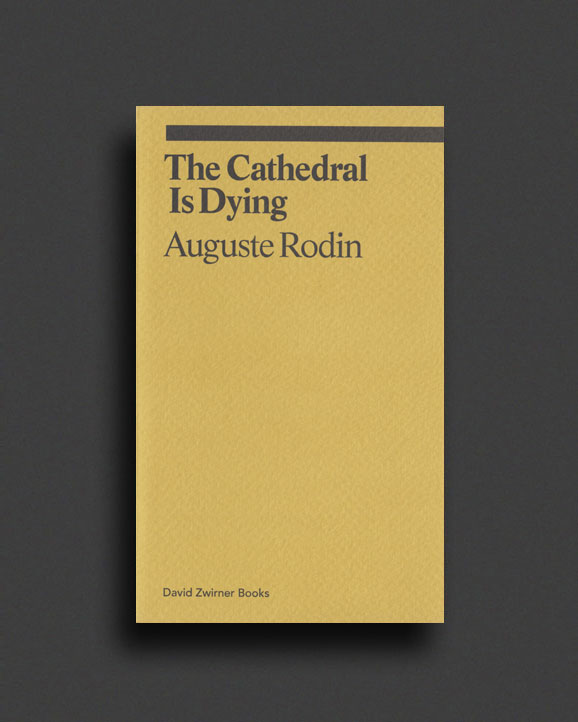
Master sculptor Auguste Rodin’s illuminating writings on cathedrals in France are especially relevant and significant following the recent fire at Notre Dame.
In this volume, the writer and Rodin scholar Rachel Corbett selects excerpts from the famous sculptor’s book Cathedrals of France, first published in 1914, just before the outbreak of World War I. Cathedrals were central to the way Rodin thought about his art: he saw them as visual metaphors for the human figure, among the finest examples of craftsmanship known to modern man, and as a model for how to live and work-slowly, brick by brick.
Here, Corbett takes the fire at Notre Dame and the concerns over its restoration as an entry point in an exploration of Rodin’s cathedrals. Rodin adamantly opposed restoration, as he felt it often did more damage than the original injury. (Many of the cathedrals that Rodin looks at in his texts were, in fact, bombed during the war.) But while he rails against various restoration efforts as evidence that “we are letting our cathedrals die,” the book, with its tenderly rendered sketches and written portraits, is itself an attempt to preserve these cathedrals. The selection of texts in this volume is a reminder-as is the tragedy of Notre Dame-of why we ought to appreciate these feats of architecture, whether or not they are still standing today.
About the Authors
Auguste Rodin (1840-1917) is known for an innovative sculptural style in which the traces of his working process are conserved in the works' final form. His career began in Brussels and later shifted to Paris, where he undertook public commissions that dovetailed with academic trends affirming clarity in sculptural language. These afforded him the support to pursue bolder aesthetic experimentation in private. Rodin's attention to partial figures and fragmentation and his privileging of emotive pathos over allegory are hallmarks of his groundbreaking and influential style.
Rachel Corbett is the author of You Must Change Your Life: The Story of Rainer Maria Rilke and Auguste Rodin, which won the 2016 Marfield Prize, the National Award for Arts Writing. Her essays and journalism have appeared in The New Yorker, The New York Times Magazine, The Atlantic, New York magazine, and other publications. She wrote the introduction to Rainer Maria Rilke's Letters to a Young Painter (2017), published by David Zwirner Books.
1973, English
Softcover, 266 pages, 18 x 11 cm
Out of print title / used / very good
Published by
Penguin Books / London
$35.00 - Out of stock
"A prodigious novel ... Stapledon's literary imagination was boundless"—Jorge Luis Borges
Star Maker is a science fiction novel by British writer and philosopher Olaf Stapledon, published in 1937. A lasting influence on successive generations of science fiction writers and on the physicist Freeman Dyson, this poetic, philosophical tale of one man's unexpected voyage through the universe is imbued with a sense of mystery and vast cosmic loneliness.
"The most wonderful novel I have ever read ... Star Maker remains light years ahead"—Brian Aldiss
"Probably the most powerful work of imagination ever written"—Arthur C. Clarke
"A unique genius"—Doris Lessing
William Olaf Stapledon (1886—1950) – known as Olaf Stapledon – was a British philosopher and author of science fiction. In 2014, he was inducted into the Science Fiction and Fantasy Hall of Fame.
Very Good copy of the 1977 Penguin edition.
2013, English
Softcover, 92 pages, 14.5 x 21.8 cm
Published by
Zero Books / UK
$29.00 - Out of stock
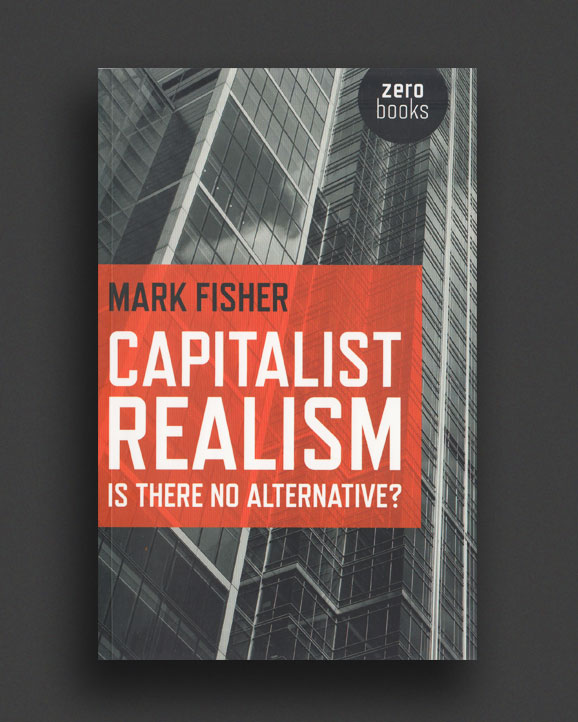
After 1989, capitalism has successfully presented itself as the only realistic political-economic system - a situation that the bank crisis of 2008, far from ending, actually compounded. The book analyses the development and principal features of this capitalist realism as a lived ideological framework. Using examples from politics, films, fiction, work and education, it argues that capitalist realism colours all areas of contemporary experience. But it will also show that, because of a number of inconsistencies and glitches internal to the capitalist reality program capitalism in fact is anything but realistic.
2022, English
Softcover, 216 pages, 14.2 x 22.9 cm
Published by
Primary Information / New York
$40.00 - In stock -
Reader is the first anthology to gather Constance DeJong’s diverse body of writing. Spanning from the 1980s to the present, the publication features eighteen works by DeJong, including out-of-print and previously unpublished fiction, as well as texts emanating from her new media sculptures, sound works, video works, and public art commissions.
An influential figure of the 1970s and ’80s downtown New York writing and performance scene, Constance DeJong has channeled time and language as mediums in her work for the last four decades, expanding the possibilities of narrative form and literary genre. From the earliest work collected here—a manuscript of DeJong’s 1982 prose text I.T.I.L.O.E.—to the digital project Nightwriters (2017-18), Reader assembles a range of experimental texts by the artist. The volume includes such works as the 2013 publication and performance, SpeakChamber and the script for Relatives (1988), a duet between a television and a performer made in collaboration with artist Tony Oursler. Never-before-published works including texts created for re-engineered vintage radios, aphorisms commissioned for a Times Square digital billboard, and transcripts for sound works originally installed along the Thames and Hudson rivers are also featured in the book.
Taken together, these works showcase how DeJong has helped define and push the boundaries of language in the visual and performing arts. The artist’s sustained exploration of language blurs the lines between many fields, and DeJong’s work has also had a long life in the literary world. In the late 1970s, she self-published the critically acclaimed novel Modern Love on her short-lived Standard Editions imprint. On the 40th anniversary of the novel’s original publication, the book was published in facsimile form by Primary Information and Ugly Duckling Presse, and has gone on to sell over 10,000 copies since its release in 2017.
Constance DeJong is a New York-based artist who has exhibited and performed internationally. Her work has been presented at the Renaissance Society, Chicago; the Walker Art Center, Minneapolis; the Wexner Center for the Arts, Columbus; the Philadelphia Museum of Art; and in New York at the Dia Art Foundation; The Kitchen, Thread Waxing Space, and the Whitney Museum of American Art. In 1983 she composed the libretto for Satyagraha, the Philip Glass opera, which has been staged at opera houses worldwide, including the Metropolitan Opera, New York; the Netherlands National Opera, Rotterdam; and the Brooklyn Academy of Music, New York. She has permanent audio-text installations in Beacon, New York; London; and Seattle. DeJong has published several books of fiction, including her celebrated Modern Love (Standard Editions, 1977; Primary Information/Ugly Duckling Presse, 2017), I.T.I.L.O.E. (Top Stories, 1983), and SpeakChamber (Bureau, 2013), and her work is included in the anthologies Up is Up, But So is Down: New York’s Downtown Literary Science, 1974-1991 (NYU Press, 2006); Blasted Allegories (New Museum/MIT, 1987), and Wild History (Tanam Press, 1985).
2011, English
Hardcover (w. dust jacket), 320 pages, 21.9 x 28.4 cm
1st Edition, Out of print title / as new
Published by
Yale University Press / New Haven
$90.00 - In stock -
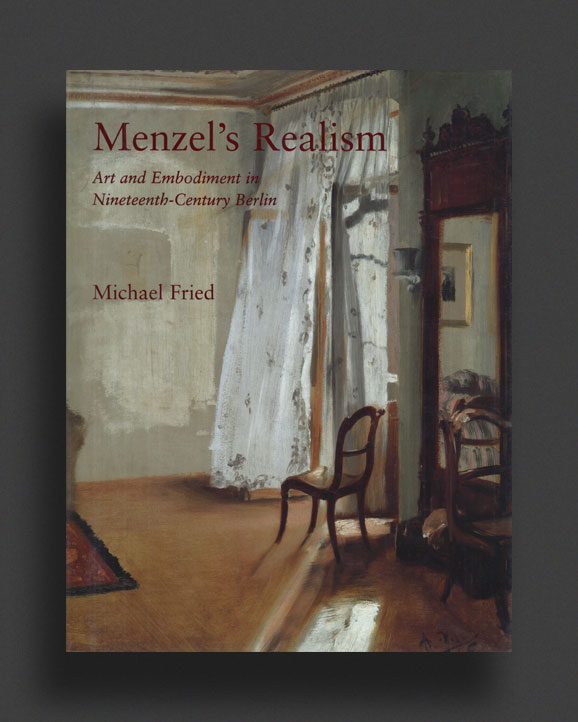
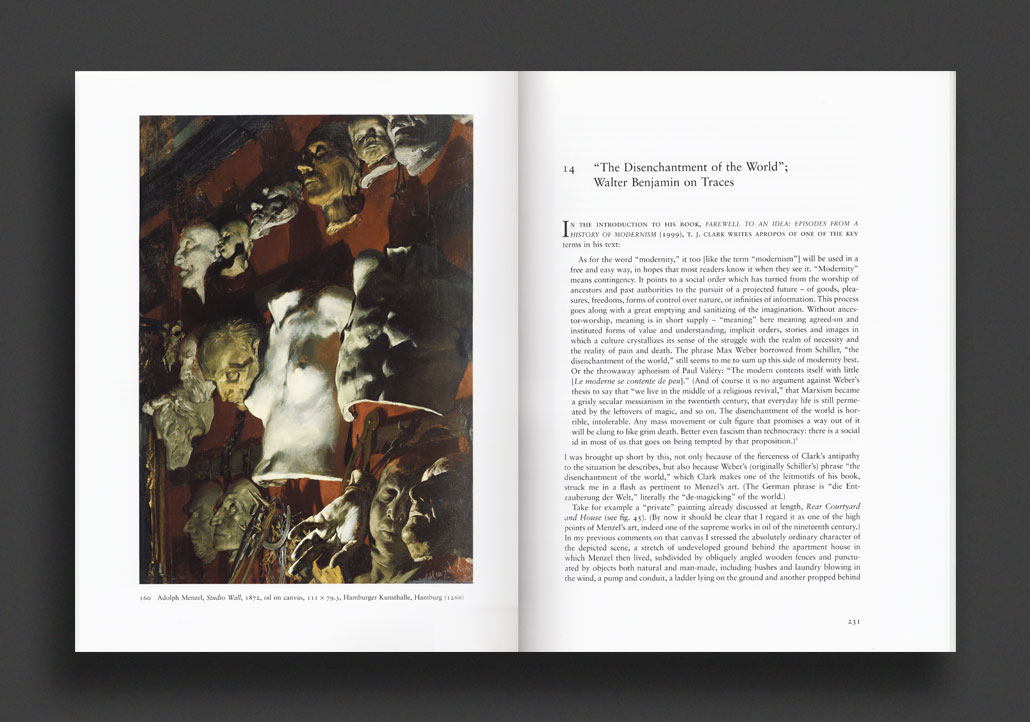
Adolf Menzel was one of the most important German artists of the 19th century, yet he is scarcely known outside his native land. In this study a leading art historian argues that Menzel deserves to be recognized not only as one of the greatest painters and draftsmen of his century but also as a master realist whose work engages profoundly with an extraordinary range of issues - artistic, scientific, philosophical and socio-political.
Michael Fried explores Menzel's large and fascinating oeuvre, and in so doing seeks to make the artist's achievement accessible to a wide audience. Fried compares Menzel's art with that of the 19th-century's two other great realist painters, Courbet and Eakins. Analyzing paintings, drawings and prints from all stages of Menzel's long career, he asserts that the distinctive quality of Menzel's realism is found in his concern with evoking the multi-sensory, fully-embodied relationships of persons with the universe of physical objects, tools and situations.
Fried establishes connections between Menzel's work and a broad array of extra-artistic contexts, among them the writings of the empathy theorists, Kierkegaard on reflection and the everyday, Helmholtz on vision, Fontane's "Effi Briest", Duranty's art criticism, Simmel on modern urban life, E.T.A. Hoffmann's "art of seeing", and Benjamin on traces. He also explores the complex relationship between Menzel's version of "extreme" realism and the exactly contemporary technology of photography. The resulting work establishes Menzel as a key artist of modernity.
Out-of-print, Fine—As New copy.
1982 / 2018, English
Softcover, 96 pages, 25 x 20 cm
Published by
RE/SEARCH / San Francisco
$45.00 - Out of stock
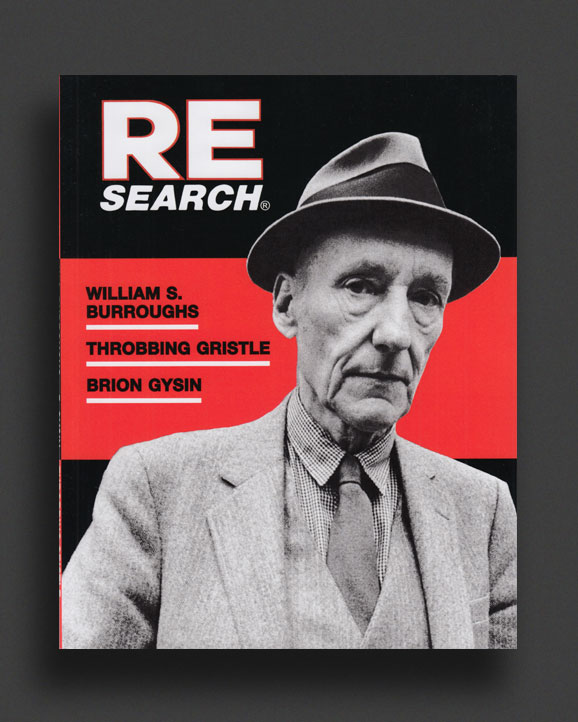
First published in 1982 and long out-of-print, in this iconic issue of the mighty RE/Search magazine, #4/5, William Burroughs, Brion Gysin and Throbbing Gristle talk about advanced ideas involving the social control process, creativity and the future. Interviews, scarce fiction, essays: this is a manual of prophetic ideas and insights. Strikingly designed and heavily illustrated with rare photos, bibliographies, discographies, chronologies and illustrations. A classic! Back in a limited edition print-run.
2022, English
Softcover, 260 pages, 22.86 x 15.24 cm
Published by
11:11 Press / US
$44.00 - In stock -
LIKE A RECOVERED PYRAMID TEXT IN WHICH ALL THE ANCIENT MYTHS WE THOUGHT WE UNDERSTOOD HAVE BEEN RECAST, EVAN ISOLINE’S DƐVDMVTH IS A DISORIENTING PHANTASMAGORIA OF GENRE-SHATTERING FORMS AND STYLES, TEARING LIKE BLITZKRIEG THROUGH ITS UNHINGED IMAGINATION OF THE UNCONSCIOUS SPACE BEHIND ALL TIME. SPASTIC, BATTY, UNRELENTING, ABSURD, PROVOCATIVE, INCANTATORY, AND PROFANE ON EVERY PAGE, CONSIDER MAKING THIS THE LAST GIFT YOU EVER GIVE THE PEOPLE YOU CALL YOUR PARENTS.
—BLAKE BUTLER, AUTHOR OF ALICE KNOTT
DƐVDMVTH is a mythographical-rhetorical work, a book of flowers, of arcadian theophanies & semiopathic assaults. In sur-rendering its totems & mementoes of Western arcana to the agency of their own dissolution, DƐVDMVTH brings the dead into rebellion, constructs a monument to an uninterpretable key in a ruin of obsolete modes.
2021, English
Softcover, 248 pages, 23 x 17 cm
Published by
11:11 Press / US
$52.00 - Out of stock
PHILOSOPHY OF THE SKY is not a work of philosophy in an academic or traditional sense. It is, however, highly philosophical, totemic, and personal. In the book, Evan uses the sky as an abstract philosophical concept, like a cinematic backdrop, to explore conceptual associations between selfhood, objecthood, the body, apocalypticism, masculinity, masturbation, and self-destruction.
The text, symbol, and glyph are partially augmented by chance cut-up processes such as language translators, Markov chain generators, and AI natural language generators for the purpose of eliminating narrative preconception, discovering subconscious visual realms, and spotlighting a point of tension between natural and artificial aesthetic forms. The formatting of text becomes an important cinematographic framing tool.
LIKE AN ARTAUDIAN SET OF MAPS SKETCHED OUT FROM THE TOPOGRAPHIC EXPLORATION OF A SELF WHICH LOST ITSELF IN DATA AND CONSTELLATIONS, PHILOSOPHY OF THE SKY BECOMES A MIRROR IMAGE OF THE PHILOSOPHICAL ABYSS. ISOLINE’S SKY REFLECTS THE BLACKHOLESNESS OF WRITING AS IT UNVEILS ITSELF AS THE ATTRACTOR OF CONJUGATION, MUTATION AND REMIX —A CATACLYSMIC BLANK SPACE INSINUATING THE SILHOUETTES OF MONSTERS AND THE DISORIENTING TURBULENCE THAT ANTICIPATES THE ABERRANT DIRECTION OF THEIR WHIMS. THROUGH ABSTRACT IMAGES EXTIRPATED FROM CHAOS AND THEN FLOWCHARTED, AND GRAMMATICALIZED DESPAIR SAMPLED OUT IN GRAPHICAL TEST TUBES, PHILOSOPHY OF THE SKY IS BOTH A CAREFUL ESSAY ON THE GEOMETRY OF WRITING AND A VISIONARY COLLECTION OF ATTEMPTS TO CRYSTALLIZE A LOVABLE SELF FROM THE RUINS OF A COLLAPSING UNIVERSE.
— GERMÁN SIERRA
THERE ARE A FEW BOOKS I’VE READ THAT FELT LIKE THEY WERE DIRECTLY ANSWERING THE CALL MADE BY ROBBE-GRILLET IN TOWARDS A NEW NOVEL. SLOW SLIDINGS BY M KITCHELL IS ONE, APPARITIONS OF THE LIVING BY JOHN TREFRY ANOTHER. I FELT EXCITED WHILE READING EVAN ISOLINE’S PHILOSOPHY OF THE SKY BECAUSE IT WAS CLEAR I’D FOUND ONE MORE. THE LANGUAGE IS SPARE YET RELENTLESS, THE FORM EXACTLY AS EXPERIMENTAL AS IT NEEDS TO BE TO PULL THE RUG OUT FROM YOU AGAIN AND AGAIN. A COMPLETELY UNIQUE AND REWARDING EXPERIENCE.
— GRANT MAIERHOFER
WHEREAS DANIEL SCHREBER GAVE US TESTIMONY FROM THE OTHER SIDE OF THE SUN, AND NERVAL TOOK CONTROL OF THE MOON, EVAN ISOLINE’S DEBUT WANTS TO GRASP THE ENTIRE SKY, TO FOLD ITS HIDDEN ASPECT INTO A SECRET WEAPON AND BLOW OUR BRAINS OUT ACROSS THE HEAVENS. WITH A NERVE-LOGIC MADE HIS OWN, ISOLINE’S DEMENTED EMPIRICISM HALLUCINATES A SPRAWLING, ONANISTIC ONTOLOGY: WE DISCOVER HOW THE SKY IS ALSO THE SEA (THE SKY THAT FELL TO EARTH), THE BEACH A DESERT, AND HOW IT WAS ONCE SWALLOWED BY A SHARK (WHOSE ATTACKS NOW CONSUMMATE THE ULTIMATE SEXUAL UNION). A LOVE LETTER TO IMAGINATIVE EXCESS AND THE FAILURES OF REALITY, THIS TOO REAL SIMULATION WILL DRY HUMP YOUR LEG LIKE IT WAS THE LAST GLORY HOLE OF GOD, AND YOU’LL BE GLAD OF THE ATTENTION.
— GARY J SHIPLEY
SEBALD'S "I" IS INEXTRICABLY HIM, YET IS SO UNSPECIFIC AND ETHEREAL AS TO BECOME ALL OF US. ISOLINE'S "I" IS NOT HIM, NOT EVEN A HUMAN--"I AM THE NEW WORD OUTSIDE ITSELF"--NOT EVEN A WORD. WRITERS USE THE "I" FOR MANY REASONS... URGENCY, VULNERABILITY, AUTHENTICITY. ISOLINE USES IT TO MAKE US AWARE THAT WE DON'T EXIST.
— JOHN TREFRY
2020, English
Softcover, 332 pages, 22.86 x 15.24 cm
Published by
Mandrake / Oxford
$38.00 - Out of stock
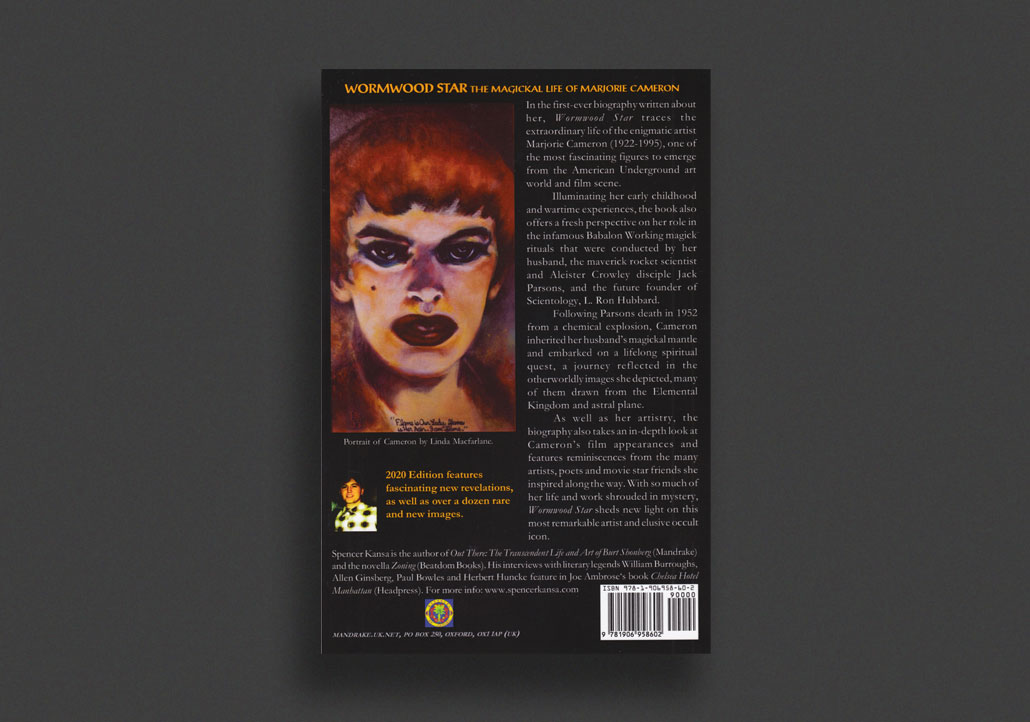
2020 Edition features fascinating new revelations, as well as over a dozen rare and new images.
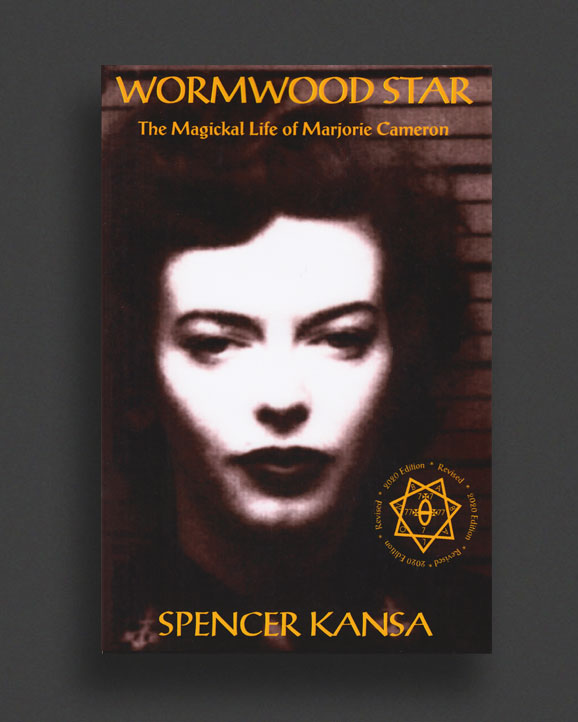
In the first-ever biography written about her, Wormwood Star traces the extraordinary life of the enigmatic artist Marjorie Cameron, one of the most fascinating figures to emerge from the American Underground art world and film scene.
Born in Belle Plaine, Iowa, in 1922, Cameron's uniqueness and talent as a natural-born artist was evident to those around her early on in life. During World War 2 she served in the Women's Navy and worked in Washington as an aide to the Joint Chiefs of Staff. But it was after the War that her life really took off when she met her husband Jack Parsons. By day Parsons was a brilliant rocket scientist, but by night he was Master of the Agape Lodge, a fraternal magickal order, whose head was the most famous magus of the 20th century... Aleister Crowley.
Gradually, over the course of their marriage, Parsons initiated Cameron into the occult sciences, and the biography offers a fresh perspective on her role in the infamous Babalon Working magick rituals Parsons conducted with the future founder of Scientology, L Ron Hubbard. Following Parsons death in 1952 from a chemical explosion, Cameron inherited her husband's magickal mantle and embarked on a lifelong spiritual quest, a journey reflected in the otherworldly images she depicted, many of them drawn from the Elemental Kingdom and astral plane.
Throughout the 1950s and 1960s, Cameron became a celebrated personality in California's underground art world and film scene. In 1954 she starred in Kenneth Anger's visual masterwork, Inauguration of the Pleasure Dome, stealing the show from her co-star Anais Nin. The budding filmmaker Curtis Harrington was so taken with Cameron, he made a film study dedicated to her artwork entitled The Wormwood Star. He then brought Cameron's powerful and mysterious presence to bear on his evocative noir thriller, Night Tide, casting her alongside a young Dennis Hopper.
Cameron was an inspirational figure to the many artists and poets that congregated around Wallace Berman's Semina scene, and in 1957 Berman's show at the Ferus Gallery was shut down by LA's vice squad, due to the sexually charged nature of one of her drawings. Undaunted, she continued to carve a unique and brilliant path as an artist.
A retrospective of Cameron's work, entitled The Pearl of Reprisal, was held at LA's Barnsdall Art Park in 1989, and after her death, some of her most admired pieces were included in the Reflections of a New Aeon Exhibition at the Eleven Seven Gallery in Long Beach, California. Cameron's famous Peyote Vision drawing made its way into the Beat Culture and the New America retrospective held at the Whitney Museum in 1995. And in 2006, a profile of her work was featured in the critically lauded Semina Culture Exhibition. The following year an exhibition of her sketches and drawings was held at the Nicole Klagsbrun Gallery in New York.
With so much of her life and work shrouded in mystery, Wormwood Star sheds new light on this most remarkable artist and elusive occult icon.
2003, Japanese
Softcover (w. dust jacket), 158 pages, 21 x 14.8 cm
1st Edition, Out of print title / as new
Published by
Apple Comics / Tokyo
$35.00 - Out of stock
First printing of this hardcore hentai collection from the prolific artist Shizuki Shinra, includes the title comic story Slave's Blood, along with Trick of Temptation, Maid Window, Wet Gym Clothes, Preparation fro Rape, Daughter Slave, Torture and Rape Interrogation, Breeding Outpatient, Vicarious Training, Slave Lineage, and Discipline. Obviously packed full of delirious BDSM dom/sub fetish scenarios. Published in 2003. Mature readers.
As New with As New dust jacket.
2003, Japanese
Softcover (w. dust jacket), 158 pages, 21 x 14.8 cm
1st Edition, Out of print title / as new
Published by
Apple Comics / Tokyo
$35.00 - Out of stock
First printing of this hardcore hentai collection from the prolific artist Shizuki Shinra, includes the title comic story My mother is a Bitch, along with Forbidden Gambling, Hyena's Prey, Collared Secretary, Training period, Into the Pitch-black Darkness, Bad Nightmare, Day of The Nurses, How to Raise a Pet Dog, and After-school Classes. Obviously packed full of delirious BDSM dom/sub fetish scenarios. Published in 2003. Mature readers.
As New with As New dust jacket.
1997, English / Dutch
Softcover, 500 pages, 17 x 24 cm
1st Edition, Out of print title / used / good
Published by
SUN / Nijmegen
$45.00 - Out of stock
First, only edition of Beyond Ethics and Aesthetics / Voorbij ethiek en esthetiek, a 500 page book based on the experiences during the formation, realization and evaluation of the exhibition: I + the Other. Art and the Human Condition, in the Beurs van Berlage, Amsterdam 1994. Edited by Ine Gevers and Jeanne Van Heeswijk.
"Beyond Ethics and Aesthetics has been compiled in the knowledge that it is impossible to avoid a history in which the meaning of ethics and aesthetics has already been fixed. Rooted in tradition, these notions determine the space and scope of contemporary practices such as fine art, exhibition-making and theory. Whenever an attempt is made to cross the dividing lines, for instance in trying to connect art with life, it becomes immediately apparent how unproductive it is to continue to com-ply with structures that are no longer functional in a technology- and information-based, postmodern society. This is particularly true when it becomes clear that notions such as ethics and aesthetics, which are basically idealistic, often have a controlling and, in this sense, limiting function. With this book we want to draw attention to the sometimes subtle, though often radical attempts to escape from the way modernity has divided the world into manageable and relatively safe specializations. The continuing institutionalization, 'museification' and 'mediaization' of our society provides an example. They seem to pull the above-mentioned obstructions even sharper into focus." — from book introduction
With contributions by Oscar van Alphen, Ute Meta Bauer, Yvonne P. Doderer, Marianne Brouwer, Martin Lucas, Adrian Piper, Simon Critchley, Helmut Draxler, Jean Fisher, Avital Geva, Ine Gevers, Jeanne van Heeswijk, Tijs Goldschmidt, Roy Villevoye, Multiple Autorenschaft, Jouke Kleerebezem, Viktor Misiano, Everlyn Nicodemus, Sadie Plant, Martha Rosler, Rob Schroder, Jorinde Seijdel, Barbara Steiner, Rirkrit Tiravanija, Krzysztof Wodiczko, Ross Sinclair, and more.
Good copy with some cover wear.
2022, English
Softcover, 240 pages, 20.9 x 15 cm
Published by
Whitechapel / London
$40.00 - Out of stock
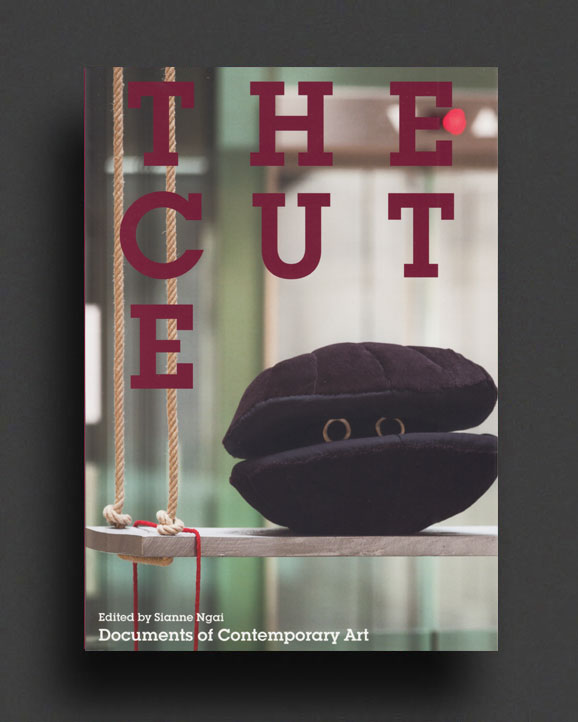
The Cute tracks the astonishing impact of a single aesthetic category on post-war and contemporary art, and on the vast range of cultural practices and discourses on which artists draw. From robots and cat videos to ice cream socials, The Cute explores the ramifications of an aesthetic 'of' or 'about' minorness - or what is perceived to be diminutive, subordinate, and above all, unthreatening - on the shifting forms and contents of art today. This anthology is the first of its kind to show how contemporary artists have worked on and transformed the cute, and in ways that not only complexify its meaning, but reshape their own artistic practices.
Artists surveyed include Peggy Ahwesh, Cosima Von Bonin, Nayland Blake, Paul Chan, Henry Darger, Adrian Howells, Juliana Huxtable, Larry Johnson, Mike Kelley, Dean Kenning, Wyndham Lewis, Jeff Koons, Sean-Kierre Lyons, Mammalian Diving Reflex, Tala Madani, Annette Messager, Mariko Mori, Charlemagne Palestine, Mika Rottenberg, Allen Ruppersberg, Jack Smith, Carolee Schneeman, Kara Walker, Andy Warhol, Yoshitomo Nara
Writers include Sasha Archibald, Roland Barthes, Leigh Claire La Berge, Ian Bogost, Lauren Berlant, Jennifer Doyle, Lee Edelman, Stephen Jay Gould, Angelik Vizcarrondo-Laboy, Bridget Minamore, Juliane Rebentisch, Frances Richard, John Roberts, Friedrich Schiller, Peter Schjeldahl, Kanako Shiokawa
is the author of Ugly Feelings (Harvard, 2005), Our Aesthetic Categories: Zany, Cute, Interesting (Harvard, 2012), and Theory of the Gimmick: Aesthetic Judgment and Capitalist Form (Belknap/Harvard, 2020). She is the Andrew W. Mellon Professor of English at the University of Chicago.
2022, English / French
Softocver, 160 pages, 25.5 x 18 cm
Published by
Walther König / Köln
$57.00 - Out of stock
Published on occasion of Thea Djordjadze's first exhibition in a museum in France at the Musée d’art moderne et contemporain de Saint-Étienne (MAMC+), 5 Feb – 15 May 2022. Entitled ‘Remember and Witness’ (‘Se souvenir et témoigner’ in French), this eponymous catalogue unveils materials, archives and writings from the artist in the first part, while the second combines exhibition views from the Gropius Bau in Berlin and MAMC+ to apprehend her sense of installation and composition in two opposite spaces. An interview with the artist by MAMC+ director, Aurélie Voltz, and an essay by the art historian, Thomas Boutoux, question her practice, influences and works.
English and French text.
1963, German
Hardcover (clothbound), 216 pages, 24.5 x 20.5 cm
1st Edition, Out of print title / used / good
Published by
Schuler Verlagsgesellschaft / Stuttgart
$25.00 - Out of stock
Published in 1963, lavishly illustrated book of 100 Treasures from museums around the world, spanning art history, antiquity, archaeology, handicrafts, biology, architecture, with text by Dr. Traudl Seifert, edited by J.E. Schuler. Includes the throne of Tutankhamun, Order of the Golden Fleece, Venus von Milo, Nike von Samothrake, Ming dynasty vase, Arabian celestial globe, the Taj Mahal, Meißner porcelain, Louis XIV pistols, Renaissance Venetian cabinet, statue of Uta von Naumburg, Venus von Milo, Altar of Verdun, Nike von Samothrake, The Tabatière rifle, the bust of Nefertiti, The lady and the Unicorn
... the work of Michelangelo, Veit Stoss, Aristide Maillol, Tilman Riemenschneider, Albrecht Dürer, and many more.
Good copy with general wear and rubbing to linen boards.
2020, English
Softcover, 328 pages, 13.7 x 20.3 cm
Published by
Sternberg Press / Berlin
$48.00 - Out of stock
A collection of writings on art by Barry Schwabsky.
"Many consider Barry Schwabsky to be the critic on painting today, even if he does write copiously on other art forms," write editors Rob Colvin and Sherman Sam in their foreword to this selection of Schwabsky's writings. Written since the turn of the millennium, the texts in The Oberver Effect include meditations on the broader context of painting today alongside reflections on such well-known American painters as Alex Katz, Kerry James Marshall, Nicole Eisenman, and Dana Schutz, as well as practitioners from Europe and beyond—Bernard Frize, Tal R, and Ha Chonghyun among them. As Colvin and Sam point out, the book "documents a dialogue between abstraction and the image" in which "images serve less to represent their described subject than to articulate the sort of painting each one desires to be."
2022, English
Softcover, 240 pages, 17 x 13 cm
Published by
Masala Noir / Paris
$54.00 - Out of stock
A compilation of house, techno, trance and jungle audio cassettes from the 90s rave era.
Limited edition.