World Food Books' programme is largely produced on Kulin Nation land. We acknowledge the Wurundjeri people of the Kulin Nation as the first and continuing custodians of this land, and pay respect to their Elders past, present, and emerging.
World Food Books is an arts and special interests bookshop in Naarm / Melbourne. Founded in 2010, World Food Books is devoted to the presentation of a rotating, hand-selection of international art, design, literary and counterculture publications with an emphasis on the anti-traditional, the experimental, the avant-garde, the heretic, the marginal.
Presenting new titles alongside rare and out-of-print books, catalogues and journals spanning the fields of modern and contemporary art, design, photography, illustration, film, literature, poetry, cultural theory, philosophy, sexuality, popular and underground culture in its many radical forms, World Food Books wishes to encourage adventurous, thoughtful and open-minded reading, looking, writing, and exchange of publishing and ideas, both current and historical.
As well as our bookshop, located in Melbourne's historical Nicholas Building, all of our inventory is available internationally via our online mail-order service.
World Food Books semi-regularly co-ordinates "Occasions", a programme of exhibits and events at the bookshop and in partnership with other hosts (such as museums and art galleries) that develop out of the activities, relationships and content of the bookshop itself.
World Food Books
The Nicholas Building
37 Swanston Street
Room 5, Level 6
Melbourne 3000
Australia
SHOP HOURS:
Thu–Fri 12–6, Sat 12–5
WEB-SHOP OPEN 24/7
World Food Books
Postal Address:
PO Box 435
Flinders Lane
Victoria 8009
Australia
Art
Theory / Essay
Architecture / Interior
Graphic Design / Typography
Photography
Fashion
Eros
LGBTQ+
Fiction / Poetry
Weird / Speculative / Science Fiction / Horror
Transgressive / Visceral / Abject
Symbolism / Decadence / Fin de siècle
Film / Video
Painting
Sculpture / Installation
Performance / Dance / Theater
Drawing
Sound / Music
Curatorial
Group Shows / Collections
Periodicals
Out-of-print / Rare
Posters / Ephemera / Discs
Signed Books
World Food Books Gift Voucher
World Food Book Bag
Australian Art
Australian Fiction
Australian Science Fiction / Speculative Fiction
Australian Poetry
Australian Photography
Japanese Photography
Conceptual Art
Minimal Art
Dada
'Pataphysics / Oulipo
Fluxus
Concrete Poetry
Pop Art
Surrealism
Arte Povera
Arte Informale / Haute Pâte / Tachism
Nouveau Réalisme / Zero / Kinetic
Situationism / Lettrism
Collage / Mail Art / Xerox Art
Art Brut / Folk / Visionary / Fantastic
Illustration / Graphic Art / Bandes Dessinées
Furniture
Italian Radical Design / Postmodernism
Textiles
Ceramics / Glass
Counterculture
Protest / Revolt
Philosophy
Psychoanalysis
Anthropology
Anarchism
Socialism / Anarchism / Communism / Capitalism
Literary Theory / Semiotics / Language
Feminism / Women's Studies
Gender Studies / Sexuality
Anthropology
Fetishism / BDSM
Drugs / Psychedelia
Crime / Violence
Animal Rights / Veganism
Occult / Esoterica
Ecology / Earth / Alternative Living
Whole Earth / Crafts
All prices in AUD (Australian dollars)
Pick-Ups
Pick-up orders can be collected in our bookshop during opening hours after order date. Please collect any Pick-up orders within 2 weeks of ordering as we have limited storage space. Orders will be released back into stock if not collected within this time. No refunds can be made for pick-ups left un-collected. If you cannot make it in to the bookshop in this time-frame, please choose postage option.
Return Policy
All sales are final. We do accept returns (for refund or exchange) for items received in error. All our orders are packed with special care using heavy-duty padding and cardboard book-mailers or bubble mailers (for smaller books), using reinforcement where required. We cannot take responsibility for any lost, stolen or damaged parcels.
Insurance
Should you wish to insure your package, please email us directly after placing your order and we can organise this at a small extra expense. Although all standard/express tracked packages are very safe and dependable, we cannot take responsibility for any lost, stolen or damaged parcels. We recommend insurance on valuable orders.
Interested in selling your old books, catalogues, journals, magazines, comics, fanzines, ephemera? We are always looking for interesting, unusual and out-of-print books to buy. We only buy books in our fields of interest and specialty, and that we feel we can resell.
We base these prices on desirability, market value, in-print prices, condition and our current stock levels. We offer cash, store credit, and can take stock on consignment. All
about 25% of the price we expect to get when we sell them, or 30% in store credit. We base these prices on desirability, market value, in-print prices, condition and our current stock levels.
Sell your books any day of the week. You can drop them off and return later. If you have a lot of books, we can visit your Sydney home.
We buy books that we feel we can resell. We offer about 25 % of the price we expect to get when we sell them, or 30% in store credit. We base these prices on desirability, market value, in-print prices, condition and our current stock levels.
Philadelphia Wireman
03 August - 01 September, 2018
World Food Books is proud to announce our next Occasion, the first presentation of sculptures by Philadelphia Wireman in Australia.
The Philadelphia Wireman sculptures were found abandoned in an alley off Philadelphia’s South Street on trash night in 1982. Their discovery in a rapidly-changing neighbourhood undergoing extensive renovation, compounded with the failure of all attempts to locate the artist, suggests that the works may have been discarded after the maker’s death. Dubbed the "Philadelphia Wireman" during the first exhibition of this work, in 1985, the maker’s name, age, ethnicity, and even gender remain uncertain. The entire collection totals approximately 1200 pieces, all intricately bound together with tightly-wound heavy-gauge wire (along with a few small, abstract marker drawings, reminiscent both of Mark Tobey and J.B. Murry). The dense construction of the work, despite a modest range of scale and materials, is singularly obsessive and disciplined in design: a wire armature or exoskeleton firmly binds a bricolage of found objects including plastic, glass, food packaging, umbrella parts, tape, rubber, batteries, pens, leather, reflectors, nuts and bolts, nails, foil, coins, toys, watches, eyeglasses, tools, and jewellery.
Heavy with associations—anthropomorphic, zoomorphic, and socio-cultural responses to wrapped detritus—the totemic sculptures by Philadelphia Wireman have been discussed in the context of work created to fulfil the shamanistic needs of alternative religions in American culture. Curators, collectors, and critics have variously compared certain pieces to sculpture from Classical antiquity, Native American medicine bundles, African-American memory jugs, and African fetish objects. Reflecting the artist’s prolific and incredibly focused scavenging impulse, and despite—or perhaps enhanced by—their anonymity, these enigmatic objects function as urban artefacts and arbiters of power, though their origin and purpose is unknown. Philadelphia Wireman, whatever their identity, possessed an astonishing ability to isolate and communicate the concepts of power and energy through the selection and transformation of ordinary materials. Over the course of the past two decades, this collection has come to be regarded as an important discovery in the field of self-taught art and vernacular art.
Presented in collaboration with Fleisher-Ollman Gallery, Philadelphia, and Robert Heald, Wellington.
Susan Te Kahurangi King
02 February - 10 March, 2018
Susan Te Kahurangi King (24 February 1951 - ) has been a confident and prolific artist since she was a young child, drawing with readily available materials - pencils, ballpoint pens and felt-tip markers, on whatever paper is at hand. Between the ages of four and six Susan slowly ceased verbal communication. Her grandparents William and Myrtle Murphy had developed a special bond with Susan so they took on caring responsibilities for extended periods. Myrtle began informally archiving her work, carefully collecting and storing the drawings and compiling scrapbooks. No drawing was insignificant; every scrap of paper was kept. The King family are now the custodians of a vast collection containing over 7000 individual works, from tiny scraps of paper through to 5 meter long rolls.
The scrapbooks and diaries reveal Myrtle to be a woman of great patience and compassion, seeking to understand a child who was not always behaving as expected. She encouraged Susan to be observant, to explore her environment and absorb all the sights and sounds. Myrtle would show Susan’s drawings to friends and people in her community that she had dealings with, such as shopkeepers and postal workers, but this was not simply a case of a grandmother’s bias. She recognised that Susan had developed a sophisticated and unique visual language and sincerely believed that her art deserved serious attention.
This was an unorthodox attitude for the time. To provide some context, Jean Dubuffet coined the term Art Brut in 1945 to describe work created by self-taught artists – specifically residents of psychiatric institutions and those he considered to be visionaries or eccentrics. In 1972 Roger Cardinal extended this concept by adopting the term Outsider Art to describe work made by non-academically trained artists operating outside of mainstream art networks through choice or circumstance. Susan was born in Te Aroha, New Zealand in 1951, far from the artistic hubs of Paris and London that Dubuffet and Cardinal operated in. That Myrtle fêted Susan as a self-taught artist who deserved to be taken seriously shows how progressive her attitudes were.
Susan’s parents Doug and Dawn were also progressive. Over the years they had consulted numerous health practitioners about Susan’s condition, as the medical establishment could not provide an explanation as to why she had lapsed into silence. Dawn educated herself in the field of homeopathy and went on to treat all twelve of her children using these principles – basing prescriptions on her observations of their physical, mental and emotional state.
Doug was a linguist with an interest in philosophy who devoted what little spare time he had to studying Maori language and culture. To some extent their willingness to explore the fringes of the mainstream made them outsiders too but it was their commitment to living with integrity and their respect for individuality that ensured Susan’s creativity was always encouraged.
Even though Susan’s family supported her artistic pursuits, some staff in schools and hospitals saw it as an impediment to her assimilation into the community and discouraged it in a variety of ways. Her family was not always aware of this and therefore did not fully understand why Susan stopped drawing in the early 1990s. However, rather than dwell on the challenges that Susan faced in pursuit of her artistic practice, they prefer to highlight her achievements. In 2008 Susan began drawing again in earnest, after an almost 20 year interruption, and her work is now shown in galleries around the world.
Susan grew up without television and has been heavily influenced by the comics she read as a child. She is absolutely fearless in the appropriation of recognizable characters, such as Donald Duck and Mickey Mouse, in her work. She twists their limbs, contorts their faces, compresses them together, blends them into complex patterned backgrounds - always imbuing them with an incredible energy. Although Susan often used pop culture characters in her work they are not naive or childlike. These are drawings by a brilliant self-taught artist who has been creating exceptional work for decades without an audience in mind.
Mladen Stilinović
"Various Works 1986 - 1999"
02 February 16 - September 10, 2016
Various works 1986 - 1999, from two houses, from the collections of John Nixon, Sue Cramer, Kerrie Poliness, Peter Haffenden and Phoebe Haffenden.
Including: Geometry of Cakes (various shelves), 1993; Poor People’s Law (black and white plate), 1993; White Absence (glasses, ruler, set square, silver spoon, silver ladel with skin photograph and wooden cubes), 1990-1996; Exploitation of the Dead (grey and red star painting, wooden painting, black spoon with red table, red plate), 1984-1990; Money and Zeros (zero tie, paintings made for friends in Australia (Sue, John, Kerrie), numbers painting), 1991-1992; Words - Slogans (various t-shirts) - “they talk about the death of art...help! someone is trying to kill me”, “my sweet little lamb”, “work is a disease - Karl Marx”; Various artist books, catalogues, monographs, videos; Poster from exhibition Insulting Anarchy; "Circular" Croatian - Australian edition; Artist book by Vlado Martek (Dostoyevsky); more.
Thanks to Mladen Stilinović and Branka Stipančić.
Jonathan Walker
Always Will Need To Wear Winter Shirt Blue + Ochre Small Check Pattern
21 August - 21 September, 2015
Untitled
I am not a great reader of poetry but I always return to the work of Melbourne poet, Vincent Buckley (1925- 1988). Perhaps I find his most tantalising piece to be not a finished poem but a fragment left on a scrap of paper discovered on his desk after the poet’s death.
The poetry gathers like oil
In the word-core, and spreads
It has its music meet,
Its music is in movement.
This fragment is more the shell left behind from a volatile thought than a finished poem. I find the last two lines honest but awkward whereas the first two lines work like an arrow. Most likely he could not find a resolution so it was left. Still, in its present form, it remains an eloquent testimony to the ultimate failure of a medium to express mobile thought and sensation, in Buckley’s case, through verbal language. It’s an important matter because this is something all artists have to deal with regardless of the medium.
I have never written a poem, however, I am forever copying fragments from books on paper scraps in a vain effort to fix certain notions in my head. At first, they function as bookmarks that are sometimes returned to when I open the book. But before long, as they accumulate, they fall out littering the table interspersed with A4 photocopies, bills, books and medications.
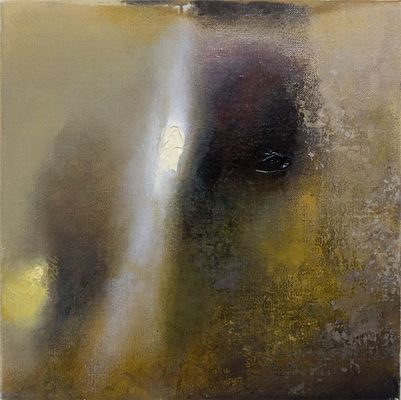
To return to Buckley’s fragment, the first two lines very much evoke how I paint nowadays. As you age, detail diminishes and patches of light become more luminous and float. I feel the most honest way of dealing with this is by smearing the oil paint on the canvas with the fingers and working close-up, blind. Only if the patches coalesce into an approaching image can the work gain a life.
-
Jonathan Walker was born in Melbourne, Australia and brought up on a dairy farm in Gippsland. In the 1970’s he studied painting at RMIT and won the Harold Wright Scholarship to the British Museum, London. During the 1980’s he exhibited at Pinacotheca Gallery, Richmond and had work shown at the NGV and Heidi City Art Gallery. Over the same period he designed the cover for the “Epigenesi” LP by Giancarlo Toniutti, Italy and conducted a mail exchange work with Achim Wollscheid, Germany. The work with artists through the post resulted in an article published in the bicentenary issue of Art and Australia 1988. He showed in artist run spaces such as WestSpace in the 90’s and 2000’s, and until 2012, taught painting at Victoria University, which is where we (Colleen Ahern and Lisa Radford) as organisers of the exhibition, among many others, had the privilege of being his student.
Walker’s knowledge was imparted to students through the careful selection of music, literature, and artists found in books that he himself had ordered for the library. Walker’s strategy was the generosity of sharing his vast knowledge with references specific to each student and their context.
Walker’s paintings share a similar focus and intimacy.
This exhibition presents a small selection of recent paintings alongside a publication that includes Walker’s writing. Observational and analytical, Walker’s work is a type of material notation — the time of day, colour and how it is blended, the both specific and fleeting location of a reflection on lino or the question of whether a chair leg should be included in a painting.
Please join us on Friday August 21 between 6-8pm to celebrate the opening of the exhibition.
Curated by Colleen Ahern and Lisa Radford.
B. Wurtz
Curated by Nic Tammens
March 26 - April 4, 2015
B.Wurtz works from a basement studio in his home on Manhattan’s Lower East Side.
This local fact is attested to by the plastic shopping bags and newsprint circulars that appear in his work. As formal objects, they don’t make loud claims about their origins but nonetheless transmit street addresses and places of business from the bottom of this long thin island. Like plenty of artists, Wurtz is affected by what is local and what is consumed. His work is underpinned by this ethic. It often speaks from a neighborhood or reads like the contents of a hamper:
“BLACK PLUMS $1.29 lb.”
“Food Bazaar”
“USDA Whole Pork Shoulder Picnic 99c lb.”
“RITE AID Pharmacy, with us it’s personal.”
“H. Brickman & Sons.”
“Sweet Yams 59c lb."
Most of the work in this exhibition was made while the artist was in residence at Dieu Donne, a workshop dedicated to paper craft in Midtown. Here Wurtz fabricated assemblages with paper and objects that are relatively lightweight, with the intention that they would be easily transportable to Australia. This consideration isn’t absolute in Wurtz’s work, but was prescriptive for making the current exhibition light and cheap. Packed in two boxes, these works were sent from a USPS post office on the Lower East Side and delivered to North Melbourne by Australia Post.
Wurtz appears courtesy of Metro Pictures, New York.
Thanks to Rob Halverson, Joshua Petherick, Sari de Mallory, Matt Hinkley, Helen Johnson, Fayen d'Evie, Ask Kilmartin, Lisa Radon, Ellena Savage, Yale Union, and "Elizabeth".
John Nixon
"Archive"
December 15 - January 20, 2014
The presentation of John Nixon's archive offered a rare showcase of this extensive collection of the artist's own publications, catalogues, posters, ephemera, editions and more, from the mid 1980s onwards, alongside a selection of his artworks.
Organized by John Nixon, Joshua Petherick and Matt Hinkley.
<a href=http://wfb.public-office.info/artist/john-nixon>All titles by John Nixon
"Habitat"
at Minerva, Sydney (organised by Joshua Petherick and Matt Hinkley)
November 15 - December 20, 2014
Lupo Borgonovo, Janet Burchill & Jennifer McCamley,
Lewis Fidock, HR Giger, Piero Gilardi, Veit Laurent Kurz,
Cinzia Ruggeri, Michael E. Smith, Lucie Stahl, Daniel Weil, Wols
Press Release:
“...It contained seven objects. The slender fluted bone, surely formed for flight, surely from the wing of some large bird. Three archaic circuitboards, faced with mazes of gold. A smooth white sphere of baked clay. An age-blackened fragment of lace. A fingerlength segment of what she assumed was bone from a human wrist, grayish white, inset smoothly with the silicon shaft of a small instrument that must once have ridden flush with the surface of the skin - but the thing’s face was seared and blackened.”
William Gibson, “Count Zero”, 1986
"Autumn Projects Archive"
Curated by Liza Vasiliou
March 6 - March 15, 2014
World Food Books, in conjunction with the Virgin Australia Melbourne Fashion Festival 2014, presented the Autumn Projects archive, consisting of a selection of early examples in Australian fashion with a particular interest in collecting designers and labels from the period beginning in the 1980’s, who significantly influenced the discourse of Australian Fashion.
Curated by Liza Vasiliou, the exhibition provided a unique opportunity to view pieces by designers Anthea Crawford, Barbara Vandenberg, Geoff Liddell and labels CR Australia, Covers, Jag along with early experimental collage pieces by Prue Acton and Sally Browne’s ‘Fragments’ collection, suspended throughout the functioning World Food Books shop in Melbourne.
H.B. Peace
presented by CENTRE FOR STYLE
November 14, 2013
"Hey Blinky, you say chic, I say same"
Anon 2013
H.B. Peace is a clothing collaboration between great friends Blake Barns and Hugh Egan Westland. Their pieces explore the divergences between 'character’ and ‘personality’ in garments....etc
Special Thanks to Joshua Petherick and Matt Hinkley of WFB and Gillian Mears
and a Very Special Thank you to Audrey Thomas Hayes for her shoe collaboration.
Janet Burchill & Jennifer McCamley
"Aesthetic Suicide"
May 10 - June 8, 2013
The first of our occasional exhibitions in the World Food Books office/shop space in Melbourne, "Aesthetic Suicide" presented a body of new and older works together by artists Janet Burchill & Jennifer McCamley, including videos, prints, a wall work, and publications.
During shop open hours videos played every hour, on the hour.
1991, English
Softcover (staple-bound), 36 pages, 30 x 21cm
1st Edition, Out of print title / used / very good
Published by
Art Gallery of New South Wales / Sydney
$35.00 - Out of stock
Scarce exhibition catalogue published on the occasion of the exhibition, 3 Installations : Noelene Lucas, Ross Mellick, Robert Owen, curated by Anthony Bond at Art Gallery of New South Wales, 1991. Illustrated in colour and b/w throughout with the work of all three Australian artists, alongside texts by playwright Noëlle Janaczewska (for Noelene Lucas), curator Tony Bond (for Ross Mellick), and artist John Barbour (for Robert Owen), biographies, artist texts and drawings.
Very Good copy.
1969, English
Softcover (staple-bound), 32 pages, 21.5 x 14 cm
1st Edition, Out of print title / used / very good
Published by
Oxford University Press / New York
$30.00 - Out of stock
First edition of "Australian Abstract Art", an essay by Australian art historian and academic Patrick McCaughey (born 1942 in Dublin, Ireland), published in 1969 by Oxford University Press under their "National Gallery Booklets" series. Includes illustrated examples of Roy de Maistre, Grace Crowley, Ralph Balson, John Olsen, Elwyn Lynn, Norma Redpath, Lawrence Daws, Clement Meadmore, Robert Jacks, Sydney Ball, Dale Hickey, Richard Havyatt.
Fine copy with light tanning.
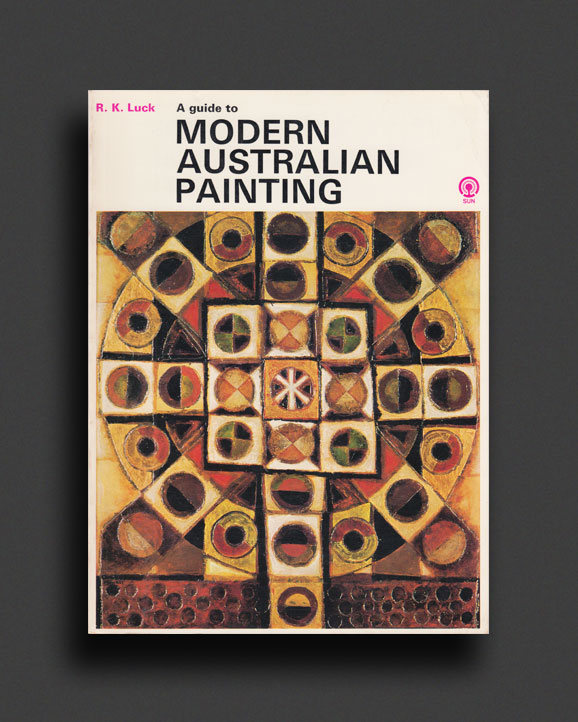
1969, English
Softcover, 120 pages, 21.5 x 16 cm
1st Edition, Out of print title / used / very good
Published by
Sun Books / Melbourne
$18.00 - Out of stock
First 1969 edition of "A Guide to Modern Australian Painting", published by Sun Books, Melbourne. "The first paperback book on modern Australian art", this small but generous volume, traces the extraordinary developments in Australian art for the "student, connoisseur or 'just plain curious'".
Profusely illustrated in colour and b/w throughout with the work of Ian Fairweather, John Olsen, Brett Whiteley, John Coburn, Robert Grieve, Sydney Ball, Col Jordon, Stanislaus Rapotec, Albert Tucker, John Perceval, Sidney Nolan, Arthur Boyd, Donald Friend, Sir William Dobell, Lloyd Rees, Jon Molvig, James Gleeson, Robert Juniper, Clifton Pugh, Jacqueline Hick, Leonard French, John Brack, Lloyd Rees, Russell Drysdale, Elwyn Lynn, Ken Reinhard, David Boyd, David Aspen, and many more.
Foreword by author R.K. Luck, and followed by details of plates, biographical notes on all featured artists, list of main Australian galleries and bibliography.
Good-Very Good copy.
2002, English
Softcover (staple-bound), 32 pages, 27 x 21 cm
1st Edition, Out of print title / used / very good
$15.00 - In stock -
Scarce catalogue published on the occasion of the First Birthday Exhibition of Metro 5 Gallery, May - June, 2002, coinciding with the world exclusive release of the gold sculptures of Sidney Nolan (depicted on the cover and within). Features the work of Sidney Nolan, Arthur Boyd, Dale Hickey, John Brack, John Firth-Smith, Hoawrd Arkley, Robert Jacks, Roger Kemp, Yvonne Audette, Albert Tucker, James Gleeson, John Perceval, Tim Storrier, Brett Whiteley, and many others. Illustrated throughout in colour with press release and room-sheet price-list enclosed.
Very Good copy.
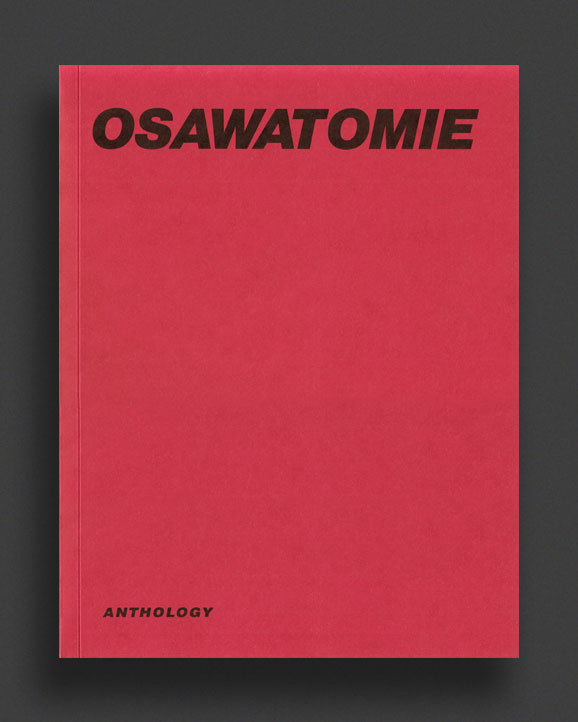
2021, English
Softcover, 234 pages, 22.4 x 29 cm
Published by
BATT Coop /Paris
$70.00 - In stock -
Osawatomie is a direct allusion to the eponymous battle waged by the abolitionist John Brown of whom Victor Hugo at the time of saving him from hanging says "Yes, let America know and think about it, there is something more frightening than Cain killing Abel, it is Washington killing Spartacus". By his call to the armed struggle to fight slavery Brown is part of a revolutionary culture which links him in particular to Auguste Blanqui.
At a time when the United States of America seems once again affected by the fever of resistance against racial and social inequalities, it seems opportune to put the documents of the radicals of the 1960s and 1970s back into circulation. The context of the struggle for civil rights and the military expansion in Vietnam then allowed the emergence of a militant generation such as the country had not known since the crushing of the unionism of the IWW (Industrial Worker of the World) and the hunt for communists. From Ghettos to Universities, groups are suddenly forming and organizing in the middle of the sixties into a whole, that history calls New Left. Among them, the student union movement is experiencing through the SDS (Student for a Democratic Society) a peak of 100,000 inscribed members, torn within it by two political organizations, one based on Marxist Leninist orthodoxy, strongly tinged with workerism, refusing the contextual analysis of racial tensions and the particular history of the USA, the Worker Student Alliance (WSA). The other, majority in the SDS, the Revolutionary Youth Movement (RYM) wishing to accompany the resistance movements of the Young Lords to the Black Panther Party, opting after the dissolution of the SDS for a strategy of participation in the increase of tensions and confrontations with the power and reactionary America. Thus are formed the Weather Underground in allusion to the words of a Bob Dylan song "You don't need a weatherman to know which way the wind blows", prophetic adhesion to the imminence of a world revolution. While they are not about taking power, it is about accompanying it to its downfall. Its members, numbering 30, exclusively from the white petty bourgeoisie went underground from 1969 relying on a strong network of thousands of sympathizers. They carry out attacks of symbolic significance which never claim victims, and become much more radicalized in their autarky and publish in low circulation, Osawatomie, a newspaper sent mainly to their relays supposed to withdraw and distribute the publication which will know 6 issues in a year before disappearing with the organization.
The complete collection is reproduced in this book, along with the brochure explaining the organizational explosion, the split. Feminism, anti-imperialist struggle, Vietnam, racism and segregation, sexism, workers' struggles, anti-colonialists, anti-prison in addition to the political orientations of the revolutionary movement are all themes addressed.
2022, English
Softcover, 256 pages, 17.5 x 11.5 cm
Published by
Urbanomic / Cornwall
$35.00 - In stock -
An argument that by amplifying alienation in performance, we can shift the emphasis from the sonic to the social.
We are not what we think we are. Our self-image as natural individuated subjects is determined behind our backs—historically by political forces, cognitively by the language we use, and neurologically by sub-personal mechanisms, as revealed by scientific and philosophical analyses.
Under contemporary capitalism, as the gap between self-image and reality becomes an ever greater source of social and mental distress, these theoretical insights are potential dynamite. Shifting his explorations from the sonic to the social, amplifying alienation and playing with psychic noise, artist and performer Mattin finally lights the fuse.
In what is a handbook for practical transformation as much as a theoretical treatise, Mattin sets out the thinking behind his score Social Dissonance, in which the audience is the instrument.
The noise is here to stay. Alienation is a constitutive part of subjectivity and an enabling condition for exploring social dissonance—the territory upon which we already find ourselves, the condition we inhabit today.
2022, English
Softcover, 192 pages, 19.8 x 12.9 cm
Published by
Urbanomic / Cornwall
$35.00 - Out of stock
Insights into the intelligence throughout the natural and technical environment, in the fabric of our devices and dwellings, in our clothes, and under our skin.
Is there a way to understand the materials that surround us not as passive objects, but as other intelligences interacting with our own?
In Parallel Minds, expert in materials science and nanotechnology Laura Tripaldi delivers not only detailed insights into the properties and emergent behaviours of matter as revealed by state-of-the-art chemistry, synthetic biology, and nanotech, but also a rich philosophical reflection that crosses the frontier between nature and culture, and where the most cutting-edge scientific syntheses resonate with ancient myth.
The result is a technomaterial bestiary full of unexpected encounters with ‘strange minds’—from cobwebs to kevlar and carbon fibre, from centaurs to amoebas to arachnids, from polycephalic slime to resonating plasmons, from viruses to golems. In leading us through this labyrinth of intelligent materials, Tripaldi picks up the thread of new materialisms and—in the historical weave between ‘women’s work’ and the ‘unnatural sciences’—contemporary feminisms.
Parallel Minds reveals the intelligence at large throughout the natural and technical environment, in the fabric of our devices and dwellings, in our clothes, and even under our skin. Full of lateral ideas and unexpected images, Tripaldi’s book imbues the study and synthesis of materials with a new urgency. For not only do the materials that surround us participate actively in the construction of the world in which we live, but harnessing their ability to interact intelligently with their environment could be the key to the future of our species.
"Parallel Minds is a welcome guide to contemporary debates about material intelligence: calm and measured, it is also bold in its ambitions and unafraid to face the challenges posed by an increasingly—and often disconcertingly—smart and lively world in which culture is inseparable from technology." —Sadie Plant, author of Zeros and Ones
"Tripaldi’s book is the most important philosophical surprise of recent years. It outlines a research programme in which philosophy and chemistry, the science of living beings and morality will have to work together in order to overcome all the dualisms that have marked modernity. Radical and erudite, very readable, and revolutionary, Tripaldi’s book is sure to become a great contemporary classic." —Emmanuele Coccia, author of Metamorphoses
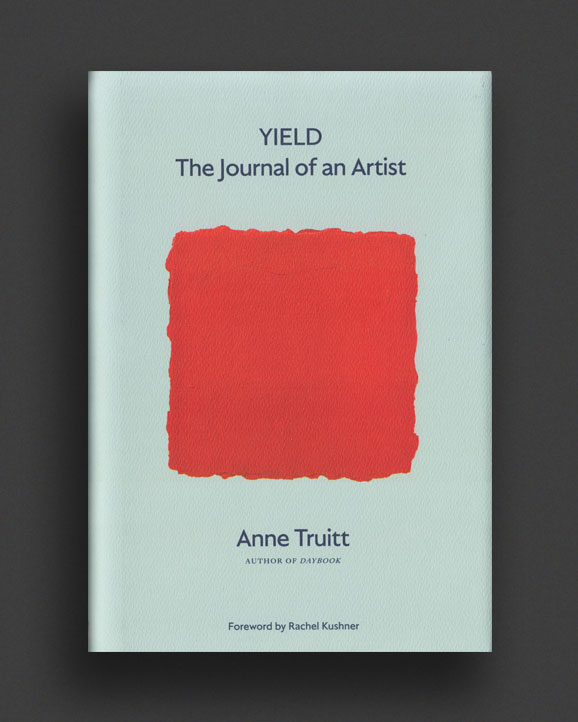
2022, English
Hardcover (w. dust jacket), 216 pages, 21 x 14 cm
Published by
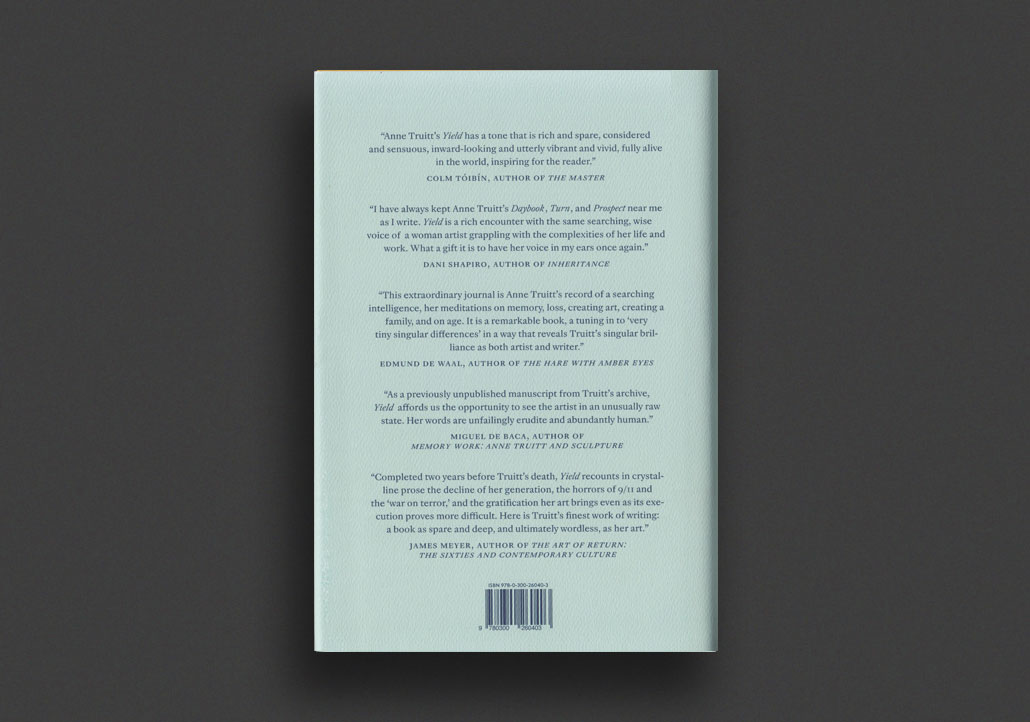
Yale University Press / New Haven
$46.00 - Out of stock
Foreword by Rachel Kushner
Preface by Alexandra Truitt
"Impressive . . . Truitt lyrically looks back on 80 years of life. . . . [T]hese daily entries . . . offer a version of Truitt free of artifice as she meditates on the sacred and mundane. . . . This sparks with intelligence."—Publishers Weekly
In the spring of 1974, the artist Anne Truitt (1921-2004) committed herself to keeping a journal for a year. She would continue the practice, sometimes intermittently, over the next six years, writing in spiral-bound notebooks and setting no guidelines other than to "let the artist speak." These writings were published as Daybook: The Journal of an Artist (1982). Two other journal volumes followed: Turn (1986) and Prospect (1996). This book, the final volume, comprises journals the artist kept from the winter of 2001 to the spring of 2002, two years before her death.
In Yield, Truitt's unflinching honesty is on display as she contemplates her place in the world and comes to terms with the intellectual, practical, emotional, and spiritual issues that an artist faces when reconciling her art with her life, even as that life approaches its end. Truitt illuminates a life and career in which the demands, responsibilities, and rewards of family, friends, motherhood, and grandmotherhood are ultimately accepted, together with those of a working artist.
2022, English
Softcover, 256 pages, 21.3 x 14 cm
Published by
Simon and Schuster / New York
$33.00 - Out of stock
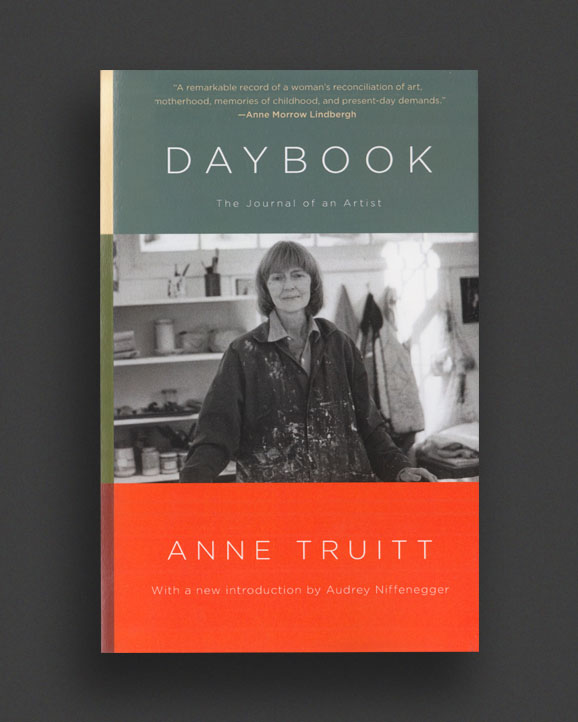
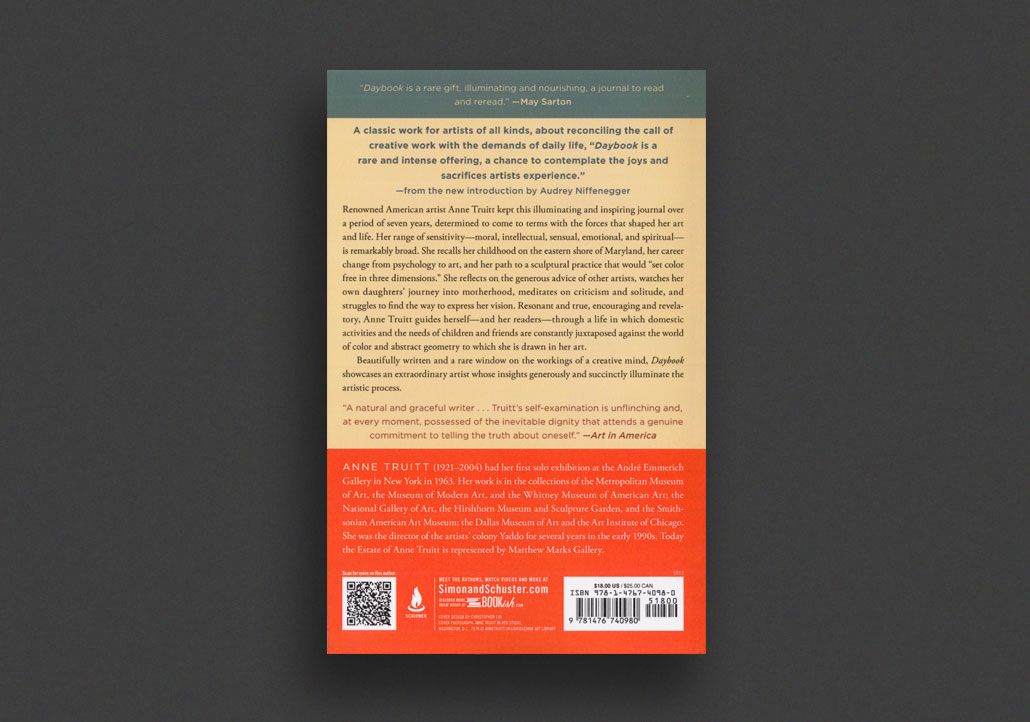
Renowned American artist Anne Truitt kept this illuminating and inspiring journal over a period of seven years, determined to come to terms with the forces that shaped her art and life. Her range of sensitivity—moral, intellectual, sensual, emotional, and spiritual— is remarkably broad. She recalls her childhood on the eastern shore of Maryland, her career change from psychology to art, and her path to a sculptural practice that would “set color free in three dimensions.” She reflects on the generous advice of other artists, watches her own daughters’ journey into motherhood, meditates on criticism and solitude, and struggles to find the way to express her vision. Resonant and true, encouraging and revelatory, Anne Truitt guides herself—and her readers—through a life in which domestic activities and the needs of children and friends are constantly juxtaposed against the world of color and abstract geometry to which she is drawn in her art.
Beautifully written and a rare window on the workings of a creative mind, Daybook showcases an extraordinary artist whose insights generously and succinctly illuminate the artistic process.
Introduction by Audrey Niffenegger
"A remarkable record of a woman's reconciliation of art, motherhood, memoires of childhood, and present-day demands." — Anne Morrow Lindbergh
"Daybook is a rare gift, illuminating and nourishing, a journal to read and re-read." — May Sarton
"A natural and graceful writer... Truitt's self-examination is unflinching and, at every moment, possessed of the inevitable dignity that attends a genuine commitment to telling the truth about oneself." — Art in America
1973, English
Softcover, 480 pages, 18.3 x 10.9 cm
Reprint,
Published by
Vintage Books / New York
$32.00 - Out of stock
'It's only after our death that we shall really be able to hear.'
Originally published in 1925, this book became known for the frank sexuality of its contents and its account of middle class French morality. The measured tone of hopeless nihilism that pervades The Counterfeiters quickly shatters any image of André Gide as the querulous and impious Buddha to a quarter-century of intellectuals. In sharp and brilliant prose a seedy, cynical and gratuitously alarming narrative is developed, involving a wide range of otherwise harmless and mainly middle-to-upper-class Parisians. But the setting could be anywhere. From puberty through adolescence to death, The Counterfeiters is a rare encyclopedia of human disorder, weakness and despair.
An appendix to this edition (Vintage, 1973) contains excerpts from the Gide's notebooks which he kept while writing this book.
André Paul Guillaume Gide (1869 – 1951) was a French author. Born in Paris in 1869, Gide's career ranged from its beginnings in the symbolist movement, to the advent of anticolonialism between the two World Wars. He had an irregular and lonely upbringing. He became devoted to literature and music, and began his literary career as an essayist, moving on to poetry, biography, fiction, drama, criticism, reminiscence and translation. By 1917 he had emerged as a prophet to French youth, and his unorthodox views were a source of endless debate and attack. Known for his fiction as well as his autobiographical works, Gide exposed to public view the conflict and eventual reconciliation of the two sides of his personality (characterized by a Protestant austerity and a transgressive sexual adventurousness, respectively), which a strict and moralistic education had helped set at odds. Gide's work can be seen as an investigation of freedom and empowerment in the face of moralistic and puritanical constraints, and centers on his continuous effort to achieve intellectual honesty. His self-exploratory texts reflect his search of how to be fully oneself, including owning one's sexual nature, without at the same time betraying one's values. He was awarded the Nobel Prize for Literature in 1948. Gide died in Paris in 1951.
2009, English / Spanish
Softcover, 736 pages, 23.2 x 15.45 cm
Published by
University of California Press / Berkley
$76.00 - Out of stock
Edited and translated by Clayton Eshleman
Foreword by Mario Vargas Llosa
Introduction by Efrain Kristal
This first translation of the complete poetry of Peruvian Cesar Vallejo (1892-1938) makes available to English speakers one of the greatest achievements of twentieth-century world poetry. Handsomely presented in facing-page Spanish and English, this volume, translated by National Book Award winner Clayton Eshleman, includes the groundbreaking collections "The Black Heralds" (1918), "Trilce" (1922), "Human Poems" (1939), and "Spain, Take This Cup from Me" (1939).
Vallejo's poetry takes the Spanish language to an unprecedented level of emotional rawness and stretches its grammatical possibilities. Striking against theology with the very rhetoric of the Christian faith, Vallejo's is a tragic vision - perhaps the only one in the canon of Spanish-language literature - in which salvation and sin are one and the same. This edition includes notes on the translation and a fascinating translation memoir that traces Eshleman's long relationship with Vallejo's poetry. An introduction and chronology provide further insights into Vallejo's life and work.
César Abraham Vallejo Mendoza (1892–1938) was a Peruvian poet, writer, playwright, and journalist. Although he published only three books of poetry during his lifetime, he is considered one of the great poetic innovators of the 20th century in any language. Always a step ahead of the literary currents, each of his books was distinct from the others and, in it's own sense, revolutionary. Thomas Merton called him "the greatest universal poet since Dante".
Poet and essayist Clayton Eshleman is a recipient of the National Book Award and the Landon Translation Prize. He is the cotranslator of César Vallejo: The Complete Posthumous Poetry and Aimé Césaire: The Collected Poetry, both from UC Press. Among Mario Vargas Llosa's prestigious literary awards are the National Critics' Prize, the Peruvian National Prize, and the Miguel de Cervantes Prize. He is the author of more than twenty books. Efrain Kristal is Professor of Comparative Literature at the University of California, Los Angeles. Stephen M. Hart is Professor of Spanish and Latin American Studies at University College, London.
1976, English
Softcover, 252 pages, 18 x 11 cm
Out of print title / used / very good
Published by
Penguin Books / London
$10.00 - Out of stock
A gripping tale of human unrelieved horror, of survival and resilience, and of the ways in which humankind confronts death, The Plague is at once a masterfully crafted novel, eloquently understated and epic in scope, and a parable of ageless moral resonance, profoundly relevant to our times. In Oran, a coastal town in North Africa, the plague begins as a series of portents, unheeded by the people. It gradually becomes an omnipresent reality, obliterating all traces of the past and driving its victims to almost unearthly extremes of suffering, madness, and compassion.
An immediate triumph when it was published in 1947, The Plague is in part an allegory of France's suffering under the Nazi occupation, and a story of bravery and determination against the precariousness of human existence.
Albert Camus (1913—1960) was an Algerian-born French philosopher, author, dramatist and journalist. He was awarded the 1957 Nobel Prize in Literature at the age of 44, the second-youngest recipient in history. His works include The Stranger, The Plague, The Myth of Sisyphus, The Fall, and The Rebel.
Very Good copy of the 1972 Penguin edition, light wear and tanning.
1962, English
Softcover, 256 pages, 18 x 11 cm
1st Edition, Out of print title / used / very good
Published by
Penguin Books / London
$18.00 - Out of stock
Written in 1914 but not published until 1925, a year after Kafka’s death, The Trial is the terrifying tale of Josef K., a respectable bank officer who is suddenly and inexplicably arrested and must defend himself against a charge about which he can get no information. Whether read as an existential tale, a parable, or a prophecy of the excesses of modern bureaucracy wedded to the madness of totalitarianism, The Trial has resonated with chilling truth for generations of readers.
Franz Kafka (1883—1924) was a German-speaking Bohemian novelist and short-story writer, widely regarded as one of the major figures of 20th-century literature. His work fuses elements of realism and the fantastic. It typically features isolated protagonists facing bizarre or surrealistic predicaments and incomprehensible socio-bureaucratic powers. It has been interpreted as exploring themes of alienation, existential anxiety, guilt, and absurdity. His best known works include the short story "The Metamorphosis" and novels The Trial and The Castle. The term Kafkaesque has entered English to describe situations like those found in his writing.
Very good copy of 1962 edition, with tanning and light wear.
2012, English
Softcover, 136 pages, 12 x 18 cm
Published by
Wakefield Press / Cambridge
$30.00 - Out of stock
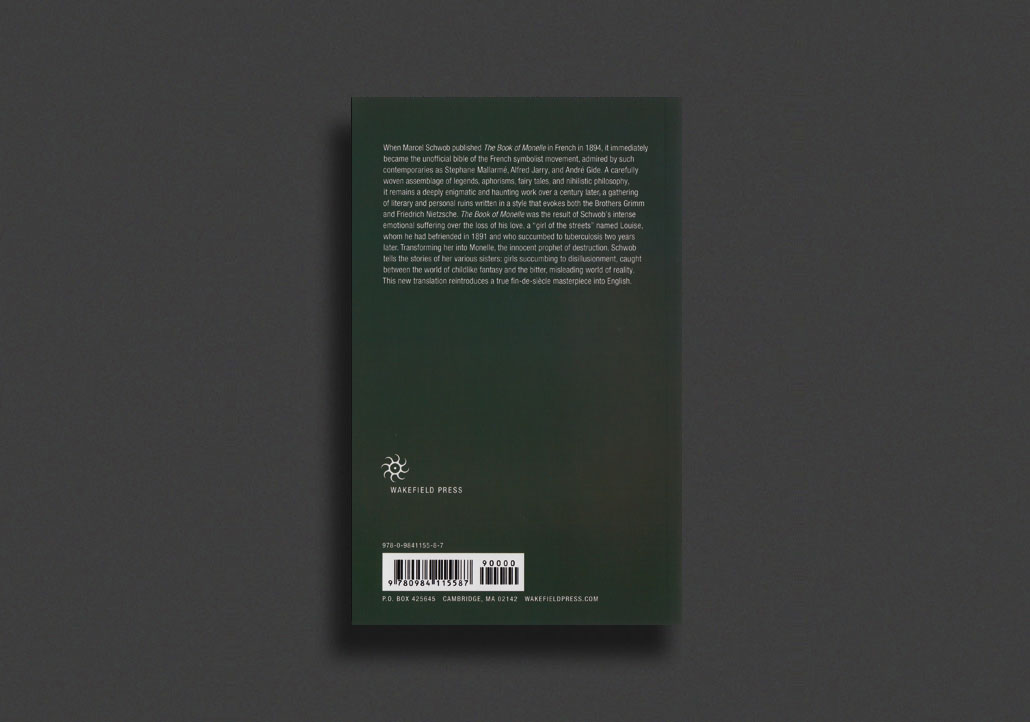
When Marcel Schwob published The Book of Monelle in French in 1894, it immediately became the unofficial bible of the French symbolist movement, admired by such contemporaries as Stephane Mallarmé, Alfred Jarry, and André Gide. A carefully woven assemblage of legends, aphorisms, fairy tales, and nihilistic philosophy, it remains a deeply enigmatic and haunting work over a century later, a gathering of literary and personal ruins written in a style that evokes both the Brothers Grimm and Friedrich Nietzsche. The Book of Monelle was the fruit of Schwob’s intense emotional suffering over the loss of his love, a “girl of the streets” named Louise, whom he had befriended in 1891 and who succumbed to tuberculosis two years later. Transforming her into Monelle, the innocent prophet of destruction, Schwob tells the stories of her various sisters: girls succumbing to disillusion, caught between the misleading world of childlike fantasy and the bitter world of reality. This new translation reintroduces a true fin-de-siècle masterpiece into English.
Marcel Schwob (1867–1905) was a scholar of startling breadth and an incomparable storyteller. A secret influence on generations of writers, from Guillaume Apollinaire and Jorge Luis Borges to Roberto Bolaño, Schwob was as versed in the street slang of medieval thieves as he was in the poetry of Walt Whitman. His allegiances were to Rabelais and François Villon, Robert Louis Stevenson and Edgar Allan Poe. Paul Valéry and Alfred Jarry both dedicated their first books to him, and in doing so paid tribute to the author who could evoke both the intellect of Leonardo da Vinci and the anarchy of Ubu Roi. He was also the uncle of Lucy Schwob, better remembered today as the Surrealist photographer Claude Cahun.
Translated, with an afterword, by Kit Schluter
“[A]n utterly heartbreaking book, beautiful in the torment and suffering that is manifested through its words.” — Janice Lee, HTML Giant
“[The Book of Monelle] is an unsettling work, a triptych in which the singular is transformed into the universal." — Stephen Sparks, 3:AM Magazine
“It is a work of poetic force and intuitive form, and the book Schwob was best known for during his lifetime.” — Martin Riker, The Wall Street Journal
A "Best of the Small Press" selection by CAConrad.
2021, English
Softcover, 124 pages, 16.2 x 11.4 cm
Published by
Spurl Editions / Sacramento
$42.00 - Out of stock
Translated by Daniel Lupo
Arthur’s Whims is the tale of “a modern saint,” a love story born of a childhood dream of being “alone on a boat with a boy, a friend.” Arthur and his beloved Bichon—a young man who, after drinking Arthur’s tears, becomes pregnant with his child—drift through a stream of identities and circumstances: birdcatchers for a French taxidermist; sailors shipwrecked in an ice fortress; explorers of the Isles of Traitors, Babies, and Sadness; famous magicians in Oklahoma; religious and medical marvels. It is an anarchic, outrageous novel, in the tradition of Edgar Allan Poe and Comte de Lautréamont, now available in English for the first time in translation by Daniel Lupo. This edition includes Hervé Guibert’s essay “The Bear,” in which he compares his books to rooms in a house, writing: “Arthur’s Whims would be the library of the house, and the bedroom of a child who will never be.” It is “a true adventure novel in the tradition of the genre, or what I believed to be its tradition, with great journeys, disasters, shipwrecks, cataclysms.”
Hervé Guibert was a French photographer, critic, and author. Born in 1955, he published works of autofiction, novels, short stories, and essays, including many on photography. His writing was often deeply personal, ironic, and centered on illness and the body. Guibert died from complications of AIDS in 1991, at the age of thirty-six.
Daniel Lupo is a writer and translator based in New York. Their work has appeared in Entropy, Bone & Ink Press, Arcturus (Chicago Review of Books), Apricity Press, and elsewhere. Arthur’s Whims is their first published translation.
“This short novel, offered here along with an essay by Guibert, reads like a madcap picaresque—one in which bodies can transform, the pace is constantly accelerating, and geography proves to be malleable. A gloriously surreal account of an unexpected voyage.” — Tobias Carroll, Words Without Borders
“How can an artist so original, so thrillingly indifferent to convention and the tyranny of good taste—let alone one so prescient—remain untranslated and unread?” — Parul Sehgal, NY Times
2020, English
Softcover, 272 pages, 13.7 x 20.3 cm
Published by
Semiotext(e) / Los Angeles
$44.00 - In stock -
Stories that map the writer's artistic development, written with candor, detachment, and passion. Herve Guibert published twenty-five books before dying of AIDS in 1991 at age 36. An originator of French "autofiction" of the 1990s, Guibert wrote with aggressive candor, detachment, and passion, mixing diary writing, memoir, and fiction. Best known for the series of books he wrote during the last years of his life, chronicling his coexistence with illness, he has been a powerful influence on many contemporary writers. Written in Invisible Ink maps the writer's artistic development, from his earliest texts-fragmented stories of queer desire-to the unnervingly photorealistic descriptions in Vice and the autobiographical sojourns of Singular Adventures. Propaganda Death, his harsh, visceral debut, is included in its entirety. The volume concludes with a series of short, jewel-like stories composed at the end of his life. These anarchic and lyrical pieces are translated into English for the first time by Jeffrey Zuckerman. From midnight encounters with strangers to tormented relationships with friends, from a blistering sequence written for Roland Barthes to a tender summoning of Michel Foucault upon his death, these texts lay bare Guibert's relentless obsessions in miniature.
Translated by Jeffrey Zuckerman
HERVÉ GUIBERT (1955-1991) was a French writer and photographer. A critic for Le Monde, he was the author of some thirty books, most notably To the Friend Who Did Not Save My Life, which presents an intimate portrait of Michel Foucault and played a significant role in changing public attitudes in France towards AIDS.
2020, English
Softcover, 272 pages, 13.7 x 20.3 cm
Published by
Semiotext(e) / Los Angeles
$49.00 - Out of stock
A novel that describes, with devastating, darkly comic clarity, its narrator's experience of being diagnosed with AIDS.
First published by Gallimard in 1990, To the Friend Who Did Not Save My Life describes, with devastating, darkly comic clarity, its narrator's experience of being diagnosed with AIDS. Guibert chronicles three months in the penultimate year of the narrator's life as, in the wake of his friend Muzil's death, he goes from one quack doctor to another, describing the progression of the disease and recording the reactions of his many friends.
The novel scandalized the French media, which quickly identified Muzil as Guibert's close friend Michel Foucault. To the Friend became a bestseller, and Guibert a celebrity. Guibert continued to document the daily experiences of his body in a series of novels and diaries, mostly published posthumously. To the Friend has since attained a cult following for its intimate and candid tone, its fragmented and slippery form. As Edmund White observed, "[Guibert's] very taste for the grotesque, this compulsion to offend, finally affords him the necessary rhetorical panache to convey the full, exhilarating horror of his predicament." In his struggle to piece together a language suited to his suffering, Herve Guibert catapulted himself into notoriety and sealed his reputation for uncompromising, transgressive prose.
Translated by Linda Coverdale, Afterword by Edmund White, Introduction by Andrew Durbin
HERVÉ GUIBERT (1955-1991) was a French writer and photographer. A critic for Le Monde, he was the author of some thirty books, most notably To the Friend Who Did Not Save My Life, which presents an intimate portrait of Michel Foucault and played a significant role in changing public attitudes in France towards AIDS.
2018, English
Softcover, 704 pages, 20.5 x 13.7 cm
Published by
New Directions / New York
$46.00 - Out of stock
Translated by Katrina Dodson
Edited by Benjamin Moser
Here, gathered in one volume, are the stories that made Clarice a Brazilian legend. Originally a cloth edition of eighty-six stories, now we have eighty-nine stories in all, covering her whole amazing career, from her teenage years to her deathbed. In these 700 plus pages, we meet teenagers becoming aware of their sexual and artistic powers, humdrum housewives whose lives are shattered by unexpected epiphanies, old people who don’t know what to do with themselves. Lispector's stories take us through their lives - and ours. From one of the greatest modern writers, these 89 stories, gathered from all the collections published during her lifetime and translated to English for the first time, follow Clarice Lispector throughout her life.
“One of the hidden geniuses of 20th-century literature” — Colm Tóibín
Clarice Lispector (1920—1977) was a Ukrainian-born Brazilian novelist and short story writer acclaimed internationally for her innovative novels and short stories. Born in 1920 to a Jewish family in western Ukraine. As a result of the anti-Semitic violence they endured, the family fled to Brazil in 1922, and Clarice Lispector grew up in Recife. Following the death of her mother when Clarice was nine, she moved to Rio de Janeiro with her father and two sisters, and she went on to study law. With her husband, who worked for the foreign service, she lived in Italy, Switzerland, England, and the United States, until they separated and she returned to Rio in 1959; she died there in 1977. Since her death, Clarice Lispector has earned universal recognition as Brazil’s greatest modern writer.
2012, English
Softcover, 220 pages, 20.3 x 13.2 cm
Published by
New Directions / New York
$28.00 - Out of stock
Translated from the Portuguese by Idra Novey
Edited by Benjamin Moser
Introduction by Caetano Veloso
The Passion According to G.H., Clarice Lispector's mystical novel of 1964, concerns a well-to-do Rio sculptress, G.H., who enters her maid’s room, which is as clear and white 'as in an insane asylum from which dangerous objects have been removed'. There she sees a cockroach - black, dusty, prehistoric - crawling out of the wardrobe and, panicking, slams the door on it. The sight of the dying insect provokes a spiritual crisis, in which she questions her place in the universe and her very identity, at the height which comes one of the most famous and most genuinely shocking scenes in Latin American literature. Clarice Lispector's spare, deeply disturbing yet luminous novel transforms language into something otherworldly, and is one of her most unsettling and compelling works. Lispector wrote that of all her works this novel was the one that “best corresponded to her demands as a writer.”
“One of the hidden geniuses of 20th-century literature” — Colm Tóibín
[Lispector] left behind an astounding body of work that has no real corollary inside literature or outside it. — Rachel Kushner
Clarice Lispector (1920—1977) was a Ukrainian-born Brazilian novelist and short story writer acclaimed internationally for her innovative novels and short stories. Born in 1920 to a Jewish family in western Ukraine. As a result of the anti-Semitic violence they endured, the family fled to Brazil in 1922, and Clarice Lispector grew up in Recife. Following the death of her mother when Clarice was nine, she moved to Rio de Janeiro with her father and two sisters, and she went on to study law. With her husband, who worked for the foreign service, she lived in Italy, Switzerland, England, and the United States, until they separated and she returned to Rio in 1959; she died there in 1977. Since her death, Clarice Lispector has earned universal recognition as Brazil’s greatest modern writer.
2012, English
Softcover, 88 pages, 20.3 x 13.2 cm
Published by
New Directions / New York
$28.00 - Out of stock
Translated by Stefan Tobler
Preface by Benjamin Moser
A meditation on the nature of life and time, Agua Viva (1973) shows Lispector discovering a new means of writing about herself, more deeply transforming her individual experience into a universal poetry. In a body of work as emotionally powerful, formally innovative, and philosophically profound as Clarice Lispector's, Agua Viva stands out as a particular triumph.
“One of the hidden geniuses of 20th-century literature” — Colm Tóibín
[Lispector] left behind an astounding body of work that has no real corollary inside literature or outside it. — Rachel Kushner
Clarice Lispector (1920—1977) was a Ukrainian-born Brazilian novelist and short story writer acclaimed internationally for her innovative novels and short stories. Born in 1920 to a Jewish family in western Ukraine. As a result of the anti-Semitic violence they endured, the family fled to Brazil in 1922, and Clarice Lispector grew up in Recife. Following the death of her mother when Clarice was nine, she moved to Rio de Janeiro with her father and two sisters, and she went on to study law. With her husband, who worked for the foreign service, she lived in Italy, Switzerland, England, and the United States, until they separated and she returned to Rio in 1959; she died there in 1977. Since her death, Clarice Lispector has earned universal recognition as Brazil’s greatest modern writer.
2000, English
Softcover, 192 pages, 19.9 x 13.6 cm
Published by
Penguin Books / London
$23.00 - In stock -
The most popular anthology of Jorge Luis Borges's short stories, Fictions is a wildly original and influential collection of fantastic tales, translated from the Spanish with an afterword by Andrew Hurley in Penguin Modern Classics.
Jorge Luis Borge's Fictions introduced an entirely new voice into world literature. It is here we find the astonishing accounts of Funes, the man who can forget nothing; the French poet who recreated Don Quixote word for word; the fatal lottery in Babylon; the mysterious planet of Tlon; and the library containing every possible book in the whole universe. Here too are the philosophical detective stories and the haunting tales of Irish revolutionaries, gaucho knife fights and dreams within dreams which proved so influential (and yet impossible to imitate). This collection was eventually to bring Borges international fame; over fifty years later it remains endlessly intriguing.
'Nobody before Borges had ever attempted this strange and wonderful mixture of arcana, popular literature, national myth, the nature of time and classical themes. Now we can see it in all its intense and disturbing brilliance, certain that we will never see anything like it again'—Justin Cartwright, Independent on Sunday
2020, English
Softcover, 80 pages, 11.4 x 17.8 cm
Published by
Wakefield Press / Cambridge
$29.00 - Out of stock
Originally published in French in 1979, Rogomelec was the third of Leonor Fini’s novels. All the qualities of the paintings for which she is famed can be found in it: an undermining of patriarchy, the ambiguities of gender and the slipperiness of desire, along with darker hints of cruelty and the voluptuousness of fear. This novella’s ambiguous narrator sets off for the isolated locale of Rogomelec—where a crumbling monastery serves as a sanatorium and offers a cure involving a diet of plants and flowers—and moves through a waking dream involving strangely scented monks, vibratory concerts in a cavernous ossuary, and ritualist pomp with costumes of octopi and shining beetles. As the days unfold, the narrator discovers that the “the celebration of the king” is approaching, the events of which will lead to a shocking discovery in Rogomelec’s Gothic ruins. This first English translation includes 14 drawings by Fini that accompanied the novella’s original publication.
Translated by William Kulik and Serena Shanken Skwersky, with an introduction by Jonathan P. Eburne
Born in Argentina and raised in Italy, Leonor Fini (1907–1996), concluded a rebellious youth with a move to Paris and a career in painting. Her six decades of work as artist, illustrator, designer, and author bore close ties to the Surrealist movement, but though the Surrealists saw her as one of them, she herself never identified as a Surrealist. Rejecting the role of muse, her work focused on portrayals of women as subjects with desire as opposed to objects of desire, and was groundbreaking in its explorations of mythology, androgyny, death, and life as Mannerist theater.
2019, English
Softcover (staple-bound), 32 pages, 29.5 x 21 cm
Published by
Daniel Buchholz Galerie / Köln
$38.00 - Out of stock
This beautiful brochure was published on the occasion of the exhibition Otto Meyer-Amden “Vorbereitung” at Galerie Buchholz New York, in 2019, and contains a new essay by Dieter Schwarz, alongside colour plates of all exhibited works. This is the English edition.
Otto Meyer-Amden (Born Otto Meyer, February 20, 1885, Bern - January 15, 1933, Zürich) was a Swiss painter and graphic artist.
2019, English
Softcover, 42 pages, 24.8 x 19.6 cm
Published by
Daniel Buchholz Galerie / Köln
$40.00 - Out of stock
Secret Passage 6: Bonnard, Villiegle, Twomboy, WSB, FBess, Hatchet Kai, Picabia, thirst trapgedies, all some young dudes, religious conversion therapy, Moreau, Teenage Moster Makeup, I touched up a Martha Rosler, TFaulk update, yetceterea
Self-published 2019 by richard hawkins and Galerie Buchholz