World Food Books' programme is largely produced on Kulin Nation land. We acknowledge the Wurundjeri people of the Kulin Nation as the first and continuing custodians of this land, and pay respect to their Elders past, present, and emerging.
World Food Books is an arts and special interests bookshop in Naarm / Melbourne. Founded in 2010, World Food Books is devoted to the presentation of a rotating, hand-selection of international art, design, literary and counterculture publications with an emphasis on the anti-traditional, the experimental, the avant-garde, the heretic, the marginal.
Presenting new titles alongside rare and out-of-print books, catalogues and journals spanning the fields of modern and contemporary art, design, photography, illustration, film, literature, poetry, cultural theory, philosophy, sexuality, popular and underground culture in its many radical forms, World Food Books wishes to encourage adventurous, thoughtful and open-minded reading, looking, writing, and exchange of publishing and ideas, both current and historical.
As well as our bookshop, located in Melbourne's historical Nicholas Building, all of our inventory is available internationally via our online mail-order service.
World Food Books semi-regularly co-ordinates "Occasions", a programme of exhibits and events at the bookshop and in partnership with other hosts (such as museums and art galleries) that develop out of the activities, relationships and content of the bookshop itself.
World Food Books
The Nicholas Building
37 Swanston Street
Room 5, Level 6
Melbourne 3000
Australia
SHOP HOURS:
Thu–Fri 12–6, Sat 12–5
WEB-SHOP OPEN 24/7
World Food Books
Postal Address:
PO Box 435
Flinders Lane
Victoria 8009
Australia
Art
Theory / Essay
Architecture / Interior
Graphic Design / Typography
Photography
Fashion
Eros
LGBTQ+
Fiction / Poetry
Weird / Speculative / Science Fiction / Horror
Transgressive / Visceral / Abject
Symbolism / Decadence / Fin de siècle
Film / Video
Painting
Sculpture / Installation
Performance / Dance / Theater
Drawing
Sound / Music
Curatorial
Group Shows / Collections
Periodicals
Out-of-print / Rare
Posters / Ephemera / Discs
Signed Books
World Food Books Gift Voucher
World Food Book Bag
Australian Art
Australian Fiction
Australian Science Fiction / Speculative Fiction
Australian Poetry
Australian Photography
Japanese Photography
Conceptual Art
Minimal Art
Dada
'Pataphysics / Oulipo
Fluxus
Concrete Poetry
Pop Art
Surrealism
Arte Povera
Arte Informale / Haute Pâte / Tachism
Nouveau Réalisme / Zero / Kinetic
Situationism / Lettrism
Collage / Mail Art / Xerox Art
Art Brut / Folk / Visionary / Fantastic
Illustration / Graphic Art / Bandes Dessinées
Furniture
Italian Radical Design / Postmodernism
Textiles
Ceramics / Glass
Counterculture
Protest / Revolt
Philosophy
Psychoanalysis
Anthropology
Anarchism
Socialism / Anarchism / Communism / Capitalism
Literary Theory / Semiotics / Language
Feminism / Women's Studies
Gender Studies / Sexuality
Anthropology
Fetishism / BDSM
Drugs / Psychedelia
Crime / Violence
Animal Rights / Veganism
Occult / Esoterica
Ecology / Earth / Alternative Living
Whole Earth / Crafts
All prices in AUD (Australian dollars)
Pick-Ups
Pick-up orders can be collected in our bookshop during opening hours after order date. Please collect any Pick-up orders within 2 weeks of ordering as we have limited storage space. Orders will be released back into stock if not collected within this time. No refunds can be made for pick-ups left un-collected. If you cannot make it in to the bookshop in this time-frame, please choose postage option.
Return Policy
All sales are final. We do accept returns (for refund or exchange) for items received in error. All our orders are packed with special care using heavy-duty padding and cardboard book-mailers or bubble mailers (for smaller books), using reinforcement where required. We cannot take responsibility for any lost, stolen or damaged parcels.
Insurance
Should you wish to insure your package, please email us directly after placing your order and we can organise this at a small extra expense. Although all standard/express tracked packages are very safe and dependable, we cannot take responsibility for any lost, stolen or damaged parcels. We recommend insurance on valuable orders.
Interested in selling your old books, catalogues, journals, magazines, comics, fanzines, ephemera? We are always looking for interesting, unusual and out-of-print books to buy. We only buy books in our fields of interest and specialty, and that we feel we can resell.
We base these prices on desirability, market value, in-print prices, condition and our current stock levels. We offer cash, store credit, and can take stock on consignment. All
about 25% of the price we expect to get when we sell them, or 30% in store credit. We base these prices on desirability, market value, in-print prices, condition and our current stock levels.
Sell your books any day of the week. You can drop them off and return later. If you have a lot of books, we can visit your Sydney home.
We buy books that we feel we can resell. We offer about 25 % of the price we expect to get when we sell them, or 30% in store credit. We base these prices on desirability, market value, in-print prices, condition and our current stock levels.
Philadelphia Wireman
03 August - 01 September, 2018
World Food Books is proud to announce our next Occasion, the first presentation of sculptures by Philadelphia Wireman in Australia.
The Philadelphia Wireman sculptures were found abandoned in an alley off Philadelphia’s South Street on trash night in 1982. Their discovery in a rapidly-changing neighbourhood undergoing extensive renovation, compounded with the failure of all attempts to locate the artist, suggests that the works may have been discarded after the maker’s death. Dubbed the "Philadelphia Wireman" during the first exhibition of this work, in 1985, the maker’s name, age, ethnicity, and even gender remain uncertain. The entire collection totals approximately 1200 pieces, all intricately bound together with tightly-wound heavy-gauge wire (along with a few small, abstract marker drawings, reminiscent both of Mark Tobey and J.B. Murry). The dense construction of the work, despite a modest range of scale and materials, is singularly obsessive and disciplined in design: a wire armature or exoskeleton firmly binds a bricolage of found objects including plastic, glass, food packaging, umbrella parts, tape, rubber, batteries, pens, leather, reflectors, nuts and bolts, nails, foil, coins, toys, watches, eyeglasses, tools, and jewellery.
Heavy with associations—anthropomorphic, zoomorphic, and socio-cultural responses to wrapped detritus—the totemic sculptures by Philadelphia Wireman have been discussed in the context of work created to fulfil the shamanistic needs of alternative religions in American culture. Curators, collectors, and critics have variously compared certain pieces to sculpture from Classical antiquity, Native American medicine bundles, African-American memory jugs, and African fetish objects. Reflecting the artist’s prolific and incredibly focused scavenging impulse, and despite—or perhaps enhanced by—their anonymity, these enigmatic objects function as urban artefacts and arbiters of power, though their origin and purpose is unknown. Philadelphia Wireman, whatever their identity, possessed an astonishing ability to isolate and communicate the concepts of power and energy through the selection and transformation of ordinary materials. Over the course of the past two decades, this collection has come to be regarded as an important discovery in the field of self-taught art and vernacular art.
Presented in collaboration with Fleisher-Ollman Gallery, Philadelphia, and Robert Heald, Wellington.
Susan Te Kahurangi King
02 February - 10 March, 2018
Susan Te Kahurangi King (24 February 1951 - ) has been a confident and prolific artist since she was a young child, drawing with readily available materials - pencils, ballpoint pens and felt-tip markers, on whatever paper is at hand. Between the ages of four and six Susan slowly ceased verbal communication. Her grandparents William and Myrtle Murphy had developed a special bond with Susan so they took on caring responsibilities for extended periods. Myrtle began informally archiving her work, carefully collecting and storing the drawings and compiling scrapbooks. No drawing was insignificant; every scrap of paper was kept. The King family are now the custodians of a vast collection containing over 7000 individual works, from tiny scraps of paper through to 5 meter long rolls.
The scrapbooks and diaries reveal Myrtle to be a woman of great patience and compassion, seeking to understand a child who was not always behaving as expected. She encouraged Susan to be observant, to explore her environment and absorb all the sights and sounds. Myrtle would show Susan’s drawings to friends and people in her community that she had dealings with, such as shopkeepers and postal workers, but this was not simply a case of a grandmother’s bias. She recognised that Susan had developed a sophisticated and unique visual language and sincerely believed that her art deserved serious attention.
This was an unorthodox attitude for the time. To provide some context, Jean Dubuffet coined the term Art Brut in 1945 to describe work created by self-taught artists – specifically residents of psychiatric institutions and those he considered to be visionaries or eccentrics. In 1972 Roger Cardinal extended this concept by adopting the term Outsider Art to describe work made by non-academically trained artists operating outside of mainstream art networks through choice or circumstance. Susan was born in Te Aroha, New Zealand in 1951, far from the artistic hubs of Paris and London that Dubuffet and Cardinal operated in. That Myrtle fêted Susan as a self-taught artist who deserved to be taken seriously shows how progressive her attitudes were.
Susan’s parents Doug and Dawn were also progressive. Over the years they had consulted numerous health practitioners about Susan’s condition, as the medical establishment could not provide an explanation as to why she had lapsed into silence. Dawn educated herself in the field of homeopathy and went on to treat all twelve of her children using these principles – basing prescriptions on her observations of their physical, mental and emotional state.
Doug was a linguist with an interest in philosophy who devoted what little spare time he had to studying Maori language and culture. To some extent their willingness to explore the fringes of the mainstream made them outsiders too but it was their commitment to living with integrity and their respect for individuality that ensured Susan’s creativity was always encouraged.
Even though Susan’s family supported her artistic pursuits, some staff in schools and hospitals saw it as an impediment to her assimilation into the community and discouraged it in a variety of ways. Her family was not always aware of this and therefore did not fully understand why Susan stopped drawing in the early 1990s. However, rather than dwell on the challenges that Susan faced in pursuit of her artistic practice, they prefer to highlight her achievements. In 2008 Susan began drawing again in earnest, after an almost 20 year interruption, and her work is now shown in galleries around the world.
Susan grew up without television and has been heavily influenced by the comics she read as a child. She is absolutely fearless in the appropriation of recognizable characters, such as Donald Duck and Mickey Mouse, in her work. She twists their limbs, contorts their faces, compresses them together, blends them into complex patterned backgrounds - always imbuing them with an incredible energy. Although Susan often used pop culture characters in her work they are not naive or childlike. These are drawings by a brilliant self-taught artist who has been creating exceptional work for decades without an audience in mind.
Mladen Stilinović
"Various Works 1986 - 1999"
02 February 16 - September 10, 2016
Various works 1986 - 1999, from two houses, from the collections of John Nixon, Sue Cramer, Kerrie Poliness, Peter Haffenden and Phoebe Haffenden.
Including: Geometry of Cakes (various shelves), 1993; Poor People’s Law (black and white plate), 1993; White Absence (glasses, ruler, set square, silver spoon, silver ladel with skin photograph and wooden cubes), 1990-1996; Exploitation of the Dead (grey and red star painting, wooden painting, black spoon with red table, red plate), 1984-1990; Money and Zeros (zero tie, paintings made for friends in Australia (Sue, John, Kerrie), numbers painting), 1991-1992; Words - Slogans (various t-shirts) - “they talk about the death of art...help! someone is trying to kill me”, “my sweet little lamb”, “work is a disease - Karl Marx”; Various artist books, catalogues, monographs, videos; Poster from exhibition Insulting Anarchy; "Circular" Croatian - Australian edition; Artist book by Vlado Martek (Dostoyevsky); more.
Thanks to Mladen Stilinović and Branka Stipančić.
Jonathan Walker
Always Will Need To Wear Winter Shirt Blue + Ochre Small Check Pattern
21 August - 21 September, 2015
Untitled
I am not a great reader of poetry but I always return to the work of Melbourne poet, Vincent Buckley (1925- 1988). Perhaps I find his most tantalising piece to be not a finished poem but a fragment left on a scrap of paper discovered on his desk after the poet’s death.
The poetry gathers like oil
In the word-core, and spreads
It has its music meet,
Its music is in movement.
This fragment is more the shell left behind from a volatile thought than a finished poem. I find the last two lines honest but awkward whereas the first two lines work like an arrow. Most likely he could not find a resolution so it was left. Still, in its present form, it remains an eloquent testimony to the ultimate failure of a medium to express mobile thought and sensation, in Buckley’s case, through verbal language. It’s an important matter because this is something all artists have to deal with regardless of the medium.
I have never written a poem, however, I am forever copying fragments from books on paper scraps in a vain effort to fix certain notions in my head. At first, they function as bookmarks that are sometimes returned to when I open the book. But before long, as they accumulate, they fall out littering the table interspersed with A4 photocopies, bills, books and medications.
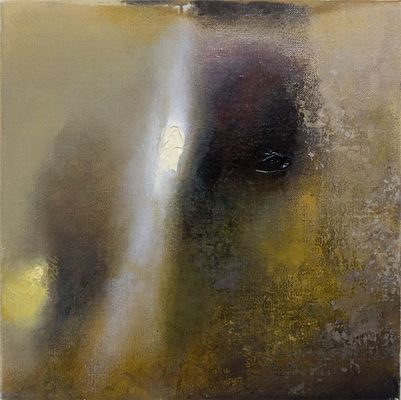
To return to Buckley’s fragment, the first two lines very much evoke how I paint nowadays. As you age, detail diminishes and patches of light become more luminous and float. I feel the most honest way of dealing with this is by smearing the oil paint on the canvas with the fingers and working close-up, blind. Only if the patches coalesce into an approaching image can the work gain a life.
-
Jonathan Walker was born in Melbourne, Australia and brought up on a dairy farm in Gippsland. In the 1970’s he studied painting at RMIT and won the Harold Wright Scholarship to the British Museum, London. During the 1980’s he exhibited at Pinacotheca Gallery, Richmond and had work shown at the NGV and Heidi City Art Gallery. Over the same period he designed the cover for the “Epigenesi” LP by Giancarlo Toniutti, Italy and conducted a mail exchange work with Achim Wollscheid, Germany. The work with artists through the post resulted in an article published in the bicentenary issue of Art and Australia 1988. He showed in artist run spaces such as WestSpace in the 90’s and 2000’s, and until 2012, taught painting at Victoria University, which is where we (Colleen Ahern and Lisa Radford) as organisers of the exhibition, among many others, had the privilege of being his student.
Walker’s knowledge was imparted to students through the careful selection of music, literature, and artists found in books that he himself had ordered for the library. Walker’s strategy was the generosity of sharing his vast knowledge with references specific to each student and their context.
Walker’s paintings share a similar focus and intimacy.
This exhibition presents a small selection of recent paintings alongside a publication that includes Walker’s writing. Observational and analytical, Walker’s work is a type of material notation — the time of day, colour and how it is blended, the both specific and fleeting location of a reflection on lino or the question of whether a chair leg should be included in a painting.
Please join us on Friday August 21 between 6-8pm to celebrate the opening of the exhibition.
Curated by Colleen Ahern and Lisa Radford.
B. Wurtz
Curated by Nic Tammens
March 26 - April 4, 2015
B.Wurtz works from a basement studio in his home on Manhattan’s Lower East Side.
This local fact is attested to by the plastic shopping bags and newsprint circulars that appear in his work. As formal objects, they don’t make loud claims about their origins but nonetheless transmit street addresses and places of business from the bottom of this long thin island. Like plenty of artists, Wurtz is affected by what is local and what is consumed. His work is underpinned by this ethic. It often speaks from a neighborhood or reads like the contents of a hamper:
“BLACK PLUMS $1.29 lb.”
“Food Bazaar”
“USDA Whole Pork Shoulder Picnic 99c lb.”
“RITE AID Pharmacy, with us it’s personal.”
“H. Brickman & Sons.”
“Sweet Yams 59c lb."
Most of the work in this exhibition was made while the artist was in residence at Dieu Donne, a workshop dedicated to paper craft in Midtown. Here Wurtz fabricated assemblages with paper and objects that are relatively lightweight, with the intention that they would be easily transportable to Australia. This consideration isn’t absolute in Wurtz’s work, but was prescriptive for making the current exhibition light and cheap. Packed in two boxes, these works were sent from a USPS post office on the Lower East Side and delivered to North Melbourne by Australia Post.
Wurtz appears courtesy of Metro Pictures, New York.
Thanks to Rob Halverson, Joshua Petherick, Sari de Mallory, Matt Hinkley, Helen Johnson, Fayen d'Evie, Ask Kilmartin, Lisa Radon, Ellena Savage, Yale Union, and "Elizabeth".
John Nixon
"Archive"
December 15 - January 20, 2014
The presentation of John Nixon's archive offered a rare showcase of this extensive collection of the artist's own publications, catalogues, posters, ephemera, editions and more, from the mid 1980s onwards, alongside a selection of his artworks.
Organized by John Nixon, Joshua Petherick and Matt Hinkley.
<a href=http://wfb.public-office.info/artist/john-nixon>All titles by John Nixon
"Habitat"
at Minerva, Sydney (organised by Joshua Petherick and Matt Hinkley)
November 15 - December 20, 2014
Lupo Borgonovo, Janet Burchill & Jennifer McCamley,
Lewis Fidock, HR Giger, Piero Gilardi, Veit Laurent Kurz,
Cinzia Ruggeri, Michael E. Smith, Lucie Stahl, Daniel Weil, Wols
Press Release:
“...It contained seven objects. The slender fluted bone, surely formed for flight, surely from the wing of some large bird. Three archaic circuitboards, faced with mazes of gold. A smooth white sphere of baked clay. An age-blackened fragment of lace. A fingerlength segment of what she assumed was bone from a human wrist, grayish white, inset smoothly with the silicon shaft of a small instrument that must once have ridden flush with the surface of the skin - but the thing’s face was seared and blackened.”
William Gibson, “Count Zero”, 1986
"Autumn Projects Archive"
Curated by Liza Vasiliou
March 6 - March 15, 2014
World Food Books, in conjunction with the Virgin Australia Melbourne Fashion Festival 2014, presented the Autumn Projects archive, consisting of a selection of early examples in Australian fashion with a particular interest in collecting designers and labels from the period beginning in the 1980’s, who significantly influenced the discourse of Australian Fashion.
Curated by Liza Vasiliou, the exhibition provided a unique opportunity to view pieces by designers Anthea Crawford, Barbara Vandenberg, Geoff Liddell and labels CR Australia, Covers, Jag along with early experimental collage pieces by Prue Acton and Sally Browne’s ‘Fragments’ collection, suspended throughout the functioning World Food Books shop in Melbourne.
H.B. Peace
presented by CENTRE FOR STYLE
November 14, 2013
"Hey Blinky, you say chic, I say same"
Anon 2013
H.B. Peace is a clothing collaboration between great friends Blake Barns and Hugh Egan Westland. Their pieces explore the divergences between 'character’ and ‘personality’ in garments....etc
Special Thanks to Joshua Petherick and Matt Hinkley of WFB and Gillian Mears
and a Very Special Thank you to Audrey Thomas Hayes for her shoe collaboration.
Janet Burchill & Jennifer McCamley
"Aesthetic Suicide"
May 10 - June 8, 2013
The first of our occasional exhibitions in the World Food Books office/shop space in Melbourne, "Aesthetic Suicide" presented a body of new and older works together by artists Janet Burchill & Jennifer McCamley, including videos, prints, a wall work, and publications.
During shop open hours videos played every hour, on the hour.
2022, English
Softcover, 272 pages, 24 x 30 cm
Published by
Hatje Cantz / Berlin
$130.00 - Out of stock
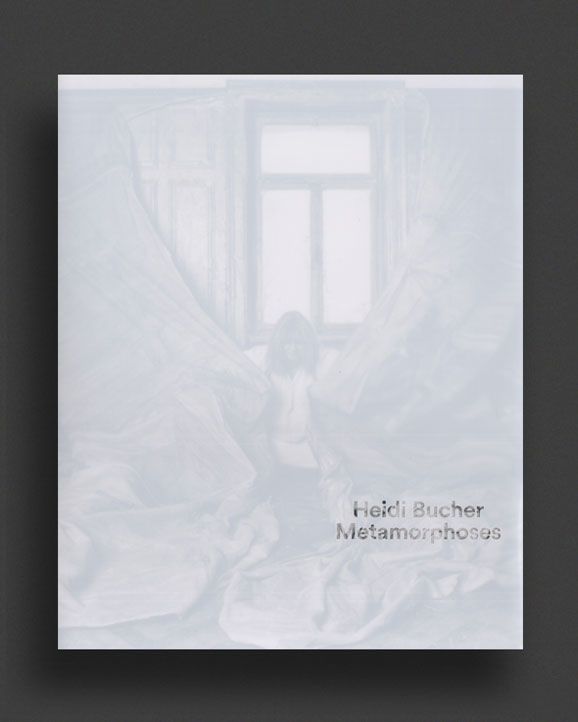
This major new monograph charts Swiss sculptor Heidi Bucher’s (1926–1993) sensual, radical, feminist sculpture across four decades.
Heidi Bucher’s fascination with the interplay between art and fashion gave rise to wearable genderless body sculptures back in the early 1970s in California. The works celebrated her concept of sculpture as something between performance and object. Already at this time, she began to experiment with unusual materials such as rubber, which she applied to surfaces in liquid form and pulled off again with great physical force after it had solidified. With material transformations that were at once radical and sensual, she investigated human forms of existence and their embedding in power structures. In doing so, she was always dedicated to a critical subversion of normative gender roles. This monograph presents Bucher’s oeuvre from its beginnings in Zurich in the 1940s, to the experimental phase in New York and Los Angeles in the 1960s and 1970s and the main body of work with architectural and human skins, to the works she created in the last years of her life on Lanzarote.
2009, English
Softcover, 348 pages, 23 x 31 cm
Published by
MOCA / Los Angeles
The MIT Press / Massachusetts
$85.00 - Out of stock
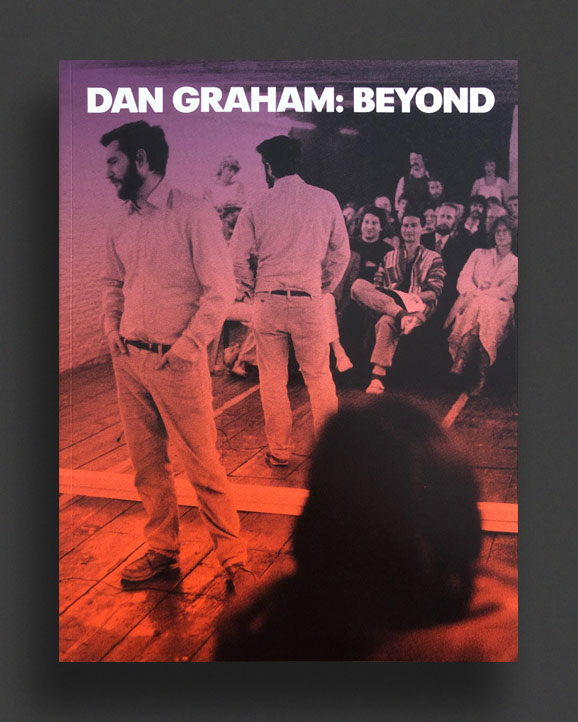
Dan Graham is one of the most significant figures to emerge from the 1960s moment of Conceptual art, with a practice that pioneered a range of art forms, modes, and ideas that are now fundamental to contemporary art. The thrust of his practice has always pointed beyond: beyond the art object, beyond the studio, beyond the medium, beyond the gallery, beyond the self. Beyond all these categories and into the realm of the social, the public, the democratic, the mass produced, the architectural, the anarchic, the humorous. Graham's early work, Homes for America--a series of snapshots of suburban New Jersey tract housing accompanied by short parodic texts, made as a page layout for Arts magazine--announced a critical art grounded in the everyday, and it merged the artist's interest in cultural commentary with art's most advanced visual modes. His 1984 "video-essay" Rock My Religion traced a continuum of separatism and collective ecstasy from the American religious sect the Shakers to hard-core punk music.
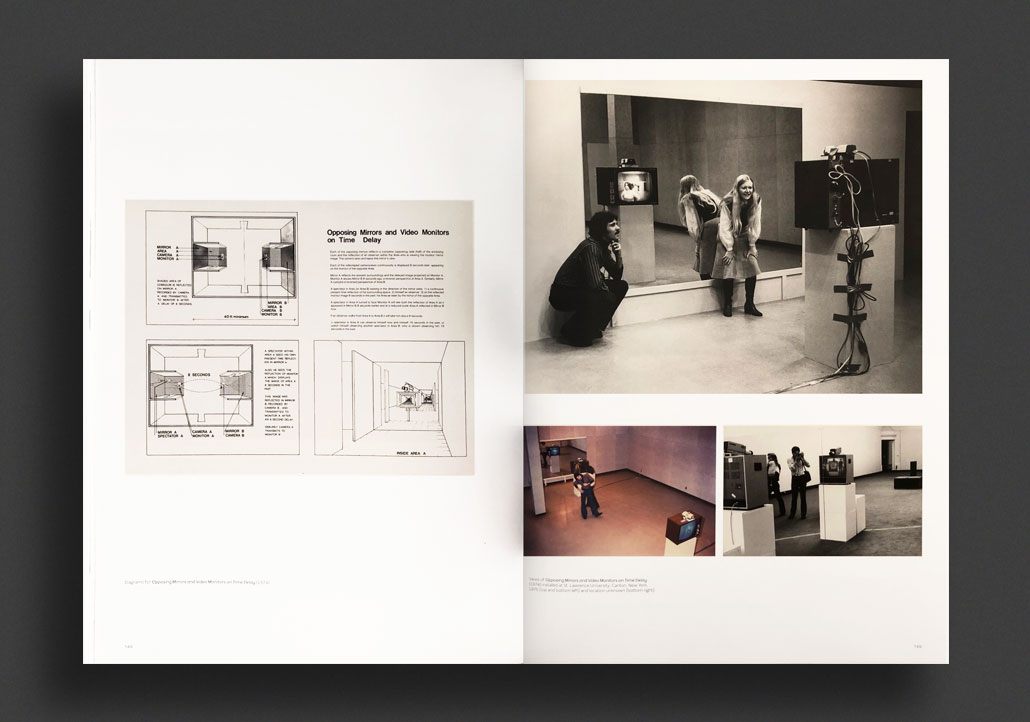
This volume, which accompanied a major retrospective organized by the Museum of Contemporary Art, Los Angeles, offers the first comprehensive survey of Graham's work. The book's design evokes magazine format and style, after Graham's important conceptual work from the 1960s in that medium. Generously illustrated in color and black and white, Dan Graham: Beyond features eight new essays, two new interviews with the artist, a section of reprints of Graham's own writing, and an animated manga-style "life of Dan Graham" narrative. It examines Graham's entire body of work, which includes designs for magazine pages, drawing, photographs, film and video, and architectural models and pavilions.
Essays : Chrissie Iles on Graham's performance work; Bennett Simpson on Graham's interest and works in rock music; Beatriz Colomina on Graham's architectural pavilions; Rhea Anastas on Graham's early formation and short-lived operation of the John Daniels Gallery; Mark von Schlegell on Graham's interest in science fiction; Mark Francis on Graham's Public Space/Two Audiences (1976); Alexandra Midal on Graham's conceptual works for magazine pages and magazine design; Philippe Vergne on Graham's puppet opera Don't Trust Anyone Over Thirty (2004); Kim Gordon interview with Graham on their collaborations and music; Rodney Graham interview with Graham on jokes and humor in art.
2021, English / Italian
Softcover, 272 pages, 17 x 24 cm
Published by
Nero / Rome
$59.00 - Out of stock
The book offers an analysis of four museums by architectural historian Orietta Lanzarini, built between the 1940s and 1960s, and conceived by four of the most groundbreaking Italian architects of the 20th century. With different approaches and strategies, Franco Albini, BBPR, Lina Bo Bardi and Carlo Scarpa rethought and redesigned the Second World War's museums and their purposes. Despite their intrinsic differences, the four case studies show how all these architects' projects sought to achieve two common purposes: to make art education accessible to everyone and to highlight the value of history in building the present.
2022, English
Softcover, 320 pages, 13.3 x 20.3 cm
Published by
Semiotext(e) / Los Angeles
$32.00 - Out of stock
The conclusion of a radically philosophical and personal series of Fanny Howe novels animated by questions of race, spirituality, childhood, transience, resistance, and poverty.
First published by Semiotexte in 2001, Indivisible concludes a radically philosophical and personal series of Fanny Howe novels animated by questions of race, spirituality, childhood, transience, wonder, resistance, and poverty. Depicting the tempestuous multiracial world of artists and activists who lived in working-class Boston during the 1960s, Indivisible begins when its narrator, Henny, locks her husband in a closet so that she might better discuss things with God. On the verge of a religious conversion, Henny attempts to make peace with the dead by telling their stories.
2022, English
Softcover, 160 pages, 24 x 17 cm
Published by
DABA / New York
$39.00 - Out of stock
The first collection of the Beat mentor's long-influential permutation poems—one of the earliest examples of computer-generated literature
Written between 1958 and 1982, Brion Gysin's permutation poems begin with short phrases or sentences whose constituent words are exhaustively rearranged over the course of the text. At first, Gysin wrote these poems manually, although later, in collaboration with programmer Ian Sommerville, he would write permutation poems with the assistance of a computer, making them a very early instance of computer-generated literature. Some of these works were published in books, while others exist only as audio recordings. Many derive from a 1960 BBC radio commission, "The Permutated Poems of Brion Gysin," in which readings of the texts were recorded, cut up, modulated and overlapped.
For the first time, this collection brings together all published and—where transcribable—unpublished versions of each poem, as well as Cut-Ups Self-Explained, a short text by Gysin that contextualizes the work. The poems are organized in chronological order by first publication or first recording, with further versions of each poem grouped together in chronological order immediately after the initial version. This organization brings distinctions between versions into relief, allowing readers to explore the playful systematicity that undergirds this remarkable body of work.
Brion Gysin (1916-86) was a multidisciplinary artist, author and poet. Born in Taplow, England, he studied painting at the Sorbonne in Paris and immigrated to New York in 1939. In the 1950s he lived in Tangier, where he first met William S. Burroughs. Gysin collaborated often; after returning to Paris, he developed the cut-up method with Burroughs, and with engineer Ian Sommerville he created the Dreamachine, a kinetic light sculpture. Gysin would become a mentor for generations of artists, musicians and writers, including David Bowie, John Giorno, Keith Haring, Brian Jones and Genesis Breyer P-Orridge, among others.
2022, English
Softcover, 240 pages, 22 x 18 cm
Published by
Fuel / London
$59.00 - Out of stock
Jonny Trunk and FUEL present I've Got The Music In Me - a publication celebrating the humble record store bag.
This exhaustive collection of the record shop bag provides a unique perspective of record shopping in the UK over the last century, bringing together over 500 incredible bags (some possibly the only surviving examples) to document the fascinating story of British high street record shopping. Bags from famous chains such as NEMS, Our Price and Virgin (the amazingly rare Roger Dean bags), sit alongside designs from local shops run by eccentric enthusiasts. Packed with stories such as the first Jewish ska retailer, the record sellers who started the premier league, famous staff (David Bowie, Dusty Springfield, Morrissey, etc.) and equally infamous owners, these anecdotes of mythical vinyl entrepreneurs will entertain and delight.
With vinyl record sales at their highest ever for decades (outselling CDs in the US), this publication acts as an amazing insight into the history, culture and visual language of record collecting. Following Own Label, Wrappers Delight and Auto Erotica - I've Got The Music In Me is the next book in the series by Jonny Trunk and FUEL, examining overlooked aspects of our collective past.
Foreword by Jon Savage.
2011, English
Softcover, 232 pages, 15.2 x 23 cm
Published by
The MIT Press / Massachusetts
$55.00 - Out of stock
A collection of essays on a key figure in postminimalist art, with texts spanning thirty years.
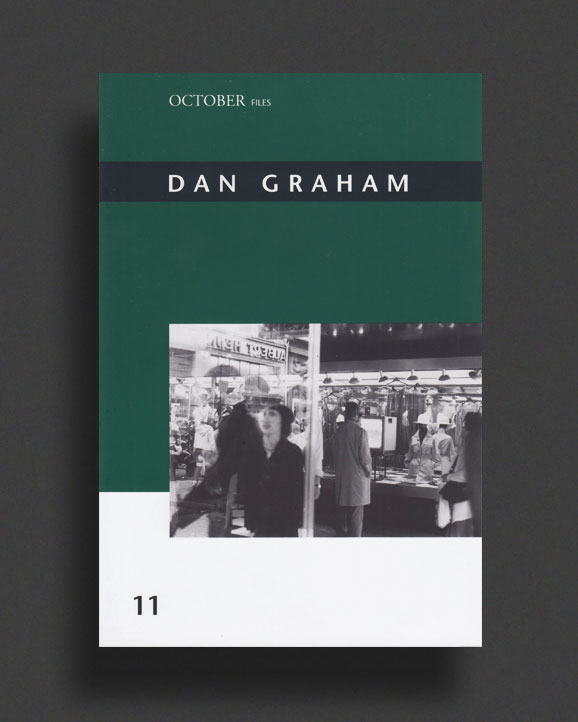
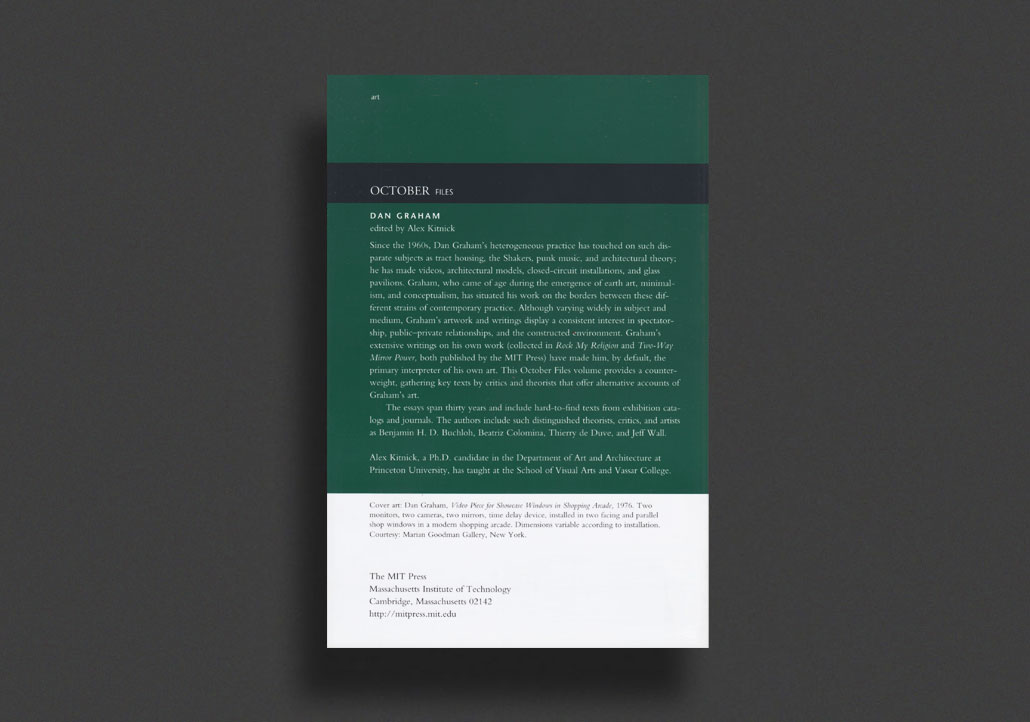
Since the 1960s, Dan Graham's heterogeneous practice has touched on such disparate subjects as tract housing, the Shakers, punk music, and architectural theory; he has made videos, architectural models, closed-circuit installations, and glass pavilions. Graham, who came of age during the emergence of earth art, minimalism, and conceptualism, has situated his work on the borders between these different strains of contemporary practice. Although varying widely in subject and medium, Graham's artwork and writings display a consistent interest in spectatorship, public-private relationships, and the constructed environment. Graham's extensive writings on his own work (collected in Rock My Religion and Two-Way Mirror Power, both published by the MIT Press) have made him, by default, the primary interpreter of his own art. This October Files volume provides a counterweight, gathering key texts by critics and theorists that offer alternative accounts of Graham's art. The essays span thirty years and include hard-to-find texts from exhibition catalogs and journals. The authors include such distinguished theorists, critics, and artists as Benjamin H. D. Buchloh, Beatriz Colomina, Thierry de Duve, and Jeff Wall.
1985, English
Softcover (w. dust jacket), 278 pages, 22 x 24 cm
1st Edition, Out of print title / used / good
Published by
Electa / Milan
$180.00 - Out of stock
First 1985 edition of Arte Povera : Storie e protagonisti by Germano Celant, published by Electa. This first edition was never distributed and, since it was only circulated among those involved in the Arte Povera movement, became a much-sought-after and inaccessible cult item. This invaluable, comprehensive title collated, for the first time everything written by Germano Celant about the group of artists associated with the movement, for which he himself, in 1967, coined the term Arte Povera (Poor Art). "This book is the product of decades of work done jointly with others, and of the accompanying exchange of ideas and opinions. It deals with an adventure - Arte Povera - that has won a lasting place in "our" history." - Germano Celant.
The book is a collection of profusely illustrated theoretical texts, all in parallel English and Italian, focusing on the art of the individual artists involved (Giovanni Anselmo, Alighiero Boetti, Pier Paolo Calzolari, Luciano Fabro, Jannis Kounellis, Mario Merz, Marisa Merz, Giulio Paolini, Pino Pascali, Giuseppe Penone, Michelangelo Pistoletto, Emilio Prini and Gilberto Zorio), whilst concentrating as much on the movement’s contingent side as on its fragmentary, contradictory, pluralistic way of creating art. It also provides a comprehensive illustrated chronology and extensive bibliography, making it one of the most essential reference volumes ever published on the movement.
Arte Povera was a radical Italian art movement from the late 1960s to 1970s whose artists explored a range of unconventional processes and non traditional ‘everyday’ materials. Coined by Celant, Arte Povera means literally ‘poor art’ but the word poor here refers to the movement’s signature exploration of a wide range of materials beyond the traditional ones of oil paint on canvas, bronze, or carved marble. Materials used by the artists included soil, rags, twigs, papier-mâché, wood, iron, plastic, and industrial waste, with which they made installations that were not always understood or immediately accepted. This field of art has always been based on a de-constructive attitude, which takes into account the many different kinds of artistic expression in relation to the context in which it is created. In using such throwaway materials they also aimed to challenge and disrupt the values of the commercialised contemporary gallery system.
Good ex-libris copy with moderate associated markings, general edge wear, and some tape markings to the dust jacket, now preserved under mylar wrap.
1982, Japanese
Softcover (w. dust jacket), 68 pages, 12.9 x 18.2 cm
1st Edition, Out of print title / used / very good
Published by
Nippon Geijutsu Shuppan (NGS) / Japan
$190.00 - Out of stock
1982 volume of nude photography by French photographer Jacques Bourboulon from the collectible Photo Girl series of green paperbacks from Japanese imprint Nippon Geijutsu Shuppan (NGS). Cover to cover glossy, full-bleed photography, printed in Japan.
Very Good copy.
1983, English
Softcover (staple-bound), 24 pages, 30 x 21 cm
1st Edition, Out of print title / used / very good
Published by
ADN / Milan
$90.00 - Out of stock
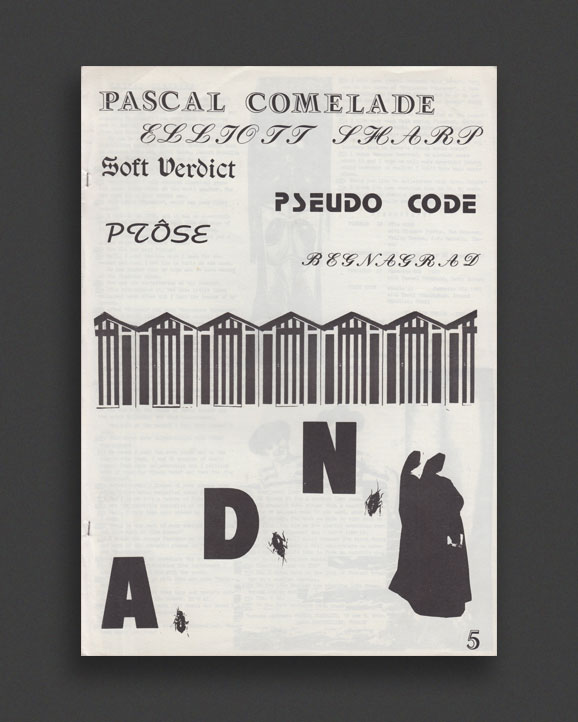
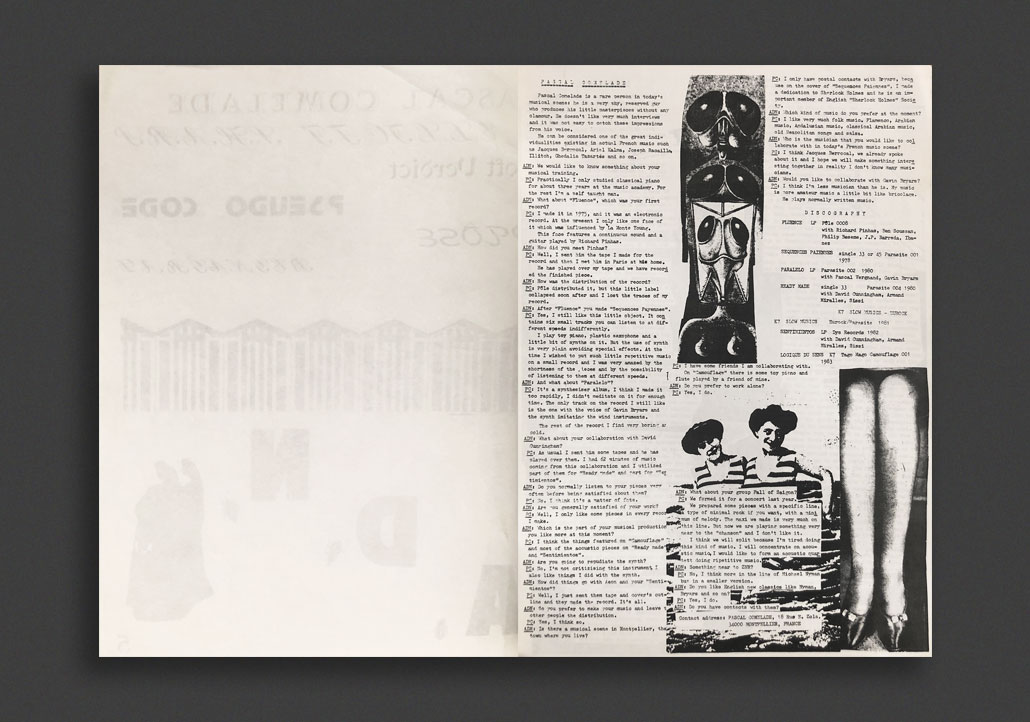
Rare copy of Italian electronic/experimental/industrial fanzine ADN, issue No. 5, published circa 1983. One of the great pioneering European experimental music fanzines of the period, this issue features articles/interviews/discographies/graphics on/with Pascal Comelade, Elliot Sharp, Soft Verdict, Alain Neffe (Insane Music, Pseudo Code, Human Flesh, Cortex, I Scream, Bene Gesserit), Begnagrad, Ptôse, along with cassette listings for the phenomenal ADN label and reviews. Virtually never seen! Texts all in English.
ADN was an Italian electronic/experimental/industrial label based in Milan, run by Marco Veronesi, Piero Bielli and Alberto Crosta (with Carla Crotti also involved at some point). ADN was established in 1983 as the first Italian fanzine for experimental new music published in English. The very first issue was called "L'Amore del Nipote" which set the trend for all labels as acronyms of ADN. The fanzine published 8 issues through to Spring 1986, with the later issues (co-released with "Skeletal Work") including optional sampler cassettes. The booklet and cassette idea carried on with the series of various artist releases called "Out Of Standard". Most of their early releases were ADN Cassettes. For their vinyl releases, post new-wave and industrial music came out on the label 'A Dull Note', whilst avant-garde and "RiO" Rock In Opposition (left-field experimental rock) releases came out on 'Auf Dem Nil'. There was also a short-lived CD label 'Alma De Nieto' and some other name variations. A few 'Auf Dem Nil' releases were also branded "Recommended Records Italia"... Artists included Riccardo Sinigaglia, Pascal Comelade, Die Form, Nu Creative Methods, Cinéma Vérité, Vidéo-Aventures, Doxa Sinistra, Merzbow, D.D.A.A., Reportaż, Nulla Iperreale, Roberto Mazza...
Very Good copy.
2015, English
Hardcover, 120 pages, 23 x 23 cm
1st Edition, Out of print title / used / very good
Published by
Ceysson-Editions d'Art / Saint-Etienne
$55.00 - In stock -
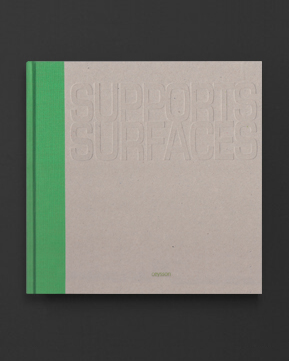
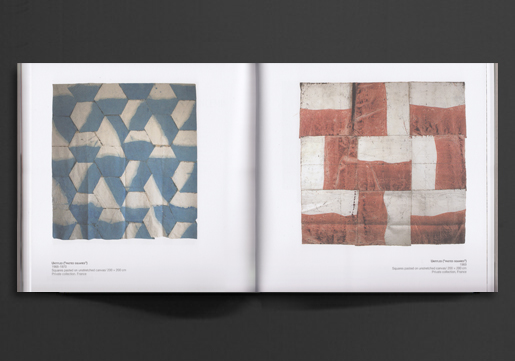
Perhaps the most under-recognized French art movement of the twentieth century, Supports/Surfaces emerged amid the intellectual and political upheaval of 1960s France, on the cusp of modernity and postmodernity. Steeped in the philosophy of Derrida, Lacan and Barthes, and inspired in their political militancy by figures such as Marx, Freud and Mao, 15 artists from the South of France converged around a shared ideological and artistic goal: the dismantling and demystifying of the painting as object, both physically and philosophically. Artists such as Louis Cane, Daniel Dezeuze, Bernard Pagès, Patrick Saytour, Claude Viallat, André-Pierre Arnal and Noël Dolla explored the physicality of the painting's stretchers and canvases, deconstructing it so as to question and reaffirm the medium and its implications.
This first-ever English publication on Supports/Surfaces, includes a poster with a timeline of key works.
Foreword by Joe Fyfe, Contributions by Rachel Stella and Bernard Ceysson.
1984, Japanese
Softcover, 96 pages, 25.5 x 18 cm
1st Edition, Out of print title / used / very good
Published by
Art Vivant / Tokyo
$70.00 - Out of stock
Issue 12 (1984) of Japan's great Art Vivant quarterly journal. This very special issue dedicated entirely to the work of Balthus (1908 – 2001). Heavily illustrated throughout with black and white reproductions of Balthus' drawings and etchings, along with a large colour section reproducing many of Balthus' paintings, also essays in Japanese, portraits, biography, and much more. Both front and back covers feature work by Balthus.
Very scarce and Very Good copy of this collectible issue.
Throughout his career, Balthus rejected the usual conventions of the art world. He insisted that his paintings should be seen and not read about, and he resisted any attempts made to build a biographical profile. A telegram sent to the Tate Gallery as it prepared for its 1968 retrospective of his works read: "NO BIOGRAPHICAL DETAILS. BEGIN: BALTHUS IS A PAINTER OF WHOM NOTHING IS KNOWN. NOW LET US LOOK AT THE PICTURES. REGARDS. B."
Balthus (1908 – 2001), was a Polish-French modern artist born in Paris to Polish expatriate parents. His given name was Balthasar Klossowski - his sobriquet "Balthus" was based on his childhood nickname, alternately spelled Baltus, Baltusz, Balthusz or Balthus. His father, Erich Klossowski, was an art historian who wrote a noted monograph on Daumier. His older brother was the philosopher and artist Pierre Klossowski. An unusual figure in the history of twentieth century painting, Balthus both traveled among and drew upon the work of other major artists of his time, while at the same time following a unique individual trajectory. He was mentored by, friends of, and/or even collaborated with seminal creative figures from different eras, including Antonin Artaud, André Breton, and Rainer Maria Rilke, while cultivating his own highly refined style of dreamlike, classically-informed painting. The scenes he usually depicted were very ordinary bourgeois interiors or outdoor settings, which nonetheless managed to reveal the heightened inner states of his subjects as well as the states of mind of those who might be viewing them.
"I always feel the desire to look for the extraordinary in ordinary things; to suggest, not to impose, to leave always with a slight touch of mystery in my paintings." - Balthus
Good-Very Good copy.
2022, English
Softcover, 154 pages, 22 x 15 cm
Published by
Caesura / US
$44.00 - Out of stock
Caesura (seh-'zhur-uh) is a magazine of art and criticism. This inaugural issue of Caesura looks back on Surrealism not as an answer to the current crisis of art, but as one of the last movements to raise it as a question for life. The legacy of Surrealism is undoubtedly problematic: its novel techniques and strange effects have been repeatedly hypostatized and deployed in the production, both high and low, of culture industry kitsch. Still something remains of its original drive: to pierce the veil of appearance for a glimpse at the underlying forms that constitute subjective experience. For the concrete, as Marx says, “is concrete by virtue of being the concentration of many determinations.” Surrealism — more real than reality itself.
Featuring work by Will Alexander, Gabriel Almeida, Dato Barbakadze, Roberta Boffo, Roberto Calasso, Austin Carder, Mary Ann Caws, Billie Chernicoff, Róbert Gál, Allison Hewitt Ward, Robert Kelly, Timothy Kelly, Carlos Lara, Juliette Neil, Joel Newberger, Tamas Panitz, Andrei Pokrovskii, Irakli Qolbaia, Alice Paalen Rahon, Laurie Rojas, Kira Scerbin, Bret Schneider, David Short, Rosmarie Waldrop, Madison Winston, Patrick Zapien, and Maggie Louisa Zavgren.
COVER: Kira Screbin, Triple Breather, 2019
DESIGN: Renata Cruz Lara
About Caesura:
The alarm bells are ringing and catastrophe is at the door. As the last century begins its final exit from the stage, what will happen to the experience it gave humanity? Will this experience survive the world that bore it? Not only common sense but the stars themselves are realigning in an effort to forget the objects of our shattered dreams, shedding them as empty husks of strange, unpleasant times. What shines true today in light of yesterday will not be counted on tomorrow. Only those who learn to brush against the flow of time will have any chance of staying afloat. Thus the sun that we see setting is not the same that will be rising, and everything — all that is holy and all profane — shall be transfigured in the course of night. Art too must stake its place in the world that will dawn in the approaching epoch.
Contemporary art, which has dominated artistic practice for fifty years or more, adheres to a concept of the contemporary which obliterates the shape of history and demands the strictest currency as the criterion of art’s success. Like fashion, it has come to be distinguished by the marvelous arbitrary ascents and subsequent ridiculous falls that churn and cycle through art’s fortune, trend after trend, season after season. Each and every moment is compelled to find its style and is extinguished in a bright and empty glimmer that leaves one wondering, much like Gauguin long ago: Where do we come from? What are we? Where are we going?
The academic theory proffered in the schools, journals, galleries, and museums that educate young artists and critics today mistrusts — and oftentimes condemns! — such basic, searching questions about the meaning and purpose of art. More often than not, the theorists and critics of contemporary art regret the fact that artworks strive towards a freedom which seems unforgivably barbaric when so many continue to suffer. But such a ‘critical’ perspective gradually grows indifferent to those images of future happiness which permeate artworks that grasp towards something truly new and different in creation. Thus the history of art has come to give form to the history of the species — to the irresistible rhythm of self-creation and self-destruction that constantly drives humanity to a world beyond its own.
Caesura is a modest project to collect the scattered fragments of art and criticism working to escape the aimlessness that plagues the present. What is necessary is a break, a pause, and some room to breathe. We are looking to publish visual art, poetry, prose, and music as well as fundamental criticism and commentary from artists and writers that recognize the task before us and the need for something new. We have no schemas or positive ideals to enshrine, nor do we endorse particular styles, techniques, or media. What we have to offer is a sense of history, of the dead-end of the present, and the disappointment of the past: “a total absence of illusion about the age and at the same time an unlimited commitment to it.” What we ask is simply that art prove its right to exist. //
“IT IS SELF-EVIDENT THAT NOTHING CONCERNING ART IS SELF-EVIDENT ANYMORE, NOT ITS INNER LIFE, NOT ITS RELATION TO THE WORLD, NOT EVEN ITS RIGHT TO EXIST.”—Theodor Adorno, Aesthetic Theory
2017, German / English
Softcover, 192 pages, 21 x 30 cm
Published by
Roma / Amsterdam
$45.00 - Out of stock
The eighth instalment in Kunstverein München’s ‘Companion’ series, this “Verkaufskatalog” contains images, prices, material descriptions, and gallery designations for each of the works by artists Jos de Gruyter and Harald Thys included in the exhibition ‘30 Jahre Kunst’. The diverse spectrum of the duo’s collaborative practice – drawings, paintings, sculptures, photographs, kinetic objects, and videos – is represented over the book’s 192 pages, all printed in black and white. In addition, a number of lost, destroyed, or forgotten works are featured, as well as new works that were specially commissioned for the exhibition.
Highly recommended.
1984, English / German / French
Softcover, 512 pages, 19.6 x 23 cm
1st Edition, Out of print title / used / good
$140.00 - Out of stock
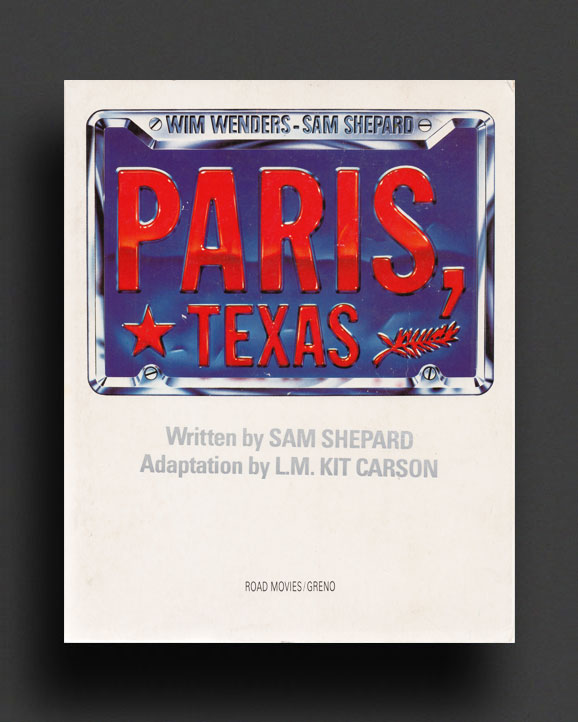
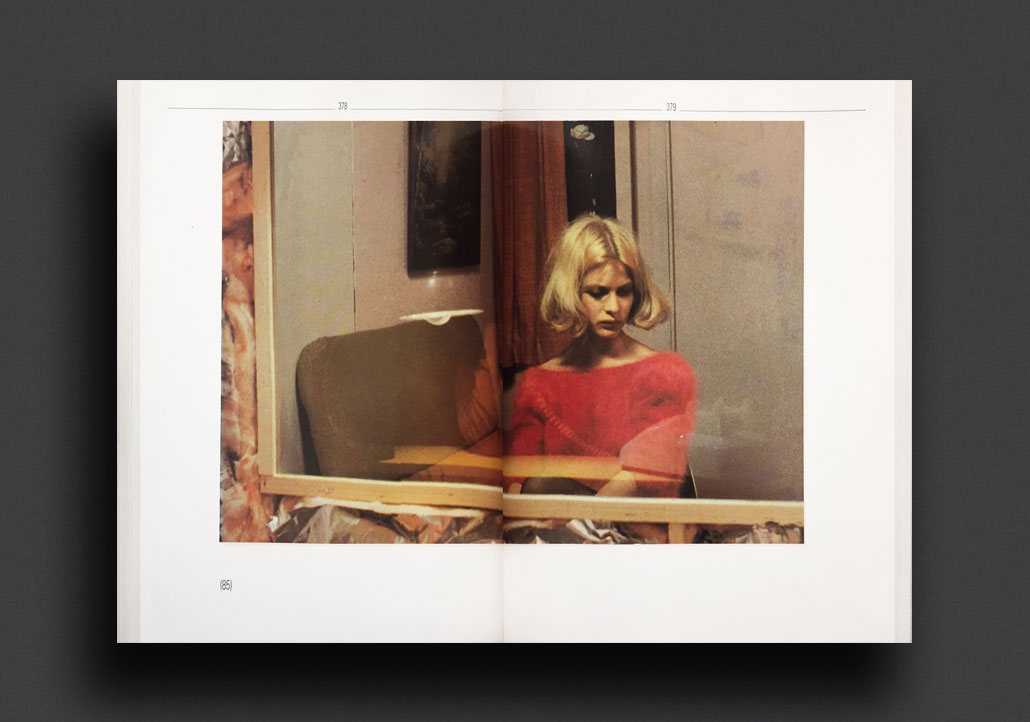
First edition of the extensive and beautifully compiled companion book to Wender's road trip masterpiece from 1984, 'Paris, Texas', starring Harry Dean Stanton, Nastassja Kinski, Dean Stockwell, and others. This heavy, comprehensive book (over 500 pages) includes 150 double page colour photographic stills illustrating every scene from the film, accompanied by the movie's script, information about the cast and crew and on-set photographs. A truly special film book, for a special film. Text in German, English and French.
"It is a story of the United States, a grim portrait of a land where people like Travis and Jane cannot put down roots, a story of a sprawling, powerful, richly endowed land where people can get desperately lost."
Good copy with wear to covers and edges/spine. Remainder marker line to bottom edge.
2021, English
Softcover, 368 pages, 22.1 x 14.3 cm
Published by
Picador / USA
$32.00 - Out of stock
A rollicking, sexy memoir of a young poet making his way in 1960s New York City.
When he graduated from Columbia in 1958, John Giorno was handsome, charismatic, ambitious, and eager to soak up as much of Manhattan's art and culture as possible. Poetry didn't pay the bills, so he worked on Wall Street, spending his nights at the happenings, underground movie premiers, art shows, and poetry readings that brought the city to life. An intense romantic relationship with Andy Warhol--not yet the global superstar he would soon become--exposed Giorno to even more of the downtown scene, but after starring in Warhol's first movie, Sleep, they drifted apart. Giorno soon found himself involved with Robert Rauschenberg and later Jasper Johns, both relationships fueling his creativity. He quickly became a renowned poet in his own right, working at the intersection of literature and technology, freely crossing genres and mediums alongside the likes of William Burroughs and Brion Gysin.
Twenty-five years in the making, and completed shortly before Giorno's death in 2019, Great Demon Kings is the memoir of a singular cultural pioneer: an openly gay man at a time when many artists remained closeted and shunned gay subject matter, and a devout Buddhist whose faith acted as a rudder during a life of tremendous animation, one full of fantastic highs and frightening lows. Studded with appearances by nearly every it-boy and girl of the downtown scene (including a moving portrait of a decades-long friendship with Burroughs), this book offers a joyous, life-affirming, and sensational look at New York City during its creative peak, narrated in the unforgettable voice of one of its most singular characters.
2021, English
Softcover, 128 pages, 20 x 13 cm
Published by
Critical Editions / US
$19.00 - Out of stock
"The Debordian analysis of modern life resonates more deeply and darkly than perhaps even its creator thought possible..."—The New Yorker
"Never before has Debord's work seemed quite as relevant as it does now"—The Guardian
"Guy Debord is a time bomb, and a difficult one to defuse."—Michael Loewy
First published in 1967, Guy Debord's stinging revolutionary critique of contemporary society, The Society of the Spectacle has since acquired a cult status. The Das Kapital of the 20th century. An essential text, and the main theoretical work of the Situationists. Few works of political and cultural theory have been as enduringly provocative. From its publication amid the social upheavals of the 1960's up to the present, the volatile theses of this book have decisively transformed debates on the shape of modernity, capitalism, and everyday life.
"In Society of the Spectacle, Debord sets out his best-known statement of how the categories of capitalism colonise everyday life to such an extent that we can barely imagine an existence beyond them."—Sydney Review of Books
"The Society of the Spectacle [is] about not just the clamor of images but also the silence of power, a silence which, since the seventies, has become deafening."—McKenzie Wark
"Never before has Debord's work seemed quite as relevant as it does now, in the permanent present that he so accurately foretold? Open his book, read it, be amazed, pour yourself a glass of supermarket wine - as he would wish - and then forget all about it, which is what the Spectacle wants."—Will Self
"In The Society of the Spectacle, Debord made plain that a 'unified critique of culture' implied a critique of the social totality. This was his practico-theoretical method throughout his career as a revolutionary: he saw no distinction between cultural work and political work."—Bruce Russell
Guy Debord (1931-1994) was a Marxist theorist, writer, poet, filmmaker, hypergraphist, cultural revolutionary and a founding member of the Lettrist International and Situationist International - groups that fused avant-garde art and politics as an anti-capitalist weapon. Few works of political and cultural theory have been as enduringly provocative as Debord's Society of the Spectacle, which decisively transformed debates on the shape of modernity, capitalism and contemporary life.
2021, English
Softcover, 254 pages, 23.5 x 15.6 cm
Published by
Critical Editions / US
$28.00 - Out of stock
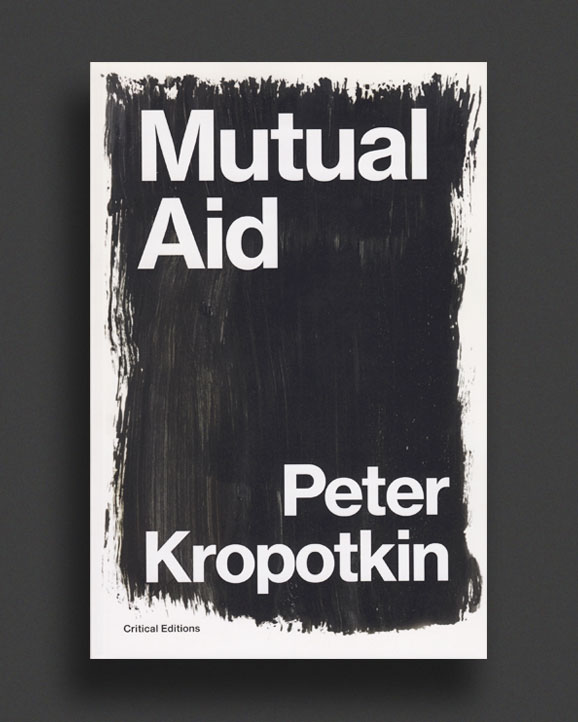
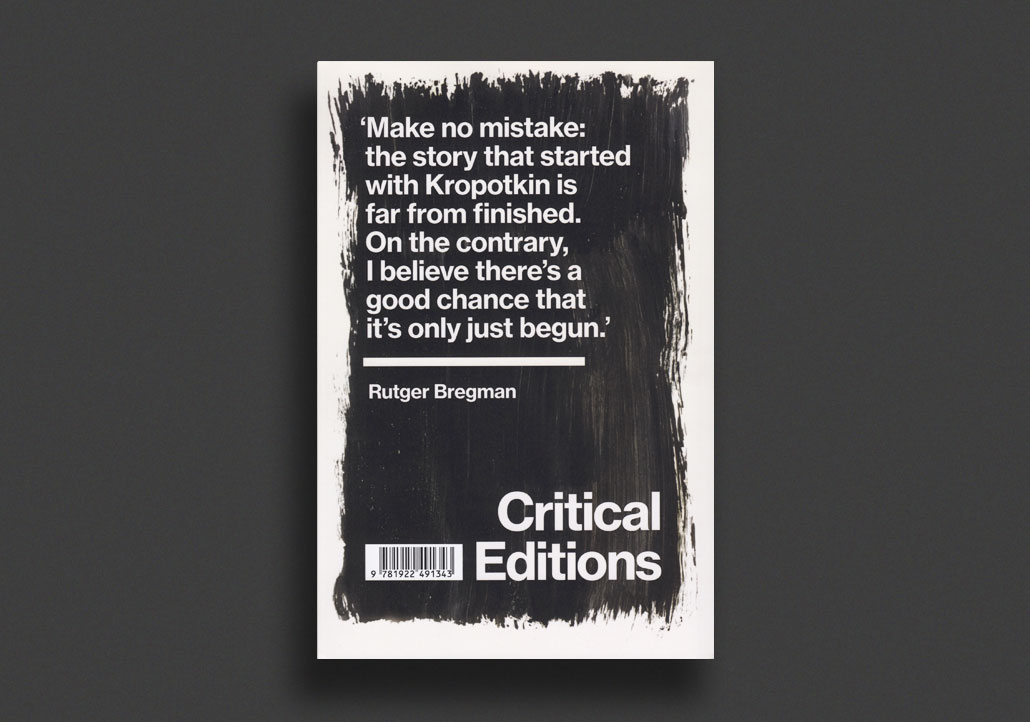
The fascinating work of a Russian prince-turned-anarchist, Peter Kropotkin (1842-1921). Kropotkin one of the world's first international celebrities. In England, Kropotkin was known as a brilliant scientist, famous for his work on animal and human cooperation, but Kropotkin's fame in continental Europe centered more on his role as a founder and vocal proponent of anarchism. In the United States, he pursued both passions. Tens of thousands of people followed ex-Prince Peter during two speaking tours in America.
Kropotkin's path to fame was unexpected and labyrinthine, with asides in prison, breathtaking 50,000-mile journeys through the wastelands of Siberia, and banishment, for one reason or another, from most respectable Western countries of the day. In his homeland of Russia, Peter went from being Czar Alexander II's favored teenage page, to a young man enamored with the theory of evolution, to a convicted felon, jail-breaker and general agitator, eventually being chased halfway around the world by the Russian Secret police for his radical - some might (and did) say enlightened - political views.
Both while in jail, and while on the run when he was entertaining and enlightening huge crowds, Kropotkin found the energy and concentration to write books on a dazzling array of topics: evolution and behavior, ethics, the geography of Asia, anarchism, socialism and communism, penal systems, the coming industrial revolution in the East, the French Revolution, and the state of Russian literature. Though seemingly disparate topics, a common thread - the scientific law of mutual aid, which guided the evolution of all life on earth - tied these works together. This law boils down to Kropotkin's deep-seated conviction that what we today would call altruism and cooperation - but what the Prince called mutual aid - was the driving evolutionary force behind all social life, be it in microbes, animals or humans. Today, anthropologists, political scientists, economists and psychologists publish hundreds of studies each year on human cooperation, and researchers in these fields are just beginning to realize that so many of the topics they are investigating were first suggested and promulgated by Peter Kropotkin.
2012, English
Softcover, 72 pages, 16 x 20 cm
1st Edition, Out of print title / as new
Published by
Tibor de Nagy Editions / New York
$65.00 - Out of stock
In 1952, the New York gallery Tibor de Nagy published A City Winter, Frank O'Hara's first collection of poems, under the Tibor de Nagy Editions imprint, inaugurating the gallery's now longstanding association with what has come to be known as the New York School of poetry. O'Hara had been in the city for barely a year, but was already immersing himself in its art scenes, becoming especially close to Grace Hartigan, and collaborating on a series of poem-pictures which Tibor de Nagy exhibited in 1953. For this occasion, O'Hara's second book, Oranges, was published: a series of prose poems in the Rimbaud manner, printed in an edition of about 75. A third collection, Love Poems (Tentative Title), was published in 1965, as O'Hara was preparing the manuscript of Lunch Poems (often described wrongly as the poet's first book). Poems from the Tibor de Nagy Editions collects these three volumes.
Cover photograph by Renate Ponsold. Drawings by Larry Rivers for A City Winter and Other Poems; and painting by Grace Hartigan for Oranges: 12 Pastorals.
Collectible, out-of-print, first-only edition. As New copy.
2022, English / German
Hardcover, 120 pages, 20 x 26.5 cm
Published by
Weiss Berlin / Berlin
$82.00 - Out of stock
In 1984, the German photographer Helga Paris spent several weeks at a state-owned clothing factory, during which time she shot more than 1,500 photographs. From these she selected the 49 powerful images that make up the series Women at the Clothing Factory VEB Treff-Modelle Berlin. These photographs capture her subjects engaged in their work or taking cigarette breaks, conveying the serenity and beauty of the sitters in their brief moments of tranquility amid the factory environment.This title collects the entire series and gathers it in a format that is affordable to a wider audience. This beautifully designed volume features a linen-bound printed cover with embossed text.
2021, English
Hardcover, 152 pages, 18.5 x 24 cm
Published by
Spector Books / Leipzig
$82.00 - Out of stock
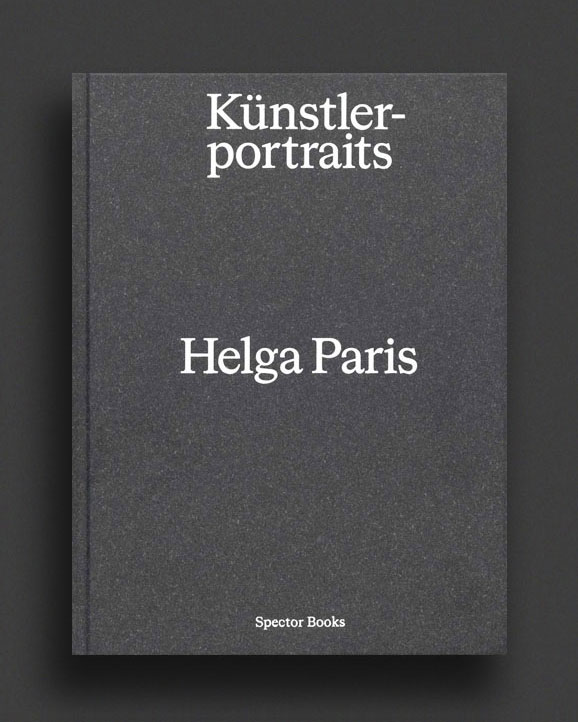
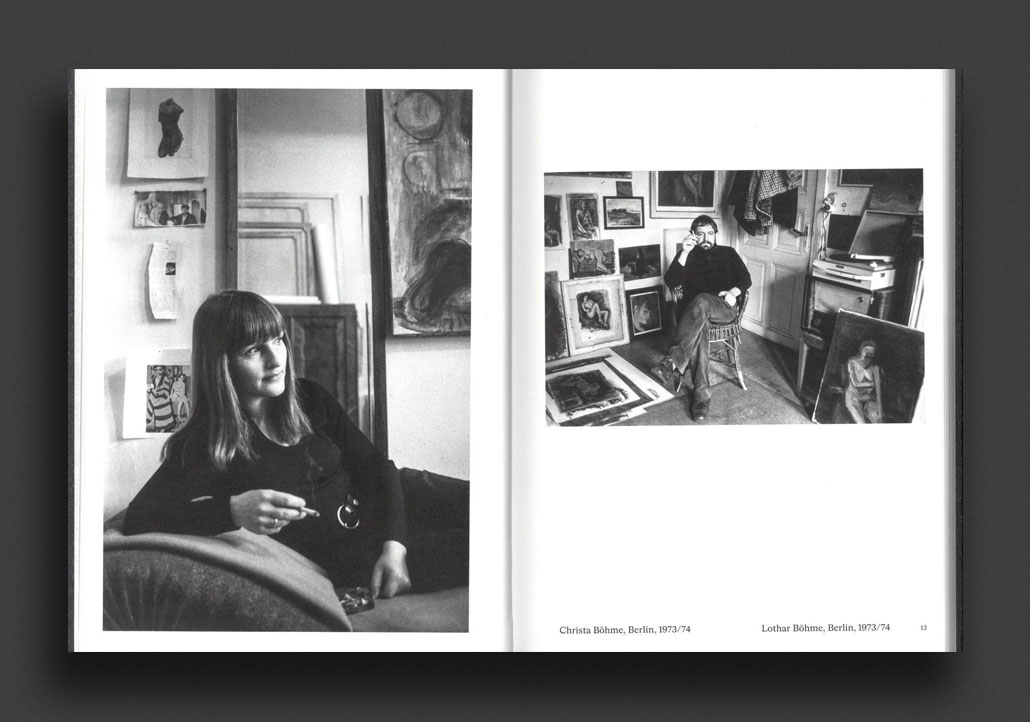
With an eye trained by modernist painting and early Soviet, Italian, and French cinema and influenced by theatre and poetry, self-taught photographer Helga Paris developed an extensive oeuvre of gently nuanced black-and-white images over a period of four and a half decades. The great trust and confidence that people had in her as an artist and as a person are a hallmark of all her portraits. Her subjects open themselves up to her and let her into their lives. The photographs show figures like Christa Wolf, Elke Erb, and Charlotte E. Pauly in private moments as well as the literary counter-public of Prenzlauer Berg and its protagonists. The book is accompanied by texts penned by publisher Gerhard Wolf and curator and art historian Eugen Blume. Paris’s portraits of artists and writers in the GDR are being published for the first time in book form in conjunction with an exhibition at the Leonhardi Museum in Dresden.
2005, English
Softcover, 176 pages, 13.2 x 22.6 cm
Published by
University of Michigan Press / Michigan
$46.00 - Out of stock
The first full-length translation in English of an essential work of postmodernism. The publication of Simulacra et Simulation in 1981 marked Jean Baudrillard's first important step toward theorizing the postmodern. Moving away from the Marxist/Freudian approaches that had concerned him earlier, Baudrillard developed in this book a theory of contemporary culture that relies on displacing economic notions of cultural production with notions of cultural expenditure. Baudrillard uses the concepts of the simulacra - the copy without an original - and simulation. These terms are crucial to an understanding of the postmodern, to the extent that they address the concept of mass reproduction and reproduceability that characterizes our electronic media culture. Baudrillard's book represents a unique and original effort to rethink cultural theory from the perspective of a new concept of cultural materialism, one that radically redefines postmodern formulations of the body.
Translated by Sheila Faria Glase
2022, English
Softcover, 384 pages, 23 x 15 cm
Published by
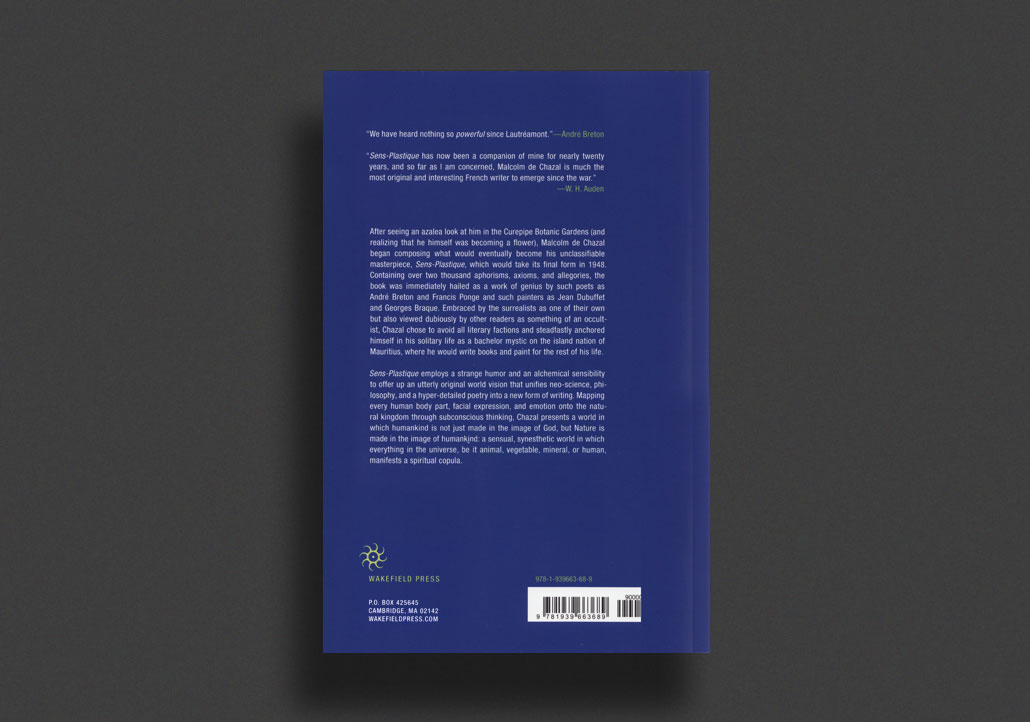
Wakefield Press / Cambridge
$46.00 - In stock -
Foreword by W. H. Auden
Translated, with an introduction, by Irving Weiss
“We have heard nothing so powerful since Lautréamont.”—André Breton
After seeing an azalea looking at him in the Curepipe Botanic Gardens (and realizing that he himself was becoming a flower), Malcolm de Chazal began composing what would eventually become his unclassifiable masterpiece, Sens-Plastique, which would take its final form in 1948. Containing over two thousand aphorisms, axioms, and allegories, the book was immediately hailed as a work of genius by such poets as André Breton and Francis Ponge and such painters as Jean Dubuffet and Georges Braque. Embraced by the surrealists as one of their own but also viewed dubiously by other readers as something of an occultist, Chazal chose to avoid all literary factions and steadfastly anchored himself in his solitary life as a bachelor mystic on the island nation of Mauritius, where he would proceed to write books and paint for the rest of his life.
Sens-Plastique employs a strange humor and an alchemical sensibility to offer up an utterly original world vision that unifies neo-science, philosophy, and a hyper-detailed poetry into a new form of writing. Mapping every human body part, facial expression, and emotion onto the natural kingdom through subconscious thinking, Chazal presents a world in which humankind is not just made in the image of God, but Nature is made in the image of humankind: a sensual, synesthetic world in which everything in the universe, be it animal, vegetable, mineral, or human, manifests a spiritual copula.
“Sens-Plastique has now been a companion of mine for nearly twenty years, and so far as I am concerned, Malcolm de Chazal is much the most original and interesting French writer to emerge since the war.”—W. H. Auden
“Malcolm de Chazal has, perhaps alone in our time, given a resolute expression to the happiness of sensuality.”—Georges Bataille
“This art deserves the name of genius, that name and no other.”—Jean Paulhan
Malcolm de Chazal (1902–1981) was a Mauritian writer and painter. Forsaking a career in the sugar industry, he spent the majority of his life in a solitary, mystical pursuit of the continuity between humankind and nature.
2018, English
Softcover, 400 pages, 13 x 19.7 cm
Published by
Repeater Books / London
$39.00 - Out of stock
Comprised of aphorisms, fragments, and observations both philosophical and personal, Thacker's new book traces the contours of pessimism, caught as it often is between a philosophical position and a bad attitude.
Reflecting on the universe's "looming abyss of indifference," Thacker explores the pessimism of a range of philosophers, from the well-known (Nietzsche, Schopenhauer, Camus), to the lesser-known (E.M. Cioran, Lev Shestov, Miguel de Unamuno). Readers will find food for thought in Thacker's handling of a range of themes in Christianity and Buddhism, as well as his engagement with literary figures (from Dostoevsky to Thomas Bernhard, Osamu Dazai, and Fernando Pessoa), whose pessimism about the world both inspires and depresses Thacker.
By turns melancholic, misanthropic, and darkly funny, ("Birth is a metaphysical injury - healing takes time - the span of one's life"), many will find Infinite Resignation a welcome antidote to the exuberant imbecility of our times.
“Scholarly advice for dark times.”
—The New Yorker
“Provides a metric ton of misery and a lot of company.”
–The New York Times