World Food Books' programme is largely produced on Kulin Nation land. We acknowledge the Wurundjeri people of the Kulin Nation as the first and continuing custodians of this land, and pay respect to their Elders past, present, and emerging.
World Food Books is an arts and special interests bookshop in Naarm / Melbourne. Founded in 2010, World Food Books is devoted to the presentation of a rotating, hand-selection of international art, design, literary and counterculture publications with an emphasis on the anti-traditional, the experimental, the avant-garde, the heretic, the marginal.
Presenting new titles alongside rare and out-of-print books, catalogues and journals spanning the fields of modern and contemporary art, design, photography, illustration, film, literature, poetry, cultural theory, philosophy, sexuality, popular and underground culture in its many radical forms, World Food Books wishes to encourage adventurous, thoughtful and open-minded reading, looking, writing, and exchange of publishing and ideas, both current and historical.
As well as our bookshop, located in Melbourne's historical Nicholas Building, all of our inventory is available internationally via our online mail-order service.
World Food Books semi-regularly co-ordinates "Occasions", a programme of exhibits and events at the bookshop and in partnership with other hosts (such as museums and art galleries) that develop out of the activities, relationships and content of the bookshop itself.
World Food Books
The Nicholas Building
37 Swanston Street
Room 5, Level 6
Melbourne 3000
Australia
SHOP HOURS:
Thu–Fri 12–6, Sat 12–5
WEB-SHOP OPEN 24/7
World Food Books
Postal Address:
PO Box 435
Flinders Lane
Victoria 8009
Australia
Art
Theory / Essay
Architecture / Interior
Graphic Design / Typography
Photography
Fashion
Eros
LGBTQ+
Fiction / Poetry
Weird / Speculative / Science Fiction / Horror
Transgressive / Visceral / Abject
Symbolism / Decadence / Fin de siècle
Film / Video
Painting
Sculpture / Installation
Performance / Dance / Theater
Drawing
Sound / Music
Curatorial
Group Shows / Collections
Periodicals
Out-of-print / Rare
Posters / Ephemera / Discs
Signed Books
World Food Books Gift Voucher
World Food Book Bag
Australian Art
Australian Fiction
Australian Science Fiction / Speculative Fiction
Australian Poetry
Australian Photography
Japanese Photography
Conceptual Art
Minimal Art
Dada
'Pataphysics / Oulipo
Fluxus
Concrete Poetry
Pop Art
Surrealism
Arte Povera
Arte Informale / Haute Pâte / Tachism
Nouveau Réalisme / Zero / Kinetic
Situationism / Lettrism
Collage / Mail Art / Xerox Art
Art Brut / Folk / Visionary / Fantastic
Illustration / Graphic Art / Bandes Dessinées
Furniture
Italian Radical Design / Postmodernism
Textiles
Ceramics / Glass
Counterculture
Protest / Revolt
Philosophy
Psychoanalysis
Anthropology
Anarchism
Socialism / Anarchism / Communism / Capitalism
Literary Theory / Semiotics / Language
Feminism / Women's Studies
Gender Studies / Sexuality
Anthropology
Fetishism / BDSM
Drugs / Psychedelia
Crime / Violence
Animal Rights / Veganism
Occult / Esoterica
Ecology / Earth / Alternative Living
Whole Earth / Crafts
All prices in AUD (Australian dollars)
Pick-Ups
Pick-up orders can be collected in our bookshop during opening hours after order date. Please collect any Pick-up orders within 2 weeks of ordering as we have limited storage space. Orders will be released back into stock if not collected within this time. No refunds can be made for pick-ups left un-collected. If you cannot make it in to the bookshop in this time-frame, please choose postage option.
Return Policy
All sales are final. We do accept returns (for refund or exchange) for items received in error. All our orders are packed with special care using heavy-duty padding and cardboard book-mailers or bubble mailers (for smaller books), using reinforcement where required. We cannot take responsibility for any lost, stolen or damaged parcels.
Insurance
Should you wish to insure your package, please email us directly after placing your order and we can organise this at a small extra expense. Although all standard/express tracked packages are very safe and dependable, we cannot take responsibility for any lost, stolen or damaged parcels. We recommend insurance on valuable orders.
Interested in selling your old books, catalogues, journals, magazines, comics, fanzines, ephemera? We are always looking for interesting, unusual and out-of-print books to buy. We only buy books in our fields of interest and specialty, and that we feel we can resell.
We base these prices on desirability, market value, in-print prices, condition and our current stock levels. We offer cash, store credit, and can take stock on consignment. All
about 25% of the price we expect to get when we sell them, or 30% in store credit. We base these prices on desirability, market value, in-print prices, condition and our current stock levels.
Sell your books any day of the week. You can drop them off and return later. If you have a lot of books, we can visit your Sydney home.
We buy books that we feel we can resell. We offer about 25 % of the price we expect to get when we sell them, or 30% in store credit. We base these prices on desirability, market value, in-print prices, condition and our current stock levels.
Philadelphia Wireman
03 August - 01 September, 2018
World Food Books is proud to announce our next Occasion, the first presentation of sculptures by Philadelphia Wireman in Australia.
The Philadelphia Wireman sculptures were found abandoned in an alley off Philadelphia’s South Street on trash night in 1982. Their discovery in a rapidly-changing neighbourhood undergoing extensive renovation, compounded with the failure of all attempts to locate the artist, suggests that the works may have been discarded after the maker’s death. Dubbed the "Philadelphia Wireman" during the first exhibition of this work, in 1985, the maker’s name, age, ethnicity, and even gender remain uncertain. The entire collection totals approximately 1200 pieces, all intricately bound together with tightly-wound heavy-gauge wire (along with a few small, abstract marker drawings, reminiscent both of Mark Tobey and J.B. Murry). The dense construction of the work, despite a modest range of scale and materials, is singularly obsessive and disciplined in design: a wire armature or exoskeleton firmly binds a bricolage of found objects including plastic, glass, food packaging, umbrella parts, tape, rubber, batteries, pens, leather, reflectors, nuts and bolts, nails, foil, coins, toys, watches, eyeglasses, tools, and jewellery.
Heavy with associations—anthropomorphic, zoomorphic, and socio-cultural responses to wrapped detritus—the totemic sculptures by Philadelphia Wireman have been discussed in the context of work created to fulfil the shamanistic needs of alternative religions in American culture. Curators, collectors, and critics have variously compared certain pieces to sculpture from Classical antiquity, Native American medicine bundles, African-American memory jugs, and African fetish objects. Reflecting the artist’s prolific and incredibly focused scavenging impulse, and despite—or perhaps enhanced by—their anonymity, these enigmatic objects function as urban artefacts and arbiters of power, though their origin and purpose is unknown. Philadelphia Wireman, whatever their identity, possessed an astonishing ability to isolate and communicate the concepts of power and energy through the selection and transformation of ordinary materials. Over the course of the past two decades, this collection has come to be regarded as an important discovery in the field of self-taught art and vernacular art.
Presented in collaboration with Fleisher-Ollman Gallery, Philadelphia, and Robert Heald, Wellington.
Susan Te Kahurangi King
02 February - 10 March, 2018
Susan Te Kahurangi King (24 February 1951 - ) has been a confident and prolific artist since she was a young child, drawing with readily available materials - pencils, ballpoint pens and felt-tip markers, on whatever paper is at hand. Between the ages of four and six Susan slowly ceased verbal communication. Her grandparents William and Myrtle Murphy had developed a special bond with Susan so they took on caring responsibilities for extended periods. Myrtle began informally archiving her work, carefully collecting and storing the drawings and compiling scrapbooks. No drawing was insignificant; every scrap of paper was kept. The King family are now the custodians of a vast collection containing over 7000 individual works, from tiny scraps of paper through to 5 meter long rolls.
The scrapbooks and diaries reveal Myrtle to be a woman of great patience and compassion, seeking to understand a child who was not always behaving as expected. She encouraged Susan to be observant, to explore her environment and absorb all the sights and sounds. Myrtle would show Susan’s drawings to friends and people in her community that she had dealings with, such as shopkeepers and postal workers, but this was not simply a case of a grandmother’s bias. She recognised that Susan had developed a sophisticated and unique visual language and sincerely believed that her art deserved serious attention.
This was an unorthodox attitude for the time. To provide some context, Jean Dubuffet coined the term Art Brut in 1945 to describe work created by self-taught artists – specifically residents of psychiatric institutions and those he considered to be visionaries or eccentrics. In 1972 Roger Cardinal extended this concept by adopting the term Outsider Art to describe work made by non-academically trained artists operating outside of mainstream art networks through choice or circumstance. Susan was born in Te Aroha, New Zealand in 1951, far from the artistic hubs of Paris and London that Dubuffet and Cardinal operated in. That Myrtle fêted Susan as a self-taught artist who deserved to be taken seriously shows how progressive her attitudes were.
Susan’s parents Doug and Dawn were also progressive. Over the years they had consulted numerous health practitioners about Susan’s condition, as the medical establishment could not provide an explanation as to why she had lapsed into silence. Dawn educated herself in the field of homeopathy and went on to treat all twelve of her children using these principles – basing prescriptions on her observations of their physical, mental and emotional state.
Doug was a linguist with an interest in philosophy who devoted what little spare time he had to studying Maori language and culture. To some extent their willingness to explore the fringes of the mainstream made them outsiders too but it was their commitment to living with integrity and their respect for individuality that ensured Susan’s creativity was always encouraged.
Even though Susan’s family supported her artistic pursuits, some staff in schools and hospitals saw it as an impediment to her assimilation into the community and discouraged it in a variety of ways. Her family was not always aware of this and therefore did not fully understand why Susan stopped drawing in the early 1990s. However, rather than dwell on the challenges that Susan faced in pursuit of her artistic practice, they prefer to highlight her achievements. In 2008 Susan began drawing again in earnest, after an almost 20 year interruption, and her work is now shown in galleries around the world.
Susan grew up without television and has been heavily influenced by the comics she read as a child. She is absolutely fearless in the appropriation of recognizable characters, such as Donald Duck and Mickey Mouse, in her work. She twists their limbs, contorts their faces, compresses them together, blends them into complex patterned backgrounds - always imbuing them with an incredible energy. Although Susan often used pop culture characters in her work they are not naive or childlike. These are drawings by a brilliant self-taught artist who has been creating exceptional work for decades without an audience in mind.
Mladen Stilinović
"Various Works 1986 - 1999"
02 February 16 - September 10, 2016
Various works 1986 - 1999, from two houses, from the collections of John Nixon, Sue Cramer, Kerrie Poliness, Peter Haffenden and Phoebe Haffenden.
Including: Geometry of Cakes (various shelves), 1993; Poor People’s Law (black and white plate), 1993; White Absence (glasses, ruler, set square, silver spoon, silver ladel with skin photograph and wooden cubes), 1990-1996; Exploitation of the Dead (grey and red star painting, wooden painting, black spoon with red table, red plate), 1984-1990; Money and Zeros (zero tie, paintings made for friends in Australia (Sue, John, Kerrie), numbers painting), 1991-1992; Words - Slogans (various t-shirts) - “they talk about the death of art...help! someone is trying to kill me”, “my sweet little lamb”, “work is a disease - Karl Marx”; Various artist books, catalogues, monographs, videos; Poster from exhibition Insulting Anarchy; "Circular" Croatian - Australian edition; Artist book by Vlado Martek (Dostoyevsky); more.
Thanks to Mladen Stilinović and Branka Stipančić.
Jonathan Walker
Always Will Need To Wear Winter Shirt Blue + Ochre Small Check Pattern
21 August - 21 September, 2015
Untitled
I am not a great reader of poetry but I always return to the work of Melbourne poet, Vincent Buckley (1925- 1988). Perhaps I find his most tantalising piece to be not a finished poem but a fragment left on a scrap of paper discovered on his desk after the poet’s death.
The poetry gathers like oil
In the word-core, and spreads
It has its music meet,
Its music is in movement.
This fragment is more the shell left behind from a volatile thought than a finished poem. I find the last two lines honest but awkward whereas the first two lines work like an arrow. Most likely he could not find a resolution so it was left. Still, in its present form, it remains an eloquent testimony to the ultimate failure of a medium to express mobile thought and sensation, in Buckley’s case, through verbal language. It’s an important matter because this is something all artists have to deal with regardless of the medium.
I have never written a poem, however, I am forever copying fragments from books on paper scraps in a vain effort to fix certain notions in my head. At first, they function as bookmarks that are sometimes returned to when I open the book. But before long, as they accumulate, they fall out littering the table interspersed with A4 photocopies, bills, books and medications.
To return to Buckley’s fragment, the first two lines very much evoke how I paint nowadays. As you age, detail diminishes and patches of light become more luminous and float. I feel the most honest way of dealing with this is by smearing the oil paint on the canvas with the fingers and working close-up, blind. Only if the patches coalesce into an approaching image can the work gain a life.
-
Jonathan Walker was born in Melbourne, Australia and brought up on a dairy farm in Gippsland. In the 1970’s he studied painting at RMIT and won the Harold Wright Scholarship to the British Museum, London. During the 1980’s he exhibited at Pinacotheca Gallery, Richmond and had work shown at the NGV and Heidi City Art Gallery. Over the same period he designed the cover for the “Epigenesi” LP by Giancarlo Toniutti, Italy and conducted a mail exchange work with Achim Wollscheid, Germany. The work with artists through the post resulted in an article published in the bicentenary issue of Art and Australia 1988. He showed in artist run spaces such as WestSpace in the 90’s and 2000’s, and until 2012, taught painting at Victoria University, which is where we (Colleen Ahern and Lisa Radford) as organisers of the exhibition, among many others, had the privilege of being his student.
Walker’s knowledge was imparted to students through the careful selection of music, literature, and artists found in books that he himself had ordered for the library. Walker’s strategy was the generosity of sharing his vast knowledge with references specific to each student and their context.
Walker’s paintings share a similar focus and intimacy.
This exhibition presents a small selection of recent paintings alongside a publication that includes Walker’s writing. Observational and analytical, Walker’s work is a type of material notation — the time of day, colour and how it is blended, the both specific and fleeting location of a reflection on lino or the question of whether a chair leg should be included in a painting.
Please join us on Friday August 21 between 6-8pm to celebrate the opening of the exhibition.
Curated by Colleen Ahern and Lisa Radford.
B. Wurtz
Curated by Nic Tammens
March 26 - April 4, 2015
B.Wurtz works from a basement studio in his home on Manhattan’s Lower East Side.
This local fact is attested to by the plastic shopping bags and newsprint circulars that appear in his work. As formal objects, they don’t make loud claims about their origins but nonetheless transmit street addresses and places of business from the bottom of this long thin island. Like plenty of artists, Wurtz is affected by what is local and what is consumed. His work is underpinned by this ethic. It often speaks from a neighborhood or reads like the contents of a hamper:
“BLACK PLUMS $1.29 lb.”
“Food Bazaar”
“USDA Whole Pork Shoulder Picnic 99c lb.”
“RITE AID Pharmacy, with us it’s personal.”
“H. Brickman & Sons.”
“Sweet Yams 59c lb."
Most of the work in this exhibition was made while the artist was in residence at Dieu Donne, a workshop dedicated to paper craft in Midtown. Here Wurtz fabricated assemblages with paper and objects that are relatively lightweight, with the intention that they would be easily transportable to Australia. This consideration isn’t absolute in Wurtz’s work, but was prescriptive for making the current exhibition light and cheap. Packed in two boxes, these works were sent from a USPS post office on the Lower East Side and delivered to North Melbourne by Australia Post.
Wurtz appears courtesy of Metro Pictures, New York.
Thanks to Rob Halverson, Joshua Petherick, Sari de Mallory, Matt Hinkley, Helen Johnson, Fayen d'Evie, Ask Kilmartin, Lisa Radon, Ellena Savage, Yale Union, and "Elizabeth".
John Nixon
"Archive"
December 15 - January 20, 2014
The presentation of John Nixon's archive offered a rare showcase of this extensive collection of the artist's own publications, catalogues, posters, ephemera, editions and more, from the mid 1980s onwards, alongside a selection of his artworks.
Organized by John Nixon, Joshua Petherick and Matt Hinkley.
<a href=http://wfb.public-office.info/artist/john-nixon>All titles by John Nixon
"Habitat"
at Minerva, Sydney (organised by Joshua Petherick and Matt Hinkley)
November 15 - December 20, 2014
Lupo Borgonovo, Janet Burchill & Jennifer McCamley,
Lewis Fidock, HR Giger, Piero Gilardi, Veit Laurent Kurz,
Cinzia Ruggeri, Michael E. Smith, Lucie Stahl, Daniel Weil, Wols
Press Release:
“...It contained seven objects. The slender fluted bone, surely formed for flight, surely from the wing of some large bird. Three archaic circuitboards, faced with mazes of gold. A smooth white sphere of baked clay. An age-blackened fragment of lace. A fingerlength segment of what she assumed was bone from a human wrist, grayish white, inset smoothly with the silicon shaft of a small instrument that must once have ridden flush with the surface of the skin - but the thing’s face was seared and blackened.”
William Gibson, “Count Zero”, 1986
"Autumn Projects Archive"
Curated by Liza Vasiliou
March 6 - March 15, 2014
World Food Books, in conjunction with the Virgin Australia Melbourne Fashion Festival 2014, presented the Autumn Projects archive, consisting of a selection of early examples in Australian fashion with a particular interest in collecting designers and labels from the period beginning in the 1980’s, who significantly influenced the discourse of Australian Fashion.
Curated by Liza Vasiliou, the exhibition provided a unique opportunity to view pieces by designers Anthea Crawford, Barbara Vandenberg, Geoff Liddell and labels CR Australia, Covers, Jag along with early experimental collage pieces by Prue Acton and Sally Browne’s ‘Fragments’ collection, suspended throughout the functioning World Food Books shop in Melbourne.
H.B. Peace
presented by CENTRE FOR STYLE
November 14, 2013
"Hey Blinky, you say chic, I say same"
Anon 2013
H.B. Peace is a clothing collaboration between great friends Blake Barns and Hugh Egan Westland. Their pieces explore the divergences between 'character’ and ‘personality’ in garments....etc
Special Thanks to Joshua Petherick and Matt Hinkley of WFB and Gillian Mears
and a Very Special Thank you to Audrey Thomas Hayes for her shoe collaboration.
Janet Burchill & Jennifer McCamley
"Aesthetic Suicide"
May 10 - June 8, 2013
The first of our occasional exhibitions in the World Food Books office/shop space in Melbourne, "Aesthetic Suicide" presented a body of new and older works together by artists Janet Burchill & Jennifer McCamley, including videos, prints, a wall work, and publications.
During shop open hours videos played every hour, on the hour.
2022, English
Softcover, 456 pages, 16.8 x 23.1 cm
Published by
Karma / New York
$52.00 - Out of stock
Conversations with leading women artists, composers and writers from Judy Chicago, Anohni and Lynne Tillman to Ellie Ga, Tauba Auerbach and Renee Green.
This massive volume comprises over 80 interviews published across a 13-year span of Lauren O’Neill-Butler’s career as a writer, educator, editor and cofounder of November magazine. The majority of the interviews first appeared on Artforum.com’s interviews column, which O’Neill-Butler edited for 11 years. The book is divided into two sections, “Q&A” and “As Told To”—the first comprising interviews in a traditional format and the second recast by O’Neill-Butler in the interviewee’s voice.
Interviewees include: Judy Chicago, Shannon Ebner, Carolee Schneemann, Lucy R. Lippard, Joan Semmel, Liz Deschenes, Eleanor Antin, Andrea Fraser, Anohni, Claudia Rankine, Lorrie Moore, Adrian Piper, fierce pussy, Nan Goldin, Nell Painter, Frances Stark, Sara Greenberger Rafferty, Alex Bag, Agnès Varda, Lisi Raskin, Mary Mattingly, Carol Bove, Jennifer West, Aki Sasamoto, Mary Ellen Carroll, Rebecca Solnit, Rita McBride and Kim Schoenstadt, Karla Black, Julia Bryan-Wilson, Lynda Benglis, Sturtevant, Rachel Foullon, Ellie Ga, Lisa Tan, Mira Schor, Jo Baer, Ruby Sky Stiler, Suzanne Lacy, Rebecca Warren, Katy Siegel, Marlene McCarty, Rachel Mason, Mary Kelly, Dianna Molzan, Lynne Tillman, Polly Apfelbaum, Jesse Jones, Dorothea Rockburne, Sarah Crowner, Lucy Skaer, Sophie Calle, Mary Beth Edelson, W.A.G.E., Mary Heilmann, Pauline Oliveros, Kathryn Andrews, Jessamyn Fiore, Aura Rosenberg, Lucy McKenzie, Rhonda Lieberman, Lucy Dodd, Hong-Kai Wang, Sakiko Sugawa, Beverly Semmes, Virginia Dwan, Jeanine Oleson, Tauba Auerbach, Renee Green, Iman Issa, Monir Shahroudy Farmanfarmaian, Joan Jonas, Yoko Ono, Donna J. Haraway and more.
2016, English
Softcover, 112 pages, 12 x 18 cm
Published by
Wakefield Press / Cambridge
$32.00 - Out of stock
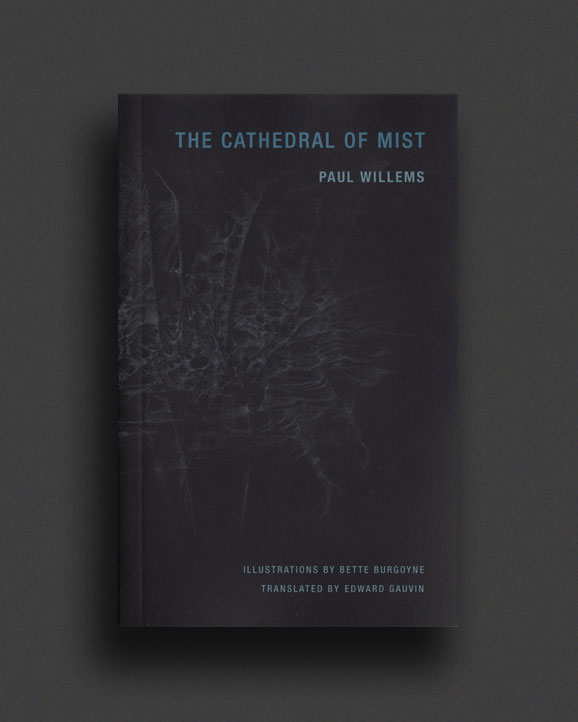
Translated, with an introduction, by Edward Gauvin
Illustrations by Bette Burgoyne
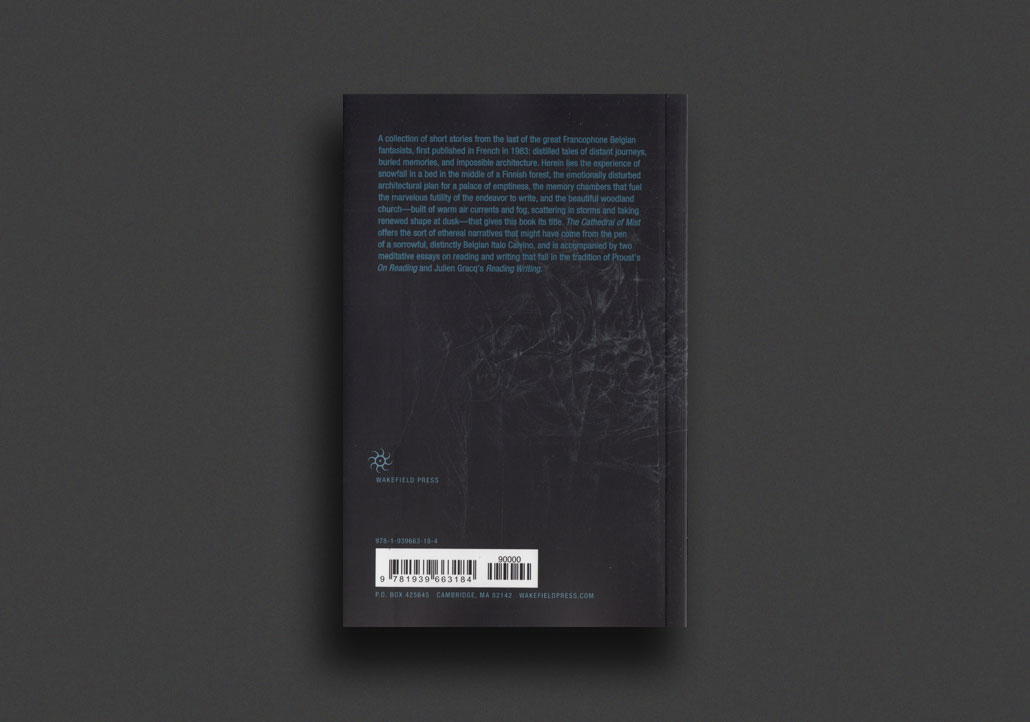
First published in French in 1983, The Cathedral of Mist is a collection of short stories from the last of the great Francophone Belgian fantasists, distilled tales of distant journeys, buried memories, and impossible architecture. Described here are the emotionally disturbed architectural plan for a palace of emptiness; the experience of snowfall in a bed in the middle of a Finnish forest; the memory chambers that fuel the marvelous futility of the endeavor to write; and the beautiful woodland church, built of warm air currents and fog, scattering in storms and taking renewed shape at dusk, that gives this book its title. The Cathedral of Mist offers the sort of ethereal narratives that might have come from the pen of a sorrowful, distinctly Belgian Italo Calvino. It is accompanied by two meditative essays on reading and writing that fall in the tradition of Marcel Proust and Julien Gracq.
Paul Willems (1912–1997) published his first novel, Everything Here is Real, in 1941. Three more novels and, toward the end of his life, two collections of short stories bracketed his career as a playwright.
2021, English
Softcover, 256 pages, 20.2 x 13.6 cm
Published by
Wakefield Press / Cambridge
$34.00 - Out of stock
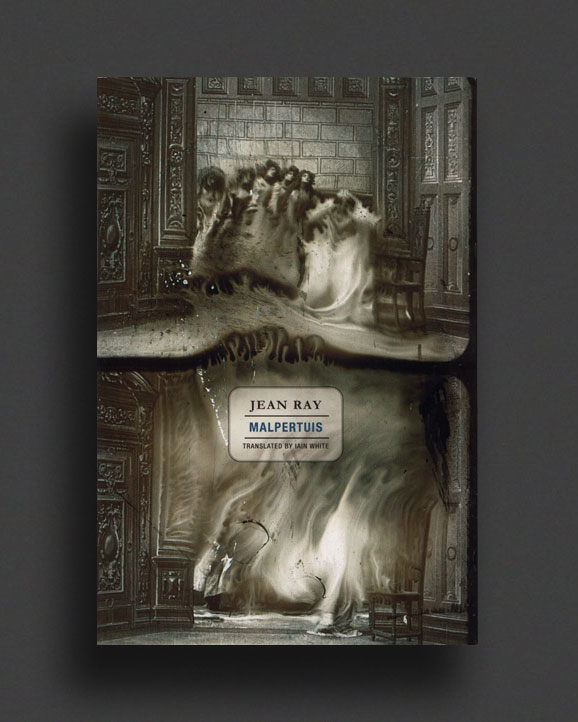
Afterword by Scott Nicolay, Introduction by Iain White
A reinvention of the Gothic novel and an established classic of fantastic literature, Malpertuis is as inventive and gripping today as when it first appeared in French in the dark year of 1943.
Malpertuis is a puzzle box of nested narratives wrested from a set of manuscripts stolen from a monastery. A bizarre collection of distrustful relatives has gathered together in the ancient stone mansion of a sea-trading dynasty for the impending death of the occult scientist, Uncle Cassave, and the reading of his will. Forced to dwell together for the remainder of their lives within the stifling walls of Malpertuis for the sake of a cursed inheritance, their banal existence gradually gives way to love affairs and secret plots, as the building slowly exposes a malevolence that eventually leads to a series of ghastly deaths.
The eccentric personalities it houses--which include an obsessive taxidermist, a hypochondriac, a trio of vengeful sisters and a former paint store manager who has gone mad--begin to shed like skins to reveal yet another hidden story buried in the novel's structure, one that turns the haunted-house tradition on its head and culminates in an apocalyptic denouement.
Jean Ray (1887-1964) is the best known of the multiple pseudonyms of Raymundus Joannes Maria de Kremer, a pivotal figure in the "Belgian School of the Strange," who authored some 6,500 texts in his lifetime.
2021, English
Softcover, 88 pages, 17.8 x 11.5 cm
Published by
Wakefield Press / Cambridge
$32.00 - Out of stock
The hallucinatory English-language debut of an overlooked German Expressionist poet.
Translated, with an introduction, by W. C. Bamberger
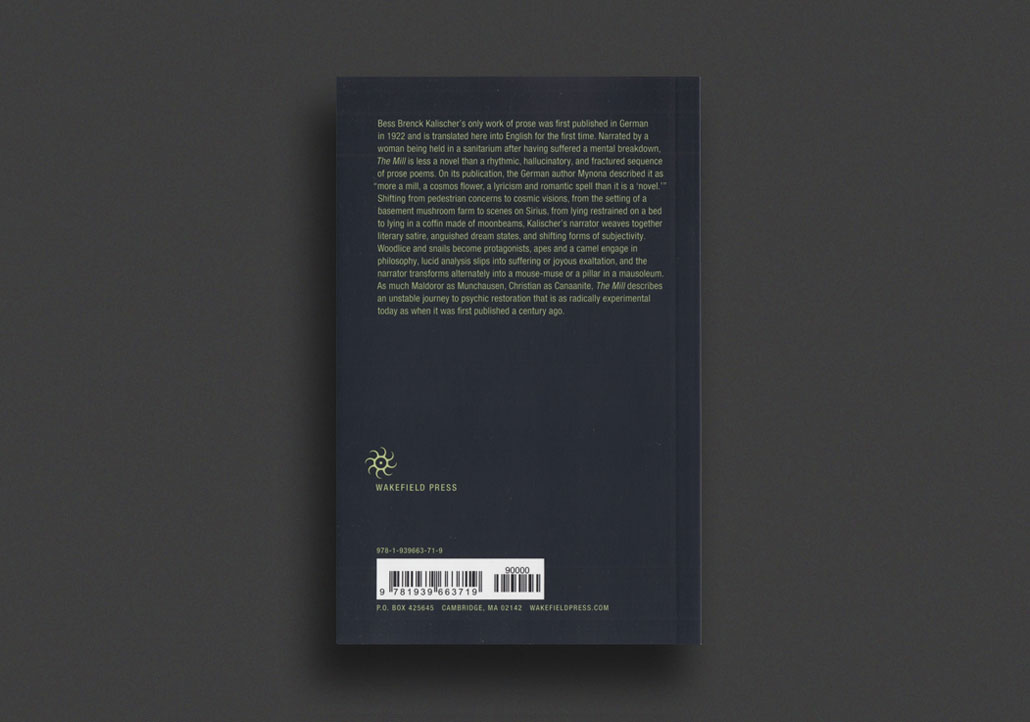
Bess Brenck Kalischer’s only work of prose was first published in German in 1922 and is translated here into English for the first time. Narrated by a woman being held in a sanitarium after having suffered a mental breakdown, The Mill is less a novel than a rhythmic, hallucinatory, and fractured sequence of prose poems. On its publication, the German author Mynona described it as “more a mill, a cosmos flower, a lyricism and romantic spell than it is a ‘novel.’” Shifting from pedestrian concerns to cosmic visions, from the setting of a basement mushroom farm to scenes on Sirius, from lying restrained on a bed to lying in a coffin made of moonbeams, Kalischer’s narrator weaves together literary satire, anguished dream states, and shifting forms of subjectivity. Woodlice and snails become protagonists, apes and a camel engage in philosophy, lucid analysis slips into suffering or joyous exaltation, and the narrator transforms alternately into a mouse-muse or a pillar in a mausoleum. As much Maldoror as Munchausen, Christian as Canaanite, The Mill describes an unstable journey to psychic restoration that is as radically experimental today as when it was first published a century ago.
Bess Brenck Kalischer (1878–1933) was born Betty (possibly Elizabeth) Levy in Rostock, Germany. Though she published her first poems in 1905, she began to make a name for herself as part of the second generation of German expressionists in Dresden, cofounding the Expressionistische Arbeitsgemeinschaft Dresden (Expressionist Working Group of Dresden) alongside Conrad Felixmüller (whose woodcut portrait remains the only visual record of her). Later relocating to Berlin, she was a friend and colleague of Salomo Friedlaender/Mynona, who used her as a model in several stories and three novels. She died of a “nervous disease” in 1933, her grave left without a headstone until 2014.
2018, English
Softcover, 150 pages, 23 x 31 cm
Published by
University of Pennsylvania ICA / Philadelphia
$55.00 - Out of stock
Text by Charlotte Ickes, Julia Bryan-Wilson.
This volume features new and recent works by New York-based artists Ginny Casey (born 1981) and Jessi Reaves (born 1986) exploring the relationship between painting and sculpture, domestic objects and decorative surfaces, by reimagining the form and function of objects encountered in daily life.
2021, English
Softcover (foiled print), 104 pages, 28 x 24.5 cm
Published by
Dancing Foxes Press / Brooklyn
Contemporary Arts Museum / Houston
$55.00 - Out of stock
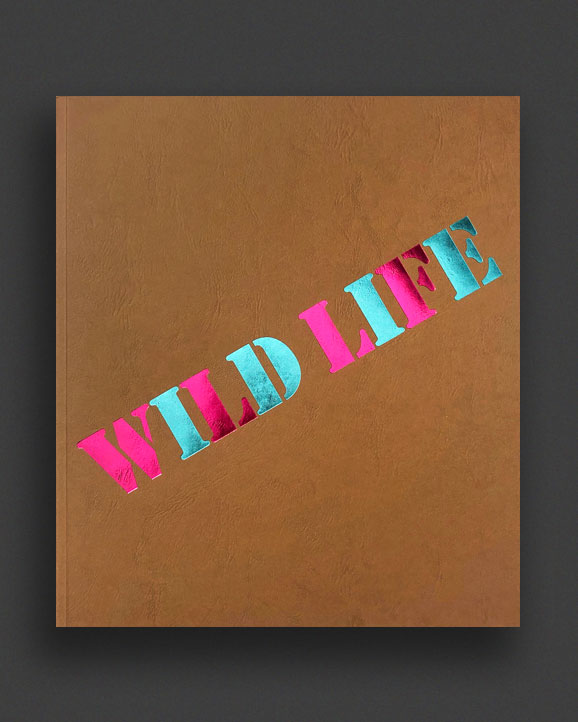
Colorful explosions of “bad objects”: the eccentric constructions of two American artists generations apart. This volume brings together the paintings and drawings of Elizabeth Murray (1940–2007) and the work of New York–based sculptor Jessi Reaves (born 1986). Despite the generations that separate Murray and Reaves, this publication highlights each artist’s lyrical, playful and rigorous engagements with the decorative, domestic and bodily.
Published to accompany an exhibition at the Contemporary Arts Museum Houston, Wild Life explores Murray and Reaves’ often ambiguous conceptions of the body and the home, wherein both body and home are continuously coming together and falling apart.
This book features a newly commissioned conversation between Reaves and Johanna Fateman as well as a reprint of a historical interview between Murray and Kate Horsfield, which together chart the two artists’ irreverent plays with color and form, high and low cultural references, and notions of masculinity and femininity.
Edited by Karen Kelly, Rebecca Matalon, Barbara Schroeder. Text by Rebecca Matalon. Conversation by Kate Horsfield & Elizabeth Murray, Johanna Fateman & Jessi Reaves.
1992, Japanese
Softcover, 140 pages, 30 x 24 cm
1st Edition, Out of print title / used / very good
Published by
i-D / Tokyo
$40.00 - Out of stock
Vintage 1992 issue of i-D JAPAN, Tokyo's version of the famed youth culture magazine founded by designer and former Vogue art director Terry Jones in London 1980. "Ideas, Fashion, Clubs, Music, People." Always a time-capsule, even in Japanese, this issue could well be called the Cyberpunk issue, packed to the brim with articles on J.G. Ballard, the "Post Human" exhibition (Paul McCarthy, Jeff Koons, Cindy Sherman, Ashley Bickerton, Charles Ray, Christian Marclay, Taro Chiezo), a "Neo Full-Metal Dialogue" between body horror/cyberpunk director Shinya Tsukamoto (Tetsuo: The Iron Man) and actor Tomoroh Taguchi (Tetsuo himself!), space/rave fashion ("The Girl from Planet X"), pop singer Kahimi Karie, director Hajime Tabe, Australian painter and legendary Mambo artist David McKay, Brian Eno, Air Jordan, Gameboys, denim... and of course the huge photographic feature on the history "U.F.O.s".
"NEW RE-BIRTH OF HIP"!!
Very Good copy.
1991, Japanese
Softcover, 140 pages, 30 x 24 cm
1st Edition, Out of print title / used / very good
Published by
i-D / Tokyo
$40.00 - Out of stock
Vintage 1991 issue of i-D JAPAN, Tokyo's version of the famed youth culture magazine founded by designer and former Vogue art director Terry Jones in London 1980. "Ideas, Fashion, Clubs, Music, People." Always a time-capsule, even in Japanese, packed to the brim with early Hysteric Glamour, Deee Lite, Colin Wilson, De La Soul, wearable soundgear, Noise, Primal Scream, Clubbing, TV, Alberto Fujimori, Gameboys, levitating dogs, feet... and the photographic feature "I-Dentity Fashion". "For The Politicians of The Future"
Very Good copy.
1979, French
Softcover (staple-bound), 98 pages, 27 x 21.5 cm
Out of print title / used / very good
Published by
Les Humanoïdes Associés / Paris
$45.00 - Out of stock
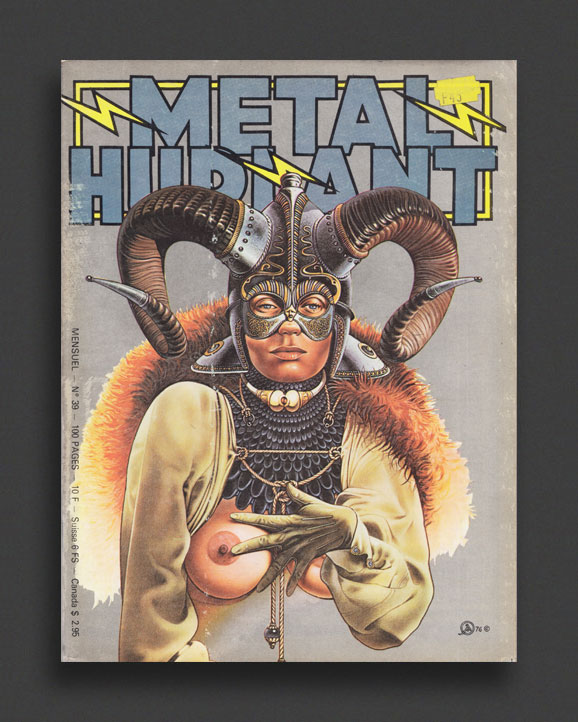
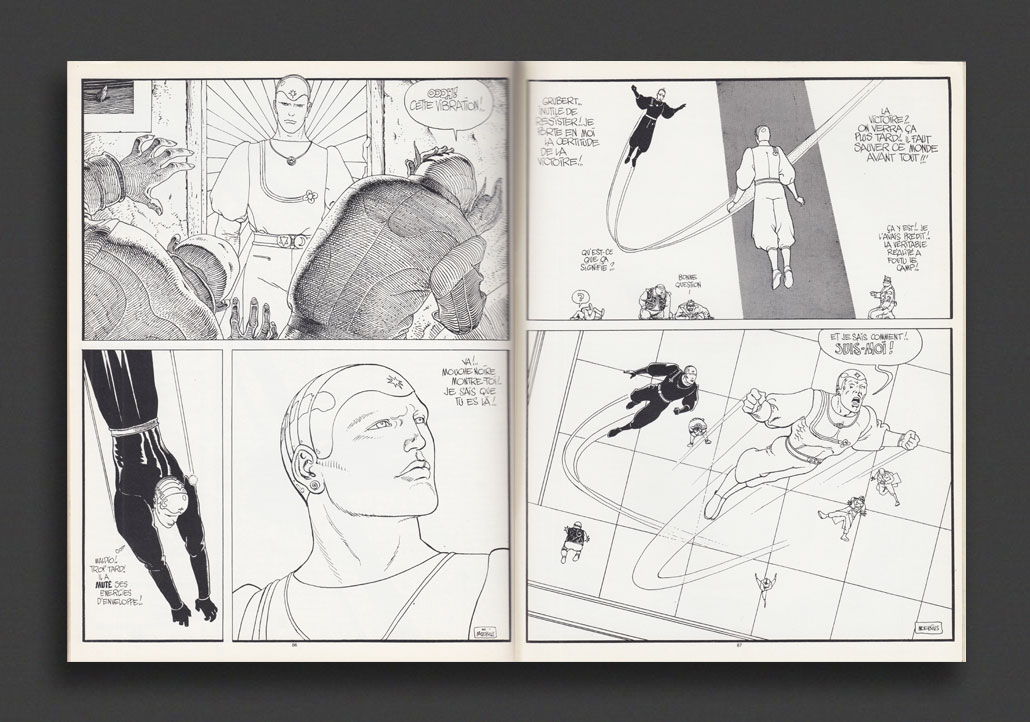
Metal Hurlant No. 39, March 1979 issue featuring comic stories/art by Moebius, Voss, Jacques Lob, Dominique Hé, Philippe Druillet, Jean-Michel Charlier and Jean "Mœbius" Giraud, Baron Staff, and many more, plus the usual fare of sci-fi, movies, music... Cover art by Chris Achilleos, the original uncensored version (reproductions of this artwork were censored for the English/US Heavy Metal covers). Original French editions, very scarce outside Europe.
Métal Hurlant (literal translation: "Howling Metal") was a French comics anthology of science fiction and horror comics stories, created in December 1974 by comics artists Jean Giraud (better known as Mœbius) and Philippe Druillet together with journalist-writer Jean-Pierre Dionnet and financial director Bernard Farkas. The four were collectively known as "Les Humanoïdes Associés" (United Humanoids), which became the name of the publishing house releasing Métal Hurlant. English, German and Italian editions were also licensed, including Heavy Metal, published in the US by National Lampoon. Métal hurlant was originally released quarterly with contributors including Moebius and Druillet, depicting such iconic characters as Arzach and Lone Sloane for the first time, as well as work by Richard Corben, Guido Crepax, Alejandro Jodorowsky, Enki Bilal, Caza, Serge Clerc, Alain Voss, Berni Wrightson, Nicole Claveloux, Milo Manara, Frank Margerin, Masse, Chantal Montellier, and many others.
Very Good copy with general light cover wear and tanning.
2022, English
Hardcover (w. printed acetate jacket), 252 pages, 22.9 x 27.3 cm
Published by
Princeton University Press / New York
Pulitzer Arts Foundation / St. Louis
$95.00 - Out of stock
A richly illustrated exploration of Hannah Wilke’s provocative art and trailblazing feminism.
One of the most groundbreaking artists to emerge in American art in the 1960s, Hannah Wilke consistently challenged the prevailing narratives of women’s bodies and their representation throughout her career, until her untimely death in 1993. Wilke established a uniquely feminist iconography in virtually all of the mediums she engaged with—painting, sculpture, photography, video, and performance art—and offered a life-affirming expression of vitality and bodily pleasure in her work.
Hannah Wilke: Art for Life’s Sake highlights the artist’s full range of expression, bringing together photographs, works on paper, video, and examples of Wilke’s sculptures in clay and other, nonconventional materials such as latex, kneaded erasers, and chewing gum. New object photography brings clarity to Wilke’s boundary-crossing art practice, making many of her rarely shown works accessible to readers for the first time. The book features a previously unpublished 1975 interview with Wilke by art critic and historian Cindy Nemser as well as a narrative chronology of Wilke’s art and life with many previously unpublished archival photographs. It includes essays by Glenn Adamson, Connie Butler, and Tamara Schenkenberg, and responses to Wilke’s work by contemporary artists Hayv Kahraman, Nadia Myre, Jeanine Oleson, and Catherine Opie.
Offering fresh perspectives on this influential artist, Hannah Wilke: Art for Life’s Sake sheds new light on Wilke’s technical and formal virtuosity, her important role in shaping postwar American art, and the nuance and poignancy of her feminist subject matter.
Edited by Tamara Schenkenberg and Donna Wingate
Contributions by Glenn Adamson, Connie Butler, Tamara Schenkenberg
Tamara H. Schenkenberg is curator at the Pulitzer Arts Foundation.
Donna Wingate is a New York-based editor.
Glenn Adamson is an independent curator and writer and a senior scholar at the Yale Center for British Art.
Connie Butler is chief curator at the Hammer Museum.
1985, English
Softcover, 196 pages, 15.2 x 22.9 cm
Published by
University of Minnesota Press / Minnesota
$52.00 - Out of stock
English translation of Jacques Attali's classic text, first published in French in 1977.
"Noise is a model of cultural historiography. In its general theoretical argument on the relations of culture to economy, but also in its specialized concentration, Noise has much that is of importance to critical theory today." — SubStance
"For Attali, music is not simply a reflection of culture, but a harbinger of change, an anticipatory abstraction of the shape of things to come. The book's title refers specifically to the reception of musics that sonically rival normative social orders. Noise is Attali's metaphor for a broad, historical vanguardism, for the radical soundscapes of the western continuum that express structurally the course of social development."
Translated by Brian Massumi
Foreword by Fredric Jameson
Afterword by Susan McClary
Jacques Attali is the author of numerous books, including Millennium: Winners and Losers in the Coming World Order and Labyrinth in Culture and Society.
Brian Massumi has translated works by Gilles Deleuze, Michel de Certeau, and Jean-François Lyotard.
Fredric Jameson is professor of literature at Duke University.
Susan McClary is professor of musicology at the University of California, Los Angeles.
2015, English
Hardcover, 192 pages, 17.5 x 19.5 cm
Published by
Atlas Press / London
$52.00 - Out of stock
This book collects the writings of a radical group of writers close to Paris Surrealism—principally René Daumal and Roger Gilbert-Lecomte—as published in their now legendary magazine, Le Grand Jeu (The Great Game). Le Grand Jeu ran to three issues between 1928 and 1930, before collapsing due to its editors' infighting, drug use and vehemently unreasonable aspirations for both art and life. The Grand Jeu is often associated with Surrealism (they were invited to join the group), but their ideas were far more extreme. The magazine was the public face of a group of artists and writers who systematically attacked their perceptions of reality through narcotics, anaesthesia and near-death experiences.
Le Grand Jeu describes a politico-mystical outlook which combined a critique of the apathy and repression of contemporary Western society with a quest to take leave of the individual ego and to reconnect with a collective Universal Mind. The group's esoteric program united narcotic and parapsychological practices with asceticism, revolutionary politics (the Russian Revolution was barely a decade old) and a prophetic mode of poetry which they identified in antecedents such as Rimbaud and Mallarmé. In this definitive collection, the theories of the Grand Jeu are presented in the group's own words for the first time, through the essays and articles which formed the bulk of their magazine.
2015, English
Softcover, 384 pages, 13 x 20.5 cm
Published by
The New York Review of Books / New York
$38.00 - Out of stock
Introduction by Helen Oyeyemi
A new translation from the Spanish by Daniel Balderston
Preface by Jorge Luis Borges
Thus Were Their Faces offers a comprehensive selection of the short fiction of Silvina Ocampo, undoubtedly one of the twentieth century’s great masters of the story and the novella. Here are tales of doubles and impostors, angels and demons, a marble statue of a winged horse that speaks, a beautiful seer who writes the autobiography of her own death, a lapdog who records the dreams of an old woman, a suicidal romance, and much else that is incredible, mad, sublime, and delicious. Italo Calvino has written that no other writer “better captures the magic inside everyday rituals, the forbidden or hidden face that our mirrors don’t show us.” Jorge Luis Borges flatly declared, “Silvina Ocampo is one of our best writers. Her stories have no equal in our literature.”
Dark, gothic, fantastic, and grotesque, these haunting stories are among the world’s most individual and finest.
"She lived a little in the shadow of her sister Victoria on the one hand and of her husband Bioy Casares and Borges on the other. She was an extravagant woman when writing her stories, short and crystalline, she was perfect."—Cesar Aira
"Ocampo wrote with fascinated horror of Argentinean petty bourgeois society, whose banality and kitsch settings she used in a masterly way to depict strange, surreal atmospheres sometimes verging on the supernatural."—The Independent
"Few writers have an eye for the small horrors of everyday life; fewer still see the everyday marvelous. Other than Silvina Ocampo, I cannot think of a single writer who, at any time or in any language, has chronicled both with such wise and elegant humor."—Alberto Manguel
"Silvina Ocampo is, together with Borges and Garcia Marquez, the leading writer in Spanish."—Jorge Amado
2000, English
Softcover, 128 pages, 20.5 x 15 cm
Published by
Exact Change / Boston
$32.00 - Out of stock
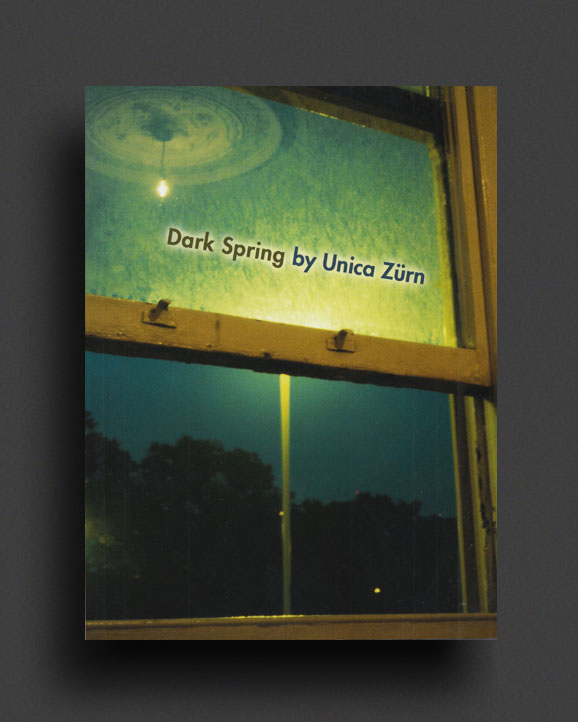
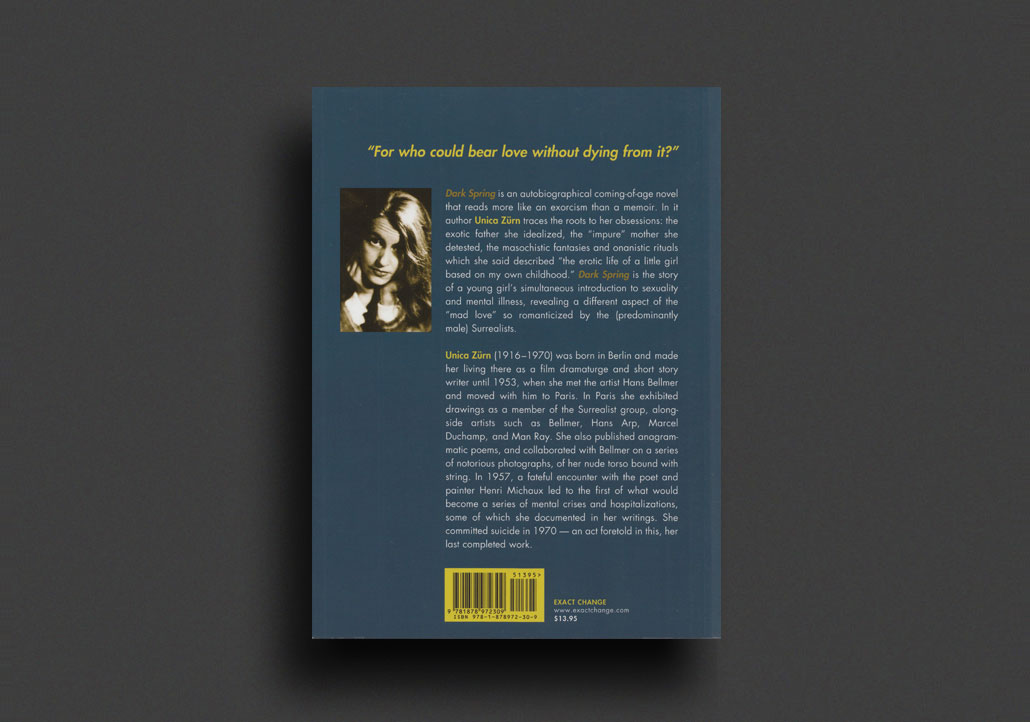
Dark Spring is an autobiographical coming-of-age novel that reads more like an exorcism than a memoir. In it author Unica Zurn traces the roots of her obsessions: The exotic father she idealized, the "impure" mother she detested, the masochistic fantasies and onanistic rituals which she said described "the erotic life of a little girl based on my own childhood." Dark Spring is the story of a young girl's simultaneous introduction to sexuality and mental illness, revealing a different aspect of the "mad love" so romanticized by the (predominantly male) Surrealists.
Unica Zurn (1916-1970) emigrated in 1953 from her native Berlin to Paris in order to live with the artist Hans Bellmer. There she exhibited drawings as a member of the Surrealist group and collaborated with Bellmer on a series of notorious photographs of her nude torso bound with string. In 1957, a fateful encounter with the poet and painter Henri Michaux led to the first of what would become a series of mental crises, some of which she documented in her writings. She committed suicide in 1970--an act foretold in this, her last completed work.
2010, English / Italian / German
Softcover (plastic printed cover, fluro hair-tie), 88 pages (w. 40 page inserts, 1 fold-out poster), 26.5 x 21.5 cm
1st Edition, Out of print title / as new
Published by
Mousse / Milan
Walther König / Köln
Museion / Bolzano
$240.00 - Out of stock
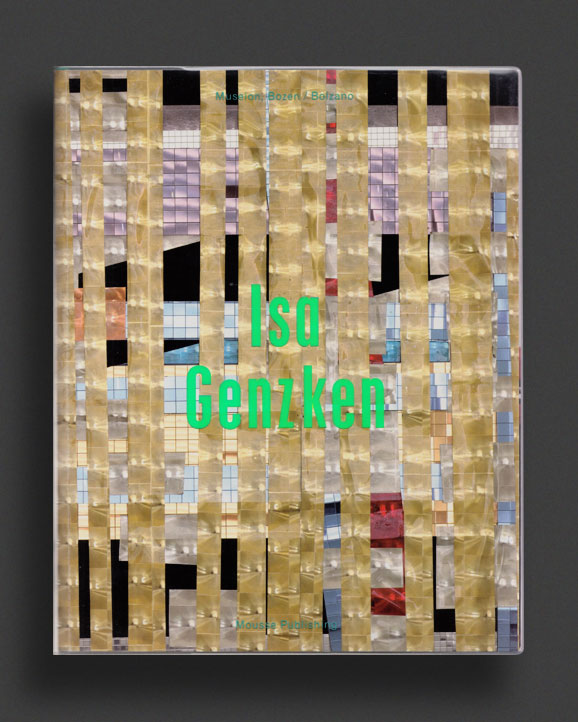
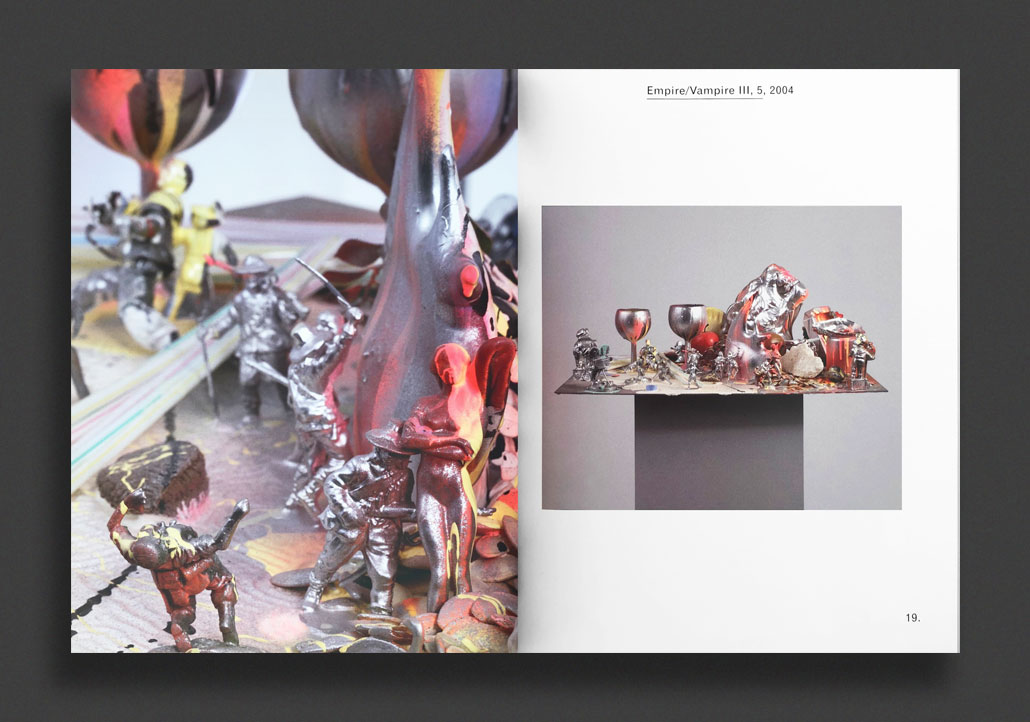
The very quickly out-of-print, first, only edition of this great Isa Genzken book, published on the occasion of the artist’s first survey exhibition in an Italian museum, at Museion, Bolzano, 11/09/2010 – 16/01/2011.
This volume takes a radical departure from the standardised format of the retrospective catalogue. While still being lavishly illustrated and offering an in-depth look at the quest for the modern which has informed the radical and diverse oeuvre of Genzken for four decades, it also gives a sense of the tremendous influence and inspiration of her body of work for three generations of artists. Profusely illustrated with Genzken's works in glossy colour, work sections spanning here entire career are puncuated by artist contribution inserts from Lawrence Weiner, Simon Denny, Nick Mauss, Monica Bonvicini, Jutta Koether, Mark Leckey, Elizabeth Peyton, and Cerith Wyn Evans. Comes in printed thick-plastic jacket with very Genzken fluro hair-tie "binding".
Fine, almost As New copy.
2018, English / French
Softcover (w. dust jacket), 200 pages, 24 x 32 cm
Published by
B. Frank Books
$95.00 - Out of stock
For this beautiful and unique photobook, Danish artist and photographer Kasper Akhøj documented the ongoing restoration of E-1027, Eileen Gray’s modernist villa in France. Based on photographs taken by Gray which were first published in 1929, Akhøj’s photographs are a kind of remake, recreating the perspective and composition of the originals. During several visits to the villa between 2009 and 2017, he produced up to six versions of each of Gray’s images, but only included one of them here. The overlap of chronologies emphasises the restoration process and references the fascinating influence of a succession of occupants. With essays by Beatriz Colomina and Amy Zion, plus an interview with Akhøj.
1988, English / Japanese
Softcover, 100 pages, 26 x 21 cm
1st Edition, Out of print title / used / good
Published by
PARCO / Tokyo
$80.00 - Out of stock
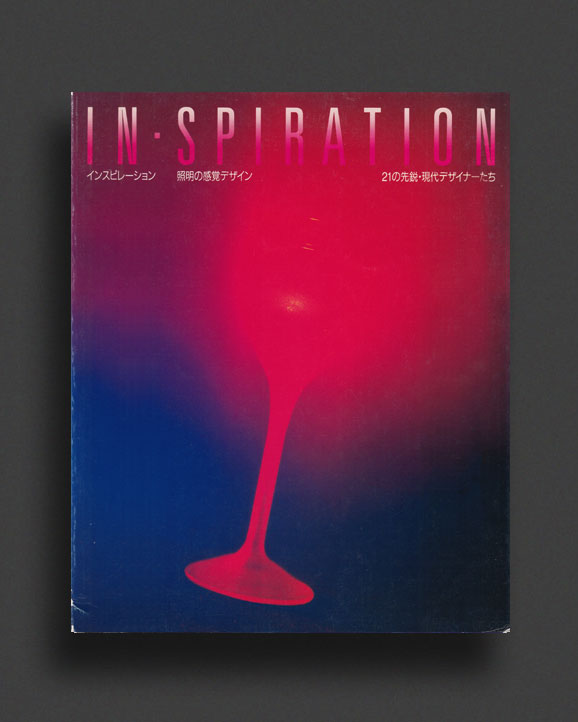
Rare Japanese light catalogue published in 1988 to accompany the exhibition In-Spiration, organised by legendary Japanese designer Shiro Kuramata for PARCO Vision Contmeporary. With an emphasis on the newest experimental designers in the field of lighting, Kuramata presents a group of young international designers including Rob Eckhardt (Amsterdam), Davis Palterer (Florence), Simo Heikkila (Helsinki), Ron Arad, Zaha Hadid, Daniel + Gerard Taylor (London), Morphosis (Los Angeles), Denis Santachiara, Fumio Shimizu + Shuji Hisada, Matteo Thun, Marco Zanini (Milan), François Bodin, Sylvain Dubuisson, Amik Hemery (Paris), Vincent Becheau + Marie-Laure Bourgeois (Perigueux), The AIR, Yutaka Hikosaka, Yasuo Kondo, Kenjiro Okazaki (Tokyo), COOP HIMMELBLAU (Vienna), plus work by co-ordinating artist Shiro Kuramata. Profusely illustrated throughout in colour with amazing examples of all designers sculptural lighting objects, followed by profiles of each that include many further archival works (expanding from lighting into furniture, architecture, ceramics) by each, profile on Kuramata and fold-out timeline of radical development in lighting. Texts in English and Japanese by Shiro Kuramata, Riichi Miyake, and Yvonne Brunhammer. An amazing and scarce postmodern lighting design reference.
Good copy, with ageing to glue binding and light corner bumping to covers,
1995, English
Softcover (w. 7" single), 60 pages, 30 x 20.5 cm
1st Edition, Out of print title / used / very good
Published by
London Musician's Collective / London
$65.00 - Out of stock
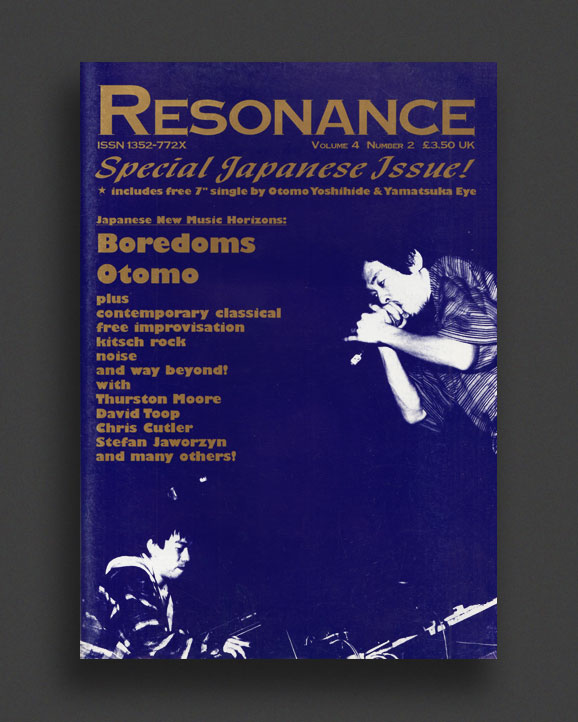
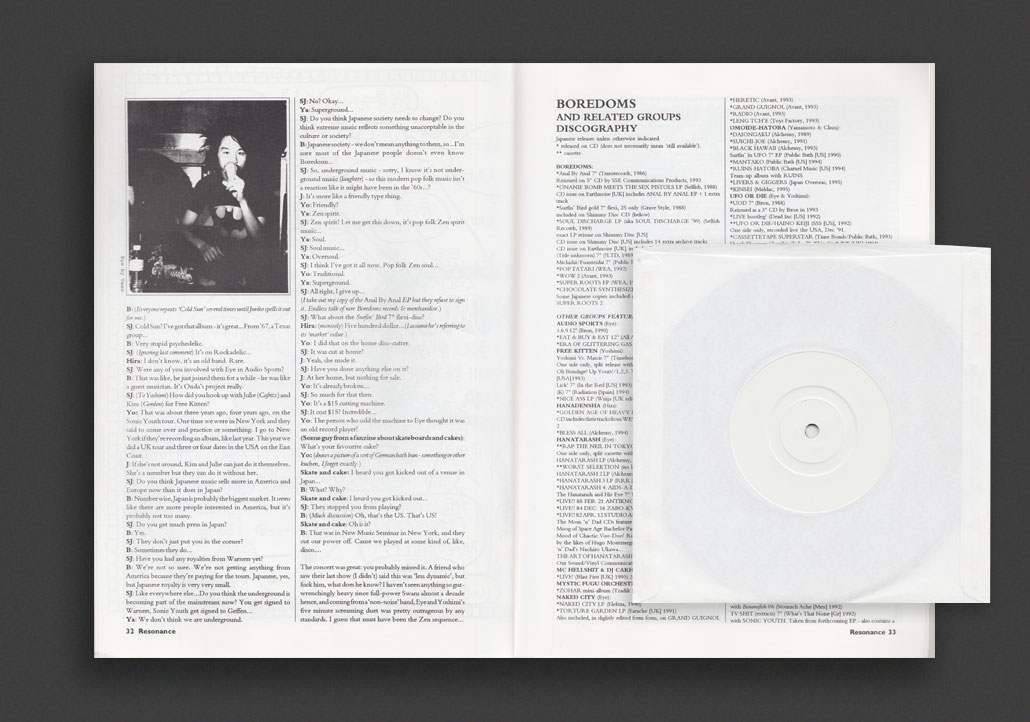
Rare "Special Japanese Issue" (Volume 4 No.2) of Resonance magazine, published by the London Musician's Collective in 1996 with exclusive 7" single of seven untitled pieces by Otomo Yoshihide and Yamatsuka Eye, recorded live in London, Spring 1995. Magazine includes articles by Otomo Yoshihide on the 1970s Japanese improvised scene (Kaoru Abe, Masayuki Takayanagi, Keiji Hano, et al.), Thurston Moore on Japan, Chris Cutler (Henry Cow, Recommended Records, et al.) on Haniwa Chan, Richard Scott on Hôgaku (Traditional Japanese Music), Steve Beresford (Derek Bailey's Company, et al.) on The Honeymoons, David Toop, Boredoms interview by Stefan Jaworzyn (including a Boredoms discography and family tree), Eckhart Derschmidt on Japanese jazz, Stefan Jaworzyn interviews Derek Bailey about working in Japan, live and record reviews and much more.
Very Good copy with Near mint, As New 7" single.
2021, English
Hardcover, 76 Pages, 20 x 25 cm
First ed. of 500,
Out of print title / as new
Published by
Baron / UK
$70.00 - Out of stock
Published in a limited first edition of 500 copies and now out-of-print, this is the first posthumous book by Japanese fetish artist Namio Harukawa (May 1947 – April 24, 2020), dedicated to Harukawa’s archive of rarely published work.
Creating a visionary language through the medium of pencil drawings, Harukawa worked for 60 years under a pseudonym, Namio Harukawa: formed from an anagram of “Naomi”, a reference to Jun’ichirō Tanizaki’s novel, and actress Masumi Harukawa, using it until his death in 2020.
Forniphilia and domination has fascinated and preoccupied Harukawa, in his artistic practice, and was central to his life work. His artwork typically featured voluptuous women dominating and humiliating smaller men. His work has been exhibited internationally and received critical praise, from Oniroku Dan to Madonna, and found new contemporary relevance on social networks, from feminists, to liberators.
The book also contains an essay by academic Pernilla Ellens, editor of Post Butt and The true meaning of S.M.H. and is designed by Sam Boxer, Art Director of Gut Magazine.
As New.
2012, English
Hardcover (w. dust jacket), 260 pages, 29 x 30 cm
Published by
Five Continents Editions / Milan
$130.00 - In stock -
The major monograph on Cuban artist Agustin Fernandez.
'As a painter I use a realist technique, but the emblems I invent are not real. They are purely imaginative... Painting is a thing of the mind. My realism is not nature, or landscape, or still life, but the psychological world.' — Agustin Fernandez
At the time of his death in 2006, Agustin Fernandez (b. 1928) ranked among Cuba's most outstanding artists. Defying simple categorisation, today his work is most recognisable for its ambiguous and precariously balanced forms, erotic overtones, surreal juxtapositions, and metallic palette. This superbly illustrated book is the first comprehensive study of Fernandez's work, and includes contributions by renowned critic Donald Kuspit and a team of experts. Fernandez's work has been exhibited throughout Europe and North and South America, and is represented in major museums worldwide, including the Museum of Modern Art in New York. His work found a wider audience when one of his larger paintings was featured in the 1980 Brian de Palma film, Dressed to Kill.
Introduction by Donald Kuspit. Texts by Susan Aberth, Rocio Aranda-Alvarado, Abby McEwen.
1977 / 1984, English
Hardcover (w. dust jacket), 88 pages, 29 x 21 cm
1st UK Edition, Out of print title / used / very good
Published by
Bracken Books / London
$15.00 - Out of stock
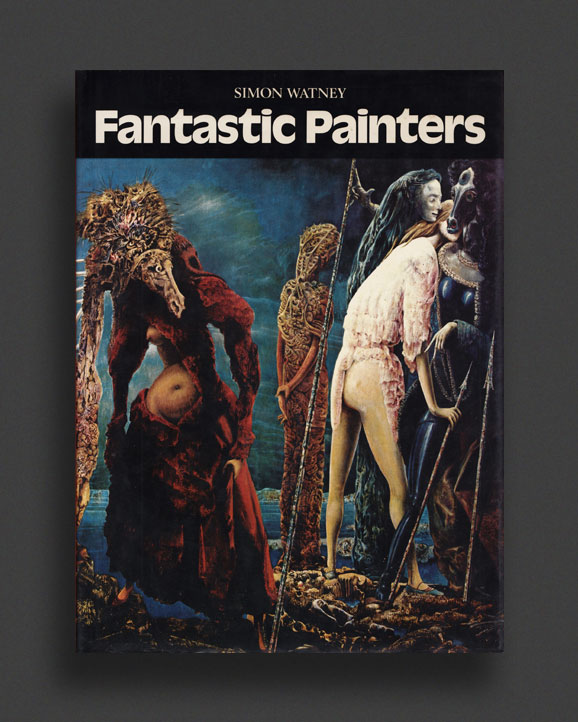
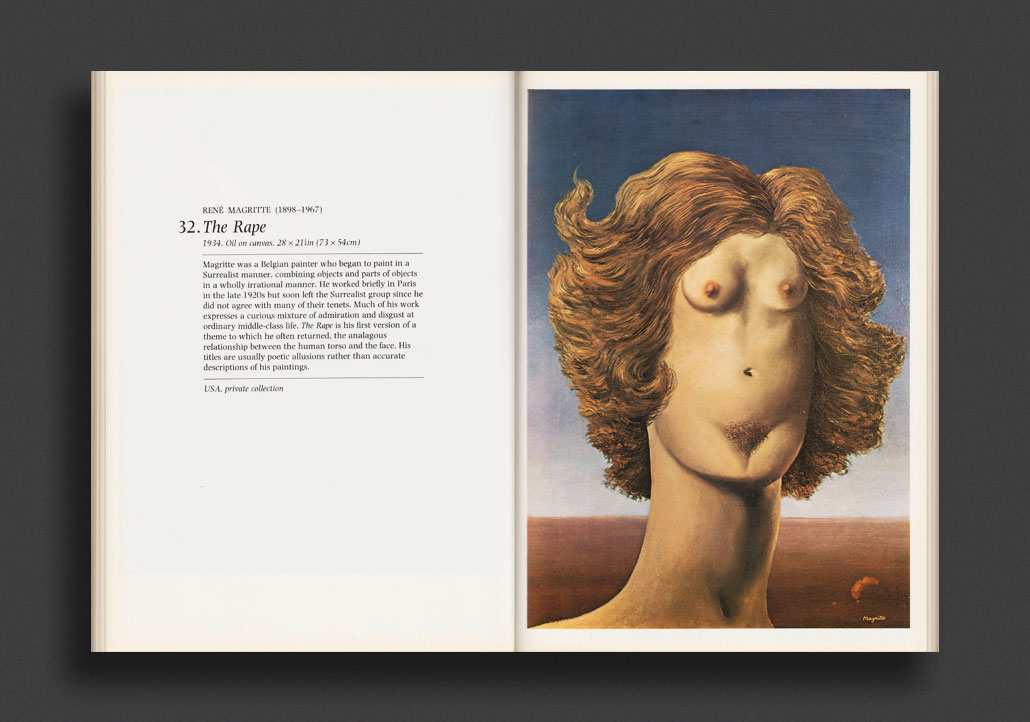
Hardcover edition of Fantastic Painters by Simon Watney, first published in 1977, this 1984 edition published by Bracken Books, London. Includes the work of Hieronymus Bosch, Max Ernst, Lyonel Feininger, Luigi Russolo, Paul Delvaux, Arnold Böcklin, Odilon Redon, Gustave Moreau, Salvador Dali, Rene Magritte, Caspar David Friedrich, Henri Rousseau, Paul Klee, Georde Frederic Watts, Giovanni Segantini, Edward Burne-Jones, John Anster Fitzgerald, Pieter Bruegel the Elder, Richard Dadd, Francisco de Goya, Henry Fuseli, Jean Auguste Dominique Ingres, Hubert Robert, William Blake, François de Nomé (Monsù Desiderio), Giuseppe Arcimboldo, Jacopo Pontormo, Matthias Grünewald, Luca Signorelli, David Hockney, and more.
Very Good in VG dust jacket.
2019, English
Hardcover (w. dust jacket), 336 pages, 25 x 29 cm
Published by
Ludion / Brussels
$100.00 - Out of stock
The first English edition of the ultimate monograph on painter Léon Spilliaert.
Leon Spilliaert (1881-1946) was one of the most important Flemish Symbolist painters. Although he was embedded in the Symbolist tradition, he was also drawn to the avant-garde. He was, in fact, an einzelganger, or loner, balancing on the fault line between two centuries, a transitional figure between Symbolism and Surrealism.
Spilliaert, like James Ensor, was born and raised in Ostend. And like Ensor, he was also driven by ridicule and irony, non-conformism and the urge to look at the world from a different perspective. He created his own spiritual imagery, experimented with pastel and gouache, and played with purified areas of colour and graceful lines. The sea under a cool moon, lonely figures with a vacant gaze, desolate beaches, empty rooms and stylised silhouettes in backlight: Spilliaert was always able to evoke an atmosphere of mystery, magic and alienation in abstract lines and colour.
Anne Adriaens-Pannier, former curator at the Royal Museums of Fine Arts in Brussels, has been working on the catalog raisonné of his oeuvre since 1995 at the Spilliaert family's request. She pays tribute to the artist with this beautifully illustrated book, in which she describes his drawings and paintings, as well as referring to his book illustrations and lithographs. The author presents Spilliaert as a link between the major art movements in the fascinating era in which he lived and worked. A unique book about an exceptional artist.
2018, English / French / Dutch
Hardcover, 192 pages, 24.5 x 29.7 cm
Published by
Pandora / Brussels
$130.00 - In stock -
For a long time, the graphic oeuvre of Leon Spilliaert (1881-1946) was, if not neglected, then at least
discussed little or summarily. It was only in 1982 that the first exhibition fully devoted to his prints was held. The prints of Spilliaert are perhaps less known than his original works on paper but they are equally mysterious, attractive and varied on topic: portraits, figures, land- and cityscapes, forests and parks...
Together with fellow citizen of Ostend James Ensor, Leon Spilliaert is considered one of the pioneers of Belgian modern art.
Over 35 years on from that first exhibition, this new and updated edition of the catalogue raisonne of the prints of Leon Spilliaert by Xavier Tricot showcases the visionary work of this Belgian artist.
Text in English, French, and Dutch.
2022, English
Softcover, 320 pages, 23 x 15.2 cm
Published by
Thames and Hudson / London
$49.00 - In stock -
This pioneering book stands as the most comprehensive treatment of the lives, ideas and art works of the remarkable group of women who were an essential part of the Surrealist movement. Leonora Carrington, Léonor Fini, Frida Kahlo, Meret Oppenheim, Dora Maar, and Dorothea Tanning, among many others, became an embodiment of their age as they struggled towards artistic maturity and their own 'liberation of the spirit' in the context of the Surrealist revolution. Their stories and their achievements are presented here against the background of the turbulent decades of the 1920s, 30s and 40s, and the war that forced Surrealism into exile in New York and Mexico.
Foreword by Dawn Ades.