World Food Books' programme is largely produced on Kulin Nation land. We acknowledge the Wurundjeri people of the Kulin Nation as the first and continuing custodians of this land, and pay respect to their Elders past, present, and emerging.
World Food Books is an arts and special interests bookshop in Naarm / Melbourne. Founded in 2010, World Food Books is devoted to the presentation of a rotating, hand-selection of international art, design, literary and counterculture publications with an emphasis on the anti-traditional, the experimental, the avant-garde, the heretic, the marginal.
Presenting new titles alongside rare and out-of-print books, catalogues and journals spanning the fields of modern and contemporary art, design, photography, illustration, film, literature, poetry, cultural theory, philosophy, sexuality, popular and underground culture in its many radical forms, World Food Books wishes to encourage adventurous, thoughtful and open-minded reading, looking, writing, and exchange of publishing and ideas, both current and historical.
As well as our bookshop, located in Melbourne's historical Nicholas Building, all of our inventory is available internationally via our online mail-order service.
World Food Books semi-regularly co-ordinates "Occasions", a programme of exhibits and events at the bookshop and in partnership with other hosts (such as museums and art galleries) that develop out of the activities, relationships and content of the bookshop itself.
World Food Books
The Nicholas Building
37 Swanston Street
Room 5, Level 6
Melbourne 3000
Australia
SHOP HOURS:
Thu–Fri 12–6, Sat 12–5
WEB-SHOP OPEN 24/7
World Food Books
Postal Address:
PO Box 435
Flinders Lane
Victoria 8009
Australia
Art
Theory / Essay
Architecture / Interior
Graphic Design / Typography
Photography
Fashion
Eros
LGBTQ+
Fiction / Poetry
Weird / Speculative / Science Fiction / Horror
Transgressive / Visceral / Abject
Symbolism / Decadence / Fin de siècle
Film / Video
Painting
Sculpture / Installation
Performance / Dance / Theater
Drawing
Sound / Music
Curatorial
Group Shows / Collections
Periodicals
Out-of-print / Rare
Posters / Ephemera / Discs
Signed Books
World Food Books Gift Voucher
World Food Book Bag
Australian Art
Australian Fiction
Australian Science Fiction / Speculative Fiction
Australian Poetry
Australian Photography
Japanese Photography
Conceptual Art
Minimal Art
Dada
'Pataphysics / Oulipo
Fluxus
Concrete Poetry
Pop Art
Surrealism
Arte Povera
Arte Informale / Haute Pâte / Tachism
Nouveau Réalisme / Zero / Kinetic
Situationism / Lettrism
Collage / Mail Art / Xerox Art
Art Brut / Folk / Visionary / Fantastic
Illustration / Graphic Art / Bandes Dessinées
Furniture
Italian Radical Design / Postmodernism
Textiles
Ceramics / Glass
Counterculture
Protest / Revolt
Philosophy
Psychoanalysis
Anthropology
Anarchism
Socialism / Anarchism / Communism / Capitalism
Literary Theory / Semiotics / Language
Feminism / Women's Studies
Gender Studies / Sexuality
Anthropology
Fetishism / BDSM
Drugs / Psychedelia
Crime / Violence
Animal Rights / Veganism
Occult / Esoterica
Ecology / Earth / Alternative Living
Whole Earth / Crafts
All prices in AUD (Australian dollars)
Pick-Ups
Pick-up orders can be collected in our bookshop during opening hours after order date. Please collect any Pick-up orders within 2 weeks of ordering as we have limited storage space. Orders will be released back into stock if not collected within this time. No refunds can be made for pick-ups left un-collected. If you cannot make it in to the bookshop in this time-frame, please choose postage option.
Return Policy
All sales are final. We do accept returns (for refund or exchange) for items received in error. All our orders are packed with special care using heavy-duty padding and cardboard book-mailers or bubble mailers (for smaller books), using reinforcement where required. We cannot take responsibility for any lost, stolen or damaged parcels.
Insurance
Should you wish to insure your package, please email us directly after placing your order and we can organise this at a small extra expense. Although all standard/express tracked packages are very safe and dependable, we cannot take responsibility for any lost, stolen or damaged parcels. We recommend insurance on valuable orders.
Interested in selling your old books, catalogues, journals, magazines, comics, fanzines, ephemera? We are always looking for interesting, unusual and out-of-print books to buy. We only buy books in our fields of interest and specialty, and that we feel we can resell.
We base these prices on desirability, market value, in-print prices, condition and our current stock levels. We offer cash, store credit, and can take stock on consignment. All
about 25% of the price we expect to get when we sell them, or 30% in store credit. We base these prices on desirability, market value, in-print prices, condition and our current stock levels.
Sell your books any day of the week. You can drop them off and return later. If you have a lot of books, we can visit your Sydney home.
We buy books that we feel we can resell. We offer about 25 % of the price we expect to get when we sell them, or 30% in store credit. We base these prices on desirability, market value, in-print prices, condition and our current stock levels.
Philadelphia Wireman
03 August - 01 September, 2018
World Food Books is proud to announce our next Occasion, the first presentation of sculptures by Philadelphia Wireman in Australia.
The Philadelphia Wireman sculptures were found abandoned in an alley off Philadelphia’s South Street on trash night in 1982. Their discovery in a rapidly-changing neighbourhood undergoing extensive renovation, compounded with the failure of all attempts to locate the artist, suggests that the works may have been discarded after the maker’s death. Dubbed the "Philadelphia Wireman" during the first exhibition of this work, in 1985, the maker’s name, age, ethnicity, and even gender remain uncertain. The entire collection totals approximately 1200 pieces, all intricately bound together with tightly-wound heavy-gauge wire (along with a few small, abstract marker drawings, reminiscent both of Mark Tobey and J.B. Murry). The dense construction of the work, despite a modest range of scale and materials, is singularly obsessive and disciplined in design: a wire armature or exoskeleton firmly binds a bricolage of found objects including plastic, glass, food packaging, umbrella parts, tape, rubber, batteries, pens, leather, reflectors, nuts and bolts, nails, foil, coins, toys, watches, eyeglasses, tools, and jewellery.
Heavy with associations—anthropomorphic, zoomorphic, and socio-cultural responses to wrapped detritus—the totemic sculptures by Philadelphia Wireman have been discussed in the context of work created to fulfil the shamanistic needs of alternative religions in American culture. Curators, collectors, and critics have variously compared certain pieces to sculpture from Classical antiquity, Native American medicine bundles, African-American memory jugs, and African fetish objects. Reflecting the artist’s prolific and incredibly focused scavenging impulse, and despite—or perhaps enhanced by—their anonymity, these enigmatic objects function as urban artefacts and arbiters of power, though their origin and purpose is unknown. Philadelphia Wireman, whatever their identity, possessed an astonishing ability to isolate and communicate the concepts of power and energy through the selection and transformation of ordinary materials. Over the course of the past two decades, this collection has come to be regarded as an important discovery in the field of self-taught art and vernacular art.
Presented in collaboration with Fleisher-Ollman Gallery, Philadelphia, and Robert Heald, Wellington.
Susan Te Kahurangi King
02 February - 10 March, 2018
Susan Te Kahurangi King (24 February 1951 - ) has been a confident and prolific artist since she was a young child, drawing with readily available materials - pencils, ballpoint pens and felt-tip markers, on whatever paper is at hand. Between the ages of four and six Susan slowly ceased verbal communication. Her grandparents William and Myrtle Murphy had developed a special bond with Susan so they took on caring responsibilities for extended periods. Myrtle began informally archiving her work, carefully collecting and storing the drawings and compiling scrapbooks. No drawing was insignificant; every scrap of paper was kept. The King family are now the custodians of a vast collection containing over 7000 individual works, from tiny scraps of paper through to 5 meter long rolls.
The scrapbooks and diaries reveal Myrtle to be a woman of great patience and compassion, seeking to understand a child who was not always behaving as expected. She encouraged Susan to be observant, to explore her environment and absorb all the sights and sounds. Myrtle would show Susan’s drawings to friends and people in her community that she had dealings with, such as shopkeepers and postal workers, but this was not simply a case of a grandmother’s bias. She recognised that Susan had developed a sophisticated and unique visual language and sincerely believed that her art deserved serious attention.
This was an unorthodox attitude for the time. To provide some context, Jean Dubuffet coined the term Art Brut in 1945 to describe work created by self-taught artists – specifically residents of psychiatric institutions and those he considered to be visionaries or eccentrics. In 1972 Roger Cardinal extended this concept by adopting the term Outsider Art to describe work made by non-academically trained artists operating outside of mainstream art networks through choice or circumstance. Susan was born in Te Aroha, New Zealand in 1951, far from the artistic hubs of Paris and London that Dubuffet and Cardinal operated in. That Myrtle fêted Susan as a self-taught artist who deserved to be taken seriously shows how progressive her attitudes were.
Susan’s parents Doug and Dawn were also progressive. Over the years they had consulted numerous health practitioners about Susan’s condition, as the medical establishment could not provide an explanation as to why she had lapsed into silence. Dawn educated herself in the field of homeopathy and went on to treat all twelve of her children using these principles – basing prescriptions on her observations of their physical, mental and emotional state.
Doug was a linguist with an interest in philosophy who devoted what little spare time he had to studying Maori language and culture. To some extent their willingness to explore the fringes of the mainstream made them outsiders too but it was their commitment to living with integrity and their respect for individuality that ensured Susan’s creativity was always encouraged.
Even though Susan’s family supported her artistic pursuits, some staff in schools and hospitals saw it as an impediment to her assimilation into the community and discouraged it in a variety of ways. Her family was not always aware of this and therefore did not fully understand why Susan stopped drawing in the early 1990s. However, rather than dwell on the challenges that Susan faced in pursuit of her artistic practice, they prefer to highlight her achievements. In 2008 Susan began drawing again in earnest, after an almost 20 year interruption, and her work is now shown in galleries around the world.
Susan grew up without television and has been heavily influenced by the comics she read as a child. She is absolutely fearless in the appropriation of recognizable characters, such as Donald Duck and Mickey Mouse, in her work. She twists their limbs, contorts their faces, compresses them together, blends them into complex patterned backgrounds - always imbuing them with an incredible energy. Although Susan often used pop culture characters in her work they are not naive or childlike. These are drawings by a brilliant self-taught artist who has been creating exceptional work for decades without an audience in mind.
Mladen Stilinović
"Various Works 1986 - 1999"
02 February 16 - September 10, 2016
Various works 1986 - 1999, from two houses, from the collections of John Nixon, Sue Cramer, Kerrie Poliness, Peter Haffenden and Phoebe Haffenden.
Including: Geometry of Cakes (various shelves), 1993; Poor People’s Law (black and white plate), 1993; White Absence (glasses, ruler, set square, silver spoon, silver ladel with skin photograph and wooden cubes), 1990-1996; Exploitation of the Dead (grey and red star painting, wooden painting, black spoon with red table, red plate), 1984-1990; Money and Zeros (zero tie, paintings made for friends in Australia (Sue, John, Kerrie), numbers painting), 1991-1992; Words - Slogans (various t-shirts) - “they talk about the death of art...help! someone is trying to kill me”, “my sweet little lamb”, “work is a disease - Karl Marx”; Various artist books, catalogues, monographs, videos; Poster from exhibition Insulting Anarchy; "Circular" Croatian - Australian edition; Artist book by Vlado Martek (Dostoyevsky); more.
Thanks to Mladen Stilinović and Branka Stipančić.
Jonathan Walker
Always Will Need To Wear Winter Shirt Blue + Ochre Small Check Pattern
21 August - 21 September, 2015
Untitled
I am not a great reader of poetry but I always return to the work of Melbourne poet, Vincent Buckley (1925- 1988). Perhaps I find his most tantalising piece to be not a finished poem but a fragment left on a scrap of paper discovered on his desk after the poet’s death.
The poetry gathers like oil
In the word-core, and spreads
It has its music meet,
Its music is in movement.
This fragment is more the shell left behind from a volatile thought than a finished poem. I find the last two lines honest but awkward whereas the first two lines work like an arrow. Most likely he could not find a resolution so it was left. Still, in its present form, it remains an eloquent testimony to the ultimate failure of a medium to express mobile thought and sensation, in Buckley’s case, through verbal language. It’s an important matter because this is something all artists have to deal with regardless of the medium.
I have never written a poem, however, I am forever copying fragments from books on paper scraps in a vain effort to fix certain notions in my head. At first, they function as bookmarks that are sometimes returned to when I open the book. But before long, as they accumulate, they fall out littering the table interspersed with A4 photocopies, bills, books and medications.
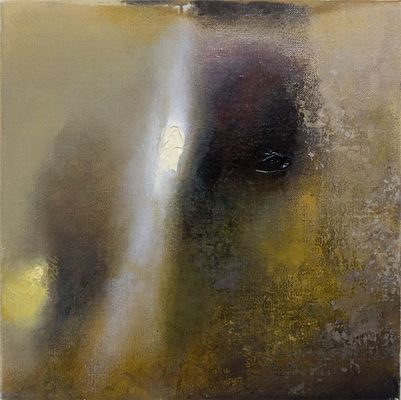
To return to Buckley’s fragment, the first two lines very much evoke how I paint nowadays. As you age, detail diminishes and patches of light become more luminous and float. I feel the most honest way of dealing with this is by smearing the oil paint on the canvas with the fingers and working close-up, blind. Only if the patches coalesce into an approaching image can the work gain a life.
-
Jonathan Walker was born in Melbourne, Australia and brought up on a dairy farm in Gippsland. In the 1970’s he studied painting at RMIT and won the Harold Wright Scholarship to the British Museum, London. During the 1980’s he exhibited at Pinacotheca Gallery, Richmond and had work shown at the NGV and Heidi City Art Gallery. Over the same period he designed the cover for the “Epigenesi” LP by Giancarlo Toniutti, Italy and conducted a mail exchange work with Achim Wollscheid, Germany. The work with artists through the post resulted in an article published in the bicentenary issue of Art and Australia 1988. He showed in artist run spaces such as WestSpace in the 90’s and 2000’s, and until 2012, taught painting at Victoria University, which is where we (Colleen Ahern and Lisa Radford) as organisers of the exhibition, among many others, had the privilege of being his student.
Walker’s knowledge was imparted to students through the careful selection of music, literature, and artists found in books that he himself had ordered for the library. Walker’s strategy was the generosity of sharing his vast knowledge with references specific to each student and their context.
Walker’s paintings share a similar focus and intimacy.
This exhibition presents a small selection of recent paintings alongside a publication that includes Walker’s writing. Observational and analytical, Walker’s work is a type of material notation — the time of day, colour and how it is blended, the both specific and fleeting location of a reflection on lino or the question of whether a chair leg should be included in a painting.
Please join us on Friday August 21 between 6-8pm to celebrate the opening of the exhibition.
Curated by Colleen Ahern and Lisa Radford.
B. Wurtz
Curated by Nic Tammens
March 26 - April 4, 2015
B.Wurtz works from a basement studio in his home on Manhattan’s Lower East Side.
This local fact is attested to by the plastic shopping bags and newsprint circulars that appear in his work. As formal objects, they don’t make loud claims about their origins but nonetheless transmit street addresses and places of business from the bottom of this long thin island. Like plenty of artists, Wurtz is affected by what is local and what is consumed. His work is underpinned by this ethic. It often speaks from a neighborhood or reads like the contents of a hamper:
“BLACK PLUMS $1.29 lb.”
“Food Bazaar”
“USDA Whole Pork Shoulder Picnic 99c lb.”
“RITE AID Pharmacy, with us it’s personal.”
“H. Brickman & Sons.”
“Sweet Yams 59c lb."
Most of the work in this exhibition was made while the artist was in residence at Dieu Donne, a workshop dedicated to paper craft in Midtown. Here Wurtz fabricated assemblages with paper and objects that are relatively lightweight, with the intention that they would be easily transportable to Australia. This consideration isn’t absolute in Wurtz’s work, but was prescriptive for making the current exhibition light and cheap. Packed in two boxes, these works were sent from a USPS post office on the Lower East Side and delivered to North Melbourne by Australia Post.
Wurtz appears courtesy of Metro Pictures, New York.
Thanks to Rob Halverson, Joshua Petherick, Sari de Mallory, Matt Hinkley, Helen Johnson, Fayen d'Evie, Ask Kilmartin, Lisa Radon, Ellena Savage, Yale Union, and "Elizabeth".
John Nixon
"Archive"
December 15 - January 20, 2014
The presentation of John Nixon's archive offered a rare showcase of this extensive collection of the artist's own publications, catalogues, posters, ephemera, editions and more, from the mid 1980s onwards, alongside a selection of his artworks.
Organized by John Nixon, Joshua Petherick and Matt Hinkley.
<a href=http://wfb.public-office.info/artist/john-nixon>All titles by John Nixon
"Habitat"
at Minerva, Sydney (organised by Joshua Petherick and Matt Hinkley)
November 15 - December 20, 2014
Lupo Borgonovo, Janet Burchill & Jennifer McCamley,
Lewis Fidock, HR Giger, Piero Gilardi, Veit Laurent Kurz,
Cinzia Ruggeri, Michael E. Smith, Lucie Stahl, Daniel Weil, Wols
Press Release:
“...It contained seven objects. The slender fluted bone, surely formed for flight, surely from the wing of some large bird. Three archaic circuitboards, faced with mazes of gold. A smooth white sphere of baked clay. An age-blackened fragment of lace. A fingerlength segment of what she assumed was bone from a human wrist, grayish white, inset smoothly with the silicon shaft of a small instrument that must once have ridden flush with the surface of the skin - but the thing’s face was seared and blackened.”
William Gibson, “Count Zero”, 1986
"Autumn Projects Archive"
Curated by Liza Vasiliou
March 6 - March 15, 2014
World Food Books, in conjunction with the Virgin Australia Melbourne Fashion Festival 2014, presented the Autumn Projects archive, consisting of a selection of early examples in Australian fashion with a particular interest in collecting designers and labels from the period beginning in the 1980’s, who significantly influenced the discourse of Australian Fashion.
Curated by Liza Vasiliou, the exhibition provided a unique opportunity to view pieces by designers Anthea Crawford, Barbara Vandenberg, Geoff Liddell and labels CR Australia, Covers, Jag along with early experimental collage pieces by Prue Acton and Sally Browne’s ‘Fragments’ collection, suspended throughout the functioning World Food Books shop in Melbourne.
H.B. Peace
presented by CENTRE FOR STYLE
November 14, 2013
"Hey Blinky, you say chic, I say same"
Anon 2013
H.B. Peace is a clothing collaboration between great friends Blake Barns and Hugh Egan Westland. Their pieces explore the divergences between 'character’ and ‘personality’ in garments....etc
Special Thanks to Joshua Petherick and Matt Hinkley of WFB and Gillian Mears
and a Very Special Thank you to Audrey Thomas Hayes for her shoe collaboration.
Janet Burchill & Jennifer McCamley
"Aesthetic Suicide"
May 10 - June 8, 2013
The first of our occasional exhibitions in the World Food Books office/shop space in Melbourne, "Aesthetic Suicide" presented a body of new and older works together by artists Janet Burchill & Jennifer McCamley, including videos, prints, a wall work, and publications.
During shop open hours videos played every hour, on the hour.
2021, English
Hardcover, 212 pages, 15.6 x 23.4 cm
Published by
Walther König / Köln
$80.00 - Out of stock
An enchanting collection of Post-it note drawings done for a child's school lunchbox.
This volume assembles 200 drawings made by Berlin-based Ed Atkins (born 1982), internationally known for his video art. Drawn on Post-it notes during weekday mornings over breakfast and slipped into his daughter's lunchbox before school, these delightful and colorful illustrations are reproduced here in their original formats.
Ranging from the playful to the graphic and even sometimes grotesque, they mirror both the absurdity and mundanity of everyday love. Some contain, simply, the words "I love you" or a quick sketch of a sunset, while others seem to treat the format as a sort of canvas, with vividly surreal scenes filling the Post-it note from corner to corner. A true artist's book, this charming volume acts as a playful testament to, and a tender snapshot of, fatherly love.
1981, German
Softcover, 142 pages, 26 x 21cm
1st Edition, Out of print title / used / good
Published by
Mahnert-Lueg Verlag / Münich
$65.00 - Out of stock
First edition from 1981, the amazing and criminally overlooked only photo book by German photographer Sibylle Mallmann. This book collects Mallmann's portraits of young women living in Germany in the early 1980s, including many familiar artists, actresses, musicians captured beautifully in their essence. Portraits taken in bedrooms, studios, living rooms, cafés and gardens, these lovely images seem more in collaboration with the subjects, surrounded by their belongings, drying clothes, and so many animal accomplices(!), Mallmann's camera becomes a mirror of her model's character. So so good.
Mallmann (b. 1944) worked as a freelance commercial photographer in Germany, quite active in the new music scene.
Introduction by Wolfgang Limmer, German critic, screenwriter, and film director.
Good copy, light cover wear (small crease to bottom corner not affecting pages), small unobstructive pencil crosses on some pages from previous owner, easily removed. Otherwise clean and crisp throughout.
1983, English / German
Softcover, 80 pages, 24 x 28.5 cm
1st Edition, Out of print title / used / very good
Published by
Eichborn Verlag / Frankfurt
$190.00 - Out of stock
First edition of this rare photographic study of youth tribes between 1977 and 1982 by British photographer Chris Wroblewski and French photographer Nelly Gommez-Vaez. A masterpiece of punk rock and youth culture, City Indians aims to draw a comparison between contemporary subcultures and ancient native tribes thought its influences on hairstyles, tattoos, piercings and fashion. Chapters on "Mohicans", "Skinheads", "Sons of hell", "Sic Boys", "Rastas", and others, with incredible portraits of "City Indians" in Europe and the UK set against Martin Knox's incredible complimentary graphic design and a foreword by Claude Levy-Strauss, a prominent Native American ethnologist. All texts in English and German.
“As the western armies and cultures marched in and took over the civilizations of the east, the displaced and unwanted ceremonies, rituals and modes of dress quietly graduated and entrenched themselves in the west in return. Just as our museums and galleries are cramped with the looted remnants of vanished civilizations so too are our streets and inner cities brimming with the evidence of a tribal past.”
Very Good copy with light cover wear.
1998, Japanese
Softcover (w. dust jacket and obi), unpaginated, 20 x 15 cm
1st Edition, Out of print title / used / very good
Published by
Asahi Press / Japan
$80.00 - Out of stock
First edition of the second publication of Kishin Shinoyama's "Accidents" series of books. Shinoyama established these lovely photo books in the late 1990s as a way to present the consequential photographs that would develop from commercial nude photoshoots with his models. Each book represents a collaboration between the photographer and one model, Accidents 2 "Breezy Day" presenting a shoot with Japanese actress Keiko Oginome. Shinoyama had close friendships with many of his regular models, working closely with them throughout their entire careers. The "accidental photographs", unrestricted by the editorial outcome of the icon "pin-up", unfold with an intimacy, tenderness and freedom that carry with it the passing of time between the photographer and model, sometimes over one shoot, at others across ages. Lavishly illustrated throughout in colour and black and white.
Very Good w. VG dust jacket.
1998, Japanese
Softcover (w. dust jacket), unpaginated, 20 x 15 cm
1st Edition, Out of print title / used / very good
Published by
Asahi Press / Japan
$80.00 - Out of stock
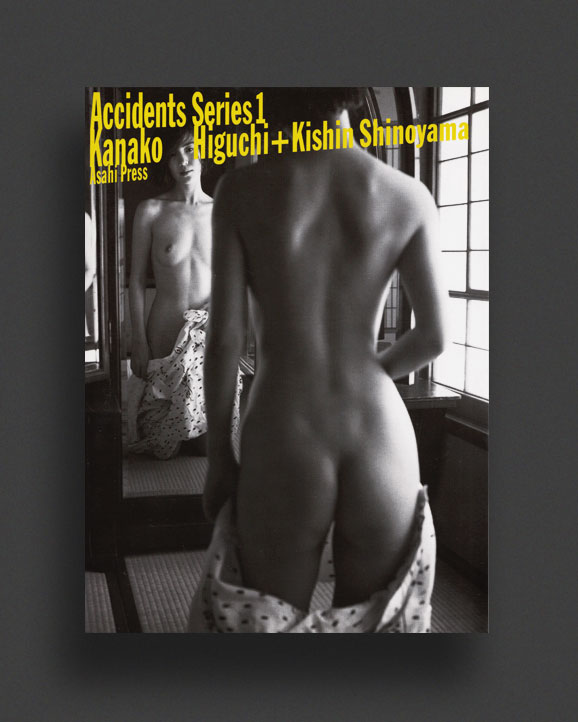
First edition of the first publication of Kishin Shinoyama's "Accidents" series of books. Shinoyama established these lovely photo books in the late 1990s as a way to present the consequential photographs that would develop from commercial nude photoshoots with his models. Each book represents a collaboration between the photographer and one model, Accidents 1 "Waterfruit" presenting a shoot with Japanese actress Kanako Higuchi. Shinoyama had close friendships with many of his regular models, working closely with them throughout their entire careers. The "accidental photographs", unrestricted by the editorial outcome of the icon "pin-up", unfold with an intimacy, tenderness and freedom that carry with it the passing of time between the photographer and model, sometimes over one shoot, at others across ages. Lavishly illustrated throughout in colour and black and white.
Very Good w. VG dust jacket.
1982, Japanese
Softcover (w. dust jacket), 68 pages, 12.9 x 18.2 cm
1st Edition, Out of print title / used / very good
Published by
Nippon Geijutsu Shuppan (NGS) / Japan
$90.00 - Out of stock
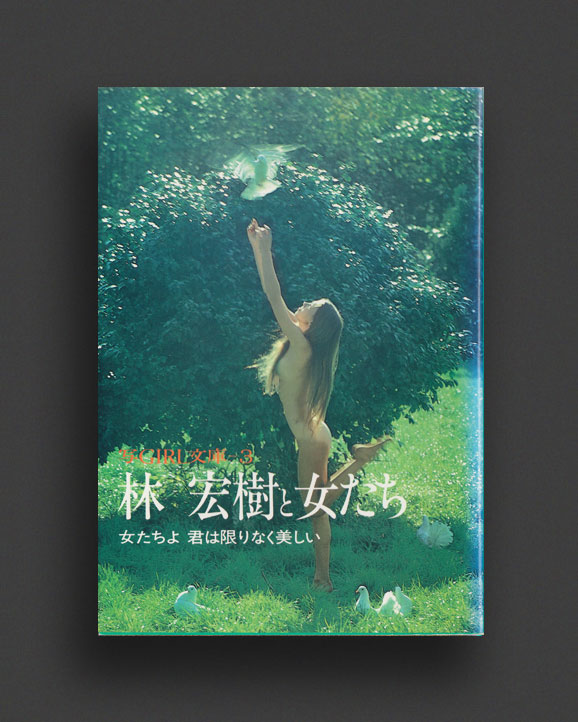
1982 volume of nude photography by Japanese photographer Hiroki Hayashi from the collectible Photo Girl series of green paperbacks from Japanese imprint Nippon Geijutsu Shuppan (NGS). Cover to cover glossy, full-bleed photography, printed in Japan.
Very Good copy.
1982, Japanese
Softcover (w. dust jacket), 68 pages, 12.9 x 18.2 cm
1st Edition, Out of print title / used / very good
Published by
Nippon Geijutsu Shuppan (NGS) / Japan
$90.00 - In stock -
1982 volume of nude photography by Dieter Schmitz from the collectible Photo Girl series of green paperbacks from Japanese imprint Nippon Geijutsu Shuppan (NGS). Cover to cover glossy, full-bleed photography, printed in Japan.
Very Good copy.
2021, English
Softcover, 172 pages, 10.8 x 17.8 cm
Published by
David Zwirner Books / New York
$28.00 - Out of stock
In his introduction to Charles Baudelaire’s Salon of 1846, the renowned art historian Michael Fried presents a new take on the French poet and critic’s ideas on art, criticism, romanticism, and the paintings of Delacroix.
Charles Baudelaire, considered a father of modern poetry, wrote some of the most daring and influential prose of the nineteenth century. Prior to publishing the international bestseller Les Fleurs du mal (1857), he was already notable as a forthright and witty critic of art and literature. Captivated by the Salons in Paris, Baudelaire took to writing to express his theories on modern art and art philosophy.
The Salon of 1846 expands upon the tenets of romanticism as Baudelaire methodically takes his reader through paintings by Delacroix and Ingres, illuminating his belief that the pursuit of the ideal must be paramount in artistic expression. Here we also see Baudelaire caught in a fundamental struggle with the urban commodity of capitalism developing in Paris at that time. Baudelaire’s text proves to be a useful lens for understanding art criticism in mid-nineteenth-century France, as well as the changing opinions regarding the essential nature of romanticism and the artist as creative genius.
Acclaimed art historian and art critic Michael Fried’s introduction offers a new reading of Baudelaire’s seminal text and highlights the importance of his writing and its relevance to today’s audience.
Charles Baudelaire
Known for his equal skill in poetry and prose, Charles Baudelaire (1821–1867) was one of the most distinctive writers of the nineteenth century. Operating within the French literary scene, his provocative theories on contemporary art remain relevant today. His poetry collections include Les Fleurs du mal (1857) and Petits poèmes en prose (1868). Notable criticisms can be found in Baudelaire: Selected Writings on Art and Artists (1995).
Michael Fried
Michael Fried is a poet, art critic, art historian, and literary scholar. His many books include Absorption and Theatricality: Painting and Beholder in the Age of Diderot (1980), Art and Objecthood: Essays and Reviews (1998), and The Moment of Caravaggio (2010). Previous books of poems are Powers (1973), To the Center of the Earth (1994), The Next Bend in the Road (2004), and Promesse du Bonheur (David Zwirner Books, 2016). Fried is Professor Emeritus of the Humanities at Johns Hopkins University.
2021, English
Softcover, 120 pages, 16.5 x 20.3 cm
Published by
Nightboat Books / New York
$32.00 - Out of stock
A debut collection of love poems that resist subjection and ask how we might live together outside of capitalism, providing for each other through intimate acts of care and struggle.
In Permanent Volta, here are love poems about how queer intimacies invent political and poetic forms, how gender deviance imagines post-sovereign presents and futures. Full of bad grammar, strange sonnets, and truncated sestinas, these poems are for anyone motivated by the homoerotic and intimate etymology of comrade: one who shares the same room. If history sees writers as tops and muses as bottoms, these poems refuse, invert, and evade representation. Here, muses demand wages, then demand the world.
“A paean to the disruptive power of queer desire, Rosie Stockton’s rhapsodic debut, Permanent Volta, embodies a poetics of the swerve, of switch life beyond butch and femme, where we inhabit, kaleidoscopically, the pleasure-pains of Eros’s excesses. We are hailed, are beckoned by, Stockton’s visionary imperatives: ‘it’s time / for love / in the time / of dollar store cutlery.’ We torque to find a way to love under late-capitalism, awash in the luxurious bliss of Permanent Volta, with Stockton as our humble guide.” — Jackie Wang
Rosie Stockton is a poet based in Los Angeles. Their first book, Permanent Volta, is the recipient of the 2019 Sawtooth Prize. Their poems have been published by Publication Studio, VOLT, Jubilat, Apogee, Mask Magazine, and WONDER. They are currently a Ph.D. Student in Gender Studies at UCLA.
2021, English
Softcover, 352 pages, 20.3 x 12.7 cm
Published by
Nightboat Books / New York
$33.00 - Out of stock
This visceral, thrilling collection of stories by prescient lesbian writer Camille Roy explores what it takes to survive as a young sex and gender outlaw in the heart of America.
Honey Mine unfolds as both excavation and romp, an adventure story that ushers readers into a lesbian writer’s coming of age through disorienting, unsparing, and exhilarating encounters with sex, gender, and distinctly American realities of race and class. From childhood in Chicago’s South Side to youth in the lesbian underground, Roy’s politics find joyful and transgressive expression in the liberatory potential of subculture. In these new, uncollected, and out-of-print fictions by a master of New Narrative, find a record of survival and thriving under conditions of danger.
“It’s poetry stretched over mountains of prose, mythic and dirty like a genius’s sex diary told outta the side of their mouth in a torn bathrobe with a topical map on the back that includes genitals, wisdom & lore. It’s held together by love – lost & known. And the healing power of silence. Honey Mine is one hell of a unique book. It’s a study. It disrupts the category, be it literature, fiction, the essay or the lesbian. It says: whatever you have the nerve to do, I will also do. Honey Mine is an inspirational work.” — Eileen Myles
1974, Japanese
Softcover, 220mm x 143mm x 16mm / 390g
1st Edition, Out of print title / used / very good
Published by
Seitosha / Tokyo
$25.00 - Out of stock
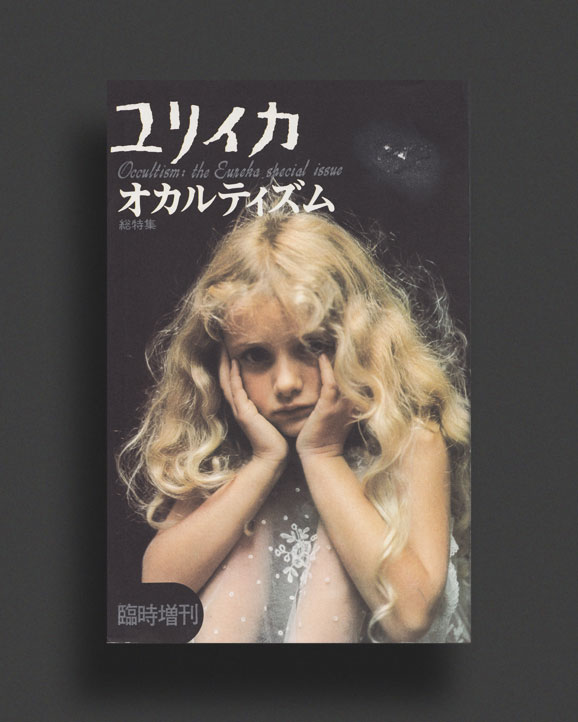
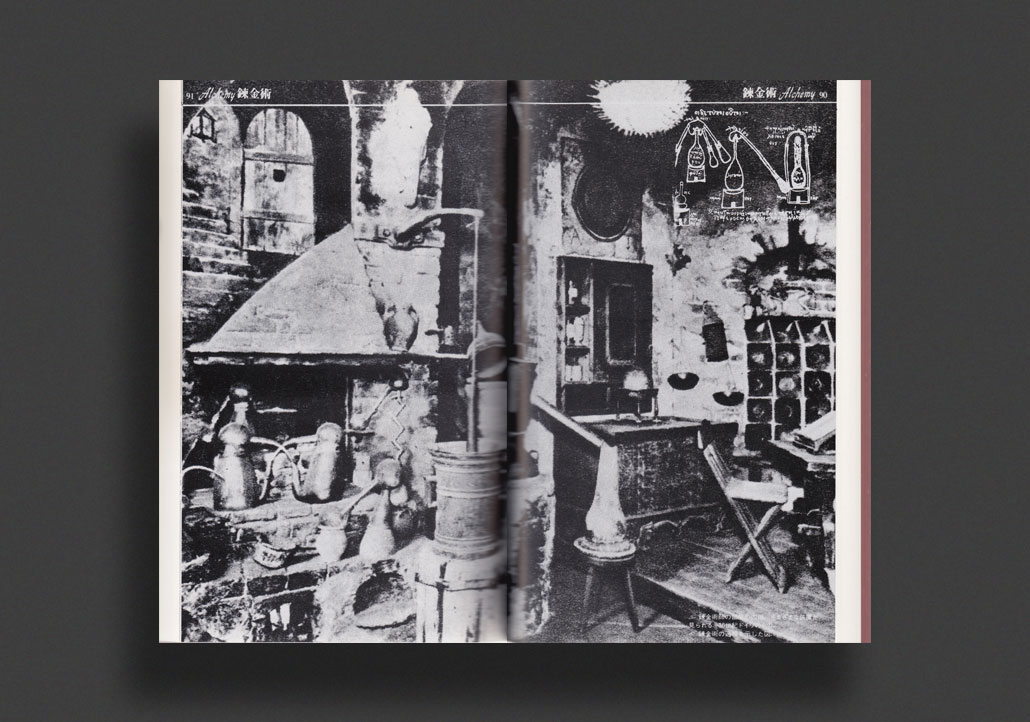
Special "Occultism" issue of cult Japanese art and literary periodical, Eureka. Published in 1974, featuring cover photography of "Alice" by Hajime Sawatari, the Occultism compendium by Eureka journal is packed with literature, poetry, and studies around the themes of Alchemy, Magic, Astrology, Tarot, Cabala, Gnosticism, et al. including work by Marshal McLuhan, Jorge Luis Borges, William Blake, Honoré de Balzac, E. T. A. Hoffmann, scientific historian Shigeru Nakayama, poet Tadao Arita, Carl Jung, literary scholar Mitsuya Kato, Kimiyoshi Yura, poet Takasuke Shibusawa, Franz Kafka, and much more. Heavily illustrated throughout in b/w, texts in Japanese!
Very Good with old sticker wear to cover.
2019, English
Hardcover (w. dust jacket), 302 pages, 15.2 x 22.9 cm
Published by
Goldsmiths Press / London
$55.00 - Out of stock
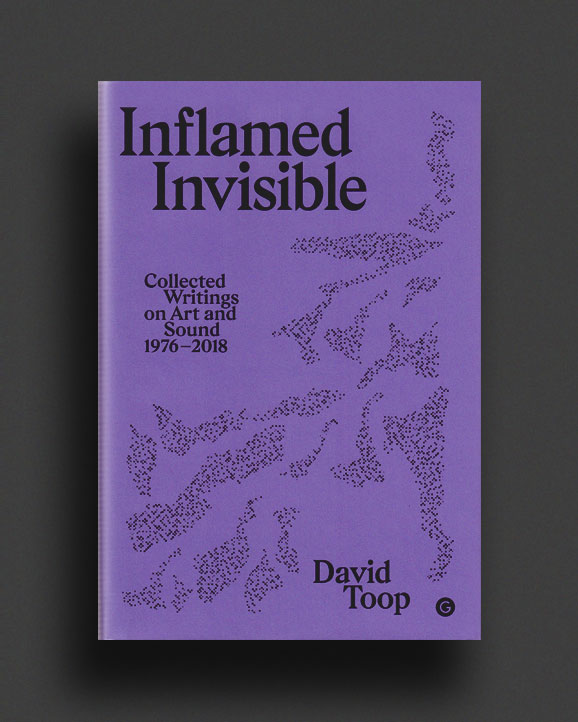
A rich collection of essays tracing the relationship between art and sound.
In the 1970s David Toop became preoccupied with the possibility that music was no longer bounded by formalities of audience: the clapping, the booing, the short attention span, the demand for instant gratification. Considering sound and listening as foundational practices in themselves leads music into a thrilling new territory: stretched time, wilderness, video monitors, singing sculptures, weather, meditations, vibration and the interior resonance of objects, interspecies communications, instructional texts, silent actions, and performance art.
Toop sought to document the originality and unfamiliarity of this work from his perspective as a practitioner and writer. The challenge was to do so without being drawn back into the domain of music while still acknowledging the vitality and hybridity of twentieth-century musics as they moved toward art galleries, museums, and site-specificity. Toop focused on practitioners, whose stories are as compelling as the theoretical and abstract implications of their works.
Inflamed Invisible collects more than four decades of David Toop's essays, reviews, interviews, and experimental texts, drawing us into the company of artists and their concerns, not forgetting the quieter, unsung voices. The volume is an offering, an exploration of strata of sound that are the crossing points of sensory, intellectual, and philosophical preoccupations, layers through which objects, thoughts and air itself come alive as the inflamed invisible.
2016, English
Softcover, 336 pages, 21.6 x 14 cm
Published by
Bloomsbury Academic / London
$49.00 - Out of stock
In this first instalment of acclaimed music writer David Toop's interdisciplinary and sweeping overview of free improvisation, Into the Maelstrom: Music, Improvisation and the Dream of Freedom: Before 1970 introduces the philosophy and practice of improvisation (both musical and otherwise) within the historical context of the post-World War II era. Neither strictly chronological, or exclusively a history, Into the Maelstrom investigates a wide range of improvisational tendencies: from surrealist automatism to stream-of-consciousness in literature and vocalization; from the free music of Percy Grainger to the free improvising groups emerging out of the early 1960s (Group Ongaku, Nuova Consonanza, MEV, AMM, the Spontaneous Music Ensemble); and from free jazz to the strands of free improvisation that sought to distance itself from jazz. In exploring the diverse ways in which spontaneity became a core value in the early twentieth century as well as free improvisation's connection to both 1960s rock (The Beatles, Cream, Pink Floyd) and the era of post-Cagean indeterminacy in composition, Toop provides a definitive and all-encompassing exploration of free improvisation up to 1970, ending with the late 1960s international developments of free music from Roscoe Mitchell in Chicago, Peter Brötzmann in Berlin and Han Bennink and Misha Mengelberg in Amsterdam.
“Maelstrom indeed ... [This] is an encyclopedic vortex of musicology, memoir and speculative extemporisation on the nature of improvisation and freedom in music ... crammed with detail and fascinating observations ... A captivating reading experience that perfectly embodies its subject in form.” – The Wire
“Any discussion of free improvisation, as an essential (anti?)-discipline of creative music, is an amusing balance between considering an unruly child and a sacred cow. History has come into a wild favor towards a genre that perpetually defies definition and prediction. David Toop, with a critical facility informed by over forty years of activity on and off the bandstand, sets his ruminations in the service of the music. Essaying on free improvisation in the mode of composition can result in didactic chin scratch. Thankfully Toop engages the readers interest with a sentient breath of prose charged by academic insight where poetic space becomes the page. It's only the beginning.” – Thurston Moore
“David Toop has dived into the Maelstrom that is the genesis of improvised music and come up with a string of pearls. There is so much here that will be new to even those of us who thought we knew the subject. A remarkable piece of real scholarship that relies on painstaking research with a refreshing absence of jargon.” – Evan Parker
“Into the Maelstrom gives an astonishing, vivid history of improvised music across the 20th century before 1970, tracing its transnational criss-crossings, trans-arts contagions, the folds between Cream and AMM, 'musicking' and John Stevens' Spontaneous Music Ensemble, Nuova Consonanza and For a Few Dollars More. David Toop's panoramic account makes obvious how urgently we have needed this alternative history, attuned to musical sounds as they resonate with artistic, cultural and political currents. A landmark book, Into the Maelstrom re-centres those vast and auspicious margins deserted by previous music histories.” – Georgina Born, Professor of Music and Anthropology, University of Oxford, UK
2019, English
Softcover, 368 pages, 11.4 x 17.8 cm
Published by
Urbanomic / Cornwall
$38.00 - Out of stock
This study of the subtlety, complexity, and variety of modes of hearing maps out a “sonorous archipelago”—a heterogeneous set of shifting sonic territories shaped by the vicissitudes of desire and discourse.
Profoundly intimate yet immediately giving onto distant spaces, both an “organ of fear” and an echo chamber of anticipated pleasures, an uncontrollable flow subject to unconscious selection and augmentation, the subtlety, complexity, and variety of modes of hearing has meant that sound has rarely received the same philosophical attention as the visual.
In The Order of Sounds, François J. Bonnet makes a compelling case for the irreducible heterogeneity of “sound,” navigating between the physical models constructed by psychophysics and refined through recording technologies, and the synthetic production of what is heard. From primitive vigilance and sonic mythologies to digital sampling and sound installations, he examines the ways in which we make sound speak to us, in an analysis of listening as a plurivocal phenomenon drawing on Foucault, Deleuze and Guattari, Barthes, Nancy, Adorno, and de Certeau, and experimental pioneers such as Tesla, Bell, and Raudive. Stringent critiques of the “soundscape” and “reduced listening” demonstrate that univocal ontologies of sound are always partial and politicized; for listening is always a selective fetishism, a hallucination of sound filtered by desire and convention, territorialized by discourse and its authorities.
Bonnet proposes neither a disciplined listening that targets sound “itself,” nor an “ocean of sound” in which we might lose ourselves, but instead maps out a sonorous archipelago—a heterogeneous set of shifting sonic territories shaped and aggregated by the vicissitudes of desire and discourse.
Introduction by Peter Szendy
Translated by Robin Mackay
François J. Bonnet
François J. Bonnet is a composer, visual artist, recording artist (as Kassel Jaeger), director of Groupe de Recherches Musicales of the National Audiovisual Institute (INA-GRM) in Paris, and part-time lecturer at the Université de Paris 1.
2016, English
Hardcover, 160 pages, 16.5 x 22 cm
Published by
Anomie Publishing / Wakefield
$72.00 - Out of stock
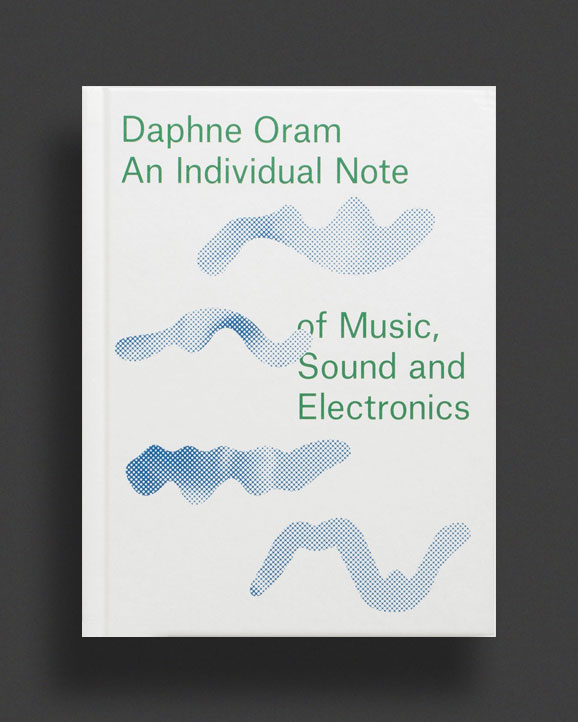
Daphne Oram (1925-2003) was one of the central figures in the development of British experimental electronic music. Having declined a place at the Royal College of Music to become a music balancer at the BBC, she went on to become the co-founder and first director of the BBC Radiophonic Workshop. Oram left the BBC in 1959 to pursue commercial work in television, advertising, film and theatre, to make her own music for recording and performance, and to continue her personal research into sound technology - a passion she had had since her childhood in rural Wiltshire. Her home, a former oasthouse in Kent, became an unorthodox studio and workshop in which, mostly on a shoestring budget, she developed her pioneering equipment, sounds and ideas. A significant part of her personal research was the invention of a machine that offered a new form of sound synthesis - the Oramics machine.
Oram's contribution to electronic music is receiving considerable attention from new generations of composers, sound engineers, musicians, musicologists and music lovers around the world. Following her death, the Daphne Oram Trust was established to preserve and promote her work, life and legacy, and an archive created in the Special Collections Library at Goldsmiths, University of London. One of the Trust's ambitions has been to publish a new edition of Oram's one and only book, An Individual Note of Music, Sound and Electronics, which was originally published in 1972. With support from the Daphne Oram Archive, the Trust has now been able to realize this ambition.
An Individual Note is both curious and remarkable. When commissioned to write a book, she was keen to avoid it becoming a manual or how-to guide, preferring instead to use the opportunity to muse on the subjects of music, sound and electronics, and the relationships between them. At a time when the world was just starting to engage with electronic music and the technology was still primarily in the hands of music studios, universities, and corporations, her approach was both innovative and inspiring, encouraging anyone with an interest in music to think about the nature, capabilities and possibilities that the new sounds could bring. And her thinking was not limited to just the future of the orchestra, synthesizer, computer and home studio, but ventured, with great spirit and wit, into other realms of science, technology, culture and thought. An Individual Note is a playful yet compelling manifesto for the dawn of electronic music and for our individual capacity to use, experience and enjoy it.
This new edition of An Individual Note features a specially commissioned introduction from the British composer, performer, roboticist and sound historian Sarah Angliss.
2017, English
Hardcover, 364 pages, 17 x 24 cm
1st Edition, Out of print title / as new
Published by
Mousse / Milan
$60.00 - Out of stock
“The exhibition is conceived as a scripted space, like an automaton, producing different temporalities, a rhythm, an itinerary, and a duration. The visitor is guided through the spaces by the appearance and orchestration of sounds and images... a mental choreography.” – Philippe Parreno
Philippe Parreno is interested more in the dynamics of how a work of art is shown to the public than in its actual production, and in his films, installations, performances and texts, he subverts the codes normally applied to exhibition spaces. He places the construction of the exhibition at the heart of his process, approaching it through different formats and redefining the exhibition experience as a coherent object rather than as a collection of individual works.
Produced in conjunction with the H {N)Y P N(Y} OSIS exhibition – curated by Hans Ulrich Obrist and Alex Poots, with consulting curator Tom Eccles, in the spaces of the Park Avenue Armory in New York – and with Hypothesis – curated by Andrea Lissoni at Pirelli HangarBicocca in Milan – this monograph offers a rich critical overview of his work, with essays by Cyril Béghin, Molly Nesbit, Brian O’Doherty and Adam Thirlwell, and two interviews with Hans Ulrich Obrist and Andrea Lissoni.
It is thus an invaluable research tool for studying one of the most influential and charismatic figures on the contemporary art scene.
Edited by Andrea Lissoni.
Texts by Cyril Béghin, Andrea Lissoni, Molly Nesbit, Hans Ulrich Obrist, Brian O’Doherty, Philippe Parreno, Adam Thirlwell.
As New copy.
2002, English
Softcover, 1088 pages, 25.2 x 16.4 cm
Published by
Harvard University Press / Cambridge
$89.00 - Out of stock
"To great writers," Walter Benjamin once wrote, "finished works weigh lighter than those fragments on which they labor their entire lives." Conceived in Paris in 1927 and still in progress when Benjamin fled the Occupation in 1940, "The Arcades Project" (in German, "Das Passagen-Werk") is a monumental ruin, meticulously constructed over the course of thirteen years--"the theater," as Benjamin called it, "of all my struggles and all my ideas."
Focusing on the arcades of nineteenth-century Paris-glass-roofed rows of shops that were early centers of consumerism--Benjamin presents a montage of quotations from, and reflections on, hundreds of published sources, arranging them in thirty-six categories with descriptive rubrics such as "Fashion," "Boredom," "Dream City," "Photography," "Catacombs," "Advertising," "Prostitution," "Baudelaire," and "Theory of Progress." His central preoccupation is what he calls the commodification of things--a process in which he locates the decisive shift to the modern age.
"The Arcades Project" is Benjamin's effort to represent and to critique the bourgeois experience of nineteenth-century history, and, in so doing, to liberate the suppressed "true history" that underlay the ideological mask. In the bustling, cluttered arcades, street and interior merge and historical time is broken up into kaleidoscopic distractions and displays of ephemera. Here, at a distance from what is normally meant by "progress," Benjamin finds the lost time(s) embedded in the spaces of things.
Edited by Rolf Tiedemann
Translated by Kevin McLaughlin, Howard Eiland
2021, English
Softcover, 480 pages, 12.9 x 19.8 cm
Published by
Verso / London
$32.00 - Out of stock
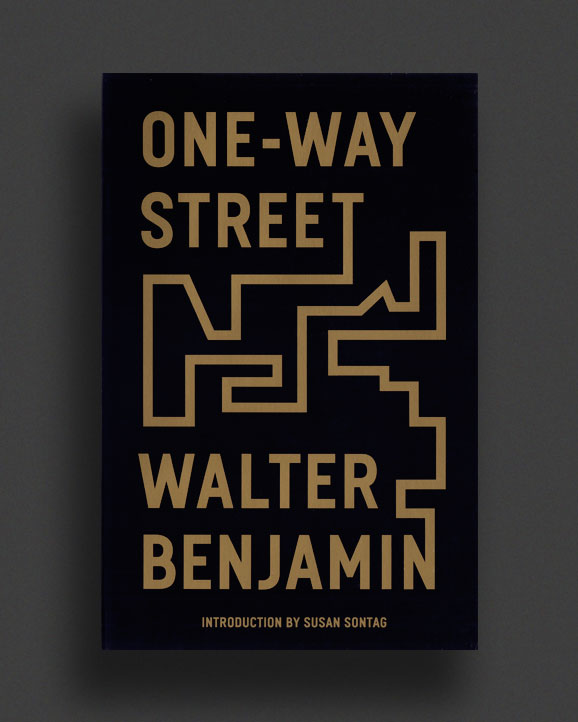
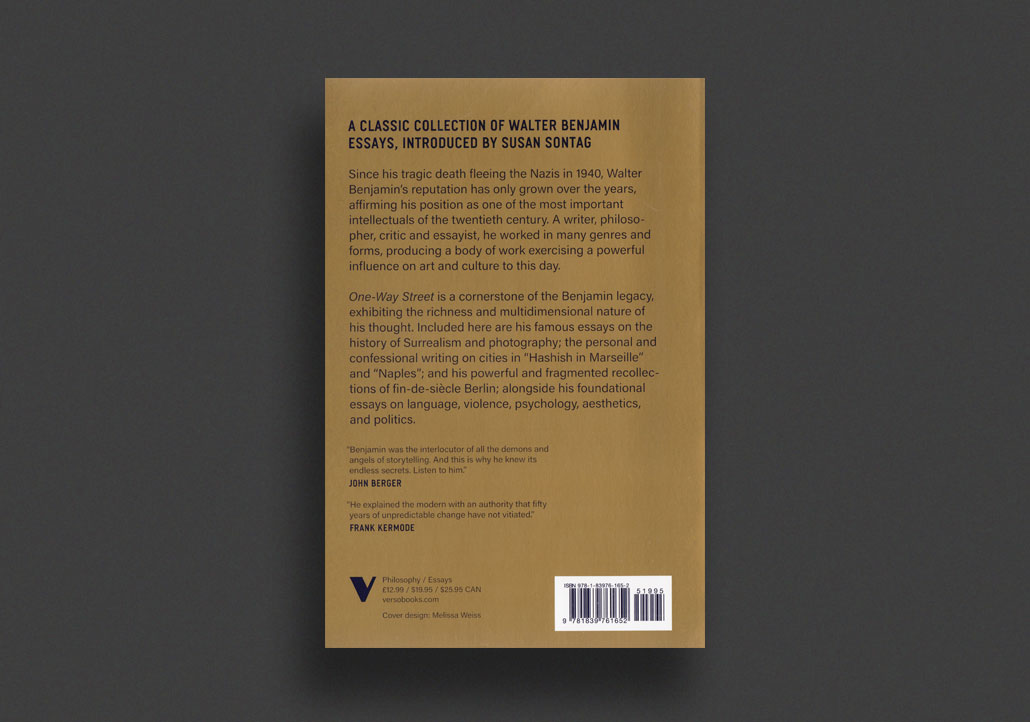
Classic collection of Walter Benjamin’s celebrated essays.
Introduction by Susan Sontag.
Walter Benjamin is one of the most fascinating and enigmatic intellectual figures of this century. Not only was he a thinker who made an enormous impact with his critical and philosophical writings, he shattered disciplinary and stylistic conventions.
This collection, contains the most representative and illuminating selection of his work over a twenty-year period, showing the richness and the multi-dimensional nature of his thought. Included in these pages are aphorisms and townscapes, esoteric meditation and reminiscences of childhood, and reflections on language, psychology, aesthetics and politics.
2018, English / Portuguese
Softcover, 114 pages, 15.2 x 22.9 cm
Published by
Parlor Press/ USA
$32.00 - Out of stock
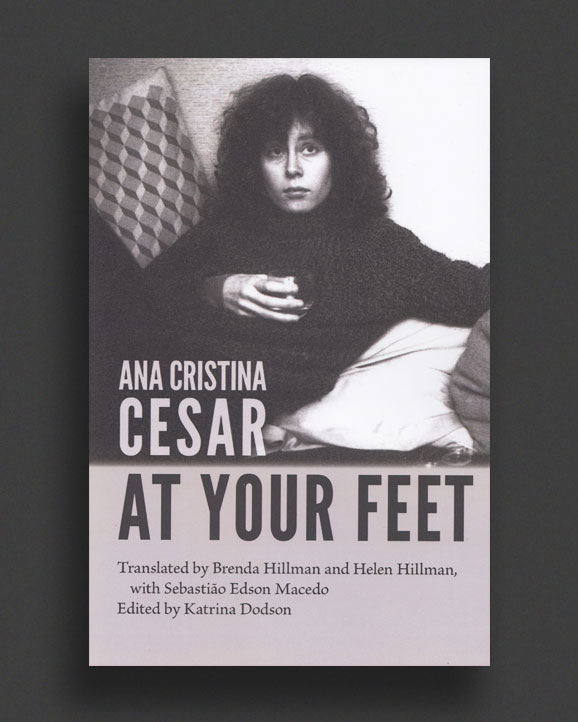
Ana Cristina Cesar (1952-1983) has posthumously become one of Brazil's best known avant-garde poets. After her suicide in 1983, her innovative, mythic, and dreamlike poetry has greatly influenced subsequent generations of writers. At Your Feet was originally published as a poetic sequence and later became part of a longer hybrid work— sometimes prose, sometimes verse—documenting the life and mind of a forcefully active literary woman. Cesar, who also worked internationally as a journalist and translator, often found inspiration in the writings of other poets, among them Emily Dickinson, Armando Freitas Filho, and Gertrude Stein. Her innovative writing has been featured in Sun and Moon's classic anthology Nothing the Sun Could Not Explain—20 Contemporary Brazilian Poets (2000). Poet Brenda Hillman and her mother Helen Hillman (a native speaker of Portuguese) worked with Brazilian poet Sebastião Edson Macedo and translator/editor Katrina Dodson to render as faithfully as possible the intricately layered poems of this legendary writer. At Your Feet includes both the English translation and original Portuguese.
Edited by Katrina Dodson
Translated by Brenda Hillman and Helen Hillman. With Sebastião Edson Macedo.
2021, English
Softcover, 368 pages, 15.2 x 22.9 cm
Published by
Semiotext(e) / Los Angeles
$35.00 - Out of stock
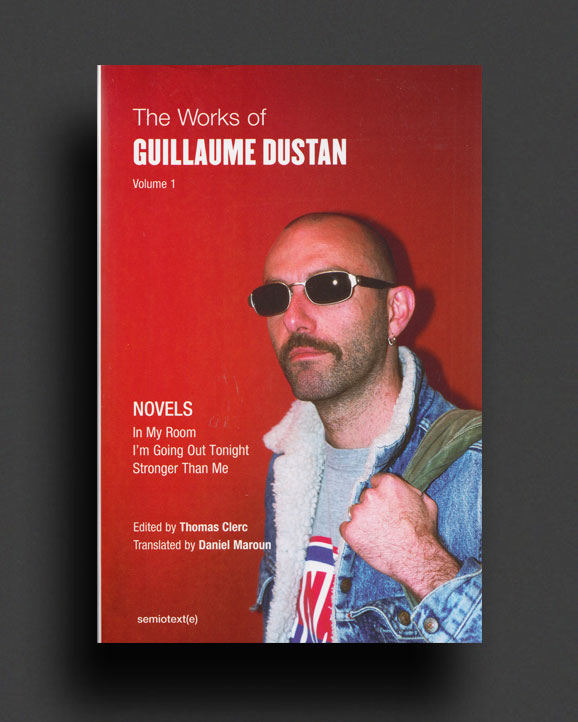
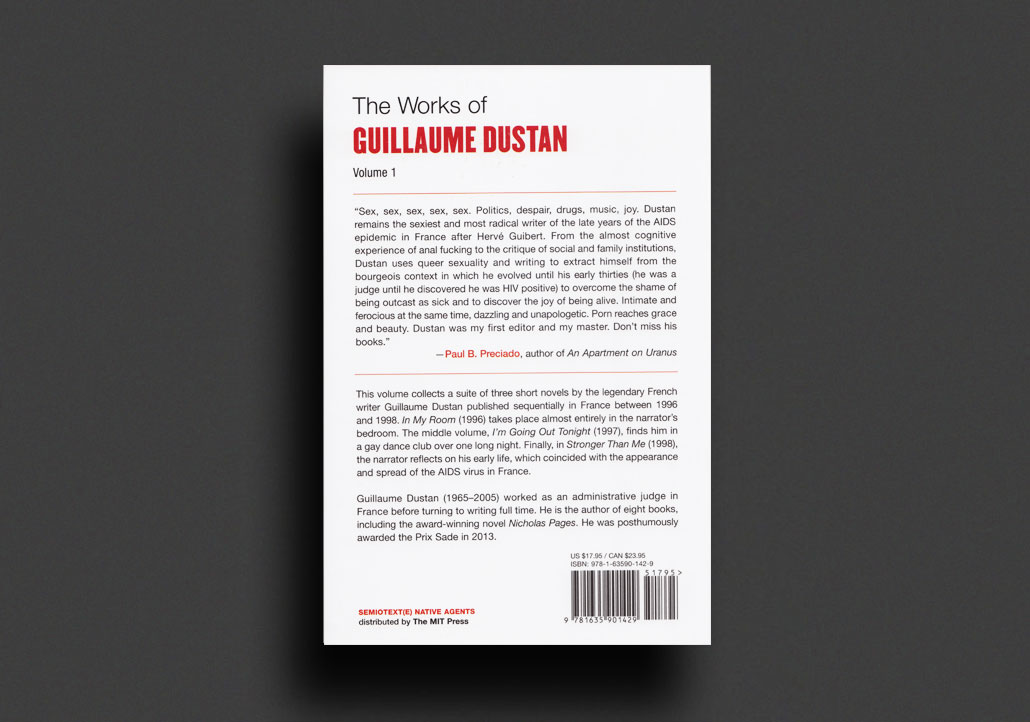
This volume collects a suite of three wildly entertaining and trailblazing short novels by the legendary French anti-assimilationist LGBTQ+ writer Guillaume Dustan. Published sequentially in France between 1996 and 1998, the three novels are exuberant and deliberately affectless accounts of the narrator's sexual odyssey through a Parisian club and bath scene still haunted by AIDS.
In My Room (1996) takes place almost entirely in the narrator's bedroom. The middle volume, I'm Going Out Tonight (1997) finds him venturing out onto the gay scene in one long night. Finally, in Stronger Than Me (1998) the narrator reflects on his early life, which coincided with the appearance and spread of the AIDS virus in France.
A close contemporary of Dennis Cooper, Brett Easton Ellis, Kevin Killian, and Gary Indiana, Guillaume Dustan's deadpan autofiction is at once satirical and intimate, and completely contemporary. Dustan (1965–2005) worked as an administrative judge in France before turning to writing full-time. He is the author of eight books, including the award-winning novel Nicholas Page. He was posthumously awarded the Prix Sade in 2013.
Edited by Thomas Clerc
Translated by Daniel Maroun
"Sex, sex, sex, sex, sex. Politics, despair, drugs, music, joy. Dustan remains the sexiest and most radical writer of late years of the AIDS epidemics in France after Hervé Guibert. From the almost cognitive experience of anal fucking to the critique of social and family institutions, Dustan uses queer sexuality and writing to extract himself from the bourgeois context in which he evolved until his early thirties (he as a judge until he discovered he was HIV positive) to overcome the shame of being out casted as sick and to discover the joy of being alive. Intimate and ferocious at the same time, dazzling and unapologetic. Porn reaches grace and beauty. Dustan was my first editor and my master. Don't miss his books."
— Paul B. Preciadoauthor of An Apartment on Uranus
2021, English
Softcover, 104 pages, 11.4 x 17.8 cm
Published by
Semiotext(e) / Los Angeles
$29.00 - Out of stock
Paul Preciado's controversial 2019 lecture at the École de la Cause Freudienne annual conference, published in a definitive translation for the first time.
November 2019, Paul Preciado was invited to speak in front of 3,500 psychoanalysts at the École de la Cause Freudienne's annual conference in Paris. Standing in front of the profession for whom he is a “mentally ill person” suffering from “gender dysphoria,” Preciado draws inspiration in his lecture from Kafka's “Report to an Academy,” in which a monkey tells an assembly of scientists that human subjectivity is a cage comparable to one made of metal bars.
Speaking from his own “mutant” cage, Preciado does not so much criticize the homophobia and transphobia of the founders of psychoanalysis as demonstrate the discipline's complicity with the ideology of sexual difference dating back to the colonial era—an ideology which is today rendered obsolete by technological advances allowing us to alter our bodies and procreate differently. Preciado calls for a radical transformation of psychological and psychoanalytic discourse and practices, arguing for a new epistemology capable of allowing for a multiplicity of living bodies without reducing the body to its sole heterosexual reproductive capability, and without legitimizing hetero-patriarchal and colonial violence.
Causing a veritable outcry among the assembly, Preciado was heckled and booed and unable to finish. The lecture, filmed on smartphones, was published online, where fragments were transcribed, translated, and published with no regard for exactitude. With this volume, Can the Monster Speak? is published in a definitive translation for the first time.
Paul B. Preciado is the author of Counter-Sexual Manifesto, Testo Junkie: Sex, Drugs and Biopolitics, and Pornotopia, for which he was awarded the Sade Prize in France. He is currently Curator of Public Programmes at the Palais de Tokyo and lives in Paris.
2021, English
Hardcover (w. dust jacket), 224 pages, 21.7 x 14.7 cm
Published by
Verso / London
$36.00 - Out of stock
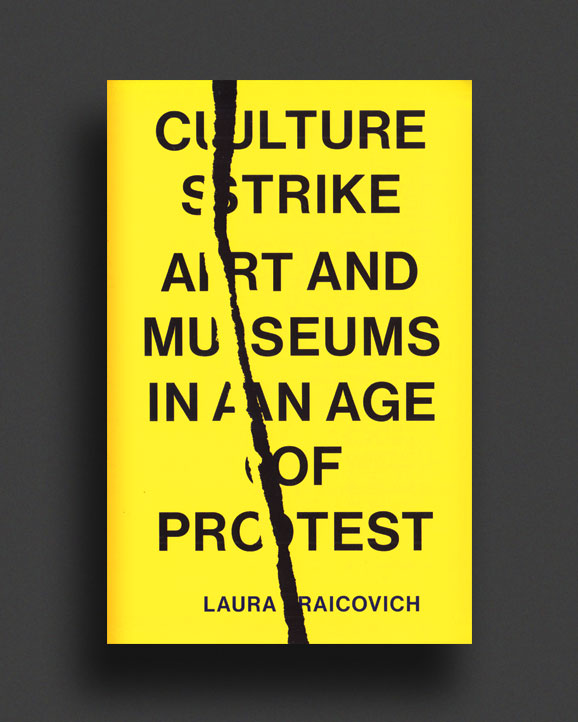
A leading activist museum director explains why museums are at the center of a political storm and how they can be reimagined.
In an age of protest, cultural institutions have come under fire. Protestors have mobilized against sources of museum funding, as happened at the Metropolitan Museum, and against board appointments, forcing tear gas manufacturer Warren Kanders to resign at the Whitney. That is to say nothing of demonstrations against exhibitions and artworks. Protests have roiled institutions across the world, from the Abu Dhabi Guggenheim to the Akron Art Museum. A popular expectation has grown that galleries and museums should work for social change.
As Director of the Queens Museum, Laura Raicovich helped turn that New York muni- cipal institution into a public commons for art and activism, organizing high-powered exhibitions that doubled as political protests. Then in January 2018, she resigned, after a dispute with the Queens Museum board and city officials. This public controversy followed the museum’s responses to Donald Trump’s election, including her objections to the Israeli government using the museum for an event featuring Vice President Mike Pence.
In this lucid and accessible book, Raicovich examines some of the key museum flashpoints and provides historical context for the current controversies. She shows how art museums arose as colonial institutions bearing an ideology of neutrality that masks their role in upholding conservative, capitalist values. And she suggests ways museums can be reinvented to serve better, public ends.
“Culture Strike is a must-read account of how museums have positioned themselves as progressive while working hard to maintain the status quo. Written by someone who knows the ropes and drawing on interviews and conversations from all corners of the art world, it is a road map of how we’ve gotten where we are, a blueprint for change, and a love letter to museums for their potential to change the world if only we would think differently about them.” — Aruna D’souza, author of Whitewalling
2021, English
Hardcover, 176 pages, 12.9 x 19.8 cm
Published by
Verso / London
$32.00 - In stock -
COVID-19 exposed the pre-existing conditions of the current global crisis. Many Western states failed to protect their populations, while others were able to suppress the virus only with sweeping social restrictions. In contrast, many Asian countries were able to make much more precise interventions. Everywhere, lockdown transformed everyday life, introducing an epidemiological view of society based on sensing, modeling, and filtering. What lessons are to be learned?
The Revenge of the Real envisions a new positive biopolitics that recognizes that governance is literally a matter of life and death. We are grappling with multiple interconnected dilemmas—climate change, pandemics, the tensions between the individual and society—all of which have to be addressed on a planetary scale. Even when separated, we are still enmeshed. Can the world govern itself differently? What models and philosophies are needed? Bratton argues that instead of thinking of biotechnologies as something imposed on society, we must see them as essential to a politics of infrastructure, knowledge, and direct intervention. In this way, we can build a society based on a new rationality of inclusion, care, and prevention.
“The pandemic has laid bare the frailties, failures, and fissures of the contemporary world. The Revenge of the Real offers a clarion call for organising ourselves differently. It is forceful, engaging, and thought provoking, and I expect it to prove immediately influential.” — Helen Hester, author of Xenofeminism
"When anti-lockdown stances such as the one espoused by the philosopher Giorgio Agamben, QAnon’s conspiracies, anti-vaxxer propaganda, and a return to an innocent relation between the humans and the planet are a match made in hell, the rise of crypto-fascism variants is the least of our concerns. We are indeed witnessing a fundamental erosion of the contemporary left’s capacity to respond to planetary-scale emergencies. This inability to systematically think about and act upon the plights brought upon this planet is what Benjamin Bratton calls the lack of planetary competency. Bratton’s The Revenge of the Real is a sober yet enthusiastic analysis of how and why some strains of the left continue to be appropriated by individualistic libertarianism if not by crypto-fascism. Yet Bratton’s work is more than that, it sets a way out for the left by mapping the scale of planetary events and what it means to think and intervene at that scale.” — Reza Negarestani, author of Intelligence and Spirit
“Bratton’s is an incisive intervention: at once polemic and productive. A counter to the self-imposed ineffectuality of certain strands of theory, The Revenge of the Real provides buoyant and zesty rebuttal to the suspicious mode in philosophizing, all whilst in search of more pragmatic alternatives.” — Thomas Moynihan, author of X-Risk
2021, English
Softcover, 272 pages, 14 x 21 cm
Published by
Verso / London
$32.00 - Out of stock
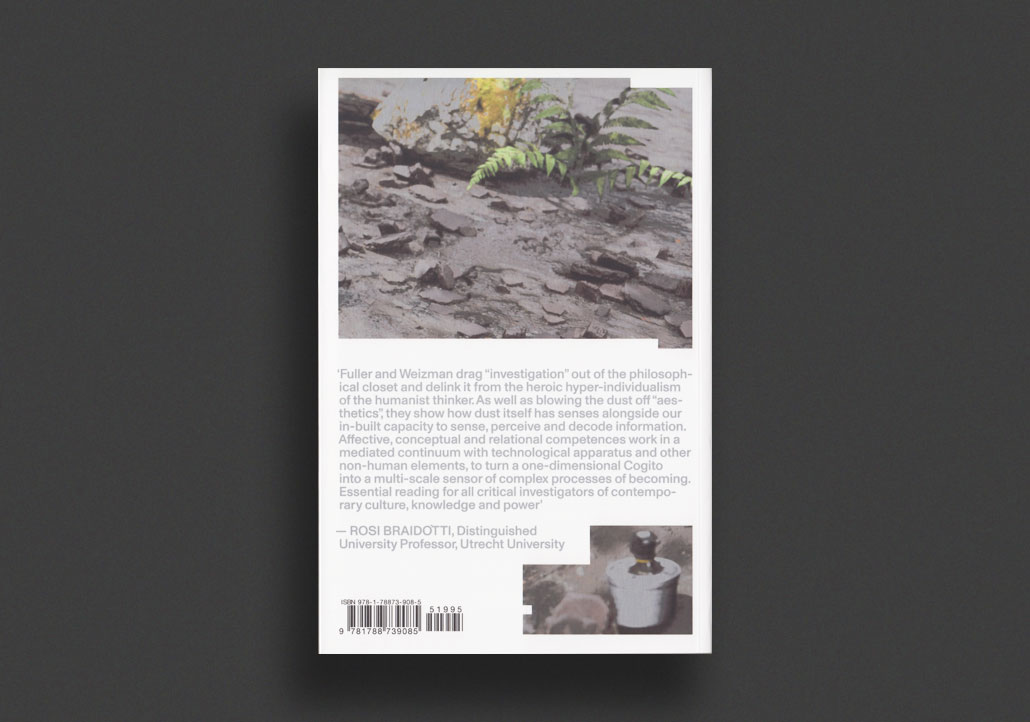
A new field of counterinvestigation in journalism, human rights, art and law.
Today, artists are engaged in investigation. They probe corruption, human rights violations, environmental crimes and technological domination. At the same time, areas not usually thought of as artistic make powerful use of aesthetics. Journalists and legal professionals pore over opensource videos and satellite imagery to undertake visual investigations. This combination of diverse fields is what the authors call “investigative aesthetics”: the mobilisation of sensibilities associated with art, architecture and other such practices in order to speak truth to power.
Investigative Aesthetics draws on theories of knowledge, ecology and technology; evaluates the methods of citizen counter-forensics, micro-history and art; and examines radical practices such as those of WikiLeaks, Bellingcat, and Forensic Architecture. These new practices take place in the studio and the laboratory, the courtroom and the gallery, online and in the streets, as they strive towards the construction of a new common sense.
Matthew Fuller and Eyal Weizman have here provided an inspiring introduction to a new field that will change how we understand and confront power today.