World Food Books' programme is largely produced on Kulin Nation land. We acknowledge the Wurundjeri people of the Kulin Nation as the first and continuing custodians of this land, and pay respect to their Elders past, present, and emerging.
World Food Books is an arts and special interests bookshop in Naarm / Melbourne. Founded in 2010, World Food Books is devoted to the presentation of a rotating, hand-selection of international art, design, literary and counterculture publications with an emphasis on the anti-traditional, the experimental, the avant-garde, the heretic, the marginal.
Presenting new titles alongside rare and out-of-print books, catalogues and journals spanning the fields of modern and contemporary art, design, photography, illustration, film, literature, poetry, cultural theory, philosophy, sexuality, popular and underground culture in its many radical forms, World Food Books wishes to encourage adventurous, thoughtful and open-minded reading, looking, writing, and exchange of publishing and ideas, both current and historical.
As well as our bookshop, located in Melbourne's historical Nicholas Building, all of our inventory is available internationally via our online mail-order service.
World Food Books semi-regularly co-ordinates "Occasions", a programme of exhibits and events at the bookshop and in partnership with other hosts (such as museums and art galleries) that develop out of the activities, relationships and content of the bookshop itself.
World Food Books
The Nicholas Building
37 Swanston Street
Room 5, Level 6
Melbourne 3000
Australia
SHOP HOURS:
Thu–Fri 12–6, Sat 12–5
WEB-SHOP OPEN 24/7
World Food Books
Postal Address:
PO Box 435
Flinders Lane
Victoria 8009
Australia
Art
Theory / Essay
Architecture / Interior
Graphic Design / Typography
Photography
Fashion
Eros
LGBTQ+
Fiction / Poetry
Weird / Speculative / Science Fiction / Horror
Transgressive / Visceral / Abject
Symbolism / Decadence / Fin de siècle
Film / Video
Painting
Sculpture / Installation
Performance / Dance / Theater
Drawing
Sound / Music
Curatorial
Group Shows / Collections
Periodicals
Out-of-print / Rare
Posters / Ephemera / Discs
Signed Books
World Food Books Gift Voucher
World Food Book Bag
Australian Art
Australian Fiction
Australian Science Fiction / Speculative Fiction
Australian Poetry
Australian Photography
Japanese Photography
Conceptual Art
Minimal Art
Dada
'Pataphysics / Oulipo
Fluxus
Concrete Poetry
Pop Art
Surrealism
Arte Povera
Arte Informale / Haute Pâte / Tachism
Nouveau Réalisme / Zero / Kinetic
Situationism / Lettrism
Collage / Mail Art / Xerox Art
Art Brut / Folk / Visionary / Fantastic
Illustration / Graphic Art / Bandes Dessinées
Furniture
Italian Radical Design / Postmodernism
Textiles
Ceramics / Glass
Counterculture
Protest / Revolt
Philosophy
Psychoanalysis
Anthropology
Anarchism
Socialism / Anarchism / Communism / Capitalism
Literary Theory / Semiotics / Language
Feminism / Women's Studies
Gender Studies / Sexuality
Anthropology
Fetishism / BDSM
Drugs / Psychedelia
Crime / Violence
Animal Rights / Veganism
Occult / Esoterica
Ecology / Earth / Alternative Living
Whole Earth / Crafts
All prices in AUD (Australian dollars)
Pick-Ups
Pick-up orders can be collected in our bookshop during opening hours after order date. Please collect any Pick-up orders within 2 weeks of ordering as we have limited storage space. Orders will be released back into stock if not collected within this time. No refunds can be made for pick-ups left un-collected. If you cannot make it in to the bookshop in this time-frame, please choose postage option.
Return Policy
All sales are final. We do accept returns (for refund or exchange) for items received in error. All our orders are packed with special care using heavy-duty padding and cardboard book-mailers or bubble mailers (for smaller books), using reinforcement where required. We cannot take responsibility for any lost, stolen or damaged parcels.
Insurance
Should you wish to insure your package, please email us directly after placing your order and we can organise this at a small extra expense. Although all standard/express tracked packages are very safe and dependable, we cannot take responsibility for any lost, stolen or damaged parcels. We recommend insurance on valuable orders.
Interested in selling your old books, catalogues, journals, magazines, comics, fanzines, ephemera? We are always looking for interesting, unusual and out-of-print books to buy. We only buy books in our fields of interest and specialty, and that we feel we can resell.
We base these prices on desirability, market value, in-print prices, condition and our current stock levels. We offer cash, store credit, and can take stock on consignment. All
about 25% of the price we expect to get when we sell them, or 30% in store credit. We base these prices on desirability, market value, in-print prices, condition and our current stock levels.
Sell your books any day of the week. You can drop them off and return later. If you have a lot of books, we can visit your Sydney home.
We buy books that we feel we can resell. We offer about 25 % of the price we expect to get when we sell them, or 30% in store credit. We base these prices on desirability, market value, in-print prices, condition and our current stock levels.
Philadelphia Wireman
03 August - 01 September, 2018
World Food Books is proud to announce our next Occasion, the first presentation of sculptures by Philadelphia Wireman in Australia.
The Philadelphia Wireman sculptures were found abandoned in an alley off Philadelphia’s South Street on trash night in 1982. Their discovery in a rapidly-changing neighbourhood undergoing extensive renovation, compounded with the failure of all attempts to locate the artist, suggests that the works may have been discarded after the maker’s death. Dubbed the "Philadelphia Wireman" during the first exhibition of this work, in 1985, the maker’s name, age, ethnicity, and even gender remain uncertain. The entire collection totals approximately 1200 pieces, all intricately bound together with tightly-wound heavy-gauge wire (along with a few small, abstract marker drawings, reminiscent both of Mark Tobey and J.B. Murry). The dense construction of the work, despite a modest range of scale and materials, is singularly obsessive and disciplined in design: a wire armature or exoskeleton firmly binds a bricolage of found objects including plastic, glass, food packaging, umbrella parts, tape, rubber, batteries, pens, leather, reflectors, nuts and bolts, nails, foil, coins, toys, watches, eyeglasses, tools, and jewellery.
Heavy with associations—anthropomorphic, zoomorphic, and socio-cultural responses to wrapped detritus—the totemic sculptures by Philadelphia Wireman have been discussed in the context of work created to fulfil the shamanistic needs of alternative religions in American culture. Curators, collectors, and critics have variously compared certain pieces to sculpture from Classical antiquity, Native American medicine bundles, African-American memory jugs, and African fetish objects. Reflecting the artist’s prolific and incredibly focused scavenging impulse, and despite—or perhaps enhanced by—their anonymity, these enigmatic objects function as urban artefacts and arbiters of power, though their origin and purpose is unknown. Philadelphia Wireman, whatever their identity, possessed an astonishing ability to isolate and communicate the concepts of power and energy through the selection and transformation of ordinary materials. Over the course of the past two decades, this collection has come to be regarded as an important discovery in the field of self-taught art and vernacular art.
Presented in collaboration with Fleisher-Ollman Gallery, Philadelphia, and Robert Heald, Wellington.
Susan Te Kahurangi King
02 February - 10 March, 2018
Susan Te Kahurangi King (24 February 1951 - ) has been a confident and prolific artist since she was a young child, drawing with readily available materials - pencils, ballpoint pens and felt-tip markers, on whatever paper is at hand. Between the ages of four and six Susan slowly ceased verbal communication. Her grandparents William and Myrtle Murphy had developed a special bond with Susan so they took on caring responsibilities for extended periods. Myrtle began informally archiving her work, carefully collecting and storing the drawings and compiling scrapbooks. No drawing was insignificant; every scrap of paper was kept. The King family are now the custodians of a vast collection containing over 7000 individual works, from tiny scraps of paper through to 5 meter long rolls.
The scrapbooks and diaries reveal Myrtle to be a woman of great patience and compassion, seeking to understand a child who was not always behaving as expected. She encouraged Susan to be observant, to explore her environment and absorb all the sights and sounds. Myrtle would show Susan’s drawings to friends and people in her community that she had dealings with, such as shopkeepers and postal workers, but this was not simply a case of a grandmother’s bias. She recognised that Susan had developed a sophisticated and unique visual language and sincerely believed that her art deserved serious attention.
This was an unorthodox attitude for the time. To provide some context, Jean Dubuffet coined the term Art Brut in 1945 to describe work created by self-taught artists – specifically residents of psychiatric institutions and those he considered to be visionaries or eccentrics. In 1972 Roger Cardinal extended this concept by adopting the term Outsider Art to describe work made by non-academically trained artists operating outside of mainstream art networks through choice or circumstance. Susan was born in Te Aroha, New Zealand in 1951, far from the artistic hubs of Paris and London that Dubuffet and Cardinal operated in. That Myrtle fêted Susan as a self-taught artist who deserved to be taken seriously shows how progressive her attitudes were.
Susan’s parents Doug and Dawn were also progressive. Over the years they had consulted numerous health practitioners about Susan’s condition, as the medical establishment could not provide an explanation as to why she had lapsed into silence. Dawn educated herself in the field of homeopathy and went on to treat all twelve of her children using these principles – basing prescriptions on her observations of their physical, mental and emotional state.
Doug was a linguist with an interest in philosophy who devoted what little spare time he had to studying Maori language and culture. To some extent their willingness to explore the fringes of the mainstream made them outsiders too but it was their commitment to living with integrity and their respect for individuality that ensured Susan’s creativity was always encouraged.
Even though Susan’s family supported her artistic pursuits, some staff in schools and hospitals saw it as an impediment to her assimilation into the community and discouraged it in a variety of ways. Her family was not always aware of this and therefore did not fully understand why Susan stopped drawing in the early 1990s. However, rather than dwell on the challenges that Susan faced in pursuit of her artistic practice, they prefer to highlight her achievements. In 2008 Susan began drawing again in earnest, after an almost 20 year interruption, and her work is now shown in galleries around the world.
Susan grew up without television and has been heavily influenced by the comics she read as a child. She is absolutely fearless in the appropriation of recognizable characters, such as Donald Duck and Mickey Mouse, in her work. She twists their limbs, contorts their faces, compresses them together, blends them into complex patterned backgrounds - always imbuing them with an incredible energy. Although Susan often used pop culture characters in her work they are not naive or childlike. These are drawings by a brilliant self-taught artist who has been creating exceptional work for decades without an audience in mind.
Mladen Stilinović
"Various Works 1986 - 1999"
02 February 16 - September 10, 2016
Various works 1986 - 1999, from two houses, from the collections of John Nixon, Sue Cramer, Kerrie Poliness, Peter Haffenden and Phoebe Haffenden.
Including: Geometry of Cakes (various shelves), 1993; Poor People’s Law (black and white plate), 1993; White Absence (glasses, ruler, set square, silver spoon, silver ladel with skin photograph and wooden cubes), 1990-1996; Exploitation of the Dead (grey and red star painting, wooden painting, black spoon with red table, red plate), 1984-1990; Money and Zeros (zero tie, paintings made for friends in Australia (Sue, John, Kerrie), numbers painting), 1991-1992; Words - Slogans (various t-shirts) - “they talk about the death of art...help! someone is trying to kill me”, “my sweet little lamb”, “work is a disease - Karl Marx”; Various artist books, catalogues, monographs, videos; Poster from exhibition Insulting Anarchy; "Circular" Croatian - Australian edition; Artist book by Vlado Martek (Dostoyevsky); more.
Thanks to Mladen Stilinović and Branka Stipančić.
Jonathan Walker
Always Will Need To Wear Winter Shirt Blue + Ochre Small Check Pattern
21 August - 21 September, 2015
Untitled
I am not a great reader of poetry but I always return to the work of Melbourne poet, Vincent Buckley (1925- 1988). Perhaps I find his most tantalising piece to be not a finished poem but a fragment left on a scrap of paper discovered on his desk after the poet’s death.
The poetry gathers like oil
In the word-core, and spreads
It has its music meet,
Its music is in movement.
This fragment is more the shell left behind from a volatile thought than a finished poem. I find the last two lines honest but awkward whereas the first two lines work like an arrow. Most likely he could not find a resolution so it was left. Still, in its present form, it remains an eloquent testimony to the ultimate failure of a medium to express mobile thought and sensation, in Buckley’s case, through verbal language. It’s an important matter because this is something all artists have to deal with regardless of the medium.
I have never written a poem, however, I am forever copying fragments from books on paper scraps in a vain effort to fix certain notions in my head. At first, they function as bookmarks that are sometimes returned to when I open the book. But before long, as they accumulate, they fall out littering the table interspersed with A4 photocopies, bills, books and medications.
To return to Buckley’s fragment, the first two lines very much evoke how I paint nowadays. As you age, detail diminishes and patches of light become more luminous and float. I feel the most honest way of dealing with this is by smearing the oil paint on the canvas with the fingers and working close-up, blind. Only if the patches coalesce into an approaching image can the work gain a life.
-
Jonathan Walker was born in Melbourne, Australia and brought up on a dairy farm in Gippsland. In the 1970’s he studied painting at RMIT and won the Harold Wright Scholarship to the British Museum, London. During the 1980’s he exhibited at Pinacotheca Gallery, Richmond and had work shown at the NGV and Heidi City Art Gallery. Over the same period he designed the cover for the “Epigenesi” LP by Giancarlo Toniutti, Italy and conducted a mail exchange work with Achim Wollscheid, Germany. The work with artists through the post resulted in an article published in the bicentenary issue of Art and Australia 1988. He showed in artist run spaces such as WestSpace in the 90’s and 2000’s, and until 2012, taught painting at Victoria University, which is where we (Colleen Ahern and Lisa Radford) as organisers of the exhibition, among many others, had the privilege of being his student.
Walker’s knowledge was imparted to students through the careful selection of music, literature, and artists found in books that he himself had ordered for the library. Walker’s strategy was the generosity of sharing his vast knowledge with references specific to each student and their context.
Walker’s paintings share a similar focus and intimacy.
This exhibition presents a small selection of recent paintings alongside a publication that includes Walker’s writing. Observational and analytical, Walker’s work is a type of material notation — the time of day, colour and how it is blended, the both specific and fleeting location of a reflection on lino or the question of whether a chair leg should be included in a painting.
Please join us on Friday August 21 between 6-8pm to celebrate the opening of the exhibition.
Curated by Colleen Ahern and Lisa Radford.
B. Wurtz
Curated by Nic Tammens
March 26 - April 4, 2015
B.Wurtz works from a basement studio in his home on Manhattan’s Lower East Side.
This local fact is attested to by the plastic shopping bags and newsprint circulars that appear in his work. As formal objects, they don’t make loud claims about their origins but nonetheless transmit street addresses and places of business from the bottom of this long thin island. Like plenty of artists, Wurtz is affected by what is local and what is consumed. His work is underpinned by this ethic. It often speaks from a neighborhood or reads like the contents of a hamper:
“BLACK PLUMS $1.29 lb.”
“Food Bazaar”
“USDA Whole Pork Shoulder Picnic 99c lb.”
“RITE AID Pharmacy, with us it’s personal.”
“H. Brickman & Sons.”
“Sweet Yams 59c lb."
Most of the work in this exhibition was made while the artist was in residence at Dieu Donne, a workshop dedicated to paper craft in Midtown. Here Wurtz fabricated assemblages with paper and objects that are relatively lightweight, with the intention that they would be easily transportable to Australia. This consideration isn’t absolute in Wurtz’s work, but was prescriptive for making the current exhibition light and cheap. Packed in two boxes, these works were sent from a USPS post office on the Lower East Side and delivered to North Melbourne by Australia Post.
Wurtz appears courtesy of Metro Pictures, New York.
Thanks to Rob Halverson, Joshua Petherick, Sari de Mallory, Matt Hinkley, Helen Johnson, Fayen d'Evie, Ask Kilmartin, Lisa Radon, Ellena Savage, Yale Union, and "Elizabeth".
John Nixon
"Archive"
December 15 - January 20, 2014
The presentation of John Nixon's archive offered a rare showcase of this extensive collection of the artist's own publications, catalogues, posters, ephemera, editions and more, from the mid 1980s onwards, alongside a selection of his artworks.
Organized by John Nixon, Joshua Petherick and Matt Hinkley.
<a href=http://wfb.public-office.info/artist/john-nixon>All titles by John Nixon
"Habitat"
at Minerva, Sydney (organised by Joshua Petherick and Matt Hinkley)
November 15 - December 20, 2014
Lupo Borgonovo, Janet Burchill & Jennifer McCamley,
Lewis Fidock, HR Giger, Piero Gilardi, Veit Laurent Kurz,
Cinzia Ruggeri, Michael E. Smith, Lucie Stahl, Daniel Weil, Wols
Press Release:
“...It contained seven objects. The slender fluted bone, surely formed for flight, surely from the wing of some large bird. Three archaic circuitboards, faced with mazes of gold. A smooth white sphere of baked clay. An age-blackened fragment of lace. A fingerlength segment of what she assumed was bone from a human wrist, grayish white, inset smoothly with the silicon shaft of a small instrument that must once have ridden flush with the surface of the skin - but the thing’s face was seared and blackened.”
William Gibson, “Count Zero”, 1986
"Autumn Projects Archive"
Curated by Liza Vasiliou
March 6 - March 15, 2014
World Food Books, in conjunction with the Virgin Australia Melbourne Fashion Festival 2014, presented the Autumn Projects archive, consisting of a selection of early examples in Australian fashion with a particular interest in collecting designers and labels from the period beginning in the 1980’s, who significantly influenced the discourse of Australian Fashion.
Curated by Liza Vasiliou, the exhibition provided a unique opportunity to view pieces by designers Anthea Crawford, Barbara Vandenberg, Geoff Liddell and labels CR Australia, Covers, Jag along with early experimental collage pieces by Prue Acton and Sally Browne’s ‘Fragments’ collection, suspended throughout the functioning World Food Books shop in Melbourne.
H.B. Peace
presented by CENTRE FOR STYLE
November 14, 2013
"Hey Blinky, you say chic, I say same"
Anon 2013
H.B. Peace is a clothing collaboration between great friends Blake Barns and Hugh Egan Westland. Their pieces explore the divergences between 'character’ and ‘personality’ in garments....etc
Special Thanks to Joshua Petherick and Matt Hinkley of WFB and Gillian Mears
and a Very Special Thank you to Audrey Thomas Hayes for her shoe collaboration.
Janet Burchill & Jennifer McCamley
"Aesthetic Suicide"
May 10 - June 8, 2013
The first of our occasional exhibitions in the World Food Books office/shop space in Melbourne, "Aesthetic Suicide" presented a body of new and older works together by artists Janet Burchill & Jennifer McCamley, including videos, prints, a wall work, and publications.
During shop open hours videos played every hour, on the hour.
2021, English
Hardcover, 350 pages, 27.4 x 13.6 cm
Published by
Repeater Books / London
$40.00 - Out of stock
A selection of Repeater authors choose their favourite horror stories for this new anthology, with each writing a critical introduction for the story of their choice.
Edited by novelist and Repeater publisher Tariq Goddard and “horror philosopher” Eugene Thacker, The Repeater Book of the Occult is a new anthology of horror stories that explores the ever-shifting boundaries between the natural and supernatural, between the real and the unreal. As the editors note, “In the grey zone between what appears and what is, lies horror. But horror writing is also a certain disposition, a way of thinking based on a suspicion regarding the world as it is given to us, and a doubt regarding the accepted ways of explaining that world to us – and for us.”
The Repeater Book of the Occult includes introductions by Repeater authors such as Leila Taylor, Carl Neville, Rhian E Jones, and Elvia Wilk, and features horror classics by Algernon Blackwood, Charlotte Perkins Gilman, and Edgar Allan Poe, as well as forgotten gems by authors such as W.W. Jacobs, Mark Twain, and Sheridan Le Fanu.
Eugene Thacker is the author of several books, including In The Dust Of This Planet (Zero Books, 2011), and Cosmic Pessimism (Univocal, 2015). He is Professor at The New School in New York City.
Tariq Goddard was born in London in 1975. He read Philosophy at King’s College London. His first three novels were shortlisted for various awards including Whitbread (Costa) First Novel Award, Bollinger Everyman Wodehouse Prize and the Commonwealth Writer’s Prize. His fourth and fifth books won the Independent Publishers Gold medal for Horror Writing and Silver medal for Literary Fiction respectively. He lives on a farm in Wiltshire with his wife and children.
2021, English
Softcover, 340 pages, 14.6 x 21 cm
Published by
Strange Attractor / London
$32.00 - Out of stock
An anthology investigating the influences behind Dungeons & Dragons, the most popular modern role-playing game.
Drawing upon the original list of "inspirational reading" provided by Gary Gygax in the first Dungeon Master's Guide, published in 1979, as well as hobbyist magazines and related periodicals that helped to define the modern role-playing game, Appendix N offers a collection of short fiction and resonant fragments that reveal the literary influences that shaped Dungeons & Dragons, the world's most popular RPG. The stories in Appendix N contextualize the ambitious lyrical excursions that helped set the adventurous tone and dank, dungeon-crawling atmospheres of fantasy roleplay as we know it today. Featuring tales by Poul Anderson, Frank Brunner, Ramsey Campbell, Lin Carter, Lord Dunsany, Robert E. Howard, Tanith Lee, Fritz Leiber, H. P. Lovecraft, David Madison, Michael Moorcock, C. L. Moore, Fred Saberhagen, Clark Ashton Smith, Margaret St. Clair, Jack Vance, and Manly Wade Wellman.
2011, English
Softcover, 179 pages, 14.3 x 22.2 cm
Published by
Zero Books / UK
$39.00 - Out of stock
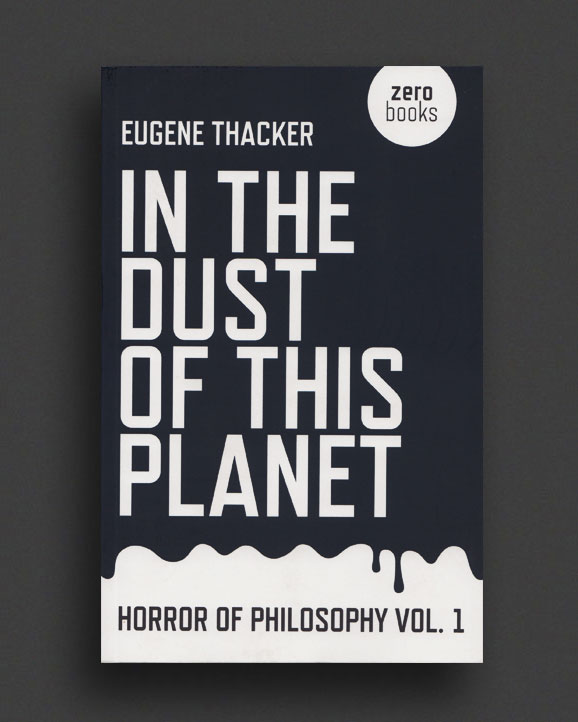
"Thacker's discourse on the intersection of horror and philosophy is utterly original and utterly captivating..." Thomas Ligotti, author of The Conspiracy Against the Human Race
The world is increasingly unthinkable, a world of planetary disasters, emerging pandemics, and the looming threat of extinction. In this best-selling book Eugene Thacker suggests that we look to the genre of horror as offering a way of thinking about the unthinkable world. To confront this idea is to confront the limit of our ability to understand the world in which we live - a central motif of the horror genre. In the Dust of This Planet explores these relationships between philosophy and horror. In Thacker's hands, philosophy is not academic logic-chopping; instead, it is the thought of the limit of all thought, especially as it dovetails into occultism, demonology, and mysticism. Likewise, Thacker takes horror to mean something beyond the focus on gore and scare tactics, but as the under-appreciated genre of supernatural horror in fiction, film, comics, and music.
2021, English
Softcover, 456 pages, 21.6 x 14 cm
Published by
University of Minnesota Press / Minnesota
$89.00 - Out of stock
A groundbreaking collection of writings by Michel Foucault and the Prisons Information Group documenting their efforts to expose France's inhumane treatment of prisoners.
Authors: Michel Foucault and Prisons Information Group
Edited by Kevin Thompson and Perry Zurn
Translated by Perry Zurn and Erik Beranek
Founded by Michel Foucault and others in 1970–71, the Prisons Information Group (GIP) circulated information about the inhumane conditions within the French prison system. Intolerable makes available for the first time in English a fully annotated compilation of materials produced by the GIP during its brief but influential existence, including an exclusive new interview with GIP member Hélène Cixous and writings by Gilles Deleuze and Jean Genet.
These archival documents — public announcements, manifestos, reports, pamphlets, interventions, press conference statements, interviews, and round table discussions — trace the GIP's establishment in post-1968 political turmoil, the new models of social activism it pioneered, the prison revolts it supported across France, and the retrospective assessments that followed its denouement. At the same time, Intolerable offers a rich, concrete exploration of Foucault's concept of resistance, providing a new understanding of the arc of his intellectual development and the genesis of his most influential book, Discipline and Punish.
Presenting the account of France's most vibrant prison resistance movement in its own words and on its own terms, this significant and relevant collection also connects the approach and activities of the GIP to radical prison resistance movements today.
1992, French / Japanese
Softcover (french-folds w. parchment dust-jacket and obi-strip),
Ed. of 950, first hand-numbered ed. 19/50,
1st Edition, Out of print title / used / very good
Published by
Taito Vision / Tokyo
$200.00 - Out of stock
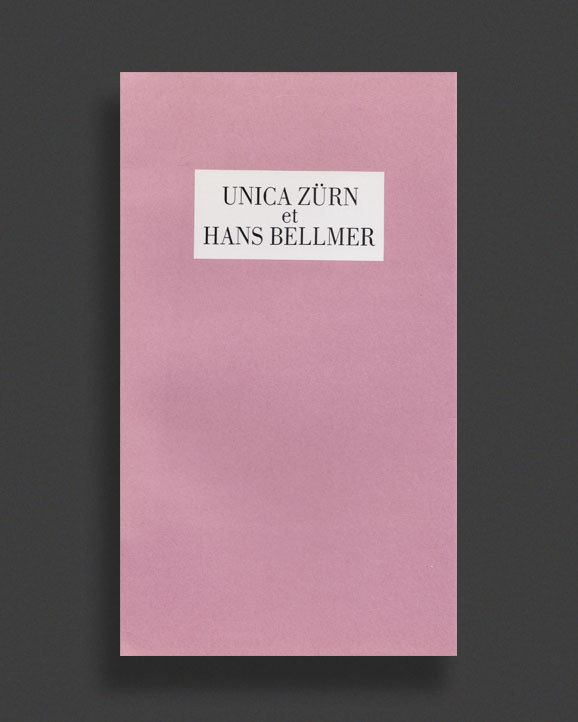
Stunning, very rare Japanese publication collecting the works of married Surrealist artist-couple Unica Zürn and Hans Bellmer, issued in a limited edition of 950 copies by Taito Vision in 1992. This copy scarcer still, being one of the first edition of 50 hand-numbered copies (no.19/50). Contents include colour reproductions of Unica Zürn's print series "Oracles et Spectacles", published in 1967 after a series of drawings created by Zürn during a 1960 hospitalization caused by a clinically diagnosed psychotic episode. They are accompanied here by a selection of her anagrammatic poetry and a hommage to Zürn by husband Bellmer. These are followed by colour reproductions of Hans Bellmer's "Petit Traité de Morale" print series from 1966-68. Accompanied by biographies, a series of texts in Japanese, a full catalogue and portraits of the artists. A stunning book making these wonderful print editions by two important Surrealists available together in book-form.
Very Good copy in Very Good dust jacket protected in publisher's removable parchment jacket and publisher's obi-strip (both not pictured here, both with some tanning and wear). A most complete and limited copy.
1970 / 1975, Japanese
Softcover (w. dust jacket), 100 pages, 26 x 18 cm
Out of print title / used / very good
Published by
Iwasaki Art Co. / Japan
$70.00 - Out of stock
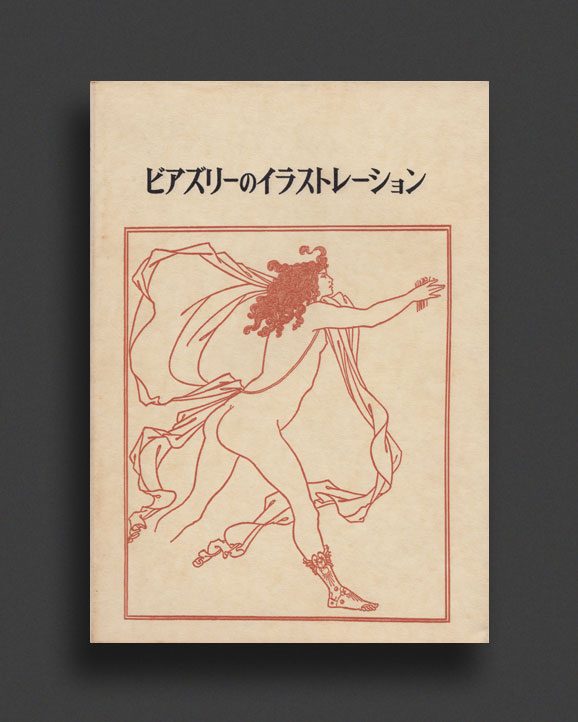
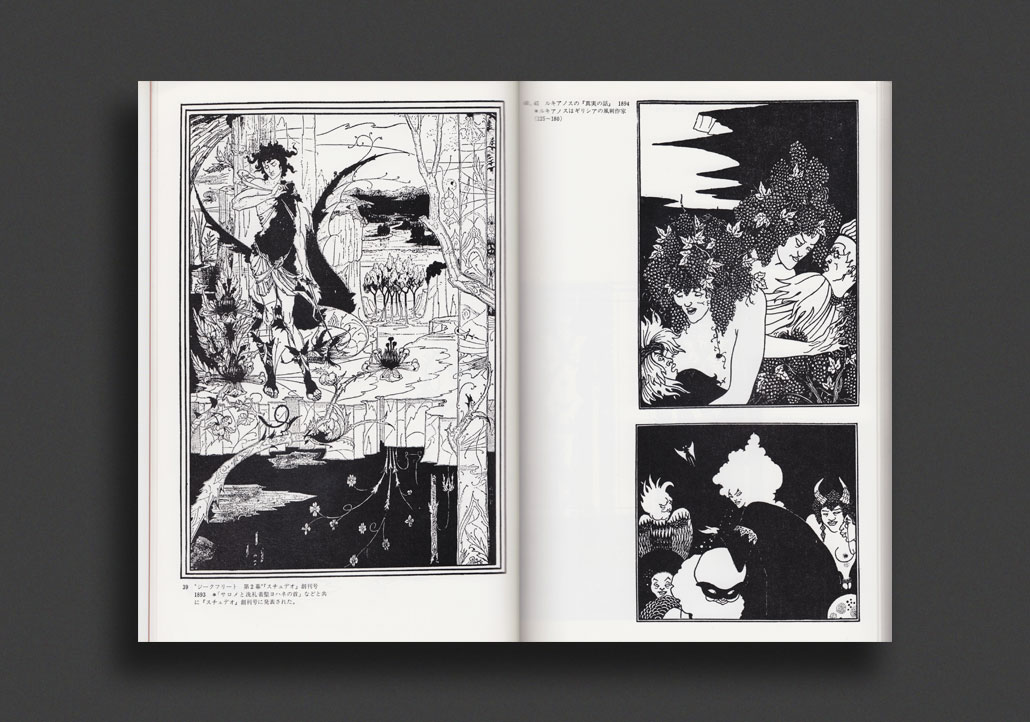
Lovely 1975 Japanese monograph on the work of Aubrey Beardsley, first published in 1970. Profusely illustrated throughout with 155 works, illustrated biography, biography and list of works, wrapped up in textured stock cover and dust jacket. Texts by Tadayuki Omori.
Aubrey Vincent Beardsley (1872 – 1898) was an English illustrator and author. His black ink drawings were influenced by Japanese woodcuts, and emphasized the grotesque, the decadent, and the erotic. He was leading figure in the aesthetic movement, the British counterpart of Decadence and Symbolism. He produced extensive illustrations for books and magazines such as The Studio, The Yellow Book, and The Savoy. Beardsley was a public as well as private eccentric. He said "I have one aim—the grotesque. If I am not grotesque, I am nothing." Oscar Wilde said Beardsley had "a face like a silver hatchet, and grass green hair." Wilde's irreverent wit and work reflected the decadence of his era and his influence was enormous, despite his early death from tuberculosis at age 25. His influence is clearly visible in the work of the French Symbolists, the Poster Art Movement of the 1890s, the work of many later-period Art Nouveau artists such as Papé and Clarke and 20th fantasy illustration.
Very Good copy in VG original dust jacket.
1998, English / German
Softcover, 264 pages, 28 x 22 cm
1st Edition, Out of print title / used / very good
Published by
John Hansard Gallery / University of Southhampton
Museum Moderner Kunst Stiftung Wien / Vienna
$180.00 - Out of stock
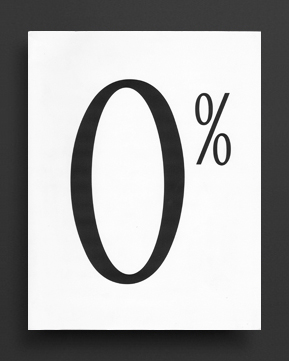
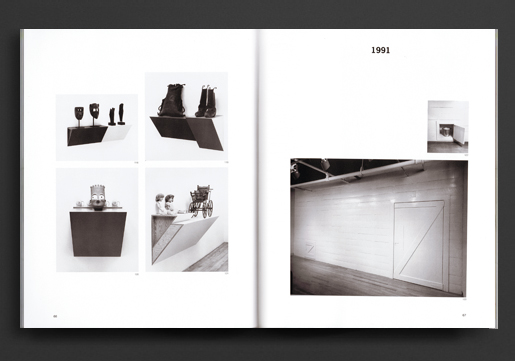
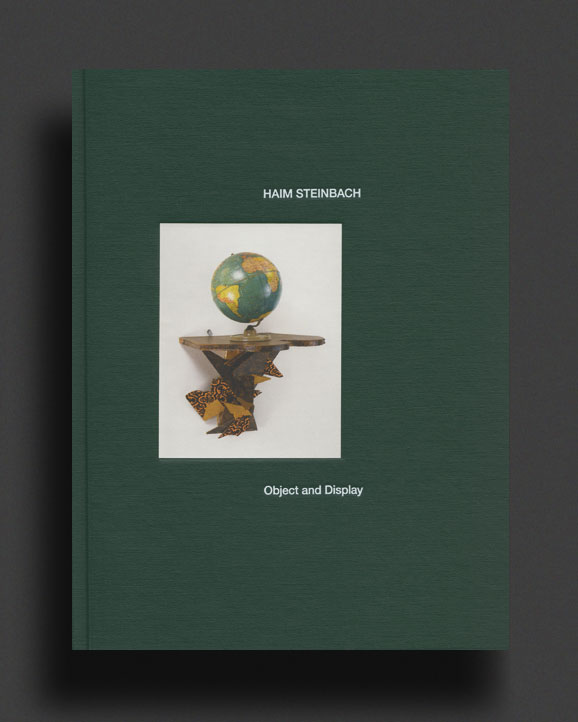
This now scarce, large monographic publication was published in 1998 to accompany a travelling 1998 exhibition on the work of Haim Steinbach at Museum of Modern Art, Ludwig Foundation Vienna, 20er Haus, and John Hansard Gallery, University of Southhampton. One of the best books on Steinbach, 0% contains abundant examples of work spanning from 1975 to 1995, in black and white and colour, running through each year, alongside numerous essays in both German and English by Lorand Hegyi, Stephen Foster, Brude Ferguson, Eve Badura-Triska, Michel Gauthier, Giacinto di Pietrantonio, Cornelia Lauf, Jen Budney, Eva Meyer, Jan Avgikos, Carolyn Christov-Bakargiev and Adachiara Zevi. Also includes a full biography/bibliography.
For more than four decades, Haim Steinbach has explored the psychological, aesthetic, cultural and ritualistic aspects of collecting and arranging already existing objects. His work engages the concept of “display” as a form that foregrounds objects, raising consciousness of the play of presentation. Steinbach selects and arranges objects – which range from the natural to the ordinary, the artistic to the ethnographic – thereby emphasizing their identities, inherent meanings and associations. An important influence in the growth of post-modern artistic dialogue, Steinbach’s work has radically redefined the status of the object in art.
Very Good copy.
2015, English
Hardcover, 250 pages, 28 x 23 cm
Published by
Gregory R. Miller & Co. / New York
$120.00 - Out of stock
Primarily known for his paradigmatic "shelves" displaying everyday objects, Haim Steinbach (born 1944) has developed a practice that evolved from early minimalist painting with grids and monochromes to later large-scale installations that have seldom been seen in the US. Growing out of a traveling exhibition that features works drawn from throughout Steinbach's career, as well as archival materials and new site-specific installations, Object and Display urges readers to take a closer look at this seminal artist's works. Hundreds of full-color illustrations document the exhibition, which included photographs, models and recreations from past works, along with photography of the site-specific installations that appeared at each institution. New essays by writers Johanna Burton and Germano Celant explore the evolution of Steinbach's practice and his investigations into what constitutes an art object and how art and objects are displayed. Interview with Hans Ulrich Obrist, Tom Eccles, Beatrix Ruf.
English / Japanese
Softcover, 64 pages, 26 x 37 cm
Published by
A.D.A Edita / Tokyo
$80.00 - Out of stock
One of the finest architecture series ever published, the world renowned GA (Global Architecture) series, presented by the highly esteemed publishing house that also published the GA Document, GA Houses, and GI (Global Interior) architectural publications.
Each over-sized photographic folio issue of the special GA Residential Masterpieces series highlights a renowned international architect and takes a detailed look into their creations for residence.
Absolutely stunning and vivid large-format architectural photography of the selected building’s interiors, exteriors and architectural details, along with texts (in English and Japanese) and floor-plans/elevation drawings make up the profiles on each featured architectural project. The visual generosity of these handsomely designed and beautifully printed over-sized publications make them a treasure for any architecture or interior design enthusiast or collector.
Built between 1945 and 1951, the Farnsworth House in Plano, Illinois, is among Mies van der Rohe’s most famous works. Having relocated to the United States just prior to the war, he embraced the new opportunities the country provided for his modernist vision. The house appears in the same style as others in a series of buildings from the architect’s American period, and is considered something of a prototype. Commissioned to design a weekend retreat for a prominent Chicago psychiatrist, Van der Rohe created an enchanting space that was at once both a sanctuary and a monument to modern architecture. With photographs and text by Yoshio Futagawa.
Printed in Japan.
2015, English / Japanese
Softcover, 76 pages, 26 x 36 cm
Published by
A.D.A Edita / Tokyo
$80.00 - Out of stock
One of the finest architecture series ever published, the world renowned GA (Global Architecture) series, presented by the highly esteemed publishing house that also published the GA Document, GA Houses, and GI (Global Interior) architectural publications.
Each over-sized photographic folio issue of the special GA Residential Masterpieces series highlights a renowned international architect and takes a detailed look into their creations for residence.
Absolutely stunning and vivid large-format architectural photography of the selected building’s interiors, exteriors and architectural details, along with texts (in English and Japanese) and floor-plans/elevation drawings make up the profiles on each featured architectural project. The visual generosity of these handsomely designed and beautifully printed over-sized publications make them a treasure for any architecture or interior design enthusiast or collector.
Designed by American architect Philip Johnson as his own residence, the Glass House in New Canaan, Connecticut (US), sent shockwaves through the architectural world when it was first completed, and has remained an icon of American residential modernism ever since. Lovingly portrayed by Japanese architectural photographer Yukio Futagawa, the house, its galleries of artworks, outlying studio, and pavilion on the pond all come alive through refined qualities of light and the natural setting. Moreover, Kengo Kuma contributes an essay in which he describes his impressions of meeting the architect and the first encounter with his famous house.
Printed in Japan
2012, Japanese / English
Softcover, 64 pages, 26 x 36 cm
Published by
A.D.A Edita / Tokyo
$77.00 - Out of stock
One of the finest architecture series ever published, the world renowned GA (Global Architecture) series, presented by the highly esteemed publishing house that also published the GA Document, GA Houses, and GI (Global Interior) architectural publications.
Each over-sized photographic folio issue of the special GA Residential Masterpieces series highlights a renowned international architect and takes a detailed look into their creations for residence.
Absolutely stunning and vivid large-format architectural photography of the selected building’s interiors, exteriors and architectural details, along with texts (in English and Japanese) and floor-plans/elevation drawings make up the profiles on each featured architectural project. The visual generosity of these handsomely designed and beautifully printed over-sized publications make them a treasure for any architecture or interior design enthusiast or collector.
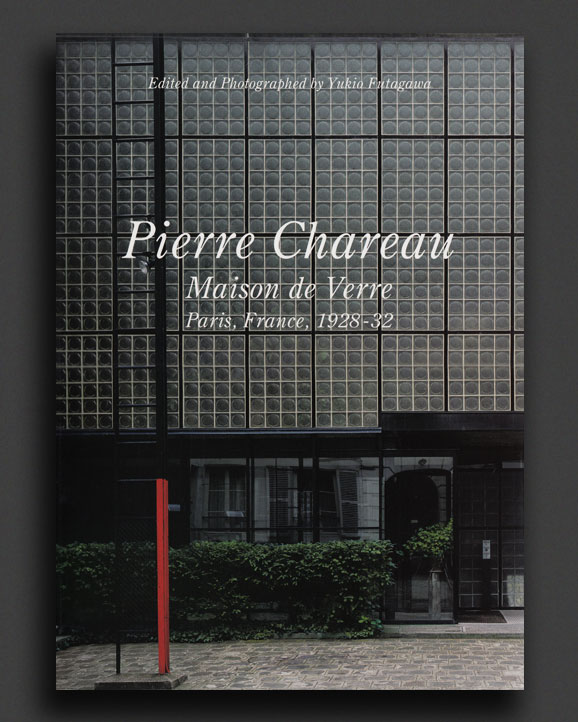
Photographed by Yoshio Futagawa and with text by Yukio Futagawa, this edition details one of modernism’s early masterpieces - Pierre Chareau's Maison De Verre. With insights into the history and conception of the house, as well as its design and authors, the text shows how Pierre Chareau, an interior designer in charge of design and planning, “positioned this residence as a prototype of a Modernist manifesto.”
Printed in Japan
2016, English / Japanese
Softcover, 54 pages, 26 x 36 cm
Published by
A.D.A Edita / Tokyo
$70.00 - Out of stock
One of the finest architecture series ever published, the world renowned GA (Global Architecture) series, presented by the highly esteemed publishing house that also published the GA Document, GA Houses, and GI (Global Interior) architectural publications.
Each over-sized photographic folio issue of the special GA Residential Masterpieces series highlights a renowned international architect and takes a detailed look into their creations for residence.
Absolutely stunning and vivid large-format architectural photography of the selected building’s interiors, exteriors and architectural details, along with texts (in English and Japanese) and floor-plans/elevation drawings make up the profiles on each featured architectural project. The visual generosity of these handsomely designed and beautifully printed over-sized publications make them a treasure for any architecture or interior design enthusiast or collector.
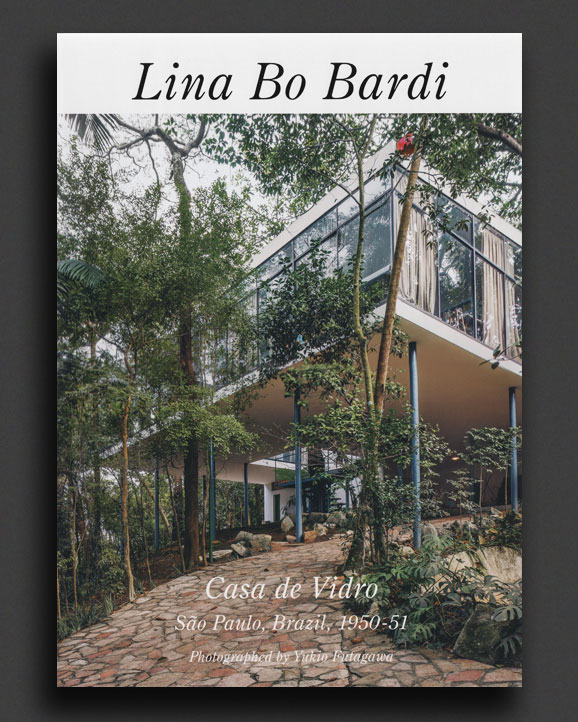
Built in the early 1950s in São Paulo, Lina Bo Bardi’s Casa de Vidro (Glass House) was the first real architectural project she completed after her arrival in Brazil. Built as a home for herself and her husband, it clearly demonstrates how architecture and design should keep a distance from individuals, society or community, and the natural environment – a stance that would come to underlie all of the Italian-born architect’s subsequent works. Photographed by master architectural photographer Yukio Futagawa, Casa de Vidro still appears as its designer intended, a prototype that responded to a new society, rising directly from the earth and embedded in the surrounding jungle.
Printed in Japan
2016, English / Japanese
Softcover, 56 pages, 26 x 36 cm
Published by
A.D.A Edita / Tokyo
$70.00 - Out of stock
One of the finest architecture series ever published, the world renowned GA (Global Architecture) series, presented by the highly esteemed publishing house that also published the GA Document, GA Houses, and GI (Global Interior) architectural publications.
Each over-sized photographic folio issue of the special GA Residential Masterpieces series highlights a renowned international architect and takes a detailed look into their creations for residence.
Absolutely stunning and vivid large-format architectural photography of the selected building’s interiors, exteriors and architectural details, along with texts (in English and Japanese) and floor-plans/elevation drawings make up the profiles on each featured architectural project. The visual generosity of these handsomely designed and beautifully printed over-sized publications make them a treasure for any architecture or interior design enthusiast or collector.
Begun in São Paulo in 1964 by Paulo Mendes da Rocha when he was just 36 years old, the Brazilian architect’s own residence was highly influential in his home country but little published due to the political climate of the time. An entire “heroic” phase of Brazilian architecture, with significant works by Oscar Niemeyer, Lina Bo Bardi, and others, was impacted by the Brazil’s increasing cultural isolation. Mendes da Rocha’s work was not recognised internationally until the 1990s, which led to a “rediscovery” of this house as a kind of manifesto. Its brutalist reinforced concrete surfaces and structural simplicity resonate with history in this series of photographs by Yukio Futagawa.
Printed in Japan
2010, English
Softcover, 112 pages, 112 x 178 mm
Published by
Sternberg Press / Berlin
$45.00 $15.00 - In stock -
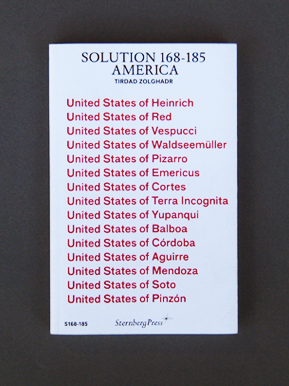
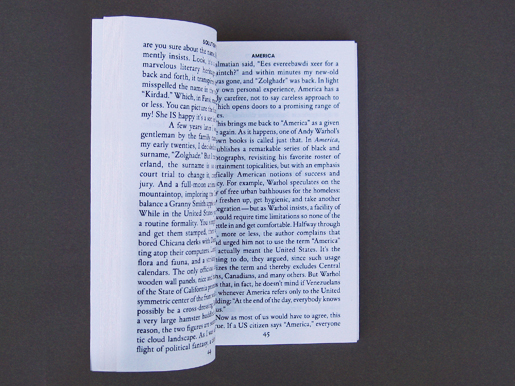
“As for the more long-term solutions, this is certainly a job for the avant-garde, be it in the shape of architects, supercilious tourist intellectuals, secret societies or some other semi-conspiratorial cluster... This demands an avantgarde a little more proactive ... and responsive than a Brechtian Villa Aurora… It’s hardly a surprise that, over time, most Americans have become suspicious of people sympathetic to avant-gardism, assuming them all to be fascist hyena pigs, ipso facto no less. But in point of fact, America offers a rich tradition of politicized avant-garde conspiracies, the Black Panthers being only the most impressive recent example to have caught the public eye. To be honest, anything in my own book was long tucked away in their laundry list already.”
Solution 168–185: America is the fourth book in the Solution series. Opting for the United States of America, “still the most proficiently colonial place I know,” Zolghadr provides a compilation of highly entertaining “solutions,” where the objective is not the education of America so much as the pleasure of a text that purports to be just that.
Tirdad Zolghadr is an independent writer/curator based in Berlin. He writes for frieze and other publications, and is editor-at-large for Cabinet magazine. Zolghadr most recently organized the national pavilion of the United Arab Emirates, Venice Biennale 2009, and the long-term project Lapdogs of the Bourgeoisie (with Nav Haq). He’s a curatorial advisor to the Guggenheim Abu Dhabi. Zolghadr currently teaches at the Center for Curatorial Studies, Bard College.
Design by Zak Kyes
2012, English
Softcover, 176 pages, 10.8 x 17.8 cm
Published by
Sternberg Press / Berlin
$39.00 $10.00 - Out of stock
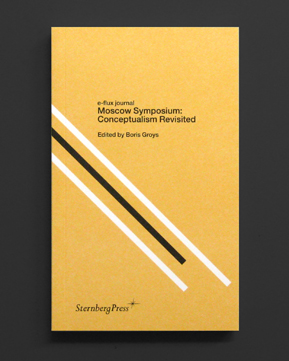
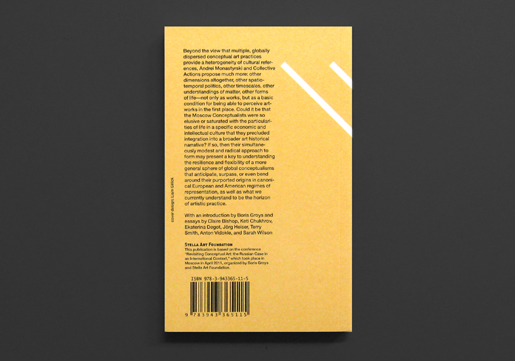
With an introduction by Boris Groys and essays by Claire Bishop, Keti Chukhrov, Ekaterina Degot, Jörg Heiser, Terry Smith, Anton Vidokle, and Sarah Wilson
Beyond the view that multiple, globally dispersed conceptual art practices provide a heterogeneity of cultural references, Andrei Monastyrski and Collective Actions propose much more: other dimensions altogether, other spatiotemporal politics, other timescales, other understandings of matter, other forms of life—not only as works, but as a basic condition for being able to perceive artworks in the first place. Could it be that the Moscow Conceptualists were so elusive or saturated with the particularities of life in a specific economic and intellectual culture that they precluded integration into a broader art historical narrative? If so, then their simultaneously modest and radical approach to form may present a key to understanding the resilience and flexibility of a more general sphere of global conceptualisms that anticipate, surpass, or even bend around their purported origins in canonical European and American regimes of representation, as well as what we currently understand to be the horizon of artistic practice.
Design by Jeff Ramsey, cover design by Liam Gillick
2012, English
Hardcover, 88 pages, 66 b/w ill., 11 x 18 cm
Published by
Sternberg Press / Berlin
$30.00 $15.00 - Out of stock
Joan Sallas, a virtuoso of the fold, has meticulously researched and mastered the history and techniques of the art of the fold. With the banquet table as setting, his expertise and philosophy pour forth in the form of splendid, folded linen.
In this precious book, Sallas shares his folding wisdom, which Charlotte Birnbaum contextualizes in two essays on the history of napkin folding. The texts are accompanied by an illustrated catalogue of folding techniques.
2017, English
Hardcover, 176 pages, 11 x 18 cm
Published by
Sternberg Press / Berlin
$30.00 $15.00 - Out of stock
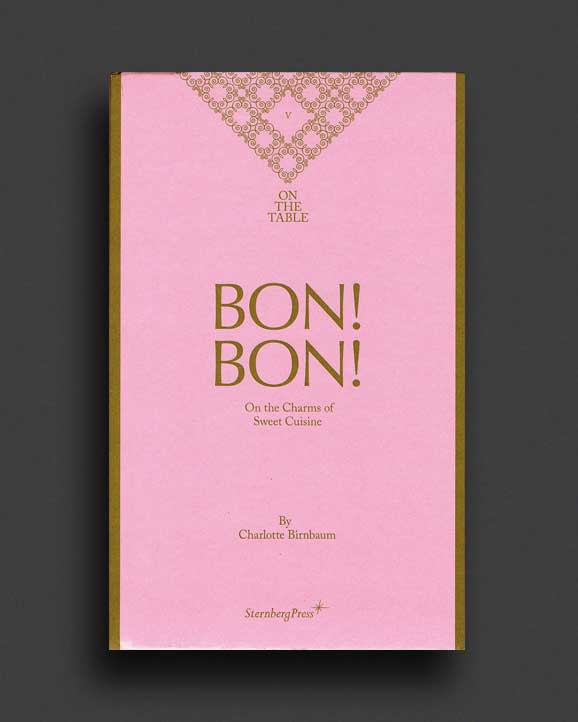
People have used honey, dates, and fruits to sweeten their dishes since time immemorial, but with the introduction of sugar—“white gold”—into cooking and baking, a whole array of delightful flavors and culinary possibilities was unearthed. Sugar was the building block for edible sculptures and model palaces made for festivals and celebrations thousands of years ago, and the main ingredient in lavish creations for Rococo and Baroque banquets. A life without cakes, pastries, tarts, soufflés, meringues, petits fours, or marzipan would be unimaginable! In Bon! Bon!, Charlotte Birnbaum uncovers the wonderful world of all things sugary through surprising anecdotes and historical accounts, each accompanied by delectable recipes that are sure to satisfy any sweet tooth.
On the Table is a series of publications edited by Charlotte Birnbaum that explores the encounter between food and art.
With illustrations by Christa Näher
Translated by Nicholas Grindell
Design by Harald Pridgar
2018, English
Hardcover, 68 pages, 11 x 18 cm
Published by
Sternberg Press / Berlin
$32.00 $15.00 - Out of stock
Gilbert & George never cook and always eat out. Back in 1969, however, the artist duo hosted The Meal, an elaborate dinner party that included thirteen guests, Princess Margaret’s butler, a chef who prepared a meal from a Victorian cookery manual, and the guest of honor, artist David Hockney. While the art world of the time was largely characterized by Pop art, Minimalism, and Conceptual art, Gilbert & George developed an entirely unique philosophy and combined their daily lives with their artistic vision; in short, their art and life are one! Charlotte Birnbaum took a trip to London’s East End to visit the immaculately dressed pair to discuss The Meal and other curious projects from their fifty-year collaboration. Also included here are photos and memorabilia from the singular event.
On the Table is a series of publications edited by Charlotte Birnbaum that explores the encounter between food and art.
Design by Harald Pridgar
2014, English
Hardcover, 228 pages (10 b/w and 12 color ill.), 11 x 18 cm
Published by
Sternberg Press / Berlin
$56.00 - Out of stock
Edited by Charlotte Birnbaum
Illustrations by Jan Hietala
Apart from the legendary and widely extolled exceptions, humans up to this point have fed themselves like ants, mice, cats and oxen. With us, the Futurists, the first human cuisine is born—that is to say, the art of feeding. Like all the arts, it excludes plagiarism and demands creative originality. It is no accident that this work is being published in the midst of a world financial crisis, the development and outcome of which apparently cannot be determined; what can be determined, however, is the dangerous and dispiriting panic it engenders. This panic we counter with a Futurist cuisine: in other words, optimism at the table.
In 1932, F. T. Marinetti and his collaborator Fillìa published The Futurist Cookbook, a manifesto-as-culinary-innovation. Replete with experimental recipes (the founder of Futurism, Marinetti, is known to have ranted about the social dangers of pasta eating), the book is a multilayered exploration of cultural metabolisms, with the dining table as its centerpiece, of course!
Translated by Barbara McGilvray
Design by Harald Pridgar
2013, English
Hardcover, 132 pages, 11 x 18 cm
Published by
Sternberg Press / Berlin
$30.00 $15.00 - Out of stock
Pies, pâtés, and pastries are the noblest of foods. Their inner life is always a secret; their outer form, a sculpture. No other dishes are so well suited to surprises and culinary amusements. In her enchanting and historically enlightening book, Charlotte Birnbaum traces the life of such delicacies through diverse cultures and traditions. Here, wondrous anecdotes of noblemen and farmers alike are woven together, each accompanied by toothsome recipes.
With illustrations by Christa Näher
Translated by Nicholas Grindell
Design by Harald Pridgar
2019, English
Softcover, 224 pages, 10.8 x 18 cm
Published by
Bergen Kunsthall / Norway
Sternberg Press / Berlin
$44.00 $15.00 - In stock -
Jill Johnston—cultural critic, auto/biographer, and lesbian icon—was renowned as a writer on dance, especially on the developments around Judson Dance and the 1960s downtown New York City scene, and later as the author of the radical-feminist classic Lesbian Nation (1973). This book collects thirty texts by Jill Johnston that were initially published in her weekly column for The Village Voice between 1960 and 1974. The column provided a format in which Johnston could dissolve distinctions between the personal, the critical, and the political. Her writing took turns and loops, reflecting its times and contexts, and set a stage for the emergence of Johnston as a public figure and self-proclaimed radical lesbian that defied any prescribed position.
Johnston’s original texts are accompanied by three new contributions by Ingrid Nyeboe, Bruce Hainley, and Jennifer Krasinski, as well as an appendix with archival material related to a panel Johnston organized in 1969, titled “The Disintegration of a Critic: An Analysis of Jill Johnston.”
Edited by Fiona McGovern, Megan Francis Sullivan, Axel Wieder
Texts by Jill Johnston; contributions by Bruce Hainley, Jennifer Krasinski, Ingrid Nyeboe
Design by HIT
2017, English
Softcover, 292 pages, 11.2 x 17.8 cm
Published by
Sternberg Press / Berlin
$62.00 $25.00 - Out of stock
Contributions by Santiago Alba Rico, Heather Anderson, Ann Cotten, Fiona Duncan, Anthony Dunne and Fiona Raby, Boris Groys, Elfriede Jelinek, Georgy Mamedov and Oksana Shatalova, Metahaven, Momus, Ingo Niermann, David Pearce, Frank Ruda, Georgia Sagri, Joshua Simon, Alexander Tarakhovsky, Timotheus Vermeulen
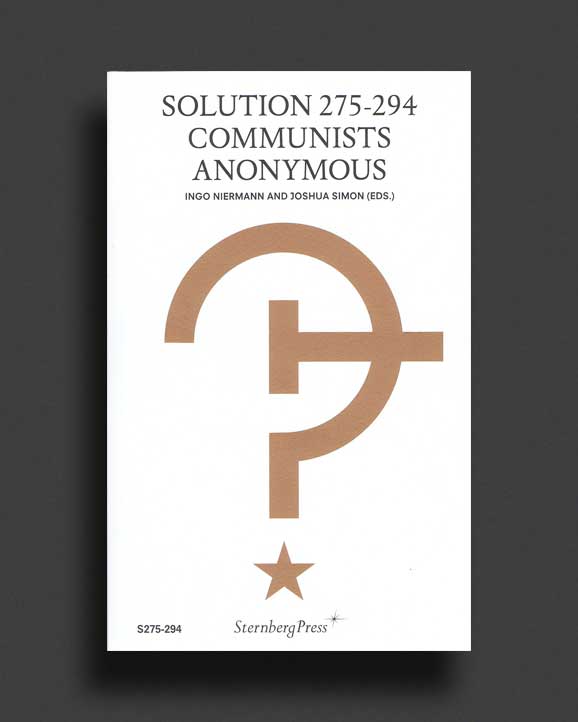
The members of Communists Anonymous (COMA) share an extreme sense of empathy and justice, and therefore detest more or less any form of private property. COMA members restrain themselves from any effort to overcome capitalism before there is a new convincing model at hand of how to actually implement communism. The speculative self-help of COMA understands the historical incarnations of communism as substantially incomplete in thought and practice, and places communism where it originated—in the realm of fiction. Only as fiction can communism manifest itself again beyond doubt.
Solution 275–294: Communists Anonymous is a document of some imageries of communism and a testament to the current predicament of our political imagination. Atomized, privatized, and deprived of any infrastructure for solidarity—without any internationalist project, with moralizations compensating for the disappearance of political organization, with micro-politics replacing macro-politics—communists can only be anonymous in this world of ours. Edited by writer Ingo Niermann and curator Joshua Simon, this collection of essays and stories—written from the fields of art, literature, law, philosophy, activism, design, and science—proposes resolutions to current social contradictions, covering topics such as bacteria, bliss, immortality, queerness, interculturality, poetry, transportation, childhood and motherhood, and all-encompassing sensual love.
Design by Zak Group
1998, English
Softcover (staple-bound), 36 pages, 24 x 16.5 cm
1st Edition, Out of print title / used / very good
Published by
Metro Arts / Brisbane
$35.00 $15.00 - Out of stock
Catalogue published on the occasion of the exhibition Two Timing, An Exhibition That Considers The Artwork Through An Aspect of Time, Presented at Metro Arts, 15 April — 30 May, 1998, guest curated by artist Gail Hastings. Features the work of Bronwyn Clark-Coolee, Kathleen Horton, Kerrie Poliness, Amanda Speight, Sarah Stutchbury, Dion Workman, all illustrated with a Q&A with each artist, alongside introduction by Hastings, biographies, and list of works. Published in an edition of 500.
Born 1965, Perth, Western Australia. Lives and works Melbourne, Victoria. Gail Hastings’ practice is informed by 1960s minimalism and the idea of created space. Her works, which she describes as “sculptuations – a spatial architecture that loops back on itself”, are sculptural situations concerned with the activation of real space through objects and form, and the active participation of the viewer.
Like New copy.
2001, English
Softcover, 86 pages, 20.8 x 29.3 cm
1st Edition, Out of print title / used / fine
Published by
Pataphysics Books / Melbourne
$45.00 - Out of stock
Out of print 2001 issue of the great Pataphysics magazine from Melbourne, the Pirate issue.
Interviews with Dave Hickey, Bruce LaBruce, Barney Rosset on Grove Press and living in a house designed by Pierre Chareau, Doing Theory by Sylvère Lotringer, 10 business cards and 5 Poems by Tony Towle, Rifle Range Drive by Jennifer McCamley, Burning Interior by David Shapiro, Rudi Ketz on Peter Lindbergh, Area Man Found Crucified by Joyce Carol Oates.
Published and edited by Leo Edelstein and Yanni Florence in Melbourne, with Judith Elliston, 2001, and long out of print. Fine copy.