World Food Books' programme is largely produced on Kulin Nation land. We acknowledge the Wurundjeri people of the Kulin Nation as the first and continuing custodians of this land, and pay respect to their Elders past, present, and emerging.
World Food Books is an arts and special interests bookshop in Naarm / Melbourne. Founded in 2010, World Food Books is devoted to the presentation of a rotating, hand-selection of international art, design, literary and counterculture publications with an emphasis on the anti-traditional, the experimental, the avant-garde, the heretic, the marginal.
Presenting new titles alongside rare and out-of-print books, catalogues and journals spanning the fields of modern and contemporary art, design, photography, illustration, film, literature, poetry, cultural theory, philosophy, sexuality, popular and underground culture in its many radical forms, World Food Books wishes to encourage adventurous, thoughtful and open-minded reading, looking, writing, and exchange of publishing and ideas, both current and historical.
As well as our bookshop, located in Melbourne's historical Nicholas Building, all of our inventory is available internationally via our online mail-order service.
World Food Books semi-regularly co-ordinates "Occasions", a programme of exhibits and events at the bookshop and in partnership with other hosts (such as museums and art galleries) that develop out of the activities, relationships and content of the bookshop itself.
World Food Books
The Nicholas Building
37 Swanston Street
Room 5, Level 6
Melbourne 3000
Australia
SHOP HOURS:
Thu–Fri 12–6, Sat 12–5
WEB-SHOP OPEN 24/7
World Food Books
Postal Address:
PO Box 435
Flinders Lane
Victoria 8009
Australia
Art
Theory / Essay
Architecture / Interior
Graphic Design / Typography
Photography
Fashion
Eros
LGBTQ+
Fiction / Poetry
Weird / Speculative / Science Fiction / Horror
Transgressive / Visceral / Abject
Symbolism / Decadence / Fin de siècle
Film / Video
Painting
Sculpture / Installation
Performance / Dance / Theater
Drawing
Sound / Music
Curatorial
Group Shows / Collections
Periodicals
Out-of-print / Rare
Posters / Ephemera / Discs
Signed Books
World Food Books Gift Voucher
World Food Book Bag
Australian Art
Australian Fiction
Australian Science Fiction / Speculative Fiction
Australian Poetry
Australian Photography
Japanese Photography
Conceptual Art
Minimal Art
Dada
'Pataphysics / Oulipo
Fluxus
Concrete Poetry
Pop Art
Surrealism
Arte Povera
Arte Informale / Haute Pâte / Tachism
Nouveau Réalisme / Zero / Kinetic
Situationism / Lettrism
Collage / Mail Art / Xerox Art
Art Brut / Folk / Visionary / Fantastic
Illustration / Graphic Art / Bandes Dessinées
Furniture
Italian Radical Design / Postmodernism
Textiles
Ceramics / Glass
Counterculture
Protest / Revolt
Philosophy
Psychoanalysis
Anthropology
Anarchism
Socialism / Anarchism / Communism / Capitalism
Literary Theory / Semiotics / Language
Feminism / Women's Studies
Gender Studies / Sexuality
Anthropology
Fetishism / BDSM
Drugs / Psychedelia
Crime / Violence
Animal Rights / Veganism
Occult / Esoterica
Ecology / Earth / Alternative Living
Whole Earth / Crafts
All prices in AUD (Australian dollars)
Pick-Ups
Pick-up orders can be collected in our bookshop during opening hours after order date. Please collect any Pick-up orders within 2 weeks of ordering as we have limited storage space. Orders will be released back into stock if not collected within this time. No refunds can be made for pick-ups left un-collected. If you cannot make it in to the bookshop in this time-frame, please choose postage option.
Return Policy
All sales are final. We do accept returns (for refund or exchange) for items received in error. All our orders are packed with special care using heavy-duty padding and cardboard book-mailers or bubble mailers (for smaller books), using reinforcement where required. We cannot take responsibility for any lost, stolen or damaged parcels.
Insurance
Should you wish to insure your package, please email us directly after placing your order and we can organise this at a small extra expense. Although all standard/express tracked packages are very safe and dependable, we cannot take responsibility for any lost, stolen or damaged parcels. We recommend insurance on valuable orders.
Interested in selling your old books, catalogues, journals, magazines, comics, fanzines, ephemera? We are always looking for interesting, unusual and out-of-print books to buy. We only buy books in our fields of interest and specialty, and that we feel we can resell.
We base these prices on desirability, market value, in-print prices, condition and our current stock levels. We offer cash, store credit, and can take stock on consignment. All
about 25% of the price we expect to get when we sell them, or 30% in store credit. We base these prices on desirability, market value, in-print prices, condition and our current stock levels.
Sell your books any day of the week. You can drop them off and return later. If you have a lot of books, we can visit your Sydney home.
We buy books that we feel we can resell. We offer about 25 % of the price we expect to get when we sell them, or 30% in store credit. We base these prices on desirability, market value, in-print prices, condition and our current stock levels.
Philadelphia Wireman
03 August - 01 September, 2018
World Food Books is proud to announce our next Occasion, the first presentation of sculptures by Philadelphia Wireman in Australia.
The Philadelphia Wireman sculptures were found abandoned in an alley off Philadelphia’s South Street on trash night in 1982. Their discovery in a rapidly-changing neighbourhood undergoing extensive renovation, compounded with the failure of all attempts to locate the artist, suggests that the works may have been discarded after the maker’s death. Dubbed the "Philadelphia Wireman" during the first exhibition of this work, in 1985, the maker’s name, age, ethnicity, and even gender remain uncertain. The entire collection totals approximately 1200 pieces, all intricately bound together with tightly-wound heavy-gauge wire (along with a few small, abstract marker drawings, reminiscent both of Mark Tobey and J.B. Murry). The dense construction of the work, despite a modest range of scale and materials, is singularly obsessive and disciplined in design: a wire armature or exoskeleton firmly binds a bricolage of found objects including plastic, glass, food packaging, umbrella parts, tape, rubber, batteries, pens, leather, reflectors, nuts and bolts, nails, foil, coins, toys, watches, eyeglasses, tools, and jewellery.
Heavy with associations—anthropomorphic, zoomorphic, and socio-cultural responses to wrapped detritus—the totemic sculptures by Philadelphia Wireman have been discussed in the context of work created to fulfil the shamanistic needs of alternative religions in American culture. Curators, collectors, and critics have variously compared certain pieces to sculpture from Classical antiquity, Native American medicine bundles, African-American memory jugs, and African fetish objects. Reflecting the artist’s prolific and incredibly focused scavenging impulse, and despite—or perhaps enhanced by—their anonymity, these enigmatic objects function as urban artefacts and arbiters of power, though their origin and purpose is unknown. Philadelphia Wireman, whatever their identity, possessed an astonishing ability to isolate and communicate the concepts of power and energy through the selection and transformation of ordinary materials. Over the course of the past two decades, this collection has come to be regarded as an important discovery in the field of self-taught art and vernacular art.
Presented in collaboration with Fleisher-Ollman Gallery, Philadelphia, and Robert Heald, Wellington.
Susan Te Kahurangi King
02 February - 10 March, 2018
Susan Te Kahurangi King (24 February 1951 - ) has been a confident and prolific artist since she was a young child, drawing with readily available materials - pencils, ballpoint pens and felt-tip markers, on whatever paper is at hand. Between the ages of four and six Susan slowly ceased verbal communication. Her grandparents William and Myrtle Murphy had developed a special bond with Susan so they took on caring responsibilities for extended periods. Myrtle began informally archiving her work, carefully collecting and storing the drawings and compiling scrapbooks. No drawing was insignificant; every scrap of paper was kept. The King family are now the custodians of a vast collection containing over 7000 individual works, from tiny scraps of paper through to 5 meter long rolls.
The scrapbooks and diaries reveal Myrtle to be a woman of great patience and compassion, seeking to understand a child who was not always behaving as expected. She encouraged Susan to be observant, to explore her environment and absorb all the sights and sounds. Myrtle would show Susan’s drawings to friends and people in her community that she had dealings with, such as shopkeepers and postal workers, but this was not simply a case of a grandmother’s bias. She recognised that Susan had developed a sophisticated and unique visual language and sincerely believed that her art deserved serious attention.
This was an unorthodox attitude for the time. To provide some context, Jean Dubuffet coined the term Art Brut in 1945 to describe work created by self-taught artists – specifically residents of psychiatric institutions and those he considered to be visionaries or eccentrics. In 1972 Roger Cardinal extended this concept by adopting the term Outsider Art to describe work made by non-academically trained artists operating outside of mainstream art networks through choice or circumstance. Susan was born in Te Aroha, New Zealand in 1951, far from the artistic hubs of Paris and London that Dubuffet and Cardinal operated in. That Myrtle fêted Susan as a self-taught artist who deserved to be taken seriously shows how progressive her attitudes were.
Susan’s parents Doug and Dawn were also progressive. Over the years they had consulted numerous health practitioners about Susan’s condition, as the medical establishment could not provide an explanation as to why she had lapsed into silence. Dawn educated herself in the field of homeopathy and went on to treat all twelve of her children using these principles – basing prescriptions on her observations of their physical, mental and emotional state.
Doug was a linguist with an interest in philosophy who devoted what little spare time he had to studying Maori language and culture. To some extent their willingness to explore the fringes of the mainstream made them outsiders too but it was their commitment to living with integrity and their respect for individuality that ensured Susan’s creativity was always encouraged.
Even though Susan’s family supported her artistic pursuits, some staff in schools and hospitals saw it as an impediment to her assimilation into the community and discouraged it in a variety of ways. Her family was not always aware of this and therefore did not fully understand why Susan stopped drawing in the early 1990s. However, rather than dwell on the challenges that Susan faced in pursuit of her artistic practice, they prefer to highlight her achievements. In 2008 Susan began drawing again in earnest, after an almost 20 year interruption, and her work is now shown in galleries around the world.
Susan grew up without television and has been heavily influenced by the comics she read as a child. She is absolutely fearless in the appropriation of recognizable characters, such as Donald Duck and Mickey Mouse, in her work. She twists their limbs, contorts their faces, compresses them together, blends them into complex patterned backgrounds - always imbuing them with an incredible energy. Although Susan often used pop culture characters in her work they are not naive or childlike. These are drawings by a brilliant self-taught artist who has been creating exceptional work for decades without an audience in mind.
Mladen Stilinović
"Various Works 1986 - 1999"
02 February 16 - September 10, 2016
Various works 1986 - 1999, from two houses, from the collections of John Nixon, Sue Cramer, Kerrie Poliness, Peter Haffenden and Phoebe Haffenden.
Including: Geometry of Cakes (various shelves), 1993; Poor People’s Law (black and white plate), 1993; White Absence (glasses, ruler, set square, silver spoon, silver ladel with skin photograph and wooden cubes), 1990-1996; Exploitation of the Dead (grey and red star painting, wooden painting, black spoon with red table, red plate), 1984-1990; Money and Zeros (zero tie, paintings made for friends in Australia (Sue, John, Kerrie), numbers painting), 1991-1992; Words - Slogans (various t-shirts) - “they talk about the death of art...help! someone is trying to kill me”, “my sweet little lamb”, “work is a disease - Karl Marx”; Various artist books, catalogues, monographs, videos; Poster from exhibition Insulting Anarchy; "Circular" Croatian - Australian edition; Artist book by Vlado Martek (Dostoyevsky); more.
Thanks to Mladen Stilinović and Branka Stipančić.
Jonathan Walker
Always Will Need To Wear Winter Shirt Blue + Ochre Small Check Pattern
21 August - 21 September, 2015
Untitled
I am not a great reader of poetry but I always return to the work of Melbourne poet, Vincent Buckley (1925- 1988). Perhaps I find his most tantalising piece to be not a finished poem but a fragment left on a scrap of paper discovered on his desk after the poet’s death.
The poetry gathers like oil
In the word-core, and spreads
It has its music meet,
Its music is in movement.
This fragment is more the shell left behind from a volatile thought than a finished poem. I find the last two lines honest but awkward whereas the first two lines work like an arrow. Most likely he could not find a resolution so it was left. Still, in its present form, it remains an eloquent testimony to the ultimate failure of a medium to express mobile thought and sensation, in Buckley’s case, through verbal language. It’s an important matter because this is something all artists have to deal with regardless of the medium.
I have never written a poem, however, I am forever copying fragments from books on paper scraps in a vain effort to fix certain notions in my head. At first, they function as bookmarks that are sometimes returned to when I open the book. But before long, as they accumulate, they fall out littering the table interspersed with A4 photocopies, bills, books and medications.
To return to Buckley’s fragment, the first two lines very much evoke how I paint nowadays. As you age, detail diminishes and patches of light become more luminous and float. I feel the most honest way of dealing with this is by smearing the oil paint on the canvas with the fingers and working close-up, blind. Only if the patches coalesce into an approaching image can the work gain a life.
-
Jonathan Walker was born in Melbourne, Australia and brought up on a dairy farm in Gippsland. In the 1970’s he studied painting at RMIT and won the Harold Wright Scholarship to the British Museum, London. During the 1980’s he exhibited at Pinacotheca Gallery, Richmond and had work shown at the NGV and Heidi City Art Gallery. Over the same period he designed the cover for the “Epigenesi” LP by Giancarlo Toniutti, Italy and conducted a mail exchange work with Achim Wollscheid, Germany. The work with artists through the post resulted in an article published in the bicentenary issue of Art and Australia 1988. He showed in artist run spaces such as WestSpace in the 90’s and 2000’s, and until 2012, taught painting at Victoria University, which is where we (Colleen Ahern and Lisa Radford) as organisers of the exhibition, among many others, had the privilege of being his student.
Walker’s knowledge was imparted to students through the careful selection of music, literature, and artists found in books that he himself had ordered for the library. Walker’s strategy was the generosity of sharing his vast knowledge with references specific to each student and their context.
Walker’s paintings share a similar focus and intimacy.
This exhibition presents a small selection of recent paintings alongside a publication that includes Walker’s writing. Observational and analytical, Walker’s work is a type of material notation — the time of day, colour and how it is blended, the both specific and fleeting location of a reflection on lino or the question of whether a chair leg should be included in a painting.
Please join us on Friday August 21 between 6-8pm to celebrate the opening of the exhibition.
Curated by Colleen Ahern and Lisa Radford.
B. Wurtz
Curated by Nic Tammens
March 26 - April 4, 2015
B.Wurtz works from a basement studio in his home on Manhattan’s Lower East Side.
This local fact is attested to by the plastic shopping bags and newsprint circulars that appear in his work. As formal objects, they don’t make loud claims about their origins but nonetheless transmit street addresses and places of business from the bottom of this long thin island. Like plenty of artists, Wurtz is affected by what is local and what is consumed. His work is underpinned by this ethic. It often speaks from a neighborhood or reads like the contents of a hamper:
“BLACK PLUMS $1.29 lb.”
“Food Bazaar”
“USDA Whole Pork Shoulder Picnic 99c lb.”
“RITE AID Pharmacy, with us it’s personal.”
“H. Brickman & Sons.”
“Sweet Yams 59c lb."
Most of the work in this exhibition was made while the artist was in residence at Dieu Donne, a workshop dedicated to paper craft in Midtown. Here Wurtz fabricated assemblages with paper and objects that are relatively lightweight, with the intention that they would be easily transportable to Australia. This consideration isn’t absolute in Wurtz’s work, but was prescriptive for making the current exhibition light and cheap. Packed in two boxes, these works were sent from a USPS post office on the Lower East Side and delivered to North Melbourne by Australia Post.
Wurtz appears courtesy of Metro Pictures, New York.
Thanks to Rob Halverson, Joshua Petherick, Sari de Mallory, Matt Hinkley, Helen Johnson, Fayen d'Evie, Ask Kilmartin, Lisa Radon, Ellena Savage, Yale Union, and "Elizabeth".
John Nixon
"Archive"
December 15 - January 20, 2014
The presentation of John Nixon's archive offered a rare showcase of this extensive collection of the artist's own publications, catalogues, posters, ephemera, editions and more, from the mid 1980s onwards, alongside a selection of his artworks.
Organized by John Nixon, Joshua Petherick and Matt Hinkley.
<a href=http://wfb.public-office.info/artist/john-nixon>All titles by John Nixon
"Habitat"
at Minerva, Sydney (organised by Joshua Petherick and Matt Hinkley)
November 15 - December 20, 2014
Lupo Borgonovo, Janet Burchill & Jennifer McCamley,
Lewis Fidock, HR Giger, Piero Gilardi, Veit Laurent Kurz,
Cinzia Ruggeri, Michael E. Smith, Lucie Stahl, Daniel Weil, Wols
Press Release:
“...It contained seven objects. The slender fluted bone, surely formed for flight, surely from the wing of some large bird. Three archaic circuitboards, faced with mazes of gold. A smooth white sphere of baked clay. An age-blackened fragment of lace. A fingerlength segment of what she assumed was bone from a human wrist, grayish white, inset smoothly with the silicon shaft of a small instrument that must once have ridden flush with the surface of the skin - but the thing’s face was seared and blackened.”
William Gibson, “Count Zero”, 1986
"Autumn Projects Archive"
Curated by Liza Vasiliou
March 6 - March 15, 2014
World Food Books, in conjunction with the Virgin Australia Melbourne Fashion Festival 2014, presented the Autumn Projects archive, consisting of a selection of early examples in Australian fashion with a particular interest in collecting designers and labels from the period beginning in the 1980’s, who significantly influenced the discourse of Australian Fashion.
Curated by Liza Vasiliou, the exhibition provided a unique opportunity to view pieces by designers Anthea Crawford, Barbara Vandenberg, Geoff Liddell and labels CR Australia, Covers, Jag along with early experimental collage pieces by Prue Acton and Sally Browne’s ‘Fragments’ collection, suspended throughout the functioning World Food Books shop in Melbourne.
H.B. Peace
presented by CENTRE FOR STYLE
November 14, 2013
"Hey Blinky, you say chic, I say same"
Anon 2013
H.B. Peace is a clothing collaboration between great friends Blake Barns and Hugh Egan Westland. Their pieces explore the divergences between 'character’ and ‘personality’ in garments....etc
Special Thanks to Joshua Petherick and Matt Hinkley of WFB and Gillian Mears
and a Very Special Thank you to Audrey Thomas Hayes for her shoe collaboration.
Janet Burchill & Jennifer McCamley
"Aesthetic Suicide"
May 10 - June 8, 2013
The first of our occasional exhibitions in the World Food Books office/shop space in Melbourne, "Aesthetic Suicide" presented a body of new and older works together by artists Janet Burchill & Jennifer McCamley, including videos, prints, a wall work, and publications.
During shop open hours videos played every hour, on the hour.
2020, English
Softcover, 280 pages, 16.2 x 21.8 cm
Published by
Sternberg Press / Berlin
$54.00 $30.00 - Out of stock
Not long ago, a melancholic left and a manic neoliberalism seemed to arrive at an awkward consensus: the foreclosure of futurity. Whereas the former mourned the failure of its utopian project, the latter celebrated the triumph of a global marketplace. The radical hope of realizing a singularly different, more equitable future displaced by a belief that the future had already come to pass, limiting post-historical society to an uneventful life of endless accumulation. Today, amidst an abundance of neofuturisms, posthumanisms, futurologies, speculative philosophies and accelerationist scenarios, there is as well an expanding awareness of a looming planetary catastrophe driven by the extractionist logic of capitalism. Despite this return to the future, the temporal horizon of our present moment is perhaps more aptly characterized by the “shrinking future” of just-in-time production, risk management, high-frequency trading, and the futures market. In Futurity Report, theorists, historians, and artists address the precarious futurity of the notion of the future itself.
Texts by Eric C. H. De Bruyn, T. J. Demos, Haytham El-Wardany, Kodwo Eshun, Natascha Sadr Haghighian, Sven Lütticken, Silvia Maglioni, Pedro Neves Marques, Achille Mbembe, Doreen Mende, China Miéville, Ana Teixeira Pinto, Johannes Paul Raether, Felicity D. Scott, Kerstin Stakemeier, Graeme Thomson, Marina Vishmidt, Mckenzie Wark
2014, English
Softcover, 2 volumes, 90 pages,16.8 x 23 cm
Published by
Fivehundred Places / Berlin
$55.00 - Out of stock
This two-volume set documents American-born, Berlin-based sculptor Jason Dodge's (born 1969) 2013 exhibition at the Henry Art Gallery in Seattle. The first volume is comprised of installation shots; the second includes an exchange between Dodge and poet Matthew Dickman.
With a simplicity that belies their conceptual nature, Jason Dodge’s (b. 1969) installations communicate powerful narratives propelled by exhibition titles such as, “I woke up. There was a note in my pocket that explained what had happened” (2009). That exhibition featured unexpected combinations of familiar objects—satellite dishes, light bulbs, bells, and baskets—taken out of context. Colorful blankets, for instance, commissioned from hand-weavers around the world, were placed in the gallery in juxtaposition with organ pipes; it was left to viewers to derive meaning from the work based on their own subjective associations to the objects. “Generally, it is the people, the subjects that are lacking in what I do,” Dodge explains. “I’m talking to you about them, but they’re not there. It’s as if I were using the feeling of loss as material.”
2020, English
Softcover, 192 pages, 11 x 18 cm
Published by
Verso / London
$26.00 - Out of stock
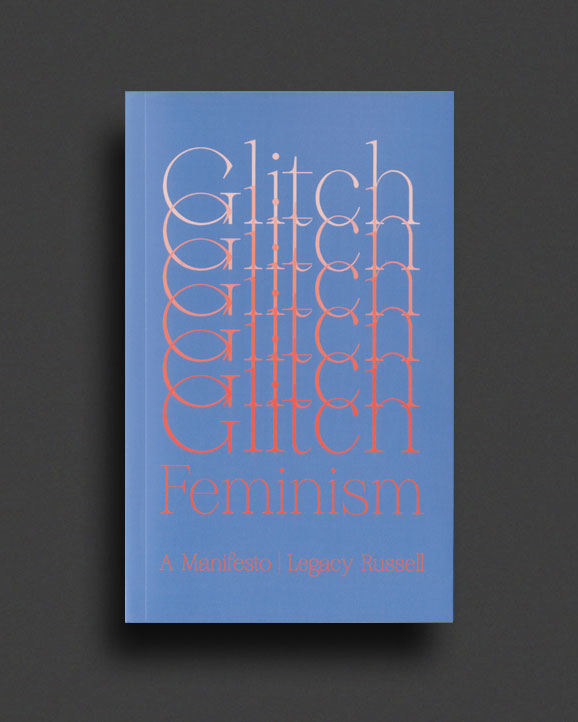
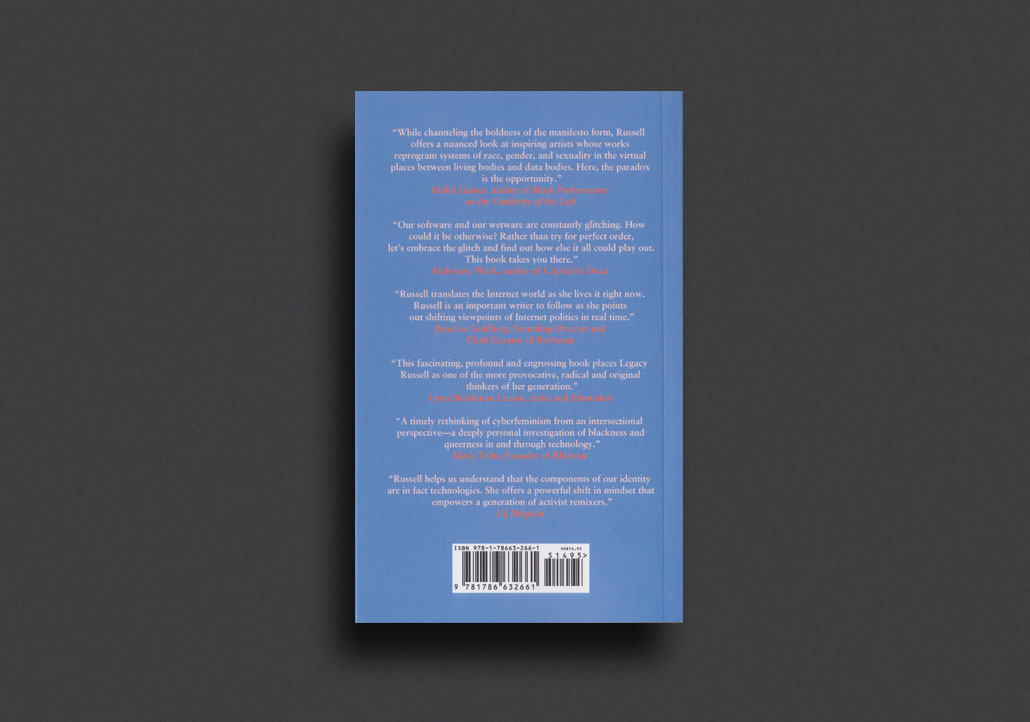
Simone de Beauvoir said, “One is not born, but rather becomes, a woman.” The glitch announces: One is not born, but rather becomes, a body.
The divide between the digital and the real world no longer exists: we are connected all the time. What must we do to work out who we are, and where we belong? How do we find the space to grow, unite and confront the systems of oppression? This conflict can be found in the fissures between the body, gender and identity. Too often, the glitch is considered a mistake, a faulty overlaying, a bug in the system; in contrast, Russell compels us to find liberation here. In a radical call to arms, Legacy Russell argues that we need to embrace the glitch in order to break down the binaries and limitations that define gender, race, sexuality.
Glitch Feminism is a vital new chapter in cyberfeminism, one that explores the relationship between gender, technology and identity. In an urgent manifesto, Russell reveals the many ways that the glitch performs and transforms: how it refuses, throws shade, ghosts, encrypt, mobilises and survives. Developing the argument through memoir, art and critical theory, Russell also looks at the work of contemporary artists who travel through the glitch in their work. Timely and provocative, Glitch Feminism shows how an error can be a revolution.
2017, English
Softcover, 200 pages, 11.8 x 16.5 cm
Published by
Sternberg Press / Berlin
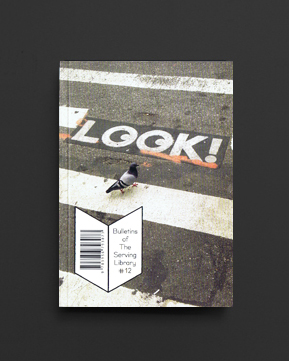
The Serving Library / New York
$25.00 $10.00 - Out of stock
Edited by Francesca Bertolotti-Bailey, Stuart Bertolotti-Bailey, Angie Keefer, David Reinfurt
With contributions by Vincenzo Latronico, Mathew Kneebone & James Langdon, Sarah Demeuse, Johan Hjerpe, 9mother9horse9eyes9, Jumana Manna & Robert Wyatt, Lucy McKenzie, Mark de Silva, Jocelyn Penny Small, Abigail Reynolds
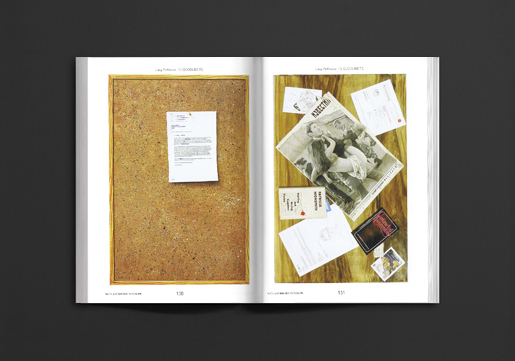
This issue comprises various outlooks on “perspective.” This might be taken to mean something as specific as a particular opinion or as general as an axonometric projection; in short, different ways and means of looking at the world. And so we find Vincenzo Latronico attempting to get in touch with E.T., a collection of Lucy McKenzie’s illusory quodlibets, a conversation between Jumana Manna and Robert Wyatt on art and ethics, a timely analysis of “Lifestyles of the Rich and Famous” by Sarah Demeuse, along with other points of view from Mark de Silva, Jocelyn Penny Small, Abigail Reynolds, James Langdon & Mathew Kneebone, Johan Hjerpe, and the inimitable 9mother9horse9eyes9.
Published by The Serving Library
2011, English/German
Softcover, 240 pages, 24 x 30 cm
Published by
Sternberg Press / Berlin
$79.00 $30.00 - Out of stock
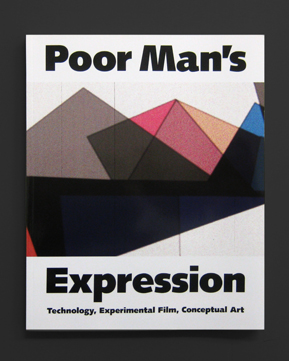
With texts by Sabeth Buchmann, Anselm Franke, Ariane Müller, Branden Joseph, Stefanie Schulte Strathaus, Ian White, Axel John Wieder
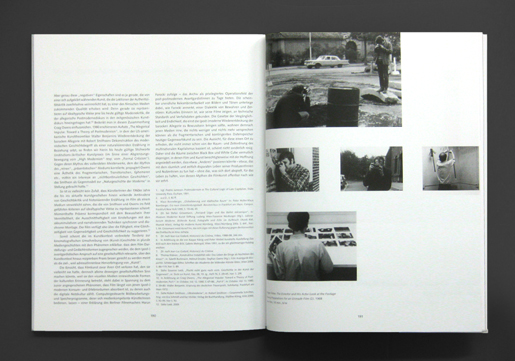
Poor Man's Expression examines the relationship between film, video, technology, and art, with a particular focus on the reciprocal influences between conceptual art and experimental film. The publication is based on the eponymous exhibition in Berlin in 2006, but represents an independent compendium of texts and images beyond the show. Works, lectures and performances by international artists, created for the exhibition and expanded for the publication, are set alongside historical experimental films from the archive of the Freunde der Deutschen Kinemathek in Berlin. The authors and artists respond to the questions that arise as to the semantics of critical and experimental conceptual art, medial representation, and the expansion of a concept of technology towards social functions and psychology; they explore problems of medial control, intellectual property, and a changing concept of the public.
as a point of departure we have assumed that there was once a close relationship between forms that now exist rather separately, namely the realms of visual art, experimental film, literature, poetry, music – and very much the development of technology, too. what is it supposed to mean that 16mm projectors now occupy their luxurious final performance sites at art societies and galleries, while iphone youtube (without open source codecs, to be sure) is the current way to watch a hollis frampton interview.
the other way around, isn’t the gentle entry of the genre of "experimental film" into the realm of "media art" of the 1980s and 1990s itself a transformation analog to general social and medial development brought about by the development of individualization and consumer society? in poor man's expression we have sought, through an advanced setting ("affirmative" neon light surfaces, and the exhibition's "paradoxical" bipartite spatial principle) to address the surrounding "corporate public" architecture of the sony center as well as the film archive deep underground and the dark cinema space of the "avant-garde cinema."
Artists: Stephanie Taylor, Sebestyén Kodolányi, Sebastian Lütgert, Henrik Olesen, Mathias Poledna, Sean Snyder, Daria Martin, Kirsten Pieroth, Martin Ebner, Florian Zeyfang
Images: Anthony Balch, Len Lye, Carolee Schneeman, Bruce Conner, Harry Smith, Joyce Wieland, George Landow, Marie Menken, Ken Jacobs, Rober Breer, Emile Cohl, a.o.
In collaboration with Arsenal Institute for Film and Video art
2020, English
Harcover, 304 pages, 23.7 x 32.4 cm
Published by
Spector Books / Leipzig
$77.00 - Out of stock
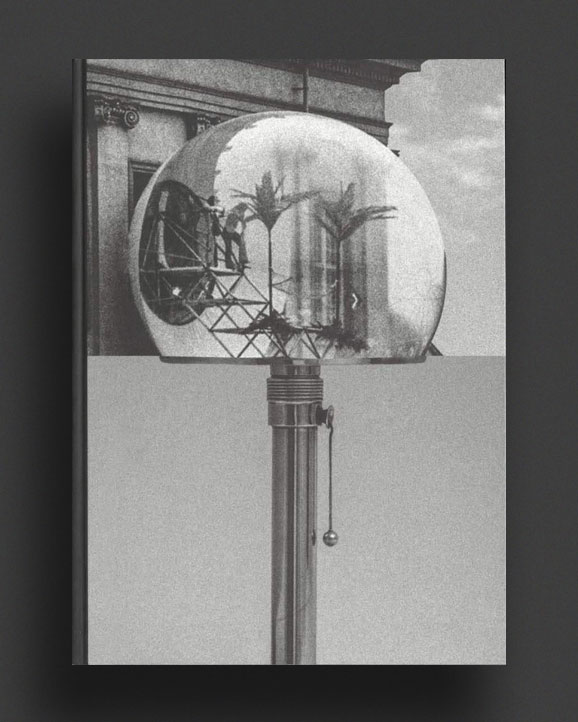
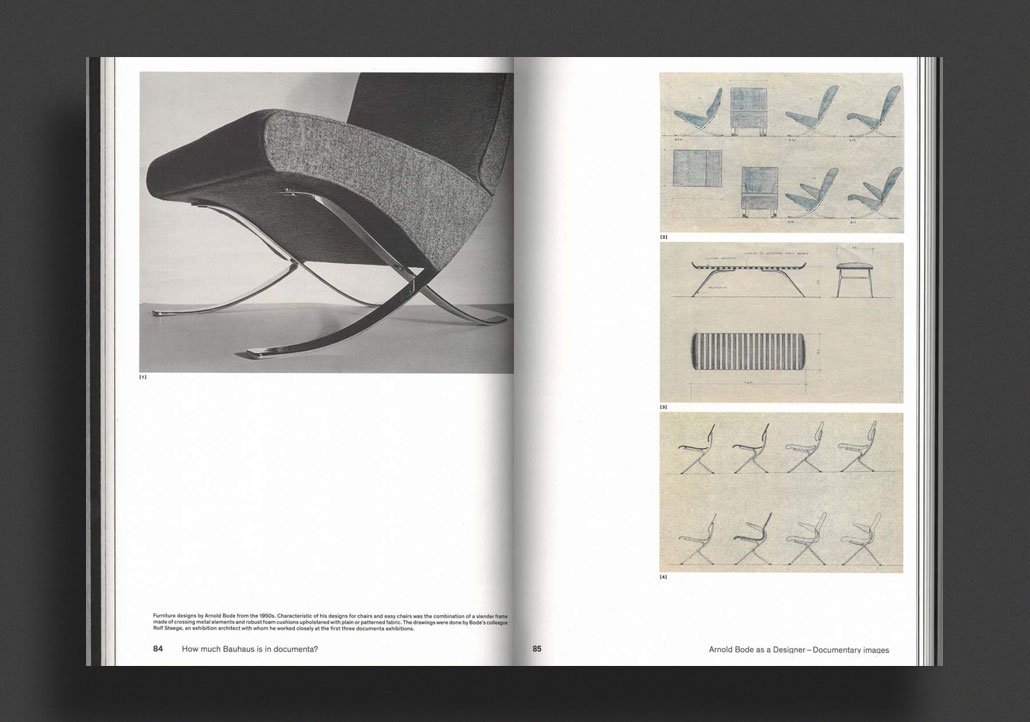
Bauhaus and documenta are two globally successful cultural brands, representing a modern Germany that is both cosmopolitan and innovative. They both came into being at a time when civilization was in a state of collapse, and they both exemplify the idea of the liberating power of art and culture. Looking at them in parallel brings out their similarities and differences and reveals that to some extent they serve to complement one another: for the one, the focus is on mass-produced articles and their everyday usage; the idea of universalism; and the design of consumer goods; for the other, encounters with unique artworks; the experience of diversity; and the critiquing of capitalist consumerism. In a series of critical essays, bolstered by a selection of original material, the publication examines fundamental, yet frequently overlooked aspects of the two cultural brands, whose profile is now once again a controversial subject of debate. The book is published in conjunction with the exhibition presented at the Neue Galerie Kassel from 24 May to 8 September 2019.
Text: Gerda Breuer, Bazon Brock, Kathryn M. Floyd, Andreas Gardt, Walter Grasskamp, Martin Groh, Birgit Jooss, Christiane Keim, Harald Kimpel, Gila Kolb, Julia Meer, Philipp Oswalt, Anna Rühl,
Nora Sternfeld, Daniela Stöppel, Annette Tietenberg, Fred Turner, Daniel Tyradellis, Wolfgang Ullrich, Frank Werner a.o.
2020, English / German /
Softcover, 448 pages, 20 x 28.5 cm
Published by
Spector Books / Leipzig
$84.00 - Out of stock
The positions adopted by Hito Steyerl in her works and texts are of key importance in any consideration of the contemporary role that art and the museum play in society. They are also crucial to experimental forays into different forms of media presentation and to the critical examination of artificial intelligence and its uses. Over the past thirty years, the artist has been tracking the way camera images have mutated, from the analogue image and its manifold possibilities for montage to the fluidity of the split digital image and the implications this then had for the representation of wars, genocides, and capital flows. “We are no longer dealing with the virtual but with a confusing and possibly alien concreteness that we are only beginning to understand,” writes Brian Kuan Wood of the digital visual worlds that the artist presents. The book is being published in conjunction with Hito Steyerl’s survey show, which will take place in autumn 2020 at the Centre Pompidou in Paris and the Kunstsammlung Nordrhein-Westfalen in Düsseldorf.
With texts by: Nora M. Alter, Karen Archey, Teresa Castro, Alexandra Delage, Florian Ebner, Thomas Elsaesser, Ayham Ghraowi, Tom Holert, Doris Krystof, Marcella Lista, Vanessa Joan Müller, Florentine Muhry, Mark Terkessidis, Brian Kuan Wood, and a lecture by Hito Steyerl and Trevor Paglen.
Hito Steyerl, born 1966 in Munich, lives and works in Berlin as an artist, filmmaker, and author. Her work has been shown in numerous international exhibitions and festivals, including the Armory (2019) and the Venice Biennale (in 2019 and 2013). In 2007 she was part of documenta 12.
2002, English
Softcover, 17.9 x 11 cm
1st Edition, Out of print title / used / good
Published by
Magazine House / Tokyo
$140.00 $10.00 - Out of stock
Very scarce first edition of the long out-of-print original "Drawings" book by British illustrator James Jarvis (b. 1970), issued only in Japan only in 2002 by Tokyo's Magazine House, publisher of Relax Magazine and their Relax Library series of books. Cover to cover black and white drawings from Jarvis' sketch books, "Drawings" chronologically collects drawings from the years 1995 to 2000 when he has working with London skate shop Slam City Skates and cult London street wear label Silas. It also introduces his iconic World of Pain and Amos characters for the very first time. A lovely book full of drawing studies.
Very Good copy throughout with crease to cover corner.
2021, English
Softcover, 248 pages, 10.8 x 18 cm
Published by
Sternberg Press / Berlin
$36.00 - Out of stock
Edited and with an introduction by Axel Wieder
Texts by Robert Glück, Ursula K. Le Guin, Audre Lorde, Eileen Myles, Alice Notley, Pauline Oliveros, Adrienne Rich
Contributions by Basma Alsharif, Erika Balsom, Caconrad, Adam Christensen, Beatrice Gibson, Mason Leaver-Yap, Eileen Myles, Irene Revell
From Audre Lorde and Adrienne Rich to Basma Alsharif and Pauline Oliveros, Deux Soeurs brings together a chorus of voices that explore representations of parenthood, friendship, and disobedience. The book acts as a reader to artist Beatrice Gibson’s films, I Hope I’m Loud When I’m Dead (2018) and Two Sisters Who Are Not Sisters (2019), and includes material that informed Gibson’s working process, together with the artist’s texts and notes used in both films. Turning to the figure of the poet as a guide in times of chaos, Deux Soeurs presents a framework for an ethics of artistic and social collaboration.
2012, English
Softcover, 312 pages, 152 x 229 mm
Published by
Semiotext(e) / Los Angeles
$38.00 - Out of stock
A manifesto for “toxic girls” that reclaims the wives and mistresses of modernism for literature and feminism.
I am beginning to realize that taking the self out of our essays is a form of repression. Taking the self out feels like obeying a gag order--pretending an objectivity where there is nothing objective about the experience of confronting and engaging with and swooning over literature." – from Heroines
On the last day of December, 2009 Kate Zambreno began a blog called Frances Farmer Is My Sister, arising from her obsession with the female modernists and her recent transplantation to Akron, Ohio, where her husband held a university job. Widely reposted, Zambreno's blog became an outlet for her highly informed and passionate rants about the fates of the modernist "wives and mistresses." In her blog entries, Zambreno reclaimed the traditionally pathologized biographies of Vivienne Eliot, Jane Bowles, Jean Rhys, and Zelda Fitzgerald: writers and artists themselves who served as male writers' muses only to end their lives silenced, erased, and institutionalized. Over the course of two years, Frances Farmer Is My Sister helped create a community where today's "toxic girls" could devise a new feminist discourse, writing in the margins and developing an alternative canon. In Heroines, Zambreno extends the polemic begun on her blog into a dazzling, original work of literary scholarship. Combing theories that have dictated what literature should be and who is allowed to write it--from T. S. Eliot's New Criticism to the writings of such mid-century intellectuals as Elizabeth Hardwick and Mary McCarthy to the occasional "girl-on-girl crime" of the Second Wave of feminism--she traces the genesis of a cultural template that consistently exiles female experience to the realm of the "minor," and diagnoses women for transgressing social bounds. "ANXIETY: When she experiences it, it's pathological," writes Zambreno. "When he does, it's existential." By advancing the Girl-As-Philosopher, Zambreno reinvents feminism for her generation while providing a model for a newly subjectivized criticism.
2019, English
Softcover, 152 pages, 13.7 x 20 cm
Published by
Semiotext(e) / Los Angeles
$34.00 - Out of stock
On the ongoing project of writing about grief; Zambreno's addendum to Book of Mutter.
"I came up with the idea of writing these notes, or talks, out of a primary desire to not read from Book of Mutter, and instead to keep gesturing to its incompleteness and ongoingness, which connects, for me, to the fragmentary project of literature, and what I long for in writing."
-from Appendix Project
Inspired by the lectures of Roland Barthes, Anne Carson, and Jorge Luis Borges, Kate Zambreno's Appendix Project collects eleven talks and essays written in the course of the year following the publication of Book of Mutter, Zambreno's book on her mother that took her over a decade to write. These surprising and moving performances, underscored by the sleeplessness of the first year of her child's life, contain Zambreno's most original and dazzling thinking and writing to date. In Appendix Project Zambreno thinks through the work of On Kawara, Roland Barthes, W.G. Sebald, Bhanu Kapil, Walter Benjamin, Theresa Hak Kyung Cha, Marguerite Duras, Marlene Dumas, Louise Bourgeois, Doris Salcedo, Jenny Holzer, and more.
2018, English / Arabic, w. German insert
Hardcover, 246 pages, 13 x 19 cm
$59.00 $15.00 - Out of stock
Contributions by Erik Hagen, Mario Pfeifer, Jeffrey J. Smith
Profit over Peace in Western Sahara examines the role of natural resources in the occupation of Africa’s last colony. Not well known to the wider public, the territory of Western Sahara is considered by the United Nations to be awaiting decolonization. Its liberation from colonial rule has come to a standstill due to Morocco’s continued military occupation of a part of the territory. The protracted conflict has dramatic consequences for the Sahrawi people of Western Sahara. This book details, among other things, a remarkable vote in the European Parliament in 2011 when EU offshore fisheries were rejected by the territory. The battle over the fisheries elegantly illustrates how the EU—for political reasons and financial self-interest—has ignored basic principles of international law.
This publication is edited by Erik Hagen and the artist Mario Pfeifer, who has been researching the region since 2011 and provides visual material for the book. Erik Hagen has followed the issue of resources in Western Sahara since 2002, both as a journalist and as a campaigner for the organization Western Sahara Resource Watch. An essay by lawyer Jeffrey J. Smith examines the 2017 landmark judgment in South Africa concerning a bulk vessel carrying conflict minerals from the territory.
Design by Markus Weisbeck
English/Arabic, with a German insert
2018, English
Softcover, 136 pages, 13.5 x 20 cm
Published by
Sternberg Press / Berlin
$46.00 $15.00 - Out of stock
Contributions by Baatarzorig Batjargal & Nomin Bold, Lauren Bonilla, Bumochir Dulam, Rebecca Empson, Richard D.G. Irvine, Yuri Pattison, Rebekah Plueckhahn, Dolgor Ser Od & Marc Schmitz, Hermione Spriggs, Simon O’Sullivan, Deborah Tchoudjinoff, Tsendpurev Tsegmid, Uranchimeg Tsultem, Hedwig Waters, Tuguldur Yondonjamts
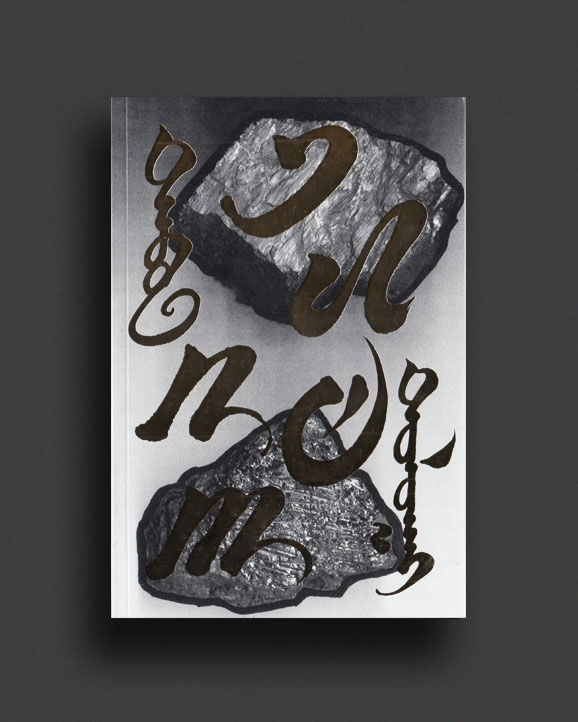
What does the future look like, or feel like, from the perspective of a yak in the coal-mining district of Khovd? From the perspective a Mongolian root extracted, illegally traded, and sold internationally as a pharmaceutical product? Or from that of the toolkit of an urban shaman securing economic futures for professional women in Ulaanbaatar?
Five Heads (Tavan Tolgoi): Art, Anthropology and Mongol Futurism brings together the work of five anthropologists and five artists/collectives researching and responding to the dramatic rise and fall of Mongolia’s mineral economy. Launched in tandem with the eponymous exhibition at greengrassi and Corvi-Mora in London, the publication features visual documentation of multiple art-anthropology exchange processes, ethnographic texts, and further written contributions that introduce contemporary Mongolia as a dynamic site for conceptual and creative experimentation.
In the essay section of this book, the Green Horse Society tells a history of art and culture newly untethered in post-Soviet Mongolia; an early style of ethnographic art known as “One Day in Mongolia” painting provides a canvas for urgent environmental protest; Mongolian hip-hop and nationalist poetry become ciphers for thinking through deep time; and space is opened up for what Simon O’Sullivan terms the art-anthropology probe head to do its important work.
Faced with questions that transcend geographies and act across various scales, Five Heads mounts an experiment in separation (research detached from author, material detached from method) and growth (through the contact space between disciplines) in order to call into being new subjectivities and imagine possible futures.
Five Heads is part of Emerging Subjects of the New Economy, a project funded by the European Research Council and led by Dr. Rebecca Empson in the Department of Anthropology, University College London.
Design by Laurie Robbins
2020, English
Hardcover (cloth), 264 pages, 22 x 14 cm
Published by
Surpllus / Melbourne
$40.00 $20.00 - Out of stock
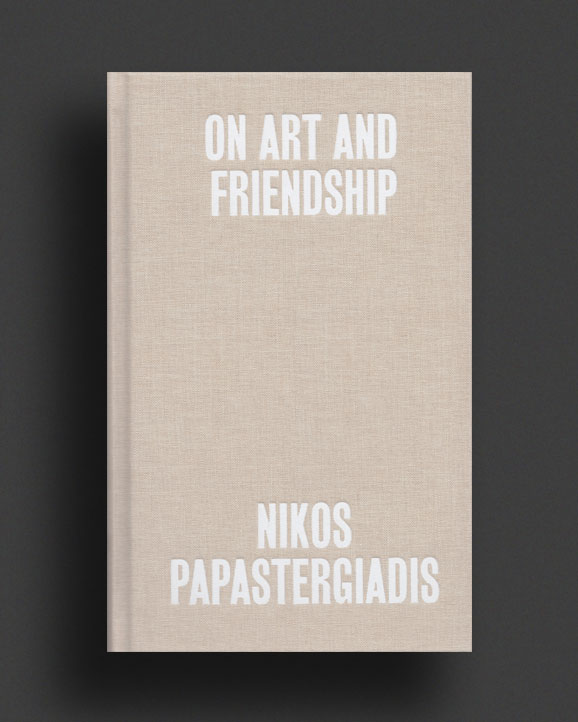
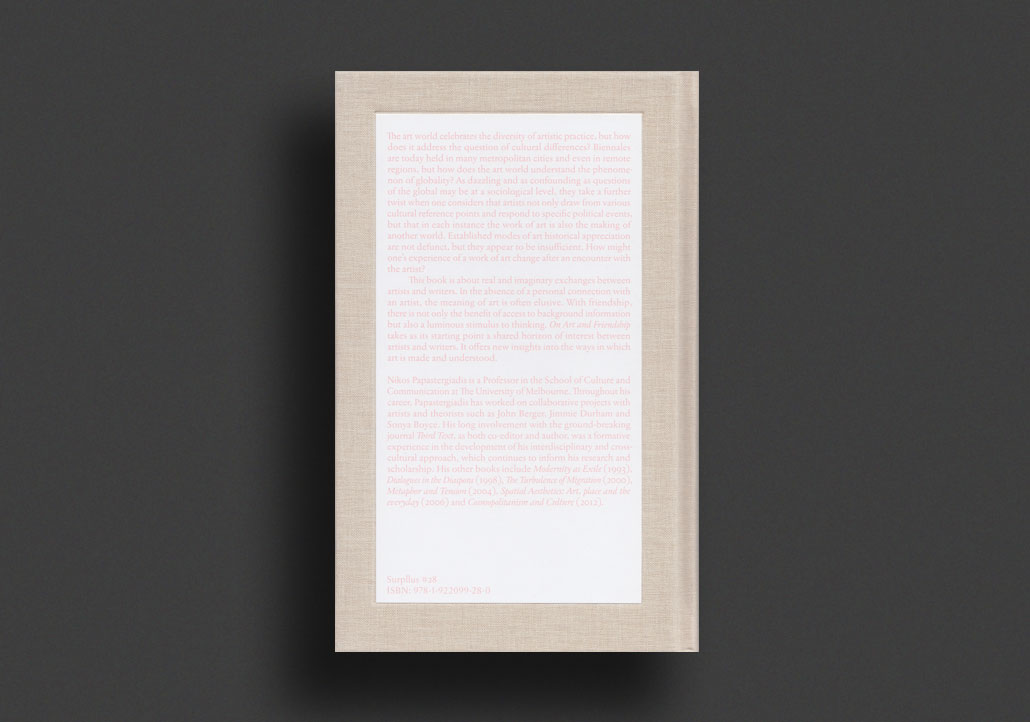
The art world celebrates the diversity of artistic practice, but how does it address the question of cultural differences? Biennales are today held in many metropolitan cities, but how does the art world understand the phenomenon of globality? This book is about real and imaginary exchanges between artists and writers. In the absence of a personal connection with an artist, the meaning of art is often elusive. It takes as its starting point a shared horizon of interest between artists and writers.
Nikos Papastergiadis is the Director of the Research Unit in Public Cultures, based at The University of Melbourne. He is a Professor in the School of Culture and Communication at The University of Melbourne and founder - with Scott McQuire - of the Spatial Aesthetics research cluster. His publications include Modernity as Exile (1993), Dialogues in the Diaspora (1998), The Turbulence of Migration (2000), Metaphor and Tension (2004) Spatial Aesthetics: Art Place and the Everyday (2006), Cosmopolitanism and Culture (2012). He is also the author of numerous essays, which have been translated into over a dozen languages and appeared in major catalogues such as the Biennales of Sydney, Liverpool, Istanbul, Gwangju, Taipei, Lyon, Thessaloniki and Documenta 13.
English, 2020
Softcover, 336 pages, 23.5 x 16 cm
Published by
Duke University Press / North Carolina
$59.00 - Out of stock
In the decades following World War II, France experienced both a period of affluence and a wave of political, artistic, and philosophical discontent that culminated in the countrywide protests of 1968. In Disordering the Establishment Lily Woodruff examines the development of artistic strategies of political resistance in France in this era. Drawing on interviews with artists, curators, and cultural figures of the time, Woodruff analyzes the formal and rhetorical methods that artists used to counter establishment ideology, appeal to direct political engagement, and grapple with French intellectuals' modeling of society. Artists and collectives such as Daniel Buren, André Cadere, the Groupe de Recherche d’Art Visuel, and the Collectif d’Art Sociologique shared an opposition to institutional hegemony by adapting their works to unconventional spaces and audiences, asserting artistic autonomy from art institutions, and embracing interdisciplinarity. In showing how these artists used art to question what art should be and where it should be seen, Woodruff demonstrates how artists challenged and redefined the art establishment and their historical moment.
“Lily Woodruff's examination of conceptual painting in France is at once timely and long overdue. She offers a satisfying total narrative of the artworks situated in relation to the changing dynamics of both the state and the market as they came to determine culture without losing focus of the specificity of the aesthetic dimension of these interventions. She situates artwork as a vehicle for an intellectual and sensual proposition charged with capacity. I learned a tremendous amount from this book.” — Jaleh Mansoor, author of Marshall Plan Modernism: Italian Postwar Abstraction and the Beginnings of Autonomia
“This extraordinarily lucid book is required reading for anyone wondering how the 1960s—and even ‘democracy’ itself—still matters. As Lily Woodruff demonstrates, the top-down instrumentalization of participation was countered in that decade by an artistic landscape ranging from kinetic painting and wearable objects to handheld props and logos. In beautifully readable prose, she replaces French artistic practice in a geopolitical terrain that negotiates both Soviet and Maoist histories, making those practices once again urgently contemporary.” — Rachel Haidu, author of The Absence of Work: Marcel Broodthaers, 1964–1976
2019, English
Paperback, 88 pages, 17 x 23.5 cm
Published by
Koenig Books / London
Moderna Museet / Stockholm
$76.00 - Out of stock
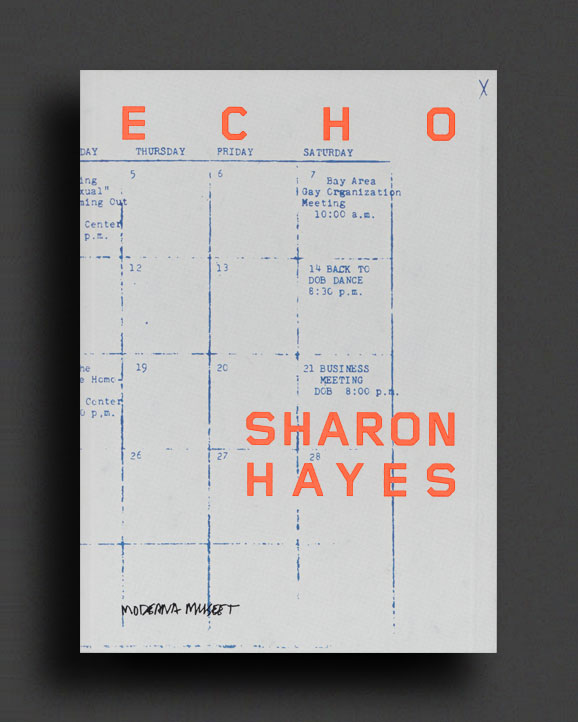
In 1996, Sharon Hayes undertook her Lesbian Love Tour, during which she visited and photographed 45 "lesbian living rooms" in nearly as many cities. Hayes is interested in how political goals or desires can be manifested in concrete terms and, starting from individuals or smaller groups, can grow into larger movements. The trained journalist and anthropologist is currently one of the most influential politically and socially committed artists of the United States.
The exhibition, Echo at Moderna Museet, Stockholm, explores the gallery space as an echo chamber: with voices and materials reverberating between different historic events. It also references a feminist interpretation of the classical myth of Echo, the nymph who is cursed for her conversational skills. She is condemned to only repeat fragments said by others, sounds devoid of meaning.
The echo resonates as both material and form throughout the work, including a new work made for the exhibition as part of the artist’s ongoing Ricerche project, made in dialogue with Comizi d’amore (1965), Pier Paolo Pasolini’s interview on sex and relations.
Hayes video piece, Symbionese Liberation Army (SLA) (2003), is one example of what the artists calls anachronisms – where an unresolved issue or conflict from the past is approached from a different moment in time. In this instance Hayes reads messages to a live audience from the kidnapped Patty Hearst to her parents that were aired on the radio in 1974.
Other ‘oral translations’ of texts and acts of speech by Hayes are replicated in the gallery for a contemporary audience.
Published on the occasion of the exhibition, Sharon Hayes: Echo at Moderna Museet, Stockholm (13 April – 11 August 2019).
Co-published by Moderna Museet and Koenig Books.
English and Swedish text.
2016, English
Softcover, 100 pages, 15 x 21 cm
Published by
Fogo Islands Arts / Newfoundland
Sternberg Press / Berlin
$54.00 $5.00 - Out of stock
Edited by Alexandra McIntosh, Nicolaus Schafhausen
Contributions by Melissa Gronlund, Will Holder, Hannah Rickards, Nicolaus Schafhausen
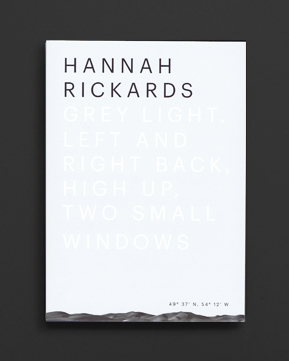
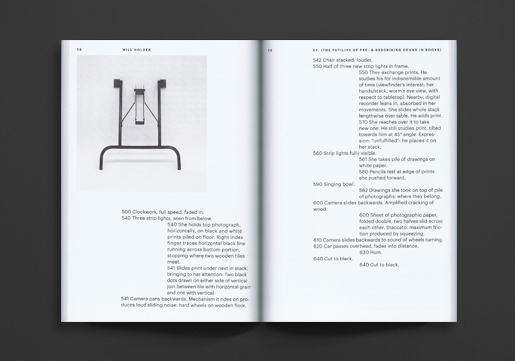
Grey light. Left and right back, high up, two small windows (2014) is a major new work by London-based artist Hannah Rickards commissioned by Fogo Island Arts. Grey light is a two-screen projected video installation with eight channels of sound. Structured rhythmically around the pattern of a foghorn sounding, the piece finds its origins in the notion of the foghorn as an auditory marker for nonvisibility, or imagelessness.
This publication features texts by Melissa Gronlund and Will Holder, a conversation between Rickards and Nicolaus Schafhausen, and striking new photographic imagery drawn from the installation’s physical materials and production process. Like Rickards’s work, the publication aims to bridge the distance between visual experience and its expression in language, whether spoken, written, or gestural.
1973, English
Hardcover, 312 pages, 26 x 21 x 3.4 cm
1st Edition, Out of print title / used / average
Published by
Architectural Press / London
$80.00 $40.00 - Out of stock
Hardcover first edition of this scarce book on military architecture in North West Europe between 1900 and 1945, written by Keith Mallory and Arvid Ottar in 1973 and published by London's Architectural Press.
Profusely illustrated throughout with photographs, diagrams and architectural plans, including projects such Maginot Line, Atlantic Wall, Autobahn and West Wall, Mulberry Harbour, plus air raid shelters, bunkers, forts, submarine pens and more spanning Germany, Britain, Belgium, France, etc. A very informative and collectible volume.
Excerpt from jacket blurb:
"Since 1914 astronomical sums have been spent on war and the preparation for war. A large part of this money has been devoted to military construction, ranging from huge concrete emplacements of almost indestructible dimensions to the flimsiest of prefabricated hutments. Yet although expenditure on various forms of military building in this century has almost certainly been greater than that on the civilian sector, the architecture associated with it has been largely ignored by historians. Its importance,
however, goes far beyond its sheer, brute use of resources, significant though that has been in itself. As this deeply researched and extraordinarily entertaining book shows, military architecture in its various manifestations reflected and influenced the course of warfare to a surprising degree...."
Ex-library copy with general wear to cover and pages throughout and glue damage to two pages. No dust jacket, with associated library markings.
1969, English
Hardcover (library bound), 162 pages, 29.5 x 22.5 cm
1st Edition, Out of print title / used / good
Published by
Universe Books / New York
$90.00 $40.00 - Out of stock
First 1969 English language edition of the collectable Modern Interiors by legendary Italian interiors editor Franco Magnani, originally published in Italian under the title "idee per la casa". This edition was also printed in Italy, evident from the stunning crisp, colour-saturated photographic reproductions of the contemporary home at the close of the 1960s. Almost 200 images capture that wonderful period of transition from the organic 1950s into the dynamic environments of 1960s pop and the space age, featuring the work of designers, manufacturers, architects, and artists such as Ludwig Mies Van Der Rohe, Tobia Scarpa, Vico Magistretti, Cassina, Charles Eames, Herman Miller, Arteluce, Venini, Achille Castiglione, Flos, Knoll, Artemide, Marcel Breuer, Eero Saarinen, Kartell, Marco Zanuso, Cini Boeri, Arflex, Dino Frigerio, Enrico Peressutti, Thonet, Joe Colombo, Carla Venosta, Roberto Mango, Fontana Arte, Giuseppe Ajmone, Marco Zanuso, Artemide, Paleari Arredamenti, Driade, Marco Comolli, Antonio Calderara, Carlo Graffi, Alberto Rosselli, Gavina, Claudio Dini, Marcello Grisotti, Rafaella Crespi, Emilia Sal Giorgio Madini, Giuseppe Gibelli, Lorenzo Forges, Bruno Munari, Arredamenti Pillinini, Tito Agnoti, Mario Passanti, George Coslin, and many more! Includes diagrams, plans, and identifications of all the designers and manufacturers of the furniture, fabrics, wall coverings, tiles, lamps and accessories illustrated, making it a valuable resource for anyone interested in the decorative arts of the 1960s.
Good copy throughout but with library-binding/covering over cloth and associated library markings.
2014, English
Softcover (w. dust jacket and laser cuts throughout book), 160 pages, 90 color ill., 15.2 x 20.3 cm
Published by
Sternberg Press / Berlin
$100.00 $20.00 - Out of stock
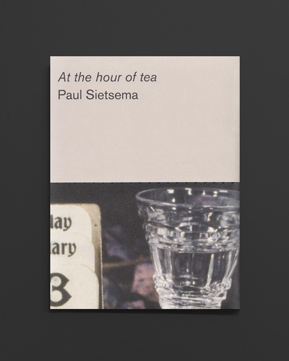
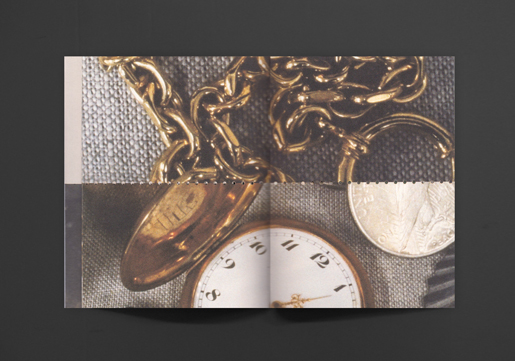
Paul Sietsema’s work in film and painting addresses the objects and systems of cultural production, tracing the circuits of proliferation and consumption that allow these objects to be taken up into history. At the hour of tea is a collection of stills from his most recent 16 mm film of the same title.
A filmic space develops within pages of this unique artist's book, moving through and layering the film’s imagery—tableaux of objects—via a system of laser-cut portals and transparent screenlike pages. Sietsema employs a language of clichéd “collectible” objects—Roman glass, coins, minor antiquities—to invoke the idea of a salon or space of contemplation as a parallel to the contemporary studio, and the idea of a kind of leisure-based consumptive creativity. Drawing on the design idea of skeuomorphism, common in modern computer interfaces, Sietsema fills his tableaux with now-outmoded items that live on as icons of their former functions.
Copublished with RITE EDITIONS
Design by Paul Sietsema and Geoff Kaplan
2016, English / German
Softcover, 44 pages, 14 x 21 cm
Published by
Halle für Kunst / Lüneburg
Sternberg Press / Berlin
$34.00 $15.00 - Out of stock
Edited by Sandro Droschl
Texts by Christian Egger and João Ribas
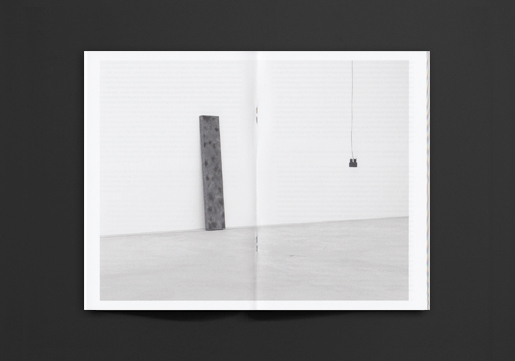
Following the 2015 exhibition “Florian Hecker/John McCracken” at Künstlerhaus, Halle für Kunst & Medien Graz, this publication probes the experimental capacity of the white-cube space of the gallery. For the exhibition, two complementary yet autonomous artists were brought into dialogue with each other: German artist and computer composer Florian Hecker, and the late American sculptor John McCracken.
The fiberglass-coated, monochrome “planks” by McCracken spanned the floor and the walls of the building, evoking a juncture between painting and sculpture, while Hecker’s computer-generated sound pieces dramatized both space and time. By combining the work of the two artists, a framework was created in which an aesthetic experience occurred between the shifting boundaries and intersections of sculpture and sound as they affected each other within a space consisting of geometric and architectural formations as well as temporal and subjective formations. At the same time, the viewer/listener became more sensitized to the conditions, qualities, and degrees of intensity between the physical and the ephemeral.
The publication includes a curatorial introduction by Christian Egger, and a comprehensive essay by the author and curator of the Serralves Museum of Contemporary Art, Porto, João Ribas. The cover has been designed by Florian Hecker using an objectness measure algorithm.
Copublished with Künstlerhaus, Halle für Kunst & Medien Graz
Design by NORM, Zurich
2012, English
Softcover, 92 pages, 20 x 20.5 cm
Ed. of 1000,
Published by
The Power Station / Dallas
$55.00 $10.00 - In stock -
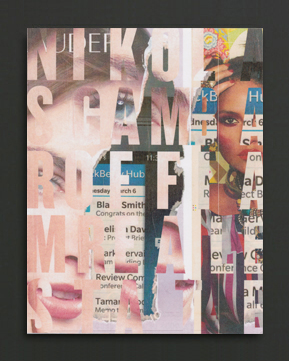
Catalogue produced in an edition of 1000 copies to accompany the exhibition Nikolas Gambaroff "I Am Real Estate" at The Power Station, Dallas, October 19 - December 14, 2012.
The Power Station is a not-for-profit contemporary art space in Exposition Park, Dallas, Texas, founded by Janelle and Alden Pinnell in 2011. It is housed in a former Dallas Power & Light building which was constructed in 1920, and hosts large scale exhibitions which compliment the building's raw architecture. For each of its international exhibitions, The Power Station works with the artists to produce a publication in conjunction with their project, limited to 1000 copies. Its programming also includes a summer exhibition and additional events each year. The building includes an apartment where artists can live as they create and build their installations. The first exhibitor was American artist Oscar Tuazon.
2018, English
Softcover (staple-bound),
Ed. of 950,
Published by
Ground / UK
$18.00 $10.00 - Out of stock
Ground is a zine that looks beyond institutions in their current form as dominant frameworks for artistic production, and embraces grassroots political and aesthetic perspectives.
Edited by Harry Burke and Marlie Mul.
Features contributions from The Gate, Linda Stupart, Beatrice Glow, Jean-Michel Wicker, Khairani Barokka, Shellyne Rodriguez, and more.
Edition of 950 copies.
2018, English
Softcover, 144 pages, 22 x 21 cm
Published by
Secession / Vienna
$75.00 - Out of stock
This catalogue accompanies "Other Mechanisms", a major group show at Secession in Vienna, 2018, that continues on from the exhibition "Mechanisms", held at CCA Wattis in San Francisco.
"Other Mechanisms" points to a present moment when machines don't look much like machines. Many aren't even called machines. Heavy and greasy machinery is absent from the smooth surfaces of digital interfaces and the weightlessness of cloud computing. Tool, appliance, device, apparatus, instrument, computer, hardware, software, program, server, processor, microchip, setting, algorithm, infrastructure, system, logistic, protocol, parameter - the terms for today's machines accumulate, evolve, and overlap.
Machines are part of the air we breathe, overseeing our lives and our bodies, from the way we communicate and consume to the way we trade and travel. Some are made of metal, but many others are made of rules or algorithms, which are infinitely more fluid and flexible. Some are objects or devices, but others are systems and infrastructures - a machine can be a thing as well as a method for organizing things. Objects yield to infrastructure. Work turns to management. Machines become mechanisms.
The works in this exhibition reflect on what it could mean to contest the regime of the machine. They compromise its tools, misuse its technologies, reroute its engineering, complicate its measurements. These other mechanisms add detours or dead ends to circulation routes, or insert delinquent trajectories that create distortions over time. They are made of knots, blanks, and incompatible settings. They demand more from their "users," forgoing protocols of convenience and immediate intelligibility. They reinsert the awkwardness of the human body, with all of its irregularities and inefficiencies.
Art can't stop the machine - nothing can. The question is not whether or not to embrace the machine - it's too late for that - but how to complicate it by testing existing systems with impossible tools and elaborate protocols that misalign outputs from their inputs.
Texts by: Jennifer Alexander, Franco Berardi, Benjamin H. Bratton, Gilles Châtelet, Gilles Deleuze & Felix Guattari, Keller Easterling, Vilém Flusser, Sigfried Gideon, Martin Heidegger, Anthony Huberman, K.G. Pontus Hultén, Maurizio Lazzarato, Pamela Lee, Les Levine, Jean-François Lyotard, Robert King Merton, Meredith Meredith, Lewis Mumford, Gerald Raunig, Nishant Shah, Robert Snowden, and Joseph Vogl.
With works by artists: Zarouhie Abdalian, Lutz Bacher, Nairy Baghramian, Eva Barto, Patricia L. Boyd, Nina Canell & Robin Watkins, Jay DeFeo, Trisha Donnelly, Harun Farocki, Howard Fried, Aaron Flint Jamison, Jacob Kassay, Garry Neill Kennedy, Frederick Kiesler, Pope.L, Louise Lawler, Sam Lewitt, Park McArthur, Jean-Luc Moulène, Cameron Rowland, Sturtevant, and Danh Vo.