World Food Books' programme is largely produced on Kulin Nation land. We acknowledge the Wurundjeri people of the Kulin Nation as the first and continuing custodians of this land, and pay respect to their Elders past, present, and emerging.
World Food Books is an arts and special interests bookshop in Naarm / Melbourne. Founded in 2010, World Food Books is devoted to the presentation of a rotating, hand-selection of international art, design, literary and counterculture publications with an emphasis on the anti-traditional, the experimental, the avant-garde, the heretic, the marginal.
Presenting new titles alongside rare and out-of-print books, catalogues and journals spanning the fields of modern and contemporary art, design, photography, illustration, film, literature, poetry, cultural theory, philosophy, sexuality, popular and underground culture in its many radical forms, World Food Books wishes to encourage adventurous, thoughtful and open-minded reading, looking, writing, and exchange of publishing and ideas, both current and historical.
As well as our bookshop, located in Melbourne's historical Nicholas Building, all of our inventory is available internationally via our online mail-order service.
World Food Books semi-regularly co-ordinates "Occasions", a programme of exhibits and events at the bookshop and in partnership with other hosts (such as museums and art galleries) that develop out of the activities, relationships and content of the bookshop itself.
World Food Books
The Nicholas Building
37 Swanston Street
Room 5, Level 6
Melbourne 3000
Australia
SHOP HOURS:
Thu–Fri 12–6, Sat 12–5
WEB-SHOP OPEN 24/7
World Food Books
Postal Address:
PO Box 435
Flinders Lane
Victoria 8009
Australia
Art
Theory / Essay
Architecture / Interior
Graphic Design / Typography
Photography
Fashion
Eros
LGBTQ+
Fiction / Poetry
Weird / Speculative / Science Fiction / Horror
Transgressive / Visceral / Abject
Symbolism / Decadence / Fin de siècle
Film / Video
Painting
Sculpture / Installation
Performance / Dance / Theater
Drawing
Sound / Music
Curatorial
Group Shows / Collections
Periodicals
Out-of-print / Rare
Posters / Ephemera / Discs
Signed Books
World Food Books Gift Voucher
World Food Book Bag
Australian Art
Australian Fiction
Australian Science Fiction / Speculative Fiction
Australian Poetry
Australian Photography
Japanese Photography
Conceptual Art
Minimal Art
Dada
'Pataphysics / Oulipo
Fluxus
Concrete Poetry
Pop Art
Surrealism
Arte Povera
Arte Informale / Haute Pâte / Tachism
Nouveau Réalisme / Zero / Kinetic
Situationism / Lettrism
Collage / Mail Art / Xerox Art
Art Brut / Folk / Visionary / Fantastic
Illustration / Graphic Art / Bandes Dessinées
Furniture
Italian Radical Design / Postmodernism
Textiles
Ceramics / Glass
Counterculture
Protest / Revolt
Philosophy
Psychoanalysis
Anthropology
Anarchism
Socialism / Anarchism / Communism / Capitalism
Literary Theory / Semiotics / Language
Feminism / Women's Studies
Gender Studies / Sexuality
Anthropology
Fetishism / BDSM
Drugs / Psychedelia
Crime / Violence
Animal Rights / Veganism
Occult / Esoterica
Ecology / Earth / Alternative Living
Whole Earth / Crafts
All prices in AUD (Australian dollars)
Pick-Ups
Pick-up orders can be collected in our bookshop during opening hours after order date. Please collect any Pick-up orders within 2 weeks of ordering as we have limited storage space. Orders will be released back into stock if not collected within this time. No refunds can be made for pick-ups left un-collected. If you cannot make it in to the bookshop in this time-frame, please choose postage option.
Return Policy
All sales are final. We do accept returns (for refund or exchange) for items received in error. All our orders are packed with special care using heavy-duty padding and cardboard book-mailers or bubble mailers (for smaller books), using reinforcement where required. We cannot take responsibility for any lost, stolen or damaged parcels.
Insurance
Should you wish to insure your package, please email us directly after placing your order and we can organise this at a small extra expense. Although all standard/express tracked packages are very safe and dependable, we cannot take responsibility for any lost, stolen or damaged parcels. We recommend insurance on valuable orders.
Interested in selling your old books, catalogues, journals, magazines, comics, fanzines, ephemera? We are always looking for interesting, unusual and out-of-print books to buy. We only buy books in our fields of interest and specialty, and that we feel we can resell.
We base these prices on desirability, market value, in-print prices, condition and our current stock levels. We offer cash, store credit, and can take stock on consignment. All
about 25% of the price we expect to get when we sell them, or 30% in store credit. We base these prices on desirability, market value, in-print prices, condition and our current stock levels.
Sell your books any day of the week. You can drop them off and return later. If you have a lot of books, we can visit your Sydney home.
We buy books that we feel we can resell. We offer about 25 % of the price we expect to get when we sell them, or 30% in store credit. We base these prices on desirability, market value, in-print prices, condition and our current stock levels.
Philadelphia Wireman
03 August - 01 September, 2018
World Food Books is proud to announce our next Occasion, the first presentation of sculptures by Philadelphia Wireman in Australia.
The Philadelphia Wireman sculptures were found abandoned in an alley off Philadelphia’s South Street on trash night in 1982. Their discovery in a rapidly-changing neighbourhood undergoing extensive renovation, compounded with the failure of all attempts to locate the artist, suggests that the works may have been discarded after the maker’s death. Dubbed the "Philadelphia Wireman" during the first exhibition of this work, in 1985, the maker’s name, age, ethnicity, and even gender remain uncertain. The entire collection totals approximately 1200 pieces, all intricately bound together with tightly-wound heavy-gauge wire (along with a few small, abstract marker drawings, reminiscent both of Mark Tobey and J.B. Murry). The dense construction of the work, despite a modest range of scale and materials, is singularly obsessive and disciplined in design: a wire armature or exoskeleton firmly binds a bricolage of found objects including plastic, glass, food packaging, umbrella parts, tape, rubber, batteries, pens, leather, reflectors, nuts and bolts, nails, foil, coins, toys, watches, eyeglasses, tools, and jewellery.
Heavy with associations—anthropomorphic, zoomorphic, and socio-cultural responses to wrapped detritus—the totemic sculptures by Philadelphia Wireman have been discussed in the context of work created to fulfil the shamanistic needs of alternative religions in American culture. Curators, collectors, and critics have variously compared certain pieces to sculpture from Classical antiquity, Native American medicine bundles, African-American memory jugs, and African fetish objects. Reflecting the artist’s prolific and incredibly focused scavenging impulse, and despite—or perhaps enhanced by—their anonymity, these enigmatic objects function as urban artefacts and arbiters of power, though their origin and purpose is unknown. Philadelphia Wireman, whatever their identity, possessed an astonishing ability to isolate and communicate the concepts of power and energy through the selection and transformation of ordinary materials. Over the course of the past two decades, this collection has come to be regarded as an important discovery in the field of self-taught art and vernacular art.
Presented in collaboration with Fleisher-Ollman Gallery, Philadelphia, and Robert Heald, Wellington.
Susan Te Kahurangi King
02 February - 10 March, 2018
Susan Te Kahurangi King (24 February 1951 - ) has been a confident and prolific artist since she was a young child, drawing with readily available materials - pencils, ballpoint pens and felt-tip markers, on whatever paper is at hand. Between the ages of four and six Susan slowly ceased verbal communication. Her grandparents William and Myrtle Murphy had developed a special bond with Susan so they took on caring responsibilities for extended periods. Myrtle began informally archiving her work, carefully collecting and storing the drawings and compiling scrapbooks. No drawing was insignificant; every scrap of paper was kept. The King family are now the custodians of a vast collection containing over 7000 individual works, from tiny scraps of paper through to 5 meter long rolls.
The scrapbooks and diaries reveal Myrtle to be a woman of great patience and compassion, seeking to understand a child who was not always behaving as expected. She encouraged Susan to be observant, to explore her environment and absorb all the sights and sounds. Myrtle would show Susan’s drawings to friends and people in her community that she had dealings with, such as shopkeepers and postal workers, but this was not simply a case of a grandmother’s bias. She recognised that Susan had developed a sophisticated and unique visual language and sincerely believed that her art deserved serious attention.
This was an unorthodox attitude for the time. To provide some context, Jean Dubuffet coined the term Art Brut in 1945 to describe work created by self-taught artists – specifically residents of psychiatric institutions and those he considered to be visionaries or eccentrics. In 1972 Roger Cardinal extended this concept by adopting the term Outsider Art to describe work made by non-academically trained artists operating outside of mainstream art networks through choice or circumstance. Susan was born in Te Aroha, New Zealand in 1951, far from the artistic hubs of Paris and London that Dubuffet and Cardinal operated in. That Myrtle fêted Susan as a self-taught artist who deserved to be taken seriously shows how progressive her attitudes were.
Susan’s parents Doug and Dawn were also progressive. Over the years they had consulted numerous health practitioners about Susan’s condition, as the medical establishment could not provide an explanation as to why she had lapsed into silence. Dawn educated herself in the field of homeopathy and went on to treat all twelve of her children using these principles – basing prescriptions on her observations of their physical, mental and emotional state.
Doug was a linguist with an interest in philosophy who devoted what little spare time he had to studying Maori language and culture. To some extent their willingness to explore the fringes of the mainstream made them outsiders too but it was their commitment to living with integrity and their respect for individuality that ensured Susan’s creativity was always encouraged.
Even though Susan’s family supported her artistic pursuits, some staff in schools and hospitals saw it as an impediment to her assimilation into the community and discouraged it in a variety of ways. Her family was not always aware of this and therefore did not fully understand why Susan stopped drawing in the early 1990s. However, rather than dwell on the challenges that Susan faced in pursuit of her artistic practice, they prefer to highlight her achievements. In 2008 Susan began drawing again in earnest, after an almost 20 year interruption, and her work is now shown in galleries around the world.
Susan grew up without television and has been heavily influenced by the comics she read as a child. She is absolutely fearless in the appropriation of recognizable characters, such as Donald Duck and Mickey Mouse, in her work. She twists their limbs, contorts their faces, compresses them together, blends them into complex patterned backgrounds - always imbuing them with an incredible energy. Although Susan often used pop culture characters in her work they are not naive or childlike. These are drawings by a brilliant self-taught artist who has been creating exceptional work for decades without an audience in mind.
Mladen Stilinović
"Various Works 1986 - 1999"
02 February 16 - September 10, 2016
Various works 1986 - 1999, from two houses, from the collections of John Nixon, Sue Cramer, Kerrie Poliness, Peter Haffenden and Phoebe Haffenden.
Including: Geometry of Cakes (various shelves), 1993; Poor People’s Law (black and white plate), 1993; White Absence (glasses, ruler, set square, silver spoon, silver ladel with skin photograph and wooden cubes), 1990-1996; Exploitation of the Dead (grey and red star painting, wooden painting, black spoon with red table, red plate), 1984-1990; Money and Zeros (zero tie, paintings made for friends in Australia (Sue, John, Kerrie), numbers painting), 1991-1992; Words - Slogans (various t-shirts) - “they talk about the death of art...help! someone is trying to kill me”, “my sweet little lamb”, “work is a disease - Karl Marx”; Various artist books, catalogues, monographs, videos; Poster from exhibition Insulting Anarchy; "Circular" Croatian - Australian edition; Artist book by Vlado Martek (Dostoyevsky); more.
Thanks to Mladen Stilinović and Branka Stipančić.
Jonathan Walker
Always Will Need To Wear Winter Shirt Blue + Ochre Small Check Pattern
21 August - 21 September, 2015
Untitled
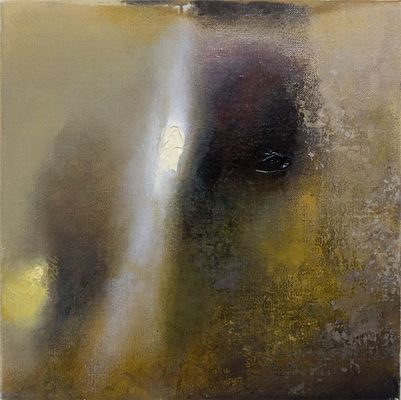
I am not a great reader of poetry but I always return to the work of Melbourne poet, Vincent Buckley (1925- 1988). Perhaps I find his most tantalising piece to be not a finished poem but a fragment left on a scrap of paper discovered on his desk after the poet’s death.
The poetry gathers like oil
In the word-core, and spreads
It has its music meet,
Its music is in movement.
This fragment is more the shell left behind from a volatile thought than a finished poem. I find the last two lines honest but awkward whereas the first two lines work like an arrow. Most likely he could not find a resolution so it was left. Still, in its present form, it remains an eloquent testimony to the ultimate failure of a medium to express mobile thought and sensation, in Buckley’s case, through verbal language. It’s an important matter because this is something all artists have to deal with regardless of the medium.
I have never written a poem, however, I am forever copying fragments from books on paper scraps in a vain effort to fix certain notions in my head. At first, they function as bookmarks that are sometimes returned to when I open the book. But before long, as they accumulate, they fall out littering the table interspersed with A4 photocopies, bills, books and medications.
To return to Buckley’s fragment, the first two lines very much evoke how I paint nowadays. As you age, detail diminishes and patches of light become more luminous and float. I feel the most honest way of dealing with this is by smearing the oil paint on the canvas with the fingers and working close-up, blind. Only if the patches coalesce into an approaching image can the work gain a life.
-
Jonathan Walker was born in Melbourne, Australia and brought up on a dairy farm in Gippsland. In the 1970’s he studied painting at RMIT and won the Harold Wright Scholarship to the British Museum, London. During the 1980’s he exhibited at Pinacotheca Gallery, Richmond and had work shown at the NGV and Heidi City Art Gallery. Over the same period he designed the cover for the “Epigenesi” LP by Giancarlo Toniutti, Italy and conducted a mail exchange work with Achim Wollscheid, Germany. The work with artists through the post resulted in an article published in the bicentenary issue of Art and Australia 1988. He showed in artist run spaces such as WestSpace in the 90’s and 2000’s, and until 2012, taught painting at Victoria University, which is where we (Colleen Ahern and Lisa Radford) as organisers of the exhibition, among many others, had the privilege of being his student.
Walker’s knowledge was imparted to students through the careful selection of music, literature, and artists found in books that he himself had ordered for the library. Walker’s strategy was the generosity of sharing his vast knowledge with references specific to each student and their context.
Walker’s paintings share a similar focus and intimacy.
This exhibition presents a small selection of recent paintings alongside a publication that includes Walker’s writing. Observational and analytical, Walker’s work is a type of material notation — the time of day, colour and how it is blended, the both specific and fleeting location of a reflection on lino or the question of whether a chair leg should be included in a painting.
Please join us on Friday August 21 between 6-8pm to celebrate the opening of the exhibition.
Curated by Colleen Ahern and Lisa Radford.
B. Wurtz
Curated by Nic Tammens
March 26 - April 4, 2015
B.Wurtz works from a basement studio in his home on Manhattan’s Lower East Side.
This local fact is attested to by the plastic shopping bags and newsprint circulars that appear in his work. As formal objects, they don’t make loud claims about their origins but nonetheless transmit street addresses and places of business from the bottom of this long thin island. Like plenty of artists, Wurtz is affected by what is local and what is consumed. His work is underpinned by this ethic. It often speaks from a neighborhood or reads like the contents of a hamper:
“BLACK PLUMS $1.29 lb.”
“Food Bazaar”
“USDA Whole Pork Shoulder Picnic 99c lb.”
“RITE AID Pharmacy, with us it’s personal.”
“H. Brickman & Sons.”
“Sweet Yams 59c lb."
Most of the work in this exhibition was made while the artist was in residence at Dieu Donne, a workshop dedicated to paper craft in Midtown. Here Wurtz fabricated assemblages with paper and objects that are relatively lightweight, with the intention that they would be easily transportable to Australia. This consideration isn’t absolute in Wurtz’s work, but was prescriptive for making the current exhibition light and cheap. Packed in two boxes, these works were sent from a USPS post office on the Lower East Side and delivered to North Melbourne by Australia Post.
Wurtz appears courtesy of Metro Pictures, New York.
Thanks to Rob Halverson, Joshua Petherick, Sari de Mallory, Matt Hinkley, Helen Johnson, Fayen d'Evie, Ask Kilmartin, Lisa Radon, Ellena Savage, Yale Union, and "Elizabeth".
John Nixon
"Archive"
December 15 - January 20, 2014
The presentation of John Nixon's archive offered a rare showcase of this extensive collection of the artist's own publications, catalogues, posters, ephemera, editions and more, from the mid 1980s onwards, alongside a selection of his artworks.
Organized by John Nixon, Joshua Petherick and Matt Hinkley.
<a href=http://wfb.public-office.info/artist/john-nixon>All titles by John Nixon
"Habitat"
at Minerva, Sydney (organised by Joshua Petherick and Matt Hinkley)
November 15 - December 20, 2014
Lupo Borgonovo, Janet Burchill & Jennifer McCamley,
Lewis Fidock, HR Giger, Piero Gilardi, Veit Laurent Kurz,
Cinzia Ruggeri, Michael E. Smith, Lucie Stahl, Daniel Weil, Wols
Press Release:
“...It contained seven objects. The slender fluted bone, surely formed for flight, surely from the wing of some large bird. Three archaic circuitboards, faced with mazes of gold. A smooth white sphere of baked clay. An age-blackened fragment of lace. A fingerlength segment of what she assumed was bone from a human wrist, grayish white, inset smoothly with the silicon shaft of a small instrument that must once have ridden flush with the surface of the skin - but the thing’s face was seared and blackened.”
William Gibson, “Count Zero”, 1986
"Autumn Projects Archive"
Curated by Liza Vasiliou
March 6 - March 15, 2014
World Food Books, in conjunction with the Virgin Australia Melbourne Fashion Festival 2014, presented the Autumn Projects archive, consisting of a selection of early examples in Australian fashion with a particular interest in collecting designers and labels from the period beginning in the 1980’s, who significantly influenced the discourse of Australian Fashion.
Curated by Liza Vasiliou, the exhibition provided a unique opportunity to view pieces by designers Anthea Crawford, Barbara Vandenberg, Geoff Liddell and labels CR Australia, Covers, Jag along with early experimental collage pieces by Prue Acton and Sally Browne’s ‘Fragments’ collection, suspended throughout the functioning World Food Books shop in Melbourne.
H.B. Peace
presented by CENTRE FOR STYLE
November 14, 2013
"Hey Blinky, you say chic, I say same"
Anon 2013
H.B. Peace is a clothing collaboration between great friends Blake Barns and Hugh Egan Westland. Their pieces explore the divergences between 'character’ and ‘personality’ in garments....etc
Special Thanks to Joshua Petherick and Matt Hinkley of WFB and Gillian Mears
and a Very Special Thank you to Audrey Thomas Hayes for her shoe collaboration.
Janet Burchill & Jennifer McCamley
"Aesthetic Suicide"
May 10 - June 8, 2013
The first of our occasional exhibitions in the World Food Books office/shop space in Melbourne, "Aesthetic Suicide" presented a body of new and older works together by artists Janet Burchill & Jennifer McCamley, including videos, prints, a wall work, and publications.
During shop open hours videos played every hour, on the hour.
1989, English
Softcover, 130 pages, 21 x 13.5 cm
1st Edition, Out of print title / used / very good
Published by
Penthouse / New York
$18.00 - In stock -
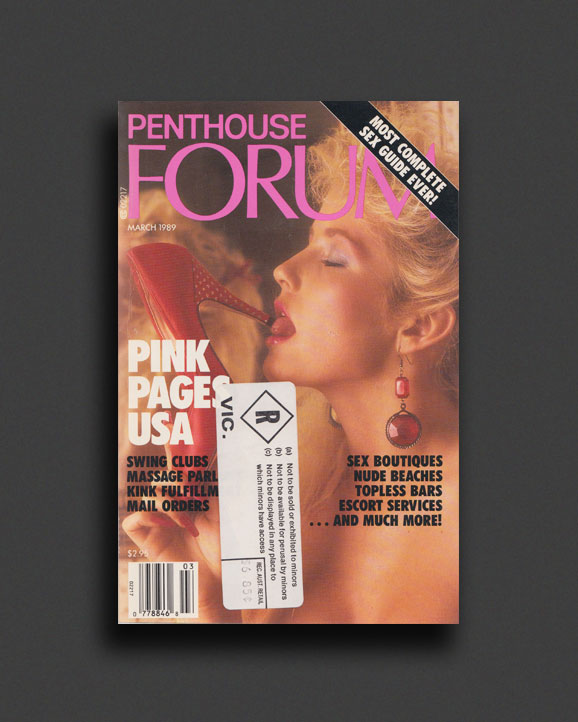
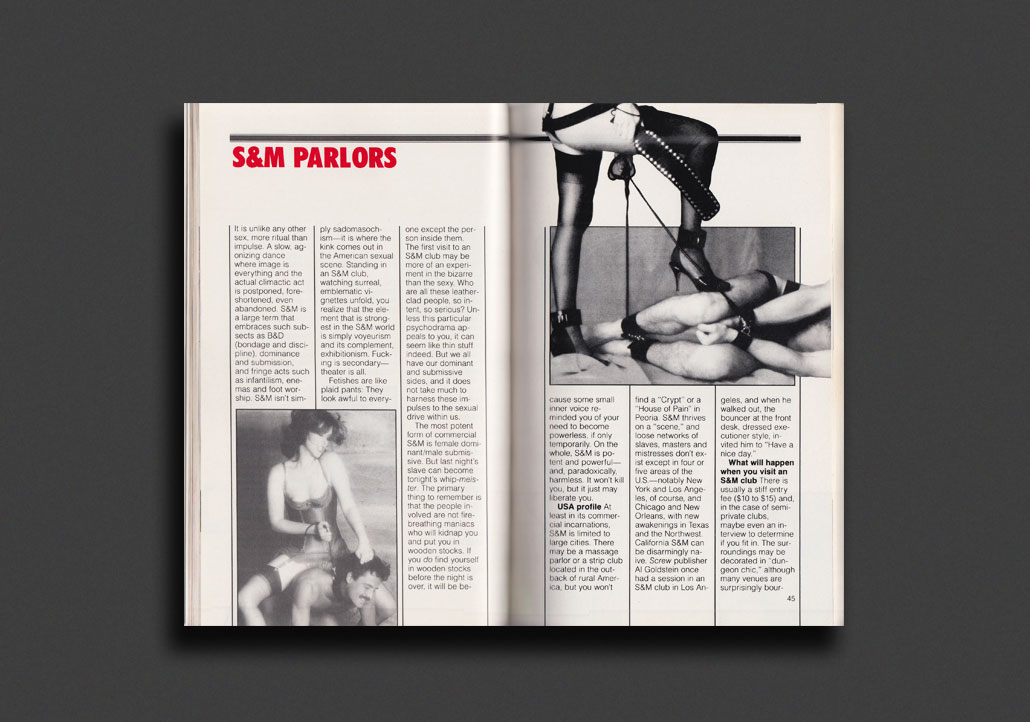
March 1989 edition of Penthouse Forum, the adult "Readers Digest", published by Penthouse International, New York, since 1972. This special issue features the "Pink Pages USA", "the most comprehensive guide to sex services and entertainment in the USA", compiled by the editors due to the complete lack of inclusion of such subjects in the regular Yellow Pages. Includes illustrated listings for mail-order services, massage parlors, S&M parlors, strip clubs, book shops and boutiques, nude beaches and nudist camps, swingers and kink clubs, outcalls, and much more, plus all the usual readers letters and questions, an article on lesbian videos by Susie Bright, Veronica Vera's sex gazette (news column), ads, and more.
2018, English / German
Softcover, 328 pages, 21 x 28.2 cm
Published by
Sternberg Press / Berlin
CCA Wattis Institute for Contemporary Arts / San Francisco
Künstlerhaus Stuttgart / Stuttgart
Participant Inc. / New York
$48.00 - Out of stock
Edited by Lia Gangitano, Fatima Hellberg, Jamie Stevens
Contributions by Dodie Bellamy, Jonathan Berger, John Brattin, Ellen Cantor, Lia Gangitano, Cy Gavin, Joseph Grigely, Clara López Menéndez, John Maybury
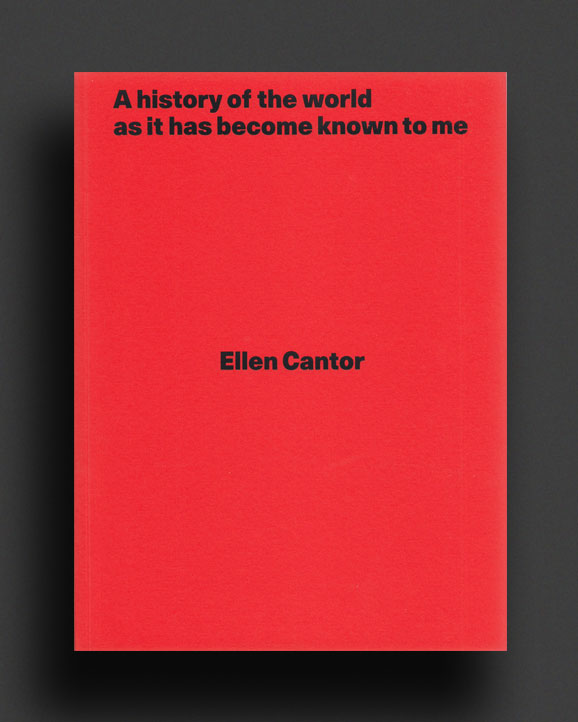
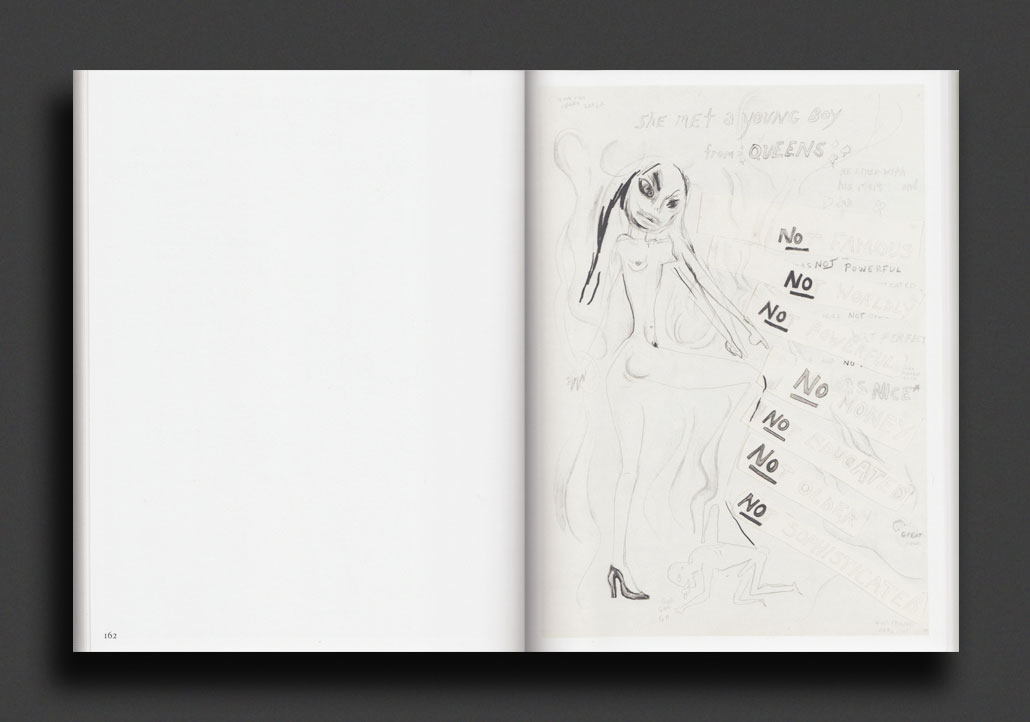
Ellen Cantor (1961–2013) combined ready-made materials with diaristic notes and drawings to probe her perceptions and experiences of personal desire and institutional violence. This book is concerned with, and a document of, Cantor’s work through the lens of Pinochet Porn (2008–16) and its making—an epic experimental film embodying and radically extending her multifaceted artistic practice. Taking the form of an episodic narrative about five children growing up under the regime of General Augusto Pinochet in Chile, and shot between her dual hometowns of London and New York, history is observed through Cantor’s fictive speculations on private experience within a totalizing political order. A history of the world as it has become known to me brings together writings and archival materials of Cantor’s, including a reproduction in full of her drawing-based script Circus Lives from Hell (2004), alongside contributions by writers, artists, collaborators, and friends reflecting on Cantor’s practice, Pinochet Porn, and a singularly transgressive vision: explicitly feminist, remorselessly emotional, dramatic in tone, and, as Cantor herself liked to put it, adult in subject matter.
This publication follows the exhibitions “Cinderella Syndrome,” CCA Wattis Institute for Contemporary Arts (December 8, 2015–February 13, 2016) and “Ellen Cantor,” Künstlerhaus Stuttgart (April 2–July 31, 2016).
Copublished with Künstlerhaus Stuttgart, Participant Inc., and CCA Wattis Institute for Contemporary Arts
Design by Pedro Cid Proença
2018, English
Softcover, 212 pages, 13 x 19.5 cm
Published by
Sternberg Press / Berlin
$39.00 - Out of stock
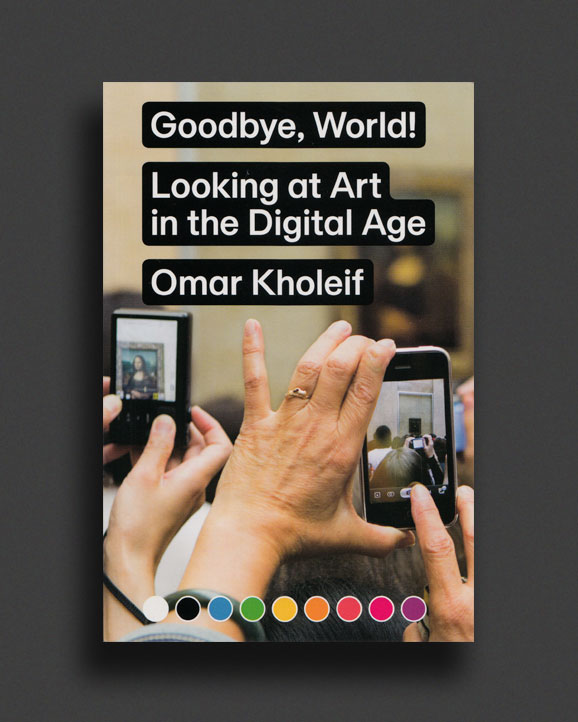
The way we see the world has changed drastically since NASA released the “blue marble” image of the earth taken by Apollo 17 in 1972. No longer a placid slow-moving orb, the world is now perceived as a hothouse of activity and hyper-connectivity that cannot keep up with its inhabitants. The internet has collectively bound human society, replacing the world as the network of all networks. In Goodbye, World! Looking at Art in the Digital Age, writer and curator Omar Kholeif traces the birth of a culture propagated but also consumed by this digitized network. Has the internet transformed the way we see and relate to images? How has the field of perception been altered by evolving technologies, pervasive distribution, and our interaction with screens? How have artists working in diverse contexts, from eBay auctions to augmented reality, created new ways of emoting that are determined by these technologies? Focusing on a cultural and artistic landscape that has taken shape since the year 2000, Kholeif aims to put into context a new language for seeing, feeling, and being that has emerged through post-millennial technologies, and argues for a nuanced understanding of the post-digital condition. Taking cues from John Berger’s Ways of Seeing and Alvin Toffler’s Future Shock, this book—part memoir, part critical analysis—should prove essential for anyone interested in the changing world of the internet.
“Goodbye, World! weaves through digital cultures, illustrating how both life and art have changed in the twenty-first century. Omar Kholeif’s critical eye is as alert to the issues facing artists as it is to those confronting the contemporary viewer.”
—Sofia Victorino, Daskalopoulos Director of Education and Public Programmes, Whitechapel Gallery
“Omar Kholeif’s insightful new book, built upon knowledge accumulated from research and practice, distills a fast-moving world mired with image overload, where the continuous reproduction of popular, or indeed viral images, contrary to general belief, can in itself offer a refreshing experience and hold an intrinsic value of its own. With Goodbye, World!, Kholeif has emerged as one of the leading contemporary historians of the digital age.”
—Sultan Sooud Al Qassemi, Director's Fellow at MIT Media Lab, founder of Barjeel Art Foundation
“Through deft juxtapositions of image, text, and digital detritus, Kholeif presents a visceral take on the strange implications of a world in which images, politics, subjectivities, and affects are recombined in a post-internet era. An Arcades Project for the twenty-first century.”
—Trevor Paglen, artist
“Omar Kholeif pushes forward our rapidly evolving understanding of contemporary art in the digital age. Goodbye, World! is an essential survey of the widening field of digital forms and formats and the growing number of artists that give this art its expression. Moreover, it is a fresh and necessary exploration of the very ontology of the work of art that digital movements force us to reevaluate.”
—Ken Stewart, Assistant Dean and Director of Communications and Public Programs, Harvard University Graduate School of Design
Design by Zak Group
2017, English
Softcover, 224 pages, 17.3 x 22 cm
Published by
MUDAM / Luxembourg
Sternberg Press / Berlin
$38.00 - Out of stock
Contributions by Carl Andre, Charles Baudelaire, Walter Benjamin, Barbara Bloemink, Jan Boelen, Louise Bourgeois, Sheldon Cheney and Martha Candler Cheney, Alex Coles, Anthony Dunne and Fiona Raby, Hal Foster, Sigmund Freud, Dan Graham, Isabelle Graw, Sebastian Hackenschmidt and Dietmar Rübel, Graham Harman, G. W. F. Hegel, Martin Heidegger, Dave Hickey, Matthew Higgs, Donald Judd, Immanuel Kant, Frederick J. Kiesler, Sven Lütticken, Alessandro Mendini, W. J. T. Mitchell, Jasper Morrison, Bruno Munari, Robert Nickas, Alice Rawsthorn, Jeff Rian, Richard Rinehart, Anthony Vidler
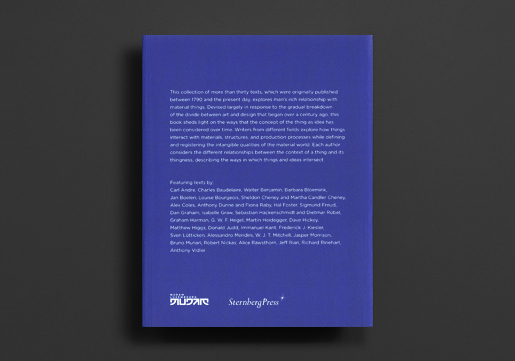
This collection of more than thirty texts, which were originally published between 1790 and the present day, explores man’s rich relationship with material things. Devised largely in response to the gradual breakdown of the divide between art and design that began over a century ago, this book sheds light on the ways that the concept of the thing as idea has been considered over time. Writers from different fields explore how things interact with materials, structures, and production processes while defining and registering the intangible qualities of the material world. Each author considers the different relationships between the context of a thing and its thingness, describing the ways in which things and ideas intersect.
Copublished with MUDAM Luxembourg
Design by Florence Richard
2018, English
Hardcover, 80 pages, 17 x 24 cm
Published by
Apartamento Publishing / Barcelona
$50.00 - Out of stock
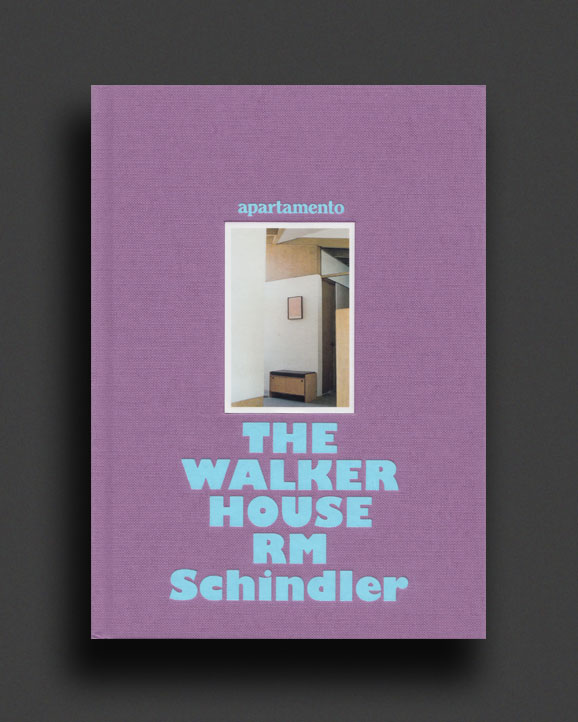
The Walker House, RM Schindler is the first in a series of architecture books related to inspirational houses. It takes us to Los Angeles, the adopted home of Austrian-born American architect, RM Schindler, and tells the story of the Walker House and how came into the possession of its current owner, journalist and modernist architecture and design geek, Andrew Romano. The 80-page hardbound book features interior photography by longtime Apartamento contributor, Ye Rin Mok, texts by Andrew Romano, and archival imagery of the Walker House, courtesy of the private collection of Andrew Romano and the University of Santa Barbara California.
‘Last October my wife and two kids and I moved into a house with a name: the Ralph G Walker House. The reason our house has a name is not because its original owner, Ralph G Walker, had a name worth knowing—he worked for an insurance company—but because his architect did. Walker’s architect was RM Schindler. Schindler arrived in Los Angeles in 1920, 15 years before Walker hired him, and the work he built during that decade and a half (and beyond) was both miraculous and maddening. Miraculous because it was better than nearly all of his contemporaries’, and maddening because it managed to attract far less attention than anything nearly as good.’
—Andrew Romano
First edition
1971, Japanese
Softcover, 152 pages, 29.5 x 21.5 cm
1st Edition, Out of print title / used / very good
Published by
Chugai Publishing Co. / Tokyo
$100.00 - Out of stock
The Kentiku "Architecture" (A Monthly Journal for Architects and Designers), previously known as Kokusai-Kentiku, was a monthly Japanese architectural magazine founded in 1925, and which had a tremendous influence on architectural theory and design in Japan, covering twentieth century architecture as well as the modern movement. Copies are now very scarce, especially collectable are those issues with cover features dedicated to specific architects, such as this one.
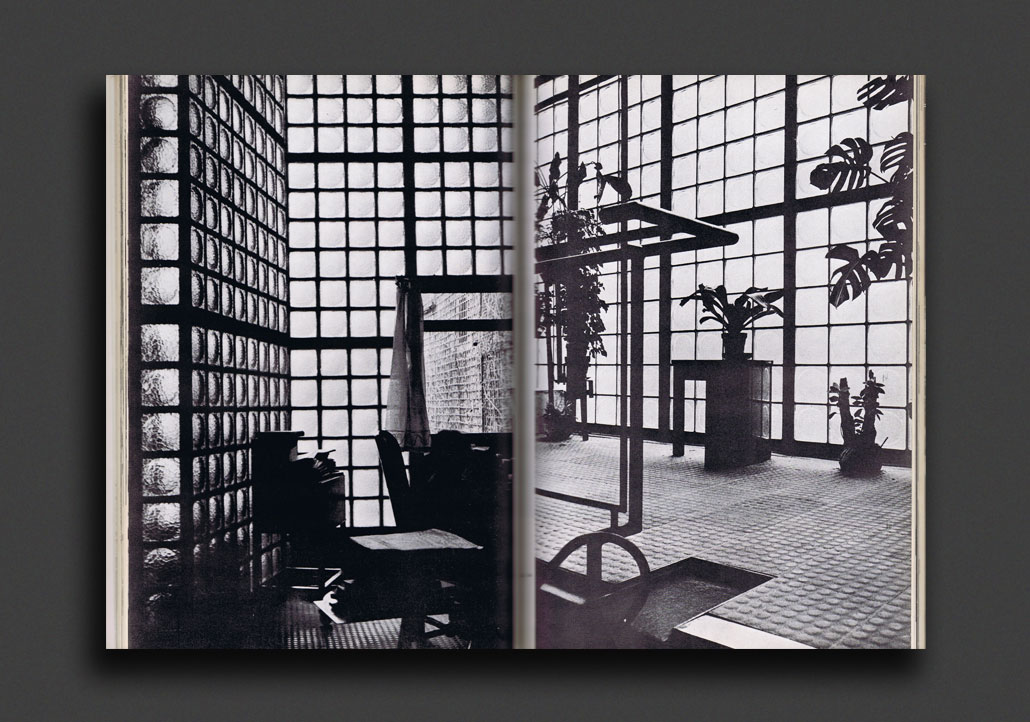
Dedicated to Pierre Chareau and his 'Maison de Verre' (House of Glass)', the bulk of this volume is made up of spreads of copious photographic architectural documentation through the years of this breathtaking Paris residence by Chareau, built between 1928-1932 to house the medical suite and domestic residence of Dr. Jean Dalsace, a member of the French Communist Party who played a significant role in both anti-fascist and cultural affairs. This important collaboration between Chareau (a furniture and interiors designer), Bernard Bijvoet (a Dutch architect working in Paris since 1927) and Louis Dalbet (craftsman metalworker), has been captured in great detail by various photographers - images of the residence interiors, exteriors and room details of living spaces, furnishings, and materials, are accompanied by historical texts (in Japanese) and scarcely seen floor-plans/elevations. Constructed in the early modern style of architecture, the house's design emphasized three primary traits: honesty of materials, variable transparency of forms, and juxtaposition of "industrial" materials and fixtures with a more traditional style of home décor. The primary materials used were steel, glass, and glass block. Some of the notable "industrial" elements included rubberized floor tiles, bare steel beams, perforated metal sheet, heavy industrial light fixtures, and mechanical fixtures, making it a very early influence of what would become known as the "High-Tech" aesthetic. In the mid-1930s, the Maison de Verre's double-height "salle de séjour" was transformed into a salon regularly frequented by Marxist intellectuals like Walter Benjamin as well as by Surrealist poets and artists such as Louis Aragon, Paul Éluard, Pablo Picasso, Max Ernst, Jacques Lipchitz, Jean Cocteau, Yves Tanguy, Joan Miró and Max Jacob.
The generosity of these Kentiku journals make them a treasure for any architecture or interior design enthusiast or collector. This issue also features the buildings and interiors of Japanese architects Kazunari Sakamoto, Hirotaka Sugiura, Kazumasa Yamashita, Kisho Kurokawa, and much more.
French architect and designer Pierre Chareau (1883-1950), a pivotal figure in modernism, known for his innovative concepts and radical use of new materials. Chareau linked architecture, fine arts, and style; designed furniture for avant-garde films and chic homes; formed an important art collection including artists such as Picasso and Mondrian.
Very Good copy with light general ageing and wear to cover, binding, spine.
2018, English
Hardcover, 464 pages, 31.8 x 31.8 cm
Published by
Fraenkel Gallery - Editions Antoine De Beaupré / San Francisco
$135.00 - Out of stock
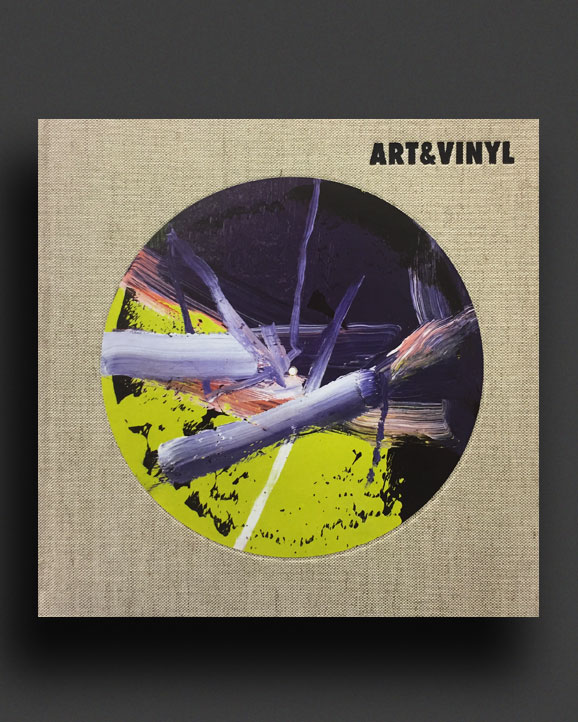
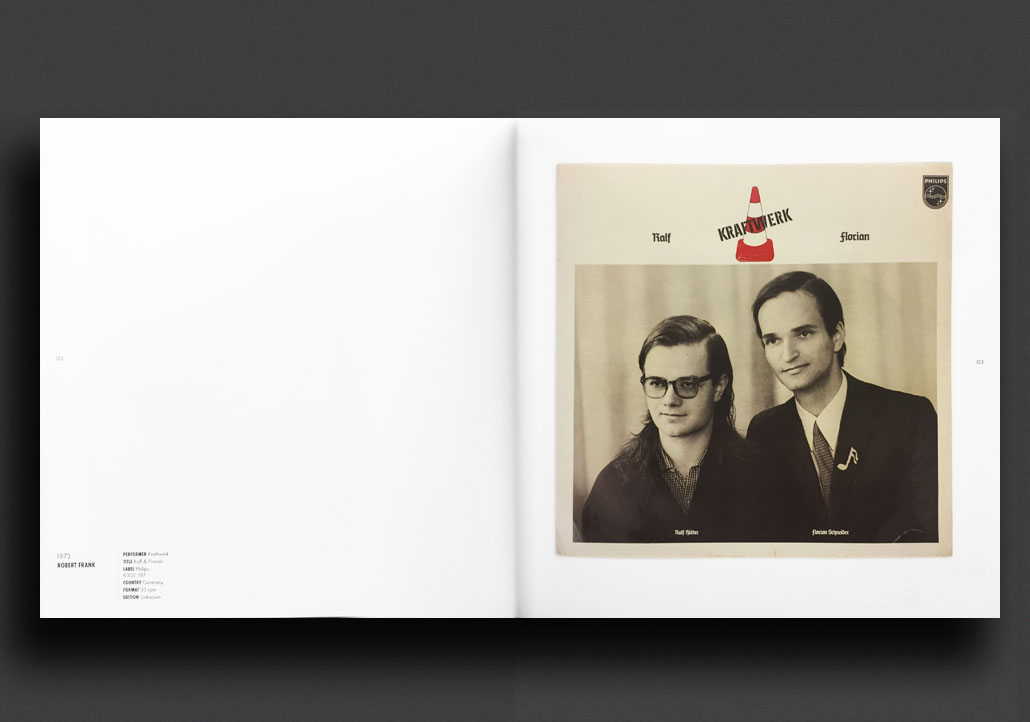
Art & Vinyl is an exhilarating new look into the history of the vinyl record as a medium for modern and contemporary visual art. This beautifully designed and printed publication is the first book to focus in-depth on works of art created specifically for an album, composer or musician.
With reproductions of more than 200 LPs from the mid-20th century to the present, Art & Vinyl traces the trajectory of how the record album has been considered by artists as material for a work of art. The book begins with Pablo Picasso’s 1949 depiction of the dove of peace, printed directly on an audio disc. Significantly, the recording was Paul Robeson’s Chante Pour La Paix (Singing for Peace). Art & Vinyl also includes works by artists as disparate and wide-ranging as Ed Ruscha, Marlene Dumas, Cy Twombly, Yoko Ono, Jean-Michel Basquiat, Barbara Kruger, Robert Rauschenberg, Sol LeWitt, Sophie Calle and Andy Warhol.
Highlights include Gerhard Richter’s extraordinary oil painting made directly on a recording of Glenn Gould’s Bach: The Goldberg Variations (1984), as well as Allan Kaprow’s LP How to Make a Happening (1966). Also featured are albums of original recordings by Joseph Beuys, Yves Klein, Jean Dubuffet, Christian Marclay and Wolfgang Tillmans, among others. Some of the better-known artists’ covers for rock, pop and jazz albums featured here are Jann Haworth and Peter Blake’s Sgt. Pepper’s Lonely Hearts Club Band; Jim Dine’s cover for The Best of Cream; Lee Friedlander’s portrait of Miles Davis for In a Silent Way; Warhol’s cover for Sticky Fingers and Robert Frank’s Exile on Main Street; Mapplethorpe’s classic Patti Smith portrait for Horses; Robert Longo’s cover for Glenn Branca’s The Ascension; Fischli/Weiss’s Liliput; and Alec Soth’s cover for Dolorean’s The Unfazed.
Art & Vinyl has been assembled over the course of nearly a decade by curator and collector Antoine de Beaupré, author of Total Records and founder of Librarie Galerie 213 in Paris.
2018, English
Hardcover, 48 pages 29.7 x 21.0 cm
Ed. of 300,
Published by
Sturm & Drang / Zürich
$116.00 - Out of stock
First English version of Das Auge der Liebe. First published in 1954, Das Auge der Liebe (The Eye of Love) by the Swiss photographer René Groebli is a small book featuring images that were made during the honeymoon with his wife Rita in France.
In Groebli's own words: "I tried to convey the typical atmosphere of French hotel rooms. There were so many impressions: the poor-looking furniture in a cheap hotel, the word 'Amors' embroidered on the curtains. And I was in love with the girl, the girl who was my wife. I think a series of photographs should be compared with a novel or even a poem rather than a painting: let us tell something!"
This poem in black and white is now ready for another closeup. Sturm & Drang is proud to present this extended re-edition of "The Eye of Love" with five additional images chosen by the photographer, presented as a limited edition (300 copies only) hardcover book.
With an english introduction by Birgit Filzmaier.
René Groebli is a Swiss photographer born 1927 in Zurich.
1988, Japanese
Softcover, 80 pages, 22 x 22 cm
1st Edition, Out of print title / used / very good
Published by
Seibu / Tokyo
$100.00 $50.00 - Out of stock
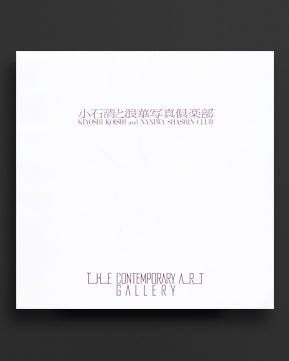
Very scarce catalogue for the only major exhibition on Kiyoshi Koishi and Naniwa Shashin Club, held in 1988 at Hyogo Prefectural Museum of Modern Art and Seibu Contemporary Art Gallery.
Kiyoshi Koishi (March 26, 1908 - July 7, 1957) was one of the most prominent Japanese photographers in the first half of the 20th century. He was born in Osaka and became a member of Naniwa Shashin Club (浪華写真倶楽部, Naniwa Photography Club) in 1928.
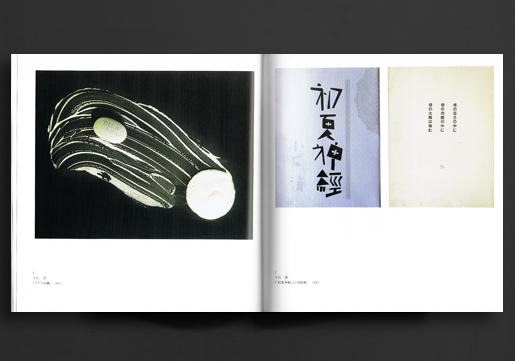
In 1933 he published the monograph Shoka Shinkei (初夏神経, "Early Summer Nerves"), one of the most important works for Japanese modernist photography and one of the most sought after volumes. In this work, he used many photographic techniques such as photomontage and photograms, succeeding in creating surrealistic images. From 1938, he worked for the Japanese government in the magazine Shashin Shūhō (写真週報, "Photo Weekly"). And he became a war photographer of the Second Sino-Japanese War. Therefore, he was no longer able to produce avant-garde photo. After World War II, he continued to take many photographs. But tragically, he couldn't leave the works from the effects of restricted activity due to the war. In 1957, Koishi died by accident, falling on the station platform in Moji, Fukuoka Prefecture.
Very rarely seen outside of Japan, and little printed document there either, this catalogue collects a valuable photographic history of Koishi's stunning work, alongside the work of his fellow Naniwa Shashin Club members from 1921-1950.
1997, English / Japanese
Hardcover (cardboard box covers w. glued in booklets, fold-outs, inserts), 84 pages plus fold-outs, 12.5 x 14 cm
1st edition, Out of print title / used*,
Published by
Wateri Museum of Contemporary Art / Tokyo
$90.00 - Out of stock
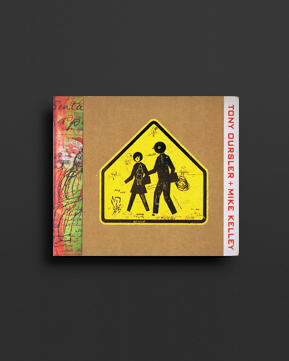
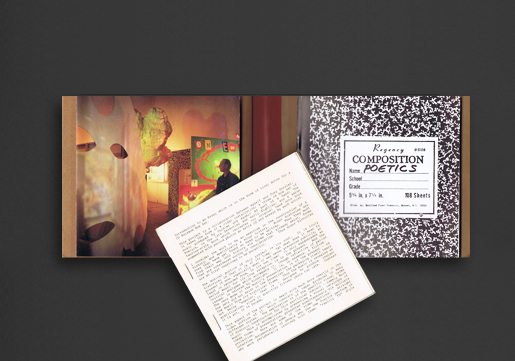
Very scarce Tony Oursler + Mike Kelley exhibition catalogue / artists' book published in conjunction with a major two-person exhibition held 1997 - 1998 in Tokyo. Includes colour installation images of the exhibition as installed at Documenta X, June 21 - September 28, 1997. "The ongoing 'Poetics Project' serves up a rich mix of visual and aural experiences, while inviting viewers to question the reliability of the shows as history. Artist Mike Kelley says, 'If you don't create your own history, someone else will." Kelley and Tony Oursler's the 'Poetics Project 1977-1997' is a retrospective work that draws from their collaborative efforts in painting, video, sculpture, drawing and music. Although the ostensible subject of this project is Kelley and Oursler's early experiences as performers in a loose-knit musical group called the Poetics, its broader concerns are the processes by which history is constructed, and the reciprocal relationship between the fine arts and popular culture. The conflation of past and present in the 'Poetics Project' makes it difficult at first for the viewer to penetrate the work. Video installations and taped interviews with visual artists, rock musicians and critics are intermingled with paintings, sculptures and stacks of drawings. A precise checklist and diagram prepared by Kelley and Oursler methodically pinpoint the authorship of each work, while serving as a serf-guided tour and critical record of the project. Only with this didactic help do viewers come to realize that the 'Poetics Project' is almost entirely made up of works created in 1997 and 1998, though based on what Kelley and Oursler tell us is a single notebook of sketches and a collection of audio recordings--some little more than notations for never-performed works--which date from the late 1970s and early '80s (the Poetics disbanded in 1983). Filled with irony and steeped in serf-reflexive practice, this work builds upon the radical autobiographical prose of William S. Burroughs and art works and performances by artists such as John Baldessari, Allan Kaprow and Andy Warhol. Reminiscent of Warhol's A:A Novel, which records one day in the life of the artist in 384 pages, the 'Poetics Project' is an expanding template of art works which explores how the past can be reconstructed to shed light on the present." -- Diane Shamash, Art in America, October 1998
First and only edition of this unique Japanese publication from these two American artists. Cardboard covers feature decal artwork reproducing the Oursler/Kelley collaborative artwork "Poetics Country", 1997.
2018, English / German
Softback, 300 pages, 26.5 x 26.5 cm
Published by
Walther König / Köln
$72.00 - Out of stock
Since 1987, Galerie Bruno Bischofberger has combined the advertisements for its gallery program with images of traditional Swiss life; a montage of contrasts that brings local traditions face to face with a globalized art world’s cosmopolitan self-image.
For roughly thirty years, the advertisement series has appeared parallel in the art magazines Artforum and Kunstbulletin and has helped the gallery achieve a high level of recognizability.
Accompanies the exhibition Backcovers: Summer Fall Winter Spring, 21 Apr – 8 Jul 2018, Museum im Bellpark Kriens, Switzerland.
German and English text.
2018, English / Dutch
Softcover, 288 pages, 17 x 24 cm
Published by
Nai010 Publishers / Rotterdam
$86.00 - In stock -
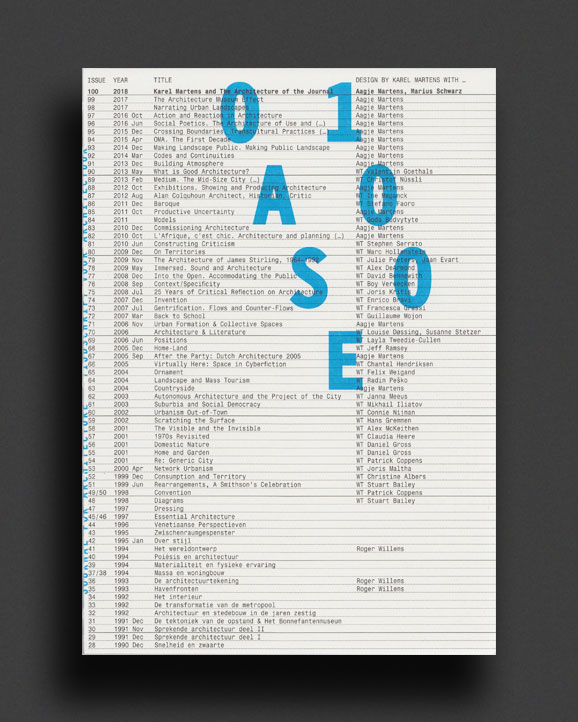
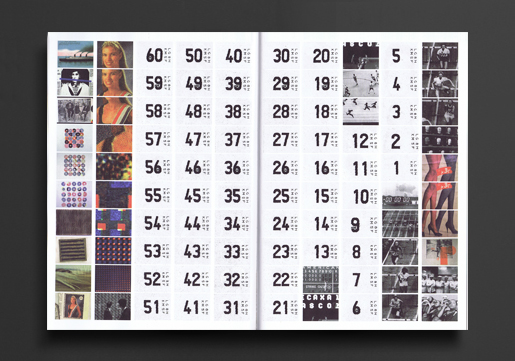
The 100th issue of OASE takes the journal’s long-standing collaboration with its graphic designer Karel Martens as a starting point to explore the relationship between architecture journals and graphic design. In doing so, it challenges the conventional idea that architecture journals are mere carriers of information, showing instead how these journals play a defining role in the message they convey. Adhering to Marshall McLuhan’s famous maxim ‘the medium is the message’, it considers the graphic space of the journal, its materiality, its production, and the physical experience of reading.
2017, English
Softcover, 304 pages, 21 x 29 cm
$60.00 - Out of stock
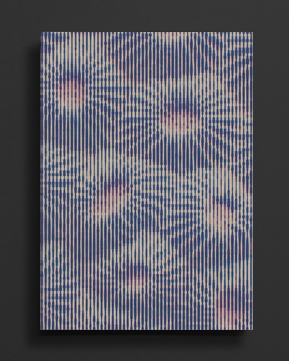
Published as part of ‘Motion’, an exhibition by Dutch artist and graphic designer Karel Martens at Kunstverein München, this book is the seventh instalment of the ‘Companion’ series produced by the Kunstverein and Roma Publications. With concept and design by Julie Peeters, the greater part of the book’s content is derived from the video ‘Not for Resale’, a sequence of photographs of the array of images and objects found on the artist’s studio wall, taken in 2000. Material from two other videos, ‘Lost & Found’ (2004) and ‘Tol’ (2008), is also included, along with a transcription of a conversation between Martens and Chris Fitzpatrick, director of the Kunstverein.
2018, English
Hardcover, 384 pages, 17 x 24 cm
Published by
Valiz / Amsterdam
$59.00 - Out of stock
What would happen if museums put relationships at the centre of their operations? This question inspires this publication, which offers a diverse, rigorous, and experimental analysis of what is commonly known as education, mediation or interpretation within museum institutions. It regards the visitor not as a passive receiver of predefined content, but as an active member of a constituent body, whom it facilitates, provokes, inspires and learns from. Moving beyond the practice of mediation as such, the publication situates constituent practices of collaboration and co-production within the existing social-political (neoliberal) context. It does this to reimagine and affect both the physical and organizational structures of museums and galleries.
Understanding the challenges of a constituent practice in an integral, interdisciplinary manner is what this publication aspires to. This is explored by placing the museum's constituents—museum professionals, active audience/co-curator, local and political agencies, operational structures and contexts—at the centre of the museum organization and looking at how their positions in society start to shift and change.
Issues that are addressed: ownership and power dynamics, collective pedagogy, pedagogy of encounter, collaboration, assent, dissent and consent, co-labour and co-curation (economies of exchange), precarity, and working with interns, archives and how to activate them, broadcasting, digital cultivation, crowdsourcing, and many other topics.
Editors: John Byrne, Elinor Morgan, November Paynter, Aida Sánchez de Serdio, Adela Železnik
Contributors: Azra Akšamija, Alberto Altés Arlandis, Burak Arikan, James Beighton, Manuel Borja-Villel, Sara Buraya, John Byrne, Jesús Carrillo, Alejandro Cevallos Narváez, Céline Condorelli, Sean Dockray, Özge Ersoy, Carmen Esbrí, Oriol Fontdevila, Amy Franceschini, Janna Graham, Nav Haq, Yaiza Hernández Velázquez, Emily Hesse, John Hill, Alistair Hudson, Adelita Husni-Bey, Kristine Khouri, Nora Landkammer, Maria Lind, Isabell Lorey, Francis McKee, Elinor Morgan, Paula Moliner, November Paynter, Manuela Pedrón Nicolau, Elliot Perkins, Bojana Piškur, Tjaša Pogačar Podgornik, Alan Quireyns, RedCSur, Rasha Salti, Francesco Salvini / pantxo ramas, Raúl Sánchez Cedillo, Aida Sánchez de Serdio, Somateca, Igor Španjol, Nora Sternfeld, Subtramas, Tiziana Terranova, Piet Van Hecke, Onur Yıldız, Adela Železnik
1989, English
Softcover (staple-bound), 16 pages, 21.5 x 15 cm
1st Edition, Out of print title / used / good
Published by
Cornerhouse / Manchester
$25.00 - Out of stock
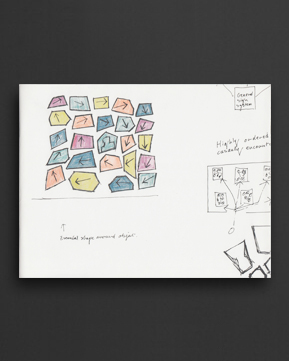
Artist's book by British artist Stephen Willats, published by Cornerhouse, Manchester, in 1989.
Presents one of Willats' unique illustrated photo-collage systems of cropped photographs and texts at play using objects and language associated with the advertising of the iconic homewares company Habitat. A work that Willats developed with the assistance of the staff of the Purley Way, Croyden, South London Habitat store.
Since the 1960s, Stephen Willats is identified as one of the most influential protagonists of international conceptual art in England. One of the main focuses of his work has always been the examination of urban realities by means of communication processes, network formation, and self-organising structures. Willats illustrates various systems of social interaction through an array of drawings, diagrams, photo-collages, computer-operated communication-devices, and animations. The artist works directly with people: their relationships to each other – be it in a private or professional environment – as well as their relationship to an omnipresent system of everyday symbols; from architectural structures to objects, materials, and sounds that surround us continually. Willats poses the question as to how the personal values and lebensraum of the individual are perceived within society, and how society defines and adopts them.
Ex-library copy w. ex-librīs to inside front cover, few stamps, and plastic coated covers. Otherwise nicely preserved and undamaged.
2012, English / German
Softcover, 24 pages, 28 x 21.5 cm
Ed. of 1,300,
Published by
Galerie Thomas Schulte / Berlin
$35.00 - Out of stock
Published by Galerie Thomas Schulte, Berlin, on the occasion of a solo exhibition of the same name in 2012, in an edition of 1,300 copies. Text by Astrid Wege in English and German.
Since the 1960s, Stephen Willats is counted as one of the most influential protagonists of international conceptual art in England. One of the main focuses of his work has always been the examination of urban realities by means of communication processes, network formation, and self-organising structures. Willats illustrates various systems of social interaction through an array of drawings, diagrams, photo-collages, computer-operated communication-devices, and animations. The artist works directly with people: their relationships to each other – be it in a private or professional environment – as well as their relationship to an omnipresent system of everyday symbols; from architectural structures to objects, materials, and sounds that surround us continually. Willats poses the question as to how the personal values and lebensraum of the individual are perceived within society, and how society defines and adopts them.
2013, English
Softcover, 48 pages, 22 x 17 cm
$39.00 $15.00 - Out of stock
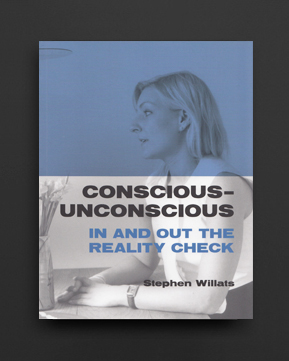
British artist Stephen Willats’ visually intense works explore the nature of human interaction, communication and connection between individuals and communities.
CONSCIOUS – UNCONSCIOUS the artist’s fourth exhibition at Modern Art Oxford, and continues a connection with the gallery which began in 1968. This latest exhibition examines social interaction, the influence of technology on daily life and the way we look at and think about our surroundings.
Unique to this exhibition is The Oxford Community Data Stream, a new commission that presents alternative and highly personal perspectives on life in Oxford through a collaboration with residents of Kennington and Blackbird Leys.
This catalogue includes an interview between Stephen Willats and Ute Meta Bauer.
Published on the occasion of the exhibition CONSCIOUS – UNCONSCIOUS: in and out the reality check at Modern Art Oxford, 27 April – 16 June 2013.
2013, English
Softcover (Staple-bound), 20 pages, 14.8 x 21 cm
Ed. of 500,
Published by
Annie Gentils Gallery / Antwerp
$22.00 - Out of stock
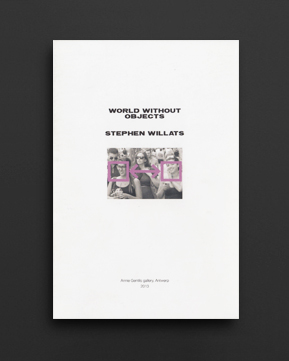
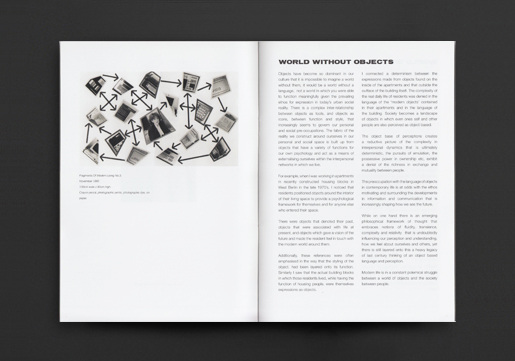
Stephen Willats extends his enquiry into the idea of the local through Signs and Messages (2013), which captures the visual language of a walk along two busy streets in Antwerp (two contrasting communities : Statiestraat Berchem and the shopping street of Antwerp axis De Keyzerlei – Meir).
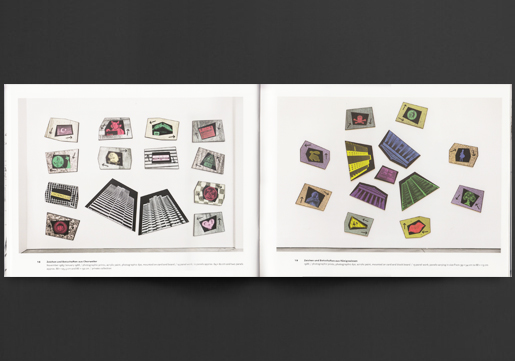
World Without Objects includes a striking mural work, which reflects on architecture and urban living, depicting high rise tower blocks with oversized ceramic vases in primary colours.
Published by Annie Gentils Gallery, Antwerp, in an edition of 500 copies.
‘All art is a product of society, of relationships between people in which it is quite clear that the most important element in the network between the artist and society is the audience. For without two people there can be no work of art.’
Stephen Willats
2005, English / German
Softcover, 128 pages, 24 x 17 cm
1st Edition, Out of print title / used / good
Published by
Revolver – Archiv für aktuelle Kunst / Frankfurt am Main
$45.00 - Out of stock
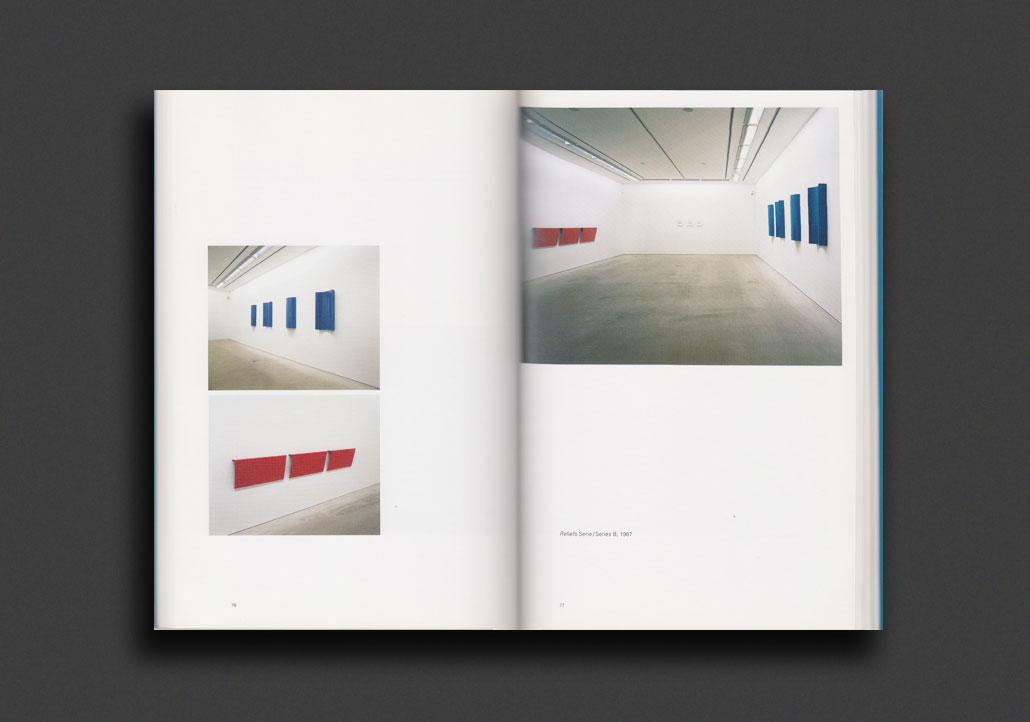
Catalogue published to coincide with a large retrospective exhibition of German artist Charlotte Posenenske held at Galerie im Taxispalais, Innsbruck, March 19 - May 15, 2005. Edited by Silvia Eiblmayr and Astrid Wege, and including further texts by Eva Schmidt, Gerald Schröder, Astrid Wege and a conversation between Konstantin Adamopoulos and Burkhard Brunn (in both German and English), this heavily illustrated catalogue follows the exhibitions ambition to present Posenenske’s development over a short span of time, primarily the 1960s, leading from painting to real space. Feature paintings from the late 1950s and early 1960s, Striped Pictures and Three-Dimensional Pictures from the mid-1960s, Reliefs (1967) as well as the Square Tubes that she presented both indoors and outdoors (1967) and her Revolving Vanes (1967/68) – the last group of works Posenenske produced before she gave up art in 1968. Posenenske’s both radical and multi-facetted artistic approach is rounded off by her stage set designs from the 1950s, her art-in-architecture projects from the 1960s and in particular her two film strips from 1968 that were created with the active participation of Peter Roehr and Paul Maenz on a drive through Holland in spring 1968. Also includes list of works and biography.
Charlotte Posenenske (1930–1985) was a German artist associated with the minimalist movement who predominately worked in sculpture, but also produced paintings and works on paper.
Posenenske worked in a variety of mediums, her practice becoming more abstract through the course of the 1960s. While other artists of the period worked in multiples, where a finite edition of a work could be produced, Posenenske worked in series, meaning that there was no limit to the editions. Posenenske rejected the commercial art market, offering her work for sale at its material cost. Reconstructions authorised by the artist’s estate are not replicas, and they are outwardly identical to the original prototype. Only the certificate differentiates the unsigned work from other commodities.
In 1968 Posenenske published a statement in the journal Art International referencing the reproducibility of her works, and her desire for the concept and ownership of the piece to be accessible:
I make series
because I do not want to make individual pieces for individuals,
in order to have elements combinable within a system,
in order to make something that is repeatable, objective,
and because it is economical.
The series can be prototypes for mass-production.
[...]
They are less and less recognisable as "works of art."
The objects are intended to represent anything other than what they are.
Poseneske stopped working as an artist in 1968, no longer believing that art could influence social interaction or draw attention to social inequalities. She retrained as a sociologist and became a specialist in employment and industrial working practices until her death in 1985. During this period of self-imposed exile Posenenske refused to visit any exhibitions, and did not show her work.
2018, English
Softcover, 288 pages, 33.5 x 24.1 cm
Published by
Spector Books / Leipzig
$75.00 - Out of stock
Edited with text by Dieter Daniels, Inke Arns. Text by Brandon LaBelle, David Toop, Dörte Schmidt, Julia H. Schröder, Jan Theben.
Contributions by Hans-Friedrich Bormann, William Letterman, Kyle Gann, Branden W. Joseph, et al.
John Cage's (1912–92) 4'33" premiered on August 29, 1952, distilling the composer's philosophical explorations of silence into four minutes, thirty-three seconds of performed, charged silence. Elegantly, provocatively, the piece asked: what does silence sound like?
Cage's questions about the nature of silence and sound continue to reverberate decades later; this volume—the most comprehensive on the piece to date—brings together new theoretical writings and artistic works exploring Cage's composition. A wide-ranging list of contributors, contemporary and historical—from Merce Cunningham to Rage Against the Machine—weigh in on Cage's work alongside Cage's original scores and the composer's own subsequent engagements with his most famous piece.
2017, English / French
Softcover, 560 pages, 16 x 23 cm
Published by
Les Presses Du Reel / Paris
$47.00 - Out of stock
Edited by Matthieu Saladin and Yvan Etienne
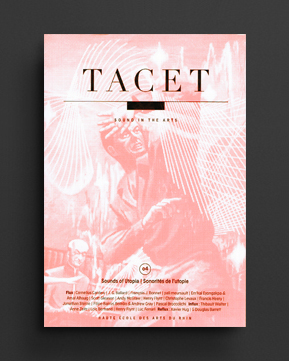
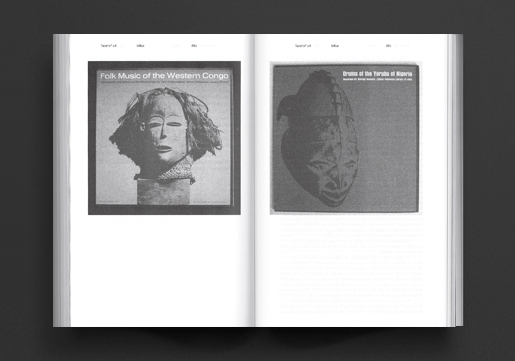
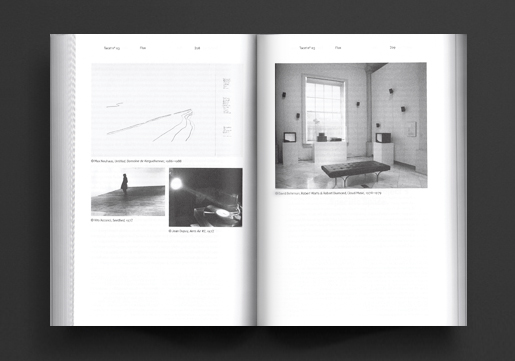
Tacet is a research publication dedicated to sound arts and experimental music. Published annually and bilingually (French, English), its ambition is to create an interdisciplinary and international space of reflection for this practices, in all its aesthetic diversity. The fourth issue is on the theme of utopias. Mixing science-fiction short stories, theoretical analysis and artists' writings, this issue addresses utopian and dystopian futures of our sound cultures. Includes: J.G. Ballard, Henry Flynt, Luc Ferrari, Francoise J. Bonnet, Loic Bertrand, Anne Zeitz, Max Neuhaus, Thibault Walter, Cornelius Cardew, Filipe Barros Beltrao, Andrew Gray, Jonathan Sterne, Christophe Levaux, John Cage, Henry A. Flynt, Jr., Andy McGraw, Scott Gleason and many more.
2014, English / French
Softcover, 448 pages, 16 x 23 cm
Published by
Les Presses Du Reel / Paris
$47.00 - Out of stock
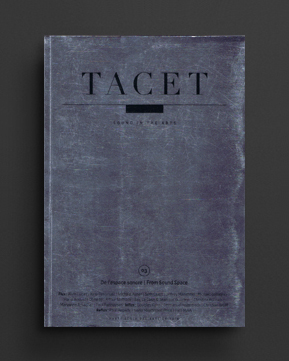
3rd issue of the sound arts and experimental music annual review, devoted to the question of sound space.
Featuring: Alvin Lucier, Kirsi Peltomäki, Michael Asher, Seth Cluett, Jeffrey Mansfield, Michael Gallagher, María Andueza Olmedo, Arthur Stidfolde, Éric La Casa & Jean-Luc Guionnet, Christina Kubisch, Maryanne Amacher, Paul Panhuysen, Douglas Kahn, Emmanuel Holterbach, Christian Wolff, Paul Hegarty, Ivana Miladinović Prica, Tom Mays...
Tacet is a new research publication dedicated to sound arts and experimental music. Published annually and bilingually (French, English), its ambition is to create an interdisciplinary and international space of reflection for this practices, in all its aesthetic diversity.
Tacet, as John Cage showed so well in 4'33'', designates a moment of silence observed by an instrumentalist during the whole period of a movement. By extension, it becomes, as the title of this publication, a moment of introspection, of reflectivity and reflection, where music interrupts itself to give way to research and theoretical questioning.
Tacet aims, in this way, on the side of sound arts and experimental music, to contribute to the renewal of theoretical research by confronting and intersecting artists and musicians' speeches, studies coming from aesthetics and philosophy of art, from the critical renewal of musicology, from cultural studies and gender studies, from political thought, from social sciences and geography.
Tacet is part of the Ohcetecho series, dedicated to sound arts and experimental music, published by Les presses du réel (editorial board: Matthieu Saladin and Yvan Etienne).
1972, Japanese
Hardcover (w. dust jacket), 190 pages, 30 x 23 cm
1st Edition, Out of print title / used / very good
Published by
Kajima Institute / Tokyo
$90.00 - Out of stock
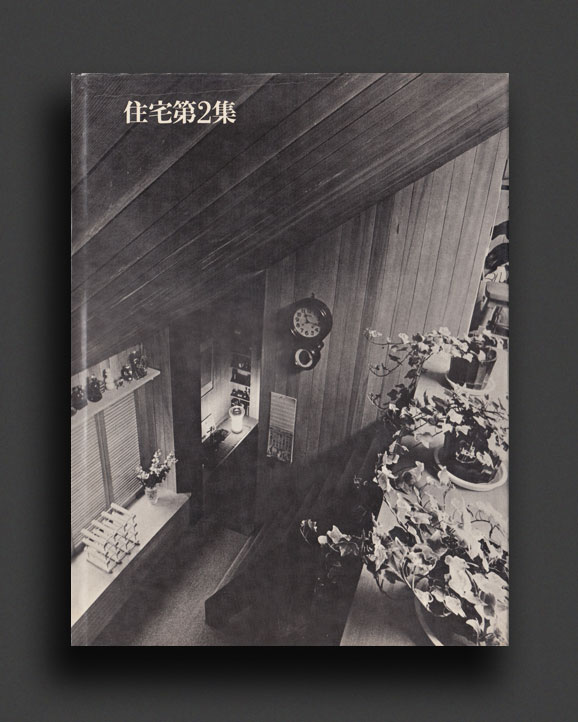
Special hardcover architectural almanac published in 1972 in Tokyo. This gorgeous, scarce volume surveys an incredible selection of residential projects from 1972, many rarely or never before seen in print, and all analysed comprehensively through spreads of beautiful colour and black and white photography and extensive fold-out plans, models and drawings. Includes homes by Shiro Kuramata, Mario Botta, Shin Takasuga, Kazumasa Yamashita, Takamitsu Azuma, Mayumi Miyawaki, Toshio Mitsufugi, Kunio Ohta, Stanley and Laurie Maurer, Leonard Feldman, Nobuyuki Furuya, JS Wood, Koichi Ogawa, Stout and Litchfield, Mashahiro Rokkaku, Takeo Hatae, and more, alongside many texts (all in Japanese), and features on wooden children's toys (Naef, etc.), modern Japanese furniture, and the radical clothing of H. Frank.
Very Good copy in Very Good dust jacket, preserved under mylar wrap.
1966, English
Softcover, 214 pages, 20.5 x 14 cm
1st US Edition, Out of print title / used / fine
Published by
Something Else Press / New York
$70.00 - Out of stock
First softcover English edition, published in 1966 by Something Else Press, New York, of "An Anecdoted Topography of Chance", arguably the most important and entertaining "Artist's Book" of the post-war period. A unique collaborative work by four artists associated with the FLUXUS and Nouveau Realisme movements, Daniel Spoerri, Robert Filliou, Emmett Williams, and Roland Topor.
What is the Topography? Hard to explain an idea so simple yet so brilliantly executed. Following a rambling conversation with his dear friend Robert Filliou, Daniel Spoerri one day mapped the objects lying at random on the table in his room, adding a rigorously scientific description of each. These objects subsequently evoked associations, memories, anecdotes; not only from the original author, but from his friends as well: a beguiling creation was born. Many of the principal participants of FLUXUS make an appearance (and texts by Higgins, Jouffroy, Kaprow, Restany, and Tinguely are included, among others). It is a novel of digressions in the manner of Tristram Shandy or Robbe-Grillet; it's a game, a poem, an encyclopaedia, a cabinet of wonders: a celebration of friendship and creativity.
The Topography personifies (and pre-dates) the whole FLUXUS spirit and constitutes one of the strangest and most compelling insights into the artist's life. From out of the banal detritus of the everyday a virtual autobiography emerges: of four perceptive, witty and eloquent members of the human species.
Translated from the French and further anecdoted by poet Emmett Williams.
First 1966 softcover edition in As New condition.
Couldn't be more highly recommended.