World Food Books' programme is largely produced on Kulin Nation land. We acknowledge the Wurundjeri people of the Kulin Nation as the first and continuing custodians of this land, and pay respect to their Elders past, present, and emerging.
World Food Books is an arts and special interests bookshop in Naarm / Melbourne. Founded in 2010, World Food Books is devoted to the presentation of a rotating, hand-selection of international art, design, literary and counterculture publications with an emphasis on the anti-traditional, the experimental, the avant-garde, the heretic, the marginal.
Presenting new titles alongside rare and out-of-print books, catalogues and journals spanning the fields of modern and contemporary art, design, photography, illustration, film, literature, poetry, cultural theory, philosophy, sexuality, popular and underground culture in its many radical forms, World Food Books wishes to encourage adventurous, thoughtful and open-minded reading, looking, writing, and exchange of publishing and ideas, both current and historical.
As well as our bookshop, located in Melbourne's historical Nicholas Building, all of our inventory is available internationally via our online mail-order service.
World Food Books semi-regularly co-ordinates "Occasions", a programme of exhibits and events at the bookshop and in partnership with other hosts (such as museums and art galleries) that develop out of the activities, relationships and content of the bookshop itself.
World Food Books
The Nicholas Building
37 Swanston Street
Room 5, Level 6
Melbourne 3000
Australia
SHOP HOURS:
Thu–Fri 12–6, Sat 12–5
WEB-SHOP OPEN 24/7
World Food Books
Postal Address:
PO Box 435
Flinders Lane
Victoria 8009
Australia
Art
Theory / Essay
Architecture / Interior
Graphic Design / Typography
Photography
Fashion
Eros
LGBTQ+
Fiction / Poetry
Weird / Speculative / Science Fiction / Horror
Transgressive / Visceral / Abject
Symbolism / Decadence / Fin de siècle
Film / Video
Painting
Sculpture / Installation
Performance / Dance / Theater
Drawing
Sound / Music
Curatorial
Group Shows / Collections
Periodicals
Out-of-print / Rare
Posters / Ephemera / Discs
Signed Books
World Food Books Gift Voucher
World Food Book Bag
Australian Art
Australian Fiction
Australian Science Fiction / Speculative Fiction
Australian Poetry
Australian Photography
Japanese Photography
Conceptual Art
Minimal Art
Dada
'Pataphysics / Oulipo
Fluxus
Concrete Poetry
Pop Art
Surrealism
Arte Povera
Arte Informale / Haute Pâte / Tachism
Nouveau Réalisme / Zero / Kinetic
Situationism / Lettrism
Collage / Mail Art / Xerox Art
Art Brut / Folk / Visionary / Fantastic
Illustration / Graphic Art / Bandes Dessinées
Furniture
Italian Radical Design / Postmodernism
Textiles
Ceramics / Glass
Counterculture
Protest / Revolt
Philosophy
Psychoanalysis
Anthropology
Anarchism
Socialism / Anarchism / Communism / Capitalism
Literary Theory / Semiotics / Language
Feminism / Women's Studies
Gender Studies / Sexuality
Anthropology
Fetishism / BDSM
Drugs / Psychedelia
Crime / Violence
Animal Rights / Veganism
Occult / Esoterica
Ecology / Earth / Alternative Living
Whole Earth / Crafts
All prices in AUD (Australian dollars)
Pick-Ups
Pick-up orders can be collected in our bookshop during opening hours after order date. Please collect any Pick-up orders within 2 weeks of ordering as we have limited storage space. Orders will be released back into stock if not collected within this time. No refunds can be made for pick-ups left un-collected. If you cannot make it in to the bookshop in this time-frame, please choose postage option.
Return Policy
All sales are final. We do accept returns (for refund or exchange) for items received in error. All our orders are packed with special care using heavy-duty padding and cardboard book-mailers or bubble mailers (for smaller books), using reinforcement where required. We cannot take responsibility for any lost, stolen or damaged parcels.
Insurance
Should you wish to insure your package, please email us directly after placing your order and we can organise this at a small extra expense. Although all standard/express tracked packages are very safe and dependable, we cannot take responsibility for any lost, stolen or damaged parcels. We recommend insurance on valuable orders.
Interested in selling your old books, catalogues, journals, magazines, comics, fanzines, ephemera? We are always looking for interesting, unusual and out-of-print books to buy. We only buy books in our fields of interest and specialty, and that we feel we can resell.
We base these prices on desirability, market value, in-print prices, condition and our current stock levels. We offer cash, store credit, and can take stock on consignment. All
about 25% of the price we expect to get when we sell them, or 30% in store credit. We base these prices on desirability, market value, in-print prices, condition and our current stock levels.
Sell your books any day of the week. You can drop them off and return later. If you have a lot of books, we can visit your Sydney home.
We buy books that we feel we can resell. We offer about 25 % of the price we expect to get when we sell them, or 30% in store credit. We base these prices on desirability, market value, in-print prices, condition and our current stock levels.
Philadelphia Wireman
03 August - 01 September, 2018
World Food Books is proud to announce our next Occasion, the first presentation of sculptures by Philadelphia Wireman in Australia.
The Philadelphia Wireman sculptures were found abandoned in an alley off Philadelphia’s South Street on trash night in 1982. Their discovery in a rapidly-changing neighbourhood undergoing extensive renovation, compounded with the failure of all attempts to locate the artist, suggests that the works may have been discarded after the maker’s death. Dubbed the "Philadelphia Wireman" during the first exhibition of this work, in 1985, the maker’s name, age, ethnicity, and even gender remain uncertain. The entire collection totals approximately 1200 pieces, all intricately bound together with tightly-wound heavy-gauge wire (along with a few small, abstract marker drawings, reminiscent both of Mark Tobey and J.B. Murry). The dense construction of the work, despite a modest range of scale and materials, is singularly obsessive and disciplined in design: a wire armature or exoskeleton firmly binds a bricolage of found objects including plastic, glass, food packaging, umbrella parts, tape, rubber, batteries, pens, leather, reflectors, nuts and bolts, nails, foil, coins, toys, watches, eyeglasses, tools, and jewellery.
Heavy with associations—anthropomorphic, zoomorphic, and socio-cultural responses to wrapped detritus—the totemic sculptures by Philadelphia Wireman have been discussed in the context of work created to fulfil the shamanistic needs of alternative religions in American culture. Curators, collectors, and critics have variously compared certain pieces to sculpture from Classical antiquity, Native American medicine bundles, African-American memory jugs, and African fetish objects. Reflecting the artist’s prolific and incredibly focused scavenging impulse, and despite—or perhaps enhanced by—their anonymity, these enigmatic objects function as urban artefacts and arbiters of power, though their origin and purpose is unknown. Philadelphia Wireman, whatever their identity, possessed an astonishing ability to isolate and communicate the concepts of power and energy through the selection and transformation of ordinary materials. Over the course of the past two decades, this collection has come to be regarded as an important discovery in the field of self-taught art and vernacular art.
Presented in collaboration with Fleisher-Ollman Gallery, Philadelphia, and Robert Heald, Wellington.
Susan Te Kahurangi King
02 February - 10 March, 2018
Susan Te Kahurangi King (24 February 1951 - ) has been a confident and prolific artist since she was a young child, drawing with readily available materials - pencils, ballpoint pens and felt-tip markers, on whatever paper is at hand. Between the ages of four and six Susan slowly ceased verbal communication. Her grandparents William and Myrtle Murphy had developed a special bond with Susan so they took on caring responsibilities for extended periods. Myrtle began informally archiving her work, carefully collecting and storing the drawings and compiling scrapbooks. No drawing was insignificant; every scrap of paper was kept. The King family are now the custodians of a vast collection containing over 7000 individual works, from tiny scraps of paper through to 5 meter long rolls.
The scrapbooks and diaries reveal Myrtle to be a woman of great patience and compassion, seeking to understand a child who was not always behaving as expected. She encouraged Susan to be observant, to explore her environment and absorb all the sights and sounds. Myrtle would show Susan’s drawings to friends and people in her community that she had dealings with, such as shopkeepers and postal workers, but this was not simply a case of a grandmother’s bias. She recognised that Susan had developed a sophisticated and unique visual language and sincerely believed that her art deserved serious attention.
This was an unorthodox attitude for the time. To provide some context, Jean Dubuffet coined the term Art Brut in 1945 to describe work created by self-taught artists – specifically residents of psychiatric institutions and those he considered to be visionaries or eccentrics. In 1972 Roger Cardinal extended this concept by adopting the term Outsider Art to describe work made by non-academically trained artists operating outside of mainstream art networks through choice or circumstance. Susan was born in Te Aroha, New Zealand in 1951, far from the artistic hubs of Paris and London that Dubuffet and Cardinal operated in. That Myrtle fêted Susan as a self-taught artist who deserved to be taken seriously shows how progressive her attitudes were.
Susan’s parents Doug and Dawn were also progressive. Over the years they had consulted numerous health practitioners about Susan’s condition, as the medical establishment could not provide an explanation as to why she had lapsed into silence. Dawn educated herself in the field of homeopathy and went on to treat all twelve of her children using these principles – basing prescriptions on her observations of their physical, mental and emotional state.
Doug was a linguist with an interest in philosophy who devoted what little spare time he had to studying Maori language and culture. To some extent their willingness to explore the fringes of the mainstream made them outsiders too but it was their commitment to living with integrity and their respect for individuality that ensured Susan’s creativity was always encouraged.
Even though Susan’s family supported her artistic pursuits, some staff in schools and hospitals saw it as an impediment to her assimilation into the community and discouraged it in a variety of ways. Her family was not always aware of this and therefore did not fully understand why Susan stopped drawing in the early 1990s. However, rather than dwell on the challenges that Susan faced in pursuit of her artistic practice, they prefer to highlight her achievements. In 2008 Susan began drawing again in earnest, after an almost 20 year interruption, and her work is now shown in galleries around the world.
Susan grew up without television and has been heavily influenced by the comics she read as a child. She is absolutely fearless in the appropriation of recognizable characters, such as Donald Duck and Mickey Mouse, in her work. She twists their limbs, contorts their faces, compresses them together, blends them into complex patterned backgrounds - always imbuing them with an incredible energy. Although Susan often used pop culture characters in her work they are not naive or childlike. These are drawings by a brilliant self-taught artist who has been creating exceptional work for decades without an audience in mind.
Mladen Stilinović
"Various Works 1986 - 1999"
02 February 16 - September 10, 2016
Various works 1986 - 1999, from two houses, from the collections of John Nixon, Sue Cramer, Kerrie Poliness, Peter Haffenden and Phoebe Haffenden.
Including: Geometry of Cakes (various shelves), 1993; Poor People’s Law (black and white plate), 1993; White Absence (glasses, ruler, set square, silver spoon, silver ladel with skin photograph and wooden cubes), 1990-1996; Exploitation of the Dead (grey and red star painting, wooden painting, black spoon with red table, red plate), 1984-1990; Money and Zeros (zero tie, paintings made for friends in Australia (Sue, John, Kerrie), numbers painting), 1991-1992; Words - Slogans (various t-shirts) - “they talk about the death of art...help! someone is trying to kill me”, “my sweet little lamb”, “work is a disease - Karl Marx”; Various artist books, catalogues, monographs, videos; Poster from exhibition Insulting Anarchy; "Circular" Croatian - Australian edition; Artist book by Vlado Martek (Dostoyevsky); more.
Thanks to Mladen Stilinović and Branka Stipančić.
Jonathan Walker
Always Will Need To Wear Winter Shirt Blue + Ochre Small Check Pattern
21 August - 21 September, 2015
Untitled
I am not a great reader of poetry but I always return to the work of Melbourne poet, Vincent Buckley (1925- 1988). Perhaps I find his most tantalising piece to be not a finished poem but a fragment left on a scrap of paper discovered on his desk after the poet’s death.
The poetry gathers like oil
In the word-core, and spreads
It has its music meet,
Its music is in movement.
This fragment is more the shell left behind from a volatile thought than a finished poem. I find the last two lines honest but awkward whereas the first two lines work like an arrow. Most likely he could not find a resolution so it was left. Still, in its present form, it remains an eloquent testimony to the ultimate failure of a medium to express mobile thought and sensation, in Buckley’s case, through verbal language. It’s an important matter because this is something all artists have to deal with regardless of the medium.
I have never written a poem, however, I am forever copying fragments from books on paper scraps in a vain effort to fix certain notions in my head. At first, they function as bookmarks that are sometimes returned to when I open the book. But before long, as they accumulate, they fall out littering the table interspersed with A4 photocopies, bills, books and medications.
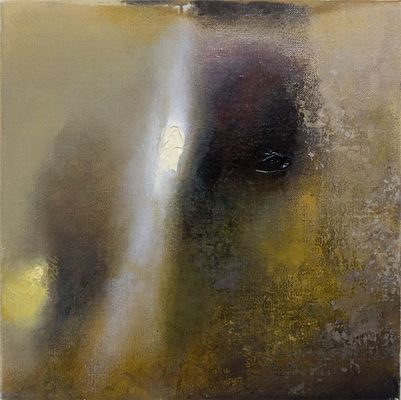
To return to Buckley’s fragment, the first two lines very much evoke how I paint nowadays. As you age, detail diminishes and patches of light become more luminous and float. I feel the most honest way of dealing with this is by smearing the oil paint on the canvas with the fingers and working close-up, blind. Only if the patches coalesce into an approaching image can the work gain a life.
-
Jonathan Walker was born in Melbourne, Australia and brought up on a dairy farm in Gippsland. In the 1970’s he studied painting at RMIT and won the Harold Wright Scholarship to the British Museum, London. During the 1980’s he exhibited at Pinacotheca Gallery, Richmond and had work shown at the NGV and Heidi City Art Gallery. Over the same period he designed the cover for the “Epigenesi” LP by Giancarlo Toniutti, Italy and conducted a mail exchange work with Achim Wollscheid, Germany. The work with artists through the post resulted in an article published in the bicentenary issue of Art and Australia 1988. He showed in artist run spaces such as WestSpace in the 90’s and 2000’s, and until 2012, taught painting at Victoria University, which is where we (Colleen Ahern and Lisa Radford) as organisers of the exhibition, among many others, had the privilege of being his student.
Walker’s knowledge was imparted to students through the careful selection of music, literature, and artists found in books that he himself had ordered for the library. Walker’s strategy was the generosity of sharing his vast knowledge with references specific to each student and their context.
Walker’s paintings share a similar focus and intimacy.
This exhibition presents a small selection of recent paintings alongside a publication that includes Walker’s writing. Observational and analytical, Walker’s work is a type of material notation — the time of day, colour and how it is blended, the both specific and fleeting location of a reflection on lino or the question of whether a chair leg should be included in a painting.
Please join us on Friday August 21 between 6-8pm to celebrate the opening of the exhibition.
Curated by Colleen Ahern and Lisa Radford.
B. Wurtz
Curated by Nic Tammens
March 26 - April 4, 2015
B.Wurtz works from a basement studio in his home on Manhattan’s Lower East Side.
This local fact is attested to by the plastic shopping bags and newsprint circulars that appear in his work. As formal objects, they don’t make loud claims about their origins but nonetheless transmit street addresses and places of business from the bottom of this long thin island. Like plenty of artists, Wurtz is affected by what is local and what is consumed. His work is underpinned by this ethic. It often speaks from a neighborhood or reads like the contents of a hamper:
“BLACK PLUMS $1.29 lb.”
“Food Bazaar”
“USDA Whole Pork Shoulder Picnic 99c lb.”
“RITE AID Pharmacy, with us it’s personal.”
“H. Brickman & Sons.”
“Sweet Yams 59c lb."
Most of the work in this exhibition was made while the artist was in residence at Dieu Donne, a workshop dedicated to paper craft in Midtown. Here Wurtz fabricated assemblages with paper and objects that are relatively lightweight, with the intention that they would be easily transportable to Australia. This consideration isn’t absolute in Wurtz’s work, but was prescriptive for making the current exhibition light and cheap. Packed in two boxes, these works were sent from a USPS post office on the Lower East Side and delivered to North Melbourne by Australia Post.
Wurtz appears courtesy of Metro Pictures, New York.
Thanks to Rob Halverson, Joshua Petherick, Sari de Mallory, Matt Hinkley, Helen Johnson, Fayen d'Evie, Ask Kilmartin, Lisa Radon, Ellena Savage, Yale Union, and "Elizabeth".
John Nixon
"Archive"
December 15 - January 20, 2014
The presentation of John Nixon's archive offered a rare showcase of this extensive collection of the artist's own publications, catalogues, posters, ephemera, editions and more, from the mid 1980s onwards, alongside a selection of his artworks.
Organized by John Nixon, Joshua Petherick and Matt Hinkley.
<a href=http://wfb.public-office.info/artist/john-nixon>All titles by John Nixon
"Habitat"
at Minerva, Sydney (organised by Joshua Petherick and Matt Hinkley)
November 15 - December 20, 2014
Lupo Borgonovo, Janet Burchill & Jennifer McCamley,
Lewis Fidock, HR Giger, Piero Gilardi, Veit Laurent Kurz,
Cinzia Ruggeri, Michael E. Smith, Lucie Stahl, Daniel Weil, Wols
Press Release:
“...It contained seven objects. The slender fluted bone, surely formed for flight, surely from the wing of some large bird. Three archaic circuitboards, faced with mazes of gold. A smooth white sphere of baked clay. An age-blackened fragment of lace. A fingerlength segment of what she assumed was bone from a human wrist, grayish white, inset smoothly with the silicon shaft of a small instrument that must once have ridden flush with the surface of the skin - but the thing’s face was seared and blackened.”
William Gibson, “Count Zero”, 1986
"Autumn Projects Archive"
Curated by Liza Vasiliou
March 6 - March 15, 2014
World Food Books, in conjunction with the Virgin Australia Melbourne Fashion Festival 2014, presented the Autumn Projects archive, consisting of a selection of early examples in Australian fashion with a particular interest in collecting designers and labels from the period beginning in the 1980’s, who significantly influenced the discourse of Australian Fashion.
Curated by Liza Vasiliou, the exhibition provided a unique opportunity to view pieces by designers Anthea Crawford, Barbara Vandenberg, Geoff Liddell and labels CR Australia, Covers, Jag along with early experimental collage pieces by Prue Acton and Sally Browne’s ‘Fragments’ collection, suspended throughout the functioning World Food Books shop in Melbourne.
H.B. Peace
presented by CENTRE FOR STYLE
November 14, 2013
"Hey Blinky, you say chic, I say same"
Anon 2013
H.B. Peace is a clothing collaboration between great friends Blake Barns and Hugh Egan Westland. Their pieces explore the divergences between 'character’ and ‘personality’ in garments....etc
Special Thanks to Joshua Petherick and Matt Hinkley of WFB and Gillian Mears
and a Very Special Thank you to Audrey Thomas Hayes for her shoe collaboration.
Janet Burchill & Jennifer McCamley
"Aesthetic Suicide"
May 10 - June 8, 2013
The first of our occasional exhibitions in the World Food Books office/shop space in Melbourne, "Aesthetic Suicide" presented a body of new and older works together by artists Janet Burchill & Jennifer McCamley, including videos, prints, a wall work, and publications.
During shop open hours videos played every hour, on the hour.
1994, English / Japanese
Hardcover (w. dut jacket), 21 x 2.5 x 31.1 cm
1st Edition, Out of print title / used / fine
Published by
Pie Books / Tokyo
$140.00 - Out of stock
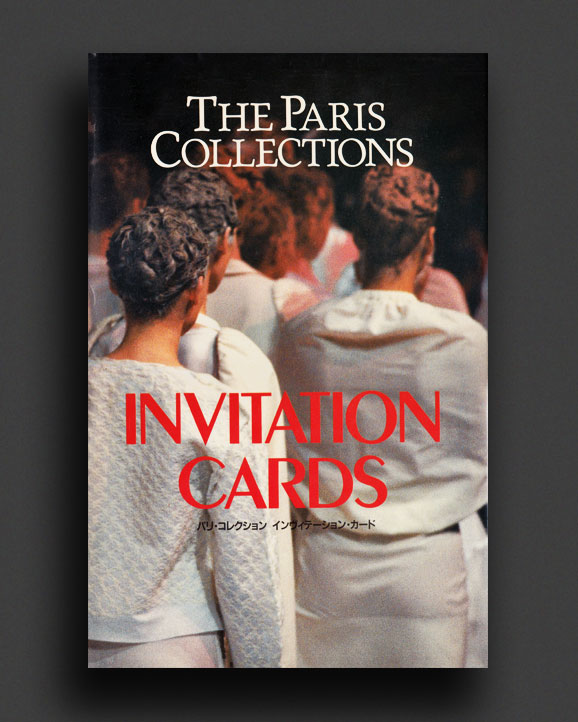
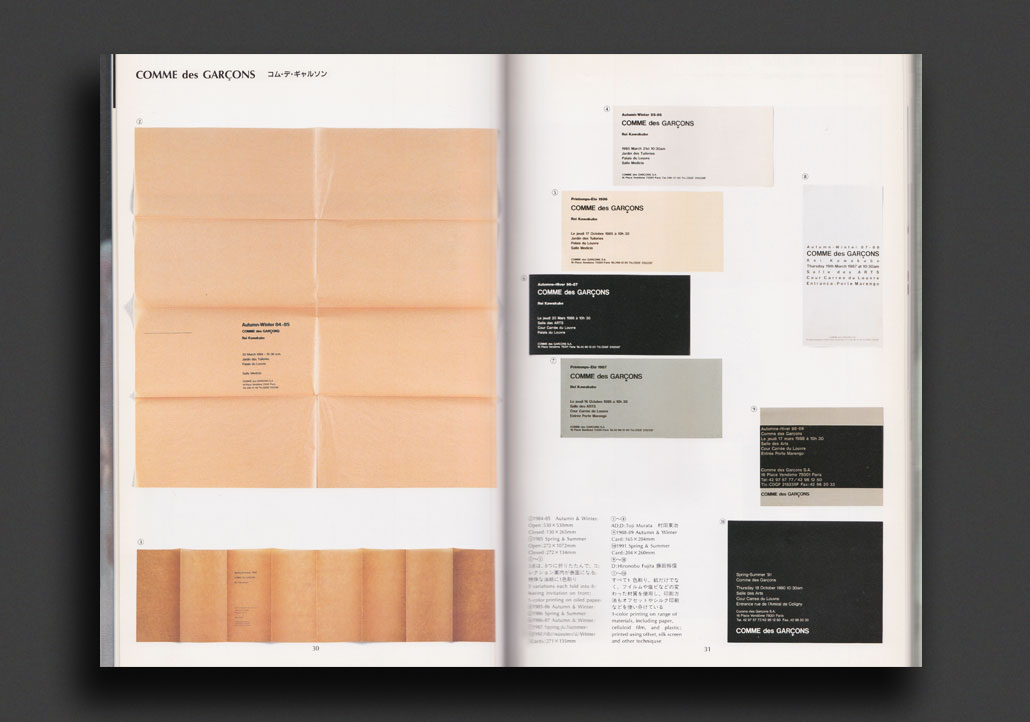
First edition of this special Japanese hardcover volume published in 1994, collecting over 400 invitations from the Paris fashion collections beginning in 1983.
"Paris is the very heart of fashion, and the Paris Collections are renowned as a dazzling display of style and sophistication. The top designers each present three collections twice a year in haute couture, pret-a-porter for ladies, and pret-a-porter for men. This book carries a selection of the fabulous invitations sent out prior to these shows, spanning the ten years from the Autumn/Winter Collections of 1983-84 to those of 1993-94. Invitations to the Paris Collections are sent around the world to fashion journalists, buyers and important clients. They encapsulate the glamour of Paris, and mirror the prestige, as
well as the originality, of each designer or fashion house. As a selection, these invitations provide a fascinating record of the changing times in the fashion world. And each of the 430 or so invitations in this book is in itself a unique work of art that will delight and reward the reader."
Features the printed matter of : Comme des Garçons, Dries Van Noten, Issey Miyake, Chloe, Jean-Paul Gaultier, Kenzo, Rochas, Popy Moreni, Sonia Rykiel, Thierry Mugler, Yohji Yamamoto, Karl Lagerfeld, Cerruti, Jean-Charles de Castelbajac, Yves Saint Laurent, Kansai Yamamoto, Christian Dior, Dirk Bikkembergs, Valentino, Balmain, Christian Lacroix, Martine Sitbon, Givenchy, Gianni Versace, Guy Laroche, Nina Ricci, Yohji Yamamoto, Chanel, Emanuel Ungaro, Lanvin, Hermes, and many others.
2017, English
Hardcover, 92 pages, 22.9 x 24.9 cm
Published by
D.A.P. / New York
$75.00 - Out of stock
In 1977, photographers Larry Sultan (1946–2009) and Mike Mandel (born 1950) published a book that would radically transform both photography and the photobook canon—a book described by Martin Parr, in The Photobook: A History, as "one of the most beautiful, dense and puzzling photobooks in existence, an endless visual box of tricks." Sultan and Mandel sifted through thousands of photographs in the files of the Bechtel Corporation, the Los Angeles Police Department, the Jet Propulsion Laboratories, the US Department of the Interior, Stanford Research Institute and a hundred other corporations, American government agencies and educational, medical and technical institutions. They were looking for photographs that were made and used as transparent documents and purely objective instruments—as evidence, in short.
Selecting 59 of the best, they published these images with the care you would expect to find in a high-quality art photography book, issuing them in 1977 in a simple, limited-edition volume titled Evidence.
Long established as a photobook classic and a seminal example of conceptual photography, Evidence was reissued as a facsimile edition in 2004 by D.A.P. with a new spread of images and a group of black-and-white illustrations selected by the artists from an archive of photographs that were not included in the original book, plus a commissioned essay by Sandra Phillips. Today both this reissue and the original 1977 publication are exceptionally rare and command high prices.
D.A.P. now reprints the 2004 edition of Evidence, making available to a general readership a truly pioneering and canonical photobook.
2009, English
Hardcover (w. wax die-cut dust jacket), 336 pages, 17.8 x 22.9 cm
Published by
The MIT Press / Massachusetts
October Books / New York
$87.00 - Out of stock
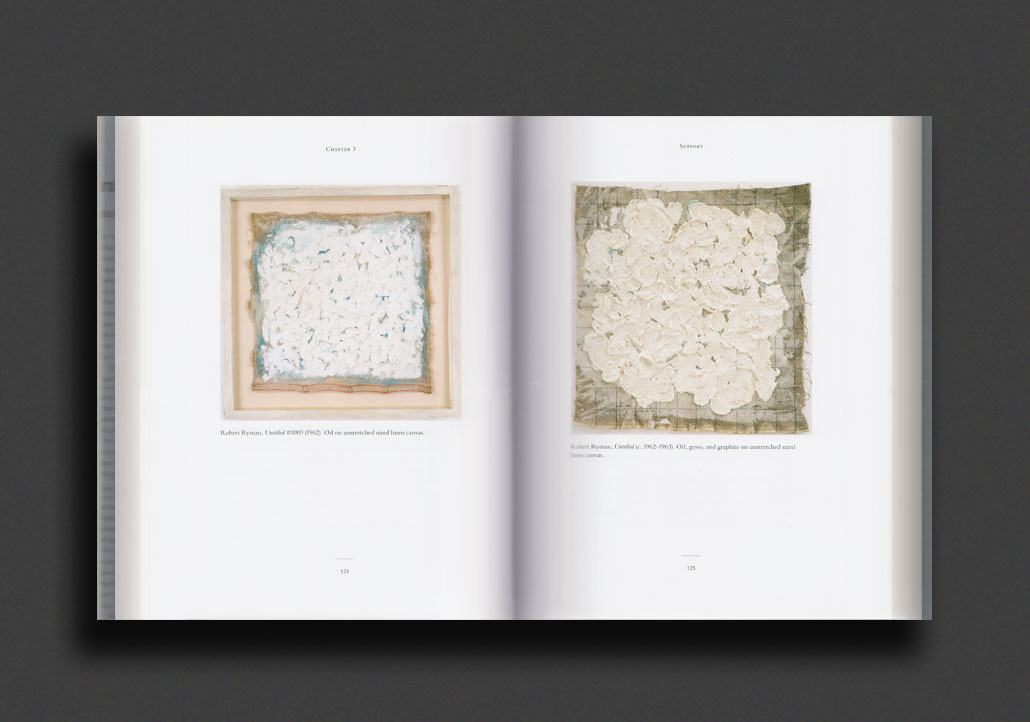
In this first book-length study of Robert Ryman, Suzanne Hudson traces the artist's production from his first paintings in the early 1950s, many of which have never been exhibited or reproduced, to his recent gallery shows. Ryman's largely white-on-white paintings represent his careful working over of painting's conventions at their most radically reduced. Through close readings of the work, Hudson casts Ryman as a painter for whom painting was conducted as a continuous personal investigation. Ryman's method—an act of ''learning by doing''—as well as his conception of painting as ''used paint'' sets him apart from second-generation abstract expressionists, minimalists, or conceptualists.
Ryman (born in 1930) is a self-taught artist who began to paint in earnest while working as a guard at the Museum of Modern Art in New York in the 1950s. Hudson argues that Ryman's approach to painting developed from quotidian contact with the story of modern painting as assembled by MoMA director and curator Alfred Barr and rendered widely accessible by director of the education department Victor D'Amico and colleagues. Ryman's introduction to artistic practice within the (white) walls of MoMA, Hudson contends, was shaped by an institutional ethos of experiential learning. (Others who worked at the MoMA during these years include Lucy Lippard, who married Ryman in 1961; Dan Flavin, another guard; and Sol LeWitt, a desk assistant.) 112 colour plates.
Hudson's chapters—''Primer,'' ''Paint,'' ''Support,'' ''Edge,'' and ''Wall,'' named after the most basic elements of the artist's work—eloquently explore Ryman's ongoing experiment in what makes a painting a painting. Ryman's work, she writes, tests the medium's material and conceptual possibilities. It signals neither the end of painting nor guarantees its continued longevity but keeps the prospect of painting an open question, answerable only through the production of new paintings.
2017, English
Softcover, 256 pages, 15.5 x 21 cm
Published by
Park Books / Zürich
$69.00 - Out of stock
New and revised edition of Iñaki Ábalos’s highly acclaimed book on seven iconic 20th-century houses, some of them actually built, others merely imagined or realized as film sets.
What is the role of architecture if not to realize a shared vision of the "good life," a vision that in the age of architectural modernism shaped - and was shaped by - a range of ideas about the home?
With The Good Life, Iñaki Ábalos serves as our guide for a tour of seven iconic twentieth-century homes that represent various concepts for living. Some of the homes were actually built, while others were merely planned, painted, or created as part of a film set. We see Mies van der Rohe's House with Three Patios, Martin Heidegger's cabin in the Black Forest, Picasso's Villa La Californie in Cannes, and the New York loft that Andy Warhol called The Factory. From the ultramodern geometric houses and gardens in Jacques Tati's Mon Oncle, we travel to the famed hobby-kit house in Buster Keaton's One Week and on to the sunny swimming pool and home in David Hockney's painting A Bigger Splash. Ábalos guides readers through the key philosophical precepts that likely guided the creation of these homes, making insightful points about the relationship between ideas about a particular modern way of living and approaches to architecture and design. What he concludes is that modernism marks less a coherent triumph of positivism, as is often assumed, than a loose celebration of the radical pluralism of the twentieth century. A fascinating work by one of Spain's most prominent architects, The Good Life presents a powerful picture of the concerns that guided the course of architectural modernism.
2017, English
Hardcover, 368 pages, 25.2 x 30.5 cm
Published by
Hatje Cantz / Berlin
$110.00 - Out of stock
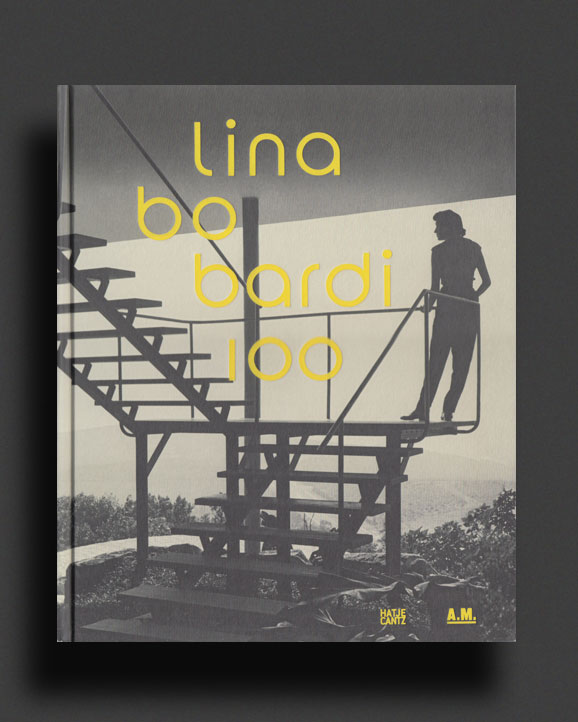
The long awaited reprint. On the occasion of Italio-Brazilian architect Lina Bo Bardi's one hundredth birthday, this richly illustrated volume presents an overview of her oeuvre and highlights iconic buildings, such as her own home, the so-called Casa de Vidro, the Museo de Arte de Sao Paulo, and the cultural center SESC Pompeia. This is a spectacular book on a celebrated architect. Spanning architecture, stage sets, fashion, and furniture, her work drew inspiration from the International Style, which she translated into her own visual language. Fundamental to her work was her thoughtful engagement with her adopted country of Brazil, its culture, society, and politics, and she productively and provocatively voiced her sometimes radical views through designs, exhibitions, and writings.
Lina Bo Bardi, born Achillina Bo (1914 – 1992) was an Italian-born Brazilian modernist architect. A prolific architect and designer, Lina Bo Bardi devoted her working life, most of it spent in Brazil, to promoting the social and cultural potential of architecture and design. She was also famed for her furniture and jewelry designs.
2018, English
Softcover, 64 pages, 10.8 × 17.8 cm
Published by
David Zwirner Books / New York
$20.00 - Out of stock
Introduction by Robert Hewison
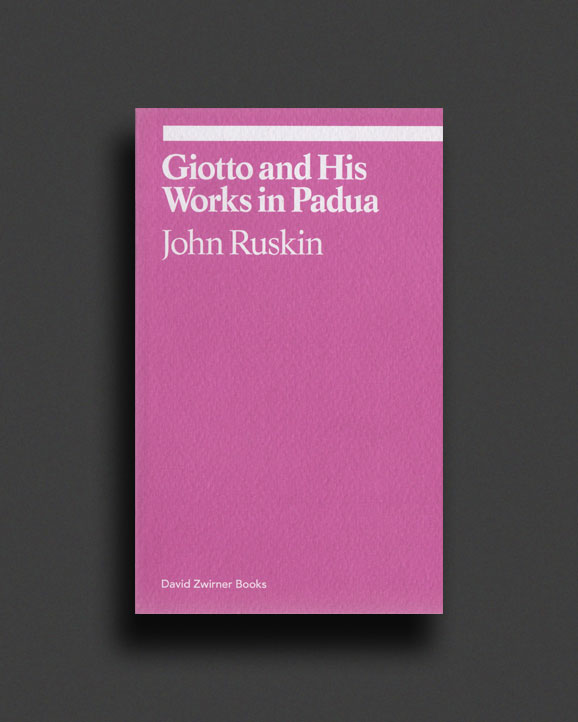
The Arena Chapel in Padua was completed in 1303; Giotto, then considered the preeminent painter in Italy, was commissioned to paint it in 1306. The resulting fresco cycle, detailing the history, birth, life, and death of Christ, ranks among the greatest artworks ever created.
John Ruskin helped redefine art criticism in the nineteenth century through his attention to detail, his playful and engaging prose, and the conviction with which he discussed the subjects that mattered most to him. Ruskin’s ekphrastic writing became a way for readers to approach the experience of looking at great art without actually seeing it in person. Despite having written about Giotto on numerous occasions in Stones of Venice and Modern Painters, he never treated the Arena Chapel in its own right. Here Ruskin examines the panels and brings them life, describing their many hidden details, all the result of Giotto’s unrivaled genius. As Ruskin says, “Giotto was…one of the greatest men who ever lived.”
Long out of print, the Arundel Society first published Giotto and His Works in Padua between 1853 and 1860. It stands as Ruskin’s most compelling set of reflections on Giotto’s masterpiece—an artwork that, in Ruskin’s estimation, changed the very course of art history. Originally accompanied by a set of black and white woodcuts of the panels in the Chapel, this new edition presents each panel in vivid color photography, adding a useful visual aid to Ruskin’s lyrical descriptions. The result is a book that serves not only as an introduction for students of art history, but also as a discussion of what it means to be a great artist, by one of most influential writers ever to tackle visual art.
John Ruskin (1819–1900) was an English critic of art, architecture, and society, who sought change through his polemical prose. Best know for his five-volume treatise on art, Modern Painters—published volume by volume from 1843 to 1860 – Ruskin applied Romantic thought to art criticism, rather than relying solely on religious tradition. In doing so, he opened up possibilities surrounding the appreciation and understanding of art, through emotive descriptions, rather than illustration. Particularly intrigued by the painting of the Gothic Middle Ages, Ruskin felt that painters such as Giotto and Fra Angelico were the ideal subject for modern painters. Ruskin’s then novel insistence that art and architecture are the direct expression of the conditions in which they were made, continues to influence the study of the fields today.
Giotto (c.1267–1337) is widely known for his role in liberating Italian painting from the Byzantine style of the early Middle Ages. Mainly active in Florence, although he may have been trained in Rome, he also worked in Avignon, Padua and Naples (1328-32). His contribution to challenging and forever changing Italian painting was widely acknowledged by Dante his contemporary, and later by Vasari. His style is associated with a supreme sense of momentous and his individualized, emotive figures are depicted with a new sense of three-dimensionality while inhabiting plausible architectural spaces. Giotto’s main surviving fresco cycles are those in the Arena Chapel, Padua, which probably date from just before 1305, and those in the Bardi and Peruzzi chapels in Santa Croce, Florence, probably before 1328.
Dedicated to publishing rare, out-of-print, and newly commissioned texts as accessible paperback volumes the ekphrasis series is part of David Zwirner Books’s ongoing effort to publish new and surprising pieces of writing on visual culture.
2018, English
Softcover, 136 pages, 10.8 × 17.8 cm
Published by
David Zwirner Books / New York
$20.00 - Out of stock
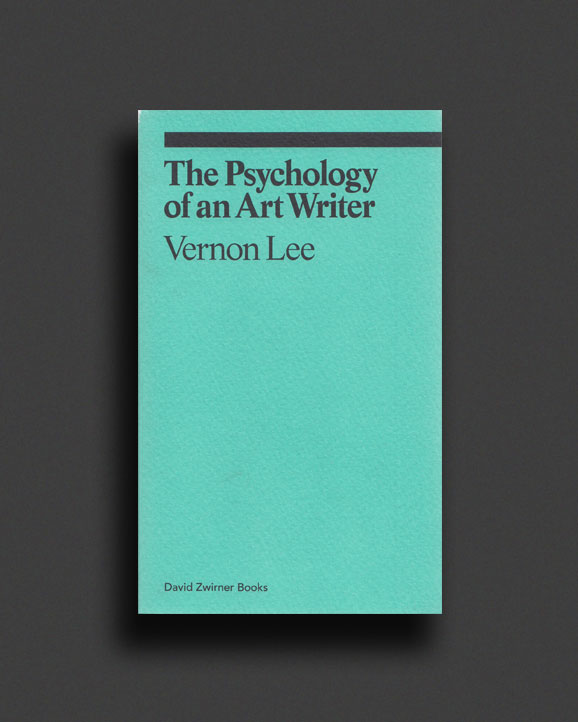
An openly lesbian, feminist writer, Vernon Lee—a pseudonym of Violet Paget—is the most important female aesthetician to come out of nineteenth century England.
Though she was widely known for her supernatural fictions, Lee hasn’t gained the recognition she so clearly deserves for her contributions in the fields of aesthetics, philosophy of empathy, and art criticism. An early follower of Walter Pater, her work is characterized by extreme attention to her own responses to artworks, and a level of psychological sensitivity rarely seen in any aesthetic writing. Today, she is largely overlooked in curriculums, her aesthetic works long out of print.
David Zwirner Books is reintroducing Lee’s writing through the first-ever English publication of "Psychology of an Art Writer" (1903) along with selections from her groundbreaking "Gallery Diaries" (1901–1904), breathtaking accounts of Lee’s own experiences with the great paintings and sculptures she traveled to see. Ranging from deeply felt assessments of the way mood affects our ability to appreciate art, to detailed descriptions of some of the most powerful personal experiences with artworks, these writings provide profound insights into the fields of psychology and aesthetics. Her philosophical inquiries in The Psychology of an Art Writer leave no stone unturned, combining fine-grained ekphrases with high fancy and dense abstraction. The diaries, in turn, establish Lee as one of the most sensitive writers about art in any language.
With a foreword by Berkeley classicist Dylan Kenny, which guides the reader through these writings and contextualizes these texts within Lee’s other work, this is the quintessential introduction to her astonishing and complex oeuvre.
Under the pseudonym Vernon Lee, Violet Paget (1856–1935) published a bewildering variety of work, including historical studies; meditative essays on art, music, gardens, and travel; philosophical dialogues; treatises on aesthetic theory and psychology; and supernatural tales. Born to a cosmopolitan English family, she settled in Florence, where she maintained friendships with artists and intellectuals throughout the world, including John Singer Sargent, Mary Cassatt, Edith Wharton, J.A. Symonds, Walter Pater, Charlotte Perkins Gilman, and G.B. Shaw. In close collaboration with her partner, the artist Kit Anstruther-Thompson, she was one of the first English thinkers to seriously engage with German empathy theory. Together, they tried to capture the mysterious and complex workings of art on our bodies, our minds, and our social lives; one of the fruits of this investigation was the 1912 volume Beauty and Ugliness, which included and analyzed long excerpts from Lee’s own Gallery Diaries. Partially as a result of her strong pacifist politics and opposition to World War I, Lee became somewhat estranged from the literary establishment, although she continued to write prolifically until her death.
Dedicated to publishing rare, out-of-print, and newly commissioned texts as accessible paperback volumes the ekphrasis series is part of David Zwirner Books’s ongoing effort to publish new and surprising pieces of writing on visual culture.
2017, English
Softcover, 64 pages, 10.8 × 17.8 cm
Published by
David Zwirner Books / New York
$20.00 - Out of stock
"As for you, my dear Balthus, you surely know full well the love that connects us. Yours with all my heart, Rilke."
Never before translated into English, Rainer Maria Rilke’s fascinating Letters to a Young Painter, written toward the end of his life between 1920 and 1926, is a surprising companion to his infamous Letters to a Young Poet, earlier correspondence from 1902 to 1908. While the latter has become a global phenomenon, with millions of copies sold in many different languages, the present volume has been largely overlooked.
In these eight intimate letters written to a teenage Balthus—who would go on to become one of the leading artists of his generation—Rilke describes the challenges he faced, while opening the door for the young painter to take himself and his work seriously. Rilke’s constant warmth, his ability to sense in advance his correspondent’s difficulties and propose solutions to them, and his sensitivity as a person and an artist come across in these charming and honest letters.
Writing during his aged years, this volume paints a picture of the venerable poet as he faced his mortality, through the perspective of hindsight, and continued to embrace his openness towards other creative individuals. With an introduction by Rachel Corbett, author of You Must Change Your Life: The Story of Rainer Maria Rilke and Auguste Rodin (2016), this book is a must-have for Rilke’s admirers, young and old, and all aspiring artists.
Rainer Maria Rilke (1875–1926) was a poet and novelist, best known for his highly lyrical poetry. He was born in Prague, but spent significant portions of his life in Paris, where he initially served as the sculptor Auguste Rodin’s secretary before going on to produce much of his important early work. Throughout his life, Rilke was continuously inspired by works of visual art. His biography of Rodin and his Letters on Cézanne, published posthumously, provide insight into the way visual artists, and their art, figured into his creative approach, and establish him as one of the key twentieth-century poets to engage with visual culture.
Dedicated to publishing rare, out-of-print, and newly commissioned texts as accessible paperback volumes the ekphrasis series is part of David Zwirner Books’s ongoing effort to publish new and surprising pieces of writing on visual culture.
1975, English
Softcover, 220 pages, 27 x 22 cm
1st Edition, Out of print title / used / very good
Published by
E P Dutton / New York
$40.00 - Out of stock
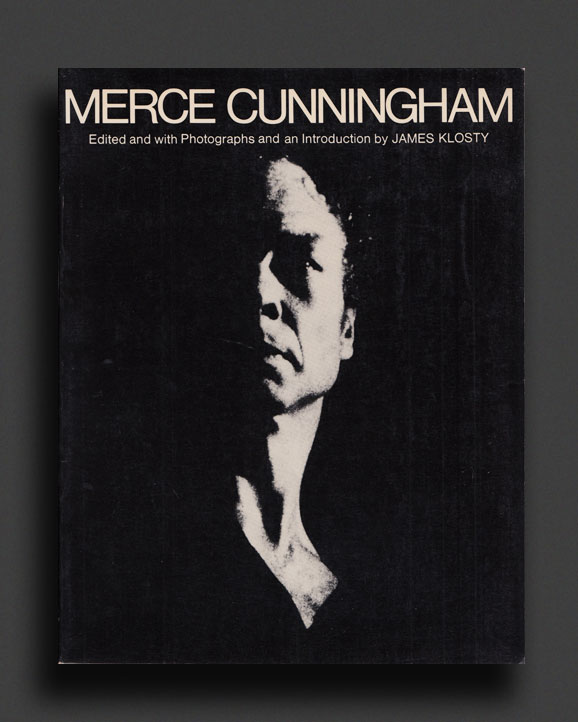
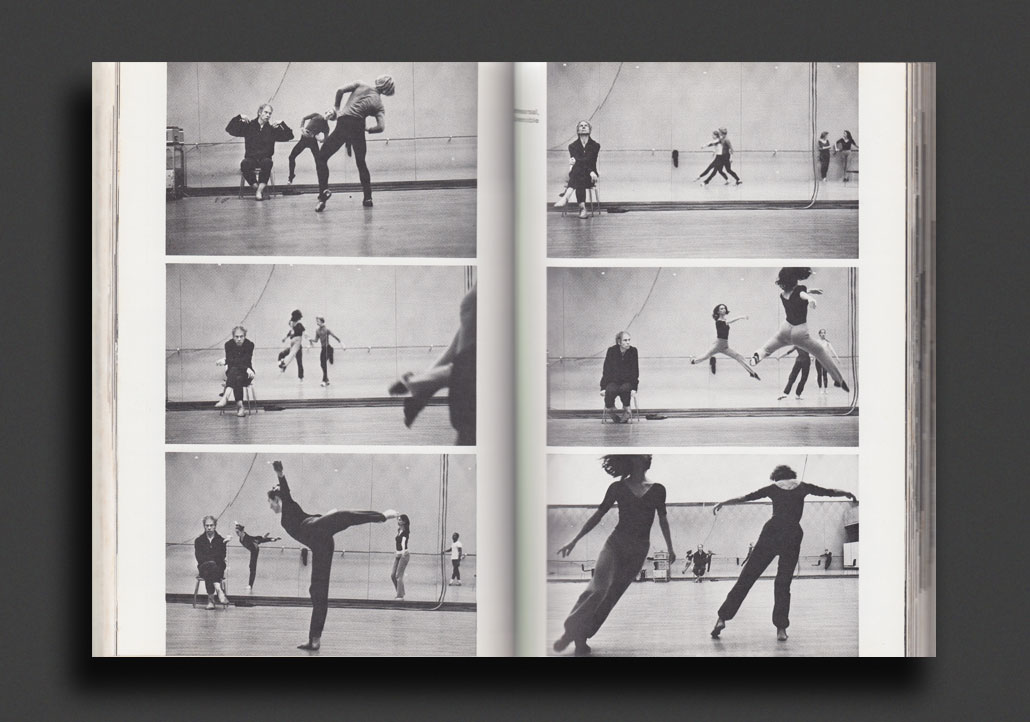
First 1975 edition of "Merce Cunningham", published by E P Dutton, New York.
Between 1967 and 1972, editor/photographer James Klosty traveled with and documented the Merce Cunningham Dance Company (MCDC). As the partner of dancer Carolyn Brown, he had unprecedented access to Cunningham, John Cage, and the Company as a whole, and his stunning photographs - first published here in his 1975 book - provide a unique, riveting, and intimate insight into both the work, and life on tour. Includes incredible documentation of the rehearsals, recitals and lives of Merce Cunningham Dance Company. Features contributions by Cunningham's close collaborators, dancers, composers, peers, including : Carolyn Brown, Viola Farber, Yvonne Rainer, Douglas Dunn, Paul Taylor, Richard Nelson, Lewis L Lloyd, John Cage, Gordon Mumma, Earle Brown, Pauline Oliveros, Christian Wolff, Robert Rauschenberg, Jasper Johns, Lincoln Kirstein, and Edwin Denby. Introduction by James Klosty.
A Very Good - Fine copy of the first edition.
1992, German / English
Hardcover (in original slipcase), Vol. 1 : 255 pages; Vol. 2 : 310 pages; Vol. 3 : 619 pages, 18.5 x 27 cm
1st Edition, Out of print title / used / good
Published by
Hatje Cantz / Berlin
$120.00 - Out of stock
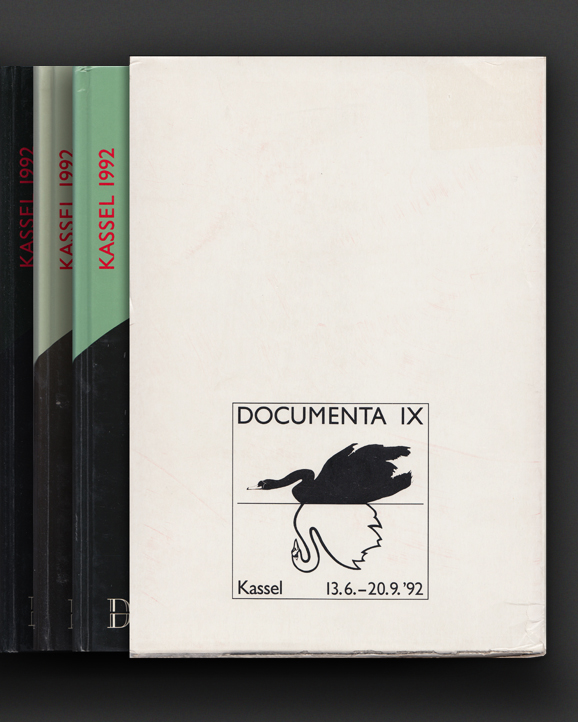
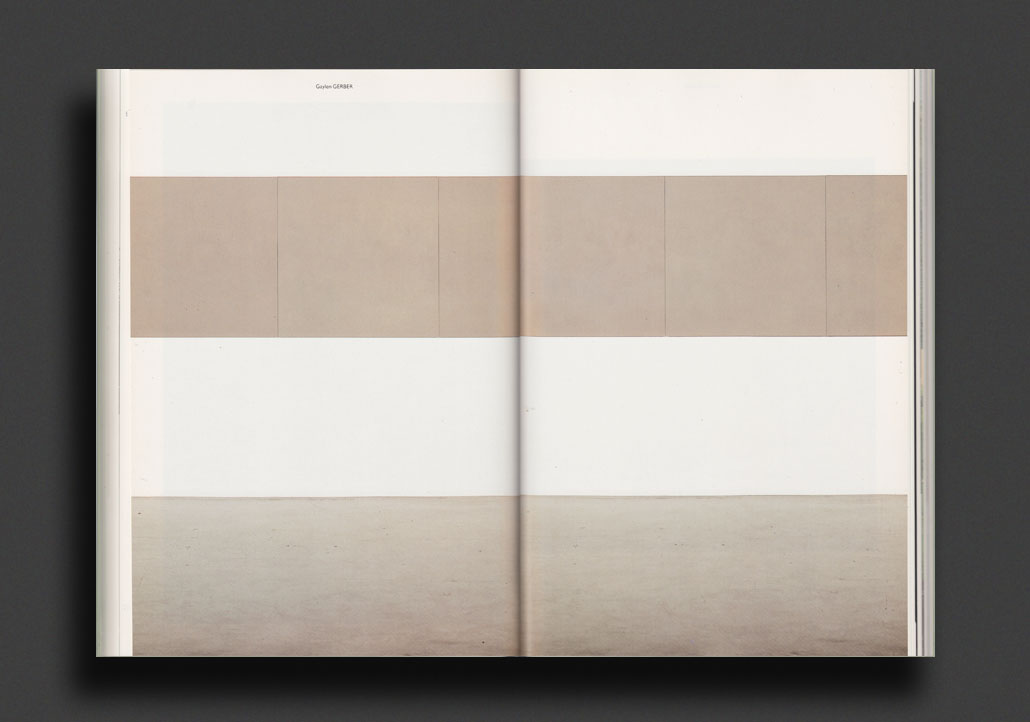
Hardcover edition, three volume exhibition catalogue published in conjunction with Documenta IX, Kassel, Germany, June 13 - September 9, 1992.
Documenta 9 is remembered as one of the most popular of all documenta exhibitions, thanks not least of all to the influence of its artistic director, the charismatic Belgian curator Jan Hoet. Hoet wanted to make the human being and our sensual, perceptual, agonized corporeality, which had been progressively displaced by the digitized, virtual world, the focus of attention at his exhibition. “From body to body to bodies” was the meaningful, poetic motto of documenta 9. Hoet described his curatorial mission in the following words: “At a time in which the human race is confronted more than ever with such dangers as AIDS and multinational wars, nuclear catastrophes, and global climate disasters, at a time in which threats are growing increasingly abstract and the fears more and more diffuse, I see reflection on the physical conditions of life as an appropriate answer.”
Texts by Jan Hoet, Denys Zacharopoulos, Bart de Baere, Pier Luigi Tazzi, Claudia Herstatt, Joyce Carol Oates, Jacques Roubaud, Cornelius Castoriadis, Heiner Müller, Paul Robbrecht, Hilde Daem.
Artists include Marina Abramovic, Absalon, Richard Artschwager, Francis Bacon, Marco Bagnoli, Nicos Baikas, Miroslaw Balka, Matthew Barney, Jerry Barr, Lothar Baumgarten, Jean-Pierre Bertrand, Joseph Beuys, Michael Biberstein, Guillaume Bijl, Dara Birnbaum, Jonathan Borofsky, Louise Bourgeois, Herbert Brandl, Ricardo Brey, Tony Brown, Marie José Burki, Jean-Marc Bustamante, Michael Buthe, Pedro Cabrita Reis, Waltercio Caldas, Pier Paolo Calzolari, Ernst Caramelle, Lawrence Carroll, Saint Clair Cemin, Tomasz Ciecierski, Tony Clark, James Coleman, Tony Conrad, Patrick Corillon, Damian, Richard Deacon, Thierry De Cordier, Silvie Defraoui & Chérif Defraoui, Raoul De Keyser, Wim Delvoye, Braco Dimitrijevic, Eugenio Dittborn, Helmut Dorner, Stan Douglas, Marlene Dumas, Jimmie Durham, Mo Edoga, Jan Fabre, Luciano Fabro, Belu-Simion Fainaru, Peter Fend, Rose Finn-Kelcey, FLATZ, Fortuyn/O'Brien, Günther Förg, Erik A.Frandsen, Michel François, Vera Frenkel, Katsura Funakoshi, Isa Genzken, Gaylen Gerber, Robert Gober, Dan Graham, Rodney Graham, Angela Grauerholz, Michael Gross, George Hadjimichalis, David Hammons, Georg Herold, Gary Hill, Peter Hopkins, Rebecca Horn, Geoffrey James, Olav Christopher Jenssen, Tim Johnson, Andrej N. Joukov, Ilya Kabakov, Anish Kapoor, Kazuo Katase, Tadashi Kawamata, Mike Kelley, Ellsworth Kelly, Bhupen Khakhar, Per Kirkeby, Harald Klingelhöller, Kurt Kocherscheidt, Peter Kogler, Vladimir Kokolia, Joseph Kosuth, Mariusz Kruk, Guillermo Kuitca, Suzanne Lafont, Jonathan Lasker, Jac Leirner, Zoe Leonard, Eugène Leroy, Via Lewandowsky, Bernd Lohaus, Ingeborg Lüscher, Attila Richard Lukacs, James Lutes, Marcel Maeyer, Brice Marden, Cildo Meireles, Ulrich Meister, Thom Merrick, Gerhard Merz, Mario Merz, Marisa Merz, Meuser, Jürgen Meyer, Liliana Moro, Reinhard Mucha, Matt Mullican, Juan Muñoz, Christa Näher, Hidetoshi Nagasawa, Bruce Nauman, Max Neuhaus, Pekka Nevalainen, Nic Nicosia, Moshe Ninio, Jussi Niva, Cady Noland, Manuel Ocampo, Jean-Michel Othoniel, Tony Oursler, Panamarenko, Giulio Paolini, A. R. Penck, Michelangelo Pistoletto, Hermann Pitz, Stephen Prina, Richard Prince, Martin Puryear, Royden Rabinowitch, Rober Racine, Philip Rantzer, Charles Ray, Martial Raysse, readymades belong to everyone, José Resende, Gerhard Richter, Ulf Rollof, Erika Rothenberg, Susan Rothenberg, Ulrich Rückriem, Thomas Ruff, Stephan Runge, Edward Ruscha, Reiner Ruthenbeck, Remo Salvadori, Joe Scanlan, Eran Schaerf, Adrian Schiess, Thomas Schütte, Helmut Schweizer, Maria Serebriakova, Mariella Simoni, Susana Solano, Ousmane Sow, Ettore Spalletti, Haim Steinbach, Pat Steir, Wolfgang Strack, Thomas Struth, János Sugár, Yuji Takeoka, Robert Therrien, Frederic Matys Thursz, Niele Toroni, Thanassis Totsikas, Addo Lodovico Trinci, Mitja Tušek, Luc Tuymans, Micha Ullman, Juan Uslé, Bill Viola, Henk Visch, James Welling, Franz West, Rachel Whiteread, Christopher Wool, KeunByung Yook, Heimo Zobernig, Gilberto Zorio, and Constantin Zvezdochotov.
Very Good condition volumes in hardcover (much less common edition than usual softcover), preserved in their original illustrated slipcase (with common repaired splitting and bumping damage).
1985, English
Softcover, 592 pages, 15.5 x 23 cm
Published by
Johns Hopkins University Press / Baltimore
$30.00 - Out of stock
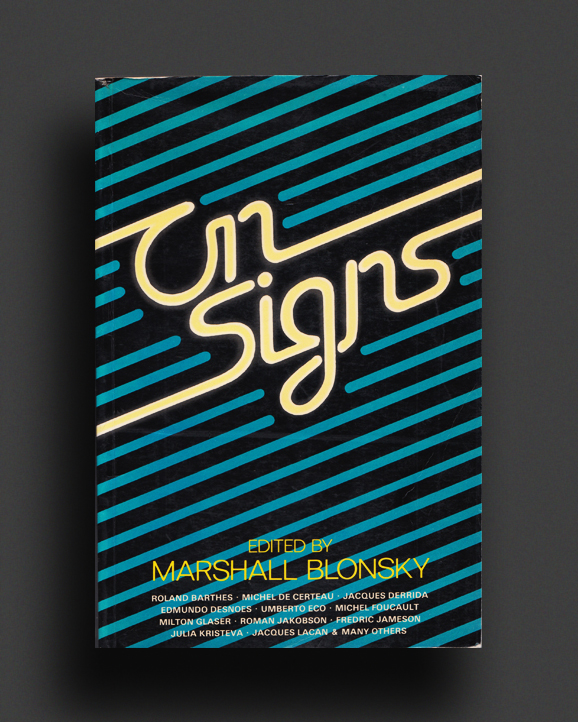
Edited by Marshall Blonsky
Published in 1985, this heavy volume functions as a unified voice proclaiming the power of semiotics to reveal the hidden practices and secrets of modern society. Marshall Blonsky has gathered original and newly translated written and illustrated contributions by highly visible forces in semiotic circles of the period, including Roland Barthes, Michel de Certeau, Jacques Derrida, Edmundo Desnoes, Umberto Eco, Michel Foucault, Julia Kristeva, Jacques Lacan, Jean Franco, Milton Glaser, Thomas A. Sebeok, Guido Crepax, Susan Meiselas and many others.
1987, English
Hardcover (w. dust jacket), 140 pages, 22.9 x 27.9 cm
1st Edition, Out of print title / used / fine
Published by
The MIT Press / Massachusetts
$130.00 - Out of stock
First english edition of this long out-of-print major hardcover monograph on Bruno Munari. Published by The MIT Press in 1987, this was the first comprehensive book on his work, and was itself designed by Munari! Clothbound, in original dust-jacket, protected in plastic sleeve.
Foreward by Andrea Branzi.
One of the last surviving members of the futurist generation, Bruno Munari has been the enfant terrible of Italian art and design for most of this century. Munari was born in 1907 in Milan and it was against the active background of futurism that his artistic experiments developed, but his mechanical fantasies, practical inventions, and didactic writings continue to be enjoyed by a public that has no memory of Balla, Prampolini, and Marinetti.
Munari's 40-odd books, ranging from futurist manifestoes to design manuals to children's books, have been widely read in many languages. But this book, itself designed by Munari, is the first comprehensive account of his total achievement. Here are the Unreadable Books (that told stories through the possibilities of typography, papermaking, and binding), Traveling Sculptures, Fossils of the Year 2000, Theoretical Reconstruction of Imaginary Objects, Original Xerographies, Negative Positives, and the famous Useless Machines of the 1930s (constructions for wagging the tails of lazy dogs, predicting dawn, making sobs sound musical) as well as numerous other works, some published for the first time.
The hundreds of illustrations, many in full color, recreate Munari's relentless inventiveness, his love of irony, chance and humor, his intensely experimental orientation and constantly fresh approach to new technologies and materials.
Aldo Tanchis lives in Milan where he is currently collaborating with the advertising agency Pirella Göttsche. He is the author of The Anomalous Art of Bruno Munari.
2018, English
Softcover, 608 pages, 178 x 25.5 cm
Published by
Columbia University Press / New York
$58.00 $30.00 - Out of stock
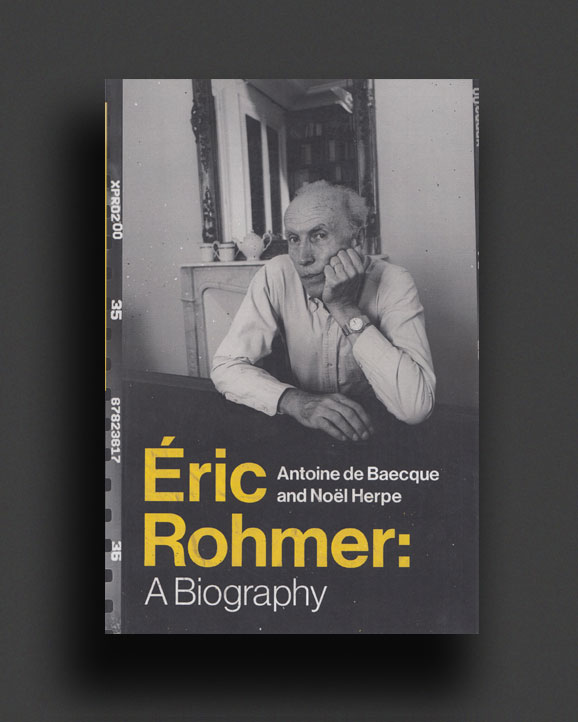
The director of twenty-five films, including My Night at Maud's (1969), which was nominated for a Best Picture Academy Award, and the editor in chief of Cahiers du cinéma from 1957 to 1963, Éric Rohmer set the terms by which people watched, made, and thought about cinema for decades. Such brilliance does not develop in a vacuum, and Rohmer cultivated a fascinating network of friends, colleagues, and industry contacts that kept his outlook sharp and propelled his work forward. Despite his privacy, he cared deeply about politics, religion, culture, and fostering a public appreciation of the medium he loved.
This exhaustive biography uses personal archives and interviews to enrich our knowledge of Rohmer's public achievements and lesser known interests and relations. The filmmaker kept in close communication with his contemporaries and competitors: François Truffaut, Jean-Luc Godard, Claude Chabrol, and Jacques Rivette. He held a paradoxical fascination with royalist politics, the fate of the environment, Catholicism, classical music, and the French nightclub scene, and his films were regularly featured at New York and Los Angeles film festivals. Despite an austere approach to life, Rohmer had a voracious appetite for art, culture, and intellectual debate captured vividly in this definitive volume.
Antoine de Baecque and Noël Herpe achieve in this scrupulously researched volume the paradoxical feat of delivering the definitive biography of a pseudonymous subject. Eric Rohmer will interest film historians, theorists of film, enthusiasts of French cinema, and film directors both aspiring and established, for whom Rohmer's low-budget modus operandi remains one of the miracles of modern film production. This, the first biography of Rohmer (né Maurice Schérer), is likely also to be the last. (Derek Schilling, Johns Hopkins University)
An essential and ceaselessly enjoyable work of scholarship.... The most valuable gift afforded by this biography is the sheer joy of moving through the exacting, meticulous accounts of each stage of Rohmer's life and career, painstakingly researched and written as if the authors were striving for the same arresting attention to detail, subtlety, humor, and philosophical weight of his films. (Dan Sullivan Film Comment)
2018, English / German
Hardcover, 222 pages, 22 x 31 cm
Published by
Hatje Cantz / Berlin
Staatliche Kunsthalle / Baden Baden
$97.00 - Out of stock
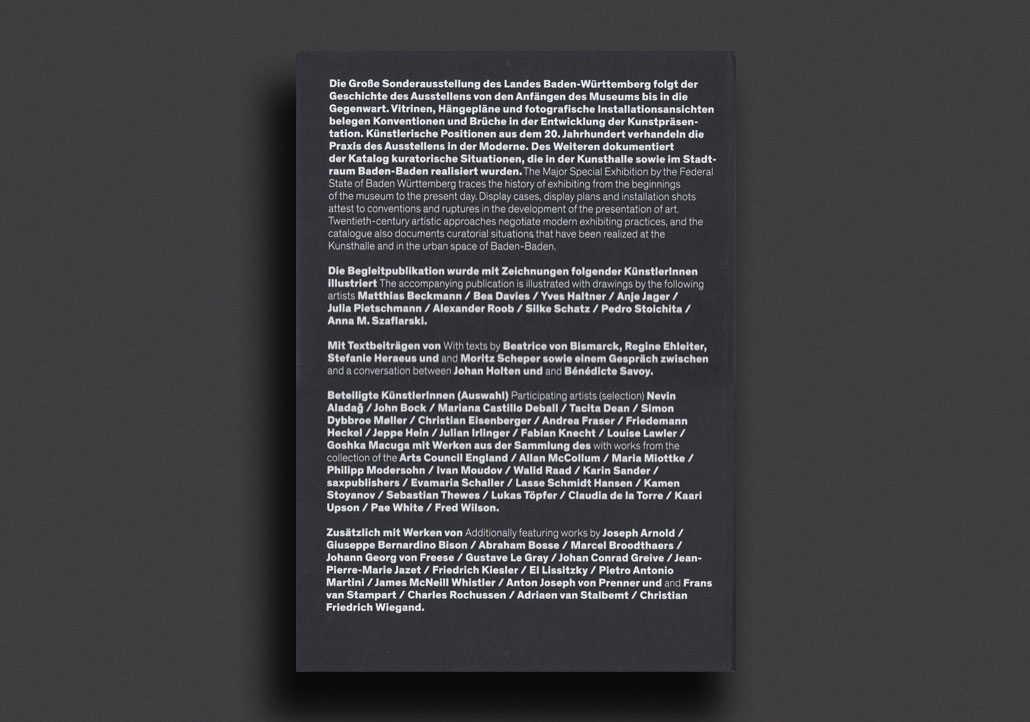
Exhibiting the Exhibition investigates the history of exhibiting up to the present day. The show at the Staatliche Kunsthalle Baden-Baden begins with predecessors to the modern museum and early art collections, then moves on to twentieth-century exhibition methods and the curatorial positions of today. The catalogue expands upon the exhibition concept: instead of photographing the exhibits for publication, various illustrators were hired to draw them, so that the book itself becomes an entirely independent instrument of “display.”
Besides the essays and interviews, the volume features works by John Bock, Mariana Castillo Deball, Andrea Fraser, Jeppe Hein, Julian Irlinger, Friedrich Kiesler, Louise Lawler, El Lissitzky, Karin Sander, Sebastian Thewes, Kaari Upson, Pae White, Fred Wilson, and many others.
With a conversation between Bénédicte Savoy and Johan Holten.
Texts by Beatrice von Bismarck, Regine Ehleiter, Stefanie Heraeus, Johan Holten, Moritz Scheper.
2018, English
Softcover, 264 pages, 16 x 21 cm
Published by
Open Editions / London
$45.00 - Out of stock
Edited by David Blamey, Brad Haylock.
Texts by Ahmed Ansari, Stuart Bertolotti-Bailey, David Blamey, Justin Clemens, Alex Coles, Neil Arthur & Jonathan Lindley, David Cross, Neil Cummings, Sean Dockray & Benjamin Forster, Susan Hawthorne, Brad Haylock, Robert Hetherington, Gareth Long, Markus Miessen & Jens-Maier Rothe, Billie Muraben, Rathna Ramanathan, Patricia Reed, Adrian Shaughnessy, Martine Syms & Pip Wallis, Jake Tilson, Eva Weinmayr
The power of knowledge lies not only in generating ideas, but also in controlling their dispersion. For those who would seek to influence others, the dissemination of ideas is paramount. For those looking to protect the fruits of intellectual labor for reasons of profit or ethics, distribution is something to control. Either way, distribution is a key concern across the spectrum of cultural production, particularly at a time when digital networks have facilitated an unprecedented access to audiences.
Bringing together contributors from a variety of backgrounds, Distributed presents the act of distribution as a subject of significant social and economic importance and argues that it merits serious creative consideration. From the attention-seeking impulse of the “influencer” to the democratization of art via books, performances, videos or sound, the increased urge to disseminate is explored here as an elemental phenomenon of our time.
2018, English
Hardcover, 128 pages, 16 x 22 cm
Published by
Four Corners Books / London
$28.00 - Out of stock
From 1968 to 1971, anyone could drop in to the basement in Camden Town and commission a poster from the Poster Workshop. In walked workers on strike, tenants associations, civil rights groups and liberation movements from all over the world. Inspired by the Atelier Populaire, set up in Paris, in May 1968, the posters could be made quickly to respond to what was needed, on a great number of themes: Vietnam, Northern Ireland, South Africa, housing, workers rights, and revolution.
The Poster Workshop existed at an exceptional time. It thrived on the energy generated by the belief that huge changes were possible, through movements for equality, civil rights, freedom and revolution. It was an expression of that time - of excitement, change and hope.
This book is the third in the Irregulars series of aspects of modern British visual history. It reproduces all of the Poster Workshop's posters which give a unique perspective on the key political issues in 1960s and 1970s Britain - many of which still resonate today.
by Sam Lord, with Peter Dukes, Jo Robinson and Sarah Wilson
With a foreword by Jess Baines
2017, English
Softcover, 352 pages, 17 x 24 cm
Published by
Quodlibet / Italy
$89.00 - Out of stock
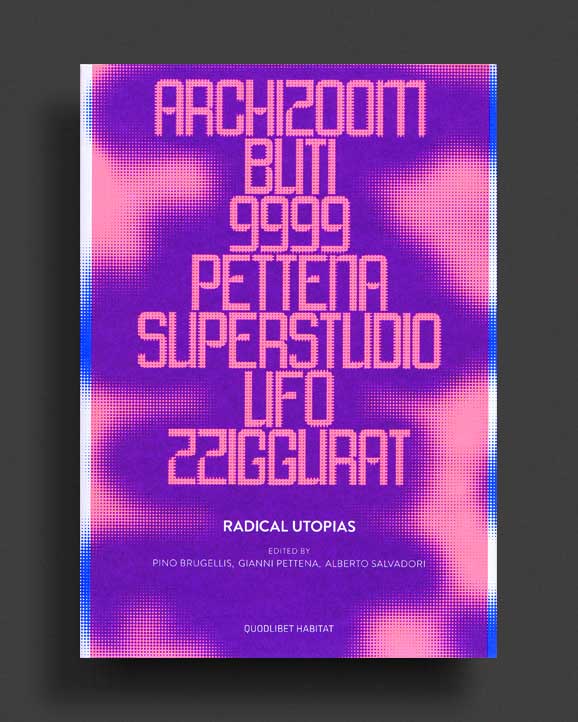
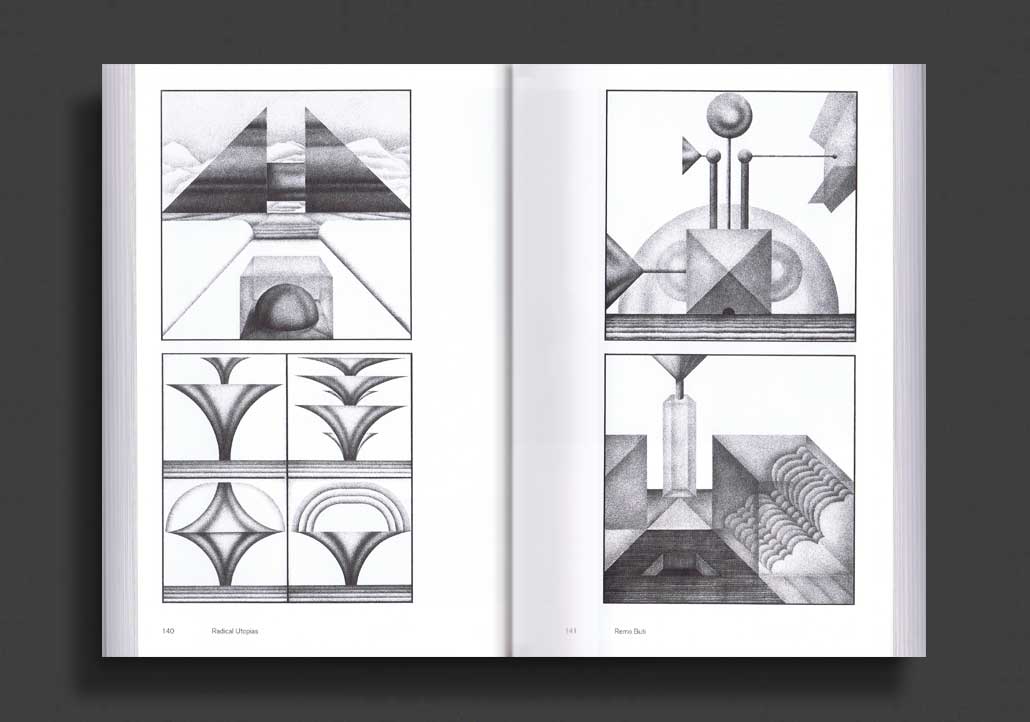
This volume is published in conjunction with an exhibition presenting the radical architects and architect groups who emerged in Florence in the late 1960s. It was a period characterised by crisis in the city, which extended to the wider political and social tension occurring throughout Italy. The related writings, drawings, and projects produced by these seven actors – Archizoom, Remo Buti, 9999, Gianni Pettena, Superstudio, UFO, and Zziggurat – have influenced generations of architects, historians, designers, and artists around the world. For the first time, all of their theoretical and visual work has been compiled in a single publication, giving renewed insight into their movement.
2017, English
Paperback, 116 pages, 17 x 24 cm
Published by
CCA Wattis Institute for Contemporary Arts / San Francisco
$46.00 - In stock -
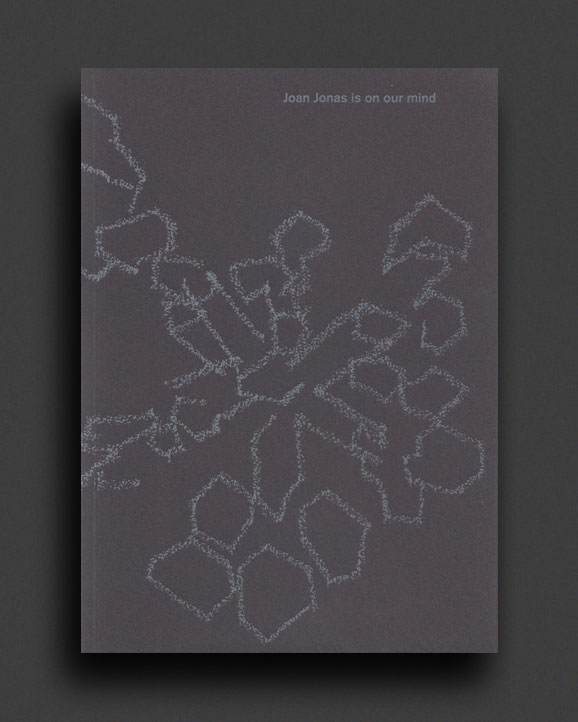
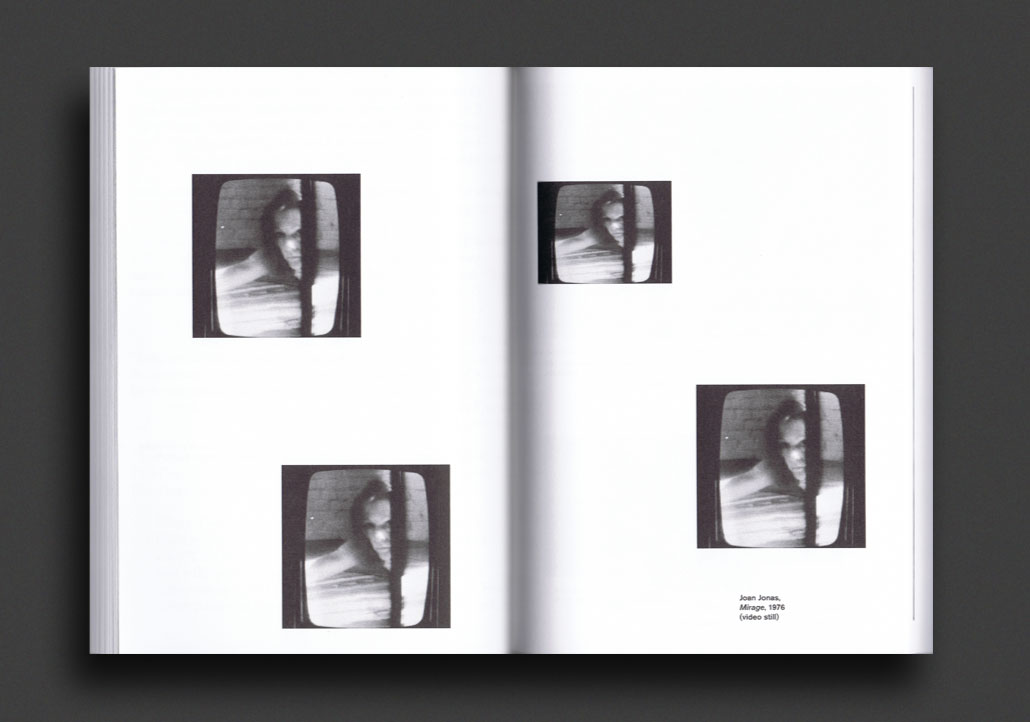
The CCA Wattis Institute in San Francisco dedicates year long seasons of discussions and public events to a single artist. In 2014–15, Joan Jonas was “on our mind.” This book brings together essays from writers, curators, art historians and artists that focus on a single work, from Jonas’ earliest films through her installation for the US Pavilion at the 56th Venice Biennale. The book also contains excerpts from readings and public lectures, and images by some of the other artists whose work was evoked in public and private conversation. Contributors include Jacqueline Francis, Renée Green, Quinn Latimer, Sarah Lehrer-Graiwer, Patricia Maloney, Elizabeth Mangini, Judith Rodenbeck and Lynne Tillman.
2018, English
Softcover, 288 pages, 14 x 21 cm
Published by
Valiz / Amsterdam
$44.00 - Out of stock
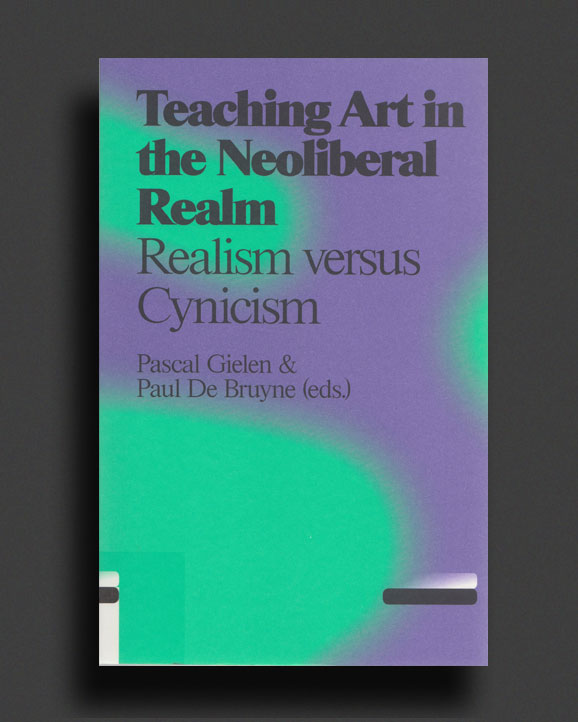
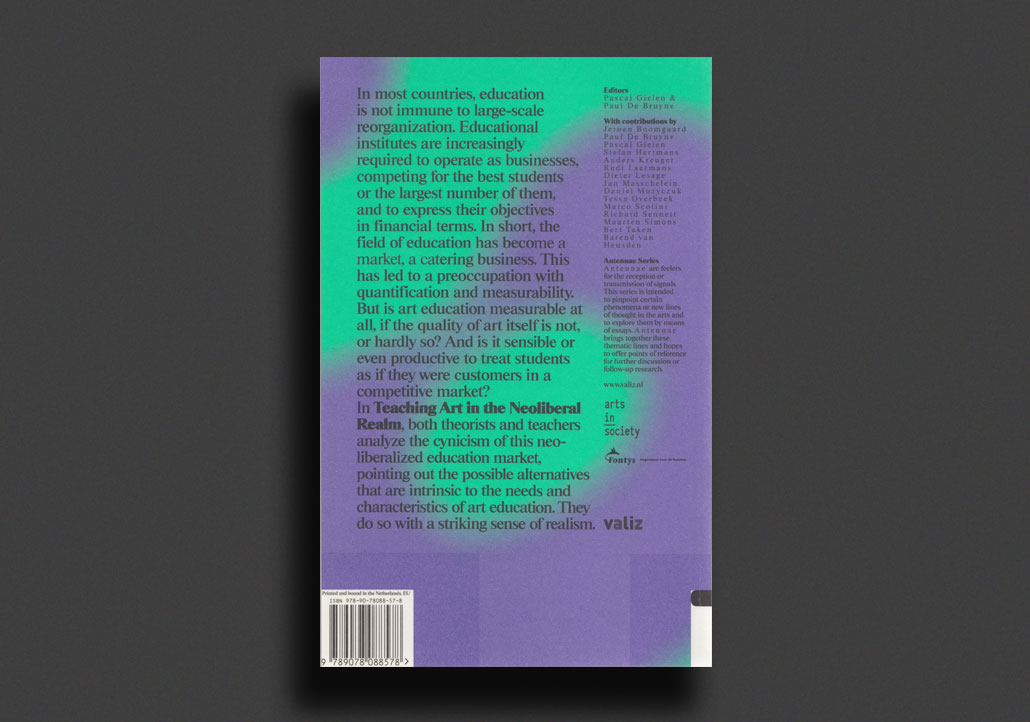
Throughout the world, the educational field is being transformed into a marketplace in which institutions must compete for students, and are called on to assess their cultural contributions in terms of finance and management. Is there any room left for art in such a system? Teaching Art in the Neoliberal Realm investigates the wide-scale reorganization of art education in the United States, Europe, Asia, Australia, Latin America, Russia and The Netherlands, and seeks to determine both the current impact and future ramifications of market education on the arts and the artist. Most importantly, it provides prescriptions for a positive direction forward, steering between the cynical big business of the art market and the threatened idealism of classic art education. The thematic chapters, interviews and essays adopt both practical and theoretical approaches, and include such contributors as Richard Sennett, Marco Scotini and Dieter Lesage.
Contributors: Pascal Gielen, Paul De Bruyne, Barend van Heusden, Maarten Simons, Jan Masschelein, Bert Taken, Jeroen Boomgaard, Daniel Muzyczuk, Dieter Lesage, Stefan Hertmans, Rudi Laermans, Anders Kruger, Marco Scotini, Tessa Overbeek, Rien van der Vleuten
2016, English
Hardcover, 656 pages, 28.2 x 19 cm
Published by
Fondation Beyeler / Basel
Koenig Books / London
MMK / Frankfurt am Main
WIELS / Brussels
$100.00 - Out of stock
Felix Gonzalez-Torres (1957-1996) is one of the most influential artists of his generation. This catalogue includes both rarely seen and more known paintings, sculptures, photographic works, and public projects, reflecting the full scope of the artist’s short yet prolific career.
Specific Objects without Specific Form offered several exhibition versions (and none the authoritative one), all the better to present the oeuvre of an artist who put fragility, the passage of time, and the questioning of authority at the centre of his artwork.
At each venue in which the show was hosted, the exhibition was co-curated with, and re-installed/re-imagined by a different invited artist whose practice has been informed by Gonzalez-Torres’ work. Those artists are Danh Vo, Carol Bove, and Tino Sehgal.
Specific Objects without Specific Form acknowledges that the way an exhibition begins and ends its ‘story’, the emphasis it places on one aspect more than another, the way it presents individual artworks, the juxtapositions it constructs, the mood it creates, in addition to the way an exhibition is discursively presented — all of these potentially shift the way that a body of work might be understood by its public. And all of these participate in the construction of the meaning and reception of an oeuvre, which is to say, nothing less than the construction of history.
Published retrospectively after the exhibition at WIELS Contemporary Art Centre, Brussels (January – April 2010); Fondation Beyeler, Basel (May – August 2010); and MMK, Frankfurt am Main (January – April 2011).
2016, English
Hardcover (w. dust jacket), 160 pages, 22 x 13.5 cm
Published by
The MIT Press / Massachusetts
$49.00 - Out of stock
A book that acts both as library and exhibition space, selecting, arranging, and housing texts and images, aligning itself with printed matter in the process.
Fantasies of the Library lets readers experience the library anew. The book imagines, and enacts, the library as both keeper of books and curator of ideas—as a platform of the future. One essay occupies the right-hand page of a two-page spread while interviews scrolls independently on the left. Bibliophilic artworks intersect both throughout the book-as-exhibition. A photo essay, “Reading Rooms Reading Machines” further interrupts the book in order to display images of libraries (old and new, real and imagined), and readers (human and machine) and features work by artists including Kader Atta, Wafaa Bilal, Mark Dion, Rodney Graham, Katie Paterson, Veronika Spierenburg, and others.
The book includes an essay on the institutional ordering principles of book collections; a conversation with the proprietors of the Prelinger Library in San Francisco; reflections on the role of cultural memory and the archive; and a dialogue with a new media theorist about experiments at the intersection of curatorial practice and open source ebooks. The reader emerges from this book-as-exhibition with the growing conviction that the library is not only a curatorial space but a bibliological imaginary, ripe for the exploration of consequential paginated affairs. The physicality of the book—and this book—“resists the digital,” argues coeditor Etienne Turpin, “but not in a nostalgic way.”
Contributors: Erin Kissane, Hammad Nasar, Megan Shaw Prelinger, Rick Prelinger, Anna-Sophie Springer, Charles Stankievech, Katharina Tauer, Etienne Turpin, Andrew Norman Wilson, Joanna Zylinska
When we think of the library we often focus on its systems of order—the even-spaced rows of shelves, the discrete call numbers on the spines of books. But Fantasies of the Library reveals that our experience of the library is instead one of chaotic discovery and unexpected interconnections, a true reflection of the often nonlinear and dreamlike state of our own minds.
The library as digital-analog remix, as labyrinth, as madness—a spectacular exploration of knowledge infrastructures in transition. Brilliant, restless, searching: Fantasies of the Library is a meta-tour of the archive with the ghosts of Foucault, Borges, and Flaubert.
2017, English
Softcover, 100 pages, 14 x 21 cm
Published by
Sternberg Press / Berlin
$29.00 - Out of stock
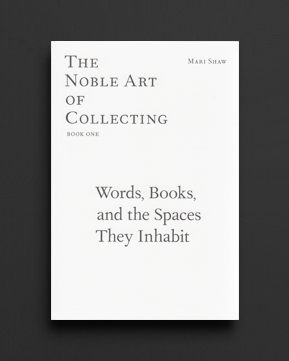
Words, Books, and the Spaces They Inhabit is the first of Mari Shaw’s series The Noble Art of Collecting. With examples of unexpected collectors and serendipitous outcomes, Shaw investigates the obscure desires that shape art collecting and the public goodwill that results from it. What was lost when the scrolls in the ancient library of Alexandria were destroyed? How did Catherine the Great’s collecting change the way we think? How do Jeff Bezos and Amazon.com expand our appreciation of books as objects? Though the ways we communicate live and vary, history has been created, recorded, and preserved in writing. Words and the spaces that contain them are crucial to an empathetic understanding of our world.
Mari Shaw is an intellectual property lawyer, storyteller, and author of Painter and Pataphysician Thomas Chimes (2015). She has organized projects with artists such as Candida Höfer and Anri Sala; has taught a seminar on originality, art, law, and technology at the University of Pennsylvania; and lectures at a number of universities and art schools. Shaw has served on boards and advisory committees for documenta 12, The Galleries of the Moore College of Art and Design, Philadelphia Museum of Art, University of Wisconsin Law School, and the Wilma Theater. She and her husband, Peter, live in Philadelphia and Berlin and have been collecting art for thirty-five years.
Design by John Hubbard
2007, English
Softcover, 112 pages, 15.2 x 21.6 cm
Published by
Afterall / London
The MIT Press / Massachusetts
$35.00 - Out of stock
A richly illustrated study of Marc Chaimowicz's groundbreaking 1972 post-Pop installation-performance piece Celebration? Realife written by art historian Tom Holert.
Marc Camille Chaimowicz (born in 1947) was one of the first artists to merge the realms of performance and installation art. Chaimowicz distinguished himself in an era of stark minimalism by his unabashed pursuit of the beautiful, establishing himself in the 1970s with art that was playful and subtly seductive. Chaimowicz's post-Pop scatter environments owed as much to glam rock as to art practice and were informed by modern French literature (Gide, Cocteau, Proust, and Gênet) as well as by art theory. His important 1972 installation Celebration? Realife featured masks, mirrors, various small objects (including a pair of orange knickers and a white bra), a glitter ball, music by the Rolling Stones, David Bowie, and others—and the artist, serving tea and engaging visitors in conversation in an adjacent room. It raised questions about public/private dichotomies, art/design boundaries, and identifications based on gender, and recast the artist as a kind of art director and stage designer. This work's recent reinstallation (as Celebration? Realife Revisited 1972/2000) and the critical acclaim it inspired confirms Chaimowicz's importance and points to his relationships with artists as different and as difficult as Cerith Wyn Evans, Jutta Koether, Kai Althoff, and others. This richly illustrated study of Celebration? Realife, with many color images, uses Chaimowicz's installation to reconstruct that cultural moment in the 1970s when the role of the artist and the relationships of art, design, popular culture, and performance changed.
Performance artist Marc Camille Chaimowicz, born in Paris in 1947, teaches in the M.F.A. course at the University of Reading and is visiting consultant at L'Ecole Nationale des Beaux-Arts, Dijon. He is the author of Café du Réve.
Tom Holert is an art historian, independent scholar, and critic who has published widely in magazines including Artforum and Bookforum.
1971, Japanese / English
Hardcover (w. slipcase), 192 pages, 23.5 x 19 cm
1st Edition, Out of print title / used / very good
Published by
Kinema Jumpo Sha / Japan
$50.00 - Out of stock
Volume 6 from an incredible series (possibly 10-parts) published in Japan in the late 1960s-early 1970s that captures the work of Japanese film director and screenwriter Akira Kurosawa (1910 – 1998), who directed 30 films in a career spanning 57 years and is regarded as one of the most important and influential filmmakers in the history of cinema.
Each cardboard slipcased, hardbound volume comprises chronologically profiled films of Kurosawa presented scene for scene, reproducing the film through copious film stills alongside the film's entire script and dialogue (in both English and Japanese). Also includes a complete cast and staff listing for each film and further select full-page stills from the featured films. This volume (no. 6) features the films The Idiot (1951) and Ikiru (1952).
Very Good-Fine copy preserved in original issue cardboard slipcase (tanning to spine otherwise very well preserved).