World Food Books' programme is largely produced on Kulin Nation land. We acknowledge the Wurundjeri people of the Kulin Nation as the first and continuing custodians of this land, and pay respect to their Elders past, present, and emerging.
World Food Books is an arts and special interests bookshop in Naarm / Melbourne. Founded in 2010, World Food Books is devoted to the presentation of a rotating, hand-selection of international art, design, literary and counterculture publications with an emphasis on the anti-traditional, the experimental, the avant-garde, the heretic, the marginal.
Presenting new titles alongside rare and out-of-print books, catalogues and journals spanning the fields of modern and contemporary art, design, photography, illustration, film, literature, poetry, cultural theory, philosophy, sexuality, popular and underground culture in its many radical forms, World Food Books wishes to encourage adventurous, thoughtful and open-minded reading, looking, writing, and exchange of publishing and ideas, both current and historical.
As well as our bookshop, located in Melbourne's historical Nicholas Building, all of our inventory is available internationally via our online mail-order service.
World Food Books semi-regularly co-ordinates "Occasions", a programme of exhibits and events at the bookshop and in partnership with other hosts (such as museums and art galleries) that develop out of the activities, relationships and content of the bookshop itself.
World Food Books
The Nicholas Building
37 Swanston Street
Room 5, Level 6
Melbourne 3000
Australia
SHOP HOURS:
Thu–Fri 12–6, Sat 12–5
WEB-SHOP OPEN 24/7
World Food Books
Postal Address:
PO Box 435
Flinders Lane
Victoria 8009
Australia
Art
Theory / Essay
Architecture / Interior
Graphic Design / Typography
Photography
Fashion
Eros
LGBTQ+
Fiction / Poetry
Weird / Speculative / Science Fiction / Horror
Transgressive / Visceral / Abject
Symbolism / Decadence / Fin de siècle
Film / Video
Painting
Sculpture / Installation
Performance / Dance / Theater
Drawing
Sound / Music
Curatorial
Group Shows / Collections
Periodicals
Out-of-print / Rare
Posters / Ephemera / Discs
Signed Books
World Food Books Gift Voucher
World Food Book Bag
Australian Art
Australian Fiction
Australian Science Fiction / Speculative Fiction
Australian Poetry
Australian Photography
Japanese Photography
Conceptual Art
Minimal Art
Dada
'Pataphysics / Oulipo
Fluxus
Concrete Poetry
Pop Art
Surrealism
Arte Povera
Arte Informale / Haute Pâte / Tachism
Nouveau Réalisme / Zero / Kinetic
Situationism / Lettrism
Collage / Mail Art / Xerox Art
Art Brut / Folk / Visionary / Fantastic
Illustration / Graphic Art / Bandes Dessinées
Furniture
Italian Radical Design / Postmodernism
Textiles
Ceramics / Glass
Counterculture
Protest / Revolt
Philosophy
Psychoanalysis
Anthropology
Anarchism
Socialism / Anarchism / Communism / Capitalism
Literary Theory / Semiotics / Language
Feminism / Women's Studies
Gender Studies / Sexuality
Anthropology
Fetishism / BDSM
Drugs / Psychedelia
Crime / Violence
Animal Rights / Veganism
Occult / Esoterica
Ecology / Earth / Alternative Living
Whole Earth / Crafts
All prices in AUD (Australian dollars)
Pick-Ups
Pick-up orders can be collected in our bookshop during opening hours after order date. Please collect any Pick-up orders within 2 weeks of ordering as we have limited storage space. Orders will be released back into stock if not collected within this time. No refunds can be made for pick-ups left un-collected. If you cannot make it in to the bookshop in this time-frame, please choose postage option.
Return Policy
All sales are final. We do accept returns (for refund or exchange) for items received in error. All our orders are packed with special care using heavy-duty padding and cardboard book-mailers or bubble mailers (for smaller books), using reinforcement where required. We cannot take responsibility for any lost, stolen or damaged parcels.
Insurance
Should you wish to insure your package, please email us directly after placing your order and we can organise this at a small extra expense. Although all standard/express tracked packages are very safe and dependable, we cannot take responsibility for any lost, stolen or damaged parcels. We recommend insurance on valuable orders.
Interested in selling your old books, catalogues, journals, magazines, comics, fanzines, ephemera? We are always looking for interesting, unusual and out-of-print books to buy. We only buy books in our fields of interest and specialty, and that we feel we can resell.
We base these prices on desirability, market value, in-print prices, condition and our current stock levels. We offer cash, store credit, and can take stock on consignment. All
about 25% of the price we expect to get when we sell them, or 30% in store credit. We base these prices on desirability, market value, in-print prices, condition and our current stock levels.
Sell your books any day of the week. You can drop them off and return later. If you have a lot of books, we can visit your Sydney home.
We buy books that we feel we can resell. We offer about 25 % of the price we expect to get when we sell them, or 30% in store credit. We base these prices on desirability, market value, in-print prices, condition and our current stock levels.
Philadelphia Wireman
03 August - 01 September, 2018
World Food Books is proud to announce our next Occasion, the first presentation of sculptures by Philadelphia Wireman in Australia.
The Philadelphia Wireman sculptures were found abandoned in an alley off Philadelphia’s South Street on trash night in 1982. Their discovery in a rapidly-changing neighbourhood undergoing extensive renovation, compounded with the failure of all attempts to locate the artist, suggests that the works may have been discarded after the maker’s death. Dubbed the "Philadelphia Wireman" during the first exhibition of this work, in 1985, the maker’s name, age, ethnicity, and even gender remain uncertain. The entire collection totals approximately 1200 pieces, all intricately bound together with tightly-wound heavy-gauge wire (along with a few small, abstract marker drawings, reminiscent both of Mark Tobey and J.B. Murry). The dense construction of the work, despite a modest range of scale and materials, is singularly obsessive and disciplined in design: a wire armature or exoskeleton firmly binds a bricolage of found objects including plastic, glass, food packaging, umbrella parts, tape, rubber, batteries, pens, leather, reflectors, nuts and bolts, nails, foil, coins, toys, watches, eyeglasses, tools, and jewellery.
Heavy with associations—anthropomorphic, zoomorphic, and socio-cultural responses to wrapped detritus—the totemic sculptures by Philadelphia Wireman have been discussed in the context of work created to fulfil the shamanistic needs of alternative religions in American culture. Curators, collectors, and critics have variously compared certain pieces to sculpture from Classical antiquity, Native American medicine bundles, African-American memory jugs, and African fetish objects. Reflecting the artist’s prolific and incredibly focused scavenging impulse, and despite—or perhaps enhanced by—their anonymity, these enigmatic objects function as urban artefacts and arbiters of power, though their origin and purpose is unknown. Philadelphia Wireman, whatever their identity, possessed an astonishing ability to isolate and communicate the concepts of power and energy through the selection and transformation of ordinary materials. Over the course of the past two decades, this collection has come to be regarded as an important discovery in the field of self-taught art and vernacular art.
Presented in collaboration with Fleisher-Ollman Gallery, Philadelphia, and Robert Heald, Wellington.
Susan Te Kahurangi King
02 February - 10 March, 2018
Susan Te Kahurangi King (24 February 1951 - ) has been a confident and prolific artist since she was a young child, drawing with readily available materials - pencils, ballpoint pens and felt-tip markers, on whatever paper is at hand. Between the ages of four and six Susan slowly ceased verbal communication. Her grandparents William and Myrtle Murphy had developed a special bond with Susan so they took on caring responsibilities for extended periods. Myrtle began informally archiving her work, carefully collecting and storing the drawings and compiling scrapbooks. No drawing was insignificant; every scrap of paper was kept. The King family are now the custodians of a vast collection containing over 7000 individual works, from tiny scraps of paper through to 5 meter long rolls.
The scrapbooks and diaries reveal Myrtle to be a woman of great patience and compassion, seeking to understand a child who was not always behaving as expected. She encouraged Susan to be observant, to explore her environment and absorb all the sights and sounds. Myrtle would show Susan’s drawings to friends and people in her community that she had dealings with, such as shopkeepers and postal workers, but this was not simply a case of a grandmother’s bias. She recognised that Susan had developed a sophisticated and unique visual language and sincerely believed that her art deserved serious attention.
This was an unorthodox attitude for the time. To provide some context, Jean Dubuffet coined the term Art Brut in 1945 to describe work created by self-taught artists – specifically residents of psychiatric institutions and those he considered to be visionaries or eccentrics. In 1972 Roger Cardinal extended this concept by adopting the term Outsider Art to describe work made by non-academically trained artists operating outside of mainstream art networks through choice or circumstance. Susan was born in Te Aroha, New Zealand in 1951, far from the artistic hubs of Paris and London that Dubuffet and Cardinal operated in. That Myrtle fêted Susan as a self-taught artist who deserved to be taken seriously shows how progressive her attitudes were.
Susan’s parents Doug and Dawn were also progressive. Over the years they had consulted numerous health practitioners about Susan’s condition, as the medical establishment could not provide an explanation as to why she had lapsed into silence. Dawn educated herself in the field of homeopathy and went on to treat all twelve of her children using these principles – basing prescriptions on her observations of their physical, mental and emotional state.
Doug was a linguist with an interest in philosophy who devoted what little spare time he had to studying Maori language and culture. To some extent their willingness to explore the fringes of the mainstream made them outsiders too but it was their commitment to living with integrity and their respect for individuality that ensured Susan’s creativity was always encouraged.
Even though Susan’s family supported her artistic pursuits, some staff in schools and hospitals saw it as an impediment to her assimilation into the community and discouraged it in a variety of ways. Her family was not always aware of this and therefore did not fully understand why Susan stopped drawing in the early 1990s. However, rather than dwell on the challenges that Susan faced in pursuit of her artistic practice, they prefer to highlight her achievements. In 2008 Susan began drawing again in earnest, after an almost 20 year interruption, and her work is now shown in galleries around the world.
Susan grew up without television and has been heavily influenced by the comics she read as a child. She is absolutely fearless in the appropriation of recognizable characters, such as Donald Duck and Mickey Mouse, in her work. She twists their limbs, contorts their faces, compresses them together, blends them into complex patterned backgrounds - always imbuing them with an incredible energy. Although Susan often used pop culture characters in her work they are not naive or childlike. These are drawings by a brilliant self-taught artist who has been creating exceptional work for decades without an audience in mind.
Mladen Stilinović
"Various Works 1986 - 1999"
02 February 16 - September 10, 2016
Various works 1986 - 1999, from two houses, from the collections of John Nixon, Sue Cramer, Kerrie Poliness, Peter Haffenden and Phoebe Haffenden.
Including: Geometry of Cakes (various shelves), 1993; Poor People’s Law (black and white plate), 1993; White Absence (glasses, ruler, set square, silver spoon, silver ladel with skin photograph and wooden cubes), 1990-1996; Exploitation of the Dead (grey and red star painting, wooden painting, black spoon with red table, red plate), 1984-1990; Money and Zeros (zero tie, paintings made for friends in Australia (Sue, John, Kerrie), numbers painting), 1991-1992; Words - Slogans (various t-shirts) - “they talk about the death of art...help! someone is trying to kill me”, “my sweet little lamb”, “work is a disease - Karl Marx”; Various artist books, catalogues, monographs, videos; Poster from exhibition Insulting Anarchy; "Circular" Croatian - Australian edition; Artist book by Vlado Martek (Dostoyevsky); more.
Thanks to Mladen Stilinović and Branka Stipančić.
Jonathan Walker
Always Will Need To Wear Winter Shirt Blue + Ochre Small Check Pattern
21 August - 21 September, 2015
Untitled
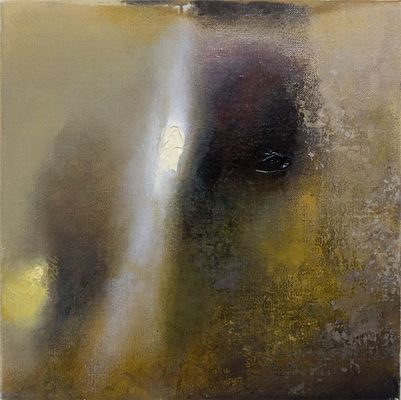
I am not a great reader of poetry but I always return to the work of Melbourne poet, Vincent Buckley (1925- 1988). Perhaps I find his most tantalising piece to be not a finished poem but a fragment left on a scrap of paper discovered on his desk after the poet’s death.
The poetry gathers like oil
In the word-core, and spreads
It has its music meet,
Its music is in movement.
This fragment is more the shell left behind from a volatile thought than a finished poem. I find the last two lines honest but awkward whereas the first two lines work like an arrow. Most likely he could not find a resolution so it was left. Still, in its present form, it remains an eloquent testimony to the ultimate failure of a medium to express mobile thought and sensation, in Buckley’s case, through verbal language. It’s an important matter because this is something all artists have to deal with regardless of the medium.
I have never written a poem, however, I am forever copying fragments from books on paper scraps in a vain effort to fix certain notions in my head. At first, they function as bookmarks that are sometimes returned to when I open the book. But before long, as they accumulate, they fall out littering the table interspersed with A4 photocopies, bills, books and medications.
To return to Buckley’s fragment, the first two lines very much evoke how I paint nowadays. As you age, detail diminishes and patches of light become more luminous and float. I feel the most honest way of dealing with this is by smearing the oil paint on the canvas with the fingers and working close-up, blind. Only if the patches coalesce into an approaching image can the work gain a life.
-
Jonathan Walker was born in Melbourne, Australia and brought up on a dairy farm in Gippsland. In the 1970’s he studied painting at RMIT and won the Harold Wright Scholarship to the British Museum, London. During the 1980’s he exhibited at Pinacotheca Gallery, Richmond and had work shown at the NGV and Heidi City Art Gallery. Over the same period he designed the cover for the “Epigenesi” LP by Giancarlo Toniutti, Italy and conducted a mail exchange work with Achim Wollscheid, Germany. The work with artists through the post resulted in an article published in the bicentenary issue of Art and Australia 1988. He showed in artist run spaces such as WestSpace in the 90’s and 2000’s, and until 2012, taught painting at Victoria University, which is where we (Colleen Ahern and Lisa Radford) as organisers of the exhibition, among many others, had the privilege of being his student.
Walker’s knowledge was imparted to students through the careful selection of music, literature, and artists found in books that he himself had ordered for the library. Walker’s strategy was the generosity of sharing his vast knowledge with references specific to each student and their context.
Walker’s paintings share a similar focus and intimacy.
This exhibition presents a small selection of recent paintings alongside a publication that includes Walker’s writing. Observational and analytical, Walker’s work is a type of material notation — the time of day, colour and how it is blended, the both specific and fleeting location of a reflection on lino or the question of whether a chair leg should be included in a painting.
Please join us on Friday August 21 between 6-8pm to celebrate the opening of the exhibition.
Curated by Colleen Ahern and Lisa Radford.
B. Wurtz
Curated by Nic Tammens
March 26 - April 4, 2015
B.Wurtz works from a basement studio in his home on Manhattan’s Lower East Side.
This local fact is attested to by the plastic shopping bags and newsprint circulars that appear in his work. As formal objects, they don’t make loud claims about their origins but nonetheless transmit street addresses and places of business from the bottom of this long thin island. Like plenty of artists, Wurtz is affected by what is local and what is consumed. His work is underpinned by this ethic. It often speaks from a neighborhood or reads like the contents of a hamper:
“BLACK PLUMS $1.29 lb.”
“Food Bazaar”
“USDA Whole Pork Shoulder Picnic 99c lb.”
“RITE AID Pharmacy, with us it’s personal.”
“H. Brickman & Sons.”
“Sweet Yams 59c lb."
Most of the work in this exhibition was made while the artist was in residence at Dieu Donne, a workshop dedicated to paper craft in Midtown. Here Wurtz fabricated assemblages with paper and objects that are relatively lightweight, with the intention that they would be easily transportable to Australia. This consideration isn’t absolute in Wurtz’s work, but was prescriptive for making the current exhibition light and cheap. Packed in two boxes, these works were sent from a USPS post office on the Lower East Side and delivered to North Melbourne by Australia Post.
Wurtz appears courtesy of Metro Pictures, New York.
Thanks to Rob Halverson, Joshua Petherick, Sari de Mallory, Matt Hinkley, Helen Johnson, Fayen d'Evie, Ask Kilmartin, Lisa Radon, Ellena Savage, Yale Union, and "Elizabeth".
John Nixon
"Archive"
December 15 - January 20, 2014
The presentation of John Nixon's archive offered a rare showcase of this extensive collection of the artist's own publications, catalogues, posters, ephemera, editions and more, from the mid 1980s onwards, alongside a selection of his artworks.
Organized by John Nixon, Joshua Petherick and Matt Hinkley.
<a href=http://wfb.public-office.info/artist/john-nixon>All titles by John Nixon
"Habitat"
at Minerva, Sydney (organised by Joshua Petherick and Matt Hinkley)
November 15 - December 20, 2014
Lupo Borgonovo, Janet Burchill & Jennifer McCamley,
Lewis Fidock, HR Giger, Piero Gilardi, Veit Laurent Kurz,
Cinzia Ruggeri, Michael E. Smith, Lucie Stahl, Daniel Weil, Wols
Press Release:
“...It contained seven objects. The slender fluted bone, surely formed for flight, surely from the wing of some large bird. Three archaic circuitboards, faced with mazes of gold. A smooth white sphere of baked clay. An age-blackened fragment of lace. A fingerlength segment of what she assumed was bone from a human wrist, grayish white, inset smoothly with the silicon shaft of a small instrument that must once have ridden flush with the surface of the skin - but the thing’s face was seared and blackened.”
William Gibson, “Count Zero”, 1986
"Autumn Projects Archive"
Curated by Liza Vasiliou
March 6 - March 15, 2014
World Food Books, in conjunction with the Virgin Australia Melbourne Fashion Festival 2014, presented the Autumn Projects archive, consisting of a selection of early examples in Australian fashion with a particular interest in collecting designers and labels from the period beginning in the 1980’s, who significantly influenced the discourse of Australian Fashion.
Curated by Liza Vasiliou, the exhibition provided a unique opportunity to view pieces by designers Anthea Crawford, Barbara Vandenberg, Geoff Liddell and labels CR Australia, Covers, Jag along with early experimental collage pieces by Prue Acton and Sally Browne’s ‘Fragments’ collection, suspended throughout the functioning World Food Books shop in Melbourne.
H.B. Peace
presented by CENTRE FOR STYLE
November 14, 2013
"Hey Blinky, you say chic, I say same"
Anon 2013
H.B. Peace is a clothing collaboration between great friends Blake Barns and Hugh Egan Westland. Their pieces explore the divergences between 'character’ and ‘personality’ in garments....etc
Special Thanks to Joshua Petherick and Matt Hinkley of WFB and Gillian Mears
and a Very Special Thank you to Audrey Thomas Hayes for her shoe collaboration.
Janet Burchill & Jennifer McCamley
"Aesthetic Suicide"
May 10 - June 8, 2013
The first of our occasional exhibitions in the World Food Books office/shop space in Melbourne, "Aesthetic Suicide" presented a body of new and older works together by artists Janet Burchill & Jennifer McCamley, including videos, prints, a wall work, and publications.
During shop open hours videos played every hour, on the hour.
2010, English / French
Hardcover, 552 pages, 20.2 x 26.2 cm
1st Edition, Out of print title / Used*,
Published by
Les Presses Du Reel / Paris
$115.00 - Out of stock
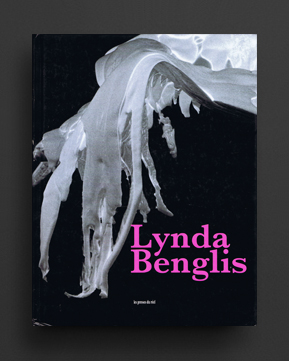
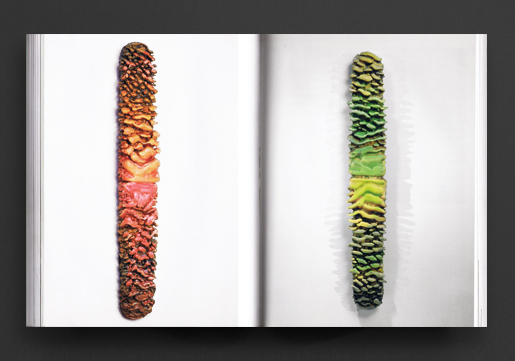
The huge reference retrospective monograph: a complete overview of Lynda Benglis' work and life from the late 1960s to the present day, with more than 350 illustrations, about 20 historical or commissioned essays, an interview, famous and unseen archival material (magazine articles, photographs, letters, installation shots), and a complete chronology.
“Seeing Lynda Benglis's ad in Artforum in 1974 was one of the most pivotal moments of my career. I was in college in Buffalo & even the Albright-Knox Art Gallery which was one of the few local places to buy the magazine (and right across from where I went to school), had ripped out that page in the issues they were selling (I must have bought mine in NYC). She kicked ass!” - Cindy Sherman
Since more than 30 years, Lynda Benglis (born in 1941 in Lake Charles, Louisiana, lives and works in New York), one of America's most important artists, a leader of Post Minimalism along with Richard Serra, Eva Hesse and Bruce Nauman, explores in her work a wide range of techniques and mediums, from wax abstract painting, to latex, polyurethane or metal sculpture, through video and performance footage.
This formal diversity expresses a complex and radical thinking about body, gender identity, representation of women and male dominance, beyond her feminist icon status since a series of sulphurous advertisements published with Robert Morris in the 1970s, including the famous and controversial ad in Artforum featuring her aggressively posed with a giant dildo and wearing only a pair of sunglasses.
Texts by Dave Hickey, Cindy Sherman, Robert Pincus-Witten, Richard Meyer, Annette Messager, Elisabeth Lebovici, Judith Tannenbaum, Caroline Hancock, Franck Gautherot, Laura Hoptman, Ron Gorchov, Keith Sonnier, John Baldessari, Diana Franssen.
An incredible book on an artist unlike any other!
2017, English
Softcover, 72 pages, 9.5 x 14.8 cm
Published by
Moderna Museet / Stockholm
Sternberg Press / Berlin
$15.00 - Out of stock
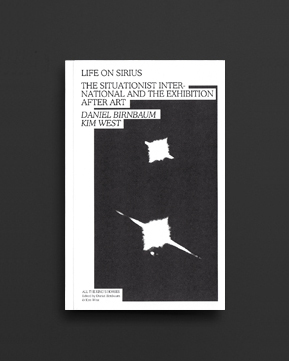
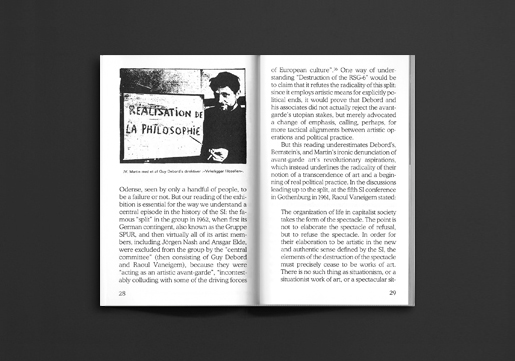
How did art escape the deadlock of the Situationists’ anti-art refusal? Did the relational artists, with their repetitions of Situationist slogans and techniques, outline a sustainable, micro-political alternative to Guy Debord’s dream of surpassing art and realizing philosophy? Looking back at some of the Situationists’ confrontations with the museum, this book traces a path beyond the tragedy of negativity and the litany of recuperation. At the center is the concept of play; originally adopted as the principle of reconciled life, it returns as the lever of instrumentalization. But in the extraterrestial wasteland of the present, spaces of ludic coexistence and experimentation may remain possible, provided that pessimism can be adequately organized.
part of the All the King’s Horses Series, edited by Daniel Birnbaum and
Kim West
Copublished between Sternberg Press and Moderna Museet, Stockholm
Design by Studio Christopher West
2016, English
Softcover, 296 pages, 14.8 x 21 cm
Published by
Sternberg Press / Berlin
$52.00 - Out of stock
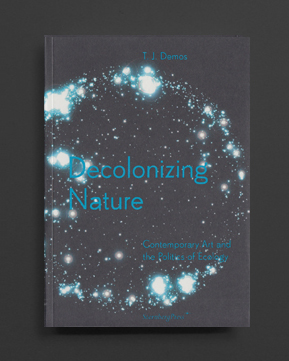
While ecology has received little systematic attention within art history, its visibility and significance has grown in relation to the threats of climate change and environmental destruction. By engaging artists’ widespread aesthetic and political engagement with environmental conditions and processes around the globe—and looking at cutting-edge theoretical, political, and cultural developments in the Global South and North—Decolonizing Nature offers a significant, original contribution to the intersecting fields of art history, ecology, visual culture, geography, and environmental politics. Art historian T. J. Demos, author of Return to the Postcolony: Specters of Colonialism in Contemporary Art(2013), considers the creative proposals of artists and activists for ways of life that bring together ecological sustainability, climate justice, and radical democracy, at a time when such creative proposals are urgently needed.
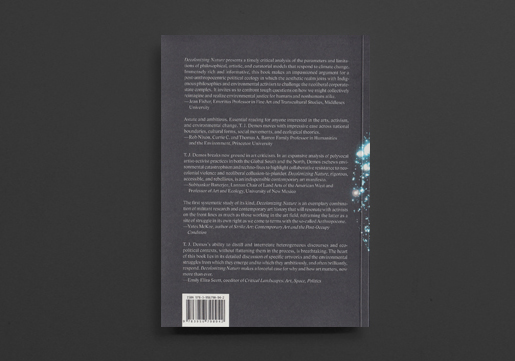
“Decolonizing Nature presents a timely critical analysis of the parameters and limitations of philosophical, artistic, and curatorial models responding to anthropogenic climate change. Rich and informative, the book makes an impassioned argument for a post-anthropocentric political ecology, in which the aesthetic realm enjoins with Indigenous philosophies and environmental activism to challenge the neoliberal corporate-state complex. It invites us to confront tough questions on how we might collectively reimagine and realize environmental justice for humans and nonhumans alike.” — Jean Fisher, Emeritus Professor in Fine Art and Transcultural Studies, Middlesex University
“Astute and ambitious. Essential reading for anyone interested in the arts, activism, and environmental change. Demos moves with impressive ease across national boundaries, cultural forms, social movements, and ecological theories.” — Rob Nixon, Currie C. and Thomas A. Barron Family Professor in Humanities and the Environment, Princeton University
“Demos breaks new ground in art criticism. In an expansive analysis of polyvocal artist-activist practices in the Global South and the North, Demos eschews environmental catastrophism, scientific determinism, and techno-fixes to highlight collaborative resistance to neocolonial violence and neoliberal collusion-to-plunder. He is also searching for what the path forward might be. Rigorous, accessible, and rebellious, Decolonizing Nature is an inspiring and indispensible contemporary art manifesto.” — Subhankar Banerjee, Lannan Chair of Land Arts of the American West and Professor of Art and Ecology, University of New Mexico
“With Decolonizing Nature, Demos extends his formidable intellectual project to a realm that has until recently often been characterized by varying degrees of naïveté, obscurantism, and indeed green-washing: the relationship between art and ecology. The first systematic study of its kind, Decolonizing Nature is an exemplary combination of militant research and contemporary art history that will resonate with activists on the front lines as much as those working in the art field, reframing the latter as a site of struggle in its own right as we come to terms with the so-called Anthropocene.”
—Yates McKee, author of Strike Art: Contemporary Art and the Post-Occupy Condition
“Demos’s ability to distill and interrelate heterogeneous discourses, practices, and eco-political contexts, without flattening them in the process, is a breathtaking feat and, moreover, one that rises to the demands of his complex and urgent subject. As clear in its argumentation as it is dense with information, the meat of this book lies in its detailed discussion of specific artworks and the environmental struggles from which they emerge and to which they ambitiously, and often brilliantly, respond. Decolonizing Nature makes a forceful case for why and how art matters, now more than ever.”
—Emily Eliza Scott, Postdoctoral Fellow, Institute for the History and Theory of Architecture, ETH Zurich, and coeditor of Critical Landscapes: Art, Space, Politics
Design by Miriam Rech, Berlin
2015, English
Softcover with dust jacket, 380 pages (19 b/w and 47 colour ill.), 12.4 x 19.4 cm,
Published by
Sternberg Press / Berlin
$45.00 - Out of stock
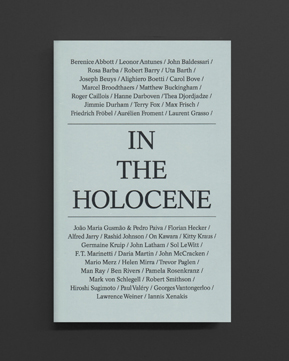
Contributions by Berenice Abbott, Leonor Antunes, Marcel Broodthaers, Roger Callois, Hanne Darboven and Lucy R. Lippard, Eric Duyckaerts, Max Frisch, Frederich Froebel, Joao Maria Gusmao and Pedro Paiva, Florian Hecker and Quintin Meillasoux, Alfred Jarry, On Kawara, John Latham, Sol LeWitt, F. T. Marinetti, Daria Martin, Mario Merz, Helen Mirra, Man Ray, Ben Rivers and Mark von Schlegell, Pamela Rosenkranz and Erik Wysocan, Robert Smithson, Paul Valéry, Iannis Xenakis
In the Holocene is based on a 2012 group exhibition of the same name at the MIT List Visual Arts Center that explored art as a speculative science, investigating principles more commonly associated with scientific or mathematical thought. Through the work of an intergenerational group of artists, the exhibition and book propose that art acts as an investigative and experimental form of inquiry, addressing or amending what is explained through traditional scientific or mathematical means: entropy, matter, time (cosmic, geological), energy, topology, mimicry, perception, consciousness, et cetera. Sometimes employing scientific methodologies or the epistemology of science, other times investigating phenomena not restricted to any scientific discipline, art can be seen as a form of inquiry into the physical and natural world. In this sense, both art and science share an interest in knowledge, realism, and observable phenomena, yet are subject to different logics, principles of reasoning, and conclusions.
Works by Berenice Abbott, John Baldessari, Rosa Barba, Robert Barry, Uta Barth, Joseph Beuys, Alighiero Boetti, Carol Bove, Marcel Broodthaers, Matthew Buckingham, Hanne Darboven, Thea Djordjadze, Aurélien Froment, Terry Fox, Laurent Grasso, João Maria Gusmão and Pedro Paiva, Rashid Johnson, Kitty Kraus, Germaine Kruip, Daria Martin, John McCracken, Trevor Paglen, Man Ray, Ben Rivers, Pamela Rosenkranz, Robert Smithson, Hiroshi Sugimoto, Georges Vantongerloo, Lawrence Weiner
Copublished with MIT List Visual Arts Center
Design by Kloepfer-Ramsey-Kwon
2012, English
Softcover, 88 pages, 25 color ills., 24 b/w ills, 11.2 x 17.2 cm
Published by
Sternberg Press / Berlin
$26.00 - Out of stock
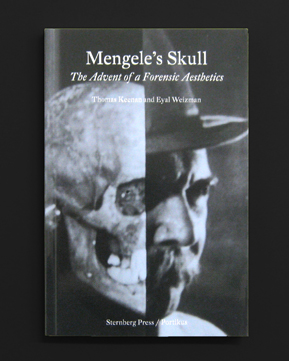
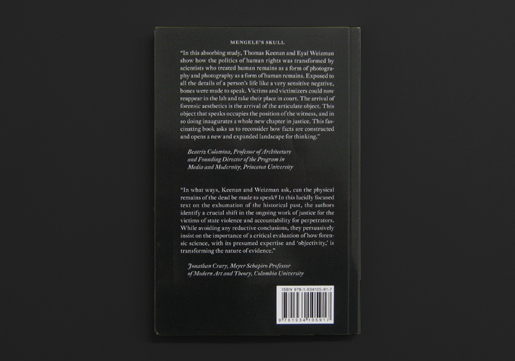
In 1985, the body of Josef Mengele, one of the last Nazi war criminals still at large, was unearthed in Brazil. The ensuing process of identifying the bones in question opened up what can now be seen as a third narrative in war crime investigations—not that of the document or the witness but rather the birth of a forensic approach to understanding war crimes and crimes against humanity.
In the period coinciding with the discovery of Mengele’s skeleton, scientists began to appear in human rights cases as expert witnesses, called to interpret and speak on behalf of things—often bones and human remains. But the aesthetic, political, and ethical complications that emerge with the introduction of the thing in war crimes trials indicate that this innovation is not simply one in which the solid object provides a stable and fixed alternative to human uncertainties, ambiguities, and anxieties.
The complexities associated with testimony—that of the subject—are echoed in the presentation of the object. Human remains are the kind of things from which the trace of the subject cannot be fully removed. Their appearance and presentation in the courts of law and public opinion has in fact blurred something of the distinction between objects and subjects, evidence and testimony.
Co-published with Portikus, Frankfurt am Main
Design by Zak Group
2012, English / French / Italian
Hardcover, 192 pages (143 colour & 32 b/w ill.), 200 x 250 mm
Published by
Castello di Rivoli / Turin
JRP Ringier / Zürich
Nottingham Contemporary / Nottingham
Van Abbemuseum / Eindhoven
$63.00 - Out of stock
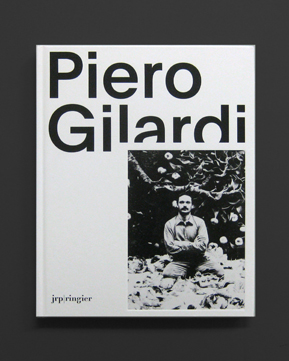
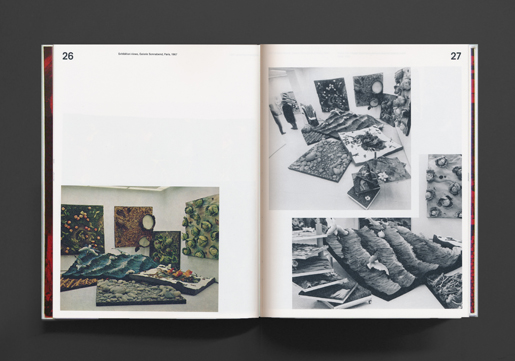
Piero Gilardi is a pioneer of Arte Povera and a proud advocate of an ecological-concerned undertaking in visual arts. He is a peripatetic artist who gathered information about experimental art and creators in the 1960s, promoting the work of Richard Long or Jan Dibbets, and introducing Bruce Nauman or Eva Hesse into Europe. He is also a political activist who marched with FIAT workers in the 1970s, and who founded, in the 2000s the Living Art Park, commissioning earthworks to contemporary artists such as Dominique Gonzalez-Foerster or Lara Almarcegui. For all this and for much more—his design and fashion creations, his social endeavors, etc.—Piero Gilardi is emblematic of the evolutions of art and society of the last five decades. He is an artist whose works and theoretical researches are still relevant to map what art could achieve and how art could be useful in the "real world."
Published with Castello di Rivoli, Turin, Van Abbemuseum, Eindhoven and Nottingham Contemporary.
1968, English
Softcover (staple-bound), 42 pages, 14 x 21 cm
1st Edition, Out of print title / Used*,
Published by
Contemporary Films Limited / London
Federation of Film Societies / London
$15.00 - Out of stock
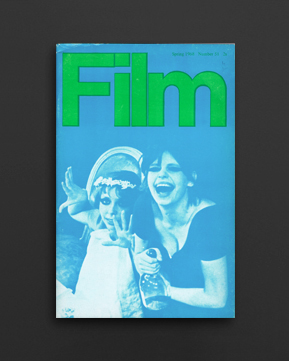
Film was the magazine of the Federation of Film Societies, published in London.
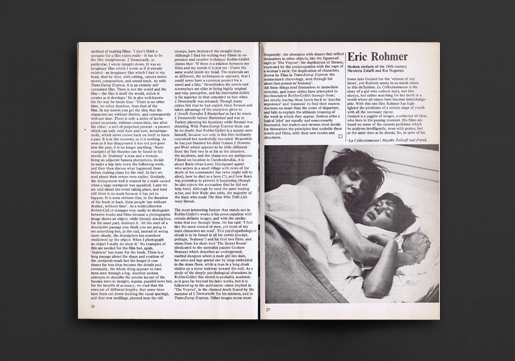
Vol. 51 Spring 1968 features articles on Alain Robbe-Grillet, Eric Rohmer, Kirsten Stenbaek, Jonas Cornell, Vera Chytilova, Dusan Makavejev, Jean Renoir, B. P. Schulberg, and much more.
Cover image: Vera Chytilova's "Daisies"
2016, English / German
Softcover, 490 pages, 32 x 24 cm
Published by
Chert Galerie / Berlin
Motto / Berlin
$95.00 - Out of stock
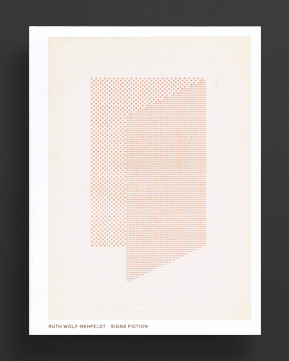
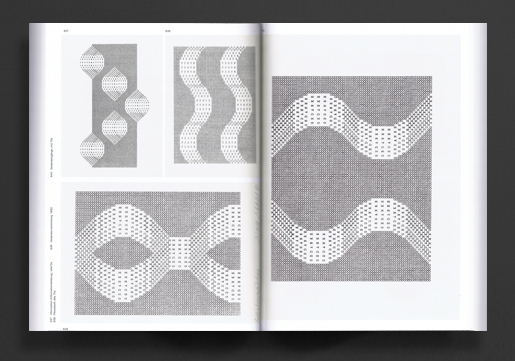
This impressive book aims to collect and present a comprehensive overview of the work of Ruth Wolf-Rehfeldt. It is the result of a long and intense immersion into the archive, and intends to establish the importance of this unique German artist – who did not have much recognition in the past – not only to the present day, but also to the precise political context and time to which she and her work belong.
The book presents her typewritings series, all produced between the early 1970s (some of the earliest works are dated 1972) and 1989. Mail Art was her way to be in contact with the world outside the GDR, otherwise impossible to reach. After the fall of the Berlin Wall and the Reunification, the artist stopped producing any art: She felt her involvement was no longer “needed”.
At the beginning of 2015 an archive of Ruth Wolf-Rehfeldt’s work was established, discovering little by little an enormous and fascinating body of work, composed by more classic poetry, simple typewriting texts, visual poetry, concrete poetry, and abstraction.
This handsomely designed, enormous volume perfectly captures this life of work.
Ruth Wolf-Rehfeldt was born in Wurzen, saxony, in 1932.
In 1950 she moved to Berlin, where she still lives today. In 1954 she met the artist Robert Rehfeldt, who she married a year later. She was employed by the exhibitions department at the Academy of Arts, and spent her spare time making drawings. A few years later she started to develop what would become her typical typewriter graphics, and became an active participant in the international Mail art movement. She stopped making art after the fall of the Berlin Wall.
2014, English
Softcover (leporello book in slipcase), 18 pages, 17 x 24.5 cm
Ed. of 800,
Published by
Motto / Berlin
$40.00 - In stock -
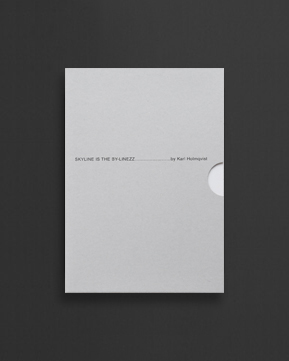
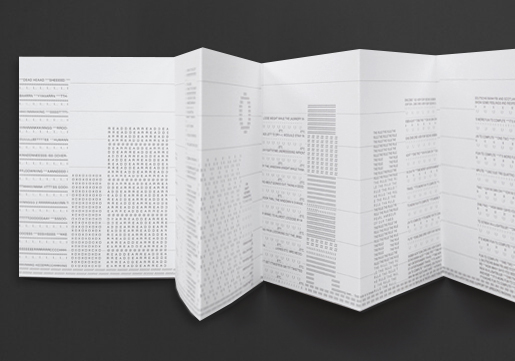
Artist book published by Karl Holmqvist, Swedish artist known for his text based works, poetry and reading, with Motto Books in 2014. Publication comes in the form of an 18 panel leporello text work that makes up a language constructed city skyline. Folded into a card slipcase and printed in an edition of 800 copies.
2016, English / Japanese
Softcover, 248 pages, 23 x 30 cm
Published by
Kyuryudo / Tokyo
$80.00 - Out of stock
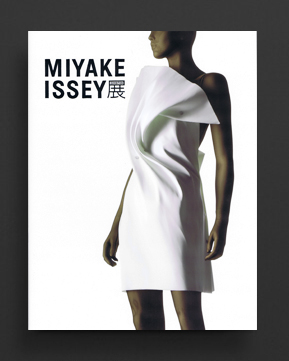
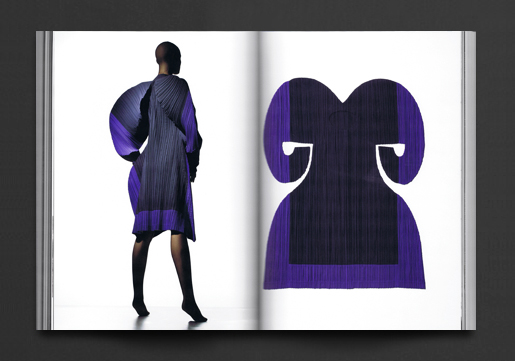
This impressive volume is part of an exhibition at the National Art Center, Tokyo, in 2016, the first full-scale retrospective to showcase the myriad ideas that have emerged over the course of the designer’s career, from his earliest activities to current projects. Widely recognised for his technology-driven clothing designs, exhibitions, and fragrances, Issey Miyake has been stimulating the world of culture and fashion for almost half a century with his organic and skilfully articulated repertoire, fuelled by boundless curiosity and love of experimentation. The catalogue explores the main themes of his innovative drive, complemented by Hiroshi Iwasaki’s expert photography.
1997, English
Hardcover (w. dust jacket), 240 pages, 22 x 29 cm
1st edition, Out of print title / used*,
Published by
Rizzoli / New York
$65.00 - Out of stock
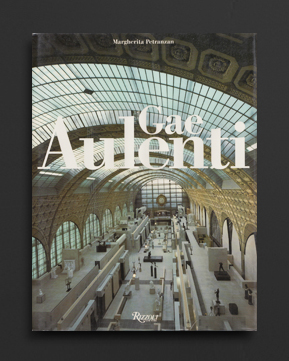
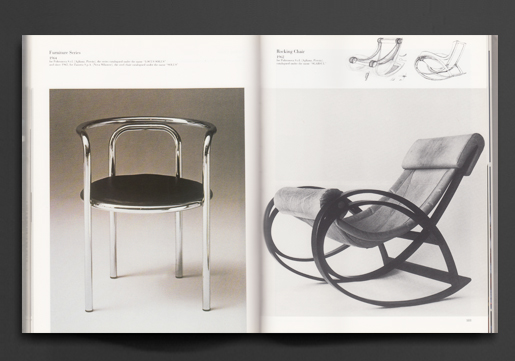
Gae Aulenti is one of the world's most prominent architects, and her prodigious output encompasses museum and theater design, industrial and exhibition design, furniture, graphics, urban planning, and architecture. This now out-of-print 1997 heavy monograph illustrates Aulenti's complete oeuvre and includes the world-famous Musée d'Orsay, stage designs for theater and opera, a villa in St. Tropez, exhibition designs for the 2001 Milan Triennale, her beautiful lamp works, furniture, glass vessels, and the remodeling of the Palazzo Grassi in Venice, among many other highly visible designs captured through gorgeous photography and Aulenti's own drawings.
2016, English
Softcover, 200 pages, 17 x 23 cm
Published by
Revolver Verlag / Berlin
Secession / Vienna
$44.00 $25.00 - Out of stock
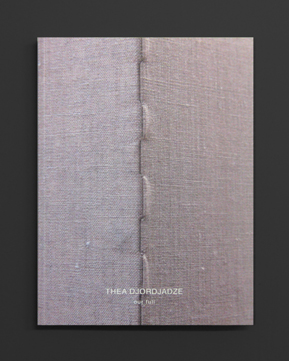
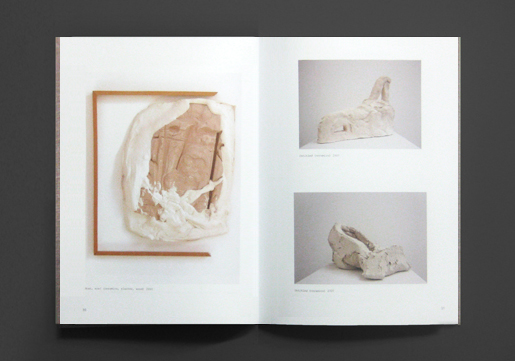
Thea Djordjadze makes expansive installations that she develops in situ and in close interaction with the surrounding spaces. The Georgian-born artist begins by exploring the specific qualities of a given exhibition space and then creates work that subtly transforms the perception and possible readings of the architectonic situation.
Ordinary staples such as fabrics, steel, glass, plaster, foam plastic, wood, and papier-mâché are the materials out of which Djordjadze manufactures sculptural objects. Presented in carefully composed arrangements sometimes complemented by found objects, paintings, and drawings, her installations recall domestic or functional settings. Her idiosyncratically proportioned sculptures suggest pieces of furniture or elements of an exhibition display such as beds, frameworks, pedestals, or showcases. The design vocabulary blends modernist geometric rigor with organic amorphous improvisation. Yet the elements correspond not only to each other, but always also to the given spatial context, building a palpable tension.
Thea Djordjadze’s process-based artistic praxis reads as an ongoing process in which existing and new elements, materials and objects are repurposed, reconfigured, and rearranged. Her exhibition project for the Secession implies transferring her studio and literally everything in it to Vienna. Here, the artist will respond to the iconic exhibition space and create a site-specific installation with her studio’s inventory, at once a kind of meta-exhibition, while her studio in Berlin remains empty.
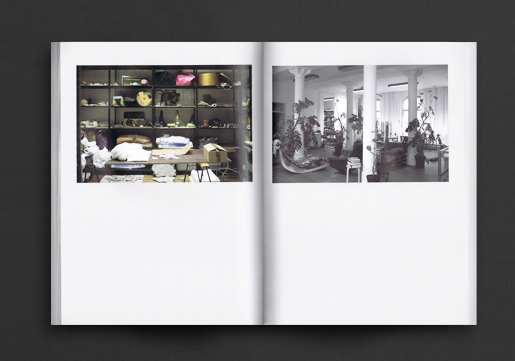
This unique book documents through colour photography the artist's studio, in great detail, prior to it's emptying out into the exhibition space at Secession in late 2016.
Thea Djordjadze was born in Tbilisi in 1971 and lives and works in Berlin.
2013, Swedish / English
Softcover, 104 pages (colour ill.), 20 x 27 cm
Published by
Malmö Konsthall / Malmö
$75.00 - Out of stock
Berlin-based Thea Djordjadze is best known for her sculpture and installations with references to the modernist language. She works with materials like plaster, wood, ceramic and papier mâché to produce almost intuitive assemblages where unformed, premature pieces collide with or rest upon precise architectural or domestic constructions. These hybrid compositions deliberately display the traces of their creation. Besides numerous and detailed installation views from her solo exhibition at Malmö Konsthall, this catalogue documents Djordjadze’s methods and perspectives through several critical texts by Gabriel Lester, Andrew Maerkle, Chris Kraus and others.
2016, English
Hardcover, 368 pages, 23 x 30 cm
Published by
Anton Kern / New York
Karma / New York
$88.00 $35.00 - Out of stock
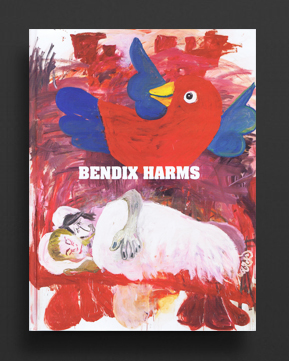
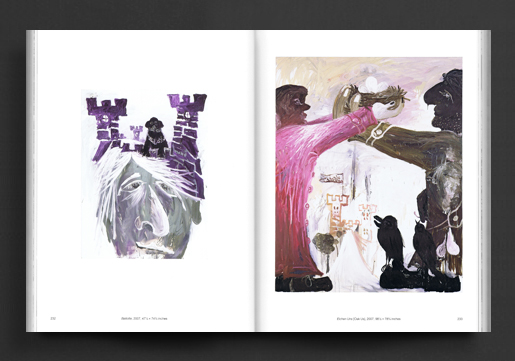
Chosen Ones is a comprehensive monograph on the work of German painter Bendix Harms (born 1967), spanning over 15 years of work. A repertoire of motifs recurs throughout the nearly 400-page volume: birds, trees, airplanes, cars and the artist's profile, all rendered in loose, exuberant strokes of gray and muddy orange. Drawing on elusive autobiographical references, the paintings – whether of grotesque figures or more surrealistic scenes – are often humourous and suggestively narrative, compelling in their apparent disregard for and liberation from concept.
2016, English / Korean
Softcover, 224 pages, 15 x 21 cm
Published by
Roma / Amsterdam
$35.00 - Out of stock
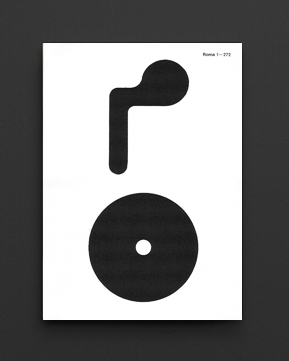
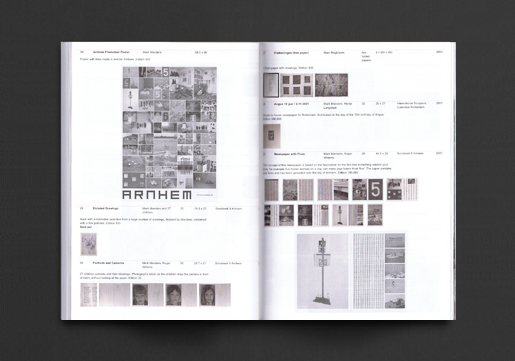
Catalogue published on the occasion of the exhibition Artists' Documents: Art, Typography and Collaboration at MMCA in Seoul (May 26 - August 31, 2016), organized by Roma Publications and mediabus. Besides exhibition views this books contains a complete and richly illustrated Roma Publications backlist from number 1, published in 1998, till this book (Roma 272), published in August 2016. Text in English and Korean, with contributions by Min Choi and LIM Kyung yong. Design: Na Kim and Roger Willems with a cover illustration by Karel Martens.
1987, English / Japanese
Softcover, 44 pages, 21 x 29.5 cm
1st Edition, Out of print title / Used*,
Published by
Marlborough Fine Art / Tokyo
$48.00 - Out of stock
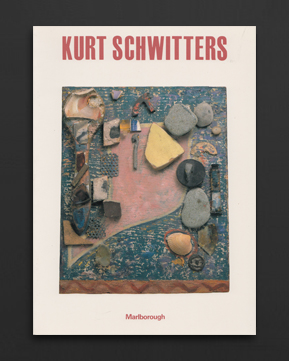
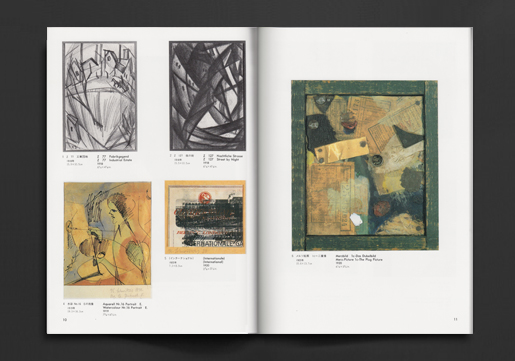
Rare Japanese catalogue produced on the occasion of the Kurt Schwitters exhibition held at Marlborough Fine Art in Tokyo, September 8 - December 5, 1987. The exhibition included works ranging from 1918 - 1947, including paintings, drawings, reliefs, sculptures, and collages, all of which are reproduced in this catalogue in colour photography. All texts are in both English and Japanese, including bibliography, biography, exhibition list and work lists. Invitation letter (?) in Japanese from Marlborough also inserted into book from previous owner.
Kurt (Hermann Eduard Karl Julius) Schwitters (20 June 1887 – 8 January 1948) was a German artist who was born in Hanover, Germany. Schwitters worked in several genres and media, including Dada, Constructivism, Surrealism, poetry, sound, painting, sculpture, graphic design, typography, and what came to be known as installation art. He is most famous for his collages, called Merz Pictures.
1984, English
Softcover, 156 pages (260 b/w & 140 colour ill.), 28.0 x 23.0 cm
Out of print title / Used*,
Published by
Thames and Hudson / London
$65.00 - Out of stock
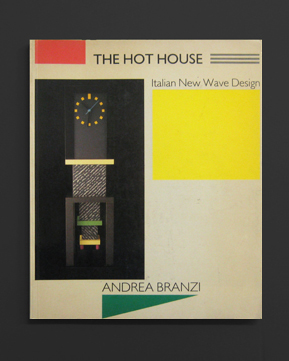
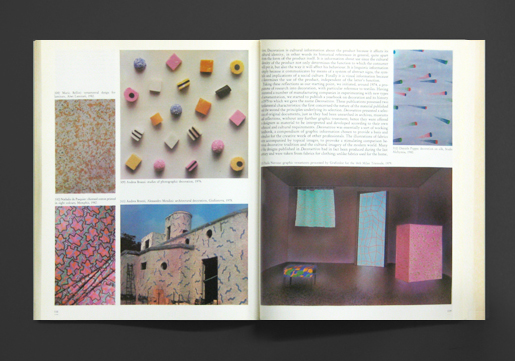
Edited by Andrea Branzi, The Hot House was one of the finest books published to trace the history of Italy's radical design studios from 1960 to the dawn of Memphis. Through academic texts and profuse visual documentation of the work of Alessandro Mendini, Gaetano Pesce, Superstudio, Ettore Sottsass, Natalie Du Pasquier, UFO Group, Enzo Mari, Alchymia, Michele De Lucchi, 9999, Archizoom Associati, Mattheo Thun, Memphis, and many others.
1973, English
Softcover (stapled), 24 pages, 23 x 18 cm
1st edition, Out of print title / used*,
Published by
The New York Cultural Center / New York
$160.00 - Out of stock
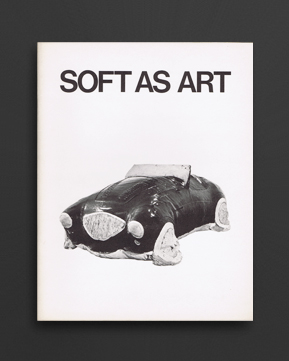
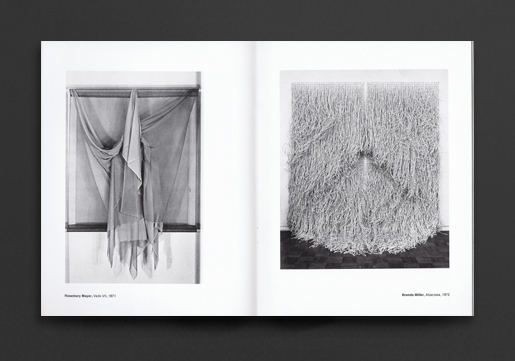
Incredibly scarce exhibition catalogue published in conjunction with show held March 20 - May 6, 1973 at The New York Cultural Center. Includes the work of Hannah Wilke, Sig Rennels, Gillian Bradshaw-Smith, Jackie Ferr, Françoise Grossen, Harmony Hammond, Anne Healy, Al Loving, Robert Mapplethorpe, Rosemary Mayer, Brenda Miller, Robert Morris, Claes Oldenburg, Patricia Oleszco, Robert Rauschenberg, David Secombe, Richard Serra, Alan Shields, William Soghor, Frank Lincoln Viner, Jackie Winsor, and Nina Yankowitz. Includes black & white illustrations throughout, exhibition checklist and selected artist biographies. Introduction by Mario Amaya.
Fantastic, very rarely seen catalogue.
1959, English
Softcover (stapled), 40 pages, 25 x 19 cm
1st Edition, Out of print title / Used*,
Published by
MoMA / New York
$15.00 - In stock -
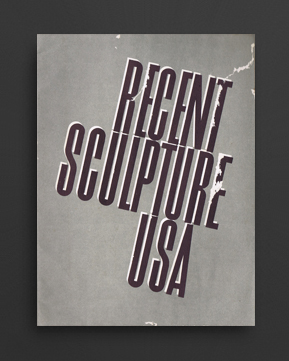
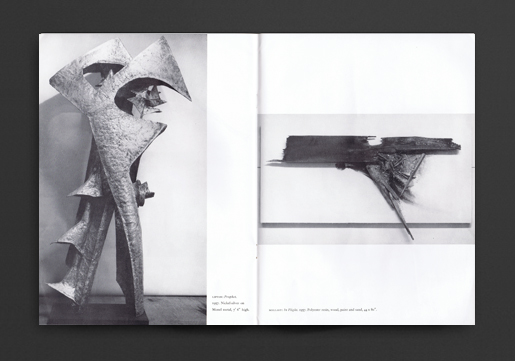
Art Bulletin (Vol. XXVI, No.5, 1959)/catalogue published in 1959 by The Museum of Modern Art in New York, showcasing recent American sculpture. Features work by Leonard Baskin, Norman Carlberg, Dorothy Dehner, Mina Harkhavy, Barbara Lekberg, Seymour Lipton, Robert Mallary, Bernhard Rosenthal, Gabriel Kohn and many others, illustrated in black and whit throughout.
1958, English
Softcover (stapled), 24 pages, 19 x 25 cm
1st Edition, Out of print title / Used*,
Published by
MoMA / New York
$15.00 - Out of stock
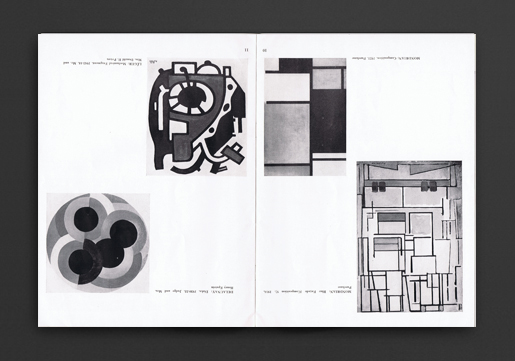
Art Bulletin (XXV, No. 4, 1957)/catalogue supplement published to accompany an exhibition in 1957 at The Museum of Modern Art in New York, to showcase their recent Painting and Sculpture collection acquisitions. Features work by Fernand Léger, Odilon Redon, Egon Schiele, Robert Motherwell, Robert Delaunay, Arshile Gorky, Pablo Picasso, Piet Mondrian, Jackson Pollock, Paul Klee, George Grosz, Giorgio de Chirico, David Smith, Gustav Limpt, Otto Dix, and many others, illustrated in black and whit throughout.
2016, English
Softcover (staple-bound, w. two stickers), 44 pages, 19.5 x 25.5 cm
Ed. of 500 (250 white cover / 250 black cover),
Published by
Canyon Rats / Los Angeles
$32.00 - In stock -
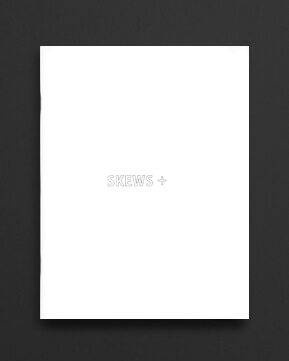
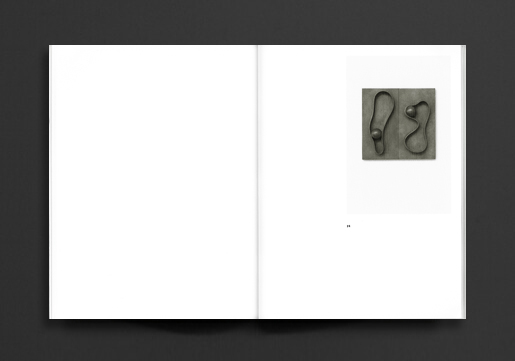
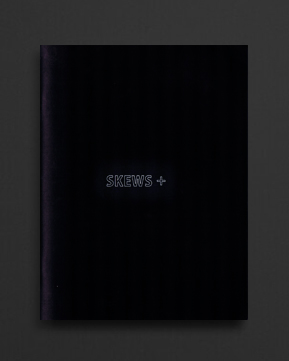
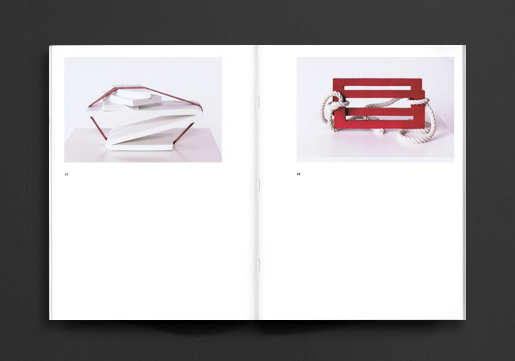
Following his solo exhibition /SKEWS/ at David Kordansky in Los Angeles, late 2015, Australian-born, Los Angeles-based artist Ricky Swallow has produced "SKEWS +". Published under new Califonian imprint Canyon Rats, this fine publication presents 29 of Swallow's new sculptural works, and comes wrapped in either white or black covers, editioned to 250 of each.
Ricky Swallow uses humble, ordinary materials to create precisely rendered objects that he then casts in bronze. The unique works that result are expressions not only of the objects’ constructed forms, but also of the process of transformation by which an otherwise inert grouping of forms becomes a sculpture.
Design by Nicholas Gottlund. Photography by Fredrik Nilsen. Printed at Typecraft in Pasadena, California.
Includes two Canyon Rats bumper stickers!
Edition of 500 (250 white cover / 250 black cover)
2016, English
Softcover (staple-bound, w. two stickers), 44 pages, 19.5 x 25.5 cm
Ed. of 500 (250 white cover / 250 black cover),
Published by
Canyon Rats / Los Angeles
$32.00 - In stock -
Following his solo exhibition /SKEWS/ at David Kordansky in Los Angeles, late 2015, Australian-born, Los Angeles-based artist Ricky Swallow has produced "SKEWS +". Published under new Califonian imprint Canyon Rats, this fine publication presents 29 of Swallow's new sculptural works, and comes wrapped in either white or black covers, editioned to 250 of each.
Ricky Swallow uses humble, ordinary materials to create precisely rendered objects that he then casts in bronze. The unique works that result are expressions not only of the objects’ constructed forms, but also of the process of transformation by which an otherwise inert grouping of forms becomes a sculpture.
Design by Nicholas Gottlund. Photography by Fredrik Nilsen. Printed at Typecraft in Pasadena, California.
Includes two Canyon Rats bumper stickers!
Edition of 500 (250 white cover / 250 black cover)
1999, English
Softcover, 228 pages, 21 x 30 cm
1st Edition, Out of print title / used / very good
Published by
Maison Martin Margiela / Paris
$200.00 - Out of stock
The scarce first joint edition of this great visual archive, designed, edited and published by Maison Martin Margiela!
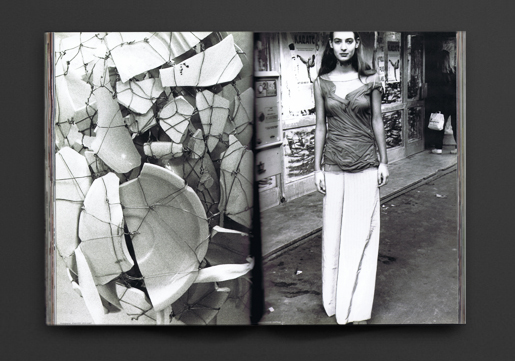
In 1995, Tokyo-based Street magazine approached the Paris fashion house of Martin Margiela with an invitation to publish a special edition dedicated to its work. Maison Martin Margiela guest-edited the magazine, and was solely responsible for the selection of images and presentation, which includes many previously unpublished photographs from its archives. The success of the first volume led to the publication of a second instalment in 1999, and together the two special issues cover every Martin Margiela collection from Spring/Summer 1989 through to Spring/Summer 1999, including heavy visual documentation of the presentations, events, studio, ephemera, behind the scenes, garment details, and much more.
In 1999, Maison Martin Margiela himself collected together both volumes into this now collectable book. After quickly selling out, it was made available once more in 2013 by Street Editorial Office, that is now also out of print.
Please note that this is the first book printing from MMM in 1999.
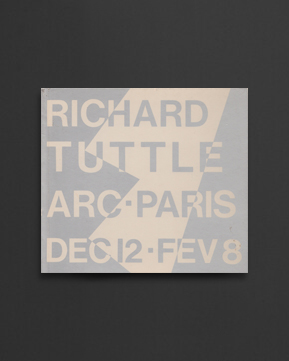
1986, English / French
Softcover, 74 pages, 15 x 17 cm
1st Edition, Out of print title / Used*,
Published by
ARC / Paris
$85.00 - Out of stock
Rare catalogue on the work of American artist Richard Tuttle, published by ARC, Musée d'art moderne de la ville de Paris in 1986. Features his drawing, painting and sculptural work, with texts in French and English.