World Food Books' programme is largely produced on Kulin Nation land. We acknowledge the Wurundjeri people of the Kulin Nation as the first and continuing custodians of this land, and pay respect to their Elders past, present, and emerging.
World Food Books is an arts and special interests bookshop in Naarm / Melbourne. Founded in 2010, World Food Books is devoted to the presentation of a rotating, hand-selection of international art, design, literary and counterculture publications with an emphasis on the anti-traditional, the experimental, the avant-garde, the heretic, the marginal.
Presenting new titles alongside rare and out-of-print books, catalogues and journals spanning the fields of modern and contemporary art, design, photography, illustration, film, literature, poetry, cultural theory, philosophy, sexuality, popular and underground culture in its many radical forms, World Food Books wishes to encourage adventurous, thoughtful and open-minded reading, looking, writing, and exchange of publishing and ideas, both current and historical.
As well as our bookshop, located in Melbourne's historical Nicholas Building, all of our inventory is available internationally via our online mail-order service.
World Food Books semi-regularly co-ordinates "Occasions", a programme of exhibits and events at the bookshop and in partnership with other hosts (such as museums and art galleries) that develop out of the activities, relationships and content of the bookshop itself.
World Food Books
The Nicholas Building
37 Swanston Street
Room 5, Level 6
Melbourne 3000
Australia
SHOP HOURS:
Thu–Fri 12–6, Sat 12–5
WEB-SHOP OPEN 24/7
World Food Books
Postal Address:
PO Box 435
Flinders Lane
Victoria 8009
Australia
Art
Theory / Essay
Architecture / Interior
Graphic Design / Typography
Photography
Fashion
Eros
LGBTQ+
Fiction / Poetry
Weird / Speculative / Science Fiction / Horror
Transgressive / Visceral / Abject
Symbolism / Decadence / Fin de siècle
Film / Video
Painting
Sculpture / Installation
Performance / Dance / Theater
Drawing
Sound / Music
Curatorial
Group Shows / Collections
Periodicals
Out-of-print / Rare
Posters / Ephemera / Discs
Signed Books
World Food Books Gift Voucher
World Food Book Bag
Australian Art
Australian Fiction
Australian Science Fiction / Speculative Fiction
Australian Poetry
Australian Photography
Japanese Photography
Conceptual Art
Minimal Art
Dada
'Pataphysics / Oulipo
Fluxus
Concrete Poetry
Pop Art
Surrealism
Arte Povera
Arte Informale / Haute Pâte / Tachism
Nouveau Réalisme / Zero / Kinetic
Situationism / Lettrism
Collage / Mail Art / Xerox Art
Art Brut / Folk / Visionary / Fantastic
Illustration / Graphic Art / Bandes Dessinées
Furniture
Italian Radical Design / Postmodernism
Textiles
Ceramics / Glass
Counterculture
Protest / Revolt
Philosophy
Psychoanalysis
Anthropology
Anarchism
Socialism / Anarchism / Communism / Capitalism
Literary Theory / Semiotics / Language
Feminism / Women's Studies
Gender Studies / Sexuality
Anthropology
Fetishism / BDSM
Drugs / Psychedelia
Crime / Violence
Animal Rights / Veganism
Occult / Esoterica
Ecology / Earth / Alternative Living
Whole Earth / Crafts
All prices in AUD (Australian dollars)
Pick-Ups
Pick-up orders can be collected in our bookshop during opening hours after order date. Please collect any Pick-up orders within 2 weeks of ordering as we have limited storage space. Orders will be released back into stock if not collected within this time. No refunds can be made for pick-ups left un-collected. If you cannot make it in to the bookshop in this time-frame, please choose postage option.
Return Policy
All sales are final. We do accept returns (for refund or exchange) for items received in error. All our orders are packed with special care using heavy-duty padding and cardboard book-mailers or bubble mailers (for smaller books), using reinforcement where required. We cannot take responsibility for any lost, stolen or damaged parcels.
Insurance
Should you wish to insure your package, please email us directly after placing your order and we can organise this at a small extra expense. Although all standard/express tracked packages are very safe and dependable, we cannot take responsibility for any lost, stolen or damaged parcels. We recommend insurance on valuable orders.
Interested in selling your old books, catalogues, journals, magazines, comics, fanzines, ephemera? We are always looking for interesting, unusual and out-of-print books to buy. We only buy books in our fields of interest and specialty, and that we feel we can resell.
We base these prices on desirability, market value, in-print prices, condition and our current stock levels. We offer cash, store credit, and can take stock on consignment. All
about 25% of the price we expect to get when we sell them, or 30% in store credit. We base these prices on desirability, market value, in-print prices, condition and our current stock levels.
Sell your books any day of the week. You can drop them off and return later. If you have a lot of books, we can visit your Sydney home.
We buy books that we feel we can resell. We offer about 25 % of the price we expect to get when we sell them, or 30% in store credit. We base these prices on desirability, market value, in-print prices, condition and our current stock levels.
Philadelphia Wireman
03 August - 01 September, 2018
World Food Books is proud to announce our next Occasion, the first presentation of sculptures by Philadelphia Wireman in Australia.
The Philadelphia Wireman sculptures were found abandoned in an alley off Philadelphia’s South Street on trash night in 1982. Their discovery in a rapidly-changing neighbourhood undergoing extensive renovation, compounded with the failure of all attempts to locate the artist, suggests that the works may have been discarded after the maker’s death. Dubbed the "Philadelphia Wireman" during the first exhibition of this work, in 1985, the maker’s name, age, ethnicity, and even gender remain uncertain. The entire collection totals approximately 1200 pieces, all intricately bound together with tightly-wound heavy-gauge wire (along with a few small, abstract marker drawings, reminiscent both of Mark Tobey and J.B. Murry). The dense construction of the work, despite a modest range of scale and materials, is singularly obsessive and disciplined in design: a wire armature or exoskeleton firmly binds a bricolage of found objects including plastic, glass, food packaging, umbrella parts, tape, rubber, batteries, pens, leather, reflectors, nuts and bolts, nails, foil, coins, toys, watches, eyeglasses, tools, and jewellery.
Heavy with associations—anthropomorphic, zoomorphic, and socio-cultural responses to wrapped detritus—the totemic sculptures by Philadelphia Wireman have been discussed in the context of work created to fulfil the shamanistic needs of alternative religions in American culture. Curators, collectors, and critics have variously compared certain pieces to sculpture from Classical antiquity, Native American medicine bundles, African-American memory jugs, and African fetish objects. Reflecting the artist’s prolific and incredibly focused scavenging impulse, and despite—or perhaps enhanced by—their anonymity, these enigmatic objects function as urban artefacts and arbiters of power, though their origin and purpose is unknown. Philadelphia Wireman, whatever their identity, possessed an astonishing ability to isolate and communicate the concepts of power and energy through the selection and transformation of ordinary materials. Over the course of the past two decades, this collection has come to be regarded as an important discovery in the field of self-taught art and vernacular art.
Presented in collaboration with Fleisher-Ollman Gallery, Philadelphia, and Robert Heald, Wellington.
Susan Te Kahurangi King
02 February - 10 March, 2018
Susan Te Kahurangi King (24 February 1951 - ) has been a confident and prolific artist since she was a young child, drawing with readily available materials - pencils, ballpoint pens and felt-tip markers, on whatever paper is at hand. Between the ages of four and six Susan slowly ceased verbal communication. Her grandparents William and Myrtle Murphy had developed a special bond with Susan so they took on caring responsibilities for extended periods. Myrtle began informally archiving her work, carefully collecting and storing the drawings and compiling scrapbooks. No drawing was insignificant; every scrap of paper was kept. The King family are now the custodians of a vast collection containing over 7000 individual works, from tiny scraps of paper through to 5 meter long rolls.
The scrapbooks and diaries reveal Myrtle to be a woman of great patience and compassion, seeking to understand a child who was not always behaving as expected. She encouraged Susan to be observant, to explore her environment and absorb all the sights and sounds. Myrtle would show Susan’s drawings to friends and people in her community that she had dealings with, such as shopkeepers and postal workers, but this was not simply a case of a grandmother’s bias. She recognised that Susan had developed a sophisticated and unique visual language and sincerely believed that her art deserved serious attention.
This was an unorthodox attitude for the time. To provide some context, Jean Dubuffet coined the term Art Brut in 1945 to describe work created by self-taught artists – specifically residents of psychiatric institutions and those he considered to be visionaries or eccentrics. In 1972 Roger Cardinal extended this concept by adopting the term Outsider Art to describe work made by non-academically trained artists operating outside of mainstream art networks through choice or circumstance. Susan was born in Te Aroha, New Zealand in 1951, far from the artistic hubs of Paris and London that Dubuffet and Cardinal operated in. That Myrtle fêted Susan as a self-taught artist who deserved to be taken seriously shows how progressive her attitudes were.
Susan’s parents Doug and Dawn were also progressive. Over the years they had consulted numerous health practitioners about Susan’s condition, as the medical establishment could not provide an explanation as to why she had lapsed into silence. Dawn educated herself in the field of homeopathy and went on to treat all twelve of her children using these principles – basing prescriptions on her observations of their physical, mental and emotional state.
Doug was a linguist with an interest in philosophy who devoted what little spare time he had to studying Maori language and culture. To some extent their willingness to explore the fringes of the mainstream made them outsiders too but it was their commitment to living with integrity and their respect for individuality that ensured Susan’s creativity was always encouraged.
Even though Susan’s family supported her artistic pursuits, some staff in schools and hospitals saw it as an impediment to her assimilation into the community and discouraged it in a variety of ways. Her family was not always aware of this and therefore did not fully understand why Susan stopped drawing in the early 1990s. However, rather than dwell on the challenges that Susan faced in pursuit of her artistic practice, they prefer to highlight her achievements. In 2008 Susan began drawing again in earnest, after an almost 20 year interruption, and her work is now shown in galleries around the world.
Susan grew up without television and has been heavily influenced by the comics she read as a child. She is absolutely fearless in the appropriation of recognizable characters, such as Donald Duck and Mickey Mouse, in her work. She twists their limbs, contorts their faces, compresses them together, blends them into complex patterned backgrounds - always imbuing them with an incredible energy. Although Susan often used pop culture characters in her work they are not naive or childlike. These are drawings by a brilliant self-taught artist who has been creating exceptional work for decades without an audience in mind.
Mladen Stilinović
"Various Works 1986 - 1999"
02 February 16 - September 10, 2016
Various works 1986 - 1999, from two houses, from the collections of John Nixon, Sue Cramer, Kerrie Poliness, Peter Haffenden and Phoebe Haffenden.
Including: Geometry of Cakes (various shelves), 1993; Poor People’s Law (black and white plate), 1993; White Absence (glasses, ruler, set square, silver spoon, silver ladel with skin photograph and wooden cubes), 1990-1996; Exploitation of the Dead (grey and red star painting, wooden painting, black spoon with red table, red plate), 1984-1990; Money and Zeros (zero tie, paintings made for friends in Australia (Sue, John, Kerrie), numbers painting), 1991-1992; Words - Slogans (various t-shirts) - “they talk about the death of art...help! someone is trying to kill me”, “my sweet little lamb”, “work is a disease - Karl Marx”; Various artist books, catalogues, monographs, videos; Poster from exhibition Insulting Anarchy; "Circular" Croatian - Australian edition; Artist book by Vlado Martek (Dostoyevsky); more.
Thanks to Mladen Stilinović and Branka Stipančić.
Jonathan Walker
Always Will Need To Wear Winter Shirt Blue + Ochre Small Check Pattern
21 August - 21 September, 2015
Untitled
I am not a great reader of poetry but I always return to the work of Melbourne poet, Vincent Buckley (1925- 1988). Perhaps I find his most tantalising piece to be not a finished poem but a fragment left on a scrap of paper discovered on his desk after the poet’s death.
The poetry gathers like oil
In the word-core, and spreads
It has its music meet,
Its music is in movement.
This fragment is more the shell left behind from a volatile thought than a finished poem. I find the last two lines honest but awkward whereas the first two lines work like an arrow. Most likely he could not find a resolution so it was left. Still, in its present form, it remains an eloquent testimony to the ultimate failure of a medium to express mobile thought and sensation, in Buckley’s case, through verbal language. It’s an important matter because this is something all artists have to deal with regardless of the medium.
I have never written a poem, however, I am forever copying fragments from books on paper scraps in a vain effort to fix certain notions in my head. At first, they function as bookmarks that are sometimes returned to when I open the book. But before long, as they accumulate, they fall out littering the table interspersed with A4 photocopies, bills, books and medications.
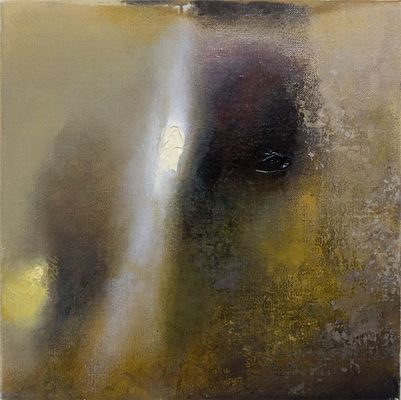
To return to Buckley’s fragment, the first two lines very much evoke how I paint nowadays. As you age, detail diminishes and patches of light become more luminous and float. I feel the most honest way of dealing with this is by smearing the oil paint on the canvas with the fingers and working close-up, blind. Only if the patches coalesce into an approaching image can the work gain a life.
-
Jonathan Walker was born in Melbourne, Australia and brought up on a dairy farm in Gippsland. In the 1970’s he studied painting at RMIT and won the Harold Wright Scholarship to the British Museum, London. During the 1980’s he exhibited at Pinacotheca Gallery, Richmond and had work shown at the NGV and Heidi City Art Gallery. Over the same period he designed the cover for the “Epigenesi” LP by Giancarlo Toniutti, Italy and conducted a mail exchange work with Achim Wollscheid, Germany. The work with artists through the post resulted in an article published in the bicentenary issue of Art and Australia 1988. He showed in artist run spaces such as WestSpace in the 90’s and 2000’s, and until 2012, taught painting at Victoria University, which is where we (Colleen Ahern and Lisa Radford) as organisers of the exhibition, among many others, had the privilege of being his student.
Walker’s knowledge was imparted to students through the careful selection of music, literature, and artists found in books that he himself had ordered for the library. Walker’s strategy was the generosity of sharing his vast knowledge with references specific to each student and their context.
Walker’s paintings share a similar focus and intimacy.
This exhibition presents a small selection of recent paintings alongside a publication that includes Walker’s writing. Observational and analytical, Walker’s work is a type of material notation — the time of day, colour and how it is blended, the both specific and fleeting location of a reflection on lino or the question of whether a chair leg should be included in a painting.
Please join us on Friday August 21 between 6-8pm to celebrate the opening of the exhibition.
Curated by Colleen Ahern and Lisa Radford.
B. Wurtz
Curated by Nic Tammens
March 26 - April 4, 2015
B.Wurtz works from a basement studio in his home on Manhattan’s Lower East Side.
This local fact is attested to by the plastic shopping bags and newsprint circulars that appear in his work. As formal objects, they don’t make loud claims about their origins but nonetheless transmit street addresses and places of business from the bottom of this long thin island. Like plenty of artists, Wurtz is affected by what is local and what is consumed. His work is underpinned by this ethic. It often speaks from a neighborhood or reads like the contents of a hamper:
“BLACK PLUMS $1.29 lb.”
“Food Bazaar”
“USDA Whole Pork Shoulder Picnic 99c lb.”
“RITE AID Pharmacy, with us it’s personal.”
“H. Brickman & Sons.”
“Sweet Yams 59c lb."
Most of the work in this exhibition was made while the artist was in residence at Dieu Donne, a workshop dedicated to paper craft in Midtown. Here Wurtz fabricated assemblages with paper and objects that are relatively lightweight, with the intention that they would be easily transportable to Australia. This consideration isn’t absolute in Wurtz’s work, but was prescriptive for making the current exhibition light and cheap. Packed in two boxes, these works were sent from a USPS post office on the Lower East Side and delivered to North Melbourne by Australia Post.
Wurtz appears courtesy of Metro Pictures, New York.
Thanks to Rob Halverson, Joshua Petherick, Sari de Mallory, Matt Hinkley, Helen Johnson, Fayen d'Evie, Ask Kilmartin, Lisa Radon, Ellena Savage, Yale Union, and "Elizabeth".
John Nixon
"Archive"
December 15 - January 20, 2014
The presentation of John Nixon's archive offered a rare showcase of this extensive collection of the artist's own publications, catalogues, posters, ephemera, editions and more, from the mid 1980s onwards, alongside a selection of his artworks.
Organized by John Nixon, Joshua Petherick and Matt Hinkley.
<a href=http://wfb.public-office.info/artist/john-nixon>All titles by John Nixon
"Habitat"
at Minerva, Sydney (organised by Joshua Petherick and Matt Hinkley)
November 15 - December 20, 2014
Lupo Borgonovo, Janet Burchill & Jennifer McCamley,
Lewis Fidock, HR Giger, Piero Gilardi, Veit Laurent Kurz,
Cinzia Ruggeri, Michael E. Smith, Lucie Stahl, Daniel Weil, Wols
Press Release:
“...It contained seven objects. The slender fluted bone, surely formed for flight, surely from the wing of some large bird. Three archaic circuitboards, faced with mazes of gold. A smooth white sphere of baked clay. An age-blackened fragment of lace. A fingerlength segment of what she assumed was bone from a human wrist, grayish white, inset smoothly with the silicon shaft of a small instrument that must once have ridden flush with the surface of the skin - but the thing’s face was seared and blackened.”
William Gibson, “Count Zero”, 1986
"Autumn Projects Archive"
Curated by Liza Vasiliou
March 6 - March 15, 2014
World Food Books, in conjunction with the Virgin Australia Melbourne Fashion Festival 2014, presented the Autumn Projects archive, consisting of a selection of early examples in Australian fashion with a particular interest in collecting designers and labels from the period beginning in the 1980’s, who significantly influenced the discourse of Australian Fashion.
Curated by Liza Vasiliou, the exhibition provided a unique opportunity to view pieces by designers Anthea Crawford, Barbara Vandenberg, Geoff Liddell and labels CR Australia, Covers, Jag along with early experimental collage pieces by Prue Acton and Sally Browne’s ‘Fragments’ collection, suspended throughout the functioning World Food Books shop in Melbourne.
H.B. Peace
presented by CENTRE FOR STYLE
November 14, 2013
"Hey Blinky, you say chic, I say same"
Anon 2013
H.B. Peace is a clothing collaboration between great friends Blake Barns and Hugh Egan Westland. Their pieces explore the divergences between 'character’ and ‘personality’ in garments....etc
Special Thanks to Joshua Petherick and Matt Hinkley of WFB and Gillian Mears
and a Very Special Thank you to Audrey Thomas Hayes for her shoe collaboration.
Janet Burchill & Jennifer McCamley
"Aesthetic Suicide"
May 10 - June 8, 2013
The first of our occasional exhibitions in the World Food Books office/shop space in Melbourne, "Aesthetic Suicide" presented a body of new and older works together by artists Janet Burchill & Jennifer McCamley, including videos, prints, a wall work, and publications.
During shop open hours videos played every hour, on the hour.
2013, English
Softcover (sewn binding), 24 pages, 15 x 21 cm
Ed. of 500,
Published by
Codex Australia / Melbourne
$10.00 - Out of stock
An illustrated essay/manifesto on the physicality of time/duration in books, using works by the author/artist as examples. The essay uses the Chinese/Japanese image of the three friends of winter to discuss different times of duration.
Since the late 1960s, Selenitsch’s practice has combined aspects of his education and work in architecture with his pursuits as a poet and artist. A unifying theme is the use and spatial manipulation of letters, words and objects to create an incisive, conceptual play between meaning and form. This is seen most directly in his three-dimensional creations, but also in concrete poems that likewise present a spatially fertile field. In these works, typographic elements and material properties are as significant in conveying ideas as words themselves.
2014, English
Softcover, 92 pages (colour & bw ill.), 21 x 28 cm
Published by
Raven Row / London
$35.00 - Out of stock
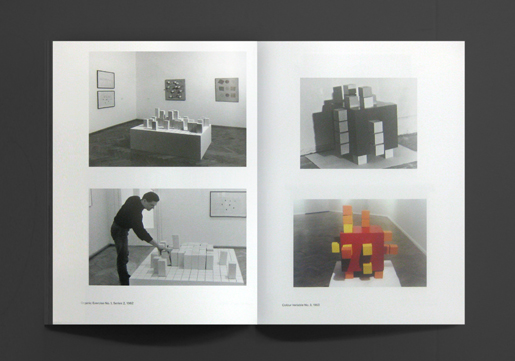
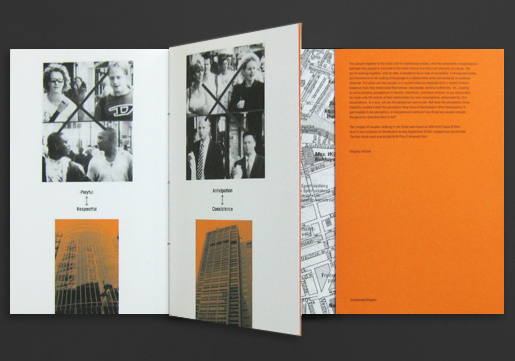
This is the first survey of work by Stephen Willats from the sixties. Willats (born and lives in London) was introduced to art as a teenage gallery assistant in 1958 and by 1962 was producing advanced artwork. He embraced the transdisciplinarity of the time, juggling the roles of social scientist, engineer, designer and artist, and developed an art about social interaction, using models derived from cybernetics, the hybrid post-war science of communication.
As well as the clothing and furniture made in 1965 when he briefly described himself as a 'conceptual designer', Willats' earliest sculptural series of 'Manual Variables' is haptic and interactive. These will be shown alongside early issues of Control, the still-operating magazine he founded in the same period. Its title is a provocation, invoking the cybernetic idea that people can take control of their environments, thereby deflecting the controls of a dominant hierarchy.
In 1968 Willats made an exhibition at the Museum of Modern Art Oxford in which he presented constructions involving movement and light – some wall-mounted, others large-scale environments – that were informed by his interest in contemporary theories: about probability and prediction, behavioural science, subliminal advertising, and colour in relation to motivation and learning. The display of these at Raven Row will be based on the darkened maze in which they were installed at Oxford, where they were proposed as experimental stimuli for 'states of consciousness'.
Willats' works on paper from this period elegantly combine cybernetic modelling, architectural graphics and constructivist geometries, and are consistent with his practice of today. However, he abandoned his dynamic constructions at the end of the sixties in pursuit of an art of social interaction beyond gallery and art object, for which he became well-known. This exhibition reconvenes this earlier work for the first time.
With texts by Antony Hudek, Emily Pethick, Christabel Stewart and Andrew Wilson.
2011, English
Softcover (foldout map cover), 32 pages (full-colour throughout), 15 x 22cm
Published by
Occasional Papers / London
$22.00 - Out of stock
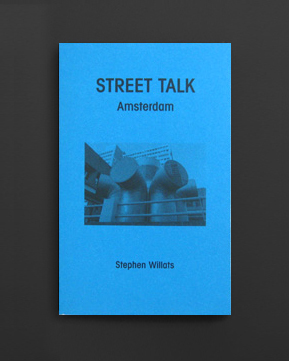
“Two people together is the basic unit for expressing society, and the complexity of expressions between two people is mirrored in the wider formal and informal networks of culture. The act of walking together, side by side, is fundamental to acts of sociability; it introduces fluidity and transience in the coding of language in a relationship when perceived by an external observer. (…)”
Stephen Willats, Street Talk: Amsterdam
Sewn by hand with orange and blue thread, includes fold-out map
Supported by Cassochrome
1984, English
Hardcover (w. dust jacket), 342 pages, 270 x 280 cm
1st Edition, Out of print title / Used*,
Published by
U.M.I. Research Press / Michigan
$150.00 - Out of stock
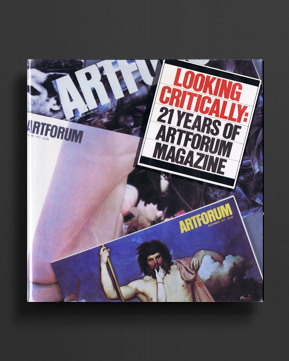
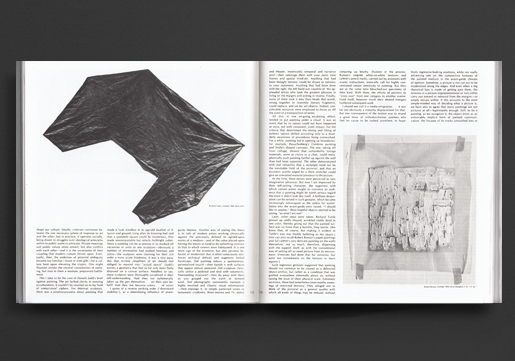
First, hardcover edition of "LOOKING CRITICALLY: 21 YEARS OF ARTFORUM MAGAZINE", the heavy 342 page volume anthology of the first 21 years of the world's most important modern and art journal. An incredibly valuable collection of art theory.
Edited by Amy Baker Sandback, designed by Roger Gorman and Mary Beath and published in 1984 by U.M.I. Research Press, this dense volume, bound in hardcover to the dimensions of a copy of ARTFORUM, begins with an Ed Kienholz review at the Ferus Gallery from ARTFORUM's June 1962 inaugural issue, and ends with Barbara Kruger reviewing the film "TRON" for the November 1982 issue. An amazing compendium of articles and reviews from the magazine's important first 21 years, featuring contributions by the likes of John Cage, Robert Morris, Kate Steinitz, Henry T. Hopkins, Don Factor, Robert Pincus-Witten, Dennis Adrian, John Coplans, Hilton Kramer, Harold Rosenberg, Henry Geldzahler, John Cage, Walter Hopps, Ed Ruscha, Allan Kaprow, Robert Rosenblum, Dan Flavin, Boris Groys, Sam Wagstaff, Billy Kluver, Lucy R. Lippard, Robert Rosenblum, Roger Shattuck, Ad Reinhardt, Mel Bochner, Andy Warhol, Roy Lichtenstein, Claes Oldenburg, Barbara Rose, Manny Farber, Michael Fried, Robert Morris, Philip Leider, Hollis Frampton, Carl Andre, Richard Serra, Lawrence Alloway, Barbara Kruger, Jane Livingston, Lizzie Borden, Kenneth Baker, Laurie Anderson, Agnes Martin, Cindy Nemser, Sidney Tillim, Annette Michelson, Rosalind Krauss, Jeremy Gilbert-Rolfe, Roberta Smith, Peter Plagens, Peter Schjeldahl, J. Hoberman, Hal Foster, Richard Flood, Carter Ratcliff, Stuart Morgan, Max Kozloff, Donald Kuspit, Dan Graham, Walter De Maria, Komar & Melamid, Edit De Ak, Lawrence Weiner, Kathy Acker, Robert Mapplethorpe, Anselm Kiefer, Thomas McEvilley, Louise Bourgeois, Ingrid Sischy, and too many more to list. Artists featured include: Josef Albers, Richard Tuttle, Jo Baer, Carl Andre, Ant Farm, Hans Arp, Max Bill, Mel Bochner, Alighiero Boetti, Lee Bontecou, Constantin Brancusi, Bertholt Brecht, Richard Avedon, Francis Bacon, Diane Arbus, Michaelangelo Antonioni, Lynda Beglis, Larry Bell, Terry Fox, James Byers, Rober Barry, Marcel Breuer, AA Bronson, Luis Buñel, Daniel Buren, Chris Burden, Joseph Beuys, Anthony Caro, Marcel Broodthaers, John Chamberlain, Paul Cézanne, Marc Chagall, Jean Cocteau, Merce Cunningham, Sonia Delauney, Walter de Maria, Bruce Connor, Jean Dubuffet, Max Ernst, Walker Evans, Dan Flavin, Marcel Duchamp, Albrecht Dürer, Lucio Fontana, Hollis Frampton, Alberto Giacometti, Eva Hesse, Gilbert & George, Philip Glass, John Cage, Nancy Graves, Dan Graham, Robert Grosvenor, Nancy Grossman, Walter Gropius, Hans Haacke, Hairy Who, David Hockney, Douglas Huebler, Jorg Immendorff, Donald Judd, Jasper Johns, Joan Jonas, Allan Kaprow, On Kawara, Ellsworth Kelly, Edward Keinholz, Paul Klee, Alison Knowles, Joseph Kosuth, Brice Marden, Agnes Martin, André Masson, Henri Matisse, Roberto Matta, Sol Lewitt, Roy Lichtenstein, Barbara Kruger, Jannis Kounellis, Markus Lüpertz, El Lissitzky, Rene Magritte, Robert Mapplethorpe, John McCracken, Mario Merz, Robert Morris, Robert Motherwell, Ree Morton, Louise Nevelson, Barnett Newman, Kenneth Noland, Claes Oldenburg, Eduardo Paolozzio, A. R. Penck, Irving Penn, Francis Picabia, Pablo Picasso, Larry Poons, Ken Price, Yvonne Rainer, Robert Rauschenberg, Martial Raysse, Roman Polanski, Jackson Pollock, Steve Reich, Gerrit Rietveld, Alain Robbe-Grillet, Dorothae Rockburne, James Rosenquist, Mark Rothko, Robert Ryman, Lucas Samaras, Kurt Schwitters, Oscar Schlemmer, Richard Serra, Cindy Sherman, David Smith, Robert Smithson, Michael Snow, Robert Venturi, Wolf Vostell, Andy Warhol, Frank Stella, Saul Steinberg, Karlheinz Stockhausen, Bruno Taut, Jean Tinguely, Anne Truitt, Paul Wunderlich, Lawrence Weiner, Louise Bourgeois, Alfred Hitchcock, and so many more.
Very uncommon hardcover edition, with dust jacket.
2011, English
Softcover, 374 pages, 21 x 13.5 cm
Published by
Valiz / Amsterdam
$48.00 $35.00 - Out of stock
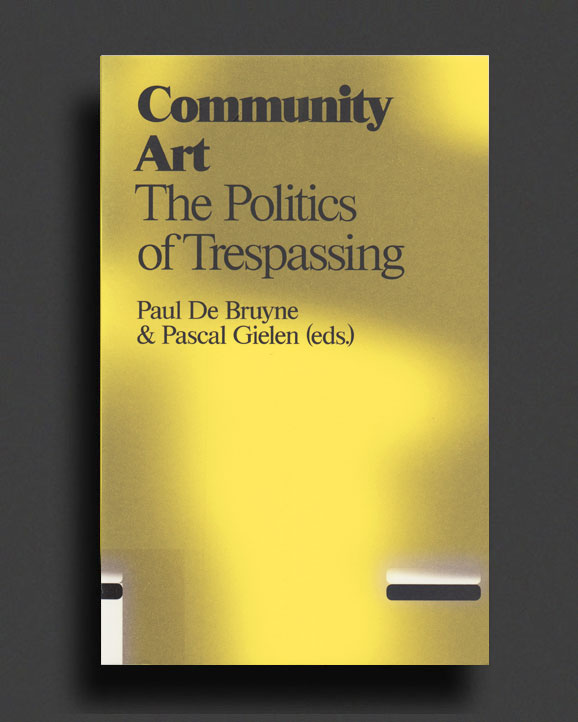
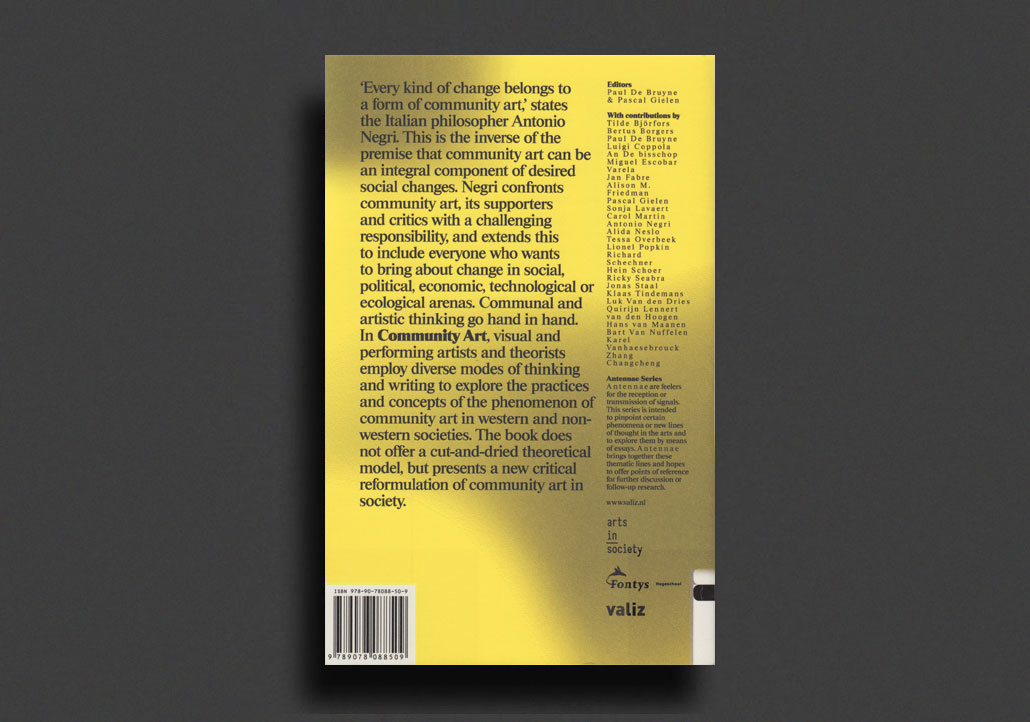
‘Every kind of change belongs to a form of community art,’ states the Italian philosopher Antonio Negri. This is the inverse of the premise that community art can be an integral component of desired social changes. Negri confronts community art, its supporters and critics with a challenging responsibility, and extends this to include everyone who wants to bring about change in social, political, economic, technological or ecological arenas. Communal and artistic thinking go hand in hand. In Community Art, visual and performing artists and theorists employ diverse modes of thinking and writing to explore the practices and concepts of community art in western and non-western societies. The book does not offer a cut-and-dried theoretical model, but presents a new critical reformulation of community art in society.
Contributors: Tilde Björfors, Bertus Borgers, Paul De Bruyne, Luigi Coppola, An de bisschop, Miguel Escobar Varela, Jan Fabre, Alison M. Friedman, Pascal Gielen, Sonja Lavaert, Carol Martin, Antonio Negri, Alida Neslo, Tessa Overbeek, Lionel Popkin, Richard Schechner, Hein Schoer, Ricky Seabra, Jonas Staal, Klaas Tindemans, Luk Van den Dries, Quirijn Lennert van den Hoogen, Hans van Maanen, Bart Van Nuffelen, Karel Vanhaesebrouck, Zhang Changcheng
Editors: Paul De Bruyne, Pascal Gielen
Design: Metahaven
1971, English
Hardcover (w. dust jacket), 216 pages, 15.5 x 22 cm
1st edition, Out of print title / used*,
Published by
Thames and Hudson / London
$58.00 - Out of stock
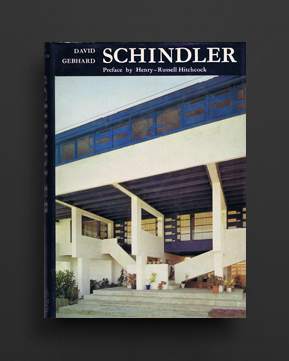
First edition (hardcover) of this first in-depth book on architect Rudolph Schindler, published in London in 1971.
The Los Angeles-based architect R.M. Schindler (1887 Vienna - 1953 Los Angeles) is regarded today as one of the central figures of the Modern movement. Trained in Vienna under Otto Wagner and Adolf Loos, Schindler then migrated to Los Angeles under the apprenticeship of Frank Lloyd Wright. Surrounded by a clientele of progressive thinkers in the emerging intellectual culture of Hollywood, Schindler created a radical and intensely personal architectural conception, resulting in some of the seminal works of the twentieth century.
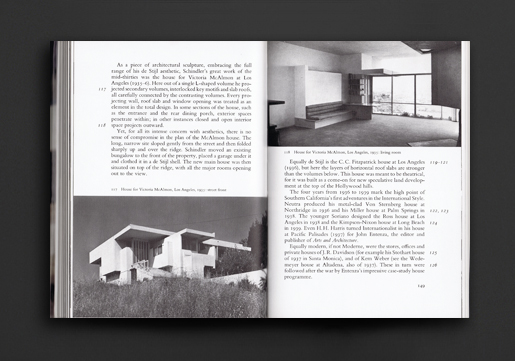
Gebhard's Schindler, first issued in 1971, is the only full-length account of Schindler's prolific yet unfulfilled career. Illustrated heavily throughout with photographs of Schindler's buildings and interiors, his plans, schemes and projections.
Chapters are: Preface by Henry-Russell Hitchcock; New worlds and old; American apprenticeship; The years with Wright; Opportunity: California in the twenties; Theories in practice; The making of a personal style; Schindler's 'de Stijl'; The depression: a new clientele; Living space; Modern versus Moderne; Business commissions; The uses of wood; The final phase; Schindler's place in architecture.
Charles Moore said, "David Gebhard's book about Rudolph Schindler was, for me, the most moving story of an architect that I have read since I was astonished at an early age by Frank Lloyd Wright's autobiography."
Includes a preface by Henry-Russell Hitchcock.
1970, English
Hardcover (w. dust jacket), 354 pages, 21 x 30 cm
1st UK Edition, Out of print title / Used*,
Published by
Crosby Lockwood Staples / London
$67.00 - Out of stock
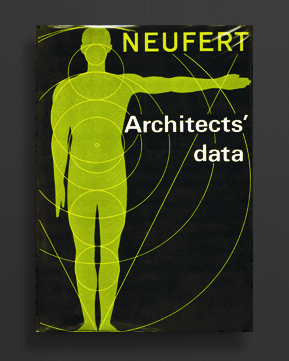
First English edition, in hardcover.
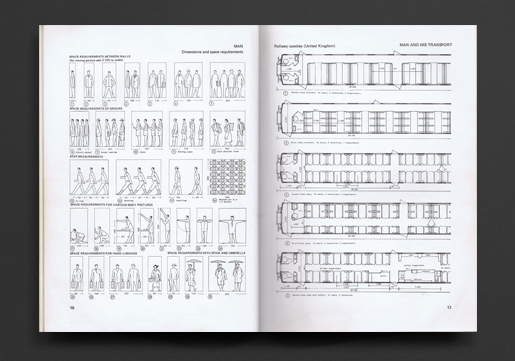
Architects' Data (German: Bauentwurfslehre), also simply known as the Neufert, is an essential reference book for spatial requirements in building design and site planning. First published in Germany in 1936 by Ernst Neufert, its 39 German editions and translations into 17 languages have sold over 500,000 copies. This first English version was published in 1970.
Ernst Neufert (15 March 1900 – 23 February 1986) was a German architect who was one of the first students of the Bauhaus, going on to become chief architect under Walter Gropius in one of the most prominent architecture studios of the Weimar Republic. In collaboration with Gropius, Neufert realized the new Bauhaus buildings in Dessau and the completion of the masters' houses for Muche, Klee, and Wassily Kandinsky. As well as being well known as the assistant of Walter Gropius, Neufert was an influential teacher in Weimar and member of various standardization organizations, and is especially known for his essential handbook Architects' Data, which became an architectural library standard across the world.
Architects' Data provides, in one concise volume, the core information needed to form the framework for the more detailed design and planning of any building project. Organised largely by building type, it covers the full range of preliminary considerations, and with over 6200 diagrams it provides a mass of data on spatial requirements. Most illustrations are dimensioned and each building type includes plans, sections, site layouts and design details. An extensive bibliography and a detailed set of metric/imperial conversion tables are included.
1977, English
Softcover, 208 pages (146 ill.), 152 x 229 mm
Published by
Semiotext(e) / Los Angeles
The MIT Press / Massachusetts
$50.00 - Out of stock
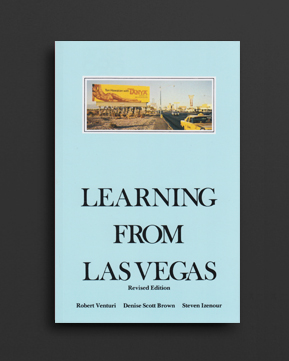
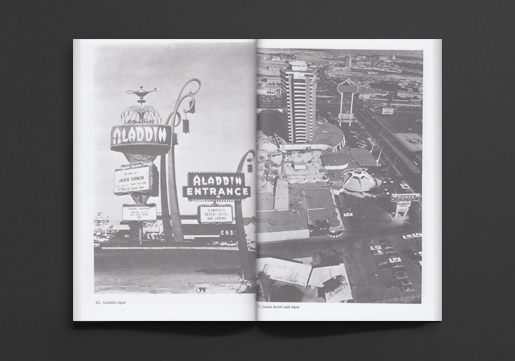
Learning from Las Vegas created a healthy controversy on its appearance in 1972, calling for architects to be more receptive to the tastes and values of "common" people and less immodest in their erections of "heroic," self-aggrandizing monuments. This revision includes the full texts of Part I of the original, on the Las Vegas strip, and Part II, "Ugly and Ordinary Architecture, or the Decorated Shed," a generalization from the findings of the first part on symbolism in architecture and the iconography of urban sprawl.
Robert Venturi is an award-winning architect and an influential writer, teacher, artist, and designer. His work includes includes the Sainsbury Wing of London's National Galler; renovation of the Museum of Contemporary Art, San Diego; dozens of major academic projects; and the groundbreaking Vanna Venturi House. Denise Scott Brown is a Founding Principal of Venturi, Scott, Brown, and Associates (VBSA) whose work and ideas have influenced generations of architects and planners. Steven Izenour (1940-2001) was coauthor of Learning from Las Vegas (MIT Press, 1977) and a principal in the Philadelphia firm Venturi, Scott Brown and Associates, Inc (VSBA). His most noted projects at VSBA include Philadelphia's Basco showroom, the George D. Widener Memorial Treehouse at the Philadelphia Zoo, the Camden Children's Garden, and the house he designed for his parents in Stony Creek, Connecticut.
"...a brilliant document of the times...a work which uses history knowledgeably, skillfully, and creatively: a rarity." Journal of the Society of Architectural Historians
"...professionally informed, competitively astute, and perversely brilliant..." The Yale Review
"...these studies are brilliant...the kind of art history and theory that is rarely produced." The New York Times Ada Louis Huxtable
1972, English
Softcover, 256 pages, 11 x 18 cm
Out of print title / Used*,
Published by
Penguin Books / Australia
$18.00 - Out of stock
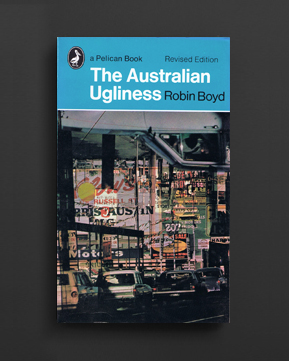
1972 revised edition of the classic Robin Boyd book, The Australian Ugliness. Introduction by John Betjeman.
Fifty years after its first publication, Robin Boyd’s bestselling The Australian Ugliness remains the definitive statement on how we live and think in the environments we create for ourselves. In it Boyd railed against Australia’s promotion of ornament, decorative approach to design and slavish imitation of all things American.
‘The basis of the Australian ugliness,’ he wrote, ‘is an unwillingness to be committed on the level of ideas. In all the arts of living, in the shaping of all her artefacts, as in politics, Australia shuffles about vigorously in the middle—as she estimates the middle—of the road, picking up disconnected ideas wherever she finds them.’
Boyd was a fierce critic, and an advocate of good design. He understood the significance of the connection between people and their dwellings, and argued passionately for a national architecture forged from a genuine Australian identity. His concerns are as important now, in an era of sustainability, suburban sprawl and inner-city redevelopment, as they were half a century ago.
Caustic and brilliant, The Australian Ugliness is a masterpiece that enables us to see our surroundings with fresh eyes.
Robin Boyd (1919–71) is arguably Australia’s most influential architect. He was an idealist, a visionary, who believed that good design would improve the quality of people’s lives. A tireless public educator and outspoken social commentator, he designed more than two hundred buildings and wrote such classics as The Puzzle of Architecture and Australia’s Home.
1985, English / Japanese
Hardcover (w. dustjacket), 216 pages, 31 x 24 cm
1st edition, Out of print title / used*,
Published by
Rikuyo-Sha / Tokyo
$120.00 - Out of stock
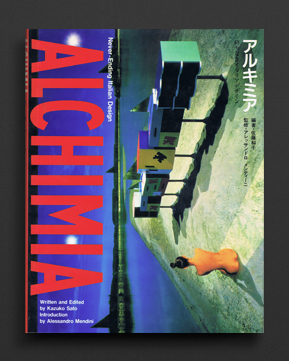
The first edition of this great Alchimia book, edited by Kazuko Sato and published by Rikuyo-sha in Japan in 1985. The first European edition of this book appeared later in 1988.
Text in both English and Japanese.
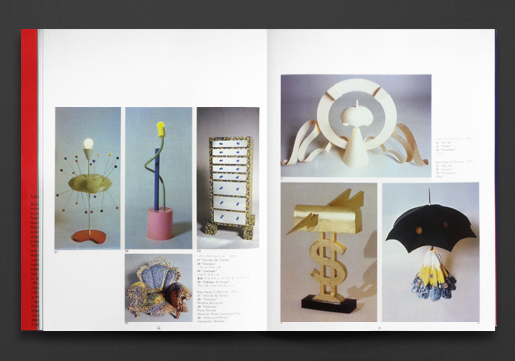
This is truly THE book on the work of Studio Alchimia. Published in Japan in 1985 and later in Germany in 1988 and lavishly illustrated throughout with colour photography and illustrations, this bilingual (English/German) volume features the history of Studio Alchimia, profiles of the Alchimia members (which included designers such as Andrea Branzi, Ettore Sottsass and Michele De Lucchi, amongst many others) a full work index and bibliography, and more.
Studio Alchimia was an iconoclastic, radical design group founded in Italy in 1976 by the Italian Architect Alessandro Guerriero. The Studio Alchimia was composed of designers, whose aim was to design and manufacture exhibition pieces, rather than consumer orientated products. Their products were to be regarded as prototypes / one-offs, leading the way from the principles of modernist design to a bold, new, experimental design style. This style would lead to the formation and popularity of Italian design groups in the 1980′s such as the Memphis Group and the new directions taken by the Alessi company.
Contents: Introduction by Alessandro Mendini. I). Alchimia. 1). Redesigned cupboards. 2). Bauhaus I – II. II). Exhibition. 1). A phenomenon of design. 2). Banal objects. 3). Natural objects. 4). Blackout. 5). House of Newlyweds. III). Pilosophical expression and activity. 1). Unfinished furniture. 2). Cosmesi. 3). Juliet’s house. 4). Carnival tower. 5). Bisexual architecture. 6). ‘Nulla’ – sounding garment. IV). Space design performance. 1). Furniture as clothing. 2). Mussolini’s bathroom. 3). Sentimental robot. 4). Midsummer night’s erotic dream. 5). Ambrogio’s house. 6). Momentary environment. 7). Kitchen space. V). Architecture and interior. 1). Utopia in a test-tube. 2). Tender architecture. 3). Alchimia town. 4). Summer architecture. 5). An idea for the house. 6). House of falsity. 7). Café de Paris. 8). Colosseum/bank in Alcamo. 9). Mysterious bathing. 10). New bridge of Accademia. 11). Thodier house. 12). Alessi house. VI). Redesigning the Modern Movement. VII). New design. 1). Nuova Alchimia. 2). 1930s furniture. 3). Poetic objects. 4). Philosophical cupboards. 5). Monumental objects. 6). Timeless objects. 7). Human-life objects. 8). Architectural fashion. 9). Textile patterns. 10). The present age – the designer in the cage. 11). Design research on bicycles. VIII). Alchimia and industry. 1). ‘Sans souci’ tableware. 2). Product research on Neapolitan coffee-pots. 3). Post-modern designs. 4). Programme No. 6. 5). ‘Renault super 5′ decoration. 6). Domus. 7). Invention of a neutral surface. IX). Radical design. 1). The Forence group and Casabella. 2). Products of the Non-project period. 3). The Post-radicals.
First Japanese edition, hardcover, 1985.
1971, English
Hardcover, 128 pages, 17.5 x 24 cm
1st Edition, Out of print title / Used*,
Published by
Lansdowne Australian Art Library / Melbourne
$28.00 - Out of stock
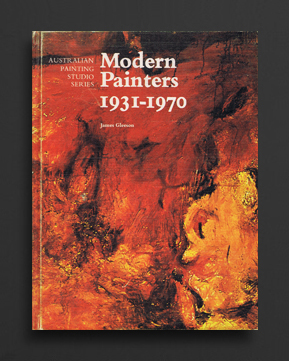
First edition, published in 1971 by Lansdowne Australian Art Library, Melbourne, as part of the Australian Painting Studio Series under the editorship of John Henshaw.
Illustrated throughout with colour reproductions of the works of modern Australian painters selected by Australian artist James Gleeson, from post-impressionism, abstraction and op-art to the hard-edge minimal and colour-field painting, inc. Ian Fairweather, Sydney Ball, Fred Williams, John Perceval, Albert Tucker, Sydney Nolan, Arthur Boyd, John Passmore, Alun Leach-Jones, John Olsen, Brett Whiteley, Rodney Milgate, Colin Lanceley, Stanislaw Ostoja-Kotowski, Col Jordan, Dick Watkins, Michael Johnson, Tony McGillick, Henry Salkauskas, Eva Kubbos, Judy Cassab, Roger Kemp, Margo Lewers, Ralph Balson, Jeffrey Smart, Donald Friend, Ray Crooke, Michael Kmit, Jon Molvig, Sali Herman, Charles Blackman, Robert Dickerson, Eric Wilson,Godrey Miller, Russell Drysdale, William Dobell, William Dobell, Grace Crossington Smith, Grace Crowley, Rah Fizelle, Roy de Maistre, Margaret Preston, Roland Wakelin, and more.
Introduction by author, lengthy biographies on each artist featured throughout the book, works in public collections, acknowledgements, and select bibliography.
1987, English
Softcover, 112 pages, 18 x 24 cm
1st Edition, Out of print title / Used*,
Published by
Art Gallery of New South Wales / Sydney
Artspace / Sydney
$65.00 - Out of stock
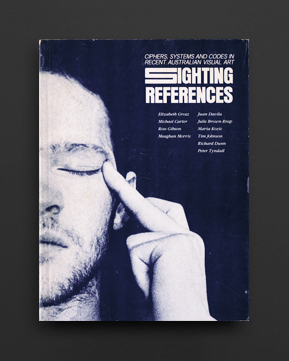
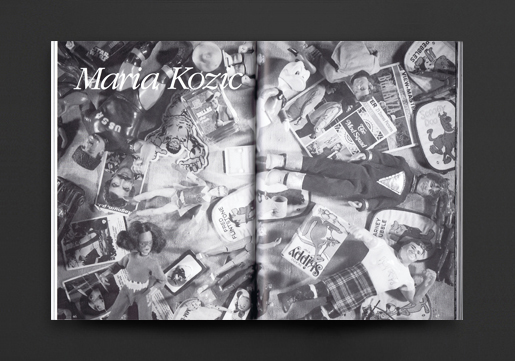
Very scarce Australian catalogue published on the occasion of the great exhibition "Sighting References: Ciphers, Systems and Codes in Recent Australian Visual Art" held in 1987 as a collaborative venture between Artspace Sydney and the Art Gallery of NSW and curated by Gary Sangster. This exhibition presents 'a range of sites of art production and reception', addressing the exhibition as a discursive and creative conjunction of (written and visual) information. Features the work of Juan Davila, Julie Brown-Rrap, Maria Kozic, Tim Johnson, Richard Dunn, Peter Tyndall, alongside essays by Elizabeth Grosz, Michael Carter, Ross Gibson, Meaghan Morris.
1985, English
Softcover, 60 pages, 21 x 28 cm
1st Edition, Out of print title / Used*,
Published by
The Art Gallery of Western Australia / Perth
$50.00 - Out of stock
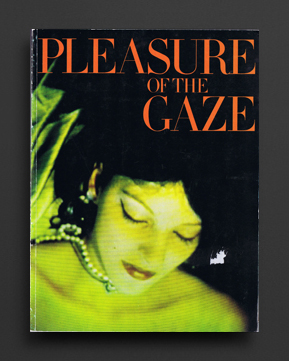
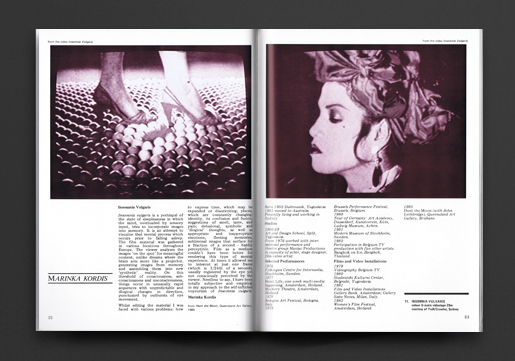
Scarce Australian catalogue published on the occasion of the exhibition "Pleasure of The Gaze : Image and Appearance in Recent Australian Art", held at the The Art Gallery of Western Australia, Perth, 1985, and curated by Bruce Adams.
Profusely illustrated in colour and black and white across exhibiting artist biographical sections and essay accompaniment illustrations, this publication features the work of Julie Brown-Rrap, Peter Callas, Richard Dunn, Merilyn Fairskye, Marinka Kordis, Maria Kozic, Lindy Lee, John Lethbridge, Akio Makigawa, Sue Paull, Stieg Persson, Robert Randall and Frank Bendinelli, Carol Rudyard, Peter Tyndall, Vicki Varvaressos, and John R. Walker. Essays include "Eye, Image, Picture, Screen (and all that Junk)" by Adrian Martin; "Sticky Television" by Meaghan Morris; "Re Re-Orientation: The Image as Fantasy and Furniture in Japan" by Peter Callas. Plus an introduction by Adams.
Design by Wohlnick Design.
1984, English
Softcover, 170 pages, 21 x 30 cm
1st Edition, Out of print title / Used*,
Published by
Art & Text / Beverley Hills
Art & Text / Prahran
$65.00 - Out of stock
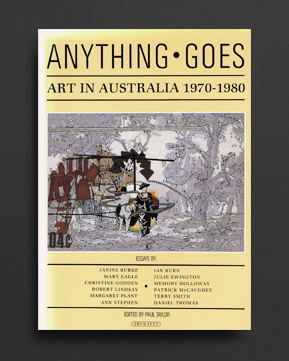
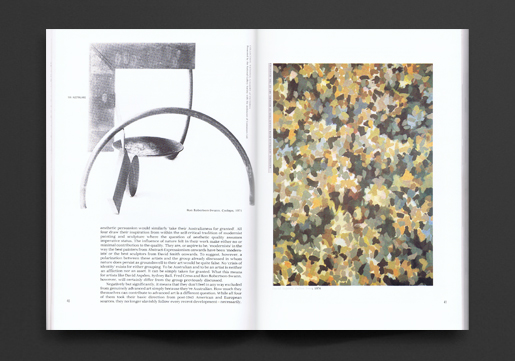
First printing of "Anything Goes : Art in Australia 1970-1980", published by Art & Text in 1984. Edited by Paul Taylor, founder of Art & Text, this large, valuable volume of essays by leading writers of those years - covering all aspects of painting, sculpture, photography and experimental art forms since 1970 - features contributions by Janine Burks, Mary Eagle, Christine Godden, Robert Lindsay, Ian Burn, Julie Ewington, Memory Holloway, Terry Smith, Ann Stephen, Margaret Plant, Patrick McCaughey, Daniel Thomas.
"The 1970s were years of unprecedented change in Australian art and culture, and Anything Goes is the first book about that decade's remarkable variety of art."
Includes the work of: →↑→, Mike Parr, Howard Arkley, Jenny Watson, Donald Judd, Ian Burn, John Lethbridge, John Davis, Mel Bochner, Joseph Beuys, Mel Ramsden, Women's Domestic Needlework Group, Andy Warhol, Tim Johnson, Nigel Lendon, Artsworkers Union, Robert Rooney, Clive Murray-White, Tony McGillick, Fred Williams, John Firth-Smith, George Haynes, Donald Laycock, Michael Taylor, Fred Cress, Ron Robertson-Swann, David Aspden, Sydney Ball, Roger Kemp, Paul Partos, Trevor Vickors, Robert Hunter, Robert Jacks, Vivienne Binns, Bonita Ely, Marie McMahon, Virginia Cuppaidge, Imants Tillers, Les Kossatz, Ti Parks, Peter Cripps, Ken Searle, Jan Senbergs, George Baldessin, John Armstrong, Janet Dawson, Dale Hickey, Tony Coleing, Marr Grounds, Chips Mackinolty, Ann Newmarch, Colin Little, Jan Mackay, Toni Robertson, Jenny Hill, Christo, Ross Grounds, Ken Unsworth, Kevin Mortensen, Stelarc, Jillian Orr, Hossein Valamanesh, W. Thomas Arthur, Ewa Pachucka, Vicki Varvaressos, Carol Jerrems, Elizabeth Gower, Geoff Hogg, Ann Newmarch, Peter Kennedy, Jon Rhodes, Bill Henson, Stephen Lojewski, Robert Owen, Mark Johnson, Peter Booth, John Dunkley-Smith
, Ron Robertson-Swann, Alun Leach-Jones, Michael Johnson, Lesley Dumbrell, Fred Cross, John Walker, David Aspden, and many more.
Paul Taylor (Melbourne, 1957–7 September 1992) was an Australian art critic, curator, editor and publisher. In 1981, he founded Art & Text, the contemporary art journal considered to be responsible for generating and promoting postmodernist discourse in Australian art.
1980, English
Softcover, 54 pages, 21 x 23.5 cm
1st Edition, Out of print title / Used*,
Published by
Regional Development Program / Victoria
$50.00 - Out of stock
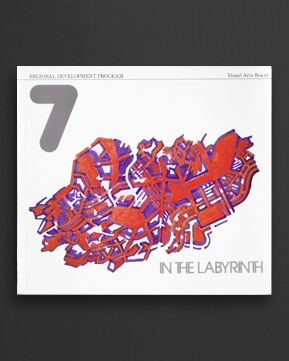
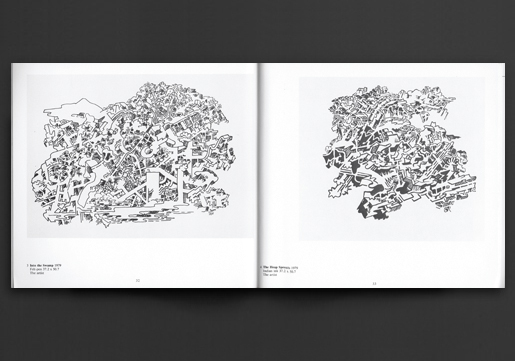
Scarce catalogue published to accompany the two-person exhibition "Exhibition 7 : In The Labyrinth : drawings by Peter Booth and Mike Brown", a traveling exhibition across regional galleries in 1980-1981. Catalogue is split in two with 20 illustrations of works by each Australian artist, in black and white and colour. Includes an introduction and biography for each artist.
Peter Booth (born 2 November 1940 in Sheffield, England) is an Australian figurative and a surrealist painter, and one of the key late-20th-century Australian artists. His work is characterised by an intense emotional power of often dark narratives, and esoteric symbolism.
Mike Brown (1938-1997) was a significant late 20th century contemporary Australian artist. One of the founders of the Annandale Imitation Realists of the early 1960s, now recognised as a key event in the development of anti-formalist art in Australia. Brown was a unique leader of alternative avant guard art in Australia, railing against elite art cliques. In 1965 Brown became the only Australian artist ever to be prosecuted for obscenity and scandals would continue even after his death in 1997. During his lifetime, Brown produced a multiplicity of work including naïve landscapes, pattern based abstraction, pop and text paintings, found object assemblages, graffiti, performance.
1972, English
Hardcover (w. dust jacket), 29 pages, 25 x 19 cm
1st Edition, Out of print title / Used*,
Published by
Mullaya / Canterbury
$30.00 - Out of stock
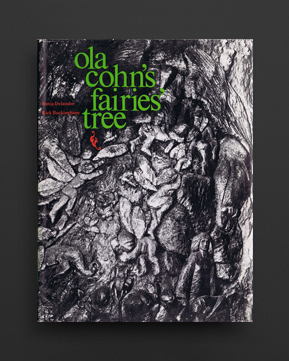
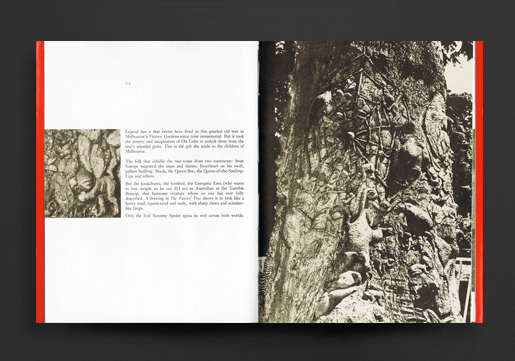
Ola Cohn (1892 - 1964) was a pioneer of modernist sculpture in Australia and a founding member of the Australian Sculptors Society, herself working across bronze, stone, wood and also an author of children's books.
"For just on three years Bendigo-born sculptor Ola Cohn spent long hours each day lovingly creating a community of fairies and animals in the iron-hard wood of a gnarled 500-year-old red gum tree which stands in Melbourne's Fitzroy Gardens. In May 1934 her task was completed. She dedicated the tree to the children of Melbourne with these simple words:
'I have carved a tree in the Fitzroy Gardens for you and the fairies; but mostly for the fairies, and those who believe in them, for they will understand how necessary it is to have a Fairy Sanctuary - a place that is sacred and safe as a home should be to all living creatures.'
Sonja Delander has told the story of Ola Cohn and her Fairies' Tree in a manner which will delight both young and old. Her text, with the photography of Rick Buckingham, brings to life all the characters which inhabit the tree. There is Stoutheart on his gallant bullfrog; the Energetic Emu who wants to lose weight; the Weeping Imp who scraped his knee while dancing and the Reading Mother, well protected from the weather in a niche in the tree, with the young fairies grouped around her knee intently listening to her story...."
2016, English / German
Softcover, 248 pages, 23 x 16.5 cm
Published by
Texte Zur Kunst / Berlin
$30.00 - Out of stock
Issue #104 of TzK examines a key protagonist of the modern age: the individual. As our cover suggests, there is an inherent tragedy to this being who, however autonomous, is beholden to a program that it must internalize at the price of suffering enormously. This issue takes up the individual not as a fixed subject, but as a mode of the self that shifts according to the current form of governance, asking how 15-some years of the "new spirit of capitalism" has shaped her – as an artist, as an entrepreneur, as a "productive" contemporary self.
ISSUE NO. 104 / DECEMBER 2016 “THE INDIVIDUAL”
TABLE OF CONTENTS
PREFACE
INVEST YOURSELF! / Wendy Brown in conversation with Isabelle Graw
NINA POWER
FROM THE ONE TO THE MANY
CAN THE ENTREPRENEURIAL SELF TWEET? / An interview with Ulrich Bröckling
BUFFERING OF THE SELF: GUISING IN THE MID-’00S / Storm van Helsing, André Rottmann, Sarah Nicole Prickett, Reena Spaulings, @lilinternet, i.i.i., Luther Blissett -- on -- Luther Blissett, JT LeRoy, Reena Spaulings, @lonelygirl15, Claire Fontaine, An Hero, Lee Williams, and Strom van Helsing
SVEN LÜTTICKEN
SPEECH GESTURES / Notes on the individual and the socialization of language after Gutenberg
WOLFGANG RUPPERT
PRODUCING INDIVIDUALITY / The Artist among his Contemporaries
I’M NOT PUNK / Alex Israel in conversation with Texte zur Kunst
BILDSTRECKE
ANNA HAIFISCH
PORTFOLIO
ROTATION
FEEDBACK FÜR BLINDE FLECKE / Karin Gludovatz über „Jenseits des Spiegels. Das Sehen in Kunstgeschichte und Visual Culture Studies“ von Susanne von Falkenhausen
WORLD WIDE WEB / Anthony Vidler on Felicity D. Scott’s “Outlaw Territories”
LIEBE ARBEIT KINO
LANGSAMER ABSCHIED / Esther Buss über Albert Serras „La mort de Louis XIV“
DAS SICH SELBST TRÄUMENDE INTERNET / Sulgi Lie über Werner Herzogs „Lo and Behold. Reveries of the Connected World“
KLANG KÖRPER
SHARING ANGST / Gaby Tront on Anne Imhof's "Angst II" at Hamburger Bahnhof, Berlin
SHORT WAVES
Mikael Brkic on Alex Israel at the Astrup Fearnley Museum, Oslo / Steven Warwick on Morag Keil at Eden Eden, Berlin / Hanna Magauer über Dana Schutz bei Contemporary Fine Arts, Berlin / Tonio Kröner über Amelie von Wulffen in der Galerie Barbara Weiss, Berlin / Kari Rittenbach on Margaret Lee at Jack Hanley Gallery, New York / Susanne von Falkenhausen über „Die zu sein scheint, die bin ich.“ Birgit Jürgenssen, Cindy Sherman, Katharina Sieverding und Francesca Woodman in der Galerie Thomas Schulte, Berlin
REVIEWS
INDIVIDUELLER ORIENT / Diedrich Diederichsen über Michael Buthe im Haus der Kunst, München
ÜBERBLENDUNGSVERHÄLTNISSE / Sabeth Buchmann über Ellen Cantor im Künstlerhaus Stuttgart
… MY MERE SELF / Rachel Haidu on Kai Althoff at the Museum of Modern Art, New York
DIE KUNST DER STUNDE / Susanne Leeb über Kader Attia im Museum für Moderne Kunst, Frankfurt / M.
RUBY STERLING ZEIGT STERLING RUBY / Tanja Widmann und Inka Meißner über Sterling Ruby im Winterpalais Wien
DAS VIRTUELLE IM PHYSISCHEN / Hanne Loreck über Katrin Mayer und Eske Schlüters in der Kunsthalle Lingen
WHY BOTHER WITH SHOW BUSINESS? / Bosko Blagojevic on Antek Walczak at Real Fine Arts, New York
WERKE / Nikola Dietrich über Karl Holmqvist und Klara Lidén im Kunstverein Braunschweig
OBITUARY
BIRD OF PARADISE / Frank Wagner (1958–2016) in the words of Julie Ault
EDITION
ROBERT LONGO
OSCAR MURILLO
COSIMA VON BONIN
2016, English
Softcover, 170 pages, 12.5 x 20 cm
Published by
Sternberg Press / Berlin
$64.00 $30.00 - Out of stock
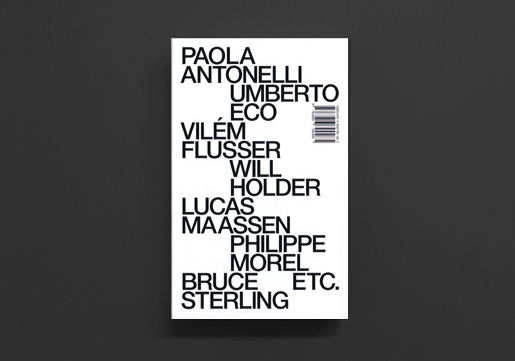
Contributions by Paola Antonelli, The Atlas Group (1989–2004), Alex Coles, Anthony Dunne, James Dyer, Umberto Eco, Experimental Jetset, Vilém Flusser, Verina Gfader, Huib Haye van der Werf, Will Holder, Sophie Krier, Carrie Lambert-Beatty, Lucas Maassen, Valle Medina, Philippe Morel, Rick Poynor, Fiona Raby, Benjamin Reynolds, Hiroko Shiratori, Bruce Sterling
After the first EP volume on the activities of the early Italian avant-garde, the second volume in the series identifies the current fascination with fiction across art, design, and architecture. Practitioners and theorists explore this strategy by pushing the debate into both speculative and real-fictitious terrains. Newly commissioned interviews, artist projects, and essays shed light on topics such as parafiction and algorithmic ambiguity. Included in the volume is one of the final interviews to be published with novelist and semiotician Umberto Eco; a conversation with Bruce Sterling, in which the science-fiction author responds to designers who reference his writings; and design theorist Vilém Flusser’s 1966 essay “On Fiction,” in its first English translation.
The EP series fluidly moves between art, design, and architecture, and introduces the notion of the “extended play” into publishing, with thematically edited pocket books as median between popular magazines (“single play”) and academic journals (“long play”).
Design by Experimental Jetset
1996, English
Softcover, 238 pages, 23 x 30.5 cm
Out of print title / used*,
Published by
Rizzoli / New York
$70.00 - Out of stock
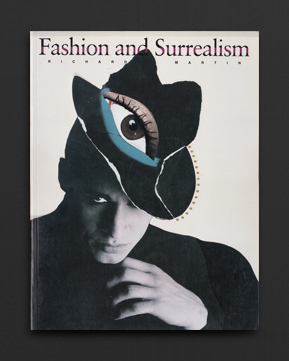
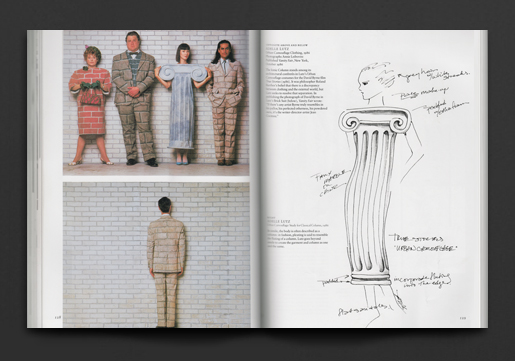
"The influence of Surrealism on fashion and its ancillary arts lasted decades longer than the movement itself. This catalog, accompanying a 1987 exhibition at Fashion Institute of Technology, explores the extravagances of visual language as social and political comment, a revolution in perception."--The Library Journal.
"The love affair between fashion and Surrealism began in the Paris of the 1920s when Surrealist artists plundered fashion's imagery for their art, raising fashion beyond the level of mere style to an important expression of culture. This text reveals the extravagent and ingenious creations resulting from this collaboration. It ranges from the shocking Surrealist dresses of Schiaparelli and Dali, and photographic experiments with Surrealist techniques by Horst P. Horst, Cecil Beaton and George Hoyningen-Huene to the work of younger fashion designers, including Olivier Guillemin and Vivienne Westwood, who have all brought Surrealist imagery into clothing and accessories."
This bountiful, visually lavish volume, published to accompany a 1987 exhibition at Fashion Institute of Technology, features the garments, paintings, sculptures, illustrations, window displays, fashion advertisements, costume designs and photography of Man Ray, Cecil Beaton, Issey Miyake, Horst P. Horst, Cinzia Ruggeri, Vivienne Westwood, Thierry Mugler, Krizia, Giorgio De Chirico, Meret Oppenheim, Max Ernst, Donatella, Rene Magritte, Comme des Garcons, Enrico Donati, Elsa Schiaparelli, Salvador Dali, Marcel Rochas, Jaques Griffe, Adelle Lutz, Marina Killery, Dominique Lacoustille, Emme, Stephen Jones, Louise Bourbon, Bill Cunningham, Germaine Vittu, Eric Braagaard, Karl Lagerfeld, Candy Pratts Price, Serge Lutens, Antonio, Linda Fargo, Claude Montana, Georgina Godley, Olivier Guillemin, Yves Tanguy, Christian Lacroix, Valentine Hugo, Paul Colin, Francoise Lesage, Yves Saint Laurent, Jean Cocteau, Adam Kurtzman, Herbert Bayer, Mel Odom, Jean-Paul Gaultier, Alfa Castaldi, Leo Malet, Jorge Silvetti, Gabriella Giandelli, Givenchy, Marcel Jean, Jean-Charles de Castelbajac, Michael Roberts, Marcel Vertés, Bert Stern, John Galliano, Danuta Riyder, Paul Delvaux, Manolo Blahnik, Dorothea Tanning, Eileen Agar, Miguel Covarubias, Cristobal Balenciaga, Andre Masson, Leonor Fini, Roman Cieslewicz, Shoji Ueda, Louise Dahl-Wolfe, Bruce Weber, Robert Mapplethorpe, A. M. Cassandre, Peter Lindbergh, Claude Cahun, Jean Arp, and so many more.
1977, English
Softcover, 111 pages, 25 x 30 cm
1st edition, Out of print title / used*,
Published by
Australian Gallery Directors Council / Canberra
$38.00 - Out of stock
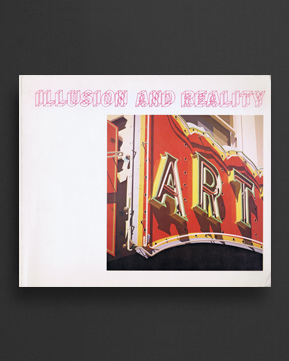
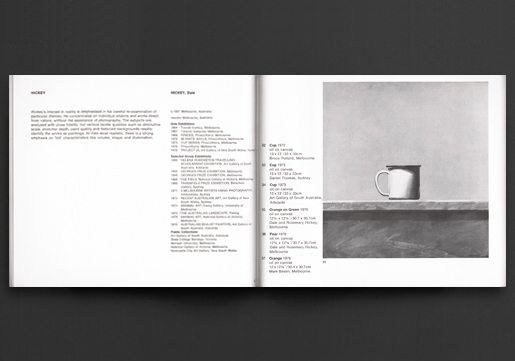
Major Australian touring exhibition exploring realism and illusion in art (across new realist painting, pop, photography, conceptualism, minimalism, abstraction, ceramics, even architecture) with a catalogue of 71 works by 44 international artists and groups. Introduction and notes on the artists by John Stringer; statements by Audrey Flack, Stephen Posen and Josef Raffael; biographical notes on the artists, including exhibitions and collections; statement on realism by Raymond Williams. Exhibition organized by the Australian National Gallery, Canberra, and shown at seven locations throughout Australia.
Artists: Ian Burn, Gerhard Richter, Ed Ruscha, Joseph Kosuth, Bernd and Hilla Becher, Marilyn Levine, Dale Hickey, Jenny Watson, Jan Dibbets, Chuck Close, SITE, Michael Snow, Tom Wesselman, Claudio Bravo, Malcolm Morley, Michael Snow, Robert Bechtle, Tom Blackwell, Christian Boltanski, Santiago Cardenas, John Clem Clarke, William Delafield Cook, Robert Cottingham, Don Eddy, Richard Estes, Audrey Flack, Ralph Goings, Jan Groover, Duane Hanson, Peter Kennedy, Ron Kleeman, Richard Larter, Victor Lance Henderson, Terry Schoonhoven, Richard McLean, Jud Nelson, John Okulick, Philip Pearlstein,, Michelangelo Pistoletto, Liliana Porter, Stephen Posen, Joseph Raffael, Ben Schonzeit, Paul Sharits, Sonia Landy Sheridan, and more.
1976, English
Softcover, 120 pages, 28 x 27 cm
1st edition, Out of print title / used*,
Published by
Solomon R. Guggenheim Foundation / New York
$20.00 - Out of stock
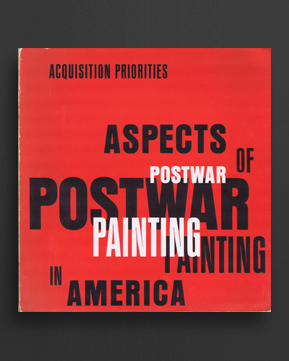
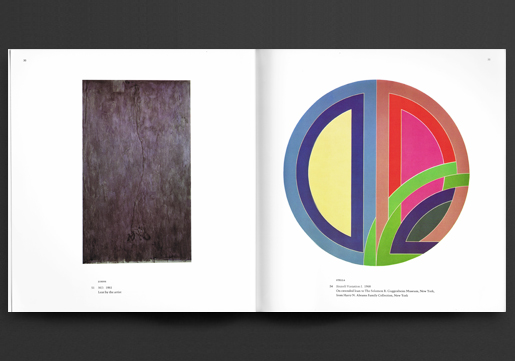
Offering a unique glimpse into the acquisition priorities of a large-scale institution, this catalogue juxtaposes works from the Guggenheim’s own collection with a selection of highly ranked artworks on the list of potential acquisitions, showcasing 32 American artists who shaped the mid-20th century's art world.
Published by Solomon R. Guggenheim Foundation, New York, to accompany the exhibition Acquisition Priorities: Aspects of Postwar Painting in American, October 15, 1976–January 16, 1977, this book functions as much more than just a review of postwar American painting, acting as a self-analytical, institutional critique bringing the strengths and weaknesses of the Guggenheim’s holdings into stark relief. The catalogue features large images in both colour and black and white, followed by artists’ biographies, which are illustrated by social photographs.
Features: Jasper Johns, Frank Stella, Agnes Martin, Josef Albers, Robert Rauschenberg, Mark Rothko, Philip Guston, Alfred Jensen, Jack Tworkov, Robert Motherwell, Arshile Gorky, Mark Tobey, Jackson Pollock, Helen Frankenthaler, Roy Lichtenstein, Willem de Kooning, Andy Warhol, Robert Indiana, Barnett Newman, Adolph Gottlieb, Ad Reinhardt, amongst others.
Text by Thomas M. Messer
1968, English
Softcover, 40 pages, 20 x 19 cm
1st edition, Out of print title / used*,
Published by
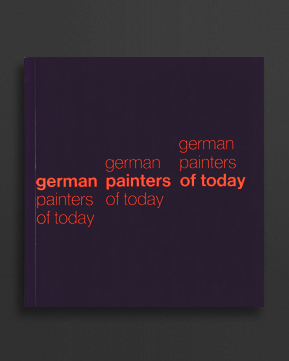
German Art Council to the Adelaide Festival of Arts / Adelaide
$25.00 - Out of stock
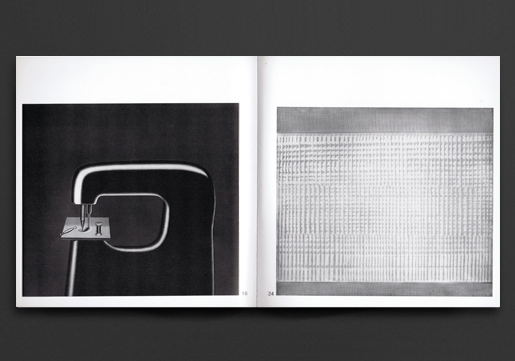
A curious catalogue published on the occasion of an exhibition of new German painting held in Adelaide during the Adelaide Festival of Arts in 1968.
Includes a selection of 21 colour and black and white reproductions of works by Wolf Vostell, Horst Antes, Konrad Klapheck, Heinz Mack, Otto Piene, Paul Wunderlich, and many others, alongside a text by Werner Schmalenbach.
Published in Adelaide and printed in Germany.
2013, English
Softcover, 124 pages, 23.5 x 29.7 cm
Published by
Ruthin Craft Centre / Denbighshire
$120.00 - Out of stock
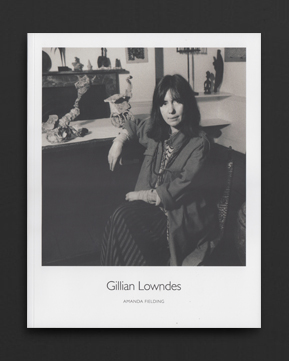
Gillian Lowndes (1936–2010) was one of the ceramic world’s most daring, radical and original artists of the post-war generation. Operating on the border territory between fine art and craft, she is renowned for her sensitive investigations of material and process, of serendipity and sculptural form. In view of her avant-garde position, it is surprising that in her lifetime she had notably few solo exhibitions, and that her art is not more widely known and appreciated beyond a network of ceramists, curators, gallerists, critics, collectors and enthusiasts engaged with the crafts and applied arts.
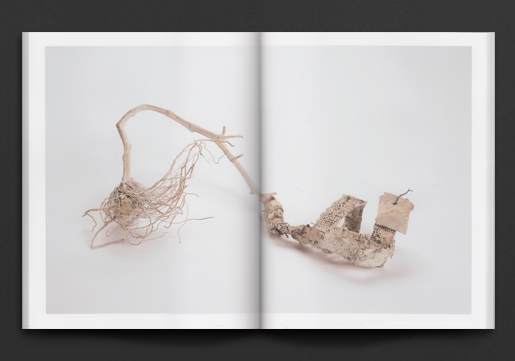
Published on the occasion of a large retrospective exhibition held at Ruthin Craft Centre, Wales, in 2013, curated by Amanda Fielding, this is the first major publication dedicated to the work of Lowndes, which is beautifully illustrated with photography of her incredible sculptural works across 124 pages with accompanying texts, biography, exhibition list, and more.
Very highly recommended!
About Gillian Lowndes:
Gillian Lowndes (1936 – 2 October 2010) was an English ceramics sculptor.
Born in Cheshire in 1936, she spent much of her childhood in British India. She studied at the Central School of Arts and Crafts beginning in 1957 and spent a year at L’École des Beaux-Arts in Paris in 1960. In the early 1970s she traveled to Nigeria with her husband, Ian Auld, a trip that would prove to be influential in her subsequent work. From 1975 until the early 1990s, she taught part-time at Camberwell College of Arts and Central Saint Martins College of Art and Design.
Since the early 1960s and 70s her work has challenged the traditional notions surrounding the form of a vessel and fine art. Through her non-traditional experimental methods of incorporating found objects and materials such as wire and various objects from found in everyday life into her ceramic work, she continually challenges the orthodox world of pure ceramics.
Her mixed-media sculptures have been referred to as bricolage, or sculptures that utilize found objects to construct new meaning. "Bricolage sculpture converts the inertia and exhaustion of found materials into new conduits of meaning…the idea of a Bricolage image…depends on the use of the found object wrenched from its original context, used as visual or tactile element but stripped of all but residual meaning". “Lowndes is keenly aware of the periodically changing objects that have furnished [her house] over time, and admits to a particular fondness for the usually taken for granted things that surround us in contemporary life: bulldog clips, can openers, forks, and pliers.”
Lowndes' affinity and approach to basic, used materials and their inherent materiality calls to mind Arte Povera. “The found materials [Lowndes employs] are poor, low-status ones – old bricks, clinker, granite clippings, mild steel strip, cheap industrially made cups and tiles.” Povera artists explore the relationship between art and life through the use of such everyday materials in contrast to “quasi-precious” ones like oil paint or marble that are traditionally used in “fine art.” These materials also imply issues pertaining to class and the differentiation between “high” and “low” art. However, Arte Povera “denotes not an impoverished art, but an art made without restraints, a laboratory situation in which a theoretical basis was rejected in favor of a complete openness towards materials and processes.”
Lowndes' approach and experimentation with form and materials is much like that of the Process Artists of the 1960s as well. Lowndes believes that "materials are the source of the ideas as well as their expression." Lowndes said of her own work that “...it is the methods and materials that produce the ideas, not the other way round. The choice of materials and the assemblage of pieces lead her towards the object and this process gives her work a strangeness that is visually rich, yet her work is still rooted with the ceramic process and material."
Lowndes used many different combinations and amalgamations of clay from fiberglass dipped in liquid porcelain slip to Egyptian paste in her work. Lowndes would often bury work made of Egyptian paste in sand during the firing using a saggar. After the initial firing she would then smash the pieces with a hammer and reassemble them with ceramic mortar or Nichrome wire. Cups and tiles are added with extra glaze and act as “an affectionate backward glance at the pottery traditions (that of the Leach tradition) of form and technique from which Lowndes emerged.” Through the firing process, her work goes through odd, curious metamorphosis. When the work is finished, the fusion of the disparate parts rarely resembles the original piece with which she began.
Previously, Lowndes had already possessed an affinity towards ethnographic objects. Ethnography is an anthropologic description of individual cultures and “human social phenomena”. Her visit to Nigeria codified her curiosity in the ethnographic aspects surrounding certain objects. However, she wasn't particularly drawn to the Nigerian pots, but to the non-ceramic materials they used. The seeming haphazard nature with which the materials were juxtaposed was broad and diverse. Nigeria's influence is seen through Lowndes' own use of diverse materials. The speed in which they worked was influential as well. "African expediency and improvisation appealed to her…[as well as] the poetic content of the artifacts." Specifically, the Yoruba, who live in southwestern Nigeria near Ife University where Lowndes' husband worked during their time there, are known for their new styles and approaches to art. Yoruba artwork, which takes numerous forms, is deeply imbedded in a philosophical discourse pertaining to “deep talk”. This conversation includes resemblance, balance, clarity, completeness, insight, aliveness, and durability. "Yoruba art might be defined summarily as ‘evocative form’ that is meant to be generative and transformative…at the core of Yoruba aesthetics is the saying ‘character (or essence) is beauty’. This refers to the essential nature of a thing or person. When art captures the essential nature of something, the work will be deemed 'beautiful'."
Upon her return from Africa, Lowndes' “impatience with clay” and the so-called “craftsmanly side of her art” is apparent through her combination of “mainstream” sculpture materials “…that put the concept before the material.” As a result of Lowndes’ open approach to working, leaving room for reworking and rediscovery, her work vacillates between and perhaps challenges the “undefined space between craft and fine art.” Her materially based experimentation and intuitive approach to making with a material that is traditionally seen as a purveyor of craft defines Lowndes' work as art that “…occupies an undefined space between the craft and fine artworlds.”
2015, English / German
Softcover, 96 pages, 13 x 19.5 cm
Published by
Kunsthalle Wien / Vienna
Sternberg Press / Berlin
$22.00 - In stock -
Edited by Gareth Long, Nicolaus Schafhausen
Texts by Jonathan Walley, Tony Conrad, Diedrich Diederichsen
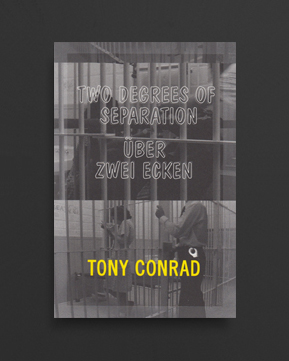
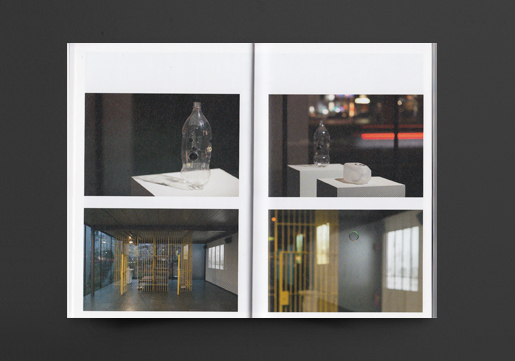
Tony Conrad, who can be described as an artist, composer, musician, filmmaker, and performer, might be considered the first true “crossover artist.” Two Degrees of Separation accompanies the eponymous exhibition by Tony Conrad at Kunsthalle Wien. In his essay “A Show That’s Almost Invisible,” the critic Jonathan Walley discusses how the main works in this exhibition relate to Conrad’s interest in the subgenre referred to as the woman-in-prison film, silent music, and the idea of perspective developed during the Italian Renaissance. A conversation between Tony Conrad and Diedrich Diederichsen provides insight into the thinking of the multitalented artist and his unique position in the field of contemporary art.
Copublished with Kunsthalle Wien