World Food Books' programme is largely produced on Kulin Nation land. We acknowledge the Wurundjeri people of the Kulin Nation as the first and continuing custodians of this land, and pay respect to their Elders past, present, and emerging.
World Food Books is an arts and special interests bookshop in Naarm / Melbourne. Founded in 2010, World Food Books is devoted to the presentation of a rotating, hand-selection of international art, design, literary and counterculture publications with an emphasis on the anti-traditional, the experimental, the avant-garde, the heretic, the marginal.
Presenting new titles alongside rare and out-of-print books, catalogues and journals spanning the fields of modern and contemporary art, design, photography, illustration, film, literature, poetry, cultural theory, philosophy, sexuality, popular and underground culture in its many radical forms, World Food Books wishes to encourage adventurous, thoughtful and open-minded reading, looking, writing, and exchange of publishing and ideas, both current and historical.
As well as our bookshop, located in Melbourne's historical Nicholas Building, all of our inventory is available internationally via our online mail-order service.
World Food Books semi-regularly co-ordinates "Occasions", a programme of exhibits and events at the bookshop and in partnership with other hosts (such as museums and art galleries) that develop out of the activities, relationships and content of the bookshop itself.
World Food Books
The Nicholas Building
37 Swanston Street
Room 5, Level 6
Melbourne 3000
Australia
SHOP HOURS:
Thu–Fri 12–6, Sat 12–5
WEB-SHOP OPEN 24/7
World Food Books
Postal Address:
PO Box 435
Flinders Lane
Victoria 8009
Australia
Art
Theory / Essay
Architecture / Interior
Graphic Design / Typography
Photography
Fashion
Eros
LGBTQ+
Fiction / Poetry
Weird / Speculative / Science Fiction / Horror
Transgressive / Visceral / Abject
Symbolism / Decadence / Fin de siècle
Film / Video
Painting
Sculpture / Installation
Performance / Dance / Theater
Drawing
Sound / Music
Curatorial
Group Shows / Collections
Periodicals
Out-of-print / Rare
Posters / Ephemera / Discs
Signed Books
World Food Books Gift Voucher
World Food Book Bag
Australian Art
Australian Fiction
Australian Science Fiction / Speculative Fiction
Australian Poetry
Australian Photography
Japanese Photography
Conceptual Art
Minimal Art
Dada
'Pataphysics / Oulipo
Fluxus
Concrete Poetry
Pop Art
Surrealism
Arte Povera
Arte Informale / Haute Pâte / Tachism
Nouveau Réalisme / Zero / Kinetic
Situationism / Lettrism
Collage / Mail Art / Xerox Art
Art Brut / Folk / Visionary / Fantastic
Illustration / Graphic Art / Bandes Dessinées
Furniture
Italian Radical Design / Postmodernism
Textiles
Ceramics / Glass
Counterculture
Protest / Revolt
Philosophy
Psychoanalysis
Anthropology
Anarchism
Socialism / Anarchism / Communism / Capitalism
Literary Theory / Semiotics / Language
Feminism / Women's Studies
Gender Studies / Sexuality
Anthropology
Fetishism / BDSM
Drugs / Psychedelia
Crime / Violence
Animal Rights / Veganism
Occult / Esoterica
Ecology / Earth / Alternative Living
Whole Earth / Crafts
All prices in AUD (Australian dollars)
Pick-Ups
Pick-up orders can be collected in our bookshop during opening hours after order date. Please collect any Pick-up orders within 2 weeks of ordering as we have limited storage space. Orders will be released back into stock if not collected within this time. No refunds can be made for pick-ups left un-collected. If you cannot make it in to the bookshop in this time-frame, please choose postage option.
Return Policy
All sales are final. We do accept returns (for refund or exchange) for items received in error. All our orders are packed with special care using heavy-duty padding and cardboard book-mailers or bubble mailers (for smaller books), using reinforcement where required. We cannot take responsibility for any lost, stolen or damaged parcels.
Insurance
Should you wish to insure your package, please email us directly after placing your order and we can organise this at a small extra expense. Although all standard/express tracked packages are very safe and dependable, we cannot take responsibility for any lost, stolen or damaged parcels. We recommend insurance on valuable orders.
Interested in selling your old books, catalogues, journals, magazines, comics, fanzines, ephemera? We are always looking for interesting, unusual and out-of-print books to buy. We only buy books in our fields of interest and specialty, and that we feel we can resell.
We base these prices on desirability, market value, in-print prices, condition and our current stock levels. We offer cash, store credit, and can take stock on consignment. All
about 25% of the price we expect to get when we sell them, or 30% in store credit. We base these prices on desirability, market value, in-print prices, condition and our current stock levels.
Sell your books any day of the week. You can drop them off and return later. If you have a lot of books, we can visit your Sydney home.
We buy books that we feel we can resell. We offer about 25 % of the price we expect to get when we sell them, or 30% in store credit. We base these prices on desirability, market value, in-print prices, condition and our current stock levels.
Philadelphia Wireman
03 August - 01 September, 2018
World Food Books is proud to announce our next Occasion, the first presentation of sculptures by Philadelphia Wireman in Australia.
The Philadelphia Wireman sculptures were found abandoned in an alley off Philadelphia’s South Street on trash night in 1982. Their discovery in a rapidly-changing neighbourhood undergoing extensive renovation, compounded with the failure of all attempts to locate the artist, suggests that the works may have been discarded after the maker’s death. Dubbed the "Philadelphia Wireman" during the first exhibition of this work, in 1985, the maker’s name, age, ethnicity, and even gender remain uncertain. The entire collection totals approximately 1200 pieces, all intricately bound together with tightly-wound heavy-gauge wire (along with a few small, abstract marker drawings, reminiscent both of Mark Tobey and J.B. Murry). The dense construction of the work, despite a modest range of scale and materials, is singularly obsessive and disciplined in design: a wire armature or exoskeleton firmly binds a bricolage of found objects including plastic, glass, food packaging, umbrella parts, tape, rubber, batteries, pens, leather, reflectors, nuts and bolts, nails, foil, coins, toys, watches, eyeglasses, tools, and jewellery.
Heavy with associations—anthropomorphic, zoomorphic, and socio-cultural responses to wrapped detritus—the totemic sculptures by Philadelphia Wireman have been discussed in the context of work created to fulfil the shamanistic needs of alternative religions in American culture. Curators, collectors, and critics have variously compared certain pieces to sculpture from Classical antiquity, Native American medicine bundles, African-American memory jugs, and African fetish objects. Reflecting the artist’s prolific and incredibly focused scavenging impulse, and despite—or perhaps enhanced by—their anonymity, these enigmatic objects function as urban artefacts and arbiters of power, though their origin and purpose is unknown. Philadelphia Wireman, whatever their identity, possessed an astonishing ability to isolate and communicate the concepts of power and energy through the selection and transformation of ordinary materials. Over the course of the past two decades, this collection has come to be regarded as an important discovery in the field of self-taught art and vernacular art.
Presented in collaboration with Fleisher-Ollman Gallery, Philadelphia, and Robert Heald, Wellington.
Susan Te Kahurangi King
02 February - 10 March, 2018
Susan Te Kahurangi King (24 February 1951 - ) has been a confident and prolific artist since she was a young child, drawing with readily available materials - pencils, ballpoint pens and felt-tip markers, on whatever paper is at hand. Between the ages of four and six Susan slowly ceased verbal communication. Her grandparents William and Myrtle Murphy had developed a special bond with Susan so they took on caring responsibilities for extended periods. Myrtle began informally archiving her work, carefully collecting and storing the drawings and compiling scrapbooks. No drawing was insignificant; every scrap of paper was kept. The King family are now the custodians of a vast collection containing over 7000 individual works, from tiny scraps of paper through to 5 meter long rolls.
The scrapbooks and diaries reveal Myrtle to be a woman of great patience and compassion, seeking to understand a child who was not always behaving as expected. She encouraged Susan to be observant, to explore her environment and absorb all the sights and sounds. Myrtle would show Susan’s drawings to friends and people in her community that she had dealings with, such as shopkeepers and postal workers, but this was not simply a case of a grandmother’s bias. She recognised that Susan had developed a sophisticated and unique visual language and sincerely believed that her art deserved serious attention.
This was an unorthodox attitude for the time. To provide some context, Jean Dubuffet coined the term Art Brut in 1945 to describe work created by self-taught artists – specifically residents of psychiatric institutions and those he considered to be visionaries or eccentrics. In 1972 Roger Cardinal extended this concept by adopting the term Outsider Art to describe work made by non-academically trained artists operating outside of mainstream art networks through choice or circumstance. Susan was born in Te Aroha, New Zealand in 1951, far from the artistic hubs of Paris and London that Dubuffet and Cardinal operated in. That Myrtle fêted Susan as a self-taught artist who deserved to be taken seriously shows how progressive her attitudes were.
Susan’s parents Doug and Dawn were also progressive. Over the years they had consulted numerous health practitioners about Susan’s condition, as the medical establishment could not provide an explanation as to why she had lapsed into silence. Dawn educated herself in the field of homeopathy and went on to treat all twelve of her children using these principles – basing prescriptions on her observations of their physical, mental and emotional state.
Doug was a linguist with an interest in philosophy who devoted what little spare time he had to studying Maori language and culture. To some extent their willingness to explore the fringes of the mainstream made them outsiders too but it was their commitment to living with integrity and their respect for individuality that ensured Susan’s creativity was always encouraged.
Even though Susan’s family supported her artistic pursuits, some staff in schools and hospitals saw it as an impediment to her assimilation into the community and discouraged it in a variety of ways. Her family was not always aware of this and therefore did not fully understand why Susan stopped drawing in the early 1990s. However, rather than dwell on the challenges that Susan faced in pursuit of her artistic practice, they prefer to highlight her achievements. In 2008 Susan began drawing again in earnest, after an almost 20 year interruption, and her work is now shown in galleries around the world.
Susan grew up without television and has been heavily influenced by the comics she read as a child. She is absolutely fearless in the appropriation of recognizable characters, such as Donald Duck and Mickey Mouse, in her work. She twists their limbs, contorts their faces, compresses them together, blends them into complex patterned backgrounds - always imbuing them with an incredible energy. Although Susan often used pop culture characters in her work they are not naive or childlike. These are drawings by a brilliant self-taught artist who has been creating exceptional work for decades without an audience in mind.
Mladen Stilinović
"Various Works 1986 - 1999"
02 February 16 - September 10, 2016
Various works 1986 - 1999, from two houses, from the collections of John Nixon, Sue Cramer, Kerrie Poliness, Peter Haffenden and Phoebe Haffenden.
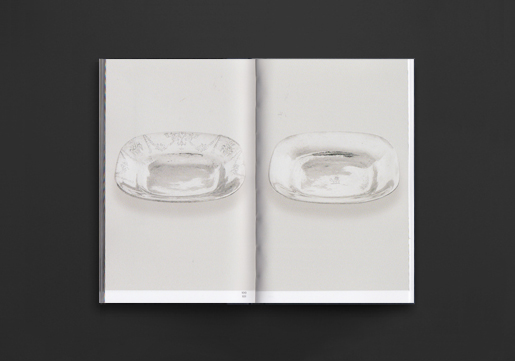
Including: Geometry of Cakes (various shelves), 1993; Poor People’s Law (black and white plate), 1993; White Absence (glasses, ruler, set square, silver spoon, silver ladel with skin photograph and wooden cubes), 1990-1996; Exploitation of the Dead (grey and red star painting, wooden painting, black spoon with red table, red plate), 1984-1990; Money and Zeros (zero tie, paintings made for friends in Australia (Sue, John, Kerrie), numbers painting), 1991-1992; Words - Slogans (various t-shirts) - “they talk about the death of art...help! someone is trying to kill me”, “my sweet little lamb”, “work is a disease - Karl Marx”; Various artist books, catalogues, monographs, videos; Poster from exhibition Insulting Anarchy; "Circular" Croatian - Australian edition; Artist book by Vlado Martek (Dostoyevsky); more.
Thanks to Mladen Stilinović and Branka Stipančić.
Jonathan Walker
Always Will Need To Wear Winter Shirt Blue + Ochre Small Check Pattern
21 August - 21 September, 2015
Untitled
I am not a great reader of poetry but I always return to the work of Melbourne poet, Vincent Buckley (1925- 1988). Perhaps I find his most tantalising piece to be not a finished poem but a fragment left on a scrap of paper discovered on his desk after the poet’s death.
The poetry gathers like oil
In the word-core, and spreads
It has its music meet,
Its music is in movement.
This fragment is more the shell left behind from a volatile thought than a finished poem. I find the last two lines honest but awkward whereas the first two lines work like an arrow. Most likely he could not find a resolution so it was left. Still, in its present form, it remains an eloquent testimony to the ultimate failure of a medium to express mobile thought and sensation, in Buckley’s case, through verbal language. It’s an important matter because this is something all artists have to deal with regardless of the medium.
I have never written a poem, however, I am forever copying fragments from books on paper scraps in a vain effort to fix certain notions in my head. At first, they function as bookmarks that are sometimes returned to when I open the book. But before long, as they accumulate, they fall out littering the table interspersed with A4 photocopies, bills, books and medications.
To return to Buckley’s fragment, the first two lines very much evoke how I paint nowadays. As you age, detail diminishes and patches of light become more luminous and float. I feel the most honest way of dealing with this is by smearing the oil paint on the canvas with the fingers and working close-up, blind. Only if the patches coalesce into an approaching image can the work gain a life.
-
Jonathan Walker was born in Melbourne, Australia and brought up on a dairy farm in Gippsland. In the 1970’s he studied painting at RMIT and won the Harold Wright Scholarship to the British Museum, London. During the 1980’s he exhibited at Pinacotheca Gallery, Richmond and had work shown at the NGV and Heidi City Art Gallery. Over the same period he designed the cover for the “Epigenesi” LP by Giancarlo Toniutti, Italy and conducted a mail exchange work with Achim Wollscheid, Germany. The work with artists through the post resulted in an article published in the bicentenary issue of Art and Australia 1988. He showed in artist run spaces such as WestSpace in the 90’s and 2000’s, and until 2012, taught painting at Victoria University, which is where we (Colleen Ahern and Lisa Radford) as organisers of the exhibition, among many others, had the privilege of being his student.
Walker’s knowledge was imparted to students through the careful selection of music, literature, and artists found in books that he himself had ordered for the library. Walker’s strategy was the generosity of sharing his vast knowledge with references specific to each student and their context.
Walker’s paintings share a similar focus and intimacy.
This exhibition presents a small selection of recent paintings alongside a publication that includes Walker’s writing. Observational and analytical, Walker’s work is a type of material notation — the time of day, colour and how it is blended, the both specific and fleeting location of a reflection on lino or the question of whether a chair leg should be included in a painting.
Please join us on Friday August 21 between 6-8pm to celebrate the opening of the exhibition.
Curated by Colleen Ahern and Lisa Radford.
B. Wurtz
Curated by Nic Tammens
March 26 - April 4, 2015
B.Wurtz works from a basement studio in his home on Manhattan’s Lower East Side.
This local fact is attested to by the plastic shopping bags and newsprint circulars that appear in his work. As formal objects, they don’t make loud claims about their origins but nonetheless transmit street addresses and places of business from the bottom of this long thin island. Like plenty of artists, Wurtz is affected by what is local and what is consumed. His work is underpinned by this ethic. It often speaks from a neighborhood or reads like the contents of a hamper:
“BLACK PLUMS $1.29 lb.”
“Food Bazaar”
“USDA Whole Pork Shoulder Picnic 99c lb.”
“RITE AID Pharmacy, with us it’s personal.”
“H. Brickman & Sons.”
“Sweet Yams 59c lb."
Most of the work in this exhibition was made while the artist was in residence at Dieu Donne, a workshop dedicated to paper craft in Midtown. Here Wurtz fabricated assemblages with paper and objects that are relatively lightweight, with the intention that they would be easily transportable to Australia. This consideration isn’t absolute in Wurtz’s work, but was prescriptive for making the current exhibition light and cheap. Packed in two boxes, these works were sent from a USPS post office on the Lower East Side and delivered to North Melbourne by Australia Post.
Wurtz appears courtesy of Metro Pictures, New York.
Thanks to Rob Halverson, Joshua Petherick, Sari de Mallory, Matt Hinkley, Helen Johnson, Fayen d'Evie, Ask Kilmartin, Lisa Radon, Ellena Savage, Yale Union, and "Elizabeth".
John Nixon
"Archive"
December 15 - January 20, 2014
The presentation of John Nixon's archive offered a rare showcase of this extensive collection of the artist's own publications, catalogues, posters, ephemera, editions and more, from the mid 1980s onwards, alongside a selection of his artworks.
Organized by John Nixon, Joshua Petherick and Matt Hinkley.
<a href=http://wfb.public-office.info/artist/john-nixon>All titles by John Nixon
"Habitat"
at Minerva, Sydney (organised by Joshua Petherick and Matt Hinkley)
November 15 - December 20, 2014
Lupo Borgonovo, Janet Burchill & Jennifer McCamley,
Lewis Fidock, HR Giger, Piero Gilardi, Veit Laurent Kurz,
Cinzia Ruggeri, Michael E. Smith, Lucie Stahl, Daniel Weil, Wols
Press Release:
“...It contained seven objects. The slender fluted bone, surely formed for flight, surely from the wing of some large bird. Three archaic circuitboards, faced with mazes of gold. A smooth white sphere of baked clay. An age-blackened fragment of lace. A fingerlength segment of what she assumed was bone from a human wrist, grayish white, inset smoothly with the silicon shaft of a small instrument that must once have ridden flush with the surface of the skin - but the thing’s face was seared and blackened.”
William Gibson, “Count Zero”, 1986
"Autumn Projects Archive"
Curated by Liza Vasiliou
March 6 - March 15, 2014
World Food Books, in conjunction with the Virgin Australia Melbourne Fashion Festival 2014, presented the Autumn Projects archive, consisting of a selection of early examples in Australian fashion with a particular interest in collecting designers and labels from the period beginning in the 1980’s, who significantly influenced the discourse of Australian Fashion.
Curated by Liza Vasiliou, the exhibition provided a unique opportunity to view pieces by designers Anthea Crawford, Barbara Vandenberg, Geoff Liddell and labels CR Australia, Covers, Jag along with early experimental collage pieces by Prue Acton and Sally Browne’s ‘Fragments’ collection, suspended throughout the functioning World Food Books shop in Melbourne.
H.B. Peace
presented by CENTRE FOR STYLE
November 14, 2013
"Hey Blinky, you say chic, I say same"
Anon 2013
H.B. Peace is a clothing collaboration between great friends Blake Barns and Hugh Egan Westland. Their pieces explore the divergences between 'character’ and ‘personality’ in garments....etc
Special Thanks to Joshua Petherick and Matt Hinkley of WFB and Gillian Mears
and a Very Special Thank you to Audrey Thomas Hayes for her shoe collaboration.
Janet Burchill & Jennifer McCamley
"Aesthetic Suicide"
May 10 - June 8, 2013
The first of our occasional exhibitions in the World Food Books office/shop space in Melbourne, "Aesthetic Suicide" presented a body of new and older works together by artists Janet Burchill & Jennifer McCamley, including videos, prints, a wall work, and publications.
During shop open hours videos played every hour, on the hour.
2016, English / German
Softcover, 176 pages, 17.5 x 26 cm
ed. of 1600,
Published by
Präsens Editionen / Luzern
$18.00 - In stock -
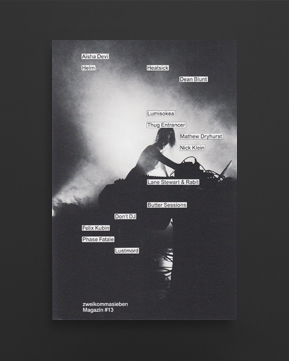
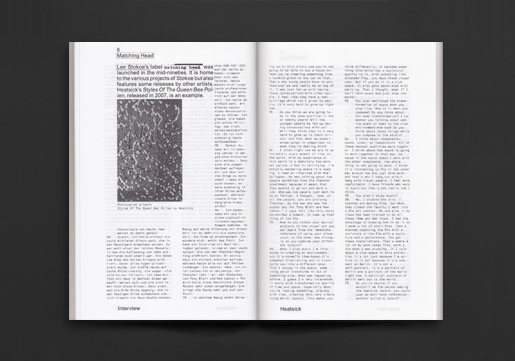
zweikommasieben is a Swiss magazine that has been devoted to the documentation of contemporary club culture since the summer of 2011.
zweikommasieben #13 deals with questions about the professional and social proximity of the featured artists (among many other things). Featured are Aïsha Devi & Tianzhuo Chen, Helm, Heatsick, Dean Blunt, Lumisokea, Thug Entrancer, Mathew Dryhurst, Nick Klein, Lane Stewart & Rabit, Butter Sessions, Don’t DJ, Felix Kubin, Phase Fatale, Lustmord, etc. Co-published with Motto Books.
2016, English
Softcover, 196 pages, 21.5 x 16 cm
ed. of 250,
Published by
Surpllus / Melbourne
Telephone Publishing / Melbourne
$40.00 - Out of stock
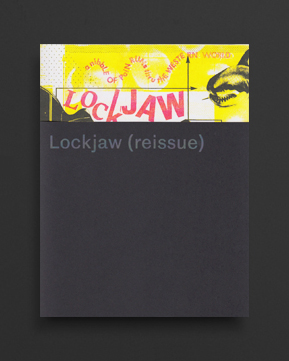
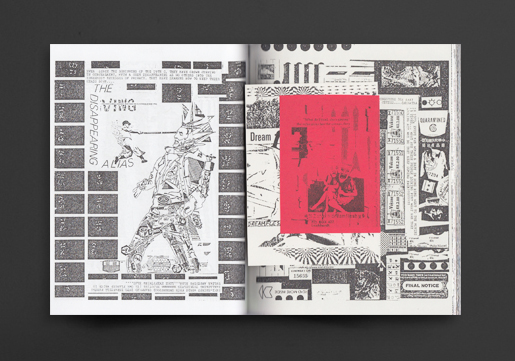
Lockjaw (1983) was the most realised project by Zerox Dreamflesh (1979-1984), a loose group of writers, artists and musicians that produced a series of 'zine-ish print objects, cassettes, Xerox postcards and a Super 8 film. Their work was oppositional, not very accessible (though when you got it, you really got it), and always inspired and inspiring. The book has been scanned from an original copy and reproduced by risograph - a 21st-century analogue to early-1980s photocopy art. This new edition includes a separate section with essays by George Alexander and Professor Ross Gibson, an introduction by Sonya Jeffery, and a reflection on the impact of Lockjaw on one reader by Matt Holden. This reissue of Lockjaw is a co-publication of Telephone Publishing(Melbourne) and Surpllus (Melbourne).
2013, English
Softcover, 400 pages, 13.4 x 20 cm
Edition of 1000,
Published by
Monash University Museum of Art / Melbourne
Surpllus / Melbourne
$30.00 - Out of stock
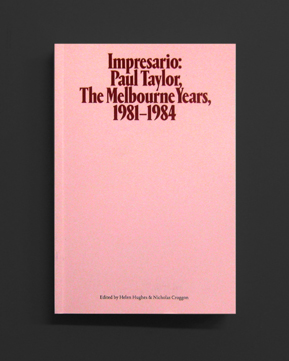
Impresario: Paul Taylor, The Melbourne Years, 1981–1984 brings together a diverse body of texts focused on Paul Taylor, the Australian editor, writer, curator and impresario, and in particular his important and influential early years in Melbourne between 1981 and 1984. The dates of the texts included span some thirty years and take a variety of different forms — critical essays, reviews, short reflective texts, interviews, transcriptions of lectures — the combination of which seeks to analyse Taylor’s impact on Australian art history in the early 1980s, when he founded Art & Text and curated the landmark exhibition ‘POPISM’ at the National Gallery of Victoria, and the subsequent ripples that continue to encircle us in his wake, thirty years on.
Edited and introduced by Helen Hughes and Nicholas Croggon, and featuring contributions by Ashley Crawford, Adrian Martin, Charles Green & Heather Barker, Chris McAuliffe, David Chesworth & Jon Dale, David Pestorius, Graham Willett, Ian McLean, Judy Annear, Janine Burke, Juan Davila, Jonathan Holmes, John Nixon & David Homewood, Jenny Watson & Kelly Fliedner, Lyndal Jones, Merryn Gates, Maria Kozic, Philip Brophy, Paul Foss, Patrick McCaughey, Peter Tyndall, Rex Butler & Susan Rothnie, Ralph Traviati, Imants Tillers, Edward Colless, Russell Walsh, Sue Cramer, Denise Robinson and Vivienne Shark LeWitt.
Editors: Helen Hughes and Nicholas Croggon
Design: Brad Haylock
2015, English / German
Softcover, 300 pages, 11 x 18 cm
Published by
Christoph Merian / Basel
$36.00 - Out of stock
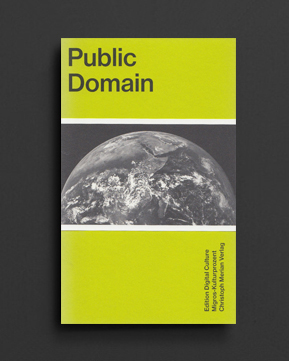
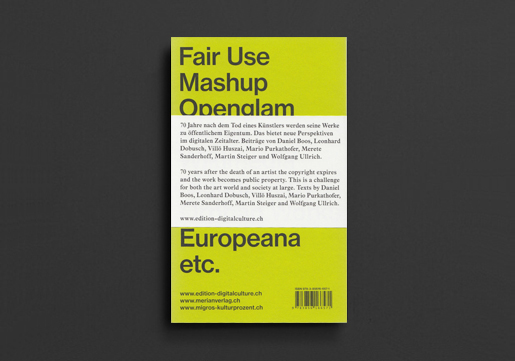
Seventy years after the death of the originator, his or her works become public intellectual property; they are in the public domain and so belong to the public. This effects not just medieval texts, but also 20th century books and works. Thanks to digitization the treatment of these works has taken on a whole new dynamism. For museums, libraries, archives and galleries, the public domain is a challenge, but also an opportunity for the whole cultural sector.
This book explains the copyright fundamentals of the public domain and discusses the difficulties involved in implementing it in the everyday functioning of cultural institutions. Particular attention is given to the theme remix, which is presented from a theoretical and a practical viewpoint. The publication has an extensive glossary.
With essays by Leonhard Dobusch, Merete Sanderhoff, Martin Steiger, Wolfgang Ullrich, and others.
2016, English / Portuguese
Softcover, 168 pages, 15,5 x 22 cm
Published by
Mousse Publishing / Milan
$45.00 $10.00 - Out of stock
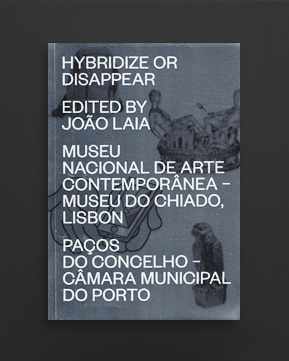
João Laia, ed.
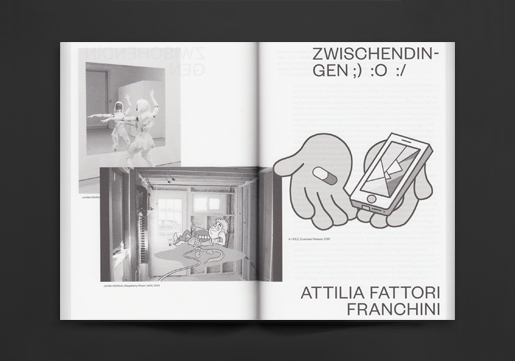
Texts by Stephanie Bailey, Paulo Cunha E Silva, Attilia Fattori Franchini, João Laia, João Ribas, Alex Ross, David Santos, Andrey Shental, Eleanor Ivory Weber, Rósza Zita Farkas
This publication has been produced in the framework of “Hybridize or Disappear”, a group exhibition with works by Cécile B. Evans, Neïl Beloufa, Antoine Catala, Diogo Evangelista, Oliver Laric, Shana Moulton, Katja Novitskova, Laure Prouvost and Magali Reus at the Museu Nacional de Arte Contemporânea – Museu do Chiado, Lisbon, and at the Paços do Concelho, Câmara Municipal do Porto. Edited by João Laia, this book aims to expand on the universe of the show, posing a wide set of questions that shape contemporary visual culture, rather than serving as a document or an archive. Through the lens of the “hybrid”, the commissioned texts look at different dimensions of our current condition, addressing ideas related to the circulation of identity and meaning in our mediated environments.
2016, English
Softcover (w. printed plastic jacket), 124 pages, 10.5 x 16 cm
Published by
Mousse Publishing / Milan
$50.00 $10.00 - Out of stock
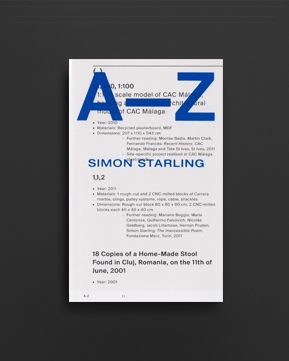
Stefano Cernuschi and Abaseh Mirvali, eds.
Texts by Simon Starling and Maja McLaughlin
Simon Starling: A–Z is a pocket, non illustrated mid-career catalogue raisonné of a practice now spanning over two decades. Every work ever realized by Starling (Epsom, UK, 1967) is listed in alphabetical order and referenced in this compact guide, which also provides a bibliography and connections to other related projects. Halfway through the text flow, three photo inserts and texts by the artist and Maja McLaughlin document the exhibition projects El Eco and Bowl, Plates realized in Mexico City, at the Museo Experimental El Eco and the Luis Barragán House and Studio, in 2015.
2016, English
Hardcover, 100 pages, 18.5 x 12.5 cm
Published by
Mousse Publishing / Milan
$56.00 - Out of stock
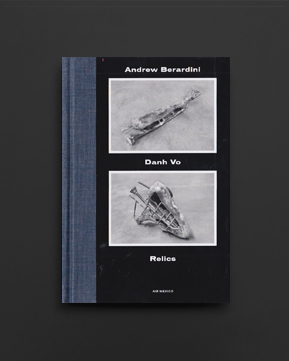
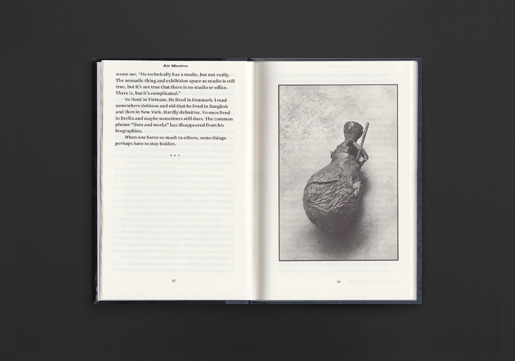
Text by Andrew Berardini
“A relic is what remains, what’s left over.” In this memoir once-removed, Andrew Berardini journeys into the heart of the work of Danh Vo to discover how historical forces find form in our individual lives. Inspired by an exhibition never seen in Mexico City, Berardini’s deeply personal investigation of Vo’s work weaves one story into the other and finds along the way the clash and mesh of civilizations, a sexy Statue of Liberty, the head of a decapitated martyr, the collapse of the American labor movement, John Keats’ tombstone, the holy trinity in a license plate, the ravages of war, a battered encyclopedia, a terrorist’s typewriter, the history of saints in a boy’s wing. In Relics, Berardini explores through Vo’s work how art and poetry gives utterance to history’s shadows on our lives; and through it, to make our own stories.
This is the second volume of “Air Mexico,” a literary series investigating art exhibitions initiated by Mousse and commissioned by kurimanzutto.
2016, English
Softcover (over-sized), 136 pages, 25 x 37 cm
Published by
Encens / Paris
$58.00 - Out of stock
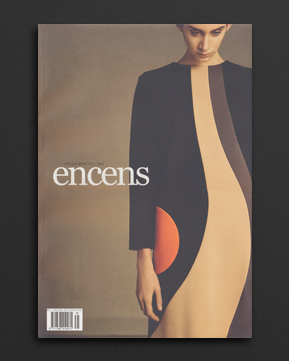
encens is a fashion magazine from France, presenting a very selective number of designers, edited by Samuel Drira and Sybille Walter.
encens 35 "Single Mind" (Spring/Summer 2016) features Helmut Newton, Adolf Loos, Celine, Greta Garbo, Cecil Beaton, Franceso Brigid, Nehera, Dries Van Noten, Allude, Hermes, Giorgio Armani, Isabel Benenato, Cedric Charlier, Y/Project, Olivier Jacquet, Lucio Vanotti, Hed Mayner, Lemaire, Diorre Homme, Chanel, Saint Laurent Paris, Axl Jansen, Givenchy, Heide Ackermann, Cecile Bortoletti, Gordon Matta-Clark, Mathias Kiss, Sybille Walter, Cartier, Kenzo, Ghislain Mollet-Vieville, Daniel Buren, Sol Lewitt, Carl Andre, Walter de Maria, Niele Toroni, Joseph Kosuth, Christian Dior, YSL, Issey Miyake, and much more.
2015, English
Softcover, 128 pages, 16 x 21 cm
Published by
Open Editions / London
$55.00 - Out of stock
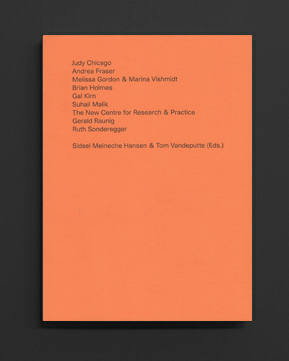
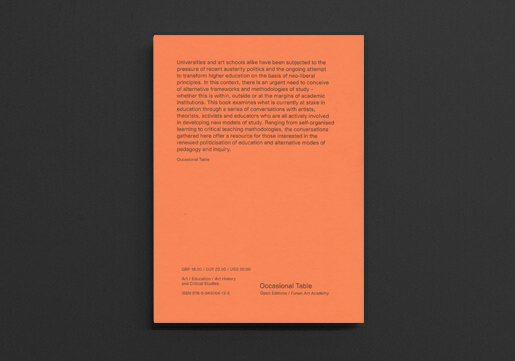
Universities and art schools alike have been subjected to the pressure of recent austerity politics and the ongoing attempt to transform higher education on the basis of neoliberal principles. In this context, there is an urgent need to conceive of alternative frameworks and methodologies of study – whether this is within, outside or at the margins of academic institutions. This book examines what is currently at stake in education through a series of conversations with artists, theorists, activists and educators who are all actively involved in developing new models of study. Ranging from self-organised learning to critical teaching methodologies, the conversations gathered here offer a resource for those interested in the renewed politicisation of education and alternative modes of pedagogy and inquiry.
With contributions by Andrea Fraser, Brian Holmes, Gal Kirn, Gerald Raunig, Judy Chicago, Melissa Gordon & Marina Vishmidt, Ruth Sonderegger, Suhail Malik, Timothy Ivison and The New Centre for Research & Practice.
2016, English
Softcover, 200 pages, 15.2 x 23 cm
Published by
October Books / New York
The MIT Press / Massachusetts
$42.00 - Out of stock
During a career that spanned more than forty years, from the late 1960s until his death in 2012, Michael Asher created site-specific installations and institutional interventions that examined the conditions of art's production, display, and reception. At the Art Institute of Chicago, for example, he famously relocated a bronze replica of an eighteenth-century sculpture of George Washington from the museum's entrance to an interior gallery, thereby highlighting the disjunction between the statue's symbolic function as a public monument and its aesthetic origins as an artwork. Today, Asher is celebrated as one of the forerunners of institutional critique. Yet because of Asher's situation-based method of working, and his resistance to making objects that could circulate in the art market, few of his works survive in physical form. What does survive is writing by scholars and critics about his diverse practice. The essays in this volume document projects that range from Asher's environmental works and museum displacements to his research-based presentations and reflections on urban space.
Contributors: Michael Asher, Sandy Ballatore, Benjamin H. D. Buchloh, Jennifer King, Miwon Kwon, Barbara Munger, Stephan Pascher, Birgit Pelzer, Anne Rorimer, Allan Sekula
2015, English
Softcover, 264 pages, 15.2 x 23 cm
Published by
October Books / New York
The MIT Press / Massachusetts
$42.00 - Out of stock
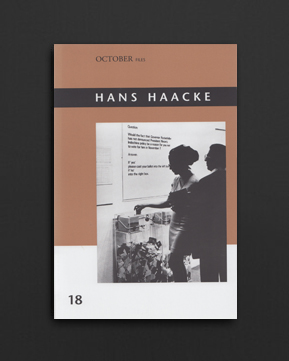
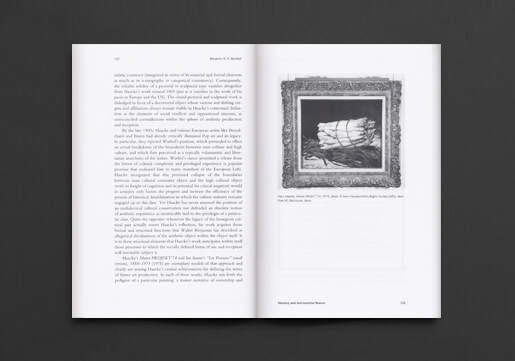
For five decades, the artist Hans Haacke (b. 1936) has created works that explore the social, political, and economic underpinnings of the production of art. His works make plain the hidden and not-so-hidden agendas of those -- from Cartier to David Koch -- who support art in the service of industry; they expose such inconvenient social and economic truths as the real estate holdings of Manhattan slumlords, and the attempts to whitewash support for the Nazi regime, apartheid, or the war on terror through museum donations. This book gathers interviews, difficult-to-find essays, cornerstones of institutional critique, and new critical approaches by writers that include Benjamin H. D. Buchloh, Jack Burnham, Rosalyn Deutsche, and Leo Steinberg. Haacke's 1971 Guggenheim exhibition was famously canceled when the artist refused to withdraw several proposed works, including one exposing the business dealings of a Manhattan real estate company. This volume includes Edward Fry's catalog text for that show, as well as Walter Grasskamp's "An Unpublished Text for an Unpainted Picture," redacted from an exhibition catalog in 1984 because of statements about the German collector Peter Ludwig. Other essays consider such topics as Haacke's controversial commission for the Reichstag; the activation of the spectator, from Condensation Cube to the Polls; the conceptual continuity of his practice with regard to General Systems Theory; and his delayed and problematic reception in both the United States and Europe. With contemporary essays and scholarly reassessments, this collection serves as an essential guide to critical thinking on Haacke's artistic practice, from the works of the 1960s that engage with physical and biological systems to his later interrogations of the social and economic underpinnings of art.
Contributors: Yve-Alain Bois, Benjamin H. D. Buchloh, Jack Burnham, Douglas Crimp, Rosalyn Deutsche, Sam Durant, Edward F. Fry, Walter Grasskamp, Rosalind Krauss, Jack McGrath, Luke Skrebowski, Leo Steinberg
2013, English
Softcover, 212 pages, 15.2 x 23 cm
Published by
October Books / New York
The MIT Press / Massachusetts
$42.00 - Out of stock
This October Files volume gathers essays, an interview, and a roundtable discussion on the work of Robert Morris, one of the most influential American artists of the postwar period. It includes a little-known text on dance by Morris himself and a never-before-anthologized but influential catalog essay by Annette Michelson. Often associated with minimalism, Morris (b. 1931) also created important works that involved dance, process art, and conceptualism. The texts in this volume focus on Morris's early work and include an examination of a 1971 Tate retrospective by Jon Bird, an interview with the artist by Benjamin Buchloh, a conversation from a 1994 issue of October about resistance to 1960s art, and an essay by this volume's editor, Julia Bryan-Wilson, on the labor involved in installing the massive works in Morris's 1970 solo exhibition at the Whitney. Spanning 1965 to 2009, these writings map the evolution of critical thought on Morris over more than four decades.
2016, English
Softcover, 158 pages, 21 x 29 cm
Published by
Pataphysics Books / Melbourne
$20.00 - Out of stock
Fantastic new issue from Melbourne's Pataphysics Magazine!
The "MIRAGE ISSUE" features:
Brook Andrew - Systems of Allowance
Hany Armanious - Light
Del Kathryn Barton - The Stars Eat Your Body
Marcus Bergner - Four Designs
Stephen Bram - Collages
Claude Cahun - Aveux non Avenus
Mark Cohen - Interview and Photographs
Fiona Connor - Wall Section (home)
Mikala Dwyer - Saint Jude’s Leftovers
Hans Eijkelboom - In the Newspaper
Ivars Gravlejs - Interview and Photographs
Janina Green - Be Home Before Dark
Eliza Hutchison - Photographs
David Noonan - Collages
Ron Padgett - Man to Man
Barrington Vincent Sherman - Tenebrae Visibiles
Michael Williams - Photographs
Konrad Winkler - Julie
2016, English
Softcover (spiral-bound w. flexidisc), 208 pages, 20 x 31 cm
Published by
Walker Art Centre / Minneapolis
$85.00 $45.00 - Out of stock
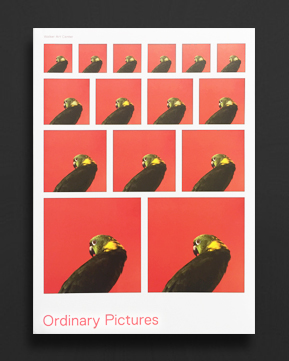
Despite its apparent throwaway status, the stock image comprises the primary commodity of a billion-dollar global industry with far-reaching effects in the marketplace and the public sphere. Taking this overlooked facet of contemporary life as a point of departure, "Ordinary Pictures" explores the photographic apparatuses and commercial interests that have given rise to our generic image culture through the conceptual image-based work of some 40 artists, including John Baldessari, Steven Baldi, Sarah Charlesworth, Anne Collier, Liz Deschenes, John Divola, Aleksandra Domanovi c, Hans-Peter Feldmann, Morgan Fisher, Hollis Frampton, Jack Goldstein, Rachel Harrison, Robert Heinecken, Leslie Hewitt, Elad Lassry, Louise Lawler, Sherrie Levine, Steve McQueen, Jack Pierson, Peter Piller, Seth Price, Amanda Rossotto, Ed Ruscha, Steven Shore, Sturtevant, Mungo Thomson, Wolfgang Tillmans, Tseng Kwong Chi, Julia Wachtel and Christopher Williams. Spanning generations, movements and artistic strategies from the 1960s to the present day, this publication brings together works by artists who have probed, mimicked and critiqued this aspect of our visual environment as well as its industrial modes of production and distribution. Through the work of these artists and a series of scholarly essays, the catalogue aims to examine different operations of the generic image in culture, namely its anonymous circulation and editorial uses, its adaptability and reproducibility, its technical processes of production, its claim to copyright and artistic license and its tendency toward abstraction. Featuring a unique, coil-bound design reminiscent of stock photo catalogues and a flexidisc recording by the artist Jack Goldstein, this highly collectible book ultimately reflects on contemporary art's own complicit function as an expanding industrial image economy.
Edited by Eric Crosby, texts by Lane Relyea and Thomas Beard.
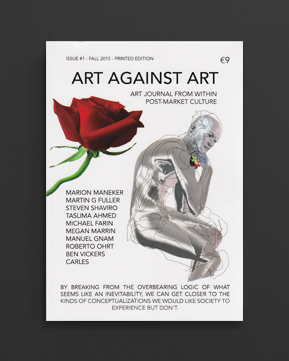
2016, English
Softcover, 80 pages, 17 x 24 cm
Published by
Art Against Art / Berlin
$18.00 - In stock -
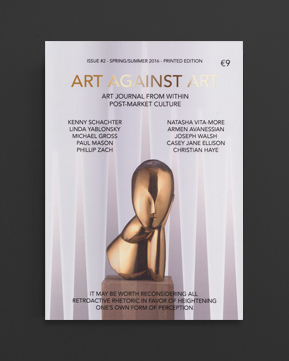
EDITORIAL
When considering the art field as being a raft in speculative time, the tendency is to seek comfort in numbers, regressive ideas such as another return to painting[1] or hedging bets on all sides whilst pursuing an unreasonable personal growth fetish.
These are classic reactions to a perceived risk that arises as a result of readjusting to new data. Uncertainty, if left unmediated, will pose a risk not just to market stability but to conceptual stability as it becomes more and more difficult to differentiate between artists and ads; artworks and hype-objects; or content and sponsored content – keeping us in a state of high drama too complex to decode. For example artists who consciously use marketing strategies as art are contextually mixed up with masses of artists who simply run a marketing strategy. Or, equally, galleries with a reputation for long-term quality regularly use their weight to inflate very short-lived speculative art. It is in these differences that art barters itself off very quickly to sometimes uninteresting effects holding us in a certain inappropriate narrative if we are not careful.
Up until a hundred years ago, it was normal to assume that all art aimed at “beauty” or varying degrees of “representation” and that anything but, would not be considered art. Later, after The Fountain, this evolved into the politics of mass production leading to whatever fallacy that we have today – perhaps a speculative bias targeted at an erroneously projected future consensus. It may be worth considering ditching all retroactive rhetoric about “safe places” in favor of heightening one’s own form of perception (perhaps even through enhancement), to adapt to the new environment and to filter through informational debris.
Inside the art world [...]
The Editors
CONTENTS
Editorial
Kenny Schachter – Art After the Apocalypse
Linda Yablonsky – Plus Ça Change
A Conversation with Michael Gross – Quid pro Quo – How the sausage gets made at the Met
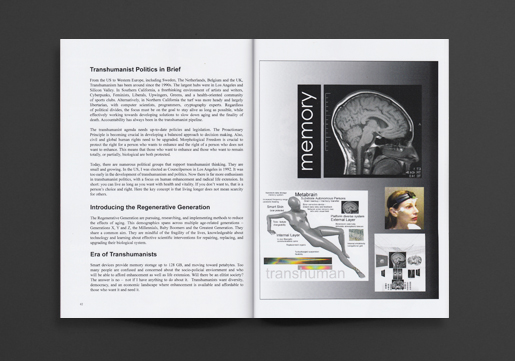
Joseph Walsh – An Image that is Nothing to be Desired
Image spread by Natasha Vita-More
Paul Mason – Eleven Theses on Postcapitalist Art
Christian J. Haye – More Art
Casey Jane Ellison – 2 Ones Chat and Then End
Armen Avanessian – Present Tension: Notes on Preemption, Hyperstition,
Contemporary Art and the Post-Contemporary Condition
Artist edition by Phillip Zach
2015, English
Softcover, 86 pages, 17 x 24 cm
Published by
Art Against Art / Berlin
$18.00 - In stock -
London, Paris, New York, Milan, Los Angeles, Sao Paulo, Palo Alto – art is moving faster than capital like a god wind that no-one can stop let alone control. Meanwhile a lot of art writing and ‘critical theory’ is stuck in the comfort zone of the 70-90s when there actually was an avant garde or subculture.
For art writing to get back on track it needs to shake out of this nostalgia and start engaging with the nuances of what is going on by covering the new breeds of involvement that have emerged since 2009 – the new sincerities and ironies, the more subtle art practices and social variations of market participation that have developed to deal with the institutional grip. For some time an aesthetic suspension of disbelief helped to provide an alibi that allowed us to participate as if we did believe the market was the key to “validation”, but then quickly vanished into feelings of depression after any agency seemed like an impossibility. As the contradictions got wider, different problems have emerged such as whether art is concurrent with the transitional moments of our present culture or technology, or whether art altogether has reached its informational limit.
The art world has slowly transitioned from modernist pretensions that seem like delusional excuses to the public, to developing a new sensibility – one of silent, shared communion, retributions and confessions. It has taken the step into a reality that is more in keeping with the real world of business, design and branding than creating stark ‘alternatives’. Beyond short-term pragmatism and adaptability, how can artists aesthetically work alongside their authentic desire to participate in a logic of the market that by necessity must scale? How can we realistically judge the work of art institutions if they are frozen into following instrumental logics rather than relevance? With the availability of information online, there is no way these logics are not transparent to a committed internet user.
Narratives like these happened in Pop Music years ago. Just as the Music Industry had to face up to its own protocols, the Art Industry needs to be judged on its changing developments; the ways art is being used as a financial instrument, art’s new marketing techniques, art as representation of different sociological interests, art as access to power, status, fame, participation and the rest of it. Until art writing gets really into these driving forces, it won’t be able to say anything interesting about art. It also won’t be able to grow or be writing that anyone really wants to read.
Art Against Art marks a turning point – the one that says by breaking from the overbearing logic of what seems like an inevitability, we can get closer to the conceptualizations we would like society to experience but don’t.
The Editors
CONTENTS
Editorial
Marion Maneker - Art is Not an Asset, It’s a Reserve Currency
Ben Vickers - Strange Objects and Their Discontents
Martin G Fuller - A Sociology of Art for Artists
Steven Shaviro - Feed
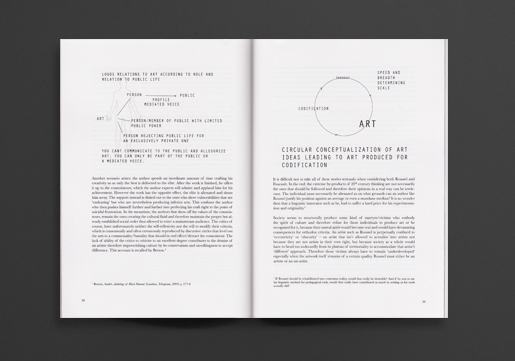
Taslima Ahmed - Left to the Mercy of Roussel
Image spread by Michael Farin
Roberto Ohrt - Needle and Balloon
Manuel Gnam - Centralization and Globalization of Art leading to One Global Hierarchy That Creates Less Options and Forms a Function of Limited Growth
Carles - Creativity vs. Scalability
Artist edition by Megan Marrin
2015, English
Softcover, 310 pages, 21 x 30 cm
Published by
Aspen Art Museum / Aspen
$126.00 - Out of stock
Using familiar materials such as receipts, newspaper and plastic bags, Mexican-born, Los Angeles–based artist Gabriel Kuri (born 1970) is interested in the way that money mediates almost all human relationships.
This large publication accompanies his Aspen Art Museum exhibition, comprising an extensive selection of works that center on Kuri's interest in the transactional residue of daily life and broad-based ideas of tracking systems in economics, politics, consumption and production. The catalogue also features essays by Daniel McClean and Heidi Zuckerman, as well as an interview between Kuri and Sofia Hernández Chong Cuy.
2016, English
Softcover, 240 pages, 145 x 210 mm
Published by
The MIT Press / Massachusetts
Whitechapel / London
$52.00 - Out of stock
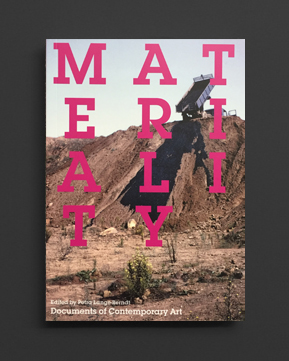
Materiality has reappeared as a highly contested topic in recent art. Modernist criticism tended to privilege form over matter—considering material as the essentialized basis of medium specificity—and technically based approaches in art history reinforced connoisseurship through the science of artistic materials. But in order to engage critically with the meaning, for example, of hair in David Hammons’s installations, milk in the work of Dieter Roth, or latex in the sculptures of Eva Hesse, we need a very different set of methodological tools.
This anthology focuses on the moments when materials become willful actors and agents within artistic processes, entangling their audience in a web of connections. It investigates the role of materiality in art that attempts to expand notions of time, space, process, or participation. And it looks at the ways in which materials obstruct, disrupt, or interfere with social norms, emerging as impure formations and messy, unstable substances. It reexamines the notion of “dematerialization”; addresses materialist critiques of artistic production; surveys relationships between matter and bodies, from the hierarchies of gender to the abject and phobic; explores the vitality of substances; and addresses the concepts of intermateriality and transmateriality emerging in the hybrid zones of digital experimentation.
Artists surveyed include
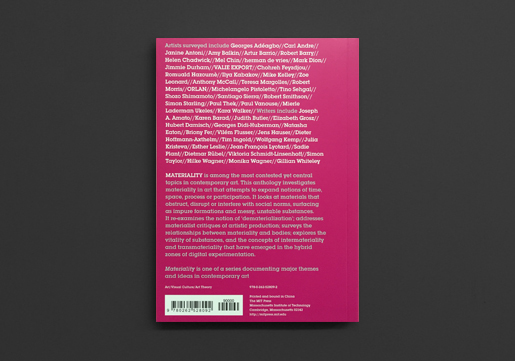
Georges Adéagbo, Carl Andre, Janine Antoni, Amy Balkin, Artur Barrio, Helen Chadwick, Mel Chin, Mark Dion, Jimmie Durham, Tessa Farmer, Chohreh Feyzdjou, Romuald Hazoumè, Pierre Huyghe, Ilya Kabakov, Mike Kelley, Anthony McCall, Teresa Margolles, Robert Morris, Michelangelo Pistoletto, Tino Sehgal, Shozo Shimamoto, Santiago Sierra, Robert Smithson, Simon Starling, Paul Thek, Paul Vanouse, Mierle Laderman Ukeles, Kara Walker
Writers include
Joseph D. Amato, Karen Barad, Judith Butler, Elizabeth Grosz, Georges Didi-Huberman, Natasha Eaton, Jens Hauser, Dieter Hoffmann-Axthelm, Tim Ingold, Wolfgang Kemp, Julia Kristeva, Esther Leslie, Jean-François Lyotard, Dietmar Rübel, Monika Wagner, Gillian Whiteley
About the Editor
Petra Lange-Berndt is Chair of Modern and Contemporary art in the Art History Department at the University of Hamburg and a leading researcher in the field of material studies in art history. She is coeditor, with Dietmar Rübel, of Sigmar Polke: We Petty Bourgeois! Contemporaries and Comrades, the 1970s.
2016, English
Softcover, 200 pages, 11.5 x 17.7 cm
Published by
Badlands Unlimited / New York
$26.00 - In stock -
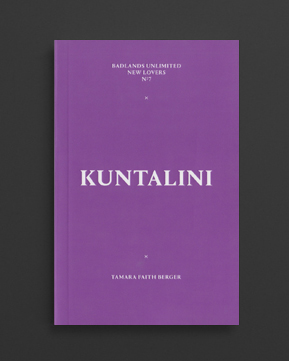
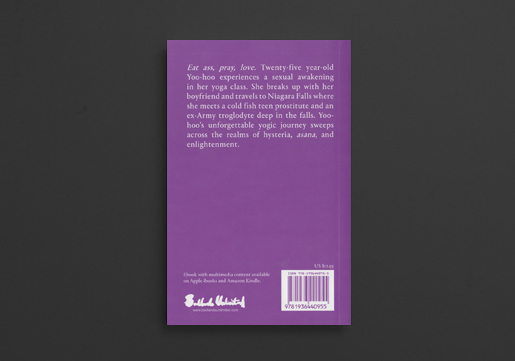
Kundalini rising or spiritual hemorrhoid? Twenty-five-year-old Yoo-hoo experiences a sexual awakening in her yoga class. She breaks up with her boyfriend and travels to Niagara Falls where she meets a cold-fish teen prostitute and an ex-Army trogdolyte deep in the Falls. Yoo-hoo's unforgettable yogic journey sweeps across the realms of hysteria, "asana" and enlightenment.
"Kuntalini" is the latest volume in Badlands Unlimited's "New Lovers" series of short erotic fiction. Inspired by Maurice Girodias' legendary Olympia Press, "New Lovers" features the raw and uncut writings of authors new to the erotic romance genre. Each story has its own unique take on relationships, intimacy and sex, as well as the complexities that bedevil contemporary life and culture today. Tamara Faith Berger has published three novels: "Lie With Me" (2001), "The Way of the Whore" (2004) and "Maidenhead" (2012). Her first two novels were recently republished as "Little Cat" (2013). She has been published in "Taddle Creek," "Adult" and "Apology" magazines. Her work has been translated into Spanish and German. Berger won the Believer Book Award for "Maidenhead." She lives in Toronto.
2016, English
Softcover, 192 pages + 92 page booklet, 23 × 30 cm
Published by
Discipline / Melbourne
$30.00 - Out of stock
Edited by Nicholas Croggon, David Homewood, & Helen Hughes; with a guest edited section by Ferdiansyah Thajib, KUNCI Cultural Studies Center; and designed by Robert Milne.
Contents
Cover : Gordon Bennett
Editorial by Nicholas Croggon, David Homewood & Helen Hughes
Elizabeth Newman: Abstraction, Simulation, Obscuration by Francis Plagne
Critical Ambiguity: A Kantian Reading of Recent Work by Juan Davila by Helen Johnson
Trans-Pacific: Abstract Painting in Australia, New Zealand and America 1930–1960 by Rex Butler & A.D.S. Donaldson
Object Documentation by David Homewood & Bronté Lambert
The Dispute at the 19th Biennale of Sydney by Michael Ascroft
Illusion in Wendy Paramor’s Triad by Amelia Sully
Ambient Perspective and Endless Art by Nikos Papastergiadis & Amelia Barikin
Figures of the Machine: Richard Tuohy’s Halftone Films by Giles Fielke
Non-Resolution IRL by Danni Zuvela
Interview with Hito Steyerl by Amelia Groom
The Three Bodies of Angus Cerini by Jon Roffe
Encountering a Collection: Fiona Connor’s Wallworks by Kate Warren
What it’s Like to Dance Naked in the Museum and Other Thoughts: Stuart Ringholt’s Kraft (2014) by Liang Luscombe & Patrice Sharkey
Contemporary Art and Contemporaneity: Reflections on Method, Review of Reviews (Part 2) by Terry Smith
The Eternal Return of Irony: Gordon Bennett (1955–2014) by Ian McLean
Clothes by Centre for Style
Back Cover : John Citizen
Guess edited section by Ferdiansyah Thajib, KUNCI Cultural Studies Center (loose booklet in Bahasa and English)
Holopis Kuntul Baris: Karya Seni di Era Kolaborasi yang Tampak Mekanis / Holopis Kuntul Baris: The Work of Art in the Age of Manifestly Mechanical Collaboration
Pengantar/Introduction by Ferdiansyah Thajib
Kerangka Kolektivitas/Terms of Collectivity by Simon Soon
Wok the Rock & Co.: Memahami Persahabatan dalam Dunia Seni Yogyakarta/Wok the Rock & Co.: Making Sense of Friendship in Yogyakarta’s Art Scene by Nuraini Juliastuti
Punkasila, Kerjasama dan Persahabatan/Punkasila, Cooperation and Friendship by Syafiatudina
Hestu A. Nugroho (Setu Legi)
(artist pages)
2015, English
Softcover, 32 pages, 19.5 x 25.5 cm
Published by
Nieves / Zurich
$30.00 - Out of stock
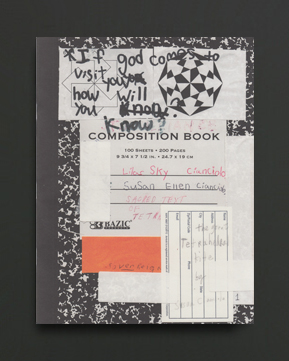
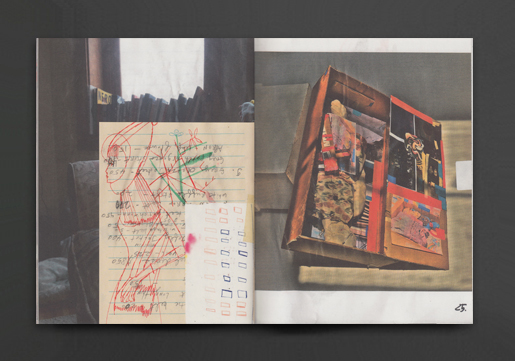
For the past twenty years, Susan Cianciolo (New York, USA) has moved between fields and formats – from fashion to craft, from performance to filmmaking – and the works presented in The Great Tetrahedral Kite speak to this restlessness. Cianciolo has produced a body of work that wilfully evades categorisation, exploiting the false dichotomies of construction and deconstruction, art and design, event and document.
Susan Cianciolo studied Fashion Design at Parsons The New School for Design and painting at Winchester School of Art. Cianciolo began her career as production manager for Kim Gordon's X-girl line and went on to be assistant collection designer at Badgley Mischka. From 1995–2001 she produced her critically-acclaimed collection RUN, revived in recent years in various forms. Cianciolo has presented her work at in New York at Alleged Gallery, P.S.1 Museum, Andrea Rosen, Sears-Peyton, Maryam Nassir Zadeh, and Ralph Pucci Gallery among others; Internationally at Pitti Immagine Discovery and Kaufmann Repetto, Italy; Purple Institute and Deep Gallery, France; Gallery 360, Presspop, Marugame Genichiro-Inokuma Museum of Contemporary Art, Japan; MMK Museum fur Modern Kunst and Portikus, Frankfurt, Germany. Her work has been featured in publications such as: The New York Times, T Magazine, Vogue, Visionaire, Interview, i-D magazine, Self-Service, Index, Artforum, Hanatsubaki, Vice, Vestoj and Purple amongst others.
2001, English
Hardcover (w. CD), 28 pages, 20 x 32 cm
1st edition, Out of print title / used*,
Published by
Toys Factory / Tokyo
$90.00 - Out of stock
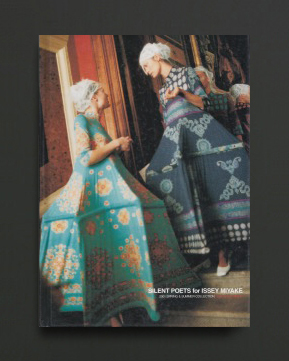
Hardcover Japanese first (and only) edition book documenting Issey Miyake's 2001 spring-summer collection and "Red Eyes Tribe" show. Designed by Kaie Murakami from Issey Miyake, art directed by Midori Kitamura from Miyake Design Studio and photographed by French photographer Francoise Huguier, the book beautifully captures this 2001 collection designed by Issey Miyake and Naoki Takizawa through runway and backstage colour photography and an accompanying CD of music composed specifically for the runway show by Japanese musicians Silent Poets.
2011, Japanese
Softcover (w. obi-strip), 212 pages, 15 x 22 cm
1st Japanese edition, Out of print title / used*,
Published by
Iwanami Shoten / Japan
$65.00 - Out of stock
Yohji Yamamoto led the Japanese fashion wave of the 1980s and 1990s into the new millennium. In October 2009, after a series of bad investments, Yamamoto Inc. went bankrupt; by the end of that year the designer had inaugurated a new business and a complete reevaluation of his direction. My Dear Bombis an outcome of this transition moment. Coauthored with Ai Mitsuda, this carefully and beautifully written autobiography (with biographical interpolations by friends and collaborators) seamlessly combines extended meditations on clothing and life with Yamamoto's memories and anecdotes, in short, concise paragraphs. Throughout its pages, we encounter Yamamoto as a tough realist unburdened by disingenuousness ("I am, in fact, a man who may turn heartless in an instant; I desire only to settle each and every score immediately"); and, of course, as a great designer blessed with unerring instinct for his materials ("how does the cloth want to drape, to sway, to fall? If one keeps these things in mind and looks very carefully, the fabric itself begins to speak"). Illustrated with drawings by Yamamoto, this open-hearted meditation offers a take on the autobiography form as imaginative as the designer's fashion wear.
This is the first Japanese edition, with all texts in Japanese.
1972, Japanese
Softcover (w. dustjacket), 340 pages, 15.5 x 22 cm
1st Japanese edition, Out of print title / used*,
Published by
? / Japan
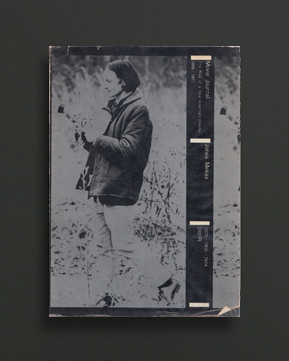
$45.00 - In stock -
Japanese edition of this classic collection of writings from the great Jonas Mekas.
Please note, texts in this scarce edition are entirely in Japanese.
In his Village Voice Movie Journal columns, Jonas Mekas captured the makings of an exciting movement in 1960s American filmmaking. Works by Andy Warhol, Gregory J. Markapoulos, Stan Brakhage, Jack Smith, Robert Breer, and others echoed experiments already underway elsewhere, yet they belonged to a nascent tradition that only a true visionary could identify. Mekas incorporated the most essential characteristics of these films into a unique conception of American filmmaking s next phase. He simplified complex aesthetic strategies for unfamiliar audiences and appreciated the subversive genius of films that many dismissed as trash.