World Food Books' programme is largely produced on Kulin Nation land. We acknowledge the Wurundjeri people of the Kulin Nation as the first and continuing custodians of this land, and pay respect to their Elders past, present, and emerging.
World Food Books is an arts and special interests bookshop in Naarm / Melbourne. Founded in 2010, World Food Books is devoted to the presentation of a rotating, hand-selection of international art, design, literary and counterculture publications with an emphasis on the anti-traditional, the experimental, the avant-garde, the heretic, the marginal.
Presenting new titles alongside rare and out-of-print books, catalogues and journals spanning the fields of modern and contemporary art, design, photography, illustration, film, literature, poetry, cultural theory, philosophy, sexuality, popular and underground culture in its many radical forms, World Food Books wishes to encourage adventurous, thoughtful and open-minded reading, looking, writing, and exchange of publishing and ideas, both current and historical.
As well as our bookshop, located in Melbourne's historical Nicholas Building, all of our inventory is available internationally via our online mail-order service.
World Food Books semi-regularly co-ordinates "Occasions", a programme of exhibits and events at the bookshop and in partnership with other hosts (such as museums and art galleries) that develop out of the activities, relationships and content of the bookshop itself.
World Food Books
The Nicholas Building
37 Swanston Street
Room 5, Level 6
Melbourne 3000
Australia
SHOP HOURS:
Thu–Fri 12–6, Sat 12–5
WEB-SHOP OPEN 24/7
World Food Books
Postal Address:
PO Box 435
Flinders Lane
Victoria 8009
Australia
Art
Theory / Essay
Architecture / Interior
Graphic Design / Typography
Photography
Fashion
Eros
LGBTQ+
Fiction / Poetry
Weird / Speculative / Science Fiction / Horror
Transgressive / Visceral / Abject
Symbolism / Decadence / Fin de siècle
Film / Video
Painting
Sculpture / Installation
Performance / Dance / Theater
Drawing
Sound / Music
Curatorial
Group Shows / Collections
Periodicals
Out-of-print / Rare
Posters / Ephemera / Discs
Signed Books
World Food Books Gift Voucher
World Food Book Bag
Australian Art
Australian Fiction
Australian Science Fiction / Speculative Fiction
Australian Poetry
Australian Photography
Japanese Photography
Conceptual Art
Minimal Art
Dada
'Pataphysics / Oulipo
Fluxus
Concrete Poetry
Pop Art
Surrealism
Arte Povera
Arte Informale / Haute Pâte / Tachism
Nouveau Réalisme / Zero / Kinetic
Situationism / Lettrism
Collage / Mail Art / Xerox Art
Art Brut / Folk / Visionary / Fantastic
Illustration / Graphic Art / Bandes Dessinées
Furniture
Italian Radical Design / Postmodernism
Textiles
Ceramics / Glass
Counterculture
Protest / Revolt
Philosophy
Psychoanalysis
Anthropology
Anarchism
Socialism / Anarchism / Communism / Capitalism
Literary Theory / Semiotics / Language
Feminism / Women's Studies
Gender Studies / Sexuality
Anthropology
Fetishism / BDSM
Drugs / Psychedelia
Crime / Violence
Animal Rights / Veganism
Occult / Esoterica
Ecology / Earth / Alternative Living
Whole Earth / Crafts
All prices in AUD (Australian dollars)
Pick-Ups
Pick-up orders can be collected in our bookshop during opening hours after order date. Please collect any Pick-up orders within 2 weeks of ordering as we have limited storage space. Orders will be released back into stock if not collected within this time. No refunds can be made for pick-ups left un-collected. If you cannot make it in to the bookshop in this time-frame, please choose postage option.
Return Policy
All sales are final. We do accept returns (for refund or exchange) for items received in error. All our orders are packed with special care using heavy-duty padding and cardboard book-mailers or bubble mailers (for smaller books), using reinforcement where required. We cannot take responsibility for any lost, stolen or damaged parcels.
Insurance
Should you wish to insure your package, please email us directly after placing your order and we can organise this at a small extra expense. Although all standard/express tracked packages are very safe and dependable, we cannot take responsibility for any lost, stolen or damaged parcels. We recommend insurance on valuable orders.
Interested in selling your old books, catalogues, journals, magazines, comics, fanzines, ephemera? We are always looking for interesting, unusual and out-of-print books to buy. We only buy books in our fields of interest and specialty, and that we feel we can resell.
We base these prices on desirability, market value, in-print prices, condition and our current stock levels. We offer cash, store credit, and can take stock on consignment. All
about 25% of the price we expect to get when we sell them, or 30% in store credit. We base these prices on desirability, market value, in-print prices, condition and our current stock levels.
Sell your books any day of the week. You can drop them off and return later. If you have a lot of books, we can visit your Sydney home.
We buy books that we feel we can resell. We offer about 25 % of the price we expect to get when we sell them, or 30% in store credit. We base these prices on desirability, market value, in-print prices, condition and our current stock levels.
Philadelphia Wireman
03 August - 01 September, 2018
World Food Books is proud to announce our next Occasion, the first presentation of sculptures by Philadelphia Wireman in Australia.
The Philadelphia Wireman sculptures were found abandoned in an alley off Philadelphia’s South Street on trash night in 1982. Their discovery in a rapidly-changing neighbourhood undergoing extensive renovation, compounded with the failure of all attempts to locate the artist, suggests that the works may have been discarded after the maker’s death. Dubbed the "Philadelphia Wireman" during the first exhibition of this work, in 1985, the maker’s name, age, ethnicity, and even gender remain uncertain. The entire collection totals approximately 1200 pieces, all intricately bound together with tightly-wound heavy-gauge wire (along with a few small, abstract marker drawings, reminiscent both of Mark Tobey and J.B. Murry). The dense construction of the work, despite a modest range of scale and materials, is singularly obsessive and disciplined in design: a wire armature or exoskeleton firmly binds a bricolage of found objects including plastic, glass, food packaging, umbrella parts, tape, rubber, batteries, pens, leather, reflectors, nuts and bolts, nails, foil, coins, toys, watches, eyeglasses, tools, and jewellery.
Heavy with associations—anthropomorphic, zoomorphic, and socio-cultural responses to wrapped detritus—the totemic sculptures by Philadelphia Wireman have been discussed in the context of work created to fulfil the shamanistic needs of alternative religions in American culture. Curators, collectors, and critics have variously compared certain pieces to sculpture from Classical antiquity, Native American medicine bundles, African-American memory jugs, and African fetish objects. Reflecting the artist’s prolific and incredibly focused scavenging impulse, and despite—or perhaps enhanced by—their anonymity, these enigmatic objects function as urban artefacts and arbiters of power, though their origin and purpose is unknown. Philadelphia Wireman, whatever their identity, possessed an astonishing ability to isolate and communicate the concepts of power and energy through the selection and transformation of ordinary materials. Over the course of the past two decades, this collection has come to be regarded as an important discovery in the field of self-taught art and vernacular art.
Presented in collaboration with Fleisher-Ollman Gallery, Philadelphia, and Robert Heald, Wellington.
Susan Te Kahurangi King
02 February - 10 March, 2018
Susan Te Kahurangi King (24 February 1951 - ) has been a confident and prolific artist since she was a young child, drawing with readily available materials - pencils, ballpoint pens and felt-tip markers, on whatever paper is at hand. Between the ages of four and six Susan slowly ceased verbal communication. Her grandparents William and Myrtle Murphy had developed a special bond with Susan so they took on caring responsibilities for extended periods. Myrtle began informally archiving her work, carefully collecting and storing the drawings and compiling scrapbooks. No drawing was insignificant; every scrap of paper was kept. The King family are now the custodians of a vast collection containing over 7000 individual works, from tiny scraps of paper through to 5 meter long rolls.
The scrapbooks and diaries reveal Myrtle to be a woman of great patience and compassion, seeking to understand a child who was not always behaving as expected. She encouraged Susan to be observant, to explore her environment and absorb all the sights and sounds. Myrtle would show Susan’s drawings to friends and people in her community that she had dealings with, such as shopkeepers and postal workers, but this was not simply a case of a grandmother’s bias. She recognised that Susan had developed a sophisticated and unique visual language and sincerely believed that her art deserved serious attention.
This was an unorthodox attitude for the time. To provide some context, Jean Dubuffet coined the term Art Brut in 1945 to describe work created by self-taught artists – specifically residents of psychiatric institutions and those he considered to be visionaries or eccentrics. In 1972 Roger Cardinal extended this concept by adopting the term Outsider Art to describe work made by non-academically trained artists operating outside of mainstream art networks through choice or circumstance. Susan was born in Te Aroha, New Zealand in 1951, far from the artistic hubs of Paris and London that Dubuffet and Cardinal operated in. That Myrtle fêted Susan as a self-taught artist who deserved to be taken seriously shows how progressive her attitudes were.
Susan’s parents Doug and Dawn were also progressive. Over the years they had consulted numerous health practitioners about Susan’s condition, as the medical establishment could not provide an explanation as to why she had lapsed into silence. Dawn educated herself in the field of homeopathy and went on to treat all twelve of her children using these principles – basing prescriptions on her observations of their physical, mental and emotional state.
Doug was a linguist with an interest in philosophy who devoted what little spare time he had to studying Maori language and culture. To some extent their willingness to explore the fringes of the mainstream made them outsiders too but it was their commitment to living with integrity and their respect for individuality that ensured Susan’s creativity was always encouraged.
Even though Susan’s family supported her artistic pursuits, some staff in schools and hospitals saw it as an impediment to her assimilation into the community and discouraged it in a variety of ways. Her family was not always aware of this and therefore did not fully understand why Susan stopped drawing in the early 1990s. However, rather than dwell on the challenges that Susan faced in pursuit of her artistic practice, they prefer to highlight her achievements. In 2008 Susan began drawing again in earnest, after an almost 20 year interruption, and her work is now shown in galleries around the world.
Susan grew up without television and has been heavily influenced by the comics she read as a child. She is absolutely fearless in the appropriation of recognizable characters, such as Donald Duck and Mickey Mouse, in her work. She twists their limbs, contorts their faces, compresses them together, blends them into complex patterned backgrounds - always imbuing them with an incredible energy. Although Susan often used pop culture characters in her work they are not naive or childlike. These are drawings by a brilliant self-taught artist who has been creating exceptional work for decades without an audience in mind.
Mladen Stilinović
"Various Works 1986 - 1999"
02 February 16 - September 10, 2016
Various works 1986 - 1999, from two houses, from the collections of John Nixon, Sue Cramer, Kerrie Poliness, Peter Haffenden and Phoebe Haffenden.
Including: Geometry of Cakes (various shelves), 1993; Poor People’s Law (black and white plate), 1993; White Absence (glasses, ruler, set square, silver spoon, silver ladel with skin photograph and wooden cubes), 1990-1996; Exploitation of the Dead (grey and red star painting, wooden painting, black spoon with red table, red plate), 1984-1990; Money and Zeros (zero tie, paintings made for friends in Australia (Sue, John, Kerrie), numbers painting), 1991-1992; Words - Slogans (various t-shirts) - “they talk about the death of art...help! someone is trying to kill me”, “my sweet little lamb”, “work is a disease - Karl Marx”; Various artist books, catalogues, monographs, videos; Poster from exhibition Insulting Anarchy; "Circular" Croatian - Australian edition; Artist book by Vlado Martek (Dostoyevsky); more.
Thanks to Mladen Stilinović and Branka Stipančić.
Jonathan Walker
Always Will Need To Wear Winter Shirt Blue + Ochre Small Check Pattern
21 August - 21 September, 2015
Untitled
I am not a great reader of poetry but I always return to the work of Melbourne poet, Vincent Buckley (1925- 1988). Perhaps I find his most tantalising piece to be not a finished poem but a fragment left on a scrap of paper discovered on his desk after the poet’s death.
The poetry gathers like oil
In the word-core, and spreads
It has its music meet,
Its music is in movement.
This fragment is more the shell left behind from a volatile thought than a finished poem. I find the last two lines honest but awkward whereas the first two lines work like an arrow. Most likely he could not find a resolution so it was left. Still, in its present form, it remains an eloquent testimony to the ultimate failure of a medium to express mobile thought and sensation, in Buckley’s case, through verbal language. It’s an important matter because this is something all artists have to deal with regardless of the medium.
I have never written a poem, however, I am forever copying fragments from books on paper scraps in a vain effort to fix certain notions in my head. At first, they function as bookmarks that are sometimes returned to when I open the book. But before long, as they accumulate, they fall out littering the table interspersed with A4 photocopies, bills, books and medications.
To return to Buckley’s fragment, the first two lines very much evoke how I paint nowadays. As you age, detail diminishes and patches of light become more luminous and float. I feel the most honest way of dealing with this is by smearing the oil paint on the canvas with the fingers and working close-up, blind. Only if the patches coalesce into an approaching image can the work gain a life.
-
Jonathan Walker was born in Melbourne, Australia and brought up on a dairy farm in Gippsland. In the 1970’s he studied painting at RMIT and won the Harold Wright Scholarship to the British Museum, London. During the 1980’s he exhibited at Pinacotheca Gallery, Richmond and had work shown at the NGV and Heidi City Art Gallery. Over the same period he designed the cover for the “Epigenesi” LP by Giancarlo Toniutti, Italy and conducted a mail exchange work with Achim Wollscheid, Germany. The work with artists through the post resulted in an article published in the bicentenary issue of Art and Australia 1988. He showed in artist run spaces such as WestSpace in the 90’s and 2000’s, and until 2012, taught painting at Victoria University, which is where we (Colleen Ahern and Lisa Radford) as organisers of the exhibition, among many others, had the privilege of being his student.
Walker’s knowledge was imparted to students through the careful selection of music, literature, and artists found in books that he himself had ordered for the library. Walker’s strategy was the generosity of sharing his vast knowledge with references specific to each student and their context.
Walker’s paintings share a similar focus and intimacy.
This exhibition presents a small selection of recent paintings alongside a publication that includes Walker’s writing. Observational and analytical, Walker’s work is a type of material notation — the time of day, colour and how it is blended, the both specific and fleeting location of a reflection on lino or the question of whether a chair leg should be included in a painting.
Please join us on Friday August 21 between 6-8pm to celebrate the opening of the exhibition.
Curated by Colleen Ahern and Lisa Radford.
B. Wurtz
Curated by Nic Tammens
March 26 - April 4, 2015
B.Wurtz works from a basement studio in his home on Manhattan’s Lower East Side.
This local fact is attested to by the plastic shopping bags and newsprint circulars that appear in his work. As formal objects, they don’t make loud claims about their origins but nonetheless transmit street addresses and places of business from the bottom of this long thin island. Like plenty of artists, Wurtz is affected by what is local and what is consumed. His work is underpinned by this ethic. It often speaks from a neighborhood or reads like the contents of a hamper:
“BLACK PLUMS $1.29 lb.”
“Food Bazaar”
“USDA Whole Pork Shoulder Picnic 99c lb.”
“RITE AID Pharmacy, with us it’s personal.”
“H. Brickman & Sons.”
“Sweet Yams 59c lb."
Most of the work in this exhibition was made while the artist was in residence at Dieu Donne, a workshop dedicated to paper craft in Midtown. Here Wurtz fabricated assemblages with paper and objects that are relatively lightweight, with the intention that they would be easily transportable to Australia. This consideration isn’t absolute in Wurtz’s work, but was prescriptive for making the current exhibition light and cheap. Packed in two boxes, these works were sent from a USPS post office on the Lower East Side and delivered to North Melbourne by Australia Post.
Wurtz appears courtesy of Metro Pictures, New York.
Thanks to Rob Halverson, Joshua Petherick, Sari de Mallory, Matt Hinkley, Helen Johnson, Fayen d'Evie, Ask Kilmartin, Lisa Radon, Ellena Savage, Yale Union, and "Elizabeth".
John Nixon
"Archive"
December 15 - January 20, 2014
The presentation of John Nixon's archive offered a rare showcase of this extensive collection of the artist's own publications, catalogues, posters, ephemera, editions and more, from the mid 1980s onwards, alongside a selection of his artworks.
Organized by John Nixon, Joshua Petherick and Matt Hinkley.
<a href=http://wfb.public-office.info/artist/john-nixon>All titles by John Nixon
"Habitat"
at Minerva, Sydney (organised by Joshua Petherick and Matt Hinkley)
November 15 - December 20, 2014
Lupo Borgonovo, Janet Burchill & Jennifer McCamley,
Lewis Fidock, HR Giger, Piero Gilardi, Veit Laurent Kurz,
Cinzia Ruggeri, Michael E. Smith, Lucie Stahl, Daniel Weil, Wols
Press Release:
“...It contained seven objects. The slender fluted bone, surely formed for flight, surely from the wing of some large bird. Three archaic circuitboards, faced with mazes of gold. A smooth white sphere of baked clay. An age-blackened fragment of lace. A fingerlength segment of what she assumed was bone from a human wrist, grayish white, inset smoothly with the silicon shaft of a small instrument that must once have ridden flush with the surface of the skin - but the thing’s face was seared and blackened.”
William Gibson, “Count Zero”, 1986
"Autumn Projects Archive"
Curated by Liza Vasiliou
March 6 - March 15, 2014
World Food Books, in conjunction with the Virgin Australia Melbourne Fashion Festival 2014, presented the Autumn Projects archive, consisting of a selection of early examples in Australian fashion with a particular interest in collecting designers and labels from the period beginning in the 1980’s, who significantly influenced the discourse of Australian Fashion.
Curated by Liza Vasiliou, the exhibition provided a unique opportunity to view pieces by designers Anthea Crawford, Barbara Vandenberg, Geoff Liddell and labels CR Australia, Covers, Jag along with early experimental collage pieces by Prue Acton and Sally Browne’s ‘Fragments’ collection, suspended throughout the functioning World Food Books shop in Melbourne.
H.B. Peace
presented by CENTRE FOR STYLE
November 14, 2013
"Hey Blinky, you say chic, I say same"
Anon 2013
H.B. Peace is a clothing collaboration between great friends Blake Barns and Hugh Egan Westland. Their pieces explore the divergences between 'character’ and ‘personality’ in garments....etc
Special Thanks to Joshua Petherick and Matt Hinkley of WFB and Gillian Mears
and a Very Special Thank you to Audrey Thomas Hayes for her shoe collaboration.
Janet Burchill & Jennifer McCamley
"Aesthetic Suicide"
May 10 - June 8, 2013
The first of our occasional exhibitions in the World Food Books office/shop space in Melbourne, "Aesthetic Suicide" presented a body of new and older works together by artists Janet Burchill & Jennifer McCamley, including videos, prints, a wall work, and publications.
During shop open hours videos played every hour, on the hour.
2019, English / German
Softcover, 384 pages, 20 x 25 cm
1st Edition, Out of print title / as new
Published by
Ludwig Museum / Cologne
$85.00 - Out of stock
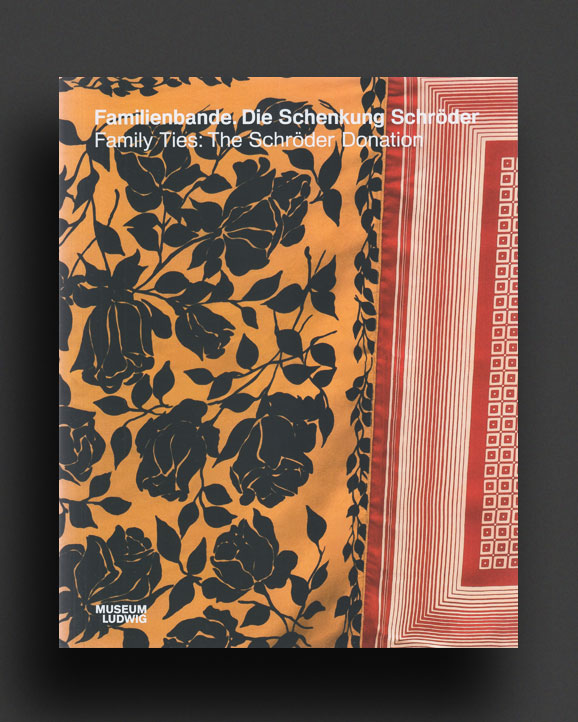
Family, clan, clan, gang, clique, clique, fandum, elective kinship, alliance, collaboration, network.
In the 1990s a new art scene began to form in Cologne. New galleries, magazines such as Texte zur Kunst, and the alternative exhibition space Friesenwall 120 were started. Alexander Schröder followed these developments from Berlin. Already as an art student at the Hochschule der Künste Berlin, he founded his own gallery along with Thilo Wermke. At the same time, he began collecting art from the 1990s and 2000s with his special eye.
Today his collection exemplifies the idiosyncratic and sensual side of this era, which was shaped by Conceptual Art. It demonstrates the significance of artist groups and collaborations in changing constellations at the time. Proximity and distance, connections and competition, inclusion and exclusion existed in productive friction with each other. Now the Schröder family has donated twenty-nine works from their collection, including large-scale installations, to the Museum Ludwig by artists such as Kai Althoff, Cosima von Bonin, Tom Burr, Lukas Duwenhögger, Isa Genzken, and Danh Võ. The exhibition Family Ties: The Schröder Donation presents these works to the public along with a selection from the Museum Ludwig collection. It focuses on art at the turn of the twenty-first century and examines the special conditions that existed in Cologne, also in relationship to New York.
The chronological documents (the works of art themselves, the invitations, flyers, fanzines, journals and texts from the 1990s to the 2000s) arranged on a timeline in this catalogue provide an insight into the development of art at that time in Cologne and New York. Selected essays and reviews reflect the at that time virulent theoretical debates; selective metadata point to drastic socio-political events and influential exhibitions. The catalog accompanies the exhibition Schroeder with works by Kai Althoff, Cosima von Bonin, KP Brehmer, Tom Burr, Luke Duwenhögger, Isa Genzken, Dan Graham, Renee Green, Ull Hohn, Hilary Lloyd, Lucy McKenzie, Christian Philip Muller, Nils Norman, Stephen Prina and Danh Vo.
2022, English
Hardcover (w. dust jacket), 148 pages, 24.6 x 32.5 cm
Published by
Walther König / Köln
$120.00 - In stock -
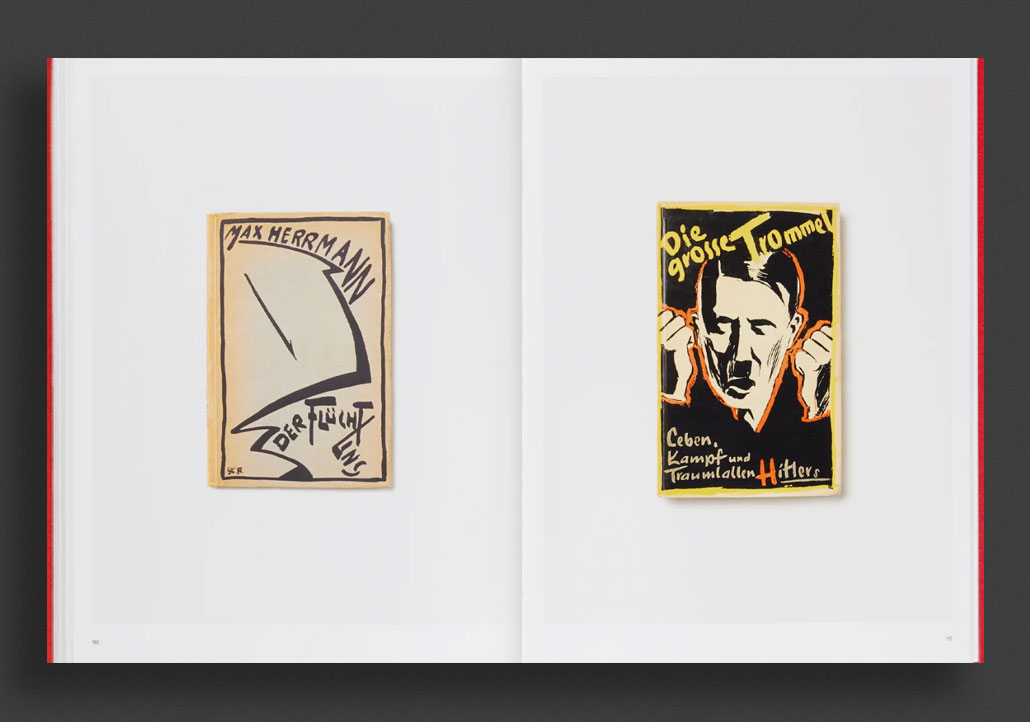
In Die Bücher, the Berlin-based artist Annette Kelm explores books that fell victim to defamation campaigns, persecution and bans imposed by the National Socialist regime between 1933 and 1945.
With her precise, simple photographic presentation, Kelm creates a new or ongoing public platform for the works of once ostracised writers, illustrators, and publishers, and of the extraordinary artistic and literary diversity of the Weimar Republic and the period before it. At the same time, Kelm transfers this subject matter into the current time.
Her work touches on pressing issues about the value and fragility of democratic models of society, the need to protect freedom of expression and intellectual and artistic diversity, and the potential threats posed to these values by right-wing forces.
Edited by Udo Kittelmann, Mirjam Zadoff, Nicolaus Schafhausen.
2022, English
Softcover, 102 pages, 21 x 15 cm
Published by
Afterall / London
Walther König / Köln
$36.00 - Out of stock
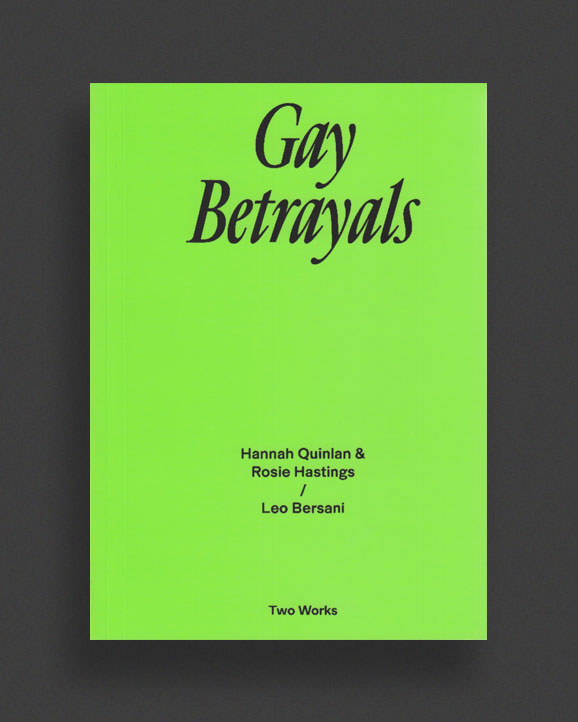
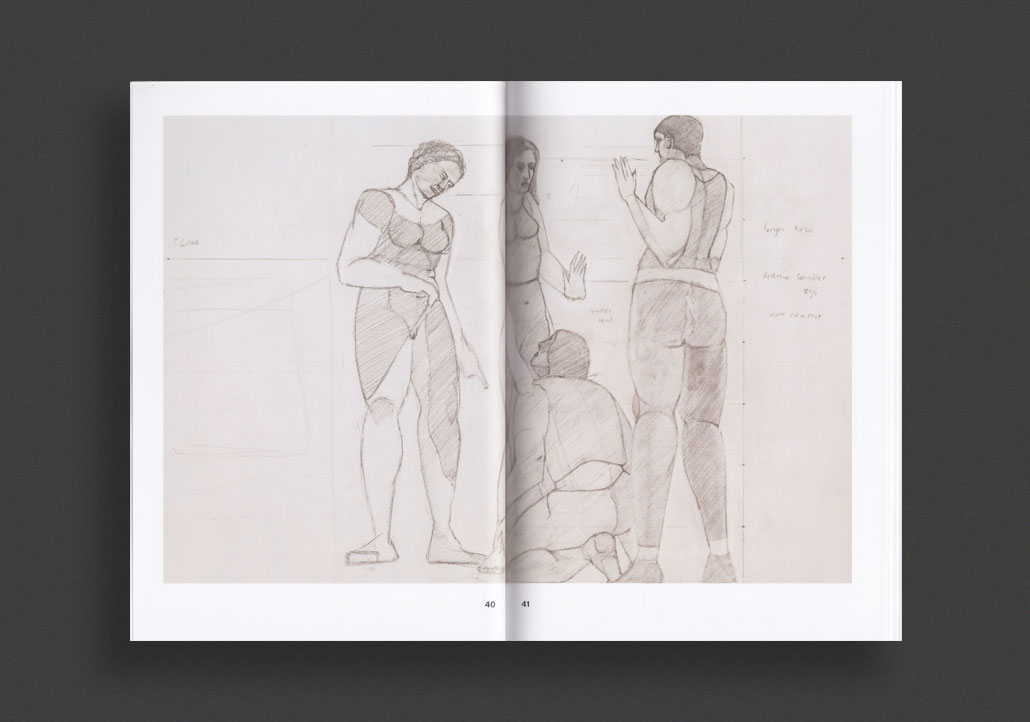
In 1997, during a symposium at Centre Pompidou, pioneering queer theorist Leo Bersani presented a prescient critique of the assimilative tendencies that made “gays melt into the very culture they like to think of themselves as undermining.” For Bersani, queer activism, mired in micropolitics, had relinquished the radical task of reconfiguring the horizon of the possible. Later published as “Gay Betrayals” in the pioneering (and now unavailable) collection Is the Rectum a Grave?, Bersani’s intervention champions a truly disruptive vision of homosexuality, one that betrays the relational, identitarian and communitarian foundations of bourgeois heterosexual respectability through “antimonogamous promiscuity.”
Building on artistic research into the politics of queer spaces and culture some 20 years later, British artist duo Hannah Quinlan and Rosie Hastings revisit Bersani’s polemic with a response in three acts. Through a kaleidoscopic array of drawings, preparatory sketches and egg tempera paintings, a narrative of everyday (homo)sociality emerges.
Leo Bersani (1931–2022) was an American theorist best known for his books Is the Rectum a Grave?, Homos and Receptive Bodies. Born in the Bronx, he graduated from Harvard in 1952 and eventually joined the University of California, Berkeley, where he became an influential teacher, remaining there for the rest of his career.
1988, English
Softcover (staple-bound), 24 pages, 21.5 x 28 cm
1st Edition, Out of print title / used / very good
Published by
Exit Art / New York
$220.00 - Out of stock
Wonderful, extremely rare 1988 catalogue published to accompany the important solo exhibition of US-Chinese artist Martin Wong (b. 1946, Portland, US, d. 1999, San Francisco) at Exit Art, New York, November 5—December 23, 1988, curated by Jeanette Ingberman. Illustrated throughout with Wong's paintings accompanied by text by John Yau. Includes gorgeous portrait and biography.
Martin Wong is recognized for his depictions of social, sexual, and political scenographies from the US in the 1970s, 1980s, and 1990s. Poetically weaving together narratives of queer existence, marginal communities, and urban gentrification, Wong stands out as an important countercultural voice at odds with the art establishment’s reactionary discourse at the time. Heavily influenced by his immediate surroundings, the artist’s practice merges the visual languages of Chinese iconography, urban poetry, graffiti, carceral aesthetics, and sign language. His work offers rare insight into decisive periods of recent US American history as told through its changing urban landscapes, unfolding hidden desires, and complexities.
Very good copy with only light creasing and tanning.
2022, English
Hardcover, 262 pages, 22 x 28.5 cm
Published by
Walther König / Köln
Zeno X Gallery / Antwerp
$120.00 - Out of stock
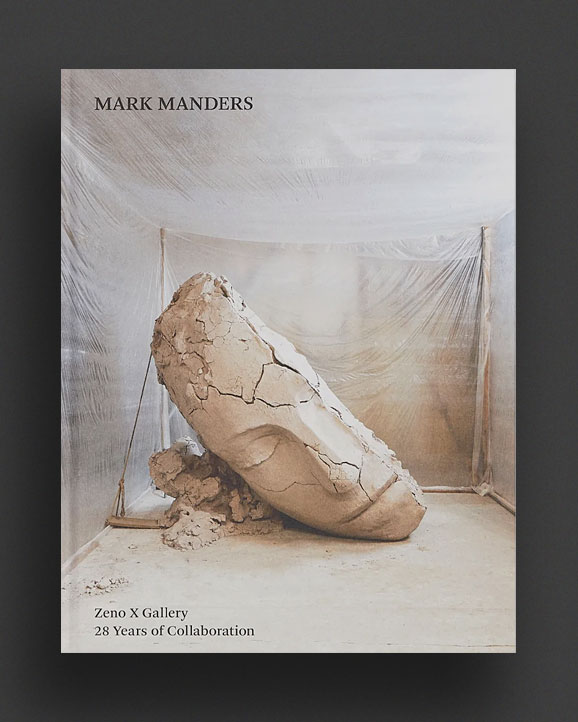
Mark Manders – Zeno X Gallery, 28 Years of Collaboration offers an overview of the long-standing collaboration between the artist Mark Manders (b. 1968) and Zeno X Gallery in Antwerp. The review has been published to accompany his most recent solo exhibition in the gallery and highlights a number of important exhibitions and special projects in Belgium and abroad in which Manders was invited to take part from the 1990s to the present day.
Mark Manders has been working since 1986 on what he calls his ‘self-portrait as a building’. His oeuvre – consisting of installations, sculptures, works on paper and drawings – is ascribed the metaphor of a fictional building, divided into separate rooms whose precise shape and size is undefined. There is no beginning and no end. Manders strives for timelessness and universality using archetypal forms and familiar-looking materials such as clay, bronze and wood. His bronze sculptures and installations consequently appear more vulnerable than they are in reality.
With text contributions from Mark Manders, Frank Demaegd (Zeno X Gallery) and Marjolein Sponselee.
Publication accompanying the exhibition in Zeno X Gallery, which takes place from 3 September to 15 October 2022.
2014 / 2022, English
Softcover, 336 pages, 15 x 23 cm
Published by
Bbooks Verlag / Germany
$60.00 - Out of stock
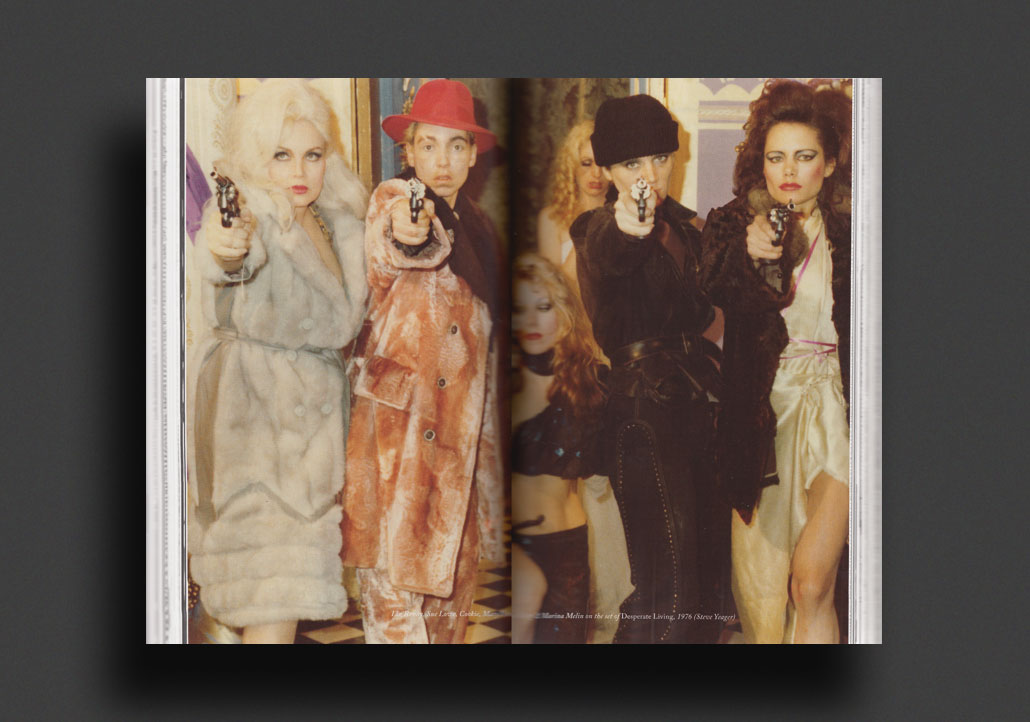
Cookie Mueller (1949-1989) was a firecracker, a cult figure, a wild child, a writer, a go-go dancer, a mother and a queer icon. A child of suburban 1950s Maryland, she made her name first as an actress in the films of John Waters, and then as an art critic and columnist, a writer of hilarious stories and a maven of New York's downtown art world. Edgewise, by Berlin-based actress and writer Chloé Griffin, tells the story of Cookie's life through an oral history composed of more than 80 interviews with the people who knew her, including John Waters, Mink Stole, Gary Indiana, Sharon Niesp, Max Mueller, Linda Yablonsky, Richard Hell, Amos Poe and Raymond Foye. The contributors take us from the late-1960s artist communes of Baltimore to 1970s Provincetown and New York, through 1980s Berlin and Positano. Along with the text, Edgewise includes artwork, unpublished photographs and archival material and photography by Philip-Lorca diCorcia, David Armstrong, Robert Mapplethorpe, and Peter Hujar.
2022, English
Hardcover (w. dust jacket), 224 pages, 26.3 x 18.8 cm
Published by
Semiotext(e) / Los Angeles
$56.00 - Out of stock
The life, times, and mysteries of Fred Halsted, gay porn's first film auteur, in a new, updated, and expanded edition.
Fred Halsted’s L.A. Plays Itself (1972) was gay porn’s first masterpiece: a sexually explicit, autobiographical, experimental film whose New York screening left even Salvador Dalí repeatedly muttering “new information for me.” Halsted, a self-taught filmmaker, shot the film over a period of three years in a now-vanished Los Angeles, a city at once rural and sleazy. Although his cultural notoriety at one point equaled that of Kenneth Anger or Jack Smith, Halsted’s star waned in the 1980s with the emergence of a more commercial gay porn industry. After the death from AIDS of his long-time partner, lover, spouse (and tormentor) Joey Yale in 1986, Halsted committed suicide in 1989. In Halsted Plays Himself, acclaimed artist and filmmaker William E. Jones documents his quest to capture the elusive public and private personas of Halsted—to zero in on an identity riddled with contradictions. Jones assembles a narrative of a long-gone gay lifestyle and an extinct Hollywood underground, when independent films were still possible, and the boundary between experimental and pornographic was not yet established. The book also depicts what sexual liberation looked like at a volatile point in time—and what it looked like when it collapsed.
The revised and expanded edition of Halsted Plays Himself includes material that came to light since the book’s first publication, including details about the restoration of Halsted’s films by the Museum of Modern Art, the true identities of several key figures in his life, new testimony from family members, and the rediscovery of his feature film Truck It (1973), previously considered lost.
2019, English
Softcover, 152 pages, 21cm x 19cm
Published by
Yale University Press
$43.00 - Out of stock
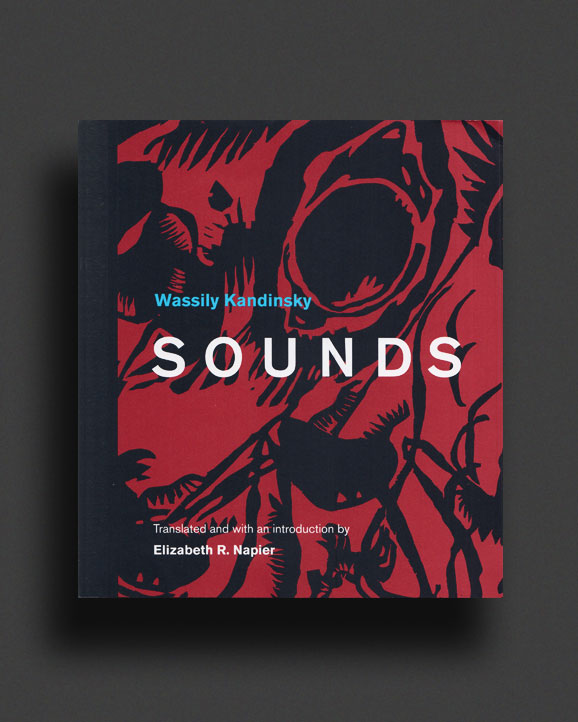
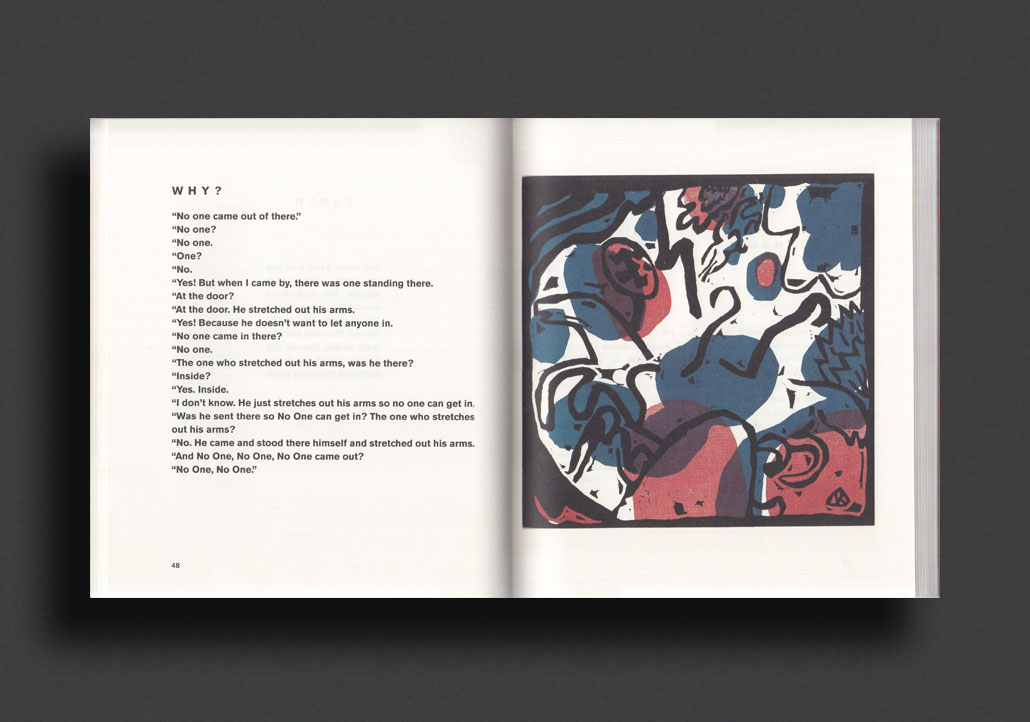
Wassily Kandinsky (1866–1944) was a Russian pioneer of abstract painting whose work has influenced generations of artists. His Sounds (Klänge) of 1912 is one of the earliest, most beautiful examples of a 20th-century artist’s book. Its “sound poems” are alternately narrative and expressive, witty and simple in form. They treat questions of space, color, physical design, and the act of seeing in a world that offers multiple and often contradictory possibilities. The woodcut illustrations that accompany the poems range from representational designs to abstract vignettes. In its fusion of image and word, Sounds epitomizes the artist’s move toward abstraction and his aspiration to a synthesis of the arts.
This updated edition of Sounds includes all of the book’s poems in English and German and its woodcuts, twelve of which appear in color for greater fidelity to the original. The translator’s introduction offers close formal examination of the poems and situates Sounds in the context of Kandinsky’s oeuvre. Although it was prized by prominent 20th-century artists, Sounds is one of the least known of Kandinsky’s major writings, and this remains the most authoritative English version.
2018, English
Softcover, 220 pages
Published by
Amphetamine Sulphate / Austin
$34.00 - Out of stock
In psychological warfare, a rigorous thirst for perversion is a definite advantage.
Welcome to the last crusade. Imagine GG Allin teaming up with Louis-Ferdinand Celine to right all the wrongs of this fallen, corrupted world. Join a merry band of chronic degenerates as they fuck and slaughter their way across the ruins of revolutionary France.
That's 21st century revolutionary France. Islamist terror attacks, rustic rebellions, blatant atrocities, scatological derangement and host of other comic misadventures worthy of Rabelais at his most splenetic. And disgusting.
Amphetamine Sulphate is proud to present this provocative and astonishing French mock-literary punk epic, appearing in English translation for the very first time.
Jean-Louis Costes is a French noise musician, performance artist and film actor.
2022, English
Hardcover (w. dust jacket), 616 pages, 23.6 x 16.3 cm
Published by
Semiotext(e) / Los Angeles
The MIT Press / Massachusetts
$65.00 - In stock -
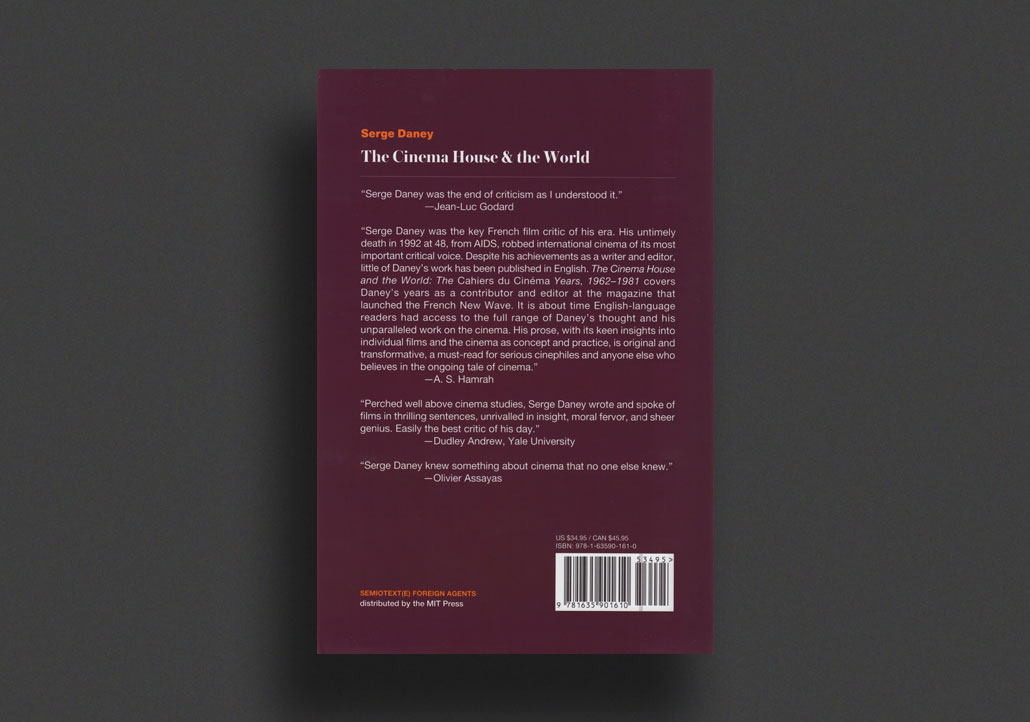
The writings of one of the greatest film critics of his generation on the auteur approach of the French New Wave to a more structural examination of film.
"Serge Daney was the end of criticism as I understood it."—Jean-Luc Godard
One of the greatest film critics of his generation, Serge Daney wrote for Cahiers du Cinéma before becoming a journalist for the daily newspaper Libération. The writings collected in this volume reflect Daney’s evolving interests, from the auteur approach of the French New Wave to a more structural examination of film, psychoanalysis, and popular culture.
Openly gay throughout his lifetime, Daney rarely wrote explicitly about homosexuality but his writings reflect a queer sensibility that would influence future generations. In regular intellectual exchanges with Gilles Deleuze, Félix Guattari, and Roland Barthes, Daney wrote about cinema autobiographically, while lyrically analyzing the transition from modern cinema to postmodern media. A noted polymath, Daney also published books about tennis and Haiti’s notorious Duvalier regime. His criticism is open and challenging, polyvocal and compulsively readable.
"Serge Daney was the key French film critic of his era. His untimely death in 1992 at 48, from AIDS, robbed international cinema of its most important critical voice. Despite his achievements as a writer and editor, little of Daney's work has been published in English. The Cinema House and the World: The Cahiers du Cinéma Years, 1962–1981 covers Daney's years as a contributor and editor at the magazine that launched the French New Wave. It is about time English-language readers had access to the full range of Daney's thought and his unparalleled work on cinema. His prose, with its keen insights into individual films and the cinema as concept and practice, is original and transformative, a must-read for serious cinephiles and anyone else who believes in the ongoing tale of cinema."—A. S. Hamrah
"Thirty years after his death, Daney's revenant presence offers a most welcome disquietude."—Nick Pinkerton
Serge Daney became the editor of Cahiers du Cinema in 1974. In 1981, he left Cahiers and wrote about visual culture for Libération, turning his attention to television and coverage of the Gulf War. He collaborated with Claire Denis on a documentary film, Jacques Rivette, le veilleur (1990). He died of AIDS-related causes in 1992.
A. S. Hamrah is a writer living in Brooklyn. He contributed a column on film to n+1 from 2008 to 2019, and his essays and reviews have appeared in Harper's, Bookforum, Cineaste, and other publications. Heis the author of The Earth Dies Streaming: Film Writing, 2002–2018.
1986, English
Softcover, 253 pages, 13.8 x 21.6 cm
Published by
University of Minnesota Press / Minnesota
minnes
$65.00 - Out of stock
Reprint of the 1986 edition, translated by Hugh Tomlinson and Barbara Habberjam.
A revolutionary work in philosophy and a book about cinema that identifies three principal types of image-movement using examples from the work of a diverse group of filmmakers including Griffith, Eisenstein, Cassavetes, and Altman.
The appearance of Cinema 1 is an exciting event for film study and one that well deserves serious attention and commentary.—Film Quarterly
1986, English
Softcover, 352 pages, 13.8 x 21.6 cm
Published by
University of Minnesota Press / Minnesota
$65.00 - Out of stock
Reprint of the 1986 edition, translated by Hugh Tomlinson and Barbara Habberjam.
Brings to completion Deleuze’s work on the implications of the cinematographic image. In Cinema 2, Deleuze explains why, since World War II, time has come to dominate film. Among the filmmakers discussed are Rossellini, Fellini, Godard, Resnais, Pasolini, and many others.
2022, English
Softcover, 184 pages, 10.8 × 17.6 cm
Edition of 400,
Published by
Discipline / Melbourne
$25.00 - Out of stock
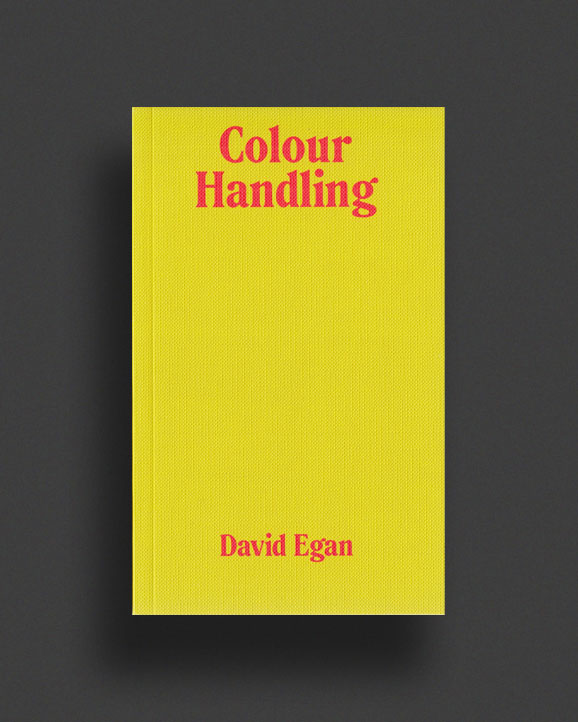
Australian artist David Egan's (b. 1989) exploration of Colour Handling — Colour as Embodied Substance in Jutta Koether's Red Paintings; Colour as Portal in Rosie Isaac's Green Mirror; Colour as Time Machine in Tony Conrad's Yellow Movies; Colour as Dissemblance for Pain in Derek Jarman's Blue; Colour as Medium in Etel Adnan's Worldly Paintings.
Originally written as part of a practice based PhD in Fine Art, completed at Monash University Art, Design & Architecture in 2022, this popular paperback book edition has been edited by Helen Hughes and Amy Stuart, with an introduction by Tessa Laird, designed by Zenobia Ahmed, and published by Discipline in an edition of 400 copies. Features accompanying full-colour plates section.
1973, English
Hardcover (w. dust jacket), 22 x 21.5 cm
1st Edition, Out of print title / used / very good
Published by
Thomas Y. Crowell Company / New York
$280.00 - Out of stock
Bruno Munari's one and only A Flower with Love, in the collectable 1973 first hardcover "square" edition, published in English by Thomas Y. Crowell Company, New York. A Flower with Love is beloved Italian artist and designer Bruno Munari's personal ikebana design book. The best ikebana book in the West. Munari's humour and creative playfulness is overflowing in this beautifully illustrated volume, with photographic spreads accompanying Munari's texts and drawings, presenting his whimsical and inventive creations in the Japanese art of flower arrangement, such as arranging dandelions and herbs in wine glasses, the use of a potato as a floral pin frog. Flipping the measured restraint of traditional ikebana on its head and eliminating the elitism we might associate with expensive flower arrangements. There is no force in A Flower With Love. It’s a really gentle, colourful presentation of joy. "...what really matters is the love with which a little daisy, a lavender sprig or some moss are chosen, that one there in particular and not that other one." For the child and adult alike, like most of Munari's wonderful books, A Flower with Love gives us a renewed awareness of the beauty of the world around us.
Bruno Munari (October 24, 1907, Milan – September 30, 1998, Milan) was an Italian artist, designer, and inventor who contributed fundamentals to many fields of visual arts (painting, sculpture, film, industrial design, graphic design) in modernism, futurism, and concrete art, and in non visual arts (literature, poetry) with his research on games, didactic method, movement, tactile learning, kinesthetic learning, and creativity.
Very Good Copy, Good—VG dust jacket, with single chip to back-top of dj and small closed tears, preserved under mylar. Only mild wear/ageing.
2018, Japanese / Italian
Softcover (w. dust jacket), 380 pages, 25.7 x 19 cm
1st Edition, Out of print title / as new
Published by
Museum of Modern Art / Kamakura
$89.00 - Out of stock
First edition of the incredible Japanese Bruno Munari Retrospective catalogue, published on the occasion of the largest ever survey exhibition of Bruno Munari's work, that travelled across Japan in 2018. At nearly 400 pages, this profusely colour-illustrated book begins with Munari's early futurist paintings and mobile sculptures and carries the reader through his entire career, generously showcasing throughout an impressive archive of his innovative and iconic graphic works in book and poster design, sculpture, illustration, interior/furniture design, games, art objects, his Xerografia, and much more. It's all here! A wonderful document of material. Texts in Japanese and Italian, with a full chronology, and extensive list of exhibited works. Stunning.
Bruno Munari (October 24, 1907, Milan – September 30, 1998, Milan) was an Italian artist, designer, and inventor who contributed fundamentals to many fields of visual arts (painting, sculpture, film, industrial design, graphic design) in modernism, futurism, and concrete art, and in non visual arts (literature, poetry) with his research on games, didactic method, movement, tactile learning, kinesthetic learning, and creativity.
2022, English
Softcover, 264 pages, 14 x 20.3 cm
Published by
Wakefield Press / Cambridge
$42.00 - In stock -
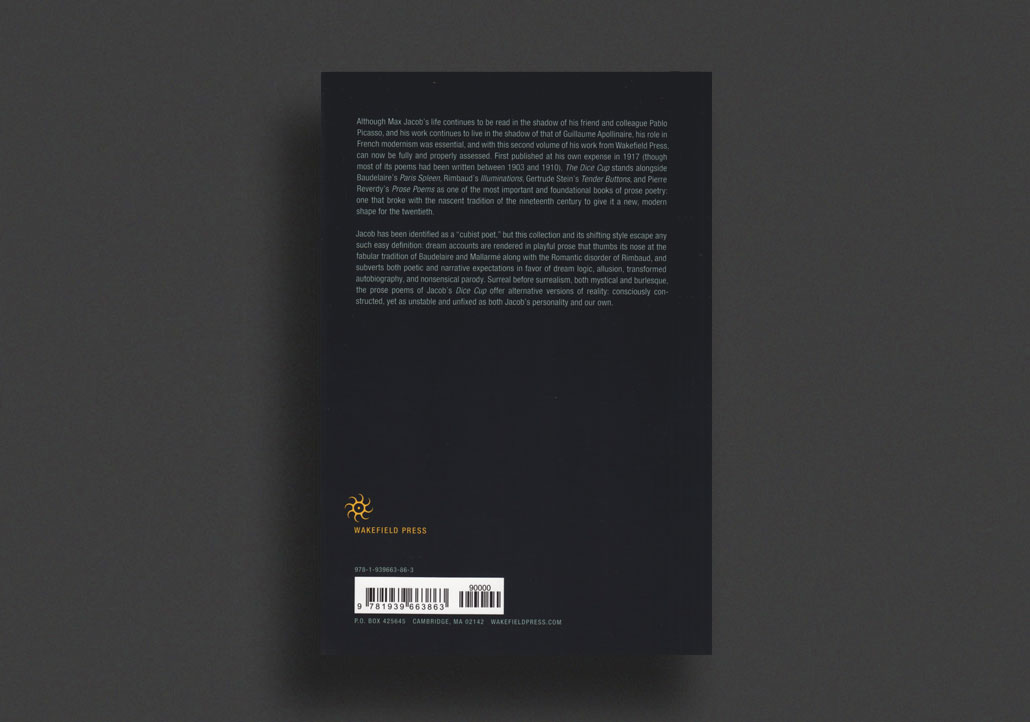
The most important prose-poem collection of the 20th century, available in a trade publication for the first time.
Max Jacob's role in French modernity was essential, and with this second volume of his work from Wakefield Press, it can now be fully and properly assessed. First published in 1917, The Dice Cup stands alongside Baudelaire's Paris Spleen, Rimbaud's Illuminations and Pierre Reverdy's Prose Poems as one of the most important and foundational books of prose poetry. Jacob has been identified as a "cubist poet," but this collection and its shifting style escape any such easy definition: dream accounts are rendered in playful prose that thumbs its nose at the fabular tradition of Baudelaire and Mallarmé and the Romantic disorder of Rimbaud, and subverts both poetic and narrative expectations in favor of dream logic, allusion, transformed autobiography and nonsensical parody. At once mystical and burlesque, the prose poems of Dice Cup are consciously constructed, yet as unstable and unfixed as both Jacob's personality and our own.
Max Jacob (1876-1944) was a French poet, painter, writer and critic. A key figure of bohemian Montmartre and the Cubist era, he rubbed shoulders with Apollinaire and Modigliani and was a lifelong friend to Picasso, Gris and Cocteau. Jacob converted from Judaism to Christianity in 1915. Arrested by the Gestapo in 1944, he died in a deportation camp of pneumonia. Rosanna Warren's critically acclaimed biography of Jacob was published in 2020.
Translated by Ian Seed
2022, English
Softcover, 360 pages, 13.7 x 20.1 cm
Published by
Wakefield Press / Cambridge
$42.00 - Out of stock
Translated, with an introduction, by Alexander Dickow
When Max Jacob published The Central Laboratory in 1921, Cubism’s glory days had passed, the Parisian Dada movement had just officially come to an end, and the surrealist movement was yet to be born. The poetic scene in Paris was between definitions, and in that sense, Jacob’s work embodied the moment.
The Central Laboratory is distinctly modern yet utterly discordant with anything else that had been published before: a grab bag of popular genres, operettas, Breton folk song, nonsense poetry, nursery rhyme, cockeyed doggerel, pastiche, parody, and puns in which sound often trumps sense. In this collection, Jacob changes register on a dime, shifting from societal sarcasm to mystical sincerity, bearing allegiance to no school or form but his own. Employing the symbolist method of obscure reference, the cubist fracturing of perspective, Dadaist discontinuity, and a dream logic that was at stylistic antipodes with what surrealism would soon become, Jacob drew from almost twenty years of work to assemble an array of “stoppered phials” in this tongue-in-cheek laboratory, each one of them carefully mislabeled. It most clearly presents what Jacob described as his “art of disappointment”: the sabotage of readerly expectations in which doubt and disorientation serve as poetic principle, and the traditional jilted lover and jilted poet join forces to propagate a new form of jilted reader. Mixed signals, mysterious rationales, and mocked allegory formulate a camp sensibility, a “queering” of literary style that is as riddled with contradiction as Jacob himself had been in his lifetime.
The book remains, a century after its initial publication in French, utterly peculiar and for too long lost in the shadow of Jacob’s more famous poetical colleague, Guillaume Apollinaire, as well as the one cast by Jacob’s own earlier, more famous book of prose poems, The Dice Cup. Jacob himself said of The Central Laboratory: “it sums up twenty years and reflects twenty states of soul, often twenty styles either suffered or created by me.”
Max Jacob (1876–1944) was a French poet, painter, writer, and critic. A key figure of the bohemian setting of Montmartre Paris and the legendary cubist era, he rubbed shoulders with such figures as Guillaume Apollinaire and Amadeo Modigliani, was a lifelong friend to Pablo Picasso, Juan Gris, and Jean Cocteau, and an influence for a generation of young writers. After experiencing a mystic vision in his studio apartment in 1909, Jacob converted from Judaism to Christianity in 1915, with Picasso as godfather. Arrested by the Gestapo in 1944, he subsequently died in a deportation camp from bronchial pneumonia.
1989, English
Softcover, 78 pages, 21 x 30 cm
1st Edition, Out of print title / as new
Published by
IMA / Brisbane
$80.00 - Out of stock
Published by the Institute of Modern Art, Brisbane in 1989 and edited by curator Sue Cramer.
"This exhibition and catalogue considers the gallery Inhibodress which existed in Sydney 1970-1972. The focus is upon the significance of the gallery as an example of independent action by artists, which achieved major importance through its commitment to and promotion of a new kind of critical art. Inhibodress failed as a collective, but succeeded in exploring a range of avant—garde ideas and establishing in Sydney a new kind of conceptually-based practice which questioned the nature and purpose of art, the status of painting and the notion of the art-object. In the debates which surrounded Inhibodress, and in the work of its main exhibiting artists, the notion of the ‘idea’ or ‘concept’ superseded the notion of the art object, opening up the possibilities of art beyond Greenbergian formalism. Inhibodress was born at the beginning of the seventies as a part of that moment in Australia (1968- 1972) when in the eyes of a number of young art practitioners, the implications of formalist art had reached their furthermost extreme: when minimalism was inverted to seed the beginnings of 'post—minimalism’; when an interest in the internal aesthetics of the art object became an investigation into the place of art in the world. This new conceptual work explored art's inextricable links with the world, with philosophy and politics, with society and its institutions. These changes corresponded of ‘course to those which had taken place in America and Europe and they had particular and fervent manifestation in Australia around this time..."
Sue Cramer
Essays and interviews with artists Tim Johnson, Peter Kennedy and Mike Parr, alongside documentation of Inhibodress exhibitions, performances, events, notifications and catalogues, this publication serves as an in-depth look at an important moment in Australian contemporary art history.
Designed by Sue Cramer and John Nixon.
1984, English
Softcover, 250 pages, 21 x 30 cm
1st Edition, Out of print title / used / very good
Published by
Biennale of Sydney / Sydney
$70.00 - Out of stock
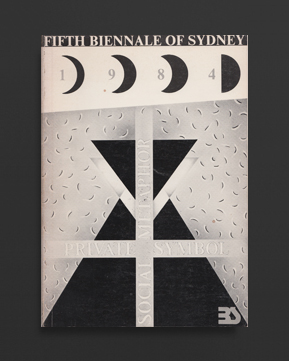
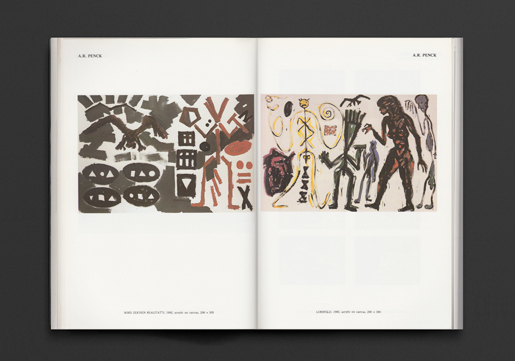
Catalogue published on the occasion of the Fifth Biennale of Sydney 1984, 11 April – 17 June 1984. Under the artistic direction of Leon Paroissien the 1984 Biennale was titled "Private Symbol: Social Mataphor" and featured the work of Davida Allen, Armando, Art & Language, Terry Atkinson, Breda Beban, Joseph Beuys, Tony Bevan, Annette Bezor, Francois Boisrond, Peter Booth, Tomasz Ciecierski, Tony Cragg, Juan Davila, Antonio Dias Gonzalo Diaz, Eugenio Dittborn, Felix Droese, Marlene Dumas, Edward Dwurnik Mimmo Germana, Gilbert & George, Mike Glier, Hans Haacke, Jenny Holzer, Ralph Hotere, Jorg lmmendorff, Berit Jensen, Birgit Jürgenssen, Mike Kelley, Peter Kennedy, Anselm Kiefer, Karen Knorr, Barbara Kruger, Robert Longo, Colin McCahon, Syoko Maemoto, Sandra Meigs, Cildo Meireles, Gianni Melotti, Marisa Merz, Annette Messager, Olaf Metzel, Sara Modiano, Michael Mulcahy, Josef Felix Müller, Christa Näher, Annick Nozati, Anna Oppermann, Andy Patton, A.R. Penck, Robert Randall & Frank Bendinelli, Jytte Rex, Georges Rousse, Klaudia Schifferle, Hubert Schmalix, Cindy Sherman, Vincent Tangredi, Peter Taylor, Dragoljub Raéa Todosijevié, Vicki Varvaressos, Jenny Watson, Michiko Yano, Eva Man-Wah Yuen
This catalogue includes colour examples of the work of all participating artists alongside texts by Leon Paroissien, Annelie Pohlen, Carter Ratcliff, Jean-Louis Pradel, Leon Paroissien.
2022, English
Softcover, 192 pages, 19.5 x 12.9 cm
Published by
Penguin Putnam / New York
$34.00 - In stock -
"One of the Finest Memoirs Ever Written"—The New Yorker
The highly acclaimed memoir of one of the most original American storytellers of the rural South.
Harry Crews grew up as the son of a sharecropper in Georgia at a time when "the rest of the country was just beginning to feel the real hurt of the Great Depression but it had been living in Bacon County for years." Yet what he conveys in this moving, brutal autobiography of his first six years of life is an elegiac sense of community and roots from a rural South that had rarely been represented in this way. Interweaving his own memories including his bout with polio and a fascination with the Sears, Roebuck catalog, with the tales of relatives and friends, he re-creates a childhood of tenderness and violence, comedy and tragedy.
1996, English
Softcover, 192 pages, 21.5 x 14 cm
Re-print,
Published by
Simon and Schuster / New York
$34.00 - In stock -
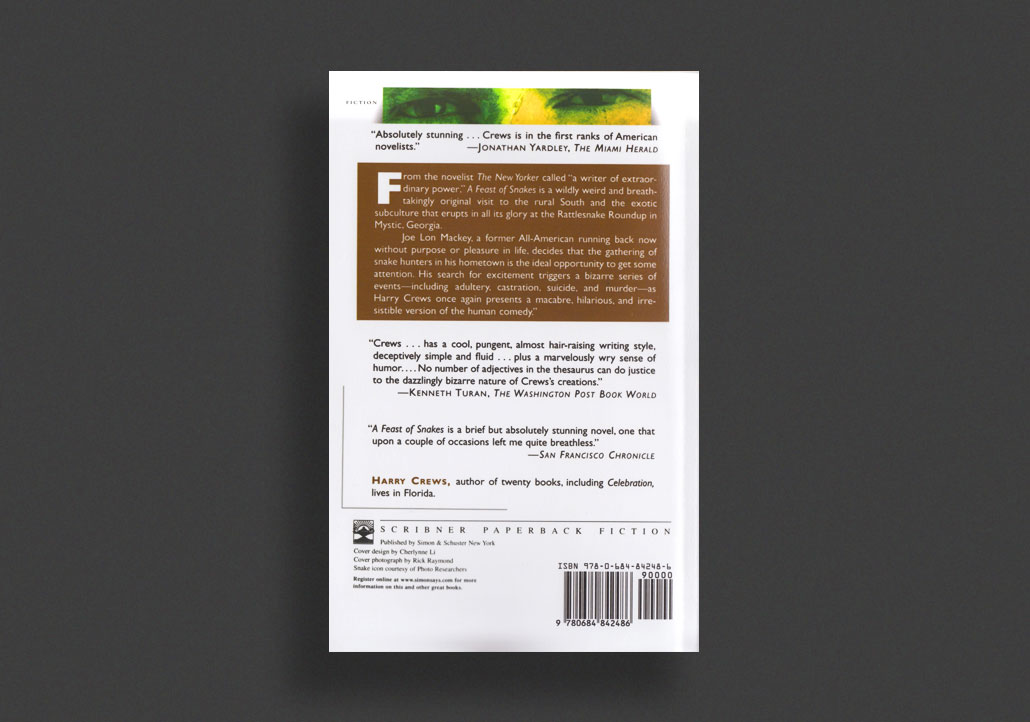
First published in 1976 by Atheneum Books, Feast of Snakes is one of American author Harry Crews' best known, and most provocative novels. An extraordinary, starkly powerful example of Southern Gothic literature or "Grit Lit" that many critics consider Crews' finest work.
From the acclaimed author of such novels as Blood and Grits and Childhood comes an original visit to the rural South that reveals the exotic subculture that erupts in all its glory at the Rattlesnake Roundup in Mystic, Georgia.
"a writhing of the darkness, an incessant boiling of something thick and slow-moving."
2022, English
Softcover, 144 pages, 15.2 x 20.3 cm
Published by
Nightboat Books / New York
$49.00 - In stock -
Internationally recognized for his work in telepresence and bioart, Kac presents here, translated into English for the first time, experimental poems, performances and visual works realized in the context of the Porn Art Movement, a vanguard that emerged in 1980 under a military dictatorship in Brazil.
Porneia features a selection of works by Eduardo Kac realized in the context of the Porn Art Movement, a vanguard that emerged in 1980 under a military dictatorship in Brazil and which, for two intense years, straddled the line between relentless formal experimentation and the outlying demimonde where boundary-busting gender reinvention took place. Through performances, poetry and visual works, as well as through interventions in daily life, between 1980 and 1982 Kac carried out a radical body-based program that upturned the semiotics of normative pornography at the service of activism and imagination.
2022, English
Softcover, 264 pages, 13.7 x 20.3 cm
Published by
Semiotext(e) / Los Angeles
$35.00 - Out of stock
Sad and funny and bitter and true, a novel about grief, discovering your own story, and trying to listen for those stories that are not yours to tell.
August 2014. Two friends, writers Damaris Caleemootoo and Oliver Pablo Herzberg, arrive in Edinburgh from London, the city that killed Daniel--his brother, her frenemy and loved by them both. Every day is different but the same. Trying to get to the library, they get distracted by bickering--will it rain or not and what should they do about their tanking bitcoin?--in the end failing to write or resist the sadness which follows them as they drift around the city.
On such a day they meet Diego, a poet. They learn that Diego's mother was from the Chagos Archipelago, that she and her community were forced to leave their ancestral islands by soldiers in 1973 to make way for a military base. They become obsessed with this notorious episode in British history and the continuing resistance of the Chagossian people, and feel urged to write in solidarity. But how to share a story that is not theirs to tell?
Sad, funny and angry, this collaborative fiction builds on the true fact of another: a collaborative fiction created by the British and US governments to dispossess a people of their homeland.
2022, English
Softcover (w. dust jacket), 256 pages, 10.9 x 180 cm
Published by
Sternberg Press / Berlin
$30.00 - Out of stock
Newly commissioned writing and artwork on the themes found in the work of Cecilia Vicuña, including ecofeminism, indigenous forms of knowledge, dissolution and extinction, and exile.
What happens between the knots? is the third book in the annual A Series of Open Questions published by CCA Wattis Institute for Contemporary Arts and Sternberg Press. Each book in the series includes newly commissioned writing as well a selection of perspectives, images, and references related to the Wattis's year-long research seasons dedicated to single artists. Each book takes the work of a single artist as its point of departure and spirals outward from there to create an expansive and carefully edited ecosystem of ideas and voices.
This third issue is informed by themes found in the work of Cecilia Vicuña, including ecofeminism, indigenous forms of knowledge, poetry and politics, dissolution and extinction, exile, dematerialization, regeneration, and environmental responsibility.
Contributors
Gloria Anzaldua, Elvira Espejo Ajca, Erika Balsom, María Berrios, Marisol de la Cadena, Lynne Cooke, Miho Dohi, Ricki Dwyer, Silvia Federici, Tonya Foster, Phillip Greenlief, Sheroanawe Hakihiiwe, Brian Karl, Dionne Lee, Zoe Leonard, Rosemary Mayer, Koyoltzintli Miranda-Rivadeneira, Denise Newman, Thao Nguyen Phan, Frances Richard, Dylan Robinson, Abel Rodriguez, Oscar Santillan, Alessandra Troncone, Anna Lowenhaupt Tsing, Ignacio Valero, Jacopo Cathrine Veikos, Cecilia Vicuña, Diego Villalobos, Jacopo Crivelli Visconti, Carla Zaccagnini