World Food Books' programme is largely produced on Kulin Nation land. We acknowledge the Wurundjeri people of the Kulin Nation as the first and continuing custodians of this land, and pay respect to their Elders past, present, and emerging.
World Food Books is an arts and special interests bookshop in Naarm / Melbourne. Founded in 2010, World Food Books is devoted to the presentation of a rotating, hand-selection of international art, design, literary and counterculture publications with an emphasis on the anti-traditional, the experimental, the avant-garde, the heretic, the marginal.
Presenting new titles alongside rare and out-of-print books, catalogues and journals spanning the fields of modern and contemporary art, design, photography, illustration, film, literature, poetry, cultural theory, philosophy, sexuality, popular and underground culture in its many radical forms, World Food Books wishes to encourage adventurous, thoughtful and open-minded reading, looking, writing, and exchange of publishing and ideas, both current and historical.
As well as our bookshop, located in Melbourne's historical Nicholas Building, all of our inventory is available internationally via our online mail-order service.
World Food Books semi-regularly co-ordinates "Occasions", a programme of exhibits and events at the bookshop and in partnership with other hosts (such as museums and art galleries) that develop out of the activities, relationships and content of the bookshop itself.
World Food Books
The Nicholas Building
37 Swanston Street
Room 5, Level 6
Melbourne 3000
Australia
SHOP HOURS:
Thu–Fri 12–6, Sat 12–5
WEB-SHOP OPEN 24/7
World Food Books
Postal Address:
PO Box 435
Flinders Lane
Victoria 8009
Australia
Art
Theory / Essay
Architecture / Interior
Graphic Design / Typography
Photography
Fashion
Eros
LGBTQ+
Fiction / Poetry
Weird / Speculative / Science Fiction / Horror
Transgressive / Visceral / Abject
Symbolism / Decadence / Fin de siècle
Film / Video
Painting
Sculpture / Installation
Performance / Dance / Theater
Drawing
Sound / Music
Curatorial
Group Shows / Collections
Periodicals
Out-of-print / Rare
Posters / Ephemera / Discs
Signed Books
World Food Books Gift Voucher
World Food Book Bag
Australian Art
Australian Fiction
Australian Science Fiction / Speculative Fiction
Australian Poetry
Australian Photography
Japanese Photography
Conceptual Art
Minimal Art
Dada
'Pataphysics / Oulipo
Fluxus
Concrete Poetry
Pop Art
Surrealism
Arte Povera
Arte Informale / Haute Pâte / Tachism
Nouveau Réalisme / Zero / Kinetic
Situationism / Lettrism
Collage / Mail Art / Xerox Art
Art Brut / Folk / Visionary / Fantastic
Illustration / Graphic Art / Bandes Dessinées
Furniture
Italian Radical Design / Postmodernism
Textiles
Ceramics / Glass
Counterculture
Protest / Revolt
Philosophy
Psychoanalysis
Anthropology
Anarchism
Socialism / Anarchism / Communism / Capitalism
Literary Theory / Semiotics / Language
Feminism / Women's Studies
Gender Studies / Sexuality
Anthropology
Fetishism / BDSM
Drugs / Psychedelia
Crime / Violence
Animal Rights / Veganism
Occult / Esoterica
Ecology / Earth / Alternative Living
Whole Earth / Crafts
All prices in AUD (Australian dollars)
Pick-Ups
Pick-up orders can be collected in our bookshop during opening hours after order date. Please collect any Pick-up orders within 2 weeks of ordering as we have limited storage space. Orders will be released back into stock if not collected within this time. No refunds can be made for pick-ups left un-collected. If you cannot make it in to the bookshop in this time-frame, please choose postage option.
Return Policy
All sales are final. We do accept returns (for refund or exchange) for items received in error. All our orders are packed with special care using heavy-duty padding and cardboard book-mailers or bubble mailers (for smaller books), using reinforcement where required. We cannot take responsibility for any lost, stolen or damaged parcels.
Insurance
Should you wish to insure your package, please email us directly after placing your order and we can organise this at a small extra expense. Although all standard/express tracked packages are very safe and dependable, we cannot take responsibility for any lost, stolen or damaged parcels. We recommend insurance on valuable orders.
Interested in selling your old books, catalogues, journals, magazines, comics, fanzines, ephemera? We are always looking for interesting, unusual and out-of-print books to buy. We only buy books in our fields of interest and specialty, and that we feel we can resell.
We base these prices on desirability, market value, in-print prices, condition and our current stock levels. We offer cash, store credit, and can take stock on consignment. All
about 25% of the price we expect to get when we sell them, or 30% in store credit. We base these prices on desirability, market value, in-print prices, condition and our current stock levels.
Sell your books any day of the week. You can drop them off and return later. If you have a lot of books, we can visit your Sydney home.
We buy books that we feel we can resell. We offer about 25 % of the price we expect to get when we sell them, or 30% in store credit. We base these prices on desirability, market value, in-print prices, condition and our current stock levels.
Philadelphia Wireman
03 August - 01 September, 2018
World Food Books is proud to announce our next Occasion, the first presentation of sculptures by Philadelphia Wireman in Australia.
The Philadelphia Wireman sculptures were found abandoned in an alley off Philadelphia’s South Street on trash night in 1982. Their discovery in a rapidly-changing neighbourhood undergoing extensive renovation, compounded with the failure of all attempts to locate the artist, suggests that the works may have been discarded after the maker’s death. Dubbed the "Philadelphia Wireman" during the first exhibition of this work, in 1985, the maker’s name, age, ethnicity, and even gender remain uncertain. The entire collection totals approximately 1200 pieces, all intricately bound together with tightly-wound heavy-gauge wire (along with a few small, abstract marker drawings, reminiscent both of Mark Tobey and J.B. Murry). The dense construction of the work, despite a modest range of scale and materials, is singularly obsessive and disciplined in design: a wire armature or exoskeleton firmly binds a bricolage of found objects including plastic, glass, food packaging, umbrella parts, tape, rubber, batteries, pens, leather, reflectors, nuts and bolts, nails, foil, coins, toys, watches, eyeglasses, tools, and jewellery.
Heavy with associations—anthropomorphic, zoomorphic, and socio-cultural responses to wrapped detritus—the totemic sculptures by Philadelphia Wireman have been discussed in the context of work created to fulfil the shamanistic needs of alternative religions in American culture. Curators, collectors, and critics have variously compared certain pieces to sculpture from Classical antiquity, Native American medicine bundles, African-American memory jugs, and African fetish objects. Reflecting the artist’s prolific and incredibly focused scavenging impulse, and despite—or perhaps enhanced by—their anonymity, these enigmatic objects function as urban artefacts and arbiters of power, though their origin and purpose is unknown. Philadelphia Wireman, whatever their identity, possessed an astonishing ability to isolate and communicate the concepts of power and energy through the selection and transformation of ordinary materials. Over the course of the past two decades, this collection has come to be regarded as an important discovery in the field of self-taught art and vernacular art.
Presented in collaboration with Fleisher-Ollman Gallery, Philadelphia, and Robert Heald, Wellington.
Susan Te Kahurangi King
02 February - 10 March, 2018
Susan Te Kahurangi King (24 February 1951 - ) has been a confident and prolific artist since she was a young child, drawing with readily available materials - pencils, ballpoint pens and felt-tip markers, on whatever paper is at hand. Between the ages of four and six Susan slowly ceased verbal communication. Her grandparents William and Myrtle Murphy had developed a special bond with Susan so they took on caring responsibilities for extended periods. Myrtle began informally archiving her work, carefully collecting and storing the drawings and compiling scrapbooks. No drawing was insignificant; every scrap of paper was kept. The King family are now the custodians of a vast collection containing over 7000 individual works, from tiny scraps of paper through to 5 meter long rolls.
The scrapbooks and diaries reveal Myrtle to be a woman of great patience and compassion, seeking to understand a child who was not always behaving as expected. She encouraged Susan to be observant, to explore her environment and absorb all the sights and sounds. Myrtle would show Susan’s drawings to friends and people in her community that she had dealings with, such as shopkeepers and postal workers, but this was not simply a case of a grandmother’s bias. She recognised that Susan had developed a sophisticated and unique visual language and sincerely believed that her art deserved serious attention.
This was an unorthodox attitude for the time. To provide some context, Jean Dubuffet coined the term Art Brut in 1945 to describe work created by self-taught artists – specifically residents of psychiatric institutions and those he considered to be visionaries or eccentrics. In 1972 Roger Cardinal extended this concept by adopting the term Outsider Art to describe work made by non-academically trained artists operating outside of mainstream art networks through choice or circumstance. Susan was born in Te Aroha, New Zealand in 1951, far from the artistic hubs of Paris and London that Dubuffet and Cardinal operated in. That Myrtle fêted Susan as a self-taught artist who deserved to be taken seriously shows how progressive her attitudes were.
Susan’s parents Doug and Dawn were also progressive. Over the years they had consulted numerous health practitioners about Susan’s condition, as the medical establishment could not provide an explanation as to why she had lapsed into silence. Dawn educated herself in the field of homeopathy and went on to treat all twelve of her children using these principles – basing prescriptions on her observations of their physical, mental and emotional state.
Doug was a linguist with an interest in philosophy who devoted what little spare time he had to studying Maori language and culture. To some extent their willingness to explore the fringes of the mainstream made them outsiders too but it was their commitment to living with integrity and their respect for individuality that ensured Susan’s creativity was always encouraged.
Even though Susan’s family supported her artistic pursuits, some staff in schools and hospitals saw it as an impediment to her assimilation into the community and discouraged it in a variety of ways. Her family was not always aware of this and therefore did not fully understand why Susan stopped drawing in the early 1990s. However, rather than dwell on the challenges that Susan faced in pursuit of her artistic practice, they prefer to highlight her achievements. In 2008 Susan began drawing again in earnest, after an almost 20 year interruption, and her work is now shown in galleries around the world.
Susan grew up without television and has been heavily influenced by the comics she read as a child. She is absolutely fearless in the appropriation of recognizable characters, such as Donald Duck and Mickey Mouse, in her work. She twists their limbs, contorts their faces, compresses them together, blends them into complex patterned backgrounds - always imbuing them with an incredible energy. Although Susan often used pop culture characters in her work they are not naive or childlike. These are drawings by a brilliant self-taught artist who has been creating exceptional work for decades without an audience in mind.
Mladen Stilinović
"Various Works 1986 - 1999"
02 February 16 - September 10, 2016
Various works 1986 - 1999, from two houses, from the collections of John Nixon, Sue Cramer, Kerrie Poliness, Peter Haffenden and Phoebe Haffenden.
Including: Geometry of Cakes (various shelves), 1993; Poor People’s Law (black and white plate), 1993; White Absence (glasses, ruler, set square, silver spoon, silver ladel with skin photograph and wooden cubes), 1990-1996; Exploitation of the Dead (grey and red star painting, wooden painting, black spoon with red table, red plate), 1984-1990; Money and Zeros (zero tie, paintings made for friends in Australia (Sue, John, Kerrie), numbers painting), 1991-1992; Words - Slogans (various t-shirts) - “they talk about the death of art...help! someone is trying to kill me”, “my sweet little lamb”, “work is a disease - Karl Marx”; Various artist books, catalogues, monographs, videos; Poster from exhibition Insulting Anarchy; "Circular" Croatian - Australian edition; Artist book by Vlado Martek (Dostoyevsky); more.
Thanks to Mladen Stilinović and Branka Stipančić.
Jonathan Walker
Always Will Need To Wear Winter Shirt Blue + Ochre Small Check Pattern
21 August - 21 September, 2015
Untitled
I am not a great reader of poetry but I always return to the work of Melbourne poet, Vincent Buckley (1925- 1988). Perhaps I find his most tantalising piece to be not a finished poem but a fragment left on a scrap of paper discovered on his desk after the poet’s death.
The poetry gathers like oil
In the word-core, and spreads
It has its music meet,
Its music is in movement.
This fragment is more the shell left behind from a volatile thought than a finished poem. I find the last two lines honest but awkward whereas the first two lines work like an arrow. Most likely he could not find a resolution so it was left. Still, in its present form, it remains an eloquent testimony to the ultimate failure of a medium to express mobile thought and sensation, in Buckley’s case, through verbal language. It’s an important matter because this is something all artists have to deal with regardless of the medium.
I have never written a poem, however, I am forever copying fragments from books on paper scraps in a vain effort to fix certain notions in my head. At first, they function as bookmarks that are sometimes returned to when I open the book. But before long, as they accumulate, they fall out littering the table interspersed with A4 photocopies, bills, books and medications.
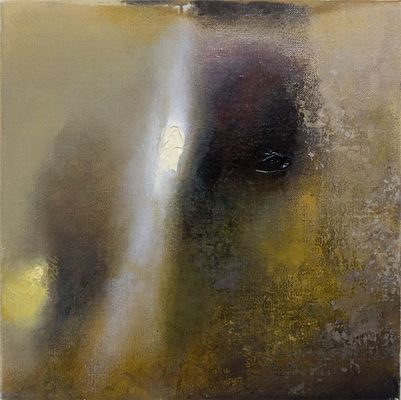
To return to Buckley’s fragment, the first two lines very much evoke how I paint nowadays. As you age, detail diminishes and patches of light become more luminous and float. I feel the most honest way of dealing with this is by smearing the oil paint on the canvas with the fingers and working close-up, blind. Only if the patches coalesce into an approaching image can the work gain a life.
-
Jonathan Walker was born in Melbourne, Australia and brought up on a dairy farm in Gippsland. In the 1970’s he studied painting at RMIT and won the Harold Wright Scholarship to the British Museum, London. During the 1980’s he exhibited at Pinacotheca Gallery, Richmond and had work shown at the NGV and Heidi City Art Gallery. Over the same period he designed the cover for the “Epigenesi” LP by Giancarlo Toniutti, Italy and conducted a mail exchange work with Achim Wollscheid, Germany. The work with artists through the post resulted in an article published in the bicentenary issue of Art and Australia 1988. He showed in artist run spaces such as WestSpace in the 90’s and 2000’s, and until 2012, taught painting at Victoria University, which is where we (Colleen Ahern and Lisa Radford) as organisers of the exhibition, among many others, had the privilege of being his student.
Walker’s knowledge was imparted to students through the careful selection of music, literature, and artists found in books that he himself had ordered for the library. Walker’s strategy was the generosity of sharing his vast knowledge with references specific to each student and their context.
Walker’s paintings share a similar focus and intimacy.
This exhibition presents a small selection of recent paintings alongside a publication that includes Walker’s writing. Observational and analytical, Walker’s work is a type of material notation — the time of day, colour and how it is blended, the both specific and fleeting location of a reflection on lino or the question of whether a chair leg should be included in a painting.
Please join us on Friday August 21 between 6-8pm to celebrate the opening of the exhibition.
Curated by Colleen Ahern and Lisa Radford.
B. Wurtz
Curated by Nic Tammens
March 26 - April 4, 2015
B.Wurtz works from a basement studio in his home on Manhattan’s Lower East Side.
This local fact is attested to by the plastic shopping bags and newsprint circulars that appear in his work. As formal objects, they don’t make loud claims about their origins but nonetheless transmit street addresses and places of business from the bottom of this long thin island. Like plenty of artists, Wurtz is affected by what is local and what is consumed. His work is underpinned by this ethic. It often speaks from a neighborhood or reads like the contents of a hamper:
“BLACK PLUMS $1.29 lb.”
“Food Bazaar”
“USDA Whole Pork Shoulder Picnic 99c lb.”
“RITE AID Pharmacy, with us it’s personal.”
“H. Brickman & Sons.”
“Sweet Yams 59c lb."
Most of the work in this exhibition was made while the artist was in residence at Dieu Donne, a workshop dedicated to paper craft in Midtown. Here Wurtz fabricated assemblages with paper and objects that are relatively lightweight, with the intention that they would be easily transportable to Australia. This consideration isn’t absolute in Wurtz’s work, but was prescriptive for making the current exhibition light and cheap. Packed in two boxes, these works were sent from a USPS post office on the Lower East Side and delivered to North Melbourne by Australia Post.
Wurtz appears courtesy of Metro Pictures, New York.
Thanks to Rob Halverson, Joshua Petherick, Sari de Mallory, Matt Hinkley, Helen Johnson, Fayen d'Evie, Ask Kilmartin, Lisa Radon, Ellena Savage, Yale Union, and "Elizabeth".
John Nixon
"Archive"
December 15 - January 20, 2014
The presentation of John Nixon's archive offered a rare showcase of this extensive collection of the artist's own publications, catalogues, posters, ephemera, editions and more, from the mid 1980s onwards, alongside a selection of his artworks.
Organized by John Nixon, Joshua Petherick and Matt Hinkley.
<a href=http://wfb.public-office.info/artist/john-nixon>All titles by John Nixon
"Habitat"
at Minerva, Sydney (organised by Joshua Petherick and Matt Hinkley)
November 15 - December 20, 2014
Lupo Borgonovo, Janet Burchill & Jennifer McCamley,
Lewis Fidock, HR Giger, Piero Gilardi, Veit Laurent Kurz,
Cinzia Ruggeri, Michael E. Smith, Lucie Stahl, Daniel Weil, Wols
Press Release:
“...It contained seven objects. The slender fluted bone, surely formed for flight, surely from the wing of some large bird. Three archaic circuitboards, faced with mazes of gold. A smooth white sphere of baked clay. An age-blackened fragment of lace. A fingerlength segment of what she assumed was bone from a human wrist, grayish white, inset smoothly with the silicon shaft of a small instrument that must once have ridden flush with the surface of the skin - but the thing’s face was seared and blackened.”
William Gibson, “Count Zero”, 1986
"Autumn Projects Archive"
Curated by Liza Vasiliou
March 6 - March 15, 2014
World Food Books, in conjunction with the Virgin Australia Melbourne Fashion Festival 2014, presented the Autumn Projects archive, consisting of a selection of early examples in Australian fashion with a particular interest in collecting designers and labels from the period beginning in the 1980’s, who significantly influenced the discourse of Australian Fashion.
Curated by Liza Vasiliou, the exhibition provided a unique opportunity to view pieces by designers Anthea Crawford, Barbara Vandenberg, Geoff Liddell and labels CR Australia, Covers, Jag along with early experimental collage pieces by Prue Acton and Sally Browne’s ‘Fragments’ collection, suspended throughout the functioning World Food Books shop in Melbourne.
H.B. Peace
presented by CENTRE FOR STYLE
November 14, 2013
"Hey Blinky, you say chic, I say same"
Anon 2013
H.B. Peace is a clothing collaboration between great friends Blake Barns and Hugh Egan Westland. Their pieces explore the divergences between 'character’ and ‘personality’ in garments....etc
Special Thanks to Joshua Petherick and Matt Hinkley of WFB and Gillian Mears
and a Very Special Thank you to Audrey Thomas Hayes for her shoe collaboration.
Janet Burchill & Jennifer McCamley
"Aesthetic Suicide"
May 10 - June 8, 2013
The first of our occasional exhibitions in the World Food Books office/shop space in Melbourne, "Aesthetic Suicide" presented a body of new and older works together by artists Janet Burchill & Jennifer McCamley, including videos, prints, a wall work, and publications.
During shop open hours videos played every hour, on the hour.
1972, Japanese
Softcover (3 vols), 21 x 14.8 cm
1st Edition, Out of print title / used / good
Published by
Taiyo books / Japan
$90.00 - Out of stock
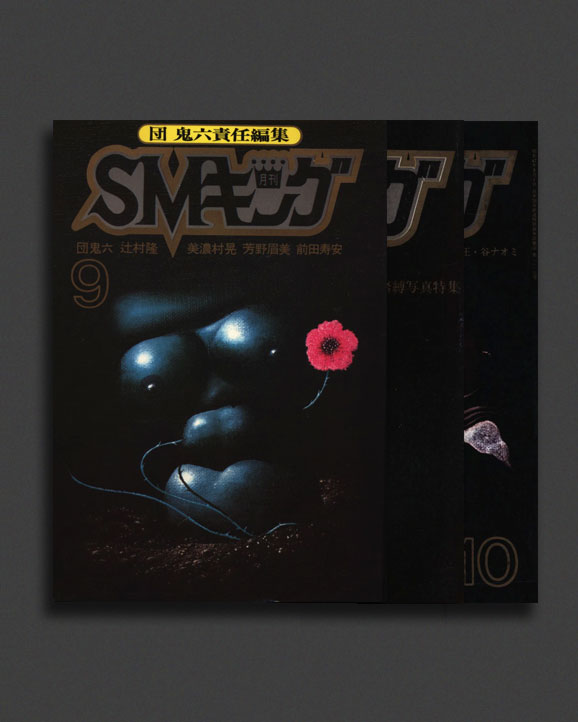
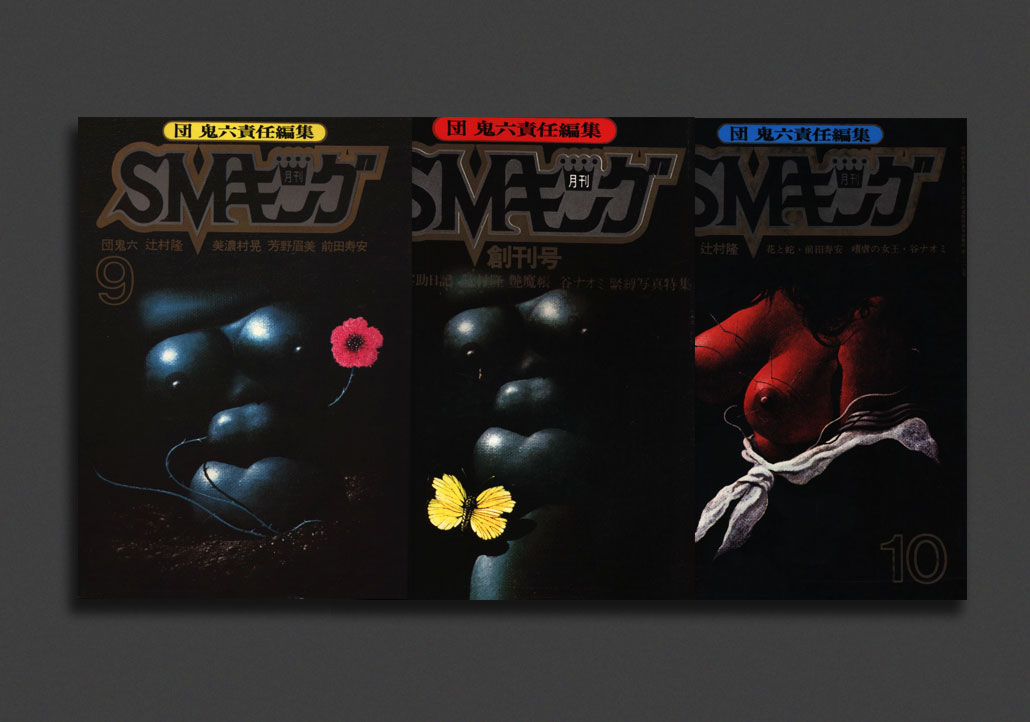
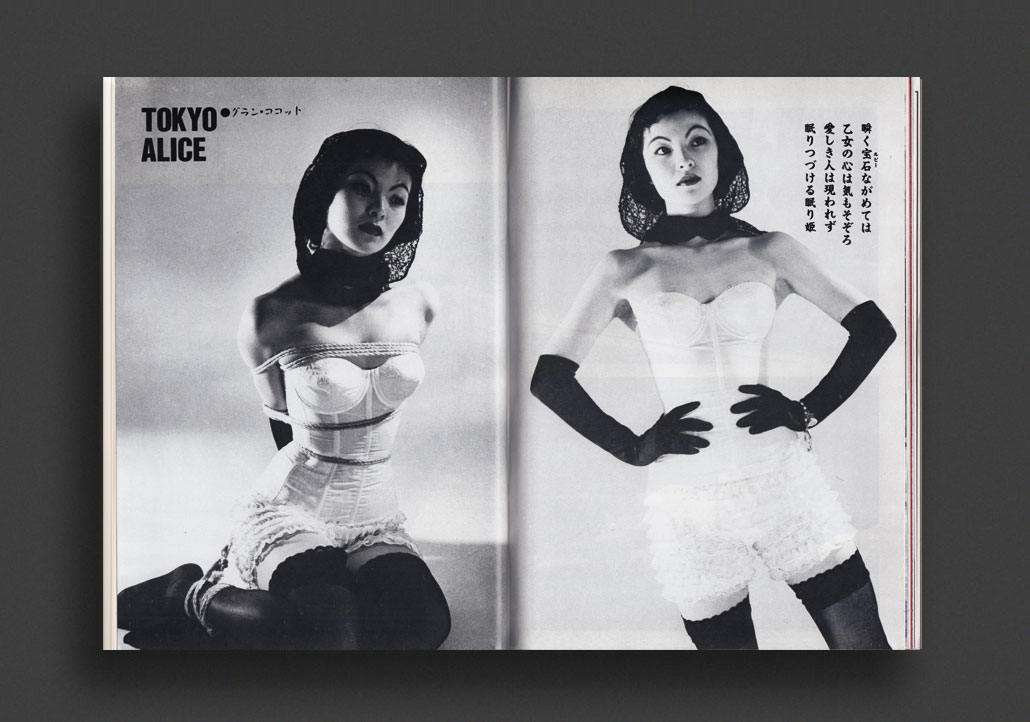
Lot of 3 issues of SM KING, all published in 1972 in Japan by Taiyo books. A legendary Japanese magazine in the world of BDSM, with each issue featuring many colour and b/w photographs, illustrations, and stories on the subject of bondage in Japan. All texts in Japanese.
All issues Good-Very Good condition.
2022, English
Softcover, 80 pages, 12.7 x 20.3 cm
Published by
Nightboat Books / New York
$39.00 - Out of stock
Translated by Jeffrey Zuckerman, Foreword by Shiv Kotecha.
A madcap tale of sadistic power-play by one of the 20th century's most beloved French gay writers.
My Manservant and Me is a story about the trials and tribulations of having a live-in valet. Written from the uneasy perspective of an aging, incontinent author of extremely successful middlebrow plays, we learn about his manservant, a young film actor who is easily moved to both delicate gestures and terrible tantrums; who's been authorized to handle his master's finances, who orders stock buys, dictates his master's wardrobe, sleeps in his master's bed, and yet won't let him watch variety television. My Manservant and Me reveals the rude specificities of this relationship with provocative humor and stylistic abjection. This manservant won't be going anywhere.
2022, English
Softcover, 144 pages, 13.7 x 20.3 cm
Published by
Semiotext(e) / Los Angeles
$32.00 - In stock -
Hervé Guibert's incandescent correspondence with Belgian poet Eugène Savitzkaya.
In 1977, Hervé Guibert discovered the first novel written by Eugène Savitzkaya, Mentir, and sent him his La mort propagande, which had just been published. In the following years, they exchanged the books they had written, read each other, appreciated each other. They saw each other rarely, however: one lived in Liège, the other Paris.
A turning point occurred in 1982, when Hervé published Lettre à un frère d'écriture, in which he declared to Eugène, I love you through your writing. The tone had changed; Hervé, obsessed with his correspondent, wrote him increasingly incandescent letters. 1984 would, however, see the sudden extinguishing of that passion. A deep friendship replaced it, which found itself with new areas to explore: the adventure of publishing L'Autre Journal and at the Villa Medicis, where they were both fellows. These nearly eighty letters, exchanged between 1977 and 1987, form a correspondence that is all the more unique for being the only one whose publication was authorized by Guibert. An intersection of life and writing, self and other, reality and fiction, their release is a renewal of Guibert's oeuvre.
2022, English
Softcover, 160 pages, 13.7 x 20.3 cm
Published by
Semiotext(e) / Los Angeles
$34.00 - Out of stock
On Hervé Guibert and the difficulty of writing and speaking about someone beloved and revered.
Translated by Jeffrey Zuckerman.
"Soon that was my nickname for Hervé, what with my habit of italianizing the names of my nearest and dearest ... Hervelino: that didn't make me think so much of Hervé as of us both. The word might not seem like much but it was him and it was me, he took it for himself."
Mathieu Lindon met the writer and photographer Hervé Guibert in 1978. The nickname Hervelino marked the start of their friendship, which was cemented a decade later by the years they both spent in Rome. Guibert was a pensionnaire at the Villa Médicis starting in 1987; Lindon became a fellow pensionnaire the next year, and the two would stay in Italy until 1990. These Roman years are at the heart of this autobiographie à deux that alternates between humor and melancholy. Guibert had just learned that he was HIV-positive and would die not long after returning to France and rising to fame with his searing masterpiece To the Friend Who Did Not Save My Life—in which Lindon himself was a character.
Hervelino is a book about the difficulty of writing and speaking about someone beloved and revered. In recounting their time in Italy, Lindon contends with the impossibility of writing about Guibert: "To write about Rome is to skip over everything I don't dare to write because it's so hard to make sense of Hervé." Hervelino is a story of a singular friendship, and of the books read and shared by the friend who was loved and lost. As it closes with each inscription Guibert wrote for his friend Mathieu and with Lindon's present-day commentary below it, what remains are shards and fragments of a friendship sealed by illness and death, enshrined by literature and love.
2022, English
Softcover, 144 pages, 11.4 x 17.8 cm
Published by
Wakefield Press / Cambridge
$34.00 - In stock -
A disorienting, de Chirico-esque detective tale of curio shops and eerie antiquities, penned in France's postwar trauma A traveling businessman decides to tarry in an unnamed city, dons a new name and profession on a whim, and rents a room in a hotel on an island at the city's edge. As he wanders through the streets of unvisited storefronts and offices, he encounters a strange constellation of characters: a sinister night watchman; his spiritual half-brother, the "professor"; and a mute beauty who quickly obsesses him. They in turn lead the narrator into labyrinths of crowded curio shops and secondhand furnishers where the secrets of the island lie buried behind armoires and delirium. As the narrator pieces together the drama at the heart of the abandoned quarter, he discovers missing elements to his own biography and the role he is to play as witness to tragedy. Marcel Béalu's novella, written in the 1940s but not published until 1954, peels away an oneiric banality to reveal doubled lives and secret stories. The Impersonal Adventure utilizes a dreamlike logic to translate postwar trauma, urban devastation and anxiety into a tale that unfolds in the empty streets and bric-a-brac shops of a de Chirico painting.
Marcel Béalu (1908-93) was a French poet and novelist who drew inspiration from German Romanticism and French Surrealism, but avoided schools of thought and autobiography. His work was distinct for its dreamlike qualities and has established him as a master of the French fantastique. He made his living as a hat maker (when he first met the poet Max Jacob, who took him under his wing), an antiques dealer, and then as a bookseller.
Introduction by George MacLennan.
2022, English
Softcover, 224 pages, 13.5 x 20.3 cm
Published by
Wakefield Press / Cambridge
$36.00 - Out of stock
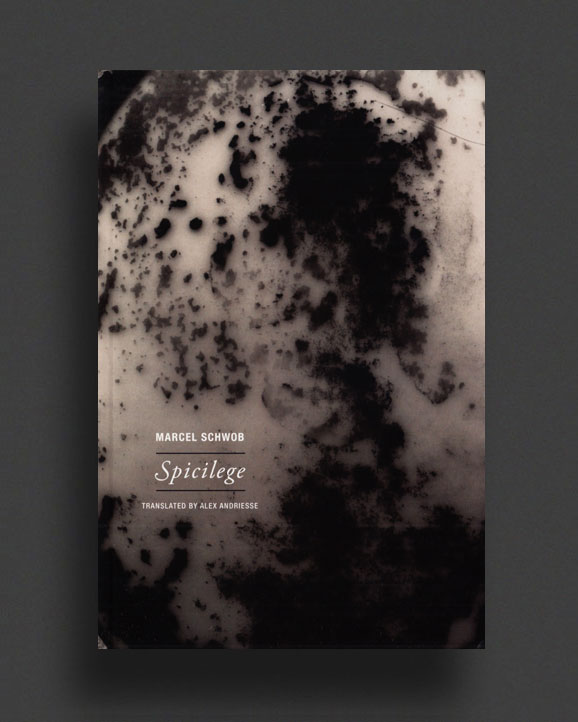
Exquisitely crafted essays on medieval criminal slang, ancient Greek prostitution, laughter, anarchy and more from the endlessly influential Marcel Schwob.
"All over the world," wrote Jorge Luis Borges, "there are devotees of the writer Marcel Schwob who constitute little secret societies." Spicilege, Schwob's last book published under his name, constitutes the handbook to these societies--to Schwob's work, to himself as erudite scholar and author, and to the twilight of the era of French Symbolism. Schwob was, as Paul Léautaud described him, a "living library," and the critical biographies gathered in the essays of Spicilege display a few of the volumes in that library: his groundbreaking research on François Villon (work that remains a cornerstone to our knowledge of Villon), his passion for Robert Louis Stevenson and his encounters with such less-remembered writers as George Meredith. But it is the carefully developed ideas in these essays and the eccentric yet thorough scholarship that draws them together that are of particular interest today: the understanding of criminal slang in the Middle Ages; the study of prostitution in ancient Greece; the folklore inspired by a Flaubert story; a complex critique of individuality that effectively laid the groundwork for Jarry's "pataphysics"; as well as ruminations on perversity, laughter, biography, love, terror and pity, and art and anarchy.
Marcel Schwob (1867-1905) was a scholar of startling breadth, an incomparable storyteller and a secret influence on generations of writers, from Apollinaire and Borges to Roberto Bolaño and J. Rodolfo Wilcock.
Translated by Alex Andriesse.
2022, English
Softcover, 208 pages, 13.7 x 20.3 cm
Published by
Wakefield Press / Cambridge
$44.00 - In stock -
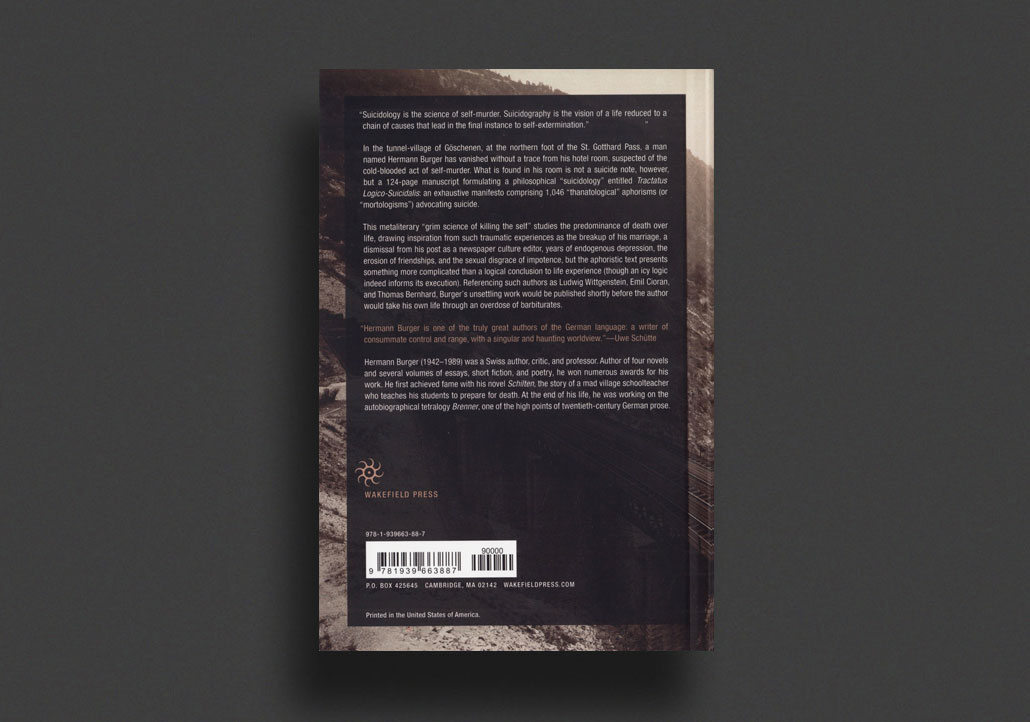
"Hermann Burger is one of the truly great authors of the German language: a writer of consummate control and range, with a singular and haunting worldview."—Uwe Schütte
In the tunnel-village of Göschenen, a man named Hermann Burger has vanished without a trace from his hotel room, suspected of suicide. What is found in his room is not a note, but a 124-page manuscript entitled Tractatus Logico-Suicidalis: an exhaustive manifesto comprising 1,046 "thanatological" aphorisms (or "mortologisms") advocating suicide.
This "grim science of killing the self" studies the predominance of death over life, in traumatic experiences such as the breakup of a marriage, years of depression, the erosion of friendships and the disgrace of impotence--but the aphoristic text presents something more complicated than a logical conclusion to life experience. Drawing inspiration from such authors as Wittgenstein, Cioran and Bernhard, Burger's unsettling work would be published shortly before the author would take his own life.
Hermann Burger (1942-89) was a Swiss author, critic and professor. Author of four novels and several volumes of essays, short fiction and poetry, he first achieved fame with his novel Schilten, the story of a mad village schoolteacher who teaches his students to prepare for death. At the end of his life, he was working on the autobiographical tetralogy Brenner, one of the high points of 20th-century German prose. He died by overdose days after the first volume's publication.
Translated by Adrian Nathan West
2005, English
Softcover, 272 pages, 20.3 x 14 cm
Published by
Soft Skull Press / New York
$35.00 - Out of stock
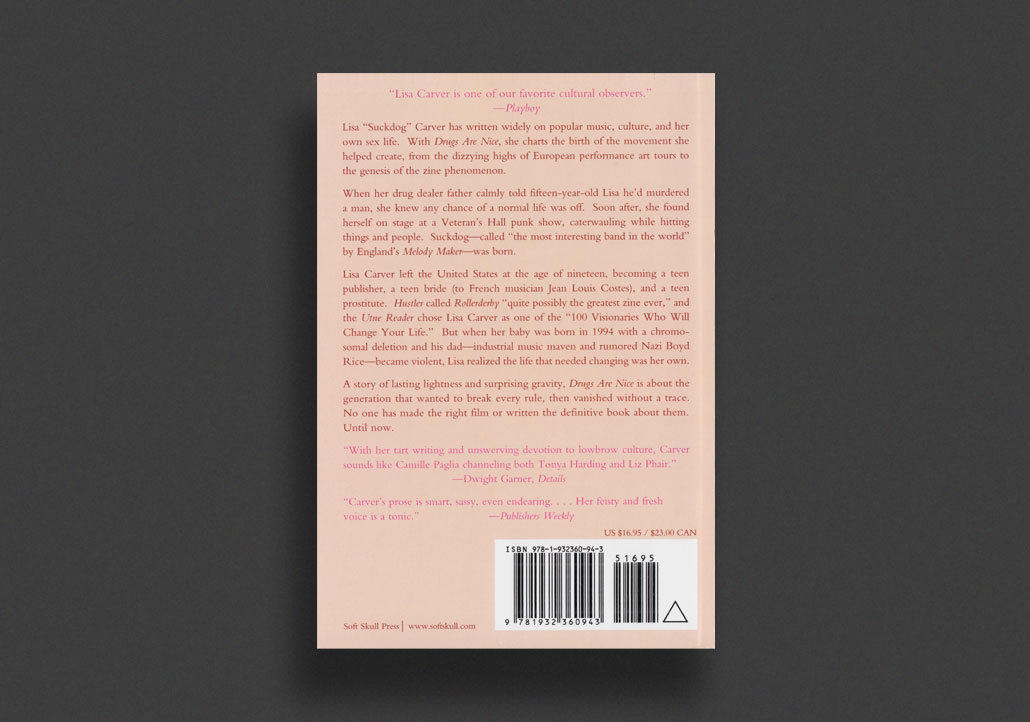
In this eye-opening memoir, Lisa Crystal Carver recalls her extraordinary youth and charts the late-80s, early-90s punk subculture that she helped shape. She recounts how her band Suckdog was born in 1987 and the wild events that followed: leaving small-town New Hampshire to tour Europe at 18, becoming a teen publisher of fanzines, a teen bride, and a teen prostitute. Spin has called Suckdog's album Drugs Are Nice one of the best of the '90s, and the book includes photos of infamous European shows. Yet the book also tells of how Lisa saw the need for change in 1994, when her baby was born with a chromosomal deletion and his father—industrial music maven and rumoured Nazi Boyd Rice—became violent. With lasting lightness and surprising gravity, Drugs Are Nice is a definitive account of the generation that wanted to break every rule, but also a story of an artist and a mother becoming an adult on her own terms.
2021, English
Hardcover (w. obi-strip), 292 pages, 28 x 22 cm
Published by
Walther König / Köln
Museum Folkwang / Essen
$160.00 - Out of stock
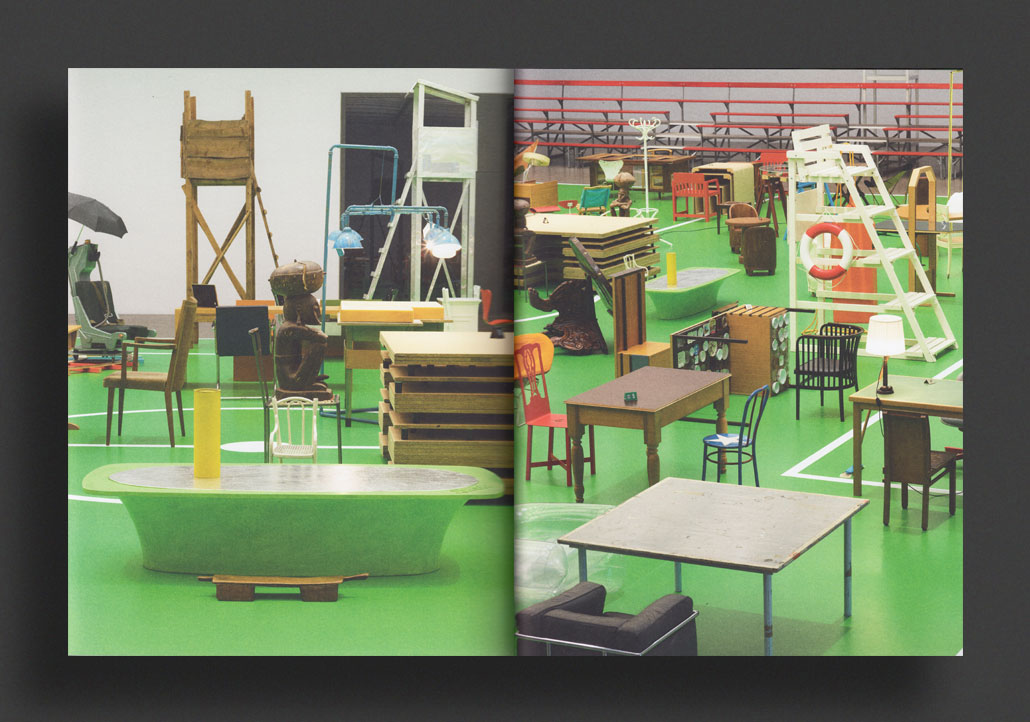
A detailed documentation of Kippenberger’s epic masterpiece. Kippenberger's largest and most complex work, The Happy End of Franz Kafka’s "Amerika" explores a utopia of universal employment, based on a section from Kafka’s titular novel in which the protagonist, Karl Rossmann, applies for a job at the “biggest theater in the world”: “whoever wants to become an artist should sign up!”.
Kippenberger spent several years preparing, researching and producing the epic installation, set out on a stylized football pitch, and made up of 50 table-and-chair ensembles. Alongside classic design icons and found objects, it also includes furniture especially produced by Kippenberger, as well as pieces by numerous artist friends, including Cosima von Bonin, Tony Oursler, Ulrich Strothjohann and Jason Rhodes. This profusely illustrated hardcover publication examines the work, and includes, for the first time, “biographies” of the individual objects, tracing the contexts of their creation, collection and integration into the installation.This volume therefore constitutes the definitive documentation of The Happy End of Franz Kafka’s "Amerika" and offers a new way to approach Martin Kippenberger’s life and oeuvre.
Published on the occasion of the exhibition at Museum Folkwang, Essen (2021).
1968, English
Softcover (folded leaflet), 4 pages, 20 x 17 cm
1st Edition, Out of print title / used / average
Published by
Students for a Democratic Society (SDS) / Sydney
$100.00 - In stock -
Printed and distributed at demonstrations by Students for a Democratic Society (SDS) and the SSDA, in Sydney, Melbourne and South Australia, circa mid-to-late 1968, this four-paged, newsprint anti-conscription leaflet highlights the choice Australian's can make to oppose the unjust National Service Act and outlines the alternatives, consequences and achievements of objecting.
"Follow the principles which have guided Jesus, Gandhi, Martin Luther King, and Dr. Benjamin Spock in disobedience for conscience refuse to register for National Service"
By calling on young men to refuse to register for National Service, the signatories were in clear breach of Federal law. To minimise the risk of arrest, the brochure was ‘authorised’ by a significantly large number of people, listed on the back of the brochure alongside Conscientious Objectors Advisory Committees contacts.
"Absolute non-co-operation with unjust laws is the way they will be changed"
A wonderful historical piece of Australian ephemera from the anti-war movement.
Average tanned copy, softened with age, light old creases, marking.
2018, English
Softcover, 216 pages, 255 x 192 mm
Published by
Surpllus / Melbourne
$40.00 - Out of stock
Comprehensive monograph on the work of Australian artist Damiano Bertoli.
"Melbourne artist Damiano Bertoli is best known for the ongoing series ‘Continuous moment’, a multidisciplinary practice that offers a paratactic investigation of artistic experiments, social projects and theoretical legacies that inform the history of modernism and contemporary art. At the centre of much of this thought and production is a delirious pragmatism that draws on material as diverse as Pablo Picasso’s 1941 surrealist play Le desire attrape par la queue (Desire caught by the tail), originally performed under the shadow of Nazi occupation, the aspirational practices of Superstudio (1966–78), which sought to live without architecture, and the occultism of the homicidal sect led by Charles ‘Willis’ Manson. What is decisive, in any case, is that for Bertoli the unity of this practice resides in a display methodology that echoes a number of avant-garde principles that question the backward looking gaze." - Nik Papas
Published by Surpllus. Designed by Ziga Testen, Edited by Brad Haylock.
Profusely illustrated throughout in colour and black and white, with accompanying essays by Justin Clemens, Helen Hughes, Helen Johnson, Nik Papas, Chris Sharp, Liza Vasiliou.
2017, English
Hardcover, 336 pages
Published by
Surpllus / Melbourne
Westspace / Melbourne
$30.00 - In stock -
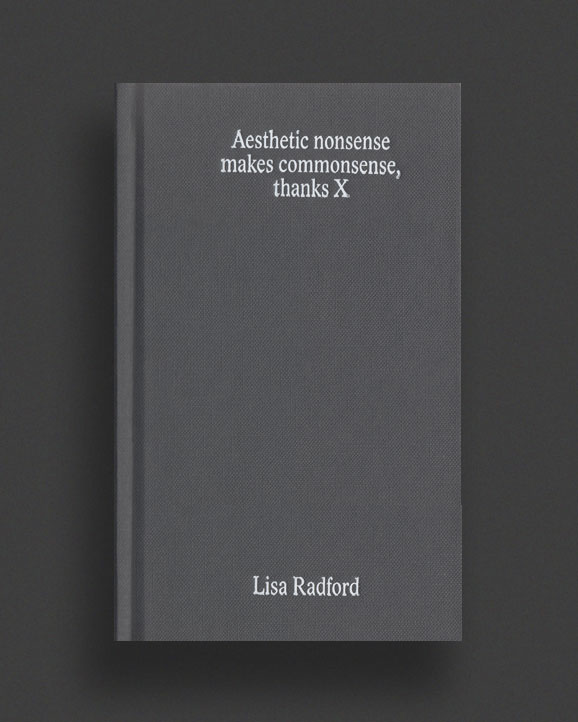
For the past twenty years, Lisa Radford has written alongside (and sometimes about) contemporary art and artists in Melbourne. Along the way, her fictocriticism has captured many minor local histories that speak to politics, friendship, popular culture and a myriad of other subjectivities.
Aesthetic nonsense makes commonsense, thanks X brings together a selection of over fifty texts, including catalogue essays for Centre for Style, David Shrigley and Blair Trethowan, alongside other texts previously published in contemporary art journals including Art & Australia, Discipline and un Magazine.
Co-published by Surpllus and West Space, the publication includes contributions from Geoff Lowe & Jacqueline Riva (A Constructed World), Fiona Macdonald and Jarrod Rawlins. Designed and edited by Brad Haylock with editorial assistance by Robert Shumoail-Albazi.
2022, English
Hardcover, 240 pages, 30 x 30 cm
Published by
Fantagraphics / Seattle
$125.00 - Out of stock
Drawn from private collections around the world, this is the first comprehensive collection of the Saturn label’s printed record covers, along with hundreds of the best hand-designed, one-of-a-kind sleeves and disc labels decorated by Sun Ra and members of his Arkestra.
Considered the foremost exponent of Afrofuturism, Sun Ra mastered a wide array of styles that spanned jazz, R&B, exotica, Afro-hybrids, electronic, big band, solo piano, orchestral, experimental, and chamber works. In his 45-year recording career, he issued an epic number of albums and he was one of the first Black musicians to own an independent label, which he named Saturn, after the planet on which he claimed to have been born. The covers of Saturn LPs, issued from 1957 to 1988, are iconic—some rolled off commercial printing presses but many were hand-crafted. These records were sold at concerts, club dates, and by mail order. As collectibles, original handmade Saturn covers sell for hundreds, sometimes thousands, of dollars. More than just packaging for a slab of vinyl, they are works of art in their own right.
Sun Ra: Art on Saturn is the first comprehensive collection of all Saturn printed covers, along with hundreds of the best hand-designed, one-of-a-kind sleeves and disc labels, decorated by Ra himself and members of his Arkestra. Essays by Sun Ra catalog preservationist Irwin Chusid, noted Ra scholar John Corbett, and Glenn Jones, who in the 1970s signed Ra to a distribution deal that put countless homemade covers into circulation, add unique insights into the interplanetary life and work of Sun Ra and his Saturn partner Alton Abraham.
Historians have written extensively about Sun Ra and his music. This book is a tribute to the covers and to the uncredited visual artists and their rich imaginations. From the simple to the baroque to the absurd, the covers that sheathed Ra's discs reflect the tenaciousness of a genius who refused to compromise or relinquish control of his destiny.
2021, English
Softcover, 292 pages, 14 x 20 cm
Published by
Blank Forms / New York
$33.00 - In stock -
The life and work of American experimental musician/composer/intermedia artist Jerry Hunt.
Jerry Hunt was among the most eccentric figures in the world of new music. A frenetic orator, occultist and engineering consultant, his works from the 1970s through the early '90s made use of readymade sculptures, medical technology, arcane talismans and all manner of homemade electronic implements to form confrontational recordings and enigmatic, powerful performances. Tracing Hunt's life across his home state's major cities to a self-built house in rural Van Zandt County, this memoir-cum-biography by Stephen Housewright, Hunt's partner of 35 years, offers illuminating depictions of Hunt's important installations and performances across North America and Europe.
Housewright narrates a lifetime spent together, beginning in high school as a closeted couple in an East Texas and ending with Hunt's battle with cancer and his eventual suicide, the subject of one of his most harrowing works of video art. This highly readable narrative contains many private correspondences with, and thrilling anecdotes about, Hunt's friends, family, and collaborators, including Joseph Celli, Arnold Dreyblatt, Michael Galbreth, Karen Finley, James and Mary Fulkerson, Guy Klucevsek, Pauline Oliveros, Paul Panhuysen, Annea Lockwood, and the S.E.M. Ensemble.
Stephen Housewright is a writer, librarian, and teacher.
Jerry Hunt (1943–1993) is often described as a shamanic figure with the look of a Central Texas meat inspector. One of the most compelling composers in the world of late-twentieth-century new music, he made work that combined video synthesis, installation art, and early computers with rough-hewn sculptures, scores drawn from celestial alphabets, and homemade electronics activated by his signature wands and impassioned gestures. Hunt lived his entire life in Texas, eventually settling in a house ("an interactive environment") he built with his partner, Stephen Housewright, in a rural area outside Canton; but his pataphysical, abrasive, and humorous performances took him across North America and Europe, where he amassed a small but dedicated following.
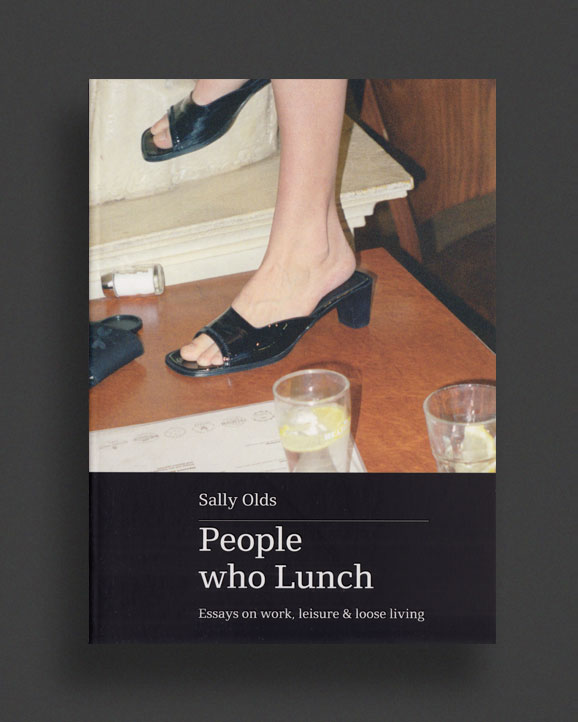
2022, English
Softcover, 144 pages, 21 x 15 cm
$30.00 - Out of stock
This book is about working and not working, hating work and needing to work, intimacy and technology, money and love, labour and pleasure. Across a series of essays, Sally Olds probes the ambivalent utopias of polyamory, cryptocurrency, clubbing, communes, a secret fraternity, and the essay form itself. Curiosity drives each of these adventures into projected worlds, where Olds explores how living with precariousness changes expectations of how a life can be lived in this thrilling appraisal of the state of things.
Sally Olds is a writer from Queensland living in Naarm/Melbourne. Her work has been published by Sydney Review of Books, un Magazine, AQNB, the Institute of Modern Art, collected in anthologies, and shortlisted for the Griffith Review’s Emerging Voices Competition and the Sydney Review of Books/Copyright Agency’s Emerging Critics Fellowship. She has collaborated extensively with Precog, a club night held in Narrm, and taught writing workshops in and outside of university. This is her first book.
"This is an utterly riveting and original collection of essays – hard-thinking, formally innovative, dazzling intellectually and sentence by sentence out-of-this-world good." — Maria Tumarkin
Cover artwork: Tim Hardy, Idols, 2019. Digital c-print.
1972, Japanese
Softcover, 214 pages, 20.8 x 14.7 cm
1st Edition, Out of print title / used / good
Published by
Tokyo Sanseisha / Tokyo
$120.00 - Out of stock
"Sadistic Play of Bondage"
Very rare 1972 special photobook edition of legendary cult kinbaku magazine SM Select. A beautiful volume, packed cover to cover with full-bleed bondage photography in saturated 1970s colour and b/w, printed on textured stocks, showcasing the talents of famous Japanese actresses and models such as Reiko Ike, Yuri Izumi, Naomi Tani, Junko Miyashita, Nana Minami, and many more. Barely any text, just photos!
First published in 1970, SM Select fast become the leading magazine that sparked the SM magazine boom in the 70's and 80's in Japan. Nobuyuki Miyasaka, Hiroshi Senda, Toshiyuki Suma (Uramado, Kitan Club), etc. and others were all founding members of the magazine, but with the growing popularity of SM culture and magazines during this period, many contributors went on to establish other SM publishing ventures — Shin Miyasaka and Toshiyuki Suma established Sun Publishing and launched SM Collector, while Seiko Ishikawa and three others from Tokyo Sanseisha moved to Shishobo and launched SM Fan. SM Select run for 20 years, ending in 1990.
Building from the foundations of its predecessors Kitan Club and Uramado, SM Select contained a harder, non-conformist and fanatic edge, featuring writings with more lavish visual SM content — photographs and artworks in colour and black and white. The high quality of photography and artwork ushered in a new era of SM publishing, with SM Select featuring many now legendary artists, including Haruo Shinozaki, Jun Yoshida, Toshio Saeki, Kazuyuki Minori, Minoru Nagao, Ruyo Yo, Yasuharu Maeda, Mino Mura Akira, Hiro Kato, Nishimura Haruhi, Kozumi Yuko, Kito Akatsuki, Oshima Yukio, Kirigaoka Hiroyuki, Lin Moonlight, Maeda Yasunari, Yuya Nohira, Nakao Kaoru, etc. Major contributors were Dan Oniroku and Aotaro Aki. The principal rope master was Toshiyuki Suma. Rope master and writer Chimuo Nureki had several guest appearances in the magazine and took over as principal master when Mr. Suma fell ill. Photographer Norio Sugiura was the main photographer in the magazine from the 1980s.
Average—Good copy with some cover creases and spine crease, light wear, old fragile binding.
1974, Japanese
Softcover, 202 pages, 21 x 15 cm
1st Edition, Out of print title / used / very good
Published by
Kubo Shoten / Japan
$70.00 - Out of stock
February 1974, rare early issue of Suspense Magazine, the cult Japanese kinbaku magazine founded in 1965 and running for 15 years, edited by Haruo Shimamoto and Chimuo Nureki, packed with illustrated SM stories, lavish colour and b/w fetish artwork, sadistic cartoons, and gorgeous bondage photo spreads and vivid colour photographic fold-outs. This issue features bondage master Haruo Shimamoto, art feature by the legendary kinbaku/tattooed lady illustrator Kaname Ozuma, Akira Kito, Kazumu Kohinata, Toshiro Tama, stories by Aotaro Aki, Kaoru Fujimi, Higashiho Mitsuya, and many others.
Good—VG copy with light wear.
1998, Japanese
Softcover, 310 pages, 21 x 15 cm
1st Edition, Out of print title / used / very good
Published by
Million Publishing / Tokyo
$80.00 - Out of stock
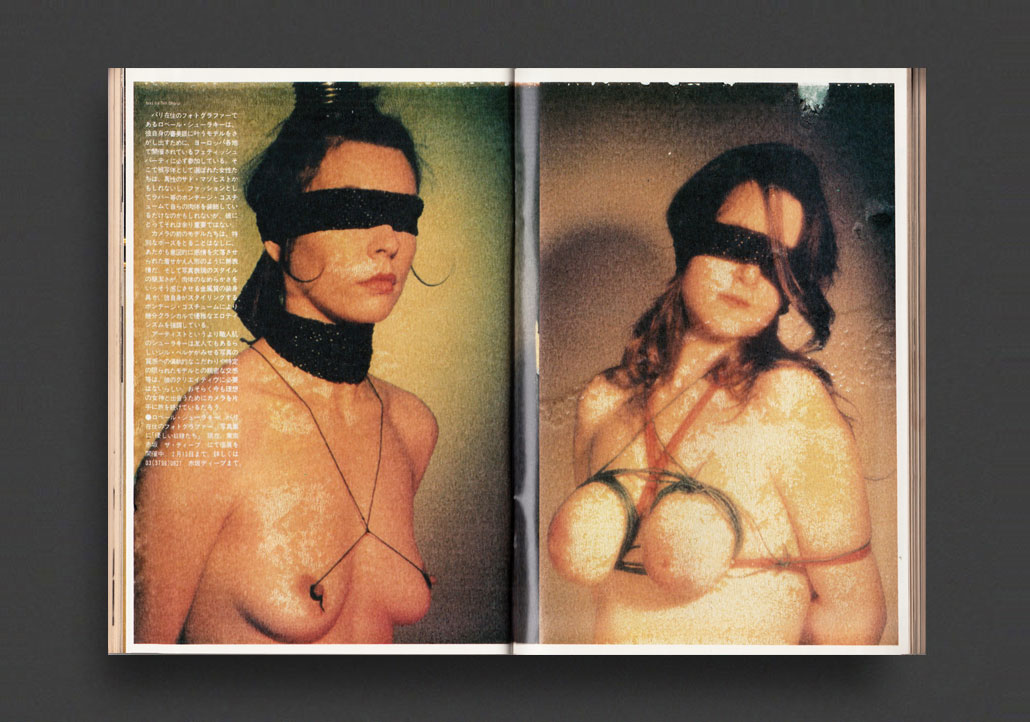
January 1998 issue of S&M Sniper, the cult glossy fetish magazine published in Japan between 1979 - 2009 that, unlike previous SM magazines, didn't centre so much around professional kinbakushi, favouring instead the exploration of new innovations of fetish and underground sex culture and emphasising the work of the models, stylists, make-up artists, and fashions designers, as much as the writers or photographers. The "new wave" of SM culture, embedded in 1980s underground music, fashion and visual art culture in Japan. Explicitly and profusely illustrated, issues are packed from cover-to-cover with all manner of SM and fetish photoshoots, illustrations, comics, essays, diaries, reports, exhibitions, reviews, interviews, and included regular contributors such as Masami Akita (Merzbow), Kazuo Kamimura, Domu Kitahara, Makoto Orui, Kinichi Tanaka, Nobuhiko Ansai, Masaaki Toyoura... Each issue is also brimming with amazing Japanese advertisements and classifieds for the latest bondage clubs, boutiques, fashion, toys, video and publication catalogues, hook-ups, phone sex, and much more. This issue includes Nobuyoshi Araki, Takashi Homma, Ken-ichi Murata, Masami Akita, Toyoura Masaaki, Aki Tanaka, Koji Nakano, Junko Takahashi, Tetsuo Amano, Domu Kitahara, Mayumi Oda, Gaijin Tokuno, all the usual and more... Not for the faint of heart.
Very Good copy.
1993, Japanese
Softcover, 300 pages, 21 x 15 cm
1st Edition, Out of print title / used / very good
Published by
Million Publishing / Tokyo
$80.00 - Out of stock
March 1993 issue of S&M Sniper, the cutting-edge cult glossy fetish magazine published in Japan between 1979—2009 that, unlike previous SM magazines, didn't centre so much around professional kinbakushi, favouring instead the exploration of new innovations of fetish and underground sex culture and emphasising the work of the models, stylists, make-up artists, and fashions designers, as much as the writers or photographers. The "new wave" of SM counterculture, embedded in 1980s underground music, fashion and visual art culture in Japan. Explicitly and profusely illustrated, each issue came wrapped in the iconic hyper-stylized airbrushed front covers of artist Yosuke Onishi, veiling the core content of non-fiction realist degradation and an eclectic, expressive editorial of kinbaku and all manner of SM, and extreme fetish photoshoots, illustrations, comics, essays, diaries, reports, exhibitions, reviews, interviews, and included regular contributors such as SM archivist and noise musician Masami Akita (Merzbow), legendary SM writer and editor Dan Oniroku ("the most celebrated writer of popular SM novels in Japan"), features by legendary SM and seppuku performer, actress, and author Hiromi Saotome, features by contributing photographers Nobuyoshi Araki, Masaaki Toyoura, Kenichi Murata, Nobuhiko Ansai, Kinichi Tanaka, Domu Kitahara, sadistic BDSM trainer Shima Shikou, and regular writings by convicted murderer and cannibal Issei Sagawa!! Including his translations of Guido Crepax comics from Italian to Japanese. This was not a magazine like the others. Each issue is also brimming with amazing Japanese advertisements and classifieds for the latest bondage clubs, boutiques, dungeons, fashion, toys, video and publication catalogues, hook-ups, phone sex, and much more. This issue includes Nobuyoshi Araki, Kiyoshi Ikejiri, Yosuke Onishi, Domu Kitahara, Tadao Chigusa, Kenichi Yamakawa, Shima Shikou, Aki Ryo, Kinichi Tanaka, Wakao Takahashi, Chihiro Abe, Robert Mapplethorpe, Takashi Ishii, Hiroyuki Tanino, all the usual and more... Not for the faint of heart.
Very Good copy.
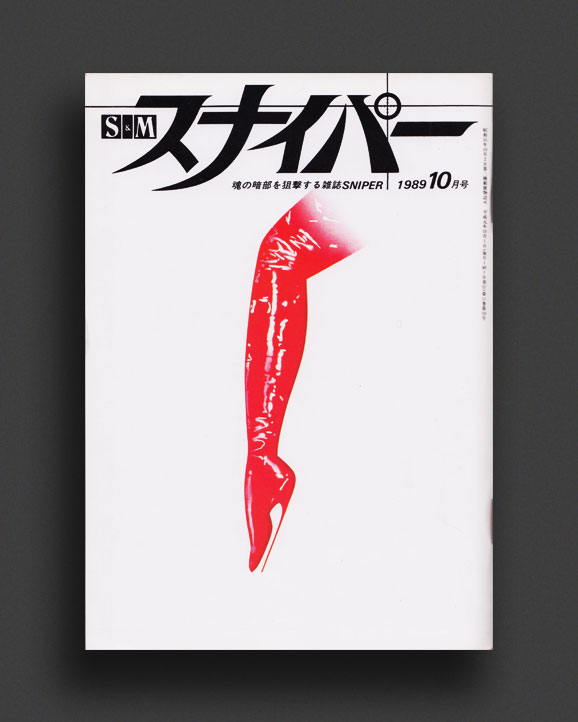
1989, Japanese
Softcover, 310 pages, 21 x 15 cm
1st Edition, Out of print title / used / very good
Published by
Million Publishing / Tokyo
$80.00 - Out of stock
October 1989 issue of S&M Sniper, the cult glossy fetish magazine published in Japan between 1979 - 2009 that, unlike previous SM magazines, didn't centre so much around professional kinbakushi, favouring instead the exploration of new innovations of fetish and underground sex culture and emphasising the work of the models, stylists, make-up artists, and fashions designers, as much as the writers or photographers. The "new wave" of SM culture, embedded in 1980s underground music, fashion and visual art culture in Japan. Explicitly and profusely illustrated, issues are packed from cover-to-cover with all manner of SM and fetish photoshoots, illustrations, comics, essays, diaries, reports, exhibitions, reviews, interviews, and included regular contributors such as Masami Akita (Merzbow), Kazuo Kamimura, Domu Kitahara, Makoto Orui, Kinichi Tanaka, Nobuhiko Ansai, Masaaki Toyoura... Each issue is also brimming with amazing Japanese advertisements and classifieds for the latest bondage clubs, boutiques, fashion, toys, video and publication catalogues, hook-ups, phone sex, and much more. This issue includes Tadao Chigusa, Nobuyoshi Araki, Tsuguya Inoue, Joel Peter-Witkin, Robert Mapplethorpe, Wilhelm von Gloeden, Keizo Miyanishi, Sayoko Nakajima, all the usual and more... Not for the faint of heart.
Very Good copy.
1983, Japanese
Softcover, 250 pages, 21 x 15 cm
1st Edition, Out of print title / used / very good
Published by
Million Publishing / Tokyo
$80.00 - Out of stock
November 1983 issue of S&M Sniper, the cult glossy fetish magazine published in Japan between 1979 - 2009 that, unlike previous SM magazines, didn't centre so much around professional kinbakushi, favouring instead the exploration of new innovations of fetish and underground sex culture and emphasising the work of the models, stylists, make-up artists, and fashions designers, as much as the writers or photographers. The "new wave" of SM culture, embedded in 1980s underground music, fashion and visual art culture in Japan. Explicitly and profusely illustrated, issues are packed from cover-to-cover with all manner of SM and fetish photoshoots, illustrations, comics, essays, diaries, reports, exhibitions, reviews, interviews, and included regular contributors such as Masami Akita (Merzbow), Kazuo Kamimura, Domu Kitahara, Makoto Orui, Kinichi Tanaka, Nobuhiko Ansai, Masaaki Toyoura... Each issue is also brimming with amazing Japanese advertisements and classifieds for the latest bondage clubs, boutiques, fashion, toys, video and publication catalogues, hook-ups, phone sex, and much more. This issue includes Nobuyoshi Araki, Oniroku Dan, Aki Uchiyama, Fumika Kitahara, all the usual and more... Not for the faint of heart.
Very Good copy.
2015, Japanese / English
Softcover (silkscreened cover), 40 pages, 21 x 30 cm
1st Edition, Out of print title / used / very good
Published by
Akio Nagasawa Gallery / Tokyo
$240.00 - Out of stock
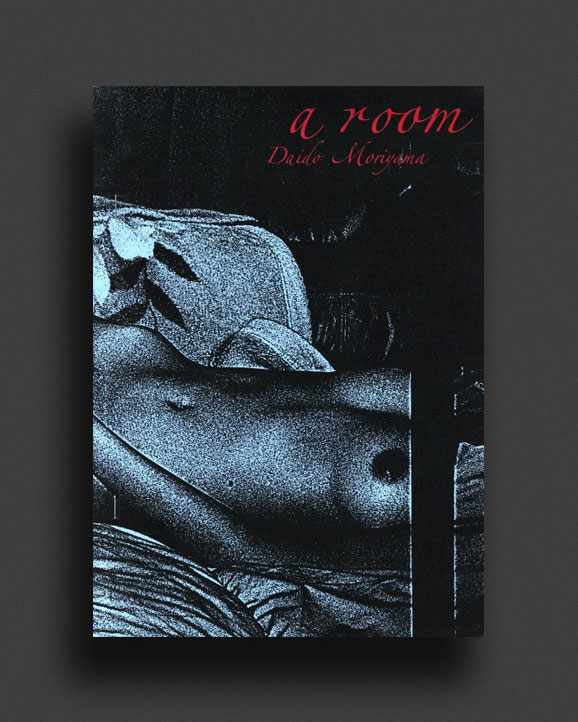
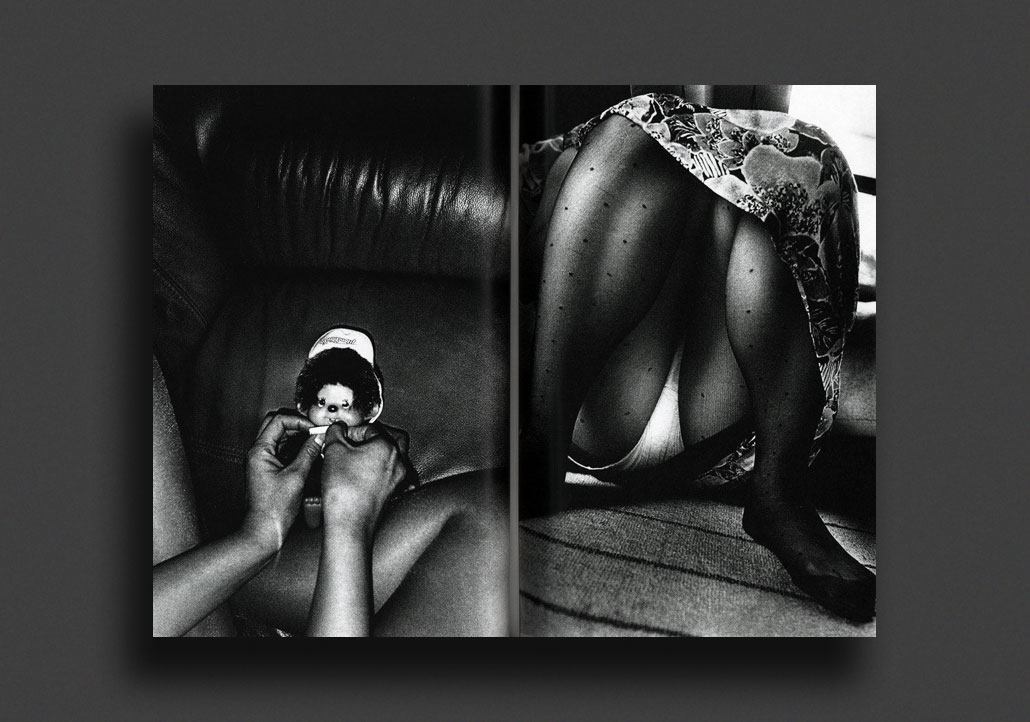
Signed limited edition of A Room by Daido Moriyama, published in 2015 by Akio Nagasawa Publishing. A very special photo book in variation. Created at a printing event at Akio Nagasawa Gallery in 2015, in homage to Moriyama's 1974 Printing Show performance, a selection of images were selected from a series of erotically charged photographs of female nudes and domestic items and assembled in various orders to create numerous page sequences for the print-runs. Features 2 different silkscreened covers that were available in a limited edition of 250 signed/numbered copies each. A lovely publication.
Daido Moriyama (Ikeda, Osaka, 1938) lives and works in Tokyo.He first trained in graphic design before taking up photography under Takeji Iwamiya and Eikoh Hosoe as an assistant.He became an independent photographer in 1964, publishing Nippon Gekijō Shashinchō (Japan Theater Photo Album) in 1968 and Shashin yo Sayounara (Farewell Photography) in 1972; the work showed the darker sides of urban life and the city.He has had a radical impact on the photographic and art world in both Japan and in the West, with his expressive style of 'are, bure, boke' (rough, blurred and out-of-focus) and of quick snapshots without looking in the viewfinder. Solo shows at New York's Metropolitan Museum of Art and the Fondation Cartier pour l'Art Contemporain in Paris solidified Moriyama's worldwide reputation, and in 2012, he became the first Japanese to be awarded in the category of Lifetime Achievement at the 28th Annual Infinity Awards hosted by the International Center of Photography (ICP) in New York.
Signed by Daido Moriyama.
2018, Japanese / English / Chinese
Softcover, 3 volumes plus supplement, printed plastic bag
1st Edition, Out of print title / as new
Published by
NITESHA / Tokyo
$280.00 - In stock -
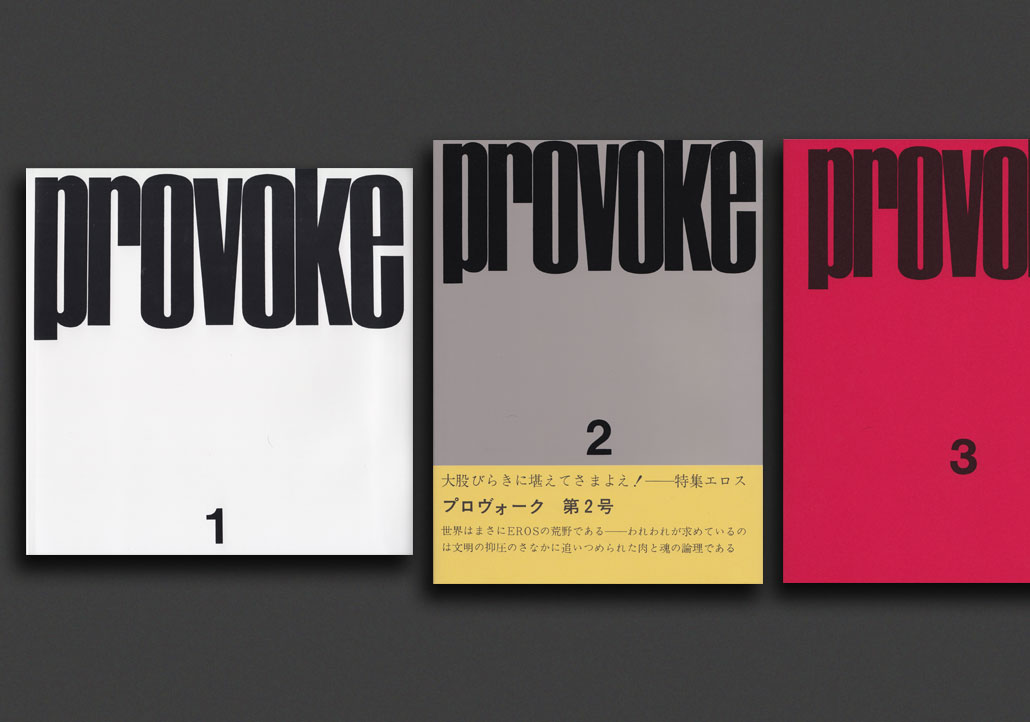
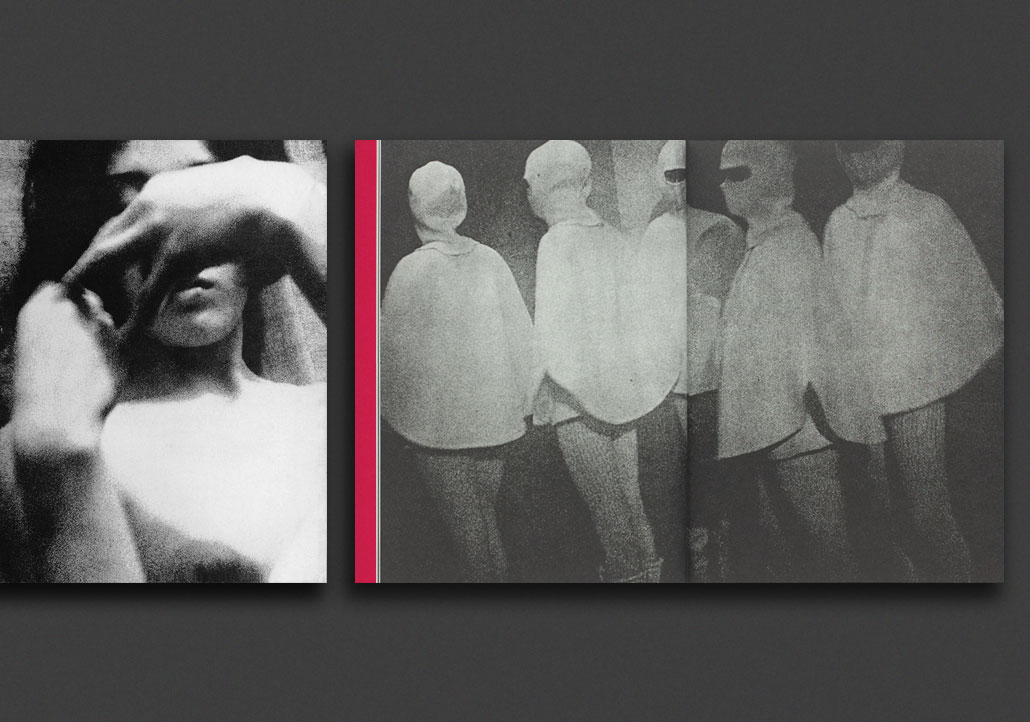
First, quickly out-of-print, complete limited-edition facsimile of all three issues the ground-breaking Japanese photography magazine Provoke. The short-lived Provoke, founded in 1968 by art critic Koji Taki (1928-2011), photographer Takuma Nakahira (1938-2015), poet Takahiko Okada (1939-1997), photographer Yutaka Takanashi, and later joined by Daido Moriyama, is nowadays recognized as a major contribution to postwar photography in Japan, featuring the country's finest representatives of protest photography, vanguard fine art and critical theory in only three issues ever published.
In 2018, marking the 50th year since Provoke had first appeared, this special edition was published by NITESHA, a secondhand bookshop in Tokyo who were fortunate to be able to purchase all three volumes of the original prints. Rather than merely putting them back on the market again for profit, they decided to make a reprint of these extremely rare and inaccessible issues that are currently only owned by a limited number of connoisseurs. Striving to stay as close to the original publications as possible, all three issues are accompanied by a supplementary volume containing all the original Japanese texts (essays, poetry, etc.) translated into both English and Chinese, including those by Takahiko Okada (excluded from Steidl's “The Japanese Box” reissue due to copyright issues). This facsimile reprint also maintains the original size of all of the images (unlike the cropped Steidl “The Japanese Box” reissue), making it the closest thing to the seldom seen originals.
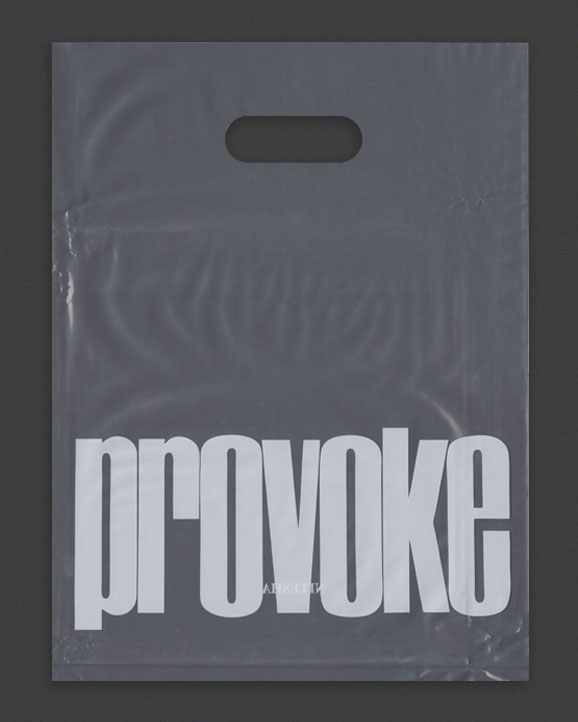
Comes housed in the publisher's limited edition "Provoke" printed plastic bag, as first issued, making it a most complete copy of this book-set.
Provoke's goal was to mirror the complexities of Japanese society and its art world of the 1960s, a decade shaped by the country's first large-scale student protests. The subtitle for the magazine was “Provocative Materials for Thought,” and each self-published issue was composed of photographs, essays and poems. The movement yielded a wave of new books featuring innovative graphic design combined with photography: serialized imagery, gripping text-image combinations, dynamic cropping and the use of provocatively "poor" materials. The writings and images by Provoke's members - Taki, Nakahira, Okada, Takanashi and Moriyama - were suffused with the tactics developed by Japanese protest photographers such as Nobuyoshi Araki, Eikoh Hosoe and Shomei Tomatsu, who pointed at and criticized the mythologies of modern life. Provoke’s grainy, blurry, and out-of-focus photographs were initially ridiculed as are-bure-boke (a Japanese term meaning, literally, “rough, blurred and out-of-focus”) and stirred a great deal of controversy, yet it had created a strong impact inside and outside of the photography world during that time and its influence cannot be overstated.
PROVOKE 1: Softcover, 68 pages, 21 x 21 cm
PROVOKE 2: Softcover (w. printed wrap-around obi strip), 110 pages, 24.2 x 18 cm
PROVOKE 3: Softcover, 110 pages, 24 x 18.4 cm.
PROVOKE Textbook (English and Chinese translations), 24 x 18.4 cm
As New. This edition is now out-of-print, further re-prints have been made.
2022, English
Softcover, 144 pages, 2 colour Risoprint, 110 x 165 mm
Edition of 150,
Published by
Discipline / Melbourne
$30.00 - Out of stock
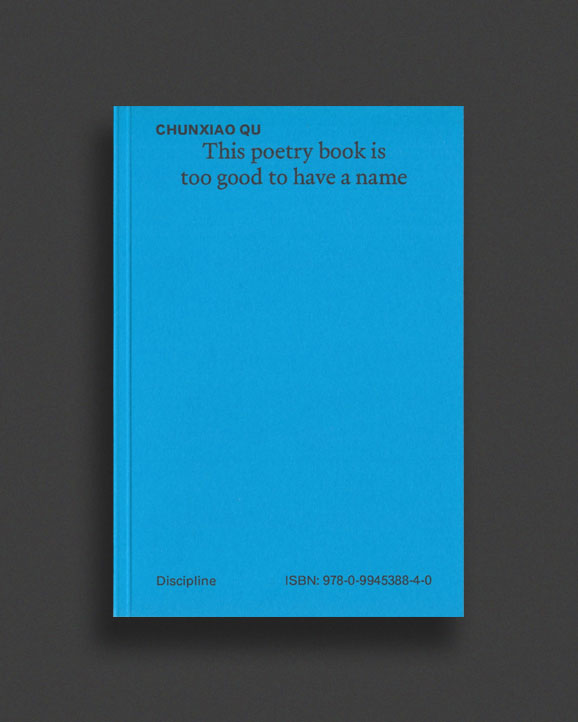
Two books of poetry by Melbourne artist Chunxiao Qu bound into one volume.
Co-edited by Helen Hughes and Amy Stuart, with contributing writers Autumn Royal and Juhani Yli-Vakkuri. Designed by Zenobia Ahmed.