World Food Books' programme is largely produced on Kulin Nation land. We acknowledge the Wurundjeri people of the Kulin Nation as the first and continuing custodians of this land, and pay respect to their Elders past, present, and emerging.
World Food Books is an arts and special interests bookshop in Naarm / Melbourne. Founded in 2010, World Food Books is devoted to the presentation of a rotating, hand-selection of international art, design, literary and counterculture publications with an emphasis on the anti-traditional, the experimental, the avant-garde, the heretic, the marginal.
Presenting new titles alongside rare and out-of-print books, catalogues and journals spanning the fields of modern and contemporary art, design, photography, illustration, film, literature, poetry, cultural theory, philosophy, sexuality, popular and underground culture in its many radical forms, World Food Books wishes to encourage adventurous, thoughtful and open-minded reading, looking, writing, and exchange of publishing and ideas, both current and historical.
As well as our bookshop, located in Melbourne's historical Nicholas Building, all of our inventory is available internationally via our online mail-order service.
World Food Books semi-regularly co-ordinates "Occasions", a programme of exhibits and events at the bookshop and in partnership with other hosts (such as museums and art galleries) that develop out of the activities, relationships and content of the bookshop itself.
World Food Books
The Nicholas Building
37 Swanston Street
Room 5, Level 6
Melbourne 3000
Australia
SHOP HOURS:
Thu–Fri 12–6, Sat 12–5
WEB-SHOP OPEN 24/7
World Food Books
Postal Address:
PO Box 435
Flinders Lane
Victoria 8009
Australia
Art
Theory / Essay
Architecture / Interior
Graphic Design / Typography
Photography
Fashion
Eros
LGBTQ+
Fiction / Poetry
Weird / Speculative / Science Fiction / Horror
Transgressive / Visceral / Abject
Symbolism / Decadence / Fin de siècle
Film / Video
Painting
Sculpture / Installation
Performance / Dance / Theater
Drawing
Sound / Music
Curatorial
Group Shows / Collections
Periodicals
Out-of-print / Rare
Posters / Ephemera / Discs
Signed Books
World Food Books Gift Voucher
World Food Book Bag
Australian Art
Australian Fiction
Australian Science Fiction / Speculative Fiction
Australian Poetry
Australian Photography
Japanese Photography
Conceptual Art
Minimal Art
Dada
'Pataphysics / Oulipo
Fluxus
Concrete Poetry
Pop Art
Surrealism
Arte Povera
Arte Informale / Haute Pâte / Tachism
Nouveau Réalisme / Zero / Kinetic
Situationism / Lettrism
Collage / Mail Art / Xerox Art
Art Brut / Folk / Visionary / Fantastic
Illustration / Graphic Art / Bandes Dessinées
Furniture
Italian Radical Design / Postmodernism
Textiles
Ceramics / Glass
Counterculture
Protest / Revolt
Philosophy
Psychoanalysis
Anthropology
Anarchism
Socialism / Anarchism / Communism / Capitalism
Literary Theory / Semiotics / Language
Feminism / Women's Studies
Gender Studies / Sexuality
Anthropology
Fetishism / BDSM
Drugs / Psychedelia
Crime / Violence
Animal Rights / Veganism
Occult / Esoterica
Ecology / Earth / Alternative Living
Whole Earth / Crafts
All prices in AUD (Australian dollars)
Pick-Ups
Pick-up orders can be collected in our bookshop during opening hours after order date. Please collect any Pick-up orders within 2 weeks of ordering as we have limited storage space. Orders will be released back into stock if not collected within this time. No refunds can be made for pick-ups left un-collected. If you cannot make it in to the bookshop in this time-frame, please choose postage option.
Return Policy
All sales are final. We do accept returns (for refund or exchange) for items received in error. All our orders are packed with special care using heavy-duty padding and cardboard book-mailers or bubble mailers (for smaller books), using reinforcement where required. We cannot take responsibility for any lost, stolen or damaged parcels.
Insurance
Should you wish to insure your package, please email us directly after placing your order and we can organise this at a small extra expense. Although all standard/express tracked packages are very safe and dependable, we cannot take responsibility for any lost, stolen or damaged parcels. We recommend insurance on valuable orders.
Interested in selling your old books, catalogues, journals, magazines, comics, fanzines, ephemera? We are always looking for interesting, unusual and out-of-print books to buy. We only buy books in our fields of interest and specialty, and that we feel we can resell.
We base these prices on desirability, market value, in-print prices, condition and our current stock levels. We offer cash, store credit, and can take stock on consignment. All
about 25% of the price we expect to get when we sell them, or 30% in store credit. We base these prices on desirability, market value, in-print prices, condition and our current stock levels.
Sell your books any day of the week. You can drop them off and return later. If you have a lot of books, we can visit your Sydney home.
We buy books that we feel we can resell. We offer about 25 % of the price we expect to get when we sell them, or 30% in store credit. We base these prices on desirability, market value, in-print prices, condition and our current stock levels.
Philadelphia Wireman
03 August - 01 September, 2018
World Food Books is proud to announce our next Occasion, the first presentation of sculptures by Philadelphia Wireman in Australia.
The Philadelphia Wireman sculptures were found abandoned in an alley off Philadelphia’s South Street on trash night in 1982. Their discovery in a rapidly-changing neighbourhood undergoing extensive renovation, compounded with the failure of all attempts to locate the artist, suggests that the works may have been discarded after the maker’s death. Dubbed the "Philadelphia Wireman" during the first exhibition of this work, in 1985, the maker’s name, age, ethnicity, and even gender remain uncertain. The entire collection totals approximately 1200 pieces, all intricately bound together with tightly-wound heavy-gauge wire (along with a few small, abstract marker drawings, reminiscent both of Mark Tobey and J.B. Murry). The dense construction of the work, despite a modest range of scale and materials, is singularly obsessive and disciplined in design: a wire armature or exoskeleton firmly binds a bricolage of found objects including plastic, glass, food packaging, umbrella parts, tape, rubber, batteries, pens, leather, reflectors, nuts and bolts, nails, foil, coins, toys, watches, eyeglasses, tools, and jewellery.
Heavy with associations—anthropomorphic, zoomorphic, and socio-cultural responses to wrapped detritus—the totemic sculptures by Philadelphia Wireman have been discussed in the context of work created to fulfil the shamanistic needs of alternative religions in American culture. Curators, collectors, and critics have variously compared certain pieces to sculpture from Classical antiquity, Native American medicine bundles, African-American memory jugs, and African fetish objects. Reflecting the artist’s prolific and incredibly focused scavenging impulse, and despite—or perhaps enhanced by—their anonymity, these enigmatic objects function as urban artefacts and arbiters of power, though their origin and purpose is unknown. Philadelphia Wireman, whatever their identity, possessed an astonishing ability to isolate and communicate the concepts of power and energy through the selection and transformation of ordinary materials. Over the course of the past two decades, this collection has come to be regarded as an important discovery in the field of self-taught art and vernacular art.
Presented in collaboration with Fleisher-Ollman Gallery, Philadelphia, and Robert Heald, Wellington.
Susan Te Kahurangi King
02 February - 10 March, 2018
Susan Te Kahurangi King (24 February 1951 - ) has been a confident and prolific artist since she was a young child, drawing with readily available materials - pencils, ballpoint pens and felt-tip markers, on whatever paper is at hand. Between the ages of four and six Susan slowly ceased verbal communication. Her grandparents William and Myrtle Murphy had developed a special bond with Susan so they took on caring responsibilities for extended periods. Myrtle began informally archiving her work, carefully collecting and storing the drawings and compiling scrapbooks. No drawing was insignificant; every scrap of paper was kept. The King family are now the custodians of a vast collection containing over 7000 individual works, from tiny scraps of paper through to 5 meter long rolls.
The scrapbooks and diaries reveal Myrtle to be a woman of great patience and compassion, seeking to understand a child who was not always behaving as expected. She encouraged Susan to be observant, to explore her environment and absorb all the sights and sounds. Myrtle would show Susan’s drawings to friends and people in her community that she had dealings with, such as shopkeepers and postal workers, but this was not simply a case of a grandmother’s bias. She recognised that Susan had developed a sophisticated and unique visual language and sincerely believed that her art deserved serious attention.
This was an unorthodox attitude for the time. To provide some context, Jean Dubuffet coined the term Art Brut in 1945 to describe work created by self-taught artists – specifically residents of psychiatric institutions and those he considered to be visionaries or eccentrics. In 1972 Roger Cardinal extended this concept by adopting the term Outsider Art to describe work made by non-academically trained artists operating outside of mainstream art networks through choice or circumstance. Susan was born in Te Aroha, New Zealand in 1951, far from the artistic hubs of Paris and London that Dubuffet and Cardinal operated in. That Myrtle fêted Susan as a self-taught artist who deserved to be taken seriously shows how progressive her attitudes were.
Susan’s parents Doug and Dawn were also progressive. Over the years they had consulted numerous health practitioners about Susan’s condition, as the medical establishment could not provide an explanation as to why she had lapsed into silence. Dawn educated herself in the field of homeopathy and went on to treat all twelve of her children using these principles – basing prescriptions on her observations of their physical, mental and emotional state.
Doug was a linguist with an interest in philosophy who devoted what little spare time he had to studying Maori language and culture. To some extent their willingness to explore the fringes of the mainstream made them outsiders too but it was their commitment to living with integrity and their respect for individuality that ensured Susan’s creativity was always encouraged.
Even though Susan’s family supported her artistic pursuits, some staff in schools and hospitals saw it as an impediment to her assimilation into the community and discouraged it in a variety of ways. Her family was not always aware of this and therefore did not fully understand why Susan stopped drawing in the early 1990s. However, rather than dwell on the challenges that Susan faced in pursuit of her artistic practice, they prefer to highlight her achievements. In 2008 Susan began drawing again in earnest, after an almost 20 year interruption, and her work is now shown in galleries around the world.
Susan grew up without television and has been heavily influenced by the comics she read as a child. She is absolutely fearless in the appropriation of recognizable characters, such as Donald Duck and Mickey Mouse, in her work. She twists their limbs, contorts their faces, compresses them together, blends them into complex patterned backgrounds - always imbuing them with an incredible energy. Although Susan often used pop culture characters in her work they are not naive or childlike. These are drawings by a brilliant self-taught artist who has been creating exceptional work for decades without an audience in mind.
Mladen Stilinović
"Various Works 1986 - 1999"
02 February 16 - September 10, 2016
Various works 1986 - 1999, from two houses, from the collections of John Nixon, Sue Cramer, Kerrie Poliness, Peter Haffenden and Phoebe Haffenden.
Including: Geometry of Cakes (various shelves), 1993; Poor People’s Law (black and white plate), 1993; White Absence (glasses, ruler, set square, silver spoon, silver ladel with skin photograph and wooden cubes), 1990-1996; Exploitation of the Dead (grey and red star painting, wooden painting, black spoon with red table, red plate), 1984-1990; Money and Zeros (zero tie, paintings made for friends in Australia (Sue, John, Kerrie), numbers painting), 1991-1992; Words - Slogans (various t-shirts) - “they talk about the death of art...help! someone is trying to kill me”, “my sweet little lamb”, “work is a disease - Karl Marx”; Various artist books, catalogues, monographs, videos; Poster from exhibition Insulting Anarchy; "Circular" Croatian - Australian edition; Artist book by Vlado Martek (Dostoyevsky); more.
Thanks to Mladen Stilinović and Branka Stipančić.
Jonathan Walker
Always Will Need To Wear Winter Shirt Blue + Ochre Small Check Pattern
21 August - 21 September, 2015
Untitled
I am not a great reader of poetry but I always return to the work of Melbourne poet, Vincent Buckley (1925- 1988). Perhaps I find his most tantalising piece to be not a finished poem but a fragment left on a scrap of paper discovered on his desk after the poet’s death.
The poetry gathers like oil
In the word-core, and spreads
It has its music meet,
Its music is in movement.
This fragment is more the shell left behind from a volatile thought than a finished poem. I find the last two lines honest but awkward whereas the first two lines work like an arrow. Most likely he could not find a resolution so it was left. Still, in its present form, it remains an eloquent testimony to the ultimate failure of a medium to express mobile thought and sensation, in Buckley’s case, through verbal language. It’s an important matter because this is something all artists have to deal with regardless of the medium.
I have never written a poem, however, I am forever copying fragments from books on paper scraps in a vain effort to fix certain notions in my head. At first, they function as bookmarks that are sometimes returned to when I open the book. But before long, as they accumulate, they fall out littering the table interspersed with A4 photocopies, bills, books and medications.
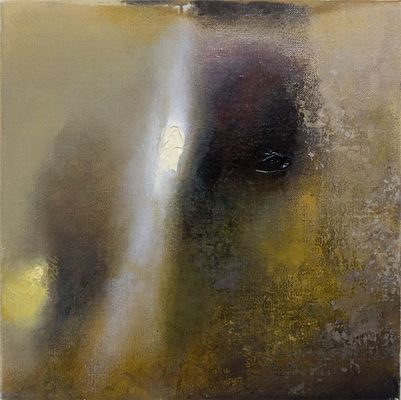
To return to Buckley’s fragment, the first two lines very much evoke how I paint nowadays. As you age, detail diminishes and patches of light become more luminous and float. I feel the most honest way of dealing with this is by smearing the oil paint on the canvas with the fingers and working close-up, blind. Only if the patches coalesce into an approaching image can the work gain a life.
-
Jonathan Walker was born in Melbourne, Australia and brought up on a dairy farm in Gippsland. In the 1970’s he studied painting at RMIT and won the Harold Wright Scholarship to the British Museum, London. During the 1980’s he exhibited at Pinacotheca Gallery, Richmond and had work shown at the NGV and Heidi City Art Gallery. Over the same period he designed the cover for the “Epigenesi” LP by Giancarlo Toniutti, Italy and conducted a mail exchange work with Achim Wollscheid, Germany. The work with artists through the post resulted in an article published in the bicentenary issue of Art and Australia 1988. He showed in artist run spaces such as WestSpace in the 90’s and 2000’s, and until 2012, taught painting at Victoria University, which is where we (Colleen Ahern and Lisa Radford) as organisers of the exhibition, among many others, had the privilege of being his student.
Walker’s knowledge was imparted to students through the careful selection of music, literature, and artists found in books that he himself had ordered for the library. Walker’s strategy was the generosity of sharing his vast knowledge with references specific to each student and their context.
Walker’s paintings share a similar focus and intimacy.
This exhibition presents a small selection of recent paintings alongside a publication that includes Walker’s writing. Observational and analytical, Walker’s work is a type of material notation — the time of day, colour and how it is blended, the both specific and fleeting location of a reflection on lino or the question of whether a chair leg should be included in a painting.
Please join us on Friday August 21 between 6-8pm to celebrate the opening of the exhibition.
Curated by Colleen Ahern and Lisa Radford.
B. Wurtz
Curated by Nic Tammens
March 26 - April 4, 2015
B.Wurtz works from a basement studio in his home on Manhattan’s Lower East Side.
This local fact is attested to by the plastic shopping bags and newsprint circulars that appear in his work. As formal objects, they don’t make loud claims about their origins but nonetheless transmit street addresses and places of business from the bottom of this long thin island. Like plenty of artists, Wurtz is affected by what is local and what is consumed. His work is underpinned by this ethic. It often speaks from a neighborhood or reads like the contents of a hamper:
“BLACK PLUMS $1.29 lb.”
“Food Bazaar”
“USDA Whole Pork Shoulder Picnic 99c lb.”
“RITE AID Pharmacy, with us it’s personal.”
“H. Brickman & Sons.”
“Sweet Yams 59c lb."
Most of the work in this exhibition was made while the artist was in residence at Dieu Donne, a workshop dedicated to paper craft in Midtown. Here Wurtz fabricated assemblages with paper and objects that are relatively lightweight, with the intention that they would be easily transportable to Australia. This consideration isn’t absolute in Wurtz’s work, but was prescriptive for making the current exhibition light and cheap. Packed in two boxes, these works were sent from a USPS post office on the Lower East Side and delivered to North Melbourne by Australia Post.
Wurtz appears courtesy of Metro Pictures, New York.
Thanks to Rob Halverson, Joshua Petherick, Sari de Mallory, Matt Hinkley, Helen Johnson, Fayen d'Evie, Ask Kilmartin, Lisa Radon, Ellena Savage, Yale Union, and "Elizabeth".
John Nixon
"Archive"
December 15 - January 20, 2014
The presentation of John Nixon's archive offered a rare showcase of this extensive collection of the artist's own publications, catalogues, posters, ephemera, editions and more, from the mid 1980s onwards, alongside a selection of his artworks.
Organized by John Nixon, Joshua Petherick and Matt Hinkley.
<a href=http://wfb.public-office.info/artist/john-nixon>All titles by John Nixon
"Habitat"
at Minerva, Sydney (organised by Joshua Petherick and Matt Hinkley)
November 15 - December 20, 2014
Lupo Borgonovo, Janet Burchill & Jennifer McCamley,
Lewis Fidock, HR Giger, Piero Gilardi, Veit Laurent Kurz,
Cinzia Ruggeri, Michael E. Smith, Lucie Stahl, Daniel Weil, Wols
Press Release:
“...It contained seven objects. The slender fluted bone, surely formed for flight, surely from the wing of some large bird. Three archaic circuitboards, faced with mazes of gold. A smooth white sphere of baked clay. An age-blackened fragment of lace. A fingerlength segment of what she assumed was bone from a human wrist, grayish white, inset smoothly with the silicon shaft of a small instrument that must once have ridden flush with the surface of the skin - but the thing’s face was seared and blackened.”
William Gibson, “Count Zero”, 1986
"Autumn Projects Archive"
Curated by Liza Vasiliou
March 6 - March 15, 2014
World Food Books, in conjunction with the Virgin Australia Melbourne Fashion Festival 2014, presented the Autumn Projects archive, consisting of a selection of early examples in Australian fashion with a particular interest in collecting designers and labels from the period beginning in the 1980’s, who significantly influenced the discourse of Australian Fashion.
Curated by Liza Vasiliou, the exhibition provided a unique opportunity to view pieces by designers Anthea Crawford, Barbara Vandenberg, Geoff Liddell and labels CR Australia, Covers, Jag along with early experimental collage pieces by Prue Acton and Sally Browne’s ‘Fragments’ collection, suspended throughout the functioning World Food Books shop in Melbourne.
H.B. Peace
presented by CENTRE FOR STYLE
November 14, 2013
"Hey Blinky, you say chic, I say same"
Anon 2013
H.B. Peace is a clothing collaboration between great friends Blake Barns and Hugh Egan Westland. Their pieces explore the divergences between 'character’ and ‘personality’ in garments....etc
Special Thanks to Joshua Petherick and Matt Hinkley of WFB and Gillian Mears
and a Very Special Thank you to Audrey Thomas Hayes for her shoe collaboration.
Janet Burchill & Jennifer McCamley
"Aesthetic Suicide"
May 10 - June 8, 2013
The first of our occasional exhibitions in the World Food Books office/shop space in Melbourne, "Aesthetic Suicide" presented a body of new and older works together by artists Janet Burchill & Jennifer McCamley, including videos, prints, a wall work, and publications.
During shop open hours videos played every hour, on the hour.
1982, English
Softcover, 378 pages, 23 x 15.5 cm
1st Edition, Out of print title / used / very good
$25.00 - Out of stock
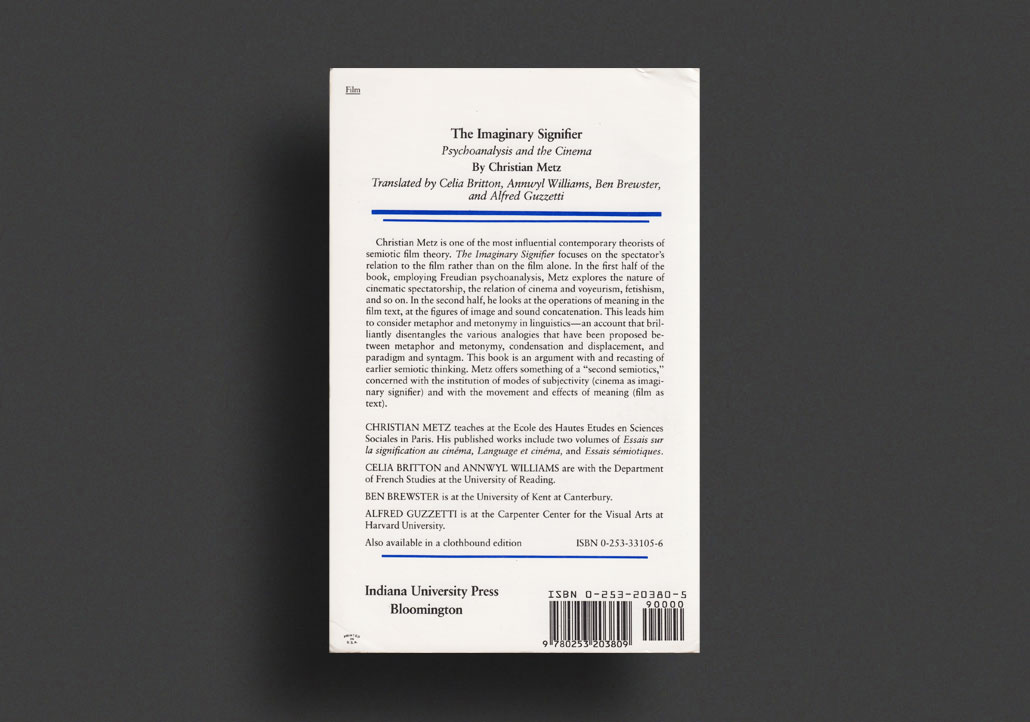
Since the publications of his first essays in the early 1960s Christian Metz has produced a body of work that has established him as the most influential contemporary theorist of cinema and as a leading contributor to the development of semiotics generally.
Psychoanalysis and Cinema: The Imaginary Signifier is in many ways a culmination of this work. In the first half of the book Metz explores a number of aspects of the psychological anchoring of cinema as a social institution, using Freudian psychoanalysis to examine the nature of cinematic spectatorship, the relations of cinema and voyeurism, fetishism and so on. In the second half, he shifts his approach a little to look at the operations of meaning in the film text, at the figures of image and sound concatenation. Thus he is led to consideration of metaphor and metonymy in film, this involving a detailed account of these two figures as they appear in psychoanalysis and linguistics - an account which brilliantly disentangles the various analogies that have been proposed between metaphor and metonymy, condensation and displacement, paradigm and syntagm, and makes an important contribution to our general understanding of these issues as well as to our particular understanding of cinema.
Throughout, the book is an argument with and recasting of initial semiotic thinking dependent on reference to fixed linguistics models; it offers something of a 'second semiotics', concerned now with the institution of modes of subjectivity, cinema as imaginary signifier, and with the movement and effects of meaning, film as text.
CHRISTIAN METZ teaches at the Ecole des Hautes Etudes en Sciences Sociales in Paris. His published works include two volumes of Essais sur la signification au cinema, Langage et cinema and Essais semiotiques. The Translators CELIA BRITTON and ANNWYL WILLIAMS are with the Department of French Studies at the University of Reading. BEN BREWSTER is at the University of Kent at Canterbury. ALFRED GUZZETTI is at the Carpenter Center for the Visual Arts at Harvard University.
VG copy.
1970, English
Softcover, 104 pages, 19.5 x 13 cm
1st Edition, Out of print title / used / good
Published by
Calder and Boyars / London
$20.00 - Out of stock
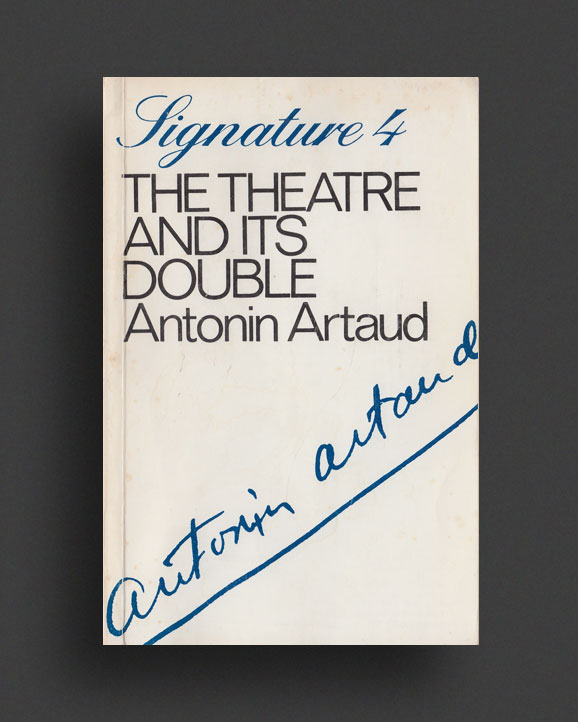
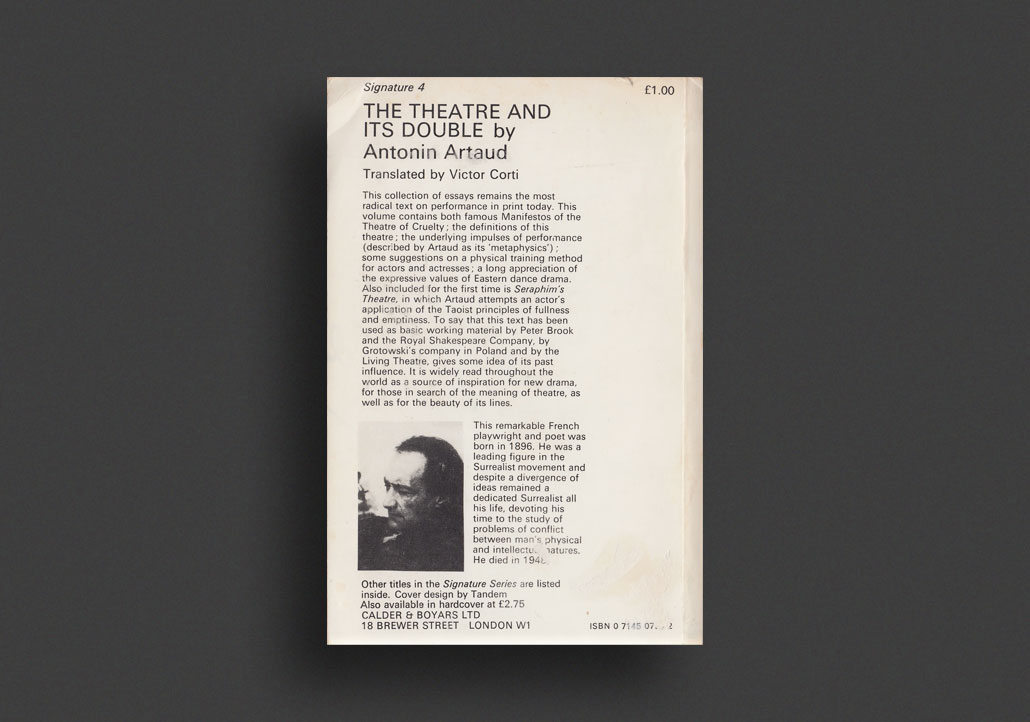
This collection of essays remains the most radical text on performance in print today. This volume contains the famous Manifestos of the Theatre of Cruelty and the definitions of this theatre; the underlying impulses of performance (described by Artaud as its 'metaphysics'); some suggestions on a physical training method for actors and actresses; a long appreciation of the expressive values of Eastern dance drama. Also included is Seraphim's Theatre, in which Artaud attempts an actor's application of the Taoist principles of fullness and emptiness. "We cannot go on prostituting the idea of the theater, the only value of which is in its excruciating, magical relation to reality and danger," Artaud wrote. He fought vigorously against an encroaching conventionalism he found anathema to the very concept of theater. He sought to use theater to transcend writing, "to break through the language in order to touch life." The Theatre and Its Double is widely read throughout the world as a source of inspiration for new drama, for those in search of the meaning of the theatre, as well as for the beauty of its lines.
This remarkable French playwright and poet was born in 1896. He was a leading figure in the Surrealist movement and despite a divergence of ideas remained a dedicated Surrealist all his life, devoting his time to the study of problems of conflict between man's physical and intellectual natures. He died in 1948.
Good copy of 1970 English edition with general age and wear. Ex-owner's name to top of first page, bump to top-right corner, tanning to extremities.
1983, Japanese / English
Softcover (w. original plastic cover and obi band), 138 pages, 22 x 30 cm
1st Edition, Out of print title / used / very good
Published by
Asahi Shimbun / Japan
$180.00 - Out of stock
Rare first edition of this compelling early 1980's photo book of violence and disaffection in American cities from Japanese photographer Shigemoto Nobi, printed by Asahi Shimbun in 1983.
Images of social unrest, gang warfare, prostitution, police precinct lockups, murder... the "poverty of the heart" real people must face behind the facade of America's boasted wealth of economic growth, something Japanese photographer Shigemoto Nobi (b. 1943) first encountered when he went to New York in his twenties to work as a freelance commercial photographer. Despite the implications of the title, Shigemoto Nobi visited and documented not only New York, but also Detroit, Chicago, Hawaii, the US/Mexican border and the Fort Apache Indian reservation, taking images primarily at night. Intense, lurid reportage on life in the United States of America in rich, saturated colour Kodochrome. File alongside Kiyotaka Tsurisaki, Seiji Kurata, or Bruce Davidson's "Subway".
First printing in original protective plastic sleeve with original obi band. Texts in Japanese and English.
Very Good copy with usual light damage/shrinkage to aged original plastic dust jacket cover/obi. Light edge wear.
1981, Japanese
Softcover (w. dust jacket), unpaginated, 25.5 x 21 cm
1st Edition, Out of print title / used / very good
Published by
Shinko Music Publishing / Tokyo
$120.00 - Out of stock
Rare original Japanese edition of the cult cat classic photo book and 1980's phenomenon, Namennayo Cats, published in 1981 by Shinko Music Publishing. The illustrated photo album of the delinquent Namennayo Cats in their youth, dressed up in leathers, smoking cigarettes, hanging at the catnip coffee shop and the pinball arcade, graffitiing the school, playing in a rock band, as members in bōsōzoku biker gangs, all photographed by Satoro Tsuda and styled by a host of collaborators, set in elaborate miniature scenes with kitten scale props and ever-changing costumes. Tsuda fell in love with cats when he took four abandoned kittens into his care in 1979. "One day, almost two months since they met, Tsuda noticed the kittens playing with costumes for dolls left behind by his girlfriend." The rest is history. Practically overnight the "obliged" Namennayo Cats became mega idols in Japan, and this book an international treasure of Cat Photo humour.
Very Good copy of the original Japanese edition in dust jacket with light wear, preserved under mylar wrap..
1978, English
Softcover, 260 pages, 25 x 17.5 cm
1st Edition, Out of print title / used / very good
Published by
Phaidon / London
$30.00 - In stock -
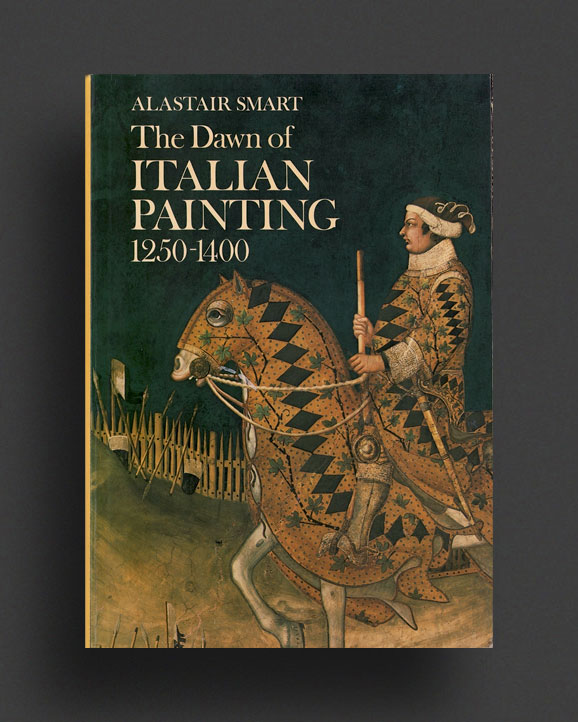
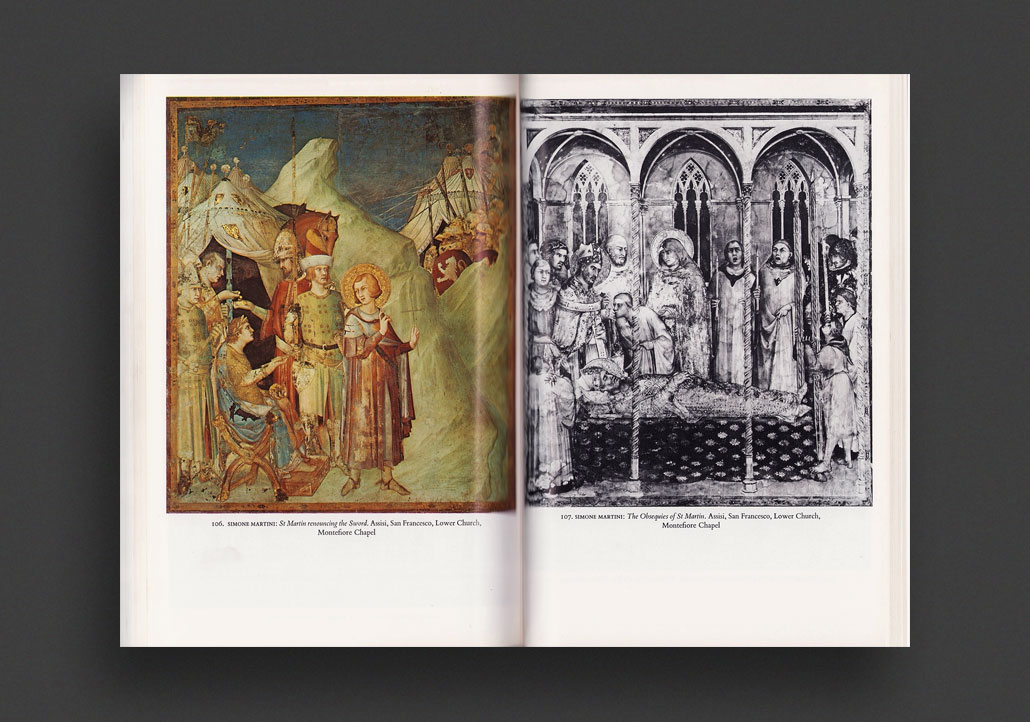
First 1978 softcover edition of The Dawn of Italian Painting 1250—1400 by Alastair Smart.
"The history of early Italian painting from about 1250 to 1400 constitutes one of the richest and most inspiring chapters in the history of European art. In his illuminating introduction to this important but much neglected period, Professor Alastair Smart argues that the early Italian masters — among them Cimabue, Duccio, Giotto, Simone Martini, and Pietro and Ambrogio Lorenzetti — should be seen as artists concerned with the values of their own time, and not merely as precursors of the Renaissance. The traditional view of these artists as 'primitives' has led critics in the past to misunderstand and undervalue their art. The mood of the Dugento and the Trecento was one of discovery and innovation, and yet, as Professor Smart shows, the preservation of vital and cher- ished traditions was often equally significant.
This is a period about which much still remains to be learnt, and exciting finds are constantly being made. It is also a period which has given rise to many art-historical controversies, and Professor Smart re-examines many of the most important of these vexed questions, bringing the arguments up to date in the light of the latest evidence.
The illustrations, which include 15 colour plates, convey a sense of the purity and freshness of early Italian painting, qualities which cannot fail to impress and delight any visitor to Italy's great churches and galleries. The book's usefulness to student and layman alike is enhanced by the inclusion of a detailed bibliography. Alastair Smart is head of the Department of Fine Art at the University of Nottingham and Director of the University Art Gallery. He is the author of many books and articles, both on early Italian painting and on other subjects, including studies on Constable and Allan Ramsay.
Very Good copy.
1983, French
Hardcover, 60 pages, 21.5 x 29.5 cm
1st Edition, Out of print title / used / very good
Published by
Glénat Editions / Grenoble
$55.00 - Out of stock
Wonderful first 1983 hardcover edition of the French edition of 'Les Voyages de Bianca' by Italian comics artist Guido Crepax, published by Glénat Editions in 1983. Sci-fi themed adventures of Crepax's Bianca, plus another story based on Gulliver's Travels, all with Crepax's heavy dose of eroticism and sadomasochism, beautifully illustrated with colour paint washes in full colour throughout.
Guido Crepas (1933—2003, Milan), better known by his nom de plume Guido Crepax, was an Italian comics artist. He studied at the School of Architecture at the University of Milan. After graduating, he made his debut in comic books in 1959 when he contributed his work to Tempo Medico. He joined the new magazine Linus in 1965 with a fantasy comic, 'Neutron', a superhero comic about an art critic with the mysterious power to stop humans or objects via his gaze. It featured a minor character called Valentina, a fashionable, communist Milanese photographer born in 1942, who quickly became Crepax's protagonist and his most famous creation. Valentina became an underground icon of 1960s culture. Crepax's work became noted for his very sophisticated expressionistic yet graphic drawing style, his truely innovative panel work and his unusual compositions that seemed to have more in common with modern art and film than comic strips. His psychedelic, dreamlike storylines were immersive, generally involving a strong dose of erotism and a predilection towards sadomasochism and the surreal. After 'Valentina', other titles followed, such as 'L'Astronave Pirata' (1968), 'La Casa Matta' (1969), 'La Calata di Mac Similiano' (1969), 'Belinda', 'Anita' and 'Bianca'. Crepax's illustrated adaptations of classic erotic stories like De Sade's 'Justine', Pauline Réage's 'Histoire d'O' and Sacher-Masoch's 'Venus in Furs' brought him further acclaim, especially to English audiences who had mostly only read translated Crepax through the pages of Heavy Metal magazine.
Very Good copy.
1977, French
Hardcover (w. dust jacket), 352 pages, 28 x 22 cm
1st Edition, Out of print title / used / very good
Published by
Obliques / Paris
$180.00 - Out of stock
The landmark, over-sized Obliques special double issue, "La Femme Surréaliste", published in Paris in 1977. The French literary journal Obliques (who published special issues on Artaud, Bellmer, Kafka, Klossowski, Vian, Sartre, Robbe-Grillet, Strindberg, Genet...) was the first publisher to present a comprehensive list of the literary and plastic production of Surrealist women with this gorgeous volume, long before the works of surrealist women, as a corpus, began to be more widely studied in the 1980s. Featuring well known names, but also many female artists neglected and seldom mentioned in the recent (strangely narrow-minded) re-evaluation of this period, this beautifully printed issue of Obliques is an incredibly valuable reference on a movement that was decidedly ‘feminine’. Edited by Roger Borderie with Michel Camus, it features profiles on the work and writing of Belen, Maya Bell, Bona, Leonora Carrington, Lise Deharme, Jacqueline Duprey, Aube Elléouët, Josette Exandier, Leonor Fini, Aline Gagnaire, Giovanna, Jane Graverol, Marianne Van Hirtum, Rozeta Hum, Valentine Hugo, Karskaya, Greta Knutson, Laure, Gina Pane, Annie Lebrun, Georgette Magritte, Manina, Joyce Mansour, Nora Mitrani, Meret Oppenheim, Mimi Parent, Valentine Penrose, Gisele Prassinos, Karina Raeck, Remedios Varo, Sibylle Ruppert, Colette Thomas, Toyen, Isabelle Waldberg, Unica Zurn, Cécile Reims, Dorothea Tanning, Greta Knutson, and more. Additional texts and works by Beatrice Didier, Cécile Reims, Michel Butor, Michel Sicard, Andre Pieyre De Mandiargues, Jean Roudaut, Rene Micha, Gerard Legrand, Jean Pfeiffer, Jacques Laurans, Michel Carassou, Annie Lebrun, Charles Bachat, Olivier Milliard, Robert Brechon, Jules Michelet, Jerome Prieur, Xaviere Gauthier, Elsa Thoresen Gouveia, plus a gallery by Titi Parant and Henri Maccheroni's Portraits Corrigés. Profusely illustrated with artworks, mostly in b/w with some colour sections.
Very Good copy of the rarer hardcover edition in VG dust jacket with signs of ageing and some wear/small tears
1969, English
Softcover, 90 pages, 23 x 30 cm
1st Edition, Out of print title / Used*,
Published by
Galerie Mikro & Edizioni 0 / Milan
$100.00 - In stock -
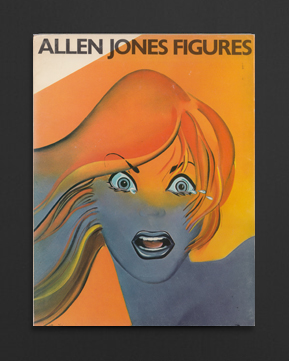
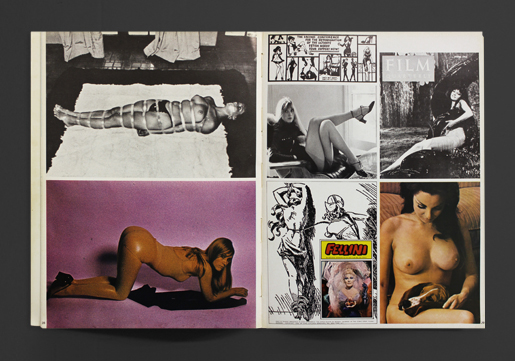
One of the finest of Allen Jones' artist books, "Figures" was published in 1969 in Berlin and Milan. Designed by Jones himself, with Anthony Marshall, this over-sized colourful "scrapbook" compiles a collection of found images from pin-up magazines, fashion advertising, film promos, giving way to images of the artist's work - both paintings, drawings and his famous sculpture-furniture, concluding with a unique four b&w pages of (other) "Artist's Advertisements" (including H.C. Westermann, Kenneth Price, Tom Wesselmann, Pablo Picasso), and business "calling card" acknowledgements.
Allen Jones (b. 1 September 1937) is a British pop artist, best known for his sculptures, paintings, drawings, and work in set and costume design for film and theatre.
Jones' exhibitions of erotic sculptures, such as the set Chair, Table and Hat Stand (1969), are studies in forniphilia, which turn women into items of human furniture. Much of his work draws on the imagery of rubber fetishism and BDSM. The sculptures in the Korova Milk Bar from the 1971 film A Clockwork Orange were based on works by Jones after he turned down the request by Stanley Kubrick to design the set for no payment. Jones designed Barbet Schroeder's 1976 film Maîtresse.
Good copy but with age tanning (most common with this title) and old spotting to pages.
2012, English
Hardcover, 272 pages, 26.5 x 25 cm
1st Edition, Out of print title / as new
Published by
The Metropolitan Museum of Art / New York
Yale University Press / New Haven
$90.00 - In stock -
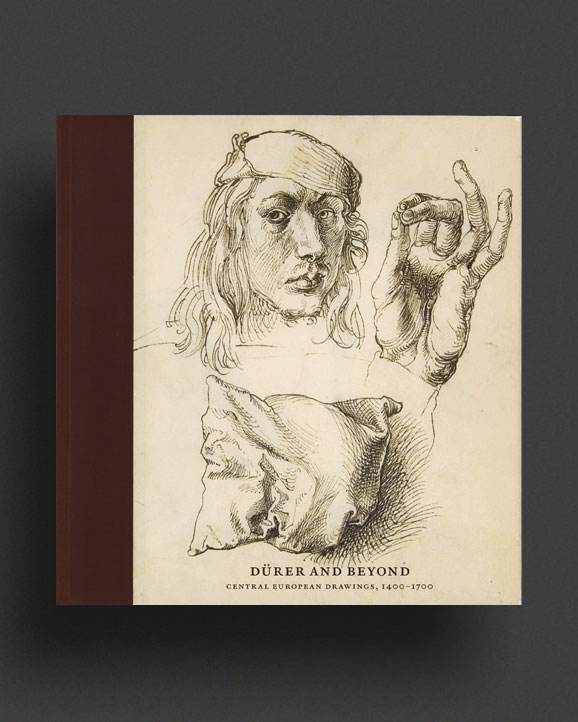
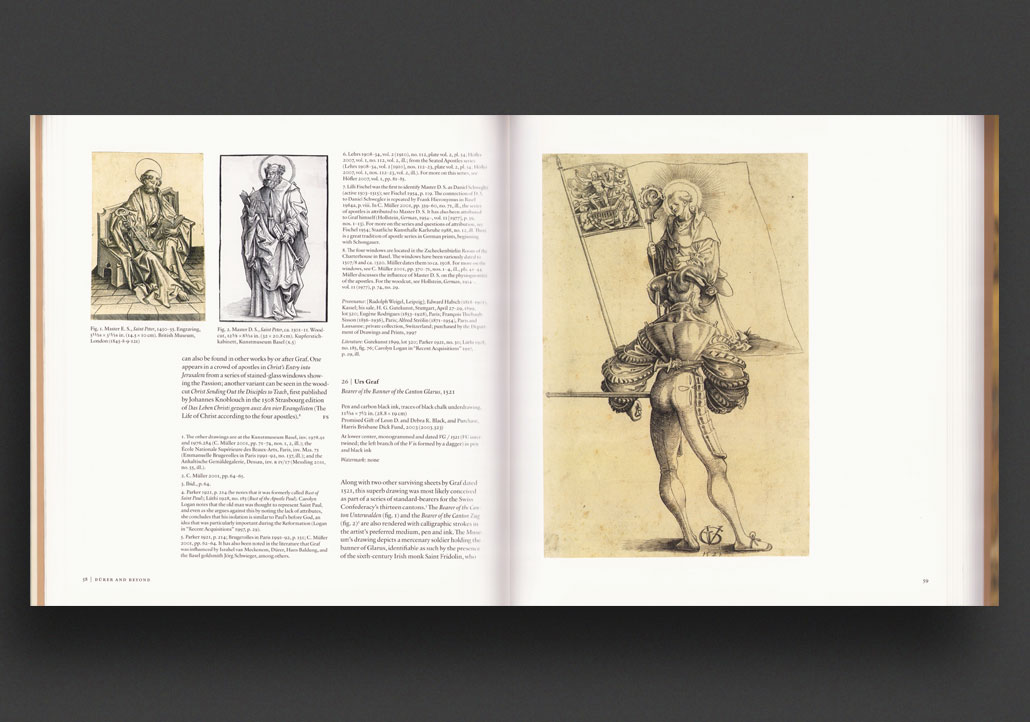
Dürer and Beyond presents a selection of 100 works from the Metropolitan Museum's outstanding collection of German, Swiss, Austrian, and Bohemian drawings. Featured are numerous drawings by Albrecht Dürer, including his celebrated study sheet with a self-portrait. In addition to drawings by major artists such as Martin Schongauer, Albrecht Altdorfer, Urs Graf, Hans Holbein the Younger, Friedrich Sustris, and Wenceslaus Hollar, the selection also highlights work by lesser known but equally superb draftsmen from the 14th to the end of the 17th century. Richly illustrated and fully documented with artist biographies, comparative illustrations, and enlightening commentary on the variety, quality, and purpose of the featured drawings, this book makes a significant scholarly contribution to a field that has not been widely explored.
Stijn Alsteens is Curator and Freyda Spira is Assistant Curator in the Department of Drawings and Prints, The Metropolitan Museum of Art, New York.
Published by The Metropolitan Museum of Art/Distributed by Yale University Press.
Out-of-print, As New copy.
1971, English
Softcover, 90 pages, 27 x 20 cm
1st Edition, Out of print title / used / very good
Published by
NGV (National Gallery of Victoria) / Victoria
$40.00 - Out of stock
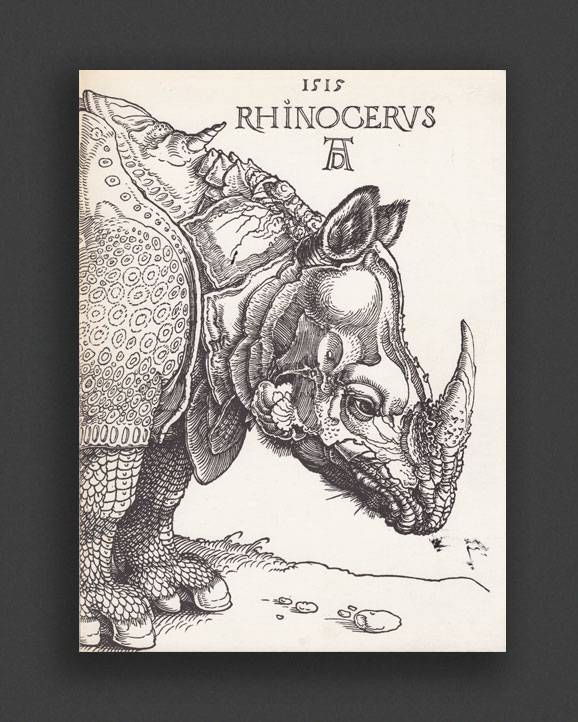
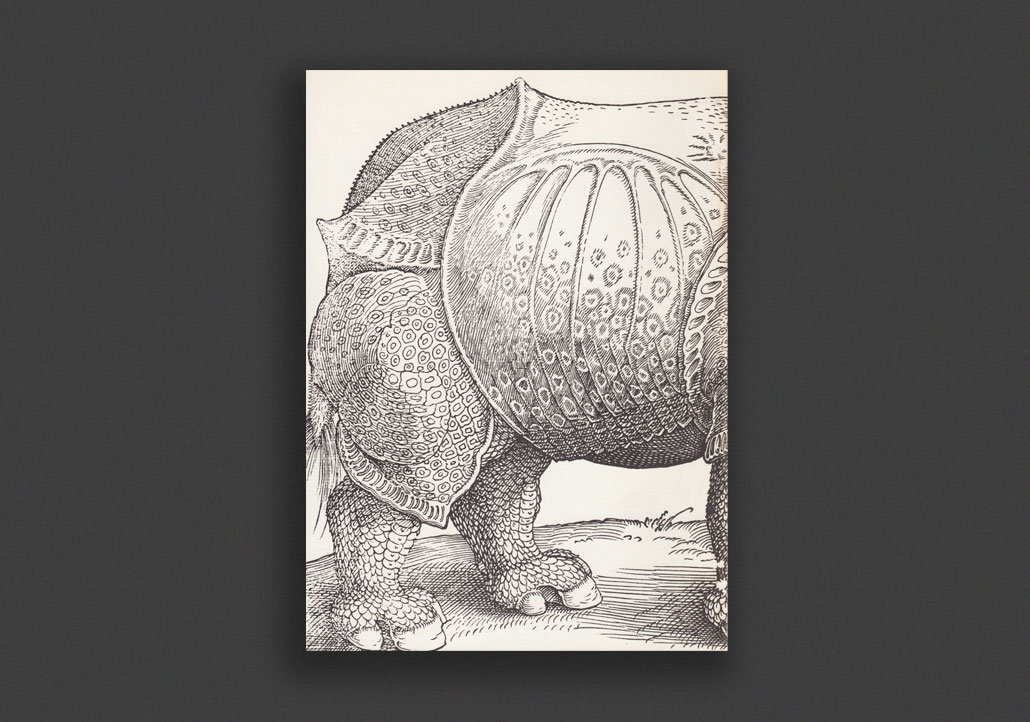
Scarce and handsome catalogue published on the occasion of the exhibition Dürer and His Times, held at the National Gallery of Victoria, May 21 — July 11, 1971. Boldly illustrated throughout with works by Dürer and his contemporaries, including Martin Schongauer, Michael Wolgemut, Andrea Mantegna, Lucas Cranach the Elder. Texts by Sonia Dean, head of Prints and Drawings.
‘It can be said without exaggeration that the history of painting would remain unchanged had Dürer never touched a brush and a palette, but that the first five years of his independent work as an engraver and woodcut designer sufficed to revolutionise the graphic arts.’—Erwin Panofsky, 1943
Very Good copy with light tanning, ink mark to cover.
2013, English
Hardcover, 264 pages, 28 x 25 cm
1st Edition, Out of print title / used / fine
Published by
Hirmer / Münich
$55.00 - In stock -
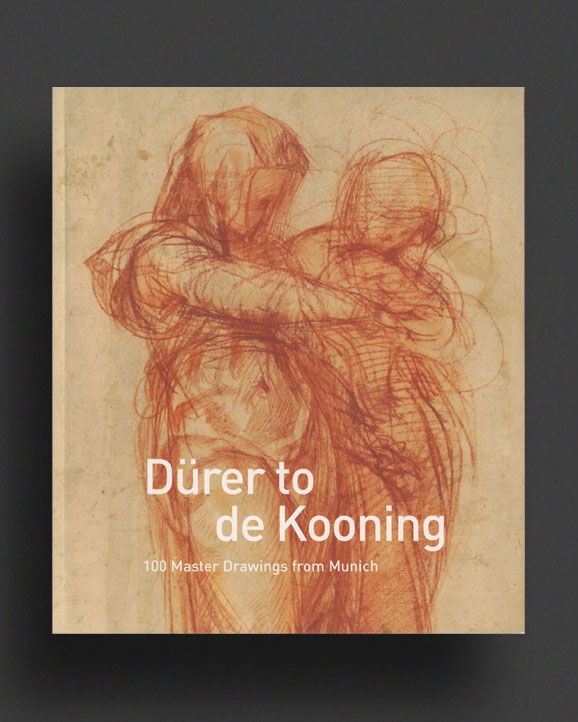
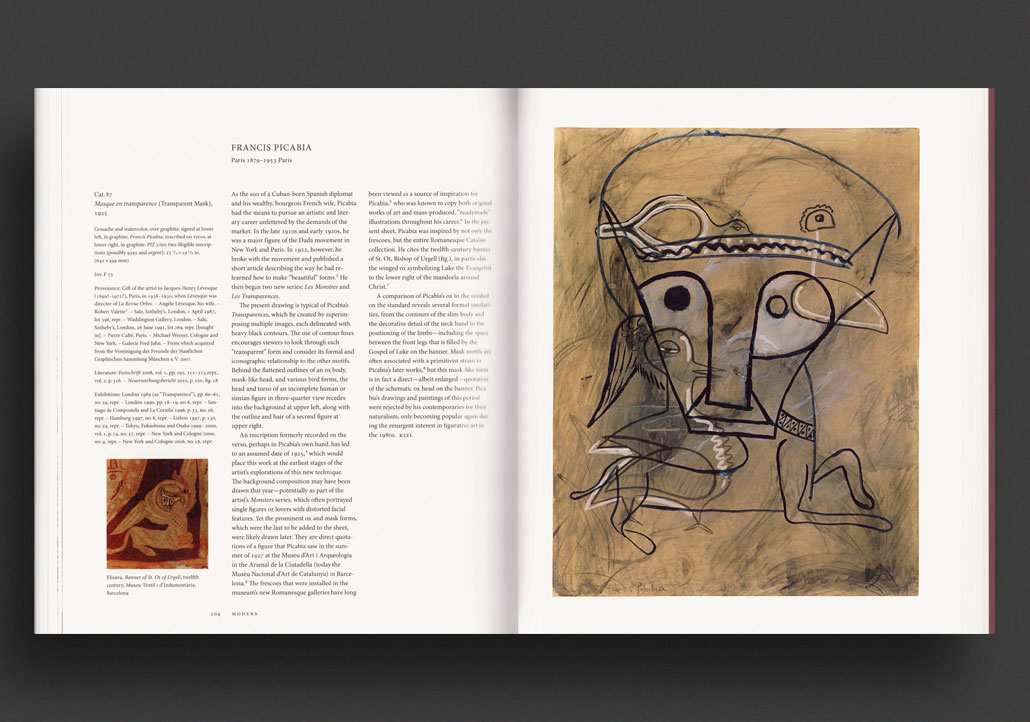
The Staatliche Graphische Sammlung in Munich houses one of the finest and most famous collections of drawings and prints in Germany, with holdings of around 400,000 works ranging from the fifteenth century to modernity. Published to accompany an exhibition at the Morgan Library and Museum in New York, 100 Master Drawings from Munich comprises lush full-color illustrations of over one hundred of the museum’s works of art.
Demonstrating the impressive depth and breadth of works owned by the Staatliche Graphische Sammlung, the works in this volume range from rough preparatory sketches to meticulously executed studies and encompass a variety of media, including silverpoint, chalk, ink, and aquarelle. Among the many extraordinary pieces are Old Dutch and German prints, nineteenth-century German drawings, and works by Dürer and Rembrandt. But equally not to be missed are the many compelling works of contemporary graphic art for which the museum is best known.
Very Good—NF copy.
1953, German
Hardcover (w. dust jacket), 80 pages, 26.5 x 19 cm
1st Edition, Out of print title / used / good
Published by
Karl Robert Langewiesche Verlag / Königstein im Taunus
$20.00 - Out of stock
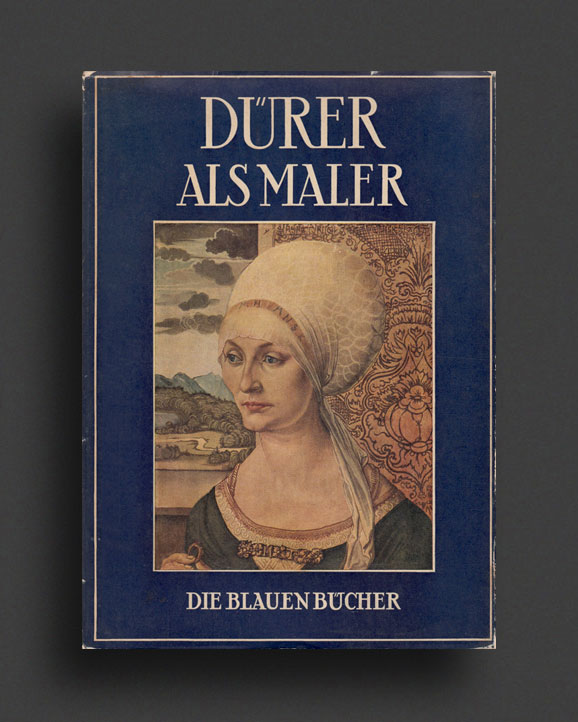
Beautiful 1953 Albrecht Dürer monograph published by Karl Robert Langewiesche Verlag in Königstein im Taunus, Germany, as part of the Die blauen Bücher art book series. Profusely illustrated throughout with stunning colour and b/w plates of the great German painter, printmaker, and theorist of the German Renaissance, with accompanying text by Johannes Beer in original German.
Good copy with good dust jacket. Some foxing/tanning to page edges.
1979, English
Softcover, 288 pages, 23.5 x 15 cm
1st Edition, Out of print title / used / good
Published by
Penguin Books / London
$20.00 - Out of stock
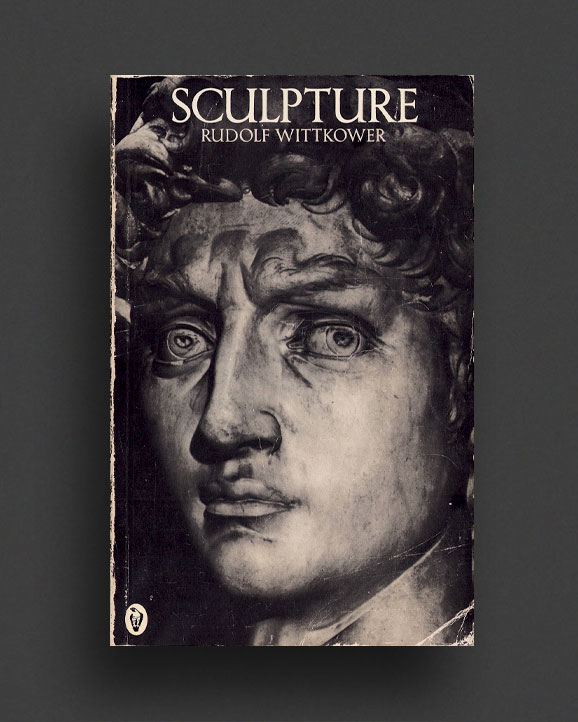
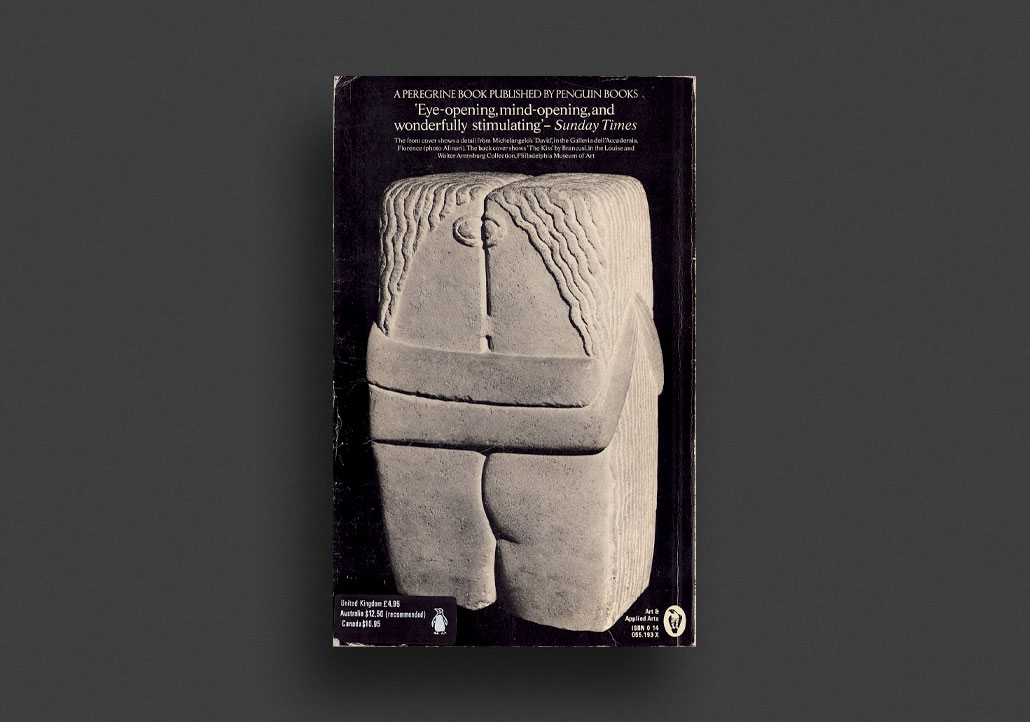
1979 edition of Rudolf Wittkower's Sculpture : Processes and Principles — with the aid of over 180 photographs, this book studies what unites and separates sculptors across the centuries. It looks at the masters of Archaic Greece, the Middle Ages, through the great names of Michelangelo, Cellini and Bernini to Rodin, Brancusi and Henry Moore. By studying their working methods and techniques, the author discloses their artistic ideas and convictions, thereby opening up new avenues of approach for the spectator.
Rudolf Wittkower (1901—1971) was a British art historian specializing in Italian Renaissance and Baroque art and architecture.
Good copy with wear to covers, internally VG.
2010, English
Hardcover (w. dustjacket), 304 pages, 24.8 x 28.4 cm
1st Edition, Out of print title / used / fine
Published by
Yale University Press / New Haven
$220.00 - Out of stock
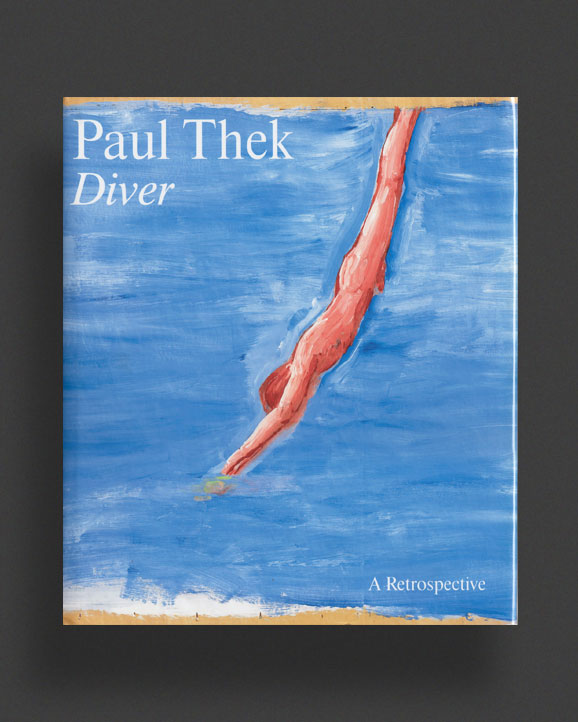
Now well out-of-print, the incredible Paul Thek monograph, was published by Yale University Press in 2010 to accompany Thek's first retrospective in the United States, at the Whitney Museum in New York.
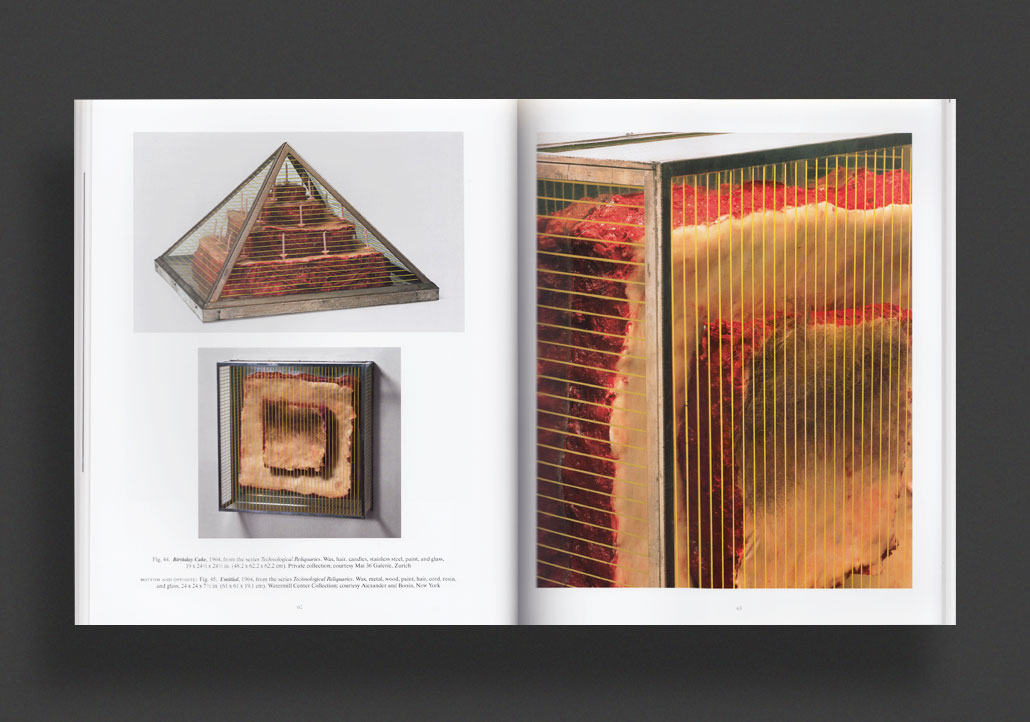
An American sculptor, painter, and installation artist, Paul Thek (1933—1988) is primarily known for hyper-realistic works of human body parts executed in fleshlike beeswax and for his strongly symbolic, room-size installations constructed from transitory materials. A major figure on the 1960s New York art scene, Thek also spent time in Europe, where he paved the way for artists adopting collaborative strategies. Although he gained a large following and was featured in more than one hundred solo and group exhibitions, the anti-establishment "artist's artist" was practically forgotten at the time of his death. Major exhibitions abroad and critical attention from younger artists have done much to revive his reputation, and Paul Thek: Diver expands on those efforts by bringing the artist's resounding influence on the art world up to date. Published to accompany Thek's first retrospective in the United States, this landmark publication includes nearly 300 chronologically arranged illustrations of sculptures, paintings, prints, and other works featured in the exhibition as well as four special "in-depth" image sections focusing on key installations, projects, and pages from the artist's journals. An extensive selection of documentary photographs, many never before published, illuminate Thek's artistic aesthetic and production process. With a bibliography, exhibition history, and checklist of works in the exhibition, this overdue acknowledgment of Thek's brief, but broad-reaching career will be the authoritative volume on the artist for years to come.
Edited by Lynn Zelevansky and Elisabeth Sussman, Contributions by George Baker, David Breslin, Carol Mancusi-Ungaro, Eleonora Nagy, Susanne Neubauer, Michael Nickel, Scott Rothkopf, Ann Wilson
Very Good—Fine copy in VG dust jacket.
2023, English
Softcover, 222 pages
Published by
Silver Press / London
$35.00 - Out of stock
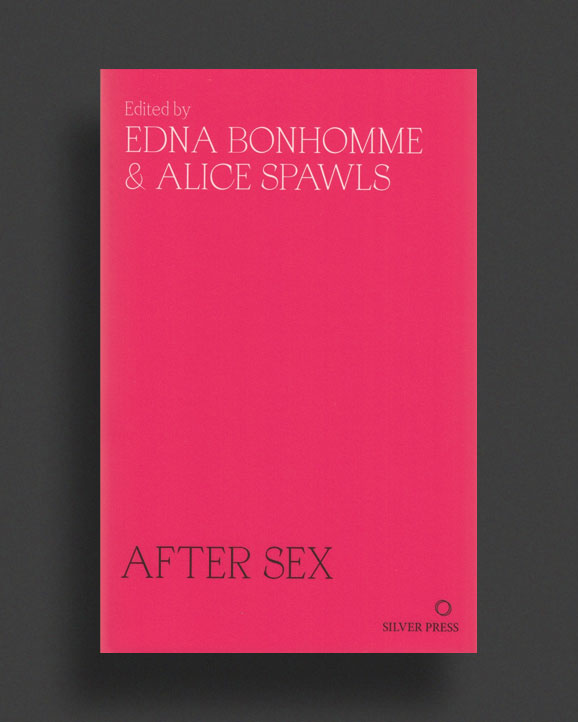
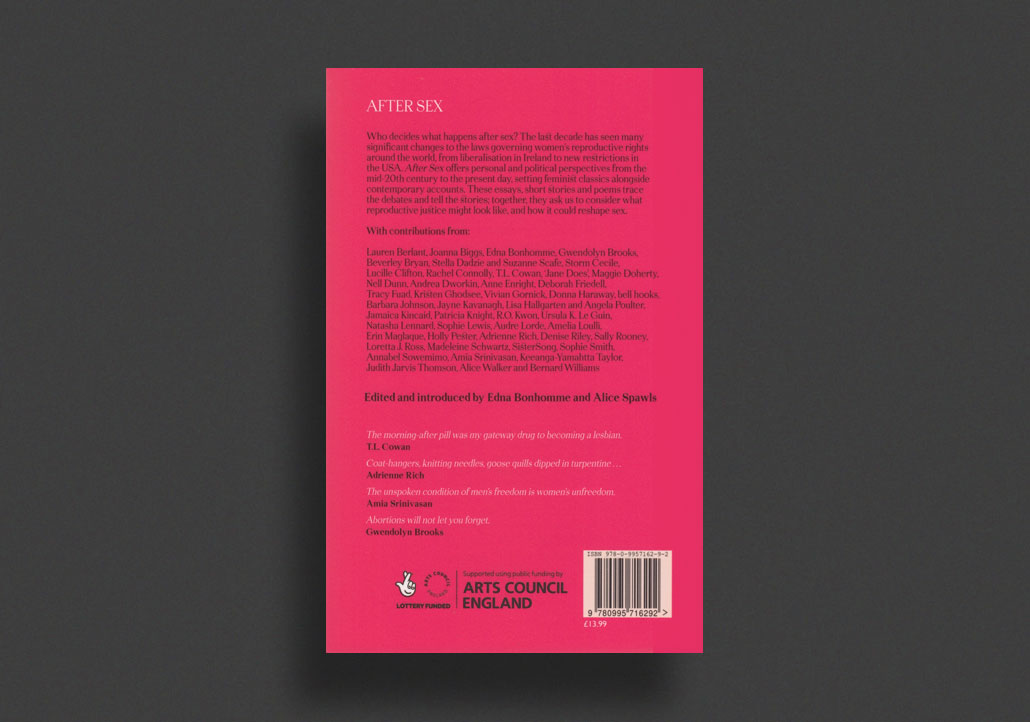
The last decade has seen a rise in activism and arguments over women’s reproductive freedom reminiscent of the 1960s and 1970s. This title provides personal and political perspectives from the mid-twentieth century to the present day, setting feminist classics alongside contemporary accounts and highlighting the experiences of women of colour and working-class women. Contributors include Nell Dunn, Anne Enright, bell hooks, Ursula K. Le Guin, Audre Lord and Sally Rooney.
These essays, short stories and poems trace past understandings of reproductive freedom and consider what it might look like in future, making urgent connections between women’s equality and access to contraception, healthcare and childcare. The writers pay special attention to people — both fictional and real — who have sought control over their sexual lives, and the joy, comedy, difficulties and disappointments that entails. But above all, After Sex testifies to the power of great writing to show us why that freedom is worth pursuing — without shame and without apology.
Contributors include: Edna Bonhomme, Gwendolyn Brooks, RachelConnolly, T.L. Cowan, Maggie Doherty, Nell Dunn, Anne Enright, Tracy Fuad, Kirsten Ghodsee, Vivian Gornick, Donna Haraway, bell hooks, Jamaica Kincaid, Patricia Knight, R.O. Kwon, Ursula K. Le Guin, Natasha Lennard, Sophie Lewis, Audre Lorde, Erin Maglaque, Adrienne Rich, Denise Riley, Sally Rooney, Loretta J. Ross, Madeleine Schwartz, Annabel Sowemimo, Keeanga Yahmatta Taylor, Bernard Williams and more.
1994, English
Softcover, 196 pages, 22 x 27 cm
1st Edition, Out of print title / used / very good
Published by
Yale University Press / New Haven
$100.00 - In stock -
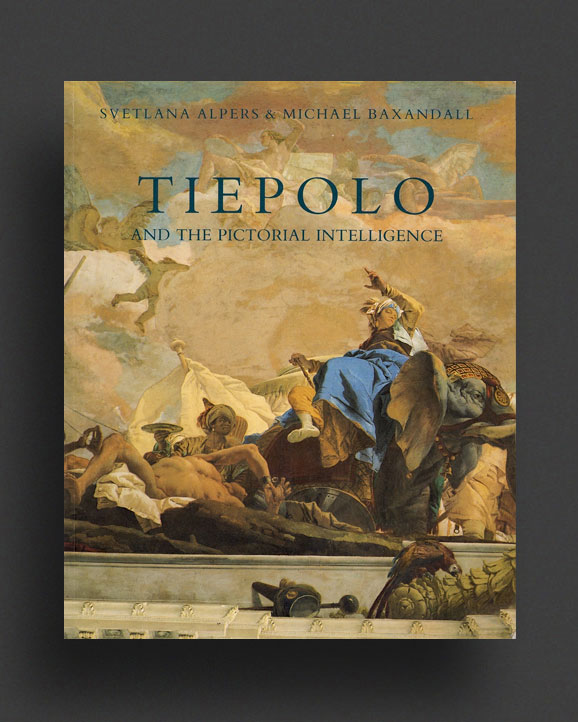
First edition of this important study of 18th-century Venetian school painter and print-maker Giovanni Battista Tiepolo by Svetlana Alpers, published in 1994 by Yale.
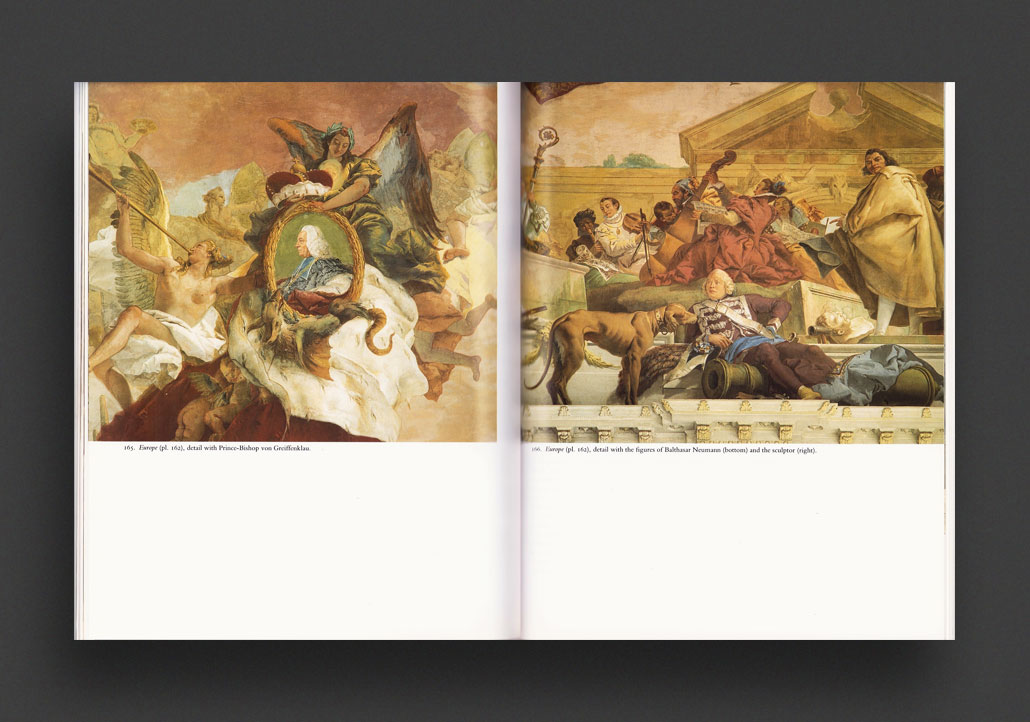
Tiepolo is an example of the specifically pictorial intelligence. This book is both a study of his art and an argument for fuller recognition of the peculiarities of the painters' representational medium. Svetlana Alpers and Michael Baxandall locate distinctive modes of Tiepolo's representation of the world and human action; follow his process of invention from first pen drawings through small oil-sketches to great frescoes; and analyze his best and biggest painting, the "Four Continents", in the Stairway Hall of the Prince-Bishop's Residence at Wurzburg, which is illustrated with photographs specially taken for the book. The topics taken up include: painting's resistance to enacted narrative drama, its engagement with indeterminacies and repetitions, the senses in which painters may "perform" both past art and themselves, the constructive roles of gestural drawing, the exploitation of shifts of scale between design and finished work, the dialogue between the changing natural site lighting and in-picture lighting, contributions made by the beholder's own mobility, the expressive scope of tensions between two and three dimensions, the deep rationale of rococo formal structure, and the sources of the moral force of pictures that lack an explicit moral. The book - both art criticism and a practical polemic - ends with an annotated gazetteer for travellers, listing those Tiepolo paintings that can still be seen in the places and conditions for which he painted them.
1968, English
Hardcover (w. dust jacket), 288 pages, 29 x 22.5 cm
1st Edition, Out of print title / used / very good
Published by
Weidenfeld and Nicolson / London
$140.00 - Out of stock
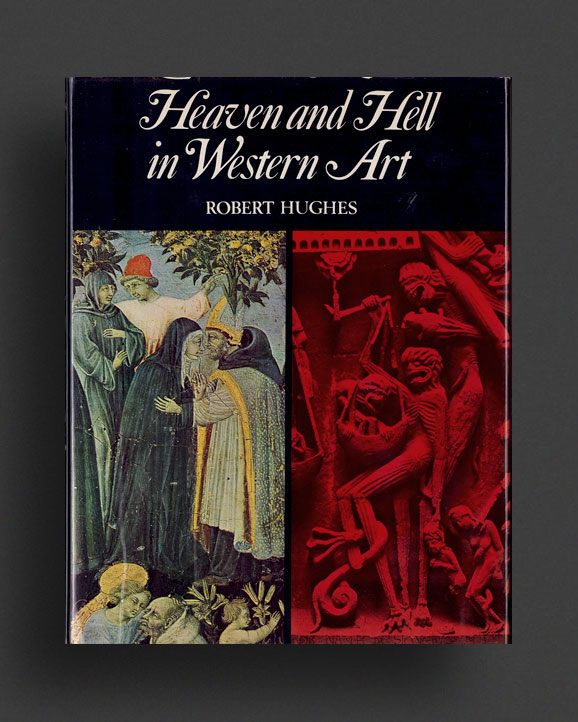
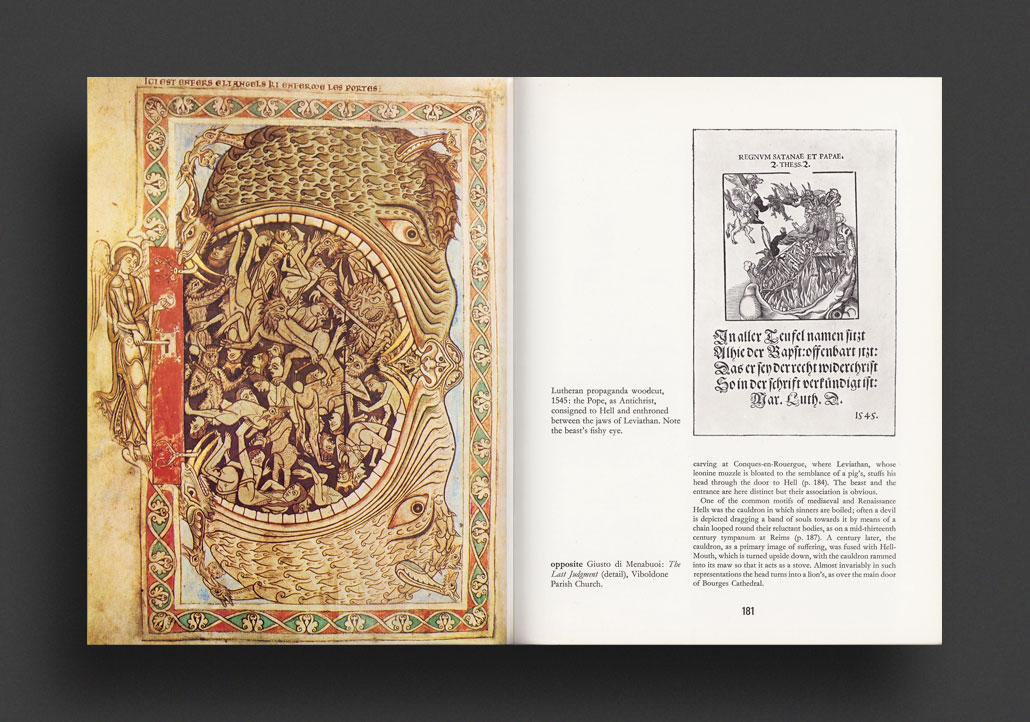
First 1968 UK hardcover edition of Heaven and Hell in Western Art by celebrated Australian-born art critic Robert Hughes (1938—2012), published by Weidenfeld and Nicolson, London.
"The themes of Heaven and Hell are among the most fruitful and varied in all Western art. Robert Hughes discusses their changing forms in a book which illustrates many of the finest and most interesting works of art devoted to these images. The author discusses the traditional Christian doctrine and also the psychological implications of a subject which has had a powerful hold on the imagination of artists over the past thousand years. Hell and the Devil have always been graphically depicted, and in Robert Hughes' book we can see the gradual development of their traditional forms. The devil, who started as the beautiful fallen angel Lucifer, becomes the obscenely ugly figure carved on the great Romanesque churches and illustrated so terrifyingly throughout the Middle Ages, only to degenerate into the harmless satyr of the Renaissance, and to the comic figure of the popular melodrama. Hell, described so articulately by Dante, is most vividly represented in the Last Judgments by Signorelli and Michelangelo, in which medieval fears are expressed with all the immediacy of Renaissance realism. The joys of Heaven are less easy to set forth in visual terms, and alongside actual representations of Heaven there has been a tradition of metaphorical paintings of Heaven, from Duccio's Maestà to the Arcadia of Claude and Poussin and later. Heaven itself developed from the walled garden of medieval imagination to the trompe l'œil ceilings of the Baroque era, often showing highly unlikely candidates being received by the Heavenly host. Robert Hughes surveys this whole field, and concludes with some reasons why the themes of Heaven and Hell have lost their force in this present century. This book illustrates many great works of art, with many fascinating and unusual details, and presents an aesthetic and psychological interpretation of these works by one of the leading young art-critics of the present day.
Very Good copy in VG dust jacket with only light wear (preserved under mylar wrap).
1982, English
Hardcover (w. dust jacket), 346 pages, 29 x 22 cm
1st Edition, Out of print title / used / good
Published by
Yale University Press / New Haven
$50.00 - In stock -
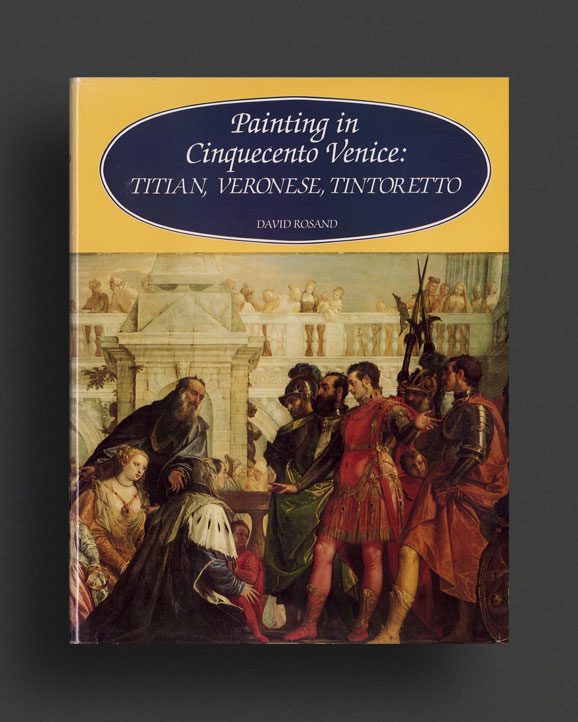
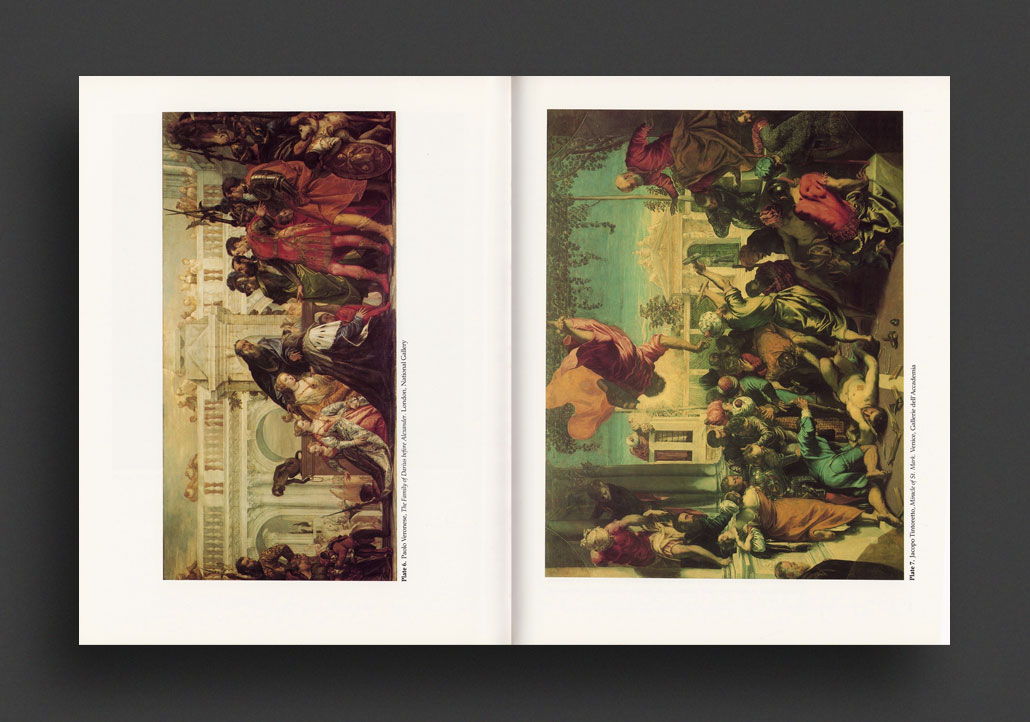
First 1982 hardcover edition of the first modern study in English of sixteenth-century Venetian painting and a modern critical framework for the general study of art.
Painting in Sixteenth-Century Venice explores the visual tradition of one of the most important centres of the Italian Renaissance through a study of three masters - Titian, Veronese, and Tintoretto. These painters dominated and shaped the traditions of Venetian painting in the High and Late Renaissance. Establishing the conditions of painting in Renaissance Venice, including the social, economic and political situation of arts and artists and the aesthetic values that distinguish Venetian painting from that of Central Italy, David Rosand also explores the formal principles and technical procedures that determined the uniqueness of painting in Venice, above all the development of oil painting on canvas. He also analyses individual images, altarpieces and mural paintings within the several contexts of conventions and institutions - artistic, social, historical - of Renaissance Venice.
Good book with ex-libris markings, otherwise VG book in VG dust jacket (no library markings to DJ, preserved under mylar wrap).
1983, English
Hardcover (w. dust jacket), 244 pages, 32 x 35.5 cm
1st Edition, Out of print title / used / very good
Published by
Hudson Hills Press / New York
$50.00 - In stock -
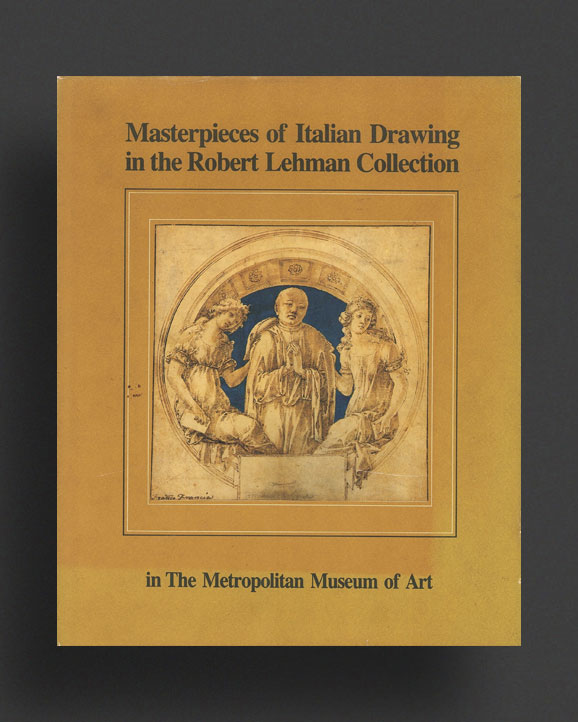
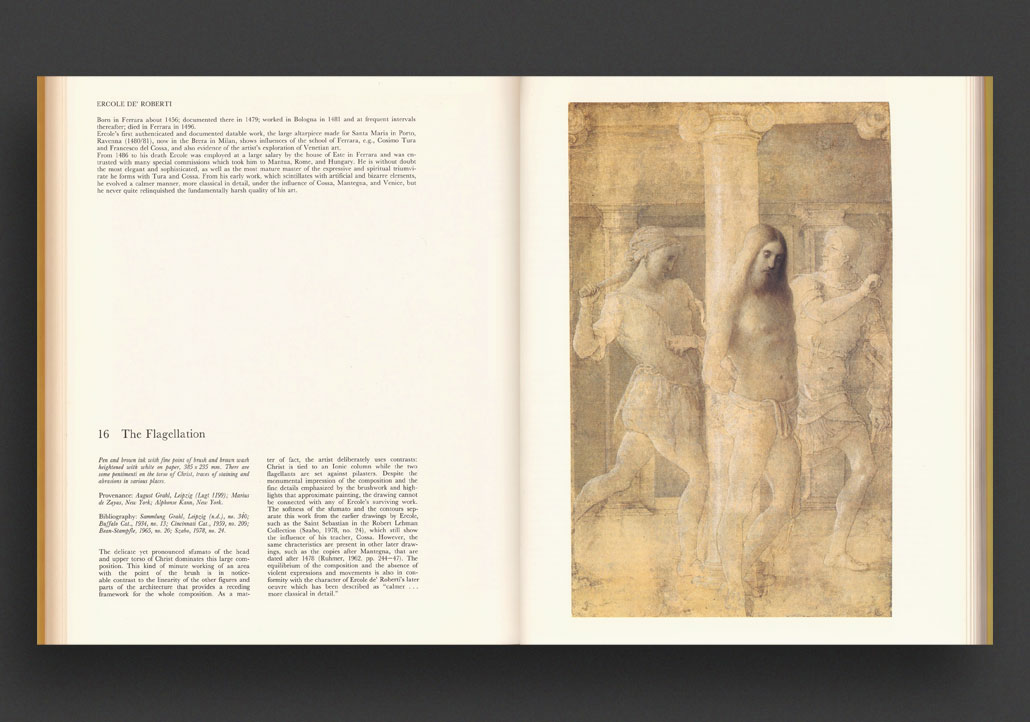
First hardcover 1983 edition of Masterpieces of Italian Drawing in the Robert Lehman Collection in The Metropolitan Museum of Art by George Szabo, long out-of-print.
"The Robert Lehman Collection, now a part of the Metropolitan Museum of Art, represents a unique chapter in the history of art collecting and connoisseurship. Its master drawings rank high among all the world's collections, especially — because of their sheer number, great variety, and extraordinary quality — the Italian drawings. Here are magnificent sheets by many of the greatest masters of the Italian Renaissance and beyond: Pollaiuolo, Bellini, Leonardo da Vinci, Perugino, Fra Bartolommeo, Signorelli, Bronzino, Tintoretto, Cambiaso, Veronese, Carracci, Canaletto, Guardi, Piranesi, the Tiepolos, and 38 more. Each of these masterpieces from Italy's incomparable flowering of draughtsmanship is reproduced in this splendid volume in a full-color plate of astonishing fidelity and delicacy, and each is accompanied by a biography of the artist and a full commentary (including provenance and bibliography). The author is Dr. George Szabo, Curator of the Lehman Collection since 1963. In addition to his fascinating texts on the individual drawings, his Introduction provides a short history of the collecting of Italian drawings in New York, a history of the Lehman family and Collection, and an extensive discussion of Italian paintings and decorative arts in the Collection, especially as they relate to the drawings. An additional 82 works of art appear within the Introduction in rich duotone; more than half of these are drawings, and the balance are paintings, majolica, illuminated manuscripts, bronzes, sculptures, furniture, and jewelry. A comprehensive bibliography completes Masterieces of Italian Drawing in the Robert Lehman Collection, The Metropolitan Museum of Art, which will be treasured by all lovers of drawings, of Italian art, and of fine book making."
Very Good copy in Good dust jacket. Tanning/discolouration to jacket edges/spine, small closed tears to top of spine. VG book with only light wear.
1991, English
Softcover, 156 pages, 25 x 21 cm
1st Edition, Out of print title / used / good
Published by
Whitney Museum of American Art / New York
$50.00 - Out of stock
Great catalogue published in 1991 on the occasion of the exhibition Mind over Matter: Concept and Object, at the Whitney Museum of American Art, October 3, 1990 - January 6, 1991. Curated by Richard Armstrong the exhibition showcased the work of Ashley Bickerton, Ronald Jones, Nayland Blake, Liz Larner, Tishan Hsu, and Annette Lemieux. These young artists use objects and materials to create idea-oriented painting and sculpture. Representatives of a third generation of conceptual artists, they have turned from the self-conscious absorption of formalist art, addressing instead social as well as aesthetic issues. This articulate generation, conversant with art historical precedents, explores larger fields of knowledge, in a conscious rejection of Modernism and post-Modernism.
Profusely illustrated in colour and b/w with extensive sections devoted to each artist, including interviews and statements, alongside curator's essay and a full list of exhibited works.
Good copy with some wear to cover and spine. Very Good throughout interior.
1982, German
Softcover, 128 pages, 29 x 22 cm
1st Edition, Out of print title / used / very good
Published by
Maximilian Verlag / Munich
$50.00 - In stock -
Gorgeous German catalogue published for the first edition of Erste Konzentration, a series of three portfolios of 12 prints by 6 artists : Georg Baselitz, Antonius Höckelmann, Jörg Immendorff, Per Kirkeby, Markus Lüpertz, A.R. Penck, published in a limited edition of 50 copies, signed, numbered and dated. Includes wood, linocut, and lithograph prints. This beautifully printed catalogue reproduces 6 of the prints of each artist in colour and b/w on stiff art paper, accompanied by text by curator/author Alexander Dückers and biographies of each artist.
Very Good copy with only light edge wear to cover. From the collection of artist Bernhard Sachs (name to front endpaper).
1986, German
Softcover, 360 pages, 27.5 x 21.5 cm
1st Edition, Out of print title / used / good
Published by
Edition Cantz / Stuttgart
Württenbergischer Kunstverein / Stuttgart
$45.00 - In stock -
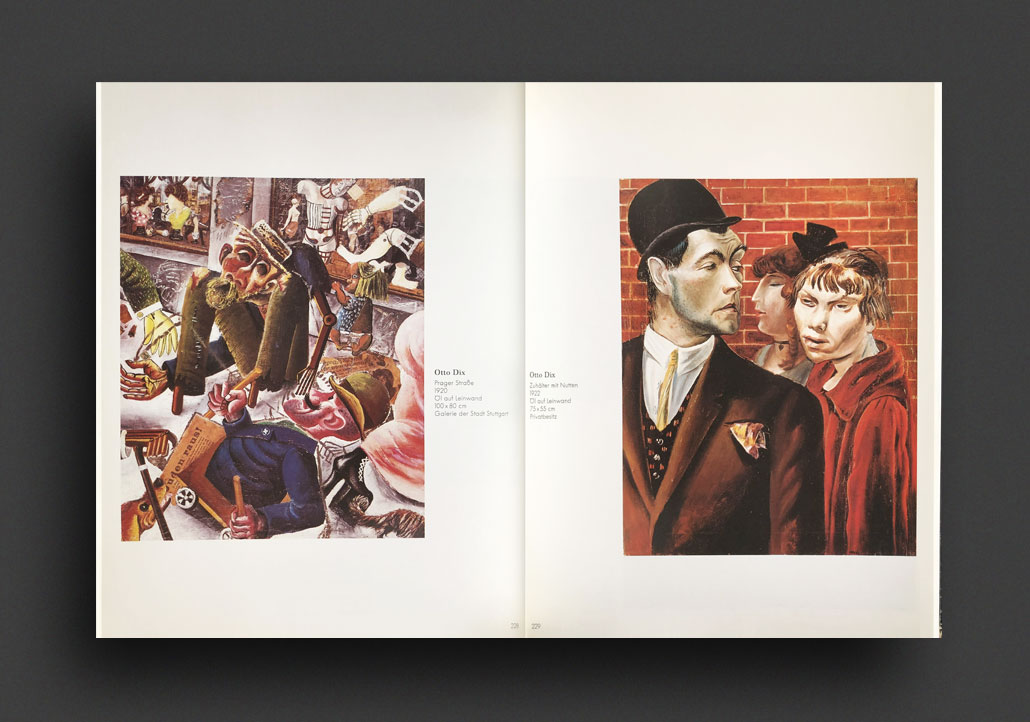
First 1986 edition of this huge survey of German artists, Künstler in Deutschland 1900-1945. Individualismus und Tradition, published by Edition Cantz and Württenbergischer Kunstverein. Profusely illustrated with the work of Max Ernst, Kurt Schwitters, László Moholy-Nagy, Walter Dexel, Oskar Schlemmer, Rudolf Belling, Wilhelm Lehmbruck, Ludwig Meidner, Otto Dix, George Grosz, Franz Radziwill, Christian Schad, Josef Scharl, Otto Pankok, Ernst Barlach, Käthe Kollwitz, Lovis Corinth, Max Beckmann, Paula Modersohn-Becker, Hans Hartung, Emil Nolde, Hans Uhlmann, Karl Schmidt-Rottluff, Fritz Winter, Ernst Ludwig Kirchner, Ernst Wilhelm Nay, Otto Mueller, Willi Baumeister, Oskar Kokoschka, Adolf Hölzel, August Macke, Franz Marc, Alexej Jawlensky, Wassily Kandinsky, Paul Klee. Texts in German by Tilman Osterwold, Jens Christian Jensen, Andreas Vowinckel, plus biographies and catalogue.
Good copy with wear to cover edges and spine.
1983, English
Softcover, 176 pages, 27.9 x 22 cm
1st Edition, Out of print title / used / good
Published by
Prestel / Munich
The Saint Louis Art Museum / Saint Louis
$45.00 - Out of stock
1983 exhibition catalogue surveying the Neue Wilde neo-expressionism and the re-emergence of expressive painting in late 1970s and 1980s Germany, published in conjunction with show organized by Jack Cowart and held at The Saint Louis Art Museum, June—August, 1983. Profusely illustrated in colour and b/w throughout with the work of the artists included in the exhibition : George Baselitz, Jörg Immendorff, Anselm Kiefer, A.R. Penck, and Markus Lüpertz. Essays by Jack Cowart, Siegfried Gohr, and Donald B. Kuspit. Critical bibliography by Renate Winkler.
This copy stuffed with loose archival clippings on above artists from German magazine Stern, from around the same period (documenta 7, 1982).
Good copy but with spots of heavy wear to the cover and general wear.
1988, English
Softcover, 238 pages, 30 x 24 cm
1st Edition, Out of print title / used / very good
Published by
Taschen / Cologne
$45.00 - Out of stock
First 1988 English translation edition of Contemporary Art by German art critic Klaus Honnef, one of the organisers of documenta 5 and 6 in Kassel. "This study is the first attempt to provide a comprehensive survey of contemporary art. Beginning with the New Savages of the late Seventies, Klaus Honnef introduces the various movements of the Eighties. This reworked edition outlines current trends in the international art world. Drawing on the work of 102 artists from nine different countries, the book contains 190 colour plates and 53 black and white illustrations." Lavishly illustrated throughout with the works of featured artists Rosemarie Trockel, Martin Kippenberger, Mike Kelley, Albert Oehlen, Helmut Middendorf, Andreas Schultze, Ashlet Bickerton, Bernd Zimmer, Rainer Fetting, David Salle, Enzo Cucchi, Eric Fischl, Jean-Michel Basquiat, Julian Schnabel, Robert Longo, Richard Prince, Peter Halley, Günther Förg, Walter Dahn, Werner Büttner, Georg Baselitz, Joseph Beuys, Andy Warhol, Markus Lüpertz, Jürgen Klauke, Astrid Klein, Cindy Sherman, William Wegman, Rob Scholte, Julian Opie, Jeff Koons, Bernhard Johannes, Anna Blume, Barbara Kruger, Thomas Ruff, Milan Kunc, Jenny Holzer, Jeff Wall, George Condo, Thomas Huber, Gerhard Merz, Gilbert & George, James Lee Byars, John Armleder, Helmut Federle, Philip Taaffe, Haim Steinbach, Reinhard Mucha, Hubert Kiecol, Frank Stella, Robert Gober, Robert Deacon, Anish Kapoor, Isa Genzken, Richard Serra, Christian Boltanski, Franz West, Leon Golub, Antonius Hockelmann, Robert Kushner, Jorg Immendorf, Kenny Scharf, Sandro Chia, Gerhard Richter, A.R. Penck, Sigmar Polke, Anselm Kiefer, Keith Haring, Per Kirkeby, and many more. Includes portraits and biographies.
Good copy with general light wear.