World Food Books' programme is largely produced on Kulin Nation land. We acknowledge the Wurundjeri people of the Kulin Nation as the first and continuing custodians of this land, and pay respect to their Elders past, present, and emerging.
World Food Books is an arts and special interests bookshop in Naarm / Melbourne. Founded in 2010, World Food Books is devoted to the presentation of a rotating, hand-selection of international art, design, literary and counterculture publications with an emphasis on the anti-traditional, the experimental, the avant-garde, the heretic, the marginal.
Presenting new titles alongside rare and out-of-print books, catalogues and journals spanning the fields of modern and contemporary art, design, photography, illustration, film, literature, poetry, cultural theory, philosophy, sexuality, popular and underground culture in its many radical forms, World Food Books wishes to encourage adventurous, thoughtful and open-minded reading, looking, writing, and exchange of publishing and ideas, both current and historical.
As well as our bookshop, located in Melbourne's historical Nicholas Building, all of our inventory is available internationally via our online mail-order service.
World Food Books semi-regularly co-ordinates "Occasions", a programme of exhibits and events at the bookshop and in partnership with other hosts (such as museums and art galleries) that develop out of the activities, relationships and content of the bookshop itself.
World Food Books
The Nicholas Building
37 Swanston Street
Room 5, Level 6
Melbourne 3000
Australia
SHOP HOURS:
Thu–Fri 12–6, Sat 12–5
WEB-SHOP OPEN 24/7
World Food Books
Postal Address:
PO Box 435
Flinders Lane
Victoria 8009
Australia
Art
Theory / Essay
Architecture / Interior
Graphic Design / Typography
Photography
Fashion
Eros
LGBTQ+
Fiction / Poetry
Weird / Speculative / Science Fiction / Horror
Transgressive / Visceral / Abject
Symbolism / Decadence / Fin de siècle
Film / Video
Painting
Sculpture / Installation
Performance / Dance / Theater
Drawing
Sound / Music
Curatorial
Group Shows / Collections
Periodicals
Out-of-print / Rare
Posters / Ephemera / Discs
Signed Books
World Food Books Gift Voucher
World Food Book Bag
Australian Art
Australian Fiction
Australian Science Fiction / Speculative Fiction
Australian Poetry
Australian Photography
Japanese Photography
Conceptual Art
Minimal Art
Dada
'Pataphysics / Oulipo
Fluxus
Concrete Poetry
Pop Art
Surrealism
Arte Povera
Arte Informale / Haute Pâte / Tachism
Nouveau Réalisme / Zero / Kinetic
Situationism / Lettrism
Collage / Mail Art / Xerox Art
Art Brut / Folk / Visionary / Fantastic
Illustration / Graphic Art / Bandes Dessinées
Furniture
Italian Radical Design / Postmodernism
Textiles
Ceramics / Glass
Counterculture
Protest / Revolt
Philosophy
Psychoanalysis
Anthropology
Anarchism
Socialism / Anarchism / Communism / Capitalism
Literary Theory / Semiotics / Language
Feminism / Women's Studies
Gender Studies / Sexuality
Anthropology
Fetishism / BDSM
Drugs / Psychedelia
Crime / Violence
Animal Rights / Veganism
Occult / Esoterica
Ecology / Earth / Alternative Living
Whole Earth / Crafts
All prices in AUD (Australian dollars)
Pick-Ups
Pick-up orders can be collected in our bookshop during opening hours after order date. Please collect any Pick-up orders within 2 weeks of ordering as we have limited storage space. Orders will be released back into stock if not collected within this time. No refunds can be made for pick-ups left un-collected. If you cannot make it in to the bookshop in this time-frame, please choose postage option.
Return Policy
All sales are final. We do accept returns (for refund or exchange) for items received in error. All our orders are packed with special care using heavy-duty padding and cardboard book-mailers or bubble mailers (for smaller books), using reinforcement where required. We cannot take responsibility for any lost, stolen or damaged parcels.
Insurance
Should you wish to insure your package, please email us directly after placing your order and we can organise this at a small extra expense. Although all standard/express tracked packages are very safe and dependable, we cannot take responsibility for any lost, stolen or damaged parcels. We recommend insurance on valuable orders.
Interested in selling your old books, catalogues, journals, magazines, comics, fanzines, ephemera? We are always looking for interesting, unusual and out-of-print books to buy. We only buy books in our fields of interest and specialty, and that we feel we can resell.
We base these prices on desirability, market value, in-print prices, condition and our current stock levels. We offer cash, store credit, and can take stock on consignment. All
about 25% of the price we expect to get when we sell them, or 30% in store credit. We base these prices on desirability, market value, in-print prices, condition and our current stock levels.
Sell your books any day of the week. You can drop them off and return later. If you have a lot of books, we can visit your Sydney home.
We buy books that we feel we can resell. We offer about 25 % of the price we expect to get when we sell them, or 30% in store credit. We base these prices on desirability, market value, in-print prices, condition and our current stock levels.
Philadelphia Wireman
03 August - 01 September, 2018
World Food Books is proud to announce our next Occasion, the first presentation of sculptures by Philadelphia Wireman in Australia.
The Philadelphia Wireman sculptures were found abandoned in an alley off Philadelphia’s South Street on trash night in 1982. Their discovery in a rapidly-changing neighbourhood undergoing extensive renovation, compounded with the failure of all attempts to locate the artist, suggests that the works may have been discarded after the maker’s death. Dubbed the "Philadelphia Wireman" during the first exhibition of this work, in 1985, the maker’s name, age, ethnicity, and even gender remain uncertain. The entire collection totals approximately 1200 pieces, all intricately bound together with tightly-wound heavy-gauge wire (along with a few small, abstract marker drawings, reminiscent both of Mark Tobey and J.B. Murry). The dense construction of the work, despite a modest range of scale and materials, is singularly obsessive and disciplined in design: a wire armature or exoskeleton firmly binds a bricolage of found objects including plastic, glass, food packaging, umbrella parts, tape, rubber, batteries, pens, leather, reflectors, nuts and bolts, nails, foil, coins, toys, watches, eyeglasses, tools, and jewellery.
Heavy with associations—anthropomorphic, zoomorphic, and socio-cultural responses to wrapped detritus—the totemic sculptures by Philadelphia Wireman have been discussed in the context of work created to fulfil the shamanistic needs of alternative religions in American culture. Curators, collectors, and critics have variously compared certain pieces to sculpture from Classical antiquity, Native American medicine bundles, African-American memory jugs, and African fetish objects. Reflecting the artist’s prolific and incredibly focused scavenging impulse, and despite—or perhaps enhanced by—their anonymity, these enigmatic objects function as urban artefacts and arbiters of power, though their origin and purpose is unknown. Philadelphia Wireman, whatever their identity, possessed an astonishing ability to isolate and communicate the concepts of power and energy through the selection and transformation of ordinary materials. Over the course of the past two decades, this collection has come to be regarded as an important discovery in the field of self-taught art and vernacular art.
Presented in collaboration with Fleisher-Ollman Gallery, Philadelphia, and Robert Heald, Wellington.
Susan Te Kahurangi King
02 February - 10 March, 2018
Susan Te Kahurangi King (24 February 1951 - ) has been a confident and prolific artist since she was a young child, drawing with readily available materials - pencils, ballpoint pens and felt-tip markers, on whatever paper is at hand. Between the ages of four and six Susan slowly ceased verbal communication. Her grandparents William and Myrtle Murphy had developed a special bond with Susan so they took on caring responsibilities for extended periods. Myrtle began informally archiving her work, carefully collecting and storing the drawings and compiling scrapbooks. No drawing was insignificant; every scrap of paper was kept. The King family are now the custodians of a vast collection containing over 7000 individual works, from tiny scraps of paper through to 5 meter long rolls.
The scrapbooks and diaries reveal Myrtle to be a woman of great patience and compassion, seeking to understand a child who was not always behaving as expected. She encouraged Susan to be observant, to explore her environment and absorb all the sights and sounds. Myrtle would show Susan’s drawings to friends and people in her community that she had dealings with, such as shopkeepers and postal workers, but this was not simply a case of a grandmother’s bias. She recognised that Susan had developed a sophisticated and unique visual language and sincerely believed that her art deserved serious attention.
This was an unorthodox attitude for the time. To provide some context, Jean Dubuffet coined the term Art Brut in 1945 to describe work created by self-taught artists – specifically residents of psychiatric institutions and those he considered to be visionaries or eccentrics. In 1972 Roger Cardinal extended this concept by adopting the term Outsider Art to describe work made by non-academically trained artists operating outside of mainstream art networks through choice or circumstance. Susan was born in Te Aroha, New Zealand in 1951, far from the artistic hubs of Paris and London that Dubuffet and Cardinal operated in. That Myrtle fêted Susan as a self-taught artist who deserved to be taken seriously shows how progressive her attitudes were.
Susan’s parents Doug and Dawn were also progressive. Over the years they had consulted numerous health practitioners about Susan’s condition, as the medical establishment could not provide an explanation as to why she had lapsed into silence. Dawn educated herself in the field of homeopathy and went on to treat all twelve of her children using these principles – basing prescriptions on her observations of their physical, mental and emotional state.
Doug was a linguist with an interest in philosophy who devoted what little spare time he had to studying Maori language and culture. To some extent their willingness to explore the fringes of the mainstream made them outsiders too but it was their commitment to living with integrity and their respect for individuality that ensured Susan’s creativity was always encouraged.
Even though Susan’s family supported her artistic pursuits, some staff in schools and hospitals saw it as an impediment to her assimilation into the community and discouraged it in a variety of ways. Her family was not always aware of this and therefore did not fully understand why Susan stopped drawing in the early 1990s. However, rather than dwell on the challenges that Susan faced in pursuit of her artistic practice, they prefer to highlight her achievements. In 2008 Susan began drawing again in earnest, after an almost 20 year interruption, and her work is now shown in galleries around the world.
Susan grew up without television and has been heavily influenced by the comics she read as a child. She is absolutely fearless in the appropriation of recognizable characters, such as Donald Duck and Mickey Mouse, in her work. She twists their limbs, contorts their faces, compresses them together, blends them into complex patterned backgrounds - always imbuing them with an incredible energy. Although Susan often used pop culture characters in her work they are not naive or childlike. These are drawings by a brilliant self-taught artist who has been creating exceptional work for decades without an audience in mind.
Mladen Stilinović
"Various Works 1986 - 1999"
02 February 16 - September 10, 2016
Various works 1986 - 1999, from two houses, from the collections of John Nixon, Sue Cramer, Kerrie Poliness, Peter Haffenden and Phoebe Haffenden.
Including: Geometry of Cakes (various shelves), 1993; Poor People’s Law (black and white plate), 1993; White Absence (glasses, ruler, set square, silver spoon, silver ladel with skin photograph and wooden cubes), 1990-1996; Exploitation of the Dead (grey and red star painting, wooden painting, black spoon with red table, red plate), 1984-1990; Money and Zeros (zero tie, paintings made for friends in Australia (Sue, John, Kerrie), numbers painting), 1991-1992; Words - Slogans (various t-shirts) - “they talk about the death of art...help! someone is trying to kill me”, “my sweet little lamb”, “work is a disease - Karl Marx”; Various artist books, catalogues, monographs, videos; Poster from exhibition Insulting Anarchy; "Circular" Croatian - Australian edition; Artist book by Vlado Martek (Dostoyevsky); more.
Thanks to Mladen Stilinović and Branka Stipančić.
Jonathan Walker
Always Will Need To Wear Winter Shirt Blue + Ochre Small Check Pattern
21 August - 21 September, 2015
Untitled
I am not a great reader of poetry but I always return to the work of Melbourne poet, Vincent Buckley (1925- 1988). Perhaps I find his most tantalising piece to be not a finished poem but a fragment left on a scrap of paper discovered on his desk after the poet’s death.
The poetry gathers like oil
In the word-core, and spreads
It has its music meet,
Its music is in movement.
This fragment is more the shell left behind from a volatile thought than a finished poem. I find the last two lines honest but awkward whereas the first two lines work like an arrow. Most likely he could not find a resolution so it was left. Still, in its present form, it remains an eloquent testimony to the ultimate failure of a medium to express mobile thought and sensation, in Buckley’s case, through verbal language. It’s an important matter because this is something all artists have to deal with regardless of the medium.
I have never written a poem, however, I am forever copying fragments from books on paper scraps in a vain effort to fix certain notions in my head. At first, they function as bookmarks that are sometimes returned to when I open the book. But before long, as they accumulate, they fall out littering the table interspersed with A4 photocopies, bills, books and medications.
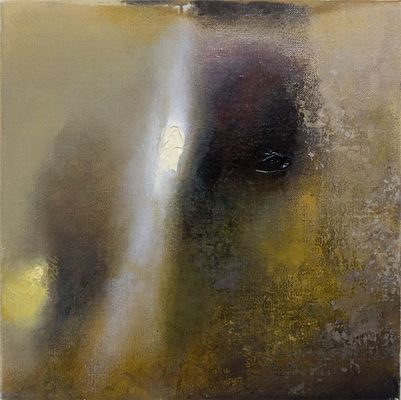
To return to Buckley’s fragment, the first two lines very much evoke how I paint nowadays. As you age, detail diminishes and patches of light become more luminous and float. I feel the most honest way of dealing with this is by smearing the oil paint on the canvas with the fingers and working close-up, blind. Only if the patches coalesce into an approaching image can the work gain a life.
-
Jonathan Walker was born in Melbourne, Australia and brought up on a dairy farm in Gippsland. In the 1970’s he studied painting at RMIT and won the Harold Wright Scholarship to the British Museum, London. During the 1980’s he exhibited at Pinacotheca Gallery, Richmond and had work shown at the NGV and Heidi City Art Gallery. Over the same period he designed the cover for the “Epigenesi” LP by Giancarlo Toniutti, Italy and conducted a mail exchange work with Achim Wollscheid, Germany. The work with artists through the post resulted in an article published in the bicentenary issue of Art and Australia 1988. He showed in artist run spaces such as WestSpace in the 90’s and 2000’s, and until 2012, taught painting at Victoria University, which is where we (Colleen Ahern and Lisa Radford) as organisers of the exhibition, among many others, had the privilege of being his student.
Walker’s knowledge was imparted to students through the careful selection of music, literature, and artists found in books that he himself had ordered for the library. Walker’s strategy was the generosity of sharing his vast knowledge with references specific to each student and their context.
Walker’s paintings share a similar focus and intimacy.
This exhibition presents a small selection of recent paintings alongside a publication that includes Walker’s writing. Observational and analytical, Walker’s work is a type of material notation — the time of day, colour and how it is blended, the both specific and fleeting location of a reflection on lino or the question of whether a chair leg should be included in a painting.
Please join us on Friday August 21 between 6-8pm to celebrate the opening of the exhibition.
Curated by Colleen Ahern and Lisa Radford.
B. Wurtz
Curated by Nic Tammens
March 26 - April 4, 2015
B.Wurtz works from a basement studio in his home on Manhattan’s Lower East Side.
This local fact is attested to by the plastic shopping bags and newsprint circulars that appear in his work. As formal objects, they don’t make loud claims about their origins but nonetheless transmit street addresses and places of business from the bottom of this long thin island. Like plenty of artists, Wurtz is affected by what is local and what is consumed. His work is underpinned by this ethic. It often speaks from a neighborhood or reads like the contents of a hamper:
“BLACK PLUMS $1.29 lb.”
“Food Bazaar”
“USDA Whole Pork Shoulder Picnic 99c lb.”
“RITE AID Pharmacy, with us it’s personal.”
“H. Brickman & Sons.”
“Sweet Yams 59c lb."
Most of the work in this exhibition was made while the artist was in residence at Dieu Donne, a workshop dedicated to paper craft in Midtown. Here Wurtz fabricated assemblages with paper and objects that are relatively lightweight, with the intention that they would be easily transportable to Australia. This consideration isn’t absolute in Wurtz’s work, but was prescriptive for making the current exhibition light and cheap. Packed in two boxes, these works were sent from a USPS post office on the Lower East Side and delivered to North Melbourne by Australia Post.
Wurtz appears courtesy of Metro Pictures, New York.
Thanks to Rob Halverson, Joshua Petherick, Sari de Mallory, Matt Hinkley, Helen Johnson, Fayen d'Evie, Ask Kilmartin, Lisa Radon, Ellena Savage, Yale Union, and "Elizabeth".
John Nixon
"Archive"
December 15 - January 20, 2014
The presentation of John Nixon's archive offered a rare showcase of this extensive collection of the artist's own publications, catalogues, posters, ephemera, editions and more, from the mid 1980s onwards, alongside a selection of his artworks.
Organized by John Nixon, Joshua Petherick and Matt Hinkley.
<a href=http://wfb.public-office.info/artist/john-nixon>All titles by John Nixon
"Habitat"
at Minerva, Sydney (organised by Joshua Petherick and Matt Hinkley)
November 15 - December 20, 2014
Lupo Borgonovo, Janet Burchill & Jennifer McCamley,
Lewis Fidock, HR Giger, Piero Gilardi, Veit Laurent Kurz,
Cinzia Ruggeri, Michael E. Smith, Lucie Stahl, Daniel Weil, Wols
Press Release:
“...It contained seven objects. The slender fluted bone, surely formed for flight, surely from the wing of some large bird. Three archaic circuitboards, faced with mazes of gold. A smooth white sphere of baked clay. An age-blackened fragment of lace. A fingerlength segment of what she assumed was bone from a human wrist, grayish white, inset smoothly with the silicon shaft of a small instrument that must once have ridden flush with the surface of the skin - but the thing’s face was seared and blackened.”
William Gibson, “Count Zero”, 1986
"Autumn Projects Archive"
Curated by Liza Vasiliou
March 6 - March 15, 2014
World Food Books, in conjunction with the Virgin Australia Melbourne Fashion Festival 2014, presented the Autumn Projects archive, consisting of a selection of early examples in Australian fashion with a particular interest in collecting designers and labels from the period beginning in the 1980’s, who significantly influenced the discourse of Australian Fashion.
Curated by Liza Vasiliou, the exhibition provided a unique opportunity to view pieces by designers Anthea Crawford, Barbara Vandenberg, Geoff Liddell and labels CR Australia, Covers, Jag along with early experimental collage pieces by Prue Acton and Sally Browne’s ‘Fragments’ collection, suspended throughout the functioning World Food Books shop in Melbourne.
H.B. Peace
presented by CENTRE FOR STYLE
November 14, 2013
"Hey Blinky, you say chic, I say same"
Anon 2013
H.B. Peace is a clothing collaboration between great friends Blake Barns and Hugh Egan Westland. Their pieces explore the divergences between 'character’ and ‘personality’ in garments....etc
Special Thanks to Joshua Petherick and Matt Hinkley of WFB and Gillian Mears
and a Very Special Thank you to Audrey Thomas Hayes for her shoe collaboration.
Janet Burchill & Jennifer McCamley
"Aesthetic Suicide"
May 10 - June 8, 2013
The first of our occasional exhibitions in the World Food Books office/shop space in Melbourne, "Aesthetic Suicide" presented a body of new and older works together by artists Janet Burchill & Jennifer McCamley, including videos, prints, a wall work, and publications.
During shop open hours videos played every hour, on the hour.
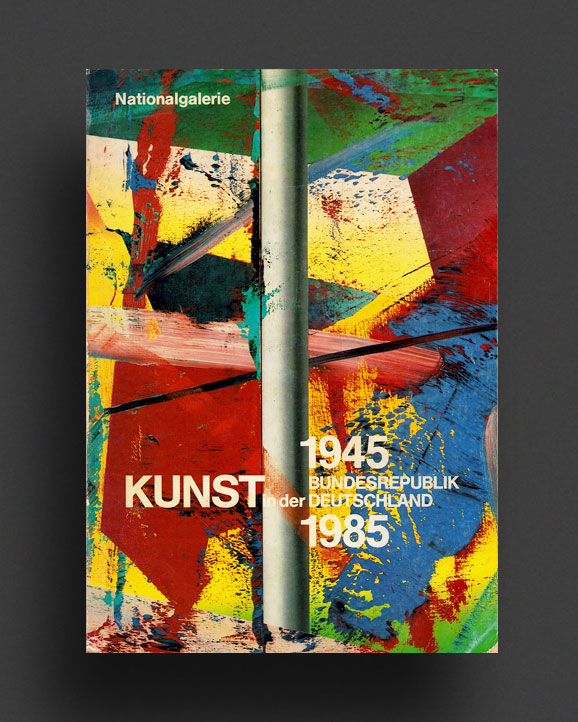
1985, German
Softcover, 736 pages, 29.7 x 21 cm
1st Edition, Out of print title / used / good
Published by
Nationalgalerie / Berlin
$40.00 - In stock -
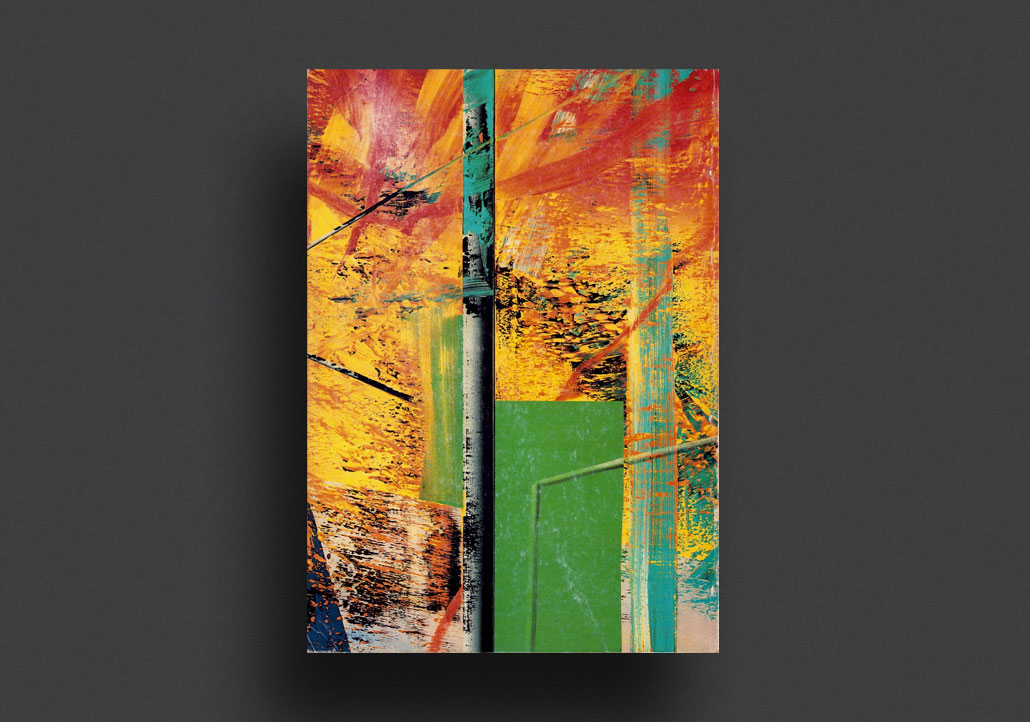
Enormous 700+ page volume about "Art in the Federal Republic of Germany 1945—1985", published on the occasion of an exhibition at the Nationalgalerie, Berlin, September 27, 1985—January 21, 1986. Profusely illustrated in colour with many works by Vostell, Baselitz, Beuys, Polke, Richter, Palermo, Klapheck, Darboven, Schultze, Uecker, Horn, Lüpertz, Haacke, Ruthenbeck, Antes, the Bechers, Rinke, Gerz, Erhard Walther, Penck, Knowles, Higgins, June Paik, Maciunas, Christiansen, Filliou, Brecht, Kriwet, Roth, Ulrichs, and many more, accompanied by texts in German, bibliography and index.
Good copy, some rubbing to the cover boards, light wear, bumping with age/size.
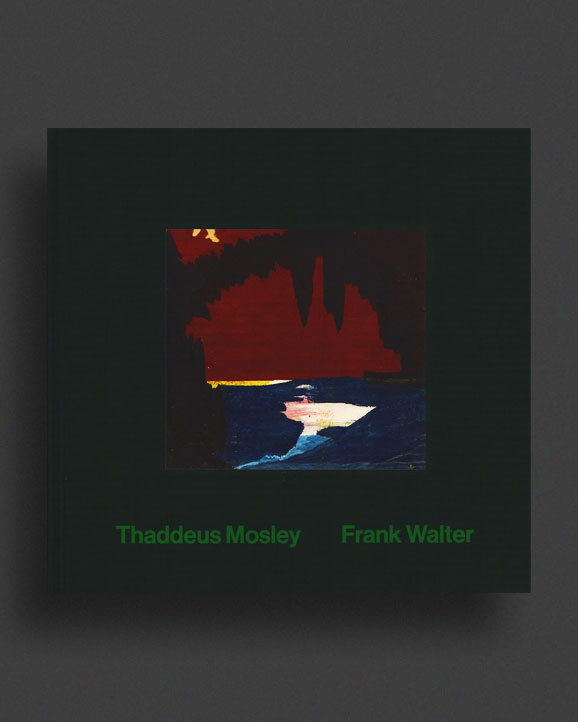
2023, English
Hardcover (clothbound), 120 pages, 27.9 x 27.9 cm
Published by
Karma / New York
$100.00 - In stock -
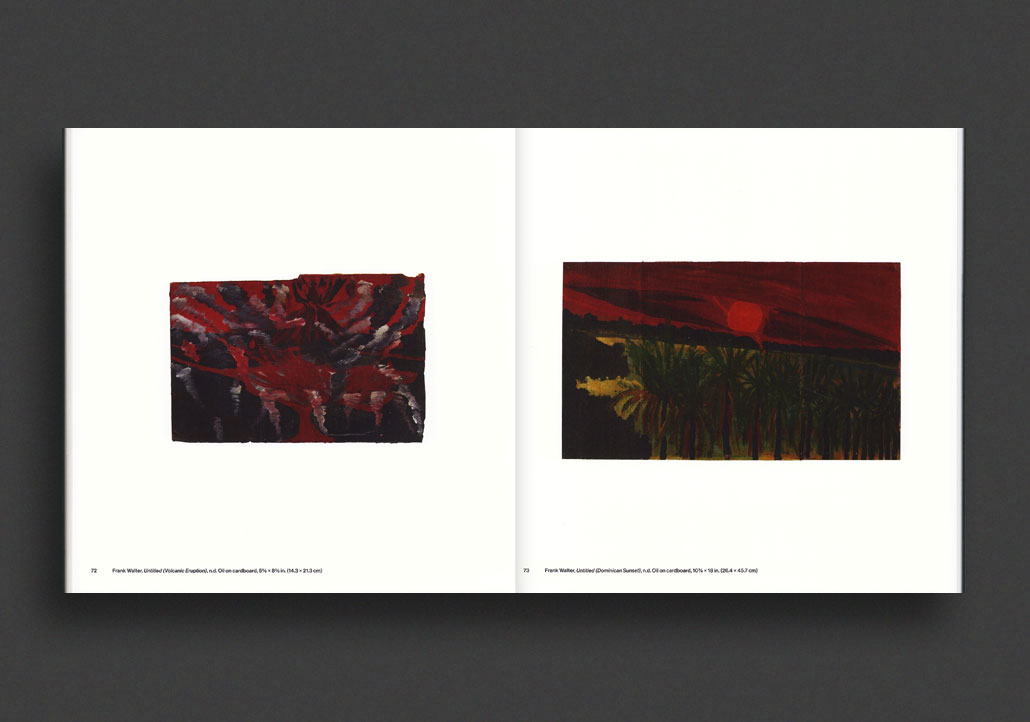
This volume showcases the works of Thaddeus Mosley and Frank Walter (1926–2009). Mosley, self-taught and son of a Pennsylvania miner, uses salvaged wood to create large-scale abstract forms. Walter, from Antigua, expresses the beauty of his homeland’s landscapes through paintings and woodwork.
1981, German
Softcover, 150 pages, 26.5 x 20 cm
1st Edition, Out of print title / used / very good
Published by
Kunstmuseum Bonn / Bonn
$120.00 - Out of stock
First edition of the scarce 1981 Blinky Palermo book published on the occasion of the exhibition 'Palermo (Peter Heisterkamp)' at Kunstmuseum Bonn, 22 Sept — 1 Nov, 1981. One of the best books on Palermo, this volume is profusely illustrated throughout with works in colour and b/w, paintings, objects, drawings, installations, photographs, accompanied with text by Dierk Stemmler, biography, chronology of works, exhibitions, and more. Texts in German.
Blinky Palermo (1943—1977), born Peter Schwarze, Heisterkamp his foster surname, was a German abstract painter. He adopted his outlandish name in 1964, during his studies with Bruno Goller and Joseph Beuys at the Kunstakademie Düsseldorf between 1962 and 1967, in reference to Frank "Blinky" Palermo, an American Mafioso and boxing promoter who managed Sonny Liston. In 1969, Palermo moved to Mönchengladbach and set up a studio he would share with Imi Knoebel and Ulrich Rückriem. After a stay in New York in the early 1970s, he moved into Gerhard Richter's former Düsseldorf studio. Over the course of his 14-year artistic career Palermo tirelessly probed the limits of abstract painting. Having begun his brushwork on more traditional surfaces, he shifted his activity to less conventional supports, experimenting with diverse materials and forms, exploring the relationships that can exist between the wall and the space delimited by the painting. Under Beuys, he became increasingly interested in the organized spatial relationship between form and colour, a polarity which is manifest throughout the rest of his oeuvre. In the mid 1960s, Palermo moved away from conventional rectangular canvases and increasingly opted for surfaces such as the circle, triangle, cruciform, totem pole and even the interior walls of buildings. Between 1964 and 1966, Palermo produced a small series of paintings on canvas in which he experimented with constructivist principles of order. Over the course of his short life, Palermo participated in more than seventy exhibitions worldwide, including Documenta in 1972 and the Venice Biennale in 1975. Blinky Palermo died in 1977, aged 33, during a trip to the Maldives.
Very Good copy with only light shelf wear to blue covers, light bump to top corner.
1969, English
Softcover, 125 pages, 23 x 15 cm
1st Edition, Out of print title / used / good
Published by
University of London / London
$20.00 - In stock -
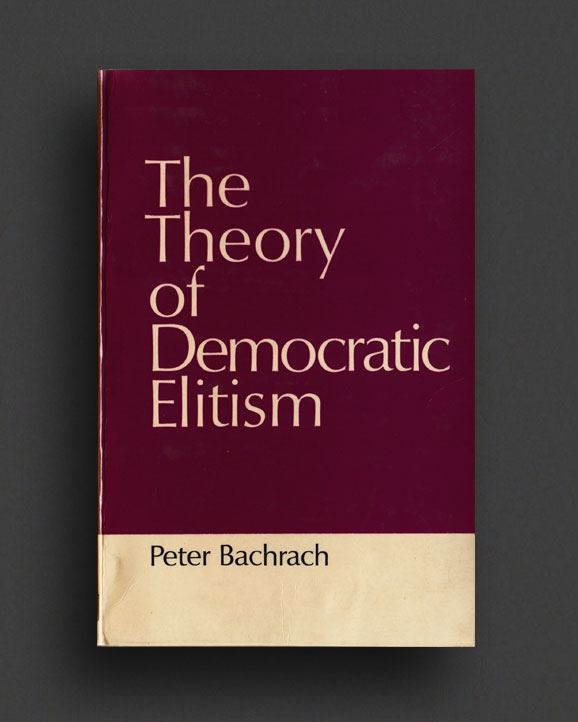
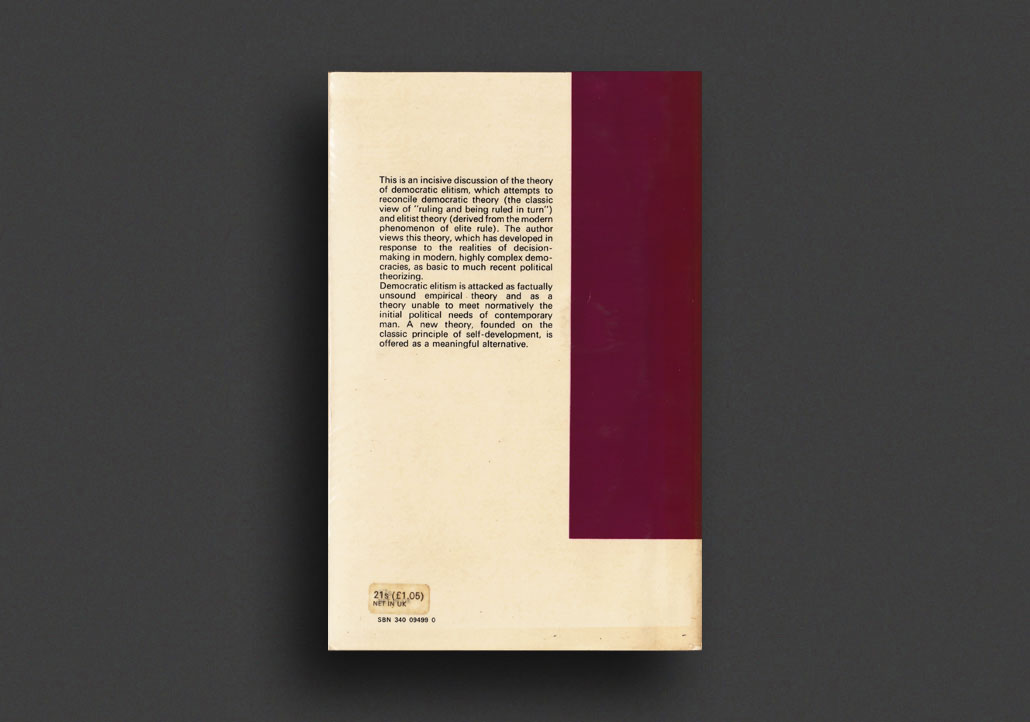
A 1969 University of London reprint of the 1967 Little, Brown book, Professor Bachrach considers the age-old question of the role of elites in a democracy. He argues that the present influence of elites in the U.S. can be offset only by the revitalization of political participation. The book also provides a historical and analytical examination of the theory of democratic elitism, as well as its soundness both as empirical and as normative theory.
Peter Bachrach was prominent political theorist and professor emeritus of political science at Temple University.
Good copy with previous owner's (artist Bernard Sachs) name to first first, tape markings from age.
2008, English
Softcover, 190 pages, 22 x 14 cm
1st Edition, Out of print title / used / very good
Published by
Solar Books / US
$140.00 - Out of stock
2003 Solar Books edition of the long out-of-print English edition of Eden, Eden, Eden — Pierre Guyotat's masterpiece of atrocity and obscenity, with preface by Roland Barthes and introduction by Stephen Barber.
The most subversive French novelist of the later 20th century, Pierre Guyotat (b. 1940) was the uncompromising heir of De Sade, Artaud, Rimbaud and Genet. Published in France in 1970 by Gallimard, with a preface by Michel Leiris, Roland Barthes and Philippe Sollers, Eden, Eden, Eden was greeted by both furore and acclaim. The book was immediately banned by the French government as pornographic. A campaign of international support for the book was signed by the like of Pier Paolo Pasolini, Jean-Paul Sartre, Pierre Boulez, Joseph Beuys, Pierre Dac, Jean Genet, Simone de Beauvoir, Joseph Kessel, Maurice Blanchot, Max Ernst, Italo Calvino, Jacques Monod, and Nathalie Sarraute. François Mitterrand and Georges Pompidou tried to get the ban lifted but failed until 11 years later when a newly elected President Mitterrand personally intervened to lift the ban in 1981.
Today Eden, Eden, Eden is recognised as one of the major works of the last century. In literally a single sentence, a desert-like, polluted, apocalyptic landscape of unending civil war unfolds without any morality (and therefore also without evil). This delirious, lacerating novel of startling innovation brings scenes of brutal carnage into intimate collision with relentless acts of prostitutional sex and humiliation.
"a new landmark and starting-point for new writing"—Roland Barthes
"I have never read anything like it in any stream of literature"—Michel Foucault
Very Good copy with some light creasing.
2023, English
Hardcover, 312 pages, 23 x 26.5 cm
Published by
RM / Barcelona
$135.00 - In stock -
The first overview in a decade of the dazzling Surrealist universe of Leonora Carrington—artist, author, occultist, feminist.
In recent years, the art and fiction of Surrealist painter and author Leonora Carrington have received much mainstream recognition, but—until now—there has been no authoritative overview of her work. Divided into 10 sections, Revelation introduces Carrington’s singular artistic universe, displaying an extensive array of her wide-ranging creations (including paintings, drawings and tapestries) and fusing a chronological narrative of her life with a study of the most prominent themes in her work—from her training and early influences in England and Florence to her contact with the Surrealists in Paris, through her time in Saint-Martin-d’Ardèche, her traumatic experiences in Spain, her immigration to New York and her new homeland in Mexico. Punctuating the reproductions are archival materials, book excerpts and documentary photographs.
Leonora Carrington (1917–2011) was a British-born artist, Surrealist painter and novelist, famed for her narrative scenes inhabited by mystical figures participating in curious rituals. After fleeing Europe during World War II, she lived most of her adult life in Mexico City, where she was a founding member of the women's liberation movement.
2023, Japanese
Softcover, 168 pages, 20.5 x 20.5 cm
Published by
Ribonsha / Japan
$70.00 - In stock -
Photo book of works by Japanese avant-garde artist and writer, Genpei Akasegawa (1937—2014), refreshing his legacy as an artist who pioneered ways of thinking about art under capitalism that still feel like trenchant critiques decades later.
Genpei Akasegawa was not only an artist who successfully transitioned from the avant-garde to the broader realm of popular culture but also an award-winning writer and photographer. He emerged in the Japanese art scene in the 1960s. Best known internationally as a member of the influential, anti-art collective Hi-Red Center (1963–64), Genpei Akasegawa is one of the all-time trickster figures of Japanese art history. The famous Model 1,000-Yen Note Incident (1963), which involved a real-life police investigation and trial, solidified his reputation as an inspired conceptualist. In 1986, Akasegawa, and his collaborators, including the Japanese architect Terunobu Fujimori, formed a new group called the Rojō Kansatsu Gakkai (Street Observation Society). Within this group, Akasegawa showcased a series of photographs featuring Tokyo's bizarre and overlooked architectural features. These structures, referred to by Akasegawa as 'Thommasons', were often disregarded by society but were repurposed by Akasegawa as objects of artistic value.
Keiko Toyoda, of Shiseido Gallery, invited six midcareer artists to select photographs from 40,000 unexhibited 35mm reversal film prints, shot between 1985 and 2006, which Akasegawa kept carefully filed in his study. Shuta Hasunuma, Zon Ito, Sachiko Kazama, Yuko Mohri, Yuta Nakamura and Yasuhiro Suzuki each chose around 20 prints each, presented in this first survey book of Akasegawa's photography, from his ‘Hyperart Thomasson’ project of the 1970s onward: photographs of functionless objects embedded and preserved in everyday spaces despite their lack of utility, to capturing everything from odd lines scored into a patch of green asphalt to table settings and cat portraits (in pre-meme-era 1993).
In addition to his artistic work, Akasegawa was also a prolific writer and critic, having authored over 20 publications on art and culture.
1992, French / Italian
Softcover (staple bound), 12 pages, 28.5 x 24 cm
1st Edition, Out of print title / used / average
Published by
Charta / Milan
Mois de La Photo / Paris
$80.00 - In stock -
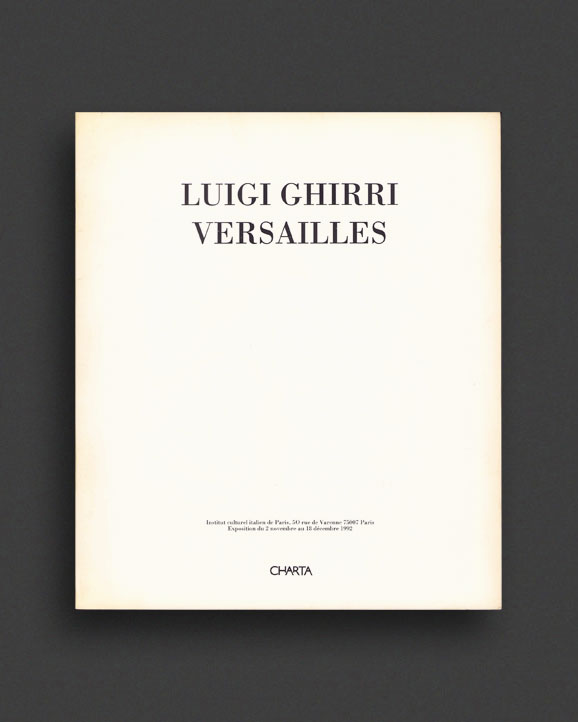
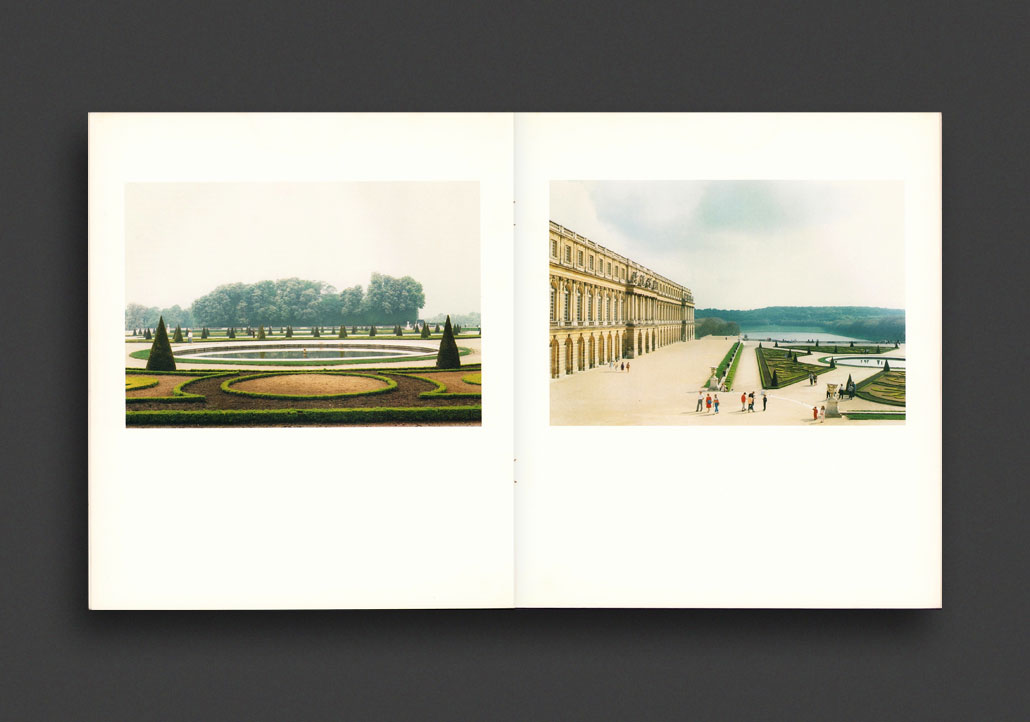
Very rare Luigi Ghirri French catalogue published in 1992 on the occasion of the exhibition Luigi Ghirri — Versailles, Institut Culturel Italien de Paris, 2 November—18 Decemeber, 1992. Illustrated in colour with Ghirri's photographs of Versailles from his visit in 1985, accompanied by text from Italian writer Beppe Sebaste in French and Italian. Printed in Milan.
Average copy due to light moisture shadow/light ripple to top of publication. Tanning and light wear.
2023, English
Hardcover, 580 pages, 24 x 17 cm
Published by
Korm Plastics / Netherlands
$70.00 - Out of stock
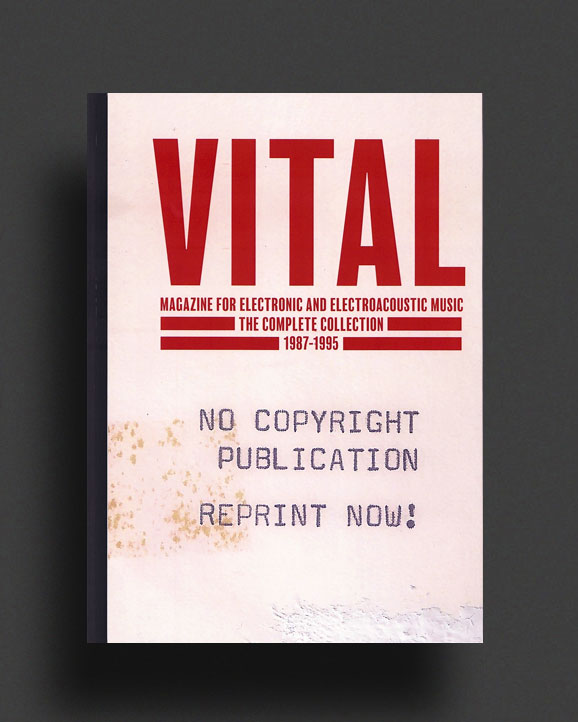
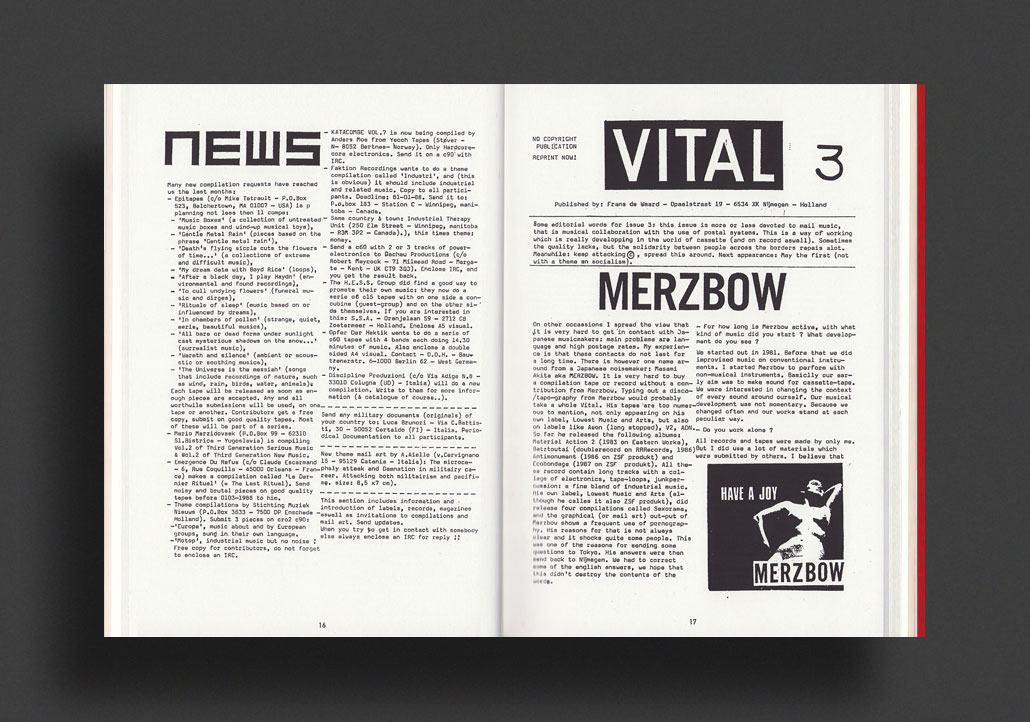
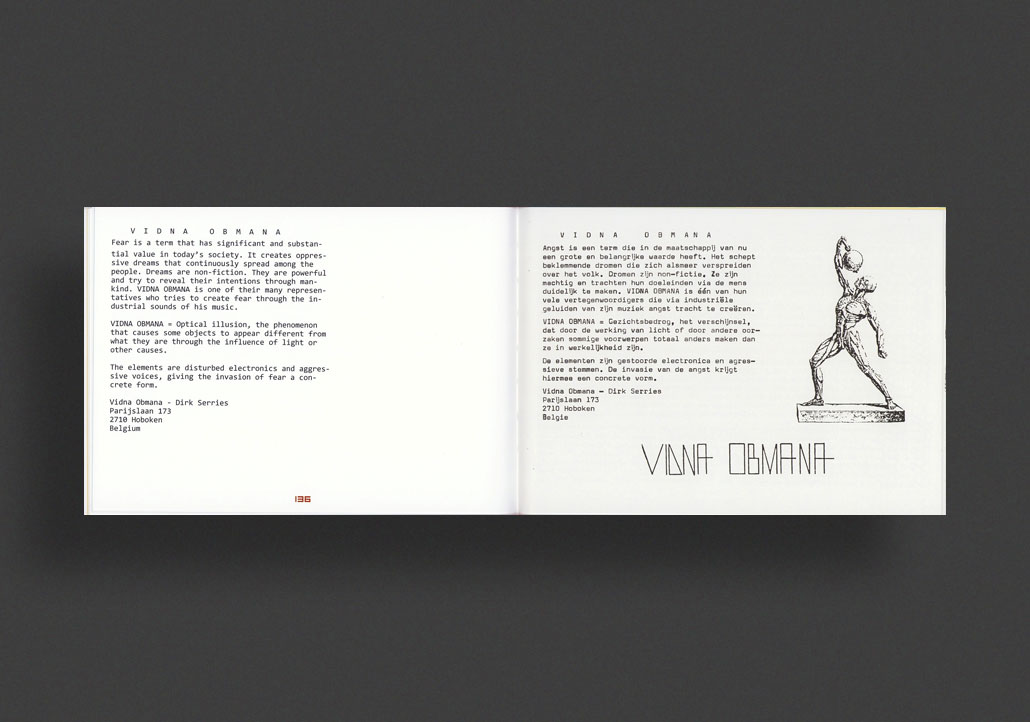
Frans de Waard published Vital, a fanzine for electronic and electroacoustic music, from 1987 to 1995. It was a low-budget, Xeroxed publication, bearing the revolutionary instruction: ‘No Copyright Publication. Reprint Now!’ It featured interviews with Asmus Tietchens, O Yuki Conjugate, Merzbow, P16.D4, Pierre Henry, Jim O’Rourke, Brume, Döc Wor Mirran and many others, hosted discussions on copyright, plagiarism and plunderphonics, house music, ambient music, cassette culture and noise, and included contributions from musicians such as Leigh Landy, Godfried Willem Raes, John Duncan, and GX Jupitter-Larsen. Every issue included reviews of cassette releases, LPs, CDs and books. A total of 44 issues were published. Vital moved online in 1995, where it appeared every week since as Vital Weekly.
This book is a reprint of all 44 issues and is a lively record of the heyday of cassette culture and industrial music, but also of developments in the wider field of electronic music.
2023, English
Hardcover (w. cd), 184 pages, 21 x 15 cm
Published by
Korm Plastics / Netherlands
$60.00 - Out of stock
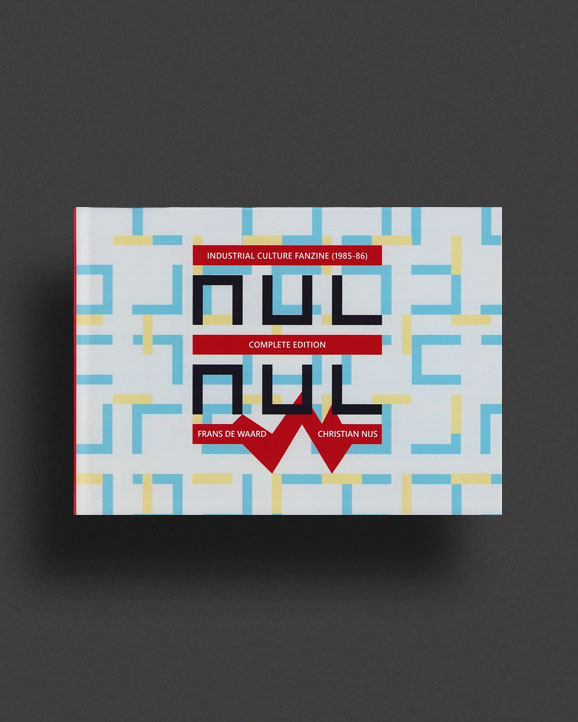
In October 1984, Frans de Waard started his Korm Plastics label and his music project Kapotte Muziek. Shortly after, a fellow student, Christian Nijs, joined him as a musical partner. They quickly released a few cassettes and contributed to international compilations, and Nijs started a short-lived label, Disabuse Transmissions. In the summer of 1985, they published the first issue of Nul Nul, a fanzine, to promote their projects and to support the industrial music scene in The Netherlands and Belgium. They published four issues. The lack of enthusiasm of readers, the financial struggle and the Nijs leaving Kapotte Muziek meant the end of Nul Nul, and De Waard started shortly after Vital (1987-1995), which is already published in book form by Korm Plastics.
These four issues are a testament to the creative times that were the 1980s, cut ‘n paste, and the strange, curious language we used when we were younger. Mark Posyden and Frans de Waard painstakingly translated all the texts (and went slightly insane doing it, as some of the original writing was pure gobbledygook), and Studio Bertin made a design that is ‘almost’ like the original, making this book a true beauty.
Along with this book comes a 24-track compilation CD by bands discussed within the pages of Nul Nul. It is very well possible this is the first time industrial music from The Netherlands and Belgium is collected on a CD, and it comes with many musical approaches, from pure noise to minimal synth. The bands are Kapotte Muziek (with a rare solo piece by Christian Nijs), Odal, Zombies Under Stress, Factor 6 (Christian Nijs’s solo project), Narzisse, Jacinthebox, Het Zweet (of which in recent years various works have been re-issued), THU20, Joe the Prang’d, Administratief Management, The Dwarf Farm, Clinique Lutetia, Experiment Incest, Heer Peejee, Sluagh Ghairm (pre Psychic Warriors Of Gaia), Zweiter Korps, Mailcop (Roel Meelkop’s earlier project), Ilo Istatov (from O.R.D.U.C.), Prilius Lacus, Dikyl Brobojo, Kanker Kommando, Het Hilaire Brisdak Ensemble, Vidna Obmana (from his early noise days), and A Violated Body; from totally unknown bands to still going strong ones, such as Kapotte Muziek and THU20.
2023, English
Softcover, 232 pages, 24 x 17 cm
Fourth expanded edition,
Published by
Korm Plastics / Netherlands
$40.00 - Out of stock
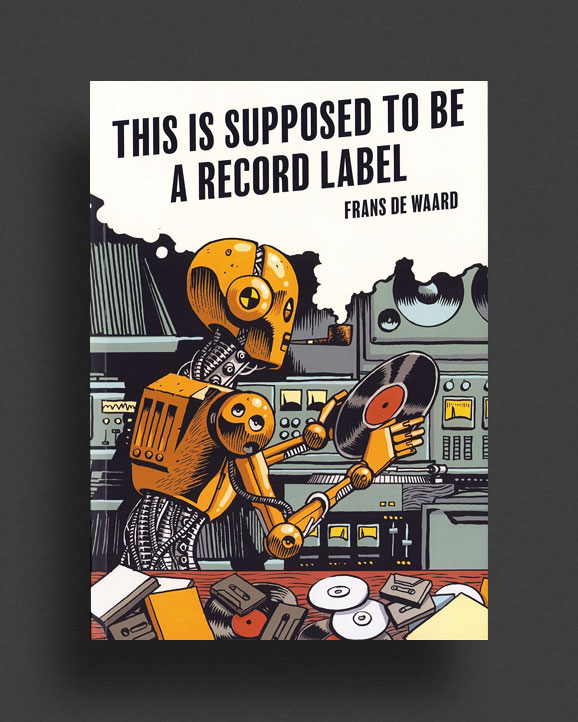
In 1992, Frans de Waard (of Kapotte Muziek, Beequeen and the Korm Plastics label) was asked to work for Staalplaat, then one of the biggest independent labels for experimental and electronic music. Staalplaat was the home for bands like Muslimgauze, :zoviet*france:, Rapoon, O Yuki Conjugate as well as Jaap Blonk, Normally Invisible and Kingdom Scum. With an average of three new releases every month, Staalplaat remained a major player for the next eleven years. Hired to set-up a database and to sell and buy new music, Frans de Waard over the years also assumed a role as (unofficial) business director and A&R man, and came to be regarded as the head honcho. In 2003 he’d had enough and decided to quit.
This book tells his story about those eleven years, the many high and as many lows of working for a small independent record label, which also functioned as a shop, mail order, radio programme, news outlet, and concert organiser. It’s about embarrassing confrontations with musicians, labels, distributors, and the endless spending on the most unique packaging CD-land ever saw.
The book includes an interview with Staalplaat founder Geert-Jan Hobijn, a transcript of a radio interview with Muslimgauze, a 1980’s account of Staalplaat’s activities, and a discography, among others. This might be a suitable reading for everyone with an interest in the experimental music scene, and anyone else who wants to read a crazy, funny and sad story about a small struggling record label.
The second edition is expanded with two more appendixes, one about John Cage and one about things found and lost, 2016-2019. Also, anyone who is interested in a manual of how (not) to run your record label might want to take notes.
"Before reading this, I had some doubts about Frans’ ability to write something so captivating and downright fucking funny. I’ve worked with him myself before, plus we have met a few times, and I always had this impression he was a somewhat sombre, serious type (an impression maintained by his reviews), but This is Supposed to be a Record Label shatters this completely. The man ought to put down his pipe long enough to get another book out because he certainly knows how to tell a story." - Adverse Effect
"Although familiar with his work in sound and music, I hadn’t had the chance to hear de Waard’s writer voice until I came across his long-running music review newsletter, Vital Weekly. The matter-of-factness reflects the brutal honesty of his assessments. A dry, wicked sense of humor is always close to the surface. De Waard’s keen observational eye made This Is Supposed to Be a Record Label a must-read for anybody interested in underground sounds." - Hyperallegric.com
2004, English
Softcover (staple bound), 16 pages, 30 x 21 cm
1st Edition, Out of print title / used / good
Published by
The Tate Gallery / London
$18.00 - Out of stock
Exhibition guide published on the occasion of Sigmar Polke, History of Everything, at the Tate London in 2004. Introduces the German artist Sigmar Polke (1941—2010) and surveys the major themes/developments in his work, illustrated throughout with examples in b/w and colour. Includes full schedule of exhibition events, etc.
Good copy with wear and spine pinching, rubbing to cover from another small book.
2023, English
Hardcover, 184 pages, 30.5 x 21.6 cm
Published by
Art Institute of Chicago / Chicago
Museo de Arte Moderno / Mexico City
$85.00 - Out of stock
This major new hardcover publication offers a definitive look at the artistic practice of Remedios Varo (1908–1963) following her emigration from Spain to Mexico City in 1941. Her work from 1955 to 1963 made a lasting contribution to modern art and the legacy of Surrealism. In Remedios Varo: Science Fictions, fresh historical and material findings establish the integral relationship between Varo’s layered interests—in alchemy, architecture, magic, mysticism, philosophy, and science—and her beguiling technical approach to art making. Essays detail specific works’ complex stories and spectacular surfaces. An illustrated taxonomy of Varo’s artistic techniques, including automatic mark making as well as careful manipulation of materials and media, offers new insights into the artist’s craft. An illustrated inventory of a major portion of Varo’s library—published here for the first time—reveals the artist’s engagement with a wide range of subjects. Stunning new photography of many of her artworks are presented within a dynamic geometric design inspired by the artist’s work. Situating Varo as a woman working in midcentury Mexico City and living among a tight-knit community of local and emigre artists, poets, and thinkers, the catalogue illuminates the complex worldview that shaped her search for individual and collective transcendence.
1996, English
Softcover, 280 pages, 17.7 x 11.2 cm
1st Edition, Out of print title / used / very good
Published by
Semiotext(e) / Los Angeles
$35.00 - Out of stock
Scarce first 1996 edition of Soft Subversions by Félix Guattari, published by Semiotext(e) in their Native Agents book series. Edited by Sylvère Lotringer, this collection of Felix Guattari's essays, lectures, and interviews traces the militant anti-psychiatrist and theorist's thought and activity throughout the 1980s ("the winter years"). Concepts such as "micropolitics," "schizoanalysis," and "becoming-woman" open up new horizons for political and creative resistance in the "postmedia era." Guattari's energetic analyses of art, cinema, youth culture, economics, and power formations introduce a radically inventive thought process engaged in liberating subjectivity from the standardizing and homogenizing processes of global capitalism.
Very Good copy.
2021, English
Softcover, 144 pages, 21 x 13.5 cm
Published by
Soho Press / New York
$32.00 - Out of stock
“I started writing books about and for my friend George Miles because whenever I would speak about him honestly like I am doing now I felt a complicated agony beneath my words that talking openly can’t handle.”
For most of his life, Dennis Cooper believed the person he had loved the most and would always love above all others was George Miles. In his first novel in ten years, Dennis Cooper writes about George Miles, love, loss, addiction, suicide, and how fiction can capture these things, and how it fails to capture them. Candid and powerful, I Wished is a radical work of shifting forms. It includes appearances by Santa Claus, land artist James Turrell, sentient prairie dogs, John Wayne Gacy, Nick Drake, and George, the muse for Cooper’s acclaimed novels Closer, Frisk, Try, Guide, and Period, collectively known as “The George Miles Cycle.” In revisiting the inspiration for the Cycle, Dennis has written a masterwork: the most raw, personal, and haunted book of his career.
Dennis Cooper (born 1953) is an American novelist, poet, critic, editor and performance artist who grew up in the Southern California. In 1976, he founded Little Caesar Magazine and Press, which he ran until 1982. In 1985, he moved to Amsterdam for two and a half years, where he began his ten year long project, The George Miles Cycle, an interconnected sequence of five novels that includes Closer, Frisk, Try, Guide, and Period. His post-George Miles Cycle novels include My Loose Thread, The Sluts and God, Jr. Other works include the short-story collections Wrong and Ugly Man, poetry collections The Dream Police and The Weaklings, as well as the recent Smothered in Hugs: Essays, Interviews, Feedback, and Obituaries. Dennis Cooper currently spends his time between Los Angeles and Paris.
First paperback edition.
2024, English
Softcover, 240 pages, 21.5 x 15.2 cm
Published by
Nightboat Books / New York
$46.00 - In stock -
Collected for the first time, four landmark works of queer experimental poetry by reclusive cult poet David Melnick, known for his prowess with invented language and sound poetry.
David Melnick's Nice: Collected Poems spans twenty crucial years of gay life and experimentation with poetic form, bringing together four masterworks of American literature: Eclogs (1967-70), ten episodes in the urban afterlife of pastoral; PCOET (1972), written in an unknown tongue, verse for a world that's yet to be; Men in Aida (1983-85), Melnick's masterpiece, a giddy epic of queer community; and A Pin's Fee (1988), a backward glance and elegy, a cry of pain, howl of anger.
"An autobiographical narrative of indefinite description but definite emotional scope sits behind the surface of the text, a surface...magically moved in and out of focus."—Tom Mandel
"It isn't just that this book queers the ways in which meaning is understood.... It also sites the reader in a homographical relation to language, one of having to parse what looks, or sounds, or seems 'like,' something we're familiar with, while also abandoning previous assumptions about what this process might entail."—Colin Herd
"Melnick's twist of "gay ethic" in poetic language makes for a brief but unforgettable oeuvre. Nice: Collected Poems proves that David Melnick is an exemplary figure of unreadability in American poetics, one who continues to teach us of unreadability's pleasures, politics, and pains. . . [T]he posthumous volume brings the once-hermetic Melnick out into the light of new audiences."—Gabriel Ojeda-Sague, Harriet
"A gem of consciousness through which facets dream of their kinfolk radiance."—Aaron Shurin
2019, English
Softcover, 128 pages, 14 x 21.6 cm
Published by
Nightboat Books / New York
$34.00 - Out of stock
A facsimile edition of the classic 1970s book with new essays and archival material.
40th anniversary reprinting of a beloved fable-manifesto from the 1970s queer counterculture. The Faggots and Their Friends Between Revolutions, written by Larry Mitchell with illustrations by Ned Asta, takes place in a brutal empire in decline, where the faggots and their friends are surviving the ways and the world of men. Beloved by many since its publication, now with new essays by Morgan Bassichis and Tourmaline, this book offers a trenchant and irreverent critique of capitalism, assimilation, and patriarchy that is deeply relevant today.
2023, English
Softcover, 300 pages, 20.3 x 15.2 cm
Published by
Blank Forms / New York
$52.00 - Out of stock
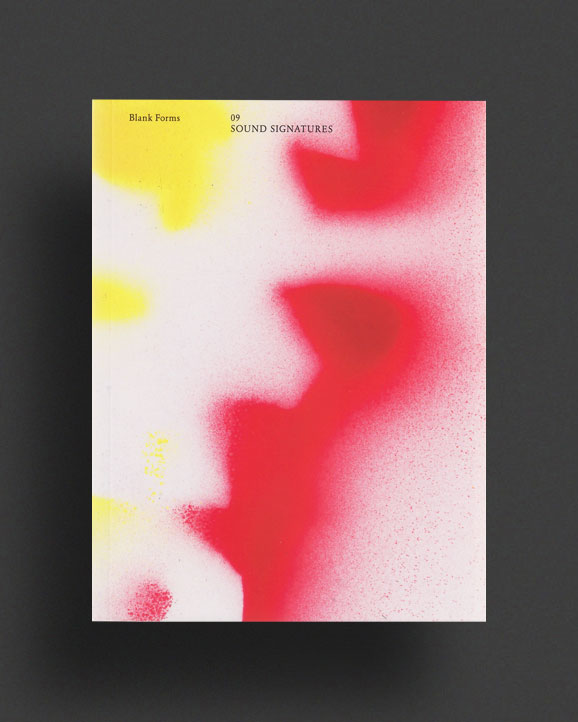
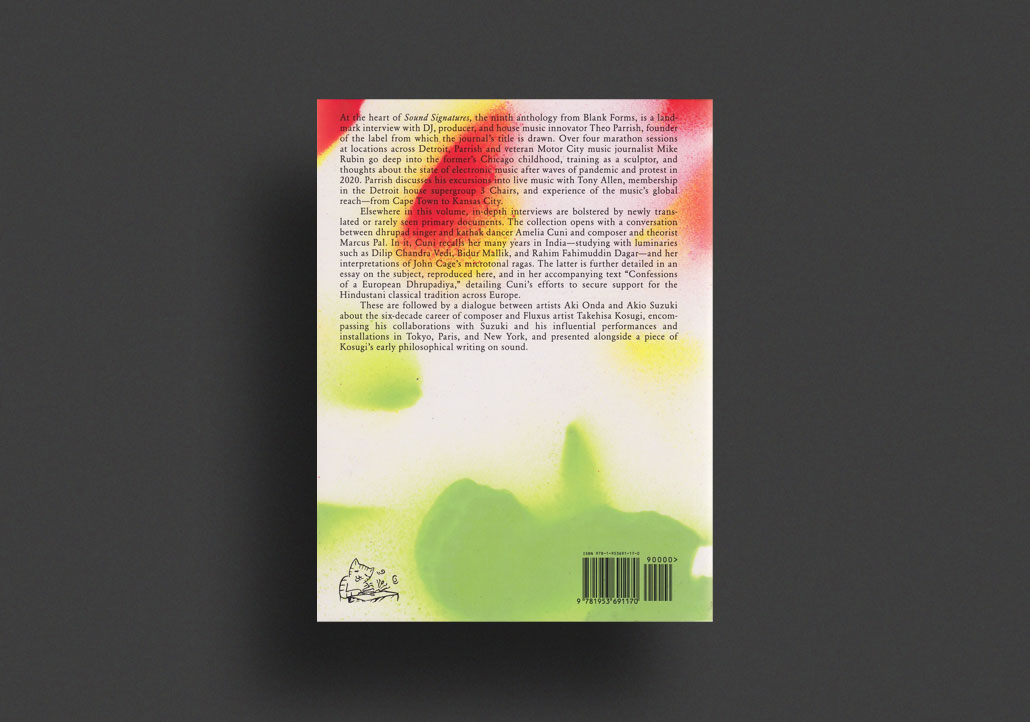
The penultimate Blank Forms anthology presents new interviews with musicians Theo Parrish, Amelia Cuni, Akio Suzuki and more.
At the centerpiece of Blank Forms 09: Sound Signatures is a career-spanning, twenty-hour conversation conducted over four days between producer, remixer, and Detroit house music legend Theo Parrish and veteran music journalist Mike Rubin. They go deep on Parrish’s childhood in Chicago’s South Side, sculptural training, and collaborations with Moodymann, Rick Wilhite, and Omar S, and explore how the social movements of 2020 have reshaped his practice and dance music at large. This volume also includes an illustrated discussion between Dhrupad singer Amelia Cuni and sound artist/tuning theorist Marcus Pal, covering Cuni’s years studying voice and dance in India, her interpretations of John Cage, and collaborations with the likes of Terry Riley and Catherine Christer Hennix—accompanied by deeply researched essays from Cuni on Hindustani classical music and avant-garde performance. Finally, the collection features reminiscences from composer and performer Akio Suzuki and musician Aki Onda on Fluxus pioneer and Taj Mahal Travellers founder Takehisa Kosugi, with newly translated criticism from Kosugi.
2023, English
Softcover, 158 pages, 14 x 20 cm
Published by
Twisted Spoon Press / Prague
$40.00 - Out of stock
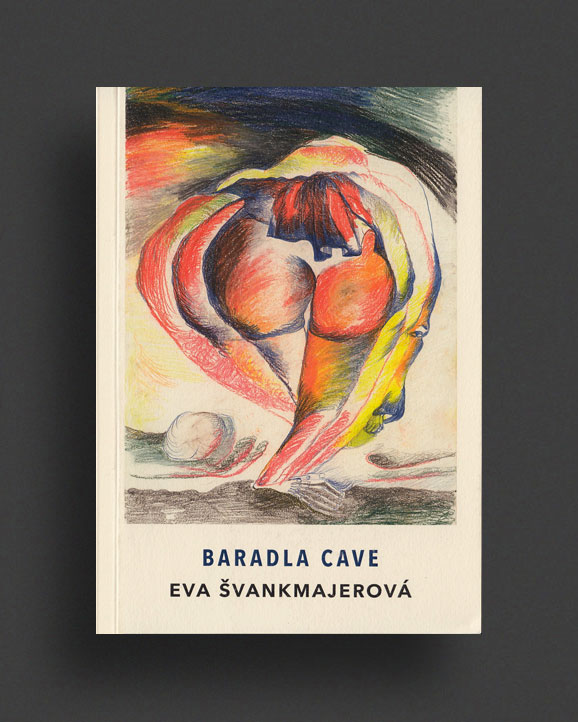
The novel Baradla Cave by the Czech Surrealist Eva Švankmajerová, who is perhaps best known for her paintings and collaboration with her husband Jan Švankmajer on a number of films, has lost none of the force of its social critique and trenchant humor since it originally appeared in samizdat in the 1980s and officially published in 1995 by Edice Analogon. A living organism, Baradla is both place (Prague) and person (a woman), an exploration of maternity and femininity as well as a satirical look at the overweening mother-state and consumer society. The language collage comprising pseudo-scientific jargon, the diction of interwar magazines for women and girls, the demotic, and metaphoric stream is complemented by Jan Švankmajer's erotic collages, as scenes of episodic sexual violence alternate with humorous reflections on various ingrained habits and customs. With a seemingly boundless sense of the absurd, Švankmajerová fingers here practically everything having to do with modern existence: substance abuse, violent sex crimes, rampant consumerism, pervasive corruption, and dysfunctional family relationships.
"It is like looking at a surrealistic painting. You might say What is going on? but when you look closer there is a certain sense of something even if it is not entirely clear what that something is. Humour and the unreal are part but only part of it, while much of it is letting us see the world in a completely different way from the way we normally do and that i s what Švankmajerová brilliantly does in this novel. The only surprise is that it is not better known."—The Modern Novel
Translated from the Czech by Gwendolyn Albert
cover and frontispiece by the author
collages by Jan Švankmajer
afterword by Vratislav Effenberger
1999 / 2006, Japanese
Hardcover (w. dust jacket and obi-strip), 240 pages, 23 x 16 cm
Out of print title / used / fine
Published by
Kokushokankokai / Tokyo
$60.00 - Out of stock
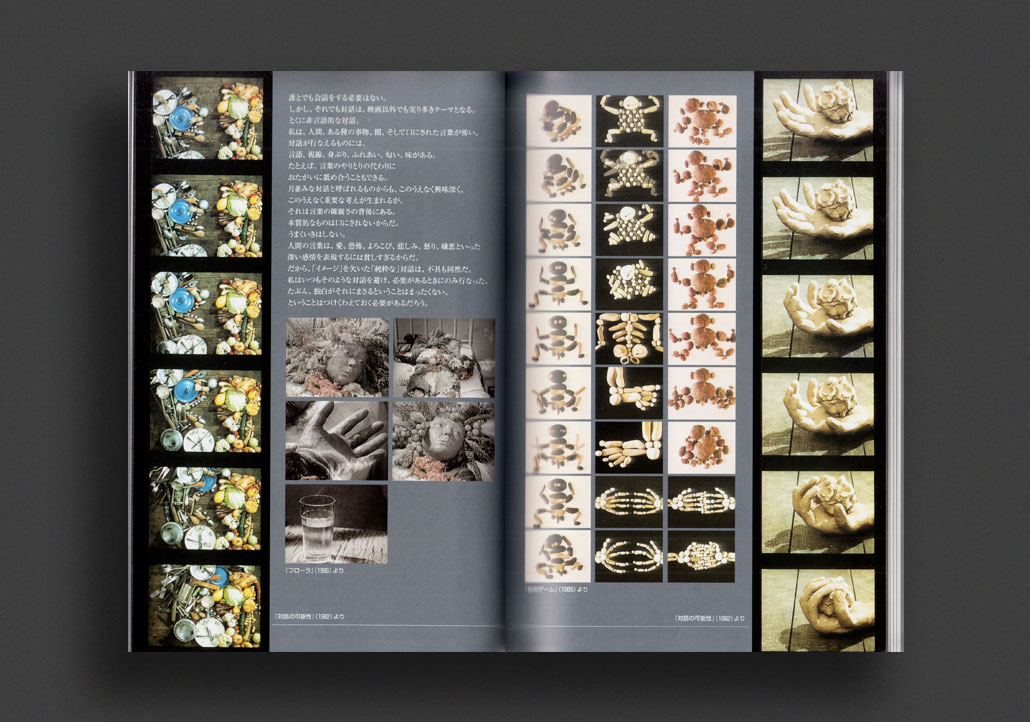
First edition of this wonderful hardcover monographic study on the work of Czech Surrealist artist, puppeteer, animator, and filmmaker, Jan Švankmajer (b. Prague, 1934), first published in Japan in 1999. Profusely illustrated throughout in colour and b/w with all of his film and artworks, including his sculpture, collage, ceramics, “tactile experiments”, and much more. With chapters such as "Manipulation of malicious intent", "Everything starts with a doll", and "Realistic delusions, grotesque dreams", the book is largely made up of conversations with Jan Švankmajer, his own diaries on the making of "Faust" and other subjects, extensive texts and dialogues with the artist relating to central themes in his work, from the "Tactile Imagination" to Alchemy. It also provides a full chronology of the artist, a complete filmography, a list of his works, and bibliography of the artist. Texts are
Well-known for his dark re-imaginings of well-known fairy tales and for his avant-garde merging of live action, stop-motion animation and puppetry, Švankmajer is one of the most distinctive and acclaimed Czech filmmakers. Since the mid-1960s, his films have shocked, mesmerized, repulsed and delighted audiences, amassing international cult-like following. His prolific work off-screen across assemblage and collage mediums, using both man-made and organic materials, share the central thematic elements of his subversive films, such as black humour, metamorphosis, sex, decomposition, mythology, scatology, death, humour and the absurd. Over 300 illustrations with texts by Hideto Fuse, Maki Kumagai, Petr Holly, Jan Švankmajer.
Fine copy, As New.
2023, English
Softcover, 168 pages, 17.78 x 11.43 cm
Published by
Wakefield Press / Cambridge
$32.00 - Out of stock
A previously untranslated gem of Surrealist prose poetry from the acclaimed French novelist.
In 1941, Julien Gracq, newly released from a German prisoner-of-war camp, wrote a series of prose poems that would come to represent the only properly Surrealist writings in his oeuvre. Surrealism provided Gracq with a means of counteracting his disturbing wartime experiences; his newfound freedom inspired a new freedom of personal expression, and he gave the collection an appropriate title, Great Liberty: "In the occult dictionary of Surrealism, the true name of poetry is liberation." Gracq the poet rather than the novelist is at work here: Surrealist fireworks lace through bewitching modernist romance, fantasy, black humor and deadpan absurdism. A later, postwar section entitled "The Habitable Earth" presents Gracq as visionary traveler exploring Andes and Flanders and returning to the narrative impulse of his better-known fiction.
Julien Gracq (1910-2007), born Louis Poirier, is known for such dreamlike novels as The Castle of Argol, A Dark Stranger, The Opposing Shore and Balcony in the Forest. He was close to the Surrealist movement, and Andr Breton in particular, to whom he devoted a critical study.
Artwork by André Masson.
1999, English
Softcover (w. dust jacket), 288 pages, 21.5 x 13.4 cm
1st Edition, Out of print title / used / very good
Published by
Faber & Faber / London
$55.00 - Out of stock
Scarce first edition of CCRU founder Sadie Plant's end-of-the-millennium classic, Writing on Drugs, published by Faber and Faber in 1999.
"All writers on drugs become ghost writers for drugs. Or perhaps their drugs are ghost writing them"—Sadie Plant
Narcotics, stimulants and hallucinogens — these drugs have always affected far more than the perceptions, minds and moods of their users. Writing on Drugs explores the profound and pervasive nature of their influence on contemporary culture. It reads Coleridge on opium, Freud on cocaine, Michaux on mescaline and Burroughs on them all, and with such writers it begins to understand the many ways in which the modern world has found itself on drugs. Psychoactive substances have been integral to its economic history, its politics, media and technologies. They have influenced its poetry and stories, and shaped some if its most fundamental philosophies. They have even exposed the neurochemistry of a human brain which, like its cultures, has never been drug-free.
Sadie Plant was born in Birmingham and studied at the University of Manchester, where she gained her PhD in Philosophy in 1989. She has been a Lecturer in Cultural Studies at the University of Birmingham and a Research Fellow in the Department of Philosophy at the University of Warwick, where, in 1995, she formed The Cybernetic Culture Research Unit (CCRU) with Mark Fisher and Nick Land, an experimental cultural theorist collective celebrated for its idiosyncratic and surreal "theory-fiction" which incorporated cyberpunk and Gothic horror, gaining an online cult following related to the rise in popularity of accelerationism. She published The Most Radical Gesture: The Situationist International in a Postmodern Age in 1992, and Zeros and Ones: Digital Women and the New Technoculture in 1997. Having spent much of the 1990s in the academic world, she now works independently and writes full-time.
G—VG in VG dust jacket. Normal page tanning, tanning to dust jacket edge and spine. Not necessarily copy pictured.
2007, English
Softcover, 150 pages, 23 x 15 cm
Published by
State University of New York Press / New York
$70.00 - Out of stock
Provocative essays on language, literature, and the aesthetics of embodiment.
Shocking, brilliant, and eccentric, the French author, translator, and artist Pierre Klossowski (1905–2001) exerted a profound effect on French intellectual culture throughout the twentieth century. The older brother of the painter Balthus, secretary to the novelist André Gide, friend to Georges Bataille and Maurice Blanchot, and heralded as one of the most important voices in the French "return to Nietzsche" by Michel Foucault and Gilles Deleuze, Klossowski pursued his singular vision of mortal embodiment through a variety of scholarly manifestations. In Such a Deathly Desire (Un si funeste désir), Klossowski's original interpretation of Nietzsche's eternal return is developed around the enigmatic figure of the "demon," then deepened with provocative readings of Gide's correspondence; Barbey d'Aurevilly's novel A Married Priest; and the intertwining of language and death in the work of Bataille, Blanchot, and Brice Parain. The book concludes with the powerful essay "Nietzsche, Polytheism, and Parody," in which Klossowski articulates the consequences of the eternal return and the meaning of Nietzsche's genealogy of the fabulation of the world. Intersecting with and confounding a range of disciplines—including psychoanalysis, literary criticism, gender studies, and philosophy—Klossowski's critical writings on language, literature, and the aesthetics of embodiment remain powerful and original contributions to contemporary concerns in the theoretical humanities.
Translated with afterword by Russell Ford. Russell Ford is Assistant Professor of Philosophy at Elmhurst College.
"Pierre Klossowski was one of the most influential (albeit idiosyncratic) literary figures in France during the postwar years, yet his work remains strangely unknown in the English-speaking world. Such a Deathly Desire was one of the essential books of Klossowski's oeuvre, and it includes seminal articles on Gide, Bataille, and Blanchot, as well as his now-classic essay 'Nietzsche, Polytheism, and Parody. ' The appearance of the book in English has long been anticipated, and we owe an immense debt to Russell Ford for providing us with an accessible and accurate translation. "—Daniel W. Smith, Purdue University
1981/2000, English
Softcover, 34 pages, 15.3 x 23 cm
Published by
Barrytown Ltd. / US
Station Hill Press / Barrytown
$16.00 - In stock -
Jacques Derrida writes (in Deconstruction and Criticism) of The Madness of the Day, first published in English in 1981, that it is a story whose title runs wild and drives the reader mad.la folie du jour, the madness of today, of the day today, which leads to the madness that comes from the day, is born of it, as well as the madness of the day itself, itself mad..La folie du jour is a story of madness, of that madness that consists in seeing the light, vision or visibility, to see beyond what is visible, is not merely 'to have a vision' in the usual sense of the word, but to see-beyond-sight, to see-sight-beyond-sight..The story obscures the sun.with a blinding light.
Translated by Lydia Davis.
Maurice Blanchot (1907-2003) was a French writer, philosopher, and literary theorist. His work had a strong influence on later post-structuralist theorists such as Jacques Derrida. He is one of the most enigmatic and influential figures in modern French writing yet no interview, no biographical sketch, and hardly any photographs have ever been published of him.