World Food Books' programme is largely produced on Kulin Nation land. We acknowledge the Wurundjeri people of the Kulin Nation as the first and continuing custodians of this land, and pay respect to their Elders past, present, and emerging.
World Food Books is an arts and special interests bookshop in Naarm / Melbourne. Founded in 2010, World Food Books is devoted to the presentation of a rotating, hand-selection of international art, design, literary and counterculture publications with an emphasis on the anti-traditional, the experimental, the avant-garde, the heretic, the marginal.
Presenting new titles alongside rare and out-of-print books, catalogues and journals spanning the fields of modern and contemporary art, design, photography, illustration, film, literature, poetry, cultural theory, philosophy, sexuality, popular and underground culture in its many radical forms, World Food Books wishes to encourage adventurous, thoughtful and open-minded reading, looking, writing, and exchange of publishing and ideas, both current and historical.
As well as our bookshop, located in Melbourne's historical Nicholas Building, all of our inventory is available internationally via our online mail-order service.
World Food Books semi-regularly co-ordinates "Occasions", a programme of exhibits and events at the bookshop and in partnership with other hosts (such as museums and art galleries) that develop out of the activities, relationships and content of the bookshop itself.
World Food Books
The Nicholas Building
37 Swanston Street
Room 5, Level 6
Melbourne 3000
Australia
SHOP HOURS:
Thu–Fri 12–6, Sat 12–5
WEB-SHOP OPEN 24/7
World Food Books
Postal Address:
PO Box 435
Flinders Lane
Victoria 8009
Australia
Art
Theory / Essay
Architecture / Interior
Graphic Design / Typography
Photography
Fashion
Eros
LGBTQ+
Fiction / Poetry
Weird / Speculative / Science Fiction / Horror
Transgressive / Visceral / Abject
Symbolism / Decadence / Fin de siècle
Film / Video
Painting
Sculpture / Installation
Performance / Dance / Theater
Drawing
Sound / Music
Curatorial
Group Shows / Collections
Periodicals
Out-of-print / Rare
Posters / Ephemera / Discs
Signed Books
World Food Books Gift Voucher
World Food Book Bag
Australian Art
Australian Fiction
Australian Science Fiction / Speculative Fiction
Australian Poetry
Australian Photography
Japanese Photography
Conceptual Art
Minimal Art
Dada
'Pataphysics / Oulipo
Fluxus
Concrete Poetry
Pop Art
Surrealism
Arte Povera
Arte Informale / Haute Pâte / Tachism
Nouveau Réalisme / Zero / Kinetic
Situationism / Lettrism
Collage / Mail Art / Xerox Art
Art Brut / Folk / Visionary / Fantastic
Illustration / Graphic Art / Bandes Dessinées
Furniture
Italian Radical Design / Postmodernism
Textiles
Ceramics / Glass
Counterculture
Protest / Revolt
Philosophy
Psychoanalysis
Anthropology
Anarchism
Socialism / Anarchism / Communism / Capitalism
Literary Theory / Semiotics / Language
Feminism / Women's Studies
Gender Studies / Sexuality
Anthropology
Fetishism / BDSM
Drugs / Psychedelia
Crime / Violence
Animal Rights / Veganism
Occult / Esoterica
Ecology / Earth / Alternative Living
Whole Earth / Crafts
All prices in AUD (Australian dollars)
Pick-Ups
Pick-up orders can be collected in our bookshop during opening hours after order date. Please collect any Pick-up orders within 2 weeks of ordering as we have limited storage space. Orders will be released back into stock if not collected within this time. No refunds can be made for pick-ups left un-collected. If you cannot make it in to the bookshop in this time-frame, please choose postage option.
Return Policy
All sales are final. We do accept returns (for refund or exchange) for items received in error. All our orders are packed with special care using heavy-duty padding and cardboard book-mailers or bubble mailers (for smaller books), using reinforcement where required. We cannot take responsibility for any lost, stolen or damaged parcels.
Insurance
Should you wish to insure your package, please email us directly after placing your order and we can organise this at a small extra expense. Although all standard/express tracked packages are very safe and dependable, we cannot take responsibility for any lost, stolen or damaged parcels. We recommend insurance on valuable orders.
Interested in selling your old books, catalogues, journals, magazines, comics, fanzines, ephemera? We are always looking for interesting, unusual and out-of-print books to buy. We only buy books in our fields of interest and specialty, and that we feel we can resell.
We base these prices on desirability, market value, in-print prices, condition and our current stock levels. We offer cash, store credit, and can take stock on consignment. All
about 25% of the price we expect to get when we sell them, or 30% in store credit. We base these prices on desirability, market value, in-print prices, condition and our current stock levels.
Sell your books any day of the week. You can drop them off and return later. If you have a lot of books, we can visit your Sydney home.
We buy books that we feel we can resell. We offer about 25 % of the price we expect to get when we sell them, or 30% in store credit. We base these prices on desirability, market value, in-print prices, condition and our current stock levels.
Philadelphia Wireman
03 August - 01 September, 2018
World Food Books is proud to announce our next Occasion, the first presentation of sculptures by Philadelphia Wireman in Australia.
The Philadelphia Wireman sculptures were found abandoned in an alley off Philadelphia’s South Street on trash night in 1982. Their discovery in a rapidly-changing neighbourhood undergoing extensive renovation, compounded with the failure of all attempts to locate the artist, suggests that the works may have been discarded after the maker’s death. Dubbed the "Philadelphia Wireman" during the first exhibition of this work, in 1985, the maker’s name, age, ethnicity, and even gender remain uncertain. The entire collection totals approximately 1200 pieces, all intricately bound together with tightly-wound heavy-gauge wire (along with a few small, abstract marker drawings, reminiscent both of Mark Tobey and J.B. Murry). The dense construction of the work, despite a modest range of scale and materials, is singularly obsessive and disciplined in design: a wire armature or exoskeleton firmly binds a bricolage of found objects including plastic, glass, food packaging, umbrella parts, tape, rubber, batteries, pens, leather, reflectors, nuts and bolts, nails, foil, coins, toys, watches, eyeglasses, tools, and jewellery.
Heavy with associations—anthropomorphic, zoomorphic, and socio-cultural responses to wrapped detritus—the totemic sculptures by Philadelphia Wireman have been discussed in the context of work created to fulfil the shamanistic needs of alternative religions in American culture. Curators, collectors, and critics have variously compared certain pieces to sculpture from Classical antiquity, Native American medicine bundles, African-American memory jugs, and African fetish objects. Reflecting the artist’s prolific and incredibly focused scavenging impulse, and despite—or perhaps enhanced by—their anonymity, these enigmatic objects function as urban artefacts and arbiters of power, though their origin and purpose is unknown. Philadelphia Wireman, whatever their identity, possessed an astonishing ability to isolate and communicate the concepts of power and energy through the selection and transformation of ordinary materials. Over the course of the past two decades, this collection has come to be regarded as an important discovery in the field of self-taught art and vernacular art.
Presented in collaboration with Fleisher-Ollman Gallery, Philadelphia, and Robert Heald, Wellington.
Susan Te Kahurangi King
02 February - 10 March, 2018
Susan Te Kahurangi King (24 February 1951 - ) has been a confident and prolific artist since she was a young child, drawing with readily available materials - pencils, ballpoint pens and felt-tip markers, on whatever paper is at hand. Between the ages of four and six Susan slowly ceased verbal communication. Her grandparents William and Myrtle Murphy had developed a special bond with Susan so they took on caring responsibilities for extended periods. Myrtle began informally archiving her work, carefully collecting and storing the drawings and compiling scrapbooks. No drawing was insignificant; every scrap of paper was kept. The King family are now the custodians of a vast collection containing over 7000 individual works, from tiny scraps of paper through to 5 meter long rolls.
The scrapbooks and diaries reveal Myrtle to be a woman of great patience and compassion, seeking to understand a child who was not always behaving as expected. She encouraged Susan to be observant, to explore her environment and absorb all the sights and sounds. Myrtle would show Susan’s drawings to friends and people in her community that she had dealings with, such as shopkeepers and postal workers, but this was not simply a case of a grandmother’s bias. She recognised that Susan had developed a sophisticated and unique visual language and sincerely believed that her art deserved serious attention.
This was an unorthodox attitude for the time. To provide some context, Jean Dubuffet coined the term Art Brut in 1945 to describe work created by self-taught artists – specifically residents of psychiatric institutions and those he considered to be visionaries or eccentrics. In 1972 Roger Cardinal extended this concept by adopting the term Outsider Art to describe work made by non-academically trained artists operating outside of mainstream art networks through choice or circumstance. Susan was born in Te Aroha, New Zealand in 1951, far from the artistic hubs of Paris and London that Dubuffet and Cardinal operated in. That Myrtle fêted Susan as a self-taught artist who deserved to be taken seriously shows how progressive her attitudes were.
Susan’s parents Doug and Dawn were also progressive. Over the years they had consulted numerous health practitioners about Susan’s condition, as the medical establishment could not provide an explanation as to why she had lapsed into silence. Dawn educated herself in the field of homeopathy and went on to treat all twelve of her children using these principles – basing prescriptions on her observations of their physical, mental and emotional state.
Doug was a linguist with an interest in philosophy who devoted what little spare time he had to studying Maori language and culture. To some extent their willingness to explore the fringes of the mainstream made them outsiders too but it was their commitment to living with integrity and their respect for individuality that ensured Susan’s creativity was always encouraged.
Even though Susan’s family supported her artistic pursuits, some staff in schools and hospitals saw it as an impediment to her assimilation into the community and discouraged it in a variety of ways. Her family was not always aware of this and therefore did not fully understand why Susan stopped drawing in the early 1990s. However, rather than dwell on the challenges that Susan faced in pursuit of her artistic practice, they prefer to highlight her achievements. In 2008 Susan began drawing again in earnest, after an almost 20 year interruption, and her work is now shown in galleries around the world.
Susan grew up without television and has been heavily influenced by the comics she read as a child. She is absolutely fearless in the appropriation of recognizable characters, such as Donald Duck and Mickey Mouse, in her work. She twists their limbs, contorts their faces, compresses them together, blends them into complex patterned backgrounds - always imbuing them with an incredible energy. Although Susan often used pop culture characters in her work they are not naive or childlike. These are drawings by a brilliant self-taught artist who has been creating exceptional work for decades without an audience in mind.
Mladen Stilinović
"Various Works 1986 - 1999"
02 February 16 - September 10, 2016
Various works 1986 - 1999, from two houses, from the collections of John Nixon, Sue Cramer, Kerrie Poliness, Peter Haffenden and Phoebe Haffenden.
Including: Geometry of Cakes (various shelves), 1993; Poor People’s Law (black and white plate), 1993; White Absence (glasses, ruler, set square, silver spoon, silver ladel with skin photograph and wooden cubes), 1990-1996; Exploitation of the Dead (grey and red star painting, wooden painting, black spoon with red table, red plate), 1984-1990; Money and Zeros (zero tie, paintings made for friends in Australia (Sue, John, Kerrie), numbers painting), 1991-1992; Words - Slogans (various t-shirts) - “they talk about the death of art...help! someone is trying to kill me”, “my sweet little lamb”, “work is a disease - Karl Marx”; Various artist books, catalogues, monographs, videos; Poster from exhibition Insulting Anarchy; "Circular" Croatian - Australian edition; Artist book by Vlado Martek (Dostoyevsky); more.
Thanks to Mladen Stilinović and Branka Stipančić.
Jonathan Walker
Always Will Need To Wear Winter Shirt Blue + Ochre Small Check Pattern
21 August - 21 September, 2015
Untitled
I am not a great reader of poetry but I always return to the work of Melbourne poet, Vincent Buckley (1925- 1988). Perhaps I find his most tantalising piece to be not a finished poem but a fragment left on a scrap of paper discovered on his desk after the poet’s death.
The poetry gathers like oil
In the word-core, and spreads
It has its music meet,
Its music is in movement.
This fragment is more the shell left behind from a volatile thought than a finished poem. I find the last two lines honest but awkward whereas the first two lines work like an arrow. Most likely he could not find a resolution so it was left. Still, in its present form, it remains an eloquent testimony to the ultimate failure of a medium to express mobile thought and sensation, in Buckley’s case, through verbal language. It’s an important matter because this is something all artists have to deal with regardless of the medium.
I have never written a poem, however, I am forever copying fragments from books on paper scraps in a vain effort to fix certain notions in my head. At first, they function as bookmarks that are sometimes returned to when I open the book. But before long, as they accumulate, they fall out littering the table interspersed with A4 photocopies, bills, books and medications.
To return to Buckley’s fragment, the first two lines very much evoke how I paint nowadays. As you age, detail diminishes and patches of light become more luminous and float. I feel the most honest way of dealing with this is by smearing the oil paint on the canvas with the fingers and working close-up, blind. Only if the patches coalesce into an approaching image can the work gain a life.
-
Jonathan Walker was born in Melbourne, Australia and brought up on a dairy farm in Gippsland. In the 1970’s he studied painting at RMIT and won the Harold Wright Scholarship to the British Museum, London. During the 1980’s he exhibited at Pinacotheca Gallery, Richmond and had work shown at the NGV and Heidi City Art Gallery. Over the same period he designed the cover for the “Epigenesi” LP by Giancarlo Toniutti, Italy and conducted a mail exchange work with Achim Wollscheid, Germany. The work with artists through the post resulted in an article published in the bicentenary issue of Art and Australia 1988. He showed in artist run spaces such as WestSpace in the 90’s and 2000’s, and until 2012, taught painting at Victoria University, which is where we (Colleen Ahern and Lisa Radford) as organisers of the exhibition, among many others, had the privilege of being his student.
Walker’s knowledge was imparted to students through the careful selection of music, literature, and artists found in books that he himself had ordered for the library. Walker’s strategy was the generosity of sharing his vast knowledge with references specific to each student and their context.
Walker’s paintings share a similar focus and intimacy.
This exhibition presents a small selection of recent paintings alongside a publication that includes Walker’s writing. Observational and analytical, Walker’s work is a type of material notation — the time of day, colour and how it is blended, the both specific and fleeting location of a reflection on lino or the question of whether a chair leg should be included in a painting.
Please join us on Friday August 21 between 6-8pm to celebrate the opening of the exhibition.
Curated by Colleen Ahern and Lisa Radford.
B. Wurtz
Curated by Nic Tammens
March 26 - April 4, 2015
B.Wurtz works from a basement studio in his home on Manhattan’s Lower East Side.
This local fact is attested to by the plastic shopping bags and newsprint circulars that appear in his work. As formal objects, they don’t make loud claims about their origins but nonetheless transmit street addresses and places of business from the bottom of this long thin island. Like plenty of artists, Wurtz is affected by what is local and what is consumed. His work is underpinned by this ethic. It often speaks from a neighborhood or reads like the contents of a hamper:
“BLACK PLUMS $1.29 lb.”
“Food Bazaar”
“USDA Whole Pork Shoulder Picnic 99c lb.”
“RITE AID Pharmacy, with us it’s personal.”
“H. Brickman & Sons.”
“Sweet Yams 59c lb."
Most of the work in this exhibition was made while the artist was in residence at Dieu Donne, a workshop dedicated to paper craft in Midtown. Here Wurtz fabricated assemblages with paper and objects that are relatively lightweight, with the intention that they would be easily transportable to Australia. This consideration isn’t absolute in Wurtz’s work, but was prescriptive for making the current exhibition light and cheap. Packed in two boxes, these works were sent from a USPS post office on the Lower East Side and delivered to North Melbourne by Australia Post.
Wurtz appears courtesy of Metro Pictures, New York.
Thanks to Rob Halverson, Joshua Petherick, Sari de Mallory, Matt Hinkley, Helen Johnson, Fayen d'Evie, Ask Kilmartin, Lisa Radon, Ellena Savage, Yale Union, and "Elizabeth".
John Nixon
"Archive"
December 15 - January 20, 2014
The presentation of John Nixon's archive offered a rare showcase of this extensive collection of the artist's own publications, catalogues, posters, ephemera, editions and more, from the mid 1980s onwards, alongside a selection of his artworks.
Organized by John Nixon, Joshua Petherick and Matt Hinkley.
<a href=http://wfb.public-office.info/artist/john-nixon>All titles by John Nixon
"Habitat"
at Minerva, Sydney (organised by Joshua Petherick and Matt Hinkley)
November 15 - December 20, 2014
Lupo Borgonovo, Janet Burchill & Jennifer McCamley,
Lewis Fidock, HR Giger, Piero Gilardi, Veit Laurent Kurz,
Cinzia Ruggeri, Michael E. Smith, Lucie Stahl, Daniel Weil, Wols
Press Release:
“...It contained seven objects. The slender fluted bone, surely formed for flight, surely from the wing of some large bird. Three archaic circuitboards, faced with mazes of gold. A smooth white sphere of baked clay. An age-blackened fragment of lace. A fingerlength segment of what she assumed was bone from a human wrist, grayish white, inset smoothly with the silicon shaft of a small instrument that must once have ridden flush with the surface of the skin - but the thing’s face was seared and blackened.”
William Gibson, “Count Zero”, 1986
"Autumn Projects Archive"
Curated by Liza Vasiliou
March 6 - March 15, 2014
World Food Books, in conjunction with the Virgin Australia Melbourne Fashion Festival 2014, presented the Autumn Projects archive, consisting of a selection of early examples in Australian fashion with a particular interest in collecting designers and labels from the period beginning in the 1980’s, who significantly influenced the discourse of Australian Fashion.
Curated by Liza Vasiliou, the exhibition provided a unique opportunity to view pieces by designers Anthea Crawford, Barbara Vandenberg, Geoff Liddell and labels CR Australia, Covers, Jag along with early experimental collage pieces by Prue Acton and Sally Browne’s ‘Fragments’ collection, suspended throughout the functioning World Food Books shop in Melbourne.
H.B. Peace
presented by CENTRE FOR STYLE
November 14, 2013
"Hey Blinky, you say chic, I say same"
Anon 2013
H.B. Peace is a clothing collaboration between great friends Blake Barns and Hugh Egan Westland. Their pieces explore the divergences between 'character’ and ‘personality’ in garments....etc
Special Thanks to Joshua Petherick and Matt Hinkley of WFB and Gillian Mears
and a Very Special Thank you to Audrey Thomas Hayes for her shoe collaboration.
Janet Burchill & Jennifer McCamley
"Aesthetic Suicide"
May 10 - June 8, 2013
The first of our occasional exhibitions in the World Food Books office/shop space in Melbourne, "Aesthetic Suicide" presented a body of new and older works together by artists Janet Burchill & Jennifer McCamley, including videos, prints, a wall work, and publications.
During shop open hours videos played every hour, on the hour.
1991, French / English
16 colour postcards, 15 × 10.5 cm
1st Edition, Out of print title / as new
Published by
Le Consortium / Dijon
$180.00 - Out of stock
Out of print sealed postcard set produced on the occasion of Michael Asher’s exhibition at Le Consortium Dijon, 7 June – 27 July 1991.
The work on show in Dijon depicted the heating systems in the basements of sixteen of the well-known architectural landmarks in a city famous for its tourism. On the walls of the exhibition space Asher exactly reproduced the schematic engineering diagrams of interior axial cuts for the heaters belonging to each of the buildings chosen. Painted in black at the same height as the actual heaters, the diagrams, on a purely formal level, presented eccentric shapes and seemingly abstract designs while expressing vigilant precision and regulated linearity.
A set of colour postcards, meant to have been sold in the city at souvenir stores and available for viewing and purchase at the reception desk, completed the exhibition as a whole. The photographs of the heaters-displayed on postcards as if they were historic monuments or scenic views-correlated with the schematic wall drawings, grounding them in the functional reality of furnaces composed of oil burners, water heaters, pressure tanks, gages, pipes, and so on.
Photography by Pascal Pique.
Michael Asher (1943–2012) is an internationally renowned pioneer of institutional critique and conceptual art. Since the mid-1960s he has explored how museums and other institutions frame the art experience for viewers and influence the cultural dialogue. His interventions use elements that exist or existed at the site.
Still sealed, As New copies. Limited edition.
1992, English / French
Softcover, 190 pages, 27.4 x 22.8 cm
1st Edition, Out of print title / as new
Published by
Le Consortium / Dijon
$69.00 - In stock -
The book presents an exhibition of Michael Asher at The Consortium, Dijon, France, June 7 - July 27, 1991. The book reproduces 16 postcards, installation photography of the exhibit, plus texts (english/french) by Frederik Leen and Abigail Solomon-Godeau.
Michael Asher was born in 1943, the artist lives and works in Los Angeles.
1991, English
Softcover, 64 pages, 23 x 23 cm
1st edition / Out of print title / As New,
Published by
The Renaissance Society / Chicago
$55.00 - In stock -
"The dwelling, the walls, the windows, the roof, the furniture, the pictures, the ornaments, the dress, the fence or hedge-all act constantly upon the imagination and determine its contents."—Charles Henderson
In 1990, Asher, armed with his characteristic incisive wit and critical intellect, set out to dig through the historical foundations of the Renaissance Society's Bergman Gallery at the University of Chicago. This exhibition marks Asher's shift from physically altering gallery spaces to using text and documentation as a manifestation of the ideological backgrounds for exhibitions. Revealing the underlying intellectual and social coordinates of the Society by juxtaposing writings from early University of Chicago scholars of the American Arts and Crafts Movement with the U.S. patent numbers for various gallery fixtures, Asher's exhibition was a brilliant contribution to the movement of institutional critique.
With detailed and thorough reproductions of the installation alongside scholarly essays by Birgit Pelzer and Anne Rorimer, this publication offers an intensive analysis of Asher's project for the Renaissance Society. It is an essential addition to the library of anyone with an interest in museum studies or site-specific art practices.
2012, English
Hardcover, 288 pages, 22.5 x 27 cm
1st UK Edition, Out of print title / as new
Published by
Yale University Press / New Haven
$120.00 - In stock -
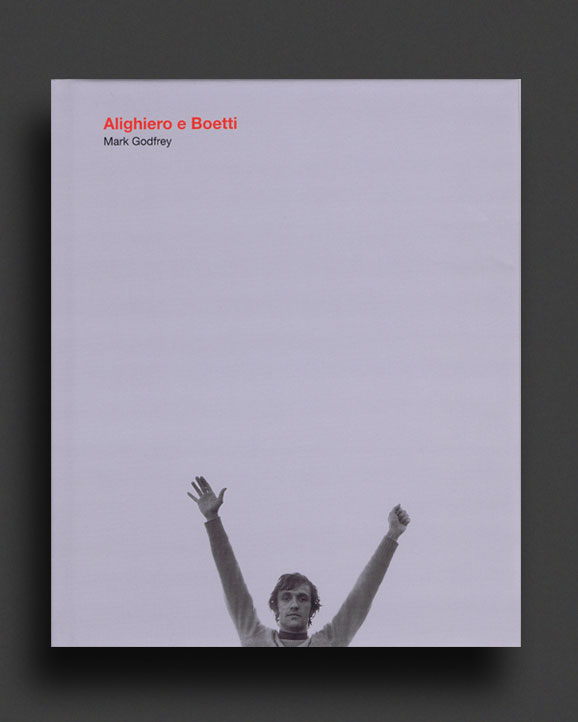
Now out-of-print, this is the first monograph on the influential 20th-century artist Alighiero e Boetti and his groundbreaking works.
Alighiero e Boetti (1940-1994) has emerged as one of the most significant figures of postwar European art whose practice is having an unfolding impact on younger artists. His powerful influence can be attributed to the material diversity of his work, its conceptual ingenuity, and his political sensibility. His work, though usually associated with the Italian Arte Povera group and Conceptual Art, has never quite fit into these contexts. Boetti ceased making Arte Povera–type objects in 1969 after a few years of association with the group, and his later choice of materials (embroidery, calligraphy, mosaic, kilims) put a gulf between his work and that of most artists of the 1970s and 1980s.
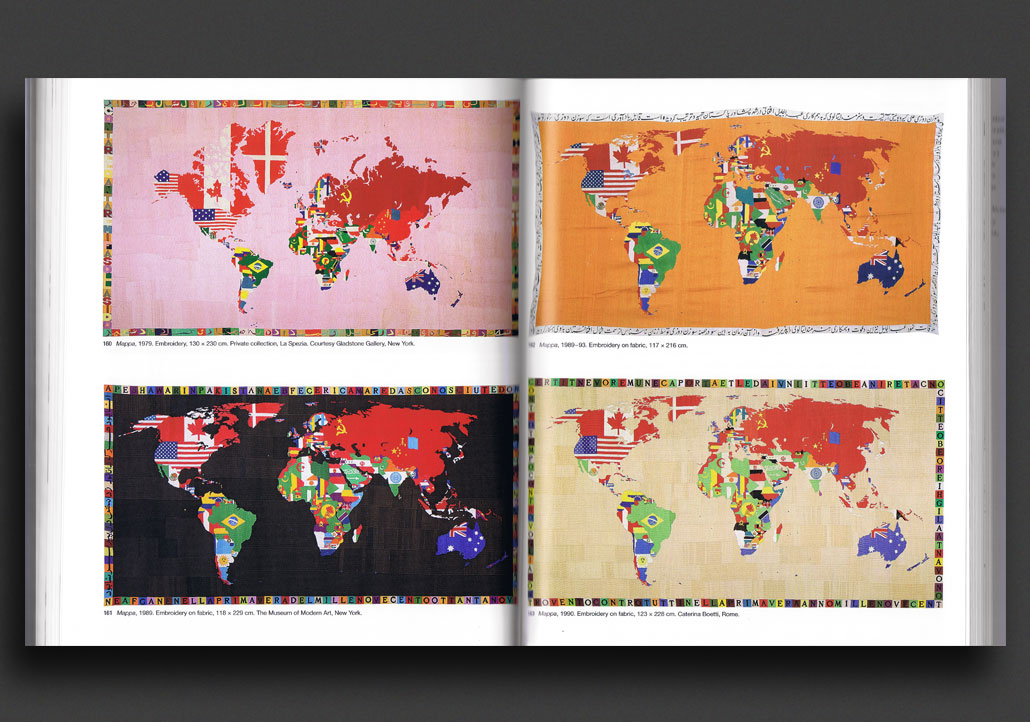
Boetti had an idiosyncratic style of working, and he often collaborated with or commissioned others to execute his ideas, including his celebrated maps of the world, colorfully embroidered by women in Afghanistan and Pakistan. He tended to create several divergent bodies of work at once in series that he continued throughout his life. Alighiero e Boetti is the first monograph covering the whole career of this crucial artist to be published in English. Rather than present a linear account of the artist's creative practice, the book contains linked chapters that expound on the key subjects of Boetti's art and position this work in relation to that of his European and American contemporaries.
2022, English
Hardcover (w. dust jacket), 80 pages, 21 x 14 cm
Published by
Blank Forms / New York
$42.00 - In stock -
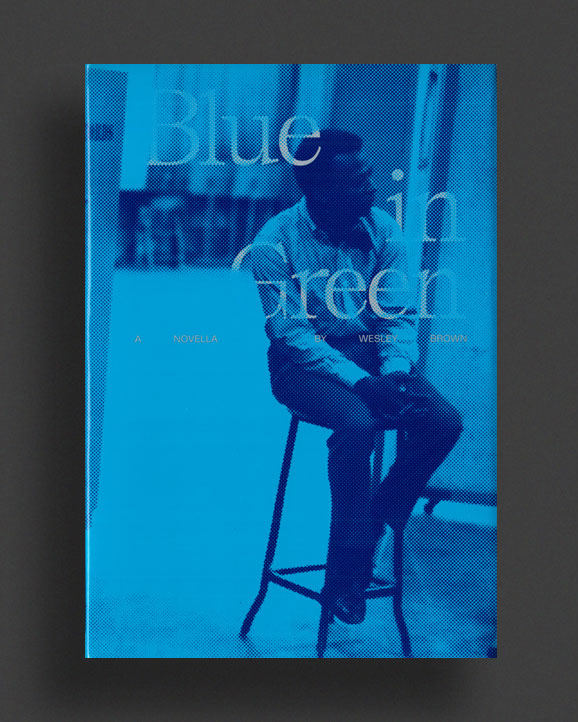
Wesley Brown narrates the day when trumpeter Miles Davis was assaulted by the New York Police Department. A dramatic and humorous story, told from multiple perspectives including that of Frances Taylor, Davis's wife, and the musicians in Davis's bands: a timely meditation on the psychological impact of police brutality, through the lens of a day in the life of Miles Davis.
The latest work from the veteran novelist called "one hell of a writer" by James Baldwin and "wonderfully wry" by Donald Barthelme, Blue in Green narrates one evening in August 1959, when, mere weeks after the release of his landmark album Kind of Blue, Miles Davis is assaulted by a member of the New York City Police Department outside of Birdland. In the aftermath, we enter the strained relationship between Davis and the woman he will soon marry, Frances Taylor, whom he has recently pressured into ending her run as a performer on Broadway and retiring from modern dance and ballet altogether. Frances, who is increasingly subject to Davis's temper—fueled by both his professional envy and substance abuse— reckons with her disciplined upbringing, and, through a fateful meeting with Lena Horne, the conflicting demands of motherhood and artistic vocation. Meanwhile, blowing off steam from his beating, Miles speeds across Manhattan in his sports car. Racing alongside him are recollections of a stony, young John Coltrane, a combative Charlie Parker, and the stilted world of the Black middle class he's left behind.
"Wesley Brown is a writer's writer. His dialog in Blue in Green is remarkable. He knows the varieties of the American language in and out. We get fascinating portraits of Dizzy Gillespie, Thelonious Monk, Billie Holiday, Clark Terry, Lena Horne, Katherine Dunham, Eartha Kitt, and others. An insider named Freeloader provides comic relief. Before the salespersons dictated trends in Black literature, a major publisher would have published this book. Thanks to Blank Forms and other midsize presses, the Black literary tradition, whose fictional standards were set by Brooks, Wright, Himes, Polite, Bambara, and others, is alive."
—Ishmael Reed
"Wesley Brown attempts a difficult thing with this book: He attempts to walk inside the consciousness of Miles Davis at a very complex point in his very complex life. Beaten by police for smoking a cigarette outside Birdland, married to a brilliant and accomplished dancer, leading a sextet that has genius at every station, and fending off demons that are co-authors of his being, Brown's Miles is a man who is troubled and proud. This novella is lyrical, insightful, and beautiful."
— A. B. Spellman
"Blue in Green is a gorgeous jazz composition. In love and in torment, Miles Davis and Frances Taylor are co-creators and lead soloists. Brown surrounds them with an ensemble of brilliant friends, rivals, and mentors: Monk, Coltrane, Cannonball Adderley, Katherine Dunham, Lena Horne, Eartha Kitt. All have their say—shrewd, ebullient, dissonant. When I closed the book, I wanted to begin it all overagain: see, hear, and re-experience every note of Wesley Brown's wonderful prose music."
—Margo Jefferson
Wesley Brown (born 1945) is an Atlanta-based writer and educator whose work spans fiction, poetry, biography, theater, and film. His oeuvre is distinguished by its attention to the musicality of speech and its balance of humorous, ironic, and political engagement with American history. In 1956, while a student at State University of New York at Oswego, Brown joined the Student Nonviolent Coordinating Committee, moving south to register voters with the Mississippi Freedom Democratic Party near the Tennessee border, where he first began to write poetry. After an arrest at a demonstration in Jackson, Mississippi, he graduated college and moved to Rochester, New York, in 1968, where he became an active member of the Black Panther Party before returning to his native New York City to join writing workshops led by Sonia Sanchez and John Olliver Killens. In 1972 he was arrested as a conscientious objector to the Vietnam War; in a statement to the draft board he quoted the Panther's Ten Point Program, adding, with his signature use of idiomatic expression, "If you can't relate to that, you can walk chicken with your ass picked clean." He served an eighteen month sentence at Lewisburg Federal Penitentiary in Pennsylvania, which informed the writing of his recently reissued first novel, Tragic Magic (Random House)—edited by Toni Morrison and released to wide acclaim by writers including James Baldwin, Donald Barthelme, and Ishmael Reed in 1978. His short fiction and essays have been published widely, from movement publications such as Liberator to glossies including Essence. For twenty-six years Brown taught literature and creative writing at Rutgers University in New Jersey. During this time he was involved with the National Association of Third World Writers; co-edited celebrated collections of multicultural American literature, authored the historical novel Darktown Strutters (Cane Hill, 1994) and award-winning plays including Boogie Woogie and Booker T. (1987) and Life During Wartime (1992); and wrote, with Thulani Davis, Toni Cade Bambara, and Amiri Baraka, the screenplay for W.E.B. Du Bois: A Biography in Four Voices (1996). After retiring, he relocated to New England, where he taught at Bard College at Simon's Rock in Massachusetts and Bennington College in Vermont, and authored his third novel, Push Comes to Shove (Concord Free Press, 2009), and the short story collection Dance of the Infidels (Concord ePress, 2017).
2018, English
Softcover, 96 pages, 20 × 15.5 cm
Published by
RVB Books / Paris
$46.00 - Out of stock
In Bleu Melody, the photographer Tony Frank brings together his complete archive of photographs and documents from 1971 when he shot the cover of Serge Gainsbourg's most mythic album.
Featuring contact sheets, slides and proofs, as well as accounts by Frank that reveal the story behind the photo, the book sheds new light on an image that went on to become famous worldwide.
1970 / 1977, English
Softcover, 340 pages, 22.5 x 14 cm
Published by
New Left Books (NLB) / Surrey
$20.00 - In stock -
1970 edition, 1977 printing of Reading Capital by Louis Althusser and Etienne Balibar, published by NLB (New Left Books), and translated from the original French by Ben Brewster.
Establishing a rigorous program of "symptomatic reading" that cuts through the silences and lacunae of Capital to reveal its philosophical core, Louis Althusser interprets Marx's structural analysis of production as a revolutionary break-the basis of a completely new science. Building on a series of Althussers's conceptual innovations that includes "overdetermination" and "social formation," Etienne Balibar explores the historical and structural facets of production as Marx understood them, scrutinizing many of the most fundamental points in Capital, as though for the first time.
Good—Very Good copy. Light wear, tanning to pages.
1996, English
Softcover, 272 pages, 13.7 x 21.6 cm
1st Edition, Out of print title / used / very good
Published by
Verso / London
$35.00 - In stock -
This is the work in which Louis Althusser formulated some of his most influential ideas. For Marx, first published in France in 1968, has come to be regarded as the founding text of the school of "structuralist Marxism" which was presided over by the fascinating and enigmatic figure of Louis Althusser. Structuralism constituted an intellectual revolution in the 1960s and 1970s and radically transformed the way philosophy, political and social theory, history, science, and aesthetics were discussed and thought about. For Marx was a key contribution to that process and it fundamentally recast the way in which many people understood Marx and Marxism.
This book contains the classic statements of Althusser's analysis of the young Marx and the importance of Feuerbach during this formative period, of his thesis of the "epistomological break" between the early and the late Marx, and of his conception of dialectics, contradiction and "overdetermination." Also included is a study of the materialist theater of Bertolazzi and Brecht and the critique of humanist readings of Marxism. Since his death in 1990, Althusser's legacy has come under renewed examination and it is increasingly recognized that the influence of his ideas has been wider and deeper than previously thought: reading For Marx, in its audacity, originality and rigor, will explain why this impact was so significant.
First English Verso 1996 edition, now out-of-print. Very Good copy.
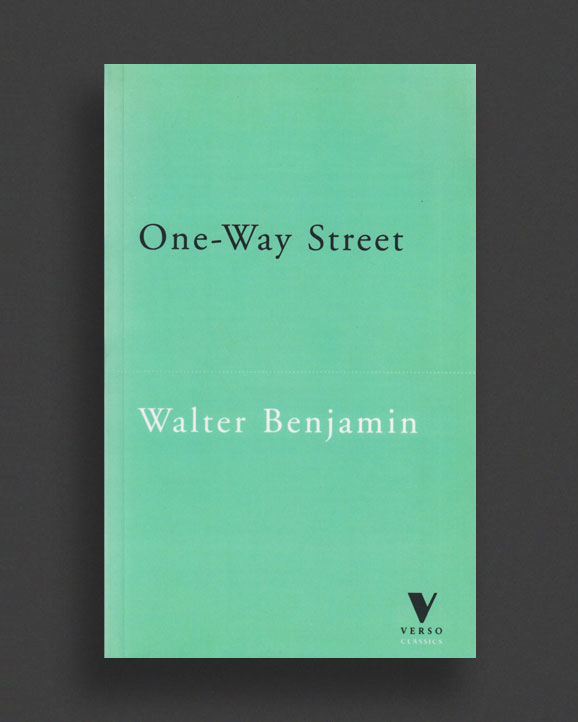
1997, English
Softcover, 392 pages, 13.5 x 21.6 cm
Published by
Verso / London
$48.00 - Out of stock
Introduction by Susan Sontag
Walter Benjamin is one of the most fascinating and enigmatic intellectual figures of this century. Notwithstanding the enormous impact made by his critical and philosophical writings, he was a thinker who shattered so many disciplinary and stylistic conventions that it is almost impossible to place him neatly in any particular category of writing or any specific and exclusive theoretical tradition. This collection, introduced by by Susan Sontag, contains the most representative and illuminating selection of his work over a twenty-year period, and thus does full justice to the richness and the multi-dimensional nature of his thought. Included in these pages are aphorisms and townscapes, esoteric meditation and reminiscences of childhood, and reflections on language, psychology, aesthetics and politics.
1999, English
Hardcover (w. dust jacket), 1088 pages, 16.5 x 25.4 cm
1st Edition, Out of print title / used / fine
Published by
Harvard University Press / Cambridge
$120.00 - In stock -
“To great writers,” Walter Benjamin once wrote, “finished works weigh lighter than those fragments on which they labor their entire lives.” Conceived in Paris in 1927 and still in progress when Benjamin fled the Occupation in 1940, The Arcades Project (in German, Das Passagen-Werk) is a monumental ruin, meticulously constructed over the course of thirteen years—“the theater,” as Benjamin called it, “of all my struggles and all my ideas.”
Focusing on the arcades of nineteenth-century Paris—glass-roofed rows of shops that were early centers of consumerism—Benjamin presents a montage of quotations from, and reflections on, hundreds of published sources, arranging them in 36 categories with descriptive rubrics such as “Fashion,” “Boredom,” “Dream City,” “Photography,” “Catacombs,” “Advertising,” “Prostitution,” “Baudelaire,” and “Theory of Progress.” His central preoccupation is what he calls the commodification of things—a process in which he locates the decisive shift to the modern age.
The Arcades Project is Benjamin’s effort to represent and to critique the bourgeois experience of nineteenth-century history, and, in so doing, to liberate the suppressed “true history” that underlay the ideological mask. In the bustling, cluttered arcades, street and interior merge and historical time is broken up into kaleidoscopic distractions and displays of ephemera. Here, at a distance from what is normally meant by “progress,” Benjamin finds the lost time(s) embedded in the spaces of things.
Translated by Kevin McLaughlin and Howard Eiland.
First 1999 deluxe hardcover Belknap/Harvard edition, now out-of-print.
1987, English
Softcover, 168 pages,
1st Edition, Out of print title / used / very good
Published by
Indiana University Press / Indiana
$30.00 - Out of stock
First 1987 edition.
"Technologies of Gender builds a bridge between the fashionable orthodoxies of academic theory (Lacan, Foucault, Derrida, et al.) and the frequently-marginalized contributions of feminist theory...In sum, de Lauretis has written a book that should be required reading for every feminist in need of theoretical ammunition-and for every theorist in need of feminist enlightenment."—B. Ruby Rich
"...sets philosophical ideas humming...she has much to say." -Cineaste "I can think of no other work that pushes the debate on the female subject forward with such passion and intellectual rigor."—SubStance
This book addresses the question of gender in poststructuralist theoretical discourse, postmodern fiction, and women's cinema. It examines the construction of gender both as representation and as self-representation in relation to several kinds of texts and argues that feminism is producing a radical rewriting, as well as a rereading, of the dominant forms of Western culture.
Very Good copy.
1988, English
Softcover, 600 pages, 15.2 x 22.9 cm
1st Edition, Out of print title / used / very good
Published by
University of Minnesota Press / Minnesota
$55.00 - Out of stock
A philosophical treatise which finds cynicism the dominant mode in contemporary culture.
In 1983, two centuries after the publication of Kant’s Critique of Pure Reason, another philosophical treatise—polemical in nature, with a title that consciously and disrespectfully alludes to the earlier work—appeared in West Germany. Peter Sloterdijk’s Critique of Cynical Reason stirred both critical acclaim and consternation and attracted a wide readership, especially among those who had come of age in the 1960’s. Sloterdijk’s finds cynicism the dominant mode in contemporary culture, in personal institutional settings; his book is less a history of the impulse than an investigation of its role in the postmodern 1970s and 1980s, among those whose earlier hopes for social change had crumbled and faded away. Sloterdijk thus brings into cultural and political discourse an issue which, though central to the mood of a generation, has remained submerged throughout the current debate about modernity and postmodernity.
With Adorno and Horkeimer’s Dialectic of Enlightenment as his primary jumping-off point, Sloterdijk also draws upon, and contends with, the poststructuralist concepts of Deleuze and Guattari. He defines cynicism as enlightened false consciousness—a sensibility “well off and miserable at the same time,” able to function in the workaday world yet assailed by doubt and paralysis; and, as counterstrategy, proposes the cynicism of antiquity—the sensuality and loud, satiric laughter of Diogenes. Above all, Sloterdijk is determined to resist the amnesia inherent in cynicism. The twentieth-century German historical experience lies behind his work, which closes with a brilliant essay on the Weimar Republic—the fourteen years between a lost war and Hitler’s ascent to power, and a time when the cynical mode first achieved cultural dominance.
"Sloterdijk can hardly be surpassed in his imaginative and vivid description of the experiences of a generation. . . . [He] not only wants to describe the thing he himself has experienced so personally, but also to explain it. Inasmuch as he explains the aftermath of the shattered ideals of 1968 with means he borrows from philosophical history, he gleans from the pile of rubble a piece of truth. He calls this truth the cynical impulse."—Jürgen Habermas, in a review of the German edition
Foreword by Andreas Huyssen. Translated by Michael Eldred.
Peter Sloterdijk holds a doctorate in German literature from the University of Hamburg and has published two other books in Germany, on literature of the Weimar Republic and on Nietzsche.
Very Good copy. First 1988 edition.
1980, English
Softcover, 56 pages, 21.5 x 13.9 cm
Published by
Leete's Island Books / U.S.
$20.00 - Out of stock
An essay on aesthetics by the Japanese novelist, this book explores architecture, jade, food, and even toilets, combining an acute sense of the use of space in buildings. The book also includes descriptions of laquerware under candlelight and women in the darkness of the house of pleasure.
Translated from original Japanese to English by Thomas J. Harper and Edward G. Seidensticker.
Foreword by Charles Moore.
Jun'ichirō Tanizaki (1886—1965) was a Japanese author who is considered to be one of the most prominent figures in modern Japanese literature, writing numerous acclaimed books, including "The Makioka Sisters "and "Naomi: A Novel." The tone and subject matter of his work ranges from shocking depictions of sexuality and destructive erotic obsessions to subtle portrayals of the dynamics of family life within the context of the rapid changes in 20th-century Japanese society. Frequently, his stories are narrated in the context of a search for cultural identity in which constructions of the West and Japanese tradition are juxtaposed. He was one of six authors on the final shortlist for the Nobel Prize in Literature in 1964, the year before his death.
1986, English
Softcover, 348 pages, 21 x 13 cm
1st Edition, Out of print title / used / very good
Published by
Schocken Books / New York
$45.00 - In stock -
First 1986 edition, published by Schocken Books, New York. Edited with an introduction by Peter Demetz.
"This book is just that: reflections of a highly polished mind that uncannily approximate the century's fragments of shattered traditions."—Time
A companion volume to Illuminations, the first collection of Walter Benjamin's writings, Reflections presents a further sampling of his wide-ranging work. Here Benjamin evolves a theory of language as the medium of all creation, discusses theater and surrealism, reminisces about Berlin in the 1920s, recalls conversations with Bertolt Brecht, and provides travelogues of various cities, including Moscow under Stalin.
Benjamin moves seamlessly from literary criticism to autobiography to philosophical-theological speculations, cementing his reputation as one of the greatest and most versatile writers of the twentieth century.
Very Good copy.
1998, English
Softcover, 360 pages, 15.3 x 22.9 cm
1st Edition, Out of print title / used / very good
Published by
Stanford University Press / Palo Alto
$25.00 - In stock -
How do the concepts border, exile, and diaspora shape individual and group identities across cultures? Taking this question as a point of departure, this wide-ranging volume explores the ways that people create and represent a home away from home. Throughout, the authors emphasize the multiple subjectivities, cultural displacements, and identity politics that have characterized the postcolonial and post-World War II eras. They simultaneously affirm and challenge previous understandings of these three terms, and they investigate their malleability the extent to which they apply to diverse communities. Once the idea of diaspora is dissociated from the historical experiences of a particular group of people, it becomes a universal designation, applicable to all displaced groups. This understanding of diaspora also allows for the creation of a nonnormative intellectual community, one experienced by many contemporary critics and with which they identify. In the postcolonial context, a global middle voice emerges that incorporates the critic and his or her identity as the participant-observer of the discourses on identity.
As personal narratives transcend the autobiographical, they become indispensable guarantors of a free theoretical field, without a priori boundaries. The diaspora s voice is thus national and cultural, but it lacks the nation or the geographical definition that would constrain its subject.
This book has 18 papers including: writing Germanness after the holocauust: a Jewish hermaphrodite & cross Dresser in Wilhelmine Germany; central Europeans in Hollywood in the 1940s; African style in Los Angeles; coming of age in Zambesia: Artaud's itinerary through exile & insanity; poster art & transgressive citizenship in France 1968-1988.
Very Good copy. First edition 1998, out-of-print.
1995, English
Softcover, 276 pages, 15.5 x 23.5 cm
1st Edition, Out of print title / used / very good
Published by
Indiana University Press / Indiana
$50.00 - Out of stock
" . . . will draw a wide readership from the ranks of literary critics, film scholars, science studies scholars and the growing legion of 'literature and science' researchers. It should be among the essentials in a posthumanist toolbox."—Richard Doyle
Automatic teller machines, castrati, lesbians and other "queers," people with AIDS, people with "multiple person-ality disorders," the Alien and the Terminator: all participate in the profound technological, representational, sexual, and theoretical changes in which bodies are implicated. Posthuman Bodies addresses new interfaces between humans and technology that are radically altering the experience of our own and others' bodies.
The contributors are Kathy Acker, Alexandra Chasin, Camilla Griggers, Judith Halberstam, Kelly Hurley, Ira Livingston, Carol Mason, Paula Rabinowitz, Roddey Reid, Steven Shaviro, Susan M. Squier, Allucquere Rosanne Stone, Jennifer Terry, and Eric White.
Judith Halberstam is Assistant Professor of Literature at the University of California, San Diego.
Ira Livingston is Assistant Professor of English at the State University of New York, Stony Brook.
Very Good copy of the first 1995 edition, not the print-on-demand reprint.
1994, English
Softcover, 256 pages, 15.6 x 23.4 cm
1st Edition, Out of print title / used / very good
Published by
Manchester University Press / Manchester
$30.00 - Out of stock
First 1994 edition, out-of-print.
This book presents an analysis of the phenomenon of the aesthetics of sexual and political violence, a central theme in European culture of the early 20th century. Presenting a synthesis of a wide range of material across disciplines and an analysis of the sources of such ideas in their political, historical and cultural context, this volume presents a broad treatment of the theme of violence during this turbulent period. The major cultural movements and individuals of the early 20th-century avant-garde are examined for their use of violence as inspiration in their artistic production. Themes explored include violence and the body; machinery and technology; Vorticism; Dada; Italian Futurism; Surrealism; violence in the avant-garde cinema; military defeat and the representation of war; the relationship of creativity and violence. Exploring the work of English, German, Italian, French, Spanish and Russian painters and writers, including Georges Sorel, Wyndham Lewis, Paul Nash, Brecht and Louis-Ferdinand Celine, the contributors provide an insight into the early 20th-century European avant-garde.
Very Good copy.
1987, English
Hardcover (w. dust jacket), 260 pages, 24 x 16.5 cm
1st Edition, Out of print title / used / very good
Published by
Secker & Warburg / London
$45.00 - Out of stock
First hardcover edition of Andrea Dworkin's most provocative book, Intercourse, published in 1987.
"This is the most shocking book any feminist has yet written: it forces us all to ask ourselves if we have not been deliberately ignoring the obvious."—Germaine Greer
Andrea Dworkin, once called "Feminism's Malcolm X," has been worshipped, reviled, criticized, and analyzed—but never ignored. The power of her writing, the passion of her ideals, and the ferocity of her intellect have spurred the arguments and activism of generations of feminists. Intercourse, her fourth non-fiction book after Pornography, Our Blood and Right-Wing Women, is the book that she's best known for—the book in which she provoked the argument that ultimately split apart the feminist movement, enraging as many readers as it inspired when it was first published in 1987. In it, Dworkin argues that in a male supremacist society, sex between men and women constitutes a central part of women's subordination to men. (This argument was quickly—and falsely—simplified to "all sex is rape" in the public arena, adding fire to Dworkin's already radical persona.) Dworkin looks at the act of intercourse through the works of five male writers who have articulated its deeper meanings with particular trenchancy — Tolstoy, Kobo Abe, Tennessee Williams, James Baldwin, Isaac Bashevis Singer — and uses them as a springboard to explore and question every aspect of the myth, meaning and reality of this God-or-nature-created act, and its relation to the sexual, civil and social inferiority of women. What is the meaning of virginity? Is permissiveness necessarily freedom? Do women collaborate to keep men, as it were, on top? What of self-determination, identity, creativity? And where do we go from here? At once tough and humane, angry and tender, intimate and analytical, Dworkin asks us to reconsider every implication of an act without which we would be extinct. It is a book resonant with the possibility of human experience — an enlightening work, and a major one.
"This monumental work is feminist theory at its best —clear, coherent, profound, shocking, and even at times funny. It strikes the main nerve of oppression in the man's world. Intercourse is a work of deep healing, grief, and rage — and uncompromising vision."—Mary Daly
"Dworkin is one of the great radical thinkers of our time. Any man who ignores what she has to say is refusing the possibility of a dramatically better world, where women and men may at last find genuine equality — and enjoy an immense and lasting pleasure in their mutual sensuality." Michael Moorcock
Very Good copy in Good dust jacket. Some light foxing/age to reverse of dj, and book block edges, otherwise a lovely copy.
1968 / 1980, English
Softcover, 624 pages, 15.2 x 22.9 cm
Out of print title / used / good
Published by
Princeton University Press / New York
$40.00 - Out of stock
1968 edition, 1980 printing.
Edited by Herbert Read and Gerhard Adler. Translated by R. F. C. Hull.
A study of the analogies between alchemy, Christian dogma, and psychological symbolism. Revised translation, with new bibliography and index.
Carl Gustav Jung (1875—1961) was a Swiss psychiatrist and psychoanalyst who founded analytical psychology. Jung's work has been influential in the fields of psychiatry, anthropology, archaeology, literature, philosophy, psychology, and religious studies.
Good copy.
1970 / 1989, English
Softcover, 742 pages, 15.2 x 22.9 cm
Out of print title / used / good
Published by
Princeton University Press / New York
$40.00 - Out of stock
1970 edition, 1989 printing.
Edited by Herbert Read and Gerhard Adler. Translated by R. F. C. Hull.
Jung’s last major work, completed in his 81st year, on the synthesis of the opposites in alchemy and psychology.
Carl Gustav Jung (1875—1961) was a Swiss psychiatrist and psychoanalyst who founded analytical psychology. Jung's work has been influential in the fields of psychiatry, anthropology, archaeology, literature, philosophy, psychology, and religious studies.
Good copy.
2010, English
Hardcover (w. dust jacket), 176 pages, 23.5 x 27.3 cm
1st Edition, Out of print title / as new
Published by
Hammer / Los Angeles
Prestel / Munich
$190.00 - Out of stock
As New copy of this major hardcover catalogue on the work of Charles Burchfield, now out-of-print.
Although he lived next door to Niagara Falls, artist Charles Burchfield (1893–1967) chose to focus his nature-based art on the ground beneath his feet. Curated by artist Robert Gober, this exhibition features over one hundred major watercolors, drawings, oils on canvas, sketches, notebooks, journals, and doodles by this visionary American artist. Acclaimed by critics and known to a broad public audience during his lifetime, Burchfield is curiously under-appreciated today. Working almost exclusively in watercolor, Burchfield’s primary subject was landscape, often focusing on his immediate surroundings: his garden, the views from his windows, snow turning to slush, the sounds of insects and bells and vibrating telephone lines, deep ravines, sudden atmospheric changes, the experience of entering a forest at dusk, to name but a few. He often imbued these subjects with highly expressionistic light, creating at times a clear-eyed depiction of the world and, at other times, a unique mystical and visionary experience of nature.
The book includes drawings from his 1917 sketchbook, Conventions for Abstract Thoughts; watercolours from 1916–18 that were the focus of the first one-person exhibition at The Museum of Modern Art, Germany, in 1930; camouflage designs from his tour in the army and wallpaper designs from the 1920s; watercolors from the 1940s showing the artist’s unique technique of expanding and reworking earlier works by pasting large strips of paper around them to dramatically increase their size; and finally Burchfield’s large, transcendental watercolours from the 1950s and 1960s.
Heat Waves in a Swamp: The Paintings of Charles Burchfield was organized by the Hammer Museum, Los Angeles, in collaboration with the Burchfield-Penney Art Center, Buffalo, New York.
Edited by Cynthia Burlingham and Robert Gober, with contributions by Dave Hickey, Tullis Johnson, and Nancy Weekly.
As New copy, now out-of-print.
English
Softcover, 56 pages, 11.4 x 17.8 cm
Published by
Wakefield Press / Cambridge
$25.00 - In stock -
Marcel Schwob's 1896 novella The Children's Crusade retells the medieval legend of the exodus of some 30,000 children from all countries to the Holy Land, who travelled to the shores of the sea, which – instead of parting to allow them to march on to Jerusalem – instead delivered them to merchants who sold them into slavery in Tunisia or delivered them to a watery death. It is a cruel and sorrowful story mingling history and legend, which Schwob recounts through the voices of eight different protagonists: a goliard, a leper, Pope Innocent III, a cleric, a qalandar and Pope Gregory IX, as well as two of the marching children, whose naive faith eventually turns into growing fear and anguish. Though it is a tale drawn from the early 13th century, Schwob presents it through a modern framework of shifting subjectivity and fragmented coherency, and its subject matter and its succession of different narrative perspectives has been seen as an influence on and precursor to such diverse works as Alfred Jarry's The Other Alcestis, Ryunosuke Akutagawa's “In a Grove,” William Faulkner's As I Lay Dying and Jerzy Andrzejewski's The Gates of Paradise. It is a tale told by many yet understood by few, a mosaic surrounding a void, describing a world in which innocence must perish.
Marcel Schwob (1867–1905) was a scholar of startling breadth and an incomparable storyteller. A secret influence on generations of writers, from Guillaume Apollinaire and Jorge Luis Borges to Roberto Bolaño, Schwob was as versed in the street slang of medieval thieves as he was in the poetry of Walt Whitman. His allegiances were to Rabelais and François Villon, Robert Louis Stevenson and Edgar Allan Poe. Paul Valéry and Alfred Jarry both dedicated their first books to him, and in doing so paid tribute to the author who could evoke both the intellect of Leonardo da Vinci and the anarchy of Ubu Roi. He was also the uncle of Lucy Schwob, better remembered today as the Surrealist photographer Claude Cahun.
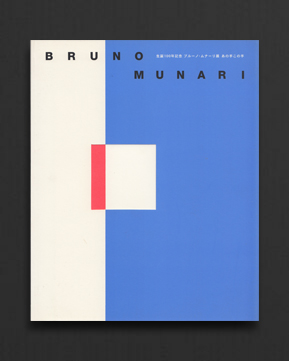
2007, Japanese
Softcover (with die-cut cover), 200 pages, 21.4 cm x 26 cm
1st Edition, Out of print title / as new
Published by
Asahi Shimbun / Japan
$90.00 - Out of stock
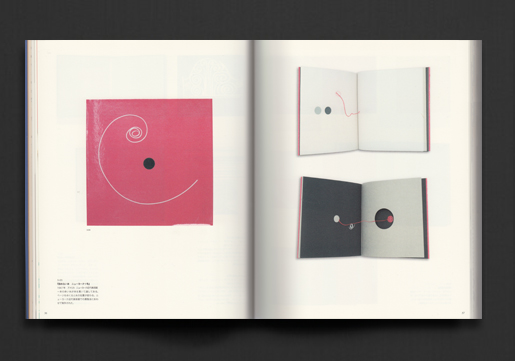
This richly illustrated and designed book was published on the occasion of the exhibition "Bruno Munari - Da Cosa Nasce Cosa -", 1 December 2007 - 14 January, 2008, at The Itabashi Museum of Art, Tokyo, celebrating the 100th Anniversary of the Italian artist Bruno Munari's birth. This lovely copy with bonus inserted exhibition flyer, exhibition ticket and book errata.
Chronologically showcasing his innovative and iconic graphic works in book and poster design, sculpture, illustration, interior/furniture design, games, art objects, and much more, this gorgeous, profusely illustrated exhibition catalogue illustrates Munari's rich creative history through modernism, futurism, and concrete art. It particularly focuses on Munari's book work, both his own authored titles and books and periodicals he created cover artwork for and contributed to/featured in, from his earliest days through. Includes rarely seen images of his illustrated/painted originals and sketches that were featured in the exhibition, along with insight into his relationships and productions in Japan throughout his career. A wonderful archive of material. Texts in Japanese.
Bruno Munari (October 24, 1907, Milan – September 30, 1998, Milan) was an Italian artist, designer, and inventor who contributed fundamentals to many fields of visual arts (painting, sculpture, film, industrial design, graphic design) in modernism, futurism, and concrete art, and in non visual arts (literature, poetry) with his research on games, didactic method, movement, tactile learning, kinesthetic learning, and creativity.
Very Good copy with inserted exhibition brochure, exhibition ticket and errata.
2001, English / Japanese / German
Hardcover, 126 pages, 23 × 29cm
1st Edition, Out of print title / used / good
Published by
Imex Fine Art / Japan
$100.00 - Out of stock
Beautiful hardbound out-of-print Japanese book of Gerhard Richter's "Atlas", published by Imex Fine Art on the occasion of a major travelling solo exhibition in Japan in 2001.
As well as surveying a selection of Richter's dense "Atlas" work across the bulk this book's full-colour spreads (including a complete cataloguing of all reproduced works and their details), this book includes an overview of Richter's career of works, texts in in both English and Japanese by Helmut Friedel and Sumi Hayashi, a history of Richter's work (reproducing a selection of his paintings and photographs), plus portraits, a bibliography and biography.
Gerhard Richter's Atlas is a collection of photographs, newspaper cuttings and sketches that the artist has been assembling since the mid 1960s. A few years later, Richter started to arrange the materials on loose sheets of paper.
"In the beginning I tried to accommodate everything there that was somewhere between art and garbage and that somehow seemed important to me and a pity to throw away."
Good copy with light buckling from storage, bump to top of spine, otherwise VG throughout. First, only edition.