World Food Books' programme is largely produced on Kulin Nation land. We acknowledge the Wurundjeri people of the Kulin Nation as the first and continuing custodians of this land, and pay respect to their Elders past, present, and emerging.
World Food Books is an arts and special interests bookshop in Naarm / Melbourne. Founded in 2010, World Food Books is devoted to the presentation of a rotating, hand-selection of international art, design, literary and counterculture publications with an emphasis on the anti-traditional, the experimental, the avant-garde, the heretic, the marginal.
Presenting new titles alongside rare and out-of-print books, catalogues and journals spanning the fields of modern and contemporary art, design, photography, illustration, film, literature, poetry, cultural theory, philosophy, sexuality, popular and underground culture in its many radical forms, World Food Books wishes to encourage adventurous, thoughtful and open-minded reading, looking, writing, and exchange of publishing and ideas, both current and historical.
As well as our bookshop, located in Melbourne's historical Nicholas Building, all of our inventory is available internationally via our online mail-order service.
World Food Books semi-regularly co-ordinates "Occasions", a programme of exhibits and events at the bookshop and in partnership with other hosts (such as museums and art galleries) that develop out of the activities, relationships and content of the bookshop itself.
World Food Books
The Nicholas Building
37 Swanston Street
Room 5, Level 6
Melbourne 3000
Australia
SHOP HOURS:
Thu–Sat 11–5
WEB-SHOP OPEN 24/7
World Food Books
Postal Address:
PO Box 435
Flinders Lane
Victoria 8009
Australia
Art
Theory / Essay
Architecture / Interior
Graphic Design / Typography
Photography
Fashion
Eros
LGBTQ+
Fiction / Poetry
Weird / Speculative / Science Fiction / Horror
Transgressive / Visceral / Abject
Symbolism / Decadence / Fin de siècle
Film / Video
Painting
Sculpture / Installation
Performance / Dance / Theater
Drawing
Sound / Music
Curatorial
Group Shows / Collections
Periodicals
Out-of-print / Rare
Posters / Ephemera / Discs
Signed Books
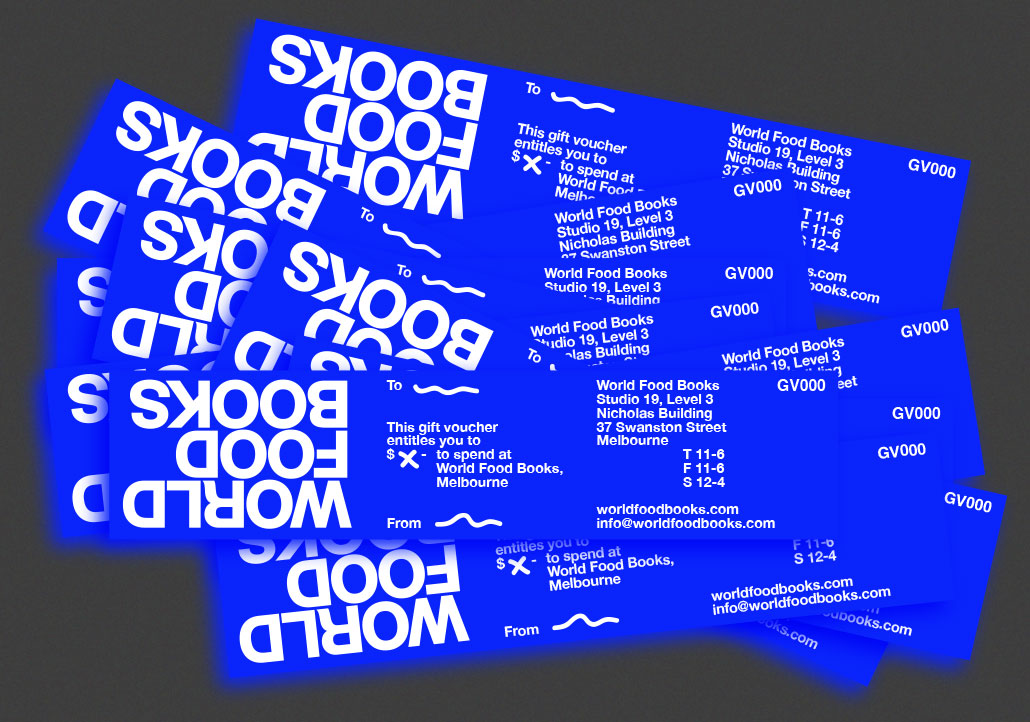
World Food Books Gift Voucher
World Food Book Bag
Australian Art
Australian Fiction
Australian Science Fiction / Speculative Fiction
Australian Poetry
Australian Photography
Japanese Photography
Conceptual Art
Minimal Art
Dada
'Pataphysics / Oulipo
Fluxus
Concrete Poetry
Pop Art
Surrealism
Arte Povera
Arte Informale / Haute Pâte / Tachism
Nouveau Réalisme / Zero / Kinetic
Situationism / Lettrism
Collage / Mail Art / Xerox Art
Art Brut / Folk / Visionary / Fantastic
Illustration / Graphic Art / Bandes Dessinées
Furniture
Italian Radical Design / Postmodernism
Textiles
Ceramics / Glass
Counterculture
Protest / Revolt
Philosophy
Psychoanalysis
Anthropology
Anarchism
Socialism / Anarchism / Communism / Capitalism
Literary Theory / Semiotics / Language
Feminism / Women's Studies
Gender Studies / Sexuality
Anthropology
Fetishism / BDSM
Drugs / Psychedelia
Crime / Violence
Animal Rights / Veganism
Occult / Esoterica
Ecology / Earth / Alternative Living
Whole Earth / Crafts
All prices in AUD (Australian dollars)
Pick-Ups
Pick-up orders can be collected in our bookshop during opening hours after order date. Please collect any Pick-up orders within 2 weeks of ordering as we have limited storage space. Orders will be released back into stock if not collected within this time. No refunds can be made for pick-ups left un-collected. If you cannot make it in to the bookshop in this time-frame, please choose postage option.
Return Policy
All sales are final. We do accept returns (for refund or exchange) for items received in error. All our orders are packed with special care using heavy-duty padding and cardboard book-mailers or bubble mailers (for smaller books), using reinforcement where required. We cannot take responsibility for any lost, stolen or damaged parcels.
Insurance
Should you wish to insure your package, please email us directly after placing your order and we can organise this at a small extra expense. Although all standard/express tracked packages are very safe and dependable, we cannot take responsibility for any lost, stolen or damaged parcels. We recommend insurance on valuable orders.
Interested in selling your old books, catalogues, journals, magazines, comics, fanzines, ephemera? We are always looking for interesting, unusual and out-of-print books to buy. We only buy books in our fields of interest and specialty, and that we feel we can resell.
We base these prices on desirability, market value, in-print prices, condition and our current stock levels. We offer cash, store credit, and can take stock on consignment. All
about 25% of the price we expect to get when we sell them, or 30% in store credit. We base these prices on desirability, market value, in-print prices, condition and our current stock levels.
Sell your books any day of the week. You can drop them off and return later. If you have a lot of books, we can visit your Sydney home.
We buy books that we feel we can resell. We offer about 25 % of the price we expect to get when we sell them, or 30% in store credit. We base these prices on desirability, market value, in-print prices, condition and our current stock levels.
Philadelphia Wireman
03 August - 01 September, 2018
World Food Books is proud to announce our next Occasion, the first presentation of sculptures by Philadelphia Wireman in Australia.
The Philadelphia Wireman sculptures were found abandoned in an alley off Philadelphia’s South Street on trash night in 1982. Their discovery in a rapidly-changing neighbourhood undergoing extensive renovation, compounded with the failure of all attempts to locate the artist, suggests that the works may have been discarded after the maker’s death. Dubbed the "Philadelphia Wireman" during the first exhibition of this work, in 1985, the maker’s name, age, ethnicity, and even gender remain uncertain. The entire collection totals approximately 1200 pieces, all intricately bound together with tightly-wound heavy-gauge wire (along with a few small, abstract marker drawings, reminiscent both of Mark Tobey and J.B. Murry). The dense construction of the work, despite a modest range of scale and materials, is singularly obsessive and disciplined in design: a wire armature or exoskeleton firmly binds a bricolage of found objects including plastic, glass, food packaging, umbrella parts, tape, rubber, batteries, pens, leather, reflectors, nuts and bolts, nails, foil, coins, toys, watches, eyeglasses, tools, and jewellery.
Heavy with associations—anthropomorphic, zoomorphic, and socio-cultural responses to wrapped detritus—the totemic sculptures by Philadelphia Wireman have been discussed in the context of work created to fulfil the shamanistic needs of alternative religions in American culture. Curators, collectors, and critics have variously compared certain pieces to sculpture from Classical antiquity, Native American medicine bundles, African-American memory jugs, and African fetish objects. Reflecting the artist’s prolific and incredibly focused scavenging impulse, and despite—or perhaps enhanced by—their anonymity, these enigmatic objects function as urban artefacts and arbiters of power, though their origin and purpose is unknown. Philadelphia Wireman, whatever their identity, possessed an astonishing ability to isolate and communicate the concepts of power and energy through the selection and transformation of ordinary materials. Over the course of the past two decades, this collection has come to be regarded as an important discovery in the field of self-taught art and vernacular art.
Presented in collaboration with Fleisher-Ollman Gallery, Philadelphia, and Robert Heald, Wellington.
Susan Te Kahurangi King
02 February - 10 March, 2018
Susan Te Kahurangi King (24 February 1951 - ) has been a confident and prolific artist since she was a young child, drawing with readily available materials - pencils, ballpoint pens and felt-tip markers, on whatever paper is at hand. Between the ages of four and six Susan slowly ceased verbal communication. Her grandparents William and Myrtle Murphy had developed a special bond with Susan so they took on caring responsibilities for extended periods. Myrtle began informally archiving her work, carefully collecting and storing the drawings and compiling scrapbooks. No drawing was insignificant; every scrap of paper was kept. The King family are now the custodians of a vast collection containing over 7000 individual works, from tiny scraps of paper through to 5 meter long rolls.
The scrapbooks and diaries reveal Myrtle to be a woman of great patience and compassion, seeking to understand a child who was not always behaving as expected. She encouraged Susan to be observant, to explore her environment and absorb all the sights and sounds. Myrtle would show Susan’s drawings to friends and people in her community that she had dealings with, such as shopkeepers and postal workers, but this was not simply a case of a grandmother’s bias. She recognised that Susan had developed a sophisticated and unique visual language and sincerely believed that her art deserved serious attention.
This was an unorthodox attitude for the time. To provide some context, Jean Dubuffet coined the term Art Brut in 1945 to describe work created by self-taught artists – specifically residents of psychiatric institutions and those he considered to be visionaries or eccentrics. In 1972 Roger Cardinal extended this concept by adopting the term Outsider Art to describe work made by non-academically trained artists operating outside of mainstream art networks through choice or circumstance. Susan was born in Te Aroha, New Zealand in 1951, far from the artistic hubs of Paris and London that Dubuffet and Cardinal operated in. That Myrtle fêted Susan as a self-taught artist who deserved to be taken seriously shows how progressive her attitudes were.
Susan’s parents Doug and Dawn were also progressive. Over the years they had consulted numerous health practitioners about Susan’s condition, as the medical establishment could not provide an explanation as to why she had lapsed into silence. Dawn educated herself in the field of homeopathy and went on to treat all twelve of her children using these principles – basing prescriptions on her observations of their physical, mental and emotional state.
Doug was a linguist with an interest in philosophy who devoted what little spare time he had to studying Maori language and culture. To some extent their willingness to explore the fringes of the mainstream made them outsiders too but it was their commitment to living with integrity and their respect for individuality that ensured Susan’s creativity was always encouraged.
Even though Susan’s family supported her artistic pursuits, some staff in schools and hospitals saw it as an impediment to her assimilation into the community and discouraged it in a variety of ways. Her family was not always aware of this and therefore did not fully understand why Susan stopped drawing in the early 1990s. However, rather than dwell on the challenges that Susan faced in pursuit of her artistic practice, they prefer to highlight her achievements. In 2008 Susan began drawing again in earnest, after an almost 20 year interruption, and her work is now shown in galleries around the world.
Susan grew up without television and has been heavily influenced by the comics she read as a child. She is absolutely fearless in the appropriation of recognizable characters, such as Donald Duck and Mickey Mouse, in her work. She twists their limbs, contorts their faces, compresses them together, blends them into complex patterned backgrounds - always imbuing them with an incredible energy. Although Susan often used pop culture characters in her work they are not naive or childlike. These are drawings by a brilliant self-taught artist who has been creating exceptional work for decades without an audience in mind.
Mladen Stilinović
"Various Works 1986 - 1999"
02 February 16 - September 10, 2016
Various works 1986 - 1999, from two houses, from the collections of John Nixon, Sue Cramer, Kerrie Poliness, Peter Haffenden and Phoebe Haffenden.
Including: Geometry of Cakes (various shelves), 1993; Poor People’s Law (black and white plate), 1993; White Absence (glasses, ruler, set square, silver spoon, silver ladel with skin photograph and wooden cubes), 1990-1996; Exploitation of the Dead (grey and red star painting, wooden painting, black spoon with red table, red plate), 1984-1990; Money and Zeros (zero tie, paintings made for friends in Australia (Sue, John, Kerrie), numbers painting), 1991-1992; Words - Slogans (various t-shirts) - “they talk about the death of art...help! someone is trying to kill me”, “my sweet little lamb”, “work is a disease - Karl Marx”; Various artist books, catalogues, monographs, videos; Poster from exhibition Insulting Anarchy; "Circular" Croatian - Australian edition; Artist book by Vlado Martek (Dostoyevsky); more.
Thanks to Mladen Stilinović and Branka Stipančić.
Jonathan Walker
Always Will Need To Wear Winter Shirt Blue + Ochre Small Check Pattern
21 August - 21 September, 2015
Untitled
I am not a great reader of poetry but I always return to the work of Melbourne poet, Vincent Buckley (1925- 1988). Perhaps I find his most tantalising piece to be not a finished poem but a fragment left on a scrap of paper discovered on his desk after the poet’s death.
The poetry gathers like oil
In the word-core, and spreads
It has its music meet,
Its music is in movement.
This fragment is more the shell left behind from a volatile thought than a finished poem. I find the last two lines honest but awkward whereas the first two lines work like an arrow. Most likely he could not find a resolution so it was left. Still, in its present form, it remains an eloquent testimony to the ultimate failure of a medium to express mobile thought and sensation, in Buckley’s case, through verbal language. It’s an important matter because this is something all artists have to deal with regardless of the medium.
I have never written a poem, however, I am forever copying fragments from books on paper scraps in a vain effort to fix certain notions in my head. At first, they function as bookmarks that are sometimes returned to when I open the book. But before long, as they accumulate, they fall out littering the table interspersed with A4 photocopies, bills, books and medications.
To return to Buckley’s fragment, the first two lines very much evoke how I paint nowadays. As you age, detail diminishes and patches of light become more luminous and float. I feel the most honest way of dealing with this is by smearing the oil paint on the canvas with the fingers and working close-up, blind. Only if the patches coalesce into an approaching image can the work gain a life.
-
Jonathan Walker was born in Melbourne, Australia and brought up on a dairy farm in Gippsland. In the 1970’s he studied painting at RMIT and won the Harold Wright Scholarship to the British Museum, London. During the 1980’s he exhibited at Pinacotheca Gallery, Richmond and had work shown at the NGV and Heidi City Art Gallery. Over the same period he designed the cover for the “Epigenesi” LP by Giancarlo Toniutti, Italy and conducted a mail exchange work with Achim Wollscheid, Germany. The work with artists through the post resulted in an article published in the bicentenary issue of Art and Australia 1988. He showed in artist run spaces such as WestSpace in the 90’s and 2000’s, and until 2012, taught painting at Victoria University, which is where we (Colleen Ahern and Lisa Radford) as organisers of the exhibition, among many others, had the privilege of being his student.
Walker’s knowledge was imparted to students through the careful selection of music, literature, and artists found in books that he himself had ordered for the library. Walker’s strategy was the generosity of sharing his vast knowledge with references specific to each student and their context.
Walker’s paintings share a similar focus and intimacy.
This exhibition presents a small selection of recent paintings alongside a publication that includes Walker’s writing. Observational and analytical, Walker’s work is a type of material notation — the time of day, colour and how it is blended, the both specific and fleeting location of a reflection on lino or the question of whether a chair leg should be included in a painting.
Please join us on Friday August 21 between 6-8pm to celebrate the opening of the exhibition.
Curated by Colleen Ahern and Lisa Radford.
B. Wurtz
Curated by Nic Tammens
March 26 - April 4, 2015
B.Wurtz works from a basement studio in his home on Manhattan’s Lower East Side.
This local fact is attested to by the plastic shopping bags and newsprint circulars that appear in his work. As formal objects, they don’t make loud claims about their origins but nonetheless transmit street addresses and places of business from the bottom of this long thin island. Like plenty of artists, Wurtz is affected by what is local and what is consumed. His work is underpinned by this ethic. It often speaks from a neighborhood or reads like the contents of a hamper:
“BLACK PLUMS $1.29 lb.”
“Food Bazaar”
“USDA Whole Pork Shoulder Picnic 99c lb.”
“RITE AID Pharmacy, with us it’s personal.”
“H. Brickman & Sons.”
“Sweet Yams 59c lb."
Most of the work in this exhibition was made while the artist was in residence at Dieu Donne, a workshop dedicated to paper craft in Midtown. Here Wurtz fabricated assemblages with paper and objects that are relatively lightweight, with the intention that they would be easily transportable to Australia. This consideration isn’t absolute in Wurtz’s work, but was prescriptive for making the current exhibition light and cheap. Packed in two boxes, these works were sent from a USPS post office on the Lower East Side and delivered to North Melbourne by Australia Post.
Wurtz appears courtesy of Metro Pictures, New York.
Thanks to Rob Halverson, Joshua Petherick, Sari de Mallory, Matt Hinkley, Helen Johnson, Fayen d'Evie, Ask Kilmartin, Lisa Radon, Ellena Savage, Yale Union, and "Elizabeth".
John Nixon
"Archive"
December 15 - January 20, 2014
The presentation of John Nixon's archive offered a rare showcase of this extensive collection of the artist's own publications, catalogues, posters, ephemera, editions and more, from the mid 1980s onwards, alongside a selection of his artworks.
Organized by John Nixon, Joshua Petherick and Matt Hinkley.
"Habitat"
at Minerva, Sydney (organised by Joshua Petherick and Matt Hinkley)
November 15 - December 20, 2014
Lupo Borgonovo, Janet Burchill & Jennifer McCamley,
Lewis Fidock, HR Giger, Piero Gilardi, Veit Laurent Kurz,
Cinzia Ruggeri, Michael E. Smith, Lucie Stahl, Daniel Weil, Wols
Press Release:
“...It contained seven objects. The slender fluted bone, surely formed for flight, surely from the wing of some large bird. Three archaic circuitboards, faced with mazes of gold. A smooth white sphere of baked clay. An age-blackened fragment of lace. A fingerlength segment of what she assumed was bone from a human wrist, grayish white, inset smoothly with the silicon shaft of a small instrument that must once have ridden flush with the surface of the skin - but the thing’s face was seared and blackened.”
William Gibson, “Count Zero”, 1986
"Autumn Projects Archive"
Curated by Liza Vasiliou
March 6 - March 15, 2014
World Food Books, in conjunction with the Virgin Australia Melbourne Fashion Festival 2014, presented the Autumn Projects archive, consisting of a selection of early examples in Australian fashion with a particular interest in collecting designers and labels from the period beginning in the 1980’s, who significantly influenced the discourse of Australian Fashion.
Curated by Liza Vasiliou, the exhibition provided a unique opportunity to view pieces by designers Anthea Crawford, Barbara Vandenberg, Geoff Liddell and labels CR Australia, Covers, Jag along with early experimental collage pieces by Prue Acton and Sally Browne’s ‘Fragments’ collection, suspended throughout the functioning World Food Books shop in Melbourne.
H.B. Peace
presented by CENTRE FOR STYLE
November 14, 2013
"Hey Blinky, you say chic, I say same"
Anon 2013
H.B. Peace is a clothing collaboration between great friends Blake Barns and Hugh Egan Westland. Their pieces explore the divergences between 'character’ and ‘personality’ in garments....etc
Special Thanks to Joshua Petherick and Matt Hinkley of WFB and Gillian Mears
and a Very Special Thank you to Audrey Thomas Hayes for her shoe collaboration.
Janet Burchill & Jennifer McCamley
"Aesthetic Suicide"
May 10 - June 8, 2013
The first of our occasional exhibitions in the World Food Books office/shop space in Melbourne, "Aesthetic Suicide" presented a body of new and older works together by artists Janet Burchill & Jennifer McCamley, including videos, prints, a wall work, and publications.
During shop open hours videos played every hour, on the hour.
$.00 - Out of stock
The eternal clean out! New items weekly.
https://worldfoodbooks.com/category/sale
Published by World Food Books / Melbourne
$20.00 - In stock -
A World Food Books gift voucher is redeemable in our Melbourne bookshop or via our webshop (here). An e-voucher (printable pdf) will be sent to your purchase email address (please notify us if you wish to have the voucher sent to an alternate address and wish us to fill in the receiver's details on the card).
Gift vouchers can be purchased in increments of $20 (Australian Dollars) and the total amount can simply be added to by increasing the quantity in your shopping cart. eg. A quantity of 5 gift vouchers will result in an item total of $100 - a $100 gift voucher. Simply click "ADD TO CART" 5 times, or update your quantity in the shopping cart.
If you wish to purchase multiple, separate gift vouchers in one go, please just email us and we can personally prepare and email you a payment request.
Please note: Please select Pick-Up on gift voucher purchse to avoid any postage charges. Accidental postage charges will be refunded right away!
Thank you.
For any questions, please don't hesitate to email: [email protected]
2021, English
Hardcover (w. dust jacket), 324 pages, 23.5 x 16 cm
Published by
Reaktion books / London
$60.00 - In stock -
A vibrant account of both the sensuous cultural scene of postwar Paris and the life of an alluring icon of modern art.
Isidore Isou was a young Jew in war-time Bucharest, and barely survived the Romanian Holocaust. He made his way to Paris where in 1945 he founded the avant-garde movement Lettrism, described as the missing link between Dada, Surrealism, Situationism and May '68.
In Speaking East Andrew Hussey presents a colourful picture of the post-war Left Bank, where Lettrist fists flew in avant-garde punch-ups in Jazz clubs and cafes and Isou, as sexy and as charismatic as the young Elvis, gathered around him a group of hooligan disciples who argued, drank and had sex with the Parisian intellectual elite.
This is a vibrant account of the life and times of a pivotal figure in the history of the avant-garde.
"A sympathetic account of an extraordinary life. Hussey has the depth of historical understanding necessary to do justice both to Isidore Isou's glamorous, sometimes absurd, life as a hero of the Left Bank and to the horrors of the Romanian Holocaust he had escaped. This is an expertly told story about Paris, Europe, and the interplay of private passion and public trauma."—Sebastian Faulks, author of "Birdsong"
"Isou's life is at once tragic and farcical: a whirling reprise of all of the twentieth century's artistic avantgardes played out against the backdrop of Paris's Left Bank in its heyday. Hussey is the ideal chronicler, and his biography, with its exuberant prose, both channels Isou's restless creativity and positions it within the main currents of postwar French thought. Essential reading."—Will Self, author of "The Quantity Theory of Insanity" and "Umbrella"
"Like Antonin Artaud before him, Isou lived his art. He also paid the price for it. In Hussey's account he emerges as a man always on the brink. As his disciples betrayed him and his movement disintegrated, so too did his mind... Hussey writes kindly about this chapter of Isou's life, without romanticising Isou's illness or naively criticising psychiatry..."—London Review of Books
2015, English
Softcover, 192 pages, 25 x 18 cm
Published by
University of Chicago Press / Chicago
$72.00 - In stock -
One of the most important avant-garde movements of postwar Paris was Lettrism, which crucially built an interest in the relationship between writing and image into projects in poetry, painting, and especially cinema. Highly influential, the Lettrists served as a bridge of sorts between the earlier works of the Dadaists and Surrealists and the later Conceptual artists.
Off-Screen Cinema is the first monograph in English of the Lettrists.
Offering a full portrait of the avant-garde scene of 1950s Paris, it focuses on the film works of key Lettrist figures like Gil J Wolman, Maurice Lemaître, François Dufrêne, and especially the movement's founder, Isidore Isou, a Romanian immigrant whose "discrepant editing" deliberately uncoupled image and sound. Through Cabañas's history, we see not only the full scope of the Lettrist project, but also its clear influence on Situationism, the French New Wave, the New Realists, as well as American filmmakers such as Stan Brakhage.
This is a monograph in English on the Lettrists.
2007, English / Portuguese / French
Softcover (w. CD), 250 pages, 27 x 17 cm
1st Edition, Out of print title / used / very good
Published by
Serralves Museum of Contemporary Art / Porto
$140.00 - In stock -
Scarce and wonderful, out-of-print, comprehensive monographic catalogue on François Dufrêne (1930 – 1982), the French Nouveau realist visual artist, Lettrist and Ultra-Lettrist poet. Francois Dufrene joined Isidore Isou and the Lettrist movement in 1946 and continued to participate until 1964. Dufrene's talent was evident in the fact that he was already a member of the Lettrist Group at only 16 years old. He is primarily known as a pioneer in sound poetry and for his use of décollage within Nouveau réalisme, the art group he helped found in 1960 with friends Pierre Restany, Yves Klein, Jean Tinguely, Arman, Hains and Villeglé. He is considered one of the important artists in that Neo-Dada art movement. Published in 2007 on the occasion of a major survey exhibition at Museu Serralve, Porto, this volume is profusely illustrated in colour and b/w with Dufrêne's works alongside many texts in English, Portuguese, French by Alain Jouffroy, Guy Schraenen, Joao Fernandes, and others, accompanying audio CD of sound works.
Very Good copy of book and CD.
2025, English
Softcover, 130 pages, 20.3 x 17.8 cm
Published by
The New York Review of Books / New York
$34.00 - In stock -
Ancient Mesopotamia, the Zodiac, and the land of the dead feature in this wildly surrealistic adventure story—Leonora Carrington's revolutionary second novel, long out of print.
The Stone Door is an omen, an incantation, and an adventure story rolled into one. Built in layers like a puzzle box, it is the tale of two people, of love and the Zodiac and the Kabbalah, of Transylvania and Mesopotamia converging at the Caucasus, of a mad Hungarian King named Böles Kilary and of a woman's discovery of an initiatory code that leads to a Cyclopean obstacle, to love, self and awareness, to the great stone door of Kescke and beyond.
Written at the end of World War II but not published until 1977 and long unavailable, The Stone Door is at once a celebration of the union of the surrealist painter Leonora Carrington and her husband, the Hungarian-born photographer Chiki Weisz, and an argument for the unification of the male and the female as a means of liberating the human race.
2025, English
Softcover, 208 pages, 20.3 x 12.62 cm
Published by
The New York Review of Books / New York
$36.00 - In stock -
An audacious, unabashedly transgressive memoir about two acts of escape by the author: rebelling aginst his family to seek a freer life in Paris and then, later, from the French military during the Algerian War.
Translated by Peter Behrman De Sinéty.
Pierre Guyotat was one of the most radical and uncompromising writers of the twentieth century, a literary successor to Sade, Bataille, and Genet whose visceral fictions and bold experiments with language have earned him cult status in France and abroad. Idiocy is his searing memoir of coming of age between 1958 and 1962, when he discovered his burgeoning sexuality and aptitude for rebellion—first against his father, whom he escaped to become a writer in Paris, then against the French military authorities as a conscript in the Algerian War.
Guyotat recounts the atrocities he witnessed first-hand in Algeria, as well as his own harrowing experience of being arrested for inciting desertion and imprisoned in a hole in the ground for three months. Guyotat wields his language like a scalpel, merciless in his exploration of human brutality in all its horrible, granular detail. Yet his generous depictions of camaraderie and friendship are just as unflinching.
The winner of the 2018 Prix Médicis, Idiocy is an incisive condemnation of violence and colonialism, and a bracing, hallucinatory late masterpiece from a writer hailed by Edmund White as “one of the few geniuses of our day.”
"Pierre Guyotat is the prince of prose."—Alain Badiou
"Guyotat renders the obscene violence of colonialism with unflinching honesty. His writing is gorgeous, brutally poetic without pretense or over-aestheticization. 'Insects scuttle between my fingers like words that escape me.' I didn't just read Idiocy, I was captured by it. It is a book that throws off your blinders, that changes you."—Dodie Bellamy
"Idiocy, as a work of memoir, maintains an uncanny sobriety throughout its reportage, indulgent in its poetical description . . . As a medium intended to survey war and warmongering, Idiocy becomes more than a simple pulling back of the curtain of atrocity; it would, instead, pull down the whole damned rigging, lights, cameras, and all."—Blake Butler
"[Guyotat is] anti-authoritarian, pushing the French language to its limits of meaning, and fascinated by the filth of fighting, illness, and recovery. . . An ugly, terrifying memoir of childhood, war, and violation, rendered into nightmarish English."—Kirkus Reviews
About the Author
Pierre Guyotat (1940-2020) was a French writer. In 1960, he was conscripted into the Algerian War, the inhumanity of which would become a recurring theme throughout his oeuvre. He is the author of Tomb for 500,000 Soldiers, Eden, Eden, Eden, which was banned in France upon its publication in 1970, and Coma, which won the 2006 Prix Décembre. In 2018, he was awarded the Prix Femina spécial for lifetime achievement.
Peter Behrman de Sinéty grew up in Maine and lives in Paris. He was lecteur d'anglais at the École Normale Supérieure, where he has taught since 2011. His translations include Éric Chevillard's QWERTY Invectives and Maël Renouard's Fragments of an Infinite Memory.
2025, English
Hardcover, 1008 pages, 23 x 18 cm
Published by
OM Books / New York
$165.00 - In stock -
From 1972 to 1973, Gordon Matta-Clark took over fifteen hundred photographs of graffiti in New York City. These pictures are some of the earliest documentation of an emerging art form, and are an under-recognized body of work from Matta-Clark—an artist who used the city’s crumbling infrastructure to reveal the social and political implications of architecture and urban design. This publication features every frame from every roll of film Matta-Clark shot, organized according to the sequence of contact sheets in the artist’s archive. Taken together, these pictures demonstrate Matta-Clark’s obsession with the graffiti that had exploded across the city’s walls, subways, and buses, and show him growing bolder as he moved from photographing on the streets and subway platforms, to trespassing in outer borough train yards. While he was out on these documentary missions, Matta-Clark also photographed abandoned architecture, infrastructure, and the social life of the city. Those pictures are included as well, as they show the relationship between graffiti and themes that are more commonly associated with the artist’s work.
The title of this publication comes from a text he wrote in a notebook a few years before he started taking these photographs. He could be describing his own artistic process, or the experience of a kid sneaking into a subway tunnel late at night with a can of paint:
PASSING THROUGH THE BOUNDARIES
PASSING AWAY WITH A PIECE TO GO
CHOOSING AND CLEARING OUT. A CRITICAL POINT IN
STRESS AND WORKING BETWEEN FAILURE
AND MINIMALISM REDUCTION AND
COLLAPSE. KEEPING EYES OPEN FOR
A NEW HIT
THE JOY OF GETTING AWAY WITH IT
A COMPLETE DEVOTION TO GETTING
AWAY WITH IT.
PASSING THROUGH MOVING IN
AND GETTING AWAY WITH IT
An essay by Antonio Sergio Bessa and a text by Jonathan Lethem accompany the photographs.
2024, English
Softcover, 132 pages, 16 x 12 cm
Published by
Resampled / UK
$45.00 - In stock -
Selected cassette tape and vinyl artwork from experimental electronic music of the 1980s. Touching on industrial, noise, new wave, minimal, drone, sound art, ambient and more. A visual archive of the xerox scanned imagery, disorderly type and hand illustration used to present the decade's boundary-pushing music and abstract compositions.
2025, English
Softcover, 113 pages, 17 x 11 cm
Published by
Index Journal / Melbourne
$30.00 - In stock -
The New Wave of the 1950s and 1960s opened two potential paths for French cinema to follow. The first would turn its youthful exuberance into a reproducible style, while the other would take up its principles of experimentation and self-reflexivity in new directions, and through an increasingly political and ethical interrogation of the image. This book explores the potentialities of that second path, with eight essays on films of the post-New Wave moment, focussed upon the principle of critical experimentation in particular—critique through experimentation, and experimentation through critique—that these films put at stake, through their difficult inheritance of the New Wave and the history of the image.
“From the metaphysics of Le Pont du Nord and the relation of Racine to L’Amour fou to the rich diversity of Marc’o’s career, not to mention the challenges of Jeanne Dielman, this is a compact illustration of the unrecognised brilliance and sheer liveliness of the best Australian film criticism.”—Jonathan Rosenbaum, film critic at the Chicago Reader 1987–2008
“French filmmakers who emerged in the ’50s and ’60s (including Chris Marker, Jean-Luc Godard and Agnès Varda) collectively proclaimed in 1967 that they were, in every sense, “far from Vietnam.” In Australia today, a like-minded group of film scholars and critics declare that they are geographically far from France, and especially far in time from its glorious Nouvelle Vague. So, their curiosity and intellectual inventiveness fastens, by identification, on the intriguingly “belated” phenomenon of post-New Wave French cinema: that loosely bundled generation including Chantal Akerman, Marc’o, Maurice Pialat, and Patrick Deval—without forgetting the post-68 experiments of Varda, Jacques Rivette, and François Truffaut—who forcefully questioned the limits of cinema and opened new ways of thinking and feeling. Far from the Masters is an indispensable assemblage of superbly written, inquisitive, and trail-blazing essays.”—Adrian Martin, Australian film critic far from Australia
“What does it mean to come “after”? Far from the Masters is a book marked by two belated arrivals: first, the generation of French filmmakers who emerged in the wake of the nouvelle vague, figures like Maurice Pialat, who extended and contested the work of his still better-known precursors; and second, a group of Australian critics who, two decades into the twenty-first century, took a collective look back at that earlier moment. Out of this temporal décalage, new perspectives open—not only on some of the most important French filmmakers of the era, but equally on a present moment of cinephilic community.”—Erika Balsom, Reader in Film Studies at King’s College, London
With texts by Conall Cash, Jake Wilson, Miranda Stanyon, Jack Keenan, Philippa Hawker, Scott Robinson, Michelle Huang, Corey P. Cribb
1966 / 1969, English
Softcover, 104 pages, 20 x 14 cm
1st Edition, Out of print title / used / good
Published by
Lorrimer / London
$40.00 - In stock -
1969 printing of the 1966 publication of Godard's Alphaville photo-illustrated screenplay, by the great Lorrimer of London. Translated by Peter Whitehead and with an introduction by Richard Roud. Alphaville (subtitled Une étrange aventure de Lemmy Caution, "A Strange Adventure of Lemmy Caution"), Godard's highly innovative 1965 dystopian science fiction / noir genre film was a highly innovative and ground-breaking classic of the French New Wave, starring Eddie Constantine, Anna Karina and Akim Tamiroff. There are no special props or futuristic sets: instead, the film was shot in real locations in Paris, the night-time streets of the capital becoming the streets of Alphaville. Expatriate American actor Eddie Constantine plays Lemmy Caution, a trenchcoat-wearing secret agent. Constantine had already played this or similar roles in dozens of previous films; the character was originally created by British crime novelist Peter Cheyney. However, in Alphaville, director Jean-Luc Godard moves Caution away from his usual twentieth-century setting and places him in a futuristic sci-fi dystopia, the technocratic dictatorship of Alphaville. Released in France on May 5, 1965, the film won the Golden Bear award of the 15th Berlin International Film Festival the same year and has remained one of the most influential films in modern cinema.
Good copy with general light wear/age, some stainging to inner boards.
?, French / Japanese
Hardcover, 48 pages (all heavy board), 18.5 x 10.5 cm
1st Edition, Out of print title / used / very good
Published by
? / Japan
$70.00 - In stock -
First and only edition of the Japanese Jean-Luc Godard "MADE IN U.S.A." film book. This photo souvenir book is printed on thick board pages and made up of full-colour stills from Godard's 1966 classic "MADE IN U.S.A.", starring Anna Karina, Jean-Pierre Léaud, László Szabó, Yves Afonso, and Marianne Faithfull. Includes text/dialogue fragments throughout in French; profiles on the actors, Godard, cinematographer Raoul Coutard, producer Georges de Beauregard; lyrics to Marianne Faithfull's featured "As Tears Go By"; comic strip; and other texts in Japanese and French.
A very special collectable Godard book.
"With its giddily complex noir plot and color-drenched widescreen images, Made in U.S.A was a final burst of exuberance from Jean-Luc Godard’s early sixties barrage of delirious movie-movies. Yet this chaotic crime thriller and acidly funny critique of consumerism—starring Anna Karina as the most brightly dressed private investigator in film history, searching for a former lover who might have been assassinated—also points toward the more political cinema that would come to define Godard. Featuring characters with names such as Richard Nixon, Robert McNamara, David Goodis, and Doris Mizoguchi, and appearances by a slapstick Jean-Pierre Léaud and a sweetly singing Marianne Faithfull, this piece of pop art is like a Looney Tunes rendition of The Big Sleep gone New Wave."
Very Good copy with some faint foxing/dustiness to pages.
1972, English
Softcover, 188 pages, 20 x 14 cm
1st Edition, Out of print title / used / good
Published by
Lorrimer / London
$45.00 - In stock -
First scarce 1972 English edition of the illustrated film scripts to Jean-Luc Godard's Weekend (1967) and Wind from the East (1970), with texts by Robin Wood, Jean-Luc Godard, Jean-Pierre Gorin, and James Roy Macbean. In Weekend Roland Durand (Jean Yanne) and his wife Corinne (Mireille Darc) embark on a weekend getaway to the French countryside. Each is contemplating adultery as they head for the coast, but end up ensnared in a traffic jam along the way. Hilarity ensues in this absurdist romp as it devolves into all manners of human folly and destruction. Wind from the East is a loosely conceived leftist-western that moves through a series of practical and analytical passages into a finale based around the process of manufacturing homemade weapons.
Good copy with wear/age to extremities, stamps/inscriptions to title page from previous owner/bookshop.
2023, English
Hardcover, 240 pages, 30 x 20 cm
Published by
Edition Patrick Frey / Zürich
$109.00 - In stock -
Matthias Groebel's activities in the late ’80s sound more like the plot of a cyberpunk novel than like a sober account of a serious artist’s professional practice: he spent those years rummaging around in electronic waste dumps in Münster, Germany, in search of windshield wiper and photocopier motors, bicycle chains and other parts to use in constructing a three-axle painting machine capable of painting according to his specifications. Meanwhile, he was also fiddling with parabolic antennas in order to catch signals from far, far away. Over the next decade, Groebel spent countless nights changing the channels, rummaging around this time around for TV stills to paint with the aid of his computer-controlled machine.
The upshot is a series of paintings that anticipated technocultural developments and plumbed the collective psychological depths of satellite television and mass media. This book is the first comprehensive exposition of Groebel's remarkable machine paintings from 1989 to 2001, along with two essays about Groebel’s unusual work.
Text by Sadie Plant.
Matthias Groebel (born 1958 in Aachen) is a German artist based in Cologne. He worked with photography, video and digital image processing, using different devices made or modified by himself. Since 1989 he has been working with a computer-controlled painting machine. From 2010 to 2020, Groebel published and exhibited works under a pseudonym.
1994, English
Hardcover (w. dust jacket), 392 pages, 30.5 x 23.5 cm
Edition of 1000,
1st Edition, Out of print title / used / very good
Published by
D.A.P. / New York
Walker Art Centre / Minneapolis
$480.00 - In stock -
Very rare, first 1994 limited deluxe hardcover edition catalogue raisonné of American artist Bruce Nauman, published on the occasion of the major 1994-1995 touring retrospective that stunned critics by bringing together the full and largely underrated range of Bruce Naman's work, first held at Nuseo Nacioal Centro de Arte Rena Sofía, Madrid, before travelling to the Walker Art Center, Minneapolis; Museum of Contemporary Art, Los Angeles; Hirshhorn Museum, Washington; and the Museum of Modern Art, New York.
A most vital reference on the artist's oeuvre, this (deluxe) hardbound version of the exhibition catalogue was issued in limited edition (1000 copies), almost doubling in page-count to contain the full illustrated catalogue raisonné of over five hundred works created (and in some instances destroyed) by the artist between 1965 and 1993. With provenance and notes for each, the work spans sculptures, films, videos, performances, drawings, neons, holograms, texts, installations, photographic pieces, et al. Profusely illustrated throughout with enlarged exhibition plates, along with a full exhibition checklist, chronology, exhibition history and bibliography, alongside texts by Neal Benezra, Kathy Halbreich, Paul Schimmel, Robert Storr, Laurie Haycock Makela and Kristen McDougal. Edited by Joan Simon and designed by Laurie Haycock Makela and Kristen McDougall. Still the most indispensable book reference on Nauman.
Very Good copy only with minimal unobtrusive ex-libris stamps to preliminary pages, not affecting content. No library markings to outside, spine or edges. Very Good throughout with Very Good dust jacket protected under removable mylar wrap.
1966, French
Hardcover (clothbound w. dustjacket), 110 pages, 20.5 x 30 cm
1st Edition, Out of print title / used / very good
Published by
Éditions Denoël / Paris
$150.00 - In stock -
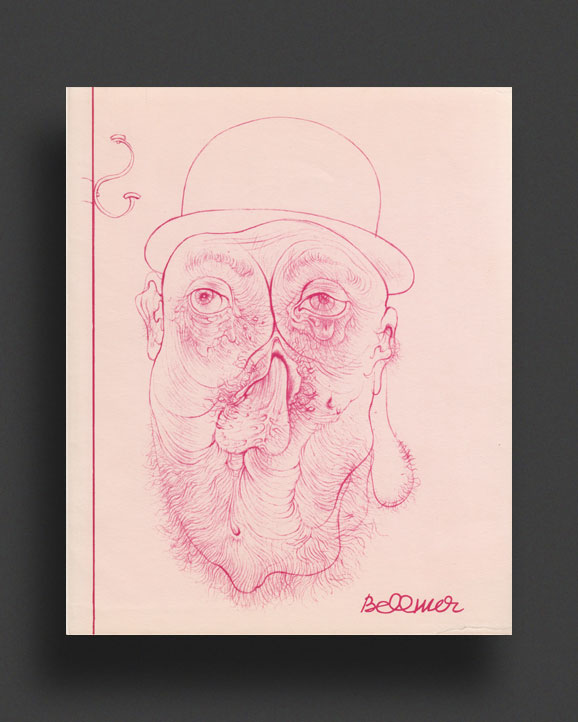
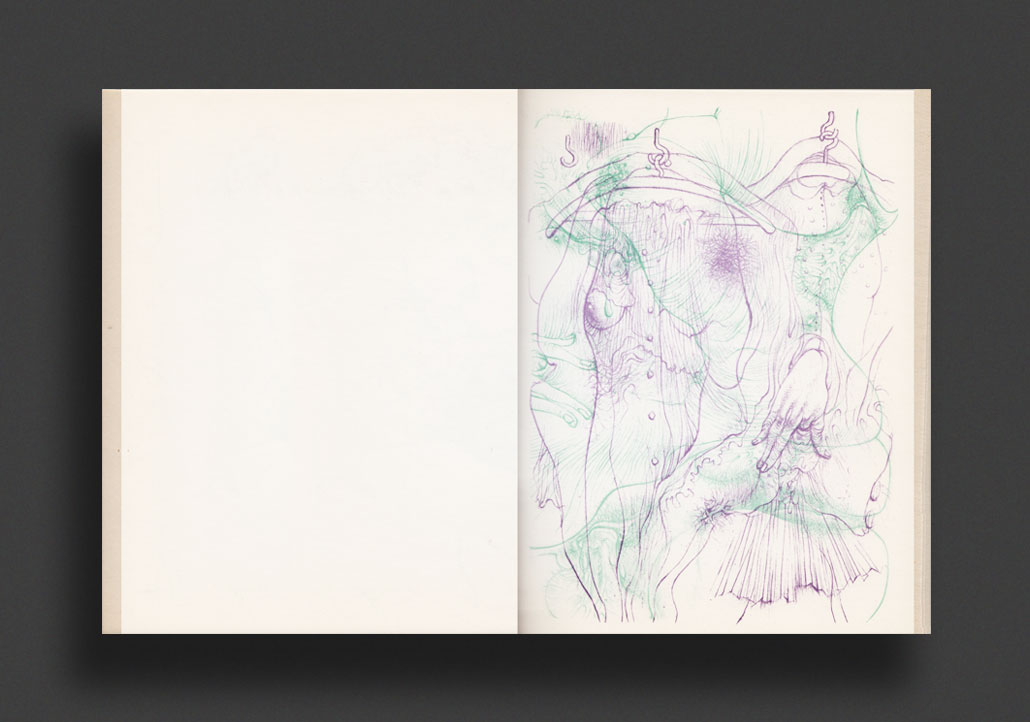
Beautifully produced, scarce French hardcover monographic volume dedicated entirely to reproductions of Surrealist visionary Hans Bellmer's incredible drawings. This is the very first edition, published by Éditions Denoël, Paris, in 1966. With an introduction by Constantin Jelenski. A stunning book, and a key title in the artist's oeuvre.
German artist Hans Bellmer (13 March 1902 – 23 February 1975), was best known for the life-sized pubescent female dolls he produced in the mid-1930s. "Bellmer was born in the city of Kattowitz, then part of the German Empire (now Katowice, Poland). Up until 1926, he'd been working as a draftsman for his own advertising company. He initiated his doll project to oppose the fascism of the Nazi Party by declaring that he would make no work that would support the new German state. Represented by mutated forms and unconventional poses, his dolls were directed specifically at the cult of the perfect body then prominent in Germany. Bellmer was influenced in his choice of art form by reading the published letters of Oskar Kokoschka (Der Fetisch, 1925)."
Very Good – (in original dust jacket and protected under plastic wrap)
1967, German
Softcover, unpaginated, 19 x 17 cm
1st Edition, Out of print title / used / very good
Published by
Frankfurter Kunstverein / Frankfurt
$40.00 - Out of stock
1967 German catalogue of German painter and printmaker, Otto Dix's "Paintings, Watercolors, Drawings, Prints", published to accompany the exhibition at Frankfurter Kunstverein, February 4—March 26, 1967. Illustrated with full-page reproductions in colour and b/w, a wonderful selection, with essay in German by German art historian Fritz Löffler. Full catalogue of exhibited works included. One of the most important artists of the Neue Sachlichkeit (New Objectivity), which also attracted George Grosz and Max Beckmann in the mid 1920s. Dix was noted for his ruthless and harshly realistic depictions of German society during the Weimar Republic and the brutality of war. A veteran haunted by his experiences of WWI, his first great subjects were crippled soldiers, but during the height of his career he also painted nudes, prostitutes, and often savagely satirical portraits of celebrities from Germany's intellectual circles. His work became even darker and more allegorical in the early 1930s, and he became a target of the Nazis, defining Dix as one of Germany's most 'degenerate' artists. Through his art, he had committed a 'violation of the moral sensibilities' of the nation and forced to promise to paint only inoffensive landscapes. His paintings that were considered "degenerate" were discovered in 2012 among the 1500+ paintings hidden away by the son of Hitler's looted-art dealer Hildebrand Gurlitt.
Very Good copy.
2008, English
Softcover (spiral bound w. acetate protector), unpaginated, 28 x 22 cm
Ed. of 200 copies,
Out of print title / used / good
Published by
Printed Matter Inc. / New York
$260.00 - In stock -
The second, expanded edition of this now highly-collectible, limited edition compilation of materials by and about New York art rock band Sonic Youth.
Compiled by Thurston Moore and Lee Ranaldo to accompany the exhibition of the same name at Printed Matter in the summer of 2000, Sonic Matters, Sonic Kollaborations is a sort of Sonic Youth super ‘zine, with over 220 photocopied pages including essays, interviews, ephemera, memorabilia, photographs, writings, gig flyers, posters, letters, song lyrics, poetry, angry fan mail, art work, record covers and related material. Includes a rambling, poetic essay by Moore on the Youth’s roots in–and ongoing relationship with–the art community, as well as the original exhibition proposals by curator, Todd Alden.
“Sonic Youth’s music explores the sometimes liberating, sometimes repressive + always complexx tensions between subjectivity + mass culture, sexuality + mass media, abjection and the star sy$tem. It is these leitmotifs which also find graphic expression, appropriately enough, in the elegantly degraded poetics of the band’s printed matter and ephemera.” ––from the exhibition introduction by Todd Alden, edited and transcribed directly onto the walls of Printed Matter by Thurston Moore.
This expanded edition goes even further, featuring extra bonus materials.
Good copy but with some marking/creasing to transparent acetate cover and marking to black acetate back cover, interior Good—VG with some marking to block edge.
1999, English
Softcover, 62 pages, 21.6 x 19.7 cm
1st Edition, Out of print title / used / very good
Published by
Walther König / Köln
$190.00 - In stock -
Truly wonderful, and now very rare, exhibition catalogue jointly conceived by Mike Kelley and Franz West, documenting their two-person exhibitions in Brussels and Angouleme in 1999. Included are never-before published texts and a series of photographs of their conversation play "To Be Read Aloud." Edited by Anne Pontegnie and Catherine Bastide.
Very Good copy with some scratch to cover board, otherwise NF.
2009, English / German
Softcover, 80 pages, 22 x 20 cm
1st Edition, Out of print title / as new
Published by
Neue Galerie Graz und Künstlerhaus / Graz
$80.00 - In stock -
Scarce catalogue published on the occasion of the exhibition “Günter Brus - Max Klinger: Confluences & Differences. Print Cycles from the Collection of the Neue Galerie Graz”, Bruseum, Neue Galerie Graz at the Landesmuseum Joanneum, March 5 – June 7, 2009, curated by Anke Orgel.
Graz: Neue Galerie am Landesmuseum Joanneum, 2009.
The BRUSEUM at the Neue Galerie Graz dared to create a confrontation whose intention was to recognize subtle harmony—alongside dissonance. Although the work of Günter Brus (born 1938) is not directly influenced by Max Klinger (1857–1920), both artists reference shared intellectual giants from art, philosophy, and science, such as Goya, Novalis, Nietzsche, and Darwin. A shared interest in human existence provides a foundation for related thematic questions. A discontinuity in the thematic structure of Klinger's graphic cycles, which leads to a constant redirection of the narrative direction, finds a parallel in Günter Brus's pictorial poems, which are based on the autonomy of the individual prints and autonomous, at most associative, image and text passages. Only drawing and printmaking, which Klinger called "pen art," seemed suitable to him not only to illustrate external reality but also to capture the "inner gaze." The resulting "dual vision" is capable of connecting reality with the irrational and lending poetry to the representation. The accompanying catalogue, featuring selected prints by Günter Brus and Max Klinger from the collection of the Neue Galerie Graz, also explores their affinity in terms of their essential nature, with texts by Anke Orgel and Birgit Prack.
As New copy.
1979, English
Softcover, 48 pages, 20.2 x 20.2 cm
1st Edition, Out of print title / used / very good
Published by
Harry N. Abrams / New York
$150.00 - Out of stock
‘CIRCLE, SQUARE, TRIANGLE, RECTANGLE, TRAPEZOID AND PARALLELOGRAM IN RED, YELLOW AND BLUE ON RED, YELLOW AND BLUE’.
First edition of LeWitt's classic artist book, "Geometric Figures & Color" published in 1979, which is beautifully made up entirely of full-bleed colour illustrations of six geometric figures six (circle, square, triangle, rectangle, trapezoid and parallelogram) presented, sequentially, in duo-chrome primary colours (yellow and blue on red, red and blue on yellow, yellow and red on blue).
Solomon "Sol" LeWitt (1928 – 2007) was one of the most distinctive and influential American artists of the 20th century. He shaped and defined many of the century's most cerebral "isms", notably minimalism and conceptualism.
Near Fine copy with only light wear/tanning.
1997, English / German
Hardcover (cloth-bound) case, 2 x audio cds, 20 page booklet, 28 x 14 cm
1st Edition, Out of print title / used / fine
Published by
Extraplatte / Austria
Steirischer Herbst / Graz
$100.00 - In stock -
Scarce copy of Roland Dahinden, Sol LeWitt — Collaboration (Sound Sculpture Wall Drawing), a deluxe clothbound 2 x CD and book set published by Extraplatte and Steirischer Herbst, Austria. Commissioned by steirischer herbst 97, Kuppelsaal, Landesmuseum Joanneum, A-8010 Graz, Austria, 5.10. - 3.12. 1997. Includes the works: 1-1 PENTAS For Piano, String 4 And Live Electronics (Robert Höldrich, Tetras Streichquartett, Hildegard Kleeb, Gerhard Hüttl) 52:23; 2-1 PENTAS For 5 Loudspeakers (Remix Of The Sound Installation) (Dimitrios Polisoidis, Robert Höldrich) 1:00:12; Sol LeWitt — wall drawing #832 — Irregular red and blue special. Packaged in a cloth-bound hardcover folder/case, containing the two CDs and book with bi-lingual English/German liner notes. A folded image of Sol Lewitt's wall drawing is glued onto the inner side of the front cover.
Solomon "Sol" LeWitt (1928 – 2007) was one of the most distinctive and influential American artists of the 20th century. He shaped and defined many of the century's most cerebral "isms", notably minimalism and conceptualism.
Roland Dahinden (b. 1962) is a Swiss trombonist and composer specializing in the performance of contemporary music and improvisation/jazz. He studied trombone and composition in Switzerland, Austria, Italy (with Vinko Globokar) and the US (with Alvin Lucier). Composers such as Peter Ablinger, Maria de Alvear, Anthony Braxton, John Cage, Peter Hansen, Hauke Harder, Bernhard Lang, Joelle Léandre, Alvin Lucier, Chris Newman, Pauline Oliveros, Hans Otte, Lars Sandberg, Wolfgang von Schweinitz, Daniel Wolf and Christian Wolff have written especially for him.
Near Fine copy all-round.
1980, English
Softcover (staple-bound), 16 pages, 30.5 x 12 cm
1st Edition, Out of print title / used / fine
Published by
Galerie Watari / Tokyo
$250.00 - In stock -
Stunning, exceptionally rare Japanese Sol LeWitt artist book/catalogue, "All Four Part Combinations of Six Geometric Figures", published to accompany his 1980 solo exhibition at Galerie Watari, Tokyo. Handsome LeWitt book design of minimal title texts introducing this unusual staple-bound oblong book of 15 b/w drawings of Six Geometric Figures in variation by LeWitt, 1980. First and only edition, printed in Japan and only available at the exhibition itself.
Solomon "Sol" LeWitt (1928 – 2007) was one of the most distinctive and influential American artists of the 20th century. He shaped and defined many of the century's most cerebral "isms", notably minimalism and conceptualism.
Near Fine copy with only light tanning to cover and page edges, otherwise beautifully preserved, no spine pinching.
1982, Japanese
Hardcover (clothbound in dust jacket in heavy slipcase), 200 pages, 31 x 31 cm
1st Edition, Out of print title / used / very good
Published by
Nippon Geijutsu Shuppan (NGS) / Japan
$300.00 - In stock -
Rare first edition, first printing of Eikoh Hosoe's classic photo book “Human Body”, published by Nippon Geijutsu Shuppansha, Tokyo in 1982. A stunning collection duotone photogravures, “Human Body” is a gorgeously designed retrospective of Hosoe's inimitable nudes and includes work from his critically acclaimed "Man & Woman", "Embrace", "Killed by Roses", as well as many previously unpublished images including many shot in Yosemite and Arizona. Beautiful black cloth bound, de-bossed covers with dust-jacket housed in the original heavy publisher's printed slipcase. An absolute classic, and wonderful copy of one of Hosoe's scarcer books.
Eikoh Hosoe (Hosoe Eikō, born 18 March 1933 in Yonezawa, Yamagata) is a Japanese photographer and filmmaker who emerged in the experimental arts movement of post-World War II Japan. He is known for his psychologically charged images, often exploring subjects such as death, erotic obsession, and irrationality. Through his friendships and artistic collaborations he is linked with the writer Yukio Mishima and 1960s avant-garde artists such as the Butoh dancer Tatsumi Hijikata.
Very Good-Fine copy. Tiny few marks on book-block side-edge of coffee? Otherwise a perfect, preserved copy in original dust-jacket and slipcase with light shelf-wear.