World Food Books' programme is largely produced on Kulin Nation land. We acknowledge the Wurundjeri people of the Kulin Nation as the first and continuing custodians of this land, and pay respect to their Elders past, present, and emerging.
World Food Books is an arts and special interests bookshop in Naarm / Melbourne. Founded in 2010, World Food Books is devoted to the presentation of a rotating, hand-selection of international art, design, literary and counterculture publications with an emphasis on the anti-traditional, the experimental, the avant-garde, the heretic, the marginal.
Presenting new titles alongside rare and out-of-print books, catalogues and journals spanning the fields of modern and contemporary art, design, photography, illustration, film, literature, poetry, cultural theory, philosophy, sexuality, popular and underground culture in its many radical forms, World Food Books wishes to encourage adventurous, thoughtful and open-minded reading, looking, writing, and exchange of publishing and ideas, both current and historical.
As well as our bookshop, located in Melbourne's historical Nicholas Building, all of our inventory is available internationally via our online mail-order service.
World Food Books semi-regularly co-ordinates "Occasions", a programme of exhibits and events at the bookshop and in partnership with other hosts (such as museums and art galleries) that develop out of the activities, relationships and content of the bookshop itself.
World Food Books
The Nicholas Building
37 Swanston Street
Room 5, Level 6
Melbourne 3000
Australia
SHOP HOURS:
Thu–Fri 12–6, Sat 12–5
WEB-SHOP OPEN 24/7
World Food Books
Postal Address:
PO Box 435
Flinders Lane
Victoria 8009
Australia
Art
Theory / Essay
Architecture / Interior
Graphic Design / Typography
Photography
Fashion
Eros
LGBTQ+
Fiction / Poetry
Weird / Speculative / Science Fiction / Horror
Transgressive / Visceral / Abject
Symbolism / Decadence / Fin de siècle
Film / Video
Painting
Sculpture / Installation
Performance / Dance / Theater
Drawing
Sound / Music
Curatorial
Group Shows / Collections
Periodicals
Out-of-print / Rare
Posters / Ephemera / Discs
Signed Books
World Food Books Gift Voucher
World Food Book Bag
Australian Art
Australian Fiction
Australian Science Fiction / Speculative Fiction
Australian Poetry
Australian Photography
Japanese Photography
Conceptual Art
Minimal Art
Dada
'Pataphysics / Oulipo
Fluxus
Concrete Poetry
Pop Art
Surrealism
Arte Povera
Arte Informale / Haute Pâte / Tachism
Nouveau Réalisme / Zero / Kinetic
Situationism / Lettrism
Collage / Mail Art / Xerox Art
Art Brut / Folk / Visionary / Fantastic
Illustration / Graphic Art / Bandes Dessinées
Furniture
Italian Radical Design / Postmodernism
Textiles
Ceramics / Glass
Counterculture
Protest / Revolt
Philosophy
Psychoanalysis
Anthropology
Anarchism
Socialism / Anarchism / Communism / Capitalism
Literary Theory / Semiotics / Language
Feminism / Women's Studies
Gender Studies / Sexuality
Anthropology
Fetishism / BDSM
Drugs / Psychedelia
Crime / Violence
Animal Rights / Veganism
Occult / Esoterica
Ecology / Earth / Alternative Living
Whole Earth / Crafts
All prices in AUD (Australian dollars)
Pick-Ups
Pick-up orders can be collected in our bookshop during opening hours after order date. Please collect any Pick-up orders within 2 weeks of ordering as we have limited storage space. Orders will be released back into stock if not collected within this time. No refunds can be made for pick-ups left un-collected. If you cannot make it in to the bookshop in this time-frame, please choose postage option.
Return Policy
All sales are final. We do accept returns (for refund or exchange) for items received in error. All our orders are packed with special care using heavy-duty padding and cardboard book-mailers or bubble mailers (for smaller books), using reinforcement where required. We cannot take responsibility for any lost, stolen or damaged parcels.
Insurance
Should you wish to insure your package, please email us directly after placing your order and we can organise this at a small extra expense. Although all standard/express tracked packages are very safe and dependable, we cannot take responsibility for any lost, stolen or damaged parcels. We recommend insurance on valuable orders.
Interested in selling your old books, catalogues, journals, magazines, comics, fanzines, ephemera? We are always looking for interesting, unusual and out-of-print books to buy. We only buy books in our fields of interest and specialty, and that we feel we can resell.
We base these prices on desirability, market value, in-print prices, condition and our current stock levels. We offer cash, store credit, and can take stock on consignment. All
about 25% of the price we expect to get when we sell them, or 30% in store credit. We base these prices on desirability, market value, in-print prices, condition and our current stock levels.
Sell your books any day of the week. You can drop them off and return later. If you have a lot of books, we can visit your Sydney home.
We buy books that we feel we can resell. We offer about 25 % of the price we expect to get when we sell them, or 30% in store credit. We base these prices on desirability, market value, in-print prices, condition and our current stock levels.
Philadelphia Wireman
03 August - 01 September, 2018
World Food Books is proud to announce our next Occasion, the first presentation of sculptures by Philadelphia Wireman in Australia.
The Philadelphia Wireman sculptures were found abandoned in an alley off Philadelphia’s South Street on trash night in 1982. Their discovery in a rapidly-changing neighbourhood undergoing extensive renovation, compounded with the failure of all attempts to locate the artist, suggests that the works may have been discarded after the maker’s death. Dubbed the "Philadelphia Wireman" during the first exhibition of this work, in 1985, the maker’s name, age, ethnicity, and even gender remain uncertain. The entire collection totals approximately 1200 pieces, all intricately bound together with tightly-wound heavy-gauge wire (along with a few small, abstract marker drawings, reminiscent both of Mark Tobey and J.B. Murry). The dense construction of the work, despite a modest range of scale and materials, is singularly obsessive and disciplined in design: a wire armature or exoskeleton firmly binds a bricolage of found objects including plastic, glass, food packaging, umbrella parts, tape, rubber, batteries, pens, leather, reflectors, nuts and bolts, nails, foil, coins, toys, watches, eyeglasses, tools, and jewellery.
Heavy with associations—anthropomorphic, zoomorphic, and socio-cultural responses to wrapped detritus—the totemic sculptures by Philadelphia Wireman have been discussed in the context of work created to fulfil the shamanistic needs of alternative religions in American culture. Curators, collectors, and critics have variously compared certain pieces to sculpture from Classical antiquity, Native American medicine bundles, African-American memory jugs, and African fetish objects. Reflecting the artist’s prolific and incredibly focused scavenging impulse, and despite—or perhaps enhanced by—their anonymity, these enigmatic objects function as urban artefacts and arbiters of power, though their origin and purpose is unknown. Philadelphia Wireman, whatever their identity, possessed an astonishing ability to isolate and communicate the concepts of power and energy through the selection and transformation of ordinary materials. Over the course of the past two decades, this collection has come to be regarded as an important discovery in the field of self-taught art and vernacular art.
Presented in collaboration with Fleisher-Ollman Gallery, Philadelphia, and Robert Heald, Wellington.
Susan Te Kahurangi King
02 February - 10 March, 2018
Susan Te Kahurangi King (24 February 1951 - ) has been a confident and prolific artist since she was a young child, drawing with readily available materials - pencils, ballpoint pens and felt-tip markers, on whatever paper is at hand. Between the ages of four and six Susan slowly ceased verbal communication. Her grandparents William and Myrtle Murphy had developed a special bond with Susan so they took on caring responsibilities for extended periods. Myrtle began informally archiving her work, carefully collecting and storing the drawings and compiling scrapbooks. No drawing was insignificant; every scrap of paper was kept. The King family are now the custodians of a vast collection containing over 7000 individual works, from tiny scraps of paper through to 5 meter long rolls.
The scrapbooks and diaries reveal Myrtle to be a woman of great patience and compassion, seeking to understand a child who was not always behaving as expected. She encouraged Susan to be observant, to explore her environment and absorb all the sights and sounds. Myrtle would show Susan’s drawings to friends and people in her community that she had dealings with, such as shopkeepers and postal workers, but this was not simply a case of a grandmother’s bias. She recognised that Susan had developed a sophisticated and unique visual language and sincerely believed that her art deserved serious attention.
This was an unorthodox attitude for the time. To provide some context, Jean Dubuffet coined the term Art Brut in 1945 to describe work created by self-taught artists – specifically residents of psychiatric institutions and those he considered to be visionaries or eccentrics. In 1972 Roger Cardinal extended this concept by adopting the term Outsider Art to describe work made by non-academically trained artists operating outside of mainstream art networks through choice or circumstance. Susan was born in Te Aroha, New Zealand in 1951, far from the artistic hubs of Paris and London that Dubuffet and Cardinal operated in. That Myrtle fêted Susan as a self-taught artist who deserved to be taken seriously shows how progressive her attitudes were.
Susan’s parents Doug and Dawn were also progressive. Over the years they had consulted numerous health practitioners about Susan’s condition, as the medical establishment could not provide an explanation as to why she had lapsed into silence. Dawn educated herself in the field of homeopathy and went on to treat all twelve of her children using these principles – basing prescriptions on her observations of their physical, mental and emotional state.
Doug was a linguist with an interest in philosophy who devoted what little spare time he had to studying Maori language and culture. To some extent their willingness to explore the fringes of the mainstream made them outsiders too but it was their commitment to living with integrity and their respect for individuality that ensured Susan’s creativity was always encouraged.
Even though Susan’s family supported her artistic pursuits, some staff in schools and hospitals saw it as an impediment to her assimilation into the community and discouraged it in a variety of ways. Her family was not always aware of this and therefore did not fully understand why Susan stopped drawing in the early 1990s. However, rather than dwell on the challenges that Susan faced in pursuit of her artistic practice, they prefer to highlight her achievements. In 2008 Susan began drawing again in earnest, after an almost 20 year interruption, and her work is now shown in galleries around the world.
Susan grew up without television and has been heavily influenced by the comics she read as a child. She is absolutely fearless in the appropriation of recognizable characters, such as Donald Duck and Mickey Mouse, in her work. She twists their limbs, contorts their faces, compresses them together, blends them into complex patterned backgrounds - always imbuing them with an incredible energy. Although Susan often used pop culture characters in her work they are not naive or childlike. These are drawings by a brilliant self-taught artist who has been creating exceptional work for decades without an audience in mind.
Mladen Stilinović
"Various Works 1986 - 1999"
02 February 16 - September 10, 2016
Various works 1986 - 1999, from two houses, from the collections of John Nixon, Sue Cramer, Kerrie Poliness, Peter Haffenden and Phoebe Haffenden.
Including: Geometry of Cakes (various shelves), 1993; Poor People’s Law (black and white plate), 1993; White Absence (glasses, ruler, set square, silver spoon, silver ladel with skin photograph and wooden cubes), 1990-1996; Exploitation of the Dead (grey and red star painting, wooden painting, black spoon with red table, red plate), 1984-1990; Money and Zeros (zero tie, paintings made for friends in Australia (Sue, John, Kerrie), numbers painting), 1991-1992; Words - Slogans (various t-shirts) - “they talk about the death of art...help! someone is trying to kill me”, “my sweet little lamb”, “work is a disease - Karl Marx”; Various artist books, catalogues, monographs, videos; Poster from exhibition Insulting Anarchy; "Circular" Croatian - Australian edition; Artist book by Vlado Martek (Dostoyevsky); more.
Thanks to Mladen Stilinović and Branka Stipančić.
Jonathan Walker
Always Will Need To Wear Winter Shirt Blue + Ochre Small Check Pattern
21 August - 21 September, 2015
Untitled
I am not a great reader of poetry but I always return to the work of Melbourne poet, Vincent Buckley (1925- 1988). Perhaps I find his most tantalising piece to be not a finished poem but a fragment left on a scrap of paper discovered on his desk after the poet’s death.
The poetry gathers like oil
In the word-core, and spreads
It has its music meet,
Its music is in movement.
This fragment is more the shell left behind from a volatile thought than a finished poem. I find the last two lines honest but awkward whereas the first two lines work like an arrow. Most likely he could not find a resolution so it was left. Still, in its present form, it remains an eloquent testimony to the ultimate failure of a medium to express mobile thought and sensation, in Buckley’s case, through verbal language. It’s an important matter because this is something all artists have to deal with regardless of the medium.
I have never written a poem, however, I am forever copying fragments from books on paper scraps in a vain effort to fix certain notions in my head. At first, they function as bookmarks that are sometimes returned to when I open the book. But before long, as they accumulate, they fall out littering the table interspersed with A4 photocopies, bills, books and medications.
To return to Buckley’s fragment, the first two lines very much evoke how I paint nowadays. As you age, detail diminishes and patches of light become more luminous and float. I feel the most honest way of dealing with this is by smearing the oil paint on the canvas with the fingers and working close-up, blind. Only if the patches coalesce into an approaching image can the work gain a life.
-
Jonathan Walker was born in Melbourne, Australia and brought up on a dairy farm in Gippsland. In the 1970’s he studied painting at RMIT and won the Harold Wright Scholarship to the British Museum, London. During the 1980’s he exhibited at Pinacotheca Gallery, Richmond and had work shown at the NGV and Heidi City Art Gallery. Over the same period he designed the cover for the “Epigenesi” LP by Giancarlo Toniutti, Italy and conducted a mail exchange work with Achim Wollscheid, Germany. The work with artists through the post resulted in an article published in the bicentenary issue of Art and Australia 1988. He showed in artist run spaces such as WestSpace in the 90’s and 2000’s, and until 2012, taught painting at Victoria University, which is where we (Colleen Ahern and Lisa Radford) as organisers of the exhibition, among many others, had the privilege of being his student.
Walker’s knowledge was imparted to students through the careful selection of music, literature, and artists found in books that he himself had ordered for the library. Walker’s strategy was the generosity of sharing his vast knowledge with references specific to each student and their context.
Walker’s paintings share a similar focus and intimacy.
This exhibition presents a small selection of recent paintings alongside a publication that includes Walker’s writing. Observational and analytical, Walker’s work is a type of material notation — the time of day, colour and how it is blended, the both specific and fleeting location of a reflection on lino or the question of whether a chair leg should be included in a painting.
Please join us on Friday August 21 between 6-8pm to celebrate the opening of the exhibition.
Curated by Colleen Ahern and Lisa Radford.
B. Wurtz
Curated by Nic Tammens
March 26 - April 4, 2015
B.Wurtz works from a basement studio in his home on Manhattan’s Lower East Side.
This local fact is attested to by the plastic shopping bags and newsprint circulars that appear in his work. As formal objects, they don’t make loud claims about their origins but nonetheless transmit street addresses and places of business from the bottom of this long thin island. Like plenty of artists, Wurtz is affected by what is local and what is consumed. His work is underpinned by this ethic. It often speaks from a neighborhood or reads like the contents of a hamper:
“BLACK PLUMS $1.29 lb.”
“Food Bazaar”
“USDA Whole Pork Shoulder Picnic 99c lb.”
“RITE AID Pharmacy, with us it’s personal.”
“H. Brickman & Sons.”
“Sweet Yams 59c lb."
Most of the work in this exhibition was made while the artist was in residence at Dieu Donne, a workshop dedicated to paper craft in Midtown. Here Wurtz fabricated assemblages with paper and objects that are relatively lightweight, with the intention that they would be easily transportable to Australia. This consideration isn’t absolute in Wurtz’s work, but was prescriptive for making the current exhibition light and cheap. Packed in two boxes, these works were sent from a USPS post office on the Lower East Side and delivered to North Melbourne by Australia Post.
Wurtz appears courtesy of Metro Pictures, New York.
Thanks to Rob Halverson, Joshua Petherick, Sari de Mallory, Matt Hinkley, Helen Johnson, Fayen d'Evie, Ask Kilmartin, Lisa Radon, Ellena Savage, Yale Union, and "Elizabeth".
John Nixon
"Archive"
December 15 - January 20, 2014
The presentation of John Nixon's archive offered a rare showcase of this extensive collection of the artist's own publications, catalogues, posters, ephemera, editions and more, from the mid 1980s onwards, alongside a selection of his artworks.
Organized by John Nixon, Joshua Petherick and Matt Hinkley.
<a href=http://wfb.public-office.info/artist/john-nixon>All titles by John Nixon
"Habitat"
at Minerva, Sydney (organised by Joshua Petherick and Matt Hinkley)
November 15 - December 20, 2014
Lupo Borgonovo, Janet Burchill & Jennifer McCamley,
Lewis Fidock, HR Giger, Piero Gilardi, Veit Laurent Kurz,
Cinzia Ruggeri, Michael E. Smith, Lucie Stahl, Daniel Weil, Wols
Press Release:
“...It contained seven objects. The slender fluted bone, surely formed for flight, surely from the wing of some large bird. Three archaic circuitboards, faced with mazes of gold. A smooth white sphere of baked clay. An age-blackened fragment of lace. A fingerlength segment of what she assumed was bone from a human wrist, grayish white, inset smoothly with the silicon shaft of a small instrument that must once have ridden flush with the surface of the skin - but the thing’s face was seared and blackened.”
William Gibson, “Count Zero”, 1986
"Autumn Projects Archive"
Curated by Liza Vasiliou
March 6 - March 15, 2014
World Food Books, in conjunction with the Virgin Australia Melbourne Fashion Festival 2014, presented the Autumn Projects archive, consisting of a selection of early examples in Australian fashion with a particular interest in collecting designers and labels from the period beginning in the 1980’s, who significantly influenced the discourse of Australian Fashion.
Curated by Liza Vasiliou, the exhibition provided a unique opportunity to view pieces by designers Anthea Crawford, Barbara Vandenberg, Geoff Liddell and labels CR Australia, Covers, Jag along with early experimental collage pieces by Prue Acton and Sally Browne’s ‘Fragments’ collection, suspended throughout the functioning World Food Books shop in Melbourne.
H.B. Peace
presented by CENTRE FOR STYLE
November 14, 2013
"Hey Blinky, you say chic, I say same"
Anon 2013
H.B. Peace is a clothing collaboration between great friends Blake Barns and Hugh Egan Westland. Their pieces explore the divergences between 'character’ and ‘personality’ in garments....etc
Special Thanks to Joshua Petherick and Matt Hinkley of WFB and Gillian Mears
and a Very Special Thank you to Audrey Thomas Hayes for her shoe collaboration.
Janet Burchill & Jennifer McCamley
"Aesthetic Suicide"
May 10 - June 8, 2013
The first of our occasional exhibitions in the World Food Books office/shop space in Melbourne, "Aesthetic Suicide" presented a body of new and older works together by artists Janet Burchill & Jennifer McCamley, including videos, prints, a wall work, and publications.
During shop open hours videos played every hour, on the hour.
1998, English
Softcover, 176 pages, 23 x 14 cm
1st Edition, Out of print title / used / good
Published by
Main St. Books / New York
$85.00 - In stock -
First edition.
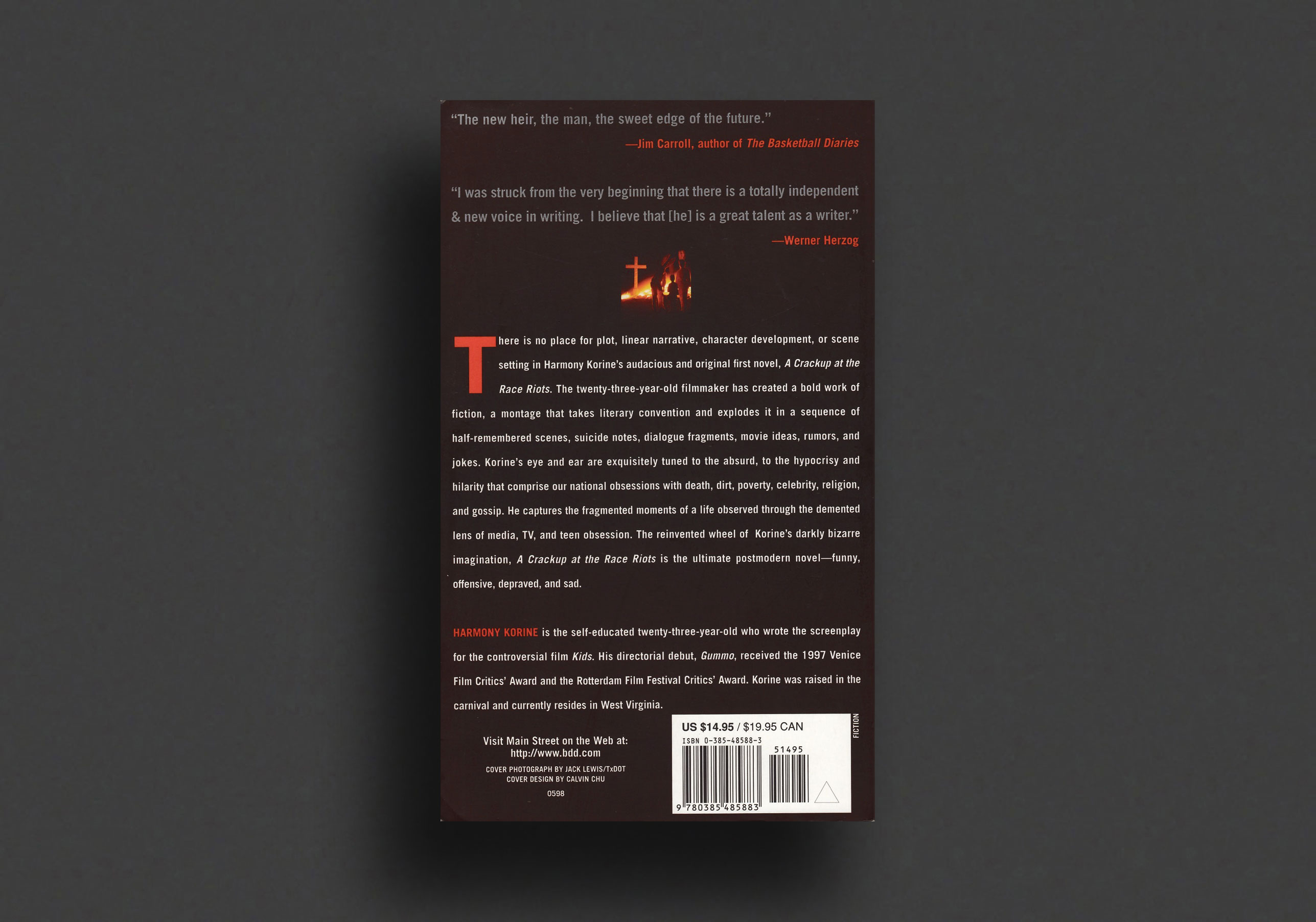
"There is no place for plot, linear narrative, character development, or scene setting in Harmony Korine's audacious and original first novel, A Crackup at the Race Riots. The twenty-three-year-old filmmaker has created a bold work of fiction, a montage that takes literary convention and explodes it in a sequence of half-remembered scenes, suicide notes, dialogue fragments, movie ideas, rumors, and jokes. Korine's eye and ear are exquisitely tuned to the absurd, to the hypocrisy and hilarity that comprise our national obsessions with death, dirt, poverty, celebrity, religion, and gossip. He captures the fragmented moments of a life observed through the demented lens of media, TV, and teen obsession. The reinvented wheel of Korine's darkly bizarre imagination, A Crackup at the Race Riots is the ultimate postmodern novel-funny, offensive, depraved, and sad."
"The new heir, the man, the sweet edge of the future."—Jim Carroll, author of The Basketball Diaries
"I was struck from the very beginning that there is a totally independent & new voice in writing. I believe that [he] is a great talent as a writer."—Werner Herzog
HARMONY KORINE is the self-educated twenty-three-year-old who wrote the screenplay for the controversial film Kids. His directorial debut, Gummo, received the 1997 Venice Film Critics' Award and the Rotterdam Film Festival Critics' Award. Korine was raised in the carnival and currently resides in West Virginia.
Good copy with wear to extremities, Tightly bound, no spine creases.
1997, Japanese / English
Hardcover (w. dust jacket), 70 pages, 26 x 21 cm
1st Edition, Out of print title / used / very good
Published by
Rockin' On / Tokyo
$120.00 - Out of stock
The incredible first monograph that doubles as an artist's book of work by Hungarian New York-based artist Rita Ackerman spanning the years 1993—1996, edited and designed by Makoto Ohrui from Fiction Inc., published by Rockin' On in 1997 and only available in Japan. Long out-of-print, this numbered hardcover volume, with illustrated vellum dust jacket, is illustrated profusely with seventy of Ackerman's drawings, paintings and collages throughout in colour and b/w with many fold-outs and notebook scans, accompanied by essays.
New York City based artist Rita Ackerman was born in Budapest in 1968. She studied at the University of Fine Arts in Budapest and The New York Studio School of Drawing, Painting and Sculpture from the years of 1989 to 1992. Ackermann invented images that became instant sensations, perturbing young girls that are now part of the universe of global imagery. Her drawings and paintings between 1993-95 depict compositions of adolescent female figures of clonelike multiples engaging in various self-destructive and hazardous activities. Her early works with their ambiguous presence serve as bridges between high and low culture, just as the myths and folk tales which often serve as merits to Ackermann's compositions. Later, Ackerman would abandon the figure, erasing the very matter of her own work, in a complex layering of visual language oscillating between abstraction and figuration into a subconscious unfolding of form—concealed deeply in the abstraction of the omnipresence.
First edition, VG copy in VG dust jacket.
1983, English
Softcover, 122 pages, 24.5 x 17.5 cm
1st Edition, Out of print title / used / very good
Published by
Pluto Press / UK
$20.00 - In stock -
First 1983 edition.
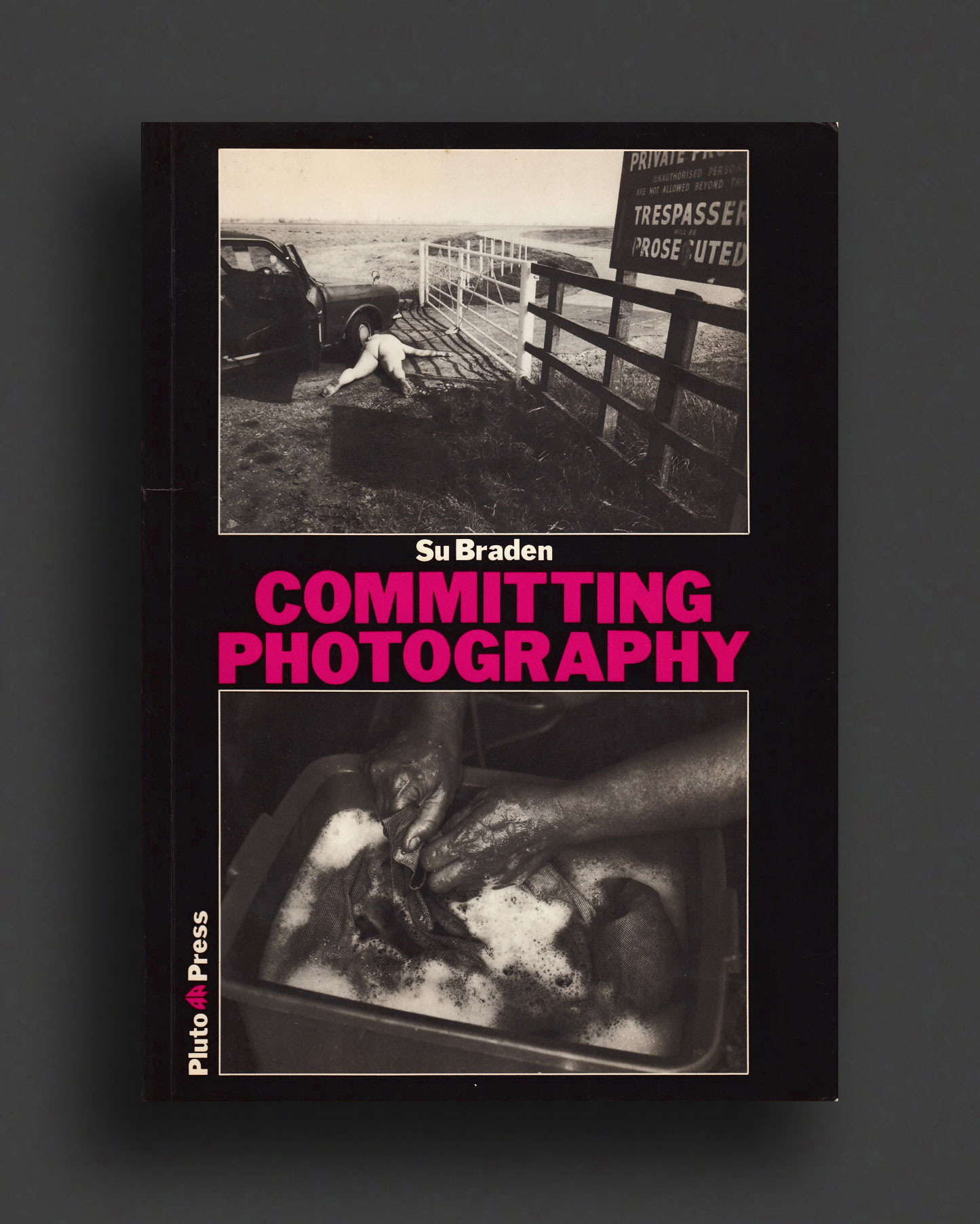
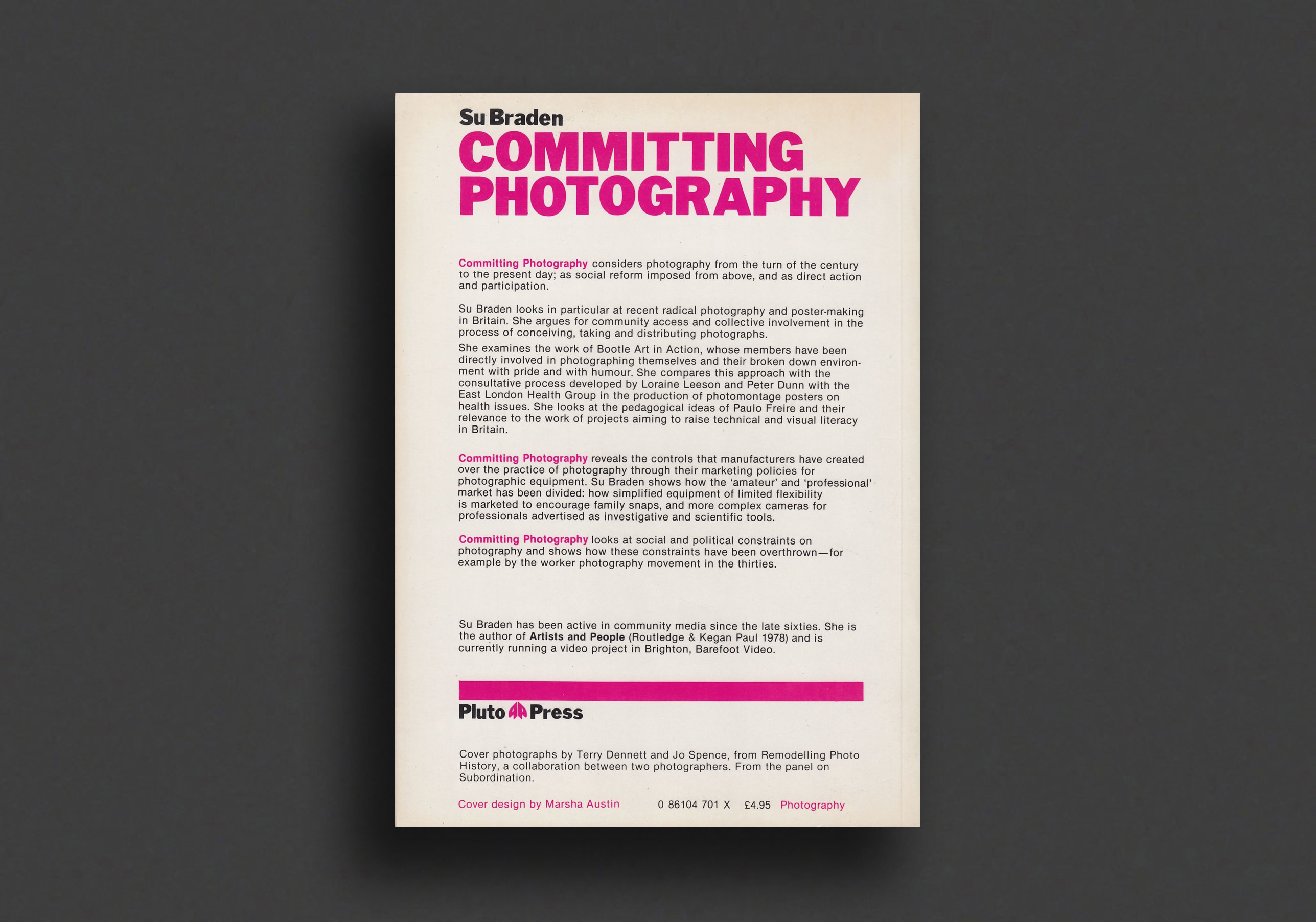
"Committing Photography considers photography from the turn of the century to the present day; as social reform imposed from above, and as direct action and participation. Su Braden looks in particular at recent radical photography and poster-making in Britain. She argues for community access and collective involvement in the process of conceiving, taking and distributing photographs.
She examines the work of Bootle Art in Action, whose members have been directly involved in photographing themselves and their broken down environment with pride and with humour. She compares this approach with the consultative process developed by Loraine Leeson and Peter Dunn with the East London Health Group in the production of photomontage posters on health issues. She looks at the pedagogical ideas of Paulo Freire and their relevance to the work of projects aiming to raise technical and visual literacy in Britain.
Committing Photography reveals the controls that manufacturers have created over the practice of photography through their marketing policies for photographic equipment. Su Braden shows how the 'amateur' and 'professional' market has been divided: how simplified equipment of limited flexibility is marketed to encourage family snaps, and more complex cameras for professionals advertised as investigative and scientific tools.
Committing Photography looks at social and political constraints on photography and shows how these constraints have been overthrown —for example by the worker photography movement in the thirties."
Su Braden has been active in community media since the late sixties. She is the author of Artists and People (Routledge & Kegan Paul 1978) and is currently running a video project in Brighton, Barefoot Video.
VG copy, monor wear to extremities.
1982, Japanese
Softcover (w. dust jacket and plastic sleeve), 126 pages, 33 x 25 cm
1st Edition, Out of print title / used / very good
Published by
Bijutsu Shuppansha / Japan
$140.00 - Out of stock
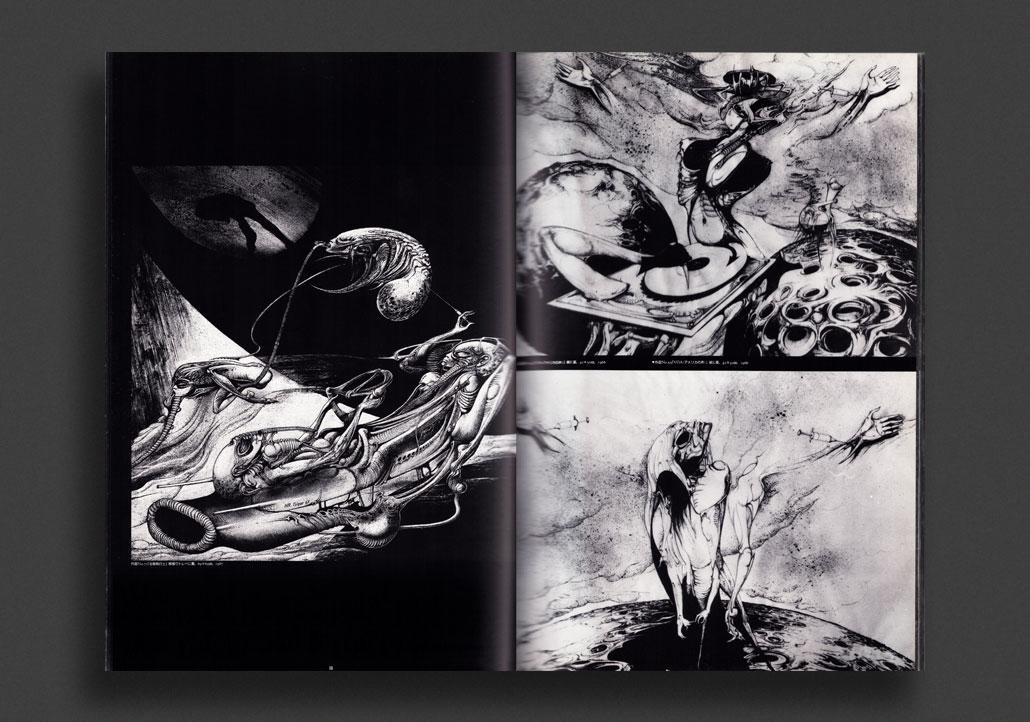
Published in 1982 and long out-of-print, Masquerade is one of the finest artist books of Japanese illustrator and graphic artist Aquirax Uno. Lavishly illustrated and elaborately designed and directed by the artist himself, this beautiful album collects Uno's most stunning fantastical illustration and painting throughout the 1960s—1980s, alongside texts and photography of Uno in his atelier. Masquerade collates a cross-section of Uno's graphic work spanning his entire career, his iconic and innovative print, book, and theatre works, including many new, unpublished works and illustrations printed in large format across many full-colour fold-outs — a wonderful way to capture his decadent, provocative, stream of consciousness line work in intimate detail. Highly recommended!
Aquirax Uno, also known as Akira Uno (b. 1934) is a Japanese graphic artist, illustrator and painter who was very influential in the 1960s and 1970s. His incredibly unique work is characterized by fantastic visuals, capricious and sensuous line flow, flamboyant (and occasionally grotesque) eroticism, and frequent use of collage and psychedelic bright colours. Uno was prominently involved with the Japanese underground art of the 1960s–1970s, and is particularly notable for his frequent collaborations with Shuji Terayama and his experimental theater Tenjo Sajiki.
Aquirax Uno, also known as Akira Uno (b. 1934) is a Japanese graphic artist, illustrator and painter who was very influential in the 1960s–1970s. His incredibly unique work is characterized by fantastic visuals, capricious and sensuous line flow, flamboyant (and occasionally grotesque) eroticism, and frequent use of collage and psychedelic bright colours. Uno was prominently involved with the Japanese underground art of the 1960s–1970s, and is particularly notable for his frequent collaborations with Shuji Terayama and his experimental theater Tenjo Sajiki.
Good copy with heavy foxing to cover edges and end pages, original publisher's textured plastic protector sleeve with usual slight shrinkage from age, edge wear. Sample images only.
1989, Japanese
Softcover (w. dust jacket + ephemera), 96 pages, 42.5 x 30.5 cm
1st Edition, Out of print title / used / very good
Published by
Treville / Tokyo
$200.00 - In stock -
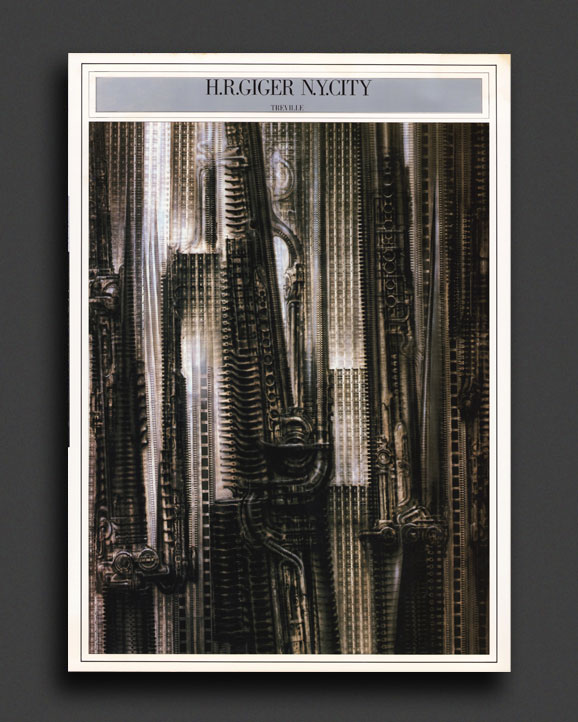
Rare first 1989 Japanese edition of H. R. Giger's Biomechanics. In his classic series of oversized and visually immersive early art volumes, this book comprises a retrospective showcase, from 1964—88, of Giger's work, designed by and with running commentary by Giger himself, with over 200 drawings, paintings, and sculptures, and including concept art for the film Poltergeist II, and design paintings for Emerson, Lake, and Palmer albums, his lost film work and early cartoons. With a foreword by legendary Science Fiction author and longtime Giger fan Harlan Ellison, who dubs him "our latter-day Hieronymus Bosch."
Note: the Japanese editions of these books often had better reproductions from the original plates than the German and English language editions.
Includes Treville publisher ephemera inserted as issued, including an illustrated advert for Giger poster editions, etc.
Very Good in Very Good dust jacket. Excellent, well-preserved copy.
1981 / 1988, English / Japanese
Softcover (w. dust jacket + Japanese booklet), 48 pages, 40 x 28 cm
1st Edition, Out of print title / used / good
Published by
Treville / Tokyo
Charles E. Tuttle / Tokyo
$140.00 - Out of stock
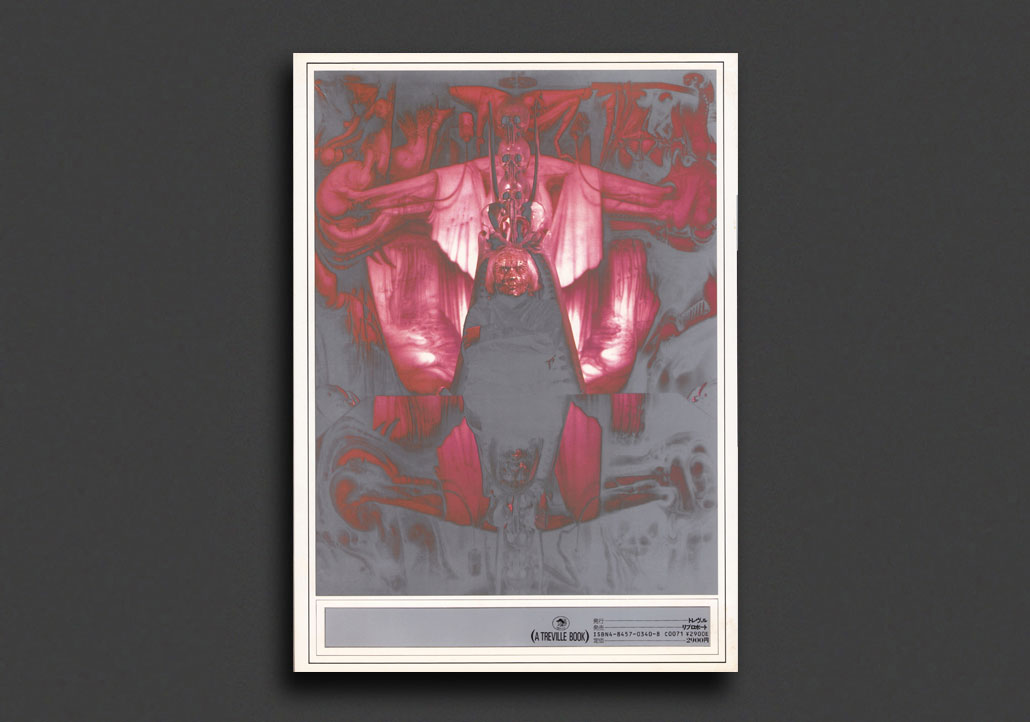
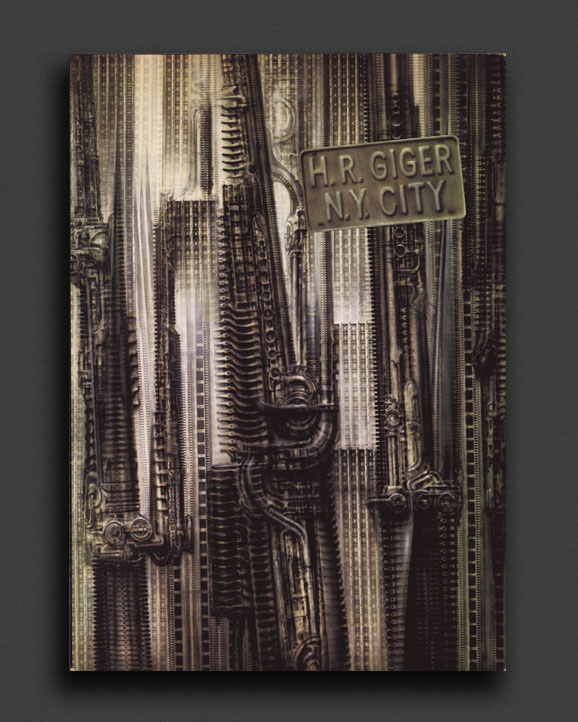
1988 Japanese re-edition by Treville of the original out-of-print 1981 Charles Tuttle edition (entirely in English language). This IS actually just the 1981 edition wrapped in a new glossy dust jacket and re-issued in 1988 with an insert booklet designed by Treville to translate all the book's English texts to Japanese for the first time. Two editions in one, you also have the beautifully produced over-sized 1981 book by H. R. Giger. Foreword by Timothy Leary.
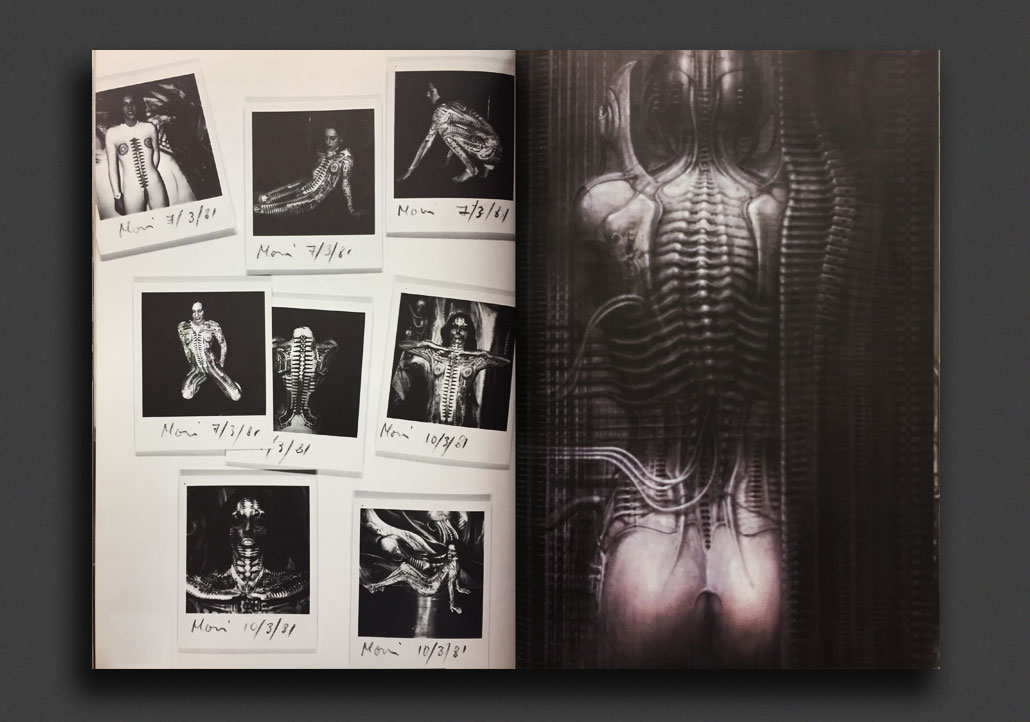
In 1981, a year after being awarded the Oscar for Best Achievement for Visual Effects for Alien, the book H.R. GIGER N.Y. CITY was published. This series of post Alien works, the result of an intense period of non-stop painting, literally day and night, were inspired by Giger's trip to New York City and a template which his colleague Cornelius de Fries, brought back from one of his excursions into the electronic industry. The stencil was actually a sheet of scrap metal from which electrical components had been punched out. Alongside these incredible works are drawings, articles, press clippings, posters and polaroids from Giger's time in New York City.
Fantastic Swiss surrealist painter, sculptor and set designer Hans Rudolf “Ruedi” Giger was born in 1940, the son of a chemist. He spoke of a father who viewed art as a "breadless profession", and strongly encouraged his son to enter into pharmaceutics. Despite this, in 1962, he moved to Zürich, where he studied Architecture and industrial design at the School of Applied Arts until 1970. Giger's style and thematic execution have been hugely influential. His design for the Alien was inspired by his painting Necronom IV and earned him an Oscar in 1980. His books of paintings, particularly Necronomicon and Necronomicon II (1985) and the frequent appearance of his art in Omni magazine continued his rise to international prominence. Giger is also well known for artwork on several music recording albums. His most distinctive stylistic innovation is that of a representation of human bodies and machines in a cold, interconnected relationship, he described as "biomechanical". His paintings often display fetishistic sexual imagery. His main influences were painters Ernst Fuchs and Salvador Dalí. He was also a personal friend of Timothy Leary. Giger suffered from night terrors and his paintings are all to some extent inspired by his experiences with that particular sleep disorder, making his first paintings as a means of art therapy. In 1998 Giger acquired the Château St. Germain in Gruyères, Switzerland, and it now houses the H. R. Giger Museum, a permanent repository of his work.
VG—Good copy, VG dust jacket, fine booklet insert. Book itself has foxing to preliminaries, light wear/tanning, otherwise a tight copy.
1986, Japanese
Hardcover (cloth-bound), 152 pages, 36.5 x 29 cm
1st Edition, Out of print title / used / good
Published by
Chikuma Shobo / Tokyo
Comme des Garçons / Tokyo
$400.00 - Out of stock
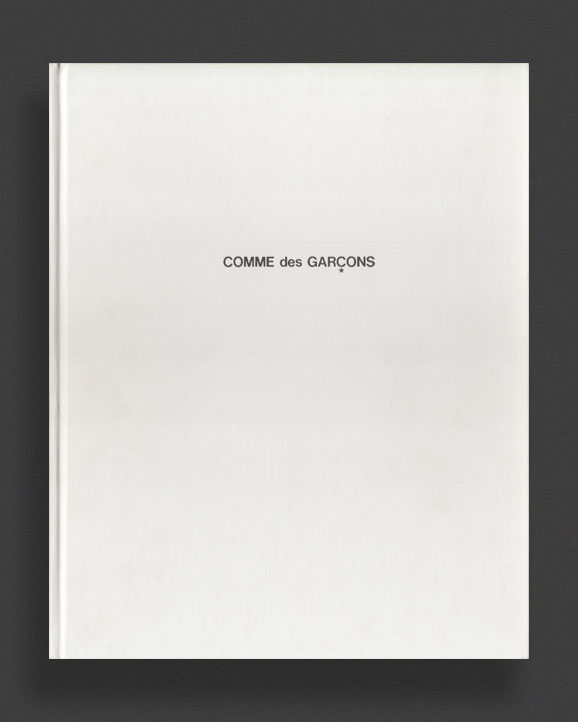
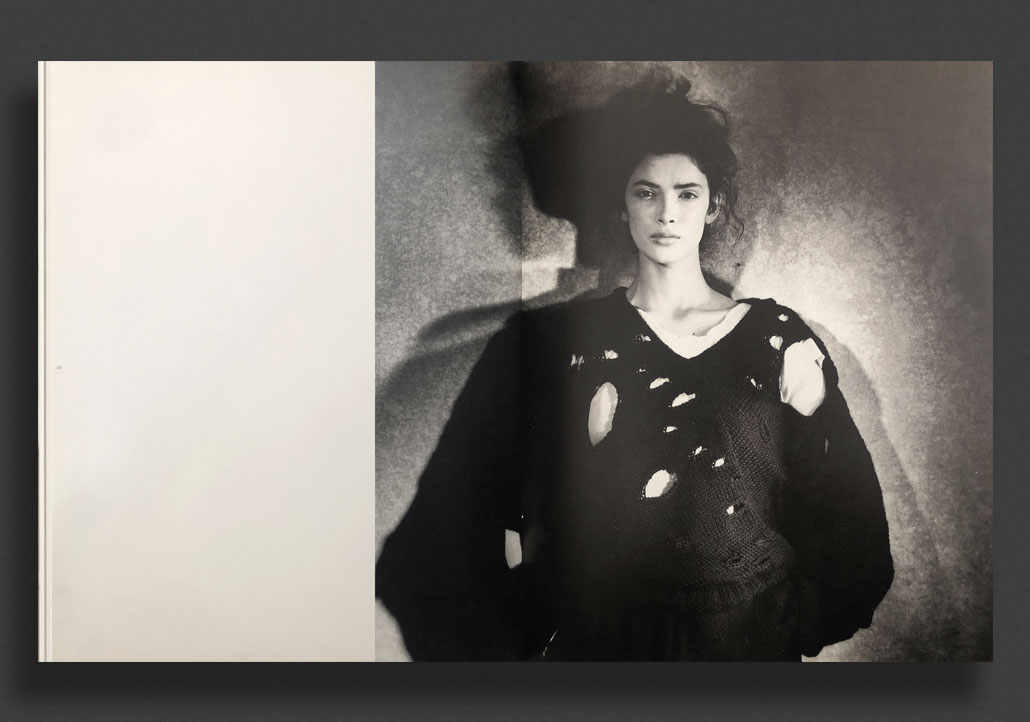
One of the most beautiful and sought after fashion photo-books ever published. First 1986 hardcover edition of Comme des Garçons 1981—1986. A document of early 1980s Comme through the iconic images of Arthur Elgort, Hans Feurer, Eddy Kohli, Peter Lindbergh, Steven Meisel, Paolo Roversi, Oliviero Toscani, and Bruce Weber.
Since the inception of Japanese fashion label Comme des Garçons in 1969, founder Rei Kawakubo applied a particular aesthetic to every aspect of Comme des Garçons, extending her vision to the company's packaging, furniture, interior design, graphic design, and publishing, including a selection of some of the fashion world's most visually compelling and challenging books and printed materials.
This wonderful and very iconic collection of photographs presents Rei Kawakubo's groundbreaking, innovative designs from an exciting period of Comme des Garçons history, between 1981 and 1986, as photographed by some of the most important fashion photographers of our time, including Arthur Elgort, Hans Feurer, Eddy Kohli, Peter Lindbergh, Steven Meisel, Paolo Roversi, Oliviero Toscani, and Bruce Weber, among others.
This gorgeous and rare clothbound volume perfectly captures a very important and exciting moment in the history of fashion, and is considered one of the most-collectable and prized fashion photo-books to come out of the 1980s.
Good copy without slipcase. This would be a Very Good copy but the only notable damage is a section of the hardcover edges on the open side has become frayed with friction. This only effects the overhang of the hardboards, which have done their job in protecting the entire book content, which remains undamaged. Otherwise only light wear. A heavily discounted copy for this one area of damage. Please contact if you wish for specific photographs.
1992, English
Softcover, 128 unbound pages, 41 x 29.5 cm
1st Edition, Out of print title / used / average
Published by
Joe McKenna / New York
$200.00 - In stock -
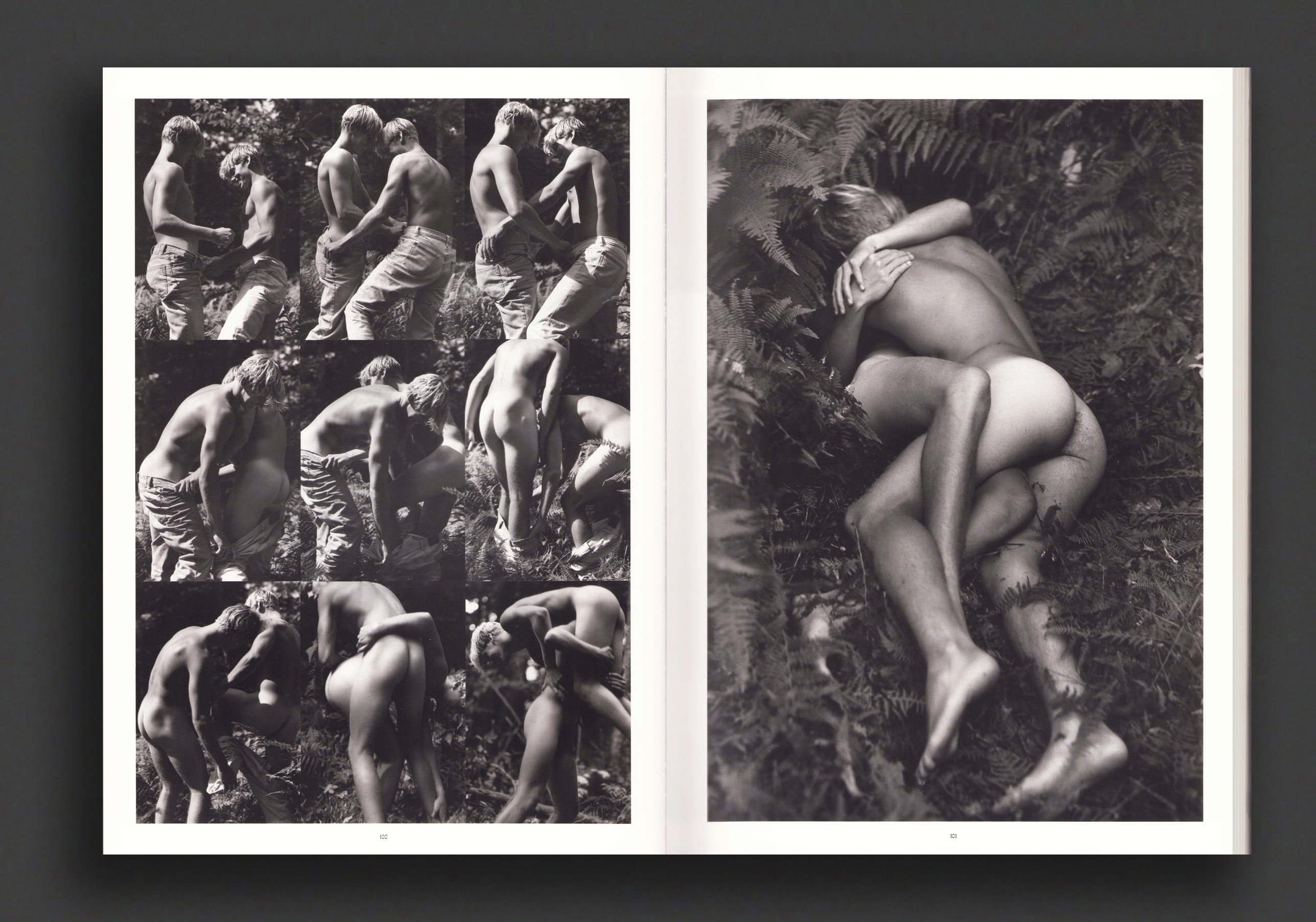
The first issue of one of the most sought after fashion publications of the 1990s, the impeccably produced, over-sized, unbound cult fashion folio magazine produced by stylist Joe McKenna and privately issued in 1992. Photographs by Bruce Weber, Peter Lindbergh, Ellen von Unwerth, Steven Meisel, Paolo Roversi, George Platt Lynes, and more. Design by Sam Shahid. Joe's was created at the height of the super-model era and a time in fashion of great artistic sophistication. A bold integration of art and fashion, the publication's success lies in the freedom that McKenna gave to the photographers and writers, away from the constraints of commercial publications. The magazine was funded by the ads, placed by designer friends of McKenna with no strings attached. A second issue only was published in 1998. Only two issues were ever made.
Articles include an illustrated discussion of the work of Parisian Maison Alaïa, Donald Windham on Tennessee Williams and Montgomery Clift with photos by George Platt Lynes and Karl Bissinger, Jean Paul Goude on Vanessa Paradis, with photographs by Paolo Roversi, Anna Sui on muse Wallis Franken, photographed by Steven Meisel and studies of Dirk Bogarde and artist Paul Cadmus.
The magazine ends with the controversial homo-erotic images of identical twins in Bruce Weber's photo-story 'The Last Days of Summer'. WARNING: This copy is priced to reflect the fact that this important section has been meticulously hand-censored wherever a penis is concerned due to it being copy imported into Tokyo in 1992 under strict print regulations. Sadly, this effects three Weber photographs, and one Paul Cadmus photograph.
Average-Good copy due to wear to cover boards and Japanese censorship outlined above. All other contents perfect.
1981, Japanese
Softcover (w. dust jacket + obi), 22.5 x 18.4 cm
1st Edition, Out of print title / used / very good
Published by
Abe / Tokyo
$80.00 - In stock -
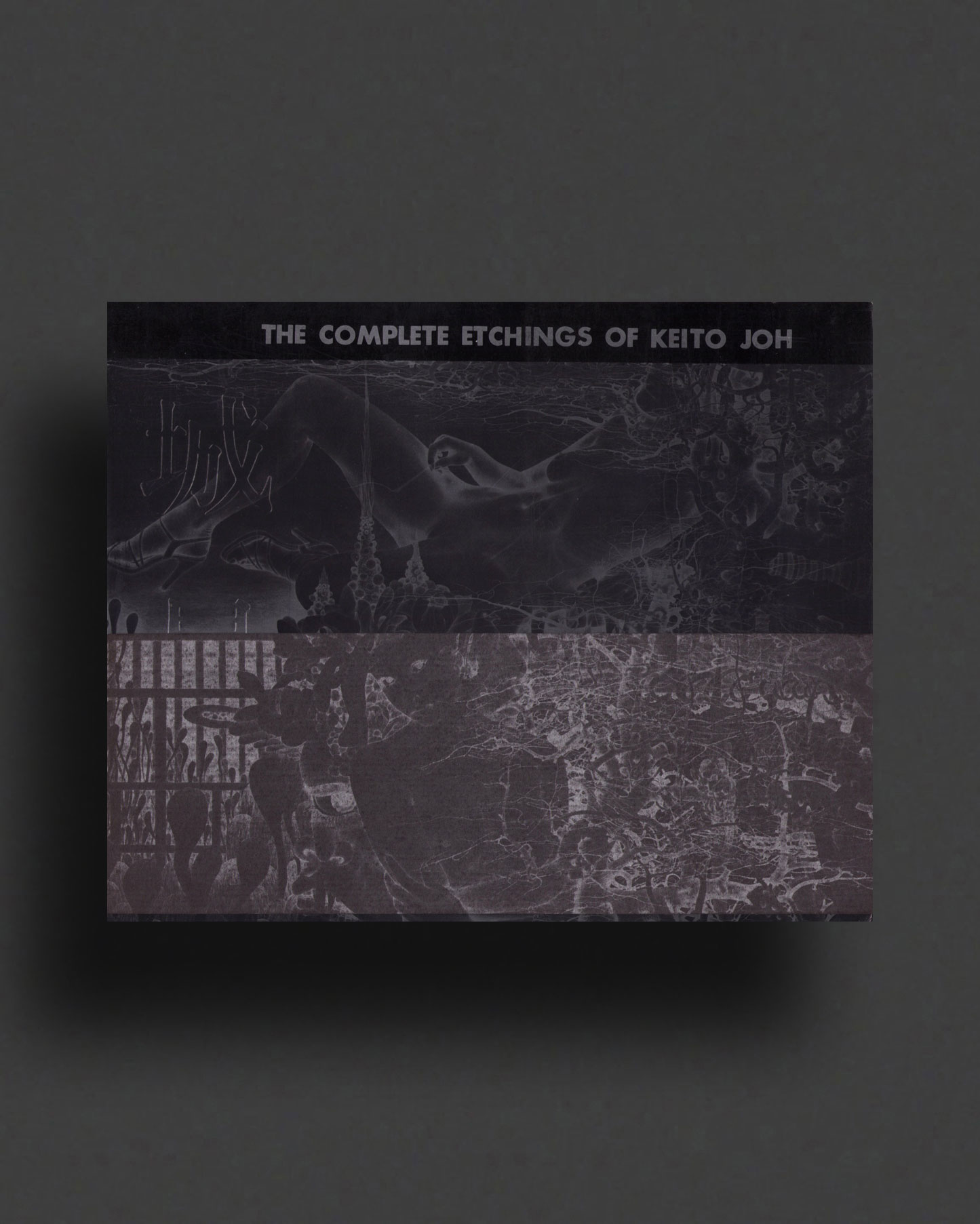
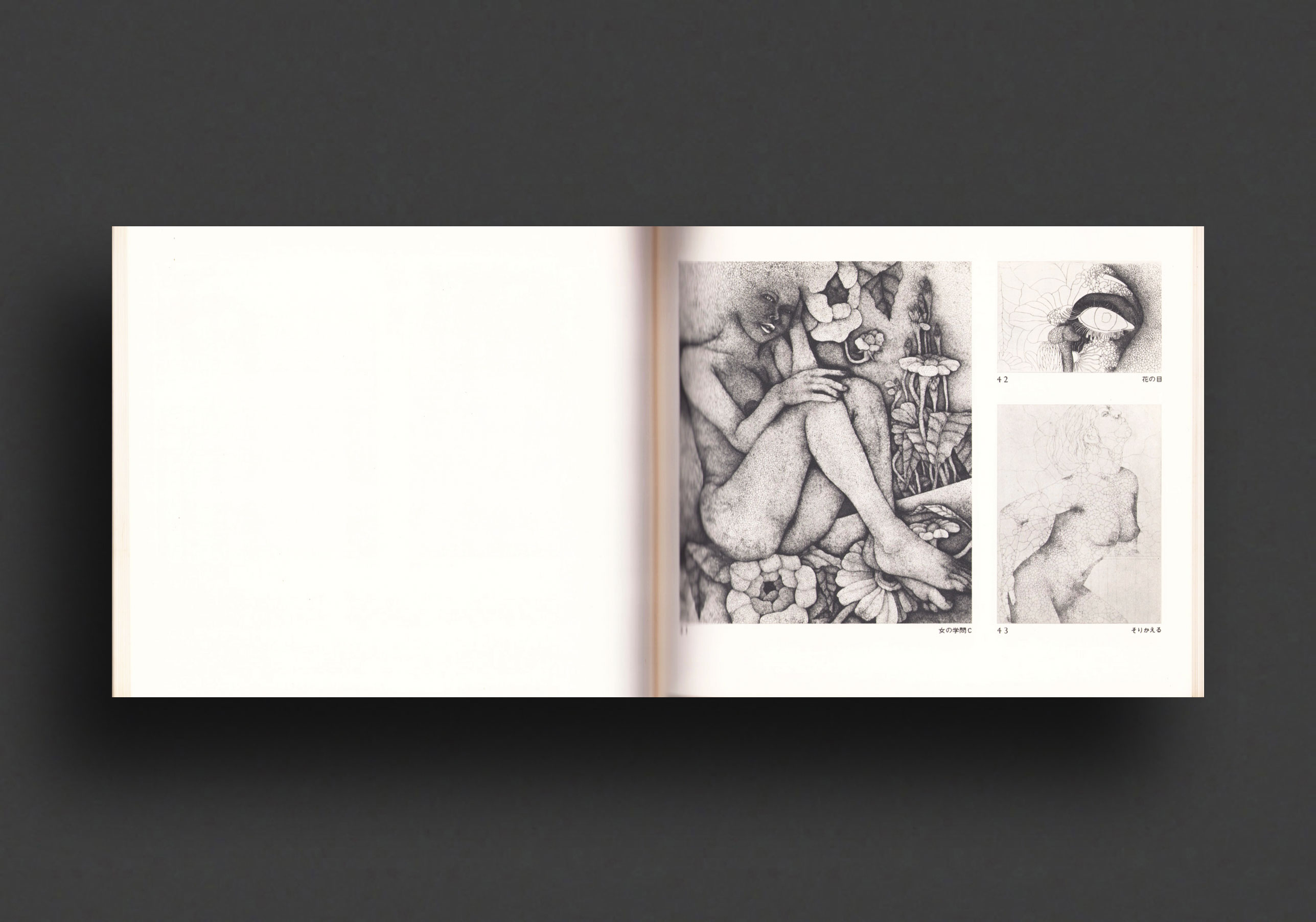
First 1981 edition of The Complete Etchings of Keito Joh between 1974—1981, featuring over 100 copperplate works of Japanese artist Keito Joh, whose prolific output throughout the 1970s—1980s depicts sensual naked figures, grotesque, fantastic plants and metaphysical landscapes composed of fine mesh-like lines, similar to porcelain cracks, that are inspired by the veins in leaves. "My childhood friend is nature", says Joh, born in 1946 in Aichi prefecture (Honshu island), whose delicate, organic line-work tames the inner vision of a wild beast. Keito Joh had a troubled youth, but loved music and painting, and during his high school years met painter Masaharu Kondo, who became his mentor and set him on his artistic path. Kondo's vibrant surrealistic abstractions, sharing the expressive intensity of artists such as Friedensreich Hundertwasser and Tarō Okamoto, influenced the work of Joh, but the youths extremely intimate, delicate threads unify his wild thickets of naked metamorphosing flesh and flora in a matrix of interlocking line, giving his work a distinct quality.
Keito Joh began his career in the 1970s with solo exhibitions and quickly gained international recognition, notably winning a grand prize at an artists' exhibition in Genoa, Italy, in 1972. A master of engraving and etching, training under Yo Kanno, like many erotic artists he collaborated with Japanese poets and literary figures to illustrate their works with erotic and expressive prints. Joh's idiosyncratic, sensuous, and psychedelic erotica gained a serious following in the 1970s, and became very well known in Japan, but today he is almost completely unknown in the West.
VG copy in VG DJ w. VG obi.
1969, French
Hardcover (cloth bound), 106 pages, 21 x 21 cm
1st Edition, Out of print title / used / good
Published by
Éditions Denoël / Paris
$120.00 - Out of stock
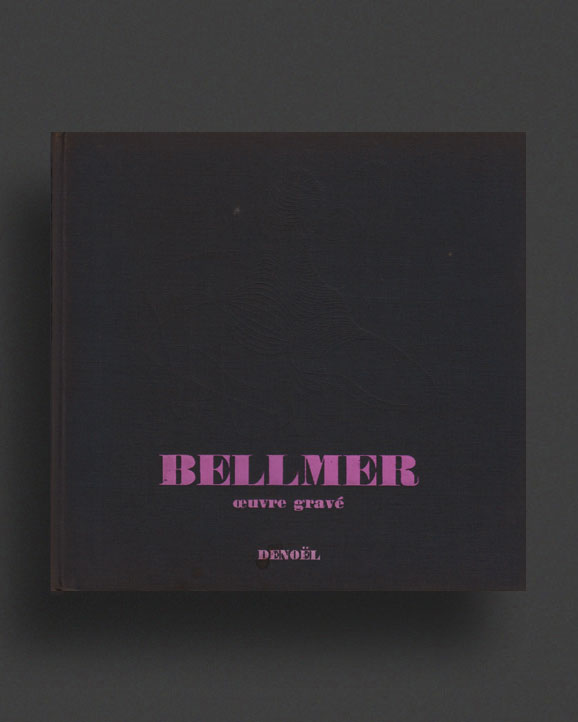
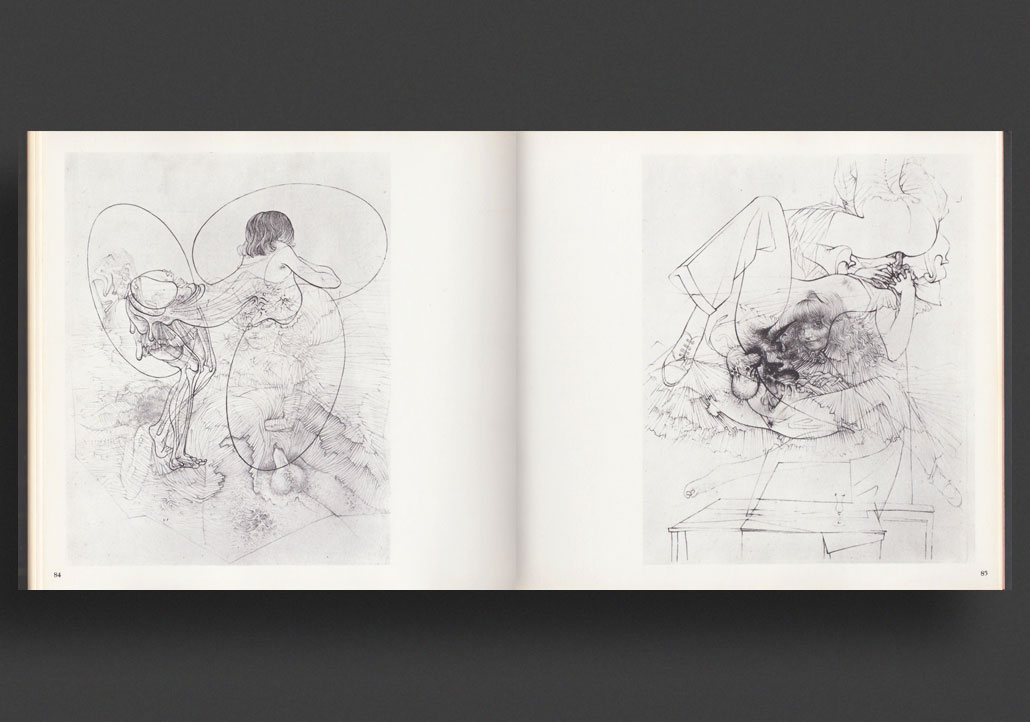
First Edition of the catalogue raisonné of the engraved work of German Surrealist Hans Bellmer, published in 1969 by Éditions Denoël, Paris. Wrapped in the publisher's debossed black covers featuring Bellmer's Céphalopode of 1965, this handsome volume opens with "Morale of Engraving", a four page introduction by author Andre Pieyre De Mandiargues (in French). The rest of the book is made up of 141 reproduced engraved works of Bellmer, including his exquisite works complimenting Georges Bataille, Marquis de Sade, Joyce Mansour, Louis Aragon, Charles Baudelaire, and others, followed by a 7 page catalogue raisonné index, including work title, date, process and technique, dimensions, printing justifications, editors and other details. An essential title in any Bellmer collection and important reference.
Very Good copy, tanning and some marks to board/page edges with age.
1972, English
Softcover, 168 pages, 29.5 x 21 cm
1st Edition, Out of print title / used / good
Published by
Academy Editions / London
$65.00 - In stock -
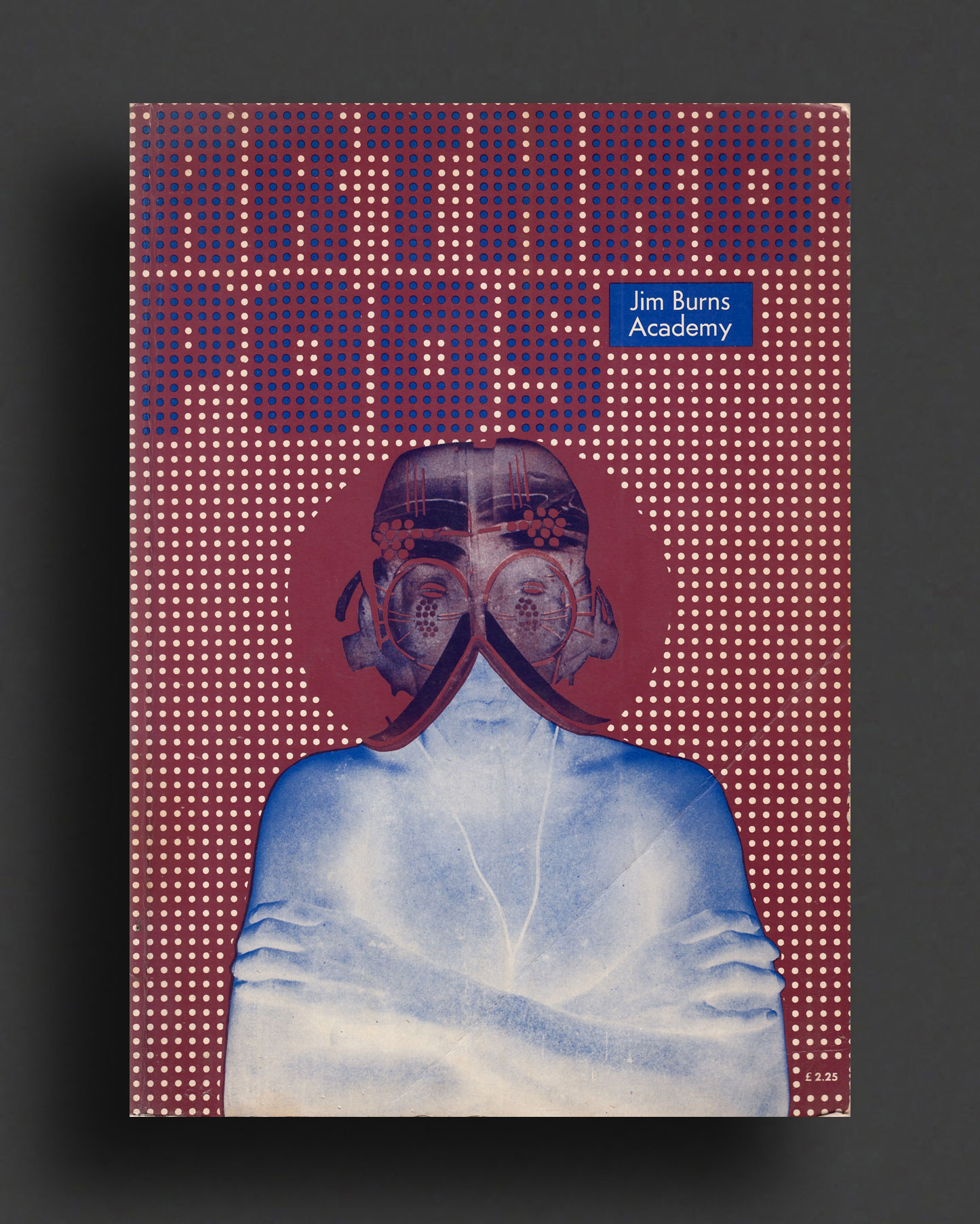
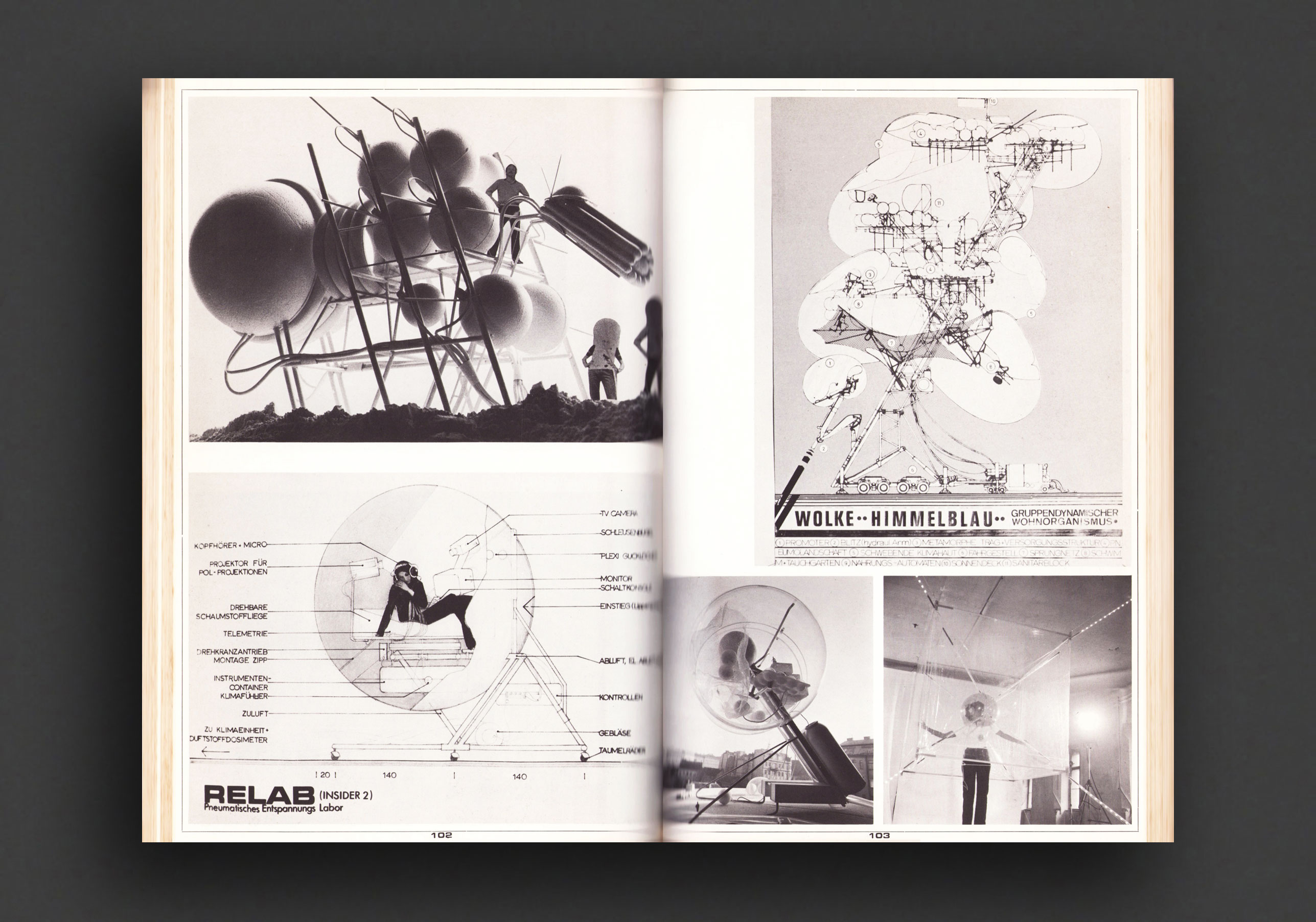
First 1972 softcover edition of the first major international survey of "Arthropods", an experimental artistic phenomenon born out of the happenings of the 1960's to encompass many ventures into radical environmental design. A survey of more than thirty international experimental architecture groups, artists, and designers, including portfolios on, among others, Superstudio, 9999, Experiments in Art et Technology, Ant Farm, Archizoom, Haus-Rucker-Co, God et Co, Cedric Price, PULSA, and Experiments in Environment (Anna and Lawrence Halprin). The author was a member of the environmental design and planning firm of Lawrence Halprin et Associates, and a former editor of Progressive Architecture.
"England's Archigram group proposes sensitizing the service network of a city to respond instantly to new situations by computer; Superstudio of Florence is into a series of investigations dealing with the impact of manmade buildings on the landscape that involves the creation of giant continuous monuments straddling the horizon; Missing Link Productions of Vienna has devised soft, amorphous "Children's Clouds" to hang between buildings in crowded cities, interconnecting the children of many families in a kid's play-community high above the traffic; Edward Suzuki of South Bend, Indiana, proposes an air-inflated system of plastic units to make a cheap, expandable, foldable, floatable, mobile home; in "Apparitions on the Ponte Vecchio," an environmental happening by 9999 of Florence, people's perception of an ancient monument was transformed for a brief period by projected Op-art slides and supergraphics.
Jim Burns has metaphorically termed these and many other flourishing groups of environmental designers "Arthropods" (invertebrate animals with articulate, segmented bodies and limbs) in order to reflect their flexibility, adaptability, and unique capacity for individual creativity within a cooperative venture. No longer affecting the old-fashioned elitist practice of designing exclusively for aloof corporate, governmental, or institutional clients on isolated building plots, these young designers and planners are trying to be responsive to the needs of people and to enhance the positive physical and social connections that make human habitations human. Their startling creations provide dynamic approaches at all levels of life-from sleeping and recreation to urban planning and ecological conservation.
In ARTHROPODS, Burns investigates the achievements and goals of more than thirty international groups and shows in an informed, sympathetic text, with a wealth of illustrations, how they intend to ameliorate man's lot in an increasingly desensitized atmosphere and put him in creative control of his environment.
Jim Burns is a member of the environmental design and planning firm of Lawrence Halprin & Associates, where he concentrates on people's participation in planning processes. He also conducts an interdisciplinary information network with Nilo Lindgren and George Novotny, and leads workshops in participatory processes at the School of Art and Architecture, Cooper Union, New York. Articles and presentations of work by him have appeared in Progressive Architecture (where he was formerly Senior Editor); Design & Environment; The Drama Review; Source; Crafts Horizons; New York Times; San Francisco Chronicle; and a new volume in the Vision + Value series of Gyorgy Kepes. He has been involved in staging exhibits and events for the American Federation of Arts, Museum of Contemporary Crafts, and New York Parks, Recreation, and Cultural.
Good—Very Good copy with light wear to extremities, light creasing to covers.
2019, Japanese
Hardcover (cloth), 312 pages, 195 x 130 cm
1st Edition, Out of print title / as new
Published by
Asahi Shimbun / Japan
$120.00 - In stock -
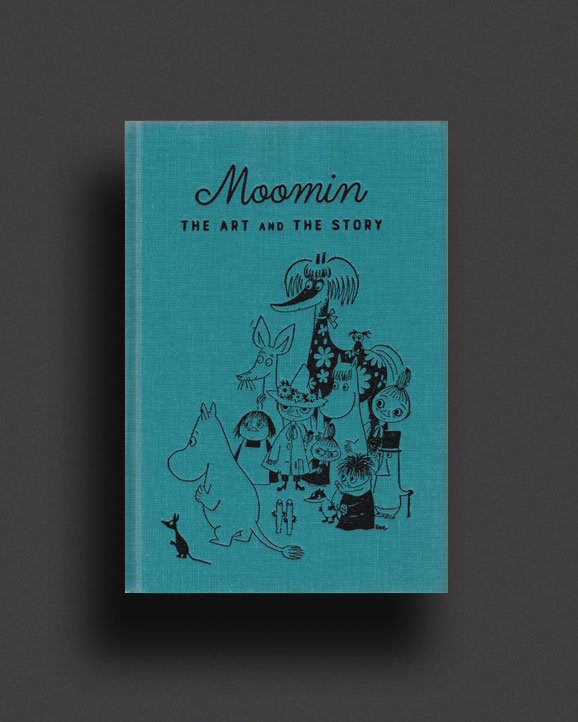
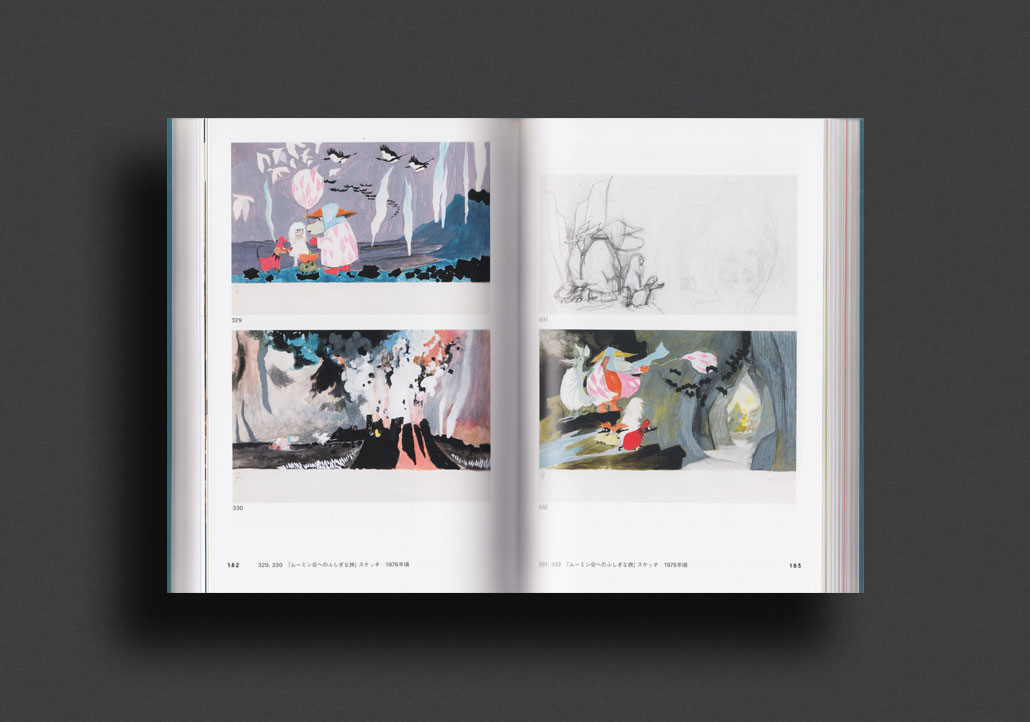
Stunning hardcover catalogue published on the occasion of the largest traveling Moomin exhibition ever staged, Moomin: The Art and The Story, Japan, 2019. Beautifully designed by the exhibition designer Yuria Oshima, this comprehensive book delves into the world of Tove Marika Jansson's Moomins in such detail that only a Japanese book could. Made in collaboration with the Moomin Museum in Tampere, who loaned 500 works for the exhibition, almost every exhibited item is captured here in in print across various paper stocks, including a miniature inlayed facsimile of the marvellous Trollvinter, first published in 1957. There is so much material captured in this book that has not been previously published, including countless original sketches and illustrations, paintings, first-edition Moomin books, all the original Moomin dolls, products and animations, commercial Moomin work, personal photographs of Jansson and much more, all thoroughly indexed. 2019 also marked the 100th Anniversary of diplomatic relations between Japan and Finland, Tove Jansson’s native country. Jansson visited Japan twice, in 1971 and 1990, each time making social and professional connections, sketches, and photographs. She also passionately collected the prints of 19th Century woodcut masters like Hiroshige, Hokusai and many more, which are captured here alongside her own artwork, drawing out the obvious influence, and admiration Jansson had for Japanese art. Also includes her Japanese hotel drawings, correspondences and photographs of her visits. An invaluable and inspiring resource for any Moomin fan.
Tove Marika Jansson (1914 – 2001) was a Swedish-speaking Finnish author, novelist, painter, illustrator and comic strip author. Brought up by artistic parents, Jansson studied art from 1930 to 1938 in Stockholm, Helsinki and Paris. Her first solo art exhibition was in 1943. She continued to work as an artist and a writer for the rest of her life, and it was with the creation of her much-loved Moomin characters that she become known around the world. Jansson wrote the Moomin books for children, starting in 1945 with The Moomins and the Great Flood. Her books became international classics translated to 35 languages. For her work as a children's writer she received the Hans Christian Andersen Medal in 1966.
As New.
1988, Japanese
Softcover (staple-bound), 28 pages, 29.5 x 18.5 cm
1st Edition, Out of print title / used / very good
Published by
ABKCO / Japan
$90.00 - In stock -
Very rare Japanese brochure from around 1988, promoting the release on VHS (we think!) of The Holy Mountain, the cult classic 1973 Mexican surreal film directed, written, produced, co-scored, co-edited by and starring Alejandro Jodorowsky, who also designed sets and costumes, inspired in part by René Daumal's Mount Analogue. The scandal of the 1973 Cannes Film Festival, Alejandro Jodorowsky's flood of sacrilegious imagery and existential symbolism is a surreal sojourn for enlightenment pitting illusion against truth. In a corrupt, greed-fueled world, a powerful alchemist leads a messianic character and seven materialistic figures representing the negative aspects of the seven planets, to the Holy Mountain, where they hope to achieve enlightenment. Following Jodorowsky's underground hit El Topo, acclaimed by both John Lennon and George Harrison, the film was produced by the Beatles manager Allen Klein and John Lennon and Yoko Ono put up production money. It was shown at various international film festivals in 1973, including Cannes, and limited screenings in New York and San Francisco, gaining cult status. The Holy Mountain is a mythical, mystical masterpiece, a Hieronymus Bosch painting come to life - part spiritual quest, part science fiction, part social satire, and completely without comparison.
This rare collectible brochure published by Allen Klein's ABKCO gives synopsis and introduction to the film, illustrated throughout with glorious stills, including a four-panel colour fold-out, Japanese texts, cast and production information, even Holy Mountain manga! A wonderful piece of printed history to Jodorowsky's masterpiece.
Very Good copy with some handling pinches.
2004, English
Softcover, 134 pages, 15.5 x 23 cm
Published by
Creation Books / London
$35.00 - Out of stock
Philosophy In The Boudoir (La philosophie dans le boudoir, 1795), is the most concise, representative text of all the Marquis de Sade's works, containing his notorious doctrine of libertinage expounded in full, coupled with liberal doses of savage, unbridled eroticism, cruelty and violent sexuality. The renegade philosophies put forward here would later rank among the cornerstones of Andre Breton's surrealist manifesto. This new edition includes "Minski the Cruel, a brand-new, unexpurgated translation of a key episode from de Sade's "Juliette.
Though initially considered a work of pornography, La philosophie dans le boudoir has come to be considered a socio-political drama and perhaps the most representative of the Marquis de Sade's work and philosophy on religion and morality. Dedicated to "voluptuaries of all ages, of every sex", it tells of a young virgin ruthlessly stripped of virtue and schooled in the ways of sexual perversion and libertine philosophy.
Taken from the forward by James Havoc: The Marquis de Sade (1740 - 1814) was a self-proclaimed libertine. His doctrine of libertinage as expounded in "Philosophy in the Boudoir" - his masterpiece - now reads like a blueprint for those manifestos drawn up will over a century later by Andre Breton; indeed "Philosophy in the Boudoir" has often been regarded as being amongst the first Surrealist texts - the others also being works by De Sade. In the course of this book - erotic, comical, and terrifyingly bleak in turn - he contrives to heap scorn on Christianity, God, and the Church, religion in general, history, marriage and the nuclear family, morality, all love other than sexual love, faith, hope and charity, parenthood, vaginal sex; i.e. all forms of humanity and virtue. At the same time, he advocates atheism, murder and reflexive crimes, torture, cruelty, abortion, all kind of sexual perversion, incest, adultery, self-abuse, ad infinitum; his sexually violent visions mark him as a precursor of modern psychology.
Very Good copy.
1973, English
Softcover, 244 pages, 22.2 x 15.2 cm
Out of print title / used / very good
Published by
Da Capo Press / New York
$40.00 - Out of stock
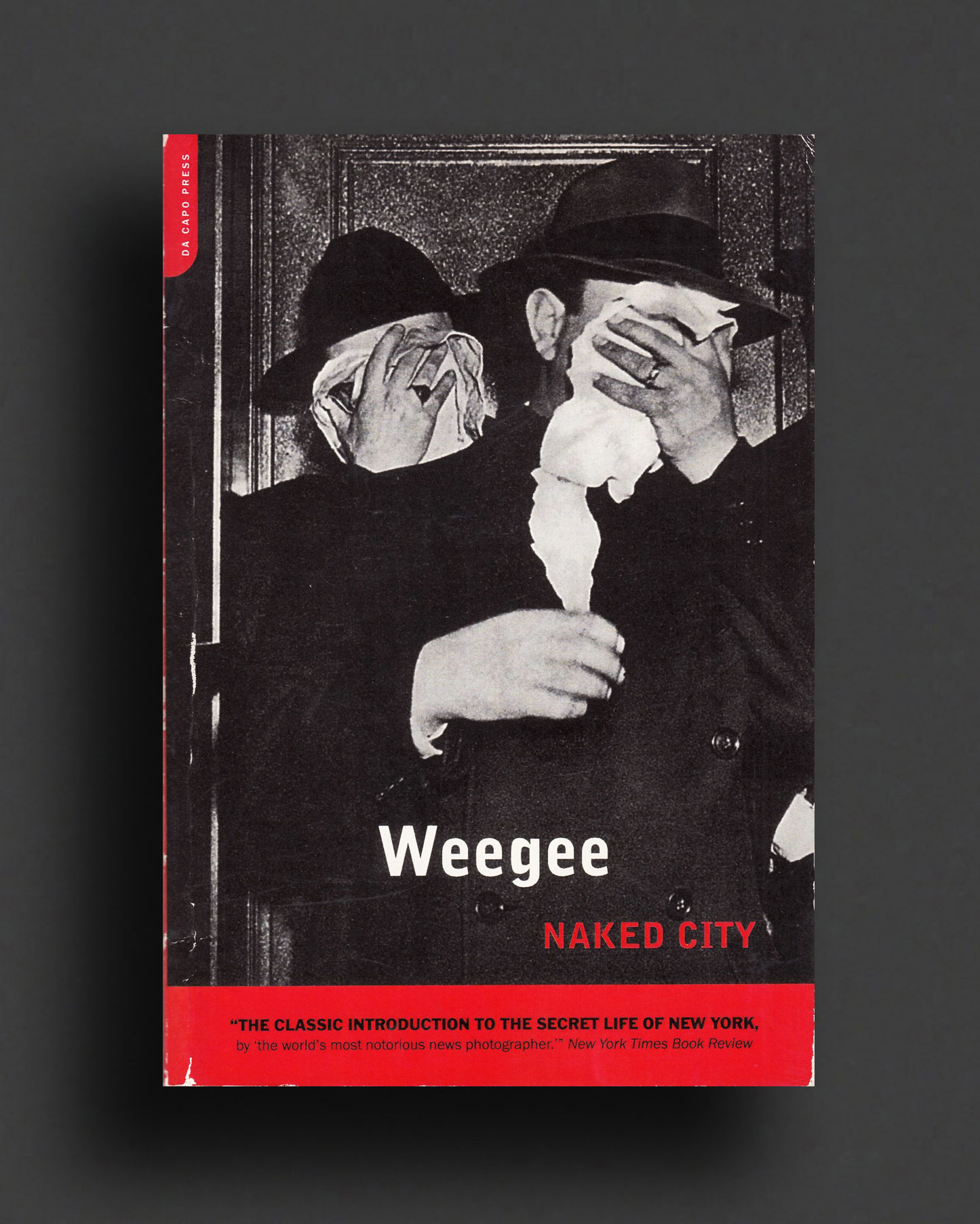
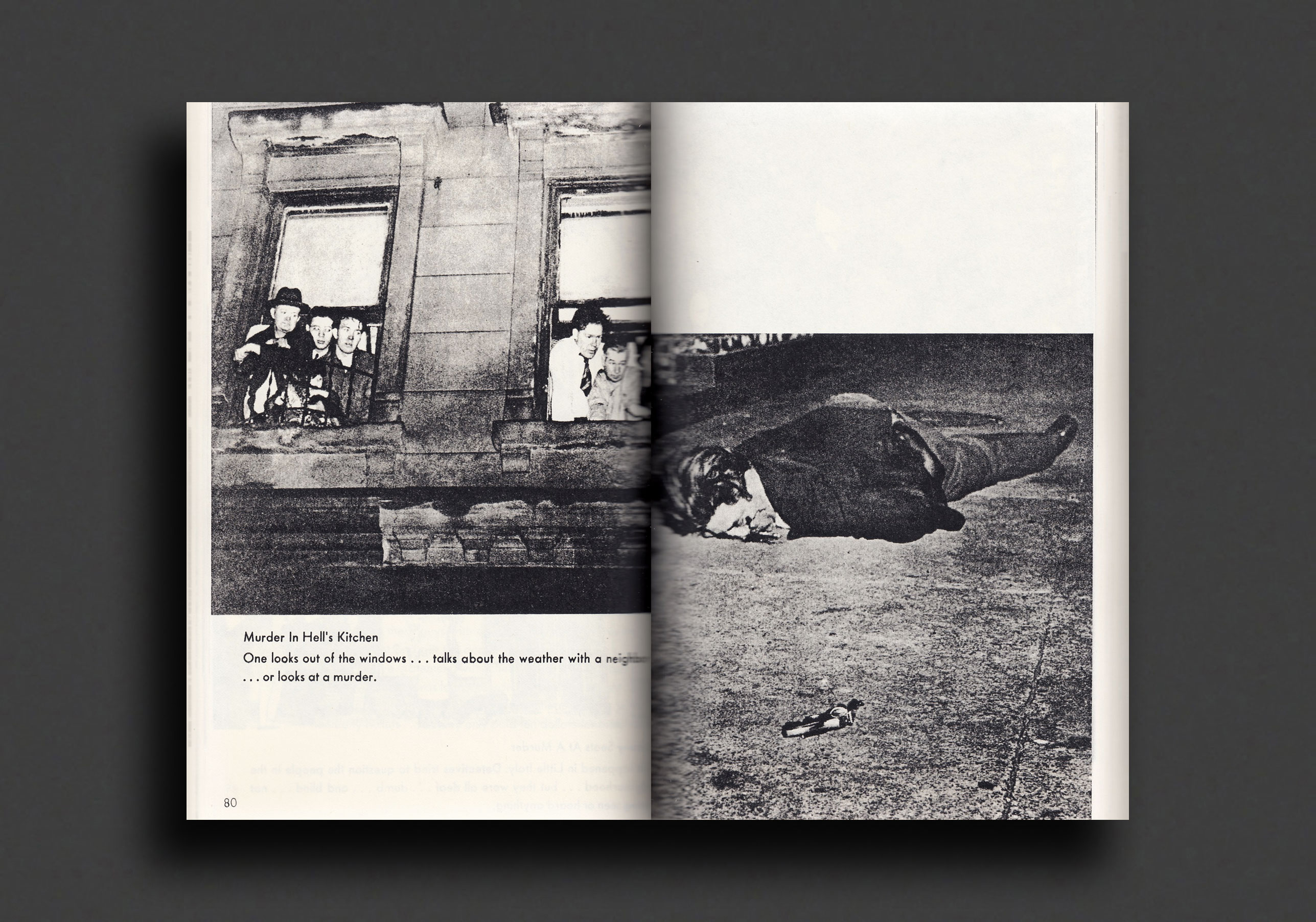
2002 paperback edition of the 1945 masterpiece 'Naked City' by the founding father of gritty, urban photojournalism. A walk on the wild side of New York.
Weegee (1900-1968) is widely acknowledged to be both the originator and reigning king of candid photojournalism, ushering in the age of tabloid culture while simultaneously elevating the sordid side of human life to the status of high art. For Naked City, his first collection, Weegee cruised the teeming streets of 1940s New York in the wee hours in search of the sensational. His photographs were lewd, louche, and licentious, but always brimming with life (except when they were brimming with death). Weegee's profound influence on other photographers over the last half-century derives not only from his sensational subject matter and his use of the blinding, close-up flash, but also from his eagerness to photograph the city at all hours, at all levels. Snapping lovers on the beach at 3:00 in the morning, transgender prostitutes in police buggies, bejeweled society ladies at balls, the desperately poor-no one knew New York like Weegee did. Naked City showcases his talent, his love of the city, and his taste for the absurd and the unbelievable, in a book that will always stand as a classic introduction to the secret life of New York.
"The disasters and spectacles [Weegee] photographed... lay bare the facts of terror and mortality that underlie it."—Village Voice
Arthur Fellig (1899-1968), better known as Weegee, was an Austrian immigrant who worked as a freelance news photographer in New York City. Beginning his career on the police beat, where he specialized in crime and catastrophe, he roamed the city during the 1930s and 1940s in search of the "Page One" photo. His work now resides in the permanent collection of the Museum of Modern Art.
VG copy with some wear to cover extremities.
1990 / 1995, Japanese
Hardcover, 120 pages, 13 x 19 cm
1st Edition, Out of print title / used / very good
Published by
Heibonsha / Tokyo
$70.00 - Out of stock
First 1990 edition, 1995 second print of this iconic photobook by Araki, distributed on the day of the funeral of Yoko, Araki's wife who died of cancer in 1990. One of the most popular of Araki's books, 'Chiro, My Love' is a delightful book devoted entirely to Araki's photographs of he and his wife Yoko's beloved cat, Chiro. Consisting of some 100 black and white photographs, this photographic essay presents Chiro in a variety of different moods and situations. On the balcony and on the roof of the neighborhood, on the sofa, in the shower, in Yoko's arms, on the sleeping belly of Araki... The figure of Chiro behaving freely, and Araki taking the shutter to love it. Poignant in retrospect as it includes a number of photos of Chiro with Yoko. ‘Yoko was very much looking forward to this book; its a pity she couldnt live to see it.’ Like Masahisa Fukase's "Sasuke", this is an intimate book for cats and photographers.
Very Good hardcover copy.
1976/2006, Japanese
Hardcover (w. dust jacket, slipcase, obi), 82 pages, 31 x 25 cm
Out of print title / used / fine
Published by
Kawade Shobo Shinsha / Tokyo
$100.00 - In stock -
2006 facsimile edition of this wonderful 1976 slip-cased hardcover monograph on German artist Friedrich Schröder-Sonnenstern, considered one of the most important representatives of Art Brut or Outsider Art. Bound in red cloth and wrapped in illustrated original dust-jacket, this heavily illustrated book surveys Schröder-Sonnenstern's incredible paintings and drawings through beautiful colour and monochrome gravure reproductions, with alongside various texts, biography, bibliography and portrait of the artist. Published as volume 6 of the deluxe La Septième Face du Dé series by Kawade Shobo Shinsha in Japan in the 1970s, all later re-printed in the 2000s. All editions now out-of-print.
Friedrich Schröder-Sonnenstern was a draftsman, painter and poet-philosopher. Born in 1892 in East Prussia, one of thirteen children, all of whom apart from one other died shortly after birth. He was sent to a number of reform schools due to accusations of theft and violent behaviour and then, at the age of twenty-six, he was diagnosed with schizophrenia and committed to a sanatorium. His experiences as a child contributed to his lifelong hatred of authority. One year later he showed up in Berlin, where he occupied himself with occultism, divination and healing magnetism. He founded a sect and distributed its income in the form of bread rolls to poor children, earning him the title "Schrippenfürst of Schöneberg". He created the name Sonnenstern (English: Sun Star) for himself while working as a con-artist, posing as a Quack doctor in "natural health", calling himself Professor Dr. Eliot Gnass von Sonnenstern. This career path was cut off by the Nazis' interdiction of occult practices, and after being confined in psychiatric institutes and in a penal camp, Schröder-Sonnenstern reemerged in 1944, scavenging firewood in the bombed-out German capital. Only in his late fifties, in 1949, did he begin to draw, using coloured pencils to create allegorical grotesques stocked with a personal iconography. Although his art was rarely shown, he was championed in Surrealist and art brut circles; Jean Dubuffet and Hans Bellmer were among his admirers, and a few drawings were included in Marcel Duchamp and André Breton's 1959 "Exposition inteRnatiOnale du Surréalisme" in Paris. The demand for his pictures by collectors and gallerists rose rapidly and he resorted to employing assistants to produce his work for him. His success was short-lived when he began to paint less and less and became the victim of counterfeiting cliques by his assistants, destroying his position in the art market. He became increasingly dependent on alcohol following the death, in 1964, of his long-time companion, Martha Möller whom he called Aunt Martha. He died almost forgotten and impoverished in 1982 in Berlin.
Fine copy.
1969, Japanese
Softcover, 108 pages, 28 x 21.5 cm
1st Edition, Out of print title / used / good
Published by
Mainichi Newspapers / Tokyo
$60.00 - In stock -
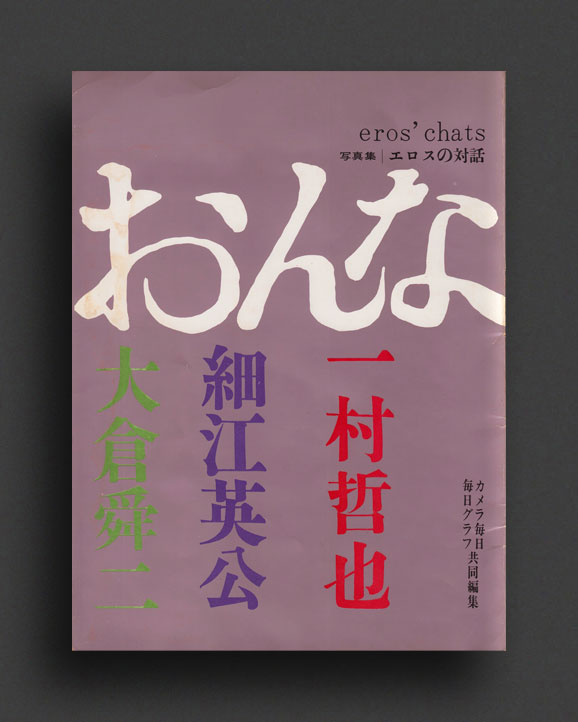
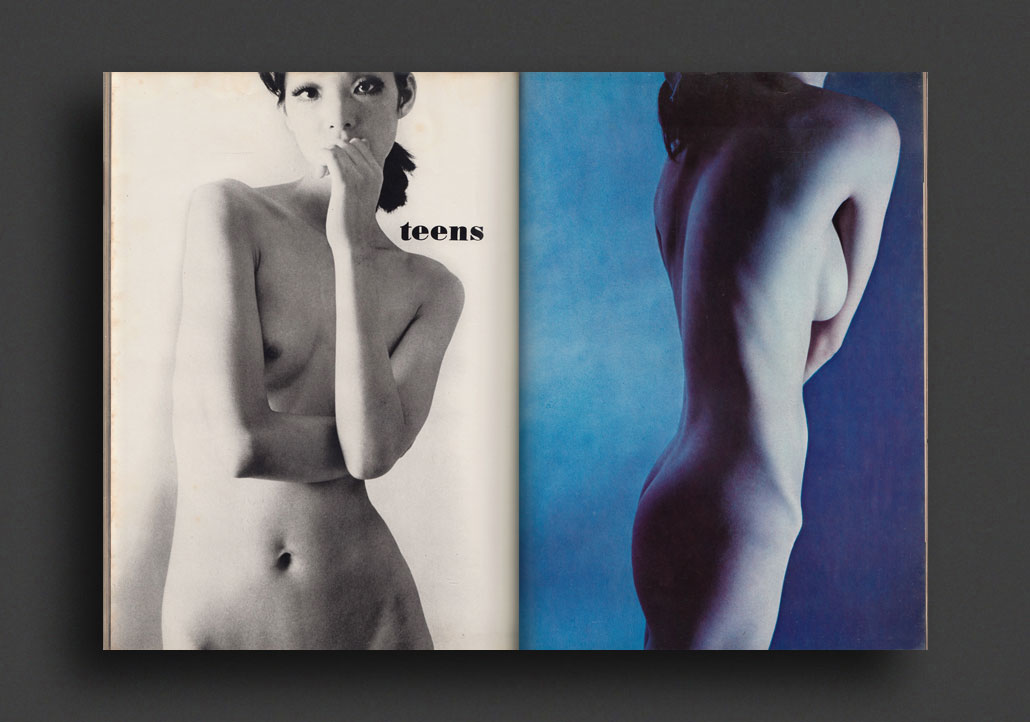
First edition of this 1969 collection of female nude photography from three of Japan's leading photographers — Tetsuya Ichimura, Eikoh Hosoe, and Shunji Okura. Lavishly printed in gloss and photo-gravure, in stark b/w contrasts and rich colour kodachrome, across different paper stocks, featuring many of the most iconic erotic images from Tokyo 1969! Lovely examples from all photographers, including some of Eikoh’s most famous work. Published by The Mainichi Newspapers.
Average—Good copy with foxing to covers and some page edges, some pinches to spine, general light wear as is common to old magazine-format books.
2020, English / French / Italian / Dutch
Softcover (3 volumes in slipcase), 400 pages, 24 x 16.9 cm
1st Edition, Out of print title / as new
Published by
Walther König / Köln
$300.00 - Out of stock
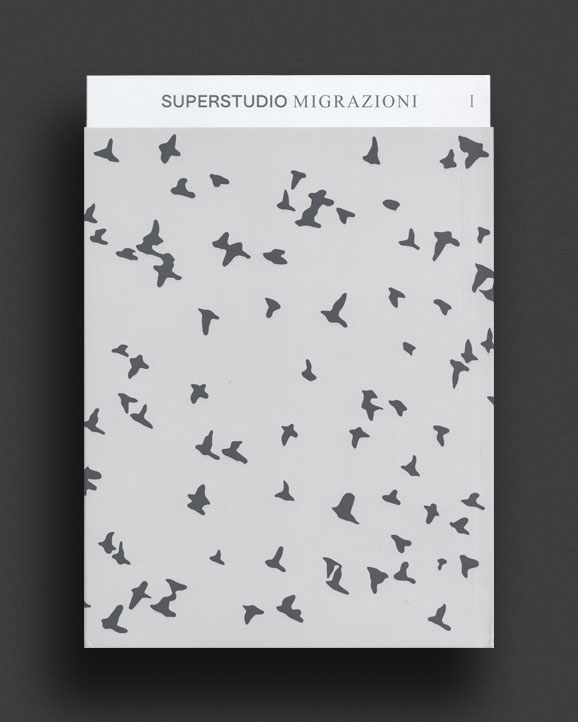
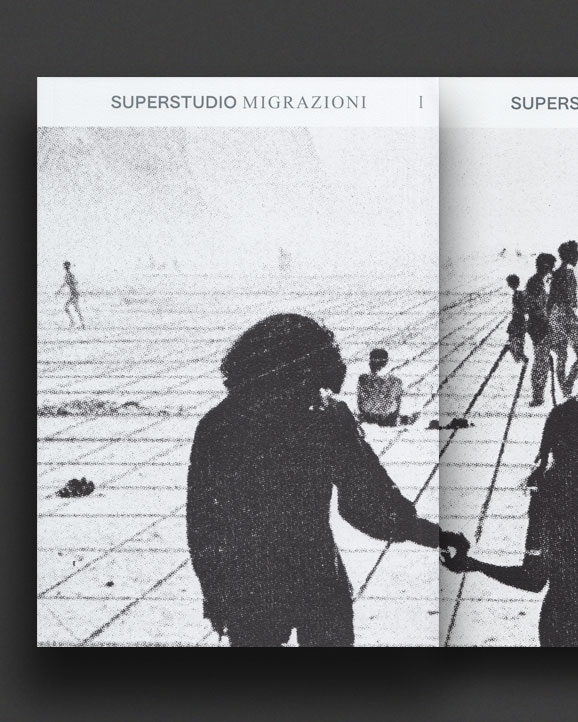
At 400 pages, this is the definitive overview of the great and influential pioneers of Italian radical architecture, Superstudio. Immediately out-of-print and now collectible.
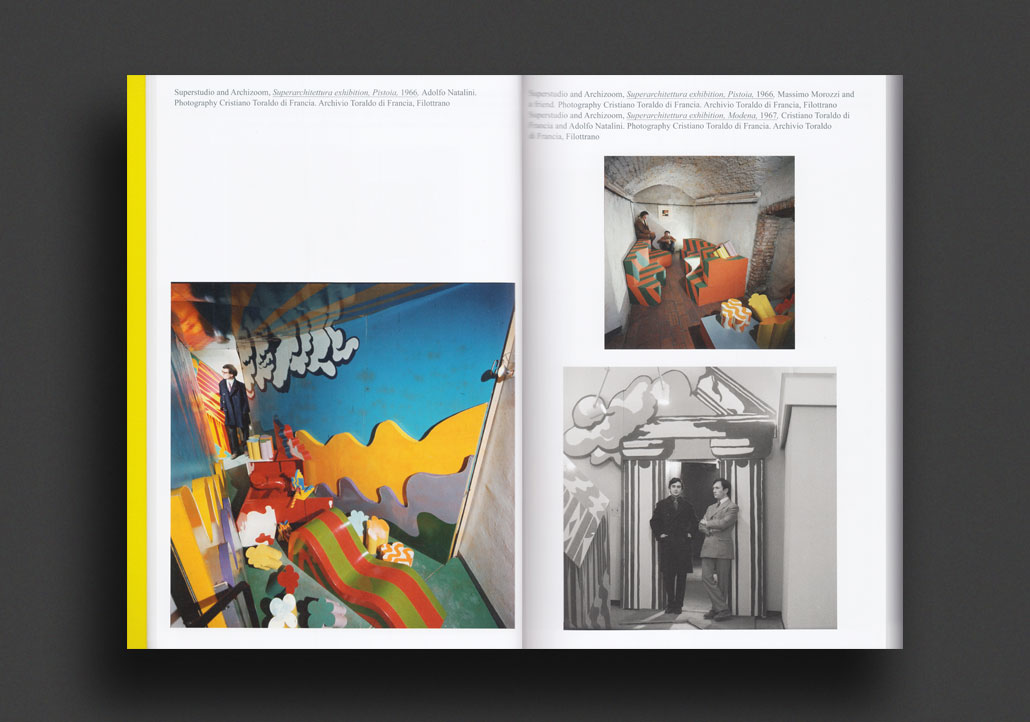
The avant-garde Italian architecture collective Superstudio was founded in 1966 by Adolfo Natalini (1941–2020) and Cristiano Toraldo di Francia (1941–2019), and quickly leaped to the forefront of the 1960s radical architecture movement alongside the likes of Archigram and Haus-Rucker-Co. Through their architectural projects (housing, industrial buildings, banks, interiors), design objects, photocollages, drawings, texts, installations, models, films and exhibitions, Superstudio found brilliant and highly inventive ways in which to inhabit a world transformed by capitalist forces and technological evolutions. This beautifully produced, slipcased, 400-page volume explores their oeuvre through the lens of “migrations” (migrazioni). Borrowed from Superstudio’s vocabulary, this term serves as a conceptual and poetic key to the group’s architecture and their works in all mediums.
Presented in 3 books, the first is a collection of critical essays and interviews with three prominent figures in architecture who have been in close contact with Superstudio over the past 50 years; By examining their personal and theoretical careers, these different voices show the great influence of the small group, bringing to life this “journey to the higher realms of reason.” The second book proposes a thematic journey through the work: it shows the rich iconography through a series of concepts from Superstudio’s vocabulary. They reveal the richness of the projects and images produced over the active years of the group that go beyond the narrative contained in some of the quasi-iconic photo collages. The last book presents previously unpublished letters from the archive of Adolfo Natalini. The exchanges between the members of Superstudio and the letters to prominent architects from the second half of the twentieth century form a collective autobiography in which architecture and life increasingly converge. In addition to the group’s oeuvre, the publication also presents work by 9999, Archizoom, Hiromi Fujii, Hans Hollein, Arata Isozaki, Rem Koolhaas, Ugo La Pietra, Leonardo Ricci, Aldo Rossi, Leonardo Savioli, Ettore Sottsass Jr. and Bernard Tschumi.
Edited with text by Emmanuelle Chiappone-Piriou. Text by Beatrice Lampariello, Gabriele Mastrigli, Frédéric Migayrou. Interviews with Veronique Patteeuw, Rem Koolhaas, Aurelien Vernant, Bernard Tschumi, Yûki Yosikawa, Hiromi Fujii.
As New sealed copy. Out-of-print.
1974, English
Hardcover (w. dust jacket), 126 pages, 23.6 x 31.4 cm
Out of print title / used / very good
Published by
Grove Press Inc. / New York
$50.00 - Out of stock
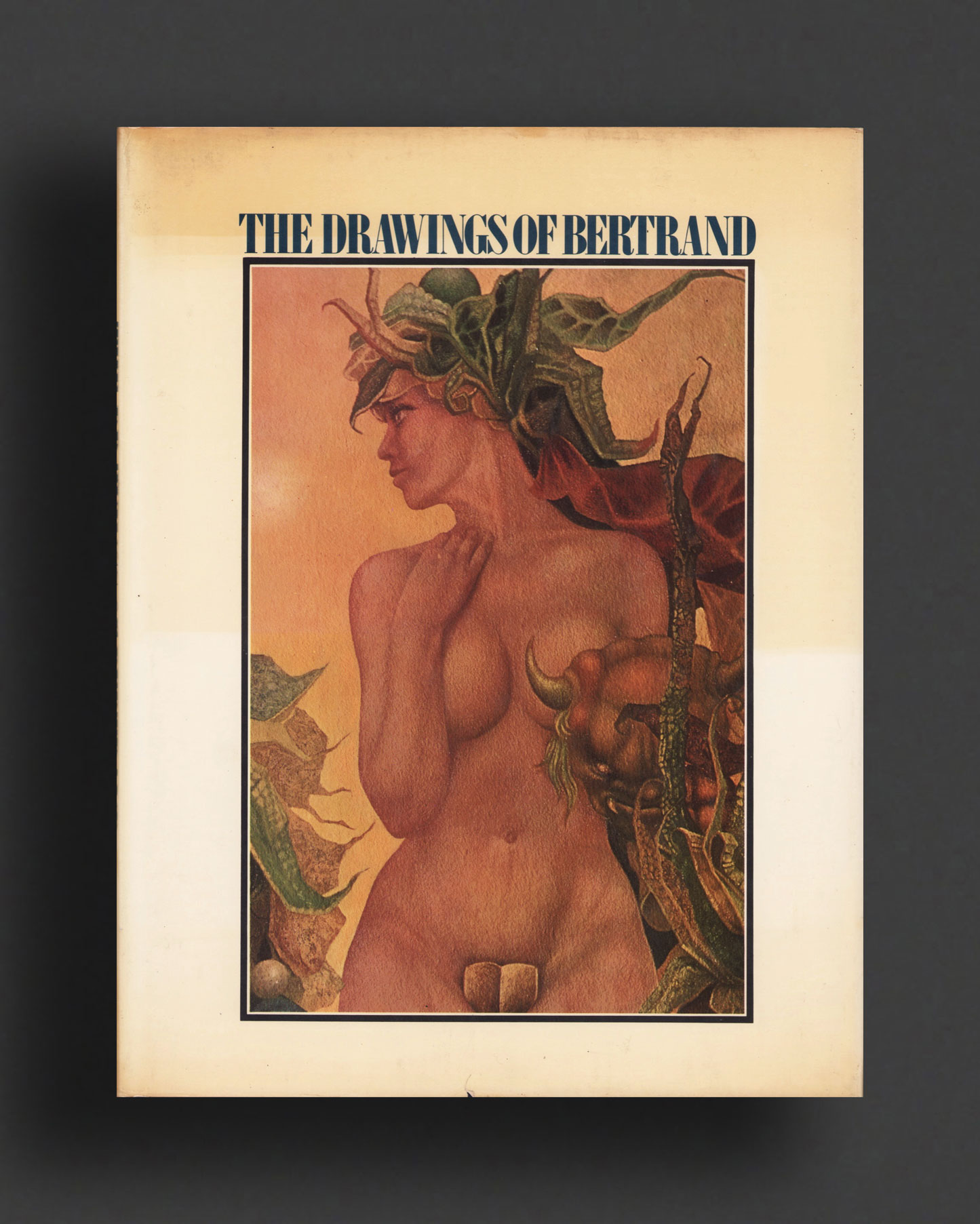
First edition of this classic volume on the work of one of the great elusive erotic-fantasy artists from Europe, Raymond Bertrand. Published in New York in 1974, this edition is one of the few publications on Bertrand outside France or Germany. A wonderful collection wrapped in hardcover with an introduction by Emmanuelle Arsan.
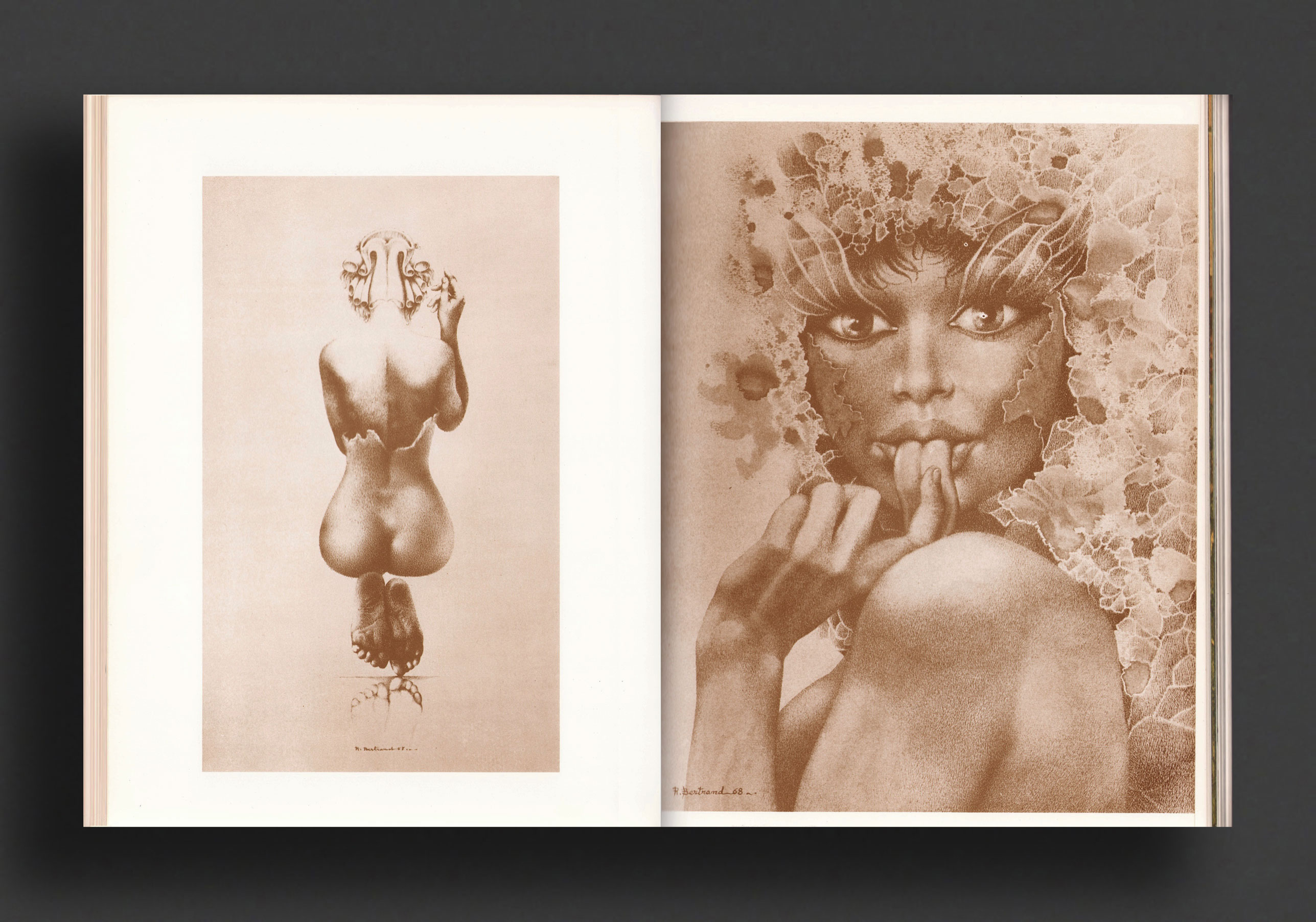
"This beautiful volume presents a comprehensive selection of the drawings and paintings of a contemporary French artist whose sensuous fantasy and surrealistic obsession have paid homage to the female body in a series of works which has no equal in modern art. 'The body,' says Emmanuelle Arsan in her introduction, 'is beautiful only if it is invented.' In this collection of drawings and paintings, Raymond Bertrand invents a female unlike any ever beheld by human eyes." (from dust jacket)
Along with Leonor Fini, Raymond Bertrand became acknowledged as one of the major new artists dealing with the modern sexuality in a highly personal fashion in the late 1960s-early 1970s, a period that seemed to encapsulate the entire published work of this little-known artist. Bertrand's work became known through his incredible illustrations for French SF journals Fiction, Galaxie, illustrations for the erotic Emmanuelle novels, and Eric Losfeld published collections. Bertrand is a somewhat elusive and shadowy figure about whom it is hard to find biographical information, and it is sadly unknown whether he continued his work after this period.
VG in Good DJ, toning to pages and DJ, light wear and tear to DJ edges, VG otherwise. Preserved in mylar wrap.
2026, English
Hardcover (w. dust jacket), 252 pages, 27.5 x 26 cm
Published by
Til Van Laere Gallery / Antwerp
Hannibal Books / Veurne
$120.00 - Out of stock
Unique collection of drawings by the celebrated Swedish artist Jockum Nordström, featuring never-before-seen work
Swedish artist Jockum Nordström (b. 1963) is one of Scandinavia’s most celebrated contemporary voices, renowned for the evocative, dreamlike worlds he brings to life through his art. This book spans more than three decades, from 1992 to 2025, tracing both early pieces and recent works, several of which have never been shown to the public before. Alongside captivating drawings, Nordström also creates sculptures, collages and maquettes – a testament to his versatility and to the richly imaginative universe he continues to shape.
With accompanying essays by Femke Vandenbosch and Carl Fredrik Hårleman. Graphic design by Kim Beirnaert.
Published on the occasion of the artist’s exhibition at Tim Van Laere Gallery from 9 October to 22 November 2025.
Jockum Nordström is a Swedish contemporary artist known for his distinct mixed-media works, which blend collage, drawing, and painting. Born in 1963 in Stockholm, Nordström’s style is often characterized by a whimsical yet surreal aesthetic, combining figures, landscapes, and architectural elements. Throughout his career, Nordström has exhibited internationally, earning recognition for his innovative approach to visual storytelling.
2026, English
Hardcover, 224 pages, 29 x 22 cm
Published by
Editions Gallimard / Paris
Musée Picasso / Paris
$80.00 - Out of stock
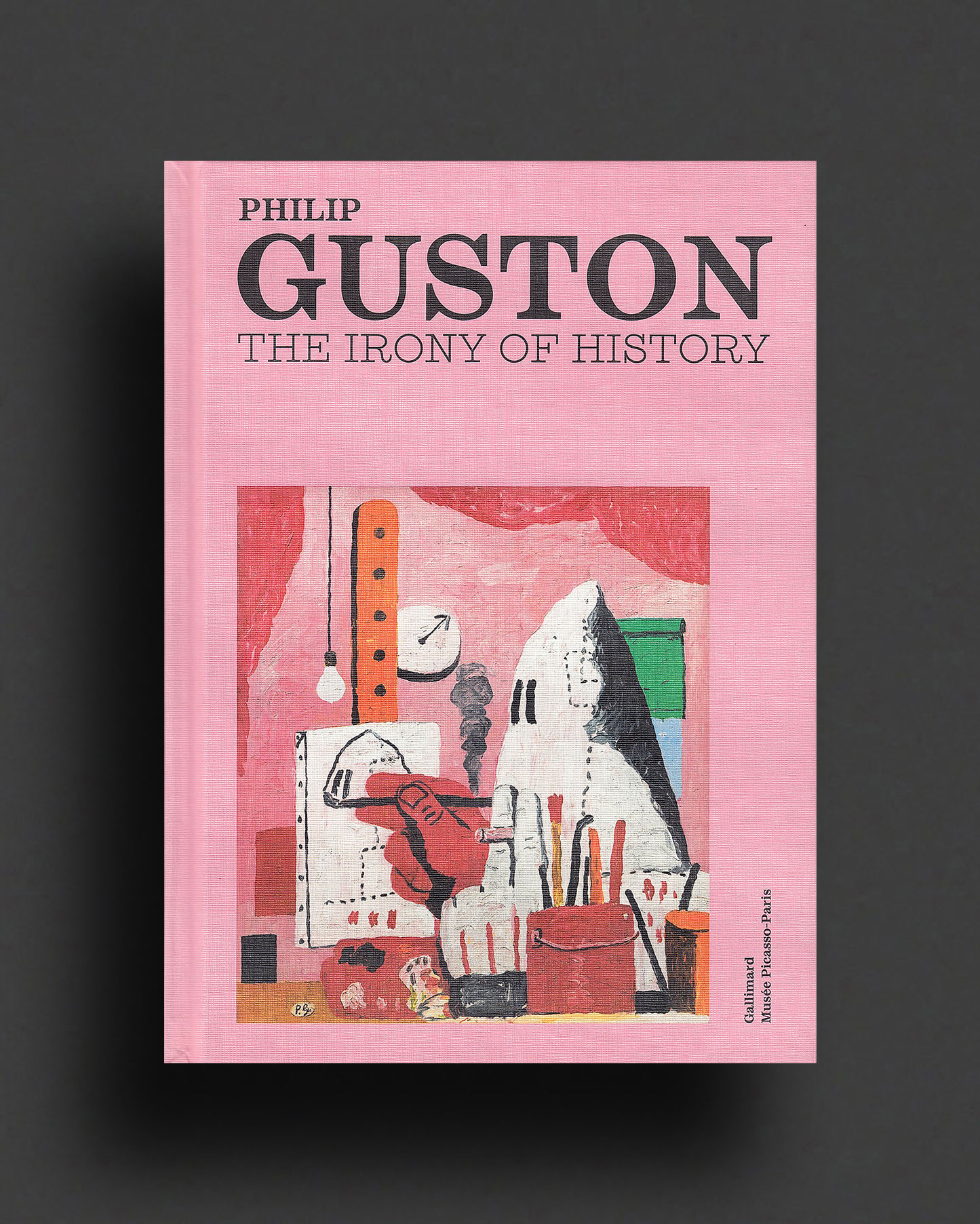
From October 14th 2025 to March 1st 2026, the Musée National Picasso-Paris will present an exhibition dedicated to the American painter Philip Guston, bringing together a group of figurative works and drawings made by the artist responding to to Philip Roth’s book Our Gang (1971). The exhibition will also show the satirical verve of Guston’s painting as well as a form of political commitment rooted in his discovery of Picasso’s Guernica, surrealism and Mexican muralism in the late 1930s.
Supported by the Philip Guston Foundation and the artist’s daughter Musa Meyer, who have entrusted the museum with the Nixon drawings series, as well as never-seen-before works, the exhibition will offer a precise look at Guston’s work from the 1940s to the end of his life. In total, the book will feature around 150 works by Guston as well as the 73 drawings, along with Philip Roth’s text.
1977, French
Hardcover (gilt-blocked, decorated clothbound w. gold dust jacket), 294 pages, 22 x 31 cm
1st Edition, Out of print title / used / very good
Published by
Draeger / Paris
$150.00 - Out of stock
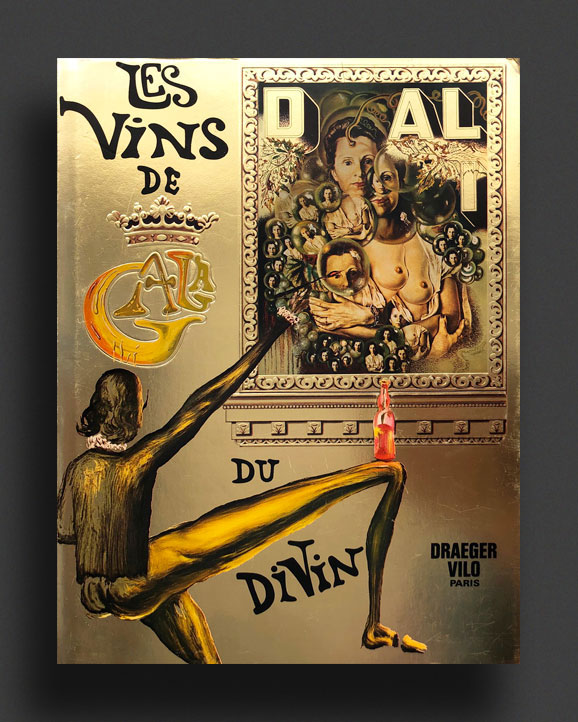
First French edition of this extravagant, lavishly illustrated book of wines and famous vineyards, created by Dalí in honor of his wife Gala and published in 1977 by Draeger, Paris. The perfect, equally surreal and sensual viticulture follow-up companion to Dalí's best-selling cookbook, Les dîners de Gala. A Dalínian take on pleasures of the grape and a coveted collectible, the book sets out to organize wines “according to the sensations they create in our very depths.” Through eclectic metrics like production method, weight, and color, the book presents wines of the world in such innovative, Dalíesque groupings as “Wines of Frivolity,” “Wines of the Impossible,” and “Wines of Light.”
Bursting with imagery, the book features more than 140 illustrations by Dalí. Many of these are appropriated artworks, including various classical nudes, all of them reconstructed with suitably Surrealist, provocative touches, like Jean-François Millet’s The Angelus, one of Dalí’s favorite points of reference over the decades. Dalí also included what is now considered one of the greatest works from his late “Nuclear Mystic” phase, The Sacrament of the Last Supper (1955), which sets the iconic biblical scene in a translucent dodecahedron-shaped space before a Catalonian coastal landscape. Dalí was by this stage a devout Catholic, simultaneously captivated by science, optical illusion, and the atomic age.
The first section is dedicated to “Ten Divine Dalí Wines,” an overview of 10 important wine-growing regions, while the second develops Dalí’s revolutionary ordering of wine by emotional experience, instead of by geography or variety. Rather than any prescriptive classification, it’s a flamboyant, free-flowing manifesto in favor of taste and feeling, as much a multisensory treat as a full-bodied document of Dalí’s late-stage oeuvre, in which the artist both reflected on formative influences and refined his own cultural legacy. Texts in French by Dalí, Max Gerard, Louis Orizet.
Very Good copy in beautiful gold dust jacket in Good condition, light wear to extremities, now preserved under mylar wrap.
2022, English
Hardcover (w. dust jacket in hard cloth-covered slipcase w. softcover supplement), 252 pages, 34 x 25 cm
Published by
Hauser & Wirth / Zurich
$190.00 - In stock -
Duchamp’s historic 1959 catalogue raisonné-cum-artist's book now back in print in a facsimile English edition. ‘Marcel Duchamp’ became the go-to book on the artist for many decades following its publication in late 1959, when exclusive grand-deluxe and deluxe editions in French, along with trade editions in French and English, were simultaneously released. While Trianon Press’s French trade edition was reprinted numerous times, the Grove Press English edition languished out of print for the better part of two generations—until now, with Hauser & Wirth Publishers’ fully authorized facsimile re-edition.
By Robert Lebel. Edited by Jean-Jacques Lebel and Association Marcel Duchamp. Foreword by Harald Falckenberg. Introduction by Michaela Unterdörfer. Text by Marcel Duchamp, André Breton, Henri-Pierre Roché, Jean-Jacques Lebel, Man Ray, Michael Taylor.
Marcel Duchamp, the artist’s first legendary monograph and draft catalogue raisonné, was written by art historian and novelist Robert Lebel and published in French in 1959; later that same year, it was translated into English by George Heard Hamilton for Grove Press. The book was a cooperation between Lebel and Duchamp, and beyond Lebel’s extensive writing and bibliography, additional chapters were authored by Duchamp, H.P. Roché and André Breton. The coupling of these texts with diverse archival photographs and an illustrated compendium of Duchamp’s artworks delivered a complex and personal rendering of the artist’s life and inner circle. For the first time since its release more than 60 years ago, this landmark publication is back in circulation with Hauser & Wirth Publishers’ meticulous facsimile of the English edition, reflecting everything from its hand-tipped images to its recto-verso dust jacket appearing as close to the original as possible.
Fully authorized by artist Jean-Jacques Lebel—Robert Lebel’s son—and the Association Marcel Duchamp, the facsimile is accompanied by a supplement volume of essays and archival material that tells the story of Duchamp and Lebel’s close collaboration, and, as contributor Michael Taylor writes, how the original publication signified a "sea change in the artist’s receptivity to critical interpretation." The supplement includes texts by both Robert and Jean-Jacques Lebel and a newly discovered note by Man Ray, among a bevy of photographs from the Lebel and Duchamp archives, extending the story presented in the 1959 edition.
Robert Lebel’s analysis of Duchamp’s oeuvre remains fresh to this day, as does the book’s design, which was personally supervised by the artist. Hauser & Wirth Publishers reanimated Marcel Duchamp with the curatorial-design firm fluid, who recast the original typefaces as digital fonts, positioning each letter and image exactly as it was in the original. To achieve a near-exact facsimile, fluid consulted with paper conservators and printers to recreate the book with modern materials that match those available in 1959. This precise production quality assures that today’s readers will experience this historic book as Marcel Duchamp and Robert Lebel intended.