World Food Books' programme is largely produced on Kulin Nation land. We acknowledge the Wurundjeri people of the Kulin Nation as the first and continuing custodians of this land, and pay respect to their Elders past, present, and emerging.
World Food Books is an arts and special interests bookshop in Naarm / Melbourne. Founded in 2010, World Food Books is devoted to the presentation of a rotating, hand-selection of international art, design, literary and counterculture publications with an emphasis on the anti-traditional, the experimental, the avant-garde, the heretic, the marginal.
Presenting new titles alongside rare and out-of-print books, catalogues and journals spanning the fields of modern and contemporary art, design, photography, illustration, film, literature, poetry, cultural theory, philosophy, sexuality, popular and underground culture in its many radical forms, World Food Books wishes to encourage adventurous, thoughtful and open-minded reading, looking, writing, and exchange of publishing and ideas, both current and historical.
As well as our bookshop, located in Melbourne's historical Nicholas Building, all of our inventory is available internationally via our online mail-order service.
World Food Books semi-regularly co-ordinates "Occasions", a programme of exhibits and events at the bookshop and in partnership with other hosts (such as museums and art galleries) that develop out of the activities, relationships and content of the bookshop itself.
World Food Books
The Nicholas Building
37 Swanston Street
Room 5, Level 6
Melbourne 3000
Australia
SHOP HOURS:
Thu–Fri 12–6, Sat 12–5
WEB-SHOP OPEN 24/7
World Food Books
Postal Address:
PO Box 435
Flinders Lane
Victoria 8009
Australia
Art
Theory / Essay
Architecture / Interior
Graphic Design / Typography
Photography
Fashion
Eros
LGBTQ+
Fiction / Poetry
Weird / Speculative / Science Fiction / Horror
Transgressive / Visceral / Abject
Symbolism / Decadence / Fin de siècle
Film / Video
Painting
Sculpture / Installation
Performance / Dance / Theater
Drawing
Sound / Music
Curatorial
Group Shows / Collections
Periodicals
Out-of-print / Rare
Posters / Ephemera / Discs
Signed Books
World Food Books Gift Voucher
World Food Book Bag
Australian Art
Australian Fiction
Australian Science Fiction / Speculative Fiction
Australian Poetry
Australian Photography
Japanese Photography
Conceptual Art
Minimal Art
Dada
'Pataphysics / Oulipo
Fluxus
Concrete Poetry
Pop Art
Surrealism
Arte Povera
Arte Informale / Haute Pâte / Tachism
Nouveau Réalisme / Zero / Kinetic
Situationism / Lettrism
Collage / Mail Art / Xerox Art
Art Brut / Folk / Visionary / Fantastic
Illustration / Graphic Art / Bandes Dessinées
Furniture
Italian Radical Design / Postmodernism
Textiles
Ceramics / Glass
Counterculture
Protest / Revolt
Philosophy
Psychoanalysis
Anthropology
Anarchism
Socialism / Anarchism / Communism / Capitalism
Literary Theory / Semiotics / Language
Feminism / Women's Studies
Gender Studies / Sexuality
Anthropology
Fetishism / BDSM
Drugs / Psychedelia
Crime / Violence
Animal Rights / Veganism
Occult / Esoterica
Ecology / Earth / Alternative Living
Whole Earth / Crafts
All prices in AUD (Australian dollars)
Pick-Ups
Pick-up orders can be collected in our bookshop during opening hours after order date. Please collect any Pick-up orders within 2 weeks of ordering as we have limited storage space. Orders will be released back into stock if not collected within this time. No refunds can be made for pick-ups left un-collected. If you cannot make it in to the bookshop in this time-frame, please choose postage option.
Return Policy
All sales are final. We do accept returns (for refund or exchange) for items received in error. All our orders are packed with special care using heavy-duty padding and cardboard book-mailers or bubble mailers (for smaller books), using reinforcement where required. We cannot take responsibility for any lost, stolen or damaged parcels.
Insurance
Should you wish to insure your package, please email us directly after placing your order and we can organise this at a small extra expense. Although all standard/express tracked packages are very safe and dependable, we cannot take responsibility for any lost, stolen or damaged parcels. We recommend insurance on valuable orders.
Interested in selling your old books, catalogues, journals, magazines, comics, fanzines, ephemera? We are always looking for interesting, unusual and out-of-print books to buy. We only buy books in our fields of interest and specialty, and that we feel we can resell.
We base these prices on desirability, market value, in-print prices, condition and our current stock levels. We offer cash, store credit, and can take stock on consignment. All
about 25% of the price we expect to get when we sell them, or 30% in store credit. We base these prices on desirability, market value, in-print prices, condition and our current stock levels.
Sell your books any day of the week. You can drop them off and return later. If you have a lot of books, we can visit your Sydney home.
We buy books that we feel we can resell. We offer about 25 % of the price we expect to get when we sell them, or 30% in store credit. We base these prices on desirability, market value, in-print prices, condition and our current stock levels.
Philadelphia Wireman
03 August - 01 September, 2018
World Food Books is proud to announce our next Occasion, the first presentation of sculptures by Philadelphia Wireman in Australia.
The Philadelphia Wireman sculptures were found abandoned in an alley off Philadelphia’s South Street on trash night in 1982. Their discovery in a rapidly-changing neighbourhood undergoing extensive renovation, compounded with the failure of all attempts to locate the artist, suggests that the works may have been discarded after the maker’s death. Dubbed the "Philadelphia Wireman" during the first exhibition of this work, in 1985, the maker’s name, age, ethnicity, and even gender remain uncertain. The entire collection totals approximately 1200 pieces, all intricately bound together with tightly-wound heavy-gauge wire (along with a few small, abstract marker drawings, reminiscent both of Mark Tobey and J.B. Murry). The dense construction of the work, despite a modest range of scale and materials, is singularly obsessive and disciplined in design: a wire armature or exoskeleton firmly binds a bricolage of found objects including plastic, glass, food packaging, umbrella parts, tape, rubber, batteries, pens, leather, reflectors, nuts and bolts, nails, foil, coins, toys, watches, eyeglasses, tools, and jewellery.
Heavy with associations—anthropomorphic, zoomorphic, and socio-cultural responses to wrapped detritus—the totemic sculptures by Philadelphia Wireman have been discussed in the context of work created to fulfil the shamanistic needs of alternative religions in American culture. Curators, collectors, and critics have variously compared certain pieces to sculpture from Classical antiquity, Native American medicine bundles, African-American memory jugs, and African fetish objects. Reflecting the artist’s prolific and incredibly focused scavenging impulse, and despite—or perhaps enhanced by—their anonymity, these enigmatic objects function as urban artefacts and arbiters of power, though their origin and purpose is unknown. Philadelphia Wireman, whatever their identity, possessed an astonishing ability to isolate and communicate the concepts of power and energy through the selection and transformation of ordinary materials. Over the course of the past two decades, this collection has come to be regarded as an important discovery in the field of self-taught art and vernacular art.
Presented in collaboration with Fleisher-Ollman Gallery, Philadelphia, and Robert Heald, Wellington.
Susan Te Kahurangi King
02 February - 10 March, 2018
Susan Te Kahurangi King (24 February 1951 - ) has been a confident and prolific artist since she was a young child, drawing with readily available materials - pencils, ballpoint pens and felt-tip markers, on whatever paper is at hand. Between the ages of four and six Susan slowly ceased verbal communication. Her grandparents William and Myrtle Murphy had developed a special bond with Susan so they took on caring responsibilities for extended periods. Myrtle began informally archiving her work, carefully collecting and storing the drawings and compiling scrapbooks. No drawing was insignificant; every scrap of paper was kept. The King family are now the custodians of a vast collection containing over 7000 individual works, from tiny scraps of paper through to 5 meter long rolls.
The scrapbooks and diaries reveal Myrtle to be a woman of great patience and compassion, seeking to understand a child who was not always behaving as expected. She encouraged Susan to be observant, to explore her environment and absorb all the sights and sounds. Myrtle would show Susan’s drawings to friends and people in her community that she had dealings with, such as shopkeepers and postal workers, but this was not simply a case of a grandmother’s bias. She recognised that Susan had developed a sophisticated and unique visual language and sincerely believed that her art deserved serious attention.
This was an unorthodox attitude for the time. To provide some context, Jean Dubuffet coined the term Art Brut in 1945 to describe work created by self-taught artists – specifically residents of psychiatric institutions and those he considered to be visionaries or eccentrics. In 1972 Roger Cardinal extended this concept by adopting the term Outsider Art to describe work made by non-academically trained artists operating outside of mainstream art networks through choice or circumstance. Susan was born in Te Aroha, New Zealand in 1951, far from the artistic hubs of Paris and London that Dubuffet and Cardinal operated in. That Myrtle fêted Susan as a self-taught artist who deserved to be taken seriously shows how progressive her attitudes were.
Susan’s parents Doug and Dawn were also progressive. Over the years they had consulted numerous health practitioners about Susan’s condition, as the medical establishment could not provide an explanation as to why she had lapsed into silence. Dawn educated herself in the field of homeopathy and went on to treat all twelve of her children using these principles – basing prescriptions on her observations of their physical, mental and emotional state.
Doug was a linguist with an interest in philosophy who devoted what little spare time he had to studying Maori language and culture. To some extent their willingness to explore the fringes of the mainstream made them outsiders too but it was their commitment to living with integrity and their respect for individuality that ensured Susan’s creativity was always encouraged.
Even though Susan’s family supported her artistic pursuits, some staff in schools and hospitals saw it as an impediment to her assimilation into the community and discouraged it in a variety of ways. Her family was not always aware of this and therefore did not fully understand why Susan stopped drawing in the early 1990s. However, rather than dwell on the challenges that Susan faced in pursuit of her artistic practice, they prefer to highlight her achievements. In 2008 Susan began drawing again in earnest, after an almost 20 year interruption, and her work is now shown in galleries around the world.
Susan grew up without television and has been heavily influenced by the comics she read as a child. She is absolutely fearless in the appropriation of recognizable characters, such as Donald Duck and Mickey Mouse, in her work. She twists their limbs, contorts their faces, compresses them together, blends them into complex patterned backgrounds - always imbuing them with an incredible energy. Although Susan often used pop culture characters in her work they are not naive or childlike. These are drawings by a brilliant self-taught artist who has been creating exceptional work for decades without an audience in mind.
Mladen Stilinović
"Various Works 1986 - 1999"
02 February 16 - September 10, 2016
Various works 1986 - 1999, from two houses, from the collections of John Nixon, Sue Cramer, Kerrie Poliness, Peter Haffenden and Phoebe Haffenden.
Including: Geometry of Cakes (various shelves), 1993; Poor People’s Law (black and white plate), 1993; White Absence (glasses, ruler, set square, silver spoon, silver ladel with skin photograph and wooden cubes), 1990-1996; Exploitation of the Dead (grey and red star painting, wooden painting, black spoon with red table, red plate), 1984-1990; Money and Zeros (zero tie, paintings made for friends in Australia (Sue, John, Kerrie), numbers painting), 1991-1992; Words - Slogans (various t-shirts) - “they talk about the death of art...help! someone is trying to kill me”, “my sweet little lamb”, “work is a disease - Karl Marx”; Various artist books, catalogues, monographs, videos; Poster from exhibition Insulting Anarchy; "Circular" Croatian - Australian edition; Artist book by Vlado Martek (Dostoyevsky); more.
Thanks to Mladen Stilinović and Branka Stipančić.
Jonathan Walker
Always Will Need To Wear Winter Shirt Blue + Ochre Small Check Pattern
21 August - 21 September, 2015
Untitled
I am not a great reader of poetry but I always return to the work of Melbourne poet, Vincent Buckley (1925- 1988). Perhaps I find his most tantalising piece to be not a finished poem but a fragment left on a scrap of paper discovered on his desk after the poet’s death.
The poetry gathers like oil
In the word-core, and spreads
It has its music meet,
Its music is in movement.
This fragment is more the shell left behind from a volatile thought than a finished poem. I find the last two lines honest but awkward whereas the first two lines work like an arrow. Most likely he could not find a resolution so it was left. Still, in its present form, it remains an eloquent testimony to the ultimate failure of a medium to express mobile thought and sensation, in Buckley’s case, through verbal language. It’s an important matter because this is something all artists have to deal with regardless of the medium.
I have never written a poem, however, I am forever copying fragments from books on paper scraps in a vain effort to fix certain notions in my head. At first, they function as bookmarks that are sometimes returned to when I open the book. But before long, as they accumulate, they fall out littering the table interspersed with A4 photocopies, bills, books and medications.
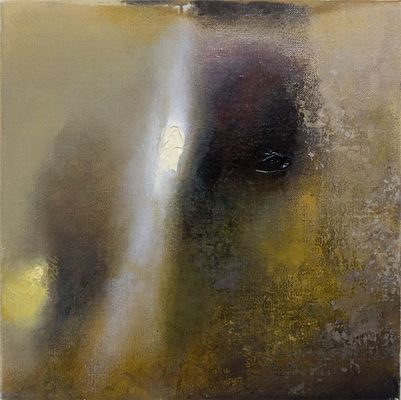
To return to Buckley’s fragment, the first two lines very much evoke how I paint nowadays. As you age, detail diminishes and patches of light become more luminous and float. I feel the most honest way of dealing with this is by smearing the oil paint on the canvas with the fingers and working close-up, blind. Only if the patches coalesce into an approaching image can the work gain a life.
-
Jonathan Walker was born in Melbourne, Australia and brought up on a dairy farm in Gippsland. In the 1970’s he studied painting at RMIT and won the Harold Wright Scholarship to the British Museum, London. During the 1980’s he exhibited at Pinacotheca Gallery, Richmond and had work shown at the NGV and Heidi City Art Gallery. Over the same period he designed the cover for the “Epigenesi” LP by Giancarlo Toniutti, Italy and conducted a mail exchange work with Achim Wollscheid, Germany. The work with artists through the post resulted in an article published in the bicentenary issue of Art and Australia 1988. He showed in artist run spaces such as WestSpace in the 90’s and 2000’s, and until 2012, taught painting at Victoria University, which is where we (Colleen Ahern and Lisa Radford) as organisers of the exhibition, among many others, had the privilege of being his student.
Walker’s knowledge was imparted to students through the careful selection of music, literature, and artists found in books that he himself had ordered for the library. Walker’s strategy was the generosity of sharing his vast knowledge with references specific to each student and their context.
Walker’s paintings share a similar focus and intimacy.
This exhibition presents a small selection of recent paintings alongside a publication that includes Walker’s writing. Observational and analytical, Walker’s work is a type of material notation — the time of day, colour and how it is blended, the both specific and fleeting location of a reflection on lino or the question of whether a chair leg should be included in a painting.
Please join us on Friday August 21 between 6-8pm to celebrate the opening of the exhibition.
Curated by Colleen Ahern and Lisa Radford.
B. Wurtz
Curated by Nic Tammens
March 26 - April 4, 2015
B.Wurtz works from a basement studio in his home on Manhattan’s Lower East Side.
This local fact is attested to by the plastic shopping bags and newsprint circulars that appear in his work. As formal objects, they don’t make loud claims about their origins but nonetheless transmit street addresses and places of business from the bottom of this long thin island. Like plenty of artists, Wurtz is affected by what is local and what is consumed. His work is underpinned by this ethic. It often speaks from a neighborhood or reads like the contents of a hamper:
“BLACK PLUMS $1.29 lb.”
“Food Bazaar”
“USDA Whole Pork Shoulder Picnic 99c lb.”
“RITE AID Pharmacy, with us it’s personal.”
“H. Brickman & Sons.”
“Sweet Yams 59c lb."
Most of the work in this exhibition was made while the artist was in residence at Dieu Donne, a workshop dedicated to paper craft in Midtown. Here Wurtz fabricated assemblages with paper and objects that are relatively lightweight, with the intention that they would be easily transportable to Australia. This consideration isn’t absolute in Wurtz’s work, but was prescriptive for making the current exhibition light and cheap. Packed in two boxes, these works were sent from a USPS post office on the Lower East Side and delivered to North Melbourne by Australia Post.
Wurtz appears courtesy of Metro Pictures, New York.
Thanks to Rob Halverson, Joshua Petherick, Sari de Mallory, Matt Hinkley, Helen Johnson, Fayen d'Evie, Ask Kilmartin, Lisa Radon, Ellena Savage, Yale Union, and "Elizabeth".
John Nixon
"Archive"
December 15 - January 20, 2014
The presentation of John Nixon's archive offered a rare showcase of this extensive collection of the artist's own publications, catalogues, posters, ephemera, editions and more, from the mid 1980s onwards, alongside a selection of his artworks.
Organized by John Nixon, Joshua Petherick and Matt Hinkley.
<a href=http://wfb.public-office.info/artist/john-nixon>All titles by John Nixon
"Habitat"
at Minerva, Sydney (organised by Joshua Petherick and Matt Hinkley)
November 15 - December 20, 2014
Lupo Borgonovo, Janet Burchill & Jennifer McCamley,
Lewis Fidock, HR Giger, Piero Gilardi, Veit Laurent Kurz,
Cinzia Ruggeri, Michael E. Smith, Lucie Stahl, Daniel Weil, Wols
Press Release:
“...It contained seven objects. The slender fluted bone, surely formed for flight, surely from the wing of some large bird. Three archaic circuitboards, faced with mazes of gold. A smooth white sphere of baked clay. An age-blackened fragment of lace. A fingerlength segment of what she assumed was bone from a human wrist, grayish white, inset smoothly with the silicon shaft of a small instrument that must once have ridden flush with the surface of the skin - but the thing’s face was seared and blackened.”
William Gibson, “Count Zero”, 1986
"Autumn Projects Archive"
Curated by Liza Vasiliou
March 6 - March 15, 2014
World Food Books, in conjunction with the Virgin Australia Melbourne Fashion Festival 2014, presented the Autumn Projects archive, consisting of a selection of early examples in Australian fashion with a particular interest in collecting designers and labels from the period beginning in the 1980’s, who significantly influenced the discourse of Australian Fashion.
Curated by Liza Vasiliou, the exhibition provided a unique opportunity to view pieces by designers Anthea Crawford, Barbara Vandenberg, Geoff Liddell and labels CR Australia, Covers, Jag along with early experimental collage pieces by Prue Acton and Sally Browne’s ‘Fragments’ collection, suspended throughout the functioning World Food Books shop in Melbourne.
H.B. Peace
presented by CENTRE FOR STYLE
November 14, 2013
"Hey Blinky, you say chic, I say same"
Anon 2013
H.B. Peace is a clothing collaboration between great friends Blake Barns and Hugh Egan Westland. Their pieces explore the divergences between 'character’ and ‘personality’ in garments....etc
Special Thanks to Joshua Petherick and Matt Hinkley of WFB and Gillian Mears
and a Very Special Thank you to Audrey Thomas Hayes for her shoe collaboration.
Janet Burchill & Jennifer McCamley
"Aesthetic Suicide"
May 10 - June 8, 2013
The first of our occasional exhibitions in the World Food Books office/shop space in Melbourne, "Aesthetic Suicide" presented a body of new and older works together by artists Janet Burchill & Jennifer McCamley, including videos, prints, a wall work, and publications.
During shop open hours videos played every hour, on the hour.
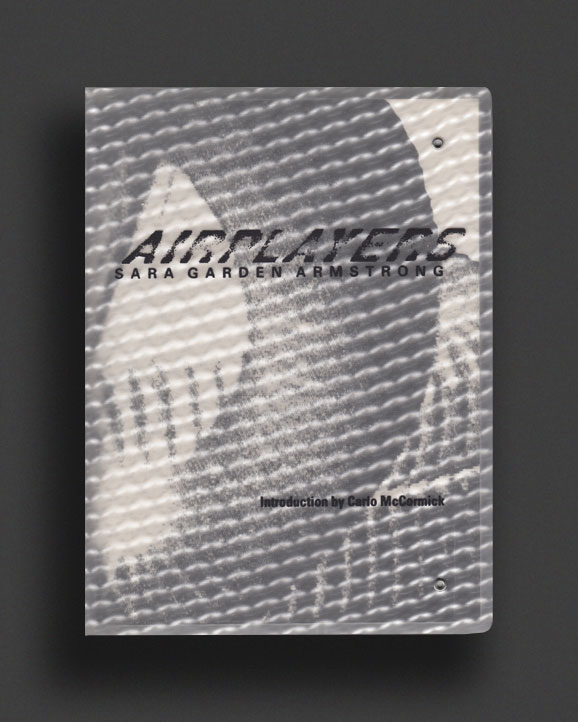
1992, English
Stiff foil cover (w. xerox acetate dust jacket), vellum pages, 28 x 11.5 cm
Ed. of 200, signed,
1st Edition, Out of print title / used / fine
Published by
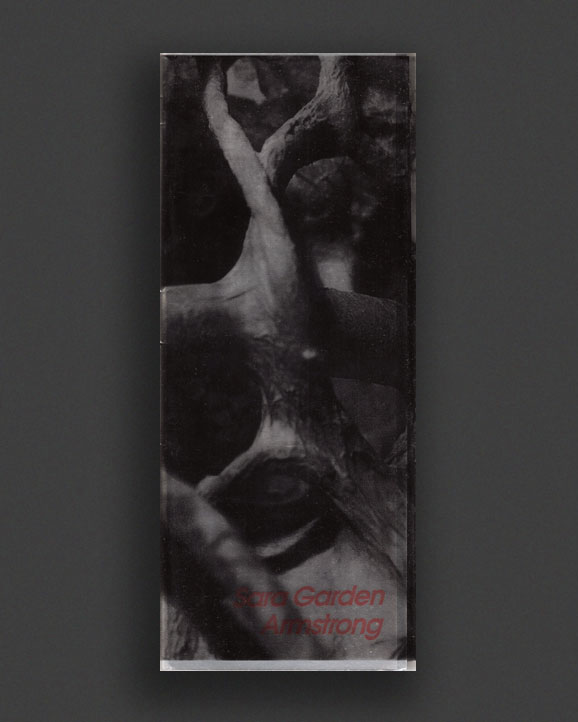
Sara Garden Armstrong / New York
$70.00 - In stock -
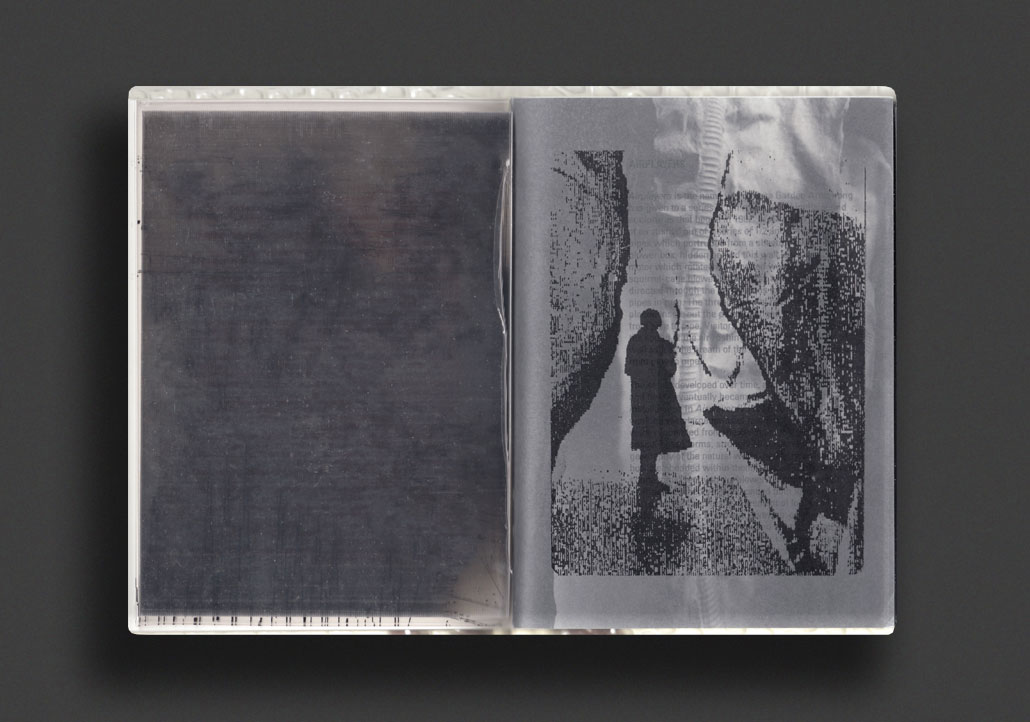
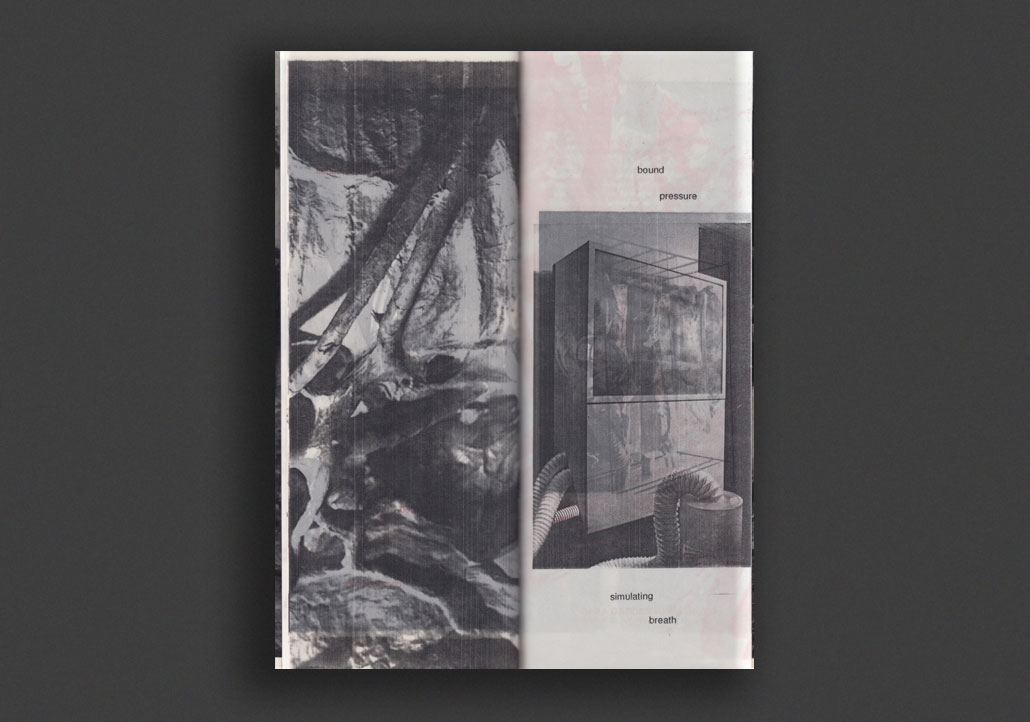
Artist's book, hand-made and signed in an edition of 200 copies by Sara Garden Armstrong. Photocopied and using various paperstocks throughout (foil card, uv ultra vellum, acetate), Armstrong documents her kinetic sound sculptures created from 1990-1992, through detailed photography and fragmented texts, with each page folding content into the next through the paper translucence. This copy no. 143/200.
Sara Garden Armstrong is an American artist known for her work in digital/electronic multimedia and artist's books. Armstrong creates sculptures, paintings, drawings (from miniature to wall size), artist's books, multimedia artworks involving computers sound and light, and constructs permanent installations in atrium spaces.
Fine copy.
2024, English
Softcover, 124 pages, 20 x 14 cm
Published by
Twisted Spoon Press / Prague
$38.00 - Out of stock
translated from the Polish by Ursula Phillips
collage artwork by Selena Kimball
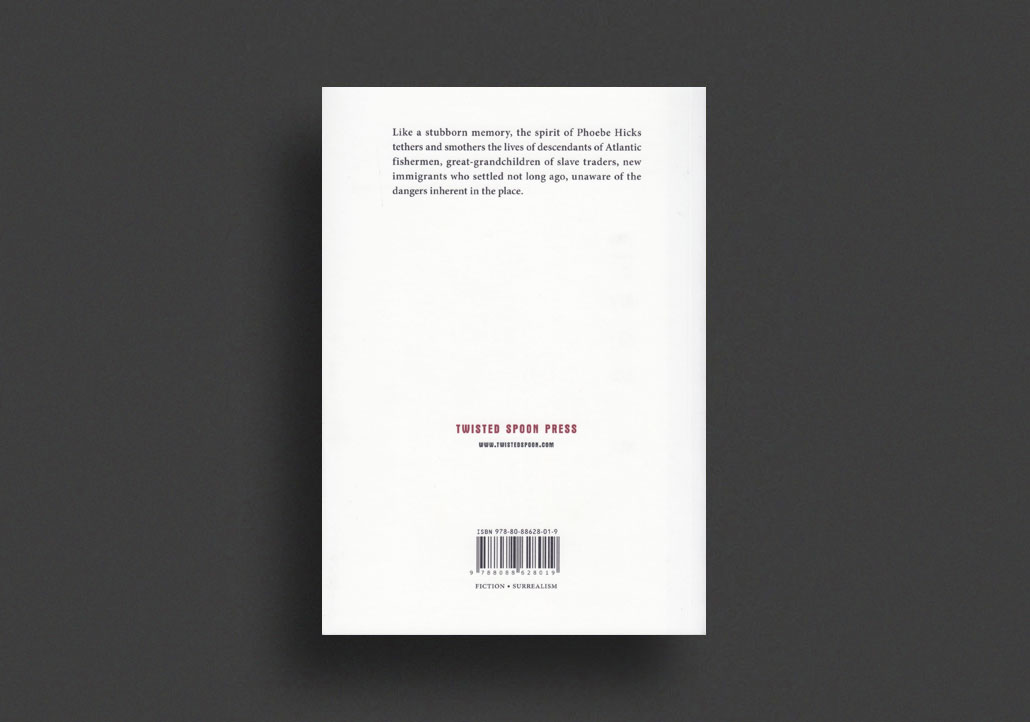
Phoebe Hicks owes her unexpected career as a spiritualist to a photograph taken of her through her bedroom window after having eaten spoiled clams. What comes out of her mouth is taken to be ectoplasm, and word spreads that she is able to commune with the dead. As the prototype for the medium, she establishes the standard for how a séance should be conducted during the sessions held in her Providence, Rhode Island, home where a growing number of curious participants witness materializations of such figures as Ivan the Terrible, Harry Houdini, Catherine the Great, Hatshepsut, Elizabeth Báthory, and a host of others. Told as a compilation of episodes conjoined with Selena Kimball’s haunting collages, The Unfinished Life of Phoebe Hicks is a feminist surrealist exploration of the rise of Spiritualism and the role of the medium in 19th-century America alongside the expectations, and constraints, imposed on women.
Frequent references to Victorian sexuality—from the corset to nocturnal emissions of ectoplasm—contribute to the work’s saucy sense of humor, as well as a larger statement about the role of Spiritualism in the history of women’s emancipation. As the narrator points out, seances and other such performances allowed women to speak publicly and subvert patriarchal social norms.—Jess Jensen Mitchell, Full Stop
This book – atmospherically interspersed with collages by Selena Kimball – stays with you long after the seance is over.—Mathilde Montpetit, The Berliner
Presented as a serious account—albeit with a healthy amount of wry humour—of the role of this somewhat mysterious medium in the early years of spiritualist practice, the portrait that emerges is of a woman for whom the boundary between the world of the spirit and the world of the flesh has become somewhat permeable.
—Joseph Schreiber, roughghosts
What is not strange, what feels contemporary about this fictionalized biography are the reasons why almost any woman without economic and social security would become a medium: In their “trance” stage, with spirits speaking through them, mediums could say things to their guests they otherwise couldn’t get away with. A woman could be “odd” and not have to worry satisfying a whole set of social conventions that otherwise would leave her destitute.—Tom Bowden, Book Beat
Surreal, funny, unnerving, thought-provoking and a wonderful read from beginning to end, The Unfinished Life of Phoebe Hicks is a marvellous book and I highly recommend it!—Kaggsy's Bookish Ramblings
Agnieszka Taborska, otherwise innocent, has, during her annual pilgrimage into “the murky back-streets of Providence,” shamelessly consorted with the spirits of such infamous locals as Poe, Lovecraft, and Hawkes, giving spiritual birth to the charmingly eerie nineteenth-century medium, Phoebe Hicks. Phoebe’s story, which, the author says, “seems to belong more to dream than reality,” is a delightful postmodernist mix of fiction and history, hovering delicately between parody and mystery. Taborska’s fictional character Leonora de la Cruz makes a guest appearance, Harry Houdini challenges Phoebe to a kind of duel, and Alain Resnais, we’re told, had intended to make Phoebe the heroine of his 20th-century film Providence, scared off perhaps by her “disturbing ambiguity.” Phoebe is by turns a genuine communicant with the spiritual world, a fraud, an artist, a feminist, a psychiatrist, a lunatic. She can also be, thanks to her ethereal deadpan humor, very funny.—Robert Coover
Agnieszka Taborska and artist Selena Kimball’s fictional heroines are clairvoyant women whose internal visions are projected externally through art and are conditioned by the scientific contexts of their eras.—New Literature from Europe
It turns out that spiritualism is not so far from surrealism as it might seem. The surrealists, using their imagination, tried to break the shackles of social order, abolish the binding rules, and get out of the roles imposed from above. This transgressive element is equally important in the case of spiritualist séances, as Taborska notes, such a séance could be for the medium "entering with impunity roles inaccessible to her in waking life."
—Sarah Nowicka, Art Papier
It is a story about women's powers, or the career paths available to women at that time. About the eroticism hidden behind Victorian morality. About our desire for the extraordinary.—Kinga Dunin, Journal of Opinions
The spirit of surreal eeriness seems to coexist quite well with the ghosts that haunt our heads as well.—Mark Zaleski, Biweekly.com
1999, English
Softcover (staple-bound), 32 pages, 28 x 21.5 cm
1st Edition, Out of print title / as new
Published by
Josh Ronsen / Austin
$20.00 - In stock -
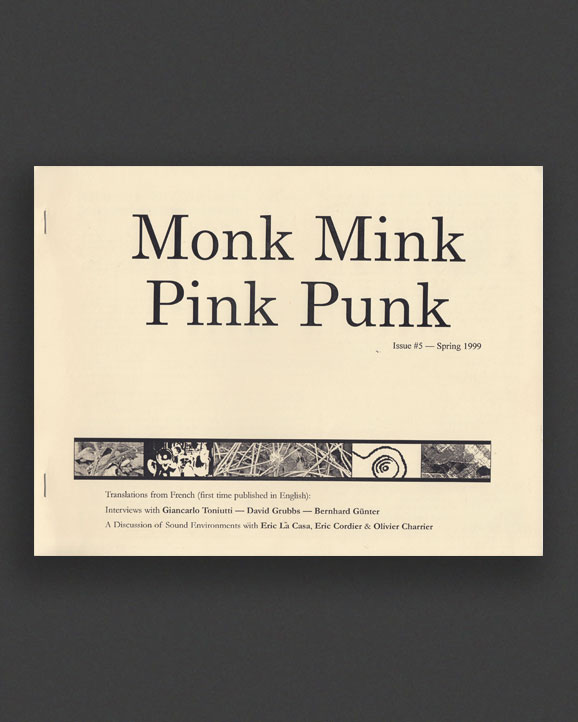
Issue 5 of Josh Ronsen's independent and infrequent publication devoted to innovative, distinctive experimental music and mail art, founded in 1994 and perhaps folding in 2015? Monk Mink Pink Punk was a true labour of love, emplying long-form interviews, articles and reviews, without the distraction of advertisements, introducing readers to material and artists which have never previously been available in the English press. Ronsen would introduce important articles from French and Italian fanzines that he has painstakingly translated for an English audience.
Issue #5 includes translations of French interviews with Giancarlo Toniutti, David Grubbs (Gastr del Sol), Bernhard Günter, Eric Cordier, Eric LaCasa (Syllyk) and Oliver Charrier. Photo-art by Seth Nehil. True fiction by Seth Tisue (with photos).
"...one of the most vital and eclectic music zines going. With some uniformly solid record review coverage sitting like cherries on top, this is a labour of love that is already compulsory reading."—Broken Pencil #14
?, English
Softcover (staple-bound w. audio CD), 162 pages, 27 x 21 cm
1st Edition, Out of print title / used / very good
Published by
Tedium House / San Francisco
$30.00 - Out of stock
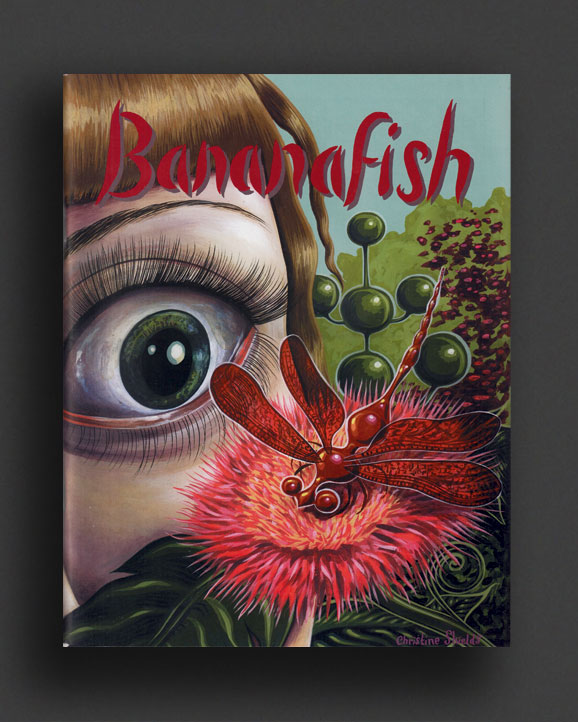
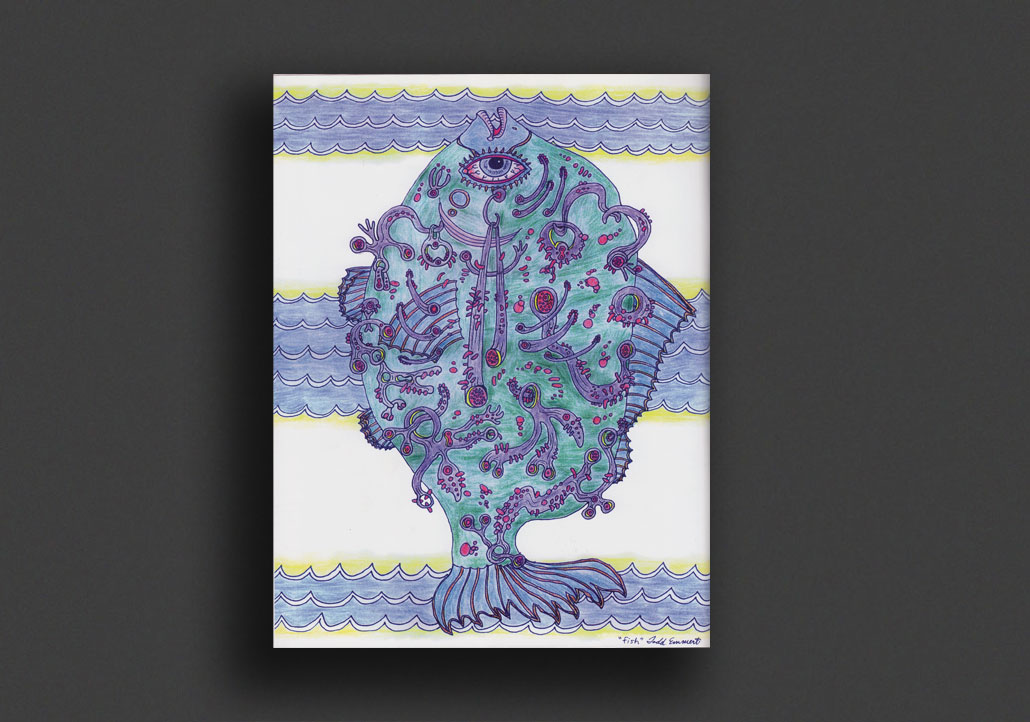
Issue 15 of the legendary and influential underground noise culture magazine Bananafish, launched in 1987 in San Francisco, California, by Seymour Glass (also of Stomach Ache Records), and published until 2004. A major force during the underground magazine and experimental music boom in the 1990s, Bananafish is often credited with giving many English-speakers their first exposure to Japanese noise musicians such as Merzbow, The Boredoms and Solmania. Heavy with outsider/freak/DIY material, Bananafish featured interviews, articles, fiction, and music reviews, often written in Glass's absurdist, stream-of-consciousness writing style, which at times bordered on nonsense. There were many contributors as well, with texts complemented by bizarre artwork and photographs, frequently unrelated to the articles they accompanied. One trademark of the magazine was its use of appropriated text and images from uncredited or unknown sources, taken from found objects picked up by Glass, other contributors, or readers. Another regular feature was the inclusion of a compilation 7" record or CD of music by artists profiled in the corresponding issue.
This issue features Christine Shields, Mal Sharpe, Ana-Maria Avram, Volcano the Bear, mad-cow.org, John Crouse, Rats With Wings, Volvox, Agog, and much more. The CD follow's suit.
1985, English
Softcover (staple-bound), 54 pages, 21 x 15 cm
1st Edition, Out of print title / used / very good
Published by
ADN / Milan
Skeletal Work / Biella
$90.00 - Out of stock
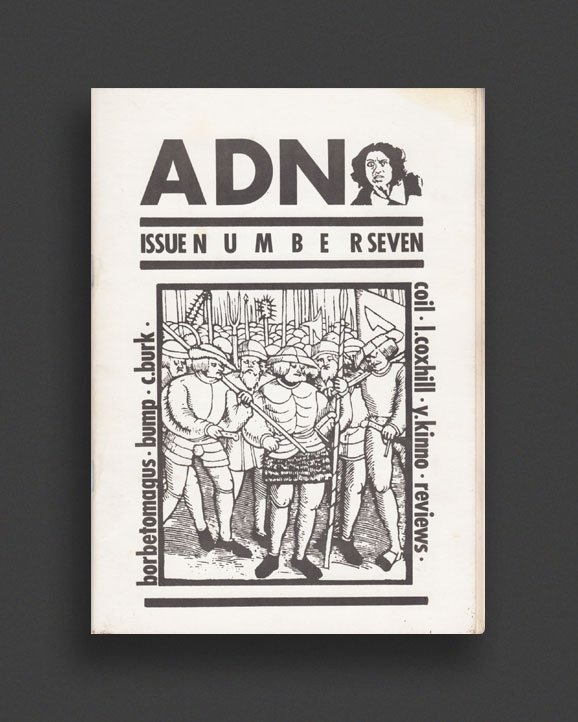
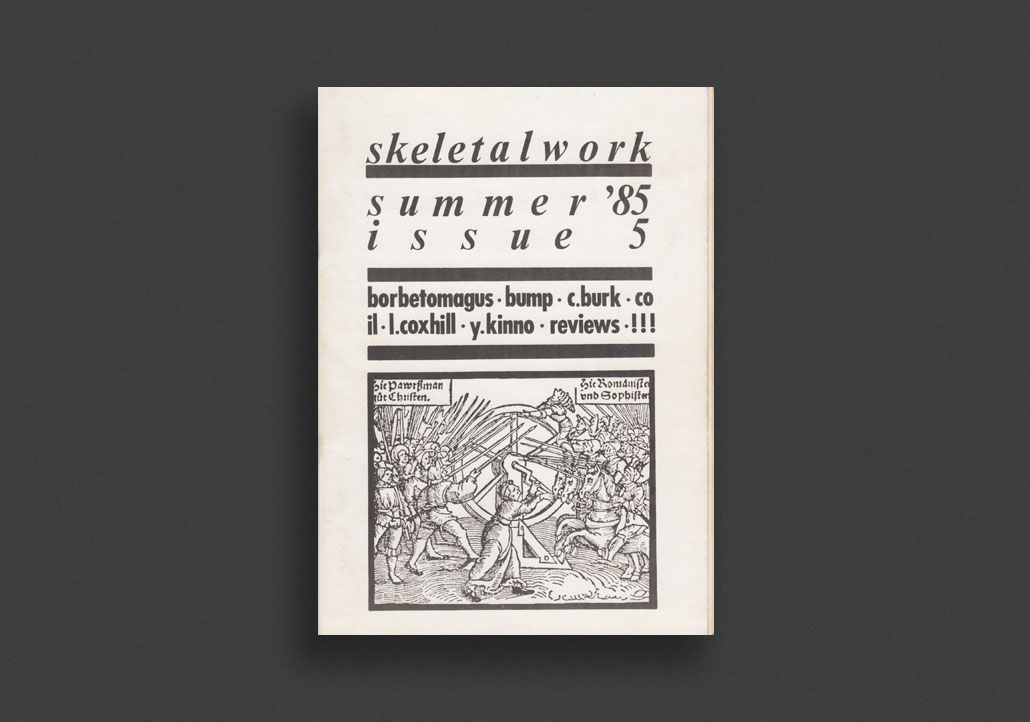
Rare copy of this special collaborative English-language issue of two of Italy's most important electronic/experimental/industrial fanzines, ADN from Milan and Skeletal Work from Biella, issue 7 and 5, respectively, published Summer 1985. Bumper issue featuring articles/interviews/discographies/graphics on Borbetomagus, Coil, Lol Coxhill, Yoshiaki Kinno (Onnyk/Allelopathy label/Fifth Column label), Anima (Paul and Limpe Fuchs), Craig Burk, Bump, loads of reviews, along with listings for the phenomenal ADN label. Virtually never seen now! Texts all in English.
ADN was an Italian electronic/experimental/industrial label based in Milan, run by Marco Veronesi, Piero Bielli and Alberto Crosta (with Carla Crotti also involved at some point). ADN was established in 1983 as the first Italian fanzine for experimental new music published in English. The very first issue was called "L'Amore del Nipote" which set the trend for all labels as acronyms of ADN. The fanzine published 8 issues through to Spring 1986, with the later issues (co-released with "Skeletal Work") including optional sampler cassettes. The booklet and cassette idea carried on with the series of various artist releases called "Out Of Standard". Most of their early releases were ADN Cassettes. For their vinyl releases, post new-wave and industrial music came out on the label 'A Dull Note', whilst avant-garde and "RiO" Rock In Opposition (left-field experimental rock) releases came out on 'Auf Dem Nil'. There was also a short-lived CD label 'Alma De Nieto' and some other name variations. A few 'Auf Dem Nil' releases were also branded "Recommended Records Italia"... Artists included Riccardo Sinigaglia, Pascal Comelade, Die Form, Nu Creative Methods, Cinéma Vérité, Vidéo-Aventures, Doxa Sinistra, Merzbow, D.D.A.A., Reportaż, Nulla Iperreale, Roberto Mazza...
Very Good copy.
1984, English
Loose-leaf pages in plastic sleeve, 30 x 21 cm
1st Edition, Out of print title / used / very good
Published by
ADN / Milan
$90.00 - In stock -
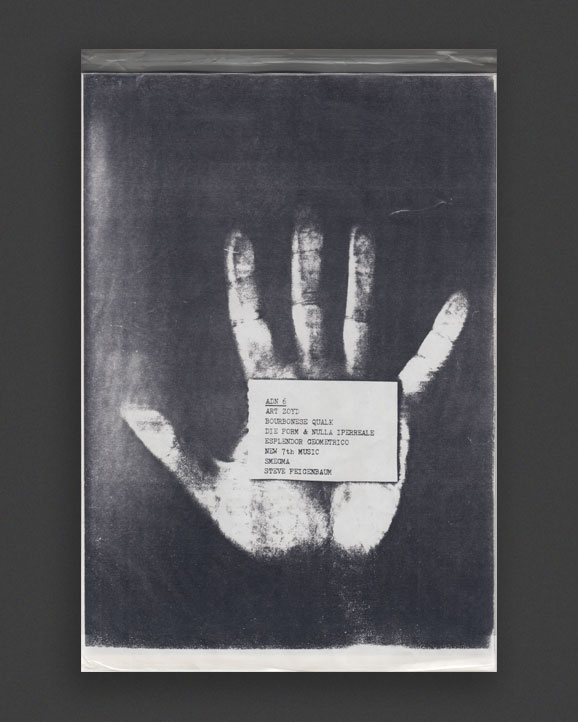
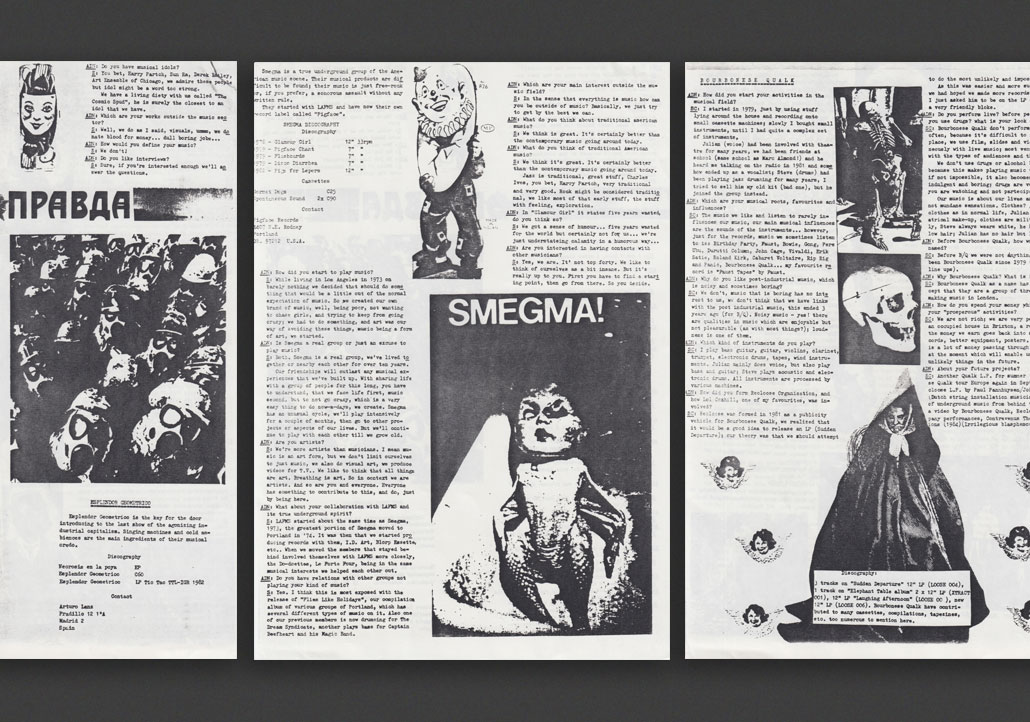
Rare copy of Italian electronic/experimental/industrial fanzine ADN, issue No. 6, published circa 1984. One of the great pioneering European experimental music fanzines of the period, this issue comes unbound as loose-leaf xeroxed pages in original issue plastic bag, and features articles/interviews/discographies/graphics on/with Art Zoyd, Bourbonese Qualk, Die Form & Nulla Iperreale, Esplendor Geométrico, New 7th Music, Smegma, Steve Feigenbaum, along with cassette listings for the phenomenal ADN label. Virtually never seen! Texts all in English.
ADN was an Italian electronic/experimental/industrial label based in Milan, run by Marco Veronesi, Piero Bielli and Alberto Crosta (with Carla Crotti also involved at some point). ADN was established in 1983 as the first Italian fanzine for experimental new music published in English. The very first issue was called "L'Amore del Nipote" which set the trend for all labels as acronyms of ADN. The fanzine published 8 issues through to Spring 1986, with the later issues (co-released with "Skeletal Work") including optional sampler cassettes. The booklet and cassette idea carried on with the series of various artist releases called "Out Of Standard". Most of their early releases were ADN Cassettes. For their vinyl releases, post new-wave and industrial music came out on the label 'A Dull Note', whilst avant-garde and "RiO" Rock In Opposition (left-field experimental rock) releases came out on 'Auf Dem Nil'. There was also a short-lived CD label 'Alma De Nieto' and some other name variations. A few 'Auf Dem Nil' releases were also branded "Recommended Records Italia"... Artists included Riccardo Sinigaglia, Pascal Comelade, Die Form, Nu Creative Methods, Cinéma Vérité, Vidéo-Aventures, Doxa Sinistra, Merzbow, D.D.A.A., Reportaż, Nulla Iperreale, Roberto Mazza...
Very Good in original bag w. sticker.
2004, English
Softcover, 69 pages, 21 x 21 cm
1st Edition, Out of print title / used / fine
Published by
Griffith University / Brisbane
$80.00 - Out of stock
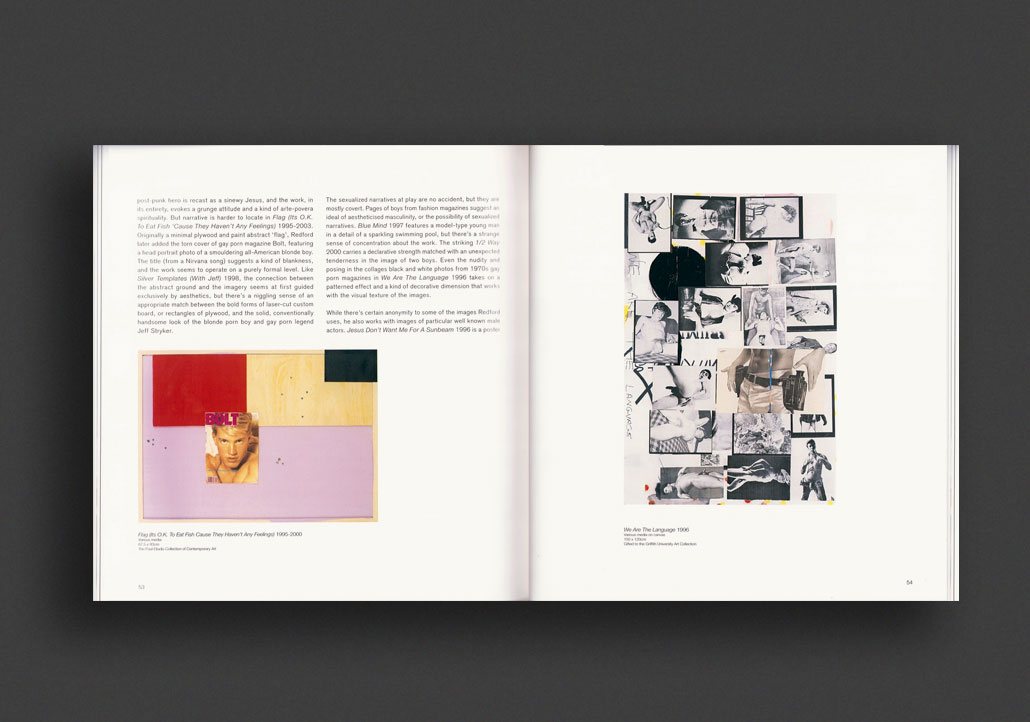
Fantastic catalogue from DELL Gallery at QCA in 2004 surveying Scott Redford's collage works, curated by Simon P Wright. Heavily illustrated throughout with texts by Christopher Chapman, Rafael von Usler, Simon P Wright, and a long interview with Scott Redford.
Scott Redford (b. 1962), Gold Coast, Australia. Lives and works at Gold Coast, Australia. Redford is a highly significant and influential Australian contemporary artist who has been exhibiting since the early 1980s. His work is represented in all major collections in Australia and has been included in important international exhibitions. Redford's work is unique in its references to international art movements including colour-field painting, conceptual art and pop art, its engagement with local themes (such as Australian art history and vernacular architecture), and its accessibility to a broad audience. Redford has used images of iconic actors and musicians (including Keanu Reeves and Kurt Cobain) to comment on gender issues, and has worked with surfboard technicians to produce 'surf paintings' that articulate the glossy appeal of surfboards.
Very Good copy.
2024, English
Softcover, 448 pages, 27.2 x 20 cm
Published by
Brooklyn Museum / Brooklyn
Phaidon / London
$90.00 - Out of stock
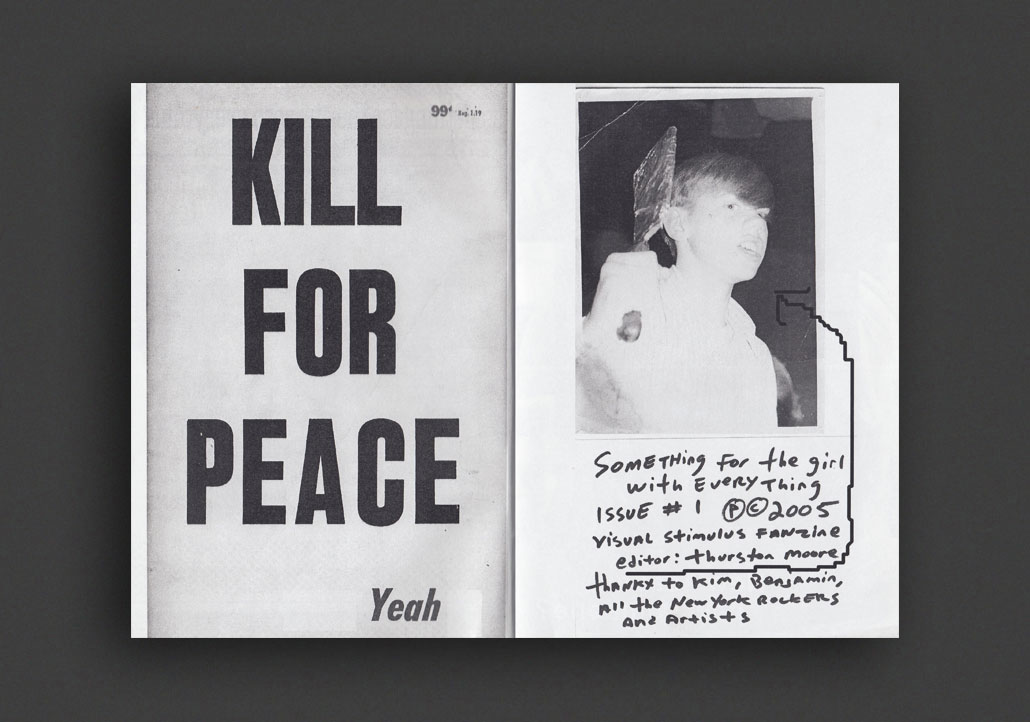
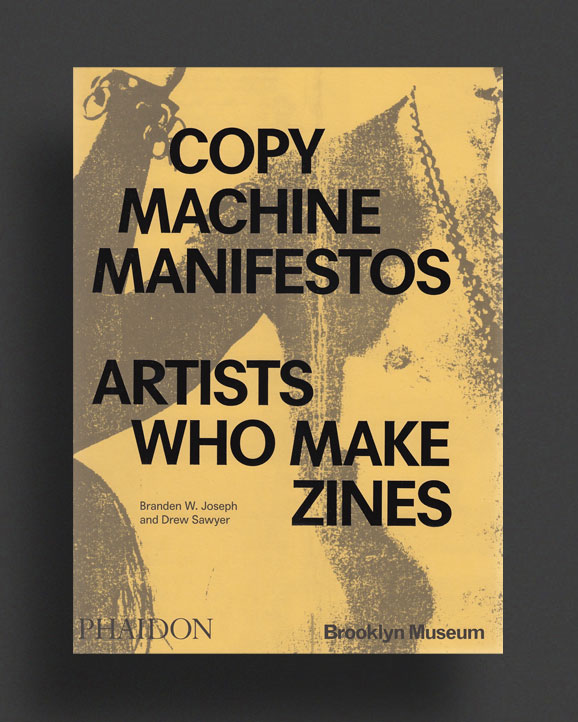
The first publication dedicated to artists' zines in North America, a revelatory exploration of an unexamined but thriving aesthetic practice
Copy Machine Manifestos captures the rich history of artists' zines as never before, placing them in the lineage of the visual arts and exploring their vibrant growth over the past five decades. Fully illustrated with hundreds of zine covers and interiors, alongside work in other media, such as painting, photography, film, video, and performance, the book also features brief biographies for more than 100 zine-makers including Beverly Buchanan, Mark Gonzales, G.B. Jones, Miranda July, Bruce LaBruce, Terence Koh, LTTR, Ari Marcopoulos, Mark Morrisroe, Raymond Pettibon, Brontez Purnell, Paul Mpagi Sepuya, and Kandis Williams. Accompanying a major exhibition at the Brooklyn Museum, this expansive book, bound as a paperback with a separate jacket, focuses on zines from North America, celebrating how artists have harnessed the medium's essential role in community building and transforming material and conceptual approaches to making art across all media since 1970.
2022, Japanese / English
Softcover (w. obi strip), 480 pages, 30 x 21 cm
1st Edition, Out of print title / as new
Published by
SLOGAN / Japan
$90.00 - In stock -
First 2022 edition of CHIRASHI — TOKYO PUNK & NEW WAVE '78-80s, an almost 500 page comprehensive compilation of "the flyers that have coloured the music scene since the 'Tokyo Rockers' in 1978. Underground music history as seen through leaflets". Edited by Toshio Iijima and Hirokazu Furukawa.
The rise of punk rock & new wave from 1978. The paper medium of 'flyers' supported this great wave. Bands delivered information by flyers, people gathered by flyers, bands and people burned together, and flyers were literally 'scattered'.Punk Rock ~ New Wave since 1978 The large waves were supported by a paper medium called "flyer". The band delivers information by the flyer, the flyers gather people, the band and people burned together, and the flyers literally "scattered".
FEATURING:
Tokyo Rockers / Friction / Lizard / Mirrors / S-Ken / Punk 99% / The Stalin / The Star Club / Jagatara / Zelda / Non Band / Gozira Records / Les Rallizes Dénudés / 100% Nylon / Pirate Boat K / Electric Circuit / Daisuck And Prostitute / Auto-Mod / Telegraph Records / Fools / Legal Contagion Gig / Typhus / Indiscriminate Gig / Pablo Picasso / Mods Mayday'81 / Emotional Market / Adk Day / Disinfection Gig / Gauze / Chance Operation / Edps / Heavenly Injection Day / etc...
FROM THE EDITOR...
The flyer, as it is now called, is a paper medium that carries information about shows and releases. With the rise of Punk Rock in the late 1970s, it played an important role as a means of communicating information in the music scene and was called a "flyer" or "leaflet" at the time. Of course, there were no computers back then, and flyers were produced completely by hand, copying, cutting and pasting hand-drawn illustrations, photographs and existing materials, and writing information on a text sheet called an in-letter (......). The flyers, produced entirely by hand, were literally 'scattered' as a medium to succinctly convey the individuality and orientation of each band and live project. As they were distributed free of charge, most of them were discarded when they had fulfilled their advertising function. However, many of the designs are still attractive today and, as a result, have become valuable record-keeping media for live shows and other information. This time, for the first time in Japan, flyers have been compiled into a book, with the cooperation of people who have recognised the significance and value of flyers as more than mere information announcements and have carefully preserved them. By collecting the flyers and arranging them chronologically, we can feel the changes in the underground scene from a different perspective from the books and films that have been published so far. We are convinced that this content, which goes beyond a mere collection of works and conveys a real history of the scene, is a valuable record of Japanese / Tokyo PUNK ROCK / underground music. These "flyers" cannot be called art or works of art, nor do we want to call them that. However, we are sure that it is full of mysterious charm. We hope that everyone who picks up a copy will be able to feel the passion that has transcended the years. Record shop BASE, Toshio Iijima 2022
As New.
2024, English
Hardcover, 200 pages, 31 x 24 cm
Published by
Amaya Productions / USA
$130.00 - In stock -
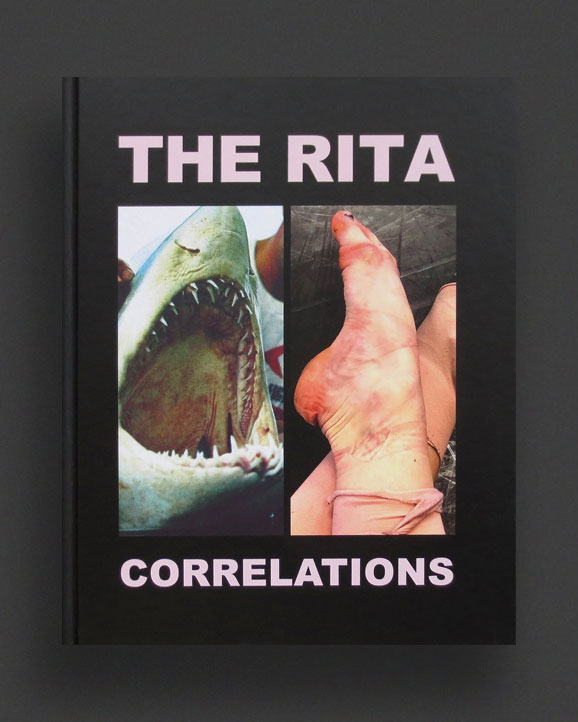
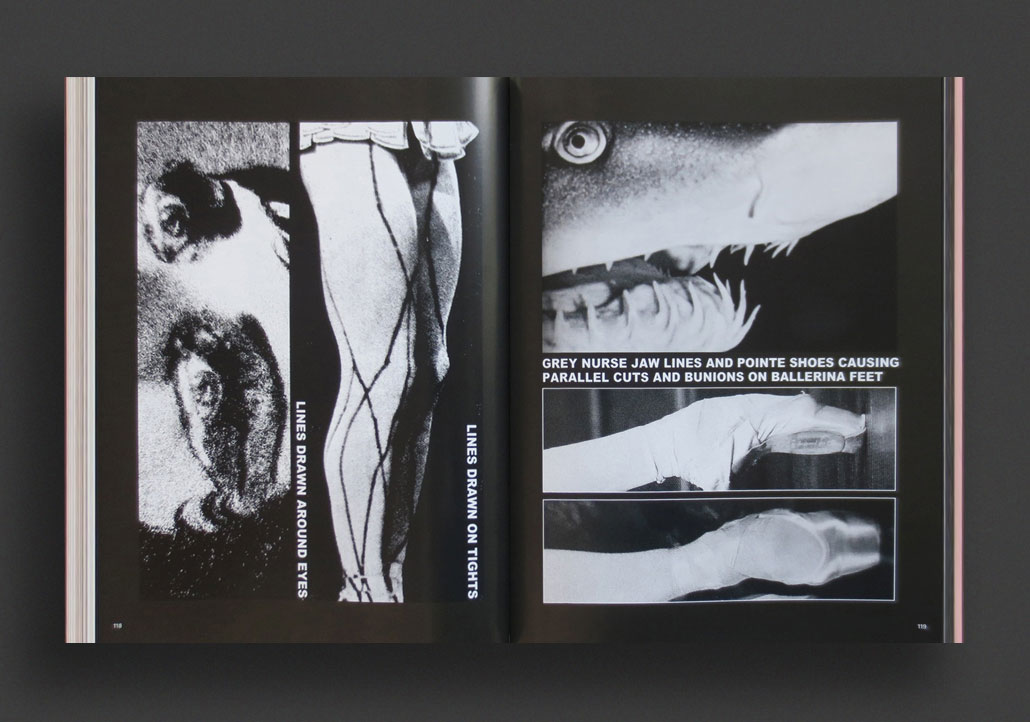
This monograph presents the visual language inseparable from the higly influential sound project of Sam McKinlay, pioneer of the "harsh noise wall" with the multidisciplinary entity The Rita.
Correlations presents some of the images and documents Sam McKinlay finds most definitive in his practice. The monograph is designed to provide a cohesive understanding of the artist's creative trajectory, as well as illuminate The Rita's uncanny process that visually, conceptually, and historically 'connects' seemingly unrelated subjects.
Published by Amaya Productions and curated by Andrea Stillacci; the monograph includes essays by the art historian and Centre Pompidou curator Nicolas Ballet (Shock Factory: The Visual Culture of Industrial Music), associate Professor and harsh noise artist Lexi Turner (Cornell University), and author, writer, producer Kier-La Janisse (House of Psychotic Women).
Credited as one of the pioneers of "harsh noise wall", influential artist Sam McKinlay (born 1974 in California) has been operating under the alias The Rita since the 1990s. Having performed extensively and credited with over 200 releases, the project has grown into a laser focused multidisciplinary venture and is celebrated for pushing the boundaries of "harsh noise". Accompanying The Rita's singular and often unpredictable sonic output is an inseparable and distinct visual language. By combining McKinlay's fine arts education, research, experimentation, and collaboration; the project visually and texturally unites the artist's interests in minimalist design, noise, ballet, sharks, choreography, and film.
Edited by Andrea Stillacci.
Texts by Nicolas Ballet, Lexi Turner, Kier-La Janisse.
2021, English
Hardcover, 160 pages, 31 x 22.86 cm
Published by
Amaya Productions / USA
$130.00 - Out of stock
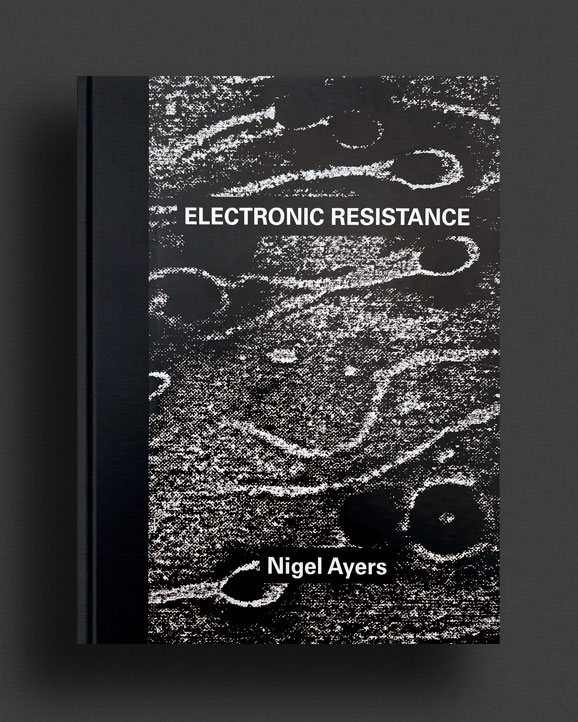
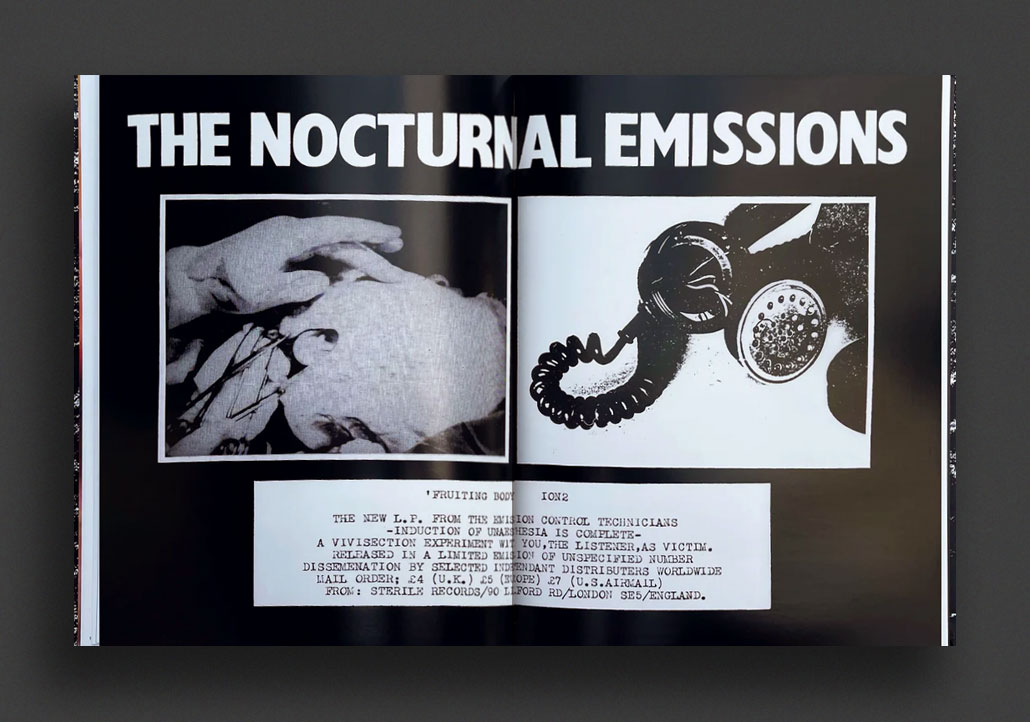
Since the late 1970s, Nigel Ayers (b. 1957, UK) has cut a bracing, subversive path through the contemporary underground, bridging DIY industrial enthusiasms with multimedia experimentation to form a singular body of work. Co-founder of the groups The Pump and Nocturnal Emissions (along with brother Daniel Ayers and then-partner Caroline Kaye), Ayers has been a contributor to and proponent of industrial music’s high-water marks, his Sterile Records imprint disseminating not only NE sides but also defining work from Lustmord, SPK, Maurizio Bianchi, and others between 1979 and 1986. In 1987, Ayers inaugurated the Earthly Delights label with the now-canonical Caroline K recording Now Wait For Last Year, and the imprint has since served as Ayers’s primary outlet for releasing new work, whether as Magnetizdat, Spanner Thru Ma Beatbox, or Nocturnal Emissions, a going concern to this day.
Published, designed, and produced by Ross Waitman and Amaya Productions in collaboration with the artist, Electronic Resistance compiles mail-art, collages, assemblages, flyers, slides, video stills, ephemera, record and tape covers to present an arresting cross-section of the genre-sundering art Nigel Ayers created between 1980 and 1992. It features an introductory reflection from Ayers, as well as an essay entitled “Bleeding Images: Antipsychiatry, Death, and Mind Control” by art historian and critic Nicholas Ballet (Université Paris-1 Panthéon-Sorbonne), contextualizing Ayers’s work and extensive career.
750 copies limited edition.
1994/2022, English
Softcover (staple-bound), 68 pages, 28 x 21.5 cm
Published by
Kunstverein Toronto / Toronto
$45.00 - In stock -
Long-awaited re—print of G.B. Jones' legendary 1994 monograph.
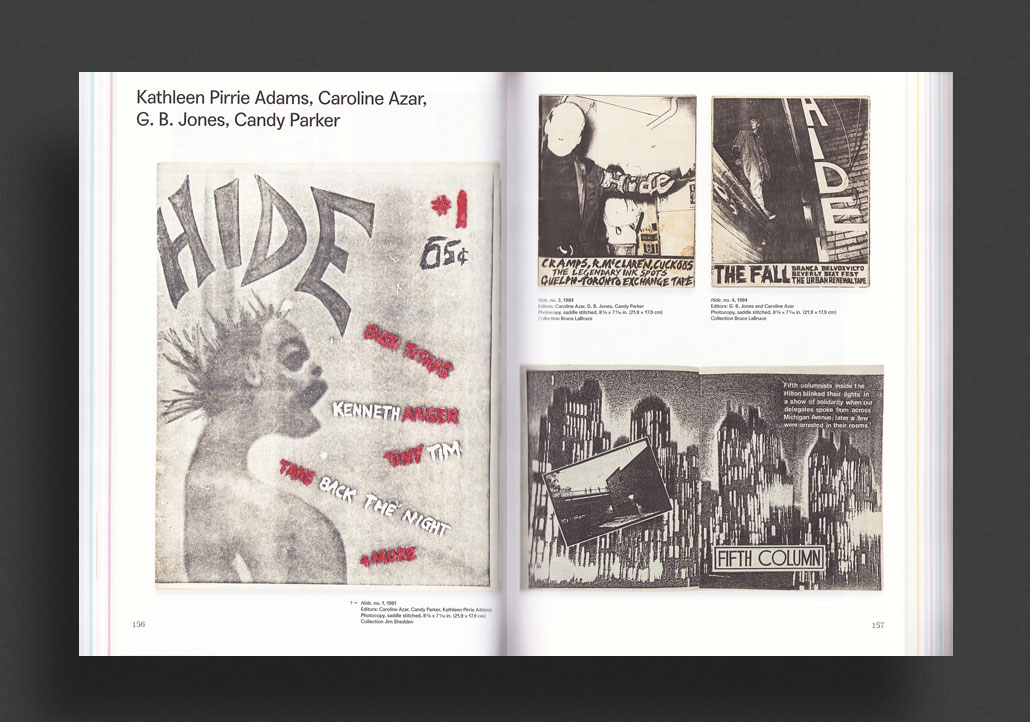
G.B. Jones (b. 1965, Bowmanville, Canada) is recognized for many accomplishments: for the success of her post-punk band Fifth Column (1981–2002), the widespread influence of the many queer punk zines she co-authored, including J.D.s, Double Bill and Hide, her coining of the term “queercore,”and her prolific work as a “no-budget” filmmaker, scene photographer and visual artist. Her drawing series, “Tom Girls,” originally published in J.D.s, replaced Tom of Finland’s iconic, “hyper-virile studs” with bold, uncompromising leather dykes, co-opting Finland’s objectified, male-on-male erotica and presenting a world of “nasty female role models”—Dodie Bellamy.
In 1994, Feature Inc. + Instituting Contemporary Idea in New York released the monograph G.B. Jones. Edited and designed by Steve Lafreniere, the book compiled Jones’ “Tom Girls” drawings alongside show and film posters, record covers, comics and commissioned writing, including contributions and appearances by Dennis Cooper, Vaginal Davis, Dodie Bellamy, Kevin Killian, Caroline Azar, Johnny Noxzema, and others. As part of a campaign by the Canadian Border Services agency against allegedly pornographic or immoral materials in the 1990s, copies of Jones’ book were seized by the Canada Border Services Agency and barred from entering the country on the charge of depicting “bondage.” Jones was later informed that the seized copies had been burned by Border Control agents.
27 years later, in collaboration with Jones, Kunstverein Toronto is putting G.B. Jones back in circulation in Canada. This re—publication of the book was published to accompany a 2022 exhibition of related drawings, photographs, posters, ephemera and tributes that reflect the reach and influence of Jones’ heterogenous practice, both at the time of the original release of G.B. Jones, and today.
1976, Portuguese
Double-sided fold-out, 4 panels, 47 x 30 cm (unfolded)
1st Edition, Out of print title / used / very good
Published by
Museu de Arte Contemporânea da Universidade de São Paulo / São Paulo
$45.00 - In stock -
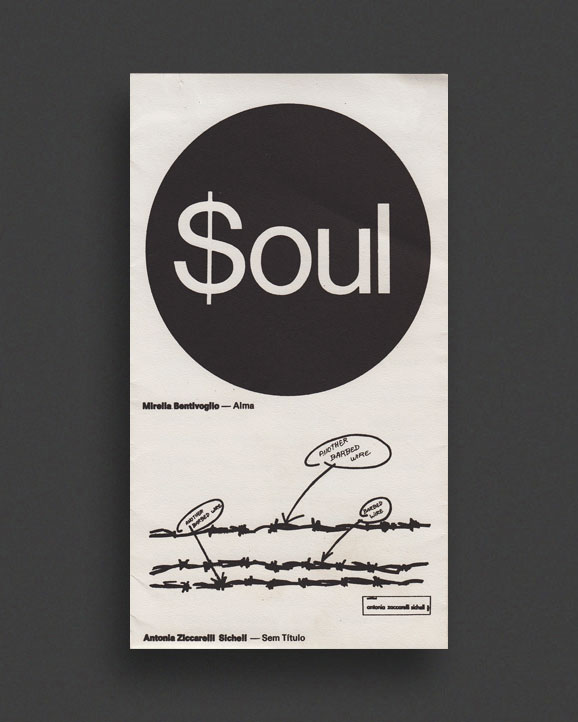
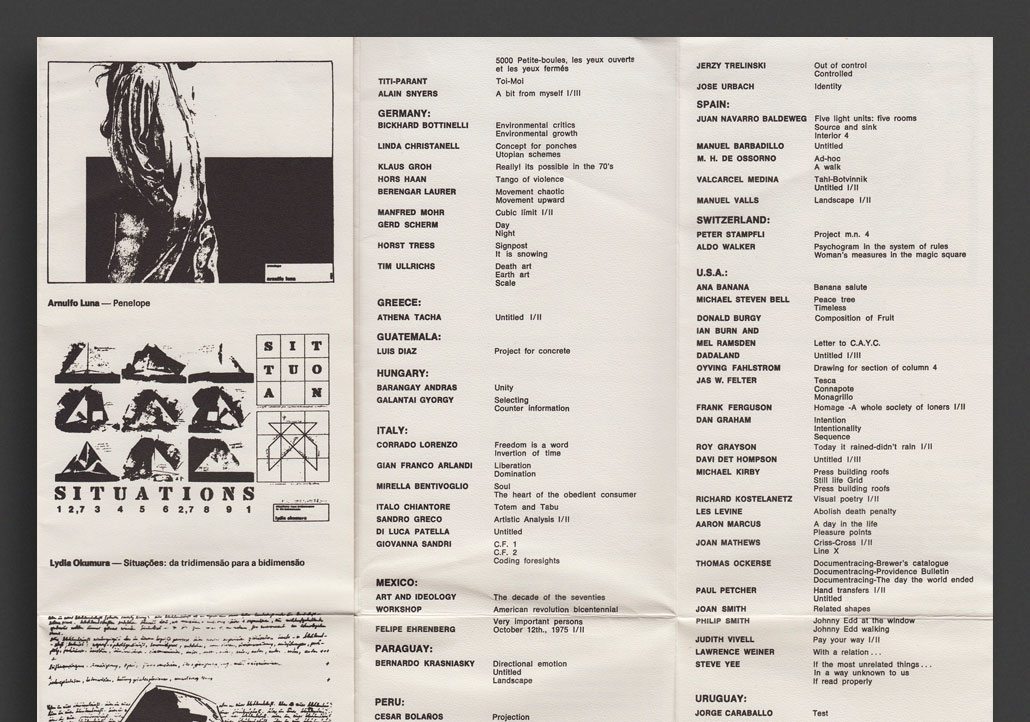
Very rare fold-out catalogue for the important international art exhibition surveying conceptual art, concrete poetry, experimental art, performance art, mail art ("activity with a critical view of society") in the 1970s organized by Argentine author, publisher, curator, professor, and conceptual artist, Jorge Glusberg, who was director of the Center for Art and Communication of Buenos Aires (CAYC). With text by Brazilian professor, historian, art critic and curator by Walter Zanini, director of the Museu de Arte Contemporânea da Universidade de Sao Paulo (MAC). With a number of the exhibited heliographic documents from the exhibition illustrated throughout, the brochure catalogues the exhibited works by participants including: Dan Graham, Lawrence Weiner, Genesis P-Orridge, Ian Burn and Mel Ramsden, Öyvind Fahlström, Július Koller, Tim Ullrichs, Luis Fernando Benedit, Jaime Davidovich, Jorge Glusberg, Víctor Grippo, Lea Lublin, Luis Pazos, Julio Plaza, Jonier Marin, Jiří Valoch, Guillermo Deisler, Juan Navarro Baldeweg, Manuel Barbadillo, MH de Ossorno, Valcárcel Medina, Felipe Ehrenberg, César Bolaños, Pawel Petasz, José Urbach, Lydia Okumura, Haroldo González, Les Levine, and many others.
Very Good copy with light wear.
2022, English
Softcover, 400 pages, 25 x 34 cm
Published by
Walther König / Köln
$89.00 $60.00 - In stock -
An essential compendium on the work, life and legacy of the transgressive autofiction pioneer.
The American author Kathy Acker was one of the most influential writers of the 20th century. Working through a tradition spanning Bataille, Burroughs, Schneemann, French critical theory and pornography, she wrote numerous novels, essays, poems and novellas from the early 1970s to the late 1990s, among them the classics The Childlike Life of the Black Tarantula, Blood and Guts in High School and In Memoriam to Identity. A truly pioneering postmodernist, plagiarist and postpunk feminist, Acker continues to inspire generations of writers, philosophers and artists, from her contemporaries such as Dodie Bellamy, Avital Ronell, McKenzie Wark and Chris Kraus to younger writers such as Bhanu Kapil and Olivia Laing.
Get Rid of Meaning is the first comprehensive publication to synthesize art and literary perspectives on Acker's work. It shows Acker's own visual sensibility in her cut-up notebooks and her use of mail-art idioms, and orients her emergence within the 1970s art scenes in New York and California populated by Eleanor Antin, Lynn Hershman Leeson and Constance DeJong, among others--artists who made innovations in performance, of which Acker would make use.
Also included is previously unpublished material from Acker's personal archive and other collections, including correspondence, her library and various personal effects.
Contributors include: Kathy Acker, Dodie Bellamy, Hanjo Berressem, Ruth Buchanan, Anja Casser, Georgina Colby, Leslie Dick, Claire Finch, Johnny Golding, Anja Kirschner, Chris Kraus, Sylvère Lotringer, Douglas A. Martin, Jason McBride, Karolin Meunier and Kerstin Stakemeier, Avital Ronell, Daniel Schulz, Matias Viegener and McKenzie Wark.
2024, English
Softcover, 80 pages, 23 x 17 cm
Published by
Hatje Cantz / Berlin
$69.00 - In stock -
At the beginning of World War II, Dada artist Hannah Höch (1889–1978) retreated to a secluded house on the outskirts of Berlin to escape fascist persecution. The adjoining garden inspired and nourished her. And this is also where she hid her unique collection of dadaist artworks. Eighty years later, this richly illustrated and thoroughly researched book combines Höch’s botanical collages and photographs of the garden with documents on her relationship with the writer Til Brugman. Together with new works by artists Scott Roben and Johanna Tiedtke based on visits to the garden, and an essay by the scholar Alhena Katsof, the book interweaves past and present, private and public, personal and political, and opens up new perspectives on Höch’s long-forgotten refuge.
1978, English
Softcover, 158 pages, 21 x 29.5 cm
1st Edition, Out of print title / used / very good
Published by
Dragon's Dream / Paris
$220.00 - Out of stock
First printing of this cult classic of magmatic erotic collage from 1978 by artist Penny Slinger and poet Nik Douglas, published by Dragon's Dream of Paris. Seized and burnt by British customs, Mountain Ecstasy is an explicit, kaleidoscopic work that melds the sacred with the profane — an ecstatic and cosmic journey to tantric utopia by way of Penny’s wild collages created from found images – many from Slinger’s own collection of erotica, saturated in colour and volcanic sensuality.
"'Mountain Ecstasy' was my celebration of Tantric alchemy, freed from any restrictions, out of the confines of the house ('An Exorcism') and into the wide-open Technicolor landscapes of the high Himalayas. I never really thought of the collages as being material for a book - as they were rather outrageous - but Dragon's Dream wanted to publish. Whereas 'An Exorcism' had been mostly my own photographs, the images for 'Mountain Ecstasy' were nearly all 'objects trouves'. I had traveled for the first time in exotic parts (India, Nepal, Thailand) and the work reflects this input. Thousands of copies of 'Mountain Ecstasy' were subsequently seized and burnt by British customs, my comment at the time was, "They thought it was pornography, they didn't realize it was its antidote"—Penny Slinger
"Magnificant erotic assemblages of nudes, flowers, masks and rocks against landscapes, they tease, they excite and they dazzle the eye and in the end the sheer voluptuous beauty of these erotic montages finally exist in their own right as works of art and nary a bullet or a bomb in them."—Arthur Moyse, Freedom Anarchist Review
Very Good copy, beautifully preserved with light cover wear/crease, tightly bound/unsunned — rare for this title.
2006, English
Hardcover (debossed faux leather bound + 7"), 26 x 23 cm
600 numbered copies,
1st Edition, Out of print title / used / fine
Published by
Hysteric Glamour / Tokyo
$120.00 - In stock -
Published in 2006 by fashion brand Hysteric Glamor in a numbered edition of 600 copies, bound in padded debossed faux leather hardcover with a 7" record, "the book is a monograph of my late 1970s photographs of my friends, the avant-garde rock group Destroy All Monsters."—Sue Rynski, Detroit photographer. Described by legendary critic Lester Bangs as "anti-rock", Destroy All Monsters was an influential Detroit rock band formed in 1973 by University of Michigan art students Mike Kelley, Jim Shaw, legendary femme fatale Niagara, and filmmaker Cary Loren, existing to 1985 with shifting personnel and sporadic performances since. Performing their first concert at a comic book convention in Ann Arbor, Michigan, on New Year's Eve of 1973, the group combined elements of punk, psych, metal and noise rock with a heavy dose of experimentation and performance art, influenced as much by ESP-Disk, Sun Ra and The Velvets, as monster movies and Futurism. The cult group earned a measure of notoriety through their coveted DAM Magazine, also due to members of The Stooges and MC5 joining the band, and Sonic Youth singer/guitarist Thurston Moore compiling a three compact disc set of the group's music in 1994.
"Born in 1954, year of the birth of rock and roll, I grew up immersed in the high energy music of my hometown Detroit. This loud, physical, emotional music took hold and became a part of me."—Sue Rynski
A stunning book published by Hysteric Glamor director Nobuhiko Kitamura, with editorial direction by : Osamu Wataya, Michitaka Ota (Sokyusha), and Koichi Hara. 7" includes the tracks "Rocking the Cradle" and "Little Boyfriend" by Destroy All Monsters.
Near Fine copy.
1985, Japanese
Softcover, 260 pages, 19 x 13 cm
1st Edition, Out of print title / used / fine
Published by
Data House / Tokyo
$200.00 - Out of stock
Possibly the most fun you can cram into 260-odd pages! A now very collectible volume edited by none other than Japanese master of erotic superrealism, Hajime Sorayama, Pink Department Store is a wild book digest of visual sex — straight out of 1985! A compendium of remarkable erotic imagery packed into this one-stop look-book of kink compiled by Sorayama, all reproduced in full-colour on beautiful warm raw paper stock, designed by Hisao Iguchi. From the Tokyo sex clubs, phone-booths and toilet stalls, Shibari photography to pink film posters, x-rated manga to wildlife fornication, leather daddys to dominatrixes, Pink Department Store is a safari through graphic perversion and joyous visual innuendo. Alongside archival material and international works the book generously features an abundance of works by over 100 contemporary Japanese illustrators and photographers, including Aimei Ozaki, Harumi Yamaguchi, Takashi Nemoto, Yosuke Onishi, Suehiro Maruo, Hajime Sorayama, Mizumaru Anzai, Yokoyama Akira, Keiichi Ota, Akira Ishigaki, Kaoru Ueda, Teruhiko Yumura, Yoshiharu Ebisu, Arata Taga, to name but a few. There is also a directory list to contact them all!
Very Good—NF copy in VG original dust jacket and rarely preserved publisher's obi-strip.
1991, English
Softcover (staplebound), unpaginated, 17 x 17 cm
1st Edition, Out of print title / used / very good
Published by
Iowa Chapter of the Aggressive School of Cultural Workers / Iowa
$65.00 - Out of stock
Very rare, bullet-holed, anti-Gulf War catalogue published in 1991 by the Iowa Chapter of the Aggressive School of Cultural Workers on the occasion of a huge international mailart exhibition mounted in response to the US backed United Nations coalition announcement to use force to oust Saddam Hussein from Kuwait. Opposed to the looming Persian Gulf War, a call out for work from the international correspondence network resulted in 151 contributions from a total of 25 countries, exhibited in three Iowa City locations, with plans to travel the exhibition to Kill Time Space, Philadelphia, and ABC No Rio, New York, after this catalogue was published.
Packed with xerox collage artworks reproduced full-bleed in b/w, the catalogue has a comprehensive index of the many contributors, texts by the Iowa Chapter of the Aggressive School of Cultural Workers, with the pink insert reproduced text by the Bureau of Public Secrets, 'The War and The Spectacle'. The catalogues were then shot by a member of the US Army Reserves.
Very Good copy with light age.
2000, English
Hardcover (w. dust jacket), 400 pages, 24 x 32 cm
1st Edition, Out of print title / used / very good
Published by
Argo / Prague
$190.00 - Out of stock
First edition of the most comprehensive English-language monograph ever published on Czech Surrealist Toyen (Marie Cerninova; 1902-1980). Published on the occasion of the major survey exhibition in the Prague City Gallery, this exhaustive 400 page hardcover volume is profusely illustrated with around 480 of Toyen's works, many undocumented elsewhere, alongside contemporary specialist studies on her work, with major contributions by Czech art historian and curator Karel Srp, Radovan Ivsic, Karolina Vocadlo, and Marie Cerminova. Highly recommended.
Marie Čermínová (1902 – 1980), known as Toyen, was a Czech painter, drafter and illustrator and a member of the Surrealist movement. Born in Smíchov, Bohemia, she left home at the age of 16 and worked at a soap factory in Zizkov while putting himself through school. She worked closely with fellow Surrealist poet and artist Jindřich Štyrský, both joining and exhibiting with the Devětsil group in 1923. In the 1920s they travelled to Paris and founded an artistic alternative to Abstraction and Surrealism, which they dubbed Artificialism, returning to Prague in 1928. Toyen's sketches, book illustrations, and paintings were frequently erotic, illustrating the Marquis de Sade's "Justine" under Štyrský's publishing imprint, Edice 69, as well as contributing many erotic sketches to Štyrský's Eroticka Revue (1930–33), published on strict subscription terms with a circulation of 150 copies. Toyen and Štyrský gradually grew more interested in Surrealism. After their associates Vítězslav Nezval and Jindřich Honzl met André Breton in Paris, they founded the Czech Surrealist Group along with other artists, writers, film makers and the composer Jaroslav Ježek. Toyen was one of the few female Surrealists, along with Claude Cahun, Leonora Carrington and a handful of others. While Cahun examined the fluidity of gender roles, Toyen dispensed with gender altogether. Toyen often dressed in men's clothing and preferred masculine pronouns, choosing a non-conformist position when it came to gender and sexuality, themes heavily mined in Surrealist art. Forced underground during the Nazi occupation and Second World War, he sheltered his second artistic partner, Jindřich Heisler, a poet of Jewish descent who had joined the Czech Surrealist Group in 1938. The two relocated to Paris in 1947, before the Communist takeover of Czechoslovakia in 1948. In Paris, they worked with André Breton, Benjamin Péret, and other members of the surrealist movement.
Very Good copy in Good-Very Good dust jacket (small tear to bottom-left corner).
2002, French
Softcover, 264 pages, 23.5 cm x 27.5 cm
1st Edition, Out of print title / used / good
Published by
Artha / Saint Etienne
$200.00 - In stock -
First edition of Une Femme Surrealiste — one of the finest reference volumes ever published on the great Czech transgender surrealist Toyen (1902—1980). Edited by noted Toyen authority and exhibition curator Karel Srp, this lavishly illustrated catalogue was published on the occasion of the major retrospective exhibition held June 20 —Sep 30, 2002 at the Musee d'Art Moderne, Saint Etienne, France. Photo illustrated chronology and extensive catalogue of artworks in colour and b/w (149 works — paintings, drawings, lithographs, collages.....) Texts in French.
Marie Čermínová (1902 – 1980), known as Toyen, was a Czech painter, drafter and illustrator and a member of the Surrealist movement. Born in Smíchov, Bohemia, she left home at the age of 16 and worked at a soap factory in Zizkov while putting himself through school. She worked closely with fellow Surrealist poet and artist Jindřich Štyrský, both joining and exhibiting with the Devětsil group in 1923. In the 1920s they travelled to Paris and founded an artistic alternative to Abstraction and Surrealism, which they dubbed Artificialism, returning to Prague in 1928. Toyen's sketches, book illustrations, and paintings were frequently erotic, illustrating the Marquis de Sade's "Justine" under Štyrský's publishing imprint, Edice 69, as well as contributing many erotic sketches to Štyrský's Eroticka Revue (1930–33), published on strict subscription terms with a circulation of 150 copies. Toyen and Štyrský gradually grew more interested in Surrealism. After their associates Vítězslav Nezval and Jindřich Honzl met André Breton in Paris, they founded the Czech Surrealist Group along with other artists, writers, film makers and the composer Jaroslav Ježek. Toyen was one of the few female Surrealists, along with Claude Cahun, Leonora Carrington and a handful of others. While Cahun examined the fluidity of gender roles, Toyen dispensed with gender altogether. Toyen often dressed in men's clothing and preferred masculine pronouns, choosing a non-conformist position when it came to gender and sexuality, themes heavily mined in Surrealist art. Forced underground during the Nazi occupation and Second World War, he sheltered his second artistic partner, Jindřich Heisler, a poet of Jewish descent who had joined the Czech Surrealist Group in 1938. The two relocated to Paris in 1947, before the Communist takeover of Czechoslovakia in 1948. In Paris, they worked with André Breton, Benjamin Péret, and other members of the surrealist movement.
Good copy with knock to bottom spine corner, light age wear.
1970, Japanese
Softcover, 250 pages, 21 x 14.8 cm
1st Edition, Out of print title / used / good
Published by
Misaki Shobo / Tokyo
$30.00 - Out of stock
Erotica December 1970, Japan's erotic magazine for bibliophiles, published in the 1960s—1970s by Misaki Bookstore. Each issue densely packed with illustrations, articles, news, and feature stories around the universe of Eros from around the world during a time of great sexual revolution. Covering all manner of sexual customs and subject matter from the arts and literature, film and manga, philosophy and radical politics, Erotica was Japan's leading erotic academic journal, featuring, amongst it's heavy historical and contemporary papers, the cutting-edge of Japanese and international erotic artists, from Hans Bellmer to Toshio Saeki.
Erotica December 1970 is themed "The Eros of Theatre: The Aesthetics of Voluptuousness".
Good copy, light wear/age.
2023, English
Hardcover, 240 pages, 22.3 x 27.3 cm
Published by
Princeton University Press / New York
$70.00 - Out of stock
A richly illustrated exploration of Mina Loy's art and writings.
Mina Loy (1882-1966) was one of the most iconoclastic figures in modernism. A groundbreaking poet, she also left an indelible mark in painting, drawing, prose, art criticism and fashion. This book is the first to examine the full scope of her extraordinary career, demonstrating Loy's transformative impact on the visual arts as well as the literary avant-garde of the twentieth century. Presenting dozens of Loy's paintings, drawings and constructions alongside selections of her poems and writings, this book gives a comprehensive overview of the complex images and objects Loy created and situates them in the larger context of her life and work. It explores Loy's pursuit of truth and beauty, arguing that her engagement with the emphatically "unbeautiful" materials of the Bowery - such as rags and bottle caps - reflects her questioning of truth.
The book positions Loy within the broader context of surrealist art; sheds light on her relationships with influential figures such as Gertrude Stein, Marcel Duchamp and Wyndham Lewis; and addresses Loy's enduring relevance today. Featuring rare and previously unpublished artworks, Mina Loy: Strangeness Is Inevitable reveals this visionary artist's extraordinary contributions as an image-maker, writer, and cultural arbiter, introducing her work to a new generation of readers and charting new directions in art history, women's studies, poetry, and modernist studies.
Published in association with the Bowdoin College Museum of Art Exhibition Schedule Bowdoin College Museum of Art, Brunswick, Maine April 6 September 17, 2023
1991, English
Softcover (staple-bound), approx 60 pages, 21.5 x 13.5 cm
1st Edition, Out of print title / used / very good
Published by
The Drawing Legion / Iowa City
$35.00 - Out of stock
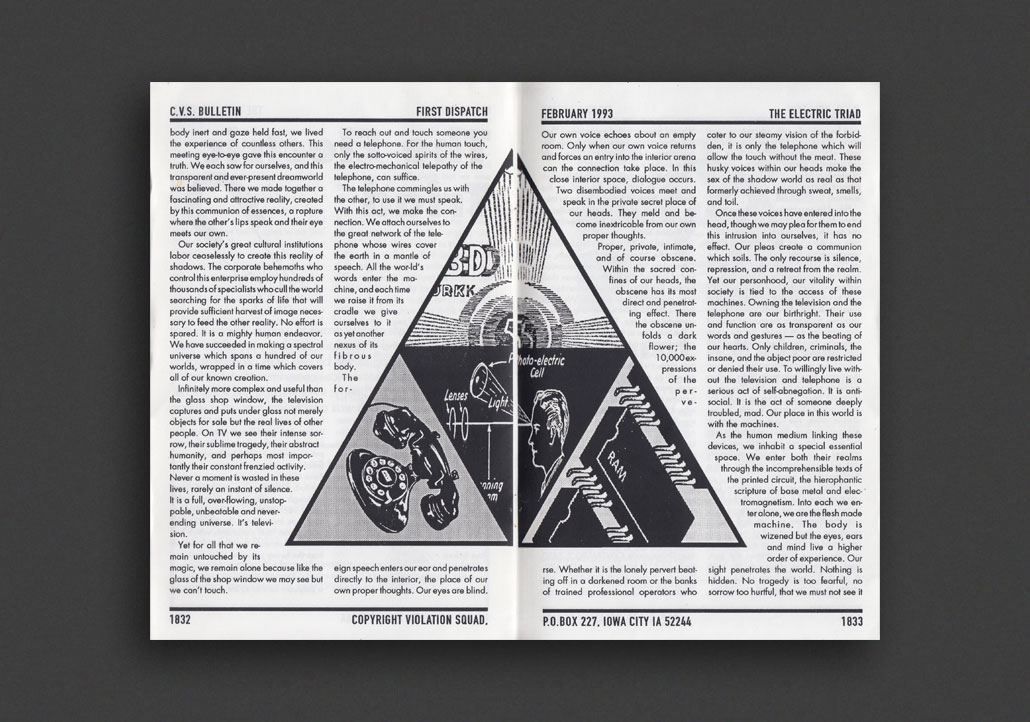
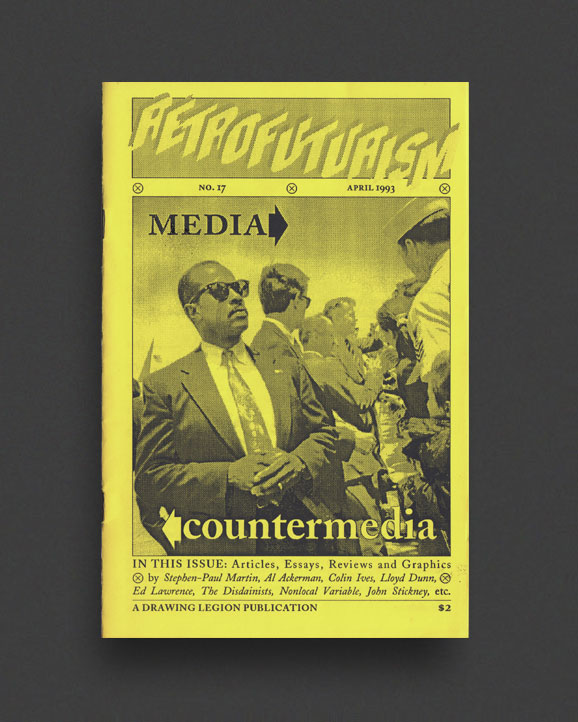
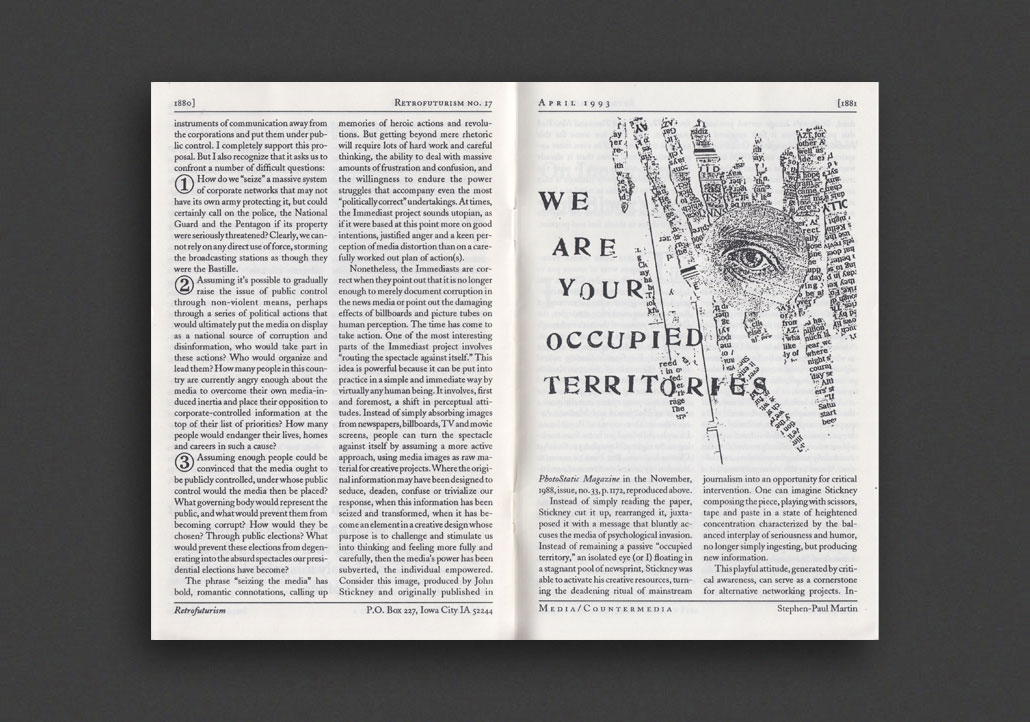
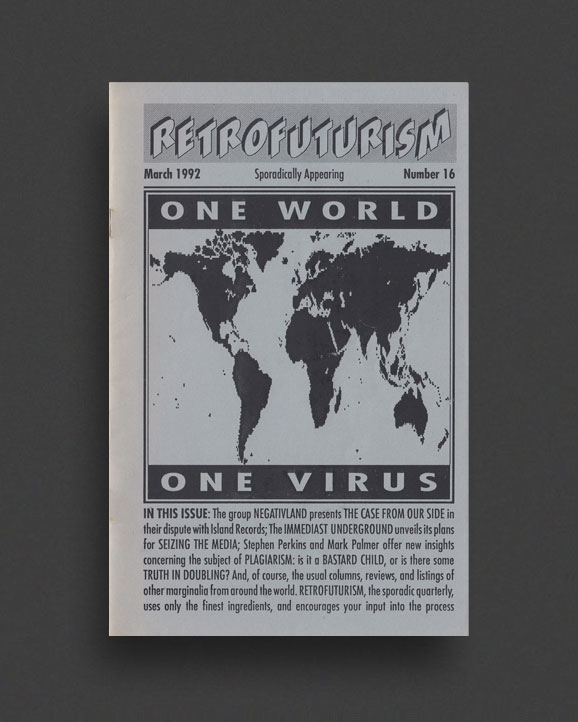
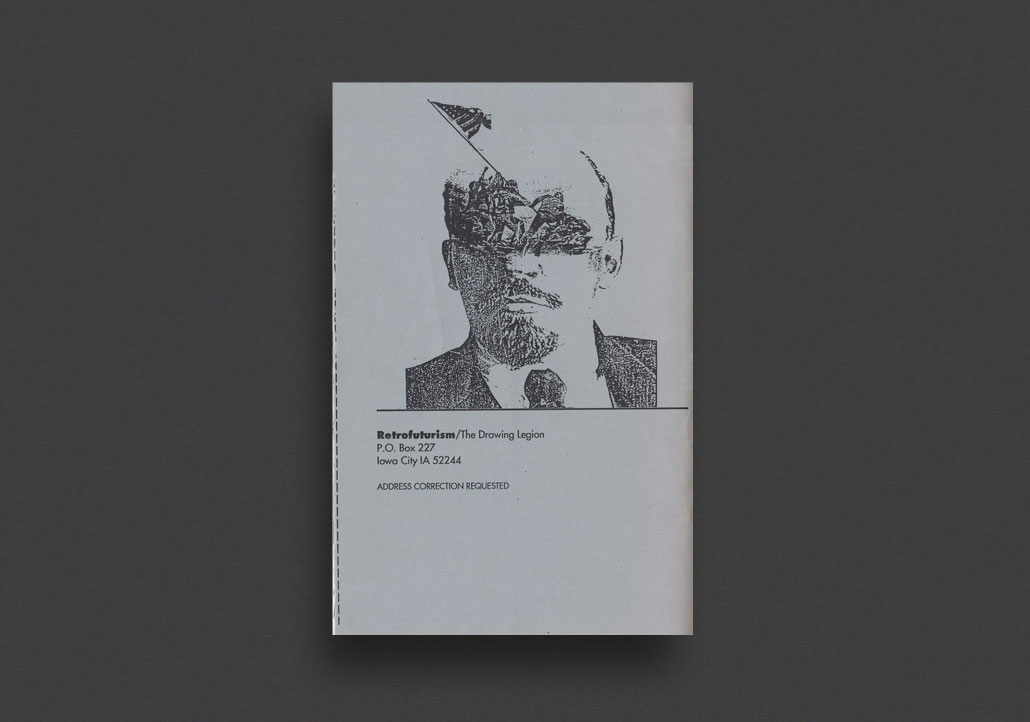
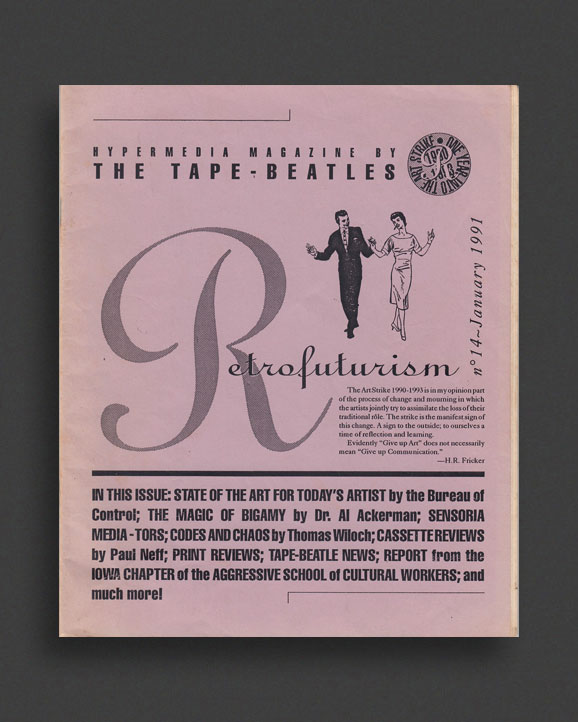
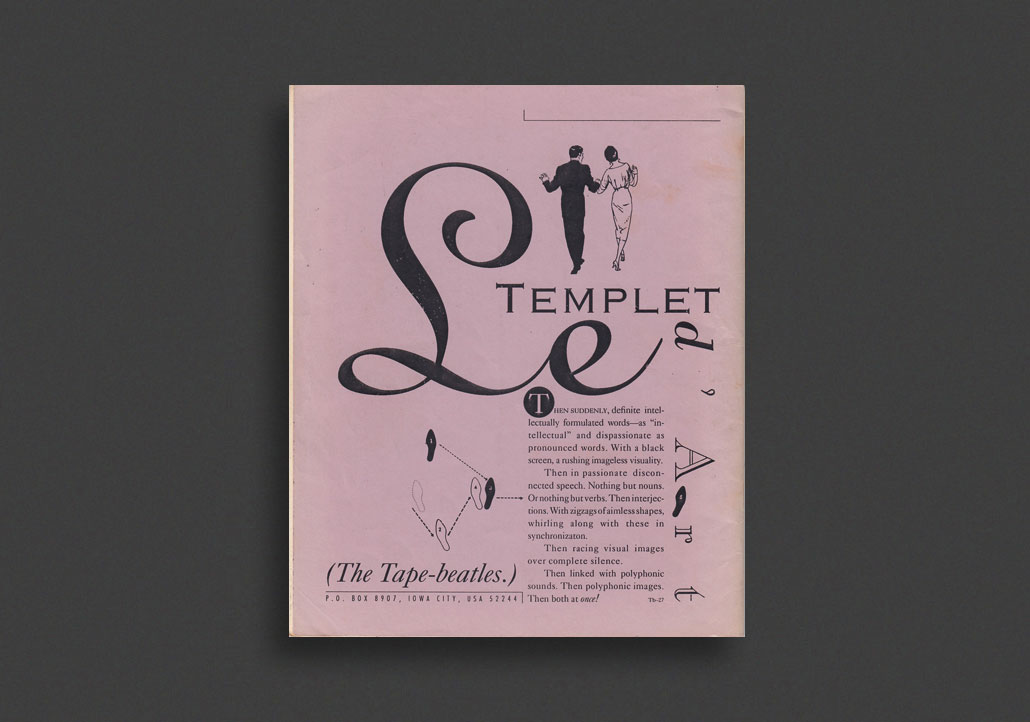
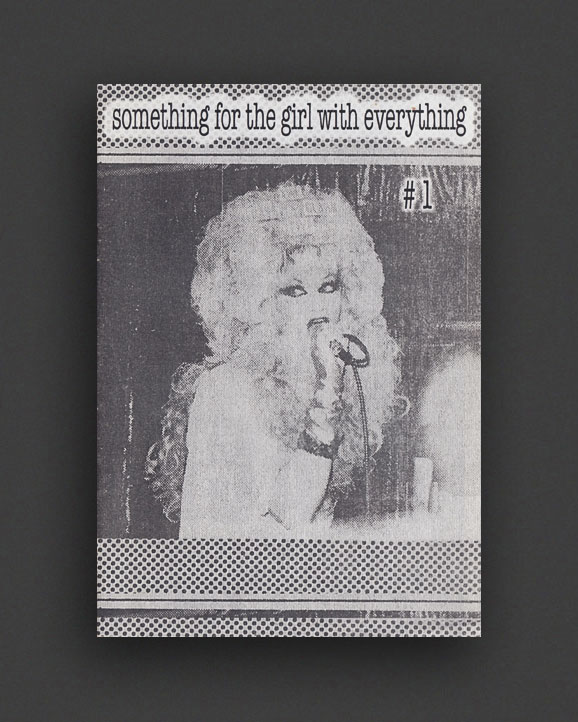
Very rare issue of Retrofuturism, the sporadically appearing hyper-media magazine edited by The Tape-beatles, a multi-media and experimental audio art group that formed in Iowa City in December 1986, informed by musique concrète and heavily involved in the new networked mail art, cassette and ‘zine sub-cultures of the late 1980's. Retrofuturism was one of their many editorial periodical projects.
Retrofuturism no. 15, August 1991 features: Plans for an INTERNATIONAL NETWORKING CONGRESS 1992, THE WAR AND THE SPECTACLE by the Bureau of Public Secrets, CODES AND CHAOS by Thomas Wiloch, THE EPISTEMOLOGY OF eSCHATOLOGY by Ben G. Price, CONFESSIONS OF A POSTERIST by Barney Rubble, A NEW YORK EXPERIENCE by Eliza Blackweb, THE NEED FOR PLAGIARISM by Karen Eliot, TAPE-BEATLE NEWS, Reviews and Listings of Audio and Print Productions From Around The World..
Very Good copy, aged staples/edges.