World Food Books' programme is largely produced on Kulin Nation land. We acknowledge the Wurundjeri people of the Kulin Nation as the first and continuing custodians of this land, and pay respect to their Elders past, present, and emerging.
World Food Books is an arts and special interests bookshop in Naarm / Melbourne. Founded in 2010, World Food Books is devoted to the presentation of a rotating, hand-selection of international art, design, literary and counterculture publications with an emphasis on the anti-traditional, the experimental, the avant-garde, the heretic, the marginal.
Presenting new titles alongside rare and out-of-print books, catalogues and journals spanning the fields of modern and contemporary art, design, photography, illustration, film, literature, poetry, cultural theory, philosophy, sexuality, popular and underground culture in its many radical forms, World Food Books wishes to encourage adventurous, thoughtful and open-minded reading, looking, writing, and exchange of publishing and ideas, both current and historical.
As well as our bookshop, located in Melbourne's historical Nicholas Building, all of our inventory is available internationally via our online mail-order service.
World Food Books semi-regularly co-ordinates "Occasions", a programme of exhibits and events at the bookshop and in partnership with other hosts (such as museums and art galleries) that develop out of the activities, relationships and content of the bookshop itself.
World Food Books
The Nicholas Building
37 Swanston Street
Room 5, Level 6
Melbourne 3000
Australia
SHOP HOURS:
Thu–Sat 11–5
WEB-SHOP OPEN 24/7
World Food Books
Postal Address:
PO Box 435
Flinders Lane
Victoria 8009
Australia
Art
Theory / Essay
Architecture / Interior
Graphic Design / Typography
Photography
Fashion
Eros
LGBTQ+
Fiction / Poetry
Weird / Speculative / Science Fiction / Horror
Transgressive / Visceral / Abject
Symbolism / Decadence / Fin de siècle
Film / Video
Painting
Sculpture / Installation
Performance / Dance / Theater
Drawing
Sound / Music
Curatorial
Group Shows / Collections
Periodicals
Out-of-print / Rare
Posters / Ephemera / Discs
Signed Books
World Food Books Gift Voucher
World Food Book Bag
Australian Art
Australian Fiction
Australian Science Fiction / Speculative Fiction
Australian Poetry
Australian Photography
Japanese Photography
Conceptual Art
Minimal Art
Dada
'Pataphysics / Oulipo
Fluxus
Concrete Poetry
Pop Art
Surrealism
Arte Povera
Arte Informale / Haute Pâte / Tachism
Nouveau Réalisme / Zero / Kinetic
Situationism / Lettrism
Collage / Mail Art / Xerox Art
Art Brut / Folk / Visionary / Fantastic
Illustration / Graphic Art / Bandes Dessinées
Furniture
Italian Radical Design / Postmodernism
Textiles
Ceramics / Glass
Counterculture
Protest / Revolt
Philosophy
Psychoanalysis
Anthropology
Anarchism
Socialism / Anarchism / Communism / Capitalism
Literary Theory / Semiotics / Language
Feminism / Women's Studies
Gender Studies / Sexuality
Anthropology
Fetishism / BDSM
Drugs / Psychedelia
Crime / Violence
Animal Rights / Veganism
Occult / Esoterica
Ecology / Earth / Alternative Living
Whole Earth / Crafts
All prices in AUD (Australian dollars)
Pick-Ups
Pick-up orders can be collected in our bookshop during opening hours after order date. Please collect any Pick-up orders within 2 weeks of ordering as we have limited storage space. Orders will be released back into stock if not collected within this time. No refunds can be made for pick-ups left un-collected. If you cannot make it in to the bookshop in this time-frame, please choose postage option.
Return Policy
All sales are final. We do accept returns (for refund or exchange) for items received in error. All our orders are packed with special care using heavy-duty padding and cardboard book-mailers or bubble mailers (for smaller books), using reinforcement where required. We cannot take responsibility for any lost, stolen or damaged parcels.
Insurance
Should you wish to insure your package, please email us directly after placing your order and we can organise this at a small extra expense. Although all standard/express tracked packages are very safe and dependable, we cannot take responsibility for any lost, stolen or damaged parcels. We recommend insurance on valuable orders.
Interested in selling your old books, catalogues, journals, magazines, comics, fanzines, ephemera? We are always looking for interesting, unusual and out-of-print books to buy. We only buy books in our fields of interest and specialty, and that we feel we can resell.
We base these prices on desirability, market value, in-print prices, condition and our current stock levels. We offer cash, store credit, and can take stock on consignment. All
about 25% of the price we expect to get when we sell them, or 30% in store credit. We base these prices on desirability, market value, in-print prices, condition and our current stock levels.
Sell your books any day of the week. You can drop them off and return later. If you have a lot of books, we can visit your Sydney home.
We buy books that we feel we can resell. We offer about 25 % of the price we expect to get when we sell them, or 30% in store credit. We base these prices on desirability, market value, in-print prices, condition and our current stock levels.
Philadelphia Wireman
03 August - 01 September, 2018
World Food Books is proud to announce our next Occasion, the first presentation of sculptures by Philadelphia Wireman in Australia.
The Philadelphia Wireman sculptures were found abandoned in an alley off Philadelphia’s South Street on trash night in 1982. Their discovery in a rapidly-changing neighbourhood undergoing extensive renovation, compounded with the failure of all attempts to locate the artist, suggests that the works may have been discarded after the maker’s death. Dubbed the "Philadelphia Wireman" during the first exhibition of this work, in 1985, the maker’s name, age, ethnicity, and even gender remain uncertain. The entire collection totals approximately 1200 pieces, all intricately bound together with tightly-wound heavy-gauge wire (along with a few small, abstract marker drawings, reminiscent both of Mark Tobey and J.B. Murry). The dense construction of the work, despite a modest range of scale and materials, is singularly obsessive and disciplined in design: a wire armature or exoskeleton firmly binds a bricolage of found objects including plastic, glass, food packaging, umbrella parts, tape, rubber, batteries, pens, leather, reflectors, nuts and bolts, nails, foil, coins, toys, watches, eyeglasses, tools, and jewellery.
Heavy with associations—anthropomorphic, zoomorphic, and socio-cultural responses to wrapped detritus—the totemic sculptures by Philadelphia Wireman have been discussed in the context of work created to fulfil the shamanistic needs of alternative religions in American culture. Curators, collectors, and critics have variously compared certain pieces to sculpture from Classical antiquity, Native American medicine bundles, African-American memory jugs, and African fetish objects. Reflecting the artist’s prolific and incredibly focused scavenging impulse, and despite—or perhaps enhanced by—their anonymity, these enigmatic objects function as urban artefacts and arbiters of power, though their origin and purpose is unknown. Philadelphia Wireman, whatever their identity, possessed an astonishing ability to isolate and communicate the concepts of power and energy through the selection and transformation of ordinary materials. Over the course of the past two decades, this collection has come to be regarded as an important discovery in the field of self-taught art and vernacular art.
Presented in collaboration with Fleisher-Ollman Gallery, Philadelphia, and Robert Heald, Wellington.
Susan Te Kahurangi King
02 February - 10 March, 2018
Susan Te Kahurangi King (24 February 1951 - ) has been a confident and prolific artist since she was a young child, drawing with readily available materials - pencils, ballpoint pens and felt-tip markers, on whatever paper is at hand. Between the ages of four and six Susan slowly ceased verbal communication. Her grandparents William and Myrtle Murphy had developed a special bond with Susan so they took on caring responsibilities for extended periods. Myrtle began informally archiving her work, carefully collecting and storing the drawings and compiling scrapbooks. No drawing was insignificant; every scrap of paper was kept. The King family are now the custodians of a vast collection containing over 7000 individual works, from tiny scraps of paper through to 5 meter long rolls.
The scrapbooks and diaries reveal Myrtle to be a woman of great patience and compassion, seeking to understand a child who was not always behaving as expected. She encouraged Susan to be observant, to explore her environment and absorb all the sights and sounds. Myrtle would show Susan’s drawings to friends and people in her community that she had dealings with, such as shopkeepers and postal workers, but this was not simply a case of a grandmother’s bias. She recognised that Susan had developed a sophisticated and unique visual language and sincerely believed that her art deserved serious attention.
This was an unorthodox attitude for the time. To provide some context, Jean Dubuffet coined the term Art Brut in 1945 to describe work created by self-taught artists – specifically residents of psychiatric institutions and those he considered to be visionaries or eccentrics. In 1972 Roger Cardinal extended this concept by adopting the term Outsider Art to describe work made by non-academically trained artists operating outside of mainstream art networks through choice or circumstance. Susan was born in Te Aroha, New Zealand in 1951, far from the artistic hubs of Paris and London that Dubuffet and Cardinal operated in. That Myrtle fêted Susan as a self-taught artist who deserved to be taken seriously shows how progressive her attitudes were.
Susan’s parents Doug and Dawn were also progressive. Over the years they had consulted numerous health practitioners about Susan’s condition, as the medical establishment could not provide an explanation as to why she had lapsed into silence. Dawn educated herself in the field of homeopathy and went on to treat all twelve of her children using these principles – basing prescriptions on her observations of their physical, mental and emotional state.
Doug was a linguist with an interest in philosophy who devoted what little spare time he had to studying Maori language and culture. To some extent their willingness to explore the fringes of the mainstream made them outsiders too but it was their commitment to living with integrity and their respect for individuality that ensured Susan’s creativity was always encouraged.
Even though Susan’s family supported her artistic pursuits, some staff in schools and hospitals saw it as an impediment to her assimilation into the community and discouraged it in a variety of ways. Her family was not always aware of this and therefore did not fully understand why Susan stopped drawing in the early 1990s. However, rather than dwell on the challenges that Susan faced in pursuit of her artistic practice, they prefer to highlight her achievements. In 2008 Susan began drawing again in earnest, after an almost 20 year interruption, and her work is now shown in galleries around the world.
Susan grew up without television and has been heavily influenced by the comics she read as a child. She is absolutely fearless in the appropriation of recognizable characters, such as Donald Duck and Mickey Mouse, in her work. She twists their limbs, contorts their faces, compresses them together, blends them into complex patterned backgrounds - always imbuing them with an incredible energy. Although Susan often used pop culture characters in her work they are not naive or childlike. These are drawings by a brilliant self-taught artist who has been creating exceptional work for decades without an audience in mind.
Mladen Stilinović
"Various Works 1986 - 1999"
02 February 16 - September 10, 2016
Various works 1986 - 1999, from two houses, from the collections of John Nixon, Sue Cramer, Kerrie Poliness, Peter Haffenden and Phoebe Haffenden.
Including: Geometry of Cakes (various shelves), 1993; Poor People’s Law (black and white plate), 1993; White Absence (glasses, ruler, set square, silver spoon, silver ladel with skin photograph and wooden cubes), 1990-1996; Exploitation of the Dead (grey and red star painting, wooden painting, black spoon with red table, red plate), 1984-1990; Money and Zeros (zero tie, paintings made for friends in Australia (Sue, John, Kerrie), numbers painting), 1991-1992; Words - Slogans (various t-shirts) - “they talk about the death of art...help! someone is trying to kill me”, “my sweet little lamb”, “work is a disease - Karl Marx”; Various artist books, catalogues, monographs, videos; Poster from exhibition Insulting Anarchy; "Circular" Croatian - Australian edition; Artist book by Vlado Martek (Dostoyevsky); more.
Thanks to Mladen Stilinović and Branka Stipančić.
Jonathan Walker
Always Will Need To Wear Winter Shirt Blue + Ochre Small Check Pattern
21 August - 21 September, 2015
Untitled
I am not a great reader of poetry but I always return to the work of Melbourne poet, Vincent Buckley (1925- 1988). Perhaps I find his most tantalising piece to be not a finished poem but a fragment left on a scrap of paper discovered on his desk after the poet’s death.
The poetry gathers like oil
In the word-core, and spreads
It has its music meet,
Its music is in movement.
This fragment is more the shell left behind from a volatile thought than a finished poem. I find the last two lines honest but awkward whereas the first two lines work like an arrow. Most likely he could not find a resolution so it was left. Still, in its present form, it remains an eloquent testimony to the ultimate failure of a medium to express mobile thought and sensation, in Buckley’s case, through verbal language. It’s an important matter because this is something all artists have to deal with regardless of the medium.
I have never written a poem, however, I am forever copying fragments from books on paper scraps in a vain effort to fix certain notions in my head. At first, they function as bookmarks that are sometimes returned to when I open the book. But before long, as they accumulate, they fall out littering the table interspersed with A4 photocopies, bills, books and medications.
To return to Buckley’s fragment, the first two lines very much evoke how I paint nowadays. As you age, detail diminishes and patches of light become more luminous and float. I feel the most honest way of dealing with this is by smearing the oil paint on the canvas with the fingers and working close-up, blind. Only if the patches coalesce into an approaching image can the work gain a life.
-
Jonathan Walker was born in Melbourne, Australia and brought up on a dairy farm in Gippsland. In the 1970’s he studied painting at RMIT and won the Harold Wright Scholarship to the British Museum, London. During the 1980’s he exhibited at Pinacotheca Gallery, Richmond and had work shown at the NGV and Heidi City Art Gallery. Over the same period he designed the cover for the “Epigenesi” LP by Giancarlo Toniutti, Italy and conducted a mail exchange work with Achim Wollscheid, Germany. The work with artists through the post resulted in an article published in the bicentenary issue of Art and Australia 1988. He showed in artist run spaces such as WestSpace in the 90’s and 2000’s, and until 2012, taught painting at Victoria University, which is where we (Colleen Ahern and Lisa Radford) as organisers of the exhibition, among many others, had the privilege of being his student.
Walker’s knowledge was imparted to students through the careful selection of music, literature, and artists found in books that he himself had ordered for the library. Walker’s strategy was the generosity of sharing his vast knowledge with references specific to each student and their context.
Walker’s paintings share a similar focus and intimacy.
This exhibition presents a small selection of recent paintings alongside a publication that includes Walker’s writing. Observational and analytical, Walker’s work is a type of material notation — the time of day, colour and how it is blended, the both specific and fleeting location of a reflection on lino or the question of whether a chair leg should be included in a painting.
Please join us on Friday August 21 between 6-8pm to celebrate the opening of the exhibition.
Curated by Colleen Ahern and Lisa Radford.
B. Wurtz
Curated by Nic Tammens
March 26 - April 4, 2015
B.Wurtz works from a basement studio in his home on Manhattan’s Lower East Side.
This local fact is attested to by the plastic shopping bags and newsprint circulars that appear in his work. As formal objects, they don’t make loud claims about their origins but nonetheless transmit street addresses and places of business from the bottom of this long thin island. Like plenty of artists, Wurtz is affected by what is local and what is consumed. His work is underpinned by this ethic. It often speaks from a neighborhood or reads like the contents of a hamper:
“BLACK PLUMS $1.29 lb.”
“Food Bazaar”
“USDA Whole Pork Shoulder Picnic 99c lb.”
“RITE AID Pharmacy, with us it’s personal.”
“H. Brickman & Sons.”
“Sweet Yams 59c lb."
Most of the work in this exhibition was made while the artist was in residence at Dieu Donne, a workshop dedicated to paper craft in Midtown. Here Wurtz fabricated assemblages with paper and objects that are relatively lightweight, with the intention that they would be easily transportable to Australia. This consideration isn’t absolute in Wurtz’s work, but was prescriptive for making the current exhibition light and cheap. Packed in two boxes, these works were sent from a USPS post office on the Lower East Side and delivered to North Melbourne by Australia Post.
Wurtz appears courtesy of Metro Pictures, New York.
Thanks to Rob Halverson, Joshua Petherick, Sari de Mallory, Matt Hinkley, Helen Johnson, Fayen d'Evie, Ask Kilmartin, Lisa Radon, Ellena Savage, Yale Union, and "Elizabeth".
John Nixon
"Archive"
December 15 - January 20, 2014
The presentation of John Nixon's archive offered a rare showcase of this extensive collection of the artist's own publications, catalogues, posters, ephemera, editions and more, from the mid 1980s onwards, alongside a selection of his artworks.
Organized by John Nixon, Joshua Petherick and Matt Hinkley.
<a href=http://wfb.public-office.info/artist/john-nixon>All titles by John Nixon
"Habitat"
at Minerva, Sydney (organised by Joshua Petherick and Matt Hinkley)
November 15 - December 20, 2014
Lupo Borgonovo, Janet Burchill & Jennifer McCamley,
Lewis Fidock, HR Giger, Piero Gilardi, Veit Laurent Kurz,
Cinzia Ruggeri, Michael E. Smith, Lucie Stahl, Daniel Weil, Wols
Press Release:
“...It contained seven objects. The slender fluted bone, surely formed for flight, surely from the wing of some large bird. Three archaic circuitboards, faced with mazes of gold. A smooth white sphere of baked clay. An age-blackened fragment of lace. A fingerlength segment of what she assumed was bone from a human wrist, grayish white, inset smoothly with the silicon shaft of a small instrument that must once have ridden flush with the surface of the skin - but the thing’s face was seared and blackened.”
William Gibson, “Count Zero”, 1986
"Autumn Projects Archive"
Curated by Liza Vasiliou
March 6 - March 15, 2014
World Food Books, in conjunction with the Virgin Australia Melbourne Fashion Festival 2014, presented the Autumn Projects archive, consisting of a selection of early examples in Australian fashion with a particular interest in collecting designers and labels from the period beginning in the 1980’s, who significantly influenced the discourse of Australian Fashion.
Curated by Liza Vasiliou, the exhibition provided a unique opportunity to view pieces by designers Anthea Crawford, Barbara Vandenberg, Geoff Liddell and labels CR Australia, Covers, Jag along with early experimental collage pieces by Prue Acton and Sally Browne’s ‘Fragments’ collection, suspended throughout the functioning World Food Books shop in Melbourne.
H.B. Peace
presented by CENTRE FOR STYLE
November 14, 2013
"Hey Blinky, you say chic, I say same"
Anon 2013
H.B. Peace is a clothing collaboration between great friends Blake Barns and Hugh Egan Westland. Their pieces explore the divergences between 'character’ and ‘personality’ in garments....etc
Special Thanks to Joshua Petherick and Matt Hinkley of WFB and Gillian Mears
and a Very Special Thank you to Audrey Thomas Hayes for her shoe collaboration.
Janet Burchill & Jennifer McCamley
"Aesthetic Suicide"
May 10 - June 8, 2013
The first of our occasional exhibitions in the World Food Books office/shop space in Melbourne, "Aesthetic Suicide" presented a body of new and older works together by artists Janet Burchill & Jennifer McCamley, including videos, prints, a wall work, and publications.
During shop open hours videos played every hour, on the hour.
2020, Japanese / English
Softcover (w. dust jacket and obi-strip), 368 pages, 15 x 21 cm
Published by
Treville / Tokyo
$90.00 - Out of stock
Back in print!
Wonderful new expanded memorial edition of the highly sought after monograph "The Incredible Femdom Art of Namio Harukawa", first published in 2019 and immediately out-of-print. Dedicated to the exceptional work of Namio Harukawa (1947 – 2020), a pseudonymous Japanese fetish artist best known for his masterful pencil works depicting female domination ("femdom"), with erotic asphyxiation through facesitting appearing as a frequent subject of his art. Born 1947 in Osaka, Japan, Harukawa’s distinctive penname combines the name of film actress Harukawa Masumi with an anagram of Naomi, the sadistic heroine in Tanizaki Jun’ichiro’s novel "Chijin no ai / A Fool’s Love". While in high school, Harukawa began contributing work to the readers’ column of leading postwar Japanese SM pulp magazine "Kitan Club". Since then, Harukawa’s drawings of male masochism have lovingly portrayed noble, voluptuously beautiful women and the men who serve them as human furniture. Namio Harukawa passed away on April 2020, he was 72 years old. This book is a requiem dedicated to the memory of an extraordinary artist who remained committed to the regime of “absolute Ganmen Kijo Shugi (facesitting principle)” throughout his artistic life.
The profusely illustrated "The Incredible Femdom Art of Namio Harukawa" consists of the most comprehensive collection of Harukawa’s works published to date, spanning his entire career and including many unpublished works. This new expanded edition includes all of the originally published works beautifully reproduced throughout, with an additional chapter of unpublished works and a new manuscript written by Mr. Harukawa himself. It also includes an authoritative biography and bibliography of the aritst.
1980, Japanese
Softcover, 200 pages (plus poster insert), 21 x 15 cm
1st Edition, Out of print title / used / very good
Published by
Night Vision / Japan
$80.00 - Out of stock
First 1980 edition of cult Japanese underground magazine Night Vision, a special edition dedicated to the work of German artist Hans Bellmer (1902-1975). ("the doll = the human form - the body"). Nowhere in the world has Bellmer's "Die Puppe" has such a lasting effect than in Japan. This volume compiles many of the artist's texts, translated to Japanese, with many illustrations of Bellmer's graphic works, drawings nad photography, alongside contributions by Miyoko Nakano, Yuichi Konno, Shuzo Takiguchi, Hideo Nakai and others. This book also comes with an inserted copy of Japanese doll artist Nori Doi's four-fold poster
German artist Hans Bellmer (1902-1975) was one of the most subversive artists associated with Surrealism, famous--notorious, even--for his erotic engravings, objects and photographs. Best known for the life-sized pubescent female dolls he produced in the mid-1930s. "Bellmer was born in the city of Kattowitz, then part of the German Empire (now Katowice, Poland). Up until 1926, he'd been working as a draftsman for his own advertising company. He initiated his doll project to oppose the fascism of the Nazi Party by declaring that he would make no work that would support the new German state. Represented by mutated forms and unconventional poses, his dolls were directed specifically at the cult of the perfect body then prominent in Germany. Bellmer was influenced in his choice of art form by reading the published letters of Oskar Kokoschka (Der Fetisch, 1925)."
Very Good copy.
unknown, English
Softcover (screw post binding), 108 pages, 28 x 21.5 cm
Out of print title / used / very good
Published by
? / ?
$140.00 - In stock -
Super rare production storyboard bootleg publication for the original 1984 Blade Runner, illustrated throughout by Sherman Labby with typed and handwritten notes, original notes from the production team and bearing the photocopied signature of production manager John W. Rogers. These storyboards were confidential and not allowed to be re-xeroxed, but leaked copies were bootlegged and leaked into fan market places. An incredible insight into the making of one of the greatest films of all time.
Sherman Labby (1929—1998) was a legendary American storyboard artist and production illustrator. After many years as a magazine illustrator, and like many in his craft, his first motion-picture work was in animation at studios such as Filmation, Hanna-Barbera, and Marvel. He worked as a storyboard artist on such shows as Star Trek: The Animated Series, Groovie Goolies, The Batman/Superman Hour, The New Adventures of Batman, The New Adventures of Gilligan, The Secret Lives of Waldo Kitty, and Will the Real Jerry Lewis Please Sit Down, and the animated TV series of Journey to the Center of the Earth, Fantastic Voyage, and Godzilla. His best-known live-action credits include Invasion of the Body Snatchers (1978), The Wanderers, The Incredible Shrinking Woman, Blade Runner, 2010, The Witches of Eastwick, Broadcast News, Lethal Weapon 2, The War of the Roses, Thelma & Louise, Bram Stoker's Dracula, Made in America, Free Willy, The Horse Whisperer, and What Dreams May Come.
Near Fine copy.
2016/2017, Japanese
2 softcover publications (staple-bound), 26 x 18 cm
1st Edition, Out of print title / used / very good
Published by
Vanilla Gallery / Tokyo
$120.00 - Out of stock
Rare 2 volume catalogue from the first exhibitions of Serial Killer Art at Vanilla Gallery, Ginza, Tokyo, in 2016 and 2017, from the HN collection. From John Wayne Gacy, Ed Gein, Ted Bundy, Henry Lee Lucas, and Ronnie Clay, these exhibitions featured artworks, self-portraits, letters, and documents of serial killers in Europe and America whose heinous personalities and numerous crimes have served as models for novels and films, becoming known the world over.
"The world portrayed by murderers who committed crimes that make you want to look away is like a dreadful, lonely, impermanent feeling that looks into the depths of the viewer's heart, and is like when confronted with something unknown. It's full of tension."
Collected by Mr. HN (H. Nakajima), over 200 items were displayed in Tokyo on the occasion of these exhibits, with these pamphlets available at the exhibitions only. Illustrated with examples throughout in colour and b/w, texts in Japanese by film critic Kiichirō Yanashita, Orihara Ichi, and collector/curator H. Nakajima.
Killers included in the exhibitions: John Wayne Gacy, Henry Lee Lucas, Peter Sutcliffe, Danny Rowling, Keith Jasperson, James Earl Ray, Thomas Pitera, Henry Hill, Nicholas Crowe, Dorothy Puente, Haddon Clarke, Gerald Shaffer, Anthony Shore, James Munro, Gary Ray Balls, Hudson Graham, Carroll Bundy, Otis Toole, Charles Watson, Lawrence Bittaker, Herbert Mullin, Arthur Shawcross, Rod Ferrell, Ted Bundy, Jim Jones, Christa Pike, Harvard Baumeister, David Berkowitz, Richard Ramirez, Ronnie Clay, Irene Wuornos, Wayne Low, Dana Sue Gray, Roy Norris, Kenneth Bianchi, Michael Alig, Veronica Compton, Joe Roy Metheny, Gary Heidnik, Charles Manson, Jeremy Jones, Jack Trawick, Carl Drew, Wayne Harton, Rosemary West, Theodore Kaczynski, Thomas Heyer, Ed Gein, Ferrell Mykers, Douglas Clark, Richard Clarey, Ian Brady, Jack Kevorkian, Bonnie & Clyde, Philip Jacobinski, Daniel Siebert, Tommy Lynn Sells.
Very Good with only light wear.
1971, English
Hardcover (w. dust jacket), 268 pages, 29.5 x 21.5 cm
1st Edition, Out of print title / used / very good
Published by
Praeger Publishers Inc. / New York
$80.00 - Out of stock
First 1971 clothbound hardcover edition of the first major English-language monograph on Argentinian artist Lucio Fontana (1899–1968), published two years after his death. Profusely illustrated with texts by Italian writer and art critic Guido Ballo (1914-2010), this volume surveys Fontana's works across painting (many of his Concetti Spaziale examples), sculpture, drawing, installation and graphic work, encompassing his Spatialism manifesto, along with biographic details, bibliography, photographs documenting the life and work of the great artist.
Lucio Fontana (1899–1968) is one the most innovative artists of the 20th century. A major figure of postwar European art and a binational resident of Argentina and Italy, Fontana blurred numerous boundaries in his life and art, crossing borders both literally and figuratively. The founder of Spatialism, a movement focused on the spatial qualities of sculpture and paintings with the goal of breaking through the two-dimensionality of the traditional picture plane, he pushed the painterly into the sculptural and redefined the relationship between the arts. He was best known for his monochrome canvases known as Concetti Spaziale that he would cut or puncture, leaving distinctive gaping slash marks and holes that imbued the finished work with an almost violent energy. In his seminal writing, White Manifesto (1946), the artist traced ideas for creating a new medium that blended architecture, painting, and sculpture. “I do not want to make a painting; I want to open up space, create a new dimension, tie in the cosmos, as it endlessly expands beyond the confining plane of the picture,” he said of his work. Fontana had widespread impact on the following generation of artists, who began to use installation media more aggressively to address the dynamics of space in gallery environments and Land Art. Fontana died on September 7, 1968 in Varese, Italy at the age of 69, just two years after being awarded the Grand Prize for painting at the Venice Biennale.
Very Good copy in VG dust jacket. All near Fine.
1951, German
Softcover, 98 pages, 27.5 x 20 cm
1st Edition, Out of print title / used / very good
Published by
Self Published / Brühl
$70.00 - Out of stock
Lovely publication produced in 1951 on the occasion of a special exhibition of Max Ernst held in the Augustusburg Castle, organised by Karl Seibt and the city of Brühl in Germany on the 60th birthday of the artist. Illustrated throughout with many fine examples of Ernst's paintings, collages, frottages, prints and drawings, alongside two essays by Ernst (including "What is Surrealism?"), plus writings on Ernst by fellow Surrealist artists and writers Andre Breton, Nicolas Calas, Hans Arp, and Paul Eluard, amongst others, essay by Lothar Pretzell. All texts in German.
Good-Very Good copy with general wear, tanning.
1972, English
Softcover, unpaginated, 27.5 x 21 cm
1st Edition, Out of print title / used / good
Published by
Playboy Press / Chicago
$180.00 - In stock -
"Playboy's Vargas Girls in full color — fifty years of beauty by Playboy's favorite delineator of the american girl"
First edition of this now rare first book collection of Alberto Vargas (1896—1982), the celebrated Peruvian-American painter of pin-up girls, published by Playboy Press in 1972. Profusely illustrated, this is the only collection of Vargas' pin-up paintings for Playboy—reproducing 99 in all, as full-page or double-page spreads, exactly as published in Playboy magazine 1962—1972. Also includes 17 further examples of his earlier work spanning the 1920s—1950s.
Vargas, often considered one of the most famous of the pin-up artists, made his name in the 1940s as the creator of iconic World War-II era pin-ups for Esquire magazine known as "Vargas Girls." Between 1940 and 1946 Vargas produced 180 paintings for the magazine. He would leave Esquire in 1946, striking for better compensation, and a four year lawsuit ensued over the use of his "Varga" signature. He struggled financially until 1959 when Hugh Hefner, who was formerly a copywriter for Esquire and quit after he was denied a $5 raise, signed him up to create artwork for his nascent Playboy magazine. Over the next 16 years Vargas produced 152 paintings for the magazine. His career flourished and he had major exhibitions of his work all over the world.
Good—VG copy with minor cover edge/corner wear/marking to glossy black boards.
1976, French
Softcover, 360 pages, 27 x 21 cm
1st Edition, Out of print title / used / very good
Published by
Obliques / Paris
$100.00 - Out of stock
The landmark, over-sized Obliques special double issue dedicated to Antonin Artaud, published in Paris in 1976. The French literary journal Obliques (who published special issues on Bellmer, Kafka, Klossowski, Vian, Sartre, Robbe-Grillet, Strindberg, Genet, Female Surrealists...) published this extensive study and portrait of the extreme and provocative life of Antonin Artaud (1896—1948), French writer, poet, dramatist, artist, essayist, actor, theatre director and major figure of the European avant-garde. From his volatile alliance with the Surrealist movement to his legendary Theatre of Cruelty, this heavily illustrated (including many photographs and Artaud's drawings) documents his writings, letters and artworks, his cinema, theatre and esotericism, biography and bibliography, with contributions by Michel Sicard, Michel Camus,
Jerome Peignot, Guy Rosolato, Jean Domeneghini, Jerome Prieur, Jean Cocteau, Françoise Buisson, Alfred Jarry, Marc Fumaroli, Jean Thibaudeau, Alain Jouffroy, Jean-Michel Heimonet, Jean-Paul Morel, Pierre Courtens, Georges-Arthur Goldschmidt, Charles Bachat, Ronald Hayman, Jacques Prevel, Anie Besnard, Bruno Chabert, Claude Reichler, Florence De Meredieu, Daniel Giraud, Camille Bryen, J.M.G. Le Clezio, Jacques Derrida, Gilles Deleuze, Henri Thomas, Philippe Sollers, Paule Thevenin, Camille Bryen, Michel Butor, Jean-Claude Grosjean, Gerard Mace, Jose Quiroga, Roger Caillois, and more. Texts in French.
was the first publisher to present a comprehensive list of the literary and plastic production of Surrealist women with this gorgeous volume, long before the works of surrealist women, as a corpus, began to be more widely studied in the 1980s. Featuring well known names, but also many female artists neglected and seldom mentioned in the recent (strangely narrow-minded) re-evaluation of this period, this beautifully printed issue of Obliques is an incredibly valuable reference on a movement that was decidedly ‘feminine’. Edited by Roger Borderie with Michel Camus, it features profiles on the work and writing of Belen, Maya Bell, Bona, Leonora Carrington, Lise Deharme, Jacqueline Duprey, Aube Elléouët, Josette Exandier, Leonor Fini, Aline Gagnaire, Giovanna, Jane Graverol, Marianne Van Hirtum, Rozeta Hum, Valentine Hugo, Karskaya, Greta Knutson, Laure, Gina Pane, Annie Lebrun, Georgette Magritte, Manina, Joyce Mansour, Nora Mitrani, Meret Oppenheim, Mimi Parent, Valentine Penrose, Gisele Prassinos, Karina Raeck, Remedios Varo, Sibylle Ruppert, Colette Thomas, Toyen, Isabelle Waldberg, Unica Zurn, Cécile Reims, Dorothea Tanning, Greta Knutson, and more. Additional texts and works by Beatrice Didier, Cécile Reims, Michel Butor, Michel Sicard, Andre Pieyre De Mandiargues, Jean Roudaut, Rene Micha, Gerard Legrand, Jean Pfeiffer, Jacques Laurans, Michel Carassou, Annie Lebrun, Charles Bachat, Olivier Milliard, Robert Brechon, Jules Michelet, Jerome Prieur, Xaviere Gauthier, Elsa Thoresen Gouveia, plus a gallery by Titi Parant and Henri Maccheroni's Portraits Corrigés. Profusely illustrated with artworks, mostly in b/w with some colour sections.
Very Good copy of the rarer hardcover edition in VG dust jacket with signs of ageing and some wear/small tears
1999, English
Hardcover (w. dust jacket), 224 pages, 27.8 x 21.2 cm
1st US Edition, Out of print title / as new
Published by
Flammarion / Paris
$90.00 - Out of stock
First edition of “Correspondences”, the now out-of-print major catalogue / monograph of the fabulous artist Ray Johnson.
In 1995, the resolutely reclusive Ray Johnson reemerged into the spotlight when he died in a mysterious and spectacular way, leading to the discovery of thousands of works of art in his house. Drawing upon this vast trove, Donna De Salvo, the Wexner Center's Curator at Large, has organized Ray Johnson: Correspondences, the first comprehensive exhibition to be mounted (with the complete cooperation of the artist's estate).
Like Rauschenberg, Cy Twombly, Jasper Johns, and later Andy Warhol and Jim Rosenquist, Johnson combined the signs and symbols of contemporary culture with the lessons of abstraction to develop a new lexicon of forms. A pioneer in the use of 'found' images and techniques of mechanical reproduction, Johnson created in 1955 what may have been the first informal happening.
Johnson first created 'mail art' in the fifties. These were part collage, part manifesto, part parody; he often instructed recipients to 'add to', 'return to', or 'send to', spawning an interactive art form, a continuous happening, that pre-figured electronic mail. Johnson was the nerve center of this pre-digital netscape that spread around the nation and, eventually, the world, which continues to flourish today.
By the eighties, Johnson was a legend in the artistic community. Ray Johnson: correspondences, offers the first opportunity for in-depth examination of the work of an artist who reflected and dissected many of the aesthetic, cultural, and theoretical preoccupations of the last forty years; a figure whose impact and influence will finally be made known.
Essays by the exhibition’s curator, Donna De Salvo, Mason Klein, Wendy Steiner, Jonathan Weinberg, Sharla Sava, Lucy Lippard, William S. Wilson, and Henry Martin, all profusely illustrated throughout with Johnson's artworks.
Co-published by Flammarion and the Wexner Center in conjunction with an exhibition held at the Wexner Center September 16 – December 31, 2000.
As New.
1984, French
Softcover, 24 pages, 31.5 x 22 cm
1st Edition, Out of print title / used / average
Published by
Galerie Maeght / Paris
$45.00 - Out of stock
1984 catalogue for solo exhibition by Pierre Klossowski at Galerie Maeght Lelong, Paris. Illustrated throughout with Klossowski's artworks in colour and black and white, alongside photographic portraits, biography and texts by conceptual painter and critic Rémy Zaugg, including "Simulacra", an interview with Pierre Klossowski.
Pierre Klossowski (August 9, 1905, Paris – August 12, 2001, Paris) was a French writer, translator and artist. He was the eldest son of the artists Erich Klossowski and Baladine Klossowska, and his younger brother was the painter Balthus. As a writer, Pierre Klossowski wrote full length volumes on the Marquis de Sade and Friedrich Nietzsche, a number of essays on literary and philosophical figures, and five novels. Roberte Ce Soir (Roberte in the Evening) provoked controversy due to its graphic depiction of sexuality. He translated several important texts (by Virgil, Ludwig Wittgenstein, Martin Heidegger, Friedrich Hölderlin, Franz Kafka, Nietzsche, and Walter Benjamin) into French, worked on films and was also an artist, illustrating many of the scenes from his novels. Klossowski participated in most issues of George Bataille's review, Acéphale, in the late 1930s.
Good copy but with wear and tanning to covers.
1971, French
Softcover (staple-bound), 16 pages, 16 x 21 cm
1st Edition, Out of print title / used / very good
Published by
Galerie André François Petit / Paris
$65.00 - Out of stock
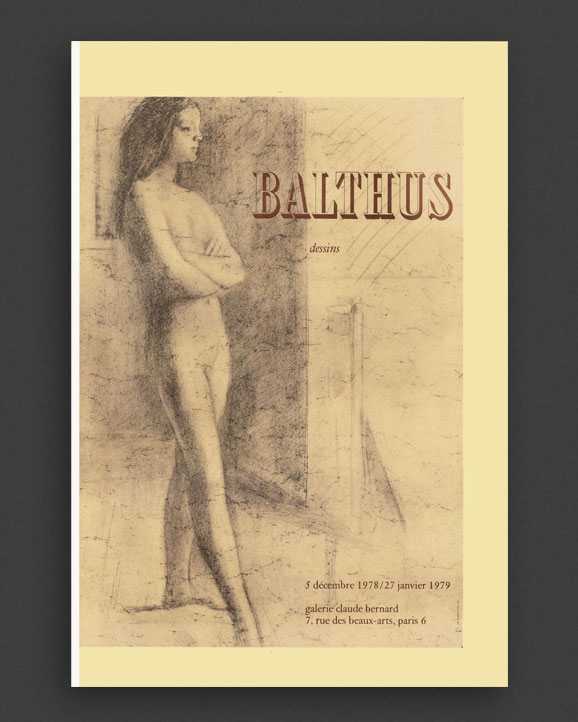
Beautiful, scarce Pierre Klossowski publication "dessins à la mine de plomb", published by Galerie André François Petit, Paris, on the occasion of the Klossowski exhibition in 1971. Illustrated throughout with Klossowski's drawings, alongside texts by André Masson, Patrick Waldberg and Klossowski himself. Includes biography and list of works.
Pierre Klossowski (August 9, 1905, Paris – August 12, 2001, Paris) was a French writer, translator and artist. He was the eldest son of the artists Erich Klossowski and Baladine Klossowska, and his younger brother was the painter Balthus.
As a writer, Pierre Klossowski wrote full length volumes on the Marquis de Sade and Friedrich Nietzsche, a number of essays on literary and philosophical figures, and five novels. Roberte Ce Soir (Roberte in the Evening) provoked controversy due to its graphic depiction of sexuality.[1] He translated several important texts (by Virgil, Ludwig Wittgenstein, Martin Heidegger, Friedrich Hölderlin, Franz Kafka, Nietzsche, and Walter Benjamin) into French, worked on films and was also an artist, illustrating many of the scenes from his novels. Klossowski participated in most issues of George Bataille's review, Acéphale, in the late 1930s.
His 1969 book, Nietzsche and the Vicious Circle, greatly influenced French philosophers such as Michel Foucault, Gilles Deleuze, and Jean-François Lyotard.
Very Good copy.
2023, English / Italian
Hardcover, 128 pages, 22 x 33 cm
Published by
Mousse / Milan
$68.00 - Out of stock
Published on the occasion of the artist's solo exhibition at the MASI in Lugano, this book traces the last thirty years of Rita Ackermann's career containing both well-known and previously unpublished works, ranging from painting to drawing, created in a range of media and formats.
Rita Ackermann's first drawings and paintings, made between 1993 and 1996, show adolescent female figures multiplied within the composition and engaged in various self-destructive activities, expressed to the public through understandable and direct language. Twenty years down the line, Ackermann rethinks the presence of the figure as the focus of her work, endowing it with new connotations and reworking it through a layering of subjects and matter. The book contains reproductions of all the works in the exhibition, and others selected personally by the artist.
New York City based artist Rita Ackerman was born in Budapest in 1968. She studied at the University of Fine Arts in Budapest and The New York Studio School of Drawing, Painting and Sculpture from the years of 1989 to 1992. Ackermann invented images that became instant sensations, perturbing young girls that are now part of the universe of global imagery. Her drawings and paintings between 1993-95 depict compositions of adolescent female figures of clonelike multiples engaging in various self-destructive and hazardous activities. Her early works with their ambiguous presence serve as bridges between high and low culture, just as the myths and folk tales which often serve as merits to Ackermann's compositions. Later, Ackerman would abandon the figure, erasing the very matter of her own work, in a complex layering of visual language oscillating between abstraction and figuration into a subconscious unfolding of form—concealed deeply in the abstraction of the omnipresence.
Text by Pamela Kort; conversation between Rita Ackermann and Donatien Grau.
2004, English
Softcover, unpaginated (approx 100 pages), 30 x 21.5 cm
1st Edition, Out of print title / used / fine
Published by
Brown Art / Perth
$25.00 - In stock -
Rare extensive monographic analysis by Dr David Bromfield on the work of Polish-born Australian artist Gosia Wlodarczak, profusely illustrated throughout in colour and b/w. Born 1959, Banie, Poland; lives and works Melbourne, Victoria and Szczecin, Poland, Gosia Wlodarczak's cross-disciplinary drawing practice has extended into performance, installation, sound and film. Her work is motivated by a fascination with the mind's relationship with the outside world conducted through the senses. Using only what she sees around her, she uses the drawn line as a materialisation of being present in the world and in a moment. She works in private and public spaces rather than an artist’s studio, interacting with the stimuli of the outside world and ordinary life, translating her ‘living energy into the drawn line’.
Fine copy.
1988, German
Softcover, 96 pages, 42.5 x 30.5 cm
1st Edition, Out of print title / used / very good
Published by
Edition C. (Edition Crocodile) / Switzerland
$500.00 - Out of stock
Very rare, very first 1988 Swiss edition of H. R. Giger's Biomechanics, published by Edition C. (Edition Crocodile). In his classic series of oversized and visually overwhelming early art volumes, this book comprises a retrospective showcase, from 1964—88, of Giger's work, designed by and with running commentary by Giger himself, with over 200 drawings, paintings, and sculptures, and including concept art for the film Poltergeist II, and design paintings for Emerson, Lake, and Palmer albums. With a foreword by legendary Science Fiction author and longtime Giger fan Harlan Ellison, who dubs him "out latter-day Hieronymus Bosch."
Very Good copy with light wear and light pinch to spine.
2016, English
Softcover (w. embossed plastic sleeve), 240 pages, 31 x 24 cm
Published by
Koenig Books / London
$90.00 - Out of stock
At the intersection between art, design and social history, The Inventors of Tradition is a subjective study of the history of the Scottish textiles industry since the 1930s. It brings together samples of world-class design, the archive material of individuals and companies, and documentation in the form of film and interviews.
In response to this material the artist Lucy McKenzie and designer Beca Lipscombe, from Atelier, have produced a series of new works including clothing, furniture and accessories in collaborative partnership with Caerlee Mills, Begg Scotland, Hawick Cashmere, Laura Lees, Jannette Murray, Mackintosh, Muehlbauer and Steven Purvis.
With The Inventors of Tradition II, McKenzie and Lipscombe expand their exploration to encompass Scotland’s recent cultural past, making new connections that bring together art, architecture, design and sub-cultural identities.
Edited by Panel (Catriona Duffy and Lucy McEachan) – a collective of freelance curators that promotes design and craft through exhibitions and projects.
Atelier is a collaboration between artist Lucy McKenzie and designer Beca Lipscombe. Atelierʼs design work includes commissions for public and private spaces, temporary and permanent display and design objects.
As New copies with some light moisture rippling to back pages.
2022, French
Flexcover (clothbound), 248 pages, 21 x 26 cm
Published by
Les Presses Du Reel / Paris
$69.00 $30.00 - Out of stock
Produced on the occasion of the exhibition Marc Camille Chaimowicz – Zig Zag and Many Ribbons… at MAMC Saint-Etienne in 2022—2023, this reference monograph revisits the conceptual and sensorial developments pursued by the artist since the 1970s.
Includes a ribbon drawn by the artist as an inserted bookmark. Edited by Marc Camille Chaimowicz and Anna Clifford. Text by Marie Canet. Designed by Zak Kyes.
Born in the aftermath of World War II (in 1947 in Paris) of a Polish father and a French mother, Marc Camille Chaimowicz moved as a child to the United Kingdom. He studied at Ealing, Camberwell, and the Slate School of Art in London. In new artistic times, careful to bring art and life closer, often using performance, the life of Marc Camille Chaimowicz has become a great workshop. Living in the exhibition spaces, he sets up hotels entrances, decorates them with his own artefacts, and serves there some tea to visitors with musical background. When it became an official art practice which was no longer subversive, Chaimowicz abandoned performance art. From 1975 to 1979, he designed the interior of his Approach Road flat. Wallpapers, curtains, videos he made while performing in his own decor: everything had been tailored-imagined, drawn, and conceived to turn his interior into a room conducive to reverie. From the 1980s onwards, decors and furniture set like in a theatre scenography took their place in museums. Since then, hundreds of exhibitions have featured the interiors series of this international artist.
Marie Canet is a French art critic, independent curator and professor of aesthetics at the Villa Arson (Nice).
2014, English
Softcover, 376 pages, 21 x 26 cm
1st Edition, Out of print title / as new
Published by
Paul Holberton Publishing / London
National Gallery of Canada / Ottawa
$200.00 $120.00 - In stock -
First, only, quickly out-of-print edition of this comprehensive catalogue surveying Ruskin's drawings and watercolours, published on the occasion of the major exhibition at the National Gallery of Canada, Ottawa, 14 February – 11 May 2014, and National Gallery of Scotland, Edinburgh, 4 July – 28 September 2014.
Known an a writer on art, architecture, nature, landscape, economics and history, John Ruskin (1819–1900) also produced extraordinary drawings and watercolours that offer insight into the workings of his brilliant mind and are testimony to the scrupulous attention he gave to everything that interested him. These exhilarating works deserve to be appreciated afresh by audiences anew.
Accompanying a landmark exhibition at the National Galleries of Canada and Scotland in 2104, this definitive exploration of a private but hugely revealing aspect of Ruskin’s creative life – representing his entire career and all subject types and degrees of finish and elaboration – will demonstrate how his use of drawing evolved in terms of his most characteristic stylistic traits and how he used the medium in a most distinctive technical manner. Ruskin regarded drawing as a means of focusing his eye and as a discipline of observation, and so he attached small significance to the work itself when completed. Paradoxically, despite the extraordinary skill and emotion his drawings demonstrate, Ruskin has never been acclaimed as the great artist he undoubtedly was.
Drawing was used by Ruskin to express the ecstasy he felt in the presence of transcendent beauty in nature and landscape, as well as in the works of man. His drawings are instantly enjoyable for their immediacy and verve, for their absence of self-consciousness or artistic indulgence, but they also reveal a range of emotional responses and are profoundly informative about the devastating swings of mood that he endured and which fired his massive intellectual creativity as well as his eventual descent into insanity.
In examining alongside the central core of Ruskin’s own drawings those made by artists who were his mentors, friends and followers, this book also aims to give an account of the wider phenomenon which might be called ‘Ruskinism’. It will demonstrate how Ruskin’s own style formed as a result of contact with an older generation of drawing masters, such as Samuel Prout and J.D. Harding. Ruskin’s paramount admiration for J.M.W. Turner, and the story of his advocacy of Turner as the greatest genius of British art, will also be explained. A fascinating and visually rich element of the book are the photographs (Daguerrotypes), including those taken by Ruskin himself or under his immediate supervision. By seeing photographs and drawings together it is possible to identify certain pictorial traits that are characteristic of Ruskinian methods of looking.
Contributions by Conal Shields, Ian Jeffrey, Christopher Baker and Christopher Newall.
As New, out-of-print.
2019, English
Softcover, 120 pages, 26 x 21.5 cm
1st Edition, Out of print title / as new
Published by
Paul Holberton Publishing / London
$60.00 $30.00 - Out of stock
Ruskin, Turner & the Storm Cloud presents new writing on John Ruskin’s vision of art and its relationship with modern society and a changing environment. As part of the re-evaluation of Ruskin, 200 years after his birth in 1819, art historians, scientists, geographers, artists and curators explore the critic’s lifelong commitment to the painted landscapes of JMW Turner and his own artistic ambitions, as well as his prophetic concerns about the world’s darkening skies, pollution and psychological turbulence.
In 1884 John Ruskin spoke out against an encroaching “Storm Cloud”—a darkening of the skies that he attributed to the belching chimneys of the modern world. The imagery of the pollution-stained sky also allowed Ruskin to articulate the internal distress that seemed to engulf him. His analysis of a “blanched sun, blighted grass [and] blinded man” overwhelmed by a modern “plague-wind” expresses both the visible climatic effects of industrialization and the effects of his own worsening mental health. Propelled by bereavement and anxieties over his religious faith, Ruskin became fixated on the skies, “watching a cloud from four in the afternoon to four in the morning”.
This collection of essays examining Ruskin’s distinctive blend of meteorology, morality and social criticism brings new perspectives to one of the most influential and provocative thinkers of the nineteenth century. Ruskin’s deep and personal engagement with Turner’s work over many decades emerges as a recurring theme. In Turner, Ruskin found the ideal “Modern Painter”—an artist whose powerful sunrises and sunsets, mountains and storms, inspired his own critical engagement with the natural world.
As an artist and critic, Ruskin consistently challenged the way others experienced the world, encouraging his audiences to recognise and record nature’s transient beauty, and doing the same with his own intimately observed drawings of animals, flora and weathered buildings. As an environmentalist, he witnessed a natural world changing before his eyes, as the landscapes, buildings and skies he had seen as a young man came under threat. As an ethical provocateur ahead of his time, he condemned the throwaway culture that spoilt the towns and rivers he loved, urging his audiences to take responsibility for these changes.
Responding to this rich and troubled legacy, the book brings together original contributions by artists and curators, art historians, geographers and climate change specialists, each of whom shares new insights into Ruskin’s concerns about the changing weather patterns and shifting landscapes of the modern world. Individual essays reconsider Ruskin alongside a range of contemporary issues, encompassing mental health, technology, environmental pollution and climate change. The collection’s diverse voices make a compelling case for the continuing relevance of Ruskin and his ways of seeing in the twenty-first century.
Ruskin, Turner & the Storm Cloud accompanies a major exhibition at York Art Gallery and Abbot Hall Art Gallery.
As New, out-of-print.
1963, English
Hardcover (w. dust jacket), 140 pages
1st Edition, Out of print title / used / good
Published by
Boston Book & Art Shop / Boston
$30.00 - Out of stock
First 1963 hardcover edition of this English translation of Georges Rouault's (1871-1958) Miserere, published by the Boston Book & Art Shop. Beautifully printed reproduction of this classic, including Rouault's original preface translated to English, the series of 58 engravings with titles reproduced in facsimile from the artist's handwriting, and 18 plates comparing various successive states with the finished engravings. Introduction by Anthony Blunt.
Georges Henri Rouault (1871—1958) was a French painter, draughtsman, and print artist, whose work is often associated with Fauvism and Expressionism.
Average dust jacket with chipping and wear, book G—VG.
2018, English / French
Softcover, 144 pages, 18.8 x 27 cm
1st Edition, Out of print title / as new
Published by
WIELS / Brussels
Mercatorfonds / Brussels
$35.00 - Out of stock
The much anticipated first major publication about the work of Belgian poet and graphic artist Sophie Podolski (1953–1974), who has lingered in obscurity since her untimely death. Now out-of-print, this lovely book and catalogue published on the occasion of the major 2018 exhibition in Brussels and Paris, features a generous selection of previously unpublished drawings and texts, as well as explorations of Podolski’s personal mythology and of her place in the counterculture of the late 1960s and early 1970s by authors Jean-Philippe Convert, Caroline Dumalin, Chris Kraus, Lars Bang Larsen, and Erik Thys.
Sophie Podolski was born in 1953 in Brussels, where she died in 1974. In just a few years (between 1968 and 1974, the date of her suicide at the age of 21), Sophie Podolski produced a remarkable graphic work, as well as a book: Le pays ou tout est permis in 1972. This young self-taught scholar wrote in an expressive and provocative, unrestrained style about life, popular culture and societal conformity. While writing and drawing are almost inextricable for Podolski, during her lifetime she was above all considered a poet. Her poetry was much admired by the novelist and poet Roberto Bolaño, who referenced Podolski in his novels The Savage Detectives, Antwerp, and Distant Star, and in his short stories "Vagabond in France and Belgium" and "Dance Card" (both collected in Last Evenings on Earth). Podolski had schizophrenia and spent time in psychiatric clinics in Paris and Brussels. She attempted suicide in Brussels on 19 December 1974 and died 10 days later as a result.
The exhibition and catalogue emphasizes her visual work and very personal iconography in order to bring it out of the shadows. The exhibition presents more than a hundred works on paper, made in Indian ink, pastel and colored pencil, alongside her early engravings and the original manuscript of her unique book, all documented in the catalogue.
Fine copy.
2023, English
Softcover (w. dust jacket) 330 pages, 21 x 14.9 cm
Published by
Treville / Tokyo
Pan-Exotica / Tokyo
$70.00 - Out of stock
The first of its kind, "KINBAKU The Golden Age of Japanese Restrained & Tortured Artworks" collects the masters of Japanese kinbaku rope bondage and torture artworks by nine Japanese artists, spanning generations, artists who have refined the beauty of masochism and inherited the legacy of Japanese Shibari-e eroticism as pioneered by Seiu Ito. This book presents beautiful reproductions in colour and b/w of many extreme artworks by Kou Minomura, Yoko Ozuma, Yoji Muku, Ran Akiyoshi, Hajime Sorayama, Hiroaki Samura, Shoji Oki, Gengoroh Tagame, and Miyabi Kyodo. Each artist has bilingual introduction text, plus essays in Japanese by Akira Naka, Masakazu Tanaka, and Toshihi Soma.
Published on the occasion of the exhibition, The Essentials of KINBAKU ART, held at Vanilla Gallery, Tokyo, 16 March—9 April, 2023.
"After World War II, people who had been freed from the long curse of asceticism sought entertainment and freedom in easy "reading", and a multitude of magazines were launched into the world. Among the numerous magazines were the forbidden maniac magazines. These unique magazines raised people's sexual and even aesthetic interests in
2018, Japanese
2 Volumes, softcover (one w. dust jacket), 195 + 95 pages, 19 x 13 cm
Signed by author,
Published by
Treville / Tokyo
$40.00 - Out of stock
A must-have book for Biblio enthusiasts. Pursuing the ultimate in erotic expression, dismantling the boundaries between pornography and art, and exploring the deepest mysteries of the desires of
This 2-volume set includes the "Erotic Art and Esotericism" (Booster Booklet), which expands on—in full colour—Soma's selections of artists surveyed, featuring hundreds of artworks and associated book-references. Artists include: Hans Bellmer, Pierre Molinier, Jean Benoit, Gérard Gachet, Sybille Ruppert, Jean-Marie Poumeyrol, H.R. Giger, Zdzisław Beksiński, Nik Douglas & Penny Slinger, Bob Carlos Clark, Hajime Sorayama, Seiu Ito, Kazutomo Fujino, Ayako Nakagawa, Petter Hegre, Henri Maccheroni, Jamie MacCartney, Richard Cerf, Gilles Berquet, Trevor Watson, Laszlo, Tony Ward, Laurent Bunaim...
Limited edition signed by the author.
2023, English
Softcover, 152 pages, 17.5 x 11 cm
Published by
Index Journal / Melbourne
$30.00 - Out of stock
Norman Lindsay (1879–1969) was a prolific, popular and controversial Australian artist. He is best known for his children’s book The Magic Pudding and his skilled prints, which mostly draw on Greek and Roman mythology and nineteenth century literature and philosophy. The Australian cultural consciousness is indelibly marked by Lindsay’s output, his prominence in the Sydney bohemian intellectual scene and by The Magic Pudding, which entrances the imagination of generation after generation of Australian children. This consciousness is marked too by the paradoxical conjunctions of Lindsay’s life: artistic bohemia and fascistic tendencies, avant-gardism and a fervour for the rule of law, libertinism and conservatism, worship and denigration.
This collection of essays examines Lindsay’s current position in Australian art history. The authors’ opinions are erudite, varied and often incendiary; few figures are as divisive as Lindsay.
Film critic Adrian Martin writes alongside Ian McLean, the Hugh Ramsay Chair of Australian Art History at the University of Melbourne, art historian Cameron Hurst, and literary critic Jeremy George. Art historian Soo-Min Shim responds to a video work by artist James Nguyen.
The project develops research conducted during an exhibition of the University of Melbourne’s Norman Lindsay collection, also titled Venus in Tullamarine, held at the George Paton Gallery in 2022.
1984, German
Softcover, 78 pages (w. fold-outs), 42 x 30 cm
1st Edition, Out of print title / used / very good
Published by
Edition C / Zürich
$180.00 - Out of stock
With an introduction by Clive Baker and numerous texts by HR Giger as well as texts by Fritz Billeter and Simon Vinkenoog and a tribute from Salvador Dali.
"The "Necronomicon" is a legendary magical book that is kept in inaccessible places only in a few, incompletely preserved specimens because it could have disastrous consequences if it fell into the wrong hands. It was written down around 730 AD in Yemen by the legendary Abdul Al Azred. It is said to tell of things and events that took place in the gray age, and illustrations of uncanny creatures lurking in the depths of the earth and the seas, one day destroying mankind and striking the world.
Al Azred's "Necronomicon" is a kind of museum of the most wonderful abominations and perversions. The well-known writer HP Lovecraft was the first to report in his "Cthulhu" mythology of this work. Many other science fiction and fantasy writers have quoted this fictional work time and again, but it has only become a visual reality in "HR Giger's Necronomicon"!"
"Giger always opens up new approaches to the origins of our psyche," writes Clive Baker in his foreword. "He is planning for us to go, encouraged by the knowledge that others have gone before this path, and only a few artists are able to give such impulses, and if we follow Giger, we are initially afraid of our mental health. And quickly recognize that the supposed new territory has countless stations that are connected with our familiar life. For, after all, we are no strangers: Giger points the direction into the world in which we must return, where we pledge our pledge, to pay the tithes which we owe. Giger's world is the place of our own taboos, and only our own disregard makes him appear frightening, sullen, "alien" (alien). (...) Giger's work calls us to the common ground of the unconscious, where, though we sometimes alienate ourselves from it, we are never really strangers. In other words, HR Giger's fantastic art is calling us home."
Beginning with a hommage from Salvador Dali, the first in this series of oversized and visually overwhelming volumes takes us through the early history of one of the most brilliant fantasy artists of the century. From his "Passegen" series, his work for theatre, posters, album artwork, environments, personal works, is designs for Alejandro Jodorowsky's DUNE, and much more, all beautifully reproduced in full-colour and black and white, full-bleed spreads, including fold-out pages. These Giger folio books have become very desirable, collectable editions in their various printings around the world, the series encompassing the work of one of the world's most unique and influential visionaries.
This is the first Swiss edition, published by Edition C.
Very Good copy.