World Food Books' programme is largely produced on Kulin Nation land. We acknowledge the Wurundjeri people of the Kulin Nation as the first and continuing custodians of this land, and pay respect to their Elders past, present, and emerging.
World Food Books is an arts and special interests bookshop in Naarm / Melbourne. Founded in 2010, World Food Books is devoted to the presentation of a rotating, hand-selection of international art, design, literary and counterculture publications with an emphasis on the anti-traditional, the experimental, the avant-garde, the heretic, the marginal.
Presenting new titles alongside rare and out-of-print books, catalogues and journals spanning the fields of modern and contemporary art, design, photography, illustration, film, literature, poetry, cultural theory, philosophy, sexuality, popular and underground culture in its many radical forms, World Food Books wishes to encourage adventurous, thoughtful and open-minded reading, looking, writing, and exchange of publishing and ideas, both current and historical.
As well as our bookshop, located in Melbourne's historical Nicholas Building, all of our inventory is available internationally via our online mail-order service.
World Food Books semi-regularly co-ordinates "Occasions", a programme of exhibits and events at the bookshop and in partnership with other hosts (such as museums and art galleries) that develop out of the activities, relationships and content of the bookshop itself.
World Food Books
The Nicholas Building
37 Swanston Street
Room 5, Level 6
Melbourne 3000
Australia
SHOP HOURS:
Thu–Fri 12–6, Sat 12–5
WEB-SHOP OPEN 24/7
World Food Books
Postal Address:
PO Box 435
Flinders Lane
Victoria 8009
Australia
Art
Theory / Essay
Architecture / Interior
Graphic Design / Typography
Photography
Fashion
Eros
LGBTQ+
Fiction / Poetry
Weird / Speculative / Science Fiction / Horror
Transgressive / Visceral / Abject
Symbolism / Decadence / Fin de siècle
Film / Video
Painting
Sculpture / Installation
Performance / Dance / Theater
Drawing
Sound / Music
Curatorial
Group Shows / Collections
Periodicals
Out-of-print / Rare
Posters / Ephemera / Discs
Signed Books
World Food Books Gift Voucher
World Food Book Bag
Australian Art
Australian Fiction
Australian Science Fiction / Speculative Fiction
Australian Poetry
Australian Photography
Japanese Photography
Conceptual Art
Minimal Art
Dada
'Pataphysics / Oulipo
Fluxus
Concrete Poetry
Pop Art
Surrealism
Arte Povera
Arte Informale / Haute Pâte / Tachism
Nouveau Réalisme / Zero / Kinetic
Situationism / Lettrism
Collage / Mail Art / Xerox Art
Art Brut / Folk / Visionary / Fantastic
Illustration / Graphic Art / Bandes Dessinées
Furniture
Italian Radical Design / Postmodernism
Textiles
Ceramics / Glass
Counterculture
Protest / Revolt
Philosophy
Psychoanalysis
Anthropology
Anarchism
Socialism / Anarchism / Communism / Capitalism
Literary Theory / Semiotics / Language
Feminism / Women's Studies
Gender Studies / Sexuality
Anthropology
Fetishism / BDSM
Drugs / Psychedelia
Crime / Violence
Animal Rights / Veganism
Occult / Esoterica
Ecology / Earth / Alternative Living
Whole Earth / Crafts
All prices in AUD (Australian dollars)
Pick-Ups
Pick-up orders can be collected in our bookshop during opening hours after order date. Please collect any Pick-up orders within 2 weeks of ordering as we have limited storage space. Orders will be released back into stock if not collected within this time. No refunds can be made for pick-ups left un-collected. If you cannot make it in to the bookshop in this time-frame, please choose postage option.
Return Policy
All sales are final. We do accept returns (for refund or exchange) for items received in error. All our orders are packed with special care using heavy-duty padding and cardboard book-mailers or bubble mailers (for smaller books), using reinforcement where required. We cannot take responsibility for any lost, stolen or damaged parcels.
Insurance
Should you wish to insure your package, please email us directly after placing your order and we can organise this at a small extra expense. Although all standard/express tracked packages are very safe and dependable, we cannot take responsibility for any lost, stolen or damaged parcels. We recommend insurance on valuable orders.
Interested in selling your old books, catalogues, journals, magazines, comics, fanzines, ephemera? We are always looking for interesting, unusual and out-of-print books to buy. We only buy books in our fields of interest and specialty, and that we feel we can resell.
We base these prices on desirability, market value, in-print prices, condition and our current stock levels. We offer cash, store credit, and can take stock on consignment. All
about 25% of the price we expect to get when we sell them, or 30% in store credit. We base these prices on desirability, market value, in-print prices, condition and our current stock levels.
Sell your books any day of the week. You can drop them off and return later. If you have a lot of books, we can visit your Sydney home.
We buy books that we feel we can resell. We offer about 25 % of the price we expect to get when we sell them, or 30% in store credit. We base these prices on desirability, market value, in-print prices, condition and our current stock levels.
Philadelphia Wireman
03 August - 01 September, 2018
World Food Books is proud to announce our next Occasion, the first presentation of sculptures by Philadelphia Wireman in Australia.
The Philadelphia Wireman sculptures were found abandoned in an alley off Philadelphia’s South Street on trash night in 1982. Their discovery in a rapidly-changing neighbourhood undergoing extensive renovation, compounded with the failure of all attempts to locate the artist, suggests that the works may have been discarded after the maker’s death. Dubbed the "Philadelphia Wireman" during the first exhibition of this work, in 1985, the maker’s name, age, ethnicity, and even gender remain uncertain. The entire collection totals approximately 1200 pieces, all intricately bound together with tightly-wound heavy-gauge wire (along with a few small, abstract marker drawings, reminiscent both of Mark Tobey and J.B. Murry). The dense construction of the work, despite a modest range of scale and materials, is singularly obsessive and disciplined in design: a wire armature or exoskeleton firmly binds a bricolage of found objects including plastic, glass, food packaging, umbrella parts, tape, rubber, batteries, pens, leather, reflectors, nuts and bolts, nails, foil, coins, toys, watches, eyeglasses, tools, and jewellery.
Heavy with associations—anthropomorphic, zoomorphic, and socio-cultural responses to wrapped detritus—the totemic sculptures by Philadelphia Wireman have been discussed in the context of work created to fulfil the shamanistic needs of alternative religions in American culture. Curators, collectors, and critics have variously compared certain pieces to sculpture from Classical antiquity, Native American medicine bundles, African-American memory jugs, and African fetish objects. Reflecting the artist’s prolific and incredibly focused scavenging impulse, and despite—or perhaps enhanced by—their anonymity, these enigmatic objects function as urban artefacts and arbiters of power, though their origin and purpose is unknown. Philadelphia Wireman, whatever their identity, possessed an astonishing ability to isolate and communicate the concepts of power and energy through the selection and transformation of ordinary materials. Over the course of the past two decades, this collection has come to be regarded as an important discovery in the field of self-taught art and vernacular art.
Presented in collaboration with Fleisher-Ollman Gallery, Philadelphia, and Robert Heald, Wellington.
Susan Te Kahurangi King
02 February - 10 March, 2018
Susan Te Kahurangi King (24 February 1951 - ) has been a confident and prolific artist since she was a young child, drawing with readily available materials - pencils, ballpoint pens and felt-tip markers, on whatever paper is at hand. Between the ages of four and six Susan slowly ceased verbal communication. Her grandparents William and Myrtle Murphy had developed a special bond with Susan so they took on caring responsibilities for extended periods. Myrtle began informally archiving her work, carefully collecting and storing the drawings and compiling scrapbooks. No drawing was insignificant; every scrap of paper was kept. The King family are now the custodians of a vast collection containing over 7000 individual works, from tiny scraps of paper through to 5 meter long rolls.
The scrapbooks and diaries reveal Myrtle to be a woman of great patience and compassion, seeking to understand a child who was not always behaving as expected. She encouraged Susan to be observant, to explore her environment and absorb all the sights and sounds. Myrtle would show Susan’s drawings to friends and people in her community that she had dealings with, such as shopkeepers and postal workers, but this was not simply a case of a grandmother’s bias. She recognised that Susan had developed a sophisticated and unique visual language and sincerely believed that her art deserved serious attention.
This was an unorthodox attitude for the time. To provide some context, Jean Dubuffet coined the term Art Brut in 1945 to describe work created by self-taught artists – specifically residents of psychiatric institutions and those he considered to be visionaries or eccentrics. In 1972 Roger Cardinal extended this concept by adopting the term Outsider Art to describe work made by non-academically trained artists operating outside of mainstream art networks through choice or circumstance. Susan was born in Te Aroha, New Zealand in 1951, far from the artistic hubs of Paris and London that Dubuffet and Cardinal operated in. That Myrtle fêted Susan as a self-taught artist who deserved to be taken seriously shows how progressive her attitudes were.
Susan’s parents Doug and Dawn were also progressive. Over the years they had consulted numerous health practitioners about Susan’s condition, as the medical establishment could not provide an explanation as to why she had lapsed into silence. Dawn educated herself in the field of homeopathy and went on to treat all twelve of her children using these principles – basing prescriptions on her observations of their physical, mental and emotional state.
Doug was a linguist with an interest in philosophy who devoted what little spare time he had to studying Maori language and culture. To some extent their willingness to explore the fringes of the mainstream made them outsiders too but it was their commitment to living with integrity and their respect for individuality that ensured Susan’s creativity was always encouraged.
Even though Susan’s family supported her artistic pursuits, some staff in schools and hospitals saw it as an impediment to her assimilation into the community and discouraged it in a variety of ways. Her family was not always aware of this and therefore did not fully understand why Susan stopped drawing in the early 1990s. However, rather than dwell on the challenges that Susan faced in pursuit of her artistic practice, they prefer to highlight her achievements. In 2008 Susan began drawing again in earnest, after an almost 20 year interruption, and her work is now shown in galleries around the world.
Susan grew up without television and has been heavily influenced by the comics she read as a child. She is absolutely fearless in the appropriation of recognizable characters, such as Donald Duck and Mickey Mouse, in her work. She twists their limbs, contorts their faces, compresses them together, blends them into complex patterned backgrounds - always imbuing them with an incredible energy. Although Susan often used pop culture characters in her work they are not naive or childlike. These are drawings by a brilliant self-taught artist who has been creating exceptional work for decades without an audience in mind.
Mladen Stilinović
"Various Works 1986 - 1999"
02 February 16 - September 10, 2016
Various works 1986 - 1999, from two houses, from the collections of John Nixon, Sue Cramer, Kerrie Poliness, Peter Haffenden and Phoebe Haffenden.
Including: Geometry of Cakes (various shelves), 1993; Poor People’s Law (black and white plate), 1993; White Absence (glasses, ruler, set square, silver spoon, silver ladel with skin photograph and wooden cubes), 1990-1996; Exploitation of the Dead (grey and red star painting, wooden painting, black spoon with red table, red plate), 1984-1990; Money and Zeros (zero tie, paintings made for friends in Australia (Sue, John, Kerrie), numbers painting), 1991-1992; Words - Slogans (various t-shirts) - “they talk about the death of art...help! someone is trying to kill me”, “my sweet little lamb”, “work is a disease - Karl Marx”; Various artist books, catalogues, monographs, videos; Poster from exhibition Insulting Anarchy; "Circular" Croatian - Australian edition; Artist book by Vlado Martek (Dostoyevsky); more.
Thanks to Mladen Stilinović and Branka Stipančić.
Jonathan Walker
Always Will Need To Wear Winter Shirt Blue + Ochre Small Check Pattern
21 August - 21 September, 2015
Untitled
I am not a great reader of poetry but I always return to the work of Melbourne poet, Vincent Buckley (1925- 1988). Perhaps I find his most tantalising piece to be not a finished poem but a fragment left on a scrap of paper discovered on his desk after the poet’s death.
The poetry gathers like oil
In the word-core, and spreads
It has its music meet,
Its music is in movement.
This fragment is more the shell left behind from a volatile thought than a finished poem. I find the last two lines honest but awkward whereas the first two lines work like an arrow. Most likely he could not find a resolution so it was left. Still, in its present form, it remains an eloquent testimony to the ultimate failure of a medium to express mobile thought and sensation, in Buckley’s case, through verbal language. It’s an important matter because this is something all artists have to deal with regardless of the medium.
I have never written a poem, however, I am forever copying fragments from books on paper scraps in a vain effort to fix certain notions in my head. At first, they function as bookmarks that are sometimes returned to when I open the book. But before long, as they accumulate, they fall out littering the table interspersed with A4 photocopies, bills, books and medications.
To return to Buckley’s fragment, the first two lines very much evoke how I paint nowadays. As you age, detail diminishes and patches of light become more luminous and float. I feel the most honest way of dealing with this is by smearing the oil paint on the canvas with the fingers and working close-up, blind. Only if the patches coalesce into an approaching image can the work gain a life.
-
Jonathan Walker was born in Melbourne, Australia and brought up on a dairy farm in Gippsland. In the 1970’s he studied painting at RMIT and won the Harold Wright Scholarship to the British Museum, London. During the 1980’s he exhibited at Pinacotheca Gallery, Richmond and had work shown at the NGV and Heidi City Art Gallery. Over the same period he designed the cover for the “Epigenesi” LP by Giancarlo Toniutti, Italy and conducted a mail exchange work with Achim Wollscheid, Germany. The work with artists through the post resulted in an article published in the bicentenary issue of Art and Australia 1988. He showed in artist run spaces such as WestSpace in the 90’s and 2000’s, and until 2012, taught painting at Victoria University, which is where we (Colleen Ahern and Lisa Radford) as organisers of the exhibition, among many others, had the privilege of being his student.
Walker’s knowledge was imparted to students through the careful selection of music, literature, and artists found in books that he himself had ordered for the library. Walker’s strategy was the generosity of sharing his vast knowledge with references specific to each student and their context.
Walker’s paintings share a similar focus and intimacy.
This exhibition presents a small selection of recent paintings alongside a publication that includes Walker’s writing. Observational and analytical, Walker’s work is a type of material notation — the time of day, colour and how it is blended, the both specific and fleeting location of a reflection on lino or the question of whether a chair leg should be included in a painting.
Please join us on Friday August 21 between 6-8pm to celebrate the opening of the exhibition.
Curated by Colleen Ahern and Lisa Radford.
B. Wurtz
Curated by Nic Tammens
March 26 - April 4, 2015
B.Wurtz works from a basement studio in his home on Manhattan’s Lower East Side.
This local fact is attested to by the plastic shopping bags and newsprint circulars that appear in his work. As formal objects, they don’t make loud claims about their origins but nonetheless transmit street addresses and places of business from the bottom of this long thin island. Like plenty of artists, Wurtz is affected by what is local and what is consumed. His work is underpinned by this ethic. It often speaks from a neighborhood or reads like the contents of a hamper:
“BLACK PLUMS $1.29 lb.”
“Food Bazaar”
“USDA Whole Pork Shoulder Picnic 99c lb.”
“RITE AID Pharmacy, with us it’s personal.”
“H. Brickman & Sons.”
“Sweet Yams 59c lb."
Most of the work in this exhibition was made while the artist was in residence at Dieu Donne, a workshop dedicated to paper craft in Midtown. Here Wurtz fabricated assemblages with paper and objects that are relatively lightweight, with the intention that they would be easily transportable to Australia. This consideration isn’t absolute in Wurtz’s work, but was prescriptive for making the current exhibition light and cheap. Packed in two boxes, these works were sent from a USPS post office on the Lower East Side and delivered to North Melbourne by Australia Post.
Wurtz appears courtesy of Metro Pictures, New York.
Thanks to Rob Halverson, Joshua Petherick, Sari de Mallory, Matt Hinkley, Helen Johnson, Fayen d'Evie, Ask Kilmartin, Lisa Radon, Ellena Savage, Yale Union, and "Elizabeth".
John Nixon
"Archive"
December 15 - January 20, 2014
The presentation of John Nixon's archive offered a rare showcase of this extensive collection of the artist's own publications, catalogues, posters, ephemera, editions and more, from the mid 1980s onwards, alongside a selection of his artworks.
Organized by John Nixon, Joshua Petherick and Matt Hinkley.
<a href=http://wfb.public-office.info/artist/john-nixon>All titles by John Nixon
"Habitat"
at Minerva, Sydney (organised by Joshua Petherick and Matt Hinkley)
November 15 - December 20, 2014
Lupo Borgonovo, Janet Burchill & Jennifer McCamley,
Lewis Fidock, HR Giger, Piero Gilardi, Veit Laurent Kurz,
Cinzia Ruggeri, Michael E. Smith, Lucie Stahl, Daniel Weil, Wols
Press Release:
“...It contained seven objects. The slender fluted bone, surely formed for flight, surely from the wing of some large bird. Three archaic circuitboards, faced with mazes of gold. A smooth white sphere of baked clay. An age-blackened fragment of lace. A fingerlength segment of what she assumed was bone from a human wrist, grayish white, inset smoothly with the silicon shaft of a small instrument that must once have ridden flush with the surface of the skin - but the thing’s face was seared and blackened.”
William Gibson, “Count Zero”, 1986
"Autumn Projects Archive"
Curated by Liza Vasiliou
March 6 - March 15, 2014
World Food Books, in conjunction with the Virgin Australia Melbourne Fashion Festival 2014, presented the Autumn Projects archive, consisting of a selection of early examples in Australian fashion with a particular interest in collecting designers and labels from the period beginning in the 1980’s, who significantly influenced the discourse of Australian Fashion.
Curated by Liza Vasiliou, the exhibition provided a unique opportunity to view pieces by designers Anthea Crawford, Barbara Vandenberg, Geoff Liddell and labels CR Australia, Covers, Jag along with early experimental collage pieces by Prue Acton and Sally Browne’s ‘Fragments’ collection, suspended throughout the functioning World Food Books shop in Melbourne.
H.B. Peace
presented by CENTRE FOR STYLE
November 14, 2013
"Hey Blinky, you say chic, I say same"
Anon 2013
H.B. Peace is a clothing collaboration between great friends Blake Barns and Hugh Egan Westland. Their pieces explore the divergences between 'character’ and ‘personality’ in garments....etc
Special Thanks to Joshua Petherick and Matt Hinkley of WFB and Gillian Mears
and a Very Special Thank you to Audrey Thomas Hayes for her shoe collaboration.
Janet Burchill & Jennifer McCamley
"Aesthetic Suicide"
May 10 - June 8, 2013
The first of our occasional exhibitions in the World Food Books office/shop space in Melbourne, "Aesthetic Suicide" presented a body of new and older works together by artists Janet Burchill & Jennifer McCamley, including videos, prints, a wall work, and publications.
During shop open hours videos played every hour, on the hour.
1995, Japanese
Softcover, 66 pages, 18 x 13 cm
1st Edition, Out of print title / used / fine
Published by
Dela Corporation Inc. / Tokyo
$50.00 - Out of stock
Very scarce Japanese photo book for the film "Je t'aime moi non plus", a feature film written, directed, and musically scored in 1976 by Serge Gainsbourg, starring Jane Birkin, Hugues Quester and Joe Dallesandro, and featuring a cameo by Gérard Depardieu. Published in 1995 to accompany a small travelling Japanese exhibition of photographs from the film, this booklet reproduces many iconic images from the film in black and white and colour, alongside cast biographies, filmography, chronology, behind the scenes photographs, and much more.
Fine, almost As New copy, only some tanning to gloss edges.
1964, English
Softcover (staple-bound), 16 pages, 18.5 x 24.5 cm
1st Edition, Out of print title / Used*,
Published by
Melbourne University Film Society / Melbourne
$15.00 - Out of stock
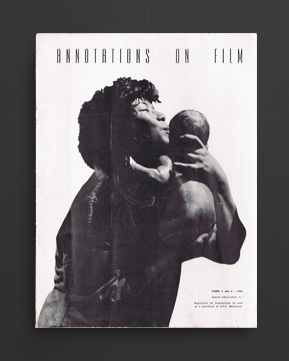
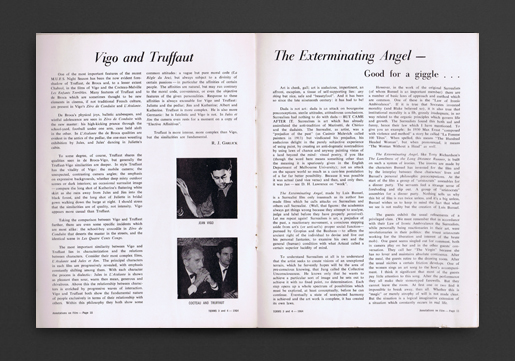
Annotations on Film was a journal published by the Melbourne University Film Society to accompany their film programme, aimed at presenting films in Melbourne in the medium they were created and providing a critical reading of them for an independent, membership-based film society. Starting in 1948, the Melbourne University Film Society (MUFS) changed its name to Cinémathèque in 1984 and continues to this day in Melbourne. A written accompaniment to their programme can be seen in the form of the current-day online journal Senses of Cinema.
This scarce early journal from the Melbourne University Film Society features writings on Roberto Rossellini's Vanina Vanini, Kon Ichikawa's Kagi, Georges Fraju's Spotlight on Murder, Blake Edwards' Breakfast at Tiffany's, Nicholas Ray's The Savage Innocents, Alfred Hitchcock's The Lady Vanishes, E. A. Dupont's Variety, Robert Flaherty's Moana, Jean Vigo, François Truffaut, Luis Buñuel's The Exterminating Angel, and more, and was published in Melbourne in 1964.
1964, English
Softcover (staple-bound), 20 pages, 18.5 x 24.5 cm
1st Edition, Out of print title / Used*,
Published by
Melbourne University Film Society / Melbourne
$15.00 - Out of stock
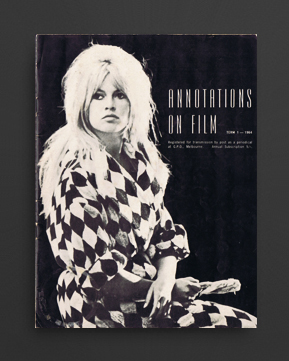
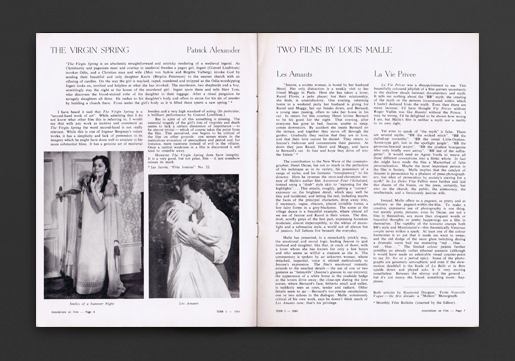
Annotations on Film was a journal published by the Melbourne University Film Society to accompany their film programme, aimed at presenting films in Melbourne in the medium they were created and providing a critical reading of them for an independent, membership-based film society. Starting in 1948, the Melbourne University Film Society (MUFS) changed its name to Cinémathèque in 1984 and continues to this day in Melbourne. A written accompaniment to their programme can be seen in the form of the current-day online journal Senses of Cinema.
This scarce early journal from the Melbourne University Film Society features writings on Ingmar Bergman, Louis Malle, Marcel Camus' Black Orpheus, Jules Dassin's Rififi, Jack Clayton's The Innocents, Frank Tashlin, Alain Resnais' Hiroshima, Mon Amour, Sergei Eisenstein's Battleship Potemkin, Orson Welles' Citizan Kane, and more, and was published in Melbourne in 1964.
2010, English / German
Hardcover, 160 pages, 170 x 240 mm
Published by
Sternberg Press / Berlin
$79.00 $15.00 - Out of stock
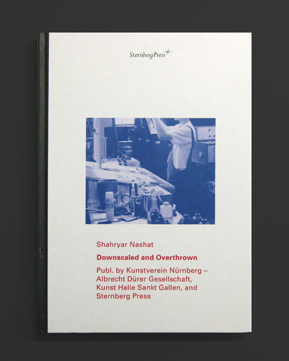
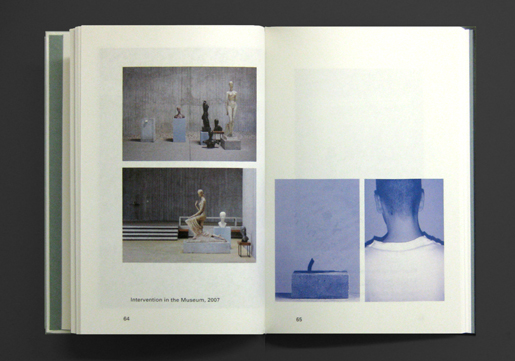
Text by Dominic Eichler A conversation with the artist by Giovanni Carmine and Kathleen Rahn “As soon as I see a male nude sculpture made between 1500 and 1700, I can’t help but chop its top off at thigh, calf, or foot-height.” Downscaled and Overthrown is the first monograph on the work of the Swiss artist Shahryar Nashat (*1975). Whether he truncates Renaissance bronze sculptures through photography, or redesigns a section of the Louvre to accommodate the baroque frescoes of Rubens while filming a well-trained athlete performing a one-armed handstand while looking at the paintings, Nashat’s works and exhibitions involve his interest in art collections, art libraries, reproduction of works of art, as well as questions relating to appropriation and artistic reuse, display issues, and apparatus. Lighting, plinths, pedestals, and the mode of projecting and positioning all play pivotal roles in Nashat’s video installations, sculpture, etchings, and photographs. Wherever he draws his source or reference material from, he consistently makes a certain artificiality or constructedness obvious in order to generate the possibility of critical reflection about the medium itself. The monograph appears on the occasion of Shahryar Nashat’s first solo exhibition in Germany at the Kunstverein Nürnberg – Albrecht Dürer Gesellschaft. Co-published with Kunstverein Nürnberg – Albrecht Dürer Gesellschaft and Kunst Halle Sankt Gallen Design by Aude Lehmann
2016, English
Hardcover, 128 pages, 18 x 28 cm
Published by
Sternberg Press / Berlin
$65.00 $15.00 - Out of stock
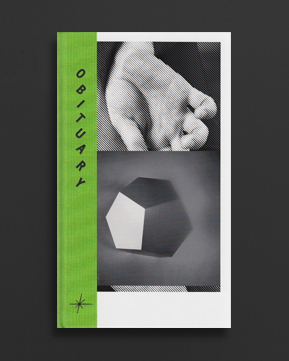
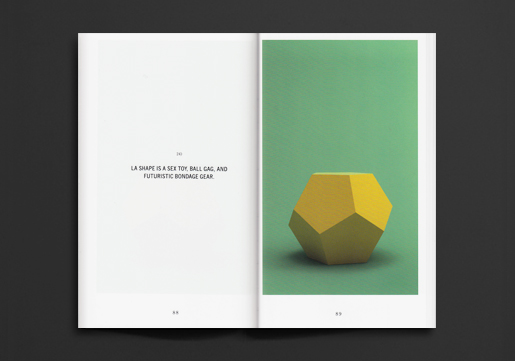
The subject of this book is a deceased prop, an object of a particular color, the green of cinematic trickery and special effects. It edged itself into Shahryar Nashat’s work in 2011, first appearing in Factor Green, an installation the artist produced for the Venice Biennale. Taking its final form a year later, the prop became properly known as La Shape and garnered critical acclaim for its sardonic personification of an unscrupulous impresario in Parade and star turn in Nashat’s video Hustle in Hand (both 2014). Earlier this year, its mysterious death at the height of its career became the occasion for Nashat and Los Angeles writer Sarah Lehrer-Graiwer to reflect upon the brief but meaningful life of a most singular figure.
Accompanied by archival images and a series of portraits that Nashat made during La Shape’s most prolific years, Obituary is a gripping read into a most mysterious icon and a timely consideration of the roles played, and agency expressed, by such a highly mediated art object.
Text by Sarah-Lehrer Graiwer
CGI by Andrea Faraguna
Design by Aude Lehmann
2019, English
Softcover, 212 pages, 25 x 20 cm
Published by
Sternberg Press / Berlin
Muzeum Sztuki / Łódź
$69.00 $40.00 - Out of stock
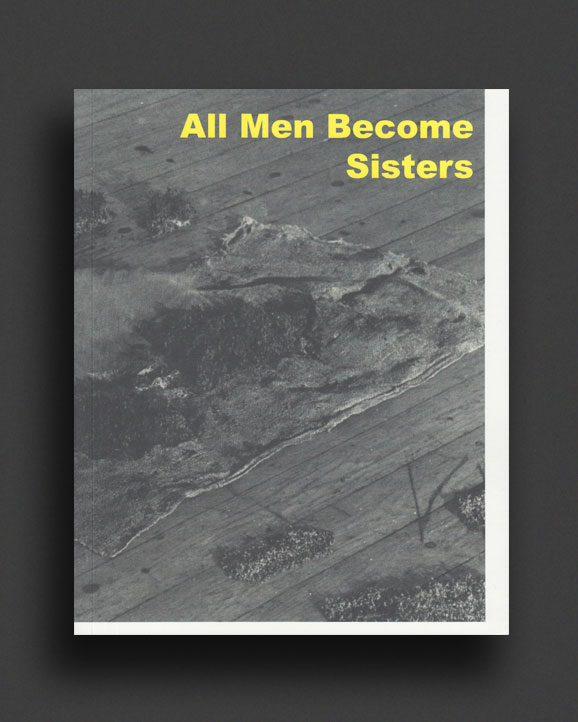
With contributions by Joanna Bednarek, Ines Doujak & John Barker, Zofia Łapniewska, Raqs Media Collective, Joanna Sokołowska, Marina Vishmidt, Siona Wilson
This book is both a record and a theoretical expansion of the exhibition “All Men Become Sisters” at the Muzeum Sztuki in Łódź. Dedicated to the manifestation of sisterhood in art from the 1970s until today, the exhibition and the publication focus on art that resonated with feminist perspectives on work, production, and reproduction. “Sisterhood” is a key concept and an impulse to work with imagination; built on the foundations of second-wave criticism of the patriarchal exploitation of women, it poses questions about the future from the perspective of feminist economics and ethics of care.
Artists: Berwick Street Film Collective, Pauline Boudry/Renate Lorenz, Sarah Browne, Agnieszka Brzeżańska, Jan Czapliński, Ines Doujak in cooperation with John Barker, Köken Ergun, Hackney Flashers, Krystyna Gryczełowska, Margaret Harrison, Elżbieta Jabłońska, Birgit Jürgenssen, Irena Kamieńska, Ola Kozioł/Suavas Levy, Nalini Malani, Marge Monko, Şükran Moral, Teresa Murak, Letícia Parente, Agnieszka Piksa, Marcin Polak, Aleksandra Polisiewicz, Raqs Media Collective, R.E.P., Alicja Rogalska, Daniel Rumiancew, Jadwiga Sawicka, Allan Sekula, Jo Spence, Rosemarie Trockel, Agnès Varda, Mona Vǎtǎmanu/Florin Tudor, Zorka Wollny
Curator: Joanna Sokołowska
Copublished with Muzeum Sztuki, Łódź
Design by Monika Zawadzki, Olo Jean-Claude Zawadzki
1986, English / Italian
2 hardcover volumes (in illustrated hardcover box), 600 pages, 24 x 34 cm
1st Edition, Out of print title / used / very good
Published by
Coneditor / Rome
$180.00 - Out of stock
First edition of the most elaborate, visually-dazzling, analytical monograph ever produced on the work of Michelangelo Antonioni. Published in this lavish 2-volume boxset edition in 1986 in Rome, Architetture della Visione was conceived and edited by film critics Michele Mancini and Giuseppe Perrella, only 5 years after their ground-breaking Pier Paolo Pasolini: Corpi e Luoghi (1981). Like Corpi e Luoghi (Bodies and Places), Architetture della Visione is an indispensable reference on the films of Michelangelo Antonioni, one of the leading protagonists of post-war Italian cinema. Profusely illustrated with countless colour and b/w frames extracted from Antonioni's films (L'Avventura (1960), La Notte (1961), L'Eclisse (1962), The Red Desert (1964), Blowup (1966), The Passenger (1975), etc.), alongside illustrations, diagrams and artworks by leading Italian artists such as Luigi Serafini, Ugo La Pietra, Bruno Munari, Giuseppe Perrone, Alessandro Mendini, and many more, Architetture della Visione is not just an illustrated book-set but a unique model of film research and critique. Using a gridded, archeological "filing system" it comprehensively documents the creative process and iconographic imagery of Antonioni through the sequences and the specific themes of his work: the architecture of uneasiness, metropolitan deserts, metaphysical cities, eclipses, phantoms, the dissolved set, natural landscapes, passages, telephones, attire, the weather... with many never-before-published archival materials contributed by Antonioni himself. Includes an exhaustive filmography, chronology, bibliography, credits, technical information and much more. Heavy in every sense of the word.
First edition of the scarce bilingual Italian-English version!
Very Good. Gorgeously preserved throughout.
2020, English
Hardcover (w. dust jacket), 240 pages, 22.2 x 14.4cm
Published by
Reaktion books / London
$39.00 $20.00 - Out of stock
Marking a return for Laura Mulvey to questions of film theory and feminism, as well as a reconsideration of new and old film technologies, this urgent and compelling collection of essays is essential reading for anyone interested in the power and pleasures of moving images.
Its title, Afterimages, alludes to the dislocation of time that runs through many of the films and works it discusses as well as to the way we view them. Beginning with a section on the theme of woman as spectacle, a shift in focus leads to films from across the globe, directed by women and about women, all adopting radical cinematic strategies. Mulvey goes on to consider moving image works made for art galleries, arguing that the aesthetics of cinema have persisted into this environment.
Structured in three main parts, Afterimages also features an appendix of ten frequently asked questions on her classic feminist essay ‘Visual Pleasure and Narrative Cinema’, in which Mulvey addresses questions of spectatorship, autonomy and identity that are crucial to our era today.
2020, English
Softcover, 112 pages, 15.2 x 21.6 cm
Published by
Afterall / London
$44.00 - Out of stock
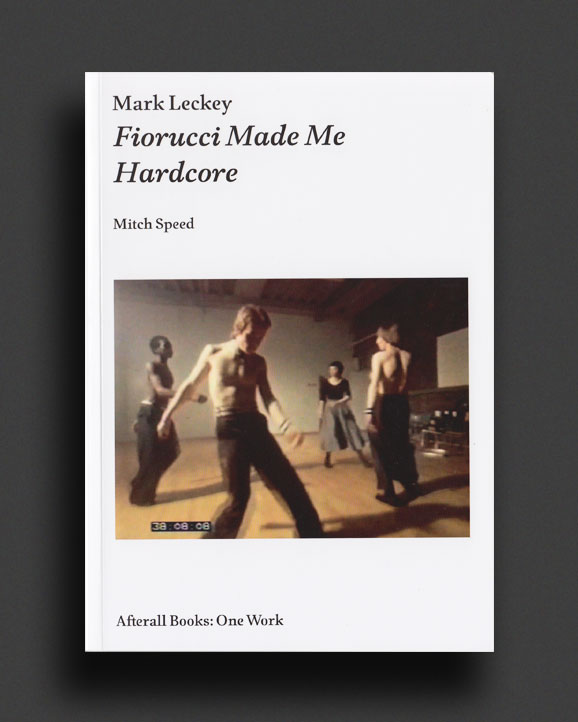
In 1999, the British artist Mark Leckey released his video-montage Fiorucci made me Hardcore, a dreamscape vignette that communes with the rapturous promises of youth. Putting archive material to use, Leckey entwined footage of underground dance and street culture in Britain with audio grifted and recorded in the artist's studio. In this illustrated study, the first comprehensive examination of the work, Mitch Speed argues that by interweaving personal and collective memory, this work gives voice to the complexities of class and cultural transformation during Britain's Thatcherite era. Oscillating between local and expansive resonances, Fiorucci made me Hardcore takes form as a homage, love letter, and work of criticism that eschews analysis, instead incanting the deeper implications of its subject.
1994, English / Japanese
Softcover (staple-bound), 40 pages, 21 x 30 cm
1st Edition, Out of print title / Used*,
Published by
File Inc. / Kyoto
$190.00 - Out of stock
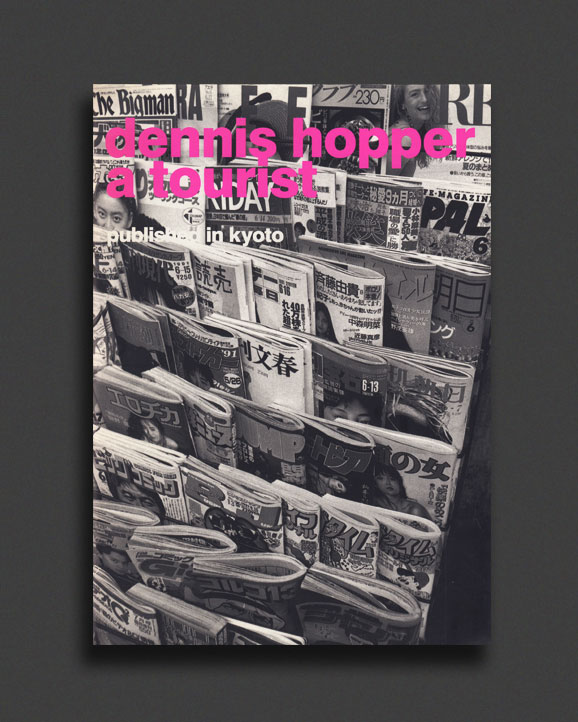
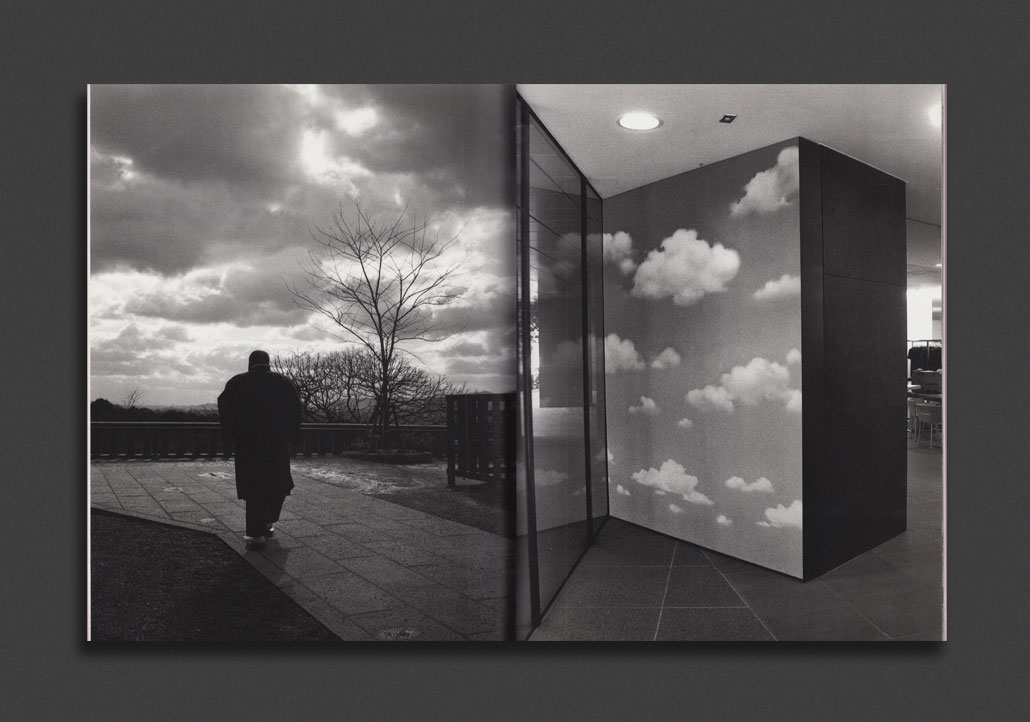
A very scarce publication of Director/Actor Dennis Hopper's photographs from a 1991 visit to Tokyo and a 1994 visit to Kyoto, published in Kyoto in 1994 by Takao Nakamura and File, Inc.
This is the first and only edition and to our knowledge these photographs have never appeared in book form since. A fine copy. Includes invitation card to Dennis Hopper "Photo Works II" exhibition in Japan, 1994.
"From 1961 on I carried my camera everywhere. All My friends teased me about being a tourist. I put my Nikon away in 1967 when I started writing and directing “Easy Rider.” Only on occasion did I use it, when friends who were camera shy asked me to photograph them—Sean Penn, Gary Oldman, Maria Mckee, Quentin Tarantino. Three years ago on my second trip to Japan, I took my Nikon with me for the first time since the 60’s and shot 30 rolls of film. In the states I had them developed, looked at the proof sheets vaguely and put them away. Six months ago I blew up 12 pictures to give to friends in Japan because they always give me presents. I was surprised how much I liked the pictures. Chihiro Narumi asked me to do a show in Kyoto and Tokyo. I bought a new Nikon 35Ti in Kyoto, and I am now carrying it everywhere. I feels good being a tourist again. My life seems very full suddenly. Thank you. - Dennis Hopper"
Very Good-Fine copy.
2019, English
Softcover, 244 pages, 12.9 x 19.5 cm
Published by
Verso / London
$30.00 - In stock -
What is the function of art in the era of digital gloablisation?
How can one think of art institutions in an age defined by planetary civil war, growing inequality, and proprietary digital technology? The boundaries of such institutions have grown fuzzy. They extend from a region where the audience is pumped for tweets to a future of “neurocurating,” in which paintings surveil their audience via facial recognition and eye tracking to assess their popularity and to scan for suspicious activity.
In Duty Free Art, filmmaker and writer Hito Steyerl wonders how we can appreciate, or even make art in the present age. What can we do when arms manufacturers sponsor museums and some of the world's most valuable artworks are used as a fictional currency in a global futures market that has nothing to do with the works themselves? Can we distinguish between creativity and the digital white noise that bombards our everyday lives? Exploring artifacts as diverse as video games, Wikileaks files, the proliferation of spam, and political actions, she exposes the paradoxes within globalization, political economies, visual culture, and the status of art production.
2018, English
Softcover, 96 pages, 17 x 22 cm
Published by
Roma / Amsterdam
$40.00 - Out of stock
Looking at the play between memory and forgetfulness, 'Mike Kelley: Fortress of Solitude' brings together a range of key works from across the artist’s career. Whether using found stuffed animals as emotional effigies of long lost traumatic memories, or evoking the psychic existential homelessness of Superman in the form of his Kandor series, Mike Kelley explores the dark underbelly of post-war American culture. This publication accompanies the exhibition that took place at the Museum of Cycladic Art in Athens, Greece.
2019, English
Hardcover, 144 pages, 23 x 33 cm
Published by
Fulgur Press / UK
$115.00 - In stock -
Between 1968 and 1971, in a loft on New York's Jefferson Street, the poet, photographer and filmmaker Ira Cohen created some of the most mythic images of the late 1960s. Inspired by his friends Jack Smith and Bill Devore, Cohen’s initial experiments with black light developed into an experimental ritual space he termed the Mylar Chamber—a simple room of hinged boards hung with reflective Mylar film. Through his extended network, and with the support of artist and set designer Robert LaVigne, Cohen invited visitors to play another self within this small theater, among them Jimi Hendrix, William Burroughs, Vali Myers, Jack Smith, Angus MacLise, Alejandro Jodorowsky, Lionel Ziprin, Ching Ho Cheng, Petra Vogt, Charles Ludlam, John McLaughlin and the rock group Spirit.
In December 1969, in a summary of the past decade, Life magazine declared that “few came as close to explaining the euphoric distortions of hallucinogenics” as Cohen through his Mylar Chamber photographs, but the full story draws upon much deeper ideas surrounding identity and the power of the image.
This is the first book to explore Cohen’s iconic Mylar Chamber photographs. Published on the 50th anniversary of the Life magazine feature, and with several gatefolds, it includes more than 70 images from this intensely creative period, each digitally restored from the original negatives by Cohen’s friend and collaborator, Ira Landgarten. It also includes an interview with Cohen, excerpts from his poetry, critical writing from Allan Graubard and Ian MacFadyen and further reflections from Timothy Baum, Alice Farley and Thurston Moore.
Ira Cohen was born in the Bronx in 1935. A countercultural renaissance man, Cohen made films, photographs and poetry, edited the magazine Gnaoua and authored The Hashish Cookbook. Cohen became well known for his 1968 movie using the Mylar technique, The Invasion of Thunderbolt Pagoda, soundtracked by Angus MacLise, the original drummer of the Velvet Underground. In 2008 Nina Zivancevic, writing in NY Arts magazine, described Cohen’s life as “a sort of white magic produced by an alchemist who turned his back on the establishment in order to find God, art and poetry.” He died in 2011.
“Looking at your pictures is like looking through butterfly wings.” – Jimi Hendrix
2019, English
Softcover, 272 pages, 15.2 x 22.9 cm
Published by
Semiotext(e) / Los Angeles
$44.00 - Out of stock
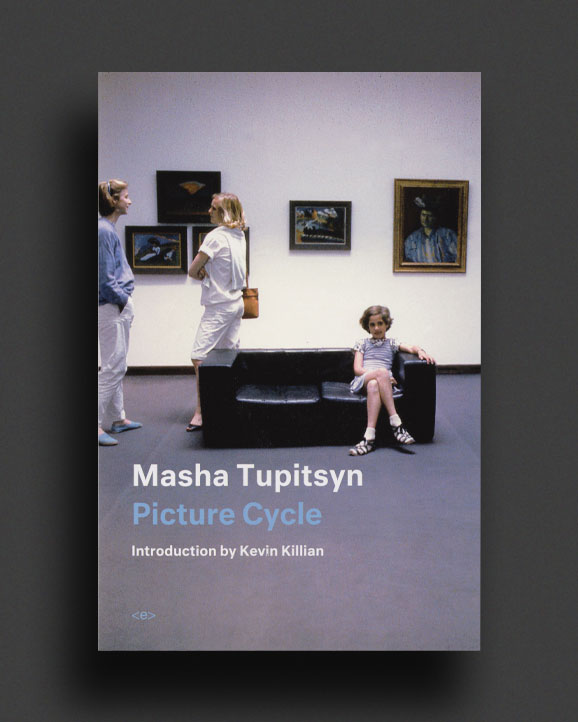
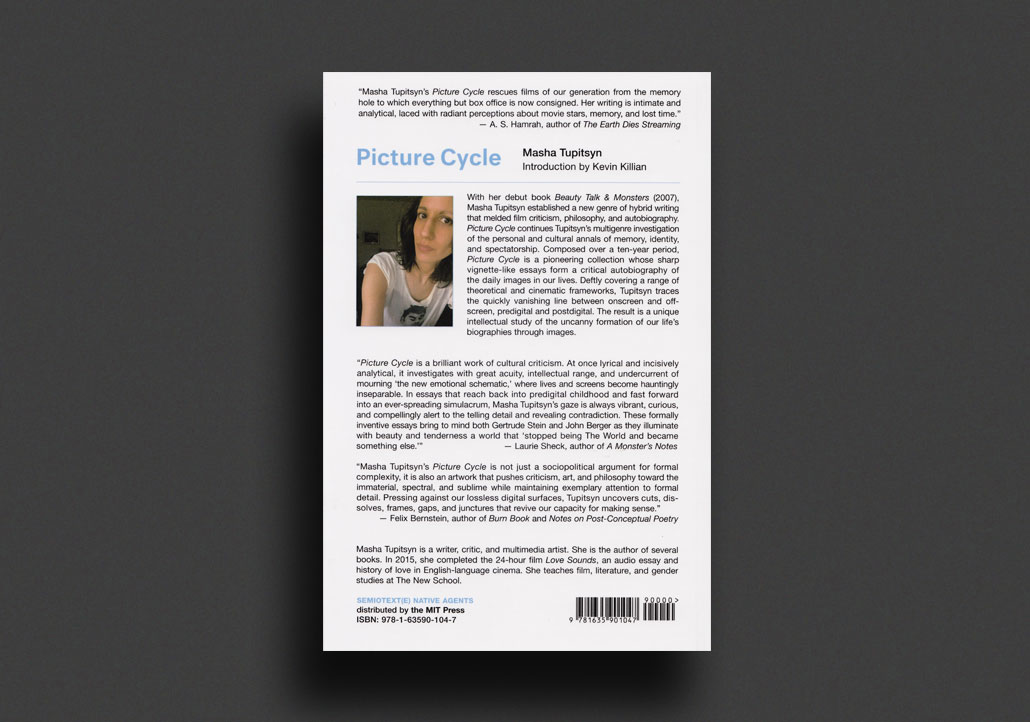
Introduction by Kevin Killian
With her debut collection Beauty Talk & Monsters (2007), Masha Tupitsyn established a new genre of hybrid writing that melded film criticism, philosophy, and autobiography. Picture Cycle continues Tupitsyn's multigenre investigation of the personal and cultural annals of memory, identity, and spectatorship, both on and off the screen. Composed over a ten-year period, Picture Cycle is a pioneering collection whose sharp and knowing vignette-like essays form a critical autobiography of the daily images in our lives. Deftly covering a range of theoretical and cinematic frameworks, Tupitsyn traces here the quickly vanishing line between onscreen and offscreen, predigital and postdigital. The result is a unique intellectual study of the uncanny formation of our life's biographies through images.
In exchange for studying what each fraudulent cell looks like under a merciless commercial and commodified lens, viewers enable late-capitalism to run more smoothly by calling in with their votes, as is the case with Reality TV. From the inside, secrecy appears eradicated, as though secrets or coded transparencies comprise the totality of injustice, rather than just one part. Justice is reduced to a vantage point. We see and we see and we see ad infinitum. - from Picture Cycle
1967, French
Softcover, 60 pages, 26 x 18 cm
1st Edition, Out of print title / used / very good
Published by
Musée des Arts Decoratifs / Paris
$80.00 - Out of stock
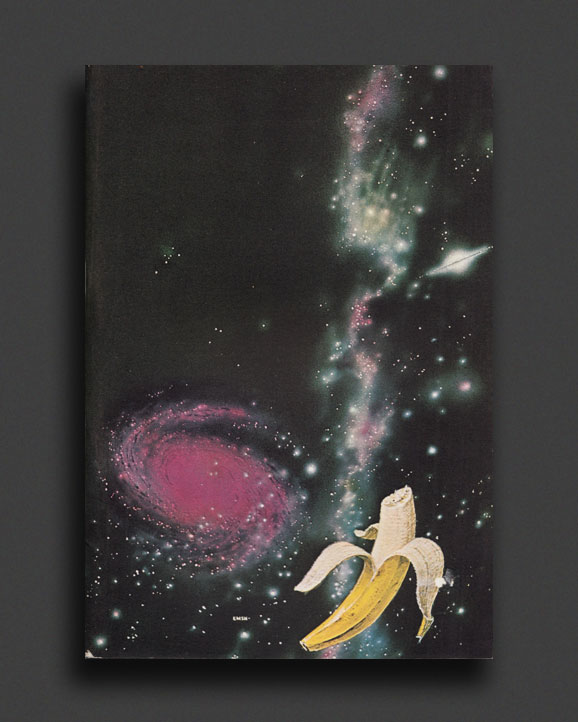
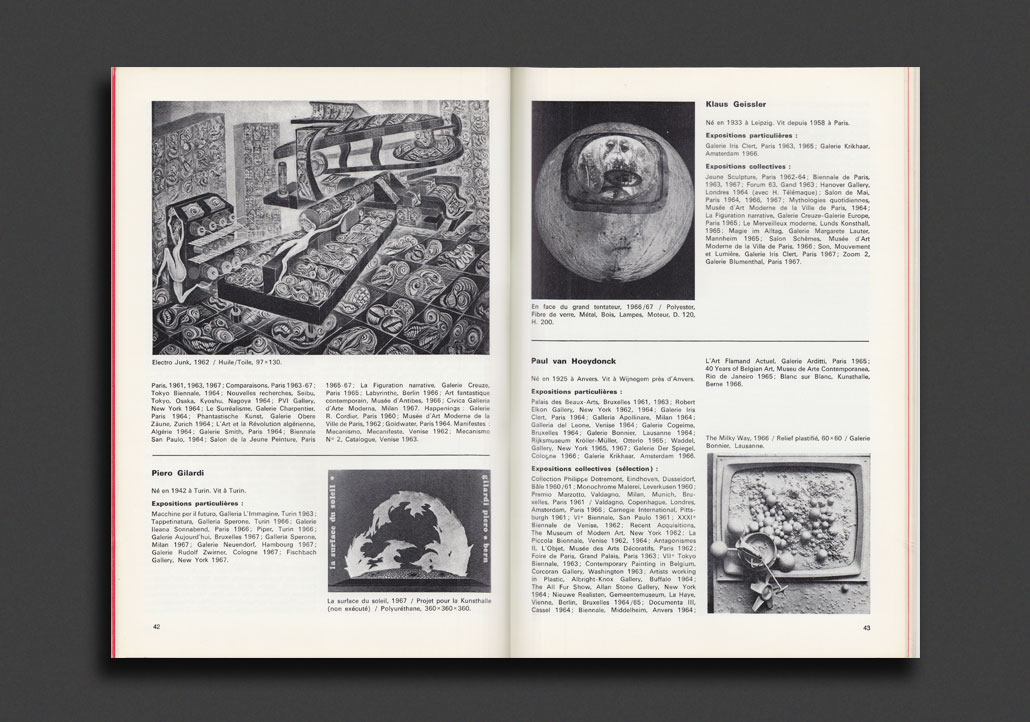
First edition of the iconic catalogue for the legendary Science-Fiction exhibition, curated by Harald Szeemann and presented as a touring show at Kunsthalle Bern, Musée des arts décoratifs Paris, and Städtische Kunsthalle Düsseldorf, 1967-1968. In the fashion of Szeemann's exhibition-making, Science-Fiction attracted record numbers of visitors whilst triggering controversial debate in the press. In institutions dedicated to the showcasing of contemporary art, Szeemann ventured to compile the unbelievable amount of around 3,000 objects from sociology, technology, science, art, comics, journalism, and literature, around the theme of Science-Fiction. The exhibits were presented in the show ordered in segments: modern spaceflight, art, film, literature, robots, UFOs, humour, toys, comics, as well as science fiction in the real world. Catalogue includes the work of Martial Raysse, Tetsumi Kudo, Roy Lichtenstein, Liliane Lijn, Robert Malaval, H. W. Muller, Bernard Rancillac, Markus Ratz, Shinkichi Tajiri, Edmund Alleyn, Piero Gilardi, Klaus Geissler, Paul van Hoeydonck, Piotr Kowalski, Yaacov Agam, Erró, Takis, Antonio Dias, Frank Franzetta, Guido Crepax, Wally Wood, Giovanni Scolari, Jean-Claude Forest, Al Williamson, and many more. Texts by Pierre Versins, Jacques Sadoul, Demètre Iokimidis, etc. in French. Includes the fold-out "Tableau chronologique de la S.F." compiled by French Science Fiction collector and scholar Pierre Versins.
Very Good copy.
1967, Dutch / English
Softcover (staple-bound), 14 pages, 29.5 × 21.5 cm
1st Edition, Out of print title / used / good
Published by
Kultureel Centrum / Venlo
$40.00 - Out of stock
Catalogue published in 1967 to accompany the international exhibition of S-F at Kultureel Centrum Venlo, 26 August - 25 September, 1967. Organised by Lei Alberigs, this high-profile exhibition presented the work of Shinkichi Tajiri and Ferdi Tajiri, Frans Zwartjes, Thomas Attridge, Karl Kleimann, Frans Peeters, Jan Slothouber, Willem Graatsma, Isamu Kanamori, Carl Mangus, Erhard Wehrmann and Robert Berlind. Illustrated throughout in b/w with works by all artists and text by Sylvia Nicolas (in Dutch).
Good with tanning to spine and some creasing to spine.
2006, English
Softcover, 375 pages, 35 x 25.5 cm
1st Edition, Out of print title / used / fine
Published by
CAPC / Bordeaux
Sculpture Centre / New York
$160.00 - Out of stock
Over-sized, long out-of-print Grey Flags catalogue edited by Bettina Funcke, published in conjunction with the exhibition of the same name curated by Anthony Huberman and Paul Pfeiffer. Comprised of nineteen artists with significant individual differences, Grey Flags assembles a group of works that not only resist categorical branding, but also go on in different ways to challenge the very terms of the "arts-apparatus." The exhibition featured the work of John Armleder, Lutz Bacher, Helen Chadwick, Tacita Dean, Claire Fontaine, Liam Gillick, Piero Golia, Michael Krebber, Jonathan Monk, Gabriel Orozco, The Atlas Group / Walid Raad, Allen Ruppersberg, Seth Price, Wilhelm Sasnal, Karin Schneider, Shirana Shahbazi, Kelley Walker, Apichatpong Weerasethakul, Mario Ybarra Jr. and the 375 page exhibition catalogue compiled a sort-of reader/scrap book of bootlegged pages from other catalogues and zines, artworks, text excerpts etc. contributed by all involved. A unique and fascinating catalogue.
"When you stop talking and doing, and close your eyes, what comes to mind? Voices? Images? Feelings? Like landscape seen from a plane, these phenomena hover on a sublime verge between fascinating and boring. Well, that might be true of anything viewed from a distance: the stars, the sea, mountains, the horizon. And what of social phenomena? Same. On any forgotten record, it's in the filler songs that you find the blank, thoughtless strivings laid bare, production patterns of another day, secrets of the ornaments. [...]" - Seth Price
Fine copy, with light shelf wear.
1977, Czech
Softcover, 32 pages,
1st Edition, Out of print title / used / very good
Published by
National Gallery / Prague
$40.00 - Out of stock
Lovely Czech catalogue from 1977 published on the occasion of an exhibition of the work of master animator, puppeteer and illustrator Jiří Trnka (1912-1969), held at the Národní Galerie, Praha (Prague National Gallery). Profusely illustrated throughout with examples of Trnka's puppets, drawings, and paintings.
Very Good copy.
Jiří Trnka (11912 – 1969) was a Czech puppet-maker, illustrator, motion-picture animator and film director. In addition to his extensive career as an illustrator, especially of children's books, he is best known for his work in animation with puppets, which began in 1946. Most of his movies were intended for adults and many were adaptations of literary works. Because of his prolific influence in animation, he was called "the Walt Disney of Eastern Europe", despite the great differences between their works. Throughout his life, he illustrated 130 works of literature, most of them for children, for which he received the international Hans Christian Andersen Medal for illustrators in 1968. Especially famous are his illustrations for the tales of the Brothers Grimm, as well as many collections of folktales from Czech authors such as Jiří Horák and Jan Páleníček. Of his many animated works, Trnka considered his greatest work to be his last film, the short Ruka (The Hand, 1965). In the words of animation historian Giannalberto Bendazzi, Ruka is "a kind of hymn to the creative freedom raging." In short, it is about a sculptor visited by a huge hand, which seeks the completion of a sculpture of itself. By rejecting the imposition, the artist is constantly pursued by the hand, ending with induced suicide and the hand officiating at his funeral. Ruka is considered a protest against the conditions imposed by the Czechoslovak communist state to artistic creation, and even some have seen in it an anticipation of the so-called Prague Spring. Although the film initially had no problems with censorship, after his death copies were confiscated and banned from public display in Czechoslovakia for two decades.
1979, English / Polish
Hardcover (w. dust jacket), 216 pages, 27.5 x 26 cm
1st Edition, Out of print title / used / very good
Published by
Krajowa Agencja Wydawnicza / Warsaw
$100.00 - Out of stock
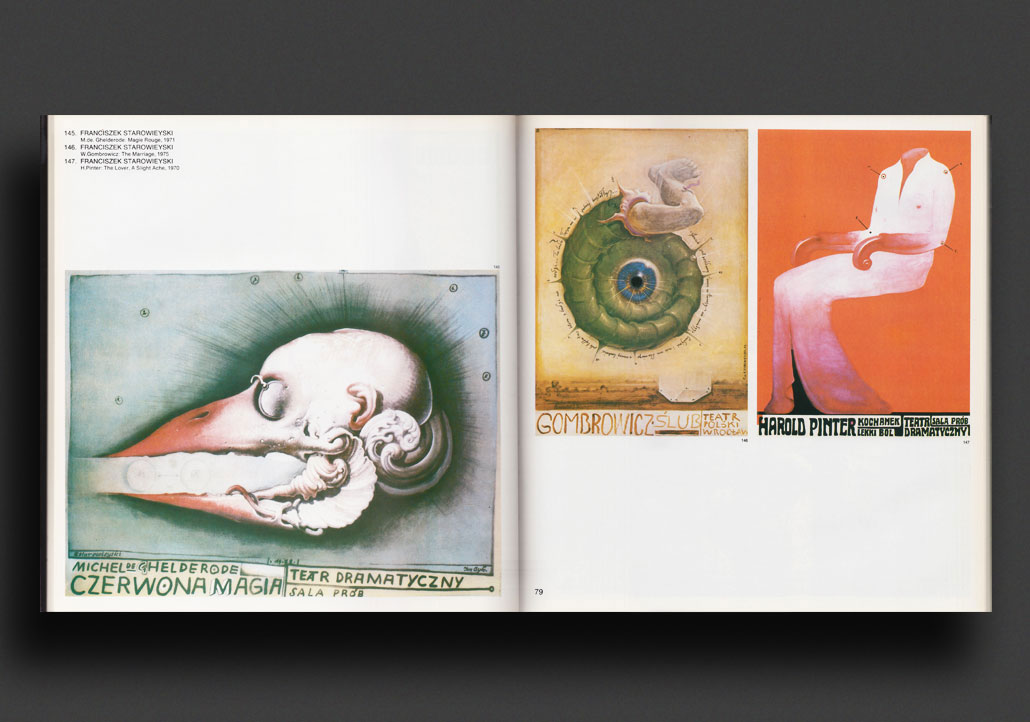
First scarce edition of this wonderful hardcover volume, published in 1979 by Krajowa Agencja Wydawnicza in Warsaw. Beautifully designed by one of the leading graphic artists in the field of Polish posters, Hubert Hilscher, this 200+ page book remains the finest document dedicated to the "Plakat Polski" (Polish Poster) of the 1970s - an exceptional period for the medium. Lavishly illustrated throughout in colour and b&w with over 400 of the best examples spanning 1970-1978, the book opens with an introduction in both Polish and English, English captions throughout, and includes detailed artist and work indexes in the back. Includes Political and Social Posters, Theatre and Concert Posters, Film Posters, Exhibition and Commercial Posters, Tourist and Sports Posters, and Circus Posters. This stunning book is a must for anyone interested in the subject, or graphic design and illustration from this period in general.
Features the work of Maciej Urbaniec, Franciszek Starowieyski, Józef Mroszczak, Leszek Hołdanowicz, Karol Śliwka, Romuald Socha, Elzbieta Procka, Jan Młodożeniec, Włodzimierz Terechowicz, Wiktor Górka, Roman Cieślewicz, Jerzy Czerniawski, René Mulas, Maria Ihnatowicz, Jan Lenica, Janusz Grabiański, Mieczysław Wasilewski, Hubert Hilscher, Jan Kotarbinski, Waldemar Świerzy, Tomasz Rumiński, Jerzy Treliński, Roman Rosyk, Tadeusz Piskorski, Andrzej Krajewski, Danuta Żukowska, Jan Jaromir Aleksiun, Marcin Mroszczak, Jan Sawka, Henryk Tomaszewski, Doroty Kabiesz, Tomasz Jura, Jerzy Flisak, Marek Freudenreich, Marian Stachurski, Witold Janowski, and many more.
Beginning in the 1950s and through the 1980s, the Polish School of Posters combined the aesthetics of painting with the succinctness and simple metaphor of the poster. It developed characteristics such as painterly gesture, linear quality, and vibrant colours, as well as a sense of individual personality, humour, and fantasy. It was in this way that the Polish poster was able to make the distinction between designer and artist less apparent. Posters of the Polish Poster School significantly influenced the international development of graphic design in poster art. Their major contribution is in their use of the power of suggestion through allusion. Using strong and vivid colours from folk art, they combine printed slogans, often hand-lettered, with popular symbols, to create a concise inventive metaphor. As a hybrid of words and images, these posters created a certain aesthetic tension that projected the art form in this period on European design. In addition to aesthetic aspects, these posters were able to reveal the artist's emotional involvement with the subject. They did not solely exist as an objective presentation, rather they were also the artist's interpretation and commentary on the subject and on society.
To this day, "Plakat Polski" remain as influential as ever on the world of graphic design, typography, illustration and even painting, and are widely collected and exhibited around the world.
Very Good copy.
2019, English / German
Softcover, 272 pages, 23 x 16.5 cm
Published by
Texte Zur Kunst / Berlin
$32.00 - Out of stock
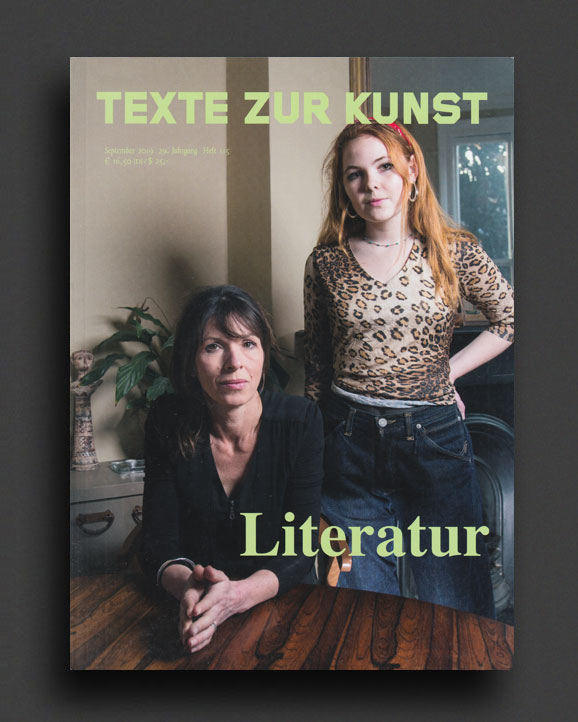
In the current issue of Texts on Art, "Literature," we explore the emergence of the genre of "autofiction": a field in literature that has been taken up between the formally distinct categories of fiction and autobiography. Annie Ernaux, Rachel Cusk, Deborah Levy, among others, whose works are exemplary in developing the form of writing in which the fictitious ego merges with the voices of others, where these voices are potentially in the social more generally.
ISSUE NO. 115 / SEPTEMBER 2019 "LITERATUR"
TABLE OF CONTENTS
PREFACE
BETWEEN YOU AND ME / A Correspondence on Autofiction in Contemporary Literature between Isabelle Graw and Brigitte Weingart
WOMAN AS SUBJECT OR EXEMPLARY OF HER KIND / A Conversation between Maija Timonen and Rachel Cusk
CLAUDE HAAS
ON - THE DEMISE OF AUTOBIOGRAPHY IN THE WHIRL OF AUTOFICTION. OR: REALITY TODAY
SURRENDER AS FREEDOM / Interview with Enis Maci by Aram Lintzel
PETER REHBERG
- QUEER AUTOFICTION AS BODY PROTOCOL
DIRK VON LOWTZOW
SOME QUESTIONS FOR LEÏLA SLIMANI
LEANDER SCHOLZ - LITERATURE OF WORKING-CLASS CHILDREN
JUTTA KOETHER -
WHEN YOU PAINT APPLES, DO YOU ALSO FEEL YOUR BREASTS AND KNEES BECOMING APPLES?
NEW DEVELOPMENT
EMPIRE OF ETHER / Colin Lang on the Advent of Drone Exhibitions
ROTATION
LIFE PRESERVER / Sven Lütticken on Alice Creischer’s “In the Stomach of the Predators: Writings and Collaborations”
KLANG KÖRPER
PROTO-WHATEVER-THIS-NEXT-PHASE-IS / Annika Haas über Holly Herndon in der Volksbühne Berlin und im Haus der elektronischen Künste Basel
REVIEWS
BLUE CUBES: VOLLGELAUFENE VOLUMEN / Diedrich Diederichsen über die 58. Biennale in Venedig
THE POWER OF NO / Eva Díaz on the Whitney Biennial 2019
GLOBAL SALE / Simon Baier über El Anatsui im Haus der Kunst, München
TO GIVE AND GIVE SUN / Övül Ö. Durmuşoğlu on Cecilia Vicuña at Witte de With, Rotterdam
FREE WILLY / Mikael Brkic on Jana Euler at Galerie Neu, Berlin
UNDERSTANDING THAT EVERYONE IS NOT UNDERSTANDING EVERYTHING / Gunter Reski über Heike-Karin Föll in den KW Institute for Contemporary Art, Berlin
CONSIDER NOT THE BIRD’S, BUT THE WORM’S VIEW / Adam Kleinman on Cian Dayrit at Nome Gallery, Berlin
KÜNSTLERIN SEIN / Georg Imdahl über Anna Oppermann in der Kunsthalle Bielefeld
SETTING THE RECORD STRAY / Ana Teixeira Pinto on “Straying from the Line” at Schinkel Pavillon, Berlin
CHICAGO, NOW! / Hans-Jürgen Hafner über Gustave Caillebotte in der Alten Nationalgalerie, Berlin
HIDE AND SEEK / Magnus Schaefer on Lydia Ourahmane at Bodega, New York
WE NEVER KNOW HOW HIGH WE ARE / Thomas Groetz über Mayo Thompson in der Galerie Buchholz, Berlin
INVOLUNTARY TRACES / Daniel Ricardo Quiles on Jonathas de Andrade at the Museum of Contemporary Art, Chicago
POETISCHE SEZIERUNGEN / Isabel Mehl über Cana Bilir-Meier im Hamburger Kunstverein
CAVEMAN BLUES / Saim Demircan on Edith Karlson and Dan Mitchell at Temnikova & Kasela, Tallinn
DIE MEISTERIN / Stefan Neuner über Lotte Laserstein in der Berlinischen Galerie
STAGING FEMINISM / Luisa Lorenza Corna on “The Unexpected Subject: 1978 Art and Feminism in Italy” at FM Centro per l’Arte Contemporanea, Milan, and “Doing Deculturalization” at Museion, Bolzano
WAHRNEHMUNG IST VERSCHIEBBAR / Christina Irrgang über Bea Schlingelhoff in der Galerie Max Mayer, Düsseldorf
GRIT AND VITALITY / Daniel Sturgis on Joan Snyder at Blain Southern, London
NACHRUFE
LINDA BILDA (1963−2019)
by Silvia Eiblmayr
AGNÈS VARDA (1928–2019)
by Jennifer Stob
MICHEL SERRES (1930−2019)
by Lorenz Engell
KLAUS BUSSMANN (1941–2019
by Ulrike Groos and Hans Haacke
EDITION
BIRGIT MEGERLE
STERLING RUBY
2019, English / German
Hardcover, 144 pages, 16.5 cm x 22 cm
Published by
Koenig Books / London
Fridericianum / Kassel
$48.00 - Out of stock
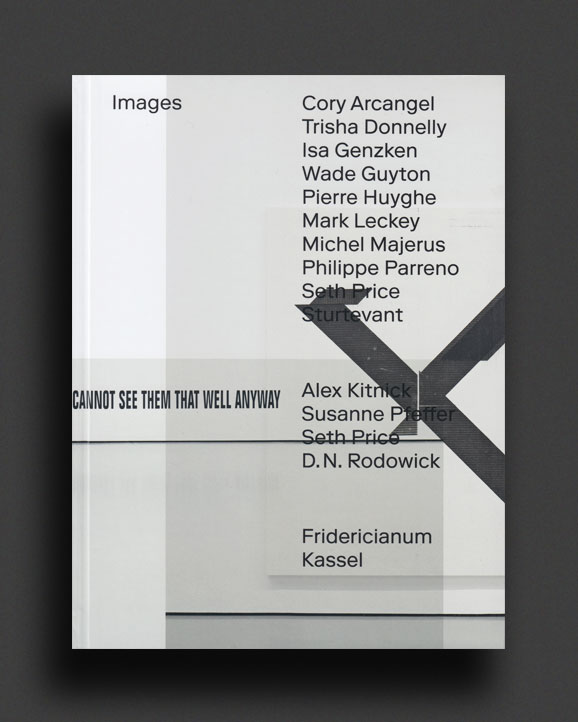
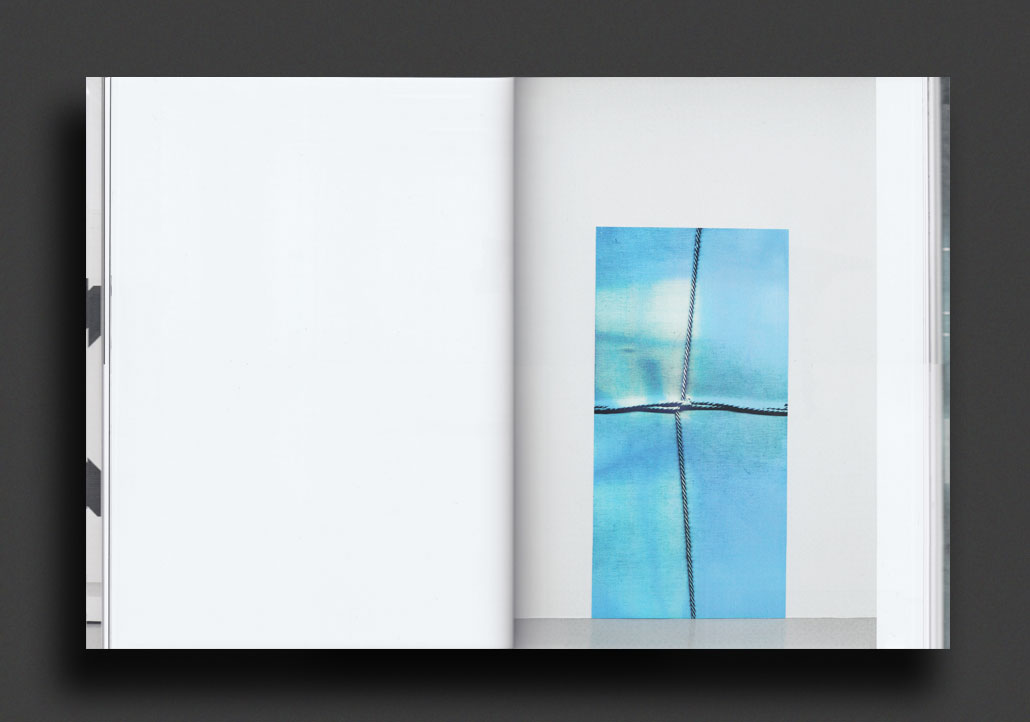
The realm of the imaginary, which has always been regarded as the primal domain of art, has expanded progressively under the influence of new technologies in the early years of the twenty-first century. Through a process of mutual interaction, the imaginary permeates and shapes reality— and vice versa. The imaginary potential of the visual image has become increasingly significant. This ongoing process is designated by the concept of the image. The works presented in this exhibition explore the image at the moment of its fundamental reconfiguration. Changes affecting the origin, distribution, function, and mission of the image have made it both the point of departure and the principal object of artistic analysis.
Artworks by Pierre Huyghe, Wade Guyton, Seth Price, Mark Leckey, Philippe Parreno, Michel Majerus, Trisha Donnelly, Cory Arcangel, Sturtevant, Isa Genzken
Texts by Alex Kitnick, Susanne Pfeffer, Seth Price, D.N. Rodowick
Published to accompany the exhibition ‘Images’, 31 Jan – 1 May 2016, Fridericianum, Kassel.
Co-published by Koenig Books and Fridericianum.
English and German text.
2019, English
Hardcover, 236 pages, 21 x 27 cm
Published by
Walther König / Köln
$94.00 $60.00 - Out of stock
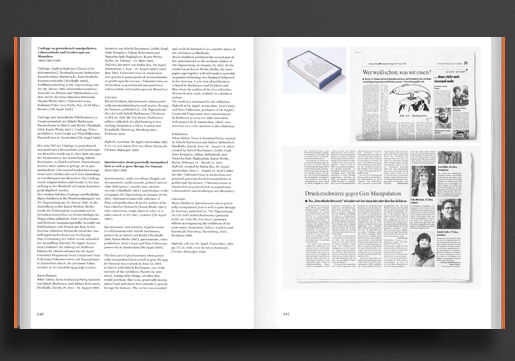
This publication focuses on two of Maria Eichhorn’s open-ended projects, which both have the representation and regulation of sexual imagery as their theme. Prohibited Imports (2003/08 and 2015) now includes books censored by Japanese customs – books made by artists Robert Mapplethorpe, Wolfgang Tillmans, and Jeff Koons, among others. Film Lexicon of Sexual Practices (1999/2005/2008/2014/2015) currently consists of twenty 16mm silent films (each approx. 3 minutes).
The essays by Nina Power, Nora M. Alter, Pamela M Lee, and Scott Watson engage the critical dimension of these compelling works.
Published after the exhibition at Morris and Helen Belkin Art Gallery, Vancouver (11 September – 13 December 2015).
Maria Eichhorn is a German artist based in Berlin. She is best known for site-specific works and installations that investigate political and economic systems, often revealing their intrinsic absurdity or the extent to which we normalize their complex codes and networks
2017, English / German
Hardcover (cloth-bound), 560 pages, 23 x 18 cm
Published by
Kunsthaus Bregenz / Austria
Walther König / Köln
$85.00 - In stock -
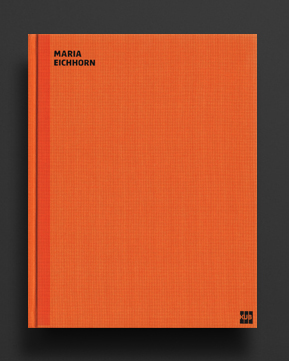
This comprehensive and chronologically structured catalogue raisonné orders the radical work of the artist Maria Eichhorn according to art history and is supplemented by extensive image and archive material on her works, projects and exhibitions since 1986.
With the addition of large-format illustrations of the exhibition in Bregenz, this is one of the most comprehensive publications on the work of the artist to date.
Published retrospectively after the exhibition at Kunsthaus Bregenz, 10 May – 6 July 2014.
English and German text.
Maria Eichhorn is a German artist based in Berlin. She is best known for site-specific works and installations that investigate political and economic systems, often revealing their intrinsic absurdity or the extent to which we normalize their complex codes and networks
2017, English
Softcover, 112 pages, 16 x 23 cm
Published by
Mousse / Milan
$48.00 $25.00 - Out of stock
Józef Robakowski, a key figure of the 1960s and 1970s neo-avant-garde rebellion, is a master of structural cinema and a pioneer of Polish video art. In his practice he has tested viewers’ perceptual habits, developed ideas about mechanical recordings beyond any aesthetic convention, and criticized methods of visual persuasion in films, highlighting in particular the pompousness of political spectacles. A radical experimentalist and media analyst, Robakowski is known for his unique approach, “his own cinema,” in which autobiography replaces dubious history, and in which the artist proposes his own scenario for perceiving the reality of life under communism. The book, published in collaboration with the Luigi Pecci Centre for Contemporary Art and the Profile Foundation on the occasion of the exhibition “Józef Robakowski: Nearer – Further,” full of illustrations and descriptions of the work, contains an interview by Hans Ulrich Obrist with the artist and an interview between Fabio Cavallucci, the Artistic Director of Centro per l’Arte Contemporanea Luigi Pecci, and Marina Abramović, a colleague and friend of Robakowski in the years they both lived and worked in communist bloc countries.