World Food Books' programme is largely produced on Kulin Nation land. We acknowledge the Wurundjeri people of the Kulin Nation as the first and continuing custodians of this land, and pay respect to their Elders past, present, and emerging.
World Food Books is an arts and special interests bookshop in Naarm / Melbourne. Founded in 2010, World Food Books is devoted to the presentation of a rotating, hand-selection of international art, design, literary and counterculture publications with an emphasis on the anti-traditional, the experimental, the avant-garde, the heretic, the marginal.
Presenting new titles alongside rare and out-of-print books, catalogues and journals spanning the fields of modern and contemporary art, design, photography, illustration, film, literature, poetry, cultural theory, philosophy, sexuality, popular and underground culture in its many radical forms, World Food Books wishes to encourage adventurous, thoughtful and open-minded reading, looking, writing, and exchange of publishing and ideas, both current and historical.
As well as our bookshop, located in Melbourne's historical Nicholas Building, all of our inventory is available internationally via our online mail-order service.
World Food Books semi-regularly co-ordinates "Occasions", a programme of exhibits and events at the bookshop and in partnership with other hosts (such as museums and art galleries) that develop out of the activities, relationships and content of the bookshop itself.
World Food Books
The Nicholas Building
37 Swanston Street
Room 5, Level 6
Melbourne 3000
Australia
SHOP HOURS:
Thu–Fri 12–6, Sat 12–5
WEB-SHOP OPEN 24/7
World Food Books
Postal Address:
PO Box 435
Flinders Lane
Victoria 8009
Australia
Art
Theory / Essay
Architecture / Interior
Graphic Design / Typography
Photography
Fashion
Eros
LGBTQ+
Fiction / Poetry
Weird / Speculative / Science Fiction / Horror
Transgressive / Visceral / Abject
Symbolism / Decadence / Fin de siècle
Film / Video
Painting
Sculpture / Installation
Performance / Dance / Theater
Drawing
Sound / Music
Curatorial
Group Shows / Collections
Periodicals
Out-of-print / Rare
Posters / Ephemera / Discs
Signed Books
World Food Books Gift Voucher
World Food Book Bag
Australian Art
Australian Fiction
Australian Science Fiction / Speculative Fiction
Australian Poetry
Australian Photography
Japanese Photography
Conceptual Art
Minimal Art
Dada
'Pataphysics / Oulipo
Fluxus
Concrete Poetry
Pop Art
Surrealism
Arte Povera
Arte Informale / Haute Pâte / Tachism
Nouveau Réalisme / Zero / Kinetic
Situationism / Lettrism
Collage / Mail Art / Xerox Art
Art Brut / Folk / Visionary / Fantastic
Illustration / Graphic Art / Bandes Dessinées
Furniture
Italian Radical Design / Postmodernism
Textiles
Ceramics / Glass
Counterculture
Protest / Revolt
Philosophy
Psychoanalysis
Anthropology
Anarchism
Socialism / Anarchism / Communism / Capitalism
Literary Theory / Semiotics / Language
Feminism / Women's Studies
Gender Studies / Sexuality
Anthropology
Fetishism / BDSM
Drugs / Psychedelia
Crime / Violence
Animal Rights / Veganism
Occult / Esoterica
Ecology / Earth / Alternative Living
Whole Earth / Crafts
All prices in AUD (Australian dollars)
Pick-Ups
Pick-up orders can be collected in our bookshop during opening hours after order date. Please collect any Pick-up orders within 2 weeks of ordering as we have limited storage space. Orders will be released back into stock if not collected within this time. No refunds can be made for pick-ups left un-collected. If you cannot make it in to the bookshop in this time-frame, please choose postage option.
Return Policy
All sales are final. We do accept returns (for refund or exchange) for items received in error. All our orders are packed with special care using heavy-duty padding and cardboard book-mailers or bubble mailers (for smaller books), using reinforcement where required. We cannot take responsibility for any lost, stolen or damaged parcels.
Insurance
Should you wish to insure your package, please email us directly after placing your order and we can organise this at a small extra expense. Although all standard/express tracked packages are very safe and dependable, we cannot take responsibility for any lost, stolen or damaged parcels. We recommend insurance on valuable orders.
Interested in selling your old books, catalogues, journals, magazines, comics, fanzines, ephemera? We are always looking for interesting, unusual and out-of-print books to buy. We only buy books in our fields of interest and specialty, and that we feel we can resell.
We base these prices on desirability, market value, in-print prices, condition and our current stock levels. We offer cash, store credit, and can take stock on consignment. All
about 25% of the price we expect to get when we sell them, or 30% in store credit. We base these prices on desirability, market value, in-print prices, condition and our current stock levels.
Sell your books any day of the week. You can drop them off and return later. If you have a lot of books, we can visit your Sydney home.
We buy books that we feel we can resell. We offer about 25 % of the price we expect to get when we sell them, or 30% in store credit. We base these prices on desirability, market value, in-print prices, condition and our current stock levels.
Philadelphia Wireman
03 August - 01 September, 2018
World Food Books is proud to announce our next Occasion, the first presentation of sculptures by Philadelphia Wireman in Australia.
The Philadelphia Wireman sculptures were found abandoned in an alley off Philadelphia’s South Street on trash night in 1982. Their discovery in a rapidly-changing neighbourhood undergoing extensive renovation, compounded with the failure of all attempts to locate the artist, suggests that the works may have been discarded after the maker’s death. Dubbed the "Philadelphia Wireman" during the first exhibition of this work, in 1985, the maker’s name, age, ethnicity, and even gender remain uncertain. The entire collection totals approximately 1200 pieces, all intricately bound together with tightly-wound heavy-gauge wire (along with a few small, abstract marker drawings, reminiscent both of Mark Tobey and J.B. Murry). The dense construction of the work, despite a modest range of scale and materials, is singularly obsessive and disciplined in design: a wire armature or exoskeleton firmly binds a bricolage of found objects including plastic, glass, food packaging, umbrella parts, tape, rubber, batteries, pens, leather, reflectors, nuts and bolts, nails, foil, coins, toys, watches, eyeglasses, tools, and jewellery.
Heavy with associations—anthropomorphic, zoomorphic, and socio-cultural responses to wrapped detritus—the totemic sculptures by Philadelphia Wireman have been discussed in the context of work created to fulfil the shamanistic needs of alternative religions in American culture. Curators, collectors, and critics have variously compared certain pieces to sculpture from Classical antiquity, Native American medicine bundles, African-American memory jugs, and African fetish objects. Reflecting the artist’s prolific and incredibly focused scavenging impulse, and despite—or perhaps enhanced by—their anonymity, these enigmatic objects function as urban artefacts and arbiters of power, though their origin and purpose is unknown. Philadelphia Wireman, whatever their identity, possessed an astonishing ability to isolate and communicate the concepts of power and energy through the selection and transformation of ordinary materials. Over the course of the past two decades, this collection has come to be regarded as an important discovery in the field of self-taught art and vernacular art.
Presented in collaboration with Fleisher-Ollman Gallery, Philadelphia, and Robert Heald, Wellington.
Susan Te Kahurangi King
02 February - 10 March, 2018
Susan Te Kahurangi King (24 February 1951 - ) has been a confident and prolific artist since she was a young child, drawing with readily available materials - pencils, ballpoint pens and felt-tip markers, on whatever paper is at hand. Between the ages of four and six Susan slowly ceased verbal communication. Her grandparents William and Myrtle Murphy had developed a special bond with Susan so they took on caring responsibilities for extended periods. Myrtle began informally archiving her work, carefully collecting and storing the drawings and compiling scrapbooks. No drawing was insignificant; every scrap of paper was kept. The King family are now the custodians of a vast collection containing over 7000 individual works, from tiny scraps of paper through to 5 meter long rolls.
The scrapbooks and diaries reveal Myrtle to be a woman of great patience and compassion, seeking to understand a child who was not always behaving as expected. She encouraged Susan to be observant, to explore her environment and absorb all the sights and sounds. Myrtle would show Susan’s drawings to friends and people in her community that she had dealings with, such as shopkeepers and postal workers, but this was not simply a case of a grandmother’s bias. She recognised that Susan had developed a sophisticated and unique visual language and sincerely believed that her art deserved serious attention.
This was an unorthodox attitude for the time. To provide some context, Jean Dubuffet coined the term Art Brut in 1945 to describe work created by self-taught artists – specifically residents of psychiatric institutions and those he considered to be visionaries or eccentrics. In 1972 Roger Cardinal extended this concept by adopting the term Outsider Art to describe work made by non-academically trained artists operating outside of mainstream art networks through choice or circumstance. Susan was born in Te Aroha, New Zealand in 1951, far from the artistic hubs of Paris and London that Dubuffet and Cardinal operated in. That Myrtle fêted Susan as a self-taught artist who deserved to be taken seriously shows how progressive her attitudes were.
Susan’s parents Doug and Dawn were also progressive. Over the years they had consulted numerous health practitioners about Susan’s condition, as the medical establishment could not provide an explanation as to why she had lapsed into silence. Dawn educated herself in the field of homeopathy and went on to treat all twelve of her children using these principles – basing prescriptions on her observations of their physical, mental and emotional state.
Doug was a linguist with an interest in philosophy who devoted what little spare time he had to studying Maori language and culture. To some extent their willingness to explore the fringes of the mainstream made them outsiders too but it was their commitment to living with integrity and their respect for individuality that ensured Susan’s creativity was always encouraged.
Even though Susan’s family supported her artistic pursuits, some staff in schools and hospitals saw it as an impediment to her assimilation into the community and discouraged it in a variety of ways. Her family was not always aware of this and therefore did not fully understand why Susan stopped drawing in the early 1990s. However, rather than dwell on the challenges that Susan faced in pursuit of her artistic practice, they prefer to highlight her achievements. In 2008 Susan began drawing again in earnest, after an almost 20 year interruption, and her work is now shown in galleries around the world.
Susan grew up without television and has been heavily influenced by the comics she read as a child. She is absolutely fearless in the appropriation of recognizable characters, such as Donald Duck and Mickey Mouse, in her work. She twists their limbs, contorts their faces, compresses them together, blends them into complex patterned backgrounds - always imbuing them with an incredible energy. Although Susan often used pop culture characters in her work they are not naive or childlike. These are drawings by a brilliant self-taught artist who has been creating exceptional work for decades without an audience in mind.
Mladen Stilinović
"Various Works 1986 - 1999"
02 February 16 - September 10, 2016
Various works 1986 - 1999, from two houses, from the collections of John Nixon, Sue Cramer, Kerrie Poliness, Peter Haffenden and Phoebe Haffenden.
Including: Geometry of Cakes (various shelves), 1993; Poor People’s Law (black and white plate), 1993; White Absence (glasses, ruler, set square, silver spoon, silver ladel with skin photograph and wooden cubes), 1990-1996; Exploitation of the Dead (grey and red star painting, wooden painting, black spoon with red table, red plate), 1984-1990; Money and Zeros (zero tie, paintings made for friends in Australia (Sue, John, Kerrie), numbers painting), 1991-1992; Words - Slogans (various t-shirts) - “they talk about the death of art...help! someone is trying to kill me”, “my sweet little lamb”, “work is a disease - Karl Marx”; Various artist books, catalogues, monographs, videos; Poster from exhibition Insulting Anarchy; "Circular" Croatian - Australian edition; Artist book by Vlado Martek (Dostoyevsky); more.
Thanks to Mladen Stilinović and Branka Stipančić.
Jonathan Walker
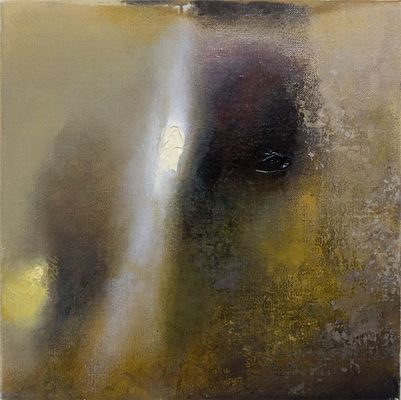
Always Will Need To Wear Winter Shirt Blue + Ochre Small Check Pattern
21 August - 21 September, 2015
Untitled
I am not a great reader of poetry but I always return to the work of Melbourne poet, Vincent Buckley (1925- 1988). Perhaps I find his most tantalising piece to be not a finished poem but a fragment left on a scrap of paper discovered on his desk after the poet’s death.
The poetry gathers like oil
In the word-core, and spreads
It has its music meet,
Its music is in movement.
This fragment is more the shell left behind from a volatile thought than a finished poem. I find the last two lines honest but awkward whereas the first two lines work like an arrow. Most likely he could not find a resolution so it was left. Still, in its present form, it remains an eloquent testimony to the ultimate failure of a medium to express mobile thought and sensation, in Buckley’s case, through verbal language. It’s an important matter because this is something all artists have to deal with regardless of the medium.
I have never written a poem, however, I am forever copying fragments from books on paper scraps in a vain effort to fix certain notions in my head. At first, they function as bookmarks that are sometimes returned to when I open the book. But before long, as they accumulate, they fall out littering the table interspersed with A4 photocopies, bills, books and medications.
To return to Buckley’s fragment, the first two lines very much evoke how I paint nowadays. As you age, detail diminishes and patches of light become more luminous and float. I feel the most honest way of dealing with this is by smearing the oil paint on the canvas with the fingers and working close-up, blind. Only if the patches coalesce into an approaching image can the work gain a life.
-
Jonathan Walker was born in Melbourne, Australia and brought up on a dairy farm in Gippsland. In the 1970’s he studied painting at RMIT and won the Harold Wright Scholarship to the British Museum, London. During the 1980’s he exhibited at Pinacotheca Gallery, Richmond and had work shown at the NGV and Heidi City Art Gallery. Over the same period he designed the cover for the “Epigenesi” LP by Giancarlo Toniutti, Italy and conducted a mail exchange work with Achim Wollscheid, Germany. The work with artists through the post resulted in an article published in the bicentenary issue of Art and Australia 1988. He showed in artist run spaces such as WestSpace in the 90’s and 2000’s, and until 2012, taught painting at Victoria University, which is where we (Colleen Ahern and Lisa Radford) as organisers of the exhibition, among many others, had the privilege of being his student.
Walker’s knowledge was imparted to students through the careful selection of music, literature, and artists found in books that he himself had ordered for the library. Walker’s strategy was the generosity of sharing his vast knowledge with references specific to each student and their context.
Walker’s paintings share a similar focus and intimacy.
This exhibition presents a small selection of recent paintings alongside a publication that includes Walker’s writing. Observational and analytical, Walker’s work is a type of material notation — the time of day, colour and how it is blended, the both specific and fleeting location of a reflection on lino or the question of whether a chair leg should be included in a painting.
Please join us on Friday August 21 between 6-8pm to celebrate the opening of the exhibition.
Curated by Colleen Ahern and Lisa Radford.
B. Wurtz
Curated by Nic Tammens
March 26 - April 4, 2015
B.Wurtz works from a basement studio in his home on Manhattan’s Lower East Side.
This local fact is attested to by the plastic shopping bags and newsprint circulars that appear in his work. As formal objects, they don’t make loud claims about their origins but nonetheless transmit street addresses and places of business from the bottom of this long thin island. Like plenty of artists, Wurtz is affected by what is local and what is consumed. His work is underpinned by this ethic. It often speaks from a neighborhood or reads like the contents of a hamper:
“BLACK PLUMS $1.29 lb.”
“Food Bazaar”
“USDA Whole Pork Shoulder Picnic 99c lb.”
“RITE AID Pharmacy, with us it’s personal.”
“H. Brickman & Sons.”
“Sweet Yams 59c lb."
Most of the work in this exhibition was made while the artist was in residence at Dieu Donne, a workshop dedicated to paper craft in Midtown. Here Wurtz fabricated assemblages with paper and objects that are relatively lightweight, with the intention that they would be easily transportable to Australia. This consideration isn’t absolute in Wurtz’s work, but was prescriptive for making the current exhibition light and cheap. Packed in two boxes, these works were sent from a USPS post office on the Lower East Side and delivered to North Melbourne by Australia Post.
Wurtz appears courtesy of Metro Pictures, New York.
Thanks to Rob Halverson, Joshua Petherick, Sari de Mallory, Matt Hinkley, Helen Johnson, Fayen d'Evie, Ask Kilmartin, Lisa Radon, Ellena Savage, Yale Union, and "Elizabeth".
John Nixon
"Archive"
December 15 - January 20, 2014
The presentation of John Nixon's archive offered a rare showcase of this extensive collection of the artist's own publications, catalogues, posters, ephemera, editions and more, from the mid 1980s onwards, alongside a selection of his artworks.
Organized by John Nixon, Joshua Petherick and Matt Hinkley.
<a href=http://wfb.public-office.info/artist/john-nixon>All titles by John Nixon
"Habitat"
at Minerva, Sydney (organised by Joshua Petherick and Matt Hinkley)
November 15 - December 20, 2014
Lupo Borgonovo, Janet Burchill & Jennifer McCamley,
Lewis Fidock, HR Giger, Piero Gilardi, Veit Laurent Kurz,
Cinzia Ruggeri, Michael E. Smith, Lucie Stahl, Daniel Weil, Wols
Press Release:
“...It contained seven objects. The slender fluted bone, surely formed for flight, surely from the wing of some large bird. Three archaic circuitboards, faced with mazes of gold. A smooth white sphere of baked clay. An age-blackened fragment of lace. A fingerlength segment of what she assumed was bone from a human wrist, grayish white, inset smoothly with the silicon shaft of a small instrument that must once have ridden flush with the surface of the skin - but the thing’s face was seared and blackened.”
William Gibson, “Count Zero”, 1986
"Autumn Projects Archive"
Curated by Liza Vasiliou
March 6 - March 15, 2014
World Food Books, in conjunction with the Virgin Australia Melbourne Fashion Festival 2014, presented the Autumn Projects archive, consisting of a selection of early examples in Australian fashion with a particular interest in collecting designers and labels from the period beginning in the 1980’s, who significantly influenced the discourse of Australian Fashion.
Curated by Liza Vasiliou, the exhibition provided a unique opportunity to view pieces by designers Anthea Crawford, Barbara Vandenberg, Geoff Liddell and labels CR Australia, Covers, Jag along with early experimental collage pieces by Prue Acton and Sally Browne’s ‘Fragments’ collection, suspended throughout the functioning World Food Books shop in Melbourne.
H.B. Peace
presented by CENTRE FOR STYLE
November 14, 2013
"Hey Blinky, you say chic, I say same"
Anon 2013
H.B. Peace is a clothing collaboration between great friends Blake Barns and Hugh Egan Westland. Their pieces explore the divergences between 'character’ and ‘personality’ in garments....etc
Special Thanks to Joshua Petherick and Matt Hinkley of WFB and Gillian Mears
and a Very Special Thank you to Audrey Thomas Hayes for her shoe collaboration.
Janet Burchill & Jennifer McCamley
"Aesthetic Suicide"
May 10 - June 8, 2013
The first of our occasional exhibitions in the World Food Books office/shop space in Melbourne, "Aesthetic Suicide" presented a body of new and older works together by artists Janet Burchill & Jennifer McCamley, including videos, prints, a wall work, and publications.
During shop open hours videos played every hour, on the hour.
2026, English
Softcover, 592 pages, 24 x 17 cm
Published by
Perimeter Editions / Melbourne
Gertrude Contemporary / Melbourne
$69.00 - In stock -
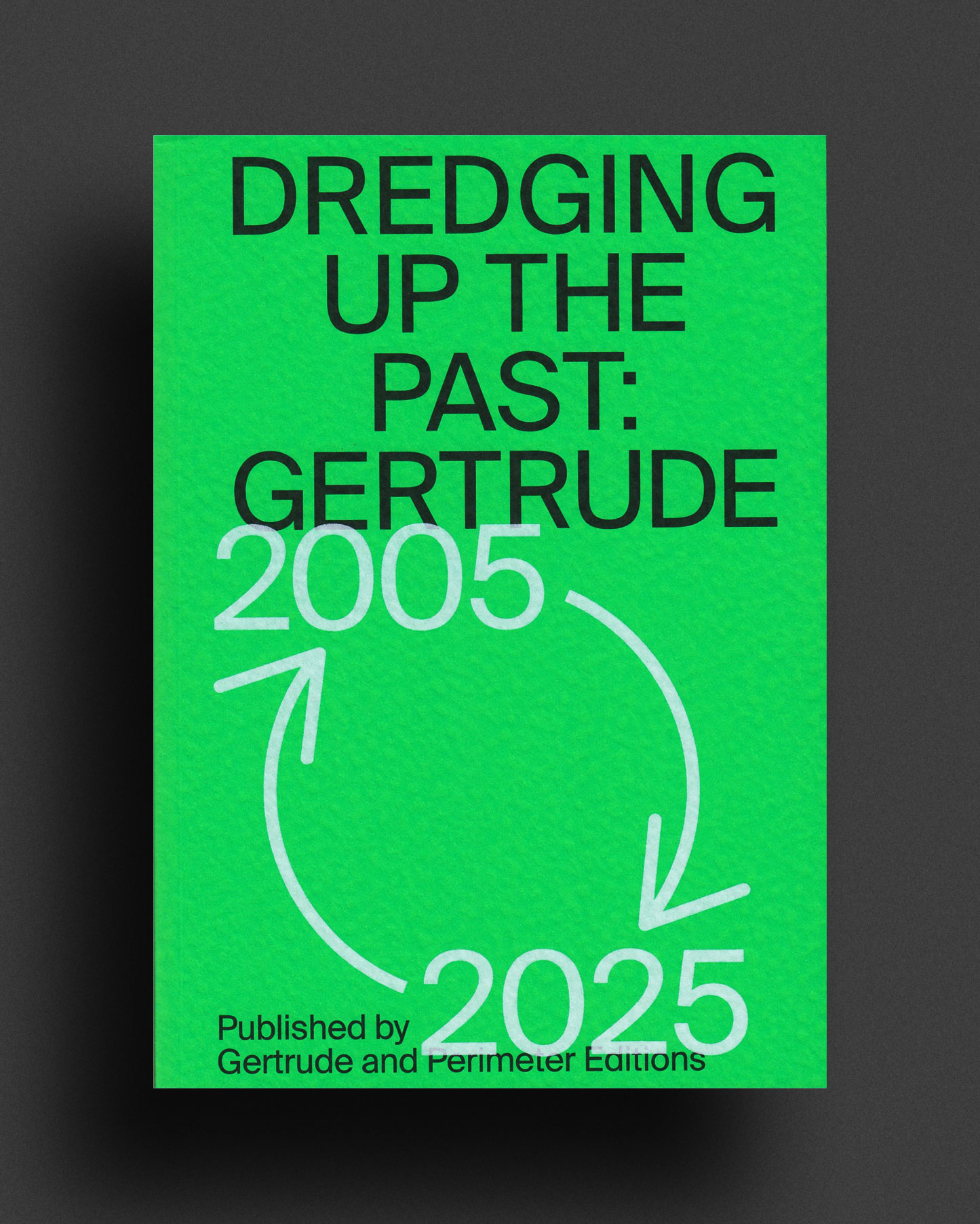
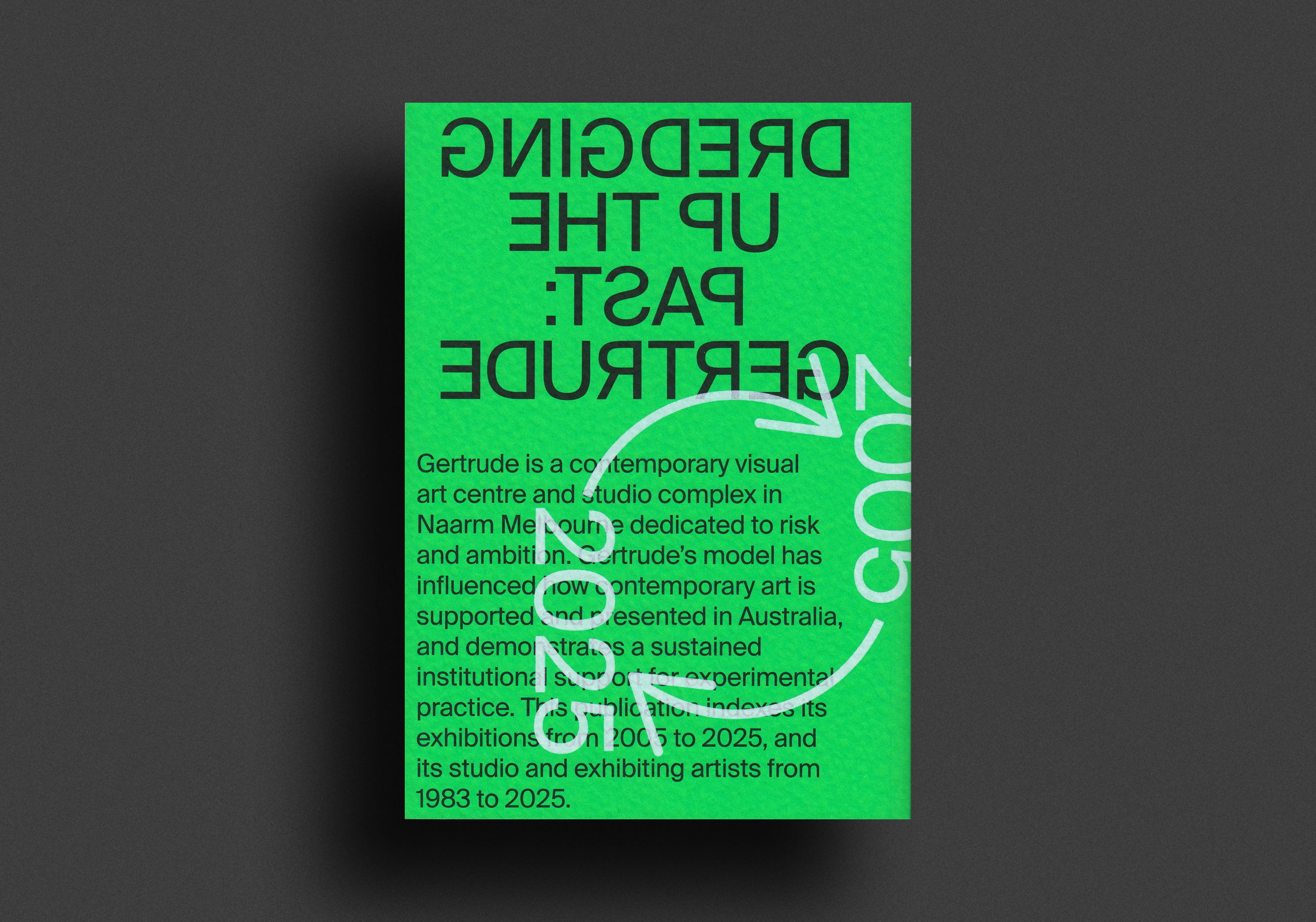
Gertrude is a contemporary visual art centre and studio complex in Naarm Melbourne, dedicated to risk and ambition. Gertrude’s model has influenced how contemporary art is supported and presented in Australia, and demonstrates a sustained institutional support for experimental practice. Co-published by Gertrude and Perimeter Editions, Dredging up the Past indexes its exhibitions from 2005 to 2025, and its studio and exhibiting artists from 1983 to 2025.
Edited by Sharon Flynn, and designed by Narelle Brewer, Dredging up the Past follows on from Gertrude’s previous twenty-year history, A Short Ride in a Fast Machine (2005), edited by Charlotte Day. An exercise in methodical indexing and recording, this 592-page tome covers every exhibition from the last two decades, alongside documentation of programs and projects, colloquial photographs, and creative and critical texts by the likes of James Nguyen, Nat Thomas, Kim Donaldson, and current directors Mark Feary and Tracy Burgess. In addition, a polyphonic text titled ‘Risk Contemporary’ draws on the contributions of former directors, curators, staff, studio artists, and board members to share anecdotes of conceptual risk during their time associated with Gertrude. The book closes with a vast ‘Catalogue of Personnel’ – a nod to the thousands of humans to have contributed to the organisation’s ecosystem from 1983 until 2025.
Dredging up the Past – which takes its title from the Richard Bell exhibition that inaugurated the first full year of programming at Gertrude’s current site in Preston South in 2018 – feels an apt description for the underpinnings of this book. Rather than reducing history to the stories of a few, this is about recording everything possible and affording it equal importance. This is no highlight reel; it is an excavation of each brick in Gertrude’s foundations.
1973, English
Hardcover (w. dust jacket), 331 pages, 21.5 x 20.5 cm
1st Edition, Out of print title / used / good
Published by
The MIT Press / Massachusetts
$75.00 - Out of stock
First 1973 hardcover edition.
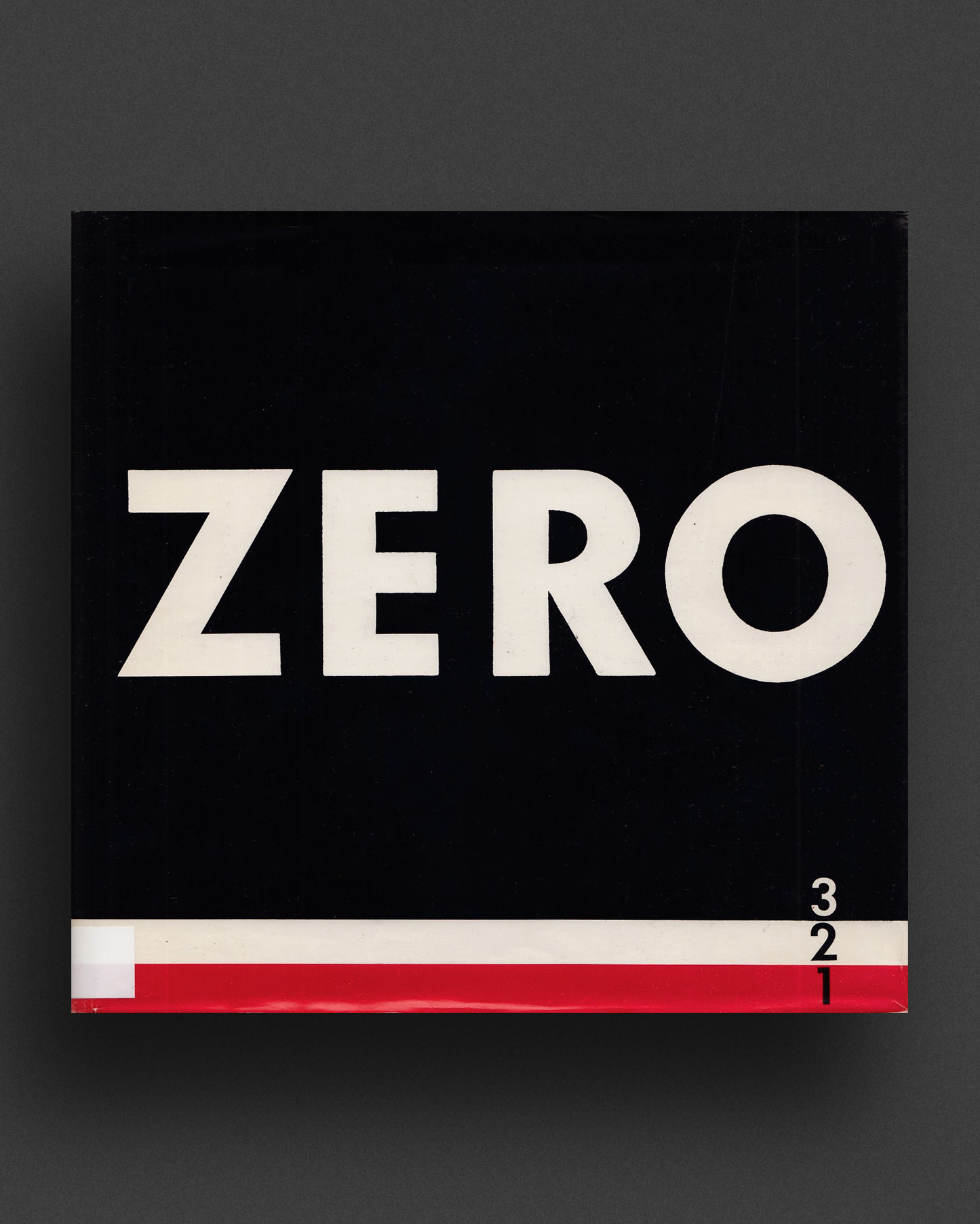
Environmental and Elemental art—large-scale and sky art—kinetic and technological art—random happenings and programmed events—multimedia and light shows: Zero 1, 2, 3 collects in one volume the three publications created by the artists' collaborative, Group Zero, between 1958 and 1961.
Group Zero originated in Dusseldorf, Germany, but quickly became a pan-European force, with mutual exchanges and interacting influences linking an array of artists in Dusseldorf, Paris, Milan, Amsterdam, and elsewhere. This is best indicated by listing some of the artists whose words are displayed and whose works are illustrated in this book: besides Piene and Mack, they include Fontana, Yves Klein, Mavignier, Jean Tinguely, Arman, Pol Bury, Spoerri, Manzoni, Dorazio, Soto, Manfred Kage, and many others.
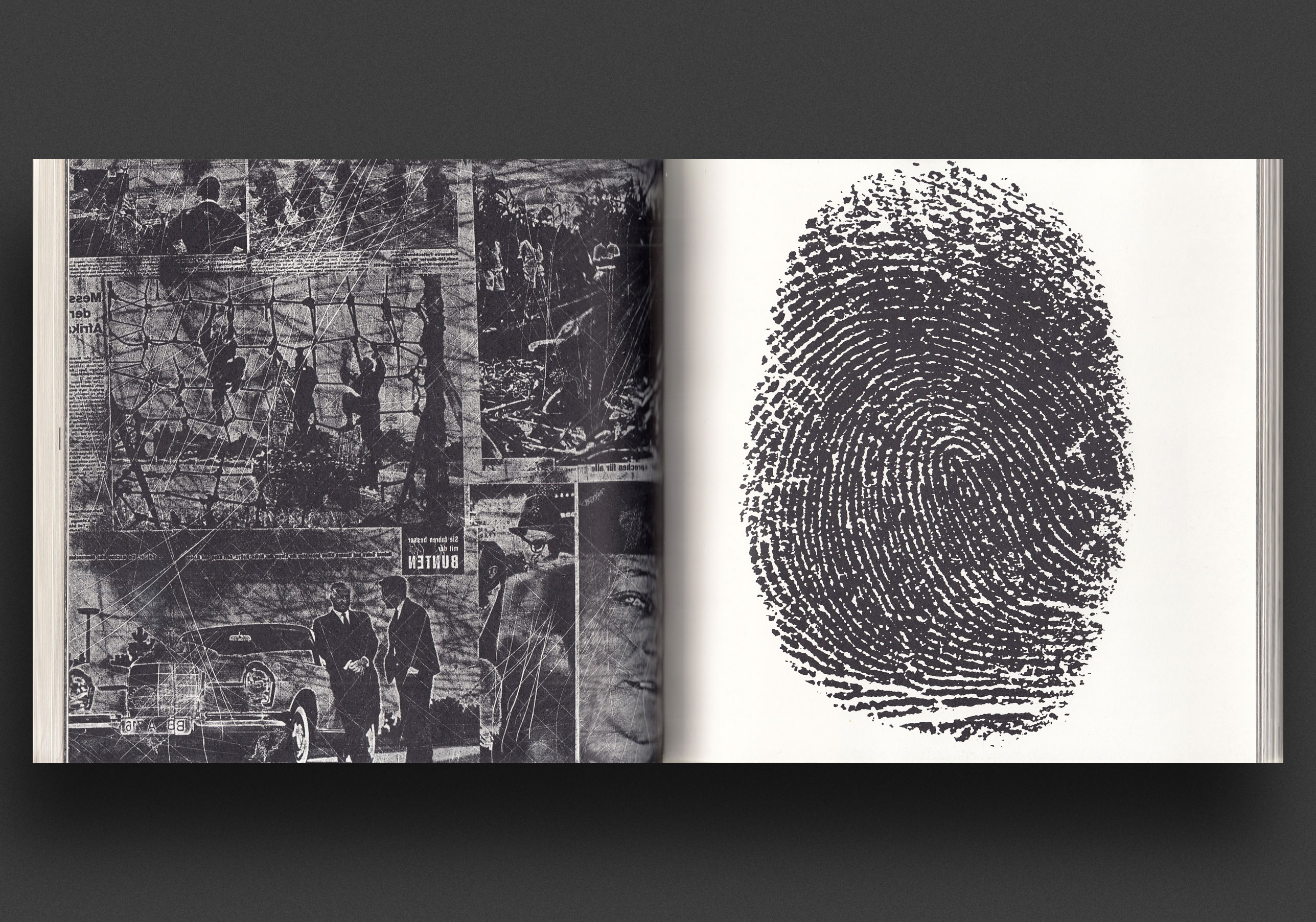
The book, designed by its originators, makes an artistic statement on its own terms: individual photographs can be viewed at leisure, but because of its dynamic film-like sequences, a rapid thumb-through converts it into a happening in the kinetic mode. In this edition all the text has been rendered into English in addition to being reproduced in the original German; yet the multilingual aspect of the first publication has been retained: those manifestos and artistic credos written in French or Italian are reprinted in their original language as well.
Zero 1 examines the Red Painting—it is a study in the monochromatic. Zero 2 focuses on vibrations and motion. The last and most elaborate of the volumes, Zero 3, exhibits the full range of Group Zero's concerns: it embraces the total environment, the nature-man-technology triad, and the myriads of artistic possibilities that can be realized through the interactions of elements.
The book offers ample testimony that Group Zero was a happening in contemporary art whose impact was far from ephemeral. As Lawrence Alloway writes in his Foreword: "The Zero group was the first artists' collaboration devoted to topics of light and movement, preceding by two years such collectives as Gruppo T (Milan) and the Groupe de Recherche d'Art Visuel (Paris). A general term for these and other groups was The New Tendency, useful initially as a way of indicating a broad community of interests (protechnology, antisubjective). What should be stressed is that The Zero Group, in their response to widespread aesthetic problems, revealed a sophistication and control that other groups in their strictness often missed. Ten years later, Zero has proved to have withstood the test of time."
Ex–library copy. Single filing sticker to DJ spine, library marking to initials, but (NOTE) with stamping that continues across a number of internal pages. Otherwise the book and DJ would be VG with light wear to extremities. Preserved in mylar wrap. The publisher's original torn, cut and burnt pages are all present and as they should be.
1991, Czech
Softcover (2 volumes in wrap), 266 + 50 pages, 29.7 x 21 cm
1st Edition, Out of print title / used / good
Published by
Prague City Galerie / Prague
Václav Špála Galerie / Prague
$100.00 - In stock -
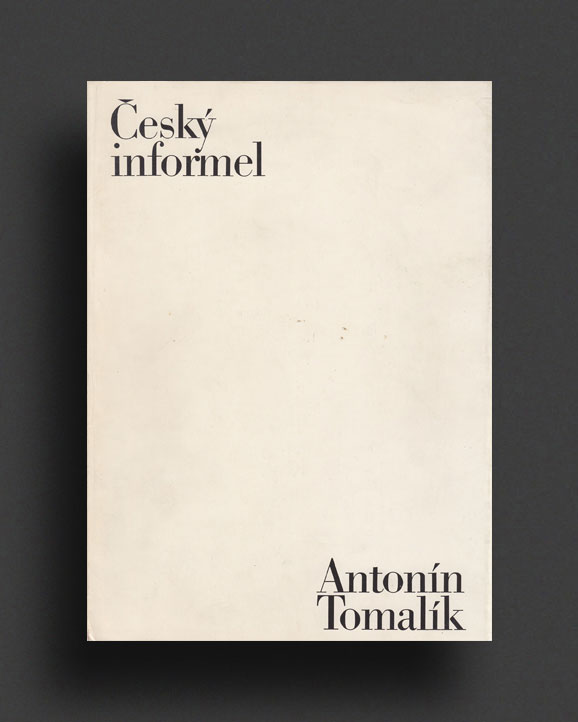
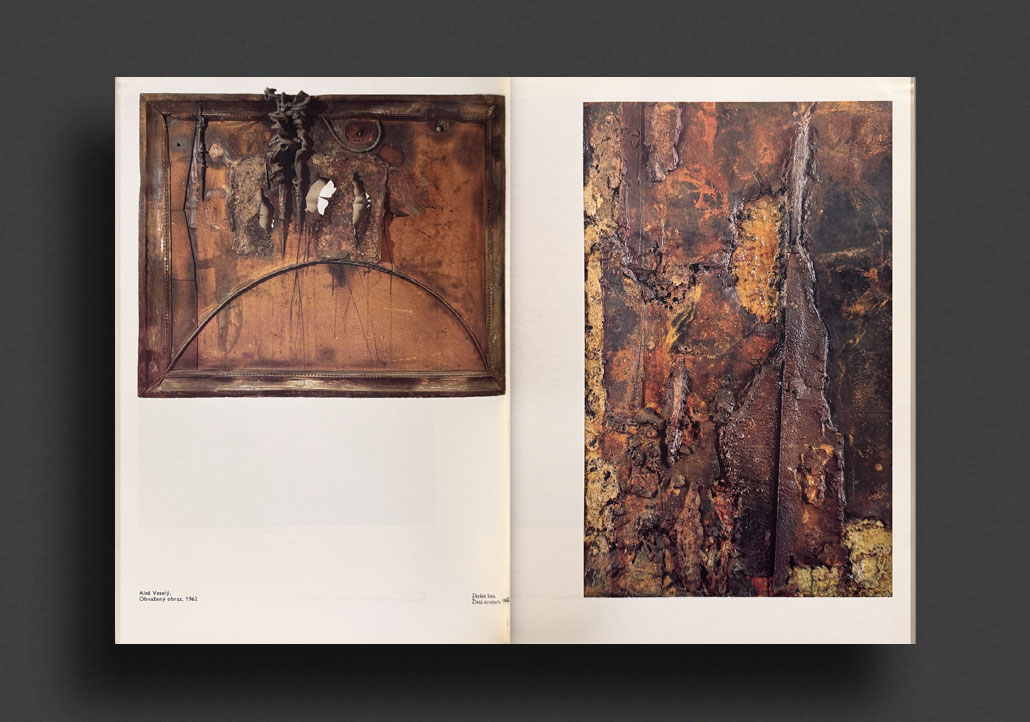
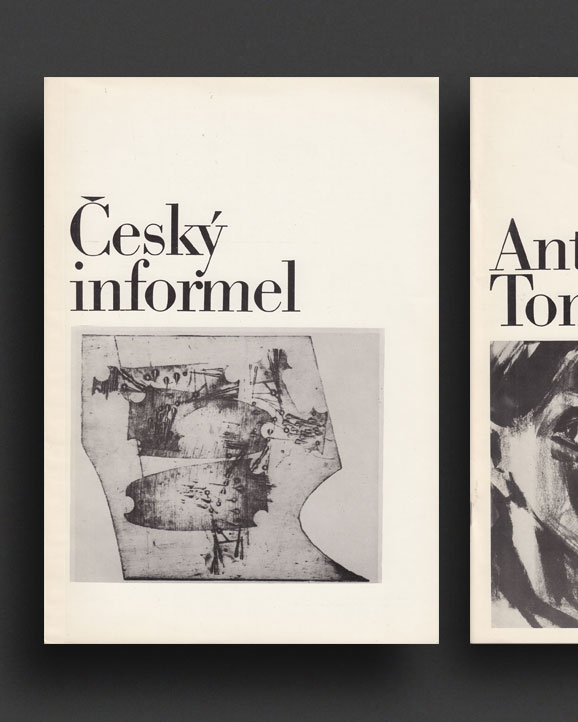
First edition of the only comprehensive book (a 2 volume survey) ever published on Český informel ("Czech Informel"), a radical current of post-war art that emerged in Prague from specific local conditions at the turn of the 1950s and 1960s. The term "Czech Informel" was an afterthought and defined only in the context of this major 1991 exhibition, accompanying symposium and publication. In the 1960s, the term "structural abstraction" was used, which according to Mahulena Nešlehová is inaccurate and misleading, because the term structure refers rather to an order that is internally organized. Informel, a term used from 1945 by the French critic Waldemar-George and later Michel Tapié, on the other hand, works with chance and the projection of spontaneous emotions and represents an "expressive material antipainting". The revolt of about thirty desperate avant-garde artists created a turning point in the history of Czech art, a phenomenon of which had no predecessor in Czechoslovakia. Sharing an emphasis on the aesthetic effect of raw materials and destruction with concurrent post-war European arts, Czech Informel differed in emphasis on its existential basis. The principle of the permanent construction and destruction of the image was a reaction to the severity of the times and an attempt to penetrate to the deeper essence of creation, in which the birth involves at the same time the extinction of the previous and reflects the consciousness of the fragility of human existence itself.
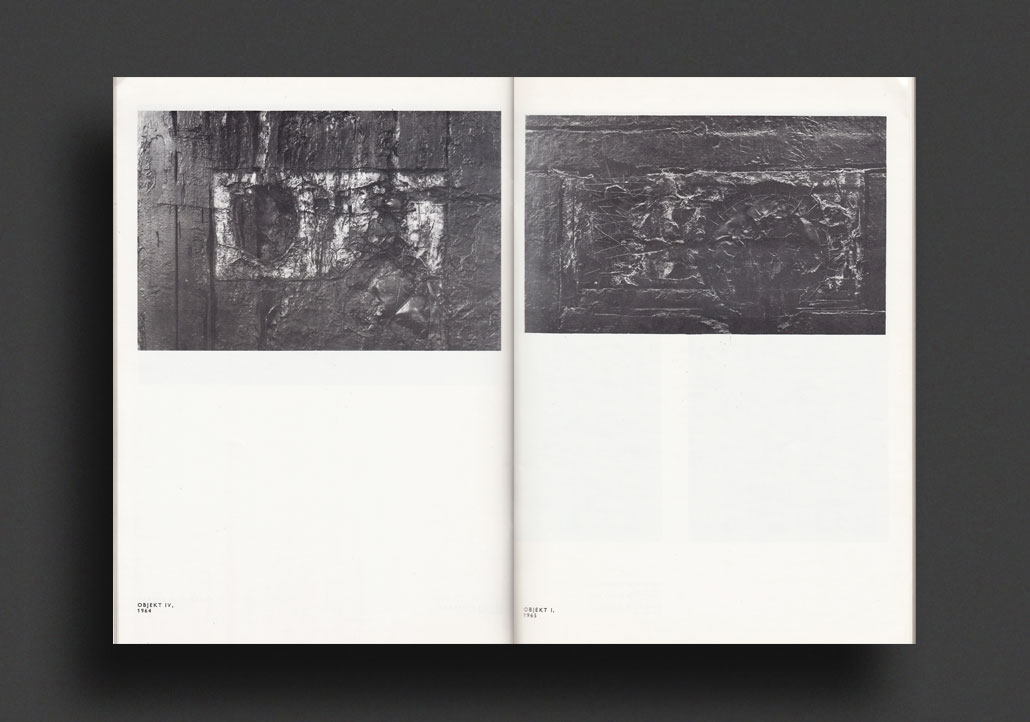
Profusely illustrated in b/w with select colour plates, the first volume traces the painting, sculpture, print and photographic works of the radical current of central Czech Informel artists, including Jan Koblasa, Aleš Veselý, Antonín Tomalík, Zbyšek Sion, Zdeněk Beran, Vladimír Boudník, Čestmír Janošek, Antonín Málek, Jiří Valenta, Miloš Koreček, Emila Medková, Zbyněk Sekal, Čestmír Krátký, Jiří Balcar, Karel Kuklík, Pavla Mautnerová, Jozef Jankovič, Jaroslav Hovadík, Mikuláš Medek, Alois Nožička, and many more.
The second volume is devoted to the life and work of Antonín Tomalík (1939—1968), one of the main artists of the radical Informel. He played a significant and irreplaceable role in the formation of Czech avant-garde and non-conformist art at a time when artists were burdened by an existential crisis as a result of the totalitarian regime. He belonged to a generation of young artists whose skepticism about life found expression in the raw, deliberately anti-aesthetic language of dark material creation, the result of which was an expressively urgent, internally destroyed object. Tomalík died in 1968, the result of an overdose of barbiturates and alcohol.
Texts in Czech by Antonín Dufek, Jiri Valoch, Mahulena Neslehová.
Highly recommended.
Good—VG copy.
1968, English
Softcover (French-fold with die-cut), 96 pages, 22 x 30 cm
Out of print title / used / good
Published by
NGV (National Gallery of Victoria) / Victoria
$150.00 - In stock -
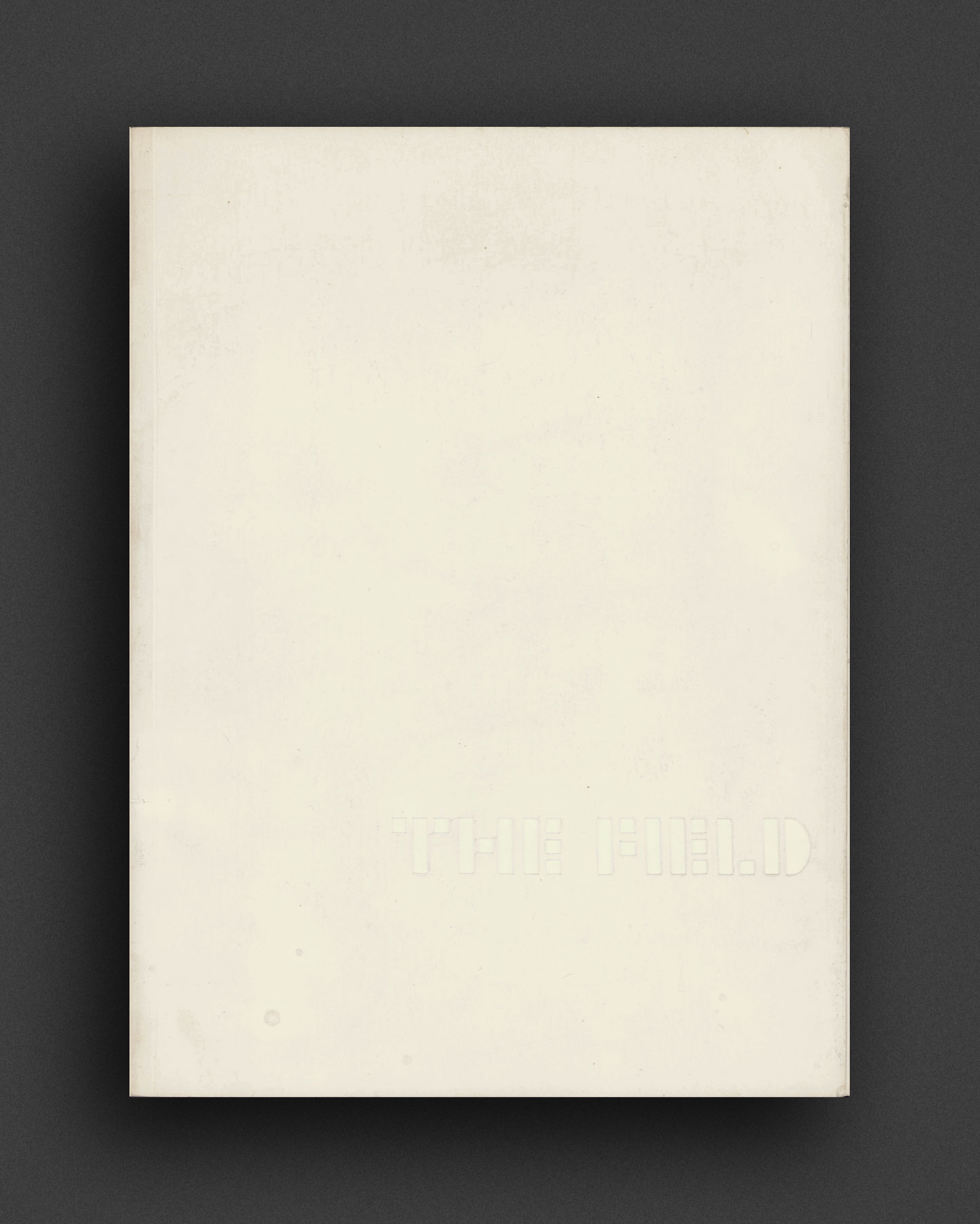
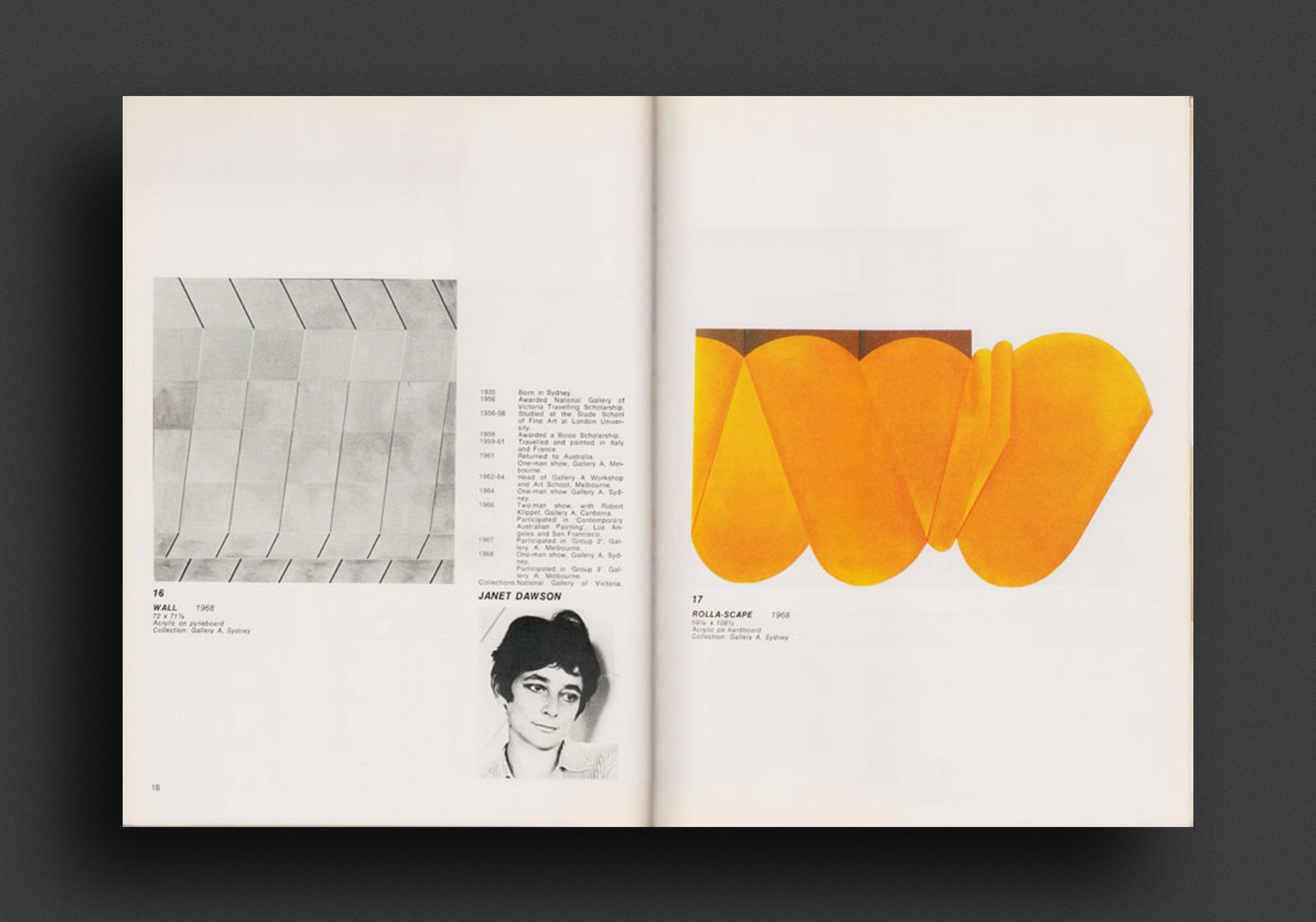
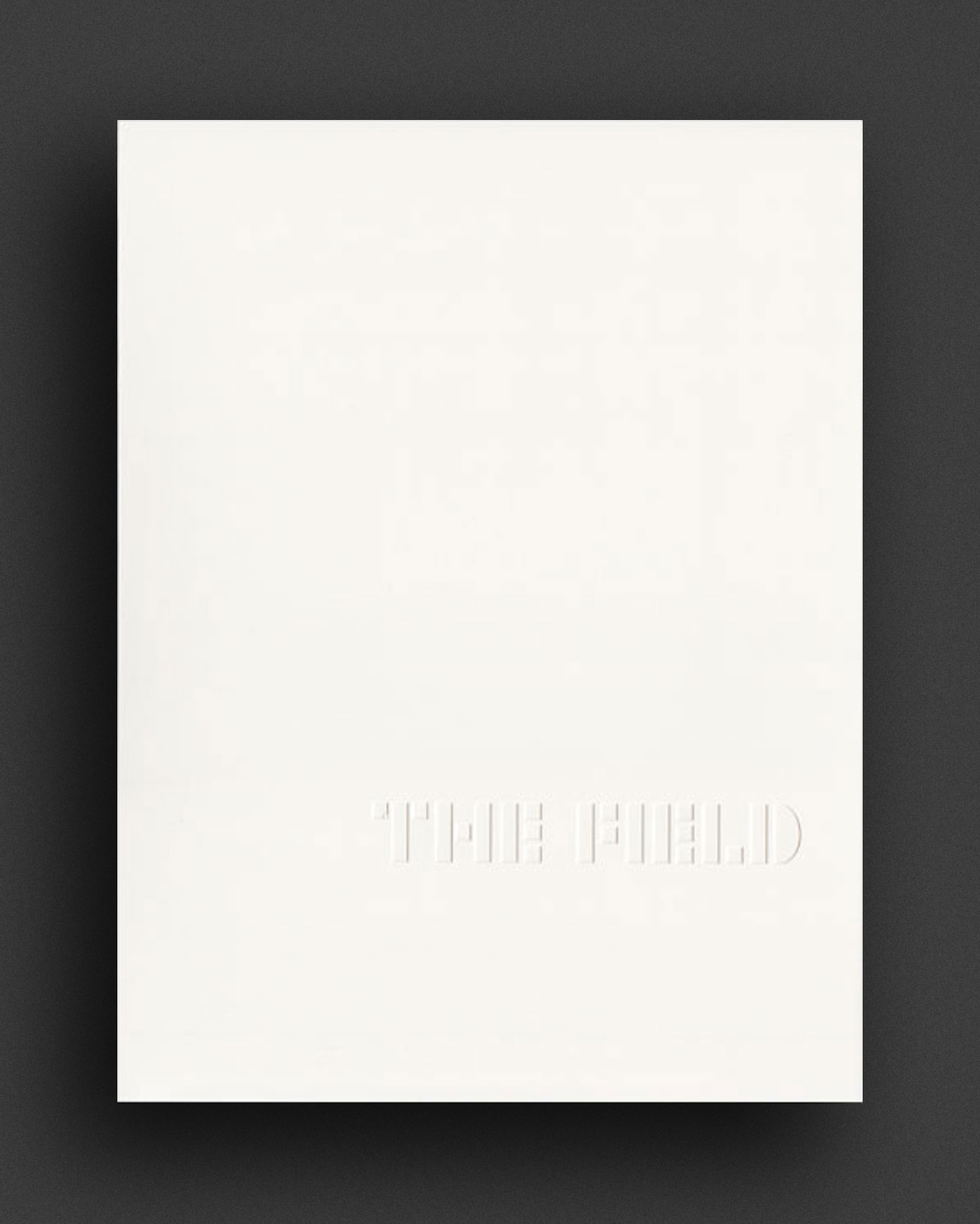
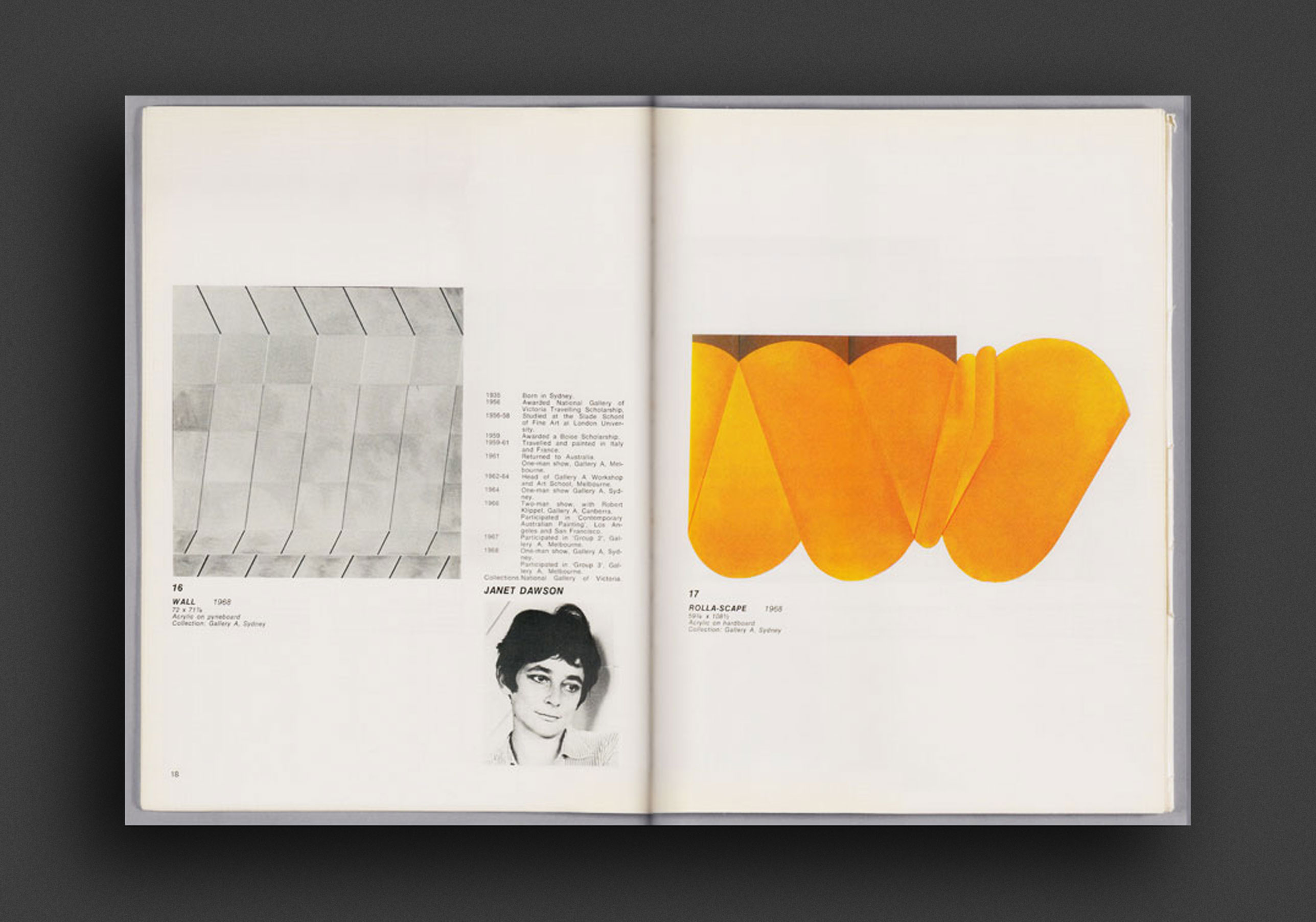
Rare first edition of this iconic catalogue produced in 1968 to accompany "The Field", regarded as a landmark exhibition in Australian art history – a radical showcase of 74 abstract and conceptual, colour field, geometric and hard edge artworks. Influenced by the American origins of abstract art, the exhibition opened to much controversy at the NGV in 1968 with its silver foil-covered walls and geometric light fittings, boldly launching the careers of a generation of young Australian artists it was the first the NGV staged in its new Swanston Street galleries.
Handsomely designed with its wrapped, french-flap, die-cut cover, the book includes profiles on each exhibiting artist in the exhibition, including colour and black and white reproductions of all 72 of the works exhibited.
On the occasion of its 50th anniversary the NGV will restage the exhibition as The Field Revisited, opening in May 2018 at The Ian Potter Centre: NGV Australia.
Texts by Elwyn Lynn, Patrick McCaughey, Royston Harpur, and an introduction by Brian Finemore (Curator) and John Stringer (Exhibitions Manager).
Artists included: Sydney Ball, Peter Booth, Janet Dawson, Robert Jacks, James Doolin, David Aspden, Tony Bishop, Ian Burn, Gunter Christmann, Tony Coleing, Noel Dunn, Garry Foulkes, Dale Hickey, Michael Johnson, Col Jordan, Michael Kitching, Alun Leach-Jones, Nigel Lendon, Tony McGillick, Clement Meadmore, Michael Nicholson, Harald Noritis, Alan Oldfield, Wendy Paramor, Paul Partos, John Peart, Emanuel Raft, Melvyn Ramsden, R.C. Robertson-Swann, Robert Rooney, Rollin Schlicht, Udo Sellbach, Eric Shirley, Joseph Szabo, Vernon Treweeke, Trevor Vickers, Dick Watkins, John White, Normana Wight.
G—VG copy with some marks/nicks/knocks to extremities of wrap–around. Die–cut text cover undamaged.
2018, English
Softcover (2 volumes w. die-cut covers in plastic jacket), 144 / 96 pages, 32.8 x 24 cm
1st Edition, Out of print title / as new
Published by
NGV (National Gallery of Victoria) / Victoria
$100.00 - In stock -
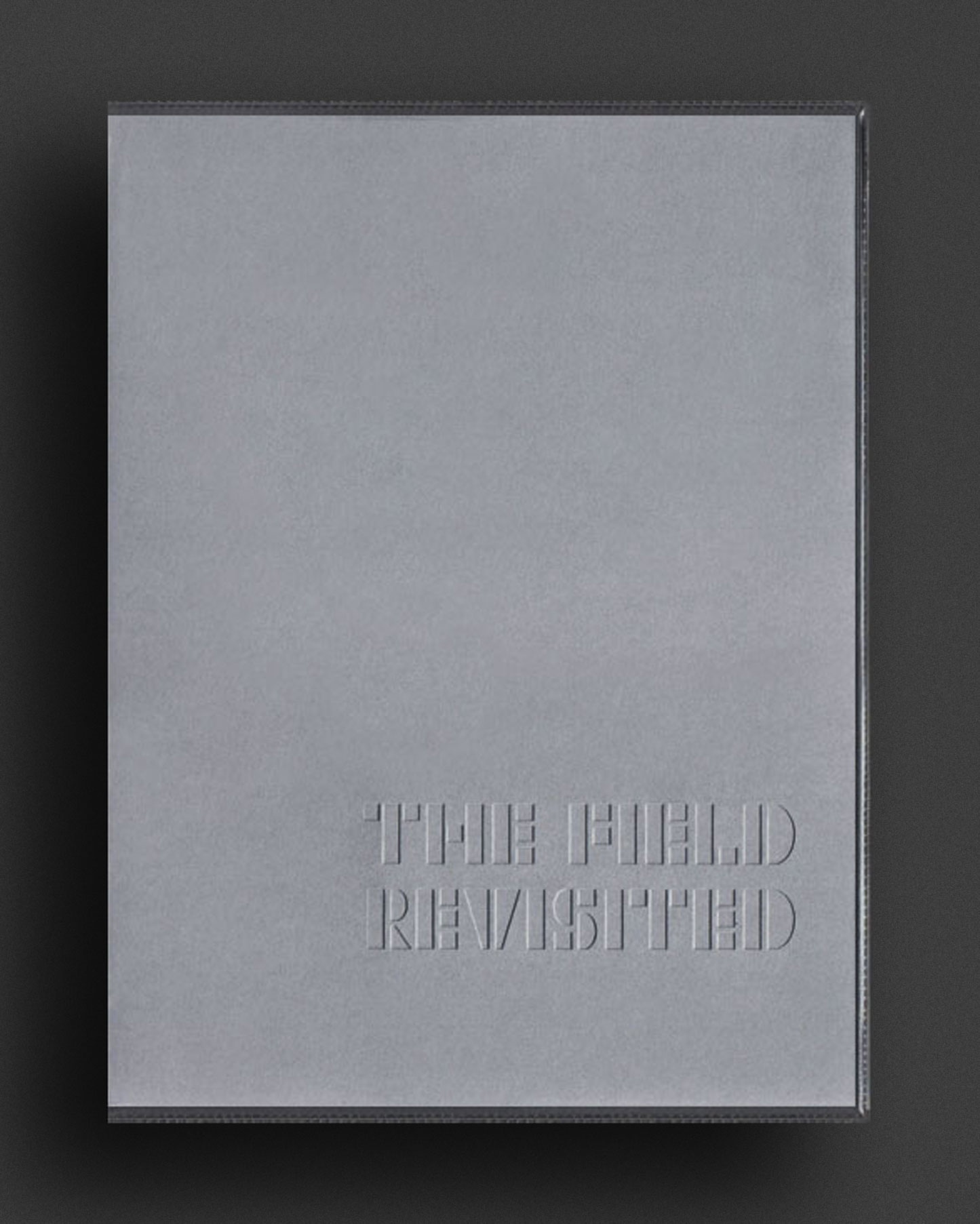
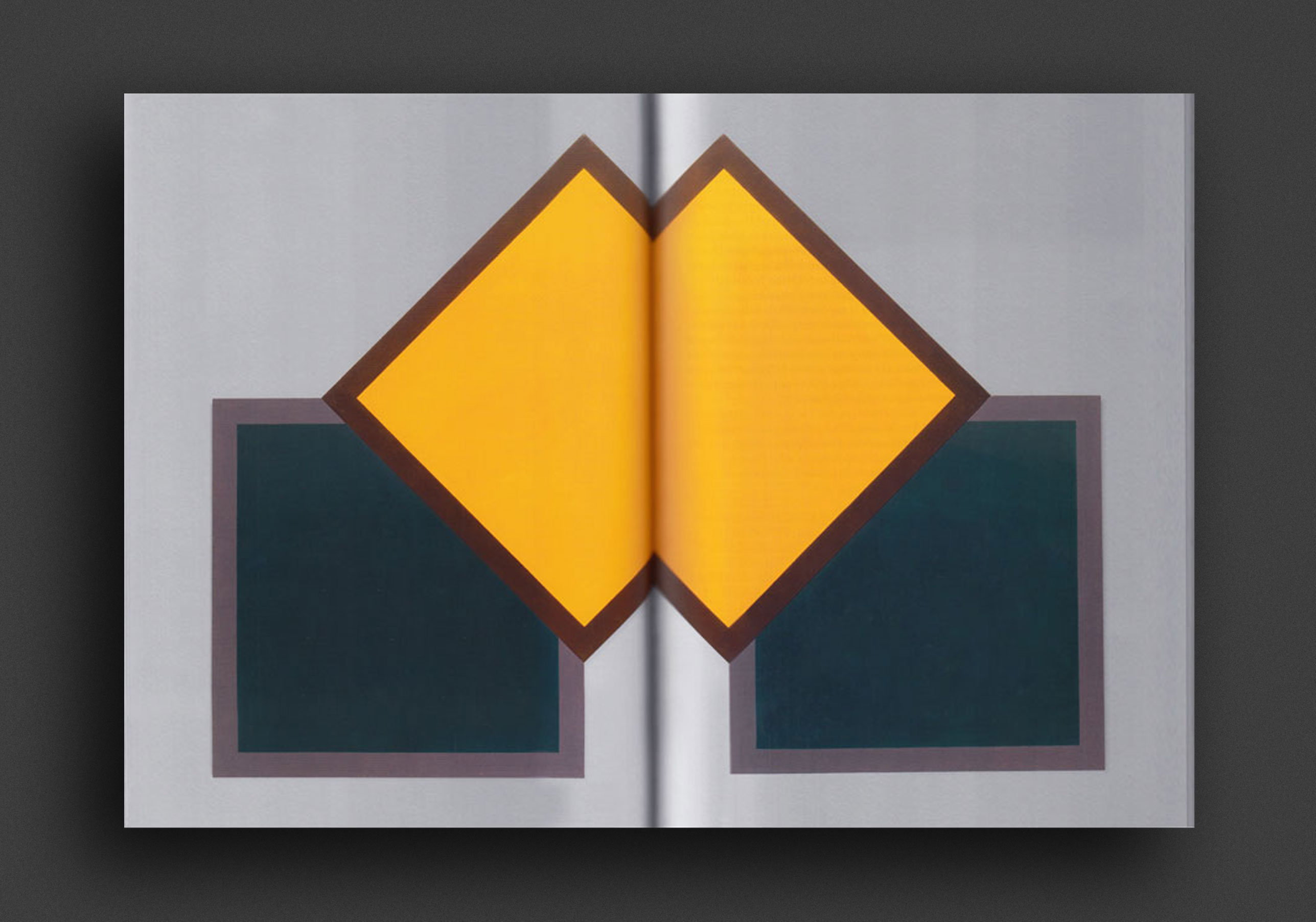
The fast out-of-print two-volume publication published to accompany 'The Field Revisited' 50th anniversary exhibition at The Ian Potter Centre, NGV Australia, 27 April - 26 August, 2018. Housed in a transparent plastic jacket, the publication includes a complete facsimile of the rare and highly collectable original 1968 'The Field' exhibition publication and a new publication for 'The Field Revisited', which reflects on the importance of this exhibition over the past fifty years through new essays, colour documentation of the exhibited (and related) works and archival photographs of the 1968 exhibit. Designed by Stuart Geddes, with typography by Vincent Chan.
The National Gallery of Victoria’s inaugural exhibition at its new premises on St Kilda Road in 1968 was The Field, the first comprehensive display of colour field painting and abstract sculpture in Australia. Regarded as a landmark exhibition in Australian art history, The Field was a radical presentation of 74 works by 40 artists who practised hard-edge, geometric, colour and flat abstraction, many of which were influenced by American stylistic tendencies of the time. With its silver foil–covered walls and geometric light fittings, The Field opened to much controversy and helped launch the careers of a generation of Australian artists, including Sydney Ball, Peter Booth, Janet Dawson and Robert Jacks. Eighteen of the exhibiting artists were under the age of thirty, with Robert Hunter the youngest at twenty-one years of age.
The Field Revisited recreated The Field exhibition for its fifty-year anniversary. By reassembling as many of the original 74 paintings and sculptures as possible, this restaging re-examined the exhibition’s impact and significance for Australian art history and allow a new generation to experience it for themselves. Because some works included in The Field are known to have been destroyed, the NGV has commissioned a number of artists, including Normana Wight and Col Jordan, to recreate their original works for The Field Revisited.
Artists : Sydney Ball, Peter Booth, Janet Dawson, Robert Jacks, James Doolin, David Aspden, Tony Bishop, Ian Burn, Gunter Christmann, Tony Coleing, Noel Dunn, Garry Foulkes, Dale Hickey, Michael Johnson, Col Jordan, Michael Kitching, Alun Leach-Jones, Nigel Lendon, Tony McGillick, Clement Meadmore, Michael Nicholson, Harald Noritis, Alan Oldfield, Wendy Paramor, Paul Partos, John Peart, Emanuel Raft, Melvyn Ramsden, R.C. Robertson-Swann, Robert Rooney, Rollin Schlicht, Udo Sellbach, Eric Shirley, Joseph Szabo, Vernon Treweeke, Trevor Vickers, Dick Watkins, John White, Normana Wight.
Out-of-print, As New copy.
1979, Japanese
Hardcover (w. dust jacket), 236 pages, 20.4 x 20.3 cm
1st Edition, Out of print title / used / very good
Published by
Self-published / Kobe City
$90.00 - In stock -
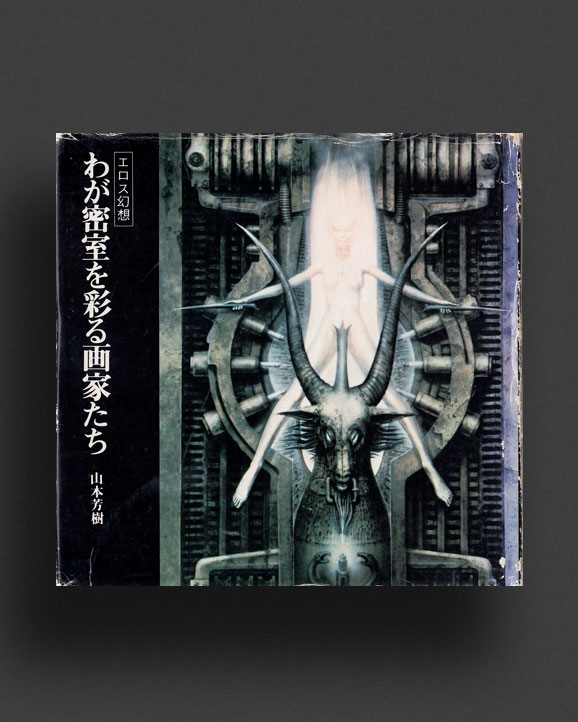
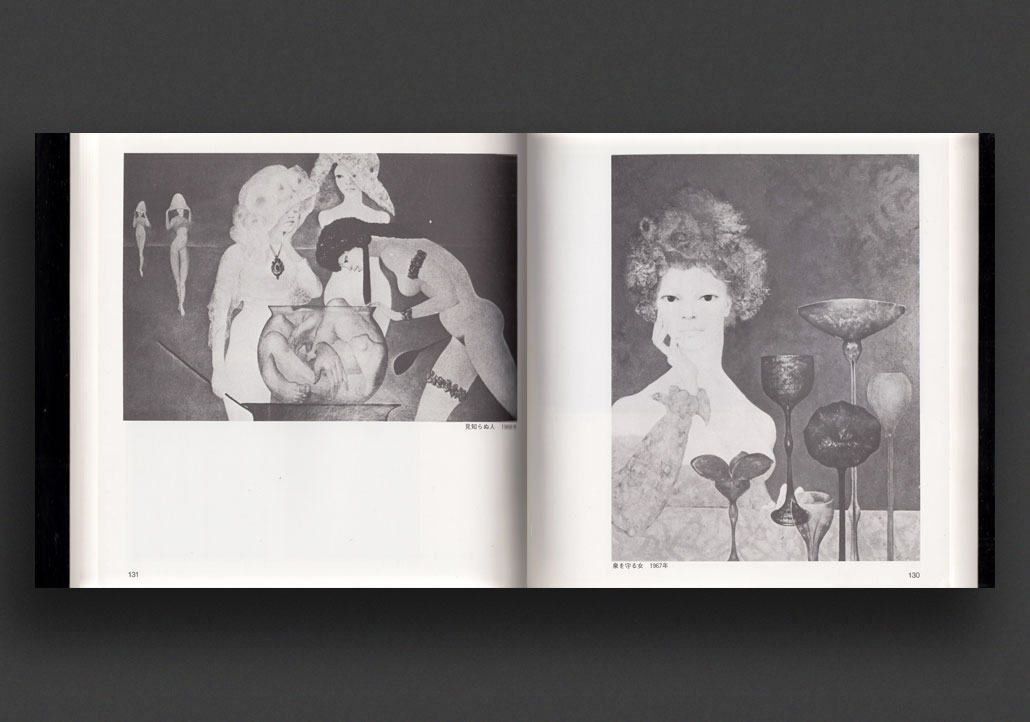
First and only edition of this stunning privately-issued 1979 Japanese hardcover collection of erotic fantasy art, edited and written by Yoshiki Yamamoto. Upon retiring from the Sanyo Electric Railway Company in 1976, Yamamoto devoted himself to the art that he loved and to complete an intimate book study that traces an important lineage of artists of "eros fantasy", focussing on 16 key artists through profusely illustrated chapters, linking artists of the fin de siècle, symbolism, surrealism, and their descendants. A total labour of love. There is no other book like it. "Artists Who Decorate My Secret Room" features illustrated full chapters on Gustave Moreau, Félicien Rops, Gustav Klimt, Franz von Bayros, Egon Schiele, Paul Delvaux, Hans Bellmer, Felix Labisse, Pierre-Yves Trémois, Leonor Fini, Paul Wunderlich, Ernst Fuchs, Tomi Ungerer, H.R. Giger, Raymond Bertrand, Gilles Rimbault, including profiles, many artworks, portraits and texts by Yamamoto, closing with a chronology of further artists and authors through the centuries.
Good–Very Good some mild foxing to block edges/initials. Good dust jacket with the usual edge wear and tanning of this title, some chipping to spine ends of DJ. Sample images only. Preserved in mylar wrap.
1992, English
Softcover (french-folds), 144 pages, 28 x 22 cm
1st Edition, Out of print title / used / very good
Published by
FAE Musee d'Art Contemporaine Pully / Lausanne
$160.00 - In stock -
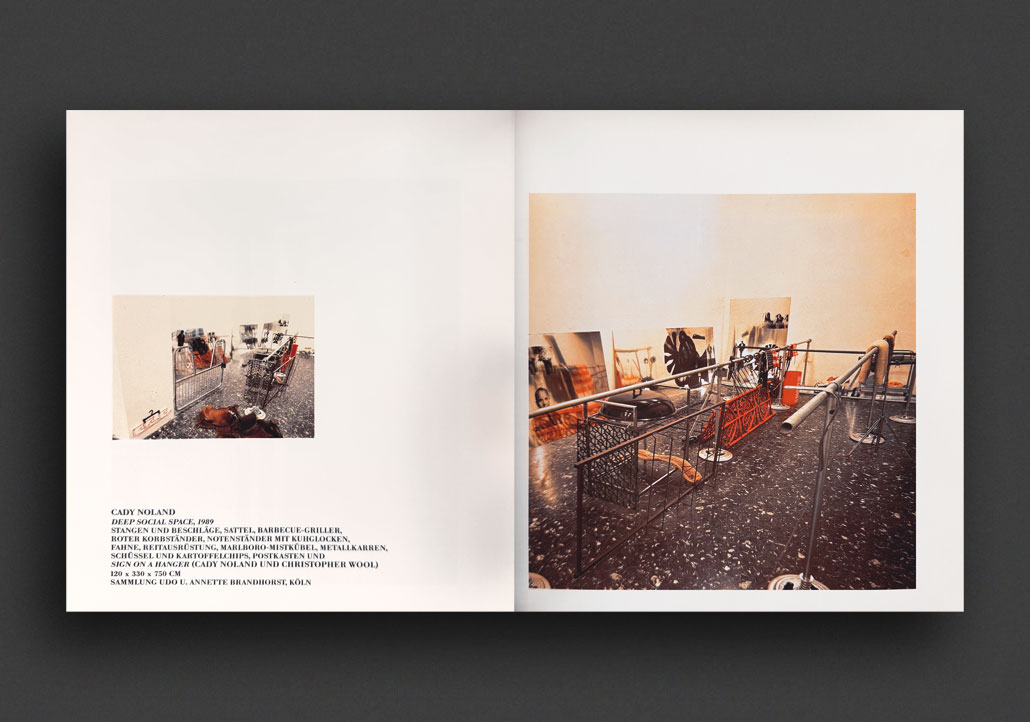
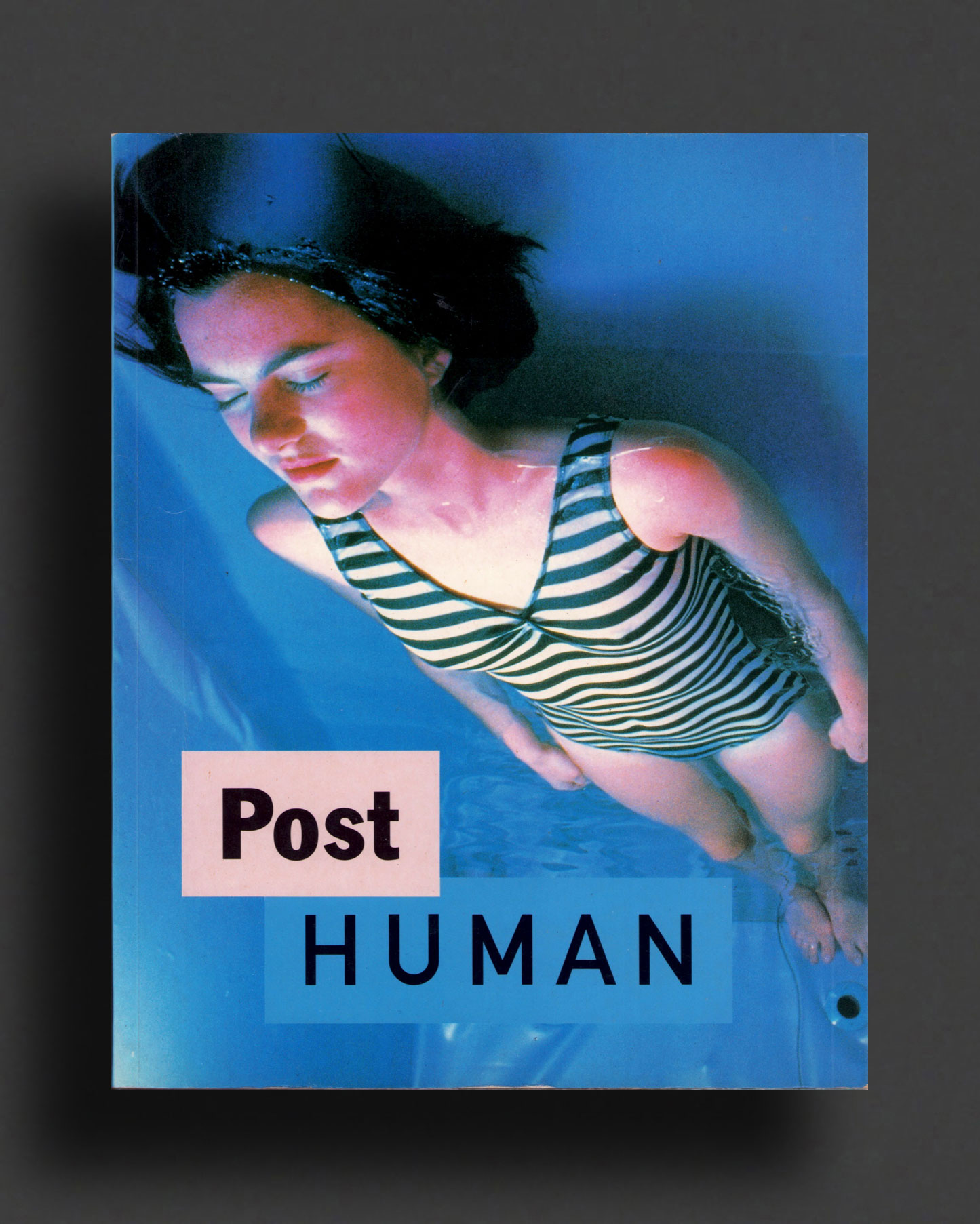
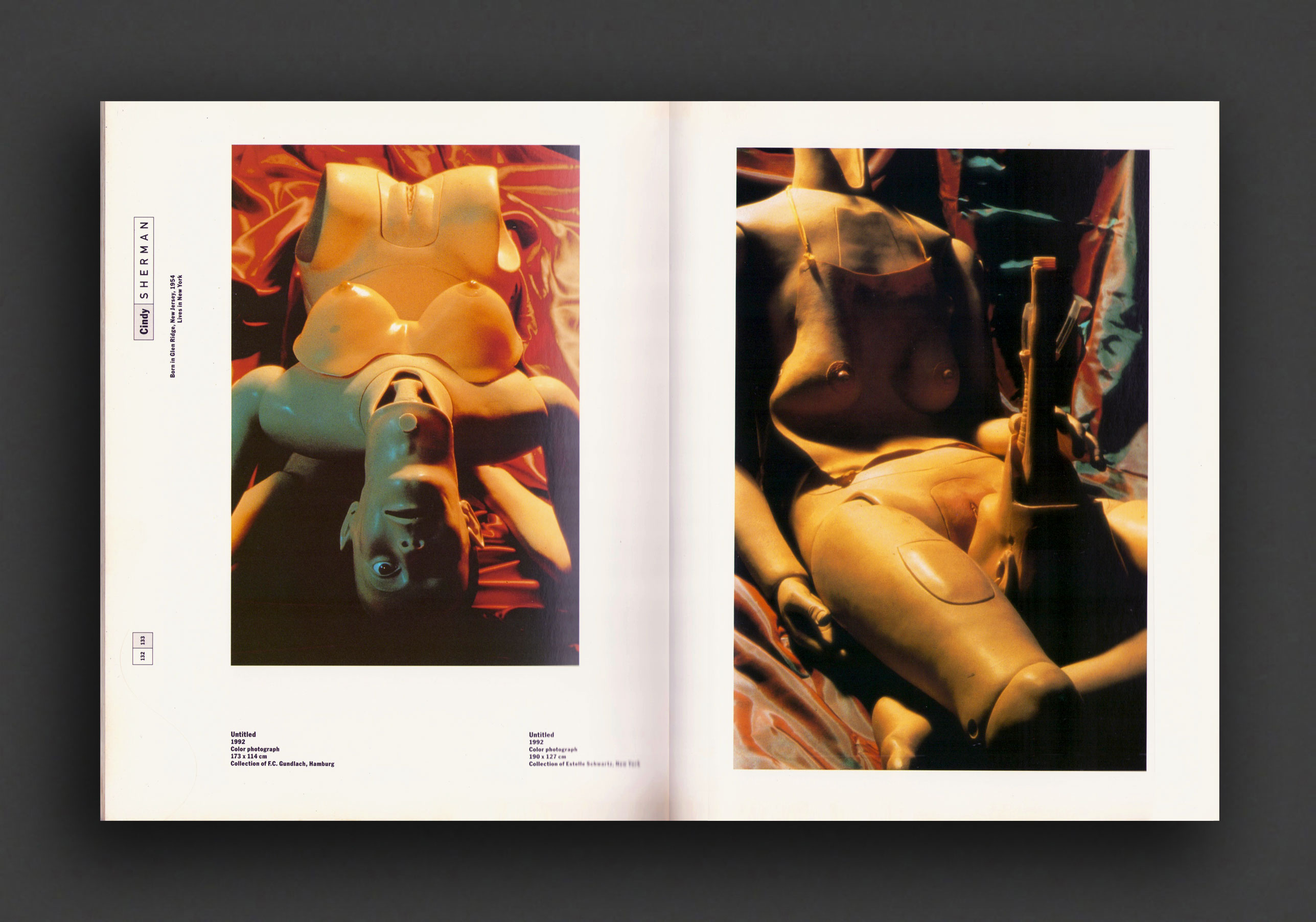
First 1992 English edition of the legendary Post Human exhibition catalogue, published on the occasion of the touring exhibition curated by Jeffrey Deitch, June 1992—October 1993. Post Human brought together the work of leading young international artists confronting a new artificial “real” world; a new figuration. The participating artists examine the media’s obsession with the “virtual reality” of the body beautiful through works that reveal the neuroses that plague contemporary society. In Deitch's words, this lavishly designed catalogue "explores the implications of genetic engineering, plastic surgery, mind expansion, and other forms of body alteration, to ask whether our society is developing a new model of the human being. It poses the question of whether our society is creating a new kind of post-human person that replaces previous constructions of the self. Images from the new technological and consumer culture and the new, conceptually oriented figurative art of thirty-six young artists will endeavor to give us a glimpse of the coming post-human world."
Featuring the work of Dennis Adams, Janine Antoni, John M Armleder, Stephan Balkenhol, Matthew Barney, Ashley Bickerton, Taro Chiezo, Clegg & Guttmann, Wim Delvoye, Suzan Etkin, Fischli / Weiss, Slyvie Fleury, Robert Gober, Felix Gonzalez-Torres, Damien Hirst, Martin Honert, Mike Kelley, Karen Kilimnik, Martin Kippenberger, Jeff Koons, George Lappas, Annette Lemieux, Christian Marclay, Paul McCarthy, Yasumasa Morimura, Kodai Nakahara, Cady Noland, Daniel Oates, Pruitt & Early, Charles Ray, Thomas Ruff, Cindy Sherman, Kiki Smith, Pia Stadtbäumer, Meyer Vaisman, Jeff Wall.
"Post Human was virtually a manifesto trumpeting a new art for a new breed of human. As Deitch’s text explained in the fragmented mottos that punctuated the billboard-style graphics of Dan Friedman’s catalogue design, “It is becoming routine for people to try to alter their appearance, their behavior, and their consciousness beyond what was once thought possible.” And we go on to read, “With the embrace of artificiality, Realism as we used to know it may no longer be possible.” The glossy color plates spoke volumes, whether the illustrations came from art or from “life.” The catalogue was to become something of a cult item that triggered the imaginations of many younger artists. Here was a permanent anthology of the “posthumanity” that surrounds us not only in galleries but on television, in magazines, even in real life, where the friendly androids among us chatter on about Botox and face-lifts. In the catalogue pages, one could see, for instance, four photos of Jane Fonda in four completely different but equally synthetic guises; Pat Buchanan being made up by a cosmetician for a TV appearance; computer morphs of once- human faces; before-and-after bellies and buttocks; and dead center, a profile view of Michael Jackson, clearly the sun god of this new solar system, who would later be deified by Jeff Koons.
This pure plastic environment, whether peopled by Ivana Trump or Barbie, set the stage for the artists in the show, whose works played perfectly in this parallel universe that was quickly replacing that old-fashioned thing called Nature. The result was a complete reshuffling of the contemporary-art deck, with an international mix of thirty-six artists (singles and pairs) that embraced Thomas Ruff and Jeff Wall, Clegg & Gutmann and Pruitt/Early, Damien Hirst and Cindy Sherman, Matthew Barney and Yasumasa Morimura, Charles Ray and Martin Kippenberger. A new dynasty had installed itself, and this ruling class demanded fitting ancestry."—Robert Rosenblum, Artforum (October 2004)
"Looked at from the point of view of being difficult cultural issues to a broader public than usual, the project Post Human could not have come about at a better time. (…) Deitch’s central thesis—that the voluntary manipulation of the human body through surgery, cosmetics and exercise, combined with recent technologies allowing us to simulate the experience of reality, have produced a culture in which the body no longer serves as a cohesive, organic reference point—fits well in an age in which pop starts, politicians and even artists themselves seem to delight in changing their physical identities to suit their purposes. No longer the domain of privacy and difference, the body has become a public crossroads where the merging of real and artificial, organic and synthetic, and even good and evil, is taking place right before our very (ahem) eyes."—Dan Cameron, Frieze (September–October 1992)
Very Good copy.
2019, English / German
Softcover, 436 pages, 17 x 23.5 cm
Published by
Walther König / Köln
Ludwig Forum / Aachen
$85.00 - In stock -
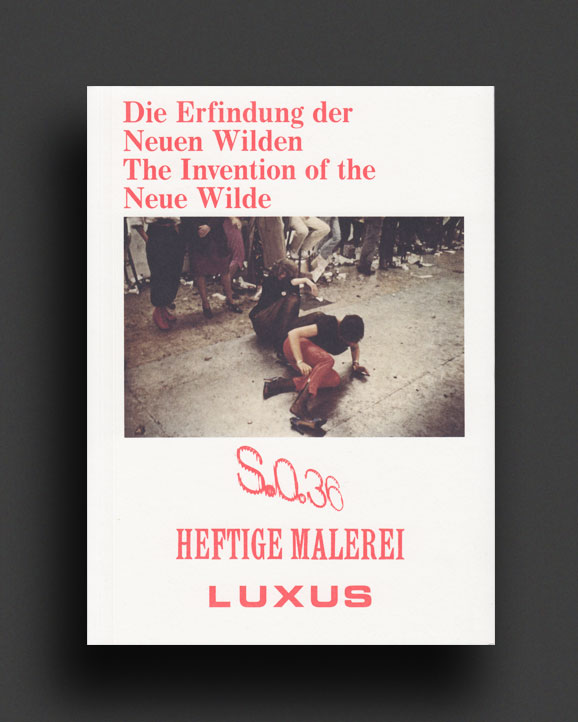
The Invention of the Neue Wilde aims to put a new perspective on the phenomena of the so-called ‘Neue Wilde’ (new Fauves), which was a term used in Germany for neo-expressionism: a movement which saw the re-emergence of expressive painting in the late 1970s and 1980s. Its most famous protagonists include Martin Kippenberger, Werner Büttner, Salome and Walter Dahn.
Instead of focusing on the production of paintings by those involved – and a corresponding catalogue of these paintings – it is much more interested in the emergence of the painting boom out of potent interplay between artists, gallerists, collectors and art historians. Here the focus is especially on personal backgrounds and the context in which painters worked.
The argument shows that the artistic practices of the ‘Neuen Wilden’ had little to do with a generalised ‘return’ to panel painting and thus to a traditional concept of art. Painting was in fact embedded in an extended network of artistic production, which was particularly characterised by a destabilisation in the division between high and popular culture as well as by various media, genres and collaborative forms of praxis.
Hitherto neglected photographic and documentary material as well as artists’ posters, records, newspapers, video works and artists’ books testify to the artists’ experimental bent on one hand, their proximity to self-organised, subcultural phenomenon, such as the punk or new wave scenes of the 1980s on the other. On this basis, the much-described ‘return’ to painting can be exposed as a hugely simplified narrative, while sketching out a complex image of the situation around 1980.
Artists: Hans Peter Adamski, Peter Bömmels, Werner Büttner, Luciano Castelli, Walter Dahn, Jiÿí Georg Dokoupil, Rainer Fetting, G. L. Gabriel-Thieler, Anne Jud, Martin Kippenberger, Helmut Middendorf, Christa Näher, Hilka Nordhausen, Markus Oehlen, Brigitta Rohrbach, Salomé, Bettina Semmer, Bettina Sefkow, Claudia Skoda, Rolf von Bergmann, Bernd Zimmer, and others.
Includes texts by Thomas Bayrle, Andreas Beitin, Werner Büttner, Diedrich Diederichsen, Catherine Dossin, Brigitte Franzen, Ramona Heinlein, Christian Höller, Katrin Köpper
Published on the occasion of the exhibition, The Invention of the Neue Wilde: Painting and Subculture around 1980 at Ludwig Forum für Internationale Kunst, Aachen (12 October 2018 –10 March 2019).
English and German text.
2013, English / Japanese
Hardcover, 352 pages, 26.5 x 20 cm
1st Edition, Out of print title / used / fine
Published by
Yomiuri Shimbun / Tokyo
$140.00 - In stock -
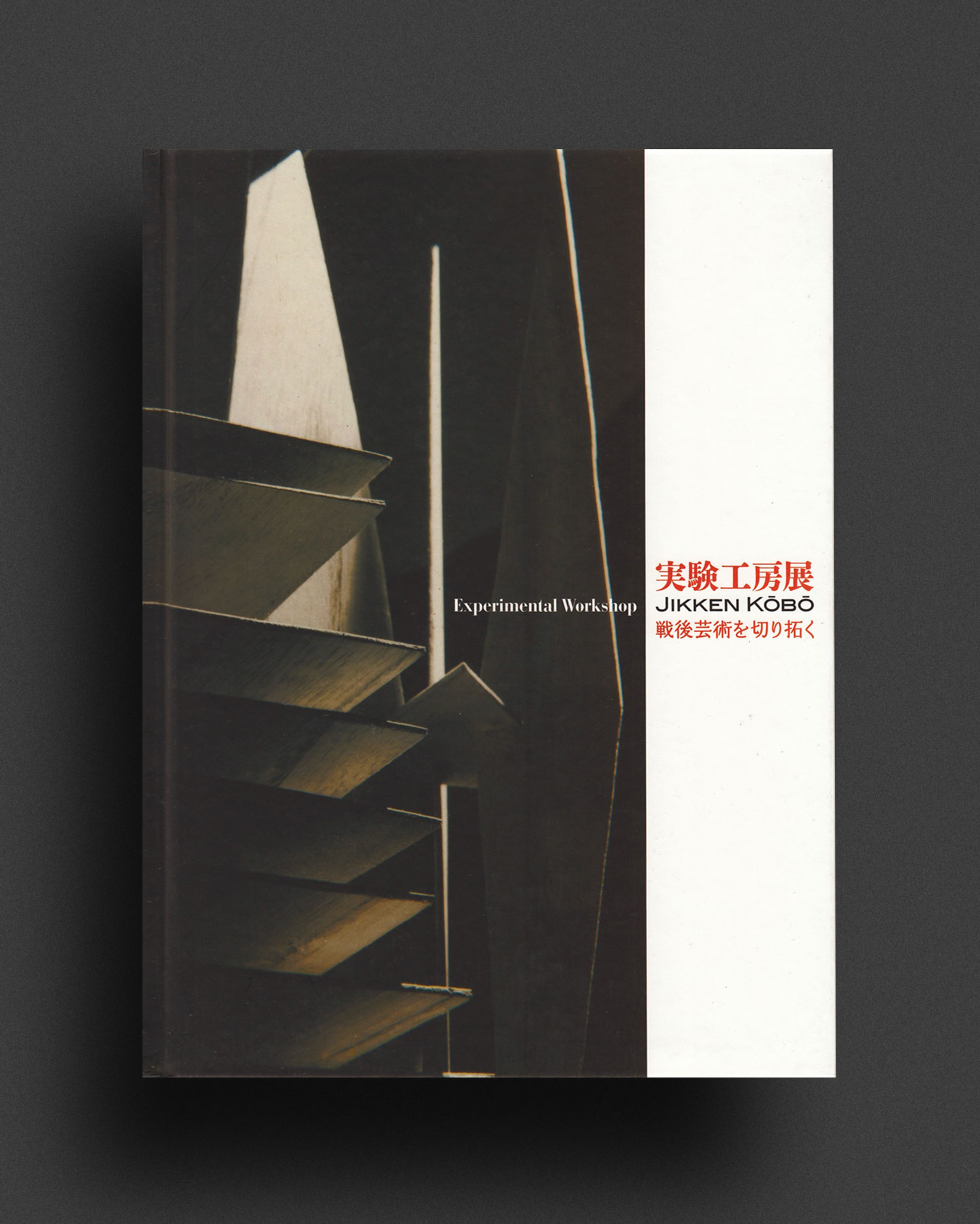
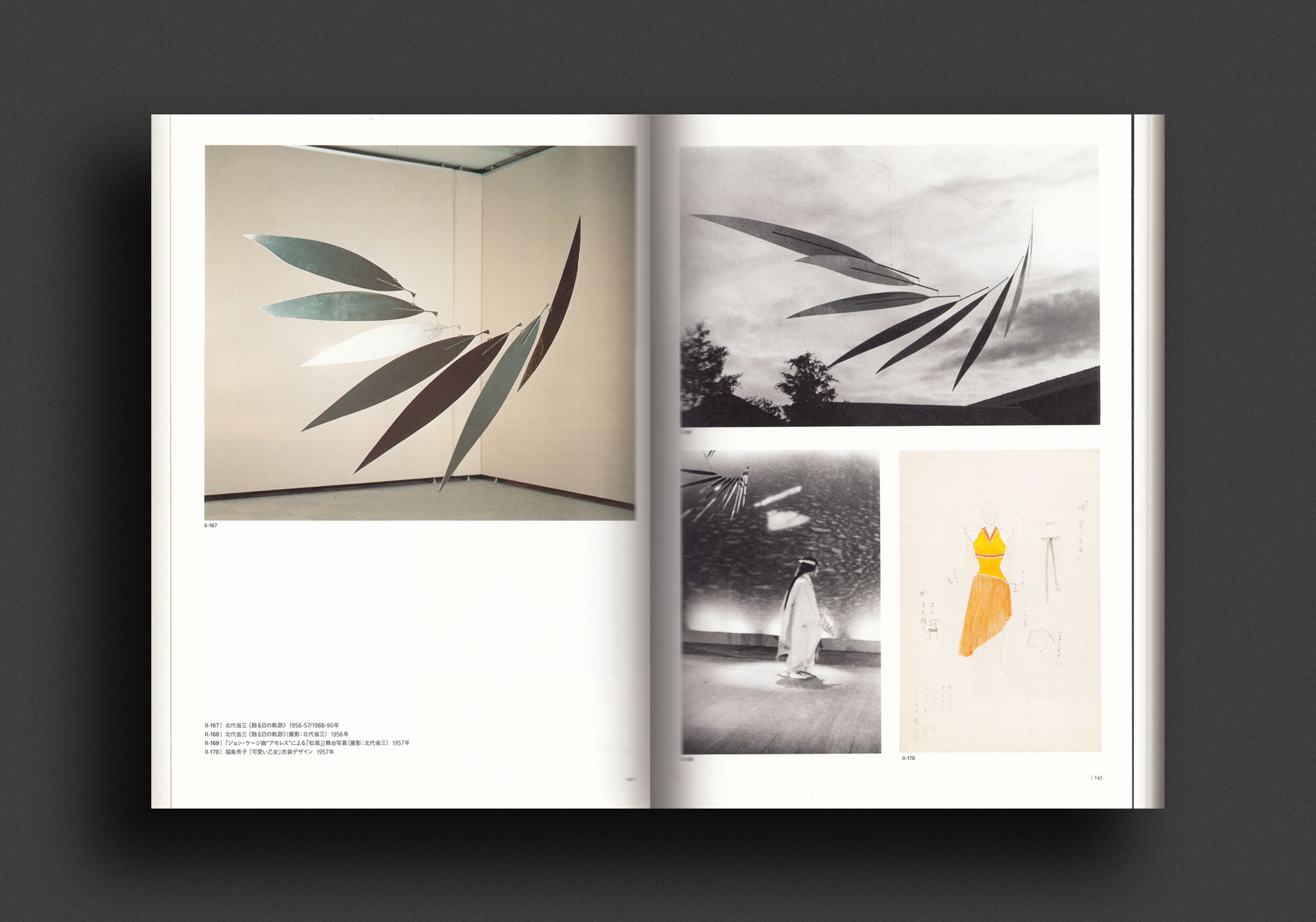
From establishing one of the earliest frameworks for modern interactive multimedia art or Total Art (Gesaumtkunstwerk) to playing a pioneering role in the development of musique concrète in Japan, the seminal post-war Japanese avant-garde collective Jikken Kōbō (Experimental Workshop) blurred the lines between sonic arts, photography, stage lighting, costume design, poetry and experimental choreography.
Wonderful and comprehensive 2013 hardcover catalogue devoted entirely to the wide scope of Jikken Kōbō (Experimental Workshop), one of the first avant-garde artist collectives active in postwar Japan. Founded in Tokyo in 1951 by a group of composers, visual artists, musicians, choreographers, poets, critics and technicians including Toru Takemitsu, Kazuo Fukushima, Joji Yuasa, Hiroyoshi Suzuki, Keijiro Sato, Takahiro Sonoda, Ririko Hayashi, Hikaru Hayashi and Toshi Ichiyanagi, art critic Shūzō Takiguchi, and many others working in various media. Active between 1951–1958, the group was founded against the backdrop of the Hiroshima and Nagasaki bombs and in a time of post-war austerity. Jikken Kōbō organized its own exhibitions of group members' works, which were influenced by Western avant-garde art and showed a strong interest in new technology. However, they are best known for their collaborative "presentations" (happyōkai 発表会): theatrical or musical performances where each member contributed their individual works to create a multimedia production. Their multi-layered installations embraced sound recording, photography and film, together with artist-designed sets, specially composed music and dance, shattering distinction between mediums. Many of the group’s fourteen members were self-taught, and as a result distanced themselves from the traditional artistic culture in Japan. Co-founder Katsuhiro Yamaguchi described them as Bauhaus without the building.
This profusely illustrated book brings together the works, photographic documentation, costume designs, compositions, publications, writings, and all manner of material relating to the the group for the first time with extensive chronology and catalogue, with all accompanying texts in bi–lingual English and Japanese.
Exhibition ticket stub laid–in.
Very Good–Near Fine copy of this long out–of–print book, with only light wear to boards.
1990, English
Softcover (staple–bound), 56 pages, 30 x 21 cm
1st Edition, Out of print title / used / good
Published by
Electronic Media Arts Ltd. / NSW
$20.00 - In stock -
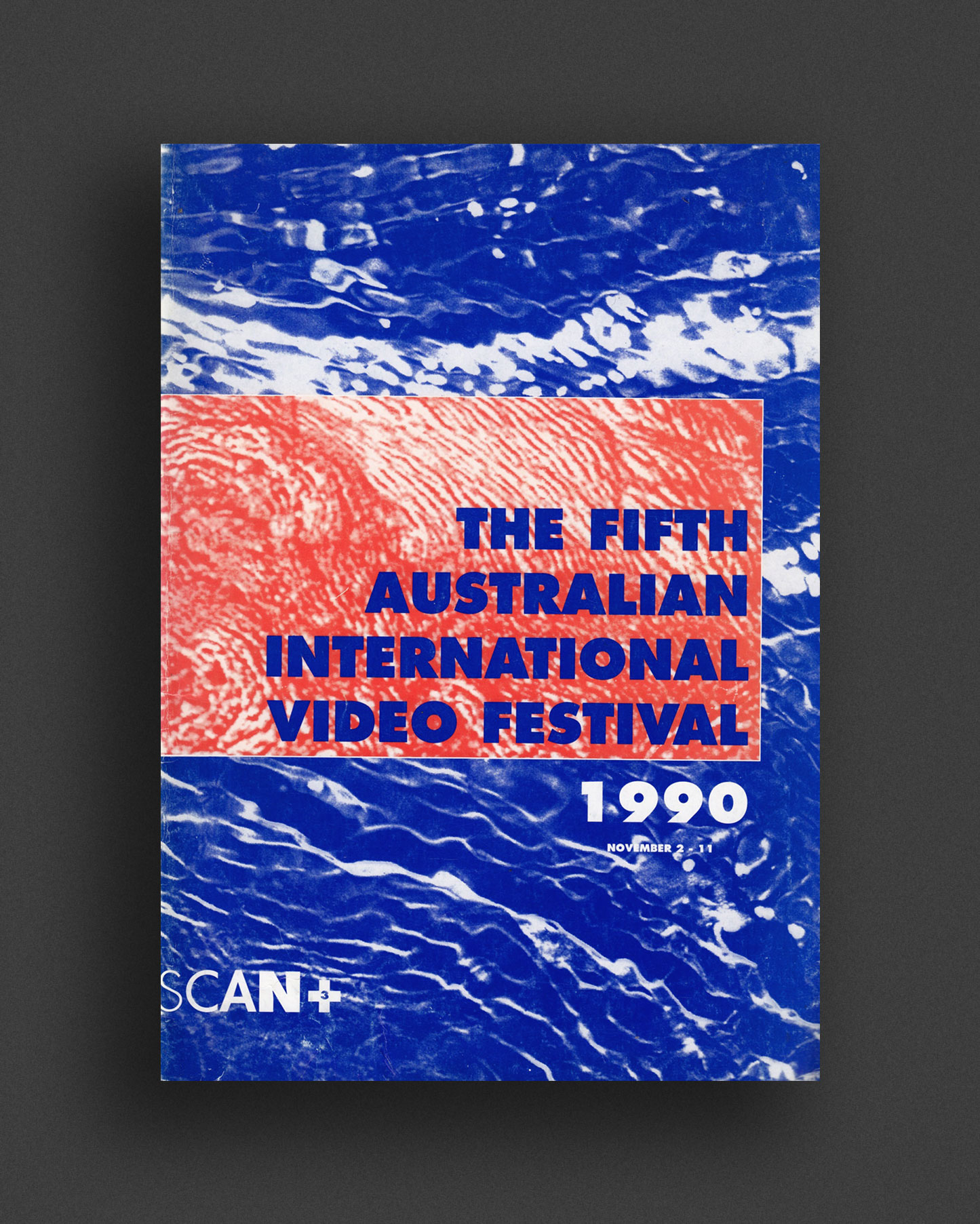
Catalogue published on the occasion of SCAN+ 3: The Fifth Australian International Video Festival, 1990, November 2–11, directed by Brian Langer and presented by Electronic Media Arts Ltd. Illustrated throughout with essays by David Dunn and Bohuslav Woody Vasulka, an interview with Nam June Paik by Nicholas Zurbrugg, the retrospective of early video art pioneers, Steina and Woody Vasulka, by Roy Durfee, Mckenzie Wark on Peter Callas, Ulrike Rosenbach's installaion, Bill Seaman, New Video from Japan by Carl E. Loeffler, and more, a full Videoteque Directory of international and local works screening in the festival, and much more.
Biran Langer was the Artistic Director of the Australian International Video Festival from 1988 to 1992 and Executive Director of Electronic Media Arts Ltd from 1990 to 1992.
Good copy with light wear to boards/corners.
1986, English
Softcover (staple–bound), 22 pages, 29.5 x 21 cm
1st Edition, Out of print title / used / good
Published by
MIMA / Melbourne
$35.00 - In stock -
Rare copy of the catalogue published to accompany the touring exhibition that grew from the first year of the Modern Image Makers Association's activities in 1986. MIMA (Modern Image Makers Association Inc.) was Experimenta Media Arts is a Melbourne based group which was was first established in 1986 as the Modern Image Makers Association Inc. (MIMA). In 1986 MIMA received funding from the Australian Film Commission and Film Victoria to run a series of exhibitions and produce a set of compilation tapes of Victorian Film and Video Art titled MIMA Yearbook Videos. This catalogue documents the film programmes, profiles all of the artists, and is accompanied by essays from Australian poet Kris Hemensley and Australian actor John Flaus. Features the work of: → ↑ → (Tsk Tsk Tsk), Virginia Fraser. David Chesworth, James Clayden, Arthur & Corinne Cantrill, Ivor Cantrill, Dirk de Bruyn, John Dunkley–Smith, John Hillcoat, John Hughes / Peter Kennedy, Chris Knowles, Michael Lee, Marie Hoy, Jean–Marc Le Pechoux, Lynsey Martin, Ruben Mow, Nick Ostrovskis, Randelli (Frank Bendinelli & Robert Randall), Peter Tammer, Marcus Bergner, Michael Buckley & Sue McCauley, Warren Burt.
MIMA (Modern Image Makers Association Inc.) was Experimenta Media Arts is a Melbourne based group which was was first established in 1986 as the Modern Image Makers Association Inc. (MIMA)
"I'm constantly moved by that tale told of Moholy-Nagy, how just as Mondrian in his last paintings abandoned the straight-edge and restored to the free-stroke of the hand its right to speak, so a few days before his death Moholy with a free & eager hand engraved lines and signs in the finest of his plexiglass sculptures - thus creating a link between noology and biology. This expressionist (or emotionalist as Moholy-Nagy might have called it) impulse, both egotistical and transcendent of primordial resonance, is an abiding feature of the art of modern times. Originating here is the contradictory enablement proposed in such terms as abstract expressionism and collage, for example, wherein personality and history, respectively, are the products of their apparent antitheses. This fruitful ambiguity is the signature of the most memorable work of the MIMA collection."—Kris Hemensley (from his essay)
Good copy with general light wear to boards/corners.
2006, English
Softcover, 336 pages, 26 x 21.5 cm
1st Edition, Out of print title / used / very good
Published by
Center for Curatorial Studies Bard College / New York
$300.00 - Out of stock
First edition of this very special, now very rare catalogue published in 2006 on the occasion of the major survey exhibition Witness To Her Art, featuring the work of Adrian Piper, Mona Hatoum, Cady Noland, Jenny Holzer, Kara Walker, Daniela Rossell and the seminal magazine Eau de Cologne, published by gallerist Monika Sprüth between 1985 and 1989. Profusely illustrated throughout with artworks by all artists, reproductions of important artist publications, installation views, and many works by other related artists, alongside texts by Adrian Piper, Kara Walker, Daniela Rossell, Mona Hatoum, Cady Noland, Jenny Holzer, Monika Sprüth, Rhea Anastas, Michael Brenson, Norton Batkin, Johanna Burton, Aruna D’Souza, Pamela Franks, Janet Kraynak, David Levi Strauss, Cuauhtémoc Medina, Ann Reynolds, Hamza Walker, and many more.
Publisher's blurb:
"This radical new study aims to change the way that some of the most influential artists of the past 40 years are seen—all of them women. Emphasizing questions of autonomy, critical intelligence and artistic intention, "Witness to Her Art" presents works by Adrian Piper, Mona Hatoum, Cady Noland, Jenny Holzer, Kara Walker, Daniela Rossell and "Eau de Cologne," a magazine published by gallerist Monika Sprüth. The artworks are accompanied by original writings by the artists, contemporaneous criticism and newly commissioned essays by Pamela Franks, Aruna D'Souza, Johanna Burton, David Levi Strauss, Hamza Walker and Cuauhtémoc Medina. The ambitious works presented and interpreted herein invite us to consider the impact of the feminist revolution across generations while rendering obsolete any stigma associated with shows or catalogues limited to women artists. Taking its lead from Conceptualism, feminism, and from its included artists, "Witness to Her Art" reaches for art history's capacity as a medium of world-making."
Highly recommended. Very Good copy with light edge wear/rounding to stiff overlay boards.
1983, English/German/Spanish
Softcover, 220 pages, 18.6 x 13 cm
1st Edition, Out of print title / used / very good
Published by
Peter-Rump-Verlag / Bielefeld
Peter-Rump-Verlag
$50.00 - In stock -
Mailart extraordinaire Peter Küstermann's first book, "No War in my City!", independently published in 1983 in a limited edition to accompany a global networked exhibition of Mail–Art by 430 contributing artists, edited by Peter Rump, with foreword by Küstermann, introducing the phenomenon of Mail Art, self–translated into German/English/Spanish. Profusely illustrated in b/w throughout with all of the border breaking artworks spanning the entire globe, sent through the post. A detailed list of all the artists and captions to accompany the artworks are included.
"This "art by mail" is a serious pleasure, various and tongue-in-cheek. It is the duty-free link in an international net of artists and laymen that extends as far as a letter can reach and is continuously growing.
Mail Art gets manifested in exhibitions, catalogues, papers and is becoming more and more popular beyond its traditional homes in Italy, Belgium and the U.S.
Mail Art represents not only a non-commercial El Dorado for literates, thinkers, printers, gluers, painters, protesters, cartoonists from Iceland to Argentina, but it also creates worldwide contacts and helps to better understand each other.
[...]
WHY "MAIL ART FOR PEACE"?
Mail Artists are crazy people - and choose the craziest themes. But they are also very concerned, and they watch the problems in the world around us. Considering the worldwide threat against us all by war and the arms race, mail art seemed to me to be the ideal medium for an international call for peace - from the whole world to the whole world, organized as a travelling exhibition.
"No war in my town!" ... and not in yours, and in nobody else's town! For we are all addressed."
—from the introduction
Peter Küstermann (b. Hagen, Westphalia, 1950) has been a mail artist since 1983 and is also an author, painter, musician, filmmaker, art critic, alternative cultural manager, and gallery owner at the BÜZ cultural center in Minden, located in a former church. Together with Angela Pähler, he holds the Guinness World Record for traveling art mail carriers under the artist name Angela & Peter Netmail.
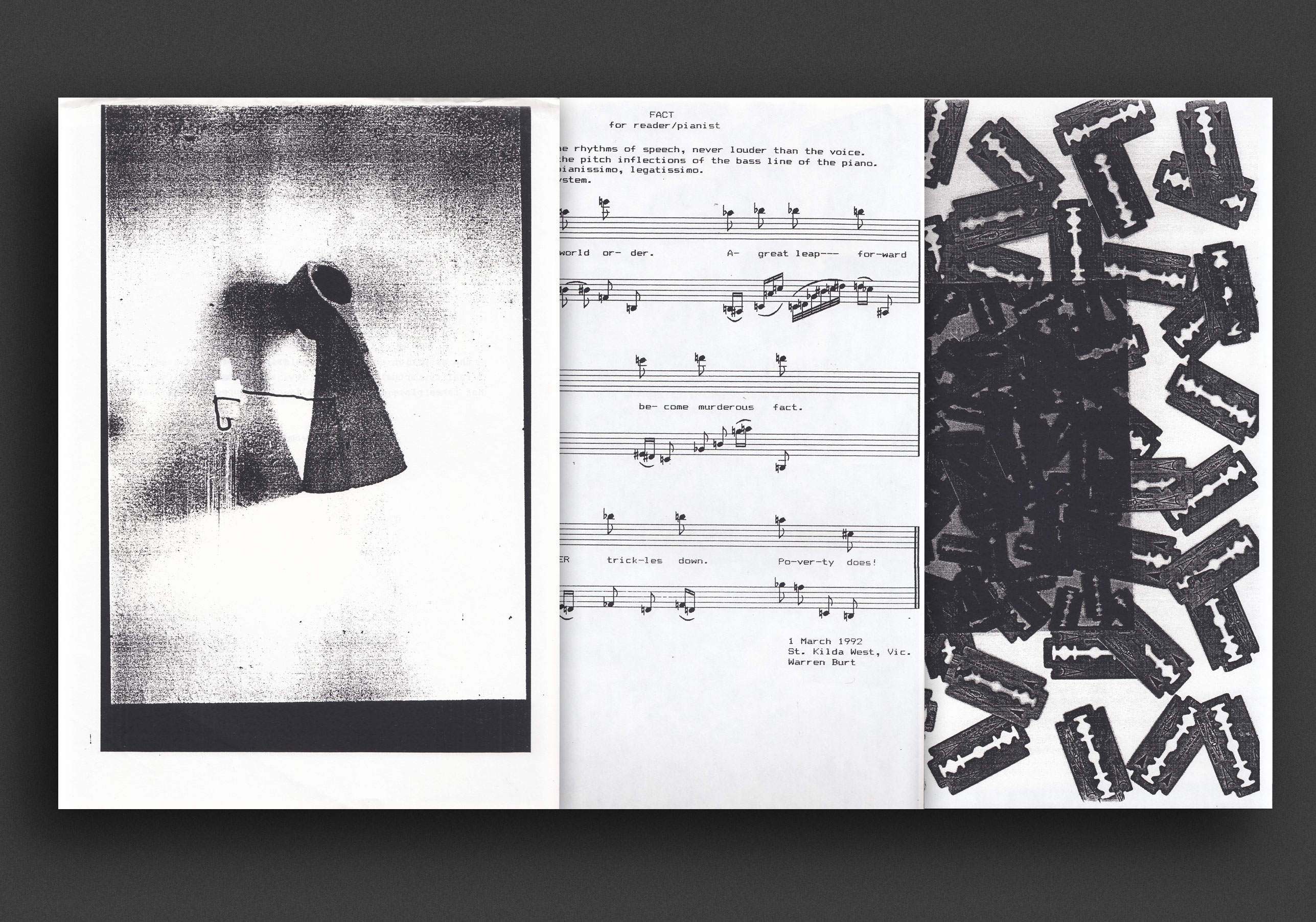
VG copy with inscription from Angela and Peter to Australian sound composer Warren Burt.
1979, German
Softcover, 419 pages, 28 x 22 cm
1st Edition, Out of print title / used / very good
Published by
Kunsthaus Zürich / Zürich
Bentelli Verlag / Bern
$60.00 - In stock -
Wonderful over-sized catalogue published on the occasion of the exhibition Malerei und Photographie im Dialog / Painting and Photography in Dialogue, Kunsthaus Zürich, May 13 to July 24, 1977. Profusely illustrated, this heavy volume documents this historical survey of the relationship between photography and painting from 1840 to the present (late 1970s); with a full catalogue of works, artists' biographies, bibliography. Edited by Erika Billeter with texts throughout by art historian Josef A. Schmoll. Includes the work of Edvard Munch, Urs Lüthi, Wols, Vito Acconci, John Baldessari, Eadweard Muybridge, Hannah Höch, Raoul Hausmann, Hans-Peter Feldmann, Oskar Schlemmer, Francis Bacon, Hilla and Bernd Becher, Les Levine, Constant Puyo, Clarence Hudson White, Jan Groover, Jochen Gerz, Duane Michels, Mario Merz, Giulio Paolini, Ruth Francken, Theo Von Doesburg, Kurt Schwitters, Ferdinand Hodler, Herbert Bayer, Marcel Duchamp, Gertrude Käsebier, Edward Steichen, Alighiero Boetti, Klaus Rinke, Giuseppe Penone, Pierre Bonnard, Paul Klee, Gerhard Richter, Monika Baumgartl, Yves Klein, Wolf Vostell, Heinrich Kühn, Georges Mathieu, Peter Roehr, Sarkis, Jiro Takamatsu, Michael Heizer, Umberto Boccioni, Hans Bellmer, William Wegman, Raoul Ubac, Margrit Jäggli, André Kertész, Jiri Kolar, Kasimir Malevich, Henri de Toulouse-Lautrec, Dennis Oppenheim, Christian Boltanski, Dan Graham, Jan Dibbets, Jürgen Klauke, Bruce Nauman, Jean Tinguely, Vettor Pisani, Max Ernst, Joseph Cornell, Allen Kaprow, Arnulf Rainer, Mieczyslaw Berman, Jim Dine, George Brecht, Man Ray, Paul Wunderlich, Karin Székessy, Tom Wesselmann, Chuck Close, Eugène Delacroix, Duane Hanson, Heinrich Zille, Félix Vallotton, Carl Durheim, Gilbert and George, Joseph Beuys, Thomas Eakins, Robert Rauschenberg, Édouard Vuillard, Carlo Carrà, Alphonse Mucha, Les Krims, Albert Steiner, Giorgio de Chirico, Keiji Uematsu, Ernst Ludwig Kirchner, Heinrich Zille, Franco Fontana, Richard Long, Ben Shahn, Edmund Kesting, László Moholy-Nagy, Anton Stankowski, Paul Nash, Rene Magritte, Paul T. Frankl, John Heartfield, El Lissitzky, Georges Hugnet, Gordon Matta-Clark....
Very Good copy, crease to top cover corner.
1972 / 2019, English
Softcover, 336 pages, 28 x 22 cm
Published by
Martino Fine Books / Connecticut
$95.00 - In stock -
2019 Reprint of 1972 English Language Edition. Full facsimile of the original edition, not reproduced with Optical Recognition software. Containing 187 Illustrations, some of which are in color. Between 1919 and 1921, circulars were sent to psychiatric institutions in German speaking countries by Hans Prinzhorn and Karl Willmanns, then Head of the Psychiatric University Hospital. The artistic works of patients they asked for were destined for the creation of a museum of psychopathological art.
In 1922, Prinzhorn published his richly illustrated Artistry of the Mentally Ill [in German] based on the collection. Received enthusiastically by the art scene of his time, it immediately became "the Bible of the Surrealists". The book was edited many times and translated into various languages. To this day, it remains a classic. It launched the field of psychiatric art. It was the first attempt to analyze the drawings of the mentally ill not merely psychologically, but also aesthetically. Prinzhorn presents the works of ten "schizophrenic masters", now housed in the Prinzhorn Collection at the University Hospital Heidelberg, with in-depth aesthetic analysis of each and also full-color reproductions of their work. This is the first and only English translation.
2006, English
Softcover, 118 pages, 23.5 x 16.5 cm
1st Edition, Out of print title / used / very good
Published by
Hayward Gallery Publishing / London
$25.00 - In stock -
Published in 2006 on the occasion of this Hayward Gallery touring group exhibition, 'A Secret Service: Art, Compulsion, Concealment' explores the work of fifteen international artists and groups whose practices centre on the creation of secret worlds or the exposure of hidden facts and images. Key figures of Modern art, established and emerging contemporary artists and 'outsiders' together address numerous aspects of secrecy: magic, alchemy, sexuality, dreams, religion, political conspiracy, assumed identity and the covert workings of the State. Essays by Richard Grayson, Clare Carolin, and Roger Cardinal, accompany biographies and lavish, full-colour galleries of works by all featured artists: Sophie Calle, Roberto Cuoghi, Henry Darger, Gedewon, Susan Hiller, Tehching Hsieh, Kataryzna Józefowicz, Joachim Koester & Adrian Dannatt, Paul Étienne Lincoln, Mark Lombardi, Mike Nelson, Kurt Schwitters, The Speculative Archive, Jeffrey Vallance, Oskar Voll.
Very Good copy with light wear to covers.
2022, English
Softcover, 344 pages, 26.8 x 35.5 cm
Published by
Skira / Milan
$110.00 $70.00 - In stock -
Charting the three momentous years in which New York became the global capital of art.
The radical cultural transformations that occurred in New York in the three years between January 1962 and December 1964 ramified across the world. In addition to a whole host of creative innovations across disciplines, the period also saw a shift in the center of artistic gravity from Europe to the United States and the rise of a new leadership in the arts—curators, gallerists and other impresarios.
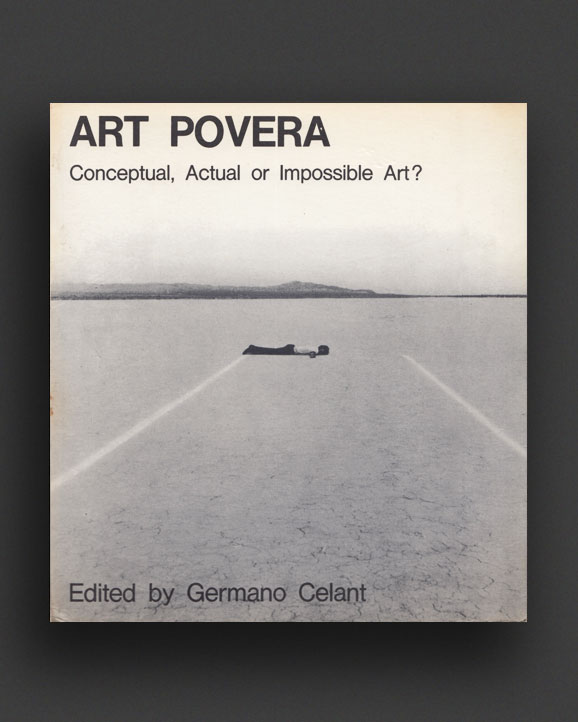
Modeled on the scale and format of Life magazine (one of the most widely read publications of the era), this lavishly illustrated oversized paperback traces a detailed itinerary of artists and curators, experimental exhibitions and museums, as well as historical and political events that transformed society during this explosive moment. From the New Realists exhibition at Sidney Janis Gallery in 1962 to Robert Rauschenberg's unexpected win of the International Grand Prize in Painting at the 1964 Venice Biennale, every groundbreaking event from this incredible three-year period is documented.
Organized chronologically, the book is teeming with images of artworks and archival photographs, and artist interviews conducted by the late great curator Germano Celant.
Artists include: Diane Arbus, Lee Bontecou, Chryssa, Merce Cunningham, Jim Dine, Melvin Edwards, Dan Flavin, Lee Friedlander, Nancy Grossman, Jasper Johns, Donald Judd, Ellsworth Kelly, Yayoi Kusama, Norman Lewis, Roy Lichtenstein, Marisol, Agnes Martin, Louise Nevelson, Isamu Noguchi, Claes Oldenburg, Yvonne Rainer, Robert Rauschenberg, Faith Ringgold, Larry Rivers, James Rosenquist, Miriam Schapiro, Carolee Schneemann, George Segal, Jack Smith, Harold Stevenson, Marjorie Strider, Mark di Suvero, Bob Thompson and Andy Warhol.
Conceived by Germano Celant. Edited with text by Sam Sackeroff, Lerman-Neubauer Associate Curator at the Jewish Museum. Preface by Claudia Gould, Helen Goldsmith Menschel Director at the Jewish Museum. Introduction by Michael Rock. Interviews by Germano Celant with Christo and Jim Dine. Text by Claudia Gould, Michael Rock, Sam Sackeroff, Emily Bauman, Ninotchka D. Bennahum, Jennifer G. Buonocore-Nedrelow, Olivia Casa, Laura Conconi, J. English Cook, Maria Corti, Michaëla de Lacaze Mohrmann, Joshua B. Guild, Liz Hirsch, Hiroko Ikegami, Susan Murray, Kristina Parsons, Benjamin Serby, Jennifer Sichel, Robert Slifkin.
2011, English
Hardcover, 228 pages, 23.3 x 27 cm
1st Edition, Out of print title / used / very good
Published by
MoMA / New York
$100.00 $80.00 - In stock -
First edition of long out-of-print important catalogue published to accompany the exhibition On Line: Drawing Through the Twentieth Century, The Museum of Modern Art, New York, 21 Nov. 2010—7 Feb. 2011. On Line: Drawing through the Twentieth Century explores a radical transformation of drawing that began over a century ago and continues as a vital impulse in art today. In a revolutionary departure from traditional ideas of drawing, and from the reliance on paper as the medium's fundamental support, artists have pushed the line of drawing into real space, expanding its relationship to gesture and form and invigorating its links with painting and sculpture, photography and film, and, particularly notably, dance and performance. Through works by over 100 artists, and through essays by Cornelia Butler and Catherine de Zegher that illuminate both broad themes and individual practices, On Line presents a groundbreaking history of an art form. The great, recognized art movements, from Cubism and Futurism at the beginning of the twentieth century through Abstract Expressionism, Neo-Concretism, arte povera, Conceptualism, and many other approaches up to the diverse present, are shown from a new perspective, and are joined by a host of less familiar artworks that properly claim a place in this differently defined field. The exhibition and catalogue includes works by a wide range of artists, both familiar and relatively unknown, from different eras of the past century and from many nations, including Aleksandr Rodchenko, Alexander Calder, Karel Malich, Eva Hesse, Anna Maria Maiolino, Richard Tuttle, Mona Hatoum, and Monika Grzymala.
Very Good / As New copy.
2000, English / German
Hardcover, 136 pages, 24.5 x 17 cm
1st Edition, Out of print title / used / very good
Published by
Sammlung Goetz / Münich
$65.00 - Out of stock
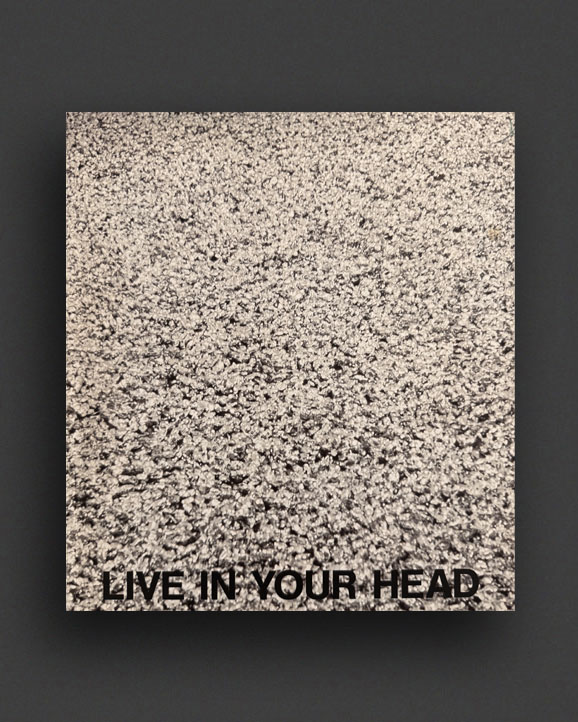
First edition hardcover catalogue published on the occasion of the Mike Kelley - Peter Fischli, David Weiss at Sammlung Goetz, June 13 to November 4, 2000. This volume considers the work of Mike Kelley alongside the collaborations of Peter Fischli and David Weiss. Kelley's works are firmly anchored in an ironic, detached attitude towards his Irish Catholic upbringing; he makes use of the pictorial language of specific subcultures and the aesthetics of ‘low culture,’ to probe such concerns as the representation of childhood and the social construction of sexual behavior and cultural identification. Peter Fischli and David Weiss have been making art together since 1979, addressing various theoretical and philosophical explanations of the world with their subtle and humorous manipulations of common objects. The work of the American Kelley and the Swiss Fischli and Weiss resonate with each other in curious ways, most significantly in their exploration of everyday consciousness and ‘low' materials. This publication documents the work of Peter Fischli and David Weiss in the Goetz Collection during a recent exhibition, along with interviews, essays and two texts by Kelley himself. Profusely illustrated throughout with essay contributions by Bice Curiger, Patrick Frey, Boris Groys, and Daniel Kothenschulte in bi-lingual English and German.
Very Good copy.
1972, German
Softcover, 96 pages, 28 x 205 cm
1st Edition, Out of print title / used / good
Published by
Heyne Verlag / Münich
$35.00 - Out of stock
Wonderful 1972 German book of erotic art selected by Phyllis and Dr. Eberhard Kronhausen, rightly considered international experts in the field. "Their exhibition "Erotic Art," which has been shown in many countries around the world, formed the basis for this illustrated volume. Because this exhibition included loans from museums and galleries, as well as works from the Kronhausen couple's collection and other private collections, it was possible to present images that had previously been inaccessible to the public. In selecting works for this volume, care was taken, on the one hand, to depict these unknown works, and, on the other, to provide a reliable overview of the erotic work of the leading artists (painting, graphic art, and sculpture) of our century. Thus, this book is a fortunate exception; it is a precious document, but also a demonstration of the sexual and cultural revolution of our century."
Features the work of Franz von Bayros, Hans Bellmer, Marc Chagall, Lovis Corinth, Salvador Dali, Paul Delvaux, Otto Dix, J. Dubuffet, Max Ernst, Ernst Fuchs, Willi Geiger, George Grosz, Horst Janssen, Allen Jones, Gustav Klimt, Felix Labisse, Jan Lebenstein, Edward Munch, Claes Oldenburg, Pablo Picasso, Herbert Rauschenberg, George Segal, Max Walter Swanberg, Tomi Ungerer, Andy Warhol, Tom Wesselmann.
Good—VG copy with some laminate seperation to cover extremities and slight corner bump.
1985, German
Hardcover, 184 pages, 27.5 x 21.5 cm
1st Edition, Out of print title / used / good
Published by
Kölnischer Kunstverein / Köln
$40.00 - In stock -
Lovely 1985 hardcover catalogue published on the occasion of the exhibition of the same name at the Kölnischer Kunstverein, March 23—June 2, 1985, curated by German art historian and curator Wulf Herzogenrath, featuring Josef Albers, Joseph Beuys, John Cage, Carl Gustav Carus, Marcel Duchamp, Jannis Kounellis, René Magritte, Kasimir Malevich, La Monte Young / Marian Zazeela, Barnett Newman, Nam June Paik, Arnulf Rainer, Odilon Redon, Mark Rothko, Reiner Ruthenbeck, and Georges Seurat. Heavily illustrated in colour and b/w with accompanying texts in German.
Good copy with some rubbing/flaking to silkscreened carbon black hardcovers, otherwise Very Good throughout. Previous owner's name to title page (that of Melbourne artist Bernhard Sachs).
1990, English
Softcover (w. dust jacket), 512 pages, 29.5 x 23 cm
1st Edition, Out of print title / used / very good
Published by
Biennale of Sydney / Sydney
$100.00 - In stock -
First edition of the incredible (huge) catalogue published to accompany the 8th Biennale of Sydney 1990 "The Readymade Boomerang: Certain Relations in 20th Century Art", held 11 April-3 June 1990 in Sydney across various venues. The eighth Biennale began from ‘a trio of Dada originators’: Marcel Duchamp, Man Ray and Francis Picabia. A large number of artists across generations joined these key figures in Artistic Director René Block’s exploration of the ‘readymade’ in twentieth-century art, which aimed to highlight ‘its invention and pure use by Duchamp, to its resurgence in Nouveau Realism, Pop Art, and Fluxus of the 60s, all the way to new versions by young contemporary artists’. Pop, fluxus and conceptual artists such as Andy Warhol, Richard Hamilton, Marcel Broodthaers, Joseph Beuys, John Cage, Alison Knowles, César, George Brecht, Nam Jun Paik and Piero Manzoni were shown alongside Rosemarie Trockel, John Nixon, Ian Burn, Mel Ramsden, Janet Burchill, Peter Tyndall, Robert Rooney, Rosalie Gascoigne, Cindy Sherman, Bruce Nauman, Hans Haacke, Rebecca Horn, Sophie Calle, Jeff Koons, Allan Kaprow, Jenny Holzer, Robert Gober, Jill Scott, Bill Culbert, Stanley Brouwn, Peter Cripps, Terry Fox, Ian Hamilton Finlay, Fischli & Weiss, KP Brehmer, Sigmar Polke, Dieter Rot, Hanne Darboven, Robert MacPherson, Jackie Redgate, Ed Ruscha, Barbara Bloom, Oyvind Fahlstrom, amongst so many others. The industrial Bond Store at Millers Point featured site-specific works by artists such as Olaf Metzel and Simone Mangos, and several works were created on-site in Sydney, amplifying Block’s notion of the Biennale as a ‘workshop’. A comprehensive satellite program of music, performance, lectures, symposia, workshops and exhibitions at various Sydney venues complemented the exhibition, with Carles Santos’ piano recital on a barge in Sydney Harbour a highlight. Five satellite exhibitions included On Kawara, Joseph Beuys, Alain Fleischer, Fluxus and Broken Record, which featured artist’s experimentations with audio recordings, vinyl and album artwork – from John Cage’s 33 1/3 composition for 12 record players to Milan Knížák’s record-collages.
An incredible Sydney biennale, captured here across over 500 pages conceived and realised by René Block and Jennifer Cook - profusely illustrated with examples of all artists works and accompanying texts throughout by Lynne Cooke, Bernice Murphy, Anne Marie Freybourg, Dick Higgins, René Block and Jennifer Cook. Very Good copy with only general wear/ageing. Bright and clean, includes tanned original dust jacket now preserved under plastic wrap.
Having represented Beuys, Richter and Polke, German gallery owner, art publisher, art collector and curator René Block (born 1942) ranks among the central figures of the 1960s avant-garde.
Very Good copy with original dust jacket. Common tanning to dust jacket spine, now preserved under mylar wrap.
2025, English
Softcover, 248 pages, 30 x 22.8 cm
Published by
Melbourne University Press / Naarm
$60.00 - In stock -
Keeping Things Together: 50 Years of the Women’s Art Register is a dynamic, polyvocal anthology exploring 50 years of community, care and perseverance.
Keeping Things Together delves into the 50-year legacy of the Women’s Art Register (W.A.R.), Australia’s only living archive of women’s art. This landmark publication celebrates W.A.R.’s grassroots origins and ongoing role in documenting and championing women’s art practice.
Featuring new writing, creative works and archival material, it brings together diverse voices—artists, historians, curators, archivists and educators—to explore feminist art history and the power of archives. Keeping Things Together critically rethinks how cultural knowledge is preserved, shared and expanded, amplifying marginalised voices and reviving forgotten histories. It offers fresh insight into Australian art, feminism and archival practice and provides an accessible introduction to W.A.R.’s significant collection.
Contributors: Carla Abate, Diana Baker Smith, Sofi Basseghi, Catherine Bell, Sophia Cai, Anna Daly, Bonita Ely, Gail Harradine, Maya Hodge, Sahra Martin, Georgia Milford, Juliette Peers, Caroline Phillips, Merren Ricketson, Lisa Roberts, Meredith Rogers, Bea Rubio-Gabriel, Anna Sande, Ema Shin, Nur Shkembi, Peta Tait, Ellie Thomas, Nat Thomas, Azza Zein.
Edited by: Anna Daly, Sahra Martin and Merren Ricketson
2026, English
Hardcover, 296 pages, 28 x 23.5 cm
Published by
Walther König / Köln
Albertina Modern / Vienna
$115.00 - In stock -
From auratic presences to mediumistic drawings—an account of the occult's role in the art of Vienna's Lebensreform movement.
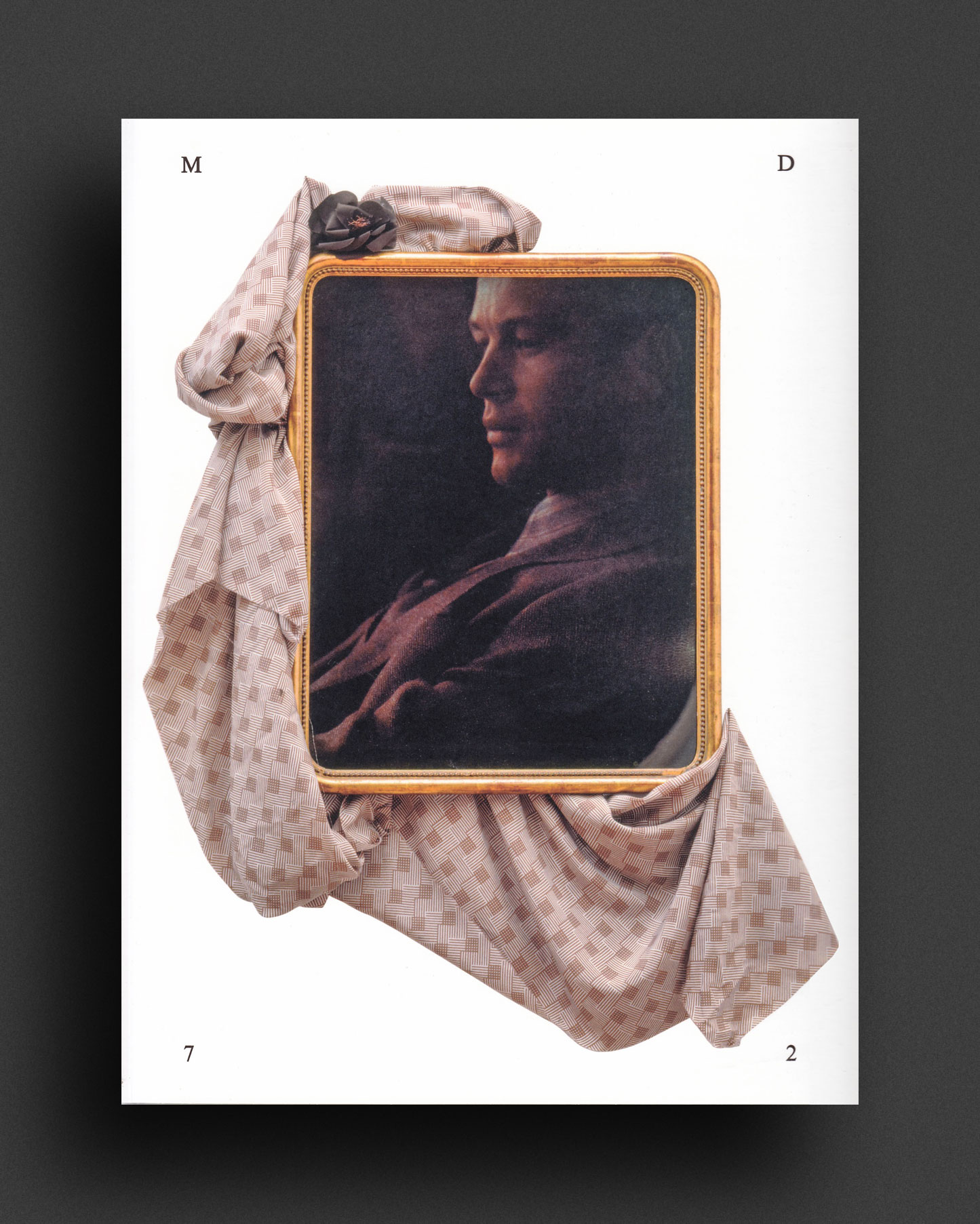
Around 1900, a nature-oriented way of life, spiritism and theosophy inspired artists from Arnold Schoenberg to Egon Schiele. Hidden Modernism is the first to explore the occult aspects of the "Lebensreform" movement in Vienna. In the late 19th century, criticism of industrialized society's materialism reached Vienna. Spiritism and theosophy inspired many who were looking for a "better self." Painters such as Albert von Keller and Gabriel von Max documented their trance states, Gertrude Honzatko-Mediz created mediumistic drawings, the writer August Strindberg painted dark landscape visions, artists such as Richard Gerstl, Arnold Schoenberg, Egon Schiele, Oskar Kokoschka and Max Oppenheimer saw their models as auratic presences. Through intensively researched scholarly texts and abundant artwork images and archival photographs, this volume examines the search for the "New Human" in Vienna without ignoring the darker aspects of magical thinking.
Edited by Matthias Dusini, Ivan Ristic, Hans-Peter Wipplinger. Text by Karl Baier, Matthias Dusini, Laura Feurle, Kira Kaufmann, Astrid Kury, Michaela Lindinger, Therese Muxeneder, Ivan Ristic.