World Food Books' programme is largely produced on Kulin Nation land. We acknowledge the Wurundjeri people of the Kulin Nation as the first and continuing custodians of this land, and pay respect to their Elders past, present, and emerging.
World Food Books is an arts and special interests bookshop in Naarm / Melbourne. Founded in 2010, World Food Books is devoted to the presentation of a rotating, hand-selection of international art, design, literary and counterculture publications with an emphasis on the anti-traditional, the experimental, the avant-garde, the heretic, the marginal.
Presenting new titles alongside rare and out-of-print books, catalogues and journals spanning the fields of modern and contemporary art, design, photography, illustration, film, literature, poetry, cultural theory, philosophy, sexuality, popular and underground culture in its many radical forms, World Food Books wishes to encourage adventurous, thoughtful and open-minded reading, looking, writing, and exchange of publishing and ideas, both current and historical.
As well as our bookshop, located in Melbourne's historical Nicholas Building, all of our inventory is available internationally via our online mail-order service.
World Food Books semi-regularly co-ordinates "Occasions", a programme of exhibits and events at the bookshop and in partnership with other hosts (such as museums and art galleries) that develop out of the activities, relationships and content of the bookshop itself.
World Food Books
The Nicholas Building
37 Swanston Street
Room 5, Level 6
Melbourne 3000
Australia
SHOP HOURS:
Thu–Fri 12–6, Sat 12–5
WEB-SHOP OPEN 24/7
World Food Books
Postal Address:
PO Box 435
Flinders Lane
Victoria 8009
Australia
Art
Theory / Essay
Architecture / Interior
Graphic Design / Typography
Photography
Fashion
Eros
LGBTQ+
Fiction / Poetry
Weird / Speculative / Science Fiction / Horror
Transgressive / Visceral / Abject
Symbolism / Decadence / Fin de siècle
Film / Video
Painting
Sculpture / Installation
Performance / Dance / Theater
Drawing
Sound / Music
Curatorial
Group Shows / Collections
Periodicals
Out-of-print / Rare
Posters / Ephemera / Discs
Signed Books
World Food Books Gift Voucher
World Food Book Bag
Australian Art
Australian Fiction
Australian Science Fiction / Speculative Fiction
Australian Poetry
Australian Photography
Japanese Photography
Conceptual Art
Minimal Art
Dada
'Pataphysics / Oulipo
Fluxus
Concrete Poetry
Pop Art
Surrealism
Arte Povera
Arte Informale / Haute Pâte / Tachism
Nouveau Réalisme / Zero / Kinetic
Situationism / Lettrism
Collage / Mail Art / Xerox Art
Art Brut / Folk / Visionary / Fantastic
Illustration / Graphic Art / Bandes Dessinées
Furniture
Italian Radical Design / Postmodernism
Textiles
Ceramics / Glass
Counterculture
Protest / Revolt
Philosophy
Psychoanalysis
Anthropology
Anarchism
Socialism / Anarchism / Communism / Capitalism
Literary Theory / Semiotics / Language
Feminism / Women's Studies
Gender Studies / Sexuality
Anthropology
Fetishism / BDSM
Drugs / Psychedelia
Crime / Violence
Animal Rights / Veganism
Occult / Esoterica
Ecology / Earth / Alternative Living
Whole Earth / Crafts
All prices in AUD (Australian dollars)
Pick-Ups
Pick-up orders can be collected in our bookshop during opening hours after order date. Please collect any Pick-up orders within 2 weeks of ordering as we have limited storage space. Orders will be released back into stock if not collected within this time. No refunds can be made for pick-ups left un-collected. If you cannot make it in to the bookshop in this time-frame, please choose postage option.
Return Policy
All sales are final. We do accept returns (for refund or exchange) for items received in error. All our orders are packed with special care using heavy-duty padding and cardboard book-mailers or bubble mailers (for smaller books), using reinforcement where required. We cannot take responsibility for any lost, stolen or damaged parcels.
Insurance
Should you wish to insure your package, please email us directly after placing your order and we can organise this at a small extra expense. Although all standard/express tracked packages are very safe and dependable, we cannot take responsibility for any lost, stolen or damaged parcels. We recommend insurance on valuable orders.
Interested in selling your old books, catalogues, journals, magazines, comics, fanzines, ephemera? We are always looking for interesting, unusual and out-of-print books to buy. We only buy books in our fields of interest and specialty, and that we feel we can resell.
We base these prices on desirability, market value, in-print prices, condition and our current stock levels. We offer cash, store credit, and can take stock on consignment. All
about 25% of the price we expect to get when we sell them, or 30% in store credit. We base these prices on desirability, market value, in-print prices, condition and our current stock levels.
Sell your books any day of the week. You can drop them off and return later. If you have a lot of books, we can visit your Sydney home.
We buy books that we feel we can resell. We offer about 25 % of the price we expect to get when we sell them, or 30% in store credit. We base these prices on desirability, market value, in-print prices, condition and our current stock levels.
Philadelphia Wireman
03 August - 01 September, 2018
World Food Books is proud to announce our next Occasion, the first presentation of sculptures by Philadelphia Wireman in Australia.
The Philadelphia Wireman sculptures were found abandoned in an alley off Philadelphia’s South Street on trash night in 1982. Their discovery in a rapidly-changing neighbourhood undergoing extensive renovation, compounded with the failure of all attempts to locate the artist, suggests that the works may have been discarded after the maker’s death. Dubbed the "Philadelphia Wireman" during the first exhibition of this work, in 1985, the maker’s name, age, ethnicity, and even gender remain uncertain. The entire collection totals approximately 1200 pieces, all intricately bound together with tightly-wound heavy-gauge wire (along with a few small, abstract marker drawings, reminiscent both of Mark Tobey and J.B. Murry). The dense construction of the work, despite a modest range of scale and materials, is singularly obsessive and disciplined in design: a wire armature or exoskeleton firmly binds a bricolage of found objects including plastic, glass, food packaging, umbrella parts, tape, rubber, batteries, pens, leather, reflectors, nuts and bolts, nails, foil, coins, toys, watches, eyeglasses, tools, and jewellery.
Heavy with associations—anthropomorphic, zoomorphic, and socio-cultural responses to wrapped detritus—the totemic sculptures by Philadelphia Wireman have been discussed in the context of work created to fulfil the shamanistic needs of alternative religions in American culture. Curators, collectors, and critics have variously compared certain pieces to sculpture from Classical antiquity, Native American medicine bundles, African-American memory jugs, and African fetish objects. Reflecting the artist’s prolific and incredibly focused scavenging impulse, and despite—or perhaps enhanced by—their anonymity, these enigmatic objects function as urban artefacts and arbiters of power, though their origin and purpose is unknown. Philadelphia Wireman, whatever their identity, possessed an astonishing ability to isolate and communicate the concepts of power and energy through the selection and transformation of ordinary materials. Over the course of the past two decades, this collection has come to be regarded as an important discovery in the field of self-taught art and vernacular art.
Presented in collaboration with Fleisher-Ollman Gallery, Philadelphia, and Robert Heald, Wellington.
Susan Te Kahurangi King
02 February - 10 March, 2018
Susan Te Kahurangi King (24 February 1951 - ) has been a confident and prolific artist since she was a young child, drawing with readily available materials - pencils, ballpoint pens and felt-tip markers, on whatever paper is at hand. Between the ages of four and six Susan slowly ceased verbal communication. Her grandparents William and Myrtle Murphy had developed a special bond with Susan so they took on caring responsibilities for extended periods. Myrtle began informally archiving her work, carefully collecting and storing the drawings and compiling scrapbooks. No drawing was insignificant; every scrap of paper was kept. The King family are now the custodians of a vast collection containing over 7000 individual works, from tiny scraps of paper through to 5 meter long rolls.
The scrapbooks and diaries reveal Myrtle to be a woman of great patience and compassion, seeking to understand a child who was not always behaving as expected. She encouraged Susan to be observant, to explore her environment and absorb all the sights and sounds. Myrtle would show Susan’s drawings to friends and people in her community that she had dealings with, such as shopkeepers and postal workers, but this was not simply a case of a grandmother’s bias. She recognised that Susan had developed a sophisticated and unique visual language and sincerely believed that her art deserved serious attention.
This was an unorthodox attitude for the time. To provide some context, Jean Dubuffet coined the term Art Brut in 1945 to describe work created by self-taught artists – specifically residents of psychiatric institutions and those he considered to be visionaries or eccentrics. In 1972 Roger Cardinal extended this concept by adopting the term Outsider Art to describe work made by non-academically trained artists operating outside of mainstream art networks through choice or circumstance. Susan was born in Te Aroha, New Zealand in 1951, far from the artistic hubs of Paris and London that Dubuffet and Cardinal operated in. That Myrtle fêted Susan as a self-taught artist who deserved to be taken seriously shows how progressive her attitudes were.
Susan’s parents Doug and Dawn were also progressive. Over the years they had consulted numerous health practitioners about Susan’s condition, as the medical establishment could not provide an explanation as to why she had lapsed into silence. Dawn educated herself in the field of homeopathy and went on to treat all twelve of her children using these principles – basing prescriptions on her observations of their physical, mental and emotional state.
Doug was a linguist with an interest in philosophy who devoted what little spare time he had to studying Maori language and culture. To some extent their willingness to explore the fringes of the mainstream made them outsiders too but it was their commitment to living with integrity and their respect for individuality that ensured Susan’s creativity was always encouraged.
Even though Susan’s family supported her artistic pursuits, some staff in schools and hospitals saw it as an impediment to her assimilation into the community and discouraged it in a variety of ways. Her family was not always aware of this and therefore did not fully understand why Susan stopped drawing in the early 1990s. However, rather than dwell on the challenges that Susan faced in pursuit of her artistic practice, they prefer to highlight her achievements. In 2008 Susan began drawing again in earnest, after an almost 20 year interruption, and her work is now shown in galleries around the world.
Susan grew up without television and has been heavily influenced by the comics she read as a child. She is absolutely fearless in the appropriation of recognizable characters, such as Donald Duck and Mickey Mouse, in her work. She twists their limbs, contorts their faces, compresses them together, blends them into complex patterned backgrounds - always imbuing them with an incredible energy. Although Susan often used pop culture characters in her work they are not naive or childlike. These are drawings by a brilliant self-taught artist who has been creating exceptional work for decades without an audience in mind.
Mladen Stilinović
"Various Works 1986 - 1999"
02 February 16 - September 10, 2016
Various works 1986 - 1999, from two houses, from the collections of John Nixon, Sue Cramer, Kerrie Poliness, Peter Haffenden and Phoebe Haffenden.
Including: Geometry of Cakes (various shelves), 1993; Poor People’s Law (black and white plate), 1993; White Absence (glasses, ruler, set square, silver spoon, silver ladel with skin photograph and wooden cubes), 1990-1996; Exploitation of the Dead (grey and red star painting, wooden painting, black spoon with red table, red plate), 1984-1990; Money and Zeros (zero tie, paintings made for friends in Australia (Sue, John, Kerrie), numbers painting), 1991-1992; Words - Slogans (various t-shirts) - “they talk about the death of art...help! someone is trying to kill me”, “my sweet little lamb”, “work is a disease - Karl Marx”; Various artist books, catalogues, monographs, videos; Poster from exhibition Insulting Anarchy; "Circular" Croatian - Australian edition; Artist book by Vlado Martek (Dostoyevsky); more.
Thanks to Mladen Stilinović and Branka Stipančić.
Jonathan Walker
Always Will Need To Wear Winter Shirt Blue + Ochre Small Check Pattern
21 August - 21 September, 2015
Untitled
I am not a great reader of poetry but I always return to the work of Melbourne poet, Vincent Buckley (1925- 1988). Perhaps I find his most tantalising piece to be not a finished poem but a fragment left on a scrap of paper discovered on his desk after the poet’s death.
The poetry gathers like oil
In the word-core, and spreads
It has its music meet,
Its music is in movement.
This fragment is more the shell left behind from a volatile thought than a finished poem. I find the last two lines honest but awkward whereas the first two lines work like an arrow. Most likely he could not find a resolution so it was left. Still, in its present form, it remains an eloquent testimony to the ultimate failure of a medium to express mobile thought and sensation, in Buckley’s case, through verbal language. It’s an important matter because this is something all artists have to deal with regardless of the medium.
I have never written a poem, however, I am forever copying fragments from books on paper scraps in a vain effort to fix certain notions in my head. At first, they function as bookmarks that are sometimes returned to when I open the book. But before long, as they accumulate, they fall out littering the table interspersed with A4 photocopies, bills, books and medications.
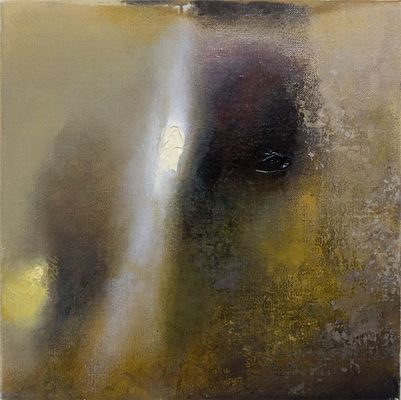
To return to Buckley’s fragment, the first two lines very much evoke how I paint nowadays. As you age, detail diminishes and patches of light become more luminous and float. I feel the most honest way of dealing with this is by smearing the oil paint on the canvas with the fingers and working close-up, blind. Only if the patches coalesce into an approaching image can the work gain a life.
-
Jonathan Walker was born in Melbourne, Australia and brought up on a dairy farm in Gippsland. In the 1970’s he studied painting at RMIT and won the Harold Wright Scholarship to the British Museum, London. During the 1980’s he exhibited at Pinacotheca Gallery, Richmond and had work shown at the NGV and Heidi City Art Gallery. Over the same period he designed the cover for the “Epigenesi” LP by Giancarlo Toniutti, Italy and conducted a mail exchange work with Achim Wollscheid, Germany. The work with artists through the post resulted in an article published in the bicentenary issue of Art and Australia 1988. He showed in artist run spaces such as WestSpace in the 90’s and 2000’s, and until 2012, taught painting at Victoria University, which is where we (Colleen Ahern and Lisa Radford) as organisers of the exhibition, among many others, had the privilege of being his student.
Walker’s knowledge was imparted to students through the careful selection of music, literature, and artists found in books that he himself had ordered for the library. Walker’s strategy was the generosity of sharing his vast knowledge with references specific to each student and their context.
Walker’s paintings share a similar focus and intimacy.
This exhibition presents a small selection of recent paintings alongside a publication that includes Walker’s writing. Observational and analytical, Walker’s work is a type of material notation — the time of day, colour and how it is blended, the both specific and fleeting location of a reflection on lino or the question of whether a chair leg should be included in a painting.
Please join us on Friday August 21 between 6-8pm to celebrate the opening of the exhibition.
Curated by Colleen Ahern and Lisa Radford.
B. Wurtz
Curated by Nic Tammens
March 26 - April 4, 2015
B.Wurtz works from a basement studio in his home on Manhattan’s Lower East Side.
This local fact is attested to by the plastic shopping bags and newsprint circulars that appear in his work. As formal objects, they don’t make loud claims about their origins but nonetheless transmit street addresses and places of business from the bottom of this long thin island. Like plenty of artists, Wurtz is affected by what is local and what is consumed. His work is underpinned by this ethic. It often speaks from a neighborhood or reads like the contents of a hamper:
“BLACK PLUMS $1.29 lb.”
“Food Bazaar”
“USDA Whole Pork Shoulder Picnic 99c lb.”
“RITE AID Pharmacy, with us it’s personal.”
“H. Brickman & Sons.”
“Sweet Yams 59c lb."
Most of the work in this exhibition was made while the artist was in residence at Dieu Donne, a workshop dedicated to paper craft in Midtown. Here Wurtz fabricated assemblages with paper and objects that are relatively lightweight, with the intention that they would be easily transportable to Australia. This consideration isn’t absolute in Wurtz’s work, but was prescriptive for making the current exhibition light and cheap. Packed in two boxes, these works were sent from a USPS post office on the Lower East Side and delivered to North Melbourne by Australia Post.
Wurtz appears courtesy of Metro Pictures, New York.
Thanks to Rob Halverson, Joshua Petherick, Sari de Mallory, Matt Hinkley, Helen Johnson, Fayen d'Evie, Ask Kilmartin, Lisa Radon, Ellena Savage, Yale Union, and "Elizabeth".
John Nixon
"Archive"
December 15 - January 20, 2014
The presentation of John Nixon's archive offered a rare showcase of this extensive collection of the artist's own publications, catalogues, posters, ephemera, editions and more, from the mid 1980s onwards, alongside a selection of his artworks.
Organized by John Nixon, Joshua Petherick and Matt Hinkley.
<a href=http://wfb.public-office.info/artist/john-nixon>All titles by John Nixon
"Habitat"
at Minerva, Sydney (organised by Joshua Petherick and Matt Hinkley)
November 15 - December 20, 2014
Lupo Borgonovo, Janet Burchill & Jennifer McCamley,
Lewis Fidock, HR Giger, Piero Gilardi, Veit Laurent Kurz,
Cinzia Ruggeri, Michael E. Smith, Lucie Stahl, Daniel Weil, Wols
Press Release:
“...It contained seven objects. The slender fluted bone, surely formed for flight, surely from the wing of some large bird. Three archaic circuitboards, faced with mazes of gold. A smooth white sphere of baked clay. An age-blackened fragment of lace. A fingerlength segment of what she assumed was bone from a human wrist, grayish white, inset smoothly with the silicon shaft of a small instrument that must once have ridden flush with the surface of the skin - but the thing’s face was seared and blackened.”
William Gibson, “Count Zero”, 1986
"Autumn Projects Archive"
Curated by Liza Vasiliou
March 6 - March 15, 2014
World Food Books, in conjunction with the Virgin Australia Melbourne Fashion Festival 2014, presented the Autumn Projects archive, consisting of a selection of early examples in Australian fashion with a particular interest in collecting designers and labels from the period beginning in the 1980’s, who significantly influenced the discourse of Australian Fashion.
Curated by Liza Vasiliou, the exhibition provided a unique opportunity to view pieces by designers Anthea Crawford, Barbara Vandenberg, Geoff Liddell and labels CR Australia, Covers, Jag along with early experimental collage pieces by Prue Acton and Sally Browne’s ‘Fragments’ collection, suspended throughout the functioning World Food Books shop in Melbourne.
H.B. Peace
presented by CENTRE FOR STYLE
November 14, 2013
"Hey Blinky, you say chic, I say same"
Anon 2013
H.B. Peace is a clothing collaboration between great friends Blake Barns and Hugh Egan Westland. Their pieces explore the divergences between 'character’ and ‘personality’ in garments....etc
Special Thanks to Joshua Petherick and Matt Hinkley of WFB and Gillian Mears
and a Very Special Thank you to Audrey Thomas Hayes for her shoe collaboration.
Janet Burchill & Jennifer McCamley
"Aesthetic Suicide"
May 10 - June 8, 2013
The first of our occasional exhibitions in the World Food Books office/shop space in Melbourne, "Aesthetic Suicide" presented a body of new and older works together by artists Janet Burchill & Jennifer McCamley, including videos, prints, a wall work, and publications.
During shop open hours videos played every hour, on the hour.
1999, English
Softcover, 128 pages, 24 x 18 cm
1st Edition, Out of print title / used / good
Published by
Creation Books / London
The Tears Corporation / London
$40.00 - Out of stock
Antonin Artaud (1896-1948) remains the most inspirational, provocative and challenging figure in world-wide contemporary culture. His trajectory extends from the Surrealist movement, to the Theatre of Cruelty, to the lunatic asylums of France, and finally back to Paris and the most astonishing period of his work.
For the first time, the book gives a full and authoritative account of Artaud's film projects, and his conception of Surrealist cinema. It examines his unique series of drawings of the fragmented human body, begun in the ward of a lunatic asylum and finished in a state of furious liberation. Finally, the book captures Artaud's ultimate experiment with the screaming body in the form of his censored recording To Have Done With The Judgement Of God - an experiment which is unprecedented in the history of art, and which ultimately decimates that history.
The Screaming Body is an essential resource and inspiration for those engaged in creating the definitive culture of our time, in film, art, music and writing.
Good copy, some wear to cover otherwise VG throughout rest.
2003 / 2006, Japanese
Hardcover (w. dust jacket), 494 pages, 24 x 16 cm
1st Edition, Out of print title / used / fine
Published by
Shinchosha / Tokyo
$45.00 - Out of stock
Lovely hardcover Japanese edition of this tremendous survey of Egon Schiele's Drawings & Watercolors, authored by Jane Kallir and edited by Ivan Vartanian, published in this translated edition in 2006. An almost entirely visual book, Schiele's works are lavishly reproduced across almost 500 pages in colour, with very minimal accompanying text in Japanese.
"Austrian Expressionist Egon Schiele produced a prolific body of work before his early death at the age of twenty-eight in the flu epidemic of 1918. As well as a few hundred oil paintings, he created nearly 3,000 drawings and watercolours. Limited access to these fragile works and dispersion among several collections have made a comprehensive survey of his work a rarity. This volume assembles this master draughtsman's works on paper, providing a unique opportunity to study his rapid artistic development over the course of his brief twelve years of activity. Jane Kallir, the author of Schieles catalogue raisonne, introduces each year of the artists output, discussing his step-by-step progression from child prodigy to master of the human form and expression."
Near Fine copy in NF dustjacket.
2018, English
Hardcover, 152 pages, 32 x 25 cm
Ed. of 500,
1st Edition, Out of print title / used / very good
Published by
Timeless Edition / Paris
$200.00 - Out of stock
First 2018 regular hardcover edition of NEKROPHILE – “Archives & Documents” by Genesis Breyer P-Orridge. Culled from Genesis’s private, mostly unpublished archives, “Archives and Documents” presents 152 full color pages of crucial early art terrorism from h/er little seen Nekrophile zine, reproduced here in full. Nekrophile magazine was conceived in 1968 by GPO as a single issue. The collages, drawings, poems and texts gathered in it deal with the themes that later prevailed in the iconography of Industrial Music. This volume also displays ultra rare and previously unseen TG and PTV documents selected by GPO. Edited by Nicolas Ballet with personal explanations and insights added by GPO, this volume is an essential visual document of Gen’s contributions to art and culture from the mid 1960s onwards with a strong emphasis on that most controversial and rewarding period of the late ’70s and early ’80s.
Edition of 500 copies, out-of-print.
1990, Japanese / English
Hardcover (w. dust jacket + obi), 120 pages (approx), 30 x 30.5 cm
1st Edition, Out of print title / used / very good
Published by
Bundgeishunju / Tokyo
$150.00 - In stock -
Beautiful first hardcover edition of this great photo book by Japanese photographer Joji "Geroge" Hashiguchi (b. born in Kagoshima in 1949), the second in his acclaimed collections that also includes Seventeen's Map (1988) and Couples (1992) following Hashiguchi’s striking method of portraiture. "Father" is a moving sociological typology consisting of documentary black and white portraits of Japanese Fathers taken across Japan at the end of the 1980s. Text in Japanese and English by the photographer. In addition to its value as an archaeological record, Hashiguchi's point of view always captures the social landscape behind it. Working as a sociological ethnographer with a survey approach, Hashiguchi produces a unique overview of Japanese society with a sense of considerable sociocultural diversity in light of stereotypic reductions of Japan as a homogeneous entity.
"The present volume "Father" represents the second in my series. At least since beginning work on "Seventeen" I have come to notice that while mothers in Japan are often talked about by their children, fathers seem to be spoken of very little. And although Japan continues to be called a "male-centered" society, the males referred to in that expression tend to be the men of organizations and companies, not men as individuals. In addition, while one can see many depictions of ordinary wives in the pages of magazines and in other media, descriptions of fathers are strangely absent. As a result, while Japan continues to be viewed as a "man's society," solitary fathers, or individual men in their working prime, are virtually estranged from social consciousness. Value judgements aside, within Japan's current social structure, there exists an image of the father as a dedicated "working warrior," but it seems rebellion begins before we really get to know the existence of our fathers, and we lose the opportunity of confronting them genuinely as individual human beings. At the same time, I am also impressed with the feeling that fathers themselves do not speak their own minds, but bury their real feelings deep within as the years mount.
And this fact holds true not only with respect to relationships within the family, but with regard to the society as a whole. In that respect, I cannot help thinking that the faiure to por tray the genuine human image of those people living the most crucial roles within Japan's social structure is a minus for those of all generations. And it is from these kinds of thoughts that this collection, "Father" began"—Joji "Geroge" Hashiguchi
Texts in English and Japanese.
Very Good—Near Finein VG dust jacket and obi.
1981, English
Softcover, 96 pages, 24 x 24 cm
1st Edition, Out of print title / used / very good
Published by
Quick Fox / New York
$190.00 - In stock -
The now rare, first, only edition of one of the greatest interior design books ever published by one of the greatest interior design photographers ever. Tim Street-Porter (Domus, Underground Interiors, et al), compiled this, his first and most iconic book, in 1981. A wild book of his personal interior photographs with a fantastic design to match the fantastic interiors within. Capturing a multitude of architectural and interior styles, Interiors really is one of the rarest looks inside the homes you'd not usually see in glossy magazines nor coffee table books. From London, Los Angeles, New York, even Australia, from pop artists, stage designers, architects, animators, art dealers, stylists, textile designers, actresses... including the homes of Frank Gehry, Allen Jones, Zsa Zsa Gábor, Ward Bannett, Thea Porter, Duggie Fields, Harry Nilsson, James Coburn, Rudi Stern, Moira Lister, Luciana Martínez, Sally Sirkin Lewis, Lloyd Ziff, Philip Castle, Max Clendinning, Ralph Adron, and many more, including the photographer himself. A very rare, interior classic.
Very Good copy with light wear.
1981, Japanese
Softcover (w. dust jacket), 240 pages, 17.5 x 11 cm
1st Edition, Out of print title / used / very good
Published by
Sunday Inc. / Tokyo
$110.00 - Out of stock
Rare first 1981 edition of Yoshiyuki's heavily illustrated instructional photobook, published the year following his voyeuristic masterpiece, Document Park (1980), a controversial volume of 74 photographs taken by the Japanese photographer using a 35mm camera, infrared film, and flash to document a secret community of lovers and voyeurs who gathered in Shinjuku Park and Yoyogi Park between 1971 and 1973. "This Is Infrared!" is Kohei's essential accompanying handbook for all those curious about his clandestine techniques that still amaze to this day, for many various reasons. Profusely illustrated with many of the infamous photographs from his Document Park book and many photograph collections that have not been published elsewhere, Kohei's D.I.Y. manual is a thorough analysis of his honed peeping techniques, camera equipment, various strategies (in the field and in the darkroom), technical specifications and aesthetic concerns, complete with manga illustrations, set-by-step guides and a sense of humour.
"My curiosity and lewdness were the starting point for peeping photos in the park. I used infrared film. Last May I published a photo book called "Park" (Documentary). It documents couples in parks, the peeping toms who flock to them, and the world of gays who gather in parks. Since I published this photo book, I've been asked a lot of questions like "What kind of camera is an infrared camera?" It's a bit tiring, as some of the people asking are quite knowledgeable about photography, and some are even professional photographers."—excerpt from Kohei Yoshiyuki's introduction
From "The Monroe-effect" (action photography on windy days...) to pigeon-cameras, "This Is Infrared!" goes beyond the night works to explore the many convictions of the determined peeping-tom. Nothing like it. Apart from those of Ikko Kagari... Fits right in the pocket.
Kohei Yoshiyuki (b. 1946—2022) came to recognition in 1972 when material from his photo project “The Park” was featured in magazine Shukan Shincho, and a year later, in respected photo journal Camera Mainichi. However, it was the 1979 photo exhibition “The Park” at Komai Gallery and 1980 photo book “Document: The Park” that established him within the contemporary photographic landscape. As Martin Parr writes in The Photobook: A History, Volume II, The Park is "a brilliant piece of social documentation, capturing perfectly the loneliness, sadness and desperation that so often accompany sexual or human relationships in a big, hard metropolis like Tokyo." Since then, Yoshiyuki was a recurrent fixture in Japan debauchery journal Super Photo Magazine along photographers: Nobuyoshi Araki, Daido Moriyama, Keizo Kitajima and Seiji Kurata.
Very Good copy in VG dust jacket.
1974, Japanese
Hardcover (w. dust jacket), 127 pages, 29 x 22 cm
1st Edition, Out of print title / used / very good
Published by
Bijutsu Shuppansha / Japan
Rippu Shobo / Japan
$200.00 - Out of stock
Rare copy of the best book on award-winning Japanese illustrator Shiro Tatsumi (1938—2003). From the legendary Illustration NOW series published by Rippu Shobo in 1974, this lavishly produced book collects the best of Tatsumi's radical graphic phantasmagoria, showcasing his unique work from the Tokyo underground to his award-winning commercial illustration, his never published private drawings and his illustrations of Hell. Fiercely independent and challenging, Tatsumi started his design career with Daido Moriyama’s first photobook, A Photo Theater, then worked on theater posters for the avant-garde performances of Shuji Terayama, and as a commercial illustrator and designer. Designed by Seiichi Horiuchi in the 1970s and presented by Keiichi Tanaami, Yoshitara Isaka, Yosuke Inoue and others, The World of Shiro Tatsumi includes 207 works, with fold-out panels. Highly recommended volume on an artist seldom spoken of outside Japan.
Very Good copy with VG dust jacket. Lacks pull-out poster.
1992, Japanese / English
Softcover (w. dust jacket), 108 pages, 30 x 30.5 mm
1st Edition, Out of print title / used / very good
Published by
Bundgeishunju / Tokyo
$200.00 - In stock -
Beautiful first edition of this great photobook by Japanese photographer Joji "Geroge" Hashiguchi (b. born in Kagoshima in 1949). Starting in June 1990 on Iriomote Island, Okinawa, and ended in Tokyo in September 1992, Couple is Hashiguchi’s series of 103 portraits of couples living in Japanese at the beginning of the 1990s. Following on from his previous acclaimed collections, 17-year-old map (1988) and Father (1990), Couples follows Hashiguchi’s same method of portraiture. In addition to its value as an archaeological record, Hashiguchi's point of view always captures the social landscape behind it. Working as a sociological ethnographer with a survey approach, Hashiguchi produces a unique overview of Japanese society with a sense of considerable sociocultural diversity in light of stereotypic reductions of Japan as a homogeneous entity.
Texts in English and Japanese.
Very Good copy.
1994, Japanese / English
Slipcase (w. obi), corrugated envelope, unpaginated book, 29.7 x 21 cm
1st Edition, Out of print title / used / fine
Published by
B-Sellers / Japan
$220.00 - Out of stock
First book edition of Scene of Death, a rare 1994 death photo collection, published by B-Sellers in Japan only, compiled by Noriaki Nakagawa, Hitomi Komukai, and Yoichi Shihata. An elaborate and beautiful production of the macabre. Housed in an illustrated slipcase with illustrated obi-strip and further within a stamped, labelled, corrugated envelope, housing the bound book containing 64 monochrome photographic plates reproducing images from "Atlas der Gerichtsmedizin", an absolutely fascinating collection by Weiman / Prokop, first published in 1963. Atlas der Gerichtsmedizin was originally a serious German scientific reference book for criminal investigators and those in the medical field — a photo book scrapbook of thousands of images of graphic human death scenes — suffocation and strangulation, drowning and death by water, death by burning and electrocution, crimes of passion, abuse and neglect, and more. In turn, this visual opus became a bible of reference imagery to a wave of musicians, artists and authors during the industrial avant-garde, from Throbbing Gristle to Paul Buck to Atrax Morgue. This meticulous and unique Japanese offering further influenced many Japanese artists in the 1990's.
"We believe the scenes of death is, in one sense, the most erotic of human nature. It is at the time of death that man no longer can attempt to control his inner self and therefore the real self appears vividly. Here we have opened the doors to a topic that is usually not only hidden but also shut out of the minds of man. Please share our excitement and take a glance into the world of hidden eroticism"—Scene of Death blurb.
Fine copy throughout, As New with sealed sticker never opened. Finer than pictured copy.
1995, Japanese
Softcover (w. dust jacket + obi), 130 pages, 20 x 15 cm
1st Edition, Out of print title / used / fine
Published by
Photo Musée / Tokyo
$110.00 - Out of stock
First, long-out-of-print, 1995 revised edition of Daido Moriyama's classic first photo book, Nippon Gekijo Shashincho (Japan, A Photo Theater), originally published in 1968, the year which also saw the launch of the influential Provoke magazine. This wonderful first book already demonstrates Moriyama’s trademark visual style, synonymous with Provoke, and features many of his most iconic early photographs. On invitation of legendary Japanese avant-garde theatre director and writer Shūji Terayama (1935—1983), Moriyama began photographing members of his experimental theatre troupe Tenjō Sajiki, a major phenomenon on the Japanese Angura ("underground") theater scene of the 1960s and 70s, adding shots of dwarf show dancers, strip clubs, street performers, fetuses in formaldehyde containers and other motifs and characters of late 1960's Japan captured in Daido's signature grain.
NF copy in NF dust jacket w/ NF obi.
1989, English
Softcover, 214 pages, 21.5 x 13.5 cm
1st Edition, Out of print title / used / very good
Published by
Marion Boyars / London
$55.00 - Out of stock
Scarce 1989 softcover edition of the English edition of Roberte Ce Soir and The Revocation of the Edict of Nantes, published by Marion Boyars, London/New York. Together these two novels comprise the most fascinating, obsessive, and erotic works of contemporary French fiction. Like the works of Georges Bataille, and those of the Marquis de Sade before him, Klossowski's fiction explores the connections between the mind and the body through a lens of sexuality. Both of these novels feature Octave, an elderly cleric; his striking young wife Roberte; and their nephew, Antoine in a series of sexual situations. But Klossowski's books are about theology as well, and this merging of the sexual with the religious makes this book one of the most painstakingly baroque and intellectual novels of our time.
Pierre Klossowski (1905, Paris—2001, Paris) was a French writer, translator and artist. He was the eldest son of the artists Erich Klossowski and Baladine Klossowska, and his younger brother was the painter Balthus. As a writer, Pierre Klossowski wrote full length volumes on the Marquis de Sade and Friedrich Nietzsche, a number of essays on literary and philosophical figures, and five novels. Roberte Ce Soir (Roberte in the Evening) provoked controversy due to its graphic depiction of sexuality. He translated several important texts (by Virgil, Ludwig Wittgenstein, Martin Heidegger, Friedrich Hölderlin, Franz Kafka, Nietzsche, and Walter Benjamin) into French, worked on films and was also an artist, illustrating many of the scenes from his novels. Klossowski participated in most issues of George Bataille's review, Acéphale, in the late 1930s. His 1969 book, Nietzsche and the Vicious Circle, greatly influenced French philosophers such as Michel Foucault, Gilles Deleuze, and Jean-François Lyotard.
Very Good copy, sun discolouration to cover boards and spine.
1998, French
Softcover, 140 pages, 21 x 13.5 cm
1st Edition, Out of print title / used / good
Published by
Marval / Paris
$55.00 - Out of stock
"Looking at a painting by Klossowski is to turn oneself into its victim."
First edition 1998 French paperback study of Pierre Klossowski by French writer, poet, art critic and collector, Bernard Lamarche-Vadel (1949—2000). Heavily illustrated throughout with many fine examples of Klossowski's artworks in colour and b/w, plus biography, portraits, history of exhibitions, and more.
"The great master of heresy desires first and places the observer of his works at the center of their mechanisms. This device lends itself to the description of the great and redoubtable logic of the images that place us on the threshold of the secret of Roberte. Scandalous and classic Klossowski's work is one of the most enigmatic of the twentieth century because it is primarily a process the enigma of which is the subject."
Bernard Lamarche-Vadel (1949—2000) was a French writer, poet, art critic and collector. The son of a veterinarian, self-taught, his tastes for art and literature earned him a paternal anathema. A graduate from the École pratique des hautes études in art sociology (1970), he subsequently taught at the Paris-I Panthéon-Sorbonne University and then at ICART in 1979. A poet and short stories writer, Bernard Lamarche-Vadel bega writing art criticism in the 1970s and founded the magazine Artistes. He became a prolific writer on the arts, publishing many books and organising exhibitions. He appareared in L'Argent (1983) by Robert Bresson. In 2000, at age 50, he committed suicide in his castle of La Rongère. His photographic collection is archived at Musée Nicéphore-Niépce in Chalon-sur-Saône. An exhibition devoted to his work as an art critic was presented in 2009 by the Musée d'Art Moderne de la Ville de Paris.
Very Good copy with some laminate peeling to the covers, tanned edges.
2006, English
Softcover, 366 pages,
1st UK Edition, Out of print title / used / good
Published by
Snowbooks / London
$35.00 - Out of stock
'History follows a trail of sputtering desire, often calling upon the delusions of lovers to generate the sparks. If it weren't for us, the world would suffer from a dismal lack of stories.'
In this brutally candid memoir, writer, translator and journalist Bruce Benderson recounts his unrequited love for an impoverished Romanian whom he meets while on a journalism assignment in Eastern Europe. Rather than retreat, Benderson absorbs everything he can about Romania, its culture and its history and discovers a mirror in it for his own turmoil: the wild affairs of its last king, Carol II. Free of bitterness, nastiness, or any desire to protect himself, he is sustained throughout by little white codeine pills, a poetic self-awareness, a sense of humor, and an unwavering belief in the perfect romance, even as wild dogs chase him down Romanian streets.
"Bruce Benderson's harrowingly autobiographical The Romanian (Snowbooks) is one of the most devastating and unsparing accounts of amour fou I have ever read, providing at the same time an extraordinary glimpse into Romania's past and present. [...] More than just a memoir, The Romanian is also a fascinating travelogue of a country dense with mystical traces and decay...A grand, if disturbing adventure."—Joy Press, The Village Voice
Good copy, light edge wear, some foxing to block edges.
2018, English
Hardcover, 400 pages, 24 x 28.8 cm
1st Edition, Out of print title / as new
Published by
Mumok / Vienna
$68.00 - Out of stock
English edition of this heavy hardcover monographic catalogue published on the occasion of a retrospective exhibition of Austrian artist Bruno Gironcoli at mumok, Vienna in 2018. Heavily illustrated throughout, with accompanying texts by Manuela Ammer, Edith Futscher, Peter Gorsen, Charlotte Matter, Karin Steiner.
Bruno Gironcoli is one of the most idiosyncratic artists of the twentieth century. He gained public recognition with his late large-scale sculptures, in which archetypes and trivial elements meld to form futuristic conglomerates. It is less well known that alongside his work in sculpture Gironcoli also produced an extensive body of graphic works. This retrospective exhibition at mumok will for the first time focus on Gironcoli the painter and draughtsman. His works on paper will enter into dialogue with outstanding examples of the artist’s wire sculptures, polyester objects, installations, and monumental sculptures, also opening up new perspectives on the sculptural work.
Right from the beginning, Gironcoli’s works on paper were more than just designs for his sculptures. On paper, the Austrian artist took his ideas into dimensions that by far transcend any concrete work on physical materials. On paper, he animated his own sculptural work: Divorced from the laws of physics, his schematic figures, animals, symbols, and apparatuses enter into hypothetical connections and merge to form fantastic and surreal scenes. Gironcoli’s works on paper are literally “surfaces of considerations” that seek to rescue potential forms of life from alienated signs.
1994, English
Softcover, 192 pages, 21.5 x 14 cm
1st Edition, Out of print title / used / good
Published by
Permeable Press / San Fransisco
$12.00 - In stock -
"Lance Olsen's Tonguing The Zeitgeist is pure dope - some of the wildest, darkest and hippest head candy you could ever imagine tasting! His addictive prose style is like taking a hit of ecstasy and entering a futureworld that rivals Gibson's Neuromancer. I dare you to read it!"—Mark Amerika, author of The Kafka Chronicles
"Lance Olsen writes as if he were Lucifer taking the long plummet to Hell. His prose lights the sky with mocking laughter and burning conviction."—Lewis Shiner, author of Slam and Deserted Cities of the Heart
"Avant-Pop Prof Lance Olsen's Tonguing The Zeitgeist is one of the new breed of savvy, post-cyberpunk SF novels that should alert all those grunge-weary members of the underground that there's weird, wired, and wild quality stuff coming from the Pacific Northwest these days other than remastered Hendrix or Nirvana's latest. Two thumbs up!"—Larry MaCaffery, editor of Storming The Reality Studio: A Cyberpunk Casebook
"So you want to be a rock 'n' roll star? In a future that isn't distant enough, you'll have to sell your soul to MTV just to pick up a guitar. And then they start carving you up, making you over in the mega-media image of glitter and bone.
Poor Ben Tendo, he just wanted to play music and make love to Jessika. . . Tonguing the Zeitgeist, finalist for the 1995 Philip K. Dick Award for best science fiction novel, is a social satire in the tradition of Anthony Burgess's A Clockwork Orange about the music industry and the commercialisation of the arts."
LANCE OLSEN's many books include the novel Live From Earth, the short story collections My Dates With Franz and Scherzi, I Believe, and the first full-length study of the godfather of cyberpunk, William Gibson. His prose and poetry have appeared in about two hundred magazines and anthologies, among them Fiction International, Mondo 2000, and VZS. Born in New Jersey and raised in Venezuela, he has sampled Wisconsin, Iowa, Virginia, Kentucky, London, and Oxford, but now lives on a farm in northern Idaho with his wife, Andi Olsen, and their modem.
Very Good copy, some light wear/marking to block edges.
1990, English
Hardcover (w. dust jacket), 150 pages, 24 x 16 cm
1st UK Edition, Out of print title / used / very good
Published by
Faber & Faber / London
$25.00 - In stock -
1990 English hardcover edition of "In Praise of the Stepmother', an erotic novel by Peruvian writer Mario Vargas Llosa, winner of the Nobel Prize in Literature in 2010, about a sexually open couple whose fantasies lead them to the edge of morality. The book is dedicated to Spanish film director Luis García Berlanga. Mario Vargas Llosa, the internationally acclaimed author of The Storyteller, adds his own finely-tuned poetic polish to this erotic exploration of carnality in one family. He turns the proverbial romantic triangle on its ear to create this New York Times bestselling erotic novel. Illustrated in colour with six full-colour pages of classical artworks. Cover artwork by Andrzej Klimowski.
Jorge Mario Pedro Vargas Llosa, 1st Marquess of Vargas Llosa (b. 1936), more commonly known as Mario Vargas Llosa, is a Peruvian novelist, journalist, essayist and former politician. Vargas Llosa is one of the Spanish language and Latin America's most significant novelists and essayists and one of the leading writers of his generation. Some critics consider him to have had a larger international impact and worldwide audience than any other writer of the Latin American Boom. In 2010, he won the Nobel Prize in Literature, "for his cartography of structures of power and his trenchant images of the individual's resistance, revolt, and defeat." Many of Vargas Llosa's works are influenced by the writer's perception of Peruvian society and his own experiences as a native Peruvian. Increasingly, he has expanded his range, and tackled themes that arise from other parts of the world. In his essays, Vargas Llosa has made many criticisms of nationalism in different parts of the world.
VG in G dust jacket with wear to extremities.
1971, English
Hardcover (w. dust jacket), 122 pages
Numbered Ed. of 700,
Out of print title / used / very good
Published by
Piscean Press / London
$55.00 - Out of stock
Lovely facsimile hardcover edition of Bibliotheca Arcana, published in 1971 in limited (hand-numbered) edition of 700 copies, originally published in 1885 by George Redway, London. This bibliography lists 630 titles, primarily of classic English and French erotica of the 18th and 19th centuries, with brief descriptions and notes, making it an important early resource heavily referenced throughout the history of esoteric antiquarian book-selling.
Very Good copy in Very Good dust jacket. Hand-numbered.
2008, Japanese
Softcover (in illustrated slipcase), 22 x 14.5 cm
1st Edition, Out of print title / used / fine
Published by
BNN / Tokyo
Film Art Company / Tokyo
$110.00 - Out of stock
First 2008 edition of one of the finest collections of staged photographs by the prolific Japanese avant-garde writer, film maker, poet, photographer, and anarchist, Shuji Terayama (1935-1983), embodying the irreverent spirit of Terayama and his experimental theatre troupe, Tenjō Sajiki. Edited by Tanaka Michi, the 100-odd photos here, many shot in Europe and all presented beautifully in landscape format reflecting the compositions, feature Terayama's theatrical cast of mimes and models, the masked and the made-up, in images that have the air of stills from a Japanese-inflected Fellini-esque film, full of bizarre, surrealist, imagery and sexuality. Terayama’s works range from radio drama, experimental television, underground (Angura) theatre, countercultural essays, to Japanese New Wave and "expanded" cinema. Led by Terayama and active between 1967—1983, Tenjō Sajiki's members included Kohei Ando, Kujō Kyōko, Yutaka Higashi, Tadanori Yokoo, and Fumiko Takagi.
Out-of-print title in all editions. A re-print appeared in 2011.
Fine copy.
1981, English / French
Hardcover (w. dust jacket), 160 pages, 33 x 27.5 cm
1st Edition, Out of print title / used / very good
Published by
Love Me Tender / Paris
$190.00 - In stock -
First and only printing 1981 hardcover edition of the very sought after cult photo book "Seven In New York", published by Love Me Tender, Paris. This over-sized photographic volume illustrates the work of seven professional photographers, Sacha, Uli Rose, Denis Piel, Pierre Houles, Arthur Elgort, Alex Chatelain, and Patrick Demarchelier, who were transferred from Paris to New York to explore new horizons in fashion photography. Produced in collaboration with Kodak Pathé France, the results, which include shoots with models Gia Carangi and Patti Hansen, amongst others, coupled with Love Me Tender's bold 80s graphic design, encapsulate all that makes this period of fashion photography so fantastic. A very special book.
A very good copy in good dust jacket with foxing to reverse of jacket, block edges, and first and last book pages only. Otherwise VG throughout.
1982, French
Hardcover (w. dustjacket), 25 x 33 cm
1st Edition, Out of print title / used / very good
Published by
Love Me Tender / Paris
$240.00 - Out of stock
The very sought after, first and only printing of Jean-Daniel Lorieux's "Coconuts", from 1982. Published in hardcover by Paris' Love Me Tender photography publishing house, "Coconuts", the first book of French photographer Jean-Daniel Lorieux, has certainly become one of their rarest, most prized editions. Working as a fashion photographer for Vogue, L'Officiel, Dior, Lanvin, Céline, Cardin, this strikingly designed, sun-kissed and airbrushed folio captures swimwear models and celebrities (including a young Brooke Shields, Debbie Dickinson, Kirsteen Price, Isabelle Adjani, Mireille Darc, Paulina Porizkova, Alexandra Stewart, Beverly Johnson, Glenn Ford, Marlène Jobert...) in saturated colours across sun-dreanched locations such as Monte Carlo, Mexico, Djerba, Tunis and Panama. Pure 1980s Summer fantasy, the way only Love Me Tender could capture so well in book form.
VG copy in Good dust jacket.
2004, English
Hardcover, 176 pages, 19 x 28.5 cm
1st Edition, Out of print title / used / fine
Published by
Hatje Cantz / Berlin
Regen Projects / Los Angeles
$220.00 - Out of stock
First, only edition of the collectable hardcover catalogue cum artist's book that is Richard Prince's pictorial homage to Women, published in conjunction with a 2004 Regen Projects exhibition in Los Angeles and long out-of-print.
"Perfectly beautiful yet strangely faceless, hundreds of interchangeable fashion models and bare-breasted biker chicks find themselves reincarnated in the artwork of Richard Prince. Prince recycles these American (male) pop culture fantasies from found materials, most often advertising images and magazine layouts which he rephotographs, repaints or overpaints, arranges in collages, or breaks down into fragments. Images of women representing various spheres of trivial culture, marketing iconography like the Marlboro Man, and figures borrowed from chauvinist cartoons are central motifs in his art. Without comment, Prince cites and duplicates them in supposedly defunct role clichés that remain stubbornly present even today. Women goes even further, presenting a diverse yet decidedly thematic selection of appropriations chosen by the artist himself and ranging across his body of work. From bad sexist jokes to the covers of books written by female authors, from rockin' out naked biker chicks to Kate Moss, from a rephotographed Untitled Film Still to penny-novel nurses--these are Richard Prince's Women."
Lavishly illustrated throughout. Text by Shaun Caley Regen. Designed by Lorraine Wild and Robert Ruehlmann. (Cat Entry 13 in "Bibliotheque d'un Amateur: Richard Prince's Publications 1981-2012")
Near Fine, As New copy.
2000, Japanese
Softcover, 162 pages, 29.5 x 22.5 cm
1st Edition, Out of print title / used / fine
Published by
Art Days / Tokyo
$190.00 - Out of stock
Wonderful Spring 2000 issue of DUNE, featuring Sofia Coppola cover shot by Matt Jones. Rare and very sought-after issue of this Japanese fashion and culture magazine, edited by the legendary Fumihiro Hayashi, with the theme of "REAL/PEOPLE", encapsulating the "realism" of 1990's—2000's new fashion photography and anti-fashion aesthetic, including a huge photo feature of Sofia Coppola (shot by Matt Jones) to promote "The Virgin Suicides", which was scheduled to be screened soon, and iconic photo features on Harmony Korine & Chloe Sevigny (shot by Matt Jones) with Julien Donkey-Boy having just been release in 1999, Mark Gonzales shot by Shigekasu Onuma, "Teenage Smokers" art feature by Ed Templeton, fashion photo feature by Anders Edström, fashion shoots for United Bamboo and Hysteric Glamour, Spike Jonze on Being John Malkovich, Chris Ofili, an article on Dogma '95 cinema, interview with gallerist Andrea Rosen, interview with Luc and Jean-Pierre Dardenne, "Run9" art folio by Susan Cianciolo, photography features by Chikashi Suzuki, Japanese corpse photographer Kiyotaka Tsurisaki, Shigekasu Onuma, Barbara Pfister, Yuki Kimura, Fumihiro Hayashi, and much more... a rare (even in Japan) time capsule and distant memory of the Genki days of the bookshop building.
Very Good—Near Fine copy.
1982, English
Softcover, 24 pages, 21.5 x 28 cm
1st Edition, Out of print title / used / very good
Published by
The Renaissance Society / Chicago
$20.00 - In stock -
"To consume in America is not to buy; it is to dream. Advertising is the suggestion that the dream of entering the third person singular might possibly be fulfilled." — Don DeLillo
These are the artists who put the load-bearing post in postmodern, making the visual politics of media, marketplace and patriarchy the crucial issues for the 1980s: Sarah Charlesworth, Eric Bogosian, Nancy Dwyer, Jeff Koons, Barbara Kruger, Robert Longo, Richard Prince, David Salle, Cindy Sherman. A Fatal Attraction brought these and other artists who share these concerns together at a seminal point in this movement. This exhibition catalogue is a valuable reference for scholarship of this period of contemporary art, not to mention a cultural relic from an important moment in recent art history. Tom Lawson's essay links the artists within a set of shared concerns-deconstruction of institutionalized pleasure, demystification of representation-that follow from the discourse of 1960s and 70s conceptual art, but takes this critique of ideology from the insulated art world out into the streets and living rooms of America.
1998, Japanese
Softcover (w. dust jacket), 224 pages, 21 x 15 cm
1st Edition, Out of print title / used / fine
Published by
Ohta Shuppan / Tokyo
$190.00 - Out of stock
"IT'S UNBELIEVABLE!! IT'S REAL UNDERGROUND"
Very rare, long out-of-print full anthology re-print of the even longer out-of-print cult classic Japanese ero manga, "Invasion of Sex Monsters From Outerspace" that was originally only published between 1967-1968 by artists Ryuji Shima, Kaname Suganuma and author Ken Kondo in a bi-monthly true story manga magazine. At the forefront of Mondo Erotica, "Invasion...", the book, collects all of the comic stories in full bizarro glory, without alteration — with all of its politically-incorrect exploitation rampage madness kept true to the originals, with all of the kinky monsters and their many special powers and perversions, plus additional artwork galleries, commentaries and essays by Yoshihiro Yonezawa tracing the history of the underground era of Japanese Bizarre comics that blossomed in the hippie counterculture of the mid-1960s and the broader history of post-war Erotica.
"HUNDREDS OF MONSTERS ARE COMING!!!!"
Fine copy, light tanning to page edges.