World Food Books' programme is largely produced on Kulin Nation land. We acknowledge the Wurundjeri people of the Kulin Nation as the first and continuing custodians of this land, and pay respect to their Elders past, present, and emerging.
World Food Books is an arts and special interests bookshop in Naarm / Melbourne. Founded in 2010, World Food Books is devoted to the presentation of a rotating, hand-selection of international art, design, literary and counterculture publications with an emphasis on the anti-traditional, the experimental, the avant-garde, the heretic, the marginal.
Presenting new titles alongside rare and out-of-print books, catalogues and journals spanning the fields of modern and contemporary art, design, photography, illustration, film, literature, poetry, cultural theory, philosophy, sexuality, popular and underground culture in its many radical forms, World Food Books wishes to encourage adventurous, thoughtful and open-minded reading, looking, writing, and exchange of publishing and ideas, both current and historical.
As well as our bookshop, located in Melbourne's historical Nicholas Building, all of our inventory is available internationally via our online mail-order service.
World Food Books semi-regularly co-ordinates "Occasions", a programme of exhibits and events at the bookshop and in partnership with other hosts (such as museums and art galleries) that develop out of the activities, relationships and content of the bookshop itself.
World Food Books
The Nicholas Building
37 Swanston Street
Room 5, Level 6
Melbourne 3000
Australia
SHOP HOURS:
Thu–Fri 12–6, Sat 12–5
WEB-SHOP OPEN 24/7
World Food Books
Postal Address:
PO Box 435
Flinders Lane
Victoria 8009
Australia
Art
Theory / Essay
Architecture / Interior
Graphic Design / Typography
Photography
Fashion
Eros
LGBTQ+
Fiction / Poetry
Weird / Speculative / Science Fiction / Horror
Transgressive / Visceral / Abject
Symbolism / Decadence / Fin de siècle
Film / Video
Painting
Sculpture / Installation
Performance / Dance / Theater
Drawing
Sound / Music
Curatorial
Group Shows / Collections
Periodicals
Out-of-print / Rare
Posters / Ephemera / Discs
Signed Books
World Food Books Gift Voucher
World Food Book Bag
Australian Art
Australian Fiction
Australian Science Fiction / Speculative Fiction
Australian Poetry
Australian Photography
Japanese Photography
Conceptual Art
Minimal Art
Dada
'Pataphysics / Oulipo
Fluxus
Concrete Poetry
Pop Art
Surrealism
Arte Povera
Arte Informale / Haute Pâte / Tachism
Nouveau Réalisme / Zero / Kinetic
Situationism / Lettrism
Collage / Mail Art / Xerox Art
Art Brut / Folk / Visionary / Fantastic
Illustration / Graphic Art / Bandes Dessinées
Furniture
Italian Radical Design / Postmodernism
Textiles
Ceramics / Glass
Counterculture
Protest / Revolt
Philosophy
Psychoanalysis
Anthropology
Anarchism
Socialism / Anarchism / Communism / Capitalism
Literary Theory / Semiotics / Language
Feminism / Women's Studies
Gender Studies / Sexuality
Anthropology
Fetishism / BDSM
Drugs / Psychedelia
Crime / Violence
Animal Rights / Veganism
Occult / Esoterica
Ecology / Earth / Alternative Living
Whole Earth / Crafts
All prices in AUD (Australian dollars)
Pick-Ups
Pick-up orders can be collected in our bookshop during opening hours after order date. Please collect any Pick-up orders within 2 weeks of ordering as we have limited storage space. Orders will be released back into stock if not collected within this time. No refunds can be made for pick-ups left un-collected. If you cannot make it in to the bookshop in this time-frame, please choose postage option.
Return Policy
All sales are final. We do accept returns (for refund or exchange) for items received in error. All our orders are packed with special care using heavy-duty padding and cardboard book-mailers or bubble mailers (for smaller books), using reinforcement where required. We cannot take responsibility for any lost, stolen or damaged parcels.
Insurance
Should you wish to insure your package, please email us directly after placing your order and we can organise this at a small extra expense. Although all standard/express tracked packages are very safe and dependable, we cannot take responsibility for any lost, stolen or damaged parcels. We recommend insurance on valuable orders.
Interested in selling your old books, catalogues, journals, magazines, comics, fanzines, ephemera? We are always looking for interesting, unusual and out-of-print books to buy. We only buy books in our fields of interest and specialty, and that we feel we can resell.
We base these prices on desirability, market value, in-print prices, condition and our current stock levels. We offer cash, store credit, and can take stock on consignment. All
about 25% of the price we expect to get when we sell them, or 30% in store credit. We base these prices on desirability, market value, in-print prices, condition and our current stock levels.
Sell your books any day of the week. You can drop them off and return later. If you have a lot of books, we can visit your Sydney home.
We buy books that we feel we can resell. We offer about 25 % of the price we expect to get when we sell them, or 30% in store credit. We base these prices on desirability, market value, in-print prices, condition and our current stock levels.
Philadelphia Wireman
03 August - 01 September, 2018
World Food Books is proud to announce our next Occasion, the first presentation of sculptures by Philadelphia Wireman in Australia.
The Philadelphia Wireman sculptures were found abandoned in an alley off Philadelphia’s South Street on trash night in 1982. Their discovery in a rapidly-changing neighbourhood undergoing extensive renovation, compounded with the failure of all attempts to locate the artist, suggests that the works may have been discarded after the maker’s death. Dubbed the "Philadelphia Wireman" during the first exhibition of this work, in 1985, the maker’s name, age, ethnicity, and even gender remain uncertain. The entire collection totals approximately 1200 pieces, all intricately bound together with tightly-wound heavy-gauge wire (along with a few small, abstract marker drawings, reminiscent both of Mark Tobey and J.B. Murry). The dense construction of the work, despite a modest range of scale and materials, is singularly obsessive and disciplined in design: a wire armature or exoskeleton firmly binds a bricolage of found objects including plastic, glass, food packaging, umbrella parts, tape, rubber, batteries, pens, leather, reflectors, nuts and bolts, nails, foil, coins, toys, watches, eyeglasses, tools, and jewellery.
Heavy with associations—anthropomorphic, zoomorphic, and socio-cultural responses to wrapped detritus—the totemic sculptures by Philadelphia Wireman have been discussed in the context of work created to fulfil the shamanistic needs of alternative religions in American culture. Curators, collectors, and critics have variously compared certain pieces to sculpture from Classical antiquity, Native American medicine bundles, African-American memory jugs, and African fetish objects. Reflecting the artist’s prolific and incredibly focused scavenging impulse, and despite—or perhaps enhanced by—their anonymity, these enigmatic objects function as urban artefacts and arbiters of power, though their origin and purpose is unknown. Philadelphia Wireman, whatever their identity, possessed an astonishing ability to isolate and communicate the concepts of power and energy through the selection and transformation of ordinary materials. Over the course of the past two decades, this collection has come to be regarded as an important discovery in the field of self-taught art and vernacular art.
Presented in collaboration with Fleisher-Ollman Gallery, Philadelphia, and Robert Heald, Wellington.
Susan Te Kahurangi King
02 February - 10 March, 2018
Susan Te Kahurangi King (24 February 1951 - ) has been a confident and prolific artist since she was a young child, drawing with readily available materials - pencils, ballpoint pens and felt-tip markers, on whatever paper is at hand. Between the ages of four and six Susan slowly ceased verbal communication. Her grandparents William and Myrtle Murphy had developed a special bond with Susan so they took on caring responsibilities for extended periods. Myrtle began informally archiving her work, carefully collecting and storing the drawings and compiling scrapbooks. No drawing was insignificant; every scrap of paper was kept. The King family are now the custodians of a vast collection containing over 7000 individual works, from tiny scraps of paper through to 5 meter long rolls.
The scrapbooks and diaries reveal Myrtle to be a woman of great patience and compassion, seeking to understand a child who was not always behaving as expected. She encouraged Susan to be observant, to explore her environment and absorb all the sights and sounds. Myrtle would show Susan’s drawings to friends and people in her community that she had dealings with, such as shopkeepers and postal workers, but this was not simply a case of a grandmother’s bias. She recognised that Susan had developed a sophisticated and unique visual language and sincerely believed that her art deserved serious attention.
This was an unorthodox attitude for the time. To provide some context, Jean Dubuffet coined the term Art Brut in 1945 to describe work created by self-taught artists – specifically residents of psychiatric institutions and those he considered to be visionaries or eccentrics. In 1972 Roger Cardinal extended this concept by adopting the term Outsider Art to describe work made by non-academically trained artists operating outside of mainstream art networks through choice or circumstance. Susan was born in Te Aroha, New Zealand in 1951, far from the artistic hubs of Paris and London that Dubuffet and Cardinal operated in. That Myrtle fêted Susan as a self-taught artist who deserved to be taken seriously shows how progressive her attitudes were.
Susan’s parents Doug and Dawn were also progressive. Over the years they had consulted numerous health practitioners about Susan’s condition, as the medical establishment could not provide an explanation as to why she had lapsed into silence. Dawn educated herself in the field of homeopathy and went on to treat all twelve of her children using these principles – basing prescriptions on her observations of their physical, mental and emotional state.
Doug was a linguist with an interest in philosophy who devoted what little spare time he had to studying Maori language and culture. To some extent their willingness to explore the fringes of the mainstream made them outsiders too but it was their commitment to living with integrity and their respect for individuality that ensured Susan’s creativity was always encouraged.
Even though Susan’s family supported her artistic pursuits, some staff in schools and hospitals saw it as an impediment to her assimilation into the community and discouraged it in a variety of ways. Her family was not always aware of this and therefore did not fully understand why Susan stopped drawing in the early 1990s. However, rather than dwell on the challenges that Susan faced in pursuit of her artistic practice, they prefer to highlight her achievements. In 2008 Susan began drawing again in earnest, after an almost 20 year interruption, and her work is now shown in galleries around the world.
Susan grew up without television and has been heavily influenced by the comics she read as a child. She is absolutely fearless in the appropriation of recognizable characters, such as Donald Duck and Mickey Mouse, in her work. She twists their limbs, contorts their faces, compresses them together, blends them into complex patterned backgrounds - always imbuing them with an incredible energy. Although Susan often used pop culture characters in her work they are not naive or childlike. These are drawings by a brilliant self-taught artist who has been creating exceptional work for decades without an audience in mind.
Mladen Stilinović
"Various Works 1986 - 1999"
02 February 16 - September 10, 2016
Various works 1986 - 1999, from two houses, from the collections of John Nixon, Sue Cramer, Kerrie Poliness, Peter Haffenden and Phoebe Haffenden.
Including: Geometry of Cakes (various shelves), 1993; Poor People’s Law (black and white plate), 1993; White Absence (glasses, ruler, set square, silver spoon, silver ladel with skin photograph and wooden cubes), 1990-1996; Exploitation of the Dead (grey and red star painting, wooden painting, black spoon with red table, red plate), 1984-1990; Money and Zeros (zero tie, paintings made for friends in Australia (Sue, John, Kerrie), numbers painting), 1991-1992; Words - Slogans (various t-shirts) - “they talk about the death of art...help! someone is trying to kill me”, “my sweet little lamb”, “work is a disease - Karl Marx”; Various artist books, catalogues, monographs, videos; Poster from exhibition Insulting Anarchy; "Circular" Croatian - Australian edition; Artist book by Vlado Martek (Dostoyevsky); more.
Thanks to Mladen Stilinović and Branka Stipančić.
Jonathan Walker
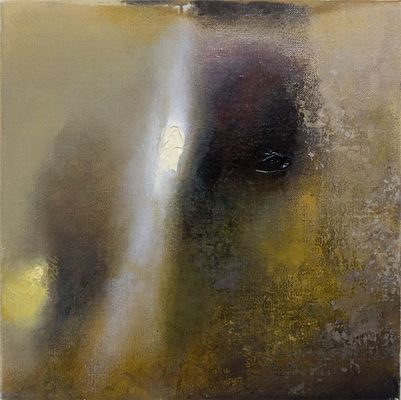
Always Will Need To Wear Winter Shirt Blue + Ochre Small Check Pattern
21 August - 21 September, 2015
Untitled
I am not a great reader of poetry but I always return to the work of Melbourne poet, Vincent Buckley (1925- 1988). Perhaps I find his most tantalising piece to be not a finished poem but a fragment left on a scrap of paper discovered on his desk after the poet’s death.
The poetry gathers like oil
In the word-core, and spreads
It has its music meet,
Its music is in movement.
This fragment is more the shell left behind from a volatile thought than a finished poem. I find the last two lines honest but awkward whereas the first two lines work like an arrow. Most likely he could not find a resolution so it was left. Still, in its present form, it remains an eloquent testimony to the ultimate failure of a medium to express mobile thought and sensation, in Buckley’s case, through verbal language. It’s an important matter because this is something all artists have to deal with regardless of the medium.
I have never written a poem, however, I am forever copying fragments from books on paper scraps in a vain effort to fix certain notions in my head. At first, they function as bookmarks that are sometimes returned to when I open the book. But before long, as they accumulate, they fall out littering the table interspersed with A4 photocopies, bills, books and medications.
To return to Buckley’s fragment, the first two lines very much evoke how I paint nowadays. As you age, detail diminishes and patches of light become more luminous and float. I feel the most honest way of dealing with this is by smearing the oil paint on the canvas with the fingers and working close-up, blind. Only if the patches coalesce into an approaching image can the work gain a life.
-
Jonathan Walker was born in Melbourne, Australia and brought up on a dairy farm in Gippsland. In the 1970’s he studied painting at RMIT and won the Harold Wright Scholarship to the British Museum, London. During the 1980’s he exhibited at Pinacotheca Gallery, Richmond and had work shown at the NGV and Heidi City Art Gallery. Over the same period he designed the cover for the “Epigenesi” LP by Giancarlo Toniutti, Italy and conducted a mail exchange work with Achim Wollscheid, Germany. The work with artists through the post resulted in an article published in the bicentenary issue of Art and Australia 1988. He showed in artist run spaces such as WestSpace in the 90’s and 2000’s, and until 2012, taught painting at Victoria University, which is where we (Colleen Ahern and Lisa Radford) as organisers of the exhibition, among many others, had the privilege of being his student.
Walker’s knowledge was imparted to students through the careful selection of music, literature, and artists found in books that he himself had ordered for the library. Walker’s strategy was the generosity of sharing his vast knowledge with references specific to each student and their context.
Walker’s paintings share a similar focus and intimacy.
This exhibition presents a small selection of recent paintings alongside a publication that includes Walker’s writing. Observational and analytical, Walker’s work is a type of material notation — the time of day, colour and how it is blended, the both specific and fleeting location of a reflection on lino or the question of whether a chair leg should be included in a painting.
Please join us on Friday August 21 between 6-8pm to celebrate the opening of the exhibition.
Curated by Colleen Ahern and Lisa Radford.
B. Wurtz
Curated by Nic Tammens
March 26 - April 4, 2015
B.Wurtz works from a basement studio in his home on Manhattan’s Lower East Side.
This local fact is attested to by the plastic shopping bags and newsprint circulars that appear in his work. As formal objects, they don’t make loud claims about their origins but nonetheless transmit street addresses and places of business from the bottom of this long thin island. Like plenty of artists, Wurtz is affected by what is local and what is consumed. His work is underpinned by this ethic. It often speaks from a neighborhood or reads like the contents of a hamper:
“BLACK PLUMS $1.29 lb.”
“Food Bazaar”
“USDA Whole Pork Shoulder Picnic 99c lb.”
“RITE AID Pharmacy, with us it’s personal.”
“H. Brickman & Sons.”
“Sweet Yams 59c lb."
Most of the work in this exhibition was made while the artist was in residence at Dieu Donne, a workshop dedicated to paper craft in Midtown. Here Wurtz fabricated assemblages with paper and objects that are relatively lightweight, with the intention that they would be easily transportable to Australia. This consideration isn’t absolute in Wurtz’s work, but was prescriptive for making the current exhibition light and cheap. Packed in two boxes, these works were sent from a USPS post office on the Lower East Side and delivered to North Melbourne by Australia Post.
Wurtz appears courtesy of Metro Pictures, New York.
Thanks to Rob Halverson, Joshua Petherick, Sari de Mallory, Matt Hinkley, Helen Johnson, Fayen d'Evie, Ask Kilmartin, Lisa Radon, Ellena Savage, Yale Union, and "Elizabeth".
John Nixon
"Archive"
December 15 - January 20, 2014
The presentation of John Nixon's archive offered a rare showcase of this extensive collection of the artist's own publications, catalogues, posters, ephemera, editions and more, from the mid 1980s onwards, alongside a selection of his artworks.
Organized by John Nixon, Joshua Petherick and Matt Hinkley.
<a href=http://wfb.public-office.info/artist/john-nixon>All titles by John Nixon
"Habitat"
at Minerva, Sydney (organised by Joshua Petherick and Matt Hinkley)
November 15 - December 20, 2014
Lupo Borgonovo, Janet Burchill & Jennifer McCamley,
Lewis Fidock, HR Giger, Piero Gilardi, Veit Laurent Kurz,
Cinzia Ruggeri, Michael E. Smith, Lucie Stahl, Daniel Weil, Wols
Press Release:
“...It contained seven objects. The slender fluted bone, surely formed for flight, surely from the wing of some large bird. Three archaic circuitboards, faced with mazes of gold. A smooth white sphere of baked clay. An age-blackened fragment of lace. A fingerlength segment of what she assumed was bone from a human wrist, grayish white, inset smoothly with the silicon shaft of a small instrument that must once have ridden flush with the surface of the skin - but the thing’s face was seared and blackened.”
William Gibson, “Count Zero”, 1986
"Autumn Projects Archive"
Curated by Liza Vasiliou
March 6 - March 15, 2014
World Food Books, in conjunction with the Virgin Australia Melbourne Fashion Festival 2014, presented the Autumn Projects archive, consisting of a selection of early examples in Australian fashion with a particular interest in collecting designers and labels from the period beginning in the 1980’s, who significantly influenced the discourse of Australian Fashion.
Curated by Liza Vasiliou, the exhibition provided a unique opportunity to view pieces by designers Anthea Crawford, Barbara Vandenberg, Geoff Liddell and labels CR Australia, Covers, Jag along with early experimental collage pieces by Prue Acton and Sally Browne’s ‘Fragments’ collection, suspended throughout the functioning World Food Books shop in Melbourne.
H.B. Peace
presented by CENTRE FOR STYLE
November 14, 2013
"Hey Blinky, you say chic, I say same"
Anon 2013
H.B. Peace is a clothing collaboration between great friends Blake Barns and Hugh Egan Westland. Their pieces explore the divergences between 'character’ and ‘personality’ in garments....etc
Special Thanks to Joshua Petherick and Matt Hinkley of WFB and Gillian Mears
and a Very Special Thank you to Audrey Thomas Hayes for her shoe collaboration.
Janet Burchill & Jennifer McCamley
"Aesthetic Suicide"
May 10 - June 8, 2013
The first of our occasional exhibitions in the World Food Books office/shop space in Melbourne, "Aesthetic Suicide" presented a body of new and older works together by artists Janet Burchill & Jennifer McCamley, including videos, prints, a wall work, and publications.
During shop open hours videos played every hour, on the hour.
1988, English
Softcover, 368 pages, 16 x 23.5 cm
1st Edition, Out of print title / used / very good
Published by
Cornell University Press / New York
$20.00 - In stock -
"Lukacher is one of the most brilliant and authoritative of young critics and theorists working in the post-structuralist mode. I think Primal Scenes is a book of great importance and will take a significant place within the present field of thinking about literature."—J. Hillis Miller, University of California, Irvine
Primal Scenes is concerned with those elements in the thought of Freud and Heidegger which make us continue to regard them as our contemporaries. It seeks to reassert their radical potential, which, the author believes, has been minimized as critics celebrate the radicality of Lacan, Derrida, and others. Drawing heavily on Freud's idea of the primal scene and Heidegger's idea of the history of Being, Lukacher de- lineates his own notion of the primal scene in the context of deconstruction and the new historicism.
In the first part of the book, which culminates in a reading of Henry James's Turn of the Screw, Lukacher provides a theoretical base for his interdisciplinary mode of interpretation. A series of intertextual "primal scenes" from the works of Heidegger and Derrida, Hegel and Shakespeare, Marx and Balzac, and Freud and Dickens exemplifies the interplay of recollection and reconstruction, memory and imagina- tion, which underlies the discourses of literature, philosophy, and psychoanalysis.
"An important study which offers new possibilities for those attempt- ing to forge a path between deconstruction and Marxist or feminist criticism. Lukacher is an inquisitive and rigorous thinker with an im- pressive range of knowledge. A difficult and sometimes troubling book, Primal Scenes is well worth the effort it requires."—Comparative Literature
"In this complexly argued, learned, and suggestive work, Lukacher is concerned with memory, ancestry, and forgetting in literature, philosophy, and psychoanalysis. No summary can do justice to his recon- ceptualization of remembering, which quite transforms what used to be thought of, quite unproblematically, as 'influence.'"—Choice
"Ned Lukacher... announces himself as a major figure in contemporary criticism with Primal Scenes." World Literature Today
NED LUKACHER teaches the history of literary criticism in the Department of English at the University of Illinois, Chicago.
VG copy.
1964 , French
Hardcover, 192 pages, 30.5 x 24.5 cm
1st Edition, Out of print title / used / very good
Published by
Pont Royal Del Duca - Laffont
Paris
$100.00 - Out of stock
First 1964 hardcover edition of Histoire de l'insolite (History of the Unusual) by Romi. Preface by Philippe Soupault, artistic design by Pierre Chapelot. An incredible visual survey of the weird and wonderful from the history of occultism to the absurd, the cabinet of curiosities to the voyages of science fiction, demonology to psychosis, the Fin de siècle, Futurists, Surrealists, Dadaists, Pataphysicians, the visionaries, the mediums, the curios, the macabre, the bizarre. Profusely illustrated in mono and duotone with many pasted-in lush colour plates, this is a beautiful visual reference of the fantastic throughout history. Chapters include (translated from French): The Sources of the Unusual - A Legendary Bestiary - Fantastic Voyages - The Design to Surprise - Unusual Enterprises, featuring Alfred Jarry, Giuseppe Arcimbaldo, P.T. Barnum, Edward Lear, Hélène Smith, Raymond Roussel, Alessandro Cagliostro, Stanislao Lepri, Hieronymus Bosch, Ferdinand Cheval, and hundreds of other artists, poets, mystics and unknowns. With a preface by none other than Surrealist founder, Dadaist, writer, poet, novelist, critic, political activist, Philippe Soupault (1897-1990).
Very Good copy, highly recommended.
1999, English / Japanese
Softcover, 100 pages, 21 x 30 cm
1st Edition, Out of print title / used / very good
Published by
Street Editorial Office / Tokyo
$120.00 - Out of stock
The scarce Special Edition of STREET - here is the first printing of Vol. 2 of this great visual archive, designed, edited and published by Maison Martin Margiela!
In 1995, Tokyo-based Street magazine approached the Paris fashion house of Martin Margiela with an invitation to publish a special edition dedicated to its work. Maison Martin Margiela guest-edited the magazine, and was solely responsible for the selection of images and presentation, which includes many previously unpublished photographs from its archives. The success of the first volume led to the publication of a second instalment in 1999, and together the two special issues cover every Martin Margiela collection from Spring/Summer 1989 through to Spring/Summer 1999, including heavy visual documentation of the presentations, events, studio, ephemera, behind the scenes, garment details, and much more.
This is a copy of the first 1999 edition of Vol. 2. together with the earlier Vol. 1, it was reprinted as a book in 1999 and later again in 2013. These volumes of STREET have long been collector's items for any fan of MMM, providing a rare and thorough insight into this long admired and elusive fashion house.
Good—Very Good copy with light general edge and cover wear.
1999, English
Softcover, 186 pages, 15.5 x 23 cm
1st Edition, Out of print title / used / very good
Published by
Cityful Press / Seattle
$200.00 - In stock -
First, only edition of "Think of The Self Speaking : Harry Smith — Selected Interviews", published in 1998 by Cityful Press and long out-of-print. In this incredible collection you will find the flavour and texture of experimental filmmaker, music anthologist, and enigmatic polymath Harry Smith’s conversation, his rambling, obscure, luminous, cantankerous genius. This collection of interviews spans Harry Smith's long and influential life in American arts and letters. They cover a quarter-century, touching on the full range of Smith's activity as a groundbreaking experimental filmmaker, obsessive collector, folk music anthologist, visionary painter, student of Native American lore, anthropologist, cosmographer, alchemist, hermetic scholar, occultist, autodidact, classic American eccentric, and all-around explorer of the possibilities of human consciousness and creativity. Jordan Belson writes, "THINK OF THE SELF SPEAKING is the next best thing to being with Harry himself-perhaps better, certainly safer. The interviews are remarkably similar to his collage films. A brilliant mind unhinged." Includes an introduction by Allen Ginsberg.
Very Good copy with only light shelf wear.
1996/2003, English / Japanese
Softcover (w. dust jacket and obi), 176 pages, 21 x 30 cm
1st Edition, Out of print title / used / very good
Published by
Treville / Tokyo
Pan-Exotica / Tokyo
$300.00 - Out of stock
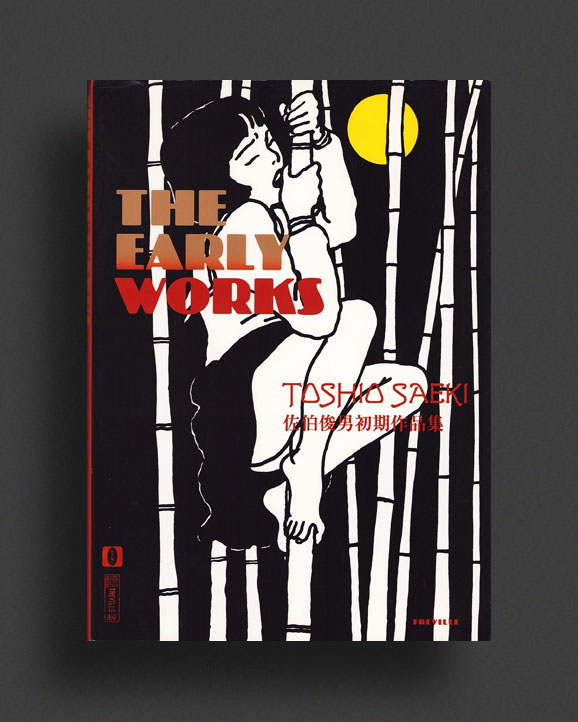
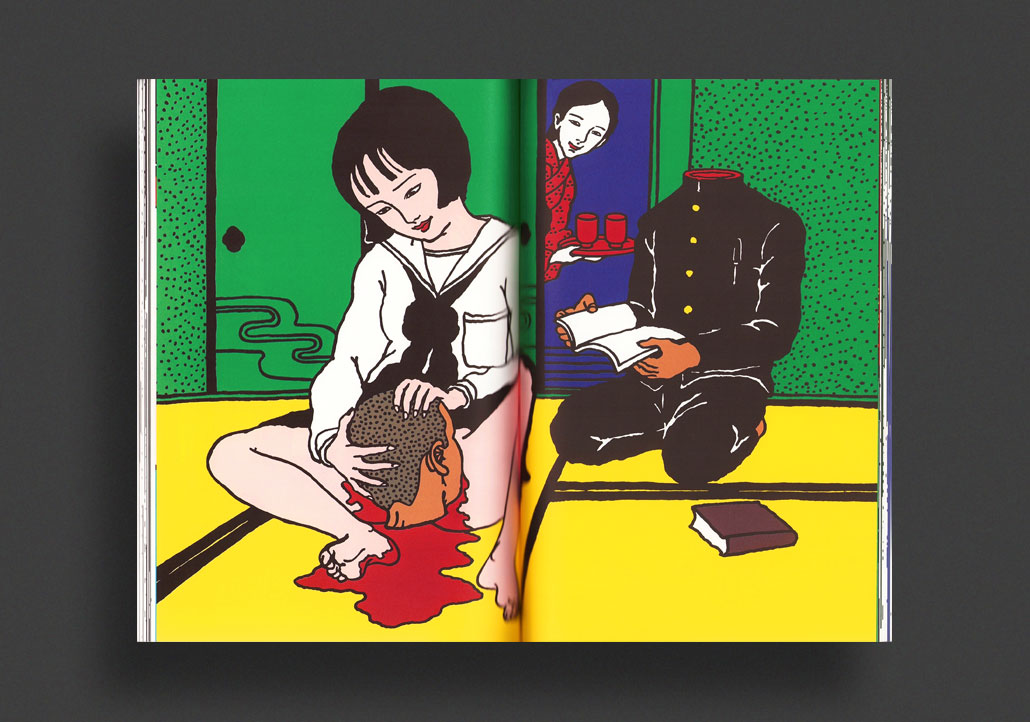
The second volume of Toshio Saeki's erotic nightmare masterpiece, "Chimushi II" was published in 1996 by Treville, only available in Japan, and now very collectible in every edition. A lavishly illustrated book collection of every darkest sexual depravity rendered in vibrant colour by Japanese master of Ero guro, Toshio Saeki, published by Treville and Pan-Exotica, here in the 2003 softcover edition. In the introduction, Timothy Leary writes, "We salute the style and grace with which you tease our secret sensualities. And teach us how our dark, twisted images and fearful fantasies are created by our own minds."
Toshio Saeki (1945—2019) was an illusive Japanese illustrator and painter, and icon of 1970s Tokyo counterculture, known for combining Japanese folklore, Yōkai spirits and elements of Western art with his own sophisticated aesthetics to create a unique, sensational world of eros, dark humour, and horror. Given the title “Erotic Engineer” by Timothy Leary, Saeki's provocative art broke all sexual taboos, questioned Japanese ideology and traditional views on love, desire and gender roles. Saeki’s surgically-precise graphic work is closely related to the Japanese cultural phenomenon ‘Erotic, Grotesque, Nonsense’ (ero, guro, nansensu).
“Toshio Saeki conjures death with a pen”—Shūji Terayama, 1969.
Good—Very Good copy, with light wear/bumping to cover extremities, interior Fine. With Average obi inserted.
1969, Japanese / English
Softcover (w. dust jacket), 166 pages, 26 x 19 cm
1st Edition, Out of print title / used / very good
Published by
Tojusha / Tokyo
$380.00 - In stock -
Extremely rare first 1969 edition of Anger Is Our Daily Bread, Japanese photographer Tatsuo Kurihara's arresting book of front-line photographic student protest reportage published by Tojusha, Tokyo. The book of the "Zengakuren", Japan's radical student activists. With stunning, richly gravure-printed imagery, Anger Is Our Daily Bread is one of the most provocative and powerful photographic records of political unrest in Japan ever published. A desperate documentary and a master work from a Japanese photo-journalist at the forefront of bloodshed. Text in Japanese and English.
Anger Is Our Daily Bread concerns one of the most important political events in post-war Japan, The Anpo protests, also known as the Anpo struggle, a series of massive protests throughout Japan from 1959 to 1960 against the US–Japan Security Treaty, which allows the United States to maintain military bases on Japanese soil. Inspired by anti-imperialist left, these protests, the largest popular protests in Japan's history, were the coordinated actions of various citizen movements, from labor unions, student and women's organizations, mothers' groups, poetry circles, theatre troupes, groups affiliated with the Japan Socialist and Communist Parties, even conservative businessmen, who all wanted to prevent the ratification of the treaty and, as survivors of the unrivalled disasters of Hiroshima and Nagasaki, end the trauma of American military presence in Japan. The planned visit of the US president Eisenhower escalated the protests, which gripped hundreds of thousands to protest daily for a year around the Japanese Parliament National Diet building. With an unparalleled police presence physically removing the Socialist Diet members' attempted opposition sit-in, Prime Minister Kishi undemocratically passed the treaty provoking nationwide outrage, strikes and actions. The Zengakuren were always on the front-line. Facing strong anti-government public opinion which had been enhanced by the death of a female Tokyo University student named Michiko Kanba during a demonstration, Eisenhower's visit was cancelled and Kishi resigned as Prime Minister, in order to quell the widespread popular anger at his extremist actions. Yet the treaty remained in effect and wide-spread Americanisation of Japan ensued.
On the eve of the 1970 treaty revision, Anger Is Our Daily Bread was published.
"Another revision term coming next year, the Zengakuren students started to resort to "Molotov cocktail" method. They are not only against the Japan—US Security Treaty, but also struggling to address those problems like university reform, the new international airport at Narita, Chiba, the U.S. bases in Japan, Okinawa's return to Japan, etc. Helmeted and armed with the so-called "Gewalt" clubs and sticks, those students of Zengakuren repeatedly clash with the armed police. Pictures shown here are the record of the Zengakuren movement for the past twelve months."—from Tatsuo Kurihara's introduction
Kurihara's extremely vivid first hand visual accounts of the immense student demonstrations, their meetings, their brutal conflict with the police, the molotov cocktails from stormed buildings, and constant armed street battles, make for one of the most moving protest books ever printed. His stark, heavy contrast images are so immersive they give the viewer the impression of themselves being in the violent clashes, a witness to people's lives thrown into turmoil, the urgency and desperation to be heard by the elite.
Tatsuo Kurihara was born in downtown Tokyo in 1937. Upon graduating from Waseda University's Faculty of Political Science and Economics in 1961, he began working at the Asahi Shimbun Tokyo Headquarters Publishing Photography Department. In 1962, he won the Japan Photographers Association Newcomer's Award. In 1967, he left Asahi Shimbun and became a freelancer and a member of the Japan Photographers Society (JPS).
Very Good copy in Good—VG dust jacket with some light wear to jacket extremities. Corner bump to front top first few pages.
2012, English
Softcover, 120 pages, 28 x 21.5 cm
1st Edition, Out of print title / as new
Published by
Creation Books / London
$45.00 - In stock -
FRACTURED EYE was a large-format annual film journal, edited by well-known authors Stephen Barber and Jack Hunter, who between them have produced around 50 books on global cinema and cultural history. FRACTURED EYE does not concern itself with either "mainstream" or "cult" cinema, but rather takes its cue from Amos Vogel's seminal 1974 study Film As A Subversive Art. Subjects covered by FRACTURED EYE Volume One include illegal film pornography in the 1970s, execution film documents of WW2, film documents of extreme performance art, subversive film documentaries, unfilmed surrealist film scenarios, revolutionary Japanese cinema of 1969, the origins of film projection technology, films of urban demolition, surgical films, and various works of renegade, politically prohibited or transgressive cinema. The book is heavily illustrated with unusual and often disquieting photographs, and is recommended for adult readers only. Subjects covered include Vienna Aktion Cinema, Tokyo 1969, Tatsumi Hijikata, Pierre Guyotat, Koji Wakamatsu, Jean Painlevé, Cosey Fanni Tutti, Jean Vigo, Luis Buñuel, Skladanowsky Brothers, Georges Franju, and much more. Only one volume was published.
1997, English
Softcover, 56 pages, 30 x 21 cm
1st Edition, Out of print title / used / very good
Published by
Last Gasp / San Fransisco
$60.00 - Out of stock
First 1997 English-language edition of Erich von Gotha's A Very Special Prison, published by Last Gasp, San Fransisco. Dark and disturbing Sadean sadomasochistic masterpiece of bandes dessinées érotiques, first published in France in the 1980s.
Adults only!
Erich von Götha (b. 1924, Wimbledon, London) is the pseudonym of the British illustrator, comic book artist, aconteur, and English gentleman Robin Ray. Robin Ray has gained fame with his erotic and, above all, sadomasochist content. He studied drawing and painting for four years at St Martins art school in London and enjoyed a career in London advertising agencies as designer and copywriter. He took time off for three years to teach graphic design at Ealing School of Art. A chance meeting with the English human rights activist, sex therapist, consultant, campaigner, writer and adult model Tuppy Owens led to the "Sex Maniac's Diary", a remarkable and successful publication which amazingly sold mainly to women, for which EvG became the illustrator from 1975 to 1984. His relationship and ongoing friendship with Tuppy was enormously influential and helped lead to his artistic contributions to erotic publications. But it is "Torrid", entirely conceived and realised by EvG, that is the substantial overture to the comic strip (Bande Dessinée) extravaganza that was to follow. This ground-breaking publication, carried by the creative freedom of the 1970's sexual revolution of the 1970's, and pushing the legal boundaries in its path, spanned 1979 to 1986, all while EvG was running a successful advertising firm. However, his most famous work is The Troubles of Janice, set in the time of the Marquis de Sade. It has appeared in four albums; the first album appeared in 1980, and they represented a close collaboration with the French campaigning writer, historian and collector Bernard Joubert. A luxury edition of all four was published in 2008 by Dynamite. English versions of "Janice" and "Twenty", his other 'serial' story were published in the Noughties by the Erotic Print Society. Since the 80s he has produced many erotic paintings for friends and fans and has several books published by "Larmes d'Eros" in Paris. He continues to produce prints and execute commissions of an erotic nature usually with a mythological theme. He has had solo exhibitions in the Mondo Bizzarro Gallery in Bologna, titled Sweat Tears & Reflections and In "Larmes d'Eros" in Paris on the publication of "The Secret Notebooks of Janice".
VG copy.
1999, English
Softcover, 56 pages, 30 x 21 cm
1st Edition, Out of print title / used / very good
Published by
Last Gasp / San Fransisco
$60.00 - Out of stock
First 1999 English-language edition of Erich von Gotha's The Troubles of Janice Part 1, published by Last Gasp, San Fransisco. The first book of von Gotha's classic story set in the time of the Marquis de Sade, and a masterpiece of bandes dessinées érotiques, first published in France in 1980.
Adults only!
Erich von Götha (b. 1924, Wimbledon, London) is the pseudonym of the British illustrator, comic book artist, aconteur, and English gentleman Robin Ray. Robin Ray has gained fame with his erotic and, above all, sadomasochist content. He studied drawing and painting for four years at St Martins art school in London and enjoyed a career in London advertising agencies as designer and copywriter. He took time off for three years to teach graphic design at Ealing School of Art. A chance meeting with the English human rights activist, sex therapist, consultant, campaigner, writer and adult model Tuppy Owens led to the "Sex Maniac's Diary", a remarkable and successful publication which amazingly sold mainly to women, for which EvG became the illustrator from 1975 to 1984. His relationship and ongoing friendship with Tuppy was enormously influential and helped lead to his artistic contributions to erotic publications. But it is "Torrid", entirely conceived and realised by EvG, that is the substantial overture to the comic strip (Bande Dessinée) extravaganza that was to follow. This ground-breaking publication, carried by the creative freedom of the 1970's sexual revolution of the 1970's, and pushing the legal boundaries in its path, spanned 1979 to 1986, all while EvG was running a successful advertising firm. However, his most famous work is The Troubles of Janice, set in the time of the Marquis de Sade. It has appeared in four albums; the first album appeared in 1980, and they represented a close collaboration with the French campaigning writer, historian and collector Bernard Joubert. A luxury edition of all four was published in 2008 by Dynamite. English versions of "Janice" and "Twenty", his other 'serial' story were published in the Noughties by the Erotic Print Society. Since the 80s he has produced many erotic paintings for friends and fans and has several books published by "Larmes d'Eros" in Paris. He continues to produce prints and execute commissions of an erotic nature usually with a mythological theme. He has had solo exhibitions in the Mondo Bizzarro Gallery in Bologna, titled Sweat Tears & Reflections and In "Larmes d'Eros" in Paris on the publication of "The Secret Notebooks of Janice".
VG copy.
2000, German
Softcover, 55 pages, 24 × 28 cm
Published by
Galerie Ascan Crone / Hamburg
$65.00 - In stock -
Wonderful early artist's book by German artist Kai Althoff, published in 2000 on the occasion of his solo exhibition at Galerie Ascan Crone, Hamburg, and long out-of-print. Illustrated throughout in colour and black and white with Althoff's paintings, drawings, installations and assorted imagery, alongside a text by German painter Michaela Eichwald.
As New.
Kai Althoff (born 1966 in Cologne) is a German visual artist and musician. Borrowing from moments of history, religious iconography, and counter-cultural movements, Althoff creates imaginary environments in which paintings, sculpture, drawing, video, and found objects commingle. Tapping a multitude of sources, from Germanic folk traditions to recent popular culture, from medieval and gothic religious imagery to early modern expressionism, Althoff’s characters inhabit imaginary worlds that serve as allegories for human experience and emotion. His image bank and painterly style also draw on the past, especially early-20th-century German Expressionism, reconfigured by introducing collaged technique.
1978, Japanese / English
Softcover (w. dust jacket, obi-strip, poster), 112 pages, 40.5 x 27.8 cm
1st Edition, Out of print title / used / very good
Published by
Kodansha Int / Tokyo
$250.00 - Out of stock
Stunning, very first 1978 Japanese edition of the wonderful over-sized collection of posters by legendary Japanese graphic artist Tadanori Yokoo. Published by Kodansha, only in Japan, this large, lavish volume is comprised entirely of beautiful full page reproductions of Yokoo's major poster works spanning his entire career to date (1978), in which his iconic photo-montage and print-making had a distinct psychedelic, erotic and esoteric spirit that captured international attention. A true avant-garde of the Japanese scene, this rich volume includes his famous works for the theatre company Tenjō Sajiki (w. director Shuji Terayama), exhibition and concert posters, and much more. Each work is accompanied by text by Koichi Tanigawa, and an introduction by world-renowned illustrator and graphic designer Milton Glaser, who had a close relationship with Yokoo.
Includes original publisher's obi-strip and the rarely preserved fold-out Yokoo poster! A Very Good and most complete copy of this first collectible edition. Highly recommended.
Tadanori Yokoo (横尾 忠則), born in Nishiwaki, Hyōgo Prefecture, Japan, in 1936, is one of Japan's most successful and internationally recognized graphic designers and artists. He began his career as a stage designer for avant garde theatre in Tokyo. In the late 1960s he became interested in mysticism and psychedelia, deepened by travels in India. Because his work was so attuned to 1960s pop culture, he has often been (unfairly) described as the "Japanese Andy Warhol" or likened to psychedelic poster artist Peter Max, but Yokoo's complex and multi-layered imagery is intensely autobiographical and entirely original, heavily reflecting Japan's cultural history and iconography. By the late 60s he had already achieved international recognition for his work and was included in the 1968 "Word & Image" exhibition at the Museum of Modern Art in New York. Four years later MoMA mounted a solo exhibition of his graphic work organized by Mildred Constantine. Yokoo collaborated extensively with Shūji Terayama and his theater Tenjō Sajiki. He has also starred as a protagonist in Nagisa Oshima's film Diary of a Shinjuku Thief. In 1968 Yukio Mishima claimed, "Tadanori Yokoo's works reveal all of the unbearable things which we Japanese have inside ourselves and they make people angry and frightened. He makes explosions with the frightening resemblance which lies between the vulgarity of billboards advertising variety shows during festivals at the shrine devoted to the war dead and the red containers of Coca Cola in American Pop Art, things which are in us but which we do not want to see."
2000, English
Softcover, 320 pages, 23 x 15.2 cm
1st Edition, Out of print title / used / very good
Published by
Reaktion books / London
$45.00 - In stock -
This ground-breaking reading of Goya's late work concentrates on the end of a century as a neglected milestone in the artist's career. Goya waited until 1799 to publish his celebrated series of drawings known as the Caprichos: difficult, often violent, deeply disturbing compositions which offer a personal vision of the 'world turned upside down'. Taking their cues from sources as diverse as Mikhail Bakhtin and the Marquis de Sade, the authors show how obsessions with the notions of 'revolution' and 'Carnival', both inversions of the established order, characterized Spanish culture at the end of the eighteenth century. By relating these ideas to the fantasies and fixations Goya explored in the secret laboratory of his Caprichos, Victor I. Stoichita and Anna Maria Coderch suggest fascinating connections between the artist's world and our own at the end of the millennium.
Heavily illustrated throughout.
Victor L. Stoichita is Professor of the History of Art at the University of Fribourg, Switzerland. Anna Maria Coderch is an art historian.
VG copy.
1970, English
Softcover, 592 pages, 23.29 x 15.19 cm
1st Edition, Out of print title / used / good
Published by
Yale University Press / New Haven
$35.00 - Out of stock
If Paul Ricoeur is correct in seeing the various currents of contemporary philosophy all converging on the problem of a "grand philosophy of language," then the first sixty pages of this absorbing study of Freud may become the rallying point from which future work can begin. This first part of Freud and Philosophy, "Problematic," presents a profound and clear theory of signification, symbol, and interpretation. The second part, "A Reading of Freud," is required reading for anyone seriously interested in psychoanalysis. The third section interpretation of Ricoeur's own theory of symbol―particularly religious symbol―which places this study at the center of contemporary debate over the sense of myth.In this book are revealed Ricoeur the philosopher of language; Ricoeur the critic of Freud; and Ricoeur the theologian of religious symbol. The author is outstanding in all three roles, and the book that emerges is of rare profundity, enormous scope, and complete timeliness.
Paul Ricoeur is professor of philosophy at the University of Paris.
“Paul Ricouer…has done a study that is all too rare these days, in which one intellect comes to grips with another, in which a scholar devotes himself to a thoughtful, searching, and comprehensive study of a genius…The final result is a unique survey of the panorama of Freudian thought by an observer who, although starting from outside, succeeds in penetrating to its core.” –American Journal of Psychiatry
“Primarily an inquiry into the foundations of language and hermeneutics…[Ricoeur uses] the Freudian ‘hermeneutics of suspicion’ as a corrective and counter-balance for phenomenology and create a ‘new phenomenology’…This important work…should have an impact upon serious thinking in philosophy, theology, psychology, and other areas which have been affected by Freud studies.”―International Philosophical Quarterly
“A stimulating tour de force that allows us to envisage both the psychoanalytic body of knowledge and the psychoanalytic movement in a broad perspective within the framework of its links to culture, history and the evolution of Western intellectual thought.” – Psychoanalytic Quarterly
Paul Ricoeur is a professor of philosophy at the University of Chicago and the University of Paris.
Good copy with general light wear to extremities.
1990, English
Softcover, 256 pages, 23 x 15 cm
1st Edition, Out of print title / used / very good
Published by
State University of New York Press / New York
$20.00 - Out of stock
This is the first full-length study of the impact of Friedrich Nietzsche's writings on the thought of French philosopher Michel Foucault. Focusing on the notion of genealogy in the thought of both Nietzsche and Foucault, the author explores the three genealogical axes-truth, power, and the subject-as they gradually emerge in Foucault's writings. This complex of axes into which Foucault was drawn, especially as a result of his early history of madness, called forth his explicit adoption of a Nietzschean approach to his future work.
By interpreting Foucault's Histoire de la folie in the light of Nietzsche's genealogy of tragedy, Mahon shows how the moral problematization of madness in history provides the historical conditions from which the three axes emerge. After tracing the gradual emergence of the three axes through Foucault's writings of the remainder of the 1960s, especially Les Mots et les choses, Mahon turns to Foucault's explicit methodological statements and his notion of genealogy and offers a reading of Foucault's L'archeologie du savoir, arguing that there is no chasm between Foucault's archaeological writings and his genealogies.
The work concludes with an analysis of Foucault's final writings on the genealogy of modern subjectivity and an examination of how truth, power, and the subject operate for the modern psychoanalytic subject of desire.
"There has long been a need to overcome the view that Foucault is totally unique, a philosophical eccentricity. In exploring him as a Nietzschean, Mahon meets this need in a very close reading of Foucault and one which is extremely well written.
"I regard it as very important for the world of scholarship about Foucault, but also for Nietzsche. Mahon shows that Nietzsche himself can lead to an important style of concrete critique.
"While such careful—and needed—textual analysis could be dull, the fact that the subject matter is Nietzsche and Foucault makes that careful reading fascinating in its own right. In addition to its scholarly contribution, the material is so fascinating and the text so well written that the book should appeal to a fairly general academic audience." — James Bernauer, Boston College
VG copy light cover wear.
2000, English
Softcover, 244 pages, 23.5 x 15.5 cm
1st Edition, Out of print title / used / very good
Published by
The Athlone Press / UK
$25.00 - In stock -
"A tour de force that reclaims Derrida from the legions of unselfconscious parodists of Derridean style. The range of Norris's reference is truly impressive, from philosophy, to politics, to science, and his repositioning of deconstruction as part of the unfinished project of modernity is as persuasive as it is innovative. Arguably the best expositor of Derrida's work that we have."—JOHN DRAKAKIS
Deconstruction has been widely and damagingly misunderstood. In this provocative new book, Christopher Norris challenges the prevalent idea that deconstruction is merely a more specialized philosophical offshoot of those various trends and cultural fashions grouped under the label of 'postmodernism'.
Through a close engagement with some key thinkers among them Derrida, Foucault, de Man, Habermas, Lyotard and Levinas Norris argues that deconstruction is a part of the 'unfinished project of modernity', a project whose interests and values it upholds precisely by continuing to question them in a spirit of enlightened self-critical enquiry.
Assessing the impact of postmodernist thought across a range of disciplines, his book presents a lucid analysis and guide to recent developments in the field. It will be regarded as a main point of reference for students of deconstruction and for those with an interest in the problems and prospects of critical theory.
Christopher Norris is Distinguished Research Professor in Philosophy at the University of Cardiff. His many publications include Deconstruction: Theory and Practice (1982), Jacques Derrida (1987), The Truth about Postmodernism (1993), New Idols of the Cave (1997), Resources of Realism (1997), Against Relativism (1997) and Quantum Theory and the Flight from Realism (2000).
VG copy.
1994, English
Softcover, 152 pages, 21.5 x 14 cm
Out of print title / used / good
Published by
Marion Boyars / London
$30.00 - Out of stock
Cortázar's stories are like small time-pieces, where each jewelled and polished part moves relentlessly on its own particular path, while wielding a crucial and perpetual influence on the mechanism as a whole. Situations double, slip by: moments jerk forward and retract, reflect and refract; an island at noon from an aeroplane an aeroplane at noon from an island; the living deceiving the dying and themselves about death; death by fire in an ancient Roman arena and in a modern city apartment. It is a world that is constantly shifting. upsetting our balance and our peace of mind. It is a world, writes one critic, that is like 'a Chirico landscape, outside of all time, in which mysterious thread-ends from the realm of the sub-conscious provoke responses of fascination and terror in the primordial depths of our psyches.'
'He is a man who has married surrealism to the kind of fiction we associate with Poe and Stevenson, who has persistently and brilliantly rewritten "Dr Jekyll and Mr Hyde" in a manner which has nothing to do with psychology and everything to do with mystery. He is the apostle of the lives we have chosen not to live... Cortázar keeps our ghosts alive, and we need him.'—New York Times Book Review
'It is at its finest when characters see themselves only as flicked back and forth by the force of self-generated images by the echoes of vampirism, basilisks, resemblances of face and sound, which recur in differing forms in Vienna, Paris and London.'—New Statesman
Julio Cortázar, an Argentinian, was born in Brussels in 1914 and lived and worked in Paris from 1952 until his death in 1984. He first captivated the English-speaking world through Antonioni's film Blow-Up. Although he was best known as a novelist and short story writer, he was also a poet, a translator and an enthusiastic amateur musician.
Good copy with some marking to block edge and light wear to covers
1994, English
Softcover, 346 pages, 23 x 15.5 cm
Out of print title / used / very good
Published by
Sinclair-Stevenson / London
$25.00 - Out of stock
Considered by many the greatest painter since Turner, Francis Bacon lived the life of an outsider in violent times. Sinclair explores the influences of Bacon's childhood in Ireland and his youth in Berlin and Paris, and London in the Depression. He takes this turbulent life through to a wise and witty old age, with its extraordinary refusal of honours, fame and riches. Sinclair has also produced biographies of Jack London and John Ford.
G—VG copy with light wear to extremities, page tanning.
1992, English
Softcover, 386 pages, 21.5 x 13.5 cm
Out of print title / used / very good
Published by
Princeton University Press / New York
$25.00 - Out of stock
1992 Princeton edition.
Among the most influential books on tragedy written in the past half-century, Walter Kaufmann's Tragedy and Philosophy develops a bold poetics based on the author's critical reexamination of the views of Plato, Aristotle, Hegel, and Nietzsche. Not only does this book reveal ancient Greek tragedy as surprisingly modern and experimental, but it also recasts such concepts as mimesis and catharsis, "pity and fear," hubris, the tragic collision, and the "death of tragedy."
"Walter Kaufmann . . . is a philosopher with a penchant for the kind of fresh thinking that philosophers rarely do. Here he has attempted a searching analysis of the essence of tragedy. He offers a new definition and, without raising his voice, his version of poetics as against that of Aristotle." —The New York Times
"The book as a whole is a tribute to the author's impressive scholarly and critical virtuosity." —Classical Philology
Walter Kaufmann (1921-1980) was Professor of Philosophy at Princeton University. This book is the third in a trilogy that includes his Critique of Religion and Philosophy and From Shakespeare to Existentialism. Kaufmann is also the author of Nietzsche: Philosopher, Psychologist, Antichrist.
Very Good copy with corner crease to back cover corner top.
1968, English
Softcover, 576 pages, 20.5 x 13 cm
Reprint?,
Out of print title / used / very good
Published by
Vintage / UK
$20.00 - In stock -
Represents a selection from Nietzche's notebooks to find out what he wrote on nihilism, art, morality, religion, and the theory of knowledge, among others. Edited by Walter Kaufmann.
Nietzsche's notebooks, kept by him during his most productive years, offer a fascinating glimpse into the workshop and mind of a great thinker, and compare favorably with the notebooks of Gide and Kafka, Camus and Wittgenstein. The Will to Power, compiled from the notebooks, is one of the most famous boooks of the philosophy. Here is the first critical edition in any language.
Down through the Nazi period The Will to Power was often mistakenly considered to be Nietzche's crowning systematic labor; since World War II it has frequently been denigrated. In fact, it represents a stunning selection from Nietzsche's notebooks, in a a topical arrangement that enables the reader to find what Nietzsche's wrote on a variety of subjects.
Walter Kaufmann, in collaboration with R. J. Holilngdale, brings to this volume his unsurpassed skills as a Nietzsche translator and scholar. Professor Kaufmann has included an approximate date of each note. His running footnote commentary offers information needed to follow Nietzsche's train of thought, and indicates, among other things, which notes were eventually superseded by later formulations. The comprehensive index serves to guide the reader to the extraordinary riches of this book.
VG copy, light wear, foxing/tanning.
1975, English
Softcover, 532 pages, 23.5 x 15.5 cm
Out of print title / used / good
Published by
Princeton University Press / New York
$30.00 - In stock -
"The fourth edition of this major work includes a new preface and a new section at the end of the book. Professor Kaufmann has also extensively updated the bibliography and has made dozens of changes throughout the text, some of which affect the interpretation of major ideas, such as the death of God.
Comments on first edition:
"A work of great superiority over everything previous- ly achieved in Nietzsche criticism and interpretation."—Thomas Mann
"This is the most sensible exposition of Nietzsche's philosophy ever made."—A.J.P. Taylor, The New Statesman and Nation
"An important historical and philosophical contri- bution. Mr. Kaufmann's analysis of Nietzsche's life, thought, and influence is extremely well-informed, thorough, and searching, and rids us of many inter- pretations due to popularized Nietzscheanism. Indispensable for anyone concerned with Nietzsche."—Jacques Maritain
"No attempt at paraphrase could bring out the compact richness of this book."—Crane Brinton, The Saturday Review
"Mr. Kaufmann has produced what may be the defini- tive study of Nietzsche's life and thought-an informed, scholarly, and lustrous work."—The New Yorker
Good copy, light wear/age.
1976, English
Softcover, 640 pages, 23 x 15 cm
1st Edition, Out of print title / used / good
Published by
University of California Press / Berkley
$20.00 - Out of stock
"Film teachers and students will welcome this new anthology, which makes available in one source a comprehensive selection of recent theoretical work on film, including many articles difficult to locate in the scattered literature. The contents are drawn almost entirely from the publications of the past fifteen years, and include work by the most original film thinkers—some well known to a wide public, some widely known among readers of film journals. Several important filmmakers are also represented.
The materials have been grouped in critical categories reflecting recent approaches to the medium. In place of older questions such as the relation of film to other arts, or film's ability to capture an imprint of reality, the questions emphasized in the anthology concern film's ideological operations, the nature of film genres, the role of the auteur in the creative process, the representation of social groups (such as women) in film, the logical of narrative and formal organizations in films, the treatment of films as myths, and new theoretical perspectives. Thus the contents reflect the use of political, structualist, semiological and psychoanalytic methods, as well as those of more traditional criticism. There is virtually no duplication of materials included in the Mast & Cohen anthology Film Theory and Criticism.
The editor has provided an overall general introduction, and mini-introductions to each text. A glossary of terms used in structuralist-semiological work is included, and lists of additional readings are provided.
Its scope and careful organization will make this volume a fundamental resource for film scholarship and teaching."
Texts by Susan Sontag, François Truffaut, André Bazin, Umberto Eco, Yves De Laurot, Pier Paolo Pasolini, William Rothman, Peter Wollen, Raymond Durgnat, Thomas Elsaesser, Andrew Tudor, Iew Hwa Beh, Alan Lovell, David Macdougall, Brian Henderson, Robin Wood, Stephen Koch, V F Perkins, Sam Rohdie, Daniel Dayan, and many others.
Good copy with general wear/age, tanning/creases.
1997, English
Softcover, 244 pages, 21.5 x 14 cm
1st Edition, Out of print title / used / good
Published by
Cambridge University Press / Cambridge
$15.00 - In stock -
How do gender and race become objects of intellectual inquiry? What happens to marginal discourses when they participate in the academic processes of scrutiny and evaluation? In Women Intellectuals, Modernism, and Difference, Alice Gambrell examines the careers of a group of women intellectuals - Leonora Carrington, Ella Deloria, H. D., Zora Neale Hurston, and Frida Kahlo - whose scholarly rediscovery coincided with the rise of feminist and minority discourse studies in the academy. She examines the exhibitions, memoirs, poems, ethnographies, and personal correspondences these women produced, combining concrete local observation with contemporary theoretical perspectives on race and gender. Through a mixture of empirical detail and theoretical speculation, Gambrell explores the role these women played in expanding the conception of American literature by their involvement in the Harlem Renaissance. She offers new ways of thinking about the relationships between cultural studies, feminism and minority discourse within the ongoing reassessment of modernism.
Good copy, crease to front top corner, light wear.
1992, English
Softcover, 224 pages, 23 x 15.5 cm
1st Edition, Out of print title / used / very good
Published by
Polity / US
$20.00 - In stock -
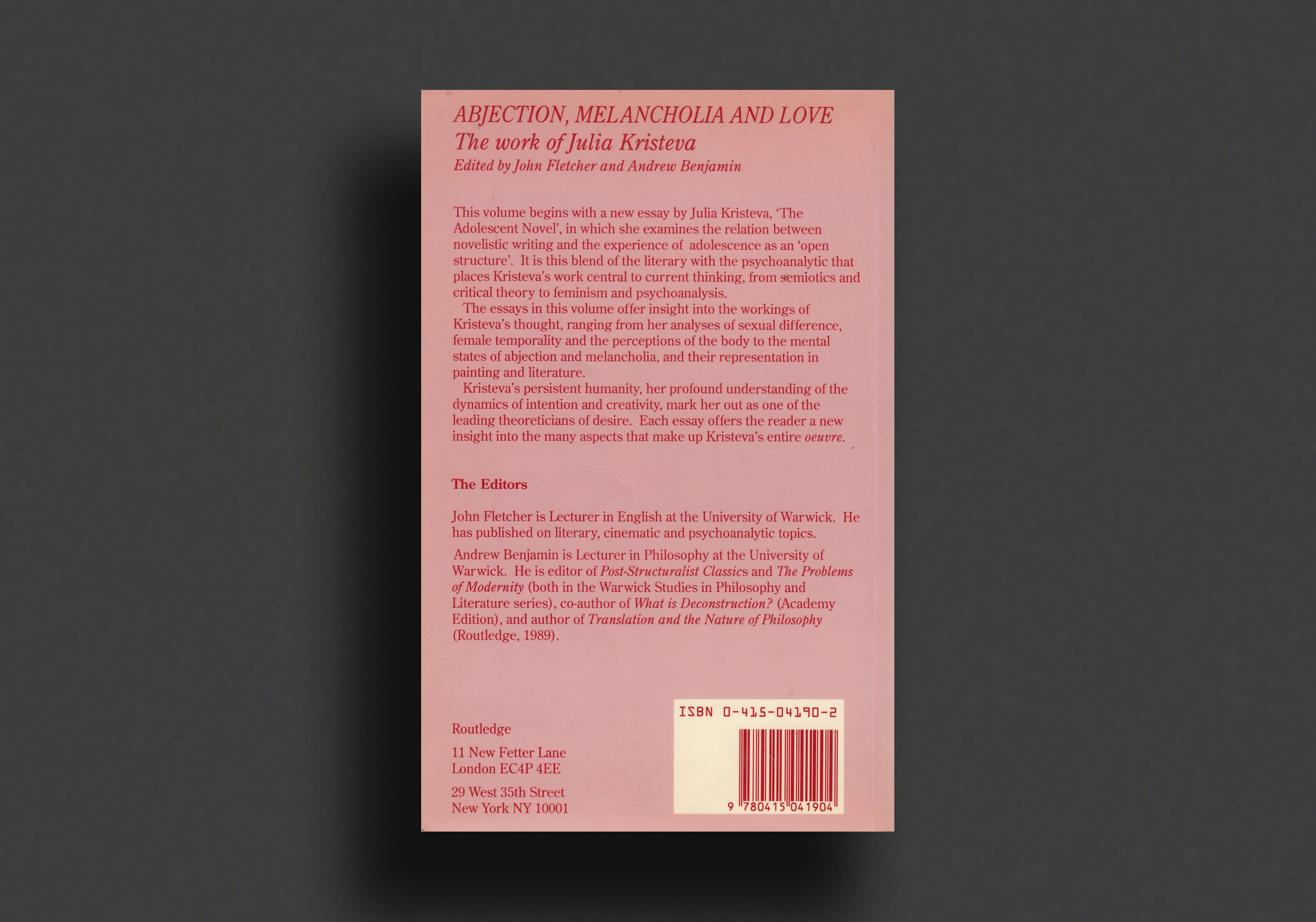
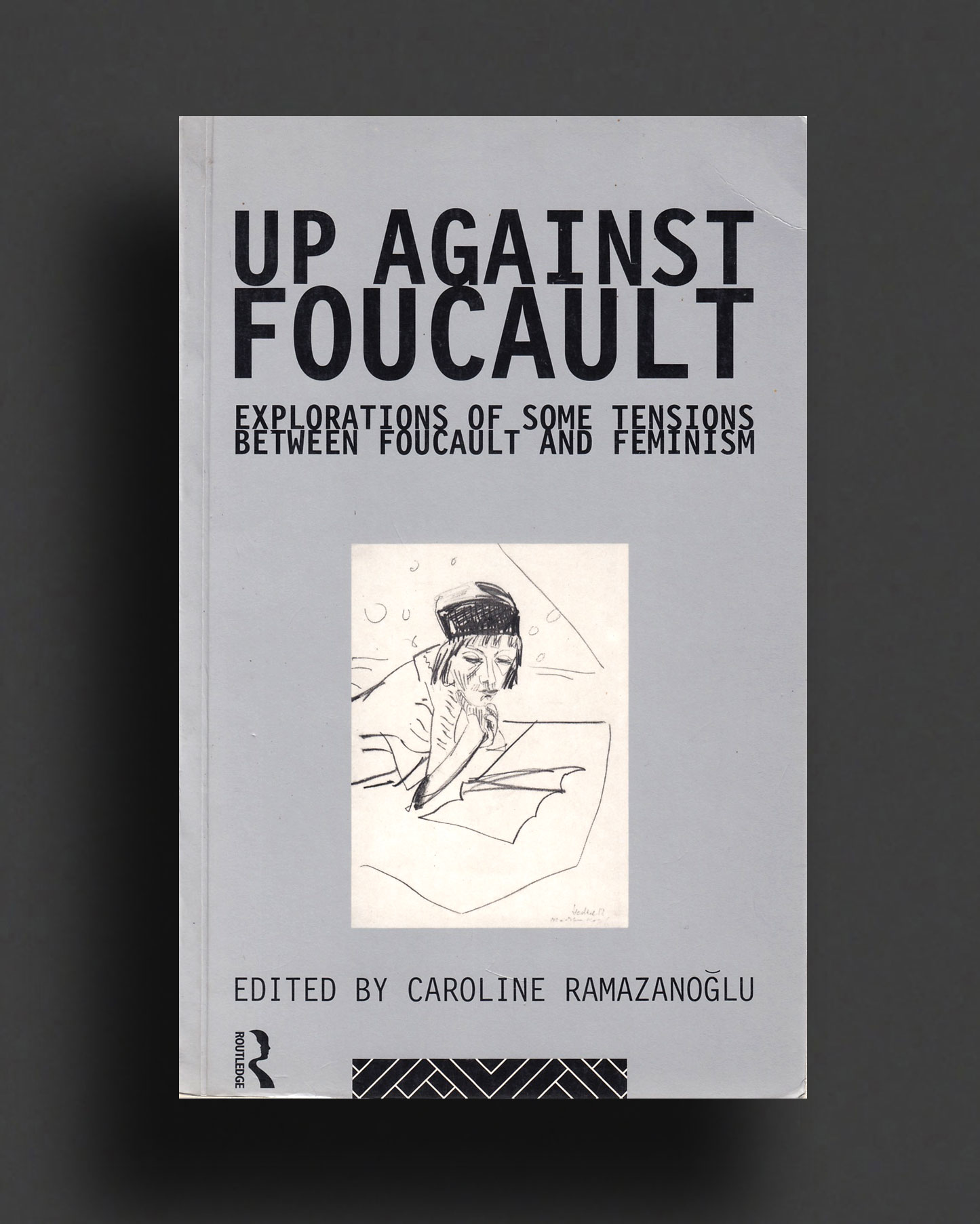
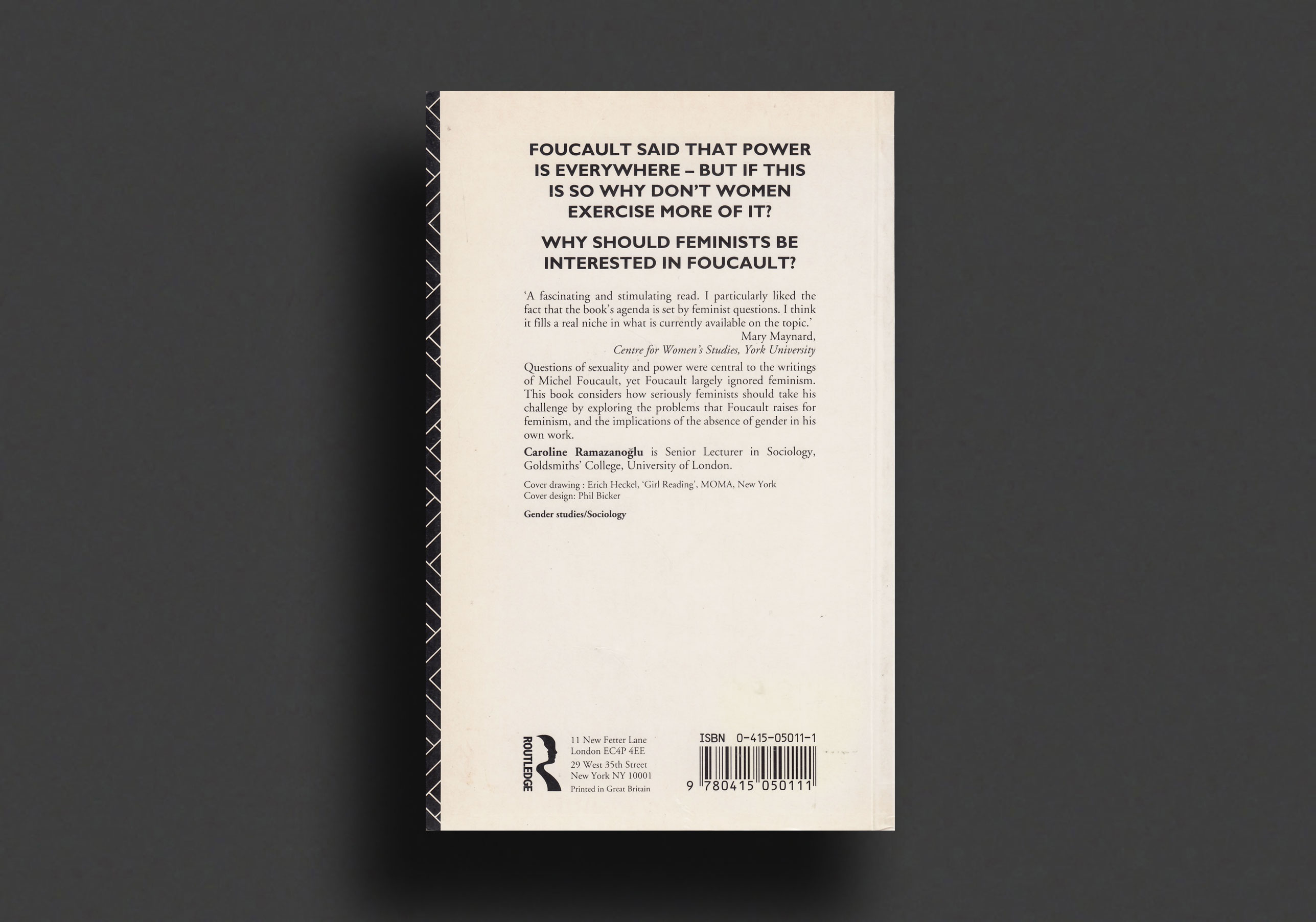
This book offers a systematic attempt to explore the point of convergence between feminist theory and the work of Michel Foucault.
Lois McNay is the author of Foucault and Feminism: Power, Gender and the Self, published by Wiley.
'Thought-provoking account.'—Times Higher Education Supplement
'Lois McNay has produced an attractively clear and critical account of how feminists might use Foucault's last works.'—Sociology
'It offers a clearly written and thorough, critical survey of Foucault's last publications. This, in turn, is balanced by a wide-ranging and equally critically review of recent developments within contemporary feminist ethical theory. It is well worth the read!!'—Women's Philosophy Review
'This is an excellent book, lucid, carefully argued, sympathetically critical and a great pleasure to read.'—Jeffrey Weeks, South Bank University
VG copy.
1993, English
Softcover, 368 pages, 23 x 15 cm
1st Edition, Out of print title / used / very good
Published by
University of California Press / Berkley
$30.00 - Out of stock
Pier Paolo Pasolini (1922-1975) was arguably the most complex director of postwar Italian cinema. His films—Accattone, The Canterbury Tales, Medea, Saló—continue to challenge and entertain new generations of moviegoers. A leftist, a homosexual, and a distinguished writer of fiction, poetry, and criticism, Pasolini once claimed that "a certain realism" informed his filmmaking.
Masterfully combining analyses of Pasolini's literary and theoretical writings and of all his films, Maurizio Viano offers the first thorough study of Pasolini's cinematic realism, in theory and in practice. He finds that Pasolini's cinematic career exemplifies an "expressionistic realism" that acknowledges its subjective foundation instead of striving for an impossible objectivity.
Focusing on the personal and expressionistic dimensions of Pasolini's cinema, Viano also argues that homosexuality is present in the films in ways that critics have thus far failed to acknowledge. Sure to generate controversy among film scholars, Italianists, and fans of the director's work, this accessible film-by-film treatment is an ideal companion for anyone watching Pasolini's films on video.
"Superb. . . . In its careful handling of the biographical and the autobiographical, the factual and the speculative, this book will become a model for how studies of individual directors should be done in the future."—Peter Brunette, author of Roberto Rossellini
Maurizio Viano is Associate Professor of Italian at Wellesley College.
VG copy.