World Food Books' programme is largely produced on Kulin Nation land. We acknowledge the Wurundjeri people of the Kulin Nation as the first and continuing custodians of this land, and pay respect to their Elders past, present, and emerging.
World Food Books is an arts and special interests bookshop in Naarm / Melbourne. Founded in 2010, World Food Books is devoted to the presentation of a rotating, hand-selection of international art, design, literary and counterculture publications with an emphasis on the anti-traditional, the experimental, the avant-garde, the heretic, the marginal.
Presenting new titles alongside rare and out-of-print books, catalogues and journals spanning the fields of modern and contemporary art, design, photography, illustration, film, literature, poetry, cultural theory, philosophy, sexuality, popular and underground culture in its many radical forms, World Food Books wishes to encourage adventurous, thoughtful and open-minded reading, looking, writing, and exchange of publishing and ideas, both current and historical.
As well as our bookshop, located in Melbourne's historical Nicholas Building, all of our inventory is available internationally via our online mail-order service.
World Food Books semi-regularly co-ordinates "Occasions", a programme of exhibits and events at the bookshop and in partnership with other hosts (such as museums and art galleries) that develop out of the activities, relationships and content of the bookshop itself.
World Food Books
The Nicholas Building
37 Swanston Street
Room 5, Level 6
Melbourne 3000
Australia
SHOP HOURS:
Thu–Fri 12–6, Sat 12–5
WEB-SHOP OPEN 24/7
World Food Books
Postal Address:
PO Box 435
Flinders Lane
Victoria 8009
Australia
Art
Theory / Essay
Architecture / Interior
Graphic Design / Typography
Photography
Fashion
Eros
LGBTQ+
Fiction / Poetry
Weird / Speculative / Science Fiction / Horror
Transgressive / Visceral / Abject
Symbolism / Decadence / Fin de siècle
Film / Video
Painting
Sculpture / Installation
Performance / Dance / Theater
Drawing
Sound / Music
Curatorial
Group Shows / Collections
Periodicals
Out-of-print / Rare
Posters / Ephemera / Discs
Signed Books
World Food Books Gift Voucher
World Food Book Bag
Australian Art
Australian Fiction
Australian Science Fiction / Speculative Fiction
Australian Poetry
Australian Photography
Japanese Photography
Conceptual Art
Minimal Art
Dada
'Pataphysics / Oulipo
Fluxus
Concrete Poetry
Pop Art
Surrealism
Arte Povera
Arte Informale / Haute Pâte / Tachism
Nouveau Réalisme / Zero / Kinetic
Situationism / Lettrism
Collage / Mail Art / Xerox Art
Art Brut / Folk / Visionary / Fantastic
Illustration / Graphic Art / Bandes Dessinées
Furniture
Italian Radical Design / Postmodernism
Textiles
Ceramics / Glass
Counterculture
Protest / Revolt
Philosophy
Psychoanalysis
Anthropology
Anarchism
Socialism / Anarchism / Communism / Capitalism
Literary Theory / Semiotics / Language
Feminism / Women's Studies
Gender Studies / Sexuality
Anthropology
Fetishism / BDSM
Drugs / Psychedelia
Crime / Violence
Animal Rights / Veganism
Occult / Esoterica
Ecology / Earth / Alternative Living
Whole Earth / Crafts
All prices in AUD (Australian dollars)
Pick-Ups
Pick-up orders can be collected in our bookshop during opening hours after order date. Please collect any Pick-up orders within 2 weeks of ordering as we have limited storage space. Orders will be released back into stock if not collected within this time. No refunds can be made for pick-ups left un-collected. If you cannot make it in to the bookshop in this time-frame, please choose postage option.
Return Policy
All sales are final. We do accept returns (for refund or exchange) for items received in error. All our orders are packed with special care using heavy-duty padding and cardboard book-mailers or bubble mailers (for smaller books), using reinforcement where required. We cannot take responsibility for any lost, stolen or damaged parcels.
Insurance
Should you wish to insure your package, please email us directly after placing your order and we can organise this at a small extra expense. Although all standard/express tracked packages are very safe and dependable, we cannot take responsibility for any lost, stolen or damaged parcels. We recommend insurance on valuable orders.
Interested in selling your old books, catalogues, journals, magazines, comics, fanzines, ephemera? We are always looking for interesting, unusual and out-of-print books to buy. We only buy books in our fields of interest and specialty, and that we feel we can resell.
We base these prices on desirability, market value, in-print prices, condition and our current stock levels. We offer cash, store credit, and can take stock on consignment. All
about 25% of the price we expect to get when we sell them, or 30% in store credit. We base these prices on desirability, market value, in-print prices, condition and our current stock levels.
Sell your books any day of the week. You can drop them off and return later. If you have a lot of books, we can visit your Sydney home.
We buy books that we feel we can resell. We offer about 25 % of the price we expect to get when we sell them, or 30% in store credit. We base these prices on desirability, market value, in-print prices, condition and our current stock levels.
Philadelphia Wireman
03 August - 01 September, 2018
World Food Books is proud to announce our next Occasion, the first presentation of sculptures by Philadelphia Wireman in Australia.
The Philadelphia Wireman sculptures were found abandoned in an alley off Philadelphia’s South Street on trash night in 1982. Their discovery in a rapidly-changing neighbourhood undergoing extensive renovation, compounded with the failure of all attempts to locate the artist, suggests that the works may have been discarded after the maker’s death. Dubbed the "Philadelphia Wireman" during the first exhibition of this work, in 1985, the maker’s name, age, ethnicity, and even gender remain uncertain. The entire collection totals approximately 1200 pieces, all intricately bound together with tightly-wound heavy-gauge wire (along with a few small, abstract marker drawings, reminiscent both of Mark Tobey and J.B. Murry). The dense construction of the work, despite a modest range of scale and materials, is singularly obsessive and disciplined in design: a wire armature or exoskeleton firmly binds a bricolage of found objects including plastic, glass, food packaging, umbrella parts, tape, rubber, batteries, pens, leather, reflectors, nuts and bolts, nails, foil, coins, toys, watches, eyeglasses, tools, and jewellery.
Heavy with associations—anthropomorphic, zoomorphic, and socio-cultural responses to wrapped detritus—the totemic sculptures by Philadelphia Wireman have been discussed in the context of work created to fulfil the shamanistic needs of alternative religions in American culture. Curators, collectors, and critics have variously compared certain pieces to sculpture from Classical antiquity, Native American medicine bundles, African-American memory jugs, and African fetish objects. Reflecting the artist’s prolific and incredibly focused scavenging impulse, and despite—or perhaps enhanced by—their anonymity, these enigmatic objects function as urban artefacts and arbiters of power, though their origin and purpose is unknown. Philadelphia Wireman, whatever their identity, possessed an astonishing ability to isolate and communicate the concepts of power and energy through the selection and transformation of ordinary materials. Over the course of the past two decades, this collection has come to be regarded as an important discovery in the field of self-taught art and vernacular art.
Presented in collaboration with Fleisher-Ollman Gallery, Philadelphia, and Robert Heald, Wellington.
Susan Te Kahurangi King
02 February - 10 March, 2018
Susan Te Kahurangi King (24 February 1951 - ) has been a confident and prolific artist since she was a young child, drawing with readily available materials - pencils, ballpoint pens and felt-tip markers, on whatever paper is at hand. Between the ages of four and six Susan slowly ceased verbal communication. Her grandparents William and Myrtle Murphy had developed a special bond with Susan so they took on caring responsibilities for extended periods. Myrtle began informally archiving her work, carefully collecting and storing the drawings and compiling scrapbooks. No drawing was insignificant; every scrap of paper was kept. The King family are now the custodians of a vast collection containing over 7000 individual works, from tiny scraps of paper through to 5 meter long rolls.
The scrapbooks and diaries reveal Myrtle to be a woman of great patience and compassion, seeking to understand a child who was not always behaving as expected. She encouraged Susan to be observant, to explore her environment and absorb all the sights and sounds. Myrtle would show Susan’s drawings to friends and people in her community that she had dealings with, such as shopkeepers and postal workers, but this was not simply a case of a grandmother’s bias. She recognised that Susan had developed a sophisticated and unique visual language and sincerely believed that her art deserved serious attention.
This was an unorthodox attitude for the time. To provide some context, Jean Dubuffet coined the term Art Brut in 1945 to describe work created by self-taught artists – specifically residents of psychiatric institutions and those he considered to be visionaries or eccentrics. In 1972 Roger Cardinal extended this concept by adopting the term Outsider Art to describe work made by non-academically trained artists operating outside of mainstream art networks through choice or circumstance. Susan was born in Te Aroha, New Zealand in 1951, far from the artistic hubs of Paris and London that Dubuffet and Cardinal operated in. That Myrtle fêted Susan as a self-taught artist who deserved to be taken seriously shows how progressive her attitudes were.
Susan’s parents Doug and Dawn were also progressive. Over the years they had consulted numerous health practitioners about Susan’s condition, as the medical establishment could not provide an explanation as to why she had lapsed into silence. Dawn educated herself in the field of homeopathy and went on to treat all twelve of her children using these principles – basing prescriptions on her observations of their physical, mental and emotional state.
Doug was a linguist with an interest in philosophy who devoted what little spare time he had to studying Maori language and culture. To some extent their willingness to explore the fringes of the mainstream made them outsiders too but it was their commitment to living with integrity and their respect for individuality that ensured Susan’s creativity was always encouraged.
Even though Susan’s family supported her artistic pursuits, some staff in schools and hospitals saw it as an impediment to her assimilation into the community and discouraged it in a variety of ways. Her family was not always aware of this and therefore did not fully understand why Susan stopped drawing in the early 1990s. However, rather than dwell on the challenges that Susan faced in pursuit of her artistic practice, they prefer to highlight her achievements. In 2008 Susan began drawing again in earnest, after an almost 20 year interruption, and her work is now shown in galleries around the world.
Susan grew up without television and has been heavily influenced by the comics she read as a child. She is absolutely fearless in the appropriation of recognizable characters, such as Donald Duck and Mickey Mouse, in her work. She twists their limbs, contorts their faces, compresses them together, blends them into complex patterned backgrounds - always imbuing them with an incredible energy. Although Susan often used pop culture characters in her work they are not naive or childlike. These are drawings by a brilliant self-taught artist who has been creating exceptional work for decades without an audience in mind.
Mladen Stilinović
"Various Works 1986 - 1999"
02 February 16 - September 10, 2016
Various works 1986 - 1999, from two houses, from the collections of John Nixon, Sue Cramer, Kerrie Poliness, Peter Haffenden and Phoebe Haffenden.
Including: Geometry of Cakes (various shelves), 1993; Poor People’s Law (black and white plate), 1993; White Absence (glasses, ruler, set square, silver spoon, silver ladel with skin photograph and wooden cubes), 1990-1996; Exploitation of the Dead (grey and red star painting, wooden painting, black spoon with red table, red plate), 1984-1990; Money and Zeros (zero tie, paintings made for friends in Australia (Sue, John, Kerrie), numbers painting), 1991-1992; Words - Slogans (various t-shirts) - “they talk about the death of art...help! someone is trying to kill me”, “my sweet little lamb”, “work is a disease - Karl Marx”; Various artist books, catalogues, monographs, videos; Poster from exhibition Insulting Anarchy; "Circular" Croatian - Australian edition; Artist book by Vlado Martek (Dostoyevsky); more.
Thanks to Mladen Stilinović and Branka Stipančić.
Jonathan Walker
Always Will Need To Wear Winter Shirt Blue + Ochre Small Check Pattern
21 August - 21 September, 2015
Untitled
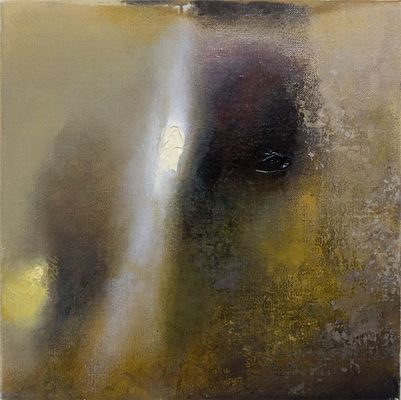
I am not a great reader of poetry but I always return to the work of Melbourne poet, Vincent Buckley (1925- 1988). Perhaps I find his most tantalising piece to be not a finished poem but a fragment left on a scrap of paper discovered on his desk after the poet’s death.
The poetry gathers like oil
In the word-core, and spreads
It has its music meet,
Its music is in movement.
This fragment is more the shell left behind from a volatile thought than a finished poem. I find the last two lines honest but awkward whereas the first two lines work like an arrow. Most likely he could not find a resolution so it was left. Still, in its present form, it remains an eloquent testimony to the ultimate failure of a medium to express mobile thought and sensation, in Buckley’s case, through verbal language. It’s an important matter because this is something all artists have to deal with regardless of the medium.
I have never written a poem, however, I am forever copying fragments from books on paper scraps in a vain effort to fix certain notions in my head. At first, they function as bookmarks that are sometimes returned to when I open the book. But before long, as they accumulate, they fall out littering the table interspersed with A4 photocopies, bills, books and medications.
To return to Buckley’s fragment, the first two lines very much evoke how I paint nowadays. As you age, detail diminishes and patches of light become more luminous and float. I feel the most honest way of dealing with this is by smearing the oil paint on the canvas with the fingers and working close-up, blind. Only if the patches coalesce into an approaching image can the work gain a life.
-
Jonathan Walker was born in Melbourne, Australia and brought up on a dairy farm in Gippsland. In the 1970’s he studied painting at RMIT and won the Harold Wright Scholarship to the British Museum, London. During the 1980’s he exhibited at Pinacotheca Gallery, Richmond and had work shown at the NGV and Heidi City Art Gallery. Over the same period he designed the cover for the “Epigenesi” LP by Giancarlo Toniutti, Italy and conducted a mail exchange work with Achim Wollscheid, Germany. The work with artists through the post resulted in an article published in the bicentenary issue of Art and Australia 1988. He showed in artist run spaces such as WestSpace in the 90’s and 2000’s, and until 2012, taught painting at Victoria University, which is where we (Colleen Ahern and Lisa Radford) as organisers of the exhibition, among many others, had the privilege of being his student.
Walker’s knowledge was imparted to students through the careful selection of music, literature, and artists found in books that he himself had ordered for the library. Walker’s strategy was the generosity of sharing his vast knowledge with references specific to each student and their context.
Walker’s paintings share a similar focus and intimacy.
This exhibition presents a small selection of recent paintings alongside a publication that includes Walker’s writing. Observational and analytical, Walker’s work is a type of material notation — the time of day, colour and how it is blended, the both specific and fleeting location of a reflection on lino or the question of whether a chair leg should be included in a painting.
Please join us on Friday August 21 between 6-8pm to celebrate the opening of the exhibition.
Curated by Colleen Ahern and Lisa Radford.
B. Wurtz
Curated by Nic Tammens
March 26 - April 4, 2015
B.Wurtz works from a basement studio in his home on Manhattan’s Lower East Side.
This local fact is attested to by the plastic shopping bags and newsprint circulars that appear in his work. As formal objects, they don’t make loud claims about their origins but nonetheless transmit street addresses and places of business from the bottom of this long thin island. Like plenty of artists, Wurtz is affected by what is local and what is consumed. His work is underpinned by this ethic. It often speaks from a neighborhood or reads like the contents of a hamper:
“BLACK PLUMS $1.29 lb.”
“Food Bazaar”
“USDA Whole Pork Shoulder Picnic 99c lb.”
“RITE AID Pharmacy, with us it’s personal.”
“H. Brickman & Sons.”
“Sweet Yams 59c lb."
Most of the work in this exhibition was made while the artist was in residence at Dieu Donne, a workshop dedicated to paper craft in Midtown. Here Wurtz fabricated assemblages with paper and objects that are relatively lightweight, with the intention that they would be easily transportable to Australia. This consideration isn’t absolute in Wurtz’s work, but was prescriptive for making the current exhibition light and cheap. Packed in two boxes, these works were sent from a USPS post office on the Lower East Side and delivered to North Melbourne by Australia Post.
Wurtz appears courtesy of Metro Pictures, New York.
Thanks to Rob Halverson, Joshua Petherick, Sari de Mallory, Matt Hinkley, Helen Johnson, Fayen d'Evie, Ask Kilmartin, Lisa Radon, Ellena Savage, Yale Union, and "Elizabeth".
John Nixon
"Archive"
December 15 - January 20, 2014
The presentation of John Nixon's archive offered a rare showcase of this extensive collection of the artist's own publications, catalogues, posters, ephemera, editions and more, from the mid 1980s onwards, alongside a selection of his artworks.
Organized by John Nixon, Joshua Petherick and Matt Hinkley.
<a href=http://wfb.public-office.info/artist/john-nixon>All titles by John Nixon
"Habitat"
at Minerva, Sydney (organised by Joshua Petherick and Matt Hinkley)
November 15 - December 20, 2014
Lupo Borgonovo, Janet Burchill & Jennifer McCamley,
Lewis Fidock, HR Giger, Piero Gilardi, Veit Laurent Kurz,
Cinzia Ruggeri, Michael E. Smith, Lucie Stahl, Daniel Weil, Wols
Press Release:
“...It contained seven objects. The slender fluted bone, surely formed for flight, surely from the wing of some large bird. Three archaic circuitboards, faced with mazes of gold. A smooth white sphere of baked clay. An age-blackened fragment of lace. A fingerlength segment of what she assumed was bone from a human wrist, grayish white, inset smoothly with the silicon shaft of a small instrument that must once have ridden flush with the surface of the skin - but the thing’s face was seared and blackened.”
William Gibson, “Count Zero”, 1986
"Autumn Projects Archive"
Curated by Liza Vasiliou
March 6 - March 15, 2014
World Food Books, in conjunction with the Virgin Australia Melbourne Fashion Festival 2014, presented the Autumn Projects archive, consisting of a selection of early examples in Australian fashion with a particular interest in collecting designers and labels from the period beginning in the 1980’s, who significantly influenced the discourse of Australian Fashion.
Curated by Liza Vasiliou, the exhibition provided a unique opportunity to view pieces by designers Anthea Crawford, Barbara Vandenberg, Geoff Liddell and labels CR Australia, Covers, Jag along with early experimental collage pieces by Prue Acton and Sally Browne’s ‘Fragments’ collection, suspended throughout the functioning World Food Books shop in Melbourne.
H.B. Peace
presented by CENTRE FOR STYLE
November 14, 2013
"Hey Blinky, you say chic, I say same"
Anon 2013
H.B. Peace is a clothing collaboration between great friends Blake Barns and Hugh Egan Westland. Their pieces explore the divergences between 'character’ and ‘personality’ in garments....etc
Special Thanks to Joshua Petherick and Matt Hinkley of WFB and Gillian Mears
and a Very Special Thank you to Audrey Thomas Hayes for her shoe collaboration.
Janet Burchill & Jennifer McCamley
"Aesthetic Suicide"
May 10 - June 8, 2013
The first of our occasional exhibitions in the World Food Books office/shop space in Melbourne, "Aesthetic Suicide" presented a body of new and older works together by artists Janet Burchill & Jennifer McCamley, including videos, prints, a wall work, and publications.
During shop open hours videos played every hour, on the hour.
1989, English
Softcover, 844 pages, 21 x 14 cm
Reprint,
Out of print title / as new
Published by
Humanity Books / New York
$90.00 - In stock -
From its first appearance in 1812, Hegel's Science of Logic (some-times entitled the "Greater" or the "Major" Logic) has been recognized by both its admirers and its detractors alike as being the absolute foundation of Hegel's system. Most of the major schools of contemporary philosophy, from Marxism to Existentialism, are reactions to Hegelianism and all, if they are to be understood, require some understanding of Hegel's Logic. Even such a hard-headed practical revolutionary as Lenin understood that Hegelian theory could not be avoid-ed-and so he devoted himself to writing a commentary upon the Logic. Indeed, Hegel well recognized the significance of this work, for he had consciously prepared a way for it with a work of equal challenge and influencethe Phenomenology of Mind.
The first English translation was published in 1929 and remained the standard work for some years. Following the Second World War scholars began to see the need for a new translation. This work was undertaken by A.V. Miller, a scholar internationally recognized for his extensive and excellent translations of Hegel and was first published in 1969. It is his translation which appears in this edition.
This is the first paperback edition of the Science of Logic.
1989 edition, later reprint. As New.
1980, Enfglish
Softcover, 358 pages, 20 x 13.5 cm
1st Edition, Out of print title / used / good
Published by
Verso / London
$20.00 - In stock -
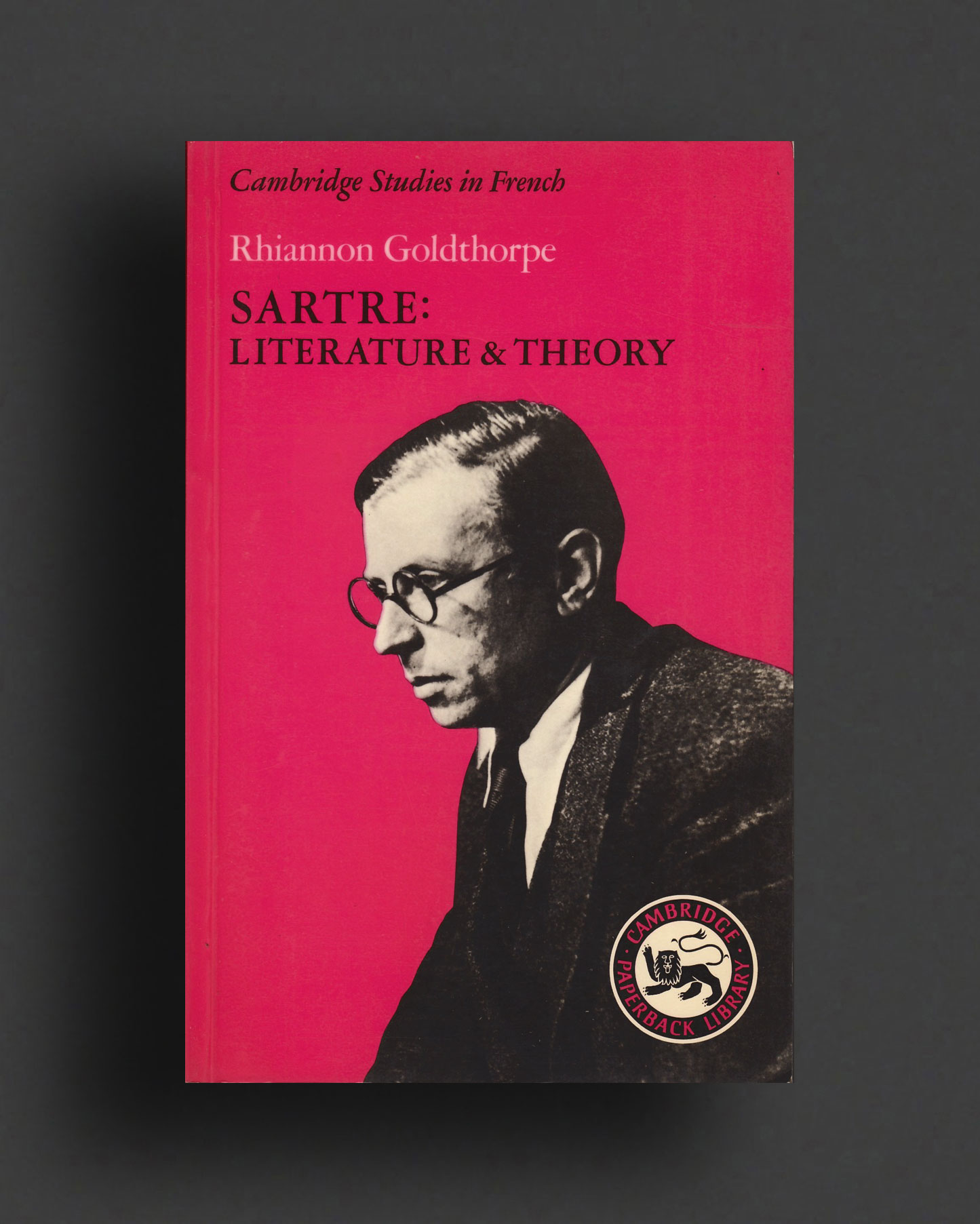
No post-war philosopher acquired such world-wide fame as Jean-Paul Sartre, or occupied such a commanding position within the difficult history of the European Left after the war.
Yet the very scale and variety of Sartre's writings has rendered an informed and balanced judgement of his achievement difficult. Ronald Aronson's book seeks to provide a set of keys to an overall understanding of it. After describing the historical and cultural conditions in which Sartre was formed in France, it proceeds to an analysis of his first text on 'The Imagination', and the evolution that led from it to 'Nausea' and Being and Nothingness'. Discussing the role of art as salvation in the work of this period, Aronson goes on to show how Sartre's theory of literature after the Liberation was the hinge of his transition from existentialism to socialism. He then assesses the actual results of Sartre's political commitment, as a dramatist and an essayist in the '50s and '60s. There follows the most cogent critical reflection on the Critique of Dialectical Reason' yet to have been written - one which includes, for the first time anywhere in the world, an account of the unpublished second volume of the work, largely on the history of the USSR.
Finally, Aronson surveys the miniature autobiography 'Words' and the monumental biography 'Flaubert', which formed the summum of Sartre's career.
"Jean-Paul Sartre - Philosophy in the World" is a tour de force of interpretative insight.
Good copy of first 1980 edition with some light creasing to cover and spine. Light general wear/age.
1991, English
Softcover, 416 pages, 23 x 15 cm
1st Edition, Out of print title / used / very good
Published by
The MIT Press / Massachusetts
$35.00 - In stock -
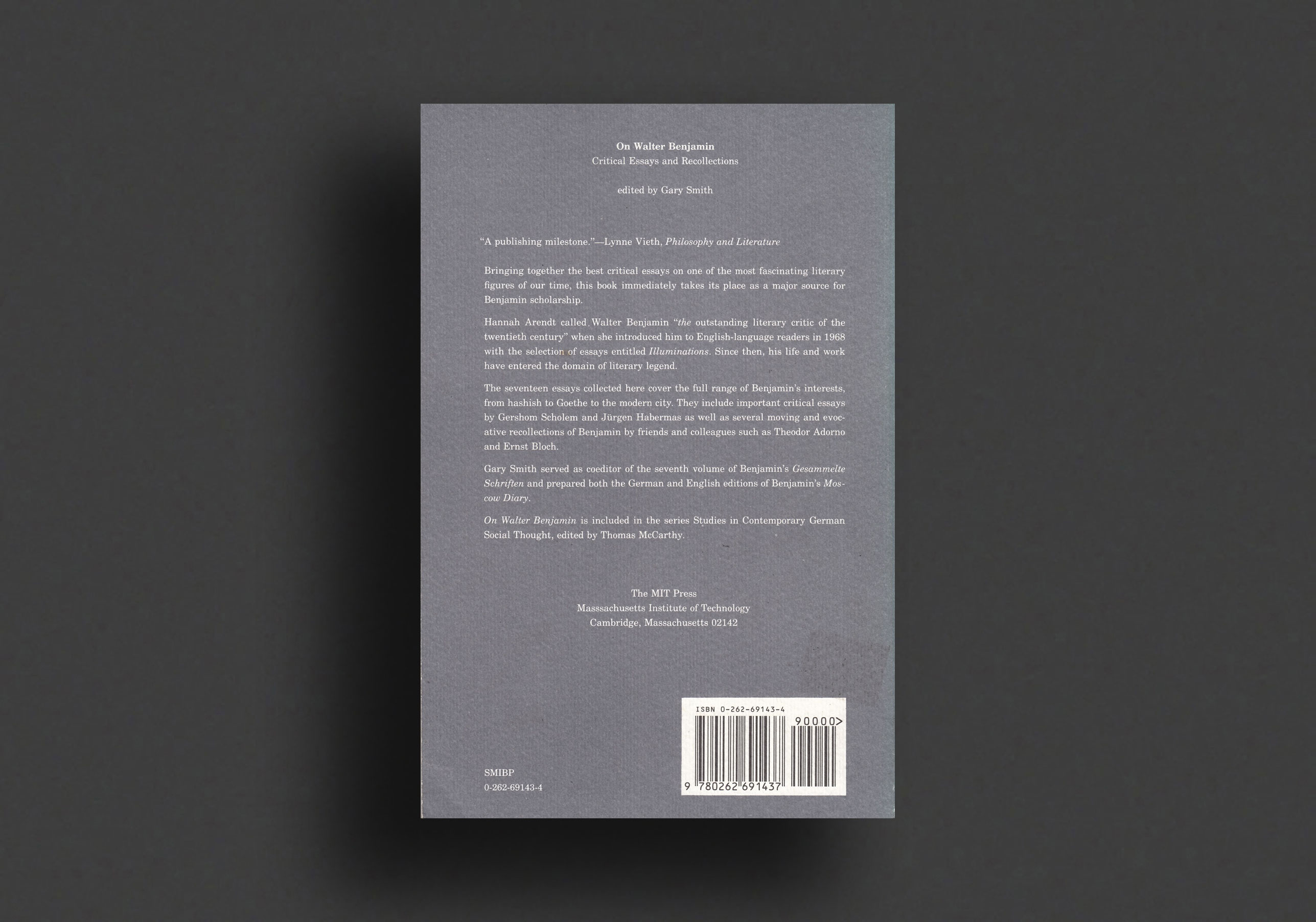
Bringing together the best critical essays on one of the most fascinating literary figures of our time, this book immediately takes its place as a major source for Benjamin scholarship. Hannah Arendt called Walter Benjamin "the outstanding literary critic of the twentieth century" when she introduced him to English-language readers in 1968 with the selection of essays entitled Illuminations. Since then, his life and work have entered the domain of literary legend. The seventeen essays collected here cover the full range of Benjamin's interests, from hashish to Goethe to the modern city. They include important critical essays by Gershom Scholem and Jürgen Habermas as well as several moving and evocative recollections of Benjamin by friends and colleagues such as Theodor Adorno and Ernst Bloch. Gary Smith served as coeditor of the seventh volume of Benjamin's Gesammelte Schriften and prepared both the German and English editions of Benjamin's Moscow Diary.
VG copy with some tanning to spine edge, light wear.
1996 / 2005, English
Softcover, 118 pages, 21.5 x 14 cm
1st Edition, Out of print title / used / fine
Published by
Stanford University Press / Palo Alto
$55.00 - In stock -
Translated by Peggy Kamuf
This book, by one of the most challenging contemporary thinkers, begins with an essay that introduces the principal concern sustained in the four succeeding ones: Why are there several arts and not just one? This question focuses on the point of maximal tension between the philosophical tradition and contemporary thinking about the arts: the relation between the plurality of the human senses—to which the plurality of the arts has most frequently been referred—and sense or meaning in general.
Throughout the five essays, Nancy’s argument hinges on the culminating formulation of this relation in Hegel’s Aesthetics and The Phenomenology of Spirit—art as the sensible presentation of the Idea. Demonstrating once again his renowned ability as a reader of Hegel, Nancy scrupulously and generously restores Hegel’s historical argument concerning art as a thing of the past, as that which is negated by the dialectic of Spirit in the passage from aesthetic religion to revealed religion to philosophy.
First 1996 edition, later print.
1997, English
Softcover, 206 pages, 23 x 15 cm
1st Edition, Out of print title / used / very good
Published by
University of Minnesota Press / Minnesota
$45.00 - In stock -
An essential exploration of sense and meaning.
Is there a “world” anymore, let alone any “sense” to it? Acknowledging the lack of meaning in our time, and the lack of a world at the center of meanings we try to impose, Jean-Luc Nancy presents a rigorous critique of the many discourses-from philosophy and political science to psychoanalysis and art history-that talk and write their way around these gaping absences in our lives.
In an original style befitting his search for a new mode of thought, Nancy offers fragmentary readings of writers such as Nietzsche, Hegel, Marx, Lévinas, Lacan, Derrida, and Deleuze insofar as their work reflects his concern with sense and the world. Rather than celebrate or bemoan the loss of meaning or attempt to install a new one, his book seeks to reposition both sense and the world between the presence and absence of meaning, between objectivity and subjectivity. Nancy’s project entails a reconception of the field of philosophy itself, a rearticulation of philosophical practice. Neither recondite nor abstract, it is concerned with the existence and experience of freedom-the actuality of existence as experienced by contemporary communities of citizens, readers, and writers.
Combining aesthetic, political, and philosophical considerations to convey a sense of the world between meaning and reality, ideal content and material form, this book offers a new way of understanding-and responding to-“the end of the world.”
Jean-Luc Nancy teaches at the University of Human Sciences in Strasbourg. His books in English include The Literary Absolute (with Philip Lacoue-Labarthe, 1988), The Inoperative Community (Minnesota, 1991), The Birth to Presence (1993), The Experience of Freedom (1993), and The Muses (1996).
Jeffrey S. Librett is associate professor of modern languages and literatures at Loyola University of Chicago.
First 1997 edition. VG copy, light wear.
1989, English
Softcover, 202 pages, 23.5 x 15.5 cm
1st Edition, Out of print title / used / good
Published by
Indiana University Press / Indiana
$25.00 - In stock -
To an extent rarely realized, Jurgen Habermas' thought is inseparable from his reading of Marx and Marxism. Tom Rockmore reconstructs and evaluates Habermas' philosophical position in terms of the lengthy but little-known debate with historical materialism from which it emerged. After an account of the background of Habermas' approach to Marx and Marxism in nineteenth-century German philosophy and in recent analytical philosophy of science, Rockmore describes the development of his reading of historical materialism in four interrelated phases. These include his initial interpretation of historical materialism, his subsequent critique of the theory from a quasi-Kantian perspective, an attempt at reconstruction, and, finally, rejection of historical materialism in favor of an alternative position better suited to achieve its intrinsic aim. Analysis of Habermas' reading of historical materialism builds toward a critical discussion of his view of the relevance of reason, an underlying theme of Rockmore's study. A final section evaluates Habermas' contribution to the Marxist theme of the relation of theory and practice, the key to which, Rockmore concludes, is the relevance of reason. Habermas on Historical Materialism contributes important new insights to the current discussion of Jurgen Habermas' thought.
TOM ROCKMORE is Professor and Chair of the Department of Philosophy at Duquesne University. His publications include Fichte, Marx, and German Philosophy and Hegel's Circular Epistemology.
Good copy, light bumping/wear. First edition.
1999, English
Softcover, 198 pages, 21.5 x 14 cm
1st Edition, Out of print title / used / fine
Published by
University of Texas Press / Texas
$45.00 - In stock -
French philosopher Luce Irigaray has become one of the twentieth century's most influential feminist thinkers. Among her many writings are three books (with a projected fourth) in which she challenges the Western tradition's construals of human beings' relations to the four elements-earth, air, fire, and water-and to nature. In answer to Heidegger's undoing of Western metaphysics as a "forgetting of Being," Irigaray seeks in this work to begin to think out the Being of sexedness and the sexedness of Being.This volume is the first English translation of L'oubli de l'air chez Martin Heidegger (1983). In this complex, lyrical, meditative engagement with the later work of the eminent German philosopher, Irigaray critiques Heidegger's emphasis on the element of earth as the ground of life and speech and his "oblivion" or forgetting of air.With the other volumes (Elemental Passions and Marine Lover of Friedrich Nietzsche, published elsewhere) in Irigaray's "elemental" series, The Forgetting of Air offers a fundamental rereading of basic tenets in Western metaphysics. And with its emphasis on dwelling and human habitation, it will be important reading not only in the humanities but also in architecture and the environmental sciences.
Near Fine copy of the first edition.
2021, English
Softcover, 106 pages, 20.4 x 12.7 cm
Published by
Schism Press / World
$24.00 - Out of stock
It is enough to glance at the footnotes - from masters of body horror like Cronenberg, Ballard and Barker to post-structuralist philosophers of the self like Derrida, Nancy and Deleuze - to grasp the intention of Snuff Memories. Unveiling like a tableau of ancient gods and deathly orgies, where “the universe is composed out of windowless monads each locked away and screaming,” this evocative novel is better called a theoretical installation. Each fragment documenting an erotic way to lose one’s humanity, this is a collection of nightmarish yet utopian miniature visions of sex, death, transformation, and pain, where human bodies are stretched beyond their capacity into mythical realms. Brutal and evocative, at once a prose poem and a theory of the limit, Snuff Memories creates a mythology of enticing and deadly encounters with mutants, matriarchs, and goddesses, documenting a multitude of ways in which one can be erotically and philosophically disemboweled.
– Bogna M. Konior, Research Fellow, NYU Shanghai, Interactive Media Arts department & AI and Culture Research Centre
Snuff Memories is Sadean. Not because of its commitment to detailing the minutiae of posthuman pornographic excess (although that is certainly an important part of the work) but because of its obsession with permutation. Everything is erected, demolished, decentred, and respooled, before being forced out to the limits once again. Bodies effervesce in fatal conjugations, topologies deform, fuzz out and remerge everted, like bad DOOM skins, covered in blood. The posthuman cannot be known before it is produced—so to know it, we must produce it. And until we really are swept up in these disorienting forces—merciless, murderous, erotic perhaps—we have literature. Snuff Memories is a book for anyone who ever secretly wanted to get dommed by fiction.
– Amy Ireland
Read less
1971, French
Softcover (w. glassine obi-strip), 96 pages, 23 x 18 cm
1st Edition, Out of print title / used / very good
Published by
L'Arc / Marseille
$55.00 - In stock -
Special 1971 volume of French literary/arts journal L'Arc devoted entirely to the work of French philosopher and author Georges Bataille (1897—1962) whose influential works spanning philosophy, literature, sociology, anthropology, and history of art, which included essays, novels, and poetry, exploring such subjects as eroticism, mysticism, surrealism, and transgression. Featuring contributions by André Masson, Henri Ronse, Michel Leiris, Rodolphe Gasché, François Cuzin, Alexandre Kojève, François Perroux, Jean-Michel Rey, Jean Pfeiffer, Gilbert Lascault, Denis Hollier.
Very Good copy complete with publisher's original glassine obi-strip that prints the contributors in red.
1992, English
Softcover, 200 pages, 22 x 14 cm
1st UK Edition, Out of print title / used / fine
Published by
The MIT Press / Massachusetts
October Books / New York
$45.00 - In stock -
"Hollier has not only written a series of interlocking essays which manage to roam representatively over and under the six thousand pages of Bataille, a polygraphic author of the most bewildering complexity, but he has taken the master's method to heart and has written not a book about Bataille
but a book through him: he has turned Bataille on and even against Bataille. The result is a superb, even a supreme critical work."—Richard Howard, Professor of Creative Writing, University of Houston
Over the past 30 years the writings of Georges Bataille have had a profound influence on French intellectual thought, informing the work of Foucault, Derrida, and Barthes, among others. Against Architecture offers the first serious interpretation of this challenging thinker, spelling out the profoundly original and radical nature of Bataille's work.
Denis Hollier is Professor of French at Yale University.
An OCTOBER Book.
Very Good—NF copy. First 1992 ed. 2nd print. Not a digital reprint.
1988, English
Softcover, 232 pages, 23 x 15 cm
1st Edition, Out of print title / used / very good
Published by
Review of Existential Psychology and Psychiatry / Seattle
$50.00 - In stock -
Rare first 1988 edition published by the Review of Existential Psychology and Psychiatry in Seattle.
Heidegger & Psychology contains an essay by the Swiss psychiatrist Medard Boss interpreting Heidegger's only recurring dream and revealing Heidegger's many trips to Zurich to teach Boss' psychiatry students. It also includes eight original essays by noted Heidegger scholars, as well as a bibliography on Heidegger and the Behavioral Sciences.
VG copy with some light wear/age.
1998, English
Softcover, 344 pages, 23 x 15 cm
1st Edition, Out of print title / used / fine
Published by
Stanford University Press / Palo Alto
$50.00 - In stock -
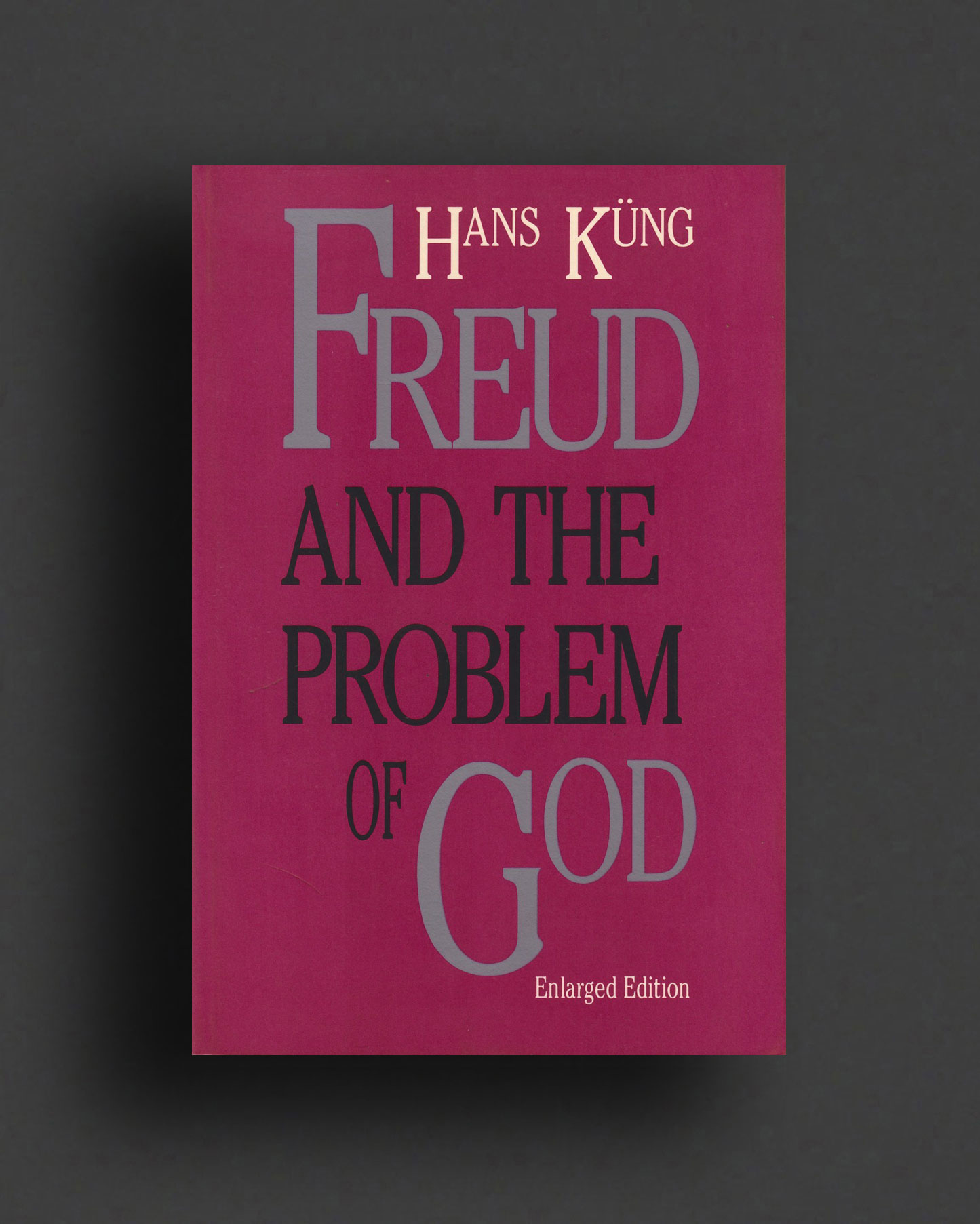
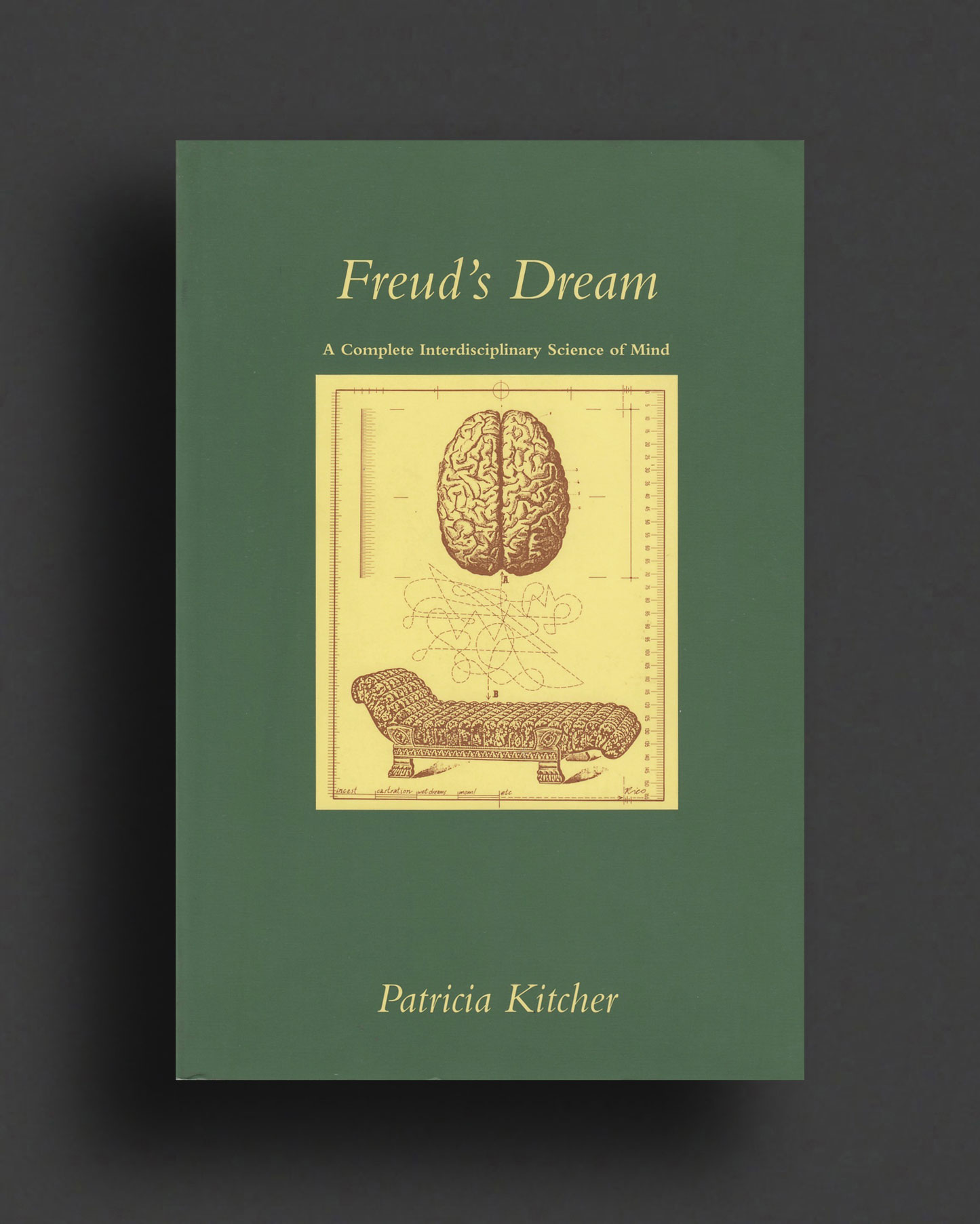
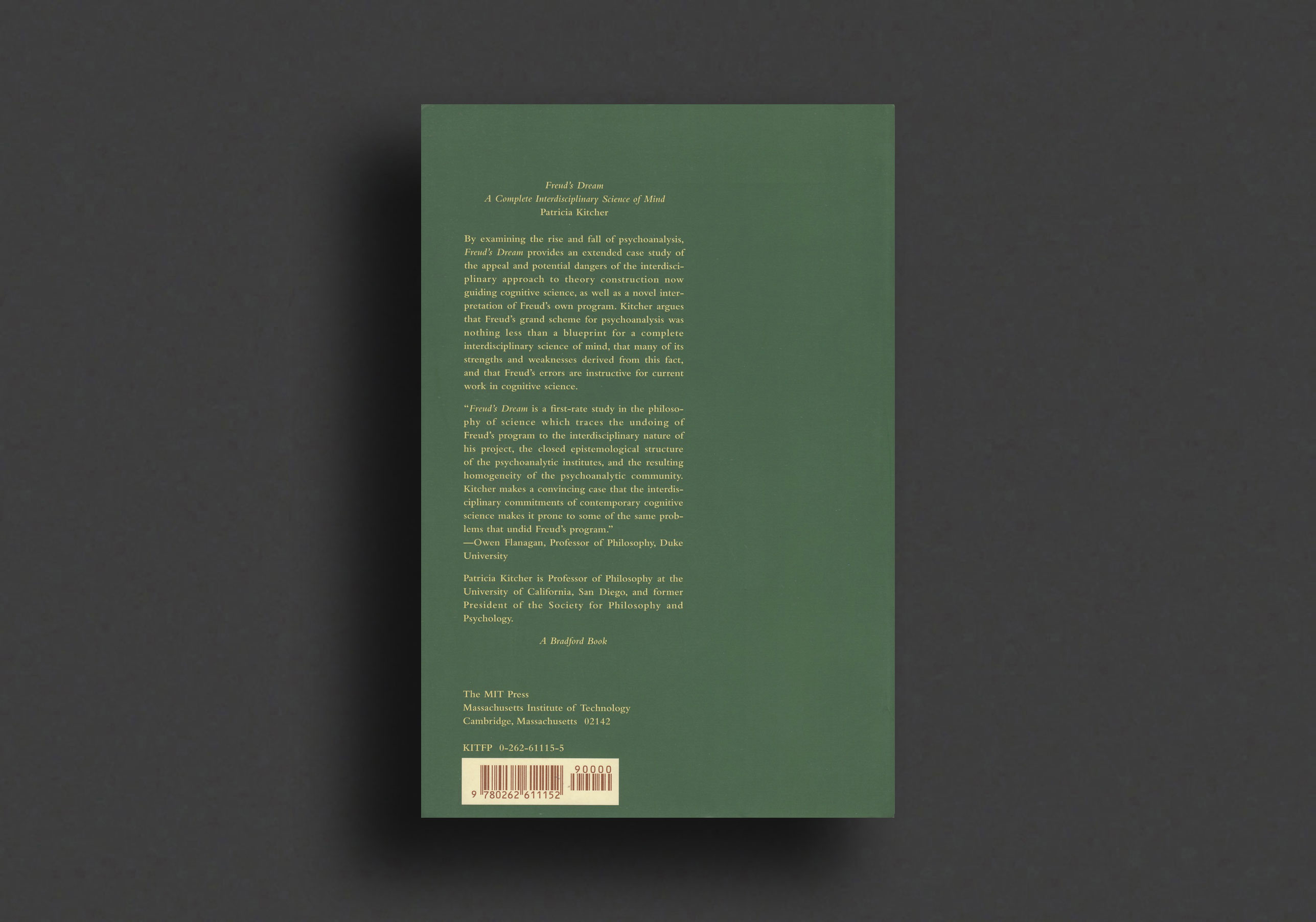
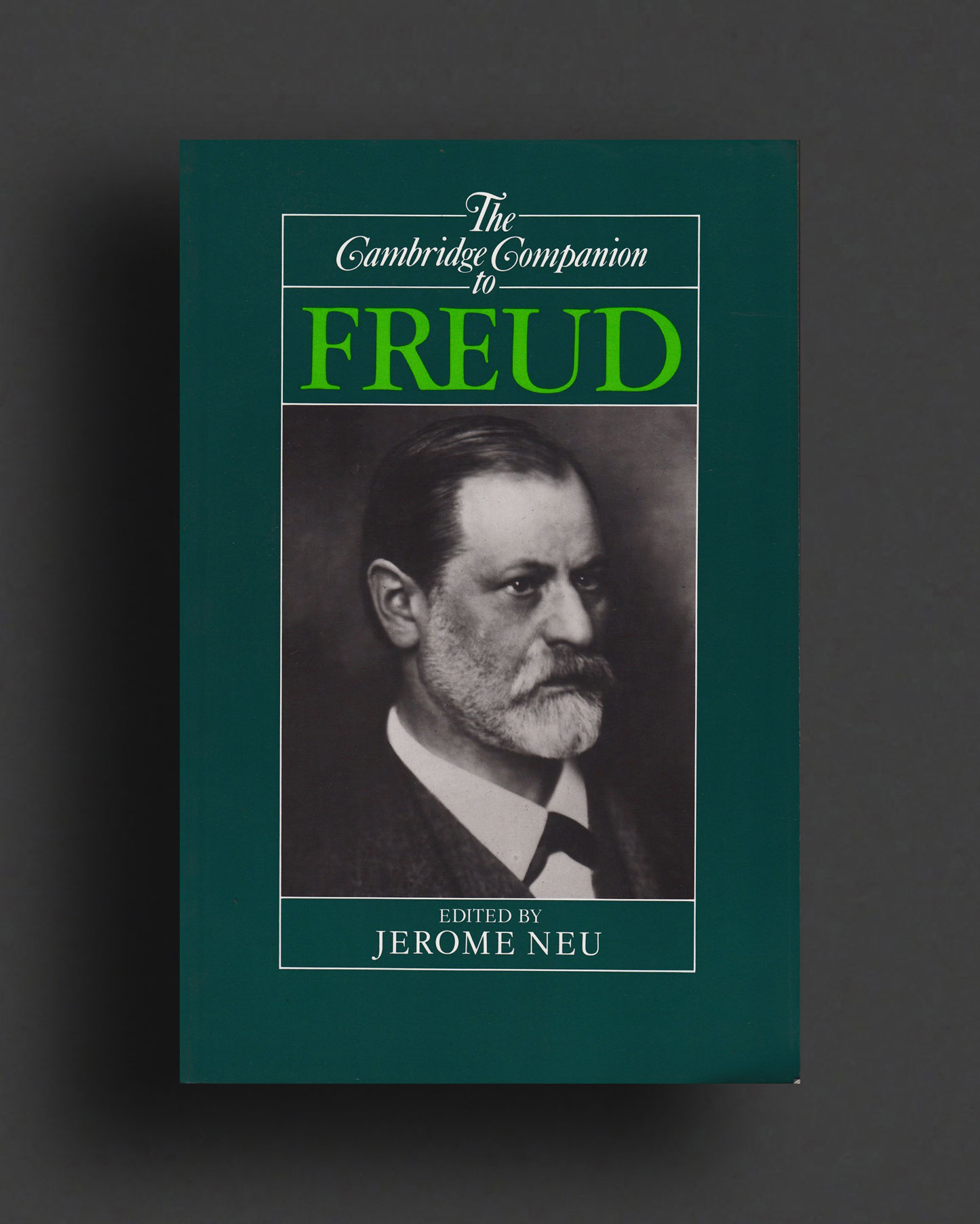
“Psychoanalysis may be said to have been born in the twentieth century,” Freud said late in his career, “but it did not drop from the skies ready-made.” And in his speculative theories of modernism, Bruno Latour argued that “no science can exit from the network of its practice.” Deploying Latour’s model of scientific theory production, this book argues that the historical emergence of psychoanalysis depended on nineteenth-century scientific practices: laboratory experimentation, medical transmission of research findings along collegial or social networks, and medical representation of illness—including case studies, amphitheatrical demonstration of cases, hospital records of symptoms, and laboratory graphology and photography of patients.
The author shows how hysteria enabled Freud to appropriate medical and scientific concepts from neurology, sexology, gynecology, psychiatry, and existing rest cures and psychotherapies. His new model eschewed physiological determinism, linking unconscious ideation with counterwill and reproduced memory, psychosexual experience, and affect-laden images of object relations (usually with family members).
Constructing around himself a psychoanalytic circle and establishing training institutions, Freud translated this new psycho-physical body and hybrid subjectivity to other research sites. Just as in the 1890’s he had used the figure of the hysteric to mobilize theory production, by the 1920’s he had replaced the hysteric with a modernized figure, the homosexual. Freud used autobiography, summary, and outline to stabilize his concepts and control the dissemination of his new science. Psychoanalysis had successfully created new scientific “plausible bridges” between psyche and soma, nature and the social, to produce a modern theory of hybrid subjectivity that was rooted in yet conceptually separated from the body.
Very Good copy.
1993, English
Softcover, 254 pages, 23.5 x 15.65 cm
1st Edition, Out of print title / used / very good
Published by
Indiana University Press / Indiana
$20.00 - In stock -
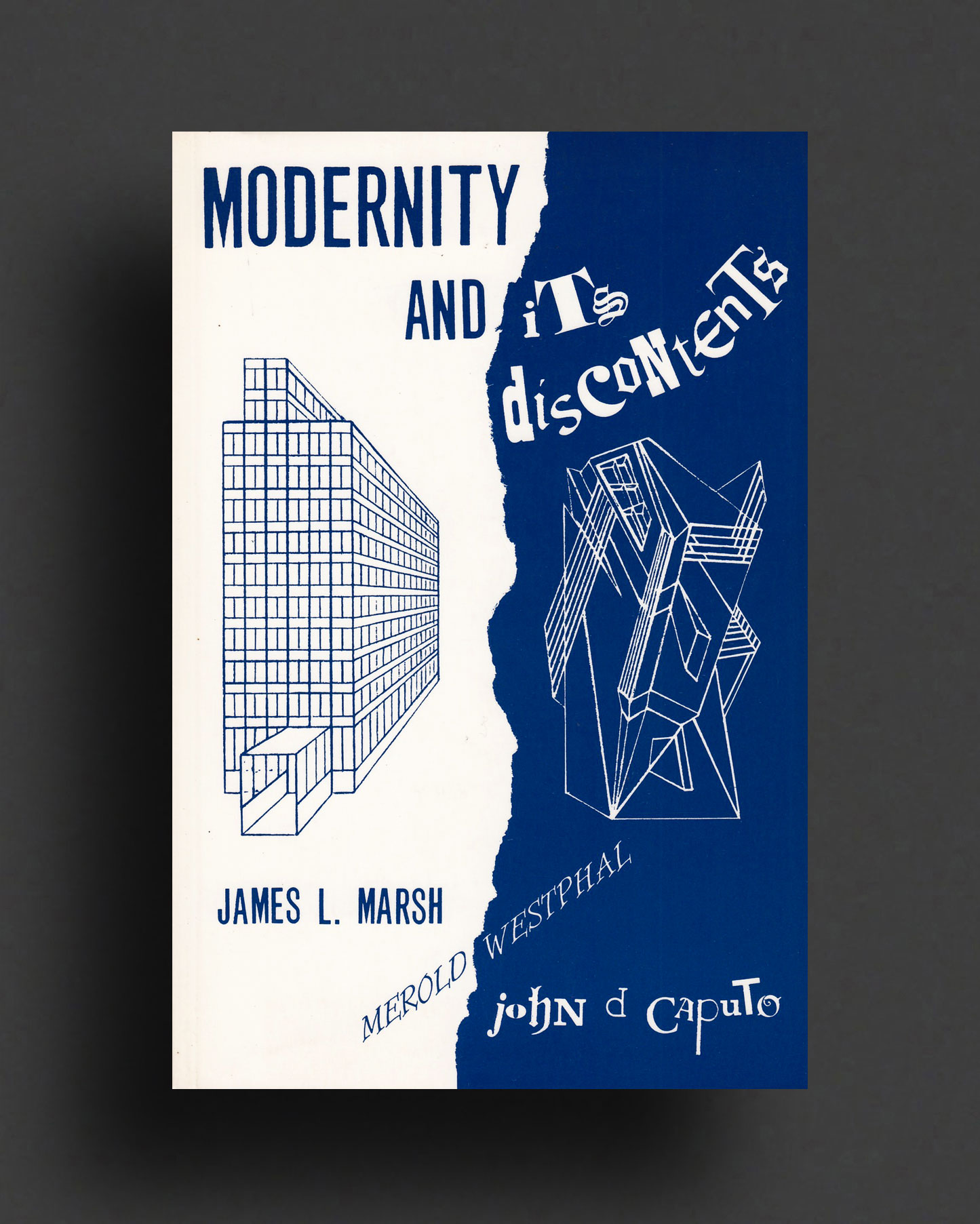
This book calls for a distinction between dangerous, elitist, hierarchizing myths such as Heidegger's and salutary, liberative, empowering myths that foster the humility of justice. A readable chronological consideration of Heidegger's texts that assesses his achievement as a thinker, while pointing to the sources of his political and ethical failure. Caputo addresses the religious significance of Heidegger's thought.
JOHN D. CAPUTO is David R. Cook Professor of Philosophy at Villanova University. His publications include Radical Hermeneutics: Repetition, Deconstruction, and the Hermeneutic Project and Heidegger and Aquinas: An Essay on Overcoming Metaphysics.
Very Good copy.
1990, English
Softcover, 214 pages, 21 x 14 cm
1st Edition, Out of print title / used / very good
Published by
Indiana University Press / Indiana
$25.00 - In stock -
In Echoes John Sallis mobilizes the figure of echo, used by Heidegger to characterize originary thinking, as the motif around which to organize a radical reading of Heidegger's most important texts. Itself subject to the very displacements produced by those writings, Sallis's reading draws various strands of Heidegger's texts to the point where each engages its issue in the most radical way. This graceful essay focuses on the shifts and turns that come into play at these limits and that effectively transform the Heideggerian project. Among his themes are the determination of thinking at the end of philosophy; originary, ecstatic time as the meaning of Being; the sense of the sensible; the involvement of imagination in the question of fundamental ontology; death as radical alterity; the sacrifice of understanding in thinking the political; the reconstitution of mimesis in art; and the translation of ecstasy. By taking up the engagement of Heidegger's texts with these issues and drawing that engagement to its limit, Echoes undertakes to broach a thinking after Heidegger.
JOHN SALLIS is W. Alton Jones Professor of Philosophy at Vanderbilt University. His previous books include Phenomenology and the Return to Beginnings, Being and Logos, The Gathering of Rea-son, Delimitations, and Spacings. Sallis is founding editor of the journal Research in Phenomenology.
Good—Very Good copy with light wear, crease to back cover.
2012, English
Hardcover (w. dust jacket), 198 pages, 22.5 x15 cm
Published by
Indiana University Press / Indiana
$65.00 - Out of stock
This volume consists of two lecture series given by Heidegger in the 1940s and 1950s. The lectures given in Bremen constitute the first public lectures Heidegger delivered after World War II, when he was officially banned from teaching. Here, Heidegger openly resumes thinking that deeply engaged him with Hölderlin's poetry and themes developed in his earlier works. In the Freiburg lectures Heidegger ponders thought itself and freely engages with the German idealists and Greek thinkers who had provoked him in the past. Andrew J. Mitchell's translation allows English-speaking readers to explore important connections with Heidegger's earlier works on language, logic, and reality.
1997 / 1999, English
Softcover, 188 pages, 22.5 x 15 cm
1st Edition, Out of print title / used / fine
Published by
Cambridge University Press / Cambridge
$30.00 - In stock -
Kant is the central figure of modern philosophy. He sought to rebuild philosophy from the ground up, and he succeeded in permanently changing its problems and methods. This revised edition of the Prolegomena, which is the best introduction to the theoretical side of his philosophy, presents his thought clearly by paying careful attention to his original language. Also included are selections from the Critique of Pure Reason, which fill out and explicate some of Kant's central arguments (including famous sections of the Schematism and Analogies), and in which Kant himself explains his special terminology. The first reviews of the Critique, to which Kant responded in the Prolegomena, are included in this revised edition. The volume is completed by a historical and philosophical introduction, explanatory notes, a chronology, and a guide to further reading.
Fine copy.
1989, English
Softcover, 176 pages, 13.6 x 20 cm
1st Edition, Out of print title / used / good
Published by
Columbia University Press / New York
$25.00 - Out of stock
Derrida offers significant insights into de Man's understanding of Heidegger, Holderlin, Hegel, Austin, and Rouseau. A warm, personal, and at times touching account of the de Man/Derrida intellectual friendship and the existential experience of a friend's death, this work shows a very human side to a thinker whose humanity has been questioned by the critics.
"Derrida offers significant insights into de Man's understanding of Heidegger, Hoderlin, Hegel, Austin, and Rosseau. A warm, personal, and at times touching account of the de Man/Derrida intellectual friendship and the existential experience of a friend's death, this work shows a very human side to a thinker whose humanity has been questioned by the critics. A welcome addition to any library already containing some writings of Derrida."—Choice
1989 edition, revised, year? Good copy, light general wear, chip to spine.
1993, English
Softcover, 106 pages, 21.6 x 14 cm
1st Edition, Out of print title / used / good
Published by
State University of New York Press / New York
$15.00 - Out of stock
Here are the major statements of the leading figures in the nineteenth- and twentieth-century German and French hermeneutic traditions—the major statements on the aims, methods, and techniques of interpretation. Some of these appear here for the first time in English.
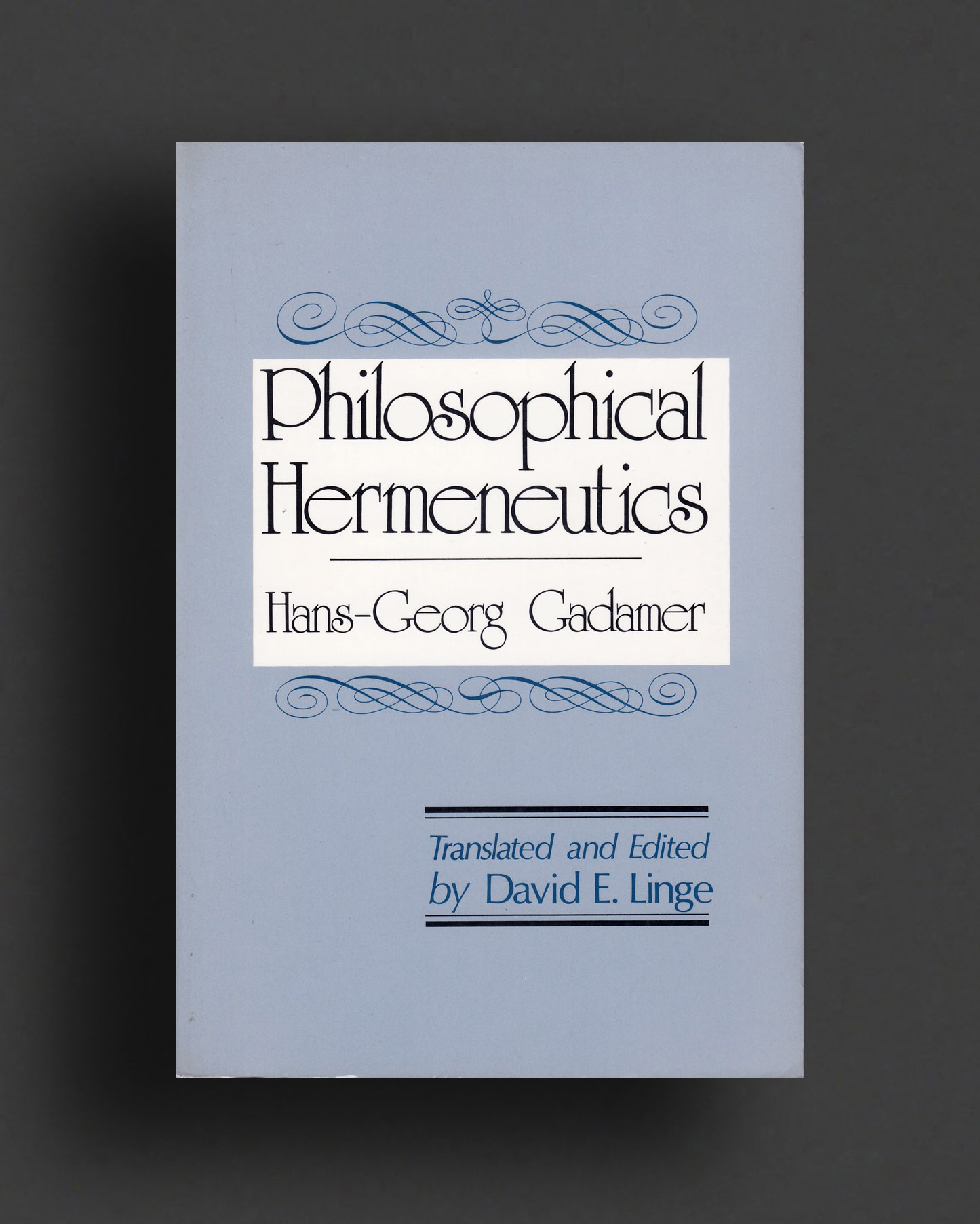
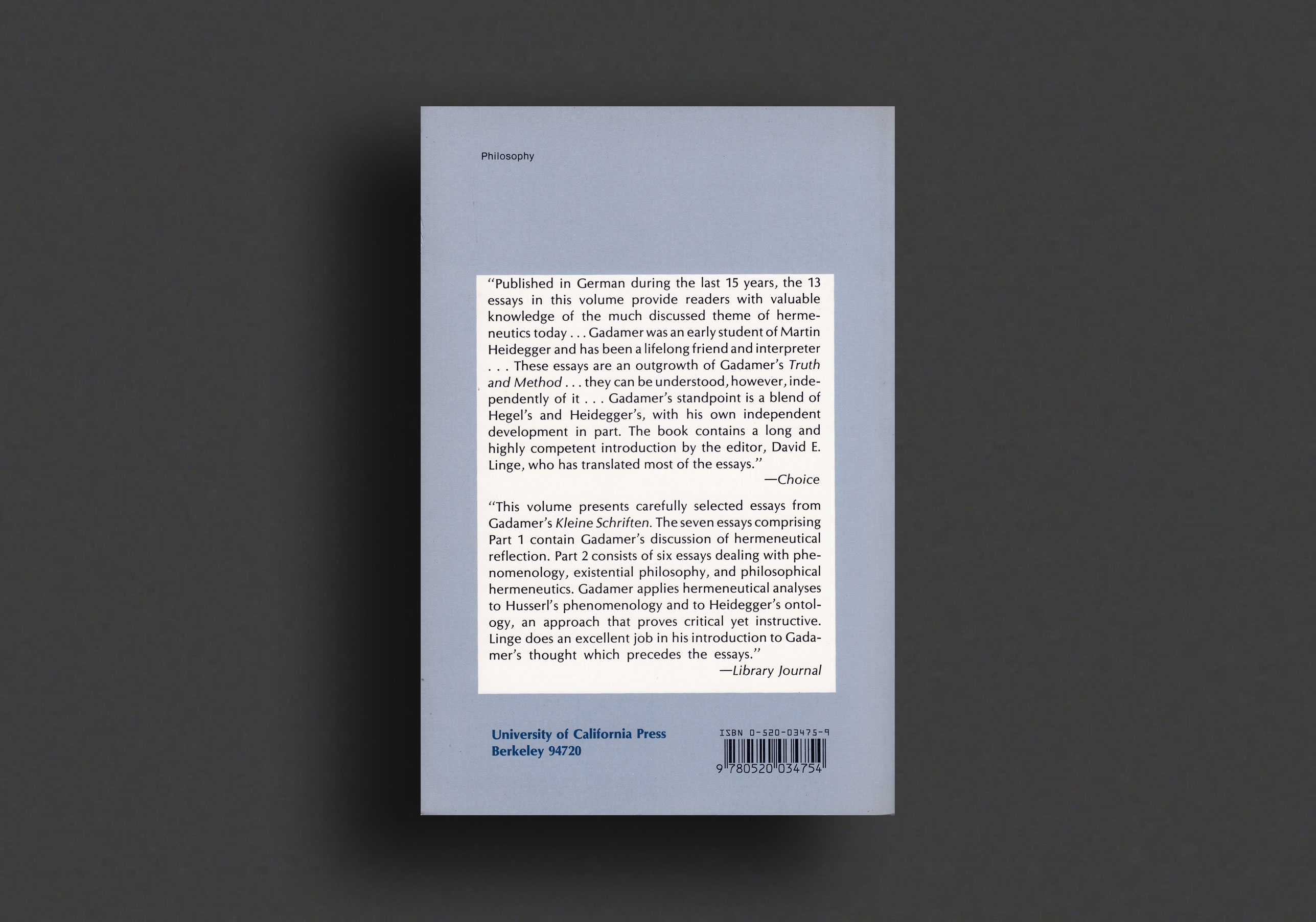
This book establishes the context for contemporary analyses of interpretation. Part I traces the evolution of hermeneutics from Friedrich Ast and Friedrich Schleiermacher through Wilhelm Dilthey to Martin Heidegger's placing of hermeneutics at the center of the ontological analysis of human being. Part II follows the development of the Heideggerian tradition in the writings of Hans-Georg Gadamer. Gadamer's "philosophical hermeneutics" is then located at the center of several important exchanges with more traditional, objective hermeneutical methodologists like Emilio Betti, ideology-critics like Jürgen Habermas, and linguistic-phenomenological thinkers like Paul Ricoeur.
Gayle L. Ormiston is Professor in the Department of Philosophy at Kent State University. Alan D. Schrift is Assistant Professor of Philosophy at Grinnell College.
Good copy with some wear and bumping to extremities/boards.
2006, English
Softcover, 122 pages, 21.5 x 14 cm
1st Edition, Out of print title / used / fine
Published by
Power Publications / Sydney
$60.00 - Out of stock
First 2006 edition. Edited by Paul Patton and Terry Smith. Long out-of-print.
Jacques Derrida's two Sydney seminars of August 1999 enabled him to present some of the principal themes of his work to non-specialist audiences. As might be expected of a Sydney setting, warmth of feeling and openness of spirit pervaded both occasions. Derrida's willingness to engage with both interlocutors and audiences ensured an exciting demonstration of the subtlety and flexibility of deconstructive thinking in action.
This book is reconstructed from the transcripts of those sessions. It provides a clear, systematic and highly accessible introduction to many of the central concerns of Derrida's engagement with philosophy, visual art and politics.
Fine copy.
1993, English
Softcover, 106 pages, 21.6 x 14 cm
1st Edition, Out of print title / used / very good
Published by
Stanford University Press / Palo Alto
$20.00 - In stock -
Derrida's Aporias bears a special significance because it focuses on an issue that has informed the whole of his work up to the present. One of the aporetic experiences touched upon is that "my death" can never be subject to an experience that would be properly mine, that I can have and account for, yet that there is, at the same time, nothing closer to me and more properly mine than "my death."
Translated by Thomas Dutoit.
VG copy of the 1st ed.
1991 / 2000, English
Softcover, 304 pages, 23 x 15 cm
Published by
University of Minnesota Press / Minnesota
$35.00 - In stock -
A fresh take on this critical philosopher. In this essential rereading of Spinoza's (1632-1677) philosophical and political writings, Negri positions this thinker within the historical context of the development of the modern state and its attendant political economy. Through a close examination of Spinoza, Negri reveals him as unique among his contemporaries for his nondialectical approach to social organization in a bourgeois age.
After living in exile in France for nearly fourteen years, Antonio Negri is currently serving a jail sentence in Italy, his home country, for his political activism in the 1970s. His conviction, which was based on the substance of his writings, led Michel Foucault to ask, "Isn't he in prison simply for being an intellectual?" Negri's works in English include Insurgencies (1999) and, with Michael Hardt, Labor of Dionysus (1994), both published by Minnesota.
1998, English
Softcover, 372 pages, 23.5 x 14.8 cm
1st Edition, Out of print title / used / very good
Published by
Johns Hopkins University Press / Baltimore
$35.00 - In stock -
A classic work on Freud by one of France's foremost philosophers and literary critics.
Jacques Lacan's commentaries on Freud had revolutionary implications not only for the analytic movement but also for contemporary philosophy and literary criticism. Lacan held that if the unconscious, as Freud described it, exists, it functions linguistically, rather than symbolically or instinctually. He refers to the unconscious as a language: "the discourse of the Other." In The Language of the Self Lacan offers a significant and fertile return to the heart of the Freudian texts.
Originally published in paperback under the title Speech and Language in Psychoanalysis, this book is based on Anthony Wilden's translation of "Fonction et champ de la parole et du langage en psychanalyse," a 1953 article that became a manifesto for a generation interested in a new reading of Freud. Wilden expands and amplifies the text with extensive notes and a commentary that places Lacan's work in the context of contemporary thought.
VG 1998 edition. Some sticker remnants to b.c.
1997, English
Softcover, 264 pages, 23.6 x 16 cm
1st Edition, Out of print title / used / very good
Published by
Verso / London
$20.00 - In stock -
The first publication of seminal early writing by Louis Althusser.
Throughout the 1960s and 1970s, Louis Althusser enjoyed virtually unrivalled status as the foremost living Marxist philosopher. Today, he is remembered as the scourge and severest critic of “humanist” or Hegelian Marxism, as the proponent of rigorously scientific socialism, and as the theorist who posited a sharp rupture—an epistemological break—between the early and the late Marx.
This collection of texts from the period 1945-1953 turns these interpretations of Althusser on their head: we discover that there was a “young Althusser” as well as the “mature Althusser” we are already familiar with. In his fascinating Master’s thesis, “On Content in the Thought of G.W.F. Hegel” (1947), Althusser developed a position which he was later to attack ferociously: namely, that the revolutionary potential of the Hegelian dialectic could be defended against Hegel’s own political conservatism. We see Althusser still wrestling with the spectres of Hegel and of Catholicism in another long text, his letter to Jean Lacroix, and, finally, we see his own “epistemological break” in the piece “On Marxism” from 1953. Other texts included are his critique of Alexander KojÅve (whose interpretation Francis Fukoyama has recently revived) and his attack on the French Church’s teachings on women, sex and the family. Widely recognized as an intellectual giant of the late twentieth century, Althusser has left a towering legacy. This collection not only gives a unique insight into the formation of such a personality, but will also restore the “unknown Althusser” to the centre of the history of Marxism and of philosophy since the Second World War.
VG copy, light wear/age, old price sticker to b.c.
1980, English
Hardcover (clothbound), 380 pages, 24 x 16 cm
1st Edition, Out of print title / used / very good
Published by
Northwestern University Press / Evanston
$30.00 - In stock -
1980 hardcover edition.
This collection contains original translations of essays, discussions, and papers including six previously unpublished works from the International Colloquium on Heidegger’s Conception of Language, held at The Pennsylvania State University in 1969. This volume endeavors to place Martin Heidegger’s ideas within a wide range of philosophical thought. It contains critical reflections on his conception of speech in Being and Time, linguistic meditations on Heidegger’s use of language, and analysis of his view on the relationship between thought and the language in which it is expressed. In this book, Heidegger scholars will find additional insights into his conception of language and his philosophy as a whole.
VG w/o dust jacket, small chip to bottom cover corner (back).