World Food Books' programme is largely produced on Kulin Nation land. We acknowledge the Wurundjeri people of the Kulin Nation as the first and continuing custodians of this land, and pay respect to their Elders past, present, and emerging.
World Food Books is an arts and special interests bookshop in Naarm / Melbourne. Founded in 2010, World Food Books is devoted to the presentation of a rotating, hand-selection of international art, design, literary and counterculture publications with an emphasis on the anti-traditional, the experimental, the avant-garde, the heretic, the marginal.
Presenting new titles alongside rare and out-of-print books, catalogues and journals spanning the fields of modern and contemporary art, design, photography, illustration, film, literature, poetry, cultural theory, philosophy, sexuality, popular and underground culture in its many radical forms, World Food Books wishes to encourage adventurous, thoughtful and open-minded reading, looking, writing, and exchange of publishing and ideas, both current and historical.
As well as our bookshop, located in Melbourne's historical Nicholas Building, all of our inventory is available internationally via our online mail-order service.
World Food Books semi-regularly co-ordinates "Occasions", a programme of exhibits and events at the bookshop and in partnership with other hosts (such as museums and art galleries) that develop out of the activities, relationships and content of the bookshop itself.
World Food Books
The Nicholas Building
37 Swanston Street
Room 5, Level 6
Melbourne 3000
Australia
SHOP HOURS:
Thu–Fri 12–6, Sat 12–5
WEB-SHOP OPEN 24/7
World Food Books
Postal Address:
PO Box 435
Flinders Lane
Victoria 8009
Australia
Art
Theory / Essay
Architecture / Interior
Graphic Design / Typography
Photography
Fashion
Eros
LGBTQ+
Fiction / Poetry
Weird / Speculative / Science Fiction / Horror
Transgressive / Visceral / Abject
Symbolism / Decadence / Fin de siècle
Film / Video
Painting
Sculpture / Installation
Performance / Dance / Theater
Drawing
Sound / Music
Curatorial
Group Shows / Collections
Periodicals
Out-of-print / Rare
Posters / Ephemera / Discs
Signed Books
World Food Books Gift Voucher
World Food Book Bag
Australian Art
Australian Fiction
Australian Science Fiction / Speculative Fiction
Australian Poetry
Australian Photography
Japanese Photography
Conceptual Art
Minimal Art
Dada
'Pataphysics / Oulipo
Fluxus
Concrete Poetry
Pop Art
Surrealism
Arte Povera
Arte Informale / Haute Pâte / Tachism
Nouveau Réalisme / Zero / Kinetic
Situationism / Lettrism
Collage / Mail Art / Xerox Art
Art Brut / Folk / Visionary / Fantastic
Illustration / Graphic Art / Bandes Dessinées
Furniture
Italian Radical Design / Postmodernism
Textiles
Ceramics / Glass
Counterculture
Protest / Revolt
Philosophy
Psychoanalysis
Anthropology
Anarchism
Socialism / Anarchism / Communism / Capitalism
Literary Theory / Semiotics / Language
Feminism / Women's Studies
Gender Studies / Sexuality
Anthropology
Fetishism / BDSM
Drugs / Psychedelia
Crime / Violence
Animal Rights / Veganism
Occult / Esoterica
Ecology / Earth / Alternative Living
Whole Earth / Crafts
All prices in AUD (Australian dollars)
Pick-Ups
Pick-up orders can be collected in our bookshop during opening hours after order date. Please collect any Pick-up orders within 2 weeks of ordering as we have limited storage space. Orders will be released back into stock if not collected within this time. No refunds can be made for pick-ups left un-collected. If you cannot make it in to the bookshop in this time-frame, please choose postage option.
Return Policy
All sales are final. We do accept returns (for refund or exchange) for items received in error. All our orders are packed with special care using heavy-duty padding and cardboard book-mailers or bubble mailers (for smaller books), using reinforcement where required. We cannot take responsibility for any lost, stolen or damaged parcels.
Insurance
Should you wish to insure your package, please email us directly after placing your order and we can organise this at a small extra expense. Although all standard/express tracked packages are very safe and dependable, we cannot take responsibility for any lost, stolen or damaged parcels. We recommend insurance on valuable orders.
Interested in selling your old books, catalogues, journals, magazines, comics, fanzines, ephemera? We are always looking for interesting, unusual and out-of-print books to buy. We only buy books in our fields of interest and specialty, and that we feel we can resell.
We base these prices on desirability, market value, in-print prices, condition and our current stock levels. We offer cash, store credit, and can take stock on consignment. All
about 25% of the price we expect to get when we sell them, or 30% in store credit. We base these prices on desirability, market value, in-print prices, condition and our current stock levels.
Sell your books any day of the week. You can drop them off and return later. If you have a lot of books, we can visit your Sydney home.
We buy books that we feel we can resell. We offer about 25 % of the price we expect to get when we sell them, or 30% in store credit. We base these prices on desirability, market value, in-print prices, condition and our current stock levels.
Philadelphia Wireman
03 August - 01 September, 2018
World Food Books is proud to announce our next Occasion, the first presentation of sculptures by Philadelphia Wireman in Australia.
The Philadelphia Wireman sculptures were found abandoned in an alley off Philadelphia’s South Street on trash night in 1982. Their discovery in a rapidly-changing neighbourhood undergoing extensive renovation, compounded with the failure of all attempts to locate the artist, suggests that the works may have been discarded after the maker’s death. Dubbed the "Philadelphia Wireman" during the first exhibition of this work, in 1985, the maker’s name, age, ethnicity, and even gender remain uncertain. The entire collection totals approximately 1200 pieces, all intricately bound together with tightly-wound heavy-gauge wire (along with a few small, abstract marker drawings, reminiscent both of Mark Tobey and J.B. Murry). The dense construction of the work, despite a modest range of scale and materials, is singularly obsessive and disciplined in design: a wire armature or exoskeleton firmly binds a bricolage of found objects including plastic, glass, food packaging, umbrella parts, tape, rubber, batteries, pens, leather, reflectors, nuts and bolts, nails, foil, coins, toys, watches, eyeglasses, tools, and jewellery.
Heavy with associations—anthropomorphic, zoomorphic, and socio-cultural responses to wrapped detritus—the totemic sculptures by Philadelphia Wireman have been discussed in the context of work created to fulfil the shamanistic needs of alternative religions in American culture. Curators, collectors, and critics have variously compared certain pieces to sculpture from Classical antiquity, Native American medicine bundles, African-American memory jugs, and African fetish objects. Reflecting the artist’s prolific and incredibly focused scavenging impulse, and despite—or perhaps enhanced by—their anonymity, these enigmatic objects function as urban artefacts and arbiters of power, though their origin and purpose is unknown. Philadelphia Wireman, whatever their identity, possessed an astonishing ability to isolate and communicate the concepts of power and energy through the selection and transformation of ordinary materials. Over the course of the past two decades, this collection has come to be regarded as an important discovery in the field of self-taught art and vernacular art.
Presented in collaboration with Fleisher-Ollman Gallery, Philadelphia, and Robert Heald, Wellington.
Susan Te Kahurangi King
02 February - 10 March, 2018
Susan Te Kahurangi King (24 February 1951 - ) has been a confident and prolific artist since she was a young child, drawing with readily available materials - pencils, ballpoint pens and felt-tip markers, on whatever paper is at hand. Between the ages of four and six Susan slowly ceased verbal communication. Her grandparents William and Myrtle Murphy had developed a special bond with Susan so they took on caring responsibilities for extended periods. Myrtle began informally archiving her work, carefully collecting and storing the drawings and compiling scrapbooks. No drawing was insignificant; every scrap of paper was kept. The King family are now the custodians of a vast collection containing over 7000 individual works, from tiny scraps of paper through to 5 meter long rolls.
The scrapbooks and diaries reveal Myrtle to be a woman of great patience and compassion, seeking to understand a child who was not always behaving as expected. She encouraged Susan to be observant, to explore her environment and absorb all the sights and sounds. Myrtle would show Susan’s drawings to friends and people in her community that she had dealings with, such as shopkeepers and postal workers, but this was not simply a case of a grandmother’s bias. She recognised that Susan had developed a sophisticated and unique visual language and sincerely believed that her art deserved serious attention.
This was an unorthodox attitude for the time. To provide some context, Jean Dubuffet coined the term Art Brut in 1945 to describe work created by self-taught artists – specifically residents of psychiatric institutions and those he considered to be visionaries or eccentrics. In 1972 Roger Cardinal extended this concept by adopting the term Outsider Art to describe work made by non-academically trained artists operating outside of mainstream art networks through choice or circumstance. Susan was born in Te Aroha, New Zealand in 1951, far from the artistic hubs of Paris and London that Dubuffet and Cardinal operated in. That Myrtle fêted Susan as a self-taught artist who deserved to be taken seriously shows how progressive her attitudes were.
Susan’s parents Doug and Dawn were also progressive. Over the years they had consulted numerous health practitioners about Susan’s condition, as the medical establishment could not provide an explanation as to why she had lapsed into silence. Dawn educated herself in the field of homeopathy and went on to treat all twelve of her children using these principles – basing prescriptions on her observations of their physical, mental and emotional state.
Doug was a linguist with an interest in philosophy who devoted what little spare time he had to studying Maori language and culture. To some extent their willingness to explore the fringes of the mainstream made them outsiders too but it was their commitment to living with integrity and their respect for individuality that ensured Susan’s creativity was always encouraged.
Even though Susan’s family supported her artistic pursuits, some staff in schools and hospitals saw it as an impediment to her assimilation into the community and discouraged it in a variety of ways. Her family was not always aware of this and therefore did not fully understand why Susan stopped drawing in the early 1990s. However, rather than dwell on the challenges that Susan faced in pursuit of her artistic practice, they prefer to highlight her achievements. In 2008 Susan began drawing again in earnest, after an almost 20 year interruption, and her work is now shown in galleries around the world.
Susan grew up without television and has been heavily influenced by the comics she read as a child. She is absolutely fearless in the appropriation of recognizable characters, such as Donald Duck and Mickey Mouse, in her work. She twists their limbs, contorts their faces, compresses them together, blends them into complex patterned backgrounds - always imbuing them with an incredible energy. Although Susan often used pop culture characters in her work they are not naive or childlike. These are drawings by a brilliant self-taught artist who has been creating exceptional work for decades without an audience in mind.
Mladen Stilinović
"Various Works 1986 - 1999"
02 February 16 - September 10, 2016
Various works 1986 - 1999, from two houses, from the collections of John Nixon, Sue Cramer, Kerrie Poliness, Peter Haffenden and Phoebe Haffenden.
Including: Geometry of Cakes (various shelves), 1993; Poor People’s Law (black and white plate), 1993; White Absence (glasses, ruler, set square, silver spoon, silver ladel with skin photograph and wooden cubes), 1990-1996; Exploitation of the Dead (grey and red star painting, wooden painting, black spoon with red table, red plate), 1984-1990; Money and Zeros (zero tie, paintings made for friends in Australia (Sue, John, Kerrie), numbers painting), 1991-1992; Words - Slogans (various t-shirts) - “they talk about the death of art...help! someone is trying to kill me”, “my sweet little lamb”, “work is a disease - Karl Marx”; Various artist books, catalogues, monographs, videos; Poster from exhibition Insulting Anarchy; "Circular" Croatian - Australian edition; Artist book by Vlado Martek (Dostoyevsky); more.
Thanks to Mladen Stilinović and Branka Stipančić.
Jonathan Walker
Always Will Need To Wear Winter Shirt Blue + Ochre Small Check Pattern
21 August - 21 September, 2015
Untitled
I am not a great reader of poetry but I always return to the work of Melbourne poet, Vincent Buckley (1925- 1988). Perhaps I find his most tantalising piece to be not a finished poem but a fragment left on a scrap of paper discovered on his desk after the poet’s death.
The poetry gathers like oil
In the word-core, and spreads
It has its music meet,
Its music is in movement.
This fragment is more the shell left behind from a volatile thought than a finished poem. I find the last two lines honest but awkward whereas the first two lines work like an arrow. Most likely he could not find a resolution so it was left. Still, in its present form, it remains an eloquent testimony to the ultimate failure of a medium to express mobile thought and sensation, in Buckley’s case, through verbal language. It’s an important matter because this is something all artists have to deal with regardless of the medium.
I have never written a poem, however, I am forever copying fragments from books on paper scraps in a vain effort to fix certain notions in my head. At first, they function as bookmarks that are sometimes returned to when I open the book. But before long, as they accumulate, they fall out littering the table interspersed with A4 photocopies, bills, books and medications.
To return to Buckley’s fragment, the first two lines very much evoke how I paint nowadays. As you age, detail diminishes and patches of light become more luminous and float. I feel the most honest way of dealing with this is by smearing the oil paint on the canvas with the fingers and working close-up, blind. Only if the patches coalesce into an approaching image can the work gain a life.
-
Jonathan Walker was born in Melbourne, Australia and brought up on a dairy farm in Gippsland. In the 1970’s he studied painting at RMIT and won the Harold Wright Scholarship to the British Museum, London. During the 1980’s he exhibited at Pinacotheca Gallery, Richmond and had work shown at the NGV and Heidi City Art Gallery. Over the same period he designed the cover for the “Epigenesi” LP by Giancarlo Toniutti, Italy and conducted a mail exchange work with Achim Wollscheid, Germany. The work with artists through the post resulted in an article published in the bicentenary issue of Art and Australia 1988. He showed in artist run spaces such as WestSpace in the 90’s and 2000’s, and until 2012, taught painting at Victoria University, which is where we (Colleen Ahern and Lisa Radford) as organisers of the exhibition, among many others, had the privilege of being his student.
Walker’s knowledge was imparted to students through the careful selection of music, literature, and artists found in books that he himself had ordered for the library. Walker’s strategy was the generosity of sharing his vast knowledge with references specific to each student and their context.
Walker’s paintings share a similar focus and intimacy.
This exhibition presents a small selection of recent paintings alongside a publication that includes Walker’s writing. Observational and analytical, Walker’s work is a type of material notation — the time of day, colour and how it is blended, the both specific and fleeting location of a reflection on lino or the question of whether a chair leg should be included in a painting.
Please join us on Friday August 21 between 6-8pm to celebrate the opening of the exhibition.
Curated by Colleen Ahern and Lisa Radford.
B. Wurtz
Curated by Nic Tammens
March 26 - April 4, 2015
B.Wurtz works from a basement studio in his home on Manhattan’s Lower East Side.
This local fact is attested to by the plastic shopping bags and newsprint circulars that appear in his work. As formal objects, they don’t make loud claims about their origins but nonetheless transmit street addresses and places of business from the bottom of this long thin island. Like plenty of artists, Wurtz is affected by what is local and what is consumed. His work is underpinned by this ethic. It often speaks from a neighborhood or reads like the contents of a hamper:
“BLACK PLUMS $1.29 lb.”
“Food Bazaar”
“USDA Whole Pork Shoulder Picnic 99c lb.”
“RITE AID Pharmacy, with us it’s personal.”
“H. Brickman & Sons.”
“Sweet Yams 59c lb."
Most of the work in this exhibition was made while the artist was in residence at Dieu Donne, a workshop dedicated to paper craft in Midtown. Here Wurtz fabricated assemblages with paper and objects that are relatively lightweight, with the intention that they would be easily transportable to Australia. This consideration isn’t absolute in Wurtz’s work, but was prescriptive for making the current exhibition light and cheap. Packed in two boxes, these works were sent from a USPS post office on the Lower East Side and delivered to North Melbourne by Australia Post.
Wurtz appears courtesy of Metro Pictures, New York.
Thanks to Rob Halverson, Joshua Petherick, Sari de Mallory, Matt Hinkley, Helen Johnson, Fayen d'Evie, Ask Kilmartin, Lisa Radon, Ellena Savage, Yale Union, and "Elizabeth".
John Nixon
"Archive"
December 15 - January 20, 2014
The presentation of John Nixon's archive offered a rare showcase of this extensive collection of the artist's own publications, catalogues, posters, ephemera, editions and more, from the mid 1980s onwards, alongside a selection of his artworks.
Organized by John Nixon, Joshua Petherick and Matt Hinkley.
<a href=http://wfb.public-office.info/artist/john-nixon>All titles by John Nixon
"Habitat"
at Minerva, Sydney (organised by Joshua Petherick and Matt Hinkley)
November 15 - December 20, 2014
Lupo Borgonovo, Janet Burchill & Jennifer McCamley,
Lewis Fidock, HR Giger, Piero Gilardi, Veit Laurent Kurz,
Cinzia Ruggeri, Michael E. Smith, Lucie Stahl, Daniel Weil, Wols
Press Release:
“...It contained seven objects. The slender fluted bone, surely formed for flight, surely from the wing of some large bird. Three archaic circuitboards, faced with mazes of gold. A smooth white sphere of baked clay. An age-blackened fragment of lace. A fingerlength segment of what she assumed was bone from a human wrist, grayish white, inset smoothly with the silicon shaft of a small instrument that must once have ridden flush with the surface of the skin - but the thing’s face was seared and blackened.”
William Gibson, “Count Zero”, 1986
"Autumn Projects Archive"
Curated by Liza Vasiliou
March 6 - March 15, 2014
World Food Books, in conjunction with the Virgin Australia Melbourne Fashion Festival 2014, presented the Autumn Projects archive, consisting of a selection of early examples in Australian fashion with a particular interest in collecting designers and labels from the period beginning in the 1980’s, who significantly influenced the discourse of Australian Fashion.
Curated by Liza Vasiliou, the exhibition provided a unique opportunity to view pieces by designers Anthea Crawford, Barbara Vandenberg, Geoff Liddell and labels CR Australia, Covers, Jag along with early experimental collage pieces by Prue Acton and Sally Browne’s ‘Fragments’ collection, suspended throughout the functioning World Food Books shop in Melbourne.
H.B. Peace
presented by CENTRE FOR STYLE
November 14, 2013
"Hey Blinky, you say chic, I say same"
Anon 2013
H.B. Peace is a clothing collaboration between great friends Blake Barns and Hugh Egan Westland. Their pieces explore the divergences between 'character’ and ‘personality’ in garments....etc
Special Thanks to Joshua Petherick and Matt Hinkley of WFB and Gillian Mears
and a Very Special Thank you to Audrey Thomas Hayes for her shoe collaboration.
Janet Burchill & Jennifer McCamley
"Aesthetic Suicide"
May 10 - June 8, 2013
The first of our occasional exhibitions in the World Food Books office/shop space in Melbourne, "Aesthetic Suicide" presented a body of new and older works together by artists Janet Burchill & Jennifer McCamley, including videos, prints, a wall work, and publications.
During shop open hours videos played every hour, on the hour.
1994, English
Softcover, 254 pages, 22 x 15 cm
1st Edition, Out of print title / used / very good
Published by
Atlas Press / London
$70.00 - Out of stock
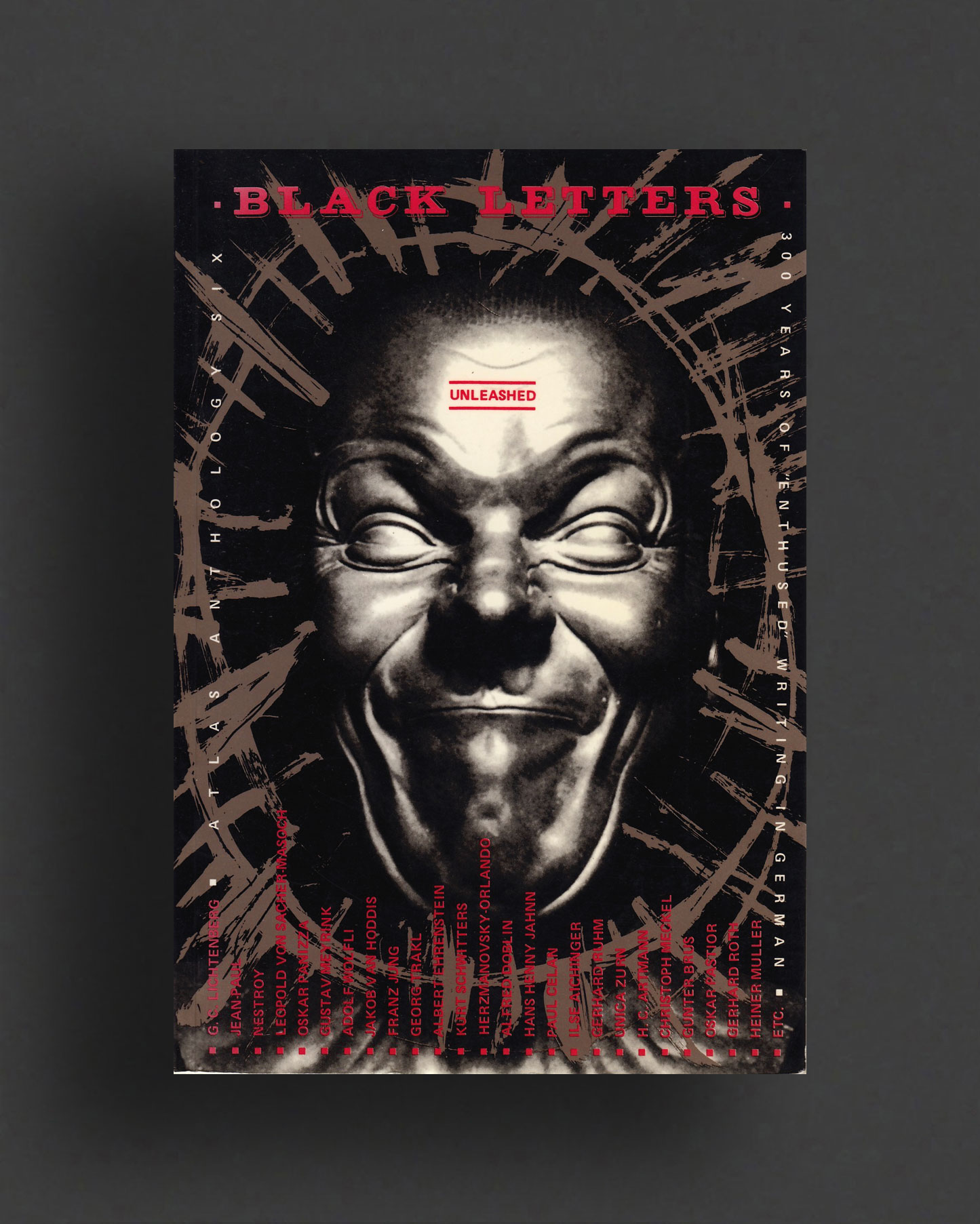
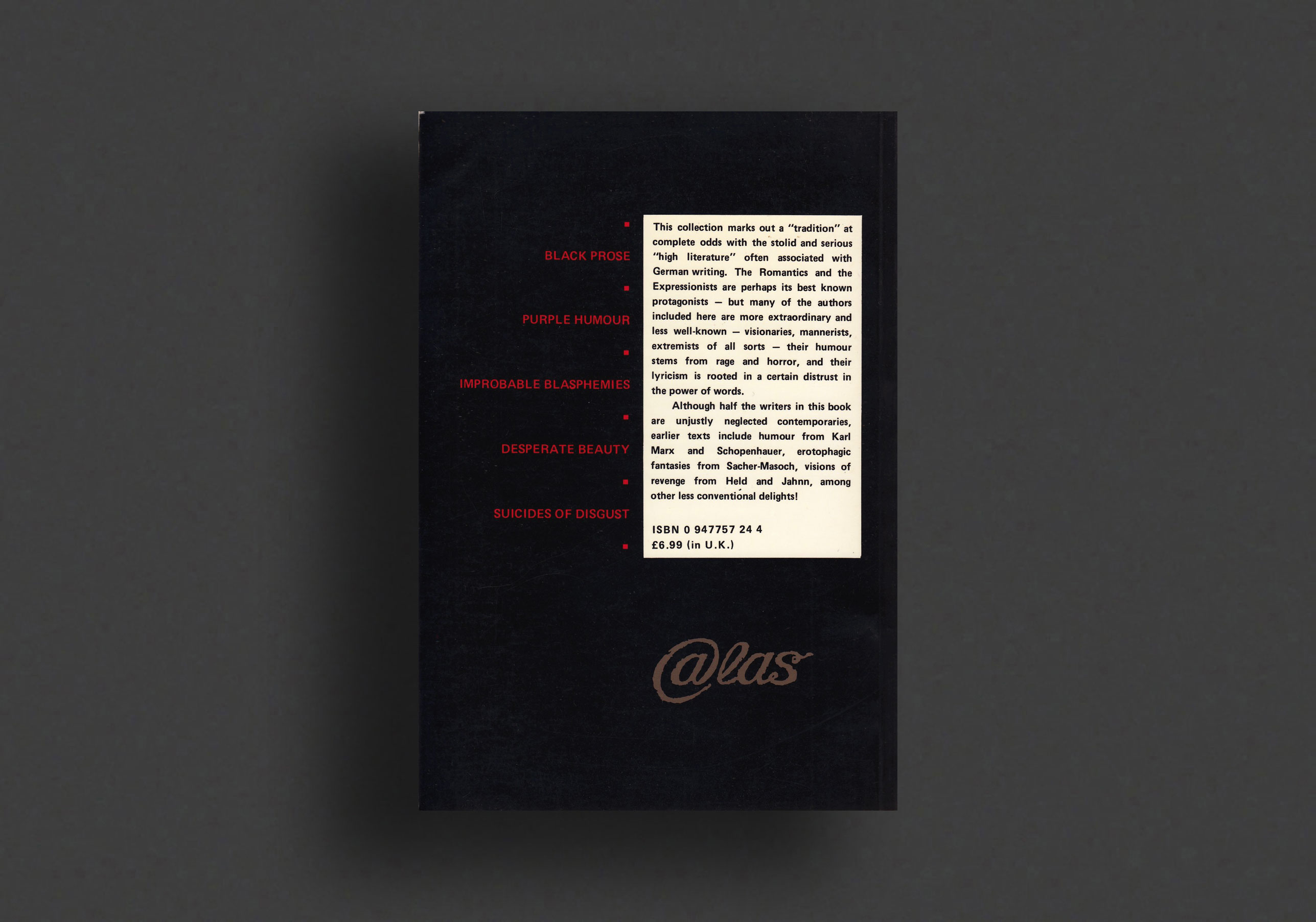
Black Prose, Purple Humour, Improbable Blasphemies, Desperate Beauty, Suicides of Disgust
Rare copy of the long out–of–print Atlas Anthology 6, Black Letters Unleashed: 300 years of enthused writing in German, translated and introduced by Malcolm Green and published by Atlas Press in 1994.
This anthology contains an astounding selection of German weirdness, fanaticism and general literary extremism. The critical reaction to it was one of astonishment and incomprehension, in particular as regards its mix of world-famous names with figures of utter obscurity, even to specialists — something we still see as a great virtue!
"This collection marks out a "tradition" at complete odds with the stolid and serious "high literature" often associated with German writing. The Romantics and the Expressionists are perhaps its best known protagonists - but many of the authors included here are more extraordinary and less well-known - visionaries, mannerists, extremists of all sorts - their humour stems from rage and horror, and their lyricism is rooted in a certain distrust in the power of words. Although half the writers in this book are unjustly neglected contemporaries, earlier texts include humour from Karl Marx and Schopenhauer, erotophagic fantasies from Sacher-Masoch, visions of revenge from Held and Jahnn, among other less conventional delights!"
Texts by Ilse Aichinger, H.C. Artmann, Wolfgang Bauer, Günter Brus, Gottfried Bürger, Paul Celan, Alfred Döblin, Albert Ehrenstein, Johannes Fischart, Franz Grillparzer, Ferdinand Hardekopf, Georg Heym, Franz Held, Wieland Herzefelde, Fritz von Hermanovsky-Orlando, Jacob van Hoddis, E.T.A. Hoffmann, Jean Paul Jacobs, Hans Henny Jahnn, Jean Paul, Franz Jung, Ingomar Kieseritsky, Erna Kröner, Quirinus Kuhlmann, Christoph Meckel, Imtraud Morgner, Heiner Müller, Oskar Pastior, Peter Pongratz, Elsa Lasker-Schuler, G.C. Lichtenberg, Karl Marx, Gustav Meyrink, Nestroy, Friedrich Nietzsche, Novalis, Oskar Panizza, Stanislaw Przybyszewski, Gerhard Roth, Gerhard Rühm, Leopold von Sacher-Masoch, Heinrich Schaefer, Paul Scheerbart, Arthur Schopenhauer, Kurt Schwitters, Max Stirner, Monica Tornow, Georg Trakl, Adolf Wöffli, Ror Wolf, Unica Zurn.
Very Good copy, only very light wear.
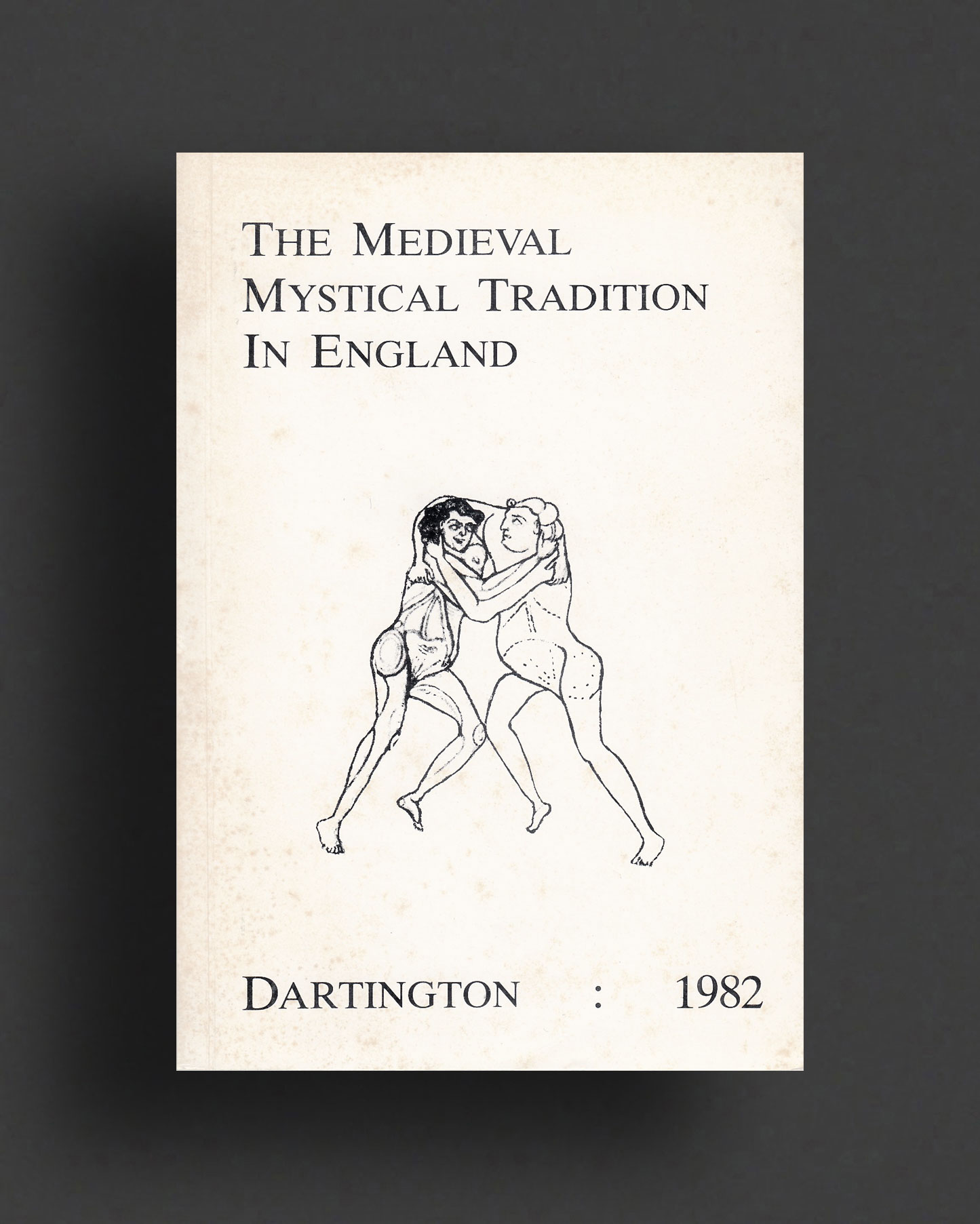
1982, English
Softcover, 262 pages, 21 x 14.5 cm
1st Edition, Out of print title / used / good
Published by
University of Exeter / IK
$65.00 - In stock -
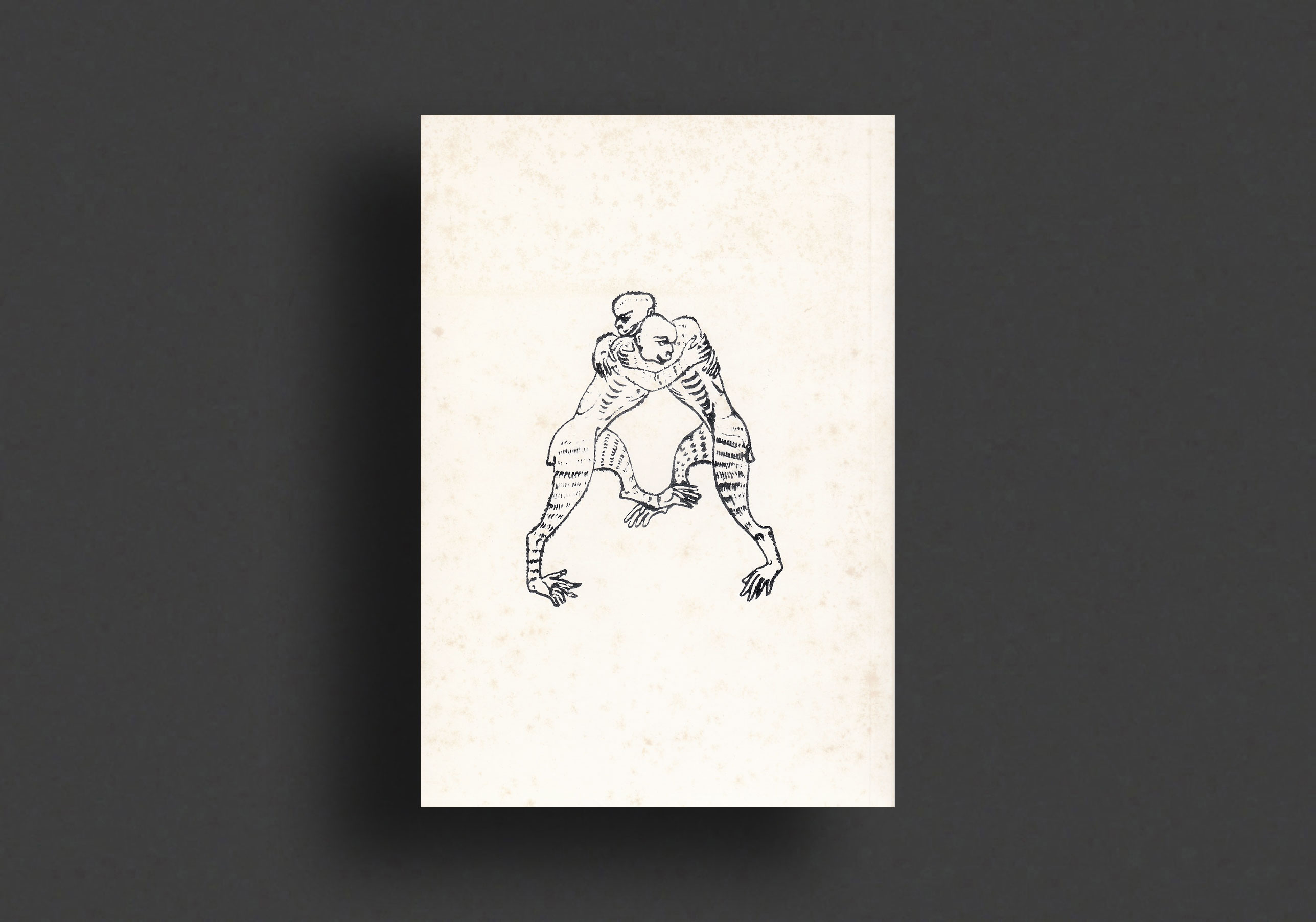
Very rare first 1982 edition of the first collection published by the University of Exeter, "The Medieval Mystical Tradition in England: Papers Read at Dartington Hall, July 1982", collecting scholarly essays exploring medieval mysticism through diverse academic disciplines. It covers significant figures and topics such as Henry Suso, the sources for The Cloud of Unknowing, and the contemplative traditions of figures like Julian of Norwich. The contributors approach medieval mysticism from a range of perspectives, including literary, historical, theological and psychological points of view.
G—VG copy with light wear/foxing to spine edge, back cover. Original volume from 1982, not the print–on–demand version from the 2006 (Liverpool) or the later collections from 1984 of the 1990s. This first Exeter issue is rarely seen.
1973, English
Hardcover (w. dust jacket), 396 pages, 24 x 16.5 cm
1st Edition, Out of print title / used / very good
Published by
Quadrangle / New York
$20.00 - In stock -
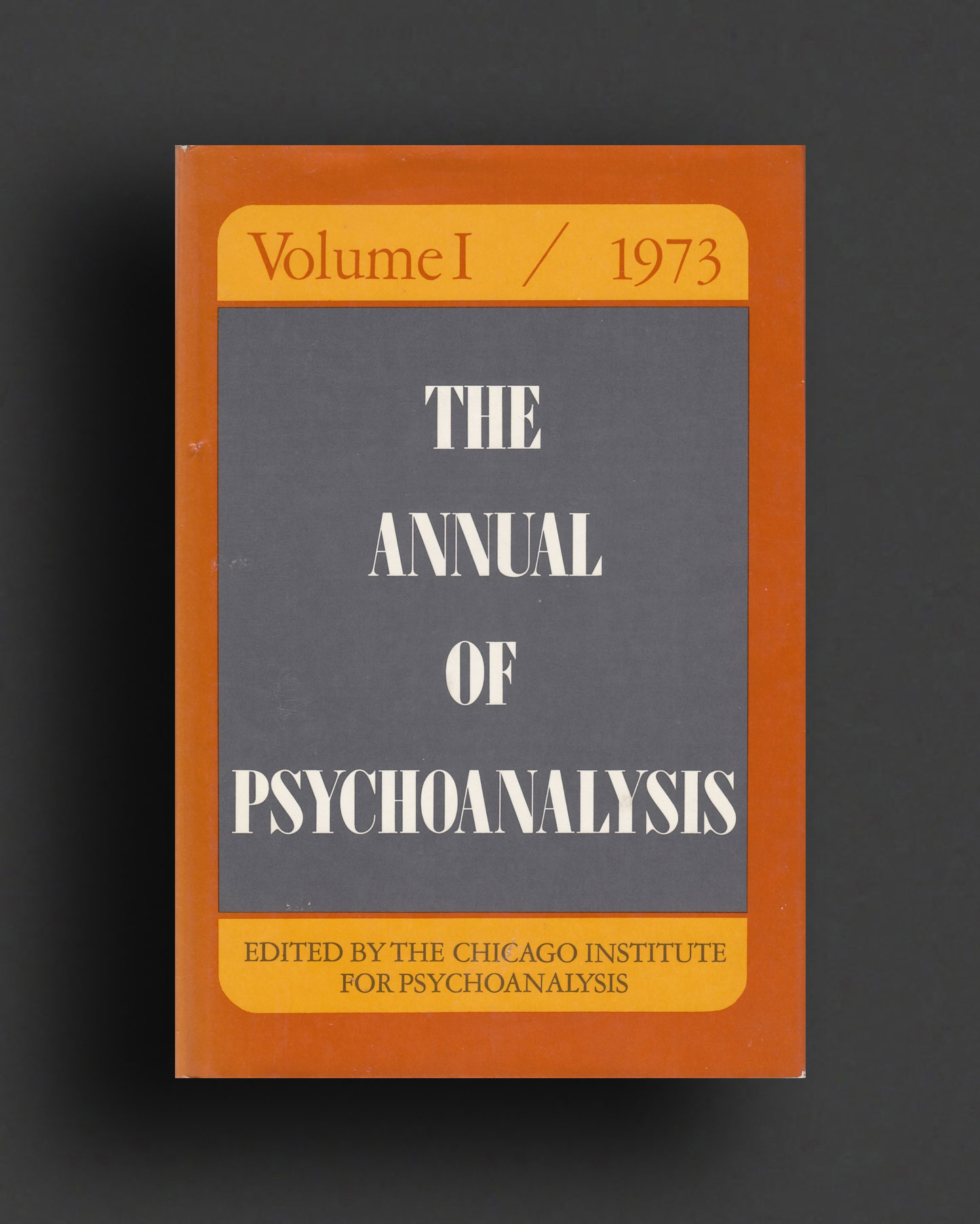
Inaugural hardcover edition of this heavy annual edited by the Chicago Institute for Psychoanalysis in 1973.
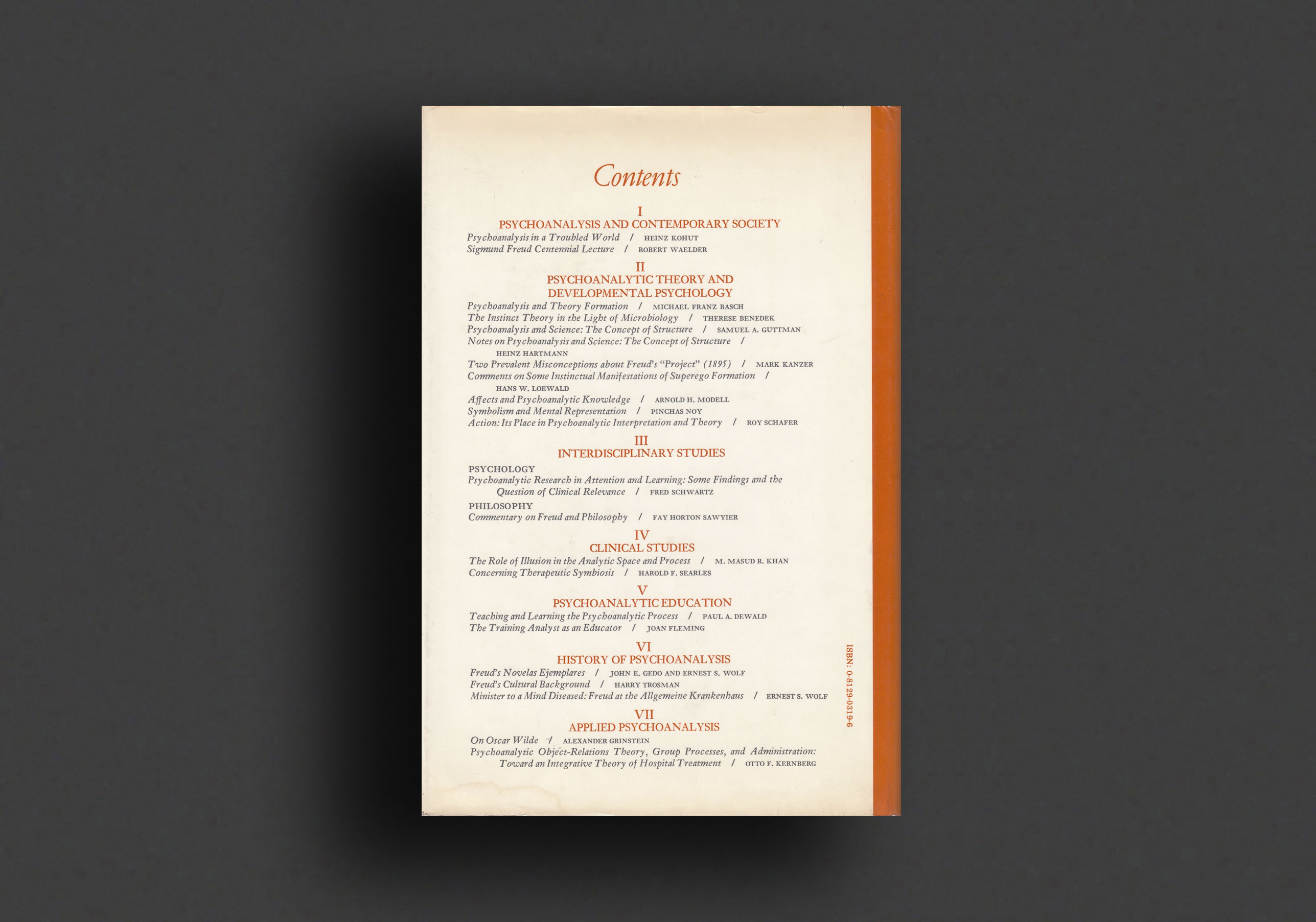
Contents:
I
Psychoanalysis and Contemporary Society
Psychoanalysis in a Troubled World / Heinz Kohut
Sigmund Freud Centennial Lecture / Robert Waelder
II
Psychoanalytic Theory and Developmental Psychology
Psychoanalysis and Theory Formation / Michael Franz Basch
The Instinct Theory in the Light of Microbiology / Therese Benedek
Psychoanalysis and Science: The Concept of Structure / Samuel A. Guttman
Notes on Psychoanalysis and Science: The Concept of Structure / Heinz Hartmann
Two Prevalent Misconceptions about Freud’s “Project” (1895) / Mark Kanzer
Comments on Some Instinctual Manifestations of Superego Formation / Hans W. Loewald
Affects and Psychoanalytic Knowledge / Arnold H. Modell
Symbolism and Mental Representation / Pinchas Noy
Action: Its Place in Psychoanalytic Interpretation and Theory / Roy Schafer
III
Interdisciplinary Studies
Psychology
Psychoanalytic Research in Attention and Learning: Some Findings and the Question of Clinical Relevance / Fred Schwartz
Philosophy
Commentary on Freud and Philosophy / Fay Horton Sawvier
IV
Clinical Studies
The Role of Illusion in the Analytic Space and Process / M. Masud R. Khan
Concerning Therapeutic Symbiosis / Harold F. Searles
V
Psychoanalytic Education
Teaching and Learning the Psychoanalytic Process / Paula Dewald
The Training Analyst as an Educator / Joan Fleming
VI
History of Psychoanalysis
Freud’s Novelas Ejemplares / John E. Gedo and Ernest S. Wolf
Freud’s Cultural Background / Harry Trosman
Minister to a Mind Diseased: Freud at the Allgemeine Krankenhaus / Ernest S. Wolf
VII
Applied Psychoanalysis
On Oscar Wilde / Alexander Grinstein
Psychoanalytic Object-Relations Theory, Group Processes, and Administration: Toward an Integrative Theory of Hospital Treatment / Otto R. Kernberg
G with foxing/marking to top block edges, otherwise VG in VG DJ.
1990, English
Softcover, 126 pages, 22 x 14 cm
1st Edition, Out of print title / used / very good
Published by
Yale University Press / New Haven
$15.00 - In stock -
Translated by Edward Quinn.
In this highly acclaimed book, one of the most prominent theologians in the world offers a theological and psychoanalytic assessment of Freud's atheism and of its implications for current psychoanalytic practice. In the original section of the book, now entitled "God--An Infantile Illusion?," Hans Kung traces Freud's views on religion and religious longing, compares Jung's and Adler's attitudes toward religion, shows that Freud's arguments against the existence of God are theologically unsound, and concludes with a frank and provocative discussion of what psychoanalysis may be able to teach the Christian Church. In a new section, "Religion--The Final Taboo?," Kung points out that religions still plays a negligible role in the practice of psychoanalysis, despite its increasing importance in the lives of most people. Has religion replaced sex, Kung asks, as an integral facet of human experience ignored or repressed by the very profession that seeks to enlighten?
"This should stand as one of Dr. Kung's finest works."—Edmund Fuller, Wall Street Journal
Hans Küng was a Swiss Catholic priest, theologian, and author. He was a leading and often controversial figure in modern Catholic thought, known for his critique of papal infallibility and his advocacy of a re-examination of Catholic doctrine.
VG copy of the 1990 edition.
1966, English
Softcover, 310 pages, 21.5 x 14 cm
Out of print title / used / very good
Published by
Ernest Benn / London
$40.00 - In stock -
1966 English edition of The Psychopathology of Everyday Life by Sigmund Freud, a seminal work in the field of psychology, published by Ernest Benn, London. Translated by Alan Tyson, Edited by James Strachey. The Psychopathology of Everyday Life explores the hidden meanings and motivations behind everyday actions such as slips of the tongue, forgetfulness, bungled actions, errors, and superstitions.
Psychopathology of Everyday Life (German: Zur Psychopathologie des Alltagslebens) is a 1901 work by Sigmund Freud, the founder of psychoanalysis. Based on Freud's researches into slips and parapraxes from 1897 onwards, it became perhaps the best-known of all Freud's writings. It was originally published in the Monograph for Psychiatry and Neurology in 1901, before appearing in book form in 1904. It would receive twelve foreign translations during Freud's lifetime, as well as numerous new German editions, with fresh material being added in almost every one. James Strachey objected that "Almost the whole of the basic explanations and theories were already present in the earliest edition...the wealth of new examples interrupts and even confuses the mainstream of the underlying argument"
Studying the various deviations from the stereotypes of everyday behavior, strange defects and malfunctions, as well as seemingly random errors, the author concludes that they indicate the underlying pathology of the psyche, the symptoms of psychoneurosis.
G—VG copy with light general wear/age.
1998, English
Softcover, 278 pages, 23.5 x 15.5 cm
1st Edition, Out of print title / used / very good
Published by
Routledge / London
$45.00 - In stock -
The work of the French literary review, intellectual grouping and publishing team Tel Quel had a profound impact on the formation of literary and cultural debate in the 1960s and 70s. Its legacy has had enormous influence on the parameters of such debate today. From its beginning in 1960 to its closure in 1982, it published some of the earliest work of Jacques Derrida, Julia Kristeva, Michel Foucault and Roland Barthes. It was also associated with some of the key ideas of the French avant-garde, publishing key articles by Georges Bataille and Antonin Artaud.
The Tel Quel Reader presents for the first time in English the key essays written by the Tel Quel group. Essays by Julia Kristeva, one of the review's editor's Michel Foucault, and a fascinating interview with Roland Barthes are here made available for the first time in English. It provides a unique insight into the post-structuralist movement and presents some of the pioneering essays on literature and culture, film, semiotics and psychoanalysis.
Assembling key essays from over a twenty-year period, The Tel Quel Reader is an indispensible resource for students of literature, cultural and visual studies, philosophy and French studies.
'This collection includes the most important essays and gives an excellent picture of Tel Quel’s work and evolution over time.'—Fredric Jameson, Duke University
'This reader will prove extremely valuable to structuralist and post-structuralist literature sholars.'—Library Journal
VG copy with some wear/age to corners.
1996, English
Softcover, 238 pages, 23.5 x 15.5 cm
1st Edition, Out of print title / used / very good
$25.00 - In stock -
Based on the concept of radical evil, an evil at the very heart of the ethical problematic, this book focuses on the modern or political notion of evil as it takes shape in Kant, as it is prefigured by Machiavelli and later developed by Schelling.
Contributors are Slavoj Žižek, Jacob Rogozinski, Juliet Flower MacCannell, Andrew Hewitt, Alenka Zupančič, Gerald Sfez, Renata Salecl, Michael Geyer, and Joan Copjec.
Radical Evil, the second volume in the S series, marks the two-hundredth anniversary of the publication of Kant’s Religion without the Limits of Reason Alone, where Kant first proposed, and quickly withdrew in horror, the concept of radical evil—an evil at the very heart of the ethical problematic. It also marks the recent publication in English of Lacan’s Ethics of Psychoanalysis, arguably one of the most important and influential of Lacan’s seminars, in which he discusses the rise since the nineteenth century of a certain ‘happiness in evil’.
The events of the twentieth century have made the assertions of both Lacan and Kant credible and concrete—the Holocaust and the attempts to cast doubt on its existence, the rise of racism worldwide, the engagement by philosophers with ethics as critical to relevant issues but without the consideration of the problems which lead Kant to his formation of radical evil.
The contributors to this volume were asked to consider radical evil in its philosophical, political and cultural dimensions. What emerges is a clear introduction to the problematic, including discussions of the Holocaust, the placement of homosexuals in concentration camps, the creation of the Machiavellian in politics and literature—a full and fascinating exploration of the radical nature of modern evil.
VG copy. First 1996 ed.
1994, English
Softcover, 224 pages, 23.5 x 15.5 cm
1st Edition, Out of print title / used / very good
Published by
Verso / London
$18.00 - In stock -
Contributions by Parveen Adams, Étienne Balibar, Homi Bhabha, Mikkel Borch-Jacobsen, Mladen Dolar, Elizabeth Grosz, Juliet Flower MacCannell, Charles Shepherdson, Slavoj Žižek
The psychoanalytic subject in modern culture and politics A collection of essays by theorists in culture and politics. Experts from a variety of fields re-examine the origins of the subject as understood by Descartes, Kant and Hegel, and consider contemporary ideas that revive the subject, including queer theory and national identity.
G—VG copy with wear to corners/edges. First 1994 ed.
1995, English
Softcover, 244 pages, 23 x 15.5 cm
1st Edition, Out of print title / used / very good
Published by
The MIT Press / Massachusetts
$25.00 - In stock -
"By examining the rise and fall of psychoanalysis, Freud's Dream provides an extended case study of the appeal and potential dangers of the interdisciplinary approach to theory construction now guiding cognitive science, as well as a novel interpretation of Freud's own program. Kitcher argues that Freud's grand scheme for psychoanalysis was nothing less than a blueprint for a complete interdisciplinary science of mind, that many of its strengths and weaknesses derived from this fact, and that Freud's errors are instructive for current work in cognitive science.
"Freud's Dream is a first-rate study in the philosophy of science which traces the undoing of Freud's program to the interdisciplinary nature of his project, the closed epistemological structure of the psychoanalytic institutes, and the resulting homogeneity of the psychoanalytic community.
Kitcher makes a convincing case that the interdisciplinary commitments of contemporary cognitive science makes it prone to some of the same problems that undid Freud's program."—Owen Flanagan, Professor of Philosophy, Duke University
Patricia Kitcher is Professor of Philosophy at the University of California, San Diego, and former President of the Society for Philosophy and Psychology.
VG copy. First 1995 ed.
1989, English
Softcover, 206 pages, 23 x 15.5 cm
1st Edition, Out of print title / used / very good
Published by
Cornell University Press / New York
$85.00 - In stock -
First 1989 edition.
Translated by Catherine Porter
With a Foreword by Ned Lukacher
Seeking to redefine the problematic relation of language and the body, Monique David-Ménard here explores and revises the major psychoanalytic theories of hysteria. First published in French in 1983, Hysteria from Freud to Lacan is now available in English in a lucid and elegant translation by Catherine Porter.
David-Ménard closely examines the most influential psychoanalytic texts on hysteria, from Freud's theories of conversion and associative hysteria to Lacan's theory of jouissance and the hysterical body.
Identifying the foundations of a metapsychology of movement in which unconscious formations are related to the development of motor-muscular coordination, she illuminates a broad range of theoretical and clinical issues concerning hysteria, including the language of bodily movement, the character of feminine jouissance, and the psychoanalysis of tics. Although the conceptual framework within which David-Ménard writes is Lacanian, Hysteria from Freud to Lacan provides a trenchant reassessment of Lacan's theories. In David-Ménard's view, the Lacanian interrogation of hysteria has not, for all its apparent originality, moved significantly beyond Freudian discoveries.
Through persuasive new interpretations of Freud's Studies on Hysteria and his case history of Dora, and Lacan's Séminaires, she demonstrates that the language of the hysterical body becomes readable as a relation between the erogenous body and linguistic structures. David-Ménard also undertakes penetrating analyses of essays by early Freudians such as Ferenczi, Klein, Feldmann, Sadger, and Landauer.
All readers concerned with psychoanalytic theory and the history of analysis, including psychoanalysts, philosophers, and feminists working in a variety of fields, will welcome this translation of David-Ménard's brilliant study of the relations between theory and hysteria.
MONIQUE DAVID-MÉNARD is a practicing psychoanalyst and teaches philosophy in Paris.
CATHERINE PORTER has translated many books, including Sarah Kofman's The Enigma of Woman: Woman in Freud's Writings and Luce Irigaray's This Sex Which Is Not One, both available from Cornell University Press
VG—NF first edition.
1992, English
Hardcover (w. dust jacket), 595 pages, 24 x 16 cm
1st Edition, Out of print title / used / very good
Published by
Basic Books / New York
$120.00 - In stock -
Rare first hardcover edition, published in 1992.
A stunning revelation of the eerie likeness between schizophrenic insanity and the sensibility of modern art, literature, and thought, Madness and Modernism presents a vivid and highly original portrait of the world of the madman, along with a provocative commentary on modernist and postmodernist culture. Sass, a clinical psychologist, explores the bizarre experiences of schizophrenia (and related conditions) through a comparison with the works of various artists and writers, including Franz Kafka, Paul Valery, Samuel Beckett, Alain Robbe-Grillet, Giorgio de Chirico, and Marcel Duchamp, and by considering the ideas of philosophers such as Friedrich Nietzsche, William James, Martin Heidegger, Michel Foucault, and Jacques Derrida.
The similarities between madness and modernism are striking: defiance of authority and convention; an extreme, often dizzying relativism, which can culminate in paralysis; nihilism and all-embracing irony; a tantalizing, uncanny, but always frustrating sense of revelation; obliteration of standard forms of time and narrative; pervasive dehumanization; and disappearance of external reality in favor of the omnipotent ego or, alternatively, dissolution of all sense of selfhood.
This rigorously argued, gracefully written book offers a startlingly new vision of schizophrenia, an illness long recognized as the greatest challenge to psychiatric or psychological understanding. Conventionally seen as a loss of rationality, perhaps involving a return to some infantile or bestial condition, schizophrenia, according to Sass, is better understood as, in a sense, a disease of hyperrationality, with detachment from action, emotions, and the body and entrapment in forms of acute self-consciousness and heightened awareness. Sass refuses to romanticize the schizophrenic as a heroic rebel, mystic, or passionate Wildman, arguing instead that this condition echoes many of the most alienating aspects of modern life. In an epilogue and appendix, he considers whether modern culture might actively contribute to the genesis or shaping of schizophrenic forms of pathology, and he discusses the possible role of abnormalities of the brain.
VG copy in VG–NF DJ. Some block tanning.
1994, English
Hardcover (w. dust jacket), 178 pages, 24 x 16 cm
1st Edition, Out of print title / used / very good
Published by
Cornell University Press / New York
$80.00 - In stock -
First 1994 hardcover edition.
“I regard Dr. Sass’s investigations of schizophrenia as the most important and interesting contemporary work in this field. Our field is full of simplistic theories of causation, including causation of schizophrenia, even when the essential nature of the condition is not clear. Dr. Sass has taken important steps, the latest being this book, toward rectifying this weakness. I admire his work and applaud him for it.”—David Shapiro, author of Neurotic Styles
“This imaginative book sets out to challenge one of the most cherished beliefs of clinicians, namely, the pathological nature of delusional utterances. Whether or not one agrees with Dr. Sass’s conclusions, tour de force is the most apposite term to describe this erudite and well-written work, which should feel like a breath of fresh air in the increasingly dry cloisters of biological psychiatry.”—G. E. Berrios, Editor, History of Psychiatry
“The Paradoxes of Delusion presents a novel, interesting, and altogether persuasive interpretation of the most important psychotic case of modern times. An excellent writer, Sass has fashioned what might have been a highly abstract analysis into an exciting story. Its texture and lively tone will appeal to the general intellectual public.”—Paul Robinson, Stanford University
“Sass’s conception of schizophrenia parallels many of the cultural manifestations of twentieth-century life. A clearly written, well-argued book that will have a lot of people talking about it.”—Sander L. Gilman, Cornell University
VG First 1994 HC copy w. VG DJ.
1987, English
Softcover, 112 pages, 22 x 13.5 cm
1st Edition, Out of print title / used / very good
Published by
Verso / London
$30.00 - In stock -
First 1987 edition.
Translated by Nicole Ball
With an Introduction by Ann Rosalind Jones
In this passionately written and controversial book, first published in France in 1978, Catherine Clément, Communist, feminist and analysand, asks what the social function of psychoanalysis should be and condemns what it has become.
She attacks psychoanalysis as an institution disdainful of treatment and cure, serving the interests of a new intelligentsia, the nouveaux riches of a narcissistic literary culture and publishing industry. Contrasting the insights of psychoanalytic theory to the obsessive imitations of Jacques Lacan by those who followed him as a practitioner-trainer, she offers an anthropological perspective and a political critique of Parisian psychoanalysis as a profession. How has the attentive ear of the analyst become deaf to questions about the social and political meaning of his or her work? Does a woman who is both a socialist and an analysand necessarily hear such questions more clearly and answer them differently? Clément reflects on her own history, the history of psychoanalysis and the history of the French left to demonstrate what an activist and feminist restoration of psychoanalysis could be.
"A work of ferocious humour and loving spite. What, she asks herself (and us loud and direct, are psychoanalysts for?"—LE NOUVEL OBSERVATEUR
VG copy, light wear/marking to block edges.
1993 / 1996, English
Softcover, 394 pages, 24 x 15.5 cm
1st Edition, Out of print title / used / very good
Published by
Cornell University Press / New York
$45.00 - In stock -
"Fetishism as Cultural Discourse is particularly impressive for its historical and interdisciplinary scope, for its serious effort to tackle the difficult problems posed in articulating the three distinct, and often competing, traditions of inquiry around the subject of fetishism-Marxist, psychoanalytic, and anthro-pological. I am also impressed by the range and quality of individual contributions. This important collection will be much discussed and will open new interdisciplinary discussions."—Sharon Willis, University of Rochester
"There is no other collection of essays on fetishism available in English, and this book will fill a significant gap. The crucial conjunction between psychoanalysis and Marxism runs through the most challenging essays and makes the book a landmark."—Laura Mulvey, author of Visual and Other Pleasures
What is fetishism? Sixteenth-century European merchants in Africa identified fetishes as magical charms worshiped by peoples they found incomprehensible. Eighteenth-century philosophers claimed fetishes were primitive personifications, the origin of all religion and superstition. Marx viewed the seductive commodities and magic money of capitalist society as fetishes. Fin-de-siècle psychiatrists found fetishes in the erotic fixations of sexual deviants, while Freud declared them to be representations of castration anxiety. Theorists of modern art have suggested that a fetish is any artifact that shocks our sensibility and taps the well of our deepest passions.
This landmark collection of sixteen essays—most of them previously unpublished—brings together leading scholars from a variety of disciplines, as well as prominent artists and filmmakers, to re-examine the enduring problem of fetishism. Certain essays explore fin-de-siècle psychiatry's construction of sexual fetishism as a response to cultural fears aroused by decadent aesthetes, cross-dressing women, and the perceived degeneration of national virility. Other essays consider theories of female and lesbian fetishism or the fetishism of commodities, capital, and the state. Still others regard fetishism in visual culture, from Dutch still-life paintings to the obsessive photographs of a nineteenth-century countess and of Robert Mapplethorpe, to recent feminist art by Barbara Bloom and Mary Kelly.
Illustrated with twenty-two halftones and drawings, Fetishism as Cultural Discourse will engage and challenge a wide audience of academic and nonacademic readers, including specialists and students in the fields of anthropology, history, literature, film, psychoanalysis, visual arts, feminist theory, Marxian criticism, and cultural studies.
Contributors: Jack Amariglio. Emily Apter. Charles Bernheimer. Barbara Bloom. Antonio Callari.
Hal Foster. Elizabeth Grosz. Thomas Keenan. Mary Kelly. Jann Matlock. Jeffrey Mehlman. Kobena Mercer. Robert A. Nye. William Pietz. Naomi Schor. Abigail Solomon-Godeau. Michael Taussig. Jane Weinstock.
Emily Apter is Professor of French and Italian at the University of California, Davis. She is the author of Feminizing the Fetish: Psychoanalysis and Narrative Obsession in Turn-of-the-Century France (also from Cornell).
William Pietz has taught at Georgetown University, Pitzer College, and the University of California, Santa Cruz. His publications include a series of essays on the problem of fetishism in Res: A Journal of Aesthetics and Anthropology.
VG copy. 1996 edition with Mary Kelly cover artwork.
1992, English
Softcover, 219 pages, 23 x 15.5 cm
1st Edition, Out of print title / used / very good
Published by
Fordham University Press / New York
$35.00 - In stock -
The introduction by Merold Westphal sets the scene: “Two books, two visions of philosophy, two friends and sometimes colleagues. . . .” This book is an attempt at a mediated dialogue between the critical modernism of Marsh’s Post-Cartesian Meditations, deeply indebted to the thought of Jürgen Habermas, and the postmodernism of Caputo’s Radical Hermeneutics, equally indebted to the thought of Jacques Derrida. Their distinctive embodiments of these two major movements in contemporary philosophy are by no means simply the exposition and defense of Habermas and Derrida, for Marsh and Caputo bring to the discussion their own long formation in continental philosophy as interpreted and practiced in North America. Moreover, given their even longer formation in the Christian tradition, they are not bound by the dogmatic secularism of Habermas and Derrida. But the point of contact is not so much religious as political, and the fundamental question concerns the role that reason may play in building a humane society. It is in their differing estimates of reason’s nature and possible political function that the disagreements are most sharply focused. Thus the epistemological debate is driven by political passion and properly concerns the viability of the Enlightenment dream that knowledge could indeed be enlightening and humanizing.
Westphal is especially well suited to attempt to mediate the debate because he not only shares with Caputo and Marsh a long formation in both continental philosophy and the Christian faith, but he is deeply sympathetic to both critical modernism and postmodernism. Caputo finds him to be almost as hopeless a rationalist as Marsh, while Marsh finds him to flirt almost as shamelessly with irrationality as Caputo. Westphal seeks to argue, not for a synthesis of the two perspectives, but for a willingness to live in the tension between the two.
James L. Marsh and Merold Westphal are Professors of Philosophy at Fordham University, and John D. Caputo is Professor of Philosophy at Villanova University.
VG copy, first 1992 ed.
1988, English
Hardcover (w. dust jacket), 188 pages, 22 x 14.5 cm
1st Edition, Out of print title / used / fine
Published by
John Hopkins University Press / Baltimore
$35.00 - In stock -
Translated with introduction by Jon R. Snyder
Gianni Vattimo reexamines the roots of modernism and postmodernism in Nietzsche, Benjamin, and Heidegger. Exploring the links between concepts of nihilism and destiny in nineteenth-century humanism, Vattimo follows these trends in aesthetic and scientific theory from Benjamin to Bloch, Ricoeur, and Kuhn.
"Sharp and deceptively simple essays."—Brian Rotman, Times Literary Supplement.
Fine copy, first edition hardcover.
1970, English
Softcover, 724 pages, 20.5 x 13.5 cm
1st Edition, Out of print title / used / good
Published by
Farrar Straus & Giroux / New York
$40.00 - In stock -
"This book has saved me millions of dollars"—BERNARD M. BARUCH
The poet Schiller once said: "Anyone taken as an individual is tolerably sensible and reasonable—as a member of a crowd he at once becomes a blockhead." Extraordinary Popular Delusions is a fascinating study of crowd psychology and mass manias; a casebook of human folly through the ages. Included are full accounts of the Mississippi Scheme that swept France in 1720; the South Sea Bubble that ruined thousands in England at the same time; the Tulipmania of Holland, when fortunes were made and lost on single tulip bulbs. Other chapters deal with fads and delusions that often spring from valid ideas and causes-many of which have their followers today: Alchemy and the Philosopher's Stone, the Rosecrucians, Prophecies of Judgment Day, the Coming of Comets, Astrology, Necromancy, Father Hell and Magnetism, Anthony Mesmer and Mesmerism, the Influence of Politics and Religion on the Hair and Beard, Sorcery and the Burning of "Witches," the Traffic in Relics, the Popularity of Murder by Slow Poisoning, Ghosts and Haunted Castles, the Hero-Worship of Common Thieves.
Bernard M. Baruch writes in his foreword: "Some years ago a friend gave me a copy of Extraordinary Popular Delusions. In a vague way I had been familiar with the stark fact of these events, as who is not? But I did not know—and I think there is not elsewhere so engagingly, carefully and comprehensively related—the astonishing circumstances of each of the greater delusions of earlier eras. I have always thought that if in 1929 we had all continuously repeated 'two and two still make four,' much of the evil might have been averted."
1970 edition, with facsimile title pages and reproductions from the editions of 1741 and 1852. Good—VG copy with some general light wear, spine creasing, foxing to block edge.
1996, English
Hardcover (w. dust jacket), 350 pages, 24 x 15 cm
1st Edition, Out of print title / used / fine
Published by
The MIT Press / Massachusetts
$80.00 - In stock -
First 1996 hardcover edition.
In this sweeping challenge to the postmodern critiques of psychoanalysis, Joel Whitebook argues for a reintegration of Freud's uncompromising investigation of the unconscious with the political and philosophical insights of critical theory. Perversion and Utopia follows in the tradition of Herbert Marcuse's Eros and Civilization and Paul Ricoeur's Freud and Philosophy. It expands on these books, however, because of the author's remarkable grasp not only of psychoanalytic studies but also of the contemporary critical climate; Whitebook, a philosopher and a psychoanalyst, writes with equal facility on both Habermas and Freud.
A central thesis of Perversion and Utopia is that there is an essential affinity between the utopian impulse and the perverse impulse, in that both reflect a desire to bypass the reality principle that Freud claimed to define the human condition. The book explores the positive and negative aspects of the relationship between these impulses, which are ubiquitous features of human life, and the requirements of civilized social existence.
Whitebook steers a course between orthodox psychoanalytic conservatism, which seeks simply to repress the perverse-utopian impulse in the name of social continuity and cohesion, and those forms of Freudo-Marxism, postmodernism, and psychoanalytic feminism that advocate its direct and full expression in the name of emancipation. While he demonstrates the limitations of the current textual approaches to Freud, especially those influenced by Lacan, Whitebook also enlists the lessons of psychoanalysis to counteract the excessive rationalism of the Habermasian brand of critical theory, thus making a substantial contribution to current discussions within critical theory itself. His analysis and interpretation of perversion, narcissism, sublimation, and ego bring new insight to these central and thorny issues in Freud, and his discussions of Adorno, Marcuse, Castoriadis, Habermas, Ricoeur, Lacan, and others are equally penetrating.
VG—NF copy in VG—NF DJ, preserved in mylar wrap.
1993, English
Softcover, 230 pages, 23 x 15.5 cm
1st Edition, Out of print title / used / very good
Published by
University of Minnesota Press / Minnesota
$40.00 - In stock -
In recent years, the disciplines of philosophy, linguistics, anthropology, sociology, and psychology have increasingly focused on the states of emotion and passion. In what many consider a reaction to the abstraction of theory, certain scholars have now decided to explore whether various productions of the body can be folded into the space of epistemology.
In this powerful and thought-provoking investigation of the multifaceted complexity of literary object-semiotics, Algirdas Julien Greimas and Jacques Fontanille explore the possibility that so-called subjective states— affect, feeling, emotion, passion, avarice, honor, and jealousy—and their multiple mediations can have a semiotic existence. The Semiotics of Passions raises provocative questions: What are the necessary conditions for the existence of passion? Can passion be submitted to a logic of language? Does passion allow systemic semiotic transformations?
Starting from the premise that a meaningful world involves the "subject" in the "state of affairs," Greimas's and Fontanille's investigation of complex "psychic states" takes them through texts in philosophy and literature from the seventeenth to the twentieth century, including the works of Descartes, Spinoza, Shakespeare, and Proust. Singular in its approach to this fascinating topic, The Semiotics of Passions will advance and refine semiotics in general and literary semiotics in particular.
VG copy. 1st 1993 ed.
1977, English
Softcover, 244 pages, 22.5 x 15 cm
Reprint,
1st Edition, Out of print title / used / very good
Published by
University of California / Berkeley
$30.00 - In stock -
This excellent collection contains 13 essays from Gadamer's Kleine Schriften, dealing with hermeneutical reflection, phenomenology, existential philosophy, and philosophical hermeneutics. Gadamer applies hermeneutical analysis to Heidegger and Husserl's phenomenology, an approach that proves critical and instructive.
VG—NF copy, 1977 edition, later reprint.
1991 / 1996, English
Softcover, 356 pages, 22.5 x 15 cm
1st Edition, Out of print title / used / very good
Published by
Cambridge University Press / Cambridge
$35.00 - In stock -
Does Freud still have something to teach us? The premise of this volume is that he most certainly does. Approaching Freud from not only the philosophical but also historical, psychoanalytical, anthropological, and sociological perspectives, the contributors show us how Freud gave us a new and powerful way to think about human thought and action. They consider the context of Freud's thought and the structure of his arguments to reveal how he made sense of ranges of experience generally neglected or misunderstood. All the central topics of Freud's work from sexuality and neurosis to morality, art, and culture are covered.
VG copy. First 1991 edition, 1996 print.
1986, English
Softcover, 246 pages, 21.5 x 14 cm
1st Edition, Out of print title / used / very good
Published by
Cambridge University Press / Cambridge
$20.00 - In stock -
In this major study Rhiannon Goldthorpe takes up the challenge of Sartre's diversity in an original and provocative way. Her detailed and comprehensive exploration of the relationship between the theoretical and literary works pays due attention to their characteristic complexity. The discussion of La Nausée, Les Mouches, Huis clos, Les Mains sales and Les Séquestrés e'Altona, for example, does not present these literary texts as mere 'illustrations' of Sartre's theories of consciousness, imagination and emotion, but as subtle philosophical and linguistic investigations in their own right. In addition, by reference to recently published fragments from Sartre's earlier work, Goldthorpe calls into question existing views of Sartre's intellectual development and provides a new history of the crucial Sartrean concept of 'commitment'.
VG copy. First 1986 edition.
1995, English
Softcover, 156 pages, 23 x 14.6 cm
1st Edition, Out of print title / used / very good
Published by
Routledge / London
$15.00 - Out of stock
Using Sartre is an introduction to the philosophy of Jean-Paul Sartre, but it is not an ordinary introduction. It both promotes Sartrean views and adopts a consistently analytical approach to him. Concentrating on the early philosophy, up to and including Sarte's masterwork Being and Nothingness, Gregory McCulloch clearly shows how much analytical philosophy misses when it neglects Sartre and the continental tradition in philosophy.
In the classic spirit of analytical philosophy, this is a clear, simple and appealingly short exposition of the early work of Sartre. Written specifically for beginners and non-specialists, this book is sure to spark new interest in Sartre and the existentialists, while making a significant contribution to the development of analytical philosophy of mind as well.
"Using Sartre will be a welcome addition to the materials with the aid of which an analytically trained undergraduate can study Sartre's philosophy. The book immediately engages the reader with its directness and informality of style!"—John Compton, Vanderbilt University
Gregory McCulloch is Lecturer in Philosophy at the University of Nottingham. He is the author of The Game of the Name (1989) and of the forthcoming The Mind and Its World in the Routledge The Problems of Philosophy series.
2005, English
Softcover,
1st Edition, Out of print title / used / very good
Published by
Oxford University Press / New York
$25.00 - In stock -
Riddles of Existence makes metaphysics genuinely accessible, even fun. Its lively, informal style brings the riddles to life and shows how stimulating they can be to think about. No philosophical background is required to enjoy this book. It is ideal for beginning students. Anyone wanting to think about life's most profound questions will find Riddles of Existence provocative and entertaining.
"A series of hors d'oeuvres for intellectual diners.... The entertainment value lies in picking one's way through ingenious arguments, encountering along the way basic ideas like the law of the excluded middle and the principle of sufficient reason .... Mr. Conee and Mr. Sider like to start with a common-sense, real-life question— Why is the person in my baby picture the same as the person I see in the mirror today?-and then pick apart the comfortable assumptions that carry most of us. through life.... The questions are big. Do things occur by accident or necessity? Do humans have free will? Why does anything exist? Nothing is resolved, but a lot is discussed, and some famous arguments, like St. Anselm's devilishly clever proof of the existence of God, are presented clearly and understandably."—William Grimes, The New York Times
*...a thought-provoking, lucid and concise guided tour of metaphysics."—Ann Whittle, Mind
VG copy with inscription by author to Australian artist Bernhard Sachs. First 2005 edition.