World Food Books' programme is largely produced on Kulin Nation land. We acknowledge the Wurundjeri people of the Kulin Nation as the first and continuing custodians of this land, and pay respect to their Elders past, present, and emerging.
World Food Books is an arts and special interests bookshop in Naarm / Melbourne. Founded in 2010, World Food Books is devoted to the presentation of a rotating, hand-selection of international art, design, literary and counterculture publications with an emphasis on the anti-traditional, the experimental, the avant-garde, the heretic, the marginal.
Presenting new titles alongside rare and out-of-print books, catalogues and journals spanning the fields of modern and contemporary art, design, photography, illustration, film, literature, poetry, cultural theory, philosophy, sexuality, popular and underground culture in its many radical forms, World Food Books wishes to encourage adventurous, thoughtful and open-minded reading, looking, writing, and exchange of publishing and ideas, both current and historical.
As well as our bookshop, located in Melbourne's historical Nicholas Building, all of our inventory is available internationally via our online mail-order service.
World Food Books semi-regularly co-ordinates "Occasions", a programme of exhibits and events at the bookshop and in partnership with other hosts (such as museums and art galleries) that develop out of the activities, relationships and content of the bookshop itself.
World Food Books
The Nicholas Building
37 Swanston Street
Room 5, Level 6
Melbourne 3000
Australia
SHOP HOURS:
Thu–Fri 12–6, Sat 12–5
WEB-SHOP OPEN 24/7
World Food Books
Postal Address:
PO Box 435
Flinders Lane
Victoria 8009
Australia
Art
Theory / Essay
Architecture / Interior
Graphic Design / Typography
Photography
Fashion
Eros
LGBTQ+
Fiction / Poetry
Weird / Speculative / Science Fiction / Horror
Transgressive / Visceral / Abject
Symbolism / Decadence / Fin de siècle
Film / Video
Painting
Sculpture / Installation
Performance / Dance / Theater
Drawing
Sound / Music
Curatorial
Group Shows / Collections
Periodicals
Out-of-print / Rare
Posters / Ephemera / Discs
Signed Books
World Food Books Gift Voucher
World Food Book Bag
Australian Art
Australian Fiction
Australian Science Fiction / Speculative Fiction
Australian Poetry
Australian Photography
Japanese Photography
Conceptual Art
Minimal Art
Dada
'Pataphysics / Oulipo
Fluxus
Concrete Poetry
Pop Art
Surrealism
Arte Povera
Arte Informale / Haute Pâte / Tachism
Nouveau Réalisme / Zero / Kinetic
Situationism / Lettrism
Collage / Mail Art / Xerox Art
Art Brut / Folk / Visionary / Fantastic
Illustration / Graphic Art / Bandes Dessinées
Furniture
Italian Radical Design / Postmodernism
Textiles
Ceramics / Glass
Counterculture
Protest / Revolt
Philosophy
Psychoanalysis
Anthropology
Anarchism
Socialism / Anarchism / Communism / Capitalism
Literary Theory / Semiotics / Language
Feminism / Women's Studies
Gender Studies / Sexuality
Anthropology
Fetishism / BDSM
Drugs / Psychedelia
Crime / Violence
Animal Rights / Veganism
Occult / Esoterica
Ecology / Earth / Alternative Living
Whole Earth / Crafts
All prices in AUD (Australian dollars)
Pick-Ups
Pick-up orders can be collected in our bookshop during opening hours after order date. Please collect any Pick-up orders within 2 weeks of ordering as we have limited storage space. Orders will be released back into stock if not collected within this time. No refunds can be made for pick-ups left un-collected. If you cannot make it in to the bookshop in this time-frame, please choose postage option.
Return Policy
All sales are final. We do accept returns (for refund or exchange) for items received in error. All our orders are packed with special care using heavy-duty padding and cardboard book-mailers or bubble mailers (for smaller books), using reinforcement where required. We cannot take responsibility for any lost, stolen or damaged parcels.
Insurance
Should you wish to insure your package, please email us directly after placing your order and we can organise this at a small extra expense. Although all standard/express tracked packages are very safe and dependable, we cannot take responsibility for any lost, stolen or damaged parcels. We recommend insurance on valuable orders.
Interested in selling your old books, catalogues, journals, magazines, comics, fanzines, ephemera? We are always looking for interesting, unusual and out-of-print books to buy. We only buy books in our fields of interest and specialty, and that we feel we can resell.
We base these prices on desirability, market value, in-print prices, condition and our current stock levels. We offer cash, store credit, and can take stock on consignment. All
about 25% of the price we expect to get when we sell them, or 30% in store credit. We base these prices on desirability, market value, in-print prices, condition and our current stock levels.
Sell your books any day of the week. You can drop them off and return later. If you have a lot of books, we can visit your Sydney home.
We buy books that we feel we can resell. We offer about 25 % of the price we expect to get when we sell them, or 30% in store credit. We base these prices on desirability, market value, in-print prices, condition and our current stock levels.
Philadelphia Wireman
03 August - 01 September, 2018
World Food Books is proud to announce our next Occasion, the first presentation of sculptures by Philadelphia Wireman in Australia.
The Philadelphia Wireman sculptures were found abandoned in an alley off Philadelphia’s South Street on trash night in 1982. Their discovery in a rapidly-changing neighbourhood undergoing extensive renovation, compounded with the failure of all attempts to locate the artist, suggests that the works may have been discarded after the maker’s death. Dubbed the "Philadelphia Wireman" during the first exhibition of this work, in 1985, the maker’s name, age, ethnicity, and even gender remain uncertain. The entire collection totals approximately 1200 pieces, all intricately bound together with tightly-wound heavy-gauge wire (along with a few small, abstract marker drawings, reminiscent both of Mark Tobey and J.B. Murry). The dense construction of the work, despite a modest range of scale and materials, is singularly obsessive and disciplined in design: a wire armature or exoskeleton firmly binds a bricolage of found objects including plastic, glass, food packaging, umbrella parts, tape, rubber, batteries, pens, leather, reflectors, nuts and bolts, nails, foil, coins, toys, watches, eyeglasses, tools, and jewellery.
Heavy with associations—anthropomorphic, zoomorphic, and socio-cultural responses to wrapped detritus—the totemic sculptures by Philadelphia Wireman have been discussed in the context of work created to fulfil the shamanistic needs of alternative religions in American culture. Curators, collectors, and critics have variously compared certain pieces to sculpture from Classical antiquity, Native American medicine bundles, African-American memory jugs, and African fetish objects. Reflecting the artist’s prolific and incredibly focused scavenging impulse, and despite—or perhaps enhanced by—their anonymity, these enigmatic objects function as urban artefacts and arbiters of power, though their origin and purpose is unknown. Philadelphia Wireman, whatever their identity, possessed an astonishing ability to isolate and communicate the concepts of power and energy through the selection and transformation of ordinary materials. Over the course of the past two decades, this collection has come to be regarded as an important discovery in the field of self-taught art and vernacular art.
Presented in collaboration with Fleisher-Ollman Gallery, Philadelphia, and Robert Heald, Wellington.
Susan Te Kahurangi King
02 February - 10 March, 2018
Susan Te Kahurangi King (24 February 1951 - ) has been a confident and prolific artist since she was a young child, drawing with readily available materials - pencils, ballpoint pens and felt-tip markers, on whatever paper is at hand. Between the ages of four and six Susan slowly ceased verbal communication. Her grandparents William and Myrtle Murphy had developed a special bond with Susan so they took on caring responsibilities for extended periods. Myrtle began informally archiving her work, carefully collecting and storing the drawings and compiling scrapbooks. No drawing was insignificant; every scrap of paper was kept. The King family are now the custodians of a vast collection containing over 7000 individual works, from tiny scraps of paper through to 5 meter long rolls.
The scrapbooks and diaries reveal Myrtle to be a woman of great patience and compassion, seeking to understand a child who was not always behaving as expected. She encouraged Susan to be observant, to explore her environment and absorb all the sights and sounds. Myrtle would show Susan’s drawings to friends and people in her community that she had dealings with, such as shopkeepers and postal workers, but this was not simply a case of a grandmother’s bias. She recognised that Susan had developed a sophisticated and unique visual language and sincerely believed that her art deserved serious attention.
This was an unorthodox attitude for the time. To provide some context, Jean Dubuffet coined the term Art Brut in 1945 to describe work created by self-taught artists – specifically residents of psychiatric institutions and those he considered to be visionaries or eccentrics. In 1972 Roger Cardinal extended this concept by adopting the term Outsider Art to describe work made by non-academically trained artists operating outside of mainstream art networks through choice or circumstance. Susan was born in Te Aroha, New Zealand in 1951, far from the artistic hubs of Paris and London that Dubuffet and Cardinal operated in. That Myrtle fêted Susan as a self-taught artist who deserved to be taken seriously shows how progressive her attitudes were.
Susan’s parents Doug and Dawn were also progressive. Over the years they had consulted numerous health practitioners about Susan’s condition, as the medical establishment could not provide an explanation as to why she had lapsed into silence. Dawn educated herself in the field of homeopathy and went on to treat all twelve of her children using these principles – basing prescriptions on her observations of their physical, mental and emotional state.
Doug was a linguist with an interest in philosophy who devoted what little spare time he had to studying Maori language and culture. To some extent their willingness to explore the fringes of the mainstream made them outsiders too but it was their commitment to living with integrity and their respect for individuality that ensured Susan’s creativity was always encouraged.
Even though Susan’s family supported her artistic pursuits, some staff in schools and hospitals saw it as an impediment to her assimilation into the community and discouraged it in a variety of ways. Her family was not always aware of this and therefore did not fully understand why Susan stopped drawing in the early 1990s. However, rather than dwell on the challenges that Susan faced in pursuit of her artistic practice, they prefer to highlight her achievements. In 2008 Susan began drawing again in earnest, after an almost 20 year interruption, and her work is now shown in galleries around the world.
Susan grew up without television and has been heavily influenced by the comics she read as a child. She is absolutely fearless in the appropriation of recognizable characters, such as Donald Duck and Mickey Mouse, in her work. She twists their limbs, contorts their faces, compresses them together, blends them into complex patterned backgrounds - always imbuing them with an incredible energy. Although Susan often used pop culture characters in her work they are not naive or childlike. These are drawings by a brilliant self-taught artist who has been creating exceptional work for decades without an audience in mind.
Mladen Stilinović
"Various Works 1986 - 1999"
02 February 16 - September 10, 2016
Various works 1986 - 1999, from two houses, from the collections of John Nixon, Sue Cramer, Kerrie Poliness, Peter Haffenden and Phoebe Haffenden.
Including: Geometry of Cakes (various shelves), 1993; Poor People’s Law (black and white plate), 1993; White Absence (glasses, ruler, set square, silver spoon, silver ladel with skin photograph and wooden cubes), 1990-1996; Exploitation of the Dead (grey and red star painting, wooden painting, black spoon with red table, red plate), 1984-1990; Money and Zeros (zero tie, paintings made for friends in Australia (Sue, John, Kerrie), numbers painting), 1991-1992; Words - Slogans (various t-shirts) - “they talk about the death of art...help! someone is trying to kill me”, “my sweet little lamb”, “work is a disease - Karl Marx”; Various artist books, catalogues, monographs, videos; Poster from exhibition Insulting Anarchy; "Circular" Croatian - Australian edition; Artist book by Vlado Martek (Dostoyevsky); more.
Thanks to Mladen Stilinović and Branka Stipančić.
Jonathan Walker
Always Will Need To Wear Winter Shirt Blue + Ochre Small Check Pattern
21 August - 21 September, 2015
Untitled
I am not a great reader of poetry but I always return to the work of Melbourne poet, Vincent Buckley (1925- 1988). Perhaps I find his most tantalising piece to be not a finished poem but a fragment left on a scrap of paper discovered on his desk after the poet’s death.
The poetry gathers like oil
In the word-core, and spreads
It has its music meet,
Its music is in movement.
This fragment is more the shell left behind from a volatile thought than a finished poem. I find the last two lines honest but awkward whereas the first two lines work like an arrow. Most likely he could not find a resolution so it was left. Still, in its present form, it remains an eloquent testimony to the ultimate failure of a medium to express mobile thought and sensation, in Buckley’s case, through verbal language. It’s an important matter because this is something all artists have to deal with regardless of the medium.
I have never written a poem, however, I am forever copying fragments from books on paper scraps in a vain effort to fix certain notions in my head. At first, they function as bookmarks that are sometimes returned to when I open the book. But before long, as they accumulate, they fall out littering the table interspersed with A4 photocopies, bills, books and medications.
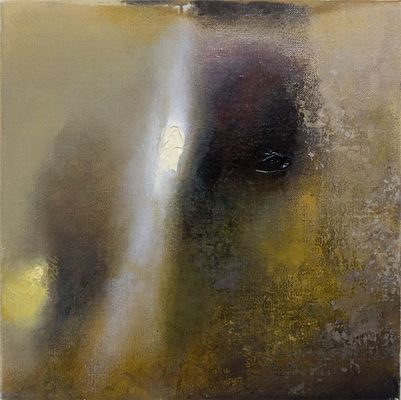
To return to Buckley’s fragment, the first two lines very much evoke how I paint nowadays. As you age, detail diminishes and patches of light become more luminous and float. I feel the most honest way of dealing with this is by smearing the oil paint on the canvas with the fingers and working close-up, blind. Only if the patches coalesce into an approaching image can the work gain a life.
-
Jonathan Walker was born in Melbourne, Australia and brought up on a dairy farm in Gippsland. In the 1970’s he studied painting at RMIT and won the Harold Wright Scholarship to the British Museum, London. During the 1980’s he exhibited at Pinacotheca Gallery, Richmond and had work shown at the NGV and Heidi City Art Gallery. Over the same period he designed the cover for the “Epigenesi” LP by Giancarlo Toniutti, Italy and conducted a mail exchange work with Achim Wollscheid, Germany. The work with artists through the post resulted in an article published in the bicentenary issue of Art and Australia 1988. He showed in artist run spaces such as WestSpace in the 90’s and 2000’s, and until 2012, taught painting at Victoria University, which is where we (Colleen Ahern and Lisa Radford) as organisers of the exhibition, among many others, had the privilege of being his student.
Walker’s knowledge was imparted to students through the careful selection of music, literature, and artists found in books that he himself had ordered for the library. Walker’s strategy was the generosity of sharing his vast knowledge with references specific to each student and their context.
Walker’s paintings share a similar focus and intimacy.
This exhibition presents a small selection of recent paintings alongside a publication that includes Walker’s writing. Observational and analytical, Walker’s work is a type of material notation — the time of day, colour and how it is blended, the both specific and fleeting location of a reflection on lino or the question of whether a chair leg should be included in a painting.
Please join us on Friday August 21 between 6-8pm to celebrate the opening of the exhibition.
Curated by Colleen Ahern and Lisa Radford.
B. Wurtz
Curated by Nic Tammens
March 26 - April 4, 2015
B.Wurtz works from a basement studio in his home on Manhattan’s Lower East Side.
This local fact is attested to by the plastic shopping bags and newsprint circulars that appear in his work. As formal objects, they don’t make loud claims about their origins but nonetheless transmit street addresses and places of business from the bottom of this long thin island. Like plenty of artists, Wurtz is affected by what is local and what is consumed. His work is underpinned by this ethic. It often speaks from a neighborhood or reads like the contents of a hamper:
“BLACK PLUMS $1.29 lb.”
“Food Bazaar”
“USDA Whole Pork Shoulder Picnic 99c lb.”
“RITE AID Pharmacy, with us it’s personal.”
“H. Brickman & Sons.”
“Sweet Yams 59c lb."
Most of the work in this exhibition was made while the artist was in residence at Dieu Donne, a workshop dedicated to paper craft in Midtown. Here Wurtz fabricated assemblages with paper and objects that are relatively lightweight, with the intention that they would be easily transportable to Australia. This consideration isn’t absolute in Wurtz’s work, but was prescriptive for making the current exhibition light and cheap. Packed in two boxes, these works were sent from a USPS post office on the Lower East Side and delivered to North Melbourne by Australia Post.
Wurtz appears courtesy of Metro Pictures, New York.
Thanks to Rob Halverson, Joshua Petherick, Sari de Mallory, Matt Hinkley, Helen Johnson, Fayen d'Evie, Ask Kilmartin, Lisa Radon, Ellena Savage, Yale Union, and "Elizabeth".
John Nixon
"Archive"
December 15 - January 20, 2014
The presentation of John Nixon's archive offered a rare showcase of this extensive collection of the artist's own publications, catalogues, posters, ephemera, editions and more, from the mid 1980s onwards, alongside a selection of his artworks.
Organized by John Nixon, Joshua Petherick and Matt Hinkley.
<a href=http://wfb.public-office.info/artist/john-nixon>All titles by John Nixon
"Habitat"
at Minerva, Sydney (organised by Joshua Petherick and Matt Hinkley)
November 15 - December 20, 2014
Lupo Borgonovo, Janet Burchill & Jennifer McCamley,
Lewis Fidock, HR Giger, Piero Gilardi, Veit Laurent Kurz,
Cinzia Ruggeri, Michael E. Smith, Lucie Stahl, Daniel Weil, Wols
Press Release:
“...It contained seven objects. The slender fluted bone, surely formed for flight, surely from the wing of some large bird. Three archaic circuitboards, faced with mazes of gold. A smooth white sphere of baked clay. An age-blackened fragment of lace. A fingerlength segment of what she assumed was bone from a human wrist, grayish white, inset smoothly with the silicon shaft of a small instrument that must once have ridden flush with the surface of the skin - but the thing’s face was seared and blackened.”
William Gibson, “Count Zero”, 1986
"Autumn Projects Archive"
Curated by Liza Vasiliou
March 6 - March 15, 2014
World Food Books, in conjunction with the Virgin Australia Melbourne Fashion Festival 2014, presented the Autumn Projects archive, consisting of a selection of early examples in Australian fashion with a particular interest in collecting designers and labels from the period beginning in the 1980’s, who significantly influenced the discourse of Australian Fashion.
Curated by Liza Vasiliou, the exhibition provided a unique opportunity to view pieces by designers Anthea Crawford, Barbara Vandenberg, Geoff Liddell and labels CR Australia, Covers, Jag along with early experimental collage pieces by Prue Acton and Sally Browne’s ‘Fragments’ collection, suspended throughout the functioning World Food Books shop in Melbourne.
H.B. Peace
presented by CENTRE FOR STYLE
November 14, 2013
"Hey Blinky, you say chic, I say same"
Anon 2013
H.B. Peace is a clothing collaboration between great friends Blake Barns and Hugh Egan Westland. Their pieces explore the divergences between 'character’ and ‘personality’ in garments....etc
Special Thanks to Joshua Petherick and Matt Hinkley of WFB and Gillian Mears
and a Very Special Thank you to Audrey Thomas Hayes for her shoe collaboration.
Janet Burchill & Jennifer McCamley
"Aesthetic Suicide"
May 10 - June 8, 2013
The first of our occasional exhibitions in the World Food Books office/shop space in Melbourne, "Aesthetic Suicide" presented a body of new and older works together by artists Janet Burchill & Jennifer McCamley, including videos, prints, a wall work, and publications.
During shop open hours videos played every hour, on the hour.
2007, English
Softcover, 718 pages, 17.8 x 25.4 cm
Published by
Eurock Publications / Portland
$80.00 - In stock -
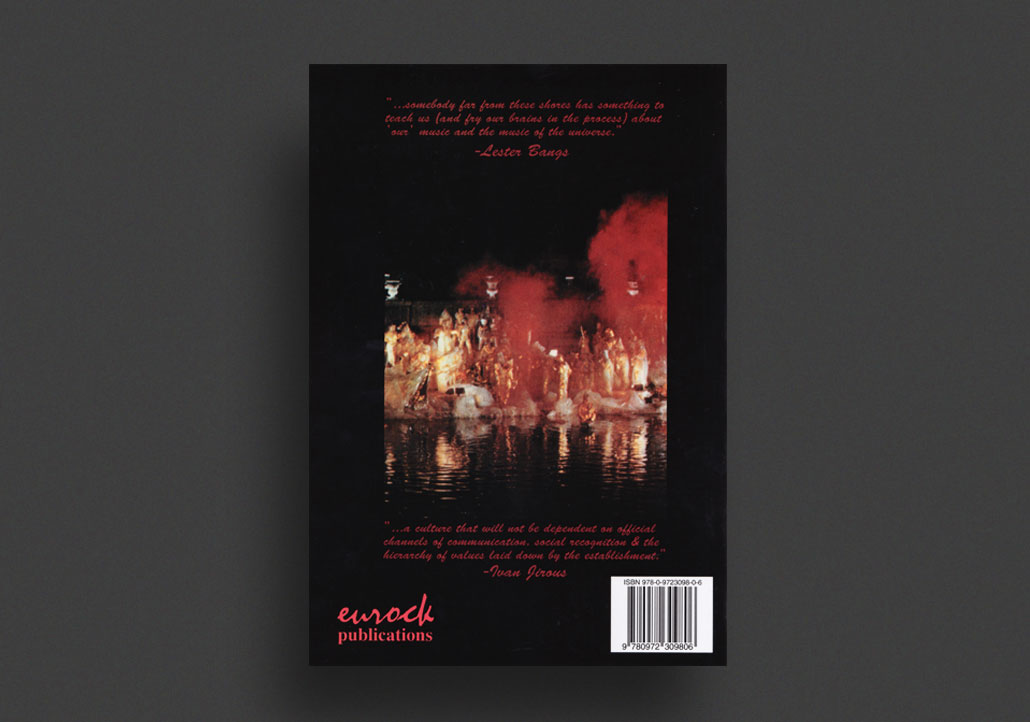
"the Second Culture ... a culture that will not be dependent on the official channels of communication, social recognition, and the hierarchy of values laid down by the establishment." – Ivan Jirous, Plastic People of the Universe
"Eurock Magazine documents a particular time in the world when the limits of imagination and what was possible sonically were stretched beyond the norm. The futuristic alchemy of free-flowing ions, mind-expanding chemical substances and mega-watts of electricity resulted in an explosion of creativity unparalleled in the history of rock music." – from foreword
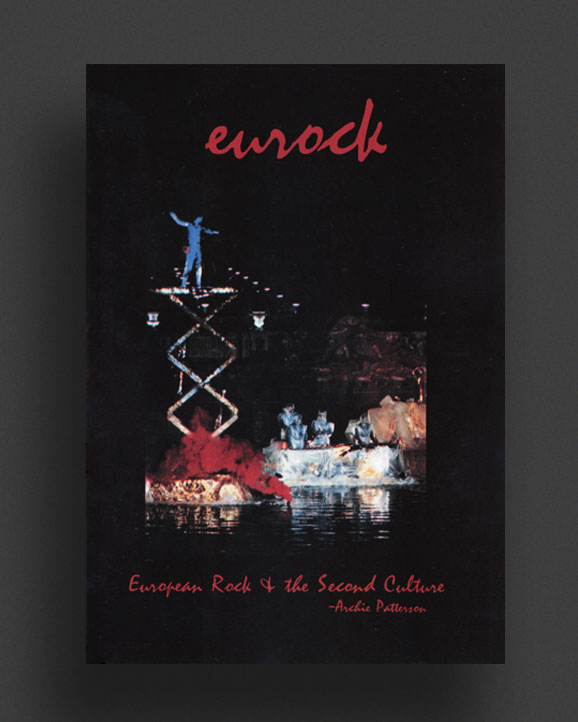
European Rock & the Second Culture, "The Book of Eurock", compiles all the feature articles, interviews, reviews and essays published in Eurock Magazine during its existence from 1973 - 1992. Founded by Archie Patterson in Portland 1971 as an FM radio show in Central California, Eurock developed into the fanzine bible of European rock and electronic music, promoting space, cosmic music, krautrock, ambient, and experimental music through its pages and subsequent Intergalactic Trading Company and Paradox Music Mailorder services. Whilst releasing and distributing the "100 Points" recording by the imprisoned Czech underground band Plastic People of the Universe, consulting on film scores in LA (introducing director Michael Mann to Tangerine Dream), and teaching Rock music history classes in public high school, Archie published 45 issues of the invaluable, internationally distributed vanguard Eurock magazine.
At over 700 pages, European Rock & the Second Culture contains an enormous wealth of information, illustrated and collated in chronological order, and rounded off with an extensive index of the musical artists and subjects covered over 30 years. Includes Amon Düül, Faust, Heldon, ZNR, Can, Magma, Plastic People of the Universe, Urban Sax, Henry Cow, Klaus Schulze, Tangerine Dream, Ash Ra Tempel, Popol Vuh, Art Zoyd, Univers Zero, Pascal Comelade, Floh de Cologne, Hoelderlin, Emtidi, Mythos, Amon Düül 2, Konrad Schnitzler, Peter Michel Hamel, Savage Rose, Urban Sax, Neu, Embryo, Yochk'o Seffer, Wigwam, Catherine Riberio + Alpes, Chrome, Area, Kluster, ZAO, Ange, Tolonen, Sensation's Fix, Osanna, DDAA, Le Orme, Kraan, SBB, Omega, Mark Shreeve, Cyrille Verdeaux, Holger Czukay, Pekka Pohjola, Richard Pinhas, Tasavallan Presidentti, and many many more, plus the labels, the fanzines, the politics, and above all else, the spirit of the music.
A Special Bonus is the previously unpublished tome on Krautrock from 1971 by Lester Bangs, late Editor of Creem Magazine and gonzo rock journalist extraordinaire, Amon Düül - A Science Fiction Rock Spectacle: "the combined accomplishments of American and Limey bands have been seeded in less-sung rock scenes around the world, and some of these seeds are coming to the weirdest blooms heard in the Western world with the mostest bloom in one of the seemingly unlikeliest places imaginable: Scandinavia and Germany." – Lester Bangs
A must!
1988 / 2000, English
Softcover, 112 pages, 8.2 x 12 cm
1st Edition, Out of print title / used / very good
Published by
Arc Publications / UK
$60.00 - Out of stock
2000 edition of this now very scarce Ivor Cutler book, published by Arc first in 1988. This small tartan-covered pocket-book contains a wonderful collection of many of Cutler's poems, along with his illustrations.
Scottish poet, songwriter and humorist Ivor Cutler (1923–2006) was a singular force in popular culture. His oeuvre encompassed absurd songs and poems, surreal performances, and illustrated publications. These abstract the banal and everyday with warmth, occasional darkness, and quiet radicalism. Self-styled as an "Oblique Musical Philosopher", Cutler saw himself as having "….the effect of a very mild earthquake, one that nudges people into having a look around themselves, through all the rubbish that passes for convention". His whimsical performances gained him a cult following across generations, not least as part of 60s and 70s counterculture. Broadcasts on the Home Service in the 1950s lead to albums, later with Virgin Records and Rough Trade. TV appearances on the BBC caught Paul McCartney’s attention. Cutler appeared in the Beatles’ film Magical Mystery Tour (1967) and George Martin produced his album ‘Ludo’ (1967). He collaborated with pianist Neil Ardley, singer and musician Robert Wyatt (formerly of Soft Machine), and Phyllis King, his companion who appears on several of his records, and for a number of years was a part of his concerts and King Cutler BBC radio series. New generations were introduced to his work in the 1980s on TV for the Old Grey Whistle Test, and on radio for John Peel and later Andy Kershaw. Cutler was an anti-intellectual and noted eccentric, dressing in a distinctive style, travelling mainly by bicycle and often communicating by means of sticky labels printed with "Cutlerisms". Many of Cutler's poems and songs involve conversations delivered as a monologue and, in these, one party is often Cutler as a child, a part of his intended "bypassing the intellect". Cutler recited his poems in a gentle Scottish burr, and this, combined with the absurdity of the subject matter, is a mix that earned him a faithful cult following. Cutler also wrote books for children and adults and was a teacher at A. S. Neill's Summerhill School and for 30 years in inner-city schools in London. Cutler was a member of the Noise Abatement Society and the Voluntary Euthanasia Society. He retired from performing in 2004, and died on 3 March 2006. The reception room of his home contained a number of pieces of ivory cutlery, deliberately intended as a pun on his name.
Very Good-Fine copy.
1989-1991, English
Softcover (staple-bound), 24-44 pages ea., 21 x 15 cm
1st Edition, Out of print title / as new
Published by
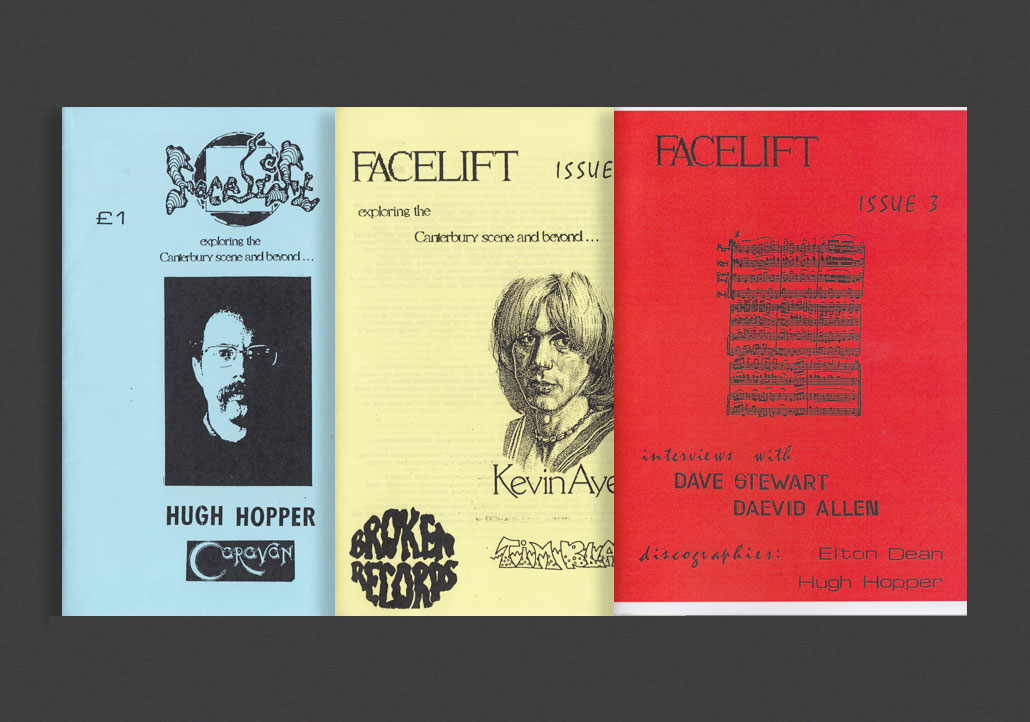
Facelift / Manchester
$65.00 - In stock -
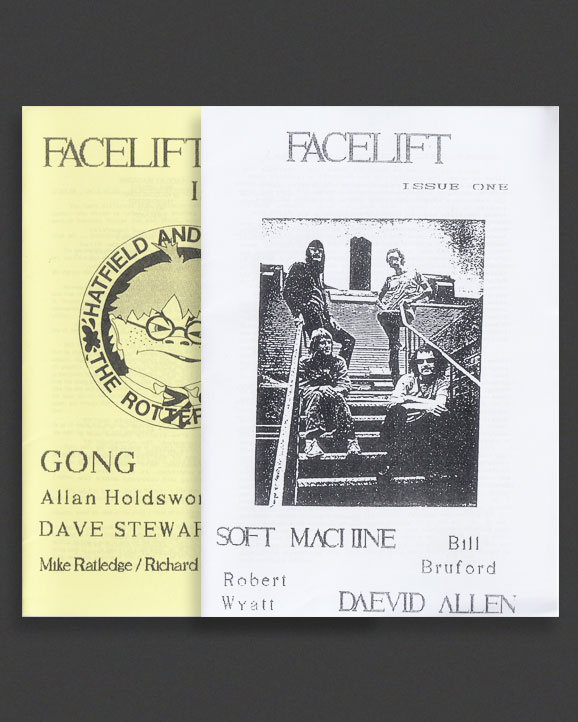
First five issues of the first and only music fanzine entirely dedicated to covering 'The Canterbury scene and beyond...', independently published out of Manchester between 1989 and 1999. Original, As New copies.
The Canterbury scene (or Canterbury sound) was a musical scene centred around the city of Canterbury, Kent, England during the late 1960s and early 1970s. Associated with progressive rock, the term describes a loosely-defined, improvisational style that blended elements of jazz, rock, and psychedelia. These musicians played together in numerous bands, with ever-changing and overlapping personnel. The "beyond" byline meant that the scope of the fanzine was in fact much wider than the editor, its contributors or its readers first envisaged. Heavily centred around the bands Caravan, Soft Machine, Gong, Hatfield and the North, Matching Mole, National Health, and Henry Cow, Facelift was a committed to all the spin-off musical projects by the many prominent British avant-garde and fusion musicians that began their career in Canterbury bands, including Robert Wyatt, Kevin Ayers, Daevid Allen, Hugh Hopper, Steve Hillage, Dave Stewart, Elton Dean, Tim Blake, Lol Coxhill, Dave Stewart, Hugh Hopper, Pip Pyle, Keith Tippett, Allen Holdsworth, Richard Sinclair, Mike Ratledge, and many more. Includes many obscure Canterbury groups and others in the world of UK/EU avant-garde/jazz rock/prog. Interviews, articles, discographies, record reviews, live reports past and present, and much more. A delight for any Canterbury aficionado. The life's-blood of World Food Books!
Fine dead stock copies.
2019, English
Softcover, 512 pages, 15.2 x 22.6 cm
Published by
Duke University Press / North Carolina
$52.00 - In stock -
“What was it all about, to me? Thinking. Henry Cow really thought about the why, the what, the appropriate methods of making music. Their riveting music was the sound of thinking out loud: Henry Cow seemed to be asking, ‘So, what is the significance of these sounds in our heads?’ And they were always witty: just look at the name of the band and the unwearable sock representing ‘the Henry Cow legend.’ I am very glad this book exists. Henry Cow’s history —in all its inevitable turbulence— tells an inspiring story.” - Robert Wyatt
In its open improvisations, lapidary lyrics, errant melodies, and relentless pursuit of spontaneity, the British experimental band Henry Cow pushed rock music to its limits. Its rotating personnel, sprung from rock, free jazz, and orchestral worlds, synthesized a distinct sound that troubled genre lines, and with this musical diversity came a mixed politics, including Maoism, communism, feminism, and Italian Marxism. In Henry Cow: The World Is a Problem Benjamin Piekut tells the band’s story—from its founding in Cambridge in 1968 and later affiliation with Virgin Records to its demise ten years later—and analyzes its varied efforts to link aesthetics with politics. Drawing on ninety interviews with Henry Cow musicians and crew, letters, notebooks, scores, journals, and meeting notes, Piekut traces the group’s pursuit of a political and musical collectivism, offering up its history as but one example of the vernacular avant-garde that emerged in the decades after World War II. Henry Cow’s story resonates far beyond its inimitable music; it speaks to the avant-garde’s unpredictable potential to transform the world.
2006, English
Hardcover, 220 pages, 17.8 x 25.4 cm
Published by
Semiotext(e) / Los Angeles
$60.00 - Out of stock
In February 1991, the artist David Wojnarowicz (1954-1992) and the philosopher Sylvère Lotringer met in a borrowed East Village apartment to conduct a long-awaited dialogue on Wojnarowicz's work. Wojnarowicz was then at the peak of his notoriety as the fiercest antagonist of morals crusader Senator Jesse Helms—a notoriety that Wojnarowicz alternately embraced and rejected. Already suffering the last stages of AIDS, David saw his dialogue with Lotringer as a chance to set the record straight on his aspirations, his personal history, and his political views. The two arranged to have this three-hour dialogue video-recorded by a mutual friend, the artist Marion Scemama. Lotringer held on to the tape for a long time. After Wojnarowicz's death the following year, he found the transcript enormously moving, yet somehow incomplete. David was trying, often with heartbreaking eloquence, to define not just his career but its position in time. The subject was huge, and transcended the actual dialogue. Lotringer then spent the next several years gathering additional commentary on Wojnarowicz's life and work from those who knew him best—the friends with whom he collaborated. Lotringer solicited personal testimony from Wojnarowicz's friends and other artists, including Mike Bildo, Steve Brown, Julia Scher, Richard Kern, Carlo McCormick, Ben Neill, Kiki Smith, Nan Goldin, Marguerite van Cook, and others. What emerges from these masterfully-conducted interviews is a surprising insight into something art history knows, but systematically hides: the collaborative nature of the work of any "great artist." All these respondents had, at one time, made performances, movies, sculptures, photographs, and other collaborative works with Wojnarowicz. In this sense, Wojnarowicz appears not only as a great originator, but as a great synthesizer.
2020, English
Softcover (ring-binding), 368 pages, 24.5 x 33.5 cm
Published by
Spector Books / Leipzig
$99.00 - Out of stock
The mid-1960s witnessed a boom in underground and self-published works. Hectographs, mimeographs, and offset printing not only allowed for the production of small, low-cost print runs but also promoted a unique aesthetic: using wild mock-ups, 'messianic amateurs' combined typescript aesthetics, handwriting, scribbled drawings, assemblages of collaged visuals, porn photos, snapshots, and comic strips. The typography consciously frees itself, in parallel to a liberalization of linguistic and visual forms of expression in the name of a new 'sensibility'. This book is the first to present the underground and self-published works that came out of West Germany in such depth, while also showing the international context in which they emerged: not as an anecdotal history but as an attempt to tap into the aesthetic cosmos of a Do-It-Yourself rebellion, one that also challenges us to take a new look at the current boom in 'independent publishing', the risograph aesthetic, and so on.
An incredible collection and valuable volume for anyone interested in underground publishing history!
Finally reprinted.
2017, English
Softcover, 512 pages, 15.3 x 23.4 cm
Published by
Faber & Faber / London
$35.00 - Out of stock
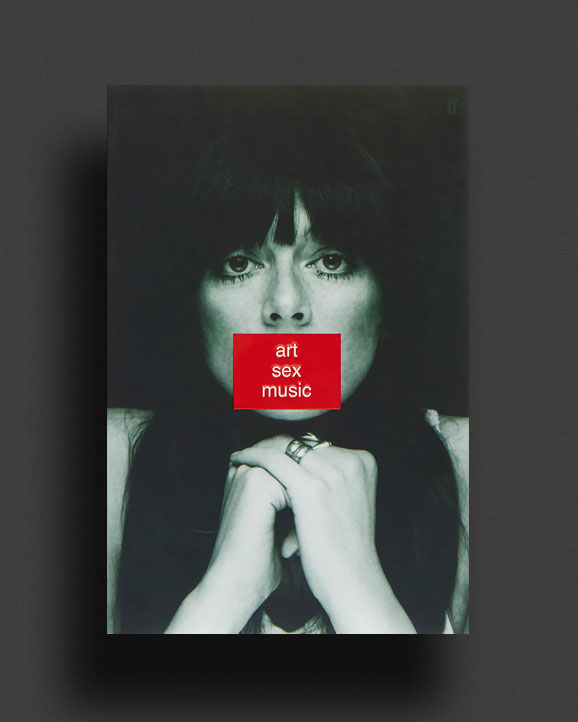
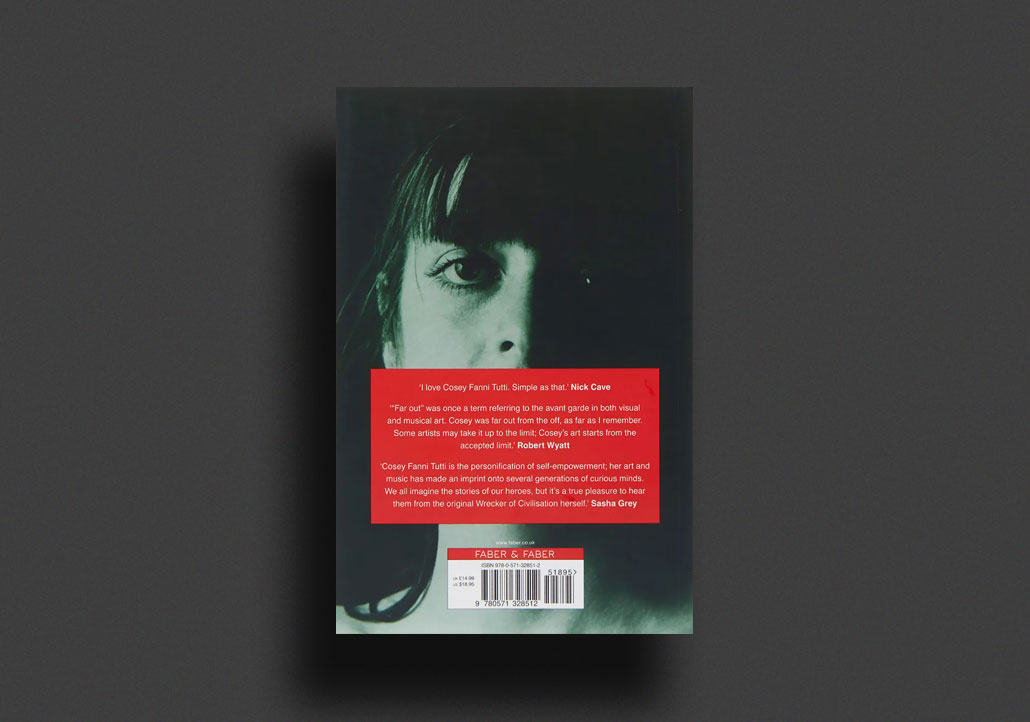
Art Sex Music is the wise, shocking and elegant autobiography of Cosey Fanni Tutti.
Art Sex Music is the autobiography of a musician who, as a founding member of the avant-garde group Throbbing Gristle and electronic pioneers Chris & Cosey, has consistently challenged the boundaries of music over the past four decades.
It is the account of an artist who, as part of COUM Transmissions, represented Britain at the IXth Biennale de Paris, whose Prostitution show at the ICA in 1976 caused the Conservative MP Nicholas Fairbairn to declare her, COUM and Throbbing Gristle 'Wreckers of Civilisation'...shortly before he was arrested for indecent exposure, and whose work continues to be held at the vanguard of contemporary art.
And it is the story of her work as a pornographic model and striptease artiste which challenged assumptions about morality, erotica and art.
1994, English
Softcover (staple-bound), 68 pages, 28 x 21.5 cm
1st Edition, Out of print title / used / very good
Published by
Feature Inc. / New York
$300.00 - Out of stock
The rarely seen, first edition of G.B. Jones' artist book, published in the US in 1994 and seized at the border and officially banned in Jones’ native Canada.
G.B. Jones (b. 1965) is a Canadian artist, filmmaker, and founding member of Canadian queer punk band Fifth Column (K Records/Outpunk/Kill Rock Stars/et al). She published legendary queercore fanzine J.D.s (Juvenile Delinquents) with fellow queer filmmaker Bruce LaBruce, which regularly featured her iconic Tom Girl drawings. According to novelist Dodie Bellamy, G.B. Jones' drawing "co-opts the male-on-male objectifying gaze of gay erotica and converts it to a female-on-female gaze." Depicting autonomous women through fantasies of bikers, punks and degenerates in the style of and situations similar to those drawn by Tom of Finland, her Tom Girls are "unapologetic, thrillingly anti-assimilationist." Compiling a scrapbook curriculum vitae of her work to date, this wonderful book presents the Tom Girl series of drawings alongside stills from videos, excerpts from J.D.s zines, gig flyers, photos and essays and commentaries by Dennis Cooper, Vaginal Davis, Dodie Bellamy, Kevin Killian, Caroline Azar, Johnny Noxzema, and others. The essential book on the artist.
Very Good, beautiful copy of the very first banned edition. Possibly in 1996 more were printed (also barely exist), but this is definitely the original 1994 print, exceptionally rare.
2020, English
Softcover, 242 pages, 15 x 20.2 cm
Published by
Blank Forms / New York
$44.00 - Out of stock
Edited by Lawrence Kumpf with Joe Bucciero.
Contributors and featured artists include Masayuki Takayanagi, Louise Landes Levi, Joseph Jarman, Catherine Christer Hennix, Charles Stein, Henry Orlov, Maryanne Amacher, Alan Cummings, Bill Dietz, Peter Kastakis, Art Lange, Leo Svirsky, Satoru Obara, and Tomoyuki Chida.
Aspirations of Madness, Blank Forms’ fifth collection of archival, unpublished, or newly translated texts, takes its title from a series of interviews with Japanese free jazz pioneer Masayuki Takayangi that were published in Japanese in 1975–76 and are published here in English for the first time. The interviews provide a rare look at Takayanagi’s eccentric practice and personality, both long under-recognized by audiences outside (and often, inside) of Japan. In this respect, the interviews speak to the goals of Blank Forms’ publication enterprise, that is, to expand upon our work in performance programming, record production, and archival preservation, and to foster new dialogues on vanguard art and music from the past 50-plus years.
Aspirations of Madness considers the work of Masayuki Takayanagi, the poet Louise Landes Levi, musician and writer Joseph Jarman, polymath Catherine Christer Hennix and her one-time student the poet Charles Stein, Russian musicologist Henry Orlov, and Maryanne Amacher—brilliant and overlooked artists whose work Blank Forms will continue to champion in a variety of contexts. Aspirations of Madness features additional contributions by Alan Cummings, Bill Dietz, Peter Kastakis, Art Lange, Leo Svirsky, Satoru Obara, and Tomoyuki Chida, and is edited by Lawrence Kumpf with Joe Bucciero.
2020, English
Hardcover, 208 pages, 25 x 21 cm
Published by
Walther König / Köln
Kunstmuseum Liechtenstein / Vaduz
$80.00 - Out of stock
The first ever monograph on Steven Parrino.
Steven Parrino (1958–2005) was one of the most influential artists of the New York art scene since the late 1980s. Parrino began producing art at the end of the 1970s, driven, as he said himself, by his ‘necrophiliac interest’ in painting, which at that time had been pronounced dead. Parrino’s work is defined by an unconditional will to be free that stems from American biker culture and is also influenced by punk rock existentialism. Borrowings from underground comics and the “Kustom Kulture” of the motorcycle world with its specific symbolic language are the main themes of his drawings in the early years. His monochrome painting in the tradition of “Radical Painting” evolved in parallel. As early as 1981 he began creating the large monochrome paintings that he violently slashed, tore or twisted off their stretchers, thus achieving a literal deconstruction of painting. Predominantly a painter, music played a role that was at least as important for his artistic practice. Drawing on various "high" and subcultural sources, Parrino created an oeuvre of painting and music that contradicted increasing social and cultural conformism and also provided a fresh and intelligent contribution to the debate on modernism's demise. Parrino died in a motorcycle accident in Greenpoint, Brooklyn at the age of 46.
Parrino “came to painting at the time of its death, not to breathe its last breath, but to caress its lifelessness.”
Heavily illustrated throughout with mostly full-page colour reproductions of his work, Steven Parrino: Nihilism Is Love includes texts by Konrad Bitterli, Catherine Dossin, Reinhard Ermen, Fabian Flückiger, Amy Granat, Pierre Huber, Friedemann Malsch, Matthew McCaslin, Olivier Mosset, Bob Nickas, Steven Parrino, Mai-Thu Perret, Amy O'Neill, Rolf Ricke, Marc- Olivier Wahler. Published on the occasion of the first comprehensive retrospective of his work in Europe.
2020, English
Softcover, 350 pages, 15 x 23 cm
Published by
Sternberg Press / Berlin
$50.00 - In stock -
Exploring the relationship between art and pop music over the last fifty years.
Why did Andy Warhol decide to enter the music business by producing the Velvet Underground, and what did the band expect to gain in return? What made Yoko Ono use the skills she developed in the artistic avant-garde in pop music, and what drew John Lennon, in turn, to visual art? Why, in 1982, did Joseph Beuys record the pop single “Sonne statt Reagan,” and why, around the same time did, West German artists such as Michaela Melián move into pop music?
In Double Lives in Art and Pop Music, Jörg Heiser argues that context shifting between art and pop music is an attempt to find solutions for contradictions faced in one field of cultural production. Heiser looks closely at the careers of artists and pop musicians who work in both fields professionally. The seeming acceptance and effortlessness today of current border crossings can be deceptive, since they might be serving vested economic or ideological interests. Exploring a pop and art history of more than fifty years, Heiser shows that those leading double lives in art and pop music may often be best able to detect these vested interests while he points toward radical alternatives.
2019, English
Softcover, 20 pages, 16.5 x 23.6 cm
Published by
Innen Books / Zürich
$28.00 - Out of stock
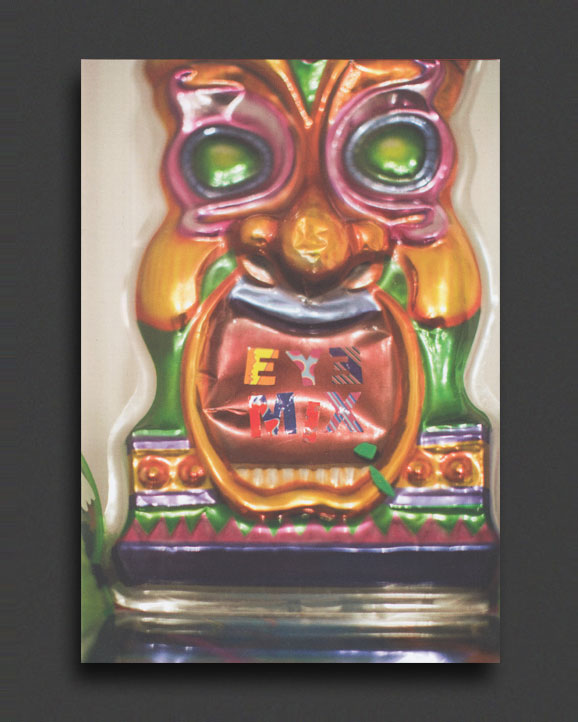
"EYƎ Mix" is a new publication by Japanese artist/musician EYE, published in 2019 by Innen Books on the occasion of TOKYO ART BOOK FAIR 2019 at Museum of Contemporary Art Tokyo, July 12 – July 15, 2019.
EYƎ is a Japanese vocalist and visual artist, best known as co-founder of the influential rock music band Boredoms and Naked City. He has changed his stage name several times, from Yamatsuka Eye, to Yamantaka Eye, to Yamataka Eye and now simply calls himself EYƎ.
EYƎ is a member of the bands Hanatarash, UFO or Die, Puzzle Punks, Noise Ramones and Destroy 2. He is notorious for his vast, confusing discography and countless guest appearances. Notable collaborations include his work with Nam June Paik, Sonic Youth, Yamamoto Seiichi & Yamazaki Maso, Bill Laswell's Praxis and John Zorn's groups Naked City and Painkiller.
As well as his music, EYƎ is famous for his mixed-media style of art that utilises airbrush, marker pen and collage, amongst other materials. His artworks have adorned a number of records, including the majority of Boredom’s releases and, perhaps more famously, Beck's Midnite Vultures. Drawing as much from Japanese mythology as from his musical influences, his work aims to complement the music as well as to provide another dimension to the sound.
2019, English
Softcover (staple-bound), 24 pages, 13 x 19 cm
Ed. of 200,
Published by
Innen Books / Zürich
Nieves / Zurich
$18.00 - In stock -
"The Rock T" is a limited edition publication by Japanese artist/musician EYE. Published in 2019 by Innen Books and Nieves in Zürich in an edition of 200 copies only on the occasion of TOKYO ART BOOK FAIR 2019 at Museum of Contemporary Art Tokyo, July 12 – July 15, 2019.
EYƎ is a Japanese vocalist and visual artist, best known as co-founder of the influential rock music band Boredoms and Naked City. He has changed his stage name several times, from Yamatsuka Eye, to Yamantaka Eye, to Yamataka Eye and now simply calls himself EYƎ.
EYƎ is a member of the bands Hanatarash, UFO or Die, Puzzle Punks, Noise Ramones and Destroy 2. He is notorious for his vast, confusing discography and countless guest appearances. Notable collaborations include his work with Nam June Paik, Sonic Youth, Yamamoto Seiichi & Yamazaki Maso, Bill Laswell's Praxis and John Zorn's groups Naked City and Painkiller.
As well as his music, EYƎ is famous for his mixed-media style of art that utilises airbrush, marker pen and collage, amongst other materials. His artworks have adorned a number of records, including the majority of Boredom’s releases and, perhaps more famously, Beck's Midnite Vultures. Drawing as much from Japanese mythology as from his musical influences, his work aims to complement the music as well as to provide another dimension to the sound.
2018, English
Hardcover, 372 pages, 29.7 x 24.9 cm
Published by
Walther König / Köln
$120.00 - In stock -
This extensive, over-sized hardcover catalogue offers a systematic and chronological overview of the multifaceted oeuvre of German artist, Jutta Koether. It goes back to her beginnings in the context of Neo Expressionism in Cologne in the early and mid-1980s, and her subsequent exploration of the colour red as an expressive device – presenting a response to the cliché of male painters. After moving to New York in the early 1990s, Koether began making breathtakingly intense and colourful large-scale paintings that layer motifs from pop culture, literature and art history in dense painterly gestures. In the early 2000s, the artist’s approach became increasingly involved with performance and music, culminating in inky black canvases and assemblage paintings incorporating devotional objects from Punk and ‘noise culture’. The final chapter of this retrospective is dedicated to Koetherʼs eccentric turn to history painting and her latest appropriations from art historyʼs visual memory.
Published on the occasion of the exhibition, Jutta Koether: Tour de Madame at Museum Brandhorst, Munich (18 May – 21 Oct 2018), and at Mudam Luxembourg, 2019.
2015, English
Softcover, 108 pages, 21 x 29.7 cm
Published by
Roma / Amsterdam
$37.00 $25.00 - In stock -
Collection of graphic and textual work by Anne-Mie Van Kerckhoven, dating from the seventies up till 2015. Compiled and designed by Julie Peeters, enriched with translations of facsimile material and a large amount of personal comments from the artist on the selected work. Published in conjunction with the exhibition Serving Compressed Energy with Vacuum in Kunstverein München from 25 April - 14 June 2015.
Anne-Mie van Kerckhoven (also known as AMVK) was born in Antwerp and lives in Antwerp and Berlin. She studied graphic design at the Fine Arts Academy in Antwerp and has been prolific in her output of drawings and other works on paper and synthetic material, as well as short videos, since the early eighties. Anne-Mie van Kerckhoven has been fascinated for a long time with the representation in the mass media of images of women, of interiors, of the kinetic powers of any kind of language. She investigates supra-moral connections in contemporary society s.a. between sex and technology. Her work connects different knowledge systems, explores the areas of the unconscious, and looks at moral aberrations or the obscene from a female point of view. In the nineties, hand-made paper works gave way to computer graphics, while text has always featured alongside images, underlining the message of Van Kerckhoven’s proud, sometimes exhibitionist female figures like song-lyrics. Music plays an important role in Van Kerchkoven’s creative production in parallel to her visual output, and she and Danny Devos have stood as a key pair of the Antwerp experimental music scene under the band name Club Moral (1981–now). Since 1982 she is represented by Zeno X Gallery in Antwerp, Belgium. And since 1999 also by Galerie Barbara Thumm in Berlin.
Since 2005 she is working on a conceptual and pictorial trialogue between the mystic Marguerite Porete, the hermetic Giordano Bruno and the philosopher Herbert Marcuse.
In 2015 she will be the subject of two major solo shows at Kunstverein München and Castillo/Corrales, Paris c/o Yale Union, Portland.
2006, English
Hardback (w. dust jacket), 544 pages, 15.2 x 22.9 cm
Published by
Waitawhile / Tübingen
$120.00 - In stock -
This is the only edition of Sun Ra's complete poetry and prose in one volume - over 500 pages bound in hardcover.
A talented pianist and composer in his own right, Sun Ra (1914-1993) founded and conducted one of jazz's last great big bands from the 1950s until he left planet Earth. Few only know that he also was a gifted thinker and poet. Sun Ra's poetry leaves everything behind what's called contemporary, and flings out pictures of infinity into the outer space. These poems are for tomorrow.
Editors:
James L. Wolf earned a music degree from Carleton College, and studied ethnomusicology at the University of Washington, Seattle. Now works at the Library of Congress in the Music Division. Active musician in various bands in the DC area. Many contributions to Sun Ra scholarship.
Hartmut Geerken, Oriental studies, philosophy and comparative religion at the universities of Tübingen and Istanbul. Writer, filmmaker, musician, composer. Since the 1970s, close relationships to Sun Ra and his works, setting up the world's most comprehensive Waitawhile Sun Ra Archive Sigrid Hauff Studied oriental languages and arts, philosophy, and romance studies at the universities of Tübingen and Istanbul. Free lance writer on literary and philosophical subjects. Klaus Detlef Thiel Studied philosophy and history at Trier University, Ph.D. Philosophical author, focussing on theory and history of writing. Brent Hayes Edwards Teaches in the English Department at Rutgers University, New Brunswick, NJ. Author and Co-Editor of works on jazz and literature.
2019, English
Softcover, 302 pages, 15 x 20 cm
Published by
Blank Forms / New York
$48.00 - Out of stock
The fourth issue of Blank Forms' journal: a kaleidoscopic view of the last fifty years of experimental art and music in the United States and beyond, mining the conceptual, technical, historical, or otherwise marginal details undergirding artists' lives, ideas, and approaches that may otherwise remain buried.
Edited by Lawrence Kumpf. Contributors and featured artists include Onyx Ashanti, Amy Cimini, Marcia Douglas, Kazuo Imai, Werner Durand, Peter Gente, Heidi Paris, Robert Ashley, “Blue” Gene Tyranny, Spencer Gerhardt, Adrian Rew, Paul Cummings, and Walter De Maria.
1990, Japanese
Softcover, 112 pages, 30 x 22.5 cm
1st Edition, Out of print title / used / good
Published by
Studio Voice / Tokyo
$30.00 - Out of stock
1990 ACID AGE issue of Japan's esteemed "multi-media mix" magazine STUDIO VOICE, a cultural magazine dedicated to the cutting-edge of music, fashion, technology, the arts, film, video games, and literature. Cover feature is a primer on ACID through the ages, 1960-1990, the music, philosophy, literature, art, drugs, fashion... from William S. Burroughs, Philip K. Dick, KLF, Syd Barrett, DAF, Timothy Leary, Manuel Göttsching, Antwerp 6, Throbbing Gristle, Kraftwerk, Detroit Techno, etc., also the work of fashion designer Mitsuhiro Matsuda, musician Susumu Hirasawa, photographer Javier Vallhonrat, Amy Arbus, Studio V, and more.
Good copy.
1978, English
Softcover, 194 pages (plus insert), 21 x 29 cm
1st Edition, Out of print title / used / good
Published by
LIP / Melbourne
$50.00 - Out of stock
The incredible book-sized 1978-79 edition of Melbourne's great LIP journal. Published out of Carlton between 1976-1984, LIP encapsulated Australian feminist artistic practice of the period, publishing articles and interviews by women on women in film, sound, theatre, painting, photography, poetry, criticism, activism, journalism, publishing, sculpture, design, education, and much more.
In this issue: Art Sense and Sensibility: Women's Art and Feminist Criticism - Janine Burke; Aboriginal Women: Ritual and Culture - Diane Bell interviewed by Lesley Dumbrell; Map of Transition: Performance - Jillian Orr; Jane Sutherland - Frances Lindsay; Sybil Craig - Mary Eagle; Make Your Own Teaset - Mary Newsome; Women's Images of Women - Barbara Hall; In Search of Old Mistresses - Patricia Symons; Women Ceramacists; Olive Bishop interviewed by Julie Ewington; Margaret Dodd Talking with Julie Ewington; Lorrain Jenyns; Wendy Stavrianos interviewed by Pauline Petrus; The Development of a Political View: A Conversation Between Two Women Artists - Jennifer Barwell and Vivienne Binns; Micky Allan interviewed by Suzanne Davies; Photographs - Jacqueline Mitelman; From the Ground Up - Photographs - Virginia Coventry; Survey of Women's Art Theory Courses and Feminine Sensibility - Janine Burke; The Women's Art Register Extension Project - Bonita Ely; Sisterhood ― For Whom? Jude Adams and Jenny Barber; Posters by Women in the Earthworks Poster Collective; Film - Margaret Fink and Her Brilliant Career - Frida Freiberg; Following My Star - Elsa Chauvel; Monique Schwarz interviewed by Christine Johnston; A Dialogue between Toni Robertson, a Feminist Poster Maker, and Jeni Thornley, a Feminist Film-maker; Nina Claditz interviewed by Annette Blonski; Introducing Helmer Sanders - Frida Freiberg; Reviews: Shopping in Hearbreak Arcade - Meredith Nolte; Me and Daphne - Linda Rubinstein; Feminine Focus at the Festival - Frida Freiberg; Supplement: Australian Women in Music - Australian Women in Music - Terry Radic; Margaret Sutherland - Helen Coles; May Brahe: Composer - Mimi Colligan; Dr. Ruby Davy - Silvia O’Toole; Four Women Composers: Helen Gifford, Ann Boyd, Ann Carr-Boyd and Peggy Glanville-Hicks - Marcia Ruff; Esther Rofe interviewed by Pauline Petrus; Talking with Linda Phillips by Kerry Murphy; Mary Nemet interviewed by Jeanette Fenelon; The Women's Electric Band interviewed by Jeannette Fenelon; Robyn Archer interviewed by Jeannette Fenelon; The Shameless Hussie A.C.R.; Jane Clifton and Celeste Howden interviewed by Jeannette Fenelon; Janie Conway and Marnie Sheehan - Virginia Fraser; Theatre - The Women's Theatre Group: A Selection of Scripts, Interviews and Comments Kerry Dwyer, Jenny Walsh and Suzanne Spunner; Roma: A One Woman Play - Jan Macdonald and the Roma cast; Tongue to Lip - Valerie Kirwan; And Women Must Wait: Savage Sepia - Suzanne Spunner; Dance and Movement - Marilyn Jones interviewed by Roseanne Hull-Brown; Betty Pounder interviewed by Roseanne Hull-Brown; Yum Wing Chun: Never Underestimate the Power of a Woman - Karen Armstrong; Media - An Open Letter - Shere Hite; Feminism and Publishing: Interviews with Women Publishers - Cathy Peake; Two Early Melbourne Journalists - Lurline Stewart; Sydney Women Writers’ Workshop - Anna Couani and Pamela Brown; The Australian Women's Weekly ― The Case of the Bald Cockatoo - Cathy Peake, Maree Conway and Sue Parvaris.
LIP Collective members: Annette Blonski, Janine Burke, Isabel Davies, Suzanne Davies, Lesley Dumbrell, Jeannette Fenelon, Freda Freiberg, Christine Johnston, Elizabeth Owen, Cathy Peake, Meredith Rogers, Suzanne Spunner, Lynne Wilkinson.
This copy includes the original 1978 etching "Make Your Own Teaset" insert by Mary Newsome.
Good-Very Good copy. Bump to one corner, light wear/tanning.
2020, English
Hardcover, 352 pages, 22 x 30 cm
Published by
Gingko Press / Berkeley
$139.00 - In stock -
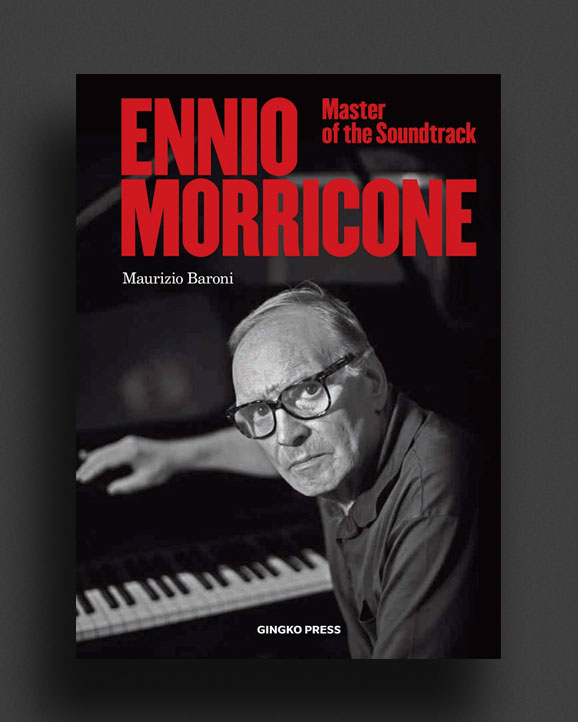
Unique in its genre, Ennio Morricone: Master of the Soundtrack originates from the idea of the collector, author, and cinema expert Maurizio Baroni. Baroni draws on his own archive to give life to a rich selection highlighting over fifty years of a prestigious career, largely unseen before, which includes handwritten scores by the maestro himself, the original album and single cover sleeves from his soundtracks, and much more.
This book is a definitive homage to this great Italian composer of film soundtracks, probably the most famous in the world.
Accompanying the most comprehensive and lavishly illustrated chronology/discography of Morricone's work in print, this large hardcover volume contains texts by Dario Argento, Bernardo Bertolucci, Liliana Cavani, Lisa Gastoni, Franco Nero, Quentin Tarantino, and many more.
A wonder for any Morricone fan.
2019, English
Softcover, 241 pages, 14 x 21.6 cm
Published by
Zero Books / UK
$33.00 $15.00 - Out of stock
"Hearing the Cloud guides us through the soundscapes of contemporary neoliberal capitalism, from chillstep to nightcore, and recaptures the possibilities of collective listening embedded within these musical forms. Emile Frankel traces a pattern recognition of our moment, poised between dystopian nihilism and the receding possibilities of utopia. Against irony, fragmentation, and chaos, Hearing the Cloud helps us hear the material presence of sound in our lives and the whispers of a better future." -- Benjamin Noys, author of Malign Velocities: Accelerationism and Capitalism
Can music be a curse? This book offers an alternate history of online politics and new technology from the perspective of listening, typing, composing, and shared hearing. In spite of narrowing images of tech-dystopias and flooded, desertified worlds, experimental sound and club culture attempts to open up spaces for alternate and vital imaginings. Charting the work of artists such as Holly Herndon, Chino Amobi, Amnesia Scanner, OPN and PC Music, as well as a broader discussion of streaming economics, virtual soundtracks and internet birthed genre, Hearing the Cloud reflects upon an epoch of music which is critical of the neoliberal future we speed towards. The causal nature of making music about such a future becomes a platform to consider the act of composing, one note over another, as an act of resistance and an act of prophecy.
Emile Frankel presents a rigorous account of a world felt to be in crisis. The aesthetic and tonal ramifications for such feelings are twisted within the oppressive online structures mediating new music. The legacies of Silicon Valley digitalism, 4chan, Less Wrong, and Chaos Magic are compared to the magical thinking which underlies stochastic composition, and the aesthetics of deconstructed club music. Despite a pessimistic account of Accelerationism and reactionary philosophy, Frankel's spirited writing is still full of hope. Hearing the Cloud considers the communal online conversations we engage in daily as profound acts of defiance. Sweet, lithe, oily, and honest music is shown to be an important source of togetherness.
Emile Frankel is a writer and composer researching the changing conditions of online listening.
2019, English
Softcover, 144 pages, 13.2 x 20.3 cm
Published by
New Directions / New York
$32.00 - Out of stock
An essential selection of the poetry of one of the most important twentieth-century creative movements.
Black Mountain College had an explosive influence on American poetry, music, art, craft, dance, and thought; it’s hard to imagine any other institution that was so utopian, rebellious, and experimental. Founded with the mission of creating rounded, complete people by balancing the arts and manual labor within a democratic, nonhierarchical structure, Black Mountain was a crucible of revolutionary literature. Although this artistic haven only existed from 1933 to 1956, Black Mountain helped inspire some of the most radical and significant midcentury American poets.
This anthology begins with the well-known Black Mountain Poets— Charles Olson, Robert Creeley, Robert Duncan and Denise Levertov—but also includes the artist Josef Albers and the musician John Cage, as well as the often overlooked women associated with the college, M. C. Richards and Hilda Morley.
1970, Japanese
Staple-bound, 32 pages, 21 x 15 cm
1st Edition, Out of print title / used / very good
Published by
The Japan Rolling Stones Fan Club / Tokyo
$65.00 - Out of stock
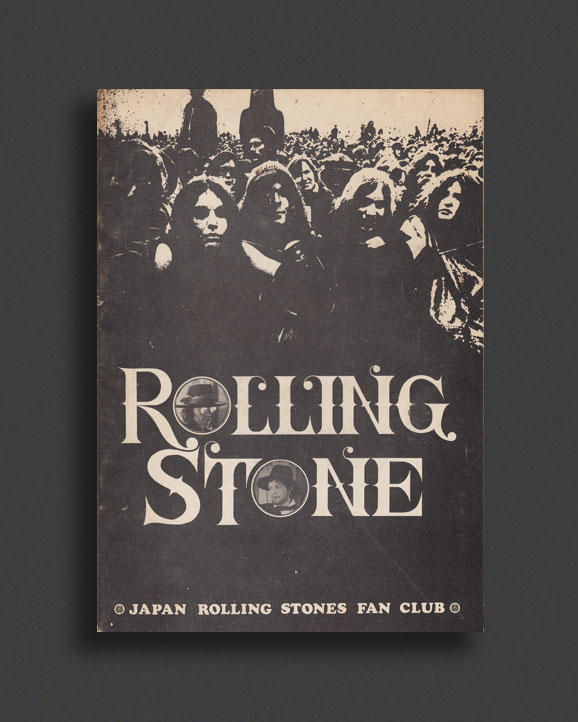
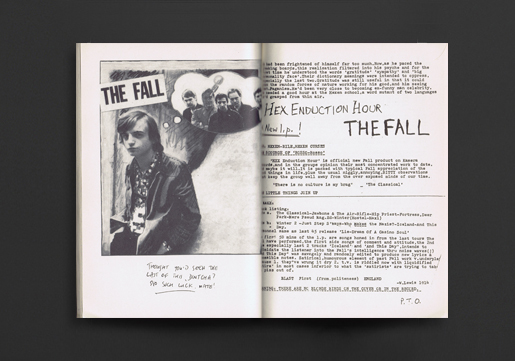
Very rare first issue of "ROLLING STONE" - not the American magazine but the Japan Rolling Stones fan club fanzine, published in 1970. Illustrated throughout with black and white photographs of the Stones, their audience, lyrics in Japanese, interviews, news, fan-mail, and fan drawings. A lovely piece of scarce Stones memorabilia.
Very Good copy with tanning and light wear.
1985, English
Softcover, 112 pages, 24 x 17 pages
1st Edition, Out of print title / used / very good
Published by
The Lough Press / Berlin
$130.00 - Out of stock
"The Fall Lyrik & Texte von Mark E. Smith. In Deutsch & Englisch. With Drawings by Brix."
The now famous, treasured book-artefact of the Fall, published in a single edition in 1985 by The Lough Press in Berlin and now super scarce. Early Fall Mark E. Smith lyrics w/ facing German translations, reproductions of Smith's original typescripts & handwritten drafts, sleeve notes, reviews, b&w photos & drawings from the period 1977-1983, all wrapped up one glossy orange paperback. The book contains material (e.g. "Wigan Soul Poem") which is nowhere else available, quickly making it a very sought after Fall collector's item.